EP4366091A1 - Contact element with a spray coating as well as connection assembly, use of a spray medium and method for manufacturing a contact element - Google Patents
Contact element with a spray coating as well as connection assembly, use of a spray medium and method for manufacturing a contact element Download PDFInfo
- Publication number
- EP4366091A1 EP4366091A1 EP23207755.2A EP23207755A EP4366091A1 EP 4366091 A1 EP4366091 A1 EP 4366091A1 EP 23207755 A EP23207755 A EP 23207755A EP 4366091 A1 EP4366091 A1 EP 4366091A1
- Authority
- EP
- European Patent Office
- Prior art keywords
- solid particles
- contact element
- contact
- carrier body
- contact surface
- Prior art date
- Legal status (The legal status is an assumption and is not a legal conclusion. Google has not performed a legal analysis and makes no representation as to the accuracy of the status listed.)
- Pending
Links
- 238000005507 spraying Methods 0.000 title claims abstract description 63
- 238000000034 method Methods 0.000 title claims abstract description 29
- 238000004519 manufacturing process Methods 0.000 title claims abstract description 9
- 239000007921 spray Substances 0.000 title claims abstract description 9
- 239000002245 particle Substances 0.000 claims abstract description 143
- 239000007787 solid Substances 0.000 claims abstract description 130
- 239000004020 conductor Substances 0.000 claims abstract description 90
- 239000000463 material Substances 0.000 claims abstract description 33
- 238000000576 coating method Methods 0.000 claims description 17
- 239000011248 coating agent Substances 0.000 claims description 16
- QVGXLLKOCUKJST-UHFFFAOYSA-N atomic oxygen Chemical compound [O] QVGXLLKOCUKJST-UHFFFAOYSA-N 0.000 claims description 11
- 239000001301 oxygen Substances 0.000 claims description 11
- 229910052760 oxygen Inorganic materials 0.000 claims description 11
- 239000000843 powder Substances 0.000 claims description 11
- 230000008569 process Effects 0.000 claims description 10
- 239000007789 gas Substances 0.000 claims description 7
- 229910052709 silver Inorganic materials 0.000 claims description 7
- 229910052749 magnesium Inorganic materials 0.000 claims description 5
- 229910052759 nickel Inorganic materials 0.000 claims description 5
- 230000003746 surface roughness Effects 0.000 claims description 5
- 238000007750 plasma spraying Methods 0.000 claims description 4
- 239000007858 starting material Substances 0.000 claims description 4
- 229910052721 tungsten Inorganic materials 0.000 claims description 4
- 229910052742 iron Inorganic materials 0.000 claims description 3
- 229910052697 platinum Inorganic materials 0.000 claims description 3
- 239000012159 carrier gas Substances 0.000 claims description 2
- 239000012876 carrier material Substances 0.000 claims description 2
- 229910052719 titanium Inorganic materials 0.000 claims description 2
- 229910000881 Cu alloy Inorganic materials 0.000 claims 1
- 230000009467 reduction Effects 0.000 abstract description 2
- 229910045601 alloy Inorganic materials 0.000 description 10
- 239000000956 alloy Substances 0.000 description 10
- RYGMFSIKBFXOCR-UHFFFAOYSA-N Copper Chemical compound [Cu] RYGMFSIKBFXOCR-UHFFFAOYSA-N 0.000 description 8
- PXHVJJICTQNCMI-UHFFFAOYSA-N Nickel Chemical compound [Ni] PXHVJJICTQNCMI-UHFFFAOYSA-N 0.000 description 8
- 229910052802 copper Inorganic materials 0.000 description 8
- 239000010949 copper Substances 0.000 description 8
- 230000008901 benefit Effects 0.000 description 7
- BQCADISMDOOEFD-UHFFFAOYSA-N Silver Chemical compound [Ag] BQCADISMDOOEFD-UHFFFAOYSA-N 0.000 description 6
- 229910052782 aluminium Inorganic materials 0.000 description 6
- XAGFODPZIPBFFR-UHFFFAOYSA-N aluminium Chemical compound [Al] XAGFODPZIPBFFR-UHFFFAOYSA-N 0.000 description 6
- 230000000694 effects Effects 0.000 description 6
- 239000004332 silver Substances 0.000 description 6
- XEEYBQQBJWHFJM-UHFFFAOYSA-N Iron Chemical compound [Fe] XEEYBQQBJWHFJM-UHFFFAOYSA-N 0.000 description 4
- FYYHWMGAXLPEAU-UHFFFAOYSA-N Magnesium Chemical compound [Mg] FYYHWMGAXLPEAU-UHFFFAOYSA-N 0.000 description 4
- 238000011109 contamination Methods 0.000 description 4
- 239000011777 magnesium Substances 0.000 description 4
- BASFCYQUMIYNBI-UHFFFAOYSA-N platinum Chemical compound [Pt] BASFCYQUMIYNBI-UHFFFAOYSA-N 0.000 description 4
- VYZAMTAEIAYCRO-UHFFFAOYSA-N Chromium Chemical compound [Cr] VYZAMTAEIAYCRO-UHFFFAOYSA-N 0.000 description 3
- 238000004873 anchoring Methods 0.000 description 3
- 229910052804 chromium Inorganic materials 0.000 description 3
- 239000011651 chromium Substances 0.000 description 3
- 230000003647 oxidation Effects 0.000 description 3
- 238000007254 oxidation reaction Methods 0.000 description 3
- 125000006850 spacer group Chemical group 0.000 description 3
- 229910000861 Mg alloy Inorganic materials 0.000 description 2
- 229940123973 Oxygen scavenger Drugs 0.000 description 2
- KJTLSVCANCCWHF-UHFFFAOYSA-N Ruthenium Chemical compound [Ru] KJTLSVCANCCWHF-UHFFFAOYSA-N 0.000 description 2
- HCHKCACWOHOZIP-UHFFFAOYSA-N Zinc Chemical compound [Zn] HCHKCACWOHOZIP-UHFFFAOYSA-N 0.000 description 2
- OWXLRKWPEIAGAT-UHFFFAOYSA-N [Mg].[Cu] Chemical compound [Mg].[Cu] OWXLRKWPEIAGAT-UHFFFAOYSA-N 0.000 description 2
- 230000001133 acceleration Effects 0.000 description 2
- 230000005540 biological transmission Effects 0.000 description 2
- 230000008859 change Effects 0.000 description 2
- 229910017052 cobalt Inorganic materials 0.000 description 2
- 239000010941 cobalt Substances 0.000 description 2
- GUTLYIVDDKVIGB-UHFFFAOYSA-N cobalt atom Chemical compound [Co] GUTLYIVDDKVIGB-UHFFFAOYSA-N 0.000 description 2
- TVZPLCNGKSPOJA-UHFFFAOYSA-N copper zinc Chemical compound [Cu].[Zn] TVZPLCNGKSPOJA-UHFFFAOYSA-N 0.000 description 2
- 239000011258 core-shell material Substances 0.000 description 2
- 230000000149 penetrating effect Effects 0.000 description 2
- 230000000737 periodic effect Effects 0.000 description 2
- 229910052707 ruthenium Inorganic materials 0.000 description 2
- 239000000126 substance Substances 0.000 description 2
- 239000000758 substrate Substances 0.000 description 2
- WFKWXMTUELFFGS-UHFFFAOYSA-N tungsten Chemical compound [W] WFKWXMTUELFFGS-UHFFFAOYSA-N 0.000 description 2
- 239000010937 tungsten Substances 0.000 description 2
- 229910052725 zinc Inorganic materials 0.000 description 2
- 239000011701 zinc Substances 0.000 description 2
- 229910000570 Cupronickel Inorganic materials 0.000 description 1
- 229910000831 Steel Inorganic materials 0.000 description 1
- RTAQQCXQSZGOHL-UHFFFAOYSA-N Titanium Chemical compound [Ti] RTAQQCXQSZGOHL-UHFFFAOYSA-N 0.000 description 1
- 229910001297 Zn alloy Inorganic materials 0.000 description 1
- 230000001680 brushing effect Effects 0.000 description 1
- 239000003795 chemical substances by application Substances 0.000 description 1
- IYRDVAUFQZOLSB-UHFFFAOYSA-N copper iron Chemical compound [Fe].[Cu] IYRDVAUFQZOLSB-UHFFFAOYSA-N 0.000 description 1
- YOCUPQPZWBBYIX-UHFFFAOYSA-N copper nickel Chemical compound [Ni].[Cu] YOCUPQPZWBBYIX-UHFFFAOYSA-N 0.000 description 1
- YCKOAAUKSGOOJH-UHFFFAOYSA-N copper silver Chemical compound [Cu].[Ag].[Ag] YCKOAAUKSGOOJH-UHFFFAOYSA-N 0.000 description 1
- KUNSUQLRTQLHQQ-UHFFFAOYSA-N copper tin Chemical class [Cu].[Sn] KUNSUQLRTQLHQQ-UHFFFAOYSA-N 0.000 description 1
- 238000005516 engineering process Methods 0.000 description 1
- 230000002349 favourable effect Effects 0.000 description 1
- 230000001771 impaired effect Effects 0.000 description 1
- 238000009434 installation Methods 0.000 description 1
- 238000012423 maintenance Methods 0.000 description 1
- 229910052751 metal Inorganic materials 0.000 description 1
- 239000002184 metal Substances 0.000 description 1
- 150000002739 metals Chemical class 0.000 description 1
- 230000008439 repair process Effects 0.000 description 1
- 238000005488 sandblasting Methods 0.000 description 1
- 239000010959 steel Substances 0.000 description 1
- 238000007751 thermal spraying Methods 0.000 description 1
- 239000010936 titanium Substances 0.000 description 1
Images


Classifications
-
- H—ELECTRICITY
- H01—ELECTRIC ELEMENTS
- H01R—ELECTRICALLY-CONDUCTIVE CONNECTIONS; STRUCTURAL ASSOCIATIONS OF A PLURALITY OF MUTUALLY-INSULATED ELECTRICAL CONNECTING ELEMENTS; COUPLING DEVICES; CURRENT COLLECTORS
- H01R13/00—Details of coupling devices of the kinds covered by groups H01R12/70 or H01R24/00 - H01R33/00
- H01R13/02—Contact members
- H01R13/03—Contact members characterised by the material, e.g. plating, or coating materials
-
- H—ELECTRICITY
- H01—ELECTRIC ELEMENTS
- H01R—ELECTRICALLY-CONDUCTIVE CONNECTIONS; STRUCTURAL ASSOCIATIONS OF A PLURALITY OF MUTUALLY-INSULATED ELECTRICAL CONNECTING ELEMENTS; COUPLING DEVICES; CURRENT COLLECTORS
- H01R4/00—Electrically-conductive connections between two or more conductive members in direct contact, i.e. touching one another; Means for effecting or maintaining such contact; Electrically-conductive connections having two or more spaced connecting locations for conductors and using contact members penetrating insulation
- H01R4/58—Electrically-conductive connections between two or more conductive members in direct contact, i.e. touching one another; Means for effecting or maintaining such contact; Electrically-conductive connections having two or more spaced connecting locations for conductors and using contact members penetrating insulation characterised by the form or material of the contacting members
-
- C—CHEMISTRY; METALLURGY
- C23—COATING METALLIC MATERIAL; COATING MATERIAL WITH METALLIC MATERIAL; CHEMICAL SURFACE TREATMENT; DIFFUSION TREATMENT OF METALLIC MATERIAL; COATING BY VACUUM EVAPORATION, BY SPUTTERING, BY ION IMPLANTATION OR BY CHEMICAL VAPOUR DEPOSITION, IN GENERAL; INHIBITING CORROSION OF METALLIC MATERIAL OR INCRUSTATION IN GENERAL
- C23C—COATING METALLIC MATERIAL; COATING MATERIAL WITH METALLIC MATERIAL; SURFACE TREATMENT OF METALLIC MATERIAL BY DIFFUSION INTO THE SURFACE, BY CHEMICAL CONVERSION OR SUBSTITUTION; COATING BY VACUUM EVAPORATION, BY SPUTTERING, BY ION IMPLANTATION OR BY CHEMICAL VAPOUR DEPOSITION, IN GENERAL
- C23C24/00—Coating starting from inorganic powder
-
- C—CHEMISTRY; METALLURGY
- C23—COATING METALLIC MATERIAL; COATING MATERIAL WITH METALLIC MATERIAL; CHEMICAL SURFACE TREATMENT; DIFFUSION TREATMENT OF METALLIC MATERIAL; COATING BY VACUUM EVAPORATION, BY SPUTTERING, BY ION IMPLANTATION OR BY CHEMICAL VAPOUR DEPOSITION, IN GENERAL; INHIBITING CORROSION OF METALLIC MATERIAL OR INCRUSTATION IN GENERAL
- C23C—COATING METALLIC MATERIAL; COATING MATERIAL WITH METALLIC MATERIAL; SURFACE TREATMENT OF METALLIC MATERIAL BY DIFFUSION INTO THE SURFACE, BY CHEMICAL CONVERSION OR SUBSTITUTION; COATING BY VACUUM EVAPORATION, BY SPUTTERING, BY ION IMPLANTATION OR BY CHEMICAL VAPOUR DEPOSITION, IN GENERAL
- C23C24/00—Coating starting from inorganic powder
- C23C24/02—Coating starting from inorganic powder by application of pressure only
- C23C24/04—Impact or kinetic deposition of particles
-
- C—CHEMISTRY; METALLURGY
- C23—COATING METALLIC MATERIAL; COATING MATERIAL WITH METALLIC MATERIAL; CHEMICAL SURFACE TREATMENT; DIFFUSION TREATMENT OF METALLIC MATERIAL; COATING BY VACUUM EVAPORATION, BY SPUTTERING, BY ION IMPLANTATION OR BY CHEMICAL VAPOUR DEPOSITION, IN GENERAL; INHIBITING CORROSION OF METALLIC MATERIAL OR INCRUSTATION IN GENERAL
- C23C—COATING METALLIC MATERIAL; COATING MATERIAL WITH METALLIC MATERIAL; SURFACE TREATMENT OF METALLIC MATERIAL BY DIFFUSION INTO THE SURFACE, BY CHEMICAL CONVERSION OR SUBSTITUTION; COATING BY VACUUM EVAPORATION, BY SPUTTERING, BY ION IMPLANTATION OR BY CHEMICAL VAPOUR DEPOSITION, IN GENERAL
- C23C4/00—Coating by spraying the coating material in the molten state, e.g. by flame, plasma or electric discharge
- C23C4/04—Coating by spraying the coating material in the molten state, e.g. by flame, plasma or electric discharge characterised by the coating material
- C23C4/06—Metallic material
- C23C4/08—Metallic material containing only metal elements
-
- C—CHEMISTRY; METALLURGY
- C23—COATING METALLIC MATERIAL; COATING MATERIAL WITH METALLIC MATERIAL; CHEMICAL SURFACE TREATMENT; DIFFUSION TREATMENT OF METALLIC MATERIAL; COATING BY VACUUM EVAPORATION, BY SPUTTERING, BY ION IMPLANTATION OR BY CHEMICAL VAPOUR DEPOSITION, IN GENERAL; INHIBITING CORROSION OF METALLIC MATERIAL OR INCRUSTATION IN GENERAL
- C23C—COATING METALLIC MATERIAL; COATING MATERIAL WITH METALLIC MATERIAL; SURFACE TREATMENT OF METALLIC MATERIAL BY DIFFUSION INTO THE SURFACE, BY CHEMICAL CONVERSION OR SUBSTITUTION; COATING BY VACUUM EVAPORATION, BY SPUTTERING, BY ION IMPLANTATION OR BY CHEMICAL VAPOUR DEPOSITION, IN GENERAL
- C23C4/00—Coating by spraying the coating material in the molten state, e.g. by flame, plasma or electric discharge
- C23C4/12—Coating by spraying the coating material in the molten state, e.g. by flame, plasma or electric discharge characterised by the method of spraying
-
- C—CHEMISTRY; METALLURGY
- C23—COATING METALLIC MATERIAL; COATING MATERIAL WITH METALLIC MATERIAL; CHEMICAL SURFACE TREATMENT; DIFFUSION TREATMENT OF METALLIC MATERIAL; COATING BY VACUUM EVAPORATION, BY SPUTTERING, BY ION IMPLANTATION OR BY CHEMICAL VAPOUR DEPOSITION, IN GENERAL; INHIBITING CORROSION OF METALLIC MATERIAL OR INCRUSTATION IN GENERAL
- C23C—COATING METALLIC MATERIAL; COATING MATERIAL WITH METALLIC MATERIAL; SURFACE TREATMENT OF METALLIC MATERIAL BY DIFFUSION INTO THE SURFACE, BY CHEMICAL CONVERSION OR SUBSTITUTION; COATING BY VACUUM EVAPORATION, BY SPUTTERING, BY ION IMPLANTATION OR BY CHEMICAL VAPOUR DEPOSITION, IN GENERAL
- C23C4/00—Coating by spraying the coating material in the molten state, e.g. by flame, plasma or electric discharge
- C23C4/12—Coating by spraying the coating material in the molten state, e.g. by flame, plasma or electric discharge characterised by the method of spraying
- C23C4/134—Plasma spraying
-
- H—ELECTRICITY
- H01—ELECTRIC ELEMENTS
- H01M—PROCESSES OR MEANS, e.g. BATTERIES, FOR THE DIRECT CONVERSION OF CHEMICAL ENERGY INTO ELECTRICAL ENERGY
- H01M50/00—Constructional details or processes of manufacture of the non-active parts of electrochemical cells other than fuel cells, e.g. hybrid cells
- H01M50/50—Current conducting connections for cells or batteries
- H01M50/502—Interconnectors for connecting terminals of adjacent batteries; Interconnectors for connecting cells outside a battery casing
- H01M50/505—Interconnectors for connecting terminals of adjacent batteries; Interconnectors for connecting cells outside a battery casing comprising a single busbar
-
- H—ELECTRICITY
- H01—ELECTRIC ELEMENTS
- H01R—ELECTRICALLY-CONDUCTIVE CONNECTIONS; STRUCTURAL ASSOCIATIONS OF A PLURALITY OF MUTUALLY-INSULATED ELECTRICAL CONNECTING ELEMENTS; COUPLING DEVICES; CURRENT COLLECTORS
- H01R4/00—Electrically-conductive connections between two or more conductive members in direct contact, i.e. touching one another; Means for effecting or maintaining such contact; Electrically-conductive connections having two or more spaced connecting locations for conductors and using contact members penetrating insulation
- H01R4/26—Connections in which at least one of the connecting parts has projections which bite into or engage the other connecting part in order to improve the contact
-
- H—ELECTRICITY
- H01—ELECTRIC ELEMENTS
- H01R—ELECTRICALLY-CONDUCTIVE CONNECTIONS; STRUCTURAL ASSOCIATIONS OF A PLURALITY OF MUTUALLY-INSULATED ELECTRICAL CONNECTING ELEMENTS; COUPLING DEVICES; CURRENT COLLECTORS
- H01R43/00—Apparatus or processes specially adapted for manufacturing, assembling, maintaining, or repairing of line connectors or current collectors or for joining electric conductors
- H01R43/16—Apparatus or processes specially adapted for manufacturing, assembling, maintaining, or repairing of line connectors or current collectors or for joining electric conductors for manufacturing contact members, e.g. by punching and by bending
-
- C—CHEMISTRY; METALLURGY
- C23—COATING METALLIC MATERIAL; COATING MATERIAL WITH METALLIC MATERIAL; CHEMICAL SURFACE TREATMENT; DIFFUSION TREATMENT OF METALLIC MATERIAL; COATING BY VACUUM EVAPORATION, BY SPUTTERING, BY ION IMPLANTATION OR BY CHEMICAL VAPOUR DEPOSITION, IN GENERAL; INHIBITING CORROSION OF METALLIC MATERIAL OR INCRUSTATION IN GENERAL
- C23C—COATING METALLIC MATERIAL; COATING MATERIAL WITH METALLIC MATERIAL; SURFACE TREATMENT OF METALLIC MATERIAL BY DIFFUSION INTO THE SURFACE, BY CHEMICAL CONVERSION OR SUBSTITUTION; COATING BY VACUUM EVAPORATION, BY SPUTTERING, BY ION IMPLANTATION OR BY CHEMICAL VAPOUR DEPOSITION, IN GENERAL
- C23C30/00—Coating with metallic material characterised only by the composition of the metallic material, i.e. not characterised by the coating process
-
- C—CHEMISTRY; METALLURGY
- C23—COATING METALLIC MATERIAL; COATING MATERIAL WITH METALLIC MATERIAL; CHEMICAL SURFACE TREATMENT; DIFFUSION TREATMENT OF METALLIC MATERIAL; COATING BY VACUUM EVAPORATION, BY SPUTTERING, BY ION IMPLANTATION OR BY CHEMICAL VAPOUR DEPOSITION, IN GENERAL; INHIBITING CORROSION OF METALLIC MATERIAL OR INCRUSTATION IN GENERAL
- C23C—COATING METALLIC MATERIAL; COATING MATERIAL WITH METALLIC MATERIAL; SURFACE TREATMENT OF METALLIC MATERIAL BY DIFFUSION INTO THE SURFACE, BY CHEMICAL CONVERSION OR SUBSTITUTION; COATING BY VACUUM EVAPORATION, BY SPUTTERING, BY ION IMPLANTATION OR BY CHEMICAL VAPOUR DEPOSITION, IN GENERAL
- C23C4/00—Coating by spraying the coating material in the molten state, e.g. by flame, plasma or electric discharge
- C23C4/04—Coating by spraying the coating material in the molten state, e.g. by flame, plasma or electric discharge characterised by the coating material
- C23C4/06—Metallic material
-
- F—MECHANICAL ENGINEERING; LIGHTING; HEATING; WEAPONS; BLASTING
- F16—ENGINEERING ELEMENTS AND UNITS; GENERAL MEASURES FOR PRODUCING AND MAINTAINING EFFECTIVE FUNCTIONING OF MACHINES OR INSTALLATIONS; THERMAL INSULATION IN GENERAL
- F16B—DEVICES FOR FASTENING OR SECURING CONSTRUCTIONAL ELEMENTS OR MACHINE PARTS TOGETHER, e.g. NAILS, BOLTS, CIRCLIPS, CLAMPS, CLIPS OR WEDGES; JOINTS OR JOINTING
- F16B2200/00—Constructional details of connections not covered for in other groups of this subclass
- F16B2200/93—Fastener comprising feature for establishing a good electrical connection, e.g. electrostatic discharge or insulation feature
-
- H—ELECTRICITY
- H01—ELECTRIC ELEMENTS
- H01R—ELECTRICALLY-CONDUCTIVE CONNECTIONS; STRUCTURAL ASSOCIATIONS OF A PLURALITY OF MUTUALLY-INSULATED ELECTRICAL CONNECTING ELEMENTS; COUPLING DEVICES; CURRENT COLLECTORS
- H01R4/00—Electrically-conductive connections between two or more conductive members in direct contact, i.e. touching one another; Means for effecting or maintaining such contact; Electrically-conductive connections having two or more spaced connecting locations for conductors and using contact members penetrating insulation
- H01R4/28—Clamped connections, spring connections
- H01R4/30—Clamped connections, spring connections utilising a screw or nut clamping member
- H01R4/34—Conductive members located under head of screw
Definitions
- the present invention relates to a contact element for contacting at least one electrical conductor, such as a busbar. Furthermore, the present invention relates to an electrical connection assembly with such a contact element and at least one electrical conductor. The present invention furthermore relates to the application of a sprayed coating and a method for manufacturing such a contact element.
- electrical conductors made of copper, aluminum, or their alloys are often used in automotive and energy technology.
- the electrical conductors e.g. in the form of busbars often have to be connected to one another or to the electrical modules in a current-conducting manner. This occurs at designated contact surfaces which are usually pressed together to establish an electrical connection. This inevitably results in contact resistance which impairs current transmission.
- the latter is composed of the constriction resistance and the surface contamination resistance.
- the present invention is based on the object of providing devices for electrically connecting electrical conductors to one another in a current-conducting manner with the lowest possible contact resistance.
- a contact element comprising an electrically conductive carrier body with at least one contact surface for contacting at least one electrical conductor, where the at least one contact surface comprises a spray coating made of electrically conductive solid particles distributed over the at least one contact surface.
- the features and properties of the solid particles described in the framework of this application preferably apply to all solid particles, but they apply at least to the majority of the solid particles or at least to their average.
- the electrically conductive solid particles can form micro-contacts (so-called a-spots) establishing contact at discrete locations at which the current transfer takes place between the contact element and the at least one electrical conductor. Since these are discrete locations, the contact pressure there is higher as compared to continuous contact surfaces pressed together using the same normal force. Any contamination layers that may be present can be broken open and the surface contamination resistance can be reduced. In addition, the number and position of the discrete locations can be optimized by way of the parameters of the spray coating (e.g. particle density).
- the micro-contacts (hereinafter also referred to as micro-surfaces or micro-surfaces establishing contact) are also distributed accordingly. This means that the current flow is not restricted at a single location and the proportion of constriction resistance that arises from the mutual influence of the individual micro-contacts can be reduced.
- the contact element according to the invention can be part of an electrical module, in particular a connection point of the electrical module, to which the at least one electrical conductor is to be connected.
- the contact element according to the invention can be arranged between two electrical conductors to be connected to one another.
- only one side of the contact element according to the invention in such an embodiment can comprise the at least one contact surface with the spray coating according to the invention and the other side of the contact element can be formed with a conventional silver coating.
- the two electrical conductors to be connected to one another can alternatively share the at least one contact surface.
- the invention can be further improved by the following embodiments which are advantageous by themselves and which can be combined with one another arbitrarily.
- the solid particles can protrude from an oxide layer that may be present on the carrier body and at the same time contact a non-oxidized region of the carrier body and of the conductor to be contacted.
- the solid particles can be anchored in the carrier body at one end and protrude from the carrier body at another end. Due to the local high contact pressure, existing oxide layers on the conductors can be broken open.
- the particle diameter of the solid particles can be larger than the average layer thickness of the oxide layer on the conductor to be contacted.
- the solid particles preferably have such a high strength that the oxide layer present on the conductor to be contacted shatters. The solid particles can penetrate and bridge the oxide layer, should an oxide layer be present.
- the complexity and costs of the coating are in fact reduced and in no way just shifted from the electrical conductor to the contact element.
- the contact element is smaller and easier to handle than the electrical conductor, which makes it easier to coat.
- the contact element represents a universally employable solution that does not depend on the material or any coatings of the electrical conductor.
- coated and pretreated (e.g. by steel brushing and/or sandblasting) busbars can also be used as electrical conductors.
- the particle diameter of the solid particles can be larger than, in particular more than twice, the average surface roughness of the at least one contact surface.
- the average surface roughness can be, for example, the mean roughness value or the roughness depth.
- the particle diameter of the solid particles can preferably be larger than 50 ⁇ m. In this way, the solid particles do not sink into the valleys of the surface structure of the contact region and instead protrude over the peaks of the surface structure of the contact surface.
- the solid particles can be formed to be edged, in particular sharp-edged, spattered, and/or spherical.
- the solid particles can cling well during spray coating for the purpose of anchoring to the substrate (i.e. to the carrier body). Sharp edges are also helpful in breaking open the oxide layers that may be present on the conductor to be contacted.
- the solid particles can also be spherical or be provided with a combination of a spherical and edged geometry.
- the solid particles can have a greater hardness than the carrier body.
- the solid particles can contain, for example, at least one material from the group of nickel, silver, platinum, titanium, ruthenium, tungsten, iron, cobalt, zinc, copper, chromium and magnesium or their alloys.
- the carrier body can be manufactured from, for example, aluminum, copper or their alloy.
- the solid particles can comprise a core and a coating.
- the solid particles can have what is known as a core-shell structure.
- the material of the core can differ from the material of the coating, resulting in flexibility in the selection of material.
- the material of the core can be selected for hardness and/or conductivity, whereas the material of the coating is selected in terms of hardness.
- the solid particles preferably have a core made of a copper-zinc or copper-tin alloy or a copper-silver or a copper-iron or a copper-nickel or a copper-magnesium alloy with a coating of nickel, silver, or their alloy.
- the solid particles can be distributed over the entire contact surface. Furthermore, the solid particles can be evenly distributed over the at least one contact surface. In the case of the evenly distributed solid particles, the average number of solid particles per unit area (i.e. particle density) is constant for different regions or at least within a +/-20% deviation, in particular within a +/-10% deviation. In this way, the available space is used as completely as possible.
- the solid particles need not to cover the entire contact surface. According to a material and cost-saving embodiment of the contact element, it is sufficient to have the solid particles cover less than 10% of the surface of the at least one contact surface.
- the individual solid particles can be spaced from one another.
- the solid particles to the degree possible form no or at least few agglomerates.
- the solid particles can of course also form agglomerates.
- the agglomerates can in turn be spaced from one another in order to achieve favorable current distribution.
- the solid particles can be distributed aperiodically (i.e. not periodically or not forming a regular pattern) over the at least one contact surface.
- This embodiment has the advantage that impressions created by the solid particles on the at least one conductor do not fall onto one another when the contact element and the at least one conductor are repeatedly connected as part of repair and maintenance work. If the impressions fall onto one another, as would be expected with a periodic distribution, the current transmission would be impaired because the impressions represent worn regions. In other words, with an aperiodic distribution of the solid particles, it is more likely than with a periodic distribution that new impressions arise in places that have not yet been worn when the contact element is reconnected to the at least one conductor.
- the solid particles and agglomerates of solid particles can of course also be distributed periodically (i.e. forming a regular pattern) over the at least one contact surface.
- the spray coating can contain a material with an affinity for oxygen, such as chromium or magnesium.
- the material with an affinity for oxygen can be distributed over the entire contact surface or can be confined to an edge region of the at least one contact surface.
- the material with an affinity for oxygen can be present as a separate powder component admixed to the solid particles.
- the material with an affinity for oxygen can be a substance having a low electrochemical standard potential, in particular with an electrochemical standard potential that is lower than that of the solid particles, the contact element, and/or the at least one conductor.
- the material with an affinity for oxygen can then serve as an oxygen scavenger (so-called getter) and prevent or at least reduce the occurrence of oxidation at the micro-contacts.
- the carrier body can optionally comprise two contact surfaces pointing away from one another for contacting one electrical conductor each. Both contact surfaces can comprise the spray coating.
- the contact element can therefore be arranged particularly easily between two electrical conductors to be connected to one another. The current then flows from one of the two conductors, via the solid particles of the first contacting contact surface, through the carrier body, via the solid particles of the second contact surface into the other of the two conductors.
- the carrier body can be configured as a disk-shaped flat body with two flat sides that preferably run parallel to one another and are disposed opposite one another.
- the flat sides there each form a contact surface.
- the flat sides each comprise the spray coating. Due to the disk-shaped configuration, the contact element can be used, for example, as part of a retrofit for the electrically conductive connection of two already existing busbars that were previously connected directly to one another, without taking up an excessive amount of installation space.
- connection assembly comprising a contact element according to one of the embodiments already described and at least one electrical conductor, where the contact element is pressed against the at least one conductor, and where the solid particles of the spray coating have penetrated or been pressed at least in part into the material of the at least one conductor.
- the at least one electrical conductor can be manufactured from copper, aluminum, or their alloy.
- the solid particles of the spray coating are present on at least one side of the contact element, preferably on the side which is pressed against the conductor to be contacted.
- connection assembly benefits from the advantages and technical effects of the contact element according to the invention already described.
- the solid particles of the spray coating form the micro-surfaces (i.e. a-spots) establishing contact already mentioned at the points where they have penetrated or been pressed into the material of the at least one conductor, so that the connection between the contact element and the at least one electrical conductor is characterized by low contact resistance.
- connection assembly optionally comprises an attachment device, wherein the attachment device is configured to press the contact element against the at least one electrical conductor while creating a press-fit.
- the attachment device can be, for example, a screw and a nut or a threaded sleeve or a rivet, respectively.
- the contact element can comprise an opening, in particular a central opening, for the attachment device, wherein the opening extends through the carrier body.
- the opening can extend to be perpendicular to the two flat sides.
- a washer or spacer sleeve can be used as a carrier body, wherein the washer or spacer sleeve is made of copper, aluminum, or an alloy based on one of these metals.
- the attachment device can also be configured as a clip or clamp.
- the carrier body therefore does not necessarily need the opening.
- the connection assembly can also comprise several attachment devices to create a particularly high combined press-fit.
- the solid particles of the spray coating can have such high strength that the oxide layer present on the at least one is shattered.
- the solid particles of the spray coating can have a greater elongation at break than an oxide layer present on the at least one conductor.
- the oxide layer is more brittle or ductile than the solid particles so that the solid particles break through the oxide layer when the contact element and the at least one electrical conductor are pressed against one another.
- the solid particles protrude through the oxide layer of the at least one electrical conductor and extend to a non-oxidized region of the at least one electrical conductor.
- the application and/or introduction of the solid particles onto one of the conductors or the carrier material, respectively, can be achieved using various spray coating processes.
- connection assembly optionally comprises two electrical conductors. If present, the attachment device or devices can hold the contact element between the two electrical conductors.
- a first use of a spray medium or of a spray containing a carrier gas and electrically conductive solid particles for creating a spray coating on an electrically conductive carrier body of a contact element likewise achieves the object set out at the outset.
- this use enables the simple manufacture of the contact element according to the invention with the advantages and technical effects already described.
- a second use of electrically conductive solid particles applied by way of spray coating to an electrically conductive carrier body of a contact element for penetrating one or more oxide layers when contacting the contact element with at least one electrical conductor likewise achieves the object set out at the outset because the contact resistance can be reduced due to the solid particles.
- a third use of a contact element with a carrier body for the electrically conductive connection of two electrical conductors likewise achieves the object set out at the outset, wherein two flat sides of the carrier body are respectively placed on one of the two conductors, wherein the contact element is pressed between the two conductors, and wherein solid particles of a spray coating on the carrier body penetrate at least in part the material of the respective conductor.
- the contact element has the advantages and technical effects already described.
- a method for manufacturing the contact element according to the invention likewise achieves the object set out at the outset, wherein the method comprises the steps of providing an electrically conductive carrier body with at least one contact surface and spraying electrically conductive solid particles onto the at least one contact surface.
- the spray coating already described is applied onto the at least one contact surface.
- the contact element produced can thereafter be used as already described and bring about its advantages and technical effects.
- a spattered, spherical, and/or edged powder can be used as the starting material for the electrically conductive solid particles. Accordingly, when used for the first time according to the invention, the solid particles can be present in the spray medium as a spattered, spherical, and/or edged powder. Due to the spattered, spherical, and/or edged structure, such powder particles can get anchored well in the carrier body. In addition, such powder particles can easily break through oxide layers and are therefore advantageous. The powder having spherical, broken, spheroidal, or block-like particle shape can also be employed.
- the spray coating can be a thermal spray coating, in particular a cold gas spray coating or a plasma spray coating.
- the spraying process can accordingly be carried out using a cold gas spraying method or a plasma spraying method. This has the additional advantage that non-weldable or non-coatable material combinations can also be implemented in the contact element.
- the solid particles are not melted off or on or fused during the spraying process to the degree possible.
- the electrically conductive solid particles can be applied primarily by acceleration in the direction of the at least one contact surface.
- the method of cold gas spraying or plasma spraying subject to an inert/oxygen-free atmosphere can be used.
- FIG. 1 The schematic structure of a contact element 4 according to the invention shall be described hereafter with reference to the exemplary embodiment from Figure 1 . Furthermore, the method according to the invention shall be described with reference to Figure 2 . In addition, the schematic structure of a connection assembly 2 according to the invention shall be explained with reference to Figures 3 to 5 . Finally, a first, second, and third use according to the invention shall be briefly explained with reference to Figures 2 and 4 . It is to be noted there that Figures 1 to 5 are greatly simplified schematic representations which, in particular, are not to be understood to be true to scale.
- contact element 4 comprises an electrically conductive carrier body 10 with at least one contact surface 6 for contacting at least one electrical conductor 8.
- Carrier body 10 can optionally comprise two contact surfaces 6a, 6b pointing away from one another for contacting one electrical conductor 8 each (see Figure 4 ).
- carrier body 10 can be configured to be disk-shaped with two flat sides 12 that preferably run parallel to one another and are disposed opposite one another. The flat sides 12 there each form one of contact surfaces 6a, 6b.
- contact element 4 can comprise an opening 14, in particular a central opening 16, wherein opening 14 extends through carrier body 10 perpendicular to the two flat sides 12.
- a washer 18 or spacer sleeve (not shown) can be used as a carrier body 10.
- a screw 20 can be inserted through opening 14 (see Figure 4 ).
- the at least one contact surface 6 comprises a spray coating 22 made of electrically conductive solid particles 1 distributed over at least one contact surface 6.
- both contact surfaces 6a, 6b can comprise spray coating 22.
- the solid particles 1 can form micro-surfaces (so-called a-spots) establishing contact at discrete locations 24 at which the current transfer takes place between contact element 4 and the at least one electrical conductor 8. Furthermore, due to the distribution of solid particles 1 over the at least one contact surface 6, the micro-surfaces establishing contact are also distributed accordingly.
- the features and properties of the solid particles 1 described in the framework of this application preferably apply to all solid particles1, but they apply at least to the majority of the solid particles 1 or at least to their average.
- individual solid particles 1 are spaced from one another.
- the solid particles 1 to the degree possible form no or at least few agglomerates.
- the solid particles 1 are distributed aperiodically (i.e. not periodically or not forming a regular pattern) over the at least one contact surface 6.
- the solid particles 1 can of course also be distributed periodically (i.e. forming a regular pattern) and/or as agglomerates over the at least one contact surface 6.
- the solid particles 1 can be distributed over the entire contact surface 6. However, the solid particles 1 need not necessarily cover the entire contact surface 6, but less than 10% of the surface of at least one contact surface 6. Furthermore, the solid particles 1 can be evenly distributed over at least one contact surface 6. I.e. the average number of solid particles 1 per unit area is constant for different regions or at least within a +/-20% deviation, in particular within a +/-10% deviation.
- the solid particles 1 can protrude at one end from an oxide layer 28 present on carrier body 10 and at the same time contact a non-oxidized region 30 of carrier body 10 at another end.
- the particle diameter of the solid particles 1 can be larger than the average layer thickness of oxide layer 28 on carrier body 10.
- the solid particles 1 can penetrate up to non-oxidized region 30 of carrier body 10 and be anchored there.
- solid particles 1 preferably have a greater toughness, in particular a greater elongation at break, than oxide layer 28 on carrier body 10. This allows the solid particles 1 to penetrate and bridge oxide layer 28 of carrier body 10.
- the particle diameter of the solid particles 1 can be larger than, in particular more than twice, the average surface roughness of at least one contact surface 6.
- the average surface roughness can be, for example, the mean roughness value or the roughness depth.
- the particle diameter of the solid particles 1 can preferably be larger than 50 ⁇ m. The solid particles 1 therefore do not sink into valleys 32 of the surface structure of contact surface 6 and at the same time protrude over tips 34 of the surface structure of contact surface 6 (see Figure 3 ).
- the solid particles 1 can be configured to be edged, in particular sharp-edged. As a result, the solid particles 1 can cling well for the purpose of anchoring to the substrate (i.e. to carrier body 10) (see Figure 3 ).
- the solid particles 1 can have a greater hardness than carrier body 10.
- the respective hardness of the solid particles 1 and carrier body 10 can be, for example, the Martens, Vickers, Shore, Brinell or Rockwell hardness or a hardness according to another hardness scale.
- the solid particles 1 can contain, for example, at least one material from the group of nickel, silver, platinum, ruthenium, tungsten, iron, cobalt, zinc, copper, and magnesium or their alloys, respectively.
- the strength, in particular the tensile and/or compressive strength, of the solid particles 1 is preferably greater than 500 N/m 2 .
- Carrier body 10 can be manufactured from, for example, aluminum, copper, or their alloy.
- the solid particles 1 can comprise a core 36 and a coating 38.
- the solid particles 1 can have what is known as a core-shell structure.
- the material of core 35 can there differ from the material of coating 38, resulting in flexibility in the selection of material.
- the material of core 36 can be selected for hardness, whereas the material of coating 38 is selected in terms of conductivity.
- the solid particles 1 preferably have a core 36 made of a copper-zinc alloy or a copper-magnesium alloy with a coating 38 made of nickel, silver, or their alloy.
- Spray coating 22 can comprise a material with an affinity for oxygen (not shown), such as chromium and/or magnesium.
- the material with an affinity for oxygen can be distributed over entire contact surface 6 or can be confined to an edge region of at least one contact surface 6.
- the material with an affinity for oxygen can be present as a separate powder component admixed to the solid particles 1, in core 36 of the solid particles 1, and/or in coating 38 of the solid particles 1.
- the material with an affinity for oxygen can be a substance having a low electrochemical standard potential, in particular having a lower electrochemical standard potential than the solid particles 1, contact element 4, and/or at least one conductor 8.
- the material with an affinity for oxygen can then serve as an oxygen scavenger and prevent or at least reduce the occurrence of oxidation on the micro-contacts establishing contact.
- Connection assembly 2 shown in Figure 4 can comprise contact element 4 and at least one conductor 8.
- Contact element 4 is pressed against at least one conductor 8, wherein the solid particles 1 of spray coating 22 are penetrated or pressed at least in part into the material of at least one conductor 8.
- At least one electrical conductor 8 can be configured as a busbar and manufactured from copper, aluminum, or an electrically conductive alloy.
- connection assembly 2 can comprise two electrical conductors 8a, 8b to be connected to one another, for example, two busbars.
- contact element 4 can then be arranged between the two electrical conductors 8a, 8b and function as a contact bridge 40.
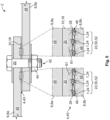
- the current flow there (indicated by dashed lines 61 representing several current paths) takes place from one of the two conductors 8a, via the solid particles 1 of first contact surface 6a, through carrier body 10, via the solid particles 1 of second contact surface 6b into the other of the two conductors 8b or vice versa.
- first contact surface 6a comprises the spray coating containing solid particles
- second contact surface 6b comprises a conventional silver coating (see enlargements in Figure 5 ).
- contact element 4 can also be welded or soldered to second contact surface 6b on conductor 8a.
- the two electrical conductors to be connected to one another can share a contact surface.
- the two electrical conductors can rest next to one another on the same contact surface.
- the contact element can alternatively be part of an electrical module (not shown), in particular a connection point of the electrical module, to which the at least one electrical conductor is to be connected.
- Connection assembly 2 can comprise an attachment device 42, where attachment device 42 is configured to press contact element 4 against at least one electrical conductor 8 while creating a press-fit. Accordingly, contact element 4 is pressed against at least one conductor 8 by attachment device 42 while creating the press-fit.
- Attachment device 42 can be, for example, screw 20 already mentioned and a nut 44 or a threaded sleeve (not shown) or a rivet. In the embodiment shown in Figure 4 , attachment device 42 can hold contact element 4 between the two electrical conductors 8a, 8b.
- attachment device 42 can also be configured as a clip or clamp. Carrier body 10 then does not necessarily need opening 14. If necessary, connection assembly 2 can also comprise several attachment devices 42.
- the solid particles 1 of spray coating 22 can have a greater toughness or strength, in particular a greater elongation at break, than an oxide layer 46 present on at least one conductor 8.
- the oxide layer is more brittle or ductile than the solid particles 1 so that the solid particles 1 break through oxide layer 46 when contact element 4 and at least one electrical conductor 8 are pressed against one another.
- the solid particles 1 protrude through oxide layer 46 of at least one electrical conductor 8 and extend up to a non-oxidized region 48 of at least one electrical conductor 8 (see Figure 4 ).
- the method according to the invention is used to manufacture contact element 4 according to the invention and comprises, as a method step, the provision of electrically conductive carrier body 10 with the at least one contact surface 6. As indicated in Figure 3 , a further method step of spraying at least one contact surface 6 with the electrically conductive solid particles 1 follows.
- Spray coating 22 is applied onto at least one contact surface 6.
- Spray coating 22 can be a spray coating 50, in particular a thermal spray coating 52.
- the spraying process can be carried out using a thermal spraying process, for example, cold gas spraying or plasma spraying.
- thermal spray coating can be cold gas coating or plasma spray coating.
- a spattered, edged, and/or spherical powder 56 can be used as starting material 54 for the electrically conductive solid particles 1. Powder having a broken, spherical, or block-like particle shape can alternatively also be employed.
- the solid particles 1 are not or as little as possible melted off or on or fused during the spraying process.
- the solid particles 1 can be applied mainly by acceleration in the direction of at least one contact surface 6. This is indicated in Figure 2 by arrows 58.
- the cold gas spraying method can be used.
- Figure 2 shows the first use according to the invention of a spray medium 60, a spraying agent or a spray containing the electrically conductive solid particles 1 for creating spray coating 22 on electrically conductive carrier body 10 of contact element 4.
Landscapes
- Chemical & Material Sciences (AREA)
- Engineering & Computer Science (AREA)
- Chemical Kinetics & Catalysis (AREA)
- Mechanical Engineering (AREA)
- Materials Engineering (AREA)
- Metallurgy (AREA)
- Organic Chemistry (AREA)
- Plasma & Fusion (AREA)
- Physics & Mathematics (AREA)
- Manufacturing & Machinery (AREA)
- Electrochemistry (AREA)
- General Chemical & Material Sciences (AREA)
- Coating By Spraying Or Casting (AREA)
- Connection Of Batteries Or Terminals (AREA)
- Other Surface Treatments For Metallic Materials (AREA)
Abstract
The present invention relates to a contact element (4) comprising an electrically conductive carrier body (10) with at least one contact surface (6, 6a, 6b) for contacting at least one electrical conductor (8, 8a, 8b), wherein the at least one contact surface (6, 6a, 6b) comprises a spray coating (22) made of electrically conductive solid particles (1) distributed over the at least one contact surface (6, 6a, 6b). The presence and distribution of the solid particles (1) lead to a reduction in the contact resistance between the contact element (4) and the at least one conductor (8, 8a, 8b) when the contact element (4) is pressed with the at least one contact surface (6, 6a, 6b) against the at least one conductor (8, 8a, 8b) and the solid particles (1) have there penetrated at least in part into the material of the at least one conductor (8, 8a, 8b). The present invention furthermore relates to a connection assembly (2) with such a contact element (4). The present invention additionally relates to the use of a spray medium (60) as well as to a method for manufacturing such a contact element (4).
Description
- The present invention relates to a contact element for contacting at least one electrical conductor, such as a busbar. Furthermore, the present invention relates to an electrical connection assembly with such a contact element and at least one electrical conductor. The present invention furthermore relates to the application of a sprayed coating and a method for manufacturing such a contact element.
- To transmit electrical currents between electrical modules, such as battery modules and electric motors or other electrical consumption and generation units, electrical conductors made of copper, aluminum, or their alloys are often used in automotive and energy technology. The electrical conductors e.g. in the form of busbars often have to be connected to one another or to the electrical modules in a current-conducting manner. This occurs at designated contact surfaces which are usually pressed together to establish an electrical connection. This inevitably results in contact resistance which impairs current transmission. The latter is composed of the constriction resistance and the surface contamination resistance.
- The present invention is based on the object of providing devices for electrically connecting electrical conductors to one another in a current-conducting manner with the lowest possible contact resistance.
- This object is achieved by a contact element comprising an electrically conductive carrier body with at least one contact surface for contacting at least one electrical conductor, where the at least one contact surface comprises a spray coating made of electrically conductive solid particles distributed over the at least one contact surface.
- The features and properties of the solid particles described in the framework of this application preferably apply to all solid particles, but they apply at least to the majority of the solid particles or at least to their average.
- The present invention is advantageous because it can reduce the contact resistance. This shall be explained in more detail hereafter:
On the one hand, the electrically conductive solid particles can form micro-contacts (so-called a-spots) establishing contact at discrete locations at which the current transfer takes place between the contact element and the at least one electrical conductor. Since these are discrete locations, the contact pressure there is higher as compared to continuous contact surfaces pressed together using the same normal force. Any contamination layers that may be present can be broken open and the surface contamination resistance can be reduced. In addition, the number and position of the discrete locations can be optimized by way of the parameters of the spray coating (e.g. particle density). - On the other hand, due to the distribution of the solid particles over the at least one contact surface, the micro-contacts (hereinafter also referred to as micro-surfaces or micro-surfaces establishing contact) are also distributed accordingly. This means that the current flow is not restricted at a single location and the proportion of constriction resistance that arises from the mutual influence of the individual micro-contacts can be reduced.
- In summary, this means that the presence and distribution of the solid particles on the contact element according to the invention leads to a reduction in the contact resistance.
- The contact element according to the invention can be part of an electrical module, in particular a connection point of the electrical module, to which the at least one electrical conductor is to be connected. Alternatively, the contact element according to the invention can be arranged between two electrical conductors to be connected to one another. In addition, only one side of the contact element according to the invention in such an embodiment can comprise the at least one contact surface with the spray coating according to the invention and the other side of the contact element can be formed with a conventional silver coating. Furthermore, the two electrical conductors to be connected to one another can alternatively share the at least one contact surface.
- The invention can be further improved by the following embodiments which are advantageous by themselves and which can be combined with one another arbitrarily.
- According to an exemplary embodiment, the solid particles can protrude from an oxide layer that may be present on the carrier body and at the same time contact a non-oxidized region of the carrier body and of the conductor to be contacted.
- According to a further exemplary embodiment, the solid particles can be anchored in the carrier body at one end and protrude from the carrier body at another end. Due to the local high contact pressure, existing oxide layers on the conductors can be broken open. The particle diameter of the solid particles can be larger than the average layer thickness of the oxide layer on the conductor to be contacted. In order to ensure that the solid particles penetrate to the non-oxidized region of the conductor, the solid particles preferably have such a high strength that the oxide layer present on the conductor to be contacted shatters. The solid particles can penetrate and bridge the oxide layer, should an oxide layer be present. This lowers the so-called surface contamination resistance, which is part of the contact resistance, without the at least one electrical conductor having to be pre-treated or coated in order to remove the oxide layer or not allow it to form in the first place. This leads to a significant saving in effort and costs, since untreated and uncoated busbars can be used as electrical conductors.
- It should presently be noted that the complexity and costs of the coating are in fact reduced and in no way just shifted from the electrical conductor to the contact element. The contact element is smaller and easier to handle than the electrical conductor, which makes it easier to coat. In addition, the contact element represents a universally employable solution that does not depend on the material or any coatings of the electrical conductor. Of course, coated and pretreated (e.g. by steel brushing and/or sandblasting) busbars can also be used as electrical conductors.
- Furthermore, the particle diameter of the solid particles can be larger than, in particular more than twice, the average surface roughness of the at least one contact surface. The average surface roughness can be, for example, the mean roughness value or the roughness depth. The particle diameter of the solid particles can preferably be larger than 50 µm. In this way, the solid particles do not sink into the valleys of the surface structure of the contact region and instead protrude over the peaks of the surface structure of the contact surface.
- According to a further possible embodiment of the contact element, the solid particles can be formed to be edged, in particular sharp-edged, spattered, and/or spherical. As a result, the solid particles can cling well during spray coating for the purpose of anchoring to the substrate (i.e. to the carrier body). Sharp edges are also helpful in breaking open the oxide layers that may be present on the conductor to be contacted. The solid particles can also be spherical or be provided with a combination of a spherical and edged geometry.
- In order to further promote the oxide layer breaking open, the solid particles can have a greater hardness than the carrier body. The solid particles can contain, for example, at least one material from the group of nickel, silver, platinum, titanium, ruthenium, tungsten, iron, cobalt, zinc, copper, chromium and magnesium or their alloys. The carrier body can be manufactured from, for example, aluminum, copper or their alloy.
- According to a further possible embodiment of the contact element, the solid particles can comprise a core and a coating. In particular, the solid particles can have what is known as a core-shell structure. Advantageously, the material of the core can differ from the material of the coating, resulting in flexibility in the selection of material. For example, the material of the core can be selected for hardness and/or conductivity, whereas the material of the coating is selected in terms of hardness. The solid particles preferably have a core made of a copper-zinc or copper-tin alloy or a copper-silver or a copper-iron or a copper-nickel or a copper-magnesium alloy with a coating of nickel, silver, or their alloy.
- According to a further possible embodiment of the contact element, the solid particles can be distributed over the entire contact surface. Furthermore, the solid particles can be evenly distributed over the at least one contact surface. In the case of the evenly distributed solid particles, the average number of solid particles per unit area (i.e. particle density) is constant for different regions or at least within a +/-20% deviation, in particular within a +/-10% deviation. In this way, the available space is used as completely as possible.
- However, the solid particles need not to cover the entire contact surface. According to a material and cost-saving embodiment of the contact element, it is sufficient to have the solid particles cover less than 10% of the surface of the at least one contact surface.
- In order to keep the correction of the constriction resistance as large as possible, the individual solid particles can be spaced from one another. In other words, the solid particles to the degree possible form no or at least few agglomerates. Alternatively, the solid particles can of course also form agglomerates. The agglomerates can in turn be spaced from one another in order to achieve favorable current distribution.
- In addition, the solid particles can be distributed aperiodically (i.e. not periodically or not forming a regular pattern) over the at least one contact surface. This embodiment has the advantage that impressions created by the solid particles on the at least one conductor do not fall onto one another when the contact element and the at least one conductor are repeatedly connected as part of repair and maintenance work. If the impressions fall onto one another, as would be expected with a periodic distribution, the current transmission would be impaired because the impressions represent worn regions. In other words, with an aperiodic distribution of the solid particles, it is more likely than with a periodic distribution that new impressions arise in places that have not yet been worn when the contact element is reconnected to the at least one conductor. Alternatively, the solid particles and agglomerates of solid particles can of course also be distributed periodically (i.e. forming a regular pattern) over the at least one contact surface.
- According to a further possible embodiment, the spray coating can contain a material with an affinity for oxygen, such as chromium or magnesium. The material with an affinity for oxygen can be distributed over the entire contact surface or can be confined to an edge region of the at least one contact surface. Furthermore, the material with an affinity for oxygen can be present as a separate powder component admixed to the solid particles. The material with an affinity for oxygen can be a substance having a low electrochemical standard potential, in particular with an electrochemical standard potential that is lower than that of the solid particles, the contact element, and/or the at least one conductor. The material with an affinity for oxygen can then serve as an oxygen scavenger (so-called getter) and prevent or at least reduce the occurrence of oxidation at the micro-contacts.
- The carrier body can optionally comprise two contact surfaces pointing away from one another for contacting one electrical conductor each. Both contact surfaces can comprise the spray coating. The contact element can therefore be arranged particularly easily between two electrical conductors to be connected to one another. The current then flows from one of the two conductors, via the solid particles of the first contacting contact surface, through the carrier body, via the solid particles of the second contact surface into the other of the two conductors.
- In particular, the carrier body can be configured as a disk-shaped flat body with two flat sides that preferably run parallel to one another and are disposed opposite one another. The flat sides there each form a contact surface. Furthermore, the flat sides each comprise the spray coating. Due to the disk-shaped configuration, the contact element can be used, for example, as part of a retrofit for the electrically conductive connection of two already existing busbars that were previously connected directly to one another, without taking up an excessive amount of installation space.
- The object set out at the outset can also be achieved by a connection assembly comprising a contact element according to one of the embodiments already described and at least one electrical conductor, where the contact element is pressed against the at least one conductor, and where the solid particles of the spray coating have penetrated or been pressed at least in part into the material of the at least one conductor. The at least one electrical conductor can be manufactured from copper, aluminum, or their alloy. The solid particles of the spray coating are present on at least one side of the contact element, preferably on the side which is pressed against the conductor to be contacted.
- The connection assembly benefits from the advantages and technical effects of the contact element according to the invention already described. In particular, the solid particles of the spray coating form the micro-surfaces (i.e. a-spots) establishing contact already mentioned at the points where they have penetrated or been pressed into the material of the at least one conductor, so that the connection between the contact element and the at least one electrical conductor is characterized by low contact resistance.
- The connection assembly optionally comprises an attachment device, wherein the attachment device is configured to press the contact element against the at least one electrical conductor while creating a press-fit.
- The attachment device can be, for example, a screw and a nut or a threaded sleeve or a rivet, respectively. In this case, the contact element can comprise an opening, in particular a central opening, for the attachment device, wherein the opening extends through the carrier body. In the case of the disk-shaped carrier body, the opening can extend to be perpendicular to the two flat sides. For example, a washer or spacer sleeve can be used as a carrier body, wherein the washer or spacer sleeve is made of copper, aluminum, or an alloy based on one of these metals.
- Alternatively, the attachment device can also be configured as a clip or clamp. The carrier body therefore does not necessarily need the opening. If necessary, the connection assembly can also comprise several attachment devices to create a particularly high combined press-fit.
- According to a possible embodiment of the connection assembly, the solid particles of the spray coating can have such high strength that the oxide layer present on the at least one is shattered. In particular, the solid particles of the spray coating can have a greater elongation at break than an oxide layer present on the at least one conductor. In other words, the oxide layer is more brittle or ductile than the solid particles so that the solid particles break through the oxide layer when the contact element and the at least one electrical conductor are pressed against one another. In particular, the solid particles protrude through the oxide layer of the at least one electrical conductor and extend to a non-oxidized region of the at least one electrical conductor.
- The application and/or introduction of the solid particles onto one of the conductors or the carrier material, respectively, can be achieved using various spray coating processes.
- The connection assembly optionally comprises two electrical conductors. If present, the attachment device or devices can hold the contact element between the two electrical conductors.
- A first use of a spray medium or of a spray containing a carrier gas and electrically conductive solid particles for creating a spray coating on an electrically conductive carrier body of a contact element likewise achieves the object set out at the outset. In particular, this use enables the simple manufacture of the contact element according to the invention with the advantages and technical effects already described.
- A second use of electrically conductive solid particles applied by way of spray coating to an electrically conductive carrier body of a contact element for penetrating one or more oxide layers when contacting the contact element with at least one electrical conductor likewise achieves the object set out at the outset because the contact resistance can be reduced due to the solid particles.
- A third use of a contact element with a carrier body for the electrically conductive connection of two electrical conductors likewise achieves the object set out at the outset, wherein two flat sides of the carrier body are respectively placed on one of the two conductors, wherein the contact element is pressed between the two conductors, and wherein solid particles of a spray coating on the carrier body penetrate at least in part the material of the respective conductor. In this third use, the contact element has the advantages and technical effects already described.
- A method for manufacturing the contact element according to the invention likewise achieves the object set out at the outset, wherein the method comprises the steps of providing an electrically conductive carrier body with at least one contact surface and spraying electrically conductive solid particles onto the at least one contact surface. In the spraying process, the spray coating already described is applied onto the at least one contact surface. The contact element produced can thereafter be used as already described and bring about its advantages and technical effects.
- According to a possible embodiment of the method, a spattered, spherical, and/or edged powder can be used as the starting material for the electrically conductive solid particles. Accordingly, when used for the first time according to the invention, the solid particles can be present in the spray medium as a spattered, spherical, and/or edged powder. Due to the spattered, spherical, and/or edged structure, such powder particles can get anchored well in the carrier body. In addition, such powder particles can easily break through oxide layers and are therefore advantageous. The powder having spherical, broken, spheroidal, or block-like particle shape can also be employed.
- According to an embodiment of the contact element that is easy to manufacture, the spray coating can be a thermal spray coating, in particular a cold gas spray coating or a plasma spray coating. In the method according to the invention, the spraying process can accordingly be carried out using a cold gas spraying method or a plasma spraying method. This has the additional advantage that non-weldable or non-coatable material combinations can also be implemented in the contact element.
- In order to maintain the structure, in particular the edged, sharp-edged and spattered structure of the solid particles or at least to change it as little as possible and to largely prevent oxidation of the particles, the solid particles are not melted off or on or fused during the spraying process to the degree possible. In particular, the electrically conductive solid particles can be applied primarily by acceleration in the direction of the at least one contact surface. For example, the method of cold gas spraying or plasma spraying subject to an inert/oxygen-free atmosphere can be used.
- The invention shall be explained hereafter in more detail with reference to the drawings on the basis of several exemplary embodiments, the different features of which may be combined with one another as required in accordance with the above observations. In particular, individual features can be added to the described embodiments in accordance with the above explanations if the effect of these features is necessary for a specific application. Conversely, individual features can be omitted from the existing embodiments if the technical effect of these features is not important in a specific application. Similar, identical, and functionally identical elements in the drawings are provided with the same reference numerals to the extent as appropriate,
where: - Fig. 1
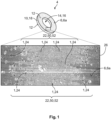
- shows a schematic perspective illustration of a contact element according to an exemplary embodiment;
- Fig. 2
- shows a schematic illustration of a method step of the manufacturing method according to the invention in a side view;
- Fig. 3
- shows a schematic exploded view of a connection assembly according to a first exemplary embodiment in a side view;
- Fig. 4
- shows a schematic illustration of a connection assembly according to a second exemplary embodiment in a side view; and
- Fig. 5
- shows a schematic illustration of a connection assembly according to a third exemplary embodiment in a side view.
- The schematic structure of a
contact element 4 according to the invention shall be described hereafter with reference to the exemplary embodiment fromFigure 1 . Furthermore, the method according to the invention shall be described with reference toFigure 2 . In addition, the schematic structure of aconnection assembly 2 according to the invention shall be explained with reference toFigures 3 to 5 . Finally, a first, second, and third use according to the invention shall be briefly explained with reference toFigures 2 and4 . It is to be noted there thatFigures 1 to 5 are greatly simplified schematic representations which, in particular, are not to be understood to be true to scale. - It can be seen from
Figure 1 thatcontact element 4 comprises an electricallyconductive carrier body 10 with at least one contact surface 6 for contacting at least one electrical conductor 8.Carrier body 10 can optionally comprise two contact surfaces 6a, 6b pointing away from one another for contacting one electrical conductor 8 each (seeFigure 4 ). In particular,carrier body 10 can be configured to be disk-shaped with twoflat sides 12 that preferably run parallel to one another and are disposed opposite one another. Theflat sides 12 there each form one of contact surfaces 6a, 6b. - Furthermore,
contact element 4 can comprise an opening 14, in particular a central opening 16, wherein opening 14 extends throughcarrier body 10 perpendicular to the twoflat sides 12. For example, a washer 18 or spacer sleeve (not shown) can be used as acarrier body 10. Ascrew 20 can be inserted through opening 14 (seeFigure 4 ). - The at least one contact surface 6 comprises a spray coating 22 made of electrically conductive
solid particles 1 distributed over at least one contact surface 6. in particular, both contact surfaces 6a, 6b can comprise spray coating 22. - The
solid particles 1 can form micro-surfaces (so-called a-spots) establishing contact at discrete locations 24 at which the current transfer takes place betweencontact element 4 and the at least one electrical conductor 8. Furthermore, due to the distribution ofsolid particles 1 over the at least one contact surface 6, the micro-surfaces establishing contact are also distributed accordingly. - The features and properties of the
solid particles 1 described in the framework of this application preferably apply to all solid particles1, but they apply at least to the majority of thesolid particles 1 or at least to their average. - As can be seen from
detailed view 26 ofFigure 1 , individualsolid particles 1 are spaced from one another. In other words, thesolid particles 1 to the degree possible form no or at least few agglomerates. In addition, thesolid particles 1 are distributed aperiodically (i.e. not periodically or not forming a regular pattern) over the at least one contact surface 6. Alternatively, thesolid particles 1 can of course also be distributed periodically (i.e. forming a regular pattern) and/or as agglomerates over the at least one contact surface 6. - The
solid particles 1 can be distributed over the entire contact surface 6. However, thesolid particles 1 need not necessarily cover the entire contact surface 6, but less than 10% of the surface of at least one contact surface 6. Furthermore, thesolid particles 1 can be evenly distributed over at least one contact surface 6. I.e. the average number ofsolid particles 1 per unit area is constant for different regions or at least within a +/-20% deviation, in particular within a +/-10% deviation. - As indicated schematically in
Figure 3 , thesolid particles 1 can protrude at one end from anoxide layer 28 present oncarrier body 10 and at the same time contact anon-oxidized region 30 ofcarrier body 10 at another end. In other words, the particle diameter of thesolid particles 1 can be larger than the average layer thickness ofoxide layer 28 oncarrier body 10. In particular, thesolid particles 1 can penetrate up tonon-oxidized region 30 ofcarrier body 10 and be anchored there. In order to achieve this,solid particles 1 preferably have a greater toughness, in particular a greater elongation at break, thanoxide layer 28 oncarrier body 10. This allows thesolid particles 1 to penetrate andbridge oxide layer 28 ofcarrier body 10. - As can be seen from
Figures 2 and 3 , the particle diameter of thesolid particles 1 can be larger than, in particular more than twice, the average surface roughness of at least one contact surface 6. The average surface roughness can be, for example, the mean roughness value or the roughness depth. The particle diameter of thesolid particles 1 can preferably be larger than 50 µm. Thesolid particles 1 therefore do not sink intovalleys 32 of the surface structure of contact surface 6 and at the same time protrude overtips 34 of the surface structure of contact surface 6 (seeFigure 3 ). - As indicated schematically in
Figures 2 to 4 , thesolid particles 1 can be configured to be edged, in particular sharp-edged. As a result, thesolid particles 1 can cling well for the purpose of anchoring to the substrate (i.e. to carrier body 10) (seeFigure 3 ). - In order to additionally promote the anchoring of the
solid particles 1, thesolid particles 1 can have a greater hardness thancarrier body 10. The respective hardness of thesolid particles 1 andcarrier body 10 can be, for example, the Martens, Vickers, Shore, Brinell or Rockwell hardness or a hardness according to another hardness scale. Thesolid particles 1 can contain, for example, at least one material from the group of nickel, silver, platinum, ruthenium, tungsten, iron, cobalt, zinc, copper, and magnesium or their alloys, respectively. The strength, in particular the tensile and/or compressive strength, of thesolid particles 1 is preferably greater than 500 N/m2.Carrier body 10 can be manufactured from, for example, aluminum, copper, or their alloy. - As indicated schematically in
Figure 2 , thesolid particles 1 can comprise acore 36 and acoating 38. In particular, thesolid particles 1 can have what is known as a core-shell structure. Advantageously, the material of core 35 can there differ from the material ofcoating 38, resulting in flexibility in the selection of material. For example, the material ofcore 36 can be selected for hardness, whereas the material ofcoating 38 is selected in terms of conductivity. Thesolid particles 1 preferably have a core 36 made of a copper-zinc alloy or a copper-magnesium alloy with acoating 38 made of nickel, silver, or their alloy. - Spray coating 22 can comprise a material with an affinity for oxygen (not shown), such as chromium and/or magnesium. The material with an affinity for oxygen can be distributed over entire contact surface 6 or can be confined to an edge region of at least one contact surface 6. Furthermore, the material with an affinity for oxygen can be present as a separate powder component admixed to the
solid particles 1, incore 36 of thesolid particles 1, and/or in coating 38 of thesolid particles 1. The material with an affinity for oxygen can be a substance having a low electrochemical standard potential, in particular having a lower electrochemical standard potential than thesolid particles 1,contact element 4, and/or at least one conductor 8. The material with an affinity for oxygen can then serve as an oxygen scavenger and prevent or at least reduce the occurrence of oxidation on the micro-contacts establishing contact. -
Connection assembly 2 shown inFigure 4 can comprisecontact element 4 and at least one conductor 8.Contact element 4 is pressed against at least one conductor 8, wherein thesolid particles 1 of spray coating 22 are penetrated or pressed at least in part into the material of at least one conductor 8. At least one electrical conductor 8 can be configured as a busbar and manufactured from copper, aluminum, or an electrically conductive alloy. - In particular,
connection assembly 2 can comprise two electrical conductors 8a, 8b to be connected to one another, for example, two busbars. As can be seen fromFigure 4 ,contact element 4 can then be arranged between the two electrical conductors 8a, 8b and function as a contact bridge 40. The current flow there (indicated by dashedlines 61 representing several current paths) takes place from one of the two conductors 8a, via thesolid particles 1 of first contact surface 6a, throughcarrier body 10, via thesolid particles 1 of second contact surface 6b into the other of the two conductors 8b or vice versa. According to an alternative embodiment, first contact surface 6a comprises the spray coating containing solid particles, whereas second contact surface 6b comprises a conventional silver coating (see enlargements inFigure 5 ). If necessary,contact element 4 can also be welded or soldered to second contact surface 6b on conductor 8a. - According to an alternative embodiment, not shown, the two electrical conductors to be connected to one another can share a contact surface. In other words, the two electrical conductors can rest next to one another on the same contact surface. Furthermore, the contact element can alternatively be part of an electrical module (not shown), in particular a connection point of the electrical module, to which the at least one electrical conductor is to be connected.
-
Connection assembly 2 can comprise anattachment device 42, whereattachment device 42 is configured to presscontact element 4 against at least one electrical conductor 8 while creating a press-fit. Accordingly,contact element 4 is pressed against at least one conductor 8 byattachment device 42 while creating the press-fit.Attachment device 42 can be, for example, screw 20 already mentioned and anut 44 or a threaded sleeve (not shown) or a rivet. In the embodiment shown inFigure 4 ,attachment device 42 can holdcontact element 4 between the two electrical conductors 8a, 8b. - According to an embodiment not shown,
attachment device 42 can also be configured as a clip or clamp.Carrier body 10 then does not necessarily need opening 14. If necessary,connection assembly 2 can also compriseseveral attachment devices 42. - The
solid particles 1 of spray coating 22 can have a greater toughness or strength, in particular a greater elongation at break, than anoxide layer 46 present on at least one conductor 8. In other words, the oxide layer is more brittle or ductile than thesolid particles 1 so that thesolid particles 1 break throughoxide layer 46 whencontact element 4 and at least one electrical conductor 8 are pressed against one another. In particular, thesolid particles 1 protrude throughoxide layer 46 of at least one electrical conductor 8 and extend up to anon-oxidized region 48 of at least one electrical conductor 8 (seeFigure 4 ). - The method according to the invention is used to manufacture
contact element 4 according to the invention and comprises, as a method step, the provision of electricallyconductive carrier body 10 with the at least one contact surface 6. As indicated inFigure 3 , a further method step of spraying at least one contact surface 6 with the electrically conductivesolid particles 1 follows. - In the spraying process, spray coating 22 is applied onto at least one contact surface 6. Spray coating 22 can be a spray coating 50, in particular a thermal spray coating 52. Accordingly, the spraying process can be carried out using a thermal spraying process, for example, cold gas spraying or plasma spraying. Depending on the spraying process used, thermal spray coating can be cold gas coating or plasma spray coating.
- A spattered, edged, and/or spherical powder 56 can be used as starting material 54 for the electrically conductive
solid particles 1. Powder having a broken, spherical, or block-like particle shape can alternatively also be employed. - In order to maintain the structure, in particular the edged, sharp-edged, and spattered structure of the
solid particles 1 or at least to change it as little as possible, thesolid particles 1 are not or as little as possible melted off or on or fused during the spraying process. In particular, thesolid particles 1 can be applied mainly by acceleration in the direction of at least one contact surface 6. This is indicated inFigure 2 byarrows 58. For example, the cold gas spraying method can be used. -
Figure 2 shows the first use according to the invention of a spray medium 60, a spraying agent or a spray containing the electrically conductivesolid particles 1 for creating spray coating 22 on electricallyconductive carrier body 10 ofcontact element 4. - The second use according to the invention of the electrically conductive
solid particles 1 applied to electricallyconductive carrier body 10 ofcontact element 4 by way of spray coating for penetrating anyoxide layers contact element 4 with at least one electrical conductor 8 is shown inFigure 4 . - The third use according to the invention of
contact element 4 withcarrier body 10 for the electrically conductive connection of the two electrical conductors 8a, 8b is likewise shown inFigure 4 , where twoflat sides 12 ofcarrier body 10 are each applied to one of the two conductors 8a, 8b, wherecontact element 4 is pressed between the two conductors 8a, 8b, and where thesolid particles 1 of spray coating 22 oncarrier body 10 penetrate at least in part into the material of the respective conductors 8a, 8b. -
- 1
- solid particle
- 2
- connection assembly
- 4
- contact element
- 6, 6a, 6b
- contact surface
- 8, 8a, 8b
- conductor
- 10
- carrier body
- 12
- flat side
- 14
- opening
- 16
- central opening
- 18
- washer
- 20
- screw
- 22
- spray coating
- 24
- discrete location
- 26
- detailed view
- 28
- oxide layer
- 30
- region
- 32
- valley
- 34
- tip
- 36
- core
- 38
- coating
- 40
- contact bridge
- 42
- attachment device
- 44
- nut
- 46
- oxide layer
- 48
- region
- 50
- spray coating
- 52
- thermal spray coating
- 54
- starting material
- 56
- spattered powder
- 58
- arrow
- 60
- spray medium
- 61
- line
Claims (16)
- Contact element (4) comprising an electrically conductive carrier body (10) with at least one contact surface (6, 6a, 6b) for contacting at least one electrical conductor (8, 8a, 8b), wherein said at least one contact surface (6, 6a, 6b) comprises a spray coating (22) made of electrically conductive solid particles (1) distributed over said at least one contact surface (6, 6a, 6b).
- Contact element (4) according to claim 1, wherein said solid particles (1) protrude from an oxide layer (28) which may be present on said carrier body (10) and at the same time contact a non-oxidized region (30) of said carrier body (10) and of said conductor to be contacted.
- Contact element (4) according to claim 1 or 2, wherein the average particle diameter of said solid particles (1) is larger than the average surface roughness of said at least one contact surface (6, 6a, 6b) and of said possible oxide layer thickness on said carrier material/component to be connected.
- Contact element (4) according to one of the claims 1 to 3, wherein said solid particles (1) are configured to be edged, spattered, and/or spherical.
- Contact element (4) according to one of the claims 1 to 4, wherein said solid particles (1) have a greater hardness than said carrier body (10).
- Contact element (4) according to one of the claims 1 to 5, wherein said solid particles (1) comprise a core (36) and a coating (38).
- Contact element (4) according to one of the claims 1 to 6, wherein said solid particles (1) are distributed uniformly or aperiodically over said at least one contact surface (6, 6a, 6b) and/or cover less than 10% of the surface of said at least one contact surface (6, 6a, 6b).
- Contact element (4) according to one of the claims 1 to 7, wherein said spray coating (22) contains a material with an affinity for oxygen.
- Contact element (4) according to one of the claims 1 to 8, wherein said carrier body (10) comprises two contact surfaces (6, 6a, 6b) pointing away from one another for contacting one electrical conductor (8, 8a, 8b) each.
- Connection assembly (2) comprising a contact element (4) according to one of the claims 1 to 9 and at least one electrical conductor (8, 8a, 8b), wherein said contact element (4) is pressed against said at least one conductor (8, 8a, 8b) and wherein said solid particles (1) of said spray coating (22) penetrate at least in part into the material of said at least one conductor (8, 8a, 8b).
- Connection assembly (2) according to claim 10, wherein said solid particles (1) of said spray coating (22) have such a high strength that said oxide layer (46) present on said at least one conductor (8, 8a, 8b) is shattered.
- Use of a spray medium (60) containing a carrier gas and solid particles (1) for creating a spray coating (22) on an electrically conductive carrier body (10) of a contact element (4).
- Method for manufacturing a contact element (4), comprising the steps of:- providing an electrically conductive carrier body (10) with at least one contact surface (6, 6a, 6b) and- spraying electrically conductive solid particles (1) onto said at least one contact surface (6, 6a, 6b).
- Method according to claim 13, wherein a spattered, edged, and/or spherical powder (56) is used as starting material (54) for said electrically conductive solid particles (1).
- Method according to claim 13 or 14, wherein the spraying process is carried out using a cold gas spraying method or a plasma spraying method.
- Method according to one of the claims 13 to 15, wherein said solid particles consist of one or more of the elements Ti, W, Ru, Cr, W, Fe, Ag, Co, Pt, Ni, Mg or a Cu alloy and are optionally coated.
Applications Claiming Priority (1)
| Application Number | Priority Date | Filing Date | Title |
|---|---|---|---|
| DE102022129225.8A DE102022129225A1 (en) | 2022-11-04 | 2022-11-04 | Contact element with a spray coating and connection arrangement, use of a spray agent and method for producing a contact element |
Publications (1)
| Publication Number | Publication Date |
|---|---|
| EP4366091A1 true EP4366091A1 (en) | 2024-05-08 |
Family
ID=88651484
Family Applications (1)
| Application Number | Title | Priority Date | Filing Date |
|---|---|---|---|
| EP23207755.2A Pending EP4366091A1 (en) | 2022-11-04 | 2023-11-03 | Contact element with a spray coating as well as connection assembly, use of a spray medium and method for manufacturing a contact element |
Country Status (6)
| Country | Link |
|---|---|
| US (1) | US20240154334A1 (en) |
| EP (1) | EP4366091A1 (en) |
| JP (1) | JP7715469B2 (en) |
| KR (1) | KR102926942B1 (en) |
| CN (1) | CN117996484A (en) |
| DE (1) | DE102022129225A1 (en) |
Families Citing this family (1)
| Publication number | Priority date | Publication date | Assignee | Title |
|---|---|---|---|---|
| US20260016043A1 (en) * | 2024-07-15 | 2026-01-15 | Carbice Corporation | Coated connector devices and methods of making and using thereof |
Citations (4)
| Publication number | Priority date | Publication date | Assignee | Title |
|---|---|---|---|---|
| CA2451978A1 (en) * | 2001-06-15 | 2002-12-27 | Groupe Minutia Inc. | Method and product for electrically contacting oxide-coated conductors |
| US20040149685A1 (en) * | 2001-06-15 | 2004-08-05 | Sabin Boily | Method and product for electrically contacting oxide-coated conductors |
| US20120305300A1 (en) * | 2009-12-18 | 2012-12-06 | Metalor Technologies International Sa | Methods for manufacturing an electric contact pad and electric contact |
| US20180097295A1 (en) * | 2015-06-08 | 2018-04-05 | Te Connectivity Germany Gmbh | Electrical Contact Element And Method For Altering Mechanical And/Or Electrical Properties Of At Least One Area Of Such |
Family Cites Families (17)
| Publication number | Priority date | Publication date | Assignee | Title |
|---|---|---|---|---|
| US3157735A (en) * | 1961-06-27 | 1964-11-17 | Aluminum Co Of America | Metallic particle compositions for mechanically joined electrical conductors |
| DE6932095U (en) * | 1969-08-11 | 1969-12-04 | Bbc Brown Boveri & Cie | CONTACT CONNECTION OF TWO CURRENT CONDUCTORS WITH LEVEL CONTACT AREAS |
| JP2820366B2 (en) * | 1994-03-04 | 1998-11-05 | 東京電力株式会社 | Terminal structure of sodium-sulfur battery |
| JP4274014B2 (en) | 2004-03-18 | 2009-06-03 | 日産自動車株式会社 | Conductive member and battery pack |
| JP5500676B2 (en) | 2009-12-24 | 2014-05-21 | 株式会社日立製作所 | Heat-resistant alloy film forming method and composite powder used therefor |
| JP5186528B2 (en) * | 2010-04-23 | 2013-04-17 | 日本発條株式会社 | Conductive member and manufacturing method thereof |
| JP5872844B2 (en) * | 2011-10-26 | 2016-03-01 | 日本発條株式会社 | Method for producing composite material and composite material |
| US20150044493A1 (en) * | 2012-03-22 | 2015-02-12 | Nippon Light Metal Company, Ltd | METHOD FOR ANCHORING Sn POWDER ON ALUMINIUM SUBSTRATE AND ALUMINIUM ELECRTOCONDUCTIVE MEMBER |
| DE102012017609A1 (en) * | 2012-09-06 | 2014-03-06 | Phoenix Contact Gmbh & Co. Kg | Connection terminal for making contact of aluminum conductor with current-carrying element, has clamping portion on which particles are embedded such that edge portions of particles are protruded from outer surface of clamping portion |
| JP5985993B2 (en) | 2013-01-10 | 2016-09-06 | 日立オートモティブシステムズ株式会社 | Battery pack and manufacturing method thereof |
| JP5654088B1 (en) | 2013-07-08 | 2015-01-14 | 日本発條株式会社 | Conductive member and method of manufacturing conductive member |
| DE102015210458A1 (en) * | 2015-06-08 | 2016-12-08 | Te Connectivity Germany Gmbh | Method for connecting a conductor having a base metal with a copper-containing terminal element by means of welding and a connection arrangement produced thereby |
| JP6454262B2 (en) | 2015-12-24 | 2019-01-16 | タツタ電線株式会社 | Solder connection structure and film forming method |
| JP2017135076A (en) | 2016-01-29 | 2017-08-03 | 住友電装株式会社 | Method for producing wire harness |
| US10347896B2 (en) | 2016-06-14 | 2019-07-09 | Ford Global Technologies, Llc | Electrical interconnects for battery cells |
| JP2019127599A (en) | 2018-01-19 | 2019-08-01 | タツタ電線株式会社 | Bus bar, and manufacturing method of bus bar |
| CN112542660A (en) | 2020-12-07 | 2021-03-23 | 东莞仁海科技股份有限公司 | Lithium battery electrode connection process |
-
2022
- 2022-11-04 DE DE102022129225.8A patent/DE102022129225A1/en active Pending
-
2023
- 2023-10-30 US US18/497,070 patent/US20240154334A1/en active Pending
- 2023-10-31 JP JP2023186126A patent/JP7715469B2/en active Active
- 2023-11-02 CN CN202311448402.3A patent/CN117996484A/en active Pending
- 2023-11-02 KR KR1020230150003A patent/KR102926942B1/en active Active
- 2023-11-03 EP EP23207755.2A patent/EP4366091A1/en active Pending
Patent Citations (4)
| Publication number | Priority date | Publication date | Assignee | Title |
|---|---|---|---|---|
| CA2451978A1 (en) * | 2001-06-15 | 2002-12-27 | Groupe Minutia Inc. | Method and product for electrically contacting oxide-coated conductors |
| US20040149685A1 (en) * | 2001-06-15 | 2004-08-05 | Sabin Boily | Method and product for electrically contacting oxide-coated conductors |
| US20120305300A1 (en) * | 2009-12-18 | 2012-12-06 | Metalor Technologies International Sa | Methods for manufacturing an electric contact pad and electric contact |
| US20180097295A1 (en) * | 2015-06-08 | 2018-04-05 | Te Connectivity Germany Gmbh | Electrical Contact Element And Method For Altering Mechanical And/Or Electrical Properties Of At Least One Area Of Such |
Also Published As
| Publication number | Publication date |
|---|---|
| JP2024068152A (en) | 2024-05-17 |
| CN117996484A (en) | 2024-05-07 |
| KR102926942B1 (en) | 2026-02-11 |
| DE102022129225A1 (en) | 2024-05-08 |
| US20240154334A1 (en) | 2024-05-09 |
| JP7715469B2 (en) | 2025-07-30 |
| KR20240066236A (en) | 2024-05-14 |
Similar Documents
| Publication | Publication Date | Title |
|---|---|---|
| JP4834022B2 (en) | Silver coating material for movable contact parts and manufacturing method thereof | |
| US7294028B2 (en) | Electrical contact | |
| JP4834023B2 (en) | Silver coating material for movable contact parts and manufacturing method thereof | |
| CA2240239A1 (en) | Tin coated electrical connector | |
| JP5460585B2 (en) | Sliding member manufacturing method, sliding member and sliding member base material | |
| CN107104292A (en) | A kind of joint and its method for resistance welding of copper tip and aluminum conductor | |
| US9793554B2 (en) | Fuel cell separator and fuel cell | |
| JP7789783B2 (en) | Method for manufacturing a bipolar plate for an electrochemical cell and bipolar plate | |
| EP4366091A1 (en) | Contact element with a spray coating as well as connection assembly, use of a spray medium and method for manufacturing a contact element | |
| JP2020522871A (en) | Joint of copper terminal and aluminum conductor and its magnetic induction welding method | |
| US20160344127A1 (en) | Electroconductive material with an undulating surface, an electrical terminal formed of said material, and a method of producing said material | |
| US20140220836A1 (en) | Crimped Terminal | |
| US7015406B2 (en) | Electric contact | |
| JP2010146925A (en) | Contactor material for electric motor and method of manufacturing the same | |
| JP2009283288A (en) | Crimp terminal for aluminum wire | |
| DE102016006064A1 (en) | Manufacturing method for a thermoelectric device | |
| CN1072043A (en) | Compound electrical contact | |
| JP2004111079A (en) | Metal separator for fuel cell and polymer electrolyte fuel cell using the same | |
| JP4169848B2 (en) | Electrolytic electrode and method for producing electrolytic electrode | |
| US20040149685A1 (en) | Method and product for electrically contacting oxide-coated conductors | |
| CN120109552A (en) | Aluminum-containing metal terminal with coating and preparation method thereof | |
| CN120109551A (en) | Copper terminal with tin-containing coating and preparation method thereof | |
| CA2451978A1 (en) | Method and product for electrically contacting oxide-coated conductors | |
| WO2007116717A1 (en) | Silver coated composite material for movable contact and method for producing same | |
| JPH04124299A (en) | Copper-based platinum-clad electrode |
Legal Events
| Date | Code | Title | Description |
|---|---|---|---|
| PUAI | Public reference made under article 153(3) epc to a published international application that has entered the european phase |
Free format text: ORIGINAL CODE: 0009012 |
|
| STAA | Information on the status of an ep patent application or granted ep patent |
Free format text: STATUS: REQUEST FOR EXAMINATION WAS MADE |
|
| 17P | Request for examination filed |
Effective date: 20231103 |
|
| AK | Designated contracting states |
Kind code of ref document: A1 Designated state(s): AL AT BE BG CH CY CZ DE DK EE ES FI FR GB GR HR HU IE IS IT LI LT LU LV MC ME MK MT NL NO PL PT RO RS SE SI SK SM TR |
|
| RBV | Designated contracting states (corrected) |
Designated state(s): AL AT BE BG CH CY CZ DE DK EE ES FI FR GB GR HR HU IE IS IT LI LT LU LV MC ME MK MT NL NO PL PT RO RS SE SI SK SM TR |