EP4364617A1 - Beverage container cover assembly - Google Patents
Beverage container cover assembly Download PDFInfo
- Publication number
- EP4364617A1 EP4364617A1 EP23204071.7A EP23204071A EP4364617A1 EP 4364617 A1 EP4364617 A1 EP 4364617A1 EP 23204071 A EP23204071 A EP 23204071A EP 4364617 A1 EP4364617 A1 EP 4364617A1
- Authority
- EP
- European Patent Office
- Prior art keywords
- lid
- lid cover
- axis
- bottom panel
- cover
- Prior art date
- Legal status (The legal status is an assumption and is not a legal conclusion. Google has not performed a legal analysis and makes no representation as to the accuracy of the status listed.)
- Pending
Links
Images




Classifications
-
- B—PERFORMING OPERATIONS; TRANSPORTING
- B65—CONVEYING; PACKING; STORING; HANDLING THIN OR FILAMENTARY MATERIAL
- B65D—CONTAINERS FOR STORAGE OR TRANSPORT OF ARTICLES OR MATERIALS, e.g. BAGS, BARRELS, BOTTLES, BOXES, CANS, CARTONS, CRATES, DRUMS, JARS, TANKS, HOPPERS, FORWARDING CONTAINERS; ACCESSORIES, CLOSURES, OR FITTINGS THEREFOR; PACKAGING ELEMENTS; PACKAGES
- B65D47/00—Closures with filling and discharging, or with discharging, devices
- B65D47/04—Closures with discharging devices other than pumps
- B65D47/20—Closures with discharging devices other than pumps comprising hand-operated members for controlling discharge
- B65D47/26—Closures with discharging devices other than pumps comprising hand-operated members for controlling discharge with slide valves, i.e. valves that open and close a passageway by sliding over a port, e.g. formed with slidable spouts
- B65D47/261—Closures with discharging devices other than pumps comprising hand-operated members for controlling discharge with slide valves, i.e. valves that open and close a passageway by sliding over a port, e.g. formed with slidable spouts having a rotational or helicoidal movement
- B65D47/265—Closures with discharging devices other than pumps comprising hand-operated members for controlling discharge with slide valves, i.e. valves that open and close a passageway by sliding over a port, e.g. formed with slidable spouts having a rotational or helicoidal movement between planar parts
-
- A—HUMAN NECESSITIES
- A47—FURNITURE; DOMESTIC ARTICLES OR APPLIANCES; COFFEE MILLS; SPICE MILLS; SUCTION CLEANERS IN GENERAL
- A47G—HOUSEHOLD OR TABLE EQUIPMENT
- A47G19/00—Table service
- A47G19/22—Drinking vessels or saucers used for table service
- A47G19/2205—Drinking glasses or vessels
- A47G19/2266—Means for facilitating drinking, e.g. for infants or invalids
- A47G19/2272—Means for facilitating drinking, e.g. for infants or invalids from drinking glasses or cups comprising lids or covers
-
- B—PERFORMING OPERATIONS; TRANSPORTING
- B65—CONVEYING; PACKING; STORING; HANDLING THIN OR FILAMENTARY MATERIAL
- B65D—CONTAINERS FOR STORAGE OR TRANSPORT OF ARTICLES OR MATERIALS, e.g. BAGS, BARRELS, BOTTLES, BOXES, CANS, CARTONS, CRATES, DRUMS, JARS, TANKS, HOPPERS, FORWARDING CONTAINERS; ACCESSORIES, CLOSURES, OR FITTINGS THEREFOR; PACKAGING ELEMENTS; PACKAGES
- B65D1/00—Rigid or semi-rigid containers having bodies formed in one piece, e.g. by casting metallic material, by moulding plastics, by blowing vitreous material, by throwing ceramic material, by moulding pulped fibrous material or by deep-drawing operations performed on sheet material
- B65D1/22—Boxes or like containers with side walls of substantial depth for enclosing contents
- B65D1/26—Thin-walled containers, e.g. formed by deep-drawing operations
- B65D1/265—Drinking cups
-
- B—PERFORMING OPERATIONS; TRANSPORTING
- B65—CONVEYING; PACKING; STORING; HANDLING THIN OR FILAMENTARY MATERIAL
- B65D—CONTAINERS FOR STORAGE OR TRANSPORT OF ARTICLES OR MATERIALS, e.g. BAGS, BARRELS, BOTTLES, BOXES, CANS, CARTONS, CRATES, DRUMS, JARS, TANKS, HOPPERS, FORWARDING CONTAINERS; ACCESSORIES, CLOSURES, OR FITTINGS THEREFOR; PACKAGING ELEMENTS; PACKAGES
- B65D43/00—Lids or covers for rigid or semi-rigid containers
- B65D43/02—Removable lids or covers
- B65D43/0202—Removable lids or covers without integral tamper element
- B65D43/0204—Removable lids or covers without integral tamper element secured by snapping over beads or projections
- B65D43/021—Removable lids or covers without integral tamper element secured by snapping over beads or projections only on the inside, or a part turned to the inside, of the mouth
-
- B—PERFORMING OPERATIONS; TRANSPORTING
- B65—CONVEYING; PACKING; STORING; HANDLING THIN OR FILAMENTARY MATERIAL
- B65D—CONTAINERS FOR STORAGE OR TRANSPORT OF ARTICLES OR MATERIALS, e.g. BAGS, BARRELS, BOTTLES, BOXES, CANS, CARTONS, CRATES, DRUMS, JARS, TANKS, HOPPERS, FORWARDING CONTAINERS; ACCESSORIES, CLOSURES, OR FITTINGS THEREFOR; PACKAGING ELEMENTS; PACKAGES
- B65D43/00—Lids or covers for rigid or semi-rigid containers
- B65D43/02—Removable lids or covers
- B65D43/0202—Removable lids or covers without integral tamper element
- B65D43/0214—Removable lids or covers without integral tamper element secured only by friction or gravity
- B65D43/022—Removable lids or covers without integral tamper element secured only by friction or gravity only on the inside, or a part turned to the inside, of the mouth of the container
-
- B—PERFORMING OPERATIONS; TRANSPORTING
- B65—CONVEYING; PACKING; STORING; HANDLING THIN OR FILAMENTARY MATERIAL
- B65D—CONTAINERS FOR STORAGE OR TRANSPORT OF ARTICLES OR MATERIALS, e.g. BAGS, BARRELS, BOTTLES, BOXES, CANS, CARTONS, CRATES, DRUMS, JARS, TANKS, HOPPERS, FORWARDING CONTAINERS; ACCESSORIES, CLOSURES, OR FITTINGS THEREFOR; PACKAGING ELEMENTS; PACKAGES
- B65D51/00—Closures not otherwise provided for
- B65D51/16—Closures not otherwise provided for with means for venting air or gas
- B65D51/1672—Closures not otherwise provided for with means for venting air or gas whereby venting occurs by manual actuation of the closure or other element
- B65D51/1683—Closures not otherwise provided for with means for venting air or gas whereby venting occurs by manual actuation of the closure or other element by actuating a separate element in the container or closure
-
- A—HUMAN NECESSITIES
- A47—FURNITURE; DOMESTIC ARTICLES OR APPLIANCES; COFFEE MILLS; SPICE MILLS; SUCTION CLEANERS IN GENERAL
- A47G—HOUSEHOLD OR TABLE EQUIPMENT
- A47G2200/00—Details not otherwise provided for in A47G
- A47G2200/10—Magnetism
- A47G2200/106—Permanent
-
- B—PERFORMING OPERATIONS; TRANSPORTING
- B65—CONVEYING; PACKING; STORING; HANDLING THIN OR FILAMENTARY MATERIAL
- B65D—CONTAINERS FOR STORAGE OR TRANSPORT OF ARTICLES OR MATERIALS, e.g. BAGS, BARRELS, BOTTLES, BOXES, CANS, CARTONS, CRATES, DRUMS, JARS, TANKS, HOPPERS, FORWARDING CONTAINERS; ACCESSORIES, CLOSURES, OR FITTINGS THEREFOR; PACKAGING ELEMENTS; PACKAGES
- B65D2313/00—Connecting or fastening means
- B65D2313/04—Connecting or fastening means of magnetic type
-
- B—PERFORMING OPERATIONS; TRANSPORTING
- B65—CONVEYING; PACKING; STORING; HANDLING THIN OR FILAMENTARY MATERIAL
- B65D—CONTAINERS FOR STORAGE OR TRANSPORT OF ARTICLES OR MATERIALS, e.g. BAGS, BARRELS, BOTTLES, BOXES, CANS, CARTONS, CRATES, DRUMS, JARS, TANKS, HOPPERS, FORWARDING CONTAINERS; ACCESSORIES, CLOSURES, OR FITTINGS THEREFOR; PACKAGING ELEMENTS; PACKAGES
- B65D2543/00—Lids or covers essentially for box-like containers
- B65D2543/00009—Details of lids or covers for rigid or semi-rigid containers
- B65D2543/00018—Overall construction of the lid
- B65D2543/00046—Drinking-through lids
-
- B—PERFORMING OPERATIONS; TRANSPORTING
- B65—CONVEYING; PACKING; STORING; HANDLING THIN OR FILAMENTARY MATERIAL
- B65D—CONTAINERS FOR STORAGE OR TRANSPORT OF ARTICLES OR MATERIALS, e.g. BAGS, BARRELS, BOTTLES, BOXES, CANS, CARTONS, CRATES, DRUMS, JARS, TANKS, HOPPERS, FORWARDING CONTAINERS; ACCESSORIES, CLOSURES, OR FITTINGS THEREFOR; PACKAGING ELEMENTS; PACKAGES
- B65D2543/00—Lids or covers essentially for box-like containers
- B65D2543/00009—Details of lids or covers for rigid or semi-rigid containers
- B65D2543/00018—Overall construction of the lid
- B65D2543/00064—Shape of the outer periphery
- B65D2543/00074—Shape of the outer periphery curved
- B65D2543/00092—Shape of the outer periphery curved circular
-
- B—PERFORMING OPERATIONS; TRANSPORTING
- B65—CONVEYING; PACKING; STORING; HANDLING THIN OR FILAMENTARY MATERIAL
- B65D—CONTAINERS FOR STORAGE OR TRANSPORT OF ARTICLES OR MATERIALS, e.g. BAGS, BARRELS, BOTTLES, BOXES, CANS, CARTONS, CRATES, DRUMS, JARS, TANKS, HOPPERS, FORWARDING CONTAINERS; ACCESSORIES, CLOSURES, OR FITTINGS THEREFOR; PACKAGING ELEMENTS; PACKAGES
- B65D2543/00—Lids or covers essentially for box-like containers
- B65D2543/00009—Details of lids or covers for rigid or semi-rigid containers
- B65D2543/00018—Overall construction of the lid
- B65D2543/00231—Overall construction of the lid made of several pieces
-
- B—PERFORMING OPERATIONS; TRANSPORTING
- B65—CONVEYING; PACKING; STORING; HANDLING THIN OR FILAMENTARY MATERIAL
- B65D—CONTAINERS FOR STORAGE OR TRANSPORT OF ARTICLES OR MATERIALS, e.g. BAGS, BARRELS, BOTTLES, BOXES, CANS, CARTONS, CRATES, DRUMS, JARS, TANKS, HOPPERS, FORWARDING CONTAINERS; ACCESSORIES, CLOSURES, OR FITTINGS THEREFOR; PACKAGING ELEMENTS; PACKAGES
- B65D2543/00—Lids or covers essentially for box-like containers
- B65D2543/00009—Details of lids or covers for rigid or semi-rigid containers
- B65D2543/00444—Contact between the container and the lid
- B65D2543/00481—Contact between the container and the lid on the inside or the outside of the container
- B65D2543/0049—Contact between the container and the lid on the inside or the outside of the container on the inside, or a part turned to the inside of the mouth of the container
- B65D2543/005—Contact between the container and the lid on the inside or the outside of the container on the inside, or a part turned to the inside of the mouth of the container both cup and skirt
-
- B—PERFORMING OPERATIONS; TRANSPORTING
- B65—CONVEYING; PACKING; STORING; HANDLING THIN OR FILAMENTARY MATERIAL
- B65D—CONTAINERS FOR STORAGE OR TRANSPORT OF ARTICLES OR MATERIALS, e.g. BAGS, BARRELS, BOTTLES, BOXES, CANS, CARTONS, CRATES, DRUMS, JARS, TANKS, HOPPERS, FORWARDING CONTAINERS; ACCESSORIES, CLOSURES, OR FITTINGS THEREFOR; PACKAGING ELEMENTS; PACKAGES
- B65D2543/00—Lids or covers essentially for box-like containers
- B65D2543/00009—Details of lids or covers for rigid or semi-rigid containers
- B65D2543/00444—Contact between the container and the lid
- B65D2543/00592—Snapping means
- B65D2543/00712—Snapping means on the lid
- B65D2543/00722—Profiles
- B65D2543/00731—Groove or hollow bead
-
- B—PERFORMING OPERATIONS; TRANSPORTING
- B65—CONVEYING; PACKING; STORING; HANDLING THIN OR FILAMENTARY MATERIAL
- B65D—CONTAINERS FOR STORAGE OR TRANSPORT OF ARTICLES OR MATERIALS, e.g. BAGS, BARRELS, BOTTLES, BOXES, CANS, CARTONS, CRATES, DRUMS, JARS, TANKS, HOPPERS, FORWARDING CONTAINERS; ACCESSORIES, CLOSURES, OR FITTINGS THEREFOR; PACKAGING ELEMENTS; PACKAGES
- B65D2543/00—Lids or covers essentially for box-like containers
- B65D2543/00009—Details of lids or covers for rigid or semi-rigid containers
- B65D2543/00444—Contact between the container and the lid
- B65D2543/00592—Snapping means
- B65D2543/00712—Snapping means on the lid
- B65D2543/00787—Periphery concerned
- B65D2543/00796—Totality
-
- B—PERFORMING OPERATIONS; TRANSPORTING
- B65—CONVEYING; PACKING; STORING; HANDLING THIN OR FILAMENTARY MATERIAL
- B65D—CONTAINERS FOR STORAGE OR TRANSPORT OF ARTICLES OR MATERIALS, e.g. BAGS, BARRELS, BOTTLES, BOXES, CANS, CARTONS, CRATES, DRUMS, JARS, TANKS, HOPPERS, FORWARDING CONTAINERS; ACCESSORIES, CLOSURES, OR FITTINGS THEREFOR; PACKAGING ELEMENTS; PACKAGES
- B65D2543/00—Lids or covers essentially for box-like containers
- B65D2543/00009—Details of lids or covers for rigid or semi-rigid containers
- B65D2543/00953—Sealing means
- B65D2543/00962—Sealing means inserted
- B65D2543/00972—Collars or rings
-
- B—PERFORMING OPERATIONS; TRANSPORTING
- B65—CONVEYING; PACKING; STORING; HANDLING THIN OR FILAMENTARY MATERIAL
- B65D—CONTAINERS FOR STORAGE OR TRANSPORT OF ARTICLES OR MATERIALS, e.g. BAGS, BARRELS, BOTTLES, BOXES, CANS, CARTONS, CRATES, DRUMS, JARS, TANKS, HOPPERS, FORWARDING CONTAINERS; ACCESSORIES, CLOSURES, OR FITTINGS THEREFOR; PACKAGING ELEMENTS; PACKAGES
- B65D2547/00—Closures with filling and discharging, or with discharging, devices
- B65D2547/04—Closures with discharging devices other than pumps
- B65D2547/06—Closures with discharging devices other than pumps with pouring spouts ot tubes; with discharge nozzles or passages
- B65D2547/063—Details of spouts
Definitions
- the present disclosure is directed generally to containers and related devices.
- the present disclosure relates specifically to a lid assembly for a beverage container.
- Beverage containers are often used to transport beverages for consumption. Beverage containers often include a cover or a lid that encloses the beverage within the container.
- a drinking container including a bottom panel that defines a bottom-most surface, an axis around which the bottom panel is centered, a wall extending upwardly from the bottom panel, a lid coupled to the wall, a lid cover rotatably engaged with the lid, and a biasing element coupled to at least one of the lid and the lid cover, the biasing element biasing the lid cover from transitioning from the closed position to the open position with respect to the lid.
- the wall extends around the axis, and the wall and bottom panel collectively partially define a storage compartment.
- the wall defines an upper opening opposite the bottom panel.
- the lid partially covers the upper opening.
- the lid defines a drinking opening smaller than the upper opening.
- the lid includes a first projection that extends upward away from the bottom panel, and the first projection extends circumferentially around and is centered on the axis.
- the lid cover When the lid cover is in a closed position the lid cover occludes the drinking opening, and when the lid cover is in an open position the drinking opening provides fluid communication between the storage compartment and an exterior of the drinking container.
- the lid cover includes a first recess circumferentially extending around the axis, and the first recess receives the first projection.
- a drinking container including a bottom panel that defines a bottom-most surface, an axis around which the bottom panel is centered, a wall extending upwardly from the bottom panel, the wall defining an upper opening opposite the bottom panel, a lid coupled to the wall and partially covering the upper opening, a lid cover rotatably coupled to the lid, a biasing element coupled to at least one of the lid and the lid cover, the biasing element biasing the lid cover from transitioning from the closed position to the open position with respect to the lid.
- the wall extends around the axis, and the wall and bottom panel collectively partially define a storage compartment.
- the lid defines a drinking opening smaller than the upper opening, and the lid defines an inner surface that faces inward towards the axis.
- the lid includes an outer surface that faces outward away from the axis, the outer surface and inner surface facing towards each other.
- the lid cover actuates between an open position and a closed position with respect to the lid. When the lid cover is in the closed position the lid cover occludes the drinking opening, and when the lid cover is in the open position the drinking opening provides fluid communication between the storage compartment and an exterior of the drinking container.
- the outer surface and the inner surface do not interface when the lid cover is rotated with respect to the lid.
- a drinking container including a bottom panel that defines a bottom-most surface, an axis around which the bottom panel is centered, a wall extending upwardly from the bottom panel, the wall defining an upper opening opposite the bottom panel, a lid coupled to the wall and partially covering the upper opening, a first magnetically-responsive element coupled to the lid, a lid cover rotatably coupled to the lid, a second magnetically-responsive element coupled to the lid cover, and a gasket.
- the wall extends around the axis, and the wall and bottom panel collectively partially define a storage compartment.
- the lid defines a drinking opening smaller than the upper opening, and the lid defines a vent that provides fluid communication with the storage compartment.
- the lid cover actuates between an open position and a closed position with respect to the lid.
- the lid cover When the lid cover is in the closed position the lid cover occludes the drinking opening, and when the lid cover is in the open position the drinking opening provides fluid communication between the storage compartment and an exterior of the drinking container.
- Magnetic engagement between the first magnetically-responsive element and the second magnetically-responsive element biases the lid cover from transitioning from the closed position to the open position.
- the gasket is coupled to one of the lid or the lid cover. The gasket engages with the other of the lid or the lid cover when the lid cover is positioned in the closed position with respect to the lid, and the gasket blocks fluid communication between the vent and the storage compartment when the lid cover is in the closed position.
- a drinking container including a bottom panel that includes a bottom-most surface, an axis around which the bottom panel is centered, a wall that extends upwardly from the bottom panel, the wall and bottom panel collectively defining a liquid-storage area, the wall defining an upper opening opposite the bottom panel, a lid coupled to the wall and covering the upper opening, a first magnetically-responsive element coupled to the lid, a lid cover rotatably coupled to the lid, and a second magnetically-responsive element coupled to the lid cover.
- the lid defines a drinking opening smaller than the upper opening, and the lid includes an inner surface that faces inward towards the axis.
- the lid cover includes an outer lateral surface that faces outward away from the axis and towards the inner surface of the lid.
- the lid cover actuates between an open position and a closed position with respect to the lid. When the lid cover is in the closed position the lid cover occludes the drinking opening, and when the lid cover is in the open position the drinking opening provides fluid communication between the liquid-storage area and an exterior of the drinking container.
- the outer surface and the inner surface do not interface when the lid cover is rotated with respect to the lid. Magnetic engagement between the first magnetically-responsive element and the second magnetically-responsive element biases the lid cover from transitioning from the closed position to the open position.
- the lid includes one or more projections that extend upward and circumferentially extend around the axis
- the lid cover includes one or more recesses that circumferentially extend around the axis. The one or more recesses receive the one or more projections.
- the lid includes a vent that selectively provides fluid communication between the liquid-storage area and the exterior of the drinking container
- the drinking container includes a gasket coupled to one of the lid or the lid cover, the gasket engaging with the other of the lid or the lid cover when the lid cover is positioned in the closed position with respect to the lid.
- one of the lid or the lid cover includes a recess that receives the gasket when the lid cover is positioned in the open position with respect to the lid. The recess and the vent collectively provide fluid communication between the liquid-storage area and the exterior of the drinking container when the lid cover is positioned in the open position with respect to the lid.
- a lid and lid cover for a beverage container are shown.
- the lid and lid cover are designed to selectively actuate between an open position and a closed position.
- the beverage In the open position, the beverage is accessible, for example, for a user to drink.
- the closed position the beverage is enclosed within the beverage container, thereby protecting the beverage from spilling out of the container.
- the lids and lid covers described herein are configured to reduce, minimize or even eliminate spillage and splashing of liquid from the container.
- the lid and/or lid cover include a gasket that seals a vent when the lid and lid cover are in a closed configuration, thereby reducing an amount of liquid that can spill.
- the lid and lid cover include interface elements, such as curved protrusions and recesses that receive the protrusions, that reduce an amount of splashing of liquid when the lid cover is rotated with respect to the lid.
- the lids are configured to couple to a beverage container that couples to a cleat in a Milwaukee PACKOUT ® modular storage unit.
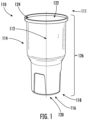
- beverage container 110 includes bottom panel 118, a wall 114, such as a cylindrical wall, lid 130, and lid cover 180 coupled to the lid 130, and biasing element 127.
- beverage container 110 includes body 126 that includes bottom panel 118 and wall 114, and body 126 defines storage compartment 122 and upper opening 124.
- Lid 130 is coupled to the wall 114 and/or body 126 (e.g., via wall 114) and partially covers upper opening 124.
- Each of the lid 130 and lid cover 180 include one or more magnetically-responsive elements (e.g., magnets and/or ferrous metals).
- Bottom panel 118 of container 110 defines a bottom-most surface 120 of container 110.
- An enclosing element shown as wall 114, extends upwardly from bottom panel 118, and wall 114 extends around axis 112, such as circumferentially around axis 112.
- Wall 114 and bottom panel 118 collectively partially define a storage area, shown as storage compartment 122.
- body 126, wall 114, bottom panel 118, lid 130 and/or lid cover 180 are centered on axis 112 (e.g., bottom panel 118 is centered on axis 112).
- Biasing element 127 is coupled to at least one of the lid 130 and lid cover 180. Biasing element 127 biases lid cover 180 from transitioning from a closed position to an open position with respect to the lid 130.
- biasing element 127 includes one or more magnetically responsive elements, shown as ferrous metal 156, magnet 158, and magnet 190. Magnetic engagement between the ferrous metal 156 and the magnet 190 biases lid cover 180 from transitioning from the closed position to the open position with respect to lid 130.
- magnet 158 is coupled to one of lid cover 180 and lid 130, and magnetic engagement between the magnet 158 and magnet 190 biases the lid cover 180 from transitioning from the open position to the closed position. In various embodiments, magnet 158 is coupled to lid 130.
- Wall 114 extends upwardly from bottom panel 118.
- Wall 114 defines upper opening 124 opposite bottom panel 118.
- One or more of lids described herein are configured to couple to wall 114 at upper opening 124, thereby fully or mostly enclosing storage compartment 122.
- lid 130 is coupled to wall 114 and partially covers the upper opening 124, and the lid 130 defines a drinking opening 132 smaller than the upper opening 124.
- one or more of bottom panel 118, walls 114, and upper opening 124 are centered on axis 112.
- coupling component 116 extends from and/or along bottom panel 118.
- coupling component 116 is compatible with the coupling mechanism(s) described in International Patent Publication No. WO 2017/191628 , which is incorporated herein by reference in its entirety.
- One or more lids described herein are configured to reversibly and detachably engage and disengage with wall 114, such as at upper opening 124 of wall 114.
- the lids described herein engage with a beverage container via an interference fit.
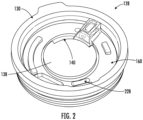
- Lid assembly 128 includes lid 130 and lid cover 180.
- Lid cover 180 is rotatably engaged and slidably engaged with lid 130.
- Lid cover 180 rotatably actuates between an open position and a closed position ( FIG. 3 ) with respect to the lid 130.
- beverage lid cover 180 includes plug 228 ( FIG. 2 ) coupled to apertures 224.
- plug 228 extends through apertures 224 to bias lid cover 180 away from lid 130.
- lid cover 180 includes upwardly-extending projection 194 that extends upward from the body 192 of lid cover 180 above upper surface 196 of body 192, the upwardly-extending projection 194 being configured to interface with a user actuating the lid cover 180 between the open position and the closed position.
- lid cover 180 When lid cover 180 is in a closed position, the lid cover 180 occludes the drinking opening 132 of lid 130, and when lid cover 180 is in an open position the drinking opening 132 of lid 130 provides fluid communication between the storage compartment 122 and an exterior 111 of the drinking container 110.
- lid 130 and lid cover 180 are coupled to a top of a beverage container (e.g., container 110), thereby enclosing a beverage stored within the beverage container.
- lid 130 includes one or more projections, shown as ears 136, 137, that extend radially inward from annular wall 134 towards axis 112.
- lid 130 includes a projection, shown as ear 136, that extends inwardly towards axis 112.
- Ears 136, 137 at least partially secure lid cover 180 to lid 130.
- upper surface 196 of lid cover 180 interfaces with ears 136, 137 to secure lid cover 180 to lid 130.
- engagement between ear 136 and lid cover 180 biases lid cover 180 towards bottom panel 118.
- drinking opening 132 of lid 130 and drinking opening 182 of lid cover 180 are rotated out of alignment, thereby enclosing the storage compartment 122 of the beverage container.
- the beverage is sealed within the storage compartment 122 of the beverage container, thereby reducing and/or minimizing the ability of the beverage to leak out of the storage compartment 122 of the beverage container 110.
- Lid 130 includes a curved recess, shown as arcuate-shaped recess 140, within projection 138.
- the arcuate-shaped recess 140 is defined by a reduced diameter section of projection 138 that extends circumferentially around a portion of lid 130 and is centered around axis 112. In various embodiments, recess 140 extends circumferentially around axis 112.
- lid cover 180 includes body 192, which extends circumferentially around axis 112.
- Lid cover 180 includes projection 186, which extends radially inward from body 192 towards axis 112 into recess 186. As lid cover 180 actuates between the open and closed positions with respect to lid 130, projection 186 rotates within recess 140 of lid 130.
- Lid cover 180 rotates angle 218 relative to (e.g., with respect to) lid 130 around axis 112.
- angle 218 is between 25 degrees and 100 degrees, and more specifically is between 35 degrees and 75 degrees, and more specifically is between 45 degrees and 58 degrees, and more specifically is 50 degrees.
- a magnetically-responsive component shown as magnet 190, is coupled to lid cover 180.
- magnet 190 is rigidly coupled to lid cover 180, such as via magnet 190 being embedded within lid cover 180.
- magnet 190 biases lid cover 180 to remain stationary with respect to lid 130.
- magnet 190 includes a plurality of magnets (e.g., stacked magnets).
- lid 130 includes inner wall 149 that extends peripherally around lid 130.
- Inner wall 149 includes an inner surface 150 that faces inwards towards the lid cover 180 when the lid cover 180 is seated within lid 130.
- Inner surface 150 defines a diameter 152.
- Diameter 152 of inner surface 150 of lid 130 is greater than diameter 200 of lid cover 180 such that outer lateral surface 198 of lid cover 180 and inner surface 150 do not interface when lid cover 180 is rotating with respect to lid 130. Applicant has observed that reducing contact between outer lateral surface 198 of lid cover 180 and inner surface 150 of lid 130 reduces and/or eliminates splashing of liquid resting on lid 130 when lid cover 180 is rotated with respect to lid 130.
- lid 130 includes vent 154.
- Vent 154 provides fluid communication for air to enter storage compartment 122 when the user is drinking liquid through openings 132, 182, thereby reducing how much air enters storage compartment 122 through openings 132, 182 when the user is drinking from container 110, which may interfere with the even flow of liquid through openings 132, 182.
- lid includes upper wall 160 extending perpendicular to axis 112, and one or more of first projection 142 and second projection 146 extend upward from upper wall 160.
- lid 130 includes wall 134 extending upward from upper wall 160 away from bottom panel 118, wall 134 defining inner surface 150 that faces inward towards the axis 112.
- a first magnetically-responsive component shown as ferrous metal 156
- a second magnetically-responsive component shown as magnet 158
- ferrous metal 156 and/or magnet 158 are rigidly coupled to lid 130, such as via being embedded within lid 130.
- magnet 190 of lid cover 180 magnetically engages with either ferrous metal 156 (open position) or magnet 158 (closed position).
- the ferrous metal 156 includes or consists of steel (e.g., ferrous metal 156 is formed from steel).
- magnet 190 of lid cover 180 is magnetically engaged with magnet 158. Because of this engagement, lid cover 180 is biased from transitioning from the closed position into the open position.
- lid 130 includes first projection 142 and second projection 146, each of which extend upward away from bottom panel 118 when lid 130 is coupled to container 110.
- first projection 142 and/or second projection 146 define curves that circumferentially extend around axis 112.
- first projection 142 and/or second projection 146 define partial cylinders that circumferentially extend around axis 112.
- First projection 142 and/or second projection 146 extend circumferentially around and are centered on axis 112.
- First projection 142 circumferentially extends an arc length defined by angle 144 around axis 112
- second projection 146 circumferentially extends an arc length defined by angle 148 around axis 112.
- second projection 146 is distinct from first projection 142 and extends upward away from bottom panel 118.
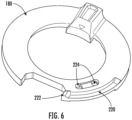
- lid cover 180 includes projection 222 extending upward away from lid 130.
- projection 222 interfaces with right ear 137 to bias lid cover 180 towards lid 130, thereby increasing the seal between lid cover 180 and lid 130.
- Recess 220 extends circumferentially around an outer portion of lid cover 180. When lid cover 180 transitions from the closed position to the open position with respect to lid 130, recess 220 receives right ear 137, thereby facilitating rotating lid cover 180 with respect to lid 130.
- Lid cover 180 includes first recess 202 within lower surface 188, which extends circumferentially angle 208 around lid cover 180 with respect to axis 112 from first end 204 to second end 206.
- lid cover 180 includes first recess 202 that circumferentially extends around axis 112 and receives first projection 142.
- Lid cover 180 includes second recess 210 within lower surface 188, and second recess 210 extends circumferentially around lid cover 180 with respect to axis 112 from first end 212 to second end 214 (e.g., second recess 210 circumferentially extends around a portion of lid cover 180 with respect to axis 112).
- Second recess 210 has an arc length defined by angle 216.
- second recess 210 circumferentially extend around axis 112 and the second recess 210 receives second projection 146.
- Lid cover 180 defines diameter 200.
- diameter 200 of lid cover 180 is sufficiently smaller than diameter 152 of lid 130 such that lateral surface 198 of lid cover 180 and inner surface 150 of lid 130 have reduced, minimal, or even no interface with each other when lid cover 180 is rotated with respect to lid 130.
- the contact between first and second projections 142, 146 and first and second recesses 202, 210 maintain the positioning of lid cover 180 with respect to lid 130, thereby reducing or eliminating the amount of interface between lateral surface 198 of lid cover 180 and inner surface 150 of lid 130 when lid cover 180 is rotated with respect to lid 130.
- Applicant has observed that reducing contact between outer lateral surface 198 of lid cover 180 and inner surface 150 of lid 130 reduces and/or eliminates splashing of liquid resting on lid 130 when lid cover 180 is rotated with respect to lid 130.
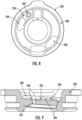
- lid assembly 128 includes the vent sealing mechanisms, such as gasket 260 and/or gasket 384, in one of lid 230 or lid cover 280 ( FIGS. 8-9 ) or the vent sealing mechanisms in one of lid 330 or lid cover 380 ( FIGS. 10-11 ).
- vent sealing mechanisms such as gasket 260 and/or gasket 384
- lid 230 and lid cover 280 are shown according to exemplary embodiments.
- Lid 230 is substantially the same as lid 130 except for the differences discussed herein
- lid cover 280 is substantially the same as lid cover 180 except for the differences discussed herein.
- lid 230 includes gasket 260, which is configured to engage with lid cover 280, thereby sealing vent 254, when lid cover 280 is positioned in the closed configuration with respect to lid 230.
- gasket 260 is coupled to one of lid 230 or lid cover 280 and engages the other of the lid 230 or the lid cover 280 when the lid cover 280 is positioned in the closed position with respect to the lid 230.
- gasket 260 blocks fluid communication between the vent 254 and the storage compartment of the container (e.g., storage compartment 122 of container 110) when the lid cover 280 is in the closed position.
- gasket 260 sealingly engages lower surface 284 of lid cover 280 to reduce and/or eliminate fluid communication between storage compartment 122 and outside the container 110 via vent 254.
- gasket 260 is positioned within pocket 266.
- vent 254 provides fluid communication between storage compartment 122 and outside the container 110 via vent 254 (e.g., to permit air to transit vent 254 into storage compartment 122 when the user is drinking liquid).
- Ramp 264 helps press gasket 260 closed when the lid cover 280 is in the closed position with respect to lid 230.
- lid 330 and lid cover 380 are shown according to exemplary embodiments.
- Lid 330 is substantially the same as lid 130 or lid 230 except for the differences discussed herein
- lid cover 380 is substantially the same as lid cover 180 or lid cover 280 except for the differences discussed herein.
- Lid 330 includes vent 354 and a ramp 352 (e.g., an elevated surface around vent 354).
- gasket 384 coupled lid cover 380 engages with vent 354 to seal vent 354.
- gasket 384 coupled lid cover 380 disengages with vent 354 and as a result gasket 384 is within pocket 366, thereby providing fluid communication between storage compartment 122 and outside the container 110 via vent 354.
- lid 330 and/or lid cover 380 includes a bumper 386 that facilitates decelerating lid cover 380 with respect to lid 330 when lid cover 380 is being closed or opened, thereby reducing amount of liquid splashing.
- the term "coupled” means the joining of two components directly or indirectly to one another. Such joining may be stationary in nature or movable in nature. Such joining may be achieved with the two members and any additional intermediate members being integrally formed as a single unitary body with one another or with the two members or the two members and any additional member being attached to one another. Such joining may be permanent in nature or alternatively may be removable or releasable in nature.
- the relative dimensions, including angles, lengths and radii, as shown in the Figures are to scale. Actual measurements of the Figures will disclose relative dimensions, angles and proportions of the various exemplary embodiments. Various exemplary embodiments extend to various ranges around the absolute and relative dimensions, angles and proportions that may be determined from the Figures. Various exemplary embodiments include any combination of one or more relative dimensions or angles that may be determined from the Figures. Further, actual dimensions not expressly set out in this description can be determined by using the ratios of dimensions measured in the Figures in combination with the express dimensions set out in this description.
Landscapes
- Engineering & Computer Science (AREA)
- Mechanical Engineering (AREA)
- Health & Medical Sciences (AREA)
- General Health & Medical Sciences (AREA)
- Pediatric Medicine (AREA)
- Ceramic Engineering (AREA)
- Closures For Containers (AREA)
Abstract
Description
- The present application claims the benefit of and priority to
U.S. Application No. 63/382,636 filed on November 7, 2022 - The present disclosure is directed generally to containers and related devices. The present disclosure relates specifically to a lid assembly for a beverage container.
- Beverage containers are often used to transport beverages for consumption. Beverage containers often include a cover or a lid that encloses the beverage within the container.
- One embodiment of the invention relates to a drinking container including a bottom panel that defines a bottom-most surface, an axis around which the bottom panel is centered, a wall extending upwardly from the bottom panel, a lid coupled to the wall, a lid cover rotatably engaged with the lid, and a biasing element coupled to at least one of the lid and the lid cover, the biasing element biasing the lid cover from transitioning from the closed position to the open position with respect to the lid. The wall extends around the axis, and the wall and bottom panel collectively partially define a storage compartment. The wall defines an upper opening opposite the bottom panel. The lid partially covers the upper opening. The lid defines a drinking opening smaller than the upper opening. The lid includes a first projection that extends upward away from the bottom panel, and the first projection extends circumferentially around and is centered on the axis. When the lid cover is in a closed position the lid cover occludes the drinking opening, and when the lid cover is in an open position the drinking opening provides fluid communication between the storage compartment and an exterior of the drinking container. The lid cover includes a first recess circumferentially extending around the axis, and the first recess receives the first projection.
- Another embodiment of the invention relates to a drinking container including a bottom panel that defines a bottom-most surface, an axis around which the bottom panel is centered, a wall extending upwardly from the bottom panel, the wall defining an upper opening opposite the bottom panel, a lid coupled to the wall and partially covering the upper opening, a lid cover rotatably coupled to the lid, a biasing element coupled to at least one of the lid and the lid cover, the biasing element biasing the lid cover from transitioning from the closed position to the open position with respect to the lid. The wall extends around the axis, and the wall and bottom panel collectively partially define a storage compartment. The lid defines a drinking opening smaller than the upper opening, and the lid defines an inner surface that faces inward towards the axis. The lid includes an outer surface that faces outward away from the axis, the outer surface and inner surface facing towards each other. The lid cover actuates between an open position and a closed position with respect to the lid. When the lid cover is in the closed position the lid cover occludes the drinking opening, and when the lid cover is in the open position the drinking opening provides fluid communication between the storage compartment and an exterior of the drinking container. The outer surface and the inner surface do not interface when the lid cover is rotated with respect to the lid.
- Another embodiment of the invention relates to a drinking container including a bottom panel that defines a bottom-most surface, an axis around which the bottom panel is centered, a wall extending upwardly from the bottom panel, the wall defining an upper opening opposite the bottom panel, a lid coupled to the wall and partially covering the upper opening, a first magnetically-responsive element coupled to the lid, a lid cover rotatably coupled to the lid, a second magnetically-responsive element coupled to the lid cover, and a gasket. The wall extends around the axis, and the wall and bottom panel collectively partially define a storage compartment. The lid defines a drinking opening smaller than the upper opening, and the lid defines a vent that provides fluid communication with the storage compartment. The lid cover actuates between an open position and a closed position with respect to the lid. When the lid cover is in the closed position the lid cover occludes the drinking opening, and when the lid cover is in the open position the drinking opening provides fluid communication between the storage compartment and an exterior of the drinking container. Magnetic engagement between the first magnetically-responsive element and the second magnetically-responsive element biases the lid cover from transitioning from the closed position to the open position. The gasket is coupled to one of the lid or the lid cover. The gasket engages with the other of the lid or the lid cover when the lid cover is positioned in the closed position with respect to the lid, and the gasket blocks fluid communication between the vent and the storage compartment when the lid cover is in the closed position.
- Another embodiment of the invention relates to a drinking container including a bottom panel that includes a bottom-most surface, an axis around which the bottom panel is centered, a wall that extends upwardly from the bottom panel, the wall and bottom panel collectively defining a liquid-storage area, the wall defining an upper opening opposite the bottom panel, a lid coupled to the wall and covering the upper opening, a first magnetically-responsive element coupled to the lid, a lid cover rotatably coupled to the lid, and a second magnetically-responsive element coupled to the lid cover. The lid defines a drinking opening smaller than the upper opening, and the lid includes an inner surface that faces inward towards the axis. The lid cover includes an outer lateral surface that faces outward away from the axis and towards the inner surface of the lid. The lid cover actuates between an open position and a closed position with respect to the lid. When the lid cover is in the closed position the lid cover occludes the drinking opening, and when the lid cover is in the open position the drinking opening provides fluid communication between the liquid-storage area and an exterior of the drinking container. The outer surface and the inner surface do not interface when the lid cover is rotated with respect to the lid. Magnetic engagement between the first magnetically-responsive element and the second magnetically-responsive element biases the lid cover from transitioning from the closed position to the open position.
- In various embodiments, the lid includes one or more projections that extend upward and circumferentially extend around the axis, and the lid cover includes one or more recesses that circumferentially extend around the axis. The one or more recesses receive the one or more projections.
- In various embodiments, the lid includes a vent that selectively provides fluid communication between the liquid-storage area and the exterior of the drinking container, and the drinking container includes a gasket coupled to one of the lid or the lid cover, the gasket engaging with the other of the lid or the lid cover when the lid cover is positioned in the closed position with respect to the lid. In various embodiments, one of the lid or the lid cover includes a recess that receives the gasket when the lid cover is positioned in the open position with respect to the lid. The recess and the vent collectively provide fluid communication between the liquid-storage area and the exterior of the drinking container when the lid cover is positioned in the open position with respect to the lid.
- Additional features and advantages will be set forth in the detailed description which follows, and, in part, will be readily apparent to those skilled in the art from the description or recognized by practicing the embodiments as described in the written description included, as well as the appended drawings. It is to be understood that both the foregoing general description and the following detailed description are exemplary.
- The accompanying drawings are included to provide further understanding and are incorporated in and constitute a part of this specification. The drawings illustrate one or more embodiments and, together with the description, serve to explain principles and operation of the various embodiments. In addition, alternative exemplary embodiments relate to other features and combinations of features as may be generally recited in the claims.
- This application will become more fully understood from the following detailed description, taken in conjunction with the accompanying figures, wherein like reference numerals refer to like elements in which:
-
FIG. 1 is a perspective view of a beverage container, according to an exemplary embodiment. -
FIG. 2 is a perspective view of a lid assembly for a beverage container in a closed position, according to an exemplary embodiment. -
FIG. 3 is a top view of the lid assembly ofFIG. 2 , according to an exemplary embodiment. -
FIG. 4 is a cross section view of the lid assembly ofFIG. 3 taken along line 4-4 inFIG. 3 , according to an exemplary embodiment. -
FIG. 5 is a top view of the lid ofFIG. 2 , according to an exemplary embodiment. -
FIG. 6 is a perspective view of the lid cover ofFIG. 2 , according to an exemplary embodiment. -
FIG. 7 is a bottom view of the lid cover ofFIG. 2 , according to an exemplary embodiment. -
FIG. 8 is a top view of a lid and lid cover, according to another exemplary embodiment. -
FIG. 9 is a cross-section view of the lid and lid cover ofFIG. 8 , according to an exemplary embodiment. -
FIG. 10 is a top view of a lid and lid cover, according to another exemplary embodiment. -
FIG. 11 is a cross-section view of the lid and lid cover ofFIG. 10 , according to an exemplary embodiment. - Referring generally to the figures, various embodiments of a lid and lid cover for a beverage container are shown. The lid and lid cover are designed to selectively actuate between an open position and a closed position. In the open position, the beverage is accessible, for example, for a user to drink. In the closed position, the beverage is enclosed within the beverage container, thereby protecting the beverage from spilling out of the container.
- Various embodiments of the lids and lid covers described herein are configured to reduce, minimize or even eliminate spillage and splashing of liquid from the container. In various embodiments, the lid and/or lid cover include a gasket that seals a vent when the lid and lid cover are in a closed configuration, thereby reducing an amount of liquid that can spill. In various embodiments, the lid and lid cover include interface elements, such as curved protrusions and recesses that receive the protrusions, that reduce an amount of splashing of liquid when the lid cover is rotated with respect to the lid. In various embodiments, the lids are configured to couple to a beverage container that couples to a cleat in a Milwaukee PACKOUT® modular storage unit.
- Referring to
FIG. 1 , a drinking container, unit and/or device, such asbeverage container 110, is shown according to an exemplary embodiment. In various embodiments,beverage container 110 includesbottom panel 118, awall 114, such as a cylindrical wall,lid 130, andlid cover 180 coupled to thelid 130, and biasingelement 127. In various embodiments,beverage container 110 includesbody 126 that includesbottom panel 118 andwall 114, andbody 126 definesstorage compartment 122 andupper opening 124.Lid 130 is coupled to thewall 114 and/or body 126 (e.g., via wall 114) and partially coversupper opening 124. Each of thelid 130 andlid cover 180 include one or more magnetically-responsive elements (e.g., magnets and/or ferrous metals).Bottom panel 118 ofcontainer 110 defines a bottom-most surface 120 ofcontainer 110. An enclosing element, shown aswall 114, extends upwardly frombottom panel 118, andwall 114 extends aroundaxis 112, such as circumferentially aroundaxis 112.Wall 114 andbottom panel 118 collectively partially define a storage area, shown asstorage compartment 122. In various embodiments one or more ofbody 126,wall 114,bottom panel 118,lid 130 and/orlid cover 180 are centered on axis 112 (e.g.,bottom panel 118 is centered on axis 112). -
Biasing element 127 is coupled to at least one of thelid 130 andlid cover 180.Biasing element 127biases lid cover 180 from transitioning from a closed position to an open position with respect to thelid 130. In various embodiments, biasingelement 127 includes one or more magnetically responsive elements, shown asferrous metal 156,magnet 158, andmagnet 190. Magnetic engagement between theferrous metal 156 and themagnet 190biases lid cover 180 from transitioning from the closed position to the open position with respect tolid 130. - In various embodiments,
magnet 158 is coupled to one oflid cover 180 andlid 130, and magnetic engagement between themagnet 158 andmagnet 190 biases thelid cover 180 from transitioning from the open position to the closed position. In various embodiments,magnet 158 is coupled tolid 130. -
Wall 114 extends upwardly frombottom panel 118.Wall 114 definesupper opening 124 oppositebottom panel 118. One or more of lids described herein are configured to couple towall 114 atupper opening 124, thereby fully or mostly enclosingstorage compartment 122. For example,lid 130 is coupled towall 114 and partially covers theupper opening 124, and thelid 130 defines adrinking opening 132 smaller than theupper opening 124. In a specific embodiment, one or more ofbottom panel 118,walls 114, andupper opening 124 are centered onaxis 112. - In a specific embodiment,
coupling component 116 extends from and/or alongbottom panel 118. In a specific embodiment,coupling component 116 is compatible with the coupling mechanism(s) described in International Patent Publication No.WO 2017/191628 , which is incorporated herein by reference in its entirety. - One or more lids described herein are configured to reversibly and detachably engage and disengage with
wall 114, such as atupper opening 124 ofwall 114. In various embodiment, the lids described herein engage with a beverage container via an interference fit. - Referring to
FIGS. 2-7 , alid assembly 128 is shown according to an exemplary embodiment.Lid assembly 128 includeslid 130 andlid cover 180.Lid cover 180 is rotatably engaged and slidably engaged withlid 130.Lid cover 180 rotatably actuates between an open position and a closed position (FIG. 3 ) with respect to thelid 130. - In various embodiments,
beverage lid cover 180 includes plug 228 (FIG. 2 ) coupled toapertures 224. In various embodiments, plug 228 extends throughapertures 224 to biaslid cover 180 away fromlid 130. - Referring to
FIG. 3 , in variousembodiments lid cover 180 includes upwardly-extendingprojection 194 that extends upward from thebody 192 oflid cover 180 aboveupper surface 196 ofbody 192, the upwardly-extendingprojection 194 being configured to interface with a user actuating thelid cover 180 between the open position and the closed position. Whenlid cover 180 is in a closed position, thelid cover 180 occludes the drinking opening 132 oflid 130, and whenlid cover 180 is in an open position the drinking opening 132 oflid 130 provides fluid communication between thestorage compartment 122 and anexterior 111 of thedrinking container 110. Invarious embodiments lid 130 andlid cover 180 are coupled to a top of a beverage container (e.g., container 110), thereby enclosing a beverage stored within the beverage container. - Referring to
FIG. 3 , in various embodiments,lid 130 includes one or more projections, shown asears annular wall 134 towardsaxis 112. In a specific embodiment,lid 130 includes a projection, shown asear 136, that extends inwardly towardsaxis 112.Ears secure lid cover 180 tolid 130. In various embodiments,upper surface 196 oflid cover 180 interfaces withears lid cover 180 tolid 130. In various embodiments, engagement betweenear 136 andlid cover 180biases lid cover 180 towardsbottom panel 118. - In the closed position (
FIG. 3 ), drinkingopening 132 oflid 130 and drinking opening 182 oflid cover 180 are rotated out of alignment, thereby enclosing thestorage compartment 122 of the beverage container. In the closed position, the beverage is sealed within thestorage compartment 122 of the beverage container, thereby reducing and/or minimizing the ability of the beverage to leak out of thestorage compartment 122 of thebeverage container 110. -
Lid 130 includes a curved recess, shown as arcuate-shapedrecess 140, withinprojection 138. The arcuate-shapedrecess 140 is defined by a reduced diameter section ofprojection 138 that extends circumferentially around a portion oflid 130 and is centered aroundaxis 112. In various embodiments,recess 140 extends circumferentially aroundaxis 112. - Referring to
FIG. 3 ,lid cover 180 includesbody 192, which extends circumferentially aroundaxis 112.Lid cover 180 includesprojection 186, which extends radially inward frombody 192 towardsaxis 112 intorecess 186. Aslid cover 180 actuates between the open and closed positions with respect tolid 130,projection 186 rotates withinrecess 140 oflid 130. -
Lid cover 180 rotatesangle 218 relative to (e.g., with respect to)lid 130 aroundaxis 112. In various embodiments,angle 218 is between 25 degrees and 100 degrees, and more specifically is between 35 degrees and 75 degrees, and more specifically is between 45 degrees and 58 degrees, and more specifically is 50 degrees. - A magnetically-responsive component, shown as
magnet 190, is coupled tolid cover 180. In a specific embodiment,magnet 190 is rigidly coupled tolid cover 180, such as viamagnet 190 being embedded withinlid cover 180. As will be described,magnet 190biases lid cover 180 to remain stationary with respect tolid 130. In various embodiments,magnet 190 includes a plurality of magnets (e.g., stacked magnets). - Referring to
FIGS. 4-5 ,lid 130 includes inner wall 149 that extends peripherally aroundlid 130. Inner wall 149 includes aninner surface 150 that faces inwards towards thelid cover 180 when thelid cover 180 is seated withinlid 130.Inner surface 150 defines adiameter 152.Diameter 152 ofinner surface 150 oflid 130 is greater thandiameter 200 oflid cover 180 such that outerlateral surface 198 oflid cover 180 andinner surface 150 do not interface whenlid cover 180 is rotating with respect tolid 130. Applicant has observed that reducing contact between outerlateral surface 198 oflid cover 180 andinner surface 150 oflid 130 reduces and/or eliminates splashing of liquid resting onlid 130 whenlid cover 180 is rotated with respect tolid 130. - Referring to
FIG. 5 ,lid 130 includesvent 154.Vent 154 provides fluid communication for air to enterstorage compartment 122 when the user is drinking liquid throughopenings storage compartment 122 throughopenings container 110, which may interfere with the even flow of liquid throughopenings upper wall 160 extending perpendicular toaxis 112, and one or more offirst projection 142 andsecond projection 146 extend upward fromupper wall 160. In various embodiments,lid 130 includeswall 134 extending upward fromupper wall 160 away frombottom panel 118,wall 134 defininginner surface 150 that faces inward towards theaxis 112. - Referring to
FIG. 5 , in various embodiments a first magnetically-responsive component, shown asferrous metal 156, is coupled tolid 130, and a second magnetically-responsive component, shown asmagnet 158, is coupled tolid 130. In a specific embodiment,ferrous metal 156 and/ormagnet 158 are rigidly coupled tolid 130, such as via being embedded withinlid 130. Aslid cover 180 actuates with respect to thelid 130 between the open and closed positions,magnet 190 oflid cover 180 magnetically engages with either ferrous metal 156 (open position) or magnet 158 (closed position). In various embodiments, theferrous metal 156 includes or consists of steel (e.g.,ferrous metal 156 is formed from steel). In the closed position (FIG. 3 ),magnet 190 oflid cover 180 is magnetically engaged withmagnet 158. Because of this engagement,lid cover 180 is biased from transitioning from the closed position into the open position. - Referring to
FIG. 5 ,lid 130 includesfirst projection 142 andsecond projection 146, each of which extend upward away frombottom panel 118 whenlid 130 is coupled tocontainer 110. In various embodiments,first projection 142 and/orsecond projection 146 define curves that circumferentially extend aroundaxis 112. In various embodiments,first projection 142 and/orsecond projection 146 define partial cylinders that circumferentially extend aroundaxis 112.First projection 142 and/orsecond projection 146 extend circumferentially around and are centered onaxis 112.First projection 142 circumferentially extends an arc length defined byangle 144 aroundaxis 112, andsecond projection 146 circumferentially extends an arc length defined byangle 148 aroundaxis 112. In various embodiments,second projection 146 is distinct fromfirst projection 142 and extends upward away frombottom panel 118. - Referring to
FIG. 6 ,lid cover 180 includesprojection 222 extending upward away fromlid 130. Whenlid cover 180 is in the open position with respect tolid 130,projection 222 interfaces withright ear 137 to biaslid cover 180 towardslid 130, thereby increasing the seal betweenlid cover 180 andlid 130. -
Recess 220 extends circumferentially around an outer portion oflid cover 180. When lid cover 180 transitions from the closed position to the open position with respect tolid 130,recess 220 receivesright ear 137, thereby facilitatingrotating lid cover 180 with respect tolid 130. - Referring to
FIG. 7 , various aspects of a bottom oflid cover 180 are shown.Lid cover 180 includesfirst recess 202 withinlower surface 188, which extendscircumferentially angle 208 aroundlid cover 180 with respect toaxis 112 fromfirst end 204 tosecond end 206. In various embodiments,lid cover 180 includesfirst recess 202 that circumferentially extends aroundaxis 112 and receivesfirst projection 142.Lid cover 180 includessecond recess 210 withinlower surface 188, andsecond recess 210 extends circumferentially aroundlid cover 180 with respect toaxis 112 fromfirst end 212 to second end 214 (e.g.,second recess 210 circumferentially extends around a portion oflid cover 180 with respect to axis 112).Second recess 210 has an arc length defined byangle 216. In various embodiments,second recess 210 circumferentially extend aroundaxis 112 and thesecond recess 210 receivessecond projection 146. -
Lid cover 180 definesdiameter 200. As explained above, invarious embodiments diameter 200 oflid cover 180 is sufficiently smaller thandiameter 152 oflid 130 such thatlateral surface 198 oflid cover 180 andinner surface 150 oflid 130 have reduced, minimal, or even no interface with each other whenlid cover 180 is rotated with respect tolid 130. Instead, the contact between first andsecond projections second recesses lid cover 180 with respect tolid 130, thereby reducing or eliminating the amount of interface betweenlateral surface 198 oflid cover 180 andinner surface 150 oflid 130 whenlid cover 180 is rotated with respect tolid 130. Applicant has observed that reducing contact between outerlateral surface 198 oflid cover 180 andinner surface 150 oflid 130 reduces and/or eliminates splashing of liquid resting onlid 130 whenlid cover 180 is rotated with respect tolid 130. - In various embodiments,
lid assembly 128 includes the vent sealing mechanisms, such asgasket 260 and/orgasket 384, in one oflid 230 or lid cover 280 (FIGS. 8-9 ) or the vent sealing mechanisms in one oflid 330 or lid cover 380 (FIGS. 10-11 ). - Referring to
FIGS. 8-9 ,lid 230 andlid cover 280 are shown according to exemplary embodiments.Lid 230 is substantially the same aslid 130 except for the differences discussed herein, andlid cover 280 is substantially the same aslid cover 180 except for the differences discussed herein. In particular,lid 230 includesgasket 260, which is configured to engage withlid cover 280, thereby sealingvent 254, whenlid cover 280 is positioned in the closed configuration with respect tolid 230. In various embodiments,gasket 260 is coupled to one oflid 230 orlid cover 280 and engages the other of thelid 230 or thelid cover 280 when thelid cover 280 is positioned in the closed position with respect to thelid 230. In various embodiments,gasket 260 blocks fluid communication between thevent 254 and the storage compartment of the container (e.g.,storage compartment 122 of container 110) when thelid cover 280 is in the closed position. - In use, when
lid cover 280 is positioned in the closed configuration with respect to lid 230 (FIG. 7 ),gasket 260 sealingly engageslower surface 284 oflid cover 280 to reduce and/or eliminate fluid communication betweenstorage compartment 122 and outside thecontainer 110 viavent 254. Whenlid cover 280 is positioned in the open configuration with respect tolid 230,gasket 260 is positioned withinpocket 266. As a result,gasket 260 is not interfacinglower surface 284 oflid cover 280, and therefore vent 254 provides fluid communication betweenstorage compartment 122 and outside thecontainer 110 via vent 254 (e.g., to permit air totransit vent 254 intostorage compartment 122 when the user is drinking liquid).Ramp 264 helpspress gasket 260 closed when thelid cover 280 is in the closed position with respect tolid 230. - Referring to
FIGS. 10-11 ,lid 330 andlid cover 380 are shown according to exemplary embodiments.Lid 330 is substantially the same aslid 130 orlid 230 except for the differences discussed herein, andlid cover 380 is substantially the same aslid cover 180 orlid cover 280 except for the differences discussed herein. -
Lid 330 includesvent 354 and a ramp 352 (e.g., an elevated surface around vent 354). Whenlid cover 380 is in the closed configuration with respect tolid 330,gasket 384 coupledlid cover 380 engages withvent 354 to sealvent 354. Whenlid cover 380 is in the open configuration with respect tolid 330,gasket 384 coupledlid cover 380 disengages withvent 354 and as aresult gasket 384 is withinpocket 366, thereby providing fluid communication betweenstorage compartment 122 and outside thecontainer 110 viavent 354. In various embodiments,lid 330 and/orlid cover 380 includes abumper 386 that facilitates deceleratinglid cover 380 with respect tolid 330 whenlid cover 380 is being closed or opened, thereby reducing amount of liquid splashing. - It should be understood that the figures illustrate the exemplary embodiments in detail, and it should be understood that the present application is not limited to the details or methodology set forth in the description or illustrated in the figures. It should also be understood that the terminology is for description purposes only and should not be regarded as limiting.
- Further modifications and alternative embodiments of various aspects of the disclosure will be apparent to those skilled in the art in view of this description. Accordingly, this description is to be construed as illustrative only. The construction and arrangements, shown in the various exemplary embodiments, are illustrative only. Although only a few embodiments have been described in detail in this disclosure, many modifications are possible (e.g., variations in sizes, dimensions, structures, shapes and proportions of the various elements, values of parameters, mounting arrangements, use of materials, colors, orientations, etc.) without materially departing from the novel teachings and advantages of the subject matter described herein. Some elements shown as integrally formed may be constructed of multiple parts or elements, the position of elements may be reversed or otherwise varied, and the nature or number of discrete elements or positions may be altered or varied. The order or sequence of any process, logical algorithm, or method steps may be varied or re-sequenced according to alternative embodiments. Other substitutions, modifications, changes and omissions may also be made in the design, operating conditions and arrangement of the various exemplary embodiments without departing from the scope of the present disclosure.
- Unless otherwise expressly stated, it is in no way intended that any method set forth herein be construed as requiring that its steps be performed in a specific order. Accordingly, where a method claim does not actually recite an order to be followed by its steps or it is not otherwise specifically stated in the claims or descriptions that the steps are to be limited to a specific order, it is in no way intended that any particular order be inferred. In addition, as used herein, the article "a" is intended to include one or more component or element, and is not intended to be construed as meaning only one. As used herein, "rigidly coupled" refers to two components being coupled in a manner such that the components move together in a fixed positional relationship when acted upon by a force.
- Various embodiments of the disclosure relate to any combination of any of the features, and any such combination of features may be claimed in this or future applications. Any of the features, elements or components of any of the exemplary embodiments discussed above may be utilized alone or in combination with any of the features, elements or components of any of the other embodiments discussed above.
- For purposes of this disclosure, the term "coupled" means the joining of two components directly or indirectly to one another. Such joining may be stationary in nature or movable in nature. Such joining may be achieved with the two members and any additional intermediate members being integrally formed as a single unitary body with one another or with the two members or the two members and any additional member being attached to one another. Such joining may be permanent in nature or alternatively may be removable or releasable in nature.
- While the current application recites particular combinations of features in the claims appended hereto, various embodiments of the invention relate to any combination of any of the features described herein whether or not such combination is currently claimed, and any such combination of features may be claimed in this or future applications. Any of the features, elements, or components of any of the exemplary embodiments discussed above may be used alone or in combination with any of the features, elements, or components of any of the other embodiments discussed above.
- In various exemplary embodiments, the relative dimensions, including angles, lengths and radii, as shown in the Figures are to scale. Actual measurements of the Figures will disclose relative dimensions, angles and proportions of the various exemplary embodiments. Various exemplary embodiments extend to various ranges around the absolute and relative dimensions, angles and proportions that may be determined from the Figures. Various exemplary embodiments include any combination of one or more relative dimensions or angles that may be determined from the Figures. Further, actual dimensions not expressly set out in this description can be determined by using the ratios of dimensions measured in the Figures in combination with the express dimensions set out in this description.
Claims (20)
- A drinking container comprising:a bottom panel that defines a bottom-most surface;an axis around which the bottom panel is centered;a wall extending upwardly from the bottom panel, the wall extending around the axis, the wall and bottom panel collectively partially defining a storage compartment, the wall defining an upper opening opposite the bottom panel;a lid coupled to the wall and partially covering the upper opening, the lid defining a drinking opening smaller than the upper opening, the lid comprising a first projection that extends upward away from the bottom panel, wherein the first projection extends circumferentially around and is centered on the axis;a lid cover rotatably engaged with the lid, wherein when the lid cover is in a closed position the lid cover occludes the drinking opening, and when the lid cover is in an open position the drinking opening provides fluid communication between the storage compartment and an exterior of the drinking container, the lid cover comprising a first recess circumferentially extending around the axis, wherein the first recess receives the first projection; anda biasing element coupled to at least one of the lid and the lid cover, the biasing element biasing the lid cover from transitioning from the closed position to the open position with respect to the lid.
- The drinking container of claim 1, the lid comprising a second projection distinct from the first projection and that extends upward away from the bottom panel, wherein the second projection extends circumferentially around and is centered on the axis, and the lid comprising a second recess circumferentially extending around the axis, wherein the second recess receives the second projection.
- The drinking container of claim 1, the lid comprising an upper wall extending perpendicular to the axis, wherein the first projection extends upward from the upper wall.
- The drinking container of claim 3, the lid comprising a second wall extending upward from the upper wall away from the bottom panel, the second wall defining an inner surface that faces inward towards the axis.
- The drinking container of claim 1, the biasing element comprising:a first magnetically-responsive element coupled to the lid; anda second magnetically-responsive element coupled to the lid cover, wherein magnetic engagement between the first magnetically-responsive element and the second magnetically-responsive element biases the lid cover from transitioning from the closed position to the open position with respect to the lid.
- The drinking container of claim 5, wherein the second magnetically-responsive element comprises a first magnet.
- The drinking container of claim 6, wherein the first magnetically-responsive element comprises a second magnet.
- The drinking container of claim 5, comprising a third magnetically-responsive element coupled to one of the lid cover or the lid, wherein magnetic engagement between the third magnetically-responsive element and one of the first magnetically-responsive element and the second magnetically-responsive element biases the lid cover from transitioning from the open position to the closed position.
- The drinking container of claim 8, wherein the third magnetically-responsive element is coupled to the lid.
- The drinking container of claim 1, wherein the lid cover comprises a body that extends circumferentially around the axis, and a third projection that extends from the body towards the axis, wherein the lid comprises a third recess that receives the third projection.
- The drinking container of claim 10, wherein the third recess extends circumferentially around the axis.
- The drinking container of claim 1, the lid comprising a second projection extending inwardly from the lid towards the axis, wherein engagement between the second projection and the lid cover biases the lid cover towards the bottom panel.
- A drinking container comprising:a bottom panel that defines a bottom-most surface;an axis around which the bottom panel is centered;a wall extending upwardly from the bottom panel, the wall extending around the axis, the wall and bottom panel collectively partially defining a storage compartment, the wall defining an upper opening opposite the bottom panel;a lid coupled to the wall and partially covering the upper opening, the lid defining a drinking opening smaller than the upper opening, the lid defining an inner surface that faces inward towards the axis;a lid cover rotatably coupled to the lid, the lid comprising an outer surface that faces outward away from the axis, the outer surface and inner surface facing towards each other, the lid cover actuating between an open position and a closed position with respect to the lid, wherein when the lid cover is in the closed position the lid cover occludes the drinking opening, and when the lid cover is in the open position the drinking opening provides fluid communication between the storage compartment and an exterior of the drinking container, wherein the outer surface and the inner surface do not interface when the lid cover is rotated with respect to the lid; anda biasing element coupled to at least one of the lid and the lid cover, the biasing element biasing the lid cover from transitioning from the closed position to the open position with respect to the lid.
- The drinking container of claim 13, the lid comprising a first projection that extends upward away from the bottom panel, wherein the first projection extends circumferentially around and is centered on the axis, and the lid cover comprising a first recess circumferentially extending around the axis, wherein the first recess receives the first projection.
- The drinking container of claim 14, the lid comprising an upper wall extending perpendicular to the axis, wherein the first projection extends upward from the upper wall.
- The drinking container of claim 15, the lid comprising a second wall extending upward from the upper wall away from the bottom panel, the second wall defining the inner surface that faces inward towards the axis.
- The drinking container of claim 13, the lid comprising an upper wall extending perpendicular to the axis, and a second wall extending upward from the upper wall away from the bottom panel, the second wall defining the inner surface that faces inward towards the axis.
- A drinking container comprising:a bottom panel that defines a bottom-most surface;an axis around which the bottom panel is centered;a wall extending upwardly from the bottom panel, the wall extending around the axis, the wall and bottom panel collectively partially defining a storage compartment, the wall defining an upper opening opposite the bottom panel;a lid coupled to the wall and partially covering the upper opening, the lid defining a drinking opening smaller than the upper opening, the lid defining a vent that provides fluid communication with the storage compartment;a first magnetically-responsive element coupled to the lid;a lid cover rotatably coupled to the lid, the lid cover actuating between an open position and a closed position with respect to the lid, wherein when the lid cover is in the closed position the lid cover occludes the drinking opening, and when the lid cover is in the open position the drinking opening provides fluid communication between the storage compartment and an exterior of the drinking container;a second magnetically-responsive element coupled to the lid cover, wherein magnetic engagement between the first magnetically-responsive element and the second magnetically-responsive element biases the lid cover from transitioning from the closed position to the open position; anda gasket coupled to one of the lid or the lid cover, the gasket engaging with the other of the lid or the lid cover when the lid cover is positioned in the closed position with respect to the lid, wherein the gasket blocks fluid communication between the vent and the storage compartment when the lid cover is in the closed position.
- The drinking container of claim 18, the lid comprising a projection extending inwardly from the lid towards the axis, wherein engagement between the projection and the lid cover biases the lid cover towards the bottom panel.
- The drinking container of claim 18, the lid comprising a projection that extends upward away from the bottom panel, wherein the projection extends circumferentially around and is centered on the axis, and the lid cover comprising a first recess circumferentially extending around the axis, wherein the first recess receives the projection.
Applications Claiming Priority (2)
| Application Number | Priority Date | Filing Date | Title |
|---|---|---|---|
| US202263382636P | 2022-11-07 | 2022-11-07 | |
| US18/474,502 US12565363B2 (en) | 2022-11-07 | 2023-09-26 | Beverage container cover assembly |
Publications (1)
| Publication Number | Publication Date |
|---|---|
| EP4364617A1 true EP4364617A1 (en) | 2024-05-08 |
Family
ID=88417419
Family Applications (1)
| Application Number | Title | Priority Date | Filing Date |
|---|---|---|---|
| EP23204071.7A Pending EP4364617A1 (en) | 2022-11-07 | 2023-10-17 | Beverage container cover assembly |
Country Status (2)
| Country | Link |
|---|---|
| US (2) | US12565363B2 (en) |
| EP (1) | EP4364617A1 (en) |
Families Citing this family (3)
| Publication number | Priority date | Publication date | Assignee | Title |
|---|---|---|---|---|
| US12486084B2 (en) * | 2023-08-02 | 2025-12-02 | Hangzhou Yici Chengpin Technology Co., Ltd. | Packaging cover and packaging container |
| US12515857B2 (en) * | 2023-09-25 | 2026-01-06 | Xiamen City Spark Tech. Co., Ltd. | Cup lid and container using the cup lid |
| US12668405B2 (en) * | 2024-03-28 | 2026-06-30 | Fellow Industries, Inc. | Swivel opening lid |
Citations (5)
| Publication number | Priority date | Publication date | Assignee | Title |
|---|---|---|---|---|
| US5294014A (en) * | 1992-10-16 | 1994-03-15 | Aladdin Synergetics, Inc. | Container closure arrangement |
| WO2017191628A1 (en) | 2016-05-02 | 2017-11-09 | Keter Plastic Ltd. | Utility assembly and coupling mechanism |
| US20210354889A1 (en) * | 2020-05-13 | 2021-11-18 | King's Flair Development Ltd. | Lid assembly operable with one press action mechanism and container comprising the same |
| US11213146B1 (en) * | 2021-04-06 | 2022-01-04 | JDS Industries, Inc. | Beverage container system |
| US20220354283A1 (en) * | 2021-05-07 | 2022-11-10 | Milwaukee Electric Tool Corporation | Beverage Container Cover Assembly |
Family Cites Families (67)
| Publication number | Priority date | Publication date | Assignee | Title |
|---|---|---|---|---|
| US3424334A (en) | 1964-10-09 | 1969-01-28 | Joseph Goltz | Stacking box construction with interlock |
| US4171060A (en) | 1978-12-11 | 1979-10-16 | Spil-Les | Covered drinking cup |
| US4872569A (en) | 1984-01-31 | 1989-10-10 | Brown Bolte | Drinking vessels |
| US4712704A (en) | 1987-02-19 | 1987-12-15 | Ramsey Douglas P | Self-sealing closure |
| FR2631928A2 (en) | 1987-10-27 | 1989-12-01 | Cosmetic Production | BOXES FOR PACKAGING OR STORAGE OF VARIOUS OBJECTS |
| US5477980A (en) | 1994-12-08 | 1995-12-26 | Chaffin; Jeffrey D. | Receptacle cover with valve controlled openings |
| US5711452A (en) | 1994-12-08 | 1998-01-27 | Chaffin; Jeffrey D. | Valve controlled receptacle cover |
| US5657897A (en) | 1995-11-08 | 1997-08-19 | Packerware Corporation | Beverage container constructed to accommodate cup holders of different sizes |
| US5890613A (en) | 1997-07-21 | 1999-04-06 | Williams; Warren Bret | Modular cooler construction |
| US6047849A (en) | 1998-06-26 | 2000-04-11 | Berry Plastics Corporation | Large-capacity beverage cup |
| US6318683B1 (en) | 1999-11-05 | 2001-11-20 | Adonica B. Savoy | Infant utensil having twist lock coupling |
| US6732876B2 (en) * | 2001-01-13 | 2004-05-11 | Niko Products, Inc. | Automatically sealing lid assembly |
| FR2834824B1 (en) | 2002-01-15 | 2004-04-02 | Entrelec | ELECTRONIC BOX CONNECTION DEVICE |
| US6983946B2 (en) | 2003-04-01 | 2006-01-10 | Porta Plastic Products | Transportable containers apparatus and method |
| CA2478602A1 (en) | 2003-08-20 | 2005-02-20 | Ltl Wholesale, Inc. D.B.A. Ltl Home Products, Inc. | Railing attachment device |
| US20050189361A1 (en) | 2004-02-17 | 2005-09-01 | Wincup Holdings, Inc. | Beverage cup for placement in holder |
| USD513167S1 (en) | 2004-08-20 | 2005-12-27 | Ltl Wholesale Inc. | Railing attachment device |
| US7503569B2 (en) | 2005-05-16 | 2009-03-17 | Keter Plastic Ltd. | Portable container assembly |
| US20060283859A1 (en) | 2005-06-20 | 2006-12-21 | Sara Rose International Inc. | Cup lid assembly |
| US20070138041A1 (en) | 2005-12-19 | 2007-06-21 | Welsh Robert P | Carrying Case |
| USD565352S1 (en) | 2006-08-21 | 2008-04-01 | Michael Williams | Cup |
| US20090001090A1 (en) | 2007-06-29 | 2009-01-01 | Carl-Louis Pty Ltd. | Disposable beverage container |
| EP2338650B1 (en) | 2009-12-25 | 2016-10-19 | Makita Corporation | Power tool storage case |
| US20110260588A1 (en) | 2010-04-27 | 2011-10-27 | Chia-Yun Lin | Tool Cabinet |
| US8360258B2 (en) | 2010-11-15 | 2013-01-29 | Pacific Market International, Llc | Beverage container closure |
| US10421587B2 (en) | 2010-11-15 | 2019-09-24 | Pacific Market International, Llc | Beverage container closure |
| US8657307B2 (en) | 2011-06-22 | 2014-02-25 | The Stanley Works Israel Ltd. | Modular rolling container assembly |
| US8464895B2 (en) | 2011-06-27 | 2013-06-18 | Pacific Market International, Llc | Beverage container with one-handed operation |
| US8573431B2 (en) | 2011-09-07 | 2013-11-05 | Pacific Market International, Llc | Beverage container closure with venting |
| EP2596920B1 (en) | 2011-11-22 | 2018-06-06 | The Stanley Works Israel Ltd. | Modular container assembly |
| US8740010B1 (en) | 2012-01-19 | 2014-06-03 | Rex E. Page | Cooler with locking capabilities |
| US8757418B2 (en) | 2012-11-01 | 2014-06-24 | Israel Harry Zimmerman | Self-anchoring low-profile container anchor with directional release and attachment capability |
| CN203195261U (en) | 2013-01-28 | 2013-09-18 | 厦门铭友七六茶业有限公司 | Automatic water-control and dust-proof cup lid |
| CN203195260U (en) | 2013-01-28 | 2013-09-18 | 厦门铭友七六茶业有限公司 | Automatic water control device of cup lid |
| WO2014125484A1 (en) | 2013-02-14 | 2014-08-21 | Keter Plastic Ltd. | Toolbox |
| US20140265440A1 (en) | 2013-03-14 | 2014-09-18 | Kung-Cheng Chen | Cart having corner bumpers, side containers, and corner top holders |
| US10329061B2 (en) | 2013-11-07 | 2019-06-25 | Thermos L.L.C. | System and methods for managing a container or its contents |
| DE202014103695U1 (en) | 2014-04-24 | 2014-10-30 | Metabowerke Gmbh | Stackable container |
| CN203969968U (en) | 2014-06-16 | 2014-12-03 | 宁波立羊真空器皿有限公司 | Thermos cup |
| CN204580762U (en) | 2015-05-05 | 2015-08-26 | 成都小爱未来智慧科技有限公司 | A kind of bowl cover tightened-up structure |
| US9375835B1 (en) | 2015-07-29 | 2016-06-28 | Fairness Technology Corp. | Tool box assembly |
| USD796265S1 (en) | 2015-08-05 | 2017-09-05 | Starline Global Inc. | Beverageware |
| CH711464B1 (en) | 2015-08-17 | 2020-08-31 | Kunststoffwerk Ag Buchs | Lid for a drinking cup. |
| DE202015005752U1 (en) | 2015-08-18 | 2016-11-21 | Plaston Ag | Stackable case with coupling connection and fuse |
| CN105147013B (en) | 2015-09-10 | 2017-03-01 | 膳魔师(中国)家庭制品有限公司 | Capable of being opened by one key self-locking bowl cover and its method of work |
| US10232993B2 (en) | 2015-10-30 | 2019-03-19 | Yeti Coolers, Llc | Closure and lid and method of forming closure and lid |
| US10124942B2 (en) | 2015-10-30 | 2018-11-13 | Yeti Coolers, Llc | Closure and lid and method of forming closure and lid |
| CN107874548A (en) | 2016-09-30 | 2018-04-06 | 徐柏青 | A kind of magnetic-type automatic sealing cup lid |
| CA3043362C (en) | 2016-11-08 | 2021-08-24 | AFJ Industries LLC | Container with automatic lid closure |
| CN106805661A (en) | 2016-11-30 | 2017-06-09 | 佛山市兴华源机械设备有限公司 | A kind of sandy beach cup |
| CN106724563B (en) | 2016-12-22 | 2019-02-01 | 永康市久久科技有限公司 | It is a kind of can set temperature fast cooling vacuum cup |
| USD851998S1 (en) | 2017-02-28 | 2019-06-25 | Berry Plastics Corporation | Portion of a drink cup |
| US10906710B2 (en) | 2018-05-05 | 2021-02-02 | Jonathan Isengingo | Self-closing lid for cup |
| CN108771431A (en) | 2018-06-13 | 2018-11-09 | 上海上福塑料制品有限公司 | Cup lid with snap-button rotary seal |
| US10870522B2 (en) | 2018-08-20 | 2020-12-22 | Thermos L.L.C. | Lid with actuator for valve assembly |
| US20200231345A1 (en) | 2018-08-20 | 2020-07-23 | Thermos L.L.C. | Lid with actuator for valve assembly |
| NZ804781A (en) | 2018-10-23 | 2026-03-27 | Yeti Coolers Llc | Closure and lid and method of forming closure and lid |
| CN210697021U (en) | 2019-03-05 | 2020-06-09 | 武汉轩远志合信息咨询有限公司 | A rotary push-type opening water cup lid |
| US20220361694A1 (en) * | 2019-07-01 | 2022-11-17 | Cumulo Group Pty Ltd | Lid for drinking container with drinking passage |
| CN210055531U (en) | 2019-07-03 | 2020-02-14 | 合肥工业大学 | A mechanical linkage one-hand opening and closing cup lid based on elastic dynamic principle |
| CN210540511U (en) | 2019-07-10 | 2020-05-19 | 宁波利时日用品有限公司 | Rotary cup cover and beverage cup with the same |
| CN110279295A (en) | 2019-08-05 | 2019-09-27 | 新兴县凌铭电器有限公司 | A kind of travelling electrothermal water cup |
| CN210446545U (en) | 2019-09-04 | 2020-05-05 | 吴江云成模具塑胶有限公司 | Back-opened hand cup |
| CN211093209U (en) | 2019-12-24 | 2020-07-28 | 上海昆杰五金工具有限公司 | Rotary container cover |
| CN212186046U (en) | 2020-04-27 | 2020-12-22 | 佛山市顺德区汉双精密配件科技有限公司 | Rotary open-close type cup cover |
| US12089758B2 (en) | 2020-05-07 | 2024-09-17 | Precise Flight, Inc. | Cupholder assembly |
| CN111631575B (en) | 2020-06-15 | 2021-09-03 | 泉州睿郎机电技术有限公司 | Magnetic control type water cup |
-
2023
- 2023-09-26 US US18/474,502 patent/US12565363B2/en active Active
- 2023-10-17 EP EP23204071.7A patent/EP4364617A1/en active Pending
-
2026
- 2026-02-04 US US19/529,788 patent/US20260167396A1/en active Pending
Patent Citations (6)
| Publication number | Priority date | Publication date | Assignee | Title |
|---|---|---|---|---|
| US5294014A (en) * | 1992-10-16 | 1994-03-15 | Aladdin Synergetics, Inc. | Container closure arrangement |
| WO2017191628A1 (en) | 2016-05-02 | 2017-11-09 | Keter Plastic Ltd. | Utility assembly and coupling mechanism |
| US20210354889A1 (en) * | 2020-05-13 | 2021-11-18 | King's Flair Development Ltd. | Lid assembly operable with one press action mechanism and container comprising the same |
| US11213146B1 (en) * | 2021-04-06 | 2022-01-04 | JDS Industries, Inc. | Beverage container system |
| US20220354283A1 (en) * | 2021-05-07 | 2022-11-10 | Milwaukee Electric Tool Corporation | Beverage Container Cover Assembly |
| WO2022236025A1 (en) * | 2021-05-07 | 2022-11-10 | Milwaukee Electric Tool Corporation | Beverage container cover assembly |
Also Published As
| Publication number | Publication date |
|---|---|
| US20260167396A1 (en) | 2026-06-18 |
| US20240150090A1 (en) | 2024-05-09 |
| US12565363B2 (en) | 2026-03-03 |
Similar Documents
| Publication | Publication Date | Title |
|---|---|---|
| US20240389776A1 (en) | Beverage Container Cover Assembly | |
| US12565363B2 (en) | Beverage container cover assembly | |
| EP3855982B1 (en) | Closure and lid and method of forming closure and lid | |
| CN102089217B (en) | Adjustable closure for a container | |
| EP1390268B1 (en) | Sealing and locking cup and lid | |
| US6216903B1 (en) | Bi-directional operating closure for a liquid container | |
| US20210130051A1 (en) | Lid for a drinking vessel with integrated venting mechanism | |
| NZ533517A (en) | Beverage can lid with articulated spout | |
| AU2002309553A1 (en) | Sealing and locking cup and lid | |
| EP4706459A1 (en) | Beverage container lid assembly | |
| JP2013527823A (en) | Multi-part closure with hinged lid | |
| US20080224350A1 (en) | Fluid dispensing closure and method of manufacturing the same | |
| US12600536B2 (en) | Dual function lid for mug or other drinkware | |
| EP1712480B1 (en) | Cap element for a beverage can | |
| CN118025655A (en) | Beverage container cover assembly | |
| CN221083346U (en) | Cup cover structure | |
| JP2002102078A (en) | Beverage container closure | |
| CN118183049A (en) | Beverage container lid assembly | |
| JP3170574B2 (en) | Beverage can cap | |
| CN223262666U (en) | Cup cover and cup | |
| JP7781494B2 (en) | Beverage containers and closures | |
| EP3470346A1 (en) | Tiltable lid assembly | |
| GB2283012A (en) | Cap and tube apparatus. | |
| JP7743153B2 (en) | Beverage containers and stoppers | |
| PL1600395T3 (en) | Drinking caps for beverage containers |
Legal Events
| Date | Code | Title | Description |
|---|---|---|---|
| PUAI | Public reference made under article 153(3) epc to a published international application that has entered the european phase |
Free format text: ORIGINAL CODE: 0009012 |
|
| STAA | Information on the status of an ep patent application or granted ep patent |
Free format text: STATUS: THE APPLICATION HAS BEEN PUBLISHED |
|
| AK | Designated contracting states |
Kind code of ref document: A1 Designated state(s): AL AT BE BG CH CY CZ DE DK EE ES FI FR GB GR HR HU IE IS IT LI LT LU LV MC ME MK MT NL NO PL PT RO RS SE SI SK SM TR |
|
| STAA | Information on the status of an ep patent application or granted ep patent |
Free format text: STATUS: REQUEST FOR EXAMINATION WAS MADE |
|
| 17P | Request for examination filed |
Effective date: 20241107 |
|
| RBV | Designated contracting states (corrected) |
Designated state(s): AL AT BE BG CH CY CZ DE DK EE ES FI FR GB GR HR HU IE IS IT LI LT LU LV MC ME MK MT NL NO PL PT RO RS SE SI SK SM TR |
|
| STAA | Information on the status of an ep patent application or granted ep patent |
Free format text: STATUS: EXAMINATION IS IN PROGRESS |
|
| 17Q | First examination report despatched |
Effective date: 20251208 |