EP4362002A1 - System und verfahren zur erkennung und vermeidung von konflikten entlang einer aktuellen route eines fahrzeugs - Google Patents
System und verfahren zur erkennung und vermeidung von konflikten entlang einer aktuellen route eines fahrzeugs Download PDFInfo
- Publication number
- EP4362002A1 EP4362002A1 EP23204578.1A EP23204578A EP4362002A1 EP 4362002 A1 EP4362002 A1 EP 4362002A1 EP 23204578 A EP23204578 A EP 23204578A EP 4362002 A1 EP4362002 A1 EP 4362002A1
- Authority
- EP
- European Patent Office
- Prior art keywords
- vehicle
- maneuver
- maneuvers
- conflict
- magnitude
- Prior art date
- Legal status (The legal status is an assumption and is not a legal conclusion. Google has not performed a legal analysis and makes no representation as to the accuracy of the status listed.)
- Pending
Links
Images


Classifications
-
- G—PHYSICS
- G08—SIGNALLING
- G08G—TRAFFIC CONTROL SYSTEMS
- G08G5/00—Traffic control systems for aircraft
- G08G5/80—Anti-collision systems
-
- G—PHYSICS
- G08—SIGNALLING
- G08G—TRAFFIC CONTROL SYSTEMS
- G08G5/00—Traffic control systems for aircraft
- G08G5/20—Arrangements for acquiring, generating, sharing or displaying traffic information
-
- G—PHYSICS
- G08—SIGNALLING
- G08G—TRAFFIC CONTROL SYSTEMS
- G08G5/00—Traffic control systems for aircraft
- G08G5/20—Arrangements for acquiring, generating, sharing or displaying traffic information
- G08G5/21—Arrangements for acquiring, generating, sharing or displaying traffic information located onboard the aircraft
-
- G—PHYSICS
- G08—SIGNALLING
- G08G—TRAFFIC CONTROL SYSTEMS
- G08G5/00—Traffic control systems for aircraft
- G08G5/20—Arrangements for acquiring, generating, sharing or displaying traffic information
- G08G5/26—Transmission of traffic-related information between aircraft and ground stations
-
- G—PHYSICS
- G08—SIGNALLING
- G08G—TRAFFIC CONTROL SYSTEMS
- G08G5/00—Traffic control systems for aircraft
- G08G5/30—Flight plan management
-
- G—PHYSICS
- G08—SIGNALLING
- G08G—TRAFFIC CONTROL SYSTEMS
- G08G5/00—Traffic control systems for aircraft
- G08G5/50—Navigation or guidance aids
- G08G5/53—Navigation or guidance aids for cruising
-
- G—PHYSICS
- G08—SIGNALLING
- G08G—TRAFFIC CONTROL SYSTEMS
- G08G5/00—Traffic control systems for aircraft
- G08G5/50—Navigation or guidance aids
- G08G5/55—Navigation or guidance aids for a single aircraft
-
- G—PHYSICS
- G08—SIGNALLING
- G08G—TRAFFIC CONTROL SYSTEMS
- G08G5/00—Traffic control systems for aircraft
- G08G5/50—Navigation or guidance aids
- G08G5/59—Navigation or guidance aids in accordance with predefined flight zones, e.g. to avoid prohibited zones
-
- G—PHYSICS
- G08—SIGNALLING
- G08G—TRAFFIC CONTROL SYSTEMS
- G08G5/00—Traffic control systems for aircraft
- G08G5/70—Arrangements for monitoring traffic-related situations or conditions
- G08G5/72—Arrangements for monitoring traffic-related situations or conditions for monitoring traffic
- G08G5/723—Arrangements for monitoring traffic-related situations or conditions for monitoring traffic from the aircraft
-
- G—PHYSICS
- G08—SIGNALLING
- G08G—TRAFFIC CONTROL SYSTEMS
- G08G5/00—Traffic control systems for aircraft
- G08G5/50—Navigation or guidance aids
- G08G5/57—Navigation or guidance aids for unmanned aircraft
Definitions
- the present disclosure is generally related to collision avoidance systems. More particularly, the present disclosure is related to automated detection and avoidance systems for avoiding vehicle collisions.
- Example implementations of the present disclosure are directed to a system and method for detecting and avoiding a conflict along a current route of a vehicle (e.g., an aircraft).
- the system accesses or determines trajectories of the aircraft and a plurality of nearby moving objects, the trajectories being determined forward in time from respective current positions of the aircraft and the plurality of nearby moving objects.
- the system performs a comparison of the trajectories, and, from that comparison, predicts one or more conflicts between the aircraft and corresponding ones of the nearby moving objects.
- the system determines the most-imminent conflict from the one or more conflicts and selects a maneuver to avoid the most-imminent conflict. This process is updated and performed continuously based on the potential conflicts detected.
- the system includes a user interface, where a specific resolution to the conflict is displayed.
- the specific resolution includes a direction in which to turn the aircraft and the magnitude of heading change (e.g., "LEFT" 15 degrees).
- the specific resolution is transmitted to a guidance system of the aircraft where the resolution is automatically executed by the guidance system.
- Some example implementations provide a system for detecting and avoiding conflict along a current route of a vehicle, the system comprising: a memory configured to store computer-readable program code; and processing circuitry configured to access the memory, and execute the computer-readable program code to cause the system to at least: access or determine trajectories of the vehicle and a plurality of nearby moving objects, the trajectories being determined forward in time from respective current positions of the vehicle and the plurality of nearby moving objects; predict, from a comparison of the trajectories, one or more conflicts between the vehicle and corresponding ones of the nearby moving objects; determine a most-imminent conflict from the one or more conflicts based on a set of predefined prioritization rules; select a maneuver to avoid the most-imminent conflict, including: determine, based on the most-imminent conflict
- system is further caused to transmit the selected maneuver, including the maneuver direction and the magnitude of heading change, to a guidance system of the vehicle, wherein the guidance system is configured to maneuver the vehicle according to the selected maneuver direction and magnitude of heading change.
- the system is further caused to: display a first trajectory of the vehicle on a visual flight rules (VFR) map or terrain map on the user interface, including a current position of the vehicle and the first trajectory pointing from the current position of the vehicle to a future position of the vehicle based on the selected maneuver direction and magnitude of heading change; and display a current position of each of the plurality of nearby moving objects relative to the current position of the vehicle.
- VFR visual flight rules
- the user interface is configured to toggle between the VFR map and the terrain map with the first trajectory displayed thereon.
- system is further configured to display an indicia on the user interface to indicate a status of the vehicle along an updated route, the status including a location of the vehicle along the updated route.
- the set of predefined prioritization rules comprises, in ranked order from first to last, the system configured to: determine that a physically closest nearby moving object is the most-imminent conflict if the vehicle is in a near mid-air collision (NMAC) state; determine that a nearby moving object predicted to cause the vehicle to enter a NMAC state is the most-imminent conflict if the vehicle is in a loss of well-clear (LOWC) state; determine that the physically closest nearby moving object is the most-imminent conflict if the vehicle is currently in a LOWC state, but no NMAC state is predicted; or determine that a nearby moving object that is predicted to cause the vehicle to enter an LOWC state earlier than any other nearby moving object is the most-imminent conflict if the vehicle is not currently in an NMAC or LOWC state.
- NMAC near mid-air collision
- ULC loss of well-clear
- the system caused to evaluate the set of maneuvers includes the system configured to: sort the set of maneuvers by maneuver direction and increasing magnitude of heading change; and select, from the sorted set of maneuvers, a corresponding maneuver including: a maneuver direction that complies with predefined right-of-way rules; and a magnitude of heading change for the vehicle, as the selected maneuver to avoid the conflict.
- the system configured to select the corresponding maneuver comprises the system further configured to: select, from the sorted set of maneuvers, a first maneuver direction and magnitude of heading change in the set of maneuvers that does not result in an LOWC state being predicted for the vehicle if the vehicle maneuvers in the selected maneuver direction and magnitude of heading change; select, from the sorted set of maneuvers, the corresponding maneuver with a maneuver direction and magnitude of heading change that maximizes a distance at which the vehicle will remain a first threshold distance away from all of the nearby moving objects if no maneuver direction and corresponding magnitude of heading change will avoid the vehicle entering an LOWC state; or select, from the sorted set of maneuvers, the corresponding maneuver with a maneuver direction and the magnitude of heading change that leads fastest to a state where no conflict between the vehicle and the nearby moving objects is predicted if more than one of the set of maneuvers creates corresponding distances, at which the vehicle will remain away from all of the nearby moving objects, within a second threshold distance of
- the set of maneuvers comprises an ordered list of maneuver directions and magnitudes of heading change, wherein the maneuver direction is either left or right and the ordered list is ordered such that all maneuvers with a left maneuver direction are given priority in the ordered list, along with corresponding magnitudes of heading change, over the maneuvers with a right maneuver direction.
- the system is provided a preferred maneuver direction; wherein the system is configured to select a maneuver with the preferred maneuver direction unless no maneuver in the set that has the preferred maneuver direction will prevent a loss of well-clear.
- Some other example implementations of the present disclosure provide a method for detecting and avoiding conflict along a current route of a vehicle, the method comprising: storing computer-readable program code in a memory and executing the computer-readable program code by processing circuitry configured to access the memory, wherein upon execution of the computer-readable program code, the processing circuitry is configured to perform the steps comprising: accessing or determining trajectories of the vehicle and a plurality of nearby moving objects, the trajectories being determined forward in time from respective current positions of the vehicle and the plurality of nearby moving objects; predicting, from a comparison of the trajectories, one or more conflicts between the vehicle and corresponding ones of the nearby moving objects; determining a most-imminent conflict from the one or more conflicts based on a set of predefined prioritization rules; selecting a maneuver to avoid the most-imminent conflict, including: determining, based on the most-imminent conflict, a set of maneuvers, each of the maneuvers in the set comprising a maneuver direction and
- the method further comprises: transmitting the selected maneuver, including the maneuver direction and the magnitude of heading change, to a guidance system of the vehicle; and using the guidance system to maneuver the vehicle according to the selected maneuver direction and magnitude of heading change.
- the method further comprises: displaying a first trajectory of the vehicle on a visual flight rules (VFR) map or terrain map on the user interface, including a current position of the vehicle and the first trajectory pointing from the current position of the vehicle to a future position of the vehicle based on the selected maneuver direction and magnitude of heading change; and displaying a current position of each of the plurality of nearby moving objects relative to the current position of the vehicle.
- VFR visual flight rules
- the user interface is configured to toggle between the VFR map and the terrain map with the first trajectory displayed thereon.
- the method further comprises displaying an indicia on the user interface to indicate a status of the vehicle along an updated route, the status including a location of the vehicle along the updated route.
- the set of predefined prioritization rules comprises, in ranked order from first to last, the processing circuitry: determining that a physically closest nearby moving object is the most-imminent conflict if the vehicle is in a near mid-air collision (NMAC) state; determining that a nearby moving object predicted to cause the vehicle to enter a NMAC state is the most-imminent conflict if the vehicle is in a loss of well-clear (LOWC) state; determining that the physically closest nearby moving object is the most-imminent conflict if the vehicle is currently in a LOWC state, but no NMAC state is predicted; or determining that a nearby moving object that is predicted to cause the vehicle to enter an LOWC state earlier than any other nearby moving object is the most-imminent conflict if the vehicle is not currently in an NMAC or LOWC state.
- NMAC near mid-air collision
- LOWC loss of well-clear
- evaluating the set of maneuvers includes the processing circuitry: sorting the set of maneuvers by maneuver direction and increasing magnitude of heading change; and selecting, from the sorted set of maneuvers, a corresponding maneuver including: a maneuver direction that complies with predefined right-of-way rules; and a magnitude of heading change for the vehicle, as the selected maneuver to avoid the conflict.
- selecting the corresponding maneuver includes the processing circuitry: selecting, from the sorted set of maneuvers, a first maneuver direction and magnitude of heading change in the set of maneuvers that does not result in an LOWC state being predicted for the vehicle if the vehicle maneuvers in the selected maneuver direction and magnitude of heading change; selecting, from the sorted set of maneuvers, the corresponding maneuver with a maneuver direction and magnitude of heading change that maximizes a distance at which the vehicle will remain a first threshold distance away from all of the nearby moving objects if no maneuver direction and corresponding magnitude of heading change will avoid the vehicle entering an LOWC state; or selecting, from the sorted set of maneuvers, the corresponding maneuver with a maneuver direction and the magnitude of heading change that leads fastest to a state where no conflict between the vehicle and the nearby moving objects is predicted if more than one of the set of maneuvers creates corresponding distances, at which the vehicle will remain away from all of the nearby moving objects, within a second threshold distance of each other.
- the set of maneuvers comprises an ordered list of maneuver directions and magnitudes of heading change, wherein the maneuver direction is either left or right and the ordered list is ordered such that all maneuvers with a left maneuver direction are given priority in the ordered list, along with corresponding magnitudes of heading change, over the maneuvers with a right maneuver direction.
- the method further comprises: receiving a preferred maneuver direction; selecting a maneuver with the preferred maneuver direction unless no maneuver in the set that has the preferred maneuver direction will prevent a loss of well-clear.
- Example implementations of the present disclosure relate generally to aircraft, aerial vehicles, and/or robotic aircraft and, in particular, to one or more of the design, construction, operation or use of robotic aircraft.
- a robotic aircraft is a machine designed and configurable to execute maneuvers in its environment.
- the robotic aircraft is manned or unmanned.
- the robotic aircraft is fully human-controlled, or the robotic aircraft is semi-autonomous or fully-autonomous in which at least some of the maneuvers are executed independent of or with minimal human intervention.
- the robotic aircraft is operable in various modes with various amounts of human control.
- non-aerial robotic or autonomous vehicles e.g., ground or water vehicles
- suitable robotic aerial and non-aerial vehicles include aerobots, androids, automatons, autonomous vehicles, explosive ordnance disposal robots, hexapods, industrial robots, insect robots, microbots, nanobots, military robots, mobile robots, rovers, service robots, walking robots, and the like.
- Other examples include a variety of unmanned vehicles, including unmanned ground vehicles (UGVs), unmanned aerial vehicles (UAVs), unmanned surface vehicles (USVs), unmanned underwater vehicles (UUVs), unmanned spacecraft and the like.
- UUVs unmanned ground vehicles
- UUVs unmanned aerial vehicles
- UUVs unmanned underwater vehicles
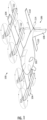
- FIG. 1 illustrates one type of robotic aircraft, namely, a UAV 100.
- the UAV generally includes a fuselage 102, wings 104 extending from opposing sides of the UAV in a mid-section of the fuselage, and an empennage or tail assembly 106 at a rear end of the fuselage.
- the tail assembly includes a vertical stabilizer 108 and two horizontal stabilizers 110 extending from opposing sides of the UAV.
- Rotors 112 and 114 are mounted to, respectively, the wings and the end of the tail assembly for lifting and propelling the UAV during flight.
- the present disclosure relates to robotic aircraft, but also to pilot-controlled aircraft. Any description herein with respect to the aircraft being autonomous or robotic also relates to describing operations of the method and system herein when the aircraft is pilot-controlled.
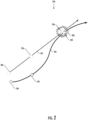
- FIG. 2 illustrates an example flight scenario 200 that helps illustrate some implementations of the present disclosure.
- This flight scenario illustrates an example collision for which the system for detecting and avoiding conflicts of the present disclosure is configured to avoid.
- the flight scenario includes a first flight path 202 along which an aircraft 204 is traveling.
- the aircraft is also referred to as the ownship, where the ownship is the aircraft on which the system described herein is located. Multiple instances of the aircraft 204 symbol are shown in FIG. 2 to indicate its movement along the first flight path over time.
- a flying object 206 traveling along second flight path 207. Similar to the aircraft, multiple instances of the flying object symbol are shown along the second flight path to illustrate the flying object's movement along the second flight path. While FIG.
- the system of the present disclosure is configured to determine maneuvers, as described hereinbelow, for one or more flying objects. If the aircraft and flying object were to continue along their respective flight paths, a collision would occur at collision point 208. This could result in a catastrophic event causing the destruction of both the aircraft and the flying object. As described further below, the system of the present disclosure is configured to help avoid these collisions.
- FIG. 3A illustrates a block diagram of a system 300 for detecting and avoiding conflict along a current route of an aircraft, such as the aircraft 204 illustrated in FIG. 2 .
- the system includes processing circuitry and a memory 301 configured to store computer-readable program code, wherein the processing circuitry is configured to access the memory, and execute the computer-readable program code.
- the system includes a conflict monitoring and prediction block 302 which receives nearby object tracking information 304 from one or more sensors 305.
- the sensors include radar sensors, video cameras, motion detectors, or any other suitable sensor that detects moving objects.
- the system further includes a most-imminent conflict determination block 306 and a conflict resolution analysis and maneuver selection block 308.
- the system 300 upon execution of the computer-readable program code, is configured to access or determine trajectories of the aircraft (e.g., by accessing or determining the ownship path from a guidance system 320 of the aircraft) and a plurality of nearby moving objects (e.g., from the sensors 305), the trajectories being determined forward in time from respective current positions of the aircraft and the plurality of nearby moving objects. That is, the system determines the future trajectories of the flying objects (e.g., based on analyzing the current track of the flying objects from the nearby object tracking data 304 received from the sensors) and itself to determine if a future conflict will occur.
- the system determines the future trajectories of the flying objects (e.g., based on analyzing the current track of the flying objects from the nearby object tracking data 304 received from the sensors) and itself to determine if a future conflict will occur.
- the conflict monitoring and prediction block 302 is configured to predict, from a comparison of the trajectories, one or more conflicts between the aircraft and corresponding ones of the nearby moving objects.
- FIG. 2 illustrates such a conflict whereby the aircraft 204 and the flying object will collide with each other at the collision point 208.
- the system 300 includes a most-imminent conflict determination block 306, at which the system is configured to determine a most-imminent conflict from the one or more conflicts based on a set of predefined prioritization rules.
- the set of predefined prioritization rules comprises, in ranked order from first to last, the system configured to: determine that a physically closest nearby moving object is the most-imminent conflict if the aircraft is in a near mid-air collision (NMAC) state; determine that a nearby moving object predicted to cause the aircraft to enter a NMAC state is the most-imminent conflict if the aircraft is in a loss of well-clear (LOWC) state; determine that the physically closest nearby moving object is the most-imminent conflict if the aircraft is currently in a LOWC state, but no NMAC state is predicted; or determine that a nearby moving object that is predicted to cause the aircraft to enter an LOWC state earlier than any other nearby moving object is the most-imminent conflict if the aircraft is not currently in an NMAC
- NMAC near mid
- An NMAC is defined as an incident associated with the operation of an aircraft in which a possibility of collision occurs as a result of proximity of less than 500 feet to another aircraft, or a report is received from a pilot or a flight crewmember stating that a collision hazard existed between two or more aircraft.
- Well-clear refers to a state in which a pilot considers the situation of the aircraft to be safe in relation to the surrounding traffic.
- Well-clear and NMAC each have different meanings in different contexts.
- RTCA standard DO-365B defines well-clear as: 1) 2200 feet horizontal and 450 feet vertical for non-cooperative air traffic (i.e., other aircraft with no transponder); and 2) 4000 feet plus a 35 second "modified tau" value, 450 feet vertical for cooperative aircraft.
- RTCA standard DO-365B defines NMAC as 500 feet horizontal and 100 feet vertical.
- ASTM standard F3442/F3442M-20 (for small UAS) specifies that 1) well-clear is 2000 feet horizontal and 250 feet vertical; and 2) NMAC is 500 feet horizontal and 100 feet vertical.
- the conflict resolution analysis and maneuver selection block 308 of the system 300 is configured to determine, based on the most-imminent conflict, a set of maneuvers, each of the maneuvers in the set comprising a maneuver direction and magnitude of heading change, calculated to maneuver the aircraft away from the current route to thereby avoid the most-imminent conflict.
- the set of maneuvers includes a list or table of maneuvers with a maneuver direction (e.g., "LEFT” or "RIGHT”) and a corresponding magnitude of heading change (e.g., 1, 2, 3,...90 degrees).
- the system is further configured to evaluate the set of maneuvers and select the maneuver to avoid the most-imminent conflict.
- the system is configured to output the maneuver, including the maneuver direction and corresponding magnitude of heading change, on a user interface 310 for use in controlling the aircraft. Controlling the aircraft using the output on the user interface is described in further detail below with respect to FIG. 3B .
- the system 300 is configured to evaluate the set of maneuvers, including the system configured to sort the set of maneuvers by maneuver direction and increasing magnitude of heading change.
- the set of maneuvers comprises an ordered list of maneuver directions and magnitudes of heading change, wherein the maneuver direction is either "LEFT” or "RIGHT” and the ordered list is ordered such that all maneuvers with a "LEFT” maneuver direction are given priority, (e.g., listed first) along with corresponding magnitudes of heading change, over the maneuvers with a "RIGHT” maneuver direction.
- the system 300 is configured to select, from the sorted set of maneuvers, a corresponding maneuver including: a maneuver direction that complies with predefined right-of-way rules (e.g., such as the right-of-way rules defined by the Federal Aviation Administration [FAA] or other rules setting body for aviation); and a magnitude of heading change for the aircraft, as the selected maneuver to avoid the conflict.
- the right-of-way rules defined by the FAA determine a preferred direction (left or right) depending on the situation presented.
- the system 300 being configured to select the corresponding maneuver comprises the system further configured to: select, from the sorted set of maneuvers, a first maneuver direction and magnitude of heading change in the set of maneuvers that does not result in an LOWC state being predicted for the aircraft if the aircraft maneuvers in the selected maneuver direction and magnitude of heading change.
- the system is further configured to select, from the sorted set of maneuvers, the corresponding maneuver with a maneuver direction and magnitude of heading change that maximizes a distance at which the aircraft will remain a first threshold distance away from all of the nearby moving objects if no maneuver direction and corresponding magnitude of heading change will avoid the aircraft entering an LOWC state.
- system is further configured to select, from the sorted set of maneuvers, the corresponding maneuver with a maneuver direction and the magnitude of heading change that leads fastest to a state where no conflict between the aircraft and the nearby moving objects is predicted if more than one of the set of maneuvers creates corresponding distances, at which the aircraft will remain away from all of the nearby moving objects, within a second threshold distance of each other.
- the conflict resolution analysis and maneuver selection block 308 of the system 300 is configured to select a maneuver with a maneuver direction in the preferred direction (e.g., left or right, based on the right-of-way rules discussed above, or based on a received preferred direction) unless no maneuver in the set having the preferred maneuver direction will prevent a loss of well-clear.
- the maneuver selection block will select a maneuver with a left maneuver, however, if a left maneuver will not produce a return to well clear or otherwise resolve the conflict, a maneuver having a "RIGHT" maneuver direction will be selected.
- FIG. 3B illustrates an aerial environment 330 wherein the detect and avoid system 300 is located on an aircraft 204, such as the UAV illustrated in FIG. 1 .
- the aircraft including the detect and avoid system is in communication with a ground station 332.
- the ground station is used to send the nearby object tracking data to the detect and avoid system.
- the ground station includes the user interface 310 where a user, such as a remote pilot, will view the user interface and maneuver the aircraft according to the maneuver output to the user interface. Further, as shown in FIG.
- the aircraft includes the detect and avoid system onboard the aircraft, the system being in communication with the sensors 305 (e.g., for also collecting flying object tracking data as described above) and the guidance system 320 of the aircraft.
- the system is further configured to transmit the selected maneuver, including the maneuver direction and the magnitude of heading change, to the guidance system of the aircraft, wherein the guidance system is configured to maneuver the aircraft (e.g., automatically maneuver the aircraft) according to the selected maneuver direction and magnitude of heading change.
- the aircraft is fully autonomous (i.e., the maneuver is executed by the guidance system 320), partially autonomous (e.g., some aspects of the maneuver are executed by the guidance system and other parts are executed by a human operator), or fully controlled by a human (i.e., the ground station 332 comprises a joy stick or other user interface allowing a pilot on the ground to execute the maneuver manually).
- FIG. 3C illustrates an example user interface 310C (e.g., such as a graphical user interface) according to some implementations of the present disclosure.
- the system is further configured to display, on the user interface, a first trajectory of the aircraft on a visual flight rules (VFR) map or terrain map on the user interface, including a current position of the aircraft and the first trajectory pointing from the current position of the aircraft to a future position of the aircraft based on the selected maneuver direction and magnitude of heading change.
- VFR visual flight rules
- the system is further configured to display a current position of each of the plurality of nearby moving objects relative to the current position of the aircraft on the user interface.
- VFR visual flight rules
- the aircraft 204 (also referred to as the ownship) is flying along first flight path 202 towards destination 311.
- flying object 1 312 is displayed and has a trajectory 313 that will intersect with the first flight path
- flying object 2 314 is displayed and has a trajectory 315 that will intersect with the first flight path.
- the user interface is configured to toggle between the VFR map and the terrain map with the first trajectory (e.g., the first flight path) displayed thereon.
- the system 300 determines the maneuver with respect to flying object 1 312 and flying object 2 314 according to the description above, it displays an arrow and instruction 316 indicating the maneuver direction (e.g., "RIGHT” in the example illustrated in FIG. 3C ) and magnitude of the change of direction of the maneuver (e.g., 100° in this case).
- the user interface will also display various data 317 indicating, for example, how long ago the tracking data was updated for the flying objects, when a LWOC is calculated to occur, an estimated distance between the ownship and the flying objects, and how long a near mid-air collision is calculated to occur in the future between the ownship and the flying object.
- FIG. 3D illustrates another view of a user interface 310D, which is an updated view in time of the user interface 310C, wherein the system has selected the maneuver and the aircraft 204 has executed the maneuver described in relation to FIG. 3C , and is on a new path 318 to travel to the destination 311 and avoid the flying object 1 312 and the flying object 2 314. While the trajectory 313 of flying object 1 still intersects with the new path 318 of the aircraft 204, there is not a conflict calculated because flying object 1 will fly over the intersected path well before the aircraft 204 arrives.
- the system is further configured to display an indicia 319 on the user interface to indicate a status of the aircraft along an updated route, the status including a location of the aircraft along the updated route.
- the system 300 described above is configured to continuously perform the functions described herein as real-time flying object tracking is received and processed by the system. For example, once a maneuver is selected and the aircraft changes direction according to the maneuver, the process for receiving the flying object tracking data, analyzing the data, detecting conflicts, and determining maneuvers will begin again.
- FIG. 4 illustrates a flow chart of an example method 400 for detecting and avoiding conflict along a current route of an aircraft.
- the method includes storing computer-readable program code in a memory and executing the computer-readable program code by processing circuitry configured to access the memory. Upon execution of the computer-readable program code, the processing circuitry is configured to perform the following steps.
- the method includes accessing or determining trajectories of the vehicle and a plurality of nearby moving objects, the trajectories being determined forward in time from respective current positions of the vehicle and the plurality of nearby moving objects.
- the method includes predicting, from a comparison of the trajectories, one or more conflicts between the vehicle and corresponding ones of the nearby moving objects.
- the method 400 incudes determining a most-imminent conflict from the one or more conflicts based on a set of predefined prioritization rules.
- the method includes selecting a maneuver to avoid the most-imminent conflict.
- the method includes selecting the maneuver to avoid the most-imminent conflict including determining, based on the most-imminent conflict, a set of maneuvers, each of the maneuvers in the set comprising a maneuver direction and magnitude of heading change, calculated to maneuver the vehicle away from the current route to thereby avoid the most-imminent conflict; and as shown in seventh block 414 evaluating the set of maneuvers and selecting the maneuver to avoid the conflict.
- the method further includes outputting the selected maneuver on a user interface for use in controlling the vehicle.
- the system 300 for detecting and avoiding conflict along a current route of an aircraft is implemented by various means.
- Means for implementing the system includes hardware, alone or under direction of one or more computer programs from a computer-readable storage medium.
- one or more apparatuses are configured to function as or otherwise implement the system shown and described herein.
- the respective apparatuses are connected to or otherwise in communication with one another in a number of different manners, such as directly or indirectly via a wired or wireless network or the like.
- FIG. 5 illustrates an apparatus 500 capable of implementing the system 300 of FIG. 3A for detecting and avoiding conflict along a current route of an aircraft.
- the apparatus 500 is an example device that is used to implement the methods and functions described above with respect to the system for detecting and avoiding conflict along a current route of an aircraft.
- an apparatus of exemplary implementations of the present disclosure comprises, includes, or is embodied in one or more fixed or portable electronic devices. Examples of suitable electronic devices include a microcontroller, controller, smartphone, tablet computer, laptop computer, desktop computer, workstation computer, server computer or the like.
- the apparatus includes one or more of each of a number of components such as, for example, processing circuitry 502 (e.g., processor unit or computer processor) connected to a memory 504 (e.g., storage device).
- processing circuitry 502 e.g., processor unit or computer processor
- memory 504 e.g., storage device
- the processing circuitry 502 is composed of one or more processors alone or in combination with one or more memories.
- the processing circuitry is generally any piece of computer hardware that is capable of processing information such as, for example, data, computer programs and/or other suitable electronic information.
- the processing circuitry is composed of a collection of electronic circuits some of which is packaged as an integrated circuit or multiple interconnected integrated circuits (an integrated circuit at times more commonly referred to as a "chip").
- the processing circuitry is configured to execute computer programs, which are stored onboard the processing circuitry or otherwise stored in the memory 504 (of the same or another apparatus).
- the processing circuitry 502 includes a number of processors, a multi-core processor or some other type of processor, depending on the particular implementation. Further, the processing circuitry is implemented using a number of heterogeneous processor systems in which a main processor is present with one or more secondary processors on a single chip. As another illustrative example, the processing circuitry is a symmetric multi-processor system containing multiple processors of the same type. In yet another example, the processing circuitry is embodied as or otherwise include one or more ASICs, FPGAs or the like. Thus, although the processing circuitry is capable of executing a computer program to perform one or more functions, the processing circuitry of various examples is capable of performing one or more functions without the aid of a computer program. In either instance, the processing circuitry is appropriately programmed to perform functions or operations according to example implementations of the present disclosure.
- the memory 504 is generally any piece of computer hardware that is capable of storing information such as, for example, data, computer programs (e.g., computer-readable program code 506) and/or other suitable information either on a temporary basis and/or a permanent basis.
- the memory includes volatile and/or non-volatile memory, and is fixed or removable.
- RAM random access memory
- ROM read-only memory
- HDD hard drive
- flash memory a hard drive
- thumb drive a removable computer diskette
- optical disk a magnetic tape or some combination of the above.
- Optical disks include compact disk - read only memory (CD-ROM), compact disk - read/write (CD-R/W), DVD or the like.
- the memory is referred to as a computer-readable storage medium.
- the computer-readable storage medium is a non-transitory device capable of storing information, and is distinguishable from computer-readable transmission media such as electronic transitory signals capable of carrying information from one location to another.
- Computer-readable medium as described herein generally refer to a computer-readable storage medium or computer-readable transmission medium.
- the processing circuitry 502 is also connected to one or more interfaces for displaying, transmitting and/or receiving information.
- the interfaces include a communications interface 508 (e.g., communications unit) and/or one or more user interfaces.
- the communications interface is configured to transmit and/or receive information, such as to and/or from other apparatus(es), network(s) or the like.
- the communications interface is configured to transmit and/or receive information by physical (wired) and/or wireless communications links. Examples of suitable communication interfaces include a network interface controller (NIC), wireless NIC (WNIC) or the like.
- NIC network interface controller
- WNIC wireless NIC
- the user interfaces include a display 510 and/or one or more user input interfaces 512 (e.g., input/output unit).
- the display is configured to present or otherwise display information to a user, suitable examples of which include a liquid crystal display (LCD), light-emitting diode display (LED), plasma display panel (PDP) or the like.
- the user input interfaces are wired or wireless, and are configured to receive information from a user into the apparatus, such as for processing, storage and/or display. Suitable examples of user input interfaces include a microphone, image or video capture device, keyboard or keypad, joystick, touch-sensitive surface (separate from or integrated into a touchscreen), biometric sensor or the like.
- the user interfaces further include one or more interfaces for communicating with peripherals such as printers, scanners or the like.
- program code instructions are stored in memory, and executed by processing circuitry that is thereby programmed, to implement functions of the systems, subsystems, tools and their respective elements described herein.
- any suitable program code instructions are loaded onto a computer or other programmable apparatus from a computer-readable storage medium to produce a particular machine, such that the particular machine becomes a means for implementing the functions specified herein.
- These program code instructions are also stored in a computer-readable storage medium that direct a computer, a processing circuitry or other programmable apparatus to function in a particular manner to thereby generate a particular machine or particular article of manufacture.
- the instructions stored in the computer-readable storage medium produce an article of manufacture, where the article of manufacture becomes a means for implementing functions described herein.
- the program code instructions are retrieved from a computer-readable storage medium and loaded into a computer, processing circuitry or other programmable apparatus to configure the computer, processing circuitry or other programmable apparatus to execute operations to be performed on or by the computer, processing circuitry or other programmable apparatus.
- Retrieval, loading and execution of the program code instructions are performed sequentially such that one instruction is retrieved, loaded and executed at a time. In some example implementations, retrieval, loading and/or execution are performed in parallel such that multiple instructions are retrieved, loaded, and/or executed together. Execution of the program code instructions produce a computer-implemented process such that the instructions executed by the computer, processing circuitry or other programmable apparatus provide operations for implementing functions described herein.
- Execution of instructions by a processing circuitry, or storage of instructions in a computer-readable storage medium supports combinations of operations for performing the specified functions.
- the apparatus 500 includes the processing circuitry 502 and the computer-readable storage medium or memory 504 coupled to the processing circuitry, where the processing circuitry is configured to execute computer-readable program code 506 stored in the memory. It will also be understood that one or more functions, and combinations of functions, are implemented by special purpose hardware-based computer systems and/or processing circuitry which perform the specified functions, or combinations of special purpose hardware and program code instructions.
- first, second, etc. are used herein to describe various steps or calculations, these steps or calculations should not be limited by these terms. These terms are only used to distinguish one operation or calculation from another. For example, a first calculation is termed a second calculation, and, similarly, a second step is termed a first step, without departing from the scope of this disclosure.
- the term "and/or" and the "j" symbol includes any and all combinations of one or more of the associated listed items.
Landscapes
- Engineering & Computer Science (AREA)
- Aviation & Aerospace Engineering (AREA)
- Physics & Mathematics (AREA)
- General Physics & Mathematics (AREA)
- Traffic Control Systems (AREA)
- Radar, Positioning & Navigation (AREA)
- Remote Sensing (AREA)
Applications Claiming Priority (1)
| Application Number | Priority Date | Filing Date | Title |
|---|---|---|---|
| US17/971,252 US12387615B2 (en) | 2022-10-21 | 2022-10-21 | System and method for detecting and avoiding conflicts along a current route of a vehicle |
Publications (1)
| Publication Number | Publication Date |
|---|---|
| EP4362002A1 true EP4362002A1 (de) | 2024-05-01 |
Family
ID=88505128
Family Applications (1)
| Application Number | Title | Priority Date | Filing Date |
|---|---|---|---|
| EP23204578.1A Pending EP4362002A1 (de) | 2022-10-21 | 2023-10-19 | System und verfahren zur erkennung und vermeidung von konflikten entlang einer aktuellen route eines fahrzeugs |
Country Status (3)
| Country | Link |
|---|---|
| US (2) | US12387615B2 (de) |
| EP (1) | EP4362002A1 (de) |
| CN (1) | CN117917714A (de) |
Cited By (1)
| Publication number | Priority date | Publication date | Assignee | Title |
|---|---|---|---|---|
| US20260073798A1 (en) * | 2024-09-06 | 2026-03-12 | Honeywell International Inc. | Method and system for automatically switching navigation modes for air mobility vehicles |
Families Citing this family (1)
| Publication number | Priority date | Publication date | Assignee | Title |
|---|---|---|---|---|
| CN119902446B (zh) * | 2025-03-26 | 2025-08-19 | 西安达升科技股份有限公司 | 机器人集群调度方法、装置及设备 |
Citations (4)
| Publication number | Priority date | Publication date | Assignee | Title |
|---|---|---|---|---|
| US20100121503A1 (en) * | 2008-11-13 | 2010-05-13 | Saab Ab | Collision avoidance system and a method for determining an escape manoeuvre trajectory for collision avoidance |
| US20140019034A1 (en) * | 2007-09-28 | 2014-01-16 | The Boeing Company | Vehicle-based automatic traffic conflict and collision avoidance |
| US10302759B1 (en) * | 2013-03-05 | 2019-05-28 | The United States Of America As Represented By The Administrator Of The National Aeronautics And Space Administration | Automatic dependent surveillance broadcast (ADS-B) system with radar for ownship and traffic situational awareness |
| US20210197966A1 (en) * | 2019-03-15 | 2021-07-01 | Yan Zhang | Methods and systems for aircraft collision avoidance |
Family Cites Families (39)
| Publication number | Priority date | Publication date | Assignee | Title |
|---|---|---|---|---|
| SE515655C2 (sv) * | 1999-12-22 | 2001-09-17 | Saab Ab | "System och metod för kollisionsundvikning mellan farkoster |
| US6393362B1 (en) * | 2000-03-07 | 2002-05-21 | Modular Mining Systems, Inc. | Dynamic safety envelope for autonomous-vehicle collision avoidance system |
| FR2810146A1 (fr) * | 2000-06-09 | 2001-12-14 | Thomson Csf | Procede d'elaboration d'une trajectoire d'evitement dans le plan horizontal pour aeronef en vue de la resolution d'un conflit de trafic |
| US6820006B2 (en) * | 2002-07-30 | 2004-11-16 | The Aerospace Corporation | Vehicular trajectory collision conflict prediction method |
| US6691034B1 (en) * | 2002-07-30 | 2004-02-10 | The Aerospace Corporation | Vehicular trajectory collision avoidance maneuvering method |
| FR2848661B1 (fr) * | 2002-12-13 | 2005-03-04 | Thales Sa | Equipement anticollision terrain embarque a bord d'aeronef avec aide au retour en vol normal |
| US6873269B2 (en) * | 2003-05-27 | 2005-03-29 | Honeywell International Inc. | Embedded free flight obstacle avoidance system |
| WO2006021813A1 (en) * | 2004-07-09 | 2006-03-02 | Bae Systems Plc | Collision avoidance system |
| US20070043481A1 (en) * | 2005-08-11 | 2007-02-22 | Teamvision Corporation | New Approach to Enroute Aircraft Management |
| WO2007102367A1 (ja) * | 2006-02-28 | 2007-09-13 | Toyota Jidosha Kabushiki Kaisha | 物体進路予測方法、装置、プログラム、および自動運転システム |
| DE102007013303A1 (de) * | 2007-03-16 | 2008-09-18 | Robert Bosch Gmbh | Verfahren zur Berechnung einer kollisionsvermeidenden Trajektorie für ein Fahrmanöver eines Fahrzeugs |
| ATE548245T1 (de) * | 2008-04-03 | 2012-03-15 | Valeo Schalter & Sensoren Gmbh | Verfahren und vorrichtung zur unterstützung eines fahres eines fahrzeugs beim ausparken aus einer parklücke |
| DK2851084T3 (en) * | 2008-05-22 | 2018-07-30 | H Lundbeck As | Modulation of Vps10p domain receptors for the treatment of cardiovascular disease |
| US9127908B2 (en) * | 2009-02-02 | 2015-09-08 | Aero Vironment, Inc. | Multimode unmanned aerial vehicle |
| US8380367B2 (en) * | 2009-03-26 | 2013-02-19 | The University Of North Dakota | Adaptive surveillance and guidance system for vehicle collision avoidance and interception |
| US11150105B2 (en) * | 2009-07-26 | 2021-10-19 | Aspen Avionics, Inc. | Avionics device, systems and methods of display |
| US8725402B2 (en) * | 2009-11-13 | 2014-05-13 | The Boeing Company | Loss of separation avoidance maneuvering |
| US9262933B2 (en) * | 2009-11-13 | 2016-02-16 | The Boeing Company | Lateral avoidance maneuver solver |
| US8892348B2 (en) * | 2009-11-18 | 2014-11-18 | The Mitre Corporation | Method and system for aircraft conflict detection and resolution |
| US8509982B2 (en) * | 2010-10-05 | 2013-08-13 | Google Inc. | Zone driving |
| US8830090B2 (en) * | 2011-07-08 | 2014-09-09 | The Boeing Company | Display of current trend and/or future position of vehicular traffic |
| FR2990290B1 (fr) * | 2012-05-02 | 2015-04-03 | Sagem Defense Securite | Procede d'evitement d'un aeronef et drone equipe d'un systeme mettant en oeuvre ce procede |
| US8965679B2 (en) * | 2012-06-11 | 2015-02-24 | Honeywell International Inc. | Systems and methods for unmanned aircraft system collision avoidance |
| US8989998B2 (en) * | 2013-03-27 | 2015-03-24 | The Boeing Company | Predicted position and heading/track indicators for navigation display |
| US10332405B2 (en) * | 2013-12-19 | 2019-06-25 | The United States Of America As Represented By The Administrator Of Nasa | Unmanned aircraft systems traffic management |
| EP2990290B1 (de) * | 2014-09-01 | 2019-11-06 | Honda Research Institute Europe GmbH | Verfahren und System zur Manöverplanung nach einer Kollision und mit einem derartigen System ausgestattetes Fahrzeug |
| US9547993B2 (en) * | 2015-02-23 | 2017-01-17 | Honeywell International Inc. | Automated aircraft ground threat avoidance system |
| US10586464B2 (en) * | 2015-07-29 | 2020-03-10 | Warren F. LeBlanc | Unmanned aerial vehicles |
| US9898934B2 (en) * | 2016-07-25 | 2018-02-20 | Honeywell International Inc. | Prediction of vehicle maneuvers |
| US10126722B2 (en) * | 2016-08-01 | 2018-11-13 | Qualcomm Incorporated | System and method of dynamically controlling parameters for processing sensor output data for collision avoidance and path planning |
| US9849044B1 (en) * | 2017-01-30 | 2017-12-26 | SkyRyse, Inc. | Vehicle system and method for providing services |
| US10710579B2 (en) * | 2017-06-01 | 2020-07-14 | Waymo Llc | Collision prediction system |
| US10692389B2 (en) * | 2018-07-20 | 2020-06-23 | Aurora Flight Services Corporation, a subsidiary of The Boeing Company | Flight control systems for aerial vehicles and related methods |
| US20230028792A1 (en) * | 2019-12-23 | 2023-01-26 | A^3 By Airbus, Llc | Machine learning architectures for camera-based detection and avoidance on aircrafts |
| US11077951B1 (en) | 2020-03-28 | 2021-08-03 | Textron Innovations Inc. | Propulsion systems for low observable aircraft |
| US11465619B2 (en) * | 2020-05-27 | 2022-10-11 | Zoox, Inc. | Vehicle collision avoidance based on perturbed object trajectories |
| US11731661B2 (en) * | 2020-10-01 | 2023-08-22 | Argo AI, LLC | Systems and methods for imminent collision avoidance |
| US12371010B2 (en) * | 2021-12-28 | 2025-07-29 | Ford Global Technologies, Llc | Integrated trajectory forecasting, error estimation, and vehicle handling when detecting an observed scenario |
| US12482367B2 (en) * | 2022-02-03 | 2025-11-25 | The Boeing Company | Reinforcement learning-based mid-air collision avoidance |
-
2022
- 2022-10-21 US US17/971,252 patent/US12387615B2/en active Active
-
2023
- 2023-09-19 CN CN202311211048.2A patent/CN117917714A/zh active Pending
- 2023-10-19 EP EP23204578.1A patent/EP4362002A1/de active Pending
-
2025
- 2025-08-08 US US19/294,540 patent/US20260024444A1/en active Pending
Patent Citations (4)
| Publication number | Priority date | Publication date | Assignee | Title |
|---|---|---|---|---|
| US20140019034A1 (en) * | 2007-09-28 | 2014-01-16 | The Boeing Company | Vehicle-based automatic traffic conflict and collision avoidance |
| US20100121503A1 (en) * | 2008-11-13 | 2010-05-13 | Saab Ab | Collision avoidance system and a method for determining an escape manoeuvre trajectory for collision avoidance |
| US10302759B1 (en) * | 2013-03-05 | 2019-05-28 | The United States Of America As Represented By The Administrator Of The National Aeronautics And Space Administration | Automatic dependent surveillance broadcast (ADS-B) system with radar for ownship and traffic situational awareness |
| US20210197966A1 (en) * | 2019-03-15 | 2021-07-01 | Yan Zhang | Methods and systems for aircraft collision avoidance |
Cited By (1)
| Publication number | Priority date | Publication date | Assignee | Title |
|---|---|---|---|---|
| US20260073798A1 (en) * | 2024-09-06 | 2026-03-12 | Honeywell International Inc. | Method and system for automatically switching navigation modes for air mobility vehicles |
Also Published As
| Publication number | Publication date |
|---|---|
| US20240296746A1 (en) | 2024-09-05 |
| US12387615B2 (en) | 2025-08-12 |
| US20260024444A1 (en) | 2026-01-22 |
| CN117917714A (zh) | 2024-04-23 |
Similar Documents
| Publication | Publication Date | Title |
|---|---|---|
| US20260024444A1 (en) | System and method for detecting and avoiding conflicts along a current route of a vehicle | |
| US12190741B2 (en) | Conflict detection and avoidance along a current route of a robot | |
| CN107272731B (zh) | 无人机自动避撞系统 | |
| US9286807B2 (en) | Collision avoidance system and a method for determining an escape manoeuvre trajectory for collision avoidance | |
| US12590816B2 (en) | Route planning for a ground vehicle through unfamiliar terrain | |
| US12482367B2 (en) | Reinforcement learning-based mid-air collision avoidance | |
| US20220301445A1 (en) | Supporting Flight Operations of an Aircraft in an Airspace System | |
| EP3945396B1 (de) | Erkennung von konflikten entlang einer route eines roboters | |
| US20240265817A1 (en) | Conflict detection and avoidance for a robot with right-of-way rule compliant maneuver selection | |
| EP4354414A1 (de) | Kollisionsvermeidungssystem und -verfahren | |
| US20240419167A1 (en) | Conflict detection and avoidance for a robot based on perception uncertainty | |
| EP3945513A1 (de) | Auswahl eines alternativen ziels in reaktion auf ein unvorhergesehenes ereignis | |
| US12032370B2 (en) | Supporting an aircraft on a mission in which an intent of the aircraft is conveyed responsive to a lost-link event | |
| EP3945285B1 (de) | Bewertung eines bodenbereichs für die landung eines roboters | |
| US20230129329A1 (en) | Guidance modes for an unmanned aerial vehicle | |
| US20250157349A1 (en) | Conflict detection and avoidance for a robot with right-of-way rule compliant maneuver selection | |
| Mendes et al. | Safe teleoperation of a quadrotor using FastSLAM |
Legal Events
| Date | Code | Title | Description |
|---|---|---|---|
| PUAI | Public reference made under article 153(3) epc to a published international application that has entered the european phase |
Free format text: ORIGINAL CODE: 0009012 |
|
| STAA | Information on the status of an ep patent application or granted ep patent |
Free format text: STATUS: THE APPLICATION HAS BEEN PUBLISHED |
|
| AK | Designated contracting states |
Kind code of ref document: A1 Designated state(s): AL AT BE BG CH CY CZ DE DK EE ES FI FR GB GR HR HU IE IS IT LI LT LU LV MC ME MK MT NL NO PL PT RO RS SE SI SK SM TR |
|
| STAA | Information on the status of an ep patent application or granted ep patent |
Free format text: STATUS: REQUEST FOR EXAMINATION WAS MADE |
|
| 17P | Request for examination filed |
Effective date: 20241030 |
|
| RBV | Designated contracting states (corrected) |
Designated state(s): AL AT BE BG CH CY CZ DE DK EE ES FI FR GB GR HR HU IE IS IT LI LT LU LV MC ME MK MT NL NO PL PT RO RS SE SI SK SM TR |