EP4360617A1 - Formulation comprising ester quats based on trialkanolamines - Google Patents
Formulation comprising ester quats based on trialkanolamines Download PDFInfo
- Publication number
- EP4360617A1 EP4360617A1 EP23205451.0A EP23205451A EP4360617A1 EP 4360617 A1 EP4360617 A1 EP 4360617A1 EP 23205451 A EP23205451 A EP 23205451A EP 4360617 A1 EP4360617 A1 EP 4360617A1
- Authority
- EP
- European Patent Office
- Prior art keywords
- weight
- acyl radicals
- inci
- evonik industries
- formulation
- Prior art date
- Legal status (The legal status is an assumption and is not a legal conclusion. Google has not performed a legal analysis and makes no representation as to the accuracy of the status listed.)
- Granted
Links
Images

Classifications
-
- A—HUMAN NECESSITIES
- A61—MEDICAL OR VETERINARY SCIENCE; HYGIENE
- A61K—PREPARATIONS FOR MEDICAL, DENTAL OR TOILETRY PURPOSES
- A61K8/00—Cosmetics or similar toiletry preparations
- A61K8/18—Cosmetics or similar toiletry preparations characterised by the composition
- A61K8/30—Cosmetics or similar toiletry preparations characterised by the composition containing organic compounds
- A61K8/40—Cosmetics or similar toiletry preparations characterised by the composition containing organic compounds containing nitrogen
- A61K8/41—Amines
- A61K8/416—Quaternary ammonium compounds
-
- A—HUMAN NECESSITIES
- A61—MEDICAL OR VETERINARY SCIENCE; HYGIENE
- A61K—PREPARATIONS FOR MEDICAL, DENTAL OR TOILETRY PURPOSES
- A61K8/00—Cosmetics or similar toiletry preparations
- A61K8/18—Cosmetics or similar toiletry preparations characterised by the composition
- A61K8/30—Cosmetics or similar toiletry preparations characterised by the composition containing organic compounds
- A61K8/40—Cosmetics or similar toiletry preparations characterised by the composition containing organic compounds containing nitrogen
- A61K8/42—Amides
-
- A—HUMAN NECESSITIES
- A61—MEDICAL OR VETERINARY SCIENCE; HYGIENE
- A61K—PREPARATIONS FOR MEDICAL, DENTAL OR TOILETRY PURPOSES
- A61K8/00—Cosmetics or similar toiletry preparations
- A61K8/18—Cosmetics or similar toiletry preparations characterised by the composition
- A61K8/30—Cosmetics or similar toiletry preparations characterised by the composition containing organic compounds
- A61K8/46—Cosmetics or similar toiletry preparations characterised by the composition containing organic compounds containing sulfur
- A61K8/463—Cosmetics or similar toiletry preparations characterised by the composition containing organic compounds containing sulfur containing sulfuric acid derivatives, e.g. sodium lauryl sulfate
-
- A—HUMAN NECESSITIES
- A61—MEDICAL OR VETERINARY SCIENCE; HYGIENE
- A61Q—SPECIFIC USE OF COSMETICS OR SIMILAR TOILETRY PREPARATIONS
- A61Q5/00—Preparations for care of the hair
-
- A—HUMAN NECESSITIES
- A61—MEDICAL OR VETERINARY SCIENCE; HYGIENE
- A61Q—SPECIFIC USE OF COSMETICS OR SIMILAR TOILETRY PREPARATIONS
- A61Q5/00—Preparations for care of the hair
- A61Q5/02—Preparations for cleaning the hair
-
- A—HUMAN NECESSITIES
- A61—MEDICAL OR VETERINARY SCIENCE; HYGIENE
- A61Q—SPECIFIC USE OF COSMETICS OR SIMILAR TOILETRY PREPARATIONS
- A61Q5/00—Preparations for care of the hair
- A61Q5/12—Preparations containing hair conditioners
-
- A—HUMAN NECESSITIES
- A61—MEDICAL OR VETERINARY SCIENCE; HYGIENE
- A61K—PREPARATIONS FOR MEDICAL, DENTAL OR TOILETRY PURPOSES
- A61K2800/00—Properties of cosmetic compositions or active ingredients thereof or formulation aids used therein and process related aspects
- A61K2800/10—General cosmetic use
Definitions
- compositions comprising specific ester quats based on trialkanolamines, and to the use of these compositions in cosmetics.
- DE3608093 describes quaternary ammonium compounds comprising two 2-acyloxyalkyl groups, the acyl groups of which are derived from saturated or unsaturated carboxylic acids having 12 to 22 carbon atoms, including dimethyldi(oleoyl-oxyisopropyl)ammonium methosulfate, and the use of such substances in textile-softening formulations.
- DE3877422 describes similar quaternary ammonium compounds, the corresponding acyl groups of which comprise at most 17 carbon atoms, including dimethyldi(palmitoyl-oxyisopropyl)ammonium chloride, and the use of such substances in textile-softening formulations, but also mentions their suitability for hair conditioning agents.
- EP0900260 discloses a textile softener composition with improved stability and softening performance which comprises a fabric-softening active amount of a quaternary ammonium salt having specific mono-, di- and triester components, where the diester component amounts to more than about 55% by weight and the triester component amounts to less than about 25% by weight based on the total amount of the quaternary ammonium salt.
- EP3820980A1 discloses a composition
- a composition comprising, based on the weight of the composition, about 30% to about 100% by weight of a mixture of one or more ester quats and one or more glycerides, where the mixture comprises about 50% to about 80% by weight of ester quats and about 20% to about 50% by weight of glycerides; and, based on the weight of the composition, optionally 0% to about 70% by weight of a solvent.
- Ester quats obtainable hitherto, which are suitable for use in hair conditioning, are solid substances which are only converted to a formulatable form by using solvents, as a result of which it is stipulated which solvent will be present in the end formulation. This limits the degrees of freedom of the formulation options.
- liquid hair conditioning agents exhibit excellent conditioning properties but decrease the viscosity of the formulations as the concentration increases. This limits the use concentration and requires the use of an emulsifier for the fatty alcohol.
- compositions described below are able to achieve the object of the invention.
- the present invention provides a composition comprising an ester quat of the general formula I) where
- ester quat of the composition according to the invention is a compound composed of multiple distinct molecules, with the numbers a to c stated indicating average values.
- the respective ratio is greater than 2 or greater than 10.
- the invention further provides for the use of a composition comprising an ester quat of the general formula I) where
- ester quats used are liquid at room temperature and can therefore easily be incorporated into a final consumer formulation without the use of solvents and without heating, as a result of which such a solvent does not necessarily have to be present in said formulation.
- Another advantage of the present invention is that the shine of the treated keratin fibres is increased.
- a further advantage of the present invention is that the compounds used develop a good effect even in small use amounts.
- a further advantage is that the compounds used have little impact from an ecological point of view.
- Another advantage of the present invention is that the compounds used do not crystallize out.
- Another advantage of the present invention is that the compounds used are effective in relatively low use concentrations.
- Another advantage of the present invention is that the compounds used protect hair colourants from being washed out.
- Another advantage of the present invention is that the compounds used protect keratin fibres against thermally induced damage.
- Another advantage of the present invention is that the compounds used reduce the combing forces on wet and dry hair.
- Another advantage of the present invention is that the compounds used are particularly economically viable.
- Another advantage of the present invention is that the compounds used can be incorporated into surfactant formulations to give a clear formulation.
- Another advantage of the present invention is that the viscosity can be increased depending on the use concentration of the conditioning agent.
- ester quats used in the context of the invention can be prepared by relevant methods of preparative organic chemistry.
- the preparation of ester quats is based on a multistage process in which firstly the esterified alkanolamine is prepared by reacting an alkanolamine with carboxylic acids or corresponding derivatives, and said alkanolamine is then subsequently quaternized with a suitable reagent.
- the alkanolamine used is triethanolamine or triisopropanolamine or mixtures thereof, in particular triethanolamine.
- EP0483195 In connection with suitable preparation processes, reference may be made to EP0483195 , according to which trialkanolamine is partially esterified in the presence of hypophosphorous acid with fatty acids, air is passed through and then quaternization is carried out with dimethyl sulfate or ethylene oxide.
- the compounds listed therein serve as plasticizers for textiles.
- DE4308794 describes the preparation of solid ester quats by carrying out the quaternization of the triethanolamine esters in the presence of suitable dispersants. Overviews on this topic can be found for example under R. Puchta et al. in Tens. Surf. Det., 30, 186 (1993 ), M. Brock in Tens. Surf. Det., 30, 394 (1993 ), R. Lagerman et al. in J. Am. Chem. Soc., 71, 97 (1994 ) or under I. Shapiro in Cosm. Toil., 109, 77 (1994 ).
- the ester quats present in the compositions according to the invention are characterized by the parameter a with respect to their degree of esterification.
- the ester quat thus comprises corresponding mono-, di- and/or triesters, which result in a statistical average corresponding to the degree of esterification.
- Suitable methods for quantitative determination are HPLC and NMR, with particular emphasis being given to the methodology disclosed in Characterization of quaternized triethanolamine esters (esterquats) by HPLC, HRCGC and NMR by Wilkes, A. J. et al. World Surfactants Congress, 4th, Barcelona, June 3-7, 1996 .
- compositions that are preferred according to the invention comprise an ester quat of the general formula I) that comprises, based on all ester quats of the general formula I) that are present, less than 20% by weight, preferably less than 15% by weight, especially preferably less than 10% by weight, of triester quat.
- the acyl radicals R 1 of the general formula I) are a mixture which has a weight ratio of saturated C16 acyl radicals to unsaturated C16 acyl radicals of greater than 2 and a weight ratio of unsaturated C18 acyl radicals to saturated C18 acyl radicals of greater than 10.
- Such a distribution can in particular be found in mixed vegetable oils.
- compositions that are preferred according to the invention are characterized in that the mixture of acyl radicals comprises a content of acyl radicals as shown below (mixed vegetable oil fatty acid I) C16 4% by weight - 7% by weight, C16:1 0% by weight - 2% by weight, C18 0% by weight - 4% by weight, C18:1 55% by weight - 65% by weight, C18:2 15% by weight - 25% by weight, C18:3 6% by weight - 12% by weight, where the percentages by weight are based on the sum total of all R 1 in the ester quat of the general formula I).
- the iodine number is preferably in the range from 100 to 160, particularly preferably 105 to 135, gl/100 g.
- compositions that are preferred according to the invention are characterized in that the mixture of acyl radicals comprises a content of acyl radicals as shown below (mixed vegetable oil fatty acid II) C16 4% by weight - 7% by weight, C16:1 0% by weight - 2% by weight, C18 0% by weight - 4% by weight, C18:1 14% by weight - 21% by weight, C18:2 12% by weight - 25% by weight, C18:3 29% by weight - 39% by weight, where the percentages by weight are based on the sum total of all R 1 in the ester quat of the general formula I).
- the iodine number is preferably in the range from 100 to 160, particularly preferably 105 to 135, gl/100 g.
- compositions that are preferred according to the invention are characterized in that the mixture of acyl radicals comprises a content of acyl radicals as shown below (tall oil fatty acid) C16 1% by weight - 8% by weight, C16:1 0% by weight - 2% by weight, C18 0% by weight - 4% by weight, C18:1 40% by weight - 60% by weight, C18:2 30% by weight - 40% by weight, C18:3 5% by weight - 10% by weight, where the percentages by weight are based on the sum total of all R 1 in the ester quat of the general formula I).
- the iodine number is preferably in the range from 140 to 160 gl/100 g.
- the mixture of acyl radicals may of course comprise a content of other acyl radicals in addition to those specifically named. It is preferable according to the invention if the sum total of the specifically named acyl radicals amounts to at least 70% by weight, in particular at least 80% by weight, particularly preferably at least 90% by weight, based on all acyl radicals present in the mixture.
- compositions that are preferred according to the invention are characterized in that the mixture of acyl radicals has an iodine number of 80 to 170, preferably 95 to 160, particularly preferably 105 to 135, cg l/g.
- the charge of the compound I) present in the composition according to the invention must be compensated by corresponding anions; this takes place by means of counteranions present in the composition according to the invention.
- Suitable as such counteranions are, for example, the halides, pseudohalides, anions of mineral acids, sulfates, sulfites, hydrogensulfites, sulfonate, alkyl- and arylsulfonates, phosphate, hydrogenphosphates, phosphites, hydrogenphosphites, phosphonites, carboxylates, borates, carbonates, sulfides, hydrogensulfides, lactate, glycolate, formate, acetate and propionate.
- anions are preferably selected from those which are suitable for cosmetic application and are therefore for example nontoxic.
- compositions according to the invention may be processed with further constituents to form formulations, in particular cosmetic formulations, so that the compositions according to the invention are, in particular cosmetic, formulations.
- the formulations according to the invention comprise the ester quat preferably in an amount of 0.2% by weight to 25% by weight, preferably 0.5% by weight to 15% by weight, in particular 1% by weight to 10% by weight, where the percentages by weight are based on the total composition.
- Formulations that are preferred according to the invention are characterized in that they do not comprise any fatty acids or fatty acid salts.
- the formulations according to the invention additionally comprise 0.5% by weight to 20% by weight, preferably 1.0% by weight to 10% by weight, in particular 2.0% by weight to 7.0% by weight, of at least one fatty alcohol, where the percentages by weight are based on the total formulation.
- fatty alcohol is preferably understood to mean an unbranched or branched monoalcohol having an alkyl group of 8 to 30 carbon atoms, which may also be unsaturated.
- Preferred fatty alcohols are octanol, decanol, lauryl alcohol, isolauryl alcohol, anteisolauryl alcohol, myristyl alcohol, isomyristyl alcohol, cetyl alcohol, palmoleyl alcohol, stearyl alcohol, isostearyl alcohol, anteisostearyl alcohol, eicosanol, petroselinyl alcohol, Guerbet alcohol, arachyl alcohol, gadoleyl alcohol, behenyl alcohol, erucyl alcohol, hectacosanol, octacosanol, and melissyl alcohol, and mixtures thereof, in particular technical-grade mixtures, preferably technical-grade coconut or tallow fatty alcohols having 12 to 18, preferably having 16 to 18, carbon
- composition according to the invention comprises at least one alkylamidoamine.
- Alkylamidoamines preferably present are those of the general formula II)
- R 3 CO here is an aliphatic, linear or branched acyl residue having 6 to 22 carbon atoms and 0 and/or 1, 2 or 3 double bonds, which generally originates from a naturally occurring or synthetically prepared fatty acid.
- R 4 and R 5 are identical or different alkyl radicals which may optionally bear functional groups such as hydroxy groups, ester groups, amines, amides or other polar substituents, with preference however generally being given to unsubstituted hydrocarbon radicals which at most have one or more branches.
- short-chain hydrocarbon radicals having 1 to 6 carbon atoms are especially preferred, with very particular preference being given according to the invention to ethyl and methyl radicals.
- the number m is an integer from 1 to 10, with preference being given to values for m of 2 to 7, in particular of 2 to 4.
- the alkylaminoamines are usually prepared by amidation of natural or synthetic fatty acids and fatty acid cuts with dialkylaminoamines.
- Typical examples of such fatty acids are caproic acid, caprylic acid, 2-ethylhexanoic acid, capric acid, lauric acid, isotridecanoic acid, myristic acid, palmitic acid, palm oleic acid, stearic acid, isostearic acid, oleic acid, elaidic acid, petroselinic acid, linoleic acid, linolenic acid, eleostearic acid, arachidic acid, gadoleic acid, behenic acid and erucic acid, and technical-grade mixtures thereof which are produced for example during the pressurized cleavage of natural fats and oils, during the reduction of aldehydes from the Roelen oxo synthesis or the dimerization of unsaturated fatty acids.
- fatty acid cuts which are obtainable from coconut oil or palm oil, with the use of stearic acid generally being especially preferred.
- composition according to the invention may comprise the ester quat and the alkylamidoamine in different amounts.
- active ingredient concentrations (based on the individual components) of 0.2% by weight to 7% by weight, preferably 0.3% by weight to 5% by weight and especially preferably 0.4% by weight to 3% by weight. Particularly good results can be achieved at active ingredient concentrations of 0.2% to 2% by weight.
- the application of the preparations according to the invention to keratin fibres, in particular to human hair is not however limited to the use of the active ingredients at a low concentration. It is also possible to use concentrates in which the active ingredients are each present in proportions of 2% by weight to 20% by weight or 3% by weight to 14% by weight, in particular at 5% by weight to 12% by weight.
- Ester quats and alkylaminoamines are usually present in a weight ratio of 20 to 1 to 1 to 20, in particular of 10 to 1 to 1 to 10, in the preparation according to the invention. Depending on the desired effect, the mixing ratio may also be varied from 5 : 1 to 1 : 5 or even from 3 : 1 to 1 : 3.
- formulations according to the invention may comprise for example at least one further, additional component selected from the group of
- composition according to the invention comprises at least one emulsifier selected from the group of polyglycerol esters.
- the formulation has a pH of 3.0 to 5.5, preferably 3.5 to 5.0.
- the "pH” is defined as the value which is measured for the relevant composition at 25°C after stirring for five minutes using a pH electrode calibrated in accordance with ISO 4319 (1977).
- compositions according to the invention can be used according to the invention for treating keratin fibres, in particular for treating hair.
- the use according to the invention leads to the improvement in the conditioning, shine, flexibility, elasticity and/or combability, and to a reduction in the probability of breakage of the treated fibres and, moreover, it reduces the antistatic forces between the fibres.
- the use according to the invention leads to the protection of the fibres against heat.
- Example 1a Preparation of "mixed vegetable oil fatty acid, reaction product with triethanolamine, quaternized with dimethyl sulfate" (inventive)
- TAN 5.0 mg KOH/g; active content 1.16 meq/g (cationic active content according to Epton).
- Example 1b Preparation of "mixed vegetable oil fatty acid, reaction product with triethanolamine, quaternized with dimethyl sulfate" (inventive)
- TAN 4.9 mg KOH/g; active content 1.15 meq/g (cationic active content according to Epton).
- the TAN of the finished product was determined with 4.0 mg KOH/g, the active content was 0.96 meq/g.
- the TAN of the finished product was determined with 5.1 mg KOH/g, the active content was 1.16 meq/g.
- the TAN of the finished product was determined with 5.5 mg KOH/g, the active content was 1.19 meq/g.
- Example 7 Preparation of "1-propanaminium, 2-hydroxy-N-(2-hydroxypropyl)-N,N-dimethyl, diester with mixed vegetable oil fatty acid, methyl sulfate" (non-inventive)
- TAN 5.0 mg KOH/g; active content 1.27 meq/g (cationic active content according to Epton).
- Example 8 Application technology of hair treatment agents using the examples and commercial market products.
- the compounds of the examples were used in a simple cosmetic formulation.
- ester quat Distearoylethyl Hydroxyethylmonium Methosulfate (VARISOFT ® EQ F 75 Pellets, Evonik Industries) was also used.
- composition of the test formulations is deliberately chosen to be simple in order to avoid the test results being influenced by (normally present) formulation constituents.
- formulations according to the invention may also comprise further ingredients.
- the combination with further ingredients can lead to a synergistic improvement in the case of the described effects.
- the hair is pretreated using a shampoo formulation (Tab. 2) which does not comprise any conditioning agents.
- Tab. 2 Shampoo formulation for the pretreatment of the hair tresses.
- Texapon NSO ® 28% strength, Cognis (INCI: Sodium Laureth Sulfate) 42.9% NaCl 3% Water, demineralized to 100.0
- Standardized treatment of predamaged hair tresses with conditioning samples The hair tresses which have been predamaged as described above are washed with the shampoo formulation from Tab. 2.
- the hair tresses are wetted under running warm water. The excess water is gently squeezed out by hand, then the shampoo is applied and worked gently into the hair for 1 min (0.5 ml/2 g hair tress). The hair tress is rinsed for 30 s under running warm water. This procedure is repeated once more, except that final rinsing is for 1 min.
- the hair tresses are conditioned with the hair rinse formulations from Tab. 1.
- the rinse is applied and gently worked into the hair (0.5 ml/2 g hair tress). After a residence time of 1 min, the hair is rinsed for a) 1 min or for b) 3 min.
- the hair is dried for at least 12 h in the air at 50% humidity and 25°C.
- the sensory evaluations are performed using grades awarded on a scale from 1 to 5, with 1 being the worst evaluation and 5 being the best evaluation.
- the individual test criteria each receive their own evaluation.
- test criteria are: Wet combability, wet feel, dry combability, dry feel, appearance/shine.
- the results in Table 3b show that the inventive formulations 1a and 8a have even more markedly improved conditioning properties with 3 min rinsing time than after 1 min than the comparative formulations V2a and V6a. In comparison with the comparative formulation V7a, the results are comparable at a very high level.
- the comparative formulation V7a comprises an ester quat that is known for its very good conditioning properties even in the case of long rinsing times.
- the comparative formulation V6a comprises, as conditioning compound, VARISOFT ® EQ F 75 (65% strength in C16/18 fatty alcohol, Evonik Industries, INCI: Distearoylethyl Dimonium Chloride, Cetearyl Alcohol), an ester quat that has very good emulsifying properties, but only a moderate conditioning performance with 1 min rinsing time (see Tab. 3a), and exhibits even worse conditioning with 3 min rinsing time.
- VARISOFT ® EQ F 75 65% strength in C16/18 fatty alcohol
- an ester quat that has very good emulsifying properties, but only a moderate conditioning performance with 1 min rinsing time (see Tab. 3a), and exhibits even worse conditioning with 3 min rinsing time.
- Example 8 Influence of the compounds according to the invention on combing forces of hair
- the hair tresses are measured with a residual moisture of 60%, determined by weight determination. European, undamaged, dark brown hair is used for the experiments.
- the hair tress is clamped in the measuring device and the first combing force measurement is carried out. The measurement is repeated a total of 10 times.
- 0.5 g of the respective test formulation is used per hair tress (2 g hair/0.5 g solution).
- the formulation is massaged into the hair for 30 sec and then left on for 5 min, then rinsed off under running tap water for 1 min or 3 min.
- the combability (%) is then calculated before and after the treatment with the test formulation.
- the pretreated hair tresses described above, a plastic comb, a spotlight and a projection field marked with concentric semicircles are used.
- the experiments were carried out under standardized climatic conditions.
- the hair tress is hung up at a distance of 15 cm from the projection field.
- the spotlight is positioned at a distance of 145 cm from the hair tress so that a shadow falls on the projection field.
- the hair tress is then combed five times in succession using the comb.
- the electrostatic charging is measured via the shadow silhouette by marking the two outer points of the shadow and determining the distance between them. The smaller the shadow area, the more effective the antistatic effect.
- Formulation Viscosity after preparation Viscosity after storage at RT (1 month) Viscosity after storage at RT (6 months) Viscosity after storage at 40°C (3 months) Inventive formulation 1a 15 Pas 15 Pas 15 Pas 10 Pas Comparative formulation 2a (TEA stearic acid) 12 Pas 12 Pas 12 Pas 5 Pas Comparative formulation 6a (EQ F 75) 11.5 Pas 11.5 Pas 11 Pas 5 Pas Comparative formulation 7a (Ex. 7) 7 Pas 6 Pas Phase separation Phase separation Comparative formulation 5a (TEA oleic acid) 13 Pas 13 Pas 12 Pas 6 Pas
- TEXAPON ® NSO Cognis, 28% strength (INCI: Sodium Laureth Sulfate) 32.25% Inventive Example X 0.25% Perfume 0.25% Water 55.25% TEGO ® Betain F 50, Evonik Industries AG, 38% strength (INCI: Cocamidopropyl Betaine) 8.00% TEGO ® Pearl N 300 Evonik Industries AG (INCI: Glycol Distearate; Laureth-4; Cocamidopropyl Betaine) 2.00% ANTIL ® 171 Evonik Industries AG (INCI: PEG-18 Glyceryl Oleate/Cocoate) 1.50% NaCl 0.50% Preservative q.s.
- TEGINACID ® C Evonik Industries AG (INCI: Ceteareth-25) 0.50% TEGO ® Alkanol 16, Evonik Industries AG (INCI: Cetyl Alcohol) 2.00% TEGO ® Amid S 18, Evonik Industries AG (INCI: Stearamidopropyl Dimethylamine) 1.00% Inventive Example X 1.50% Propylene Glycol 2.00% Citric Acid Monohydrate 0.30% Water 92.70% Preservative, Perfume q.s.
- TEGINACID ® C Evonik Industries AG (INCI: Ceteareth-25) 0.50% TEGO ® Alkanol 16, Evonik Industries AG (INCI: Cetyl Alcohol) 5.00% TEGOSOFT ® DEC, Evonik Industries AG (INCI: Diethylhexyl Carbonate) 1.00% Inventive Example X 1.50% Water 89.20% TEGO ® Cosmo C 100 Evonik Industries AG (INCI: Creatine) 0.50% Propylene Glycol 2.00% Citric Acid Monohydrate 0.30% Preservative, Perfume q.s.
- Lactic Acid 80% 0.40% Water 95.30%
- Inventive Example X 1.20% TEGIN ® G 1100 Pellets, Evonik Industries AG (INCI: Glycol Distearate) 0.60% TEGO ® Care PS, Evonik Industries AG (INCI: Methyl Glucose Sesquistearate) 1.20% TEGOSOFT ® DEC, Evonik Industries AG (INCI: Diethylhexyl Carbonate) 1.30% Preservative, Perfume q.s.
- Lactic Acid 80% 0.40% Water 95.30% TEGO ® Amid S 18, Evonik Industries AG (INCI: Stearamidopropyl Dimethylamine) 1.20% Inventive Example X 0.30% TEGIN ® G 1100 Pellets, Evonik Industries AG (INCI: Glycol Distearate) 0.90% TEGO ® Care PS, Evonik Industries AG (INCI: Methyl Glucose Sesquistearate) 1.60% TEGOSOFT ® DEC, Evonik Industries AG (INCI: Diethylhexyl Carbonate) 0.30% Preservative, Perfume q.s.
- TEXAPON ® NSO Cognis, 28% strength (INCI: Sodium Laureth Sulfate) 30.00% TEGOSOFT ® PC 31, Evonik Industries AG (INCI: Polyglyceryl-3 Caprate) 0.70% Inventive Example X 0.30% Perfume 0.30% Water 53.90% TEGOCEL ® HPM 4000, Evonik Industries AG (INCI: Hydroxypropyl Methylcellulose) 0.30% REWOTERIC ® AM C, Evonik Industries AG, 32% strength (INCI: Sodium Cocoamphoacetate) 10.00% Citric Acid Monohydrate 0.50% REWODERM ® LI S 80, Evonik Industries AG (INCI: PEG-200 Hydrogenated Glyceryl Palmate; PEG-7 Glyceryl Cocoate) 2.00% TEGO ® Pearl N 300, Evonik Industries AG (INCI: Glycol Distearate; Laureth-4; Cocamidopropyl Betaine) 2.00%
- TEXAPON ® NSO Cognis, 28% strength (INCI: Sodium Laureth Sulfate) 27.00% REWOPOL ® SB FA 30, Evonik Industries AG, 40% strength (INCI: Disodium Laureth Sulfosuccinate) 12.00% TEGOSOFT ® LSE 65 K SOFT, Evonik Industries AG (INCI: Sucrose Cocoate) 2.00% Water 39.00% REWOTERIC ® AM C, Evonik Industries AG, 32% strength (INCI: Sodium Cocoamphoacetate) 13.00% Inventive Example X 0.40% Citric Acid (30% in water) 3.00% ANTIL ® 171 Evonik Industries AG (INCI: PEG-18 Glyceryl Oleate/Cocoate) 1.60% TEGO ® Pearl N 300 Evonik Industries AG (INCI: Glycol Distearate; Laureth-4; Cocamidopropyl Betaine) 2.00%
- Formulation Example 20 In-Shower Hair and Body Conditioner (O/W emulsion)
- VARISOFT ® BT 85 Evonik Industries AG (INCI: Behentrimonium Chloride) 0.5% Inventive Example X 0.5% COSMOFERM ® Mix III, Evonik Industries AG (INCI: Isocetyl Alcohol; Ceramide NP; Cetyl Alcohol) 2.0% TEGINACID ® C, Evonik Industries AG (INCI: Ceteareth-25) 0.5% ABIL ® Soft AF 100, Evonik Industries AG (INCI: Methoxy PEG/PPG-7/3 Aminopropyl Dimethicone) 0.3% TEGO ® Alkanol 16, Evonik Industries AG (INCI: Cetyl Alcohol) 2.0% TEGIN ® M, Evonik Industries AG (INCI: Glyceryl Stearate) 1.0% ABIL ® OSW 5, Evonik Industries AG (INCI: Cyclopentasiloxane; Dimethiconol) 7.5% Water 86.2% Preservative, Perfume q.s.
- Formulation Example 23 Conditioning hair rinse for coloured hair
Landscapes
- Health & Medical Sciences (AREA)
- Life Sciences & Earth Sciences (AREA)
- Animal Behavior & Ethology (AREA)
- General Health & Medical Sciences (AREA)
- Public Health (AREA)
- Veterinary Medicine (AREA)
- Birds (AREA)
- Epidemiology (AREA)
- Dermatology (AREA)
- Cosmetics (AREA)
Abstract
Description
- The invention provides compositions comprising specific ester quats based on trialkanolamines, and to the use of these compositions in cosmetics.
-
DE3608093 describes quaternary ammonium compounds comprising two 2-acyloxyalkyl groups, the acyl groups of which are derived from saturated or unsaturated carboxylic acids having 12 to 22 carbon atoms, including dimethyldi(oleoyl-oxyisopropyl)ammonium methosulfate, and the use of such substances in textile-softening formulations. -
DE3877422 describes similar quaternary ammonium compounds, the corresponding acyl groups of which comprise at most 17 carbon atoms, including dimethyldi(palmitoyl-oxyisopropyl)ammonium chloride, and the use of such substances in textile-softening formulations, but also mentions their suitability for hair conditioning agents. -
EP0900260 discloses a textile softener composition with improved stability and softening performance which comprises a fabric-softening active amount of a quaternary ammonium salt having specific mono-, di- and triester components, where the diester component amounts to more than about 55% by weight and the triester component amounts to less than about 25% by weight based on the total amount of the quaternary ammonium salt. -
EP3820980A1 discloses a composition comprising, based on the weight of the composition, about 30% to about 100% by weight of a mixture of one or more ester quats and one or more glycerides, where the mixture comprises about 50% to about 80% by weight of ester quats and about 20% to about 50% by weight of glycerides; and, based on the weight of the composition, optionally 0% to about 70% by weight of a solvent. - Ester quats obtainable hitherto, which are suitable for use in hair conditioning, are solid substances which are only converted to a formulatable form by using solvents, as a result of which it is stipulated which solvent will be present in the end formulation. This limits the degrees of freedom of the formulation options. Currently available liquid hair conditioning agents exhibit excellent conditioning properties but decrease the viscosity of the formulations as the concentration increases. This limits the use concentration and requires the use of an emulsifier for the fatty alcohol.
- It was an object of the invention to provide a composition which exerts excellent conditioning effects on keratin fibres and simultaneously enables a high viscosity and stability.
- Surprisingly, it has been found that the compositions described below are able to achieve the object of the invention.
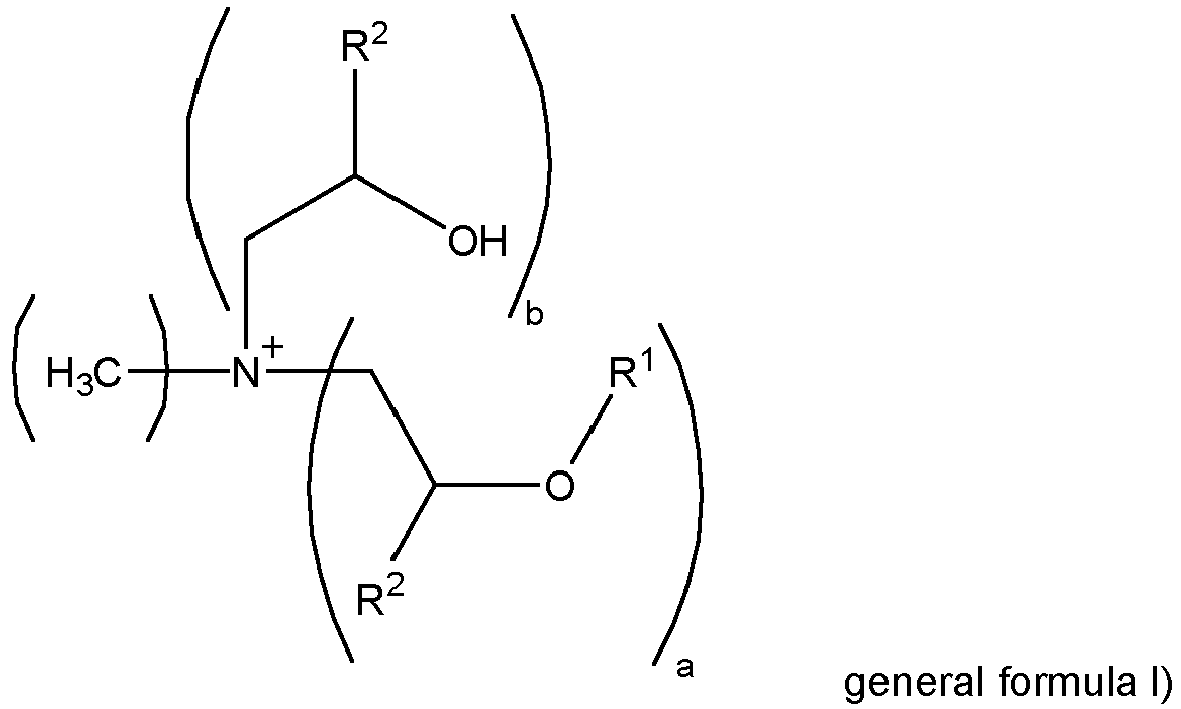
- The present invention provides a composition comprising an ester quat of the general formula I)

- R1 is an acyl radical of a fatty acid,
- R2 is independently selected from alkyl radicals having 1 to 6 carbon atoms and H, in particular H, where
- a = 1.0 to 2.2, preferably 1.5 to 2.0, particularly preferably 1.7 to 1.9, in particular 1.8, and
- b = 3 - a,
- characterized in that
- R1 is a mixture of acyl radicals which has
- a weight ratio of saturated C16 acyl radicals to unsaturated C16 acyl radicals of greater than 2 and
- a weight ratio of unsaturated C18 acyl radicals to saturated C18 acyl radicals of greater than 10.
- It is clearly apparent to those skilled in the art from the general formula I) and the chosen wording that the ester quat of the composition according to the invention is a compound composed of multiple distinct molecules, with the numbers a to c stated indicating average values.
- In the case where the mixture of acyl radicals does not comprise any unsaturated C16 acyl radicals or saturated C18 acyl radicals, then the respective ratio is greater than 2 or greater than 10.
- The invention further provides for the use of a composition comprising an ester quat of the general formula I)
- R1 is an acyl radical of a fatty acid,
- R2 is independently selected from alkyl radicals having 1 to 6 carbon atoms and H, in particular H, wherein
- a = 1.0 to 2.2, preferably 1.5 to 2.0, particularly preferably 1.7 to 1.9, in particular 1.8, and
- b = 3 - a,
- characterized in that
- R1 is a mixture of acyl radicals which has
- a weight ratio of saturated C16 acyl radicals to unsaturated C16 acyl radicals of greater than 2 and
- a weight ratio of unsaturated C18 acyl radicals to saturated C18 acyl radicals of greater than 10,
- for the cosmetic treatment of keratin fibres, in particular hair, with preference being given to human hair.
- One advantage of the present invention is that the ester quats used are liquid at room temperature and can therefore easily be incorporated into a final consumer formulation without the use of solvents and without heating, as a result of which such a solvent does not necessarily have to be present in said formulation.
- Another advantage of the present invention is that the shine of the treated keratin fibres is increased.
- A further advantage of the present invention is that the compounds used develop a good effect even in small use amounts.
- A further advantage is that the compounds used have little impact from an ecological point of view.
- Another advantage is that the compounds used exhibit an improved conditioning effect on keratin
- fibres in the case of longer rinse-off times than quaternary ester compounds known hitherto.
- Another advantage of the present invention is that the compounds used do not crystallize out.
- Another advantage of the present invention is that the compounds used are effective in relatively low use concentrations.
- Another advantage of the present invention is that the compounds used protect hair colourants from being washed out.
- Another advantage of the present invention is that the compounds used protect keratin fibres against thermally induced damage.
- Another advantage of the present invention is that the compounds used reduce the combing forces on wet and dry hair.
- Another advantage of the present invention is that the compounds used are particularly economically viable.
- Another advantage of the present invention is that the compounds used can be incorporated into surfactant formulations to give a clear formulation.
- Another advantage of the present invention is that the viscosity can be increased depending on the use concentration of the conditioning agent.
- Unless stated otherwise, all stated percentages (%) are percentages by mass.
- The ester quats used in the context of the invention can be prepared by relevant methods of preparative organic chemistry. Usually, the preparation of ester quats is based on a multistage process in which firstly the esterified alkanolamine is prepared by reacting an alkanolamine with carboxylic acids or corresponding derivatives, and said alkanolamine is then subsequently quaternized with a suitable reagent. In connection with the present invention, the alkanolamine used is triethanolamine or triisopropanolamine or mixtures thereof, in particular triethanolamine.
- In connection with suitable preparation processes, reference may be made to
EP0483195 , according to which trialkanolamine is partially esterified in the presence of hypophosphorous acid with fatty acids, air is passed through and then quaternization is carried out with dimethyl sulfate or ethylene oxide. The compounds listed therein serve as plasticizers for textiles.DE4308794 describes the preparation of solid ester quats by carrying out the quaternization of the triethanolamine esters in the presence of suitable dispersants. Overviews on this topic can be found for example under R. Puchta et al. in Tens. Surf. Det., 30, 186 (1993), M. Brock in Tens. Surf. Det., 30, 394 (1993), R. Lagerman et al. in J. Am. Chem. Soc., 71, 97 (1994) or under I. Shapiro in Cosm. Toil., 109, 77 (1994). - The ester quats present in the compositions according to the invention are characterized by the parameter a with respect to their degree of esterification. The ester quat thus comprises corresponding mono-, di- and/or triesters, which result in a statistical average corresponding to the degree of esterification.
- Suitable methods for quantitative determination are HPLC and NMR, with particular emphasis being given to the methodology disclosed in Characterization of quaternized triethanolamine esters (esterquats) by HPLC, HRCGC and NMR by Wilkes, A. J. et al. World Surfactants Congress, 4th, Barcelona, June 3-7, 1996.
- Compositions that are preferred according to the invention comprise an ester quat of the general formula I) that comprises, based on all ester quats of the general formula I) that are present, less than 20% by weight, preferably less than 15% by weight, especially preferably less than 10% by weight, of triester quat.
- Compositions that are preferred according to the invention comprise an ester quat of the general formula I) in which R2 = H, a = 1.7 to 1.9, in particular 1.8, and b = 3.
- The acyl radicals R1 of the general formula I) are a mixture which has a weight ratio of saturated C16 acyl radicals to unsaturated C16 acyl radicals of greater than 2 and a weight ratio of unsaturated C18 acyl radicals to saturated C18 acyl radicals of greater than 10.
- Such a distribution can in particular be found in mixed vegetable oils.
- Compositions that are preferred according to the invention are characterized in that the mixture of acyl radicals comprises a content of acyl radicals as shown below (mixed vegetable oil fatty acid I)
C16 4% by weight - 7% by weight, C16:1 0% by weight - 2% by weight, C18 0% by weight - 4% by weight, C18:1 55% by weight - 65% by weight, C18:2 15% by weight - 25% by weight, C18:3 6% by weight - 12% by weight, - Compositions that are preferred according to the invention are characterized in that the mixture of acyl radicals comprises a content of acyl radicals as shown below (mixed vegetable oil fatty acid II)
C16 4% by weight - 7% by weight, C16:1 0% by weight - 2% by weight, C18 0% by weight - 4% by weight, C18:1 14% by weight - 21% by weight, C18:2 12% by weight - 25% by weight, C18:3 29% by weight - 39% by weight, - Compositions that are preferred according to the invention are characterized in that the mixture of acyl radicals comprises a content of acyl radicals as shown below (tall oil fatty acid)
C16 1% by weight - 8% by weight, C16:1 0% by weight - 2% by weight, C18 0% by weight - 4% by weight, C18:1 40% by weight - 60% by weight, C18:2 30% by weight - 40% by weight, C18:3 5% by weight - 10% by weight, - In the abovementioned compositions according to the invention, the mixture of acyl radicals may of course comprise a content of other acyl radicals in addition to those specifically named. It is preferable according to the invention if the sum total of the specifically named acyl radicals amounts to at least 70% by weight, in particular at least 80% by weight, particularly preferably at least 90% by weight, based on all acyl radicals present in the mixture.
- Compositions that are preferred according to the invention are characterized in that the mixture of acyl radicals has an iodine number of 80 to 170, preferably 95 to 160, particularly preferably 105 to 135, cg l/g.
- The charge of the compound I) present in the composition according to the invention must be compensated by corresponding anions; this takes place by means of counteranions present in the composition according to the invention.
- Suitable as such counteranions are, for example, the halides, pseudohalides, anions of mineral acids, sulfates, sulfites, hydrogensulfites, sulfonate, alkyl- and arylsulfonates, phosphate, hydrogenphosphates, phosphites, hydrogenphosphites, phosphonites, carboxylates, borates, carbonates, sulfides, hydrogensulfides, lactate, glycolate, formate, acetate and propionate.
- These anions are preferably selected from those which are suitable for cosmetic application and are therefore for example nontoxic. Particularly preferably, at least one counteranion to the compound of the general formula I) selected from the group comprising chloride, bromide, iodide, alkyl sulfate, for example methyl sulfate, ethyl sulfate, alkylsulfonate, for example methylsulfonate, triflate, tosylate, phosphate, sulfate, hydrogensulfate, lactate, glycolate, acetate and citrate, preferably chloride and methyl sulfate, is present.
- The compositions according to the invention may be processed with further constituents to form formulations, in particular cosmetic formulations, so that the compositions according to the invention are, in particular cosmetic, formulations.
- The formulations according to the invention comprise the ester quat preferably in an amount of 0.2% by weight to 25% by weight, preferably 0.5% by weight to 15% by weight, in particular 1% by weight to 10% by weight, where the percentages by weight are based on the total composition.
- Formulations that are preferred according to the invention are characterized in that they do not comprise any fatty acids or fatty acid salts.
- It has proven to be advantageous if the formulations according to the invention additionally comprise 0.5% by weight to 20% by weight, preferably 1.0% by weight to 10% by weight, in particular 2.0% by weight to 7.0% by weight, of at least one fatty alcohol, where the percentages by weight are based on the total formulation.
- In this context, "fatty alcohol" is preferably understood to mean an unbranched or branched monoalcohol having an alkyl group of 8 to 30 carbon atoms, which may also be unsaturated. Preferred fatty alcohols are octanol, decanol, lauryl alcohol, isolauryl alcohol, anteisolauryl alcohol, myristyl alcohol, isomyristyl alcohol, cetyl alcohol, palmoleyl alcohol, stearyl alcohol, isostearyl alcohol, anteisostearyl alcohol, eicosanol, petroselinyl alcohol, Guerbet alcohol, arachyl alcohol, gadoleyl alcohol, behenyl alcohol, erucyl alcohol, hectacosanol, octacosanol, and melissyl alcohol, and mixtures thereof, in particular technical-grade mixtures, preferably technical-grade coconut or tallow fatty alcohols having 12 to 18, preferably having 16 to 18, carbon atoms, and the monounsaturated fatty alcohols, such as oleyl alcohol, elaidyl alcohol, delta-9-cis-hexadecenol, delta-9-octadecenol, trans-delta-9-octadecenol, cis-delta-11-octadecenol, trans-10,cis-12-hexadecadien-1-ol, octacosa-10,19-dien-1-ol, and polyunsaturated fatty alcohols such as for example linoleyl alcohol (9Z, 12Z-octadecadien-1-ol), elaidolinoleyl alcohol (9E, 12E-octadecadien-1-ol), linolenyl alcohol (9Z, 12Z, 15Z-octadecatrien-1-ol), elaidolinolenyl alcohol (9E, 12E, 15-E-octadecatrien-1-ol), with particular preference being given to mixtures of coconut or tallow fatty alcohols having 16 to 18 carbon atoms.
- It is preferable according to the invention that the composition according to the invention comprises at least one alkylamidoamine.
- Alkylamidoamines preferably present are those of the general formula II)

- R3CO here is an aliphatic, linear or branched acyl residue having 6 to 22 carbon atoms and 0 and/or 1, 2 or 3 double bonds, which generally originates from a naturally occurring or synthetically prepared fatty acid.
- R4 and R5 are identical or different alkyl radicals which may optionally bear functional groups such as hydroxy groups, ester groups, amines, amides or other polar substituents, with preference however generally being given to unsubstituted hydrocarbon radicals which at most have one or more branches.
- However, short-chain hydrocarbon radicals having 1 to 6 carbon atoms are especially preferred, with very particular preference being given according to the invention to ethyl and methyl radicals.
- The number m is an integer from 1 to 10, with preference being given to values for m of 2 to 7, in particular of 2 to 4.
- The alkylaminoamines are usually prepared by amidation of natural or synthetic fatty acids and fatty acid cuts with dialkylaminoamines. Typical examples of such fatty acids are caproic acid, caprylic acid, 2-ethylhexanoic acid, capric acid, lauric acid, isotridecanoic acid, myristic acid, palmitic acid, palm oleic acid, stearic acid, isostearic acid, oleic acid, elaidic acid, petroselinic acid, linoleic acid, linolenic acid, eleostearic acid, arachidic acid, gadoleic acid, behenic acid and erucic acid, and technical-grade mixtures thereof which are produced for example during the pressurized cleavage of natural fats and oils, during the reduction of aldehydes from the Roelen oxo synthesis or the dimerization of unsaturated fatty acids.
- Particular preference is usually given to the fatty acid cuts which are obtainable from coconut oil or palm oil, with the use of stearic acid generally being especially preferred.
- Depending on the intended use, the composition according to the invention may comprise the ester quat and the alkylamidoamine in different amounts.
- In the treatment of keratin fibres, in particular of human hair, use is generally made of active ingredient concentrations (based on the individual components) of 0.2% by weight to 7% by weight, preferably 0.3% by weight to 5% by weight and especially preferably 0.4% by weight to 3% by weight. Particularly good results can be achieved at active ingredient concentrations of 0.2% to 2% by weight. The application of the preparations according to the invention to keratin fibres, in particular to human hair, is not however limited to the use of the active ingredients at a low concentration. It is also possible to use concentrates in which the active ingredients are each present in proportions of 2% by weight to 20% by weight or 3% by weight to 14% by weight, in particular at 5% by weight to 12% by weight.
- Ester quats and alkylaminoamines are usually present in a weight ratio of 20 to 1 to 1 to 20, in particular of 10 to 1 to 1 to 10, in the preparation according to the invention. Depending on the desired effect, the mixing ratio may also be varied from 5 : 1 to 1 : 5 or even from 3 : 1 to 1 : 3.
- The formulations according to the invention may comprise for example at least one further, additional component selected from the group of
- emollients,
- emulsifiers,
- thickeners/viscosity regulators/stabilizers,
- antioxidants,
- hydrotropes (or polyols),
- solids and fillers,
- pearlescence additives,
- deodorant and antiperspirant active ingredients,
- insect repellents,
- self-tanning agents,
- preservatives,
- conditioning agents,
- perfumes,
- colourants,
- cosmetic active ingredients,
- care additives,
- superfatting agents,
- solvents.
- Substances which can be used as exemplary representatives of the individual groups are known to those skilled in the art and can be taken, for example, from German patent application
DE 102008001788.4 . This patent application is hereby incorporated by reference and is thus considered to form part of the disclosure. - As regards further optional components and also the amounts used of these components, reference is expressly made to the relevant handbooks known to those skilled in the art, for example K. Schrader, "Grundlagen und Rezepturen der Kosmetika" [Fundamentals and formulations of cosmetics], 2nd edition, pages 329 to 341, Hüthig Buch Verlag, Heidelberg.
- The amounts of the respective additives are guided by the intended use.
- Typical starting formulations for the relevant applications are known prior art and are contained for example in the brochures of the manufacturers of the relevant base materials and active substances. These existing formulations can generally be adopted unchanged. However, if necessary, for adjustment and optimization, the desired modifications can be made in a straightforward manner through simple tests.
- It is preferable according to the invention that the composition according to the invention comprises at least one emulsifier selected from the group of polyglycerol esters.
- It is preferable according to the invention if the formulation has a pH of 3.0 to 5.5, preferably 3.5 to 5.0.
- In connection with the present invention, the "pH" is defined as the value which is measured for the relevant composition at 25°C after stirring for five minutes using a pH electrode calibrated in accordance with ISO 4319 (1977).
- The compositions according to the invention can be used according to the invention for treating keratin fibres, in particular for treating hair.
- In this connection, use is preferably made of those compositions that are described above as preferred compositions.
- The use according to the invention leads to the improvement in the conditioning, shine, flexibility, elasticity and/or combability, and to a reduction in the probability of breakage of the treated fibres and, moreover, it reduces the antistatic forces between the fibres.
- The use according to the invention leads to the protection of the fibres against heat.
- The examples which follow describe the present invention by way of example, without any intention of restricting the invention, the scope of application of which is apparent from the entirety of the description and the claims, to the embodiments cited in the examples.
- The following figures are an integral part of the examples:
-
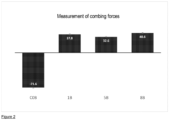
Fig. 1 . Comparison of the reduction in the combing forces between formulations after a rinsing time of 1 minute -
Fig. 2 . Comparison of the reduction in the combing forces between formulations after a rinsing time of 3 minutes - 608 g (2.16 mol) of mixed vegetable oil fatty acid I (C16 4.7%, C16:1 0.2%, C18 1.6%, C18:1 60.2%, C18:2 18.7 %, C18:3 7.3%, iodine number 110 gl/100 g) is mixed with 182.4 g (1.22 mol) of triethanolamine and heated to 190°C with stirring. Water of reaction is distilled off continuously. After the majority of the water of reaction has been distilled at atmospheric pressure, reduced pressure is applied and the acid number of the reaction mixture is reacted down to < 6 mg KOH/g. The resulting ester amine is cooled to 60°C and admixed with 137.6 g (1.09 mol) of dimethyl sulfate in such a way that the reaction temperature does not exceed 90°C.
- After cooling to room temperature, the total amine number (TAN) and the active content of the finished product are analysed.
- TAN = 5.0 mg KOH/g; active content 1.16 meq/g (cationic active content according to Epton).
- 563 g (2.0 mol) of mixed vegetable oil fatty acid II (C16 6.2%, C16:1 0.5%, C18 2.2%, C18:1 20.1%, C18:2 23.5%, C18:3 36.3%, iodine number 160 gl/100 g) is mixed with 168.5 g (1.13 mol) of triethanolamine and heated to 190°C with stirring. Water of reaction is distilled off continuously.
- After the majority of the water of reaction has been distilled at atmospheric pressure, reduced pressure is applied and the acid number of the reaction mixture is reacted down to < 6 mg KOH/g. The resulting ester amine is cooled to 60°C and admixed with 128.3 g (1.02 mol) of dimethyl sulfate in such a way that the reaction temperature does not exceed 90°C.
- After cooling to room temperature, the total amine number (TAN) and the active content of the finished product are analysed.
- TAN = 4.9 mg KOH/g; active content 1.15 meq/g (cationic active content according to Epton).
- 800 g (3.12 mol) of stearic acid (technical-grade quality, approx. 98% pure) is admixed with 263 g (1.76 mol) of triethanolamine and esterified as described in Example 1. The ester amine had an acid number of 5.6 mg KOH/g. This mixture was alkylated with 198 g (1.57 mol) of dimethyl sulfate as described in Example 1. At the end of the alkylation, the viscosity increased sharply and the mixture was diluted with 215 g of isopropanol.
- The TAN of the finished product was determined with 4.0 mg KOH/g, the active content was 0.96 meq/g.
- 814 g (2.84 mol) of commercial tall oil fatty acid (Sylfat™ 2 from Kraton, CAS No. 61790-12-3) is mixed with 240 g (1.60 mol) of triethanolamine and esterified as described in Example 1. The ester amine had an acid number of 4.5 mg KOH/g. This mixture was alkylated with 168 g (1.33 mol) of dimethyl sulfate as described in Example 1. The TAN of the finished product was determined with 6.3 mg KOH/g, the active content was 1.18 meq/g.
- 392 g (1.15 mol) of erucic acid is mixed with 97 g (0.65 mol) of triethanolamine and esterified as described in Example 1. The ester amine had an acid number of 3.9 mg KOH/g. This mixture was alkylated with 73.7 g (0.59 mol) of dimethyl sulfate as described in Example 1. The TAN of the finished product was determined with 3.9 mg KOH/g, the active content was 1.13 meq/g.
- 504 g (1.77 mol) of isostearic acid (technical-grade quality) is admixed with 149.2 g (1.0 mol) of triethanolamine and esterified as described in Example 1. The ester amine had an acid number of 3.4 mg KOH/g. This mixture was alkylated with 113.5 g (0.9 mol) of dimethyl sulfate as described in Example 1.
- The TAN of the finished product was determined with 5.1 mg KOH/g, the active content was 1.16 meq/g.
- 500 g (1.77 mol) of oleic acid (98%) is admixed with 149.2 g (1.0 mol) of triethanolamine and esterified as described in Example 1. The ester amine had an acid number of 3.4 mg KOH/g. This mixture was alkylated with 113.5 g (0.9 mol) of dimethyl sulfate as described in Example 1.
- The TAN of the finished product was determined with 5.5 mg KOH/g, the active content was 1.19 meq/g.
- 1120 g (4 mol) of mixed vegetable oil fatty acid is mixed with 302 g (2.05 mol) of methyldiisopropanolamine and heated to 180°C with stirring. Water of reaction is distilled off continuously. After the majority of the water of reaction has been distilled at atmospheric pressure, reduced pressure is applied and the acid number of the reaction mixture is reacted down to < 7 mg KOH/g. The resulting ester amine is cooled to 60°C and admixed in portions with 240 g (1.90 mol) of dimethyl sulfate in such a way that the reaction temperature does not exceed 100°C. After cooling to room temperature, the total amine number (TAN) and the active content of the finished product are analysed.
- TAN = 5.0 mg KOH/g; active content 1.27 meq/g (cationic active content according to Epton).
- For the application-related assessment, use was made of hair tresses which had been predamaged in a standardized manner by way of a bleaching treatment. Standard hairdressing products are used for this purpose. The damage to the hair tresses is described in detail in
DE10327871 . - For the application-related assessment, the compounds of the examples were used in a simple cosmetic formulation.
- As reference compounds, the commercially available ester quat (INCI) Distearoylethyl Hydroxyethylmonium Methosulfate (VARISOFT® EQ F 75 Pellets, Evonik Industries) was also used.
- The application properties when used in hair rinses were tested in the following formulations (Tab. 1):
Tab. 1: Hair rinse formulation for testing the hair conditioning properties Formulation examples C0a 1a V2a 3a V4a V5a V6a V7a 8a TEGINACID® C, Evonik Industries (INCI: Ceteareth-25) 0.5% 0.5% 0.5% 0.5% 0.5% 0.5% 0.5% 0.5% 0.5% TEGO®Alkanol 1618, Evonik Industries (INCI: Cearyl Alcohol) 5% 5% 5% 5% 5% 5% 5% 5% 5% Example 1a (100%) (TEA mixed vegetable oil I) 1.5% Example 1b (100%) (TEA mixed vegetable oil II) 1.5% Example 2 (80% in isopropanol) 1.88% Example 3 (TEA tall oil) 1.5% Example 4 (TEA Eruca) 1.5% Example 6 (TEA oleic acid) 1.5% VARISOFT® EQ F 75 Pellets (65% strength in C1618 fatty alcohol), Evonik Industries (INCI: Distearoylethyl Hydroxyethylmonium Methosulfate, Cetearyl Alcohol) 2.3% Example 7 1.5% Water, demineralized to 100.0 Citric acid to pH 4.0 - The composition of the test formulations is deliberately chosen to be simple in order to avoid the test results being influenced by (normally present) formulation constituents. In addition to the specified ingredients and/or instead of the specified ingredients, formulations according to the invention may also comprise further ingredients. In particular, the combination with further ingredients can lead to a synergistic improvement in the case of the described effects.
- The hair is pretreated using a shampoo formulation (Tab. 2) which does not comprise any conditioning agents.
Tab. 2: Shampoo formulation for the pretreatment of the hair tresses. Texapon NSO®, 28% strength, Cognis (INCI: Sodium Laureth Sulfate) 42.9% NaCl 3% Water, demineralized to 100.0 - Standardized treatment of predamaged hair tresses with conditioning samples:
The hair tresses which have been predamaged as described above are washed with the shampoo formulation from Tab. 2. - Here, the hair tresses are wetted under running warm water. The excess water is gently squeezed out by hand, then the shampoo is applied and worked gently into the hair for 1 min (0.5 ml/2 g hair tress). The hair tress is rinsed for 30 s under running warm water. This procedure is repeated once more, except that final rinsing is for 1 min.
- Then, directly after washing, the hair tresses are conditioned with the hair rinse formulations from Tab. 1.
- Here, the rinse is applied and gently worked into the hair (0.5 ml/2 g hair tress). After a residence time of 1 min, the hair is rinsed for a) 1 min or for b) 3 min.
- Before the sensory assessment, the hair is dried for at least 12 h in the air at 50% humidity and 25°C.
- The sensory evaluations are performed using grades awarded on a scale from 1 to 5, with 1 being the worst evaluation and 5 being the best evaluation. The individual test criteria each receive their own evaluation.
- The test criteria are:
Wet combability, wet feel, dry combability, dry feel, appearance/shine. - In the tables which follow, the results of the sensory assessment of the treatment of the hair tresses, carried out as described above, in the case of a) 1 min rinsing time and in the case of b) 3 min rinsing time, are compared with the inventive formulations 1a and 8a and the comparative formulations and the control formulation C0a (control without test substance).
-
Tab. 3a: Results of the conditioning of hair with 1 min rinsing time Wet combability Wet feel Dry combability Dry feel Inventive formulation 1a 5 5 4.5 4.5 Comparative formulation V2a (TEA stearic acid) 3 3 3 3 Comparative formulation V5a (TEA oleic acid) 4 4 4 4 Comparative formulation V6a (EQ F 75) 3 3 3 3 Comparative formulation V7a (Ex. 7) 4.5 4.5 4.5 4.5 Inventive formulation 8a 5 5 5 5 Control C0a 2 2 3 2.5 -
Tab. 3b: Results of the conditioning of hair with 3 min rinsing time Wet combability Wet feel Dry combability Dry feel Inventive formulation 1a 4.5 4.5 4.5 4.5 Comparative formulation V2a (TEA stearic acid) 2.5 2.5 2.5 3.5 Comparative formulation V5a (TEA oleic acid) 3.5 3.5 3.5 3.5 Comparative formulation V6a (EQ F 75) 2.5 3 3 3 Comparative formulation V7a (Ex. 7) 4.5 4.5 4 4 Inventive formulation 8a 5 5 5 5 Control C0a 2 2 3 2.5 - The results in Table 3a show that the inventive formulations 1a and 8a have very good conditioning properties with 1 min rinsing time which are at the same level as the comparative formulation V7a and are very significantly superior to the comparative formulations V2a and V6a. The inventive formulations 1a and 8a are noticeably improved in comparison with V5a.
- The results in Table 3b show that the inventive formulations 1a and 8a have even more markedly improved conditioning properties with 3 min rinsing time than after 1 min than the comparative formulations V2a and V6a. In comparison with the comparative formulation V7a, the results are comparable at a very high level. The comparative formulation V7a comprises an ester quat that is known for its very good conditioning properties even in the case of long rinsing times. The comparative formulation V6a comprises, as conditioning compound, VARISOFT® EQ F 75 (65% strength in C16/18 fatty alcohol, Evonik Industries, INCI: Distearoylethyl Dimonium Chloride, Cetearyl Alcohol), an ester quat that has very good emulsifying properties, but only a moderate conditioning performance with 1 min rinsing time (see Tab. 3a), and exhibits even worse conditioning with 3 min rinsing time.
-
- Measuring device: Diastron MTT 175
- Measurement distance: 20 cm
- Combing rate: 2000 mm/min
- Hair tresses used: length = 23 cm; width = 1.5 cm; weight = 2 g Measurement conditions: T = 22°C The hair tresses are measured with a residual moisture of 60%, determined by weight determination. European, undamaged, dark brown hair is used for the experiments. To carry out the combing force measurements, this hair is damaged by means of perming in the laboratory in accordance with standard conditions:
1.) 4 g of perming solution/g of hair, leave to act for 15 min, rinse out for 2 min under running tap water (T = 35°C). (Perming solution: Universal perming, Basler) 2.) 4 g of neutralizer (1 part neutralizing solution + 3 parts water)/g of hair, leave to act for 10 min, rinse out for 2 min. - Carrying out the combing force measurement before the treatment with the test formulation:
The predamaged hair tresses are climatized overnight. - 3.) The hair tress is dipped for 1 min in a buffer solution (Na citrate, pH = 6). 4.) The hair tress is precombed by hand until no change in combing resistance can be ascertained. 5.) The hair tress is clamped in the measuring device and the first combing force measurement is carried out. The measurement is repeated a total of 10 times.
- 0.5 g of the respective test formulation is used per hair tress (2 g hair/0.5 g solution). The formulation is massaged into the hair for 30 sec and then left on for 5 min, then rinsed off under running tap water for 1 min or 3 min.
- Carrying out the combing force measurement after the treatment with the test formulation:
Points 3-5 are repeated. - The combability (%) is then calculated before and after the treatment with the test formulation.
- The combing forces when used in hair rinses were tested in the following formulations (Tab. 4):
Tab. 4: Hair rinse formulations for testing the hair conditioning properties Formulation examples C0b 1b V2b 3b V4b V5b V6b V7b 8b TEGINACID® C, Evonik Industries (INCI: Ceteareth-25) 0.5% 0.5% 0.5% 0.5% 0.5% 0.5% 0.5% 0.5% 0.5% TEGO®Alkanol 1618, Evonik Industries (INCI: Cearyl Alcohol) 5% 5% 5% 5% 5% 5% 5% 5% 5% Example 1a (100%) (TEA mixed vegetable oil I) 1.5% Example 1b (100%) (TEA mixed vegetable oil II) 1.5% Example 2 (80% in isopropanol) 1.88% Example 3 (TEA tall oil) 1.5% Example 4 (TEA Eruca) 1.5% Example 6 (TEA oleic acid) 1.5% VARISOFT® EQ 75 Pellets (65% strength in C1618 fatty alcohol), Evonik Industries (INCI: Distearoylethyl Hydroxyethylmonium Methosulfate, Cetearyl Alcohol) 2.3% Example 7 1.5% Water, demineralized to 100.0 Citric acid to pH 4.0 - The results are shown in
Figures 1 (rinsing time of 1 min) and 2 (rinsing time of 3 min). - To test the antistatic behaviour, the shadow silhouette method was used.
- The pretreated hair tresses described above, a plastic comb, a spotlight and a projection field marked with concentric semicircles are used.
- The experiments were carried out under standardized climatic conditions. The hair tress is hung up at a distance of 15 cm from the projection field. The spotlight is positioned at a distance of 145 cm from the hair tress so that a shadow falls on the projection field.
- The hair tress is then combed five times in succession using the comb. The electrostatic charging is measured via the shadow silhouette by marking the two outer points of the shadow and determining the distance between them. The smaller the shadow area, the more effective the antistatic effect.
-
Formulation Distance C0a 15 cm 1a 4 cm V7a 6 cm -
Formulation Viscosity after preparation Viscosity after storage at RT (1 month) Viscosity after storage at RT (6 months) Viscosity after storage at 40°C (3 months) Inventive formulation 1a 15 Pas 15 Pas 15 Pas 10 Pas Comparative formulation 2a (TEA stearic acid) 12 Pas 12 Pas 12 Pas 5 Pas Comparative formulation 6a (EQ F 75) 11.5 Pas 11.5 Pas 11 Pas 5 Pas Comparative formulation 7a (Ex. 7) 7 Pas 6 Pas Phase separation Phase separation Comparative formulation 5a (TEA oleic acid) 13 Pas 13 Pas 12 Pas 6 Pas - Each individual formulation listed below was prepared three times.
- For "Inventive Example X", each of Inventive Examples 1a, 1b and 3 were used.
-
TEXAPON® NSO, Cognis, 28% strength (INCI: Sodium Laureth Sulfate) 32.25% Inventive Example X 0.25% Perfume 0.25% Water 55.25% TEGO®Betain F 50, Evonik Industries AG, 38% strength (INCI: Cocamidopropyl Betaine) 8.00% TEGO® Pearl N 300 Evonik Industries AG (INCI: Glycol Distearate; Laureth-4; Cocamidopropyl Betaine) 2.00% ANTIL® 171 Evonik Industries AG (INCI: PEG-18 Glyceryl Oleate/Cocoate) 1.50% NaCl 0.50% Preservative q.s. -
Water 92.0% TEGINACID® C, Evonik Industries AG (INCI: Ceteareth-25) 0.5% Inventive Example X 2.50% TEGO®Alkanol 1618, Evonik Industries AG (INCI: Cetearyl Alcohol) 5.00% Preservative, Perfume q.s. -
Water 91.0% Inventive Example X 2.00% VARISOFT® BT 85, Evonik Industries AG (INCI: Behentrimonium Chloride) 2.00% TEGO®Alkanol 1618, Evonik Industries AG (INCI: Cetearyl Alcohol) 5.00% Preservative, Perfume q.s. -
Water 90.20% Inventive Example X 2.00% VARISOFT® EQ 65, Evonik Industries AG (INCI: Distearoyl Dimonium Chloride, Cetearyl Alcohol) 2.00% TEGO®Alkanol 1618, Evonik Industries AG (INCI: Cetearyl Alcohol) 5.80% Preservative, Perfume q.s. -
Water 89.20% TEGINACID® C, Evonik Industries AG (INCI: Ceteareth-25) 0.5% VARISOFT® EQ 65, Evonik Industries AG (INCI: Distearoyl Dimonium Chloride, Cetearyl Alcohol) 2.00% Inventive Example X 2.00% ABIL® Quat 3272, Evonik Industries AG (INCI: Quaternium-80) 1.30% TEGO®Alkanol 1618, Evonik Industries AG (INCI: Cetearyl Alcohol) 5.00% Preservative, Perfume q.s. -
TEGINACID® C, Evonik Industries AG (INCI: Ceteareth-25) 0.50% TEGO®Alkanol 16, Evonik Industries AG (INCI: Cetyl Alcohol) 2.00% TEGO® Amid S 18, Evonik Industries AG (INCI: Stearamidopropyl Dimethylamine) 1.00% Inventive Example X 1.50% Propylene Glycol 2.00% Citric Acid Monohydrate 0.30% Water 92.70% Preservative, Perfume q.s. -
TEGINACID® C, Evonik Industries AG (INCI: Ceteareth-25) 0.50% TEGO®Alkanol 16, Evonik Industries AG (INCI: Cetyl Alcohol) 5.00% TEGOSOFT® DEC, Evonik Industries AG (INCI: Diethylhexyl Carbonate) 1.00% Inventive Example X 1.50% Water 89.20% TEGO® Cosmo C 100 Evonik Industries AG (INCI: Creatine) 0.50% Propylene Glycol 2.00% Citric Acid Monohydrate 0.30% Preservative, Perfume q.s. -
Lactic Acid, 80% 0.40% Water 95.30% Inventive Example X 1.20% TEGIN® G 1100 Pellets, Evonik Industries AG (INCI: Glycol Distearate) 0.60% TEGO® Care PS, Evonik Industries AG (INCI: Methyl Glucose Sesquistearate) 1.20% TEGOSOFT® DEC, Evonik Industries AG (INCI: Diethylhexyl Carbonate) 1.30% Preservative, Perfume q.s. -
Lactic Acid, 80% 0.40% Water 95.30% TEGO® Amid S 18, Evonik Industries AG (INCI: Stearamidopropyl Dimethylamine) 1.20% Inventive Example X 0.30% TEGIN® G 1100 Pellets, Evonik Industries AG (INCI: Glycol Distearate) 0.90% TEGO® Care PS, Evonik Industries AG (INCI: Methyl Glucose Sesquistearate) 1.60% TEGOSOFT® DEC, Evonik Industries AG (INCI: Diethylhexyl Carbonate) 0.30% Preservative, Perfume q.s. -
TAGAT® CH-40, Evonik Industries AG (INCI: PEG-40 Hydrogenated Castor Oil) 2.20% Ceramide VI, Evonik Industries AG (INCI: Ceramide 6 II) 0.05% Perfume 0.20% Water 90.95% Inventive Example X 0.30% LACTIL® Evonik Industries AG (INCI: Sodium Lactate; Sodium PCA; Glycine; Fructose; Urea; Niacinamide; Inositol; Sodium Benzoate; Lactic Acid) 2.00% TEGO®Betain F 50 Evonik Industries AG 38% (INCI: Cocamidopropyl Betaine) 2.30% Citric Acid (10% in water) 2.00% -
Inventive Example X 0.30% TAGAT® CH-40, Evonik Industries AG (INCI: PEG-40 Hydrogenated Castor Oil) 1.0% Perfume 0.30% TEGO®Betain 810, Evonik Industries AG (INCI: Capryl/Capramidopropyl Betaine) 2.00% Water 94.00% TEGO® Cosmo C 100, Evonik Industries AG (INCI: Creatine) 0.50% TEGOCEL® HPM 50, Evonik Industries AG (INCI: Hydroxypropyl Methylcellulose) 0.30% VARISOFT® 300, Evonik Industries AG (INCI: Cetrimonium Chloride) 1.0% LACTIL® Evonik Industries AG (INCI: Sodium Lactate; Sodium PCA; Glycine; Fructose; Urea; Niacinamide; Inositol; Sodium Benzoate; Lactic Acid) 0.50% Citric Acid, 30% 0.10% Preservative q.s. -
TEGO®Carbomer 141, Evonik Industries AG (INCI: Carbomer) 1.20% Water 66.70% NaOH, 25% 2.70% PVP/VA W-735, ISP (INCI: PVP/VA Copolymer) 16.00% Inventive Example X 0.30% Alcohol Denat. 10.50% TAGAT® O 2 V, Evonik Industries AG (INCI: PEG-20 Glyceryl Oleate) 2.00% Perfume 0.30% ABIL® B 88183, Evonik Industries AG (INCI: PEG/PPG-20/6 Dimethicone) 0.30% Preservative q.s. -
TEXAPON® NSO, Cognis, 28% strength (INCI: Sodium Laureth Sulfate) 30.00% TEGOSOFT® PC 31, Evonik Industries AG (INCI: Polyglyceryl-3 Caprate) 0.70% Inventive Example X 0.30% Perfume 0.30% Water 53.90% TEGOCEL® HPM 4000, Evonik Industries AG (INCI: Hydroxypropyl Methylcellulose) 0.30% REWOTERIC® AM C, Evonik Industries AG, 32% strength (INCI: Sodium Cocoamphoacetate) 10.00% Citric Acid Monohydrate 0.50% REWODERM® LI S 80, Evonik Industries AG (INCI: PEG-200 Hydrogenated Glyceryl Palmate; PEG-7 Glyceryl Cocoate) 2.00% TEGO® Pearl N 300, Evonik Industries AG (INCI: Glycol Distearate; Laureth-4; Cocamidopropyl Betaine) 2.00% -
TEXAPON® NSO, Cognis, 28% strength (INCI: Sodium Laureth Sulfate) 27.00% REWOPOL® SB FA 30, Evonik Industries AG, 40% strength (INCI: Disodium Laureth Sulfosuccinate) 12.00% TEGOSOFT® LSE 65 K SOFT, Evonik Industries AG (INCI: Sucrose Cocoate) 2.00% Water 39.00% REWOTERIC® AM C, Evonik Industries AG, 32% strength (INCI: Sodium Cocoamphoacetate) 13.00% Inventive Example X 0.40% Citric Acid (30% in water) 3.00% ANTIL® 171 Evonik Industries AG (INCI: PEG-18 Glyceryl Oleate/Cocoate) 1.60% TEGO® Pearl N 300 Evonik Industries AG (INCI: Glycol Distearate; Laureth-4; Cocamidopropyl Betaine) 2.00% -
Water 89.20% Inventive Example X 3.00% ABIL® OSW 5, Evonik Industries AG (INCI: Cyclopentasiloxane; Dimethiconol) 1.80% TEGO®Alkanol 1618, Evonik Industries AG (INCI: Cetearyl Alcohol) 6.00% Preservative, Perfume q.s. -
Water 89.20% TEGINACID® C, Evonik Industries AG (INCI: Ceteareth-25) 0.5% VARISOFT® EQ 65, Evonik Industries AG (INCI: Distearyl Dimonium Chloride, Cetearyl Alcohol) 1.50% Inventive Example X 2.00% ABIL® Soft AF 100, Evonik Industries AG (INCI: Methoxy PEG/PPG-7/3 Aminopropyl Dimethicone) 1.00% TEGO®Alkanol 1618, Evonik Industries AG (INCI: Cetearyl Alcohol) 5.80% Preservative, Perfume q.s. -
Water 91.50% TEGINACID® C, Evonik Industries AG (INCI: Ceteareth-25) 0.5% Inventive Example X 2.00% SF 1708, Momentive (INCI: Amodimethicone) 1.00% TEGO®Alkanol 1618, Evonik Industries AG (INCI: Cetearyl Alcohol) 5.00% Preservative, Perfume q.s. -
Water 28.00% Jaguar C-162 (Hydroxypropyl Guar Hydroxypropyltimonium Chloride) 0.5% VARISOFT®BT 85, Evonik Industries AG (INCI: Behentrimonium Chloride) 0.50% Inventive Example X 0.50% TEGO®Alkanol 1618, Evonik Industries AG (INCI: Cetearyl Alcohol) 1.00% TEGIN® G 1100 Pellets, Evonik Industries AG (INCI: Glycol Distearate) 0.80% Sodium Laureth Sulfate, 28% 39.0% Petrolatum 1.0% ABIL®T- Quat 60, Evonik Industries AG (INCI: Silicone Quaternium-22) 1.3% REWOTERIC® AM C, Evonik Industries AG (INCI: Sodium Cocoamphoacetate) 17.50% Citric Acid (20%) 6.3% ANTIL® SPA 80, Evonik Industries AG (INCI: Isostearamide MIPA; Glyceryl Laurate) 2.20% NaCl 1.0% REWODERM® LI S 80, Evonik Industries AG (INCI: PEG-200 Hydrogenated Glyceryl Palmate; PEG-7 Glyceryl Cocoate) 1.0% Preservative, Perfume q.s. -
TEGO®Alkanol 1618, Evonik Industries AG (INCI: Cetearyl Alcohol) 4.0% TEGINACID® C, Evonik Industries AG (INCI: Ceteareth-25) 0.5% VARISOFT®BT 85, Evonik Industries AG (INCI: Behentrimonium Chloride) 2.0% Inventive Example X 1.0% TEGIN® M, Evonik Industries AG (INCI: Glyceryl Stearate) 0.5% Water 93.0% Preservative, Perfume q.s. -
ABIL® Soft AF 100, Evonik Industries AG (INCI: Methoxy PEG/PPG-7/3 Aminopropyl Dimethicone) 0.5% Inventive Example X 1.0% VARISOFT®BT 85, Evonik Industries AG (INCI: Behentrimonium Chloride) 0.5% TEGO®Alkanol 16, Evonik Industries AG (INCI: Cetyl Alcohol) 2.0% Simmondsia Chinensis (Jojoba) Seed Oil 0.5% Water 93.5% Glycerin 2.0% Panthenol 0.2% Preservative, Perfume q.s. -
Water 96.5 Polyquaternium-10 1.0% Hydroxyethylcellulose 0.5% Inventive Example X 1.0% VARISOFT®BT 85, Evonik Industries AG (INCI: Behentrimonium Chloride) 1.0% Lauramide DEA 1.0% Citric Acid, 30% q.s. Preservative, Perfume q.s. -
VARISOFT®BT 85, Evonik Industries AG (INCI: Behentrimonium Chloride) 0.5% Inventive Example X 0.5% COSMOFERM®Mix III, Evonik Industries AG (INCI: Isocetyl Alcohol; Ceramide NP; Cetyl Alcohol) 2.0% TEGINACID® C, Evonik Industries AG (INCI: Ceteareth-25) 0.5% ABIL® Soft AF 100, Evonik Industries AG (INCI: Methoxy PEG/PPG-7/3 Aminopropyl Dimethicone) 0.3% TEGO®Alkanol 16, Evonik Industries AG (INCI: Cetyl Alcohol) 2.0% TEGIN® M, Evonik Industries AG (INCI: Glyceryl Stearate) 1.0% ABIL® OSW 5, Evonik Industries AG (INCI: Cyclopentasiloxane; Dimethiconol) 7.5% Water 86.2% Preservative, Perfume q.s. -
TEGIN® M, Evonik Industries AG (INCI: Glyceryl Stearate) 2.0% TEGO®Alkanol 1618, Evonik Industries AG (INCI: Cetearyl Alcohol) 3.0% TEGO®Amid S 18, Evonik Industries AG (INCI: Stearamidopropyl Dimethylamine) 0.7% VARISOFT®BT 85, Evonik Industries AG (INCI: Behentrimonium Chloride) 0.8% Inventive Example X 0.8% VARISOFT®W 575 PG, Evonik Industries AG (INCI: Quaternium-87) 0.9% Water 90.9% 1 ,2-Propylene glycol (Propylene Glycol) 1.0% Citric Acid (20%) 0.7% Preservative, Perfume q.s. -
Plantacare® 1200 UP, BASF SE (INCI: Lauryl Glucoside) 8.8% ANTIL® SPA 80, Evonik Industries AG (INCI: Isostearamide MIPA; Glyceryl Laurate) 1.0% RHEANCE® One, Evonik Industries AG (INCI: Glycolipids) 0.7% Jaguar® C-162, Solvay (INCI: Hydroxypropyl Guar Hydroxypropyltrimonium Chloride) 0.5% Inventive Example X 0.5% REWOTERIC® AM C MB, Evonik Industries AG (INCI: Sodium Cocoamphoacetate) 12.5% Water Ad 100.0% TEGO® Betain P 50 C, Evonik Industries AG (INCI: (Cocamidopropyl Betaine) 14.9% Natrium Chloride (20%) 0.8% TEGO® White 50 MB, Evonik Industries AG (INCI: Glycol Distearate; Disodium Lauryl Sulfosuccinate; Glyceryl Laurate) 3.0% Verstatil® SL non GMO, Evonik Industries AG (INCI: Aqua; Sodium Levulinate; Potassium Sorbate) 1.1%
Claims (15)
- Composition comprising an ester quat of the general formula I)
 R1 is an acyl radical of a fatty acid,R2 is independently selected from alkyl radicals having 1 to 6 carbon atoms and H, in particular H,wherea = 1.0 to 2.2, preferably 1.5 to 2.0, particularly preferably 1.7 to 1.9, in particular 1.8, andb = 3 - a,characterized in thatR1 is a mixture of acyl radicals which hasa weight ratio of saturated C16 acyl radicals to unsaturated C16 acyl radicals of greater than 2 anda weight ratio of unsaturated C18 acyl radicals to saturated C18 acyl radicals of greater than 10.
 - Composition according to Claim 1, characterized in that the mixture of acyl radicals comprises a content of acyl radicals as shown below
C16 4% by weight - 7% by weight, C16:1 0% by weight - 2% by weight, C18 0% by weight - 4% by weight, C18:1 55% by weight - 65% by weight, C18:2 15% by weight - 25% by weight, C18:3 6% by weight - 12% by weight, - Composition according to Claim 1, characterized in that the mixture of acyl radicals comprises a content of acyl radicals as shown below
C16 4% by weight - 7% by weight, C16:1 0% by weight - 2% by weight, C18 0% by weight - 4% by weight, C18:1 14% by weight - 21% by weight, C18:2 12% by weight - 25% by weight, C18:3 29% by weight - 39% by weight, - Composition according to Claim 1, characterized in that the mixture of acyl radicals comprises a content of acyl radicals as shown below
C16 1% by weight - 8% by weight, C16:1 0% by weight - 2% by weight, C18 0% by weight - 4% by weight, C18:1 40% by weight - 60% by weight, C18:2 30% by weight - 40% by weight, C18:3 5% by weight - 10% by weight, - Composition according to any of Claims 2 to 4, characterized in that the sum total of the specifically named acyl radicals amounts to at least 70% by weight, in particular at least 80% by weight, particularly preferably at least 90% by weight, based on all acyl radicals present in the mixture.
- Composition according to at least one of the preceding claims, characterized in that the mixture of acyl radicals has an iodine number of 80 to 170, preferably 95 to 160, particularly preferably 105 to 135, cg l/g.
- Composition according to at least one of the preceding claims, additionally comprising at least one counteranion to the compound of the general formula I) selected from the group comprising chloride, bromide, iodide, alkyl sulfate, for example methyl sulfate, ethyl sulfate, alkylsulfonate, for example methylsulfonate, triflate, tosylate, phosphate, sulfate, hydrogensulfate, lactate, glycolate, acetate and citrate.
- Composition according to at least one of the preceding claims, characterized in that the composition is a formulation, in particular a cosmetic formulation.
- Composition according to at least one of the preceding claims, characterized in that the ester quat is present in an amount of 0.2% to 25% by weight, preferably 0.5% to 15% by weight, in particular 1% to 10% by weight, where the percentages by weight are based on the total composition.
- Composition according to at least one of the preceding claims, characterized in that it comprises at least one alkylamidoamine, which is preferably present in an amount of 0.2% by weight to 25% by weight, preferably 0.5% by weight to 15% by weight, in particular 1.0% by weight to 10% by weight, where the percentages by weight are based on the total composition.
- Use of a composition according to at least one of the preceding claims for the cosmetic treatment of keratin fibres.
- Use according to Claim 11 for increasing the shine of the fibre.
- Use according to Claim 11 for increasing the flexibility, the combability and/or the elasticity of the fibre.
- Use according to Claim 11 for reducing the antistatic forces between the fibres.
- Use according to Claim 11 for protecting the fibres against heat.
Applications Claiming Priority (1)
| Application Number | Priority Date | Filing Date | Title |
|---|---|---|---|
| EP22204643 | 2022-10-31 |
Publications (2)
| Publication Number | Publication Date |
|---|---|
| EP4360617A1 true EP4360617A1 (en) | 2024-05-01 |
| EP4360617B1 EP4360617B1 (en) | 2025-07-02 |
Family
ID=84044859
Family Applications (1)
| Application Number | Title | Priority Date | Filing Date |
|---|---|---|---|
| EP23205451.0A Active EP4360617B1 (en) | 2022-10-31 | 2023-10-24 | Formulation comprising ester quats based on trialkanolamines |
Country Status (6)
| Country | Link |
|---|---|
| US (1) | US20240156704A1 (en) |
| EP (1) | EP4360617B1 (en) |
| JP (1) | JP2024066499A (en) |
| KR (1) | KR20240062988A (en) |
| CN (1) | CN117942271A (en) |
| PL (1) | PL4360617T3 (en) |
Citations (11)
| Publication number | Priority date | Publication date | Assignee | Title |
|---|---|---|---|---|
| DE3608093A1 (en) | 1986-03-12 | 1987-09-17 | Henkel Kgaa | MADE-UP TEXTILE SOFTENER CONCENTRATE |
| EP0483195A1 (en) | 1989-07-17 | 1992-05-06 | Henkel Kgaa | Process for preparing quaternary ammonium compounds. |
| DE3877422T2 (en) | 1987-05-01 | 1993-05-13 | Procter & Gamble | QUATERNAIRE ISOPROPYLESTER AMMONIUM COMPOUNDS AS FIBER AND TISSUE TREATMENT AGENTS. |
| DE4308794C1 (en) | 1993-03-18 | 1994-04-21 | Henkel Kgaa | Prepn. of solid esterquat used as hair care compsn. by quaternising fatty acid tri:ethanolamine ester - with alkylating agent, in presence of fatty alcohol, fatty acid mono:glyceride or di:alkyl ether as dispersant and opt. emulsifier |
| EP0900260A1 (en) | 1996-05-03 | 1999-03-10 | Akzo Nobel N.V. | High di(alkyl fatty ester) quaternary ammonium compound from triethanol amine |
| US20030161808A1 (en) * | 2000-06-08 | 2003-08-28 | Joaquim Bigorra Llosas | Ester quaternary mixtures |
| DE10327871A1 (en) | 2003-06-18 | 2005-01-05 | Goldschmidt Ag | Use of alkylguanidine compounds for the treatment and aftertreatment of hair |
| EP2783677A2 (en) * | 2013-03-22 | 2014-10-01 | Evonik Industries AG | Formulation comprising ester quats based on isopropanolamine |
| EP2997958A2 (en) * | 2014-09-22 | 2016-03-23 | Evonik Degussa GmbH | Formulation comprising liquid ester quats and/or imidazolinium salts and polymer thickener |
| EP3111919A1 (en) * | 2015-07-02 | 2017-01-04 | Evonik Degussa GmbH | Emulsions containing cationic emulsifiers based on mdipa esterquats |
| EP3820980A1 (en) | 2018-07-12 | 2021-05-19 | Stepan Company | Esterquat compositions |
-
2023
- 2023-10-24 EP EP23205451.0A patent/EP4360617B1/en active Active
- 2023-10-24 PL PL23205451.0T patent/PL4360617T3/en unknown
- 2023-10-26 KR KR1020230144634A patent/KR20240062988A/en active Pending
- 2023-10-30 JP JP2023185487A patent/JP2024066499A/en active Pending
- 2023-10-30 US US18/497,641 patent/US20240156704A1/en active Pending
- 2023-10-30 CN CN202311422900.0A patent/CN117942271A/en active Pending
Patent Citations (11)
| Publication number | Priority date | Publication date | Assignee | Title |
|---|---|---|---|---|
| DE3608093A1 (en) | 1986-03-12 | 1987-09-17 | Henkel Kgaa | MADE-UP TEXTILE SOFTENER CONCENTRATE |
| DE3877422T2 (en) | 1987-05-01 | 1993-05-13 | Procter & Gamble | QUATERNAIRE ISOPROPYLESTER AMMONIUM COMPOUNDS AS FIBER AND TISSUE TREATMENT AGENTS. |
| EP0483195A1 (en) | 1989-07-17 | 1992-05-06 | Henkel Kgaa | Process for preparing quaternary ammonium compounds. |
| DE4308794C1 (en) | 1993-03-18 | 1994-04-21 | Henkel Kgaa | Prepn. of solid esterquat used as hair care compsn. by quaternising fatty acid tri:ethanolamine ester - with alkylating agent, in presence of fatty alcohol, fatty acid mono:glyceride or di:alkyl ether as dispersant and opt. emulsifier |
| EP0900260A1 (en) | 1996-05-03 | 1999-03-10 | Akzo Nobel N.V. | High di(alkyl fatty ester) quaternary ammonium compound from triethanol amine |
| US20030161808A1 (en) * | 2000-06-08 | 2003-08-28 | Joaquim Bigorra Llosas | Ester quaternary mixtures |
| DE10327871A1 (en) | 2003-06-18 | 2005-01-05 | Goldschmidt Ag | Use of alkylguanidine compounds for the treatment and aftertreatment of hair |
| EP2783677A2 (en) * | 2013-03-22 | 2014-10-01 | Evonik Industries AG | Formulation comprising ester quats based on isopropanolamine |
| EP2997958A2 (en) * | 2014-09-22 | 2016-03-23 | Evonik Degussa GmbH | Formulation comprising liquid ester quats and/or imidazolinium salts and polymer thickener |
| EP3111919A1 (en) * | 2015-07-02 | 2017-01-04 | Evonik Degussa GmbH | Emulsions containing cationic emulsifiers based on mdipa esterquats |
| EP3820980A1 (en) | 2018-07-12 | 2021-05-19 | Stepan Company | Esterquat compositions |
Non-Patent Citations (6)
| Title |
|---|
| CAS, no. 61790-12-3 |
| I. SHAPIRO IN COSM. TOIL., vol. 109, 1994, pages 77 |
| K. SCHRADER: "Fundamentals and formulations of cosmetics", HUTHIG BUCH VERLAG, article "Grundlagen und Rezepturen der Kosmetika", pages: 329 - 341 |
| R. LAGERMAN ET AL., J. AM. CHEM. SOC., vol. 71, 1994, pages 97 |
| R. PUCHTA ET AL., TENS. SURF. DET., vol. 30, 1993, pages 394 |
| WILKES, A. ET AL., WORLD SURFACTANTS CONGRESS, 1996 |
Also Published As
| Publication number | Publication date |
|---|---|
| KR20240062988A (en) | 2024-05-09 |
| PL4360617T3 (en) | 2025-11-03 |
| EP4360617B1 (en) | 2025-07-02 |
| JP2024066499A (en) | 2024-05-15 |
| CN117942271A (en) | 2024-04-30 |
| US20240156704A1 (en) | 2024-05-16 |
Similar Documents
| Publication | Publication Date | Title |
|---|---|---|
| US9801797B2 (en) | Formulation comprising ester quats based on isopropanolamine | |
| US10815191B2 (en) | Formulation comprising ester quats based on isopropanolamine and tetrahydroxypropyl ethylenediamine | |
| US9073818B2 (en) | Quaternary dialkanolamine esters | |
| US20130071343A1 (en) | Quaternary dialkanolamine esters | |
| US9763870B2 (en) | Formulation comprising liquid ester quats and/or imidazolinium salts and polymer thickeners | |
| US20210251865A1 (en) | Hybrid quats in, in particular, hair treatment agents | |
| EP4360617B1 (en) | Formulation comprising ester quats based on trialkanolamines | |
| JPH08507537A (en) | Preparation of solid ester quats with improved emulsification | |
| BR102023022631A2 (en) | COMPOSITION AND ITS USE | |
| JP2012077023A (en) | Hair cosmetics |
Legal Events
| Date | Code | Title | Description |
|---|---|---|---|
| PUAI | Public reference made under article 153(3) epc to a published international application that has entered the european phase |
Free format text: ORIGINAL CODE: 0009012 |
|
| STAA | Information on the status of an ep patent application or granted ep patent |
Free format text: STATUS: REQUEST FOR EXAMINATION WAS MADE |
|
| 17P | Request for examination filed |
Effective date: 20231024 |
|
| AK | Designated contracting states |
Kind code of ref document: A1 Designated state(s): AL AT BE BG CH CY CZ DE DK EE ES FI FR GB GR HR HU IE IS IT LI LT LU LV MC ME MK MT NL NO PL PT RO RS SE SI SK SM TR |
|
| GRAP | Despatch of communication of intention to grant a patent |
Free format text: ORIGINAL CODE: EPIDOSNIGR1 |
|
| STAA | Information on the status of an ep patent application or granted ep patent |
Free format text: STATUS: GRANT OF PATENT IS INTENDED |
|
| INTG | Intention to grant announced |
Effective date: 20250217 |
|
| RIC1 | Information provided on ipc code assigned before grant |
Ipc: A61Q 5/02 20060101ALI20250207BHEP Ipc: A61Q 5/12 20060101ALI20250207BHEP Ipc: A61Q 5/00 20060101ALI20250207BHEP Ipc: A61K 8/41 20060101AFI20250207BHEP |
|
| GRAS | Grant fee paid |
Free format text: ORIGINAL CODE: EPIDOSNIGR3 |
|
| GRAA | (expected) grant |
Free format text: ORIGINAL CODE: 0009210 |
|
| STAA | Information on the status of an ep patent application or granted ep patent |
Free format text: STATUS: THE PATENT HAS BEEN GRANTED |
|
| AK | Designated contracting states |
Kind code of ref document: B1 Designated state(s): AL AT BE BG CH CY CZ DE DK EE ES FI FR GB GR HR HU IE IS IT LI LT LU LV MC ME MK MT NL NO PL PT RO RS SE SI SK SM TR |
|
| P01 | Opt-out of the competence of the unified patent court (upc) registered |
Free format text: CASE NUMBER: APP_24966/2025 Effective date: 20250526 |
|
| REG | Reference to a national code |
Ref country code: GB Ref legal event code: FG4D |
|
| REG | Reference to a national code |
Ref country code: CH Ref legal event code: EP |
|
| REG | Reference to a national code |
Ref country code: DE Ref legal event code: R096 Ref document number: 602023004500 Country of ref document: DE |
|
| REG | Reference to a national code |
Ref country code: IE Ref legal event code: FG4D |
|
| REG | Reference to a national code |
Ref country code: NL Ref legal event code: FP |
|
| PG25 | Lapsed in a contracting state [announced via postgrant information from national office to epo] |
Ref country code: PT Free format text: LAPSE BECAUSE OF FAILURE TO SUBMIT A TRANSLATION OF THE DESCRIPTION OR TO PAY THE FEE WITHIN THE PRESCRIBED TIME-LIMIT Effective date: 20251103 |
|
| REG | Reference to a national code |
Ref country code: AT Ref legal event code: MK05 Ref document number: 1808470 Country of ref document: AT Kind code of ref document: T Effective date: 20250702 |
|
| PG25 | Lapsed in a contracting state [announced via postgrant information from national office to epo] |
Ref country code: IS Free format text: LAPSE BECAUSE OF FAILURE TO SUBMIT A TRANSLATION OF THE DESCRIPTION OR TO PAY THE FEE WITHIN THE PRESCRIBED TIME-LIMIT Effective date: 20251102 |
|
| PGFP | Annual fee paid to national office [announced via postgrant information from national office to epo] |
Ref country code: DE Payment date: 20251021 Year of fee payment: 3 |
|
| PG25 | Lapsed in a contracting state [announced via postgrant information from national office to epo] |
Ref country code: NO Free format text: LAPSE BECAUSE OF FAILURE TO SUBMIT A TRANSLATION OF THE DESCRIPTION OR TO PAY THE FEE WITHIN THE PRESCRIBED TIME-LIMIT Effective date: 20251002 |
|
| REG | Reference to a national code |
Ref country code: LT Ref legal event code: MG9D |
|
| PG25 | Lapsed in a contracting state [announced via postgrant information from national office to epo] |
Ref country code: AT Free format text: LAPSE BECAUSE OF FAILURE TO SUBMIT A TRANSLATION OF THE DESCRIPTION OR TO PAY THE FEE WITHIN THE PRESCRIBED TIME-LIMIT Effective date: 20250702 |
|
| PG25 | Lapsed in a contracting state [announced via postgrant information from national office to epo] |
Ref country code: FI Free format text: LAPSE BECAUSE OF FAILURE TO SUBMIT A TRANSLATION OF THE DESCRIPTION OR TO PAY THE FEE WITHIN THE PRESCRIBED TIME-LIMIT Effective date: 20250702 |
|
| PGFP | Annual fee paid to national office [announced via postgrant information from national office to epo] |
Ref country code: IT Payment date: 20251031 Year of fee payment: 3 |
|
| PG25 | Lapsed in a contracting state [announced via postgrant information from national office to epo] |
Ref country code: HR Free format text: LAPSE BECAUSE OF FAILURE TO SUBMIT A TRANSLATION OF THE DESCRIPTION OR TO PAY THE FEE WITHIN THE PRESCRIBED TIME-LIMIT Effective date: 20250702 |
|
| PGFP | Annual fee paid to national office [announced via postgrant information from national office to epo] |
Ref country code: FR Payment date: 20251030 Year of fee payment: 3 |
|
| PG25 | Lapsed in a contracting state [announced via postgrant information from national office to epo] |
Ref country code: GR Free format text: LAPSE BECAUSE OF FAILURE TO SUBMIT A TRANSLATION OF THE DESCRIPTION OR TO PAY THE FEE WITHIN THE PRESCRIBED TIME-LIMIT Effective date: 20251003 |
|
| PGFP | Annual fee paid to national office [announced via postgrant information from national office to epo] |
Ref country code: BE Payment date: 20251021 Year of fee payment: 3 |
|
| PG25 | Lapsed in a contracting state [announced via postgrant information from national office to epo] |
Ref country code: CZ Free format text: LAPSE BECAUSE OF FAILURE TO SUBMIT A TRANSLATION OF THE DESCRIPTION OR TO PAY THE FEE WITHIN THE PRESCRIBED TIME-LIMIT Effective date: 20250702 Ref country code: SE Free format text: LAPSE BECAUSE OF FAILURE TO SUBMIT A TRANSLATION OF THE DESCRIPTION OR TO PAY THE FEE WITHIN THE PRESCRIBED TIME-LIMIT Effective date: 20250702 |
|
| PG25 | Lapsed in a contracting state [announced via postgrant information from national office to epo] |
Ref country code: LV Free format text: LAPSE BECAUSE OF FAILURE TO SUBMIT A TRANSLATION OF THE DESCRIPTION OR TO PAY THE FEE WITHIN THE PRESCRIBED TIME-LIMIT Effective date: 20250702 |
|
| PG25 | Lapsed in a contracting state [announced via postgrant information from national office to epo] |
Ref country code: BG Free format text: LAPSE BECAUSE OF FAILURE TO SUBMIT A TRANSLATION OF THE DESCRIPTION OR TO PAY THE FEE WITHIN THE PRESCRIBED TIME-LIMIT Effective date: 20250702 |
|
| PGFP | Annual fee paid to national office [announced via postgrant information from national office to epo] |
Ref country code: PL Payment date: 20251020 Year of fee payment: 3 |
|
| PG25 | Lapsed in a contracting state [announced via postgrant information from national office to epo] |
Ref country code: RS Free format text: LAPSE BECAUSE OF FAILURE TO SUBMIT A TRANSLATION OF THE DESCRIPTION OR TO PAY THE FEE WITHIN THE PRESCRIBED TIME-LIMIT Effective date: 20251002 |
|
| PG25 | Lapsed in a contracting state [announced via postgrant information from national office to epo] |
Ref country code: ES Free format text: LAPSE BECAUSE OF FAILURE TO SUBMIT A TRANSLATION OF THE DESCRIPTION OR TO PAY THE FEE WITHIN THE PRESCRIBED TIME-LIMIT Effective date: 20250702 |
|
| PG25 | Lapsed in a contracting state [announced via postgrant information from national office to epo] |
Ref country code: RO Free format text: LAPSE BECAUSE OF FAILURE TO SUBMIT A TRANSLATION OF THE DESCRIPTION OR TO PAY THE FEE WITHIN THE PRESCRIBED TIME-LIMIT Effective date: 20250702 |
|
| PG25 | Lapsed in a contracting state [announced via postgrant information from national office to epo] |
Ref country code: SM Free format text: LAPSE BECAUSE OF FAILURE TO SUBMIT A TRANSLATION OF THE DESCRIPTION OR TO PAY THE FEE WITHIN THE PRESCRIBED TIME-LIMIT Effective date: 20250702 |
|
| PG25 | Lapsed in a contracting state [announced via postgrant information from national office to epo] |
Ref country code: DK Free format text: LAPSE BECAUSE OF FAILURE TO SUBMIT A TRANSLATION OF THE DESCRIPTION OR TO PAY THE FEE WITHIN THE PRESCRIBED TIME-LIMIT Effective date: 20250702 |
|
| PG25 | Lapsed in a contracting state [announced via postgrant information from national office to epo] |
Ref country code: EE Free format text: LAPSE BECAUSE OF FAILURE TO SUBMIT A TRANSLATION OF THE DESCRIPTION OR TO PAY THE FEE WITHIN THE PRESCRIBED TIME-LIMIT Effective date: 20250702 Ref country code: SK Free format text: LAPSE BECAUSE OF FAILURE TO SUBMIT A TRANSLATION OF THE DESCRIPTION OR TO PAY THE FEE WITHIN THE PRESCRIBED TIME-LIMIT Effective date: 20250702 |
|
| PLBE | No opposition filed within time limit |
Free format text: ORIGINAL CODE: 0009261 |
|
| STAA | Information on the status of an ep patent application or granted ep patent |
Free format text: STATUS: NO OPPOSITION FILED WITHIN TIME LIMIT |