EP4359351B1 - Verfahren und vorrichtung zur behandlung von biologisch abbaubaren organischen substanzen enthaltendem abwasser mittels soldaten-fliegenlarven - Google Patents
Verfahren und vorrichtung zur behandlung von biologisch abbaubaren organischen substanzen enthaltendem abwasser mittels soldaten-fliegenlarven Download PDFInfo
- Publication number
- EP4359351B1 EP4359351B1 EP22741850.6A EP22741850A EP4359351B1 EP 4359351 B1 EP4359351 B1 EP 4359351B1 EP 22741850 A EP22741850 A EP 22741850A EP 4359351 B1 EP4359351 B1 EP 4359351B1
- Authority
- EP
- European Patent Office
- Prior art keywords
- liquid
- support bed
- treated
- larvae
- reactor
- Prior art date
- Legal status (The legal status is an assumption and is not a legal conclusion. Google has not performed a legal analysis and makes no representation as to the accuracy of the status listed.)
- Active
Links
Images
Classifications
-
- C—CHEMISTRY; METALLURGY
- C02—TREATMENT OF WATER, WASTE WATER, SEWAGE, OR SLUDGE
- C02F—TREATMENT OF WATER, WASTE WATER, SEWAGE, OR SLUDGE
- C02F3/00—Biological treatment of water, waste water, or sewage
- C02F3/32—Biological treatment of water, waste water, or sewage characterised by the animals or plants used, e.g. algae
- C02F3/327—Biological treatment of water, waste water, or sewage characterised by the animals or plants used, e.g. algae characterised by animals and plants
-
- C—CHEMISTRY; METALLURGY
- C02—TREATMENT OF WATER, WASTE WATER, SEWAGE, OR SLUDGE
- C02F—TREATMENT OF WATER, WASTE WATER, SEWAGE, OR SLUDGE
- C02F3/00—Biological treatment of water, waste water, or sewage
- C02F3/02—Aerobic processes
- C02F3/06—Aerobic processes using submerged filters
-
- C—CHEMISTRY; METALLURGY
- C02—TREATMENT OF WATER, WASTE WATER, SEWAGE, OR SLUDGE
- C02F—TREATMENT OF WATER, WASTE WATER, SEWAGE, OR SLUDGE
- C02F3/00—Biological treatment of water, waste water, or sewage
- C02F3/02—Aerobic processes
- C02F3/10—Packings; Fillings; Grids
- C02F3/101—Arranged-type packing, e.g. stacks, arrays
-
- C—CHEMISTRY; METALLURGY
- C02—TREATMENT OF WATER, WASTE WATER, SEWAGE, OR SLUDGE
- C02F—TREATMENT OF WATER, WASTE WATER, SEWAGE, OR SLUDGE
- C02F3/00—Biological treatment of water, waste water, or sewage
- C02F3/02—Aerobic processes
- C02F3/10—Packings; Fillings; Grids
- C02F3/104—Granular carriers
-
- C—CHEMISTRY; METALLURGY
- C02—TREATMENT OF WATER, WASTE WATER, SEWAGE, OR SLUDGE
- C02F—TREATMENT OF WATER, WASTE WATER, SEWAGE, OR SLUDGE
- C02F3/00—Biological treatment of water, waste water, or sewage
- C02F3/02—Aerobic processes
- C02F3/10—Packings; Fillings; Grids
- C02F3/105—Characterized by the chemical composition
- C02F3/107—Inorganic materials, e.g. sand, silicates
-
- C—CHEMISTRY; METALLURGY
- C02—TREATMENT OF WATER, WASTE WATER, SEWAGE, OR SLUDGE
- C02F—TREATMENT OF WATER, WASTE WATER, SEWAGE, OR SLUDGE
- C02F2103/00—Nature of the water, waste water, sewage or sludge to be treated
- C02F2103/06—Contaminated groundwater or leachate
-
- C—CHEMISTRY; METALLURGY
- C02—TREATMENT OF WATER, WASTE WATER, SEWAGE, OR SLUDGE
- C02F—TREATMENT OF WATER, WASTE WATER, SEWAGE, OR SLUDGE
- C02F2103/00—Nature of the water, waste water, sewage or sludge to be treated
- C02F2103/32—Nature of the water, waste water, sewage or sludge to be treated from the food or foodstuff industry, e.g. brewery waste waters
-
- C—CHEMISTRY; METALLURGY
- C02—TREATMENT OF WATER, WASTE WATER, SEWAGE, OR SLUDGE
- C02F—TREATMENT OF WATER, WASTE WATER, SEWAGE, OR SLUDGE
- C02F2209/00—Controlling or monitoring parameters in water treatment
- C02F2209/02—Temperature
-
- C—CHEMISTRY; METALLURGY
- C02—TREATMENT OF WATER, WASTE WATER, SEWAGE, OR SLUDGE
- C02F—TREATMENT OF WATER, WASTE WATER, SEWAGE, OR SLUDGE
- C02F2301/00—General aspects of water treatment
- C02F2301/04—Flow arrangements
- C02F2301/046—Recirculation with an external loop
-
- C—CHEMISTRY; METALLURGY
- C02—TREATMENT OF WATER, WASTE WATER, SEWAGE, OR SLUDGE
- C02F—TREATMENT OF WATER, WASTE WATER, SEWAGE, OR SLUDGE
- C02F2305/00—Use of specific compounds during water treatment
- C02F2305/06—Nutrients for stimulating the growth of microorganisms
-
- Y—GENERAL TAGGING OF NEW TECHNOLOGICAL DEVELOPMENTS; GENERAL TAGGING OF CROSS-SECTIONAL TECHNOLOGIES SPANNING OVER SEVERAL SECTIONS OF THE IPC; TECHNICAL SUBJECTS COVERED BY FORMER USPC CROSS-REFERENCE ART COLLECTIONS [XRACs] AND DIGESTS
- Y02—TECHNOLOGIES OR APPLICATIONS FOR MITIGATION OR ADAPTATION AGAINST CLIMATE CHANGE
- Y02W—CLIMATE CHANGE MITIGATION TECHNOLOGIES RELATED TO WASTEWATER TREATMENT OR WASTE MANAGEMENT
- Y02W10/00—Technologies for wastewater treatment
- Y02W10/10—Biological treatment of water, waste water, or sewage
Definitions
- the present invention relates generally to the field of treatment of waste water containing biodegradable organic substances, and more particularly to a method and apparatus for the treatment of such waste water by using black soldier fly larvae.
- larvae are arranged in a container and waste water is sprayed on the larvae from above.
- the larvae are arranged in a container and waste water is supplied at the bottom of the container. Channels are also provided for the movement of the larvae that extend from one side of the container to the other.
- the larvae are arranged in containers formed by grids and waste water is sprayed laterally on the larvae.
- the invention is based on the idea of supporting the black soldier fly larvae with a support bed made of a solid non-biodegradable material, wherein the support bed has a three-dimensional, or volumetric, structure, that is, a structure that extends in three dimensions (thus not only in a plane, as in the prior art discussed above, but also in height), as well as a porous structure, thereby allowing the larvae to move within the pores or passages present within the support bed.
- a three-dimensional, or volumetric, structure that is, a structure that extends in three dimensions (thus not only in a plane, as in the prior art discussed above, but also in height), as well as a porous structure, thereby allowing the larvae to move within the pores or passages present within the support bed.
- the support bed can thus be submerged in a high liquid head, at least equal to the height of the support bed itself, and allow the larvae on the one hand to come into contact with the liquid to be treated and on the other to move according to their metabolic needs, dipping into the liquid to feed themselves and re-emerging to breathe.
- a structure of the support bed that is no longer merely two-dimensional, but three-dimensional (or volumetric)
- the movement of the larvae, and thus the treatment activity performed by them are no longer limited to a flat surface but take place within a certain volume, namely the volume of the support bed. This allows, for the same surface area of the container in which the larvae are placed, to increase the liquid head and hence the volume of waste water treated. Therefore, the following advantages are achieved:
- the support bed is made of a material that is non-biodegradable, and therefore non-edible for the larvae, so that the larvae are forced to eat only the substances contained in the liquid to be treated, thus preventing them from eating also substances contained in the support bed.
- This material is preferably a plastic material (including silicone material, elastomeric material, etc.), but it may also be another material, for example stone material, metal material or composite material, and/or a combination of the above materials.
- the material used for the support bed should have adequate thermal and chemical resistance, depending on the environmental conditions of the process and on the liquid to be treated.
- polypropylene (PP) is susceptible to photodegradation and therefore its use may be critical when exposed to UV radiation (sunlight or artificial light that simulates the day/night cycle);
- polyethylene terephthalate and polyurethane are more biodegradable by any microorganisms that may be present, while polyamide (nylon), in addition to this problem, absorbs moisture more readily, which may compromise its chemical and physical characteristics.
- the material should not release substances that may impair the end use of the larval biomass.
- the support bed is configured in such a way that, once immersed in the liquid to be treated, the homogeneity of the resulting mixture (which can be either saturated or partially saturated) is ensured in order to avoid the formation of completely liquid zones, in which the survival of the larvae would be severely jeopardized.
- the support bed preferably has a porosity such as to allow the mobility of the larvae at any point, so as to maximize the possibility of contact of the larvae with the liquid to be treated.
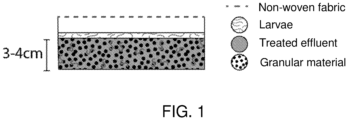
- Figure 1 schematically depicts a batch reactor used in laboratory to test the treatment method of the present invention.
- the invention proposes to insert into the process reactor, for the support of the black soldier fly larvae, a support bed made of solid non-biodegradable material, which support bed has a three-dimensional, or volumetric, structure, that is, a structure that extends in the three dimensions, thus not only in the plane but also in height, as well as a porous structure, so as to allow the larvae to move within the pores or passages of the support bed.
- a support bed made of solid non-biodegradable material, which support bed has a three-dimensional, or volumetric, structure, that is, a structure that extends in the three dimensions, thus not only in the plane but also in height, as well as a porous structure, so as to allow the larvae to move within the pores or passages of the support bed.
- the support bed can be immersed in a high liquid head without thereby jeopardizing the survival of the larvae.
- a similar level of survival of the larvae is thus achieved as in the case of their use for the treatment of organic solid waste, and, compared with the prior art discussed above, a significantly higher treatment efficiency is achieved.
- the material used for the support bed is non-biodegradable, it is not edible for the larvae and is completely recyclable without giving rise to any final solid waste production.
- the support bed is formed by granules of plastic material (including silicone or elastomeric material) with specific weight greater than that of the effluent to be treated.
- plastic material including silicone or elastomeric material
- Such granules are, for example, 2-4 mm in size, but of course their size may vary, depending on market availability and cost.
- the granules are arranged according to a static arrangement to form a layer with adequate thickness, for example several centimetres. In the reactor in Figure 1 , the thickness of the granule layer is 2-3 cm, but it might also be greater, for example 5-10 cm.
- the effluent to be treated is added to the solid material of the support bed so as to fill all the voids in the support bed and thus achieve a water-saturated condition of the support bed.
- the thickness of the support bed indicated above may also vary according to the degree of saturation of the bed, in case partial saturation conditions are adopted.
- non-biodegradable materials such as stone materials, metal materials, or composite materials
- the material used for the support bed will preferably be chosen so as to have adequate thermal and chemical resistance, depending on the environmental process conditions, on the liquid to be treated and on the end use of the larval biomass.
- a material that is not susceptible to photodegradation will be used as the material for the support bed in case UV radiation is used for day/night cycle simulation (artificial or natural light).
- the material used for the support bed will advantageously be a material that is resistant to a pH between 4 and 9 and to temperatures up to 45°C (these being the possible operating conditions of the larvae, in terms of pH and temperature).
- the support bed is made of granular material, as in the example of Figure 1 , the granules may be of any shape, such as solid or hollow shape, cylindrical or spherical shape, branched or irregular shape, etc.
- the size of the granules may also vary, for example in the range of less than 1 mm to 5 cm.
- the support bed may also be structured in blocks or layers of appropriate porosity, to form lattice structures, so as to maximize the contact surface between the support bed and the liquid to be treated and thus maximize the interaction between the larvae and the liquid.
- the support bed may be used with respect to the liquid to be treated either under static conditions, i.e. kept stationary in the liquid, or under dynamic conditions, i.e. driven in motion within the liquid.
- the final mixture consisting of the solid support bed and the liquid effluent may be either fully saturated (i.e. with the voids in the porous structure of the support bed being completely filled by the effluent) or partially saturated (in which case, with a proper structure of the support bed it is possible to have simultaneously saturated and unsaturated zones, i.e. zones occupied by the liquid and air).
- aeration of the solid-liquid mixture may be provided in order to promote respiration of the larvae and thus increase their survival rate.
- This can also be achieved by using, as a support matrix, aeration systems with a three-dimensional or volumetric structure adequate to provide support for the larvae. These systems simultaneously fulfil both the aeration function and the support function for the larvae.
- MABR Membrane Aerated Biological Reactor
- heating of the support bed and/or of the solid-liquid mixture and/or of the surrounding environment may also be provided in order to ensure optimal environmental conditions for the growth of the larvae.
- reactors consisting of plastic containers (volume of 0.6 I; size of 13.5 cm x 13.5 cm x 5.5 cm), containing 150 ml of waste water to be treated (of varying quality) and, as a support bed, a structure formed by polybutylene-terephthalate (Valox TM ) granules with a diameter of 2-4 mm, were used for experimentation.
- the granules were added to the effluent in such a way as to avoid surface liquid layers and thus ensure that the larvae supported by the granules had contact with the air. Overall, the thickness of the final solid-liquid mixture was 3-4 cm.
- the effluent consisted in leachate obtained synthetically in the laboratory.
- a further improvement in the treatment efficiency is conceivable by providing control of the temperatures inside the solid-liquid mixture (so as to ensure optimal temperatures for the larvae) and/or continuous feeding of the reactor with the substrate to be treated.
- the liquid Before or immediately after feeding the liquid to be treated to the process reactor, the liquid may undergo a conditioning operation, with the aim of changing its quality.
- a conditioning operation may, for example, involve the removal of inhibiting substances by appropriate pre-treatment and/or the addition of nutrients for the larvae.
- the liquid to be treated may be fed into the reactor from above, in which case it may be advantageous to collect the liquid from below through a filter placed on the bottom of the reactor. It should be noted in this regard that the feeding of the liquid to be treated is advantageously done without spraying, unlike some of the known examples illustrated in the introductory part of the present description. This makes it possible to avoid problems of clogging of the spray system or to dispense with pre-treatment systems to separate solid particles from the liquid to be treated (which pre-treatment systems, on the other hand, are indispensable in case the liquid to be treated is fed by spraying, in order to avoid problems of clogging of the spray systems).
Landscapes
- Life Sciences & Earth Sciences (AREA)
- Engineering & Computer Science (AREA)
- Chemical & Material Sciences (AREA)
- Organic Chemistry (AREA)
- Hydrology & Water Resources (AREA)
- Environmental & Geological Engineering (AREA)
- Water Supply & Treatment (AREA)
- Microbiology (AREA)
- Biodiversity & Conservation Biology (AREA)
- Botany (AREA)
- Biotechnology (AREA)
- Inorganic Chemistry (AREA)
- Materials Engineering (AREA)
- Chemical Kinetics & Catalysis (AREA)
- General Chemical & Material Sciences (AREA)
- Biological Treatment Of Waste Water (AREA)
- Treatment Of Sludge (AREA)
Claims (15)
- Verfahren zum Behandeln von Abwasser, das biologisch abbaubare organische Substanzen enthält, durch Zuführen der zu behandelnden Flüssigkeit in einen Prozessreaktor, der Larven der Schwarzen Soldatenfliege enthält, um die in der zu behandelnden Flüssigkeit enthaltenen organischen Substanzen zu verstoffwechseln,
gekennzeichnet durch das Einbringen eines Trägerbetts aus festem, biologisch nicht abbaubarem Material in den Prozessreaktor, um die Larven zu tragen, wobei das Trägerbett eine volumetrische oder dreidimensionale sowie poröse Struktur aufweist, so dass es den Larven einerseits ermöglicht wird, mit der zu behandelnden Flüssigkeit in Kontakt zu kommen, und es ihnen andererseits ermöglicht wird, sich durch die Poren oder Durchgänge in dem Trägerbett auf der Grundlage ihres Stoffwechselbedarfs zu bewegen, wobei sie in die Flüssigkeit eintauchen, um sich zu ernähren, und wieder auftauchen, um zu atmen, wobei die volumetrische oder dreidimensionale Struktur des Trägerbetts eine körnige Struktur ist, wobei die Körner so angeordnet sind, dass sie eine Schicht mit einer Dicke in der Größenordnung von mehreren Zentimetern oder eine Gitterstruktur bilden. - Verfahren nach Anspruch 1, wobei das Trägerbett aus mindestens einem der folgenden Materialien besteht: Kunststoffmaterial, einschließlich Silikon- oder Elastomermaterial, Steinmaterial, Metallmaterial, Verbundmaterial.
- Verfahren nach Anspruch 1 oder Anspruch 2, wobei die zu behandelnde Flüssigkeit dem festen Material des Trägerbetts zugegeben wird, um alle Poren der Struktur des Trägerbetts zu füllen und dadurch einen wassergesättigten Zustand des Trägerbetts zu erreichen.
- Verfahren nach Anspruch 1 oder Anspruch 2, wobei die zu behandelnde Flüssigkeit dem festen Material des Trägerbetts zugegeben wird, um so das gleichzeitige Vorhandensein von gesättigten und ungesättigten Zonen innerhalb des Trägerbetts zu erzeugen.
- Verfahren nach einem der vorhergehenden Ansprüche, wobei das Trägerbett innerhalb der zu behandelnden Flüssigkeit stationär gehalten oder in Bewegung versetzt wird.
- Verfahren nach einem der vorhergehenden Ansprüche, das ferner den Arbeitsschritt des Belüftens der aus dem Trägerbett und der zu behandelnden Flüssigkeit gebildeten Mischung umfasst, um die Atmung der Larven zu fördern und dadurch ihre Überlebensrate zu erhöhen.
- Verfahren nach einem der vorhergehenden Ansprüche, das ferner den Vorgang der Temperaturregelung in dem Trägerbett und/oder in dem aus dem Trägerbett und der zu behandelnden Flüssigkeit gebildeten Gemisch und/oder in der Umgebung umfasst.
- Verfahren nach einem der vorhergehenden Ansprüche, wobei der Reaktor kontinuierlich mit der zu behandelnden Flüssigkeit eingeleitet wird.
- Verfahren nach einem der vorhergehenden Ansprüche, das ferner den Vorgang des Umwälzens der zu behandelnden Flüssigkeit umfasst.
- Verfahren nach einem der vorhergehenden Ansprüche, das ferner den Vorgang des Aufbereitens der zu behandelnden Flüssigkeit vor oder unmittelbar nach dem Zuführen der zu behandelnden Flüssigkeit in den Prozessreaktor umfasst.
- Verfahren nach einem der vorhergehenden Ansprüche, wobei die zu behandelnde Flüssigkeit von oben in den Reaktor eingeleitet wird, und wobei die Flüssigkeit vorzugsweise auch am Boden des Reaktors gefiltert wird.
- Vorrichtung zum Behandeln von Abwasser, das biologisch abbaubare organische Substanzen enthält, durch Einsetzen von Larven der Schwarzen Soldatenfliege zum Verstoffwechseln der in der zu behandelnden Flüssigkeit enthaltenen organischen Substanzen, wobei die Vorrichtung mindestens einen Prozessreaktor mit einem Trägerbett aus festem, nicht biologisch abbaubarem Material umfasst, auf dem die Larven der Schwarzen Soldatenfliege angeordnet sind,dadurch gekennzeichnet, dass das Trägerbett eine volumetrische bzw. dreidimensionale sowie poröse Struktur aufweist, so dass die Larven einerseits mit der zu behandelnden Flüssigkeit in Kontakt kommen und sich andererseits je nach ihrem Stoffwechselbedarf durch die im Trägerbett vorhandenen Poren oder Durchgänge bewegen können, wobei sie in die Flüssigkeit eintauchen, um sich zu ernähren, und wieder auftauchen, um zu atmen,wobei die volumetrische oder dreidimensionale Struktur des Trägerbetts eine körnige Struktur mit Körnchen ist, die so angeordnet sind, dass sie eine Schicht mit einer Dicke in der Größenordnung von mehreren Zentimetern oder eine Gitterstruktur bilden.
- Einrichtung nach Anspruch 12, wobei das Trägerbett aus mindestens einem der folgenden Materialien besteht: Kunststoffmaterial, einschließlich Silikon- oder Elastomermaterial, Steinmaterial, metallisches Material, Verbundmaterial.
- Einrichtung nach Anspruch 12 oder Anspruch 13, die ferner Zuführmittel zum Zuführen der zu behandelnden Flüssigkeit von oben in den mindestens einen Prozessreaktor umfasst.
- Einrichtung nach einem der Ansprüche 12 bis 14, die ferner Filtermittel umfasst, die auf dem Boden des mindestens einen Prozessreaktors angeordnet sind, um die zu behandelnde Flüssigkeit zu filtern, und/oder Temperaturkontrollmittel zum Kontrollieren der Temperatur in dem Trägerbett und/oder in der Mischung, die aus dem Trägerbett und der zu behandelnden Flüssigkeit gebildet wird.
Applications Claiming Priority (2)
| Application Number | Priority Date | Filing Date | Title |
|---|---|---|---|
| IT102021000016700A IT202100016700A1 (it) | 2021-06-25 | 2021-06-25 | Metodo per il trattamento di acque di rifiuto contenenti sostanze organiche biodegradabili mediante utilizzo di larve di mosca soldato nera |
| PCT/IB2022/055888 WO2022269563A1 (en) | 2021-06-25 | 2022-06-24 | Method and apparatus for treating waste water containing biodegradable organic substances by using black soldier fly larvae |
Publications (3)
| Publication Number | Publication Date |
|---|---|
| EP4359351A1 EP4359351A1 (de) | 2024-05-01 |
| EP4359351C0 EP4359351C0 (de) | 2025-02-26 |
| EP4359351B1 true EP4359351B1 (de) | 2025-02-26 |
Family
ID=77802047
Family Applications (1)
| Application Number | Title | Priority Date | Filing Date |
|---|---|---|---|
| EP22741850.6A Active EP4359351B1 (de) | 2021-06-25 | 2022-06-24 | Verfahren und vorrichtung zur behandlung von biologisch abbaubaren organischen substanzen enthaltendem abwasser mittels soldaten-fliegenlarven |
Country Status (3)
| Country | Link |
|---|---|
| EP (1) | EP4359351B1 (de) |
| IT (1) | IT202100016700A1 (de) |
| WO (1) | WO2022269563A1 (de) |
Family Cites Families (5)
| Publication number | Priority date | Publication date | Assignee | Title |
|---|---|---|---|---|
| CN210127128U (zh) * | 2019-05-10 | 2020-03-06 | 广东金银山环保科技有限公司 | 一种用于黑水虻处理高含水畜禽粪便的装置 |
| CN110050760B (zh) * | 2019-05-17 | 2024-07-23 | 郑州笨农农业科技有限公司 | 一种利用黑水虻幼虫预处理液体有机废弃物的液体养殖装置及其处理方法 |
| CN211497305U (zh) * | 2019-12-04 | 2020-09-15 | 广州安芮洁环保科技有限公司 | 一种有机废水的高效处理设备 |
| CN212065394U (zh) * | 2020-03-02 | 2020-12-04 | 广州丰晟生态环境有限公司 | 一种利用液体原料养殖黑水虻的设备 |
| CN111328772A (zh) * | 2020-04-08 | 2020-06-26 | 赖德仪 | 养殖装置及养殖系统 |
-
2021
- 2021-06-25 IT IT102021000016700A patent/IT202100016700A1/it unknown
-
2022
- 2022-06-24 WO PCT/IB2022/055888 patent/WO2022269563A1/en not_active Ceased
- 2022-06-24 EP EP22741850.6A patent/EP4359351B1/de active Active
Also Published As
| Publication number | Publication date |
|---|---|
| WO2022269563A1 (en) | 2022-12-29 |
| IT202100016700A1 (it) | 2022-12-25 |
| EP4359351A1 (de) | 2024-05-01 |
| EP4359351C0 (de) | 2025-02-26 |
Similar Documents
| Publication | Publication Date | Title |
|---|---|---|
| DE69224759T2 (de) | Verfahren und Vorrichtung für die Beseitigung von organischen Schmutzstoffen aus Abwasser. | |
| US20170332567A1 (en) | Aerobic, bioremediation treatment system comprising floating inert media in an aqueous environment | |
| US20130180915A1 (en) | Composition for triggering microbiological processes in water and method of producing the same | |
| EP0240929B1 (de) | Trägermaterial zur Imobilisierung von Mikroorganismen | |
| US5466373A (en) | Maintenance-free enhancement of aquatic biological filters using amphipods | |
| KR19990036465A (ko) | 합성 해양 구조물 | |
| EP2468088A1 (de) | Hochverbesserte, verstellbare, schwimmfähige schwimmende Insel | |
| DE4205572A1 (de) | Verfahren und reaktionsteilchen zur durchfuehrung von reaktionen | |
| CN104512966A (zh) | 一种用于污水处理的人工生态浮岛及净水方法 | |
| CN105776561B (zh) | 一种可漂浮于水面的轻质多孔生态砖及其制备方法 | |
| RU2595670C9 (ru) | Система для разложения органических соединений и способ ее эксплуатации | |
| US4422408A (en) | Shielding device for the temperature and pollution control of water in a farming enclosure for fish and other aquatic organisms | |
| US3929630A (en) | Process for biochemical reactions | |
| WO2022269563A1 (en) | Method and apparatus for treating waste water containing biodegradable organic substances by using black soldier fly larvae | |
| Ramos et al. | The contribution of microbiology toward attainment of sustainable development goals: the need to conserve soil health while maximizing its productivity. | |
| KR101064806B1 (ko) | 먹이생물 배양장치가 구비된 갯벌생태수조 | |
| CN104671626A (zh) | 一种富营养化滩涂沉积物生境修复的方法 | |
| CN101234824A (zh) | 一种改善富营养化水体水质的方法 | |
| CN119096911A (zh) | 一种适合淡水鱼养殖的多营养层级生态养殖系统 | |
| JPH11343181A (ja) | 多孔質成形体の製造方法、多孔質成形体を用いた培養方法、培養システムおよび濾過システム | |
| CN206680267U (zh) | 一种自带菌种和培养基的池塘养殖用生物膜净水机 | |
| KR200362639Y1 (ko) | 부도형 수질정화장치 | |
| CN115637155B (zh) | 一种用于改良盐碱地的生物碳系统调理模块及制备方法 | |
| Thornton | Phytoplankton mucilage production in coastal waters: a dispersal mechanism in a front dominated system? | |
| Ileri | Experimental and Theoretical Study of the Biosorption of Copper Ions by Immobilised Dead Rhizopus arrhizus |
Legal Events
| Date | Code | Title | Description |
|---|---|---|---|
| STAA | Information on the status of an ep patent application or granted ep patent |
Free format text: STATUS: UNKNOWN |
|
| STAA | Information on the status of an ep patent application or granted ep patent |
Free format text: STATUS: THE INTERNATIONAL PUBLICATION HAS BEEN MADE |
|
| PUAI | Public reference made under article 153(3) epc to a published international application that has entered the european phase |
Free format text: ORIGINAL CODE: 0009012 |
|
| STAA | Information on the status of an ep patent application or granted ep patent |
Free format text: STATUS: REQUEST FOR EXAMINATION WAS MADE |
|
| 17P | Request for examination filed |
Effective date: 20231222 |
|
| AK | Designated contracting states |
Kind code of ref document: A1 Designated state(s): AL AT BE BG CH CY CZ DE DK EE ES FI FR GB GR HR HU IE IS IT LI LT LU LV MC MK MT NL NO PL PT RO RS SE SI SK SM TR |
|
| DAV | Request for validation of the european patent (deleted) | ||
| DAX | Request for extension of the european patent (deleted) | ||
| GRAP | Despatch of communication of intention to grant a patent |
Free format text: ORIGINAL CODE: EPIDOSNIGR1 |
|
| STAA | Information on the status of an ep patent application or granted ep patent |
Free format text: STATUS: GRANT OF PATENT IS INTENDED |
|
| INTG | Intention to grant announced |
Effective date: 20241016 |
|
| GRAS | Grant fee paid |
Free format text: ORIGINAL CODE: EPIDOSNIGR3 |
|
| GRAA | (expected) grant |
Free format text: ORIGINAL CODE: 0009210 |
|
| STAA | Information on the status of an ep patent application or granted ep patent |
Free format text: STATUS: THE PATENT HAS BEEN GRANTED |
|
| AK | Designated contracting states |
Kind code of ref document: B1 Designated state(s): AL AT BE BG CH CY CZ DE DK EE ES FI FR GB GR HR HU IE IS IT LI LT LU LV MC MK MT NL NO PL PT RO RS SE SI SK SM TR |
|
| REG | Reference to a national code |
Ref country code: GB Ref legal event code: FG4D |
|
| REG | Reference to a national code |
Ref country code: CH Ref legal event code: EP |
|
| REG | Reference to a national code |
Ref country code: DE Ref legal event code: R096 Ref document number: 602022011204 Country of ref document: DE |
|
| REG | Reference to a national code |
Ref country code: IE Ref legal event code: FG4D |
|
| U01 | Request for unitary effect filed |
Effective date: 20250318 |
|
| U07 | Unitary effect registered |
Designated state(s): AT BE BG DE DK EE FI FR IT LT LU LV MT NL PT RO SE SI Effective date: 20250324 |
|
| PG25 | Lapsed in a contracting state [announced via postgrant information from national office to epo] |
Ref country code: RS Free format text: LAPSE BECAUSE OF FAILURE TO SUBMIT A TRANSLATION OF THE DESCRIPTION OR TO PAY THE FEE WITHIN THE PRESCRIBED TIME-LIMIT Effective date: 20250526 |
|
| PG25 | Lapsed in a contracting state [announced via postgrant information from national office to epo] |
Ref country code: PL Free format text: LAPSE BECAUSE OF FAILURE TO SUBMIT A TRANSLATION OF THE DESCRIPTION OR TO PAY THE FEE WITHIN THE PRESCRIBED TIME-LIMIT Effective date: 20250226 |
|
| PG25 | Lapsed in a contracting state [announced via postgrant information from national office to epo] |
Ref country code: ES Free format text: LAPSE BECAUSE OF FAILURE TO SUBMIT A TRANSLATION OF THE DESCRIPTION OR TO PAY THE FEE WITHIN THE PRESCRIBED TIME-LIMIT Effective date: 20250226 |
|
| PG25 | Lapsed in a contracting state [announced via postgrant information from national office to epo] |
Ref country code: IS Free format text: LAPSE BECAUSE OF FAILURE TO SUBMIT A TRANSLATION OF THE DESCRIPTION OR TO PAY THE FEE WITHIN THE PRESCRIBED TIME-LIMIT Effective date: 20250626 Ref country code: NO Free format text: LAPSE BECAUSE OF FAILURE TO SUBMIT A TRANSLATION OF THE DESCRIPTION OR TO PAY THE FEE WITHIN THE PRESCRIBED TIME-LIMIT Effective date: 20250526 |
|
| PG25 | Lapsed in a contracting state [announced via postgrant information from national office to epo] |
Ref country code: HR Free format text: LAPSE BECAUSE OF FAILURE TO SUBMIT A TRANSLATION OF THE DESCRIPTION OR TO PAY THE FEE WITHIN THE PRESCRIBED TIME-LIMIT Effective date: 20250226 |
|
| PG25 | Lapsed in a contracting state [announced via postgrant information from national office to epo] |
Ref country code: GR Free format text: LAPSE BECAUSE OF FAILURE TO SUBMIT A TRANSLATION OF THE DESCRIPTION OR TO PAY THE FEE WITHIN THE PRESCRIBED TIME-LIMIT Effective date: 20250527 |
|
| U20 | Renewal fee for the european patent with unitary effect paid |
Year of fee payment: 4 Effective date: 20250619 |
|
| PG25 | Lapsed in a contracting state [announced via postgrant information from national office to epo] |
Ref country code: SM Free format text: LAPSE BECAUSE OF FAILURE TO SUBMIT A TRANSLATION OF THE DESCRIPTION OR TO PAY THE FEE WITHIN THE PRESCRIBED TIME-LIMIT Effective date: 20250226 |
|
| PG25 | Lapsed in a contracting state [announced via postgrant information from national office to epo] |
Ref country code: CZ Free format text: LAPSE BECAUSE OF FAILURE TO SUBMIT A TRANSLATION OF THE DESCRIPTION OR TO PAY THE FEE WITHIN THE PRESCRIBED TIME-LIMIT Effective date: 20250226 |
|
| PG25 | Lapsed in a contracting state [announced via postgrant information from national office to epo] |
Ref country code: SK Free format text: LAPSE BECAUSE OF FAILURE TO SUBMIT A TRANSLATION OF THE DESCRIPTION OR TO PAY THE FEE WITHIN THE PRESCRIBED TIME-LIMIT Effective date: 20250226 |
|
| PLBE | No opposition filed within time limit |
Free format text: ORIGINAL CODE: 0009261 |
|
| STAA | Information on the status of an ep patent application or granted ep patent |
Free format text: STATUS: NO OPPOSITION FILED WITHIN TIME LIMIT |
|
| REG | Reference to a national code |
Ref country code: CH Ref legal event code: L10 Free format text: ST27 STATUS EVENT CODE: U-0-0-L10-L00 (AS PROVIDED BY THE NATIONAL OFFICE) Effective date: 20260107 |
|
| REG | Reference to a national code |
Ref country code: CH Ref legal event code: H13 Free format text: ST27 STATUS EVENT CODE: U-0-0-H10-H13 (AS PROVIDED BY THE NATIONAL OFFICE) Effective date: 20260127 |
|
| PG25 | Lapsed in a contracting state [announced via postgrant information from national office to epo] |
Ref country code: MC Free format text: LAPSE BECAUSE OF FAILURE TO SUBMIT A TRANSLATION OF THE DESCRIPTION OR TO PAY THE FEE WITHIN THE PRESCRIBED TIME-LIMIT Effective date: 20250226 |
|
| 26N | No opposition filed |
Effective date: 20251127 |
|
| PG25 | Lapsed in a contracting state [announced via postgrant information from national office to epo] |
Ref country code: IE Free format text: LAPSE BECAUSE OF NON-PAYMENT OF DUE FEES Effective date: 20250624 |
|
| PG25 | Lapsed in a contracting state [announced via postgrant information from national office to epo] |
Ref country code: CH Free format text: LAPSE BECAUSE OF NON-PAYMENT OF DUE FEES Effective date: 20250630 |
|
| U20 | Renewal fee for the european patent with unitary effect paid |
Year of fee payment: 5 Effective date: 20260331 |
|
| PG25 | Lapsed in a contracting state [announced via postgrant information from national office to epo] |
Ref country code: CY Free format text: LAPSE BECAUSE OF FAILURE TO SUBMIT A TRANSLATION OF THE DESCRIPTION OR TO PAY THE FEE WITHIN THE PRESCRIBED TIME-LIMIT Effective date: 20250226 |