EP4357385B1 - Polymer und organisches lichtemittierendes element damit - Google Patents
Polymer und organisches lichtemittierendes element damit Download PDFInfo
- Publication number
- EP4357385B1 EP4357385B1 EP22846058.0A EP22846058A EP4357385B1 EP 4357385 B1 EP4357385 B1 EP 4357385B1 EP 22846058 A EP22846058 A EP 22846058A EP 4357385 B1 EP4357385 B1 EP 4357385B1
- Authority
- EP
- European Patent Office
- Prior art keywords
- group
- substituted
- unsubstituted
- polymer
- present specification
- Prior art date
- Legal status (The legal status is an assumption and is not a legal conclusion. Google has not performed a legal analysis and makes no representation as to the accuracy of the status listed.)
- Active
Links
Images

Classifications
-
- C—CHEMISTRY; METALLURGY
- C08—ORGANIC MACROMOLECULAR COMPOUNDS; THEIR PREPARATION OR CHEMICAL WORKING-UP; COMPOSITIONS BASED THEREON
- C08G—MACROMOLECULAR COMPOUNDS OBTAINED OTHERWISE THAN BY REACTIONS ONLY INVOLVING UNSATURATED CARBON-TO-CARBON BONDS
- C08G61/00—Macromolecular compounds obtained by reactions forming a carbon-to-carbon link in the main chain of the macromolecule
- C08G61/12—Macromolecular compounds containing atoms other than carbon in the main chain of the macromolecule
-
- C—CHEMISTRY; METALLURGY
- C08—ORGANIC MACROMOLECULAR COMPOUNDS; THEIR PREPARATION OR CHEMICAL WORKING-UP; COMPOSITIONS BASED THEREON
- C08G—MACROMOLECULAR COMPOUNDS OBTAINED OTHERWISE THAN BY REACTIONS ONLY INVOLVING UNSATURATED CARBON-TO-CARBON BONDS
- C08G61/00—Macromolecular compounds obtained by reactions forming a carbon-to-carbon link in the main chain of the macromolecule
- C08G61/12—Macromolecular compounds containing atoms other than carbon in the main chain of the macromolecule
- C08G61/121—Macromolecular compounds containing atoms other than carbon in the main chain of the macromolecule derived from organic halides
-
- C—CHEMISTRY; METALLURGY
- C08—ORGANIC MACROMOLECULAR COMPOUNDS; THEIR PREPARATION OR CHEMICAL WORKING-UP; COMPOSITIONS BASED THEREON
- C08L—COMPOSITIONS OF MACROMOLECULAR COMPOUNDS
- C08L65/00—Compositions of macromolecular compounds obtained by reactions forming a carbon-to-carbon link in the main chain; Compositions of derivatives of such polymers
-
- C—CHEMISTRY; METALLURGY
- C09—DYES; PAINTS; POLISHES; NATURAL RESINS; ADHESIVES; COMPOSITIONS NOT OTHERWISE PROVIDED FOR; APPLICATIONS OF MATERIALS NOT OTHERWISE PROVIDED FOR
- C09D—COATING COMPOSITIONS, e.g. PAINTS, VARNISHES OR LACQUERS; FILLING PASTES; CHEMICAL PAINT OR INK REMOVERS; INKS; CORRECTING FLUIDS; WOODSTAINS; PASTES OR SOLIDS FOR COLOURING OR PRINTING; USE OF MATERIALS THEREFOR
- C09D165/00—Coating compositions based on macromolecular compounds obtained by reactions forming a carbon-to-carbon link in the main chain; Coating compositions based on derivatives of such polymers
-
- C—CHEMISTRY; METALLURGY
- C09—DYES; PAINTS; POLISHES; NATURAL RESINS; ADHESIVES; COMPOSITIONS NOT OTHERWISE PROVIDED FOR; APPLICATIONS OF MATERIALS NOT OTHERWISE PROVIDED FOR
- C09K—MATERIALS FOR MISCELLANEOUS APPLICATIONS, NOT PROVIDED FOR ELSEWHERE
- C09K11/00—Luminescent materials, e.g. electroluminescent or chemiluminescent
- C09K11/06—Luminescent materials, e.g. electroluminescent or chemiluminescent containing organic luminescent materials
-
- H—ELECTRICITY
- H10—SEMICONDUCTOR DEVICES; ELECTRIC SOLID-STATE DEVICES NOT OTHERWISE PROVIDED FOR
- H10K—ORGANIC ELECTRIC SOLID-STATE DEVICES
- H10K85/00—Organic materials used in the body or electrodes of devices covered by this subclass
- H10K85/10—Organic polymers or oligomers
- H10K85/111—Organic polymers or oligomers comprising aromatic, heteroaromatic, or aryl chains, e.g. polyaniline, polyphenylene or polyphenylene vinylene
-
- H—ELECTRICITY
- H10—SEMICONDUCTOR DEVICES; ELECTRIC SOLID-STATE DEVICES NOT OTHERWISE PROVIDED FOR
- H10K—ORGANIC ELECTRIC SOLID-STATE DEVICES
- H10K85/00—Organic materials used in the body or electrodes of devices covered by this subclass
- H10K85/10—Organic polymers or oligomers
- H10K85/151—Copolymers
-
- H—ELECTRICITY
- H10—SEMICONDUCTOR DEVICES; ELECTRIC SOLID-STATE DEVICES NOT OTHERWISE PROVIDED FOR
- H10K—ORGANIC ELECTRIC SOLID-STATE DEVICES
- H10K85/00—Organic materials used in the body or electrodes of devices covered by this subclass
- H10K85/40—Organosilicon compounds, e.g. TIPS pentacene
-
- C—CHEMISTRY; METALLURGY
- C08—ORGANIC MACROMOLECULAR COMPOUNDS; THEIR PREPARATION OR CHEMICAL WORKING-UP; COMPOSITIONS BASED THEREON
- C08G—MACROMOLECULAR COMPOUNDS OBTAINED OTHERWISE THAN BY REACTIONS ONLY INVOLVING UNSATURATED CARBON-TO-CARBON BONDS
- C08G2261/00—Macromolecular compounds obtained by reactions forming a carbon-to-carbon link in the main chain of the macromolecule
- C08G2261/10—Definition of the polymer structure
- C08G2261/12—Copolymers
- C08G2261/122—Copolymers statistical
-
- C—CHEMISTRY; METALLURGY
- C08—ORGANIC MACROMOLECULAR COMPOUNDS; THEIR PREPARATION OR CHEMICAL WORKING-UP; COMPOSITIONS BASED THEREON
- C08G—MACROMOLECULAR COMPOUNDS OBTAINED OTHERWISE THAN BY REACTIONS ONLY INVOLVING UNSATURATED CARBON-TO-CARBON BONDS
- C08G2261/00—Macromolecular compounds obtained by reactions forming a carbon-to-carbon link in the main chain of the macromolecule
- C08G2261/10—Definition of the polymer structure
- C08G2261/13—Morphological aspects
- C08G2261/132—Morphological aspects branched or hyperbranched
-
- C—CHEMISTRY; METALLURGY
- C08—ORGANIC MACROMOLECULAR COMPOUNDS; THEIR PREPARATION OR CHEMICAL WORKING-UP; COMPOSITIONS BASED THEREON
- C08G—MACROMOLECULAR COMPOUNDS OBTAINED OTHERWISE THAN BY REACTIONS ONLY INVOLVING UNSATURATED CARBON-TO-CARBON BONDS
- C08G2261/00—Macromolecular compounds obtained by reactions forming a carbon-to-carbon link in the main chain of the macromolecule
- C08G2261/10—Definition of the polymer structure
- C08G2261/14—Side-groups
- C08G2261/141—Side-chains having aliphatic units
- C08G2261/1412—Saturated aliphatic units
-
- C—CHEMISTRY; METALLURGY
- C08—ORGANIC MACROMOLECULAR COMPOUNDS; THEIR PREPARATION OR CHEMICAL WORKING-UP; COMPOSITIONS BASED THEREON
- C08G—MACROMOLECULAR COMPOUNDS OBTAINED OTHERWISE THAN BY REACTIONS ONLY INVOLVING UNSATURATED CARBON-TO-CARBON BONDS
- C08G2261/00—Macromolecular compounds obtained by reactions forming a carbon-to-carbon link in the main chain of the macromolecule
- C08G2261/10—Definition of the polymer structure
- C08G2261/14—Side-groups
- C08G2261/143—Side-chains containing nitrogen
- C08G2261/1434—Side-chains containing nitrogen containing triarylamine moieties
-
- C—CHEMISTRY; METALLURGY
- C08—ORGANIC MACROMOLECULAR COMPOUNDS; THEIR PREPARATION OR CHEMICAL WORKING-UP; COMPOSITIONS BASED THEREON
- C08G—MACROMOLECULAR COMPOUNDS OBTAINED OTHERWISE THAN BY REACTIONS ONLY INVOLVING UNSATURATED CARBON-TO-CARBON BONDS
- C08G2261/00—Macromolecular compounds obtained by reactions forming a carbon-to-carbon link in the main chain of the macromolecule
- C08G2261/10—Definition of the polymer structure
- C08G2261/14—Side-groups
- C08G2261/148—Side-chains having aromatic units
-
- C—CHEMISTRY; METALLURGY
- C08—ORGANIC MACROMOLECULAR COMPOUNDS; THEIR PREPARATION OR CHEMICAL WORKING-UP; COMPOSITIONS BASED THEREON
- C08G—MACROMOLECULAR COMPOUNDS OBTAINED OTHERWISE THAN BY REACTIONS ONLY INVOLVING UNSATURATED CARBON-TO-CARBON BONDS
- C08G2261/00—Macromolecular compounds obtained by reactions forming a carbon-to-carbon link in the main chain of the macromolecule
- C08G2261/10—Definition of the polymer structure
- C08G2261/16—End groups
- C08G2261/164—End groups comprising organic end groups
-
- C—CHEMISTRY; METALLURGY
- C08—ORGANIC MACROMOLECULAR COMPOUNDS; THEIR PREPARATION OR CHEMICAL WORKING-UP; COMPOSITIONS BASED THEREON
- C08G—MACROMOLECULAR COMPOUNDS OBTAINED OTHERWISE THAN BY REACTIONS ONLY INVOLVING UNSATURATED CARBON-TO-CARBON BONDS
- C08G2261/00—Macromolecular compounds obtained by reactions forming a carbon-to-carbon link in the main chain of the macromolecule
- C08G2261/10—Definition of the polymer structure
- C08G2261/16—End groups
- C08G2261/164—End groups comprising organic end groups
- C08G2261/1646—End groups comprising organic end groups comprising aromatic or heteroaromatic end groups
-
- C—CHEMISTRY; METALLURGY
- C08—ORGANIC MACROMOLECULAR COMPOUNDS; THEIR PREPARATION OR CHEMICAL WORKING-UP; COMPOSITIONS BASED THEREON
- C08G—MACROMOLECULAR COMPOUNDS OBTAINED OTHERWISE THAN BY REACTIONS ONLY INVOLVING UNSATURATED CARBON-TO-CARBON BONDS
- C08G2261/00—Macromolecular compounds obtained by reactions forming a carbon-to-carbon link in the main chain of the macromolecule
- C08G2261/30—Monomer units or repeat units incorporating structural elements in the main chain
- C08G2261/31—Monomer units or repeat units incorporating structural elements in the main chain incorporating aromatic structural elements in the main chain
- C08G2261/312—Non-condensed aromatic systems, e.g. benzene
-
- C—CHEMISTRY; METALLURGY
- C08—ORGANIC MACROMOLECULAR COMPOUNDS; THEIR PREPARATION OR CHEMICAL WORKING-UP; COMPOSITIONS BASED THEREON
- C08G—MACROMOLECULAR COMPOUNDS OBTAINED OTHERWISE THAN BY REACTIONS ONLY INVOLVING UNSATURATED CARBON-TO-CARBON BONDS
- C08G2261/00—Macromolecular compounds obtained by reactions forming a carbon-to-carbon link in the main chain of the macromolecule
- C08G2261/30—Monomer units or repeat units incorporating structural elements in the main chain
- C08G2261/31—Monomer units or repeat units incorporating structural elements in the main chain incorporating aromatic structural elements in the main chain
- C08G2261/316—Monomer units or repeat units incorporating structural elements in the main chain incorporating aromatic structural elements in the main chain bridged by heteroatoms, e.g. N, P, Si or B
- C08G2261/3162—Arylamines
-
- C—CHEMISTRY; METALLURGY
- C08—ORGANIC MACROMOLECULAR COMPOUNDS; THEIR PREPARATION OR CHEMICAL WORKING-UP; COMPOSITIONS BASED THEREON
- C08G—MACROMOLECULAR COMPOUNDS OBTAINED OTHERWISE THAN BY REACTIONS ONLY INVOLVING UNSATURATED CARBON-TO-CARBON BONDS
- C08G2261/00—Macromolecular compounds obtained by reactions forming a carbon-to-carbon link in the main chain of the macromolecule
- C08G2261/40—Polymerisation processes
- C08G2261/41—Organometallic coupling reactions
- C08G2261/411—Suzuki reactions
-
- C—CHEMISTRY; METALLURGY
- C08—ORGANIC MACROMOLECULAR COMPOUNDS; THEIR PREPARATION OR CHEMICAL WORKING-UP; COMPOSITIONS BASED THEREON
- C08G—MACROMOLECULAR COMPOUNDS OBTAINED OTHERWISE THAN BY REACTIONS ONLY INVOLVING UNSATURATED CARBON-TO-CARBON BONDS
- C08G2261/00—Macromolecular compounds obtained by reactions forming a carbon-to-carbon link in the main chain of the macromolecule
- C08G2261/90—Applications
- C08G2261/95—Use in organic luminescent diodes
-
- H—ELECTRICITY
- H10—SEMICONDUCTOR DEVICES; ELECTRIC SOLID-STATE DEVICES NOT OTHERWISE PROVIDED FOR
- H10K—ORGANIC ELECTRIC SOLID-STATE DEVICES
- H10K50/00—Organic light-emitting devices
- H10K50/10—OLEDs or polymer light-emitting diodes [PLED]
- H10K50/14—Carrier transporting layers
- H10K50/15—Hole transporting layers
-
- H—ELECTRICITY
- H10—SEMICONDUCTOR DEVICES; ELECTRIC SOLID-STATE DEVICES NOT OTHERWISE PROVIDED FOR
- H10K—ORGANIC ELECTRIC SOLID-STATE DEVICES
- H10K50/00—Organic light-emitting devices
- H10K50/10—OLEDs or polymer light-emitting diodes [PLED]
- H10K50/17—Carrier injection layers
Definitions
- the present specification relates to a polymer and an organic light emitting device formed by using the same.
- An organic light emission phenomenon is one of the examples of converting an electric current into visible rays through an internal process of a specific organic molecule.
- the principle of the organic light emission phenomenon is as follows. When an organic material layer is disposed between a positive electrode and a negative electrode, if electric current is applied between the two electrodes, electrons and holes are injected from the negative electrode and the positive electrode, respectively, into the organic material layer. The electrons and the holes which are injected into the organic material layer are recombined to form an exciton, and the exciton falls down again to the ground state to emit light.
- An organic electroluminescent device using this principle may be generally composed of a negative electrode, a positive electrode, and an organic material layer disposed therebetween, for example, an organic material layer including a hole injection layer, a hole transport layer, a light emitting layer, an electron transport layer, and an electron injection layer.
- a material used in the organic light emitting device is mostly a pure organic material or a complex compound where an organic material and metal form a complex, and may be classified into a hole injection material, a hole transport material, a light emitting material, an electron transport material, an electron injection material, and the like according to the use thereof.
- an organic material having a p-type property that is, an organic material, which is easily oxidized and has an electrochemically stable state during oxidation
- an organic material having an n-type property that is, an organic material, which is easily reduced and has an electrochemically stable state during reduction, is usually used as the electron injection material or the electron transport material.
- the light emitting material a material having both p-type and n-type properties, that is, a material having a stable form in both oxidation and reduction states is preferred, and a material having high light emitting efficiency for converting an exciton into light when the exciton is formed is preferred.
- Hole transport materials for OLEDS are known, for example, from KR 2016 0131947 A .
- the material used in the organic light emitting device additionally has the following properties.
- the material used in the organic light emitting device has excellent thermal stability. This is because joule heating occurs due to the movement of electric charges in the organic light emitting device.
- NPB N,N'-di(1-naphthyl)-N,N'-diphenyl-(1,1'-biphenyl)-4,4'-diamine
- NPB N,N'-di(1-naphthyl)-N,N'-diphenyl-(1,1'-biphenyl)-4,4'-diamine
- a material used in the organic light emitting device needs to have an appropriate band gap and an appropriate highest occupied molecular orbital (HOMO) or lowest unoccupied molecular orbital (LUMO) energy level.
- HOMO highest occupied molecular orbital
- LUMO lowest unoccupied molecular orbital
- poly(3,4-ethylenedioxythiophene) doped poly(styrenesulfonic acid) (PEDOT:PSS) currently used as a hole transport material in an organic light emitting device to be manufactured by a solution application method has a lower LUMO energy level than the LUMO energy level of an organic material used as a light emitting layer material, it is difficult to manufacture an organic light emitting device having high efficiency and a long service life.
- PEDOT:PSS poly(styrenesulfonic acid)
- the material used in the organic light emitting device needs to have excellent chemical stability, excellent charge mobility, excellent interface characteristics with electrodes or adjacent layers, and the like. That is, the material used in the organic light emitting device needs to be minimally deformed by moisture or oxygen. Further, the material used in the organic light emitting device needs to have appropriate hole or electron mobility so as to make a balance between densities of holes and electrons in a light emitting layer of the organic light emitting device, thereby maximally forming excitons. Moreover, the material used in the organic light emitting device needs to improve the interface with an electrode including a metal or a metal oxide for the stability of the device.
- a material used in an organic light emitting device for a solution process needs to additionally have the following properties.
- the material used in the organic light emitting device needs to form a storable homogenous solution. Since a commercialized material for a deposition process has good crystallinity so that the material is not dissolved well in a solution or the crystals thereof are easily formed even though the material forms a solution, it is highly likely that according to the storage period, the concentration gradient of the solution varies or a defective device is formed.
- layers where the solution process is performed need to have solvent and material resistance to other layers.
- a material capable of forming a polymer self-cross-linked on a substrate through a heat treatment or ultraviolet (UV) irradiation after a curing group is introduced and a solution is applied like N4,N4'-di(naphthalen-1-yl)-N4,N4'-bis(4-vinylphenyl)biphenyl-4,4'-diamine (VNPB), or capable of forming a polymer having sufficient resistance in the next process is preferred, and a material capable of having solvent resistance itself, like hexaazatriphenylenehexacarbonitrile (HATCN), is also preferred.
- HTCN hexaazatriphenylenehexacarbonitrile
- the present specification provides a polymer and an organic light emitting device formed using the same.
- An exemplary embodiment of the present specification provides a polymer including: a first unit represented by the following Chemical Formula 1; a second unit represented by the following Chemical Formula 1 and different from the first unit; a third unit represented by the following Chemical Formula 2; and an end group represented by the following Chemical Formula 3.
- a polymer including: a first unit represented by the following Chemical Formula 1; a second unit represented by the following Chemical Formula 1 and different from the first unit; a third unit represented by the following Chemical Formula 2; and an end group represented by the following Chemical Formula 3.
- an organic light emitting device including: a first electrode; a second electrode; and an organic material layer having one or more layers provided between the first electrode and the second electrode, in which one or more layers of the organic material layer include the polymer.
- the polymer according to an exemplary embodiment of the present specification easily adjusts electrical characteristics by simultaneously including a first unit and a second unit which are different from each other. Accordingly, an effect in which the hole mobility is improved is exhibited.
- the polymer according to an exemplary embodiment of the present specification can be applied to an organic material layer of an organic light emitting device, and thus can improve the performance and life characteristics of the device.
- the polymer according to an exemplary embodiment of the present specification can be applied to a hole transport layer of the organic light emitting device to improve the efficiency and/or service life of the device.
- FIGS. 1 and 2 are views exemplifying the structure of an organic light emitting device according to some exemplary embodiments of the present specification.
- one member (layer) is disposed "on" another member (layer) in the present specification, this includes not only a case where the one member (layer) is brought into contact with another member, but also a case where still another member (layer) is present between the two members (layers).
- the "mole fraction” means a ratio of the mole number of a given component to the total mole number of all the components.
- the "adjacent" group may mean a substituent substituted with an atom directly linked to an atom in which the corresponding substituent is substituted, a substituent disposed to be sterically closest to the corresponding substituent, or another substituent substituted with an atom in which the corresponding substituent is substituted.
- two substituents substituted at the ortho position in a benzene ring and two substituents substituted with the same carbon in an aliphatic ring may be interpreted as groups which are "adjacent" to each other.
- the "ring” in a ring formed by bonding adjacent groups, means a substituted or unsubstituted hydrocarbon ring; or a substituted or unsubstituted hetero ring.
- substitution means that a hydrogen atom bonded to a carbon atom of a compound is changed into another substituent, and a position to be substituted is not limited as long as the position is a position at which the hydrogen atom is substituted, that is, a position at which the substituent may be substituted, and when two or more are substituted, the two or more substituents may be the same as or different from each other.
- substituted or unsubstituted means being substituted with one or two or more substituents selected from the group consisting of deuterium; a halogen group; an alkyl group; a cycloalkyl group; an alkoxy group; an aryloxy group; an amine group; an aryl group; a heterocyclic group; and a cross-linkable group, being substituted with a substituent to which two or more substituents among the exemplified substituents are linked, or having no substituent.
- the substituent to which two or more substituents are linked may be a biphenyl group. That is, the biphenyl group may also be an aryl group, and may be interpreted as a substituent to which two phenyl groups are linked.
- examples of a halogen group include fluorine (F), chlorine (Cl), bromine (Br) or iodine (I).
- an alkyl group may be straight-chained or branched, and the number of carbon atoms thereof is not particularly limited, but is preferably 1 to 60. According to an exemplary embodiment, the number of carbon atoms of the alkyl group is 1 to 30.
- Specific examples of the alkyl group include a methyl group, an ethyl group, a propyl group, an isopropyl group, a butyl group, an isobutyl group, a tert-butyl group, a pentyl group, a hexyl group, a heptyl group, an octyl group, and the like, but are not limited thereto.
- an alkylene group means a group having two bonding positions in an alkyl group, that is, a divalent group.
- the above-described description on the alkyl group may be applied to the alkylene group, except for a divalent alkylene group.
- the number of carbon atoms of the cycloalkyl group is not particularly limited, but is preferably 3 to 60. According to an exemplary embodiment, the number of carbon atoms of the cycloalkyl group is 3 to 30.
- Specific examples of the cycloalkyl group include a cyclopropyl group, a cyclobutyl group, a cyclopentyl group, a cyclohexyl group, a cycloheptyl group, a cyclooctyl group, and the like, but are not limited thereto.
- an alkoxy group may be straight-chained, branched, or cyclic.
- the number of carbon atoms of the alkoxy group is not particularly limited, but is preferably 1 to 30.
- Specific examples of the alkoxy group may be a methoxy group, an ethoxy group, an n-propoxy group, an isopropoxy group, an n-butoxy group, an isobutoxy group, a tert-butoxy group, a sec-butoxy group, an n-pentyloxy group, a neopentyloxy group, an isopentyloxy group, an n-hexyloxy group, a 3,3-dimethylbutyloxy group, a 2-ethylbutyloxy group, an n-octyloxy group, an n-nonyloxy group, an n-decyloxy group and the like, but are not limited thereto.
- an amine group may be selected from the group consisting of -NH 2 ; an alkylamine group; an arylalkylamine group; an arylamine group; an arylheteroarylamine group; an alkylheteroarylamine group; and a heteroarylamine group, and is not limited thereto.
- the number of carbon atoms of the amine group is not particularly limited, but is preferably 1 to 60.
- the number of carbon atoms of the aryl group is not particularly limited, but is preferably 6 to 60. According to an exemplary embodiment, the number of carbon atoms of the aryl group is 6 to 30.
- the aryl group may be a monocyclic aryl group or a polycyclic aryl group. Specific examples of the monocyclic aryl group include a phenyl group, a biphenyl group, a terphenyl group, and the like, but are not limited thereto.
- polycyclic aryl group examples include a naphthyl group, an anthracenyl group, a phenanthrenyl group, a pyrenyl group, a perylenyl group, a triphenylenyl group, a chrysenyl group, a fluorenyl group, and the like, but are not limited thereto.
- an arylene group means that there are two bonding positions in an aryl group, that is, a divalent group.
- the above-described description on the aryl group may be applied to the arylene group, except that the arylene groups are each a divalent group.
- examples of an arylamine group include a substituted or unsubstituted monoarylamine group, a substituted or unsubstituted diarylamine group, or a substituted or unsubstituted triarylamine group.
- the aryl group in the arylamine group may be a monocyclic aryl group or a polycyclic aryl group.
- the arylamine group including two or more aryl groups may include a monocyclic aryl group, a polycyclic aryl group, or both a monocyclic aryl group and a polycyclic aryl group.
- the aryl group in the arylamine group may be selected from the above-described examples of the aryl group.
- the number of carbon atoms of the arylamine group is not particularly limited, but is preferably 6 to 60.
- a heterocyclic group is an aromatic, aliphatic or fused ring group of the aromatic group and the aliphatic group, which includes one or more atoms other than carbon, that is, one or more heteroatoms.
- the heteroatom may include one or more atoms selected from the group consisting of O, N, Se, S, and the like.
- the number of carbon atoms of the heterocyclic group is not particularly limited, but may be 2 to 60.
- heterocyclic group examples include a thiophene group, a furan group, a pyrrole group, an imidazole group, a thiazole group, an oxazole group, an oxadiazole group, a pyridine group, a bipyridine group, a pyrimidine group, a triazine group, a triazole group, an acridine group, a pyridazine group, a pyrazine group, a quinoline group, a quinazoline group, a quinoxaline group, a phthalazine group, a pyridopyrimidine group, a pyridopyrazine group, a pyrazinopyrazine group, an isoquinoline group, an indole group, a carbazole group, a benzoxazole group, a benzimidazole group, a benzothiazole group, a benzocarbazole
- a heteroaryl group is an aromatic ring group including one or more heteroatoms.
- the number of carbon atoms of the heteroaryl group is not particularly limited, but may be 2 to 60.
- the heteroaryl group include a pyridine group, a pyrrole group, a pyrimidine group, a pyridazine group, a furan group, a thiophene group, a benzothiophene group, a benzofuran group, a dibenzothiophene group, a dibenzofuran group, a carbazole group, and the like, but are not limited thereto.
- the aryloxy group is a group represented by -OR 200
- R 200 is an aryl group.
- the aryl group in the aryloxy group is the same as the above-described examples of the aryl group.
- Specific examples of the aryloxy group include a phenoxy group, benzyloxy, p-methylbenzyloxy, a p-tolyloxy group, an m-tolyloxy group, a 3,5-dimethyl-phenoxy group, a 2,4,6-trimethylphenoxy group, a p-tert-butylphenoxy group, a 3-biphenyloxy group, a 4-biphenyloxy group, a 1-naphthyloxy group, a 2-naphthyloxy group, a 4-methyl-1-naphthyloxy group, a 5-methyl-2-naphthyloxy group, a 1-anthryloxy group, a 2-anthryloxy group, a 9
- a silyl group is a group represented by -SiR 201 R 202 R 203 , and R 201 , R 202 and R 203 are the same as or different from each other, and are each independently hydrogen; deuterium; a substituted or unsubstituted alkyl group; or a substituted or unsubstituted aryl group.
- silyl group examples include a trimethylsilyl group, a triethylsilyl group, a t-butyldimethylsilyl group, a vinyldimethylsilyl group, a propyldimethylsilyl group, a triphenylsilyl group, a diphenylsilyl group, a phenylsilyl group, and the like, but are not limited thereto.
- a siloxane group is a group represented by -Si(R 204 ) 2 OSi(R 205 ) 3 , and R 204 and R 205 are the same as or different from each other, and are each independently hydrogen; deuterium; a substituted or unsubstituted alkyl group; or a substituted or unsubstituted aryl group.
- the hydrocarbon ring group may be an aromatic ring, an aliphatic ring or a ring in which an aromatic ring and an aliphatic ring are fused.
- cycloalkyl group may be applied to an aliphatic ring.
- a combination of substituents means a substituent in which two or more substituents of the exemplified substituents are linked.
- the 'combination' means a substituent in which two or more substituents of the exemplified substituents are linked.
- the combination may have a structure in which an alkyl group and a cross-linkable group are linked or a structure in which an alkyl group and an aryl group are linked, but is not limited thereto.
- a cross-linkable group may mean a reactive substituent which cross-links compounds by being exposed to heat, light, and/or radiation.
- a cross-linkage may be produced while radicals produced by decomposing carbon-carbon multiple bonds and cyclic structures by means of a heat treatment, light irradiation, and/or radiation irradiation are linked to each other.
- cross-linkable group is any one of the following structures.
- both the first unit and the second unit are represented by Chemical Formula 1, but are different from each other.
- L1 is a direct bond; or a substituted or unsubstituted arylene group having 6 to 30 carbon atoms.
- L1 is a direct bond; a substituted or unsubstituted phenylene group; or a substituted or unsubstituted naphthylene group.
- L2 is a substituted or unsubstituted arylene group having 6 to 30 carbon atoms.
- L2 is a substituted or unsubstituted phenylene group; or a substituted or unsubstituted naphthylene group.
- Chemical Formula 1 is represented by any one of the following Chemical Formulae 1-1 to 1-4.
- Chemical Formula 1 is represented by any one of the following Chemical Formulae 1-11 to 1-18.
- L3 and L4 are the same as or different from each other, and are each independently a substituted or unsubstituted arylene group.
- L3 and L4 are the same as or different from each other, and are each independently a substituted or unsubstituted arylene group having 6 to 30 carbon atoms.
- L3 and L4 are the same as or different from each other, and are each independently a substituted or unsubstituted phenylene group; a substituted or unsubstituted biphenylene group; or a substituted or unsubstituted naphthylene group.
- Ar1 and Ar2 are the same as or different from each other, and are a substituted or unsubstituted arylene group having 6 to 30 carbon atoms.
- Ar1 and Ar2 are the same as or different from each other, and are each independently a substituted or unsubstituted phenylene group; a substituted or unsubstituted biphenylene group; or a substituted or unsubstituted naphthylene group.
- Chemical Formula 1 is represented by any one of the following Chemical Formulae 1-21 to 1-28.
- p1 to p4 are each 1 or 2.
- p1 and p2 are 2.
- p3 and p4 are 1 or 2.
- R10 and R11 are the same as or different from each other, and are each independently a substituted or unsubstituted alkyl group having 1 to 30 carbon atoms; a substituted or unsubstituted arylamine group having 6 to 60 carbon atoms; a substituted or unsubstituted aryl group having 6 to 30 carbon atoms; or a substituted or unsubstituted heterocyclic group having 2 to 30 carbon atoms.
- R10 and R11 are the same as or different from each other, and are each independently a substituted or unsubstituted arylamine group; or a substituted or unsubstituted aryl group.
- R10 and R11 are the same as or different from each other, and are each independently an arylamine group; or an aryl group unsubstituted or substituted with an alkyl group.
- R10 and R11 are the same as or different from each other, and are each independently an arylamine group; a phenyl group unsubstituted or substituted with an alkyl group; a biphenyl group unsubstituted or substituted with an alkyl group; or a naphthyl group unsubstituted or substituted with an alkyl group.
- R10 and R11 are the same as or different from each other, and are each independently an arylamine group; or a phenyl group unsubstituted or substituted with an alkyl group.
- Chemical Formula 1 is the following Chemical Formula 1-A or 1-B.
- At least one of Rz3 and Rz4 and at least one of Rz5 and Rz6 are a substituted or unsubstituted aryl group.
- Rz3 to Rz6 are the same as or different from each other, and are each independently a substituted or unsubstituted aryl group.
- Chemical Formula 1 is the following Chemical Formula 1-A-1 or 1-B-1.
- At least one of the first unit and the second unit is Chemical Formula 1-A-1.
- Chemical Formula 1 is the following Chemical Formula 1-A1.
- At least one of the first unit and the second unit is Chemical Formula 1-A1.
- Rx1 to Rx3 and Ry1 to Ry3 are the same as or different from each other, and are each independently hydrogen; deuterium; or a substituted or unsubstituted alkyl group having 1 to 30 carbon atoms, and at least one of Rx1 to Rx3 and at least one of Ry1 to Ry3 are a substituted or unsubstituted alkyl group having 1 to 30 carbon atoms.
- Rx1 to Rx3 and Ry1 to Ry3 are the same as or different from each other, and are each independently hydrogen; deuterium; or a substituted or unsubstituted alkyl group having 1 to 10 carbon atoms, and at least one of Rx1 to Rx3 and at least one of Ry1 to Ry3 are a substituted or unsubstituted alkyl group having 1 to 10 carbon atoms.
- Rx1 to Rx3 and Ry1 to Ry3 are the same as or different from each other, and are each independently hydrogen; deuterium; a straight-chained alkyl group having 1 to 10 carbon atoms; or a branched alkyl group having 4 to 10 carbon atoms, and at least one of Rx1 to Rx3 and at least one of Ry1 to Ry3 are a straight-chained alkyl group having 1 to 10 carbon atoms; or a branched alkyl group having 4 to 10 carbon atoms.
- Rx1 to Rx3 and Ry1 to Ry3 are the same as or different from each other, and are each independently hydrogen; deuterium; a methyl group; an ethyl group; a propyl group; an n-butyl group; a sec-butyl group; an isobutyl group; or a tert-butyl group, and at least one of Rx1 to Rx3 and at least one of Ry1 to Ry3 are a methyl group; an ethyl group; a propyl group; an n-butyl group; a sec-butyl group; an isobutyl group; or a tert-butyl group.
- At least one of Rx1 to Rx3 and at least one of Ry1 to Ry3 are a methyl group; a sec-butyl group; an isobutyl group; or a tert-butyl group.
- At least one of Rx1 to Rx3 and at least one of Ry1 to Ry3 are a sec-butyl group; an isobutyl group; or a tert-butyl group.
- Rx2 and Ry2 are the same as or different from each other, and are each independently a substituted or unsubstituted alkyl group having 1 to 30 carbon atoms.
- Rx2 and Ry2 are the same as or different from each other, and are each independently a substituted or unsubstituted alkyl group having 1 to 10 carbon atoms.
- Rx2 and Ry2 are the same as or different from each other, and are each independently a substituted or unsubstituted straight-chained alkyl group having 1 to 30 carbon atoms or a substituted or unsubstituted branched alkyl group having 4 to 30 carbon atoms.
- Rx2 and Ry2 are the same as or different from each other, and are each independently a substituted or unsubstituted straight-chained alkyl group having 1 to 10 carbon atoms or a substituted or unsubstituted branched alkyl group having 4 to 10 carbon atoms.
- Rx2 and Ry2 are the same as or different from each other, and are each independently a straight-chained alkyl group having 1 to 10 carbon atoms or a branched alkyl group having 4 to 10 carbon atoms.
- Rx2 and Ry2 are the same as or different from each other, and are each independently a substituted or unsubstituted branched alkyl group having 4 to 30 carbon atoms.
- Rx2 and Ry2 are the same as or different from each other, and are each independently hydrogen; deuterium; a methyl group; an ethyl group; a propyl group; an n-butyl group; a sec-butyl group; an isobutyl group; or a tert-butyl group.
- Rx2 and Ry2 are the same as or different from each other, and are each independently a methyl group; an ethyl group; a propyl group; an n-butyl group; a sec-butyl group; an isobutyl group; or a tert-butyl group.
- Rx2 and Ry2 are the same as or different from each other, and are each independently a methyl group; a sec-butyl group; an isobutyl group; or a tert-butyl group.
- Rx2 and Ry2 are the same as or different from each other, and are each independently a sec-butyl group; an isobutyl group; or a tert-butyl group.
- L1 of Chemical Formula 1-A1 is a direct bond
- L2 is a substituted or unsubstituted phenylene group.
- Chemical Formula 1-A is any one of the following Chemical Formulae 1-A2 to 1-A4.
- At least one of the first unit and the second unit is Chemical Formula 1-A2, 1-A3 or 1-A4.
- Chemical Formula 1 is any one of the following Chemical Formulae 1-A-11 to 1-A-14 and 1-B-11 to 1-B-14.
- the first unit and the second unit are different from each other, and are each any one of Chemical Formulae 1-A-11 to 1-A-14 and 1-B-11 to 1-B-14.
- At least one of the first unit and the second unit is Chemical Formula 1-A-11.
- R20 to R27 are the same as or different from each other, and are each independently hydrogen; deuterium; a halogen group; or a substituted or unsubstituted alkyl group.
- R20 to R27 are the same as or different from each other, and are each independently hydrogen; deuterium; or a substituted or unsubstituted alkyl group having 1 to 10 carbon atoms.
- R20 to R27 are the same as or different from each other, and are each independently hydrogen or deuterium.
- R30 to R37 are the same as or different from each other, and are each independently hydrogen or deuterium.
- Rx4 to Rx6 and Ry4 to Ry6 are the same as or different from each other, and are each independently hydrogen; deuterium; or a substituted or unsubstituted alkyl group having 1 to 30 carbon atoms.
- Rx4 to Rx6 and Ry4 to Ry6 are the same as or different from each other, and are each independently hydrogen; deuterium; a substituted or unsubstituted straight-chained alkyl group having 1 to 30 carbon atoms; or a substituted or unsubstituted branched alkyl group having 4 to 30 carbon atoms.
- At least one of Rx4 to Rx6 and at least one of Ry4 to Ry6 are a substituted or unsubstituted alkyl group having 1 to 30 carbon atoms.
- Rx4 to Rx6 and Ry4 to Ry6 are the same as or different from each other, and are each independently hydrogen; deuterium; a straight-chained alkyl group having 1 to 30 carbon atoms; or a branched alkyl group having 4 to 30 carbon atoms.
- Rx4 to Rx6 and Ry4 to Ry6 are the same as or different from each other, and are each independently hydrogen; deuterium; a straight-chained alkyl group having 1 to 10 carbon atoms; or a branched alkyl group having 4 to 10 carbon atoms.
- At least one of Rx4 to Rx6 and at least one of Ry4 to Ry6 are a straight-chained alkyl group having 1 to 10 carbon atoms; or a branched alkyl group having 4 to 10 carbon atoms.
- At least one of Rx4 to Rx6 and at least one of Ry4 to Ry6 are a branched alkyl group having 4 to 10 carbon atoms.
- any one of Rx4 to Rx6 and any one of Ry4 to Ry6 are a straight-chained alkyl group having 1 to 30 carbon atoms; or a branched alkyl group having 4 to 30 carbon atoms.
- any one of Rx4 to Rx6 and any one of Ry4 to Ry6 are a branched alkyl group having 4 to 30 carbon atoms.
- Rx4 to Rx6 and Ry4 to Ry6 are the same as or different from each other, and are each independently hydrogen; deuterium; a methyl group; an ethyl group; a propyl group; an n-butyl group; a sec-butyl group; an isobutyl group; or a tert-butyl group.
- At least one of Rx4 to Rx6 and at least one of Ry4 to Ry6 are a methyl group; a sec-butyl group; an isobutyl group; or a tert-butyl group.
- At least one of Rx4 to Rx6 and at least one of Ry4 to Ry6 are a sec-butyl group; an isobutyl group; or a tert-butyl group.
- Rx5 and Ry5 are the same as or different from each other, and are each independently an alkyl group having 1 to 30 carbon atoms.
- Rx5 and Ry5 are the same as or different from each other, and are each independently a branched alkyl group having 4 to 30 carbon atoms.
- Rx5 and Ry5 are the same as or different from each other, and are each independently a methyl group; a sec-butyl group; an isobutyl group; or a tert-butyl group.
- Rx5 and Ry5 are the same as or different from each other, and are each independently a sec-butyl group; an isobutyl group; or a tert-butyl group.
- Rp3, Rp4, Rq3 and Rq4 are the same as or different from each other, and are each independently hydrogen; deuterium; a halogen group; or a substituted or unsubstituted alkyl group.
- Rp3, Rp4, Rq3 and Rq4 are the same as or different from each other, and are each independently hydrogen or deuterium.
- At least one of R1 to R3 is a substituted or unsubstituted alkyl group.
- one of R1 to R3 is a substituted or unsubstituted alkyl group.
- two of R1 to R3 are a substituted or unsubstituted alkyl group.
- all of R1 to R3 are a substituted or unsubstituted alkyl group.
- At least one of R1, R2, R4 and R5 is a substituted or unsubstituted alkyl group.
- one of R1, R2, R4 and R5 is a substituted or unsubstituted alkyl group.
- R1, R2, R4 and R5 are a substituted or unsubstituted alkyl group.
- R1, R2, R4 and R5 are a substituted or unsubstituted alkyl group.
- At least one of R1, R2, R6 and R7 is a substituted or unsubstituted alkyl group.
- one of R1, R2, R6 and R7 is a substituted or unsubstituted alkyl group.
- R1, R2, R6 and R7 are a substituted or unsubstituted alkyl group.
- R1, R2, R6 and R7 are a substituted or unsubstituted alkyl group.
- At least one of R1, R2, R8 and R9 is a substituted or unsubstituted alkyl group.
- R1, R2, R8 and R9 are a substituted or unsubstituted alkyl group.
- R1, R2, R8 and R9 are a substituted or unsubstituted alkyl group.
- R1 to R9 are the same as or different from each other, and are each independently hydrogen; deuterium; or a substituted or unsubstituted alkyl group having 1 to 10 carbon atoms.
- At least one of R1, R2, R8 and R9 is an alkyl group.
- At least one of R1, R2, R8 and R9 is an alkyl group having 1 to 10 carbon atoms.
- R1 to R9 are the same as or different from each other, and are each independently hydrogen; deuterium; or a substituted or unsubstituted alkyl group having 1 to 10 carbon atoms, and at least one of R1 to R9 is an alkyl group having 1 to 10 carbon atoms.
- Chemical Formula 1 is the following Chemical Formula 1-31 or the following Chemical Formula 1-32.
- Chemical Formula 1 is Chemical Formula 1-31 or the following Chemical Formula 1-33.
- Chemical Formula 1 is the following Chemical Formula 1-34 or the following Chemical Formula 1-35.
- Chemical Formula 1 is Chemical Formula 1-34 or the following Chemical Formula 1-36.
- R1, R2, R3, R3', R8 and R9 are the same as or different from each other, and are each independently a substituted or unsubstituted alkyl group.
- R1, R2, R3, R3', R8 and R9 are the same as or different from each other, and are each independently a substituted or unsubstituted alkyl group having 1 to 30 carbon atoms.
- R1, R2, R3, R3', R8 and R9 are the same as or different from each other, and are each independently a substituted or unsubstituted alkyl group having 1 to 10 carbon atoms.
- R1, R2, R3, R3', R8 and R9 are the same as or different from each other, and are each independently a substituted or unsubstituted straight-chained alkyl group having 1 to 10 carbon atoms.
- R1, R2, R3, R3', R8 and R9 are the same as or different from each other, and are each independently a methyl group; a hexyl group; or an octyl group.
- R1 and R2 are each a methyl group.
- R3 and R3' are each a hexyl group or an octyl group.
- R8 and R9 are each a hexyl group or an octyl group.
- the first unit and the second unit are different from each other, and are each any one of the following structures.
- * is an attachment point in the polymer.
- hydrogen can be replaced with deuterium.
- hydrogen included in the structure can be replaced with deuterium.
- the third unit is a unit having 3 or 4 attachment points.
- Y is a direct bond; or a substituted or unsubstituted arylene group.
- Y is a direct bond; or a substituted or unsubstituted phenylene group.
- Chemical Formula 2 is any one of the following Chemical Formulae 2-1 to 2-4.
- Chemical Formula 2 is Chemical Formula 2-1.
- Z1 is CRa or SiRa, and when Ra is a substituted or unsubstituted aryl group, L10 is a substituted or unsubstituted arylene group.
- Z1 is CH; SiH; N; or a substituted or unsubstituted trivalent aryl group.
- Z1 is CH; SiH; N; or a substituted or unsubstituted trivalent phenyl group.
- Z1 is N; or a trivalent phenyl group.
- L10 is a direct bond; or a substituted or unsubstituted arylene group having 6 to 30 carbon atoms.
- L10 is a direct bond; or an arylene group having 6 to 30 carbon atoms.
- L10 is a direct bond; or a phenylene group.
- L10 is a direct bond.
- Chemical Formula 2 is Chemical Formula 2-2.
- Z2 is C; or Si.
- Chemical Formula 2 is Chemical Formula 2-3.
- Z3 is C; or Si.
- Chemical Formula 2 is Chemical Formula 2-4.
- Chemical Formula 2 is any one of the following structures.
- R50 to R61 and R52' are each hydrogen; or deuterium.
- Chemical Formula 2 is any one of the following structures.
- * is an attachment point in the polymer.
- Chemical Formula 2 is any one of the following structures.
- * is an attachment point in the polymer.
- Chemical Formula 2 is any one of the following structures.
- * is an attachment point in the polymer.
- E is an end-capping unit of a polymer.
- E is a unit having only one attachment point.
- E is a substituted or unsubstituted alkyl group; a substituted or unsubstituted aryl group; a cross-linkable group; or a combination thereof.
- E is a substituted or unsubstituted alkyl group having 1 to 30 carbon atoms; a substituted or unsubstituted aryl group having 6 to 30 carbon atoms; a cross-linkable group; or a combination thereof.
- E is a substituted or unsubstituted alkyl group having 1 to 10 carbon atoms; a substituted or unsubstituted phenyl group; a substituted or unsubstituted biphenyl group; a cross-linkable group; or a combination thereof.
- E is a cross-linkable group; or any one of the following structures.
- E is any one of the following structures.
- R70 to R72, L70, i1, n70 to n72 and * are as described above.
- R70 to R72 are the same as or different from each other, and are each independently hydrogen; deuterium; an alkyl group having 1 to 10 carbon atoms; or a cross-linkable group.
- L70 is a direct bond; an alkylene group having 1 to 10 carbon atoms; or an arylene group having 6 to 30 carbon atoms.
- E is any one of the following structures.
- * is an attachment point in the polymer.
- E is any one of the following structures.
- * is an attachment point in the polymer.
- the polymer is represented by the following Chemical Formula 4.
- Chemical Formula 4 E1-[A1] a -[B1] b -[C1] c -E2
- a, b, and c are determined by the equivalent ratio of the monomers used in the preparation of the polymer.
- a is a real number of 0.05 or more and less than 1.
- a is a real number of 0.1 or more and less than 1.
- a is a real number from 0.1 to 0.9.
- a is a real number from 0.1 to 0.8.
- a is a real number from 0.2 to 0.8.
- b is a real number of 0.05 or more and less than 1.
- b is a real number of 0.1 or more and less than 1.
- b is a real number from 0.1 to 0.9.
- b is a real number from 0.1 to 0.8.
- b is a real number from 0.2 to 0.9.
- b is a real number from 0.2 to 0.8.
- c is a real number of more than 0 and less than 1.
- c is a real number of more than 0 and 0.9 or less.
- c is a real number from 0.1 to 0.8.
- a is a real number of 0.05 or more and less than 1
- b is a real number of 0.05 or more and less than 1
- c is a real number of more than 0 and 0.9 or less.
- a is a real number from 0.1 to 0.8
- b is a real number from 0.1 to 0.8
- c is a real number from 0.1 to 0.8.
- a, b, and c are not based on the mole fraction of the entire polymer represented by Chemical Formula 4 including E1 and E2, but are a mole fraction based on the sum of A1, B1 and C1.
- the molar ratio of (A1+B1+C1): (E1+E2) is 40:60 to 98:2.
- the polymer is an alternating polymer, a block polymer, or a random polymer.
- Chemical Formula 4 does not mean that A1, B1 and C1 are only in this order in the polymer.
- A1, B1 and C1 may be in various orders in the polymer.
- the polymer may be in the order of E1-A1-B1-C1-E2, E1-A1-C1-B1-E2, E1-B1-A1-C1-E2, E1-B1-C1-A1-E2, E1-C1-A1-B1-E2 or E1-C1-B1-A1-E2.
- Chemical Formula 4 does not have a structure in which only each one of A1, B1 and C1 is linked in the polymer.
- the polymer may be linked in various content ranges in the polymer, such as E1-A1-B1-A1-C1-E2, E1-A1-C1-B1-C1-E2, and E1-A1-B1-C1-A1-E2.
- the content range of A1, B1 and C1 is determined by the equivalent ratio of the monomers used during the preparation of the polymer.
- the polymer has a weight average molecular weight (Mw) of 10,000 g/mol to 3,000,000 g/mol. Specifically, the polymer has a weight average molecular weight (Mw) of 10,000 g/mol to 1,000,000 g/mol. More specifically, the polymer has a weight average molecular weight (Mw) of 10,000 g/mol to 300,000 g/mol.
- the polymer has a number average molecular weight (Mn) of 5,000 g/mol to 3,000,000 g/mol. Specifically, the polymer has a number average molecular weight (Mn) of 5,000 g/mol to 1,000,000 g/mol. More specifically, the polymer has a number average molecular weight (Mn) of 10,000 g/mol to 300,000 g/mol.
- the molecular weight may be measured as a relative value to a standard polystyrene (PS) sample through gel permeation chromatography (GPC, waters breeze) using tetrahydrofuran (THF) as an eluate, and specifically, is a value obtained by applying a polystyrene-converted weight average molecular weight (Mw) and a number average molecular weight (Mn) obtained by gel permeation chromatography (GPC, PLgel HFIPGEL, Agilent Technologies).
- PS polystyrene
- GPC gel permeation chromatography
- Mn number average molecular weight obtained by gel permeation chromatography
- the polymer to be measured is dissolved in tetrahydrofuran to a concentration of 1%, 10 ⁇ l of the resulting solution is injected into GPC and flowed at a flow rate of 0.3 mL/min, and the sample may be analyzed at 30°C for a sample concentration of 2.0 mg/mL (100 ⁇ l injection).
- two PLgel HFIPGELs manufactured by Waters as columns are connected in series, the polymer is measured at 40°C using an RI detector (product manufactured by Agilent Waters, 2414) as a detector, and then data may be processed using ChemStation.
- the viscosity is appropriate to show an effect of facilitating the manufacture of an inkjet device and the manufacture of an organic light emitting device using fine pixels.
- the polymer has a polydispersity index (PDI) of 1 to 10. Specifically, the polymer has polydispersity index of 1 to 8.
- the first unit represented by Chemical Formula 1; the second unit represented by Chemical Formula 1 and different from the first unit; the third unit represented by Chemical Formula 2; and the end group represented by Chemical Formula 3 in the polymer may be distributed such that the characteristics of the polymer are optimized.
- a1 is a real number from 0.05 to 0.95.
- a1 is a real number from 0.1 to 0.9.
- a1 is a real number from 0.05 to 0.8.
- a1 is a real number from 0.1 to 0.8.
- b1 is a real number of 0.05 or more and less than 1.
- b1 is a real number from 0.05 to 0.95.
- b1 is a real number from 0.1 to 0.9.
- b1 is a real number from 0.05 to 0.8.
- b1 is a real number from 0.1 to 0.8.
- c1 is a real number of 0 or more and less than 1.
- c1 is a real number of 0.05 or more and less than 1.
- c1 is a real number from 0.1 to 0.9.
- c1 is a real number from 0.1 to 0.8.
- e1 is a real number of 0.05 or more and less than 1.
- e1 is a real number from 0.05 to 0.95.
- e1 is a real number from 0.1 to 0.9.
- e1 is a real number from 0.05 to 0.8.
- e1 is a real number from 0.1 to 0.8.
- a1 is a real number of 0.05 or more and less than 1
- b1 is a real number of 0.05 or more and less than 1
- c1 is a real number from 0.05 to 0.9
- e1 is a real number from 0.05 to 0.95
- a1+b1+c1+e1 1.
- a1 is a real number from 0.05 to 0.8
- b1 is a real number from 0.05 to 0.8
- c1 is a real number from 0.1 to 0.8
- e1 is a real number from 0.05 to 0.8
- a1+b1+c1+e1 1.
- the polymer is any one of the following structures.
- a1 is a real number of 0 ⁇ a1 ⁇ 1
- b1 is a real number of 0 ⁇ b1 ⁇ 1
- c1 is a real number of 0 ⁇ c1 ⁇ 1
- e1 is a real number of 0 ⁇ e1 ⁇ 1
- a1+b1+c1+e1 is 1.
- a1 is a real number of 0.05 or more and less than 1
- b1 is a real number of 0.05 or more and less than 1
- c1 is a real number from 0.05 to 0.9
- e1 is a real number from 0.05 to 0.9
- a1+b1+c1+e1 1.
- a1 is a real number from 0.05 to 0.8
- b1 is a real number from 0.05 to 0.8
- c1 is a real number from 0.1 to 0.8
- e1 is a real number from 0.05 to 0.8
- a1+b1+c1+e1 1.
- the polymer may be prepared by using a publicly-known polymerization technique.
- preparation methods such as Suzuki, Yamamoto, Stille, a C-N coupling reaction using a metal catalyst, and an arylation reaction using a metal catalyst may be applied.
- the polymer may be substituted with deuterium.
- deuterium may be substituted by applying a method using a precursor material.
- deuterium may be substituted by treating a non-deuterated monomer and/or polymer with a deuterated solvent in the presence of a Lewis acid H/D exchange catalyst.
- the molecular weight of the polymer may be controlled by adjusting the ratio of the used monomers.
- the molecular weight of the polymer may be controlled by using a quenching reaction.
- the polymer may be used as a hole transport material.
- the polymer may be a 'polymer for transporting holes'.
- the polymer may be formed into a layer by a solution process.
- the term 'layer' is used interchangeably with the term 'membrane' or 'film', and refers to a coating which covers a desired region. This term is not limited by size. The region may be as large as the entire device, as small as a specific functional area such as an actual visual display, or as small as a single sub-pixel.
- the layers, membranes and films may be formed by any typical deposition technique including deposition, liquid deposition (continuous and discontinuous techniques), and thermal transfer.
- the continuous deposition technique includes spin coating, gravure coating, curtain coating, dip coating, slot-die coating, spray coating, and continuous nozzle coating, but is not limited thereto.
- the discontinuous deposition technique includes inkjet printing, gravure printing, and screen printing, but is not limited thereto.
- the polymer has an intrinsic viscosity of less than 20 cP. This is especially useful for inkjet printing applications, but the lower viscosity may allow the inkjet printing to spray a thicker liquid. Specifically, the polymer has an intrinsic viscosity of less than 15 cP, more specifically less than 10 cP, and more specifically less than 8 cP.
- An exemplary embodiment of the present specification provides a coating composition including the above-described polymer.
- the coating composition further includes a solvent.
- the coating composition includes the polymer and the solvent.
- the coating composition may be in a liquid phase.
- the "liquid phase” means that the composition is in a liquid state at room temperature under atmospheric pressure.
- the solvent does not dissolve a material applied to a lower layer.
- a solvent that does not dissolve a material in a lower layer is used.
- a solvent that does not dissolve the material in the lower layer first electrode, hole injection layer, and the like. Accordingly, there is an advantage in that the hole transport layer can be introduced by the solution process.
- the coating composition has an improved resistance to solvent during heat treatment after coating.
- the layer may have resistance to the same solvent after the heat treatment.
- examples of the solvent included in the coating composition include: a chlorine-based solvent such as chloroform, methylene chloride, 1,2-dichloroethane, 1,1,2-trichloroethane, chlorobenzene, and o-dichlorobenzene; an ether-based solvent such as tetrahydrofuran and dioxane; an aromatic hydrocarbon-based solvent such as toluene, xylene, trimethylbenzene, and mesitylene; a ketone-based solvent such as acetone, methyl ethyl ketone, and cyclohexanone; an ester-based solvent such as ethyl acetate, butyl acetate, and ethyl cellosolve acetate; a polyhydric alcohol such as ethylene glycol, ethylene glycol monobutyl ether, ethylene glycol monoethyl ether, ethylene glycol monomethyl ether, dimethoxy
- a boiling point of the solvent is preferably 40°C to 350°C, and more preferably 80°C to 330°C, but is not limited thereto.
- a concentration of the polymer in the coating composition is preferably 0.1 wt/v% to 20 wt/v%, and more preferably 0.5 wt/v% to 10 wt/v%, but is not limited thereto.
- the remaining components except for the polymer in the coating composition are solvents.
- An exemplary embodiment of the present specification provides an organic light emitting device including: a first electrode; a second electrode; and an organic material layer including one or more layers provided between the first electrode and the second electrode, in which one or more layers of the organic material layer include the polymer.
- the organic material layer of the organic light emitting device of the present specification may also be composed of a single-layered structure, but may be composed of a multi-layered structure in which two or more organic material layers are stacked.
- the organic light emitting device of the present invention may have a structure including a hole injection layer, a hole transport layer, a light emitting layer, an electron transport layer, an electron injection layer, a layer which simultaneously injects and transports holes, a layer which simultaneously injects and transports electrons, and the like as an organic material layer.
- the structure of the organic light emitting device is not limited thereto, and may include a fewer number of organic layers.
- the organic material layers may be formed of the same material or different materials.
- the organic light emitting device includes: a first electrode; a second electrode; and a light emitting layer provided between the first electrode and the second electrode, and further includes an organic material layer having a single layer between the light emitting layer and the first electrode, in which the organic material layer includes the polymer.
- the organic light emitting device includes: a first electrode; a second electrode; and a light emitting layer between the first electrode and the second electrode, and further includes an organic material layer having multi-layers between the light emitting layer and the first electrode, in which one or more layers of the organic material layer include the polymer.
- the organic material layer including the polymer is a hole injection layer, a hole transport layer, or a layer which simultaneously injects and transports holes.
- the organic light emitting device includes: a first electrode; a second electrode; and a light emitting layer provided between the first electrode and the second electrode, and further includes one or more layers of a hole injection layer, a hole transport layer and an electron blocking layer between the light emitting layer and the first electrode, in which one or more layers of the hole injection layer, the hole transport layer and the electron blocking layer include the polymer.
- the organic light emitting device includes: a first electrode; a second electrode; and a light emitting layer provided between the first electrode and the second electrode, and includes the hole injection layer and the hole transport layer between the first electrode and the light emitting layer, and one or more layers of the hole injection layer and the hole transport layer include the polymer.
- the organic light emitting device has a structure in which a first electrode; a hole injection layer; a hole transport layer; a light emitting layer; and a second electrode are sequentially provided, and one or more layers of the hole injection layer and the hole transport layer include the polymer.
- the organic light emitting device has a structure in which a first electrode; a hole injection layer; a hole transport layer; a light emitting layer; and a second electrode are sequentially stacked, and the hole injection layer or the hole transport layer includes the polymer.
- the organic light emitting device has a structure in which a first electrode; a hole injection layer; a hole transport layer; a light emitting layer; and a second electrode are sequentially stacked, and the hole transport layer includes the polymer.
- an additional organic material layer may be further included between the light emitting layer and the second electrode.
- an organic material layer having a single layer may be further included between the light emitting layer and the second electrode.
- an organic material layer having multi-layers may be further included between the light emitting layer and the second electrode.
- one or more layers of a hole blocking layer, an electron injection layer, an electron transport layer and a layer which simultaneously injects and transports electrons may be further included between the light emitting layer and the second electrode.
- the organic light emitting device has a structure in which a first electrode; a hole injection layer; a hole transport layer; a light emitting layer; an electron injection and transport layer; and a second electrode are sequentially stacked, and one or more layers of the hole injection layer and the hole transport layer include the polymer.
- the organic light emitting device has a structure in which a first electrode; a hole injection layer; a hole transport layer; a light emitting layer; an electron injection and transport layer; and a second electrode are sequentially stacked, and the hole injection layer or the hole transport layer includes the polymer.
- the organic light emitting device has a structure in which a first electrode; a hole injection layer; a hole transport layer; a light emitting layer; an electron injection and transport layer; and a second electrode are sequentially stacked, and the hole transport layer includes the polymer.
- FIGS. 1 and 2 The structures of the organic light emitting device according to an exemplary embodiment of the present specification are exemplified in FIGS. 1 and 2 .
- FIG. 1 exemplifies the structure of an organic light emitting device in which a substrate 1, an anode 2, a light emitting layer 3, and a cathode 4 are sequentially stacked.
- FIG. 2 exemplifies the structure of an organic light emitting device in which a substrate 1, an anode 2, a hole injection layer 5, a hole transport layer 6, a light emitting layer 3, an electron injection and transport layer 7, and a cathode 4 are sequentially stacked.
- FIGS. 1 and 2 exemplify an organic light emitting device , and the structure of the organic light emitting device of the present invention is not limited thereto.
- the first electrode is an anode
- the second electrode is a cathode
- the first electrode is a cathode
- the second electrode is an anode
- the organic light emitting device may be a normal type organic light emitting device in which an anode, an organic material layer having one or more layers, and a cathode are sequentially stacked on a substrate.
- the organic light emitting device may be an inverted type organic light emitting device in which a cathode, an organic material layer having one or more layers, and an anode are sequentially stacked on a substrate.
- the organic light emitting device of the present invention may be stacked as a structure in the following examples.
- Electrode/Electron injection layer may be replaced with “Electron injection and transport layer” or “Layer which simultaneously injects and transports electrons”.
- the organic light emitting device of the present invention may be stacked as a structure such as 'Anode/Hole injection layer/Hole transport layer/Light emitting layer/Electron injection and transport layer/Cathode' in which the Electron transport layer/Electron injection layer of (7) is replaced with the electron injection and transport layer.
- the "Hole injection layer/Hole transport layer” may be replaced with the "hole injection and transport layer” or the "layer which simultaneously injects and transports holes”.
- the organic light emitting device of the present specification may be manufactured by the materials and methods known in the art, except that one or more layers of the organic material layer are manufactured so as to include the polymer. Specifically, for the organic light emitting device, one or more layers of the organic material layer may be formed by using a coating composition including the polymer.
- the organic light emitting device of the present specification may be manufactured by sequentially stacking an anode, an organic material layer, and a cathode on a substrate.
- the organic light emitting device may be manufactured by depositing a metal or a metal oxide having conductivity, or an alloy thereof on a substrate to form an anode, forming an organic material layer including a hole injection layer, a hole transport layer, a light emitting layer, and an electron injection and transport layer thereon, and then depositing a material, which may be used as a cathode, thereon, by using a physical vapor deposition (PVD) method such as sputtering or e-beam evaporation.
- PVD physical vapor deposition
- an organic light emitting device may be made by sequentially depositing a cathode material, an organic material layer, and an anode material on a substrate.
- the present specification also provides a method for manufacturing an organic light emitting device formed by using the coating composition.
- the method includes: preparing a substrate; forming a first electrode on the substrate; forming an organic material layer having one or more layers on the first electrode; and forming a second electrode on the organic material layer, and one or more layers of the organic material layer are formed by using the coating composition.
- the organic material layer formed by using the coating composition is formed by using spin coating.
- the organic material layer formed by using the coating composition is formed by a printing method.
- examples of the printing method include inkjet printing, nozzle printing, offset printing, transfer printing or screen printing, and the like, but are not limited thereto.
- the coating composition according to an exemplary embodiment of the present specification is suitable for a solution process due to the structural characteristic thereof, so that the organic material layer may be formed by a printing method, and as a result, there is an economic effect in terms of time and costs when a device is manufactured.
- the forming of the organic material layer formed by using the coating composition includes: coating the first electrode with the coating composition; and heat-treating or light-treating the coated coating composition.
- a heat treatment time in the heat-treating of the coating composition may be within 1 hour.
- the heat treatment time may be specifically within 30 minutes.
- the atmosphere for heat-treating the organic material layer formed by using the coating composition is preferably an inert gas atmosphere such as argon or nitrogen.
- the organic material layer formed by using the coating composition is formed by a method including the heat-treating or light-treating of the coated coating composition, resistance to a solvent is increased, so that a plurality of layers may be formed by repeatedly performing solution deposition and cross-linking methods, and stability is increased, so that the service life characteristic of the device may be increased.
- layers other than the organic material layer formed using the coating composition are formed by spin coating, a printing method or a deposition process.
- the coating composition is applied to a hole injection layer or a hole transport layer
- the hole injection layer or the hole transport layer is formed by spin coating
- the other organic material layers may be formed by spin coating, a printing method or a deposition process.
- an upper layer provided to be brought into contact with the organic material layer formed using the coating composition may be formed by spin coating.
- the coating composition when applied to a hole transport layer, the hole transport layer is formed by spin coating, the light emitting layer formed on the hole transport layer so as to be brought into contact with the hole transport layer is formed by spin coating, and the electron injection and transport layer formed on the light emitting layer may be formed by a deposition process.
- the anode material materials having a high work function are usually preferred so as to facilitate the injection of holes into an organic material layer.
- the anode material which may be used in the present invention include: a metal such as vanadium, chromium, copper, zinc, and gold, or an alloy thereof; a metal oxide such as zinc oxide, indium oxide, indium tin oxide (ITO), and indium zinc oxide (IZO); a combination of a metal and an oxide, such as ZnO : Al or SnO 2 : Sb; a conductive polymer such as poly(3-methylthiophene), poly[3,4-(ethylene-1,2-dioxy)thiophene] (PEDOT), polypyrrole, and polyaniline; and the like, but are not limited thereto.
- a metal such as vanadium, chromium, copper, zinc, and gold, or an alloy thereof
- a metal oxide such as zinc oxide, indium oxide, indium tin oxide (ITO), and indium zinc oxide (IZ
- the cathode material materials having a low work function are usually preferred so as to facilitate the injection of electrons into an organic material layer.
- the cathode material include: a metal such as magnesium, calcium, sodium, potassium, titanium, indium, yttrium, lithium, gadolinium, aluminum, silver, tin, and lead, or an alloy thereof; a multi-layer structured material, such as LiF/Al or LiO 2 /Al; and the like, but are not limited thereto.
- the hole injection layer is a layer which injects holes from an electrode
- a hole injection material is preferably a compound which has a capability of transporting holes and thus has an excellent effect of injecting holes into a light emitting layer or a light emitting material, prevents excitons produced from the light emitting layer from moving to an electron injection layer or an electron injection material, and is also excellent in the ability to form a thin film.
- the highest occupied molecular orbital (HOMO) of the hole injection material is preferably a value between the work function of the anode material and the HOMO of the neighboring organic material layer.
- the hole injection material examples include metal porphyrin, oligothiophene, arylamine-based organic materials, hexanitrile hexaazatriphenylene-based organic materials, quinacridone-based organic materials, perylene-based organic materials, carbazole-based organic materials, anthraquinone, polyaniline-based and polythiophene-based electrically conductive polymers, and the like, but are not limited thereto.
- the hole injection layer may be a carbazole-based compound, an arylamine-based compound, or a compound in which a substituted or unsubstituted carbazole and an arylamine group are linked, but is not limited thereto.
- the hole transport layer is a layer which accepts holes from a hole injection layer and transports the holes to a light emitting layer
- a hole transport material is suitably a material having high hole mobility which may accept holes from an anode or a hole injection layer and transfer the holes to a light emitting layer.
- the hole transport layer includes the polymer.
- the light emitting layer includes an organic compound.
- the organic compound is a material which may receive holes and electrons from a hole transport layer and an electron transport layer, respectively, and combine the holes and the electrons to emit light in a visible ray region, and is preferably a material having good quantum efficiency to fluorescence or phosphorescence.
- Alq 3 8-hydroxy-quinoline aluminum complexes
- carbazole-based compounds dimerized styryl compounds
- BAlq 10-hydroxybenzoquinoline-metal compounds
- benzoxazole-based benzothiazole-based and benzimidazole-based compounds
- poly(p-phenylenevinylene) (PPV)-based polymers spiro compounds; polyfluorene, rubrene, and the like, but are not limited thereto.
- the light emitting layer may include a host material and a dopant material.
- the host material include fused aromatic ring derivatives, or hetero ring-containing compounds, and the like.
- the fused aromatic ring derivatives include anthracene derivatives, pyrene derivatives, naphthalene derivatives, pentacene derivatives, phenanthrene compounds, fluoranthene compounds, and the like
- the hetero ring-containing compounds include carbazole derivatives, dibenzofuran derivatives, ladder-type furan compounds, pyrimidine derivatives, and the like, but the examples thereof are not limited thereto.
- the dopant material examples include aromatic amine derivatives, styrylamine compounds, boron complexes, compounds including boron, fluoranthene compounds, metal complexes, and the like.
- the aromatic amine derivative is a fused aromatic ring derivative substituted with a substituted or unsubstituted arylamino group, and examples thereof include fluorene substituted with an arylamino group, benzofluorene, pyrene, anthracene, chrysene, periflanthene, and the like
- the styrylamine compound is a compound in which a substituted or unsubstituted arylamine is substituted with at least one arylvinyl group, and one or two or more substituents selected from the group consisting of an aryl group, a silyl group, an alkyl group, a cycloalkyl group, and an arylamino group is or are substituted or unsubstituted.
- examples of the styrylamine compound include styrylamine, styryldiamine, styryltriamine, styryltetramine, and the like, but are not limited thereto.
- examples of the metal complex include an iridium complex, a platinum complex, and the like, but are not limited thereto.
- the host material is an anthracene derivative
- the dopant material is a benzofluorene-based compound substituted with an arylamine group or a compound including boron.
- the host material may be an anthracene derivative unsubstituted or substituted with deuterium
- the dopant material may be a bis(diarylamino)benzofluorene-based compound or a compound including boron, but is not limited thereto.
- the light emitting layer includes a quantum dot.
- the light emitting layer may include a matrix resin and a quantum dot, and as the types and contents of quantum dots, those known in the art may be used.
- the light emitting layer includes a quantum dot exhibits a lower HOMO energy level than the case where the light emitting layer includes an organic compound, so that a common layer also needs to show a low HOMO energy level. Since the compound according to an exemplary embodiment of the present specification exhibits a low HOMO energy level by including a halogen group, it is possible to introduce a quantum dot into the light emitting layer.
- the common layer is a hole injection layer, a hole transport layer, a layer which simultaneously injects and transport holes, an electron injection layer, an electron transport layer, or a layer which simultaneously injects and transports electrons.
- the electron transport layer is a layer which accepts electrons and transports the electrons to a light emitting layer
- an electron transport material is suitably a material having high electron mobility which may proficiently accept electrons from a cathode and transfer the electrons to a light emitting layer.
- Specific examples thereof include: Al complexes of 8-hydroxyquinoline; complexes including Alq 3 ; organic radical compounds; hydroxyflavone-metal complexes, and the like, but are not limited thereto.
- the electron transport layer may be used with any desired cathode material, as used according to the related art.
- appropriate examples of the cathode material are a typical material which has a low work function, followed by an aluminum layer or a silver layer.
- Specific examples thereof include cesium, barium, calcium, ytterbium, and samarium, in each case followed by an aluminum layer or a silver layer.
- the electron injection layer is a layer which injects electrons from an electrode
- an electron injection material is preferably a compound which has a capability of transporting electrons, has an excellent effect of injecting electrons into a light emitting layer or a light emitting material, prevents excitons produced from the light emitting layer from moving to a hole injection layer, and is also excellent in the ability to form a thin film.
- fluorenone anthraquinodimethane, diphenoquinone, thiopyran dioxide, oxazole, oxadiazole, triazole, imidazole, perylenetetracarboxylic acid, fluorenylidene methane, anthrone, bathocuproine (BCP), and the like, and derivatives thereof, metal complex compounds, nitrogen-containing 5-membered ring derivatives, and the like, but are not limited thereto.
- examples of the metal complex compounds include 8-hydroxyquinolinato lithium, bis(8-hydroxyquinolinato) zinc, bis(8-hydroxyquinolinato) copper, bis(8-hydroxyquinolinato) manganese, tris(8-hydroxyquinolinato) aluminum, tris(2-methyl-8-hydroxyquinolinato) aluminum, tris(8-hydroxyquinolinato) gallium, bis(10-hydroxybenzo[h]quinolinato) beryllium, bis(10-hydroxybenzo[h]quinolinato) zinc, bis(2-methyl-8-quinolinato) chlorogallium, bis(2-methyl-8-quinolinato) (o-cresolato) gallium, bis(2-methyl-8-quinolinato) (1-naphtholato) aluminum, bis(2-methyl-8-quinolinato) (2-naphtholato) gallium, and the like, but are not limited thereto.
- the hole blocking layer is a layer which blocks holes from reaching a cathode, and may be generally formed under the same conditions as those of the hole injection layer.
- Specific examples thereof include oxadiazole derivatives or triazole derivatives, phenanthroline derivatives, BCP, aluminum complexes, and the like, but are not limited thereto.
- a layer adjacent to an organic material layer including the polymer represented by Chemical Formula 4; or the polymer including the third unit represented by Chemical Formula 1 and the end group represented by Chemical Formula 3, for example, a bank layer includes a compound having fluorine as a substituent.
- one or more of a bank layer adjacent to a hole transport layer, a hole injection layer, and a light emitting layer include fluorine.
- the organic light emitting device may be a top emission type, a bottom emission type, or a dual emission type according to the materials to be used.
- Monomer B-2 was prepared in the same manner as in (1) of Synthesis Example 1, except that Monomer B-1 was used instead of Monomer A-1 in (1) of Synthesis Example 1.
- Monomer C-2 was prepared in the same manner as in (1) of Synthesis Example 1, except that Monomer C-1 was used instead of Monomer A-1 in (1) of Synthesis Example 1.
- Monomer D-2 was prepared in the same manner as in (1) of Synthesis Example 1, except that Monomer D-1 was used instead of Monomer A-1 in (1) of Synthesis Example 1.
- the reaction was terminated by slowly adding the reactant dropwise to methanol, and then the mixture was stirred for 45 minutes, and the resulting solid was filtered.
- the dried solid was dissolved in toluene (1% wt/v) and purified by being allowed to pass through a column containing silica gel and basic aluminum oxide (6 g each).
- Polymer 1 (5.2 g) was prepared by triturating the obtained toluene solution with acetone.
- Polymer 2 was prepared in the same manner as in Synthesis Example 2, except that Monomer C-2 was used instead of Monomer A-2 in Synthesis Example 2.
- Polymer 3 was prepared in the same manner as in Synthesis Example 2, except that Monomer D-2 was used instead of Monomer B-2 in Synthesis Example 2.
- Polymer 4 was prepared in the same manner as in Synthesis Example 2, except that Monomer C-2 and Monomer D-2 were used instead of Monomer A-2 and Monomer B-2, respectively, in Synthesis Example 2.
- Polymer 5 was prepared in the same manner as in Synthesis Example 2, except that Monomer D-2 was used instead of Monomer A-2 in Synthesis Example 2.
- the vial was sealed with a screw-cap with septum, inserted into an aluminum block and heated to an external temperature of 105°C over a time of 30 minutes, and the mixture was stirred at that temperature under reflux for 5 hours. Subsequently, Monomer Y-2 (0.3 mmol) and toluene (1 mL) were added thereto. The reaction product was heated for an additional 1.5 hours, and cooled to room temperature. The aqueous layer was removed and the organic layer was washed twice with each of 20 mL of DI water. The toluene layer was dried by being allowed to pass through 10 g of silica gel and the silica was rinsed with toluene. The solvent was removed to obtain 250 mg of a product.
- the product was further purified by passing a toluene solution through alumina, silica gel, and Florisil ® . After concentration, the solvent-wet product was diluted with toluene to about 14 mL and then added to ethyl acetate (150 mL) to obtain a copolymer. The product toluene solution was reprecipitated in 3-pentanone to prepare Polymer 6. (yield: 70 %)
- Monomer C-1 (0.3 mmol), Monomer B-1 (0.2 mmol), Monomer X-3 (0.2 mmol) and Monomer Y-3 (0.3 mmol) were added to a scintillation vial and dissolved in toluene (10 mL) to prepare a first solution.
- the second solution was put into a Schlenk tube and stirred at 50°C for 30 minutes.
- the first solution was additionally added to the Schlenk tube, and the resulting solution was stirred at 50°C for 180 minutes.
- the Schlenk tube was cooled to room temperature and then poured into HCl/methanol (5% v/v, concentrated HCl). After stirring for 45 minutes, the polymer was collected by vacuum filtration and dried under high vacuum.
- the polymer was dissolved in toluene (1% wt/v) and passed through a column containing basic aluminum oxide (6 g) layered onto silica gel (6 g).
- Polymer 8 was prepared in the same manner as in Synthesis Example 7, except that Monomer E-1, Monomer A-2, Monomer X-4, and Monomer Y-1 were used instead of Monomer A-1, Monomer C-1, Monomer X-2 and Monomer Y-2, respectively, in Synthesis Example 7. (yield: 55%)
- Polymer 9 was prepared in the same manner as in Synthesis Example 7, except that Monomer F-1, Monomer B-1, and Monomer Y-4 were used instead of Monomer A-1, Monomer C-1, and Monomer Y-2, respectively, in Synthesis Example 7. (yield: 60%)
- Polymer 10 was prepared in the same manner as in Synthesis Example 7, except that Monomer B-2, Monomer G-2, Monomer X-5, and Monomer Y-5 were used instead of Monomer A-1, Monomer C-1, Monomer X-2 and Monomer Y-2, respectively, in Synthesis Example 7. (yield: 60%)
- Polymer 11 was prepared in the same manner as in Synthesis Example 8, except that Monomer B-3, Monomer F-1, Monomer X-1, and Monomer Y-2 were used instead of Monomer C-1, Monomer B-1, Monomer X-3 and Monomer Y-3, respectively, in Synthesis Example 8. (yield: 60%)
- Polymer 12 was prepared in the same manner as in Synthesis Example 7, except that Monomer A-3 and Monomer Y-1 were used instead of Monomer C-1 and Monomer Y-2, respectively, in Synthesis Example 7. (yield: 50%)
- Polymer 13 was prepared in the same manner as in Synthesis Example 8, except that Monomer A-4, Monomer X-1, and Monomer Y-6 were used instead of Monomer C-1, Monomer X-3, and Monomer Y-3, respectively, in Synthesis Example 8. (yield: 60%)
- Polymer 14 was prepared in the same manner as in Synthesis Example 8, except that Monomer A-1, Monomer C-1, Monomer X-1, and Monomer Y-1 were used instead of Monomer C-1, Monomer B-1, Monomer X-3 and Monomer Y-3, respectively, in Synthesis Example 8. (yield: 70%)
- Polymer Q1 was prepared in the same manner as in Synthesis Example 2, except that the polymer was prepared without using Monomer B-2 in Synthesis Example 2.
- Polymer Q3 was prepared in the same manner as in Comparative Synthesis Example 1, except that Monomer Y-4 was used instead of Monomer Y-1 in Comparative Synthesis Example 1.
- Polymer Q4 was prepared in the same manner as in Synthesis Example 8, except that Monomer F-1, Monomer X-4, and Monomer Y-2 were used instead of Monomer B-1, Monomer X-3 and Monomer Y-3, respectively, without using Monomer C-1 in Synthesis Example 8.
- the number average molecular weight (Mn), weight average molecular weight (Mw) and polydispersity index (PDI) of Polymer 1 prepared in Synthesis Example 2 were measured using GPC (manufactured by Agilent, PLgel HFIPGEL column) using tetrahydrofuran (THF).
- the polydispersity index was calculated by the following Equation (1).
- PDI Weight average molecular weight (Mw)/Number average molecular weight (Mn)
- Example 1-2 to 1-14 the number average molecular weight (Mn), weight average molecular weight (Mw) and polydispersity index (PDI) were measured in the same manner as in Example 1-1, except that the polymers in the following Table 1 were used instead of Polymer 1 in Example 1-1.
- Mn number average molecular weight
- Mw weight average molecular weight
- PDI polydispersity index
- Example 1 Polymer a1:b1:c1:e1 (molar ratio) Mn Mw PDI
- Example 1-1 1 0.27:0.27:0.18: 0.28 32,000 86,000 2.69
- Example 1-2 2 0.27:0.27:0.18: 0.28 35,000 91,000 2.60
- Example 1-3 3 0.29:0.29:0.18: 0.24 39,000 126,000 3.23
- Example 1-4 4 0.29:0.29:0.19: 0.23 38,000 122,000 3.21
- Example 1-5 5 0.28:0.28:0.18: 0.26 39,000 129,000 3.31
- Example 1-6 6 0.26:0.20:0.24: 0.30 31,988 150,860 4.72
- Example 1-7 7 0.30:0.20:0.20: 0.30 29,075 92,422 3.18
- Example 1-8 8 0.25:0.25:0.30: 0.20 31,151 159,230 5.11
- Example 1-9 9 0.25:0.25:0.40: 0.10 32,366 157,961 4.88
- Example 1-10
- a glass substrate thinly coated with indium tin oxide (ITO) to have a thickness of 1,500 ⁇ was put into distilled water in which a detergent was dissolved, and ultrasonically washed.
- ITO indium tin oxide
- a product manufactured by the Fischer Co. was used as the detergent
- distilled water twice filtered using a filter manufactured by Millipore Co. was used as the distilled water.
- ultrasonic washing was conducted twice repeatedly using distilled water for 10 minutes.
- the substrate was ultrasonically washed with isopropyl alcohol and acetone solvents, and dried, and then the substrate was cleaned for 5 minutes, and then dried.
- the washed and patterned ITO was treated with UV ozone for 10 minutes. After ozone treatment, a 2 wt% cyclohexanone solution including Compound A and the following Compound B at a weight ratio of 8:2 is spin-coated on the ITO surface, and the solvent is removed by heat treatment, thereby forming a hole injection layer having a thickness of about 40 nm.
- a toluene solution in which 1.5 wt% of Polymer 1 prepared in Synthesis Example 2 was dissolved was spin-coated on the hole injection layer formed above and the solvent was removed by heat treatment, thereby forming a hole transport layer having a thickness of about 100 nm.
- a methylbenzoate solution in which the following Compound C and Compound D (Compound C:Compound D 93:7 (wt%)) were dissolved at a concentration of 2.0 wt% was spin-coated on the hole transport layer, thereby forming a light emitting layer having a thickness of about 100 nm. Thereafter, the ITO was transported to a vacuum deposition apparatus, and then BCP was vacuum-deposited on the light emitting layer to have a thickness of 35 nm, thereby forming an electron injection and transport layer. LiF and aluminum were sequentially deposited on the electron injection and transport layer to have a thickness of 1 nm and 100 nm, respectively, thereby forming a cathode.
- Examples 2-2 to 2-5 organic light emitting devices were manufactured in the same manner as in Example 2-1, except that the polymers of the following Table 3 were used instead of Polymer 1 in Example 2-1.
- the measured values are those at 1000 nits
- V is a driving voltage (in volt units) at 10 mA/cm 2
- the external quantum efficiency (QE) is obtained as (the number of emitted photons)/(the number of injected charge carriers)
- cd/A (CE) is a current efficiency
- lm/W is a light source efficiency
- CIEx and CIEy are the x and y coordinates according to the C.I.E chromaticity diagram (Commission Internationalede L'Eclairage, 1931)
- the CE/CIEy is a value obtained by dividing the light emitting efficiency (cd/A) by the color coordinate (y) value.
- a glass substrate on which ITO was thin-film deposited to a thickness of 1500 ⁇ was ultrasonically cleaned with an acetone solvent for 10 minutes. Then, the glass substrate was put into distilled water in which a detergent was dissolved, and washed with ultrasonic waves for 10 minutes, and then the glass substrate was repeatedly ultrasonically washed twice with distilled water for 10 minutes. After the glass substrate was washed with distilled water, the glass substrate was ultrasonically washed with a solvent of isopropyl alcohol for 10 minutes, and then dried. Thereafter, the substrate was transported to a glove box.
- a 2 wt% cyclohexanone solution including the following Compound A and the following Compound B at a weight ratio of 8:2 was spin-coated on the ITO transparent electrode prepared as described above, and heat-treated at 230°C for 30 minutes, thereby forming a hole injection layer having a thickness of 600 ⁇ .
- a 0.8 wt% toluene solution including Polymer 6 prepared in Synthesis Example 7 was spin-coated on the hole injection layer, thereby forming a hole transport layer having a thickness of 1000 ⁇ .
- the following Compounds C and D were dissolved in toluene on the hole transport layer at a weight ratio of 9:1, thereby forming a light emitting layer having a thickness of 550 ⁇ through a solution process.
- the following Compound E was vacuum-deposited on the light emitting layer, thereby forming an electron injection and transport layer having a thickness of 400 ⁇ .
- LiF and aluminum were sequentially deposited on the electron injection and transport layer to have a thickness of 5 ⁇ and 1000 ⁇ , respectively, thereby forming a cathode.
- the deposition rate of the organic material was maintained at 0.4 ⁇ /sec to 1.0 ⁇ /sec
- the deposition rates of LiF and aluminum of the cathode were maintained at 0.3 ⁇ /sec and at 2 ⁇ /sec, respectively
- the degree of vacuum during the deposition was maintained at 2 ⁇ 10 -8 torr to 5 ⁇ 10 -6 torr.
Landscapes
- Chemical & Material Sciences (AREA)
- Engineering & Computer Science (AREA)
- Materials Engineering (AREA)
- Organic Chemistry (AREA)
- Chemical Kinetics & Catalysis (AREA)
- Health & Medical Sciences (AREA)
- Medicinal Chemistry (AREA)
- Polymers & Plastics (AREA)
- Life Sciences & Earth Sciences (AREA)
- Wood Science & Technology (AREA)
- Electroluminescent Light Sources (AREA)
- Polyoxymethylene Polymers And Polymers With Carbon-To-Carbon Bonds (AREA)
Claims (14)
- Polymer, umfassend:eine erste Einheit, dargestellt durch die folgende chemische Formel 1;eine zweite Einheit, dargestellt durch die folgende chemische Formel 1 und sich von der ersten Einheit unterscheidend;eine dritte Einheit, dargestellt durch die folgende chemische Formel 2; undeine Endgruppe, dargestellt durch die folgende chemische Formel 3:


worin in den chemischen Formel 1 bis 3L1, L3 und L4 gleich oder voneinander verschieden sind und jeweils unabhängig eine direkte Bindung; oder eine substituierte oder unsubstituierte Arylengruppe sind,Ar1, Ar2 und L2 gleich oder voneinander verschieden sind und jeweils unabhängig eine substituierte oder unsubstituierte Arylengruppe sind,R1 und R2 gleich oder voneinander verschieden sind und jeweils unabhängig Wasserstoff; Deuterium; eine Halogengruppe; eine substituierte oder unsubstituierte Alkylgruppe; eine substituierte oder unsubstituierte Silylgruppe; eine substituierte oder unsubstituierte Arylgruppe; eine substituierte oder unsubstituierte heterocyclische Gruppe; eine substituierte oder unsubstituierte Arylamingruppe; oder eine substituierte oder unsubstituierte Siloxangruppe sind,R10 und R11 gleich oder voneinander verschieden sind und jeweils unabhängig eine substituierte oder unsubstituierte Alkylgruppe; eine substituierte oder unsubstituierte Arylgruppe; eine substituierte oder unsubstituierte heterocyclische Gruppe; oder eine substituierte oder unsubstituierte Arylamingruppe sind,n1 und n2 jeweils eine ganze Zahl von 1 bis 4 sind, und wenn n1 und n2 jeweils 2 oder größer sind, die Substituenten in den Klammern gleich oder voneinander verschieden sind,m eine ganze Zahl von 3 oder 4 ist,wenn m 3 ist, Z CRa; SiRa; N; oder eine substituierte oder unsubstituierte trivalente Arylgruppe ist,wenn m 4 ist, Z C; Si; oder eine substituierte oder unsubstituierte tetravalente Arylgruppe ist,Ra Wasserstoff; Deuterium; eine substituierte oder unsubstituierte Alkylgruppe; oder eine substituierte oder unsubstituierte Arylgruppe ist,Y eine direkte Bindung; eine substituierte oder unsubstituierte Alkylengruppe; oder eine substituierte oder unsubstituierte Arylengruppe ist,wenn Y eine direkte Bindung; oder eine substituierte oder unsubstituierte Alkylengruppe ist, Z eine substituierte oder unsubstituierte trivalente oder tetravalente Arylgruppe ist,E Wasserstoff; Deuterium; eine substituierte oder unsubstituierte Alkylgruppe; eine substituierte oder unsubstituierte Silylgruppe; eine substituierte oder unsubstituierte Arylgruppe; eine substituierte oder unsubstituierte Arylamingruppe; eine substituierte oder unsubstituierte Siloxangruppe; eine substituierte oder unsubstituierte heterocyclische Gruppe; eine vernetzbare Gruppe; oder eine Kombination hiervon ist, und* ein Verbindungspunkt in dem Polymer ist. - Polymer gemäß Anspruch 1, worin das Polymer durch die folgende chemische Formel 4 dargestellt ist:
[Chemische Formel 4] E1-[A1]a-[B1]b-[C1]c-E2
worin in der chemischen Formel 4A1 die erste, durch die chemische Formel 1 dargestellte Einheit ist,B1 eine zweite Einheit ist, die durch die chemische Formel 1 dargestellt ist und sich von der ersten Einheit unterscheidet,C1 die dritte Einheit ist, die durch die chemische Formel 2 dargestellt ist,E1 und E2 gleich oder voneinander verschieden sind und jeweils unabhängig die durch die chemische Formel 3 dargestellte Endgruppe sind,a, b und c jeweils eine Molfraktion sind, a eine reale Zahl von 0<a<1 ist, b eine reale Zahl von 0<b<1 ist, c eine reale Zahl von 0<c<1 ist und a+b+c 1 ist. - Polymer gemäß Anspruch 1, worin die chemische Formel 1 durch irgendeine der folgenden chemischen Formeln 1-1 bis 1-4 dargestellt ist:


 R1, R2, R10, R11, Ar1, Ar2, L3, L4, n1 und n2 jeweils die gleichen sind wie diejenigen, die in der chemischen Formel 1 definiert sind,R3 bis R9 gleich oder voneinander verschieden sind und jeweils unabhängig Wasserstoff; Deuterium; eine Halogengruppe; eine substituierte oder unsubstituierte Alkylgruppe; eine substituierte oder unsubstituierte Silylgruppe; eine substituierte oder unsubstituierte Arylgruppe; eine substituierte oder unsubstituierte heterocyclische Gruppe; eine substituierte oder unsubstituierte Arylamingruppe; oder eine substituierte oder unsubstituierte Siloxangruppe sind,n3 bis n6 jeweils ganze Zahlen von 1 bis 4 sind, und wenn n3 bis n6 jeweils 2 oder größer sind, die Substituenten in den Klammern gleich oder voneinander verschieden sind,n7 bis n9 jeweils eine ganze Zahl von 1 bis 6 sind, und wenn n7 bis n9 jeweils 2 oder größer sind, die Substituenten in den Klammern gleich oder voneinander verschieden sind, und* ein Verbindungspunkt in dem Polymer ist.
 - Polymer gemäß Anspruch 1, worin zumindest eine von der ersten Einheit und der zweiten Einheit die folgende chemische Formel 1-A1 ist:
 L1 bis L4, R1, R2, Ar1, Ar2, n1 und n2 gleich sind wie diejenigen, die in der chemischen Formel 1 definiert sind,Rx1 bis Rx3 und Ry1 bis Ry3 gleich oder voneinander verschieden sind und jeweils unabhängig Wasserstoff; oder eine substituierte oder unsubstituierte Alkylgruppe sind,wobei zumindest eines von Rx1 bis Rx3 und zumindest eines von Ry1 bis Ry3 eine substituierte oder unsubstituierte Alkylgruppe ist, und* ein Verbindungspunkt in dem Polymer ist.
 - Polymer gemäß Anspruch 4, worin Rx2 und Ry2 gleich oder voneinander verschieden sind und jeweils unabhängig eine verzweigte Alkylgruppe mit 4 bis 30 Kohlenstoffatomen sind.
- Polymer gemäß Anspruch 4, worin L1 eine direkte Bindung ist und L2 eine substituierte oder unsubstituierte Phenylengruppe ist.
- Polymer gemäß Anspruch 1, worin die chemische Formel 2 irgendeine der folgende chemischen Formeln 2-1 bis 2-4 ist:


 Z1 CRA; SiRa; N, oder eine substituierte oder unsubstituierte trivalente Arylgruppe ist,Z2 und Z3 gleich oder voneinander verschieden sind und jeweils unabhängig C; Si; oder eine substituierte oder unsubstituierte tetravalente Arylgruppe sind,L10 eine direkte Bindung; oder eine substituierte oder unsubstituierte Arylengruppe ist,Ra Wasserstoff; Deuterium; eine substituierte oder unsubstituierte Alkylgruppe; oder eine substituierte oder unsubstituierte Arylgruppe ist,R50 bis R60 gleich oder voneinander verschieden sind und jeweils unabhängig Wasserstoff; Deuterium; eine Halogengruppe; eine Cyanogruppe; eine Alkoxygruppe; eine Aryloxygruppe; eine Siloxangruppe; eine substituierte oder unsubstituierte Amingruppe; eine substituierte oder unsubstituierte Alkylgruppe; eine substituierte oder unsubstituierte Arylgruppe; eine substituierte oder unsubstituierte heterocyclische Gruppe; oder eine vernetzbare Gruppe sind, und benachbarte Gruppen aneinander gebunden sein können, um einen Ring zu bilden,r50 bis r59 jeweils eine ganze Zahl von 1 bis 4 sind, r60 eine ganze Zahl von 1 bis 5 ist, und wenn r50 bis r60 2 oder größer sind, die Substituenten in den Klammern gleich oder voneinander verschieden sind, und* ein Verbindungspunkt in dem Polymer ist.
 - Polymer gemäß Anspruch 1, worin E eine substituierte oder unsubstituierte Alkylgruppe; eine substituierte oder unsubstituierte Arylgruppe; eine vernetzbare Gruppe; oder eine Kombination hiervon ist.
- Polymer gemäß Anspruch 1, worin E eine vernetzbare Gruppe; oder irgendeine der folgenden Strukturen ist:
 R70 bis R72 gleich oder voneinander verschieden sind und jeweils unabhängig Wasserstoff; Deuterium; eine substituierte oder unsubstituierte Alkylgruppe; eine substituierte oder unsubstituierte Arylgruppe; eine substituierte oder unsubstituierte heterocyclische Gruppe; oder eine vernetzbare Gruppe sind,L70 eine direkte Bindung; eine substituierte oder unsubstituierte Alkylengruppe; oder eine substituierte oder unsubstituierte Arylengruppe sind,i1 eine ganze Zahl von 1 bis 10 ist, und wenn i1 2 oder größer ist, zwei oder mehr der L70 gleich oder voneinander verschieden sind,n70 und n72 jeweils eine ganze Zahl von 1 bis 5 sind, n71 eine ganze Zahl von 1 bis 4 ist, und wenn n70 bis n72 jeweils 2 oder größer sind, die Substituenten in den Klammern gleich oder voneinander verschieden sind, und* ein Verbindungspunkt in dem Polymer ist.
 - Polymer gemäß Anspruch 1, worin die vernetzbare Gruppe irgendeine der folgenden Strukturen ist:

 L30 bis L36 gleich oder voneinander verschieden sind und jeweils unabhängig eine direkte Bindung; -O-; -COO-; eine substituierte oder unsubstituierte Alkylengruppe; eine substituierte oder unsubstituierte Arylengruppe; oder eine Kombination hiervon sind, und------ ein an die chemische Formel 3 gebundener Rest ist.
 - Polymer gemäß Anspruch 1, worin die erste Einheit und die zweite Einheit sich voneinander unterscheiden und jeweils irgendeine der folgenden Strukturen sind:


- Polymer gemäß Anspruch 1, worin das Polymer irgendeine der folgenden Strukturen aufweist:


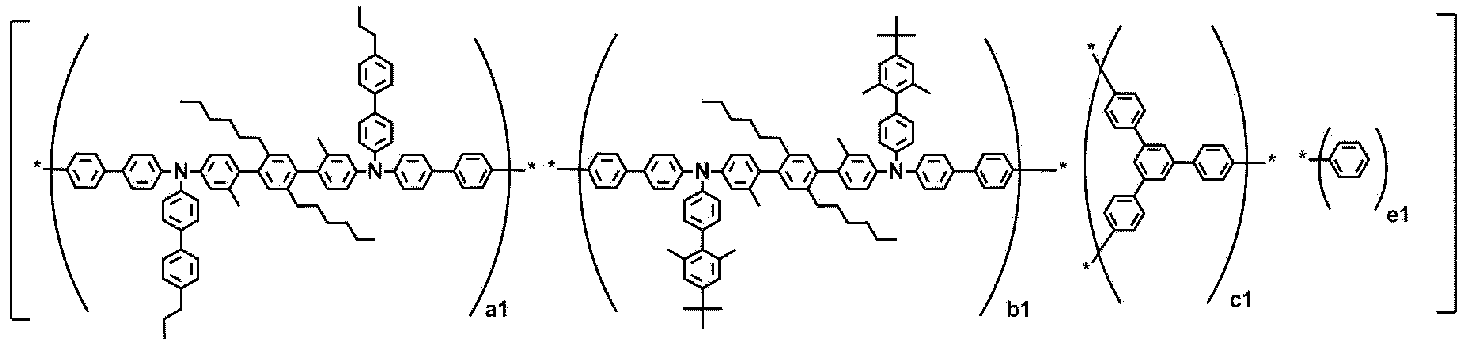


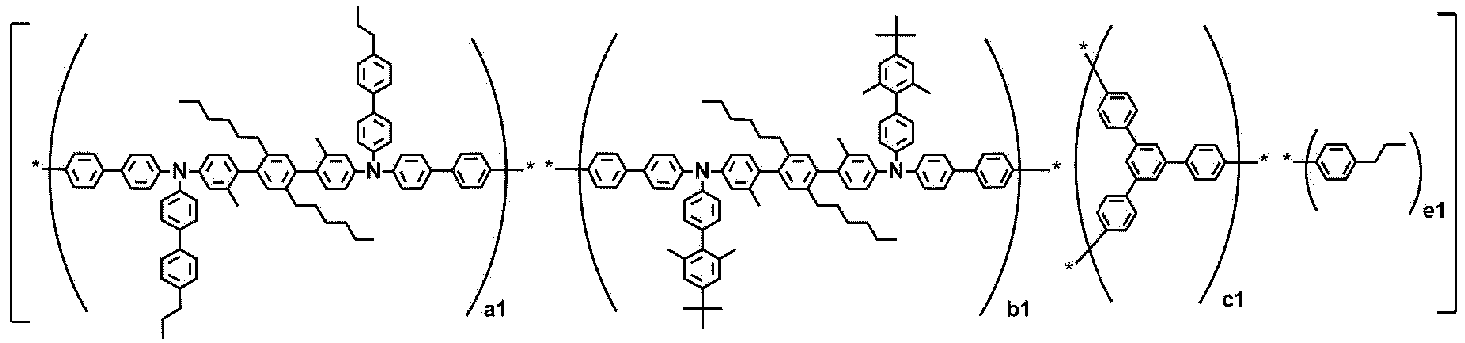


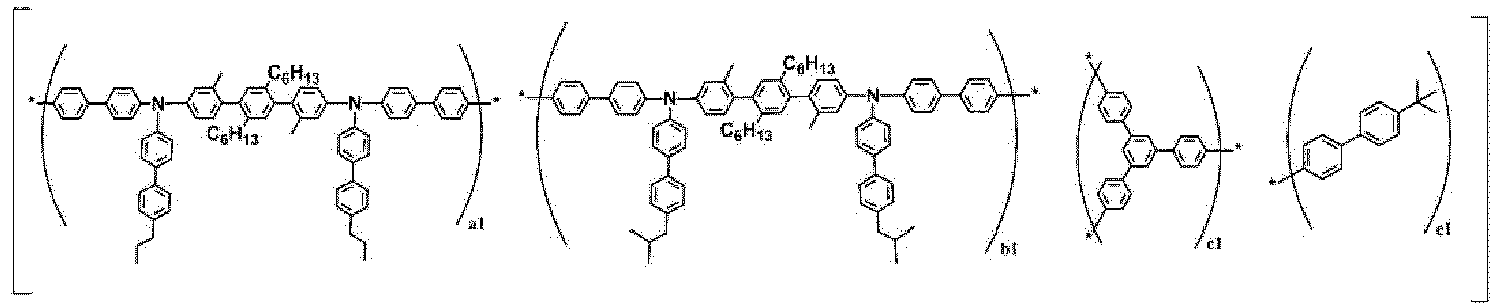


- Organische lichtemittierende Vorrichtung, umfassend:eine erste Elektrode;eine zweite Elektrode; undeine organische Materialschicht, die eine oder mehr Schicht(en) aufweist, vorgesehen zwischen der ersten Elektrode und der zweiten Elektrode,worin eine oder mehr Schicht(en) der organischen Materialschicht das Polymer gemäß irgendeinem der Ansprüche 1 bis 12 umfasst.
- Organische lichtemittierende Vorrichtung gemäß Anspruch 13, worin die organische Materialschicht, die das Polymer umfasst, eine Lochinjektionsschicht, eine Lochtransportschicht oder eine Schicht, die simultan Löcher injiziert und transportiert, ist.
Applications Claiming Priority (3)
| Application Number | Priority Date | Filing Date | Title |
|---|---|---|---|
| KR1020210095600A KR102895375B1 (ko) | 2021-07-21 | 2021-07-21 | 중합체 및 이를 이용한 유기 발광 소자 |
| KR20210095599 | 2021-07-21 | ||
| PCT/KR2022/008796 WO2023003186A1 (ko) | 2021-07-21 | 2022-06-21 | 중합체 및 이를 이용한 유기 발광 소자 |
Publications (3)
| Publication Number | Publication Date |
|---|---|
| EP4357385A1 EP4357385A1 (de) | 2024-04-24 |
| EP4357385A4 EP4357385A4 (de) | 2024-10-23 |
| EP4357385B1 true EP4357385B1 (de) | 2025-05-07 |
Family
ID=84980316
Family Applications (1)
| Application Number | Title | Priority Date | Filing Date |
|---|---|---|---|
| EP22846058.0A Active EP4357385B1 (de) | 2021-07-21 | 2022-06-21 | Polymer und organisches lichtemittierendes element damit |
Country Status (4)
| Country | Link |
|---|---|
| US (1) | US20250113723A1 (de) |
| EP (1) | EP4357385B1 (de) |
| JP (1) | JP7721790B2 (de) |
| WO (1) | WO2023003186A1 (de) |
Family Cites Families (10)
| Publication number | Priority date | Publication date | Assignee | Title |
|---|---|---|---|---|
| US8063399B2 (en) * | 2007-11-19 | 2011-11-22 | E. I. Du Pont De Nemours And Company | Electroactive materials |
| JP5866990B2 (ja) * | 2010-11-15 | 2016-02-24 | 住友化学株式会社 | 高分子化合物及びその製造方法 |
| US9954174B2 (en) * | 2015-05-06 | 2018-04-24 | E I Du Pont De Nemours And Company | Hole transport materials |
| JP2019501872A (ja) | 2015-11-05 | 2019-01-24 | イー・アイ・デュポン・ドウ・ヌムール・アンド・カンパニーE.I.Du Pont De Nemours And Company | 架橋性正孔輸送材料 |
| KR102470868B1 (ko) * | 2018-07-24 | 2022-11-24 | 주식회사 엘지화학 | 중합체, 이를 포함하는 코팅 조성물, 이를 이용한 유기 발광 소자 및 이의 제조방법 |
| JP7233923B2 (ja) | 2018-12-28 | 2023-03-07 | 三星電子株式会社 | 量子ドットエレクトロルミネッセンス素子 |
| JP7276059B2 (ja) | 2019-10-07 | 2023-05-18 | 三菱ケミカル株式会社 | 有機電界発光素子用組成物、有機電界発光素子、表示装置及び照明装置 |
| CN111857823B (zh) | 2020-07-15 | 2024-10-29 | 北京百度网讯科技有限公司 | 用于写回指令执行结果的装置和方法、处理装置 |
| KR102885077B1 (ko) * | 2020-10-06 | 2025-11-11 | 주식회사 엘지화학 | 중합체 및 이를 이용한 유기 발광 소자 |
| KR20210095600A (ko) | 2021-07-13 | 2021-08-02 | 조규형 | 낚시용 싱커 |
-
2022
- 2022-06-21 US US18/580,313 patent/US20250113723A1/en active Pending
- 2022-06-21 EP EP22846058.0A patent/EP4357385B1/de active Active
- 2022-06-21 WO PCT/KR2022/008796 patent/WO2023003186A1/ko not_active Ceased
- 2022-06-21 JP JP2024503474A patent/JP7721790B2/ja active Active
Also Published As
| Publication number | Publication date |
|---|---|
| US20250113723A1 (en) | 2025-04-03 |
| JP2024527818A (ja) | 2024-07-26 |
| EP4357385A4 (de) | 2024-10-23 |
| EP4357385A1 (de) | 2024-04-24 |
| JP7721790B2 (ja) | 2025-08-12 |
| WO2023003186A1 (ko) | 2023-01-26 |
Similar Documents
| Publication | Publication Date | Title |
|---|---|---|
| KR102455717B1 (ko) | 중합체 및 이를 이용한 유기 발광 소자 | |
| EP4368652B1 (de) | Polymer und organische lichtemittierende vorrichtung damit | |
| KR102601561B1 (ko) | 중합체 및 이를 이용한 유기 발광 소자 | |
| EP3960778B1 (de) | Polymer, beschichtungszusammensetzung damit und organische lichtemittierende vorrichtung mit verwendung davon | |
| KR102825396B1 (ko) | 중합체 및 이를 이용한 유기 발광 소자 | |
| EP4357385A1 (de) | Polymer und organisches lichtemittierendes element damit | |
| KR102817427B1 (ko) | 중합체 및 이를 이용한 유기 발광 소자 | |
| EP4400526A1 (de) | Polymer und organische lichtemittierende vorrichtung damit | |
| KR20230017447A (ko) | 중합체 및 이를 이용한 유기 발광 소자 | |
| KR102895375B1 (ko) | 중합체 및 이를 이용한 유기 발광 소자 | |
| KR102817438B1 (ko) | 중합체 및 이를 이용한 유기 발광 소자 | |
| KR20240123148A (ko) | 중합체 및 이를 포함하는 유기 발광 소자 | |
| KR20240123147A (ko) | 중합체 및 이를 포함하는 유기 발광 소자 | |
| KR20220138681A (ko) | 중합체 및 이를 이용한 유기 발광 소자 | |
| KR20220138684A (ko) | 중합체 및 이를 이용한 유기 발광 소자 | |
| KR20220168819A (ko) | 중합체 및 이를 이용한 유기 발광 소자 | |
| KR20220168810A (ko) | 중합체 및 이를 이용한 유기 발광 소자 | |
| KR20220138683A (ko) | 중합체 및 이를 이용한 유기 발광 소자 |
Legal Events
| Date | Code | Title | Description |
|---|---|---|---|
| STAA | Information on the status of an ep patent application or granted ep patent |
Free format text: STATUS: THE INTERNATIONAL PUBLICATION HAS BEEN MADE |
|
| PUAI | Public reference made under article 153(3) epc to a published international application that has entered the european phase |
Free format text: ORIGINAL CODE: 0009012 |
|
| STAA | Information on the status of an ep patent application or granted ep patent |
Free format text: STATUS: REQUEST FOR EXAMINATION WAS MADE |
|
| 17P | Request for examination filed |
Effective date: 20240118 |
|
| AK | Designated contracting states |
Kind code of ref document: A1 Designated state(s): AL AT BE BG CH CY CZ DE DK EE ES FI FR GB GR HR HU IE IS IT LI LT LU LV MC MK MT NL NO PL PT RO RS SE SI SK SM TR |
|
| A4 | Supplementary search report drawn up and despatched |
Effective date: 20240923 |
|
| RIC1 | Information provided on ipc code assigned before grant |
Ipc: H10K 85/10 20230101ALI20240917BHEP Ipc: C09K 11/06 20060101ALI20240917BHEP Ipc: C09D 165/00 20060101ALI20240917BHEP Ipc: C08G 61/12 20060101AFI20240917BHEP |
|
| DAV | Request for validation of the european patent (deleted) | ||
| DAX | Request for extension of the european patent (deleted) | ||
| GRAP | Despatch of communication of intention to grant a patent |
Free format text: ORIGINAL CODE: EPIDOSNIGR1 |
|
| STAA | Information on the status of an ep patent application or granted ep patent |
Free format text: STATUS: GRANT OF PATENT IS INTENDED |
|
| RIC1 | Information provided on ipc code assigned before grant |
Ipc: C08L 65/00 20060101ALI20250108BHEP Ipc: H10K 85/10 20230101ALI20250108BHEP Ipc: C09K 11/06 20060101ALI20250108BHEP Ipc: C09D 165/00 20060101ALI20250108BHEP Ipc: C08G 61/12 20060101AFI20250108BHEP |
|
| INTG | Intention to grant announced |
Effective date: 20250122 |
|
| GRAS | Grant fee paid |
Free format text: ORIGINAL CODE: EPIDOSNIGR3 |
|
| GRAA | (expected) grant |
Free format text: ORIGINAL CODE: 0009210 |
|
| STAA | Information on the status of an ep patent application or granted ep patent |
Free format text: STATUS: THE PATENT HAS BEEN GRANTED |
|
| AK | Designated contracting states |
Kind code of ref document: B1 Designated state(s): AL AT BE BG CH CY CZ DE DK EE ES FI FR GB GR HR HU IE IS IT LI LT LU LV MC MK MT NL NO PL PT RO RS SE SI SK SM TR |
|
| REG | Reference to a national code |
Ref country code: GB Ref legal event code: FG4D |
|
| REG | Reference to a national code |
Ref country code: CH Ref legal event code: EP |
|
| REG | Reference to a national code |
Ref country code: DE Ref legal event code: R096 Ref document number: 602022014464 Country of ref document: DE |
|
| REG | Reference to a national code |
Ref country code: IE Ref legal event code: FG4D |
|
| PGFP | Annual fee paid to national office [announced via postgrant information from national office to epo] |
Ref country code: DE Payment date: 20250520 Year of fee payment: 4 |
|
| PGFP | Annual fee paid to national office [announced via postgrant information from national office to epo] |
Ref country code: FR Payment date: 20250521 Year of fee payment: 4 |
|
| PGFP | Annual fee paid to national office [announced via postgrant information from national office to epo] |
Ref country code: AT Payment date: 20250721 Year of fee payment: 4 |
|
| REG | Reference to a national code |
Ref country code: NL Ref legal event code: MP Effective date: 20250507 |
|
| PG25 | Lapsed in a contracting state [announced via postgrant information from national office to epo] |
Ref country code: PT Free format text: LAPSE BECAUSE OF FAILURE TO SUBMIT A TRANSLATION OF THE DESCRIPTION OR TO PAY THE FEE WITHIN THE PRESCRIBED TIME-LIMIT Effective date: 20250908 Ref country code: FI Free format text: LAPSE BECAUSE OF FAILURE TO SUBMIT A TRANSLATION OF THE DESCRIPTION OR TO PAY THE FEE WITHIN THE PRESCRIBED TIME-LIMIT Effective date: 20250507 Ref country code: ES Free format text: LAPSE BECAUSE OF FAILURE TO SUBMIT A TRANSLATION OF THE DESCRIPTION OR TO PAY THE FEE WITHIN THE PRESCRIBED TIME-LIMIT Effective date: 20250507 |
|
| REG | Reference to a national code |
Ref country code: LT Ref legal event code: MG9D |
|
| PG25 | Lapsed in a contracting state [announced via postgrant information from national office to epo] |
Ref country code: GR Free format text: LAPSE BECAUSE OF FAILURE TO SUBMIT A TRANSLATION OF THE DESCRIPTION OR TO PAY THE FEE WITHIN THE PRESCRIBED TIME-LIMIT Effective date: 20250808 Ref country code: NO Free format text: LAPSE BECAUSE OF FAILURE TO SUBMIT A TRANSLATION OF THE DESCRIPTION OR TO PAY THE FEE WITHIN THE PRESCRIBED TIME-LIMIT Effective date: 20250807 |
|
| PG25 | Lapsed in a contracting state [announced via postgrant information from national office to epo] |
Ref country code: NL Free format text: LAPSE BECAUSE OF FAILURE TO SUBMIT A TRANSLATION OF THE DESCRIPTION OR TO PAY THE FEE WITHIN THE PRESCRIBED TIME-LIMIT Effective date: 20250507 Ref country code: PL Free format text: LAPSE BECAUSE OF FAILURE TO SUBMIT A TRANSLATION OF THE DESCRIPTION OR TO PAY THE FEE WITHIN THE PRESCRIBED TIME-LIMIT Effective date: 20250507 |
|
| REG | Reference to a national code |
Ref country code: AT Ref legal event code: MK05 Ref document number: 1792442 Country of ref document: AT Kind code of ref document: T Effective date: 20250507 |
|
| PG25 | Lapsed in a contracting state [announced via postgrant information from national office to epo] |
Ref country code: BG Free format text: LAPSE BECAUSE OF FAILURE TO SUBMIT A TRANSLATION OF THE DESCRIPTION OR TO PAY THE FEE WITHIN THE PRESCRIBED TIME-LIMIT Effective date: 20250507 |
|
| PG25 | Lapsed in a contracting state [announced via postgrant information from national office to epo] |
Ref country code: HR Free format text: LAPSE BECAUSE OF FAILURE TO SUBMIT A TRANSLATION OF THE DESCRIPTION OR TO PAY THE FEE WITHIN THE PRESCRIBED TIME-LIMIT Effective date: 20250507 Ref country code: AT Free format text: LAPSE BECAUSE OF FAILURE TO SUBMIT A TRANSLATION OF THE DESCRIPTION OR TO PAY THE FEE WITHIN THE PRESCRIBED TIME-LIMIT Effective date: 20250507 |
|
| PG25 | Lapsed in a contracting state [announced via postgrant information from national office to epo] |
Ref country code: RS Free format text: LAPSE BECAUSE OF FAILURE TO SUBMIT A TRANSLATION OF THE DESCRIPTION OR TO PAY THE FEE WITHIN THE PRESCRIBED TIME-LIMIT Effective date: 20250807 |
|
| PG25 | Lapsed in a contracting state [announced via postgrant information from national office to epo] |
Ref country code: IS Free format text: LAPSE BECAUSE OF FAILURE TO SUBMIT A TRANSLATION OF THE DESCRIPTION OR TO PAY THE FEE WITHIN THE PRESCRIBED TIME-LIMIT Effective date: 20250907 |
|
| PG25 | Lapsed in a contracting state [announced via postgrant information from national office to epo] |
Ref country code: LV Free format text: LAPSE BECAUSE OF FAILURE TO SUBMIT A TRANSLATION OF THE DESCRIPTION OR TO PAY THE FEE WITHIN THE PRESCRIBED TIME-LIMIT Effective date: 20250507 |
|
| PG25 | Lapsed in a contracting state [announced via postgrant information from national office to epo] |
Ref country code: DK Free format text: LAPSE BECAUSE OF FAILURE TO SUBMIT A TRANSLATION OF THE DESCRIPTION OR TO PAY THE FEE WITHIN THE PRESCRIBED TIME-LIMIT Effective date: 20250507 Ref country code: SM Free format text: LAPSE BECAUSE OF FAILURE TO SUBMIT A TRANSLATION OF THE DESCRIPTION OR TO PAY THE FEE WITHIN THE PRESCRIBED TIME-LIMIT Effective date: 20250507 |
|
| PG25 | Lapsed in a contracting state [announced via postgrant information from national office to epo] |
Ref country code: CZ Free format text: LAPSE BECAUSE OF FAILURE TO SUBMIT A TRANSLATION OF THE DESCRIPTION OR TO PAY THE FEE WITHIN THE PRESCRIBED TIME-LIMIT Effective date: 20250507 |
|
| PG25 | Lapsed in a contracting state [announced via postgrant information from national office to epo] |
Ref country code: EE Free format text: LAPSE BECAUSE OF FAILURE TO SUBMIT A TRANSLATION OF THE DESCRIPTION OR TO PAY THE FEE WITHIN THE PRESCRIBED TIME-LIMIT Effective date: 20250507 |
|
| PG25 | Lapsed in a contracting state [announced via postgrant information from national office to epo] |
Ref country code: SK Free format text: LAPSE BECAUSE OF FAILURE TO SUBMIT A TRANSLATION OF THE DESCRIPTION OR TO PAY THE FEE WITHIN THE PRESCRIBED TIME-LIMIT Effective date: 20250507 |
|
| REG | Reference to a national code |
Ref country code: CH Ref legal event code: H13 Free format text: ST27 STATUS EVENT CODE: U-0-0-H10-H13 (AS PROVIDED BY THE NATIONAL OFFICE) Effective date: 20260127 |
|
| PG25 | Lapsed in a contracting state [announced via postgrant information from national office to epo] |
Ref country code: IT Free format text: LAPSE BECAUSE OF FAILURE TO SUBMIT A TRANSLATION OF THE DESCRIPTION OR TO PAY THE FEE WITHIN THE PRESCRIBED TIME-LIMIT Effective date: 20250507 |
|
| REG | Reference to a national code |
Ref country code: DE Ref legal event code: R097 Ref document number: 602022014464 Country of ref document: DE |
|
| PG25 | Lapsed in a contracting state [announced via postgrant information from national office to epo] |
Ref country code: LU Free format text: LAPSE BECAUSE OF NON-PAYMENT OF DUE FEES Effective date: 20250621 |
|
| PG25 | Lapsed in a contracting state [announced via postgrant information from national office to epo] |
Ref country code: MC Free format text: LAPSE BECAUSE OF FAILURE TO SUBMIT A TRANSLATION OF THE DESCRIPTION OR TO PAY THE FEE WITHIN THE PRESCRIBED TIME-LIMIT Effective date: 20250507 |
|
| REG | Reference to a national code |
Ref country code: BE Ref legal event code: MM Effective date: 20250630 |
|
| PG25 | Lapsed in a contracting state [announced via postgrant information from national office to epo] |
Ref country code: RO Free format text: LAPSE BECAUSE OF FAILURE TO SUBMIT A TRANSLATION OF THE DESCRIPTION OR TO PAY THE FEE WITHIN THE PRESCRIBED TIME-LIMIT Effective date: 20250507 |
|
| PLBE | No opposition filed within time limit |
Free format text: ORIGINAL CODE: 0009261 |
|
| STAA | Information on the status of an ep patent application or granted ep patent |
Free format text: STATUS: NO OPPOSITION FILED WITHIN TIME LIMIT |
|
| REG | Reference to a national code |
Ref country code: CH Ref legal event code: L10 Free format text: ST27 STATUS EVENT CODE: U-0-0-L10-L00 (AS PROVIDED BY THE NATIONAL OFFICE) Effective date: 20260318 |
|
| PG25 | Lapsed in a contracting state [announced via postgrant information from national office to epo] |
Ref country code: IE Free format text: LAPSE BECAUSE OF NON-PAYMENT OF DUE FEES Effective date: 20250621 |
|
| 26N | No opposition filed |
Effective date: 20260210 |
|
| PG25 | Lapsed in a contracting state [announced via postgrant information from national office to epo] |
Ref country code: BE Free format text: LAPSE BECAUSE OF NON-PAYMENT OF DUE FEES Effective date: 20250630 |
|
| PG25 | Lapsed in a contracting state [announced via postgrant information from national office to epo] |
Ref country code: CH Free format text: LAPSE BECAUSE OF NON-PAYMENT OF DUE FEES Effective date: 20250630 |