EP4356815A1 - Wireless scanner and charging method thereof - Google Patents
Wireless scanner and charging method thereof Download PDFInfo
- Publication number
- EP4356815A1 EP4356815A1 EP22825262.3A EP22825262A EP4356815A1 EP 4356815 A1 EP4356815 A1 EP 4356815A1 EP 22825262 A EP22825262 A EP 22825262A EP 4356815 A1 EP4356815 A1 EP 4356815A1
- Authority
- EP
- European Patent Office
- Prior art keywords
- scanner
- charging module
- wireless
- cradle
- heating part
- Prior art date
- Legal status (The legal status is an assumption and is not a legal conclusion. Google has not performed a legal analysis and makes no representation as to the accuracy of the status listed.)
- Pending
Links
Images



Classifications
-
- A—HUMAN NECESSITIES
- A61—MEDICAL OR VETERINARY SCIENCE; HYGIENE
- A61C—DENTISTRY; APPARATUS OR METHODS FOR ORAL OR DENTAL HYGIENE
- A61C9/00—Impression cups, i.e. impression trays; Impression methods
- A61C9/004—Means or methods for taking digitized impressions
- A61C9/0046—Data acquisition means or methods
- A61C9/0053—Optical means or methods, e.g. scanning the teeth by a laser or light beam
-
- H—ELECTRICITY
- H02—GENERATION; CONVERSION OR DISTRIBUTION OF ELECTRIC POWER
- H02J—ELECTRIC POWER NETWORKS; CIRCUIT ARRANGEMENTS OR SYSTEMS FOR SUPPLYING OR DISTRIBUTING ELECTRIC POWER; SYSTEMS FOR STORING ELECTRIC ENERGY
- H02J7/00—Circuit arrangements for charging or discharging batteries or for supplying loads from batteries
- H02J7/70—Circuit arrangements for charging or discharging batteries or for supplying loads from batteries characterised by the mechanical construction
- H02J7/731—Circuit arrangements for charging or discharging batteries or for supplying loads from batteries characterised by the mechanical construction specially adapted for holding portable devices containing batteries
-
- A—HUMAN NECESSITIES
- A61—MEDICAL OR VETERINARY SCIENCE; HYGIENE
- A61B—DIAGNOSIS; SURGERY; IDENTIFICATION
- A61B1/00—Instruments for performing medical examinations of the interior of cavities or tubes of the body by visual or photographical inspection, e.g. endoscopes; Illuminating arrangements therefor
- A61B1/00002—Operational features of endoscopes
- A61B1/00011—Operational features of endoscopes characterised by signal transmission
- A61B1/00016—Operational features of endoscopes characterised by signal transmission using wireless means
-
- A—HUMAN NECESSITIES
- A61—MEDICAL OR VETERINARY SCIENCE; HYGIENE
- A61B—DIAGNOSIS; SURGERY; IDENTIFICATION
- A61B1/00—Instruments for performing medical examinations of the interior of cavities or tubes of the body by visual or photographical inspection, e.g. endoscopes; Illuminating arrangements therefor
- A61B1/00002—Operational features of endoscopes
- A61B1/00025—Operational features of endoscopes characterised by power management
- A61B1/00027—Operational features of endoscopes characterised by power management characterised by power supply
- A61B1/00029—Operational features of endoscopes characterised by power management characterised by power supply externally powered, e.g. wireless
-
- A—HUMAN NECESSITIES
- A61—MEDICAL OR VETERINARY SCIENCE; HYGIENE
- A61B—DIAGNOSIS; SURGERY; IDENTIFICATION
- A61B1/00—Instruments for performing medical examinations of the interior of cavities or tubes of the body by visual or photographical inspection, e.g. endoscopes; Illuminating arrangements therefor
- A61B1/00002—Operational features of endoscopes
- A61B1/00025—Operational features of endoscopes characterised by power management
- A61B1/00027—Operational features of endoscopes characterised by power management characterised by power supply
- A61B1/00032—Operational features of endoscopes characterised by power management characterised by power supply internally powered
- A61B1/00034—Operational features of endoscopes characterised by power management characterised by power supply internally powered rechargeable
-
- A—HUMAN NECESSITIES
- A61—MEDICAL OR VETERINARY SCIENCE; HYGIENE
- A61B—DIAGNOSIS; SURGERY; IDENTIFICATION
- A61B1/00—Instruments for performing medical examinations of the interior of cavities or tubes of the body by visual or photographical inspection, e.g. endoscopes; Illuminating arrangements therefor
- A61B1/00064—Constructional details of the endoscope body
- A61B1/00108—Constructional details of the endoscope body characterised by self-sufficient functionality for stand-alone use
-
- A—HUMAN NECESSITIES
- A61—MEDICAL OR VETERINARY SCIENCE; HYGIENE
- A61B—DIAGNOSIS; SURGERY; IDENTIFICATION
- A61B1/00—Instruments for performing medical examinations of the interior of cavities or tubes of the body by visual or photographical inspection, e.g. endoscopes; Illuminating arrangements therefor
- A61B1/24—Instruments for performing medical examinations of the interior of cavities or tubes of the body by visual or photographical inspection, e.g. endoscopes; Illuminating arrangements therefor for the mouth, i.e. stomatoscopes, e.g. with tongue depressors; Instruments for opening or keeping open the mouth
-
- A—HUMAN NECESSITIES
- A61—MEDICAL OR VETERINARY SCIENCE; HYGIENE
- A61B—DIAGNOSIS; SURGERY; IDENTIFICATION
- A61B5/00—Measuring for diagnostic purposes; Identification of persons
- A61B5/0059—Measuring for diagnostic purposes; Identification of persons using light, e.g. diagnosis by transillumination, diascopy, fluorescence
- A61B5/0062—Arrangements for scanning
-
- A—HUMAN NECESSITIES
- A61—MEDICAL OR VETERINARY SCIENCE; HYGIENE
- A61B—DIAGNOSIS; SURGERY; IDENTIFICATION
- A61B5/00—Measuring for diagnostic purposes; Identification of persons
- A61B5/0059—Measuring for diagnostic purposes; Identification of persons using light, e.g. diagnosis by transillumination, diascopy, fluorescence
- A61B5/0082—Measuring for diagnostic purposes; Identification of persons using light, e.g. diagnosis by transillumination, diascopy, fluorescence adapted for particular medical purposes
- A61B5/0088—Measuring for diagnostic purposes; Identification of persons using light, e.g. diagnosis by transillumination, diascopy, fluorescence adapted for particular medical purposes for oral or dental tissue
-
- A—HUMAN NECESSITIES
- A61—MEDICAL OR VETERINARY SCIENCE; HYGIENE
- A61C—DENTISTRY; APPARATUS OR METHODS FOR ORAL OR DENTAL HYGIENE
- A61C9/00—Impression cups, i.e. impression trays; Impression methods
- A61C9/004—Means or methods for taking digitized impressions
- A61C9/0046—Data acquisition means or methods
- A61C9/0053—Optical means or methods, e.g. scanning the teeth by a laser or light beam
- A61C9/006—Optical means or methods, e.g. scanning the teeth by a laser or light beam projecting one or more stripes or patterns on the teeth
-
- G—PHYSICS
- G01—MEASURING; TESTING
- G01B—MEASURING LENGTH, THICKNESS OR SIMILAR LINEAR DIMENSIONS; MEASURING ANGLES; MEASURING AREAS; MEASURING IRREGULARITIES OF SURFACES OR CONTOURS
- G01B11/00—Measuring arrangements characterised by the use of optical techniques
- G01B11/24—Measuring arrangements characterised by the use of optical techniques for measuring contours or curvatures
-
- H—ELECTRICITY
- H02—GENERATION; CONVERSION OR DISTRIBUTION OF ELECTRIC POWER
- H02J—ELECTRIC POWER NETWORKS; CIRCUIT ARRANGEMENTS OR SYSTEMS FOR SUPPLYING OR DISTRIBUTING ELECTRIC POWER; SYSTEMS FOR STORING ELECTRIC ENERGY
- H02J50/00—Circuit arrangements or systems for wireless supply or distribution of electric power
- H02J50/005—Mechanical details of housing or structure aiming to accommodate the power transfer means, e.g. mechanical integration of coils, antennas or transducers into emitting or receiving devices
-
- H—ELECTRICITY
- H02—GENERATION; CONVERSION OR DISTRIBUTION OF ELECTRIC POWER
- H02J—ELECTRIC POWER NETWORKS; CIRCUIT ARRANGEMENTS OR SYSTEMS FOR SUPPLYING OR DISTRIBUTING ELECTRIC POWER; SYSTEMS FOR STORING ELECTRIC ENERGY
- H02J50/00—Circuit arrangements or systems for wireless supply or distribution of electric power
- H02J50/10—Circuit arrangements or systems for wireless supply or distribution of electric power using inductive coupling
-
- H—ELECTRICITY
- H02—GENERATION; CONVERSION OR DISTRIBUTION OF ELECTRIC POWER
- H02J—ELECTRIC POWER NETWORKS; CIRCUIT ARRANGEMENTS OR SYSTEMS FOR SUPPLYING OR DISTRIBUTING ELECTRIC POWER; SYSTEMS FOR STORING ELECTRIC ENERGY
- H02J50/00—Circuit arrangements or systems for wireless supply or distribution of electric power
- H02J50/70—Circuit arrangements or systems for wireless supply or distribution of electric power involving the reduction of electric, magnetic or electromagnetic leakage fields
-
- H—ELECTRICITY
- H02—GENERATION; CONVERSION OR DISTRIBUTION OF ELECTRIC POWER
- H02J—ELECTRIC POWER NETWORKS; CIRCUIT ARRANGEMENTS OR SYSTEMS FOR SUPPLYING OR DISTRIBUTING ELECTRIC POWER; SYSTEMS FOR STORING ELECTRIC ENERGY
- H02J50/00—Circuit arrangements or systems for wireless supply or distribution of electric power
- H02J50/80—Circuit arrangements or systems for wireless supply or distribution of electric power involving the exchange of data, concerning supply or distribution of electric power, between transmitting devices and receiving devices
-
- H—ELECTRICITY
- H02—GENERATION; CONVERSION OR DISTRIBUTION OF ELECTRIC POWER
- H02J—ELECTRIC POWER NETWORKS; CIRCUIT ARRANGEMENTS OR SYSTEMS FOR SUPPLYING OR DISTRIBUTING ELECTRIC POWER; SYSTEMS FOR STORING ELECTRIC ENERGY
- H02J7/00—Circuit arrangements for charging or discharging batteries or for supplying loads from batteries
-
- A—HUMAN NECESSITIES
- A61—MEDICAL OR VETERINARY SCIENCE; HYGIENE
- A61B—DIAGNOSIS; SURGERY; IDENTIFICATION
- A61B2560/00—Constructional details of operational features of apparatus; Accessories for medical measuring apparatus
- A61B2560/02—Operational features
- A61B2560/0204—Operational features of power management
- A61B2560/0214—Operational features of power management of power generation or supply
-
- A—HUMAN NECESSITIES
- A61—MEDICAL OR VETERINARY SCIENCE; HYGIENE
- A61B—DIAGNOSIS; SURGERY; IDENTIFICATION
- A61B2560/00—Constructional details of operational features of apparatus; Accessories for medical measuring apparatus
- A61B2560/04—Constructional details of apparatus
- A61B2560/0456—Apparatus provided with a docking unit
Definitions
- the present disclosure relates to a wireless scanner and a method of charging the wireless scanner.
- the three-dimensional scanner needs to be manufactured to have a small size in order for a user (representatively a dentist) to easily scan the narrow area. Accordingly, a structure and a technology have been integrated into the three-dimensional scanner.
- a conventional three-dimensional scanner needs to be disposed within a predetermined distance from an external device (e.g., a PC or a server) that is connected to the three-dimensional scanner in a wired way and that is separated from the three-dimensional scanner.
- an external device e.g., a PC or a server
- the three-dimensional scanner and the external device are connected by a communication cable having a length of about 1.5 m, a user can use the three-dimensional scanner only within a radius range of about 1.5 m from the external device.
- a degree of freedom of scanning of the user is greatly limited.
- a three-dimensional wireless scanner solves the problem with the three-dimensional scanner using the wired connection method to some extent through a battery, etc.
- the three-dimensional wireless scanner has an additional problem in that a discharged battery needs to be replaced with a new battery by detaching the discharged battery in order to charge the three-dimensional wireless scanner or the three-dimensional wireless scanner needs to be charged by using an external power source.
- a contactless wireless charging method is actively discussed.
- the present disclosure provides a wireless scanner including at least one charging module from which a current is generated by receiving a magnetic field that is generated from a transmitting coil included in a cradle.
- the present disclosure provides a method of charging the wireless scanner, in which an operation of a part that performs a scan process is deactivated when wireless charging is performed through the charging module of the wireless scanner.
- a wireless scanner includes a scanner body having a plurality of parts disposed therein and a scanner tip coupled to one end of the scanner body and having a passage through which light passes therein.
- the scanner body includes an optical heating part including at least one camera and a light projector, a power heating part including a battery that supplies power to at least one of the camera and the light projector, and at least one charging module configured to charge the battery by a current that is generated in a receiving coil formed in the scanner body by a magnetic field generated from a transmitting coil included in a cradle on which the scanner body is held.
- the charging module may be formed by being separated from the power heating part.
- An interval between the charging module and the optical heating part may be formed to be smaller than an interval between the charging module and the power heating part.
- the charging module may be disposed within an internal space of the scanner body, and may be disposed on a lower side than the optical heating part and the power heating part.
- the charging module may be formed in a shape corresponding to an external surface of the scanner body.
- the wireless scanner may further include at least one slot that is upward depressed and formed at the bottom of the scanner body, wherein the charging module may be formed in a shape corresponding to at least one surface of the slot.
- the scanner body may further include a magnetic unit that is formed at the bottom of the scanner body and that provides magnetism so that the scanner body is held on the cradle.
- the scanner body may further include an electromagnetic shielding unit for preventing electromagnetic interference between the magnetic unit and the charging module.
- the wireless scanner may further include a communication module for communicating with a physically separated device, wherein the communication module may be formed by being separated from a holding part of a user in the scanner body, and may be formed by being separated from the charging module by at least one of the optical heating part and the power heating part.
- the wireless scanner may further include a controller configured to determine whether a current has been generated in the charging module, wherein the controller may deactivate an operation of the optical heating part when determining that the current has been generated in the charging module.
- a method of charging a wireless scanner includes holding a scanner including a charging module on a cradle that generates an electromagnetic force, generating a current in a charging module that is separated from the cradle at a predetermined interval by the cradle, and charging a battery that is electrically connected to the charging module and that supplies power to the scanner through the generated current.
- the holding of the scanner may include holding the scanner so that the bottom of the scanner comes into contact with the cradle and the charging module is adjacent to the cradle.
- the method may further include, before the generating of the current, determining, by a controller of the scanner, whether a current has been generated in the charging module, and controlling, by the controller, an operation of the scanner based on whether the current has been generated in the charging module.
- controlling of the operation of the scanner may include deactivating, by the controller, an operation of an optical heating part including at least one camera and a light projector when determining that the current has been generated in the charging module.
- the wireless scanner according to the present disclosure can be stably held because the wireless scanner is held on the cradle and the wireless scanner can be precisely charged with power although an external power source is not connected to the wireless scanner.
- the wireless scanner can be stably held in the cradle in a shape in which charging efficiency can be maximized because at least one slot is formed at the bottom of the scanner body and the charging module is formed in a shape corresponding to a shape of the slot.
- the wireless scanner is stably held on the cradle and charging efficiency is maximized because the magnetic unit is disposed under the scanner body and gravitation acts between the magnetic unit and the cradle magnetic unit formed in the cradle.
- wireless scanner 100 scanner body 110: optical heating part 120: power heating part 130: charging module 140: communication module 150: slot 160: magnetic unit 170: electromagnetic shielding unit 180: controller 190: intake fan 2: cradle 310: cradle body 320: power generation module 330: cradle magnetic unit S110: step of being held on cradle S120: step of current being generated S130: step of determining whether current has been generated S140: step of controlling operation of scanner S150: step of charging battery
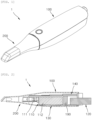
- FIG. 1 is a perspective view of a wireless scanner 1 according to the present disclosure.
- the wireless scanner 1 includes a scanner body 100 in which a plurality of major parts is disposed and a scanner tip 200.
- Parts for scanning an object are embedded and disposed in the scanner body 100.
- a part for radiating light to the outside or receiving light that is received therein, a part for storing data, a part for communicating with the outside, a part for controlling an operation of the wireless scanner 1, a part for supplying power, etc. are embedded in the scanner body 100.
- the scanner tip 200 has a shape having one side opened. A part for reflecting light may be embedded within the scanner tip. Through the scanner tip 200, light that is generated within the wireless scanner 1 may be radiated toward an object through an opening of the scanner tip 200. Light that is reflected by a surface of the object may be transmitted to the part for receiving the light through the opening of the scanner tip 200. That is, the scanner tip 200 may be coupled to one end of the scanner body 100, and may form a passage through which light passes therein.
- the object is a target for obtaining a three-dimensional model by using the wireless scanner 1 according to the present disclosure.
- the object may be the inside of an actual mouth, including the teeth, gingiva, and a dental arch of a patient.
- the object may be an oral model that is obtained by the impression taking of the inside of the mouth of a patient.
- an oral model may be fabricated by a plaster material.
- FIG. 2 is a cross-sectional view of the wireless scanner 1 according to the present disclosure.
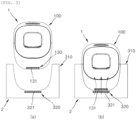
- FIG. 3 is for describing a process of the wireless scanner 1 according to the present disclosure being held on a cradle 2 and charged.
- FIG. 3(a) is for describing the state in which the wireless scanner 1 has been separated from the cradle 2.
- FIG. 3(b) is for describing the state in which the wireless scanner 1 has been seated and held on the cradle 2 and charged.
- the wireless scanner 1 includes an optical heating part 110.
- the optical heating part 110 may be embedded in the scanner body 100, and may radiate light to the outside of the wireless scanner 1 or may receive light that is input to the wireless scanner 1.
- the optical heating part 110 includes at least one camera 111 and a light projector 112.
- the camera 111 may receive light that is input to the wireless scanner 1 through the scanner tip 200.
- the light that is input to the wireless scanner 1 may include light that is reflected by a surface of an object.
- the camera 111 may be a mono camera or a stereo camera.
- the wireless scanner 1 may have one camera 111 or may have a plurality of cameras 111.
- the wireless scanner 1 has a plurality of cameras 111, there is an advantage in that image data indicative of an object can be obtained more precisely.
- An imaging sensor that is electrically connected to the camera 111 may generate image data on the basis of light that is received by the camera 111.
- the image data may be two-dimensional plane data.
- the imaging sensor may be a CCD sensor or a CMOS sensor.
- the imaging sensor is not limited to types that are listed in this specification, and may be any type of sensor for generating image data on the basis of light that is received by the camera 111.
- the light projector 112 may radiate light to the outside of the wireless scanner 1.
- the light projector 112 includes a light source (not illustrated) that generates predetermined light.
- the light source may generate a variable color or may generate a single color. If the light source generates a single color, the light projector 112 may include a plurality of light sources, and may implement various colors based on a combination of the light sources.
- the light projector 112 may further include a pattern generation part (not illustrated).
- the pattern generation part may radiate a structured light on a surface of an object so that the pattern generation part may generate a three-dimensional model on the basis of light that is input to the camera 111.
- the pattern generation part may be a pattern mask or may be a digital micromirror device (DMD).
- DMD digital micromirror device
- the wireless scanner 1 may include a power heating part 120.
- the power heating part 120 may play a role of supplying power to a plurality of parts embedded in the wireless scanner 1 according to the present disclosure.
- the power heating part 120 may include a battery.
- the power heating part 120 may supply power to at least one of the camera 111 and the light projector 112. More specifically, the battery may supply power to the optical heating part 110 including the camera 111 and the light projector 112.
- the power heating part 120 may include a chargeable construction.
- the power heating part 120 may include a lithium-ion battery. However, the power heating part 120 does not need to essentially include the lithium-ion battery, and may include any type of battery which can be consistently used by being charged in wire and wireless manners without replacing the battery.
- the wireless scanner 1 may further include an intake fan 190 within the scanner body 100.
- the intake fan 190 may suck the air outside the wireless scanner 1 into the scanner body 100 through a rotary motion, and may cool heated parts within the scanner body 100.
- the intake fan 190 may suck the air outside the wireless scanner 1 into the scanner body 100, and may induce an air flow path so that the sucked air is directed toward the optical heating part 110.
- the air that is moved by the intake fan 190 may forcedly cool the optical heating part 110. Heated air may be discharged through a rear surface of the scanner body 100 and/or the opening of the scanner tip 200.
- the power heating part 120 does not have a high degree of heating compared to the optical heating part 110, so that a part of the power heating part 120 may be naturally cooled by being exposed to the outside of the scanner body 100.
- the wireless scanner 1 may include a communication module 140.
- the communication module 140 may be disposed within the scanner body 100.
- the communication module 140 may communicate with a device that has been physically separated from the wireless scanner 1, that is, the outside.
- the communication module 140 may transmit, to the outside, image data that are obtained through the optical heating part 110, or may transmit a signal for indicating the state of the wireless scanner 1 to the outside.
- the communication module 140 may transmit a signal that is received from the outside of the communication module 140 to a controller 180 that is described later, so that the wireless scanner 1 according to the present disclosure can operate in response to the signal received from the outside.
- the communication module 140 may be a common construction capable of wireless communication, such as Wi-Fi, Bluetooth, Zigbee, or LoRa.
- the communication module 140 is formed by being separated from the holding part of a user, which is included in the scanner body 100.
- the communication module 140 may be disposed in a rear part of the scanner body 100 on the upper side thereof.
- the wireless scanner 1 according to the present disclosure may be formed in a shape that enables a user to grasp the wireless scanner 1 without hindering the transmission and reception of signals of the communication module 140.
- the communication module 140 is disposed at a specific location within the scanner body 100 so that a user can grasp a part that does not hinder the transmission and reception of signals of the communication module 140. Accordingly, the wireless scanner 1 according to the present disclosure has advantages in that the wireless scanner can smoothly communicate with a device that has been physically separated and a loss of image data that are received from the separated device can be minimized.
- the wireless scanner 1 may include at least one charging module 130 that charges a battery included in the power heating part 120.
- a current is generated in a receiving coil 131 that is formed within the scanner body 100 and that is included in the charging module 130 by a magnetic field generated from a transmitting coil 321 included in the cradle 2 on which the scanner body 100 is held. Accordingly, the charging module 130 can charge the battery.
- a power generation module 320 that is formed within a cradle body 310 having a U-shaped contact surface of the cradle 2 may generate a magnetic field by an external power source (not illustrated) electrically connected to the power generation module 320.
- the power generation module 320 may be formed to have a circle or a ring shape, but the present disclosure is not essentially limited thereto.
- the power generation module 320 may be formed in any shape capable of generating an electromagnetic field.
- the generated magnetic field affects the charging module 130 formed within the scanner body 100. More specifically, the charging module 130 receives the magnetic field transmitted by the power generation module 320, so that a current is generated in the receiving coil 131 of the charging module 130 by an electromagnetic induction principle. The generated current may move to the power heating part 120 electrically connected to the charging module 130, and charges the battery of the power heating part 120.
- the charging module 130 may be formed by being separated from the power heating part 120.
- the charging module 130 may be formed between the optical heating part 110 and the power heating part 120 at a predetermined interval therefrom.
- the interval between the charging module 130 and the optical heating part 110 may be formed to be smaller than an interval between the charging module 130 and the power heating part 120.
- the charging module 130 may be disposed to be adjacent to the bottom of the scanner body 100 within the scanner body 100.
- the optical heating part 110 may be disposed at a central part of the scanner body 100 within the scanner body 100.
- the power heating part 120 may be disposed at a rear part of the scanner body 100 within the scanner body 100.
- the charging module 130 may be disposed in an internal space of the scanner body 100, and may be disposed on a lower side than the optical heating part 110 and the power heating part 120. Since the charging module 130 is disposed on a lower side than the optical heating part 110 and the power heating part 120, a distance from the power generation module 320 can be minimized when the charging module 130 is held on the cradle 2. Accordingly, there are advantages in that the charging module 130 can easily receive a magnetic field that is generated by the power generation module 320 and charging efficiency of the wireless scanner 1 is maximized.
- the communication module 140 may be formed by being separated from the charging module 130 by at least one of the optical heating part 110 and the power heating part 120.
- the charging module 130 is a part that receives a magnetic field attributable to electromagnetic induction, and the communication module 140 is formed by being separated from the charging module 130. Accordingly, when the communication module 140 communicates with the outside, interference attributable to electromagnetic induction, which may affect the communication, is prevented.
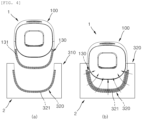
- FIG. 4 is for describing a process of the wireless scanner 1 according to the present disclosure being held on the cradle 2 and charged and another shape of the charging module 130.
- FIG. 5 is for describing a form in which at least one slot 150 has been formed at the bottom of the scanner body 100 in the wireless scanner 1 according to the present disclosure.
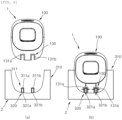
- FIG. 6 is for describing a process of the wireless scanner 1 according to the present disclosure being held on the cradle 2 and charged and still another shape of the charging module 130. More specifically, FIG. 4(a) is for describing the state in which the wireless scanner 1 has been separated from the cradle 2.
- FIG. 4(b) is for describing the state in which the wireless scanner 1 has been seated and held on the cradle 2 and charged.
- FIG. 4(a) is for describing the state in which the wireless scanner 1 has been separated from the cradle 2.
- FIG. 4(b) is for describing the state in which the wireless scanner 1 has been seated and held on the cradle 2
- FIG. 5(a) is for describing the bottom of the wireless scanner 1 having the at least one slot 150.
- FIG. 5(b) is for describing the cradle 2 corresponding to the wireless scanner 1 having the slot 150.
- FIG. 6(a) is for describing the state in which the wireless scanner 1 has been separated from the cradle 2.
- FIG. 6(b) is for describing the state in which the wireless scanner 1 has been seated and held on the cradle 2 and charged.
- the charging module 130 may be formed in a plate shape having a rectangular parallelepiped.
- the power generation module 320 of the cradle 2 corresponding to the charging module 130 may also be formed in a plate shape having a rectangular parallelepiped.
- the charging module 130 and the power generation module 320 may be formed to face each other in parallel. Accordingly, there are advantages in that electromagnetic induction between the power generation module 320 and the charging module 130 is maximized and charging efficiency of the battery is maximized because the charging module 130 and the power generation module 320 face each other in parallel at a minimized interval when the wireless scanner 1 is seated and held on the cradle 2 as illustrated in FIG. 3(b) .
- the charging module 130 may be formed in a shape corresponding to an external surface of the scanner body 100.
- the charging module 130 may have a streamlined (more specifically, U-shaped) structure so that the charging module 130 corresponds to the bottom of the scanner body 100.
- the power generation module 320 of the cradle 2 may also have a streamlined (U-shaped) structure, that is, a shape corresponding to the charging module 130, so that the power generation module 320 corresponds to the charging module 130. Accordingly, as illustrated in FIG.
- the charging module 130 when the wireless scanner 1 is seated and held on the cradle 2, the charging module 130 is formed to face the power generation module 320 in parallel, and the interval between the charging module 130 and the power generation module 320 is minimized. Accordingly, there is an advantage in that charging efficiency of the wireless scanner 1 is maximized.
- the wireless scanner 1 may include at least one slot 150 that is upward depressed and formed at the bottom of the scanner body 100.
- the slot 150 may be formed in the length direction of the wireless scanner 1, but the present disclosure is not essentially limited thereto.
- a first slot 151 and second slot 152 of the slot 150 may be formed in parallel as a pair.
- the cradle 2 may include a cradle protrusion part 311 having a shape corresponding to the slot 150 in order to accommodate the wireless scanner 1.
- the cradle protrusion part 311 may be formed to protrude at a predetermined height from a contact surface of the cradle protrusion part 311 on which the wireless scanner 1 is held toward a direction in which the wireless scanner 1 is held. If the wireless scanner 1 includes the first slot 151 and the second slot 152, the cradle protrusion part 311 may include a first cradle protrusion part 311a and a second cradle protrusion part 311b so that the first cradle protrusion part 311a and the second cradle protrusion part 311b correspond to the first slot 151 and the second slot 152.
- the slot 150 accommodates the cradle protrusion part 311. Accordingly, the wireless scanner 1 may be disposed at its regular position without being rotated with respect to the cradle 2. Accordingly, the charging module 130 and the power generation module 320 may be disposed at a location having optimal charging efficiency.
- the charging module 130 may be formed in a shape corresponding to at least one surface of the slot.
- the charging module 130 may include a first charging coil 131a formed in a shape corresponding to the first slot 151 and a second charging coil 131b formed in a shape corresponding to the second slot 152.
- the first charging coil 131a and the second charging coil 131b may have a cross-sectional shape that surrounds the slot 150 within the scanner body 100 like a Hangeul consonant " " (or a channel shape).
- the power generation module 320 also includes a first power generation coil 321a corresponding to the first cradle protrusion part 311a and a second power generation coil 321b corresponding to the second cradle protrusion part 311b.
- the first power generation coil 321a and the second power generation coil 321b are surrounded by the first charging coil 131a and the second charging coil 131b, respectively, when the slot 150 is accommodated in the cradle protrusion part 311. Accordingly, there is an advantage in that charging efficiency of the wireless scanner 1 is maximized because the charging module 130 can effectively receive a magnetic field transmitted by the power generation module 320.
- FIG. 7 is for describing a process of the wireless scanner 1 according to the present disclosure being held by the magnetic unit 160 in the wireless scanner.
- FIG. 8 is for describing an electromagnetic shielding unit 170 in the wireless scanner 1 according to the present disclosure.
- the scanner body 100 may further include at least one magnetic unit 160 that provides magnetism so that the scanner body 100 can be stably held on the cradle 2.
- the magnetic unit 160 may be formed at the bottom of the scanner body 100.
- the magnetic unit 160 may be embedded in the scanner body 100 like other internal parts thereof, and may be formed in an external surface of the scanner body 100.
- a first magnetic unit 161 and second magnetic unit 162 of the magnetic unit 160 may be formed to face each other on the basis of a location where the charging module 130 has been formed.
- the cradle 2 may include at least one cradle magnetic unit 330 on which gravitation acts along with the magnetic unit 160 at a location corresponding to the magnetic unit 160.
- the cradle magnetic unit 330 may also include a first cradle magnetic unit 331 and a second cradle magnetic unit 332 corresponding to the first magnetic unit 161 and the second magnetic unit 162, respectively.
- the wireless scanner 1 may be disposed at its regular position at a specific location of the cradle 2.
- the wireless scanner 1 may be held on the cradle 2 so that the charging module 130 and the power generation module 320 have a location relation having optimal charging efficiency.
- the wireless scanner 1 further includes the electromagnetic shielding unit 170 for preventing electromagnetic interference between the magnetic unit 160 and the charging module 130 in the scanner body 100.
- the electromagnetic shielding unit 170 may be formed in a shape that covers at least one surface of the charging module 130.
- the electromagnetic shielding unit 170 may be formed between the charging module 130 and the magnetic unit 160.
- the electromagnetic shielding unit 170 may be formed between the charging module 130 and the optical heating part 110 and/or the power heating part 120 in order to minimize the influence of a magnetic field that is applied to the optical heating part 110 and the power heating part 120. That is, the electromagnetic shielding unit 170 may be formed in a shape that covers two sides, four sides, or the top, and four sides of the charging module 130 except the bottom of the scanner body 100 in which the wireless scanner 1 is held on the cradle 2.
- the electromagnetic shielding unit 170 may have a shape of a case made of a metal material, such as aluminum or copper, may use a metal thin film, and may use any material capable of minimizing magnetic interference of the magnetic unit 160, which may be applied to the charging module 130.
- controller 180 that controls an operation of the wireless scanner 1 according to the present disclosure is described.
- FIG. 9 is a schematic diagram of a construction of the wireless scanner according to the present disclosure.
- FIG. 10 is for describing a process of charging being performed by the charging module in the wireless scanner according to the present disclosure.
- the wireless scanner 1 further includes the controller 180.
- the controller 180 controls an operation of the wireless scanner 1 according to the present disclosure.
- the controller 180 may control the optical heating part 110 to operate and obtain image data, and may control the communication module 140 to transmit stored image data to the outside.
- the controller 180 may include a microprocessor.
- the controller 180 determines whether a current has been generated in the charging module 130, and controls operations of at least some components of the wireless scanner 1 based on whether a current has been generated in the charging module 130. As illustrated in FIG. 9 , if the wireless scanner 1 is not held on the cradle 2 or a magnetic field is not generated by the power generation module 320 because power is not supplied to the cradle 2 although the wireless scanner 1 is held on the cradle 2, the wireless scanner 1 according to the present disclosure operates normally, and the battery of the power heating part 120 can supply power to the optical heating part 110 and the communication module 140. Accordingly, a user may perform a scan operation by using the wireless scanner 1 according to the present disclosure.
- the wireless scanner 1 may charge the battery of the power heating part 120 without scanning an object, and may communicate with the outside through the communication module 140.
- the optical heating part 110 may not operate during the wireless charging of the wireless scanner 1 because it is inefficient to perform a scan process in the state in which the wireless scanner 1 has been held on the cradle 2.
- the controller 180 may deactivate an operation of the optical heating part 110. That is, when the wireless scanner 1 is held on the cradle 2 and starts to be charged, the controller 180 may limit the acquisition of image data by a scan process by deactivating an operation of the optical heating part 110. That is, if the wireless scanner 1 is held on the cradle 2 and charging is performed although a user does not directly terminate the scan process of the wireless scanner 1, the supply of power to the optical heating part 110 may be automatically blocked and the acquisition of the image data may be limited.
- the wireless scanner 1 may transmit, to the outside, image data obtained by a scan process prior to the charging through the communication module 140, and may display the charging state of the wireless scanner 1 on a display device (not illustrated) that is physically separated from the wireless scanner 1 by transmitting the charging state to the outside.
- the display device may include a monitor, a tablet device, etc., which can visually notify a user of the state of the wireless scanner 1 according to the present disclosure.
- the controller 180 deactivates an operation of the optical heating part 110.
- a user directly holds the wireless scanner 1 on the cradle 2 without stopping a scan process of the wireless scanner 1 so that the scan operation is automatically stopped. Accordingly, there are advantages in that a user's inconvenience is minimized, the waste of unnecessary resources is minimized by limiting the acquisition of image data during charging, and charging efficiency of the wireless scanner 1 through the charging module 130 is maximized by minimizing power consumption of the optical heating part 110 that is deactivated during charging.
- FIG. 11 is a flowchart of a method of charging the wireless scanner according to the present disclosure.
- the method of charging the wireless scanner according to the present disclosure includes step S110 of holding the scanner (i.e., the wireless scanner according to the present disclosure) including the charging module on the cradle that generate an electromagnetic force.
- a user may obtain image data indicative of an object by using the scanner, and may hold the scanner on the cradle when the acquisition of the image data is completed or for a short break. In this case, the user may hold the scanner so that the bottom of the scanner comes into contact with the cradle and the charging module is adjacent to the cradle.
- the cradle may have a contact surface having a shape corresponding to an external surface of the scanner body. The bottom of the scanner body may be seated on the contact surface of the cradle.
- the charging module formed at the bottom of the scanner may be disposed to be adjacent to the power generation module embedded in the cradle body, and charging efficiency of the wireless scanner is maximized.
- the cradle is connected to an external power source. A magnetic field is generated by the power generation module embedded in the cradle body.
- the method of charging the wireless scanner according to the present disclosure includes step S120 of a current being generated in the charging module by the cradle.
- the current may be generated in the charging module included in the scanner according to an electromagnetic induction principle by the influence of a magnetic field that is generated by the power generation module.
- the current that is generated in the charging module may move to the power heating part electrically connected to the charging module, and may charge (S150) the battery that supplies power to the scanner.
- the battery may supply power for operations of the optical heating part, the communication module, the controller, etc. That is, the charging module may provide the battery of the power heating part with the current that is induced by an electromagnetic force generated by the power generation module.
- the battery of the power heating part may be charged by the charging module.
- the method of charging the wireless scanner according to the present disclosure may further include step S130 of determining, by the controller of the scanner, whether a current has been generated in the charging module before the battery is charged.
- the controller may determine whether a current has been generated in the charging module based on at least one of the amount of current, the amount of power, a change in the amount of current, and a change in the amount of power in the charging module.
- the controller may control operations of at least some of internal components of the scanner based on whether a current has been generated in the charging module.
- the controller may control (S140) an operation of the scanner based on whether the current has been generated in the charging module.
- the controller may deactivate an operation of the optical heating part including the at least one camera and the light projector when determining that a current has been generated in the charging module. That is, when the wireless scanner according to the present disclosure is held on the cradle and wireless charging is performed, the scanner may limit the acquisition of image data by the optical heating part so that a scan process is not performed.
- the waste of unnecessary resources is prevented and power consumption of the scanner is minimized because an operation of the optical heating part is deactivated by only a user's behavior of holding, on the cradle, the wireless scanner that is used by the user.
- charging efficiency of the wireless scanner through the charging module is maximized because power consumption of the scanner is minimized.
- the present disclosure provides the wireless scanner including the charging module that charges the battery that provides power for operations of the optical heating part and the power heating part and the method of charging the wireless scanner, in which the wireless scanner is held on the cradle and charged.
Landscapes
- Health & Medical Sciences (AREA)
- Life Sciences & Earth Sciences (AREA)
- Engineering & Computer Science (AREA)
- Surgery (AREA)
- Physics & Mathematics (AREA)
- Veterinary Medicine (AREA)
- Public Health (AREA)
- General Health & Medical Sciences (AREA)
- Animal Behavior & Ethology (AREA)
- Computer Networks & Wireless Communication (AREA)
- Power Engineering (AREA)
- Heart & Thoracic Surgery (AREA)
- Biomedical Technology (AREA)
- Medical Informatics (AREA)
- Molecular Biology (AREA)
- Biophysics (AREA)
- Pathology (AREA)
- Optics & Photonics (AREA)
- Nuclear Medicine, Radiotherapy & Molecular Imaging (AREA)
- Radiology & Medical Imaging (AREA)
- Dentistry (AREA)
- Oral & Maxillofacial Surgery (AREA)
- Electromagnetism (AREA)
- Epidemiology (AREA)
- Audiology, Speech & Language Pathology (AREA)
- General Physics & Mathematics (AREA)
- Charge And Discharge Circuits For Batteries Or The Like (AREA)
Abstract
Description
- The present disclosure relates to a wireless scanner and a method of charging the wireless scanner.
- Recently, a three-dimensional scanner that is used to measure and analyze a narrow area, such as the inside of the mouth, is actively developed. The three-dimensional scanner needs to be manufactured to have a small size in order for a user (representatively a dentist) to easily scan the narrow area. Accordingly, a structure and a technology have been integrated into the three-dimensional scanner.
- Furthermore, when the user obtains two-dimensional image data and/or three-dimensional data by using the three-dimensional scanner, a three-dimensional model that is generated based on the data is displayed on a display device. A conventional three-dimensional scanner needs to be disposed within a predetermined distance from an external device (e.g., a PC or a server) that is connected to the three-dimensional scanner in a wired way and that is separated from the three-dimensional scanner. Illustratively, if the three-dimensional scanner and the external device are connected by a communication cable having a length of about 1.5 m, a user can use the three-dimensional scanner only within a radius range of about 1.5 m from the external device. As the three-dimensional scanner is connected in a wired way, a degree of freedom of scanning of the user is greatly limited.
- In order to solve a user's inconvenience according to a wired connection, a three-dimensional scanner using a wireless method is developed. A three-dimensional wireless scanner solves the problem with the three-dimensional scanner using the wired connection method to some extent through a battery, etc.
- Meanwhile, the three-dimensional wireless scanner has an additional problem in that a discharged battery needs to be replaced with a new battery by detaching the discharged battery in order to charge the three-dimensional wireless scanner or the three-dimensional wireless scanner needs to be charged by using an external power source. In order to solve such a problem, the application of a contactless wireless charging method is actively discussed.
- In order to solve the aforementioned problem, the present disclosure provides a wireless scanner including at least one charging module from which a current is generated by receiving a magnetic field that is generated from a transmitting coil included in a cradle.
- Furthermore, the present disclosure provides a method of charging the wireless scanner, in which an operation of a part that performs a scan process is deactivated when wireless charging is performed through the charging module of the wireless scanner.
- Technical objects of the present disclosure are not limited to the aforementioned objects, and the other objects not described above may be evidently understood from the following description by those skilled in the art.
- In order to solve the aforementioned problem, a wireless scanner according to the present disclosure includes a scanner body having a plurality of parts disposed therein and a scanner tip coupled to one end of the scanner body and having a passage through which light passes therein. The scanner body includes an optical heating part including at least one camera and a light projector, a power heating part including a battery that supplies power to at least one of the camera and the light projector, and at least one charging module configured to charge the battery by a current that is generated in a receiving coil formed in the scanner body by a magnetic field generated from a transmitting coil included in a cradle on which the scanner body is held.
- Furthermore, the charging module may be formed by being separated from the power heating part. An interval between the charging module and the optical heating part may be formed to be smaller than an interval between the charging module and the power heating part.
- Furthermore, the charging module may be disposed within an internal space of the scanner body, and may be disposed on a lower side than the optical heating part and the power heating part.
- Furthermore, the charging module may be formed in a shape corresponding to an external surface of the scanner body.
- Furthermore, the wireless scanner may further include at least one slot that is upward depressed and formed at the bottom of the scanner body, wherein the charging module may be formed in a shape corresponding to at least one surface of the slot.
- Furthermore, the scanner body may further include a magnetic unit that is formed at the bottom of the scanner body and that provides magnetism so that the scanner body is held on the cradle.
- Furthermore, the scanner body may further include an electromagnetic shielding unit for preventing electromagnetic interference between the magnetic unit and the charging module.
- Furthermore, the wireless scanner may further include a communication module for communicating with a physically separated device, wherein the communication module may be formed by being separated from a holding part of a user in the scanner body, and may be formed by being separated from the charging module by at least one of the optical heating part and the power heating part.
- Furthermore, the wireless scanner may further include a controller configured to determine whether a current has been generated in the charging module, wherein the controller may deactivate an operation of the optical heating part when determining that the current has been generated in the charging module.
- Meanwhile, a method of charging a wireless scanner according to the present disclosure includes holding a scanner including a charging module on a cradle that generates an electromagnetic force, generating a current in a charging module that is separated from the cradle at a predetermined interval by the cradle, and charging a battery that is electrically connected to the charging module and that supplies power to the scanner through the generated current.
- Furthermore, the holding of the scanner may include holding the scanner so that the bottom of the scanner comes into contact with the cradle and the charging module is adjacent to the cradle.
- Furthermore, the method may further include, before the generating of the current, determining, by a controller of the scanner, whether a current has been generated in the charging module, and controlling, by the controller, an operation of the scanner based on whether the current has been generated in the charging module.
- Furthermore, the controlling of the operation of the scanner may include deactivating, by the controller, an operation of an optical heating part including at least one camera and a light projector when determining that the current has been generated in the charging module.
- Through the wireless scanner and the method of charging the wireless scanner according to the present disclosure, there is an advantage in that a degree of freedom of scanning is increased because a user is free of a wired connection range in performing a scan process.
- Furthermore, there are advantages in that the wireless scanner according to the present disclosure can be stably held because the wireless scanner is held on the cradle and the wireless scanner can be precisely charged with power although an external power source is not connected to the wireless scanner.
- Furthermore, there is an advantage in that charging efficiency is maximized by a magnetic field generated from the transmitting coil because a shape of the charging module corresponds to a shape of the transmitting coil of the cradle.
- Furthermore, there is an advantage in that the wireless scanner can be stably held in the cradle in a shape in which charging efficiency can be maximized because at least one slot is formed at the bottom of the scanner body and the charging module is formed in a shape corresponding to a shape of the slot.
- Furthermore, there are advantages in that the wireless scanner is stably held on the cradle and charging efficiency is maximized because the magnetic unit is disposed under the scanner body and gravitation acts between the magnetic unit and the cradle magnetic unit formed in the cradle.
- Furthermore, there is an advantage in that magnetic interference of the magnetic unit with the charging module is minimized because the electromagnetic shielding unit is formed between the charging module and the magnetic unit.
- Furthermore, there are advantages in that unnecessary data are prevented from being obtained in a process of wireless charging being performed because the controller deactivates an operation of the optical heating part when a charging process is performed by the charging module and charging efficiency is maximized because unnecessary power consumption is minimized by deactivating an operation of the optical heating part during the charging of the wireless scanner.
-
-
FIG. 1 is a perspective view of a wireless scanner according to the present disclosure. -
FIG. 2 is a cross-sectional view of the wireless scanner according to the present disclosure. -
FIG. 3 is for describing a process of the wireless scanner according to the present disclosure being held on a cradle and charged. -
FIG. 4 is for describing a process of the wireless scanner according to the present disclosure being held on the cradle and charged and another shape of a charging module. -
FIG. 5 is for describing a form in which at least one slot has been formed at the bottom of a scanner body in the wireless scanner according to the present disclosure. -
FIG. 6 is for describing a process of the wireless scanner according to the present disclosure being held on the cradle and charged and still another shape of the charging module. -
FIG. 7 is for describing a process of the wireless scanner according to the present disclosure being held by a magnetic unit in the wireless scanner. -
FIG. 8 is for describing an electromagnetic shielding unit in the wireless scanner according to the present disclosure. -
FIG. 9 is a schematic diagram of a construction of the wireless scanner according to the present disclosure. -
FIG. 10 is for describing a process of charging being performed by a charging module in the wireless scanner according to the present disclosure. -
FIG. 11 is a flowchart of a method of charging the wireless scanner according to the present disclosure. -
1: wireless scanner 100: scanner body 110: optical heating part 120: power heating part 130: charging module 140: communication module 150: slot 160: magnetic unit 170: electromagnetic shielding unit 180: controller 190: intake fan 2: cradle 310: cradle body 320: power generation module 330: cradle magnetic unit S110: step of being held on cradle S120: step of current being generated S130: step of determining whether current has been generated S140: step of controlling operation of scanner S150: step of charging battery - Hereinafter, some embodiments of the present disclosure will be described in detail with reference to exemplary drawings. In adding reference numerals to the components of each drawing, it should be noted that the same components have the same reference numerals as much as possible even if they are displayed in different drawings. Furthermore, in describing embodiments of the present disclosure, when it is determined that a detailed description of the related well-known configuration or function hinders understanding of an embodiment of the present disclosure, the detailed description thereof will be omitted.
- Furthermore, in describing components of an embodiment of the present disclosure, terms, such as a first, a second, A, B, (a), and (b), may be used. Such terms are used only to distinguish one component from another component, and the essence, order, or sequence of a corresponding component is not limited by the terms. All terms used herein, including technical or scientific terms, have the same meanings as those commonly understood by a person having ordinary knowledge in the art to which an embodiment pertains, unless defined otherwise in the specification. Terms, such as those commonly used and defined in dictionaries, should be construed as having the same meanings as those in the context of a related technology, and are not construed as having ideal or excessively formal meanings unless explicitly defined otherwise in the specification
-
FIG. 1 is a perspective view of awireless scanner 1 according to the present disclosure. - The
wireless scanner 1 according to the present disclosure includes ascanner body 100 in which a plurality of major parts is disposed and ascanner tip 200. - Parts for scanning an object are embedded and disposed in the
scanner body 100. Illustratively, a part for radiating light to the outside or receiving light that is received therein, a part for storing data, a part for communicating with the outside, a part for controlling an operation of thewireless scanner 1, a part for supplying power, etc. are embedded in thescanner body 100. - Furthermore, the
scanner tip 200 has a shape having one side opened. A part for reflecting light may be embedded within the scanner tip. Through thescanner tip 200, light that is generated within thewireless scanner 1 may be radiated toward an object through an opening of thescanner tip 200. Light that is reflected by a surface of the object may be transmitted to the part for receiving the light through the opening of thescanner tip 200. That is, thescanner tip 200 may be coupled to one end of thescanner body 100, and may form a passage through which light passes therein. - The object is a target for obtaining a three-dimensional model by using the
wireless scanner 1 according to the present disclosure. Illustratively, the object may be the inside of an actual mouth, including the teeth, gingiva, and a dental arch of a patient. Furthermore, the object may be an oral model that is obtained by the impression taking of the inside of the mouth of a patient. In general, an oral model may be fabricated by a plaster material. - Hereinafter, detailed components of the
wireless scanner 1 according to the present disclosure are described. -
FIG. 2 is a cross-sectional view of thewireless scanner 1 according to the present disclosure.FIG. 3 is for describing a process of thewireless scanner 1 according to the present disclosure being held on acradle 2 and charged. In particular,FIG. 3(a) is for describing the state in which thewireless scanner 1 has been separated from thecradle 2.FIG. 3(b) is for describing the state in which thewireless scanner 1 has been seated and held on thecradle 2 and charged. - Referring to
FIG. 2 , thewireless scanner 1 according to the present disclosure includes anoptical heating part 110. Theoptical heating part 110 may be embedded in thescanner body 100, and may radiate light to the outside of thewireless scanner 1 or may receive light that is input to thewireless scanner 1. More specifically, theoptical heating part 110 includes at least onecamera 111 and alight projector 112. Thecamera 111 may receive light that is input to thewireless scanner 1 through thescanner tip 200. In this case, the light that is input to thewireless scanner 1 may include light that is reflected by a surface of an object. Thecamera 111 may be a mono camera or a stereo camera. Furthermore, thewireless scanner 1 may have onecamera 111 or may have a plurality ofcameras 111. Illustratively, if thewireless scanner 1 has a plurality ofcameras 111, there is an advantage in that image data indicative of an object can be obtained more precisely. - An imaging sensor that is electrically connected to the
camera 111 may generate image data on the basis of light that is received by thecamera 111. Illustratively, the image data may be two-dimensional plane data. Furthermore, the imaging sensor may be a CCD sensor or a CMOS sensor. However, the imaging sensor is not limited to types that are listed in this specification, and may be any type of sensor for generating image data on the basis of light that is received by thecamera 111. - Meanwhile, the
light projector 112 may radiate light to the outside of thewireless scanner 1. Illustratively, thelight projector 112 includes a light source (not illustrated) that generates predetermined light. The light source may generate a variable color or may generate a single color. If the light source generates a single color, thelight projector 112 may include a plurality of light sources, and may implement various colors based on a combination of the light sources. Furthermore, thelight projector 112 may further include a pattern generation part (not illustrated). The pattern generation part may radiate a structured light on a surface of an object so that the pattern generation part may generate a three-dimensional model on the basis of light that is input to thecamera 111. Illustratively, the pattern generation part may be a pattern mask or may be a digital micromirror device (DMD). - Furthermore, the
wireless scanner 1 according to the present disclosure may include apower heating part 120. Thepower heating part 120 may play a role of supplying power to a plurality of parts embedded in thewireless scanner 1 according to the present disclosure. Illustratively, thepower heating part 120 may include a battery. Thepower heating part 120 may supply power to at least one of thecamera 111 and thelight projector 112. More specifically, the battery may supply power to theoptical heating part 110 including thecamera 111 and thelight projector 112. Thepower heating part 120 may include a chargeable construction. Illustratively, thepower heating part 120 may include a lithium-ion battery. However, thepower heating part 120 does not need to essentially include the lithium-ion battery, and may include any type of battery which can be consistently used by being charged in wire and wireless manners without replacing the battery. - The
wireless scanner 1 according to the present disclosure may further include anintake fan 190 within thescanner body 100. Theintake fan 190 may suck the air outside thewireless scanner 1 into thescanner body 100 through a rotary motion, and may cool heated parts within thescanner body 100. Illustratively, theintake fan 190 may suck the air outside thewireless scanner 1 into thescanner body 100, and may induce an air flow path so that the sucked air is directed toward theoptical heating part 110. The air that is moved by theintake fan 190 may forcedly cool theoptical heating part 110. Heated air may be discharged through a rear surface of thescanner body 100 and/or the opening of thescanner tip 200. Meanwhile, thepower heating part 120 does not have a high degree of heating compared to theoptical heating part 110, so that a part of thepower heating part 120 may be naturally cooled by being exposed to the outside of thescanner body 100. - Furthermore, the
wireless scanner 1 according to the present disclosure may include acommunication module 140. Thecommunication module 140 may be disposed within thescanner body 100. Thecommunication module 140 may communicate with a device that has been physically separated from thewireless scanner 1, that is, the outside. Thecommunication module 140 may transmit, to the outside, image data that are obtained through theoptical heating part 110, or may transmit a signal for indicating the state of thewireless scanner 1 to the outside. Furthermore, thecommunication module 140 may transmit a signal that is received from the outside of thecommunication module 140 to acontroller 180 that is described later, so that thewireless scanner 1 according to the present disclosure can operate in response to the signal received from the outside. Thecommunication module 140 may be a common construction capable of wireless communication, such as Wi-Fi, Bluetooth, Zigbee, or LoRa. - Meanwhile, the
communication module 140 is formed by being separated from the holding part of a user, which is included in thescanner body 100. Thecommunication module 140 may be disposed in a rear part of thescanner body 100 on the upper side thereof. Thewireless scanner 1 according to the present disclosure may be formed in a shape that enables a user to grasp thewireless scanner 1 without hindering the transmission and reception of signals of thecommunication module 140. Thecommunication module 140 is disposed at a specific location within thescanner body 100 so that a user can grasp a part that does not hinder the transmission and reception of signals of thecommunication module 140. Accordingly, thewireless scanner 1 according to the present disclosure has advantages in that the wireless scanner can smoothly communicate with a device that has been physically separated and a loss of image data that are received from the separated device can be minimized. - Hereinafter, a
charging module 130, among detailed components of thewireless scanner 1 according to the present disclosure, is described. - Referring to
FIGS. 2 and3 , thewireless scanner 1 according to the present disclosure may include at least onecharging module 130 that charges a battery included in thepower heating part 120. Illustratively, a current is generated in a receivingcoil 131 that is formed within thescanner body 100 and that is included in thecharging module 130 by a magnetic field generated from a transmittingcoil 321 included in thecradle 2 on which thescanner body 100 is held. Accordingly, thecharging module 130 can charge the battery. - More specifically, a
power generation module 320 that is formed within acradle body 310 having a U-shaped contact surface of thecradle 2 may generate a magnetic field by an external power source (not illustrated) electrically connected to thepower generation module 320. Thepower generation module 320 may be formed to have a circle or a ring shape, but the present disclosure is not essentially limited thereto. Thepower generation module 320 may be formed in any shape capable of generating an electromagnetic field. - When the magnetic field is generated by the
power generation module 320, the generated magnetic field affects thecharging module 130 formed within thescanner body 100. More specifically, thecharging module 130 receives the magnetic field transmitted by thepower generation module 320, so that a current is generated in the receivingcoil 131 of thecharging module 130 by an electromagnetic induction principle. The generated current may move to thepower heating part 120 electrically connected to thecharging module 130, and charges the battery of thepower heating part 120. - Hereinafter, an arrangement relation in the
wireless scanner 1 of thecharging module 130 is described. - As illustrated in
FIG. 2 , thecharging module 130 may be formed by being separated from thepower heating part 120. Illustratively, thecharging module 130 may be formed between theoptical heating part 110 and thepower heating part 120 at a predetermined interval therefrom. The interval between the chargingmodule 130 and theoptical heating part 110 may be formed to be smaller than an interval between the chargingmodule 130 and thepower heating part 120. More specifically, thecharging module 130 may be disposed to be adjacent to the bottom of thescanner body 100 within thescanner body 100. Theoptical heating part 110 may be disposed at a central part of thescanner body 100 within thescanner body 100. Thepower heating part 120 may be disposed at a rear part of thescanner body 100 within thescanner body 100. - As another meaning, the
charging module 130 may be disposed in an internal space of thescanner body 100, and may be disposed on a lower side than theoptical heating part 110 and thepower heating part 120. Since thecharging module 130 is disposed on a lower side than theoptical heating part 110 and thepower heating part 120, a distance from thepower generation module 320 can be minimized when thecharging module 130 is held on thecradle 2. Accordingly, there are advantages in that thecharging module 130 can easily receive a magnetic field that is generated by thepower generation module 320 and charging efficiency of thewireless scanner 1 is maximized. - Meanwhile, the
communication module 140 may be formed by being separated from thecharging module 130 by at least one of theoptical heating part 110 and thepower heating part 120. Thecharging module 130 is a part that receives a magnetic field attributable to electromagnetic induction, and thecommunication module 140 is formed by being separated from thecharging module 130. Accordingly, when thecommunication module 140 communicates with the outside, interference attributable to electromagnetic induction, which may affect the communication, is prevented. - Hereinafter, a shape of the
charging module 130 is more specifically described. -
FIG. 4 is for describing a process of thewireless scanner 1 according to the present disclosure being held on thecradle 2 and charged and another shape of thecharging module 130.FIG. 5 is for describing a form in which at least oneslot 150 has been formed at the bottom of thescanner body 100 in thewireless scanner 1 according to the present disclosure.FIG. 6 is for describing a process of thewireless scanner 1 according to the present disclosure being held on thecradle 2 and charged and still another shape of thecharging module 130. More specifically,FIG. 4(a) is for describing the state in which thewireless scanner 1 has been separated from thecradle 2.FIG. 4(b) is for describing the state in which thewireless scanner 1 has been seated and held on thecradle 2 and charged.FIG. 5(a) is for describing the bottom of thewireless scanner 1 having the at least oneslot 150.FIG. 5(b) is for describing thecradle 2 corresponding to thewireless scanner 1 having theslot 150.FIG. 6(a) is for describing the state in which thewireless scanner 1 has been separated from thecradle 2.FIG. 6(b) is for describing the state in which thewireless scanner 1 has been seated and held on thecradle 2 and charged. - As any one example, referring to
FIG. 3 , thecharging module 130 may be formed in a plate shape having a rectangular parallelepiped. Furthermore, thepower generation module 320 of thecradle 2 corresponding to thecharging module 130 may also be formed in a plate shape having a rectangular parallelepiped. Thecharging module 130 and thepower generation module 320 may be formed to face each other in parallel. Accordingly, there are advantages in that electromagnetic induction between thepower generation module 320 and thecharging module 130 is maximized and charging efficiency of the battery is maximized because thecharging module 130 and thepower generation module 320 face each other in parallel at a minimized interval when thewireless scanner 1 is seated and held on thecradle 2 as illustrated inFIG. 3(b) . - As another example, referring to
FIG. 4 , thecharging module 130 may be formed in a shape corresponding to an external surface of thescanner body 100. Illustratively, thecharging module 130 may have a streamlined (more specifically, U-shaped) structure so that thecharging module 130 corresponds to the bottom of thescanner body 100. Thepower generation module 320 of thecradle 2 may also have a streamlined (U-shaped) structure, that is, a shape corresponding to thecharging module 130, so that thepower generation module 320 corresponds to thecharging module 130. Accordingly, as illustrated inFIG. 4(b) , when thewireless scanner 1 is seated and held on thecradle 2, thecharging module 130 is formed to face thepower generation module 320 in parallel, and the interval between the chargingmodule 130 and thepower generation module 320 is minimized. Accordingly, there is an advantage in that charging efficiency of thewireless scanner 1 is maximized. - As another example, referring to
FIGS. 5 and6 , thewireless scanner 1 according to the present disclosure may include at least oneslot 150 that is upward depressed and formed at the bottom of thescanner body 100. Theslot 150 may be formed in the length direction of thewireless scanner 1, but the present disclosure is not essentially limited thereto. Illustratively, afirst slot 151 andsecond slot 152 of theslot 150 may be formed in parallel as a pair. Furthermore, thecradle 2 may include acradle protrusion part 311 having a shape corresponding to theslot 150 in order to accommodate thewireless scanner 1. Thecradle protrusion part 311 may be formed to protrude at a predetermined height from a contact surface of thecradle protrusion part 311 on which thewireless scanner 1 is held toward a direction in which thewireless scanner 1 is held. If thewireless scanner 1 includes thefirst slot 151 and thesecond slot 152, thecradle protrusion part 311 may include a firstcradle protrusion part 311a and a secondcradle protrusion part 311b so that the firstcradle protrusion part 311a and the secondcradle protrusion part 311b correspond to thefirst slot 151 and thesecond slot 152. - When the
wireless scanner 1 according to the present disclosure is seated and held on thecradle 2, theslot 150 accommodates thecradle protrusion part 311. Accordingly, thewireless scanner 1 may be disposed at its regular position without being rotated with respect to thecradle 2. Accordingly, thecharging module 130 and thepower generation module 320 may be disposed at a location having optimal charging efficiency. - Meanwhile, if the
wireless scanner 1 includes theslot 150, thecharging module 130 may be formed in a shape corresponding to at least one surface of the slot. Illustratively, thecharging module 130 may include afirst charging coil 131a formed in a shape corresponding to thefirst slot 151 and asecond charging coil 131b formed in a shape corresponding to thesecond slot 152. Thefirst charging coil 131a and thesecond charging coil 131b may have a cross-sectional shape that surrounds theslot 150 within thescanner body 100 like a Hangeul consonant "" (or a channel shape). The
power generation module 320 also includes a firstpower generation coil 321a corresponding to the firstcradle protrusion part 311a and a secondpower generation coil 321b corresponding to the secondcradle protrusion part 311b. The firstpower generation coil 321a and the secondpower generation coil 321b are surrounded by thefirst charging coil 131a and thesecond charging coil 131b, respectively, when theslot 150 is accommodated in thecradle protrusion part 311. Accordingly, there is an advantage in that charging efficiency of thewireless scanner 1 is maximized because thecharging module 130 can effectively receive a magnetic field transmitted by thepower generation module 320. - Hereinafter, a construction of a
magnetic unit 160 for enabling thewireless scanner 1 according to the present disclosure to be disposed in thecradle 2 at its regular position in is described. -
FIG. 7 is for describing a process of thewireless scanner 1 according to the present disclosure being held by themagnetic unit 160 in the wireless scanner.FIG. 8 is for describing anelectromagnetic shielding unit 170 in thewireless scanner 1 according to the present disclosure. - Referring to both
FIGS. 7 and 8 , in thewireless scanner 1 according to the present disclosure, thescanner body 100 may further include at least onemagnetic unit 160 that provides magnetism so that thescanner body 100 can be stably held on thecradle 2. Illustratively, themagnetic unit 160 may be formed at the bottom of thescanner body 100. Themagnetic unit 160 may be embedded in thescanner body 100 like other internal parts thereof, and may be formed in an external surface of thescanner body 100. A firstmagnetic unit 161 and secondmagnetic unit 162 of themagnetic unit 160 may be formed to face each other on the basis of a location where thecharging module 130 has been formed. - Furthermore, the
cradle 2 may include at least one cradle magnetic unit 330 on which gravitation acts along with themagnetic unit 160 at a location corresponding to themagnetic unit 160. If themagnetic unit 160 of thewireless scanner 1 includes the firstmagnetic unit 161 and the secondmagnetic unit 162, the cradle magnetic unit 330 may also include a first cradlemagnetic unit 331 and a second cradlemagnetic unit 332 corresponding to the firstmagnetic unit 161 and the secondmagnetic unit 162, respectively. When thewireless scanner 1 according to the present disclosure is held on thecradle 2, gravitation mutually acts between the firstmagnetic unit 161 and the first cradlemagnetic unit 331, and gravitation mutually acts between the secondmagnetic unit 162 and the second cradlemagnetic unit 332. Accordingly, thewireless scanner 1 according to the present disclosure may be disposed at its regular position at a specific location of thecradle 2. Thewireless scanner 1 may be held on thecradle 2 so that thecharging module 130 and thepower generation module 320 have a location relation having optimal charging efficiency. - Meanwhile, referring to
FIG. 8 , interference may occur in an electromagnetic induction process between thepower generation module 320 and thecharging module 130 due to magnetism that is generated by themagnetic unit 160. That is, although thewireless scanner 1 is stably held on thecradle 2 by themagnetic unit 160, there is a possibility that charging efficiency may be reduced due to the magnetism provided by themagnetic unit 160. Accordingly, thewireless scanner 1 according to the present disclosure further includes theelectromagnetic shielding unit 170 for preventing electromagnetic interference between themagnetic unit 160 and thecharging module 130 in thescanner body 100. Theelectromagnetic shielding unit 170 may be formed in a shape that covers at least one surface of thecharging module 130. Illustratively, theelectromagnetic shielding unit 170 may be formed between the chargingmodule 130 and themagnetic unit 160. Additionally, theelectromagnetic shielding unit 170 may be formed between the chargingmodule 130 and theoptical heating part 110 and/or thepower heating part 120 in order to minimize the influence of a magnetic field that is applied to theoptical heating part 110 and thepower heating part 120. That is, theelectromagnetic shielding unit 170 may be formed in a shape that covers two sides, four sides, or the top, and four sides of thecharging module 130 except the bottom of thescanner body 100 in which thewireless scanner 1 is held on thecradle 2. Theelectromagnetic shielding unit 170 may have a shape of a case made of a metal material, such as aluminum or copper, may use a metal thin film, and may use any material capable of minimizing magnetic interference of themagnetic unit 160, which may be applied to thecharging module 130. - Hereinafter, a construction of the
controller 180 that controls an operation of thewireless scanner 1 according to the present disclosure is described. -
FIG. 9 is a schematic diagram of a construction of the wireless scanner according to the present disclosure.FIG. 10 is for describing a process of charging being performed by the charging module in the wireless scanner according to the present disclosure. - Referring to
FIG. 9 , thewireless scanner 1 according to the present disclosure further includes thecontroller 180. Thecontroller 180 controls an operation of thewireless scanner 1 according to the present disclosure. Illustratively, thecontroller 180 may control theoptical heating part 110 to operate and obtain image data, and may control thecommunication module 140 to transmit stored image data to the outside. In order to perform such operation functions, thecontroller 180 may include a microprocessor. - Furthermore, the
controller 180 determines whether a current has been generated in thecharging module 130, and controls operations of at least some components of thewireless scanner 1 based on whether a current has been generated in thecharging module 130. As illustrated inFIG. 9 , if thewireless scanner 1 is not held on thecradle 2 or a magnetic field is not generated by thepower generation module 320 because power is not supplied to thecradle 2 although thewireless scanner 1 is held on thecradle 2, thewireless scanner 1 according to the present disclosure operates normally, and the battery of thepower heating part 120 can supply power to theoptical heating part 110 and thecommunication module 140. Accordingly, a user may perform a scan operation by using thewireless scanner 1 according to the present disclosure. - However, if the
wireless scanner 1 is held on thecradle 2 and wireless charging is performed, thewireless scanner 1 may charge the battery of thepower heating part 120 without scanning an object, and may communicate with the outside through thecommunication module 140. Theoptical heating part 110 may not operate during the wireless charging of thewireless scanner 1 because it is inefficient to perform a scan process in the state in which thewireless scanner 1 has been held on thecradle 2. - More specifically, as illustrated in
FIG. 10 , when determining that a current has been generated in thecharging module 130 due to electromagnetic induction, thecontroller 180 may deactivate an operation of theoptical heating part 110. That is, when thewireless scanner 1 is held on thecradle 2 and starts to be charged, thecontroller 180 may limit the acquisition of image data by a scan process by deactivating an operation of theoptical heating part 110. That is, if thewireless scanner 1 is held on thecradle 2 and charging is performed although a user does not directly terminate the scan process of thewireless scanner 1, the supply of power to theoptical heating part 110 may be automatically blocked and the acquisition of the image data may be limited. While thewireless scanner 1 is charged, thewireless scanner 1 may transmit, to the outside, image data obtained by a scan process prior to the charging through thecommunication module 140, and may display the charging state of thewireless scanner 1 on a display device (not illustrated) that is physically separated from thewireless scanner 1 by transmitting the charging state to the outside. Illustratively, the display device may include a monitor, a tablet device, etc., which can visually notify a user of the state of thewireless scanner 1 according to the present disclosure. - When a current is generated in the
charging module 130, thecontroller 180 deactivates an operation of theoptical heating part 110. A user directly holds thewireless scanner 1 on thecradle 2 without stopping a scan process of thewireless scanner 1 so that the scan operation is automatically stopped. Accordingly, there are advantages in that a user's inconvenience is minimized, the waste of unnecessary resources is minimized by limiting the acquisition of image data during charging, and charging efficiency of thewireless scanner 1 through thecharging module 130 is maximized by minimizing power consumption of theoptical heating part 110 that is deactivated during charging. - Hereinafter, a method of controlling the wireless scanner according to the present disclosure is described in detail. In describing the method of controlling the wireless scanner, a description that is redundant with that of the
wireless scanner 1 is provided in short or omitted. -
FIG. 11 is a flowchart of a method of charging the wireless scanner according to the present disclosure. - Referring to
FIG. 11 , the method of charging the wireless scanner according to the present disclosure includes step S110 of holding the scanner (i.e., the wireless scanner according to the present disclosure) including the charging module on the cradle that generate an electromagnetic force. A user may obtain image data indicative of an object by using the scanner, and may hold the scanner on the cradle when the acquisition of the image data is completed or for a short break. In this case, the user may hold the scanner so that the bottom of the scanner comes into contact with the cradle and the charging module is adjacent to the cradle. For example, the cradle may have a contact surface having a shape corresponding to an external surface of the scanner body. The bottom of the scanner body may be seated on the contact surface of the cradle. Accordingly, the charging module formed at the bottom of the scanner may be disposed to be adjacent to the power generation module embedded in the cradle body, and charging efficiency of the wireless scanner is maximized. The cradle is connected to an external power source. A magnetic field is generated by the power generation module embedded in the cradle body. - Meanwhile, the method of charging the wireless scanner according to the present disclosure includes step S120 of a current being generated in the charging module by the cradle. In step S120 of the current being generated, the current may be generated in the charging module included in the scanner according to an electromagnetic induction principle by the influence of a magnetic field that is generated by the power generation module.
- The current that is generated in the charging module may move to the power heating part electrically connected to the charging module, and may charge (S150) the battery that supplies power to the scanner. The battery may supply power for operations of the optical heating part, the communication module, the controller, etc. That is, the charging module may provide the battery of the power heating part with the current that is induced by an electromagnetic force generated by the power generation module. The battery of the power heating part may be charged by the charging module.
- Meanwhile, the method of charging the wireless scanner according to the present disclosure may further include step S130 of determining, by the controller of the scanner, whether a current has been generated in the charging module before the battery is charged. Illustratively, the controller may determine whether a current has been generated in the charging module based on at least one of the amount of current, the amount of power, a change in the amount of current, and a change in the amount of power in the charging module. The controller may control operations of at least some of internal components of the scanner based on whether a current has been generated in the charging module.
- When the controller determines whether a current has been generated in the charging module, the controller may control (S140) an operation of the scanner based on whether the current has been generated in the charging module. Illustratively, in step S140 of controlling an operation of the scanner, the controller may deactivate an operation of the optical heating part including the at least one camera and the light projector when determining that a current has been generated in the charging module. That is, when the wireless scanner according to the present disclosure is held on the cradle and wireless charging is performed, the scanner may limit the acquisition of image data by the optical heating part so that a scan process is not performed. Accordingly, by using the method of charging the wireless scanner according to the present disclosure, the waste of unnecessary resources is prevented and power consumption of the scanner is minimized because an operation of the optical heating part is deactivated by only a user's behavior of holding, on the cradle, the wireless scanner that is used by the user. There is also an advantage in that charging efficiency of the wireless scanner through the charging module is maximized because power consumption of the scanner is minimized.
- The above description is merely a description of the technical spirit of the present disclosure, and those skilled in the art may change and modify the present disclosure in various ways without departing from the essential characteristic of the present disclosure.
- Accordingly, the embodiments described in the present disclosure should not be construed as limiting the technical spirit of the present disclosure, but should be construed as describing the technical spirit of the present disclosure. The technical spirit of the present disclosure is not restricted by the embodiments. The range of protection of the present disclosure should be construed based on the following claims, and all of technical spirits within an equivalent range of the present disclosure should be construed as being included in the scope of rights of the present disclosure.
- The present disclosure provides the wireless scanner including the charging module that charges the battery that provides power for operations of the optical heating part and the power heating part and the method of charging the wireless scanner, in which the wireless scanner is held on the cradle and charged.
Claims (13)
- A wireless scanner comprising:a scanner body having a plurality of parts disposed therein; anda scanner tip coupled to one end of the scanner body and having a passage through which light passes therein,wherein the scanner body comprises:an optical heating part comprising at least one camera and a light projector;a power heating part comprising a battery that supplies power to at least one of the camera and the light projector; andat least one charging module configured to charge the battery by a current that is generated in a receiving coil formed in the scanner body by a magnetic field generated from a transmitting coil included in a cradle on which the scanner body is held.
- The wireless scanner of claim 1, wherein:the charging module is formed by being separated from the power heating part, andan interval between the charging module and the optical heating part is formed to be smaller than an interval between the charging module and the power heating part.
- The wireless scanner of claim 1, wherein the charging module is disposed within an internal space of the scanner body and is disposed on a lower side than the optical heating part and the power heating part.
- The wireless scanner of claim 1, wherein the charging module is formed in a shape corresponding to an external surface of the scanner body.
- The wireless scanner of claim 1, further comprising at least one slot that is upward depressed and formed at a bottom of the scanner body, wherein the charging module is formed in a shape corresponding to at least one surface of the slot.
- The wireless scanner of claim 1, wherein the scanner body further comprises a magnetic unit that is formed at a bottom of the scanner body and that provides magnetism so that the scanner body is held on the cradle.
- The wireless scanner of claim 6, wherein the scanner body further comprises an electromagnetic shielding unit for preventing electromagnetic interference between the magnetic unit and the charging module.
- The wireless scanner of claim 1, further comprising a communication module for communicating with a physically separated device, wherein the communication module is formed by being separated from a holding part of a user in the scanner body, and is formed by being separated from the charging module by at least one of the optical heating part and the power heating part.
- The wireless scanner of claim 1, further comprising a controller configured to determine whether a current has been generated in the charging module, wherein the controller deactivates an operation of the optical heating part when determining that the current has been generated in the charging module.
- A method of charging a wireless scanner, comprising:holding a scanner comprising a charging module on a cradle that generates an electromagnetic force;generating a current in a charging module that is separated from the cradle at a predetermined interval by the cradle; andcharging a battery that is electrically connected to the charging module and that supplies power to the scanner through the generated current.
- The method of claim 10, wherein the holding of the scanner comprises holding the scanner so that a bottom of the scanner comes into contact with the cradle and the charging module is adjacent to the cradle.
- The method of claim 10, further comprising:before the generating of the current,determining, by a controller of the scanner, whether a current has been generated in the charging module; andcontrolling, by the controller, an operation of the scanner based on whether the current has been generated in the charging module.
- The method of claim 12, wherein the controlling of the operation of the scanner comprises deactivating, by the controller, an operation of an optical heating part comprising at least one camera and a light projector when determining that the current has been generated in the charging module.
Applications Claiming Priority (2)
| Application Number | Priority Date | Filing Date | Title |
|---|---|---|---|
| KR1020210077208A KR102612158B1 (en) | 2021-06-15 | 2021-06-15 | Wireless scanner and method for charging thereof |
| PCT/KR2022/008358 WO2022265337A1 (en) | 2021-06-15 | 2022-06-14 | Wireless scanner and charging method thereof |
Publications (2)
| Publication Number | Publication Date |
|---|---|
| EP4356815A1 true EP4356815A1 (en) | 2024-04-24 |
| EP4356815A4 EP4356815A4 (en) | 2025-10-29 |
Family
ID=84527221
Family Applications (1)
| Application Number | Title | Priority Date | Filing Date |
|---|---|---|---|
| EP22825262.3A Pending EP4356815A4 (en) | 2021-06-15 | 2022-06-14 | WIRELESS SCANNER AND CHARGING METHOD FOR IT |
Country Status (5)
| Country | Link |
|---|---|
| US (1) | US20240113538A1 (en) |
| EP (1) | EP4356815A4 (en) |
| KR (1) | KR102612158B1 (en) |
| CN (1) | CN117460446A (en) |
| WO (1) | WO2022265337A1 (en) |
Families Citing this family (3)
| Publication number | Priority date | Publication date | Assignee | Title |
|---|---|---|---|---|
| USD1048401S1 (en) * | 2022-12-08 | 2024-10-22 | 3Shape A/S | Scanner tip |
| USD1051387S1 (en) * | 2022-12-08 | 2024-11-12 | 3Shape A/S | Scanner with a tip |
| KR20260033310A (en) * | 2024-09-02 | 2026-03-10 | 오스템임플란트 주식회사 | Heat dissipation structure of wireless oral scanner |
Family Cites Families (10)
| Publication number | Priority date | Publication date | Assignee | Title |
|---|---|---|---|---|
| US8169185B2 (en) * | 2006-01-31 | 2012-05-01 | Mojo Mobility, Inc. | System and method for inductive charging of portable devices |
| JP4519180B2 (en) * | 2008-04-24 | 2010-08-04 | 三洋電機株式会社 | Charging stand, portable device and charging stand, and battery pack and charging stand |
| KR20170027624A (en) * | 2015-09-02 | 2017-03-10 | 삼성전자주식회사 | Cardle for wireless charging and electronic device applied thereto |
| EP3351136B1 (en) * | 2017-01-20 | 2020-01-08 | The Gillette Company LLC | Personal care product charging system swith flux guiding members |
| KR101967780B1 (en) * | 2017-04-24 | 2019-04-10 | 주식회사 바텍 | Cradle For Intra-Oral Scanner And Intra-Oral Scanner System Comprising The Same |
| KR20180126170A (en) * | 2017-05-17 | 2018-11-27 | 주식회사바텍 | Cart For Intra-Oral Scanner And Intra-Oral Scanner System Comprising The Same |
| KR20180126166A (en) * | 2017-05-17 | 2018-11-27 | 주식회사바텍 | Intra-Oral Scanner Having Display And Intra-Oral Scanner System Comprising The Same |
| KR101941001B1 (en) * | 2017-05-17 | 2019-01-22 | 주식회사 바텍 | Calibration Cradle For Intra-Oral Scanner And Intra-Oral Scanner System Comprising The Same |
| KR102225425B1 (en) | 2018-02-22 | 2021-03-09 | 엘지이노텍 주식회사 | Wireless charger having wireless communication coil |
| KR102284290B1 (en) * | 2019-11-18 | 2021-08-02 | 오션스바이오 주식회사 | Wireless chargable electroceuticals for epilepsy treatment and control method thereof |
-
2021
- 2021-06-15 KR KR1020210077208A patent/KR102612158B1/en active Active
-
2022
- 2022-06-14 CN CN202280040907.3A patent/CN117460446A/en active Pending
- 2022-06-14 EP EP22825262.3A patent/EP4356815A4/en active Pending
- 2022-06-14 WO PCT/KR2022/008358 patent/WO2022265337A1/en not_active Ceased
-
2023
- 2023-12-14 US US18/540,839 patent/US20240113538A1/en active Pending
Also Published As
| Publication number | Publication date |
|---|---|
| KR20220168197A (en) | 2022-12-23 |
| EP4356815A4 (en) | 2025-10-29 |
| CN117460446A (en) | 2024-01-26 |
| KR102612158B1 (en) | 2023-12-12 |
| WO2022265337A1 (en) | 2022-12-22 |
| US20240113538A1 (en) | 2024-04-04 |
Similar Documents
| Publication | Publication Date | Title |
|---|---|---|
| US20240113538A1 (en) | Wireless scanner and charging method thereof | |
| US9861456B2 (en) | Device for detecting the three-dimensional geometry of objects and method for the operation thereof | |
| EP1238624B1 (en) | Intra-oral camera with integral display | |
| US6908307B2 (en) | Dental camera utilizing multiple lenses | |
| US11209721B2 (en) | Imaging device and optical unit | |
| CN219538245U (en) | Dental photographic device | |
| KR102637594B1 (en) | Control method of mode of intraoral scanner and intraoral scanner | |
| KR101909486B1 (en) | Charging Cradle Providing Real Time Information And Portable X-ray Imaging Apparatus Comprising The Same | |
| CN109716207B (en) | Optical scanning control device and retinal scanning projection device | |
| KR102607610B1 (en) | 3D scanner | |
| KR20220157249A (en) | 3D scanner | |
| US20250195182A1 (en) | Device and method for providing power to scanner | |
| CN115508846A (en) | Distance measuring device and distance measuring system | |
| KR20180119081A (en) | Cradle For Intra-Oral Scanner And Intra-Oral Scanner System Comprising The Same | |
| US20250113986A1 (en) | Intraoral camera, illumination control device, and illumination control method | |
| JP6330285B2 (en) | Imaging apparatus, charging apparatus, and charging system for imaging apparatus | |
| KR102607612B1 (en) | 3D scanner | |
| CN214231326U (en) | Three-dimensional scanning system for medical human body appearance | |
| KR102601144B1 (en) | Wireless scanner and control method thereof | |
| CN206792508U (en) | A kind of dental scans instrument | |
| US20250379461A1 (en) | An intraoral scanner battery charger | |
| US20260000299A1 (en) | An intraoral scanning device with improved cooling | |
| WO2020034996A1 (en) | Auxiliary photographic apparatus for mobile electronic device and assembly method therefor | |
| CN223380580U (en) | Light supplementing equipment for skin photographing detection and skin detection system | |
| JP2004056303A (en) | Digital camera |
Legal Events
| Date | Code | Title | Description |
|---|---|---|---|
| STAA | Information on the status of an ep patent application or granted ep patent |
Free format text: STATUS: THE INTERNATIONAL PUBLICATION HAS BEEN MADE |
|
| PUAI | Public reference made under article 153(3) epc to a published international application that has entered the european phase |
Free format text: ORIGINAL CODE: 0009012 |
|
| STAA | Information on the status of an ep patent application or granted ep patent |
Free format text: STATUS: REQUEST FOR EXAMINATION WAS MADE |
|
| 17P | Request for examination filed |
Effective date: 20231207 |
|
| AK | Designated contracting states |
Kind code of ref document: A1 Designated state(s): AL AT BE BG CH CY CZ DE DK EE ES FI FR GB GR HR HU IE IS IT LI LT LU LV MC MK MT NL NO PL PT RO RS SE SI SK SM TR |
|
| DAV | Request for validation of the european patent (deleted) | ||
| DAX | Request for extension of the european patent (deleted) | ||
| A4 | Supplementary search report drawn up and despatched |
Effective date: 20250930 |
|
| RIC1 | Information provided on ipc code assigned before grant |
Ipc: A61B 1/24 20060101AFI20250924BHEP Ipc: A61B 1/00 20060101ALI20250924BHEP Ipc: A61B 5/00 20060101ALI20250924BHEP Ipc: A61C 9/00 20060101ALI20250924BHEP Ipc: G01B 11/24 20060101ALI20250924BHEP Ipc: H02J 7/00 20060101ALI20250924BHEP Ipc: H02J 50/10 20160101ALI20250924BHEP Ipc: H02J 50/70 20160101ALI20250924BHEP |