EP4355446B1 - Tischfussball - Google Patents
Tischfussball Download PDFInfo
- Publication number
- EP4355446B1 EP4355446B1 EP23712967.1A EP23712967A EP4355446B1 EP 4355446 B1 EP4355446 B1 EP 4355446B1 EP 23712967 A EP23712967 A EP 23712967A EP 4355446 B1 EP4355446 B1 EP 4355446B1
- Authority
- EP
- European Patent Office
- Prior art keywords
- playing
- rods
- deflection
- eyes
- rod
- Prior art date
- Legal status (The legal status is an assumption and is not a legal conclusion. Google has not performed a legal analysis and makes no representation as to the accuracy of the status listed.)
- Active
Links
Images


Classifications
-
- A—HUMAN NECESSITIES
- A63—SPORTS; GAMES; AMUSEMENTS
- A63F—CARD, BOARD, OR ROULETTE GAMES; INDOOR GAMES USING SMALL MOVING PLAYING BODIES; VIDEO GAMES; GAMES NOT OTHERWISE PROVIDED FOR
- A63F7/00—Indoor games using small moving playing bodies, e.g. balls, discs or blocks
- A63F7/06—Games simulating outdoor ball games, e.g. hockey
- A63F7/0672—Games simulating outdoor ball games, e.g. hockey with play figures fixed to a rotatable and longitudinally movable shaft
-
- A—HUMAN NECESSITIES
- A63—SPORTS; GAMES; AMUSEMENTS
- A63F—CARD, BOARD, OR ROULETTE GAMES; INDOOR GAMES USING SMALL MOVING PLAYING BODIES; VIDEO GAMES; GAMES NOT OTHERWISE PROVIDED FOR
- A63F7/00—Indoor games using small moving playing bodies, e.g. balls, discs or blocks
- A63F7/22—Accessories; Details
- A63F7/24—Devices controlled by the player to project or roll-off the playing bodies
- A63F7/2409—Apparatus for projecting the balls
- A63F7/2427—Apparatus for projecting the balls with laterally movable, slidable projecting mechanism
Definitions
- the present invention relates to the construction of a table football.
- the invention falls into the field of table board games imitating outdoor sports.
- FR2728479 discloses a table football according to the preamble of claim 1.
- This game is designed in such a
- the used game tables allow the figures to move only along the axis of the game rods on which they are attached.
- the rods pass through holes in the side panels of the game table with a diameter only slightly larger than the diameter of the game rod on which the figures are attached. By rotating this game rod is possible shooting with the ball.
- the last weak point of the current state of this board game is the game rods extending over the wall behind which the opponent is.
- Each of the players controls 4 rods in the case of singles, when 1 and 1 player play against each other, or 2 game rods are controlled in the case of doubles, when 2 and 2 players play against each other.
- Opponents - opponents face each other on the sides of the game table, and with the protruding part of the game rod, they can, if they want or not, attack opponents, or, on the contrary, the opponent can control the opponent's figures with the protruding part of the game rod, knowingly or by mistake, which is inadmissible.
- the mentioned shortcomings of the construction of table football with a playing surface, players and goalkeepers attached to the playing rods, goals and guardrails are eliminated according to the invention, the essence of which consists in that the playing rods are telescopic and at both ends are movably placed in the eyes of the deflection mechanisms allowing the deflection of the playing rods in the left and right direction, while the deflection mechanisms are coupled to the side walls of the playing surface of the table and ensure the return of the playing rods to the central position after their player lets them go of hand.
- the outer parts of the playing rods are placed in the eyes, and on the opposing player's side, the inner parts of the playing rods are placed in the eyes, which have locking elements to prevent their axial movement.
- the term "eye” must be understood as a body shaped like a loop or a ring into which a playing rod is loosely woven. But it is also necessary to understand under this term a more massive body, preferably a cuboid, a cube with a drilled hole into which a playing rod is loosely woven.
- the first variant is a construction that requires the game table to be supplemented with continuous horizontal chambers located along both side walls behind the playing surface.
- Each chamber has six guiding sectors for players and two guiding sectors for goalkeepers.
- Player guiding sectors have guideways sloping to the center of the player guiding sectors with a slight slope, preferably approx. 10%, where at the same time the central (rest) position of the game rod is.
- Guiding sectors for goalkeepers have guideways sloping towards the goals with a slight slope, preferably approx. 10%, where the game rod is at rest at the same time.
- the guideways are made of hard material and they have one or two parallel guide slots.
- the movement mechanisms for each playing rod are mounted on rolling stock, which consist of two traveling wheels coupled with axles.
- the pull rods for example, made of webbing, are loosely attached through the upper eye, which are inserted in the guide slots of the guideways, and at the lower ends they are terminated by eyes through which the playing rods are guided. Thanks to this arrangement, it is possible to hold the rod on both sides, which allows the rod to move from the central position in both directions. After the player lets go of the rod, it returns to the center position by itself due to its own weight and the sloping floor of the chamber.
- the wheels are used in order to prevent frictional force and possible jamming even with a minimal slope. Due to stability and strength, it is advantageous to implement this entire fastening system in a more robust design made of solid metal. In order to prevent an excess of metallic sound during play, the wheels can preferably be rubberized on the surface.
- the second variant of the deflection mechanisms enabling deflection of the playing rods in the left and right direction is a structure consisting of two coiled expansion springs, one end of which is fixed in the eyes through which the playing rods pass, and the other ends of which are attached to upper side walls and lower side walls of the playing surface of the table.
- the eyes loops are rings.
- a fixed cable attached to the places where the coil spring is also attached passes through the inner part of the thread of each coil spring, while the cable limits the expansion of the coil spring only to set limit.
- the third variant of the deflection mechanisms enabling deflection of the playing rods in the left and right direction is a structure consisting of two gas springs preferably filled with nitrogen, one end of which is fixed in the eyes through which the playing rods pass, and the other ends of which are attached to upper side walls and lower side walls of the playing surface of the table. It is advantageous to calibrate the pneumatic springs from 17N to 15N so that their expansion for the game is comfortable without developing too much force. In this case, the eyes are blocks with drilled holes. This solution also requires that the side walls of the game table have continuous rectangular spaces created on both sides to allow the deflection of the playing rods. Movement of the playing rod in both directions from the central position is made possible by pulling and compressing the gas springs, which return again when the playing rod is released with playing rod to the center position.
- deflection mechanisms can be implemented on playing tables that are already in operation, and thus by adapting their side walls as described above, or already in the production of playing tables, by making the side walls with continuous rectangular spaces.
- the advantages of the construction of the table football according to the present invention are obvious from the effects they manifest externally.
- the originality of the solution lies in the fact that the maneuvering and combination possibilities will increase incomparably.
- the improvement allows the movement of the figures by moving the game rod, on which they are also fixed forward and backwards, i.e. towards your own goal or the opponent's goal from the middle starting position.
- the player directly controls the entire rectangle of the playing field, which is bounded, and partially overlaps, with the playing field of the figures on the adjacent playing rods.
- the position of the playing rod within this field relative to the side edge of the table can range from perpendicular to both diagonals of this rectangle.
- deflection mechanisms by means of conventional coiled expansion springs and gas expansion springs, preferably filled with nitrogen, enables the movement of the playing rods in the longitudinal direction of the field.
- Their control due to the permanent effect of counter-tension, is more difficult for beginning players, therefore weaker springs can be used on the opposite side to hold the game rod.
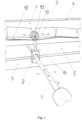
- Fig. 1 shows a system of deflection mechanisms with continuous horizontal chambers and traveling wheels located on the side walls behind the playing surface.
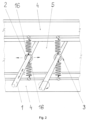
- Fig. 2 shows a set of deflection mechanisms with coiled springs, not part of the claimed invention.
- Table football consists of a playing table with playing surface 5.
- the playing table is designed in such a way that the side walls 4, which are divided into three parts in height, are partially removed.
- the lower parts of the side walls 4 are preserved.
- the middle parts of the side walls 4 are removed and they represent free spaces.
- the upper parts of the side walls 4 are preferably supplemented with continuous horizontal chambers 7 located along both side walls 4 behind the playing surface 5. Playing rods 1 are telescopic.
- the outer rotatable and extendable parts of the playing rods 1 are placed in the eyes 2, and on the opposing player's side, the supporting inner parts of the playing rods 1 are placed in the eyes 2, which have locking elements 6 to prevent their axial movement, as shown in Fig. 4 .
- the playing rods 1 are movably placed at both ends in the eyes 2 of the deflection mechanisms 3 enabling the deflection of the playing rods 1 in the left and right direction, while the deflection mechanisms 3 are coupled to the side walls 4 of the playing surface 5 of the table.
- marked dotted lines represent rectangular playing surfaces for player movement as in the current state of the art.
- the dashed lines delimit the expanded, new rectangular playing surfaces when moving the playing rod 1 forwards or backwards, and thus 100% coverage of the playing surface, there are no places where the figures cannot reach the ball.
- goalkeepers only have half the range of movement and only forward. At the same time, the goalkeeper is the only figure who can control the ball without the possibility of an opponent's intervention, which better corresponds to real football, as he has the possibility of an unhindered kick.
- the deflection mechanism 3 is designed so that the horizontal chamber 7 advantageously has six guiding sectors 8 for players and two guiding sectors 9 for goalkeepers.
- the guiding sectors 8 for players advantageously have metal guideways 10 sloping towards the center of the guiding sectors 8 for players with a slight slope of approx.
- the guiding sectors 9 for the goalkeepers have preferably metal guideways 10 sloping towards the goals 11 with a slight drop of approx. 10%.
- the guideways have two parallel guide slots 15.
- the movement mechanisms for each playing rod 1 are mounted on rolling stock, which consist of two traveling wheels 12 coupled with axles 13.
- the pull rods 14, made of webbing are loosely attached through the upper eye 2, which are inserted in the guide slots 15 of the guideways 10, and at the lower ends they are terminated by eyes 2 through which are the playing rods 1 guided.
- Table football consists of a playing table with playing surface 5.
- the playing table is designed in such a way that the side walls 4, which are divided into three parts in height, are partially removed. Preferably, the upper and lower parts of the side walls 4 are preserved. The middle parts of the side walls 4 are removed and they represent free spaces.
- the deflection mechanisms 3 enabling deflection of the playing rods 1 in the left and right direction are solved in such a way that their construction preferably consists of two coiled expansion springs 16, one end of which is fixed in the eyes 2 through which the playing rods 1 pass, and the other ends of which are attached to the upper side walls 4 and lower side walls 4 of the playing surface 5 of the table.
- the eyes 2 are loops or rings. Movement of the playing rod 1 in both directions from the central position is made possible by tensioning the coiled expansion springs 16, which return again when the playing rod 1 is released with playing rod 1 to the center position.
- a fixed cable fixed in the places where the coiled expansion spring 16 is also fixed passes through the inner part of the thread of each coiled expansion spring 16, while the cable limits the expansion of the coiled expansion spring 16 only to the specified limit.
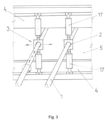
- Table football consists of a playing table with playing surface 5.
- the playing table is designed in such a way that the side walls 4, which are divided into three parts in height, are partially removed. Preferably, the upper and lower parts of the side walls 4 are preserved. The middle parts of the side walls 4 are removed and they represent free spaces.
- the deflection mechanisms 3 enabling deflection of the playing rods 1 in the left and right direction are solved in such a way that their construction preferably consists of two gas springs 17, one end of which is fixed in the eyes 2 through which the playing rods 1 pass, and the other ends of which are attached to the upper side walls 4 and lower side walls 4 of the playing surface 5 of the table.
- the eyes 2 are preferably blocks with a hole. Movement of the playing rod 1 in both directions from the central position is made possible by pulling and compressing the gas springs 17, which return again when the playing rod 1 is released with playing rod 1 to the center position.
- the table football according to the present invention can be used primarily in social spaces and gaming houses.
Landscapes
- Engineering & Computer Science (AREA)
- Multimedia (AREA)
- Toys (AREA)
Claims (1)
- Ein Tischfußball mit einer Spielfläche, mit den auf den Spielstangen befestigten Spielern und Torwarten, wo die Spielstangen (1) teleskopisch sind und an beiden Enden beweglich gelagert sind in den Ösen (2) der Schwenkmechanismen (3), durch die die Schwenkung der Spielstangen (1) in der Richtung nach links und rechts ermöglicht wird, wobei die Schwenkmechanismen (3) mit den Seitenwänden (4) der Spielfläche (5) des Tisches gekuppelt sind; auf einer Seite sind in den Ösen (2) die Außenteile der Spielstangen (1) platziert und auf der Gegenseite sind in den Ösen (2) die Innenteile der Spielstangen (1) platziert, die über Sicherungselemente (6) verfügen, um ihre axiale Bewegung zu verhindern, dadurch gekennzeichnet, dass die Schwenkmechanismen (3), durch die die Schwenkung der Spielstangen (1) in der Richtung nach links und rechts ermöglicht wird, aus den an den Seitenwänden (4) hinter der Spielfläche (5) platzierten horizontalen Durchgangskammern (7) bestehen, wobei jede Seitenwand (4) sechs Führungssektoren (8) für die Spieler und zwei Führungssektoren (9) für die Torwarte aufweist, wo die Führungssektoren (8) für die Spieler über die Führungsbahnen (10) verfügen, die in Richtung Mitte der Führungssektoren (8) für die Spieler geneigt sind, und die Führungssektoren (9) für die Torwarte über die Führungsbahnen (10) verfügen, die in Richtung Tore (11) geneigt sind; auf den Führungsbahnen (10) befinden sich für jede Spielstange (1) rollende Bewegungsmechanismen, die aus Laufrädern (12) mit Achsen (13) bestehen, an den Achsen (13) sind die Zugstangen (14) frei befestigt, die in die Führungsspalten (15) der Führungsbahnen (10) eingelegt sind, und an den Enden sind die Zugstangen (14) mit den Ösen (2) beendet, über die die Spielstangen (1) geführt sind.
Applications Claiming Priority (2)
| Application Number | Priority Date | Filing Date | Title |
|---|---|---|---|
| SK50016-2022A SK500162022A3 (sk) | 2022-03-18 | 2022-03-18 | Stolný futbal |
| PCT/SK2023/050001 WO2023177361A1 (en) | 2022-03-18 | 2023-01-27 | Table football |
Publications (3)
| Publication Number | Publication Date |
|---|---|
| EP4355446A1 EP4355446A1 (de) | 2024-04-24 |
| EP4355446B1 true EP4355446B1 (de) | 2025-03-12 |
| EP4355446C0 EP4355446C0 (de) | 2025-03-12 |
Family
ID=84527731
Family Applications (1)
| Application Number | Title | Priority Date | Filing Date |
|---|---|---|---|
| EP23712967.1A Active EP4355446B1 (de) | 2022-03-18 | 2023-01-27 | Tischfussball |
Country Status (3)
| Country | Link |
|---|---|
| EP (1) | EP4355446B1 (de) |
| SK (1) | SK500162022A3 (de) |
| WO (1) | WO2023177361A1 (de) |
Family Cites Families (4)
| Publication number | Priority date | Publication date | Assignee | Title |
|---|---|---|---|---|
| FR1025388A (fr) * | 1950-10-03 | 1953-04-14 | Jeu de football perfectionné à groupes de joueurs mobiles en toutes directions parallèles à l'aire de jeu | |
| FR1061245A (fr) * | 1952-08-05 | 1954-04-09 | Jeu d'adresse | |
| FR2652007B1 (fr) * | 1989-09-20 | 1991-10-31 | Richard Robert | Jeu de football de table. |
| FR2728479B1 (fr) * | 1995-12-20 | 1997-07-18 | Villa Giocattoli Srl | Perfectionnement pour les jeux de baby-foot |
-
2022
- 2022-03-18 SK SK50016-2022A patent/SK500162022A3/sk not_active Application Discontinuation
-
2023
- 2023-01-27 WO PCT/SK2023/050001 patent/WO2023177361A1/en not_active Ceased
- 2023-01-27 EP EP23712967.1A patent/EP4355446B1/de active Active
Also Published As
| Publication number | Publication date |
|---|---|
| SK500162022A3 (sk) | 2022-12-21 |
| EP4355446A1 (de) | 2024-04-24 |
| WO2023177361A1 (en) | 2023-09-21 |
| EP4355446C0 (de) | 2025-03-12 |
Similar Documents
| Publication | Publication Date | Title |
|---|---|---|
| US4290606A (en) | Nonpredictable game projectile | |
| US4534567A (en) | Board game with chance device playing piece | |
| US7740518B2 (en) | Jousting toy | |
| US5332215A (en) | Football board game | |
| US20120248699A1 (en) | Board Game | |
| EP4355446B1 (de) | Tischfussball | |
| US3731934A (en) | Board game apparatus | |
| US5358256A (en) | Horsesticks game assembly and method of play | |
| US4570938A (en) | Board game having pieces with pivotal arm | |
| US4125262A (en) | Game with elastic tethered missiles | |
| US3920244A (en) | Table top game figure | |
| US7614623B2 (en) | Head-to-head tilting surface game | |
| US7325804B2 (en) | Game apparatus with an encapsulated figure | |
| US4544162A (en) | Board game utilizing articulated playing pieces | |
| US6827349B2 (en) | Billiard table | |
| US20230173363A1 (en) | Game system and method of using the same | |
| US11717743B2 (en) | Method for playing a skill-based strategy game | |
| US922897A (en) | Game-board. | |
| US7261293B2 (en) | Ball game having members with passageways | |
| US4167267A (en) | Puck projecting game | |
| KR102658798B1 (ko) | 피규어 이동형 축구 보드게임 | |
| US11883725B1 (en) | Ball game and method of playing | |
| US20060138724A1 (en) | Team-based battle board game | |
| US10898788B2 (en) | Game having personalized game pieces with selectively removable magnetized pieces and accessories | |
| US20220409988A1 (en) | Game utilizing reaction adjustable bumper |
Legal Events
| Date | Code | Title | Description |
|---|---|---|---|
| STAA | Information on the status of an ep patent application or granted ep patent |
Free format text: STATUS: UNKNOWN |
|
| STAA | Information on the status of an ep patent application or granted ep patent |
Free format text: STATUS: THE INTERNATIONAL PUBLICATION HAS BEEN MADE |
|
| PUAI | Public reference made under article 153(3) epc to a published international application that has entered the european phase |
Free format text: ORIGINAL CODE: 0009012 |
|
| STAA | Information on the status of an ep patent application or granted ep patent |
Free format text: STATUS: REQUEST FOR EXAMINATION WAS MADE |
|
| 17P | Request for examination filed |
Effective date: 20240117 |
|
| AK | Designated contracting states |
Kind code of ref document: A1 Designated state(s): AL AT BE BG CH CY CZ DE DK EE ES FI FR GB GR HR HU IE IS IT LI LT LU LV MC ME MK MT NL NO PL PT RO RS SE SI SK SM TR |
|
| GRAP | Despatch of communication of intention to grant a patent |
Free format text: ORIGINAL CODE: EPIDOSNIGR1 |
|
| STAA | Information on the status of an ep patent application or granted ep patent |
Free format text: STATUS: GRANT OF PATENT IS INTENDED |
|
| DAV | Request for validation of the european patent (deleted) | ||
| DAX | Request for extension of the european patent (deleted) | ||
| INTG | Intention to grant announced |
Effective date: 20241008 |
|
| GRAS | Grant fee paid |
Free format text: ORIGINAL CODE: EPIDOSNIGR3 |
|
| GRAA | (expected) grant |
Free format text: ORIGINAL CODE: 0009210 |
|
| STAA | Information on the status of an ep patent application or granted ep patent |
Free format text: STATUS: THE PATENT HAS BEEN GRANTED |
|
| AK | Designated contracting states |
Kind code of ref document: B1 Designated state(s): AL AT BE BG CH CY CZ DE DK EE ES FI FR GB GR HR HU IE IS IT LI LT LU LV MC ME MK MT NL NO PL PT RO RS SE SI SK SM TR |
|
| REG | Reference to a national code |
Ref country code: GB Ref legal event code: FG4D |
|
| REG | Reference to a national code |
Ref country code: CH Ref legal event code: EP |
|
| REG | Reference to a national code |
Ref country code: DE Ref legal event code: R096 Ref document number: 602023002416 Country of ref document: DE |
|
| REG | Reference to a national code |
Ref country code: IE Ref legal event code: FG4D |
|
| U01 | Request for unitary effect filed |
Effective date: 20250410 |
|
| U07 | Unitary effect registered |
Designated state(s): AT BE BG DE DK EE FI FR IT LT LU LV MT NL PT RO SE SI Effective date: 20250416 |
|
| PG25 | Lapsed in a contracting state [announced via postgrant information from national office to epo] |
Ref country code: RS Free format text: LAPSE BECAUSE OF FAILURE TO SUBMIT A TRANSLATION OF THE DESCRIPTION OR TO PAY THE FEE WITHIN THE PRESCRIBED TIME-LIMIT Effective date: 20250612 |
|
| PG25 | Lapsed in a contracting state [announced via postgrant information from national office to epo] |
Ref country code: ES Free format text: LAPSE BECAUSE OF FAILURE TO SUBMIT A TRANSLATION OF THE DESCRIPTION OR TO PAY THE FEE WITHIN THE PRESCRIBED TIME-LIMIT Effective date: 20250312 |
|
| PG25 | Lapsed in a contracting state [announced via postgrant information from national office to epo] |
Ref country code: NO Free format text: LAPSE BECAUSE OF FAILURE TO SUBMIT A TRANSLATION OF THE DESCRIPTION OR TO PAY THE FEE WITHIN THE PRESCRIBED TIME-LIMIT Effective date: 20250612 |
|
| PG25 | Lapsed in a contracting state [announced via postgrant information from national office to epo] |
Ref country code: HR Free format text: LAPSE BECAUSE OF FAILURE TO SUBMIT A TRANSLATION OF THE DESCRIPTION OR TO PAY THE FEE WITHIN THE PRESCRIBED TIME-LIMIT Effective date: 20250312 |
|
| PG25 | Lapsed in a contracting state [announced via postgrant information from national office to epo] |
Ref country code: GR Free format text: LAPSE BECAUSE OF FAILURE TO SUBMIT A TRANSLATION OF THE DESCRIPTION OR TO PAY THE FEE WITHIN THE PRESCRIBED TIME-LIMIT Effective date: 20250613 |
|
| U1N | Appointed representative for the unitary patent procedure changed after the registration of the unitary effect |
Representative=s name: INVENTA PATENTOVA A ZNAMKOVA KANCELARIA S.R.O.; SK |
|
| PG25 | Lapsed in a contracting state [announced via postgrant information from national office to epo] |
Ref country code: SM Free format text: LAPSE BECAUSE OF FAILURE TO SUBMIT A TRANSLATION OF THE DESCRIPTION OR TO PAY THE FEE WITHIN THE PRESCRIBED TIME-LIMIT Effective date: 20250312 |
|
| PG25 | Lapsed in a contracting state [announced via postgrant information from national office to epo] |
Ref country code: PL Free format text: LAPSE BECAUSE OF FAILURE TO SUBMIT A TRANSLATION OF THE DESCRIPTION OR TO PAY THE FEE WITHIN THE PRESCRIBED TIME-LIMIT Effective date: 20250312 |
|
| PG25 | Lapsed in a contracting state [announced via postgrant information from national office to epo] |
Ref country code: CZ Free format text: LAPSE BECAUSE OF FAILURE TO SUBMIT A TRANSLATION OF THE DESCRIPTION OR TO PAY THE FEE WITHIN THE PRESCRIBED TIME-LIMIT Effective date: 20250312 |
|
| PG25 | Lapsed in a contracting state [announced via postgrant information from national office to epo] |
Ref country code: SK Free format text: LAPSE BECAUSE OF FAILURE TO SUBMIT A TRANSLATION OF THE DESCRIPTION OR TO PAY THE FEE WITHIN THE PRESCRIBED TIME-LIMIT Effective date: 20250312 |
|
| PG25 | Lapsed in a contracting state [announced via postgrant information from national office to epo] |
Ref country code: IS Free format text: LAPSE BECAUSE OF FAILURE TO SUBMIT A TRANSLATION OF THE DESCRIPTION OR TO PAY THE FEE WITHIN THE PRESCRIBED TIME-LIMIT Effective date: 20250712 |
|
| PLBE | No opposition filed within time limit |
Free format text: ORIGINAL CODE: 0009261 |
|
| STAA | Information on the status of an ep patent application or granted ep patent |
Free format text: STATUS: NO OPPOSITION FILED WITHIN TIME LIMIT |
|
| REG | Reference to a national code |
Ref country code: CH Ref legal event code: L10 Free format text: ST27 STATUS EVENT CODE: U-0-0-L10-L00 (AS PROVIDED BY THE NATIONAL OFFICE) Effective date: 20260121 |
|
| 26N | No opposition filed |
Effective date: 20251215 |
|
| U20 | Renewal fee for the european patent with unitary effect paid |
Year of fee payment: 4 Effective date: 20260121 |