EP4351890B1 - Extenseur a stylisme perfectionné et ensemble roulant comportant un tel extenseur - Google Patents
Extenseur a stylisme perfectionné et ensemble roulant comportant un tel extenseur Download PDFInfo
- Publication number
- EP4351890B1 EP4351890B1 EP22740940.6A EP22740940A EP4351890B1 EP 4351890 B1 EP4351890 B1 EP 4351890B1 EP 22740940 A EP22740940 A EP 22740940A EP 4351890 B1 EP4351890 B1 EP 4351890B1
- Authority
- EP
- European Patent Office
- Prior art keywords
- inserts
- adapter
- axially
- extender
- rim
- Prior art date
- Legal status (The legal status is an assumption and is not a legal conclusion. Google has not performed a legal analysis and makes no representation as to the accuracy of the status listed.)
- Active
Links
Images

Classifications
-
- B—PERFORMING OPERATIONS; TRANSPORTING
- B60—VEHICLES IN GENERAL
- B60C—VEHICLE TYRES; TYRE INFLATION; TYRE CHANGING; CONNECTING VALVES TO INFLATABLE ELASTIC BODIES IN GENERAL; DEVICES OR ARRANGEMENTS RELATED TO TYRES
- B60C15/00—Tyre beads, e.g. ply turn-up or overlap
- B60C15/02—Seating or securing beads on rims
- B60C15/024—Bead contour, e.g. lips, grooves, or ribs
- B60C15/0242—Bead contour, e.g. lips, grooves, or ribs with bead extensions located radially outside the rim flange position, e.g. rim flange protectors
-
- B—PERFORMING OPERATIONS; TRANSPORTING
- B60—VEHICLES IN GENERAL
- B60B—VEHICLE WHEELS; CASTORS; AXLES FOR WHEELS OR CASTORS; INCREASING WHEEL ADHESION
- B60B21/00—Rims
- B60B21/10—Rims characterised by the form of tyre-seat or flange, e.g. corrugated
-
- B—PERFORMING OPERATIONS; TRANSPORTING
- B60—VEHICLES IN GENERAL
- B60B—VEHICLE WHEELS; CASTORS; AXLES FOR WHEELS OR CASTORS; INCREASING WHEEL ADHESION
- B60B21/00—Rims
- B60B21/12—Appurtenances, e.g. lining bands
- B60B21/125—Bead clamping elements
-
- B—PERFORMING OPERATIONS; TRANSPORTING
- B60—VEHICLES IN GENERAL
- B60B—VEHICLE WHEELS; CASTORS; AXLES FOR WHEELS OR CASTORS; INCREASING WHEEL ADHESION
- B60B25/00—Rims built-up of several main parts ; Locking means for the rim parts
- B60B25/04—Rims with dismountable flange rings, seat rings, or lock rings
- B60B25/045—Rims with dismountable flange rings, seat rings, or lock rings on both sides
-
- B—PERFORMING OPERATIONS; TRANSPORTING
- B60—VEHICLES IN GENERAL
- B60B—VEHICLE WHEELS; CASTORS; AXLES FOR WHEELS OR CASTORS; INCREASING WHEEL ADHESION
- B60B25/00—Rims built-up of several main parts ; Locking means for the rim parts
- B60B25/04—Rims with dismountable flange rings, seat rings, or lock rings
- B60B25/08—Continuous flange rings; Arrangement of recesses enabling the flange rings to be slipped over the rim body
-
- B—PERFORMING OPERATIONS; TRANSPORTING
- B60—VEHICLES IN GENERAL
- B60B—VEHICLE WHEELS; CASTORS; AXLES FOR WHEELS OR CASTORS; INCREASING WHEEL ADHESION
- B60B7/00—Wheel cover discs, rings, or the like, for ornamenting, protecting, venting, or obscuring, wholly or in part, the wheel body, rim, hub, or tyre sidewall, e.g. wheel cover discs, wheel cover discs with cooling fins
- B60B7/0026—Wheel cover discs, rings, or the like, for ornamenting, protecting, venting, or obscuring, wholly or in part, the wheel body, rim, hub, or tyre sidewall, e.g. wheel cover discs, wheel cover discs with cooling fins characterised by the surface
- B60B7/0033—Wheel cover discs, rings, or the like, for ornamenting, protecting, venting, or obscuring, wholly or in part, the wheel body, rim, hub, or tyre sidewall, e.g. wheel cover discs, wheel cover discs with cooling fins characterised by the surface the dominant aspect being the surface appearance
- B60B7/0053—Wheel cover discs, rings, or the like, for ornamenting, protecting, venting, or obscuring, wholly or in part, the wheel body, rim, hub, or tyre sidewall, e.g. wheel cover discs, wheel cover discs with cooling fins characterised by the surface the dominant aspect being the surface appearance the surface being decorated
-
- B—PERFORMING OPERATIONS; TRANSPORTING
- B60—VEHICLES IN GENERAL
- B60B—VEHICLE WHEELS; CASTORS; AXLES FOR WHEELS OR CASTORS; INCREASING WHEEL ADHESION
- B60B7/00—Wheel cover discs, rings, or the like, for ornamenting, protecting, venting, or obscuring, wholly or in part, the wheel body, rim, hub, or tyre sidewall, e.g. wheel cover discs, wheel cover discs with cooling fins
- B60B7/01—Rings specially adapted for covering only the wheel rim or the tyre sidewall, e.g. removable tyre sidewall trim rings
-
- B—PERFORMING OPERATIONS; TRANSPORTING
- B60—VEHICLES IN GENERAL
- B60C—VEHICLE TYRES; TYRE INFLATION; TYRE CHANGING; CONNECTING VALVES TO INFLATABLE ELASTIC BODIES IN GENERAL; DEVICES OR ARRANGEMENTS RELATED TO TYRES
- B60C15/00—Tyre beads, e.g. ply turn-up or overlap
- B60C15/02—Seating or securing beads on rims
- B60C15/0209—Supplementary means for securing the bead
-
- B—PERFORMING OPERATIONS; TRANSPORTING
- B60—VEHICLES IN GENERAL
- B60C—VEHICLE TYRES; TYRE INFLATION; TYRE CHANGING; CONNECTING VALVES TO INFLATABLE ELASTIC BODIES IN GENERAL; DEVICES OR ARRANGEMENTS RELATED TO TYRES
- B60C15/00—Tyre beads, e.g. ply turn-up or overlap
- B60C15/02—Seating or securing beads on rims
- B60C15/0209—Supplementary means for securing the bead
- B60C15/0223—Supplementary means for securing the bead the bead being secured by clip-hook elements not forming part of the rim flange
-
- B—PERFORMING OPERATIONS; TRANSPORTING
- B60—VEHICLES IN GENERAL
- B60C—VEHICLE TYRES; TYRE INFLATION; TYRE CHANGING; CONNECTING VALVES TO INFLATABLE ELASTIC BODIES IN GENERAL; DEVICES OR ARRANGEMENTS RELATED TO TYRES
- B60C15/00—Tyre beads, e.g. ply turn-up or overlap
- B60C15/02—Seating or securing beads on rims
- B60C15/0209—Supplementary means for securing the bead
- B60C15/023—Supplementary means for securing the bead the bead being secured by bead extensions which extend over and wrap around the rim flange
Definitions
- the invention relates to an expander for a rolling assembly consisting of a tire and a rigid rim connected together by an expander capable of offering a certain elastic flexibility during an impact suffered during rolling, as well as a rolling assembly comprising it.
- a tire comprises, as is known, two beads intended to be mounted on the seats of a rim.
- the present invention relates to rolling assemblies in which a tire bead is not mounted directly on a rigid rim, but is mounted on a flexible expander, an expander which is itself mounted on a rigid rim.
- a tire, a rim, and an expander referred to in the present invention are usually described by a representation in a meridian plane, i.e., a plane containing the axis of rotation of the tire. All these products (the tire, the rim, the expander) are objects having a geometry of revolution relative to the axis of rotation of the tire.
- the radial and axial directions respectively designate the directions, the first, perpendicular to the axis of rotation of the tire, and the second, parallel to the axis of rotation of the tire.
- the expressions “radially” and “axially” respectively mean “in a radial direction” and “in the axial direction.”
- the expressions “radially inner, respectively radially outer” mean “closer, respectively further, from the axis of rotation of the tire, in a radial direction.”
- a median plane is a plane perpendicular to the tire's axis of rotation, positioned axially so as to intersect the tread surface substantially midway between the beads of a tire.
- the expressions “axially inward, respectively axially outward” mean “closer, respectively further, from the median plane of the tire, in the axial direction”.
- radial cut or “radial section” means a cut or section along a plane that contains the tire's axis of rotation.
- “Meridian cut” means a cut made with a meridian plane and, “meridian plane” means a plane parallel to and containing the tire's axis of rotation and perpendicular to the circumferential direction.
- “Circumferentially” means, in a circumferential direction, the direction that is substantially perpendicular to both the axial direction and a radius of the tire (in other words, tangent to a circle whose center is on the axis of rotation of the tire).
- the document WO2016/046197 describes an example of a flexible expander arranged between a tire bead and a rim.
- the rolling assembly according to this document comprises a tire, a rim and two identical expanders.
- an expander comprises, axially from the inside to the outside, an axially inner end called an expander bead and intended to ensure the attachment of the expander to the rim.
- Such an expander also comprises an axially outer end intended to receive and axially immobilize a tire bead.
- a body provided with a reinforcing reinforcement connects the two ends, respectively axially inner and axially outer.
- the extenders are mounted on a rim which is a metal part, most of the time made of aluminum.
- the rim has a rim hook on each side intended to ensure in particular the immobilization in the axial direction of the extender.
- a flexible extender must, on the one hand, have a certain elastic flexibility, for example when hitting a sidewalk or when passing through a pothole, and on the other hand, it must have sufficient rigidity when rolling to give the vehicle correct behavior.
- such an extender is made of elastomeric materials, materials close to those used for the manufacture of the tire from which it borrows its appearance.
- a rolling assembly comprising a rim, and a tire mounted on the rim by means of two extenders, presents the appearance of a wheel smaller in diameter than that of a conventional wheel used with a tire of the same size.
- the current design trend is to have a wheel as large as possible, at least in its visual appearance.
- these soft synthetic materials must be dyed in the mass (instead of being covered with paint, as in the case of metallic surfaces). This type of coloring cannot confer a shiny appearance, as desired by vehicle wheel designers.
- the thickness of this ring is quite significant and therefore causes greater exposure to grating against a pavement. This creates problems of surface scratches on the trim ring, or even loss of the trim ring following its detachment from the support.
- the aim of the invention is to overcome the aforementioned drawbacks and to propose an original styling solution for an extender allowing robust fixing of design elements, even in the event of large deformations of the extender or when the wheel rotates at high speed, while providing a visual perception of a large diameter wheel.
- the invention therefore relates to an extender for a rolling assembly with an axis of rotation X-X' comprising a tire, having two beads and a rim, the extender being intended to ensure the junction between one of the beads and the rim, said extender comprising an axially inner end, an axially outer end and a body oriented mainly axially and arranged between said axially outer end and said axially inner end, so that, when mounted within the assembly, said axially inner end is intended to be immobilized on said rim using an inner reinforcing element, said axially outer end comprising an outer reinforcing element is intended to receive a tire bead, characterized in that the axially outer end comprises a visible face made so as to reveal the axially outer faces of several inserts fixed to the extender and distributed over the circumference of said visible face.
- extender we mean a flexible extender, capable of elastically deforming mainly in a radial direction when it is subjected to a force, such as that experienced when the wheel hits a pavement.
- the extender comprises several fixed (or non-removable) mounted inserts while being distributed around the circumference of said visible face of the extender (it is understood that the face is visible when looking at a wheel mounted on the vehicle, the wheel comprising an extender mounted on the rim), so that the inserts can also be visible.
- the extender inserts can be glued individually in housings made of an elastomeric material obtained after the extender has been baked or they can be placed in the baking mold beforehand and secured to the extender during the baking thereof.
- inserts distributed around the circumference it is understood that two inserts are located side by side so that a space remains between the two, allowing bridges of elastomeric material to be created between the inserts, and this over the entire circumference of the visible face of the axially outer end of the extender.
- the visible face is preferably a front face of the extender.
- the inserts according to the invention are independent rigid inserts or connected to each other by deformable links, while being integral with the extender.
- the inserts being rather rigid, for example metallic, the zone which separates two inserts fixed in their respective cavities is, itself, flexible.
- the inserts and the spaces separating two adjacent inserts are chosen to be fairly small, their sizes being of the same order of magnitude as the local deformation undergone by the extender in the event of an impact against a sidewalk for example.
- This allows the extender to absorb deformation in the event of an impact to the wheel, without affecting the external appearance of the extender and therefore while maintaining its initial design.
- the flexible extender deforms and the rigid inserts attached to it retain their shape and configuration.
- the solution of the invention is compatible with high levels of deformation encountered for example during an impact against a pavement of a rolling assembly comprising an extender of the invention and this due to the dissociation between them of the elements added on the visible external surface of the extender.
- This dissociation makes it possible to cut off the transmission of stresses linked to an imposed deformation, present in a trim ring produced in the form of a single piece, stresses all the greater as the modulus of elasticity of the part concerned is large.
- Said inserts may be made of a metallic material.
- a plurality of inserts on the circumference of the axially outer end of the extender, this will make it possible to give it an overall metallic appearance and to give the wheel the appearance of a large diameter wheel.
- Said visible surface may be the axially outermost face of said axially outer end and the inserts may protrude relative to this face.
- the inserts protrude relative to the axially outermost face of the extender, they manage to protect the elastomeric surfaces of the extender, surfaces which are therefore further back, during sidewalk raking.
- by visible surface is meant that of the axially outer face of the outer extender.
- the inner extender may be identical or different to the outer extender, for example when it is different, it does not include added inserts.
- Said inserts can be made in the form of several individual elements connected together at their base. This facilitates their attachment to the expander, particularly during an overmolding operation during cooking.
- the inserts can be separate individual elements. This embodiment is more suitable for gluing the inserts into the designated recesses on the expander after baking.
- Said inserts may have an elongated shape, their length being at most equal to the width of said visible face of the axially outer end of the extender.
- the inserts thus occupy part of the width of the circumference of the axially outer end of the extender, which makes it possible to obtain a visual appearance of a large diameter wheel, even by increasing the space between two adjacent inserts.
- Said inserts may be uniformly distributed around the circumference of said visible face of the expander.
- the inserts may be spaced apart by a pitch greater or less than their width.
- the housings of said inserts may each have several notches made in their walls. This makes it possible to fill the notches of the impression or the housing of the insert with adhesive, while controlling the thickness of the adhesive layer.
- Said inserts can be arranged in a radial direction or in a direction which forms a constant acute angle with the radial direction of the expander.
- the inserts can be parallel to each other in groups of inserts, they preferably form a constant angle with the radial direction.
- the object of the invention is also achieved with a method of manufacturing an expander according to the invention, which comprises a step of molding said inserts in the same mold as that for molding the expander. This makes it possible to obtain the final object during a single cooking operation of the expander and insert assembly.
- the object of the invention is also achieved with a method of manufacturing an expander according to the invention, which comprises a step of gluing said inserts into housings provided for this purpose in the axially outer end of the expander.
- the object of the invention is also achieved with a rolling assembly with an axis of rotation X-X' comprising a tire, having two beads, a rim and an extender according to the invention intended to ensure the junction between one of the beads and the rim.
- any interval of values designated by the expression "between a and b" represents the domain of values from more than a to less than b (i.e., excluding the limits a and b), while any interval of values designated by the expression “from a to b” means the domain of values from a to b (i.e., including the strict limits a and b).
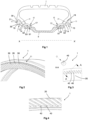
- FIG. 1 shows in a meridian sectional view a rolling assembly according to the invention.
- This assembly has an axis of rotation X-X', it comprises two expanders 1, a tire 2 and a rim 5.
- the tire 2 has two beads 21.
- the rim 5 has two rim seats 51, each extended by a rim flange 52.
- the rim flange 52 has a radially outer bearing face 53 intended to serve as a support for the body of the expander.
- the bearing face 53 of the rim flange 52 is in contact with the expander 1 when the tire is mounted on the expanders and the latter are mounted on the rim, the tire being inflated to the nominal pressure.
- the extender 1 comprises an axially inner end 10 intended to be mounted on one of said rim seats 51. It comprises an axially outer end 11 provided with an outer reinforcing element 15, which is annular in shape, produced for example on the basis of a cable winding, as well as a body 12 oriented substantially axially and arranged between said axially outer end 11 and said axially inner end 10.
- the axially inner end 10 of the extender has an axial positioning face substantially perpendicular to the axis of rotation X-X', and is immobilized by being pressed axially against the rim flange 52 under the effect of the inflation pressure of the tire 2 and thanks to a groove in the rim containing it.
- the axially outer end 11 has a shoulder 16 forming a face substantially perpendicular to the axis of rotation X-X'.
- Said expander 1 comprises a seat on expander 14 which receives the bead 21 of the tire.
- the bead 21 is immobilized by being pressed axially on said seat 14 against said shoulder 16 of the axially outer end 11 of the expander, under the effect of the inflation pressure of the tire.
- the axially inner end 10 of the extender comprises an inner reinforcing element 17 (preferably produced in the form of a cable winding) connected to the outer reinforcing element 15 by a reinforcing ply produced from reinforcing threads embedded in an elastomeric composition and forms with the reinforcing elements 15, 17 an internal structure of the extender.
- Other external elastomeric plies surround the internal structure of the extender.
- the assembly is mounted by arranging the extender 1 on the rim 5 and then mounting the tire 2 on the extender 1. Once mounted, the bead of the tire imposes a circumferential contraction of the extender 1.
- the axially outer end 11 of the extender 1 of the invention comprises a visible face 20 made so as to reveal the axially outer faces 31 of several inserts 30 fixed to the extender 1 and distributed over the circumference of said visible face 20.
- the inserts 30 protrude relative to the flat surface of the visible face 20.
- the axially outermost faces of the inserts 30 are located at the level of the visible surface 20.
- the axially outermost faces of the inserts are located axially further inward relative to the level of the visible face 20, but these inserts are visible thanks to cutouts made in the surface of the visible face 20 allowing all or part of the axially outer faces of the inserts mounted fixed on the extender to be seen.
- FIG. 2 illustrates an extender 1 of the invention whose axially outer end 11 comprises a visible face 20 whose circumference is provided with several inserts 30 uniformly distributed over its circumference.
- the inserts 30 are fixed by gluing in housings 40 obtained during the cooking of the expander.
- the housings 40 have a cross section in the shape of an arc of a circle ( Fig. 3 ) or dovetail ( Fig. 4 ).
- the 40 accommodations Figures 3 and 4 have a generally elongated shape and are preferably inclined, they make an angle of between 30 and 60° with the circumferential direction of the extender.
- the inserts 30 have a generally elongated shape and are fixed permanently or in a non-removable manner using a suitable adhesive. For example, when the needles are metallic, a cyanolite type adhesive is used to ensure their good fixing by gluing in housings made of an elastomeric material.
- FIG. 10 illustrates by an enlarged view an insert 30 in a housing 40 provided with several notches 42 made in its walls.
- the notches 42 receive glue and make it possible to control the thickness of the layer of glue applied for better retention of the attachment of the insert 30.
- the inserts 30 are secured to the extender by being molded in the same mold and at the same time as the latter.
- the inserts 30 are connected at their base by two hoops 35, 36 of metal wire and form a unitary assembly 37.
- the assembly 37 is placed at the bottom of a mold intended for cooking the expander 1 before cooking.
- the expander blank is added to the mold which is then closed and heated to cook the entire expander and inserts. After cooking, the expander 1 is removed from the mold and is of the type best visible at Figure 5 . It is thus noted that only the axially upper faces 31 of the inserts 30 are visible, the rest of the assembly 37 being embedded in the mass based on elastomeric material of the extender 1.
- FIG. 7 illustrates a variant in which the inserts 30 have a spherical shape and are fixed by gluing in housings in the shape of a corresponding spherical cap.
- figure 8 illustrates another variant of extender comprising two rows of spherical-shaped inserts 30.
- the figure 9 illustrates a variant in which the inserts 30 have a cylindrical needle shape with rounded edges.
- the heads of the inserts are plates, for example of triangular shape.
- an extender 1 allowing the mounting of a 20" tire on a rim may comprise a number of 200 to 300 elongated inserts, as illustrated in Figure 9 , the inserts having a length between 9 mm and 15 mm and a width between 2 mm and 4 mm.
- the inserts 30 are preferably metallic, for example made of stainless steel or anodized aluminum or steel coated with paint and varnish. In one variant, they are made of a metallized plastic material. In another variant, they are made of a colored plastic material. In yet another variant, the inserts have different colors, preferably all the colors of a rainbow so that, when the wheel rotates, the inserts produce the impression of a white color.
- the invention is not limited to the embodiments described above. Thus, it is possible to envisage various other shapes of inserts (cube-shaped, parallelepiped-shaped, pyramid-shaped, or other three-dimensional solid) fixed by gluing to the extender or by molding with it.
- At least one of the inserts of the extender of the invention may be a part offering certain functionalities, such as an acceleration sensor or an identification or anti-theft chip, or even energy storage or other, in which case it will be fixed by gluing to the extender.
Landscapes
- Engineering & Computer Science (AREA)
- Mechanical Engineering (AREA)
- Tires In General (AREA)
Description
- L'invention a pour objet un extenseur pour un ensemble roulant constitué par un pneumatique et une jante rigide reliés ensemble par un extenseur apte à offrir une certaine flexibilité élastique lors d'un choc subi pendant le roulement, ainsi qu'un ensemble roulant le comportant. Un pneumatique comprend, comme on le sait, deux bourrelets destinés à être montés sur les sièges d'une jante. La présente invention concerne les ensembles roulants dans lesquels un bourrelet de pneumatique n'est pas monté directement sur une jante rigide, mais est monté sur un extenseur flexible, extenseur qui, lui, est monté sur une jante rigide.
- Un pneumatique, une jante, ainsi qu'un extenseur dont il est question dans la présente invention sont usuellement décrits par une représentation dans un plan méridien, c'est-à-dire un plan contenant l'axe de rotation du pneumatique. Tous ces produits (le pneumatique, la jante, l'extenseur) sont des objets ayant une géométrie de révolution par rapport à l'axe de rotation du pneumatique. Les directions radiale et axiale désignent respectivement les directions, la première, perpendiculaire à l'axe de rotation du pneumatique, et la seconde, parallèle à l'axe de rotation du pneumatique. Dans ce qui suit, les expressions « radialement » et « axialement » signifient respectivement « selon une direction radiale » et « selon la direction axiale ». Les expressions « radialement intérieur, respectivement radialement extérieur » signifient « plus proche, respectivement plus éloigné, de l'axe de rotation du pneumatique, selon une direction radiale ». Un plan médian est un plan perpendiculaire à l'axe de rotation du pneumatique, positionné axialement de façon à couper la surface de la bande de roulement sensiblement à mi-distance des bourrelets d'un pneumatique. Les expressions « axialement intérieur, respectivement axialement extérieur » signifient « plus proche, respectivement plus éloigné, du plan médian du pneumatique, selon la direction axiale ». Par ailleurs, par « coupe radiale » ou « section radiale », on entend une coupe ou une section selon un plan qui contient l'axe de rotation du pneumatique. Par « coupe méridienne » on comprend une coupe réalisée avec un plan méridien et, par plan méridien, on entend un plan parallèle à et contenant l'axe de rotation du pneumatique et perpendiculaire à la direction circonférentielle. Par « circonférentiellement » on comprend selon une direction circonférentielle, la direction qui est sensiblement perpendiculaire à la fois à la direction axiale et à un rayon du pneumatique (en d'autres termes, tangente à un cercle dont le centre est sur l'axe de rotation du pneumatique).
- Le document
WO2016/046197 décrit un exemple d'extenseur flexible agencé entre un bourrelet de pneumatique et une jante. L'ensemble roulant selon ce document comprend un pneumatique, une jante et deux extenseurs identiques. En considérant les conventions de langage rappelées ci-dessus, et en se reportant à la façon dont on monte un extenseur sur une jante, un tel extenseur comprend, axialement de l'intérieur vers l'extérieur, une extrémité axialement intérieure appelée bourrelet d'extenseur et destinée à assurer l'accrochage de l'extenseur sur la jante. Un tel extenseur comprend aussi une extrémité axialement extérieure destinée à recevoir et immobiliser axialement un bourrelet de pneumatique. Un corps muni d'une armature de renfort relie les deux extrémités respectivement axialement intérieure et axialement extérieure. - Les extenseurs sont montés sur une jante qui est une pièce métallique, la plupart du temps en aluminium. La jante présente de chaque côté un crochet de jante destiné à assurer en particulier l'immobilisation en direction axiale de l'extenseur. Un extenseur flexible doit, d'une part, présenter une certaine flexibilité élastique par exemple lors d'un choc contre un trottoir ou lors du passage dans un « nid de poule » et, d'autre part, il doit présenter suffisamment de rigidité en roulage afin de conférer un comportement correct au véhicule. Pour ceci, on réalise un tel extenseur dans des matériaux élastomériques, matériaux proches de ceux utilisés pour la fabrication du pneumatique dont il emprunte l'apparence.
- Ainsi, un ensemble roulant comportant une jante, et un pneumatique monté sur la jante moyennant deux extenseurs, présente l'apparence d'une roue plus petite en diamètre que celle d'une roue classique utilisée avec un pneumatique de même dimension. Or, la tendance actuelle de design est d'avoir une roue la plus grande possible, au moins dans son apparence visuelle.
- Une solution a été proposée dans le document
WO201807751 - Le but de l'invention est de remédier aux inconvénients précités et de proposer une solution originale de stylisme pour un extenseur permettant une fixation robuste des éléments de designs, même en cas de grandes déformations de l'extenseur ou lorsque la roue tourne à grande vitesse, tout en offrant une perception visuelle d'une roue de grand diamètre.
- L'invention a donc pour objet un extenseur pour un ensemble roulant d'axe de rotation X-X' comprenant un pneumatique, ayant deux bourrelets et une jante, l'extenseur étant destiné à assurer la jonction entre l'un des bourrelets et la jante, ledit extenseur comprenant une extrémité axialement intérieure, une extrémité axialement extérieure et un corps orienté principalement axialement et disposé entre ladite extrémité axialement extérieure et ladite extrémité axialement intérieure, de sorte que, lorsqu'il est monté au sein de l'ensemble, ladite extrémité axialement intérieure est destinée à être immobilisée sur ladite jante à l'aide d'un élément de renfort intérieur, ladite extrémité axialement extérieure comprenant un élément de renfort extérieur est destinée à recevoir un bourrelet de pneumatique, caractérisé en ce que l'extrémité axialement extérieure comporte une face visible réalisée de manière à laisser apparaître les faces axialement extérieures de plusieurs inserts fixés sur l'extenseur et répartis sur la circonférence de ladite face visible.
- Par extenseur selon l'invention, on comprend un extenseur flexible, apte à se déformer élastiquement principalement dans une direction radiale lorsqu'il est soumis à un effort, tel que subi quand la roue heurte un trottoir. Selon l'invention, l'extenseur comporte plusieurs inserts montés fixes (ou indémontables) en étant répartis sur la circonférence de ladite face visible de l'extenseur (on comprend que la face est visible lorsqu'on regarde une roue montée sur le véhicule, la roue comportant un extenseur monté sur la jante), de manière à ce que les inserts puissent être visibles également. Les inserts de l'extenseur peuvent être collés individuellement dans des logements en une matière élastomérique obtenus après la cuisson de l'extenseur ou ils peuvent être disposés dans le moule de cuisson au préalable et solidarisés à l'extenseur durant la cuisson de celui-ci.
- Par inserts répartis sur la circonférence, on comprend que deux inserts sont situés côte-à-côte de manière à ce qu'un espace subsiste entre les deux, permettant de créer des ponts de matière élastomérique entre les inserts, et cela sur toute la circonférence de la face visible de l'extrémité axialement extérieure de l'extenseur. La face visible est de préférence une face frontale de l'extenseur. Les inserts selon l'invention sont des inserts rigides indépendants ou reliés entre eux par des liens déformables, tout en étant solidaires de l'extenseur. Ainsi, les inserts étant plutôt rigides, par exemple métalliques, la zone qui sépare deux inserts fixés dans leurs cavités respectives est, elle, souple. De préférence, les inserts et les espaces séparant deux inserts adjacents sont choisis d'assez petite taille, leurs tailles étant du même ordre de grandeur que la déformation locale subie par l'extenseur en cas d'un choc contre un trottoir par exemple. Ceci permet à l'extenseur d'absorber une déformation en cas de choc subi par la roue, sans incidence sur l'aspect extérieur de l'extenseur et donc tout en gardant son design initial. Ainsi, en cas de choc subi par la roue, l'extenseur souple de déforme et les inserts rigides qui y sont fixés conservent leur forme et leur configuration.
- La solution de l'invention est compatible avec des hauts niveaux de déformation rencontrés par exemple lors d'un choc contre un trottoir d'un ensemble roulant comportant un extenseur de l'invention et cela en raison de la dissociation entre eux des éléments rapportés sur la surface extérieure visible de l'extenseur. Cette dissociation permet de couper la transmission des contraintes liées à une déformation imposée, présente dans un anneau enjoliveur réalisé sous forme d'une pièce d'un seul tenant, contraintes d'autant plus grandes que le module d'élasticité de la pièce concernée est grand.
- Lesdits inserts peuvent être en une matière métallique. Ainsi, en disposant une pluralité d'inserts sur la circonférence de l'extrémité axialement extérieure de l'extenseur, cela permettra de lui conférer un aspect globalement métallique et de conférer à la roue une apparence de roue de grand diamètre.
- Ladite surface visible peut être la face la plus axialement à l'extérieur de ladite extrémité axialement extérieure et les inserts peuvent être protubérants par rapport à cette face. Ainsi, lorsque les inserts sont protubérants par rapport à la face la plus axialement à l'extérieur de l'extenseur, ils arrivent à protéger les surfaces en matière élastomérique de l'extenseur, surfaces se trouvant de ce fait plus en retrait, lors d'un râpage trottoir. De préférence, par surface visible on entend celle de la face axialement extérieure de l'extenseur extérieur. L'extenseur intérieur peut, lui, être identique ou différent à l'extenseur extérieur, par exemple lorsqu'il est différent, il ne comporte pas d'inserts rapportés.
- Lesdits inserts peuvent être réalisées sous forme de plusieurs éléments individuels reliés entre eux à leur base. Ceci facilite leur fixation à l'extenseur plus particulièrement lors d'une opération de surmoulage lors de la cuisson.
- Lesdits inserts peuvent être des éléments individuels séparés. Cette variante de réalisation se prête mieux au collage des inserts dans des logements prévus à cet effet sur l'extenseur après cuisson.
- Lesdits inserts peuvent avoir une forme allongée, leur longueur pouvant être au plus égale à la largeur de ladite face visible de l'extrémité axialement extérieure de l'extenseur. Les inserts occupent ainsi une partie de la largeur de la circonférence de l'extrémité axialement extérieure de l'extenseur, ce qui permet d'obtenir un aspect visuel d'une roue de grand diamètre, et cela même en augmentant l'espace entre deux inserts adjacents.
- Lesdits inserts peuvent être uniformément répartis sur la circonférence de ladite face visible de l'extenseur. Les inserts peuvent être espacés d'un pas supérieur ou inférieur à leur largeur.
- Les logements desdits inserts peuvent comporter chacun plusieurs encoches pratiquées dans leurs parois. Cela permet de combler les encoches de l'empreinte ou le logement de l'insert par de l'adhésif, tout en maîtrisant l'épaisseur de la couche d'adhésif.
- Lesdits inserts peuvent être agencés selon une direction radiale ou selon une direction qui forme un angle aigu constant avec la direction radiale de l'extenseur. Dans ce cas, les inserts peuvent être parallèles entre eux par groupes d'inserts, ils forment préférentiellement un angle constant avec la direction radiale.
- L'objet de l'invention est aussi atteint avec un procédé de fabrication d'un extenseur selon l'invention, qui comprend une étape de moulage desdits inserts dans un même moule que celui de moulage de l'extenseur. Ceci permet d'obtenir l'objet final lors d'une seule opération de cuisson de l'ensemble extenseur et inserts.
- L'objet de l'invention est également atteint avec un procédé de fabrication d'un extenseur selon l'invention, qui comprend une étape de collage desdits inserts dans des logements prévus à cet effet dans l'extrémité axialement extérieure de l'extenseur. Ceci permet l'obtention d'un extenseur de l'invention en collant les inserts dans des logements obtenus lors d'une étape préalable de cuisson de l'extenseur.
- L'objet de l'invention est également atteint avec un ensemble roulant d'axe de rotation X-X' comprenant un pneumatique, ayant deux bourrelets, une jante et un extenseur selon l'invention destiné à assurer la jonction entre l'un des bourrelets et la jante.
- L'invention est décrite ci-après à l'aide des
figures 1 à 10 , données uniquement à titre d'illustration : - la
figure 1 est une vue en coupe méridienne d'un ensemble roulant comportant un extenseur selon l'invention ; - la
figure 2 est une vue en perspective partielle d'un extenseur de l'invention ; - la
figure 3 est une vue de face partielle d'une face visible de l'extenseur selon un premier mode de réalisation de l'invention et le détail A-A est une vue en coupe selon le plan A-A ; - la
figure 4 est une vue en perspective partielle d'une face visible de l'extenseur selon une variante du mode de réalisation de lafigure 3 ; - la
figure 5 est une vue en perspective partielle de l'extenseur selon un deuxième mode de réalisation de l'invention ; - la
figure 6 est une vue en perspective partielle des inserts utilisés pour obtenir l'extenseur de lafigure 5 ; - les
figures 7, 8 et 9 illustrent par des vues de face partielles différents extenseurs de l'invention ; - la
figure 10 illustre un insert dans son logement au sein d'un extenseur de l'invention. - Sur les différentes figures, les éléments identiques ou similaires portent la même référence. Leur description n'est donc pas systématiquement reprise.
- Tout intervalle de valeurs désigné par l'expression "entre a et b" représente le domaine de valeurs allant de plus de a à moins de b (c'est-à-dire bornes a et b exclues) tandis que tout intervalle de valeurs désigné par l'expression "de a à b" signifie le domaine de valeurs allant de a jusqu'à b (c'est-à-dire incluant les bornes strictes a et b).
- La
figure 1 montre par une vue en coupe méridienne un ensemble roulant selon l'invention. Cet ensemble présente un axe de rotation X-X', il comprend deux extenseurs 1, un pneumatique 2 et une jante 5. Le pneumatique 2 comporte deux bourrelets 21. La jante 5 comporte deux sièges sur jante 51, chacun prolongé par un rebord 52 de jante. Le rebord 52 de jante comporte une face d'appui 53 radialement extérieure destinée à servir de support au corps de l'extenseur. La face d'appui 53 du rebord de jante 52 est en contact avec l'extenseur 1 lorsque le pneumatique est monté sur les extenseurs et que ceux-ci sont montés sur la jante, le pneumatique étant gonflé à la pression nominale. - L'extenseur 1 comporte une extrémité axialement intérieure 10 destinée à être montée sur l'un desdits sièges sur jante 51. Il comporte une extrémité axialement extérieure 11 munie d'un élément de renfort extérieur 15, qui est de forme annulaire, réalisé par exemple à base d'un enroulement de câbles, ainsi qu'un corps 12 orienté sensiblement axialement et disposé entre ladite extrémité axialement extérieure 11 et ladite extrémité axialement intérieure 10. L'extrémité axialement intérieure 10 de l'extenseur a une face de positionnement axial sensiblement perpendiculaire à l'axe de rotation X-X', et est immobilisée en étant plaquée axialement contre le rebord 52 de jante sous l'effet de la pression de gonflage du pneumatique 2 et grâce à une gorge de la jante la contenant. L'extrémité axialement extérieure 11 présente un épaulement 16 formant une face sensiblement perpendiculaire à l'axe de rotation X-X'. Ledit extenseur 1 comporte un siège sur extenseur 14 qui reçoit le bourrelet 21 du pneumatique. Le bourrelet 21 est immobilisé en étant plaqué axialement sur ledit siège 14 contre ledit épaulement 16 de l'extrémité axialement extérieure 11 de l'extenseur, sous l'effet de la pression de gonflage du pneumatique.
- L'extrémité axialement intérieure 10 de l'extenseur comprend un élément de renfort intérieur 17 (réalisé préférentiellement sous forme d'un enroulement de câbles) relié à l'élément de renfort extérieur 15 par une nappe de renfort réalisée à base de fils de renfort noyés dans une composition élastomérique et forme avec les éléments de renfort 15, 17 une structure interne de l'extenseur. D'autres nappes élastomériques externes entourent la structure interne de l'extenseur.
- Le montage de l'ensemble se fait en agençant l'extenseur 1 sur la jante 5 et ensuite en montant le pneumatique 2 sur l'extenseur 1. Une fois le montage effectué, le bourrelet du pneumatique impose une contraction circonférentielle de l'extenseur 1.
- L'extrémité axialement extérieure 11 de l'extenseur 1 de l'invention comporte une face visible 20 réalisée de manière à laisser apparaître les faces axialement extérieures 31 de plusieurs inserts 30 fixés sur l'extenseur 1 et répartis sur la circonférence de ladite face visible 20. Dans la variante illustrée à la
figure 1 , les inserts 30 sont protubérants par rapport à la surface plane de la face visible 20. Dans d'autres variantes, les faces axialement le plus à l'extérieur des inserts 30 sont situées au niveau de la surface visible 20. Dans d'autres variantes, les faces axialement le plus à l'extérieur des inserts sont situées axialement plus à l'intérieur par rapport au niveau de la face visible 20, mais ces inserts sont visibles grâce à des découpes réalisées dans la surface de la face visible 20 permettant de voir tout ou partie des faces axialement extérieures des inserts montés fixes sur l'extenseur. - La
figure 2 illustre un extenseur 1 de l'invention dont l'extrémité axialement extérieure 11 comprend une face visible 20 dont la circonférence est munie de plusieurs inserts 30 uniformément répartis sur sa circonférence. - Dans un premier mode de réalisation, les inserts 30 sont fixés par collage dans des logements 40 obtenus lors de la cuisson de l'extenseur. Les logements 40 ont une section transversale en arc de cercle (
fig. 3 ) ou en queue d'aronde (fig. 4 ). Les logements 40 desfigures 3 et 4 ont une forme générale allongée et sont de préférence inclinés, ils font un angle compris entre 30 et 60° avec la direction circonférentielle de l'extenseur. Les inserts 30 ont une forme générale allongée et sont fixés à demeure ou de manière indémontable en utilisant un adhésif approprié. Par exemple, lorsque les aiguilles sont métalliques, on utilise un adhésif du type cyanolite pour assurer leur bonne fixation par collage dans des logements réalisés, eux, dans une matière élastomérique. - La
figure 10 illustre par une vue agrandie un insert 30 dans un logement 40 muni de plusieurs encoches 42 pratiquées dans ses parois. Les encoches 42 reçoivent de la colle et permettent de maîtriser l'épaisseur de la couche de colle appliquée pour une meilleure tenue de la fixation de l'insert 30. - Dans un deuxième mode de réalisation, les inserts 30 sont solidarisés de l'extenseur en étant moulés dans un même moule et en même temps que celui-ci. Dans ce mode de réalisation, tel que mieux visible à la
fig. 6 , les inserts 30 sont reliés à leur base par deux cerceaux 35, 36 de fil métallique et forment un ensemble unitaire 37. L'ensemble 37 est disposé au fond d'un moule prévu pour la cuisson de l'extenseur 1 avant la cuisson. L'ébauche d'extenseur est rajoutée dans le moule qui est ensuite fermé et chauffé pour réaliser la cuisson de l'ensemble de l'extenseur et des inserts. Après cuisson, l'extenseur 1 est extrait du moule et est du type mieux visible à lafigure 5 . On remarque ainsi qu'uniquement les faces axialement supérieures 31 des inserts 30 sont visibles, le reste de l'ensemble 37 étant noyé dans la masse à base de matière élastomérique de l'extenseur 1. - Les
figures 7 à 9 illustrent différents exemples de design d'extenseur 1 de l'invention. Lafigure 7 illustre une variante dans laquelle les inserts 30 ont une forme sphérique et sont fixés par collage dans des logements en forme de calotte sphérique correspondante. Lafigure 8 illustre une autre variante d'extenseur comprenant deux rangées d'inserts 30 de forme sphérique. Lafigure 9 illustre une variante dans laquelle les inserts 30 ont une forme d'aiguille cylindrique à bords arrondis. Dans une autre variante (non illustrée sur les figures) les têtes des inserts sont des plaquettes, par exemple de forme triangulaire. - A titre d'exemple, un extenseur 1 permettant le montage d'un pneu de 20" sur une jante peut comporter un nombre de 200 à 300 d'inserts de forme allongée, tel qu'illustré à la
figure 9 , les inserts ayant une longueur comprise entre 9 mm et 15 mm et une largeur comprise entre 2 mm et 4 mm. - Les inserts 30 sont de préférence métalliques, ils sont par exemple réalisés en acier inoxydable ou en aluminium anodisé ou encore en acier revêtu d'une peinture et d'un vernis. Dans une variante, ils sont en un matériau plastique métallisé. Dans une autre variante, ils sont réalisés en une matière plastique colorée. Dans encore une autre variante, les inserts ont des couleurs différentes, elles sont de préférence de toutes les couleurs d'un arc-en-ciel de manière à ce que, lors de la rotation de la roue, les inserts produisent l'impression d'une couleur blanche.
- Il a été constaté lors des tests effectués en laboratoire qu'un ensemble roulant comportant un extenseur selon l'invention reliant une roue de 20" à sa jante peut subir sans dégâts un choc contre un trottoir de 90 mm à une vitesse de 55 km/h et cela sans aucun impact sur l'aspect de l'extenseur ni sur la tenue des inserts. Un même choc subi par un ensemble roulant selon le document
WO201807751 - L'invention ne se limite pas aux modes de réalisation décrits précédemment. Ainsi, on peut envisager différentes autres formes d'inserts (en forme de cube, de parallélépipède, en forme de pyramide, ou autre solide tridimensionnel) fixés par collage sur l'extenseur ou par moulage avec celui-ci.
- En effet, on pourra combiner les différents modes de réalisation décrits-ci-dessus, notamment combiner les moyens de fixation des inserts des
figures 5 à 6 à ceux desfigures 7 à 9 . - Par ailleurs, au moins un des inserts de l'extenseur de l'invention peut être une pièce offrant certaines fonctionnalités, tel un capteur d'accélération ou une puce d'identification ou d'antivol, voire de stockage d'énergie ou autre, auquel cas elle sera fixée par collage à l'extenseur.
Claims (12)
- Extenseur (1) pour un ensemble roulant d'axe de rotation X-X' comprenant un pneumatique (2), ayant deux bourrelets (21) et une jante (5), l'extenseur (1) étant destiné à assurer la jonction entre l'un des bourrelets (21) et la jante (5), ledit extenseur (1) comprenant une extrémité axialement intérieure (10), une extrémité axialement extérieure (11) et un corps (12) orienté principalement axialement et disposé entre ladite extrémité axialement extérieure (11) et ladite extrémité axialement intérieure (10), de sorte que, lorsqu'il est monté au sein de l'ensemble, ladite extrémité axialement intérieure (10) est destinée à être immobilisée sur ladite jante à l'aide d'un élément de renfort intérieur (17), ladite extrémité axialement extérieure comprenant un élément de renfort extérieur (15) est destinée à recevoir un bourrelet (21) de pneumatique (2), caractérisé en ce que l'extrémité axialement extérieure (11) comporte une face visible (20) réalisée de manière à laisser apparaître les faces axialement extérieures (31) de plusieurs inserts (30) fixés sur l'extenseur (1) et répartis sur la circonférence de ladite face visible (20).
- Extenseur selon la revendication 1, dans lequel lesdits inserts (30) sont en une matière métallique.
- Extenseur selon l'une des revendications 1 ou 2, caractérisé en ce que ladite surface visible (20) est la face la plus axialement à l'extérieur de ladite extrémité axialement extérieure (11) et en ce que les inserts (30) sont protubérants par rapport à cette face.
- Extenseur selon l'une des revendications 1 à 3, caractérisé en ce que lesdits inserts (30) sont réalisées sous forme de plusieurs éléments individuels reliés entre eux à leur base.
- Extenseur selon l'une des revendications 1 à 3, caractérisé en ce que lesdits inserts (30) sont des éléments individuels séparés.
- Extenseur selon l'une des revendications précédentes, caractérisé en ce que lesdits inserts (30) ont une forme allongée, leur longueur étant au plus égale à la largeur de ladite face visible (20) de l'extrémité axialement extérieure de l'extenseur.
- Extenseur selon la revendication 6, caractérisé en ce que lesdits inserts (30) sont uniformément répartis sur la circonférence de ladite face visible (20) de l'extenseur.
- Extenseur selon l'une des revendications 5 à 7, caractérisé en ce que lesdits inserts sont fixés dans des logements (40) comportant chacun plusieurs encoches pratiquées dans ses parois.
- Extenseur selon l'une des revendications précédentes, caractérisé en ce que lesdits inserts (30) sont agencés selon une direction radiale ou selon une direction qui forme un angle aigu constant avec la direction radiale de l'extenseur.
- Procédé de fabrication d'un extenseur selon l'une des revendications précédentes, caractérisé en ce qu'il comprend une étape de moulage desdits inserts (30) en même temps et dans un même moule que celui de moulage de l'extenseur (1).
- Procédé de fabrication d'un extenseur selon l'une des revendications 1 à 3 et 5 à 9, caractérisé en ce qu'il comprend une étape de collage desdits inserts (30) dans des logements prévus à cet effet dans l'extrémité axialement extérieure de l'extenseur.
- Ensemble roulant d'axe de rotation X-X' comprenant un pneumatique (2), ayant deux bourrelets (21) une jante (5) et un extenseur (1) selon l'une des revendications 1 à 9 destiné à assurer la jonction entre l'un des bourrelets (21) et la jante (5).
Applications Claiming Priority (2)
| Application Number | Priority Date | Filing Date | Title |
|---|---|---|---|
| FR2106042A FR3123590B1 (fr) | 2021-06-08 | 2021-06-08 | Extenseur a stylisme perfectionne et ensemble roulant comportant un tel extenseur |
| PCT/FR2022/051085 WO2022258922A1 (fr) | 2021-06-08 | 2022-06-08 | Extenseur a stylisme perfectionne et ensemble roulant comportant un tel extenseur |
Publications (2)
| Publication Number | Publication Date |
|---|---|
| EP4351890A1 EP4351890A1 (fr) | 2024-04-17 |
| EP4351890B1 true EP4351890B1 (fr) | 2025-05-07 |
Family
ID=76730866
Family Applications (1)
| Application Number | Title | Priority Date | Filing Date |
|---|---|---|---|
| EP22740940.6A Active EP4351890B1 (fr) | 2021-06-08 | 2022-06-08 | Extenseur a stylisme perfectionné et ensemble roulant comportant un tel extenseur |
Country Status (3)
| Country | Link |
|---|---|
| EP (1) | EP4351890B1 (fr) |
| FR (1) | FR3123590B1 (fr) |
| WO (1) | WO2022258922A1 (fr) |
Family Cites Families (4)
| Publication number | Priority date | Publication date | Assignee | Title |
|---|---|---|---|---|
| JPH08216602A (ja) * | 1995-02-10 | 1996-08-27 | Tomita Auto:Kk | サイドリムプロテクタ |
| KR20140005829U (ko) * | 2013-05-08 | 2014-11-18 | 오재현 | 차량용 휠의 림 보호구 |
| FR3026051B1 (fr) | 2014-09-24 | 2016-11-04 | Michelin & Cie | Adaptateur pour ensemble roulant et ensemble roulant le comprenant |
| FR3053634A3 (fr) | 2016-07-08 | 2018-01-12 | Michelin & Cie | Anneau-enjoliveur pour rebord de jante de vehicule a siege flottant, et ensemble forme par un anneau-enjoliveur et un adapateur pour roue a siege flottant |
-
2021
- 2021-06-08 FR FR2106042A patent/FR3123590B1/fr active Active
-
2022
- 2022-06-08 WO PCT/FR2022/051085 patent/WO2022258922A1/fr not_active Ceased
- 2022-06-08 EP EP22740940.6A patent/EP4351890B1/fr active Active
Also Published As
| Publication number | Publication date |
|---|---|
| EP4351890A1 (fr) | 2024-04-17 |
| FR3123590B1 (fr) | 2023-05-19 |
| FR3123590A1 (fr) | 2022-12-09 |
| WO2022258922A1 (fr) | 2022-12-15 |
Similar Documents
| Publication | Publication Date | Title |
|---|---|---|
| EP1397262B1 (fr) | Renforcement de flanc d'un pneumatique radial | |
| EP3017669B2 (fr) | Roue agricole amelioree | |
| EP4351890B1 (fr) | Extenseur a stylisme perfectionné et ensemble roulant comportant un tel extenseur | |
| CA2276710A1 (fr) | Dispositif de roulage a plat pour vehicule automobile et son procede de montage | |
| EP1420966B1 (fr) | Ensemble monte tubeless pour cycle | |
| EP0967094B1 (fr) | Ensemble monté pneumatique/roue comportant un enjoliveur | |
| EP3074247B1 (fr) | Pneumatique comportant un motif de masquage de defaut sur un flanc | |
| WO2022185004A1 (fr) | Insert de flanc pour pneumatique pour motocylcette | |
| EP4351891B1 (fr) | Extenseur à stylisme perfectionné et ensemble roulant comportant un tel extenseur | |
| EP3802151B1 (fr) | Ensemble jante et extenseur flexible pour ensemble roulant | |
| CA2475417A1 (fr) | Methode pour alleger un dispositif de roulage a plat de roue de vehicule automobile et dispositif ainsi obtenu | |
| FR3130199A1 (fr) | Extenseur a stylisme ameliore et ensemble roulant comportant un tel extenseur | |
| EP3894239B1 (fr) | Pneumatique pourvu d'un marquage colore et d'une texture sur un flanc | |
| EP3074246B1 (fr) | Pneumatique comportant un motif de masquage de defaut sur un flanc | |
| EP3619031B1 (fr) | Ensemble d'elements moulants pour moule de pneumatique | |
| FR3130198A1 (fr) | Pneumatique comportant un flanc a stylisme ameliore | |
| EP3898288A1 (fr) | Extenseur perfectionne et ensemble roulant comportant un tel extenseur | |
| EP3074245B1 (fr) | Pneumatique comportant un motif de masquage de defaut sur un flanc | |
| FR2842140A1 (fr) | Ensemble monte tubeless pour cycle, jante et pneumatique tubeless | |
| EP1684996A2 (fr) | Appui de securite allege pour pneumatique | |
| WO2008129169A1 (fr) | Pneumatique pour cycle et jante adaptée à ce pneumatique, ainsi qu'une roue de cycle les comportant | |
| WO2016151210A1 (fr) | Enjoliveur de roue de véhicule automobile comportant des bourrelets de protection en plastique souple | |
| EP1838540A1 (fr) | Pneumatique dont au moins un siege de bourrelet comporte une nervure | |
| WO2020043970A1 (fr) | Roue de vehicule automobile en aluminium avec au moins un insert raidisseur colle | |
| WO2020128362A1 (fr) | Extenseur perfectionne et ensemble roulant comportant un tel extenseur |
Legal Events
| Date | Code | Title | Description |
|---|---|---|---|
| STAA | Information on the status of an ep patent application or granted ep patent |
Free format text: STATUS: UNKNOWN |
|
| STAA | Information on the status of an ep patent application or granted ep patent |
Free format text: STATUS: THE INTERNATIONAL PUBLICATION HAS BEEN MADE |
|
| PUAI | Public reference made under article 153(3) epc to a published international application that has entered the european phase |
Free format text: ORIGINAL CODE: 0009012 |
|
| STAA | Information on the status of an ep patent application or granted ep patent |
Free format text: STATUS: REQUEST FOR EXAMINATION WAS MADE |
|
| 17P | Request for examination filed |
Effective date: 20240108 |
|
| AK | Designated contracting states |
Kind code of ref document: A1 Designated state(s): AL AT BE BG CH CY CZ DE DK EE ES FI FR GB GR HR HU IE IS IT LI LT LU LV MC MK MT NL NO PL PT RO RS SE SI SK SM TR |
|
| DAV | Request for validation of the european patent (deleted) | ||
| DAX | Request for extension of the european patent (deleted) | ||
| GRAP | Despatch of communication of intention to grant a patent |
Free format text: ORIGINAL CODE: EPIDOSNIGR1 |
|
| STAA | Information on the status of an ep patent application or granted ep patent |
Free format text: STATUS: GRANT OF PATENT IS INTENDED |
|
| INTG | Intention to grant announced |
Effective date: 20241212 |
|
| GRAS | Grant fee paid |
Free format text: ORIGINAL CODE: EPIDOSNIGR3 |
|
| GRAA | (expected) grant |
Free format text: ORIGINAL CODE: 0009210 |
|
| STAA | Information on the status of an ep patent application or granted ep patent |
Free format text: STATUS: THE PATENT HAS BEEN GRANTED |
|
| AK | Designated contracting states |
Kind code of ref document: B1 Designated state(s): AL AT BE BG CH CY CZ DE DK EE ES FI FR GB GR HR HU IE IS IT LI LT LU LV MC MK MT NL NO PL PT RO RS SE SI SK SM TR |
|
| REG | Reference to a national code |
Ref country code: GB Ref legal event code: FG4D Free format text: NOT ENGLISH |
|
| REG | Reference to a national code |
Ref country code: CH Ref legal event code: EP |
|
| REG | Reference to a national code |
Ref country code: DE Ref legal event code: R096 Ref document number: 602022014382 Country of ref document: DE |
|
| REG | Reference to a national code |
Ref country code: IE Ref legal event code: FG4D Free format text: LANGUAGE OF EP DOCUMENT: FRENCH |
|
| PGFP | Annual fee paid to national office [announced via postgrant information from national office to epo] |
Ref country code: DE Payment date: 20250618 Year of fee payment: 4 |
|
| PGFP | Annual fee paid to national office [announced via postgrant information from national office to epo] |
Ref country code: AT Payment date: 20250721 Year of fee payment: 4 |
|
| REG | Reference to a national code |
Ref country code: NL Ref legal event code: MP Effective date: 20250507 |
|
| PG25 | Lapsed in a contracting state [announced via postgrant information from national office to epo] |
Ref country code: PT Free format text: LAPSE BECAUSE OF FAILURE TO SUBMIT A TRANSLATION OF THE DESCRIPTION OR TO PAY THE FEE WITHIN THE PRESCRIBED TIME-LIMIT Effective date: 20250908 Ref country code: ES Free format text: LAPSE BECAUSE OF FAILURE TO SUBMIT A TRANSLATION OF THE DESCRIPTION OR TO PAY THE FEE WITHIN THE PRESCRIBED TIME-LIMIT Effective date: 20250507 Ref country code: FI Free format text: LAPSE BECAUSE OF FAILURE TO SUBMIT A TRANSLATION OF THE DESCRIPTION OR TO PAY THE FEE WITHIN THE PRESCRIBED TIME-LIMIT Effective date: 20250507 |
|
| REG | Reference to a national code |
Ref country code: LT Ref legal event code: MG9D |
|
| PG25 | Lapsed in a contracting state [announced via postgrant information from national office to epo] |
Ref country code: GR Free format text: LAPSE BECAUSE OF FAILURE TO SUBMIT A TRANSLATION OF THE DESCRIPTION OR TO PAY THE FEE WITHIN THE PRESCRIBED TIME-LIMIT Effective date: 20250808 Ref country code: NO Free format text: LAPSE BECAUSE OF FAILURE TO SUBMIT A TRANSLATION OF THE DESCRIPTION OR TO PAY THE FEE WITHIN THE PRESCRIBED TIME-LIMIT Effective date: 20250807 |
|
| PG25 | Lapsed in a contracting state [announced via postgrant information from national office to epo] |
Ref country code: NL Free format text: LAPSE BECAUSE OF FAILURE TO SUBMIT A TRANSLATION OF THE DESCRIPTION OR TO PAY THE FEE WITHIN THE PRESCRIBED TIME-LIMIT Effective date: 20250507 Ref country code: PL Free format text: LAPSE BECAUSE OF FAILURE TO SUBMIT A TRANSLATION OF THE DESCRIPTION OR TO PAY THE FEE WITHIN THE PRESCRIBED TIME-LIMIT Effective date: 20250507 |
|
| REG | Reference to a national code |
Ref country code: AT Ref legal event code: MK05 Ref document number: 1792098 Country of ref document: AT Kind code of ref document: T Effective date: 20250507 |
|
| PG25 | Lapsed in a contracting state [announced via postgrant information from national office to epo] |
Ref country code: BG Free format text: LAPSE BECAUSE OF FAILURE TO SUBMIT A TRANSLATION OF THE DESCRIPTION OR TO PAY THE FEE WITHIN THE PRESCRIBED TIME-LIMIT Effective date: 20250507 |
|
| PG25 | Lapsed in a contracting state [announced via postgrant information from national office to epo] |
Ref country code: HR Free format text: LAPSE BECAUSE OF FAILURE TO SUBMIT A TRANSLATION OF THE DESCRIPTION OR TO PAY THE FEE WITHIN THE PRESCRIBED TIME-LIMIT Effective date: 20250507 Ref country code: AT Free format text: LAPSE BECAUSE OF FAILURE TO SUBMIT A TRANSLATION OF THE DESCRIPTION OR TO PAY THE FEE WITHIN THE PRESCRIBED TIME-LIMIT Effective date: 20250507 |
|
| PGFP | Annual fee paid to national office [announced via postgrant information from national office to epo] |
Ref country code: FR Payment date: 20250701 Year of fee payment: 4 |
|
| PG25 | Lapsed in a contracting state [announced via postgrant information from national office to epo] |
Ref country code: RS Free format text: LAPSE BECAUSE OF FAILURE TO SUBMIT A TRANSLATION OF THE DESCRIPTION OR TO PAY THE FEE WITHIN THE PRESCRIBED TIME-LIMIT Effective date: 20250807 |
|
| PG25 | Lapsed in a contracting state [announced via postgrant information from national office to epo] |
Ref country code: IS Free format text: LAPSE BECAUSE OF FAILURE TO SUBMIT A TRANSLATION OF THE DESCRIPTION OR TO PAY THE FEE WITHIN THE PRESCRIBED TIME-LIMIT Effective date: 20250907 |
|
| PG25 | Lapsed in a contracting state [announced via postgrant information from national office to epo] |
Ref country code: LV Free format text: LAPSE BECAUSE OF FAILURE TO SUBMIT A TRANSLATION OF THE DESCRIPTION OR TO PAY THE FEE WITHIN THE PRESCRIBED TIME-LIMIT Effective date: 20250507 |
|
| PG25 | Lapsed in a contracting state [announced via postgrant information from national office to epo] |
Ref country code: DK Free format text: LAPSE BECAUSE OF FAILURE TO SUBMIT A TRANSLATION OF THE DESCRIPTION OR TO PAY THE FEE WITHIN THE PRESCRIBED TIME-LIMIT Effective date: 20250507 Ref country code: SM Free format text: LAPSE BECAUSE OF FAILURE TO SUBMIT A TRANSLATION OF THE DESCRIPTION OR TO PAY THE FEE WITHIN THE PRESCRIBED TIME-LIMIT Effective date: 20250507 |
|
| PG25 | Lapsed in a contracting state [announced via postgrant information from national office to epo] |
Ref country code: CZ Free format text: LAPSE BECAUSE OF FAILURE TO SUBMIT A TRANSLATION OF THE DESCRIPTION OR TO PAY THE FEE WITHIN THE PRESCRIBED TIME-LIMIT Effective date: 20250507 |
|
| PG25 | Lapsed in a contracting state [announced via postgrant information from national office to epo] |
Ref country code: EE Free format text: LAPSE BECAUSE OF FAILURE TO SUBMIT A TRANSLATION OF THE DESCRIPTION OR TO PAY THE FEE WITHIN THE PRESCRIBED TIME-LIMIT Effective date: 20250507 |
|
| PG25 | Lapsed in a contracting state [announced via postgrant information from national office to epo] |
Ref country code: SK Free format text: LAPSE BECAUSE OF FAILURE TO SUBMIT A TRANSLATION OF THE DESCRIPTION OR TO PAY THE FEE WITHIN THE PRESCRIBED TIME-LIMIT Effective date: 20250507 |
|
| REG | Reference to a national code |
Ref country code: CH Ref legal event code: H13 Free format text: ST27 STATUS EVENT CODE: U-0-0-H10-H13 (AS PROVIDED BY THE NATIONAL OFFICE) Effective date: 20260127 |
|
| PG25 | Lapsed in a contracting state [announced via postgrant information from national office to epo] |
Ref country code: IT Free format text: LAPSE BECAUSE OF FAILURE TO SUBMIT A TRANSLATION OF THE DESCRIPTION OR TO PAY THE FEE WITHIN THE PRESCRIBED TIME-LIMIT Effective date: 20250507 |
|
| REG | Reference to a national code |
Ref country code: DE Ref legal event code: R097 Ref document number: 602022014382 Country of ref document: DE |
|
| PG25 | Lapsed in a contracting state [announced via postgrant information from national office to epo] |
Ref country code: LU Free format text: LAPSE BECAUSE OF NON-PAYMENT OF DUE FEES Effective date: 20250608 |
|
| PG25 | Lapsed in a contracting state [announced via postgrant information from national office to epo] |
Ref country code: MC Free format text: LAPSE BECAUSE OF FAILURE TO SUBMIT A TRANSLATION OF THE DESCRIPTION OR TO PAY THE FEE WITHIN THE PRESCRIBED TIME-LIMIT Effective date: 20250507 |
|
| REG | Reference to a national code |
Ref country code: BE Ref legal event code: MM Effective date: 20250630 |
|
| PG25 | Lapsed in a contracting state [announced via postgrant information from national office to epo] |
Ref country code: RO Free format text: LAPSE BECAUSE OF FAILURE TO SUBMIT A TRANSLATION OF THE DESCRIPTION OR TO PAY THE FEE WITHIN THE PRESCRIBED TIME-LIMIT Effective date: 20250507 |
|
| PLBE | No opposition filed within time limit |
Free format text: ORIGINAL CODE: 0009261 |
|
| STAA | Information on the status of an ep patent application or granted ep patent |
Free format text: STATUS: NO OPPOSITION FILED WITHIN TIME LIMIT |
|
| REG | Reference to a national code |
Ref country code: CH Ref legal event code: L10 Free format text: ST27 STATUS EVENT CODE: U-0-0-L10-L00 (AS PROVIDED BY THE NATIONAL OFFICE) Effective date: 20260318 |
|
| PG25 | Lapsed in a contracting state [announced via postgrant information from national office to epo] |
Ref country code: IE Free format text: LAPSE BECAUSE OF NON-PAYMENT OF DUE FEES Effective date: 20250608 |
|
| 26N | No opposition filed |
Effective date: 20260210 |
|
| PG25 | Lapsed in a contracting state [announced via postgrant information from national office to epo] |
Ref country code: BE Free format text: LAPSE BECAUSE OF NON-PAYMENT OF DUE FEES Effective date: 20250630 |
|
| PG25 | Lapsed in a contracting state [announced via postgrant information from national office to epo] |
Ref country code: CH Free format text: LAPSE BECAUSE OF NON-PAYMENT OF DUE FEES Effective date: 20250630 |