EP4351079B1 - Vorrichtung und verfahren mit homomorpher verschlüsselungsoperation - Google Patents
Vorrichtung und verfahren mit homomorpher verschlüsselungsoperation Download PDFInfo
- Publication number
- EP4351079B1 EP4351079B1 EP23192922.5A EP23192922A EP4351079B1 EP 4351079 B1 EP4351079 B1 EP 4351079B1 EP 23192922 A EP23192922 A EP 23192922A EP 4351079 B1 EP4351079 B1 EP 4351079B1
- Authority
- EP
- European Patent Office
- Prior art keywords
- key
- ciphertext
- operand
- vector
- homomorphic encryption
- Prior art date
- Legal status (The legal status is an assumption and is not a legal conclusion. Google has not performed a legal analysis and makes no representation as to the accuracy of the status listed.)
- Active
Links
Images


Classifications
-
- H—ELECTRICITY
- H04—ELECTRIC COMMUNICATION TECHNIQUE
- H04L—TRANSMISSION OF DIGITAL INFORMATION, e.g. TELEGRAPHIC COMMUNICATION
- H04L9/00—Cryptographic mechanisms or cryptographic arrangements for secret or secure communications; Network security protocols
- H04L9/008—Cryptographic mechanisms or cryptographic arrangements for secret or secure communications; Network security protocols involving homomorphic encryption
-
- H—ELECTRICITY
- H04—ELECTRIC COMMUNICATION TECHNIQUE
- H04L—TRANSMISSION OF DIGITAL INFORMATION, e.g. TELEGRAPHIC COMMUNICATION
- H04L9/00—Cryptographic mechanisms or cryptographic arrangements for secret or secure communications; Network security protocols
- H04L9/06—Cryptographic mechanisms or cryptographic arrangements for secret or secure communications; Network security protocols the encryption apparatus using shift registers or memories for block-wise or stream coding, e.g. DES systems or RC4; Hash functions; Pseudorandom sequence generators
- H04L9/0618—Block ciphers, i.e. encrypting groups of characters of a plain text message using fixed encryption transformation
-
- H—ELECTRICITY
- H04—ELECTRIC COMMUNICATION TECHNIQUE
- H04L—TRANSMISSION OF DIGITAL INFORMATION, e.g. TELEGRAPHIC COMMUNICATION
- H04L9/00—Cryptographic mechanisms or cryptographic arrangements for secret or secure communications; Network security protocols
- H04L9/08—Key distribution or management, e.g. generation, sharing or updating, of cryptographic keys or passwords
- H04L9/0816—Key establishment, i.e. cryptographic processes or cryptographic protocols whereby a shared secret becomes available to two or more parties, for subsequent use
- H04L9/0819—Key transport or distribution, i.e. key establishment techniques where one party creates or otherwise obtains a secret value, and securely transfers it to the other(s)
- H04L9/0825—Key transport or distribution, i.e. key establishment techniques where one party creates or otherwise obtains a secret value, and securely transfers it to the other(s) using asymmetric-key encryption or public key infrastructure [PKI], e.g. key signature or public key certificates
-
- H—ELECTRICITY
- H04—ELECTRIC COMMUNICATION TECHNIQUE
- H04L—TRANSMISSION OF DIGITAL INFORMATION, e.g. TELEGRAPHIC COMMUNICATION
- H04L9/00—Cryptographic mechanisms or cryptographic arrangements for secret or secure communications; Network security protocols
- H04L9/40—Network security protocols
Definitions
- the following description relates to an apparatus and method with a homomorphic encryption operation.
- the one or more processors may be configured to: perform a first blind operation based on a first set of the operand ciphertext; and perform a second blind operation based on a second set of the operand ciphertext.
- the one or more processors may be configured to perform the blind rotation operation by performing an increment operation, an automorphism operation, and a key switching operation based on the modified vector.
- the one or more processors may be configured to: determine a number of odd numbers and a number of even numbers in the vector components of the operand ciphertext; and add "1" to the vector components of the operand ciphertext based on a result of comparing the number of odd numbers and the number of even numbers.
- a processor-implemented method with a homomorphic encryption operation includes: generating a modified vector by preprocessing vector components of an operand ciphertext of a blind rotation operation based on an order of a polynomial of an output ciphertext of the blind rotation operation and a modulus of the operand ciphertext; and generating a homomorphic encryption operation result by performing the blind rotation operation on the modified vector based on a public key for performing the blind rotation operation.
- the public key may include a blind rotation key, an automorphism key, and a key-switching key.
- the public key is generated based on the modified vector and a secret key.
- the generating of the modified vector may include: comparing the modulus and the order of the output ciphertext; and generating the modified vector based on a result of the comparing.
- the generating of the modified vector may include: generating a first set based on a portion of the vector components of the operand ciphertext; and generating the modified vector based on a second set, wherein the first set and the second set are disjoint.
- the generating of the homomorphic encryption operation result may include performing the blind rotation operation by performing an increment operation, an automorphism operation, and a key switching operation based on the modified vector.
- the generating of the homomorphic encryption operation result may include performing, in response to the vector components of the operand ciphertext being even, the blind rotation operation based on a blind rotation key based on vector components of a secret key of the public key, a negative sum of the vector components of the secret key, and a sum of consecutive vector components among the vector components of the secret key.
- the term "and/or” includes any one and any combination of any two or more of the associated listed items.
- the phrases “at least one of A, B, and C", “at least one of A, B, or C”, and the like are intended to have disjunctive meanings, and these phrases “at least one of A, B, and C", “at least one of A, B, or C", and the like also include examples where there may be one or more of each of A, B, and/or C (e.g., any combination of one or more of each of A, B, and C), unless the corresponding description and embodiment necessitates such listings (e.g., "at least one of A, B, and C") to be interpreted to have a conjunctive meaning.
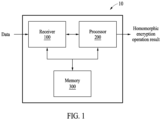
- FIG. 1 illustrates an example of a homomorphic encryption operation apparatus.
- a homomorphic encryption operation apparatus 10 may perform encryption and decryption using homomorphic encryption.
- the homomorphic encryption operation apparatus 10 may perform a blind rotation operation for a homomorphic encryption operation.
- the homomorphic encryption operation apparatus 10 of one or more embodiments may reduce the size of a public key, thereby improving homomorphic encryption technology by reducing the amount of computation of the homomorphic encryption.
- the homomorphic encryption operation apparatus 10 may generate an operation result by performing a homomorphic encryption operation.
- the homomorphic encryption operation apparatus 10 may generate a ciphertext (e.g., an operand ciphertext) for performing a blind rotation operation.
- the homomorphic encryption operation apparatus 10 may generate a secret key and a public key.
- the public key may include a key-switching key, a blind rotation key, and/or an automorphism key.
- encrypted data or encrypted text may be referred to as a ciphertext.
- the ciphertext may be in the form of a polynomial or a vector including a polynomial.
- the portable device may be, or be implemented in, a laptop computer, a mobile phone, a smart phone, a tablet PC, a mobile internet device (MID), a personal digital assistant (PDA), an enterprise digital assistant (EDA), a digital still camera, a digital video camera, a portable multimedia player (PMP), a personal navigation device or portable navigation device (PND), a handheld game console, an e-book, a smart device, a smart watch, a smart band, and/or a smart ring.
- MID mobile internet device
- PDA personal digital assistant
- EDA enterprise digital assistant
- PMP portable multimedia player
- PND personal navigation device
- handheld game console an e-book
- a smart device a smart watch, a smart band, and/or a smart ring.
- the homomorphic encryption operation apparatus 10 may include a receiver 100 and a processor 200 (e.g., one or more processors).
- the homomorphic encryption operation apparatus 10 may further include the memory 300 (e.g., one or more memories).
- the receiver 100 may include a receiving interface.
- the receiver 100 may receive data for performing a homomorphic encryption operation from the outside or from the memory 300.
- the data may be operand data (e.g., an operand ciphertext) or a key (e.g., a secret key, a key-switching key, an automorphism key, and/or a blind rotation key) for performing a homomorphic encryption operation.
- operand data e.g., an operand ciphertext
- a key e.g., a secret key, a key-switching key, an automorphism key, and/or a blind rotation key
- the blind rotation key may be generated based on a ring Gentry, Sahai, Waters (RGSW) ciphertext or a ring learning with errors' (RLWE') ciphertext.
- the key-switching key may be generated based on the RLWE' ciphertext.
- the operand ciphertext may be generated based on a learning with errors (LWE) ciphertext.
- the receiver 100 may receive a public key for performing a blind rotation operation and an operand ciphertext of the blind rotation operation.
- the public key may include a blind rotation key, an automorphism key, and a key-switching key.
- the receiver 100 may output the received public key and operand ciphertext to the processor 200.
- the processor 200 may process data stored in the memory 300.
- the processor 200 may execute a computer-readable instructions stored in the memory 300 and instructions triggered by the processor 200.
- the "processor 200" may be a data processing hardware device including a circuit having a physical structure to perform desired operations.
- the desired operations may include code or instructions included in a program.
- the data processing hardware device may include, for example, a microprocessor, a central processing unit (CPU), a processor core, a multi-core processor, a multiprocessor, an application-specific integrated circuit (ASIC), and/or a field-programmable gate array (FPGA).
- a microprocessor a central processing unit (CPU), a processor core, a multi-core processor, a multiprocessor, an application-specific integrated circuit (ASIC), and/or a field-programmable gate array (FPGA).
- CPU central processing unit
- processor core a processor core
- ASIC application-specific integrated circuit
- FPGA field-programmable gate array
- the processor 200 may generate a modified vector by preprocessing vector components of the operand ciphertext based on an order of a polynomial of an output ciphertext of the blind rotation operation and a modulus of the operand ciphertext.
- the processor 200 may compare the order of the output ciphertext with the modulus of the operand ciphertext.
- the processor 200 may generate the modified vector based on a result of the comparing.
- the processor 200 may generate a first set based on a portion of the vector components of the operand ciphertext.
- the processor 200 may generate the modified vector based on a second set, wherein the first set and the second set are disjoint.
- the processor 200 may determine a loop index based on the generator.
- the processor 200 may perform the blind rotation operation based on the loop index.
- the processor 200 may perform the blind rotation operation by performing an increment operation, an automorphism operation, and a key switching operation based on the modified vector.
- the processor 200 may obtain the number of odd numbers and the number of even numbers in the vector components of the operand ciphertext.
- the processor 200 may add "1" to the vector components of the operand ciphertext based on a result of comparing the number of odd numbers and the number of even numbers.
- the processor 200 may perform the blind rotation operation based on a blind rotation key based on vector components of a secret key of the public key, a negative sum of the vector components of the secret key, and a sum of consecutive vector components among the vector components of the secret key.
- the memory 300 may store instructions (or programs) executable by the processor 200.
- the instructions may include instructions for performing the operation of the processor 200 and/or an operation of each component of the processor 200.
- the memory 300 may include a non-transitory computer-readable storage medium storing instructions that, when executed by the processor 200, configure the processor 200 to perform any one, any combination, or all of the operations and/or methods described herein with reference to FIGS. 1-8 .
- the memory 300 may be implemented as a volatile or non-volatile memory device.
- the volatile memory device may be implemented as a dynamic random-access memory (DRAM), a static random-access memory (SRAM), a thyristor RAM (T-RAM), a zero capacitor RAM (Z-RAM), and/or a twin transistor RAM (TTRAM).
- DRAM dynamic random-access memory
- SRAM static random-access memory
- T-RAM thyristor RAM
- Z-RAM zero capacitor RAM
- TTRAM twin transistor RAM
- the non-volatile memory device may be implemented as an electrically erasable programmable read-only memory (EEPROM), a flash memory, a magnetic RAM (MRAM), a spin-transfer torque (STT)-MRAM, a conductive bridging RAM(CBRAM), a ferroelectric RAM (FeRAM), a phase change RAM (PRAM), a resistive RAM (RRAM), a nanotube RRAM, a polymer RAM (PoRAM), a nano floating gate Memory (NFGM), a holographic memory, a molecular electronic memory device), and/or an insulator resistance change memory.
- EEPROM electrically erasable programmable read-only memory
- flash memory a flash memory
- MRAM magnetic RAM
- STT spin-transfer torque
- CBRAM conductive bridging RAM
- FeRAM ferroelectric RAM
- PRAM phase change RAM
- RRAM resistive RAM
- NFGM nano floating gate Memory
- holographic memory a holographic memory
- FIG. 2 illustrates an example of an operation of a homomorphic encryption operation apparatus (e.g., the homomorphic encryption operation apparatus of FIG. 1 ).
- a ciphertext used by a processor for a homomorphic encryption operation may be defined as follows.
- a ciphertext of a message (or a plaintext) m may be expressed as ⁇ ⁇ ⁇ ⁇ Z q n + 1 .
- LWE s ( m ) may denote encryption of the message m using a secret key s .
- a ciphertext of the message m may be expressed as a b ⁇ R Q 2 .
- An RLWE ciphertext of the message m using the secret key z may be defined as expressed by Equation 1 below, for example.
- a denotes a polynomial on a modulus Q
- e denotes an error polynomial with a small coefficient.
- RLWE ′ m RLWE g 0 ⁇ m , RLWE g 1 ⁇ m , ... , RLWE g d ⁇ 1 ⁇ m
- An RGSW ciphertext of the message m for the secret key z may be defined by two RLWE' ciphertexts as expressed by Equation 3 below, for example.
- RGSW m RLWE ′ ⁇ zm , RLWE ′ m
- Homomorphic encryption operations performed by the processor 200 may be defined as follows.
- automorphism ⁇ t of a polynomial ring may output a ( X t ) with respect to an element a ( X ) of the polynomial ring, and the space of the domain and the space of the codomain may be the same.
- the processor 200 may output a X t , b X t ⁇ R Q 2 with respect to an input a X , b X ⁇ R Q 2 through the automorphism operation.
- the processor 200 may obtain a ciphertext corresponding to a new secret key z 2 from a ciphertext corresponding to a secret key z 1 through a key switching operation.
- the processor 200 may perform a blind rotation operation.
- Z q which is a ring of integers modulo q, may be integers from "0" to "q-1", and may define addition and multiplication.
- Z q ⁇ may be a subset of the ring of integers modulo q, having inverse elements for multiplication.
- Z q ⁇ may be a set having inverse elements for multiplication, in the subset of Z q . If Z q ⁇ is expressible by powers of g i s, then g i s may be referred to as generators of Z q ⁇ .
- the processor 200 may generally consider a case where q is a power of "2".
- Z q ⁇ may have a set of all odd numbers that are less than or equal to q and coprime with "2".
- all of the odd numbers may be expressed by powers of "5" and "-1".
- the processor 200 of one or more embodiments may improve homomorphic encryption technology by reducing the size of a public key and the amount of computation used for the process of the blind rotation operation.
- the processor 200 may perform the blind rotation operation using ak g and ak -g only according to a result of comparing the modulus q and 2N based on an order of an RLWE ciphertext, with the key-switching key not having ak t for all odd numbers t.
- the key generator 210 may verify a generator for generating a comparison and analysis result ⁇ i , generate a blind rotation key and a key-switching key necessary as a result of the verifying, and transmit the blind rotation key and the key-switching key to the operator 250.
- the operator 250 may set an initial value.
- the operator 250 may set the initial value in the form of a ring element.
- FIG. 4 illustrates an example of a homomorphic encryption operation of a homomorphic encryption operation apparatus (e.g., the homomorphic encryption operation apparatus of FIG. 1 ).
- Operations 411 through 443 of FIG. 4 may be performed sequentially but not necessarily performed sequentially.
- the order of the operations 411 through 443 may change and two or more of the operations 411 through 443 may be performed in parallel or simultaneously. Further, one or more of the operations 411 through 443 may be omitted, without departing from the scope of the shown example.
- the operator 250 may maintain the LWE ciphertext in its original form, in operation 419.
- the operator 250 may verify whether vector components are even for i that satisfies i ⁇ n.
- the operator 250 may perform a blind rotation operation based on the modified vector ⁇ and the secret key S .
- the process of performing the blind rotation operation may be the same as that of FIG. 3 .
- the operator 250 may output an RLWE ciphertext as a final operation result.
- the operator 250 of one or more embodiments may improve homomorphic encryption technology by efficiently using a storage space of a memory by adding only one blind rotation operation key.
- the operator 250 may perform an increment operation using the RGSW ciphertext N 2 + 1 times at the maximum, thereby adjusting a trade-off relationship between the memory and the operation.
- a key generator may generate an input LWE ciphertext as ( ⁇ , ⁇ ).
- the key generator 210 may generate a blind rotation key RGSW( X s i ) which is an RGSW ciphertext corresponding to each secret key.
- the key generator 210 may generate, as the blind rotation key, an RGSW ciphertext RGSW( X - ⁇ s i ) corresponding to the negative sum of vector components of the secret key.
- the key generator 210 may generate, as a blind rotation key, an RGSW ciphertext RGSW(X s i+si+1 ) based on the sum of consecutive vector components.
- the key generator 210 may generate automorphism keys ak g and ak -g corresponding to g and -g.
- the key generator 210 may generate a key-switching key for changing s ( X -g ) to s ( X ) .
- the key generator 210 may output the generated LWE ciphertext, the blind rotation key, the automorphism keys, and the key-switching key to an operator (e.g., the operator 250 of FIG. 2 ).
- the operator 250 may set an initial value.
- the operator 250 may set the initial value in the form of a ring element.
- the operator 250 may determine whether a first component of the vector components of the LWE ciphertext is even.
- the operator 250 may additionally perform an increment operation using the RGSW ciphertext only once, depending on whether the first vector component is odd. Accordingly, the operator 250 of one or more embodiments may improve homomorphic encryption technology by efficiently performing the homomorphic encryption operation by reducing the amount of computation. At this time, N+1 additional blind rotation keys may be generated, and thus, a trade-off may occur between the memory and the amount of computation.
- the operator 250 may perform a blind rotation operation for all components in I j + .
- the operator 250 may perform an increment operation on RGSW.
- the operator 250 may perform an automorphism operation on g' , and perform a key switching operation for restoring the secret key to the original secret key.
- the operator 250 may perform an increment operation for all vector components of I 0 + through operation 625.
- the operator 250 may output an RLWE ciphertext as a blind rotation operation result.
- a homomorphic encryption operation apparatus (e.g., the homomorphic encryption operation apparatus 10 of FIG. 1 ) of one or more embodiments may apply the example of FIG. 6 according to the vector components of the LWE ciphertext or parameter values of homomorphic encryption, thereby improving homomorphic encryption technology by efficiently performing a homomorphic encryption operation using only one automorphism key.
- both I j + and I j ⁇ may be empty sets for some j.
- the operator 250 of one or more embodiments may generate and use a plurality of automorphism keys for generators, thereby improving homomorphic encryption technology by reducing the number of times a blind rotation operation is unnecessarily performed.
- the operator 250 may generate ak g , ..., ak gb , and ak -g as automorphism keys.
- the example of generating a plurality of automorphism keys may apply to all of the examples of FIGS. 3 to 6 .
- FIG. 7 illustrates an example of a key generation operation of a homomorphic encryption operation apparatus (e.g., the homomorphic encryption operation apparatus of FIG. 1 ).
- Operations 711 through 725 of FIG. 7 may be performed sequentially but not necessarily performed sequentially.
- the order of the operations 711 through 725 may change and two or more of the operations 711 through 725 may be performed in parallel or simultaneously. Further, one or more of the operations 711 through 725 may be omitted, without departing from the scope of the shown example.
- a key generator (e.g., the key generator 210 of FIG. 2 ) may generate RGSW( X s i ) an ak g' based on the value of the generator g' for generating the vector components of the LWE ciphertext and generate a key-switching key for changing s ( X g ' ) to s ( X ), to perform the blind rotation operation shown in the example of FIG. 6 .
- FIG. 8 illustrates an example of an operation of a homomorphic encryption operation apparatus (e.g., the homomorphic encryption operation apparatus of FIG. 1 ).
- Operations 810 through 850 of FIG. 8 may be performed sequentially but not necessarily performed sequentially.
- the order of the operations 810 through 850 may change and two or more of the operations 810 through 850 may be performed in parallel or simultaneously. Further, one or more of the operations 810 through 850 may be omitted, without departing from the scope of the shown example.
- the processor 200 may generate a modified vector by preprocessing vector components of the operand ciphertext based on an order of a polynomial of an output ciphertext of the blind rotation operation and a modulus of the operand ciphertext.
- the processor 200 may generate a first set based on a portion of the vector components of the operand ciphertext.
- the processor 200 may generate the modified vector based on a second set, wherein the first set and the second set are disjoint.
- the processor 200 may generate a homomorphic encryption operation result by performing the blind rotation operation based on the public key and the modified vector.
- the public key may be generated based on the modified vector and a secret key.
- the processor 200 may perform a first blind operation based on the first set of the operand ciphertext.
- the processor 200 may perform a second blind operation based on the second set of the operand ciphertext.
- the processor 200 may obtain the number of odd numbers and the number of even numbers in the vector components of the operand ciphertext.
- the processor 200 may add "1" to the vector components of the operand ciphertext based on a result of comparing the number of odd numbers and the number of even numbers.
- the processor 200 may perform the blind rotation operation based on a blind rotation key based on vector components of a secret key of the public key, a negative sum of the vector components of the secret key, and a sum of consecutive vector components among the vector components of the secret key.
- the homomorphic encryption operation apparatuses, receivers, processors, memories, key generators, receivers, operators, homomorphic encryption operation apparatus 10, receiver 100, processor 200, memory 300, key generator 210, receiver 230, operator 250, and other apparatuses, devices, units, modules, and components disclosed and described herein with respect to FIGS. 1-8 are implemented by or representative of hardware components.
- examples of hardware components that may be used to perform the operations described in this application where appropriate include controllers, sensors, generators, drivers, memories, comparators, arithmetic logic units, adders, subtractors, multipliers, dividers, integrators, and any other electronic components configured to perform the operations described in this application.
- one or more of the hardware components that perform the operations described in this application are implemented by computing hardware, for example, by one or more processors or computers.
- a processor or computer may be implemented by one or more processing elements, such as an array of logic gates, a controller and an arithmetic logic unit, a digital signal processor, a microcomputer, a programmable logic controller, a field-programmable gate array, a programmable logic array, a microprocessor, or any other device or combination of devices that is configured to respond to and execute instructions in a defined manner to achieve a desired result.
- a processor or computer includes, or is connected to, one or more memories storing instructions or software that are executed by the processor or computer.
- Hardware components implemented by a processor or computer may execute instructions or software, such as an operating system (OS) and one or more software applications that run on the OS, to perform the operations described in this application.
- the hardware components may also access, manipulate, process, create, and store data in response to execution of the instructions or software.
- OS operating system
- processors or computers may be used, or a processor or computer may include multiple processing elements, or multiple types of processing elements, or both.
- a single hardware component or two or more hardware components may be implemented by a single processor, or two or more processors, or a processor and a controller.
- One or more hardware components may be implemented by one or more processors, or a processor and a controller, and one or more other hardware components may be implemented by one or more other processors, or another processor and another controller.
- One or more processors, or a processor and a controller may implement a single hardware component, or two or more hardware components.
- example hardware components may have any one or more of different processing configurations, examples of which include a single processor, independent processors, parallel processors, single-instruction single-data (SISD) multiprocessing, single-instruction multiple-data (SIMD) multiprocessing, multiple-instruction single-data (MISD) multiprocessing, and multiple-instruction multiple-data (MIMD) multiprocessing.
- SISD single-instruction single-data
- SIMD single-instruction multiple-data
- MIMD multiple-instruction multiple-data
- FIGS. 1-8 that perform the operations described in this application are performed by computing hardware, for example, by one or more processors or computers, implemented as described above implementing instructions or software to perform the operations described in this application that are performed by the methods.
- a single operation or two or more operations may be performed by a single processor, or two or more processors, or a processor and a controller.
- One or more operations may be performed by one or more processors, or a processor and a controller, and one or more other operations may be performed by one or more other processors, or another processor and another controller.
- One or more processors, or a processor and a controller may perform a single operation, or two or more operations.
- Instructions or software to control computing hardware may be written as computer programs, code segments, instructions or any combination thereof, for individually or collectively instructing or configuring the one or more processors or computers to operate as a machine or special-purpose computer to perform the operations that are performed by the hardware components and the methods as described above.
- the instructions or software include machine code that is directly executed by the one or more processors or computers, such as machine code produced by a compiler.
- the instructions or software includes higher-level code that is executed by the one or more processors or computer using an interpreter.
- the instructions or software may be written using any programming language based on the block diagrams and the flow charts illustrated in the drawings and the corresponding descriptions herein, which disclose algorithms for performing the operations that are performed by the hardware components and the methods as described above.
- the instructions or software to control computing hardware for example, one or more processors or computers, to implement the hardware components and perform the methods as described above, and any associated data, data files, and data structures, may be recorded, stored, or fixed in or on one or more non-transitory computer-readable storage media, and thus, not a signal per se.
- examples of a non-transitory computer-readable storage medium include one or more of any of read-only memory (ROM), random-access programmable read only memory (PROM), electrically erasable programmable read-only memory (EEPROM), random-access memory (RAM), dynamic random access memory (DRAM), static random access memory (SRAM), flash memory, non-volatile memory, CD-ROMs, CD-Rs, CD+Rs, CD-RWs, CD+RWs, DVD-ROMs, DVD- Rs, DVD+Rs, DVD-RWs, DVD+RWs, DVD-RAMs, BD-ROMs, BD-Rs, BD-R LTHs, BD-REs, blue-ray or optical disk storage, hard disk drive (HDD), solid state drive (SSD), flash memory, a card type memory such as multimedia card micro or a card (for example, secure digital (SD) or extreme digital (XD)), magnetic tapes, floppy disks, magneto
- SD secure digital
- XD extreme
- the instructions or software and any associated data, data files, and data structures are distributed over network-coupled computer systems so that the instructions and software and any associated data, data files, and data structures are stored, accessed, and executed in a distributed fashion by the one or more processors or computers.
Landscapes
- Engineering & Computer Science (AREA)
- Computer Security & Cryptography (AREA)
- Computer Networks & Wireless Communication (AREA)
- Signal Processing (AREA)
- Executing Machine-Instructions (AREA)
Claims (15)
- Eine Vorrichtung mit einer homomorphen Verschlüsselungsoperation, wobei die Vorrichtung Folgendes aufweist:
einen oder mehrere Prozessoren, die konfiguriert sind, zum:Erzeugen eines modifizierten Vektors durch Vorverarbeiten von Vektorkomponenten eines Operanden-Chiffretextes einer blinden Rotationsoperation basierend auf einer Ordnung eines Polynoms eines Ausgangs-Chiffretextes der blinden Rotationsoperation und einem Modulus des Operanden-Chiffretextes; undErzeugen eines homomorphen Verschlüsselungsoperationsergebnisses durch Ausführen der Blindrotationsoperation basierend auf einem öffentlichen Schlüssel zum Ausführen der Blindrotationsoperation und dem modifizierten Vektor. - Die Vorrichtung nach Anspruch 1, wobei der öffentliche Schlüssel einen Blindrotationsschlüssel, einen Automorphismusschlüssel und einen Schlüsselumschaltschlüssel aufweist.
- Die Vorrichtung nach Anspruch 1 oder 2, wobei der öffentliche Schlüssel auf der Grundlage des modifizierten Vektors und eines geheimen Schlüssels erzeugt wird.
- Die Vorrichtung nach einem der Ansprüche 1 bis 3, wobei für die Erzeugung des modifizierten Vektors der eine oder die mehreren Prozessoren konfiguriert sind, um:den Modulus und die Reihenfolge des ausgegebenen Chiffretextes zu vergleichen; undErzeugen des modifizierten Vektors auf der Grundlage eines Ergebnisses des Vergleichs.
- Die Vorrichtung nach einem der Ansprüche 1 bis 4, wobei für die Erzeugung des modifizierten Vektors der eine oder die mehreren Prozessoren konfiguriert sind, um:einen ersten Satz auf der Basis eines Abschnitts der Vektorkomponenten des Operandenchiffriertextes zu erzeugen; undErzeugen des modifizierten Vektors auf der Grundlage eines zweiten Satzes, wobei der erste Satz und der zweite Satz disjunkt sind.
- Die Vorrichtung nach einem der Ansprüche 1 bis 5, wobei zum Erzeugen des Ergebnisses der homomorphen Verschlüsselungsoperation der eine oder die mehreren Prozessoren so konfiguriert sind, dass sie einen oder mehrere der folgenden Schritte ausführen:Bestimmen eines Schleifenindexes auf der Basis des Generators, wenn ein Generator der Vektorkomponenten des Operanden-Chiffretextes eindeutig ist; und Durchführen der blinden Rotationsoperation auf der Basis des Schleifenindexes, oderDurchführen einer ersten Blindoperation auf der Grundlage eines ersten Satzes des Operandenchiffretextes; und Durchführen einer zweiten Blindoperation auf der Grundlage eines zweiten Satzes des Operandenchiffretextes, oderDurchführen der blinden Rotationsoperation durch Durchführen einer Inkrementierungsoperation, einer Automorphismusoperation und einer Schlüsselumschaltoperation auf der Grundlage des modifizierten Vektors, oderBestimmen einer Anzahl von ungeraden Zahlen und einer Anzahl von geraden Zahlen in den Vektorkomponenten des Operanden-Chiffretextes; und Addieren von "1" zu den Vektorkomponenten des Operanden-Chiffretextes basierend auf einem Ergebnis des Vergleichs der Anzahl von ungeraden Zahlen und der Anzahl von geraden Zahlen.
- Die Vorrichtung nach einem der Ansprüche 1 bis 6, wobei zum Erzeugen des Ergebnisses der homomorphen Verschlüsselungsoperation der eine oder die mehreren Prozessoren so konfiguriert sind, dass sie als Reaktion darauf, dass die Vektorkomponenten des Operandenchiffriertextes gerade sind, die Blindrotationsoperation auf der Grundlage eines Blindrotationsschlüssels auf der Basis von Vektorkomponenten eines geheimen Schlüssels des öffentlichen Schlüssels, einer negativen Summe der Vektorkomponenten des geheimen Schlüssels und einer Summe von aufeinanderfolgenden Vektorkomponenten unter den Vektorkomponenten des geheimen Schlüssels durchführen.
- Die Vorrichtung nach einem der Ansprüche 1 bis 7, ferner aufweisend einen Empfänger, der so konfiguriert ist, dass er den öffentlichen Schlüssel und den Operandenchiffretext empfängt.
- Ein prozessor-implementiertes Verfahren mit einer homomorphen Verschlüsselungsoperation, wobei das Verfahren aufweist:Erzeugen eines modifizierten Vektors durch Vorverarbeiten von Vektorkomponenten eines Operanden-Chiffretextes einer blinden Rotationsoperation basierend auf einer Ordnung eines Polynoms eines Ausgangs-Chiffretextes der blinden Rotationsoperation und einem Modulus des Operanden-Chiffretextes; undErzeugen eines homomorphen Verschlüsselungsoperationsergebnisses durch Ausführen der Blindrotationsoperation an dem modifizierten Vektor auf der Grundlage eines öffentlichen Schlüssels zum Ausführen der Blindrotationsoperation.
- Das Verfahren nach Anspruch 9, wobei der öffentliche Schlüssel einen Blindrotationsschlüssel, einen Automorphismusschlüssel und einen Schlüsselumschaltschlüssel aufweist, oder wobei der öffentliche Schlüssel auf der Basis des modifizierten Vektors und eines geheimen Schlüssels erzeugt wird.
- Das Verfahren nach Anspruch 9 oder 10, wobei das Erzeugen des modifizierten Vektors aufweist:Vergleichen des Moduls und der Reihenfolge des ausgegebenen Chiffretextes; undErzeugen des modifizierten Vektors auf der Grundlage eines Ergebnisses des Vergleichs.
- Das Verfahren nach einem der Ansprüche 9 bis 11, wobei das Erzeugen des modifizierten Vektors aufweist:Erzeugen eines ersten Satzes auf der Basis eines Abschnitts der Vektorkomponenten des Operanden-Chiffretextes; undErzeugen des modifizierten Vektors auf der Grundlage eines zweiten Satzes, wobei der erste Satz und der zweite Satz disjunkt sind.
- Das Verfahren nach einem der Ansprüche 9 bis 12, wobei das Erzeugen des Ergebnisses der homomorphen Verschlüsselungsoperation aufweisend ist:Bestimmen eines Schleifenindexes auf der Basis des Generators, wenn ein Generator der Vektorkomponenten des Operandenchiffretextes eindeutig ist; undDurchführen der Blindrotationsoperation auf der Grundlage des Schleifenindexes.
- Das Verfahren nach einem der Ansprüche 9 bis 13, wobei das Erzeugen des Ergebnisses der homomorphen Verschlüsselungsoperation aufweisend ist:Durchführen einer ersten Blindoperation auf der Grundlage eines ersten Satzes des Operandenchiffretextes; undDurchführen einer zweiten Blindoperation auf der Grundlage eines zweiten Satzes des Operandenchiffriertextes.
- Das Verfahren nach einem der Ansprüche 9 bis 14, wobei das Erzeugen des Ergebnisses der homomorphen Verschlüsselungsoperation eines oder mehrere der folgenden Merkmale aufweist:Durchführen der blinden Rotationsoperation durch Ausführen einer Inkrement-Operation, einer Automorphismus-Operation und einer Schlüsselumschalt-Operation auf der Grundlage des modifizierten Vektors, oderBestimmen einer Anzahl von ungeraden Zahlen und einer Anzahl von geraden Zahlen in den Vektorkomponenten des Operanden-Chiffretextes; und Addieren von "1" zu den Vektorkomponenten des Operanden-Chiffretextes auf der Grundlage eines Ergebnisses des Vergleichs der Anzahl von ungeraden Zahlen und der Anzahl von geraden Zahlen, oderals Reaktion darauf, dass die Vektorkomponenten des Operanden-Chiffretextes gerade sind, Durchführen der blinden Rotationsoperation auf der Grundlage eines blinden Rotationsschlüssels auf der Grundlage von Vektorkomponenten eines geheimen Schlüssels des öffentlichen Schlüssels, einer negativen Summe der Vektorkomponenten des geheimen Schlüssels und einer Summe von aufeinanderfolgenden Vektorkomponenten unter den Vektorkomponenten des geheimen Schlüssels.
Applications Claiming Priority (2)
| Application Number | Priority Date | Filing Date | Title |
|---|---|---|---|
| KR20220126564 | 2022-10-04 | ||
| KR1020220170614A KR20240047280A (ko) | 2022-10-04 | 2022-12-08 | 동형 암호 연산 장치 및 방법 |
Publications (2)
| Publication Number | Publication Date |
|---|---|
| EP4351079A1 EP4351079A1 (de) | 2024-04-10 |
| EP4351079B1 true EP4351079B1 (de) | 2025-07-09 |
Family
ID=87762787
Family Applications (1)
| Application Number | Title | Priority Date | Filing Date |
|---|---|---|---|
| EP23192922.5A Active EP4351079B1 (de) | 2022-10-04 | 2023-08-23 | Vorrichtung und verfahren mit homomorpher verschlüsselungsoperation |
Country Status (2)
| Country | Link |
|---|---|
| US (1) | US12368570B2 (de) |
| EP (1) | EP4351079B1 (de) |
Family Cites Families (10)
| Publication number | Priority date | Publication date | Assignee | Title |
|---|---|---|---|---|
| US10778409B2 (en) * | 2017-12-15 | 2020-09-15 | Crypto Lab Inc. | Terminal device performing homomorphic encryption, server device processing ciphertext and methods thereof |
| KR102349855B1 (ko) | 2020-04-16 | 2022-01-11 | 주식회사 크립토랩 | 공간 복잡도를 고려한 동형 암호화 또는 복호화 방법 |
| US11962679B2 (en) * | 2020-06-19 | 2024-04-16 | Duality Technologies, Inc. | Secure distributed key generation for multiparty homomorphic encryption |
| KR20220120410A (ko) | 2021-02-23 | 2022-08-30 | 삼성전자주식회사 | 동형 암호에서 교환 법칙 및 결합 법칙을 이용한 암호화 방법 및 장치 |
| KR20240004830A (ko) * | 2021-05-04 | 2024-01-11 | 자마 에스에이에스 | 완전 동형 암호화에서 사용하기 위한 블라인드 회전 |
| US12184771B2 (en) | 2021-05-21 | 2024-12-31 | Samsung Electronics Co., Ltd. | Encryption key generating method, apparatus, ciphertext operation method and apparatus using the generated encryption key |
| US11722290B2 (en) | 2021-05-21 | 2023-08-08 | Samsung Electronics Co., Ltd. | Method and apparatus for modulus refresh in homomorphic encryption |
| US12432043B2 (en) | 2021-11-26 | 2025-09-30 | Samsung Electronics Co., Ltd. | Homomorphic encryption apparatus and method |
| EP4195577A1 (de) | 2021-12-07 | 2023-06-14 | Zama SAS | Verschlüsselte berechung mit einer blinden rotation |
| EP4221069A1 (de) | 2022-01-28 | 2023-08-02 | Samsung Electronics Co., Ltd. | Vorrichtung und verfahren mit homomorpher verschlüsselung mittels automorphismus |
-
2023
- 2023-05-11 US US18/316,062 patent/US12368570B2/en active Active
- 2023-08-23 EP EP23192922.5A patent/EP4351079B1/de active Active
Also Published As
| Publication number | Publication date |
|---|---|
| EP4351079A1 (de) | 2024-04-10 |
| US20240129106A1 (en) | 2024-04-18 |
| US12368570B2 (en) | 2025-07-22 |
Similar Documents
| Publication | Publication Date | Title |
|---|---|---|
| US11722290B2 (en) | Method and apparatus for modulus refresh in homomorphic encryption | |
| EP4221069A1 (de) | Vorrichtung und verfahren mit homomorpher verschlüsselung mittels automorphismus | |
| US12231544B2 (en) | Method and apparatus with homomorphic encryption | |
| US12432043B2 (en) | Homomorphic encryption apparatus and method | |
| US12184771B2 (en) | Encryption key generating method, apparatus, ciphertext operation method and apparatus using the generated encryption key | |
| Dridi et al. | Prime factorization using quantum annealing and computational algebraic geometry | |
| EP3907926B1 (de) | Verschlüsselungsverfahren und -vorrichtung unter verwendung von homomorpher verschlüsselung | |
| EP4436094A1 (de) | Vorrichtung und verfahren für bootstrapping einer homomorphen verschlüsselung | |
| US20220052848A1 (en) | Method and apparatus with encryption based on error variance in homomorphic encryption | |
| EP4258591A1 (de) | Vorrichtung und verfahren mit homomorpher verschlüsselungsoperation | |
| US8756410B2 (en) | Polynomial evaluation delegation | |
| US20240340158A1 (en) | Apparatus and method with homomorphic encryption operation | |
| US20240313945A1 (en) | Apparatus and method with homomorphic encryption | |
| KR20240004830A (ko) | 완전 동형 암호화에서 사용하기 위한 블라인드 회전 | |
| US12368569B2 (en) | Apparatus and method with homomorphic encryption | |
| EP3264669B1 (de) | System und verfahren zur suche über verschlüsselten daten mithilfe homomorpher verschlüsselung | |
| US20250106005A1 (en) | Apparatus and method with intersection operation | |
| EP4351079A1 (de) | Vorrichtung und verfahren mit homomorpher verschlüsselungsoperation | |
| US20240273218A1 (en) | Apparatus and method with neural network operation of homomorphic encrypted data | |
| Park et al. | Hyperdimensional computing as a rescue for efficient privacy-preserving machine learning-as-a-service | |
| US12483382B2 (en) | Apparatus and method with homomorphic encryption | |
| Shortell et al. | Secure Convolutional Neural Network using FHE | |
| CN117857004A (zh) | 具有同态加密操作的装置和方法 | |
| US20250036943A1 (en) | Method and apparatus with neural network operation of homomorphic encrypted data | |
| US20260067062A1 (en) | Method and device with intersection and label operations |
Legal Events
| Date | Code | Title | Description |
|---|---|---|---|
| PUAI | Public reference made under article 153(3) epc to a published international application that has entered the european phase |
Free format text: ORIGINAL CODE: 0009012 |
|
| STAA | Information on the status of an ep patent application or granted ep patent |
Free format text: STATUS: REQUEST FOR EXAMINATION WAS MADE |
|
| 17P | Request for examination filed |
Effective date: 20230823 |
|
| AK | Designated contracting states |
Kind code of ref document: A1 Designated state(s): AL AT BE BG CH CY CZ DE DK EE ES FI FR GB GR HR HU IE IS IT LI LT LU LV MC ME MK MT NL NO PL PT RO RS SE SI SK SM TR |
|
| P01 | Opt-out of the competence of the unified patent court (upc) registered |
Effective date: 20240530 |
|
| GRAP | Despatch of communication of intention to grant a patent |
Free format text: ORIGINAL CODE: EPIDOSNIGR1 |
|
| STAA | Information on the status of an ep patent application or granted ep patent |
Free format text: STATUS: GRANT OF PATENT IS INTENDED |
|
| RIC1 | Information provided on ipc code assigned before grant |
Ipc: H04L 9/08 20060101ALN20250123BHEP Ipc: H04L 9/00 20220101AFI20250123BHEP |
|
| INTG | Intention to grant announced |
Effective date: 20250212 |
|
| GRAS | Grant fee paid |
Free format text: ORIGINAL CODE: EPIDOSNIGR3 |
|
| GRAA | (expected) grant |
Free format text: ORIGINAL CODE: 0009210 |
|
| STAA | Information on the status of an ep patent application or granted ep patent |
Free format text: STATUS: THE PATENT HAS BEEN GRANTED |
|
| AK | Designated contracting states |
Kind code of ref document: B1 Designated state(s): AL AT BE BG CH CY CZ DE DK EE ES FI FR GB GR HR HU IE IS IT LI LT LU LV MC ME MK MT NL NO PL PT RO RS SE SI SK SM TR |
|
| REG | Reference to a national code |
Ref country code: GB Ref legal event code: FG4D |
|
| REG | Reference to a national code |
Ref country code: CH Ref legal event code: EP |
|
| REG | Reference to a national code |
Ref country code: IE Ref legal event code: FG4D |
|
| REG | Reference to a national code |
Ref country code: DE Ref legal event code: R096 Ref document number: 602023004661 Country of ref document: DE |
|
| PGFP | Annual fee paid to national office [announced via postgrant information from national office to epo] |
Ref country code: DE Payment date: 20250805 Year of fee payment: 3 |
|
| PGFP | Annual fee paid to national office [announced via postgrant information from national office to epo] |
Ref country code: FR Payment date: 20250808 Year of fee payment: 3 Ref country code: AT Payment date: 20251020 Year of fee payment: 3 |
|
| REG | Reference to a national code |
Ref country code: NL Ref legal event code: MP Effective date: 20250709 |
|
| PG25 | Lapsed in a contracting state [announced via postgrant information from national office to epo] |
Ref country code: PT Free format text: LAPSE BECAUSE OF FAILURE TO SUBMIT A TRANSLATION OF THE DESCRIPTION OR TO PAY THE FEE WITHIN THE PRESCRIBED TIME-LIMIT Effective date: 20251110 |
|
| PG25 | Lapsed in a contracting state [announced via postgrant information from national office to epo] |
Ref country code: NL Free format text: LAPSE BECAUSE OF FAILURE TO SUBMIT A TRANSLATION OF THE DESCRIPTION OR TO PAY THE FEE WITHIN THE PRESCRIBED TIME-LIMIT Effective date: 20250709 |
|
| REG | Reference to a national code |
Ref country code: AT Ref legal event code: MK05 Ref document number: 1812899 Country of ref document: AT Kind code of ref document: T Effective date: 20250709 |
|
| PG25 | Lapsed in a contracting state [announced via postgrant information from national office to epo] |
Ref country code: IS Free format text: LAPSE BECAUSE OF FAILURE TO SUBMIT A TRANSLATION OF THE DESCRIPTION OR TO PAY THE FEE WITHIN THE PRESCRIBED TIME-LIMIT Effective date: 20251109 |
|
| PG25 | Lapsed in a contracting state [announced via postgrant information from national office to epo] |
Ref country code: NO Free format text: LAPSE BECAUSE OF FAILURE TO SUBMIT A TRANSLATION OF THE DESCRIPTION OR TO PAY THE FEE WITHIN THE PRESCRIBED TIME-LIMIT Effective date: 20251009 |
|
| REG | Reference to a national code |
Ref country code: LT Ref legal event code: MG9D |
|
| PG25 | Lapsed in a contracting state [announced via postgrant information from national office to epo] |
Ref country code: AT Free format text: LAPSE BECAUSE OF FAILURE TO SUBMIT A TRANSLATION OF THE DESCRIPTION OR TO PAY THE FEE WITHIN THE PRESCRIBED TIME-LIMIT Effective date: 20250709 |
|
| PG25 | Lapsed in a contracting state [announced via postgrant information from national office to epo] |
Ref country code: FI Free format text: LAPSE BECAUSE OF FAILURE TO SUBMIT A TRANSLATION OF THE DESCRIPTION OR TO PAY THE FEE WITHIN THE PRESCRIBED TIME-LIMIT Effective date: 20250709 |
|
| PG25 | Lapsed in a contracting state [announced via postgrant information from national office to epo] |
Ref country code: HR Free format text: LAPSE BECAUSE OF FAILURE TO SUBMIT A TRANSLATION OF THE DESCRIPTION OR TO PAY THE FEE WITHIN THE PRESCRIBED TIME-LIMIT Effective date: 20250709 |
|
| PG25 | Lapsed in a contracting state [announced via postgrant information from national office to epo] |
Ref country code: GR Free format text: LAPSE BECAUSE OF FAILURE TO SUBMIT A TRANSLATION OF THE DESCRIPTION OR TO PAY THE FEE WITHIN THE PRESCRIBED TIME-LIMIT Effective date: 20251010 |
|
| PG25 | Lapsed in a contracting state [announced via postgrant information from national office to epo] |
Ref country code: SE Free format text: LAPSE BECAUSE OF FAILURE TO SUBMIT A TRANSLATION OF THE DESCRIPTION OR TO PAY THE FEE WITHIN THE PRESCRIBED TIME-LIMIT Effective date: 20250709 |
|
| PG25 | Lapsed in a contracting state [announced via postgrant information from national office to epo] |
Ref country code: LV Free format text: LAPSE BECAUSE OF FAILURE TO SUBMIT A TRANSLATION OF THE DESCRIPTION OR TO PAY THE FEE WITHIN THE PRESCRIBED TIME-LIMIT Effective date: 20250709 |
|
| PG25 | Lapsed in a contracting state [announced via postgrant information from national office to epo] |
Ref country code: BG Free format text: LAPSE BECAUSE OF FAILURE TO SUBMIT A TRANSLATION OF THE DESCRIPTION OR TO PAY THE FEE WITHIN THE PRESCRIBED TIME-LIMIT Effective date: 20250709 Ref country code: PL Free format text: LAPSE BECAUSE OF FAILURE TO SUBMIT A TRANSLATION OF THE DESCRIPTION OR TO PAY THE FEE WITHIN THE PRESCRIBED TIME-LIMIT Effective date: 20250709 |
|
| PG25 | Lapsed in a contracting state [announced via postgrant information from national office to epo] |
Ref country code: RS Free format text: LAPSE BECAUSE OF FAILURE TO SUBMIT A TRANSLATION OF THE DESCRIPTION OR TO PAY THE FEE WITHIN THE PRESCRIBED TIME-LIMIT Effective date: 20251009 |
|
| PG25 | Lapsed in a contracting state [announced via postgrant information from national office to epo] |
Ref country code: ES Free format text: LAPSE BECAUSE OF FAILURE TO SUBMIT A TRANSLATION OF THE DESCRIPTION OR TO PAY THE FEE WITHIN THE PRESCRIBED TIME-LIMIT Effective date: 20250709 |
|
| PG25 | Lapsed in a contracting state [announced via postgrant information from national office to epo] |
Ref country code: RO Free format text: LAPSE BECAUSE OF FAILURE TO SUBMIT A TRANSLATION OF THE DESCRIPTION OR TO PAY THE FEE WITHIN THE PRESCRIBED TIME-LIMIT Effective date: 20250709 |
|
| PG25 | Lapsed in a contracting state [announced via postgrant information from national office to epo] |
Ref country code: SM Free format text: LAPSE BECAUSE OF FAILURE TO SUBMIT A TRANSLATION OF THE DESCRIPTION OR TO PAY THE FEE WITHIN THE PRESCRIBED TIME-LIMIT Effective date: 20250709 |
|
| PG25 | Lapsed in a contracting state [announced via postgrant information from national office to epo] |
Ref country code: DK Free format text: LAPSE BECAUSE OF FAILURE TO SUBMIT A TRANSLATION OF THE DESCRIPTION OR TO PAY THE FEE WITHIN THE PRESCRIBED TIME-LIMIT Effective date: 20250709 |
|
| PG25 | Lapsed in a contracting state [announced via postgrant information from national office to epo] |
Ref country code: LU Free format text: LAPSE BECAUSE OF NON-PAYMENT OF DUE FEES Effective date: 20250823 Ref country code: IT Free format text: LAPSE BECAUSE OF FAILURE TO SUBMIT A TRANSLATION OF THE DESCRIPTION OR TO PAY THE FEE WITHIN THE PRESCRIBED TIME-LIMIT Effective date: 20250709 |
|
| PG25 | Lapsed in a contracting state [announced via postgrant information from national office to epo] |
Ref country code: CZ Free format text: LAPSE BECAUSE OF FAILURE TO SUBMIT A TRANSLATION OF THE DESCRIPTION OR TO PAY THE FEE WITHIN THE PRESCRIBED TIME-LIMIT Effective date: 20250709 |
|
| PG25 | Lapsed in a contracting state [announced via postgrant information from national office to epo] |
Ref country code: SK Free format text: LAPSE BECAUSE OF FAILURE TO SUBMIT A TRANSLATION OF THE DESCRIPTION OR TO PAY THE FEE WITHIN THE PRESCRIBED TIME-LIMIT Effective date: 20250709 Ref country code: EE Free format text: LAPSE BECAUSE OF FAILURE TO SUBMIT A TRANSLATION OF THE DESCRIPTION OR TO PAY THE FEE WITHIN THE PRESCRIBED TIME-LIMIT Effective date: 20250709 |
|
| PLBE | No opposition filed within time limit |
Free format text: ORIGINAL CODE: 0009261 |
|
| STAA | Information on the status of an ep patent application or granted ep patent |
Free format text: STATUS: NO OPPOSITION FILED WITHIN TIME LIMIT |