EP4350659A1 - Database generation method, database generation device, database generation program, data analysis method, data analysis device, and data analysis program - Google Patents
Database generation method, database generation device, database generation program, data analysis method, data analysis device, and data analysis program Download PDFInfo
- Publication number
- EP4350659A1 EP4350659A1 EP22842060.0A EP22842060A EP4350659A1 EP 4350659 A1 EP4350659 A1 EP 4350659A1 EP 22842060 A EP22842060 A EP 22842060A EP 4350659 A1 EP4350659 A1 EP 4350659A1
- Authority
- EP
- European Patent Office
- Prior art keywords
- comfortableness
- type
- travel
- road
- mobility device
- Prior art date
- Legal status (The legal status is an assumption and is not a legal conclusion. Google has not performed a legal analysis and makes no representation as to the accuracy of the status listed.)
- Pending
Links
Images




Classifications
-
- G—PHYSICS
- G08—SIGNALLING
- G08G—TRAFFIC CONTROL SYSTEMS
- G08G1/00—Traffic control systems for road vehicles
- G08G1/123—Traffic control systems for road vehicles indicating the position of vehicles, e.g. scheduled vehicles; Managing passenger vehicles circulating according to a fixed timetable, e.g. buses, trains, trams
- G08G1/127—Traffic control systems for road vehicles indicating the position of vehicles, e.g. scheduled vehicles; Managing passenger vehicles circulating according to a fixed timetable, e.g. buses, trains, trams to a central station ; Indicators in a central station
- G08G1/13—Traffic control systems for road vehicles indicating the position of vehicles, e.g. scheduled vehicles; Managing passenger vehicles circulating according to a fixed timetable, e.g. buses, trains, trams to a central station ; Indicators in a central station the indicator being in the form of a map
-
- G—PHYSICS
- G01—MEASURING; TESTING
- G01C—MEASURING DISTANCES, LEVELS OR BEARINGS; SURVEYING; NAVIGATION; GYROSCOPIC INSTRUMENTS; PHOTOGRAMMETRY OR VIDEOGRAMMETRY
- G01C21/00—Navigation; Navigational instruments not provided for in groups G01C1/00 - G01C19/00
- G01C21/38—Electronic maps specially adapted for navigation; Updating thereof
- G01C21/3804—Creation or updating of map data
- G01C21/3807—Creation or updating of map data characterised by the type of data
- G01C21/3815—Road data
-
- G—PHYSICS
- G01—MEASURING; TESTING
- G01C—MEASURING DISTANCES, LEVELS OR BEARINGS; SURVEYING; NAVIGATION; GYROSCOPIC INSTRUMENTS; PHOTOGRAMMETRY OR VIDEOGRAMMETRY
- G01C21/00—Navigation; Navigational instruments not provided for in groups G01C1/00 - G01C19/00
- G01C21/38—Electronic maps specially adapted for navigation; Updating thereof
- G01C21/3804—Creation or updating of map data
- G01C21/3807—Creation or updating of map data characterised by the type of data
- G01C21/3815—Road data
- G01C21/3819—Road shape data, e.g. outline of a route
-
- G—PHYSICS
- G01—MEASURING; TESTING
- G01C—MEASURING DISTANCES, LEVELS OR BEARINGS; SURVEYING; NAVIGATION; GYROSCOPIC INSTRUMENTS; PHOTOGRAMMETRY OR VIDEOGRAMMETRY
- G01C21/00—Navigation; Navigational instruments not provided for in groups G01C1/00 - G01C19/00
- G01C21/38—Electronic maps specially adapted for navigation; Updating thereof
- G01C21/3804—Creation or updating of map data
- G01C21/3807—Creation or updating of map data characterised by the type of data
- G01C21/3815—Road data
- G01C21/3822—Road feature data, e.g. slope data
-
- G—PHYSICS
- G01—MEASURING; TESTING
- G01C—MEASURING DISTANCES, LEVELS OR BEARINGS; SURVEYING; NAVIGATION; GYROSCOPIC INSTRUMENTS; PHOTOGRAMMETRY OR VIDEOGRAMMETRY
- G01C21/00—Navigation; Navigational instruments not provided for in groups G01C1/00 - G01C19/00
- G01C21/38—Electronic maps specially adapted for navigation; Updating thereof
- G01C21/3804—Creation or updating of map data
- G01C21/3833—Creation or updating of map data characterised by the source of data
- G01C21/3841—Data obtained from two or more sources, e.g. probe vehicles
-
- G—PHYSICS
- G06—COMPUTING OR CALCULATING; COUNTING
- G06F—ELECTRIC DIGITAL DATA PROCESSING
- G06F16/00—Information retrieval; Database structures therefor; File system structures therefor
- G06F16/20—Information retrieval; Database structures therefor; File system structures therefor of structured data, e.g. relational data
- G06F16/29—Geographical information databases
-
- G—PHYSICS
- G07—CHECKING-DEVICES
- G07C—TIME OR ATTENDANCE REGISTERS; REGISTERING OR INDICATING THE WORKING OF MACHINES; GENERATING RANDOM NUMBERS; VOTING OR LOTTERY APPARATUS; ARRANGEMENTS, SYSTEMS OR APPARATUS FOR CHECKING NOT PROVIDED FOR ELSEWHERE
- G07C5/00—Registering or indicating the working of vehicles
- G07C5/008—Registering or indicating the working of vehicles communicating information to a remotely located station
-
- G—PHYSICS
- G08—SIGNALLING
- G08G—TRAFFIC CONTROL SYSTEMS
- G08G1/00—Traffic control systems for road vehicles
- G08G1/01—Detecting movement of traffic to be counted or controlled
-
- G—PHYSICS
- G08—SIGNALLING
- G08G—TRAFFIC CONTROL SYSTEMS
- G08G1/00—Traffic control systems for road vehicles
- G08G1/01—Detecting movement of traffic to be counted or controlled
- G08G1/0104—Measuring and analyzing of parameters relative to traffic conditions
- G08G1/0108—Measuring and analyzing of parameters relative to traffic conditions based on the source of data
- G08G1/0112—Measuring and analyzing of parameters relative to traffic conditions based on the source of data from the vehicle, e.g. floating car data [FCD]
-
- G—PHYSICS
- G08—SIGNALLING
- G08G—TRAFFIC CONTROL SYSTEMS
- G08G1/00—Traffic control systems for road vehicles
- G08G1/01—Detecting movement of traffic to be counted or controlled
- G08G1/0104—Measuring and analyzing of parameters relative to traffic conditions
- G08G1/0125—Traffic data processing
- G08G1/0129—Traffic data processing for creating historical data or processing based on historical data
-
- G—PHYSICS
- G08—SIGNALLING
- G08G—TRAFFIC CONTROL SYSTEMS
- G08G1/00—Traffic control systems for road vehicles
- G08G1/01—Detecting movement of traffic to be counted or controlled
- G08G1/0104—Measuring and analyzing of parameters relative to traffic conditions
- G08G1/0137—Measuring and analyzing of parameters relative to traffic conditions for specific applications
- G08G1/0141—Measuring and analyzing of parameters relative to traffic conditions for specific applications for traffic information dissemination
Definitions
- the present disclosure relates to a technique for generating a database and a technique for extracting predetermined data satisfying an extraction condition from a database.
- Patent Literature 1 discloses that a traveling state of a vehicle on a road that is not included in map information is acquired, and in a case where the traveling state is determined to satisfy a predetermined registration criterion, the road on which the vehicle travels is determined to be one on which a vehicle can be driven comfortably, and the road is added to map information.
- Patent Literature 1 JP 2019-138876 A
- the present disclosure has been made to solve the above problem, and an object of the present disclosure is to provide a technique of generating a database in which comfortableness of when traveling on a road in a predetermined area in a mobility device can be collected for each type of mobility device.
- a database generation method includes: by a computer, acquiring state information indicating a type and a location of a plurality of mobility devices traveling on one or more roads in a predetermined area; for each of the one or more roads, calculating, based on the state information and for each of types of the plurality of mobility devices, travel comfortableness indicating how high comfortableness is when traveling in each type of mobility device on each road among the one or more roads; and generating a database that associates, for each of the one or more roads, the type of the plurality of mobility devices with the travel comfortableness when traveling in the type of mobility device on each road.
- a light vehicle, a motorized bicycle (motorcycle), and the like may be prescribed by law to travel on the edge side of a road at a lower speed than an automobile.
- a light vehicle, a motorized bicycle, and the like often decelerate or greatly change a traveling direction in order to avoid a pedestrian and an automobile parked or stopped on a road, and often causes travel to be less comfortable than that on an automobile even in a case of traveling on the same road.
- Patent Literature 1 only a road on which a traveling state of a vehicle satisfies a predetermined registration criterion is added to map information, and it is not possible to grasp comfortableness at the time of traveling on a road for each vehicle type from the map information.
- a database in which a type of a plurality of mobility devices is associated with travel comfortableness of when traveling on each road in the type of mobility device is generated. For this reason, it is possible to collect travel comfortableness of when traveling on each road in a predetermined area in a specific type of mobility device from a generated database.
- the collected travel comfortableness it is possible to grasp relatively how high comfortableness each road can be traveled with among one or more roads in a predetermined area by a mobility device of a specific type.
- a mobility device of a specific type By the above, in a case of moving in a predetermined area, it is possible to grasp which type of mobility device should be used and on which road one should travel in order to move comfortably.
- the state information may further include information indicating a time of when the plurality of mobility devices travel, in the calculation of the travel comfortableness, for each of the one or more roads, a type of the plurality of mobility devices and the travel comfortableness in a time zone in which the plurality of mobility devices travel may be calculated based on the state information, and in the generation of the database, for each of the one or more roads, a type of the plurality of mobility devices, a time zone in which the plurality of mobility devices travel, and the travel comfortableness of when traveling on each road in the type of mobility device in the time zone may be associated.
- a database in which a type of a plurality of mobility device, a time zone in which the plurality of mobility devices travel, travel comfortableness of when traveling on each road in the type of mobility device in the time zone are associated is generated. For this reason, it is possible to collect travel comfortableness of when traveling on each road in a predetermined area in a specific type of mobility device in a specific time zone from a generated database.
- the collected travel comfortableness it is possible to grasp relatively how high comfortableness each road can be traveled with among one or more roads in a predetermined area by a mobility device of a specific type in a specific time zone.
- a mobility device of a specific type in a specific time zone, it is possible to grasp which type of mobility device should be used and on which road one should travel in order to move comfortably.
- the state information may further include information indicating an environment of when the plurality of mobility devices travel on the one or more roads, in the calculation of the travel comfortableness, for each of the one or more roads, a type of the plurality of mobility devices and the travel comfortableness in an environment of when the plurality of mobility device travel may be calculated based on the state information, and in the generation of the database, for each of the one or more roads, a type of the plurality of mobility devices, an environment of when the plurality of mobility devices travel, and the travel comfortableness of when traveling on each road in the type of mobility device in the environment may be associated.
- a database in which a type of a plurality of mobility devices, an environment of when the plurality of mobility devices travel, travel comfortableness of when traveling on each road in the type of mobility device in the environment are associated is generated. For this reason, it is possible to collect travel comfortableness of when traveling on each road in a predetermined area in a specific type of mobility device in a specific environment from a generated database.
- the collected travel comfortableness it is possible to grasp relatively how high comfortableness each road can be traveled with among one or more roads in a predetermined area by a mobility device of a specific type in a specific environment.
- a mobility device of a specific type in a specific environment, it is possible to grasp which type of mobility device should be used and on which road one should travel in order to move comfortably.
- the travel comfortableness of when each type of mobility device travels on each road included in each area may be calculated based on speed comfortableness based on an average speed of when each type of mobility device travels on each road and straight travel comfortableness based on an average angular velocity and an average acceleration of when each type of mobility device travels on each road.
- the travel comfortableness can be appropriately calculated in consideration of an average speed, an average angular velocity, and an average acceleration of when each type of mobility device travels on each road.
- the speed comfortableness may be calculated based on an average speed of when each type of mobility device is traveling on each road and sample standard deviation of a speed of when each type of mobility device travels on each road
- the straight travel comfortableness may be calculated based on an average angular velocity and an average acceleration of when each type of mobility device travels on each road, and sample standard deviation of an angular velocity and an acceleration of when each type of mobility device travels on each road.
- the travel comfortableness can be more appropriately calculated in consideration of not only an average speed, an average angular velocity, and an average acceleration of when each type of mobility device travels on each road, but also variation in a speed, an angular velocity, and an acceleration of a mobility device.
- the travel comfortableness of when each type of mobility device travels on each road included in each area may be calculated based on speed comfortableness based on an average speed of when each type of mobility device travels on each road, straight travel comfortableness based on an average angular velocity and an average acceleration of when each type of mobility device travels on each road, and environment comfortableness based on an average value of indexes indicating an environment of when each type of mobility device travels on each road.
- the travel comfortableness can be appropriately calculated in consideration of an average speed, an average angular velocity, and an average acceleration, and also an average value of indexes indicating an environment of when each type of mobility device travels on each road.
- the speed comfortableness may be calculated based on an average speed of when each type of mobility device travels on each road and sample standard deviation of a speed of when each type of mobility device travels on each road
- the straight travel comfortableness may be calculated based on an average angular velocity and an average acceleration of when each type of mobility device travels on each road
- the environment comfortableness may be calculated based on an average value of indexes indicating an environment of when each type of mobility device travels on each road and sample standard deviation of an index indicating an environment of when each type of mobility device travels on each road.
- the travel comfortableness can be more appropriately calculated in consideration of not only an average speed, an average angular velocity, and an average acceleration, and an average value of indexes indicating an environment of when each type of mobility device travels on each road, but also variation in each of a speed, an angular velocity, and an acceleration of a mobility device, and an index indicating an environment.
- the travel comfortableness may be calculated based on information obtained by excluding, from the state information, information indicating that each type of mobility device travels on each road at a speed equal to or less than a predetermined lower limit speed.
- information acquired when a mobility device is forcibly caused to travel at a low speed equal to or less than the lower limit speed or stop due to traffic congestion, signal waiting, or the like can be excluded from the state information, and travel comfortableness when a plurality of mobility devices normally travel can be appropriately calculated based on the state information.
- a database generation device includes an acquisition unit that acquires state information indicating a type and a location of a plurality of mobility devices traveling on one or more roads in a predetermined area, a calculation unit that calculates, for each of the one or more roads, based on the state information and for each of types of the plurality of mobility devices, travel comfortableness indicating how high comfortableness is when traveling in each type of mobility device on each road among the one or more roads; and a generation unit that generates a database that associates, for each of the one or more roads, the type of the plurality of mobility devices with the travel comfortableness when traveling in the type of mobility device on each road.
- a database generation program causes a computer to function to acquire state information indicating a type and a location of a plurality of mobility devices traveling on one or more roads in a predetermined area, for each of the one or more roads, calculate, based on the state information and for each of types of the plurality of mobility devices, travel comfortableness indicating how high comfortableness is when traveling in each type of mobility device on each road among the one or more roads, and generate a database that associates, for each of the one or more roads, the type of the plurality of mobility devices with the travel comfortableness when traveling in the type of mobility device on each road.
- a data analysis method is a data analysis method in a data analysis device that extracts at least one road satisfying an extraction condition from the database generated by the database generation method according to (1), in which the extraction condition includes a type of mobility device and a condition for identifying the travel comfortableness of when traveling on a road in the type of mobility device, the data analysis method includes acquiring the extraction condition, extracting the at least one road satisfying the extraction condition from the database, and outputting analysis result information including the extracted at least one road.
- At least one road that satisfies a type of mobility device and an extraction condition for identifying travel comfortableness of when traveling on a road in the type of mobility device is extracted from the database, and analysis result information including the at least one road is output. For this reason, from the analysis result information, it is possible to easily grasp at least one road on which it is possible to travel in a predetermined area with travel comfortableness identified by the extraction condition in a type of mobility device identified by the extraction condition.
- the analysis result information may include a heat map indicating a relationship between each of the at least one road and the travel comfortableness of when traveling on each of the at least one road in a mobility device of a type identified by the extraction condition.
- a heat map indicating a relationship between each of at least one road satisfying an extraction condition and travel comfortableness of when traveling on each of the at least one road in a mobility device of a type identified by the extraction condition is output. For this reason, it is possible to easily grasp travel comfortableness of when traveling on each of at least one road satisfying the extraction condition in a mobility device of a type identified by the extraction condition from the heat map.
- a data analysis device is a data analysis device that extracts at least one road satisfying an extraction condition from the database generated by the database generation method according to (1), in which the extraction condition includes a type of mobility device and a condition for identifying the travel comfortableness of when traveling on a road in the type of mobility device, the data analysis device includes a condition acquisition unit that acquires the extraction condition, an extraction unit that extracts the at least one road satisfying the extraction condition from the database, and an output unit that outputs analysis result information including the extracted at least one road.
- a data analysis program is a data analysis program that extracts at least one road satisfying an extraction condition from the database generated by the database generation method according to (1), in which the extraction condition includes a type of mobility device and a condition for identifying the travel comfortableness of when traveling on a road in the type of mobility device, the data analysis program causing a computer to: acquire the extraction condition, extract the at least one road satisfying the extraction condition from the database, and output analysis result information including the extracted at least one road.
- FIG. 1 is a diagram illustrating an overall configuration of a mobility device management system 100 according to an embodiment of the present disclosure.
- the mobility device management system 100 includes a mobility device 1, a terminal device 2, and a server device 3.
- the mobility device 1 includes, for example, a large automobile, a normal automobile, a small automobile, a motorcycle (motorized bicycle), and a light vehicle.
- the light vehicle includes a power-assisted bicycle and a bicycle.
- the mobility device 1 is driven by the user.
- the mobility device 1 moves from a departure place to a destination according to a user's instruction.
- the mobility device 1 can stop at any place.
- the mobility device 1 is communicably connected to the server device 3 via a network 5 each other.
- the network 5 is the Internet, for example.
- the terminal device 2 is, for example, a smartphone, a tablet computer, or a personal computer, and is used by the user in the mobility device 1 and an administrator of the mobility device management system 100.
- the terminal device 2 is communicably connected to the server device 3 via the network 5 each other.
- the terminal device 2 transmits an extraction condition to the server device 3, receives analysis result information from the server device 3, and presents received analysis result information.
- the server device 3 is, for example, a web server.
- the server device 3 is an example of a database generation device and a data analysis device.
- the server device 3 receives various types of information from the mobility device 1 and the terminal device 2, and transmits various types of information to the mobility device 1 and the terminal device 2.
- the server device 3 generates a database based on information received from the mobility device 1. Further, the server device 3 receives an extraction condition from the terminal device 2, extracts information satisfying the received extraction condition from the database, and transmits extracted information to the terminal device 2 as analysis result information.
- the mobility device 1, the terminal device 2, and the server device 3 are communicably connected to a public server 4 via the network 5.
- the public server 4 returns necessary public information in response to an inquiry from the mobility device 1, the terminal device 2, and the server device 3.
- the public information includes, for example, information indicating a season corresponding to a designated date and time, information indicating weather at a designated date and time, information indicating a date category of a designated date, and the like.
- the date category is information indicating which one of seven days of the week from Sunday to Saturday or a national holiday the date is.
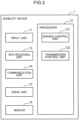
- FIG. 2 is a diagram illustrating an example of a configuration of the mobility device 1 according to an embodiment of the present disclosure.
- the mobility device 1 includes an input unit 11, a processor 12, a global positioning system (GPS) receiving unit 13, a communication unit 14, a drive unit 15, and a sensor 16.
- GPS global positioning system
- the input unit 11 receives driving operation of the mobility device 1 by the user.
- the GPS receiving unit 13 acquires a current location of the mobility device 1.
- the current location is represented by latitude and longitude.
- the sensor 16 detects various speeds of the mobility device 1.
- the sensor 16 includes a speed sensor, an angular velocity sensor, and an acceleration sensor.
- the speed sensor detects a traveling speed of the mobility device 1.
- the angular velocity sensor detects an angular velocity of the mobility device 1 around a front-rear direction, that is, an angular velocity of the mobility device 1 in a roll direction.
- the angular velocity sensor detects an angular velocity of the mobility device 1 around a left-right direction, that is, an angular velocity of the mobility device 1 in a pitch direction.
- the angular velocity sensor detects an angular velocity of the mobility device 1 around a vertical direction, that is, an angular velocity of the mobility device 1 in a yaw direction.
- the acceleration sensor detects acceleration in three directions of the front-rear direction, the left-right direction, and the vertical direction of the mobility device 1.
- the processor 12 is, for example, a central processing unit (CPU), and includes a driving control unit 121 and a transmission control unit 122.
- CPU central processing unit
- the driving control unit 121 controls the drive unit 15 according to driving operation of the user by the input unit 11 to move the mobility device 1.
- the transmission control unit 122 transmits state information indicating a current state of the mobility device 1 to the server device 3 periodically (for example, every 30 seconds).
- the state information includes a mobility device ID for identifying the mobility device 1, a transmission date and time of the state information (time when the mobility device 1 is traveling), a type of the mobility device 1, a location of the mobility device 1 received by the GPS receiving unit 13, and a traveling speed, an angular velocity in three directions (roll direction, pitch direction, and yaw direction), and an acceleration in three directions (front-back direction, left-right direction, and vertical direction) of the mobility device 1 detected by the sensor 16.
- the type of the mobility device 1 indicates any of a large automobile, a normal automobile, a small automobile, a motorcycle (motorized bicycle), and a light vehicle.
- the communication unit 14 transmits various types of information to the server device 3 and receives various types of information from the server device 3.
- the communication unit 14 transmits state information to the server device 3.
- the drive unit 15 is, for example, a traveling motor and a transmission, and moves the mobility device 1 under control of the driving control unit 121.
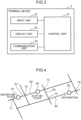
- FIG. 3 is a diagram illustrating an example of a configuration of the terminal device 2.
- the terminal device 2 includes a control unit 21, an input unit 22, a display unit 23, and a communication unit 24.
- the control unit 21 is, for example, a CPU, and controls the entire terminal device 2.
- the input unit 22 is, for example, a touch panel, and receives various types of information input by the user.
- the communication unit 24 transmits various types of information to the server device 3 and receives various types of information from the server device 3.
- the display unit 23 is, for example, a liquid crystal display device, and displays various types of information.
- FIG. 4 is a schematic diagram for explaining a movement path of the mobility device 1.
- a link 81 is between a node 71 and a node 72
- a link 82 is between the node 72 and a node 73
- a link 83 is between the node 73 and a node 74
- a link 84 is between the node 74 and a node 75.
- the departure place 61 is on the link 81
- the destination 62 is on the link 84
- the stop-by place 63 is on the link 82.
- a link ID for identifying a link is assigned to each link. That is, the mobility device 1 travels on the links 81, 82, 83, and 84 while moving from the departure place 61 to the destination 62.
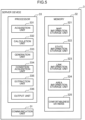
- FIG. 5 is a diagram illustrating an example of a configuration of the server device 3.
- the server device 3 includes a communication unit 31, a memory 32, and a processor 33 (computer).
- the communication unit 31 receives state information transmitted by the mobility device 1.
- the communication unit 31 outputs received state information to an acquisition unit 331.
- the communication unit 31 receives an extraction condition transmitted by the terminal device 2.
- the communication unit 31 transmits analysis result information to the terminal device 2.
- the memory 32 is, for example, a semiconductor memory or a hard disk drive, and includes a map information storage unit 321, a state information storage unit 322, a link information storage unit 323, an area information storage unit 324, and a comfortableness database 325 (database).
- the map information storage unit 321 stores in advance information (hereinafter, map information) indicating a map of a predetermined region.
- map information indicating a map of a predetermined region.
- a region indicated by the map information is divided into a plurality of areas.
- FIG. 6 is a diagram illustrating an example in which a region 65 indicated by the map information is divided into a plurality of areas.
- the region 65 indicated by the map information is divided into a plurality of rectangular areas.
- Each of the plurality of areas is the same size.
- a length of each area in a longitudinal direction and a lateral direction is, for example, 30 meters.
- An area ID for identifying an area is assigned to each area.
- "A [1,1]”, “A [1,2]”, and the like are area IDs.
- the stop-by place 63 exists in an area whose area ID is "A [2,2]".
- the region 65 indicated by the map information is divided into a plurality of rectangular areas, but the present disclosure is not particularly limited to this, and may be divided into a plurality of circular areas.
- the state information storage unit 322 stores state information transmitted by the plurality of mobility devices 1.
- the link information storage unit 323 stores link information indicating a location of each link on a map.
- FIG. 7 is a diagram illustrating an example of the link information. As illustrated in FIG. 7 , the link information storage unit 323 stores link information in which a link ID, end point coordinates, and a distance are associated with each other.
- the end point coordinates represent coordinates on a map of two nodes that are two end points of a link.
- the distance represents a distance between two end points of a link.
- the area information storage unit 324 stores area information indicating a location on a map of each area included in the region 65 indicated by map information.
- FIG. 8 is a diagram illustrating an example of area information. As illustrated in FIG. 8 , the area information storage unit 324 stores area information in which an area ID and center coordinates of an area are associated with each other. The center coordinates represent center coordinates on a map of each of a plurality of divided areas.
- the comfortableness database 325 is a database that stores, for each of one or more links in a predetermined area, a type of the mobility device 1 and travel comfortableness when traveling on each link in the type of the mobility device 1 in association with each other.
- the travel comfortableness indicates how high comfortableness at the time of traveling on each link in a predetermined area in the mobility device 1 is among one or more links in a predetermined area. For this reason, by referring to the comfortableness database 325, for example, it is possible to grasp traveling in which type of the mobility device 1 and on which link enables most comfortable movement in a predetermined area.
- FIG. 9 is a diagram illustrating an example of the comfortableness database 325.
- FIG. 9 illustrates an example in which a type "large automobile” of the mobility device 1 and travel comfortableness "R11" when traveling on a link with a link ID of "131011” in the mobility device 1 of the type "large automobile” are associated with the link with the link ID of "131011” in the comfortableness database 325.
- the comfortableness database 325 is generated by a generation unit 333. A method of generating the comfortableness database 325 will be described later.
- the processor 33 is, for example, a CPU, and includes the acquisition unit 331, a calculation unit 332, the generation unit 333, a condition acquisition unit 334, an extraction unit 335, and an output unit 336.
- the acquisition unit 331 acquires state information indicating a current state of the mobility device 1 being driven, and stores the acquired state information in the state information storage unit 322.
- the calculation unit 332 refers to the state information storage unit 322, the link information storage unit 323, and the area information storage unit 324, and calculates, for each type of the plurality of mobility devices 1, for each of one or more links (roads) in a predetermined area (predetermined area), travel comfortableness indicating how high comfortableness when traveling on each link with each type of the mobility device 1 is among the one or more links. Details of a method of calculating the travel comfortableness will be described later.
- the generation unit 333 generates, for each of one or more links in a predetermined area, a comfortableness database 325 in which a type of the plurality of mobility devices 1 is associated with travel comfortableness at the time of traveling on each link in the type of the mobility device 1 calculated by the calculation unit 332.
- the condition acquisition unit 334 acquires an extraction condition received by the communication unit 31.
- the extraction condition includes a departure place and a destination of the mobility device 1, a type of the mobility device 1, at least one of a departure time and an arrival time of the mobility device 1, and a condition for identifying travel comfortableness when traveling on a road in the mobility device 1 of the type.
- the extraction unit 335 extracts at least one link satisfying an extraction condition acquired by the condition acquisition unit 334 from the link information storage unit 323, the area information storage unit 324, and the comfortableness database 325.
- the extraction unit 335 refers to the link information storage unit 323, the area information storage unit 324, and the comfortableness database 325, and uses a best priority search algorithm to search for at least one best route for moving between a departure place and a destination identified by an extraction condition acquired by the condition acquisition unit 334.
- the best priority search algorithm is, for example, Dijkstra's algorithm, A* algorithm, or uniform-cost search.
- the extraction unit 335 extracts all links constituting at least one searched best route as at least one link satisfying an extraction condition.
- the output unit 336 outputs analysis result information including at least one link extracted by the extraction unit 335 to the communication unit 31.
- the communication unit 31 transmits the analysis result information to the terminal device 2.
- the output unit 336 appropriately refers to the link information storage unit 323, the area information storage unit 324, and the map information storage unit 321 to acquire map information including at least one link extracted by the extraction unit 335.
- the output unit 336 performs drawing so as to emphasize a departure place and a destination identified by at least one best route searched by the extraction unit 335 and an extraction condition on a map indicated by the map information.
- the output unit 336 outputs information indicating the drawn map to the communication unit 31 as analysis result information. Drawing so as to emphasize includes drawing a drawing target in a dark color, drawing a drawing target with a thick line, surrounding a drawing target with a line drawing, and the like.
- FIG. 10A is a diagram illustrating an example of analysis result information.
- FIG. 10A illustrates an example in which, on a map 106 indicated by map information including all three links 103 to 105 extracted by the extraction unit 335, the output unit 336 draws a link different from the three links 103 to 105 with a broken line and draws the three links 103 to 105 with emphasis by a black thick line arrow, so as to draw by emphasizing a route searched for by the extraction unit 335 including the three links 103 to 105.
- FIG. 10A illustrates an example in which the output unit 336 draws a departure place 101 and a destination 102 identified by an extraction condition with emphasis by a black circle.
- the output unit 336 may generate a heat map indicating a relationship between each of at least one link extracted by the extraction unit 335 and travel comfortableness when traveling on each of the at least one link in a type of the mobility device 1 identified by an extraction condition, and output analysis result information including the generated heat map to the communication unit 31.
- the output unit 336 may refer to the comfortableness database 325, and, on a map indicated by map information including all of at least one link extracted by the extraction unit 335, draw each of the at least one link so as emphasize each of the at least one link more as a value of travel comfortableness associated with each link and a type of the mobility device 1 specified by an extraction condition is larger.
- FIG. 10B is a diagram illustrating another example of analysis result information.
- FIG. 10B illustrates an example in which the output unit 336 emphasizes each of three of the links 103 to 105 constituting a route searched for by the extraction unit 335 and another link extracted by the extraction unit 335 on the map 106 illustrated in FIG. 10A by drawing them in a darker color as a value of travel comfortableness associated with each link and a type of the mobility device 1 identified by an extraction condition is larger.
- the link 103 is drawn in a darkest color
- the link 104 is drawn in a lightest color. This indicates that travel comfortableness of the link 103 is highest and travel comfortableness of the link 104 is lowest among the three links 103 to 105.
- FIG. 11 is a flowchart for explaining database generation operation of the server device 3.
- operation of generating the comfortableness database 325 for a certain area (hereinafter, target area) in the server device 3 will be described. Note that operation of generating the comfortableness database 325 is executed for an optional area at an optional timing such as once a day.
- step S1 the acquisition unit 331 acquires state information periodically transmitted from the plurality of traveling mobility device 1, and stores the acquired state information in the state information storage unit 322.
- step S2 for each of one or more links in a target area, the calculation unit 332 calculates travel comfortableness for each type of the plurality of mobility device 1 based on the state information acquired from the plurality of mobility device 1 traveling on the one or more links.
- a method of calculating travel comfortableness in step S2 will be described later.
- step S3 the generation unit 333 generates, for each of one or more links in a target area, the comfortableness database 325 in which a type of the mobility device 1 is associated with the travel comfortableness at the time of traveling on each link in the type of the mobility device 1 calculated by the calculation unit 332.
- step S2 a method of calculating travel comfortableness by the calculation unit 332 in step S2 will be described.
- target type a certain one type
- travel comfortableness when the mobility device 1 of the target type travels on each link is calculated for each of one or more links in a target area will be described.
- the calculation unit 332 calculates speed comfortableness based on an average speed when the mobility device 1 of a target type travels on each link and sample standard deviation (sample standard deviation) of a speed when the mobility device 1 of the target type travels on each link.
- the speed comfortableness indicates how much the mobility device 1 of a target type can travel on each link at a comfortable speed.
- the calculation unit 332 refers to the link information storage unit 323, the area information storage unit 324, and the state information storage unit 322, and acquires state information transmitted when the mobility device 1 of a target type is traveling on one or more links in a target area.
- the calculation unit 332 refers to a traveling speed of the mobility device 1 included in acquired state information, and calculates, for each of one or more links in a target area, an average value V q_ave of traveling speeds when the mobility device 1 of a target type travels on each of links L q .
- the average value V q_ave of traveling speeds when the mobility device 1 of the target type travels on each of the links L q is abbreviated as the average speed V q_ave in each of the links L q .
- the calculation unit 332 may refer to a location of the mobility device 1 included in acquired state information and calculate a traveling speed of the mobility device 1 of a target type.
- the calculation unit 332 may exclude state information indicating that a traveling speed of the mobility device 1 of a target type is equal to or less than a predetermined lower limit speed from acquired state information.
- state information indicating that a traveling speed of the mobility device 1 of a target type is equal to or less than a predetermined lower limit speed from acquired state information.
- information acquired when the mobility device 1 of a target type is forcibly caused to travel at a low speed equal to or less than the lower limit speed or stop due to traffic congestion, signal waiting, or the like can be excluded from state information, and speed comfortableness of when the mobility device 1 of a target type normally travels can be appropriately calculated based on the state information.
- the calculation unit 332 calculates comfortableness C q of a speed at the time of traveling on each of the links L q in the mobility device 1 of a target type by using Equation (1) below including the average speed V q_ave in each of the links L q .
- Equation (1) the average speed V q_ave in each of the links L q .
- C q V q _ ave ⁇ V ave _ min V ave _ max ⁇ V ave _ min ⁇ 100 %
- V ave_min represents a minimum value of the average speeds V q_ave of one or more of the links L q in a target area.
- V ave_max indicates a maximum value among the average speeds V q_ave of one or more of the links L q in a target area. That is, according to Equation (1), as the average speed V q_ave in the link L q increases, the comfortableness C q of a speed at the time of traveling on the link L q in the mobility device 1 of a target type increases. For this reason, the comfortableness C q of a speed at the time of traveling on the link L q with the average speed V q_ave being at the maximum value V ave_max among one or more links in the target area is 100%.
- the calculation unit 332 refers to a traveling speed included in the acquired state information, and calculates, for each of one or more links in a target area, sample standard deviation V q_ssd of a traveling speed when the mobility device 1 of a target type travels on each of the links L q .
- sample standard deviation V q_ssd of a traveling speed when the mobility device 1 of a target type travels on each of the links L q is abbreviated as the sample standard deviation V q_ssd of a traveling speed in each of the links L q .
- the calculation unit 332 calculates stability D q of a speed at the time of traveling on each of the links L q in the mobility device 1 of a target type by using Equation (2) below including the sample standard deviation V q_ssd of a traveling speed in each of the links L q .
- Equation (2) the sample standard deviation V q_ssd of a traveling speed in each of the links L q .
- D q 1 ⁇ V q _ ssd ⁇ V ssd _ min V ssd _ max ⁇ V ssd _ min ⁇ 100 %
- V ssd_min represents a minimum value of the sample standard deviation V q_ssd of a traveling speed of one or more of the links L q in a target area.
- V ssd_max indicates a maximum value of the sample standard deviation V q_ssd of a traveling speed of one or more of the links L q in the target area. That is, according to Equation (2), as the sample standard deviation V q_ssd of a traveling speed in the link L q is smaller, the stability D q of a speed at the time of traveling on the link L q in the mobility device 1 of a target type becomes larger.
- the stability D q of a speed at the time of traveling on the link L q in which the sample standard deviation V q_ssd of a traveling speed is the minimum value V ssd_min among one or more links in a target area is 100%.
- the calculation unit 332 calculates a weighted average value of the comfortableness C q of a speed and the stability D q of a speed when traveling on each of the links L q in the mobility device 1 of a target type as speed comfortableness M q when traveling on each of the links L q in the mobility device 1 of a target type.
- M q W C ⁇ C q + W D ⁇ D q W C + W D
- Wc is a weighting factor of the comfortableness C q of a speed
- W D is a weighting factor of the stability D q of a speed.
- the weighting factor W C and the weighting factor W D are set to an optional value of zero or more in such a manner that at least one of the weighting factor Wc and the weighting factor W D has a value larger than zero.
- the weighting factor Wc and the weighting factor W D may be appropriately determined according to which one of the comfortableness C q of a speed and the stability D q of a speed is emphasized as comfortableness at the time of traveling of the mobility device 1 by the user of the mobility device 1 based on an experimental value.
- the weighting factor W C is preferably set to a value larger than zero, and the weighting factor W D is preferably set to zero.
- the calculation unit 332 calculates straight travel comfortableness based on an average angular velocity and an average acceleration when the mobility device 1 of a target type travels on each link and sample standard deviation of an angular velocity and an acceleration when the mobility device 1 of a target type is traveling on each link.
- the straight travel comfortableness indicates how comfortable it is to travel straight on each link in the mobility device 1 of a target type.
- the calculation unit 332 refers to angular velocities in three directions of the mobility device 1 included in the acquired state information, and calculates, for each of one or more links in a target area, an average value ⁇ jq_ave of angular velocities in each direction j when the mobility device 1 of a target type travels on each of the links L q .
- the average value ⁇ jq_ave of angular velocities in each of the directions j when the mobility device 1 of a target type travels on each of the links L q is abbreviated as the average angular velocity ⁇ jq_ave in each of the directions j in each of the links L q .
- the calculation unit 332 may refer to a location of the mobility device 1 included in acquired state information and calculate angular velocities in three directions of the mobility device 1 of a target type.
- the calculation unit 332 may exclude state information indicating that a traveling speed of the mobility device 1 of a target type is equal to or less than a predetermined lower limit speed from acquired state information.
- state information indicating that a traveling speed of the mobility device 1 of a target type is equal to or less than a predetermined lower limit speed from acquired state information.
- information acquired when the mobility device 1 of a target type is forcibly caused to travel at a low speed equal to or less than the lower limit speed or stop due to traffic congestion, signal waiting, or the like can be excluded from state information, and straight travel comfortableness of when the mobility device 1 of a target type normally travels can be appropriately calculated based on the state information.
- the calculation unit 332 calculates comfortableness E jq of a degree of rotation in each of the directions j at the time of traveling on each of the links L q in the mobility device 1 of a target type by using Equation (4) below including the average angular velocity ⁇ jq_ave in each of the directions j in each of the links L q .
- Equation (4) the average angular velocity ⁇ jq_ave in each of the directions j in each of the links L q .
- ⁇ j_ave_min represents a minimum value of the average angular velocity ⁇ jq_ave in each of the directions j in one or more of the links L q in a target area.
- ⁇ j_ave_max represents a maximum value of the average angular velocity ⁇ jq_ave in each of the directions j in one or more of the links L q in a target area. That is, according to Equation (4), as the average angular velocity ⁇ jq_ave in each of the directions j in the link L q is smaller, the comfortableness E jq of a degree of rotation in each of the directions j when traveling on the link L q in the mobility device 1 of a target type becomes higher.
- the comfortableness E jq of a degree of rotation in each of the directions j when traveling on the link L q in which the average angular velocity ⁇ jq_ave in each of the directions j is the minimum value ⁇ j_ave_min among one or more links in a target area is 100%.
- the calculation unit 332 refers to an angular velocity included in the acquired state information, and calculates, for each of one or more links in a target area, sample standard deviation ⁇ jq_ssd of an angular velocity in each of the directions j when the mobility device 1 of a target type travels on each of the links L q .
- sample standard deviation ⁇ jq_ssd of an angular velocity in each of the directions j when the mobility device 1 of a target type travels on each of the links L q is abbreviated as the sample standard deviation ⁇ jq_ssd of an angular velocity in each of the directions j in each of the links L q .
- the calculation unit 332 calculates stability F jq of a degree of rotation in each of the directions j at the time of traveling on each of the links L q in the mobility device 1 of a target type by using Equation (5) below including the sample standard deviation ⁇ jq_ssd of an angular velocity in each of the directions j in each of the links L q .
- F jq 1 ⁇ ⁇ jq _ ssd ⁇ ⁇ j _ ssd _ min ⁇ j _ ssd _ max ⁇ ⁇ j _ ssd _ min ⁇ 100 %
- ⁇ j_ssd_min represents a minimum value of the sample standard deviation ⁇ jq_ssd of an angular velocity in each of the directions j in one or more links L q in a target area.
- ⁇ j_ssd_max represents a maximum value of the sample standard deviation ⁇ jq_ssd of an angular velocity in each of the directions j in one or more of the links L q in a target area.
- the stability F jq of a degree of rotation in each of the directions j at the time of traveling on the link L q in the mobility device 1 of a target type becomes higher.
- the stability F jq of a degree of rotation in each of the directions j when traveling on the link L q in which the sample standard deviation Q jq_ssd of an angular velocity in each of the directions j is the minimum value ⁇ j_ssd_min is 100%.
- the calculation unit 332 refers to accelerations in three directions of the mobility device 1 included in the acquired state information, and calculates, for each of one or more links in a target area, an average value A jq_ave of accelerations in each of the directions j when the mobility device 1 of a target type travels on each of the links L q .
- the average value A jq_ave of accelerations in each of the directions j when the mobility device 1 of a target type travels on each of the links L q is abbreviated as the average acceleration A jq_ave in each of the directions j in each of the links L q .
- the calculation unit 332 may exclude state information indicating that a traveling speed of the mobility device 1 of a target type is equal to or less than a predetermined lower limit speed from acquired state information.
- state information indicating that a traveling speed of the mobility device 1 of a target type is equal to or less than a predetermined lower limit speed from acquired state information.
- information acquired when the mobility device 1 of a target type is forcibly caused to travel at a low speed equal to or less than the lower limit speed or stop due to traffic congestion, signal waiting, or the like can be excluded from state information, and straight travel comfortableness when the mobility device 1 of a target type normally travels can be appropriately calculated based on the state information.
- the calculation unit 332 calculates comfortableness G jq of a degree of acceleration in each of the directions j when traveling on each of the links L q in the mobility device 1 of a target type by using Equation (6) below including the average acceleration A jq_ave in each of the directions j in each of the links L q .
- G jq 1 ⁇ A jq _ ave ⁇ A j _ ave _ min A j _ ave _ max ⁇ A j _ ave _ min ⁇ 100 %
- a j_ave_min represents a minimum value of the average acceleration A jq_ave in each of the directions j in one or more of the links L q in a target area.
- a j_ave_max indicates a maximum value of the average acceleration A jq_ave in each of the directions j in one or more of the links L q in a target area. That is, according to Equation (6), as the average acceleration A jq_ave in each of the directions j in the link L q is smaller, the comfortableness G jq of a degree of acceleration in each of the directions j at the time of traveling on the link L q in the mobility device 1 of a target type becomes higher.
- the comfortableness G jq of a degree of acceleration in each of the directions j when traveling on the link L q in which the average acceleration A jq_ave in each of the directions j is the minimum value A j_ave_min among one or more links in a target area is 100%.
- the calculation unit 332 refers to an acceleration included in the acquired state information, and calculates, for each of one or more links in a target area, sample standard deviation A jq_ssd of an acceleration in each of the directions j when the mobility device 1 of a target type travels on each of the links L q .
- sample standard deviation A jq_ssd of an acceleration in each of the directions j when the mobility device 1 of a target type travels on each of the links L q is abbreviated as the sample standard deviation A jq_ssd of an acceleration in each of the directions j in each of the links L q .
- the calculation unit 332 calculates stability H jq of a degree of acceleration in each of the directions j when traveling on each of the links L q in the mobility device 1 of a target type by using Equation (7) below including the sample standard deviation A jq_ssd of an acceleration in each of the directions j in each of the links L q .
- H jq 1 ⁇ A jq _ ssd ⁇ A j _ ssd _ min A j _ ssd _ max ⁇ A j _ ssd _ min ⁇ 100 %
- a j_ssd_min represents a minimum value of the sample standard deviation A jq_ssd of an acceleration in each of the directions j in one or more of the links L q in a target area.
- a j_ssd_max represents a maximum value of the sample standard deviation A jq_ssd of an acceleration in each of the directions j in one or more of the links L q in a target area.
- the stability H jq of a degree of acceleration in each of the directions j at the time of traveling on the link L q in the mobility device 1 of a target type becomes higher. For this reason, among one or more links in a target area, the stability H jq of a degree of acceleration in each of the directions j when traveling on the link L q in which the sample standard deviation A jq_ssd of an acceleration in each of the directions j is the minimum value A j_ssd_min is 100%.
- the calculation unit 332 calculates a weighted average value of the comfortableness E jq of a degree of rotation in each of the directions j, the stability F jq of a degree of rotation in each of the directions j, the comfortableness G jq of a degree of acceleration in each of the directions j, and the stability H jq of a degree of acceleration in each of the directions j when traveling on each of the links L q in the mobility device 1 of a target type as straight travel comfortableness N q when traveling on each of the links L q in the mobility device 1 of a target type.
- W jE is a weighting factor of the comfortableness E jq of a degree of rotation in each of the directions j.
- W jF is a weighting factor of the stability F jq of a degree of rotation in each of the directions j.
- W jG is a weighting factor of the comfortableness G jq of a degree of acceleration in each of the directions j.
- W jH is a weighting factor of the stability H jq of a degree of acceleration in each of the directions j.
- the weighting factors W jE , W jF , W jG , and W jH are set to an optional value of zero or more such that at least one of the weighting factors W jE , W jF , W jG , and W jH has a value larger than zero.
- weighting factors W 1E , W 2E , W 3E , W 1G , W 2G , and W 3G are preferably set to a value larger than zero, and weighting factors W 1F , W 2F , W 3F , W 1H , W 2H , and W 3H are preferably set to zero.
- the calculation unit 332 calculates a weighted average value of the speed comfortableness M q and the straight travel comfortableness N q as travel comfortableness R q when the mobility device 1 of a target type travels on each of the links L q .
- R q ⁇ ⁇ M q + ⁇ ⁇ N q ⁇ + ⁇
- ⁇ represents a weighting factor of the speed comfortableness M q larger than zero.
- ⁇ represents a weighting factor of the straight travel comfortableness N q larger than zero.
- the weighting factors ⁇ and ⁇ may be appropriately determined based on an experimental value according to which one of the speed comfortableness M q and the straight travel comfortableness N q the user of the mobility device 1 emphasizes as comfortableness at the time of traveling of the mobility device 1. For example, in a case where the speed comfortableness M q is emphasized more than the straight travel comfortableness N q as comfortableness at the time of traveling of the mobility device 1, the weighting factor ⁇ may be set to a value larger than the weighting factor ⁇ .
- the comfortableness database 325 in which a type of the plurality of mobility devices 1 and the travel comfortableness R q at the time of traveling on each of the links L q in the mobility device 1 of the type are associated with each other is generated. For this reason, from the generated comfortableness database 325, it is possible to collect the travel comfortableness R q at the time of traveling on each of the links L q in a predetermined area within the mobility device 1 of a specific type.
- the calculation unit 332 may calculate, for each of one or more links in a target area, a type of the plurality of mobility devices 1 and travel comfortableness in a time zone in which the plurality of mobility devices 1 travel, based on state information acquired from the plurality of mobility devices 1 traveling on the one or more links.
- the time zone may be, for example, a time zone of one hour obtained by equally dividing a day into 24, or a time zone of 12 hours indicating the morning and a time zone of 12 hours indicating the afternoon.
- the calculation unit 332 refers to the link information storage unit 323, the area information storage unit 324, and the state information storage unit 322, and acquires state information indicating that the mobility device 1 of a target type travels on one or more links in a target area.
- the calculation unit 332 refers to a transmission date and time included in acquired state information, and divides the acquired state information for each time zone including the referred transmission date and time.
- the calculation unit 332 calculates the travel comfortableness R q as described above by using the state information in each of the divided time zones, and sets the calculated travel comfortableness R q as the travel comfortableness R q at the time of traveling on each of the links L q in the mobility device 1 of a target type in each of the time zones.
- step S3 the generation unit 333 generates the comfortableness database 325 in which a type of the mobility device 1, a time zone in which the mobility device 1 travels, and the travel comfortableness R q at the time of traveling on each of the links L q in the type of the mobility device 1 in the time zone calculated by the calculation unit 332 are associated with each of one or more links in a target area.
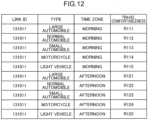
- FIG. 12 is a diagram illustrating another example of the comfortableness database 325.
- FIG. 12 illustrates an example in which a type "large automobile” of the mobility device 1, a time zone “morning” in which the mobility device 1 of the type “large automobile” travels, and travel comfortableness "R111" when traveling on a link with a link ID of "131011” in the mobility device 1 of the type "large automobile” in the time zone “morning" are associated with the link with the link ID of "131011” in the generated comfortableness database 325.
- the generated comfortableness database 325 it is possible to collect the travel comfortableness R q at the time of traveling on each of the links L q in a target area in the mobility device 1 of a specific type in a specific time zone. According to the collected travel comfortableness R q , it is possible to grasp relatively how high comfortableness each of the links L q can be traveled with among one or more links in a target area by the mobility device 1 of a specific type in a specific time zone. By the above, in a case of moving in a target area in a certain time zone, it is possible to grasp which type of mobility device should be used and on which link one should travel in order to move comfortably.
- the calculation unit 332 may calculate, for each of one or more links in a target area, a type of the plurality of mobility devices 1 and travel comfortableness in an environment when the plurality of mobility devices 1 travel, based on state information acquired from the plurality of mobility devices 1 traveling on the one or more links.
- the environment when the plurality of mobility devices 1 travel is, for example, weather, season, or a date category of when the plurality of mobility devices 1 travel.
- the date category indicates which one of seven days of the week from Sunday to Saturday or a national holiday the date is.
- the acquisition unit 331 refers to a transmission date and time included in state information acquired from the plurality of mobility devices 1 during traveling, and inquires of the public server 4 about information indicating weather, season, or a date category corresponding to the transmission date and time by using the communication unit 31.
- the acquisition unit 331 acquires information indicating weather, season, or a date category corresponding to the transmission date and time received by the communication unit 31 from the public server 4 as information indicating an environment of when the mobility device 1 travels.
- the acquisition unit 331 includes acquired information (hereinafter, environment information) indicating an environment of when the mobility device 1 travels in state information and stores the state information in the state information storage unit 322.
- the calculation unit 332 refers to the link information storage unit 323, the area information storage unit 324, and the state information storage unit 322, and acquires state information indicating that the mobility device 1 of a target type travels on one or more links in a target area.
- the calculation unit 332 refers to environment information included in the acquired state information, and divides the acquired state information for each environment indicated by the referred environment information.
- the calculation unit 332 calculates the travel comfortableness R q as described above by using state information of each environment after the division, and sets the calculated travel comfortableness R q as the travel comfortableness R q at the time of traveling on each of the links L q in the mobility device 1 of a target type in each environment.
- step S3 the generation unit 333 generates the comfortableness database 325 in which a type of the mobility device 1, an environment of when the mobility device 1 travels, and the travel comfortableness R q at the time of traveling on each of the links L q in the type of the mobility device 1 in the environment calculated by the calculation unit 332 are associated with each of one or more links in a target area.
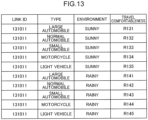
- FIG. 13 is a diagram illustrating another example of the comfortableness database 325.
- FIG. 13 illustrates an example in which a type "large automobile” of the mobility device 1, an environment “sunny” of when the mobility device 1 of the type “large automobile” travels, and travel comfortableness "R131" when traveling on a link with a link ID of "131011” in the mobility device 1 of the type “large automobile” in the environment “sunny” are associated with the link with the link ID of "131011” in the generated comfortableness database 325.
- the generated comfortableness database 325 it is possible to collect the travel comfortableness R q at the time of traveling on each of the links L q in a target area in the mobility device 1 of a specific type in a specific environment. According to the collected travel comfortableness R q , it is possible to grasp relatively how high comfortableness each of the links L q can be traveled with among one or more links in a target area by the mobility device 1 of a specific type in a specific environment. By the above, in a case of moving in a target area in a certain environment, it is possible to grasp which type of mobility device should be used and on which link one should travel in order to move comfortably.
- FIG. 14 is a flowchart for explaining data analysis operation of the server device 3.
- the condition acquisition unit 334 acquires an extraction condition received by the communication unit 31 from the terminal device 2.
- the terminal device 2 receives input of an extraction condition by an operator, and transmits the input extraction condition to the server device 3.
- the extraction condition includes a departure place and a destination of the mobility device 1, a type of the mobility device 1, at least one of a departure time and an arrival time of the mobility device 1, and a condition for identifying travel comfortableness when traveling on a road in the mobility device 1 of the type.
- step S12 the extraction unit 335 extracts at least one link satisfying the extraction condition acquired in step S11 from the link information storage unit 323, the area information storage unit 324, and the comfortableness database 325.
- step S13 the output unit 336 outputs analysis result information including at least one link extracted in step S12 to the communication unit 31.
- the communication unit 31 transmits the analysis result information to the terminal device 2.
- the terminal device 2 receives analysis result information transmitted by the server device 3, and displays the received analysis result information.
- the terminal device 2 can present analysis result information to an operator.
- the calculation unit 332 calculates speed comfortableness and straight travel comfortableness, and calculates travel comfortableness by a weighted average value of the speed comfortableness and the straight travel comfortableness is described.
- the calculation unit 332 further calculates environment comfortableness, and calculates speed comfortableness from a weighted average value of speed comfortableness, straight travel comfortableness, and environment comfortableness.
- the environment comfortableness indicates how comfortable an environment is when traveling on each link in the mobility device 1 of a target type.
- the acquisition unit 331 refers to a transmission date and time included in state information acquired from the plurality of mobility devices 1 during traveling, and inquires the public server 4 about an environment index corresponding to the transmission date and time by using the communication unit 31.
- the environment index is an index indicating an environment.
- the environment index includes a solar radiation amount, a rainfall amount, a snowfall amount, a temperature, and a wind speed.
- the wind speed may be a wind speed for each wind direction (for example, a wind speed in the east direction, a wind speed in the west direction, and the like), or may be a wind speed that does not depend on a wind direction.
- the acquisition unit 331 acquires an environment index corresponding to the transmission date and time received by the communication unit 31 from the public server 4 as an environment index when the mobility device 1 travels.
- the acquisition unit 331 includes the acquired environment index when the mobility device 1 travels in state information and stores the state information in the state information storage unit 322.
- step S2 similarly to the first embodiment, the calculation unit 332 calculates the speed comfortableness M q and the straight travel comfortableness N q at the time of traveling on each of the links Lq in the mobility device 1 of a target type. Furthermore, the calculation unit 332 calculates environment comfortableness Z q at the time of traveling on each of the links Lq in the mobility device 1 of a target type as described below.
- the calculation unit 332 refers to the link information storage unit 323, the area information storage unit 324, and the state information storage unit 322, and acquires state information transmitted when the mobility device 1 of a target type is traveling on one or more links in a target area.
- the calculation unit 332 refers to an environment index included in the acquired state information, and calculates, for each of one or more links in a target area, an average value U jq_ave of each environment index j of when the mobility device 1 of a target type travels on each of the links L q .
- the average value U jq_ave of the environment indexes j of when the mobility device 1 of a target type travels on each of the links L q is abbreviated as the average value U jq_ave of the environment indexes j in each of the links L q .
- the calculation unit 332 may exclude state information indicating that a traveling speed of the mobility device 1 of a target type is equal to or less than a predetermined lower limit speed from acquired state information.
- state information indicating that a traveling speed of the mobility device 1 of a target type is equal to or less than a predetermined lower limit speed from acquired state information.
- information acquired when the mobility device 1 of a target type is forcibly caused to travel at a low speed equal to or less than the lower limit speed or stop due to traffic congestion, signal waiting, or the like can be excluded from state information, and environment comfortableness of when the mobility device 1 of a target type normally travels can be appropriately calculated based on the state information.
- the calculation unit 332 calculates comfortableness X jq of an environment indicated by each of the environment indexes j at the time of traveling on each of the links L q in the mobility device 1 of a target type by using Equation (10) below including the average value U jq_ave of each of the environment indexes j in each of the links L q .
- Equation (10) including the average value U jq_ave of each of the environment indexes j in each of the links L q .
- X jq 1 ⁇ U jq _ ave ⁇ U j _ ave _ min U j _ ave _ max ⁇ U j _ ave _ min ⁇ 100 %
- U j_ave_min represents a minimum value among the average values U jq_ave of each of the environment indexes j in one or more of the links L q in a target area.
- U j_ave_max indicates a maximum value among average values U jq_ave of each of the environment indexes j in one or more of the links L q in a target area. That is, according to Equation (10), as the average value U jq_ave of each of the environment indexes j in the link L q is smaller, the comfortableness X jq of an environment indicated by each of the environment indexes j at the time of traveling on the link L q in the mobility device 1 of a target type becomes higher.
- the comfortableness X jq of an environment indicated by each of the environment indexes j at the time of traveling on the link L q in which the average value U jq_ave of each of the environment indexes j is the minimum value U j_ave_min among one or more links in a target area is 100%.
- the calculation unit 332 refers to an environment index included in the acquired state information, and calculates, for each of one or more links in a target area, a sample standard deviation U jq_ssd of each of the environment indexes j when the mobility device 1 of a target type travels on each of the links L q .
- the sample standard deviation U jq_ssd of each of the environment indexes j when the mobility device 1 of a target type travels on each of the links L q is abbreviated as the sample standard deviation U jq_ssd of each of the environment indexes j in each of the links L q .
- the calculation unit 332 calculates stability Y jq of an environment indicated by each of the environment indexes j at the time of traveling on each of the links L q in the mobility device 1 of a target type by using Equation (11) below including the sample standard deviation U jq_ssd of each of the environment indexes j in each of the links L q .
- Equation (11) the sample standard deviation U jq_ssd of each of the environment indexes j in each of the links L q .
- Y jq 1 ⁇ U jq _ ssd ⁇ U j _ ssd _ min U j _ ssd _ max ⁇ U j _ ssd _ min ⁇ 100 %
- U j_ssd_min represents a minimum value of the sample standard deviation U jq_ssd of each of the environment indexes j in one or more of the links L q in a target area.
- U j_ssd_max indicates a maximum value of the sample standard deviation U jq_ssd of each of the environment indexes j in one or more of the links L q in a target area.
- the stability Y jq of an environment indicated by each of the environment indexes j at the time of traveling on the link L q in the mobility device 1 of a target type becomes higher. For this reason, among one or more links in a target area, the stability Y jq of an environment indicated by each of the environment indexes j at the time of traveling on the link L q in which the sample standard deviation U jq_ssd of each of the environment indexes j is the minimum value U j_ssd_min is 100%.
- the calculation unit 332 calculates a weighted average value of the comfortableness X jq of an environment indicated by each of the environment indexes j and the stability Y jq of an environment indicated by each of the environment indexes j at the time of traveling on each of the links L q in the mobility device 1 of a target type as the environment comfortableness Z q at the time of traveling on each of the links L q in the mobility device 1 of a target type.
- W jX is a weighting factor of the comfortableness X jq of an environment indicated by each of the environment indexes j.
- W jY is a weighting factor of the stability Y jq of an environment indicated by each of the environment indexes j.
- n represents the number of environment indexes. For example, in a case where state information includes a solar radiation amount and a rainfall amount as environment indexes, the number of environment indexes is two.
- the weighting factors W jX and W jY are set to an optional value of zero or more such that at least one of the weighting factors W jX and W jY has a value larger than zero.
- the calculation unit 332 calculates a weighted average value of the speed comfortableness M q , the straight travel comfortableness N q , and the environment comfortableness Z q as the travel comfortableness R q when the mobility device 1 of a target type travels on each of the links L q as expressed by Equation (13) below.
- Equation (13) Equation (13) below.
- ⁇ represents a weighting factor of the speed comfortableness M q larger than zero.
- ⁇ represents a weighting factor of the straight travel comfortableness N q larger than zero.
- ⁇ indicates a weighting factor of the environment comfortableness Z q larger than zero.
- the weighting factors ⁇ , ⁇ , and ⁇ may be appropriately determined according to which one of the speed comfortableness M q , the straight travel comfortableness N q , and the environment comfortableness Z q the user of the mobility device 1 emphasizes as comfortableness at the time of traveling of the mobility device 1 based on an experimental value.
- the weighting factor ⁇ is preferably set to a value larger than the weighting factor ⁇ and the weighting factor ⁇ , and the weighting factor ⁇ is preferably set to a value larger than the weighting factor ⁇ (preferably set so that ⁇ > ⁇ > ⁇ is established).
- the calculation unit 332 may calculate, for each of one or more links in a target area, a type of the plurality of mobility devices 1 and travel comfortableness in a time zone in which the plurality of mobility devices 1 travel, based on state information acquired from the plurality of mobility devices 1 traveling on the one or more links.
- step S3 FIG. 11
- the generation unit 333 may generate the comfortableness database 325 in which a type of the mobility device 1, a time zone in which the mobility device 1 travels, and the travel comfortableness R q at the time of traveling on each of the links L q in the type of the mobility device 1 in the time zone calculated by the calculation unit 332 are associated with each of one or more links in a target area.
- the travel comfortableness R q in consideration of not only variation in an average speed, an average angular velocity, an average acceleration, a speed, an angular velocity, and an acceleration when the mobility device 1 travels on each of the links L q but also an average value of environment indexes and variation in the environment indexes when the mobility device 1 travels on each of the links L q .
- each constituent element may be implemented by being configured with dedicated hardware or by execution of a software program suitable for each constituent element.
- Each component may be implemented by a program execution unit (computer) such as a CPU or a processor reading and executing a software program (database generation program, data analysis program) recorded in a recording medium such as a hard disk or a semiconductor memory.
- LSI large scale integration
- FPGA field programmable gate array
- a part or all of functions of a device according to the embodiment of the present disclosure may be realized by a processor (computer) such as a CPU executing a program (database generation program, data analysis program).
- a processor such as a CPU executing a program (database generation program, data analysis program).
- the first embodiment, the second embodiment, and a variation according to the embodiment of the present disclosure may be optionally combined.
- the technique according to the present disclosure is useful for a technique of generating a database because comfortableness at the time of traveling on a road in a predetermined area in a mobility device can be collected for each type of mobility device.
Landscapes
- Engineering & Computer Science (AREA)
- Remote Sensing (AREA)
- Radar, Positioning & Navigation (AREA)
- Physics & Mathematics (AREA)
- General Physics & Mathematics (AREA)
- Automation & Control Theory (AREA)
- Chemical & Material Sciences (AREA)
- Analytical Chemistry (AREA)
- Databases & Information Systems (AREA)
- Theoretical Computer Science (AREA)
- Data Mining & Analysis (AREA)
- General Engineering & Computer Science (AREA)
- Traffic Control Systems (AREA)
- Navigation (AREA)
Abstract
Description
- The present disclosure relates to a technique for generating a database and a technique for extracting predetermined data satisfying an extraction condition from a database.
- In recent years, with development of an automatic driving system and MaaS (mobility as a service), it is required to collect a usage status of a mobility device in more detail and with high accuracy.
- For example,
Patent Literature 1 discloses that a traveling state of a vehicle on a road that is not included in map information is acquired, and in a case where the traveling state is determined to satisfy a predetermined registration criterion, the road on which the vehicle travels is determined to be one on which a vehicle can be driven comfortably, and the road is added to map information. - However, in the above-described conventional technique, it is not possible to grasp comfortableness when traveling on a road in a predetermined area in a mobility device for each type of mobility device. For this reason, in a case of moving in a predetermined area, it is not possible to grasp which type of mobility device should be used and on which road one should travel in order to move comfortably.
- Patent Literature 1:
JP 2019-138876 A - The present disclosure has been made to solve the above problem, and an object of the present disclosure is to provide a technique of generating a database in which comfortableness of when traveling on a road in a predetermined area in a mobility device can be collected for each type of mobility device.
- A database generation method according to an aspect of the present disclosure includes: by a computer, acquiring state information indicating a type and a location of a plurality of mobility devices traveling on one or more roads in a predetermined area; for each of the one or more roads, calculating, based on the state information and for each of types of the plurality of mobility devices, travel comfortableness indicating how high comfortableness is when traveling in each type of mobility device on each road among the one or more roads; and generating a database that associates, for each of the one or more roads, the type of the plurality of mobility devices with the travel comfortableness when traveling in the type of mobility device on each road.
-
-
FIG. 1 is a diagram illustrating an overall configuration of a mobility device management system according to an embodiment of the present disclosure. -
FIG. 2 is a diagram illustrating an example of a configuration of a mobility device according to an embodiment of the present disclosure. -
FIG. 3 is a diagram illustrating an example of a configuration of a terminal device. -
FIG. 4 is a schematic diagram for explaining a movement path of a mobility device. -
FIG. 5 is a diagram illustrating an example of a configuration of a server device. -
FIG. 6 is a diagram illustrating an example in which a region indicated by map information is divided into a plurality of areas. -
FIG. 7 is a diagram illustrating an example of link information. -
FIG. 8 is a diagram illustrating an example of area information. -
FIG. 9 is a diagram illustrating an example of a comfortableness database. -
FIG. 10A is a diagram illustrating an example of analysis result information. -
FIG. 10B is a diagram illustrating another example of the analysis result information. -
FIG. 11 is a flowchart for explaining database generation operation of the server device. -
FIG. 12 is a diagram illustrating another example of the comfortableness database. -
FIG. 13 is a diagram illustrating another example of the comfortableness database. -
FIG. 14 is a flowchart for explaining data analysis operation of the server device. - A light vehicle, a motorized bicycle (motorcycle), and the like may be prescribed by law to travel on the edge side of a road at a lower speed than an automobile. In this case, a light vehicle, a motorized bicycle, and the like often decelerate or greatly change a traveling direction in order to avoid a pedestrian and an automobile parked or stopped on a road, and often causes travel to be less comfortable than that on an automobile even in a case of traveling on the same road.
- However, from general map information, although a shape, width, and length of a road in a predetermined area can be grasped, it is not possible to grasp comfortableness when traveling on a road with a mobility device for each type of mobility device. For this reason, in a case of moving in a predetermined area, it is not possible to grasp which type of mobility device should be used and on which road one should travel in order to move comfortably.
- In
Patent Literature 1, only a road on which a traveling state of a vehicle satisfies a predetermined registration criterion is added to map information, and it is not possible to grasp comfortableness at the time of traveling on a road for each vehicle type from the map information. - (1) In order to solve the above problem, a database generation method according to an aspect of the present disclosure includes: by a computer, acquiring state information indicating a type and a location of a plurality of mobility devices traveling on one or more roads in a predetermined area; for each of the one or more roads, calculating, based on the state information and for each of types of the plurality of mobility devices, travel comfortableness indicating how high comfortableness is when traveling in each type of mobility device on each road among the one or more roads; and generating a database that associates, for each of the one or more roads, the type of the plurality of mobility devices with the travel comfortableness when traveling in the type of mobility device on each road.
- According to this configuration, for each of one or more roads in a predetermined area, a database in which a type of a plurality of mobility devices is associated with travel comfortableness of when traveling on each road in the type of mobility device is generated. For this reason, it is possible to collect travel comfortableness of when traveling on each road in a predetermined area in a specific type of mobility device from a generated database.
- Further, according to the collected travel comfortableness, it is possible to grasp relatively how high comfortableness each road can be traveled with among one or more roads in a predetermined area by a mobility device of a specific type. By the above, in a case of moving in a predetermined area, it is possible to grasp which type of mobility device should be used and on which road one should travel in order to move comfortably.
- (2) Further, in the database generation method according to (1), the state information may further include information indicating a time of when the plurality of mobility devices travel, in the calculation of the travel comfortableness, for each of the one or more roads, a type of the plurality of mobility devices and the travel comfortableness in a time zone in which the plurality of mobility devices travel may be calculated based on the state information, and in the generation of the database, for each of the one or more roads, a type of the plurality of mobility devices, a time zone in which the plurality of mobility devices travel, and the travel comfortableness of when traveling on each road in the type of mobility device in the time zone may be associated.
- According to this configuration, for each of one or more roads in a predetermined area, a database in which a type of a plurality of mobility device, a time zone in which the plurality of mobility devices travel, travel comfortableness of when traveling on each road in the type of mobility device in the time zone are associated is generated. For this reason, it is possible to collect travel comfortableness of when traveling on each road in a predetermined area in a specific type of mobility device in a specific time zone from a generated database.
- Further, according to the collected travel comfortableness, it is possible to grasp relatively how high comfortableness each road can be traveled with among one or more roads in a predetermined area by a mobility device of a specific type in a specific time zone. By the above, in a case of moving in a predetermined area in a certain time zone, it is possible to grasp which type of mobility device should be used and on which road one should travel in order to move comfortably.
- (3) Further, in the database generation method according to (1), the state information may further include information indicating an environment of when the plurality of mobility devices travel on the one or more roads, in the calculation of the travel comfortableness, for each of the one or more roads, a type of the plurality of mobility devices and the travel comfortableness in an environment of when the plurality of mobility device travel may be calculated based on the state information, and in the generation of the database, for each of the one or more roads, a type of the plurality of mobility devices, an environment of when the plurality of mobility devices travel, and the travel comfortableness of when traveling on each road in the type of mobility device in the environment may be associated.
- According to this configuration, for each of one or more roads in a predetermined area, a database in which a type of a plurality of mobility devices, an environment of when the plurality of mobility devices travel, travel comfortableness of when traveling on each road in the type of mobility device in the environment are associated is generated. For this reason, it is possible to collect travel comfortableness of when traveling on each road in a predetermined area in a specific type of mobility device in a specific environment from a generated database.
- Further, according to the collected travel comfortableness, it is possible to grasp relatively how high comfortableness each road can be traveled with among one or more roads in a predetermined area by a mobility device of a specific type in a specific environment. By the above, in a case of moving in a predetermined area in a certain environment, it is possible to grasp which type of mobility device should be used and on which road one should travel in order to move comfortably.
- (4) Further, in the database generation method according to any one of (1) to (3), in the calculation of the travel comfortableness, the travel comfortableness of when each type of mobility device travels on each road included in each area may be calculated based on speed comfortableness based on an average speed of when each type of mobility device travels on each road and straight travel comfortableness based on an average angular velocity and an average acceleration of when each type of mobility device travels on each road.
- According to this configuration, the travel comfortableness can be appropriately calculated in consideration of an average speed, an average angular velocity, and an average acceleration of when each type of mobility device travels on each road.
- (5) Further, in the database generation method according to (4), in the calculation of the travel comfortableness, the speed comfortableness may be calculated based on an average speed of when each type of mobility device is traveling on each road and sample standard deviation of a speed of when each type of mobility device travels on each road, and the straight travel comfortableness may be calculated based on an average angular velocity and an average acceleration of when each type of mobility device travels on each road, and sample standard deviation of an angular velocity and an acceleration of when each type of mobility device travels on each road.
- According to this configuration, the travel comfortableness can be more appropriately calculated in consideration of not only an average speed, an average angular velocity, and an average acceleration of when each type of mobility device travels on each road, but also variation in a speed, an angular velocity, and an acceleration of a mobility device.
- (6) Further, in the database generation method according to (1) or (2), in the calculation of the travel comfortableness, the travel comfortableness of when each type of mobility device travels on each road included in each area may be calculated based on speed comfortableness based on an average speed of when each type of mobility device travels on each road, straight travel comfortableness based on an average angular velocity and an average acceleration of when each type of mobility device travels on each road, and environment comfortableness based on an average value of indexes indicating an environment of when each type of mobility device travels on each road.
- According to this configuration, the travel comfortableness can be appropriately calculated in consideration of an average speed, an average angular velocity, and an average acceleration, and also an average value of indexes indicating an environment of when each type of mobility device travels on each road.
- (7) Further, in the database generation method according to (6), in the calculation of the travel comfortableness, the speed comfortableness may be calculated based on an average speed of when each type of mobility device travels on each road and sample standard deviation of a speed of when each type of mobility device travels on each road, the straight travel comfortableness may be calculated based on an average angular velocity and an average acceleration of when each type of mobility device travels on each road, and sample standard deviation of an angular velocity and an acceleration of when each type of mobility device travels on each road, and the environment comfortableness may be calculated based on an average value of indexes indicating an environment of when each type of mobility device travels on each road and sample standard deviation of an index indicating an environment of when each type of mobility device travels on each road.
- According to this configuration, the travel comfortableness can be more appropriately calculated in consideration of not only an average speed, an average angular velocity, and an average acceleration, and an average value of indexes indicating an environment of when each type of mobility device travels on each road, but also variation in each of a speed, an angular velocity, and an acceleration of a mobility device, and an index indicating an environment.
- (8) Further, in the database generation method according to (4) or (5), in the calculation of the travel comfortableness, the travel comfortableness may be calculated based on information obtained by excluding, from the state information, information indicating that each type of mobility device travels on each road at a speed equal to or less than a predetermined lower limit speed.
- According to this configuration, information acquired when a mobility device is forcibly caused to travel at a low speed equal to or less than the lower limit speed or stop due to traffic congestion, signal waiting, or the like can be excluded from the state information, and travel comfortableness when a plurality of mobility devices normally travel can be appropriately calculated based on the state information.
- (9) A database generation device according to another aspect of the present disclosure includes an acquisition unit that acquires state information indicating a type and a location of a plurality of mobility devices traveling on one or more roads in a predetermined area, a calculation unit that calculates, for each of the one or more roads, based on the state information and for each of types of the plurality of mobility devices, travel comfortableness indicating how high comfortableness is when traveling in each type of mobility device on each road among the one or more roads; and a generation unit that generates a database that associates, for each of the one or more roads, the type of the plurality of mobility devices with the travel comfortableness when traveling in the type of mobility device on each road.
- According to the present configuration, the same effects as those of the database generation method can be obtained.
- (10) A database generation program according to another aspect of the present disclosure causes a computer to function to acquire state information indicating a type and a location of a plurality of mobility devices traveling on one or more roads in a predetermined area, for each of the one or more roads, calculate, based on the state information and for each of types of the plurality of mobility devices, travel comfortableness indicating how high comfortableness is when traveling in each type of mobility device on each road among the one or more roads, and generate a database that associates, for each of the one or more roads, the type of the plurality of mobility devices with the travel comfortableness when traveling in the type of mobility device on each road.
- According to the present configuration, the same effects as those of the database generation method can be obtained.
- (11) A data analysis method according to another aspect of the present disclosure is a data analysis method in a data analysis device that extracts at least one road satisfying an extraction condition from the database generated by the database generation method according to (1), in which the extraction condition includes a type of mobility device and a condition for identifying the travel comfortableness of when traveling on a road in the type of mobility device, the data analysis method includes acquiring the extraction condition, extracting the at least one road satisfying the extraction condition from the database, and outputting analysis result information including the extracted at least one road.
- According to this configuration, at least one road that satisfies a type of mobility device and an extraction condition for identifying travel comfortableness of when traveling on a road in the type of mobility device is extracted from the database, and analysis result information including the at least one road is output. For this reason, from the analysis result information, it is possible to easily grasp at least one road on which it is possible to travel in a predetermined area with travel comfortableness identified by the extraction condition in a type of mobility device identified by the extraction condition.
- (12) Further, in the data analysis method according to (11), the analysis result information may include a heat map indicating a relationship between each of the at least one road and the travel comfortableness of when traveling on each of the at least one road in a mobility device of a type identified by the extraction condition.
- According to this configuration, a heat map indicating a relationship between each of at least one road satisfying an extraction condition and travel comfortableness of when traveling on each of the at least one road in a mobility device of a type identified by the extraction condition is output. For this reason, it is possible to easily grasp travel comfortableness of when traveling on each of at least one road satisfying the extraction condition in a mobility device of a type identified by the extraction condition from the heat map.
- (13) A data analysis device according to another aspect of the present disclosure is a data analysis device that extracts at least one road satisfying an extraction condition from the database generated by the database generation method according to (1), in which the extraction condition includes a type of mobility device and a condition for identifying the travel comfortableness of when traveling on a road in the type of mobility device, the data analysis device includes a condition acquisition unit that acquires the extraction condition, an extraction unit that extracts the at least one road satisfying the extraction condition from the database, and an output unit that outputs analysis result information including the extracted at least one road.
- According to this configuration, the same effects as those of the data analysis method described above can be obtained.
- (14) A data analysis program according to another aspect of the present disclosure is a data analysis program that extracts at least one road satisfying an extraction condition from the database generated by the database generation method according to (1), in which the extraction condition includes a type of mobility device and a condition for identifying the travel comfortableness of when traveling on a road in the type of mobility device, the data analysis program causing a computer to: acquire the extraction condition, extract the at least one road satisfying the extraction condition from the database, and output analysis result information including the extracted at least one road.
- According to this configuration, the same effects as those of the data analysis method described above can be obtained.
- An embodiment of the present disclosure will be described below with reference to the accompanying drawings. Note that the embodiment below is an example of an embodiment of the present disclosure, and is not intended to limit the technical scope of the present disclosure.
-
FIG. 1 is a diagram illustrating an overall configuration of a mobilitydevice management system 100 according to an embodiment of the present disclosure. As illustrated inFIG. 1 , the mobilitydevice management system 100 includes amobility device 1, aterminal device 2, and aserver device 3. - The
mobility device 1 includes, for example, a large automobile, a normal automobile, a small automobile, a motorcycle (motorized bicycle), and a light vehicle. The light vehicle includes a power-assisted bicycle and a bicycle. Themobility device 1 is driven by the user. Themobility device 1 moves from a departure place to a destination according to a user's instruction. Themobility device 1 can stop at any place. Themobility device 1 is communicably connected to theserver device 3 via a network 5 each other. The network 5 is the Internet, for example. - The
terminal device 2 is, for example, a smartphone, a tablet computer, or a personal computer, and is used by the user in themobility device 1 and an administrator of the mobilitydevice management system 100. Theterminal device 2 is communicably connected to theserver device 3 via the network 5 each other. Theterminal device 2 transmits an extraction condition to theserver device 3, receives analysis result information from theserver device 3, and presents received analysis result information. - The
server device 3 is, for example, a web server. Theserver device 3 is an example of a database generation device and a data analysis device. Theserver device 3 receives various types of information from themobility device 1 and theterminal device 2, and transmits various types of information to themobility device 1 and theterminal device 2. - The
server device 3 generates a database based on information received from themobility device 1. Further, theserver device 3 receives an extraction condition from theterminal device 2, extracts information satisfying the received extraction condition from the database, and transmits extracted information to theterminal device 2 as analysis result information. - Note that the
mobility device 1, theterminal device 2, and theserver device 3 are communicably connected to a public server 4 via the network 5. The public server 4 returns necessary public information in response to an inquiry from themobility device 1, theterminal device 2, and theserver device 3. The public information includes, for example, information indicating a season corresponding to a designated date and time, information indicating weather at a designated date and time, information indicating a date category of a designated date, and the like. The date category is information indicating which one of seven days of the week from Sunday to Saturday or a national holiday the date is. -
FIG. 2 is a diagram illustrating an example of a configuration of themobility device 1 according to an embodiment of the present disclosure. As illustrated inFIG. 2 , themobility device 1 includes aninput unit 11, aprocessor 12, a global positioning system (GPS) receivingunit 13, acommunication unit 14, adrive unit 15, and asensor 16. - The
input unit 11 receives driving operation of themobility device 1 by the user. - The
GPS receiving unit 13 acquires a current location of themobility device 1. The current location is represented by latitude and longitude. - The
sensor 16 detects various speeds of themobility device 1. - Specifically, the
sensor 16 includes a speed sensor, an angular velocity sensor, and an acceleration sensor. The speed sensor detects a traveling speed of themobility device 1. The angular velocity sensor detects an angular velocity of themobility device 1 around a front-rear direction, that is, an angular velocity of themobility device 1 in a roll direction. Furthermore, the angular velocity sensor detects an angular velocity of themobility device 1 around a left-right direction, that is, an angular velocity of themobility device 1 in a pitch direction. Furthermore, the angular velocity sensor detects an angular velocity of themobility device 1 around a vertical direction, that is, an angular velocity of themobility device 1 in a yaw direction. The acceleration sensor detects acceleration in three directions of the front-rear direction, the left-right direction, and the vertical direction of themobility device 1. - The
processor 12 is, for example, a central processing unit (CPU), and includes a drivingcontrol unit 121 and atransmission control unit 122. - The driving
control unit 121 controls thedrive unit 15 according to driving operation of the user by theinput unit 11 to move themobility device 1. - While the
mobility device 1 is driven, thetransmission control unit 122 transmits state information indicating a current state of themobility device 1 to theserver device 3 periodically (for example, every 30 seconds). - The state information includes a mobility device ID for identifying the
mobility device 1, a transmission date and time of the state information (time when themobility device 1 is traveling), a type of themobility device 1, a location of themobility device 1 received by theGPS receiving unit 13, and a traveling speed, an angular velocity in three directions (roll direction, pitch direction, and yaw direction), and an acceleration in three directions (front-back direction, left-right direction, and vertical direction) of themobility device 1 detected by thesensor 16. The type of themobility device 1 indicates any of a large automobile, a normal automobile, a small automobile, a motorcycle (motorized bicycle), and a light vehicle. - The
communication unit 14 transmits various types of information to theserver device 3 and receives various types of information from theserver device 3. Thecommunication unit 14 transmits state information to theserver device 3. - The
drive unit 15 is, for example, a traveling motor and a transmission, and moves themobility device 1 under control of the drivingcontrol unit 121. -
FIG. 3 is a diagram illustrating an example of a configuration of theterminal device 2. As illustrated inFIG. 3 , theterminal device 2 includes acontrol unit 21, aninput unit 22, adisplay unit 23, and acommunication unit 24. - The
control unit 21 is, for example, a CPU, and controls the entireterminal device 2. Theinput unit 22 is, for example, a touch panel, and receives various types of information input by the user. Thecommunication unit 24 transmits various types of information to theserver device 3 and receives various types of information from theserver device 3. Thedisplay unit 23 is, for example, a liquid crystal display device, and displays various types of information. - Next, a movement path of the
mobility device 1 will be described.FIG. 4 is a schematic diagram for explaining a movement path of themobility device 1. - As illustrated in
FIG. 4 , it is assumed that themobility device 1 moves from adeparture place 61 to adestination 62. Further, it is assumed that themobility device 1 stops at a stop-byplace 63 between thedeparture place 61 and thedestination 62 for predetermined time or more. An intersection is also referred to as a node, and a road between two nodes is also referred to as a link. InFIG. 4 , alink 81 is between anode 71 and anode 72, alink 82 is between thenode 72 and anode 73, alink 83 is between thenode 73 and anode 74, and alink 84 is between thenode 74 and anode 75. Thedeparture place 61 is on thelink 81, thedestination 62 is on thelink 84, and the stop-byplace 63 is on thelink 82. A link ID for identifying a link is assigned to each link. That is, themobility device 1 travels on thelinks departure place 61 to thedestination 62. -
FIG. 5 is a diagram illustrating an example of a configuration of theserver device 3. As illustrated inFIG. 5 , theserver device 3 includes acommunication unit 31, amemory 32, and a processor 33 (computer). - The
communication unit 31 receives state information transmitted by themobility device 1. Thecommunication unit 31 outputs received state information to anacquisition unit 331. - Further, the
communication unit 31 receives an extraction condition transmitted by theterminal device 2. Thecommunication unit 31 transmits analysis result information to theterminal device 2. - The
memory 32 is, for example, a semiconductor memory or a hard disk drive, and includes a mapinformation storage unit 321, a stateinformation storage unit 322, a linkinformation storage unit 323, an areainformation storage unit 324, and a comfortableness database 325 (database). - The map
information storage unit 321 stores in advance information (hereinafter, map information) indicating a map of a predetermined region. A region indicated by the map information is divided into a plurality of areas.FIG. 6 is a diagram illustrating an example in which aregion 65 indicated by the map information is divided into a plurality of areas. - As illustrated in
FIG. 6 , theregion 65 indicated by the map information is divided into a plurality of rectangular areas. Each of the plurality of areas is the same size. A length of each area in a longitudinal direction and a lateral direction is, for example, 30 meters. An area ID for identifying an area is assigned to each area. InFIG. 6 , "A [1,1]", "A [1,2]", and the like are area IDs. For example, the stop-byplace 63 exists in an area whose area ID is "A [2,2]". - Note that, in the present embodiment, the
region 65 indicated by the map information is divided into a plurality of rectangular areas, but the present disclosure is not particularly limited to this, and may be divided into a plurality of circular areas. - The state
information storage unit 322 stores state information transmitted by the plurality ofmobility devices 1. - The link
information storage unit 323 stores link information indicating a location of each link on a map.FIG. 7 is a diagram illustrating an example of the link information. As illustrated inFIG. 7 , the linkinformation storage unit 323 stores link information in which a link ID, end point coordinates, and a distance are associated with each other. The end point coordinates represent coordinates on a map of two nodes that are two end points of a link. The distance represents a distance between two end points of a link. - The area
information storage unit 324 stores area information indicating a location on a map of each area included in theregion 65 indicated by map information.FIG. 8 is a diagram illustrating an example of area information. As illustrated inFIG. 8 , the areainformation storage unit 324 stores area information in which an area ID and center coordinates of an area are associated with each other. The center coordinates represent center coordinates on a map of each of a plurality of divided areas. - The
comfortableness database 325 is a database that stores, for each of one or more links in a predetermined area, a type of themobility device 1 and travel comfortableness when traveling on each link in the type of themobility device 1 in association with each other. - The travel comfortableness indicates how high comfortableness at the time of traveling on each link in a predetermined area in the
mobility device 1 is among one or more links in a predetermined area. For this reason, by referring to thecomfortableness database 325, for example, it is possible to grasp traveling in which type of themobility device 1 and on which link enables most comfortable movement in a predetermined area. -
FIG. 9 is a diagram illustrating an example of thecomfortableness database 325. For example,FIG. 9 illustrates an example in which a type "large automobile" of themobility device 1 and travel comfortableness "R11" when traveling on a link with a link ID of "131011" in themobility device 1 of the type "large automobile" are associated with the link with the link ID of "131011" in thecomfortableness database 325. - The
comfortableness database 325 is generated by ageneration unit 333. A method of generating thecomfortableness database 325 will be described later. - The
processor 33 is, for example, a CPU, and includes theacquisition unit 331, acalculation unit 332, thegeneration unit 333, acondition acquisition unit 334, anextraction unit 335, and anoutput unit 336. - The
acquisition unit 331 acquires state information indicating a current state of themobility device 1 being driven, and stores the acquired state information in the stateinformation storage unit 322. - The
calculation unit 332 refers to the stateinformation storage unit 322, the linkinformation storage unit 323, and the areainformation storage unit 324, and calculates, for each type of the plurality ofmobility devices 1, for each of one or more links (roads) in a predetermined area (predetermined area), travel comfortableness indicating how high comfortableness when traveling on each link with each type of themobility device 1 is among the one or more links. Details of a method of calculating the travel comfortableness will be described later. - The
generation unit 333 generates, for each of one or more links in a predetermined area, acomfortableness database 325 in which a type of the plurality ofmobility devices 1 is associated with travel comfortableness at the time of traveling on each link in the type of themobility device 1 calculated by thecalculation unit 332. - The
condition acquisition unit 334 acquires an extraction condition received by thecommunication unit 31. The extraction condition includes a departure place and a destination of themobility device 1, a type of themobility device 1, at least one of a departure time and an arrival time of themobility device 1, and a condition for identifying travel comfortableness when traveling on a road in themobility device 1 of the type. - The
extraction unit 335 extracts at least one link satisfying an extraction condition acquired by thecondition acquisition unit 334 from the linkinformation storage unit 323, the areainformation storage unit 324, and thecomfortableness database 325. - Specifically, the
extraction unit 335 refers to the linkinformation storage unit 323, the areainformation storage unit 324, and thecomfortableness database 325, and uses a best priority search algorithm to search for at least one best route for moving between a departure place and a destination identified by an extraction condition acquired by thecondition acquisition unit 334. The best priority search algorithm is, for example, Dijkstra's algorithm, A* algorithm, or uniform-cost search. - The
extraction unit 335 extracts all links constituting at least one searched best route as at least one link satisfying an extraction condition. - The
output unit 336 outputs analysis result information including at least one link extracted by theextraction unit 335 to thecommunication unit 31. Thecommunication unit 31 transmits the analysis result information to theterminal device 2. - Specifically, the
output unit 336 appropriately refers to the linkinformation storage unit 323, the areainformation storage unit 324, and the mapinformation storage unit 321 to acquire map information including at least one link extracted by theextraction unit 335. Theoutput unit 336 performs drawing so as to emphasize a departure place and a destination identified by at least one best route searched by theextraction unit 335 and an extraction condition on a map indicated by the map information. Theoutput unit 336 outputs information indicating the drawn map to thecommunication unit 31 as analysis result information. Drawing so as to emphasize includes drawing a drawing target in a dark color, drawing a drawing target with a thick line, surrounding a drawing target with a line drawing, and the like. -
FIG. 10A is a diagram illustrating an example of analysis result information. For example,FIG. 10A illustrates an example in which, on amap 106 indicated by map information including all threelinks 103 to 105 extracted by theextraction unit 335, theoutput unit 336 draws a link different from the threelinks 103 to 105 with a broken line and draws the threelinks 103 to 105 with emphasis by a black thick line arrow, so as to draw by emphasizing a route searched for by theextraction unit 335 including the threelinks 103 to 105. Further,FIG. 10A illustrates an example in which theoutput unit 336 draws adeparture place 101 and adestination 102 identified by an extraction condition with emphasis by a black circle. - Note that the
output unit 336 may generate a heat map indicating a relationship between each of at least one link extracted by theextraction unit 335 and travel comfortableness when traveling on each of the at least one link in a type of themobility device 1 identified by an extraction condition, and output analysis result information including the generated heat map to thecommunication unit 31. - Specifically, the
output unit 336 may refer to thecomfortableness database 325, and, on a map indicated by map information including all of at least one link extracted by theextraction unit 335, draw each of the at least one link so as emphasize each of the at least one link more as a value of travel comfortableness associated with each link and a type of themobility device 1 specified by an extraction condition is larger. -
FIG. 10B is a diagram illustrating another example of analysis result information. For example,FIG. 10B illustrates an example in which theoutput unit 336 emphasizes each of three of thelinks 103 to 105 constituting a route searched for by theextraction unit 335 and another link extracted by theextraction unit 335 on themap 106 illustrated inFIG. 10A by drawing them in a darker color as a value of travel comfortableness associated with each link and a type of themobility device 1 identified by an extraction condition is larger. In the example ofFIG. 10B , among the threelinks 103 to 105, thelink 103 is drawn in a darkest color, and thelink 104 is drawn in a lightest color. This indicates that travel comfortableness of thelink 103 is highest and travel comfortableness of thelink 104 is lowest among the threelinks 103 to 105. - Next, database generation operation of the
server device 3 will be described.FIG. 11 is a flowchart for explaining database generation operation of theserver device 3. - Hereinafter, operation of generating the
comfortableness database 325 for a certain area (hereinafter, target area) in theserver device 3 will be described. Note that operation of generating thecomfortableness database 325 is executed for an optional area at an optional timing such as once a day. - As illustrated in
FIG. 11 , first, in step S1, theacquisition unit 331 acquires state information periodically transmitted from the plurality of travelingmobility device 1, and stores the acquired state information in the stateinformation storage unit 322. - Next, in step S2, for each of one or more links in a target area, the
calculation unit 332 calculates travel comfortableness for each type of the plurality ofmobility device 1 based on the state information acquired from the plurality ofmobility device 1 traveling on the one or more links. A method of calculating travel comfortableness in step S2 will be described later. - Next, in step S3, the
generation unit 333 generates, for each of one or more links in a target area, thecomfortableness database 325 in which a type of themobility device 1 is associated with the travel comfortableness at the time of traveling on each link in the type of themobility device 1 calculated by thecalculation unit 332. - Next, a method of calculating travel comfortableness by the
calculation unit 332 in step S2 will be described. Hereinafter, an example in which for themobility device 1 of a certain one type (hereinafter, target type), travel comfortableness when themobility device 1 of the target type travels on each link is calculated for each of one or more links in a target area will be described. - First, the
calculation unit 332 calculates speed comfortableness based on an average speed when themobility device 1 of a target type travels on each link and sample standard deviation (sample standard deviation) of a speed when themobility device 1 of the target type travels on each link. The speed comfortableness indicates how much themobility device 1 of a target type can travel on each link at a comfortable speed. - Specifically, the
calculation unit 332 refers to the linkinformation storage unit 323, the areainformation storage unit 324, and the stateinformation storage unit 322, and acquires state information transmitted when themobility device 1 of a target type is traveling on one or more links in a target area. - The
calculation unit 332 refers to a traveling speed of themobility device 1 included in acquired state information, and calculates, for each of one or more links in a target area, an average value Vq_ave of traveling speeds when themobility device 1 of a target type travels on each of links Lq. Hereinafter, the average value Vq_ave of traveling speeds when themobility device 1 of the target type travels on each of the links Lq is abbreviated as the average speed Vq_ave in each of the links Lq. - Note that, instead of referring to a traveling speed of the
mobility device 1 included in acquired state information, thecalculation unit 332 may refer to a location of themobility device 1 included in acquired state information and calculate a traveling speed of themobility device 1 of a target type. - Further, the
calculation unit 332 may exclude state information indicating that a traveling speed of themobility device 1 of a target type is equal to or less than a predetermined lower limit speed from acquired state information. In this case, information acquired when themobility device 1 of a target type is forcibly caused to travel at a low speed equal to or less than the lower limit speed or stop due to traffic congestion, signal waiting, or the like can be excluded from state information, and speed comfortableness of when themobility device 1 of a target type normally travels can be appropriately calculated based on the state information. - Next, the
calculation unit 332 calculates comfortableness Cq of a speed at the time of traveling on each of the links Lq in themobility device 1 of a target type by using Equation (1) below including the average speed Vq_ave in each of the links Lq.
[Mathematical formula 1]
- In Equation (1), Vave_min represents a minimum value of the average speeds Vq_ave of one or more of the links Lq in a target area. Vave_max indicates a maximum value among the average speeds Vq_ave of one or more of the links Lq in a target area. That is, according to Equation (1), as the average speed Vq_ave in the link Lq increases, the comfortableness Cq of a speed at the time of traveling on the link Lq in the
mobility device 1 of a target type increases. For this reason, the comfortableness Cq of a speed at the time of traveling on the link Lq with the average speed Vq_ave being at the maximum value Vave_max among one or more links in the target area is 100%. - Next, the
calculation unit 332 refers to a traveling speed included in the acquired state information, and calculates, for each of one or more links in a target area, sample standard deviation Vq_ssd of a traveling speed when themobility device 1 of a target type travels on each of the links Lq. Hereinafter, the sample standard deviation Vq_ssd of a traveling speed when themobility device 1 of a target type travels on each of the links Lq is abbreviated as the sample standard deviation Vq_ssd of a traveling speed in each of the links Lq. - Next, the
calculation unit 332 calculates stability Dq of a speed at the time of traveling on each of the links Lq in themobility device 1 of a target type by using Equation (2) below including the sample standard deviation Vq_ssd of a traveling speed in each of the links Lq.
[Mathematical formula 2]
- In Equation (2), Vssd_min represents a minimum value of the sample standard deviation Vq_ssd of a traveling speed of one or more of the links Lq in a target area. Vssd_max indicates a maximum value of the sample standard deviation Vq_ssd of a traveling speed of one or more of the links Lq in the target area. That is, according to Equation (2), as the sample standard deviation Vq_ssd of a traveling speed in the link Lq is smaller, the stability Dq of a speed at the time of traveling on the link Lq in the
mobility device 1 of a target type becomes larger. For this reason, the stability Dq of a speed at the time of traveling on the link Lq in which the sample standard deviation Vq_ssd of a traveling speed is the minimum value Vssd_min among one or more links in a target area is 100%. - Then, as shown in Equation (3) below, the
calculation unit 332 calculates a weighted average value of the comfortableness Cq of a speed and the stability Dq of a speed when traveling on each of the links Lq in themobility device 1 of a target type as speed comfortableness Mq when traveling on each of the links Lq in themobility device 1 of a target type.
[Mathematical formula 3]
- In Equation (3), Wc is a weighting factor of the comfortableness Cq of a speed, and WD is a weighting factor of the stability Dq of a speed. The weighting factor WC and the weighting factor WD are set to an optional value of zero or more in such a manner that at least one of the weighting factor Wc and the weighting factor WD has a value larger than zero.
- The weighting factor Wc and the weighting factor WD may be appropriately determined according to which one of the comfortableness Cq of a speed and the stability Dq of a speed is emphasized as comfortableness at the time of traveling of the
mobility device 1 by the user of themobility device 1 based on an experimental value. For example, in a case where only the comfortableness Cq of a speed is regarded as comfortableness at the time of traveling of themobility device 1, the weighting factor WC is preferably set to a value larger than zero, and the weighting factor WD is preferably set to zero. - Next, the
calculation unit 332 calculates straight travel comfortableness based on an average angular velocity and an average acceleration when themobility device 1 of a target type travels on each link and sample standard deviation of an angular velocity and an acceleration when themobility device 1 of a target type is traveling on each link. The straight travel comfortableness indicates how comfortable it is to travel straight on each link in themobility device 1 of a target type. - Specifically, the
calculation unit 332 refers to angular velocities in three directions of themobility device 1 included in the acquired state information, and calculates, for each of one or more links in a target area, an average value Ωjq_ave of angular velocities in each direction j when themobility device 1 of a target type travels on each of the links Lq. Hereinafter, the average value Ωjq_ave of angular velocities in each of the directions j when themobility device 1 of a target type travels on each of the links Lq is abbreviated as the average angular velocity Ωjq_ave in each of the directions j in each of the links Lq. - Note that, instead of referring to angular velocities in three directions of the
mobility device 1 included in acquired state information, thecalculation unit 332 may refer to a location of themobility device 1 included in acquired state information and calculate angular velocities in three directions of themobility device 1 of a target type. - Further, the
calculation unit 332 may exclude state information indicating that a traveling speed of themobility device 1 of a target type is equal to or less than a predetermined lower limit speed from acquired state information. In this case, information acquired when themobility device 1 of a target type is forcibly caused to travel at a low speed equal to or less than the lower limit speed or stop due to traffic congestion, signal waiting, or the like can be excluded from state information, and straight travel comfortableness of when themobility device 1 of a target type normally travels can be appropriately calculated based on the state information. - Next, the
calculation unit 332 calculates comfortableness Ejq of a degree of rotation in each of the directions j at the time of traveling on each of the links Lq in themobility device 1 of a target type by using Equation (4) below including the average angular velocity Ωjq_ave in each of the directions j in each of the links Lq.
[Mathematical formula 4]
- In Equation (4), Ωj_ave_min represents a minimum value of the average angular velocity Ωjq_ave in each of the directions j in one or more of the links Lq in a target area. Ωj_ave_max represents a maximum value of the average angular velocity Ωjq_ave in each of the directions j in one or more of the links Lq in a target area. That is, according to Equation (4), as the average angular velocity Ωjq_ave in each of the directions j in the link Lq is smaller, the comfortableness Ejq of a degree of rotation in each of the directions j when traveling on the link Lq in the
mobility device 1 of a target type becomes higher. For this reason, the comfortableness Ejq of a degree of rotation in each of the directions j when traveling on the link Lq in which the average angular velocity Ωjq_ave in each of the directions j is the minimum value Ωj_ave_min among one or more links in a target area is 100%. - Next, the
calculation unit 332 refers to an angular velocity included in the acquired state information, and calculates, for each of one or more links in a target area, sample standard deviation Ωjq_ssd of an angular velocity in each of the directions j when themobility device 1 of a target type travels on each of the links Lq. Hereinafter, the sample standard deviation Ωjq_ssd of an angular velocity in each of the directions j when themobility device 1 of a target type travels on each of the links Lq is abbreviated as the sample standard deviation Ωjq_ssd of an angular velocity in each of the directions j in each of the links Lq. - Next, the
calculation unit 332 calculates stability Fjq of a degree of rotation in each of the directions j at the time of traveling on each of the links Lq in themobility device 1 of a target type by using Equation (5) below including the sample standard deviation Ωjq_ssd of an angular velocity in each of the directions j in each of the links Lq.
[Mathematical formula 5]
- In Equation (5), Ωj_ssd_min represents a minimum value of the sample standard deviation Ωjq_ssd of an angular velocity in each of the directions j in one or more links Lq in a target area. Ωj_ssd_max represents a maximum value of the sample standard deviation Ωjq_ssd of an angular velocity in each of the directions j in one or more of the links Lq in a target area. That is, according to Equation (2), as the sample standard deviation Ωjq_ssd of an angular velocity in each of the directions j in the link Lq is lower, the stability Fjq of a degree of rotation in each of the directions j at the time of traveling on the link Lq in the
mobility device 1 of a target type becomes higher. For this reason, among one or more links in a target area, the stability Fjq of a degree of rotation in each of the directions j when traveling on the link Lq in which the sample standard deviation Qjq_ssd of an angular velocity in each of the directions j is the minimum value Ωj_ssd_min is 100%. - Next, the
calculation unit 332 refers to accelerations in three directions of themobility device 1 included in the acquired state information, and calculates, for each of one or more links in a target area, an average value Ajq_ave of accelerations in each of the directions j when themobility device 1 of a target type travels on each of the links Lq. Hereinafter, the average value Ajq_ave of accelerations in each of the directions j when themobility device 1 of a target type travels on each of the links Lq is abbreviated as the average acceleration Ajq_ave in each of the directions j in each of the links Lq. - Further, the
calculation unit 332 may exclude state information indicating that a traveling speed of themobility device 1 of a target type is equal to or less than a predetermined lower limit speed from acquired state information. In this case, information acquired when themobility device 1 of a target type is forcibly caused to travel at a low speed equal to or less than the lower limit speed or stop due to traffic congestion, signal waiting, or the like can be excluded from state information, and straight travel comfortableness when themobility device 1 of a target type normally travels can be appropriately calculated based on the state information. - Next, the
calculation unit 332 calculates comfortableness Gjq of a degree of acceleration in each of the directions j when traveling on each of the links Lq in themobility device 1 of a target type by using Equation (6) below including the average acceleration Ajq_ave in each of the directions j in each of the links Lq.
[Mathematical formula 6]
- In Equation (6), Aj_ave_min represents a minimum value of the average acceleration Ajq_ave in each of the directions j in one or more of the links Lq in a target area. Aj_ave_max indicates a maximum value of the average acceleration Ajq_ave in each of the directions j in one or more of the links Lq in a target area. That is, according to Equation (6), as the average acceleration Ajq_ave in each of the directions j in the link Lq is smaller, the comfortableness Gjq of a degree of acceleration in each of the directions j at the time of traveling on the link Lq in the
mobility device 1 of a target type becomes higher. For this reason, the comfortableness Gjq of a degree of acceleration in each of the directions j when traveling on the link Lq in which the average acceleration Ajq_ave in each of the directions j is the minimum value Aj_ave_min among one or more links in a target area is 100%. - Next, the
calculation unit 332 refers to an acceleration included in the acquired state information, and calculates, for each of one or more links in a target area, sample standard deviation Ajq_ssd of an acceleration in each of the directions j when themobility device 1 of a target type travels on each of the links Lq. Hereinafter, the sample standard deviation Ajq_ssd of an acceleration in each of the directions j when themobility device 1 of a target type travels on each of the links Lq is abbreviated as the sample standard deviation Ajq_ssd of an acceleration in each of the directions j in each of the links Lq. - Next, the
calculation unit 332 calculates stability Hjq of a degree of acceleration in each of the directions j when traveling on each of the links Lq in themobility device 1 of a target type by using Equation (7) below including the sample standard deviation Ajq_ssd of an acceleration in each of the directions j in each of the links Lq.
[Mathematical formula 7]
- In Equation (7), Aj_ssd_min represents a minimum value of the sample standard deviation Ajq_ssd of an acceleration in each of the directions j in one or more of the links Lq in a target area. Aj_ssd_max represents a maximum value of the sample standard deviation Ajq_ssd of an acceleration in each of the directions j in one or more of the links Lq in a target area. That is, according to Equation (7), as the sample standard deviation Ajq_ssd of an acceleration in each of the directions j in the link Lq is lower, the stability Hjq of a degree of acceleration in each of the directions j at the time of traveling on the link Lq in the
mobility device 1 of a target type becomes higher. For this reason, among one or more links in a target area, the stability Hjq of a degree of acceleration in each of the directions j when traveling on the link Lq in which the sample standard deviation Ajq_ssd of an acceleration in each of the directions j is the minimum value Aj_ssd_min is 100%. - Then, as shown in Equation (8) below, the
calculation unit 332 calculates a weighted average value of the comfortableness Ejq of a degree of rotation in each of the directions j, the stability Fjq of a degree of rotation in each of the directions j, the comfortableness Gjq of a degree of acceleration in each of the directions j, and the stability Hjq of a degree of acceleration in each of the directions j when traveling on each of the links Lq in themobility device 1 of a target type as straight travel comfortableness Nq when traveling on each of the links Lq in themobility device 1 of a target type.
[Mathematical formula 8]
- In Equation (8), WjE is a weighting factor of the comfortableness Ejq of a degree of rotation in each of the directions j. WjF is a weighting factor of the stability Fjq of a degree of rotation in each of the directions j. WjG is a weighting factor of the comfortableness Gjq of a degree of acceleration in each of the directions j. WjH is a weighting factor of the stability Hjq of a degree of acceleration in each of the directions j. The weighting factors WjE, WjF, WjG, and WjH are set to an optional value of zero or more such that at least one of the weighting factors WjE, WjF, WjG, and WjH has a value larger than zero.
- The weighting factors WjE, WjF, WjG, and WjH (j = 1 to 3) may be appropriately determined according to which of the comfortableness Ejq of a degree of rotation in each of the directions j, the stability Fjq of a degree of rotation in each of the directions j, the comfortableness Gjq of a degree of acceleration in each of the directions j, and the stability Hjq of a degree of acceleration in each of the directions j by the user of the
mobility device 1 emphasizes as comfortableness at the time of traveling of themobility device 1 based on an experimental value. - For example, in a case where comfortableness E1q, E2q, and E3q of a degree of rotation in three directions and comfortableness G1q, G2q, and G3q of a degree of acceleration in three directions are emphasized as comfortableness at the time of traveling of the
mobility device 1, weighting factors W1E, W2E, W3E, W1G, W2G, and W3G are preferably set to a value larger than zero, and weighting factors W1F, W2F, W3F, W1H, W2H, and W3H are preferably set to zero. - Then, as shown in Equation (9) below, the
calculation unit 332 calculates a weighted average value of the speed comfortableness Mq and the straight travel comfortableness Nq as travel comfortableness Rq when themobility device 1 of a target type travels on each of the links Lq.
[Mathematical formula 9]
- In Equation (9), α represents a weighting factor of the speed comfortableness Mq larger than zero. β represents a weighting factor of the straight travel comfortableness Nq larger than zero. The weighting factors α and β may be appropriately determined based on an experimental value according to which one of the speed comfortableness Mq and the straight travel comfortableness Nq the user of the
mobility device 1 emphasizes as comfortableness at the time of traveling of themobility device 1. For example, in a case where the speed comfortableness Mq is emphasized more than the straight travel comfortableness Nq as comfortableness at the time of traveling of themobility device 1, the weighting factor α may be set to a value larger than the weighting factor β. - According to the configuration of the above embodiment, for each of one or more links in a target area, the
comfortableness database 325 in which a type of the plurality ofmobility devices 1 and the travel comfortableness Rq at the time of traveling on each of the links Lq in themobility device 1 of the type are associated with each other is generated. For this reason, from the generatedcomfortableness database 325, it is possible to collect the travel comfortableness Rq at the time of traveling on each of the links Lq in a predetermined area within themobility device 1 of a specific type. - Further, from the collected travel comfortableness Rq, it is possible to grasp relatively how high comfortableness each of the links Lq can be traveled with among one or more links in a predetermined area by the
mobility device 1 of the specific type. By the above, in a case of moving in a predetermined area, it is possible to grasp which type of mobility device should be used and on which link one should travel in order to move comfortably. - Note that, in step S2 (
FIG. 11 ), thecalculation unit 332 may calculate, for each of one or more links in a target area, a type of the plurality ofmobility devices 1 and travel comfortableness in a time zone in which the plurality ofmobility devices 1 travel, based on state information acquired from the plurality ofmobility devices 1 traveling on the one or more links. The time zone may be, for example, a time zone of one hour obtained by equally dividing a day into 24, or a time zone of 12 hours indicating the morning and a time zone of 12 hours indicating the afternoon. - In this case, the
calculation unit 332 refers to the linkinformation storage unit 323, the areainformation storage unit 324, and the stateinformation storage unit 322, and acquires state information indicating that themobility device 1 of a target type travels on one or more links in a target area. Thecalculation unit 332 refers to a transmission date and time included in acquired state information, and divides the acquired state information for each time zone including the referred transmission date and time. Thecalculation unit 332 calculates the travel comfortableness Rq as described above by using the state information in each of the divided time zones, and sets the calculated travel comfortableness Rq as the travel comfortableness Rq at the time of traveling on each of the links Lq in themobility device 1 of a target type in each of the time zones. - In accordance with the above, in step S3 (
FIG. 11 ), thegeneration unit 333 generates thecomfortableness database 325 in which a type of themobility device 1, a time zone in which themobility device 1 travels, and the travel comfortableness Rq at the time of traveling on each of the links Lq in the type of themobility device 1 in the time zone calculated by thecalculation unit 332 are associated with each of one or more links in a target area. -
FIG. 12 is a diagram illustrating another example of thecomfortableness database 325. For example,FIG. 12 illustrates an example in which a type "large automobile" of themobility device 1, a time zone "morning" in which themobility device 1 of the type "large automobile" travels, and travel comfortableness "R111" when traveling on a link with a link ID of "131011" in themobility device 1 of the type "large automobile" in the time zone "morning" are associated with the link with the link ID of "131011" in the generatedcomfortableness database 325. - In this case, from the generated
comfortableness database 325, it is possible to collect the travel comfortableness Rq at the time of traveling on each of the links Lq in a target area in themobility device 1 of a specific type in a specific time zone. According to the collected travel comfortableness Rq, it is possible to grasp relatively how high comfortableness each of the links Lq can be traveled with among one or more links in a target area by themobility device 1 of a specific type in a specific time zone. By the above, in a case of moving in a target area in a certain time zone, it is possible to grasp which type of mobility device should be used and on which link one should travel in order to move comfortably. - Similarly, in step S2 (
FIG. 11 ), thecalculation unit 332 may calculate, for each of one or more links in a target area, a type of the plurality ofmobility devices 1 and travel comfortableness in an environment when the plurality ofmobility devices 1 travel, based on state information acquired from the plurality ofmobility devices 1 traveling on the one or more links. The environment when the plurality ofmobility devices 1 travel is, for example, weather, season, or a date category of when the plurality ofmobility devices 1 travel. The date category indicates which one of seven days of the week from Sunday to Saturday or a national holiday the date is. - In this case, in step S1 (
FIG. 11 ), theacquisition unit 331 refers to a transmission date and time included in state information acquired from the plurality ofmobility devices 1 during traveling, and inquires of the public server 4 about information indicating weather, season, or a date category corresponding to the transmission date and time by using thecommunication unit 31. Theacquisition unit 331 acquires information indicating weather, season, or a date category corresponding to the transmission date and time received by thecommunication unit 31 from the public server 4 as information indicating an environment of when themobility device 1 travels. Theacquisition unit 331 includes acquired information (hereinafter, environment information) indicating an environment of when themobility device 1 travels in state information and stores the state information in the stateinformation storage unit 322. - In accordance with the above, in step S2, the
calculation unit 332 refers to the linkinformation storage unit 323, the areainformation storage unit 324, and the stateinformation storage unit 322, and acquires state information indicating that themobility device 1 of a target type travels on one or more links in a target area. Thecalculation unit 332 refers to environment information included in the acquired state information, and divides the acquired state information for each environment indicated by the referred environment information. Thecalculation unit 332 calculates the travel comfortableness Rq as described above by using state information of each environment after the division, and sets the calculated travel comfortableness Rq as the travel comfortableness Rq at the time of traveling on each of the links Lq in themobility device 1 of a target type in each environment. - In accordance with the above, in step S3 (
FIG. 11 ), thegeneration unit 333 generates thecomfortableness database 325 in which a type of themobility device 1, an environment of when themobility device 1 travels, and the travel comfortableness Rq at the time of traveling on each of the links Lq in the type of themobility device 1 in the environment calculated by thecalculation unit 332 are associated with each of one or more links in a target area. -
FIG. 13 is a diagram illustrating another example of thecomfortableness database 325. For example,FIG. 13 illustrates an example in which a type "large automobile" of themobility device 1, an environment "sunny" of when themobility device 1 of the type "large automobile" travels, and travel comfortableness "R131" when traveling on a link with a link ID of "131011" in themobility device 1 of the type "large automobile" in the environment "sunny" are associated with the link with the link ID of "131011" in the generatedcomfortableness database 325. - In this case, from the generated
comfortableness database 325, it is possible to collect the travel comfortableness Rq at the time of traveling on each of the links Lq in a target area in themobility device 1 of a specific type in a specific environment. According to the collected travel comfortableness Rq, it is possible to grasp relatively how high comfortableness each of the links Lq can be traveled with among one or more links in a target area by themobility device 1 of a specific type in a specific environment. By the above, in a case of moving in a target area in a certain environment, it is possible to grasp which type of mobility device should be used and on which link one should travel in order to move comfortably. - Next, data analysis operation of the
server device 3 will be described.FIG. 14 is a flowchart for explaining data analysis operation of theserver device 3. - First, in step S11, the
condition acquisition unit 334 acquires an extraction condition received by thecommunication unit 31 from theterminal device 2. Theterminal device 2 receives input of an extraction condition by an operator, and transmits the input extraction condition to theserver device 3. As described above, the extraction condition includes a departure place and a destination of themobility device 1, a type of themobility device 1, at least one of a departure time and an arrival time of themobility device 1, and a condition for identifying travel comfortableness when traveling on a road in themobility device 1 of the type. - Next, in step S12, the
extraction unit 335 extracts at least one link satisfying the extraction condition acquired in step S11 from the linkinformation storage unit 323, the areainformation storage unit 324, and thecomfortableness database 325. - Next, in step S13, the
output unit 336 outputs analysis result information including at least one link extracted in step S12 to thecommunication unit 31. Thecommunication unit 31 transmits the analysis result information to theterminal device 2. Theterminal device 2 receives analysis result information transmitted by theserver device 3, and displays the received analysis result information. By the above, theterminal device 2 can present analysis result information to an operator. - Hereinafter, a second embodiment of the present disclosure will be described. In the first embodiment, an example in which the
calculation unit 332 calculates speed comfortableness and straight travel comfortableness, and calculates travel comfortableness by a weighted average value of the speed comfortableness and the straight travel comfortableness is described. In the second embodiment, thecalculation unit 332 further calculates environment comfortableness, and calculates speed comfortableness from a weighted average value of speed comfortableness, straight travel comfortableness, and environment comfortableness. The environment comfortableness indicates how comfortable an environment is when traveling on each link in themobility device 1 of a target type. - Specifically, first, in step S1 (
FIG. 11 ), theacquisition unit 331 refers to a transmission date and time included in state information acquired from the plurality ofmobility devices 1 during traveling, and inquires the public server 4 about an environment index corresponding to the transmission date and time by using thecommunication unit 31. The environment index is an index indicating an environment. For example, the environment index includes a solar radiation amount, a rainfall amount, a snowfall amount, a temperature, and a wind speed. The wind speed may be a wind speed for each wind direction (for example, a wind speed in the east direction, a wind speed in the west direction, and the like), or may be a wind speed that does not depend on a wind direction. - The
acquisition unit 331 acquires an environment index corresponding to the transmission date and time received by thecommunication unit 31 from the public server 4 as an environment index when themobility device 1 travels. Theacquisition unit 331 includes the acquired environment index when themobility device 1 travels in state information and stores the state information in the stateinformation storage unit 322. - In step S2 (
FIG. 11 ), similarly to the first embodiment, thecalculation unit 332 calculates the speed comfortableness Mq and the straight travel comfortableness Nq at the time of traveling on each of the links Lq in themobility device 1 of a target type. Furthermore, thecalculation unit 332 calculates environment comfortableness Zq at the time of traveling on each of the links Lq in themobility device 1 of a target type as described below. - Specifically, the
calculation unit 332 refers to the linkinformation storage unit 323, the areainformation storage unit 324, and the stateinformation storage unit 322, and acquires state information transmitted when themobility device 1 of a target type is traveling on one or more links in a target area. - The
calculation unit 332 refers to an environment index included in the acquired state information, and calculates, for each of one or more links in a target area, an average value Ujq_ave of each environment index j of when themobility device 1 of a target type travels on each of the links Lq. Hereinafter, the average value Ujq_ave of the environment indexes j of when themobility device 1 of a target type travels on each of the links Lq is abbreviated as the average value Ujq_ave of the environment indexes j in each of the links Lq. - Note that the
calculation unit 332 may exclude state information indicating that a traveling speed of themobility device 1 of a target type is equal to or less than a predetermined lower limit speed from acquired state information. In this case, information acquired when themobility device 1 of a target type is forcibly caused to travel at a low speed equal to or less than the lower limit speed or stop due to traffic congestion, signal waiting, or the like can be excluded from state information, and environment comfortableness of when themobility device 1 of a target type normally travels can be appropriately calculated based on the state information. - Next, the
calculation unit 332 calculates comfortableness Xjq of an environment indicated by each of the environment indexes j at the time of traveling on each of the links Lq in themobility device 1 of a target type by using Equation (10) below including the average value Ujq_ave of each of the environment indexes j in each of the links Lq.
[Mathematical formula 10]
- In Equation (10), Uj_ave_min represents a minimum value among the average values Ujq_ave of each of the environment indexes j in one or more of the links Lq in a target area. Uj_ave_max indicates a maximum value among average values Ujq_ave of each of the environment indexes j in one or more of the links Lq in a target area. That is, according to Equation (10), as the average value Ujq_ave of each of the environment indexes j in the link Lq is smaller, the comfortableness Xjq of an environment indicated by each of the environment indexes j at the time of traveling on the link Lq in the
mobility device 1 of a target type becomes higher. Therefore, the comfortableness Xjq of an environment indicated by each of the environment indexes j at the time of traveling on the link Lq in which the average value Ujq_ave of each of the environment indexes j is the minimum value Uj_ave_min among one or more links in a target area is 100%. - Next, the
calculation unit 332 refers to an environment index included in the acquired state information, and calculates, for each of one or more links in a target area, a sample standard deviation Ujq_ssd of each of the environment indexes j when themobility device 1 of a target type travels on each of the links Lq. Hereinafter, the sample standard deviation Ujq_ssd of each of the environment indexes j when themobility device 1 of a target type travels on each of the links Lq is abbreviated as the sample standard deviation Ujq_ssd of each of the environment indexes j in each of the links Lq. - Next, the
calculation unit 332 calculates stability Yjq of an environment indicated by each of the environment indexes j at the time of traveling on each of the links Lq in themobility device 1 of a target type by using Equation (11) below including the sample standard deviation Ujq_ssd of each of the environment indexes j in each of the links Lq.
[Mathematical formula 11]
- In Equation (11), Uj_ssd_min represents a minimum value of the sample standard deviation Ujq_ssd of each of the environment indexes j in one or more of the links Lq in a target area. Uj_ssd_max indicates a maximum value of the sample standard deviation Ujq_ssd of each of the environment indexes j in one or more of the links Lq in a target area. That is, according to Equation (11), as the sample standard deviation Ujq_ssd of each of the environment indexes j in the link Lq is smaller, the stability Yjq of an environment indicated by each of the environment indexes j at the time of traveling on the link Lq in the
mobility device 1 of a target type becomes higher. For this reason, among one or more links in a target area, the stability Yjq of an environment indicated by each of the environment indexes j at the time of traveling on the link Lq in which the sample standard deviation Ujq_ssd of each of the environment indexes j is the minimum value Uj_ssd_min is 100%. - Then, as shown in Equation (12) below, the
calculation unit 332 calculates a weighted average value of the comfortableness Xjq of an environment indicated by each of the environment indexes j and the stability Yjq of an environment indicated by each of the environment indexes j at the time of traveling on each of the links Lq in themobility device 1 of a target type as the environment comfortableness Zq at the time of traveling on each of the links Lq in themobility device 1 of a target type.
[Mathematical formula 12]
- In Equation (12), WjX is a weighting factor of the comfortableness Xjq of an environment indicated by each of the environment indexes j. WjY is a weighting factor of the stability Yjq of an environment indicated by each of the environment indexes j. n represents the number of environment indexes. For example, in a case where state information includes a solar radiation amount and a rainfall amount as environment indexes, the number of environment indexes is two. The weighting factors WjX and WjY are set to an optional value of zero or more such that at least one of the weighting factors WjX and WjY has a value larger than zero.
- The weighting factors WjX and WjY (j = 1 to n) may be appropriately determined according to which one of the comfortableness Xjq of an environment indicated by each of the environment indexes j and the environment stability Yjq indicated by each of the environment indexes j the user of the
mobility device 1 emphasizes as comfortableness at the time of traveling of themobility device 1 based on an experimental value. - For example, in a case where the comfortableness Xjq of an environment indicated by each of the environment indexes j is emphasized as comfortableness at the time of traveling of the
mobility device 1, the weighting factor WjX (j = 1 to n) is preferably set to a value larger than zero, and the weighting factor WjY (j = 1 to n) is preferably set to zero. - Then, the
calculation unit 332 calculates a weighted average value of the speed comfortableness Mq, the straight travel comfortableness Nq, and the environment comfortableness Zq as the travel comfortableness Rq when themobility device 1 of a target type travels on each of the links Lq as expressed by Equation (13) below.
[Mathematical formula 13]
- In Equation (13), α represents a weighting factor of the speed comfortableness Mq larger than zero. β represents a weighting factor of the straight travel comfortableness Nq larger than zero. γ indicates a weighting factor of the environment comfortableness Zq larger than zero. The weighting factors α, β, and γ may be appropriately determined according to which one of the speed comfortableness Mq, the straight travel comfortableness Nq, and the environment comfortableness Zq the user of the
mobility device 1 emphasizes as comfortableness at the time of traveling of themobility device 1 based on an experimental value. For example, in a case where the speed comfortableness Mq is emphasized more than the straight travel comfortableness Nq and the environment comfortableness Zq and the straight travel comfortableness Nq is emphasized more than the environment comfortableness Zq as comfortableness at the time of traveling of themobility device 1, the weighting factor α is preferably set to a value larger than the weighting factor β and the weighting factor γ, and the weighting factor β is preferably set to a value larger than the weighting factor γ (preferably set so that α > β > γ is established). - Note that, similarly to the first embodiment, in step S2 (
FIG. 11 ), thecalculation unit 332 may calculate, for each of one or more links in a target area, a type of the plurality ofmobility devices 1 and travel comfortableness in a time zone in which the plurality ofmobility devices 1 travel, based on state information acquired from the plurality ofmobility devices 1 traveling on the one or more links. In accordance with the above, in step S3 (FIG. 11 ), thegeneration unit 333 may generate thecomfortableness database 325 in which a type of themobility device 1, a time zone in which themobility device 1 travels, and the travel comfortableness Rq at the time of traveling on each of the links Lq in the type of themobility device 1 in the time zone calculated by thecalculation unit 332 are associated with each of one or more links in a target area. - According to a configuration of the second embodiment, it is possible to more appropriately calculate the travel comfortableness Rq in consideration of not only variation in an average speed, an average angular velocity, an average acceleration, a speed, an angular velocity, and an acceleration when the
mobility device 1 travels on each of the links Lq but also an average value of environment indexes and variation in the environment indexes when themobility device 1 travels on each of the links Lq. - Note that, in each of the above embodiments, each constituent element may be implemented by being configured with dedicated hardware or by execution of a software program suitable for each constituent element. Each component may be implemented by a program execution unit (computer) such as a CPU or a processor reading and executing a software program (database generation program, data analysis program) recorded in a recording medium such as a hard disk or a semiconductor memory.
- Some or all functions of the device according to the embodiment of the present disclosure are implemented as large scale integration (LSI), which is typically an integrated circuit. These may be individually integrated into one chip, or may be integrated into one chip so as to include some or all of them. Further, circuit integration is not limited to LSI, and may be implemented by a dedicated circuit or a general-purpose processor. A field programmable gate array (FPGA), which can be programmed after manufacturing of LSI, or a reconfigurable processor in which connection and setting of circuit cells inside LSI can be reconfigured may be used.
- Further, a part or all of functions of a device according to the embodiment of the present disclosure may be realized by a processor (computer) such as a CPU executing a program (database generation program, data analysis program).
- Further, all numbers used above are illustrated to specifically describe the present disclosure, and the present disclosure is not limited to the illustrated numbers.
- Further, order in which steps illustrated in the above flowchart are executed is for specifically explaining the present disclosure, and may be any order other than the above order as long as a similar effect is obtained. Further, some of the above steps may be executed simultaneously (in parallel) with other steps.
- Note that, in the present disclosure, the first embodiment, the second embodiment, and a variation according to the embodiment of the present disclosure may be optionally combined.
- The technique according to the present disclosure is useful for a technique of generating a database because comfortableness at the time of traveling on a road in a predetermined area in a mobility device can be collected for each type of mobility device.
Claims (14)
- database generation method comprising:by a computer,acquiring state information indicating a type and a location of a plurality of mobility devices traveling on one or more roads in a predetermined area;for each of the one or more roads, calculating, based on the state information and for each of types of the plurality of mobility devices, travel comfortableness indicating how high comfortableness is when traveling in each type of mobility device on each road among the one or more roads; andgenerating a database that associates, for each of the one or more roads, the type of the plurality of mobility devices with the travel comfortableness when traveling in the type of mobility device on each road.
- The database generation method according to claim 1, whereinthe state information further includes information indicating a time of when the plurality of mobility devices travel,in the calculation of the travel comfortableness,for each of the one or more roads, a type of the plurality of mobility devices and the travel comfortableness in a time zone in which the plurality of mobility devices travel are calculated based on the state information, andin the generation of the database,for each of the one or more roads, a type of the plurality of mobility devices, a time zone in which the plurality of mobility devices travel, and the travel comfortableness of when traveling on each road in the type of mobility device in the time zone are associated.
- The database generation method according to claim 1, whereinthe state information further includes information indicating an environment of when the plurality of mobility devices travel on one or more roads,in the calculation of the travel comfortableness,for each of the one or more roads, a type of the plurality of mobility devices and the travel comfortableness in an environment of when the plurality of mobility device travel are calculated based on the state information, andin the generation of the database,for each of the one or more roads, a type of the plurality of mobility devices, an environment of when the plurality of mobility devices travel, and the travel comfortableness of when traveling on each road in the type of mobility device in the environment are associated.
- The database generation method according to any one of claims 1 to 3, whereinin the calculation of the travel comfortableness,the travel comfortableness of when each type of mobility device travels on each road included in each area is calculated based on speed comfortableness based on an average speed of when each type of mobility device travels on each road and straight travel comfortableness based on an average angular velocity and an average acceleration of when each type of mobility device travels on each road.
- The database generation method according to claim 4, whereinin the calculation of the travel comfortableness,the speed comfortableness is calculated based on an average speed of when each type of mobility device is traveling on each road and sample standard deviation of a speed of when each type of mobility device travels on each road, andthe straight travel comfortableness is calculated based on an average angular velocity and an average acceleration of when each type of mobility device travels on each road, and sample standard deviation of an angular velocity and an acceleration of when each type of mobility device travels on each road.
- The database generation method according to claim 1 or 2, whereinin the calculation of the travel comfortableness,the travel comfortableness of when each type of mobility device travels on each road included in each area is calculated based on speed comfortableness based on an average speed of when each type of mobility device travels on each road, straight travel comfortableness based on an average angular velocity and an average acceleration of when each type of mobility device travels on each road, and environment comfortableness based on an average value of indexes indicating an environment of when each type of mobility device travels on each road.
- The database generation method according to claim 6, whereinin the calculation of the travel comfortableness,the speed comfortableness is calculated based on an average speed of when each type of mobility device travels on each road and sample standard deviation of a speed of when each type of mobility device travels on each road,the straight travel comfortableness is calculated based on an average angular velocity and an average acceleration of when each type of mobility device travels on each road, and sample standard deviation of an angular velocity and an acceleration of when each type of mobility device travels on each road, andthe environment comfortableness is calculated based on an average value of indexes indicating an environment of when each type of mobility device travels on each road and sample standard deviation of an index indicating an environment of when each type of mobility device travels on each road.
- The database generation method according to claim 1, whereinin the calculation of the travel comfortableness,the travel comfortableness is calculated based on information obtained by excluding, from the state information, information indicating that each type of mobility device travels on each road at a speed equal to or less than a predetermined lower limit speed.
- A database generation device comprising:an acquisition unit that acquires state information indicating a type and a location of a plurality of mobility devices traveling on one or more roads in a predetermined area;a calculation unit that calculates, for each of the one or more roads, based on the state information and for each of types of the plurality of mobility devices, travel comfortableness indicating how high comfortableness is when traveling in each type of mobility device on each road among the one or more roads; anda generation unit that generates a database that associates, for each of the one or more roads, the type of the plurality of mobility devices with the travel comfortableness when traveling in the type of mobility device on each road.
- A database generation program that causes a computer to function to:acquire state information indicating a type and a location of a plurality of mobility devices traveling on one or more roads in a predetermined area;for each of the one or more roads, calculate, based on the state information and for each of types of the plurality of mobility devices, travel comfortableness indicating how high comfortableness is when traveling in each type of mobility device on each road among the one or more roads; andgenerate a database that associates, for each of the one or more roads, the type of the plurality of mobility devices with the travel comfortableness when traveling in the type of mobility device on each road.
- A data analysis method in a data analysis device that extracts at least one road satisfying an extraction condition from the database generated by the database generation method according to claim 1, whereinthe extraction condition includes a type of mobility device and a condition for identifying the travel comfortableness of when traveling on a road in the type of mobility device,the data analysis method comprises:acquiring the extraction condition;extracting the at least one road satisfying the extraction condition from the database; andoutputting analysis result information including the extracted at least one road.
- The data analysis method according to claim 11, wherein
the analysis result information includes a heat map indicating a relationship between each of the at least one road and the travel comfortableness of when traveling on each of the at least one road in a mobility device of a type identified by the extraction condition. - A data analysis device that extracts at least one road satisfying an extraction condition from the database generated by the database generation method according to claim 1, whereinthe extraction condition includes a type of mobility device and a condition for identifying the travel comfortableness of when traveling on a road in the type of mobility device,the data analysis device comprises:a condition acquisition unit that acquires the extraction condition;an extraction unit that extracts the at least one road satisfying the extraction condition from the database; andan output unit that outputs analysis result information including the extracted at least one road.
- A data analysis program that extracts at least one road satisfying an extraction condition from the database generated by the database generation method according to claim 1, whereinthe extraction condition includes a type of mobility device and a condition for identifying the travel comfortableness of when traveling on a road in the type of mobility device,the data analysis program causing a computer to:acquire the extraction condition;extract the at least one road satisfying the extraction condition from the database; andoutput analysis result information including the extracted at least one road.
Applications Claiming Priority (2)
| Application Number | Priority Date | Filing Date | Title |
|---|---|---|---|
| JP2021116656 | 2021-07-14 | ||
| PCT/JP2022/027140 WO2023286716A1 (en) | 2021-07-14 | 2022-07-08 | Database generation method, database generation device, database generation program, data analysis method, data analysis device, and data analysis program |
Publications (2)
| Publication Number | Publication Date |
|---|---|
| EP4350659A1 true EP4350659A1 (en) | 2024-04-10 |
| EP4350659A4 EP4350659A4 (en) | 2024-10-09 |
Family
ID=84919360
Family Applications (1)
| Application Number | Title | Priority Date | Filing Date |
|---|---|---|---|
| EP22842060.0A Pending EP4350659A4 (en) | 2021-07-14 | 2022-07-08 | DATABASE GENERATION METHOD, DATABASE GENERATION DEVICE, DATABASE GENERATION PROGRAM, DATA ANALYSIS METHOD, DATA ANALYSIS DEVICE, AND DATA ANALYSIS PROGRAM |
Country Status (5)
| Country | Link |
|---|---|
| US (1) | US20240183683A1 (en) |
| EP (1) | EP4350659A4 (en) |
| JP (1) | JPWO2023286716A1 (en) |
| CN (1) | CN117597713A (en) |
| WO (1) | WO2023286716A1 (en) |
Family Cites Families (4)
| Publication number | Priority date | Publication date | Assignee | Title |
|---|---|---|---|---|
| JP4639720B2 (en) * | 2004-09-22 | 2011-02-23 | 日産自動車株式会社 | Vehicle information providing system and its center |
| US20120053805A1 (en) * | 2010-08-30 | 2012-03-01 | The University Of North Texas | Methods for detection of driving conditions and habits |
| JP6258278B2 (en) * | 2015-10-29 | 2018-01-10 | 株式会社東芝 | Electronic device system, electronic device and method |
| JP2019138876A (en) | 2018-02-15 | 2019-08-22 | 株式会社Jvcケンウッド | Road information update device, road information update method, and road information update program |
-
2022
- 2022-07-08 CN CN202280046965.7A patent/CN117597713A/en active Pending
- 2022-07-08 WO PCT/JP2022/027140 patent/WO2023286716A1/en not_active Ceased
- 2022-07-08 EP EP22842060.0A patent/EP4350659A4/en active Pending
- 2022-07-08 JP JP2023534780A patent/JPWO2023286716A1/ja active Pending
-
2024
- 2024-01-05 US US18/405,480 patent/US20240183683A1/en active Pending
Also Published As
| Publication number | Publication date |
|---|---|
| US20240183683A1 (en) | 2024-06-06 |
| WO2023286716A1 (en) | 2023-01-19 |
| EP4350659A4 (en) | 2024-10-09 |
| CN117597713A (en) | 2024-02-23 |
| JPWO2023286716A1 (en) | 2023-01-19 |
Similar Documents
| Publication | Publication Date | Title |
|---|---|---|
| US9514651B2 (en) | Optimal warning distance | |
| US9200910B2 (en) | Ranking of path segments based on incident probability | |
| US9518837B2 (en) | Monitoring and visualizing traffic surprises | |
| EP3745087B1 (en) | Method, apparatus, and computer program product for determining lane level vehicle speed profiles | |
| US10055981B2 (en) | Traffic speed modeling | |
| US8185299B2 (en) | Route search device and route search method | |
| US9558657B2 (en) | Lane level congestion splitting | |
| US20240085193A1 (en) | Automated dynamic routing unit and method thereof | |
| US9299256B2 (en) | Real-time parking assistant application | |
| US8694242B2 (en) | Traveling information creating device, traveling information creating method and program | |
| US10145698B2 (en) | Route search system, route search method, and computer program | |
| US20170075036A1 (en) | Weather condition information based on magnetometers | |
| JP4905044B2 (en) | Traffic information distribution device | |
| EP2494309A1 (en) | Method of analyzing points of interest with probe data | |
| JP6664317B2 (en) | Information processing system and information processing method | |
| EP3822939A1 (en) | Method, apparatus, and system for automatic road closure detection during probe anomaly | |
| JP2016075972A (en) | Terminal device and program | |
| CN113191030A (en) | Automatic driving test scene construction method and device | |
| WO2011046185A1 (en) | Vehicle-mounted device, travel characteristic data generation device, and vehicle-mounted information system | |
| US20210118296A1 (en) | Traffic status estimation device, traffic status estimation method, program recording medium, and output device | |
| JP2014066655A (en) | Route search device and route search method | |
| EP4249851B1 (en) | Autonomous vehicle navigation using map fragments | |
| US20220205807A1 (en) | Recall of hazard warning created from vehicle sensor data | |
| JP2004062594A (en) | Road congestion prediction method and program | |
| US20240183683A1 (en) | Database generation method, database generation device, non-transitory computer readable storage medium, data analysis method, and data analysis device |
Legal Events
| Date | Code | Title | Description |
|---|---|---|---|
| STAA | Information on the status of an ep patent application or granted ep patent |
Free format text: STATUS: THE INTERNATIONAL PUBLICATION HAS BEEN MADE |
|
| PUAI | Public reference made under article 153(3) epc to a published international application that has entered the european phase |
Free format text: ORIGINAL CODE: 0009012 |
|
| STAA | Information on the status of an ep patent application or granted ep patent |
Free format text: STATUS: REQUEST FOR EXAMINATION WAS MADE |
|
| 17P | Request for examination filed |
Effective date: 20240104 |
|
| AK | Designated contracting states |
Kind code of ref document: A1 Designated state(s): AL AT BE BG CH CY CZ DE DK EE ES FI FR GB GR HR HU IE IS IT LI LT LU LV MC MK MT NL NO PL PT RO RS SE SI SK SM TR |
|
| A4 | Supplementary search report drawn up and despatched |
Effective date: 20240906 |
|
| RIC1 | Information provided on ipc code assigned before grant |
Ipc: G01C 21/00 20060101ALI20240902BHEP Ipc: G08G 1/13 20060101ALI20240902BHEP Ipc: G08G 1/01 20060101AFI20240902BHEP |
|
| DAV | Request for validation of the european patent (deleted) | ||
| DAX | Request for extension of the european patent (deleted) | ||
| STAA | Information on the status of an ep patent application or granted ep patent |
Free format text: STATUS: EXAMINATION IS IN PROGRESS |