EP4350366B1 - Verfahren zur beurteilung einer übertragungsleitung durch automatische analyse eines reflektogramms - Google Patents
Verfahren zur beurteilung einer übertragungsleitung durch automatische analyse eines reflektogramms Download PDFInfo
- Publication number
- EP4350366B1 EP4350366B1 EP23200223.8A EP23200223A EP4350366B1 EP 4350366 B1 EP4350366 B1 EP 4350366B1 EP 23200223 A EP23200223 A EP 23200223A EP 4350366 B1 EP4350366 B1 EP 4350366B1
- Authority
- EP
- European Patent Office
- Prior art keywords
- reflectogram
- pulses
- transmission line
- reconstruction
- pulse
- Prior art date
- Legal status (The legal status is an assumption and is not a legal conclusion. Google has not performed a legal analysis and makes no representation as to the accuracy of the status listed.)
- Active
Links
Images



Classifications
-
- G—PHYSICS
- G01—MEASURING; TESTING
- G01R—MEASURING ELECTRIC VARIABLES; MEASURING MAGNETIC VARIABLES
- G01R31/00—Arrangements for testing electric properties; Arrangements for locating electric faults; Arrangements for electrical testing characterised by what is being tested not provided for elsewhere
- G01R31/08—Locating faults in cables, transmission lines, or networks
- G01R31/081—Locating faults in cables, transmission lines, or networks according to type of conductors
- G01R31/083—Locating faults in cables, transmission lines, or networks according to type of conductors in cables, e.g. underground
-
- G—PHYSICS
- G01—MEASURING; TESTING
- G01R—MEASURING ELECTRIC VARIABLES; MEASURING MAGNETIC VARIABLES
- G01R31/00—Arrangements for testing electric properties; Arrangements for locating electric faults; Arrangements for electrical testing characterised by what is being tested not provided for elsewhere
- G01R31/08—Locating faults in cables, transmission lines, or networks
- G01R31/081—Locating faults in cables, transmission lines, or networks according to type of conductors
- G01R31/085—Locating faults in cables, transmission lines, or networks according to type of conductors in power transmission or distribution lines, e.g. overhead
-
- G—PHYSICS
- G01—MEASURING; TESTING
- G01R—MEASURING ELECTRIC VARIABLES; MEASURING MAGNETIC VARIABLES
- G01R31/00—Arrangements for testing electric properties; Arrangements for locating electric faults; Arrangements for electrical testing characterised by what is being tested not provided for elsewhere
- G01R31/08—Locating faults in cables, transmission lines, or networks
- G01R31/088—Aspects of digital computing
-
- G—PHYSICS
- G01—MEASURING; TESTING
- G01R—MEASURING ELECTRIC VARIABLES; MEASURING MAGNETIC VARIABLES
- G01R31/00—Arrangements for testing electric properties; Arrangements for locating electric faults; Arrangements for electrical testing characterised by what is being tested not provided for elsewhere
- G01R31/08—Locating faults in cables, transmission lines, or networks
- G01R31/11—Locating faults in cables, transmission lines, or networks using pulse reflection methods
Definitions
- the invention relates to the field of systems and methods for diagnosing the health of a cable or more generally of a transmission line. It falls within the field of reflectometry diagnostic methods which aim to detect and locate electrical faults on a cable or on a cable network.
- the invention relates more specifically to a method for evaluating impedance discontinuities on a transmission line by automated analysis of a reflectogram.
- the invention applies to any type of electrical cable, in particular power transmission cables or communication cables, in fixed or mobile installations.
- the cables concerned may be coaxial, bifilar, in parallel lines, in twisted pairs, in cable strand or other.
- the invention may also apply to mechanical cables, for example cables supporting infrastructures such as an elevator or a bridge.
- Transmission lines can be exposed to internal and external stress conditions which are both natural and artificial disturbances such as temperature fluctuations, humidity, pressure, etc., thus leading to the appearance of anomalies often called faults.
- faults can be localized on a point in the case of open circuits or short circuits (hard faults). Faults can also result from superficial degradation of the cable, in which case they are called non-hard faults.
- One of the known techniques for detecting and locating the presence of a defect is the so-called reflectometry technique.
- so-called reflectometry methods are used to detect and/or locate electrical or mechanical faults which cause discontinuities or impedance breaks in a cable.
- TDR coming from the Anglo-Saxon expression Time Domain Reflectometry
- FDR coming from the Anglo-Saxon expression Frequency Domain Reflectometry
- the analysis is performed using a reflectogram that gives the impulse response of the measured signal after its backpropagation in the cable.
- This reflectogram includes different pulses or amplitude peaks that are characteristic of impedance discontinuities in the cable.
- the analysis of the reflectogram in order to detect and locate possible faults on the cable is generally performed through a subjective interpretation by a domain expert who is able to identify the temporal or spectral signature of a fault on the reflectogram.
- reference [1] concerns the application of neural networks to ensure the recognition and classification of waves and anomalies in an ECG electrocardiographic signal.
- Paper [2] proposes a method to automatically detect peaks on noisy signals.
- Paper [3] aims to design new signal representation techniques and to ensure that these techniques increase the ability of a passive SONAR system to recognize and interpret the signals received by the antenna placed upstream of the system.
- the invention proposes a new method for automatic reflectogram analysis in order to classify impedance discontinuities detected via their temporal or spectral signatures into different categories relating to possible defects or other physical elements present on the cable.
- the invention is based in particular on a method for detecting the mutual influence of neighboring pulses in a reflectogram in order to separate them to isolate them and precisely characterize each pulse.
- the shape of the reference signal is a Gaussian pulse.
- the optimized reconstruction is obtained by means of a trust region algorithm.
- the method according to the invention comprises the step of, if the difference between the optimized partial reconstruction and the measured reflectogram is less than the first error threshold for two successive pulses, determining whether the two pulses are of substantially identical amplitudes and of opposite signs and, if so, classifying the impedance mismatch corresponding to these two pulses as resulting from a non-clear defect, if not, classifying the impedance mismatch corresponding to each of the two pulses according to its position and its amplitude among the following classes: a short circuit, an open circuit, a load adapted to the load of the transmission line, an impedance mismatch between the measurement port and the transmission line.
- the method according to the invention further comprises a step of extracting each pulse associated with an extremum of the reflectogram, in a time interval of width chosen such that the distance between the peak of the pulse and said width is equal to a predetermined percentage, for example at least equal to 80%, of the total height of the pulse.
- the measured reflectogram is normalized in amplitude between -1 and 1.
- the reflectogram and the optimized partial or total reconstruction are normalized with respect to the extremum of the reflectogram.
- the method according to the invention further comprises a step of determining the positions of the impedance discontinuities from the time abscissas of the extrema of the reflectogram and a step of displaying the positions and types of the impedance discontinuities on a human-machine interface.
- the subject of the invention is a computer program comprising instructions for executing the method according to the invention, when the program is executed by a processor.
- the subject of the invention is a recording medium readable by a processor on which is recorded a program comprising instructions for executing the method according to the invention, when the program is executed by a processor.
- FIG. 1a describes a synopsis of an example of a time domain reflectometry system.
- the invention is positioned in the context of reflectometry methods for detecting, locating or characterizing faults impacting a cable or more generally a transmission line.
- a cable to be tested 104 which has a defect 105 at any distance from one end of the cable.
- the cable 104 can be replaced by a network of complex cables interconnected with each other.
- the simple cable 104 of the figure 1a is shown for purely illustrative purposes in order to explain the general principle of a reflectometry method.
- a reflectometry system 101 comprises an electronic component 111 of the integrated circuit type, such as a programmable logic circuit, for example of the FPGA type, or microcontroller, adapted to perform two functions.
- the component 111 makes it possible to generate a reflectometry signal s(t) to be injected into the cable 104 under test. This digitally generated signal is then converted via a digital-to-analog converter 112 and then injected 102 at one end of the cable. The signal s(t) propagates in the cable and is reflected on the singularity generated by the defect 105. The reflected signal is backpropagated to the injection point and then captured 103, digitally converted via an analog-to-digital converter 113, and transmitted to the component 111.
- the electronic component 111 is further adapted to execute the steps of the method according to the invention which will be described below in order, from the signal r(t) received, to determine a reflectogram or several reflectograms.
- the reflectogram(s) may be transmitted to a processing unit 114, such as a computer, personal digital assistant or other, to display the measurement results on a human-machine interface.
- a processing unit 114 such as a computer, personal digital assistant or other
- System 101 described in Figure 1a is an exemplary embodiment which is not at all limiting.
- the two functions performed by the component 111 can be separated into two distinct components or devices as illustrated in the example of the figure 1b .
- the injection point and the signal measurement point can also be taken at any location on the cable and not at its end.
- a first device 101 dedicated to the generation of the reflectometry signal and its injection into the cable and a second device 116 dedicated to the measurement of the signal at any point on the cable then to the calculation of the reflectogram via a component 115 are shown.
- the component 115 may be an electronic component of the integrated circuit type, such as a programmable logic circuit, for example of the FPGA type or a microcontroller, for example a digital signal processor, which receives the signal measurements and is configured to execute the method according to the invention.
- the component 115 comprises at least one memory for saving the last signal samples generated and injected into the cable and the last measured signal samples.
- the position d DF of a fault 105 on the cable 104 in other words its distance from the signal injection point, can be directly obtained from the measurement, on the calculated time domain reflectogram R(t), of the duration t DF between the first amplitude peak noted on the reflectogram and the amplitude peak corresponding to the signature of the defect.
- FIG 2 represents an example of a reflectogram R(n) obtained using the system of the figure 1a or 1b , on which we observe a first amplitude peak at an abscissa N and a second amplitude peak at an abscissa N+M.
- the first amplitude peak corresponds to the signal injected at the injection point in the cable, while the second peak corresponds to the reflection of the signal on an impedance discontinuity caused by a fault.
- d DF distance from the end of cable peak or from the clear fault.
- the method begins at step 301 with the acquisition or reception of a reflectogram measured on a cable to be analyzed by means of the device and method described above.
- the method can receive as input the sampling period of the signal as well as the maximum frequency of the reference signal used to excite the cable.
- a pre-processing step is applied beforehand to the measured reflectogram in order, for example, to increase the signal-to-noise ratio by means of suitable filtering.
- FIG 4 represents an example of a reflectogram measured for a coaxial cable with a total length of 1 meter and whose termination corresponds to a load of 50 Ohms. A non-clear defect of length 1 cm is located 10 cm from the signal injection port.
- the excitation signal used is a Gaussian-shaped pulse signal with a maximum frequency of 1 GHz.
- an extrema search is performed on the reflectogram.
- the reflectogram has four extrema 401, 402, 403, 404.
- Step 302 makes it possible to identify the areas of the reflectogram in which there is a high probability of detecting a time signature corresponding to an impedance discontinuity on the cable. Step 302 makes it possible to avoid carrying out a complete analysis of the reflectogram.
- Step 303 then consists of determining analysis zones around the extrema detected in the previous step 302.
- step 303 consists of defining a time window around each extrema on which the following steps of the method will be applied.
- step 303 is performed by defining the boundaries of the time window from the calculation of the width of the pulse at a certain relative height of the prominence of the pulse.
- the analysis area 501 is determined so that the pulse width is measured at 80% of the prominence, i.e. the total height of the pulse measured between the extremum and the base of the pulse.
- the percentage can be chosen at a different value but results from a compromise between the desired precision and the tolerated false detection rate. A lower percentage results in lower precision, a higher percentage results in a risk of false detection after analysis.
- Step 303 is for example implemented by means of a prominence calculation which consists in determining on either side of the extrema, the local minima of the signal which define the base of the signal and then in measuring the prominence equal to the distance between the extrema and the highest local minimum among the two points which define the base of the signal. Then the analysis zone is defined by plotting the width of the pulse at a distance from the extremum equal to 80% of the prominence.
- Step 303 is performed for each pulse associated with an extremum detected in step 302.
- Step 304 then consists of analyzing each pulse in its analysis zone in order to determine whether it is a single pulse or a pulse resulting from the combination of several other pulses.
- each pulse detected on the reflectogram does not necessarily correspond to a single reflection of the excitation signal but can often result from a combination of several reflections, making the direct interpretation of the time signature complex.
- Step 304 consists of identifying for each pulse of the reflectogram whether it results from a combination of two successive pulses which mutually influence each other by partially superimposing themselves.
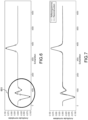
- area 601 of the reflectogram corresponds to a superposition of several pulses. Indeed, in this example, a non-clear defect is located at the start of the cable.
- the Gaussian pulses corresponding to the reflection of the signal on the non-clear defect combine with the one corresponding to the impedance mismatch between the measuring device and the cable, at the start of the cable.
- step 304 of the analysis method it is necessary to determine whether a pulse corresponds to a superposition or a combination of several other pulses in order to determine the pulses which are at the origin of the possible combination. This is the object of step 304 of the analysis method.
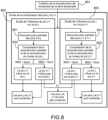
- FIG 8 represents a flowchart of the substeps of carrying out step 304 of detecting combined pulses.
- step 801 a total reconstruction of the entire reflectogram is first determined in the form of a time series corresponding to the sum of the pulses that have the same position and the same amplitude as the pulses detected on the reflectogram. This reconstructed time series makes it possible to model and simplify the initial reflectogram.
- the reconstructed time series is obtained by generating, for each extremum of the reflectogram identified in step 302, a pulse having the same shape as the excitation signal.
- a pulse having the same shape as the excitation signal in the example of the figure 7 .
- the pulse of the reconstructed series is generated using the above formula in the analysis area determined in step 303.
- the shape of the excitation signal may be different from the Gaussian shape, in this case, the modeling function used to reconstruct the pulses takes into account the shape of the excitation signal.
- step 802 the potential influence of the pulse of index j+1 on the pulse of index j is analyzed, then in step 803 the reverse operation is performed by analyzing the potential influence of the pulse of index j on the pulse of index j+1.
- step 821 a partial reconstruction of the reflectogram corresponding to the sum of the first part of the pulses going from index 0 (first pulse) to index j is constructed.
- This partial reconstruction 901 is represented in the example of figure 9 in comparison with the full reconstruction 902.
- the partial reconstruction allows to simulate a pulse of index j while potentially retaining the influence that the previous pulses exert on it but ignoring the influence of the following pulses.
- the objective is to analyze the pulse of index j in the absence of the influence of the following pulse of index j+1.
- step 822 a comparison is made between the partial reconstruction 901 and the total reconstruction 902 in the analysis window of the pulse of index j. If the two reconstructions are similar in the analysis zone, this means that the pulse of index j+1 does not influence the pulse of index j, otherwise this therefore means that the pulse of index j+1 has an influence on the pulse of index j.
- the comparison between the two reconstructions can be performed by calculating an error criterion between the two reconstructions in the analysis area, for example a mean square error criterion, and then comparing the result to a predetermined error threshold.
- This error threshold is for example of the order of 1e-09. Its value is determined according to the application case.
- step 803 The same processing is carried out in step 803 to evaluate the influence of the pulse of index j on the pulse of index j+1. For this, a partial reconstruction of the reflectogram is determined in step 831 for the pulses going from the index j+1 to the index N-1 where N is the number of pulses in the reflectogram.
- step 832 a comparison is made between this partial reconstruction and the total reconstruction in the analysis window of the pulse of index j+1. If the two reconstructions are similar in the analysis zone, this means that the pulse of index j does not influence the pulse of index j+1, otherwise this therefore means that the pulse of index j has an influence on the pulse of index j+1.
- FIG 10 illustrates how the algorithm works figure 8 on an example comprising the four pulses of indices 401, 402, 403, 404 of the reflectogram of the figure 4 .
- Diagrams 1001 and 1002 show respectively the comparison of the partial and total reconstructions for the reciprocal influence analysis of pulses 401,402. It can be seen that these two pulses are combined since pulse 401 exerts influence on pulse 402 (difference between the two curves on diagram 1002).
- Diagrams 1003 and 1004 show respectively the comparison of the partial and total reconstructions for the reciprocal influence analysis of pulses 402,403. It can be seen that these two pulses are combined since pulse 402 exerts influence on pulse 403 and vice versa (difference between the two curves on diagram 1003 and on diagram 1004).
- Diagrams 1005 and 1006 show respectively the comparison of partial and total reconstructions for the reciprocal influence analysis of pulses 403,404. This time, these two pulses are not combined since neither of them influences the other as can be seen in the two diagrams 1005 and 1006 which show superimposed curves.
- step 304 we know, for each pulse of the reflectogram, whether it is a single pulse or a pulse combined with another.
- step 305 is passed to perform a similarity test between the pulse of the initial reflectogram and the corresponding pulse of the time series reconstructed in step 801, in the pulse analysis zone.
- the similarity test is performed by comparing the two pulses, for example by calculating an adequate error criterion between the two pulses and comparing it to a predetermined error threshold.
- the error criterion is for example a mean square error criterion with a prior step of normalization between -1 and 1 of the values of the two time series to be compared. by dividing them by the extremum of the measured reflectogram.
- the value of the error threshold is for example of the order of 1e-03 and for example equal to 3.5 e -03. Its value is determined according to the application case.
- step 306 a classification of the pulse is carried out in order to associate it with a type of impedance discontinuity.
- the error criterion is greater than the error threshold then it means that the portion of the time series analyzed does not have the same shape as the excitation signal since the reconstructed series is a sum of Gaussian pulses with the same maximum frequency as the excitation signal. In this case, the pulse is not classified in order to avoid a false positive.
- a class is assigned to the single pulse based on its time abscissa and the value of its extremum. For example, the following classes can be considered. If the normalized amplitude of the extremum is close to -1, the impedance mismatch corresponds to a short circuit. If the normalized amplitude of the extremum is close to 1, the impedance mismatch corresponds to an open circuit. Other classes can be considered, for example a class grouping the characteristic impedances close to those of the cable to be analyzed or a class systematically associating the first impedance discontinuity with the impedance mismatch caused by the difference in impedance of the measurement port compared to that of the cable.
- step 307 is proceeded to determine the position and amplitude of the pulses that are at the origin of the combination. For this, an optimization algorithm is implemented to obtain an optimized reconstruction from the partial reconstruction of the pulses of a group of combined pulses.
- step 304 the successive pulses that have been detected as being combined are grouped together and then an optimization algorithm is applied to them, the objective of which is to vary the amplitude and position of the extrema in order to best approach the original reflectogram. In this way, a optimized partial reconstruction whose amplitudes and positions of the extrema are modified.
- the optimization function used seeks to determine the amplitude and position values of each of the peaks in the group that minimize the difference between the original reflectogram and a certain reconstruction that is defined by these values.
- This function therefore takes as inputs the amplitude and position of each of the peaks in the group as well as all the elements necessary for calculating the difference between the two curves. These elements are the function to be minimized and the series extracted from the reflectogram (piece of the reflectogram defined by the limits of the peaks in the group).
- the optimization algorithm used is for example a trust region reflective algorithm which is described for example in references [4], [5] and [6].
- the optimization step 307 makes it possible in particular to refine the precision of the temporal positions of the extrema in order to subsequently deduce a precise estimate of the position of the faults on the cable.
- step 307 we obtain a partial reconstruction optimized for each group of combined peaks.
- step 308 a similarity test identical to that of step 305 is then carried out, which consists in verifying the similarity between the optimized partial reconstruction and the original reflectogram.
- the same error criterion is used as in step 305, associated with a different error threshold.
- the value of the error threshold is, for example, of the order of 1.5 e -03.
- the error criterion is greater than the error threshold, this may mean that the optimization performed in step 307 is not valid or that the analyzed pulses do not have the same shape as the excitation signal. This optimization failure may come from the fact that some information on “hidden” pulse contributions in the pulse sum. In this case, the peaks of the combined peak group are not classified.
- a test is performed in step 309 on each successive pair of peaks of the peak group to check whether they correspond to the time signature of a non-clear defect. To do this, it is checked that two successive peaks have substantially the same amplitude and are of opposite signs. If this is the case, the two peaks are grouped together to associate them with a non-clear defect in step 310.
- the method is performed for all the extrema of the reflectogram.
- the temporal position of each pulse is converted into a distance corresponding to the position of the defect or impedance discontinuity on the cable. This operation is performed from the sampling period and the propagation speed of the wave injected into the cable.
- step 311 the reflectogram is displayed on a user interface with the information associated with the detected impedance defects and discontinuities, in particular their positions and types associated with the classifications carried out in steps 306 and 310.
- the invention can be implemented as a computer program comprising instructions for its execution.
- the computer program can be recorded on a recording medium readable by a processor.
- references to a computer program that, when executed, performs any of the functions described above is not limited to an application program running on a single host computer. Rather, the terms computer program and software are used herein in a general sense to refer to any type of computer code (e.g., application software, firmware, microcode, or any other form of computer instruction) that can be used to program one or more processors to implement aspects of the techniques described herein.
- the computing means or resources may be distributed ("cloud computing"), possibly using peer-to-peer technologies.
- the software code may be executed on any suitable processor (e.g., a microprocessor) or processor core or a set of processors, whether provided in a single computing device or distributed among several computing devices (e.g., as may be accessible in the device environment).
- the executable code of each program enabling the programmable device to implement the processes according to the invention may be stored, for example, in the hard disk or in read-only memory.
- the program(s) may be loaded into one of the storage means of the device before being executed.
- the central unit may control and direct the execution of the instructions or portions of software code of the program(s) according to the invention, instructions which are stored in the hard disk or in the read-only memory or in the other aforementioned storage elements.
- the invention can also be implemented in embedded form in a reflectometry device as described in Figures 1a and 1b .
- the device comprises a processing unit of the computer, personal digital assistant or other type to control the reflectometry system and execute the method according to the invention and display the results produced by the method on a human-machine interface.
Landscapes
- Physics & Mathematics (AREA)
- General Physics & Mathematics (AREA)
- Engineering & Computer Science (AREA)
- Mathematical Physics (AREA)
- Theoretical Computer Science (AREA)
- Measurement Of Resistance Or Impedance (AREA)
- Testing Of Short-Circuits, Discontinuities, Leakage, Or Incorrect Line Connections (AREA)
- Locating Faults (AREA)
Claims (12)
- Verfahren zum Bewerten einer Übertragungsleitung durch Reflektometrie, das die folgenden Schritte umfasst:- Erhalten (301) eines Messwerts der zeitlichen Impulsantwort eines Referenzsignals, das sich in der Leitung von einem Einspeisepunkt aus ausbreitet und dann zu einem Messpunkt zurückgeführt wird, wobei der zeitliche Messwert, Reflektogramm genannt, eine Vielzahl von Amplitudenspitzen umfasst, die jeweils einer Impedanzdiskontinuität entsprechen,- Suchen (302) nach einem Satz von lokalen Extrema des Reflektogramms,- Bestimmen (801) einer Gesamtrekonstruktion des Reflektogramms als die Summe von Impulsen, die jeweils die Form des Referenzsignals und die Position und Amplitude der lokalen Extrema aufweisen,dadurch gekennzeichnet, dass das Verfahren ferner die folgenden Schritte umfasst:- Vergleichen (822, 832), für jedes Paar von aufeinanderfolgenden lokalen Extrema mit den Indizes j und j + 1, der Gesamtrekonstruktion mit jeweils einer ersten Teilrekonstruktion (821) des Reflektogramms für die lokalen Extrema mit den Indizes 0 bis j und einer zweiten Teilrekonstruktion (831) des Reflektogramms für die lokalen Extrema mit den Indizes j + 1 bis N - 1, wobei N die Anzahl der lokalen Extrema ist, um festzustellen (802, 803), ob die Impulse mit den Indizes j und j + 1 des Reflektogramms sich gegenseitig beeinflussen oder nicht,- Bestimmen (307), für eine Gruppe von Impulsen des Reflektogramms, die sich gegenseitig beeinflussen, einer optimierten Rekonstruktion der Gruppe von Impulsen aus einer Teilrekonstruktion der Impulse der Gruppe, so dass die Abszissen der Impulse der Teilrekonstruktion geändert werden, um ein Fehlerkriterium zwischen der optimierten Teilrekonstruktion und dem gemessenen Reflektogramm zu minimieren,- Vergleichen (308) der Differenz zwischen der optimierten Teilrekonstruktion und dem gemessenen Reflektogramm mit einem ersten Fehlerschwellenwert und Klassifizieren (309, 306, 310), wenn die Differenz kleiner ist als der erste Fehlerschwellenwert, der mit jedem Impuls der Gruppe von Impulsen assoziierten Impedanzdiskontinuität in Abhängigkeit von ihrer Position und Amplitude unter den folgenden Klassen: einem nicht offenkundigen Fehler, einem Kurzschluss, einem offenen Stromkreis, einer an die Last der Übertragungsleitung angepassten Last, einer Impedanzfehlanpassung zwischen dem Messanschluss und der Übertragungsleitung.
- Verfahren zum Bewerten einer Übertragungsleitung nach Anspruch 1, wobei die Form des Referenzsignals ein Gaußscher Impuls ist.
- Verfahren zum Bewerten einer Übertragungsleitung nach einem der vorhergehenden Ansprüche, wobei der Schritt des Feststellens, ob die Impulse mit den Indizes j und j + 1 des Reflektogramms sich gegenseitig beeinflussen oder nicht, die folgenden Teilschritte umfasst:- Vergleichen (822) einer ersten Differenz zwischen der ersten Teilrekonstruktion und der Gesamtrekonstruktion mit einem zweiten Fehlerschwellenwert,- Vergleichen (832) einer zweiten Differenz zwischen der zweiten Teilrekonstruktion und der Gesamtrekonstruktion mit dem zweiten Fehlerschwellenwert,- Folgern, wenn mindestens eine der Differenzen aus der ersten Differenz und der zweiten Differenz größer als der zweite Fehlerschwellenwert ist, dass die Impulse mit den Indizes j und j + 1 des Reflektogramms sich gegenseitig beeinflussen, andernfalls Folgern, dass sie unabhängig voneinander sind.
- Verfahren zum Bewerten einer Übertragungsleitung nach einem der vorhergehenden Ansprüche, das den folgenden Schritt umfasst:- Vergleichen (305), für die als unabhängig identifizierten Impulse des Reflektogramms, der Differenz zwischen dem Reflektogramm und der Gesamtrekonstruktion innerhalb eines Zeitfensters, das den Impuls umgibt, mit einem dritten Fehlerschwellenwert,- Klassifizieren (306), wenn die Differenz kleiner ist als der dritte Fehlerschwellenwert, der dem Impuls entsprechenden Impedanzfehlanpassung je nach ihrer Position und Amplitude aus den folgenden Klassen: Kurzschluss, offener Stromkreis, an die Last der Übertragungsleitung angepasste Last, Impedanzfehlanpassung zwischen dem Messanschluss und der Übertragungsleitung.
- Verfahren zum Bewerten einer Übertragungsleitung nach einem der vorhergehenden Ansprüche, wobei die optimierte Rekonstruktion (307) mittels eines Algorithmus mit vertrauenswürdigen Regionen erhalten wird.
- Verfahren zum Bewerten einer Übertragungsleitung nach Anspruch 4, das den Schritt des Feststellens (309), wenn die Differenz zwischen der optimierten Teilrekonstruktion und dem gemessenen Reflektogramm für zwei aufeinanderfolgende Impulse unter dem ersten Fehlerschwellenwert liegt, ob die beiden Impulse im Wesentlichen identische Amplituden und entgegengesetzte Vorzeichen haben, und wenn ja, des Klassifizierens der diesen beiden Impulsen entsprechenden Impedanzfehlanpassung als Folge eines nicht offenkundigen Fehlers, wenn nicht, des Klassifizierens (306) der jedem der beiden Impulse entsprechenden Impedanzfehlanpassung in Abhängigkeit von ihrer Position und Amplitude unter den folgenden Klassen umfasst: Kurzschluss, offener Stromkreis, an die Last der Übertragungsleitung angepasste Last, Impedanzfehlanpassung zwischen dem Messanschluss und der Übertragungsleitung.
- Verfahren zum Bewerten einer Übertragungsleitung nach einem der vorhergehenden Ansprüche, das ferner einen Schritt des Extrahierens (303) jedes mit einem Extremum des Reflektogramms assoziierten Impulses in einem Zeitintervall mit einer Breite umfasst, die so ausgewählt ist, dass der Abstand zwischen dem Scheitelpunkt des Impulses und der Breite gleich einem vorbestimmten Prozentsatz, beispielsweise mindestens gleich 80%, der Gesamthöhe des Impulses ist.
- Verfahren zum Bewerten einer Übertragungsleitung nach einem der vorhergehenden Ansprüche, wobei das gemessene Reflektogramm in der Amplitude zwischen -1 und 1 normalisiert wird.
- Verfahren zum Bewerten einer Übertragungsleitung nach einem der vorhergehenden Ansprüche, wobei vor dem Vergleich mit dem ersten Fehlerschwellenwert oder dem dritten Fehlerschwellenwert das Reflektogramm und die optimierte Teil- oder Gesamtrekonstruktion auf das Extremum des Reflektogramms normalisiert werden.
- Verfahren zum Bewerten einer Übertragungsleitung nach einem der vorhergehenden Ansprüche, das außerdem einen Schritt des Bestimmens der Positionen der Impedanzdiskontinuitäten aus den zeitlichen Abszissen der Extrema des Reflektogramms und einen Schritt des Anzeigens (311) der Positionen und Typen der Impedanzdiskontinuitäten auf einer Mensch-Maschine-Schnittstelle umfasst.
- Computerprogramm, das Befehle zur Ausführung des Verfahrens nach einem der vorhergehenden Ansprüche umfasst, wenn das Programm von einem Prozessor ausgeführt wird.
- Prozessorlesbares Aufzeichnungsmedium, auf dem ein Programm mit Befehlen zur Ausführung des Verfahrens nach einem der Ansprüche 1 bis 10 aufgezeichnet ist, wenn das Programm von einem Prozessor ausgeführt wird.
Applications Claiming Priority (1)
| Application Number | Priority Date | Filing Date | Title |
|---|---|---|---|
| FR2210081A FR3140442B1 (fr) | 2022-10-03 | 2022-10-03 | Méthode d’évaluation d’une ligne de transmission par analyse automatique d’un réflectogramme |
Publications (2)
| Publication Number | Publication Date |
|---|---|
| EP4350366A1 EP4350366A1 (de) | 2024-04-10 |
| EP4350366B1 true EP4350366B1 (de) | 2024-12-18 |
Family
ID=84369808
Family Applications (1)
| Application Number | Title | Priority Date | Filing Date |
|---|---|---|---|
| EP23200223.8A Active EP4350366B1 (de) | 2022-10-03 | 2023-09-27 | Verfahren zur beurteilung einer übertragungsleitung durch automatische analyse eines reflektogramms |
Country Status (3)
| Country | Link |
|---|---|
| US (1) | US20240118331A1 (de) |
| EP (1) | EP4350366B1 (de) |
| FR (1) | FR3140442B1 (de) |
Family Cites Families (7)
| Publication number | Priority date | Publication date | Assignee | Title |
|---|---|---|---|---|
| US5083086A (en) * | 1990-07-12 | 1992-01-21 | James G. Biddle Co. | Differential arc reflectometry |
| US7245129B2 (en) * | 2005-02-14 | 2007-07-17 | Texas Instruments Incorporated | Apparatus for and method of cable diagnostics utilizing time domain reflectometry |
| FR2981752B1 (fr) * | 2011-10-20 | 2013-11-08 | Commissariat Energie Atomique | Procede de reflectometrie pour la detection de defauts non francs dans un cable electrique et systeme mettant en oeuvre le procede |
| FR3006769B1 (fr) * | 2013-06-11 | 2016-12-02 | Commissariat Energie Atomique | Procede de reflectometrie pour l'identification de defauts non francs impactant un cable |
| FR3034203B1 (fr) * | 2015-03-27 | 2018-07-13 | Commissariat A L'energie Atomique Et Aux Energies Alternatives | Procede de caracterisation d'un troncon d'une ligne de transmission, en particulier troncon correspondant a un connecteur ou une serie de connecteurs reliant un equipement de mesure a un cable |
| CN111095006A (zh) * | 2017-09-22 | 2020-05-01 | 施瓦哲工程实验有限公司 | 基于现场数据改进电力线上的事件定位的准确度 |
| FR3082947B1 (fr) * | 2018-06-26 | 2020-06-12 | Commissariat A L'energie Atomique Et Aux Energies Alternatives | Procede de caracterisation d'un defaut dans un reseau de lignes de transmission de topologie inconnue |
-
2022
- 2022-10-03 FR FR2210081A patent/FR3140442B1/fr active Active
-
2023
- 2023-09-27 EP EP23200223.8A patent/EP4350366B1/de active Active
- 2023-10-03 US US18/376,097 patent/US20240118331A1/en active Pending
Also Published As
| Publication number | Publication date |
|---|---|
| EP4350366A1 (de) | 2024-04-10 |
| FR3140442B1 (fr) | 2024-09-27 |
| FR3140442A1 (fr) | 2024-04-05 |
| US20240118331A1 (en) | 2024-04-11 |
Similar Documents
| Publication | Publication Date | Title |
|---|---|---|
| EP3440472B1 (de) | Verfahren zur erkennung von weichen fehlern in einem kabel durch datenfusion | |
| FR3048511B1 (fr) | Procede de detection de defauts non francs dans un cable, basee sur l'integrale d'un reflectogramme | |
| EP3201638B1 (de) | Verfahren zur analyse eines kabels, basierend auf einer selbstanpassenden korrelation, zum nachweis von nicht eindeutigen defekten | |
| EP3259608B1 (de) | Verfahren zur charakterisierung eines unklaren fehlers in einem kabel | |
| WO2020221618A1 (fr) | Procede de detection de defauts non francs dans un cable par analyse en composantes principales | |
| EP3555645B1 (de) | Verfahren zur berechnung eines reflektogramms zur analyse von fehlern in einer übertragungsleitung | |
| EP3298419B1 (de) | Verfahren zur analyse eines kabels mit einem verarbeitungsvorgang zur verstärkung der signatur eines leichten fehlers | |
| WO2018192832A1 (fr) | Procede et systeme de detection d'un defaut dans une ligne de transmission a partir d'une mesure de phase | |
| EP4001934B1 (de) | Methode zur charaterisierung einer übertragungsleitung basierend auf ihrem impedanzprofil | |
| WO2024033044A1 (fr) | Méthode de détermination d'une impédance minimale d'un défaut détectable au moyen d'une analyse d'un câble par réflectométrie | |
| WO2018192939A1 (fr) | Procede et systeme de detection d'un defaut intermittent dans une ligne de transmission, par filtrage | |
| FR3099830A1 (fr) | Procédé et système de surveillance d’un réseau de câbles, par analyse en composantes principales | |
| FR3070211B1 (fr) | Procede, mis en œuvre par ordinateur, de reconstruction de la topologie d'un reseau de cables | |
| EP4350366A1 (de) | Verfahren zur beurteilung einer übertragungsleitung durch automatische analyse eines reflektogramms | |
| WO2021052750A1 (fr) | Procede de detection de defauts dans un reseau de lignes de transmission | |
| FR3136859A1 (fr) | Méthode de détection et localisation de défauts francs ou de terminaison pour un câble composé de plusieurs tronçons de câbles inhomogènes | |
| EP4300095B1 (de) | Verfahren zur automatischen identifizierung einer akustischen quelle aus einem erzeugten akustischen signal | |
| EP4118616B1 (de) | Verfahren und system zur zerstörungsfreien prüfung einer aeronautischen komponente | |
| US20250207997A1 (en) | Denoising optical time-domain reflectometry signals | |
| FR3159671A1 (fr) | Méthode de caractérisation de défauts dans un câble par apprentissage automatique | |
| WO2023198647A1 (fr) | Procédé et dispositif d'analyse de défauts par réflectométrie au moyen d'une estimation de fonction de transfert | |
| FR3117597A1 (fr) | Procédé de contrôle non destructif pour une pièce aéronautique | |
| FR2965625A1 (fr) | Procede et dispositif d'estimation de la reponse impulsionnelle d'un reseau de cables par deconvolution myope |
Legal Events
| Date | Code | Title | Description |
|---|---|---|---|
| PUAI | Public reference made under article 153(3) epc to a published international application that has entered the european phase |
Free format text: ORIGINAL CODE: 0009012 |
|
| STAA | Information on the status of an ep patent application or granted ep patent |
Free format text: STATUS: REQUEST FOR EXAMINATION WAS MADE |
|
| 17P | Request for examination filed |
Effective date: 20230927 |
|
| AK | Designated contracting states |
Kind code of ref document: A1 Designated state(s): AL AT BE BG CH CY CZ DE DK EE ES FI FR GB GR HR HU IE IS IT LI LT LU LV MC ME MK MT NL NO PL PT RO RS SE SI SK SM TR |
|
| GRAP | Despatch of communication of intention to grant a patent |
Free format text: ORIGINAL CODE: EPIDOSNIGR1 |
|
| STAA | Information on the status of an ep patent application or granted ep patent |
Free format text: STATUS: GRANT OF PATENT IS INTENDED |
|
| RAP3 | Party data changed (applicant data changed or rights of an application transferred) |
Owner name: COMMISSARIAT A L'ENERGIE ATOMIQUE ET AUX ENERGIESALTERNATIVES |
|
| GRAS | Grant fee paid |
Free format text: ORIGINAL CODE: EPIDOSNIGR3 |
|
| INTG | Intention to grant announced |
Effective date: 20241010 |
|
| GRAA | (expected) grant |
Free format text: ORIGINAL CODE: 0009210 |
|
| STAA | Information on the status of an ep patent application or granted ep patent |
Free format text: STATUS: THE PATENT HAS BEEN GRANTED |
|
| AK | Designated contracting states |
Kind code of ref document: B1 Designated state(s): AL AT BE BG CH CY CZ DE DK EE ES FI FR GB GR HR HU IE IS IT LI LT LU LV MC ME MK MT NL NO PL PT RO RS SE SI SK SM TR |
|
| REG | Reference to a national code |
Ref country code: CH Ref legal event code: EP |
|
| REG | Reference to a national code |
Ref country code: DE Ref legal event code: R096 Ref document number: 602023001415 Country of ref document: DE |
|
| REG | Reference to a national code |
Ref country code: IE Ref legal event code: FG4D Free format text: LANGUAGE OF EP DOCUMENT: FRENCH |
|
| REG | Reference to a national code |
Ref country code: LT Ref legal event code: MG9D |
|
| PG25 | Lapsed in a contracting state [announced via postgrant information from national office to epo] |
Ref country code: HR Free format text: LAPSE BECAUSE OF FAILURE TO SUBMIT A TRANSLATION OF THE DESCRIPTION OR TO PAY THE FEE WITHIN THE PRESCRIBED TIME-LIMIT Effective date: 20241218 |
|
| PG25 | Lapsed in a contracting state [announced via postgrant information from national office to epo] |
Ref country code: FI Free format text: LAPSE BECAUSE OF FAILURE TO SUBMIT A TRANSLATION OF THE DESCRIPTION OR TO PAY THE FEE WITHIN THE PRESCRIBED TIME-LIMIT Effective date: 20241218 |
|
| PG25 | Lapsed in a contracting state [announced via postgrant information from national office to epo] |
Ref country code: BG Free format text: LAPSE BECAUSE OF FAILURE TO SUBMIT A TRANSLATION OF THE DESCRIPTION OR TO PAY THE FEE WITHIN THE PRESCRIBED TIME-LIMIT Effective date: 20241218 |
|
| PG25 | Lapsed in a contracting state [announced via postgrant information from national office to epo] |
Ref country code: NO Free format text: LAPSE BECAUSE OF FAILURE TO SUBMIT A TRANSLATION OF THE DESCRIPTION OR TO PAY THE FEE WITHIN THE PRESCRIBED TIME-LIMIT Effective date: 20250318 |
|
| REG | Reference to a national code |
Ref country code: NL Ref legal event code: MP Effective date: 20241218 |
|
| PG25 | Lapsed in a contracting state [announced via postgrant information from national office to epo] |
Ref country code: GR Free format text: LAPSE BECAUSE OF FAILURE TO SUBMIT A TRANSLATION OF THE DESCRIPTION OR TO PAY THE FEE WITHIN THE PRESCRIBED TIME-LIMIT Effective date: 20250319 Ref country code: LV Free format text: LAPSE BECAUSE OF FAILURE TO SUBMIT A TRANSLATION OF THE DESCRIPTION OR TO PAY THE FEE WITHIN THE PRESCRIBED TIME-LIMIT Effective date: 20241218 |
|
| PG25 | Lapsed in a contracting state [announced via postgrant information from national office to epo] |
Ref country code: RS Free format text: LAPSE BECAUSE OF FAILURE TO SUBMIT A TRANSLATION OF THE DESCRIPTION OR TO PAY THE FEE WITHIN THE PRESCRIBED TIME-LIMIT Effective date: 20250318 |
|
| PG25 | Lapsed in a contracting state [announced via postgrant information from national office to epo] |
Ref country code: NL Free format text: LAPSE BECAUSE OF FAILURE TO SUBMIT A TRANSLATION OF THE DESCRIPTION OR TO PAY THE FEE WITHIN THE PRESCRIBED TIME-LIMIT Effective date: 20241218 |
|
| REG | Reference to a national code |
Ref country code: AT Ref legal event code: MK05 Ref document number: 1752637 Country of ref document: AT Kind code of ref document: T Effective date: 20241218 |
|
| PG25 | Lapsed in a contracting state [announced via postgrant information from national office to epo] |
Ref country code: SM Free format text: LAPSE BECAUSE OF FAILURE TO SUBMIT A TRANSLATION OF THE DESCRIPTION OR TO PAY THE FEE WITHIN THE PRESCRIBED TIME-LIMIT Effective date: 20241218 |
|
| PG25 | Lapsed in a contracting state [announced via postgrant information from national office to epo] |
Ref country code: PL Free format text: LAPSE BECAUSE OF FAILURE TO SUBMIT A TRANSLATION OF THE DESCRIPTION OR TO PAY THE FEE WITHIN THE PRESCRIBED TIME-LIMIT Effective date: 20241218 |
|
| PG25 | Lapsed in a contracting state [announced via postgrant information from national office to epo] |
Ref country code: ES Free format text: LAPSE BECAUSE OF FAILURE TO SUBMIT A TRANSLATION OF THE DESCRIPTION OR TO PAY THE FEE WITHIN THE PRESCRIBED TIME-LIMIT Effective date: 20241218 |
|
| PG25 | Lapsed in a contracting state [announced via postgrant information from national office to epo] |
Ref country code: IS Free format text: LAPSE BECAUSE OF FAILURE TO SUBMIT A TRANSLATION OF THE DESCRIPTION OR TO PAY THE FEE WITHIN THE PRESCRIBED TIME-LIMIT Effective date: 20250418 |
|
| PG25 | Lapsed in a contracting state [announced via postgrant information from national office to epo] |
Ref country code: PT Free format text: LAPSE BECAUSE OF FAILURE TO SUBMIT A TRANSLATION OF THE DESCRIPTION OR TO PAY THE FEE WITHIN THE PRESCRIBED TIME-LIMIT Effective date: 20250421 |
|
| PG25 | Lapsed in a contracting state [announced via postgrant information from national office to epo] |
Ref country code: EE Free format text: LAPSE BECAUSE OF FAILURE TO SUBMIT A TRANSLATION OF THE DESCRIPTION OR TO PAY THE FEE WITHIN THE PRESCRIBED TIME-LIMIT Effective date: 20241218 |
|
| PG25 | Lapsed in a contracting state [announced via postgrant information from national office to epo] |
Ref country code: RO Free format text: LAPSE BECAUSE OF FAILURE TO SUBMIT A TRANSLATION OF THE DESCRIPTION OR TO PAY THE FEE WITHIN THE PRESCRIBED TIME-LIMIT Effective date: 20241218 Ref country code: AT Free format text: LAPSE BECAUSE OF FAILURE TO SUBMIT A TRANSLATION OF THE DESCRIPTION OR TO PAY THE FEE WITHIN THE PRESCRIBED TIME-LIMIT Effective date: 20241218 |
|
| PG25 | Lapsed in a contracting state [announced via postgrant information from national office to epo] |
Ref country code: SK Free format text: LAPSE BECAUSE OF FAILURE TO SUBMIT A TRANSLATION OF THE DESCRIPTION OR TO PAY THE FEE WITHIN THE PRESCRIBED TIME-LIMIT Effective date: 20241218 |
|
| PG25 | Lapsed in a contracting state [announced via postgrant information from national office to epo] |
Ref country code: CZ Free format text: LAPSE BECAUSE OF FAILURE TO SUBMIT A TRANSLATION OF THE DESCRIPTION OR TO PAY THE FEE WITHIN THE PRESCRIBED TIME-LIMIT Effective date: 20241218 |
|
| PG25 | Lapsed in a contracting state [announced via postgrant information from national office to epo] |
Ref country code: IT Free format text: LAPSE BECAUSE OF FAILURE TO SUBMIT A TRANSLATION OF THE DESCRIPTION OR TO PAY THE FEE WITHIN THE PRESCRIBED TIME-LIMIT Effective date: 20241218 |
|
| PG25 | Lapsed in a contracting state [announced via postgrant information from national office to epo] |
Ref country code: SE Free format text: LAPSE BECAUSE OF FAILURE TO SUBMIT A TRANSLATION OF THE DESCRIPTION OR TO PAY THE FEE WITHIN THE PRESCRIBED TIME-LIMIT Effective date: 20241218 |
|
| REG | Reference to a national code |
Ref country code: DE Ref legal event code: R097 Ref document number: 602023001415 Country of ref document: DE |
|
| PG25 | Lapsed in a contracting state [announced via postgrant information from national office to epo] |
Ref country code: DK Free format text: LAPSE BECAUSE OF FAILURE TO SUBMIT A TRANSLATION OF THE DESCRIPTION OR TO PAY THE FEE WITHIN THE PRESCRIBED TIME-LIMIT Effective date: 20241218 |
|
| PGFP | Annual fee paid to national office [announced via postgrant information from national office to epo] |
Ref country code: FR Payment date: 20250923 Year of fee payment: 3 |
|
| PLBE | No opposition filed within time limit |
Free format text: ORIGINAL CODE: 0009261 |
|
| STAA | Information on the status of an ep patent application or granted ep patent |
Free format text: STATUS: NO OPPOSITION FILED WITHIN TIME LIMIT |
|
| 26N | No opposition filed |
Effective date: 20250919 |