EP4344860B1 - Auflegeverfahren von verbundflugzeugteilen mit einer öffnung - Google Patents
Auflegeverfahren von verbundflugzeugteilen mit einer öffnung Download PDFInfo
- Publication number
- EP4344860B1 EP4344860B1 EP22382888.0A EP22382888A EP4344860B1 EP 4344860 B1 EP4344860 B1 EP 4344860B1 EP 22382888 A EP22382888 A EP 22382888A EP 4344860 B1 EP4344860 B1 EP 4344860B1
- Authority
- EP
- European Patent Office
- Prior art keywords
- opening
- tow
- orientation
- gap
- major axis
- Prior art date
- Legal status (The legal status is an assumption and is not a legal conclusion. Google has not performed a legal analysis and makes no representation as to the accuracy of the status listed.)
- Active
Links
Images
Classifications
-
- B—PERFORMING OPERATIONS; TRANSPORTING
- B29—WORKING OF PLASTICS; WORKING OF SUBSTANCES IN A PLASTIC STATE IN GENERAL
- B29C—SHAPING OR JOINING OF PLASTICS; SHAPING OF MATERIAL IN A PLASTIC STATE, NOT OTHERWISE PROVIDED FOR; AFTER-TREATMENT OF THE SHAPED PRODUCTS, e.g. REPAIRING
- B29C70/00—Shaping composites, i.e. plastics material comprising reinforcements, fillers or preformed parts, e.g. inserts
- B29C70/04—Shaping composites, i.e. plastics material comprising reinforcements, fillers or preformed parts, e.g. inserts comprising reinforcements only, e.g. self-reinforcing plastics
- B29C70/28—Shaping operations therefor
- B29C70/54—Component parts, details or accessories; Auxiliary operations, e.g. feeding or storage of prepregs or SMC after impregnation or during ageing
- B29C70/545—Perforating, cutting or machining during or after moulding
-
- B—PERFORMING OPERATIONS; TRANSPORTING
- B29—WORKING OF PLASTICS; WORKING OF SUBSTANCES IN A PLASTIC STATE IN GENERAL
- B29C—SHAPING OR JOINING OF PLASTICS; SHAPING OF MATERIAL IN A PLASTIC STATE, NOT OTHERWISE PROVIDED FOR; AFTER-TREATMENT OF THE SHAPED PRODUCTS, e.g. REPAIRING
- B29C70/00—Shaping composites, i.e. plastics material comprising reinforcements, fillers or preformed parts, e.g. inserts
- B29C70/04—Shaping composites, i.e. plastics material comprising reinforcements, fillers or preformed parts, e.g. inserts comprising reinforcements only, e.g. self-reinforcing plastics
- B29C70/28—Shaping operations therefor
- B29C70/30—Shaping by lay-up, i.e. applying fibres, tape or broadsheet on a mould, former or core; Shaping by spray-up, i.e. spraying of fibres on a mould, former or core
-
- B—PERFORMING OPERATIONS; TRANSPORTING
- B29—WORKING OF PLASTICS; WORKING OF SUBSTANCES IN A PLASTIC STATE IN GENERAL
- B29C—SHAPING OR JOINING OF PLASTICS; SHAPING OF MATERIAL IN A PLASTIC STATE, NOT OTHERWISE PROVIDED FOR; AFTER-TREATMENT OF THE SHAPED PRODUCTS, e.g. REPAIRING
- B29C70/00—Shaping composites, i.e. plastics material comprising reinforcements, fillers or preformed parts, e.g. inserts
- B29C70/04—Shaping composites, i.e. plastics material comprising reinforcements, fillers or preformed parts, e.g. inserts comprising reinforcements only, e.g. self-reinforcing plastics
- B29C70/28—Shaping operations therefor
- B29C70/30—Shaping by lay-up, i.e. applying fibres, tape or broadsheet on a mould, former or core; Shaping by spray-up, i.e. spraying of fibres on a mould, former or core
- B29C70/302—Details of the edges of fibre composites, e.g. edge finishing or means to avoid delamination
-
- B—PERFORMING OPERATIONS; TRANSPORTING
- B29—WORKING OF PLASTICS; WORKING OF SUBSTANCES IN A PLASTIC STATE IN GENERAL
- B29C—SHAPING OR JOINING OF PLASTICS; SHAPING OF MATERIAL IN A PLASTIC STATE, NOT OTHERWISE PROVIDED FOR; AFTER-TREATMENT OF THE SHAPED PRODUCTS, e.g. REPAIRING
- B29C70/00—Shaping composites, i.e. plastics material comprising reinforcements, fillers or preformed parts, e.g. inserts
- B29C70/04—Shaping composites, i.e. plastics material comprising reinforcements, fillers or preformed parts, e.g. inserts comprising reinforcements only, e.g. self-reinforcing plastics
- B29C70/28—Shaping operations therefor
- B29C70/30—Shaping by lay-up, i.e. applying fibres, tape or broadsheet on a mould, former or core; Shaping by spray-up, i.e. spraying of fibres on a mould, former or core
- B29C70/38—Automated lay-up, e.g. using robots, laying filaments according to predetermined patterns
- B29C70/386—Automated tape laying [ATL]
-
- B—PERFORMING OPERATIONS; TRANSPORTING
- B29—WORKING OF PLASTICS; WORKING OF SUBSTANCES IN A PLASTIC STATE IN GENERAL
- B29K—INDEXING SCHEME ASSOCIATED WITH SUBCLASSES B29B, B29C OR B29D, RELATING TO MOULDING MATERIALS OR TO MATERIALS FOR MOULDS, REINFORCEMENTS, FILLERS OR PREFORMED PARTS, e.g. INSERTS
- B29K2307/00—Use of elements other than metals as reinforcement
- B29K2307/04—Carbon
-
- B—PERFORMING OPERATIONS; TRANSPORTING
- B29—WORKING OF PLASTICS; WORKING OF SUBSTANCES IN A PLASTIC STATE IN GENERAL
- B29L—INDEXING SCHEME ASSOCIATED WITH SUBCLASS B29C, RELATING TO PARTICULAR ARTICLES
- B29L2031/00—Other particular articles
- B29L2031/30—Vehicles, e.g. ships or aircraft, or body parts thereof
- B29L2031/3076—Aircrafts
-
- B—PERFORMING OPERATIONS; TRANSPORTING
- B29—WORKING OF PLASTICS; WORKING OF SUBSTANCES IN A PLASTIC STATE IN GENERAL
- B29L—INDEXING SCHEME ASSOCIATED WITH SUBCLASS B29C, RELATING TO PARTICULAR ARTICLES
- B29L2031/00—Other particular articles
- B29L2031/30—Vehicles, e.g. ships or aircraft, or body parts thereof
- B29L2031/3076—Aircrafts
- B29L2031/3085—Wings
-
- B—PERFORMING OPERATIONS; TRANSPORTING
- B29—WORKING OF PLASTICS; WORKING OF SUBSTANCES IN A PLASTIC STATE IN GENERAL
- B29L—INDEXING SCHEME ASSOCIATED WITH SUBCLASS B29C, RELATING TO PARTICULAR ARTICLES
- B29L2031/00—Other particular articles
- B29L2031/737—Articles provided with holes, e.g. grids, sieves
Definitions
- the invention relates to a lay-up method of composite aircraft parts, specifically carbon-fiber-reinforced polymers (CRFPs), comprising openings such as manholes or handholes.
- CRFPs carbon-fiber-reinforced polymers
- a lay-up process is a molding process for composite materials, in which the final laminate is obtained by overlapping a specific number of different layers or plies.
- Each layer or ply has an orientation of 0o, 90o, +/-45o and is made up of several tows laid up with an orientation of 0, 90o, +/-45o. 0°, zero-degree fiber angle are oriented in the direction of the load of the part.
- Aircraft parts comprise several openings to carry out inspection tasks, assembly of systems, repairs, etc.
- An opening is a space or gap that allows passage or access.
- a manhole is an opening in an aircraft surface to allow the passage of a man or equipment to perform the above-mentioned tasks.
- a handhole is an opening in an aircraft surface to allow the passage of a hand. Therefore, a handhole is smaller than a manhole and allows only hand or small inspection equipment to pass through.
- NACA inlets openings are also known that are surface openings in wings or horizontal tail planes (HTP) for the installation of NACA inlets.
- Openings are mainly ovals, ellipses, or circumferences. Openings comprise a perimeter, a major axis, a minor axis, a center where both axes cross, a first and a second semi-major axis and a first and a second semi-minor axis departing from the center.
- Layers and tows having an orientation of 0o are parallel to the mayor axis of the opening and layers and tows having an orientation of 90o are parallel to the minor axis of the opening.
- CFRP carbon-fiber-reinforced polymers
- ATL Automatic lay-up machines typically provide tows of 300 mm, 150 mm ⁇ 75 mm width that are laid-up to manufacture the composite laminate.
- the width of the tow is the dimension of the tow in a direction perpendicular to its longitudinal direction or laying-up orientation.
- Fibre lay-up machines typically provide tows of 6,35 mm (1 ⁇ 4"), 12,7 mm (1 ⁇ 2") or 50,8 mm (2"). In the case of 2" (50,8 mm) tows, it is sometimes referred to as HDPreg (High deposition preimpregnated).
- 'manholes' or 'handholes' area is laid-up with extra material or scrap material.
- This extra material or scrap material is only needed for manufacturing purposes as it allows a vacuum bag to be adapted during curing. Therefore, the inner dimensions of the opening or perimeter, such as the diameter, is made intentionally undersize, and after the curing stage adjusted to its final dimension, usually by trimming methods. It is known that, to facilitate the fitting of the vacuum bag, the extra material or scrap material has a ramp geometry that smooths the contour of the manhole or handhole.
- manholes or handholes are laid-up in their entirety and the opening is cut afterwards.
- CN 110 588 020 A discloses the features of the preamble of claim 1.
- the claimed method comprises the steps of laying-up composite tows forming plies that form a composite laminate.
- At least each tow having an orientation of 0o and being within the perimeter of the opening, i.e., having at least a part within the perimeter, comprises:
- first line and a second line approximately at 3/5 of the semi-major axis from the center of, for instance, the ellipse of the manhole or the radius of the circumference of the handhole.
- the automatic or manual laying-up of the tow shall be interrupted at the mentioned first and second lines and continued after the corresponding gap.
- the cutting and starting is performed leaving the mentioned gap.
- the tension of the tow is then released, facilitating the adaptation of the vacuum bag during curing.
- the laying up is made in a dedicated laying up tool, i.e., o tool without a curing purpose
- the tows are laid-up to form the laminate and afterwards a cut of the thickness of the laid-up laminate is performed at the first line and at the second line of the opening to form the first and the second gap in each laid-up tow.
- the tool is only for laying up and not curing, it is possible to lay up the laminate to the full thickness and then make a cut in the two areas indicated to the full thickness of the laminate, without fear of damaging the tool, which could have some ridges in the area.
- the vacuum bag would not be able to fit the opening due to the tension of the tows. If the tows tension is high, the vacuum bag is not able to bend the tows with the vacuum pressure. As the contour of the tows is irregular, there could be a hole between tows. Although, the vacuum bag film has good elongation properties, it is not able to fit to these holes and it can be broken while curing.
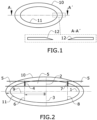
- Figure 1 discloses a schematic plan view and a cross-section of a manhole with manufacturing scrap material including a ramp area according to the state of the art.
- the schematic manhole comprises scrap material (11) disclosing the intermediate dimension of the manhole and the perimeter (10) of the final dimensions of the manhole.
- the manufacturing scrap material (11) comprises an area with a ramp (12) for allowing the positioning of the vacuum bag during the curing process of the composite laminate.
- Figure 2 discloses an opening comprising a perimeter (10), a major axis (1), a minor axis (2) and a center (3). One of the semi-major axis (9) is also depicted.
- the major axis (1) and the minor axis (2) may have the same length so that the opening is a circumference.
- Figure 2 discloses a tow (5) having an orientation of 0o.
- the tow (5) being laid-up comprises a first gap (4) and a second gap (7) between longitudinally consecutive laminated tow (5) portions.
- the first gap (4) is located at a first line (6) at 3/5 of the first semi-major axis (9) from the center (3) of the opening.
- the second gap (7) is located at a second line (8) at approximately 3/5 of the second semi-major axis (9) from the center (3) of the opening.
- the first gaps (4) and the second gaps (7) of the tows (5) of the laminate are configured as a first and a second elongated gap located within the perimeter (10) of the opening and longitudinally perpendicular to the orientation of the tow (5), that are at least those tows (5) having an orientation of 0o.
- the tows (5) having an orientation of 0o are parallel to the major axis (1).
- the first and second gaps (4, 7) do not extend beyond the perimeter (10) of the opening.
- the method comprises the following steps:
- the tows (5) having an orientation of 0° should all be cut.
- the tows (5) having an orientation of +/-45° are cut only if the laminate has many layers with this orientation. This is due because it is easier for the vacuum bag to adapt to the tows (5) having an orientation of +/-45°, even if they are not cut, due to their lower stiffness in the bending direction.
- the tows (5) having an orientation of +/-45o and being within the perimeter (10) of the opening may also comprise the first gap (4) and/or the second gap (7) or no gap depending on its position within the perimeter (10) and the needs.
- the tows (5) having an orientation of +/-45o may comprise:
- the tows (5) having an orientation of 0o, 90o or +/-45o, of the laminate are laid-up to form the laminate and, in a second step, a cut of the thickness of the laminate is performed at the first line (6), that is approximately 3/5 of the semi-major axis (9) of the opening, and at the second line (8), that is approximately 3/5 of the other semi-major axis (9) of the opening.
- the cut is configured as a first and a second elongated gap longitudinally perpendicular to the tows (5) having an orientation of 0o. It is understood as thickness of the composite laminate the smallest dimension of the laminate.
- the tows (5) are laminated without any cut or interruption at the first line (6), or the second line (8), and the gaps (4, 7) are formed afterwards by cutting the laminate.
- This alternative embodiment is particularly useful if the lay-up tool is not the same as the curing tool.
- the cuts may be made without the risk of damaging the curing tool.
- the cuts can be made either with the blade of the laying head or manually. Full thickness cutting of the laminate should only be done if there is no risk of damaging the tool during curing.
- the first gap (4) and the second gap (7) are located in a range of 3/5 of the length of the first and the semi-major axis (9) from the center (3) +/- a width of the tow (5). Therefore, approximately means that the gap (4, 7) is located at 3/5 of the semi-major axis (9) plus the dimensions of the width of the tow (5) or minus the dimensions of the width of the tow (5).
- the gaps (4, 7) are perpendicular to a longitudinal axis of the laid-ups tows (5), i.e., are perpendicular to the direction of lay-up of the tows (5) with an orientation of 0o, which is parallel to the major axis (1).
- the tows (5) laid-up at a direction of 45o are cut perpendicularly to its laying-up direction.
- the width of the gaps (4, 7) is between 1,5 mm and 2 mm, i.e., the measurement of the gaps (4, 7) taken parallel to the mayor axis (1) of the opening (10).
- the claimed invention is applicable to parts or laminates manufactured with CFRP tows (5) wider than 12,7 mm and having openings (10).
- the width of the tows (5) is taken perpendicularly to their laying-up direction.
- aircraft parts are wings or horizontal tail planes (HTP).
- the geometry of the opening does not have dimensions that are a multiple of the tow (5) width, so the edges of the laid-up opening have an irregular geometry.
- the created gaps (4,7) were inside the flying portion of the composite part, i.e., the gaps (4, 7) are located outside the opening, the position of the first (6) and second line (8) could be moved up to only one line coincident with the minor axis (2).
Landscapes
- Engineering & Computer Science (AREA)
- Chemical & Material Sciences (AREA)
- Composite Materials (AREA)
- Mechanical Engineering (AREA)
- Robotics (AREA)
- Moulding By Coating Moulds (AREA)
Claims (10)
- Laminierverfahren für Verbundstoff-Luftfahrzeugteile mit einer Öffnung, wobei die Öffnung einen Umfang (10), eine Hauptachse (1), eine Nebenachse (2), eine Mitte (3) und eine erste und eine zweite Halbachse (9) umfasst, die von der Mitte (3) abweichen, wobei das Laminierverfahren die Schritte Laminieren von Verbundstoffsträngen (5) mit einer Ausrichtung von 0°, 90° oder +/-45° umfasst, die Schichten bilden, die wiederum ein Verbundstofflaminat bilden, wobei die Stränge (5) eine Ausrichtung von 0° aufweisen, die parallel zur Hauptachse (1) der Öffnung ist, wobei das Verfahren dadurch gekennzeichnet ist, dass zumindest jeder Strang (5), der eine Ausrichtung von 0° aufweist und innerhalb des Umfangs (10) der Öffnung liegt, Folgendes umfasst:- einen ersten Spalt (4), der etwa 3/5 der Länge der ersten Halbachse (9) von der Mitte (3) entfernt liegt, wobei der erste Spalt (4) als ein erster länglicher Spalt ausgelegt ist, der in Längsrichtung senkrecht zur Ausrichtung des Strangs (5) steht, und- einen zweiten Spalt (7), der etwa 3/5 der Länge der zweiten Halbachse (9) von der Mitte (3) entfernt liegt, wobei der zweite Spalt (7) als ein zweiter länglicher Spalt ausgelegt ist, der in Längsrichtung senkrecht zur Ausrichtung des Strangs (5) steht.
- Laminierverfahren für Verbundstoff-Luftfahrzeugteile mit einer Öffnung nach Anspruch 1, wobei das Verfahren die folgenden Schritte umfasst:- Laminieren eines Strangs (5) mit einer Ausrichtung von 0° bis etwa 3/5 der ersten Halbachse (9) der Öffnung von der Mitte (3),- Schneiden des laminierten Strangs (5) bei etwa 3/5 der ersten Halbachse (9) der Öffnung senkrecht zur Ausrichtung des Strangs (5),- Belassen des ersten Spalts (4) und Fortfahren mit dem Laminieren des Strangs (5) bis etwa 3/5 der zweiten Halbachse (9) der Öffnung von der Mitte (3),- Schneiden des laminierten Strangs (5) bei etwa 3/5 der zweiten Halbachse (9) der Öffnung senkrecht zur Ausrichtung des Strangs (5),- Belassen des zweiten Spalts (7) und Fortfahren mit dem Laminieren des Strangs (5),- Wiederholen der oben genannten Schritte mit zumindest dem Rest der Stränge (5), die eine Ausrichtung von 0° aufweisen und sich innerhalb des Umfangs (10) der Öffnung befinden.
- Laminierverfahren für Verbundstoff-Luftfahrzeugteile mit einer Öffnung nach einem vorhergehenden Ansprüche, wobei die Stränge (5), die eine Ausrichtung von +/-45° aufweisen und innerhalb des Umfangs (10) der Öffnung liegen, Folgendes umfassen:- den ersten Spalt (4), der etwa 3/5 der Länge der ersten Halbachse (9) von der Mitte (3) entfernt liegt, wobei der erste Spalt (4) als ein erster länglicher Spalt ausgelegt ist, der in Längsrichtung senkrecht zur Ausrichtung des Strangs (5) steht, und/oder- den zweiten Spalt (7), der etwa 3/5 der Länge der zweiten Halbachse (9) von der Mitte (3) entfernt liegt, wobei der zweite Spalt (7) als ein zweiter länglicher Spalt ausgelegt ist, der in Längsrichtung senkrecht zur Ausrichtung des Strangs (5) steht.
- Laminierverfahren für Verbundstoff-Luftfahrzeugteile mit einer Öffnung nach Anspruch 2 und 3, wobei das Verfahren die folgenden Schritte umfasst:- Laminieren eines Strangs (5) mit einer Ausrichtung von +/-45°,- wenn der Strang (5) eine erste Linie (6) überquert, die sich etwa bei 3/5 der ersten Halbachse (9) der Öffnung von der Mitte (3) befindet, Schneiden des laminierten Strangs (5) bei etwa 3/5 der ersten Halbachse (9) der Öffnung senkrecht zur Ausrichtung des Strangs (5),- Belassen des ersten Spalts (4) und Fortfahren mit dem Laminieren des Strangs (5),- wenn der Strang (5) eine zweiten Linie (8) überquert, die sich etwa bei 3/5 der zweiten Halbachse (9) der Öffnung von der Mitte (3) befindet, Schneiden des laminierten Strangs (5) bei etwa 3/5 der zweiten Halbachse (9) der Öffnung von der Mitte (3) senkrecht zur Ausrichtung des Strangs (5),- Belassen des zweiten Spalts (7) und Fortfahren mit dem Laminieren des Strangs (5).
- Laminierverfahren für Verbundstoff-Luftfahrzeugteile mit einer Öffnung nach Anspruch 1, wobei in einem ersten Schritt die Stränge (5) zur Bildung des Laminats laminiert werden und in einem zweiten Schritt ein Schnitt der Dicke des Laminats bei etwa 3/5 der ersten und der zweiten Halbachse (9) der Öffnung (10) von der Mitte (3) durchgeführt wird, um den ersten und den zweiten Spalt (4, 7) als einen ersten und einen zweiten länglichen Spalt in Längsrichtung senkrecht zu den Strängen (5) mit einer Ausrichtung von 0° zu bilden.
- Laminierverfahren für Verbundstoff-Luftfahrzeugteile mit einer Öffnung nach einem der vorhergehenden Ansprüche, wobei der erste Spalt (4) und der zweite Spalt (7) in einem Bereich von 3/5 der Länge der ersten und der Halbachse (9) von der Mitte (3) +/- eine Breite des Strangs (5) angeordnet sind.
- Laminierverfahren für Verbundstoff-Luftfahrzeugteile mit einer Öffnung nach einem der vorhergehenden Ansprüche, wobei die Breite in der Richtung parallel zur Ausrichtung des Strangs (5) des ersten und des zweiten Spalts (4, 7) zwischen 1,5 mm und 2 mm beträgt.
- Laminierverfahren für Verbundstoff-Luftfahrzeugteile mit einer Öffnung nach einem der vorhergehenden Ansprüche, wobei die Hauptachse (1) und die Nebenachse (2) der Öffnung (10) die gleiche Länge aufweisen.
- Laminierverfahren für Verbundstoff-Luftfahrzeugteile mit einer Öffnung nach einem der vorhergehenden Ansprüche, wobei die Breite der Laminatstränge (5) größer als 12,7 mm ist.
- Laminierverfahren für Verbundstoff-Luftfahrzeugteile mit einer Öffnung nach einem der vorhergehenden Ansprüche, wobei das Luftfahrzeugteil ein Flügel oder ein Höhenleitwerk (HTP) ist.
Priority Applications (4)
| Application Number | Priority Date | Filing Date | Title |
|---|---|---|---|
| ES22382888T ES3022183T3 (en) | 2022-09-27 | 2022-09-27 | Lay-up method of composite aircraft parts comprising an opening |
| EP22382888.0A EP4344860B1 (de) | 2022-09-27 | 2022-09-27 | Auflegeverfahren von verbundflugzeugteilen mit einer öffnung |
| CN202311148707.2A CN117774373A (zh) | 2022-09-27 | 2023-09-07 | 包括开口的复合飞行器部件的铺叠方法 |
| US18/474,585 US20240100788A1 (en) | 2022-09-27 | 2023-09-26 | Lay-up method of composite aircraft parts comprising an opening |
Applications Claiming Priority (1)
| Application Number | Priority Date | Filing Date | Title |
|---|---|---|---|
| EP22382888.0A EP4344860B1 (de) | 2022-09-27 | 2022-09-27 | Auflegeverfahren von verbundflugzeugteilen mit einer öffnung |
Publications (2)
| Publication Number | Publication Date |
|---|---|
| EP4344860A1 EP4344860A1 (de) | 2024-04-03 |
| EP4344860B1 true EP4344860B1 (de) | 2025-01-15 |
Family
ID=83689790
Family Applications (1)
| Application Number | Title | Priority Date | Filing Date |
|---|---|---|---|
| EP22382888.0A Active EP4344860B1 (de) | 2022-09-27 | 2022-09-27 | Auflegeverfahren von verbundflugzeugteilen mit einer öffnung |
Country Status (4)
| Country | Link |
|---|---|
| US (1) | US20240100788A1 (de) |
| EP (1) | EP4344860B1 (de) |
| CN (1) | CN117774373A (de) |
| ES (1) | ES3022183T3 (de) |
Family Cites Families (5)
| Publication number | Priority date | Publication date | Assignee | Title |
|---|---|---|---|---|
| FR2687389B1 (fr) * | 1992-02-17 | 1994-05-06 | Aerospatiale Ste Nationale Indle | Dispositif et procede pour realiser une piece de structure complexe par depose au contact de fil ou ruban. |
| US5866272A (en) * | 1996-01-11 | 1999-02-02 | The Boeing Company | Titanium-polymer hybrid laminates |
| US7249943B2 (en) * | 2003-08-01 | 2007-07-31 | Alliant Techsystems Inc. | Apparatus for forming composite stiffeners and reinforcing structures |
| US8443575B1 (en) * | 2009-10-27 | 2013-05-21 | The Boeing Company | Composite access door |
| CN110588020A (zh) * | 2019-08-22 | 2019-12-20 | 成都飞机工业(集团)有限责任公司 | 一种复合材料六边形孔自动铺带方法 |
-
2022
- 2022-09-27 EP EP22382888.0A patent/EP4344860B1/de active Active
- 2022-09-27 ES ES22382888T patent/ES3022183T3/es active Active
-
2023
- 2023-09-07 CN CN202311148707.2A patent/CN117774373A/zh active Pending
- 2023-09-26 US US18/474,585 patent/US20240100788A1/en active Pending
Also Published As
| Publication number | Publication date |
|---|---|
| ES3022183T3 (en) | 2025-05-28 |
| US20240100788A1 (en) | 2024-03-28 |
| CN117774373A (zh) | 2024-03-29 |
| EP4344860A1 (de) | 2024-04-03 |
Similar Documents
| Publication | Publication Date | Title |
|---|---|---|
| US9724891B2 (en) | Bead-stiffened composite parts | |
| EP2433781B1 (de) | Verfahren und Vorrichtung zur Herstellung hochkonturierter Verbundstoffversteifungselemente mit reduzierter Knitterung | |
| US8152948B2 (en) | Contoured composite parts | |
| EP1899146B1 (de) | Verfahren zur Herstellung gekrümmter Verbundstofftragelemente | |
| US8312754B2 (en) | Method for forming bends in composite panels and composite panels made thereby | |
| KR102211579B1 (ko) | 복합재 패널에서의 벤드 | |
| EP3482923B1 (de) | Gewebeummantelte unidirektionale nudel | |
| US20190275754A1 (en) | Preform figuring method, composite material shaping method, composite material, and aircraft structural part | |
| EP4344860B1 (de) | Auflegeverfahren von verbundflugzeugteilen mit einer öffnung | |
| EP1946913B1 (de) | Verfahren und Vorrichtung zur Herstellung eines Tragflächenholmprofilelements | |
| US11673644B2 (en) | Composite spars with integrated sacrificial surfaces | |
| EP3750795B1 (de) | Aerodynamischer oberflächennahtspleiss | |
| EP3868548B1 (de) | Verfahren zur herstellung von soliden laminatstringern auf einer verbundplatte | |
| US11981426B2 (en) | Composite spars with integrated sacrificial surfaces | |
| WO2016100081A1 (en) | Composite laminate tooling and method of forming a composite part using the tooling | |
| US20210238851A1 (en) | Stringer and associated composite structure and method for reinforcing a base structure | |
| HK1115098B (en) | Method of manufacturing curved composite structural elements |
Legal Events
| Date | Code | Title | Description |
|---|---|---|---|
| PUAI | Public reference made under article 153(3) epc to a published international application that has entered the european phase |
Free format text: ORIGINAL CODE: 0009012 |
|
| STAA | Information on the status of an ep patent application or granted ep patent |
Free format text: STATUS: THE APPLICATION HAS BEEN PUBLISHED |
|
| AK | Designated contracting states |
Kind code of ref document: A1 Designated state(s): AL AT BE BG CH CY CZ DE DK EE ES FI FR GB GR HR HU IE IS IT LI LT LU LV MC MK MT NL NO PL PT RO RS SE SI SK SM TR |
|
| STAA | Information on the status of an ep patent application or granted ep patent |
Free format text: STATUS: REQUEST FOR EXAMINATION WAS MADE |
|
| 17P | Request for examination filed |
Effective date: 20240417 |
|
| RBV | Designated contracting states (corrected) |
Designated state(s): AL AT BE BG CH CY CZ DE DK EE ES FI FR GB GR HR HU IE IS IT LI LT LU LV MC MK MT NL NO PL PT RO RS SE SI SK SM TR |
|
| GRAP | Despatch of communication of intention to grant a patent |
Free format text: ORIGINAL CODE: EPIDOSNIGR1 |
|
| STAA | Information on the status of an ep patent application or granted ep patent |
Free format text: STATUS: GRANT OF PATENT IS INTENDED |
|
| INTG | Intention to grant announced |
Effective date: 20240923 |
|
| GRAS | Grant fee paid |
Free format text: ORIGINAL CODE: EPIDOSNIGR3 |
|
| GRAA | (expected) grant |
Free format text: ORIGINAL CODE: 0009210 |
|
| STAA | Information on the status of an ep patent application or granted ep patent |
Free format text: STATUS: THE PATENT HAS BEEN GRANTED |
|
| AK | Designated contracting states |
Kind code of ref document: B1 Designated state(s): AL AT BE BG CH CY CZ DE DK EE ES FI FR GB GR HR HU IE IS IT LI LT LU LV MC MK MT NL NO PL PT RO RS SE SI SK SM TR |
|
| REG | Reference to a national code |
Ref country code: CH Ref legal event code: EP Ref country code: GB Ref legal event code: FG4D |
|
| REG | Reference to a national code |
Ref country code: DE Ref legal event code: R096 Ref document number: 602022009574 Country of ref document: DE |
|
| REG | Reference to a national code |
Ref country code: IE Ref legal event code: FG4D |
|
| REG | Reference to a national code |
Ref country code: NL Ref legal event code: MP Effective date: 20250115 |
|
| REG | Reference to a national code |
Ref country code: ES Ref legal event code: FG2A Ref document number: 3022183 Country of ref document: ES Kind code of ref document: T3 Effective date: 20250528 |
|
| PG25 | Lapsed in a contracting state [announced via postgrant information from national office to epo] |
Ref country code: NL Free format text: LAPSE BECAUSE OF FAILURE TO SUBMIT A TRANSLATION OF THE DESCRIPTION OR TO PAY THE FEE WITHIN THE PRESCRIBED TIME-LIMIT Effective date: 20250115 |
|
| PG25 | Lapsed in a contracting state [announced via postgrant information from national office to epo] |
Ref country code: RS Free format text: LAPSE BECAUSE OF FAILURE TO SUBMIT A TRANSLATION OF THE DESCRIPTION OR TO PAY THE FEE WITHIN THE PRESCRIBED TIME-LIMIT Effective date: 20250415 |
|
| PG25 | Lapsed in a contracting state [announced via postgrant information from national office to epo] |
Ref country code: FI Free format text: LAPSE BECAUSE OF FAILURE TO SUBMIT A TRANSLATION OF THE DESCRIPTION OR TO PAY THE FEE WITHIN THE PRESCRIBED TIME-LIMIT Effective date: 20250115 |
|
| PG25 | Lapsed in a contracting state [announced via postgrant information from national office to epo] |
Ref country code: PL Free format text: LAPSE BECAUSE OF FAILURE TO SUBMIT A TRANSLATION OF THE DESCRIPTION OR TO PAY THE FEE WITHIN THE PRESCRIBED TIME-LIMIT Effective date: 20250115 |
|
| REG | Reference to a national code |
Ref country code: LT Ref legal event code: MG9D |
|
| PG25 | Lapsed in a contracting state [announced via postgrant information from national office to epo] |
Ref country code: NO Free format text: LAPSE BECAUSE OF FAILURE TO SUBMIT A TRANSLATION OF THE DESCRIPTION OR TO PAY THE FEE WITHIN THE PRESCRIBED TIME-LIMIT Effective date: 20250415 Ref country code: IS Free format text: LAPSE BECAUSE OF FAILURE TO SUBMIT A TRANSLATION OF THE DESCRIPTION OR TO PAY THE FEE WITHIN THE PRESCRIBED TIME-LIMIT Effective date: 20250515 |
|
| REG | Reference to a national code |
Ref country code: AT Ref legal event code: MK05 Ref document number: 1759601 Country of ref document: AT Kind code of ref document: T Effective date: 20250115 |
|
| PG25 | Lapsed in a contracting state [announced via postgrant information from national office to epo] |
Ref country code: HR Free format text: LAPSE BECAUSE OF FAILURE TO SUBMIT A TRANSLATION OF THE DESCRIPTION OR TO PAY THE FEE WITHIN THE PRESCRIBED TIME-LIMIT Effective date: 20250115 |
|
| PG25 | Lapsed in a contracting state [announced via postgrant information from national office to epo] |
Ref country code: PT Free format text: LAPSE BECAUSE OF FAILURE TO SUBMIT A TRANSLATION OF THE DESCRIPTION OR TO PAY THE FEE WITHIN THE PRESCRIBED TIME-LIMIT Effective date: 20250515 Ref country code: LV Free format text: LAPSE BECAUSE OF FAILURE TO SUBMIT A TRANSLATION OF THE DESCRIPTION OR TO PAY THE FEE WITHIN THE PRESCRIBED TIME-LIMIT Effective date: 20250115 |
|
| PG25 | Lapsed in a contracting state [announced via postgrant information from national office to epo] |
Ref country code: GR Free format text: LAPSE BECAUSE OF FAILURE TO SUBMIT A TRANSLATION OF THE DESCRIPTION OR TO PAY THE FEE WITHIN THE PRESCRIBED TIME-LIMIT Effective date: 20250416 Ref country code: BG Free format text: LAPSE BECAUSE OF FAILURE TO SUBMIT A TRANSLATION OF THE DESCRIPTION OR TO PAY THE FEE WITHIN THE PRESCRIBED TIME-LIMIT Effective date: 20250115 |
|
| PG25 | Lapsed in a contracting state [announced via postgrant information from national office to epo] |
Ref country code: AT Free format text: LAPSE BECAUSE OF FAILURE TO SUBMIT A TRANSLATION OF THE DESCRIPTION OR TO PAY THE FEE WITHIN THE PRESCRIBED TIME-LIMIT Effective date: 20250115 |
|
| PG25 | Lapsed in a contracting state [announced via postgrant information from national office to epo] |
Ref country code: SE Free format text: LAPSE BECAUSE OF FAILURE TO SUBMIT A TRANSLATION OF THE DESCRIPTION OR TO PAY THE FEE WITHIN THE PRESCRIBED TIME-LIMIT Effective date: 20250115 |
|
| PG25 | Lapsed in a contracting state [announced via postgrant information from national office to epo] |
Ref country code: SM Free format text: LAPSE BECAUSE OF FAILURE TO SUBMIT A TRANSLATION OF THE DESCRIPTION OR TO PAY THE FEE WITHIN THE PRESCRIBED TIME-LIMIT Effective date: 20250115 |
|
| PG25 | Lapsed in a contracting state [announced via postgrant information from national office to epo] |
Ref country code: DK Free format text: LAPSE BECAUSE OF FAILURE TO SUBMIT A TRANSLATION OF THE DESCRIPTION OR TO PAY THE FEE WITHIN THE PRESCRIBED TIME-LIMIT Effective date: 20250115 |
|
| PGFP | Annual fee paid to national office [announced via postgrant information from national office to epo] |
Ref country code: DE Payment date: 20250919 Year of fee payment: 4 |
|
| PG25 | Lapsed in a contracting state [announced via postgrant information from national office to epo] |
Ref country code: IT Free format text: LAPSE BECAUSE OF FAILURE TO SUBMIT A TRANSLATION OF THE DESCRIPTION OR TO PAY THE FEE WITHIN THE PRESCRIBED TIME-LIMIT Effective date: 20250115 |
|
| REG | Reference to a national code |
Ref country code: DE Ref legal event code: R097 Ref document number: 602022009574 Country of ref document: DE |
|
| PGFP | Annual fee paid to national office [announced via postgrant information from national office to epo] |
Ref country code: FR Payment date: 20250922 Year of fee payment: 4 |
|
| PG25 | Lapsed in a contracting state [announced via postgrant information from national office to epo] |
Ref country code: EE Free format text: LAPSE BECAUSE OF FAILURE TO SUBMIT A TRANSLATION OF THE DESCRIPTION OR TO PAY THE FEE WITHIN THE PRESCRIBED TIME-LIMIT Effective date: 20250115 Ref country code: CZ Free format text: LAPSE BECAUSE OF FAILURE TO SUBMIT A TRANSLATION OF THE DESCRIPTION OR TO PAY THE FEE WITHIN THE PRESCRIBED TIME-LIMIT Effective date: 20250115 |
|
| PG25 | Lapsed in a contracting state [announced via postgrant information from national office to epo] |
Ref country code: RO Free format text: LAPSE BECAUSE OF FAILURE TO SUBMIT A TRANSLATION OF THE DESCRIPTION OR TO PAY THE FEE WITHIN THE PRESCRIBED TIME-LIMIT Effective date: 20250115 |
|
| PG25 | Lapsed in a contracting state [announced via postgrant information from national office to epo] |
Ref country code: SK Free format text: LAPSE BECAUSE OF FAILURE TO SUBMIT A TRANSLATION OF THE DESCRIPTION OR TO PAY THE FEE WITHIN THE PRESCRIBED TIME-LIMIT Effective date: 20250115 |
|
| PLBE | No opposition filed within time limit |
Free format text: ORIGINAL CODE: 0009261 |
|
| STAA | Information on the status of an ep patent application or granted ep patent |
Free format text: STATUS: NO OPPOSITION FILED WITHIN TIME LIMIT |
|
| 26N | No opposition filed |
Effective date: 20251016 |
|
| PGFP | Annual fee paid to national office [announced via postgrant information from national office to epo] |
Ref country code: ES Payment date: 20251030 Year of fee payment: 4 |