EP4344005A1 - Stromversorgungssystem und stromwandlungsverfahren - Google Patents
Stromversorgungssystem und stromwandlungsverfahren Download PDFInfo
- Publication number
- EP4344005A1 EP4344005A1 EP21965954.7A EP21965954A EP4344005A1 EP 4344005 A1 EP4344005 A1 EP 4344005A1 EP 21965954 A EP21965954 A EP 21965954A EP 4344005 A1 EP4344005 A1 EP 4344005A1
- Authority
- EP
- European Patent Office
- Prior art keywords
- value
- current
- converter circuit
- ride
- current value
- Prior art date
- Legal status (The legal status is an assumption and is not a legal conclusion. Google has not performed a legal analysis and makes no representation as to the accuracy of the status listed.)
- Granted
Links
Images




Classifications
-
- H—ELECTRICITY
- H02—GENERATION; CONVERSION OR DISTRIBUTION OF ELECTRIC POWER
- H02J—CIRCUIT ARRANGEMENTS OR SYSTEMS FOR SUPPLYING OR DISTRIBUTING ELECTRIC POWER; SYSTEMS FOR STORING ELECTRIC ENERGY
- H02J3/00—Circuit arrangements for AC mains or AC distribution networks
- H02J3/001—Methods to deal with contingencies, e.g. abnormalities, faults or failures
-
- H—ELECTRICITY
- H02—GENERATION; CONVERSION OR DISTRIBUTION OF ELECTRIC POWER
- H02J—CIRCUIT ARRANGEMENTS OR SYSTEMS FOR SUPPLYING OR DISTRIBUTING ELECTRIC POWER; SYSTEMS FOR STORING ELECTRIC ENERGY
- H02J3/00—Circuit arrangements for AC mains or AC distribution networks
- H02J3/001—Methods to deal with contingencies, e.g. abnormalities, faults or failures
- H02J3/00125—Transmission line or load transient problems, e.g. overvoltage, resonance or self-excitation of inductive loads
-
- H—ELECTRICITY
- H02—GENERATION; CONVERSION OR DISTRIBUTION OF ELECTRIC POWER
- H02H—EMERGENCY PROTECTIVE CIRCUIT ARRANGEMENTS
- H02H7/00—Emergency protective circuit arrangements specially adapted for specific types of electric machines or apparatus or for sectionalised protection of cable or line systems, and effecting automatic switching in the event of an undesired change from normal working conditions
- H02H7/10—Emergency protective circuit arrangements specially adapted for specific types of electric machines or apparatus or for sectionalised protection of cable or line systems, and effecting automatic switching in the event of an undesired change from normal working conditions for converters; for rectifiers
- H02H7/12—Emergency protective circuit arrangements specially adapted for specific types of electric machines or apparatus or for sectionalised protection of cable or line systems, and effecting automatic switching in the event of an undesired change from normal working conditions for converters; for rectifiers for static converters or rectifiers
- H02H7/122—Emergency protective circuit arrangements specially adapted for specific types of electric machines or apparatus or for sectionalised protection of cable or line systems, and effecting automatic switching in the event of an undesired change from normal working conditions for converters; for rectifiers for static converters or rectifiers for inverters, i.e. DC/AC converters
- H02H7/1227—Emergency protective circuit arrangements specially adapted for specific types of electric machines or apparatus or for sectionalised protection of cable or line systems, and effecting automatic switching in the event of an undesired change from normal working conditions for converters; for rectifiers for static converters or rectifiers for inverters, i.e. DC/AC converters responsive to abnormalities in the output circuit, e.g. short circuit
-
- H—ELECTRICITY
- H02—GENERATION; CONVERSION OR DISTRIBUTION OF ELECTRIC POWER
- H02J—CIRCUIT ARRANGEMENTS OR SYSTEMS FOR SUPPLYING OR DISTRIBUTING ELECTRIC POWER; SYSTEMS FOR STORING ELECTRIC ENERGY
- H02J3/00—Circuit arrangements for AC mains or AC distribution networks
- H02J3/001—Methods to deal with contingencies, e.g. abnormalities, faults or failures
- H02J3/0012—Contingency detection
-
- H02J3/0014—
-
- H—ELECTRICITY
- H02—GENERATION; CONVERSION OR DISTRIBUTION OF ELECTRIC POWER
- H02J—CIRCUIT ARRANGEMENTS OR SYSTEMS FOR SUPPLYING OR DISTRIBUTING ELECTRIC POWER; SYSTEMS FOR STORING ELECTRIC ENERGY
- H02J3/00—Circuit arrangements for AC mains or AC distribution networks
- H02J3/01—Arrangements for reducing harmonics or ripples
-
- H—ELECTRICITY
- H02—GENERATION; CONVERSION OR DISTRIBUTION OF ELECTRIC POWER
- H02J—CIRCUIT ARRANGEMENTS OR SYSTEMS FOR SUPPLYING OR DISTRIBUTING ELECTRIC POWER; SYSTEMS FOR STORING ELECTRIC ENERGY
- H02J3/00—Circuit arrangements for AC mains or AC distribution networks
- H02J3/12—Circuit arrangements for AC mains or AC distribution networks for adjusting voltage in AC networks by changing a characteristic of the network load
- H02J3/16—Circuit arrangements for AC mains or AC distribution networks for adjusting voltage in AC networks by changing a characteristic of the network load by adjustment of reactive power
-
- H—ELECTRICITY
- H02—GENERATION; CONVERSION OR DISTRIBUTION OF ELECTRIC POWER
- H02J—CIRCUIT ARRANGEMENTS OR SYSTEMS FOR SUPPLYING OR DISTRIBUTING ELECTRIC POWER; SYSTEMS FOR STORING ELECTRIC ENERGY
- H02J3/00—Circuit arrangements for AC mains or AC distribution networks
- H02J3/38—Arrangements for parallely feeding a single network by two or more generators, converters or transformers
- H02J3/381—Dispersed generators
-
- H02J2101/10—
-
- H02J2101/20—
-
- H02J2101/24—
-
- H02J2101/28—
Definitions
- This application relates to the field of electronic power technologies, and in particular, to a power supply system and a conversion method.
- a power supply system usually includes a photovoltaic power supply system, a wind power supply system, and the like.
- Different types of power supply systems have different types of power generation apparatuses.
- a power generation apparatus of the power supply system is usually connected to a power grid through a converter.
- the converter in the power supply system may adjust a current at the output end of the converter, to adjust a voltage transmitted by the converter to the power grid, so as to maintain operation of the power grid.
- the converter may perform low voltage ride-through (to be specific, the converter may increase an output reactive current to increase/decrease the voltage at the output end of the converter), to ensure that the output end of the converter transmits a sufficiently large voltage to the power grid to maintain operation of the power grid.
- the converter may perform low voltage ride-through (to be specific, the converter may increase an output reactive current to increase/decrease the voltage at the output end of the converter), to ensure that the output end of the converter transmits a sufficiently large voltage to the power grid to maintain operation of the power grid.
- the reactive current output by the converter increases due to the large resistance of the power grid, and therefore the voltage transmitted by the output end of the converter to the power grid significantly increases.
- the converter stops outputting (or decreases) the reactive current before the failure of the power grid is rectified, and the voltage transmitted by the output end of the converter to the power grid decreases again. Consequently, the converter repeatedly outputs (or increases) and stops outputting (or decreases) the reactive current, causing poor stability and low safety of the power supply system.
- the power supply system may determine, based on a magnitude of impedance of a power grid, a magnitude of a reactive current provided when a converter performs low voltage ride-through.
- impedance of the power grid at different locations varies greatly. Therefore, in this method, impedance of the power grid at each grid-tied point needs to be obtained in real time before calculation, causing complex operations, low detection precision, and high costs.
- This application provides a power supply system and a conversion method, to control, based on duration of previous voltage ride-through, a current to be output by a converter circuit to a power grid, so as to reduce circuit oscillation, with a simple structure, a simple control method, and high safety.
- this application provides a power supply system.
- the power supply system includes a power generation apparatus, a converter circuit, and a drive control circuit.
- the power generation apparatus may be connected to an input end of the converter circuit, an output end of the converter circuit may be connected to a power grid, and the drive control circuit may be connected to the converter circuit.
- the drive control circuit may be configured to: when the power grid fails, control, based on duration of previous low voltage ride-through, the converter circuit to increase a value of a current to be output to the power grid from a first operating current value to a current with a low voltage ride-through current value, so as to increase a voltage value at the output end of the converter circuit.
- the previous low voltage ride-through is latest low voltage ride-through. It can be understood that, when the power supply system transmits electric energy to the power grid, some failures may occur in the power grid (for example, an inductive short circuit to ground occurs in a part of the power grid (for example, some transmission cables or other elements)), causing a voltage drop at the output end of the converter circuit.
- the converter circuit may increase an output reactive current (for example, increase the value of the current to be output to the power grid from the first operating current value to the current with the low voltage ride-through current value), to increase the voltage value at the output end of the converter circuit to a voltage value capable of maintaining operation of the power grid.
- the drive control circuit may control, based on the duration of the previous low voltage ride-through (to be specific, duration of previous low voltage ride-through performed by the power supply system before a current moment), the converter circuit to increase the value of the current to be output to the power grid from the first operating current value to the current with the low voltage ride-through current value, so as to increase the voltage value at the output end of the converter circuit.
- the previous low voltage ride-through is latest low voltage ride-through.
- the power supply system may control, based on the duration of the previous low voltage ride-through, the current to be output by the converter circuit to the power grid, to reduce circuit oscillation, with a simple structure, a simple control method, and high safety.
- the drive control circuit may be further configured to: when the power grid fails and the duration of the previous low voltage ride-through is greater than or equal to a low voltage ride-through time threshold, control the converter circuit to increase the value of the current to be output to the power grid from the first operating current value to a current with a first low voltage ride-through current value, so as to increase the voltage value at the output end of the converter circuit.
- the drive control circuit may control the value of the current to be output by the converter circuit to be the current with the first low voltage ride-through current value, so that the system can perform stable low voltage ride-through.
- the first low voltage ride-through current value may be a current value obtained by the system in advance or in real time, or may be a current value calculated by the system based on a current system parameter (for example, an operating voltage at the output end of the converter circuit, an operating current at the output end of the converter circuit, a rated voltage at the output end of the converter circuit, or a rated current at the output end of the converter circuit), or may be a current value defined by a user or a manufacturer in advance or in real time, or may be a current value determined based on a current value at the output end of the converter circuit during the previous low voltage ride-through.
- a current system parameter for example, an operating voltage at the output end of the converter circuit, an operating current at the output end of the converter circuit, a rated voltage at the output end of the converter circuit, or a rated current at the output end of the converter circuit
- a magnitude of a reactive current output by the converter circuit under the control of the drive control circuit may match impedance of the power grid during the previous low voltage ride-through. This prevents a voltage at the output end of the converter circuit from increasing to an excessively high level, and the system does not stop performing low voltage ride-through due to misjudgment and therefore the voltage at the output end of the voltage converter circuit does not decrease again (for example, decrease to a voltage that indicates a failure of the power grid). If the duration of the previous low voltage ride-through is greater than or equal to a specific threshold (for example, the low voltage ride-through time threshold), it can be considered that the previous low voltage ride-through is stable.
- a specific threshold for example, the low voltage ride-through time threshold
- the drive control circuit may control the value of the current to be output by the converter circuit to be the current with the first low voltage ride-through current value, so that the power supply system performs low voltage ride-through.
- a magnitude of a reactive current output by the converter circuit matches impedance of the power grid, so that a voltage at the output end of the converter circuit does not increase to an excessively high level.
- the system is prevented from stopping performing low voltage ride-through due to misjudgment, and therefore the voltage at the output end of the voltage converter circuit does not decrease again.
- the drive control circuit may control the value of the current to be output by the converter circuit to be the current with the first low voltage ride-through current value, so that the power supply system can perform stable low voltage ride-through, to reduce circuit oscillation, with a simple structure, a simple control method, a timely response, high safety, and high operation efficiency.
- the drive control circuit may be further configured to: when the power grid fails and the duration of the previous low voltage ride-through is less than the low voltage ride-through time threshold, control the converter circuit to increase the value of the current to be output to the power grid from the first operating current value to a current with a second low voltage ride-through current value, so as to increase the voltage value at the output end of the converter circuit.
- the second low voltage ride-through current value is less than the first low voltage ride-through current value.
- the drive control circuit may control the value of the current to be output by the converter circuit to be the current with the second low voltage ride-through current value, so that the system can perform stable low voltage ride-through.
- the second low voltage ride-through current value is less than the first low voltage ride-through current value.
- the second low voltage ride-through current value may be a current value that is obtained by the system in advance or in real time and that is less than the first low voltage ride-through current value, or may be a current value that is calculated or obtained by the system based on a current parameter (for example, an operating voltage at the output end of the converter circuit, an operating current at the output end of the converter circuit, a rated voltage at the output end of the converter circuit, or a rated current at the output end of the converter circuit) and that is less than the first low voltage ride-through current value, or may be a current value that is defined by a user or a manufacturer in advance or in real time and that is less than the first low voltage ride-through current value, or may be a current value that is determined based on a current value at the output end of the converter circuit during the previous low voltage ride-through and that is less than the first low voltage ride-through current value.
- a current parameter for example, an operating voltage at the output end of the converter circuit, an operating current at the output end of the converter
- a magnitude of a reactive current output by the converter circuit under the control of the drive control circuit may not match impedance of the power grid during the previous low voltage ride-through.
- a voltage at the output end of the converter circuit may increase to an excessively high level.
- the drive control circuit may control the value of the current to be output by the converter circuit to be the current with the second low voltage ride-through current value, so that the power supply system performs stable low voltage ride-through.
- a magnitude (for example, the second low voltage ride-through current value) of a reactive current output by the converter circuit matches impedance of the power grid, so that a voltage at the output end of the converter circuit does not increase to an excessively high level.
- the system is prevented from stopping performing low voltage ride-through due to misjudgment, and therefore the voltage at the output end of the voltage converter circuit does not decrease again.
- the drive control circuit may control the value of the current to be output by the converter circuit to be the current with the second low voltage ride-through current value, so that the power supply system can perform stable low voltage ride-through, to reduce circuit oscillation, with a simple structure, a simple control method, a timely response, high safety, and high operation efficiency.
- the converter circuit may be configured to determine that the power grid fails when it is detected that the voltage value at the output end of the converter circuit decreases from a first operating voltage value to a second operating voltage value, and the second operating voltage value is less than a first trigger voltage value. It can be understood that, when the power supply system transmits electric energy to the power grid, some failures may occur in the power grid (for example, an inductive short circuit to ground occurs in a part of the power grid (for example, some transmission cables or other elements)), causing a voltage drop at the output end of the converter circuit.
- the system may determine that the power grid fails, and then perform corresponding adjustment (for example, perform low voltage ride-through), to maintain operation of the power grid.
- This failure determining method is simple and efficient, and has a timely response and high operation efficiency, so that safety of the system is improved.
- the drive control circuit may be further configured to: in a process in which the converter circuit increases the value of the current to be output to the power grid from the first operating current value to the current with the low voltage ride-through current value, when it is detected that the voltage value at the output end of the converter circuit increases to a third operating voltage value, and the third operating voltage value is greater than or equal to a first recovery voltage value, obtain duration in which the converter circuit outputs the low voltage ride-through current to the power grid, and use the duration as duration of low voltage ride-through of this time.
- a current value of the low voltage ride-through current includes the first low voltage ride-through current value or the second low voltage ride-through current value, and the first recovery voltage value is greater than or equal to the first trigger voltage value. It can be understood that, during low voltage ride-through, if a failure in the power grid is cleared (for example, a failure point is rectified, or the power grid is disconnected in a failure area), the voltage value at the output end of the converter circuit further increases.
- the drive control circuit may obtain the duration in which the converter circuit outputs the low voltage ride-through current to the power grid (in other words, duration in which the system performs low voltage ride-through), and use the duration as the duration of the low voltage ride-through of this time.
- the duration of the low voltage ride-through of this time may be recorded and obtained by the drive control circuit, or may be recorded by another element with a timing function in the power supply system and transmitted to the drive control circuit.
- a method for obtaining the duration of the low voltage ride-through by the power supply system is simple, flexible, and accurate, so that a response speed and applicability of the system are improved.
- the drive control circuit may be further configured to: in a process in which the converter circuit increases the value of the current to be output to the power grid from the first operating current value to the current with the low voltage ride-through current value, when it is detected that the voltage value at the output end of the converter circuit increases to the third operating voltage value, and the third operating voltage value is greater than or equal to the first recovery voltage value, control the converter circuit to adjust the value of the current to be output to the power grid to a current with a second operating current value.
- the current value of the low voltage ride-through current includes the first low voltage ride-through current value or the second low voltage ride-through current value, the first recovery voltage value is greater than or equal to the first trigger voltage value, and the second operating current value is less than a smallest current value of the low voltage ride-through current among current values of the low voltage ride-through current. It can be understood that, during low voltage ride-through, if a failure in the power grid is cleared (for example, a failure point is rectified, or the power grid is disconnected in a failure area), the voltage value at the output end of the converter circuit further increases.
- the converter circuit may decrease an output reactive current, to restore the voltage value at the output end of the converter circuit to a voltage value (for example, the first operating voltage value) at the output end of the converter circuit before the failure occurs, or adjust the voltage value at the output end of the converter circuit to a voltage value suitable for operation of the power grid.
- a specific threshold for example, the first recovery voltage value
- the drive control circuit may control the converter circuit to output a current with the second operating current value to the power grid.
- the second operating current value may be equal to the first operating current value.
- the drive control circuit may be further configured to obtain the first low voltage ride-through current value based on the first operating current value, the first operating voltage value, and the second operating voltage value.
- Iq1 is the first low voltage ride-through current value
- Is1 is the first operating current value
- Us1 is the first operating voltage value
- Us2 is the second operating voltage value
- K is a ride-through current adjustment coefficient
- In is a rated current value at the output end of the converter circuit
- Un is a rated voltage value at the output end of the converter circuit.
- the system may determine the first low voltage ride-through current value based on the first operating current value, a difference between the first operating voltage value and the second operating voltage value, and a ratio of the rated voltage at the output end of the converter circuit, in combination with the ride-through current adjustment coefficient and the rated current value at the output end of the converter circuit.
- a calculation method is simple and flexible, so that a response speed, accuracy, and applicability of the system are improved.
- the drive control circuit may be further configured to obtain the first low voltage ride-through current value based on the first operating current value, the first trigger voltage value, and the second operating voltage value.
- Iq1 is the first low voltage ride-through current value
- Is1 is the first operating current value
- Ul is the first trigger voltage value
- Us2 is the second operating voltage value
- K is a ride-through current adjustment coefficient
- In is a rated current value at the output end of the converter circuit
- Un is a rated voltage value at the output end of the converter circuit.
- the system may determine the first low voltage ride-through current value based on the first operating current value, a difference between the first trigger voltage value and the second operating voltage value, and a ratio of the rated voltage at the output end of the converter circuit, in combination with the ride-through current adjustment coefficient and the rated current value at the output end of the converter circuit.
- a calculation method is simple, diverse, and flexible, so that a response speed, accuracy, and applicability of the system are improved.
- the drive control circuit may be further configured to: when the power grid fails, control, based on duration of previous high voltage ride-through, the converter circuit to decrease the value of the current to be output to the power grid from the third operating current value to a current with a high voltage ride-through current value, so as to decrease the voltage value at the output end of the converter circuit.
- the previous high voltage ride-through is latest high voltage ride-through.
- the converter circuit may decrease an output reactive current (for example, decrease the value of the current to be output to the power grid from the third operating current value to the current with the high voltage ride-through current value), to decrease the voltage value at the output end of the converter circuit to a voltage value capable of maintaining operation of the power grid.
- This process may be referred to as a high voltage ride-through process.
- the drive control circuit may control, based on the duration of the previous high voltage ride-through (to be specific, duration of previous high voltage ride-through performed by the power supply system before a current moment), the converter circuit to decrease the value of the current to be output to the power grid from the third operating current value to the current with the high voltage ride-through current value, so as to decrease the voltage value at the output end of the converter circuit.
- the previous high voltage ride-through is latest high voltage ride-through.
- the power supply system may control, based on the duration of the previous high voltage ride-through, the current to be output by the converter circuit to the power grid, to reduce circuit oscillation, with a simple structure, a simple control method, and high safety.
- the drive control circuit may be further configured to: when the power grid fails and the duration of the previous high voltage ride-through is greater than or equal to a high voltage ride-through time threshold, control the converter circuit to decrease the value of the current to be output to the power grid from the third operating current value to a current with a first high voltage ride-through current value, so as to decrease the voltage value at the output end of the converter circuit.
- the drive control circuit may control the value of the current to be output by the converter circuit to be the current with the first high voltage ride-through current value, so that the system can perform stable high voltage ride-through.
- the first high voltage ride-through current value may be a current value obtained in advance or in real time by the system, or may be a current value calculated by the system according to a current parameter (for example, an operating voltage of an output end of the converter circuit, an operating current at the output end of the converter circuit, a rated voltage of the output end of the converter circuit, or a rated current at the output end of the converter circuit), or may be a current value defined by a user or a manufacturer in advance or in real time, may also be a current value determined based on a current value of an output end of the converter circuit during the previous high voltage ride-through.
- a current parameter for example, an operating voltage of an output end of the converter circuit, an operating current at the output end of the converter circuit, a rated voltage of the output end of the converter circuit, or a rated current at the output end of the converter circuit
- a current parameter for example, an operating voltage of an output end of the converter circuit, an operating current at the output end of the converter circuit, a rated voltage
- a magnitude of a reactive current output by the converter circuit under the control of the drive control circuit may match impedance of the power grid during the previous high voltage ride-through. This prevents a voltage at the output end of the converter circuit from decreasing to an excessively low level, and the system does not stop performing high voltage ride-through due to misjudgment and therefore the voltage at the output end of the voltage converter circuit does not increase again (for example, increase to a voltage that indicates a failure of the power grid). If the duration of the previous high voltage ride-through is greater than or equal to a specific threshold (for example, the high voltage ride-through time threshold), it can be considered that the previous high voltage ride-through is stable.
- a specific threshold for example, the high voltage ride-through time threshold
- the drive control circuit may control the value of the current to be output by the converter circuit to be the current with the first high voltage ride-through current value, so that the power supply system performs high voltage ride-through.
- a magnitude of a reactive current output by the converter circuit matches impedance of the power grid, so that a voltage at the output end of the converter circuit does not decrease to an excessively low level.
- the system is prevented from stopping performing high voltage ride-through due to misjudgment, and therefore the voltage at the output end of the voltage converter circuit does not increase again.
- the drive control circuit may control the value of the current to be output by the converter circuit to be the current with the first high voltage ride-through current value, so that the power supply system can perform stable high voltage ride-through, to reduce circuit oscillation, with a simple structure, a simple control method, a timely response, high safety, and high operation efficiency.
- the drive control circuit may be further configured to: when the power grid fails and the duration of the previous high voltage ride-through is less than the high voltage ride-through time threshold, control the converter circuit to decrease the value of the current to be output to the power grid from the third operating current value to a current with a second high voltage ride-through current value, so as to decrease the voltage value at the output end of the converter circuit.
- the second high voltage ride-through current value is greater than the first high voltage ride-through current value.
- the drive control circuit may control the value of the current to be output by the converter circuit to be the current with the second high voltage ride-through current value, so that the system can perform stable high voltage ride-through.
- the second high voltage ride-through current value is greater than the first high voltage ride-through current value.
- the second high voltage ride-through current value may be a current value that is obtained by the system in advance or in real time and that is greater than the first high voltage ride-through current value, or may be a current value that is calculated or obtained by the system based on a current parameter (for example, an operating voltage at the output end of the converter circuit, an operating current at the output end of the converter circuit, a rated voltage at the output end of the converter circuit, or a rated current at the output end of the converter circuit) and that is greater than the first high voltage ride-through current value, or may be a current value that is defined by a user or a manufacturer in advance or in real time and that is greater than the first high voltage ride-through current value, or may be a current value that is determined based on a current value at the output end of the converter circuit during the previous high voltage ride-through and that is greater than the first high voltage ride-through current value.
- a current parameter for example, an operating voltage at the output end of the converter circuit, an operating current at the output end of the converter
- a magnitude of a reactive current output by the converter circuit under the control of the drive control circuit may not match impedance of the power grid during the previous high voltage ride-through.
- a voltage at the output end of the converter circuit may decrease to an excessively low level.
- the drive control circuit may control the value of the current to be output by the converter circuit to be the current with the second high voltage ride-through current value, so that the power supply system performs stable high voltage ride-through.
- a magnitude (for example, the second high voltage ride-through current value) of a reactive current output by the converter circuit matches impedance of the power grid, so that a voltage at the output end of the converter circuit does not decrease to an excessively low level.
- the system is prevented from stopping performing high voltage ride-through due to misjudgment, and therefore the voltage at the output end of the voltage converter circuit does not increase again.
- the drive control circuit may control the value of the current to be output by the converter circuit to be the current with the second high voltage ride-through current value, so that the power supply system can perform stable high voltage ride-through, to reduce circuit oscillation, with a simple structure, a simple control method, a timely response, high safety, and high operation efficiency.
- the converter circuit may be configured to determine that the power grid fails when it is detected that the voltage value at the output end of the converter circuit increases from a fourth operating voltage value to a fifth operating voltage value, and the fifth operating voltage value is greater than a second trigger voltage value. It can be understood that, when the power supply system transmits electric energy to the power grid, some failures may occur in the power grid (for example, a capacitive short circuit to ground occurs in a part of the power grid (for example, some transmission cables or other elements)), causing a voltage rise at the output end of the converter circuit.
- the system may determine that the power grid fails, and then perform corresponding adjustment (for example, perform high voltage ride-through), to maintain operation of the power grid.
- This failure determining method is simple and efficient, and has a timely response and high operation efficiency, so that safety of the system is improved.
- the drive control circuit may be further configured to: in a process in which the converter circuit decreases the value of the current to be output to the power grid from the third operating current value to the current with the high voltage ride-through current value, when it is detected that the voltage value at the output end of the converter circuit decreases to a sixth operating voltage value, and the sixth operating voltage value is less than or equal to a second recovery voltage value, obtain duration in which the converter circuit outputs the high voltage ride-through current to the power grid, and use the duration as duration of high voltage ride-through of this time.
- a current value of the high voltage ride-through current includes the first high voltage ride-through current value or the second high voltage ride-through current value, and the second recovery voltage value is less than or equal to the second trigger voltage value. It can be understood that, during high voltage ride-through, if a failure in the power grid is cleared (for example, a failure point is rectified, or the power grid is disconnected in a failure area), the voltage value at the output end of the converter circuit further decreases.
- the drive control circuit may obtain the duration in which the converter circuit outputs the high voltage ride-through current to the power grid (in other words, duration in which the system performs high voltage ride-through), and use the duration as the duration of the high voltage ride-through of this time.
- the duration of the high voltage ride-through of this time may be recorded and obtained by the drive control circuit, or may be recorded by another element with a timing function in the power supply system and transmitted to the drive control circuit.
- a method for obtaining the duration of the high voltage ride-through by the power supply system is simple, flexible, and accurate, so that a response speed and applicability of the system are improved.
- the drive control circuit may be further configured to: in a process in which the converter circuit decreases the value of the current to be output to the power grid from the third operating current value to the current with the high voltage ride-through current value, when it is detected that the voltage value at the output end of the converter circuit decreases to the sixth operating voltage value, and the sixth operating voltage value is less than or equal to the second recovery voltage value, control the converter circuit to adjust the value of the current to be output to the power grid to a current with the fourth operating current value.
- the current value of the high voltage ride-through current includes the first high voltage ride-through current value or the second high voltage ride-through current value, the second recovery voltage value is less than or equal to the second trigger voltage value, and the fourth operating current value is greater than a largest current value of the high voltage ride-through current among current values of the high voltage ride-through current. It can be understood that, during high voltage ride-through, if a failure in the power grid is cleared (for example, a failure point is rectified, or the power grid is disconnected in a failure area), the voltage value at the output end of the converter circuit further decreases.
- the converter circuit may increase an output reactive current, to restore the voltage value at the output end of the converter circuit to a voltage value (for example, the fourth operating voltage value) at the output end of the converter circuit before the failure occurs, or adjust the voltage value at the output end of the converter circuit to a voltage value suitable for operation of the power grid.
- a specific threshold for example, the second recovery voltage value
- the drive control circuit may control the converter circuit to output a current with the fourth operating current value to the power grid.
- the fourth operating current value may be equal to the third operating current value.
- the drive control circuit may be further configured to obtain the first high voltage ride-through current value based on the third operating current value, the fourth operating voltage value, and the fifth operating voltage value.
- Iq3 is the first high voltage ride-through current value
- Is3 is the third operating current value
- Us4 is the fourth operating voltage value
- Us5 is the fifth operating voltage value
- K is the ride-through current adjustment coefficient
- In is the rated current value at the output end of the converter circuit
- Un is the rated voltage value at the output end of the converter circuit.
- the system may determine the first high voltage ride-through current value based on the third operating current value, a difference between the fourth operating voltage value and the fifth operating voltage value, and a ratio of the rated voltage at the output end of the converter circuit, in combination with the ride-through current adjustment coefficient and the rated current value at the output end of the converter circuit.
- a calculation method is simple and flexible, so that a response speed, accuracy, and applicability of the system are improved.
- the drive control circuit may be further configured to obtain the first high voltage ride-through current value based on the third operating current value, the second trigger voltage value, and the fifth operating voltage value.
- Iq3 is the first high voltage ride-through current value
- Is3 is the third operating current value
- Uh is the second trigger voltage value
- Us5 is the fifth operating voltage value
- K is the ride-through current adjustment coefficient
- In is the rated current value at the output end of the converter circuit
- Un is the rated voltage value at the output end of the converter circuit.
- the system may determine the first high voltage ride-through current value based on the third operating current value, a difference between the second trigger voltage value and the fifth operating voltage value, and a ratio of the rated voltage at the output end of the converter circuit, in combination with the ride-through current adjustment coefficient and the rated current value at the output end of the converter circuit.
- a calculation method is simple, diverse, and flexible, so that a response speed, accuracy, and applicability of the system are improved.
- the power generation apparatus is a photovoltaic power generation apparatus, a wind power generation apparatus, a thermal power generation apparatus, a nuclear power generation apparatus, a chemical power generation apparatus, or a biomass power generation apparatus.
- the power generation apparatus is a photovoltaic power generation apparatus
- the power supply system further includes a combiner box
- the power generation apparatus is connected to the converter circuit through the combiner box.
- the power supply system further includes a direct current bus
- the power generation apparatus is connected to the direct current bus through the combiner box
- the direct current bus is connected to the converter circuit.
- the power supply system further includes a transformer, and the converter circuit is connected to the power grid through the transformer.
- the power supply system further includes an on-grid/off-grid wiring apparatus, and the transformer is connected to the power grid through the on-grid/off-grid wiring apparatus.
- the power generation apparatus in the power supply system has various representation forms, the power generation apparatus and the converter circuit are connected in flexible manners, and functional modules in the power supply system are combined in various and flexible manners, so that diversity of application scenarios of the power supply system can be improved, and adaptability of the power supply system can be improved.
- this application provides a conversion method for a power supply system.
- the method is applicable to the power supply system provided in any one of the first aspect or the possible implementations of the first aspect.
- an operating status of a power grid connected to the power supply system may be detected.
- a drive control circuit controls, based on duration of previous low voltage ride-through, a converter circuit to increase a value of a current to be output to the power grid from a first operating current value to a current with a low voltage ride-through current value, so as to increase a voltage value at an output end of the converter circuit.
- the previous low voltage ride-through is latest low voltage ride-through.
- the converter circuit may increase an output reactive current (for example, increase the value of the current to be output to the power grid from the first operating current value to the current with the low voltage ride-through current value), to increase the voltage value at the output end of the converter circuit to a voltage value capable of maintaining operation of the power grid. This process may be referred to as a low voltage ride-through process.
- the drive control circuit may control, based on the duration of the previous low voltage ride-through (to be specific, duration of previous low voltage ride-through performed by the power supply system before a current moment), the converter circuit to increase the value of the current to be output to the power grid from the first operating current value to the current with the low voltage ride-through current value, so as to increase the voltage value at the output end of the converter circuit.
- the previous low voltage ride-through is latest low voltage ride-through.
- the power supply system may control, based on the duration of the previous low voltage ride-through, the current to be output by the converter circuit to the power grid, to reduce circuit oscillation, with a simple structure, a simple control method, and high safety.
- the drive control circuit may control the value of the current to be output by the converter circuit to be the current with the first low voltage ride-through current value, so that the system can perform stable low voltage ride-through.
- the first low voltage ride-through current value may be a current value obtained by the system in advance or in real time, or may be a current value calculated by the system based on a current system parameter (for example, an operating voltage at the output end of the converter circuit, an operating current at the output end of the converter circuit, a rated voltage at the output end of the converter circuit, or a rated current at the output end of the converter circuit), or may be a current value defined by a user or a manufacturer in advance or in real time, or may be a current value determined based on a current value at the output end of the converter circuit during the previous low voltage ride-through.
- a current system parameter for example, an operating voltage at the output end of the converter circuit, an operating current at the output end of the converter circuit, a rated voltage at the output end of the converter circuit, or a rated current at the output end of the converter circuit
- a magnitude of a reactive current output by the converter circuit under the control of the drive control circuit may match impedance of the power grid during the previous low voltage ride-through. This prevents a voltage at the output end of the converter circuit from increasing to an excessively high level, and the system does not stop performing low voltage ride-through due to misjudgment and therefore the voltage at the output end of the voltage converter circuit does not decrease again (for example, decrease to a voltage that indicates a failure of the power grid). If the duration of the previous low voltage ride-through is greater than or equal to a specific threshold (for example, the low voltage ride-through time threshold), it can be considered that the previous low voltage ride-through is stable.
- a specific threshold for example, the low voltage ride-through time threshold
- the drive control circuit may control the value of the current to be output by the converter circuit to be the current with the first low voltage ride-through current value, so that the power supply system performs low voltage ride-through.
- a magnitude of a reactive current output by the converter circuit matches impedance of the power grid, so that a voltage at the output end of the converter circuit does not increase to an excessively high level.
- the system is prevented from stopping performing low voltage ride-through due to misjudgment, and therefore the voltage at the output end of the voltage converter circuit does not decrease again.
- the drive control circuit may control the value of the current to be output by the converter circuit to be the current with the first low voltage ride-through current value, so that the power supply system can perform stable low voltage ride-through, to reduce circuit oscillation, with a simple structure, a simple control method, a timely response, high safety, and high operation efficiency.
- the second low voltage ride-through current value is less than the first low voltage ride-through current value. It can be understood that, if the power grid fails at a current moment, and duration of previous low voltage ride-through performed by the power supply system before the current moment is less than a specific threshold (for example, the low voltage ride-through time threshold), the drive control circuit may control the value of the current to be output by the converter circuit to be the current with the second low voltage ride-through current value, so that the system can perform stable low voltage ride-through.
- the second low voltage ride-through current value is less than the first low voltage ride-through current value.
- the second low voltage ride-through current value may be a current value that is obtained by the system in advance or in real time and that is less than the first low voltage ride-through current value, or may be a current value that is calculated or obtained by the system based on a current parameter (for example, an operating voltage at the output end of the converter circuit, an operating current at the output end of the converter circuit, a rated voltage at the output end of the converter circuit, or a rated current at the output end of the converter circuit) and that is less than the first low voltage ride-through current value, or may be a current value that is defined by a user or a manufacturer in advance or in real time and that is less than the first low voltage ride-through current value, or may be a current value that is determined based on a current value at the output end of the converter circuit during the previous low voltage ride-through and that is less than the first low voltage ride-through current value.
- a current parameter for example, an operating voltage at the output end of the converter circuit, an operating current at the output end of the converter
- a magnitude of a reactive current output by the converter circuit under the control of the drive control circuit may not match impedance of the power grid during the previous low voltage ride-through.
- a voltage at the output end of the converter circuit may increase to an excessively high level.
- the drive control circuit may control the value of the current to be output by the converter circuit to be the current with the second low voltage ride-through current value, so that the power supply system performs stable low voltage ride-through.
- a magnitude (for example, the second low voltage ride-through current value) of a reactive current output by the converter circuit matches impedance of the power grid, so that a voltage at the output end of the converter circuit does not increase to an excessively high level.
- the system is prevented from stopping performing low voltage ride-through due to misjudgment, and therefore the voltage at the output end of the voltage converter circuit does not decrease again.
- the drive control circuit may control the value of the current to be output by the converter circuit to be the current with the second low voltage ride-through current value, so that the power supply system can perform stable low voltage ride-through, to reduce circuit oscillation, with a simple structure, a simple control method, a timely response, high safety, and high operation efficiency.
- the detecting an operating status of a power grid connected to the power supply system includes: obtaining the voltage value at the output end of the converter circuit; and when it is detected that the voltage value at the output end of the converter circuit decreases from a first operating voltage value to a second operating voltage value, and the second operating voltage value is less than a first trigger voltage value, determining, by the converter circuit, that it is detected that the operating status of the power grid is failed.
- the power supply system transmits electric energy to the power grid
- some failures may occur in the power grid (for example, an inductive short circuit to ground occurs in a part of the power grid (for example, some transmission cables or other elements)), causing a voltage drop at the output end of the converter circuit.
- the voltage value at the output end of the converter circuit decreases to be less than a specific threshold (for example, the voltage value at the output end of the converter circuit decreases from the first operating voltage value to the second operating voltage value, and the second operating voltage value is less than the first trigger voltage value)
- the system may determine that the power grid fails, and then perform corresponding adjustment (for example, perform low voltage ride-through), to maintain operation of the power grid.
- This failure determining method is simple and efficient, and has a timely response and high operation efficiency, so that safety of the system is improved.
- the method further includes: In a process in which the converter circuit increases the value of the current to be output to the power grid from the first operating current value to the current with the low voltage ride-through current value, when it is detected that the voltage value at the output end of the converter circuit increases to a third operating voltage value, and the third operating voltage value is greater than or equal to a first recovery voltage value, the drive control circuit obtains duration in which the converter circuit outputs the ride-through current to the power grid, and uses the duration as duration of low voltage ride-through of this time.
- a current value of the low voltage ride-through current includes the first low voltage ride-through current value or the second low voltage ride-through current value, and the first recovery voltage value is greater than or equal to the first trigger voltage value. It can be understood that, during low voltage ride-through, if a failure in the power grid is cleared (for example, a failure point is rectified, or the power grid is disconnected in a failure area), the voltage value at the output end of the converter circuit further increases.
- the drive control circuit may obtain the duration in which the converter circuit outputs the low voltage ride-through current to the power grid (in other words, duration in which the system performs low voltage ride-through), and use the duration as the duration of the low voltage ride-through of this time.
- the duration of the low voltage ride-through of this time may be recorded and obtained by the drive control circuit, or may be recorded by another element with a timing function in the power supply system and transmitted to the drive control circuit.
- a method for obtaining the duration of the low voltage ride-through by the power supply system is simple, flexible, and accurate, so that a response speed and applicability of the system are improved.
- the method further includes: In a process in which the converter circuit increases the value of the current to be output to the power grid from the first operating current value to the current with the low voltage ride-through current value, when it is detected that the voltage value at the output end of the converter circuit increases to the third operating voltage value, and the third operating voltage value is greater than or equal to the first recovery voltage value, the drive control circuit controls the converter circuit to adjust the value of the current to be output to the power grid to a current with a second operating current value.
- the current value of the low voltage ride-through current includes the first low voltage ride-through current value or the second low voltage ride-through current value, the first recovery voltage value is greater than or equal to the first trigger voltage value, and the second operating current value is less than a smallest current value of the low voltage ride-through current among current values of the low voltage ride-through current. It can be understood that, during low voltage ride-through, if a failure in the power grid is cleared (for example, a failure point is rectified, or the power grid is disconnected in a failure area), the voltage value at the output end of the converter circuit further increases.
- the converter circuit may decrease an output reactive current, to restore the voltage value at the output end of the converter circuit to a voltage value (for example, the first operating voltage value) at the output end of the converter circuit before the failure occurs, or adjust the voltage value at the output end of the converter circuit to a voltage value suitable for operation of the power grid.
- a specific threshold for example, the first recovery voltage value
- the drive control circuit may control the converter circuit to output a current with the second operating current value to the power grid.
- the second operating current value may be equal to the first operating current value.
- Iq1 is the first low voltage ride-through current value
- Is1 is the first operating current value
- Us1 is the first operating voltage value
- Us2 is the second operating voltage value
- K is a ride-through current adjustment coefficient
- In is a rated current value at the output end of the converter circuit
- Un is a rated voltage value at the output end of the converter circuit.
- the system may determine the first low voltage ride-through current value based on the first operating current value, a difference between the first operating voltage value and the second operating voltage value, and a ratio of the rated voltage at the output end of the converter circuit, in combination with the ride-through current adjustment coefficient and the rated current value at the output end of the converter circuit.
- a calculation method is simple and flexible, so that a response speed, accuracy, and applicability of the system are improved.
- Iq1 is the first low voltage ride-through current value
- Is1 is the first operating current value
- Ul is the first trigger voltage value
- Us2 is the second operating voltage value
- K is a ride-through current adjustment coefficient
- In is a rated current value at the output end of the converter circuit
- Un is a rated voltage value at the output end of the converter circuit.
- the system may determine the first low voltage ride-through current value based on the first operating current value, a difference between the first trigger voltage value and the second operating voltage value, and a ratio of the rated voltage at the output end of the converter circuit, in combination with the ride-through current adjustment coefficient and the rated current value at the output end of the converter circuit.
- a calculation method is simple, diverse, and flexible, so that a response speed, accuracy, and applicability of the system are improved.
- the method further includes: The operating status of the power grid connected to the power supply system may be detected.
- the drive control circuit controls, based on duration of previous high voltage ride-through, the converter circuit to decrease the value of the current to be output to the power grid from a third operating current value to a current with a high voltage ride-through current value, so as to decrease a voltage value at an output end of the converter circuit.
- the previous high voltage ride-through is latest low voltage ride-through.
- the converter circuit may decrease an output reactive current (for example, decrease the value of the current to be output to the power grid from the third operating current value to the current with the high voltage ride-through current value), to decrease the voltage value at the output end of the converter circuit to a voltage value capable of maintaining operation of the power grid.
- This process may be referred to as a high voltage ride-through process.
- the drive control circuit may control, based on the duration of the previous high voltage ride-through (to be specific, duration of previous high voltage ride-through performed by the power supply system before a current moment), the converter circuit to decrease the value of the current to be output to the power grid from the third operating current value to the current with the high voltage ride-through current value, so as to decrease the voltage value at the output end of the converter circuit.
- the previous high voltage ride-through is latest high voltage ride-through.
- the power supply system may control, based on the duration of the previous high voltage ride-through, the current to be output by the converter circuit to the power grid, to reduce circuit oscillation, with a simple structure, a simple control method, and high safety.
- the drive control circuit may control the value of the current to be output by the converter circuit to be the current with the first high voltage ride-through current value, so that the system can perform stable high voltage ride-through.
- the first high voltage ride-through current value may be a current value obtained in advance or in real time by the system, or may be a current value calculated by the system according to a current parameter (for example, an operating voltage of an output end of the converter circuit, an operating current at the output end of the converter circuit, a rated voltage of the output end of the converter circuit, or a rated current at the output end of the converter circuit), or may be a current value defined by a user or a manufacturer in advance or in real time, may also be a current value determined based on a current value of an output end of the converter circuit during the previous high voltage ride-through.
- a current parameter for example, an operating voltage of an output end of the converter circuit, an operating current at the output end of the converter circuit, a rated voltage of the output end of the converter circuit, or a rated current at the output end of the converter circuit
- a current parameter for example, an operating voltage of an output end of the converter circuit, an operating current at the output end of the converter circuit, a rated voltage
- a magnitude of a reactive current output by the converter circuit under the control of the drive control circuit may match impedance of the power grid during the previous high voltage ride-through. This prevents a voltage at the output end of the converter circuit from decreasing to an excessively low level, and the system does not stop performing high voltage ride-through due to misjudgment and therefore the voltage at the output end of the voltage converter circuit does not increase again (for example, increase to a voltage that indicates a failure of the power grid). If the duration of the previous high voltage ride-through is greater than or equal to a specific threshold (for example, the high voltage ride-through time threshold), it can be considered that the previous high voltage ride-through is stable.
- a specific threshold for example, the high voltage ride-through time threshold
- the drive control circuit may control the value of the current to be output by the converter circuit to be the current with the first high voltage ride-through current value, so that the power supply system performs high voltage ride-through.
- a magnitude of a reactive current output by the converter circuit matches impedance of the power grid, so that a voltage at the output end of the converter circuit does not decrease to an excessively low level.
- the system is prevented from stopping performing high voltage ride-through due to misjudgment, and therefore the voltage at the output end of the voltage converter circuit does not increase again.
- the drive control circuit may control the value of the current to be output by the converter circuit to be the current with the first high voltage ride-through current value, so that the power supply system can perform stable high voltage ride-through, to reduce circuit oscillation, with a simple structure, a simple control method, a timely response, high safety, and high operation efficiency.
- the drive control circuit controls, based on duration of previous high voltage ride-through, the converter circuit to decrease the value of the current to be output to the power grid from a third operating current value to a current with a high voltage ride-through current value further includes: When it is detected that the power grid fails and the duration of the previous high voltage ride-through is less than the high voltage ride-through time threshold, the drive control circuit controls the converter circuit to decrease the value of the current to be output to the power grid from the third operating current value to a current with a second high voltage ride-through current value, so as to decrease the voltage value at the output end of the converter circuit.
- the second high voltage ride-through current value is greater than the first high voltage ride-through current value. It can be understood that, if the power grid fails at a current moment, and duration of previous high voltage ride-through performed by the power supply system before the current moment is less than a specific threshold (for example, the high voltage ride-through time threshold), the drive control circuit may control the value of the current to be output by the converter circuit to be the current with the second high voltage ride-through current value, so that the system can perform stable high voltage ride-through.
- the second high voltage ride-through current value is greater than the first high voltage ride-through current value.
- the second high voltage ride-through current value may be a current value that is obtained by the system in advance or in real time and that is greater than the first high voltage ride-through current value, or may be a current value that is calculated or obtained by the system based on a current parameter (for example, an operating voltage at the output end of the converter circuit, an operating current at the output end of the converter circuit, a rated voltage at the output end of the converter circuit, or a rated current at the output end of the converter circuit) and that is greater than the first high voltage ride-through current value, or may be a current value that is defined by a user or a manufacturer in advance or in real time and that is greater than the first high voltage ride-through current value, or may be a current value that is determined based on a current value at the output end of the converter circuit during the previous high voltage ride-through and that is greater than the first high voltage ride-through current value.
- a current parameter for example, an operating voltage at the output end of the converter circuit, an operating current at the output end of the converter
- a magnitude of a reactive current output by the converter circuit under the control of the drive control circuit may not match impedance of the power grid during the previous high voltage ride-through.
- a voltage at the output end of the converter circuit may decrease to an excessively low level.
- the drive control circuit may control the value of the current to be output by the converter circuit to be the current with the second high voltage ride-through current value, so that the power supply system performs stable high voltage ride-through.
- a magnitude (for example, the second high voltage ride-through current value) of a reactive current output by the converter circuit matches impedance of the power grid, so that a voltage at the output end of the converter circuit does not decrease to an excessively low level.
- the system is prevented from stopping performing high voltage ride-through due to misjudgment, and therefore the voltage at the output end of the voltage converter circuit does not increase again.
- the drive control circuit may control the value of the current to be output by the converter circuit to be the current with the second high voltage ride-through current value, so that the power supply system can perform stable high voltage ride-through, to reduce circuit oscillation, with a simple structure, a simple control method, a timely response, high safety, and high operation efficiency.
- the detecting an operating status of a power grid connected to the power supply system includes: obtaining the voltage value at the output end of the converter circuit; and when it is detected that the voltage value at the output end of the converter circuit increases from a fourth operating voltage value to a fifth operating voltage value, and the fifth operating voltage value is greater than a second trigger voltage value, determining, by the converter circuit, that it is detected that the operating status of the power grid is failed.
- the power supply system transmits electric energy to the power grid
- some failures may occur in the power grid (for example, a capacitive short circuit to ground occurs in a part of the power grid (for example, some transmission cables or other elements)), causing a voltage rise at the output end of the converter circuit.
- the voltage value at the output end of the converter circuit increases to be greater than a specific threshold (for example, the voltage value at the output end of the converter circuit increases from the fourth operating voltage value to the fifth operating voltage value, and the fifth operating voltage value is greater than the second trigger voltage value)
- the system may determine that the power grid fails, and then perform corresponding adjustment (for example, perform high voltage ride-through), to maintain operation of the power grid.
- This failure determining method is simple and efficient, and has a timely response and high operation efficiency, so that safety of the system is improved.
- the method further includes: In a process in which the converter circuit decreases the value of the current to be output to the power grid from the third operating current value to the current with the high voltage ride-through current value, when it is detected that the voltage value at the output end of the converter circuit decreases to a sixth operating voltage value, and the sixth operating voltage value is less than or equal to a second recovery voltage value, the drive control circuit obtains duration in which the converter circuit outputs the third ride-through current to the power grid, and uses the duration as duration of high voltage ride-through of this time.
- a current value of the ride-through current includes a first high voltage ride-through current value or a second high voltage ride-through current value, and the second recovery voltage value is less than or equal to the second trigger voltage value. It can be understood that, during high voltage ride-through, if a failure in the power grid is cleared (for example, a failure point is rectified, or the power grid is disconnected in a failure area), the voltage value at the output end of the converter circuit further decreases.
- the drive control circuit may obtain the duration in which the converter circuit outputs the high voltage ride-through current to the power grid (in other words, duration in which the system performs high voltage ride-through), and use the duration as the duration of the high voltage ride-through of this time.
- the duration of the high voltage ride-through of this time may be recorded and obtained by the drive control circuit, or may be recorded by another element with a timing function in the power supply system and transmitted to the drive control circuit.
- a method for obtaining the duration of the high voltage ride-through by the power supply system is simple, flexible, and accurate, so that a response speed and applicability of the system are improved.
- the method further includes: in a process in which the converter circuit decreases the value of the current to be output to the power grid from the third operating current value to the current with the high voltage ride-through current value, when it is detected that the voltage value at the output end of the converter circuit decreases to the sixth operating voltage value, and the sixth operating voltage value is less than or equal to the second recovery voltage value, controlling the converter circuit to adjust the value of the current to be output to the power grid to a current with the fourth operating current value.
- the current value of the high voltage ride-through current includes the first high voltage ride-through current value or the second high voltage ride-through current value, the second recovery voltage value is less than or equal to the second trigger voltage value, and the fourth operating current value is greater than a largest current value of the high voltage ride-through current among current values of the high voltage ride-through current. It can be understood that, during high voltage ride-through, if a failure in the power grid is cleared (for example, a failure point is rectified, or the power grid is disconnected in a failure area), the voltage value at the output end of the converter circuit further decreases.
- the converter circuit may increase an output reactive current, to restore the voltage value at the output end of the converter circuit to a voltage value (for example, the fourth operating voltage value) at the output end of the converter circuit before the failure occurs, or adjust the voltage value at the output end of the converter circuit to a voltage value suitable for operation of the power grid.
- a specific threshold for example, the second recovery voltage value
- the drive control circuit may control the converter circuit to output a current with the fourth operating current value to the power grid.
- the fourth operating current value may be equal to the third operating current value.
- Iq3 is the first high voltage ride-through current value
- Is3 is the third operating current value
- Us4 is the fourth operating voltage value
- Us5 is the fifth operating voltage value
- K is the ride-through current adjustment coefficient
- In is the rated current value at the output end of the converter circuit
- Un is the rated voltage value at the output end of the converter circuit.
- the system may determine the first high voltage ride-through current value based on the third operating current value, a difference between the fourth operating voltage value and the fifth operating voltage value, and a ratio of the rated voltage at the output end of the converter circuit, in combination with the ride-through current adjustment coefficient and the rated current value at the output end of the converter circuit.
- a calculation method is simple and flexible, so that a response speed, accuracy, and applicability of the system are improved.
- Iq3 is the first high voltage ride-through current value
- Is3 is the third operating current value
- Uh is the second trigger voltage value
- Us5 is the fifth operating voltage value
- K is the ride-through current adjustment coefficient
- In is the rated current value at the output end of the converter circuit
- Un is the rated voltage value at the output end of the converter circuit.
- the system may determine the first high voltage ride-through current value based on the third operating current value, a difference between the second trigger voltage value and the fifth operating voltage value, and a ratio of the rated voltage at the output end of the converter circuit, in combination with the ride-through current adjustment coefficient and the rated current value at the output end of the converter circuit.
- a calculation method is simple, diverse, and flexible, so that a response speed, accuracy, and applicability of the system are improved.
- a power supply system and a conversion method provided in this application are applicable to a plurality of application fields such as the field of new energy smart microgrids, the field of power transmission and distribution, the field of new energy (for example, the field of grid-tied photovoltaic energy, the field of grid-tied thermal energy, or the field of grid-tied wind energy), the field of photovoltaic power generation, the field of wind power generation, the field of thermal power generation, or the field of high-power converters (for example, a direct current is converted into a high-power alternating current).
- This may be specifically determined based on an actual application scenario, and is not limited herein.
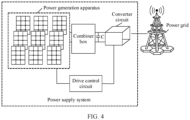
- FIG. 1 is a schematic diagram of an application scenario of a power supply system according to this application.
- the power supply system may include a power generation apparatus, a converter circuit, and a drive control circuit.
- the power generation apparatus may be connected to an input end of the converter circuit, an output end of the converter circuit may be connected to a power grid, and the drive control circuit may be connected to the converter circuit.
- the power generation apparatus may be a photovoltaic power generation apparatus (a power generation apparatus a shown in FIG. 1 ), a wind power generation apparatus (a power generation apparatus b shown in FIG. 1 ), a thermal power generation apparatus (a power generation apparatus c shown in FIG. 1 ), a nuclear power generation apparatus (a power generation apparatus d shown in FIG. 1 ), a chemical power generation apparatus (not shown in FIG. 1 ), a biomass power generation apparatus (not shown in FIG. 1 ), or the like.
- the photovoltaic power generation apparatus is used below as an example for description.
- the converter circuit and the drive control circuit may be integrated into a converter or another apparatus (not shown in FIG. 1 ) with a converter function.
- the converter circuit may adjust an output current to adjust a voltage value at the output end of the converter circuit to a voltage value that enables the power grid to operate normally, so as to supply electric energy generated by the power generation apparatus to the power grid.
- some failures may occur in the power grid (for example, an inductive or capacitive short circuit to ground occurs in a part of the power grid (for example, some transmission cables or other elements)), causing a voltage drop (or rise) at the output end of the converter circuit.
- the converter circuit may increase (or decrease) an output reactive current to increase (or decrease) the voltage value at the output end of the converter circuit to a voltage value capable of maintaining operation of the power grid.
- This process may be referred to as a voltage ride-through process (herein, the voltage ride-through includes low voltage ride-through or high voltage ride-through).
- the drive control circuit may control, based on duration of previous voltage ride-through (to be specific, duration of previous voltage ride-through performed by the power supply system before a current moment), the converter circuit to increase (or decrease) a value of a current to be output to the power grid from an operating current value to a current with a voltage ride-through current value, so as to increase (or decrease) the voltage value at the output end of the converter circuit.
- the previous voltage ride-through is latest voltage ride-through.
- previous low voltage ride-through is latest low voltage ride-through
- previous high voltage ride-through is latest high voltage ride-through.
- the power supply system may control, based on the duration of the previous voltage ride-through, the current to be output by the converter circuit to the power grid, to reduce circuit oscillation, with a simple structure, a simple control method, and high safety.
- the power supply system and the conversion method provided in this application are applicable to different application scenarios, for example, a photovoltaic power supply scenario, a wind power supply scenario, a thermal power supply scenario, or another application scenario.
- the photovoltaic power supply scenario is used below as an example for description, and details are not described below again.
- FIG. 2 is a schematic diagram of a structure of a power supply system according to this application.
- the power generation apparatus may be a photovoltaic power generation apparatus including a photovoltaic array.
- the photovoltaic array herein may be a photovoltaic module group.
- One photovoltaic module group may include one photovoltaic string or a plurality of photovoltaic strings connected in parallel.
- One photovoltaic string may include one photovoltaic module or a plurality of photovoltaic modules connected in series.
- the photovoltaic module herein may be a solar panel, a photovoltaic panel, or the like. In other words, in the power supply system shown in FIG.
- one photovoltaic string may be a photovoltaic string including one solar panel, photovoltaic panel, or energy storage battery, or a plurality of solar panels, photovoltaic panels, or energy storage batteries connected in series.
- the power generation apparatus provided in this application may alternatively be another photovoltaic power generation apparatus or another apparatus with a power generation function.
- the photovoltaic array may be connected as required in an actual application scenario.
- the power supply system shown in FIG. 2 is used below as an example for description, and details are not described below again. In the power supply system shown in FIG.
- output currents of a plurality of photovoltaic strings may supply electric energy to a power grid through a converter circuit and a drive control circuit.
- the power grid herein may include an electric device or a power transmission device such as a transmission cable, a power transfer station, a battery, a communication base station, or a home device.
- the power supply system may include a power generation apparatus, a converter circuit, and a drive control circuit.
- the power generation apparatus may be connected to an input end of the converter circuit, an output end of the converter circuit may be connected to the power grid, and the drive control circuit may be connected to the converter circuit.
- the converter circuit may adjust an output current to adjust a voltage value at the output end of the converter circuit to a voltage value that enables the power grid to operate normally, so as to supply electric energy generated by the power generation apparatus to the power grid.
- the power supply system transmits electric energy to the power grid
- some failures may occur in the power grid (for example, an inductive or capacitive short circuit to ground occurs in a part of the power grid (for example, some transmission cables or other elements)), causing a voltage drop (or rise) at the output end of the converter circuit.
- the converter circuit may increase (or decrease) an output reactive current to increase (or decrease) the voltage value at the output end of the converter circuit to a voltage value capable of maintaining operation of the power grid.
- This process may be referred to as a voltage ride-through process (herein, the voltage ride-through includes low voltage ride-through or high voltage ride-through).
- the drive control circuit may control, based on duration of previous voltage ride-through (to be specific, duration of previous voltage ride-through performed by the power supply system before a current moment), the converter circuit to increase (or decrease) a value of a current to be output to the power grid from an operating current value to a current with a voltage ride-through current value, so as to increase (or decrease) the voltage value at the output end of the converter circuit to maintain operation of the power grid.
- the previous voltage ride-through is latest voltage ride-through.
- previous low voltage ride-through is latest low voltage ride-through
- previous high voltage ride-through is latest high voltage ride-through.
- the converter circuit may be configured to determine that the power grid fails when it is detected that the voltage value at the output end of the converter circuit decreases from a first operating voltage value to a second operating voltage value, and the second operating voltage value is less than a first trigger voltage value. It can be understood that, when the power supply system transmits electric energy to the power grid, some failures may occur in the power grid (for example, an inductive short circuit to ground occurs in a part of the power grid (for example, some transmission cables or other elements)), causing a voltage drop at the output end of the converter circuit.
- the system may determine that the power grid fails, and then perform corresponding adjustment (for example, perform low voltage ride-through), to maintain operation of the power grid.
- This failure determining method is simple and efficient, and has a timely response and high operation efficiency, so that safety of the system is improved.
- the drive control circuit may be configured to: when the power grid fails, control, based on duration of previous low voltage ride-through, the converter circuit to increase a value of a current to be output to the power grid from a first operating current value to a current with a low voltage ride-through current value, so as to increase a voltage value at the output end of the converter circuit.
- the previous low voltage ride-through is latest low voltage ride-through. It can be understood that, when the power supply system transmits electric energy to the power grid, some failures may occur in the power grid (for example, an inductive short circuit to ground occurs in a part of the power grid (for example, some transmission cables or other elements)), causing a voltage drop at the output end of the converter circuit.
- the converter circuit may increase an output reactive current (for example, increase the value of the current to be output to the power grid from the first operating current value to the current with the low voltage ride-through current value), to increase the voltage value at the output end of the converter circuit to a voltage value capable of maintaining operation of the power grid.
- This process may be referred to as a low voltage ride-through process.
- the drive control circuit may control, based on the duration of the previous low voltage ride-through (to be specific, duration of previous low voltage ride-through performed by the power supply system before a current moment), the converter circuit to increase the value of the current to be output to the power grid from the first operating current value to the current with the low voltage ride-through current value, so as to increase the voltage value at the output end of the converter circuit.
- the previous low voltage ride-through is latest low voltage ride-through.
- the power supply system may control, based on the duration of the previous low voltage ride-through, the current to be output by the converter circuit to the power grid, to reduce circuit oscillation, with a simple structure, a simple control method, and high safety.
- the drive control circuit may be further configured to: when the power grid fails and the duration of the previous low voltage ride-through is greater than or equal to a low voltage ride-through time threshold, control the converter circuit to increase the value of the current to be output to the power grid from the first operating current value to a current with a first low voltage ride-through current value, so as to increase the voltage value at the output end of the converter circuit.
- the drive control circuit may control the value of the current to be output by the converter circuit to be the current with the first low voltage ride-through current value, so that the system can perform stable low voltage ride-through.
- the first low voltage ride-through current value may be a current value obtained by the system in advance or in real time, or may be a current value calculated by the system based on a current system parameter (for example, an operating voltage at the output end of the converter circuit, an operating current at the output end of the converter circuit, a rated voltage at the output end of the converter circuit, or a rated current at the output end of the converter circuit), or may be a current value defined by a user or a manufacturer in advance or in real time, or may be a current value determined based on a current value at the output end of the converter circuit during the previous low voltage ride-through.
- a current system parameter for example, an operating voltage at the output end of the converter circuit, an operating current at the output end of the converter circuit, a rated voltage at the output end of the converter circuit, or a rated current at the output end of the converter circuit
- the low voltage ride-through time threshold may be user-defined, or may be maximum duration of low voltage ride-through that is specified in a grid-tied standard (for example, VDE-AR-N 4120 in Germany and GB/T 37408 in China) of each country or region.
- a grid-tied standard for example, VDE-AR-N 4120 in Germany and GB/T 37408 in China
- the drive control circuit may be further configured to obtain the first low voltage ride-through current value based on the first operating current value, the first operating voltage value, and the second operating voltage value.
- Iq1 is the first low voltage ride-through current value
- Is1 is the first operating current value
- Us1 is the first operating voltage value
- Us2 is the second operating voltage value
- K is a ride-through current adjustment coefficient
- In is a rated current value at the output end of the converter circuit
- Un is a rated voltage value at the output end of the converter circuit.
- the system may determine the first low voltage ride-through current value based on the first operating current value, a difference between the first operating voltage value and the second operating voltage value, and a ratio of the rated voltage at the output end of the converter circuit, in combination with the ride-through current adjustment coefficient and the rated current value at the output end of the converter circuit.
- a calculation method is simple and flexible, so that a response speed, accuracy, and applicability of the system are improved.
- the drive control circuit may be further configured to obtain the first low voltage ride-through current value based on the first operating current value, the first trigger voltage value, and the second operating voltage value.
- Iq1 is the first low voltage ride-through current value
- Is1 is the first operating current value
- Ul is the first trigger voltage value
- Us2 is the second operating voltage value
- K is a ride-through current adjustment coefficient
- In is a rated current value at the output end of the converter circuit
- Un is a rated voltage value at the output end of the converter circuit.
- the system may determine the first low voltage ride-through current value based on the first operating current value, a difference between the first trigger voltage value and the second operating voltage value, and a ratio of the rated voltage at the output end of the converter circuit, in combination with the ride-through current adjustment coefficient and the rated current value at the output end of the converter circuit.
- a calculation method is simple, diverse, and flexible, so that a response speed, accuracy, and applicability of the system are improved.
- a magnitude of a reactive current output by the converter circuit under the control of the drive control circuit may match impedance of the power grid during the previous low voltage ride-through. This prevents a voltage at the output end of the converter circuit from increasing to an excessively high level, and the system does not stop performing low voltage ride-through due to misjudgment and therefore the voltage at the output end of the voltage converter circuit does not decrease again (for example, decrease to a voltage that indicates a failure of the power grid). If the duration of the previous low voltage ride-through is greater than or equal to a specific threshold (for example, the low voltage ride-through time threshold), it can be considered that the previous low voltage ride-through is stable.
- a specific threshold for example, the low voltage ride-through time threshold
- the drive control circuit may control the value of the current to be output by the converter circuit to be the current with the first low voltage ride-through current value, so that the power supply system performs low voltage ride-through.
- a magnitude of a reactive current output by the converter circuit matches impedance of the power grid, so that a voltage at the output end of the converter circuit does not increase to an excessively high level.
- the system is prevented from stopping performing low voltage ride-through due to misjudgment, and therefore the voltage at the output end of the voltage converter circuit does not decrease again.
- the drive control circuit may control the value of the current to be output by the converter circuit to be the current with the first low voltage ride-through current value, so that the power supply system can perform stable low voltage ride-through, to reduce circuit oscillation, with a simple structure, a simple control method, a timely response, high safety, and high operation efficiency.
- the drive control circuit may be further configured to: when the power grid fails and the duration of the previous low voltage ride-through is less than the low voltage ride-through time threshold, control the converter circuit to increase the value of the current to be output to the power grid from the first operating current value to a current with a second low voltage ride-through current value, so as to increase the voltage value at the output end of the converter circuit.
- the second low voltage ride-through current value is less than the first low voltage ride-through current value.
- the drive control circuit may control the value of the current to be output by the converter circuit to be the current with the second low voltage ride-through current value, so that the system can perform stable low voltage ride-through.
- the second low voltage ride-through current value is less than the first low voltage ride-through current value.
- the second low voltage ride-through current value may be a current value that is obtained by the system in advance or in real time and that is less than the first low voltage ride-through current value, or may be a current value that is calculated or obtained by the system based on a current parameter (for example, an operating voltage at the output end of the converter circuit, an operating current at the output end of the converter circuit, a rated voltage at the output end of the converter circuit, or a rated current at the output end of the converter circuit) and that is less than the first low voltage ride-through current value, or may be a current value that is defined by a user or a manufacturer in advance or in real time and that is less than the first low voltage ride-through current value, or may be a current value that is determined based on a current value at the output end of the converter circuit during the previous low voltage ride-through and that is less than the first low voltage ride-through current value.
- a current parameter for example, an operating voltage at the output end of the converter circuit, an operating current at the output end of the converter
- FIG. 3 is a schematic diagram of waveforms of a voltage and a current at an output end of a converter circuit according to this application.
- a magnitude of a reactive current output by the converter circuit under the control of the drive control circuit may not match impedance of the power grid during the previous low voltage ride-through.
- a voltage at the output end of the converter circuit may increase to an excessively high level.
- the duration of the previous low voltage ride-through is less than a specific threshold (for example, the low voltage ride-through time threshold).
- the drive control circuit may control the value of the current to be output by the converter circuit to be the current with the second low voltage ride-through current value, so that the power supply system performs stable low voltage ride-through.
- a magnitude (for example, the second low voltage ride-through current value) of a reactive current output by the converter circuit matches impedance of the power grid, so that a voltage at the output end of the converter circuit does not increase to an excessively high level.
- the system is prevented from stopping performing low voltage ride-through due to misjudgment, and therefore the voltage at the output end of the voltage converter circuit does not decrease again. That is, during the low voltage ride-through of this time, the drive control circuit may control the value of the current to be output by the converter circuit to be the current with the second low voltage ride-through current value, so that the power supply system can perform stable low voltage ride-through, to reduce circuit oscillation, with a simple structure, a simple control method, a timely response, high safety, and high operation efficiency.
- the drive control circuit may be further configured to: in a process in which the converter circuit increases the value of the current to be output to the power grid from the first operating current value to the current with the low voltage ride-through current value, when it is detected that the voltage value at the output end of the converter circuit increases to a third operating voltage value, and the third operating voltage value is greater than or equal to a first recovery voltage value, obtain duration in which the converter circuit outputs the low voltage ride-through current to the power grid, and use the duration as duration of low voltage ride-through of this time.
- a current value of the low voltage ride-through current includes the first low voltage ride-through current value or the second low voltage ride-through current value, and the first recovery voltage value is greater than or equal to the first trigger voltage value.
- the drive control circuit may obtain the duration in which the converter circuit outputs the low voltage ride-through current to the power grid (in other words, duration in which the system performs low voltage ride-through), and use the duration as the duration of the low voltage ride-through of this time.
- the duration of the low voltage ride-through of this time may be recorded and obtained by the drive control circuit, or may be recorded by another element with a timing function in the power supply system and transmitted to the drive control circuit.
- a method for obtaining the duration of the low voltage ride-through by the power supply system is simple, flexible, and accurate, so that a response speed and applicability of the system are improved.
- the drive control circuit may be further configured to: in a process in which the converter circuit increases the value of the current to be output to the power grid from the first operating current value to the current with the low voltage ride-through current value, when it is detected that the voltage value at the output end of the converter circuit increases to the third operating voltage value, and the third operating voltage value is greater than or equal to the first recovery voltage value, control the converter circuit to adjust the value of the current to be output to the power grid to a current with a second operating current value.
- the current value of the low voltage ride-through current includes the first low voltage ride-through current value or the second low voltage ride-through current value, the first recovery voltage value is greater than or equal to the first trigger voltage value, and the second operating current value is less than a smallest current value of the low voltage ride-through current among current values of the low voltage ride-through current. It can be understood that, during low voltage ride-through, if a failure in the power grid is cleared (for example, a failure point is rectified, or the power grid is disconnected in a failure area), the voltage value at the output end of the converter circuit further increases.
- the converter circuit may decrease an output reactive current, to restore the voltage value at the output end of the converter circuit to a voltage value (for example, the first operating voltage value) at the output end of the converter circuit before the failure occurs, or adjust the voltage value at the output end of the converter circuit to a voltage value suitable for operation of the power grid.
- a specific threshold for example, the first recovery voltage value
- the drive control circuit may control the converter circuit to output a current with the second operating current value to the power grid.
- the second operating current value may be equal to the first operating current value.
- the converter circuit may be configured to determine that the power grid fails when it is detected that the voltage value at the output end of the converter circuit increases from a fourth operating voltage value to a fifth operating voltage value, and the fifth operating voltage value is greater than a second trigger voltage value. It can be understood that, when the power supply system transmits electric energy to the power grid, some failures may occur in the power grid (for example, a capacitive short circuit to ground occurs in a part of the power grid (for example, some transmission cables or other elements)), causing a voltage rise at the output end of the converter circuit.
- the system may determine that the power grid fails, and then perform corresponding adjustment (for example, perform high voltage ride-through), to maintain operation of the power grid.
- This failure determining method is simple and efficient, and has a timely response and high operation efficiency, so that safety of the system is improved.
- the drive control circuit may be further configured to: when the power grid fails, control, based on duration of previous high voltage ride-through, the converter circuit to decrease the value of the current to be output to the power grid from the third operating current value to a current with a high voltage ride-through current value, so as to decrease the voltage value at the output end of the converter circuit.
- the previous high voltage ride-through is latest high voltage ride-through. It can be understood that, when the power supply system transmits electric energy to the power grid, some failures may occur in the power grid (for example, a capacitive short circuit to ground occurs in a part of the power grid (for example, some transmission cables or other elements)), causing a voltage rise at the output end of the converter circuit.
- the converter circuit may decrease an output reactive current (for example, decrease the value of the current to be output to the power grid from the third operating current value to the current with the high voltage ride-through current value), to decrease the voltage value at the output end of the converter circuit to a voltage value capable of maintaining operation of the power grid.
- This process may be referred to as a high voltage ride-through process.
- the drive control circuit may control, based on the duration of the previous high voltage ride-through (to be specific, duration of previous high voltage ride-through performed by the power supply system before a current moment), the converter circuit to decrease the value of the current to be output to the power grid from the third operating current value to the current with the high voltage ride-through current value, so as to decrease the voltage value at the output end of the converter circuit.
- the previous high voltage ride-through is latest high voltage ride-through.
- the power supply system may control, based on the duration of the previous high voltage ride-through, the current to be output by the converter circuit to the power grid, to reduce circuit oscillation, with a simple structure, a simple control method, and high safety.
- the drive control circuit may be further configured to: when the power grid fails and the duration of the previous high voltage ride-through is greater than or equal to a high voltage ride-through time threshold, control the converter circuit to decrease the value of the current to be output to the power grid from the third operating current value to a current with a first high voltage ride-through current value, so as to decrease the voltage value at the output end of the converter circuit.
- the drive control circuit may control the value of the current to be output by the converter circuit to be the current with the first high voltage ride-through current value, so that the system can perform stable high voltage ride-through.
- the first high voltage ride-through current value may be a current value obtained in advance or in real time by the system, or may be a current value calculated by the system according to a current parameter (for example, an operating voltage of an output end of the converter circuit, an operating current at the output end of the converter circuit, a rated voltage of the output end of the converter circuit, or a rated current at the output end of the converter circuit), or may be a current value defined by a user or a manufacturer in advance or in real time, may also be a current value determined based on a current value of an output end of the converter circuit during the previous high voltage ride-through.
- a current parameter for example, an operating voltage of an output end of the converter circuit, an operating current at the output end of the converter circuit, a rated voltage of the output end of the converter circuit, or a rated current at the output end of the converter circuit
- a current parameter for example, an operating voltage of an output end of the converter circuit, an operating current at the output end of the converter circuit, a rated voltage
- the high voltage ride-through time threshold may be user-defined, or may be maximum duration of low voltage ride-through that is specified in a grid-tied standard (for example, VDE-AR-N 4120 in Germany and GB/T 37408 in China) of each country or region.
- a grid-tied standard for example, VDE-AR-N 4120 in Germany and GB/T 37408 in China
- the drive control circuit may be further configured to obtain the first high voltage ride-through current value based on the third operating current value, the fourth operating voltage value, and the fifth operating voltage value.
- Iq3 is the first high voltage ride-through current value
- Is3 is the third operating current value
- Us4 is the fourth operating voltage value
- Us5 is the fifth operating voltage value
- K is the ride-through current adjustment coefficient
- In is the rated current value at the output end of the converter circuit
- Un is the rated voltage value at the output end of the converter circuit.
- the system may determine the first high voltage ride-through current value based on the third operating current value, a difference between the fourth operating voltage value and the fifth operating voltage value, and a ratio of the rated voltage at the output end of the converter circuit, in combination with the ride-through current adjustment coefficient and the rated current value at the output end of the converter circuit.
- a calculation method is simple and flexible, so that a response speed, accuracy, and applicability of the system are improved.
- the drive control circuit may be further configured to obtain the first high voltage ride-through current value based on the third operating current value, the second trigger voltage value, and the fifth operating voltage value.
- Iq3 is the first high voltage ride-through current value
- Is3 is the third operating current value
- Uh is the second trigger voltage value
- Us5 is the fifth operating voltage value
- K is the ride-through current adjustment coefficient
- In is the rated current value at the output end of the converter circuit
- Un is the rated voltage value at the output end of the converter circuit.
- the system may determine the first high voltage ride-through current value based on the third operating current value, a difference between the second trigger voltage value and the fifth operating voltage value, and a ratio of the rated voltage at the output end of the converter circuit, in combination with the ride-through current adjustment coefficient and the rated current value at the output end of the converter circuit.
- a calculation method is simple, diverse, and flexible, so that a response speed, accuracy, and applicability of the system are improved.
- a magnitude of a reactive current output by the converter circuit under the control of the drive control circuit may match impedance of the power grid during the previous high voltage ride-through. This prevents a voltage at the output end of the converter circuit from decreasing to an excessively low level, and the system does not stop performing high voltage ride-through due to misjudgment and therefore the voltage at the output end of the voltage converter circuit does not increase again (for example, increase to a voltage that indicates a failure of the power grid). If the duration of the previous high voltage ride-through is greater than or equal to a specific threshold (for example, the high voltage ride-through time threshold), it can be considered that the previous high voltage ride-through is stable.
- a specific threshold for example, the high voltage ride-through time threshold
- the drive control circuit may control the value of the current to be output by the converter circuit to be the current with the first high voltage ride-through current value, so that the power supply system performs high voltage ride-through.
- a magnitude of a reactive current output by the converter circuit matches impedance of the power grid, so that a voltage at the output end of the converter circuit does not decrease to an excessively low level.
- the system is prevented from stopping performing high voltage ride-through due to misjudgment, and therefore the voltage at the output end of the voltage converter circuit does not increase again.
- the drive control circuit may control the value of the current to be output by the converter circuit to be the current with the first high voltage ride-through current value, so that the power supply system can perform stable high voltage ride-through, to reduce circuit oscillation, with a simple structure, a simple control method, a timely response, high safety, and high operation efficiency.
- the drive control circuit may be further configured to: when the power grid fails and the duration of the previous high voltage ride-through is less than the high voltage ride-through time threshold, control the converter circuit to decrease the value of the current to be output to the power grid from the third operating current value to a current with a second high voltage ride-through current value, so as to decrease the voltage value at the output end of the converter circuit.
- the second high voltage ride-through current value is greater than the first high voltage ride-through current value.
- the drive control circuit may control the value of the current to be output by the converter circuit to be the current with the second high voltage ride-through current value, so that the system can perform stable high voltage ride-through.
- the second high voltage ride-through current value is greater than the first high voltage ride-through current value.
- the second high voltage ride-through current value may be a current value that is obtained by the system in advance or in real time and that is greater than the first high voltage ride-through current value, or may be a current value that is calculated or obtained by the system based on a current parameter (for example, an operating voltage at the output end of the converter circuit, an operating current at the output end of the converter circuit, a rated voltage at the output end of the converter circuit, or a rated current at the output end of the converter circuit) and that is greater than the first high voltage ride-through current value, or may be a current value that is defined by a user or a manufacturer in advance or in real time and that is greater than the first high voltage ride-through current value, or may be a current value that is determined based on a current value at the output end of the converter circuit during the previous high voltage ride-through and that is greater than the first high voltage ride-through current value.
- a current parameter for example, an operating voltage at the output end of the converter circuit, an operating current at the output end of the converter
- a magnitude of a reactive current output by the converter circuit under the control of the drive control circuit may not match impedance of the power grid during the previous high voltage ride-through.
- a voltage at the output end of the converter circuit may decrease to an excessively low level.
- the duration of the previous high voltage ride-through is less than a specific threshold (for example, the high voltage ride-through time threshold).
- the drive control circuit may control the value of the current to be output by the converter circuit to be the current with the second high voltage ride-through current value, so that the power supply system performs stable high voltage ride-through.
- a magnitude (for example, the second high voltage ride-through current value) of a reactive current output by the converter circuit matches impedance of the power grid, so that a voltage at the output end of the converter circuit does not decrease to an excessively low level.
- the system is prevented from stopping performing high voltage ride-through due to misjudgment, and therefore the voltage at the output end of the voltage converter circuit does not increase again. That is, during the high voltage ride-through of this time, the drive control circuit may control the value of the current to be output by the converter circuit to be the current with the second high voltage ride-through current value, so that the power supply system can perform stable high voltage ride-through, to reduce circuit oscillation, with a simple structure, a simple control method, a timely response, high safety, and high operation efficiency.
- the drive control circuit may be further configured to: in a process in which the converter circuit decreases the value of the current to be output to the power grid from the third operating current value to the current with the high voltage ride-through current value, when it is detected that the voltage value at the output end of the converter circuit decreases to a sixth operating voltage value, and the sixth operating voltage value is less than or equal to a second recovery voltage value, obtain duration in which the converter circuit outputs the high voltage ride-through current to the power grid, and use the duration as duration of high voltage ride-through of this time.
- a current value of the high voltage ride-through current includes the first high voltage ride-through current value or the second high voltage ride-through current value, and the second recovery voltage value is less than or equal to the second trigger voltage value. It can be understood that, during high voltage ride-through, if a failure in the power grid is cleared (for example, a failure point is rectified, or the power grid is disconnected in a failure area), the voltage value at the output end of the converter circuit further decreases.
- the drive control circuit may obtain the duration in which the converter circuit outputs the high voltage ride-through current to the power grid (in other words, duration in which the system performs high voltage ride-through), and use the duration as the duration of the high voltage ride-through of this time.
- the duration of the high voltage ride-through of this time may be recorded and obtained by the drive control circuit, or may be recorded by another element with a timing function in the power supply system and transmitted to the drive control circuit.
- a method for obtaining the duration of the high voltage ride-through by the power supply system is simple, flexible, and accurate, so that a response speed and applicability of the system are improved.
- the drive control circuit may be further configured to: in a process in which the converter circuit decreases the value of the current to be output to the power grid from the third operating current value to the current with the high voltage ride-through current value, when it is detected that the voltage value at the output end of the converter circuit decreases to the sixth operating voltage value, and the sixth operating voltage value is less than or equal to the second recovery voltage value, control the converter circuit to adjust the value of the current to be output to the power grid to a current with the fourth operating current value.
- the current value of the high voltage ride-through current includes the first high voltage ride-through current value or the second high voltage ride-through current value, the second recovery voltage value is less than or equal to the second trigger voltage value, and the fourth operating current value is greater than a largest current value of the high voltage ride-through current among current values of the high voltage ride-through current. It can be understood that, during high voltage ride-through, if a failure in the power grid is cleared (for example, a failure point is rectified, or the power grid is disconnected in a failure area), the voltage value at the output end of the converter circuit further decreases.
- the converter circuit may increase an output reactive current, to restore the voltage value at the output end of the converter circuit to a voltage value (for example, the fourth operating voltage value) at the output end of the converter circuit before the failure occurs, or adjust the voltage value at the output end of the converter circuit to a voltage value suitable for operation of the power grid.
- a specific threshold for example, the second recovery voltage value
- the drive control circuit may control the converter circuit to output a current with the fourth operating current value to the power grid.
- the fourth operating current value may be equal to the third operating current value.
- FIG. 4 is a schematic diagram of another structure of a power supply system according to this application.
- the power supply system shown in FIG. 4 may further include a direct current bus, and the power generation apparatus may be connected to a load through the direct current bus and the converter circuit.
- the direct current bus may include one bus capacitor or a plurality of bus capacitors connected in series, and the bus capacitor may be configured to store energy.
- the direct current bus includes a bus capacitor C.
- the converter circuit may convert electric energy that is output by the power generation apparatus and that is stored at two ends of the bus capacitor C, and output a corresponding current and voltage to maintain operation of the power grid.
- FIG. 4 the converter circuit may convert electric energy that is output by the power generation apparatus and that is stored at two ends of the bus capacitor C, and output a corresponding current and voltage to maintain operation of the power grid.
- FIG. 4 may convert electric energy that is output by the power generation apparatus and that is stored at two ends of the bus capacitor C, and output a corresponding current and voltage to maintain operation of the power
- the power supply system may further include a combiner box, and a plurality of photovoltaic strings in the power generation apparatus may be connected in parallel to the combiner box, and are connected to the direct current bus and/or the converter circuit through the combiner box.
- the plurality of photovoltaic strings in the power generation apparatus may be connected in parallel to the combiner box and then directly connected to the converter circuit through the combiner box, or may be connected to the direct current bus through the combiner box and connected to the converter circuit through the direct current bus. This may be specifically set based on an actual application scenario, and is not limited herein.
- FIG. 5 is a schematic diagram of another structure of a power supply system according to this application.
- the power generation apparatus may be connected to a direct current bus through a combiner box and connected to the converter circuit through the direct current bus, and the converter circuit is connected to the power grid through a transformer.
- output currents of a plurality of photovoltaic strings in the power generation apparatus may be combined by the combiner box (to be specific, the plurality of photovoltaic strings are connected in parallel to the combiner box) to provide an input voltage for the converter circuit.
- the converter circuit may convert electric energy that is output by the power generation apparatus and that is stored at two ends of a bus capacitor C (for example, convert direct-current electric energy into alternating-current electric energy, and preliminarily boost a voltage), and then output a corresponding current and voltage to the transformer.
- the transformer may further boost the voltage and transmit the voltage to the power grid to maintain operation of the power grid.
- FIG. 6 is a schematic diagram of another structure of a power supply system according to this application.
- a load of the power supply system may further include an on-grid/off-grid junction box, and the converter circuit may supply power to an electric device or a power transmission device such as a transmission cable, a power transfer station, a battery, a communication base station, or a home device in the power grid through the on-grid/off-grid junction box.
- a power transmission device such as a transmission cable, a power transfer station, a battery, a communication base station, or a home device in the power grid through the on-grid/off-grid junction box.
- the power generation apparatus in the power supply system has various representation forms, the power generation apparatus and the converter circuit are connected in flexible manners, and functional modules in the power supply system are combined in various and flexible manners, so that diversity of application scenarios of the power supply system can be improved, and adaptability of the power supply system can be improved.
- the power supply system may control, based on duration of previous voltage ride-through, a current to be output by the converter circuit to the power grid, to reduce circuit oscillation, with a simple structure, a simple control method, and high safety.
- the following describes a conversion method for a power supply system in embodiments of this application by using the structure of the power supply system shown in FIG. 2 as an example.
- FIG. 7A and FIG. 7B are a schematic flowchart of a conversion method for a power supply system according to this application.
- the conversion method for a power supply system in this application is applicable to any one of the power supply systems shown in FIG. 1 to FIG. 6 .
- the conversion method for a power supply system in this application includes the following steps.
- S701 Obtain a voltage value at an output end of a converter circuit.
- S702 Determine whether the voltage value at the output end of the converter circuit is less than or equal to a first trigger voltage value; and if a determining result is yes, perform step S703; or if a determining result is no, perform step S701.
- the voltage value at the output end of the converter circuit may be obtained; and when it is detected that the voltage value at the output end of the converter circuit decreases from a first operating voltage value to a second operating voltage value, and the second operating voltage value is less than the first trigger voltage value, the converter circuit determines that it is detected that an operating status of a power grid is failed. It can be understood that, when the power supply system transmits electric energy to the power grid, some failures may occur in the power grid (for example, an inductive short circuit to ground occurs in a part of the power grid (for example, some transmission cables or other elements)), causing a voltage drop at the output end of the converter circuit.
- the system may determine that the power grid fails, and then perform corresponding adjustment (for example, perform low voltage ride-through), to maintain operation of the power grid.
- This failure determining method is simple and efficient, and has a timely response and high operation efficiency, so that safety of the system is improved.
- step S704 Determine whether the duration of the previous low voltage ride-through is greater than or equal to a low voltage ride-through time threshold; and if a determining result is yes, perform step S705; or if a determining result is no, perform step S706.
- a drive control circuit controls the converter circuit to increase a value of a current to be output to the power grid from a first operating current value to a current with a first low voltage ride-through current value, and continuously obtain a voltage value at the output end of the converter circuit.
- the drive control circuit controls the converter circuit to increase the value of the current to be output to the power grid from the first operating current value to the current with the first low voltage ride-through current value, so as to increase the voltage value at the output end of the converter circuit.
- the drive control circuit may control the value of the current to be output by the converter circuit to be the current with the first low voltage ride-through current value, so that the system can perform stable low voltage ride-through.
- the first low voltage ride-through current value may be a current value obtained by the system in advance or in real time, or may be a current value calculated by the system based on a current system parameter (for example, an operating voltage at the output end of the converter circuit, an operating current at the output end of the converter circuit, a rated voltage at the output end of the converter circuit, or a rated current at the output end of the converter circuit), or may be a current value defined by a user or a manufacturer in advance or in real time, or may be a current value determined based on a current value at the output end of the converter circuit during the previous low voltage ride-through.
- a current system parameter for example, an operating voltage at the output end of the converter circuit, an operating current at the output end of the converter circuit, a rated voltage at the output end of the converter circuit, or a rated current at the output end of the converter circuit
- a magnitude of a reactive current output by the converter circuit under the control of the drive control circuit may match impedance of the power grid during the previous low voltage ride-through. This prevents a voltage at the output end of the converter circuit from increasing to an excessively high level, and the system does not stop performing low voltage ride-through due to misjudgment and therefore the voltage at the output end of the voltage converter circuit does not decrease again (for example, decrease to a voltage that indicates a failure of the power grid). If the duration of the previous low voltage ride-through is greater than or equal to a specific threshold (for example, the low voltage ride-through time threshold), it can be considered that the previous low voltage ride-through is stable.
- a specific threshold for example, the low voltage ride-through time threshold
- the drive control circuit may control the value of the current to be output by the converter circuit to be the current with the first low voltage ride-through current value, so that the power supply system performs low voltage ride-through.
- a magnitude of a reactive current output by the converter circuit matches impedance of the power grid, so that a voltage at the output end of the converter circuit does not increase to an excessively high level.
- the system is prevented from stopping performing low voltage ride-through due to misjudgment, and therefore the voltage at the output end of the voltage converter circuit does not decrease again.
- the drive control circuit may control the value of the current to be output by the converter circuit to be the current with the first low voltage ride-through current value, so that the power supply system can perform stable low voltage ride-through, to reduce circuit oscillation, with a simple structure, a simple control method, a timely response, high safety, and high operation efficiency.
- Iq1 is the first low voltage ride-through current value
- Is1 is the first operating current value
- Us1 is the first operating voltage value
- Us2 is the second operating voltage value
- K is a ride-through current adjustment coefficient
- In is a rated current value at the output end of the converter circuit
- Un is a rated voltage value at the output end of the converter circuit.
- the system may determine the first low voltage ride-through current value based on the first operating current value, a difference between the first operating voltage value and the second operating voltage value, and a ratio of the rated voltage at the output end of the converter circuit, in combination with the ride-through current adjustment coefficient and the rated current value at the output end of the converter circuit.
- a calculation method is simple and flexible, so that a response speed, accuracy, and applicability of the system are improved.
- Iq1 is the first low voltage ride-through current value
- Is1 is the first operating current value
- Ul is the first trigger voltage value
- Us2 is the second operating voltage value
- K is a ride-through current adjustment coefficient
- In is a rated current value at the output end of the converter circuit
- Un is a rated voltage value at the output end of the converter circuit.
- the system may determine the first low voltage ride-through current value based on the first operating current value, a difference between the first trigger voltage value and the second operating voltage value, and a ratio of the rated voltage at the output end of the converter circuit, in combination with the ride-through current adjustment coefficient and the rated current value at the output end of the converter circuit.
- a calculation method is simple, diverse, and flexible, so that a response speed, accuracy, and applicability of the system are improved.
- the drive control circuit controls the converter circuit to increase a value of a current to be output to the power grid from a first operating current value to a current with a second low voltage ride-through current value, and continuously obtain a voltage value at the output end of the converter circuit.
- the drive control circuit controls the converter circuit to increase the current value of the current to be output to the power grid from the first operating current value to the current with the second low voltage ride-through current value, so as to increase the voltage value at the output end of the converter circuit.
- the second low voltage ride-through current value is less than the first low voltage ride-through current value.
- the drive control circuit may control the value of the current to be output by the converter circuit to be the current with the second low voltage ride-through current value, so that the system can perform stable low voltage ride-through.
- the second low voltage ride-through current value is less than the first low voltage ride-through current value.
- the second low voltage ride-through current value may be a current value that is obtained by the system in advance or in real time and that is less than the first low voltage ride-through current value, or may be a current value that is calculated or obtained by the system based on a current parameter (for example, an operating voltage at the output end of the converter circuit, an operating current at the output end of the converter circuit, a rated voltage at the output end of the converter circuit, or a rated current at the output end of the converter circuit) and that is less than the first low voltage ride-through current value, or may be a current value that is defined by a user or a manufacturer in advance or in real time and that is less than the first low voltage ride-through current value, or may be a current value that is determined based on a current value at the output end of the converter circuit during the previous low voltage ride-through and that is less than the first low voltage ride-through current value.
- a current parameter for example, an operating voltage at the output end of the converter circuit, an operating current at the output end of the converter
- a magnitude of a reactive current output by the converter circuit under the control of the drive control circuit may not match impedance of the power grid during the previous low voltage ride-through.
- a voltage at the output end of the converter circuit may increase to an excessively high level.
- the drive control circuit may control the value of the current to be output by the converter circuit to be the current with the second low voltage ride-through current value, so that the power supply system performs stable low voltage ride-through.
- a magnitude (for example, the second low voltage ride-through current value) of a reactive current output by the converter circuit matches impedance of the power grid, so that a voltage at the output end of the converter circuit does not increase to an excessively high level.
- the system is prevented from stopping performing low voltage ride-through due to misjudgment, and therefore the voltage at the output end of the voltage converter circuit does not decrease again.
- the drive control circuit may control the value of the current to be output by the converter circuit to be the current with the second low voltage ride-through current value, so that the power supply system can perform stable low voltage ride-through, to reduce circuit oscillation, with a simple structure, a simple control method, a timely response, high safety, and high operation efficiency.
- S707 Determine whether the voltage value at the output end of the converter circuit is greater than or equal to a first recovery voltage value; and if a determining result is yes, perform step S708; or if a determining result is no, perform step S705 or step S706 based on a current value at the output end of the converter circuit.
- the drive control circuit obtains duration in which the converter circuit outputs a ride-through current to the power grid, uses the duration as duration of low voltage ride-through of this time, and controls the converter circuit to adjust the value of the current to be output to the power grid to a current with a second operating current value.
- the drive control circuit obtains the duration in which the converter circuit outputs the ride-through current to the power grid, and uses the duration as the duration of the low voltage ride-through of this time.
- a current value of the low voltage ride-through current includes the first low voltage ride-through current value or the second low voltage ride-through current value, and the first recovery voltage value is greater than or equal to the first trigger voltage value.
- the drive control circuit may obtain the duration in which the converter circuit outputs the low voltage ride-through current to the power grid (in other words, duration in which the system performs low voltage ride-through), and use the duration as the duration of the low voltage ride-through of this time.
- the duration of the low voltage ride-through of this time may be recorded and obtained by the drive control circuit, or may be recorded by another element with a timing function in the power supply system and transmitted to the drive control circuit.
- a method for obtaining the duration of the low voltage ride-through by the power supply system is simple, flexible, and accurate, so that a response speed and applicability of the system are improved.
- the drive control circuit controls the converter circuit to adjust the value of the current to be output to the power grid to the current with the second operating current value.
- the current value of the low voltage ride-through current includes the first low voltage ride-through current value or the second low voltage ride-through current value, the first recovery voltage value is greater than or equal to the first trigger voltage value, and the second operating current value is less than a smallest current value of the low voltage ride-through current among current values of the low voltage ride-through current. It can be understood that, during low voltage ride-through, if a failure in the power grid is cleared (for example, a failure point is rectified, or the power grid is disconnected in a failure area), the voltage value at the output end of the converter circuit further increases.
- the converter circuit may decrease an output reactive current, to restore the voltage value at the output end of the converter circuit to a voltage value (for example, the first operating voltage value) at the output end of the converter circuit before the failure occurs, or adjust the voltage value at the output end of the converter circuit to a voltage value suitable for operation of the power grid.
- a specific threshold for example, the first recovery voltage value
- the drive control circuit may control the converter circuit to output a current with the second operating current value to the power grid.
- the second operating current value may be equal to the first operating current value.
- the power supply system may control, based on duration of previous voltage ride-through, a current to be output by the converter circuit to the power grid, to reduce circuit oscillation, with a simple structure, a simple control method, and high safety.
- FIG. 8A and FIG. 8B are another schematic flowchart of a conversion method for a power supply system according to this application.
- the conversion method for a power supply system in this application is applicable to any one of the power supply systems shown in FIG. 1 to FIG. 6 .
- the conversion method for a power supply system in this application includes the following steps.
- step S802 Determine whether the voltage value at the output end of the converter circuit is greater than or equal to a second trigger voltage value; and if a determining result is yes, perform step S803; or if a determining result is no, perform step S801.
- the voltage value at the output end of the converter circuit may be obtained; and when it is detected that the voltage value at the output end of the converter circuit increases from a fourth operating voltage value to a fifth operating voltage value, and the fifth operating voltage value is greater than the second trigger voltage value, the converter circuit determines that it is detected that an operating status of a power grid is failed. It can be understood that, when the power supply system transmits electric energy to the power grid, some failures may occur in the power grid (for example, a capacitive short circuit to ground occurs in a part of the power grid (for example, some transmission cables or other elements)), causing a voltage rise at the output end of the converter circuit.
- the system may determine that the power grid fails, and then perform corresponding adjustment (for example, perform high voltage ride-through), to maintain operation of the power grid.
- This failure determining method is simple and efficient, and has a timely response and high operation efficiency, so that safety of the system is improved.
- step S804 Determine whether the duration of the previous high voltage ride-through is greater than or equal to a high voltage ride-through time threshold; and if a determining result is yes, perform step S805; or if a determining result is no, perform step S806.
- a drive control circuit controls the converter circuit to increase a value of a current to be output to the power grid from a third operating current value to a current with a first high voltage ride-through current value, and continuously obtain a voltage value at the output end of the converter circuit.
- the drive control circuit controls the converter circuit to decrease the value of the current to be output to the power grid from the third operating current value to the current with the first high voltage ride-through current value, so as to decrease the voltage value at the output end of the converter circuit.
- the drive control circuit may control the value of the current to be output by the converter circuit to be the current with the first high voltage ride-through current value, so that the system can perform stable high voltage ride-through.
- the first high voltage ride-through current value may be a current value obtained in advance or in real time by the system, or may be a current value calculated by the system according to a current parameter (for example, an operating voltage of an output end of the converter circuit, an operating current at the output end of the converter circuit, a rated voltage of the output end of the converter circuit, or a rated current at the output end of the converter circuit), or may be a current value defined by a user or a manufacturer in advance or in real time, may also be a current value determined based on a current value of an output end of the converter circuit during the previous high voltage ride-through.
- a current parameter for example, an operating voltage of an output end of the converter circuit, an operating current at the output end of the converter circuit, a rated voltage of the output end of the converter circuit, or a rated current at the output end of the converter circuit
- a current parameter for example, an operating voltage of an output end of the converter circuit, an operating current at the output end of the converter circuit, a rated voltage
- a magnitude of a reactive current output by the converter circuit under the control of the drive control circuit may match impedance of the power grid during the previous high voltage ride-through. This prevents a voltage at the output end of the converter circuit from decreasing to an excessively low level, and the system does not stop performing high voltage ride-through due to misjudgment and therefore the voltage at the output end of the voltage converter circuit does not increase again (for example, increase to a voltage that indicates a failure of the power grid). If the duration of the previous high voltage ride-through is greater than or equal to a specific threshold (for example, the high voltage ride-through time threshold), it can be considered that the previous high voltage ride-through is stable.
- a specific threshold for example, the high voltage ride-through time threshold
- the drive control circuit may control the value of the current to be output by the converter circuit to be the current with the first high voltage ride-through current value, so that the power supply system performs high voltage ride-through.
- a magnitude of a reactive current output by the converter circuit matches impedance of the power grid, so that a voltage at the output end of the converter circuit does not decrease to an excessively low level.
- the system is prevented from stopping performing high voltage ride-through due to misjudgment, and therefore the voltage at the output end of the voltage converter circuit does not increase again.
- the drive control circuit may control the value of the current to be output by the converter circuit to be the current with the first high voltage ride-through current value, so that the power supply system can perform stable high voltage ride-through, to reduce circuit oscillation, with a simple structure, a simple control method, a timely response, high safety, and high operation efficiency.
- Iq3 is the first high voltage ride-through current value
- Is3 is the third operating current value
- Us4 is the fourth operating voltage value
- Us5 is the fifth operating voltage value
- K is the ride-through current adjustment coefficient
- In is the rated current value at the output end of the converter circuit
- Un is the rated voltage value at the output end of the converter circuit.
- the system may determine the first high voltage ride-through current value based on the third operating current value, a difference between the fourth operating voltage value and the fifth operating voltage value, and a ratio of the rated voltage at the output end of the converter circuit, in combination with the ride-through current adjustment coefficient and the rated current value at the output end of the converter circuit.
- a calculation method is simple and flexible, so that a response speed, accuracy, and applicability of the system are improved.
- Iq3 is the first high voltage ride-through current value
- Is3 is the third operating current value
- Uh is the second trigger voltage value
- Us5 is the fifth operating voltage value
- K is the ride-through current adjustment coefficient
- In is the rated current value at the output end of the converter circuit
- Un is the rated voltage value at the output end of the converter circuit.
- the system may determine the first high voltage ride-through current value based on the third operating current value, a difference between the second trigger voltage value and the fifth operating voltage value, and a ratio of the rated voltage at the output end of the converter circuit, in combination with the ride-through current adjustment coefficient and the rated current value at the output end of the converter circuit.
- a calculation method is simple, diverse, and flexible, so that a response speed, accuracy, and applicability of the system are improved.
- the drive control circuit controls the converter circuit to increase a value of a current to be output to the power grid from a third operating current value to a current with a second high voltage ride-through current value, and continuously obtain a voltage value at the output end of the converter circuit.
- the converter circuit when it is detected that the power grid fails and the duration of the previous high voltage ride-through is less than the high voltage ride-through time threshold, the converter circuit is controlled to decrease the value of the current to be output to the power grid from the third operating current value to the current with the second high voltage ride-through current value, so as to decrease the voltage value at the output end of the converter circuit.
- the second high voltage ride-through current value is greater than the first high voltage ride-through current value.
- the drive control circuit may control the value of the current to be output by the converter circuit to be the current with the second high voltage ride-through current value, so that the system can perform stable high voltage ride-through.
- the second high voltage ride-through current value is greater than the first high voltage ride-through current value.
- the second high voltage ride-through current value may be a current value that is obtained by the system in advance or in real time and that is greater than the first high voltage ride-through current value, or may be a current value that is calculated or obtained by the system based on a current parameter (for example, an operating voltage at the output end of the converter circuit, an operating current at the output end of the converter circuit, a rated voltage at the output end of the converter circuit, or a rated current at the output end of the converter circuit) and that is greater than the first high voltage ride-through current value, or may be a current value that is defined by a user or a manufacturer in advance or in real time and that is greater than the first high voltage ride-through current value, or may be a current value that is determined based on a current value at the output end of the converter circuit during the previous high voltage ride-through and that is greater than the first high voltage ride-through current value.
- a current parameter for example, an operating voltage at the output end of the converter circuit, an operating current at the output end of the converter
- a magnitude of a reactive current output by the converter circuit under the control of the drive control circuit may not match impedance of the power grid during the previous high voltage ride-through.
- a voltage at the output end of the converter circuit may decrease to an excessively low level.
- the drive control circuit may control the value of the current to be output by the converter circuit to be the current with the second high voltage ride-through current value, so that the power supply system performs stable high voltage ride-through.
- a magnitude (for example, the second high voltage ride-through current value) of a reactive current output by the converter circuit matches impedance of the power grid, so that a voltage at the output end of the converter circuit does not decrease to an excessively low level.
- the system is prevented from stopping performing high voltage ride-through due to misjudgment, and therefore the voltage at the output end of the voltage converter circuit does not increase again.
- the drive control circuit may control the value of the current to be output by the converter circuit to be the current with the second high voltage ride-through current value, so that the power supply system can perform stable high voltage ride-through, to reduce circuit oscillation, with a simple structure, a simple control method, a timely response, high safety, and high operation efficiency.
- S807 Determine whether the voltage value at the output end of the converter circuit is less than or equal to a second recovery voltage value; and if a determining result is yes, perform step S808; or if a determining result is no, perform step S805 or step S806 based on a current value at the output end of the converter circuit.
- the drive control circuit obtains duration in which the converter circuit outputs a ride-through current to the power grid, uses the duration as duration of high voltage ride-through of this time, and controls the converter circuit to adjust the value of the current to be output to the power grid to a current with a fourth operating current value.
- the drive control circuit obtains duration in which the converter circuit outputs a third ride-through current to the power grid, and uses the duration as the duration of the high voltage ride-through of this time.
- a current value of the ride-through current includes the first high voltage ride-through current value or the second high voltage ride-through current value, and the second recovery voltage value is less than or equal to the second trigger voltage value.
- the drive control circuit may obtain the duration in which the converter circuit outputs the high voltage ride-through current to the power grid (in other words, duration in which the system performs high voltage ride-through), and use the duration as the duration of the high voltage ride-through of this time.
- the duration of the high voltage ride-through of this time may be recorded and obtained by the drive control circuit, or may be recorded by another element with a timing function in the power supply system and transmitted to the drive control circuit.
- a method for obtaining the duration of the high voltage ride-through by the power supply system is simple, flexible, and accurate, so that a response speed and applicability of the system are improved.
- the converter circuit in a process in which the converter circuit decreases the value of the current to be output to the power grid from the third operating current value to the current with the high voltage ride-through current value, when it is detected that the voltage value at the output end of the converter circuit decreases to the sixth operating voltage value, and the sixth operating voltage value is less than or equal to the second recovery voltage value, the converter circuit is controlled to adjust the value of the current to be output to the power grid to the current with the fourth operating current value.
- the current value of the high voltage ride-through current includes the first high voltage ride-through current value or the second high voltage ride-through current value, the second recovery voltage value is less than or equal to the second trigger voltage value, and the fourth operating current value is greater than a largest current value of the high voltage ride-through current among current values of the high voltage ride-through current. It can be understood that, during high voltage ride-through, if a failure in the power grid is cleared (for example, a failure point is rectified, or the power grid is disconnected in a failure area), the voltage value at the output end of the converter circuit further decreases.
- the converter circuit may increase an output reactive current, to restore the voltage value at the output end of the converter circuit to a voltage value (for example, the fourth operating voltage value) at the output end of the converter circuit before the failure occurs, or adjust the voltage value at the output end of the converter circuit to a voltage value suitable for operation of the power grid.
- a specific threshold for example, the second recovery voltage value
- the drive control circuit may control the converter circuit to output a current with the fourth operating current value to the power grid.
- the fourth operating current value may be equal to the third operating current value.
- the power supply system may control, based on duration of previous voltage ride-through, a current to be output by the converter circuit to the power grid, to reduce circuit oscillation, with a simple structure, a simple control method, and high safety.
Landscapes
- Engineering & Computer Science (AREA)
- Power Engineering (AREA)
- Inverter Devices (AREA)
Applications Claiming Priority (1)
| Application Number | Priority Date | Filing Date | Title |
|---|---|---|---|
| PCT/CN2021/134642 WO2023097517A1 (zh) | 2021-11-30 | 2021-11-30 | 供电系统以及变流方法 |
Publications (3)
| Publication Number | Publication Date |
|---|---|
| EP4344005A1 true EP4344005A1 (de) | 2024-03-27 |
| EP4344005A4 EP4344005A4 (de) | 2024-11-20 |
| EP4344005B1 EP4344005B1 (de) | 2025-10-01 |
Family
ID=86611423
Family Applications (1)
| Application Number | Title | Priority Date | Filing Date |
|---|---|---|---|
| EP21965954.7A Active EP4344005B1 (de) | 2021-11-30 | 2021-11-30 | Stromversorgungssystem und stromwandlungsverfahren |
Country Status (4)
| Country | Link |
|---|---|
| US (1) | US20240136815A1 (de) |
| EP (1) | EP4344005B1 (de) |
| CN (1) | CN116529973A (de) |
| WO (1) | WO2023097517A1 (de) |
Family Cites Families (8)
| Publication number | Priority date | Publication date | Assignee | Title |
|---|---|---|---|---|
| US7233129B2 (en) * | 2003-05-07 | 2007-06-19 | Clipper Windpower Technology, Inc. | Generator with utility fault ride-through capability |
| EP2621070A1 (de) * | 2012-01-26 | 2013-07-31 | Siemens Aktiengesellschaft | Verfahren und Anordnung für den Betrieb eines Windturbinenwandlers |
| EP2859638B1 (de) * | 2012-06-12 | 2020-05-06 | Vestas Wind Systems A/S | Steuerung einer windkraftanlage nach niederspannungsnetzdefekten |
| CN103606959A (zh) * | 2013-12-09 | 2014-02-26 | 华北电力大学 | 双馈型风力发电系统低/高电压穿越的优化控制方法 |
| CN107947221B (zh) * | 2017-12-23 | 2021-04-06 | 西安许继电力电子技术有限公司 | 一种电力电子变压器直流故障穿越方法 |
| CN108879760B (zh) * | 2018-06-21 | 2021-08-17 | 国网宁夏电力有限公司电力科学研究院 | 一种减少双馈式风机撬棒投切次数的多尺度低穿配合方法 |
| CN112968464B (zh) * | 2019-12-13 | 2022-12-09 | 新疆金风科技股份有限公司 | 永磁直驱风力发电机组高低电压连续穿越控制方法及系统 |
| CN112467781A (zh) * | 2020-10-23 | 2021-03-09 | 中国电力科学研究院有限公司 | 一种光伏电站主动控制方法和系统 |
-
2021
- 2021-11-30 CN CN202180007321.2A patent/CN116529973A/zh active Pending
- 2021-11-30 WO PCT/CN2021/134642 patent/WO2023097517A1/zh not_active Ceased
- 2021-11-30 EP EP21965954.7A patent/EP4344005B1/de active Active
-
2023
- 2023-12-25 US US18/395,643 patent/US20240136815A1/en active Pending
Also Published As
| Publication number | Publication date |
|---|---|
| EP4344005B1 (de) | 2025-10-01 |
| CN116529973A (zh) | 2023-08-01 |
| EP4344005A4 (de) | 2024-11-20 |
| US20240136815A1 (en) | 2024-04-25 |
| WO2023097517A1 (zh) | 2023-06-08 |
Similar Documents
| Publication | Publication Date | Title |
|---|---|---|
| US10090701B2 (en) | Solar power generation system | |
| EP2947743A2 (de) | Umrichter und betriebsverfahren dafür | |
| EP3979492B1 (de) | Verfahren zur steuerung eines stromrückflusses, wandler und fotovoltaisches energieerzeugungssystem | |
| EP4395103A1 (de) | Stromversorgungssystem und netzgekoppeltes steuerungsverfahren | |
| EP4618353A1 (de) | Fotovoltaischer wechselrichter und leistungseinstellungsverfahren dafür sowie fotovoltaisches system | |
| US20170317503A1 (en) | Power storage control apparatus, direct-current power system, and controlling method thereof | |
| EP4579974A1 (de) | Stromversorgungssystem und steuerungsverfahren dafür | |
| EP2922170B1 (de) | Steuerungsvorrichtung für spannungsquellenumrichter und betriebsverfahren dafür | |
| US8493758B2 (en) | Method and apparatus for generating current command value for tracking maximum power point in solar energy generating system | |
| US20240380212A1 (en) | Photovoltaic inverter and control method thereof, and photovoltaic system | |
| EP4422012A1 (de) | Leistungsumwandlungsvorrichtung und steuerungsverfahren | |
| US12512678B2 (en) | Power supply system and method for controlling output voltage of direct current combiner box | |
| EP4344005B1 (de) | Stromversorgungssystem und stromwandlungsverfahren | |
| EP4629461A1 (de) | Stromversorgungssystem | |
| EP4336697B1 (de) | Fotovoltaisches stromerzeugungssystem | |
| EP4418514A1 (de) | Fotovoltaischer wechselrichter und leistungssteuerungsverfahren | |
| US11146062B2 (en) | Method and apparatus for improving PV module fill factor using a voltage clamping circuit | |
| CN220509048U (zh) | 一种大功率光伏逆变器-pcs共用的电性能测试给电装置 | |
| EP4418485A1 (de) | Stromversorgungssystem und umwandlungsverfahren | |
| CN107807334B (zh) | 测试方法及装置 | |
| Al-Hanahi et al. | MPPT controlled DC-DC converter design and application for three stages battery charger | |
| CN222464168U (zh) | 逆变器设备及光伏系统 | |
| Kaur et al. | Design and Implementation of Hybrid Micro-Grid in MATLAB for Fault Current Analysis in Different Modes of Micro-Grid Operations | |
| EP4697543A1 (de) | Wechselrichter zur speicherung von fotovoltaischer energie und steuerungsverfahren dafür | |
| RU203529U1 (ru) | Двухступенчатый контроллер заряда аккумуляторных батарей с расширенными функциональными возможностями |
Legal Events
| Date | Code | Title | Description |
|---|---|---|---|
| STAA | Information on the status of an ep patent application or granted ep patent |
Free format text: STATUS: THE INTERNATIONAL PUBLICATION HAS BEEN MADE |
|
| PUAI | Public reference made under article 153(3) epc to a published international application that has entered the european phase |
Free format text: ORIGINAL CODE: 0009012 |
|
| STAA | Information on the status of an ep patent application or granted ep patent |
Free format text: STATUS: REQUEST FOR EXAMINATION WAS MADE |
|
| 17P | Request for examination filed |
Effective date: 20231220 |
|
| AK | Designated contracting states |
Kind code of ref document: A1 Designated state(s): AL AT BE BG CH CY CZ DE DK EE ES FI FR GB GR HR HU IE IS IT LI LT LU LV MC MK MT NL NO PL PT RO RS SE SI SK SM TR |
|
| A4 | Supplementary search report drawn up and despatched |
Effective date: 20241022 |
|
| RIC1 | Information provided on ipc code assigned before grant |
Ipc: H02H 7/12 20060101ALI20241016BHEP Ipc: H02J 3/00 20060101AFI20241016BHEP |
|
| DAV | Request for validation of the european patent (deleted) | ||
| DAX | Request for extension of the european patent (deleted) | ||
| GRAP | Despatch of communication of intention to grant a patent |
Free format text: ORIGINAL CODE: EPIDOSNIGR1 |
|
| STAA | Information on the status of an ep patent application or granted ep patent |
Free format text: STATUS: GRANT OF PATENT IS INTENDED |
|
| INTG | Intention to grant announced |
Effective date: 20250513 |
|
| GRAS | Grant fee paid |
Free format text: ORIGINAL CODE: EPIDOSNIGR3 |
|
| GRAA | (expected) grant |
Free format text: ORIGINAL CODE: 0009210 |
|
| STAA | Information on the status of an ep patent application or granted ep patent |
Free format text: STATUS: THE PATENT HAS BEEN GRANTED |
|
| AK | Designated contracting states |
Kind code of ref document: B1 Designated state(s): AL AT BE BG CH CY CZ DE DK EE ES FI FR GB GR HR HU IE IS IT LI LT LU LV MC MK MT NL NO PL PT RO RS SE SI SK SM TR |
|
| REG | Reference to a national code |
Ref country code: GB Ref legal event code: FG4D Ref country code: CH Ref legal event code: F10 Free format text: ST27 STATUS EVENT CODE: U-0-0-F10-F00 (AS PROVIDED BY THE NATIONAL OFFICE) Effective date: 20251001 |
|
| P01 | Opt-out of the competence of the unified patent court (upc) registered |
Free format text: CASE NUMBER: UPC_APP_5380_4344005/2025 Effective date: 20250829 |
|
| REG | Reference to a national code |
Ref country code: DE Ref legal event code: R096 Ref document number: 602021039874 Country of ref document: DE |
|
| REG | Reference to a national code |
Ref country code: IE Ref legal event code: FG4D |
|
| PGFP | Annual fee paid to national office [announced via postgrant information from national office to epo] |
Ref country code: DE Payment date: 20251007 Year of fee payment: 5 |
|
| REG | Reference to a national code |
Ref country code: NL Ref legal event code: MP Effective date: 20251001 |