EP4340480A1 - Informationskonfigurationsverfahren und -vorrichtung - Google Patents
Informationskonfigurationsverfahren und -vorrichtung Download PDFInfo
- Publication number
- EP4340480A1 EP4340480A1 EP21941184.0A EP21941184A EP4340480A1 EP 4340480 A1 EP4340480 A1 EP 4340480A1 EP 21941184 A EP21941184 A EP 21941184A EP 4340480 A1 EP4340480 A1 EP 4340480A1
- Authority
- EP
- European Patent Office
- Prior art keywords
- information
- configuration
- terminal
- beam information
- pusch
- Prior art date
- Legal status (The legal status is an assumption and is not a legal conclusion. Google has not performed a legal analysis and makes no representation as to the accuracy of the status listed.)
- Withdrawn
Links
Images


Classifications
-
- H—ELECTRICITY
- H04—ELECTRIC COMMUNICATION TECHNIQUE
- H04W—WIRELESS COMMUNICATION NETWORKS
- H04W72/00—Local resource management
- H04W72/20—Control channels or signalling for resource management
- H04W72/23—Control channels or signalling for resource management in the downlink direction of a wireless link, i.e. towards a terminal
-
- H—ELECTRICITY
- H04—ELECTRIC COMMUNICATION TECHNIQUE
- H04W—WIRELESS COMMUNICATION NETWORKS
- H04W72/00—Local resource management
- H04W72/12—Wireless traffic scheduling
- H04W72/1263—Mapping of traffic onto schedule, e.g. scheduled allocation or multiplexing of flows
- H04W72/1268—Mapping of traffic onto schedule, e.g. scheduled allocation or multiplexing of flows of uplink data flows
-
- H—ELECTRICITY
- H04—ELECTRIC COMMUNICATION TECHNIQUE
- H04B—TRANSMISSION
- H04B7/00—Radio transmission systems, i.e. using radiation field
- H04B7/02—Diversity systems; Multi-antenna system, i.e. transmission or reception using multiple antennas
- H04B7/04—Diversity systems; Multi-antenna system, i.e. transmission or reception using multiple antennas using two or more spaced independent antennas
- H04B7/06—Diversity systems; Multi-antenna system, i.e. transmission or reception using multiple antennas using two or more spaced independent antennas at the transmitting station
- H04B7/0686—Hybrid systems, i.e. switching and simultaneous transmission
- H04B7/0695—Hybrid systems, i.e. switching and simultaneous transmission using beam selection
- H04B7/06952—Selecting one or more beams from a plurality of beams, e.g. beam training, management or sweeping
-
- H—ELECTRICITY
- H04—ELECTRIC COMMUNICATION TECHNIQUE
- H04L—TRANSMISSION OF DIGITAL INFORMATION, e.g. TELEGRAPHIC COMMUNICATION
- H04L5/00—Arrangements affording multiple use of the transmission path
- H04L5/0001—Arrangements for dividing the transmission path
- H04L5/0014—Three-dimensional division
- H04L5/0023—Time-frequency-space
-
- H—ELECTRICITY
- H04—ELECTRIC COMMUNICATION TECHNIQUE
- H04L—TRANSMISSION OF DIGITAL INFORMATION, e.g. TELEGRAPHIC COMMUNICATION
- H04L5/00—Arrangements affording multiple use of the transmission path
- H04L5/003—Arrangements for allocating sub-channels of the transmission path
- H04L5/0048—Allocation of pilot signals, i.e. of signals known to the receiver
- H04L5/0051—Allocation of pilot signals, i.e. of signals known to the receiver of dedicated pilots, i.e. pilots destined for a single user or terminal
-
- H—ELECTRICITY
- H04—ELECTRIC COMMUNICATION TECHNIQUE
- H04L—TRANSMISSION OF DIGITAL INFORMATION, e.g. TELEGRAPHIC COMMUNICATION
- H04L5/00—Arrangements affording multiple use of the transmission path
- H04L5/003—Arrangements for allocating sub-channels of the transmission path
- H04L5/0053—Allocation of signalling, i.e. of overhead other than pilot signals
-
- H—ELECTRICITY
- H04—ELECTRIC COMMUNICATION TECHNIQUE
- H04W—WIRELESS COMMUNICATION NETWORKS
- H04W16/00—Network planning, e.g. coverage or traffic planning tools; Network deployment, e.g. resource partitioning or cells structures
- H04W16/24—Cell structures
- H04W16/28—Cell structures using beam steering
-
- H—ELECTRICITY
- H04—ELECTRIC COMMUNICATION TECHNIQUE
- H04W—WIRELESS COMMUNICATION NETWORKS
- H04W72/00—Local resource management
- H04W72/20—Control channels or signalling for resource management
- H04W72/23—Control channels or signalling for resource management in the downlink direction of a wireless link, i.e. towards a terminal
- H04W72/231—Control channels or signalling for resource management in the downlink direction of a wireless link, i.e. towards a terminal the control data signalling from the layers above the physical layer, e.g. RRC or MAC-CE signalling
-
- H—ELECTRICITY
- H04—ELECTRIC COMMUNICATION TECHNIQUE
- H04W—WIRELESS COMMUNICATION NETWORKS
- H04W72/00—Local resource management
- H04W72/04—Wireless resource allocation
- H04W72/044—Wireless resource allocation based on the type of the allocated resource
- H04W72/046—Wireless resource allocation based on the type of the allocated resource the resource being in the space domain, e.g. beams
Definitions
- the present disclosure relates to a field of communication technologies, and particularly to a method and an apparatus for information configuration, an electronic device, and a computer-readable storage medium.
- a base station Under a CG PUSCH (Configured Grant Physical Uplink Shared Channel) transmission mechanism, a base station does not need to schedule an uplink resource for each uplink transmission of a terminal, and pre-schedules a grant-free uplink transmission resource for the terminal, for example, configures a periodic uplink transmission resource to enable the terminal to automatically perform uplink transmission by using the resource.
- CG PUSCH Configured Grant Physical Uplink Shared Channel
- the base station may configure related parameters of uplink transmission for the terminal through the following two schemes: one is to provide an uplink grant by RRC (Radio Resource Control) signaling that carries all transmission parameters, such as a transmission period, a time offset, a frequency resource, a modulation and coding mode, etc., and the terminal determines that the configuration takes effect immediately after receiving the RRC signaling; the other is to provide a transmission period by RRC, and to implement resource activation by DCI (Downlink Control Information) that carries some transmission parameters, and the terminal determines that the configuration takes effect after receiving an activation command indicated by the DCI.
- RRC Radio Resource Control
- DCI Downlink Control Information
- a multi-TRP multi-Transmit Receive Point
- the base station may configure a CG PUSCH configuration for the terminal, and the CG PUSCH configuration includes one or more beam information. Therefore, the terminal can determine multiple beam information according to one or more CG PUSCH configurations, and coordinately transmit a same TB (Transport Block) through TRP directions indicated by different beam information at different transmission occasions (TOs), so as to improve transmission reliability through spatial multiplexing.
- TB Transmission Block
- the terminal may move more frequently, or there may be a blocking effect, so that when the terminal subsequently uses the beam information to send the PUSCH, transmission performance is poor and the reliability is not high.
- embodiments of the present disclosure propose a method for information configuration to solve technical problems in the related art.
- a method for information configuration is provided.
- the method is performed by a terminal, and includes:
- a method for information configuration is provided.
- the method is performed by a base station, and includes: sending configuration information to a terminal; in which the configuration information is used for the terminal to update beam information in a configured grant physical uplink shared channel CG PUSCH configuration.
- an apparatus for information configuration includes:
- an apparatus for information configuration device includes: an information sending module, configured to send configuration information to a terminal; in which the configuration information is used for the terminal to update beam information in a configured grant physical uplink shared channel CG PUSCH configuration.
- an electronic device includes:
- a computer-readable storage medium is provided.
- a computer program is stored on the storage medium.
- steps in the above method for information configuration are implemented.
- the terminal can obtain the configuration information, and update the beam information in the CG PUSCH configuration according to the configuration information.
- the terminal can update the beam information according to actual needs, and perform uplink transmission based on the updated beam information, so as to avoid reducing the reliability of uplink transmission due to the use of expired beam information.
- beam information is updated through an RRC reconfiguration of the base station, but in the method of the embodiments, regardless of whether the terminal obtains the configuration information from the base station or the terminal obtains the configuration information from a known configuration, signaling overhead can be greatly reduced, and communication resources are saved.
- Fig. 1 is a schematic flowchart of a method for information configuration according to an embodiment of the present disclosure.
- the method for information configuration shown in the embodiments can be applied to a terminal, and the terminal includes but is not limited to an electronic device such as a mobile phone, a tablet computer, a wearable device, a sensor, and an Internet of Things device.
- the terminal may serve as a user equipment to communicate with a base station, and the base station includes but is not limited to a 4G base station, a 5G base station, and a 6G base station.
- the base station may be a base station to which the method for information configuration described in any of the following embodiments applies.
- the method for information configuration may include the following steps.
- step S101 configuration information is obtained.
- step S102 beam information in a configured grant physical uplink shared channel CG PUSCH configuration is updated according to the configuration information.
- the terminal may obtain configuration information, for example, the terminal may receive configuration information sent by a base station, or the terminal may obtain configuration information from known configuration information, in which the known configuration information may include configuration information received or sent by the terminal.
- the configuration information may include related configuration of CG PUSCH, so that the terminal updates the originally configured CG PUSCH according to the configuration information.
- the configuration information may include beam information, and the beam information may indicate a TRP direction, so that the terminal may update the beam information in the CG PUSCH configuration based on the configuration information, for example, at least one originally configured beam information may be updated to the beam information in the received configuration information.
- the terminal may update beam information in one CG PUSCH configuration, or update beam information in multiple CG PUSCH configurations.
- one CG PUSCH configuration may include one beam information, or may include multiple beam information, which is not limited in the embodiment.
- the terminal can obtain configuration information, and update beam information in the CG PUSCH configuration according to the configuration information.
- the terminal can update the beam information according to actual needs, and perform uplink transmission based on the updated beam information, so as to avoid reducing the reliability of uplink transmission due to the use of expired beam information.
- beam information is updated through an RRC reconfiguration of the base station, but in the method of the embodiments, regardless of whether the terminal obtains the configuration information from the base station or the terminal obtains the configuration information from a known configuration, signaling overhead can be greatly reduced, and communication resources are saved.
- Fig. 2 is a schematic flowchart of another method for information configuration according to embodiments of the present disclosure.
- obtaining the configuration information includes: in step S201, receiving the configuration information sent by a base station.
- the base station may send configuration information to the terminal.
- the configuration information is used for the terminal to update the beam information in the configured grant physical uplink shared channel CG PUSCH configuration.
- the terminal may receive configuration information sent by the base station, and update the beam information in the CG PUSCH according to the received configuration information.
- the terminal may immediately update the beam information in the CG PUSCH, or may delay the update, for example, until a specified trigger condition and the like.
- the base station may also send a corresponding specified trigger condition.
- the specified trigger condition may be a specified duration, or may be a specified threshold based on quality of received signal measured by the terminal.
- the terminal can perform beam information according to an indication of the base station.
- the base station can accurately determine current information transmission quality of the terminal according to information reception, so as to determine whether the terminal needs to update the beam information.
- the base station can also determine beam information with best communication quality according to multiple uplink transmissions of the terminal, or the base station can also measure transmission in multiple directions of the terminal. That is, the base station can accurately determine which beam information is more suitable for the terminal to use for uplink transmission. Therefore, the terminal can update the beam information according to the configuration information delivered by the base station, so as to subsequently use more suitable beam information for uplink transmission and improve communication quality.
- the configuration information sent by the base station may include indication information configured to indicate beam information for uplink transmission in at least one TRP (Transmitter Receiver Point) direction.
- the beam information may indicate the direction of uplink transmission
- the terminal may use the direction indicated by the beam information as a TRP direction for uplink transmission.
- the configuration information may only include beam information, or may also include other information, which is not limited in the embodiment.
- the terminal may determine at least one beam information according to the configuration information sent by the base station.
- the direction indicated by each beam information is different, and the terminal may update the beam information in the CG PUSCH configuration according to the beam information. For example, in a case that the configuration information indicates one beam information, the terminal may update one beam information; in a case that the configuration information indicates multiple beam information, the terminal may select several beam information from the multiple beam information to update several beam information.
- the CG PUSCH configuration in the terminal may include one or more beam information.
- the terminal when updating the beam information in the CG PUSCH configuration, the terminal may update one or more beam information in one or more CG PUSCH configurations.
- the configuration information may be carried by at least one of: GC DCI (Group Common DCI), or MAC-CE (Medium Access Control-Control Element).
- GC DCI Group Common DCI
- MAC-CE Medium Access Control-Control Element
- the base station may carry configuration information through at least one of GC DCI or MAC-CE, so that the GC DCI and/or MAC-CE sent by the base station may be received by the terminal, and parsed to obtain the configuration information therein.
- the configuration information in a case that the configuration information is carried by GC DCI, several information indication fields in the GC DCI may indicate the configuration information.
- the GC DCI independently indicates the configuration information through one information indication field, or jointly indicates the configuration information through codepoint information of one or more information indication fields.
- each information indication field in the GC DCI may respectively indicate different beam information.
- a first information indication field is configured to indicate beam information 1
- a value of 0 is configured to indicate that the beam information 1 is not included
- a value of 1 is configured to indicate that the beam information 1 is included (that is, beam information in TRP direction 1, the same below, and will not be described in detail later)
- a second information indication field is configured to indicate beam information 2 (that is, beam information in TRP direction 2, the same below, which will not be described in detail later)
- a value of 0 is configured to indicate that the beam information 2 is not included
- a value of 1 is configured to indicate that the beam information 2 is included.
- an information indication field in the GC DCI may also jointly indicate multiple beam information, for example, a value of 0 for the information indication field is configured to indicate beam information 1 and beam information 2, and the like.
- multiple information indication fields in the GC DCI may form codepoint information, to jointly indicate beam information.
- codepoint information Take two information indication fields in the GC DCI configured to indicate configuration information as an example, a value of the two information indication fields is 00 is configured to indicate beam information 1, a value of 01 is configured to indicate that beam information 2 is included, and a value of 10 is configured to indicate the beam information 1 and beam information 2.
- the above information indication field in the GC DCI is just illustration, and in actual application, the indication by be performed through one or more information indication fields, which is not limited in the embodiments.
- the above-mentioned GC-DCI may be an existing GC-DCI, and the base station may use a reserved field in the existing GC-DCI or extend its information indication field to carry configuration information.
- the above-mentioned GC-DCI may also be a redefined GC-DCI, and the base station selects several information indication fields in it to carry configuration information.
- the GC-DCI may be sent by the base station for several terminals, that is, the base station may configure the configuration information for one or more terminals.
- the base station may determine several terminals in a cell as a group, and then send the GC-DCI to the terminals in the group respectively, so as to configure multiple terminals at the same time, improving configuration efficiency, and saving communication resources.
- a corresponding method may also be used to indicate the configuration information.
- one or more bits may be included in the MAC-CE to indicate several beam information, and the specific indication method may refer to GC DCI, which will not be repeated here.
- the base station may pre-negotiate with the terminal on a method for indicating configuration information, or may also follow an indication method stipulated in a protocol, so that the terminal can parse the received GC DCI and/or MAC according to the negotiated or stipulated indication method, to determine the beam information.
- the configuration information may indicate beam information by carrying SRI (SRS-ResourceIndicator, sounding reference signal resource indicator), which will be specifically described below with reference to FIG. 3 .
- SRI SRS-ResourceIndicator, sounding reference signal resource indicator
- Fig. 3 is a schematic flowchart of another method for information configuration according to embodiments of the present disclosure. As shown in FIG. 3 , updating the beam information in the configured grant physical uplink shared channel CG PUSCH configuration according to the configuration information includes
- step S301 at least one sounding reference signal resource indicator SRI corresponding to the configuration information is determined.
- step S302 beam information corresponding to the SRI is determined as updated beam information.
- the configuration information sent by the base station may correspond to one or more SRIs.
- the SRI is indication information of SRS (Sounding Reference Signal) resource, and corresponds to at least one SRS resource.
- the SRI may correspond to one or more SRS resource sets, and at the same time, the SRS resource set may also include one or more SRS resources, so the SRI may indicate one or more SRS resources in the SRS resource set.
- the SRI may indicate one SRS resource in one SRS resource set, or one SRI may indicate multiple SRS resources in one SRS resource set, or one SRI may indicate one or more SRS resources in multiple SRS resource sets, etc.
- the embodiment does not limit the method for indicating the SRS resource by the SRI.
- one SRS resource may correspond to one beam information.
- the terminal may determine beam information corresponding to the SRS resource respectively.
- the beam information may be referred to as beam information corresponding to the SRI. Therefore, the terminal can use the beam information corresponding to the SRI as the updated beam information, so as to implement the update of the beam information.
- Fig. 4 is a schematic flowchart of another method for information configuration according to an embodiment of the present disclosure.
- obtaining the configuration information includes: in step S401, determining the configuration information according to beam information sent or received by the terminal.
- the terminal may not separately receive configuration information sent by the base station, but may determine the configuration information according to known beam information, for example, determine the configuration information according to the sent or received beam information.
- the terminal may determine whether to update the beam information in the CG PUSCH configuration according to an indication of the base station or according to a preset trigger condition.
- the configuration information is determined according to the historically sent or received beam information, and then the beam information in the CG PUSCH configuration is updated according to the configuration information.
- the indication of the base station may be identification information delivered by the base station, which can reduce communication overhead compared with the completed configuration information delivered by the base station.
- the preset trigger condition may be pre-negotiated between the base station and the terminal, or determined by the terminal according to the protocol, or determined by the base station itself.
- the trigger condition may include an update cycle, for example, the terminal determines that an update is required when the cycle time is reached; or may include whether communication quality meets a preset threshold, for example, the terminal determines that an update is required when it determines that the communication quality does not meet the preset threshold.
- the terminal can update the beam information according to the beam information historically received or sent by the device, which reduces the dependence on a network side device (such as base stations or other network side devices), which, on the one hand, can improve the efficiency of beam information update and reduce communication overhead, and on the other hand, can avoid the inability to receive the configuration information delivered by the base station due to the poor communication quality with the base station and then the failure of updating.
- a network side device such as base stations or other network side devices
- the terminal determines the configuration information according to the sent or received beam information, and may select beam information within a specified time threshold. For example, the terminal may determine the configuration information from beam information sent or received by the terminal within a time period from a specified timing before the current timing to the current time. Generally, the specified timing before the current time should be later than a configuration time of a CG PUSCH configuration currently used by the terminal, so that the terminal can avoid selecting beam information configured relatively recently.
- the terminal may combine the methods in the embodiments in FIG. 2 and FIG. 4 .
- the terminal may first adopt the method shown in the embodiments in Figure 2 , that is, receive the configuration information sent by the base station, and update the beam information based on the configuration information sent by the base station.
- the terminal may adopt the method shown in the embodiments in FIG. 4 , that is, update according to the sent or received beam information.
- Fig. 5 is a schematic flowchart of another method for information configuration according to an embodiment of the present disclosure.
- determining the configuration information according to the beam information sent or received by the terminal includes: in step S501, in response to receiving update indication information configured by the base station, the configuration information is determined according to the beam information sent or received by the terminal.
- the base station may deliver the update indication information to the terminal, for example, the base station may carry the update indication information through RRC signaling.
- the update indication information may indicate that the terminal is allowed to determine the configuration information according to the sent or received beam information.
- the terminal may determine that the configuration information can be determined according to the sent or received beam information when receiving the update indication information; or the terminal may determine, according to specific information in the update indication information, whether it can or cannot determine the configuration information according to the sent or received beam information.
- the update indication information may trigger the terminal to determine the configuration information according to the sent or received beam information. For example, when receiving the update indication information, the terminal may determine to determine the configuration information according to the sent or received beam information immediately or after a delay.
- the terminal can also determine the configuration information according to the sent or received beam information by default, or cannot determine the configuration information according to the sent or received beam information by default. etc., which are not limited in the embodiments.
- the beam information sent or received by the terminal includes at least one of: configured beam information for scheduling transmission; configured beam information for uplink channel for scheduling-free transmission; measured and reported beam information for coordinated transmission; beam information in at least one CG PUSCH configuration that the base station has configured for the terminal, in which each CG PUSCH configuration includes at least one beam information.
- the terminal can update the beam information in the CG PUSCH configuration according to the above described at least one sent or received beam information.
- the configured beam information for scheduling transmission may be determined according to a beam consistency capability of the terminal.
- the terminal In a case that the terminal can determine the uplink transmission beam according to a measurement result of a downlink beam of the terminal, or the terminal can determine the downlink reception beam of the terminal according to a measurement result of an uplink beam of the terminal, then the terminal is considered to have the beam consistency capability.
- the base station usually also needs to support characteristic indication information related to the beam consistency of the terminal.
- the configured beam information for scheduling transmission includes at least one of beam information for uplink transmission and beam information for downlink transmission.
- the terminal can determine the beam information used for downlink transmission as used for uplink transmission, that is, a TRP receiving direction indicated by the beam information is used as a TRP sending direction, thus, the terminal can update the beam information in the CG PUSCH configuration according to the configured beam information for scheduling transmission that includes at least one of the beam information for uplink transmission and the beam information for downlink transmission.
- the configured beam information for scheduling transmission only includes beam information for uplink transmission.
- the terminal in a case that the terminal has the beam consistency capability, the terminal generally cannot determine the beam information used for downlink transmission as used for uplink transmission, for example, the measurement result of the downlink beam cannot indicate the uplink transmission quality of the uplink transmission beam.
- the terminal may update the beam information in the CG PUSCH configuration only according to the beam information used for uplink transmission.
- Fig. 6 is a schematic flowchart of another method for information configuration according to embodiments of the present disclosure.
- the method includes: in step S601, determining, from the sent or received beam information, at least one uplink beam corresponding to at least one latest transmission as updated beam information.
- the beam information sent or received by the terminal includes: at least one of the configured beam information for scheduling transmission or the configured beam information for the uplink channel for scheduling-free transmission.
- the uplink beam corresponding to the latest transmission may be selected as the updated beam information.
- the latest transmission may correspond to one or more uplink beams
- the terminal may select the uplink beam corresponding to the latest one or more uplink transmissions for updating.
- the terminal may determine according to the beam information that needs to be updated.
- the terminal may first select the uplink beams corresponding to the latest transmissions, and in a case that the number of uplink beams corresponding to the latest transmissions is less than the beam information that needs to be updated, then select an uplink beam corresponding to a previous transmission.
- the at least one latest transmission may include uplink transmission and/or downlink transmission.
- the downlink transmission corresponds to a downlink beam
- a TRP direction indicated by the downlink beam may be used as a direction of uplink transmission, so as to determine the uplink beam corresponding to the downlink transmission.
- the at least one latest transmission may include uplink transmission and/or downlink transmission; in a case that the terminal does not have the beam consistency capability, the at least one latest transmission may only include uplink transmission.
- At least one latest transmission may include uplink transmission and/or downlink transmission. Although the accuracy may be reduced, the error can be ignored to ensure the timeliness of beam information update.
- the terminal selects the uplink beam corresponding to the latest transmission, and may report the updated beam information to the base station after updating the beam information, so that the base station can receive adaptively.
- the terminal may not report the updated beam information, and the base station may determine by itself the beam information latest transmitted by the terminal among the beam information configured for the terminal for scheduling transmission and/or the beam information for the uplink channel for scheduling-free transmission, so that the base station can directly determine the updated beam information of the terminal, thereby reducing signaling overhead.
- the above-mentioned directly determining the updated beam of the terminal by the base station generally requires to predefine rules for updating the beam information by the terminal. That is, the base station can know that the terminal is suitable for updating the beam information according to the predefined rules. For example, the terminal periodically updates the beam information, and the base station can determine that the terminal performs beam information update when the period time is reached, so that the base station can directly determine the updated beam information of the terminal.
- Fig. 7 is a schematic flowchart of another method for information configuration according to embodiments of the present disclosure.
- updating the beam information in the configured grant physical uplink shared channel CG PUSCH configuration according to the configuration information includes: in step S701, at least one beam information is selected from the beam information and is determined as updated beam information.
- the beam information sent or received by the terminal includes the measured and reported beam information for coordinated transmission.
- the beam information for coordinated transmission measured and reported by the terminal may be a beam pair, for example, a beam pair consisting of a beam sent by the base station and a beam received by the terminal.
- the terminal may determine uplink beam corresponding to the beam received by the terminal in the beam pair, regardless of whether the beam consistence is established. That is, a TRP direction indicated by the received beam is taken as a direction of uplink transmission, and the beam information is updated according to the uplink beam.
- the terminal can use the measured and reported beam information as alternative beam information, and then select at least one of them to update the beam information, so that the terminal can flexibly perform self-updating without receiving the configuration of the base station, ensuring the timeliness of beam information update.
- Fig. 8 is a schematic flowchart of another method for information configuration according to an embodiment of the present disclosure.
- updating the beam information in the configured grant physical uplink shared channel CG PUSCH configuration according to the configuration information includes:
- beam indication information sent or received by the terminal includes the beam information in the at least one CG PUSCH configuration that the base station has configured for the terminal.
- the base station may send at least one CG PUSCH configuration to the terminal in advance, and each CG PUSCH configuration includes different beam information, or includes different beam information combinations, or it can also be said that beam information included in each CG PUSCH configuration is not identical.
- each CG PUSCH configuration may include one beam information, for example, a CG PUSCH configuration 1 includes beam information 1, a CG PUSCH configuration 2 includes beam information 2, and a CG PUSCH configuration 3 includes beam information 3.
- each CG PUSCH configuration may include multiple beam information (which can be called beam information combination), for example, a CG PUSCH configuration 1 includes beam information 1 and beam information 2, a CG PUSCH configuration 2 includes only beam information 1, and a CG PUSCH configuration 2 includes beam Information 2 and beam Information 3.
- the terminal may select at least one of the CG PUSCH configurations previously sent by the base station. For example, the terminal may perform selection according to the beam information in the CG PUSCH configuration. For example, the terminal may select beam information according to a measurement result of the received beam, so as to select the CG PUSCH configuration including the beam information.
- the terminal may determine the selected CG PUSCH configuration as the CG PUSCH actually used by the terminal, that is, the selected CG PUSCH configuration is activated to implement update of beam information.
- the terminal can use the beam information in at least one CG PUSCH configuration that the base station has configured for the terminal as candidate beam information, and then select at least one of them to update the beam information, so that the terminal can flexibly perform the self-update in response to not receiving the configuration of the base station, which ensures the timeliness of beam information update.
- the terminal can not only update the beam information through the above-mentioned pre-transmitted CG PUSCH configuration, but also select at least one CG PUSCH configuration from the at least one CG PUSCH configuration when configuring the beam information for the first time, and the selected CG PUSCH configuration is determined as the CG PUSCH configuration actually used in the terminal.
- the terminal can also send the beam information in the selected CG PUSCH configuration to the base station, so that the base station can perform adaptive reception.
- the terminal may also configure beam information by other methods, and then update beam information based on the pre-transmitted CG PUSCH configuration, which is not limited in the embodiments.
- the base station sends at least one CG PUSCH configuration to the terminal in advance, and beam information in each CG PUSCH configuration is different, and other transmission parameter configurations are the same. That is to say, when the terminal updates the beam information by updating the CG PUSCH configuration, it can ensure that other transmission parameter configurations remain unchanged, thereby avoiding transmission abnormalities due to changes of the transmission parameters.
- the terminal may send the updated beam information to the base station. For example, after the terminal updates the beam information based on the measured and reported beam information for coordinated transmission, it can send the updated beam information to the base station. Alternatively, after updating the beam information according to the multiple CG PUSCH configurations pre-configured by the base station, the terminal can send the updated beam information to the base station.
- the base station can know the updated beam information of the terminal, that is, determine a TRP direction for the terminal to perform uplink transmission, so that the base station can adaptively receive information and improve the reliability of information transmission.
- Fig. 9 is a schematic flowchart of a method for information configuration according to embodiments of the present disclosure.
- the method for information configuration shown in the embodiments can be applied to a base station, and the base station includes but is not limited to a 4G base station, a 5G base station, and a 6G base station.
- the base station may communicate with a terminal serving as a user equipment, and the terminal includes but is not limited to a mobile phone, a tablet computer, a wearable device, a sensor, an Internet of Things device and other electronic devices.
- the terminal may be a terminal to which the method for information configuration described in any of the foregoing embodiments is applicable.
- the method for information configuration may include the following steps.
- step S901 configuration information is sent to a terminal, in which the configuration information is used for the terminal to update beam information in a configured grant physical uplink shared channel CG PUSCH configuration.
- the base station may send the configuration information to the terminal, so that after receiving the configuration information, the terminal may update the beam information in the CG PUSCH configuration according to the configuration information.
- the base station can send configuration information configured to indicate beam information to the terminal, so that the terminal can update the beam information in the CG PUSCH configuration according to the configuration information.
- the terminal can update the beam information according to actual needs, and perform uplink transmission based on the updated beam information, so as to ensure the reliability of the uplink transmission between the terminal and the base station.
- the base station may determine whether to send configuration information according to a reception quality of the terminal. For example, in a case that the reception quality is lower than a preset threshold, the base station may send configuration information to the terminal to indicate the terminal to update beam information.
- the base station may determine the configuration information according to the reception quality of multiple TRP directions of the terminal.
- the configuration information includes indication information configured to indicate beam information for uplink transmission in at least one TRP direction.
- the base station receives information or reference signals in multiple TRP directions of the terminal to determine at least one TRP direction with reception quality higher than a preset threshold, then determines beam information indicating the at least one TRP direction, and sends the configuration information carried the beam information to the terminal.
- the terminal may indicate through at least one of downlink control information DCI and medium access control-control element MAC-CE.
- the specific indication method may refer to the embodiments of the terminal side, which will not be repeated here.
- the configuration information may correspond to at least one sounding reference signal resource indicator SRI.
- the SRI is used for the terminal to determine beam information corresponding to the SRI as updated beam information.
- the method for determining the beam information corresponding to the SRI can refer to the embodiments of the terminal side, which will not be repeated here.
- the present disclosure also provides embodiments of an apparatus for information configuration.
- Fig. 10 is a schematic flowchart of an apparatus for information configuration according to embodiments of the present disclosure.
- the apparatus for information configuration shown in the embodiments can be applied to a terminal, and the terminal includes but is not limited to a mobile phone, a tablet computer, a wearable device, a sensor, an Internet of Things device and other electronic devices.
- the terminal may serve as a user equipment to communicate with a base station, and the base station includes but is not limited to a 4G base station, a 5G base station, and a 6G base station.
- the base station may be a base station to which the apparatus for information configuration described in any of the subsequent embodiments is applicable.
- the apparatus for information configuration may include:
- the information obtaining module 1001 is specifically configured to receive configuration information sent by a base station.
- the configuration information includes indication information configured to indicate beam information for uplink transmission in at least one transmit receive point TRP direction.
- the configuration information is carried by at least one of: group common downlink control information GC DCI, or medium access control-control element MAC-CE.
- the GC DCI independently indicates the configuration information through one information indication field, or jointly indicates the configuration information through codepoint information of one or more information indication fields.
- the information configuration module 1002 is specifically configured to: determine at least one sounding reference signal resource indicator SRI corresponding to the configuration information; and determine beam information corresponding to the SRI as updated beam information.
- the information obtaining module 1001 is specifically configured to: determine the configuration information according to beam information sent or received by the terminal.
- the information configuration module 1002 is specifically configured to: determine the configuration information according to the beam information sent or received by the terminal, in response to receiving update indication information configured by a base station.
- the beam information sent or received by the terminal includes at least one of: configured beam information for scheduling transmission; configured beam information for an uplink channel for scheduling-free transmission; measured and reported beam information for coordinated transmission; or beam information in at least one CG PUSCH configuration that the base station has configured for the terminal, in which each CG PUSCH configuration includes at least one beam information.
- the beam information sent or received by the terminal includes the configured beam information for scheduling transmission
- the information configuration module 1002 is specifically configured to: in a case that the terminal has a beam consistency capability, the configured beam information for scheduling transmission includes at least one of beam information for uplink transmission or beam information for downlink transmission; or in a case that the terminal does not have the beam consistency capability, the configured beam information for scheduling transmission only includes beam information for uplink transmission.
- the information configuration module 1002 is specifically configured to: determine, from the sent or received beam information, at least one uplink beam corresponding to at least one latest transmission as updated beam information, in which the beam information sent or received by the terminal includes at least one of the configured beam information for scheduling transmission or the configured beam information for the uplink channel for scheduling-free transmission.
- the information configuration module 1002 is specifically configured to: select and determine at least one piece of beam information from the beam information as updated beam information, in which the beam information sent or received by the terminal includes the measured and reported beam information for coordinated transmission.
- the information configuration module 1002 is specifically configured to: select one or more CG PUSCH configurations from the at least one CG PUSCH configuration; and determine the selected CG PUSCH configuration as a CG PUSCH configuration actually used in the terminal, and determine beam information in the selected CG PUSCH configuration as updated beam information, in which beam indication information sent or received by the terminal includes the beam information in the at least one CG PUSCH configuration that the base station has configured for the terminal.
- the apparatus further includes: an information selection module 1003, configured to select at least one CG PUSCH configuration from the at least one CG PUSCH configuration; and determine the selected CG PUSCH configuration as the CG PUSCH configuration actually used in the terminal.
- an information selection module 1003 configured to select at least one CG PUSCH configuration from the at least one CG PUSCH configuration; and determine the selected CG PUSCH configuration as the CG PUSCH configuration actually used in the terminal.
- beam information is different, and other transmission parameter configurations are the same.
- the apparatus also includes: an information notification module 1004, configured to send the selected or updated one or more CG PUSCH configurations or corresponding beam information to the base station.
- Fig. 11 is a schematic flowchart of another apparatus for information configuration according to embodiments of the present disclosure.
- the apparatus for information configuration shown in the embodiments may be applicable to a base station, and the base station includes but is not limited to a 4G base station, a 5G base station, and a 6G base station.
- the base station may communicate with a terminal serving as a user equipment, and the terminal includes but is not limited to a mobile phone, a tablet computer, a wearable device, a sensor, an Internet of Things device and other electronic devices.
- the terminal may be a terminal to which the apparatus for information configuration described in any of the foregoing embodiments is applicable.
- the information configuration device may include: an information sending module 1101, configured to send configuration information to a terminal; the configuration information is used for the terminal to update beam information in a configured grant physical uplink shared channel CG PUSCH configuration.
- the configuration information includes indication information configured to indicate beam information for uplink transmission in at least one TRP direction.
- the configuration information is carried by at least one of: downlink control information DCI, or medium access control-control element MAC-CE.
- the configuration information corresponds to at least one sounding reference signal resource indicator SRI; the SRI is used for the terminal to determine beam information corresponding to the SRI as updated beam information.
- the apparatus embodiments since they basically correspond to the method embodiments, for related parts, please refer to the part description of the method embodiments.
- the apparatus embodiments described above are only illustrative, and the modules described as separate components may or may not be physically separated, and the components shown as modules may or may not be physical modules, that is, they may be located in one place, or may be distributed to multiple network modules. Part or all of the modules can be selected according to actual needs to achieve the purpose of the solution of the embodiments. It can be understood and implemented by those skilled in the art without creative effort.
- the application of multiple TRP (transmit receive point)/PANELs antenna panels in the base station is mainly to improve a coverage at an edge of a cell, provide a more balanced service quality in a service area, and use different methods to coordinately transmit data between multiple TRP/PANELs.
- network deployment with a large number of distributed access points and centralized baseband processing will be more conducive to providing a balanced user experience rate and significantly reducing the delay and signaling overhead caused by handover.
- the channel is transmitted/received from multiple beams of multiple angles, which can better overcome various occlusion/blocking effects, ensure the robustness of the link connection, and is suitable for a URLLC service to improve transmission quality and meet reliability requirements.
- An uplink enhancement scheme based on multi-TRP in R17 is mainly based on the PUSCH repetition scheme in R16.
- an uplink transmission scheme of R16 is introduced.
- a repetition type A transmission mode and a repetition type B transmission mode introduced in R16.
- Rel-16's Slot Aggregation PUSCH transmission is not suitable for some situations that require very low delay and high reliability.
- a PUSCH is transmitted in consecutive K slots, that is, K transmission occasions, and the transmission starts on an S-th symbol in an initial slot, and each transmission occasion lasts for L symbols, and S+L does not exceed the slot boundary;
- Rel-16 supports the PUSCH repetition scheme with Mini-slot as the unit, and allows PUSCH transmission across slots to further reduce delay.
- a PUSCH starts to transmit on an S-th symbol in an initial slot, and continuously sends K transmission occasions, and each transmission occasion occupies L symbols back-to-back, the transmission S+L can cross the slot boundary.
- the transmission is re-segmented.
- the slot L*K represents a time window length for PUSCH transmission, and DL symbols and other invalid symbols will be discarded and not used for PUSCH transmission.
- the type A and type B transmission parameters are defined as shown in Table 1: Table 1 PUSCH mapping type Normal cyclic prefix Extended cyclic prefix S L S+L S L S + L Type A (repetition Type A only) 0 ⁇ 4,...,14 ⁇ ⁇ 4,...,14 ⁇ 0 ⁇ 4,...,12 ⁇ ⁇ 4,...,12 ⁇ Type B ⁇ 0,...,13 ⁇ ⁇ 1,...,14 ⁇ ⁇ 1,...,14 ⁇ for repetition Type A, ⁇ 1,...,27 ⁇ for repetition Type B ⁇ 0,..., 11 ⁇ ⁇ 1,...,12 ⁇ ⁇ 1,...,12 ⁇ for repetition Type A, ⁇ 1,...,23 ⁇ for repetition Type B
- the RV mapping is directly mapped to the transmission occasions corresponding to all normal repetitions, and the RV field in the DCI indicates the initial value of the RV sequence.
- the RV mapping is directly mapped to the transmission occasions corresponding to all actual repetitions, and the RV field in the DCI indicates the initial value of the RV sequence.
- CG PUSCH grant-free PUSCH transmission supports two scheduling-free schemes in the uplink, the difference lies in activation methods:
- PUSCH supports coordinated transmission of a same transmission block TB in different TRP directions on different transmission occasions (TOs) in the above-defined transmission mode, so as to further apply spatial multiplexing transmission to improve transmission reliability.
- TOs transmission occasions
- a first way the same TB is sent in different TRP directions through a single CG PUSCH configuration, that is, in a same set K transmissions, different groups of TO are used to transmit PUSCH for different TRPs, which group of TO is used is determined by a beam mapping mode;
- mapping schemes There are multiple mapping schemes that can be considered for a mapping relationship between a beam transmission direction of the PUCCH/PUSCH sent by the terminal for different TRPs and different transmission occasions.
- the following examples are three typical beam mapping schemes:
- an R17 uplink enhancement for CG PUSCH configuration transmission, it also needs to consider how to use multi-TRP to improve transmission reliability.
- the parameter configuration is RRC configuration or obtained by RRC+DCI indication. Due to the movement or occlusion effect of the UE, a configured beam cannot be applied to the current or subsequent CG PUSCH.
- the beam information of CG PUSCH can only be can only be updated through RRC reconfiguration, which will lead to the degradation of the transmission service performance of the terminal.
- the signaling overhead of the beam update method also needs to be considered to save system signaling overhead, and at the same time the terminal beam measurement and reporting also needs to be minimized, to reduce terminal power consumption. Therefore, the beam mechanism for CG PUSCH needs to be enhanced.
- the multi-TRP-based CG PUSCH application beam enhancement scheme is as follows, which is applicable to CG PUSCH type 1 and type 2: Method 1: the beam information of CG PUSCH is updated through base station configuration.
- Alt. 1 A GC DCI that is newly defined or redefined and extended, i.e., group common DCI is used to indicate to update an SRI (srs-ResourceIndicator) used for 1 or 2 SRS resource sets associated with a single CG PUSCH config, i.e., beam indication information that is used;
- the group common DCI may independently indicate the SRI, or jointly indicate an SRI codepoint.
- Alt.2 Spatial relation info corresponding to the SRI beam indication information of the CG PUSCH (respectively and independently corresponding to one or two SRS resource sets) is updated through MAC-CE.
- Method 2 the terminal can update by itself the beam information of CG PUSCH by default.
- the base station configures through the RRC whether the terminal can use other new sending/receiving channels or beam direction information of the new CG config.
- uplink/downlink multl-TRP is used to receive information.
- the uplink beam information is used.
- the UE may apply other beam direction information updated in other sending times in a predefined manner by default.
- the UE has other uplink transmissions within the defined time threshold (it can be a scheduling PUSCH/PUCCH channel, or an updated CG PUSCH configuration)
- the UE is allowed to use the latest transmission beam information to send the CG PUSCH configuration.
- Predefined rules can ensure that the base station determines the beam information.
- the base station measures and reports a combination of multiple Tx-Rx beam pairs that can be used for multi-TRP coordinated transmission through the UE.
- the terminal selects one beam pair and notifies the base station of the selected beam information, for example, reports the beam sent by the UE, or reports the beam received by the UE, etc.
- the base station configures multiple CG PUSCH configs at the same time. That is, the base station configures multiple CG PUSCH configs with different beam transmission combination configurations and other transmission parameter configurations being the same, for the terminal's transmission selection, and the terminal independently selects a result and notifies the base station of the selected result at the same time.
- the enhancement scheme for the configuration of CG PUSCH, enhances the system uplink transmission performance and minimizes system signaling overhead.
- Embodiments of the present disclosure also provide an electronic device, including:
- the processor is configured to implement the above method for information configuration.
- Embodiments of the present disclosure also provide a computer-readable storage medium on which a computer program is stored, and when the program is executed by a processor, the steps in the above method for information configuration are realized.
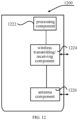
- FIG. 12 is a schematic block diagram of an apparatus 1200 for information configuration according to embodiments of the present disclosure.
- the apparatus 1200 may be provided as a base station.
- the apparatus 1200 includes a processing component 1222, a wireless transmitting/receiving component 1224, an antenna component 1226, and a signal processing part specific to a wireless interface.
- the processing component 1222 may further include one or more processors. One of the processors in the processing component 1222 may be configured to implement the method for information configuration described in any of the foregoing embodiments.
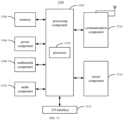
- FIG. 13 is a schematic block diagram of another apparatus 1300 for information configuration according to embodiments of the present disclosure.
- the apparatus 1300 may be a mobile phone, computer, digital broadcast terminal, messaging device, game console, tablet device, medical device, fitness device, personal digital assistant, and the like.
- the apparatus 1300 may include at least one of the following components: a processing component 1302, a memory 1304, a power component 1306, a multimedia component 1308, an audio component 1310, an input/output (I/O) interface 1312, a sensor component 1314, and a communication component 1316.
- a processing component 1302 a memory 1304, a power component 1306, a multimedia component 1308, an audio component 1310, an input/output (I/O) interface 1312, a sensor component 1314, and a communication component 1316.
- the processing component 1302 typically controls overall operations of the apparatus 1300, such as the operations associated with display, telephone calls, data communications, camera operations, and recording operations.
- the processing component 1302 may include at least one processor 1320 to execute instructions to perform all or part of the steps in the above described method.
- the processing component 1302 may include at least one module which facilitates the interaction between the processing component 1302 and other components.
- the processing component 1302 may include a multimedia module to facilitate the interaction between the multimedia component 1308 and the processing component 1302.
- the memory 1304 is configured to store various types of data to support the operation of the apparatus 1300. Examples of such data include instructions for any applications or methods operated on the apparatus 1300, contact data, phonebook data, messages, pictures, video, etc.
- the memory 1304 may be implemented using any type of volatile or non-volatile memory devices, or a combination thereof, such as a Static Random Access Memory (SRAM), an Electrically Erasable Programmable Read-Only Memory (EEPROM), an Erasable Programmable Read-Only Memory (EPROM), a programmable read-only memory (PROM), a Read-Only Memory (ROM), a magnetic memory, a flash memory, a magnetic or optical disk.
- SRAM Static Random Access Memory
- EEPROM Electrically Erasable Programmable Read-Only Memory
- EPROM Erasable Programmable Read-Only Memory
- PROM programmable read-only memory
- ROM Read-Only Memory
- the power component 1306 provides power to various components of the apparatus 1300.
- the power component 1306 may include a power management system, at least one power source, and any other components associated with the generation, management, and distribution of power in the apparatus 1300.
- the multimedia component 1308 includes a screen providing an output interface between the apparatus 1300 and the user.
- the screen may include a Liquid Crystal Display (LCD) and a Touch Panel (TP).
- the screen may be implemented as a touch screen to receive input signals from the user.
- the touch panel includes at least one touch sensor to sense touches, swipes, and gestures on the touch panel.
- the touch sensors may not only sense a boundary of a touch or swipe action, but also sense a period of time and a pressure associated with the touch or swipe action.
- the multimedia component 1308 includes a front-facing camera and/or a rear-facing camera.
- the front-facing camera and/or the rear-facing camera can receive external multimedia data.
- Each front-facing camera and rear-facing camera may be a fixed optical lens system or has focal length and optical zoom capability.
- the audio component 1310 is configured to output and/or input audio signals.
- the audio component 1310 includes a microphone (MIC) configured to receive an external audio signal when the apparatus 1300 is in an operation mode, such as a call mode, a recording mode, and a voice recognition mode.
- the received audio signal may be further stored in the memory 1304 or transmitted via the communication component 1316.
- the audio component 1310 further includes a speaker to output audio signals.
- the I/O interface 1312 provides an interface between the processing component 1302 and peripheral interface modules, such as a keyboard, a click wheel, buttons, and the like.
- the buttons may include, but are not limited to, a home button, a volume button, a starting button, and a locking button.
- the sensor component 1314 includes one or more sensors to provide status assessments of various aspects of the apparatus 1300. For instance, the sensor component 1314 may detect an open/closed status of the apparatus 1300, relative positioning of components, e.g., the display and the keypad of the apparatus 1300, a change in position of the apparatus 1300 or a component of the apparatus 1300, a presence or absence of user contact with the apparatus 1300, an orientation or an acceleration/deceleration of the apparatus 1300, and a change in temperature of the apparatus 1300.
- the sensor component 1314 may include a proximity sensor configured to detect the presence of nearby objects without any physical contact.
- the sensor component 1314 may also include a light sensor, such as a CMOS or CCD image sensor, for use in imaging applications.
- the sensor component 1314 may also include an accelerometer sensor, a gyroscope sensor, a magnetic sensor, a pressure sensor, or a temperature sensor.
- the communication component 1316 is configured to facilitate communication, wired or wirelessly, between the apparatus 1300 and other devices.
- the apparatus 1300 can access a wireless network based on a communication standard, such as WiFi, 2G or 3G, 4G LTE, 5G NR or a combination thereof.
- the communication component 1316 receives a broadcast signal or broadcast associated information from an external broadcast management system via a broadcast channel.
- the communication component 1316 further includes a near field communication (NFC) module to facilitate short-range communication.
- the NFC module may be implemented based on radio frequency identification (RFID) technology, infrared data association (IrDA) technology, ultra-wideband (UWB) technology, Bluetooth (BT) technology and other technologies.
- RFID radio frequency identification
- IrDA infrared data association
- UWB ultra-wideband
- Bluetooth Bluetooth
- the apparatus 1300 may be implemented with at least one application specific integrated circuits (ASICs), digital signal processors (DSPs), digital signal processing devices (DSPDs), programmable logic devices (PLDs), field programmable gate arrays (FPGAs), controllers, micro-controllers, microprocessors, or other electronic components, for performing the above described method of any embodiment.
- ASICs application specific integrated circuits
- DSPs digital signal processors
- DSPDs digital signal processing devices
- PLDs programmable logic devices
- FPGAs field programmable gate arrays
- controllers micro-controllers, microprocessors, or other electronic components, for performing the above described method of any embodiment.
- non-transitory computer readable storage medium including instructions, such as included in the memory 1304, executable by the processor 1320 in the apparatus 1300, for performing the above described methods.
- the non-transitory computer-readable storage medium may be a ROM, a RAM, a CD-ROM, a magnetic tape, a floppy disc, an optical data storage device, and the like.
Landscapes
- Engineering & Computer Science (AREA)
- Signal Processing (AREA)
- Computer Networks & Wireless Communication (AREA)
- Mobile Radio Communication Systems (AREA)
Applications Claiming Priority (1)
| Application Number | Priority Date | Filing Date | Title |
|---|---|---|---|
| PCT/CN2021/092850 WO2022236608A1 (zh) | 2021-05-10 | 2021-05-10 | 信息配置方法和装置 |
Publications (2)
| Publication Number | Publication Date |
|---|---|
| EP4340480A1 true EP4340480A1 (de) | 2024-03-20 |
| EP4340480A4 EP4340480A4 (de) | 2024-10-16 |
Family
ID=84029014
Family Applications (1)
| Application Number | Title | Priority Date | Filing Date |
|---|---|---|---|
| EP21941184.0A Withdrawn EP4340480A4 (de) | 2021-05-10 | 2021-05-10 | Informationskonfigurationsverfahren und -vorrichtung |
Country Status (4)
| Country | Link |
|---|---|
| US (1) | US20240244613A1 (de) |
| EP (1) | EP4340480A4 (de) |
| CN (1) | CN116889045A (de) |
| WO (1) | WO2022236608A1 (de) |
Families Citing this family (1)
| Publication number | Priority date | Publication date | Assignee | Title |
|---|---|---|---|---|
| US20240155602A1 (en) * | 2022-11-03 | 2024-05-09 | Qualcomm Incorporated | Indication of uplink transmission precoding parameter change |
Family Cites Families (10)
| Publication number | Priority date | Publication date | Assignee | Title |
|---|---|---|---|---|
| US20130294318A1 (en) * | 2012-05-03 | 2013-11-07 | Qualcomm Incorporated | Efficient update of tmgi list in lte embms |
| US10594427B2 (en) * | 2016-05-13 | 2020-03-17 | Intel Corporation | Inter evolved NODEB coordinated beamforming |
| EP3582534B1 (de) * | 2017-02-10 | 2024-11-13 | NTT DoCoMo, Inc. | Benutzerendgerät und drahtloskommunikationsverfahren |
| CN109327860A (zh) * | 2017-07-31 | 2019-02-12 | 华为技术有限公司 | 数据传输方法和装置 |
| US11184126B2 (en) * | 2018-04-06 | 2021-11-23 | Qualcomm Incorporated | Techniques for beam assignments for beamforming wireless communications |
| CN118631407A (zh) * | 2018-08-10 | 2024-09-10 | 苹果公司 | 用于新无线电超可靠低延时通信的物理上行链路共享信道增强 |
| US11979872B2 (en) * | 2018-09-29 | 2024-05-07 | Beijing Xiaomi Mobile Software Co., Ltd. | Method, device and base station for transmitting information |
| CN112399597A (zh) * | 2019-08-14 | 2021-02-23 | 华为技术有限公司 | 更新波束信息的方法和通信装置 |
| CN111092710A (zh) * | 2019-11-08 | 2020-05-01 | 中兴通讯股份有限公司 | 发送参数确定方法、电子装置、设备及介质 |
| KR20230006490A (ko) * | 2020-04-14 | 2023-01-10 | 아이디에이씨 홀딩스, 인크. | 고주파수 범위에서 커버리지의 개선 |
-
2021
- 2021-05-10 EP EP21941184.0A patent/EP4340480A4/de not_active Withdrawn
- 2021-05-10 US US18/289,867 patent/US20240244613A1/en active Pending
- 2021-05-10 CN CN202180001128.8A patent/CN116889045A/zh active Pending
- 2021-05-10 WO PCT/CN2021/092850 patent/WO2022236608A1/zh not_active Ceased
Also Published As
| Publication number | Publication date |
|---|---|
| WO2022236608A1 (zh) | 2022-11-17 |
| CN116889045A (zh) | 2023-10-13 |
| US20240244613A1 (en) | 2024-07-18 |
| EP4340480A4 (de) | 2024-10-16 |
Similar Documents
| Publication | Publication Date | Title |
|---|---|---|
| WO2021114276A1 (zh) | 波束测量方法及波束测量装置 | |
| CN111512685B (zh) | 信道状态信息测量方法、装置及计算机存储介质 | |
| US12407485B2 (en) | Implicit update of activated TCI states | |
| US12501300B2 (en) | Method for reporting channel state information and communication device | |
| CN114175821A (zh) | 传输配置指示状态确定方法、装置及存储介质 | |
| US11444722B2 (en) | Method for determining CQI information, base station, and user equipment | |
| US11368234B2 (en) | Method for determining CQI information, base station, and user equipment | |
| EP4319423A1 (de) | Kommunikationsverfahren für pusch, kommunikationsvorrichtung für pusch und speichermedium | |
| US20250031158A1 (en) | Srs power control method and apparatus, and storage medium | |
| US12028864B2 (en) | Data transmission method, device, system and storage medium | |
| EP4366407A1 (de) | Kommunikationsverfahren und vorrichtung für ungeplanten uplink-pusch und speichermedium | |
| US20240244615A1 (en) | Configuration information sending method and apparatus, and redundancy version rv value determining method and apparatus | |
| EP4661557A1 (de) | Strahlanzeigeverfahren, -vorrichtung und -vorrichtung sowie speichermedium | |
| CN114342521A (zh) | 波束确定方法及装置、存储介质 | |
| EP4518481A1 (de) | Informationsverarbeitungsverfahren und -vorrichtung sowie endgerät, basisstation und speichermedium | |
| EP4340480A1 (de) | Informationskonfigurationsverfahren und -vorrichtung | |
| US12477533B2 (en) | Uplink scheduling method, apparatus, and storage medium | |
| US20240178901A1 (en) | Method and apparatus for determining default beam, and communication device | |
| EP4668963A1 (de) | Verfahren und vorrichtung zur bestimmung des übertragungskonfigurationsanzeigezustands, verfahren und vorrichtung zur übertragungskonfigurationsanzeigezustand und speichermedium | |
| EP4668970A1 (de) | Verfahren, vorrichtung und vorrichtung zur konfiguration einer übertragungskonfigurationsanzeige und speichermedium | |
| CN117837251A (zh) | 波束上报增强方法、装置、通信设备及存储介质 | |
| CN115066846A (zh) | 一种上行链路传输方法和装置 | |
| EP4668638A1 (de) | Verfahren und vorrichtung zur kommunikation über einen gemeinsam genutzten physikalischen uplink-kanal (pusch) und speichermedium | |
| CN116368922B (en) | Transmission configuration indication state determining method, configuration method, device and storage medium | |
| EP4668964A1 (de) | Verfahren und vorrichtung zur bestimmung des übertragungskonfigurationsanzeigezustands und speichermedium |
Legal Events
| Date | Code | Title | Description |
|---|---|---|---|
| STAA | Information on the status of an ep patent application or granted ep patent |
Free format text: STATUS: THE INTERNATIONAL PUBLICATION HAS BEEN MADE |
|
| PUAI | Public reference made under article 153(3) epc to a published international application that has entered the european phase |
Free format text: ORIGINAL CODE: 0009012 |
|
| STAA | Information on the status of an ep patent application or granted ep patent |
Free format text: STATUS: REQUEST FOR EXAMINATION WAS MADE |
|
| 17P | Request for examination filed |
Effective date: 20231206 |
|
| AK | Designated contracting states |
Kind code of ref document: A1 Designated state(s): AL AT BE BG CH CY CZ DE DK EE ES FI FR GB GR HR HU IE IS IT LI LT LU LV MC MK MT NL NO PL PT RO RS SE SI SK SM TR |
|
| REG | Reference to a national code |
Ref country code: DE Ref legal event code: R079 Free format text: PREVIOUS MAIN CLASS: H04W0072040000 Ipc: H04B0007060000 |
|
| RIC1 | Information provided on ipc code assigned before grant |
Ipc: H04W 72/1268 20230101ALN20240620BHEP Ipc: H04W 72/044 20230101ALN20240620BHEP Ipc: H04W 72/23 20230101ALI20240620BHEP Ipc: H04B 7/06 20060101AFI20240620BHEP |
|
| DAV | Request for validation of the european patent (deleted) | ||
| DAX | Request for extension of the european patent (deleted) | ||
| A4 | Supplementary search report drawn up and despatched |
Effective date: 20240916 |
|
| RIC1 | Information provided on ipc code assigned before grant |
Ipc: H04W 72/1268 20230101ALN20240910BHEP Ipc: H04W 72/044 20230101ALN20240910BHEP Ipc: H04W 72/23 20230101ALI20240910BHEP Ipc: H04B 7/06 20060101AFI20240910BHEP |
|
| STAA | Information on the status of an ep patent application or granted ep patent |
Free format text: STATUS: THE APPLICATION IS DEEMED TO BE WITHDRAWN |
|
| 18D | Application deemed to be withdrawn |
Effective date: 20250405 |