EP4340326B1 - Verfahren und server zur bereitstellung eines nachrichtendienstes - Google Patents
Verfahren und server zur bereitstellung eines nachrichtendienstes Download PDFInfo
- Publication number
- EP4340326B1 EP4340326B1 EP23190730.4A EP23190730A EP4340326B1 EP 4340326 B1 EP4340326 B1 EP 4340326B1 EP 23190730 A EP23190730 A EP 23190730A EP 4340326 B1 EP4340326 B1 EP 4340326B1
- Authority
- EP
- European Patent Office
- Prior art keywords
- message
- sent
- allowed
- information
- content
- Prior art date
- Legal status (The legal status is an assumption and is not a legal conclusion. Google has not performed a legal analysis and makes no representation as to the accuracy of the status listed.)
- Active
Links
Images



Classifications
-
- H—ELECTRICITY
- H04—ELECTRIC COMMUNICATION TECHNIQUE
- H04L—TRANSMISSION OF DIGITAL INFORMATION, e.g. TELEGRAPHIC COMMUNICATION
- H04L51/00—User-to-user messaging in packet-switching networks, transmitted according to store-and-forward or real-time protocols, e.g. e-mail
- H04L51/21—Monitoring or handling of messages
- H04L51/212—Monitoring or handling of messages using filtering or selective blocking
-
- H—ELECTRICITY
- H04—ELECTRIC COMMUNICATION TECHNIQUE
- H04L—TRANSMISSION OF DIGITAL INFORMATION, e.g. TELEGRAPHIC COMMUNICATION
- H04L63/00—Network architectures or network communication protocols for network security
- H04L63/10—Network architectures or network communication protocols for network security for controlling access to devices or network resources
- H04L63/102—Entity profiles
-
- G—PHYSICS
- G06—COMPUTING OR CALCULATING; COUNTING
- G06Q—INFORMATION AND COMMUNICATION TECHNOLOGY [ICT] SPECIALLY ADAPTED FOR ADMINISTRATIVE, COMMERCIAL, FINANCIAL, MANAGERIAL OR SUPERVISORY PURPOSES; SYSTEMS OR METHODS SPECIALLY ADAPTED FOR ADMINISTRATIVE, COMMERCIAL, FINANCIAL, MANAGERIAL OR SUPERVISORY PURPOSES, NOT OTHERWISE PROVIDED FOR
- G06Q10/00—Administration; Management
- G06Q10/10—Office automation; Time management
- G06Q10/107—Computer-aided management of electronic mailing [e-mailing]
-
- H—ELECTRICITY
- H04—ELECTRIC COMMUNICATION TECHNIQUE
- H04L—TRANSMISSION OF DIGITAL INFORMATION, e.g. TELEGRAPHIC COMMUNICATION
- H04L51/00—User-to-user messaging in packet-switching networks, transmitted according to store-and-forward or real-time protocols, e.g. e-mail
- H04L51/07—User-to-user messaging in packet-switching networks, transmitted according to store-and-forward or real-time protocols, e.g. e-mail characterised by the inclusion of specific contents
-
- H—ELECTRICITY
- H04—ELECTRIC COMMUNICATION TECHNIQUE
- H04L—TRANSMISSION OF DIGITAL INFORMATION, e.g. TELEGRAPHIC COMMUNICATION
- H04L51/00—User-to-user messaging in packet-switching networks, transmitted according to store-and-forward or real-time protocols, e.g. e-mail
- H04L51/21—Monitoring or handling of messages
-
- H—ELECTRICITY
- H04—ELECTRIC COMMUNICATION TECHNIQUE
- H04L—TRANSMISSION OF DIGITAL INFORMATION, e.g. TELEGRAPHIC COMMUNICATION
- H04L51/00—User-to-user messaging in packet-switching networks, transmitted according to store-and-forward or real-time protocols, e.g. e-mail
- H04L51/21—Monitoring or handling of messages
- H04L51/216—Handling conversation history, e.g. grouping of messages in sessions or threads
-
- H—ELECTRICITY
- H04—ELECTRIC COMMUNICATION TECHNIQUE
- H04L—TRANSMISSION OF DIGITAL INFORMATION, e.g. TELEGRAPHIC COMMUNICATION
- H04L51/00—User-to-user messaging in packet-switching networks, transmitted according to store-and-forward or real-time protocols, e.g. e-mail
- H04L51/21—Monitoring or handling of messages
- H04L51/23—Reliability checks, e.g. acknowledgments or fault reporting
-
- H—ELECTRICITY
- H04—ELECTRIC COMMUNICATION TECHNIQUE
- H04L—TRANSMISSION OF DIGITAL INFORMATION, e.g. TELEGRAPHIC COMMUNICATION
- H04L51/00—User-to-user messaging in packet-switching networks, transmitted according to store-and-forward or real-time protocols, e.g. e-mail
- H04L51/06—Message adaptation to terminal or network requirements
- H04L51/063—Content adaptation, e.g. replacement of unsuitable content
Definitions
- the present disclosure relates to a message service providing method and server, and more particularly, to a method of controlling message transmission according to a sender's permission when providing a message service and a message server performing the method.
- One aspect of the invention consists of a method for providing a message service according to appended independent claim 1.
- Another aspect of the invention consists of a message server performing said method, as claimed in the appended independent claim 11.
- aspects of the present disclosure also provide the structure of a compound message designed to enable sophisticated transmission control.
- a message server receives a transmission request for a compound message which is a bundled message comprising a parent message and a plurality of child messages, obtains permission information for a sender of the compound message, determining whether to allow each of the child messages to be sent based on the permission information, controls the transmission of the compound message based on the determination result.
- the parent message comprises only a metadata field
- each of the child messages comprises a metadata field and a content field
- determining of whether to allow each of the child messages to be sent may comprises primarily determining whether to allow the compound message to be sent based on metadata of the compound message and the permission information and secondarily determining whether to allow each of the child messages to be sent in response to the determination that the compound message is a message allowed to be sent.
- the permission information may comprises information about terminals allowed to send messages
- the metadata of the compound message comprises terminal information of the sender
- the primarily determining of whether to allow the compound message to be sent comprises determining whether to allow the compound message to be sent by comparing the information about the terminals may allowed to send messages with the terminal information of the sender.
- the permission information may comprises information about a network where message transmission is allowed
- the metadata of the compound message comprises information about a network where a terminal of the sender is located
- the primarily determining of whether to allow the compound message to be sent comprises determining whether to allow the compound message to be sent by comparing the information about the network where message transmission is allowed with the information about the network where the terminal of the sender may be located.
- type information of the content may be recorded in the metadata field of each of the child messages
- the permission information comprises type information of content allowed to be sent
- the determining of whether to allow each of the child messages to be sent comprises determining whether to allow each of the child messages to be sent by comparing the type information of the content with the type information of the content may allowed to be sent.
- the type of the content may allowed to be sent varies according to the sender's affiliation or position.
- the permission information may comprises information about keywords not allowed to be sent
- the determining of whether to allow each of the child messages to be sent comprises determining whether to allow each of the child messages to be sent based on whether the keywords not allowed to be sent may be included in content of each of the child messages.
- controlling of the transmission may comprises blocking the transmission of the compound message in response to the determination that a message not allowed to be sent exists among the child messages.
- controlling of the transmission may comprises reconstructing the compound message by excluding a message not allowed to be sent or replacing the message not allowed to be sent with a notification message informing of transmission blocking in response to the determination that the message may not allowed to be sent exists among the child messages; and sending the reconstructed compound message to a receiver of the compound message.
- controlling of the transmission may comprises masking a message not allowed to be sent in response to the determination that the message may not allowed to be sent exists among the child messages and sending the compound message may comprising the masked message to a receiver of the compound message.
- server for an operation of receiving a transmission request for a compound message which is a bundled message comprising a parent message and a plurality of child messages, an operation of obtaining permission information for a sender of the compound message, an operation of determining whether to allow each of the child messages to be sent based on the permission information and an operation of controlling transmission of the compound message may based on the determination result.
- content of a predefined type or access information for the content may be recorded in a content field of each of the child messages
- type information of the content may be recorded in a metadata field of each of the child messages
- the permission information may comprises type information of content may allowed to be sent
- the operation of determining whether to allow each of the child messages to be sent comprises an operation of determining whether to allow each of the child messages to be sent by comparing the type information of the content with the type information of the content may allowed to be sent.
- the operation of determining whether to allow each of the child messages to be sent may comprises an operation of determining whether to allow each of the child messages to be sent based on whether the keywords not allowed to be sent are included in content of each of the child messages.
- the operation of controlling the transmission may comprises an operation of masking a message may not allowed to be sent in response to the determination that the message not allowed to be sent exists among the child messages and an operation of sending the compound message may comprising the masked message to a receiver of the compound message.
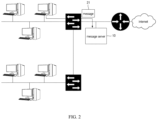
- FIG. 1 is an example diagram illustrating a message service providing environment according to embodiments of the present disclosure.
- a message server 10 providing a message service and a plurality of terminals 11-1 through 11-n using the message service may exist in the message service providing environment according to the embodiments.
- reference numeral '11' will hereinafter be used to refer to an arbitrary terminal 11-1 or 11-2 or... or 11-n or to collectively refer to all of the terminals 11-1 through 11-n.
- the message server 10 may be a computing device/system that provides a message service.
- the message service may be, for example, an instant message-based service, but the scope of the present disclosure is not limited thereto.
- the description will be continued below based on the assumption that the message service is an instance message-based service (e.g., a message service provided through a messenger).
- the message server 10 may provide a message relay function between a message sender and a message receiver.
- the message server 10 may receive a message transmission request from a sender's terminal (e.g., 11-1) and send a requested message to a receiver's terminal (e.g., 11-2).
- the message server 10 may provide a transmission control function for a message based on permission (or authority) information of a message sender.
- messages to be controlled may include a single message and a compound message.
- the compound message may refer to a bundled message including a parent message and a plurality of child messages.
- the structure and utilization example of the compound message will be described in detail with reference to FIGS. 3 through 5 .
- the transmission control function for a message will be described in detail with reference to FIG. 6 and subsequent drawings.
- the message server 10 may be implemented in at least one computing device. For example, all functions of the message server 10 may be implemented in one computing device, or a first function of the message server 10 may be implemented in a first computing device, and a second function may be implemented in a second computing device. Alternatively, a certain function of the message server 10 may be implemented in a plurality of computing devices.
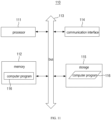
- a computing device may be any device having computing and communicating functions, and an example of this device is illustrated in FIG. 11 . Since the computing device is a collection of various components (e.g., a memory, a processor, etc.) interacting with each other, it may be named a 'computing system' in some cases. In addition, the computing system may refer to a collection of a plurality of computing devices interacting with each other.
- various components e.g., a memory, a processor, etc.
- the computing system may refer to a collection of a plurality of computing devices interacting with each other.
- a terminal 11 may be a computing device of a user (e.g., a message sender or a message receiver) using a message service.
- the user may use the message service after executing a message client (e.g., a message client application) installed in the terminal 11 and logging in.
- the message client may be an application implemented to allow the user to conveniently use the message service, but the scope of the present disclosure is not limited thereto. If the message service is provided based on the web, the message client may be a web browser.
- the terminal 11 may be implemented as various computing devices such as mobile terminals (e.g., smartphones, tablets, laptops, notebooks, etc.) and fixed terminals (e.g., desktops, etc.).
- the terminal 11 can be implemented as any computing device. An example of such a computing device is illustrated in FIG. 11 .
- the message server 10 and the terminal 11 may communicate through a network.
- the network may be implemented as all types of wired/wireless networks such as a local area network (LAN), a wide area network (WAN), a mobile radio communication network, and wireless broadband Internet (Wibro).
- LAN local area network
- WAN wide area network
- Wibro wireless broadband Internet
- the message server 10 may be installed in an internal network (intranet) of a company to provide a message service (i.e., an enterprise message service) to members of the company.
- a message service i.e., an enterprise message service
- the message server 10 can provide a flexible and sophisticated transmission control function for a message 21 according to a security policy of the company.
- security threats such as leakage of company secrets can be prevented in advance, and the level of security within the company can be greatly improved.
- communication restrictions between the members can be minimized, and work efficiency can be improved through the sophisticated transmission control of the message server 10. This will be described in detail later with reference to FIG. 6 and subsequent drawings.
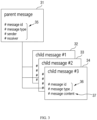
- FIG. 3 is an example diagram illustrating the structure of a compound message according to embodiments of the present disclosure.
- the compound message according to the embodiments may be a kind of bundled message and may be composed of a parent message 31 and a plurality of child messages 32 through 34.
- the number of child messages 32 through 34 is 'three'.
- the number of child messages may vary. In some cases, a limit on the maximum number of child messages may be set.
- reference numeral '32' will hereinafter be used to refer to an arbitrary child message 32 or 33 or 34 or to collectively refer to all of the child messages 32 through 34.
- the parent message 31 refers to a message including metadata 35 representing the compound message. That is, the metadata representing the compound message are recorded in a metadata field 35 of the parent message 31. In the metadata field 35 of the parent message 31, only a part of the metadata of the compound message may be recorded, or all of the metadata of the compound message may be recorded.
- Examples of the metadata of the compound message may include information about message ID (i.e., representative ID of the compound message), message type, sender, receiver, channel, chat room, number of child messages, sender's terminal, network where sender's terminal is located, etc.
- message ID i.e., representative ID of the compound message
- message type i.e., sender, receiver, channel, chat room, number of child messages, sender's terminal, network where sender's terminal is located, etc.
- message ID i.e., representative ID of the compound message
- the message type may be divided into a single message and a compound message, but the scope of the present disclosure is not limited thereto.
- sender information may be, for example, sender ID (e.g., message service account), affiliation, position, etc., but the scope of the present disclosure is not limited thereto.
- sender ID e.g., message service account
- affiliation e.g., affiliation, position, etc.
- the terminal information may be, for example, the type of terminal (e.g., mobile terminal, fixed terminal, etc.), terminal ID, terminal address, etc., but the scope of the present disclosure is not limited thereto.
- the network information may be, for example, network type (e.g., internal network, external network), network ID, network address, etc., but the scope of the present disclosure is not limited thereto.
- network type e.g., internal network, external network
- network ID e.g., network ID, network address, etc.
- the parent message 31 may be a message including only the metadata field 35 as illustrated in the drawing or may be a message further including a content field, like the child messages 32.
- the metadata field 35 of the parent message 31 may be used to determine whether to allow the compound message itself (as a whole) to be sent. This will be described later (refer to the description of operation S63 in FIG. 6 ).
- a child message 32 may a sub-message of the parent message 31 and may refer to a message having a metadata field 36 and a content field 37. At least a part (e.g., information such as sender and receiver) of the metadata 35 of the parent message 31 may also be applied to the child message 32.
- the metadata field 36 for example, information such as message ID and type may be recorded.
- the type of the child message 32 may refer to the type of content related to the content field 37.
- One child message 32 may be related to only one type of content, but the scope of the present disclosure is not limited thereto.
- the metadata field 36 may be used to determine whether to allow each child message 32 to be sent. This will be described later (refer to the description of operation S66 in FIG. 6 ).
- the type of content may be divided into, for example, text content and file content, and the file content may be divided into, for example, photo content, document content and video content.
- the type of the file content may be subdivided based on file extension.
- the type of the document content may be subdivided according to an extension of a document file
- the type of the photo content may be subdivided according to an extension of a photo file.
- the scope of the present disclosure is not limited by these examples.
- content of a certain type which is the content of a message, or access (or download) information for the content is recorded.
- text content may be recorded in the content field 37 as it is.
- access information e.g., URL, etc.
- FIG. 4 This may be further understood from FIG. 4 .
- the parent message 31 and the child message 32 may be referred to as a 'message' and a 'sub-message', respectively.
- the parent message 31 and the child message 32 may be referred to as a 'container message' and an 'individual message', respectively.
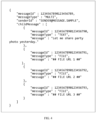
- FIG. 4 is a representation of the structure of the compound message according to the embodiments of the present disclosure in a JavaScript Object Notation (JSON) format.
- JSON JavaScript Object Notation
- 'MULTI' (or 'COMPOUND') means that the type of a corresponding message is a compound message.
- a compound message 55 is displayed in a message window (i.e., a message window of a receiver's terminal) according to embodiments of the present disclosure.
- a case where the compound message 55 is composed of a parent message, one child message 52 containing text content, nine child messages 53 containing photo content (i.e., photo file content), and one child message 54 containing text content is illustrated as an example.
- a case where the photo content is displayed in thumbnail form is illustrated as an example.
- the compound message 55 may be effective when a sender bundles different types of content and sends them to a receiver. As illustrated, one compound message 55 may be displayed in one speech bubble 51, but the scope of the present disclosure is not limited thereto.
- FIG. 6 a message service providing method according to embodiments of the present disclosure will be described with reference to FIG. 6 and subsequent drawings.
- the description will be continued based on the assumption that the method to be described later is performed in the environment illustrated in FIG. 2 (i.e., the enterprise environment).
- the description will be continued based on the assumption that all operations of the method to be described later are performed by the message server 10. Therefore, when the subject of a specific step/operation is omitted, it may be understood that the step/operation is performed by the message server 10.
- transmission control for a message may be performed by a message client installed in the sender's terminal (e.g., 11-1) to reduce the load on the message server 10.
- FIG. 6 is an example diagram illustrating a message service providing method according to embodiments of the present disclosure. However, this is only an exemplary embodiment for achieving the objectives of the present disclosure, and some operations can be added or deleted as needed.
- the method according to the embodiments may start with operation S61 in which a transmission request for a message is received.
- the message server 10 may receive a message from a sender's terminal (e.g., 11-1).
- receiving the message may have substantially the same technical meaning as receiving a transmission request for the message.
- permission information for the sender of the message may be obtained.
- the message server 10 may obtain the permission information of the sender by searching a preset permission table (or database) using information about the sender of the requested message (e.g., sender information recorded in a metadata field of a parent message).
- the permission table may be preset in consideration of, for example, a security policy of a company.
- the message server 10 may search for detailed information about the sender using the sender information (e.g., sender ID, etc.) included in the requested message and may obtain the permission information through a preset permission table using the found detailed information.
- the detailed information about the sender may be, for example, the sender's ID (e.g., message service account), position/affiliation information (e.g., department, organization, company, another company, partner company, etc.), terminal information (e.g., terminal type, terminal ID, address, etc.), and information about a network where the sender's terminal is located (e.g., network type, network ID, network address, etc.), but the present disclosure is not limited thereto.
- permission to send a message may be differentially set (that is, may vary) according to a user's position, affiliation, terminal, network, etc.
- the message server 10 may obtain the permission information for the sender using the detailed information about the sender, such as the sender's position and affiliation.
- the permission information is information used to control message transmission (or verify the sender's permission) and may include information about various items that are allowed (i.e., with permission) or not allowed (i.e., without permission) to be sent.
- the permission information may include information about users who are allowed (or not allowed) to send messages and information about their position/affiliation (e.g., department, organization, company, another company, partner company, etc.).
- message transmission control can be easily performed for each user or position/affiliation.
- transmission control such as blocking message transmission of a sender belonging to a specific department, can be easily performed.
- the permission information may include information about terminals (e.g., terminal type, terminal ID, address, etc.) which are allowed (or not allowed) to transmit messages.
- message transmission control can be easily performed for each terminal.
- transmission control such as blocking transmission of a requested message through a mobile terminal, can be easily performed.
- the permission information may include information (e.g., network type, network ID, network address, etc.) about a network where message transmission is allowed (or not allowed) (a network where a sender's terminal and/or a receiver's terminal are located).
- message transmission control can be easily performed in consideration of the network where the sender's terminal and/or the receiver's terminal are located.
- transmission control such as blocking message transmission from an internal network to an external network, can be easily performed.
- the permission information may include type information of messages (e.g., a single message and a compound message) which are allowed (or not allowed) to be sent.
- transmission control can be easily performed for each type of message. For example, transmission control, such as blocking transmission of a compound message only for some users, can be easily performed.
- the permission information may include type information of content for which message transmission is allowed (or not allowed).
- transmission control can be easily performed for each type of content. For example, transmission control, such as blocking transmission of a message containing a specific type of content only for some users, can be easily performed.
- the permission information may include information about keywords for which message transmission is not allowed.
- message transmission control can be performed in a more sophisticated manner. For example, sophisticated transmission control, such as blocking transmission of a message containing a specific keyword, can be easily performed.
- the permission information may include information based on a combination of various examples described above.
- the permission information may include keywords that are not allowed to be sent and type information of content that is allowed to be sent.
- a sender's permission for a message may be set differentially according to the sender (i.e., user), the sender's position/affiliation, the sender's terminal, or a network where the sender's terminal and/or a receiver's terminal are located.
- the type of message and content which are allowed to be sent may vary according to affiliation, position, terminal type, network type, etc. In this case, message transmission control can be performed in a fairly flexible and sophisticated manner.
- transmission control such as blocking transmission of a message containing document content and photo content only when the sender sends a message (e.g., sends a message to the outside) using a mobile terminal connected to an internal network
- transmission control such as blocking transmission of a message containing file content only when the sender does not belong to a corresponding company (e.g., belongs to a partner company or another company)
- a corresponding company e.g., belongs to a partner company or another company
- whether to allow transmission of the requested message may be primarily determined based on the obtained permission information of the sender.
- This operation may be understood as an operation of determining whether to allow transmission of the requested message itself (or as a whole).
- the message server 10 may determine whether the requested message is a message allowed to be sent by using metadata of the requested message and the permission information of the sender.
- the message server 10 may determine whether to allow transmission of the requested message by comparing the information about the terminals allowed to send messages with the information about the sender's terminal.
- the message server 10 may determine whether to allow transmission of the requested message by comparing the information about the type of message allowed to be sent with the type information of the requested message.
- the message server 10 may send a notification message informing that transmission of the requested message has been blocked to the terminal of the sender and/or the receiver.
- operation S64 it may be determined whether the type of the requested message is a single message. In response to the determination that the type of the requested message is a single message, operation S65 may be performed. In the opposite case (i.e., when the type of the requested message is a compound message), operation S66 may be performed.
- the requested message is a single message
- the requested message may be sent to a receiver of the message (e.g., the receiver's terminal or account).
- operation S66 in response to the determination that the type of the requested message is a compound message, it may be determined whether to allow transmission of each child message. For example, the message server 10 may compare the permission information with metadata (or content) of each child message to determine whether to allow transmission of each child message. As a result, operation S65 may be performed when all child messages are messages allowed to be sent, and operation S67 may be performed in the opposite case (i.e., when there is a message not allowed to be sent among the child messages).
- the message server 10 may determine whether to allow transmission of each child message by comparing the information about the type of content allowed to be sent with the type information recorded in the metadata field.
- the message server 10 may check whether the content of each child message (e.g., text content, document content, etc.) includes keywords that are not allowed to be sent and may determine whether to allow transmission of each child message based on the checking result. If the content of a child message is photo or video content, the message server 10 may extract text related to the content by using text recognition, voice recognition, image captioning (e.g., image captioning using a deep learning model) or scene recognition and may check whether the extracted text includes keywords that are not allowed to be sent.
- the content of each child message e.g., text content, document content, etc.
- the message server 10 may extract text related to the content by using text recognition, voice recognition, image captioning (e.g., image captioning using a deep learning model) or scene recognition and may check whether the extracted text includes keywords that are not allowed to be sent.
- whether to allow transmission of the parent message may also be determined in operation S66 or in another operation.
- transmission control for the requested message may be performed according to a predetermined rule. That is, in response to the determination that there is a message not allowed to be sent among the child messages, transmission control may be performed for the requested compound message.
- a specific control method may vary depending on embodiments.
- transmission of the requested compound message may be blocked.
- the message server 10 may block transmission of the entire compound message.
- the message server 10 may send a notification message informing that transmission of the requested compound message has been blocked to the terminal of the sender and/or the receiver.
- the message server 10 may reconstruct the compound message by replacing a message not allowed to be sent among the child messages (e.g., 82 and 83) with a notification message 84 informing of transmission blocking and may send the reconstructed compound message to the receiver.
- a case where a compound message is composed of a parent message 81 and three child messages (e.g., 82 and 83) is illustrated as an example.
- the message server 10 may reconstruct the compound message by deleting, masking, or replacing the content of a message not allowed to be sent among the child messages with a predetermined phrase (e.g., a blocking notification phrase as illustrated in FIG. 8 ).
- only a message not allowed to be sent among the child messages may be masked, and the compound message including the masked message may be sent to the receiver.
- a compound message 91 includes nine child messages related to photo content (e.g., 92 through 94) and that three child messages 92 through 94 are determined to be messages not allowed to be sent (e.g., photo files with extensions that are not allowed to be sent).
- the message server 10 may mask only the messages not allowed to be sent (e.g., replace the photo files with masked files) and send the compound message 91 including the masked messages to the receiver.
- the message server 10 may provide information about only a specific part of a child message or content to be masked, and a message client installed in the receiver's terminal may perform masking based on the information.
- transmission control for the compound message may be performed based on various combinations of the above-described embodiments.
- the message server 10 may block transmission of the entire compound message or block transmission of only a message not allowed to be sent among the child messages (e.g., replace the message not allowed to be sent with a notification message informing of transmission blocking or mask the message not allowed to be sent) according to detailed information about the sender (e.g., affiliation, position, terminal, network, etc.), message type, content type, etc. (e.g., if the content type is photo content, masking is performed. If the content type is text content, the message not allowed to be sent is deleted or replaced with a blocking notification message. If a message is sent through a mobile terminal or if a user who does not belong to a corresponding company sends a message through a mobile terminal, the entire compound message is blocked).
- the content of the parent message may be automatically generated before the compound message is sent to the receiver.
- the message server 10 may automatically generate the content of the parent message based on the result of analyzing the child messages. The current embodiments will be described in more detail a little later with reference to FIG. 10 .
- transmission control for a message can be performed in a sophisticated and flexible manner by differentially setting permission for message transmission according to various factors such as the sender's affiliation, position, terminal, and network.
- sophisticated transmission control for a compound message can be performed by performing transmission control for each of a plurality of child messages constituting the compound message.
- transmission control such as blocking transmission of only some child messages without permission (i.e., messages not allowed to be sent) among the child messages, can be easily performed.
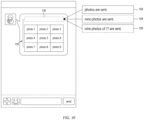
- FIG. 10 illustrates a case where a compound message 101 is composed of nine child messages related to photo content as an example.
- the message server 10 may automatically generate content 102 of a parent message constituting the compound message 101 based on the result of analyzing the child messages.
- the example illustrated in FIG. 10 can also be understood as generating a new child message 102 based on the result of analyzing the existing child messages by using the message server 10.
- the result of analyzing the child messages may include all types of information that can be derived by analyzing metadata and content of the child messages, and any analysis method can be used.
- the message server 10 may analyze and derive information about the number of child messages, the type of content included in the child messages, the topic of content, and the sentiment of text content.
- the scope of the present disclosure is not limited thereto.
- the message server 10 may derive topic information and sentiment information by inputting text content of the child messages to a topic classification model (e.g., a trained topic classification model) or a sentiment classification model.
- a topic classification model e.g., a trained topic classification model
- a sentiment classification model e.g., a sentiment classification model
- the message server 10 may extract text related to the content by using text recognition, voice recognition, image captioning (e.g., image captioning using a deep learning model), scene recognition, etc. and may derive topic information and sentiment information by inputting the extracted text to a topic classification model or a sentiment classification model.
- the message server 10 may automatically generate the content 102 of the parent message by variously combining information included in the analysis result. For example, as illustrated in the drawing, the message server 10 may generate a specific text 103 (e.g., an explanatory text for the compound message 101) using type information of the child messages, may generate a specific text 104 using information about the number and type of the child messages, or may generate a specific text 105 using information about the number, type, and topic of the child messages. In some cases, the message server 10 may add an emoticon or change a dialogic style or font of the generated text (e.g., 103) by using the sentiment information of the child messages.
- a specific text 103 e.g., an explanatory text for the compound message 101
- the message server 10 may add an emoticon or change a dialogic style or font of the generated text (e.g., 103) by using the sentiment information of the child messages.
- the content 102 of the parent message and/or the automatically generated text may be displayed in a message window of the receiver' terminal such that they are distinguished from other messages (e.g., by changing visual elements such as font, background color, text color, text size, thickness, etc.).
- a message service with enhanced security by appropriately controlling message transmission based on a sender's permission information.
- security threats such as leakage of company secrets to the outside can be effectively prevented.
- transmission control for a message can be performed in a sophisticated and flexible manner by differentially setting permission for message transmission according to various criteria such as the sender's affiliation, position, terminal, and network.
- the sender's permission information may include type information of messages allowed to be sent.
- transmission control can be easily performed for each type of message. For example, transmission control, such as blocking transmission of a compound message only for some users, can be easily performed.
- the sender's permission information may include type information of content allowed to be sent.
- transmission control can be easily performed for each type of content included in a message. For example, transmission control, such as blocking transmission of a message containing a specific type of content (e.g., document content, photo content, etc.) only for some users, can be easily performed.
- transmission control for a compound message in a sophisticated and easy manner by performing transmission control for each of a plurality of child messages constituting the compound message.
- transmission control such as blocking transmission of only some child messages without permission (i.e., messages not allowed to be sent) among the child messages, can be easily performed. Accordingly, communication restrictions between members using a message service can be minimized.
Landscapes
- Engineering & Computer Science (AREA)
- Signal Processing (AREA)
- Computer Networks & Wireless Communication (AREA)
- Business, Economics & Management (AREA)
- Human Resources & Organizations (AREA)
- Computer Hardware Design (AREA)
- Entrepreneurship & Innovation (AREA)
- Strategic Management (AREA)
- Computing Systems (AREA)
- General Engineering & Computer Science (AREA)
- Computer Security & Cryptography (AREA)
- Marketing (AREA)
- Economics (AREA)
- Data Mining & Analysis (AREA)
- Operations Research (AREA)
- Quality & Reliability (AREA)
- Tourism & Hospitality (AREA)
- Physics & Mathematics (AREA)
- General Business, Economics & Management (AREA)
- General Physics & Mathematics (AREA)
- Theoretical Computer Science (AREA)
- Information Transfer Between Computers (AREA)
Claims (13)
- Verfahren zur Bereitstellung eines Nachrichtendienstes, das von mindestens einer Rechenvorrichtung ausgeführt wird, wobei das Verfahren umfasst:Empfangen einer Übertragungsanforderung für eine Verbundnachricht, die eine gebündelte Nachricht ist, die eine übergeordnete Nachricht (31) und eine Mehrzahl von untergeordneten Nachrichten (32-34) umfasst, wobei die übergeordnete Nachricht (31) ein Metadatenfeld (35) umfasst, in dem Metadaten der Verbundnachricht aufgezeichnet werden, und wobei jede der untergeordneten Nachrichten (32-34) ein Inhaltsfeld (37) umfasst;Erhalten von Berechtigungsinformationen für einen Absender der Verbundnachricht;Bestimmen, ob das Senden jeder der untergeordneten Nachrichten (32-34) erlaubt werden, soll basierend auf den Berechtigungsinformationen; undSteuern der Übertragung der Verbundnachricht basierend auf dem Bestimmungsergebnis,wobei Inhalte eines vordefinierten Typs oder Zugriffsinformationen für den Inhalt im Inhaltsfeld (37) jeder der untergeordneten Nachrichten (32-34) aufgezeichnet werden, Informationen zum Inhaltstyp im Metadatenfeld (35) jeder der untergeordneten Nachrichten (32-34) aufgezeichnet werden, wobei die Berechtigungsinformationen Informationen zum Inhaltstyp, der gesendet werden darf, umfassen, und das Bestimmen, ob das Senden jeder der untergeordneten Nachrichten (32-34) erlaubt werden soll, ein Bestimmen, ob das Senden jeder der untergeordneten Nachrichten (32-34) erlaubt werden soll, durch Vergleichen der Informationen zum Inhaltstyp mit den Informationen zum Inhaltstyp, der gesendet werden darf, umfasst.
- Verfahren nach Anspruch 1, wobei die übergeordnete Nachricht (31) nur ein Metadatenfeld (35) umfasst und jede der untergeordneten Nachrichten (32-34) ein Metadatenfeld (36) und ein Inhaltsfeld (37) umfasst.
- Verfahren nach Anspruch 1, wobei das Bestimmen, ob das Senden jeder der untergeordneten Nachrichten (32-34) erlaubt werden soll, umfasst:primäres Bestimmen, ob das Senden der Verbundnachricht erlaubt werden soll, basierend auf den Metadaten der Verbundnachricht und den Berechtigungsinformationen; undsekundäres Bestimmen, ob das Senden jeder der untergeordneten Nachrichten (32-34) erlaubt werden soll, als Reaktion auf die Bestimmung, dass die Verbundnachricht eine Nachricht ist, die gesendet werden darf.
- Verfahren nach Anspruch 3, wobei die Berechtigungsinformationen Informationen über Endgeräte umfassen, die zum Senden von Nachrichten berechtigt sind, die Metadaten der Verbundnachricht Endgerätinformationen des Absenders umfassen, und das primäre Bestimmen, ob das Senden der Verbundnachricht erlaubt werden soll, ein Bestimmen, ob das Senden der Verbundnachricht erlaubt werden soll, durch Vergleichen der Informationen über die Endgeräte, die zum Senden von Nachrichten berechtigt sind, mit den Endgerätinformationen des Absenders umfasst.
- Verfahren nach Anspruch 3, wobei die Berechtigungsinformationen Informationen über ein Netzwerk umfassen, in dem die Nachrichtenübertragung erlaubt ist, die Metadaten der Verbundnachricht Informationen über ein Netzwerk umfassen, in dem sich ein Endgerät des Absenders befindet, und das primäre Bestimmen, ob das Senden der Verbundnachricht erlaubt werden soll, ein Bestimmen, ob das Senden der Verbundnachricht erlaubt werden soll, durch Vergleichen der Informationen über das Netzwerk, in dem die Nachrichtenübertragung erlaubt ist, mit den Informationen über das Netzwerk, in dem sich das Endgerät des Absenders befindet, umfasst.
- Verfahren nach Anspruch 1, wobei der Typ des Inhalts, der gesendet werden darf, je nach Zugehörigkeit oder Position des Absenders variiert.
- Verfahren nach Anspruch 1, wobei die Berechtigungsinformationen Informationen über Schlüsselwörter umfassen, die nicht gesendet werden dürfen, und das Bestimmen, ob das Senden jeder der untergeordneten Nachrichten (32-34) erlaubt werden soll, ein Bestimmen, ob das Senden jeder der untergeordneten Nachrichten (32-34) erlaubt werden soll, basieren darauf, ob die Schlüsselwörter, die nicht gesendet werden dürfen, im Inhalt jeder der untergeordneten Nachrichten (32-34) enthalten sind, umfasst.
- Verfahren nach Anspruch 1, wobei das Steuern der Übertragung ein Blockieren der Übertragung der Verbundnachricht als Reaktion auf die Bestimmung, dass in den untergeordneten Nachrichten (32-34) eine Nachricht enthalten ist, deren Senden nicht zulässig ist, umfasst.
- Verfahren nach Anspruch 1, wobei das Steuern der Übertragung Folgendes umfasst:Rekonstruieren der Verbundnachricht durch Ausschließen einer Nachricht, die nicht gesendet werden darf, oder Ersetzen der Nachricht, die nicht gesendet werden darf, durch eine Benachrichtigungsnachricht, die über eine Übertragungsblockierung informiert, als Reaktion auf die Bestimmung, dass die Nachricht, die nicht gesendet werden darf, in den untergeordneten Nachrichten (32 -34) enthalten ist; undSenden der rekonstruierten Verbundnachricht an einen Empfänger der Verbundnachricht.
- Verfahren nach Anspruch 1, wobei das Steuern der Übertragung umfasst:Maskieren einer Nachricht, die nicht gesendet werden darf, als Reaktion auf die Bestimmung, dass die Nachricht, die nicht gesendet werden darf, in den untergeordneten Nachrichten (32-34) enthalten ist; undSenden der Verbundnachricht, die die maskierte Nachricht umfasst, an einen Empfänger der Verbundnachricht.
- Nachrichtenserver, umfassend:einen oder mehrere Prozessoren;einen Speicher, der eine oder mehrere Anweisungen speichert; undeine Kommunikationsschnittstelle, wobei die Prozessoren die gespeicherten Anweisungen ausführen, um durchzuführen:eine Operation zum Empfangen einer Übertragungsanforderung für eine Verbundnachricht, die eine gebündelte Nachricht ist, die eine übergeordnete Nachricht (31) und eine Mehrzahl von untergeordneten Nachrichten (32-34) umfasst, wobei die übergeordnete Nachricht (31) ein Metadatenfeld (35) umfasst, in dem Metadaten der Verbundnachricht aufgezeichnet werden und wobei jede der untergeordneten Nachrichten (32-34) ein Inhaltsfeld (37) umfasst;eine Operation zum Erhalten von Berechtigungsinformationen für einen Absender der Verbundnachricht;eine Operation zum Bestimmen, ob das Senden jeder der untergeordneten Nachrichten (32-34) erlaubt werden soll, basierend auf den Berechtigungsinformationen; undeine Operation zum Steuern der Übertragung der Verbundnachricht basierend auf dem Bestimmungsergebnis,wobei Inhalte eines vordefinierten Typs oder Zugriffsinformationen für den Inhalt im Inhaltsfeld (37) jeder der untergeordneten Nachrichten (32-34) aufgezeichnet werden, Informationen zum Inhaltstyp in einem Metadatenfeld (36) jeder der untergeordneten Nachrichten (32-34) aufgezeichnet werden, wobei die Berechtigungsinformationen Informationen zum Inhaltstyp, der gesendet werden darf, umfassen, und die Operation zum Bestimmen, ob das Senden jeder der untergeordneten Nachrichten (32-34) erlaubt werden soll, eine Operation zum Bestimmen, ob das Senden jeder der untergeordneten Nachrichten (32-34) erlaubt werden, soll durch Vergleichen der Informationen zum Inhaltstyp mit den Informationen zum Inhaltstyp, der gesendet werden darf, umfasst.
- Nachrichtenserver nach Anspruch 11, wobei die Berechtigungsinformationen Informationen über Schlüsselwörter umfassen, die nicht gesendet werden dürfen, und die Operation zum Bestimmen, ob das Senden jeder der untergeordneten Nachrichten (32-34) erlaubt werden soll, eine Operation zum Bestimmen, ob das Senden jeder der untergeordneten Nachrichten (32-34) erlaubt werden soll, basierend darauf, ob die Schlüsselwörter, die nicht gesendet werden dürfen, im Inhalt jeder der untergeordneten Nachrichten (32-34) enthalten sind, umfasst.
- Nachrichtenserver nach Anspruch 11, wobei die Operation zum Steuern der Übertragung umfasst:eine Operation zum Maskieren einer Nachricht, die nicht gesendet werden darf, als Reaktion auf die Bestimmung,dass die Nachricht, die nicht gesendet werden darf, in den untergeordneten Nachrichten (32-34) enthalten ist; undeine Operation zum Senden der Verbundnachricht, die die maskierte Nachricht umfasst, an einen Empfänger der Verbundnachricht.
Applications Claiming Priority (1)
| Application Number | Priority Date | Filing Date | Title |
|---|---|---|---|
| KR1020220116908A KR20240038298A (ko) | 2022-09-16 | 2022-09-16 | 메시지 서비스 제공 방법 및 이를 위한 서버 |
Publications (2)
| Publication Number | Publication Date |
|---|---|
| EP4340326A1 EP4340326A1 (de) | 2024-03-20 |
| EP4340326B1 true EP4340326B1 (de) | 2025-01-29 |
Family
ID=87570770
Family Applications (1)
| Application Number | Title | Priority Date | Filing Date |
|---|---|---|---|
| EP23190730.4A Active EP4340326B1 (de) | 2022-09-16 | 2023-08-10 | Verfahren und server zur bereitstellung eines nachrichtendienstes |
Country Status (3)
| Country | Link |
|---|---|
| US (1) | US12323429B2 (de) |
| EP (1) | EP4340326B1 (de) |
| KR (1) | KR20240038298A (de) |
Families Citing this family (1)
| Publication number | Priority date | Publication date | Assignee | Title |
|---|---|---|---|---|
| US12586573B1 (en) * | 2023-09-29 | 2026-03-24 | Amazon Technologies, Inc. | Sentiment-based conversation hotspot detection |
Family Cites Families (29)
| Publication number | Priority date | Publication date | Assignee | Title |
|---|---|---|---|---|
| WO1997046962A1 (en) * | 1996-06-07 | 1997-12-11 | At & T Corp. | Finding an e-mail message to which another e-mail message is a response |
| AU2001296866A1 (en) * | 2000-09-05 | 2002-03-22 | Zaplet, Inc. | Methods and apparatus providing electronic messages that are linked and aggregated |
| US7797529B2 (en) * | 2003-11-10 | 2010-09-14 | Yahoo! Inc. | Upload security scheme |
| FI20045174A0 (fi) | 2004-05-12 | 2004-05-12 | Nokia Corp | Tiedostojen valitseminen ja välittäminen päätelaitteelle |
| US8065424B2 (en) * | 2005-07-15 | 2011-11-22 | University Of Utah Research Foundation | System and method for data transport |
| JP4911940B2 (ja) | 2005-09-30 | 2012-04-04 | キヤノン株式会社 | データ送信装置及びその制御方法と画像入出力装置 |
| US8200762B2 (en) * | 2006-06-01 | 2012-06-12 | Aol Inc. | Displaying complex messaging threads into a single display |
| KR100871619B1 (ko) | 2006-09-21 | 2008-12-02 | 삼성전자주식회사 | 이동통신 단말기에서 멀티미디어 메시지를 통해 컨텐트권리를 수신하는 장치 및 방법 |
| KR20080063601A (ko) | 2007-01-02 | 2008-07-07 | 삼성전자주식회사 | 이동통신 시스템에서 멀티미디어 메시지를 통해 컨텐트권리를 송신하는 장치 및 방법 |
| US8701046B2 (en) * | 2008-06-27 | 2014-04-15 | Microsoft Corporation | Aggregate and hierarchical display of grouped items spanning multiple storage locations |
| US9660832B2 (en) * | 2010-08-13 | 2017-05-23 | Oracle International Corporation | Techniques for filtering selective users in distribution lists |
| CN102056101A (zh) | 2011-01-05 | 2011-05-11 | 中兴通讯股份有限公司 | 一种多媒体消息的拦截系统及方法 |
| US8892080B2 (en) * | 2011-12-07 | 2014-11-18 | Ramin Bolouri | Methods and systems of communication interexchange allowing for heterogenous types of communication between heterogenous devices |
| US20140245178A1 (en) * | 2013-02-22 | 2014-08-28 | Research In Motion Limited | Communication device and method for profiling and presentation of message threads |
| US10666590B2 (en) | 2013-10-21 | 2020-05-26 | Dropbox, Inc. | Secure sent message identifier |
| US10990914B2 (en) * | 2014-07-22 | 2021-04-27 | Microsoft Technology Licensing, Llc | Filtering records on a unified display |
| US9973552B2 (en) * | 2014-08-04 | 2018-05-15 | Candex Technologies Ltd. | Systems and methods for organizational collaboration |
| KR20160087640A (ko) | 2015-01-14 | 2016-07-22 | 엘지전자 주식회사 | 이동단말기 및 그 제어방법 |
| US11522821B2 (en) | 2015-07-06 | 2022-12-06 | Wrinkl, Inc. | Method and apparatus for interaction in a messaging system |
| EP3563551B1 (de) * | 2016-12-30 | 2022-08-10 | Intel Corporation | Mechanismus für eine effiziente datenberichterstattung in iiot wsn |
| JP7147237B2 (ja) * | 2018-04-13 | 2022-10-05 | 富士フイルムビジネスイノベーション株式会社 | 情報処理装置及び情報処理プログラム |
| US11290406B1 (en) * | 2020-01-05 | 2022-03-29 | Meta Platforms, Inc. | Selecting an optimal combination of portions of a content item to be presented within a user interface of an online messaging application in association with information identifying a set of message threads |
| US11456070B2 (en) * | 2020-01-31 | 2022-09-27 | GE Precision Healthcare LLC | System and method for identifying healthcare assets |
| US11792141B2 (en) * | 2021-01-12 | 2023-10-17 | Meta Platforms Technologies, Llc | Automated messaging reply-to |
| US20220385607A1 (en) * | 2021-05-27 | 2022-12-01 | Microsoft Technology Licensing, Llc | Dynamic control of access permissions for split message threads of a communication system |
| US11716302B2 (en) * | 2021-05-27 | 2023-08-01 | Microsoft Technology Licensing, Llc | Coordination of message thread groupings across devices of a communication system |
| US11637798B2 (en) * | 2021-05-27 | 2023-04-25 | Microsoft Technology Licensing, Llc | Controlled display of related message threads |
| US11677694B2 (en) * | 2021-06-02 | 2023-06-13 | Microsoft Technology Licensing, Llc | System and method for converting an email thread to an instant message group |
| US11985100B2 (en) * | 2022-06-21 | 2024-05-14 | Microsoft Licensing Technology, LLC | Management of delegates for participants that are mentioned in a communication session |
-
2022
- 2022-09-16 KR KR1020220116908A patent/KR20240038298A/ko active Pending
-
2023
- 2023-07-05 US US18/218,329 patent/US12323429B2/en active Active
- 2023-08-10 EP EP23190730.4A patent/EP4340326B1/de active Active
Also Published As
| Publication number | Publication date |
|---|---|
| EP4340326A1 (de) | 2024-03-20 |
| US20240098091A1 (en) | 2024-03-21 |
| KR20240038298A (ko) | 2024-03-25 |
| US12323429B2 (en) | 2025-06-03 |
Similar Documents
| Publication | Publication Date | Title |
|---|---|---|
| US10079789B2 (en) | Shared attachments | |
| US10425422B1 (en) | Message content modification devices and methods | |
| US20200053035A1 (en) | Electronic communication message coaching service | |
| US20010044903A1 (en) | Information access method and network system | |
| US20200401554A1 (en) | Selective data migration and sharing | |
| US20150312176A1 (en) | Instant Messaging Systems and Methods | |
| US20040260820A1 (en) | Systems and methods for accessing web services via an instant messaging client | |
| CN111327589A (zh) | 资源共享方法、装置、计算机可读存储介质和计算机设备 | |
| EP3552376B1 (de) | Kartenbasiertes informationsverwaltungsverfahren und -system | |
| EA007778B1 (ru) | Генератор прикладных программ | |
| US20230252980A1 (en) | Multi-channel conversation processing | |
| US9787624B2 (en) | Taking actions on notifications using an incomplete data set from a message | |
| US20210124462A1 (en) | Enterprise workspace notifications service | |
| CN103209166B (zh) | 手机通讯录共享系统及方法 | |
| EP4340326A1 (de) | Verfahren und server zur bereitstellung eines nachrichtendienstes | |
| US11240187B2 (en) | Cognitive attachment distribution | |
| EP3756338A1 (de) | System und verfahren zur verwaltung von kommunikation über ein organisationsdatenkommunikationsnetzwerk | |
| CN102541939A (zh) | 一种基于输入法的文档建立方法及系统 | |
| CN103595855B (zh) | 手机名片系统 | |
| KR20240102544A (ko) | 메시지 처리 시스템 및 그 방법 | |
| KR101538467B1 (ko) | 링크정보 공유 시스템, 이동통신 단말기 및 그 텍스트 전송방법 | |
| US8645547B1 (en) | Methods and systems for providing a messaging service | |
| KR20070065274A (ko) | 웹사이트를 통한 파일의 초간편 전송과 공유및 저장방법 | |
| US12047186B2 (en) | Artificial intelligence supporting content delivery | |
| US11792243B2 (en) | System and method for conducting multi-session user interactions |
Legal Events
| Date | Code | Title | Description |
|---|---|---|---|
| PUAI | Public reference made under article 153(3) epc to a published international application that has entered the european phase |
Free format text: ORIGINAL CODE: 0009012 |
|
| STAA | Information on the status of an ep patent application or granted ep patent |
Free format text: STATUS: EXAMINATION IS IN PROGRESS |
|
| 17P | Request for examination filed |
Effective date: 20230810 |
|
| AK | Designated contracting states |
Kind code of ref document: A1 Designated state(s): AL AT BE BG CH CY CZ DE DK EE ES FI FR GB GR HR HU IE IS IT LI LT LU LV MC ME MK MT NL NO PL PT RO RS SE SI SK SM TR |
|
| GRAP | Despatch of communication of intention to grant a patent |
Free format text: ORIGINAL CODE: EPIDOSNIGR1 |
|
| STAA | Information on the status of an ep patent application or granted ep patent |
Free format text: STATUS: GRANT OF PATENT IS INTENDED |
|
| RIC1 | Information provided on ipc code assigned before grant |
Ipc: H04L 51/063 20220101ALN20240704BHEP Ipc: H04L 51/216 20220101ALI20240704BHEP Ipc: H04L 51/212 20220101AFI20240704BHEP |
|
| INTG | Intention to grant announced |
Effective date: 20240711 |
|
| RIN1 | Information on inventor provided before grant (corrected) |
Inventor name: KIM, KI MAN Inventor name: PARK, YONG KOOK Inventor name: KANG, KYUNG SUN Inventor name: LEE, HAN EOL Inventor name: CHOI, MYOUNG KYHUN |
|
| GRAJ | Information related to disapproval of communication of intention to grant by the applicant or resumption of examination proceedings by the epo deleted |
Free format text: ORIGINAL CODE: EPIDOSDIGR1 |
|
| STAA | Information on the status of an ep patent application or granted ep patent |
Free format text: STATUS: EXAMINATION IS IN PROGRESS |
|
| P01 | Opt-out of the competence of the unified patent court (upc) registered |
Free format text: CASE NUMBER: APP_48272/2024 Effective date: 20240822 |
|
| GRAP | Despatch of communication of intention to grant a patent |
Free format text: ORIGINAL CODE: EPIDOSNIGR1 |
|
| STAA | Information on the status of an ep patent application or granted ep patent |
Free format text: STATUS: GRANT OF PATENT IS INTENDED |
|
| GRAJ | Information related to disapproval of communication of intention to grant by the applicant or resumption of examination proceedings by the epo deleted |
Free format text: ORIGINAL CODE: EPIDOSDIGR1 |
|
| STAA | Information on the status of an ep patent application or granted ep patent |
Free format text: STATUS: EXAMINATION IS IN PROGRESS |
|
| INTC | Intention to grant announced (deleted) | ||
| RIC1 | Information provided on ipc code assigned before grant |
Ipc: H04L 51/063 20220101ALN20240930BHEP Ipc: H04L 51/216 20220101ALI20240930BHEP Ipc: H04L 51/212 20220101AFI20240930BHEP |
|
| GRAP | Despatch of communication of intention to grant a patent |
Free format text: ORIGINAL CODE: EPIDOSNIGR1 |
|
| STAA | Information on the status of an ep patent application or granted ep patent |
Free format text: STATUS: GRANT OF PATENT IS INTENDED |
|
| INTG | Intention to grant announced |
Effective date: 20241014 |
|
| INTC | Intention to grant announced (deleted) | ||
| RIC1 | Information provided on ipc code assigned before grant |
Ipc: H04L 51/063 20220101ALN20241028BHEP Ipc: H04L 51/216 20220101ALI20241028BHEP Ipc: H04L 51/212 20220101AFI20241028BHEP |
|
| GRAS | Grant fee paid |
Free format text: ORIGINAL CODE: EPIDOSNIGR3 |
|
| INTG | Intention to grant announced |
Effective date: 20241113 |
|
| GRAA | (expected) grant |
Free format text: ORIGINAL CODE: 0009210 |
|
| STAA | Information on the status of an ep patent application or granted ep patent |
Free format text: STATUS: THE PATENT HAS BEEN GRANTED |
|
| AK | Designated contracting states |
Kind code of ref document: B1 Designated state(s): AL AT BE BG CH CY CZ DE DK EE ES FI FR GB GR HR HU IE IS IT LI LT LU LV MC ME MK MT NL NO PL PT RO RS SE SI SK SM TR |
|
| REG | Reference to a national code |
Ref country code: GB Ref legal event code: FG4D |
|
| REG | Reference to a national code |
Ref country code: CH Ref legal event code: EP |
|
| REG | Reference to a national code |
Ref country code: DE Ref legal event code: R096 Ref document number: 602023001887 Country of ref document: DE |
|
| REG | Reference to a national code |
Ref country code: IE Ref legal event code: FG4D |
|
| REG | Reference to a national code |
Ref country code: NL Ref legal event code: MP Effective date: 20250129 |
|
| PG25 | Lapsed in a contracting state [announced via postgrant information from national office to epo] |
Ref country code: NL Free format text: LAPSE BECAUSE OF FAILURE TO SUBMIT A TRANSLATION OF THE DESCRIPTION OR TO PAY THE FEE WITHIN THE PRESCRIBED TIME-LIMIT Effective date: 20250129 |
|
| PG25 | Lapsed in a contracting state [announced via postgrant information from national office to epo] |
Ref country code: RS Free format text: LAPSE BECAUSE OF FAILURE TO SUBMIT A TRANSLATION OF THE DESCRIPTION OR TO PAY THE FEE WITHIN THE PRESCRIBED TIME-LIMIT Effective date: 20250429 |
|
| PG25 | Lapsed in a contracting state [announced via postgrant information from national office to epo] |
Ref country code: FI Free format text: LAPSE BECAUSE OF FAILURE TO SUBMIT A TRANSLATION OF THE DESCRIPTION OR TO PAY THE FEE WITHIN THE PRESCRIBED TIME-LIMIT Effective date: 20250129 |
|
| PG25 | Lapsed in a contracting state [announced via postgrant information from national office to epo] |
Ref country code: PL Free format text: LAPSE BECAUSE OF FAILURE TO SUBMIT A TRANSLATION OF THE DESCRIPTION OR TO PAY THE FEE WITHIN THE PRESCRIBED TIME-LIMIT Effective date: 20250129 |
|
| PG25 | Lapsed in a contracting state [announced via postgrant information from national office to epo] |
Ref country code: ES Free format text: LAPSE BECAUSE OF FAILURE TO SUBMIT A TRANSLATION OF THE DESCRIPTION OR TO PAY THE FEE WITHIN THE PRESCRIBED TIME-LIMIT Effective date: 20250129 |
|
| REG | Reference to a national code |
Ref country code: LT Ref legal event code: MG9D |
|
| PG25 | Lapsed in a contracting state [announced via postgrant information from national office to epo] |
Ref country code: IS Free format text: LAPSE BECAUSE OF FAILURE TO SUBMIT A TRANSLATION OF THE DESCRIPTION OR TO PAY THE FEE WITHIN THE PRESCRIBED TIME-LIMIT Effective date: 20250529 Ref country code: NO Free format text: LAPSE BECAUSE OF FAILURE TO SUBMIT A TRANSLATION OF THE DESCRIPTION OR TO PAY THE FEE WITHIN THE PRESCRIBED TIME-LIMIT Effective date: 20250429 |
|
| REG | Reference to a national code |
Ref country code: AT Ref legal event code: MK05 Ref document number: 1764548 Country of ref document: AT Kind code of ref document: T Effective date: 20250129 |
|
| PG25 | Lapsed in a contracting state [announced via postgrant information from national office to epo] |
Ref country code: HR Free format text: LAPSE BECAUSE OF FAILURE TO SUBMIT A TRANSLATION OF THE DESCRIPTION OR TO PAY THE FEE WITHIN THE PRESCRIBED TIME-LIMIT Effective date: 20250129 |
|
| PG25 | Lapsed in a contracting state [announced via postgrant information from national office to epo] |
Ref country code: PT Free format text: LAPSE BECAUSE OF FAILURE TO SUBMIT A TRANSLATION OF THE DESCRIPTION OR TO PAY THE FEE WITHIN THE PRESCRIBED TIME-LIMIT Effective date: 20250529 Ref country code: LV Free format text: LAPSE BECAUSE OF FAILURE TO SUBMIT A TRANSLATION OF THE DESCRIPTION OR TO PAY THE FEE WITHIN THE PRESCRIBED TIME-LIMIT Effective date: 20250129 |
|
| PG25 | Lapsed in a contracting state [announced via postgrant information from national office to epo] |
Ref country code: BG Free format text: LAPSE BECAUSE OF FAILURE TO SUBMIT A TRANSLATION OF THE DESCRIPTION OR TO PAY THE FEE WITHIN THE PRESCRIBED TIME-LIMIT Effective date: 20250129 Ref country code: GR Free format text: LAPSE BECAUSE OF FAILURE TO SUBMIT A TRANSLATION OF THE DESCRIPTION OR TO PAY THE FEE WITHIN THE PRESCRIBED TIME-LIMIT Effective date: 20250430 |
|
| PG25 | Lapsed in a contracting state [announced via postgrant information from national office to epo] |
Ref country code: AT Free format text: LAPSE BECAUSE OF FAILURE TO SUBMIT A TRANSLATION OF THE DESCRIPTION OR TO PAY THE FEE WITHIN THE PRESCRIBED TIME-LIMIT Effective date: 20250129 |
|
| PG25 | Lapsed in a contracting state [announced via postgrant information from national office to epo] |
Ref country code: SE Free format text: LAPSE BECAUSE OF FAILURE TO SUBMIT A TRANSLATION OF THE DESCRIPTION OR TO PAY THE FEE WITHIN THE PRESCRIBED TIME-LIMIT Effective date: 20250129 |
|
| PG25 | Lapsed in a contracting state [announced via postgrant information from national office to epo] |
Ref country code: SM Free format text: LAPSE BECAUSE OF FAILURE TO SUBMIT A TRANSLATION OF THE DESCRIPTION OR TO PAY THE FEE WITHIN THE PRESCRIBED TIME-LIMIT Effective date: 20250129 |
|
| PG25 | Lapsed in a contracting state [announced via postgrant information from national office to epo] |
Ref country code: DK Free format text: LAPSE BECAUSE OF FAILURE TO SUBMIT A TRANSLATION OF THE DESCRIPTION OR TO PAY THE FEE WITHIN THE PRESCRIBED TIME-LIMIT Effective date: 20250129 |
|
| PGFP | Annual fee paid to national office [announced via postgrant information from national office to epo] |
Ref country code: DE Payment date: 20250707 Year of fee payment: 3 |
|
| PG25 | Lapsed in a contracting state [announced via postgrant information from national office to epo] |
Ref country code: IT Free format text: LAPSE BECAUSE OF FAILURE TO SUBMIT A TRANSLATION OF THE DESCRIPTION OR TO PAY THE FEE WITHIN THE PRESCRIBED TIME-LIMIT Effective date: 20250129 |
|
| PG25 | Lapsed in a contracting state [announced via postgrant information from national office to epo] |
Ref country code: EE Free format text: LAPSE BECAUSE OF FAILURE TO SUBMIT A TRANSLATION OF THE DESCRIPTION OR TO PAY THE FEE WITHIN THE PRESCRIBED TIME-LIMIT Effective date: 20250129 Ref country code: CZ Free format text: LAPSE BECAUSE OF FAILURE TO SUBMIT A TRANSLATION OF THE DESCRIPTION OR TO PAY THE FEE WITHIN THE PRESCRIBED TIME-LIMIT Effective date: 20250129 |
|
| PG25 | Lapsed in a contracting state [announced via postgrant information from national office to epo] |
Ref country code: RO Free format text: LAPSE BECAUSE OF FAILURE TO SUBMIT A TRANSLATION OF THE DESCRIPTION OR TO PAY THE FEE WITHIN THE PRESCRIBED TIME-LIMIT Effective date: 20250129 |
|
| PG25 | Lapsed in a contracting state [announced via postgrant information from national office to epo] |
Ref country code: SK Free format text: LAPSE BECAUSE OF FAILURE TO SUBMIT A TRANSLATION OF THE DESCRIPTION OR TO PAY THE FEE WITHIN THE PRESCRIBED TIME-LIMIT Effective date: 20250129 |
|
| REG | Reference to a national code |
Ref country code: DE Ref legal event code: R097 Ref document number: 602023001887 Country of ref document: DE |
|
| PLBE | No opposition filed within time limit |
Free format text: ORIGINAL CODE: 0009261 |
|
| STAA | Information on the status of an ep patent application or granted ep patent |
Free format text: STATUS: NO OPPOSITION FILED WITHIN TIME LIMIT |
|
| 26N | No opposition filed |
Effective date: 20251030 |
|
| PG25 | Lapsed in a contracting state [announced via postgrant information from national office to epo] |
Ref country code: MC Free format text: LAPSE BECAUSE OF FAILURE TO SUBMIT A TRANSLATION OF THE DESCRIPTION OR TO PAY THE FEE WITHIN THE PRESCRIBED TIME-LIMIT Effective date: 20250129 |
|
| PG25 | Lapsed in a contracting state [announced via postgrant information from national office to epo] |
Ref country code: LU Free format text: LAPSE BECAUSE OF NON-PAYMENT OF DUE FEES Effective date: 20250810 |