EP4340305A2 - Systems and methods for mapping virtual radio instances into physical volumes of coherence in distributed antenna systems - Google Patents
Systems and methods for mapping virtual radio instances into physical volumes of coherence in distributed antenna systems Download PDFInfo
- Publication number
- EP4340305A2 EP4340305A2 EP24155405.4A EP24155405A EP4340305A2 EP 4340305 A2 EP4340305 A2 EP 4340305A2 EP 24155405 A EP24155405 A EP 24155405A EP 4340305 A2 EP4340305 A2 EP 4340305A2
- Authority
- EP
- European Patent Office
- Prior art keywords
- mas
- systems
- wireless
- distributed
- protocol stack
- Prior art date
- Legal status (The legal status is an assumption and is not a legal conclusion. Google has not performed a legal analysis and makes no representation as to the accuracy of the status listed.)
- Withdrawn
Links
- 238000000034 method Methods 0.000 title abstract description 88
- 238000013507 mapping Methods 0.000 title abstract description 6
- 238000001228 spectrum Methods 0.000 claims description 10
- 230000007774 longterm Effects 0.000 claims description 3
- 239000011159 matrix material Substances 0.000 claims 1
- 238000010295 mobile communication Methods 0.000 claims 1
- 238000004891 communication Methods 0.000 abstract description 27
- 230000001413 cellular effect Effects 0.000 abstract description 15
- 230000005540 biological transmission Effects 0.000 abstract description 11
- 230000002452 interceptive effect Effects 0.000 abstract description 3
- 238000012545 processing Methods 0.000 description 12
- 238000005516 engineering process Methods 0.000 description 11
- 230000010287 polarization Effects 0.000 description 11
- 230000011664 signaling Effects 0.000 description 5
- 239000006126 MAS system Substances 0.000 description 4
- 230000006978 adaptation Effects 0.000 description 4
- 238000013461 design Methods 0.000 description 3
- 230000000694 effects Effects 0.000 description 3
- 230000001965 increasing effect Effects 0.000 description 3
- 238000005259 measurement Methods 0.000 description 3
- 208000000649 small cell carcinoma Diseases 0.000 description 3
- IRLPACMLTUPBCL-KQYNXXCUSA-N 5'-adenylyl sulfate Chemical compound C1=NC=2C(N)=NC=NC=2N1[C@@H]1O[C@H](COP(O)(=O)OS(O)(=O)=O)[C@@H](O)[C@H]1O IRLPACMLTUPBCL-KQYNXXCUSA-N 0.000 description 2
- 238000010420 art technique Methods 0.000 description 2
- 230000008901 benefit Effects 0.000 description 2
- 230000006835 compression Effects 0.000 description 2
- 238000007906 compression Methods 0.000 description 2
- 230000000593 degrading effect Effects 0.000 description 2
- 230000002708 enhancing effect Effects 0.000 description 2
- 230000003287 optical effect Effects 0.000 description 2
- 238000012546 transfer Methods 0.000 description 2
- 239000000835 fiber Substances 0.000 description 1
- 230000006870 function Effects 0.000 description 1
- 238000009434 installation Methods 0.000 description 1
- 230000000644 propagated effect Effects 0.000 description 1
- 238000013341 scale-up Methods 0.000 description 1
- 230000009466 transformation Effects 0.000 description 1
Images

Classifications
-
- H—ELECTRICITY
- H04—ELECTRIC COMMUNICATION TECHNIQUE
- H04B—TRANSMISSION
- H04B7/00—Radio transmission systems, i.e. using radiation field
- H04B7/02—Diversity systems; Multi-antenna system, i.e. transmission or reception using multiple antennas
- H04B7/022—Site diversity; Macro-diversity
- H04B7/024—Co-operative use of antennas of several sites, e.g. in co-ordinated multipoint or co-operative multiple-input multiple-output [MIMO] systems
-
- H—ELECTRICITY
- H04—ELECTRIC COMMUNICATION TECHNIQUE
- H04B—TRANSMISSION
- H04B7/00—Radio transmission systems, i.e. using radiation field
- H04B7/02—Diversity systems; Multi-antenna system, i.e. transmission or reception using multiple antennas
- H04B7/04—Diversity systems; Multi-antenna system, i.e. transmission or reception using multiple antennas using two or more spaced independent antennas
- H04B7/0413—MIMO systems
- H04B7/0452—Multi-user MIMO systems
-
- H—ELECTRICITY
- H04—ELECTRIC COMMUNICATION TECHNIQUE
- H04B—TRANSMISSION
- H04B7/00—Radio transmission systems, i.e. using radiation field
- H04B7/02—Diversity systems; Multi-antenna system, i.e. transmission or reception using multiple antennas
- H04B7/04—Diversity systems; Multi-antenna system, i.e. transmission or reception using multiple antennas using two or more spaced independent antennas
- H04B7/0413—MIMO systems
- H04B7/0456—Selection of precoding matrices or codebooks, e.g. using matrices antenna weighting
-
- H—ELECTRICITY
- H04—ELECTRIC COMMUNICATION TECHNIQUE
- H04B—TRANSMISSION
- H04B7/00—Radio transmission systems, i.e. using radiation field
- H04B7/24—Radio transmission systems, i.e. using radiation field for communication between two or more posts
- H04B7/26—Radio transmission systems, i.e. using radiation field for communication between two or more posts at least one of which is mobile
- H04B7/2621—Radio transmission systems, i.e. using radiation field for communication between two or more posts at least one of which is mobile using frequency division multiple access [FDMA]
-
- H—ELECTRICITY
- H04—ELECTRIC COMMUNICATION TECHNIQUE
- H04B—TRANSMISSION
- H04B7/00—Radio transmission systems, i.e. using radiation field
- H04B7/24—Radio transmission systems, i.e. using radiation field for communication between two or more posts
- H04B7/26—Radio transmission systems, i.e. using radiation field for communication between two or more posts at least one of which is mobile
- H04B7/2643—Radio transmission systems, i.e. using radiation field for communication between two or more posts at least one of which is mobile using time-division multiple access [TDMA]
-
- H—ELECTRICITY
- H04—ELECTRIC COMMUNICATION TECHNIQUE
- H04L—TRANSMISSION OF DIGITAL INFORMATION, e.g. TELEGRAPHIC COMMUNICATION
- H04L25/00—Baseband systems
- H04L25/02—Details ; arrangements for supplying electrical power along data transmission lines
- H04L25/03—Shaping networks in transmitter or receiver, e.g. adaptive shaping networks
- H04L25/03891—Spatial equalizers
- H04L25/03898—Spatial equalizers codebook-based design
- H04L25/03904—Spatial equalizers codebook-based design cooperative design, e.g. exchanging of codebook information between base stations
-
- H—ELECTRICITY
- H04—ELECTRIC COMMUNICATION TECHNIQUE
- H04L—TRANSMISSION OF DIGITAL INFORMATION, e.g. TELEGRAPHIC COMMUNICATION
- H04L27/00—Modulated-carrier systems
-
- H—ELECTRICITY
- H04—ELECTRIC COMMUNICATION TECHNIQUE
- H04W—WIRELESS COMMUNICATION NETWORKS
- H04W16/00—Network planning, e.g. coverage or traffic planning tools; Network deployment, e.g. resource partitioning or cells structures
- H04W16/18—Network planning tools
-
- H—ELECTRICITY
- H04—ELECTRIC COMMUNICATION TECHNIQUE
- H04W—WIRELESS COMMUNICATION NETWORKS
- H04W72/00—Local resource management
- H04W72/20—Control channels or signalling for resource management
- H04W72/23—Control channels or signalling for resource management in the downlink direction of a wireless link, i.e. towards a terminal
-
- H—ELECTRICITY
- H04—ELECTRIC COMMUNICATION TECHNIQUE
- H04W—WIRELESS COMMUNICATION NETWORKS
- H04W72/00—Local resource management
- H04W72/20—Control channels or signalling for resource management
- H04W72/23—Control channels or signalling for resource management in the downlink direction of a wireless link, i.e. towards a terminal
- H04W72/232—Control channels or signalling for resource management in the downlink direction of a wireless link, i.e. towards a terminal the control data signalling from the physical layer, e.g. DCI signalling
Definitions
- every LTE eNodeB can support onlya limited number of concurrent subscribers ranging from about 20 users for pico-cells, 60-100 users for small-cells, and up to 100-200 users for macrocells.
- These concurrent subscribers are typically served through complex scheduling techniques or via multiple access techniques such as orthogonal frequency division multiple access(OFDMA) or time division multiple access (TDMA).
- OFDMA orthogonal frequency division multiple access
- TDMA time division multiple access
- DIDO distributed-input distributed-output
- One embodiment of the present invention includes a virtual radio instance (VRI) comprising a protocol stack that maps data streams coming from a network into physical layer I/Q samples fed to the DIDO precoder.
- VRI virtual radio instance
- each VRI is bound to one user device and the volume of coherence, as described herein, created by the DIDO precoder around that user device. As such, the VRI follows the user device as it moves around the coverage area, thereby keeping its context active and eliminating the need for handoff.
- VRI teleportation is described belowas the process by which the VRI is ported from one physical radio access network (RAN) to another while maintaining the context in an activestate and without disrupting the connection.
- RAN radio access network
- VRI teleportation seamlessly hands one VRI from one RAN to the adjacent one, without incurring any additional overhead.
- the architecture disclosed in the present application is very parallelizable and ideal for systems that scale up to a large number of concurrent subscribers.
- DIDO Distributed-Input Distributed-Output
- the present application discloses systems and methods to deliver multiple simultaneous non-interfering data streams within the same frequency band between a network and a plurality of volumes of coherence in a wireless link through Virtual Radio Instances (VRIs).
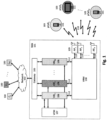
- the system is a multiuser multiple antenna system (MU-MAS)as depicted in Figure 1 .
- MU-MAS multiuser multiple antenna system
- the color-coded units in Figure 1 show one-to-one mapping between the data sources 100, the VRIs 106 and the volumes of coherence 103 asdescribed hereafter.
- the data sources100 are data files or streams carrying web content or files in a local or remote server, such as text, images, sounds, videos or combinations of those.
- a local or remote server such as text, images, sounds, videos or combinations of those.
- One or multiple data files or streams are sent or received betweenthe network 102 and every volume of coherence 103in the wireless link 110.
- the network is the Internet or any wireline or wireless local area network.
- the volumeof coherence is a volume in space where thewaveforms in the same frequency band from differentantennas of the MU-MAS add up coherently in a way that only the data output 112 of one VRlis received within that volumeof coherence, without any interference from other data outputs from other VRlssent simultaneously over the same wireless link.ln the present application, we use the term "volumeof coherence” to describe "personal cells” (e.g., " pCells TM " 103), previously disclosed using the phrase "areas of coherence” in previous patent applications, such as U.S. Application Serial No.
- the volumes of coherence correspond to the locations of the user equipment (UE) 111 or subscribers of the wireless network, such that every subscriber is associated to one or multiple data sources 100.
- Thevolumes of coherence may vary in size and shape depending on propagation conditions as well asthe type of MU-MAS precoding techniques employed to generate them.
- the MU-MAS precoder dynamically adjustssize, shape and location of the volumes of coherence, thereby adapting to the changing propagation conditions to deliver content to the users with consistentquality of service.
- the data sources 100 are first sent through the Network 102 to the Radio Access Network (RAN ) 101. Then, the RAN translates the data files or streams into a data format that can be received by the UEs 103 and sendsthedata files or streams simultaneously to the plurality of volumes of coherence, such that every UE receives its own data files or streams without interference from other data files or streams sent to other UEs.ln one embodiment, the RAN 1101 consists of a gateway 105 as the interface between the network and the VRIs 106. The VRIs translates packets being routed by the gateway into data streams 112, either as raw data, or in a packet or frame structure that are fed to a MU-MAS baseband unit.
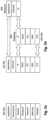
- the VRI comprises the open systems interconnection (OSI) protocol stack consisting of sever layers: application, presentation, session, transport, network, data link and physical, as depicted in Figure 2a .
- OSI open systems interconnection
- the VRI only comprises a subset of the OSI layers.
- the VRls 106 are defined from different wireless standards.
- a first VRI consists of the protocol stack from the GSM standard, a second VRI from the 3G standard, a third VRI from HSPA+ standard, a fourth VRI from the LTE standard, a fifth VRI from the LTE-A standard and a sixth VRI from the Wi-Fi standard.
- the user-plane protocol stack is shown in Figure 2b .
- Every UE 202 communicates with its own VRI 204 through the PHY, MAC, RLC and PDCP layers, with the gateway 203 through the IP layer and with the network 205 through the application layer, and despite the fact that, using prior art techniques, different wireless standards are spectrum-incompatible and could not concurrently share the same spectrum, by implementing different wireless standards in different VRIs in this embodiment, all of the wireless standards concurrently share the same spectrum and further, each link to a user device can utilize the full bandwidth of the spectrum concurrently with the other user devices, regardless of which wireless standards are used for each user device.
- Different wireless standard have different characteristics. For example, Wi-Fi is very low latency, GSM requires only one user device antenna, whereas LTE requires a minimum of two user device antennas.
- LTE-Advanced supports high-order 256-QAM modulation.
- Bluetooth Low Energy is inexpensive and very low power.
- New, yet unspecified standards may have other characteristics, including low latency, low power, low cost, high-order modulation.
- MME mobility management entity
- the Virtual Connection Manager (VCM) 107 is responsible for assigning the PHY layer identity of the UEs (e.g., cell-specific radio network temporary identifier, C-RNTI) as well as instantiating,authenticating and managing mobility of the VRIsand mappingone or more C-RNTlsto VRls for the UEs.
- the data streams 112at the output of the VRIs are fed to the Virtual Radio Manager (VRM) 108.
- the VRM comprises a scheduler unit (that schedules DL (downlink) and UL (uplink) packets for different UEs), a baseband unit (e.g., comprising of FEC encoder/decoder, modulator/demodulator, resource grid builder) and a MU-MAS baseband processor (comprising ofmatrix transformation, including DL precoding or UL post-coding methods).
- the data streams 112 are I/Q samples at the output of the PHY layer in Figure 2b that are processed by the MU-MAS baseband processor.
- the data streams 112 of I/Q samples may be a purely digital waveform (e.g. LTE, GSM), a purelyanalog waveform (e.g.
- the data streams 112 are MAC, RLC or PDCP packets sent to a scheduler unit that forwards them to a baseband unit.
- the baseband unit converts packets into I/Q fed to the MU-MAS baseband processor.
- the data streams 112 result in a plurality of digital waveforms that are processed by the MU-MAS baseband processor.
- the MU-MAS baseband processor is the core of the VRM 108 in Figure 1 that converts the M I/Q samples from the M VRIs into N data streams 113 sent to N access points (APs) 109.
- the data streams 113 are I/Q samples of the N waveforms transmitted over the wireless link 110 from the APs 109.
- the AP consists of ADC/DAC, RF chain and antenna.
- the data streams 113 are bits of information and MU-MAS precoding information that are combined at the APs to generate the N waveforms sent over the wireless link 110.
- every AP is equipped with a CPU, DSP or SoC to carry out additional baseband processing before the ADC/DAC units.
- the data streams 113 are bits of information and MU-MAS precoding information that are combined at the APs to generate the N waveforms sent over the wireless link 110 that have a lower data rate than data streams 113 that are I/Q samples of the N waveforms.
- lossless compression is used to reduce the data rate of data streams 113.
- lossy compression is used to reduce the data rate of data streams.
- the systems and methods described thus far work as long the UEs are within reach of the APs.
- the link may drop and the RAN 301 is unable to create volumes of coherence.
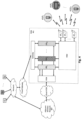
- the systems can gradually evolve by adding new APs. There may not be enough processing power in the VRM, however, to support the new APs or there may be practical installation issues to connect the new APs to the same VRM. In these scenarios, it is necessary to add adjacent RANs 302 and 303 to support the new APs as depicted in Figure 3 .
- a given UE is located in the coverage area served by both the first RAN 301 and the adjacent RAN 302.
- the adjacent RAN 302 only carries out MU-MAS baseband processing for that UE, jointly with the MU-MAS processing from the first RAN 301.No VRI is handled by the adjacent RAN 302 for the given UE, since the VRI for that UE is already running within the first RAN 301.
- baseband information is exchanged between the VRM in the first RAN 301 and the VRM in the adjacent RAN 302 through the cloud-VRM 304 and the links 305.
- the links 305 are any wireline (e.g., fiber, DSL, cable) or wireless link (e.g., line-of-sight links) that can support adequate connection quality (e.g. low enough latency and adequate data rate) to avoid degrading performance of the MU-MAS precoding.
- wireline e.g., fiber, DSL, cable
- wireless link e.g., line-of-sight links
- a given UE moves out of the coverage area of the first RAN 301 into the coverage area of the adjacent RAN 303.
- the VRI associated to that UE is "teleported" from the first RAN 301 to the adjacent RAN 303.
- the VRI state information is transferred from RAN 301 to RAN 303, and the VRI ceases to execute within RAN 301 and begins to execute within RAN 303.
- the VRI teleportation occurs fast enough that, from the perspective of the UE served by the teleported VRI, it does not experience any discontinuity in its data stream from the VRI.
- VRI teleportation is enabled by the cloud-VCM 306 that connects the VCM in the first RAN 301 to the VCM in the adjacent RAN 303.
- the wireline or wireless links 307 between VCM do not have the same restrictive performanceconstraints as the links 305 between VRMs, since the links 307 only carry data and do not have any effect on performance of the MU-MAS precoding.
- additional links 305 are employed between the first RAN 301 and the adjacent RAN 303 to connect their VRMsthat can support adequate connection quality (e.g. low enough latency and adequate data rate) to avoid degrading performance of the MU-MAS precoding.
- the gateways of the first and adjacent RANs are connected to the cloud-gateway 308 that manages all network address (or IP address) translationacross RANs.
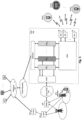
- VRI teleportation occurs between the RAN 401 disclosed in the present application and any adjacent wireless network 402 as depicted in Figure 4 .
- the wireless network 402 is any conventional cellular (e.g., GSM, 3G, HSPA+, LTE, LTE-Advanced, CDMA, WiMAX, AMPS) or wireless local area network (WLAN, e.g., Wi-Fi).
- the wireless protocol can also be broadcast digital or analog protocols, such as ATSC, DVB-T, NTSC, PAL, SECAM, AM or FM radio, with or without stereo or RDS, or broadcast carrier waveforms for any purpose, such as for timing referenceor beacons.
- the wireless protocol can create waveforms for wireless power transmission, for example, to be received by a rectifying antenna, such as those describedin U.S. patents 7,451,839 , 8,469,122 , and 8,307,922 .
- a rectifying antenna such as those describedin U.S. patents 7,451,839 , 8,469,122 , and 8,307,922 .
- the adjacent wireless network 402 is the LTE network shown in Figure 5 .
- the Cloud-VCM 502 is connected to the LTE mobility management entity (MME)508. All the information about identity, authentication and mobility of every UE handing-off between the LTE and the RAN 501 networks is exchanged between the MME508 and the cloud-VCM 502.
- the MME is connected to one or multiple eNodeBs 503 connecting to the UE 504 through the wireless cellular network.
- the eNodeBs are connected to the network 507 through the serving gateway (S-GW) 505 and the packet data network gateway (P-GW) 506.
- Typical downlink (DL) wireless links consist of broadcast physical channels carrying information for the entire cell and dedicated physical channels with information and data for given UE.
- the LTE standard defines broadcast channels such as P-SS and S-SS (used for synchronization at the UE), MIB and PDCCH as well as channels for carrying data to given UE such as the PDSCH.
- all the LTE broadcast channels e.g., P-SS, S-SS, MIC, PDCCH
- part of the broadcast channel is precoded and part is not.
- the PDCCH contains broadcast information as well as information dedicated to one UE, such as the DCI 1A and DCI 0 used to point the UEs to the resource blocks (RBs) to be used over DL and uplink (UL) channels.
- the broadcast part of the PDCCH is not precoded, whereas the portion containing the DCI 1A and 0 is precoded in such a way that every UE obtains its own dedicated information about the RBs that carry data.
- precoding is applied to all or only part of the data channels, such as the PDSCH in LTE systems.
- the MU-MAS disclosed in the present invention allocates the entire bandwidth to every UE and the plurality of data streams of the plurality of UEs are separated via spatial processing. In typical scenarios, however, most, if not all, of the UEs do not need the entire bandwidth (e.g., ⁇ 55 Mbps per UE, peak DL data rate for TDD configuration #2 and S-subframe configuration #7, in 20MHz of spectrum).
- the MU-MAS in the present invention subdivides the DL RBs in multiple blocks as in frequency division multiple access (FDMA) ororthogonal frequency division multiple access (OFDMA) systems and assigns each FDMA or OFMDA block to a subset of UEs. All the UEs within the same FDMA or OFDMA block are separated into different volumes of coherencethrough the MU-MAS precoding.
- the MU-MAS allocates different DL subframes to different subsets of UEs, thereby dividing up the DL as in TDMA systems.
- the LTE standard defines conventional multiple access techniques such as TDMA or SC-FDMA.
- the MU-MAS precoding is enabled over the DL in a way to assign UL grants to different UEs to enable TDMA and SC-FDMA multiple access techniques.As such, the aggregate UL throughput can be divided among far more UEs than there are APs.
- the MU-MAS system supports one VRI for each UE, and the VRM controls the VRIs such that VRIs utilize RBs and resource grants in keeping with the chosen OFDMA, TDMA or SC-FDMA system(s) used to subdivide the aggregate throughput.
- one or more individual VRIs may support multiple UEs and manage the scheduling of throughput among these UEs via OFDMA, TDMA or SC-FDMA techniques.
- the scheduling of throughput is based on load balancing of user demand, using any of many prior art techniques, depending upon the policies and performance goals of the system.
- scheduling is based upon Quality of Service (QoS) requirements for particular UEs (e.g. UEs used by subscribersthat pay for a particular tier of service, guaranteeing certain throughput levels) or for particular types of data (e.g. video for a television service).
- QoS Quality of Service
- uplink (UL) receive antenna selection is applied to improve link quality.
- the UL channel quality is estimated at the VRM based on signaling information sent by the UEs (e.g., SRS, DMRS) and the VRM decides the best receive antennas for different UEs over the UL. Then the VRM assigns one receive antenna to every UE to improve its link quality.
- receive antenna selection is employed to reduce cross-interference between frequency bands due to the SC-FDMA scheme.
- One significant advantage of this method is that the UE would transmit over the UL only to the AP closest to its location. In this scenario, the UE can significantly reduce its transmit power to reach the closest AP, thereby improving battery life.
- different power scaling factors are utilized for the UL data channel and for the UL signaling channel.
- the power of the UL signaling channel e.g., SRS
- the power levels of the UL signaling and UL data channels are adjusted by the VRM through DL signaling based on transmit power control methods that equalize the relative power to/from different UEs.
- maximum ratio combining is applied at the UL receiver to improve signal quality from every UE to the plurality of APs.
- zero-forcing (ZF) or minimum mean squared error (MMSE) or successive interference cancellation (SIC) or other non-linear techniques or the same precoding technique as for the DL precoding are applied to the UL to differentiate data streams being received simultaneously and within the same frequency band from different UEs' volumes of coherence.
- receive spatial processing is applied to the UL data channel (e.g., PUSCH) or UL control channel (e.g., PUCCH) or both.
- the volume of coherence, or pCell, as described in above paragraph [0076] of a first UE is the volume in space wherein the signal intended for the first UE has high enough signal-to-interference-plus-noise ratio (SINR)that the data stream for the first UE can be demodulated successfully, while meeting predefined error rate performance.Thus, everywhere within the volume of coherence, the level of interference generated by data streams sent from the plurality of APs to the other UEs is sufficiently low that the first UE can demodulate its own data stream successfully.
- SINR signal-to-interference-plus-noise ratio
- the volume of coherence or pCell is characterized by one specific electromagnetic polarization, such as linear, circular or elliptical polarization.
- the pCell of a first UE is characterized by linear polarization along a first direction and the pCell of a second UE overlaps the pCell of the first UE and is characterized by linear polarization along a second direction orthogonal to the first direction of the first UE, such that the signals received at the two UEs do not interfere with oneanother.
- a first UE pCell has linear polarization along the x-axis
- a second UE pCell has linear polarization along the y-axis
- a third UE pCell has linear polarization along the z-axis (wherein x-, y- and z-axes are orthogonal) such that the three pCells overlap (i.e., are centered at the same point in space) but the signals of the three UEs do not interfere because their polarizations are orthogonal.
- every pCell is uniquely identified by one location in three dimensional space characterized by (x,y,z) coordinates and by one polarization direction defined as linear combination of the three fundamental polarizations along the x-, y- and z-axes.
- the present MU-MAS system is characterized by six degrees of freedom (i.e., three degrees of freedom from the location in space and three from the direction of polarization), which can be exploited to create a plurality of non-interfering pCells to different UEs.
- the VRIs,as described in above paragraph [0077] are independent execution instances that run on one or multiple processors.
- every execution instance runseither on one processor, or on multiple processors in the same computer system, or on multiple processors in different computer systems connected through a network.
- different execution instances run either on the same processor, or different processors in the same computer system, or multiple processors in different computer systems.
- the processor is a central processing unit (CPU), or a core processor in a multi-core CPU, or an execution context in a hyper-threaded core processor, or a graphics processing unit (GPU), or a digital signal processor (DSP), or a field-programmable gate array (FPGA), or an application-specific integrated circuit.
- CPU central processing unit
- DSP digital signal processor
- FPGA field-programmable gate array
- Embodiments of the invention may include various steps, which have been described above.
- the steps may be embodied in machine-executable instructions which may be used to cause a general-purpose or special-purpose processor to perform the steps.
- these steps may be performed by specific hardware components that contain hardwired logic for performing the steps, or by any combination of programmed computer components and custom hardware components.
- instructions may refer to specific configurations of hardware such as application specific integrated circuits (ASICs) configured to perform certain operations or having a predetermined functionality or software instructions stored in memory embodied in a non-transitory computer readable medium.
- ASICs application specific integrated circuits
- the techniques shown in the figures can be implemented using code and data stored and executed on one or more electronic devices.
- Such electronic devices store and communicate (internally and/or with other electronic devices over a network) code and data using computer machine-readable media, such as non-transitory computer machine-readable storage media (e.g., magnetic disks; optical disks; random access memory; read only memory; flash memory devices; phase-change memory) and transitory computer machine-readable communication media (e.g., electrical, optical, acoustical or other form of propagated signals - such as carrier waves, infrared signals, digital signals, etc.).
- non-transitory computer machine-readable storage media e.g., magnetic disks; optical disks; random access memory; read only memory; flash memory devices; phase-change memory
- transitory computer machine-readable communication media e.g., electrical, optical, acoustical or other form of propagated signals - such as carrier waves, infrared signals, digital signals, etc.
Landscapes
- Engineering & Computer Science (AREA)
- Computer Networks & Wireless Communication (AREA)
- Signal Processing (AREA)
- Physics & Mathematics (AREA)
- Mathematical Physics (AREA)
- Power Engineering (AREA)
- Mobile Radio Communication Systems (AREA)
- Transceivers (AREA)
Applications Claiming Priority (4)
| Application Number | Priority Date | Filing Date | Title |
|---|---|---|---|
| US201461937273P | 2014-02-07 | 2014-02-07 | |
| US14/611,565 US20150229372A1 (en) | 2014-02-07 | 2015-02-02 | Systems and methods for mapping virtual radio instances into physical volumes of coherence in distributed antenna wireless systems |
| PCT/US2015/014511 WO2015120089A1 (en) | 2014-02-07 | 2015-02-04 | Systems and methods for mapping virtual radio instances into physical volumes of coherence in distributed antenna systems |
| EP15746217.7A EP3103235A4 (en) | 2014-02-07 | 2015-02-04 | Systems and methods for mapping virtual radio instances into physical volumes of coherence in distributed antenna systems |
Related Parent Applications (1)
| Application Number | Title | Priority Date | Filing Date |
|---|---|---|---|
| EP15746217.7A Division EP3103235A4 (en) | 2014-02-07 | 2015-02-04 | Systems and methods for mapping virtual radio instances into physical volumes of coherence in distributed antenna systems |
Publications (1)
| Publication Number | Publication Date |
|---|---|
| EP4340305A2 true EP4340305A2 (en) | 2024-03-20 |
Family
ID=53775887
Family Applications (2)
| Application Number | Title | Priority Date | Filing Date |
|---|---|---|---|
| EP24155405.4A Withdrawn EP4340305A2 (en) | 2014-02-07 | 2015-02-04 | Systems and methods for mapping virtual radio instances into physical volumes of coherence in distributed antenna systems |
| EP15746217.7A Ceased EP3103235A4 (en) | 2014-02-07 | 2015-02-04 | Systems and methods for mapping virtual radio instances into physical volumes of coherence in distributed antenna systems |
Family Applications After (1)
| Application Number | Title | Priority Date | Filing Date |
|---|---|---|---|
| EP15746217.7A Ceased EP3103235A4 (en) | 2014-02-07 | 2015-02-04 | Systems and methods for mapping virtual radio instances into physical volumes of coherence in distributed antenna systems |
Country Status (14)
| Country | Link |
|---|---|
| US (1) | US20150229372A1 (enExample) |
| EP (2) | EP4340305A2 (enExample) |
| JP (2) | JP2017511031A (enExample) |
| KR (3) | KR20220058667A (enExample) |
| CN (2) | CN105981340B (enExample) |
| AU (4) | AU2015214278B2 (enExample) |
| CA (1) | CA2938253A1 (enExample) |
| IL (5) | IL305542B2 (enExample) |
| MX (3) | MX2016010048A (enExample) |
| NZ (1) | NZ722527A (enExample) |
| RU (1) | RU2737312C2 (enExample) |
| SG (2) | SG10201806638RA (enExample) |
| TW (3) | TWI779412B (enExample) |
| WO (1) | WO2015120089A1 (enExample) |
Families Citing this family (16)
| Publication number | Priority date | Publication date | Assignee | Title |
|---|---|---|---|---|
| US10194346B2 (en) | 2012-11-26 | 2019-01-29 | Rearden, Llc | Systems and methods for exploiting inter-cell multiplexing gain in wireless cellular systems via distributed input distributed output technology |
| US11190947B2 (en) | 2014-04-16 | 2021-11-30 | Rearden, Llc | Systems and methods for concurrent spectrum usage within actively used spectrum |
| US11189917B2 (en) | 2014-04-16 | 2021-11-30 | Rearden, Llc | Systems and methods for distributing radioheads |
| US10164698B2 (en) | 2013-03-12 | 2018-12-25 | Rearden, Llc | Systems and methods for exploiting inter-cell multiplexing gain in wireless cellular systems via distributed input distributed output technology |
| US10547358B2 (en) | 2013-03-15 | 2020-01-28 | Rearden, Llc | Systems and methods for radio frequency calibration exploiting channel reciprocity in distributed input distributed output wireless communications |
| US11290162B2 (en) | 2014-04-16 | 2022-03-29 | Rearden, Llc | Systems and methods for mitigating interference within actively used spectrum |
| EP3832973B1 (en) | 2015-03-11 | 2024-07-17 | CommScope Technologies LLC | Distributed radio access network with adaptive fronthaul |
| US10608734B2 (en) | 2015-10-22 | 2020-03-31 | Phluido, Inc. | Virtualization and orchestration of a radio access network |
| WO2018017468A1 (en) | 2016-07-18 | 2018-01-25 | Phluido, Inc. | Synchronization of radio units in radio access networks |
| JP7204644B2 (ja) * | 2016-10-27 | 2023-01-16 | リアデン リミテッド ライアビリティ カンパニー | 無線ヘッドを分散するためのシステム及び方法 |
| US12016084B2 (en) | 2018-01-04 | 2024-06-18 | Commscope Technologies Llc | Management of a split physical layer in a radio area network |
| WO2019147825A2 (en) * | 2018-01-26 | 2019-08-01 | Commscope Technologies Llc | Cloud network implementation for a distributed antenna system control plane |
| CN108900233B (zh) * | 2018-04-17 | 2021-03-09 | 东南大学 | 基于数字编码超材料的直接辐射无线数字通信系统及方法 |
| EP3579443B1 (en) | 2018-06-07 | 2025-08-20 | Volkswagen Aktiengesellschaft | Vehicle, apparatus, method and computer program for communicating in multiple mobile communication systems |
| EP3841782B1 (en) | 2018-10-25 | 2024-09-18 | CommScope Technologies LLC | Multi-carrier radio point for a centralized radio access network |
| JP7771106B2 (ja) | 2020-06-30 | 2025-11-17 | コムスコープ テクノロジーズ リミティド ライアビリティ カンパニー | 複数の機能分割、複数のワイヤレスインターフェースプロトコル、複数世代の無線アクセス技術、及び複数の無線周波数帯をサポートする統一された遠隔ユニットを有するオープン無線アクセスネットワーク |
Citations (14)
| Publication number | Priority date | Publication date | Assignee | Title |
|---|---|---|---|---|
| US7418053B2 (en) | 2004-07-30 | 2008-08-26 | Rearden, Llc | System and method for distributed input-distributed output wireless communications |
| US7451839B2 (en) | 2005-05-24 | 2008-11-18 | Rearden, Llc | System and method for powering a vehicle using radio frequency generators |
| US7599420B2 (en) | 2004-07-30 | 2009-10-06 | Rearden, Llc | System and method for distributed input distributed output wireless communications |
| US7633994B2 (en) | 2004-07-30 | 2009-12-15 | Rearden, LLC. | System and method for distributed input-distributed output wireless communications |
| US7636381B2 (en) | 2004-07-30 | 2009-12-22 | Rearden, Llc | System and method for distributed input-distributed output wireless communications |
| US7711030B2 (en) | 2004-07-30 | 2010-05-04 | Rearden, Llc | System and method for spatial-multiplexed tropospheric scatter communications |
| US7885354B2 (en) | 2004-04-02 | 2011-02-08 | Rearden, Llc | System and method for enhancing near vertical incidence skywave (“NVIS”) communication using space-time coding |
| US8160121B2 (en) | 2007-08-20 | 2012-04-17 | Rearden, Llc | System and method for distributed input-distributed output wireless communications |
| US8170081B2 (en) | 2004-04-02 | 2012-05-01 | Rearden, LLC. | System and method for adjusting DIDO interference cancellation based on signal strength measurements |
| US8307922B2 (en) | 2005-05-24 | 2012-11-13 | Rearden, Llc | System and method for powering an aircraft using radio frequency signals and feedback |
| US8469122B2 (en) | 2005-05-24 | 2013-06-25 | Rearden, Llc | System and method for powering vehicle using radio frequency signals and feedback |
| US8542763B2 (en) | 2004-04-02 | 2013-09-24 | Rearden, Llc | Systems and methods to coordinate transmissions in distributed wireless systems via user clustering |
| US8571086B2 (en) | 2004-04-02 | 2013-10-29 | Rearden, Llc | System and method for DIDO precoding interpolation in multicarrier systems |
| US8654815B1 (en) | 2004-04-02 | 2014-02-18 | Rearden, Llc | System and method for distributed antenna wireless communications |
Family Cites Families (29)
| Publication number | Priority date | Publication date | Assignee | Title |
|---|---|---|---|---|
| US6041365A (en) * | 1985-10-29 | 2000-03-21 | Kleinerman; Aurel | Apparatus and method for high performance remote application gateway servers |
| JP2005159448A (ja) * | 2003-11-20 | 2005-06-16 | National Institute Of Information & Communication Technology | 広帯域無線通信システム |
| US10425134B2 (en) * | 2004-04-02 | 2019-09-24 | Rearden, Llc | System and methods for planned evolution and obsolescence of multiuser spectrum |
| US7512110B2 (en) * | 2004-09-21 | 2009-03-31 | Motorola, Inc. | Method and apparatus to facilitate inter-AN HRPD hard handoff |
| US7596111B2 (en) * | 2005-01-27 | 2009-09-29 | Atc Technologies, Llc | Satellite/terrestrial wireless communications systems and methods using disparate channel separation codes |
| US8139672B2 (en) * | 2005-09-23 | 2012-03-20 | Qualcomm Incorporated | Method and apparatus for pilot communication in a multi-antenna wireless communication system |
| KR101598324B1 (ko) * | 2007-08-20 | 2016-02-26 | 리어덴 엘엘씨 | 분산형 입력 분산형 출력 무선 통신을 위한 시스템 및 방법 |
| US20090067198A1 (en) * | 2007-08-29 | 2009-03-12 | David Jeffrey Graham | Contactless power supply |
| US8055211B2 (en) * | 2007-12-31 | 2011-11-08 | Motorola Mobility, Inc. | Method and system for utilizing transmit local oscillator for improved cell search and multi-link communication in multi-mode device |
| KR101204302B1 (ko) * | 2008-01-02 | 2012-11-26 | 인터디지탈 테크날러지 코포레이션 | 협력적 무선 통신을 위한 방법 및 장치 |
| US9820240B2 (en) * | 2008-02-01 | 2017-11-14 | Qualcomm Incorporated | Virtual scheduling in heterogeneous networks |
| US8625542B2 (en) * | 2008-12-18 | 2014-01-07 | Cisco Technology, Inc. | Beamforming spatial de-multiplexing for collaborative spatially multiplexed wireless communication |
| JP2010161478A (ja) * | 2009-01-06 | 2010-07-22 | Sharp Corp | 移動通信システム、移動局及び管理局 |
| US20100234071A1 (en) * | 2009-03-12 | 2010-09-16 | Comsys Communication & Signal Processing Ltd. | Vehicle integrated communications system |
| US8185088B2 (en) * | 2009-10-09 | 2012-05-22 | At&T Mobility Ii Llc | Mobile device leasing with customized operational features |
| USRE49471E1 (en) * | 2009-11-24 | 2023-03-21 | Electronics And Telecommunications Research Institute | Method for protecting data in a mu-mimo based wireless communication system |
| EP2583382A1 (en) * | 2010-06-18 | 2013-04-24 | Nec Corporation | Precoding techniques for downlink coordinated multipoint transmission in radio communications system |
| WO2012033877A1 (en) * | 2010-09-08 | 2012-03-15 | Mediatek Singapore Pte. Ltd. | Psmp-based downlink multi-user mimo communications |
| US8599794B2 (en) * | 2010-09-08 | 2013-12-03 | Intel Corporation | Enhanced base station and method for communicating through an enhanced distributed antenna system (eDAS) |
| US8687555B2 (en) * | 2010-09-29 | 2014-04-01 | Lg Electronics Inc. | Method and apparatus for performing effective feedback in wireless communication system supporting multiple antennas |
| PL3319395T3 (pl) * | 2010-12-03 | 2023-09-04 | Interdigital Patent Holdings, Inc. | Sposób i urządzenie do wykonywania agregacji nośnych w technologii dostępu wieloradiowego |
| CN103621035B (zh) * | 2011-06-09 | 2017-06-23 | 康普技术有限责任公司 | 用于处理标准化格式的数字信号的分布式天线系统接口 |
| MX2014002900A (es) * | 2011-09-14 | 2014-04-30 | Rearden Llc | Sistemas y metodos para explotar areas de coherencia en sistemas inalambricos. |
| EP2781116B1 (en) * | 2011-11-14 | 2019-10-23 | Alcatel Lucent | Baseband signal processing cluster |
| US9191994B2 (en) * | 2012-02-03 | 2015-11-17 | Telefonaktiebolaget L M Ericsson (Publ) | Apparatus, systems, methods, and computer products suitable for use in an advanced digital baseband processor |
| CN116346172A (zh) * | 2012-05-18 | 2023-06-27 | 李尔登公司 | 增强在无线系统中的空间分集的系统及方法 |
| US8995410B2 (en) * | 2012-05-25 | 2015-03-31 | University Of Southern California | Airsync: enabling distributed multiuser MIMO with full multiplexing gain |
| EP2680512B1 (en) * | 2012-06-25 | 2019-07-24 | Alcatel Lucent | Network entity of a communication network |
| CN103517360B (zh) * | 2012-06-25 | 2017-04-19 | 华为终端有限公司 | 切换方法、系统及设备 |
-
2015
- 2015-02-02 US US14/611,565 patent/US20150229372A1/en active Pending
- 2015-02-04 CN CN201580007666.2A patent/CN105981340B/zh active Active
- 2015-02-04 NZ NZ722527A patent/NZ722527A/en unknown
- 2015-02-04 KR KR1020227014310A patent/KR20220058667A/ko not_active Withdrawn
- 2015-02-04 MX MX2016010048A patent/MX2016010048A/es active IP Right Grant
- 2015-02-04 CA CA2938253A patent/CA2938253A1/en active Pending
- 2015-02-04 WO PCT/US2015/014511 patent/WO2015120089A1/en not_active Ceased
- 2015-02-04 KR KR1020167024659A patent/KR20160118343A/ko not_active Ceased
- 2015-02-04 CN CN202010947388.1A patent/CN112235017A/zh active Pending
- 2015-02-04 MX MX2019010059A patent/MX388272B/es unknown
- 2015-02-04 EP EP24155405.4A patent/EP4340305A2/en not_active Withdrawn
- 2015-02-04 RU RU2016133332A patent/RU2737312C2/ru active
- 2015-02-04 AU AU2015214278A patent/AU2015214278B2/en not_active Ceased
- 2015-02-04 IL IL305542A patent/IL305542B2/en unknown
- 2015-02-04 SG SG10201806638RA patent/SG10201806638RA/en unknown
- 2015-02-04 EP EP15746217.7A patent/EP3103235A4/en not_active Ceased
- 2015-02-04 SG SG11201606232SA patent/SG11201606232SA/en unknown
- 2015-02-04 IL IL291825A patent/IL291825B2/en unknown
- 2015-02-04 KR KR1020227010483A patent/KR20220045068A/ko not_active Ceased
- 2015-02-04 JP JP2016550718A patent/JP2017511031A/ja active Pending
- 2015-02-06 TW TW109142083A patent/TWI779412B/zh active
- 2015-02-06 TW TW104104142A patent/TWI714523B/zh active
- 2015-02-06 TW TW111133396A patent/TWI838848B/zh active
-
2016
- 2016-07-26 IL IL24696616A patent/IL246966B/en active IP Right Grant
- 2016-08-03 MX MX2021011259A patent/MX2021011259A/es unknown
-
2019
- 2019-02-07 AU AU2019200838A patent/AU2019200838B2/en not_active Ceased
- 2019-10-23 IL IL270106A patent/IL270106B/en active IP Right Grant
-
2021
- 2021-02-24 AU AU2021201184A patent/AU2021201184B2/en not_active Ceased
- 2021-02-25 IL IL281122A patent/IL281122B/en unknown
- 2021-07-02 JP JP2021110635A patent/JP2021168493A/ja not_active Ceased
-
2023
- 2023-02-16 AU AU2023200897A patent/AU2023200897A1/en not_active Abandoned
Patent Citations (15)
| Publication number | Priority date | Publication date | Assignee | Title |
|---|---|---|---|---|
| US7885354B2 (en) | 2004-04-02 | 2011-02-08 | Rearden, Llc | System and method for enhancing near vertical incidence skywave (“NVIS”) communication using space-time coding |
| US8654815B1 (en) | 2004-04-02 | 2014-02-18 | Rearden, Llc | System and method for distributed antenna wireless communications |
| US8571086B2 (en) | 2004-04-02 | 2013-10-29 | Rearden, Llc | System and method for DIDO precoding interpolation in multicarrier systems |
| US8542763B2 (en) | 2004-04-02 | 2013-09-24 | Rearden, Llc | Systems and methods to coordinate transmissions in distributed wireless systems via user clustering |
| US8170081B2 (en) | 2004-04-02 | 2012-05-01 | Rearden, LLC. | System and method for adjusting DIDO interference cancellation based on signal strength measurements |
| US7633994B2 (en) | 2004-07-30 | 2009-12-15 | Rearden, LLC. | System and method for distributed input-distributed output wireless communications |
| US7711030B2 (en) | 2004-07-30 | 2010-05-04 | Rearden, Llc | System and method for spatial-multiplexed tropospheric scatter communications |
| US7636381B2 (en) | 2004-07-30 | 2009-12-22 | Rearden, Llc | System and method for distributed input-distributed output wireless communications |
| US8428162B2 (en) | 2004-07-30 | 2013-04-23 | Rearden, Llc | System and method for distributed input distributed output wireless communications |
| US7418053B2 (en) | 2004-07-30 | 2008-08-26 | Rearden, Llc | System and method for distributed input-distributed output wireless communications |
| US7599420B2 (en) | 2004-07-30 | 2009-10-06 | Rearden, Llc | System and method for distributed input distributed output wireless communications |
| US8307922B2 (en) | 2005-05-24 | 2012-11-13 | Rearden, Llc | System and method for powering an aircraft using radio frequency signals and feedback |
| US8469122B2 (en) | 2005-05-24 | 2013-06-25 | Rearden, Llc | System and method for powering vehicle using radio frequency signals and feedback |
| US7451839B2 (en) | 2005-05-24 | 2008-11-18 | Rearden, Llc | System and method for powering a vehicle using radio frequency generators |
| US8160121B2 (en) | 2007-08-20 | 2012-04-17 | Rearden, Llc | System and method for distributed input-distributed output wireless communications |
Also Published As
Similar Documents
| Publication | Publication Date | Title |
|---|---|---|
| AU2021201184B2 (en) | Systems and methods for mapping virtual radio instances into physical volumes of coherence in distributed antenna wireless systems | |
| KR102787073B1 (ko) | 능동적으로 사용되는 스펙트럼 내에서의 동시 스펙트럼 사용을 위한 시스템 및 방법 | |
| WO2015034503A1 (en) | Adaptive sectorization of a spational region for parallel multi-user transmissions | |
| KR102667404B1 (ko) | 능동적으로 사용되는 스펙트럼 내에서의 간섭을 완화시키기 위한 시스템 및 방법 | |
| US12341582B2 (en) | Systems and methods for mitigating interference within actively used spectrum | |
| RU2818250C2 (ru) | Системы и способы картирования виртуальных радиоточек в физические объемы когерентности в распределенных антенных системах | |
| NZ761315B2 (en) | Systems and methods for mapping virtual radio instances into physical volumes of coherence in distributed antenna wireless systems | |
| HK40041091A (en) | Systems and methods for mapping virtual radio instances into physical volumes of coherence in distributed antenna systems | |
| HK1229092A1 (en) | Systems and methods for mapping virtual radio instances into physical volumes of coherence in distributed antenna systems | |
| HK1229092B (en) | Systems and methods for mapping virtual radio instances into physical volumes of coherence in distributed antenna systems |
Legal Events
| Date | Code | Title | Description |
|---|---|---|---|
| PUAI | Public reference made under article 153(3) epc to a published international application that has entered the european phase |
Free format text: ORIGINAL CODE: 0009012 |
|
| STAA | Information on the status of an ep patent application or granted ep patent |
Free format text: STATUS: THE APPLICATION HAS BEEN PUBLISHED |
|
| AC | Divisional application: reference to earlier application |
Ref document number: 3103235 Country of ref document: EP Kind code of ref document: P |
|
| AK | Designated contracting states |
Kind code of ref document: A2 Designated state(s): AL AT BE BG CH CY CZ DE DK EE ES FI FR GB GR HR HU IE IS IT LI LT LU LV MC MK MT NL NO PL PT RO RS SE SI SK SM TR |
|
| STAA | Information on the status of an ep patent application or granted ep patent |
Free format text: STATUS: THE APPLICATION HAS BEEN WITHDRAWN |
|
| 18W | Application withdrawn |
Effective date: 20240916 |