EP4339986B1 - Device and method for monitoring overvoltage protection capacitors in generator circuit breakers - Google Patents
Device and method for monitoring overvoltage protection capacitors in generator circuit breakers Download PDFInfo
- Publication number
- EP4339986B1 EP4339986B1 EP22382845.0A EP22382845A EP4339986B1 EP 4339986 B1 EP4339986 B1 EP 4339986B1 EP 22382845 A EP22382845 A EP 22382845A EP 4339986 B1 EP4339986 B1 EP 4339986B1
- Authority
- EP
- European Patent Office
- Prior art keywords
- generator circuit
- circuit breaker
- capacitors
- capacitor
- phase
- Prior art date
- Legal status (The legal status is an assumption and is not a legal conclusion. Google has not performed a legal analysis and makes no representation as to the accuracy of the status listed.)
- Active
Links
Images

Classifications
-
- H—ELECTRICITY
- H01—ELECTRIC ELEMENTS
- H01H—ELECTRIC SWITCHES; RELAYS; SELECTORS; EMERGENCY PROTECTIVE DEVICES
- H01H47/00—Circuit arrangements not adapted to a particular application of the relay and designed to obtain desired operating characteristics or to provide energising current
- H01H47/002—Monitoring or fail-safe circuits
-
- H—ELECTRICITY
- H02—GENERATION; CONVERSION OR DISTRIBUTION OF ELECTRIC POWER
- H02H—EMERGENCY PROTECTIVE CIRCUIT ARRANGEMENTS
- H02H7/00—Emergency protective circuit arrangements specially adapted for specific types of electric machines or apparatus or for sectionalised protection of cable or line systems, and effecting automatic switching in the event of an undesired change from normal working conditions
- H02H7/06—Emergency protective circuit arrangements specially adapted for specific types of electric machines or apparatus or for sectionalised protection of cable or line systems, and effecting automatic switching in the event of an undesired change from normal working conditions for dynamo-electric generators; for synchronous capacitors
-
- H—ELECTRICITY
- H02—GENERATION; CONVERSION OR DISTRIBUTION OF ELECTRIC POWER
- H02H—EMERGENCY PROTECTIVE CIRCUIT ARRANGEMENTS
- H02H7/00—Emergency protective circuit arrangements specially adapted for specific types of electric machines or apparatus or for sectionalised protection of cable or line systems, and effecting automatic switching in the event of an undesired change from normal working conditions
- H02H7/16—Emergency protective circuit arrangements specially adapted for specific types of electric machines or apparatus or for sectionalised protection of cable or line systems, and effecting automatic switching in the event of an undesired change from normal working conditions for capacitors
-
- H—ELECTRICITY
- H01—ELECTRIC ELEMENTS
- H01H—ELECTRIC SWITCHES; RELAYS; SELECTORS; EMERGENCY PROTECTIVE DEVICES
- H01H33/00—High-tension or heavy-current switches with arc-extinguishing or arc-preventing means
- H01H33/02—Details
- H01H33/04—Means for extinguishing or preventing arc between current-carrying parts
- H01H33/14—Multiple main contacts for the purpose of dividing the current through, or potential drop along, the arc
- H01H2033/146—Multiple main contacts for the purpose of dividing the current through, or potential drop along, the arc using capacitors, e.g. for the voltage division over the different switches
-
- H—ELECTRICITY
- H02—GENERATION; CONVERSION OR DISTRIBUTION OF ELECTRIC POWER
- H02H—EMERGENCY PROTECTIVE CIRCUIT ARRANGEMENTS
- H02H1/00—Details of emergency protective circuit arrangements
- H02H1/0061—Details of emergency protective circuit arrangements concerning transmission of signals
Definitions
- the present invention relates to a device and method for monitoring overvoltage protection capacitors in generator circuit breakers, which allows to anticipate possible failures in the overvoltage limiting capacitor, as well as to prevent SCRAM in plants due to the short-circuit failure of one of the overvoltage limiting capacitors.
- the document CN 114 563 670 A discloses a device for monitoring overvoltage protection capacitors in generator circuit breakers, according to the preamble of claim 1.
- TRV transient recovery voltage
- the generator circuit breaker (2) is connected between a generation plant (1), such as a nuclear reactor, and a transformer (5).
- the generator circuit breaker (2) comprises one phase circuit breaker (4) for each phase.
- Capacitors (3) are arranged before and after each circuit breaker (4), which capacitors are in turn connected to earth (6).
- the object of the invention is a device and method for monitoring overvoltage protection capacitors in generator circuit breaker (GCB), which presents an alternative framework to the one already known in the state of the art and disclosed above.
- GEB generator circuit breaker
- the capacitors are connected to each other instead of to earth, in a double star configuration, so that they can continue to perform the overvoltage suppression function, but at the same time they can be monitored to detect possible failures.
- the device of the invention is intended to be connected to a generator circuit breaker that is connected between an electrical generation plant and a transformer.
- generator circuit breakers are three-phase, and comprise one phase circuit breaker for each phase.
- the device of the invention comprises two capacitors with the same capacity for each phase, arranged one before and one after each phase circuit breaker, a first terminal of a first capacitor being intended to be connected between the generation plant and the generator circuit breaker, and a first terminal of a second capacitor intended to be connected between the generator circuit breaker and the transformer.
- a second terminal of each capacitor is connected to a monitoring module, in a double star configuration.
- the monitoring module is preferably a current transformer.
- This configuration enables:
- the device of the invention is intended to be connected to a generator circuit breaker (2) that is connected between an electrical generation plant (1) and a transformer (5).
- the generator circuit breakers (2) are three-phase, and comprise one phase circuit breaker (4) for each phase.
- the device of the invention comprises two capacitors (3) with the same capacity for each phase, arranged one before and one after each phase circuit breaker (2), a first terminal of a first capacitor (31) being intended to be connected between the generation plant (1) and the generator circuit breaker (2), and a first terminal of a second capacitor (32) intended to be connected between the generator circuit breaker (2) and the transformer (5).
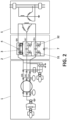
- a second terminal of each capacitor (31, 32) is connected to a monitoring module (7), in a double star configuration, as reflected in figure 2 .
- the monitoring module (7) is preferably a current transformer.
- the device comprises two capacitors (3) in total. In the event that the generator circuit breaker (2) is three-phase, as is common, the device comprises six capacitors (3) in total.
- the generator circuit breakers (2) of the state of the art is connected between a generation plant (1) and a transformer (5).
- the generator circuit breaker (2) comprises one phase circuit breaker (4) for each phase.
- Capacitors (3) are arranged before and after each phase circuit breaker (4), which capacitors are in turn connected to earth (6).
- a first possible failure is the short-circuit failure of a capacitor (3).
- an earth (6) failure occurs in one of the phases. This fault is detected by an earth (6) failure protection arranged in the generation plant (1), causing the generator circuit breaker (2) to trip immediately. This failure, except for the deterioration of the capacitor (3), does not cause further damage, unless there is a different sequence of subsequent events.
- the capacitor (3) that fails is the second capacitor (32) arranged between the generator circuit breaker (4) and the transformer (5)
- the development of the failure is different, as analysed below.
- the start of the failure is exactly the same, causing the plant SCRAM and the opening of the generator circuit breaker (4).
- the failure remains between the generator circuit breaker (4) and the transformer (5).
- earth (6) failure protections are activated and the 400 kV grid is lost until the failed capacitor (32) can be removed.
- a second possible failure is the open capacitor (3) failure.
- the consequence of this failure is the impossibility of being able to open the affected pole. In this case, there is no possibility of detecting it.
- a first failure possibility is that one of the capacitors (3) is short-circuited.
- the earth (6) failure system of the generation plant (1) since the entire assembly is isolated from earth (6). What does happen is that there is a change in the currents through each branch of capacitors (3), but it is not capable of activating any plant protection due to the low value of the current and there is no current circulation to earth (6). In no case does a short circuit between phases occur because there is always another capacitor (3) that limits the passage of current.
- the device of the invention with the capacitors (3) not connected to earth (6) presents great advantages in terms of the reliability of the generator circuit breaker (4) and, above all, of the generation plant. (1). This is due to the fact that up to six (one per condenser (3)) points referred to as single point vulnerabilities are removed.
- the present invention comprises a method for monitoring overvoltage protection capacitors in generator circuit breakers, comprising the steps of:
Landscapes
- Engineering & Computer Science (AREA)
- Power Engineering (AREA)
- Protection Of Generators And Motors (AREA)
Description
- The present invention relates to a device and method for monitoring overvoltage protection capacitors in generator circuit breakers, which allows to anticipate possible failures in the overvoltage limiting capacitor, as well as to prevent SCRAM in plants due to the short-circuit failure of one of the overvoltage limiting capacitors.
- The document
CN 114 563 670 A discloses a device for monitoring overvoltage protection capacitors in generator circuit breakers, according to the preamble ofclaim 1. - Generator circuit breakers (GCB), which are connected between an electrical generation plant and a transformer, are known in the state of the art. These circuit breakers allow the passage of electrical current to be stopped in the event of any unforeseen circumstance.
- Very high currents circulate through these generator circuit breakers and it is known that, when an inductive circuit is suddenly opened, an overvoltage is produced because the voltage is proportional to that derived from the current:

- Where:
- V: voltage
- L: circuit inductance
- I: current
- t: time
- In other words, when trying to suddenly interrupt the current in the generator circuit breaker, the derivative of the current with respect to time increases a lot and, therefore, an overvoltage is produced at the terminals thereof.
- The greater the currents to be interrupted, the more evident this phenomenon becomes. That is why, in generator circuit breakers, where currents are very high, the voltage transients are also very high, giving rise to so-called transient recovery voltages (TRV).
- In order to limit these transient recovery voltages, both in their peak magnitude and their frequency, it is known from the state of the art that overvoltage limiting capacitors are commonly installed in order to limit both the peak voltage value and the frequency of this recovery voltage.
- Specifically, as shown in
Figure 1 , the generator circuit breaker (2) is connected between a generation plant (1), such as a nuclear reactor, and a transformer (5). The generator circuit breaker (2) comprises one phase circuit breaker (4) for each phase. Capacitors (3) are arranged before and after each circuit breaker (4), which capacitors are in turn connected to earth (6). - However, this configuration has the following drawbacks:
- In the event of short-circuiting, the capacitors trip the generator circuit breaker, automatically causing SCRAM of the reactor.
- In the event that one of the three capacitors on the side between the generator circuit breaker and the main transformer short circuits after the generator circuit breaker is opened and the SCRAM of the reactor, the power supply from the 400 kV grid is lost.
- The open failure of the capacitor causes the inactivity of the affected pole. It should be noted that this inactivity remains undetected until the next shutdown and capacitor status analysis is performed. In the case, for example, of some nuclear power plants, these shutdowns occur every two years.
- It is not possible to monitor the capacitors online to know their status at all times.
- The object of the invention is a device and method for monitoring overvoltage protection capacitors in generator circuit breaker (GCB), which presents an alternative framework to the one already known in the state of the art and disclosed above.
- Specifically, in the present invention, the capacitors are connected to each other instead of to earth, in a double star configuration, so that they can continue to perform the overvoltage suppression function, but at the same time they can be monitored to detect possible failures.
- In particular, the device of the invention is intended to be connected to a generator circuit breaker that is connected between an electrical generation plant and a transformer. Normally, generator circuit breakers are three-phase, and comprise one phase circuit breaker for each phase.
- The device of the invention comprises two capacitors with the same capacity for each phase, arranged one before and one after each phase circuit breaker, a first terminal of a first capacitor being intended to be connected between the generation plant and the generator circuit breaker, and a first terminal of a second capacitor intended to be connected between the generator circuit breaker and the transformer. A second terminal of each capacitor is connected to a monitoring module, in a double star configuration. The monitoring module is preferably a current transformer.
- Normally, if there is no failure, current should not circulate through the closure of the stars of the capacitors. In the event that current circulates between the two stars (measured in the monitoring module), it means that one of the capacitors has deteriorated or failed. This current then circulates through the monitoring module, which detects it and activates a failure signal when it receives this current from the capacitors.
- This configuration enables:
- If all the capacitors have the same capacity, the current circulating through the monitoring module must be zero. If the capacity of any of the capacitors is changed, current passage through the monitoring module is established.
- In the event that one of the capacitors is short-circuited, the plant SCRAM does not occur and, at the same time, a current appears through the monitoring module, thus generating an alert to proceed to repair the failure.
- In the event that one of the capacitors loses sufficient capacity or remains open, a current appears through the unbalance protection, thus generating an alert to proceed to repair the failure.
- In this way, there are two significant improvements with regards to the configuration with the capacitors connected to earth:
- There is no plant SCRAM due to the failure of one of the capacitors.
- Capacitors can be monitored, allowing actions to be taken in an orderly and safe manner.
- To complement the description that is being made and for the purpose of helping to better understand the features of the invention according to a preferred practical exemplary embodiment thereof, a set of drawings is attached as an integral part of said description in which the following is depicted in an illustrative and non-limiting manner:
-
Figure 1 shows a schematic representation of a generator circuit breaker of the state of the art. -
Figure 2 shows a schematic representation of the generator circuit breaker of the present invention. - With the help of
Figures 1 and2 , a preferred embodiment of the device and method for monitoring switching protection capacitors in generator circuit breakers, object of the present invention, is described below. - As shown in
Figure 2 , the device of the invention is intended to be connected to a generator circuit breaker (2) that is connected between an electrical generation plant (1) and a transformer (5). Normally, the generator circuit breakers (2) are three-phase, and comprise one phase circuit breaker (4) for each phase. - The device of the invention comprises two capacitors (3) with the same capacity for each phase, arranged one before and one after each phase circuit breaker (2), a first terminal of a first capacitor (31) being intended to be connected between the generation plant (1) and the generator circuit breaker (2), and a first terminal of a second capacitor (32) intended to be connected between the generator circuit breaker (2) and the transformer (5).
- A second terminal of each capacitor (31, 32) is connected to a monitoring module (7), in a double star configuration, as reflected in
figure 2 . The monitoring module (7) is preferably a current transformer. - In the event that the generator circuit breaker (2) is single-phase, the device comprises two capacitors (3) in total. In the event that the generator circuit breaker (2) is three-phase, as is common, the device comprises six capacitors (3) in total.
- Furthermore, as previously indicated in the generator circuit breakers (2) of the state of the art, such as the one shown in
figure 1 , it is connected between a generation plant (1) and a transformer (5). In this case, the generator circuit breaker (2) comprises one phase circuit breaker (4) for each phase. Capacitors (3) are arranged before and after each phase circuit breaker (4), which capacitors are in turn connected to earth (6). - The different failures that can occur, as well as their consequences, for the generator circuit breakers (2) of the state of the art, and the generator circuit breaker (2) connected to the device of the present invention are analysed below.
- Firstly, the possible failures in the generator circuit breaker (2) of the state of the art, with the capacitors (3) connected to earth (6), are analysed.
- A first possible failure is the short-circuit failure of a capacitor (3). In this case, an earth (6) failure occurs in one of the phases. This fault is detected by an earth (6) failure protection arranged in the generation plant (1), causing the generator circuit breaker (2) to trip immediately. This failure, except for the deterioration of the capacitor (3), does not cause further damage, unless there is a different sequence of subsequent events.
- However, if the capacitor (3) that fails is the second capacitor (32) arranged between the generator circuit breaker (4) and the transformer (5), the development of the failure is different, as analysed below. In this case, the start of the failure is exactly the same, causing the plant SCRAM and the opening of the generator circuit breaker (4). After the failure is cleared by the generator circuit breaker (4), the failure remains between the generator circuit breaker (4) and the transformer (5). Once the generator circuit breaker (4) opens, earth (6) failure protections are activated and the 400 kV grid is lost until the failed capacitor (32) can be removed.
- A second possible failure is the open capacitor (3) failure. The consequence of this failure is the impossibility of being able to open the affected pole. In this case, there is no possibility of detecting it.
- In the case of the device of the present invention, wherein the capacitors (3) are connected to each other, and not to earth (6), a first failure possibility is that one of the capacitors (3) is short-circuited. In this case, there is no detection by the earth (6) failure system of the generation plant (1) since the entire assembly is isolated from earth (6). What does happen is that there is a change in the currents through each branch of capacitors (3), but it is not capable of activating any plant protection due to the low value of the current and there is no current circulation to earth (6). In no case does a short circuit between phases occur because there is always another capacitor (3) that limits the passage of current.
- When the capacitor (3) fails, a current circulates through the monitoring module (7), which allows the status of the capacitors (3) to be monitored. Therefore, it allows actions to be taken in an orderly manner.
- In the event that the capacitor (3) fails in an open circuit, the unavailability of the pole described above continues to occur. However, in the same way as when there is short-circuit failure, a current passes through the monitoring module (7). This allows the condenser (3) to be monitored and, therefore, actions to be taken in an orderly manner.
- Furthermore, there are no significant differences between the configuration with connection to earth (6) and without it in terms of the voltage transient during the opening of the generator circuit breaker (2).
- Additionally, in the present device, since the capacitors (3) are not connected to earth (6), the following advantages are obtained:
- The failure of the capacitors (3) in short circuit does not produce a plant SCRAM.
- The failure of the capacitors (3), both in short circuit and in open circuit, can be monitored, which allow:
- Anticipating a future failure in the capacitors (3).
- Preventing failure in the operation of one of the poles due to the open circuit failure of a capacitor (3).
- Preventing the simultaneous failure of two capacitors (3) with different phases, which would lead to catastrophic failures if it occurs.
- In view of the foregoing, the device of the invention with the capacitors (3) not connected to earth (6) presents great advantages in terms of the reliability of the generator circuit breaker (4) and, above all, of the generation plant. (1). This is due to the fact that up to six (one per condenser (3)) points referred to as single point vulnerabilities are removed.
- In addition, in the possible fault scenarios, there is no difference in terms of overvoltages at the time the generator circuit breaker (4) is opened, so the risk that the transient recovery voltages (TRV) produce restarts in the generator circuit breaker (4) is equally mitigated in both configurations.
- In addition, the present invention comprises a method for monitoring overvoltage protection capacitors in generator circuit breakers, comprising the steps of:
- connecting a first terminal of a first capacitor (31) between the generation plant (1) and the generator circuit breaker (4) of the phase thereof,
- connecting a first terminal of a second capacitor (32) between the generator circuit breaker (4) of the phase thereof and the transformer (5),
- connecting a second terminal of the first capacitor (31) and a second terminal of the second capacitor (32) to a monitoring module (7), in a double star configuration,
- detecting, in the monitoring module (7), a current circulating through the capacitors (31, 32), and
- generating, in the monitoring module (7), an alarm signal when a current circulates through the capacitors (31, 32).
Claims (4)
- A device for monitoring overvoltage protection capacitors in generator circuit breakers,the device being intended to be connected to a generator circuit breaker (2), GCB, arranged between an electrical generation plant (1) and a transformer (5), the generator circuit breaker (2) comprising one or more phases with one phase circuit breaker (4) per phase,wherein the device has a first capacitor (31) and a second capacitor (32) for each phase of the generator circuit breaker (2), wherein each capacitor (31, 32) comprises a first terminal and a second terminal,the device being characterised in that it additionally comprises:
a passage detection monitoring module (7) configured to generate an alarm signal when a current circulates through the capacitors (31, 32), wherein the second terminal of the first capacitor (31) and the second terminal of the second capacitor (32) are connected to the monitoring module (7), in a double star configuration, and the first terminal of the first capacitor (31) is intended to be connected between the generation plant (1) and the generator circuit breaker (4) of the phase thereof, and the first terminal of the second capacitor (32) is intended to be connected between the generator circuit breaker (4) of the phase thereof and the transformer (5). - The device of claim 1, wherein the monitoring module (7) is a current transformer.
- The device of claim 1, comprising six capacitors (31, 32), two for each phase of the generator circuit breaker (2).
- A method for monitoring overvoltage protection capacitors in generator circuit breakers, wherein a generator circuit breaker (2), GCB, comprises one or more phases with one phase circuit breaker (4) per phase, the generator circuit breaker (2) being arranged between an electrical generation plant (1) and a transformer (5), the method comprising the steps of:- connecting a first terminal of a first capacitor (31) between the generation plant (1) and the generator circuit breaker (4) of the phase thereof,- connecting a first terminal of a second capacitor (32) between the generator circuit breaker (4) of the phase thereof and the transformer (5),- connecting a second terminal of the first capacitor (31) and a second terminal of the second capacitor (32) to a monitoring module (7), in a double star configuration,- detecting, in the monitoring module (7), a current circulating through the capacitors (31, 32), and- generating, in the monitoring module (7), an alarm signal when a current circulates through the capacitors (31, 32).
Priority Applications (2)
| Application Number | Priority Date | Filing Date | Title |
|---|---|---|---|
| EP22382845.0A EP4339986B1 (en) | 2022-09-13 | 2022-09-13 | Device and method for monitoring overvoltage protection capacitors in generator circuit breakers |
| ES22382845T ES3021983T3 (en) | 2022-09-13 | 2022-09-13 | Device and method for monitoring overvoltage protection capacitors in generator circuit breakers |
Applications Claiming Priority (1)
| Application Number | Priority Date | Filing Date | Title |
|---|---|---|---|
| EP22382845.0A EP4339986B1 (en) | 2022-09-13 | 2022-09-13 | Device and method for monitoring overvoltage protection capacitors in generator circuit breakers |
Publications (3)
| Publication Number | Publication Date |
|---|---|
| EP4339986A1 EP4339986A1 (en) | 2024-03-20 |
| EP4339986B1 true EP4339986B1 (en) | 2025-02-26 |
| EP4339986C0 EP4339986C0 (en) | 2025-02-26 |
Family
ID=83898129
Family Applications (1)
| Application Number | Title | Priority Date | Filing Date |
|---|---|---|---|
| EP22382845.0A Active EP4339986B1 (en) | 2022-09-13 | 2022-09-13 | Device and method for monitoring overvoltage protection capacitors in generator circuit breakers |
Country Status (2)
| Country | Link |
|---|---|
| EP (1) | EP4339986B1 (en) |
| ES (1) | ES3021983T3 (en) |
Families Citing this family (1)
| Publication number | Priority date | Publication date | Assignee | Title |
|---|---|---|---|---|
| CN120524888B (en) * | 2025-07-23 | 2025-09-30 | 合肥工业大学 | Fast calculation method of overvoltage of shunt reactor after circuit breaker removal based on simulation parameter changes |
Family Cites Families (3)
| Publication number | Priority date | Publication date | Assignee | Title |
|---|---|---|---|---|
| US4321643A (en) * | 1980-04-04 | 1982-03-23 | Amf Incorporated | Ground monitoring system |
| AU2015274548B2 (en) * | 2014-06-11 | 2017-02-16 | Asator Global Technologies Llc | Surge suppression system for medium and high voltage |
| CN114563670B (en) * | 2022-03-01 | 2025-07-01 | 中国大唐集团科学技术研究院有限公司中南电力试验研究院 | On-line monitoring device and method for insulation of impulse capacitor in generator output circuit breaker |
-
2022
- 2022-09-13 EP EP22382845.0A patent/EP4339986B1/en active Active
- 2022-09-13 ES ES22382845T patent/ES3021983T3/en active Active
Also Published As
| Publication number | Publication date |
|---|---|
| EP4339986A1 (en) | 2024-03-20 |
| EP4339986C0 (en) | 2025-02-26 |
| ES3021983T3 (en) | 2025-05-28 |
Similar Documents
| Publication | Publication Date | Title |
|---|---|---|
| RU2553276C2 (en) | Method and configuration for detection of internal malfunction in bank of capacitors connected by n bridge | |
| RU2761112C1 (en) | Method for detecting phase breakage of the starting/backup transformer using an optical current transformer | |
| EP2676146B1 (en) | Method and arrangement for an internal failure detection in a y-y connected capacitor bank | |
| JP2019537701A (en) | Method and apparatus for detecting failure of distribution network with high reliability, and storage medium | |
| JP5256757B2 (en) | Micro ground fault detector | |
| US20180013280A1 (en) | A method of clearing a fault in a hvdc electrical network | |
| EP4339986B1 (en) | Device and method for monitoring overvoltage protection capacitors in generator circuit breakers | |
| US11594875B1 (en) | Ground fault overvoltage detection using negative sequence voltage monitoring | |
| JPH11308757A (en) | Monitoring control device for power system | |
| EP3391489B1 (en) | Ground fault detection and interrupt system | |
| US20220052518A1 (en) | Method of controlling a renewable power generation plant | |
| KR20010026829A (en) | Test equipment for making of ground and short in a distribution system | |
| KR101200033B1 (en) | Protection System for Asynchronizing of Power Generator | |
| CN108627795B (en) | Method and device for monitoring open circuit of voltage transformer in measuring circuit of power equipment | |
| EP2878964B1 (en) | Detecting shorted diodes | |
| Kulmala et al. | Open phase condition scenarios for nuclear power plant electrical network studies | |
| CN114094553B (en) | Fault protection method, device and equipment of power transmission system and power transmission system | |
| Blánquez et al. | Consideration of multi-phase criterion in the differential protection algorithm for high-impedance grounded synchronous generators | |
| Alla et al. | Improvements in Generator Breaker Failure Protection During Low-Current Conditions | |
| CN221380496U (en) | Optimizing device for preventing single-phase grounding protection during parallel operation of multiple pump sets | |
| CN116316431B (en) | A non-full-phase protection method and device for machine-end circuit breaker | |
| Korede et al. | Investigation of Transformer Lockout Event Caused by Breaker Failure Protection Misoperation | |
| KR20060056527A (en) | Method and device for voltage differential protection of parallel capacitor banks | |
| CN117650479A (en) | Optimization method and device for preventing single-phase grounding protection during parallel operation of multiple pump sets | |
| Chen et al. | Analysis of an Accident of Incorrect Action of Relay Protection Device Due to Failure of Phase Selection |
Legal Events
| Date | Code | Title | Description |
|---|---|---|---|
| PUAI | Public reference made under article 153(3) epc to a published international application that has entered the european phase |
Free format text: ORIGINAL CODE: 0009012 |
|
| STAA | Information on the status of an ep patent application or granted ep patent |
Free format text: STATUS: THE APPLICATION HAS BEEN PUBLISHED |
|
| AK | Designated contracting states |
Kind code of ref document: A1 Designated state(s): AL AT BE BG CH CY CZ DE DK EE ES FI FR GB GR HR HU IE IS IT LI LT LU LV MC MK MT NL NO PL PT RO RS SE SI SK SM TR |
|
| STAA | Information on the status of an ep patent application or granted ep patent |
Free format text: STATUS: REQUEST FOR EXAMINATION WAS MADE |
|
| 17P | Request for examination filed |
Effective date: 20240319 |
|
| RBV | Designated contracting states (corrected) |
Designated state(s): AL AT BE BG CH CY CZ DE DK EE ES FI FR GB GR HR HU IE IS IT LI LT LU LV MC MK MT NL NO PL PT RO RS SE SI SK SM TR |
|
| GRAP | Despatch of communication of intention to grant a patent |
Free format text: ORIGINAL CODE: EPIDOSNIGR1 |
|
| STAA | Information on the status of an ep patent application or granted ep patent |
Free format text: STATUS: GRANT OF PATENT IS INTENDED |
|
| INTG | Intention to grant announced |
Effective date: 20240910 |
|
| RIC1 | Information provided on ipc code assigned before grant |
Ipc: H02J 13/00 20060101ALI20240830BHEP Ipc: H02J 3/00 20060101ALI20240830BHEP Ipc: H02H 7/06 20060101ALI20240830BHEP Ipc: H01H 47/00 20060101AFI20240830BHEP |
|
| GRAS | Grant fee paid |
Free format text: ORIGINAL CODE: EPIDOSNIGR3 |
|
| GRAA | (expected) grant |
Free format text: ORIGINAL CODE: 0009210 |
|
| STAA | Information on the status of an ep patent application or granted ep patent |
Free format text: STATUS: THE PATENT HAS BEEN GRANTED |
|
| AK | Designated contracting states |
Kind code of ref document: B1 Designated state(s): AL AT BE BG CH CY CZ DE DK EE ES FI FR GB GR HR HU IE IS IT LI LT LU LV MC MK MT NL NO PL PT RO RS SE SI SK SM TR |
|
| REG | Reference to a national code |
Ref country code: GB Ref legal event code: FG4D |
|
| REG | Reference to a national code |
Ref country code: CH Ref legal event code: EP |
|
| REG | Reference to a national code |
Ref country code: DE Ref legal event code: R096 Ref document number: 602022011088 Country of ref document: DE |
|
| REG | Reference to a national code |
Ref country code: IE Ref legal event code: FG4D |
|
| U01 | Request for unitary effect filed |
Effective date: 20250326 |
|
| U07 | Unitary effect registered |
Designated state(s): AT BE BG DE DK EE FI FR IT LT LU LV MT NL PT RO SE SI Effective date: 20250401 |
|
| REG | Reference to a national code |
Ref country code: ES Ref legal event code: FG2A Ref document number: 3021983 Country of ref document: ES Kind code of ref document: T3 Effective date: 20250528 |
|
| PG25 | Lapsed in a contracting state [announced via postgrant information from national office to epo] |
Ref country code: RS Free format text: LAPSE BECAUSE OF FAILURE TO SUBMIT A TRANSLATION OF THE DESCRIPTION OR TO PAY THE FEE WITHIN THE PRESCRIBED TIME-LIMIT Effective date: 20250526 |
|
| PG25 | Lapsed in a contracting state [announced via postgrant information from national office to epo] |
Ref country code: PL Free format text: LAPSE BECAUSE OF FAILURE TO SUBMIT A TRANSLATION OF THE DESCRIPTION OR TO PAY THE FEE WITHIN THE PRESCRIBED TIME-LIMIT Effective date: 20250226 |
|
| PG25 | Lapsed in a contracting state [announced via postgrant information from national office to epo] |
Ref country code: NO Free format text: LAPSE BECAUSE OF FAILURE TO SUBMIT A TRANSLATION OF THE DESCRIPTION OR TO PAY THE FEE WITHIN THE PRESCRIBED TIME-LIMIT Effective date: 20250526 Ref country code: IS Free format text: LAPSE BECAUSE OF FAILURE TO SUBMIT A TRANSLATION OF THE DESCRIPTION OR TO PAY THE FEE WITHIN THE PRESCRIBED TIME-LIMIT Effective date: 20250626 |
|
| PG25 | Lapsed in a contracting state [announced via postgrant information from national office to epo] |
Ref country code: HR Free format text: LAPSE BECAUSE OF FAILURE TO SUBMIT A TRANSLATION OF THE DESCRIPTION OR TO PAY THE FEE WITHIN THE PRESCRIBED TIME-LIMIT Effective date: 20250226 |
|
| PG25 | Lapsed in a contracting state [announced via postgrant information from national office to epo] |
Ref country code: GR Free format text: LAPSE BECAUSE OF FAILURE TO SUBMIT A TRANSLATION OF THE DESCRIPTION OR TO PAY THE FEE WITHIN THE PRESCRIBED TIME-LIMIT Effective date: 20250527 |
|
| PG25 | Lapsed in a contracting state [announced via postgrant information from national office to epo] |
Ref country code: SM Free format text: LAPSE BECAUSE OF FAILURE TO SUBMIT A TRANSLATION OF THE DESCRIPTION OR TO PAY THE FEE WITHIN THE PRESCRIBED TIME-LIMIT Effective date: 20250226 |
|
| U20 | Renewal fee for the european patent with unitary effect paid |
Year of fee payment: 4 Effective date: 20250903 |
|
| PG25 | Lapsed in a contracting state [announced via postgrant information from national office to epo] |
Ref country code: CZ Free format text: LAPSE BECAUSE OF FAILURE TO SUBMIT A TRANSLATION OF THE DESCRIPTION OR TO PAY THE FEE WITHIN THE PRESCRIBED TIME-LIMIT Effective date: 20250226 |
|
| PG25 | Lapsed in a contracting state [announced via postgrant information from national office to epo] |
Ref country code: SK Free format text: LAPSE BECAUSE OF FAILURE TO SUBMIT A TRANSLATION OF THE DESCRIPTION OR TO PAY THE FEE WITHIN THE PRESCRIBED TIME-LIMIT Effective date: 20250226 |