EP4339901A1 - System und verfahren zur erzeugung einer hyperspektralen künstlichen sicht für maschinen - Google Patents
System und verfahren zur erzeugung einer hyperspektralen künstlichen sicht für maschinen Download PDFInfo
- Publication number
- EP4339901A1 EP4339901A1 EP23191689.1A EP23191689A EP4339901A1 EP 4339901 A1 EP4339901 A1 EP 4339901A1 EP 23191689 A EP23191689 A EP 23191689A EP 4339901 A1 EP4339901 A1 EP 4339901A1
- Authority
- EP
- European Patent Office
- Prior art keywords
- primitives
- chromatic
- neural network
- network model
- color
- Prior art date
- Legal status (The legal status is an assumption and is not a legal conclusion. Google has not performed a legal analysis and makes no representation as to the accuracy of the status listed.)
- Pending
Links
Images



Classifications
-
- G—PHYSICS
- G06—COMPUTING OR CALCULATING; COUNTING
- G06V—IMAGE OR VIDEO RECOGNITION OR UNDERSTANDING
- G06V10/00—Arrangements for image or video recognition or understanding
- G06V10/40—Extraction of image or video features
- G06V10/58—Extraction of image or video features relating to hyperspectral data
-
- G—PHYSICS
- G06—COMPUTING OR CALCULATING; COUNTING
- G06V—IMAGE OR VIDEO RECOGNITION OR UNDERSTANDING
- G06V10/00—Arrangements for image or video recognition or understanding
- G06V10/40—Extraction of image or video features
- G06V10/56—Extraction of image or video features relating to colour
-
- G—PHYSICS
- G06—COMPUTING OR CALCULATING; COUNTING
- G06V—IMAGE OR VIDEO RECOGNITION OR UNDERSTANDING
- G06V10/00—Arrangements for image or video recognition or understanding
- G06V10/70—Arrangements for image or video recognition or understanding using pattern recognition or machine learning
- G06V10/77—Processing image or video features in feature spaces; using data integration or data reduction, e.g. principal component analysis [PCA] or independent component analysis [ICA] or self-organising maps [SOM]; Blind source separation
- G06V10/776—Validation; Performance evaluation
-
- G—PHYSICS
- G06—COMPUTING OR CALCULATING; COUNTING
- G06V—IMAGE OR VIDEO RECOGNITION OR UNDERSTANDING
- G06V10/00—Arrangements for image or video recognition or understanding
- G06V10/70—Arrangements for image or video recognition or understanding using pattern recognition or machine learning
- G06V10/77—Processing image or video features in feature spaces; using data integration or data reduction, e.g. principal component analysis [PCA] or independent component analysis [ICA] or self-organising maps [SOM]; Blind source separation
- G06V10/778—Active pattern-learning, e.g. online learning of image or video features
-
- G—PHYSICS
- G06—COMPUTING OR CALCULATING; COUNTING
- G06V—IMAGE OR VIDEO RECOGNITION OR UNDERSTANDING
- G06V10/00—Arrangements for image or video recognition or understanding
- G06V10/70—Arrangements for image or video recognition or understanding using pattern recognition or machine learning
- G06V10/82—Arrangements for image or video recognition or understanding using pattern recognition or machine learning using neural networks
Definitions
- the disclosure herein generally relates to the field of machine vision and more specifically, to a method and system for generating a hyperspectral artificial vision for machines.
- Machine vision is the systems and methods used to provide imaging-based automatic inspection and analysis for applications such as automatic inspection, process control, and robot guidance, usually in industries.
- Machine vision refers to many technologies, software and hardware products, integrated systems, actions, methods, and expertise. It attempts to integrate existing technologies in new ways and apply them to solve real world problems.
- the machine vision is the prevalent one for these functions in industrial automation environments but is also used for these functions in other environment vehicle guidance.
- a biotic vision uses natural light reflected from an object to extract spatial, temporal, and chemical properties of the object.
- the spatial properties are geometric properties of the object such as size and shape, surface texture and so on and the temporal properties are motion of the object.
- the chemical properties are chemical composition of object or material of the object. The chemical properties are commonly acquired using color. Color is a psychological phenomenon which associates certain mental sensation (which commonly called as a color) with the energy reflected by the object. This is by tapping into the energy matter interaction at a molecular level. Depending upon the material and its chemical composition, energy of certain wavelengths is absorbed by the material and the rest is reflected, (some part is scattered away from the direction of the viewer).
- color is a discriminator designed for separating objects/or detecting objects, especially indicating chemical composition.
- Certain animals have more primitives than humans, which have evolved to help them better perceive their surroundings (i.e., 3 primitives for humans, 4 primitives for birds, and 16 primitives for mantis shrimps).
- the adequate number of primitives varies depending on the set of materials to be seen by a machine. Usually, color is being used as a discriminator, which can aid in locating the target material. To determine the optimal numbers of primitives is practically impossible as this entail changing sensors or filters dynamically during a robot/machine operation.
- the existing MV systems typically use filters to capture the light in blue ( ⁇ 400-500 nm) green ( ⁇ 500-600 nm) and red ( ⁇ 600-700 nm) wavelength range (called as bands henceforth).
- the signal from each range is sensed by a Charge Coupled Device (CCD) and the electrical response of the CCD is treated a trichromatic primitive. Though, it shows the scene with colors similar to human vision, the vision is limited to combination of three primitives.
- the three primitives are not necessarily right quantity of primitives and so does the human sensitivity functions. Thus, the current mechanism is incapable of enhancing the color or creating color discriminator for a given task a robot/machine can perform.
- CCD Charge Coupled Device
- the hyperspectral imaging techniques uses narrow bands to collect the data, however none of the present system use or create a discriminator which is like a color or is a color for discriminating objects.
- Embodiments of the disclosure present technological improvements as solutions to one or more of the above-mentioned technical problems recognized by the inventors in conventional systems. For example, in one embodiment, a method and system for generating a hyperspectral artificial vision for machines is provided.
- a processor-implemented method for generating a hyperspectral artificial vision for machines comprising receiving via an input/output interface receiving a hyperspectral signal of a target material to be detected as an input to a neural network model, reshaping each signal vector of the plurality of spectral bands to a predefined shape, dividing the reshaped signal vector of the plurality of spectral bands into a plurality of batches, training the neural network model iteratively for each of the plurality of batches of the reshaped signal vector to update weight for each unsuccessful material class prediction, initializing two or more chromatic primitives of the trained neural network model, optimizing a chromatic primitive sensitivity function using an adaptive moment estimation to achieve optimized weights of the initialized two or more chromatic primitives, evaluating performance of the neural network model at each iteration to obtain two or more chromatic primitives from the plurality of initialized artificial color primitives, generating a new artificial color value for one or more pixels by combining no
- a system for generating a hyperspectral artificial vision for machines includes an input/output interface configured to receive a hyperspectral signal of a target material to be detected as an input to a neural network model, wherein the hyperspectral signal comprising a plurality of spectral bands, one or more hardware processors and at least one memory storing a plurality of instructions, wherein the one or more hardware processors are configured to execute the plurality of instructions stored in the at least one memory.
- the system is configured to reshape each signal vector of the plurality of spectral bands to a predefined shape, divide the reshaped signal vector of the plurality of spectral bands into a plurality of batches train the neural network model iteratively for each of the plurality of batches of the reshaped signal vector to update weight for each unsuccessful material class prediction, initialize two or more chromatic primitives of the trained neural network model, optimize a chromatic primitive sensitivity function using an adaptive moment estimation to achieve optimized weights of the initialized two or more chromatic primitives, evaluate performance of the neural network model at each iteration to obtain two or more chromatic primitives from the plurality of initialized artificial color primitives, generate a new artificial color value for one or more pixels by combining node of the each of the obtained two or more chromatic primitives, and predict an image for the generated new color using the learned two or more chromatic primitive sensitivity functions to detect the target material.
- one or more non-transitory machine-readable information storage mediums comprising one or more instructions, which when executed by one or more hardware processors causes a method for generating a hyperspectral artificial vision for machines.
- the processor-implemented method comprising receiving via an input/output interface receiving a hyperspectral signal of a target material to be detected as an input to a neural network model, reshaping each signal vector of the plurality of spectral bands to a predefined shape, dividing the reshaped signal vector of the plurality of spectral bands into a plurality of batches, training the neural network model iteratively for each of the plurality of batches of the reshaped signal vector to update weight for each unsuccessful material class prediction, initializing two or more chromatic primitives of the trained neural network model, optimizing a chromatic primitive sensitivity function using an adaptive moment estimation to achieve optimized weights of the initialized two or more chromatic primitives, evaluating performance of the neural network model at each iteration to obtain two or more chromatic primitives
- the embodiments herein provide a method and system for generating a hyperspectral artificial vision for machines.
- a biotic vision uses natural light reflected from the object to extract the spatial, temporal, and chemical properties of the object.
- Spatial properties of the object include geometric properties such as size and shape, surface texture and so on.
- the temporal properties of the object include objects motion and chemical properties include chemical composition of object or material of the object.
- the last property is in common sense is a color. Color is a psychological phenomenon which associates certain mental sensation (which commonly called as a color) with the energy reflected by the object. This is by tapping into the energy matter interaction at the molecular level.
- color is a discriminator designed for separating objects/or detecting objects, especially indicating chemical composition.
- the biotic vision comprising elements such as optical components, sensors, perceptual computation that is color (by layers of natural neural network).
- the sensors determine how they respond to the light Humans have three cones responding to short wavelengths ( ⁇ 400 nm to ⁇ 500 nm), medium wavelengths ( ⁇ 500 nm to ⁇ 600 nm) and longer wavelengths ( ⁇ 600 nm to ⁇ 700 nm) in visible spectrum. They are corresponding to the blue, green, and red sensation. All the colors are seen as result of excitations of these cones in some degree. These are not exclusive regions as the response functions peak at certain wavelengths and the limbs of response function overlap each other. Thus, any color is a sensation resulted combination of excitement of three types of cones.
- any sensing system of the camera or robot vision uses only three primitives and sensitivity function similar to humans and detect the color.
- the control and actuation system then acts on the perceived scene as programed. For example, a machine/robot picks up the fruits which are mature and discards all the green ones. The machine locates the red object in the scene and directs its gaze toward the same.
- FIG. 1 through FIG. 7B where similar reference characters denote corresponding features consistently throughout the figures, there are shown preferred embodiments and these embodiments are described in the context of the following exemplary system and/or method.
- FIG. 1 illustrates a block diagram of a system (100) for generating a hyperspectral artificial vision for machines, in accordance with an example embodiment.
- the system (100) may comprise one or more computing devices (102), such as a laptop computer, a desktop computer, a notebook, a workstation, a cloud-based computing environment and the like. It will be understood that the system (100) may be accessed through one or more input/output interfaces 104-1, 104-2... 104-N, collectively referred to as I/O interface (104).
- Examples of the I/O interface (104) may include, but are not limited to, a user interface, a portable computer, a personal digital assistant, a handheld device, a smartphone, a tablet computer, a workstation, and the like.
- the I/O interface (104) are communicatively coupled to the system (100) through a network (106).
- the network (106) may be a wireless or a wired network, or a combination thereof.
- the network (106) can be implemented as a computer network, as one of the different types of networks, such as virtual private network (VPN), intranet, local area network (LAN), wide area network (WAN), the internet, and such.
- the network (106) may either be a dedicated network or a shared network, which represents an association of the different types of networks that use a variety of protocols, for example, Hypertext Transfer Protocol (HTTP), Transmission Control Protocol/Internet Protocol (TCP/IP), and Wireless Application Protocol (WAP), to communicate with each other.
- the network (106) may include a variety of network devices, including routers, bridges, servers, computing devices, storage devices. The network devices within the network (106) may interact with the system (100) through communication links.
- the system (100) supports various connectivity options such as BLUETOOTH ® , USB, ZigBee, and other cellular services.
- the network environment enables connection of various components of the system (100) using any communication link including Internet, WAN, MAN, and so on.
- the system (100) is implemented to operate as a stand-alone device.
- the system (100) may be implemented to work as a loosely coupled device to a smart computing environment.
- the system (100) comprises at least one memory with a plurality of instructions, one or more databases (112), and one or more hardware processors (108) which are communicatively coupled with the at least one memory to execute a plurality of modules (114) therein.
- the components and functionalities of the system (100) are described further in detail.
- the one or more I/O interfaces (104) are configured to receive a hyperspectral signal of a target material as an input to a neural network model.
- the hyperspectral signal comprising a plurality of spectral bands.
- the hyperspectral signal may come from a small ground sample in case of a spectrometer data, and it may come as a sequence of signals from a grid of rows and columns.
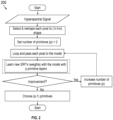
- the system (100) reshapes each signal vector of the plurality of spectral bands to a predefined shape.
- the system (100) initializes two or more chromatic primitives of the neural network model. The two or more chromatic primitives varies depending on the target material to be seen by a machine.
- the system (100) initializes by selecting the number of primitive layers to be used. This may be done dynamically in the outer flow where the system (100) keeps adding more primitives as explained above. As an activation function, the system (100) chooses either relu or sigmoid. These hyperparameters are used to define the neural network model. Further, the system (100) loops for n epochs.
- Data is divided into batches for each epoch.
- the system (100) selects an Adam optimizer, wherein the Adam is an optimization technique that can be used instead of the classical stochastic gradient descent procedure to update network weights iterative based in training data. Weights are updated after each batch. Once all of the batches have been used for training, the system (100) is configured to compute the loss and metrics specified during the model compilation. These metrics and weights are saved, and the model is trained for another epoch.
- system (100) is configured to divide the reshaped signal vector of the plurality of spectral bands into a plurality of batches and trains the neural network model for each of the plurality of batches.
- a hyperspectral data cube to obtain spectral signatures and its ground truth file is being used to get signature labels.
- the input to the neural network is a single pixel which has information across all wavelengths.
- the input is reshaped to 1 ⁇ 1 ⁇ n where n denotes the number of bands in the hyperspectral image.
- the system (100) iteratively cycles through all training data (pixels) and updating weights for each unsuccessful material class prediction.
- the model with two primitives serves as baseline, after which the system (100) adds another primitive layer and repeats the training procedure.
- the system (100) After training, the system (100) is configured to compare it to see if there is any significant improvement in the new model over the previous model. If there is growth, the system (100) may continue to add more primitive layers. The system (100) keeps repeating these processes until obtains convergence, i.e., the new model does not improve. This is where the system (100) come to a halt, and the system (1000 obtains the optimal number of primitives for the given materials (p-1).
- the system (100) begins with two primitives.
- the system (100) continued to add more primitive layers.
- FIG. 4 a schematic diagram (400) to illustrate a hyperspectral data cube with n bands followed by the neural network model architecture, in accordance with some embodiments of the present disclosure.
- system (100) is configured to optimize a chromatic primitive sensitivity function using an adaptive moment estimation to achieve optimized weights of the initialized two or more chromatic primitives.
- system (100) is configured to evaluate performance of the neural network model at each iteration to obtain two or more chromatic primitives from the plurality of initialized artificial color primitives, wherein halting the training when convergence is obtained.
- a schematic diagram (500) depicts a thorough perspective of a neural network architecture, in accordance with some embodiments of the present disclosure.
- the spectral signatures of n bands are used. These layers are linked to parallel primitive layers of depth d .
- the architecture presented above is made up of three primitives. The architecture begins with two primitive layers, and the number of layers increases as it converges to an optimal number. Each input node is linked to a single primitive layer node. These are logical connections, and weights are not learned here.
- These primitive layers which are made up of 1 ⁇ 1 CNN layers, produce a single node output. So, the system (100) gets a connection to a single node from n nodes. This is where the model learns weights.
- Weights learned by these primitive layers are interpreted as spectral response functions SRFs.
- the system (100) creates an SRF for each primitive layer. These single pixel outputs are now stacked to generate new color pixel values. Using pretrained SRF values, these color values can be used to generate images.
- the system (100) is configured to generate a new artificial color value for one or more pixels by combining node of the obtained each of the two or more chromatic primitives, wherein new artificial color is a combination of signals created by a linear combination of two or more chromatic primitives.
- the generated new color pixel is used as a discriminator to aid in locating the target material.
- the new artificial color is a mixture of weighted chromatic primitives which are optimized for sensitivity/(Spectral Response Functions) SRFs.
- SRFs Spectral Response Functions
- SRFs Spectral Response Functions
- the SRFs can be deployed to an embedded machine which has to perform target detection, this type of deployment is done when the machines scan for different types of materials which are already known to the model as the model has already learned SRFs for these materials.
- the SRFs can also be deployed in real time systems where the target to be detected is unknown, in this scenario the model learns new SRFs dynamically by finding the optimal n for a particular combination of target and data. Learned SRFs performed considerably better than human vision for a given scene/set of materials, and that more primitives may be necessary to better identify target material. The number of primitives varies based on the materials, as do the SRFs for those primitives.
- the system (100) is configured to predict an image for the generated new color using the learned two or more chromatic primitive sensitivity function to detect the target material.
- the trained neural network model enabled with color sensitive functions and two or more chromatic primitives to run on a neuro-morphic chip
- the neuro-morphic chip is enabled with the optimal artificial hyperspectral color vision as an integral part of the machine vision system (100).
- a processor-implemented method (600) for generating a hyperspectral artificial vision for machines Initially, at step (602), receiving, via an input/output interface, a hyperspectral signal of a target material as an input to a neural network model.
- the hyperspectral signal comprising a plurality of spectral bands.
- the hyperspectral signal may come from a small ground sample in case of a spectrometer data, wherein the hyperspectral signal come as a sequence of signals from a grid of rows and columns.
- each signal vector of the plurality of spectral bands is essential for preparing the data so that 2-dimension convolution can be performed on this.
- the system determines batch size and data is divided into n batches of that size per epoch.
- next step (608) training the neural network model for each of the plurality of epochs.
- next step (610) initializing two or more chromatic primitives of the trained neural network model.
- next step (612) optimizing a chromatic primitive sensitivity function using an adaptive moment estimation to achieve optimized weights of the initialized two or more chromatic primitives.
- next step (614) evaluating performance of the neural network model at each iteration to obtain two or more chromatic primitives from the plurality of initialized artificial color primitives, wherein halting the training when convergence is obtained.
- the two or more chromatic primitives varies depending on the target material to be seen by a machine.
- the two or more chromatic primitives are learned optimal chromatic primitive sensitivity function.
- the new artificial color is a mixture of weighted chromatic primitives which are optimized for sensitivity/SRF.
- the generated new color pixel is used as a discriminator to aid in locating the target material.
- the trained neural network model enabled with color sensitive functions and two or more chromatic primitives to run on a neuro-morphic chip.
- the neuro-morphic chip is enabled with the optimal artificial hyperspectral color vision as an integral part of the machine vision system.
- a neural network architecture capable of learning color filters similar to human trichromatic vision.
- the architecture was designed with three parallel 1 ⁇ 1 convolution layers to learn the filters.
- the system (100) used data from the visible region (400nm to 700nm) of the spectral signature. This data is used as an input, and the material label is obtained from the ground truth file.
- Filters learned from the model as shown in FIG. 7A a graphical representation, which represents sensitivity function (i.e., an International Commission on Illumination (CIE) sensitivity function) has similarities to human vision but also distinct.
- CIE International Commission on Illumination
- FIG. 7B a graphical representation, for learned filters and comparing the results to the first experiment.
- each learned primitive is one to one related with one of the CIE filters when the system (100) used Spectral Angle Mapper (SAM).
- SAM Spectral Angle Mapper
- Embodiments herein address the problem of machine vision.
- the adequate number of primitives varies depending on the set of materials to be seen by a machine.
- color is being used as a discriminator, which can aid in locating the target material.
- To determine the optimal numbers of primitives is practically impossible as this entail changing sensors or filters dynamically during a robot/machine operation.
- Embodiments herein provide a method and system for a hyperspectral artificial vision for machines.
- the system receives a hyperspectral signal of a target material as an input to a neural network model.
- the system initializes by selecting the number of primitive layers to be used.
- the system iteratively cycles through all training data (pixels) and updating weights for each unsuccessful material class prediction.
- Model with two primitives serves as baseline, after which the system adds another primitive layer and repeats the training procedure. The system keeps repeating these processes until obtains convergence. Where the system come to a halt, the system obtains the optimal number of primitives for the given materials.
- the generated new color pixel is used as a discriminator to aid in locating the target material.
- the new artificial color is a mixture of weighted chromatic primitives which are optimized for sensitivity/(Spectral Response Functions) SRFs.
- Such computer-readable storage means contain program-code means for implementation of one or more steps of the method, when the program runs on a server or mobile device or any suitable programmable device.
- the hardware device can be any kind of device which can be programmed including e.g., any kind of computer like a server or a personal computer, or the like, or any combination thereof.
- the device may also include means which could be e.g., hardware means like e.g., an application-specific integrated circuit (ASIC), a field-programmable gate array (FPGA), or a combination of hardware and software means, e.g., an ASIC and an FPGA, or at least one microprocessor and at least one memory with software modules located therein.
- ASIC application-specific integrated circuit
- FPGA field-programmable gate array
- the means can include both hardware means, and software means.
- the method embodiments described herein could be implemented in hardware and software.
- the device may also include software means. Alternatively, the embodiments may be implemented on different hardware devices, e.g., using a plurality of CPUs.
- the embodiments herein can comprise hardware and software elements.
- the embodiments that are implemented in software include but are not limited to, firmware, resident software, microcode, etc.
- the functions performed by various modules described herein may be implemented in other modules or combinations of other modules.
- a computer-usable or computer readable medium can be any apparatus that can comprise, store, communicate, propagate, or transport the program for use by or in connection with the instruction execution system, apparatus, or device.
- a computer-readable storage medium refers to any type of physical memory on which information or data readable by a processor may be stored.
- a computer-readable storage medium may store instructions for execution by one or more processors, including instructions for causing the processor(s) to perform steps or stages consistent with the embodiments described herein.
- the term "computer-readable medium” should be understood to include tangible items and exclude carrier waves and transient signals, i.e., be non-transitory. Examples include random access memory (RAM), read-only memory (ROM), volatile memory, nonvolatile memory, hard drives, CD ROMs, DVDs, flash drives, disks, and any other known physical storage media.
Landscapes
- Engineering & Computer Science (AREA)
- Theoretical Computer Science (AREA)
- Physics & Mathematics (AREA)
- Multimedia (AREA)
- General Physics & Mathematics (AREA)
- Evolutionary Computation (AREA)
- Databases & Information Systems (AREA)
- Computing Systems (AREA)
- Medical Informatics (AREA)
- Software Systems (AREA)
- General Health & Medical Sciences (AREA)
- Health & Medical Sciences (AREA)
- Computer Vision & Pattern Recognition (AREA)
- Artificial Intelligence (AREA)
- Spectroscopy & Molecular Physics (AREA)
- Image Analysis (AREA)
Applications Claiming Priority (1)
| Application Number | Priority Date | Filing Date | Title |
|---|---|---|---|
| IN202221053465 | 2022-09-19 |
Publications (1)
| Publication Number | Publication Date |
|---|---|
| EP4339901A1 true EP4339901A1 (de) | 2024-03-20 |
Family
ID=87580247
Family Applications (1)
| Application Number | Title | Priority Date | Filing Date |
|---|---|---|---|
| EP23191689.1A Pending EP4339901A1 (de) | 2022-09-19 | 2023-08-16 | System und verfahren zur erzeugung einer hyperspektralen künstlichen sicht für maschinen |
Country Status (2)
| Country | Link |
|---|---|
| US (1) | US12444184B2 (de) |
| EP (1) | EP4339901A1 (de) |
Cited By (1)
| Publication number | Priority date | Publication date | Assignee | Title |
|---|---|---|---|---|
| CN118870235A (zh) * | 2024-06-24 | 2024-10-29 | 烽火通信科技股份有限公司 | 一种哑资源建模管理方法和装置 |
Families Citing this family (3)
| Publication number | Priority date | Publication date | Assignee | Title |
|---|---|---|---|---|
| US12190573B1 (en) * | 2024-04-05 | 2025-01-07 | Atombeam Technologies Inc | Systems and methods for hyperspectral image generation |
| US12322070B1 (en) | 2024-04-05 | 2025-06-03 | AtomBeam Technologies Inc. | System and method for hyperspectral image generation with quality assurance |
| CN119723347B (zh) * | 2024-12-11 | 2025-09-26 | 吉林大学 | 一种结合高光谱和支持向量的汽车漆膜颜色识别分类方法 |
Family Cites Families (14)
| Publication number | Priority date | Publication date | Assignee | Title |
|---|---|---|---|---|
| JP6320440B2 (ja) * | 2015-08-04 | 2018-05-09 | ドルビー ラボラトリーズ ライセンシング コーポレイション | ハイダイナミックレンジ信号のための信号再構成 |
| JP6622150B2 (ja) * | 2016-06-29 | 2019-12-18 | 株式会社東芝 | 情報処理装置および情報処理方法 |
| US20210056391A1 (en) * | 2019-08-20 | 2021-02-25 | Mind Machine Learning, Inc. | Systems and Methods for Simulating Sense Data and Creating Perceptions |
| US11354804B1 (en) * | 2019-09-27 | 2022-06-07 | Verily Life Sciences Llc | Transforming multispectral images to enhanced resolution images enabled by machine learning |
| CN115152212B (zh) * | 2020-02-19 | 2024-09-24 | 杜比实验室特许公司 | 图像处理中的联合前向和后向神经网络优化 |
| US11275959B2 (en) * | 2020-07-07 | 2022-03-15 | Assa Abloy Ab | Systems and methods for enrollment in a multispectral stereo facial recognition system |
| US11651602B1 (en) * | 2020-09-30 | 2023-05-16 | X Development Llc | Machine learning classification based on separate processing of multiple views |
| EP3985620B1 (de) * | 2020-10-13 | 2023-12-20 | Tata Consultancy Services Limited | Feinkörnige klassifizierung von einzelhandelsprodukten |
| US12387305B2 (en) * | 2020-10-14 | 2025-08-12 | Dolby Laboratories Licensing Corporation | Color transformation for HDR video with a coding-efficiency constraint |
| WO2022256205A1 (en) * | 2021-06-01 | 2022-12-08 | Dolby Laboratories Licensing Corporation | Rotation-enabled high dynamic range video encoding |
| CN113689423A (zh) | 2021-09-09 | 2021-11-23 | 深圳新致软件有限公司 | 基于灰度和色彩鉴别算法的保险审核材料鉴定方法、系统以及设备 |
| KR102454272B1 (ko) * | 2022-05-26 | 2022-10-14 | (주)엘로이랩 | 뉴럴 네트워크를 이용한 이상 탐지 장치 및 방법과 그 뉴럴 네트워크 학습 장치 및 방법 |
| US20230408550A1 (en) * | 2022-06-15 | 2023-12-21 | Tektronix, Inc. | Separating noise to increase machine learning prediction accuracy in a test and measurement system |
| US12190573B1 (en) * | 2024-04-05 | 2025-01-07 | Atombeam Technologies Inc | Systems and methods for hyperspectral image generation |
-
2023
- 2023-08-16 EP EP23191689.1A patent/EP4339901A1/de active Pending
- 2023-08-17 US US18/234,913 patent/US12444184B2/en active Active
Non-Patent Citations (3)
| Title |
|---|
| DESHPANDE SHAILESH ET AL: "Classification of Urban Materials Using Artificial Color Features for Hyperspectral Data", IGARSS 2018 - 2018 IEEE INTERNATIONAL GEOSCIENCE AND REMOTE SENSING SYMPOSIUM, 22 July 2018 (2018-07-22) - 27 July 2018 (2018-07-27), IEEE, Piscataway, NJ, USA, pages 2673 - 2676, XP033436784, DOI: 10.1109/IGARSS.2018.8517611 * |
| NIE SHIJIE ET AL: "Deeply Learned Filter Response Functions for Hyperspectral Reconstruction", 2018 IEEE/CVF CONFERENCE ON COMPUTER VISION AND PATTERN RECOGNITION, IEEE, 18 June 2018 (2018-06-18), pages 4767 - 4776, XP033473388, DOI: 10.1109/CVPR.2018.00501 * |
| UPHAR SINGH ET AL: "Terrain Classification using Transfer Learning on Hyperspectral Images: A Comparative study", ARXIV.ORG, CORNELL UNIVERSITY LIBRARY, 19 June 2022 (2022-06-19), 201 OLIN LIBRARY CORNELL UNIVERSITY ITHACA, NY 14853, XP091254380 * |
Cited By (1)
| Publication number | Priority date | Publication date | Assignee | Title |
|---|---|---|---|---|
| CN118870235A (zh) * | 2024-06-24 | 2024-10-29 | 烽火通信科技股份有限公司 | 一种哑资源建模管理方法和装置 |
Also Published As
| Publication number | Publication date |
|---|---|
| US20240096080A1 (en) | 2024-03-21 |
| US12444184B2 (en) | 2025-10-14 |
Similar Documents
| Publication | Publication Date | Title |
|---|---|---|
| EP4339901A1 (de) | System und verfahren zur erzeugung einer hyperspektralen künstlichen sicht für maschinen | |
| Gutierrez et al. | A benchmarking of learning strategies for pest detection and identification on tomato plants for autonomous scouting robots using internal databases | |
| AU2021245099B2 (en) | Fine-grained classification of retail products | |
| WO2021238366A1 (zh) | 一种神经网络构建方法以及装置 | |
| US12033405B1 (en) | Machine learning classification based on separate processing of multiple views | |
| US11275959B2 (en) | Systems and methods for enrollment in a multispectral stereo facial recognition system | |
| CN113159300B (zh) | 图像检测神经网络模型及其训练方法、图像检测方法 | |
| EP3744410A1 (de) | System und verfahren zur spielzeug erkennung | |
| CN107292229A (zh) | 一种图像识别方法和装置 | |
| Monigari et al. | Plant leaf disease prediction | |
| WO2021175902A1 (en) | Systems and methods for fine tuning image classification neural networks | |
| Arvind et al. | Deep learning based plant disease classification with explainable AI and mitigation recommendation | |
| KR101906663B1 (ko) | 다양한 컬러 공간에서 협동 얼굴 컬러 특징 학습 방법 및 장치 | |
| KR102861404B1 (ko) | 인공지능 기반 얼굴 인식 장치 및 방법 | |
| Rajput et al. | Agricultural Intelligence: Federated Learning CNN's Models for Jute Leaf Disease Analysis | |
| KR102451758B1 (ko) | 이물질 선별 방법 및 장치 | |
| Fathima et al. | Deep-Transfer Learning for Multi-Crop Leaf Disease prediction using ResNet and ConvNet | |
| Mehta et al. | Precision Agriculture: An Augmented Datasets and CNN Model‐Based Approach to Diagnose Diseases in Fruits and Vegetable Crops | |
| US20240420464A1 (en) | Distributed architecture for fusion-transformer training acceleration | |
| Thevarasa et al. | Weighted ensemble algorithm for aerial imaging based mosquito breeding sites classification | |
| Navale et al. | Deep learning based automated wheat disease diagnosis system | |
| US20230153607A1 (en) | Method and system for attentive one shot meta imitation learning from visual demonstration | |
| Boas et al. | Ai-driven approach for digital agriculture: A case study on coffee leaf disease | |
| CN112699759B (zh) | 一种训练性别识别模型的方法及相关装置 | |
| WO2020161812A1 (ja) | フィルタ学習装置、フィルタ学習方法、及び非一時的なコンピュータ可読媒体 |
Legal Events
| Date | Code | Title | Description |
|---|---|---|---|
| PUAI | Public reference made under article 153(3) epc to a published international application that has entered the european phase |
Free format text: ORIGINAL CODE: 0009012 |
|
| STAA | Information on the status of an ep patent application or granted ep patent |
Free format text: STATUS: THE APPLICATION HAS BEEN PUBLISHED |
|
| AK | Designated contracting states |
Kind code of ref document: A1 Designated state(s): AL AT BE BG CH CY CZ DE DK EE ES FI FR GB GR HR HU IE IS IT LI LT LU LV MC ME MK MT NL NO PL PT RO RS SE SI SK SM TR |
|
| STAA | Information on the status of an ep patent application or granted ep patent |
Free format text: STATUS: REQUEST FOR EXAMINATION WAS MADE |
|
| 17P | Request for examination filed |
Effective date: 20240701 |
|
| RBV | Designated contracting states (corrected) |
Designated state(s): AL AT BE BG CH CY CZ DE DK EE ES FI FR GB GR HR HU IE IS IT LI LT LU LV MC ME MK MT NL NO PL PT RO RS SE SI SK SM TR |