EP4339743A1 - System and method of application-based three-dimensional refinement in multi-user communication sessions - Google Patents
System and method of application-based three-dimensional refinement in multi-user communication sessions Download PDFInfo
- Publication number
- EP4339743A1 EP4339743A1 EP23197572.3A EP23197572A EP4339743A1 EP 4339743 A1 EP4339743 A1 EP 4339743A1 EP 23197572 A EP23197572 A EP 23197572A EP 4339743 A1 EP4339743 A1 EP 4339743A1
- Authority
- EP
- European Patent Office
- Prior art keywords
- electronic device
- shared
- input
- user
- shared object
- Prior art date
- Legal status (The legal status is an assumption and is not a legal conclusion. Google has not performed a legal analysis and makes no representation as to the accuracy of the status listed.)
- Pending
Links
Images







Classifications
-
- G—PHYSICS
- G06—COMPUTING OR CALCULATING; COUNTING
- G06F—ELECTRIC DIGITAL DATA PROCESSING
- G06F3/00—Input arrangements for transferring data to be processed into a form capable of being handled by the computer; Output arrangements for transferring data from processing unit to output unit, e.g. interface arrangements
- G06F3/01—Input arrangements or combined input and output arrangements for interaction between user and computer
- G06F3/048—Interaction techniques based on graphical user interfaces [GUI]
- G06F3/0481—Interaction techniques based on graphical user interfaces [GUI] based on specific properties of the displayed interaction object or a metaphor-based environment, e.g. interaction with desktop elements like windows or icons, or assisted by a cursor's changing behaviour or appearance
- G06F3/04815—Interaction with a metaphor-based environment or interaction object displayed as three-dimensional [3D], e.g. changing the user viewpoint with respect to the environment or object
-
- G—PHYSICS
- G06—COMPUTING OR CALCULATING; COUNTING
- G06F—ELECTRIC DIGITAL DATA PROCESSING
- G06F3/00—Input arrangements for transferring data to be processed into a form capable of being handled by the computer; Output arrangements for transferring data from processing unit to output unit, e.g. interface arrangements
- G06F3/01—Input arrangements or combined input and output arrangements for interaction between user and computer
- G06F3/011—Arrangements for interaction with the human body, e.g. for user immersion in virtual reality
-
- G—PHYSICS
- G06—COMPUTING OR CALCULATING; COUNTING
- G06F—ELECTRIC DIGITAL DATA PROCESSING
- G06F3/00—Input arrangements for transferring data to be processed into a form capable of being handled by the computer; Output arrangements for transferring data from processing unit to output unit, e.g. interface arrangements
- G06F3/01—Input arrangements or combined input and output arrangements for interaction between user and computer
- G06F3/011—Arrangements for interaction with the human body, e.g. for user immersion in virtual reality
- G06F3/013—Eye tracking input arrangements
-
- G—PHYSICS
- G06—COMPUTING OR CALCULATING; COUNTING
- G06F—ELECTRIC DIGITAL DATA PROCESSING
- G06F3/00—Input arrangements for transferring data to be processed into a form capable of being handled by the computer; Output arrangements for transferring data from processing unit to output unit, e.g. interface arrangements
- G06F3/01—Input arrangements or combined input and output arrangements for interaction between user and computer
- G06F3/017—Gesture based interaction, e.g. based on a set of recognized hand gestures
-
- G—PHYSICS
- G06—COMPUTING OR CALCULATING; COUNTING
- G06F—ELECTRIC DIGITAL DATA PROCESSING
- G06F3/00—Input arrangements for transferring data to be processed into a form capable of being handled by the computer; Output arrangements for transferring data from processing unit to output unit, e.g. interface arrangements
- G06F3/01—Input arrangements or combined input and output arrangements for interaction between user and computer
- G06F3/048—Interaction techniques based on graphical user interfaces [GUI]
- G06F3/0484—Interaction techniques based on graphical user interfaces [GUI] for the control of specific functions or operations, e.g. selecting or manipulating an object, an image or a displayed text element, setting a parameter value or selecting a range
- G06F3/04845—Interaction techniques based on graphical user interfaces [GUI] for the control of specific functions or operations, e.g. selecting or manipulating an object, an image or a displayed text element, setting a parameter value or selecting a range for image manipulation, e.g. dragging, rotation, expansion or change of colour
-
- H—ELECTRICITY
- H04—ELECTRIC COMMUNICATION TECHNIQUE
- H04N—PICTORIAL COMMUNICATION, e.g. TELEVISION
- H04N7/00—Television systems
- H04N7/14—Systems for two-way working
- H04N7/15—Conference systems
- H04N7/157—Conference systems defining a virtual conference space and using avatars or agents
-
- H—ELECTRICITY
- H04—ELECTRIC COMMUNICATION TECHNIQUE
- H04L—TRANSMISSION OF DIGITAL INFORMATION, e.g. TELEGRAPHIC COMMUNICATION
- H04L65/00—Network arrangements, protocols or services for supporting real-time applications in data packet communication
- H04L65/40—Support for services or applications
- H04L65/403—Arrangements for multi-party communication, e.g. for conferences
Definitions
- This relates generally to systems and methods of application-based three-dimensional refinement of objects in multi-user communication sessions.
- Some computer graphical environments provide two-dimensional and/or three-dimensional environments where at least some objects displayed for a user's viewing are virtual and generated by a computer.
- the three-dimensional environments are presented by multiple devices communicating in a multi-user communication session.
- an avatar e.g., a representation
- content can be shared in the three-dimensional environment for viewing and interaction by multiple users participating in the multi-user communication session.
- shared content and/or avatars corresponding to the users participating in the multi-user communication session can be moved within the three-dimensional environment.
- a first electronic device and a second electronic device may be communicatively linked in a multi-user communication session.
- the first electronic device may present a three-dimensional environment including a first shared object and an avatar corresponding to a user of the second electronic device.
- the first electronic device may receive a first input corresponding to a request to move the first shared object in a first manner in the three-dimensional environment.
- the first electronic device may move the first shared object and the avatar in the three-dimensional environment in the first manner in accordance with the first input. In some examples, in accordance with a determination that the first shared object is an object of a second type, different from the first type, and the first input is a first type of input, the first electronic device may move the first shared object in the three-dimensional environment in the first manner in accordance with the first input, without moving the avatar.
- an object of the first type corresponds to an object that has a horizontal orientation in the three-dimensional environment relative to a viewpoint of a user of the first electronic device.
- an object of the second type corresponds to an object that has a vertical orientation in the three-dimensional environment relative to a viewpoint of a user of the first electronic device.
- the first manner of movement directed to the first shared object includes forward or backward movement of the first shared object in the three-dimensional environment relative to the viewpoint of the user of the first electronic device.
- the first electronic device scales the first shared object in the three-dimensional environment when the first shared object is moved in the three-dimensional environment in the first manner in accordance with the first input.
- a first electronic device and a second electronic device may be communicatively linked in a multi-user communication session.
- the first electronic device may present a three-dimensional environment including a first shared object and an avatar corresponding to a user of the second electronic device.
- the first electronic device may receive a first input corresponding to a request to move the first shared object in a first manner in the three-dimensional environment.
- the first electronic device may move the first shared object and the avatar in the three-dimensional environment in the first manner in accordance with the first input. In some examples, in accordance with a determination that the first shared object is an object of a second type, different from the first type, and the first input is a first type of input, the first electronic device may move the first shared object in the three-dimensional environment in the first manner in accordance with the first input, without moving the avatar.
- an object of the first type corresponds to an object that has a horizontal orientation in the three-dimensional environment relative to a viewpoint of a user of the first electronic device.
- an object of the second type corresponds to an object that has a vertical orientation in the three-dimensional environment relative to a viewpoint of a user of the first electronic device.
- the first manner of movement directed to the first shared object includes forward or backward movement of the first shared object in the three-dimensional environment relative to the viewpoint of the user of the first electronic device.
- the first electronic device scales the first shared object in the three-dimensional environment when the first shared object is moved in the three-dimensional environment in the first manner in accordance with the first input.
- performing spatial refinement in the three-dimensional environment while in the multi-user communication session may include interaction with one or more objects in the three-dimensional environment.
- initiation of spatial refinement in the three-dimensional environment can include interaction with one or more virtual objects displayed in the three-dimensional environment.
- a user's gaze may be tracked by the electronic device as an input for identifying one or more virtual objects targeted for selection when initiating spatial refinement while in the multi-user communication session.
- gaze can be used to identify one or more virtual objects targeted for selection using another selection input.
- a virtual object may be selected using hand-tracking input detected via an input device in communication with the electronic device.
- objects displayed in the three-dimensional environment may be moved and/or reoriented in the three-dimensional environment in accordance with movement input detected via the input device.
- FIG. 1 illustrates an electronic device 101 presenting an extended reality (XR) environment (e.g., a computer-generated environment) according to some examples of the disclosure.
- electronic device 101 is a hand-held or mobile device, such as a tablet computer, laptop computer, smartphone, or head-mounted display. Examples of device 101 are described below with reference to the architecture block diagram of FIG. 2 .
- electronic device 101, table 106, and coffee mug 152 are located in the physical environment 100.
- the physical environment may include physical features such as a physical surface (e.g., floor, walls) or a physical object (e.g., table, lamp, etc.).
- electronic device 101 may be configured to capture images of physical environment 100 including table 106 and coffee mug 152 (illustrated in the field of view of electronic device 101).
- the electronic device 101 in response to a trigger, may be configured to display a virtual object 114 (e.g., two-dimensional virtual content) in the computer-generated environment (e.g., represented by a rectangle illustrated in FIG. 1 ) that is not present in the physical environment 100, but is displayed in the computer-generated environment positioned on (e.g., anchored to) the top of a computer-generated representation 106' of real-world table 106.
- a virtual object 114 e.g., two-dimensional virtual content
- virtual object 114 can be displayed on the surface of the computer-generated representation 106' of the table in the computer-generated environment next to the computer-generated representation 152' of real-world coffee mug 152 displayed via device 101 in response to detecting the planar surface of table 106 in the physical environment 100.
- virtual object 114 is a representative virtual object and one or more different virtual objects (e.g., of various dimensionality such as two-dimensional or three-dimensional virtual objects) can be included and rendered in a three-dimensional computer-generated environment.
- the virtual object can represent an application or a user interface displayed in the computer-generated environment.
- the virtual object can represent content corresponding to the application and/or displayed via the user interface in the computer-generated environment.
- the virtual object 114 is optionally configured to be interactive and responsive to user input, such that a user may virtually touch, tap, move, rotate, or otherwise interact with, the virtual object.
- the virtual object 114 may be displayed in a three-dimensional computer-generated environment within a multi-user communication session ("multi-user communication session," "communication session”).
- the virtual object 114 may be viewable and/or configured to be interactive and responsive to multiple users and/or user input provided by multiple users, respectively, represented by virtual representations (e.g., avatars, such as avatar 115).
- virtual representations e.g., avatars, such as avatar 115
- the virtual object 114 may be shared among multiple users in the communication session such that input directed to the virtual object 114 is optionally viewable by the multiple users.
- the 3D environment (or 3D virtual object) described herein may be a representation of a 3D environment (or three-dimensional virtual object) projected or presented at an electronic device.
- an electronic device that is in communication with a display generation component and one or more input devices is described. It should be understood that the electronic device optionally is in communication with one or more other physical user-interface devices, such as touch-sensitive surface, a physical keyboard, a mouse, a joystick, a hand tracking device, an eye tracking device, a stylus, etc. Further, as described above, it should be understood that the described electronic device, display and touch-sensitive surface are optionally distributed amongst two or more devices. Therefore, as used in this disclosure, information displayed on the electronic device or by the electronic device is optionally used to describe information outputted by the electronic device for display on a separate display device (touch-sensitive or not).
- input received on the electronic device e.g., touch input received on a touch-sensitive surface of the electronic device, or touch input received on the surface of a stylus
- input received on a separate input device from which the electronic device receives input information.
- the device typically supports a variety of applications, such as one or more of the following: a drawing application, a presentation application, a word processing application, a website creation application, a disk authoring application, a spreadsheet application, a gaming application, a telephone application, a video conferencing application, an e-mail application, an instant messaging application, a workout support application, a photo management application, a digital camera application, a digital video camera application, a web browsing application, a digital music player application, a television channel browsing application, and/or a digital video player application.
- FIG. 2 illustrates a block diagram of an exemplary architecture for a system 201 according to some examples of the disclosure.
- system 201 includes multiple devices.
- the system 201 includes a first electronic device 260 and a second electronic device 270, wherein the first electronic device 260 and the second electronic device 270 are in communication with each other.
- the first electronic device 260 and the second electronic device 270 are a portable device, such as a mobile phone, smart phone, a tablet computer, a laptop computer, an auxiliary device in communication with another device, etc., respectively.
- the first electronic device 260 optionally includes various sensors (e.g., one or more hand tracking sensor(s) 202A, one or more location sensor(s) 204A, one or more image sensor(s) 206A, one or more touch-sensitive surface(s) 209A, one or more motion and/or orientation sensor(s) 210A, one or more eye tracking sensor(s) 212A, one or more microphone(s) 213A or other audio sensors, etc.), one or more display generation component(s) 214A, one or more speaker(s) 216A, one or more processor(s) 218A, one or more memories 220A, and/or communication circuitry 222A.
- various sensors e.g., one or more hand tracking sensor(s) 202A, one or more location sensor(s) 204A, one or more image sensor(s) 206A, one or more touch-sensitive surface(s) 209A, one or more motion and/or orientation sensor(s) 210A, one or more eye tracking sensor(s)
- the second electronic device 270 optionally includes various sensors (e.g., one or more hand tracking sensor(s) 202B, one or more location sensor(s) 204B, one or more image sensor(s) 206B, one or more touch-sensitive surface(s) 209B, one or more motion and/or orientation sensor(s) 210B, one or more eye tracking sensor(s) 212B, one or more microphone(s) 213B or other audio sensors, etc.), one or more display generation component(s) 214B, one or more speaker(s) 216, one or more processor(s) 218B, one or more memories 220B, and/or communication circuitry 222B.
- various sensors e.g., one or more hand tracking sensor(s) 202B, one or more location sensor(s) 204B, one or more image sensor(s) 206B, one or more touch-sensitive surface(s) 209B, one or more motion and/or orientation sensor(s) 210B, one or more eye tracking sensor(s)
- One or more communication buses 208A and 208B are optionally used for communication between the above-mentioned components of devices 260 and 270, respectively.
- First electronic device 260 and second electronic device 270 optionally communicate via a wired or wireless connection (e.g., via communication circuitry 222A-222B) between the two devices.
- Communication circuitry 222A, 222B optionally includes circuitry for communicating with electronic devices, networks, such as the Internet, intranets, a wired network and/or a wireless network, cellular networks, and wireless local area networks (LANs).
- Communication circuitry 222A, 222B optionally includes circuitry for communicating using near-field communication (NFC) and/or short-range communication, such as Bluetooth ® .
- NFC near-field communication
- Bluetooth ® short-range communication
- Processor(s) 218A, 218B include one or more general processors, one or more graphics processors, and/or one or more digital signal processors.
- memory 220A, 220B is a non-transitory computer-readable storage medium (e.g., flash memory, random access memory, or other volatile or non-volatile memory or storage) that stores computer-readable instructions configured to be executed by processor(s) 218A, 218B to perform the techniques, processes, and/or methods described below.
- memory 220A, 220B can include more than one non-transitory computer-readable storage medium.
- a non-transitory computer-readable storage medium can be any medium (e.g., excluding a signal) that can tangibly contain or store computer-executable instructions for use by or in connection with the instruction execution system, apparatus, or device.
- the storage medium is a transitory computer-readable storage medium.
- the storage medium is a non-transitory computer-readable storage medium.
- the non-transitory computer-readable storage medium can include, but is not limited to, magnetic, optical, and/or semiconductor storages. Examples of such storage include magnetic disks, optical discs based on CD, DVD, or Blu-ray technologies, as well as persistent solid-state memory such as flash, solid-state drives, and the like.
- display generation component(s) 214A, 214B include a single display (e.g., a liquid-crystal display (LCD), organic light-emitting diode (OLED), or other types of display).
- display generation component(s) 214A, 214B includes multiple displays.
- display generation component(s) 214A, 214B can include a display with touch capability (e.g., a touch screen), a projector, a holographic projector, a retinal projector, etc.
- devices 260 and 270 include touch-sensitive surface(s) 209A and 209B, respectively, for receiving user inputs, such as tap inputs and swipe inputs or other gestures.
- display generation component(s) 214A,214B and touch-sensitive surface(s) 209A, 209B form touch-sensitive display(s) (e.g., a touch screen integrated with devices 260 and 270, respectively, or external to devices 260 and 270, respectively, that is in communication with devices 260 and 270).
- touch-sensitive display(s) e.g., a touch screen integrated with devices 260 and 270, respectively, or external to devices 260 and 270, respectively, that is in communication with devices 260 and 270.
- Image sensors 260 and 270 optionally includes image sensor(s) 206A and 206B, respectively.
- Image sensors(s) 206A/206B optionally include one or more visible light image sensors, such as charged coupled device (CCD) sensors, and/or complementary metal-oxide-semiconductor (CMOS) sensors operable to obtain images of physical objects from the real-world environment.
- Image sensor(s) 206A/206B also optionally include one or more infrared (IR) sensors, such as a passive or an active IR sensor, for detecting infrared light from the real-world environment.
- IR infrared
- an active IR sensor includes an IR emitter for emitting infrared light into the real-world environment.
- Image sensor(s) 206A/206B also optionally include one or more cameras configured to capture movement of physical objects in the real-world environment.
- Image sensor(s) 206A/206B also optionally include one or more depth sensors configured to detect the distance of physical objects from device 260/270.
- information from one or more depth sensors can allow the device to identify and differentiate objects in the real-world environment from other objects in the real-world environment.
- one or more depth sensors can allow the device to determine the texture and/or topography of objects in the real-world environment.
- devices 260 and 270 use CCD sensors, event cameras, and depth sensors in combination to detect the physical environment around devices 260 and 270.
- image sensor(s) 206A/206B include a first image sensor and a second image sensor. The first image sensor and the second image sensor work in tandem and are optionally configured to capture different information of physical objects in the real-world environment.
- the first image sensor is a visible light image sensor and the second image sensor is a depth sensor.
- device 260/270 uses image sensor(s) 206A/206B to detect the position and orientation of device 260/270 and/or display generation component(s) 214A/214B in the real-world environment.
- device 260/270 uses image sensor(s) 206A/206B to track the position and orientation of display generation component(s) 214A/214B relative to one or more fixed objects in the real-world environment.
- device 260/270 includes microphone(s) 213A/213B or other audio sensors. Device 260/270 uses microphone(s) 213A/213B to detect sound from the user and/or the real-world environment of the user. In some examples, microphone(s) 213A/213B includes an array of microphones (a plurality of microphones) that optionally operate in tandem, such as to identify ambient noise or to locate the source of sound in space of the real-world environment.
- Device 260/270 includes location sensor(s) 204A/204B for detecting a location of device 260/270 and/or display generation component(s) 214A/214B.
- location sensor(s) 204A/204B can include a GPS receiver that receives data from one or more satellites and allows device 260/270 to determine the device's absolute position in the physical world.
- Device 260/270 includes orientation sensor(s) 210A/210B for detecting orientation and/or movement of device 260/270 and/or display generation component(s) 214A/214B.
- device 260/270 uses orientation sensor(s) 210A/210B to track changes in the position and/or orientation of device 260/270 and/or display generation component(s) 214A/214B, such as with respect to physical objects in the real-world environment.
- Orientation sensor(s) 210A/210B optionally include one or more gyroscopes and/or one or more accelerometers.
- Device 260/270 includes hand tracking sensor(s) 202A/202B and/or eye tracking sensor(s) 212A/212B, in some examples.
- Hand tracking sensor(s) 202A/202B are configured to track the position/location of one or more portions of the user's hands, and/or motions of one or more portions of the user's hands with respect to the extended reality environment, relative to the display generation component(s) 214A/214B, and/or relative to another defined coordinate system.
- Eye tracking sensor(s) 212A/212B are configured to track the position and movement of a user's gaze (eyes, face, or head, more generally) with respect to the real-world or extended reality environment and/or relative to the display generation component(s) 214A/214B.
- hand tracking sensor(s) 202A/202B and/or eye tracking sensor(s) 212A/212B are implemented together with the display generation component(s) 214A/214B. In some examples, the hand tracking sensor(s) 202A/202B and/or eye tracking sensor(s) 212A/212B are implemented separate from the display generation component(s) 214A/214B.
- the hand tracking sensor(s) 202A/202B can use image sensor(s) 206A/206B (e.g., one or more IR cameras, 3D cameras, depth cameras, etc.) that capture three-dimensional information from the real-world including one or more hands (e.g., of a human user).
- the hands can be resolved with sufficient resolution to distinguish fingers and their respective positions.
- one or more image sensor(s) 206A/206B are positioned relative to the user to define a field of view of the image sensor(s) 206A/206B and an interaction space in which finger/hand position, orientation and/or movement captured by the image sensors are used as inputs (e.g., to distinguish from a user's resting hand or other hands of other persons in the real-world environment). Tracking the fingers/hands for input (e.g., gestures, touch, tap, etc.) can be advantageous in that it does not require the user to touch, hold or wear any sort of beacon, sensor, or other marker.
- eye tracking sensor(s) 212A/212B includes at least one eye tracking camera (e.g., infrared (IR) cameras) and/or illumination sources (e.g., IR light sources, such as LEDs) that emit light towards a user's eyes.
- the eye tracking cameras may be pointed towards a user's eyes to receive reflected IR light from the light sources directly or indirectly from the eyes.
- both eyes are tracked separately by respective eye tracking cameras and illumination sources, and a focus/gaze can be determined from tracking both eyes.
- one eye e.g., a dominant eye
- Device 260/270 and system 201 are not limited to the components and configuration of FIG. 2 , but can include fewer, other, or additional components in multiple configurations.
- system 201 can be implemented in a single device.
- a person or persons using system 201, is optionally referred to herein as a user or users of the device(s).
- first electronic device e.g., corresponding to device 260
- second electronic device e.g., corresponding to device 270
- the first electronic device may be in communication with the second electronic device in a multi-user communication session.
- an avatar of (e.g., a virtual representation of) a user of the first electronic device may be displayed in the three-dimensional environment at the second electronic device
- an avatar of a user of the second electronic device may be displayed in the three-dimensional environment at the first electronic device.
- content may be shared and interactive within the three-dimensional environment while the first electronic device and the second electronic device are in the multi-user communication session.
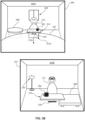
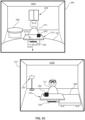
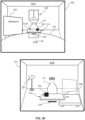
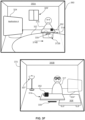
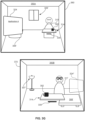
- FIGs. 3A-3G illustrate example interactions involving application-based spatial refinement in a multi-user communication session according to some examples of the disclosure.
- a first electronic device 360 may present a three-dimensional environment 350A
- a second electronic device 370 may present a three-dimensional environment 350B.
- the first electronic device 360 and the second electronic device 370 may be similar to device 101 or 260/270, and/or may be a head mountable system/device and/or projection-based system/device (including a hologram-based system/device) configured to generate and present a three-dimensional environment, such as, for example, heads-up displays (HUDs), head mounted displays (HMDs), windows having integrated display capability, or displays formed as lenses designed to be placed on a person's eyes (e.g., similar to contact lenses), respectively.
- HUDs heads-up displays
- HMDs head mounted displays
- displays formed as lenses designed to be placed on a person's eyes e.g., similar to contact lenses
- a first user is optionally wearing the first electronic device 360 and a second user is optionally wearing the second electronic device 370, such that the three-dimensional environments 350A/350B can be defined by X, Y and Z axes as viewed from a perspective of the electronic devices (e.g., a viewpoint associated with the users of the electronic devices 360/370).
- the first electronic device 360 may be in a first physical environment that includes a table 306 and a window 309.
- the three-dimensional environment 350A presented using the first electronic device 360 optionally includes captured portions of the physical environment surrounding the first electronic device 360, such as a representation of the table 306' and a representation of the window 309'.
- the second electronic device 370 may be in a second physical environment, different from the first physical environment (e.g., separate from the first physical environment), that includes a floor lamp 307 and a coffee table 308.
- the three-dimensional environment 350B presented using the second electronic device 370 optionally includes captured portions of the physical environment surrounding the second electronic device 370, such as a representation of the floor lamp 307' and a representation of the coffee table 308'. Additionally, the three-dimensional environments 350A and 350B may include representations of the floor, ceiling, and walls of the room in which the first electronic device 360 and the second electronic device 370 are located, respectively.
- the first electronic device 360 may enter a multi-user communication session with the second electronic device 370.
- the first electronic device 360 and the second electronic device 370 e.g., via communication circuitry 222A/222B of FIG. 2
- the first electronic device 360 and the second electronic device 370 are configured to present a shared three-dimensional environment that includes one or more shared virtual objects (e.g., shared content, such as images, video, audio and the like, representations of user interfaces of applications, three-dimensional models, etc.).
- shared virtual objects e.g., shared content, such as images, video, audio and the like, representations of user interfaces of applications, three-dimensional models, etc.
- shared three-dimensional environment refers to a three-dimensional environment that is independently presented, displayed, and/or visible at two or more electronic devices via which content, applications, data, and the like may be shared and/or presented to users of the two or more electronic devices.
- avatars corresponding to the users of the two or more electronic devices are optionally displayed within the shared three-dimensional environments presented at the two or more electronic devices.
- the first electronic device 360 optionally displays an avatar 315 corresponding to the user of the second electronic device 370 within the three-dimensional environment 350A.
- the second electronic device 370 optionally displays an avatar 317 corresponding to the user of the first electronic device 360 within the three-dimensional environment 350B.
- the avatars 315/317 are a representation (e.g., a full-body rendering) of each of the users of the electronic devices 370/360.
- the avatars 315/317 are each a representation of a portion (e.g., a rendering of a head, face, head and torso, etc.) of the users of the electronic devices 370/360.
- the avatars 315/317 are a user-personalized, user-selected, and/or user-created representation displayed in the three-dimensional environments 350A/350B that is representative of the users of the electronic devices 370/360. It should be understood that, while the avatars 315/317 illustrated in FIG. 3A correspond to simplified representations of a full body of each of the users of the electronic devices 370/360, respectively, alternative avatars may be provided, such as any of those described above.
- the presentation of avatars 315/317 as part of the shared three-dimensional environment is optionally accompanied by an audio effect corresponding to a voice of the users of the electronic devices 370/360.
- the avatar 315 displayed in the three-dimensional environment 350A using the first electronic device 360 is optionally accompanied by an audio effect corresponding to the voice of the user of the second electronic device 370.
- the voice of the user may be detected by the second electronic device 370 (e.g., via the microphone(s) 213B in FIG.
- the detected voice of the user of the second electronic device 370 may be presented as audio (e.g., using speaker(s) 216A) to the user of the first electronic device 360 in three-dimensional environment 350A in real-time.
- the avatar 317 displayed in the three-dimensional environment 350B using the second electronic device 370 is optionally accompanied by an audio effect corresponding to the voice of the user of the first electronic device 360.
- the voice of the user may be detected by the first electronic device 360 (e.g., via the microphone(s) 213A) and transmitted to the second electronic device 370 (e.g., via the communication circuitry 222A/222B), such that the detected voice of the user of the first electronic device 360 may be presented as audio (e.g., using speaker(s) 216B) to the user of the second electronic device 370 in three-dimensional environment 350B in real-time.
- the avatars 315/317 are displayed in the three-dimensional environments 350A/350B with respective orientations that (e.g., initially, such as prior to spatial refinement, as discussed in more detail below) correspond to and/or are based on orientations of the electronic devices 360/370 in the physical environments surrounding the electronic devices 360/370.
- orientations e.g., initially, such as prior to spatial refinement, as discussed in more detail below
- the avatar 315 is optionally facing toward a viewpoint of the user of the first electronic device 360
- the avatar 317 is optionally facing toward a viewpoint of the user of the second electronic device 370.
- the viewpoint of the user changes in accordance with the movement, which may thus also change an orientation of the user's avatar in the three-dimensional environment.
- the user of the first electronic device 360 were to look leftward in the three-dimensional environment 350A such that the first electronic device 360 is rotated (e.g., a corresponding amount) to the left (e.g., counterclockwise)
- the user of the second electronic device 370 would see the avatar 317 corresponding to the user of the first electronic device 360 rotate to the right (e.g., clockwise) in accordance with the movement of the first electronic device 360.
- a viewpoint of the three-dimensional environments 350A/350B and/or a location of the viewpoint of the three-dimensional environments 350A/350B optionally changes in accordance with movement of the electronic devices 360/370 (e.g., by the users of the electronic devices 360/370).
- the viewpoint of the user of the first electronic device 360 would change accordingly, such that the representation of the table 306', the representation of the window 309' and the avatar 315 appear larger in the field of view of three-dimensional environment 350A.
- content can be shared between the first electronic device and the second electronic device, such that the content can be interacted with (e.g., viewed, moved, modified, etc.) by the users of the first electronic device and the second electronic device.
- shared content can be moved within the shared three-dimensional environments presented by the first electronic device and the second electronic device by directly or indirectly interacting with the shared content. In some such examples, however, moving the shared content closer to the viewpoint of one user optionally moves the shared content farther from the viewpoint of the other user in the multi-communication session.
- performing spatial refinement in the shared three-dimensional environment includes moving a shared object that is selected for movement (e.g., in response to input directed to the shared object) and moving other shared objects and/or avatars corresponding to other users in the multi-user communication session in accordance with the movement of the shared object.
- the three-dimensional environments shared between the first electronic device 360 and the second electronic device 370 may include one or more shared virtual objects.
- the first electronic device 360 and the second electronic device 370 may each display a virtual tray 314 containing a virtual mug 352, which may be shared between the electronic devices 360/370.
- the shared virtual objects may be displayed with a grabber bar 335 (also referred to as a handlebar affordance) which is optionally selectable to initiate movement of the shared virtual objects (e.g., the virtual tray 314 and the virtual mug 352) within the three-dimensional environments 350A/350B.
- the shared virtual objects 314 and 352 may be associated with an application running on the electronic devices 360/370.
- the shared virtual objects may be positioned closer to the viewpoint of one user than another user in the three-dimensional environments 350A/350B (e.g., when the shared virtual objects are initially displayed in the three-dimensional environments 350A/350B).
- the shared virtual objects 314 and 352 are displayed in three-dimensional environment 350B at a first location that is optionally a first distance (e.g., "close to", or within a threshold distance, such as 0.2, 0.4, 0.5, 0.7, 1, 1.2, etc. m) from the viewpoint of the user of the second electronic device 370.
- the shared virtual objects 314 and 352 are optionally displayed at the first electronic device 360 at a second location, different from the first location, in three-dimensional environment 3 50A that is a second distance (e.g., "far from", or at more than a threshold distance," such as greater than 1, 1.4, 1.5, 2, etc. m) from the viewpoint of the user of the first electronic device 360.
- a second distance e.g., "far from", or at more than a threshold distance," such as greater than 1, 1.4, 1.5, 2, etc. m
- the position of the avatars 315 and 317 within the three-dimensional environments 350A/350B may reflect/be indicative of the relative distances between the shared virtual objects 314 and 352 and the viewpoints of the users of the electronic devices 360/370. For example, as shown in FIG. 3A , because the shared virtual objects 352 and 314 are located the first distance from the viewpoint of the user of the second electronic device 370 in three-dimensional environment 350B, at the first electronic device 360, the shared virtual objects 352 and 314 are displayed the first distance from the avatar 315 corresponding to the user of the second electronic device 370 in three-dimensional environment 350A.
- the shared virtual objects 352 and 314 are located the second distance from the viewpoint of the user of the first electronic device 360 in three-dimensional environment 350A, at the second electronic device 370, the shared virtual objects 352 and 314 are displayed the second distance from the avatar 317 corresponding to the user of the first electronic device 360 in three-dimensional environment 350B.
- the user of the first electronic device 360 may desire to move the shared virtual objects 314 and 352 closer to the viewpoint of the user of the first electronic device 360. Accordingly, in some examples, it may be advantageous to allow the users of the first electronic device and/or the second electronic device to spatially refine the virtual objects shared between the first electronic device and the second electronic device without moving the virtual objects to undesirable locations within the three-dimensional environments, as showcased above. Example interactions involving spatial refinement of the shared three-dimensional environment (including the shared virtual objects 314 and 352) in the multi-user communication session are discussed below.
- the user of the first electronic device 360 may provide a selection input 372A directed to the grabber or handlebar affordance 335 (and/or the shared virtual objects 314/352).
- the user of the first electronic device 360 provides a pinch gesture (e.g., in which an index finger and thumb of the hand of the user come together and make contact), a two-handed double pinch gesture (e.g., one in which the index finger and thumb of the hand come into contact, separate, and come into contact a second time), a two-handed pinch and hold gesture (e.g., one in which the index finger and thumb of the hand come into contact and remain in contact for a threshold amount of time, such as 1, 1.5, 2, 2.5, 3, 4, etc.
- a pinch gesture e.g., in which an index finger and thumb of the hand of the user come together and make contact
- a two-handed double pinch gesture e.g., one in which the index finger and thumb of the hand come into contact, separate, and come into contact a second time
- a selection of a spatial refinement affordance displayed in a predetermined area of the three-dimensional environment 350A (e.g., such as at or near a top of the field of view of the three-dimensional environment 350A), or a verbal command directly to and/or while a gaze of the user is directed to the grabber or handlebar affordance 335 or a portion of the shared virtual objects 314/352.
- the selection input 372A provided by one or more fingers of a hand of the user may be followed by a drag/movement input 374A toward the viewpoint of the user of the first electronic device 360.
- the user of the first electronic device 360 moves the hand closer to a portion of the body (e.g., the chest/torso) of the user.
- the selection input 372A, followed by the movement input 374a may alternatively be provided directly to the virtual tray 314 or the virtual mug 352 in three-dimensional environment 350A.
- the first electronic device 360 in response to receiving the selection input 372A followed by the movement input 374A, performs spatial refinement in the three-dimensional environment 350A. For example, as described below, the first electronic device 360 moves the shared virtual objects 314 and 352 and the avatar 315 in the three-dimensional environment 350A in accordance with the movement input 374A, rather than just moving the shared virtual objects 314 and 352 in the three-dimensional environment 350A.
- performing spatial refinement enables shared content to be moved within the three-dimensional environment 350A (e.g., closer to the viewpoint of the user of the first electronic device 360), without potentially moving the shared content farther from the user of the second electronic device 370 or to an undesirable location for the user of the second electronic device 370 in the three-dimensional environment 350B.
- the first electronic device 360 in response to receiving the selection input 372A and/or the movement input 374A, the first electronic device 360 optionally displays a planar element (e.g., a disc or disc-shaped element) 337 below the shared objects in the three-dimensional environment 350A (and optionally representations of private content and/or applications of other users).
- a planar element e.g., a disc or disc-shaped element
- the disc 337 may be displayed below the avatar 315 corresponding to the user of the second electronic device 370 and the shared virtual objects, such as the virtual tray 314 and the virtual mug 352.
- a center of the disc 337 may be positioned at the viewpoint of the user of the first electronic device 360, and an edge of the disc 337 extends into the three-dimensional environment 350A to include all objects selected for spatial refinement. Accordingly, the disc 337 may serve as a reference point for subsequent movement of the objects selected for spatial refinement at the first electronic device 360, namely the avatar 315 and the shared virtual objects 314 and 352. For example, the disc 337 extends within three-dimensional environment 350A to contain (e.g., be displayed below) all objects that are selected for spatial refinement. It should be understood that, while a disc is illustrated in FIG.
- an alternative user interface element may be displayed below the avatar 315 and the shared objects in three-dimensional environment 350A, such as a rectangular, square-shaped, triangular, octagonal, etc. stage or platter.
- the first electronic device may move the disc 337 in the three-dimensional environment 350A as the objects selected for refinement move in the three-dimensional environment 350A.
- the movement input directed to shared objects in the shared three-dimensional environment causes the electronic device to perform spatial refinement in the shared three-dimensional environment (including the shared objects) based on a type of the object and/or a direction of the movement input in the shared three-dimensional environment.
- the electronic device performs spatial refinement in the shared three-dimensional environment in response to user input directed to the shared object in accordance with a determination that the shared object is an object of a first type.
- the object type is determined based on an orientation of the shared object in the shared three-dimensional environment.
- an object of the first type is a shared object that has a horizontal orientation in the shared three-dimensional environment relative to the viewpoint of the user of the electronic device. As shown in Fig.
- the selection input 372A and the movement input 374A are directed to the shared virtual object 314, which, as previously discussed above, is optionally a virtual tray.
- the shared object 314 has a horizontal orientation in the three-dimensional environment 350A relative to the viewpoint of the user of the first electronic device 360.
- the first electronic device 360 may spatially refine the three-dimensional environment 350A (including the shared virtual objects 314 and 352) because the shared virtual object 314 has a horizontal orientation in the three-dimensional environment 350A and is thus an object of the first type.
- the shared object 352 is disposed atop the surface of the shared virtual object 314, the first electronic device 360 also spatially refines the shared object 352 based on the orientation of the shared virtual object 314 in the three-dimensional environment 350A.
- movement input directed to a shared object that is an object of the first type causes the shared object and the avatar 315 corresponding to the user of the second electronic device 370 to move in the three-dimensional environment 350A in accordance with the movement input.
- moving the grabber bar 335 may cause the shared virtual objects 314 and 352 and the avatar 515 corresponding to the user of the second electronic device 370 to move in the three-dimensional environment 350A in the direction of the movement input 374A.
- the first electronic device 360 moves the grabber bar 335 which is associated with the shared virtual object 314 that is an object of the first type in the three-dimensional environment 350A.
- the first electronic device 360 moves the avatar 315 with the virtual tray 314 and the virtual mug 352 in the three-dimensional environment 350A.
- the first electronic device 360 moves the disc 337 displayed below the avatar 315 and the shared virtual objects 314 and 352 in accordance with the movement of the shared virtual objects 314 and 352.
- the first electronic device 360 optionally moves the avatar 315 and the shared virtual objects 314 and 352 toward the viewpoint of the user of the first electronic device 360 in accordance with the movement input 374A.
- the selection input 372A e.g., the pinch gesture
- the selection input 372A is maintained as the objects are moved within three-dimensional environment 350A in FIG. 3C .
- the first electronic device 360 when the first electronic device 360 spatially refines the shared three-dimensional environment (including the shared virtual objects 314 and 352) in response to receiving input (e.g., selection input 372A in FIG. 3B ) directed to the shared virtual object 314 that is an object of the first type (e.g., a horizontally oriented object in the three-dimensional environment 350A), the first electronic device 360 transmits an indication of the spatial refinement to the second electronic device 370 (e.g., and/or to a server in communication with the first electronic device 360 and the second electronic device 370) with which the first electronic device 360 is in the multi-user communication session.
- the second electronic device 370 e.g., and/or to a server in communication with the first electronic device 360 and the second electronic device 370
- the first electronic device 360 transmits, to the second electronic device 370, data indicating that the first electronic device 360 has received input corresponding to a request to move the shared virtual objects 314 and 352 within the three-dimensional environment 350A presented at the first electronic device 360.
- spatial refinement at the first electronic device 360 causes the avatar 315 corresponding to the user of the second electronic device 370 and the shared virtual objects 314 to move within the three-dimensional environment 350A in accordance with the movement input 374A in FIG. 3C . As shown in FIG.
- the second electronic device 370 may not move the shared virtual objects 314 and 352 in the three-dimensional environment 350B despite the movement of the shared virtual objects 314 and 352 in the three-dimensional environment 350A presented at the first electronic device 360. Rather, as shown in FIG. 3C , in response to receiving the indication from the first electronic device 360, the second electronic device 370 moves the avatar 317 corresponding to the user of the first electronic device 360 in the three-dimensional environment 350B in accordance with the movement input 374A received at the first electronic device 360.
- the shared virtual objects 314 and 352 and the avatar 315 are moved to a location in three-dimensional environment 350A that is a respective distance (e.g., 0.2, 0.4, 0.5, 0.7, 1, 1.2, etc. m) from the viewpoint of the user of the first electronic device 360, which causes the avatar 317 corresponding to the user of the first electronic device 360 to be moved toward the viewpoint of the user of the second electronic device 370 in three-dimensional environment 350B to a location that is the respective distance away from the viewpoint of the user of the second electronic device 370.
- a respective distance e.g., 0.2, 0.4, 0.5, 0.7, 1, 1.2, etc. m
- the amount (e.g., in distance) of the movement of the avatar 317 in the three-dimensional environment 350B is proportional to the amount of the movement of the shared virtual objects 314 and 352 and the avatar 315 in the three-dimensional environment 350A.
- an avatar corresponding to the other user can be moved to produce a same or similar spatial refinement as discussed above.
- the user of the first electronic device 360 may provide a selection input (e.g., similar to that discussed above) directed to the avatar 315 corresponding to the user of the second electronic device 370.
- the user of the first electronic device 360 may provide a drag/movement input (e.g., similar to that discussed above) toward the viewpoint of the user of the first electronic device 360, as similarly shown in FIG. 3C .
- a selection/movement input directed to the avatar 315 in three-dimensional environment 350A may result in an appearance of a physical interaction between the users of the first and second electronic devices, which may be interpreted as potentially intrusive, socially-unaccepted and/or otherwise offensive gestures performed by the avatar 317 from the viewpoint of the user of the second electronic device 370 (e.g., such as display of a hand of the avatar 317 within the personal space of and/or directly contacting the user of the second electronic device 370).
- an appearance of the avatar 317 corresponding to the user of the first electronic device 360 such as by fading, obscuring, or ceasing display of a portion of the avatar, such as the hands, arms, and/or torso of the avatar, or to cease animation of the avatar, such that the inputs provided by the user (e.g., pinch and drag gestures) are not also performed by the avatar 317 corresponding to the user of the first electronic device 360.
- providing the method described above with reference to FIGs. 3A-3C may be preferable to initiating spatial refinement by selecting an avatar corresponding to a user of another electronic device in a multi-user communication session to avoid having to display additional user interface elements and/or modify users' avatars.
- the user of the first electronic device 360 is optionally no longer providing the selection input 372A and the movement input 374A directed to the grabber bar 335 and/or the shared virtual object 314 in three-dimensional environment 350A (e.g., such that a deselection input is received).
- the first electronic device 360 in response to detecting an end of the movement input directed to the shared virtual object 314, displays the avatar 315 and the shared virtual objects 352 and 314 at a new location in three-dimensional environment 350A that is determined based on the end of the movement input.
- the second electronic device 370 displays the avatar 317 at a new location in three-dimensional environment 350B that is determined based on the end of the movement input detected at the first electronic device 360.
- the first electronic device 360 may cease displaying the planar element 337 of FIGs. 3B-3C (e.g., because the user of the first electronic device 360 is no longer providing input for spatially refining the shared virtual objects 314 and 352 within the three-dimensional environment 350A).
- the three-dimensional environment 350A (including the avatar 315 and the shared virtual objects 314 and 352) may be spatially refined, which enables the shared virtual objects 314 and 352 to be positioned at favorable locations within the three-dimensional environments 350A and 350B at both electronic devices 360 and 370.
- one advantage of the disclosed method for spatial refinement in a multi-user communication session is that shared objects and avatars corresponding to users of electronic devices may be positioned at favorable locations for the users of the electronic devices to easily interact with the shared objects in the multi-user communication session.
- An additional advantage of the disclosed method is that the spatial refinement of shared objects and avatars is intuitive from the perspective of the user providing the spatial refinement input, and the resultant spatial refinement is intuitive from the perspectives of other users because rather than displaying movement of the shared objects, the electronic devices display movement of the avatar corresponding to the user providing the spatial refinement input while the shared content remains stationary. Attention is now directed to further example interactions involving application-based spatial refinement in a multi-user communication session between multiple electronic devices.
- the shared virtual objects 314/352 may alternatively be translated laterally within three-dimensional environment 350A.
- the three-dimensional environment 350A may include one or more virtual objects that are not shared with the second electronic device 370 (e.g., private application windows) in the multi-user communication session.
- the three-dimensional environment 350A may include a private application window 324, which may be an unshared application window corresponding to a respective application (e.g., Application A) running on the first electronic device 360. Because the private application window 324 is unshared, the second electronic device 370 optionally displays a representation of the private application window 324" in three-dimensional environment 350B.
- the representation of the private application window 324" may be a faded, occluded, discolored, and/or translucent representation of the private application window 324.
- the user of the second electronic device 370 is prevented from viewing contents of the private application window 324 (e.g., from the viewpoint of the user of the second electronic device 370).
- a location at which the representation of the private application window 324" is displayed in the three-dimensional environment 350B at the second electronic device 370 is based on a location at which the private application window 324 is displayed in the three-dimensional environment 350A at the first electronic device 360.
- the private application window 324 may be a first distance from the viewpoint of the user of the first electronic device 360.
- the representation of the private application window 324" may be the first distance (e.g., or a second distance proportional to the first distance) from the avatar 317 corresponding to the user of the first electronic device 360, as shown in Fig. 3E .
- the user of the first electronic device 360 may provide a selection input 372B directed to the grabber bar 335 (and/or the shared virtual object 314) in the three-dimensional environment 350A, followed by a movement input 374B.
- the user of the first electronic device 360 may provide a pinch gesture (e.g., using a hand of the user) while the gaze of the user is directed toward the grabber bar 335 (and/or the shared virtual object 314), followed by movement of the hand of the user while maintaining the pinch gesture, as similarly described above.
- the selection input 372B corresponds to the selection input 372A described above with reference to FIG. 3B .
- the movement input 374B optionally corresponds to movement of the shared virtual object 314 rightward in three-dimensional environment 350A from the viewpoint of the user of the first electronic device 360.
- the electronic device in response to receiving the selection input 372B directed to the grabber bar 335, which is associated with the shared virtual object 314, the electronic device initiates spatial refinement in the three-dimensional environment 350A.
- the shared virtual object 314 is an object of the first type (e.g., a horizontally oriented object), as previously described above, movement input directed to the shared virtual object 314 causes the shared virtual objects and the avatar 315 corresponding to the user of the second electronic device 370 to move within the three-dimensional environment 350A.
- the first electronic device 360 in response to receiving the selection input 372B and/or the movement input 374B, the first electronic device 360 optionally displays the planar element (e.g., disc) 337 below the objects selected for spatial refinement in three-dimensional environment 350A.
- the disc 337 is displayed below the avatar 315 and the shared objects 314 and 352 in three-dimensional environment 350A.
- the private application window 324 is private to the user of the first electronic device 360 (e.g., is not a shared virtual object)
- the private application window 324 is optionally not selected for spatial refinement and thus the disc 337 is not displayed below the private application window 324 in three-dimensional environment 350A.
- the first electronic device 360 moves the shared virtual objects 314 and 352 and the avatar 315 corresponding to the user of the second electronic device 370 in three-dimensional environment 350A in accordance with the movement input 374B.
- the shared virtual objects 314 and 352 and the avatar 315 may be moved rightward in the three-dimensional environment 350A relative to the viewpoint of the user of the first electronic device 360.
- the disc 337 may move (e.g., rightward) in three-dimensional environment 350A as the avatar 315 and the shared virtual objects 314 and 352 move in accordance with the movement input 374B.
- the private application window 324 is not selected for spatial refinement because the private application window 324 is an unshared object in three-dimensional environment 350A. Accordingly, when the avatar 315 and the shared virtual objects 314 and 352 are moved in the three-dimensional environment 350A in accordance with the movement input 374B, the first electronic device 360 optionally forgoes moving the private application window 324 in the three-dimensional environment 350A, as shown in FIG. 3F .
- the second electronic device 370 may move the avatar 317 corresponding to the user of the first electronic device 360 in three-dimensional environment 350B at the second electronic device 370, accordingly. For example, as shown in Fig.
- the second electronic device 370 moves the avatar 317 rightward in the three-dimensional environment 350A relative to the viewpoint of the user of the second electronic device 370 based on the movement input 374B detected at the first electronic device 360 (e.g., in response to receiving an indication of the movement input 374B was detected at the first electronic device 360). Additionally, in some examples, in response to detecting the movement input 374B at the first electronic device 360, the second electronic device 370 the representation of the private application window 324" with the avatar 317 in three-dimensional environment 350B. For example, as shown in FIG.
- the second electronic device 370 when the second electronic device 370 moves the avatar 317 rightward in the three-dimensional environment 350B, the second electronic device 370 also moves the representation of the private application window 324" rightward in three-dimensional environment 350B to reflect the distance between the user of the first electronic device 360 and the private application window 324 at the first electronic device 360.
- the first electronic device 360 in response to detecting an end of the movement input 374B and/or an end of the selection input 372B (e.g., a deselection input, such as release of the pinch gesture of the hand of the user), the first electronic device 360 optionally ceases moving the avatar 315 and the shared virtual objects 314 and 352 in three-dimensional environment 350A, as shown in FIG. 3G . Additionally, as shown in FIG. 3G , the first electronic device 360 ceases display of the planar element 337 in the three-dimensional environment 350A (e.g., because the first electronic device 360 is no longer spatially refining the shared virtual objects 314 and 352 in the three-dimensional environment 350A).
- a deselection input such as release of the pinch gesture of the hand of the user
- the second electronic device 370 in response to detecting the end of the movement input 374B and/or the end of the selection input 372B at the first electronic device 360, ceases moving the avatar 317 corresponding to the user of the first electronic device 360 and the representation of the private application window 324" in three-dimensional environment 350B. For example, as shown in FIG. 3G , the second electronic device 370 moves (or has moved) the avatar 317 and the representation of the private application window 324" rightward in the three-dimensional environment 350B from the viewpoint of the user of the second electronic device 370 to a location that is based on the location of the avatar 315 in three-dimensional environment 350A.
- the avatar 317 corresponding to the user of the first electronic device 360 is optionally moved to the right in three-dimensional environment 350B (e.g., by a second amount, based on (e.g., proportional or equal to) the first amount) in accordance with the movement of the avatar 315.
- a second amount based on (e.g., proportional or equal to) the first amount
- the electronic device may move an avatar and shared virtual objects forward and laterally in the three-dimensional environment in accordance with forward and lateral movement of the hand of the user.
- additional or alternative options may be provided for initiating spatial refinement at an electronic device.
- the user of the electronic device may select a spatial refinement affordance displayed in the three-dimensional environment that allows the user to individually select the objects and/or avatars the user desires to move in the three-dimensional environment.
- the electronic device may display a list of options, including an option to initiate spatial refinement, upon selection of an object (e.g., an avatar or a shared object).
- the spatial refinements illustrated in FIGs. 3A-3G include translational movements
- the spatial refinements may include a translation, a rotation, and/or both a translation and a rotation.
- the rotational movement may be performed relative to any desired reference point, such as a reference point at the viewpoint of the user, a reference point at a location of a shared object in the three-dimensional environment, a reference point at a location of an avatar of a user in the three-dimensional environment, and/or a reference point at a location selected by the user (e.g., based on the gaze of the user and/or in response to receiving a two-handed pinch and rotation gesture).
- interaction input e.g., selection inputs and/or movement inputs
- interaction input directed to a shared virtual object in a shared three-dimensional environment may cause the electronic device to perform spatial refinement on the shared three-dimensional environment (including the virtual object) depending on a type of the shared virtual object.
- interaction input directed to a shared virtual object of the first type causes the electronic device to perform spatial refinement, optionally irrespective of the manner of the interaction input directed to the shared virtual object.
- the first electronic device 360 performs spatial refinement in the three-dimensional environment 350A irrespective of whether the movement input was a forward/backward movement (e.g., relative to the viewpoint of the user of the first electronic device 360), as shown in FIG. 3C , or a lateral movement, as shown in FIG. 3F .
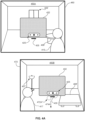
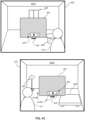
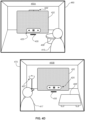
- FIGs. 4A-4J illustrate example interactions involving application-based spatial refinement in a multi-user communication session according to some examples of the disclosure.
- a three-dimensional environment 450A may be presented using first electronic device 460 and a three-dimensional environment 450B may be presented using second electronic device 470.
- the electronic devices 460/470 optionally correspond to electronic devices 360/370 discussed above.
- the three-dimensional environments 450A/450B include captured portions of the physical environments in which electronic devices 460/470 are located.
- the three-dimensional environment 450A optionally includes a table (e.g., a representation of table 406') and a window (e.g., representation of window 409'), and the three-dimensional environment 450B optionally includes a coffee table (e.g., representation of coffee table 408') and a floor lamp (e.g., representation of floor lamp 407').
- the three-dimensional environments 450A/450B optionally correspond to three-dimensional environments 350A/350B described above.
- the three-dimensional environments also include avatars 415/417 corresponding to users of the electronic devices 470/460.
- the avatars 415/417 optionally correspond to avatars 315/317 described above.
- the three-dimensional environments 450A/450B may include one or more virtual objects that are shared between the first electronic device 460 and the second electronic device 470 in the multi-user communication session.
- the three-dimensional environment 450A at the first electronic device 460 and the three-dimensional environment 450B at the second electronic device 470 may include an application window 432, which is optionally a video player user interface of a video player application running on the electronic devices 460/470.
- the shared application window 432 may include playback controls 425 in the three-dimensional environments 450A/450B that are selectable to control playback of the video content displayed in the shared application window 432. As shown in FIG.
- the shared application window 432 may be displayed with a grabber or handlebar affordance 435 which is optionally selectable to initiate movement of the shared application window 432 within the three-dimensional environments 450A/450B.
- the user of the first electronic device 460 and the user of the second electronic device 470 are able to view the video content in the application window 432 at their respective devices, as similarly described above.
- the three-dimensional environment 450A at the first electronic device 460 may include the avatar 415 corresponding to the user of the second electronic device 470
- the three-dimensional environment 450B at the second electronic device 470 may include the avatar 417 corresponding to the user of the first electronic device 460.
- the user of the first electronic device 460 and the user of the second electronic device 470 are viewing the video content in the shared application window 432 in the three-dimensional environments 450A/450B in FIG. 4A .
- the avatars 415/417 corresponding to the users are oriented to face toward the shared application window 432 in the three-dimensional environments 450A/450B.
- the avatar 415 corresponding to the user of the second electronic device 470 may be located to the right of the viewpoint of the user of the first electronic device 460 and may be oriented to face toward the shared application window 432, which is optionally located centrally within the three-dimensional environment 450A.
- the avatar 417 corresponding to the user of the first electronic device 460 may be located to the left of the viewpoint of the user of the second electronic device 470 and may also be oriented to face toward the shared application window 432, which is optionally also located centrally within the three-dimensional environment 450B, as shown in FIG. 4A .
- interaction input directed to the shared application window 432 causes the shared application window 432 to be moved within the shared three-dimensional environment.
- the shared application window 432 may be an object of a second type, different from the first type described above with reference to FIGs. 3A-3G .
- the shared application window 432 has a vertical orientation (e.g., a front-facing surface of the shared application window 432 is aligned to a vertical axis/plane) from the viewpoint of the users of the electronic devices 460/470, as shown in FIG. 4A .
- the shared three-dimensional environment is spatially refined depending on a manner (e.g., direction) of the movement directed to the shared application window 432, as described in detail below.
- the user of the second electronic device 470 optionally provides a selection input 472A directed to the grabber affordance 435, which is associated with the shared application window 432, in three-dimensional environment 450B, followed by a movement/drag input 474A.
- the user of the first electronic device 460 may provide a pinch gesture (e.g., using a hand of the user) while the gaze of the user is directed toward the shared application window 432, followed by movement of the hand of the user while maintaining the pinch gesture (or other selection input).
- the selection input 472A has one or more characteristics of the selection inputs described above.
- the movement input 474A optionally corresponds to movement of the shared application window 432 forward in the three-dimensional environment 450B and toward the viewpoint of the user of the second electronic device 470.
- the second electronic device 470 in response to receiving the movement input 474A, forgoes performing spatial refinement in the three-dimensional environment 450B (including the shared application window 432 and the avatar 417 corresponding to the user of the first electronic device 460). For example, as mentioned above, the second electronic device 470 performs spatial refinement in the three-dimensional environment 450B depending on a direction of the movement of the shared application window 432, which is an object of the second type (e.g., a vertically oriented object), in the three-dimensional environment 450B.
- a direction of the movement of the shared application window 432 which is an object of the second type (e.g., a vertically oriented object), in the three-dimensional environment 450B.
- the second electronic device 470 in accordance with a determination that the manner of the movement of the shared application window 432 is forward in the three-dimensional environment 450B (e.g., toward the viewpoint of the user of the second electronic device 470), the second electronic device 470 does not perform spatial refinement in the three-dimensional environment 450B.
- the second electronic device 470 does not display a planar element (e.g., disc), such as planar element 337 in FIGs. 3B-3C , below the shared application window 432 and the avatar 417 corresponding to the user of the first electronic device 460 in the three-dimensional environment 450B.
- a planar element e.g., disc
- the second electronic device 470 may move the shared application window 432 within the three-dimensional environment 450B in accordance with the movement input 474A, without moving the avatar 417 corresponding to the user of the first electronic device 460 or any other shared virtual objects.
- the second electronic device 470 displays the shared application window 432 at a location in the three-dimensional environment 450B that is closer to the viewpoint of the user of the second electronic device 470 (e.g., compared to that in FIG.
- the second electronic device 470 may scale the shared application window 432 in the three-dimensional environment 450B based on the movement of the shared application window 432. For example, in FIG. 4A , the shared application window 432 is displayed at a first size in the three-dimensional environment 450B (e.g., relative to the viewpoint of the user of the second electronic device 470) when the movement input 474A is received. As shown in FIG. 4B , after the movement of the shared application window 432 toward the viewpoint of the user of the second electronic device 470, the shared application window 432 is displayed at a second size, smaller than the first size.
- the second electronic device 470 scales the shared application window 432 in the three-dimensional environment 450B such that the video content displayed in the shared application window 432 occupies a same amount of a field of view of the user of the second electronic device 470 after the movement of the shared application window 432 within the three-dimensional environment 450B.
- the second electronic device 470 when the second electronic device 470 receives the input for moving the shared application window 432 in the three-dimensional environment 450B while the first electronic device 460 and the second electronic device 470 are in the multi-user communication session, the second electronic device 470 transmits an indication of the movement of the shared application window 432. In some examples, when the first electronic device 460 receives the indication of the movement, the first electronic device 460 moves the shared application window 432 in the three-dimensional environment 450A based on the movement of the shared application window 432 in the three-dimensional environment 450B at the second electronic device 470.
- the first electronic device 460 moves the shared application window 432 in the three-dimensional environment 450A instead of moving the avatar 415 corresponding to the user of the second electronic device 470 (e.g., which would have happened had the three-dimensional environment 450B been spatially refined at the second electronic device 470, as similarly described above).
- the first electronic device 460 moves the shared application window 432 in the three-dimensional environment 450A instead of moving the avatar 415 corresponding to the user of the second electronic device 470 (e.g., which would have happened had the three-dimensional environment 450B been spatially refined at the second electronic device 470, as similarly described above).
- the first electronic device 460 moves the shared application window 432 toward the viewpoint of the user of the first electronic device 460, such that a distance between the shared application window 432 in the three-dimensional environment 450A and the avatar 415 corresponding to the user of the second electronic device 470 is equal to or proportional to a distance between the shared application window 432 in the three-dimensional environment 450B and the viewpoint of the user of the second electronic device 470.
- the first electronic device 460 scales the shared application window 432 in the three-dimensional environment 450A when the shared application window 432 is moved closer to the viewpoint of the user of the first electronic device 460. For example, as similarly described above, the first electronic device 460 decreases a size of the shared application window 432 in the three-dimensional environment 450A when the shared application window 432 is moved closer to the viewpoint of the user of the first electronic device 460.
- the scaling of the shared application window 432 in the three-dimensional environment 450A is based on the scaling of the shared application window 432 in the three-dimensional environment 450B. For example, the size of the shared application window 432 in the three-dimensional environment 450A is equal to or proportional to the size of the shared application window 432 in the three-dimensional environment 450B.
- the shared application window 432 may alternatively be moved backward in the three-dimensional environment 450B and farther from the viewpoint of the user of the second electronic device 470.
- the second electronic device 470 may receive a selection input 472B directed to the grabber affordance 435 (and/or the shared application window 432) in the three-dimensional environment 450B, followed by a movement input 474B.
- the selection input 472B has one or more characteristics of the selection input 472A above and the movement input 474B has one or more characteristics of the movement input 474A above.
- the movement input 474B corresponds to movement of the shared application window 432 farther from the viewpoint of the user of the second electronic device 470.
- the shared application window 432 is an object of the second type (e.g., a vertically oriented object). As described above with reference to FIGs. 4A-4B , movement of an object of the second type closer to the viewpoint of the user does not cause the electronic device to perform spatial refinement in the shared three-dimensional environment. For example, as shown in FIG. 4B , movement of the shared application window 432 closer to the viewpoint of the user of the second electronic device 470 does not cause the second electronic device 470 to perform spatial refinement in the three-dimensional environment 450B. As shown in FIG.
- the second electronic device 470 in response to receiving the movement input 474B corresponding to movement of the shared application window 432 backward in the three-dimensional environment 450B and away from the viewpoint of the user of the second electronic device 470, the second electronic device 470 forgoes performing spatial refinement in the three-dimensional environment 450B.
- the second electronic device 470 may not display the planar element (e.g., planar element (disc) 337 in FIGs. 3B-3C ) below the shared application window 432 and the avatar 417 corresponding to the user of the first electronic device 460.
- the second electronic device 470 in response to receiving the movement input 474B, moves the shared application window 432 within the three-dimensional environment 450B in accordance with the movement input 474B, without moving the avatar 417 corresponding to the user of the first electronic device 460. For example, as shown in FIG. 4D , in response to receiving the movement input 474B, the second electronic device 470 moves the shared application window 432 within the three-dimensional environment 450B in accordance with the movement input 474B, without moving the avatar 417 corresponding to the user of the first electronic device 460. For example, as shown in FIG.
- the second electronic device 470 after detecting an end of the selection input 472B and/or an end of the movement input 474B (e.g., a deselection input, such as a release of the pinch gesture of the hand of the user), the second electronic device 470 displays the shared application window 432 at a location in the three-dimensional environment 450B that is farther from the viewpoint of the user of the second electronic device 470 (e.g., compared to that in FIG. 4C ). Additionally, as shown in FIG. 4D , as similarly described above, the second electronic device 470 may scale the shared application window 432 in the three-dimensional environment 450B based on the movement of the shared application window 432. For example, in FIG.
- the shared application window 432 is displayed at a first size in the three-dimensional environment 450B (e.g., relative to the viewpoint of the user of the second electronic device 470) when the movement input 474B is received.
- the shared application window 432 is displayed at a second size, larger than the first size.
- the second electronic device 470 scales the shared application window 432 in the three-dimensional environment 450B such that the video content displayed in the shared application window 432 occupies a same amount of a field of view of the user of the second electronic device 470 after the movement of the shared application window 432 within the three-dimensional environment 450B, as previously discussed above.
- the second electronic device 470 when the second electronic device 470 receives the input for moving the shared application window 432 in the three-dimensional environment 450B while the first electronic device 460 and the second electronic device 470 are in the multi-user communication session, the second electronic device 470 transmits an indication of the movement of the shared application window 432. In some examples, when the first electronic device 460 receives the indication of the movement, the first electronic device 460 moves the shared application window 432 in the three-dimensional environment 450A based on the movement of the shared application window 432 in the three-dimensional environment 450B at the second electronic device 470.
- the first electronic device 460 moves the shared application window 432 in the three-dimensional environment 450A instead of moving the avatar 415 corresponding to the user of the second electronic device 470 (e.g., which would have happened had the three-dimensional environment 450B been spatially refined at the second electronic device 470, as similarly described above).
- the first electronic device 460 moves the shared application window 432 in the three-dimensional environment 450A instead of moving the avatar 415 corresponding to the user of the second electronic device 470 (e.g., which would have happened had the three-dimensional environment 450B been spatially refined at the second electronic device 470, as similarly described above).
- the first electronic device 460 moves the shared application window 432 away from the viewpoint of the user of the first electronic device 460, such that a distance between the shared application window 432 in the three-dimensional environment 450A and the avatar 415 corresponding to the user of the second electronic device 470 is equal to or proportional to a distance between the shared application window 432 in the three-dimensional environment 450B and the viewpoint of the user of the second electronic device 470.
- the first electronic device 460 scales the shared application window 432 in the three-dimensional environment 450A when the shared application window 432 is moved farther from the viewpoint of the user of the first electronic device 460. For example, as similarly described above, the first electronic device 460 increases a size of the shared application window 432 in the three-dimensional environment 450A when the shared application window 432 is moved farther from the viewpoint of the user of the first electronic device 460, as shown in FIG. 4D .
- the scaling of the shared application window 432 in the three-dimensional environment 450A is based on the scaling of the shared application window 432 in the three-dimensional environment 450B. For example, as shown in FIG. 4D , the size of the shared application window 432 in the three-dimensional environment 450A is equal to or proportional to the size of the shared application window 432 in the three-dimensional environment 450B.
- the electronic device when interaction input is directed to an object of the second type (e.g., a vertically oriented object, such as the shared application window 432), the electronic device performs spatial refinement in the shared three-dimensional environment based on the manner (e.g., direction) of the movement of the object in the shared three-dimensional environment. For example, as discussed above, movement of the shared application window 432 forward or backward in the three-dimensional environment 450B (e.g., toward or away from the viewpoint of the user of the second electronic device 470) causes the second electronic device 470 to forgo performing spatial refinement in the three-dimensional environment 450B.
- the shared application window 432 forward or backward in the three-dimensional environment 450B (e.g., toward or away from the viewpoint of the user of the second electronic device 470) causes the second electronic device 470 to forgo performing spatial refinement in the three-dimensional environment 450B.
- the second electronic device 470 may move the shared application window 432 in the three-dimensional environment 450B in accordance with the movement input without moving the avatar 417 corresponding to the user of the first electronic device 460, which causes the first electronic device 460 to also move the shared application window 432 in the three-dimensional environment 450A based on the movement input received at the second electronic device. It may be advantageous to implement the behavior outlined above for forward and backward movement to help avoid situations in which movement of a user's avatar in the shared three-dimensional environment causes the avatar to at least partially obstruct or distract from the shared content displayed in the application window. Attention is now directed toward example interactions with the shared application window 432 that result in spatial refinement in the shared three-dimensional environment.
- the second electronic device 470 may receive a selection input 472C directed to the grabber affordance 435 (and/or the shared application window 432), followed by movement input 474C.
- the second electronic device 470 detects a pinch gesture provided by a hand of the user of the second electronic device while the gaze of the user is directed to the shared application window 432 in the three-dimensional environment 450B, followed by movement of the hand of the user while maintaining the pinch gesture.
- a pinch gesture provided by a hand of the user of the second electronic device while the gaze of the user is directed to the shared application window 432 in the three-dimensional environment 450B, followed by movement of the hand of the user while maintaining the pinch gesture.
- the movement input 474C may correspond to movement of the shared application window 432 radially around the viewpoint of the user of the second electronic device 470 (e.g., rightward along a perimeter of a circle centered at the viewpoint of the user of the second electronic device 470).
- the second electronic device 470 in response to receiving the movement input 474C directed to the shared application window 432, performs spatial refinement in the three-dimensional environment 450B.
- movement of the shared application window 432 also causes movement of the avatar 417 corresponding to the user of the first electronic device 460 in the three-dimensional environment 450B.
- the second electronic device 470 spatially refines the three-dimensional environment 450B including the shared application window 432, which is an object of the second type (e.g., a vertically oriented object), because the movement input 474C corresponds to movement of the shared application window 432 radially to the right relative to the viewpoint of the user of the second electronic device 470.
- the movement input 474C optionally does not correspond to movement of the shared application window 432 forward or backward along a line from the viewpoint of the user of the second electronic device 470, as previously discussed with reference to FIGs. 4A-4D .
- the second electronic device 470 may display the planar element (e.g., disc) 437 below the object(s) selected for spatial refinement in three-dimensional environment 450B.
- the disc 437 is displayed below the shared application window 432 and the avatar 417 corresponding to the user of the first electronic device 460 in the three-dimensional environment 450B.
- the movement input 474C is optionally rightward radially around the viewpoint of the user of the second electronic device 470 in three-dimensional environment 450B.
- the second electronic device 470 in response to the movement input 474C, moves the shared application window 432 rightward radially around the viewpoint 418B of the user of the second electronic device 470 in the three-dimensional environment 450B in accordance with the movement input 474C.
- the second electronic device 470 changes an orientation of the shared application window 432 after the movement of the shared application window 432 in the three-dimensional environment 450B. For example, as previously discussed above with reference to FIG.
- the shared application window 432 has a first orientation that is angled toward the user of the second electronic device 470 (e.g., a front-facing surface of the shared application window 432 is facing toward the viewpoint of the user) when the movement input 474C is received in FIG. 4E .
- FIG. 4F when the second electronic device 470 moves the shared application window 432 in accordance with the movement input 474C, the second electronic device 470 displays the shared application window 432 with a second orientation, different from the first orientation, such that the shared application window 432 continues to face toward the viewpoint 418B of the user of the second electronic device 470.
- the second electronic device 470 rotates the shared application window 432 about a vertical axis 485 through the viewpoint 418B of the user of the second electronic device 470 in the three-dimensional environment 450B (e.g., such that the shared application window 432 continues to face toward the viewpoint 418B of the user while maintaining the same distance from the viewpoint 418B).
- the second electronic device 470 does not change the size of the shared application window 432 in the three-dimensional environment 450B.
- the movement input 474C corresponds to movement of the shared application window 432 along a circle centered at the viewpoint 418B of the user of the second electronic device 470
- a distance between the shared application window 432 and the viewpoint 418B of the user does not change in the three-dimensional environment 450B when the shared application window is moved.
- the second electronic device 470 does not scale the shared application window 432 in response to the movement input 474C.
- the second electronic device 470 moves the avatar 417 corresponding to the user of the first electronic device 460 in the three-dimensional environment 450B and displays the avatar 417 with an orientation that faces toward the shared application window 432 in the three-dimensional environment 450B.
- the second electronic device 470 spatially refines the three-dimensional environment 450B in response to the movement input 474C
- the second electronic device 470 moves the avatar 417 and the shared application window 432 radially rightward in the three-dimensional environment 450B, which includes rotating the shared application window 432 and the avatar 417.
- the second electronic device 470 may translate the avatar 417 and rotate (e.g., as represented by arrow 475B) the avatar 417 by a same radial amount as the rotation of the shared application window 432 about the vertical axis 485 discussed above.
- the first electronic device 460 rotates the avatar 415 corresponding to the user of the second electronic device 470 within three-dimensional environment 450A based on the movement of the shared application window 432 at the second electronic device 470.
- the first electronic device 460 rotates the avatar 415 (e.g., as represented by arrow 475A) relative to the viewpoint 418A of the user of the first electronic device 460 (e.g., about a vertical axis through the avatar 415) based on the radial movement of the shared application window 432 in the three-dimensional environment 450B.
- a radial amount that the rotation of the avatar 415 in the three-dimensional environment 450A is equal to or proportional to the radial amount of the rotation of the shared application window 432 at the second electronic device 470.
- the first electronic device 460 when the first electronic device 460 rotates the avatar 415 in the three-dimensional environment 450A, the first electronic device 460 does not move (or rotate) the shared application window 432 in the three-dimensional environment 450A. For example, as shown in FIG. 4F , when the first electronic device 460 moves the avatar 415 in the three-dimensional environment 450A, the first electronic device 460 maintains display of the shared application window 432 centrally within the three-dimensional environment 450A. Further, the first electronic device 460 does not scale the shared application window 432 when the avatar 415 is rotated in the three-dimensional environment 450A. For example, as shown in FIG. 4F , the first electronic device 460 may maintain display of the shared application window 432 with a same size as before the movement input 474C was detected (e.g., in FIG. 4E ).
- orientations of the faces of the avatars 415/417 are utilized in FIG. 4F to indicate (e.g., changes to) the respective orientations of the avatars 415/417 of the users within the three-dimensional environments 450A/450B
- additional or alternative characteristics of the avatars 415/417 may be utilized to convey changes to the respective orientations of the avatars 415/417.
- the torso e.g., including the shoulders, arms, and/or chest
- the torso may indicate the respective orientations of the avatars within the three-dimensional environments 450A/450B.
- the lower-body (e.g., including the hips, legs, and/or feet) of each of the avatars may indicate the respective orientations of the avatars within the three-dimensional environments 450A/450B.
- the electronic device in response to receiving an interaction input that includes movement of the shared application window radially in the shared three-dimensional environment about the viewpoint of the user, performs spatial refinement in the shared three-dimensional environment. For example, spatially refining the shared application window 432 at the second electronic device 470 in response to the movement input 474C does not cause the avatar 415 to interfere with the user's view (e.g., at viewpoint 418A) of the video content at the first electronic device 460. As shown in FIG.
- the avatar 415 is rotated at the first electronic device 460 based on the radial movement of the shared application window 432 at the second electronic device 470, which optionally does not cause the avatar 415 to occlude, obscure, or distract from the video content in the shared application window 432 in the three-dimensional environment 450A.
- the above-described behavior applies for radial movement leftward (e.g., in the opposite direction than that shown in FIGs. 4E-4F ).
- the second electronic device 470 may perform spatial refinement in the three-dimensional environment 450B and move the shared application window 432 and the avatar 417 radially leftward in the three-dimensional environment 450B in accordance with the movement.
- the second electronic device 470 may rotate the shared application window 432 and the avatar 417 in addition to the leftward radial movement (e.g., translation) of the shared application window 432 and the avatar 417 (e.g., about a vertical axis through the viewpoint 418B of the user of the second electronic device 470).
- the first electronic device 460 may forgo moving the shared application window 432 in the three-dimensional environment 450A but may rotate the avatar 415 corresponding to the user of the second electronic device 470 (e.g., about a vertical axis through the avatar 415) based on the leftward radial movement detected at the second electronic device 470, as similarly described above.
- the shared application window 432 may alternatively be moved laterally within the shared three-dimensional environment while the first electronic device 460 and the second electronic device 470 are in the multi-user communication session.
- the second electronic device 470 may receive a selection input 472D directed to the grabber affordance 435 (and/or the shared application window 432) in the three-dimensional environment 450B, followed by a movement input 474D (e.g., while the gaze of the user of the second electronic device 470 is directed to the shared application window 432).
- the selection input 472D has one or more characteristics of the selection input 472C above
- the movement input 474D has one or more characteristics of the movement input 474C above.
- the movement input 474D optionally corresponds to lateral (e.g., rightward) movement of the shared application window 432 in the three-dimensional environment 450B relative to the viewpoint of the user of the second electronic device 470.
- the second electronic device 470 determines a manner of the movement directed to the shared application window 432.
- the shared application window 432 is optionally an object of the second type (e.g., a vertically oriented object relative to the viewpoint of the user)
- the second electronic device 470 evaluates a direction of the movement of the shared application window 432 in the three-dimensional environment 450B.
- the second electronic device 470 performs spatial refinement in the three-dimensional environment 450B.
- movement of the shared application window 432 also causes movement of the avatar 417 corresponding to the user of the first electronic device 460 in the three-dimensional environment 450B.
- the second electronic device 470 may display the planar element (e.g., disc) 437 below the object(s) selected for spatial refinement in three-dimensional environment 450B.
- the disc 437 is displayed below the shared application window 432 and the avatar 417 corresponding to the user of the first electronic device 460 in the three-dimensional environment 450B.
- the movement input 474D is optionally rightward relative to the viewpoint of the user of the second electronic device 470 in three-dimensional environment 450B.
- the second electronic device 470 in response to the movement input 474D, moves the shared application window 432 rightward in the three-dimensional environment 450B relative to the viewpoint 418B of the user of the second electronic device 470 in accordance with the movement input 474D.
- the second electronic device 470 changes an orientation of the shared application window 432 after or during the movement of the shared application window 432 in the three-dimensional environment 450B. For example, as previously discussed above with reference to FIG.
- the shared application window 432 has a first orientation that is angled toward the user of the second electronic device 470 (e.g., a front-facing surface of the shared application window 432 is facing toward the viewpoint of the user) when the movement input 474D is received in FIG. 4G .
- the second electronic device 470 displays the shared application window 432 with a second orientation, different from the first orientation, such that the shared application window 432 continues to face toward the viewpoint 418B of the user of the second electronic device 470.
- the second electronic device 470 rotates the shared application window 432 about a vertical axis 485 through the viewpoint 418B of the user of the second electronic device 470 in the three-dimensional environment 450B (e.g., a vertical axis through a center of the shared application window 432).
- the rightward movement input 474D includes changing the distance between the viewpoint 418B of the user of the second electronic device 470, which does not cause the second electronic device to perform spatial refinement and moving the shared application window radially rightward (e.g., along a circle centered at the viewpoint 418B), which does cause the second electronic device to perform spatial refinement.
- the second electronic device 470 scales the shared application window 432 in the three-dimensional environment 450B. For example, because the movement input 474D corresponds to movement of the shared application window 432 rightward relative to the viewpoint 418B of the user of the second electronic device 470, a distance between the shared application window 432 and the viewpoint 418B of the user increases in the three-dimensional environment 450B when the shared application window 432 is moved.
- the second electronic device 470 increases the size of the shared application window 432 in response to the movement input 474D (e.g., such that the portion of the user's field of view that is occupied by the video content in the shared application window 432 remains consistent after the movement of the shared application window), as shown in FIG. 4H and as similarly discussed above. Further, as mentioned above, the second electronic device 470 moves the avatar 417 corresponding to the user of the first electronic device 460 in the three-dimensional environment 450B and displays the avatar 417 with an orientation that faces toward the shared application window 432 in the three-dimensional environment 450B.
- the second electronic device 470 when the second electronic device 470 spatially refines the three-dimensional environment 450B in response to the movement input 474D, the second electronic device 470 moves the avatar 417 and the shared application window 432 radially rightward in the three-dimensional environment 450B, which includes rotating the shared application window 432 and the avatar 417.
- the second electronic device 470 may translate the avatar 417 and rotate (e.g., as represented by arrow 475D) the avatar 417 by a same radial amount as the rotation of the shared application window 432 about the vertical axis 485 of the user of the second electronic device 470 discussed above.
- the first electronic device 460 rotates the avatar 415 corresponding to the user of the second electronic device 470 within three-dimensional environment 450A based on the movement of the shared application window 432 at the second electronic device 470.
- the first electronic device 460 rotates the avatar 415 (e.g., as represented by arrow 475C) relative to the viewpoint 418A of the user of the first electronic device 460 based on the rotation of the shared application window 432 in the three-dimensional environment 450B.
- a radial amount that the rotation of the avatar 415 in the three-dimensional environment 450A is equal to or proportional to the radial amount of the rotation of the shared application window 432 at the second electronic device 470.
- the first electronic device 460 moves the shared application window 432 in the three-dimensional environment 450A.
- the first electronic device 460 increases a distance between the shared application window 432 and the viewpoint 418A of the user of the first electronic device 460 in the three-dimensional environment 450A (e.g., moves the shared application window 432 backward in the three-dimensional environment 450A).
- the distance that the shared application window 432 is moved in the three-dimensional environment 450A is based on (e.g., is equal or proportional to) the distance that the shared application window 432 is moved away from the viewpoint 418B of the user of the second electronic device 470, as similarly discussed above.
- the first electronic device 460 scales the shared application window 432 when the avatar 415 is moved in the three-dimensional environment 450A. For example, as shown in FIG.
- the first electronic device 460 increases the size of the shared application window 432 in the three-dimensional environment 450A based on the scaling of the shared application window 432 at the second electronic device 470 (e.g., such that the size of the shared application window 432 is equal or proportional between the three-dimensional environments 450A/450B).
- the electronic device in response to receiving an interaction input that includes movement of the shared application window laterally in the shared three-dimensional environment about the viewpoint of the user, performs spatial refinement in the shared three-dimensional environment. For example, spatially refining the shared application window 432 at the second electronic device 470 in response to the movement input 474D does not cause the avatar 415 to interfere with the user's view (e.g., at viewpoint 418A) of the video content at the first electronic device 460. As shown in FIG.
- the avatar 415 rotates based on the rightward movement of the shared application window 432 at the second electronic device 470, which optionally does not cause the avatar 415 to occlude, obscure, or distract from the video content in the shared application window 432 in the three-dimensional environment 450A. Attention is now directed to examples of interaction inputs that include upward movement of the shared application window 432 in the shared three-dimensional environment.
- the shared application window 432 may alternatively be elevated in the three-dimensional environment 450B relative to the viewpoint of the user of the second electronic device 470.
- the second electronic device 470 may receive a selection input 472E directed to the grabber affordance 435 (and/or the shared application window 432), followed by movement input 474E.
- the second electronic device 470 detects a pinch gesture provided by a hand of the user of the second electronic device while the gaze of the user is directed to the shared application window 432 in the three-dimensional environment 450B, followed by raising of the hand of the user while maintaining the pinch gesture.
- a pinch gesture provided by a hand of the user of the second electronic device while the gaze of the user is directed to the shared application window 432 in the three-dimensional environment 450B, followed by raising of the hand of the user while maintaining the pinch gesture.
- the movement input 474E may correspond to movement of the shared application window 432 radially upward in the three-dimensional environment 450B relative to the viewpoint of the user of the second electronic device 470 (e.g., heightening of the shared application window 432 in the three-dimensional environment 450B without any change in distance between the viewpoint 418B of the user of the second electronic device 470 and the shared application window 432).
- the second electronic device 470 spatially refines the three-dimensional environment 450B (including the shared application window 432) depending on the manner in which the shared application window 432 is moved in the three-dimensional environment 450B. As discussed above, the second electronic device 470 spatially refines the three-dimensional environment 450B (including the shared application window 432) in response to receiving movement input that corresponds to radial movement of the shared application window 432 (e.g., in FIGs. 4E-4F ) or lateral movement of the shared application window 432 (e.g., in FIGs. 4G-4H ).
- the second electronic device 470 optionally does not spatially refine the shared application window 432 in the three-dimensional environment 450B in response to receiving movement input that corresponds to forward or backward movement of the application window 432 relative to the viewpoint of the user of the second electronic device 470 (e.g., in FIGs. 4A-4D ). As discussed below, the second electronic device 470 may not spatially refine the three-dimensional environment 450B (including the shared application window 432) in response to receiving movement input that corresponds to radial upward or downward movement of the application window 432 relative to the viewpoint of the user of the second electronic device 470.
- the second electronic device 470 in response to receiving the movement input 474E directed to the shared application window 432, the second electronic device 470 forgoes performing spatial refinement in the three-dimensional environment 450B.
- the second electronic device 470 optionally does not display the planar element (e.g., disc) 437 below the avatar 417 corresponding to the user of the first electronic device 460 and the shared application window 432.
- the second electronic device 470 moves the shared application window 432 in the three-dimensional environment 450B in accordance with the movement input 474E without moving the avatar 417.
- the second electronic device 470 moves the shared application window 432 in the three-dimensional environment 450B in accordance with the movement input 474E without moving the avatar 417.
- the second electronic device 470 raises/elevates the shared application window 432 in the three-dimensional environment 450B relative to the viewpoint 418B of the user of the second electronic device 470 in accordance with the movement input 474E. Further, as alluded to above, the second electronic device 470 forgoes moving the avatar 417 in accordance with the movement input 474E. For example, the second electronic device 470 does not raise/elevate the avatar 417 in the three-dimensional environment 450B.
- the second electronic device 470 when the second electronic device 470 raises/elevates the shared application window 432 in the three-dimensional environment 450B in accordance with the movement input 474E, the second electronic device 470 angles the shared application window 432 downward to continue facing the viewpoint 418B of the user of the second electronic device 470.
- the second electronic device 470 rotates the shared application window 432 about a horizontal axis 485D through the viewpoint 418B of the user of second electronic device 470 , such that the front-facing surface of the shared application window 432 is oriented to face the viewpoint 418B of the user of the second electronic device 470 while maintaining the same distance from the new height in the three-dimensional environment 450B.
- the second electronic device 470 forgoes scaling the shared application window 432 in response to the movement input 474E. For example, as discussed previously above, the second electronic device 470 scales the shared application window 432 in the three-dimensional environment 450B when the distance between a location of the shared application window 432 and the viewpoint 418B of the user of the second electronic device 470 changes (e.g., increases or decreases) because of the movement of the shared application window 432. In FIG.
- the second electronic device 470 does not change a size at which the shared application window 432 is displayed in the three-dimensional environment 450B.
- the first electronic device 460 moves the shared application window 432 in the three-dimensional environment 450A based on the movement input 474E received at the second electronic device 470, without moving the avatar 415 corresponding to the user of the second electronic device 470.
- the second electronic device 470 transmits an indication of the movement input 474E received at the second electronic device 470.
- the first electronic device 460 may radially raise/elevate the shared application window 432 in the three-dimensional environment 450A by a height that is equal to or proportional to the height the shared application window 432 is raised in the three-dimensional environment 450B at the second electronic device 470.
- the first electronic device 460 does not raise/elevate the avatar 415 in the three-dimensional environment 450A.
- the first electronic device angles the shared application window 432 downward in the three-dimensional environment 450A to face toward the viewpoint 418A of the user of the first electronic device 460.
- the first electronic device 460 rotates the shared application window 432 about a horizontal axis 485C through the viewpoint 418A of the user of the first electronic device 460, such that a front-facing surface of the shared application window 432 is oriented toward the viewpoint 418A of the user of the first electronic device 460 while maintaining the same distance in the three-dimensional environment 450A.
- the first electronic device 460 forgoes scaling the shared application window 432 in the three-dimensional environment 450A. For example, because the second electronic device 470 did not scale the shared application window 432 in the three-dimensional environment 450B at the second electronic device 470 in response to the movement input 474E, the first electronic device 460 performs similarly and does not change the size of the shared application window 432 in the three-dimensional environment 450A.
- the electronic device in response to receiving an interaction input that includes movement of the shared application window upward or downward in the shared three-dimensional environment relative to the viewpoint of the user, the electronic device forgoes performing spatial refinement in the shared three-dimensional environment.
- spatially refining the shared application window 432 at the second electronic device 470 in response to the movement input 474E may cause the avatar 415 to interfere with the user's view (e.g., at viewpoint 418A) of the video content at the first electronic device 460.
- the avatar 415 were raised/elevated in FIG.
- the avatar 415 could occlude, obscure, or distract from the video content in the shared application window 432 in the three-dimensional environment 450A. Accordingly, the shared application window 432 is moved at both electronic devices 460/470 in response to the movement input 474E, without moving the avatars 415/417 corresponding to the users of the electronic devices 460/470.
- the shared application window 432 in response to detecting radial lateral movement of the shared application window 432, as shown in FIGs.
- the second electronic device 470 performs spatial refinement in the three-dimensional environment 450B, but in response to detecting radial vertical movement of the shared application window 432, as shown in FIGs. 4I-4J , the second electronic device 470 forgoes performing spatial refinement in the three-dimensional environment 450B.
- the shared application window 432 may alternatively be moved vertically in a non-radial manner in the shared three-dimensional environment.
- the movement input 474E may correspond to vertical movement in the three-dimensional environment 450B that causes the distance between the application window 432 and the viewpoint of the user of the second electronic device 470 to change.
- the second electronic device 470 would still forgo performing spatial refinement in the three-dimensional environment 450B (e.g., would move the shared application window 432 without moving the avatar 417) but would also scale the shared application window 432 in the three-dimensional environment 450B.
- the shared application window 432 may alternatively be moved vertically in a non-radial manner in the shared three-dimensional environment.
- the movement input 474E may correspond to vertical movement in the three-dimensional environment 450B that causes the distance between the application window 432 and the viewpoint of the user of the second electronic device 470 to change.
- the second electronic device 470 would still forgo performing spatial refinement in the three-dimensional environment 450B (e.g., would move
- the second electronic device 470 would increase the size of the shared application window 432 in the three-dimensional environment 450B (e.g., in addition to rotating the shared application window 432 in the three-dimensional environment 450B as described above with reference to FIG. 4I ).
- the first electronic device 460 may also scale the shared application window 432 in the three-dimensional environment 450A when the shared application window 432 is moved vertically relative to the viewpoint of the user of the first electronic device 460 based on the movement input detected at the second electronic device 470 (e.g., and without moving the avatar 415 because spatial refinement is not being performed).
- the shared three-dimensional environment may alternatively include an object of the first type (e.g., a horizontally oriented object).
- a shared virtual object that is an object of the first type may also be moved vertically in the shared three-dimensional environment. For example, referring back to FIG. 3C , if the movement input 374A alternatively corresponds to movement of the shared virtual object 314 upward in the three-dimensional environment 350A relative to the viewpoint of the user of the first electronic device 360, the first electronic device 360 would similarly forgo performing spatial refinement in the three-dimensional environment 350A.
- the first electronic device 360 would move the shared virtual object 314 upward in the three-dimensional environment 350A relative to the viewpoint of the user in accordance with the movement input without moving the avatar 315 corresponding to the user of the second electronic device 370.
- the second electronic device 370 would move the shared virtual object 314 upward in the three-dimensional environment 350B based on the movement input detected at the first electronic device 360 without moving the avatar 317 corresponding to the user of the first electronic device 360.
- the first electronic device 360 does not change an orientation of the shared virtual object 314 in response to the upward movement of the shared virtual object 314 in the three-dimensional environment 350A.
- the first electronic device 360 maintains the horizontal orientation of the shared virtual object 314 in the three-dimensional environment 350A relative to the viewpoint of the user of the first electronic device 360.
- the second electronic device 370 may not change the orientation of the shared virtual object 314 in the three-dimensional environment 350B when the second electronic device 370 moves the shared virtual object 314 upward relative to the viewpoint of the user of the second electronic device 370.
- the disclosed method enables users in a multi-user communication session to interact with shared content intuitively and efficiently, including moving the shared content, without affecting any one user's viewpoint and/or experience of the shared content, as one advantage. Additionally, the disclosed method promotes and maintains spatial truth for the users in the multi-user communication session, which enhances the users' experience within the communication session by modeling real-world interactions that would occur if the users were physically located in the same physical environment.
- the examples shown and described herein are merely exemplary and that additional and/or alternative elements may be provided within the three-dimensional environment for interacting with the content and/or the avatars.
- the appearance, shape, form, and size of each of the various user interface elements and objects shown and described herein are exemplary and that alternative appearances, shapes, forms and/or sizes may be provided.
- the virtual objects representative of application windows e.g., 324 and 432 may be provided in an alternative shape than a rectangular shape, such as a circular shape, triangular shape, etc.
- the various selectable affordances may be selected verbally via user verbal commands (e.g., "select grabber bar” or "select virtual object” verbal command).
- user verbal commands e.g., "select grabber bar” or "select virtual object” verbal command.
- the various options, user interface elements, control elements, etc. described herein may be selected and/or manipulated via user input received via one or more separate input devices in communication with the electronic device(s). For example, selection input may be received via physical input devices, such as a mouse, trackpad, keyboard, etc. in communication with the electronic device(s).
- the above methods are described with reference to two electronic devices, the above methods optionally apply for two or more electronic devices communicatively linked in a communication session.
- the above methods optionally apply for two or more electronic devices communicatively linked in a communication session.
- the above methods optionally apply for two or more electronic devices communicatively linked in a communication session.
- the above methods optionally apply for two or more electronic devices communicatively linked in a communication session.
- the above methods optionally apply for two or more electronic devices communicatively linked in a communication session.
- a shared object of the first type e.g., a horizontally oriented object, such as virtual object 314
- the movement input moves the shared object and the other users' avatars at the electronic device
- a shared object of the second type e.g., a vertically oriented object, such as application window 432
- the movement input moves the avatars corresponding to the users of the other electronic devices and the shared object at the electronic device depending on the manner (e.g., direction
- the movement input moves the shared object at the electronic device without moving the avatars corresponding to the users of the other electronic devices.
- FIG. 5 illustrates a flow diagram illustrating an example process for application-based spatial refinement in a multi-user communication session at an electronic device according to some examples of the disclosure.
- process 500 begins at a first electronic device in communication with a display, one or more input devices, and a second electronic device.
- the first electronic device and the second electronic device are optionally a head-mounted display, respectively, similar or corresponding to devices 260/270 of FIG. 2 .
- the first electronic device while in a communication session with the second electronic device, the first electronic device presents, via the display, a computer-generated environment including an avatar corresponding to a user of the second electronic device and a first shared object.
- the first electronic device displays a three-dimensional environment, such as three-dimensional environment 350A that includes the avatar 315 and the shared virtual object 314 in FIG. 3A .
- the first electronic device while displaying the computer-generated environment including the avatar corresponding to the user of the second electronic device and the first shared object, receives, via the one or more input devices, a first input corresponding to a request to move the first shared object in a first manner (e.g., forward movement) in the computer-generated environment. For example, the first electronic device receives a selection input, followed by a movement input directed to the first shared object, such as the movement input 374A directed to the shared virtual object 314 in the three-dimensional environment 450A as shown in FIG. 3B .
- the first electronic device moves the avatar and the first shared object in the computer-generated environment in the first manner in accordance with the first input. For example, if the first electronic device determines that the first shared object is an object of the first type, such as a horizontally oriented object (e.g., shared virtual object 314), the first electronic device performs spatial refinement in the computer-generated environment. In some examples, performing spatial refinement includes moving the first shared object and the avatar in the three-dimensional environment in accordance with the movement input, such as the forward movement of the shared virtual object 314 and the avatar 315 in the three-dimensional environment 350A as shown in FIG. 3C .
- performing spatial refinement includes moving the first shared object and the avatar in the three-dimensional environment in accordance with the movement input, such as the forward movement of the shared virtual object 314 and the avatar 315 in the three-dimensional environment 350A as shown in FIG. 3C .
- the first electronic device moves the first shared object in the computer-generated environment in the first manner in accordance with the first input without moving the avatar. For example, if the first electronic device determines that the first shared object is an object of the second type, such as a vertically oriented object (e.g., shared application window 432 in FIG. 4A ), and that the first input correspond to a change in distance between the first shared object, as similarly shown in FIG. 4A , or vertical radial movement, as similarly shown in FIG.
- the second type such as a vertically oriented object (e.g., shared application window 432 in FIG. 4A )
- the first input correspond to a change in distance between the first shared object, as similarly shown in FIG. 4A , or vertical radial movement, as similarly shown in FIG.
- the first electronic device forgoes performing spatial refinement in the computer-generated environment.
- forgoing performing spatial refinement includes moving the first shared object in the three-dimensional environment without moving the avatar corresponding to the user of the second electronic device, such as the forward movement of the shared application window 432 in the three-dimensional environment 450B as shown in FIG. 4B .
- process 500 is an example and that more, fewer, or different operations can be performed in the same or in a different order. Additionally, the operations in process 500 described above are, optionally, implemented by running one or more functional modules in an information processing apparatus such as general-purpose processors (e.g., as described with respect to FIG. 2 ) or application specific chips, and/or by other components of FIG. 2 .
- an information processing apparatus such as general-purpose processors (e.g., as described with respect to FIG. 2 ) or application specific chips, and/or by other components of FIG. 2 .
- FIG. 6 illustrates a flow diagram illustrating an example process for application-based spatial refinement in a multi-user communication at an electronic device according to some examples of the disclosure.
- process 600 begins at a first electronic device in communication with a display, one or more input devices, and a second electronic device.
- the first electronic device and the second electronic device are optionally a head-mounted display, respectively, similar or corresponding to devices 260/270 of FIG. 2 .
- the first electronic device presents, via the display, a computer-generated environment including an avatar corresponding to a user of the second electronic device and a first shared object.
- the first electronic device displays a three-dimensional environment, such as three-dimensional environment 350B that includes the avatar 317 and the shared virtual object 314 in FIG. 3A .
- the first electronic device while displaying the computer-generated environment including the avatar corresponding to the user of the second electronic device and the first shared object, receives, from the second electronic device, a first indication corresponding to movement of the first shared object in accordance with first movement input received at the second electronic device. For example, the first electronic device receives an indication that the second electronic device has received movement input directed to the first shared object displayed at the second electronic device, such as movement input 374A directed to the shared virtual object 314 in the three-dimensional environment 350A as shown in FIG. 3B .
- the first electronic device moves the avatar in the computer-generated environment in accordance with the first movement input without moving the first shared object. For example, if the first electronic device determines that the first shared object is an object of the first type, such as a horizontally oriented object (e.g., shared virtual object 314), the first electronic device performs spatial refinement in the computer-generated environment.
- the first electronic device determines that the first shared object is an object of the first type, such as a horizontally oriented object (e.g., shared virtual object 314), the first electronic device performs spatial refinement in the computer-generated environment.
- performing spatial refinement includes moving the avatar, without moving the first shared object, in the three-dimensional environment in accordance with the movement input received at the second electronic device, such as the forward movement of the avatar 317 in the three-dimensional environment 350B based on the movement input 374A as shown in FIG. 3C .
- the first electronic device moves the first shared object in the computer-generated environment in accordance with the first movement input without moving the avatar. For example, if the first electronic device determines that the first shared object is an object of the second type, such as a vertically oriented object (e.g., shared application window 432 in FIG. 4A ), and that the first input correspond to a change in distance between the first shared object, as similarly shown in FIG. 4A , or vertical radial movement, as similarly shown in FIG. 41, the first electronic device forgoes performing spatial refinement in the computer-generated environment.
- the second type such as a vertically oriented object (e.g., shared application window 432 in FIG. 4A )
- the first input correspond to a change in distance between the first shared object, as similarly shown in FIG. 4A , or vertical radial movement, as similarly shown in FIG. 41
- the first electronic device forgoes performing spatial refinement in the computer-generated environment.
- forgoing performing spatial refinement includes moving the first shared object in the three-dimensional environment without moving the avatar corresponding to the user of the second electronic device, such as the forward movement of the shared application window 432 in the three-dimensional environment 450A based on the movement input 474A as shown in FIG. 4B .
- process 600 is an example and that more, fewer, or different operations can be performed in the same or in a different order. Additionally, the operations in process 600 described above are, optionally, implemented by running one or more functional modules in an information processing apparatus such as general-purpose processors (e.g., as described with respect to FIG. 2 ) or application specific chips, and/or by other components of FIG. 2 .
- an information processing apparatus such as general-purpose processors (e.g., as described with respect to FIG. 2 ) or application specific chips, and/or by other components of FIG. 2 .
- some examples of the disclosure are directed to a method comprising, at a first electronic device in communication with a display, one or more input devices, and a second electronic device: while in a communication session with the second electronic device, presenting, via the display, a computer-generated environment including an avatar corresponding to a user of the second electronic device and a first shared object; while displaying the computer-generated environment including the avatar corresponding to the user of the second electronic device and the first shared object, receiving, via the one or more input devices, a first input corresponding to a request to move the first shared object in a first manner in the computer-generated environment; and in response to receiving the first input, in accordance with a determination that the first shared object is an object of a first type, moving the avatar and the first shared object in the computer-generated environment in the first manner in accordance with the first input and, in accordance with a determination that the first shared object is an object of a second type that is different from the first type and the first input is a first type of input, moving
- the first type of input corresponds to one or more of a change in distance between a viewpoint of a user of the first electronic device and the first shared object and vertical movement of the first shared object in the computer-generated environment relative to the viewpoint of the user. Additionally or alternatively, in some examples, the method further comprises, in response to receiving the first input, in accordance with a determination that the first shared object is an object of the second type and the first input is a second type of input, different from the first type of input, moving the avatar and the first shared object in the computer-generated environment in the first manner in accordance with the first input. Additionally or alternatively, in some examples, the second type of input corresponds to radial lateral movement relative to a viewpoint of a user of the first electronic device.
- the first electronic device and the second electronic device each include a head-mounted display. Additionally or alternatively, in some examples, before receiving the first input, the computer-generated environment further includes a first unshared object. Additionally or alternatively, in some examples, the method further comprises, while displaying the computer-generated environment including the avatar corresponding to the user of the second electronic device and the first shared object, receiving, via the one or more input devices, a second input corresponding to a request to move the first unshared object in the computer-generated environment and, in response to receiving the second input, moving the first unshared object in the computer-generated environment in accordance with the second input without moving the avatar and the first shared object.
- the method further comprises, in response to receiving the first input, in accordance with a determination that the first shared object is an object of the first type, moving the avatar and the first shared object in the computer-generated environment in the first manner in accordance with the first input without moving the first unshared object and, in accordance with a determination that the first shared object is an object of the second type and the first input is the first type of input, moving the first shared object in the computer-generated environment in the first manner in accordance with the first input without moving the avatar and the first unshared object.
- the object of the first type corresponds to an object that has a horizontal orientation relative to a viewpoint of a user of the first electronic device.
- the object of the second type corresponds to an object that has a vertical orientation relative to a viewpoint of a user of the first electronic device.
- the first input includes a pinch gesture provided by a hand of a user of the first electronic device and movement of the hand of the user while holding the pinch gesture with the hand.
- moving the first shared object in the first manner corresponds to moving the first shared object toward a viewpoint of the user of the first electronic device or moving the first shared object away from the viewpoint of the user of the first electronic device. Additionally or alternatively, in some examples, the method further comprises, in response to receiving the first input, in accordance with a determination that the first shared object is an object of the second type, scaling the first shared object in the computer-generated environment based on the movement of the first shared object in the first manner.
- the first shared object before receiving the first input, has a first size in the computer-generated environment and scaling the first shared object in the computer-generated environment based on the movement of the first shared object in the first manner includes, in accordance with a determination that the first manner of movement corresponds to the movement of the first shared object toward the viewpoint of the user of the first electronic device, displaying, via the display, the first shared object with a second size, smaller than the first size, in the computer-generated environment.
- the first shared object before receiving the first input, has a first size in the computer-generated environment and scaling the first shared object in the computer-generated environment based on the movement of the first shared object in the first manner includes, in accordance with a determination that the first manner of movement corresponds to the movement of the first shared object away from the viewpoint of the user of the first electronic device, displaying, via the display, the first shared object with a second size, larger than the first size, in the computer-generated environment.
- the method further comprises, in response to receiving the first input, in accordance with a determination that the first shared object is an object of the first type, forgoing scaling the first shared object in the computer-generated environment based on the movement of the first shared object in the first manner. Additionally or alternatively, in some examples, before receiving the first input, the first shared object has a first orientation in the computer-generated environment.
- the method further comprises, while displaying the computer-generated environment including the avatar corresponding to the user of the second electronic device and the first shared object, receiving, via the one or more input devices, a second input corresponding to a request to move the first shared object laterally in the computer-generated environment relative to a viewpoint of a user of the first electronic device and, in response to receiving the second input, in accordance with the determination that the first shared object is an object of the first type or that the first shared object is an object of the second type, moving the avatar and the first shared object laterally in the computer-generated environment relative to the viewpoint of the user in accordance with the second input.
- the method further comprises, while displaying the computer-generated environment including the avatar corresponding to the user of the second electronic device and the first shared object, receiving, via the one or more input devices, a second input corresponding to a request to move the first shared object radially laterally in the computer-generated environment relative to a viewpoint of a user of the first electronic device and, in response to receiving the second input, in accordance with the determination that the first shared object is an object of the first type or that the first shared object is an object of the second type, moving the avatar and the first shared object radially laterally in the computer-generated environment relative to the viewpoint of the user in accordance with the second input.
- the method further comprises, in response to receiving the second input, in accordance with the determination that the first shared object is an object of the first type, displaying, via the display, the first shared object with the first orientation and, in accordance with the determination that the first shared object is an object of the second type, displaying, via the display, the first shared object with a second orientation, different from the first orientation, that faces toward the viewpoint of the user.
- the method further comprises, while displaying the computer-generated environment including the avatar corresponding to the user of the second electronic device and the first shared object, receiving, via the one or more input devices, a second input corresponding to a request to move the first shared object vertically in the computer-generated environment relative to a viewpoint of a user of the first electronic device and, in response to receiving the second input, in accordance with a determination that the first shared object is an object of the first type or that the first shared object is an object of the second type, moving the first shared object vertically in the computer-generated environment relative to the viewpoint of the user in accordance with the second input without moving the avatar.
- the computer-generated environment before receiving the first input, further includes a first unshared object.
- the method further comprises, in response to receiving the first input, in accordance with a determination that the first shared object is an object of the second type and the first input is a second type of input, moving the avatar and the first shared object in the computer-generated environment in the first manner in accordance with the first input without moving the first unshared object.
- Some examples of the disclosure are directed to a method comprising, at a first electronic device in communication with a display, one or more input devices, and a second electronic device: while in a communication session with the second electronic device, presenting, via the display, a computer-generated environment including an avatar corresponding to a user of the second electronic device and a first shared object; while displaying the computer-generated environment including the avatar corresponding to the user of the second electronic device and the first shared object, receiving, from the second electronic device, a first indication corresponding to movement of the first shared object in accordance with first movement input received at the second electronic device; and in response to receiving the first indication, in accordance with a determination that the first shared object is an object of a first type, moving the avatar in the computer-generated environment in accordance with the first movement input without moving the first shared object and, in accordance with a determination that the first shared object is an object of a second type that is different from the first type and the first movement input is a first type of input, moving the first shared object in the computer-generated environment
- the first type of input corresponds to one or more of a change in distance between a viewpoint of a user of the first electronic device and the first shared object and vertical movement of the first shared object in the computer-generated environment relative to the viewpoint of the user. Additionally or alternatively, in some examples, the method further comprises, in response to receiving the first input, in accordance with a determination that the first shared object is an object of the second type and the first movement input is a second type of input, different from the first type of input, moving the avatar in the computer-generated environment in accordance with the first movement input without moving the first shared object. Additionally or alternatively, in some examples, the second type of input corresponds to radial lateral movement relative to a viewpoint of a user of the first electronic device. Additionally or alternatively, in some examples, the first electronic device and the second electronic device each include a head-mounted display. Additionally or alternatively, in some examples, before receiving the first indication, the computer-generated environment further includes a first unshared object of the first electronic device.
- the method further comprises, in response to receiving the first indication, in accordance with a determination that the first shared object is an object of the first type, moving the avatar in the computer-generated environment in accordance with the first movement input without moving the first shared object and the first unshared object of the first electronic device and, in accordance with a determination that the first shared object is an object of the second type and the first movement input is the first type of input, moving the first shared object in the computer-generated environment in accordance with the first movement input without moving the avatar and the first unshared object of the first electronic device.
- the object of the first type corresponds to an object that has a horizontal orientation relative to a viewpoint of a user of the first electronic device.
- the object of the second type corresponds to an object that has a vertical orientation relative to a viewpoint of a user of the first electronic device.
- the method further comprises, in response to receiving the first indication, in accordance with a determination that the first shared object is an object of the second type and that the first movement input corresponds to movement of the first shared object toward or away from a viewpoint of a user of the first electronic device, scaling the first shared object in the computer-generated environment based on the movement of the first shared object.
- the first shared object before receiving the first indication, has a first size in the computer-generated environment and scaling the first shared object in the computer-generated environment based on the movement of the first shared object includes, in accordance with a determination that the first movement input corresponds to the movement of the first shared object toward the viewpoint of the user of the first electronic device, displaying, via the display, the first shared object with a second size, smaller than the first size, in the computer-generated environment.
- the first shared object before receiving the first indication, has a first size in the computer-generated environment and scaling the first shared object in the computer-generated environment based on the movement of the first shared object includes, in accordance with a determination that the first movement input corresponds to the movement of the first shared object away from the viewpoint of the user of the first electronic device, displaying, via the display, the first shared object with a second size, larger than the first size, in the computer-generated environment.
- the method further comprises, in response to receiving the first indication, in accordance with a determination that the first shared object is an object of the first type, forgoing scaling the first shared object in the computer-generated environment based on the movement of the first shared object. Additionally or alternatively, in some examples, before receiving the first indication, the first shared object has a first orientation in the computer-generated environment.
- the method further comprises, while displaying the computer-generated environment including the avatar corresponding to the user of the second electronic device and the first shared object, receiving, from the second electronic device, a second indication corresponding to lateral movement of the first shared object relative to a viewpoint of a user of the first electronic device in accordance with second movement input received at the second electronic device and, in response to receiving the second indication, in accordance with a determination that the first shared object is an object of the first type or that the first shared object is an object of the second type, moving the avatar laterally in the computer-generated environment relative to the viewpoint of the user in accordance with the second movement input without moving the first shared object.
- the method further comprises, while displaying the computer-generated environment including the avatar corresponding to the user of the second electronic device and the first shared object, receiving, from the second electronic device, a second indication corresponding to radial lateral movement of the first shared object relative to a viewpoint of a user of the first electronic device in accordance with second movement input received at the second electronic device and, in response to receiving the second indication, in accordance with a determination that the first shared object is an object of the first type, moving the avatar radially laterally in the computer-generated environment relative to the viewpoint of the user in accordance with the second movement input without moving the first shared object and, in accordance with a determination that the first shared object is an object of the second type, rotating the avatar in the computer-generated environment relative to the viewpoint of the user based on the second movement input without moving the first shared object.
- the method further comprises, in response to receiving the second indication, in accordance with the determination that the first shared object is an object of the first type or that the first shared object is an object of the second type, displaying, via the display, the first shared object with the first orientation.
- the method further comprises, while displaying the computer-generated environment including the avatar corresponding to the user of the second electronic device and the first shared object, receiving, from the second electronic device, a second indication corresponding to vertical movement of the first shared object relative to a viewpoint of a user of the first electronic device in accordance with second movement input received at the second electronic device and, in response to receiving the second indication, in accordance with a determination that the first shared object is an object of the first type or that the first shared object is an object of the second type, moving the first shared object vertically in the computer-generated environment relative to the viewpoint of the user in accordance with the second movement input without moving the avatar.
- the computer-generated environment before receiving the first indication, further includes a first unshared object of the second electronic device.
- the method further comprises, in response to receiving the first indication, in accordance with the determination that the first shared object is an object of the first type, moving the avatar and the first unshared object of the second electronic device in the computer-generated environment in accordance with the first movement input without moving the first shared object and, in accordance with the determination that the first shared object is an object of the second type and the first movement input is the first type of input, moving the first shared object in the computer-generated environment in accordance with the first movement input without moving the avatar and the first unshared object of the second electronic device.
- the computer-generated environment before receiving the first indication, further includes a first unshared object of the first electronic device.
- the method further comprises, in response to receiving the first indication, in accordance with a determination that the first shared object is an object of the second type and the first movement input is a second type of input, different from the first type of input, moving the avatar in the computer-generated environment in accordance with the first movement input without moving the first shared object and the first unshared object of the first electronic device.
- Some examples of the disclosure are directed to an electronic device comprising: one or more processors; memory; and one or more programs stored in the memory and configured to be executed by the one or more processors, the one or more programs including instructions for performing any of the above methods.
- Some examples of the disclosure are directed to a non-transitory computer readable storage medium storing one or more programs, the one or more programs comprising instructions, which when executed by one or more processors of an electronic device, cause the electronic device to perform any of the above methods.
- Some examples of the disclosure are directed to an electronic device, comprising: one or more processors; memory; and means for performing any of the above methods.
- Some examples of the disclosure are directed to an electronic device, comprising: an information processing apparatus for use in an electronic device, the information processing apparatus comprising means for performing any of the above methods.
Landscapes
- Engineering & Computer Science (AREA)
- General Engineering & Computer Science (AREA)
- Theoretical Computer Science (AREA)
- Human Computer Interaction (AREA)
- Physics & Mathematics (AREA)
- General Physics & Mathematics (AREA)
- Multimedia (AREA)
- Signal Processing (AREA)
- User Interface Of Digital Computer (AREA)
- Processing Or Creating Images (AREA)
Abstract
Some examples of the disclosure are directed to methods for application-based spatial refinement in a multi-user communication session including a first electronic device and a second electronic device. While the first electronic device is presenting a three-dimensional environment, the first electronic device receives an input corresponding to a request to move a shared object in the three-dimensional environment. In accordance with a determination that the shared object is an object of a first type, the first electronic device moves the shared object and an avatar of a user in the three-dimensional environment in accordance with the input. In accordance with a determination that the shared object is an object of a second type, different from the first type, and the input is a first type of input, the first electronic device moves the shared object in the three-dimensional environment in accordance with the input, without moving the avatar.
Description
- This relates generally to systems and methods of application-based three-dimensional refinement of objects in multi-user communication sessions.
- Some computer graphical environments provide two-dimensional and/or three-dimensional environments where at least some objects displayed for a user's viewing are virtual and generated by a computer. In some examples, the three-dimensional environments are presented by multiple devices communicating in a multi-user communication session. In some examples, an avatar (e.g., a representation) of each user participating in the multi-user communication session (e.g., via the computing devices) is displayed in the three-dimensional environment of the multi-user communication session. In some examples, content can be shared in the three-dimensional environment for viewing and interaction by multiple users participating in the multi-user communication session. In some examples, shared content and/or avatars corresponding to the users participating in the multi-user communication session can be moved within the three-dimensional environment.
- Some examples of the disclosure are directed to systems and methods for application-based spatial refinement in a multi-user communication session. In some examples, a first electronic device and a second electronic device may be communicatively linked in a multi-user communication session. In some examples, the first electronic device may present a three-dimensional environment including a first shared object and an avatar corresponding to a user of the second electronic device. In some examples, while the first electronic device is presenting the three-dimensional environment, the first electronic device may receive a first input corresponding to a request to move the first shared object in a first manner in the three-dimensional environment. In some examples, in accordance with a determination that the first shared object is an object of a first type, the first electronic device may move the first shared object and the avatar in the three-dimensional environment in the first manner in accordance with the first input. In some examples, in accordance with a determination that the first shared object is an object of a second type, different from the first type, and the first input is a first type of input, the first electronic device may move the first shared object in the three-dimensional environment in the first manner in accordance with the first input, without moving the avatar.
- In some examples, an object of the first type corresponds to an object that has a horizontal orientation in the three-dimensional environment relative to a viewpoint of a user of the first electronic device. In some examples, an object of the second type corresponds to an object that has a vertical orientation in the three-dimensional environment relative to a viewpoint of a user of the first electronic device. In some examples, the first manner of movement directed to the first shared object includes forward or backward movement of the first shared object in the three-dimensional environment relative to the viewpoint of the user of the first electronic device. In some examples, if the first shared object is an object of the second type, the first electronic device scales the first shared object in the three-dimensional environment when the first shared object is moved in the three-dimensional environment in the first manner in accordance with the first input.
- The full descriptions of these examples are provided in the Drawings and the Detailed Description, and it is understood that this Summary does not limit the scope of the disclosure in any way.
- For improved understanding of the various examples described herein, reference should be made to the Detailed Description below along with the following drawings. Like reference numerals often refer to corresponding parts throughout the drawings.
-
FIG. 1 illustrates an electronic device presenting an extended reality environment according to some examples of the disclosure. -
FIG. 2 illustrates a block diagram of an exemplary architecture for a system according to some examples of the disclosure. -
FIGs. 3A-3G illustrate example interactions involving application-based spatial refinement in a multi-user communication session according to some examples of the disclosure. -
FIGs. 4A-4J illustrate example interactions involving application-based spatial refinement in a multi-user communication session according to some examples of the disclosure. -
FIG. 5 illustrates a flow diagram illustrating an example process for application-based spatial refinement in a multi-user communication session at an electronic device according to some examples of the disclosure. -
FIG. 6 illustrates a flow diagram illustrating an example process for application-based spatial refinement in a multi-user communication session at an electronic device according to some examples of the disclosure. - Some examples of the disclosure are directed to systems and methods for application-based spatial refinement in a multi-user communication session. In some examples, a first electronic device and a second electronic device may be communicatively linked in a multi-user communication session. In some examples, the first electronic device may present a three-dimensional environment including a first shared object and an avatar corresponding to a user of the second electronic device. In some examples, while the first electronic device is presenting the three-dimensional environment, the first electronic device may receive a first input corresponding to a request to move the first shared object in a first manner in the three-dimensional environment. In some examples, in accordance with a determination that the first shared object is an object of a first type, the first electronic device may move the first shared object and the avatar in the three-dimensional environment in the first manner in accordance with the first input. In some examples, in accordance with a determination that the first shared object is an object of a second type, different from the first type, and the first input is a first type of input, the first electronic device may move the first shared object in the three-dimensional environment in the first manner in accordance with the first input, without moving the avatar.
- In some examples, an object of the first type corresponds to an object that has a horizontal orientation in the three-dimensional environment relative to a viewpoint of a user of the first electronic device. In some examples, an object of the second type corresponds to an object that has a vertical orientation in the three-dimensional environment relative to a viewpoint of a user of the first electronic device. In some examples, the first manner of movement directed to the first shared object includes forward or backward movement of the first shared object in the three-dimensional environment relative to the viewpoint of the user of the first electronic device. In some examples, if the first shared object is an object of the second type, the first electronic device scales the first shared object in the three-dimensional environment when the first shared object is moved in the three-dimensional environment in the first manner in accordance with the first input.
- In some examples, performing spatial refinement in the three-dimensional environment while in the multi-user communication session may include interaction with one or more objects in the three-dimensional environment. For example, initiation of spatial refinement in the three-dimensional environment can include interaction with one or more virtual objects displayed in the three-dimensional environment. In some examples, a user's gaze may be tracked by the electronic device as an input for identifying one or more virtual objects targeted for selection when initiating spatial refinement while in the multi-user communication session. For example, gaze can be used to identify one or more virtual objects targeted for selection using another selection input. In some examples, a virtual object may be selected using hand-tracking input detected via an input device in communication with the electronic device. In some examples, objects displayed in the three-dimensional environment may be moved and/or reoriented in the three-dimensional environment in accordance with movement input detected via the input device.
-
FIG. 1 illustrates anelectronic device 101 presenting an extended reality (XR) environment (e.g., a computer-generated environment) according to some examples of the disclosure. In some examples,electronic device 101 is a hand-held or mobile device, such as a tablet computer, laptop computer, smartphone, or head-mounted display. Examples ofdevice 101 are described below with reference to the architecture block diagram ofFIG. 2 . As shown inFIG. 1 ,electronic device 101, table 106, andcoffee mug 152 are located in thephysical environment 100. The physical environment may include physical features such as a physical surface (e.g., floor, walls) or a physical object (e.g., table, lamp, etc.). In some examples,electronic device 101 may be configured to capture images ofphysical environment 100 including table 106 and coffee mug 152 (illustrated in the field of view of electronic device 101). In some examples, in response to a trigger, theelectronic device 101 may be configured to display a virtual object 114 (e.g., two-dimensional virtual content) in the computer-generated environment (e.g., represented by a rectangle illustrated inFIG. 1 ) that is not present in thephysical environment 100, but is displayed in the computer-generated environment positioned on (e.g., anchored to) the top of a computer-generated representation 106' of real-world table 106. For example,virtual object 114 can be displayed on the surface of the computer-generated representation 106' of the table in the computer-generated environment next to the computer-generated representation 152' of real-world coffee mug 152 displayed viadevice 101 in response to detecting the planar surface of table 106 in thephysical environment 100. - It should be understood that
virtual object 114 is a representative virtual object and one or more different virtual objects (e.g., of various dimensionality such as two-dimensional or three-dimensional virtual objects) can be included and rendered in a three-dimensional computer-generated environment. For example, the virtual object can represent an application or a user interface displayed in the computer-generated environment. In some examples, the virtual object can represent content corresponding to the application and/or displayed via the user interface in the computer-generated environment. In some examples, thevirtual object 114 is optionally configured to be interactive and responsive to user input, such that a user may virtually touch, tap, move, rotate, or otherwise interact with, the virtual object. In some examples, thevirtual object 114 may be displayed in a three-dimensional computer-generated environment within a multi-user communication session ("multi-user communication session," "communication session"). In some such examples, as described in more detail below, thevirtual object 114 may be viewable and/or configured to be interactive and responsive to multiple users and/or user input provided by multiple users, respectively, represented by virtual representations (e.g., avatars, such as avatar 115). For example, thevirtual object 114 may be shared among multiple users in the communication session such that input directed to thevirtual object 114 is optionally viewable by the multiple users. Additionally, it should be understood, that the 3D environment (or 3D virtual object) described herein may be a representation of a 3D environment (or three-dimensional virtual object) projected or presented at an electronic device. - In the discussion that follows, an electronic device that is in communication with a display generation component and one or more input devices is described. It should be understood that the electronic device optionally is in communication with one or more other physical user-interface devices, such as touch-sensitive surface, a physical keyboard, a mouse, a joystick, a hand tracking device, an eye tracking device, a stylus, etc. Further, as described above, it should be understood that the described electronic device, display and touch-sensitive surface are optionally distributed amongst two or more devices. Therefore, as used in this disclosure, information displayed on the electronic device or by the electronic device is optionally used to describe information outputted by the electronic device for display on a separate display device (touch-sensitive or not). Similarly, as used in this disclosure, input received on the electronic device (e.g., touch input received on a touch-sensitive surface of the electronic device, or touch input received on the surface of a stylus) is optionally used to describe input received on a separate input device, from which the electronic device receives input information.
- The device typically supports a variety of applications, such as one or more of the following: a drawing application, a presentation application, a word processing application, a website creation application, a disk authoring application, a spreadsheet application, a gaming application, a telephone application, a video conferencing application, an e-mail application, an instant messaging application, a workout support application, a photo management application, a digital camera application, a digital video camera application, a web browsing application, a digital music player application, a television channel browsing application, and/or a digital video player application.
-
FIG. 2 illustrates a block diagram of an exemplary architecture for asystem 201 according to some examples of the disclosure. In some examples,system 201 includes multiple devices. For example, thesystem 201 includes a firstelectronic device 260 and a secondelectronic device 270, wherein the firstelectronic device 260 and the secondelectronic device 270 are in communication with each other. In some examples, the firstelectronic device 260 and the secondelectronic device 270 are a portable device, such as a mobile phone, smart phone, a tablet computer, a laptop computer, an auxiliary device in communication with another device, etc., respectively. - As illustrated in
FIG. 2 , the firstelectronic device 260 optionally includes various sensors (e.g., one or more hand tracking sensor(s) 202A, one or more location sensor(s) 204A, one or more image sensor(s) 206A, one or more touch-sensitive surface(s) 209A, one or more motion and/or orientation sensor(s) 210A, one or more eye tracking sensor(s) 212A, one or more microphone(s) 213A or other audio sensors, etc.), one or more display generation component(s) 214A, one or more speaker(s) 216A, one or more processor(s) 218A, one ormore memories 220A, and/orcommunication circuitry 222A. In some examples, the secondelectronic device 270 optionally includes various sensors (e.g., one or more hand tracking sensor(s) 202B, one or more location sensor(s) 204B, one or more image sensor(s) 206B, one or more touch-sensitive surface(s) 209B, one or more motion and/or orientation sensor(s) 210B, one or more eye tracking sensor(s) 212B, one or more microphone(s) 213B or other audio sensors, etc.), one or more display generation component(s) 214B, one or more speaker(s) 216, one or more processor(s) 218B, one ormore memories 220B, and/orcommunication circuitry 222B. One ormore communication buses devices electronic device 260 and secondelectronic device 270 optionally communicate via a wired or wireless connection (e.g., viacommunication circuitry 222A-222B) between the two devices. -
Communication circuitry Communication circuitry - Processor(s) 218A, 218B include one or more general processors, one or more graphics processors, and/or one or more digital signal processors. In some examples,
memory memory - In some examples, display generation component(s) 214A, 214B include a single display (e.g., a liquid-crystal display (LCD), organic light-emitting diode (OLED), or other types of display). In some examples, display generation component(s) 214A, 214B includes multiple displays. In some examples, display generation component(s) 214A, 214B can include a display with touch capability (e.g., a touch screen), a projector, a holographic projector, a retinal projector, etc. In some examples,
devices devices devices devices 260 and 270). -
Devices device 260/270. In some examples, information from one or more depth sensors can allow the device to identify and differentiate objects in the real-world environment from other objects in the real-world environment. In some examples, one or more depth sensors can allow the device to determine the texture and/or topography of objects in the real-world environment. - In some examples,
devices devices device 260/270 uses image sensor(s) 206A/206B to detect the position and orientation ofdevice 260/270 and/or display generation component(s) 214A/214B in the real-world environment. For example,device 260/270 uses image sensor(s) 206A/206B to track the position and orientation of display generation component(s) 214A/214B relative to one or more fixed objects in the real-world environment. - In some examples,
device 260/270 includes microphone(s) 213A/213B or other audio sensors.Device 260/270 uses microphone(s) 213A/213B to detect sound from the user and/or the real-world environment of the user. In some examples, microphone(s) 213A/213B includes an array of microphones (a plurality of microphones) that optionally operate in tandem, such as to identify ambient noise or to locate the source of sound in space of the real-world environment. -
Device 260/270 includes location sensor(s) 204A/204B for detecting a location ofdevice 260/270 and/or display generation component(s) 214A/214B. For example, location sensor(s) 204A/204B can include a GPS receiver that receives data from one or more satellites and allowsdevice 260/270 to determine the device's absolute position in the physical world. -
Device 260/270 includes orientation sensor(s) 210A/210B for detecting orientation and/or movement ofdevice 260/270 and/or display generation component(s) 214A/214B. For example,device 260/270 uses orientation sensor(s) 210A/210B to track changes in the position and/or orientation ofdevice 260/270 and/or display generation component(s) 214A/214B, such as with respect to physical objects in the real-world environment. Orientation sensor(s) 210A/210B optionally include one or more gyroscopes and/or one or more accelerometers. -
Device 260/270 includes hand tracking sensor(s) 202A/202B and/or eye tracking sensor(s) 212A/212B, in some examples. Hand tracking sensor(s) 202A/202B are configured to track the position/location of one or more portions of the user's hands, and/or motions of one or more portions of the user's hands with respect to the extended reality environment, relative to the display generation component(s) 214A/214B, and/or relative to another defined coordinate system. Eye tracking sensor(s) 212A/212B are configured to track the position and movement of a user's gaze (eyes, face, or head, more generally) with respect to the real-world or extended reality environment and/or relative to the display generation component(s) 214A/214B. In some examples, hand tracking sensor(s) 202A/202B and/or eye tracking sensor(s) 212A/212B are implemented together with the display generation component(s) 214A/214B. In some examples, the hand tracking sensor(s) 202A/202B and/or eye tracking sensor(s) 212A/212B are implemented separate from the display generation component(s) 214A/214B. - In some examples, the hand tracking sensor(s) 202A/202B can use image sensor(s) 206A/206B (e.g., one or more IR cameras, 3D cameras, depth cameras, etc.) that capture three-dimensional information from the real-world including one or more hands (e.g., of a human user). In some examples, the hands can be resolved with sufficient resolution to distinguish fingers and their respective positions. In some examples, one or more image sensor(s) 206A/206B are positioned relative to the user to define a field of view of the image sensor(s) 206A/206B and an interaction space in which finger/hand position, orientation and/or movement captured by the image sensors are used as inputs (e.g., to distinguish from a user's resting hand or other hands of other persons in the real-world environment). Tracking the fingers/hands for input (e.g., gestures, touch, tap, etc.) can be advantageous in that it does not require the user to touch, hold or wear any sort of beacon, sensor, or other marker.
- In some examples, eye tracking sensor(s) 212A/212B includes at least one eye tracking camera (e.g., infrared (IR) cameras) and/or illumination sources (e.g., IR light sources, such as LEDs) that emit light towards a user's eyes. The eye tracking cameras may be pointed towards a user's eyes to receive reflected IR light from the light sources directly or indirectly from the eyes. In some examples, both eyes are tracked separately by respective eye tracking cameras and illumination sources, and a focus/gaze can be determined from tracking both eyes. In some examples, one eye (e.g., a dominant eye) is tracked by a respective eye tracking camera/illumination source(s).
-
Device 260/270 andsystem 201 are not limited to the components and configuration ofFIG. 2 , but can include fewer, other, or additional components in multiple configurations. In some examples,system 201 can be implemented in a single device. A person orpersons using system 201, is optionally referred to herein as a user or users of the device(s). - Attention is now directed towards exemplary concurrent displays of a three-dimensional environment on a first electronic device (e.g., corresponding to device 260) and a second electronic device (e.g., corresponding to device 270). As discussed below, the first electronic device may be in communication with the second electronic device in a multi-user communication session. In some examples, an avatar of (e.g., a virtual representation of) a user of the first electronic device may be displayed in the three-dimensional environment at the second electronic device, and an avatar of a user of the second electronic device may be displayed in the three-dimensional environment at the first electronic device. In some examples, content may be shared and interactive within the three-dimensional environment while the first electronic device and the second electronic device are in the multi-user communication session.
-
FIGs. 3A-3G illustrate example interactions involving application-based spatial refinement in a multi-user communication session according to some examples of the disclosure. In some examples, a firstelectronic device 360 may present a three-dimensional environment 350A, and a secondelectronic device 370 may present a three-dimensional environment 350B. The firstelectronic device 360 and the secondelectronic device 370 may be similar todevice FIGs. 3A-3G , a first user is optionally wearing the firstelectronic device 360 and a second user is optionally wearing the secondelectronic device 370, such that the three-dimensional environments 350A/350B can be defined by X, Y and Z axes as viewed from a perspective of the electronic devices (e.g., a viewpoint associated with the users of theelectronic devices 360/370). - As shown in
FIG. 3A , the firstelectronic device 360 may be in a first physical environment that includes a table 306 and awindow 309. Thus, the three-dimensional environment 350A presented using the firstelectronic device 360 optionally includes captured portions of the physical environment surrounding the firstelectronic device 360, such as a representation of the table 306' and a representation of the window 309'. Similarly, the secondelectronic device 370 may be in a second physical environment, different from the first physical environment (e.g., separate from the first physical environment), that includes afloor lamp 307 and a coffee table 308. Thus, the three-dimensional environment 350B presented using the secondelectronic device 370 optionally includes captured portions of the physical environment surrounding the secondelectronic device 370, such as a representation of the floor lamp 307' and a representation of the coffee table 308'. Additionally, the three-dimensional environments electronic device 360 and the secondelectronic device 370 are located, respectively. - As mentioned above, in some examples, the first
electronic device 360 may enter a multi-user communication session with the secondelectronic device 370. For example, in the multi-user communication session, the firstelectronic device 360 and the second electronic device 370 (e.g., viacommunication circuitry 222A/222B ofFIG. 2 ) are configured to present a shared three-dimensional environment that includes one or more shared virtual objects (e.g., shared content, such as images, video, audio and the like, representations of user interfaces of applications, three-dimensional models, etc.). As used herein, the term "shared three-dimensional environment" refers to a three-dimensional environment that is independently presented, displayed, and/or visible at two or more electronic devices via which content, applications, data, and the like may be shared and/or presented to users of the two or more electronic devices. - In some examples, while two or more electronic devices are communicatively linked in a multi-user communication session, avatars corresponding to the users of the two or more electronic devices are optionally displayed within the shared three-dimensional environments presented at the two or more electronic devices. As shown in
FIG. 3A , the firstelectronic device 360 optionally displays anavatar 315 corresponding to the user of the secondelectronic device 370 within the three-dimensional environment 350A. Similarly, the secondelectronic device 370 optionally displays anavatar 317 corresponding to the user of the firstelectronic device 360 within the three-dimensional environment 350B. - In some examples, the
avatars 315/317 are a representation (e.g., a full-body rendering) of each of the users of theelectronic devices 370/360. In some examples, theavatars 315/317 are each a representation of a portion (e.g., a rendering of a head, face, head and torso, etc.) of the users of theelectronic devices 370/360. In some examples, theavatars 315/317 are a user-personalized, user-selected, and/or user-created representation displayed in the three-dimensional environments 350A/350B that is representative of the users of theelectronic devices 370/360. It should be understood that, while theavatars 315/317 illustrated inFIG. 3A correspond to simplified representations of a full body of each of the users of theelectronic devices 370/360, respectively, alternative avatars may be provided, such as any of those described above. - In some examples, the presentation of
avatars 315/317 as part of the shared three-dimensional environment is optionally accompanied by an audio effect corresponding to a voice of the users of theelectronic devices 370/360. For example, theavatar 315 displayed in the three-dimensional environment 350A using the firstelectronic device 360 is optionally accompanied by an audio effect corresponding to the voice of the user of the secondelectronic device 370. In some such examples, when the user of the secondelectronic device 370 speaks, the voice of the user may be detected by the second electronic device 370 (e.g., via the microphone(s) 213B inFIG. 2 ) and transmitted to the first electronic device 360 (e.g., via thecommunication circuitry 222B/222A), such that the detected voice of the user of the secondelectronic device 370 may be presented as audio (e.g., using speaker(s) 216A) to the user of the firstelectronic device 360 in three-dimensional environment 350A in real-time. Similarly, theavatar 317 displayed in the three-dimensional environment 350B using the secondelectronic device 370 is optionally accompanied by an audio effect corresponding to the voice of the user of the firstelectronic device 360. In some such examples, when the user of the firstelectronic device 360 speaks, the voice of the user may be detected by the first electronic device 360 (e.g., via the microphone(s) 213A) and transmitted to the second electronic device 370 (e.g., via thecommunication circuitry 222A/222B), such that the detected voice of the user of the firstelectronic device 360 may be presented as audio (e.g., using speaker(s) 216B) to the user of the secondelectronic device 370 in three-dimensional environment 350B in real-time. - In some examples, while in the multi-user communication session, the
avatars 315/317 are displayed in the three-dimensional environments 350A/350B with respective orientations that (e.g., initially, such as prior to spatial refinement, as discussed in more detail below) correspond to and/or are based on orientations of theelectronic devices 360/370 in the physical environments surrounding theelectronic devices 360/370. For example, as shown inFIG. 3A , in the three-dimensional environment 350A, theavatar 315 is optionally facing toward a viewpoint of the user of the firstelectronic device 360, and in the three-dimensional environment 350B, theavatar 317 is optionally facing toward a viewpoint of the user of the secondelectronic device 370. As a particular user moves the electronic device in the physical environment, the viewpoint of the user changes in accordance with the movement, which may thus also change an orientation of the user's avatar in the three-dimensional environment. For example, with reference toFIG. 3A , if the user of the firstelectronic device 360 were to look leftward in the three-dimensional environment 350A such that the firstelectronic device 360 is rotated (e.g., a corresponding amount) to the left (e.g., counterclockwise), the user of the secondelectronic device 370 would see theavatar 317 corresponding to the user of the firstelectronic device 360 rotate to the right (e.g., clockwise) in accordance with the movement of the firstelectronic device 360. - Additionally, in some examples, while in the multi-user communication session, a viewpoint of the three-
dimensional environments 350A/350B and/or a location of the viewpoint of the three-dimensional environments 350A/350B optionally changes in accordance with movement of theelectronic devices 360/370 (e.g., by the users of theelectronic devices 360/370). For example, while in the communication session, if the firstelectronic device 360 is moved closer toward the representation of the table 306' and/or the avatar 315 (e.g., because the user of the firstelectronic device 360 moved forward in the physical environment surrounding the first electronic device 360), the viewpoint of the user of the firstelectronic device 360 would change accordingly, such that the representation of the table 306', the representation of the window 309' and theavatar 315 appear larger in the field of view of three-dimensional environment 350A. - As mentioned above, while in the multi-user communication session, content can be shared between the first electronic device and the second electronic device, such that the content can be interacted with (e.g., viewed, moved, modified, etc.) by the users of the first electronic device and the second electronic device. In some examples, shared content can be moved within the shared three-dimensional environments presented by the first electronic device and the second electronic device by directly or indirectly interacting with the shared content. In some such examples, however, moving the shared content closer to the viewpoint of one user optionally moves the shared content farther from the viewpoint of the other user in the multi-communication session. Accordingly, it may be advantageous to provide a method for spatial refinement (e.g., movement and/or repositioning of avatars and/or shared objects) in shared three-dimensional environments while multiple devices are in a multi-communication session, which would allow content to be moved at one electronic device without moving the content at the other electronic device. As used herein, performing spatial refinement in the shared three-dimensional environment includes moving a shared object that is selected for movement (e.g., in response to input directed to the shared object) and moving other shared objects and/or avatars corresponding to other users in the multi-user communication session in accordance with the movement of the shared object.
- In some examples, the three-dimensional environments shared between the first
electronic device 360 and the secondelectronic device 370 may include one or more shared virtual objects. For example, as shown inFIG. 3A , the firstelectronic device 360 and the secondelectronic device 370 may each display avirtual tray 314 containing avirtual mug 352, which may be shared between theelectronic devices 360/370. As shown, the shared virtual objects may be displayed with a grabber bar 335 (also referred to as a handlebar affordance) which is optionally selectable to initiate movement of the shared virtual objects (e.g., thevirtual tray 314 and the virtual mug 352) within the three-dimensional environments 350A/350B. In some examples, the sharedvirtual objects electronic devices 360/370. As shown inFIG. 3A , in some examples, the shared virtual objects may be positioned closer to the viewpoint of one user than another user in the three-dimensional environments 350A/350B (e.g., when the shared virtual objects are initially displayed in the three-dimensional environments 350A/350B). For example, inFIG. 3A , at the secondelectronic device 370, the sharedvirtual objects dimensional environment 350B at a first location that is optionally a first distance (e.g., "close to", or within a threshold distance, such as 0.2, 0.4, 0.5, 0.7, 1, 1.2, etc. m) from the viewpoint of the user of the secondelectronic device 370. Because objects in the three-dimensional environments 350A/350B maintain spatial truth (e.g., maintain consistent relative positioning within the three-dimensional environments 350A/350B) while the firstelectronic device 360 and the secondelectronic device 370 are in the multi-user communication session, the sharedvirtual objects electronic device 360 at a second location, different from the first location, in three-dimensional environment 3 50A that is a second distance (e.g., "far from", or at more than a threshold distance," such as greater than 1, 1.4, 1.5, 2, etc. m) from the viewpoint of the user of the firstelectronic device 360. - Additionally, in some examples, the position of the
avatars dimensional environments 350A/350B may reflect/be indicative of the relative distances between the sharedvirtual objects electronic devices 360/370. For example, as shown inFIG. 3A , because the sharedvirtual objects electronic device 370 in three-dimensional environment 350B, at the firstelectronic device 360, the sharedvirtual objects avatar 315 corresponding to the user of the secondelectronic device 370 in three-dimensional environment 350A. Similarly, as shown, because the sharedvirtual objects electronic device 360 in three-dimensional environment 350A, at the secondelectronic device 370, the sharedvirtual objects avatar 317 corresponding to the user of the firstelectronic device 360 in three-dimensional environment 350B. - In some examples, because the shared
virtual objects electronic device 360, the user of the firstelectronic device 360 may desire to move the sharedvirtual objects electronic device 360. Accordingly, in some examples, it may be advantageous to allow the users of the first electronic device and/or the second electronic device to spatially refine the virtual objects shared between the first electronic device and the second electronic device without moving the virtual objects to undesirable locations within the three-dimensional environments, as showcased above. Example interactions involving spatial refinement of the shared three-dimensional environment (including the sharedvirtual objects 314 and 352) in the multi-user communication session are discussed below. - As shown in
FIG. 3B , the user of the firstelectronic device 360 may provide aselection input 372A directed to the grabber or handlebar affordance 335 (and/or the sharedvirtual objects 314/352). For example, the user of the firstelectronic device 360 provides a pinch gesture (e.g., in which an index finger and thumb of the hand of the user come together and make contact), a two-handed double pinch gesture (e.g., one in which the index finger and thumb of the hand come into contact, separate, and come into contact a second time), a two-handed pinch and hold gesture (e.g., one in which the index finger and thumb of the hand come into contact and remain in contact for a threshold amount of time, such as 1, 1.5, 2, 2.5, 3, 4, etc. seconds), a selection of a spatial refinement affordance (not shown) displayed in a predetermined area of the three-dimensional environment 350A (e.g., such as at or near a top of the field of view of the three-dimensional environment 350A), or a verbal command directly to and/or while a gaze of the user is directed to the grabber orhandlebar affordance 335 or a portion of the sharedvirtual objects 314/352. As shown, theselection input 372A provided by one or more fingers of a hand of the user may be followed by a drag/movement input 374A toward the viewpoint of the user of the firstelectronic device 360. For example, while the selection input is maintained (e.g., while a hand of the user continues the pinch gesture), the user of the firstelectronic device 360 moves the hand closer to a portion of the body (e.g., the chest/torso) of the user. In some examples, theselection input 372A, followed by the movement input 374a, may alternatively be provided directly to thevirtual tray 314 or thevirtual mug 352 in three-dimensional environment 350A. - In some examples, in response to receiving the
selection input 372A followed by themovement input 374A, the firstelectronic device 360 performs spatial refinement in the three-dimensional environment 350A. For example, as described below, the firstelectronic device 360 moves the sharedvirtual objects avatar 315 in the three-dimensional environment 350A in accordance with themovement input 374A, rather than just moving the sharedvirtual objects dimensional environment 350A. In some examples, performing spatial refinement enables shared content to be moved within the three-dimensional environment 350A (e.g., closer to the viewpoint of the user of the first electronic device 360), without potentially moving the shared content farther from the user of the secondelectronic device 370 or to an undesirable location for the user of the secondelectronic device 370 in the three-dimensional environment 350B. - Additionally, in some examples, in response to receiving the
selection input 372A and/or themovement input 374A, the firstelectronic device 360 optionally displays a planar element (e.g., a disc or disc-shaped element) 337 below the shared objects in the three-dimensional environment 350A (and optionally representations of private content and/or applications of other users). For example, as shown inFIG. 3B , thedisc 337 may be displayed below theavatar 315 corresponding to the user of the secondelectronic device 370 and the shared virtual objects, such as thevirtual tray 314 and thevirtual mug 352. In some examples, a center of thedisc 337 may be positioned at the viewpoint of the user of the firstelectronic device 360, and an edge of thedisc 337 extends into the three-dimensional environment 350A to include all objects selected for spatial refinement. Accordingly, thedisc 337 may serve as a reference point for subsequent movement of the objects selected for spatial refinement at the firstelectronic device 360, namely theavatar 315 and the sharedvirtual objects disc 337 extends within three-dimensional environment 350A to contain (e.g., be displayed below) all objects that are selected for spatial refinement. It should be understood that, while a disc is illustrated inFIG. 3B and described herein, in some examples, an alternative user interface element may be displayed below theavatar 315 and the shared objects in three-dimensional environment 350A, such as a rectangular, square-shaped, triangular, octagonal, etc. stage or platter. As discussed in more detail below, the first electronic device may move thedisc 337 in the three-dimensional environment 350A as the objects selected for refinement move in the three-dimensional environment 350A. - In some examples, the movement input directed to shared objects in the shared three-dimensional environment causes the electronic device to perform spatial refinement in the shared three-dimensional environment (including the shared objects) based on a type of the object and/or a direction of the movement input in the shared three-dimensional environment. In some examples, the electronic device performs spatial refinement in the shared three-dimensional environment in response to user input directed to the shared object in accordance with a determination that the shared object is an object of a first type. In some examples, the object type is determined based on an orientation of the shared object in the shared three-dimensional environment. For example, an object of the first type is a shared object that has a horizontal orientation in the shared three-dimensional environment relative to the viewpoint of the user of the electronic device. As shown in
Fig. 3B , theselection input 372A and themovement input 374A are directed to the sharedvirtual object 314, which, as previously discussed above, is optionally a virtual tray. As shown inFig. 3B , the sharedobject 314 has a horizontal orientation in the three-dimensional environment 350A relative to the viewpoint of the user of the firstelectronic device 360. Accordingly, as discussed above, the firstelectronic device 360 may spatially refine the three-dimensional environment 350A (including the sharedvirtual objects 314 and 352) because the sharedvirtual object 314 has a horizontal orientation in the three-dimensional environment 350A and is thus an object of the first type. It should be understood that, because the sharedobject 352 is disposed atop the surface of the sharedvirtual object 314, the firstelectronic device 360 also spatially refines the sharedobject 352 based on the orientation of the sharedvirtual object 314 in the three-dimensional environment 350A. - As mentioned above, in some examples, movement input directed to a shared object that is an object of the first type causes the shared object and the
avatar 315 corresponding to the user of the secondelectronic device 370 to move in the three-dimensional environment 350A in accordance with the movement input. For example, as shown inFIG. 3C , moving thegrabber bar 335 may cause the sharedvirtual objects electronic device 370 to move in the three-dimensional environment 350A in the direction of themovement input 374A. As shown, as the user of the firstelectronic device 360 moves thegrabber bar 335 which is associated with the sharedvirtual object 314 that is an object of the first type in the three-dimensional environment 350A, the firstelectronic device 360 moves theavatar 315 with thevirtual tray 314 and thevirtual mug 352 in the three-dimensional environment 350A. Additionally, the firstelectronic device 360 moves thedisc 337 displayed below theavatar 315 and the sharedvirtual objects virtual objects FIG. 3C , the firstelectronic device 360 optionally moves theavatar 315 and the sharedvirtual objects electronic device 360 in accordance with themovement input 374A. In some examples, theselection input 372A (e.g., the pinch gesture) is maintained as the objects are moved within three-dimensional environment 350A inFIG. 3C . - In some examples, when the first
electronic device 360 spatially refines the shared three-dimensional environment (including the sharedvirtual objects 314 and 352) in response to receiving input (e.g.,selection input 372A inFIG. 3B ) directed to the sharedvirtual object 314 that is an object of the first type (e.g., a horizontally oriented object in the three-dimensional environment 350A), the firstelectronic device 360 transmits an indication of the spatial refinement to the second electronic device 370 (e.g., and/or to a server in communication with the firstelectronic device 360 and the second electronic device 370) with which the firstelectronic device 360 is in the multi-user communication session. For example, the firstelectronic device 360 transmits, to the secondelectronic device 370, data indicating that the firstelectronic device 360 has received input corresponding to a request to move the sharedvirtual objects dimensional environment 350A presented at the firstelectronic device 360. In some examples, as previously discussed above, spatial refinement at the firstelectronic device 360 causes theavatar 315 corresponding to the user of the secondelectronic device 370 and the sharedvirtual objects 314 to move within the three-dimensional environment 350A in accordance with themovement input 374A inFIG. 3C . As shown inFIG. 3C , the secondelectronic device 370 may not move the sharedvirtual objects dimensional environment 350B despite the movement of the sharedvirtual objects dimensional environment 350A presented at the firstelectronic device 360. Rather, as shown inFIG. 3C , in response to receiving the indication from the firstelectronic device 360, the secondelectronic device 370 moves theavatar 317 corresponding to the user of the firstelectronic device 360 in the three-dimensional environment 350B in accordance with themovement input 374A received at the firstelectronic device 360. For example, when the three-dimensional environment 350A (including the sharedvirtual objects 314 and 352) is spatially refined, the sharedvirtual objects avatar 315 are moved to a location in three-dimensional environment 350A that is a respective distance (e.g., 0.2, 0.4, 0.5, 0.7, 1, 1.2, etc. m) from the viewpoint of the user of the firstelectronic device 360, which causes theavatar 317 corresponding to the user of the firstelectronic device 360 to be moved toward the viewpoint of the user of the secondelectronic device 370 in three-dimensional environment 350B to a location that is the respective distance away from the viewpoint of the user of the secondelectronic device 370. In some examples, the amount (e.g., in distance) of the movement of theavatar 317 in the three-dimensional environment 350B is proportional to the amount of the movement of the sharedvirtual objects avatar 315 in the three-dimensional environment 350A. - Additionally or alternatively, in some examples, rather than moving the shared
virtual object 314, which is an object of the first type as discussed above, to spatially refine the three-dimensional environment 350A (including the sharedvirtual objects dimensional environment 350A), an avatar corresponding to the other user can be moved to produce a same or similar spatial refinement as discussed above. For example, rather than providing input directed to thegrabber bar 335 and/or the sharedvirtual object 314, the user of the firstelectronic device 360 may provide a selection input (e.g., similar to that discussed above) directed to theavatar 315 corresponding to the user of the secondelectronic device 370. Subsequently, the user of the firstelectronic device 360 may provide a drag/movement input (e.g., similar to that discussed above) toward the viewpoint of the user of the firstelectronic device 360, as similarly shown inFIG. 3C . However, providing a selection/movement input directed to theavatar 315 in three-dimensional environment 350A may result in an appearance of a physical interaction between the users of the first and second electronic devices, which may be interpreted as potentially intrusive, socially-unaccepted and/or otherwise offensive gestures performed by theavatar 317 from the viewpoint of the user of the second electronic device 370 (e.g., such as display of a hand of theavatar 317 within the personal space of and/or directly contacting the user of the second electronic device 370). Accordingly, it may be advantageous to alter an appearance of theavatar 317 corresponding to the user of the firstelectronic device 360, such as by fading, obscuring, or ceasing display of a portion of the avatar, such as the hands, arms, and/or torso of the avatar, or to cease animation of the avatar, such that the inputs provided by the user (e.g., pinch and drag gestures) are not also performed by theavatar 317 corresponding to the user of the firstelectronic device 360. Thus, providing the method described above with reference toFIGs. 3A-3C may be preferable to initiating spatial refinement by selecting an avatar corresponding to a user of another electronic device in a multi-user communication session to avoid having to display additional user interface elements and/or modify users' avatars. - As shown in
FIG. 3D , the user of the firstelectronic device 360 is optionally no longer providing theselection input 372A and themovement input 374A directed to thegrabber bar 335 and/or the sharedvirtual object 314 in three-dimensional environment 350A (e.g., such that a deselection input is received). In some examples, in response to detecting an end of the movement input directed to the sharedvirtual object 314, the firstelectronic device 360 displays theavatar 315 and the sharedvirtual objects dimensional environment 350A that is determined based on the end of the movement input. Similarly, in some examples, the secondelectronic device 370 displays theavatar 317 at a new location in three-dimensional environment 350B that is determined based on the end of the movement input detected at the firstelectronic device 360. As shown inFIG. 3D , in response to detecting the end of the movement input, the firstelectronic device 360 may cease displaying theplanar element 337 ofFIGs. 3B-3C (e.g., because the user of the firstelectronic device 360 is no longer providing input for spatially refining the sharedvirtual objects dimensional environment 350A). - As outlined above and as shown in
FIG. 3D , by providing movement input directed to an object of the first type, such as the horizontally-orientedvirtual tray 314 at the firstelectronic device 360, the three-dimensional environment 350A (including theavatar 315 and the sharedvirtual objects 314 and 352) may be spatially refined, which enables the sharedvirtual objects dimensional environments electronic devices - In some examples, the shared
virtual objects 314/352 may alternatively be translated laterally within three-dimensional environment 350A. Additionally, in some examples, the three-dimensional environment 350A may include one or more virtual objects that are not shared with the second electronic device 370 (e.g., private application windows) in the multi-user communication session. As shown inFIG. 3E , the three-dimensional environment 350A may include aprivate application window 324, which may be an unshared application window corresponding to a respective application (e.g., Application A) running on the firstelectronic device 360. Because theprivate application window 324 is unshared, the secondelectronic device 370 optionally displays a representation of theprivate application window 324" in three-dimensional environment 350B. In some examples, the representation of theprivate application window 324" may be a faded, occluded, discolored, and/or translucent representation of theprivate application window 324. For example, because theprivate application window 324 is unshared with the user of the secondelectronic device 370, the user of the secondelectronic device 370 is prevented from viewing contents of the private application window 324 (e.g., from the viewpoint of the user of the second electronic device 370). In some examples, a location at which the representation of theprivate application window 324" is displayed in the three-dimensional environment 350B at the secondelectronic device 370 is based on a location at which theprivate application window 324 is displayed in the three-dimensional environment 350A at the firstelectronic device 360. For example, at the firstelectronic device 360, theprivate application window 324 may be a first distance from the viewpoint of the user of the firstelectronic device 360. Accordingly, at the secondelectronic device 370, the representation of theprivate application window 324" may be the first distance (e.g., or a second distance proportional to the first distance) from theavatar 317 corresponding to the user of the firstelectronic device 360, as shown inFig. 3E . - As shown in
FIG. 3E , in some examples, the user of the firstelectronic device 360 may provide aselection input 372B directed to the grabber bar 335 (and/or the shared virtual object 314) in the three-dimensional environment 350A, followed by amovement input 374B. For example, the user of the firstelectronic device 360 may provide a pinch gesture (e.g., using a hand of the user) while the gaze of the user is directed toward the grabber bar 335 (and/or the shared virtual object 314), followed by movement of the hand of the user while maintaining the pinch gesture, as similarly described above. In some examples, theselection input 372B corresponds to theselection input 372A described above with reference toFIG. 3B . As shown inFIG. 3E , themovement input 374B optionally corresponds to movement of the sharedvirtual object 314 rightward in three-dimensional environment 350A from the viewpoint of the user of the firstelectronic device 360. - In some examples, in response to receiving the
selection input 372B directed to thegrabber bar 335, which is associated with the sharedvirtual object 314, the electronic device initiates spatial refinement in the three-dimensional environment 350A. For example, because the sharedvirtual object 314 is an object of the first type (e.g., a horizontally oriented object), as previously described above, movement input directed to the sharedvirtual object 314 causes the shared virtual objects and theavatar 315 corresponding to the user of the secondelectronic device 370 to move within the three-dimensional environment 350A. Additionally, as similarly described above, in some examples, in response to receiving theselection input 372B and/or themovement input 374B, the firstelectronic device 360 optionally displays the planar element (e.g., disc) 337 below the objects selected for spatial refinement in three-dimensional environment 350A. For example, as shown inFIG. 3E , thedisc 337 is displayed below theavatar 315 and the sharedobjects dimensional environment 350A. As shown, because theprivate application window 324 is private to the user of the first electronic device 360 (e.g., is not a shared virtual object), theprivate application window 324 is optionally not selected for spatial refinement and thus thedisc 337 is not displayed below theprivate application window 324 in three-dimensional environment 350A. - In some examples, as shown in
FIG. 3F , in response to receiving themovement input 374B directed to the grabber bar 335 (and/or the shared virtual object 314), the firstelectronic device 360 moves the sharedvirtual objects avatar 315 corresponding to the user of the secondelectronic device 370 in three-dimensional environment 350A in accordance with themovement input 374B. For example, the sharedvirtual objects avatar 315 may be moved rightward in the three-dimensional environment 350A relative to the viewpoint of the user of the firstelectronic device 360. Additionally, as shown, thedisc 337 may move (e.g., rightward) in three-dimensional environment 350A as theavatar 315 and the sharedvirtual objects movement input 374B. As mentioned above, theprivate application window 324 is not selected for spatial refinement because theprivate application window 324 is an unshared object in three-dimensional environment 350A. Accordingly, when theavatar 315 and the sharedvirtual objects dimensional environment 350A in accordance with themovement input 374B, the firstelectronic device 360 optionally forgoes moving theprivate application window 324 in the three-dimensional environment 350A, as shown inFIG. 3F . - As described above with reference to
FIG. 3C , in some examples, when the firstelectronic device 360 spatially refines the three-dimensional environment 350A including the sharedvirtual objects 314 and 352 (e.g., moves theavatar 315 and the sharedvirtual objects dimensional environment 350A in accordance with themovement input 374B), the secondelectronic device 370 may move theavatar 317 corresponding to the user of the firstelectronic device 360 in three-dimensional environment 350B at the secondelectronic device 370, accordingly. For example, as shown inFig. 3F , the secondelectronic device 370 moves theavatar 317 rightward in the three-dimensional environment 350A relative to the viewpoint of the user of the secondelectronic device 370 based on themovement input 374B detected at the first electronic device 360 (e.g., in response to receiving an indication of themovement input 374B was detected at the first electronic device 360). Additionally, in some examples, in response to detecting themovement input 374B at the firstelectronic device 360, the secondelectronic device 370 the representation of theprivate application window 324" with theavatar 317 in three-dimensional environment 350B. For example, as shown inFIG. 3F , when the secondelectronic device 370 moves theavatar 317 rightward in the three-dimensional environment 350B, the secondelectronic device 370 also moves the representation of theprivate application window 324" rightward in three-dimensional environment 350B to reflect the distance between the user of the firstelectronic device 360 and theprivate application window 324 at the firstelectronic device 360. - In some examples, in response to detecting an end of the
movement input 374B and/or an end of theselection input 372B (e.g., a deselection input, such as release of the pinch gesture of the hand of the user), the firstelectronic device 360 optionally ceases moving theavatar 315 and the sharedvirtual objects dimensional environment 350A, as shown inFIG. 3G . Additionally, as shown inFIG. 3G , the firstelectronic device 360 ceases display of theplanar element 337 in the three-dimensional environment 350A (e.g., because the firstelectronic device 360 is no longer spatially refining the sharedvirtual objects dimensional environment 350A). In some examples, in response to detecting the end of themovement input 374B and/or the end of theselection input 372B at the firstelectronic device 360, the secondelectronic device 370 ceases moving theavatar 317 corresponding to the user of the firstelectronic device 360 and the representation of theprivate application window 324" in three-dimensional environment 350B. For example, as shown inFIG. 3G , the secondelectronic device 370 moves (or has moved) theavatar 317 and the representation of theprivate application window 324" rightward in the three-dimensional environment 350B from the viewpoint of the user of the secondelectronic device 370 to a location that is based on the location of theavatar 315 in three-dimensional environment 350A. For example, because the spatial refinement by the user of the firstelectronic device 360 caused theavatar 315 to move rightward in the three-dimensional environment 350A (e.g., by a first amount), theavatar 317 corresponding to the user of the first electronic device 360 (e.g., and the representation of the private application window 524", which is private to the user of the first electronic device 360) is optionally moved to the right in three-dimensional environment 350B (e.g., by a second amount, based on (e.g., proportional or equal to) the first amount) in accordance with the movement of theavatar 315. - It should be understood that, while forward and lateral movement of the
avatars 315/317 and the shared virtual objects 514 and 552 are illustrated and described herein, additional or alternative movements may be provided based on the movement of the hand of the user. For example, the electronic device may move an avatar and shared virtual objects forward and laterally in the three-dimensional environment in accordance with forward and lateral movement of the hand of the user. Additionally, it should be understood that, in some examples, additional or alternative options may be provided for initiating spatial refinement at an electronic device. For example, the user of the electronic device may select a spatial refinement affordance displayed in the three-dimensional environment that allows the user to individually select the objects and/or avatars the user desires to move in the three-dimensional environment. Additionally, in some examples, the electronic device may display a list of options, including an option to initiate spatial refinement, upon selection of an object (e.g., an avatar or a shared object). - Additionally, it should be understood that, while the spatial refinements illustrated in
FIGs. 3A-3G include translational movements, in some examples, the spatial refinements may include a translation, a rotation, and/or both a translation and a rotation. In some such examples, the rotational movement may be performed relative to any desired reference point, such as a reference point at the viewpoint of the user, a reference point at a location of a shared object in the three-dimensional environment, a reference point at a location of an avatar of a user in the three-dimensional environment, and/or a reference point at a location selected by the user (e.g., based on the gaze of the user and/or in response to receiving a two-handed pinch and rotation gesture). - As outlined above with reference to
FIGs. 3A-3G , interaction input (e.g., selection inputs and/or movement inputs) directed to a shared virtual object in a shared three-dimensional environment may cause the electronic device to perform spatial refinement on the shared three-dimensional environment (including the virtual object) depending on a type of the shared virtual object. For example, as discussed above, interaction input directed to a shared virtual object of the first type (e.g., a horizontally oriented object) causes the electronic device to perform spatial refinement, optionally irrespective of the manner of the interaction input directed to the shared virtual object. As described with reference toFIGs. 3A-3G , the firstelectronic device 360 performs spatial refinement in the three-dimensional environment 350A irrespective of whether the movement input was a forward/backward movement (e.g., relative to the viewpoint of the user of the first electronic device 360), as shown inFIG. 3C , or a lateral movement, as shown inFIG. 3F . Attention is now directed to example interactions with a shared virtual object that is an object of a second type, different from the first type discussed above, for which spatial refinement is performed based on the manner of the interaction input directed to the shared virtual object. -
FIGs. 4A-4J illustrate example interactions involving application-based spatial refinement in a multi-user communication session according to some examples of the disclosure. In some examples, while a firstelectronic device 460 is in a multi-user communication session with a secondelectronic device 470, a three-dimensional environment 450A may be presented using firstelectronic device 460 and a three-dimensional environment 450B may be presented using secondelectronic device 470. In some examples, theelectronic devices 460/470 optionally correspond toelectronic devices 360/370 discussed above. In some examples, the three-dimensional environments 450A/450B include captured portions of the physical environments in whichelectronic devices 460/470 are located. For example, the three-dimensional environment 450A optionally includes a table (e.g., a representation of table 406') and a window (e.g., representation ofwindow 409'), and the three-dimensional environment 450B optionally includes a coffee table (e.g., representation of coffee table 408') and a floor lamp (e.g., representation of floor lamp 407'). In some examples, the three-dimensional environments 450A/450B optionally correspond to three-dimensional environments 350A/350B described above. As similarly described above, the three-dimensional environments also includeavatars 415/417 corresponding to users of theelectronic devices 470/460. In some examples, theavatars 415/417 optionally correspond toavatars 315/317 described above. - As similarly discussed above, in some examples, the three-
dimensional environments 450A/450B may include one or more virtual objects that are shared between the firstelectronic device 460 and the secondelectronic device 470 in the multi-user communication session. As shown inFIG. 4A , the three-dimensional environment 450A at the firstelectronic device 460 and the three-dimensional environment 450B at the secondelectronic device 470 may include anapplication window 432, which is optionally a video player user interface of a video player application running on theelectronic devices 460/470. In some examples, the sharedapplication window 432 may include playback controls 425 in the three-dimensional environments 450A/450B that are selectable to control playback of the video content displayed in the sharedapplication window 432. As shown inFIG. 4A , in some examples, the sharedapplication window 432 may be displayed with a grabber orhandlebar affordance 435 which is optionally selectable to initiate movement of the sharedapplication window 432 within the three-dimensional environments 450A/450B. In some examples, because theapplication window 432 is shared, the user of the firstelectronic device 460 and the user of the secondelectronic device 470 are able to view the video content in theapplication window 432 at their respective devices, as similarly described above. - As mentioned above, the three-
dimensional environment 450A at the firstelectronic device 460 may include theavatar 415 corresponding to the user of the secondelectronic device 470, and the three-dimensional environment 450B at the secondelectronic device 470 may include theavatar 417 corresponding to the user of the firstelectronic device 460. As alluded to above, the user of the firstelectronic device 460 and the user of the secondelectronic device 470 are viewing the video content in the sharedapplication window 432 in the three-dimensional environments 450A/450B inFIG. 4A . Accordingly, theavatars 415/417 corresponding to the users are oriented to face toward the sharedapplication window 432 in the three-dimensional environments 450A/450B. For example, at the firstelectronic device 460, theavatar 415 corresponding to the user of the secondelectronic device 470 may be located to the right of the viewpoint of the user of the firstelectronic device 460 and may be oriented to face toward the sharedapplication window 432, which is optionally located centrally within the three-dimensional environment 450A. Similarly, at the secondelectronic device 470, theavatar 417 corresponding to the user of the firstelectronic device 460 may be located to the left of the viewpoint of the user of the secondelectronic device 470 and may also be oriented to face toward the sharedapplication window 432, which is optionally also located centrally within the three-dimensional environment 450B, as shown inFIG. 4A . - In some examples, interaction input directed to the shared
application window 432 causes the sharedapplication window 432 to be moved within the shared three-dimensional environment. In some examples, the sharedapplication window 432 may be an object of a second type, different from the first type described above with reference toFIGs. 3A-3G . For example, the sharedapplication window 432 has a vertical orientation (e.g., a front-facing surface of the sharedapplication window 432 is aligned to a vertical axis/plane) from the viewpoint of the users of theelectronic devices 460/470, as shown inFIG. 4A . In some examples, the shared three-dimensional environment is spatially refined depending on a manner (e.g., direction) of the movement directed to the sharedapplication window 432, as described in detail below. - As shown in
FIG. 4A , the user of the secondelectronic device 470 optionally provides aselection input 472A directed to thegrabber affordance 435, which is associated with the sharedapplication window 432, in three-dimensional environment 450B, followed by a movement/drag input 474A. For example, as similarly described above, the user of the firstelectronic device 460 may provide a pinch gesture (e.g., using a hand of the user) while the gaze of the user is directed toward the sharedapplication window 432, followed by movement of the hand of the user while maintaining the pinch gesture (or other selection input). In some examples, theselection input 472A has one or more characteristics of the selection inputs described above. As shown inFIG. 4A , themovement input 474A optionally corresponds to movement of the sharedapplication window 432 forward in the three-dimensional environment 450B and toward the viewpoint of the user of the secondelectronic device 470. - In some examples, in response to receiving the
movement input 474A, the secondelectronic device 470 forgoes performing spatial refinement in the three-dimensional environment 450B (including the sharedapplication window 432 and theavatar 417 corresponding to the user of the first electronic device 460). For example, as mentioned above, the secondelectronic device 470 performs spatial refinement in the three-dimensional environment 450B depending on a direction of the movement of the sharedapplication window 432, which is an object of the second type (e.g., a vertically oriented object), in the three-dimensional environment 450B. In some examples, in accordance with a determination that the manner of the movement of the sharedapplication window 432 is forward in the three-dimensional environment 450B (e.g., toward the viewpoint of the user of the second electronic device 470), the secondelectronic device 470 does not perform spatial refinement in the three-dimensional environment 450B. For example, as shown inFIG. 4A , the secondelectronic device 470 does not display a planar element (e.g., disc), such asplanar element 337 inFIGs. 3B-3C , below the sharedapplication window 432 and theavatar 417 corresponding to the user of the firstelectronic device 460 in the three-dimensional environment 450B. - Rather, as shown in
FIG. 4B , the secondelectronic device 470 may move the sharedapplication window 432 within the three-dimensional environment 450B in accordance with themovement input 474A, without moving theavatar 417 corresponding to the user of the firstelectronic device 460 or any other shared virtual objects. For example, as shown inFIG. 4B , after detecting an end of theselection input 472A and/or an end of themovement input 474A (e.g., a deselection input, such as a release of the pinch gesture of the hand of the user), the secondelectronic device 470 displays the sharedapplication window 432 at a location in the three-dimensional environment 450B that is closer to the viewpoint of the user of the second electronic device 470 (e.g., compared to that inFIG. 4A ). Additionally, as shown inFIG. 4B , the secondelectronic device 470 may scale the sharedapplication window 432 in the three-dimensional environment 450B based on the movement of the sharedapplication window 432. For example, inFIG. 4A , the sharedapplication window 432 is displayed at a first size in the three-dimensional environment 450B (e.g., relative to the viewpoint of the user of the second electronic device 470) when themovement input 474A is received. As shown inFIG. 4B , after the movement of the sharedapplication window 432 toward the viewpoint of the user of the secondelectronic device 470, the sharedapplication window 432 is displayed at a second size, smaller than the first size. In some examples, the secondelectronic device 470 scales the sharedapplication window 432 in the three-dimensional environment 450B such that the video content displayed in the sharedapplication window 432 occupies a same amount of a field of view of the user of the secondelectronic device 470 after the movement of the sharedapplication window 432 within the three-dimensional environment 450B. - In some examples, as similarly described above, when the second
electronic device 470 receives the input for moving the sharedapplication window 432 in the three-dimensional environment 450B while the firstelectronic device 460 and the secondelectronic device 470 are in the multi-user communication session, the secondelectronic device 470 transmits an indication of the movement of the sharedapplication window 432. In some examples, when the firstelectronic device 460 receives the indication of the movement, the firstelectronic device 460 moves the sharedapplication window 432 in the three-dimensional environment 450A based on the movement of the sharedapplication window 432 in the three-dimensional environment 450B at the secondelectronic device 470. For example, because the secondelectronic device 470 did not spatially refine the three-dimensional environment 450B (including the shared application window 432) in response to themovement input 474A, the firstelectronic device 460 moves the sharedapplication window 432 in the three-dimensional environment 450A instead of moving theavatar 415 corresponding to the user of the second electronic device 470 (e.g., which would have happened had the three-dimensional environment 450B been spatially refined at the secondelectronic device 470, as similarly described above). In some examples, as shown inFIG. 4B , the firstelectronic device 460 moves the sharedapplication window 432 toward the viewpoint of the user of the firstelectronic device 460, such that a distance between the sharedapplication window 432 in the three-dimensional environment 450A and theavatar 415 corresponding to the user of the secondelectronic device 470 is equal to or proportional to a distance between the sharedapplication window 432 in the three-dimensional environment 450B and the viewpoint of the user of the secondelectronic device 470. - Additionally, as shown in
FIG. 4B , in some examples, the firstelectronic device 460 scales the sharedapplication window 432 in the three-dimensional environment 450A when the sharedapplication window 432 is moved closer to the viewpoint of the user of the firstelectronic device 460. For example, as similarly described above, the firstelectronic device 460 decreases a size of the sharedapplication window 432 in the three-dimensional environment 450A when the sharedapplication window 432 is moved closer to the viewpoint of the user of the firstelectronic device 460. In some examples, the scaling of the sharedapplication window 432 in the three-dimensional environment 450A is based on the scaling of the sharedapplication window 432 in the three-dimensional environment 450B. For example, the size of the sharedapplication window 432 in the three-dimensional environment 450A is equal to or proportional to the size of the sharedapplication window 432 in the three-dimensional environment 450B. - In some examples, the shared
application window 432 may alternatively be moved backward in the three-dimensional environment 450B and farther from the viewpoint of the user of the secondelectronic device 470. For example, as shown inFIG. 4C , the secondelectronic device 470 may receive aselection input 472B directed to the grabber affordance 435 (and/or the shared application window 432) in the three-dimensional environment 450B, followed by amovement input 474B. In some examples, theselection input 472B has one or more characteristics of theselection input 472A above and themovement input 474B has one or more characteristics of themovement input 474A above. As shown inFIG. 4C , themovement input 474B corresponds to movement of the sharedapplication window 432 farther from the viewpoint of the user of the secondelectronic device 470. - As previously discussed above, the shared
application window 432 is an object of the second type (e.g., a vertically oriented object). As described above with reference toFIGs. 4A-4B , movement of an object of the second type closer to the viewpoint of the user does not cause the electronic device to perform spatial refinement in the shared three-dimensional environment. For example, as shown inFIG. 4B , movement of the sharedapplication window 432 closer to the viewpoint of the user of the secondelectronic device 470 does not cause the secondelectronic device 470 to perform spatial refinement in the three-dimensional environment 450B. As shown inFIG. 4C , in response to receiving themovement input 474B corresponding to movement of the sharedapplication window 432 backward in the three-dimensional environment 450B and away from the viewpoint of the user of the secondelectronic device 470, the secondelectronic device 470 forgoes performing spatial refinement in the three-dimensional environment 450B. For example, as shown inFIG. 4C , the secondelectronic device 470 may not display the planar element (e.g., planar element (disc) 337 inFIGs. 3B-3C ) below the sharedapplication window 432 and theavatar 417 corresponding to the user of the firstelectronic device 460. - In some examples, as shown in
FIG. 4D , in response to receiving themovement input 474B, the secondelectronic device 470 moves the sharedapplication window 432 within the three-dimensional environment 450B in accordance with themovement input 474B, without moving theavatar 417 corresponding to the user of the firstelectronic device 460. For example, as shown inFIG. 4D , after detecting an end of theselection input 472B and/or an end of themovement input 474B (e.g., a deselection input, such as a release of the pinch gesture of the hand of the user), the secondelectronic device 470 displays the sharedapplication window 432 at a location in the three-dimensional environment 450B that is farther from the viewpoint of the user of the second electronic device 470 (e.g., compared to that inFIG. 4C ). Additionally, as shown inFIG. 4D , as similarly described above, the secondelectronic device 470 may scale the sharedapplication window 432 in the three-dimensional environment 450B based on the movement of the sharedapplication window 432. For example, inFIG. 4C , the sharedapplication window 432 is displayed at a first size in the three-dimensional environment 450B (e.g., relative to the viewpoint of the user of the second electronic device 470) when themovement input 474B is received. As shown inFIG. 4D , after the movement of the sharedapplication window 432 away from the viewpoint of the user of the secondelectronic device 470, the sharedapplication window 432 is displayed at a second size, larger than the first size. In some examples, the secondelectronic device 470 scales the sharedapplication window 432 in the three-dimensional environment 450B such that the video content displayed in the sharedapplication window 432 occupies a same amount of a field of view of the user of the secondelectronic device 470 after the movement of the sharedapplication window 432 within the three-dimensional environment 450B, as previously discussed above. - In some examples, as similarly described above, when the second
electronic device 470 receives the input for moving the sharedapplication window 432 in the three-dimensional environment 450B while the firstelectronic device 460 and the secondelectronic device 470 are in the multi-user communication session, the secondelectronic device 470 transmits an indication of the movement of the sharedapplication window 432. In some examples, when the firstelectronic device 460 receives the indication of the movement, the firstelectronic device 460 moves the sharedapplication window 432 in the three-dimensional environment 450A based on the movement of the sharedapplication window 432 in the three-dimensional environment 450B at the secondelectronic device 470. For example, because the secondelectronic device 470 did not spatially refine the three-dimensional environment 450B (including the shared application window 432) in response to themovement input 474B, the firstelectronic device 460 moves the sharedapplication window 432 in the three-dimensional environment 450A instead of moving theavatar 415 corresponding to the user of the second electronic device 470 (e.g., which would have happened had the three-dimensional environment 450B been spatially refined at the secondelectronic device 470, as similarly described above). In some examples, as shown inFIG. 4D , the firstelectronic device 460 moves the sharedapplication window 432 away from the viewpoint of the user of the firstelectronic device 460, such that a distance between the sharedapplication window 432 in the three-dimensional environment 450A and theavatar 415 corresponding to the user of the secondelectronic device 470 is equal to or proportional to a distance between the sharedapplication window 432 in the three-dimensional environment 450B and the viewpoint of the user of the secondelectronic device 470. - Additionally, as shown in
FIG. 4D , in some examples, the firstelectronic device 460 scales the sharedapplication window 432 in the three-dimensional environment 450A when the sharedapplication window 432 is moved farther from the viewpoint of the user of the firstelectronic device 460. For example, as similarly described above, the firstelectronic device 460 increases a size of the sharedapplication window 432 in the three-dimensional environment 450A when the sharedapplication window 432 is moved farther from the viewpoint of the user of the firstelectronic device 460, as shown inFIG. 4D . In some examples, the scaling of the sharedapplication window 432 in the three-dimensional environment 450A is based on the scaling of the sharedapplication window 432 in the three-dimensional environment 450B. For example, as shown inFIG. 4D , the size of the sharedapplication window 432 in the three-dimensional environment 450A is equal to or proportional to the size of the sharedapplication window 432 in the three-dimensional environment 450B. - Accordingly, as outlined above with reference to
FIGs. 4A-4D , when interaction input is directed to an object of the second type (e.g., a vertically oriented object, such as the shared application window 432), the electronic device performs spatial refinement in the shared three-dimensional environment based on the manner (e.g., direction) of the movement of the object in the shared three-dimensional environment. For example, as discussed above, movement of the sharedapplication window 432 forward or backward in the three-dimensional environment 450B (e.g., toward or away from the viewpoint of the user of the second electronic device 470) causes the secondelectronic device 470 to forgo performing spatial refinement in the three-dimensional environment 450B. Rather, the secondelectronic device 470 may move the sharedapplication window 432 in the three-dimensional environment 450B in accordance with the movement input without moving theavatar 417 corresponding to the user of the firstelectronic device 460, which causes the firstelectronic device 460 to also move the sharedapplication window 432 in the three-dimensional environment 450A based on the movement input received at the second electronic device. It may be advantageous to implement the behavior outlined above for forward and backward movement to help avoid situations in which movement of a user's avatar in the shared three-dimensional environment causes the avatar to at least partially obstruct or distract from the shared content displayed in the application window. Attention is now directed toward example interactions with the sharedapplication window 432 that result in spatial refinement in the shared three-dimensional environment. - In some examples, as shown in
FIG. 4E , the secondelectronic device 470 may receive a selection input 472C directed to the grabber affordance 435 (and/or the shared application window 432), followed bymovement input 474C. For example, as similarly described above, the secondelectronic device 470 detects a pinch gesture provided by a hand of the user of the second electronic device while the gaze of the user is directed to the sharedapplication window 432 in the three-dimensional environment 450B, followed by movement of the hand of the user while maintaining the pinch gesture. As shown inFIG. 4E , themovement input 474C may correspond to movement of the sharedapplication window 432 radially around the viewpoint of the user of the second electronic device 470 (e.g., rightward along a perimeter of a circle centered at the viewpoint of the user of the second electronic device 470). - In some examples, as shown in
FIG. 4E , in response to receiving themovement input 474C directed to the sharedapplication window 432, the secondelectronic device 470 performs spatial refinement in the three-dimensional environment 450B. For example, as previously described above, movement of the sharedapplication window 432 also causes movement of theavatar 417 corresponding to the user of the firstelectronic device 460 in the three-dimensional environment 450B. In some examples, the secondelectronic device 470 spatially refines the three-dimensional environment 450B including the sharedapplication window 432, which is an object of the second type (e.g., a vertically oriented object), because themovement input 474C corresponds to movement of the sharedapplication window 432 radially to the right relative to the viewpoint of the user of the secondelectronic device 470. In other words, themovement input 474C optionally does not correspond to movement of the sharedapplication window 432 forward or backward along a line from the viewpoint of the user of the secondelectronic device 470, as previously discussed with reference toFIGs. 4A-4D . Additionally, as shown inFIG. 4E , in some examples, in response to receiving themovement input 474C, the secondelectronic device 470 may display the planar element (e.g., disc) 437 below the object(s) selected for spatial refinement in three-dimensional environment 450B. For example, as shown inFIG. 4E , thedisc 437 is displayed below the sharedapplication window 432 and theavatar 417 corresponding to the user of the firstelectronic device 460 in the three-dimensional environment 450B. - As mentioned above, the
movement input 474C is optionally rightward radially around the viewpoint of the user of the secondelectronic device 470 in three-dimensional environment 450B. In some examples, as shown inFIG. 4F , in response to themovement input 474C, the secondelectronic device 470 moves the sharedapplication window 432 rightward radially around theviewpoint 418B of the user of the secondelectronic device 470 in the three-dimensional environment 450B in accordance with themovement input 474C. Additionally, in some examples, as shown inFIG. 4F , the secondelectronic device 470 changes an orientation of the sharedapplication window 432 after the movement of the sharedapplication window 432 in the three-dimensional environment 450B. For example, as previously discussed above with reference toFIG. 4A , the sharedapplication window 432 has a first orientation that is angled toward the user of the second electronic device 470 (e.g., a front-facing surface of the sharedapplication window 432 is facing toward the viewpoint of the user) when themovement input 474C is received inFIG. 4E . As shown inFIG. 4F , when the secondelectronic device 470 moves the sharedapplication window 432 in accordance with themovement input 474C, the secondelectronic device 470 displays the sharedapplication window 432 with a second orientation, different from the first orientation, such that the sharedapplication window 432 continues to face toward theviewpoint 418B of the user of the secondelectronic device 470. For example, the secondelectronic device 470 rotates the sharedapplication window 432 about avertical axis 485 through theviewpoint 418B of the user of the secondelectronic device 470 in the three-dimensional environment 450B (e.g., such that the sharedapplication window 432 continues to face toward theviewpoint 418B of the user while maintaining the same distance from theviewpoint 418B). - In some examples, as shown in
FIG. 4F , the secondelectronic device 470 does not change the size of the sharedapplication window 432 in the three-dimensional environment 450B. For example, because themovement input 474C corresponds to movement of the sharedapplication window 432 along a circle centered at theviewpoint 418B of the user of the secondelectronic device 470, a distance between the sharedapplication window 432 and theviewpoint 418B of the user does not change in the three-dimensional environment 450B when the shared application window is moved. Accordingly, the secondelectronic device 470 does not scale the sharedapplication window 432 in response to themovement input 474C. Further, as mentioned above, the secondelectronic device 470 moves theavatar 417 corresponding to the user of the firstelectronic device 460 in the three-dimensional environment 450B and displays theavatar 417 with an orientation that faces toward the sharedapplication window 432 in the three-dimensional environment 450B. For example, as discussed above, when the secondelectronic device 470 spatially refines the three-dimensional environment 450B in response to themovement input 474C, the secondelectronic device 470 moves theavatar 417 and the sharedapplication window 432 radially rightward in the three-dimensional environment 450B, which includes rotating the sharedapplication window 432 and theavatar 417. As shown inFIG. 4F , the secondelectronic device 470 may translate theavatar 417 and rotate (e.g., as represented byarrow 475B) theavatar 417 by a same radial amount as the rotation of the sharedapplication window 432 about thevertical axis 485 discussed above. - Likewise, because the second
electronic device 470 spatially refined the three-dimensional environment 450B (including theavatar 417 and the shared application window 432), the firstelectronic device 460 rotates theavatar 415 corresponding to the user of the secondelectronic device 470 within three-dimensional environment 450A based on the movement of the sharedapplication window 432 at the secondelectronic device 470. For example, as shown inFIG. 4F , the firstelectronic device 460 rotates the avatar 415 (e.g., as represented byarrow 475A) relative to theviewpoint 418A of the user of the first electronic device 460 (e.g., about a vertical axis through the avatar 415) based on the radial movement of the sharedapplication window 432 in the three-dimensional environment 450B. In some examples, a radial amount that the rotation of theavatar 415 in the three-dimensional environment 450A is equal to or proportional to the radial amount of the rotation of the sharedapplication window 432 at the secondelectronic device 470. - Additionally, in some examples, when the first
electronic device 460 rotates theavatar 415 in the three-dimensional environment 450A, the firstelectronic device 460 does not move (or rotate) the sharedapplication window 432 in the three-dimensional environment 450A. For example, as shown inFIG. 4F , when the firstelectronic device 460 moves theavatar 415 in the three-dimensional environment 450A, the firstelectronic device 460 maintains display of the sharedapplication window 432 centrally within the three-dimensional environment 450A. Further, the firstelectronic device 460 does not scale the sharedapplication window 432 when theavatar 415 is rotated in the three-dimensional environment 450A. For example, as shown inFIG. 4F , the firstelectronic device 460 may maintain display of the sharedapplication window 432 with a same size as before themovement input 474C was detected (e.g., inFIG. 4E ). - It should be understood that, while the orientations of the faces of the
avatars 415/417 are utilized inFIG. 4F to indicate (e.g., changes to) the respective orientations of theavatars 415/417 of the users within the three-dimensional environments 450A/450B, additional or alternative characteristics of theavatars 415/417 may be utilized to convey changes to the respective orientations of theavatars 415/417. For example, for avatars including full-body and/or upper-body renderings of the users of the electronic devices, the torso (e.g., including the shoulders, arms, and/or chest) of each of the avatars may indicate the respective orientations of the avatars within the three-dimensional environments 450A/450B. Similarly, for avatars including full-body renderings of the users of the electronic devices, the lower-body (e.g., including the hips, legs, and/or feet) of each of the avatars may indicate the respective orientations of the avatars within the three-dimensional environments 450A/450B. - Accordingly, as outlined above, in response to receiving an interaction input that includes movement of the shared application window radially in the shared three-dimensional environment about the viewpoint of the user, the electronic device performs spatial refinement in the shared three-dimensional environment. For example, spatially refining the shared
application window 432 at the secondelectronic device 470 in response to themovement input 474C does not cause theavatar 415 to interfere with the user's view (e.g., atviewpoint 418A) of the video content at the firstelectronic device 460. As shown inFIG. 4F , theavatar 415 is rotated at the firstelectronic device 460 based on the radial movement of the sharedapplication window 432 at the secondelectronic device 470, which optionally does not cause theavatar 415 to occlude, obscure, or distract from the video content in the sharedapplication window 432 in the three-dimensional environment 450A. - It should be understood that, in some examples, the above-described behavior applies for radial movement leftward (e.g., in the opposite direction than that shown in
FIGs. 4E-4F ). For example, inFIG. 4E , if themovement input 474C alternatively corresponds to movement of the sharedapplication window 432 radially leftward in the three-dimensional environment 450B relative to the viewpoint of the user of the secondelectronic device 470, the secondelectronic device 470 may perform spatial refinement in the three-dimensional environment 450B and move the sharedapplication window 432 and theavatar 417 radially leftward in the three-dimensional environment 450B in accordance with the movement. As similarly described above with reference toFIG. 4F , in such an example, the secondelectronic device 470 may rotate the sharedapplication window 432 and theavatar 417 in addition to the leftward radial movement (e.g., translation) of the sharedapplication window 432 and the avatar 417 (e.g., about a vertical axis through theviewpoint 418B of the user of the second electronic device 470). Further, the firstelectronic device 460 may forgo moving the sharedapplication window 432 in the three-dimensional environment 450A but may rotate theavatar 415 corresponding to the user of the second electronic device 470 (e.g., about a vertical axis through the avatar 415) based on the leftward radial movement detected at the secondelectronic device 470, as similarly described above. - In some examples, the shared
application window 432 may alternatively be moved laterally within the shared three-dimensional environment while the firstelectronic device 460 and the secondelectronic device 470 are in the multi-user communication session. As shown inFIG. 4G , the secondelectronic device 470 may receive aselection input 472D directed to the grabber affordance 435 (and/or the shared application window 432) in the three-dimensional environment 450B, followed by amovement input 474D (e.g., while the gaze of the user of the secondelectronic device 470 is directed to the shared application window 432). In some examples, theselection input 472D has one or more characteristics of the selection input 472C above, and themovement input 474D has one or more characteristics of themovement input 474C above. As shown inFIG. 4G , themovement input 474D optionally corresponds to lateral (e.g., rightward) movement of the sharedapplication window 432 in the three-dimensional environment 450B relative to the viewpoint of the user of the secondelectronic device 470. - In some examples, in response to receiving the
movement input 474D, the secondelectronic device 470 determines a manner of the movement directed to the sharedapplication window 432. As previously discussed above, because the sharedapplication window 432 is optionally an object of the second type (e.g., a vertically oriented object relative to the viewpoint of the user), the secondelectronic device 470 evaluates a direction of the movement of the sharedapplication window 432 in the three-dimensional environment 450B. As shown inFIG. 4G , in accordance with the determination that themovement input 474D corresponds to lateral movement of the sharedapplication window 432, the secondelectronic device 470 performs spatial refinement in the three-dimensional environment 450B. For example, as previously described above, movement of the sharedapplication window 432 also causes movement of theavatar 417 corresponding to the user of the firstelectronic device 460 in the three-dimensional environment 450B. Additionally, as shown inFIG. 4G , in some examples, in response to receiving themovement input 474D, the secondelectronic device 470 may display the planar element (e.g., disc) 437 below the object(s) selected for spatial refinement in three-dimensional environment 450B. For example, as shown inFIG. 4G , thedisc 437 is displayed below the sharedapplication window 432 and theavatar 417 corresponding to the user of the firstelectronic device 460 in the three-dimensional environment 450B. - As mentioned above, the
movement input 474D is optionally rightward relative to the viewpoint of the user of the secondelectronic device 470 in three-dimensional environment 450B. In some examples, as shown inFIG. 4H , in response to themovement input 474D, the secondelectronic device 470 moves the sharedapplication window 432 rightward in the three-dimensional environment 450B relative to theviewpoint 418B of the user of the secondelectronic device 470 in accordance with themovement input 474D. Additionally, in some examples, as shown inFIG. 4H , the secondelectronic device 470 changes an orientation of the sharedapplication window 432 after or during the movement of the sharedapplication window 432 in the three-dimensional environment 450B. For example, as previously discussed above with reference toFIG. 4A , the sharedapplication window 432 has a first orientation that is angled toward the user of the second electronic device 470 (e.g., a front-facing surface of the sharedapplication window 432 is facing toward the viewpoint of the user) when themovement input 474D is received inFIG. 4G . As shown inFIG. 4H , when the secondelectronic device 470 moves the sharedapplication window 432 in accordance with themovement input 474D, the secondelectronic device 470 displays the sharedapplication window 432 with a second orientation, different from the first orientation, such that the sharedapplication window 432 continues to face toward theviewpoint 418B of the user of the secondelectronic device 470. For example, the secondelectronic device 470 rotates the sharedapplication window 432 about avertical axis 485 through theviewpoint 418B of the user of the secondelectronic device 470 in the three-dimensional environment 450B (e.g., a vertical axis through a center of the shared application window 432). As discussed below, therightward movement input 474D includes changing the distance between theviewpoint 418B of the user of the secondelectronic device 470, which does not cause the second electronic device to perform spatial refinement and moving the shared application window radially rightward (e.g., along a circle centered at theviewpoint 418B), which does cause the second electronic device to perform spatial refinement. - Accordingly, in some examples, as shown in
FIG. 4H , the secondelectronic device 470 scales the sharedapplication window 432 in the three-dimensional environment 450B. For example, because themovement input 474D corresponds to movement of the sharedapplication window 432 rightward relative to theviewpoint 418B of the user of the secondelectronic device 470, a distance between the sharedapplication window 432 and theviewpoint 418B of the user increases in the three-dimensional environment 450B when the sharedapplication window 432 is moved. Accordingly, the secondelectronic device 470 increases the size of the sharedapplication window 432 in response to themovement input 474D (e.g., such that the portion of the user's field of view that is occupied by the video content in the sharedapplication window 432 remains consistent after the movement of the shared application window), as shown inFIG. 4H and as similarly discussed above. Further, as mentioned above, the secondelectronic device 470 moves theavatar 417 corresponding to the user of the firstelectronic device 460 in the three-dimensional environment 450B and displays theavatar 417 with an orientation that faces toward the sharedapplication window 432 in the three-dimensional environment 450B. For example, as discussed above, when the secondelectronic device 470 spatially refines the three-dimensional environment 450B in response to themovement input 474D, the secondelectronic device 470 moves theavatar 417 and the sharedapplication window 432 radially rightward in the three-dimensional environment 450B, which includes rotating the sharedapplication window 432 and theavatar 417. As shown inFIG. 4H , the secondelectronic device 470 may translate theavatar 417 and rotate (e.g., as represented byarrow 475D) theavatar 417 by a same radial amount as the rotation of the sharedapplication window 432 about thevertical axis 485 of the user of the secondelectronic device 470 discussed above. - Likewise, because the second
electronic device 470 spatially refined the three-dimensional environment 450B (including theavatar 417 and the shared application window 432), the firstelectronic device 460 rotates theavatar 415 corresponding to the user of the secondelectronic device 470 within three-dimensional environment 450A based on the movement of the sharedapplication window 432 at the secondelectronic device 470. For example, as shown inFIG. 4H , the firstelectronic device 460 rotates the avatar 415 (e.g., as represented byarrow 475C) relative to theviewpoint 418A of the user of the firstelectronic device 460 based on the rotation of the sharedapplication window 432 in the three-dimensional environment 450B. In some examples, a radial amount that the rotation of theavatar 415 in the three-dimensional environment 450A is equal to or proportional to the radial amount of the rotation of the sharedapplication window 432 at the secondelectronic device 470. - Additionally, in some examples, when the first
electronic device 460 rotates theavatar 415 in the three-dimensional environment 450A, the firstelectronic device 460 moves the sharedapplication window 432 in the three-dimensional environment 450A. For example, as shown inFIG. 4H , when the firstelectronic device 460 rotates theavatar 415 in the three-dimensional environment 450A, the firstelectronic device 460 increases a distance between the sharedapplication window 432 and theviewpoint 418A of the user of the firstelectronic device 460 in the three-dimensional environment 450A (e.g., moves the sharedapplication window 432 backward in the three-dimensional environment 450A). In some examples, the distance that the sharedapplication window 432 is moved in the three-dimensional environment 450A is based on (e.g., is equal or proportional to) the distance that the sharedapplication window 432 is moved away from theviewpoint 418B of the user of the secondelectronic device 470, as similarly discussed above. Additionally, in some examples, because the secondelectronic device 470 scaled the sharedapplication window 432 in the three-dimensional environment 450B in response to themovement input 474D, as discussed above, the firstelectronic device 460 scales the sharedapplication window 432 when theavatar 415 is moved in the three-dimensional environment 450A. For example, as shown inFIG. 4H , the firstelectronic device 460 increases the size of the sharedapplication window 432 in the three-dimensional environment 450A based on the scaling of the sharedapplication window 432 at the second electronic device 470 (e.g., such that the size of the sharedapplication window 432 is equal or proportional between the three-dimensional environments 450A/450B). - Accordingly, as outlined above, in response to receiving an interaction input that includes movement of the shared application window laterally in the shared three-dimensional environment about the viewpoint of the user, the electronic device performs spatial refinement in the shared three-dimensional environment. For example, spatially refining the shared
application window 432 at the secondelectronic device 470 in response to themovement input 474D does not cause theavatar 415 to interfere with the user's view (e.g., atviewpoint 418A) of the video content at the firstelectronic device 460. As shown inFIG. 4H , theavatar 415 rotates based on the rightward movement of the sharedapplication window 432 at the secondelectronic device 470, which optionally does not cause theavatar 415 to occlude, obscure, or distract from the video content in the sharedapplication window 432 in the three-dimensional environment 450A. Attention is now directed to examples of interaction inputs that include upward movement of the sharedapplication window 432 in the shared three-dimensional environment. - In some examples, the shared
application window 432 may alternatively be elevated in the three-dimensional environment 450B relative to the viewpoint of the user of the secondelectronic device 470. For example, as shown in FIG. 41, the secondelectronic device 470 may receive aselection input 472E directed to the grabber affordance 435 (and/or the shared application window 432), followed bymovement input 474E. For example, as similarly described above, the secondelectronic device 470 detects a pinch gesture provided by a hand of the user of the second electronic device while the gaze of the user is directed to the sharedapplication window 432 in the three-dimensional environment 450B, followed by raising of the hand of the user while maintaining the pinch gesture. As shown in FIG. 41, themovement input 474E may correspond to movement of the sharedapplication window 432 radially upward in the three-dimensional environment 450B relative to the viewpoint of the user of the second electronic device 470 (e.g., heightening of the sharedapplication window 432 in the three-dimensional environment 450B without any change in distance between theviewpoint 418B of the user of the secondelectronic device 470 and the shared application window 432). - As previously discussed above, because the shared
application window 432 is an object of the second type (e.g., a vertically oriented object), the secondelectronic device 470 spatially refines the three-dimensional environment 450B (including the shared application window 432) depending on the manner in which the sharedapplication window 432 is moved in the three-dimensional environment 450B. As discussed above, the secondelectronic device 470 spatially refines the three-dimensional environment 450B (including the shared application window 432) in response to receiving movement input that corresponds to radial movement of the shared application window 432 (e.g., inFIGs. 4E-4F ) or lateral movement of the shared application window 432 (e.g., inFIGs. 4G-4H ). The secondelectronic device 470 optionally does not spatially refine the sharedapplication window 432 in the three-dimensional environment 450B in response to receiving movement input that corresponds to forward or backward movement of theapplication window 432 relative to the viewpoint of the user of the second electronic device 470 (e.g., inFIGs. 4A-4D ). As discussed below, the secondelectronic device 470 may not spatially refine the three-dimensional environment 450B (including the shared application window 432) in response to receiving movement input that corresponds to radial upward or downward movement of theapplication window 432 relative to the viewpoint of the user of the secondelectronic device 470. - In some examples, as shown in
FIG. 4I , in response to receiving themovement input 474E directed to the sharedapplication window 432, the secondelectronic device 470 forgoes performing spatial refinement in the three-dimensional environment 450B. For example, the secondelectronic device 470 optionally does not display the planar element (e.g., disc) 437 below theavatar 417 corresponding to the user of the firstelectronic device 460 and the sharedapplication window 432. Accordingly, as similarly discussed above, the secondelectronic device 470 moves the sharedapplication window 432 in the three-dimensional environment 450B in accordance with themovement input 474E without moving theavatar 417. For example, as shown inFIG. 4J , the secondelectronic device 470 raises/elevates the sharedapplication window 432 in the three-dimensional environment 450B relative to theviewpoint 418B of the user of the secondelectronic device 470 in accordance with themovement input 474E. Further, as alluded to above, the secondelectronic device 470 forgoes moving theavatar 417 in accordance with themovement input 474E. For example, the secondelectronic device 470 does not raise/elevate theavatar 417 in the three-dimensional environment 450B. - In some examples, as shown in
FIG. 4J , when the secondelectronic device 470 raises/elevates the sharedapplication window 432 in the three-dimensional environment 450B in accordance with themovement input 474E, the secondelectronic device 470 angles the sharedapplication window 432 downward to continue facing theviewpoint 418B of the user of the secondelectronic device 470. For example, the secondelectronic device 470 rotates the sharedapplication window 432 about ahorizontal axis 485D through theviewpoint 418B of the user of secondelectronic device 470 , such that the front-facing surface of the sharedapplication window 432 is oriented to face theviewpoint 418B of the user of the secondelectronic device 470 while maintaining the same distance from the new height in the three-dimensional environment 450B. Additionally, in some examples, the secondelectronic device 470 forgoes scaling the sharedapplication window 432 in response to themovement input 474E. For example, as discussed previously above, the secondelectronic device 470 scales the sharedapplication window 432 in the three-dimensional environment 450B when the distance between a location of the sharedapplication window 432 and theviewpoint 418B of the user of the secondelectronic device 470 changes (e.g., increases or decreases) because of the movement of the sharedapplication window 432. InFIG. 4J , because the distance between the sharedapplication window 432 and theviewpoint 418B of the user of the secondelectronic device 470 does not change when the sharedapplication window 432 is raised/elevated in the three-dimensional environment 450B in response to themovement input 474E, the secondelectronic device 470 does not change a size at which the sharedapplication window 432 is displayed in the three-dimensional environment 450B. - In some examples, in response to the inputs received at the second
electronic device 470, the firstelectronic device 460 moves the sharedapplication window 432 in the three-dimensional environment 450A based on themovement input 474E received at the secondelectronic device 470, without moving theavatar 415 corresponding to the user of the secondelectronic device 470. For example, as previously discussed above, the secondelectronic device 470 transmits an indication of themovement input 474E received at the secondelectronic device 470. As shown inFIG. 4J , the firstelectronic device 460 may radially raise/elevate the sharedapplication window 432 in the three-dimensional environment 450A by a height that is equal to or proportional to the height the sharedapplication window 432 is raised in the three-dimensional environment 450B at the secondelectronic device 470. As previously discussed herein, because the secondelectronic device 470 does not perform spatial refinement in response to themovement input 474E in the three-dimensional environment 450B, the firstelectronic device 460 does not raise/elevate theavatar 415 in the three-dimensional environment 450A. - Additionally, in some examples, the first electronic device angles the shared
application window 432 downward in the three-dimensional environment 450A to face toward theviewpoint 418A of the user of the firstelectronic device 460. For example, as shown inFIG. 4J , when the sharedapplication window 432 is raised/elevated in the three-dimensional environment 450A, the firstelectronic device 460 rotates the sharedapplication window 432 about ahorizontal axis 485C through theviewpoint 418A of the user of the firstelectronic device 460, such that a front-facing surface of the sharedapplication window 432 is oriented toward theviewpoint 418A of the user of the firstelectronic device 460 while maintaining the same distance in the three-dimensional environment 450A. As similarly discussed above, in some examples, the firstelectronic device 460 forgoes scaling the sharedapplication window 432 in the three-dimensional environment 450A. For example, because the secondelectronic device 470 did not scale the sharedapplication window 432 in the three-dimensional environment 450B at the secondelectronic device 470 in response to themovement input 474E, the firstelectronic device 460 performs similarly and does not change the size of the sharedapplication window 432 in the three-dimensional environment 450A. - Accordingly, as outlined above, in response to receiving an interaction input that includes movement of the shared application window upward or downward in the shared three-dimensional environment relative to the viewpoint of the user, the electronic device forgoes performing spatial refinement in the shared three-dimensional environment. For example, spatially refining the shared
application window 432 at the secondelectronic device 470 in response to themovement input 474E may cause theavatar 415 to interfere with the user's view (e.g., atviewpoint 418A) of the video content at the firstelectronic device 460. As an example, if theavatar 415 were raised/elevated inFIG. 4J at the firstelectronic device 460 based on the upward movement of the sharedapplication window 432 at the secondelectronic device 470, theavatar 415 could occlude, obscure, or distract from the video content in the sharedapplication window 432 in the three-dimensional environment 450A. Accordingly, the sharedapplication window 432 is moved at bothelectronic devices 460/470 in response to themovement input 474E, without moving theavatars 415/417 corresponding to the users of theelectronic devices 460/470. Thus as outlined above, in response to detecting radial lateral movement of the sharedapplication window 432, as shown inFIGs. 4E-4F , the secondelectronic device 470 performs spatial refinement in the three-dimensional environment 450B, but in response to detecting radial vertical movement of the sharedapplication window 432, as shown inFIGs. 4I-4J , the secondelectronic device 470 forgoes performing spatial refinement in the three-dimensional environment 450B. - In some examples, the shared
application window 432 may alternatively be moved vertically in a non-radial manner in the shared three-dimensional environment. For example, inFIG. 4I , themovement input 474E may correspond to vertical movement in the three-dimensional environment 450B that causes the distance between theapplication window 432 and the viewpoint of the user of the secondelectronic device 470 to change. In some such examples, the secondelectronic device 470 would still forgo performing spatial refinement in the three-dimensional environment 450B (e.g., would move the sharedapplication window 432 without moving the avatar 417) but would also scale the sharedapplication window 432 in the three-dimensional environment 450B. For example, as similarly described above with reference toFIG. 4D , because the non-radial vertical movement would increase the distance between the viewpoint of the user of the secondelectronic device 470 and the sharedapplication window 432, the secondelectronic device 470 would increase the size of the sharedapplication window 432 in the three-dimensional environment 450B (e.g., in addition to rotating the sharedapplication window 432 in the three-dimensional environment 450B as described above with reference toFIG. 4I ). Further, as similarly described above, the firstelectronic device 460 may also scale the sharedapplication window 432 in the three-dimensional environment 450A when the sharedapplication window 432 is moved vertically relative to the viewpoint of the user of the firstelectronic device 460 based on the movement input detected at the second electronic device 470 (e.g., and without moving theavatar 415 because spatial refinement is not being performed). - As described above with reference to
FIGs. 3A-3G , in some examples, the shared three-dimensional environment may alternatively include an object of the first type (e.g., a horizontally oriented object). In some examples, a shared virtual object that is an object of the first type may also be moved vertically in the shared three-dimensional environment. For example, referring back toFIG. 3C , if themovement input 374A alternatively corresponds to movement of the sharedvirtual object 314 upward in the three-dimensional environment 350A relative to the viewpoint of the user of the firstelectronic device 360, the firstelectronic device 360 would similarly forgo performing spatial refinement in the three-dimensional environment 350A. For example, the firstelectronic device 360 would move the sharedvirtual object 314 upward in the three-dimensional environment 350A relative to the viewpoint of the user in accordance with the movement input without moving theavatar 315 corresponding to the user of the secondelectronic device 370. Additionally, in some examples, the secondelectronic device 370 would move the sharedvirtual object 314 upward in the three-dimensional environment 350B based on the movement input detected at the firstelectronic device 360 without moving theavatar 317 corresponding to the user of the firstelectronic device 360. In some examples, the firstelectronic device 360 does not change an orientation of the sharedvirtual object 314 in response to the upward movement of the sharedvirtual object 314 in the three-dimensional environment 350A. For example, the firstelectronic device 360 maintains the horizontal orientation of the sharedvirtual object 314 in the three-dimensional environment 350A relative to the viewpoint of the user of the firstelectronic device 360. Likewise, the secondelectronic device 370 may not change the orientation of the sharedvirtual object 314 in the three-dimensional environment 350B when the secondelectronic device 370 moves the sharedvirtual object 314 upward relative to the viewpoint of the user of the secondelectronic device 370. - Thus, as described herein with reference to
FIGs. 4A-4J , the disclosed method enables users in a multi-user communication session to interact with shared content intuitively and efficiently, including moving the shared content, without affecting any one user's viewpoint and/or experience of the shared content, as one advantage. Additionally, the disclosed method promotes and maintains spatial truth for the users in the multi-user communication session, which enhances the users' experience within the communication session by modeling real-world interactions that would occur if the users were physically located in the same physical environment. - It is understood that the examples shown and described herein are merely exemplary and that additional and/or alternative elements may be provided within the three-dimensional environment for interacting with the content and/or the avatars. It should be understood that the appearance, shape, form, and size of each of the various user interface elements and objects shown and described herein are exemplary and that alternative appearances, shapes, forms and/or sizes may be provided. For example, the virtual objects representative of application windows (e.g., 324 and 432) may be provided in an alternative shape than a rectangular shape, such as a circular shape, triangular shape, etc. In some examples, the various selectable affordances (e.g., grabber or
handlebar affordances 335 and 435) described herein may be selected verbally via user verbal commands (e.g., "select grabber bar" or "select virtual object" verbal command). Additionally or alternatively, in some examples, the various options, user interface elements, control elements, etc. described herein may be selected and/or manipulated via user input received via one or more separate input devices in communication with the electronic device(s). For example, selection input may be received via physical input devices, such as a mouse, trackpad, keyboard, etc. in communication with the electronic device(s). - Additionally, it should be understood that, although the above methods are described with reference to two electronic devices, the above methods optionally apply for two or more electronic devices communicatively linked in a communication session. In some examples, while three, four, five or more electronic devices are communicatively linked in a multi-user communication session, when a user of one electronic device provides movement input at the electronic device, if the movement input is directed to a shared object of the first type (e.g., a horizontally oriented object, such as virtual object 314) in the multi-user communication session, the movement input moves the shared object and the other users' avatars at the electronic device, and if the movement input is directed to a shared object of the second type (e.g., a vertically oriented object, such as application window 432) in the multi-user communication session, the movement input moves the avatars corresponding to the users of the other electronic devices and the shared object at the electronic device depending on the manner (e.g., direction) of the movement input. For example, if the manner of the movement input directed to the shared object of the second type corresponds to forward or backward movement or upward or downward movement while the three, four, five or more electronic devices are communicatively linked in a multi-user communication session, the movement input moves the shared object at the electronic device without moving the avatars corresponding to the users of the other electronic devices.
-
FIG. 5 illustrates a flow diagram illustrating an example process for application-based spatial refinement in a multi-user communication session at an electronic device according to some examples of the disclosure. In some examples,process 500 begins at a first electronic device in communication with a display, one or more input devices, and a second electronic device. In some examples, the first electronic device and the second electronic device are optionally a head-mounted display, respectively, similar or corresponding todevices 260/270 ofFIG. 2 . As shown inFIG. 5 , in some examples, at 502, while in a communication session with the second electronic device, the first electronic device presents, via the display, a computer-generated environment including an avatar corresponding to a user of the second electronic device and a first shared object. For example, the first electronic device displays a three-dimensional environment, such as three-dimensional environment 350A that includes theavatar 315 and the sharedvirtual object 314 inFIG. 3A . - In some examples, at 504, while displaying the computer-generated environment including the avatar corresponding to the user of the second electronic device and the first shared object, the first electronic device receives, via the one or more input devices, a first input corresponding to a request to move the first shared object in a first manner (e.g., forward movement) in the computer-generated environment. For example, the first electronic device receives a selection input, followed by a movement input directed to the first shared object, such as the
movement input 374A directed to the sharedvirtual object 314 in the three-dimensional environment 450A as shown inFIG. 3B . In some examples, at 506, in response to receiving the first input, at 508, in accordance with a determination that the first shared object is an object of a first type, the first electronic device moves the avatar and the first shared object in the computer-generated environment in the first manner in accordance with the first input. For example, if the first electronic device determines that the first shared object is an object of the first type, such as a horizontally oriented object (e.g., shared virtual object 314), the first electronic device performs spatial refinement in the computer-generated environment. In some examples, performing spatial refinement includes moving the first shared object and the avatar in the three-dimensional environment in accordance with the movement input, such as the forward movement of the sharedvirtual object 314 and theavatar 315 in the three-dimensional environment 350A as shown inFIG. 3C . - In some examples, at 510, in accordance with a determination that the first shared object is an object of a second type that is different from the first type and the first input is a first type of input, the first electronic device moves the first shared object in the computer-generated environment in the first manner in accordance with the first input without moving the avatar. For example, if the first electronic device determines that the first shared object is an object of the second type, such as a vertically oriented object (e.g., shared
application window 432 inFIG. 4A ), and that the first input correspond to a change in distance between the first shared object, as similarly shown inFIG. 4A , or vertical radial movement, as similarly shown inFIG. 4I , the first electronic device forgoes performing spatial refinement in the computer-generated environment. In some examples, forgoing performing spatial refinement includes moving the first shared object in the three-dimensional environment without moving the avatar corresponding to the user of the second electronic device, such as the forward movement of the sharedapplication window 432 in the three-dimensional environment 450B as shown inFIG. 4B . - It is understood that
process 500 is an example and that more, fewer, or different operations can be performed in the same or in a different order. Additionally, the operations inprocess 500 described above are, optionally, implemented by running one or more functional modules in an information processing apparatus such as general-purpose processors (e.g., as described with respect toFIG. 2 ) or application specific chips, and/or by other components ofFIG. 2 . -
FIG. 6 illustrates a flow diagram illustrating an example process for application-based spatial refinement in a multi-user communication at an electronic device according to some examples of the disclosure. In some examples,process 600 begins at a first electronic device in communication with a display, one or more input devices, and a second electronic device. In some examples, the first electronic device and the second electronic device are optionally a head-mounted display, respectively, similar or corresponding todevices 260/270 ofFIG. 2 . As shown inFIG. 6 , in some examples, at 602, while in a communication session with the second electronic device, the first electronic device presents, via the display, a computer-generated environment including an avatar corresponding to a user of the second electronic device and a first shared object. For example, the first electronic device displays a three-dimensional environment, such as three-dimensional environment 350B that includes theavatar 317 and the sharedvirtual object 314 inFIG. 3A . - In some examples, at 604, while displaying the computer-generated environment including the avatar corresponding to the user of the second electronic device and the first shared object, the first electronic device receives, from the second electronic device, a first indication corresponding to movement of the first shared object in accordance with first movement input received at the second electronic device. For example, the first electronic device receives an indication that the second electronic device has received movement input directed to the first shared object displayed at the second electronic device, such as
movement input 374A directed to the sharedvirtual object 314 in the three-dimensional environment 350A as shown inFIG. 3B . In some examples, at 606, in response to receiving the first indication, at 608, in accordance with a determination that the first shared object is an object of a first type, the first electronic device moves the avatar in the computer-generated environment in accordance with the first movement input without moving the first shared object. For example, if the first electronic device determines that the first shared object is an object of the first type, such as a horizontally oriented object (e.g., shared virtual object 314), the first electronic device performs spatial refinement in the computer-generated environment. In some examples, performing spatial refinement includes moving the avatar, without moving the first shared object, in the three-dimensional environment in accordance with the movement input received at the second electronic device, such as the forward movement of theavatar 317 in the three-dimensional environment 350B based on themovement input 374A as shown inFIG. 3C . - In some examples, at 610, in accordance with a determination that the first shared object is an object of a second type that is different from the first type and the first movement input is a first type of input, the first electronic device moves the first shared object in the computer-generated environment in accordance with the first movement input without moving the avatar. For example, if the first electronic device determines that the first shared object is an object of the second type, such as a vertically oriented object (e.g., shared
application window 432 inFIG. 4A ), and that the first input correspond to a change in distance between the first shared object, as similarly shown inFIG. 4A , or vertical radial movement, as similarly shown in FIG. 41, the first electronic device forgoes performing spatial refinement in the computer-generated environment. In some examples, forgoing performing spatial refinement includes moving the first shared object in the three-dimensional environment without moving the avatar corresponding to the user of the second electronic device, such as the forward movement of the sharedapplication window 432 in the three-dimensional environment 450A based on themovement input 474A as shown inFIG. 4B . - It is understood that
process 600 is an example and that more, fewer, or different operations can be performed in the same or in a different order. Additionally, the operations inprocess 600 described above are, optionally, implemented by running one or more functional modules in an information processing apparatus such as general-purpose processors (e.g., as described with respect toFIG. 2 ) or application specific chips, and/or by other components ofFIG. 2 . - Therefore, according to the above, some examples of the disclosure are directed to a method comprising, at a first electronic device in communication with a display, one or more input devices, and a second electronic device: while in a communication session with the second electronic device, presenting, via the display, a computer-generated environment including an avatar corresponding to a user of the second electronic device and a first shared object; while displaying the computer-generated environment including the avatar corresponding to the user of the second electronic device and the first shared object, receiving, via the one or more input devices, a first input corresponding to a request to move the first shared object in a first manner in the computer-generated environment; and in response to receiving the first input, in accordance with a determination that the first shared object is an object of a first type, moving the avatar and the first shared object in the computer-generated environment in the first manner in accordance with the first input and, in accordance with a determination that the first shared object is an object of a second type that is different from the first type and the first input is a first type of input, moving the first shared object in the computer-generated environment in the first manner in accordance with the first input without moving the avatar.
- Additionally or alternatively, in some examples, the first type of input corresponds to one or more of a change in distance between a viewpoint of a user of the first electronic device and the first shared object and vertical movement of the first shared object in the computer-generated environment relative to the viewpoint of the user. Additionally or alternatively, in some examples, the method further comprises, in response to receiving the first input, in accordance with a determination that the first shared object is an object of the second type and the first input is a second type of input, different from the first type of input, moving the avatar and the first shared object in the computer-generated environment in the first manner in accordance with the first input. Additionally or alternatively, in some examples, the second type of input corresponds to radial lateral movement relative to a viewpoint of a user of the first electronic device. Additionally or alternatively, in some examples, the first electronic device and the second electronic device each include a head-mounted display. Additionally or alternatively, in some examples, before receiving the first input, the computer-generated environment further includes a first unshared object. Additionally or alternatively, in some examples, the method further comprises, while displaying the computer-generated environment including the avatar corresponding to the user of the second electronic device and the first shared object, receiving, via the one or more input devices, a second input corresponding to a request to move the first unshared object in the computer-generated environment and, in response to receiving the second input, moving the first unshared object in the computer-generated environment in accordance with the second input without moving the avatar and the first shared object.
- Additionally or alternatively, in some examples, the method further comprises, in response to receiving the first input, in accordance with a determination that the first shared object is an object of the first type, moving the avatar and the first shared object in the computer-generated environment in the first manner in accordance with the first input without moving the first unshared object and, in accordance with a determination that the first shared object is an object of the second type and the first input is the first type of input, moving the first shared object in the computer-generated environment in the first manner in accordance with the first input without moving the avatar and the first unshared object. Additionally or alternatively, in some examples, the object of the first type corresponds to an object that has a horizontal orientation relative to a viewpoint of a user of the first electronic device. Additionally or alternatively, in some examples, the object of the second type corresponds to an object that has a vertical orientation relative to a viewpoint of a user of the first electronic device. Additionally or alternatively, in some examples, the first input includes a pinch gesture provided by a hand of a user of the first electronic device and movement of the hand of the user while holding the pinch gesture with the hand.
- Additionally or alternatively, in some examples, moving the first shared object in the first manner corresponds to moving the first shared object toward a viewpoint of the user of the first electronic device or moving the first shared object away from the viewpoint of the user of the first electronic device. Additionally or alternatively, in some examples, the method further comprises, in response to receiving the first input, in accordance with a determination that the first shared object is an object of the second type, scaling the first shared object in the computer-generated environment based on the movement of the first shared object in the first manner. Additionally or alternatively, in some examples, before receiving the first input, the first shared object has a first size in the computer-generated environment and scaling the first shared object in the computer-generated environment based on the movement of the first shared object in the first manner includes, in accordance with a determination that the first manner of movement corresponds to the movement of the first shared object toward the viewpoint of the user of the first electronic device, displaying, via the display, the first shared object with a second size, smaller than the first size, in the computer-generated environment.
- Additionally or alternatively, in some examples, before receiving the first input, the first shared object has a first size in the computer-generated environment and scaling the first shared object in the computer-generated environment based on the movement of the first shared object in the first manner includes, in accordance with a determination that the first manner of movement corresponds to the movement of the first shared object away from the viewpoint of the user of the first electronic device, displaying, via the display, the first shared object with a second size, larger than the first size, in the computer-generated environment. Additionally or alternatively, in some examples, the method further comprises, in response to receiving the first input, in accordance with a determination that the first shared object is an object of the first type, forgoing scaling the first shared object in the computer-generated environment based on the movement of the first shared object in the first manner. Additionally or alternatively, in some examples, before receiving the first input, the first shared object has a first orientation in the computer-generated environment. Additionally or alternatively, in some examples, the method further comprises, while displaying the computer-generated environment including the avatar corresponding to the user of the second electronic device and the first shared object, receiving, via the one or more input devices, a second input corresponding to a request to move the first shared object laterally in the computer-generated environment relative to a viewpoint of a user of the first electronic device and, in response to receiving the second input, in accordance with the determination that the first shared object is an object of the first type or that the first shared object is an object of the second type, moving the avatar and the first shared object laterally in the computer-generated environment relative to the viewpoint of the user in accordance with the second input.
- Additionally or alternatively, in some examples, the method further comprises, while displaying the computer-generated environment including the avatar corresponding to the user of the second electronic device and the first shared object, receiving, via the one or more input devices, a second input corresponding to a request to move the first shared object radially laterally in the computer-generated environment relative to a viewpoint of a user of the first electronic device and, in response to receiving the second input, in accordance with the determination that the first shared object is an object of the first type or that the first shared object is an object of the second type, moving the avatar and the first shared object radially laterally in the computer-generated environment relative to the viewpoint of the user in accordance with the second input. Additionally or alternatively, in some examples, the method further comprises, in response to receiving the second input, in accordance with the determination that the first shared object is an object of the first type, displaying, via the display, the first shared object with the first orientation and, in accordance with the determination that the first shared object is an object of the second type, displaying, via the display, the first shared object with a second orientation, different from the first orientation, that faces toward the viewpoint of the user.
- Additionally or alternatively, in some examples, the method further comprises, while displaying the computer-generated environment including the avatar corresponding to the user of the second electronic device and the first shared object, receiving, via the one or more input devices, a second input corresponding to a request to move the first shared object vertically in the computer-generated environment relative to a viewpoint of a user of the first electronic device and, in response to receiving the second input, in accordance with a determination that the first shared object is an object of the first type or that the first shared object is an object of the second type, moving the first shared object vertically in the computer-generated environment relative to the viewpoint of the user in accordance with the second input without moving the avatar. Additionally or alternatively, in some examples, before receiving the first input, the computer-generated environment further includes a first unshared object. In some examples, the method further comprises, in response to receiving the first input, in accordance with a determination that the first shared object is an object of the second type and the first input is a second type of input, moving the avatar and the first shared object in the computer-generated environment in the first manner in accordance with the first input without moving the first unshared object.
- Some examples of the disclosure are directed to a method comprising, at a first electronic device in communication with a display, one or more input devices, and a second electronic device: while in a communication session with the second electronic device, presenting, via the display, a computer-generated environment including an avatar corresponding to a user of the second electronic device and a first shared object; while displaying the computer-generated environment including the avatar corresponding to the user of the second electronic device and the first shared object, receiving, from the second electronic device, a first indication corresponding to movement of the first shared object in accordance with first movement input received at the second electronic device; and in response to receiving the first indication, in accordance with a determination that the first shared object is an object of a first type, moving the avatar in the computer-generated environment in accordance with the first movement input without moving the first shared object and, in accordance with a determination that the first shared object is an object of a second type that is different from the first type and the first movement input is a first type of input, moving the first shared object in the computer-generated environment in accordance with the first movement input without moving the avatar.
- Additionally or alternatively, in some examples, the first type of input corresponds to one or more of a change in distance between a viewpoint of a user of the first electronic device and the first shared object and vertical movement of the first shared object in the computer-generated environment relative to the viewpoint of the user. Additionally or alternatively, in some examples, the method further comprises, in response to receiving the first input, in accordance with a determination that the first shared object is an object of the second type and the first movement input is a second type of input, different from the first type of input, moving the avatar in the computer-generated environment in accordance with the first movement input without moving the first shared object. Additionally or alternatively, in some examples, the second type of input corresponds to radial lateral movement relative to a viewpoint of a user of the first electronic device. Additionally or alternatively, in some examples, the first electronic device and the second electronic device each include a head-mounted display. Additionally or alternatively, in some examples, before receiving the first indication, the computer-generated environment further includes a first unshared object of the first electronic device.
- Additionally or alternatively, in some examples, the method further comprises, in response to receiving the first indication, in accordance with a determination that the first shared object is an object of the first type, moving the avatar in the computer-generated environment in accordance with the first movement input without moving the first shared object and the first unshared object of the first electronic device and, in accordance with a determination that the first shared object is an object of the second type and the first movement input is the first type of input, moving the first shared object in the computer-generated environment in accordance with the first movement input without moving the avatar and the first unshared object of the first electronic device. Additionally or alternatively, in some examples, the object of the first type corresponds to an object that has a horizontal orientation relative to a viewpoint of a user of the first electronic device. Additionally or alternatively, in some examples, the object of the second type corresponds to an object that has a vertical orientation relative to a viewpoint of a user of the first electronic device.
- Additionally or alternatively, in some examples, the method further comprises, in response to receiving the first indication, in accordance with a determination that the first shared object is an object of the second type and that the first movement input corresponds to movement of the first shared object toward or away from a viewpoint of a user of the first electronic device, scaling the first shared object in the computer-generated environment based on the movement of the first shared object. Additionally or alternatively, in some examples, before receiving the first indication, the first shared object has a first size in the computer-generated environment and scaling the first shared object in the computer-generated environment based on the movement of the first shared object includes, in accordance with a determination that the first movement input corresponds to the movement of the first shared object toward the viewpoint of the user of the first electronic device, displaying, via the display, the first shared object with a second size, smaller than the first size, in the computer-generated environment. Additionally or alternatively, in some examples, before receiving the first indication, the first shared object has a first size in the computer-generated environment and scaling the first shared object in the computer-generated environment based on the movement of the first shared object includes, in accordance with a determination that the first movement input corresponds to the movement of the first shared object away from the viewpoint of the user of the first electronic device, displaying, via the display, the first shared object with a second size, larger than the first size, in the computer-generated environment.
- Additionally or alternatively, in some examples, the method further comprises, in response to receiving the first indication, in accordance with a determination that the first shared object is an object of the first type, forgoing scaling the first shared object in the computer-generated environment based on the movement of the first shared object. Additionally or alternatively, in some examples, before receiving the first indication, the first shared object has a first orientation in the computer-generated environment. Additionally or alternatively, in some examples, the method further comprises, while displaying the computer-generated environment including the avatar corresponding to the user of the second electronic device and the first shared object, receiving, from the second electronic device, a second indication corresponding to lateral movement of the first shared object relative to a viewpoint of a user of the first electronic device in accordance with second movement input received at the second electronic device and, in response to receiving the second indication, in accordance with a determination that the first shared object is an object of the first type or that the first shared object is an object of the second type, moving the avatar laterally in the computer-generated environment relative to the viewpoint of the user in accordance with the second movement input without moving the first shared object.
- Additionally or alternatively, in some examples, the method further comprises, while displaying the computer-generated environment including the avatar corresponding to the user of the second electronic device and the first shared object, receiving, from the second electronic device, a second indication corresponding to radial lateral movement of the first shared object relative to a viewpoint of a user of the first electronic device in accordance with second movement input received at the second electronic device and, in response to receiving the second indication, in accordance with a determination that the first shared object is an object of the first type, moving the avatar radially laterally in the computer-generated environment relative to the viewpoint of the user in accordance with the second movement input without moving the first shared object and, in accordance with a determination that the first shared object is an object of the second type, rotating the avatar in the computer-generated environment relative to the viewpoint of the user based on the second movement input without moving the first shared object. Additionally or alternatively, in some examples, the method further comprises, in response to receiving the second indication, in accordance with the determination that the first shared object is an object of the first type or that the first shared object is an object of the second type, displaying, via the display, the first shared object with the first orientation.
- Additionally or alternatively, in some examples, the method further comprises, while displaying the computer-generated environment including the avatar corresponding to the user of the second electronic device and the first shared object, receiving, from the second electronic device, a second indication corresponding to vertical movement of the first shared object relative to a viewpoint of a user of the first electronic device in accordance with second movement input received at the second electronic device and, in response to receiving the second indication, in accordance with a determination that the first shared object is an object of the first type or that the first shared object is an object of the second type, moving the first shared object vertically in the computer-generated environment relative to the viewpoint of the user in accordance with the second movement input without moving the avatar. Additionally or alternatively, in some examples, before receiving the first indication, the computer-generated environment further includes a first unshared object of the second electronic device. In some examples, the method further comprises, in response to receiving the first indication, in accordance with the determination that the first shared object is an object of the first type, moving the avatar and the first unshared object of the second electronic device in the computer-generated environment in accordance with the first movement input without moving the first shared object and, in accordance with the determination that the first shared object is an object of the second type and the first movement input is the first type of input, moving the first shared object in the computer-generated environment in accordance with the first movement input without moving the avatar and the first unshared object of the second electronic device.
- Additionally or alternatively, in some examples, before receiving the first indication, the computer-generated environment further includes a first unshared object of the first electronic device. In some examples, the method further comprises, in response to receiving the first indication, in accordance with a determination that the first shared object is an object of the second type and the first movement input is a second type of input, different from the first type of input, moving the avatar in the computer-generated environment in accordance with the first movement input without moving the first shared object and the first unshared object of the first electronic device.
- Some examples of the disclosure are directed to an electronic device comprising: one or more processors; memory; and one or more programs stored in the memory and configured to be executed by the one or more processors, the one or more programs including instructions for performing any of the above methods.
- Some examples of the disclosure are directed to a non-transitory computer readable storage medium storing one or more programs, the one or more programs comprising instructions, which when executed by one or more processors of an electronic device, cause the electronic device to perform any of the above methods.
- Some examples of the disclosure are directed to an electronic device, comprising: one or more processors; memory; and means for performing any of the above methods.
- Some examples of the disclosure are directed to an electronic device, comprising: an information processing apparatus for use in an electronic device, the information processing apparatus comprising means for performing any of the above methods.
- Exemplary methods, electronic devices, and non-transitory computer-readable storage media are set out in the following items:
- 1. A method comprising:
at a first electronic device in communication with a display, one or more input devices, and a second electronic device:- while in a communication session with the second electronic device, presenting, via the display, a computer-generated environment including an avatar corresponding to a user of the second electronic device and a first shared object;
- while displaying the computer-generated environment including the avatar corresponding to the user of the second electronic device and the first shared object, receiving, via the one or more input devices, a first input corresponding to a request to move the first shared object in a first manner in the computer-generated environment; and
- in response to receiving the first input:
- in accordance with a determination that the first shared object is an object of a first type, moving the avatar and the first shared object in the computer-generated environment in the first manner in accordance with the first input; and
- in accordance with a determination that the first shared object is an object of a second type that is different from the first type and the first input is a first type of input, moving the first shared object in the computer-generated environment in the first manner in accordance with the first input without moving the avatar.
- 2. The method of
item 1, wherein the first type of input corresponds to one or more of:- a change in distance between a viewpoint of a user of the first electronic device and the first shared object; and
- vertical movement of the first shared object in the computer-generated environment relative to the viewpoint of the user.
- 3. The method of any of items 1-2, further comprising:
in response to receiving the first input:
in accordance with a determination that the first shared object is an object of the second type and the first input is a second type of input, different from the first type of input, moving the avatar and the first shared object in the computer-generated environment in the first manner in accordance with the first input. - 4. The method of any of items 1-3, wherein, before receiving the first input, the computer-generated environment further includes a first unshared object, the method further comprising:
- while displaying the computer-generated environment including the avatar corresponding to the user of the second electronic device and the first shared object, receiving, via the one or more input devices, a second input corresponding to a request to move the first unshared object in the computer-generated environment; and
- in response to receiving the second input:
moving the first unshared object in the computer-generated environment in accordance with the second input without moving the avatar and the first shared object.
- 5. The method of item 4, further comprising:
in response to receiving the first input:- in accordance with a determination that the first shared object is an object of the first type, moving the avatar and the first shared object in the computer-generated environment in the first manner in accordance with the first input without moving the first unshared object; and
- in accordance with a determination that the first shared object is an object of the second type and the first input is the first type of input, moving the first shared object in the computer-generated environment in the first manner in accordance with the first input without moving the avatar and the first unshared object.
- 6. The method of any of items 1-5, wherein:
- the object of the first type corresponds to an object that has a horizontal orientation relative to a viewpoint of a user of the first electronic device; and
- the object of the second type corresponds to an object that has a vertical orientation relative to a viewpoint of a user of the first electronic device.
- 7. The method of any of items 1-6, wherein moving the first shared object in the first manner corresponds to:
- moving the first shared object toward a viewpoint of the user of the first electronic device; or
- moving the first shared object away from the viewpoint of the user of the first electronic device.
- 8. The method of item 7, wherein, before receiving the first input, the first shared object has a first size in the computer-generated environment, the method further comprising:
in response to receiving the first input:
in accordance with a determination that the first shared object is an object of the second type, scaling the first shared object in the computer-generated environment based on the movement of the first shared object in the first manner. - 9. The method of
item 8, wherein
scaling the first shared object in the computer-generated environment based on the movement of the first shared object in the first manner includes:- in accordance with a determination that the first manner of movement corresponds to the movement of the first shared object toward the viewpoint of the user of the first electronic device, displaying, via the display, the first shared object with a second size, smaller than the first size, in the computer-generated environment; and
- in accordance with a determination that the first manner of movement corresponds to the movement of the first shared object away from the viewpoint of the user of the first electronic device, displaying, via the display, the first shared object with a second size, larger than the first size, in the computer-generated environment.
- 10. The method of any of items 1-9, wherein, before receiving the first input, the first shared object has a first orientation in the computer-generated environment, the method
further comprising:- while displaying the computer-generated environment including the avatar corresponding to the user of the second electronic device and the first shared object, receiving, via the one or more input devices, a second input corresponding to a request to move the first shared object laterally in the computer-generated environment relative to a viewpoint of a user of the first electronic device; and
- in response to receiving the second input:
in accordance with the determination that the first shared object is an object of the first type or that the first shared object is an object of the second type, moving the avatar and the first shared object laterally in the computer-generated environment relative to the viewpoint of the user in accordance with the second input.
- 11. The method of item 10, further comprising:
in response to receiving the second input:- in accordance with the determination that the first shared object is an object of the first type, displaying, via the display, the first shared object with the first orientation; and
- in accordance with the determination that the first shared object is an object of the second type, displaying, via the display, the first shared object with a second orientation, different from the first orientation, that faces toward the viewpoint of the user.
- 12. The method of any of items 1-11, further comprising:
- while displaying the computer-generated environment including the avatar corresponding to the user of the second electronic device and the first shared object, receiving, via the one or more input devices, a second input corresponding to a request to move the first shared object vertically in the computer-generated environment relative to a viewpoint of a user of the first electronic device; and
- in response to receiving the second input:
in accordance with a determination that the first shared object is an object of the first type or that the first shared object is an object of the second type, moving the first shared object vertically in the computer-generated environment relative to the viewpoint of the user in accordance with the second input without moving the avatar.
- 13. The method of any of items 1-12, wherein, before receiving the first input, the computer-generated environment further includes a first unshared object, the method further comprising:
in response to receiving the first input:
in accordance with a determination that the first shared object is an object of the second type and the first input is a second type of input, moving the avatar and the first shared object in the computer-generated environment in the first manner in accordance with the first input without moving the first unshared object. - 14. An electronic device comprising:
- one or more processors;
- memory; and
- one or more programs stored in the memory and configured to be executed by the one or more processors, the one or more programs including instructions for performing a method of any of items 1-13.
- 15. A non-transitory computer readable storage medium storing one or more programs, the one or more programs comprising instructions, which when executed by one or more processors of an electronic device, cause the electronic device to perform a method of any of items 1-13.
- The foregoing description, for purpose of explanation, has been described with reference to specific examples or embodiments. However, the illustrative discussions above are not intended to be exhaustive or to limit the invention to the precise forms disclosed. Many modifications and variations are possible in view of the above teachings. The examples or embodiments were chosen and described in order to best explain the principles of the invention and its practical applications, to thereby enable others skilled in the art to best use the invention and various described examples with various modifications as are suited to the particular use contemplated.
Claims (15)
- A method comprising:
at a first electronic device in communication with a display, one or more input devices, and a second electronic device:while in a communication session with the second electronic device, presenting, via the display, a computer-generated environment including an avatar corresponding to a user of the second electronic device and a first shared object;while displaying the computer-generated environment including the avatar corresponding to the user of the second electronic device and the first shared object, receiving, via the one or more input devices, a first input corresponding to a request to move the first shared object in a first manner in the computer-generated environment; andin response to receiving the first input:in accordance with a determination that the first shared object is an object of a first type, moving the avatar and the first shared object in the computer-generated environment in the first manner in accordance with the first input; andin accordance with a determination that the first shared object is an object of a second type that is different from the first type and the first input is a first type of input, moving the first shared object in the computer-generated environment in the first manner in accordance with the first input without moving the avatar. - The method of claim 1, wherein the first type of input corresponds to one or more of:a change in distance between a viewpoint of a user of the first electronic device and the first shared object; andvertical movement of the first shared object in the computer-generated environment relative to the viewpoint of the user.
- The method of any of claims 1-2, further comprising:
in response to receiving the first input:
in accordance with a determination that the first shared object is an object of the second type and the first input is a second type of input, different from the first type of input, moving the avatar and the first shared object in the computer-generated environment in the first manner in accordance with the first input. - The method of any of claims 1-3, wherein, before receiving the first input, the computer-generated environment further includes a first unshared object, the method further comprising:while displaying the computer-generated environment including the avatar corresponding to the user of the second electronic device and the first shared object, receiving, via the one or more input devices, a second input corresponding to a request to move the first unshared object in the computer-generated environment; andin response to receiving the second input:
moving the first unshared object in the computer-generated environment in accordance with the second input without moving the avatar and the first shared object. - The method of claim 4, further comprising:
in response to receiving the first input:in accordance with a determination that the first shared object is an object of the first type, moving the avatar and the first shared object in the computer-generated environment in the first manner in accordance with the first input without moving the first unshared object; andin accordance with a determination that the first shared object is an object of the second type and the first input is the first type of input, moving the first shared object in the computer-generated environment in the first manner in accordance with the first input without moving the avatar and the first unshared object. - The method of any of claims 1-5, wherein:the object of the first type corresponds to an object that has a horizontal orientation relative to a viewpoint of a user of the first electronic device; andthe object of the second type corresponds to an object that has a vertical orientation relative to a viewpoint of a user of the first electronic device.
- The method of any of claims 1-6, wherein moving the first shared object in the first manner corresponds to:moving the first shared object toward a viewpoint of the user of the first electronic device; ormoving the first shared object away from the viewpoint of the user of the first electronic device.
- The method of claim 7, wherein, before receiving the first input, the first shared object has a first size in the computer-generated environment, the method further comprising:
in response to receiving the first input:
in accordance with a determination that the first shared object is an object of the second type, scaling the first shared object in the computer-generated environment based on the movement of the first shared object in the first manner. - The method of claim 8, wherein
scaling the first shared object in the computer-generated environment based on the movement of the first shared object in the first manner includes:in accordance with a determination that the first manner of movement corresponds to the movement of the first shared object toward the viewpoint of the user of the first electronic device, displaying, via the display, the first shared object with a second size, smaller than the first size, in the computer-generated environment; andin accordance with a determination that the first manner of movement corresponds to the movement of the first shared object away from the viewpoint of the user of the first electronic device, displaying, via the display, the first shared object with a second size, larger than the first size, in the computer-generated environment. - The method of any of claims 1-9, wherein, before receiving the first input, the first shared object has a first orientation in the computer-generated environment, the method
further comprising:while displaying the computer-generated environment including the avatar corresponding to the user of the second electronic device and the first shared object, receiving, via the one or more input devices, a second input corresponding to a request to move the first shared object laterally in the computer-generated environment relative to a viewpoint of a user of the first electronic device; andin response to receiving the second input:
in accordance with the determination that the first shared object is an object of the first type or that the first shared object is an object of the second type, moving the avatar and the first shared object laterally in the computer-generated environment relative to the viewpoint of the user in accordance with the second input. - The method of claim 10, further comprising:
in response to receiving the second input:in accordance with the determination that the first shared object is an object of the first type, displaying, via the display, the first shared object with the first orientation; andin accordance with the determination that the first shared object is an object of the second type, displaying, via the display, the first shared object with a second orientation, different from the first orientation, that faces toward the viewpoint of the user. - The method of any of claims 1-11, further comprising:while displaying the computer-generated environment including the avatar corresponding to the user of the second electronic device and the first shared object, receiving, via the one or more input devices, a second input corresponding to a request to move the first shared object vertically in the computer-generated environment relative to a viewpoint of a user of the first electronic device; andin response to receiving the second input:
in accordance with a determination that the first shared object is an object of the first type or that the first shared object is an object of the second type, moving the first shared object vertically in the computer-generated environment relative to the viewpoint of the user in accordance with the second input without moving the avatar. - The method of any of claims 1-12, wherein, before receiving the first input, the computer-generated environment further includes a first unshared object, the method further comprising:
in response to receiving the first input:
in accordance with a determination that the first shared object is an object of the second type and the first input is a second type of input, moving the avatar and the first shared object in the computer-generated environment in the first manner in accordance with the first input without moving the first unshared object. - An electronic device comprising:one or more processors;memory; andone or more programs stored in the memory and configured to be executed by the one or more processors, the one or more programs including instructions for performing a method of any of claims 1-13.
- A non-transitory computer readable storage medium storing one or more programs, the one or more programs comprising instructions, which when executed by one or more processors of an electronic device, cause the electronic device to perform a method of any of claims 1-13.
Applications Claiming Priority (2)
| Application Number | Priority Date | Filing Date | Title |
|---|---|---|---|
| US202263375991P | 2022-09-16 | 2022-09-16 | |
| US18/465,098 US12112011B2 (en) | 2022-09-16 | 2023-09-11 | System and method of application-based three-dimensional refinement in multi-user communication sessions |
Publications (1)
| Publication Number | Publication Date |
|---|---|
| EP4339743A1 true EP4339743A1 (en) | 2024-03-20 |
Family
ID=88092980
Family Applications (1)
| Application Number | Title | Priority Date | Filing Date |
|---|---|---|---|
| EP23197572.3A Pending EP4339743A1 (en) | 2022-09-16 | 2023-09-15 | System and method of application-based three-dimensional refinement in multi-user communication sessions |
Country Status (2)
| Country | Link |
|---|---|
| US (3) | US12112011B2 (en) |
| EP (1) | EP4339743A1 (en) |
Families Citing this family (33)
| Publication number | Priority date | Publication date | Assignee | Title |
|---|---|---|---|---|
| EP4697149A3 (en) | 2020-09-25 | 2026-03-11 | Apple Inc. | Methods for adjusting and/or controlling immersion associated with user interfaces |
| CN117032450B (en) | 2020-09-25 | 2024-11-08 | 苹果公司 | Method for manipulating objects in an environment |
| AU2021349381B2 (en) | 2020-09-25 | 2024-02-22 | Apple Inc. | Methods for interacting with virtual controls and/or an affordance for moving virtual objects in virtual environments |
| CN116670627A (en) | 2020-12-31 | 2023-08-29 | 苹果公司 | Methods for Grouping User Interfaces in Environments |
| US11995230B2 (en) | 2021-02-11 | 2024-05-28 | Apple Inc. | Methods for presenting and sharing content in an environment |
| US12542869B2 (en) * | 2021-02-12 | 2026-02-03 | Fraunhofer-Gesellschaft Zur Foerderung Der Angewandten Forschung E.V | Video conference apparatus, video conference method and computer program using a spatial virtual reality environment |
| JP7713533B2 (en) | 2021-04-13 | 2025-07-25 | アップル インコーポレイテッド | Methods for providing an immersive experience within an environment |
| EP4388397A1 (en) | 2021-09-25 | 2024-06-26 | Apple Inc. | Devices, methods, and graphical user interfaces for presenting virtual objects in virtual environments |
| US12456271B1 (en) | 2021-11-19 | 2025-10-28 | Apple Inc. | System and method of three-dimensional object cleanup and text annotation |
| CN119556830A (en) | 2022-01-12 | 2025-03-04 | 苹果公司 | Methods for displaying, selecting, and moving objects and containers in the environment |
| JP7843357B2 (en) | 2022-01-19 | 2026-04-09 | アップル インコーポレイテッド | Methods for displaying and repositioning objects within an environment |
| US12272005B2 (en) | 2022-02-28 | 2025-04-08 | Apple Inc. | System and method of three-dimensional immersive applications in multi-user communication sessions |
| US12541280B2 (en) | 2022-02-28 | 2026-02-03 | Apple Inc. | System and method of three-dimensional placement and refinement in multi-user communication sessions |
| US12321666B2 (en) | 2022-04-04 | 2025-06-03 | Apple Inc. | Methods for quick message response and dictation in a three-dimensional environment |
| EP4511722A1 (en) | 2022-04-20 | 2025-02-26 | Apple Inc. | Obstructed objects in a three-dimensional environment |
| WO2023205457A1 (en) | 2022-04-21 | 2023-10-26 | Apple Inc. | Representations of messages in a three-dimensional environment |
| US12394167B1 (en) | 2022-06-30 | 2025-08-19 | Apple Inc. | Window resizing and virtual object rearrangement in 3D environments |
| US12112011B2 (en) | 2022-09-16 | 2024-10-08 | Apple Inc. | System and method of application-based three-dimensional refinement in multi-user communication sessions |
| US12148078B2 (en) | 2022-09-16 | 2024-11-19 | Apple Inc. | System and method of spatial groups in multi-user communication sessions |
| US12099653B2 (en) | 2022-09-22 | 2024-09-24 | Apple Inc. | User interface response based on gaze-holding event assessment |
| US12405704B1 (en) | 2022-09-23 | 2025-09-02 | Apple Inc. | Interpreting user movement as direct touch user interface interactions |
| EP4591144A1 (en) * | 2022-09-23 | 2025-07-30 | Apple Inc. | Methods for manipulating a virtual object |
| US12524956B2 (en) | 2022-09-24 | 2026-01-13 | Apple Inc. | Methods for time of day adjustments for environments and environment presentation during communication sessions |
| KR20250075620A (en) | 2022-09-24 | 2025-05-28 | 애플 인크. | Methods for controlling and interacting with a three-dimensional environment. |
| CN120266083A (en) | 2022-09-24 | 2025-07-04 | 苹果公司 | Methods for attention-based interaction with user interfaces |
| CN121165940A (en) | 2023-01-30 | 2025-12-19 | 苹果公司 | Devices, methods, and graphical user interfaces for displaying multiple sets of controls in response to gaze and/or gesture input |
| US12108012B2 (en) | 2023-02-27 | 2024-10-01 | Apple Inc. | System and method of managing spatial states and display modes in multi-user communication sessions |
| US12118200B1 (en) | 2023-06-02 | 2024-10-15 | Apple Inc. | Fuzzy hit testing |
| US12443286B2 (en) | 2023-06-02 | 2025-10-14 | Apple Inc. | Input recognition based on distinguishing direct and indirect user interactions |
| US12099695B1 (en) | 2023-06-04 | 2024-09-24 | Apple Inc. | Systems and methods of managing spatial groups in multi-user communication sessions |
| CN121187445A (en) | 2023-06-04 | 2025-12-23 | 苹果公司 | Methods for managing overlapping windows and applying visual effects |
| US20250099814A1 (en) * | 2023-09-25 | 2025-03-27 | Apple Inc. | Detecting and tracking a workout using sensors |
| US20250378645A1 (en) | 2024-06-09 | 2025-12-11 | Apple Inc. | Methods of interacting with content in a virtual environment |
Citations (2)
| Publication number | Priority date | Publication date | Assignee | Title |
|---|---|---|---|---|
| US20190379765A1 (en) * | 2016-06-28 | 2019-12-12 | Against Gravity Corp. | Systems and methods for detecting collaborative virtual gestures |
| US11348300B2 (en) * | 2020-04-03 | 2022-05-31 | Magic Leap, Inc. | Avatar customization for optimal gaze discrimination |
Family Cites Families (989)
| Publication number | Priority date | Publication date | Assignee | Title |
|---|---|---|---|---|
| US1173824A (en) | 1914-09-15 | 1916-02-29 | Frank A Mckee | Drag-saw machine. |
| US5422812A (en) | 1985-05-30 | 1995-06-06 | Robert Bosch Gmbh | Enroute vehicle guidance system with heads up display |
| US5610828A (en) | 1986-04-14 | 1997-03-11 | National Instruments Corporation | Graphical system for modelling a process and associated method |
| US5015188A (en) | 1988-05-03 | 1991-05-14 | The United States Of America As Represented By The Secretary Of The Air Force | Three dimensional tactical element situation (3DTES) display |
| CA2092632C (en) | 1992-05-26 | 2001-10-16 | Richard E. Berry | Display system with imbedded icons in a menu bar |
| JPH064596A (en) | 1992-06-24 | 1994-01-14 | Brother Ind Ltd | Electronic reader |
| US5524195A (en) | 1993-05-24 | 1996-06-04 | Sun Microsystems, Inc. | Graphical user interface for interactive television with an animated agent |
| US5619709A (en) | 1993-09-20 | 1997-04-08 | Hnc, Inc. | System and method of context vector generation and retrieval |
| EP0661620B1 (en) | 1993-12-30 | 2001-03-21 | Xerox Corporation | Apparatus and method for executing multiple concatenated command gestures in a gesture based input system |
| US5515488A (en) | 1994-08-30 | 1996-05-07 | Xerox Corporation | Method and apparatus for concurrent graphical visualization of a database search and its search history |
| US5740440A (en) | 1995-01-06 | 1998-04-14 | Objective Software Technology | Dynamic object visualization and browsing system |
| US5758122A (en) | 1995-03-16 | 1998-05-26 | The United States Of America As Represented By The Secretary Of The Navy | Immersive visual programming system |
| GB2301216A (en) | 1995-05-25 | 1996-11-27 | Philips Electronics Uk Ltd | Display headset |
| US5737553A (en) | 1995-07-14 | 1998-04-07 | Novell, Inc. | Colormap system for mapping pixel position and color index to executable functions |
| JP3400193B2 (en) | 1995-07-31 | 2003-04-28 | 富士通株式会社 | Method and apparatus for displaying tree structure list with window-related identification icon |
| US5751287A (en) | 1995-11-06 | 1998-05-12 | Documagix, Inc. | System for organizing document icons with suggestions, folders, drawers, and cabinets |
| US5731805A (en) | 1996-06-25 | 1998-03-24 | Sun Microsystems, Inc. | Method and apparatus for eyetrack-driven text enlargement |
| US6078310A (en) | 1996-06-26 | 2000-06-20 | Sun Microsystems, Inc. | Eyetracked alert messages |
| JP3558104B2 (en) | 1996-08-05 | 2004-08-25 | ソニー株式会社 | Three-dimensional virtual object display apparatus and method |
| US6112015A (en) | 1996-12-06 | 2000-08-29 | Northern Telecom Limited | Network management graphical user interface |
| US6177931B1 (en) | 1996-12-19 | 2001-01-23 | Index Systems, Inc. | Systems and methods for displaying and recording control interface with television programs, video, advertising information and program scheduling information |
| US6426745B1 (en) | 1997-04-28 | 2002-07-30 | Computer Associates Think, Inc. | Manipulating graphic objects in 3D scenes |
| US5995102A (en) | 1997-06-25 | 1999-11-30 | Comet Systems, Inc. | Server system and method for modifying a cursor image |
| JP2001512261A (en) | 1997-08-01 | 2001-08-21 | ミューズ・テクノロジーズ・インコーポレイテッド | Shared multiple user interface for multidimensional synthesis environment |
| US5877766A (en) | 1997-08-15 | 1999-03-02 | International Business Machines Corporation | Multi-node user interface component and method thereof for use in accessing a plurality of linked records |
| US6108004A (en) | 1997-10-21 | 2000-08-22 | International Business Machines Corporation | GUI guide for data mining |
| US5990886A (en) | 1997-12-01 | 1999-11-23 | Microsoft Corporation | Graphically creating e-mail distribution lists with geographic area selector on map |
| US8479122B2 (en) | 2004-07-30 | 2013-07-02 | Apple Inc. | Gestures for touch sensitive input devices |
| US7663607B2 (en) | 2004-05-06 | 2010-02-16 | Apple Inc. | Multipoint touchscreen |
| US7614008B2 (en) | 2004-07-30 | 2009-11-03 | Apple Inc. | Operation of a computer with touch screen interface |
| KR100595926B1 (en) | 1998-01-26 | 2006-07-05 | 웨인 웨스터만 | Method and apparatus for integrating manual input |
| US20060033724A1 (en) | 2004-07-30 | 2006-02-16 | Apple Computer, Inc. | Virtual input device placement on a touch screen user interface |
| US7844914B2 (en) | 2004-07-30 | 2010-11-30 | Apple Inc. | Activating virtual keys of a touch-screen virtual keyboard |
| JPH11289555A (en) | 1998-04-02 | 1999-10-19 | Toshiba Corp | 3D image display device |
| US6421048B1 (en) | 1998-07-17 | 2002-07-16 | Sensable Technologies, Inc. | Systems and methods for interacting with virtual objects in a haptic virtual reality environment |
| US6295069B1 (en) | 1998-08-18 | 2001-09-25 | Alventive, Inc. | Three dimensional computer graphics tool facilitating movement of displayed object |
| US6154559A (en) | 1998-10-01 | 2000-11-28 | Mitsubishi Electric Information Technology Center America, Inc. (Ita) | System for classifying an individual's gaze direction |
| US7134130B1 (en) | 1998-12-15 | 2006-11-07 | Gateway Inc. | Apparatus and method for user-based control of television content |
| US6456296B1 (en) | 1999-05-28 | 2002-09-24 | Sony Corporation | Color scheme for zooming graphical user interface |
| AU2001233019A1 (en) | 2000-01-28 | 2001-08-07 | Intersense, Inc. | Self-referenced tracking |
| US20010047250A1 (en) | 2000-02-10 | 2001-11-29 | Schuller Joan A. | Interactive decorating system |
| US7445550B2 (en) | 2000-02-22 | 2008-11-04 | Creative Kingdoms, Llc | Magical wand and interactive play experience |
| US6584465B1 (en) | 2000-02-25 | 2003-06-24 | Eastman Kodak Company | Method and system for search and retrieval of similar patterns |
| US6750873B1 (en) | 2000-06-27 | 2004-06-15 | International Business Machines Corporation | High quality texture reconstruction from multiple scans |
| NO20014275L (en) | 2000-09-08 | 2002-03-11 | Fraunhofer Ges Forschung | Steps to create an image in a virtual studio |
| US7218226B2 (en) | 2004-03-01 | 2007-05-15 | Apple Inc. | Acceleration-based theft detection system for portable electronic devices |
| US7688306B2 (en) | 2000-10-02 | 2010-03-30 | Apple Inc. | Methods and apparatuses for operating a portable device based on an accelerometer |
| US20020044152A1 (en) | 2000-10-16 | 2002-04-18 | Abbott Kenneth H. | Dynamic integration of computer generated and real world images |
| US7035903B1 (en) | 2000-11-22 | 2006-04-25 | Xerox Corporation | Systems and methods for the discovery and presentation of electronic messages that are related to an electronic message |
| US20020065778A1 (en) | 2000-11-30 | 2002-05-30 | Stephane Bouet | Mehtod of and a system for distributing electronic content |
| US6677932B1 (en) | 2001-01-28 | 2004-01-13 | Finger Works, Inc. | System and method for recognizing touch typing under limited tactile feedback conditions |
| US6570557B1 (en) | 2001-02-10 | 2003-05-27 | Finger Works, Inc. | Multi-touch system and method for emulating modifier keys via fingertip chords |
| US20030038754A1 (en) | 2001-08-22 | 2003-02-27 | Mikael Goldstein | Method and apparatus for gaze responsive text presentation in RSVP display |
| US20030158788A1 (en) | 2002-02-12 | 2003-08-21 | Turpin Kenneth A. | Color conversion and standardization system and methods of making and using same |
| US7137074B1 (en) | 2002-05-31 | 2006-11-14 | Unisys Corporation | System and method for displaying alarm status |
| US20030222924A1 (en) | 2002-06-04 | 2003-12-04 | Baron John M. | Method and system for browsing a virtual environment |
| US11275405B2 (en) | 2005-03-04 | 2022-03-15 | Apple Inc. | Multi-functional hand-held device |
| WO2004008073A1 (en) | 2002-07-17 | 2004-01-22 | Xanavi Informatics Corporation | Navigation method, processing method for navigation system, map data management device, map data management program, and computer program |
| GB2392285B (en) | 2002-08-06 | 2006-04-12 | Hewlett Packard Development Co | Method and arrangement for guiding a user along a target path |
| JP2004080382A (en) | 2002-08-19 | 2004-03-11 | Sony Corp | Electronic equipment control apparatus and electronic equipment control method |
| US7334020B2 (en) | 2002-09-20 | 2008-02-19 | Goodcontacts Research Ltd. | Automatic highlighting of new electronic message address |
| US8416217B1 (en) | 2002-11-04 | 2013-04-09 | Neonode Inc. | Light-based finger gesture user interface |
| US8479112B2 (en) | 2003-05-13 | 2013-07-02 | Microsoft Corporation | Multiple input language selection |
| US7373602B2 (en) | 2003-05-28 | 2008-05-13 | Microsoft Corporation | Method for reading electronic mail in plain text |
| KR100538948B1 (en) | 2003-08-11 | 2005-12-27 | 삼성전자주식회사 | Display device of portable apparatus capable of accommodately displaying image |
| US20050097595A1 (en) | 2003-11-05 | 2005-05-05 | Matti Lipsanen | Method and system for controlling access to content |
| US7330585B2 (en) | 2003-11-06 | 2008-02-12 | Behr Process Corporation | Color selection and coordination kiosk and system |
| US7230629B2 (en) | 2003-11-06 | 2007-06-12 | Behr Process Corporation | Data-driven color coordinator |
| EP1691670B1 (en) | 2003-11-14 | 2014-07-16 | Queen's University At Kingston | Method and apparatus for calibration-free eye tracking |
| WO2005052751A2 (en) | 2003-11-20 | 2005-06-09 | Color Kinetics Incorporated | Light system manager |
| US20050138572A1 (en) | 2003-12-19 | 2005-06-23 | Palo Alto Research Center, Incorported | Methods and systems for enhancing recognizability of objects in a workspace |
| US8171426B2 (en) | 2003-12-29 | 2012-05-01 | International Business Machines Corporation | Method for secondary selection highlighting |
| US7409641B2 (en) | 2003-12-29 | 2008-08-05 | International Business Machines Corporation | Method for replying to related messages |
| US8151214B2 (en) | 2003-12-29 | 2012-04-03 | International Business Machines Corporation | System and method for color coding list items |
| JP2005215144A (en) | 2004-01-28 | 2005-08-11 | Seiko Epson Corp | projector |
| US7721226B2 (en) | 2004-02-18 | 2010-05-18 | Microsoft Corporation | Glom widget |
| JP4522129B2 (en) | 2004-03-31 | 2010-08-11 | キヤノン株式会社 | Image processing method and image processing apparatus |
| US20060080702A1 (en) | 2004-05-20 | 2006-04-13 | Turner Broadcasting System, Inc. | Systems and methods for delivering content over a network |
| JP4495518B2 (en) | 2004-05-21 | 2010-07-07 | 日本放送協会 | Program selection support apparatus and program selection support program |
| JP2006004093A (en) | 2004-06-16 | 2006-01-05 | Funai Electric Co Ltd | Switching unit |
| US8684839B2 (en) | 2004-06-18 | 2014-04-01 | Igt | Control of wager-based game using gesture recognition |
| JP4892480B2 (en) | 2004-07-23 | 2012-03-07 | 3シェイプ・アクティーゼルスカブ | Adaptive 3D scanning |
| US8381135B2 (en) | 2004-07-30 | 2013-02-19 | Apple Inc. | Proximity detector in handheld device |
| US7653883B2 (en) | 2004-07-30 | 2010-01-26 | Apple Inc. | Proximity detector in handheld device |
| EP1782228A1 (en) | 2004-08-03 | 2007-05-09 | Silverbrook Research Pty. Ltd | Walk-up printing |
| JP3832666B2 (en) | 2004-08-16 | 2006-10-11 | 船井電機株式会社 | Disc player |
| JP2006107048A (en) | 2004-10-04 | 2006-04-20 | Matsushita Electric Ind Co Ltd | Gaze correspondence control apparatus and gaze correspondence control method |
| US8418075B2 (en) | 2004-11-16 | 2013-04-09 | Open Text Inc. | Spatially driven content presentation in a cellular environment |
| JP2006146803A (en) | 2004-11-24 | 2006-06-08 | Olympus Corp | Operation device, and remote operation system |
| JP4297442B2 (en) | 2004-11-30 | 2009-07-15 | 富士通株式会社 | Handwritten information input device |
| US8341541B2 (en) | 2005-01-18 | 2012-12-25 | Microsoft Corporation | System and method for visually browsing of open windows |
| JP2006295236A (en) | 2005-04-05 | 2006-10-26 | Sony Corp | Recording / playback apparatus, content management apparatus, content management method, and imaging apparatus |
| US7298370B1 (en) | 2005-04-16 | 2007-11-20 | Apple Inc. | Depth ordering of planes and displaying interconnects having an appearance indicating data characteristics |
| US7580576B2 (en) | 2005-06-02 | 2009-08-25 | Microsoft Corporation | Stroke localization and binding to electronic document |
| EP1734169B1 (en) | 2005-06-16 | 2008-02-20 | Electrolux Home Products Corporation N.V. | Household-type water-recirculating clothes washing machine with automatic measure of the washload type, and operating method thereof |
| US7633076B2 (en) | 2005-09-30 | 2009-12-15 | Apple Inc. | Automated response to and sensing of user activity in portable devices |
| US7429108B2 (en) | 2005-11-05 | 2008-09-30 | Outland Research, Llc | Gaze-responsive interface to enhance on-screen user reading tasks |
| US7657849B2 (en) | 2005-12-23 | 2010-02-02 | Apple Inc. | Unlocking a device by performing gestures on an unlock image |
| US8730156B2 (en) | 2010-03-05 | 2014-05-20 | Sony Computer Entertainment America Llc | Maintaining multiple views on a shared stable virtual space |
| US8793620B2 (en) | 2011-04-21 | 2014-07-29 | Sony Computer Entertainment Inc. | Gaze-assisted computer interface |
| AU2007224810B2 (en) | 2006-03-10 | 2010-02-18 | Nero Ag | Apparatus and method for providing a sequence of video frames, apparatus and method for providing a scene model, scene model, apparatus and method for creating a menu structure and computer program |
| US8296684B2 (en) | 2008-05-23 | 2012-10-23 | Hewlett-Packard Development Company, L.P. | Navigating among activities in a computing device |
| US8279180B2 (en) | 2006-05-02 | 2012-10-02 | Apple Inc. | Multipoint touch surface controller |
| EP2100273A2 (en) | 2006-11-13 | 2009-09-16 | Everyscape, Inc | Method for scripting inter-scene transitions |
| US20080186255A1 (en) | 2006-12-07 | 2008-08-07 | Cohen Philip R | Systems and methods for data annotation, recordation, and communication |
| US8006002B2 (en) | 2006-12-12 | 2011-08-23 | Apple Inc. | Methods and systems for automatic configuration of peripherals |
| US7706579B2 (en) | 2006-12-21 | 2010-04-27 | Sony Ericsson Communications Ab | Image orientation for display |
| US7957762B2 (en) | 2007-01-07 | 2011-06-07 | Apple Inc. | Using ambient light sensor to augment proximity sensor output |
| US20080181502A1 (en) | 2007-01-31 | 2008-07-31 | Hsin-Ming Yang | Pattern recognition for during orientation of a display device |
| US20080211771A1 (en) * | 2007-03-02 | 2008-09-04 | Naturalpoint, Inc. | Approach for Merging Scaled Input of Movable Objects to Control Presentation of Aspects of a Shared Virtual Environment |
| JP4858313B2 (en) | 2007-06-01 | 2012-01-18 | 富士ゼロックス株式会社 | Workspace management method |
| US20080310707A1 (en) | 2007-06-15 | 2008-12-18 | Microsoft Corporation | Virtual reality enhancement using real world data |
| US9933937B2 (en) | 2007-06-20 | 2018-04-03 | Apple Inc. | Portable multifunction device, method, and graphical user interface for playing online videos |
| KR101432812B1 (en) | 2007-07-31 | 2014-08-26 | 삼성전자주식회사 | The apparatus for determinig coordinates of icon on display screen of mobile communication terminal and method therefor |
| US10318110B2 (en) | 2007-08-13 | 2019-06-11 | Oath Inc. | Location-based visualization of geo-referenced context |
| US8299889B2 (en) | 2007-12-07 | 2012-10-30 | Cisco Technology, Inc. | Home entertainment system providing presence and mobility via remote control authentication |
| CA2708958A1 (en) | 2007-12-14 | 2009-07-02 | France Telecom | Method of managing the display or deletion of a user's representation in a virtual environment |
| US9772689B2 (en) | 2008-03-04 | 2017-09-26 | Qualcomm Incorporated | Enhanced gesture-based image manipulation |
| US20090231356A1 (en) | 2008-03-17 | 2009-09-17 | Photometria, Inc. | Graphical user interface for selection of options from option groups and methods relating to same |
| CN102084354A (en) | 2008-04-05 | 2011-06-01 | 社会传播公司 | Device and method based on shared virtual area communication environment |
| US9870130B2 (en) | 2008-05-13 | 2018-01-16 | Apple Inc. | Pushing a user interface to a remote device |
| US8467991B2 (en) | 2008-06-20 | 2013-06-18 | Microsoft Corporation | Data services based on gesture and location information of device |
| US9164975B2 (en) | 2008-06-24 | 2015-10-20 | Monmouth University | System and method for viewing and marking maps |
| US8826174B2 (en) | 2008-06-27 | 2014-09-02 | Microsoft Corporation | Using visual landmarks to organize diagrams |
| CN102197649B (en) | 2008-08-29 | 2014-03-26 | 皇家飞利浦电子股份有限公司 | Dynamic transfer of three-dimensional image data |
| WO2010026519A1 (en) | 2008-09-03 | 2010-03-11 | Koninklijke Philips Electronics N.V. | Method of presenting head-pose feedback to a user of an interactive display system |
| US8896632B2 (en) | 2008-09-12 | 2014-11-25 | Qualcomm Incorporated | Orienting displayed elements relative to a user |
| US8941642B2 (en) | 2008-10-17 | 2015-01-27 | Kabushiki Kaisha Square Enix | System for the creation and editing of three dimensional models |
| US20100115459A1 (en) | 2008-10-31 | 2010-05-06 | Nokia Corporation | Method, apparatus and computer program product for providing expedited navigation |
| US20100185949A1 (en) | 2008-12-09 | 2010-07-22 | Denny Jaeger | Method for using gesture objects for computer control |
| US8446376B2 (en) | 2009-01-13 | 2013-05-21 | Microsoft Corporation | Visual response to touch inputs |
| US8269821B2 (en) | 2009-01-27 | 2012-09-18 | EchoStar Technologies, L.L.C. | Systems and methods for providing closed captioning in three-dimensional imagery |
| US8294766B2 (en) | 2009-01-28 | 2012-10-23 | Apple Inc. | Generating a three-dimensional model using a portable electronic device recording |
| US20100269145A1 (en) | 2009-04-17 | 2010-10-21 | Apple Inc. | Accessing radio content from a non-radio source |
| JP4676011B2 (en) | 2009-05-15 | 2011-04-27 | 株式会社東芝 | Information processing apparatus, display control method, and program |
| US9383823B2 (en) | 2009-05-29 | 2016-07-05 | Microsoft Technology Licensing, Llc | Combining gestures beyond skeletal |
| US9400559B2 (en) | 2009-05-29 | 2016-07-26 | Microsoft Technology Licensing, Llc | Gesture shortcuts |
| US9070206B2 (en) | 2009-05-30 | 2015-06-30 | Apple Inc. | Providing a visible light source in an interactive three-dimensional compositing application |
| JP5620651B2 (en) | 2009-06-26 | 2014-11-05 | キヤノン株式会社 | REPRODUCTION DEVICE, IMAGING DEVICE, AND CONTROL METHOD THEREOF |
| CN102132579A (en) | 2009-06-26 | 2011-07-20 | 松下电器产业株式会社 | Communication apparatus |
| US20110016492A1 (en) | 2009-07-16 | 2011-01-20 | Gemstar Development Corporation | Systems and methods for forwarding media asset events |
| JP5263049B2 (en) | 2009-07-21 | 2013-08-14 | ソニー株式会社 | Information processing apparatus, information processing method, and program |
| US8319788B2 (en) | 2009-07-22 | 2012-11-27 | Behr Process Corporation | Automated color selection method and apparatus |
| US9639983B2 (en) | 2009-07-22 | 2017-05-02 | Behr Process Corporation | Color selection, coordination and purchase system |
| US9563342B2 (en) | 2009-07-22 | 2017-02-07 | Behr Process Corporation | Automated color selection method and apparatus with compact functionality |
| EP2278780A1 (en) | 2009-07-23 | 2011-01-26 | Nederlandse Organisatie voor toegepast -natuurwetenschappelijk onderzoek TNO | Common audio event determination |
| KR101351487B1 (en) | 2009-08-13 | 2014-01-14 | 엘지전자 주식회사 | Mobile terminal and control method thereof |
| US8970478B2 (en) | 2009-10-14 | 2015-03-03 | Nokia Corporation | Autostereoscopic rendering and display apparatus |
| US8175617B2 (en) | 2009-10-28 | 2012-05-08 | Digimarc Corporation | Sensor-based mobile search, related methods and systems |
| US9681112B2 (en) | 2009-11-05 | 2017-06-13 | Lg Electronics Inc. | Image display apparatus and method for controlling the image display apparatus |
| KR101627214B1 (en) | 2009-11-12 | 2016-06-03 | 엘지전자 주식회사 | Image Display Device and Operating Method for the Same |
| US8856992B2 (en) | 2010-02-05 | 2014-10-14 | Stryker Corporation | Patient/invalid handling support |
| US8400548B2 (en) | 2010-01-05 | 2013-03-19 | Apple Inc. | Synchronized, interactive augmented reality displays for multifunction devices |
| US20110169927A1 (en) | 2010-01-13 | 2011-07-14 | Coco Studios | Content Presentation in a Three Dimensional Environment |
| US9507418B2 (en) | 2010-01-21 | 2016-11-29 | Tobii Ab | Eye tracker based contextual action |
| US8436872B2 (en) | 2010-02-03 | 2013-05-07 | Oculus Info Inc. | System and method for creating and displaying map projections related to real-time images |
| JP2011203880A (en) | 2010-03-25 | 2011-10-13 | Nomura Research Institute Ltd | Device and method for deciding already read |
| US8793729B2 (en) | 2010-03-31 | 2014-07-29 | Verizon Patent And Licensing, Inc. | Preferential program guide |
| WO2011123178A1 (en) | 2010-04-01 | 2011-10-06 | Thomson Licensing | Subtitles in three-dimensional (3d) presentation |
| JP2011221604A (en) | 2010-04-05 | 2011-11-04 | Konica Minolta Business Technologies Inc | Handwriting data management system, handwriting data management program, and handwriting data management method |
| JP5440334B2 (en) | 2010-04-05 | 2014-03-12 | 船井電機株式会社 | Mobile information display terminal |
| US8982160B2 (en) | 2010-04-16 | 2015-03-17 | Qualcomm, Incorporated | Apparatus and methods for dynamically correlating virtual keyboard dimensions to user finger size |
| JP2011239169A (en) | 2010-05-10 | 2011-11-24 | Sony Corp | Stereo-image-data transmitting apparatus, stereo-image-data transmitting method, stereo-image-data receiving apparatus, and stereo-image-data receiving method |
| JP5055402B2 (en) | 2010-05-17 | 2012-10-24 | 株式会社エヌ・ティ・ティ・ドコモ | Object display device, object display system, and object display method |
| EP2393056A1 (en) | 2010-06-02 | 2011-12-07 | Layar B.V. | Acquiring, ranking and displaying points of interest for use in an augmented reality service provisioning system and graphical user interface for displaying such ranked points of interests |
| US11068149B2 (en) | 2010-06-09 | 2021-07-20 | Microsoft Technology Licensing, Llc | Indirect user interaction with desktop using touch-sensitive control surface |
| US20110310001A1 (en) | 2010-06-16 | 2011-12-22 | Visteon Global Technologies, Inc | Display reconfiguration based on face/eye tracking |
| KR20120000663A (en) | 2010-06-28 | 2012-01-04 | 주식회사 팬택 | 3D object processing device |
| US8547421B2 (en) | 2010-08-13 | 2013-10-01 | Sharp Laboratories Of America, Inc. | System for adaptive displays |
| US8593558B2 (en) | 2010-09-08 | 2013-11-26 | Apple Inc. | Camera-based orientation fix from portrait to landscape |
| US20120066638A1 (en) | 2010-09-09 | 2012-03-15 | Microsoft Corporation | Multi-dimensional auto-scrolling |
| US9316827B2 (en) | 2010-09-20 | 2016-04-19 | Kopin Corporation | LifeBoard—series of home pages for head mounted displays (HMD) that respond to head tracking |
| JP5564384B2 (en) | 2010-09-28 | 2014-07-30 | 任天堂株式会社 | Image generation program, imaging apparatus, imaging system, and image generation method |
| WO2012040827A2 (en) | 2010-10-01 | 2012-04-05 | Smart Technologies Ulc | Interactive input system having a 3d input space |
| US10036891B2 (en) | 2010-10-12 | 2018-07-31 | DISH Technologies L.L.C. | Variable transparency heads up displays |
| US20120113223A1 (en) | 2010-11-05 | 2012-05-10 | Microsoft Corporation | User Interaction in Augmented Reality |
| KR101731346B1 (en) | 2010-11-12 | 2017-04-28 | 엘지전자 주식회사 | Method for providing display image in multimedia device and thereof |
| US8793753B2 (en) | 2010-11-22 | 2014-07-29 | International Business Machines Corporation | Transferring a broadcast transmission to a remote device |
| US9851866B2 (en) | 2010-11-23 | 2017-12-26 | Apple Inc. | Presenting and browsing items in a tilted 3D space |
| US8589822B2 (en) | 2010-12-10 | 2013-11-19 | International Business Machines Corporation | Controlling three-dimensional views of selected portions of content |
| US8994718B2 (en) | 2010-12-21 | 2015-03-31 | Microsoft Technology Licensing, Llc | Skeletal control of three-dimensional virtual world |
| KR101758163B1 (en) | 2010-12-31 | 2017-07-14 | 엘지전자 주식회사 | Mobile terminal and hologram controlling method thereof |
| CN103403711B (en) | 2011-01-04 | 2016-12-14 | Ppg工业俄亥俄公司 | The building color selection system of sing on web |
| US20120194547A1 (en) | 2011-01-31 | 2012-08-02 | Nokia Corporation | Method and apparatus for generating a perspective display |
| EP3527121B1 (en) | 2011-02-09 | 2023-08-23 | Apple Inc. | Gesture detection in a 3d mapping environment |
| JP2014077814A (en) | 2011-02-14 | 2014-05-01 | Panasonic Corp | Display control device and display control method |
| US9298334B1 (en) | 2011-02-18 | 2016-03-29 | Marvell International Ltd. | Method and apparatus for providing a user interface having a guided task flow among a plurality of devices |
| US20120218395A1 (en) | 2011-02-25 | 2012-08-30 | Microsoft Corporation | User interface presentation and interactions |
| US20120223885A1 (en) | 2011-03-02 | 2012-09-06 | Microsoft Corporation | Immersive display experience |
| KR101852428B1 (en) | 2011-03-09 | 2018-04-26 | 엘지전자 주식회사 | Mobile twrminal and 3d object control method thereof |
| US9142062B2 (en) | 2011-03-29 | 2015-09-22 | Qualcomm Incorporated | Selective hand occlusion over virtual projections onto physical surfaces using skeletal tracking |
| JP5741160B2 (en) | 2011-04-08 | 2015-07-01 | ソニー株式会社 | Display control apparatus, display control method, and program |
| US8643680B2 (en) | 2011-04-08 | 2014-02-04 | Amazon Technologies, Inc. | Gaze-based content display |
| US20120257035A1 (en) | 2011-04-08 | 2012-10-11 | Sony Computer Entertainment Inc. | Systems and methods for providing feedback by tracking user gaze and gestures |
| US9779097B2 (en) | 2011-04-28 | 2017-10-03 | Sony Corporation | Platform agnostic UI/UX and human interaction paradigm |
| US8930837B2 (en) | 2011-05-23 | 2015-01-06 | Facebook, Inc. | Graphical user interface for map search |
| US9396580B1 (en) | 2011-06-10 | 2016-07-19 | Disney Enterprises, Inc. | Programmable system for artistic volumetric lighting |
| US20130028443A1 (en) | 2011-07-28 | 2013-01-31 | Apple Inc. | Devices with enhanced audio |
| KR101851630B1 (en) | 2011-08-29 | 2018-06-11 | 엘지전자 주식회사 | Mobile terminal and image converting method thereof |
| GB201115369D0 (en) | 2011-09-06 | 2011-10-19 | Gooisoft Ltd | Graphical user interface, computing device, and method for operating the same |
| US9704230B2 (en) | 2011-09-30 | 2017-07-11 | Layar B.V. | Feedback to user for indicating augmentability of an image |
| JP2013089198A (en) | 2011-10-21 | 2013-05-13 | Fujifilm Corp | Electronic comic editing device, method and program |
| US9183672B1 (en) | 2011-11-11 | 2015-11-10 | Google Inc. | Embeddable three-dimensional (3D) image viewer |
| US9526127B1 (en) | 2011-11-18 | 2016-12-20 | Google Inc. | Affecting the behavior of a user device based on a user's gaze |
| US8872853B2 (en) | 2011-12-01 | 2014-10-28 | Microsoft Corporation | Virtual light in augmented reality |
| JP5831193B2 (en) | 2011-12-13 | 2015-12-09 | 富士通株式会社 | User detection device, method and program |
| US9479568B2 (en) | 2011-12-28 | 2016-10-25 | Nokia Technologies Oy | Application switcher |
| US9910490B2 (en) | 2011-12-29 | 2018-03-06 | Eyeguide, Inc. | System and method of cursor position control based on the vestibulo-ocular reflex |
| US10394320B2 (en) | 2012-01-04 | 2019-08-27 | Tobii Ab | System for gaze interaction |
| US8863042B2 (en) | 2012-01-24 | 2014-10-14 | Charles J. Kulas | Handheld device with touch controls that reconfigure in response to the way a user operates the device |
| EP2814000B1 (en) | 2012-02-10 | 2019-07-03 | Sony Corporation | Image processing apparatus, image processing method, and program |
| US20130211843A1 (en) | 2012-02-13 | 2013-08-15 | Qualcomm Incorporated | Engagement-dependent gesture recognition |
| US10289660B2 (en) | 2012-02-15 | 2019-05-14 | Apple Inc. | Device, method, and graphical user interface for sharing a content object in a document |
| KR101180119B1 (en) | 2012-02-23 | 2012-09-05 | (주)올라웍스 | Method, apparatusand computer-readable recording medium for controlling display by head trackting using camera module |
| US9513793B2 (en) | 2012-02-24 | 2016-12-06 | Blackberry Limited | Method and apparatus for interconnected devices |
| JP2013178639A (en) | 2012-02-28 | 2013-09-09 | Seiko Epson Corp | Head mounted display device and image display system |
| US20130229345A1 (en) | 2012-03-01 | 2013-09-05 | Laura E. Day | Manual Manipulation of Onscreen Objects |
| US10503373B2 (en) | 2012-03-14 | 2019-12-10 | Sony Interactive Entertainment LLC | Visual feedback for highlight-driven gesture user interfaces |
| JP2013196158A (en) | 2012-03-16 | 2013-09-30 | Sony Corp | Control apparatus, electronic apparatus, control method, and program |
| US8947323B1 (en) | 2012-03-20 | 2015-02-03 | Hayes Solos Raffle | Content display methods |
| US20130263016A1 (en) | 2012-03-27 | 2013-10-03 | Nokia Corporation | Method and apparatus for location tagged user interface for media sharing |
| KR101717604B1 (en) | 2012-03-29 | 2017-03-17 | 인텔 코포레이션 | Creation of three-dimensional graphics using gestures |
| US9293118B2 (en) | 2012-03-30 | 2016-03-22 | Sony Corporation | Client device |
| US8937591B2 (en) | 2012-04-06 | 2015-01-20 | Apple Inc. | Systems and methods for counteracting a perceptual fading of a movable indicator |
| US9448635B2 (en) | 2012-04-16 | 2016-09-20 | Qualcomm Incorporated | Rapid gesture re-engagement |
| US9448636B2 (en) | 2012-04-18 | 2016-09-20 | Arb Labs Inc. | Identifying gestures using gesture data compressed by PCA, principal joint variable analysis, and compressed feature matrices |
| GB2501471A (en) | 2012-04-18 | 2013-10-30 | Barco Nv | Electronic conference arrangement |
| US9183676B2 (en) | 2012-04-27 | 2015-11-10 | Microsoft Technology Licensing, Llc | Displaying a collision between real and virtual objects |
| AU2013205535B2 (en) | 2012-05-02 | 2018-03-15 | Samsung Electronics Co., Ltd. | Apparatus and method of controlling mobile terminal based on analysis of user's face |
| WO2013169849A2 (en) | 2012-05-09 | 2013-11-14 | Industries Llc Yknots | Device, method, and graphical user interface for displaying user interface objects corresponding to an application |
| US9746916B2 (en) | 2012-05-11 | 2017-08-29 | Qualcomm Incorporated | Audio user interaction recognition and application interface |
| WO2013168173A1 (en) | 2012-05-11 | 2013-11-14 | Umoove Services Ltd. | Gaze-based automatic scrolling |
| TWI555400B (en) | 2012-05-17 | 2016-10-21 | 晨星半導體股份有限公司 | Method and device of controlling subtitle in received video content applied to displaying apparatus |
| EP2850510A2 (en) | 2012-05-18 | 2015-03-25 | Apple Inc. | Device, method, and graphical user interface for manipulating user interfaces based on fingerprint sensor inputs |
| US9229621B2 (en) | 2012-05-22 | 2016-01-05 | Paletteapp, Inc. | Electronic palette system |
| US20130326364A1 (en) | 2012-05-31 | 2013-12-05 | Stephen G. Latta | Position relative hologram interactions |
| US9934614B2 (en) | 2012-05-31 | 2018-04-03 | Microsoft Technology Licensing, Llc | Fixed size augmented reality objects |
| US9116666B2 (en) | 2012-06-01 | 2015-08-25 | Microsoft Technology Licensing, Llc | Gesture based region identification for holograms |
| US9135751B2 (en) | 2012-06-05 | 2015-09-15 | Apple Inc. | Displaying location preview |
| US9222787B2 (en) | 2012-06-05 | 2015-12-29 | Apple Inc. | System and method for acquiring map portions based on expected signal strength of route segments |
| US9146125B2 (en) | 2012-06-05 | 2015-09-29 | Apple Inc. | Navigation application with adaptive display of graphical directional indicators |
| US20130332890A1 (en) | 2012-06-06 | 2013-12-12 | Google Inc. | System and method for providing content for a point of interest |
| JP6007600B2 (en) | 2012-06-07 | 2016-10-12 | ソニー株式会社 | Image processing apparatus, image processing method, and program |
| US20130328925A1 (en) | 2012-06-12 | 2013-12-12 | Stephen G. Latta | Object focus in a mixed reality environment |
| JP5580855B2 (en) | 2012-06-12 | 2014-08-27 | 株式会社ソニー・コンピュータエンタテインメント | Obstacle avoidance device and obstacle avoidance method |
| US9214137B2 (en) | 2012-06-18 | 2015-12-15 | Xerox Corporation | Methods and systems for realistic rendering of digital objects in augmented reality |
| US9645394B2 (en) | 2012-06-25 | 2017-05-09 | Microsoft Technology Licensing, Llc | Configured virtual environments |
| US20130342672A1 (en) | 2012-06-25 | 2013-12-26 | Amazon Technologies, Inc. | Using gaze determination with device input |
| US9767720B2 (en) | 2012-06-25 | 2017-09-19 | Microsoft Technology Licensing, Llc | Object-centric mixed reality space |
| US10129524B2 (en) | 2012-06-26 | 2018-11-13 | Google Llc | Depth-assigned content for depth-enhanced virtual reality images |
| US9256961B2 (en) | 2012-06-28 | 2016-02-09 | Here Global B.V. | Alternate viewpoint image enhancement |
| US20140002338A1 (en) | 2012-06-28 | 2014-01-02 | Intel Corporation | Techniques for pose estimation and false positive filtering for gesture recognition |
| US9292085B2 (en) | 2012-06-29 | 2016-03-22 | Microsoft Technology Licensing, Llc | Configuring an interaction zone within an augmented reality environment |
| JP6271858B2 (en) | 2012-07-04 | 2018-01-31 | キヤノン株式会社 | Display device and control method thereof |
| JP5963584B2 (en) | 2012-07-12 | 2016-08-03 | キヤノン株式会社 | Electronic device and control method thereof |
| CN105378593B (en) | 2012-07-13 | 2019-03-01 | 索尼深度传感解决方案股份有限公司 | Method and system for human-computer synchronous interaction based on gestures using singular interest points on the hand |
| US20140040832A1 (en) | 2012-08-02 | 2014-02-06 | Stephen Regelous | Systems and methods for a modeless 3-d graphics manipulator |
| US20140049462A1 (en) | 2012-08-20 | 2014-02-20 | Google Inc. | User interface element focus based on user's gaze |
| US9699485B2 (en) | 2012-08-31 | 2017-07-04 | Facebook, Inc. | Sharing television and video programming through social networking |
| US9886795B2 (en) | 2012-09-05 | 2018-02-06 | Here Global B.V. | Method and apparatus for transitioning from a partial map view to an augmented reality view |
| US9466121B2 (en) | 2012-09-11 | 2016-10-11 | Qualcomm Incorporated | Devices and methods for augmented reality applications |
| US9378592B2 (en) | 2012-09-14 | 2016-06-28 | Lg Electronics Inc. | Apparatus and method of providing user interface on head mounted display and head mounted display thereof |
| JP6099342B2 (en) | 2012-09-19 | 2017-03-22 | 大学共同利用機関法人情報・システム研究機構 | Interactive information search device using gaze interface |
| US8866880B2 (en) | 2012-09-26 | 2014-10-21 | Hewlett-Packard Development Company, L.P. | Display-camera system with selective crosstalk reduction |
| US9201500B2 (en) | 2012-09-28 | 2015-12-01 | Intel Corporation | Multi-modal touch screen emulator |
| JP6007712B2 (en) | 2012-09-28 | 2016-10-12 | ブラザー工業株式会社 | Head mounted display, method and program for operating the same |
| JP5873982B2 (en) | 2012-10-09 | 2016-03-01 | パナソニックIpマネジメント株式会社 | 3D display device, 3D image processing device, and 3D display method |
| US9007301B1 (en) | 2012-10-11 | 2015-04-14 | Google Inc. | User interface |
| WO2014066558A2 (en) | 2012-10-23 | 2014-05-01 | Roam Holdings, LLC | Three-dimensional virtual environment |
| JP2014092940A (en) | 2012-11-02 | 2014-05-19 | Sony Corp | Image display device and image display method and computer program |
| US9684372B2 (en) | 2012-11-07 | 2017-06-20 | Samsung Electronics Co., Ltd. | System and method for human computer interaction |
| US9239627B2 (en) | 2012-11-07 | 2016-01-19 | Panasonic Intellectual Property Corporation Of America | SmartLight interaction system |
| US9423939B2 (en) | 2012-11-12 | 2016-08-23 | Microsoft Technology Licensing, Llc | Dynamic adjustment of user interface |
| KR20140073730A (en) | 2012-12-06 | 2014-06-17 | 엘지전자 주식회사 | Mobile terminal and method for controlling mobile terminal |
| US9274608B2 (en) | 2012-12-13 | 2016-03-01 | Eyesight Mobile Technologies Ltd. | Systems and methods for triggering actions based on touch-free gesture detection |
| US11137832B2 (en) | 2012-12-13 | 2021-10-05 | Eyesight Mobile Technologies, LTD. | Systems and methods to predict a user action within a vehicle |
| WO2014093932A1 (en) | 2012-12-14 | 2014-06-19 | Biscotti Inc. | Mobile presence detection |
| US9746926B2 (en) | 2012-12-26 | 2017-08-29 | Intel Corporation | Techniques for gesture-based initiation of inter-device wireless connections |
| AU2013368443B2 (en) | 2012-12-29 | 2016-03-24 | Apple Inc. | Device, method, and graphical user interface for transitioning between touch input to display output relationships |
| US9395543B2 (en) | 2013-01-12 | 2016-07-19 | Microsoft Technology Licensing, Llc | Wearable behavior-based vision system |
| KR101494805B1 (en) | 2013-01-28 | 2015-02-24 | 주식회사 위피엔피 | System for producing three-dimensional content and method therefor |
| US9189611B2 (en) | 2013-02-07 | 2015-11-17 | Sony Corporation | Adapting content and monitoring user behavior based on facial recognition |
| JP2014157466A (en) | 2013-02-15 | 2014-08-28 | Sony Corp | Information processing device and storage medium |
| US9791921B2 (en) | 2013-02-19 | 2017-10-17 | Microsoft Technology Licensing, Llc | Context-aware augmented reality object commands |
| US20140247232A1 (en) | 2013-03-01 | 2014-09-04 | Tobii Technology Ab | Two step gaze interaction |
| US9864498B2 (en) | 2013-03-13 | 2018-01-09 | Tobii Ab | Automatic scrolling based on gaze detection |
| US20140247208A1 (en) | 2013-03-01 | 2014-09-04 | Tobii Technology Ab | Invoking and waking a computing device from stand-by mode based on gaze detection |
| US10895908B2 (en) | 2013-03-04 | 2021-01-19 | Tobii Ab | Targeting saccade landing prediction using visual history |
| US20140258942A1 (en) | 2013-03-05 | 2014-09-11 | Intel Corporation | Interaction of multiple perceptual sensing inputs |
| US9436357B2 (en) | 2013-03-08 | 2016-09-06 | Nook Digital, Llc | System and method for creating and viewing comic book electronic publications |
| WO2014139574A1 (en) | 2013-03-14 | 2014-09-18 | Brainlab Ag | 3d-volume viewing by controlling sight depth |
| US9041741B2 (en) | 2013-03-14 | 2015-05-26 | Qualcomm Incorporated | User interface for a head mounted display |
| US9294757B1 (en) | 2013-03-15 | 2016-03-22 | Google Inc. | 3-dimensional videos of objects |
| US20140282272A1 (en) | 2013-03-15 | 2014-09-18 | Qualcomm Incorporated | Interactive Inputs for a Background Task |
| GB2500823B (en) | 2013-03-28 | 2014-02-26 | Paycasso Verify Ltd | Method, system and computer program for comparing images |
| US9298266B2 (en) | 2013-04-02 | 2016-03-29 | Aquifi, Inc. | Systems and methods for implementing three-dimensional (3D) gesture based graphical user interfaces (GUI) that incorporate gesture reactive interface objects |
| US9234742B2 (en) | 2013-05-01 | 2016-01-12 | Faro Technologies, Inc. | Method and apparatus for using gestures to control a laser tracker |
| US20140331187A1 (en) | 2013-05-03 | 2014-11-06 | Barnesandnoble.Com Llc | Grouping objects on a computing device |
| US9245388B2 (en) | 2013-05-13 | 2016-01-26 | Microsoft Technology Licensing, Llc | Interactions of virtual objects with surfaces |
| US9489774B2 (en) | 2013-05-16 | 2016-11-08 | Empire Technology Development Llc | Three dimensional user interface in augmented reality |
| US9230368B2 (en) | 2013-05-23 | 2016-01-05 | Microsoft Technology Licensing, Llc | Hologram anchoring and dynamic positioning |
| KR20140138424A (en) | 2013-05-23 | 2014-12-04 | 삼성전자주식회사 | Method and appratus for user interface based on gesture |
| KR102098058B1 (en) | 2013-06-07 | 2020-04-07 | 삼성전자 주식회사 | Method and apparatus for providing information in a view mode |
| US9495620B2 (en) | 2013-06-09 | 2016-11-15 | Apple Inc. | Multi-script handwriting recognition using a universal recognizer |
| JP6096900B2 (en) | 2013-06-17 | 2017-03-15 | 日立マクセル株式会社 | Information display terminal |
| US9338440B2 (en) | 2013-06-17 | 2016-05-10 | Microsoft Technology Licensing, Llc | User interface for three-dimensional modeling |
| US20140368537A1 (en) | 2013-06-18 | 2014-12-18 | Tom G. Salter | Shared and private holographic objects |
| US10175483B2 (en) | 2013-06-18 | 2019-01-08 | Microsoft Technology Licensing, Llc | Hybrid world/body locked HUD on an HMD |
| US9329682B2 (en) | 2013-06-18 | 2016-05-03 | Microsoft Technology Licensing, Llc | Multi-step virtual object selection |
| US9129430B2 (en) | 2013-06-25 | 2015-09-08 | Microsoft Technology Licensing, Llc | Indicating out-of-view augmented reality images |
| US9563331B2 (en) | 2013-06-28 | 2017-02-07 | Microsoft Technology Licensing, Llc | Web-like hierarchical menu display configuration for a near-eye display |
| US9146618B2 (en) | 2013-06-28 | 2015-09-29 | Google Inc. | Unlocking a head mounted device |
| KR101844232B1 (en) | 2013-07-02 | 2018-04-02 | 엘지전자 주식회사 | Method and apparatus for processing 3-dimensional image including additional object in system providing multi-view image |
| US20150009118A1 (en) | 2013-07-03 | 2015-01-08 | Nvidia Corporation | Intelligent page turner and scroller |
| US10533850B2 (en) | 2013-07-12 | 2020-01-14 | Magic Leap, Inc. | Method and system for inserting recognized object data into a virtual world |
| US10380799B2 (en) | 2013-07-31 | 2019-08-13 | Splunk Inc. | Dockable billboards for labeling objects in a display having a three-dimensional perspective of a virtual or real environment |
| EP4411586A3 (en) | 2013-08-26 | 2024-11-20 | Samsung Electronics Co., Ltd. | User device and method for creating handwriting content |
| KR20150026336A (en) | 2013-09-02 | 2015-03-11 | 엘지전자 주식회사 | Wearable display device and method of outputting content thereof |
| US10229523B2 (en) | 2013-09-09 | 2019-03-12 | Empire Technology Development Llc | Augmented reality alteration detector |
| JP6127853B2 (en) | 2013-09-13 | 2017-05-17 | 富士通株式会社 | Information processing apparatus, method, and program |
| US9158115B1 (en) | 2013-09-16 | 2015-10-13 | Amazon Technologies, Inc. | Touch control for immersion in a tablet goggles accessory |
| US10592064B2 (en) | 2013-09-17 | 2020-03-17 | Amazon Technologies, Inc. | Approaches for three-dimensional object display used in content navigation |
| KR102081935B1 (en) | 2013-09-30 | 2020-02-26 | 엘지전자 주식회사 | an apparatus and method for recognizing multi-gaze |
| JP6165979B2 (en) | 2013-11-01 | 2017-07-19 | インテル コーポレイション | Gaze-assisted touch screen input |
| US20150123901A1 (en) | 2013-11-04 | 2015-05-07 | Microsoft Corporation | Gesture disambiguation using orientation information |
| US20150123890A1 (en) | 2013-11-04 | 2015-05-07 | Microsoft Corporation | Two hand natural user input |
| US9256785B2 (en) | 2013-11-12 | 2016-02-09 | Fuji Xerox Co., Ltd. | Identifying user activities using eye tracking data, mouse events, and keystrokes |
| US9398059B2 (en) | 2013-11-22 | 2016-07-19 | Dell Products, L.P. | Managing information and content sharing in a virtual collaboration session |
| US20150145887A1 (en) | 2013-11-25 | 2015-05-28 | Qualcomm Incorporated | Persistent head-mounted content display |
| US20170132822A1 (en) | 2013-11-27 | 2017-05-11 | Larson-Juhl, Inc. | Artificial intelligence in virtualized framing using image metadata |
| US9886087B1 (en) | 2013-11-30 | 2018-02-06 | Allscripts Software, Llc | Dynamically optimizing user interfaces |
| US9519999B1 (en) | 2013-12-10 | 2016-12-13 | Google Inc. | Methods and systems for providing a preloader animation for image viewers |
| KR20150069355A (en) | 2013-12-13 | 2015-06-23 | 엘지전자 주식회사 | Display device and method for controlling the same |
| JP6079614B2 (en) | 2013-12-19 | 2017-02-15 | ソニー株式会社 | Image display device and image display method |
| US9811245B2 (en) | 2013-12-24 | 2017-11-07 | Dropbox, Inc. | Systems and methods for displaying an image capturing mode and a content viewing mode |
| US9600904B2 (en) | 2013-12-30 | 2017-03-21 | Samsung Electronics Co., Ltd. | Illuminating a virtual environment with camera light data |
| US20150193982A1 (en) | 2014-01-03 | 2015-07-09 | Google Inc. | Augmented reality overlays using position and orientation to facilitate interactions between electronic devices |
| US9437047B2 (en) | 2014-01-15 | 2016-09-06 | Htc Corporation | Method, electronic apparatus, and computer-readable medium for retrieving map |
| US10001645B2 (en) | 2014-01-17 | 2018-06-19 | Sony Interactive Entertainment America Llc | Using a second screen as a private tracking heads-up display |
| US11103122B2 (en) | 2014-07-15 | 2021-08-31 | Mentor Acquisition One, Llc | Content presentation in head worn computing |
| US9442631B1 (en) | 2014-01-27 | 2016-09-13 | Google Inc. | Methods and systems for hands-free browsing in a wearable computing device |
| US9552060B2 (en) | 2014-01-28 | 2017-01-24 | Microsoft Technology Licensing, Llc | Radial selection by vestibulo-ocular reflex fixation |
| US9619105B1 (en) | 2014-01-30 | 2017-04-11 | Aquifi, Inc. | Systems and methods for gesture based interaction with viewpoint dependent user interfaces |
| US9448687B1 (en) | 2014-02-05 | 2016-09-20 | Google Inc. | Zoomable/translatable browser interface for a head mounted device |
| US10303324B2 (en) | 2014-02-10 | 2019-05-28 | Samsung Electronics Co., Ltd. | Electronic device configured to display three dimensional (3D) virtual space and method of controlling the electronic device |
| AU2015222821B2 (en) | 2014-02-27 | 2020-09-03 | Hunter Douglas Inc. | Apparatus and method for providing a virtual decorating interface |
| US10203762B2 (en) | 2014-03-11 | 2019-02-12 | Magic Leap, Inc. | Methods and systems for creating virtual and augmented reality |
| US10430985B2 (en) * | 2014-03-14 | 2019-10-01 | Magic Leap, Inc. | Augmented reality systems and methods utilizing reflections |
| US20150262428A1 (en) | 2014-03-17 | 2015-09-17 | Qualcomm Incorporated | Hierarchical clustering for view management augmented reality |
| KR20170021910A (en) | 2014-04-03 | 2017-02-28 | 주식회사 퓨처플레이 | Method, device, system and non-transitory computer-readable recording medium for providing user interface |
| US9544257B2 (en) | 2014-04-04 | 2017-01-10 | Blackberry Limited | System and method for conducting private messaging |
| US9361732B2 (en) | 2014-05-01 | 2016-06-07 | Microsoft Technology Licensing, Llc | Transitions between body-locked and world-locked augmented reality |
| US9430038B2 (en) | 2014-05-01 | 2016-08-30 | Microsoft Technology Licensing, Llc | World-locked display quality feedback |
| US10564714B2 (en) | 2014-05-09 | 2020-02-18 | Google Llc | Systems and methods for biomechanically-based eye signals for interacting with real and virtual objects |
| KR102209511B1 (en) | 2014-05-12 | 2021-01-29 | 엘지전자 주식회사 | Wearable glass-type device and method of controlling the device |
| KR102004990B1 (en) | 2014-05-13 | 2019-07-29 | 삼성전자주식회사 | Device and method of processing images |
| US10579207B2 (en) | 2014-05-14 | 2020-03-03 | Purdue Research Foundation | Manipulating virtual environment using non-instrumented physical object |
| US20150331240A1 (en) | 2014-05-15 | 2015-11-19 | Adam G. Poulos | Assisted Viewing Of Web-Based Resources |
| EP2947545A1 (en) | 2014-05-20 | 2015-11-25 | Alcatel Lucent | System for implementing gaze translucency in a virtual scene |
| US20150350141A1 (en) | 2014-05-31 | 2015-12-03 | Apple Inc. | Message user interfaces for capture and transmittal of media and location content |
| US9672588B1 (en) | 2014-06-13 | 2017-06-06 | Amazon Technologies, Inc. | Approaches for customizing map views |
| US9766702B2 (en) | 2014-06-19 | 2017-09-19 | Apple Inc. | User detection by a computing device |
| US9619519B1 (en) | 2014-06-23 | 2017-04-11 | Amazon Technologies, Inc. | Determining user interest from non-explicit cues |
| US9473764B2 (en) | 2014-06-27 | 2016-10-18 | Microsoft Technology Licensing, Llc | Stereoscopic image display |
| WO2016003018A1 (en) | 2014-07-02 | 2016-01-07 | 엘지전자(주) | Mobile terminal and control method therefor |
| US20170153866A1 (en) | 2014-07-03 | 2017-06-01 | Imagine Mobile Augmented Reality Ltd. | Audiovisual Surround Augmented Reality (ASAR) |
| US10120431B2 (en) | 2014-07-18 | 2018-11-06 | Apple Inc. | Raise gesture detection in a device with preheating of a processor |
| US10311638B2 (en) | 2014-07-25 | 2019-06-04 | Microsoft Technology Licensing, Llc | Anti-trip when immersed in a virtual reality environment |
| US20160025971A1 (en) | 2014-07-25 | 2016-01-28 | William M. Crow | Eyelid movement as user input |
| US10416760B2 (en) | 2014-07-25 | 2019-09-17 | Microsoft Technology Licensing, Llc | Gaze-based object placement within a virtual reality environment |
| US9990774B2 (en) | 2014-08-08 | 2018-06-05 | Sony Interactive Entertainment Inc. | Sensory stimulus management in head mounted display |
| US9838999B2 (en) | 2014-08-14 | 2017-12-05 | Blackberry Limited | Portable electronic device and method of controlling notifications |
| US9829708B1 (en) | 2014-08-19 | 2017-11-28 | Boston Incubator Center, LLC | Method and apparatus of wearable eye pointing system |
| US20160062636A1 (en) | 2014-09-02 | 2016-03-03 | Lg Electronics Inc. | Mobile terminal and control method thereof |
| US10067561B2 (en) | 2014-09-22 | 2018-09-04 | Facebook, Inc. | Display visibility based on eye convergence |
| US9588651B1 (en) | 2014-09-24 | 2017-03-07 | Amazon Technologies, Inc. | Multiple virtual environments |
| US9818225B2 (en) | 2014-09-30 | 2017-11-14 | Sony Interactive Entertainment Inc. | Synchronizing multiple head-mounted displays to a unified space and correlating movement of objects in the unified space |
| KR102337682B1 (en) | 2014-10-01 | 2021-12-09 | 삼성전자주식회사 | Display apparatus and Method for controlling thereof |
| US20160098094A1 (en) | 2014-10-02 | 2016-04-07 | Geegui Corporation | User interface enabled by 3d reversals |
| US9426193B2 (en) | 2014-10-14 | 2016-08-23 | GravityNav, Inc. | Multi-dimensional data visualization, navigation, and menu systems |
| US9977573B2 (en) | 2014-10-31 | 2018-05-22 | Microsoft Technology Licensing, Llc | Facilitating interaction between users and their environments using a headset having input mechanisms |
| US10061486B2 (en) | 2014-11-05 | 2018-08-28 | Northrop Grumman Systems Corporation | Area monitoring system implementing a virtual environment |
| KR102265086B1 (en) | 2014-11-07 | 2021-06-15 | 삼성전자 주식회사 | Virtual Environment for sharing of Information |
| JP2016096513A (en) | 2014-11-17 | 2016-05-26 | 株式会社ゼンリンデータコム | Information processing system, information processing method, and program |
| US9798743B2 (en) | 2014-12-11 | 2017-10-24 | Art.Com | Mapping décor accessories to a color palette |
| US10353532B1 (en) | 2014-12-18 | 2019-07-16 | Leap Motion, Inc. | User interface for integrated gestural interaction and multi-user collaboration in immersive virtual reality environments |
| US9778814B2 (en) | 2014-12-19 | 2017-10-03 | Microsoft Technology Licensing, Llc | Assisted object placement in a three-dimensional visualization system |
| JP6635047B2 (en) | 2014-12-26 | 2020-01-22 | ソニー株式会社 | Information processing apparatus, information processing method, and program |
| US9728010B2 (en) | 2014-12-30 | 2017-08-08 | Microsoft Technology Licensing, Llc | Virtual representations of real-world objects |
| US9685005B2 (en) | 2015-01-02 | 2017-06-20 | Eon Reality, Inc. | Virtual lasers for interacting with augmented reality environments |
| US10284794B1 (en) | 2015-01-07 | 2019-05-07 | Car360 Inc. | Three-dimensional stabilized 360-degree composite image capture |
| US9898078B2 (en) | 2015-01-12 | 2018-02-20 | Dell Products, L.P. | Immersive environment correction display and method |
| CN107209565B (en) | 2015-01-20 | 2020-05-05 | 微软技术许可有限责任公司 | Method and system for displaying fixed size augmented reality objects |
| US10740971B2 (en) | 2015-01-20 | 2020-08-11 | Microsoft Technology Licensing, Llc | Augmented reality field of view object follower |
| US11347316B2 (en) | 2015-01-28 | 2022-05-31 | Medtronic, Inc. | Systems and methods for mitigating gesture input error |
| US9779512B2 (en) | 2015-01-29 | 2017-10-03 | Microsoft Technology Licensing, Llc | Automatic generation of virtual materials from real-world materials |
| US10955924B2 (en) | 2015-01-29 | 2021-03-23 | Misapplied Sciences, Inc. | Individually interactive multi-view display system and methods therefor |
| US20160227267A1 (en) | 2015-01-30 | 2016-08-04 | The Directv Group, Inc. | Method and system for viewing set top box content in a virtual reality device |
| US10242379B2 (en) | 2015-01-30 | 2019-03-26 | Adobe Inc. | Tracking visual gaze information for controlling content display |
| US9999835B2 (en) | 2015-02-05 | 2018-06-19 | Sony Interactive Entertainment Inc. | Motion sickness monitoring and application of supplemental sound to counteract sickness |
| AU2016222716B2 (en) | 2015-02-25 | 2018-11-29 | Facebook Technologies, Llc | Identifying an object in a volume based on characteristics of light reflected by the object |
| WO2016137139A1 (en) | 2015-02-26 | 2016-09-01 | Samsung Electronics Co., Ltd. | Method and device for managing item |
| US9911232B2 (en) | 2015-02-27 | 2018-03-06 | Microsoft Technology Licensing, Llc | Molding and anchoring physically constrained virtual environments to real-world environments |
| US10732721B1 (en) | 2015-02-28 | 2020-08-04 | sigmund lindsay clements | Mixed reality glasses used to operate a device touch freely |
| US10207185B2 (en) | 2015-03-07 | 2019-02-19 | Sony Interactive Entertainment America Llc | Using connection quality history to optimize user experience |
| US9857888B2 (en) | 2015-03-17 | 2018-01-02 | Behr Process Corporation | Paint your place application for optimizing digital painting of an image |
| US9852543B2 (en) | 2015-03-27 | 2017-12-26 | Snap Inc. | Automated three dimensional model generation |
| JP6596883B2 (en) | 2015-03-31 | 2019-10-30 | ソニー株式会社 | Head mounted display, head mounted display control method, and computer program |
| JPWO2016158014A1 (en) | 2015-03-31 | 2018-01-25 | ソニー株式会社 | Information processing apparatus, communication system, information processing method, and program |
| WO2016164342A1 (en) | 2015-04-06 | 2016-10-13 | Scope Technologies Us Inc. | Methods and apparatus for augmented reality applications |
| US20160306434A1 (en) | 2015-04-20 | 2016-10-20 | 16Lab Inc | Method for interacting with mobile or wearable device |
| US9804733B2 (en) | 2015-04-21 | 2017-10-31 | Dell Products L.P. | Dynamic cursor focus in a multi-display information handling system environment |
| US9442575B1 (en) | 2015-05-15 | 2016-09-13 | Atheer, Inc. | Method and apparatus for applying free space input for surface constrained control |
| US9898864B2 (en) | 2015-05-28 | 2018-02-20 | Microsoft Technology Licensing, Llc | Shared tactile interaction and user safety in shared space multi-person immersive virtual reality |
| EP3306571A4 (en) | 2015-06-02 | 2019-01-16 | Dentsu Inc. | THREE-DIMENSIONAL ADVERTISING SPACE DETERMINING SYSTEM, USER TERMINAL AND THREE-DIMENSIONAL ADVERTISING SPACE DETERMINING COMPUTER |
| EP3309708A4 (en) | 2015-06-10 | 2019-03-06 | Vtouch Co., Ltd. | METHOD AND APPARATUS FOR DETECTING GESTURE IN A COORDINATE SYSTEM IN USER-BASED SPACE |
| WO2016203282A1 (en) | 2015-06-18 | 2016-12-22 | The Nielsen Company (Us), Llc | Methods and apparatus to capture photographs using mobile devices |
| EP3109733B1 (en) | 2015-06-22 | 2020-07-22 | Nokia Technologies Oy | Content delivery |
| US9520002B1 (en) | 2015-06-24 | 2016-12-13 | Microsoft Technology Licensing, Llc | Virtual place-located anchor |
| JP2017021461A (en) | 2015-07-08 | 2017-01-26 | 株式会社ソニー・インタラクティブエンタテインメント | Operation input device and operation input method |
| EP3118722B1 (en) | 2015-07-14 | 2020-07-01 | Nokia Technologies Oy | Mediated reality |
| US10222932B2 (en) | 2015-07-15 | 2019-03-05 | Fyusion, Inc. | Virtual reality environment based manipulation of multilayered multi-view interactive digital media representations |
| JP6611501B2 (en) | 2015-07-17 | 2019-11-27 | キヤノン株式会社 | Information processing apparatus, virtual object operation method, computer program, and storage medium |
| GB2540791A (en) | 2015-07-28 | 2017-02-01 | Dexter Consulting Uk Ltd | Apparatus, methods, computer programs and non-transitory computer-readable storage media for generating a three-dimensional model of an object |
| CN107787472A (en) | 2015-08-04 | 2018-03-09 | 谷歌有限责任公司 | For staring interactive hovering behavior in virtual reality |
| EP4374942A3 (en) | 2015-08-04 | 2024-07-10 | Google LLC | Input via context sensitive collisions of hands with objects in virtual reality |
| CA2994511C (en) | 2015-08-06 | 2020-01-21 | Accenture Global Services Limited | Condition detection using image processing |
| US20170038829A1 (en) | 2015-08-07 | 2017-02-09 | Microsoft Technology Licensing, Llc | Social interaction for remote communication |
| US9818228B2 (en) | 2015-08-07 | 2017-11-14 | Microsoft Technology Licensing, Llc | Mixed reality social interaction |
| US10290147B2 (en) | 2015-08-11 | 2019-05-14 | Microsoft Technology Licensing, Llc | Using perspective to visualize data |
| US20170053383A1 (en) | 2015-08-17 | 2017-02-23 | Dae Hoon Heo | Apparatus and method for providing 3d content and recording medium |
| KR101808852B1 (en) | 2015-08-18 | 2017-12-13 | 권혁제 | Eyeglass lens simulation system using virtual reality headset and method thereof |
| US10007352B2 (en) | 2015-08-21 | 2018-06-26 | Microsoft Technology Licensing, Llc | Holographic display system with undo functionality |
| US10101803B2 (en) | 2015-08-26 | 2018-10-16 | Google Llc | Dynamic switching and merging of head, gesture and touch input in virtual reality |
| US10318225B2 (en) | 2015-09-01 | 2019-06-11 | Microsoft Technology Licensing, Llc | Holographic augmented authoring |
| US10186086B2 (en) | 2015-09-02 | 2019-01-22 | Microsoft Technology Licensing, Llc | Augmented reality control of computing device |
| US9298283B1 (en) | 2015-09-10 | 2016-03-29 | Connectivity Labs Inc. | Sedentary virtual reality method and systems |
| JP6489984B2 (en) | 2015-09-16 | 2019-03-27 | 株式会社エクシング | Karaoke device and karaoke program |
| US10817065B1 (en) | 2015-10-06 | 2020-10-27 | Google Llc | Gesture recognition using multiple antenna |
| US10152825B2 (en) | 2015-10-16 | 2018-12-11 | Fyusion, Inc. | Augmenting multi-view image data with synthetic objects using IMU and image data |
| KR102400900B1 (en) | 2015-10-26 | 2022-05-23 | 엘지전자 주식회사 | System |
| US11432095B1 (en) | 2019-05-29 | 2022-08-30 | Apple Inc. | Placement of virtual speakers based on room layout |
| US11106273B2 (en) | 2015-10-30 | 2021-08-31 | Ostendo Technologies, Inc. | System and methods for on-body gestural interfaces and projection displays |
| WO2017074435A1 (en) | 2015-10-30 | 2017-05-04 | Homer Tlc, Inc. | Methods, apparatuses, and systems for material coating selection operations |
| US10706457B2 (en) | 2015-11-06 | 2020-07-07 | Fujifilm North America Corporation | Method, system, and medium for virtual wall art |
| KR102471977B1 (en) | 2015-11-06 | 2022-11-30 | 삼성전자 주식회사 | Method for displaying one or more virtual objects in a plurality of electronic devices, and an electronic device supporting the method |
| KR20170059760A (en) | 2015-11-23 | 2017-05-31 | 엘지전자 주식회사 | Mobile terminal and method for controlling the same |
| CN105487782B (en) | 2015-11-27 | 2019-07-09 | 惠州Tcl移动通信有限公司 | A kind of method and system of the adjust automatically roll screen speed based on eye recognition |
| US11217009B2 (en) | 2015-11-30 | 2022-01-04 | Photopotech LLC | Methods for collecting and processing image information to produce digital assets |
| US10140464B2 (en) | 2015-12-08 | 2018-11-27 | University Of Washington | Methods and systems for providing presentation security for augmented reality applications |
| US11010972B2 (en) | 2015-12-11 | 2021-05-18 | Google Llc | Context sensitive user interface activation in an augmented and/or virtual reality environment |
| US10008028B2 (en) | 2015-12-16 | 2018-06-26 | Aquifi, Inc. | 3D scanning apparatus including scanning sensor detachable from screen |
| IL243422B (en) | 2015-12-30 | 2018-04-30 | Elbit Systems Ltd | Managing displayed information according to user gaze directions |
| JP2017126009A (en) | 2016-01-15 | 2017-07-20 | キヤノン株式会社 | Display control device, display control method, and program |
| CN106993227B (en) | 2016-01-20 | 2020-01-21 | 腾讯科技(北京)有限公司 | Method and device for information display |
| US10775882B2 (en) | 2016-01-21 | 2020-09-15 | Microsoft Technology Licensing, Llc | Implicitly adaptive eye-tracking user interface |
| US9978180B2 (en) | 2016-01-25 | 2018-05-22 | Microsoft Technology Licensing, Llc | Frame projection for augmented reality environments |
| US10229541B2 (en) | 2016-01-28 | 2019-03-12 | Sony Interactive Entertainment America Llc | Methods and systems for navigation within virtual reality space using head mounted display |
| US10067636B2 (en) | 2016-02-09 | 2018-09-04 | Unity IPR ApS | Systems and methods for a virtual reality editor |
| US11221750B2 (en) | 2016-02-12 | 2022-01-11 | Purdue Research Foundation | Manipulating 3D virtual objects using hand-held controllers |
| US10169922B2 (en) | 2016-02-16 | 2019-01-01 | Microsoft Technology Licensing, Llc | Reality mixer for mixed reality |
| US10373380B2 (en) | 2016-02-18 | 2019-08-06 | Intel Corporation | 3-dimensional scene analysis for augmented reality operations |
| CN113532326B (en) | 2016-02-29 | 2023-11-21 | 派克赛斯有限责任公司 | Systems and methods for assisted 3D scanning |
| US20170256096A1 (en) | 2016-03-07 | 2017-09-07 | Google Inc. | Intelligent object sizing and placement in a augmented / virtual reality environment |
| US10176641B2 (en) | 2016-03-21 | 2019-01-08 | Microsoft Technology Licensing, Llc | Displaying three-dimensional virtual objects based on field of view |
| US20170287215A1 (en) | 2016-03-29 | 2017-10-05 | Google Inc. | Pass-through camera user interface elements for virtual reality |
| US10373381B2 (en) | 2016-03-30 | 2019-08-06 | Microsoft Technology Licensing, Llc | Virtual object manipulation within physical environment |
| US10372205B2 (en) | 2016-03-31 | 2019-08-06 | Sony Interactive Entertainment Inc. | Reducing rendering computation and power consumption by detecting saccades and blinks |
| US10048751B2 (en) | 2016-03-31 | 2018-08-14 | Verizon Patent And Licensing Inc. | Methods and systems for gaze-based control of virtual reality media content |
| US10754434B2 (en) | 2016-04-01 | 2020-08-25 | Intel Corporation | Motion gesture capture by selecting classifier model from pose |
| US10372306B2 (en) | 2016-04-16 | 2019-08-06 | Apple Inc. | Organized timeline |
| KR101904889B1 (en) | 2016-04-21 | 2018-10-05 | 주식회사 비주얼캠프 | Display apparatus and method and system for input processing therof |
| US11017257B2 (en) | 2016-04-26 | 2021-05-25 | Sony Corporation | Information processing device, information processing method, and program |
| US10019131B2 (en) | 2016-05-10 | 2018-07-10 | Google Llc | Two-handed object manipulations in virtual reality |
| WO2017200571A1 (en) | 2016-05-16 | 2017-11-23 | Google Llc | Gesture-based control of a user interface |
| US10722800B2 (en) | 2016-05-16 | 2020-07-28 | Google Llc | Co-presence handling in virtual reality |
| EP3458938B1 (en) | 2016-05-17 | 2025-07-30 | Google LLC | Methods and apparatus to project contact with real objects in virtual reality environments |
| US10545584B2 (en) | 2016-05-17 | 2020-01-28 | Google Llc | Virtual/augmented reality input device |
| US10192347B2 (en) | 2016-05-17 | 2019-01-29 | Vangogh Imaging, Inc. | 3D photogrammetry |
| EP3249497A1 (en) | 2016-05-24 | 2017-11-29 | Harman Becker Automotive Systems GmbH | Eye tracking |
| US10254546B2 (en) | 2016-06-06 | 2019-04-09 | Microsoft Technology Licensing, Llc | Optically augmenting electromagnetic tracking in mixed reality |
| US10467814B2 (en) | 2016-06-10 | 2019-11-05 | Dirtt Environmental Solutions, Ltd. | Mixed-reality architectural design environment |
| US10353550B2 (en) | 2016-06-11 | 2019-07-16 | Apple Inc. | Device, method, and graphical user interface for media playback in an accessibility mode |
| US10395428B2 (en) | 2016-06-13 | 2019-08-27 | Sony Interactive Entertainment Inc. | HMD transitions for focusing on specific content in virtual-reality environments |
| US10852913B2 (en) | 2016-06-21 | 2020-12-01 | Samsung Electronics Co., Ltd. | Remote hover touch system and method |
| JP6238381B1 (en) | 2016-06-30 | 2017-11-29 | 株式会社コナミデジタルエンタテインメント | Terminal device and program |
| JP6236691B1 (en) | 2016-06-30 | 2017-11-29 | 株式会社コナミデジタルエンタテインメント | Terminal device and program |
| US10845511B2 (en) | 2016-06-30 | 2020-11-24 | Hewlett-Packard Development Company, L.P. | Smart mirror |
| US10019839B2 (en) | 2016-06-30 | 2018-07-10 | Microsoft Technology Licensing, Llc | Three-dimensional object scanning feedback |
| US10191541B2 (en) | 2016-06-30 | 2019-01-29 | Sony Interactive Entertainment Inc. | Augmenting virtual reality content with real world content |
| CN109478091A (en) | 2016-07-12 | 2019-03-15 | 富士胶片株式会社 | Image display system, and control device of head-mounted display, working method and working procedure thereof |
| US10768421B1 (en) | 2016-07-18 | 2020-09-08 | Knowledge Initiatives LLC | Virtual monocle interface for information visualization |
| IL303843B2 (en) | 2016-08-11 | 2024-06-01 | Magic Leap Inc | Automatic positioning of a virtual object in three-dimensional space |
| GB201615382D0 (en) | 2016-09-09 | 2016-10-26 | Univ Court Of The Univ Of Edinburgh The And Lothian Health Board | A text display method and apparatus |
| US10448189B2 (en) | 2016-09-14 | 2019-10-15 | Magic Leap, Inc. | Virtual reality, augmented reality, and mixed reality systems with spatialized audio |
| US10325407B2 (en) | 2016-09-15 | 2019-06-18 | Microsoft Technology Licensing, Llc | Attribute detection tools for mixed reality |
| US10817126B2 (en) | 2016-09-20 | 2020-10-27 | Apple Inc. | 3D document editing system |
| DK179471B1 (en) | 2016-09-23 | 2018-11-26 | Apple Inc. | Image data for enhanced user interactions |
| US10503349B2 (en) | 2016-10-04 | 2019-12-10 | Facebook, Inc. | Shared three-dimensional user interface with personal space |
| US20180095636A1 (en) | 2016-10-04 | 2018-04-05 | Facebook, Inc. | Controls and Interfaces for User Interactions in Virtual Spaces |
| US20180095635A1 (en) | 2016-10-04 | 2018-04-05 | Facebook, Inc. | Controls and Interfaces for User Interactions in Virtual Spaces |
| US10341568B2 (en) | 2016-10-10 | 2019-07-02 | Qualcomm Incorporated | User interface to assist three dimensional scanning of objects |
| US10809808B2 (en) | 2016-10-14 | 2020-10-20 | Intel Corporation | Gesture-controlled virtual reality systems and methods of controlling the same |
| WO2018081125A1 (en) | 2016-10-24 | 2018-05-03 | Snap Inc. | Redundant tracking system |
| EP3316075B1 (en) | 2016-10-26 | 2021-04-07 | Harman Becker Automotive Systems GmbH | Combined eye and gesture tracking |
| EP3316117A1 (en) | 2016-10-31 | 2018-05-02 | Nokia Technologies OY | Controlling content displayed in a display |
| US10515479B2 (en) | 2016-11-01 | 2019-12-24 | Purdue Research Foundation | Collaborative 3D modeling system |
| US9983684B2 (en) | 2016-11-02 | 2018-05-29 | Microsoft Technology Licensing, Llc | Virtual affordance display at virtual target |
| US10204448B2 (en) | 2016-11-04 | 2019-02-12 | Aquifi, Inc. | System and method for portable active 3D scanning |
| US11487353B2 (en) | 2016-11-14 | 2022-11-01 | Logitech Europe S.A. | Systems and methods for configuring a hub-centric virtual/augmented reality environment |
| US10572101B2 (en) | 2016-11-14 | 2020-02-25 | Taqtile, Inc. | Cross-platform multi-modal virtual collaboration and holographic maps |
| US10754416B2 (en) | 2016-11-14 | 2020-08-25 | Logitech Europe S.A. | Systems and methods for a peripheral-centric augmented/virtual reality environment |
| WO2018090060A1 (en) | 2016-11-14 | 2018-05-17 | Logitech Europe S.A. | A system for importing user interface devices into virtual/augmented reality |
| TWI647595B (en) | 2016-11-21 | 2019-01-11 | 宏達國際電子股份有限公司 | Body posture detection system, wearable device and method |
| US20180143693A1 (en) | 2016-11-21 | 2018-05-24 | David J. Calabrese | Virtual object manipulation |
| JP2018088118A (en) | 2016-11-29 | 2018-06-07 | パイオニア株式会社 | Display control apparatus, control method, program, and storage medium |
| US20180150204A1 (en) | 2016-11-30 | 2018-05-31 | Google Inc. | Switching of active objects in an augmented and/or virtual reality environment |
| US20180150997A1 (en) | 2016-11-30 | 2018-05-31 | Microsoft Technology Licensing, Llc | Interaction between a touch-sensitive device and a mixed-reality device |
| JP2018092313A (en) | 2016-12-01 | 2018-06-14 | キヤノン株式会社 | Information processing apparatus, information processing method, and program |
| US20210248674A1 (en) | 2016-12-05 | 2021-08-12 | Wells Fargo Bank, N.A. | Lead generation using virtual tours |
| US10055028B2 (en) | 2016-12-05 | 2018-08-21 | Google Llc | End of session detection in an augmented and/or virtual reality environment |
| EP3859495B1 (en) | 2016-12-06 | 2023-05-10 | Vuelosophy Inc. | Systems and methods for tracking motion and gesture of heads and eyes |
| JP2018097141A (en) | 2016-12-13 | 2018-06-21 | 富士ゼロックス株式会社 | Head-mounted display device, virtual object display system |
| EP3336805A1 (en) | 2016-12-15 | 2018-06-20 | Thomson Licensing | Method and device for a placement of a virtual object of an augmented or mixed reality application in a real-world 3d environment |
| JP2018101019A (en) | 2016-12-19 | 2018-06-28 | セイコーエプソン株式会社 | Display unit and method for controlling display unit |
| US10474336B2 (en) | 2016-12-20 | 2019-11-12 | Adobe Inc. | Providing a user experience with virtual reality content and user-selected, real world objects |
| WO2018113740A1 (en) | 2016-12-21 | 2018-06-28 | Zyetric Technologies Limited | Combining virtual reality and augmented reality |
| JP6382928B2 (en) | 2016-12-27 | 2018-08-29 | 株式会社コロプラ | Method executed by computer to control display of image in virtual space, program for causing computer to realize the method, and computer apparatus |
| EP3563215A4 (en) | 2016-12-29 | 2020-08-05 | Magic Leap, Inc. | Automatic control of wearable display device based on external conditions |
| US10621773B2 (en) | 2016-12-30 | 2020-04-14 | Google Llc | Rendering content in a 3D environment |
| US10410422B2 (en) | 2017-01-09 | 2019-09-10 | Samsung Electronics Co., Ltd. | System and method for augmented reality control |
| US20180210628A1 (en) | 2017-01-23 | 2018-07-26 | Snap Inc. | Three-dimensional interaction system |
| US9854324B1 (en) | 2017-01-30 | 2017-12-26 | Rovi Guides, Inc. | Systems and methods for automatically enabling subtitles based on detecting an accent |
| EP3580686B1 (en) | 2017-02-07 | 2023-03-15 | InterDigital VC Holdings, Inc. | System and method to prevent surveillance and preserve privacy in virtual reality |
| US11347054B2 (en) | 2017-02-16 | 2022-05-31 | Magic Leap, Inc. | Systems and methods for augmented reality |
| WO2018148845A1 (en) | 2017-02-17 | 2018-08-23 | Nz Technologies Inc. | Methods and systems for touchless control of surgical environment |
| KR102391965B1 (en) | 2017-02-23 | 2022-04-28 | 삼성전자주식회사 | Method and apparatus for displaying screen for virtual reality streaming service |
| KR101891704B1 (en) | 2017-02-28 | 2018-08-24 | 메디컬아이피 주식회사 | Method and apparatus for controlling 3D medical image |
| CN106990838B (en) | 2017-03-16 | 2020-11-13 | 惠州Tcl移动通信有限公司 | Method and system for locking display content in virtual reality mode |
| US10627900B2 (en) | 2017-03-23 | 2020-04-21 | Google Llc | Eye-signal augmented control |
| US10290152B2 (en) | 2017-04-03 | 2019-05-14 | Microsoft Technology Licensing, Llc | Virtual object user interface display |
| US20180302686A1 (en) | 2017-04-14 | 2018-10-18 | International Business Machines Corporation | Personalizing closed captions for video content |
| US10692287B2 (en) | 2017-04-17 | 2020-06-23 | Microsoft Technology Licensing, Llc | Multi-step placement of virtual objects |
| KR102857458B1 (en) | 2017-04-19 | 2025-09-09 | 매직 립, 인코포레이티드 | Multimodal task execution and text editing for a wearable system |
| WO2018198910A1 (en) | 2017-04-28 | 2018-11-01 | 株式会社ソニー・インタラクティブエンタテインメント | Information processing device, control method for information processing device, and program |
| KR102432283B1 (en) | 2017-05-01 | 2022-08-11 | 매직 립, 인코포레이티드 | Match content to spatial 3D environment |
| US10417827B2 (en) | 2017-05-04 | 2019-09-17 | Microsoft Technology Licensing, Llc | Syndication of direct and indirect interactions in a computer-mediated reality environment |
| US10339714B2 (en) | 2017-05-09 | 2019-07-02 | A9.Com, Inc. | Markerless image analysis for augmented reality |
| JP6969149B2 (en) | 2017-05-10 | 2021-11-24 | 富士フイルムビジネスイノベーション株式会社 | 3D shape data editing device and 3D shape data editing program |
| JP6888411B2 (en) | 2017-05-15 | 2021-06-16 | 富士フイルムビジネスイノベーション株式会社 | 3D shape data editing device and 3D shape data editing program |
| CN117891335A (en) | 2017-05-19 | 2024-04-16 | 奇跃公司 | Keyboards for virtual, augmented and mixed reality display systems |
| US10228760B1 (en) * | 2017-05-23 | 2019-03-12 | Visionary Vr, Inc. | System and method for generating a virtual reality scene based on individual asynchronous motion capture recordings |
| JP6342038B1 (en) | 2017-05-26 | 2018-06-13 | 株式会社コロプラ | Program for providing virtual space, information processing apparatus for executing the program, and method for providing virtual space |
| CN117762256A (en) | 2017-05-31 | 2024-03-26 | 奇跃公司 | Eye tracking calibration technology |
| JP6257826B1 (en) | 2017-05-31 | 2018-01-10 | 株式会社コロプラ | Method, program, and information processing apparatus executed by computer to provide virtual space |
| US10747386B2 (en) | 2017-06-01 | 2020-08-18 | Samsung Electronics Co., Ltd. | Systems and methods for window control in virtual reality environment |
| CN111033572B (en) | 2017-06-02 | 2023-09-05 | 苹果公司 | Method and device for detecting planes and/or quadtrees used as virtual substrates |
| US10775897B2 (en) | 2017-06-06 | 2020-09-15 | Maxell, Ltd. | Mixed reality display system and mixed reality display terminal |
| US11262885B1 (en) | 2017-06-27 | 2022-03-01 | William Martin Burckel | Multi-gesture context chaining |
| EP3646581A1 (en) | 2017-06-30 | 2020-05-06 | PCMS Holdings, Inc. | Method and apparatus for generating and displaying 360-degree video based on eye tracking and physiological measurements |
| US10521020B2 (en) | 2017-07-12 | 2019-12-31 | Unity IPR ApS | Methods and systems for displaying UI elements in mixed reality environments |
| US10803663B2 (en) | 2017-08-02 | 2020-10-13 | Google Llc | Depth sensor aided estimation of virtual reality environment boundaries |
| WO2019031005A1 (en) | 2017-08-08 | 2019-02-14 | ソニー株式会社 | Information processing device, information processing method, and program |
| EP3542252B1 (en) | 2017-08-10 | 2023-08-02 | Google LLC | Context-sensitive hand interaction |
| US10565448B2 (en) | 2017-08-16 | 2020-02-18 | International Business Machines Corporation | Read confirmation of electronic messages |
| JP7009835B2 (en) | 2017-08-24 | 2022-01-26 | 大日本印刷株式会社 | Information processing equipment, information processing methods, and computer programs |
| DK180470B1 (en) | 2017-08-31 | 2021-05-06 | Apple Inc | Systems, procedures, and graphical user interfaces for interacting with augmented and virtual reality environments |
| US10409444B2 (en) | 2017-09-01 | 2019-09-10 | Microsoft Technology Licensing, Llc | Head-mounted display input translation |
| US10803716B2 (en) | 2017-09-08 | 2020-10-13 | Hellofactory Co., Ltd. | System and method of communicating devices using virtual buttons |
| US20190088149A1 (en) | 2017-09-19 | 2019-03-21 | Money Media Inc. | Verifying viewing of content by user |
| US11989835B2 (en) | 2017-09-26 | 2024-05-21 | Toyota Research Institute, Inc. | Augmented reality overlay |
| US10983663B2 (en) | 2017-09-29 | 2021-04-20 | Apple Inc. | Displaying applications |
| US10777007B2 (en) | 2017-09-29 | 2020-09-15 | Apple Inc. | Cooperative augmented reality map interface |
| CN114924651A (en) | 2017-09-29 | 2022-08-19 | 苹果公司 | Gaze-Based User Interaction |
| EP3676745B1 (en) | 2017-09-29 | 2022-06-29 | Apple Inc. | Privacy screen for computer simulated reality |
| US11861136B1 (en) | 2017-09-29 | 2024-01-02 | Apple Inc. | Systems, methods, and graphical user interfaces for interacting with virtual reality environments |
| KR102330655B1 (en) | 2017-09-29 | 2021-11-23 | 애플 인크. | Vein scanning device for automatic gesture and finger recognition |
| US11079995B1 (en) | 2017-09-30 | 2021-08-03 | Apple Inc. | User interfaces for devices with multiple displays |
| US10685456B2 (en) | 2017-10-12 | 2020-06-16 | Microsoft Technology Licensing, Llc | Peer to peer remote localization for devices |
| KR102138412B1 (en) | 2017-10-20 | 2020-07-28 | 한국과학기술원 | Method for managing 3d windows in augmented reality and virtual reality using projective geometry |
| US10839576B2 (en) | 2017-10-27 | 2020-11-17 | Magic Leap, Inc. | Virtual reticle for augmented reality systems |
| US10403123B2 (en) | 2017-10-31 | 2019-09-03 | Global Tel*Link Corporation | Augmented reality system for guards of controlled environment residents |
| US20190130633A1 (en) | 2017-11-01 | 2019-05-02 | Tsunami VR, Inc. | Systems and methods for using a cutting volume to determine how to display portions of a virtual object to a user |
| US10430019B2 (en) | 2017-11-08 | 2019-10-01 | Disney Enterprises, Inc. | Cylindrical interface for augmented reality / virtual reality devices |
| US10732826B2 (en) | 2017-11-22 | 2020-08-04 | Microsoft Technology Licensing, Llc | Dynamic device interaction adaptation based on user engagement |
| US10580207B2 (en) | 2017-11-24 | 2020-03-03 | Frederic Bavastro | Augmented reality method and system for design |
| US11164380B2 (en) | 2017-12-05 | 2021-11-02 | Samsung Electronics Co., Ltd. | System and method for transition boundaries and distance responsive interfaces in augmented and virtual reality |
| US10553031B2 (en) | 2017-12-06 | 2020-02-04 | Microsoft Technology Licensing, Llc | Digital project file presentation |
| GB2569139B (en) | 2017-12-06 | 2023-02-01 | Goggle Collective Ltd | Three-dimensional drawing tool and method |
| US11380039B2 (en) | 2017-12-14 | 2022-07-05 | Magic Leap, Inc. | Contextual-based rendering of virtual avatars |
| US20190188918A1 (en) | 2017-12-14 | 2019-06-20 | Tsunami VR, Inc. | Systems and methods for user selection of virtual content for presentation to another user |
| EP3503101A1 (en) | 2017-12-20 | 2019-06-26 | Nokia Technologies Oy | Object based user interface |
| US10026209B1 (en) | 2017-12-21 | 2018-07-17 | Capital One Services, Llc | Ground plane detection for placement of augmented reality objects |
| US11082463B2 (en) | 2017-12-22 | 2021-08-03 | Hillel Felman | Systems and methods for sharing personal information |
| US10685225B2 (en) | 2017-12-29 | 2020-06-16 | Wipro Limited | Method and system for detecting text in digital engineering drawings |
| WO2019135634A1 (en) | 2018-01-05 | 2019-07-11 | Samsung Electronics Co., Ltd. | Method and apparatus to navigate a virtual content displayed by a virtual reality (vr) device |
| CA3125730C (en) | 2018-01-05 | 2023-10-24 | Aquifi, Inc. | Systems and methods for volumetric sizing |
| US10739861B2 (en) | 2018-01-10 | 2020-08-11 | Facebook Technologies, Llc | Long distance interaction with artificial reality objects using a near eye display interface |
| JP2019125215A (en) | 2018-01-18 | 2019-07-25 | ソニー株式会社 | Information processing apparatus, information processing method, and recording medium |
| JP7040041B2 (en) | 2018-01-23 | 2022-03-23 | 富士フイルムビジネスイノベーション株式会社 | Information processing equipment, information processing systems and programs |
| DK201870349A1 (en) | 2018-01-24 | 2019-10-23 | Apple Inc. | Devices, Methods, and Graphical User Interfaces for System-Wide Behavior for 3D Models |
| KR102666508B1 (en) | 2018-01-24 | 2024-05-20 | 애플 인크. | Devices, methods, and graphical user interfaces for system-wide behavior for 3d models |
| US11567627B2 (en) | 2018-01-30 | 2023-01-31 | Magic Leap, Inc. | Eclipse cursor for virtual content in mixed reality displays |
| US10540941B2 (en) | 2018-01-30 | 2020-01-21 | Magic Leap, Inc. | Eclipse cursor for mixed reality displays |
| US10523912B2 (en) | 2018-02-01 | 2019-12-31 | Microsoft Technology Licensing, Llc | Displaying modified stereo visual content |
| US11861062B2 (en) | 2018-02-03 | 2024-01-02 | The Johns Hopkins University | Blink-based calibration of an optical see-through head-mounted display |
| US20190251884A1 (en) | 2018-02-14 | 2019-08-15 | Microsoft Technology Licensing, Llc | Shared content display with concurrent views |
| WO2019165055A1 (en) | 2018-02-22 | 2019-08-29 | Magic Leap, Inc. | Browser for mixed reality systems |
| WO2019164514A1 (en) | 2018-02-23 | 2019-08-29 | Google Llc | Transitioning between map view and augmented reality view |
| US11017575B2 (en) | 2018-02-26 | 2021-05-25 | Reald Spark, Llc | Method and system for generating data to provide an animated visual representation |
| US11145096B2 (en) | 2018-03-07 | 2021-10-12 | Samsung Electronics Co., Ltd. | System and method for augmented reality interaction |
| WO2019172678A1 (en) | 2018-03-07 | 2019-09-12 | Samsung Electronics Co., Ltd. | System and method for augmented reality interaction |
| US10922744B1 (en) | 2018-03-20 | 2021-02-16 | A9.Com, Inc. | Object identification in social media post |
| JP7338184B2 (en) | 2018-03-28 | 2023-09-05 | 株式会社リコー | Information processing device, information processing system, moving body, information processing method, and program |
| CN108519818A (en) | 2018-03-29 | 2018-09-11 | 北京小米移动软件有限公司 | Information prompt method and device |
| CN114935974B (en) | 2018-03-30 | 2025-04-25 | 托比股份公司 | Multi-line fixation mapping of objects for determining fixation targets |
| JP7040236B2 (en) | 2018-04-05 | 2022-03-23 | 富士フイルムビジネスイノベーション株式会社 | 3D shape data editing device, 3D modeling device, 3D modeling system, and 3D shape data editing program |
| US10523921B2 (en) | 2018-04-06 | 2019-12-31 | Zspace, Inc. | Replacing 2D images with 3D images |
| US10908769B2 (en) | 2018-04-09 | 2021-02-02 | Spatial Systems Inc. | Augmented reality computing environments—immersive media browser |
| US10831265B2 (en) | 2018-04-20 | 2020-11-10 | Microsoft Technology Licensing, Llc | Systems and methods for gaze-informed target manipulation |
| US20190325654A1 (en) | 2018-04-24 | 2019-10-24 | Bae Systems Information And Electronic Systems Integration Inc. | Augmented reality common operating picture |
| CN112020731A (en) | 2018-04-24 | 2020-12-01 | 苹果公司 | Multi-device editing of 3D models |
| WO2019213111A1 (en) | 2018-04-30 | 2019-11-07 | Meta View, Inc. | System and method for presenting virtual content in an interactive space |
| US11182964B2 (en) | 2018-04-30 | 2021-11-23 | Apple Inc. | Tangibility visualization of virtual objects within a computer-generated reality environment |
| US10650610B2 (en) | 2018-05-04 | 2020-05-12 | Microsoft Technology Licensing, Llc | Seamless switching between an authoring view and a consumption view of a three-dimensional scene |
| US10504290B2 (en) | 2018-05-04 | 2019-12-10 | Facebook Technologies, Llc | User interface security in a virtual reality environment |
| US10890968B2 (en) | 2018-05-07 | 2021-01-12 | Apple Inc. | Electronic device with foveated display and gaze prediction |
| CN118474324A (en) | 2018-05-08 | 2024-08-09 | 苹果公司 | Techniques for switching between immersion levels |
| US11595637B2 (en) | 2018-05-14 | 2023-02-28 | Dell Products, L.P. | Systems and methods for using peripheral vision in virtual, augmented, and mixed reality (xR) applications |
| KR102707428B1 (en) | 2018-05-15 | 2024-09-20 | 삼성전자주식회사 | The electronic device for providing vr/ar content |
| WO2019226691A1 (en) | 2018-05-22 | 2019-11-28 | Magic Leap, Inc. | Transmodal input fusion for a wearable system |
| US20190361521A1 (en) | 2018-05-22 | 2019-11-28 | Microsoft Technology Licensing, Llc | Accelerated gaze-supported manual cursor control |
| US11409363B2 (en) | 2018-05-30 | 2022-08-09 | West Texas Technology Partners, Llc | Augmented reality hand gesture recognition systems |
| CN110554770A (en) | 2018-06-01 | 2019-12-10 | 苹果公司 | Static shelter |
| WO2019231893A1 (en) | 2018-06-01 | 2019-12-05 | Dakiana Research Llc | Method and devices for switching between viewing vectors in a synthesized reality setting |
| US10782651B2 (en) | 2018-06-03 | 2020-09-22 | Apple Inc. | Image capture to provide advanced features for configuration of a wearable device |
| JP7136931B2 (en) | 2018-06-05 | 2022-09-13 | マジック リープ, インコーポレイテッド | Matching content to spatial 3D environments |
| US10712900B2 (en) | 2018-06-06 | 2020-07-14 | Sony Interactive Entertainment Inc. | VR comfort zones used to inform an In-VR GUI editor |
| US11157159B2 (en) | 2018-06-07 | 2021-10-26 | Magic Leap, Inc. | Augmented reality scrollbar |
| US10579153B2 (en) | 2018-06-14 | 2020-03-03 | Dell Products, L.P. | One-handed gesture sequences in virtual, augmented, and mixed reality (xR) applications |
| CN110620946B (en) | 2018-06-20 | 2022-03-18 | 阿里巴巴(中国)有限公司 | Subtitle display method and device |
| US11733824B2 (en) | 2018-06-22 | 2023-08-22 | Apple Inc. | User interaction interpreter |
| CN111837174B (en) | 2018-06-25 | 2023-03-28 | 麦克赛尔株式会社 | Head-mounted display, head-mounted display cooperation system and method thereof |
| US10783712B2 (en) | 2018-06-27 | 2020-09-22 | Facebook Technologies, Llc | Visual flairs for emphasizing gestures in artificial-reality environments |
| US10712901B2 (en) | 2018-06-27 | 2020-07-14 | Facebook Technologies, Llc | Gesture-based content sharing in artificial reality environments |
| EP3814829A4 (en) | 2018-06-27 | 2022-03-23 | Sentiar, Inc. | GAZER-BASED INTERFACE FOR AUGMENTED REALITY ENVIRONMENT |
| CN110673718B (en) | 2018-07-02 | 2021-10-29 | 苹果公司 | Focus-based debugging and inspection of display systems |
| US10890967B2 (en) | 2018-07-09 | 2021-01-12 | Microsoft Technology Licensing, Llc | Systems and methods for using eye gaze to bend and snap targeting rays for remote interaction |
| US10970929B2 (en) | 2018-07-16 | 2021-04-06 | Occipital, Inc. | Boundary detection using vision-based feature mapping |
| US10795435B2 (en) | 2018-07-19 | 2020-10-06 | Samsung Electronics Co., Ltd. | System and method for hybrid eye tracker |
| US10692299B2 (en) | 2018-07-31 | 2020-06-23 | Splunk Inc. | Precise manipulation of virtual object position in an extended reality environment |
| US10841174B1 (en) | 2018-08-06 | 2020-11-17 | Apple Inc. | Electronic device with intuitive control interface |
| EP3834065A4 (en) | 2018-08-07 | 2022-06-29 | Levi Strauss & Co. | Laser finishing design tool |
| US10916220B2 (en) | 2018-08-07 | 2021-02-09 | Apple Inc. | Detection and display of mixed 2D/3D content |
| US10573067B1 (en) | 2018-08-22 | 2020-02-25 | Sony Corporation | Digital 3D model rendering based on actual lighting conditions in a real environment |
| US12105869B2 (en) | 2018-08-24 | 2024-10-01 | Sony Corporation | Information processing apparatus and information processing method |
| GB2576905B (en) | 2018-09-06 | 2021-10-27 | Sony Interactive Entertainment Inc | Gaze input System and method |
| US10902678B2 (en) | 2018-09-06 | 2021-01-26 | Curious Company, LLC | Display of hidden information |
| US10699488B1 (en) | 2018-09-07 | 2020-06-30 | Facebook Technologies, Llc | System and method for generating realistic augmented reality content |
| KR102582863B1 (en) | 2018-09-07 | 2023-09-27 | 삼성전자주식회사 | Electronic device and method for recognizing user gestures based on user intention |
| US10855978B2 (en) | 2018-09-14 | 2020-12-01 | The Toronto-Dominion Bank | System and method for receiving user input in virtual/augmented reality |
| US10664050B2 (en) | 2018-09-21 | 2020-05-26 | Neurable Inc. | Human-computer interface using high-speed and accurate tracking of user interactions |
| US11416069B2 (en) | 2018-09-21 | 2022-08-16 | Immersivetouch, Inc. | Device and system for volume visualization and interaction in a virtual reality or augmented reality environment |
| EP3857520A4 (en) | 2018-09-24 | 2021-12-01 | Magic Leap, Inc. | SHARING PROCESSES AND SYSTEMS FOR THREE-DIMENSIONAL MODELS |
| US10638201B2 (en) | 2018-09-26 | 2020-04-28 | Rovi Guides, Inc. | Systems and methods for automatically determining language settings for a media asset |
| EP3655928B1 (en) | 2018-09-26 | 2021-02-24 | Google LLC | Soft-occlusion for computer graphics rendering |
| US11417051B2 (en) | 2018-09-28 | 2022-08-16 | Sony Corporation | Information processing apparatus and information processing method to ensure visibility of shielded virtual objects |
| US10785413B2 (en) | 2018-09-29 | 2020-09-22 | Apple Inc. | Devices, methods, and graphical user interfaces for depth-based annotation |
| AU2018443332B9 (en) | 2018-09-30 | 2022-12-08 | Huawei Technologies Co., Ltd. | Data transfer method and electronic device |
| US10816994B2 (en) | 2018-10-10 | 2020-10-27 | Midea Group Co., Ltd. | Method and system for providing remote robotic control |
| WO2020092271A1 (en) | 2018-10-29 | 2020-05-07 | Holosports Corporation | Racing helmet with visual and audible information exchange |
| US11181862B2 (en) | 2018-10-31 | 2021-11-23 | Doubleme, Inc. | Real-world object holographic transport and communication room system |
| US10929099B2 (en) | 2018-11-02 | 2021-02-23 | Bose Corporation | Spatialized virtual personal assistant |
| JP7293620B2 (en) | 2018-11-26 | 2023-06-20 | 株式会社デンソー | Gesture detection device and gesture detection method |
| JP2020086939A (en) | 2018-11-26 | 2020-06-04 | ソニー株式会社 | Information processing device, information processing method, and program |
| CN109491508B (en) | 2018-11-27 | 2022-08-26 | 北京七鑫易维信息技术有限公司 | Method and device for determining gazing object |
| US10776933B2 (en) | 2018-12-06 | 2020-09-15 | Microsoft Technology Licensing, Llc | Enhanced techniques for tracking the movement of real-world objects for improved positioning of virtual objects |
| US11651567B2 (en) | 2018-12-13 | 2023-05-16 | Maxell, Ltd. | Display terminal, display control system and display control method |
| WO2020146249A1 (en) | 2019-01-07 | 2020-07-16 | Butterfly Network, Inc. | Methods and apparatuses for tele-medicine |
| US10901495B2 (en) | 2019-01-10 | 2021-01-26 | Microsofttechnology Licensing, Llc | Techniques for multi-finger typing in mixed-reality |
| US11320957B2 (en) | 2019-01-11 | 2022-05-03 | Microsoft Technology Licensing, Llc | Near interaction mode for far virtual object |
| US11294472B2 (en) | 2019-01-11 | 2022-04-05 | Microsoft Technology Licensing, Llc | Augmented two-stage hand gesture input |
| US10740960B2 (en) | 2019-01-11 | 2020-08-11 | Microsoft Technology Licensing, Llc | Virtual object placement for augmented reality |
| US11107265B2 (en) | 2019-01-11 | 2021-08-31 | Microsoft Technology Licensing, Llc | Holographic palm raycasting for targeting virtual objects |
| US10708965B1 (en) | 2019-02-02 | 2020-07-07 | Roambee Corporation | Augmented reality based asset pairing and provisioning |
| US10782858B2 (en) | 2019-02-12 | 2020-09-22 | Lenovo (Singapore) Pte. Ltd. | Extended reality information for identified objects |
| US10866563B2 (en) | 2019-02-13 | 2020-12-15 | Microsoft Technology Licensing, Llc | Setting hologram trajectory via user input |
| KR102639725B1 (en) | 2019-02-18 | 2024-02-23 | 삼성전자주식회사 | Electronic device for providing animated image and method thereof |
| WO2020171098A1 (en) | 2019-02-19 | 2020-08-27 | 株式会社Nttドコモ | Information display device using line of sight and gestures |
| US11137875B2 (en) | 2019-02-22 | 2021-10-05 | Microsoft Technology Licensing, Llc | Mixed reality intelligent tether for dynamic attention direction |
| CN109656421B (en) | 2019-03-05 | 2021-04-06 | 京东方科技集团股份有限公司 | Display device |
| US10964122B2 (en) | 2019-03-06 | 2021-03-30 | Microsofttechnology Licensing, Llc | Snapping virtual object to target surface |
| US12056826B2 (en) | 2019-03-06 | 2024-08-06 | Maxell, Ltd. | Head-mounted information processing apparatus and head-mounted display system |
| US10890992B2 (en) | 2019-03-14 | 2021-01-12 | Ebay Inc. | Synchronizing augmented or virtual reality (AR/VR) applications with companion device interfaces |
| CN110193204B (en) | 2019-03-14 | 2020-12-22 | 网易(杭州)网络有限公司 | Method and device for grouping operation units, storage medium and electronic device |
| US12505609B2 (en) * | 2019-03-19 | 2025-12-23 | Obsess, Inc. | Systems and methods to generate an interactive environment using a 3D model and cube maps |
| JP2019169154A (en) | 2019-04-03 | 2019-10-03 | Kddi株式会社 | Terminal device and control method thereof, and program |
| WO2020210298A1 (en) | 2019-04-10 | 2020-10-15 | Ocelot Laboratories Llc | Techniques for participation in a shared setting |
| US11296906B2 (en) | 2019-04-10 | 2022-04-05 | Connections Design, LLC | Wireless programming device and methods for machine control systems |
| WO2020217326A1 (en) | 2019-04-23 | 2020-10-29 | マクセル株式会社 | Head-mounted display device |
| US10698562B1 (en) | 2019-04-30 | 2020-06-30 | Daqri, Llc | Systems and methods for providing a user interface for an environment that includes virtual objects |
| US10762716B1 (en) | 2019-05-06 | 2020-09-01 | Apple Inc. | Devices, methods, and graphical user interfaces for displaying objects in 3D contexts |
| US11100909B2 (en) | 2019-05-06 | 2021-08-24 | Apple Inc. | Devices, methods, and graphical user interfaces for adaptively providing audio outputs |
| US10852915B1 (en) * | 2019-05-06 | 2020-12-01 | Apple Inc. | User interfaces for sharing content with other electronic devices |
| CN111913565B (en) | 2019-05-07 | 2023-03-07 | 广东虚拟现实科技有限公司 | Virtual content control method, device, system, terminal device and storage medium |
| US10499044B1 (en) | 2019-05-13 | 2019-12-03 | Athanos, Inc. | Movable display for viewing and interacting with computer generated environments |
| US11146909B1 (en) | 2019-05-20 | 2021-10-12 | Apple Inc. | Audio-based presence detection |
| US20200371673A1 (en) | 2019-05-22 | 2020-11-26 | Microsoft Technology Licensing, Llc | Adaptive interaction models based on eye gaze gestures |
| CN112292726B (en) | 2019-05-22 | 2022-02-22 | 谷歌有限责任公司 | Methods, systems, and media for object grouping and manipulation in immersive environments |
| CN113728301B (en) | 2019-06-01 | 2024-07-23 | 苹果公司 | Device, method and graphical user interface for manipulating 3D objects on a 2D screen |
| US10890983B2 (en) | 2019-06-07 | 2021-01-12 | Facebook Technologies, Llc | Artificial reality system having a sliding menu |
| US20200387214A1 (en) | 2019-06-07 | 2020-12-10 | Facebook Technologies, Llc | Artificial reality system having a self-haptic virtual keyboard |
| US11334212B2 (en) | 2019-06-07 | 2022-05-17 | Facebook Technologies, Llc | Detecting input in artificial reality systems based on a pinch and pull gesture |
| US11055920B1 (en) * | 2019-06-27 | 2021-07-06 | Facebook Technologies, Llc | Performing operations using a mirror in an artificial reality environment |
| JP6684952B1 (en) | 2019-06-28 | 2020-04-22 | 株式会社ドワンゴ | Content distribution device, content distribution program, content distribution method, content display device, content display program, and content display method |
| US11023035B1 (en) | 2019-07-09 | 2021-06-01 | Facebook Technologies, Llc | Virtual pinboard interaction using a peripheral device in artificial reality environments |
| US20210011556A1 (en) | 2019-07-09 | 2021-01-14 | Facebook Technologies, Llc | Virtual user interface using a peripheral device in artificial reality environments |
| CN113574849B (en) | 2019-07-29 | 2025-01-14 | 苹果公司 | Object scanning for subsequent object detection |
| KR20190098110A (en) | 2019-08-02 | 2019-08-21 | 엘지전자 주식회사 | Intelligent Presentation Method |
| CN110413171B (en) | 2019-08-08 | 2021-02-09 | 腾讯科技(深圳)有限公司 | Method, device, equipment and medium for controlling virtual object to perform shortcut operation |
| CN115396521A (en) | 2019-08-09 | 2022-11-25 | 华为技术有限公司 | Method, device and system for switching communication protocol |
| US10852814B1 (en) | 2019-08-13 | 2020-12-01 | Microsoft Technology Licensing, Llc | Bounding virtual object |
| JP7459462B2 (en) | 2019-08-15 | 2024-04-02 | 富士フイルムビジネスイノベーション株式会社 | Three-dimensional shape data editing device and three-dimensional shape data editing program |
| US20210055789A1 (en) | 2019-08-22 | 2021-02-25 | Dell Products, Lp | System to Share Input Devices Across Multiple Information Handling Systems and Method Therefor |
| US11120611B2 (en) | 2019-08-22 | 2021-09-14 | Microsoft Technology Licensing, Llc | Using bounding volume representations for raytracing dynamic units within a virtual space |
| US10956724B1 (en) | 2019-09-10 | 2021-03-23 | Facebook Technologies, Llc | Utilizing a hybrid model to recognize fast and precise hand inputs in a virtual environment |
| CN114365187B (en) | 2019-09-10 | 2026-04-24 | 苹果公司 | Attitude tracking system |
| KR102861526B1 (en) | 2019-09-11 | 2025-09-19 | 사반트 시스템즈, 인크. | A 3D virtual room-based user interface for home automation systems. |
| US11087562B2 (en) | 2019-09-19 | 2021-08-10 | Apical Limited | Methods of data processing for an augmented reality system by obtaining augmented reality data and object recognition data |
| US11189099B2 (en) | 2019-09-20 | 2021-11-30 | Facebook Technologies, Llc | Global and local mode virtual object interactions |
| US10991163B2 (en) | 2019-09-20 | 2021-04-27 | Facebook Technologies, Llc | Projection casting in virtual environments |
| US11379033B2 (en) | 2019-09-26 | 2022-07-05 | Apple Inc. | Augmented devices |
| US11842449B2 (en) | 2019-09-26 | 2023-12-12 | Apple Inc. | Presenting an environment based on user movement |
| WO2021061351A1 (en) | 2019-09-26 | 2021-04-01 | Apple Inc. | Wearable electronic device presenting a computer-generated reality environment |
| CN116360601A (en) | 2019-09-27 | 2023-06-30 | 苹果公司 | Electronic device, storage medium, and method for providing an augmented reality environment |
| KR102684612B1 (en) | 2019-09-27 | 2024-07-15 | 애플 인크. | Control virtual objects |
| US11340756B2 (en) | 2019-09-27 | 2022-05-24 | Apple Inc. | Devices, methods, and graphical user interfaces for interacting with three-dimensional environments |
| US11762457B1 (en) | 2019-09-27 | 2023-09-19 | Apple Inc. | User comfort monitoring and notification |
| WO2021076122A1 (en) | 2019-10-16 | 2021-04-22 | Google Llc | Lighting estimation for augmented reality |
| CN119065500A (en) | 2019-10-22 | 2024-12-03 | 谷歌有限责任公司 | Spatial Audio for Wearable Devices |
| US11494995B2 (en) | 2019-10-29 | 2022-11-08 | Magic Leap, Inc. | Systems and methods for virtual and augmented reality |
| US11127373B2 (en) | 2019-10-30 | 2021-09-21 | Ford Global Technologies, Llc | Augmented reality wearable system for vehicle occupants |
| KR102258285B1 (en) | 2019-11-19 | 2021-05-31 | 데이터킹주식회사 | Method and server for generating and using a virtual building |
| KR102862950B1 (en) | 2019-11-25 | 2025-09-22 | 삼성전자 주식회사 | Electronic device for providing augmented reality service and operating method thereof |
| JP7377088B2 (en) | 2019-12-10 | 2023-11-09 | キヤノン株式会社 | Electronic devices and their control methods, programs, and storage media |
| US11204678B1 (en) | 2019-12-11 | 2021-12-21 | Amazon Technologies, Inc. | User interfaces for object exploration in virtual reality environments |
| US11875013B2 (en) | 2019-12-23 | 2024-01-16 | Apple Inc. | Devices, methods, and graphical user interfaces for displaying applications in three-dimensional environments |
| KR20210083016A (en) | 2019-12-26 | 2021-07-06 | 삼성전자주식회사 | Electronic apparatus and controlling method thereof |
| US10936148B1 (en) | 2019-12-26 | 2021-03-02 | Sap Se | Touch interaction in augmented and virtual reality applications |
| KR102830396B1 (en) | 2020-01-16 | 2025-07-07 | 삼성전자주식회사 | Mobile device and operaintg method thereof |
| US11551422B2 (en) | 2020-01-17 | 2023-01-10 | Apple Inc. | Floorplan generation based on room scanning |
| US11157086B2 (en) | 2020-01-28 | 2021-10-26 | Pison Technology, Inc. | Determining a geographical location based on human gestures |
| US11080879B1 (en) | 2020-02-03 | 2021-08-03 | Apple Inc. | Systems, methods, and graphical user interfaces for annotating, measuring, and modeling environments |
| JP7731362B2 (en) | 2020-02-26 | 2025-08-29 | マジック リープ, インコーポレイテッド | Hand Gesture Input for Wearable Systems |
| US11200742B1 (en) * | 2020-02-28 | 2021-12-14 | United Services Automobile Association (Usaa) | Augmented reality-based interactive customer support |
| KR102946236B1 (en) | 2020-02-28 | 2026-03-31 | 삼성전자주식회사 | Method for editing video based on gesture recognition and electronic device supporting the same |
| WO2021178247A1 (en) | 2020-03-02 | 2021-09-10 | Qsinx Management Llc | Systems and methods for processing scanned objects |
| KR102346294B1 (en) | 2020-03-03 | 2022-01-04 | 주식회사 브이터치 | Method, system and non-transitory computer-readable recording medium for estimating user's gesture from 2d images |
| US20210279967A1 (en) | 2020-03-06 | 2021-09-09 | Apple Inc. | Object centric scanning |
| US11217020B2 (en) | 2020-03-16 | 2022-01-04 | Snap Inc. | 3D cutout image modification |
| US11727650B2 (en) | 2020-03-17 | 2023-08-15 | Apple Inc. | Systems, methods, and graphical user interfaces for displaying and manipulating virtual objects in augmented reality environments |
| US11112875B1 (en) | 2020-03-20 | 2021-09-07 | Huawei Technologies Co., Ltd. | Methods and systems for controlling a device using hand gestures in multi-user environment |
| US11237641B2 (en) | 2020-03-27 | 2022-02-01 | Lenovo (Singapore) Pte. Ltd. | Palm based object position adjustment |
| AU2021242208B2 (en) | 2020-03-27 | 2024-07-11 | Apple Inc. | Devices, methods, and graphical user interfaces for gaze-based navigation |
| FR3109041A1 (en) | 2020-04-01 | 2021-10-08 | Orange | Acquisition of temporary rights by near-field radio wave transmission |
| US11348320B2 (en) | 2020-04-02 | 2022-05-31 | Samsung Electronics Company, Ltd. | Object identification utilizing paired electronic devices |
| US20220229534A1 (en) | 2020-04-08 | 2022-07-21 | Multinarity Ltd | Coordinating cursor movement between a physical surface and a virtual surface |
| US11126850B1 (en) | 2020-04-09 | 2021-09-21 | Facebook Technologies, Llc | Systems and methods for detecting objects within the boundary of a defined space while in artificial reality |
| US11481965B2 (en) | 2020-04-10 | 2022-10-25 | Samsung Electronics Co., Ltd. | Electronic device for communicating in augmented reality and method thereof |
| US12299340B2 (en) | 2020-04-17 | 2025-05-13 | Apple Inc. | Multi-device continuity for use with extended reality systems |
| US11641460B1 (en) | 2020-04-27 | 2023-05-02 | Apple Inc. | Generating a volumetric representation of a capture region |
| US11439902B2 (en) | 2020-05-01 | 2022-09-13 | Dell Products L.P. | Information handling system gaming controls |
| CN111580652B (en) | 2020-05-06 | 2024-01-16 | Oppo广东移动通信有限公司 | Video playback control method, device, augmented reality device and storage medium |
| US12014455B2 (en) | 2020-05-06 | 2024-06-18 | Magic Leap, Inc. | Audiovisual presence transitions in a collaborative reality environment |
| US11508085B2 (en) | 2020-05-08 | 2022-11-22 | Varjo Technologies Oy | Display systems and methods for aligning different tracking means |
| US20210358294A1 (en) | 2020-05-15 | 2021-11-18 | Microsoft Technology Licensing, Llc | Holographic device control |
| US12072962B2 (en) | 2020-05-26 | 2024-08-27 | Sony Semiconductor Solutions Corporation | Method, computer program and system for authenticating a user and respective methods and systems for setting up an authentication |
| JP7489048B2 (en) | 2020-06-01 | 2024-05-23 | 国立研究開発法人産業技術総合研究所 | Gesture recognition device, system and program thereof |
| US11989965B2 (en) | 2020-06-24 | 2024-05-21 | AR & NS Investment, LLC | Cross-correlation system and method for spatial detection using a network of RF repeaters |
| US11256336B2 (en) | 2020-06-29 | 2022-02-22 | Facebook Technologies, Llc | Integration of artificial reality interaction modes |
| US11360310B2 (en) | 2020-07-09 | 2022-06-14 | Trimble Inc. | Augmented reality technology as a controller for a total station |
| US11233973B1 (en) | 2020-07-23 | 2022-01-25 | International Business Machines Corporation | Mixed-reality teleconferencing across multiple locations |
| US11908159B2 (en) | 2020-07-27 | 2024-02-20 | Shopify Inc. | Systems and methods for representing user interactions in multi-user augmented reality |
| CN112068757B (en) | 2020-08-03 | 2022-04-08 | 北京理工大学 | Target selection method and system for virtual reality |
| US11899845B2 (en) | 2020-08-04 | 2024-02-13 | Samsung Electronics Co., Ltd. | Electronic device for recognizing gesture and method for operating the same |
| US12034785B2 (en) | 2020-08-28 | 2024-07-09 | Tmrw Foundation Ip S.Àr.L. | System and method enabling interactions in virtual environments with virtual presence |
| WO2022046340A1 (en) | 2020-08-31 | 2022-03-03 | Sterling Labs Llc | Object engagement based on finger manipulation data and untethered inputs |
| US11176755B1 (en) | 2020-08-31 | 2021-11-16 | Facebook Technologies, Llc | Artificial reality augments and surfaces |
| WO2022055821A1 (en) | 2020-09-11 | 2022-03-17 | Sterling Labs Llc | Method of displaying user interfaces in an environment and corresponding electronic device and computer readable storage medium |
| WO2022056036A2 (en) | 2020-09-11 | 2022-03-17 | Apple Inc. | Methods for manipulating objects in an environment |
| WO2022055822A1 (en) | 2020-09-11 | 2022-03-17 | Sterling Labs Llc | Method of interacting with objects in an environment |
| WO2022055650A1 (en) | 2020-09-14 | 2022-03-17 | Sterling Labs Llc | Content playback and modifications in a 3d environment |
| US11599239B2 (en) | 2020-09-15 | 2023-03-07 | Apple Inc. | Devices, methods, and graphical user interfaces for providing computer-generated experiences |
| US12032803B2 (en) | 2020-09-23 | 2024-07-09 | Apple Inc. | Devices, methods, and graphical user interfaces for interacting with three-dimensional environments |
| JP6976395B1 (en) | 2020-09-24 | 2021-12-08 | Kddi株式会社 | Distribution device, distribution system, distribution method and distribution program |
| WO2022066399A1 (en) | 2020-09-24 | 2022-03-31 | Sterling Labs Llc | Diffused light rendering of a virtual light source in a 3d environment |
| US11567625B2 (en) | 2020-09-24 | 2023-01-31 | Apple Inc. | Devices, methods, and graphical user interfaces for interacting with three-dimensional environments |
| EP4218203B1 (en) | 2020-09-24 | 2024-10-16 | Apple Inc. | Recommended avatar placement in an environmental representation of a multi-user communication session |
| US11615596B2 (en) | 2020-09-24 | 2023-03-28 | Apple Inc. | Devices, methods, and graphical user interfaces for interacting with three-dimensional environments |
| US12236546B1 (en) | 2020-09-24 | 2025-02-25 | Apple Inc. | Object manipulations with a pointing device |
| CN117032450B (en) | 2020-09-25 | 2024-11-08 | 苹果公司 | Method for manipulating objects in an environment |
| US11562528B2 (en) | 2020-09-25 | 2023-01-24 | Apple Inc. | Devices, methods, and graphical user interfaces for interacting with three-dimensional environments |
| EP4697149A3 (en) | 2020-09-25 | 2026-03-11 | Apple Inc. | Methods for adjusting and/or controlling immersion associated with user interfaces |
| JP7784422B2 (en) | 2020-09-25 | 2025-12-11 | アップル インコーポレイテッド | How to navigate the user interface |
| AU2021349381B2 (en) | 2020-09-25 | 2024-02-22 | Apple Inc. | Methods for interacting with virtual controls and/or an affordance for moving virtual objects in virtual environments |
| US11615597B2 (en) | 2020-09-25 | 2023-03-28 | Apple Inc. | Devices, methods, and graphical user interfaces for interacting with three-dimensional environments |
| US11175791B1 (en) | 2020-09-29 | 2021-11-16 | International Business Machines Corporation | Augmented reality system for control boundary modification |
| US12399568B2 (en) | 2020-09-30 | 2025-08-26 | Qualcomm Incorporated | Dynamic configuration of user interface layouts and inputs for extended reality systems |
| US11538225B2 (en) | 2020-09-30 | 2022-12-27 | Snap Inc. | Augmented reality content generator for suggesting activities at a destination geolocation |
| US12472032B2 (en) | 2020-10-02 | 2025-11-18 | Cilag Gmbh International | Monitoring of user visual gaze to control which display system displays the primary information |
| US11750774B2 (en) | 2020-10-19 | 2023-09-05 | Sophya Inc. | Systems and methods for triggering livestream communications between users based on proximity-based criteria for avatars within virtual environments that correspond to the users |
| US11095857B1 (en) | 2020-10-20 | 2021-08-17 | Katmai Tech Holdings LLC | Presenter mode in a three-dimensional virtual conference space, and applications thereof |
| US11568620B2 (en) | 2020-10-28 | 2023-01-31 | Shopify Inc. | Augmented reality-assisted methods and apparatus for assessing fit of physical objects in three-dimensional bounded spaces |
| US11669155B2 (en) | 2020-11-03 | 2023-06-06 | Light Wand LLC | Systems and methods for controlling secondary devices using mixed, virtual or augmented reality |
| US11615586B2 (en) | 2020-11-06 | 2023-03-28 | Adobe Inc. | Modifying light sources within three-dimensional environments by utilizing control models based on three-dimensional interaction primitives |
| US11249556B1 (en) | 2020-11-30 | 2022-02-15 | Microsoft Technology Licensing, Llc | Single-handed microgesture inputs |
| US11928263B2 (en) | 2020-12-07 | 2024-03-12 | Samsung Electronics Co., Ltd. | Electronic device for processing user input and method thereof |
| US11630509B2 (en) | 2020-12-11 | 2023-04-18 | Microsoft Technology Licensing, Llc | Determining user intent based on attention values |
| US11461973B2 (en) | 2020-12-22 | 2022-10-04 | Meta Platforms Technologies, Llc | Virtual reality locomotion via hand gesture |
| US11232643B1 (en) | 2020-12-22 | 2022-01-25 | Facebook Technologies, Llc | Collapsing of 3D objects to 2D images in an artificial reality environment |
| US20220207846A1 (en) | 2020-12-30 | 2022-06-30 | Propsee LLC | System and Method to Process and Display Information Related to Real Estate by Developing and Presenting a Photogrammetric Reality Mesh |
| US11402634B2 (en) | 2020-12-30 | 2022-08-02 | Facebook Technologies, Llc. | Hand-locked rendering of virtual objects in artificial reality |
| WO2022146938A1 (en) | 2020-12-31 | 2022-07-07 | Sterling Labs Llc | Method of manipulating user interfaces in an environment |
| CN117136371A (en) | 2020-12-31 | 2023-11-28 | 苹果公司 | How to display products in a virtual environment |
| CN116670627A (en) | 2020-12-31 | 2023-08-29 | 苹果公司 | Methods for Grouping User Interfaces in Environments |
| WO2022147146A1 (en) | 2021-01-04 | 2022-07-07 | Apple Inc. | Devices, methods, and graphical user interfaces for interacting with three-dimensional environments |
| US11954242B2 (en) | 2021-01-04 | 2024-04-09 | Apple Inc. | Devices, methods, and graphical user interfaces for interacting with three-dimensional environments |
| US11307653B1 (en) | 2021-03-05 | 2022-04-19 | MediVis, Inc. | User input and interface design in augmented reality for use in surgical settings |
| US20220221976A1 (en) | 2021-01-13 | 2022-07-14 | A9.Com, Inc. | Movement of virtual objects with respect to virtual vertical surfaces |
| WO2022153788A1 (en) | 2021-01-18 | 2022-07-21 | 古野電気株式会社 | Ar piloting system and ar piloting method |
| KR20260047292A (en) | 2021-01-20 | 2026-04-07 | 애플 인크. | Methods for interacting with objects in an environment |
| WO2022164644A1 (en) | 2021-01-26 | 2022-08-04 | Sterling Labs Llc | Displaying a contextualized widget |
| US12493353B2 (en) | 2021-01-26 | 2025-12-09 | Beijing Boe Technology Development Co., Ltd. | Control method, electronic device, and storage medium |
| EP4285206A1 (en) | 2021-01-27 | 2023-12-06 | Meta Platforms Technologies, Llc | Systems and methods for predicting an intent to interact |
| CN114911398A (en) | 2021-01-29 | 2022-08-16 | 伊姆西Ip控股有限责任公司 | Method for displaying graphical interface, electronic device and computer program product |
| JP7665161B2 (en) | 2021-02-08 | 2025-04-21 | サイトフル コンピューターズ リミテッド | User Interaction in Extended Reality |
| EP4295314A4 (en) | 2021-02-08 | 2025-04-16 | Sightful Computers Ltd | AUGMENTED REALITY CONTENT SHARING |
| US11402964B1 (en) | 2021-02-08 | 2022-08-02 | Facebook Technologies, Llc | Integrating artificial reality and other computing devices |
| US11294475B1 (en) | 2021-02-08 | 2022-04-05 | Facebook Technologies, Llc | Artificial reality multi-modal input switching model |
| US11556169B2 (en) | 2021-02-11 | 2023-01-17 | Meta Platforms Technologies, Llc | Adaptable personal user interfaces in cross-application virtual reality settings |
| US11531402B1 (en) | 2021-02-25 | 2022-12-20 | Snap Inc. | Bimanual gestures for controlling virtual and graphical elements |
| JP7580302B2 (en) | 2021-03-01 | 2024-11-11 | 本田技研工業株式会社 | Processing system and processing method |
| WO2022192040A1 (en) | 2021-03-08 | 2022-09-15 | Dathomir Laboratories Llc | Three-dimensional programming environment |
| WO2022192585A1 (en) | 2021-03-10 | 2022-09-15 | Onpoint Medical, Inc. | Augmented reality guidance for imaging systems and robotic surgery |
| US12003806B2 (en) | 2021-03-11 | 2024-06-04 | Quintar, Inc. | Augmented reality system for viewing an event with multiple coordinate systems and automatically generated model |
| US12244782B2 (en) | 2021-03-11 | 2025-03-04 | Quintar, Inc. | Augmented reality system for remote presentation for viewing an event |
| US12028507B2 (en) | 2021-03-11 | 2024-07-02 | Quintar, Inc. | Augmented reality system with remote presentation including 3D graphics extending beyond frame |
| US11645819B2 (en) | 2021-03-11 | 2023-05-09 | Quintar, Inc. | Augmented reality system for viewing an event with mode based on crowd sourced images |
| US20230260240A1 (en) | 2021-03-11 | 2023-08-17 | Quintar, Inc. | Alignment of 3d graphics extending beyond frame in augmented reality system with remote presentation |
| US11527047B2 (en) | 2021-03-11 | 2022-12-13 | Quintar, Inc. | Augmented reality system for viewing an event with distributed computing |
| US11657578B2 (en) | 2021-03-11 | 2023-05-23 | Quintar, Inc. | Registration for augmented reality system for viewing an event |
| US11729551B2 (en) | 2021-03-19 | 2023-08-15 | Meta Platforms Technologies, Llc | Systems and methods for ultra-wideband applications |
| WO2022204664A1 (en) | 2021-03-22 | 2022-09-29 | Apple Inc. | Devices, methods, and graphical user interfaces for maps |
| US11523063B2 (en) | 2021-03-25 | 2022-12-06 | Microsoft Technology Licensing, Llc | Systems and methods for placing annotations in an augmented reality environment using a center-locked interface |
| US11343420B1 (en) | 2021-03-30 | 2022-05-24 | Tectus Corporation | Systems and methods for eye-based external camera selection and control |
| US12504937B2 (en) | 2021-03-31 | 2025-12-23 | Maxell, Ltd. | Information display apparatus and method |
| CN112927341B (en) | 2021-04-02 | 2025-01-10 | 腾讯科技(深圳)有限公司 | Lighting rendering method, device, computer equipment and storage medium |
| EP4236351B1 (en) | 2021-04-13 | 2025-12-03 | Samsung Electronics Co., Ltd. | Wearable electronic device for controlling noise cancellation of external wearable electronic device, and method for operating same |
| JP7713533B2 (en) | 2021-04-13 | 2025-07-25 | アップル インコーポレイテッド | Methods for providing an immersive experience within an environment |
| US11941764B2 (en) | 2021-04-18 | 2024-03-26 | Apple Inc. | Systems, methods, and graphical user interfaces for adding effects in augmented reality environments |
| US12401780B2 (en) | 2021-04-19 | 2025-08-26 | Vuer Llc | System and method for exploring immersive content and immersive advertisements on television |
| CN117242497A (en) | 2021-05-05 | 2023-12-15 | 苹果公司 | Environment sharing |
| JP2022175629A (en) | 2021-05-14 | 2022-11-25 | キヤノン株式会社 | Information terminal system, method for controlling information terminal system, and program |
| US11907605B2 (en) | 2021-05-15 | 2024-02-20 | Apple Inc. | Shared-content session user interfaces |
| US12449961B2 (en) | 2021-05-18 | 2025-10-21 | Apple Inc. | Adaptive video conference user interfaces |
| US20220197403A1 (en) | 2021-06-10 | 2022-06-23 | Facebook Technologies, Llc | Artificial Reality Spatial Interactions |
| US20220165013A1 (en) | 2021-06-18 | 2022-05-26 | Facebook Technologies, Llc | Artificial Reality Communications |
| US12141423B2 (en) | 2021-06-29 | 2024-11-12 | Apple Inc. | Techniques for manipulating computer graphical objects |
| US12141914B2 (en) | 2021-06-29 | 2024-11-12 | Apple Inc. | Techniques for manipulating computer graphical light sources |
| US20230007335A1 (en) | 2021-06-30 | 2023-01-05 | Rovi Guides, Inc. | Systems and methods of presenting video overlays |
| US11868523B2 (en) | 2021-07-01 | 2024-01-09 | Google Llc | Eye gaze classification |
| JP7809925B2 (en) | 2021-07-26 | 2026-02-03 | 富士フイルムビジネスイノベーション株式会社 | Information processing system and program |
| US12288285B2 (en) | 2021-07-28 | 2025-04-29 | Apple Inc. | System and method for interactive three-dimensional preview |
| US12242706B2 (en) | 2021-07-28 | 2025-03-04 | Apple Inc. | Devices, methods and graphical user interfaces for three-dimensional preview of objects |
| US11902766B2 (en) | 2021-07-30 | 2024-02-13 | Verizon Patent And Licensing Inc. | Independent control of avatar location and voice origination location within a virtual collaboration space |
| KR20230022056A (en) | 2021-08-06 | 2023-02-14 | 삼성전자주식회사 | Display device and operating method for the same |
| US20230069764A1 (en) | 2021-08-24 | 2023-03-02 | Meta Platforms Technologies, Llc | Systems and methods for using natural gaze dynamics to detect input recognition errors |
| US11756272B2 (en) | 2021-08-27 | 2023-09-12 | LabLightAR, Inc. | Somatic and somatosensory guidance in virtual and augmented reality environments |
| EP4392853A1 (en) | 2021-08-27 | 2024-07-03 | Apple Inc. | System and method of augmented representation of an electronic device |
| WO2023028570A1 (en) | 2021-08-27 | 2023-03-02 | Chinook Labs Llc | Displaying and manipulating user interface elements |
| US11950040B2 (en) | 2021-09-09 | 2024-04-02 | Apple Inc. | Volume control of ear devices |
| DE112022004369T5 (en) | 2021-09-10 | 2024-07-18 | Apple Inc. | CAPTURE AND PLAYBACK OF ENVIRONMENTS |
| CN117980866A (en) | 2021-09-20 | 2024-05-03 | 苹果公司 | Provides direction-aware indicators based on context |
| US12124674B2 (en) | 2021-09-22 | 2024-10-22 | Apple Inc. | Devices, methods, and graphical user interfaces for interacting with three-dimensional environments |
| EP4405797A1 (en) | 2021-09-23 | 2024-07-31 | Apple Inc. | Devices, methods, and graphical user interfaces for content applications |
| CN119960596A (en) | 2021-09-23 | 2025-05-09 | 苹果公司 | Device, method and graphical user interface for content application |
| EP4405792A2 (en) | 2021-09-23 | 2024-07-31 | Apple Inc. | Methods for moving objects in a three-dimensional environment |
| US12131429B2 (en) | 2021-09-24 | 2024-10-29 | Apple Inc. | Devices, methods, and graphical user interfaces for displaying a representation of a user in an extended reality environment |
| US11934569B2 (en) | 2021-09-24 | 2024-03-19 | Apple Inc. | Devices, methods, and graphical user interfaces for interacting with three-dimensional environments |
| US12541940B2 (en) | 2021-09-24 | 2026-02-03 | The Regents Of The University Of Michigan | Visual attention tracking using gaze and visual content analysis |
| KR20240064017A (en) | 2021-09-25 | 2024-05-10 | 애플 인크. | Methods for interacting with electronic devices |
| EP4388397A1 (en) | 2021-09-25 | 2024-06-26 | Apple Inc. | Devices, methods, and graphical user interfaces for presenting virtual objects in virtual environments |
| US11847748B2 (en) | 2021-10-04 | 2023-12-19 | Snap Inc. | Transferring objects from 2D video to 3D AR |
| US11776166B2 (en) | 2021-10-08 | 2023-10-03 | Sony Interactive Entertainment LLC | Discrimination between virtual objects and real objects in a mixed reality scene |
| US12067159B2 (en) | 2021-11-04 | 2024-08-20 | Microsoft Technology Licensing, Llc. | Multi-factor intention determination for augmented reality (AR) environment control |
| US12254571B2 (en) | 2021-11-23 | 2025-03-18 | Sony Interactive Entertainment Inc. | Personal space bubble in VR environments |
| WO2023096940A2 (en) | 2021-11-29 | 2023-06-01 | Apple Inc. | Devices, methods, and graphical user interfaces for generating and displaying a representation of a user |
| WO2023122799A1 (en) | 2021-12-23 | 2023-06-29 | Apple Inc. | Methods for sharing content and interacting with physical devices in a three-dimensional environment |
| CN119621211A (en) | 2022-01-03 | 2025-03-14 | 苹果公司 | Device, method and graphical user interface for navigating and entering or revising content |
| CN119512362A (en) | 2022-01-10 | 2025-02-25 | 苹果公司 | Method for displaying user interface elements related to media content |
| CN119556830A (en) | 2022-01-12 | 2025-03-04 | 苹果公司 | Methods for displaying, selecting, and moving objects and containers in the environment |
| JP7843357B2 (en) | 2022-01-19 | 2026-04-09 | アップル インコーポレイテッド | Methods for displaying and repositioning objects within an environment |
| CN118922865A (en) | 2022-01-23 | 2024-11-08 | M·库恩都 | User-controlled three-dimensional scene |
| US12175614B2 (en) | 2022-01-25 | 2024-12-24 | Sightful Computers Ltd | Recording the complete physical and extended reality environments of a user |
| US20230244857A1 (en) | 2022-01-31 | 2023-08-03 | Slack Technologies, Llc | Communication platform interactive transcripts |
| US11768544B2 (en) | 2022-02-01 | 2023-09-26 | Microsoft Technology Licensing, Llc | Gesture recognition based on likelihood of interaction |
| US12272005B2 (en) * | 2022-02-28 | 2025-04-08 | Apple Inc. | System and method of three-dimensional immersive applications in multi-user communication sessions |
| US12541280B2 (en) * | 2022-02-28 | 2026-02-03 | Apple Inc. | System and method of three-dimensional placement and refinement in multi-user communication sessions |
| US12154236B1 (en) | 2022-03-11 | 2024-11-26 | Apple Inc. | Assisted drawing and writing in extended reality |
| US12321666B2 (en) | 2022-04-04 | 2025-06-03 | Apple Inc. | Methods for quick message response and dictation in a three-dimensional environment |
| US12164741B2 (en) | 2022-04-11 | 2024-12-10 | Meta Platforms Technologies, Llc | Activating a snap point in an artificial reality environment |
| CN119365840A (en) * | 2022-04-11 | 2025-01-24 | 苹果公司 | Methods for relative manipulation of three-dimensional environments |
| US20230377268A1 (en) | 2022-04-19 | 2023-11-23 | Kilton Patrick Hopkins | Method and apparatus for multiple dimension image creation |
| EP4511722A1 (en) | 2022-04-20 | 2025-02-26 | Apple Inc. | Obstructed objects in a three-dimensional environment |
| WO2023205457A1 (en) | 2022-04-21 | 2023-10-26 | Apple Inc. | Representations of messages in a three-dimensional environment |
| CN119404229A (en) | 2022-04-22 | 2025-02-07 | 森迪尔公司 | Bidirectional communication between head mounted display and electroanatomical system |
| US11935201B2 (en) | 2022-04-28 | 2024-03-19 | Dell Products Lp | Method and apparatus for using physical devices in extended reality environments |
| US11843469B2 (en) | 2022-04-29 | 2023-12-12 | Microsoft Technology Licensing, Llc | Eye contact assistance in video conference |
| US20230377299A1 (en) | 2022-05-17 | 2023-11-23 | Apple Inc. | Systems, methods, and user interfaces for generating a three-dimensional virtual representation of an object |
| US12283020B2 (en) | 2022-05-17 | 2025-04-22 | Apple Inc. | Systems, methods, and user interfaces for generating a three-dimensional virtual representation of an object |
| US12192257B2 (en) | 2022-05-25 | 2025-01-07 | Microsoft Technology Licensing, Llc | 2D and 3D transitions for renderings of users participating in communication sessions |
| US20230394755A1 (en) | 2022-06-02 | 2023-12-07 | Apple Inc. | Displaying a Visual Representation of Audible Data Based on a Region of Interest |
| US20240111479A1 (en) | 2022-06-02 | 2024-04-04 | Apple Inc. | Audio-based messaging |
| US20230396854A1 (en) | 2022-06-05 | 2023-12-07 | Apple Inc. | Multilingual captions |
| US11988832B2 (en) | 2022-08-08 | 2024-05-21 | Lenovo (Singapore) Pte. Ltd. | Concurrent rendering of canvases for different apps as part of 3D simulation |
| US12175580B2 (en) | 2022-08-23 | 2024-12-24 | At&T Intellectual Property I, L.P. | Virtual reality avatar attention-based services |
| US12287913B2 (en) | 2022-09-06 | 2025-04-29 | Apple Inc. | Devices, methods, and graphical user interfaces for controlling avatars within three-dimensional environments |
| WO2024059755A1 (en) | 2022-09-14 | 2024-03-21 | Apple Inc. | Methods for depth conflict mitigation in a three-dimensional environment |
| US12148078B2 (en) | 2022-09-16 | 2024-11-19 | Apple Inc. | System and method of spatial groups in multi-user communication sessions |
| US12112011B2 (en) | 2022-09-16 | 2024-10-08 | Apple Inc. | System and method of application-based three-dimensional refinement in multi-user communication sessions |
| US20240094882A1 (en) | 2022-09-21 | 2024-03-21 | Apple Inc. | Gestures for selection refinement in a three-dimensional environment |
| US12099653B2 (en) | 2022-09-22 | 2024-09-24 | Apple Inc. | User interface response based on gaze-holding event assessment |
| US20240103616A1 (en) | 2022-09-22 | 2024-03-28 | Apple Inc. | User interfaces for gaze tracking enrollment |
| US12602865B2 (en) | 2022-09-23 | 2026-04-14 | Apple Inc. | Methods for depth conflict mitigation in a three-dimensional environment |
| WO2024064925A1 (en) | 2022-09-23 | 2024-03-28 | Apple Inc. | Methods for displaying objects relative to virtual surfaces |
| EP4573436A1 (en) | 2022-09-23 | 2025-06-25 | Apple Inc. | Methods for improving user environmental awareness |
| EP4591144A1 (en) | 2022-09-23 | 2025-07-30 | Apple Inc. | Methods for manipulating a virtual object |
| US20240103681A1 (en) | 2022-09-23 | 2024-03-28 | Apple Inc. | Devices, Methods, and Graphical User Interfaces for Interacting with Window Controls in Three-Dimensional Environments |
| CN119923555A (en) | 2022-09-24 | 2025-05-02 | 苹果公司 | Offline maps |
| US20240152256A1 (en) | 2022-09-24 | 2024-05-09 | Apple Inc. | Devices, Methods, and Graphical User Interfaces for Tabbed Browsing in Three-Dimensional Environments |
| US12437494B2 (en) | 2022-09-24 | 2025-10-07 | Apple Inc. | Systems and methods of creating and editing virtual objects using voxels |
| US12524956B2 (en) | 2022-09-24 | 2026-01-13 | Apple Inc. | Methods for time of day adjustments for environments and environment presentation during communication sessions |
| WO2024064949A2 (en) | 2022-09-24 | 2024-03-28 | Apple Inc. | User interfaces for supplemental maps |
| CN120266083A (en) | 2022-09-24 | 2025-07-04 | 苹果公司 | Methods for attention-based interaction with user interfaces |
| KR20250075620A (en) | 2022-09-24 | 2025-05-28 | 애플 인크. | Methods for controlling and interacting with a three-dimensional environment. |
| CN115309271B (en) | 2022-09-29 | 2023-03-21 | 南方科技大学 | Information display method, device and equipment based on mixed reality and storage medium |
| US12469194B2 (en) | 2022-10-03 | 2025-11-11 | Adobe Inc. | Generating shadows for placed objects in depth estimated scenes of two-dimensional images |
| CN118102204A (en) | 2022-11-15 | 2024-05-28 | 华为技术有限公司 | Behavior guidance method, electronic device and medium |
| US12437471B2 (en) | 2022-12-02 | 2025-10-07 | Adeia Guides Inc. | Personalized user engagement in a virtual reality environment |
| CN116132905A (en) | 2022-12-09 | 2023-05-16 | 杭州灵伴科技有限公司 | Audio playing method and head-mounted display device |
| US20240193892A1 (en) | 2022-12-09 | 2024-06-13 | Apple Inc. | Systems and methods for correlation between rotation of a three-dimensional object and rotation of a viewpoint of a user |
| US20240221273A1 (en) | 2022-12-29 | 2024-07-04 | Apple Inc. | Presenting animated spatial effects in computer-generated environments |
| CN120712546A (en) | 2023-01-24 | 2025-09-26 | 苹果公司 | Method for displaying user interface objects in a three-dimensional environment |
| US12277848B2 (en) | 2023-02-03 | 2025-04-15 | Apple Inc. | Devices, methods, and graphical user interfaces for device position adjustment |
| US12400414B2 (en) | 2023-02-08 | 2025-08-26 | Meta Platforms Technologies, Llc | Facilitating system user interface (UI) interactions in an artificial reality (XR) environment |
| US20240281109A1 (en) | 2023-02-17 | 2024-08-22 | Apple Inc. | Systems and methods of displaying user interfaces based on tilt |
| US12108012B2 (en) | 2023-02-27 | 2024-10-01 | Apple Inc. | System and method of managing spatial states and display modes in multi-user communication sessions |
| US20240104870A1 (en) | 2023-03-03 | 2024-03-28 | Meta Platforms Technologies, Llc | AR Interactions and Experiences |
| US20240338921A1 (en) | 2023-04-07 | 2024-10-10 | Apple Inc. | Triggering a Visual Search in an Electronic Device |
| US12182325B2 (en) | 2023-04-25 | 2024-12-31 | Apple Inc. | System and method of representations of user interfaces of an electronic device |
| WO2024226681A1 (en) | 2023-04-25 | 2024-10-31 | Apple Inc. | Methods for displaying and rearranging objects in an environment |
| US12321515B2 (en) | 2023-04-25 | 2025-06-03 | Apple Inc. | System and method of representations of user interfaces of an electronic device |
| US20240420435A1 (en) | 2023-05-18 | 2024-12-19 | Apple Inc. | Methods for moving objects in a three-dimensional environment |
| US20250005864A1 (en) | 2023-05-23 | 2025-01-02 | Apple Inc. | Methods for optimization of virtual user interfaces in a three-dimensional environment |
| US12118200B1 (en) | 2023-06-02 | 2024-10-15 | Apple Inc. | Fuzzy hit testing |
| US20240402800A1 (en) | 2023-06-02 | 2024-12-05 | Apple Inc. | Input Recognition in 3D Environments |
| US12443286B2 (en) | 2023-06-02 | 2025-10-14 | Apple Inc. | Input recognition based on distinguishing direct and indirect user interactions |
| EP4695667A1 (en) | 2023-06-03 | 2026-02-18 | Apple Inc. | Devices, methods, and graphical user interfaces for displaying views of physical locations |
| WO2024253973A1 (en) | 2023-06-03 | 2024-12-12 | Apple Inc. | Devices, methods, and graphical user interfaces for content applications |
| CN119094689A (en) | 2023-06-04 | 2024-12-06 | 苹果公司 | System and method for managing space groups in a multi-user communication session |
| US12099695B1 (en) | 2023-06-04 | 2024-09-24 | Apple Inc. | Systems and methods of managing spatial groups in multi-user communication sessions |
| AU2024203762A1 (en) | 2023-06-04 | 2024-12-19 | Apple Inc. | Devices, methods, and graphical user interfaces for displaying content of physical locations |
| CN121187445A (en) | 2023-06-04 | 2025-12-23 | 苹果公司 | Methods for managing overlapping windows and applying visual effects |
| EP4702419A1 (en) | 2023-06-04 | 2026-03-04 | Apple Inc. | Systems and methods for managing display of participants in real-time communication sessions |
| WO2024253979A1 (en) | 2023-06-04 | 2024-12-12 | Apple Inc. | Methods for moving objects in a three-dimensional environment |
| WO2024254095A1 (en) | 2023-06-04 | 2024-12-12 | Apple Inc. | Locations of media controls for media content and captions for media content in three-dimensional environments |
| KR20260032626A (en) | 2023-07-23 | 2026-03-09 | 애플 인크. | Devices, methods and graphical user interfaces for sharing content in a communication session |
| US20250031002A1 (en) | 2023-07-23 | 2025-01-23 | Apple Inc. | Systems, devices, and methods for audio presentation in a three-dimensional environment |
| US20250029328A1 (en) | 2023-07-23 | 2025-01-23 | Apple Inc. | Systems and methods for presenting content in a shared computer generated environment of a multi-user communication session |
| US20250069328A1 (en) | 2023-08-25 | 2025-02-27 | Apple Inc. | Methods for managing spatially conflicting virtual objects and applying visual effects |
| US20250077066A1 (en) | 2023-08-28 | 2025-03-06 | Apple Inc. | Systems and methods for scrolling a user interface element |
| US20250104335A1 (en) | 2023-09-25 | 2025-03-27 | Apple Inc. | Systems and methods of layout and presentation for creative workflows |
| US20250104367A1 (en) | 2023-09-25 | 2025-03-27 | Apple Inc. | Systems and methods of layout and presentation for creative workflows |
| US20250106582A1 (en) | 2023-09-26 | 2025-03-27 | Apple Inc. | Dynamically updating simulated source locations of audio sources |
| US20250111605A1 (en) | 2023-09-29 | 2025-04-03 | Apple Inc. | Systems and methods of annotating in a three-dimensional environment |
| US12561924B2 (en) | 2023-09-29 | 2026-02-24 | Apple Inc. | Displaying extended reality media feed using media links |
| US20250110605A1 (en) | 2023-09-29 | 2025-04-03 | Apple Inc. | Systems and methods of boundary transitions for creative workflows |
| US20250111472A1 (en) | 2023-09-29 | 2025-04-03 | Apple Inc. | Adjusting the zoom level of content |
| CN117857981A (en) | 2023-12-11 | 2024-04-09 | 歌尔科技有限公司 | Audio playing method, vehicle, head-mounted device and computer readable storage medium |
-
2023
- 2023-09-11 US US18/465,098 patent/US12112011B2/en active Active
- 2023-09-15 EP EP23197572.3A patent/EP4339743A1/en active Pending
-
2024
- 2024-09-25 US US18/896,227 patent/US12461641B2/en active Active
-
2025
- 2025-10-27 US US19/370,241 patent/US20260050357A1/en active Pending
Patent Citations (2)
| Publication number | Priority date | Publication date | Assignee | Title |
|---|---|---|---|---|
| US20190379765A1 (en) * | 2016-06-28 | 2019-12-12 | Against Gravity Corp. | Systems and methods for detecting collaborative virtual gestures |
| US11348300B2 (en) * | 2020-04-03 | 2022-05-31 | Magic Leap, Inc. | Avatar customization for optimal gaze discrimination |
Also Published As
| Publication number | Publication date |
|---|---|
| US20240094863A1 (en) | 2024-03-21 |
| US20260050357A1 (en) | 2026-02-19 |
| US12461641B2 (en) | 2025-11-04 |
| US12112011B2 (en) | 2024-10-08 |
| US20250013344A1 (en) | 2025-01-09 |
Similar Documents
| Publication | Publication Date | Title |
|---|---|---|
| EP4339743A1 (en) | System and method of application-based three-dimensional refinement in multi-user communication sessions | |
| US12541280B2 (en) | System and method of three-dimensional placement and refinement in multi-user communication sessions | |
| US12272005B2 (en) | System and method of three-dimensional immersive applications in multi-user communication sessions | |
| US12148078B2 (en) | System and method of spatial groups in multi-user communication sessions | |
| US12108012B2 (en) | System and method of managing spatial states and display modes in multi-user communication sessions | |
| US12113948B1 (en) | Systems and methods of managing spatial groups in multi-user communication sessions | |
| US20250029328A1 (en) | Systems and methods for presenting content in a shared computer generated environment of a multi-user communication session | |
| US20250013343A1 (en) | Systems and methods of managing spatial groups in multi-user communication sessions | |
| US12182325B2 (en) | System and method of representations of user interfaces of an electronic device | |
| US20250077066A1 (en) | Systems and methods for scrolling a user interface element | |
| US20260104757A1 (en) | System and method of representations of user interfaces of an electronic device | |
| US20240193892A1 (en) | Systems and methods for correlation between rotation of a three-dimensional object and rotation of a viewpoint of a user | |
| US20250104335A1 (en) | Systems and methods of layout and presentation for creative workflows | |
| US20250104367A1 (en) | Systems and methods of layout and presentation for creative workflows | |
| US20250209753A1 (en) | Interactions within hybrid spatial groups in multi-user communication sessions | |
| US20250209744A1 (en) | Hybrid spatial groups in multi-user communication sessions | |
| US12613575B2 (en) | Systems and methods of transitioning display of a three-dimensional object based on tilt | |
| CN116668659A (en) | System and method for three-dimensional immersive application in multi-user communication session | |
| CN116668658A (en) | System and method for three-dimensional placement and refinement in a multi-user communication session | |
| CN117724641A (en) | System and method for application-based three-dimensional refinement in multi-user communication sessions | |
| US20260087759A1 (en) | Surface-based interactions and operations within multi-user communication sessions | |
| KR102919901B1 (en) | System and method of representations of user interfaces of an electronic device | |
| US20250111633A1 (en) | Maintaining eye contact between representations of users in three-dimensional environments | |
| US20260086759A1 (en) | Determining local shared origins in three-dimensional environments within multi-user communication sessions | |
| US12613609B2 (en) | Systems and methods of motion-based user interfaces |
Legal Events
| Date | Code | Title | Description |
|---|---|---|---|
| PUAI | Public reference made under article 153(3) epc to a published international application that has entered the european phase |
Free format text: ORIGINAL CODE: 0009012 |
|
| STAA | Information on the status of an ep patent application or granted ep patent |
Free format text: STATUS: REQUEST FOR EXAMINATION WAS MADE |
|
| 17P | Request for examination filed |
Effective date: 20230915 |
|
| AK | Designated contracting states |
Kind code of ref document: A1 Designated state(s): AL AT BE BG CH CY CZ DE DK EE ES FI FR GB GR HR HU IE IS IT LI LT LU LV MC ME MK MT NL NO PL PT RO RS SE SI SK SM TR |