EP4339023A1 - Controller for lighting control, vehicle lamp system - Google Patents
Controller for lighting control, vehicle lamp system Download PDFInfo
- Publication number
- EP4339023A1 EP4339023A1 EP23197019.5A EP23197019A EP4339023A1 EP 4339023 A1 EP4339023 A1 EP 4339023A1 EP 23197019 A EP23197019 A EP 23197019A EP 4339023 A1 EP4339023 A1 EP 4339023A1
- Authority
- EP
- European Patent Office
- Prior art keywords
- camera
- controller
- irradiation
- irradiation unit
- capturing
- Prior art date
- Legal status (The legal status is an assumption and is not a legal conclusion. Google has not performed a legal analysis and makes no representation as to the accuracy of the status listed.)
- Granted
Links
Images


Classifications
-
- B—PERFORMING OPERATIONS; TRANSPORTING
- B60—VEHICLES IN GENERAL
- B60Q—ARRANGEMENT OF SIGNALLING OR LIGHTING DEVICES, THE MOUNTING OR SUPPORTING THEREOF OR CIRCUITS THEREFOR, FOR VEHICLES IN GENERAL
- B60Q1/00—Arrangement of optical signalling or lighting devices, the mounting or supporting thereof or circuits therefor
- B60Q1/02—Arrangement of optical signalling or lighting devices, the mounting or supporting thereof or circuits therefor the devices being primarily intended to illuminate the way ahead or to illuminate other areas of way or environments
- B60Q1/04—Arrangement of optical signalling or lighting devices, the mounting or supporting thereof or circuits therefor the devices being primarily intended to illuminate the way ahead or to illuminate other areas of way or environments the devices being headlights
- B60Q1/18—Arrangement of optical signalling or lighting devices, the mounting or supporting thereof or circuits therefor the devices being primarily intended to illuminate the way ahead or to illuminate other areas of way or environments the devices being headlights being additional front lights
-
- B—PERFORMING OPERATIONS; TRANSPORTING
- B60—VEHICLES IN GENERAL
- B60Q—ARRANGEMENT OF SIGNALLING OR LIGHTING DEVICES, THE MOUNTING OR SUPPORTING THEREOF OR CIRCUITS THEREFOR, FOR VEHICLES IN GENERAL
- B60Q1/00—Arrangement of optical signalling or lighting devices, the mounting or supporting thereof or circuits therefor
- B60Q1/02—Arrangement of optical signalling or lighting devices, the mounting or supporting thereof or circuits therefor the devices being primarily intended to illuminate the way ahead or to illuminate other areas of way or environments
- B60Q1/22—Arrangement of optical signalling or lighting devices, the mounting or supporting thereof or circuits therefor the devices being primarily intended to illuminate the way ahead or to illuminate other areas of way or environments for reverse drive
-
- B—PERFORMING OPERATIONS; TRANSPORTING
- B60—VEHICLES IN GENERAL
- B60Q—ARRANGEMENT OF SIGNALLING OR LIGHTING DEVICES, THE MOUNTING OR SUPPORTING THEREOF OR CIRCUITS THEREFOR, FOR VEHICLES IN GENERAL
- B60Q1/00—Arrangement of optical signalling or lighting devices, the mounting or supporting thereof or circuits therefor
- B60Q1/02—Arrangement of optical signalling or lighting devices, the mounting or supporting thereof or circuits therefor the devices being primarily intended to illuminate the way ahead or to illuminate other areas of way or environments
- B60Q1/24—Arrangement of optical signalling or lighting devices, the mounting or supporting thereof or circuits therefor the devices being primarily intended to illuminate the way ahead or to illuminate other areas of way or environments for lighting other areas than only the way ahead
- B60Q1/249—Arrangement of optical signalling or lighting devices, the mounting or supporting thereof or circuits therefor the devices being primarily intended to illuminate the way ahead or to illuminate other areas of way or environments for lighting other areas than only the way ahead for illuminating the field of view of a sensor or camera
-
- B—PERFORMING OPERATIONS; TRANSPORTING
- B60—VEHICLES IN GENERAL
- B60R—VEHICLES, VEHICLE FITTINGS, OR VEHICLE PARTS, NOT OTHERWISE PROVIDED FOR
- B60R1/00—Optical viewing arrangements; Real-time viewing arrangements for drivers or passengers using optical image capturing systems, e.g. cameras or video systems specially adapted for use in or on vehicles
- B60R1/20—Real-time viewing arrangements for drivers or passengers using optical image capturing systems, e.g. cameras or video systems specially adapted for use in or on vehicles
- B60R1/22—Real-time viewing arrangements for drivers or passengers using optical image capturing systems, e.g. cameras or video systems specially adapted for use in or on vehicles for viewing an area outside the vehicle, e.g. the exterior of the vehicle
- B60R1/23—Real-time viewing arrangements for drivers or passengers using optical image capturing systems, e.g. cameras or video systems specially adapted for use in or on vehicles for viewing an area outside the vehicle, e.g. the exterior of the vehicle with a predetermined field of view
- B60R1/24—Real-time viewing arrangements for drivers or passengers using optical image capturing systems, e.g. cameras or video systems specially adapted for use in or on vehicles for viewing an area outside the vehicle, e.g. the exterior of the vehicle with a predetermined field of view in front of the vehicle
-
- H—ELECTRICITY
- H04—ELECTRIC COMMUNICATION TECHNIQUE
- H04N—PICTORIAL COMMUNICATION, e.g. TELEVISION
- H04N23/00—Cameras or camera modules comprising electronic image sensors; Control thereof
- H04N23/56—Cameras or camera modules comprising electronic image sensors; Control thereof provided with illuminating means
-
- H—ELECTRICITY
- H04—ELECTRIC COMMUNICATION TECHNIQUE
- H04N—PICTORIAL COMMUNICATION, e.g. TELEVISION
- H04N23/00—Cameras or camera modules comprising electronic image sensors; Control thereof
- H04N23/70—Circuitry for compensating brightness variation in the scene
- H04N23/73—Circuitry for compensating brightness variation in the scene by influencing the exposure time
-
- H—ELECTRICITY
- H04—ELECTRIC COMMUNICATION TECHNIQUE
- H04N—PICTORIAL COMMUNICATION, e.g. TELEVISION
- H04N23/00—Cameras or camera modules comprising electronic image sensors; Control thereof
- H04N23/70—Circuitry for compensating brightness variation in the scene
- H04N23/74—Circuitry for compensating brightness variation in the scene by influencing the scene brightness using illuminating means
-
- B—PERFORMING OPERATIONS; TRANSPORTING
- B60—VEHICLES IN GENERAL
- B60Q—ARRANGEMENT OF SIGNALLING OR LIGHTING DEVICES, THE MOUNTING OR SUPPORTING THEREOF OR CIRCUITS THEREFOR, FOR VEHICLES IN GENERAL
- B60Q1/00—Arrangement of optical signalling or lighting devices, the mounting or supporting thereof or circuits therefor
- B60Q1/02—Arrangement of optical signalling or lighting devices, the mounting or supporting thereof or circuits therefor the devices being primarily intended to illuminate the way ahead or to illuminate other areas of way or environments
- B60Q1/04—Arrangement of optical signalling or lighting devices, the mounting or supporting thereof or circuits therefor the devices being primarily intended to illuminate the way ahead or to illuminate other areas of way or environments the devices being headlights
- B60Q1/14—Arrangement of optical signalling or lighting devices, the mounting or supporting thereof or circuits therefor the devices being primarily intended to illuminate the way ahead or to illuminate other areas of way or environments the devices being headlights having dimming means
-
- B—PERFORMING OPERATIONS; TRANSPORTING
- B60—VEHICLES IN GENERAL
- B60Q—ARRANGEMENT OF SIGNALLING OR LIGHTING DEVICES, THE MOUNTING OR SUPPORTING THEREOF OR CIRCUITS THEREFOR, FOR VEHICLES IN GENERAL
- B60Q2300/00—Indexing codes for automatically adjustable headlamps or automatically dimmable headlamps
- B60Q2300/05—Special features for controlling or switching of the light beam
-
- B—PERFORMING OPERATIONS; TRANSPORTING
- B60—VEHICLES IN GENERAL
- B60Q—ARRANGEMENT OF SIGNALLING OR LIGHTING DEVICES, THE MOUNTING OR SUPPORTING THEREOF OR CIRCUITS THEREFOR, FOR VEHICLES IN GENERAL
- B60Q2400/00—Special features or arrangements of exterior signal lamps for vehicles
- B60Q2400/50—Projected symbol or information, e.g. onto the road or car body
Definitions
- the present disclosure relates to a controller for lighting control and a vehicle lamp system.
- the ratio of the highest brightness to the lowest brightness captured by a typical camera is about 10 times whereas the ratio of the irradiation pattern brightness on the road surface to the ambient brightness can be about 100 times, for example.
- a controller is (a) a controller for lighting control installed in a vehicle that is equipped with a camera that captures the surroundings of the vehicle, a monitor that displays images captured by the camera, and an irradiation unit capable of irradiating light on a road surface within a range that can be captured by the camera, and in which the controller performs operation control of the irradiation unit, where (b) the controller performs operation control of the irradiation unit so that it prevents the irradiation unit from performing light irradiation during each intermittently occurring capturing period of the camera, and causes the irradiation unit to irradiate light during a non-capturing period between the capturing periods.
- a vehicle lamp system is a vehicle lamp system including: (a) a camera that captures the surroundings of a vehicle; (b) a monitor that displays images captured by the camera; (c) an irradiation unit capable of irradiating light on a road surface within a range that can be captured by the camera; and (d) a controller for lighting control that performs operation control of the irradiation unit; where (e) the controller performs operation control of the irradiation unit so that it prevents the irradiation unit from performing light irradiation during each intermittently occurring capturing period of the camera, and causes the irradiation unit to irradiate light during a non-capturing period between the capturing periods.
- FIG. 1 is a block diagram showing the configuration of a vehicle lamp system according to one embodiment.
- the vehicle lamp system 1 of the present embodiment is configured to include a controller 10, a camera 11, a road surface drawing unit 12, a back lamp 13, a switch 14 , an object sensor 15, and a monitor (display device) 16.
- the controller 10 corresponds to a "controller for lighting control”
- the method of controlling the road surface drawing unit 12 by the controller 10 corresponds to a "control method for lighting control”.
- the controller 10 is connected to the camera 11, the road surface drawing unit 12, the back lamp 13, the switch 14, the object sensor 15, and the monitor 16, respectively, and controls light irradiation performed by the road surface drawing unit 12 according to the capturing timing, etc. by the camera 11.
- the controller 10 may be configured using a computer system (refer to FIG. 2 to be described later) having a processor (CPU: Central Processing Unit), a ROM (Read Only Memory), a RAM (Random Access Memory), a storage devices such as a flash memory, an input/output interface, etc.
- the controller 10 of the present embodiment is brought into a state capable of exhibiting a predetermined function by a processor which reads and executes a program stored in advance in the storage device (or the ROM) .
- the camera 11 is installed at a predetermined position at the rear of the vehicle, for example, and captures the space behind the vehicle. Captured image data (video data) obtained by the camera 11 is output to the controller 10. Further, the camera 11 outputs a signal which indicates the capturing timing to the controller 10.
- the road surface drawing unit 12 is installed at a predetermined position in the rear part of the vehicle, and operates according to a control signal provided from the controller 10 to irradiate the road surface behind the vehicle with a desired irradiation pattern.
- the irradiation pattern formed on the road surface may be fixed or variably set.
- a road surface drawing unit 12 capable of variably setting an irradiation pattern for example, a unit that has a plurality of LEDs (Light Emitting Diodes) arranged in two directions and can individually control the lighting and extinguishing of each light emitting diode can be used.
- a road surface drawing unit 12 capable of variably setting an irradiation pattern
- a unit configured by combining a light source bulb, a reflecting mirror, and a shielding plate may be used, or a unit that is configured by combining a liquid crystal element capable of individually controlling the light transmission state of each pixel and a light source may be used, or a unit capable of controlling timing of turning on and off a semiconductor laser such as a laser diode and timing of scanning by a scanning element may be used.
- a unit configured by combining a plurality of lamps each capable of irradiating a different fixed light distribution may be used.
- the back lamp 13 is installed at a predetermined position in the rear part of the vehicle, and operates in response to a control signal provided by the controller 10 when a vehicle shift lever is designated to "reverse", thereby irradiates the space behind the vehicle (including the road surface) at a wide angle, for example.
- the switch 14 is installed at a predetermined position near the driver's seat of the vehicle, and is used to switch the display mode of the monitor 16 in which the irradiation pattern drawn by the road surface drawing unit 12 is displayed.
- the switch 14 may be a push button switch or a toggle switch, for example. A specific example of the display mode will be described later.
- the object sensor 15 is installed at a predetermined position in the rear part of the vehicle and detects the presence of any object in the vicinity of the rear part of the vehicle (including any objects on the road surface) .
- the "object” here includes humans and various obstacles, for example.
- the monitor 16 is installed at a predetermined position near the driver's seat of the vehicle and displays images captured by the camera 11.
- a liquid crystal display device, an organic EL display device, or the like can be used, for example.
- the controller 10 is configured to include an irradiation timing setting unit 20 , an irradiation pattern setting unit 21, and a control signal generation unit 22.
- the irradiation timing setting unit 20 sets timing of light irradiation performed by the road surface drawing unit 12. In detail, by obtaining a video signal from the camera 11 or providing a control signal to the camera 11, the irradiation timing setting unit 20 sets the timing of light irradiation so that the road surface drawing unit 12 can irradiate light at a timing that does not overlap with the capturing timing by the camera 11.
- the irradiation pattern setting unit 21 variably sets the irradiation pattern according to the operation status of the switch 14 or the detection status of the object detected by the object sensor 15, for example, and outputs the setting to the control signal generation unit 22.
- the control signal generation unit 22 generates a control signal for realizing an irradiation pattern set by the irradiation pattern setting unit 21 and outputs the control signal to the road surface drawing unit 12.
- the control signal generation unit 22 generates a control signal so that the road surface drawing unit 12 performs light irradiation during a period determined according to the timing of light irradiation set by the irradiation timing setting unit 20.
- Fig. 2 is a diagram showing a configuration example of a computer system.
- the controller 10 described above can be configured using the computer system as shown in the figure, for example.
- a CPU (Central Processing Unit) 201 performs information processing by reading and executing a program 207 stored in a storage device 204.
- a ROM (Read Only Memory) 202 stores a basic control program, etc. required for the operation of the CPU 201.
- a RAM (a temporary memory) 203 temporarily stores data necessary for information processing by the CPU 201.
- the storage device 204 is a large-capacity storage device for storing data, and is composed of a hard disk drive, a solid state drive, or the like.
- a communication device 205 performs processing related to data communication with other external devices.
- An input/output unit 206 is an interface for connecting with an external device.
- the CPU 201, etc. are connected to one another via a bus so as to be able to communicate with one another.
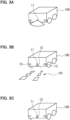
- FIGs.3A to 3C are diagrams schematically showing operating states of the camera 11 and the road surface drawing unit 12. Each figure schematically shows a camera 11, a road surface drawing unit 12, and a back lamp 13, respectively installed at the rear of the vehicle 100.
- the controller 10 performs operation control of the road surface drawing unit 12 so that the capturing period by the camera 11 and the light irradiation period by the road surface drawing unit 12 are complementary.
- FIG. 3A schematically shows a state in which the camera 11 captures the space behind the vehicle 100 including the road surface
- FIG. 3B schematically shows a state in which the road surface drawing unit 12 irradiates light of a predetermined irradiation pattern 101 on the road surface.
- irradiation of the irradiation pattern 101 on the road surface by the road surface drawing unit 12 does not occur.
- the capturing period by the camera 11 intermittently occurs a plurality of times.
- irradiation of irradiation pattern 101 by the road surface drawing unit 12 is performed.
- the illustrated irradiation pattern 101 is merely an example, and a different irradiation pattern may be set depending on whether or not the object sensor 15 detects an object. Note that the shape of the irradiation pattern 101 may be fixed.
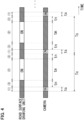
- FIG. 4 is a time chart for explaining a control method by the controller 10.
- the upper part shows the operation of the road surface drawing unit 12, and the lower part shows the operation of the camera 11, each indicated by a belt-shaped time chart.
- "ON" indicates a period during which light is irradiated
- the other periods indicate periods during which light is not irradiated.
- "ON" indicates a capturing period
- the other periods (hatched periods in the figure) indicate non-capturing periods.
- the camera 11 is for capturing moving images, and as shown in FIG. 4 , captures images at a fixed cycle Tc.
- This cycle Tc is determined by the standard adopted by the camera 11, and is a length corresponding to 25 fps in the case of a PAL standard composite signal, and is a length corresponding to 30 fps in the case of an NTSC standard composite signal.
- a capturing period ts which arrives every cycle Tc is a period required to acquire an image of one frame, and can be expressed as a shutter open period or an exposure period. It is preferable that the length of the capturing period ts is set to 1/2 or less of the cycle Tc. For example, in the case of an NTSC standard composite signal, it can be said that it is preferable to set to 1/60 seconds or less.
- the road surface drawing unit 12 irradiates a predetermined irradiation pattern 101 (refer to FIG. 3B ) under the control of the controller 10, and as shown in FIG. 4 , the road surface drawing unit 12 irradiates light during a non-capturing period which does not overlap with the capturing period ts of the camera 11. It is preferable that light irradiation period tm (period indicated as "ON" in the figure) at this time is set to a longer time as long as it does not overlap with the capturing period ts. This is because the brightness of the irradiation pattern 101 can be further increased.
- the light irradiation period tm is set by the irradiation timing setting unit 20 of the controller 10.
- the light irradiation period tm arrives every cycle Tc in synchronization with the capturing timing of the camera 11, for example, if cycle Tc is an NTSC standard composite signal and if the length corresponds to 30 fps (1/30 second), then the cycle at which the light irradiation period tm arrives becomes 30 Hz. At 30 Hz, human eyes can perceive the irradiation pattern 101 irradiated from the road surface drawing unit 12 (refer to FIG. 3B ) as being continuously lit.
- period tn is preferably as short as possible as long as the above objective can be achieved. This is to ensure a longer light irradiation period tm.
- state 1 the state in which capturing is performed by the camera 11 is defined as “state 1”
- state 2 the state in which light irradiation is performed by the road surface drawing unit 12
- state 3 the state in which neither capturing by the camera 11 nor light irradiation of irradiation pattern 101 is performed
- state 3 the state in which neither capturing by the camera 11 nor light irradiation of irradiation pattern 101 is performed.
- state 1 is repeated at cycle Tc
- state 3 exists before and after state 1.
- state 2 is also repeated at cycle Tc
- state 3 also exists before and after state 2.
- State 3 before state 1 and state 3 after state 2 are common
- state 3 after state 1 and state 3 before state 2 are common.
- irradiation mode of irradiation pattern 101 during light irradiation period tm may be continuous irradiation or pulse irradiation.
- pulse irradiation for example, pulse irradiation at a frequency of about 200 Hz to 500 Hz is preferable.
- an increase or decrease in the illuminance of the irradiation pattern 101 can be controlled by the pulse width.
- FIG. 5 is a time chart for explaining a modified example of a control method by the controller 10.
- the basic control method of this example is as described above with reference to FIG. 4 , therefore, only the differences will be described in detail.
- the road surface drawing unit 12 is controlled by the controller 10 so that transitions are made in the order of state 1, state 3, state 2, state 3, state 1, state 3, ....
- the road surface drawing unit 12 is controlled so that capturing period ts and light irradiation period tm by the the road surface drawing unit 12 overlap once every multiple times (for example, five times) of the capturing period ts by the camera 11.
- state 4" a state in which both the irradiation of irradiation pattern 101 and capturing by the camera 11 are performed
- the camera 11 can intermittently capture the irradiation pattern 101 (refer to FIG. 3B ) on the road surface.
- the monitor 16 intermittently displays the predetermined irradiation pattern 101 formed by the road surface drawing unit 12.
- the human eye perceives the irradiation pattern 101 displayed on the monitor 16 as a blinking display.
- Whether or not to display such irradiation pattern 101 can be selected using the switch 14 described above, for example. That is, by setting the timing of light irradiation of the road surface drawing unit 12 by the irradiation timing setting unit 20 according to the state of the switch 14, state 4 can be generated between state 2 and the following state 2.
- state 4 may be generated when an object is detected by the object sensor 15. As a result, the presence of an object can be notified to the driver through the blinking display.
- brightness of irradiation pattern 101 during the period in which state 4 is generated may be reduced to about 1/10, for example.
- Dimming of the irradiation pattern 101 can be achieved by reducing the pulse width of the ON period if control method of the road surface drawing unit 12 is pulse width control, or can be achieved by lowering the current value if control method of the unit is current control.
- the timing of light irradiation of the back lamp 13 in the above-described embodiment may be synchronized with the capturing period of the camera 11.
- the back lamp 13 when capturing period ts of the camera 11 arrives at cycle Tc, the back lamp 13 can also be pulse-controlled so as to irradiate light in synchronization with the cycle Tc.
- the image captured by the camera 11 and displayed on the monitor 16 can be made brighter.
- the installation position is not limited thereto, and an arbitrary installation position such as a vehicle front portion or a vehicle side portion can be selected.
- the camera 11 may capture the space in front of the vehicle, and the road surface drawing unit 12 may perform light irradiation on the road surface in front of the vehicle.
- the back lamp 13 in the above-described embodiment is replaced with a headlamp, a cornering lamp, or the like that irradiates light forward of the vehicle.
- the cornering lamp referred to here is a lamp that irradiates light obliquely forward of the vehicle in accordance with the traveling direction of the vehicle. This makes it possible to more reliably grasp the road surface condition in front of the vehicle. Further, in the mode in which state 4 is intermittently generated as described above, it is possible to achieve both grasping the road surface condition in front of the vehicle and visual recognition of irradiation pattern 101 drawn on the road surface.
Landscapes
- Engineering & Computer Science (AREA)
- Multimedia (AREA)
- Mechanical Engineering (AREA)
- Signal Processing (AREA)
- Lighting Device Outwards From Vehicle And Optical Signal (AREA)
- Traffic Control Systems (AREA)
Abstract
Description
- The present disclosure relates to a controller for lighting control and a vehicle lamp system.
- There is known a vehicle lamp that draws light with an irradiation pattern of a predetermined shape on a road surface around a vehicle. (For example, refer to
Japanese Patent Laid-Open No. 2021-111465 - This is because the ratio of the highest brightness to the lowest brightness captured by a typical camera is about 10 times whereas the ratio of the irradiation pattern brightness on the road surface to the ambient brightness can be about 100 times, for example.
- In a specific aspect, it is an object of the present disclosure to make it possible to grasp the road surface condition more reliably when the road surface on which the irradiation pattern is formed is captured by a camera.
- (1) A controller according to one aspect of the present disclosure is (a) a controller for lighting control installed in a vehicle that is equipped with a camera that captures the surroundings of the vehicle, a monitor that displays images captured by the camera, and an irradiation unit capable of irradiating light on a road surface within a range that can be captured by the camera, and in which the controller performs operation control of the irradiation unit, where (b) the controller performs operation control of the irradiation unit so that it prevents the irradiation unit from performing light irradiation during each intermittently occurring capturing period of the camera, and causes the irradiation unit to irradiate light during a non-capturing period between the capturing periods. (2) A vehicle lamp system according to one aspect of the present disclosure is a vehicle lamp system including: (a) a camera that captures the surroundings of a vehicle; (b) a monitor that displays images captured by the camera; (c) an irradiation unit capable of irradiating light on a road surface within a range that can be captured by the camera; and (d) a controller for lighting control that performs operation control of the irradiation unit; where (e) the controller performs operation control of the irradiation unit so that it prevents the irradiation unit from performing light irradiation during each intermittently occurring capturing period of the camera, and causes the irradiation unit to irradiate light during a non-capturing period between the capturing periods.
- According to the above configurations, it is possible to grasp the road surface condition more reliably when the road surface on which the irradiation pattern is formed is captured by a camera.
-
-
FIG. 1 is a block diagram showing the configuration of a vehicle lamp system according to one embodiment. -
Fig. 2 is a diagram showing a configuration example of a computer system. -
FIGs.3A to 3C are diagrams schematically showing operating states of thecamera 11 and the roadsurface drawing unit 12. -
FIG. 4 is a time chart for explaining a control method performed by thecontroller 10. -
FIG. 5 is a time chart for explaining a modified example of a control method performed by thecontroller 10. -
FIG. 6 is a time chart for explaining a modified example of a control method performed by thecontroller 10. -
FIG. 1 is a block diagram showing the configuration of a vehicle lamp system according to one embodiment. Thevehicle lamp system 1 of the present embodiment is configured to include acontroller 10, acamera 11, a roadsurface drawing unit 12, aback lamp 13, aswitch 14 , anobject sensor 15, and a monitor (display device) 16. In this embodiment, thecontroller 10 corresponds to a "controller for lighting control", and the method of controlling the roadsurface drawing unit 12 by thecontroller 10 corresponds to a "control method for lighting control". - The
controller 10 is connected to thecamera 11, the roadsurface drawing unit 12, theback lamp 13, theswitch 14, theobject sensor 15, and themonitor 16, respectively, and controls light irradiation performed by the roadsurface drawing unit 12 according to the capturing timing, etc. by thecamera 11. For example, thecontroller 10 may be configured using a computer system (refer toFIG. 2 to be described later) having a processor (CPU: Central Processing Unit), a ROM (Read Only Memory), a RAM (Random Access Memory), a storage devices such as a flash memory, an input/output interface, etc. Thecontroller 10 of the present embodiment is brought into a state capable of exhibiting a predetermined function by a processor which reads and executes a program stored in advance in the storage device (or the ROM) . - The
camera 11 is installed at a predetermined position at the rear of the vehicle, for example, and captures the space behind the vehicle. Captured image data (video data) obtained by thecamera 11 is output to thecontroller 10. Further, thecamera 11 outputs a signal which indicates the capturing timing to thecontroller 10. - The road
surface drawing unit 12 is installed at a predetermined position in the rear part of the vehicle, and operates according to a control signal provided from thecontroller 10 to irradiate the road surface behind the vehicle with a desired irradiation pattern. The irradiation pattern formed on the road surface may be fixed or variably set. As a roadsurface drawing unit 12 capable of variably setting an irradiation pattern, for example, a unit that has a plurality of LEDs (Light Emitting Diodes) arranged in two directions and can individually control the lighting and extinguishing of each light emitting diode can be used. - Here, as a road
surface drawing unit 12 capable of variably setting an irradiation pattern, a unit configured by combining a light source bulb, a reflecting mirror, and a shielding plate may be used, or a unit that is configured by combining a liquid crystal element capable of individually controlling the light transmission state of each pixel and a light source may be used, or a unit capable of controlling timing of turning on and off a semiconductor laser such as a laser diode and timing of scanning by a scanning element may be used. Furthermore, a unit configured by combining a plurality of lamps each capable of irradiating a different fixed light distribution may be used. - The
back lamp 13 is installed at a predetermined position in the rear part of the vehicle, and operates in response to a control signal provided by thecontroller 10 when a vehicle shift lever is designated to "reverse", thereby irradiates the space behind the vehicle (including the road surface) at a wide angle, for example. - The
switch 14 is installed at a predetermined position near the driver's seat of the vehicle, and is used to switch the display mode of themonitor 16 in which the irradiation pattern drawn by the roadsurface drawing unit 12 is displayed. Theswitch 14 may be a push button switch or a toggle switch, for example. A specific example of the display mode will be described later. - The
object sensor 15 is installed at a predetermined position in the rear part of the vehicle and detects the presence of any object in the vicinity of the rear part of the vehicle (including any objects on the road surface) . The "object" here includes humans and various obstacles, for example. - The
monitor 16 is installed at a predetermined position near the driver's seat of the vehicle and displays images captured by thecamera 11. As themonitor 16, a liquid crystal display device, an organic EL display device, or the like can be used, for example. - Functions realized by executing the program by the
controller 10 described above will be explained using functional blocks. Thecontroller 10 is configured to include an irradiationtiming setting unit 20 , an irradiationpattern setting unit 21, and a controlsignal generation unit 22. - The irradiation
timing setting unit 20 sets timing of light irradiation performed by the roadsurface drawing unit 12. In detail, by obtaining a video signal from thecamera 11 or providing a control signal to thecamera 11, the irradiationtiming setting unit 20 sets the timing of light irradiation so that the roadsurface drawing unit 12 can irradiate light at a timing that does not overlap with the capturing timing by thecamera 11. - The irradiation
pattern setting unit 21 variably sets the irradiation pattern according to the operation status of theswitch 14 or the detection status of the object detected by theobject sensor 15, for example, and outputs the setting to the controlsignal generation unit 22. - The control
signal generation unit 22 generates a control signal for realizing an irradiation pattern set by the irradiationpattern setting unit 21 and outputs the control signal to the roadsurface drawing unit 12. In this embodiment, the controlsignal generation unit 22 generates a control signal so that the roadsurface drawing unit 12 performs light irradiation during a period determined according to the timing of light irradiation set by the irradiationtiming setting unit 20. -
Fig. 2 is a diagram showing a configuration example of a computer system. Thecontroller 10 described above can be configured using the computer system as shown in the figure, for example. A CPU (Central Processing Unit) 201 performs information processing by reading and executing aprogram 207 stored in astorage device 204. A ROM (Read Only Memory) 202 stores a basic control program, etc. required for the operation of theCPU 201. A RAM (a temporary memory) 203 temporarily stores data necessary for information processing by theCPU 201. Thestorage device 204 is a large-capacity storage device for storing data, and is composed of a hard disk drive, a solid state drive, or the like. Acommunication device 205 performs processing related to data communication with other external devices. An input/output unit 206 is an interface for connecting with an external device. TheCPU 201, etc. are connected to one another via a bus so as to be able to communicate with one another. -
FIGs.3A to 3C are diagrams schematically showing operating states of thecamera 11 and the roadsurface drawing unit 12. Each figure schematically shows acamera 11, a roadsurface drawing unit 12, and aback lamp 13, respectively installed at the rear of thevehicle 100. In the vehicle lamp system of the present embodiment, as a basic operation, thecontroller 10 performs operation control of the roadsurface drawing unit 12 so that the capturing period by thecamera 11 and the light irradiation period by the roadsurface drawing unit 12 are complementary. - Specifically,
FIG. 3A schematically shows a state in which thecamera 11 captures the space behind thevehicle 100 including the road surface, andFIG. 3B schematically shows a state in which the roadsurface drawing unit 12 irradiates light of apredetermined irradiation pattern 101 on the road surface. In the present embodiment, during a state in which capturing by thecamera 11 is performed (refer toFIG. 3A ), irradiation of theirradiation pattern 101 on the road surface by the roadsurface drawing unit 12 does not occur. The capturing period by thecamera 11 intermittently occurs a plurality of times. - Then, during a period between one capturing period and the next capturing period in which capturing by the
camera 11 is not performed (non-capturing period), irradiation ofirradiation pattern 101 by the roadsurface drawing unit 12 is performed. (Refer toFIG. 3B .) The illustratedirradiation pattern 101 is merely an example, and a different irradiation pattern may be set depending on whether or not theobject sensor 15 detects an object. Note that the shape of theirradiation pattern 101 may be fixed. - Further, in the vehicle lamp system of the present embodiment, between the state in which capturing by the
camera 11 is performed (refer toFIG. 3A ) and the state in which irradiation ofirradiation pattern 101 by the roadsurface drawing unit 12 is performed (refer toFIG. 3B ), there is a state in which neither irradiation of theirradiation pattern 101 nor capturing by thecamera 11 is performed. This state is schematically shown inFIG. 3C . Next, each period corresponding to each state will be described in detail using a time chart. -
FIG. 4 is a time chart for explaining a control method by thecontroller 10. The upper part shows the operation of the roadsurface drawing unit 12, and the lower part shows the operation of thecamera 11, each indicated by a belt-shaped time chart. Regarding the operation of the roadsurface drawing unit 12, "ON" indicates a period during which light is irradiated, and the other periods (hatched periods in the figure) indicate periods during which light is not irradiated. Further, regarding the operation of thecamera 11, "ON" indicates a capturing period, and the other periods (hatched periods in the figure) indicate non-capturing periods. - The
camera 11 is for capturing moving images, and as shown inFIG. 4 , captures images at a fixed cycle Tc. This cycle Tc is determined by the standard adopted by thecamera 11, and is a length corresponding to 25 fps in the case of a PAL standard composite signal, and is a length corresponding to 30 fps in the case of an NTSC standard composite signal. A capturing period ts which arrives every cycle Tc is a period required to acquire an image of one frame, and can be expressed as a shutter open period or an exposure period. It is preferable that the length of the capturing period ts is set to 1/2 or less of the cycle Tc. For example, in the case of an NTSC standard composite signal, it can be said that it is preferable to set to 1/60 seconds or less. - The road
surface drawing unit 12 irradiates a predetermined irradiation pattern 101 (refer toFIG. 3B ) under the control of thecontroller 10, and as shown inFIG. 4 , the roadsurface drawing unit 12 irradiates light during a non-capturing period which does not overlap with the capturing period ts of thecamera 11. It is preferable that light irradiation period tm (period indicated as "ON" in the figure) at this time is set to a longer time as long as it does not overlap with the capturing period ts. This is because the brightness of theirradiation pattern 101 can be further increased. The light irradiation period tm is set by the irradiationtiming setting unit 20 of thecontroller 10. - Since the light irradiation period tm arrives every cycle Tc in synchronization with the capturing timing of the
camera 11, for example, if cycle Tc is an NTSC standard composite signal and if the length corresponds to 30 fps (1/30 second), then the cycle at which the light irradiation period tm arrives becomes 30 Hz. At 30 Hz, human eyes can perceive theirradiation pattern 101 irradiated from the road surface drawing unit 12 (refer toFIG. 3B ) as being continuously lit. - Between the light irradiation period tm and the capturing period ts, in other words, before and after the capturing period ts, there is provided a period tn during which neither the capturing by the
camera 11 nor the irradiation of theirradiation pattern 101 is performed. As a result, since there is always a state in which the roadsurface drawing unit 12 does not irradiate on the road surface before and after the capturing by thecamera 11, it is possible to more reliably prevent thecamera 11 from capturing the road surface during a state in which the road surface is irradiated withirradiation pattern 101. The length of period tn is preferably as short as possible as long as the above objective can be achieved. This is to ensure a longer light irradiation period tm. - In
FIG. 4 , the state in which capturing is performed by thecamera 11 is defined as "state 1", the state in which light irradiation is performed by the roadsurface drawing unit 12 is defined as "state 2", and the state in which neither capturing by thecamera 11 nor light irradiation ofirradiation pattern 101 is performed is defined as "state 3", which is respectively indicated as (1), (2), and (3) inFIG. 4 . As shown in the figure, each state transitions in the order ofstate 1,state 3,state 2,state 3,state 1,state 3, .... In detail,state 1 is repeated at cycle Tc, andstate 3 exists before and afterstate 1. Further,state 2 is also repeated at cycle Tc, andstate 3 also exists before and afterstate 2.State 3 beforestate 1 andstate 3 afterstate 2 are common, andstate 3 afterstate 1 andstate 3 beforestate 2 are common. - Here, irradiation mode of
irradiation pattern 101 during light irradiation period tm may be continuous irradiation or pulse irradiation. In the case of pulse irradiation, for example, pulse irradiation at a frequency of about 200 Hz to 500 Hz is preferable. By applying pulse irradiation, an increase or decrease in the illuminance of theirradiation pattern 101 can be controlled by the pulse width. -
FIG. 5 is a time chart for explaining a modified example of a control method by thecontroller 10. The basic control method of this example is as described above with reference toFIG. 4 , therefore, only the differences will be described in detail. In the control method of this modified example, basically as described above, the roadsurface drawing unit 12 is controlled by thecontroller 10 so that transitions are made in the order ofstate 1,state 3,state 2,state 3,state 1,state 3, .... - Furthermore, in this modified example, the road
surface drawing unit 12 is controlled so that capturing period ts and light irradiation period tm by the the roadsurface drawing unit 12 overlap once every multiple times (for example, five times) of the capturing period ts by thecamera 11. Such a state in which both the irradiation ofirradiation pattern 101 and capturing by thecamera 11 are performed is defined as "state 4" and is indicated by (4) in the figure. By causing thisstate 4 to occur once every multiple times of capturing period ts, thecamera 11 can intermittently capture the irradiation pattern 101 (refer toFIG. 3B ) on the road surface. As a result, themonitor 16 intermittently displays thepredetermined irradiation pattern 101 formed by the roadsurface drawing unit 12. Depending on the occurrence cycle ofstate 4, the human eye perceives theirradiation pattern 101 displayed on themonitor 16 as a blinking display. - Whether or not to display
such irradiation pattern 101 can be selected using theswitch 14 described above, for example. That is, by setting the timing of light irradiation of the roadsurface drawing unit 12 by the irradiationtiming setting unit 20 according to the state of theswitch 14,state 4 can be generated betweenstate 2 and thefollowing state 2. Here,state 4 may be generated when an object is detected by theobject sensor 15. As a result, the presence of an object can be notified to the driver through the blinking display. - Further, brightness of
irradiation pattern 101 during the period in whichstate 4 is generated may be reduced to about 1/10, for example. As a result, white clipping can be suppressed. Dimming of theirradiation pattern 101 can be achieved by reducing the pulse width of the ON period if control method of the roadsurface drawing unit 12 is pulse width control, or can be achieved by lowering the current value if control method of the unit is current control. - According to the above-described embodiments, when a road surface on which an irradiation pattern is formed is captured by a camera, it is possible to avoid so-called white clipping and to grasp the road surface condition more reliably. Further, in the aspect of intermittently generating a state in which both the irradiation of
irradiation pattern 101 and capturing by thecamera 11 are performed (state 4), it is possible to achieve both grasping the road surface condition and visual recognition ofirradiation pattern 101 drawn on the road surface. - Here, it should be noted that the present disclosure is not limited to the content of the above-described embodiments, and can be implemented in various modifications within the scope of the gist of the present disclosure. For example, the timing of light irradiation of the
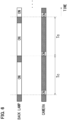
back lamp 13 in the above-described embodiment may be synchronized with the capturing period of thecamera 11. Specifically, as shown inFIG. 6 , when capturing period ts of thecamera 11 arrives at cycle Tc, theback lamp 13 can also be pulse-controlled so as to irradiate light in synchronization with the cycle Tc. As a result, since light irradiation by theback lamp 13 is performed in correspondence with the capturing period ts of thecamera 11, the image captured by thecamera 11 and displayed on themonitor 16 can be made brighter. - Further, in the above-described embodiments, a case where the
camera 11 and the roadsurface drawing unit 12 are installed in the rear part of the vehicle has been exemplified, but the installation position is not limited thereto, and an arbitrary installation position such as a vehicle front portion or a vehicle side portion can be selected. For example, thecamera 11 may capture the space in front of the vehicle, and the roadsurface drawing unit 12 may perform light irradiation on the road surface in front of the vehicle. In this case, theback lamp 13 in the above-described embodiment is replaced with a headlamp, a cornering lamp, or the like that irradiates light forward of the vehicle. The cornering lamp referred to here is a lamp that irradiates light obliquely forward of the vehicle in accordance with the traveling direction of the vehicle. This makes it possible to more reliably grasp the road surface condition in front of the vehicle. Further, in the mode in whichstate 4 is intermittently generated as described above, it is possible to achieve both grasping the road surface condition in front of the vehicle and visual recognition ofirradiation pattern 101 drawn on the road surface. - The present disclosure has features as appended below.
- (Appendix 1) A controller for lighting control installed in a vehicle that is equipped with a camera that captures the surroundings of the vehicle, a monitor that displays images captured by the camera, and an irradiation unit capable of irradiating light on a road surface within a range that can be captured by the camera, and in which the controller performs operation control of the irradiation unit,
wherein the controller performs operation control of the irradiation unit so that it prevents the irradiation unit from performing light irradiation during each intermittently occurring capturing period of the camera, and causes the irradiation unit to irradiate light during a non-capturing period between the capturing periods. - (Appendix 2) The controller according to
appendix 1,
wherein the controller performs operation control of the irradiation unit so that, within the non-capturing period, the irradiation unit irradiates light in a shorter time than the non-capturing period. - (Appendix 3) The controller according to
appendix 1 orappendix 2,
wherein the controller performs operation control of the irradiation unit so that, before and after the capturing period, a period is provided where neither light irradiation by the irradiation unit nor capturing by the camera is performed. - (Appendix 4) The controller according to any one of
Appendices 1 to 3,
wherein the controller causes the light irradiation unit to perform light irradiation within the capturing period at a rate of once for the plurality of capturing periods. - (Appendix 5) The controller according to
appendix 4,
wherein the controller is able to switch with an external switch whether or not to execute light irradiation by the light irradiation unit at a rate of once for the plurality of capturing periods. - (Appendix 6) The controller according to
appendix 4,- wherein the vehicle is further equipped with an object sensor, and
- wherein the controller causes the light irradiation unit to perform light irradiation at a rate of once for the plurality of capturing periods when the presence of an object is detected by the object sensor.
- (Appendix 7) The controller according to any one of
Appendices 1 to 6,- wherein the vehicle is further equipped with a lamp capable of irradiating space within a range that can be captured by the camera, and
- wherein the controller performs operation control of the lamp so that the light irradiation period by the lamp is synchronized with the capturing period of the camera.
- (Appendix 8) The controller according to appendix 7,
wherein the lamp is either a back lamp, a head lamp, or a cornering lamp. - (Appendix 9) The controller according to appendix 7,
wherein the lamp has a light source using a light emitting diode or a semiconductor laser. - (Appendix 10) A vehicle lamp system comprising:
- a camera that captures the surroundings of the vehicle;
- a monitor that displays the image captured by the camera;
- an irradiation unit capable of irradiating light on a road surface within a range that can be captured by the camera; and
- a controller for lighting control that performs operation control of the irradiation unit;
- wherein the controller performs operation control of the irradiation unit so that it prevents the irradiation unit from performing light irradiation during each intermittently occurring capturing period of the camera, and causes the irradiation unit to irradiate light during a non-capturing period between the capturing periods.
-
- 10:Controller,
- 11:Camera
- 12:Road surface drawing unit
- 13:Back lamp
- 14:Switch
- 15:Object sensor
- 16:Monitor
- 20:Irradiation timing setting unit,
- 21:Irradiation pattern setting unit
- 22:Control signal generation unit
- 100:Vehicle
- 101:Irradiation pattern
Claims (10)
- A controller for lighting control installed in a vehicle that is equipped with a camera that captures the surroundings of the vehicle, a monitor that displays images captured by the camera, and an irradiation unit capable of irradiating light on a road surface within a range that can be captured by the camera, and in which the controller performs operation control of the irradiation unit,
wherein the controller performs operation control of the irradiation unit so that it prevents the irradiation unit from performing light irradiation during each intermittently occurring capturing period of the camera, and causes the irradiation unit to irradiate light during a non-capturing period between the capturing periods. - The controller according to claim 1,
wherein the controller performs operation control of the irradiation unit so that, within the non-capturing period, the irradiation unit irradiates light in a shorter time than the non-capturing period. - The controller according to claim 1 or claim 2,
wherein the controller performs operation control of the irradiation unit so that, before and after the capturing period, a period is provided where neither light irradiation by the irradiation unit nor capturing by the camera is performed. - The controller according to any one of claims 1 to 3,
wherein the controller causes the light irradiation unit to perform light irradiation within the capturing period at a rate of once for the plurality of capturing periods. - The controller according to claim 4,
wherein the controller is able to switch with an external switch whether or not to execute light irradiation by the light irradiation unit at a rate of once for the plurality of capturing periods. - The controller according to claim 4,wherein the vehicle is further equipped with an object sensor, andwherein the controller causes the light irradiation unit to perform light irradiation at a rate of once for the plurality of capturing periods when the presence of an object is detected by the object sensor.
- The controller according to any one of claims 1 to 6,wherein the vehicle is further equipped with a lamp capable of irradiating space within a range that can be captured by the camera, andwherein the controller performs operation control of the lamp so that the light irradiation period by the lamp is synchronized with the capturing period of the camera.
- The controller according to claim 7,
wherein the lamp is either a back lamp, a head lamp, or a cornering lamp. - The controller according to claim 7,
wherein the lamp has a light source using a light emitting diode or a semiconductor laser. - A vehicle lamp system comprising:a camera that captures the surroundings of the vehicle;a monitor that displays images captured by the camera;an irradiation unit capable of irradiating light on a road surface within a range that can be captured by the camera; anda controller for lighting control that performs operation control of the irradiation unit;wherein the controller performs operation control of the irradiation unit so that it prevents the irradiation unit from performing light irradiation during each intermittently occurring capturing period of the camera, and causes the irradiation unit to irradiate light during a non-capturing period between the capturing periods.
Applications Claiming Priority (1)
| Application Number | Priority Date | Filing Date | Title |
|---|---|---|---|
| JP2022147023A JP2024042359A (en) | 2022-09-15 | 2022-09-15 | Controllers for lighting control, vehicle lighting systems |
Publications (2)
| Publication Number | Publication Date |
|---|---|
| EP4339023A1 true EP4339023A1 (en) | 2024-03-20 |
| EP4339023B1 EP4339023B1 (en) | 2025-08-20 |
Family
ID=88018229
Family Applications (1)
| Application Number | Title | Priority Date | Filing Date |
|---|---|---|---|
| EP23197019.5A Active EP4339023B1 (en) | 2022-09-15 | 2023-09-12 | Controller for lighting control, vehicle lamp system |
Country Status (4)
| Country | Link |
|---|---|
| US (1) | US12528402B2 (en) |
| EP (1) | EP4339023B1 (en) |
| JP (1) | JP2024042359A (en) |
| CN (1) | CN117698560A (en) |
Citations (9)
| Publication number | Priority date | Publication date | Assignee | Title |
|---|---|---|---|---|
| US20130113935A1 (en) * | 2011-11-08 | 2013-05-09 | GM Global Technology Operations LLC | Active vision system with subliminally steered and modulated lighting |
| DE202012004671U1 (en) * | 2012-04-28 | 2013-07-29 | Kiekert Aktiengesellschaft | vehicle body |
| EP3093193A1 (en) * | 2015-05-12 | 2016-11-16 | Lg Electronics Inc. | Lamp for vehicle |
| DE102015212365A1 (en) * | 2015-07-02 | 2017-01-05 | Conti Temic Microelectronic Gmbh | Synchronization of an exposure of a camera |
| US20190095726A1 (en) * | 2017-09-22 | 2019-03-28 | Toyota Jidosha Kabushiki Kaisha | Recognition support system for vehicle |
| JP2019217951A (en) * | 2018-06-21 | 2019-12-26 | スタンレー電気株式会社 | Control device of vehicle lighting fixture, control method of vehicle lighting fixture, vehicle lighting system, and vehicle |
| EP3650271A1 (en) * | 2018-11-09 | 2020-05-13 | Valeo Vision | Lane recognition for automotive vehicles |
| JP2021111465A (en) | 2020-01-07 | 2021-08-02 | 市光工業株式会社 | Vehicular lighting fixture |
| DE102020202329A1 (en) * | 2020-02-24 | 2021-08-26 | Psa Automobiles Sa | Environment recognition system of a motor vehicle, method for operating an environment recognition system, computer program product and motor vehicle |
Family Cites Families (6)
| Publication number | Priority date | Publication date | Assignee | Title |
|---|---|---|---|---|
| JP2017193239A (en) * | 2016-04-20 | 2017-10-26 | スタンレー電気株式会社 | In-vehicle system |
| WO2018030318A1 (en) * | 2016-08-10 | 2018-02-15 | パナソニックIpマネジメント株式会社 | Projection image pickup device and projection image pickup method |
| US10958830B2 (en) * | 2018-05-24 | 2021-03-23 | Magna Electronics Inc. | Vehicle vision system with infrared LED synchronization |
| EP3585047B1 (en) * | 2018-06-20 | 2021-03-24 | ZKW Group GmbH | Method and device for producing high contrast images |
| WO2022080425A1 (en) * | 2020-10-15 | 2022-04-21 | 株式会社小糸製作所 | Vehicle lamp, and control device and control method for same |
| JP2022108190A (en) * | 2021-01-12 | 2022-07-25 | 株式会社小糸製作所 | vehicle system |
-
2022
- 2022-09-15 JP JP2022147023A patent/JP2024042359A/en active Pending
-
2023
- 2023-09-12 EP EP23197019.5A patent/EP4339023B1/en active Active
- 2023-09-12 US US18/244,922 patent/US12528402B2/en active Active
- 2023-09-13 CN CN202311182024.9A patent/CN117698560A/en active Pending
Patent Citations (9)
| Publication number | Priority date | Publication date | Assignee | Title |
|---|---|---|---|---|
| US20130113935A1 (en) * | 2011-11-08 | 2013-05-09 | GM Global Technology Operations LLC | Active vision system with subliminally steered and modulated lighting |
| DE202012004671U1 (en) * | 2012-04-28 | 2013-07-29 | Kiekert Aktiengesellschaft | vehicle body |
| EP3093193A1 (en) * | 2015-05-12 | 2016-11-16 | Lg Electronics Inc. | Lamp for vehicle |
| DE102015212365A1 (en) * | 2015-07-02 | 2017-01-05 | Conti Temic Microelectronic Gmbh | Synchronization of an exposure of a camera |
| US20190095726A1 (en) * | 2017-09-22 | 2019-03-28 | Toyota Jidosha Kabushiki Kaisha | Recognition support system for vehicle |
| JP2019217951A (en) * | 2018-06-21 | 2019-12-26 | スタンレー電気株式会社 | Control device of vehicle lighting fixture, control method of vehicle lighting fixture, vehicle lighting system, and vehicle |
| EP3650271A1 (en) * | 2018-11-09 | 2020-05-13 | Valeo Vision | Lane recognition for automotive vehicles |
| JP2021111465A (en) | 2020-01-07 | 2021-08-02 | 市光工業株式会社 | Vehicular lighting fixture |
| DE102020202329A1 (en) * | 2020-02-24 | 2021-08-26 | Psa Automobiles Sa | Environment recognition system of a motor vehicle, method for operating an environment recognition system, computer program product and motor vehicle |
Also Published As
| Publication number | Publication date |
|---|---|
| EP4339023B1 (en) | 2025-08-20 |
| US20240092251A1 (en) | 2024-03-21 |
| US12528402B2 (en) | 2026-01-20 |
| CN117698560A (en) | 2024-03-15 |
| JP2024042359A (en) | 2024-03-28 |
Similar Documents
| Publication | Publication Date | Title |
|---|---|---|
| US9386231B2 (en) | State monitoring apparatus | |
| US9123179B2 (en) | Surrounding image display system and surrounding image display method for vehicle | |
| JP2006188224A (en) | Night vision system for vehicle, light source operation system and its control method | |
| CN105034929B (en) | Irradiation apparatus | |
| US11600081B2 (en) | Lane recognition for automotive vehicles | |
| US12528402B2 (en) | Controller for lighting control, vehicle lamp system | |
| JP2006277085A (en) | Optical pointing controller and pointing system using same device | |
| JP6935815B2 (en) | Illumination imager | |
| KR20150057041A (en) | LED lighting control method and device for cameras | |
| JP6322723B2 (en) | Imaging apparatus and vehicle | |
| JP2008193504A (en) | Night vision device | |
| JP5838587B2 (en) | Moving object monitoring device and moving object monitoring system | |
| JP4731177B2 (en) | Infrared imaging display device and infrared imaging display method for vehicle | |
| JPWO2007102195A1 (en) | Imaging apparatus and imaging method | |
| US11812179B2 (en) | Input apparatus for vehicle and method thereof | |
| JP6939875B2 (en) | Illumination imager | |
| JP2009253316A (en) | On-vehicle camera and drive recorder | |
| JP2025051116A (en) | Vehicle Surroundings Monitoring System | |
| JP2006287513A (en) | Off-vehicle situation presentation system | |
| JP2009027666A (en) | Recorder with camera for countermeasure of led traffic light | |
| JP2017184151A (en) | Imaging apparatus and imaging method | |
| JP2024104613A (en) | MONITORING APPARATUS, MONITORING METHOD, AND PROGRAM | |
| US20180151102A1 (en) | Display control device, display system, and display control method | |
| JP2019040295A (en) | Specific object detection device |
Legal Events
| Date | Code | Title | Description |
|---|---|---|---|
| PUAI | Public reference made under article 153(3) epc to a published international application that has entered the european phase |
Free format text: ORIGINAL CODE: 0009012 |
|
| STAA | Information on the status of an ep patent application or granted ep patent |
Free format text: STATUS: THE APPLICATION HAS BEEN PUBLISHED |
|
| AK | Designated contracting states |
Kind code of ref document: A1 Designated state(s): AL AT BE BG CH CY CZ DE DK EE ES FI FR GB GR HR HU IE IS IT LI LT LU LV MC ME MK MT NL NO PL PT RO RS SE SI SK SM TR |
|
| STAA | Information on the status of an ep patent application or granted ep patent |
Free format text: STATUS: REQUEST FOR EXAMINATION WAS MADE |
|
| 17P | Request for examination filed |
Effective date: 20240919 |
|
| RBV | Designated contracting states (corrected) |
Designated state(s): AL AT BE BG CH CY CZ DE DK EE ES FI FR GB GR HR HU IE IS IT LI LT LU LV MC ME MK MT NL NO PL PT RO RS SE SI SK SM TR |
|
| GRAP | Despatch of communication of intention to grant a patent |
Free format text: ORIGINAL CODE: EPIDOSNIGR1 |
|
| STAA | Information on the status of an ep patent application or granted ep patent |
Free format text: STATUS: GRANT OF PATENT IS INTENDED |
|
| RIC1 | Information provided on ipc code assigned before grant |
Ipc: B60Q 1/14 20060101ALN20250312BHEP Ipc: H04N 23/73 20230101ALI20250312BHEP Ipc: B60R 1/26 20220101ALI20250312BHEP Ipc: B60Q 1/24 20060101ALI20250312BHEP Ipc: H04N 23/76 20230101ALI20250312BHEP Ipc: H04N 23/74 20230101ALI20250312BHEP Ipc: H04N 23/56 20230101ALI20250312BHEP Ipc: B60Q 1/22 20060101AFI20250312BHEP |
|
| INTG | Intention to grant announced |
Effective date: 20250410 |
|
| GRAS | Grant fee paid |
Free format text: ORIGINAL CODE: EPIDOSNIGR3 |
|
| GRAA | (expected) grant |
Free format text: ORIGINAL CODE: 0009210 |
|
| STAA | Information on the status of an ep patent application or granted ep patent |
Free format text: STATUS: THE PATENT HAS BEEN GRANTED |
|
| AK | Designated contracting states |
Kind code of ref document: B1 Designated state(s): AL AT BE BG CH CY CZ DE DK EE ES FI FR GB GR HR HU IE IS IT LI LT LU LV MC ME MK MT NL NO PL PT RO RS SE SI SK SM TR |
|
| REG | Reference to a national code |
Ref country code: GB Ref legal event code: FG4D |
|
| REG | Reference to a national code |
Ref country code: CH Ref legal event code: EP |
|
| REG | Reference to a national code |
Ref country code: DE Ref legal event code: R096 Ref document number: 602023005843 Country of ref document: DE |
|
| REG | Reference to a national code |
Ref country code: IE Ref legal event code: FG4D |
|
| PGFP | Annual fee paid to national office [announced via postgrant information from national office to epo] |
Ref country code: AT Payment date: 20251020 Year of fee payment: 3 |
|
| REG | Reference to a national code |
Ref country code: NL Ref legal event code: MP Effective date: 20250820 |
|
| PG25 | Lapsed in a contracting state [announced via postgrant information from national office to epo] |
Ref country code: IS Free format text: LAPSE BECAUSE OF FAILURE TO SUBMIT A TRANSLATION OF THE DESCRIPTION OR TO PAY THE FEE WITHIN THE PRESCRIBED TIME-LIMIT Effective date: 20251220 |
|
| PGFP | Annual fee paid to national office [announced via postgrant information from national office to epo] |
Ref country code: DE Payment date: 20250930 Year of fee payment: 3 |
|
| PG25 | Lapsed in a contracting state [announced via postgrant information from national office to epo] |
Ref country code: NO Free format text: LAPSE BECAUSE OF FAILURE TO SUBMIT A TRANSLATION OF THE DESCRIPTION OR TO PAY THE FEE WITHIN THE PRESCRIBED TIME-LIMIT Effective date: 20251120 |
|
| REG | Reference to a national code |
Ref country code: LT Ref legal event code: MG9D |
|
| PG25 | Lapsed in a contracting state [announced via postgrant information from national office to epo] |
Ref country code: PT Free format text: LAPSE BECAUSE OF FAILURE TO SUBMIT A TRANSLATION OF THE DESCRIPTION OR TO PAY THE FEE WITHIN THE PRESCRIBED TIME-LIMIT Effective date: 20251222 |
|
| PG25 | Lapsed in a contracting state [announced via postgrant information from national office to epo] |
Ref country code: FI Free format text: LAPSE BECAUSE OF FAILURE TO SUBMIT A TRANSLATION OF THE DESCRIPTION OR TO PAY THE FEE WITHIN THE PRESCRIBED TIME-LIMIT Effective date: 20250820 |
|
| PG25 | Lapsed in a contracting state [announced via postgrant information from national office to epo] |
Ref country code: HR Free format text: LAPSE BECAUSE OF FAILURE TO SUBMIT A TRANSLATION OF THE DESCRIPTION OR TO PAY THE FEE WITHIN THE PRESCRIBED TIME-LIMIT Effective date: 20250820 Ref country code: NL Free format text: LAPSE BECAUSE OF FAILURE TO SUBMIT A TRANSLATION OF THE DESCRIPTION OR TO PAY THE FEE WITHIN THE PRESCRIBED TIME-LIMIT Effective date: 20250820 |
|
| PG25 | Lapsed in a contracting state [announced via postgrant information from national office to epo] |
Ref country code: GR Free format text: LAPSE BECAUSE OF FAILURE TO SUBMIT A TRANSLATION OF THE DESCRIPTION OR TO PAY THE FEE WITHIN THE PRESCRIBED TIME-LIMIT Effective date: 20251121 |
|
| PG25 | Lapsed in a contracting state [announced via postgrant information from national office to epo] |
Ref country code: SE Free format text: LAPSE BECAUSE OF FAILURE TO SUBMIT A TRANSLATION OF THE DESCRIPTION OR TO PAY THE FEE WITHIN THE PRESCRIBED TIME-LIMIT Effective date: 20250820 |
|
| PG25 | Lapsed in a contracting state [announced via postgrant information from national office to epo] |
Ref country code: LV Free format text: LAPSE BECAUSE OF FAILURE TO SUBMIT A TRANSLATION OF THE DESCRIPTION OR TO PAY THE FEE WITHIN THE PRESCRIBED TIME-LIMIT Effective date: 20250820 |
|
| PG25 | Lapsed in a contracting state [announced via postgrant information from national office to epo] |
Ref country code: PL Free format text: LAPSE BECAUSE OF FAILURE TO SUBMIT A TRANSLATION OF THE DESCRIPTION OR TO PAY THE FEE WITHIN THE PRESCRIBED TIME-LIMIT Effective date: 20250820 Ref country code: BG Free format text: LAPSE BECAUSE OF FAILURE TO SUBMIT A TRANSLATION OF THE DESCRIPTION OR TO PAY THE FEE WITHIN THE PRESCRIBED TIME-LIMIT Effective date: 20250820 |
|
| PG25 | Lapsed in a contracting state [announced via postgrant information from national office to epo] |
Ref country code: RS Free format text: LAPSE BECAUSE OF FAILURE TO SUBMIT A TRANSLATION OF THE DESCRIPTION OR TO PAY THE FEE WITHIN THE PRESCRIBED TIME-LIMIT Effective date: 20251120 |
|
| PG25 | Lapsed in a contracting state [announced via postgrant information from national office to epo] |
Ref country code: ES Free format text: LAPSE BECAUSE OF FAILURE TO SUBMIT A TRANSLATION OF THE DESCRIPTION OR TO PAY THE FEE WITHIN THE PRESCRIBED TIME-LIMIT Effective date: 20250820 |
|
| REG | Reference to a national code |
Ref country code: AT Ref legal event code: MK05 Ref document number: 1826995 Country of ref document: AT Kind code of ref document: T Effective date: 20250820 |
|
| PG25 | Lapsed in a contracting state [announced via postgrant information from national office to epo] |
Ref country code: RO Free format text: LAPSE BECAUSE OF FAILURE TO SUBMIT A TRANSLATION OF THE DESCRIPTION OR TO PAY THE FEE WITHIN THE PRESCRIBED TIME-LIMIT Effective date: 20250820 |
|
| PG25 | Lapsed in a contracting state [announced via postgrant information from national office to epo] |
Ref country code: SM Free format text: LAPSE BECAUSE OF FAILURE TO SUBMIT A TRANSLATION OF THE DESCRIPTION OR TO PAY THE FEE WITHIN THE PRESCRIBED TIME-LIMIT Effective date: 20250820 |
|
| PG25 | Lapsed in a contracting state [announced via postgrant information from national office to epo] |
Ref country code: DK Free format text: LAPSE BECAUSE OF FAILURE TO SUBMIT A TRANSLATION OF THE DESCRIPTION OR TO PAY THE FEE WITHIN THE PRESCRIBED TIME-LIMIT Effective date: 20250820 |
|
| PG25 | Lapsed in a contracting state [announced via postgrant information from national office to epo] |
Ref country code: AT Free format text: LAPSE BECAUSE OF FAILURE TO SUBMIT A TRANSLATION OF THE DESCRIPTION OR TO PAY THE FEE WITHIN THE PRESCRIBED TIME-LIMIT Effective date: 20250820 |
|
| PG25 | Lapsed in a contracting state [announced via postgrant information from national office to epo] |
Ref country code: IT Free format text: LAPSE BECAUSE OF FAILURE TO SUBMIT A TRANSLATION OF THE DESCRIPTION OR TO PAY THE FEE WITHIN THE PRESCRIBED TIME-LIMIT Effective date: 20250820 |
|
| PG25 | Lapsed in a contracting state [announced via postgrant information from national office to epo] |
Ref country code: CZ Free format text: LAPSE BECAUSE OF FAILURE TO SUBMIT A TRANSLATION OF THE DESCRIPTION OR TO PAY THE FEE WITHIN THE PRESCRIBED TIME-LIMIT Effective date: 20250820 |
|
| PG25 | Lapsed in a contracting state [announced via postgrant information from national office to epo] |
Ref country code: EE Free format text: LAPSE BECAUSE OF FAILURE TO SUBMIT A TRANSLATION OF THE DESCRIPTION OR TO PAY THE FEE WITHIN THE PRESCRIBED TIME-LIMIT Effective date: 20250820 Ref country code: SK Free format text: LAPSE BECAUSE OF FAILURE TO SUBMIT A TRANSLATION OF THE DESCRIPTION OR TO PAY THE FEE WITHIN THE PRESCRIBED TIME-LIMIT Effective date: 20250820 |
|
| PG25 | Lapsed in a contracting state [announced via postgrant information from national office to epo] |
Ref country code: LU Free format text: LAPSE BECAUSE OF NON-PAYMENT OF DUE FEES Effective date: 20250912 |
|
| REG | Reference to a national code |
Ref country code: DE Ref legal event code: R097 Ref document number: 602023005843 Country of ref document: DE |
|
| REG | Reference to a national code |
Ref country code: BE Ref legal event code: MM Effective date: 20250930 |
|
| PLBE | No opposition filed within time limit |
Free format text: ORIGINAL CODE: 0009261 |
|
| STAA | Information on the status of an ep patent application or granted ep patent |
Free format text: STATUS: NO OPPOSITION FILED WITHIN TIME LIMIT |
|
| PG25 | Lapsed in a contracting state [announced via postgrant information from national office to epo] |
Ref country code: MC Free format text: LAPSE BECAUSE OF FAILURE TO SUBMIT A TRANSLATION OF THE DESCRIPTION OR TO PAY THE FEE WITHIN THE PRESCRIBED TIME-LIMIT Effective date: 20250820 Ref country code: LT Free format text: LAPSE BECAUSE OF FAILURE TO SUBMIT A TRANSLATION OF THE DESCRIPTION OR TO PAY THE FEE WITHIN THE PRESCRIBED TIME-LIMIT Effective date: 20250820 |
|
| REG | Reference to a national code |
Ref country code: CH Ref legal event code: L10 Free format text: ST27 STATUS EVENT CODE: U-0-0-L10-L00 (AS PROVIDED BY THE NATIONAL OFFICE) Effective date: 20260701 |
|
| PG25 | Lapsed in a contracting state [announced via postgrant information from national office to epo] |
Ref country code: BE Free format text: LAPSE BECAUSE OF NON-PAYMENT OF DUE FEES Effective date: 20250930 Ref country code: IE Free format text: LAPSE BECAUSE OF NON-PAYMENT OF DUE FEES Effective date: 20250912 |
|
| PG25 | Lapsed in a contracting state [announced via postgrant information from national office to epo] |
Ref country code: FR Free format text: LAPSE BECAUSE OF NON-PAYMENT OF DUE FEES Effective date: 20251020 |
|
| 26N | No opposition filed |
Effective date: 20260521 |