EP4336762A2 - Verfahren und vorrichtung zur übertragung von uplink-steuerungsinformationen - Google Patents
Verfahren und vorrichtung zur übertragung von uplink-steuerungsinformationen Download PDFInfo
- Publication number
- EP4336762A2 EP4336762A2 EP24154427.9A EP24154427A EP4336762A2 EP 4336762 A2 EP4336762 A2 EP 4336762A2 EP 24154427 A EP24154427 A EP 24154427A EP 4336762 A2 EP4336762 A2 EP 4336762A2
- Authority
- EP
- European Patent Office
- Prior art keywords
- information
- uci
- transmission
- transmission time
- positive
- Prior art date
- Legal status (The legal status is an assumption and is not a legal conclusion. Google has not performed a legal analysis and makes no representation as to the accuracy of the status listed.)
- Pending
Links
Images




Classifications
-
- H—ELECTRICITY
- H04—ELECTRIC COMMUNICATION TECHNIQUE
- H04W—WIRELESS COMMUNICATION NETWORKS
- H04W72/00—Local resource management
- H04W72/20—Control channels or signalling for resource management
- H04W72/21—Control channels or signalling for resource management in the uplink direction of a wireless link, i.e. towards the network
-
- H—ELECTRICITY
- H04—ELECTRIC COMMUNICATION TECHNIQUE
- H04L—TRANSMISSION OF DIGITAL INFORMATION, e.g. TELEGRAPHIC COMMUNICATION
- H04L1/00—Arrangements for detecting or preventing errors in the information received
- H04L1/12—Arrangements for detecting or preventing errors in the information received by using return channel
- H04L1/16—Arrangements for detecting or preventing errors in the information received by using return channel in which the return channel carries supervisory signals, e.g. repetition request signals
- H04L1/1607—Details of the supervisory signal
- H04L1/1671—Details of the supervisory signal the supervisory signal being transmitted together with control information
-
- H—ELECTRICITY
- H04—ELECTRIC COMMUNICATION TECHNIQUE
- H04L—TRANSMISSION OF DIGITAL INFORMATION, e.g. TELEGRAPHIC COMMUNICATION
- H04L5/00—Arrangements affording multiple use of the transmission path
- H04L5/003—Arrangements for allocating sub-channels of the transmission path
- H04L5/0053—Allocation of signalling, i.e. of overhead other than pilot signals
- H04L5/0055—Physical resource allocation for ACK/NACK
-
- H—ELECTRICITY
- H04—ELECTRIC COMMUNICATION TECHNIQUE
- H04L—TRANSMISSION OF DIGITAL INFORMATION, e.g. TELEGRAPHIC COMMUNICATION
- H04L1/00—Arrangements for detecting or preventing errors in the information received
- H04L1/0001—Systems modifying transmission characteristics according to link quality, e.g. power backoff
- H04L1/0023—Systems modifying transmission characteristics according to link quality, e.g. power backoff characterised by the signalling
- H04L1/0028—Formatting
-
- H—ELECTRICITY
- H04—ELECTRIC COMMUNICATION TECHNIQUE
- H04L—TRANSMISSION OF DIGITAL INFORMATION, e.g. TELEGRAPHIC COMMUNICATION
- H04L1/00—Arrangements for detecting or preventing errors in the information received
- H04L1/12—Arrangements for detecting or preventing errors in the information received by using return channel
- H04L1/16—Arrangements for detecting or preventing errors in the information received by using return channel in which the return channel carries supervisory signals, e.g. repetition request signals
- H04L1/18—Automatic repetition systems, e.g. Van Duuren systems
- H04L1/1829—Arrangements specially adapted for the receiver end
- H04L1/1854—Scheduling and prioritising arrangements
-
- H—ELECTRICITY
- H04—ELECTRIC COMMUNICATION TECHNIQUE
- H04L—TRANSMISSION OF DIGITAL INFORMATION, e.g. TELEGRAPHIC COMMUNICATION
- H04L27/00—Modulated-carrier systems
- H04L27/26—Systems using multi-frequency codes
- H04L27/2601—Multicarrier modulation systems
- H04L27/2602—Signal structure
- H04L27/2605—Symbol extensions, e.g. Zero Tail, Unique Word [UW]
- H04L27/2607—Cyclic extensions
-
- H—ELECTRICITY
- H04—ELECTRIC COMMUNICATION TECHNIQUE
- H04L—TRANSMISSION OF DIGITAL INFORMATION, e.g. TELEGRAPHIC COMMUNICATION
- H04L5/00—Arrangements affording multiple use of the transmission path
-
- H—ELECTRICITY
- H04—ELECTRIC COMMUNICATION TECHNIQUE
- H04L—TRANSMISSION OF DIGITAL INFORMATION, e.g. TELEGRAPHIC COMMUNICATION
- H04L5/00—Arrangements affording multiple use of the transmission path
- H04L5/003—Arrangements for allocating sub-channels of the transmission path
- H04L5/0053—Allocation of signalling, i.e. of overhead other than pilot signals
- H04L5/0057—Physical resource allocation for CQI
-
- H—ELECTRICITY
- H04—ELECTRIC COMMUNICATION TECHNIQUE
- H04W—WIRELESS COMMUNICATION NETWORKS
- H04W72/00—Local resource management
- H04W72/04—Wireless resource allocation
-
- H—ELECTRICITY
- H04—ELECTRIC COMMUNICATION TECHNIQUE
- H04W—WIRELESS COMMUNICATION NETWORKS
- H04W72/00—Local resource management
- H04W72/04—Wireless resource allocation
- H04W72/044—Wireless resource allocation based on the type of the allocated resource
- H04W72/0446—Resources in time domain, e.g. slots or frames
Definitions
- the present application relates to the field of communication technologies, and particularly to a method and apparatus for transmitting uplink control information.
- 5G NR 5 Generation New RAT
- the Uplink Control Information includes: Hybrid Automatic Repeat reQuest (HARQ) feedback information (i.e., HARQ-ACK information), Scheduling Request (SR) information, periodic Channel State Information (CSI), etc.
- HARQ Hybrid Automatic Repeat reQuest
- SR Scheduling Request
- CSI periodic Channel State Information
- the embodiments of the present application provide a method and apparatus for transmitting uplink control information, so as to ensure that the network side can obtain various types of UCI in time, e.g., the SR information and HARQ-ACK feedback information and/or periodic CSI.
- the embodiment of the present application ensures that the network side can obtain various types of UCI (e.g., the SR information and HARQ-ACK feedback information and/or periodic CSI) in time through the above-mentioned method.
- the HARQ-ACK information and the SR information are configured with different NR PUCCH formats or configured with the same format but unaligned transmission moments, and when the transmission time domain resources of the periodic CSI and the SR information overlap, the SR information and HARQ-ACK information and/or periodic CSI can be transmitted simultaneously, thereby ensuring that the network side can obtain the SR information and HARQ-ACK feedback information and/or periodic CSI in time.
- condition further includes: the first UCI is configured to be transmitted using a first channel format, and the SR information is configured to be transmitted using a second channel format, or the SR information is configured to be transmitted in the first channel format and the transmission time of the SR information partially overlap with the transmission time of the first UCI.
- determining the transmission resource for transmitting the first UCI according to whether the SR information is negative SR information or positive SR information, and transmitting the first UCI on the determined transmission resource specifically includes:
- the first cyclic shift set and the second cyclic shift set each is obtained according to the initial cyclic shift configured for the first UCI and a predetermined offset.
- condition further includes: the first UCI is configured to be transmitted using a third channel format.
- determining the transmission resource for transmitting the first UCI according to whether the SR information is negative SR information or positive SR information, and transmitting the first UCI on the determined transmission resource specifically includes:
- condition further includes: the starting transmission times of the first UCI and the SR information are same; and/or the starting transmission time of the first UCI falls behind the starting transmission time of the SR information.
- the method further includes: if the starting transmission time of the first UCI is ahead of the starting transmission time of the SR information, then:
- determining a UCI transmission scheme according to whether the SR information is positive SR information or not could be determined before the starting transmission time of the first UCI specifically includes:
- transmitting the first UCI in the first channel format on the transmission resource of the first UCI according to a second cyclic shift set specifically includes: when the SR information is positive SR information, performing a step after determining that the condition is satisfied on symbols overlapping with the transmission time domain resource of the SR information, within the transmission time domain resource of the first UCI.
- the method further includes: transmitting the first UCI in the first channel format according to the first cyclic shift set on symbols not overlapping with the transmission time domain resource of the SR information, within the transmission time domain resource of the first UCI.
- the method further includes: on symbols not overlapping with the first UCI among symbols of the transmission time domain resource of the SR information, or on symbols not overlapping with the transmission time domain resource of the first UCI within the transmission time domain resource of the SR information when the starting transmission time of the first UCI falls behind the starting transmission time of the SR information, performing the following steps:
- the first channel format is the New Radio (NR) Physical Uplink Control Channel (PUCCH) format 0; and/or the second channel format is the New Radio (NR) Physical Uplink Control Channel (PUCCH) format 1.
- NR New Radio
- PUCCH Physical Uplink Control Channel
- the third channel format is the New Radio (NR) Physical Uplink Control Channel (PUCCH) format 1 or 2 or 3 or 4.
- NR New Radio
- PUCCH Physical Uplink Control Channel
- the first UCI is Hybrid Automatic Repeat reQuest feedback information (HARQ-ACK) and/or periodic Channel State Information (CSI).
- HARQ-ACK Hybrid Automatic Repeat reQuest feedback information
- CSI Channel State Information
- condition further includes: the first UCI is configured to be transmitted using a first channel format, and the SR information is configured to be transmitted using a second channel format, or the SR information is configured to be transmitted using the first channel format and the transmission time of the SR information partially overlap with the transmission time of the first UCI.
- determining transmission resource for transmitting the first UCI according to whether the SR information is negative SR information or positive SR information, and transmitting the first UCI on the determined transmission resource specifically includes:
- the first cyclic shift set and the second cyclic shift set each is obtained according to the initial cyclic shift configured for the first UCI and a predetermined offset.
- condition further includes: the first UCI is configured to be transmitted using a third channel format.
- determining the transmission resource for transmitting the first UCI according to whether the SR information is negative SR information or positive SR information, and transmitting the first UCI on the determined transmission resource specifically includes:
- condition further includes: the starting transmission times of the first UCI and the SR information are same; and/or the starting transmission time of the first UCI falls behind the starting transmission time of the SR information.
- the processor is further configured to: if the starting transmission time of the first UCI is ahead of the starting transmission time of the SR information, then:
- determining a UCI transmission scheme according to whether the SR information is positive SR information or not could be determined before the starting transmission time of the first UCI specifically includes:
- transmitting the first UCI in the first channel format on the transmission resource of the first UCI according to a second cyclic shift set specifically includes: when the SR information is positive SR information, performing a step after determining that the condition is satisfied on symbols overlapping with the transmission time domain resources of the SR information within the transmission time domain resource of the first UCI.
- the processor is further configured to: transmit the first UCI in the first channel format according to the first cyclic shift set on symbols not overlapping with the transmission time domain resource of the SR information within the transmission time domain resource of the first UCI.
- the processor is further configured to: on symbols not overlapping with the first UCI among symbols of the transmission time domain resource of the SR information, or on symbols not overlapping with the transmission time domain resource of the first UCI within the transmission time domain resource of the SR information when the starting transmission time of the first UCI falls behind the starting transmission time of the SR information, perform the following steps:
- the first channel format is the New Radio (NR) Physical Uplink Control Channel (PUCCH) format 0; and/or the second channel format is the New Radio (NR) Physical Uplink Control Channel (PUCCH) format 1.
- NR New Radio
- PUCCH Physical Uplink Control Channel
- the third channel format is the New Radio (NR) Physical Uplink Control Channel (PUCCH) format 1 or 2 or 3 or 4.
- NR New Radio
- PUCCH Physical Uplink Control Channel
- the first UCI is Hybrid Automatic Repeat reQuest feedback information (HARQ-ACK) and/or periodic Channel State Information (CSI).
- HARQ-ACK Hybrid Automatic Repeat reQuest feedback information
- CSI Channel State Information
- Another embodiment of the present application provides a computer storage medium storing the computer executable instructions which are configured to cause the computer to perform any one of the above-mentioned methods.
- GSM Global System of Mobile communication
- CDMA Code Division Multiple Access
- WCDMA Wideband Code Division Multiple Access
- GPRS General Packet Radio Service
- LTE Long Term Evolution
- LTE-A Advanced long term evolution
- UMTS Universal Mobile Telecommunication System
- NR New Radio
- the User Equipment includes but not limited to a Mobile Station (MS), a mobile terminal, a mobile telephone, a handset, a portable equipment or the like in the embodiments of the invention.
- This user equipment may communicate with one or more core networks via the Radio Access Network (RAN), for example, the user equipment may be a mobile telephone (or called "cellular" telephone), a computer with the wireless communication function, or the like.
- the user equipment may also be a portable, pocket, handheld, computer built-in or vehicle-carried mobile device.
- the base station may mean the device in the access network communicating with the wireless terminal via one or more sectors over the air interface.
- the base station may be used to perform the interconversion between the received air frame and the IP packet, and used as the router between the wireless terminal and the rest of the access network, where the rest of the access network may include Internet Protocol (IP) networks.
- IP Internet Protocol
- the base station may further coordinate the attribute management of the air interface.
- the base station may be the Base Transceiver Station (BTS) in the GSM or CDMA, or may be the NodeB in the TD-SCDMA or WCDMA, or may be the evolutional Node B (eNodeB or eNB or e-NodeB) in the LTE, or may be the gNB in the 5G NR, which is not limited in the invention.
- BTS Base Transceiver Station
- eNodeB or eNB or e-NodeB evolutional Node B
- gNB 5G NR
- the embodiments of the present application provide a method and apparatus for transmitting uplink control information, so as to ensure that the network side can obtain various types of UCI in time.
- the HARQ-ACK feedback information and the SR information are configured with different NR PUCCH formats or configured with the same format but unaligned transmission moments, or when the HARQ-ACK and/or periodic CSI is/are configured with a certain NR PUCCH format
- the simultaneous transmission of the SR information and the HARQ-ACK feedback information and/or the periodic CSI may be achieved, so as to ensure that the network side can obtain various types of UCI in time.
- the Hybrid Automatic Repeat reQuest (HARQ) ACKnowledgement (HARQ-ACK) information may be transmitted using the NR Physical Uplink Control Channel (PUCCH) format 0 or 1 or 2 or 3 or 4, the Scheduling Request (SR) information may be transmitted using the NR PUCCH format 0 or 1, and the periodic Channel State Information (CSI) may be transmitted using the NR PUCCH format 2 or 3 or 4.
- PUCCH Physical Uplink Control Channel
- SR Scheduling Request
- CSI Channel State Information
- the HARQ-ACK information and the SR information are configured with different NR PUCCH formats or configured with the same format but unaligned transmission moments, if there is overlap of transmission time domain resources between the HARQ-ACK information and the SR information, there is no solution on how to transmit the HARQ-ACK information and the SR information in the prior art.
- the periodic CSI and the SR information there is no solution on how to transmit the periodic CSI and the SR information in the prior art.
- PUCCH format 0 or 1 may be used to carry 1 bit to 2 bits of Uplink Control Information (UCI) for transmission
- PUCCH format 2, 3 or 4 may be used to carry more than 2 bits of UCI for transmission.
- the PUCCH format 0 or 2 are short PUCCH formats and assigned 1 symbol to 2 symbols for transmission
- the PUCCH format 1, 3 or 4 are long PUCCH formats and assigned 4 to 14 symbols for transmission.
- the PUCCH format 0 is based on sequence selection, and there is no pilot.
- the PUCCH format 1 is based on data modulation and spread spectrum, and there is a pilot, thus the channel estimation needs to be performed based on the pilot.
- the pilot symbols are at the even positions in the symbols occupied by the PUCCH format 1
- the UCI symbols are at the odd positions (assuming that the first symbol in the symbols occupied by PUCCH format 1 is numbered as 0 as the reference).
- the SR information may be transmitted using the PUCCH format 0 or 1.
- PUCCH format 0 is configured for SR information
- SR that is, positive SR information
- a cyclic shift value pre-configured for the SR information according to the high-level signaling is used to cyclically shift the base sequence to obtain a transmission sequence for transmitting on the configured Resource Block (RB).
- RB Resource Block
- PUCCH format 1 When PUCCH format 1 is configured for SR information, if there is the positive SR information in the SR information transmit occasion (that is, transmission time domain resource), a modulation symbol representing the SR information is carried on the base sequence subjected to the cyclic shifting and time domain spread spectrum and is mapped to symbols of the PUCCH format 1 for transmitting UCI, and the pilot is mapped to the remaining symbols for transmission. If the SR information is the negative SR information, the SR information is not transmitted.
- the positive SR information in the SR information transmit occasion that is, transmission time domain resource
- any of these five formats may be used for the HARQ-ACK information.
- PUCCH format 0 is configured for the HARQ-ACK information
- different HARQ-ACK information feedback states are indicated by different cyclic shift values.
- For HARQ-ACK information of 1 bit there are two feedback states: acknowledgement ⁇ ACK ⁇ and non-acknowledgement ⁇ NACK ⁇ .
- Two cyclic shift values are needed, and different cyclic shift values correspond to different HARQ-ACK information feedback states.
- C inital is the pre-configured initial cyclic shift value, and the cyclic shift values corresponding to different HARQ-ACK information feedback states may be obtained by this value plus a predetermined offset.
- the HARQ-ACK information of 2 bits there are four feedback states ⁇ ACK, ACK ⁇ , ⁇ NACK, ACK ⁇ , ⁇ ACK, NACK ⁇ , ⁇ NACK, NACK ⁇ .
- Four cyclic shift values are needed, and different cyclic shift values correspond to different HARQ-ACK information feedback states, as shown in Table 2 below.
- PUCCH format 1 the 1-bit HARQ-ACK information to be transmitted is modulated by the BPSK or the 2-bit HARQ-ACK information to be transmitted is modulated by the QPSK to obtain a modulation symbol.
- the modulation symbol is carried on the base sequence subjected to the cyclic shifting and time domain spread spectrum and is mapped to symbol of the PUCCH format 1 for transmitting the UCI.
- the pilot is mapped to the remaining symbols for transmission.
- the HARQ-ACK information and/or periodic CSI of more than 2 bits to be transmitted subjected to the channel encoding and rate matching is/are mapped to other PUCCH resource than that for the pilot.
- Table 1 mapping relationship of cyclic shift for 1-bit HARQ-ACK information HARQ-ACK Information HARQ-ACK Information NACK ACK Cyclic Shift C inital ( C inital + 6)mod12
- Table 2 mapping relationship of cyclic shift for 2-bit HARQ-ACK information HARQ-ACK Information NACK, NACK NACK, ACK ACK, ACK ACK, NACK Cyclic Shift C inital ( C inital + 3)mod12 ( C inital + 6)mod12 ( C inital + 9)mod12
- the first UCI and the SR information are configured with different NR PUCCH formats or configured with the same format but unaligned transmission moments (that is, the transmission time domain resources of the SR information partially overlap with the transmission time domain resources of the first UCI), if the transmission time domain resources of the first UCI and the SR information overlap, an embodiment of the present application provides the following technical solution for transmitting the first UCI and the SR information.
- the first UCI for example, may include HARQ-ACK and/or periodic CSI.
- a condition 1 is: when NR PUCCH format 0 is configured for the HARQ-ACK information, and NR PUCCH format 1 is configured for the SR information, or PUCCH format 0 is configured for SR information but the transmission time domain resources of SR information partially overlap with the transmission time domain resources of the HARQ-ACK information; if the HARQ-ACK information transmission exists in the transmit occasion of the SR information, that is, the transmission time domain resources of the HARQ-ACK information overlap with the transmission time domain resources of the SR information, where the overlap may be partial overlap or the transmission time domain resources of the HARQ-ACK information is contained in the transmission time domain resources of the SR information, then the HARQ-ACK information is transmitted as follows:
- the first cyclic shift set is different from the second cyclic shift set, and each of them is obtained according to an initial cyclic shift configured for the HARQ-ACK information and a predetermined offset.
- the HARQ-ACK is transmitted on different transmission resource (that is, different code domain resource) for the positive SR and negative SR, thereby implicitly expressing the SR information.
- the base station performs blind detection on the PUCCH in different cyclic shift sets and may determine whether the positive SR exists based on the cyclic shift set where the PUCCH has been detected.
- the first cyclic shift set is obtained according to the Table 1 and Table 2, and the cyclic shift value corresponding to the current HARQ-ACK information feedback state is selected from the first cyclic shift set according to the Table 1 and Table 2, and PUCCH format 0 is used.
- the second cyclic shift set is obtained according to the Table 3 and Table 4 below, and the cyclic shift value corresponding to the current HARQ-ACK information feedback state is selected from the second cyclic shift set according to the Table 3 and Table 4, and PUCCH format 0 is used.
- Table 3 mapping relationship of cyclic shift for1-bit HARQ-ACK information when positive SR information exists HARQ-ACK information NACK ACK Cyclic shift (CS initial + 3) mod 12 (CS initial + 9) mod 12
- Table 4 mapping relationship of cyclic shift for 2-bit HARQ-ACK information when positive SR information exists HARQ-ACK information NACK, NACK NACK, ACK ACK, ACK ACK, NACK Cyclic shift (CS initial +1) mod 12 (CS initial +4) mod 12 (CS initial +7) mod 12 (CS initial +10) mod 12
- a condition 2 is: when NR PUCCH format 1 is configured for the HARQ-ACK information, regardless of whether the NR PUCCH format 0 or the NR PUCCH format 1 is configured for the SR information, if the HARQ-ACK information transmission exists in the transmit occasion of the SR information, that is, the transmission time domain resources of the HARQ-ACK information overlap with the transmission time domain resources of the SR information, where the overlap may be partial overlap or the transmission time domain resources of the HARQ-ACK information is contained in the transmission time domain resources of the SR information or the transmission time domain resources of the SR information is contained in the transmission time domain resources of the HARQ-ACK information, then the HARQ-ACK information is transmitted as follows:
- the first transmission resource is different from the second transmission resource.
- the difference is at least in frequency domain and/or code domain, e.g., different PRB positions, different OCC sequences, different cyclic shifts, etc.
- the HARQ-ACK information is transmitted on different transmission resources for the positive SR and negative SR, thereby implicitly expressing the SR information.
- the base station performs blind detection on the PUCCH in different transmission resources and may determine whether the positive SR information exists through the transmission resource where the PUCCH has been detected.
- the base station configures two different PUCCH format 1 resources (each PUCCH format 1 resource includes, for example, time-domain resources, frequency-domain RB positions, OCC sequences, cyclic shift values and other parameters) for the terminal, where at least one of the frequency-domain RB positions, OCC sequences (if used) and cyclic shift values in the two PUCCH format 1 resources are different.
- each PUCCH format 1 resource includes, for example, time-domain resources, frequency-domain RB positions, OCC sequences, cyclic shift values and other parameters
- the base station configures two different PUCCH format 1 resources (each PUCCH format 1 resource includes, for example, time-domain resources, frequency-domain RB positions, OCC sequences, cyclic shift values and other parameters) for the terminal, where at least one of the frequency-domain RB positions, OCC sequences (if used) and cyclic shift values in the two PUCCH format 1 resources are different.
- the positive SR information exists
- one of the PUCCH format 1 resources is selected
- the first resource corresponds to the OCC1 and the second resource corresponds to the OCC2, that is, even if the RBs of the two resources are the same, the base station can determine whether the SR information is positive SR information by detecting the OCC sequence used by the PUCCH carrying the HARQ-ACK.
- the processes of distinguishing different resources in other ways are similar to this and will not be repeated here.
- the condition 3 is: when NR PUCCH format 2 or 3 or 4 is configured for the HARQ-ACK information and/or periodic CSI, regardless of whether NR PUCCH format 0 or the NR PUCCH format 1 is configured for the SR information, if the HARQ-ACK information and/or periodic CSI transmission exists in the transmit occasion of the SR information, that is, the transmission time domain resources of the HARQ-ACK information and/or periodic CSI overlap with the transmission time domain resources of the SR information, where the overlap may be partial overlap or inclusion relation, then the HARQ-ACK information and/or periodic CSI is/are transmitted as follows:
- the first transmission resource is different from the second transmission resource.
- the difference is at least in frequency domain and/or code domain (if there are code domain resources), e.g., different PRB positions, different OCC sequences, different cyclic shifts, etc.
- code domain resources e.g., different PRB positions, different OCC sequences, different cyclic shifts, etc.
- the HARQ-ACK information and/or periodic CSI is/are transmitted on different transmission resources for the positive SR and negative SR, thereby implicitly expressing the SR information.
- the base station performs blind detection on the PUCCH in different transmission resources and may determine whether the positive SR exists through the transmission resource where the PUCCH has been detected.
- the base station configures two different PUCCH format 2 resources (each PUCCH format 2 resource includes, for example, time-domain resources, frequency-domain RB positions and other parameters) for the terminal.
- each PUCCH format 2 resource includes, for example, time-domain resources, frequency-domain RB positions and other parameters
- at least the frequency-domain RB positions in the two PUCCH format 2 resources are different.
- the positive SR information exists, one of the PUCCH format 2 resources is selected to transmit the HARQ-ACK; and when the negative SR exists, the other PUCCH format 2 resource is selected to transmit the HARQ-ACK.
- the first resource includes RB 1 and RB2
- the second resource includes RB3 and RB4.
- the base station may determine whether the positive SR exists by detecting the position of the RB where the PUCCH carrying the HARQ-ACK is located. The processes of distinguishing different resources in other ways are similar to this and will not be repeated here.
- the transmission time domain resources of the first UCI overlap with the transmission time domain resources of the SR information, including complete overlap and/or partial overlap.
- the complete overlap refers to that the start symbols for transmitting the first UCI and the SR information are the same; and the partial overlap refers to that the start symbols for transmitting the first UCI and the SR information are different.
- Another expression about the fact that the transmission time domain resources of the first UCI overlap with the transmission time domain resources of the SR information may be: the first UCI and the SR information need to be transmitted on the PUCCH in the transmit occasion of the SR.
- the HARQ-ACK information and the SR information need to be transmitted on the PUCCH.
- the first UCI is the periodic CSI
- the periodic CSI and the SR information need to be transmitted on the PUCCH, that is, the transmit occasion of the periodic CSI overlaps with the transmit occasion of the SR.
- the HARQ-ACK information, periodic CSI and SR information need to be transmitted on the PUCCH.
- the transmission time domain resource described in the conditions 1 to 3 according to the embodiments of the present application are specifically represented as the symbols occupied for transmission, e.g., SC-FDMA symbols or DFT-S-OFDM symbols or OFDM symbols or CP-OFDM, etc.
- the SR information is dropped and only the first UCI is transmitted on the transmission time domain resource of the first UCI. Or when it can be determined whether the positive SR information exists before the starting transmission time of the first UCI, the above operation is performed according to the determined result about the SR information. When it cannot be determined whether the positive SR information exists before the starting transmission time of the first UCI, the SR information is dropped.
- the above determining behavior may not be performed, and it is assumed that it can be determined whether the positive SR information exists before the starting transmission time of the first UCI regardless of the relative positions between the starting transmission time of the first UCI and the starting transmission time of the SR information.
- the transmission scheme of the UCI such as SR information and HARQ-ACK information may be determined in accordance with the above-mentioned rule.
- the above operation may also be performed only for symbols overlapping with the symbols of the transmission time domain resource of the SR information among the symbols of the transmission time domain resource of the HARQ-ACK information.
- the transmission may be performed as if there is only the HARQ-ACK information, that is, the HARQ-ACK information is transmitted using the PUCCH format 0 according to the first cyclic shift set on the transmission resource of the HARQ-ACK information.
- the SR information is configured to be transmitted using the PUCCH format 1 with the length of 4 symbols
- the initial cyclic shift value configured for the SR information is CS0-SR information
- the Orthogonal Cover Code (OCC) sequence index is 0, which corresponds to the first OCC sequence in Table 5 below
- the RB is 1 RB, e.g., the RB with number 1.
- the HARQ-ACK information is configured to be transmitted using the PUCCH format 0 and 2 symbols are used for transmission; for 1-bit HARQ-ACK information transmission, the initial cyclic shift value configured for the HARQ-ACK information is CS0-AN (i.e., CS initial in Tables 1-4), and 1 RB (e.g., the RB with number 2) is occupied for transmission; then: when the transmit occasion of the SR information overlaps with the transmit occasion of the HARQ-ACK information, one of the following methods is performed.
- Method 1 processing according to the following different cases.
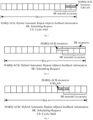
- the transmission time domain resources (resources for short in the figure) configured for the HARQ-ACK information are the third and fourth symbols from last of the slot n, that is, the starting transmission time of the HARQ-ACK information is aligned with the starting transmission time of the SR information, that is, the start symbols are the same, then:
- the transmission time domain resource configured for the HARQ-ACK information are the first and second symbols from last of the slot n, that is, the starting transmission time of the HARQ-ACK information falls behind the starting transmission time of the SR information, that is, the start symbol of the HARQ-ACK information falls behind the start symbol of the SR information, then:
- the transmission time domain resource configured for the HARQ-ACK information are the fourth and fifth symbols from last of the slot n, that is, the starting transmission time of the HARQ-ACK information is ahead of the starting transmission time of the SR information, i.e., the start symbol of the HARQ-ACK information is ahead of the start symbol of the SR information, then:
- Method 2 there is no need to determine the front-to-back relationship between the starting transmission time of the HARQ-ACK information and the starting transmission time of the SR information (i.e., regardless of the above case 1, 2 or 3), and the cyclic shift set for the transmission of the HARQ-ACK information is directly selected according to the state of the SR information. That is, it is assumed that the UE can determine whether the P-SR information exists in the transmit occasion of the SR information before the start symbol of the HARQ-ACK information. For the case 1 and the case 2, this is obvious.
- the UE determines that the SR needs to be transmitted in the current transmit occasion of the SR information (that is, the P-SR information exists), then the 1-bit HARQ-ACK information to be fed back is transmitted using the PUCCH format 0 according to the Table 3, and the cyclic shift value for the actual transmission is determined as (CS0-AN+9) mod 12, which is used to cyclically shift the base sequence to obtain the sequence to be transmitted, and the sequence to be transmitted is mapped onto the RB with number 2 corresponding to the HARQ-ACK information transmission and is transmitted on the symbols of the transmission time domain resource corresponding to the HARQ-ACK information in the slot n, as shown in Figs. 2 , 5 , 6 and 10 .
- the UE determines that there is no need to transmit the SR (i.e., it is the N-SR information) in the current transmit occasion of the SR information, then the 1-bit HARQ-ACK information to be fed back is transmitted using the PUCCH format 0 according to the Table 1.
- the Table 1 is looked up according to the feedback state for the 1-bit HARQ-ACK information to obtain the cyclic shift value corresponding to the actual transmission, e.g., the ACK, and then the cyclic shift value for the actual transmission is determined as CSO-AN, which is used to cyclically shift the base sequence to obtain the sequence to be transmitted, and the sequence to be transmitted is mapped onto the RB with number 2 corresponding to the HARQ-ACK information transmission and is transmitted on the symbols of the transmission time domain resource corresponding to the HARQ-ACK information in the slot n, as shown in Figs. 3 , 7 and 9 .
- the format 1 scheme needs to be used for the transmission resource of the SR information
- the format 0 scheme is used for blind detection since there are two cyclic shift sets on the transmission resource of the HARQ-ACK information.
- the base station determines that the P-SR information exists and that the UE loses the downlink transmission and needs to retransmit the downlink transmission if no feedback information is received on the transmission resource of the HARQ-ACK information while the feedback information is received on the transmission resource of the SR information.
- the HARQ-ACK information is detected through the first cyclic shift set on the transmission resource (here, RB positions and time domain positions) of the HARQ-ACK information, it is determined that the N-SR information exists; and if the HARQ-ACK information is detected through the second cyclic shift set on the transmission resource (here, RB positions and time domain positions) of the HARQ-ACK information, it is determined that the P-SR information also exists. If the base station does not send the downlink transmission that needs HARQ-ACK information feedback to be performed at the time domain position overlapping with the transmit occasion of the SR information, there is only a need to detect on the transmission resource of the SR information. If the information is detected, the P-SR information exists; and if it is Discontinuous Transmission (DTX), the N-SR information exists.
- DTX Discontinuous Transmission
- the HARQ-ACK information of 1 bit is only taken as an example. If it is of 2 bits, the Table 2 or Table 4 is used, and the process is similar and will not be repeated.
- the above process only takes the SR information configured with the PUCCH format 1 as an example. If the SR information is configured with the PUCCH format 0, the process is similar. The only difference is that the SR information (if transmitted) is transmitted using the format 0 on the transmission time domain resource of the SR information, and the combined transmission of the HARQ-ACK information and the P-SR information is the same as above and will not be repeated.
- the above process is also applicable if the HARQ-ACK is configured with the PUCCH format 1 and the SR is configured with the PUCCH format 0, and the difference is that the PUCCH formats of the HARQ-ACK and the SR are exchanged, different PUCCH format 1 resources (for example, different resources have different RB positions and/or CS values and/or OCC sequences, etc.) are selected for transmission according to whether the positive SR exists when the HARQ-ACK is transmitted, and the HARQ-ACK is transmitted by using the PUCCH format 1, so as to implicitly express whether the positive SR exists through different transmission resources.
- the specific situation is similar to the above embodiment and will not be repeated. In the part of the SR not overlapping with the HARQ-ACK, the transmission may be performed using the format 0 configured for the SR itself or the SR may be dropped. The specific situation is similar to the above embodiment and will not be repeated.
- a method for transmitting UCI includes:
- This method provided by the embodiment of the present application may be applicable to the UE side or the network side, e.g., base station side.
- the method for transmitting UCI is a method for sending UCI
- the method for transmitting UCI is a method for receiving UCI.
- the embodiment of the present application ensures that the network side can obtain various types of UCI (e.g., the SR information and HARQ-ACK feedback information and/or periodic CSI) in time through the above-mentioned method.
- the HARQ-ACK information and the SR information are configured with different NR PUCCH formats or configured with the same format but unaligned transmission moments, and when the transmission time domain resources of the periodic CSI and the SR information overlap, the SR information and HARQ-ACK information and/or periodic CSI can be transmitted simultaneously, thereby ensuring that the network side can obtain the SR information and HARQ-ACK feedback information and/or periodic CSI in time.
- the feedback information may be acknowledgement (ACK) information or non-acknowledgement (NACK) information, i.e., the HARQ-ACK described above.
- ACK acknowledgement
- NACK non-acknowledgement
- condition further includes: the first UCI is configured to be transmitted using a first channel format, and the SR information is configured to be transmitted using a second channel format, or the SR information is configured to be transmitted using the first channel format and the transmission time of the SR information partially overlap with the transmission time of the first UCI.
- determining the transmission resource for transmitting the first UCI according to whether the SR information is negative SR information or positive SR information, and transmitting the first UCI on the determined transmission resource includes:
- the first cyclic shift set and the second cyclic shift set each is obtained according to the initial cyclic shift configured for the first UCI and a predetermined offset.
- condition further includes: the first UCI is configured to be transmitted using a third channel format.
- determining the transmission resource for transmitting the first UCI according to whether the SR information is negative SR information or positive SR information, and transmitting the first UCI on the determined transmission resource specifically includes:
- condition further includes: the starting transmission times of the first UCI and the SR information are same; and/or the starting transmission time of the first UCI falls behind the starting transmission time of the SR information.
- the method further includes: if the starting transmission time of the first UCI is ahead of the starting transmission time of the SR information, then:
- determining a UCI transmission scheme according to whether the SR information is positive SR information or not could be determined before the starting transmission time of the first UCI includes:
- transmitting the first UCI in the first channel format on the transmission resource of the first UCI according to a second cyclic shift set includes: when the SR information is positive SR information, performing a step after determining that the condition is satisfied on symbols overlapping with the transmission time domain resource of the SR information, within the transmission time domain resource of the first UCI.
- the method further includes: transmitting the first UCI using the first channel format according to the first cyclic shift set on symbols not overlapping with the transmission time domain resource of the SR information, within the transmission time domain resource of the first UCI.
- the method further includes: on symbols not overlapping with the first UCI among symbols of the transmission time domain resource of the SR information, or on symbols not overlapping with the transmission time domain resources of the first UCI within in the transmission time domain resource of the SR information, when the starting transmission time of the first UCI falls behind the starting transmission time of the SR information, performing the following steps:
- the first channel format is the New Radio (NR) Physical Uplink Control Channel (PUCCH) format 0; and/or the second channel format is the New Radio (NR) Physical Uplink Control Channel (PUCCH) format 1.
- NR New Radio
- PUCCH Physical Uplink Control Channel
- the third channel format is the NR PUCCH format 1 or format 2 or format 3 or format 4.
- the first UCI is Hybrid Automatic Repeat reQuest feedback information (HARQ-ACK) and/or periodic Channel State Information (CSI).
- HARQ-ACK Hybrid Automatic Repeat reQuest feedback information
- CSI Channel State Information
- an apparatus for transmitting UCI provided by an embodiment of the present application includes:
- condition further includes: the first UCI is configured to be transmitted using a first channel format, and the SR information is configured to be transmitted using a second channel format, or the SR information is configured to be transmitted using the first channel format and the transmission time of the SR information partially overlap with the transmission time of the first UCI.
- determining the transmission resource for transmitting the first UCI according to whether the SR information is negative SR information or positive SR information, and transmitting the first UCI on the determined transmission resources includes:
- the first cyclic shift set and the second cyclic shift set each is obtained according to the initial cyclic shift configured for the first UCI and a predetermined offset.
- condition further includes: the first UCI is configured to be transmitted using a third channel format.
- determining the transmission resource for transmitting the first UCI according to whether the SR information is negative SR information or positive SR information, and transmitting the first UCI on the determined transmission resource includes:
- condition further includes: the starting transmission times of the first UCI and the SR information are same; and/or the starting transmission time of the first UCI falls behind the starting transmission time of the SR information.
- the processor is further configured to: if the starting transmission time of the first UCI is ahead of the starting transmission time of the SR information, then:
- determining a UCI transmission scheme according to whether the SR information is positive SR information or not could be determined before the starting transmission time of the first UCI includes:
- transmitting the first UCI using the first channel format on the transmission resource of the first UCI according to a second cyclic shift set includes: when the SR information is positive SR information, performing a step after determining that the condition is satisfied on symbols in the transmission time domain resource of the first UCI overlapping with the transmission time domain resource of the SR information.
- the processor is further configured to: transmit the first UCI using the first channel format according to the first cyclic shift set on symbols not overlapping with the transmission time domain resource of the SR information, within the transmission time domain resource of the first UCI.
- the processor is further configured to: on symbols not overlapping with the first UCI among symbols of the transmission time domain resource of the SR information, or on symbols not overlapping with the transmission time domain resource of the first UCI within the transmission time domain resource of the SR information when the starting transmission time of the first UCI falls behind the starting transmission time of the SR information, perform the following steps:
- the first channel format is the New Radio (NR) Physical Uplink Control Channel (PUCCH) format 0; and/or the second channel format is the New Radio (NR) Physical Uplink Control Channel (PUCCH) format 1.
- NR New Radio
- PUCCH Physical Uplink Control Channel
- the third channel format is the New Radio (NR) Physical Uplink Control Channel (PUCCH) format 1 or 2 or 3 or 4.
- NR New Radio
- PUCCH Physical Uplink Control Channel
- the first UCI is Hybrid Automatic Repeat reQuest feedback information (HARQ-ACK) and/or periodic Channel State Information (CSI).
- HARQ-ACK Hybrid Automatic Repeat reQuest feedback information
- CSI Channel State Information
- another apparatus for transmitting UCI provided by an embodiment of the present application includes:
- the apparatus for transmitting the UCI provided by the embodiments of the present application may be a terminal-side device, e.g., a UE, or may be a network-side device, e.g., a base station.
- An embodiment of the present application provides a computer storage medium for storing the computer program instructions used by the above apparatus, where the computer storage medium contains the program for performing any one of the methods provided by the embodiments of the present application described above.
- the computer storage medium can be any available media or data storage device accessible to the computer, including but not limited to magnetic memory (e.g., floppy disk, hard disk, magnetic tape, Magnetic Optical disc (MO) or the like), optical memory (e.g., CD, DVD, BD, HVD or the like), semiconductor memory (e.g., ROM, EPROM, EEPROM, nonvolatile memory (NAND FLASH), Solid State Disk (SSD)) or the like.
- magnetic memory e.g., floppy disk, hard disk, magnetic tape, Magnetic Optical disc (MO) or the like
- optical memory e.g., CD, DVD, BD, HVD or the like
- semiconductor memory e.g., ROM, EPROM, EEPROM, nonvolatile memory (NAND FLASH), Solid State Disk (SSD)
- the methods provided by the embodiments of the present application can be applied to the terminal devices, and can also be applied to the network devices.
- the terminal device can also referred to as the User Equipment ("UE” for short), Mobile Station (“MS” for short), Mobile Terminal (“MT” for short) or the like.
- the terminal can has the ability of communicating with one or more core networks via the Radio Access Network (RAN).
- RAN Radio Access Network
- the terminal can be a mobile telephone (or called "cellular" telephone), or a computer with the mobile property.
- the terminal can also be a portable, pocket, handheld, computer built-in or vehicle-carried mobile device.
- the network device can be a base station (e.g., access point), which means the device in the access network communicating with the wireless terminal via one or more sectors over the air interface.
- the base station may be used to perform the interconversion between the received air frame and the IP packet, and used as the router between the wireless terminal and the rest of the access network, wherein the rest of the access network may include Internet Protocol (IP) networks.
- IP Internet Protocol
- the base station may further coordinate the attribute management of the air interface.
- the base station may be the Base Transceiver Station (BTS) in the GSM or CDMA, or may be the NodeB in the WCDMA, or may be the evolutional Node B (NodeB or eNB or e-NodeB) in the LTE, which is not limited in the embodiments of the invention.
- BTS Base Transceiver Station
- NodeB evolved Node B
- eNB evolved Node B
- e-NodeB evolutional Node B
- the HARQ-ACK information when the HARQ-ACK information is configured with the format 0 and the SR information is configured with the format 1, or the SR information is configured with the format 0 and the transmission time thereof is partially the same as the transmission time of the HARQ-ACK information, the HARQ-ACK information is transmitted by using different HARQ- ACK information cyclic shift sets to implicitly express the state of the SR information. That is, the embodiments of the present application give the UCI transmission method.
- the HARQ-ACK information is transmitted by using different HARQ-ACK information cyclic shift sets to implicitly express the state of the SR information, thereby realizing the simultaneous transmission of the HARQ-ACK information and the positive SR information and ensuring that the base station can obtain the SR information and the HARQ-ACK information in time.
- the embodiments of the invention can provide methods, systems and computer program products.
- the invention can take the form of hardware embodiments alone, software embodiments alone, or embodiments combining the software and hardware aspects.
- the invention can take the form of computer program products implemented on one or more computer usable storage mediums (including but not limited to magnetic disk memories, CD-ROMs, optical memories and the like) containing computer usable program codes therein.
- These computer program instructions can also be stored in a computer readable memory which is capable of guiding the computer or another programmable data processing device to operate in a particular way, so that the instructions stored in the computer readable memory produce a manufacture including the instruction apparatus which implements the functions specified in one or more processes of the flow charts and/or one or more blocks of the block diagrams.
- These computer program instructions can also be loaded onto the computer or another programmable data processing device, so that a series of operation steps are performed on the computer or another programmable device to produce the computer-implemented processing.
- the instructions executed on the computer or another programmable device provide steps for implementing the functions specified in one or more processes of the flow charts and/or one or more blocks of the block diagrams.
Landscapes
- Engineering & Computer Science (AREA)
- Signal Processing (AREA)
- Computer Networks & Wireless Communication (AREA)
- Quality & Reliability (AREA)
- Mobile Radio Communication Systems (AREA)
- Detection And Prevention Of Errors In Transmission (AREA)
Applications Claiming Priority (3)
| Application Number | Priority Date | Filing Date | Title |
|---|---|---|---|
| CN201711480280.0A CN109996337B (zh) | 2017-12-29 | 2017-12-29 | 一种上行控制信息的传输方法及装置 |
| PCT/CN2018/113827 WO2019128466A1 (zh) | 2017-12-29 | 2018-11-02 | 一种上行控制信息的传输方法及装置 |
| EP18896174.2A EP3735069B1 (de) | 2017-12-29 | 2018-11-02 | Verfahren und vorrichtung zur übertragung von uplink-steuerinformationen |
Related Parent Applications (1)
| Application Number | Title | Priority Date | Filing Date |
|---|---|---|---|
| EP18896174.2A Division EP3735069B1 (de) | 2017-12-29 | 2018-11-02 | Verfahren und vorrichtung zur übertragung von uplink-steuerinformationen |
Publications (2)
| Publication Number | Publication Date |
|---|---|
| EP4336762A2 true EP4336762A2 (de) | 2024-03-13 |
| EP4336762A3 EP4336762A3 (de) | 2024-05-29 |
Family
ID=67065065
Family Applications (2)
| Application Number | Title | Priority Date | Filing Date |
|---|---|---|---|
| EP24154427.9A Pending EP4336762A3 (de) | 2017-12-29 | 2018-11-02 | Verfahren und vorrichtung zur übertragung von uplink-steuerungsinformationen |
| EP18896174.2A Active EP3735069B1 (de) | 2017-12-29 | 2018-11-02 | Verfahren und vorrichtung zur übertragung von uplink-steuerinformationen |
Family Applications After (1)
| Application Number | Title | Priority Date | Filing Date |
|---|---|---|---|
| EP18896174.2A Active EP3735069B1 (de) | 2017-12-29 | 2018-11-02 | Verfahren und vorrichtung zur übertragung von uplink-steuerinformationen |
Country Status (7)
| Country | Link |
|---|---|
| US (1) | US11627594B2 (de) |
| EP (2) | EP4336762A3 (de) |
| JP (2) | JP7349994B2 (de) |
| KR (3) | KR20220138022A (de) |
| CN (1) | CN109996337B (de) |
| TW (1) | TWI687070B (de) |
| WO (1) | WO2019128466A1 (de) |
Families Citing this family (16)
| Publication number | Priority date | Publication date | Assignee | Title |
|---|---|---|---|---|
| CN110034841B (zh) * | 2018-01-11 | 2021-01-12 | 华为技术有限公司 | 一种信息传输方法、装置以及计算机可读存储介质 |
| CN116961864A (zh) * | 2018-05-18 | 2023-10-27 | 中兴通讯股份有限公司 | 信道配置方法及终端、存储介质、电子装置 |
| US12262372B2 (en) * | 2019-04-30 | 2025-03-25 | Lenovo (Beijing) Limited | Apparatus and method of PUCCH transmission and reception |
| CN112242891B (zh) * | 2019-07-19 | 2022-06-14 | 大唐移动通信设备有限公司 | 信息传输方法及装置 |
| CN112311508B (zh) * | 2019-07-25 | 2022-08-09 | 大唐移动通信设备有限公司 | 一种信息传输、接收方法、终端及网络设备 |
| CN111800880B (zh) | 2019-07-30 | 2022-02-22 | 维沃移动通信有限公司 | 上行控制信息的传输方法、终端设备及存储介质 |
| CN112350805B (zh) * | 2019-08-08 | 2022-03-29 | 大唐移动通信设备有限公司 | 一种信息传输方法、终端及基站 |
| CN110536464A (zh) * | 2019-08-14 | 2019-12-03 | 中兴通讯股份有限公司 | 一种传输方法、装置、通信节点及介质 |
| CN112398614B (zh) * | 2019-08-15 | 2021-09-17 | 大唐移动通信设备有限公司 | 一种上行控制信息uci的处理方法、终端及基站 |
| CN112584512B (zh) * | 2019-09-30 | 2023-04-07 | 大唐移动通信设备有限公司 | Sps pdsch的harq-ack传输方法 |
| CN112887067B (zh) * | 2019-11-29 | 2022-06-24 | 维沃移动通信有限公司 | 资源确定方法及装置、通信设备 |
| US11758513B2 (en) | 2020-04-20 | 2023-09-12 | Qualcomm Incorporated | Physical uplink control channel with uplink message short data field |
| US11523301B2 (en) * | 2020-04-20 | 2022-12-06 | Qualcomm Incorporated | Physical uplink control channel with buffer status report |
| WO2021237501A1 (zh) * | 2020-05-27 | 2021-12-02 | 北京小米移动软件有限公司 | 传输调度请求的方法、装置以及计算机可读存储介质 |
| CN114902602B (zh) * | 2020-08-06 | 2024-06-21 | Lg电子株式会社 | 在无线通信系统中发送和接收信号的方法和设备 |
| CN116248240A (zh) * | 2022-11-28 | 2023-06-09 | 中信科移动通信技术股份有限公司 | 复用sr和ack的方法、装置及存储介质 |
Family Cites Families (11)
| Publication number | Priority date | Publication date | Assignee | Title |
|---|---|---|---|---|
| US8638729B2 (en) * | 2007-10-30 | 2014-01-28 | Nokia Siemens Networks Oy | Providing improved scheduling request signaling with ACK/NACK or CQI |
| WO2011019795A1 (en) | 2009-08-13 | 2011-02-17 | Interdigital Patent Holdings, Inc. | Multiplexing uplink l1/l2 control and data |
| CN105187174B (zh) * | 2010-03-10 | 2018-11-16 | Lg电子株式会社 | 发送控制信息的方法和装置 |
| KR101802756B1 (ko) * | 2010-04-05 | 2017-11-29 | 엘지전자 주식회사 | 무선 통신 시스템에서 제어 정보의 전송 방법 및 장치 |
| US9014130B2 (en) * | 2011-10-27 | 2015-04-21 | Lg Electronics Inc. | Method and apparatus for transmitting control information through uplink |
| US9065545B2 (en) * | 2012-03-12 | 2015-06-23 | Blackberry Limited | Handling scheduling request collisions with an ACK/NACK repetition signal |
| CN104767595A (zh) | 2014-01-07 | 2015-07-08 | 中兴通讯股份有限公司 | Harq-ack反馈信息的传输方法、系统及终端和基站 |
| US9955356B2 (en) | 2014-09-25 | 2018-04-24 | Intel IP Corporation | System and method of handling uplink transmission collision for enhanced coverage mode UEs |
| CN106067845A (zh) * | 2015-04-09 | 2016-11-02 | 北京三星通信技术研究有限公司 | 复用上行信息的方法 |
| CN106712894B (zh) * | 2015-07-29 | 2021-09-10 | 大唐移动通信设备有限公司 | 一种上行控制信息传输方法及装置 |
| US11272484B2 (en) * | 2017-05-31 | 2022-03-08 | Ntt Docomo, Inc. | Radio base station and radio communication method |
-
2017
- 2017-12-29 CN CN201711480280.0A patent/CN109996337B/zh active Active
-
2018
- 2018-11-02 WO PCT/CN2018/113827 patent/WO2019128466A1/zh not_active Ceased
- 2018-11-02 EP EP24154427.9A patent/EP4336762A3/de active Pending
- 2018-11-02 EP EP18896174.2A patent/EP3735069B1/de active Active
- 2018-11-02 US US16/958,748 patent/US11627594B2/en active Active
- 2018-11-02 KR KR1020227034238A patent/KR20220138022A/ko not_active Ceased
- 2018-11-02 KR KR1020237037960A patent/KR20230155619A/ko not_active Ceased
- 2018-11-02 KR KR1020207022122A patent/KR102451710B1/ko active Active
- 2018-11-02 JP JP2020536564A patent/JP7349994B2/ja active Active
- 2018-12-18 TW TW107145604A patent/TWI687070B/zh active
-
2023
- 2023-05-22 JP JP2023084216A patent/JP7634592B2/ja active Active
Non-Patent Citations (2)
| Title |
|---|
| INTEL CORPORATION: "Short PUCCH for UCI up to 2 bits", vol. RAN WG1, no. Nagoya, Japan; 20170918 - 20170921, 18 September 2017 (2017-09-18), XP051353835, Retrieved from the Internet <URL:http://www.3gpp.org/ftp/tsg_ran/WG1_RL1/TSGR1_AH/NR_AH_1709/Docs/> [retrieved on 20170918] * |
| ZTE ET AL: "Remaining issues on sPUCCH format design", vol. RAN WG1, no. Prague, Czech Republic; 20171009 - 20171013, 30 September 2017 (2017-09-30), XP051351931, Retrieved from the Internet <URL:http://www.3gpp.org/ftp/tsg_ran/WG1_RL1/TSGR1_90b/Docs/> [retrieved on 20170930] * |
Also Published As
| Publication number | Publication date |
|---|---|
| JP2021508211A (ja) | 2021-02-25 |
| JP7349994B2 (ja) | 2023-09-25 |
| EP3735069A4 (de) | 2021-01-27 |
| EP3735069B1 (de) | 2024-01-31 |
| JP7634592B2 (ja) | 2025-02-21 |
| EP4336762A3 (de) | 2024-05-29 |
| EP3735069A1 (de) | 2020-11-04 |
| CN109996337A (zh) | 2019-07-09 |
| KR20200102496A (ko) | 2020-08-31 |
| KR102451710B1 (ko) | 2022-10-06 |
| US20200344789A1 (en) | 2020-10-29 |
| TW201931800A (zh) | 2019-08-01 |
| CN109996337B (zh) | 2021-06-29 |
| WO2019128466A1 (zh) | 2019-07-04 |
| US11627594B2 (en) | 2023-04-11 |
| TWI687070B (zh) | 2020-03-01 |
| KR20230155619A (ko) | 2023-11-10 |
| JP2023101030A (ja) | 2023-07-19 |
| KR20220138022A (ko) | 2022-10-12 |
Similar Documents
| Publication | Publication Date | Title |
|---|---|---|
| US11627594B2 (en) | Uplink control information transmission method and apparatus | |
| JP7281441B2 (ja) | 異なる送信時間間隔(tti)持続時間により動作するシステムおよび方法 | |
| US11272520B2 (en) | Uplink transmission method, terminal device, and network device | |
| CN111092698B (zh) | 无线通信系统中的方法和节点 | |
| JP6134381B2 (ja) | キャリアアグリゲーションに対するハイブリッド自動反復要求のシグナリングのための方法および装置 | |
| US10313062B2 (en) | Method and user equipment for transmitting HARQ ACK/NACK for downlink data when using more than five cells according to carrier aggregation | |
| CN109995481B (zh) | 一种上行控制信息的传输方法及装置 | |
| EP3379883B1 (de) | Verfahren und mobilstation zur übertragung eines dienstes | |
| CN109995485B (zh) | 一种上行控制信息的传输方法及装置 | |
| CN104796926A (zh) | 资源管理方法和装置 | |
| KR102202360B1 (ko) | 정보 송신 방법, 네트워크 디바이스, 및 단말 디바이스 | |
| CN110022190B (zh) | 一种上行控制信息的传输方法及装置 | |
| US10673572B2 (en) | Communication method and communication device | |
| EP3306848B1 (de) | Datenübertragungsverfahren, endgerät und basisstation |
Legal Events
| Date | Code | Title | Description |
|---|---|---|---|
| PUAI | Public reference made under article 153(3) epc to a published international application that has entered the european phase |
Free format text: ORIGINAL CODE: 0009012 |
|
| STAA | Information on the status of an ep patent application or granted ep patent |
Free format text: STATUS: THE APPLICATION HAS BEEN PUBLISHED |
|
| AC | Divisional application: reference to earlier application |
Ref document number: 3735069 Country of ref document: EP Kind code of ref document: P |
|
| AK | Designated contracting states |
Kind code of ref document: A2 Designated state(s): AL AT BE BG CH CY CZ DE DK EE ES FI FR GB GR HR HU IE IS IT LI LT LU LV MC MK MT NL NO PL PT RO RS SE SI SK SM TR |
|
| REG | Reference to a national code |
Ref country code: DE Ref legal event code: R079 Free format text: PREVIOUS MAIN CLASS: H04L0001180000 Ipc: H04W0072040000 |
|
| PUAL | Search report despatched |
Free format text: ORIGINAL CODE: 0009013 |
|
| AK | Designated contracting states |
Kind code of ref document: A3 Designated state(s): AL AT BE BG CH CY CZ DE DK EE ES FI FR GB GR HR HU IE IS IT LI LT LU LV MC MK MT NL NO PL PT RO RS SE SI SK SM TR |
|
| RIC1 | Information provided on ipc code assigned before grant |
Ipc: H04L 1/18 20230101ALI20240423BHEP Ipc: H04L 1/16 20230101ALI20240423BHEP Ipc: H04W 72/04 20230101AFI20240423BHEP |
|
| STAA | Information on the status of an ep patent application or granted ep patent |
Free format text: STATUS: REQUEST FOR EXAMINATION WAS MADE |
|
| 17P | Request for examination filed |
Effective date: 20241129 |
|
| RBV | Designated contracting states (corrected) |
Designated state(s): AL AT BE BG CH CY CZ DE DK EE ES FI FR GB GR HR HU IE IS IT LI LT LU LV MC MK MT NL NO PL PT RO RS SE SI SK SM TR |
|
| STAA | Information on the status of an ep patent application or granted ep patent |
Free format text: STATUS: EXAMINATION IS IN PROGRESS |
|
| 17Q | First examination report despatched |
Effective date: 20251113 |