EP4336512A1 - Verfahren und system zur bereitstellung eines übungsprogramms für einen benutzer - Google Patents
Verfahren und system zur bereitstellung eines übungsprogramms für einen benutzer Download PDFInfo
- Publication number
- EP4336512A1 EP4336512A1 EP22881430.7A EP22881430A EP4336512A1 EP 4336512 A1 EP4336512 A1 EP 4336512A1 EP 22881430 A EP22881430 A EP 22881430A EP 4336512 A1 EP4336512 A1 EP 4336512A1
- Authority
- EP
- European Patent Office
- Prior art keywords
- electronic device
- exercise
- user
- target
- information
- Prior art date
- Legal status (The legal status is an assumption and is not a legal conclusion. Google has not performed a legal analysis and makes no representation as to the accuracy of the status listed.)
- Pending
Links
Images





Classifications
-
- A—HUMAN NECESSITIES
- A63—SPORTS; GAMES; AMUSEMENTS
- A63B—APPARATUS FOR PHYSICAL TRAINING, GYMNASTICS, SWIMMING, CLIMBING, OR FENCING; BALL GAMES; TRAINING EQUIPMENT
- A63B24/00—Electric or electronic controls for exercising apparatus of preceding groups; Controlling or monitoring of exercises, sportive games, training or athletic performances
- A63B24/0087—Electric or electronic controls for exercising apparatus of groups A63B21/00 - A63B23/00, e.g. controlling load
-
- G—PHYSICS
- G16—INFORMATION AND COMMUNICATION TECHNOLOGY [ICT] SPECIALLY ADAPTED FOR SPECIFIC APPLICATION FIELDS
- G16H—HEALTHCARE INFORMATICS, i.e. INFORMATION AND COMMUNICATION TECHNOLOGY [ICT] SPECIALLY ADAPTED FOR THE HANDLING OR PROCESSING OF MEDICAL OR HEALTHCARE DATA
- G16H20/00—ICT specially adapted for therapies or health-improving plans, e.g. for handling prescriptions, for steering therapy or for monitoring patient compliance
- G16H20/30—ICT specially adapted for therapies or health-improving plans, e.g. for handling prescriptions, for steering therapy or for monitoring patient compliance relating to physical therapies or activities, e.g. physiotherapy, acupressure or exercising
-
- A—HUMAN NECESSITIES
- A63—SPORTS; GAMES; AMUSEMENTS
- A63B—APPARATUS FOR PHYSICAL TRAINING, GYMNASTICS, SWIMMING, CLIMBING, OR FENCING; BALL GAMES; TRAINING EQUIPMENT
- A63B24/00—Electric or electronic controls for exercising apparatus of preceding groups; Controlling or monitoring of exercises, sportive games, training or athletic performances
- A63B24/0003—Analysing the course of a movement or motion sequences during an exercise or trainings sequence, e.g. swing for golf or tennis
- A63B24/0006—Computerised comparison for qualitative assessment of motion sequences or the course of a movement
-
- A—HUMAN NECESSITIES
- A63—SPORTS; GAMES; AMUSEMENTS
- A63B—APPARATUS FOR PHYSICAL TRAINING, GYMNASTICS, SWIMMING, CLIMBING, OR FENCING; BALL GAMES; TRAINING EQUIPMENT
- A63B24/00—Electric or electronic controls for exercising apparatus of preceding groups; Controlling or monitoring of exercises, sportive games, training or athletic performances
- A63B24/0075—Means for generating exercise programmes or schemes, e.g. computerized virtual trainer, e.g. using expert databases
-
- A—HUMAN NECESSITIES
- A63—SPORTS; GAMES; AMUSEMENTS
- A63B—APPARATUS FOR PHYSICAL TRAINING, GYMNASTICS, SWIMMING, CLIMBING, OR FENCING; BALL GAMES; TRAINING EQUIPMENT
- A63B71/00—Games or sports accessories not covered in groups A63B1/00 - A63B69/00
- A63B71/06—Indicating or scoring devices for games or players, or for other sports activities
-
- G—PHYSICS
- G16—INFORMATION AND COMMUNICATION TECHNOLOGY [ICT] SPECIALLY ADAPTED FOR SPECIFIC APPLICATION FIELDS
- G16H—HEALTHCARE INFORMATICS, i.e. INFORMATION AND COMMUNICATION TECHNOLOGY [ICT] SPECIALLY ADAPTED FOR THE HANDLING OR PROCESSING OF MEDICAL OR HEALTHCARE DATA
- G16H40/00—ICT specially adapted for the management or administration of healthcare resources or facilities; ICT specially adapted for the management or operation of medical equipment or devices
- G16H40/60—ICT specially adapted for the management or administration of healthcare resources or facilities; ICT specially adapted for the management or operation of medical equipment or devices for the operation of medical equipment or devices
- G16H40/63—ICT specially adapted for the management or administration of healthcare resources or facilities; ICT specially adapted for the management or operation of medical equipment or devices for the operation of medical equipment or devices for local operation
-
- G—PHYSICS
- G16—INFORMATION AND COMMUNICATION TECHNOLOGY [ICT] SPECIALLY ADAPTED FOR SPECIFIC APPLICATION FIELDS
- G16H—HEALTHCARE INFORMATICS, i.e. INFORMATION AND COMMUNICATION TECHNOLOGY [ICT] SPECIALLY ADAPTED FOR THE HANDLING OR PROCESSING OF MEDICAL OR HEALTHCARE DATA
- G16H40/00—ICT specially adapted for the management or administration of healthcare resources or facilities; ICT specially adapted for the management or operation of medical equipment or devices
- G16H40/60—ICT specially adapted for the management or administration of healthcare resources or facilities; ICT specially adapted for the management or operation of medical equipment or devices for the operation of medical equipment or devices
- G16H40/67—ICT specially adapted for the management or administration of healthcare resources or facilities; ICT specially adapted for the management or operation of medical equipment or devices for the operation of medical equipment or devices for remote operation
-
- G—PHYSICS
- G16—INFORMATION AND COMMUNICATION TECHNOLOGY [ICT] SPECIALLY ADAPTED FOR SPECIFIC APPLICATION FIELDS
- G16H—HEALTHCARE INFORMATICS, i.e. INFORMATION AND COMMUNICATION TECHNOLOGY [ICT] SPECIALLY ADAPTED FOR THE HANDLING OR PROCESSING OF MEDICAL OR HEALTHCARE DATA
- G16H50/00—ICT specially adapted for medical diagnosis, medical simulation or medical data mining; ICT specially adapted for detecting, monitoring or modelling epidemics or pandemics
- G16H50/20—ICT specially adapted for medical diagnosis, medical simulation or medical data mining; ICT specially adapted for detecting, monitoring or modelling epidemics or pandemics for computer-aided diagnosis, e.g. based on medical expert systems
-
- G—PHYSICS
- G16—INFORMATION AND COMMUNICATION TECHNOLOGY [ICT] SPECIALLY ADAPTED FOR SPECIFIC APPLICATION FIELDS
- G16Y—INFORMATION AND COMMUNICATION TECHNOLOGY SPECIALLY ADAPTED FOR THE INTERNET OF THINGS [IoT]
- G16Y10/00—Economic sectors
- G16Y10/60—Healthcare; Welfare
-
- G—PHYSICS
- G16—INFORMATION AND COMMUNICATION TECHNOLOGY [ICT] SPECIALLY ADAPTED FOR SPECIFIC APPLICATION FIELDS
- G16Y—INFORMATION AND COMMUNICATION TECHNOLOGY SPECIALLY ADAPTED FOR THE INTERNET OF THINGS [IoT]
- G16Y40/00—IoT characterised by the purpose of the information processing
- G16Y40/20—Analytics; Diagnosis
-
- A—HUMAN NECESSITIES
- A63—SPORTS; GAMES; AMUSEMENTS
- A63B—APPARATUS FOR PHYSICAL TRAINING, GYMNASTICS, SWIMMING, CLIMBING, OR FENCING; BALL GAMES; TRAINING EQUIPMENT
- A63B24/00—Electric or electronic controls for exercising apparatus of preceding groups; Controlling or monitoring of exercises, sportive games, training or athletic performances
- A63B24/0003—Analysing the course of a movement or motion sequences during an exercise or trainings sequence, e.g. swing for golf or tennis
- A63B24/0006—Computerised comparison for qualitative assessment of motion sequences or the course of a movement
- A63B2024/0009—Computerised real time comparison with previous movements or motion sequences of the user
-
- A—HUMAN NECESSITIES
- A63—SPORTS; GAMES; AMUSEMENTS
- A63B—APPARATUS FOR PHYSICAL TRAINING, GYMNASTICS, SWIMMING, CLIMBING, OR FENCING; BALL GAMES; TRAINING EQUIPMENT
- A63B2220/00—Measuring of physical parameters relating to sporting activity
- A63B2220/10—Positions
- A63B2220/16—Angular positions
-
- A—HUMAN NECESSITIES
- A63—SPORTS; GAMES; AMUSEMENTS
- A63B—APPARATUS FOR PHYSICAL TRAINING, GYMNASTICS, SWIMMING, CLIMBING, OR FENCING; BALL GAMES; TRAINING EQUIPMENT
- A63B2220/00—Measuring of physical parameters relating to sporting activity
- A63B2220/50—Force related parameters
- A63B2220/54—Torque
-
- A—HUMAN NECESSITIES
- A63—SPORTS; GAMES; AMUSEMENTS
- A63B—APPARATUS FOR PHYSICAL TRAINING, GYMNASTICS, SWIMMING, CLIMBING, OR FENCING; BALL GAMES; TRAINING EQUIPMENT
- A63B2220/00—Measuring of physical parameters relating to sporting activity
- A63B2220/62—Time or time measurement used for time reference, time stamp, master time or clock signal
-
- A—HUMAN NECESSITIES
- A63—SPORTS; GAMES; AMUSEMENTS
- A63B—APPARATUS FOR PHYSICAL TRAINING, GYMNASTICS, SWIMMING, CLIMBING, OR FENCING; BALL GAMES; TRAINING EQUIPMENT
- A63B2220/00—Measuring of physical parameters relating to sporting activity
- A63B2220/80—Special sensors, transducers or devices therefor
- A63B2220/83—Special sensors, transducers or devices therefor characterised by the position of the sensor
- A63B2220/833—Sensors arranged on the exercise apparatus or sports implement
-
- A—HUMAN NECESSITIES
- A63—SPORTS; GAMES; AMUSEMENTS
- A63B—APPARATUS FOR PHYSICAL TRAINING, GYMNASTICS, SWIMMING, CLIMBING, OR FENCING; BALL GAMES; TRAINING EQUIPMENT
- A63B2225/00—Miscellaneous features of sport apparatus, devices or equipment
- A63B2225/02—Testing, calibrating or measuring of equipment
-
- A—HUMAN NECESSITIES
- A63—SPORTS; GAMES; AMUSEMENTS
- A63B—APPARATUS FOR PHYSICAL TRAINING, GYMNASTICS, SWIMMING, CLIMBING, OR FENCING; BALL GAMES; TRAINING EQUIPMENT
- A63B2225/00—Miscellaneous features of sport apparatus, devices or equipment
- A63B2225/50—Wireless data transmission, e.g. by radio transmitters or telemetry
-
- A—HUMAN NECESSITIES
- A63—SPORTS; GAMES; AMUSEMENTS
- A63B—APPARATUS FOR PHYSICAL TRAINING, GYMNASTICS, SWIMMING, CLIMBING, OR FENCING; BALL GAMES; TRAINING EQUIPMENT
- A63B2230/00—Measuring physiological parameters of the user
- A63B2230/04—Measuring physiological parameters of the user heartbeat characteristics, e.g. ECG, blood pressure modulations
- A63B2230/06—Measuring physiological parameters of the user heartbeat characteristics, e.g. ECG, blood pressure modulations heartbeat rate only
Definitions
- Example embodiments relate to a technology for providing an exercise program to a user.
- a system for providing various exercise programs to a user through a wearable device may be provided.
- an electronic device including: a communication module (comprising communication circuitry) configured to exchange data with an external device; and at least one processor configured to control the electronic device, wherein the at least one processor may be configured to: receive target exercise information from a user of the electronic device, the target exercise information including target exercise time information and target exercise section information; based on the target exercise information and current values of gait assessment items, determine an optimal value of a control parameter that may satisfy preset target values of the assessment items, the control parameter being a parameter for adjusting at least one of a magnitude, torque direction and timing, an offset angle between joint angles, or sensitivity of a state factor to the joint angles or combination thereof; acquire one or more recommended exercise program based on the optimal value of the control parameter; determine a target exercise program among the one or more recommended exercise program; transmit information on the target exercise program to a wearable device worn by the user; receive sensing information from the wearable device while the target exercise program is being executed by the wearable device; and provide feedback information upon execution of the target
- the items for assessing a gait may include one or more of a step length, gait speed, gait symmetry, and gait rhythm.
- the processor may acquire the current values of the gait assessment items based on previous sensing information acquired while the user was performing a previous exercise program.
- the processor may transmit information on a test exercise program for acquiring the current values of the gait assessment items to the wearable device, receive test sensing information upon execution of the test exercise program from the wearable device, and acquire the current values of the gait assessment items based on the test sensing information.
- the processor may determine the optimal value of the control parameter such that the target values of the gait assessment items may be satisfied within a range that satisfies a set objective function.
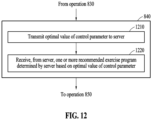
- the processor may transmit the optimal value of the control parameter to the server, and receive, from the server, one or more recommended exercise program determined by the server based on the optimal value of the control parameter.
- the processor may determine one or more recommended exercise program corresponding to the optimal value among a plurality of stored exercise programs.
- the processor may determine the one or more recommended exercise program corresponding to the optimal value among the plurality of stored exercise programs based on a history of exercise programs performed by the user.
- the information on the target exercise program may include a value of the control parameter during a target exercise time.
- the processor may determine whether the target values of the assessment items are being satisfied based on the sensing information, when the target values are not satisfied, determine a requested action to satisfy the target values, and provide the feedback information including the requested action to the user.
- the processor may transmit the feedback information to an additional electronic device, and the feedback information may be output by the additional electronic device.
- the additional electronic device may be any one of an earphone, a glasses-type electronic device, or a watch-type electronic device, for example and without limitation.
- the processor may receive a heart rate of the user from the additional electronic device as the sensing information.
- the target exercise section information may include information on a start point, an end point, and detailed routes between the start point and the end point.
- An expected gait age may be provided to the user in response to the target exercise program being performed normally.
- the target values of the gait assessment items may be set based on a target exercise goal selected by the user among a plurality of exercise goals.
- the plurality of exercise objectives may include two or more of improving gait ability, improving gait posture, improving cardiovascular health, and improving muscular strength.
- a method performed by an electronic device may include: receiving target exercise information from a user of the electronic device, the target exercise information including target exercise time information and target exercise section information; based on the target exercise information and current values of gait assessment items, determining an optimal value of a control parameter that may satisfy preset target values of the gait assessment items, the control parameter being a parameter for adjusting at least one of a magnitude, torque direction and timing, an offset angle between joint angles, or sensitivity of a state factor to the joint angles or combination thereof; acquiring one or more recommended exercise program based on the optimal value of the control parameter; determining a target exercise program among the one or more recommended exercise program; transmitting information on the target exercise program to a wearable device worn by the user; receiving sensing information from the wearable device while the target exercise program is being executed by the wearable device; and providing feedback information upon execution of the target exercise program to the user based on the sensing information.
- a server which may include: a communication module (comprising communication circuitry) configured to exchange data with an external device; and at least one processor configured to control the server, wherein the at least one processor may be configured to: receive an optimal value of a control parameter from an electronic device, the control parameter being a parameter for adjusting at least one of a magnitude, torque direction and timing, an offset angle between joint angles, or sensitivity of a state factor to the joint angles or combination thereof; determine one or more recommended exercise program among a plurality of exercise programs stored in the server based on the optimal value of the control parameter; and transmit one or more recommended exercise program to the electronic device.
- a communication module comprising communication circuitry
- the at least one processor may be configured to: receive an optimal value of a control parameter from an electronic device, the control parameter being a parameter for adjusting at least one of a magnitude, torque direction and timing, an offset angle between joint angles, or sensitivity of a state factor to the joint angles or combination thereof; determine one or more recommended exercise program among a plurality of exercise programs stored
- the processor may determine the one or more recommended exercise program corresponding to the optimal value among the plurality of stored exercise programs based on a history of exercise programs performed by the user.
- the processor may receive, from the electronic device, sensing information received by the electronic device from a wearable device while a target exercise program among the one or more recommended exercise program is being executed by the wearable device connected to the electronic device, and store the target exercise program and the sensing information in association with an account of the user.
- a system for providing various exercise programs to a user through a wearable device may be provided.
- a user wearing the wearable device may feel as if a corresponding exercise section is a different exercise section through performing a different exercise program a number of times, even when the user repeatedly performs an exercise in the same exercise section.
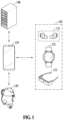
- FIG. 1 is a diagram illustrating a system for providing an exercise program to a user according to an example embodiment.
- a system for providing an exercise program to a user may include an electronic device 110, a wearable device 120, an additional device 130, and a server 140.
- the electronic device 110 may be a user terminal connectable to the wearable device 120 using short-range wireless communication.
- the electronic device 110 may transmit a control signal for controlling the wearable device 120 to the wearable device 120.
- the electronic device 110 will be described in detail below with reference to FIG. 2 , and transmission of the control signal will be described in detail below with reference to FIG. 4 .
- the wearable device 120 may provide an assistance force to assist walking or a resistance force to hinder walking, to a user wearing the wearable device 120.
- the resistance force may be provided to the user to assist the user in doing an exercise.
- the assistance force or the resistance force output by the wearable device 120 may be controlled.
- a structure and a driving method of the wearable device 120 will be described in detail below with reference to FIGS. 3a to 7 .
- the electronic device 110 may be connected, directly or indirectly, to the additional device 130 (e.g., a wireless earphone 131, a smartwatch 132, or smart glasses 133) using short-range wireless communication.
- the electronic device 110 may output information indicating a state of the electronic device 110 or a state of the wearable device 120 to the user through the additional device 130.
- feedback information on a walking state of the user wearing the wearable device 120 may be output through a haptic device, a speaker device, and a display device of the additional device 130.
- the electronic device 110 may be connected, directly or indirectly, to the server 140 using short-range wireless communication or cellular communication.
- the server 140 may include a database in which information on a plurality of exercise programs that can be provided to a user through the wearable device 120 is stored.
- the server 140 may manage a user account for a user of the electronic device 110 or the wearable device 120.
- the server 140 may store and manage an exercise program performed by the user and a result of the exercise program in association with the user account.
- An example configuration of the server 140 will be described in detail below with reference to FIG. 14 .
- the system may provide the user with an exercise program to achieve an exercise objective in various exercise environments desired by the user.
- the exercise objective of the user may be preset, and may include, for example, improvement of gait ability, improvement of gait posture, improvement of cardiovascular health, and improvement of muscular strength.
- the user may designate a predetermined exercise environment each time an exercise is performed. For example, the user may designate a target exercise section and a target exercise time as an exercise environment through the electronic device 110 before performing an exercise.
- the electronic device 110 may determine values of control parameters of the wearable device 120 that may satisfy the exercise environment based on the set exercise objective.
- control parameters may include parameters for adjusting at least one of a magnitude, a direction, or a torque timing or combination thereof to be output through the wearable device 120, an offset angle between joint angles of the wearable device 120, and sensitivity of a state factor to the joint angles.
- the electronic device 110 may acquire one or more exercise program based on the determined values of the control parameters.
- the exercise program may relate to a method of providing an assistance force or a resistance force provided to a user wearing the wearable device 120 in a set exercise environment.
- the exercise program may provide the user with the same assistance force or the same resistance force within an entire exercise time.
- the exercise program may divide the entire exercise time into a plurality of sections, and provide different assistance forces or resistance forces to the user in the plurality of sections.
- an output timing of the assistance force or the resistance force output through the exercise program may vary according to the target exercise time and the exercise objective.
- the plurality of exercise programs may be converted into a database and stored in the electronic device 110 or in the server 140.
- the electronic device 110 or the server 140 may recommend one or more of the plurality of exercise programs to the user based on the determined values of the control parameters.
- the electronic device 110 or the server 140 may determine an exercise program to be recommended to the user based on a history of exercise performed by the user. Accordingly, a new exercise program may be recommended to the user even when the user is exercising in the same exercise environment, and the user may feel as if they are performing a different exercise than the existing exercise by performing the new exercise program.
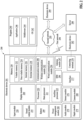
- FIG. 2 is a block diagram illustrating an electronic device in a network environment according to embodiments.
- FIG. 2 is a block diagram illustrating an electronic device 201 (e.g., the electronic device 110 of FIG. 1 ) in a network environment 200 according to embodiments.
- the electronic device 201 in the network environment 200 may communicate with an electronic device 202 via a first network 298 (e.g., a short-range wireless communication network), or communicate with at least one of an electronic device 204 and a server 208 via a second network 299 (e.g., a long-range wireless communication network).
- the electronic device 201 may communicate with the electronic device 204 via the server 208.
- the electronic device 201 may include a processor 220, a memory 230, an input module 250, a sound output module 255, a display module 260, an audio module 270, and a sensor module 276, an interface 277, a connecting terminal 278, a haptic module 279, a camera module 280, a power management module 288, a battery 289, a communication module 290, a subscriber identification module (SIM) 296, or an antenna module 297.
- at least one (e.g., the connecting terminal 278) of the above components may be omitted from the electronic device 201, or one or more other components may be added in the electronic device 201.
- some (e.g., the sensor module 276, the camera module 280, or the antenna module 297) of the components may be integrated as a single component (e.g., the display module 260).
- Each antenna module herein comprises at least one antenna
- each sensor module herein comprises circuitry and/or at least one sensor.
- the processor 220 may execute, for example, software (e.g., a program 240) to control at least one other component (e.g., a hardware or software component) of the electronic device 201 connected, directly or indirectly, to the processor 220, and may perform various data processing or computation.
- the processor 220 may store a command or data received from another component (e.g., the sensor module 276 or the communication module 290) in a volatile memory 232, process the command or the data stored in the volatile memory 232, and store resulting data in a non-volatile memory 234.
- the processor 220 may include a main processor 221 (e.g., a central processing unit (CPU) or an application processor (AP)) or an auxiliary processor 223 (e.g., a graphics processing unit (GPU), a neural processing unit (NPU), an image signal processor (ISP), a sensor hub processor, or a communication processor (CP)) that is operable independently of, or in conjoint with the main processor 221.
- a main processor 221 e.g., a central processing unit (CPU) or an application processor (AP)
- auxiliary processor 223 e.g., a graphics processing unit (GPU), a neural processing unit (NPU), an image signal processor (ISP), a sensor hub processor, or a communication processor (CP)
- the auxiliary processor 223 may be adapted to consume less power than the main processor 221 or to be specific to a specified function.
- the auxiliary processor 223 may be implemented separately from the main processor 221 or as a part of the main processor 221.
- the auxiliary processor 223 may control at least some of functions or states related to at least one (e.g., the display module 260, the sensor module 276, or the communication module 290) of the components of the electronic device 201, instead of the main processor 221 while the main processor 221 is in an inactive (e.g., sleep) state or along with the main processor 221 while the main processor 221 is in an active state (e.g., executing an application).
- the auxiliary processor 223 e.g., an ISP or a CP
- the auxiliary processor 223 may include a hardware structure specified for artificial intelligence (AI) model processing.
- An AI model may be generated by machine learning.
- the machine learning may be performed by, for example, the electronic device 201, in which artificial intelligence is performed, or performed via a separate server (e.g., the server 208).
- Learning algorithms may include, but are not limited to, for example, supervised learning, unsupervised learning, semi-supervised learning, or reinforcement learning algorithms.
- the AI model may include a plurality of artificial neural network layers.
- An artificial neural network may include, for example, a deep neural network (DNN), a convolutional neural network (CNN), a recurrent neural network (RNN), a restricted Boltzmann machine (RBM), a deep belief network (DBN), and a bidirectional recurrent deep neural network (BRDNN), a deep Q-network, or a combination of two or more thereof, but is not limited thereto.
- the AI model may additionally or alternatively include a software structure other than the hardware structure.
- the memory 230 may store various pieces of data used by at least one component (e.g., the processor 220 or the sensor module 276) of the electronic device 201.
- the various pieces of data may include, for example, software (e.g., the program 240) and input data or output data for a command related thereto.
- the memory 230 may include the volatile memory 232 or the non-volatile memory 234.
- the program 240 may be stored as software in the memory 230, and may include, for example, an operating system (OS) 242, middleware 244, or an application 246.
- OS operating system
- middleware middleware
- application 246 application
- the input module 250 may receive, from outside (e.g., a user) the electronic device 201, a command or data to be used by another component (e.g., the processor 220) of the electronic device 201.
- the input module 250 may include, for example, a microphone, a mouse, a keyboard, a key (e.g., a button), or a digital pen (e.g., a stylus pen), and typically comprises input circuitry.
- the sound output module 255 may output a sound signal to the outside of the electronic device 201.
- the sound output module 255 may include, for example, a speaker or a receiver.
- the speaker may be used for general purposes, such as playing multimedia or playing a recording.
- the receiver may be used to receive an incoming call. According to an example embodiment, the receiver may be implemented separately from the speaker or as a part of the speaker.
- the display module 260 may visually provide information to the outside (e.g., a user) of the electronic device 201.
- the display module 260 may include, for example, a control circuit for controlling a display, a hologram device, or a projector and control circuitry to control its corresponding one of the display, the hologram device, and the projector.
- the display device 260 may include a touch sensor adapted to sense a touch, or a pressure sensor adapted to measure an intensity of a force incurred by the touch.
- the audio module 270 may convert sound into an electrical signal or vice versa. According to an example embodiment, the audio module 270 may acquire the sound via the input module 250 or output the sound via the sound output module 255 or an external electronic device (e.g., an electronic device 202 such as a speaker or a headphone) directly or wirelessly connected to the electronic device 201.
- an external electronic device e.g., an electronic device 202 such as a speaker or a headphone
- the sensor module 276 may detect an operational state (e.g., power or temperature) of the electronic device 201 or an environmental state (e.g., a state of a user) external to the electronic device 201, and generate an electrical signal or data value corresponding to the detected state.
- the sensor module 276 may include, for example, a gesture sensor, a gyro sensor, an atmospheric pressure sensor, a magnetic sensor, an acceleration sensor, a grip sensor, a proximity sensor, a color sensor, an infrared (IR) sensor, a biometric sensor, a temperature sensor, a humidity sensor, or an illuminance sensor.
- the interface 277 may support one or more specified protocols to be used by the electronic device 201 to couple with the external electronic device (e.g., the electronic device 202) directly (e.g., by wire) or wirelessly.
- the interface 277 may include, for example, a high-definition multimedia interface (HDMI), a universal serial bus (USB) interface, a secure digital (SD) card interface, or an audio interface.
- HDMI high-definition multimedia interface
- USB universal serial bus
- SD secure digital
- the connecting terminal 278 may include a connector via which the electronic device 201 may physically connect to an external electronic device (e.g., the electronic device 202).
- the connecting terminal 278 may include, for example, an HDMI connector, a USB connector, an SD card connector, or an audio connector (e.g., a headphone connector).
- the haptic module 279 may convert an electric signal into a mechanical stimulus (e.g., a vibration or a movement) or an electrical stimulus which may be recognized by a user via their tactile sensation or kinesthetic sensation.
- the haptic module 279 may include, for example, a motor, a piezoelectric element, or an electric stimulator.
- the camera module 280 may capture a still image and moving images.
- the camera module 280 may include one or more lenses, image sensors, ISPs, or flashes.
- the power management module 288 may manage power supplied to the electronic device 201.
- the power management module 288 may be implemented as, for example, at least a part of a power management integrated circuit (PMIC).
- PMIC power management integrated circuit
- the battery 289 may supply power to at least one component of the electronic device 201.
- the battery 289 may include, for example, a primary cell which is not rechargeable, a secondary cell which is rechargeable, or a fuel cell.
- the communication module 290 may support establishing a direct (e.g., wired) communication channel or a wireless communication channel between the electronic device 201 and the external electronic device (e.g., the electronic device 202, the electronic device 204, or the server 208) and performing communication via the established communication channel.
- the communication module 290 may include one or more CPs that are operable independently from the processor 220 (e.g., an AP) and that support direct (e.g., wired) communication or wireless communication.
- the communication module 290 may include a wireless communication module 292 (e.g., a cellular communication module, a short-range wireless communication module, or a global navigation satellite system (GNSS) communication module) or a wired communication module 294 (e.g., a local region network (LAN) communication module, or a power line communication (PLC) module).
- a wireless communication module 292 e.g., a cellular communication module, a short-range wireless communication module, or a global navigation satellite system (GNSS) communication module
- GNSS global navigation satellite system
- wired communication module 294 e.g., a local region network (LAN) communication module, or a power line communication (PLC) module.
- LAN local region network
- PLC power line communication
- a corresponding one of these communication modules may communicate with the external electronic device, for example, the electronic device 204, via the first network 298 (e.g., a short-range communication network, such as Bluetooth TM , wireless-fidelity (Wi-Fi) direct, or infrared data association (IrDA)) or the second network 299 (e.g., a long-range communication network, such as a legacy cellular network, a 5G network, a next-generation communication network, the Internet, or a computer network (e.g., a LAN or a wide area network (WAN))).
- a short-range communication network such as Bluetooth TM , wireless-fidelity (Wi-Fi) direct, or infrared data association (IrDA)
- the second network 299 e.g., a long-range communication network, such as a legacy cellular network, a 5G network, a next-generation communication network, the Internet, or a computer network (e.g., a LAN or a wide area
- the wireless communication module 292 may identify and authenticate the electronic device 201 in a communication network, such as the first network 298 or the second network 299, using subscriber information (e.g., international mobile subscriber identity (IMSI)) stored in the SIM 296.
- subscriber information e.g., international mobile subscriber identity (IMSI)
- the wireless communication module 292 may support a 5G network after a 4G network, and next-generation communication technology, e.g., new radio (NR) access technology.
- the NR access technology may support enhanced mobile broadband (eMBB), massive machine type communications (mMTC), or ultra-reliable and low-latency communications (URLLC).
- eMBB enhanced mobile broadband
- mMTC massive machine type communications
- URLLC ultra-reliable and low-latency communications
- the wireless communication module 292 may support a high-frequency band (e.g., a mmWave band) to achieve, e.g., a high data transmission rate.
- a high-frequency band e.g., a mmWave band
- the wireless communication module 292 may support various technologies for securing performance on a high-frequency band, such as, e.g., beamforming, massive multiple-input and multiple-output (MIMO), full dimensional MIMO (FD-MIMO), an array antenna, analog beam-forming, or a large scale antenna.
- the wireless communication module 292 may support various requirements specified in the electronic device 201, an external electronic device (e.g., the electronic device 204), or a network system (e.g., the second network 299).
- the wireless communication module 292 may support a peak data rate (e.g., 20 Gbps or more) for implementing eMBB, loss coverage (e.g., 164 dB or less) for implementing mMTC, or U-plane latency (e.g., 0.5 ms or less for each of downlink (DL) and uplink (UL), or a round trip of 1 ms or less) for implementing URLLC.
- a peak data rate e.g., 20 Gbps or more
- loss coverage e.g., 164 dB or less
- U-plane latency e.g., 0.5 ms or less for each of downlink (DL) and uplink (UL), or a round trip of 1 ms or less
- the antenna module 297 may transmit or receive a signal or power to or from the outside (e.g., the external electronic device) of the electronic device 201.
- the antenna module 297 may include an antenna including a radiating element including a conductive material or a conductive pattern formed in or on a substrate (e.g., a printed circuit board (PCB)).
- the antenna module 297 may include a plurality of antennas (e.g., array antennas). In such a case, at least one antenna appropriate for a communication scheme used in a communication network, such as the first network 298 or the second network 299, may be selected by, for example, the communication module 290 from the plurality of antennas.
- the signal or power may be transmitted or received between the communication module 290 and the external electronic device via the at least one selected antenna.
- another component e.g., a radio frequency integrated circuit (RFIC)
- RFIC radio frequency integrated circuit
- the antenna module 297 may form a mmWave antenna module.
- the mmWave antenna module may include a PCB, an RFIC disposed on a first surface (e.g., a bottom surface) of the PCB or adjacent to the first surface and capable of supporting a designated a high-frequency band (e.g., the mmWave band), and a plurality of antennas (e.g., array antennas) disposed on a second surface (e.g., a top or a side surface) of the PCB, or adjacent to the second surface and capable of transmitting or receiving signals in the designated high-frequency band.
- At least some of the above-described components may be coupled mutually and exchange signals (e.g., commands or data) therebetween via an inter-peripheral communication scheme (e.g., a bus, general purpose input and output (GPIO), serial peripheral interface (SPI), or mobile industry processor interface (MIPI)).
- an inter-peripheral communication scheme e.g., a bus, general purpose input and output (GPIO), serial peripheral interface (SPI), or mobile industry processor interface (MIPI)
- commands or data may be transmitted or received between the electronic device 201 and the external electronic device 204 via the server 208 coupled with the second network 299.
- Each of the external electronic devices e.g., the electronic device 202 and/or 204 may be a device of the same type as or a different type from the electronic device 201.
- all or some of operations to be executed by the electronic device 201 may be executed at one or more external electronic devices (e.g., the external devices 202 and/or 204, and the server 208).
- the electronic device 201 may request one or more external electronic devices to perform at least portion of the function or service.
- the one or more external electronic devices receiving the request may perform the at least part of the function or service, or an additional function or an additional service related to the request, and may transfer a result of the performance to the electronic device 201.
- the electronic device 201 may provide the result, with or without further processing the result, as at least part of a response to the request.
- cloud computing, distributed computing, mobile edge computing (MEC), or client-server computing technology may be used, for example.
- the electronic device 201 may provide ultra low-latency services using, e.g., distributed computing or MEC.
- the external electronic device e.g., the electronic device 202 and/or 204
- the server 208 may be an intelligent server using machine learning and/or a neural network.
- the external electronic device 204 or the server 208 may be included in the second network 299.
- the electronic device 201 may be applied to intelligent services (e.g., a smart home, a smart city, a smart car, or healthcare) based on 5G communication technology or IoTrelated technology.
- the electronic device may be one of various types of electronic devices.
- the electronic device may include, for example, a portable communication device (e.g., a smartphone), a computer device, a portable multimedia device, a portable medical device, a camera, a wearable device, or a home appliance device. According to an embodiment, the electronic device is not limited to those described above.
- a or B at least one of A and B, “at least one of A or B”, “A, B or C”, “at least one of A, B and C", and “A, B, or C,” each of which may include any one of the items listed together in the corresponding one of the phrases, or all possible combinations thereof.
- Terms such as “first”, “second”, or “first” or “second” may simply be used to distinguish the component from other components in question, and do not limit the components in other aspects (e.g., importance or order).
- an element e.g., a first element
- the element may be coupled with the other element directly (e.g., by wire), wirelessly, or via at least a third element.
- module may include a unit implemented in hardware, software, or firmware, and may interchangeably be used with other terms, for example, “logic,” “logic block,” “part,” or “circuitry”.
- a module may be a single integral component, or a minimum unit or part thereof, adapted to perform one or more functions.
- the module may be implemented in a form of an application-specific integrated circuit (ASIC).
- ASIC application-specific integrated circuit
- Various embodiments of the present disclosure as set forth herein may be implemented as software (e.g., the program 240) including one or more instructions that are stored in a storage medium (e.g., an internal memory 236 or an external memory 238) that is readable by a machine (e.g., the electronic device 201).
- a processor e.g., the processor 220 of the machine (e.g., the electronic device 201) may invoke at least one of the one or more instructions stored in the storage medium, and execute it. This allows the machine to be operated to perform at least one function according to the at least one instruction invoked.
- the one or more instructions may include code generated by a compiler or code executable by an interpreter.
- the machine-readable storage medium may be provided in the form of a non-transitory storage medium.
- non-transitory simply means that the storage medium is a tangible device, and does not include a signal (e.g., an electromagnetic wave), but this term does not differentiate between where data is semi-permanently stored in the storage medium and where the data is temporarily stored in the storage medium.
- a method may be included and provided in a computer program product.
- the computer program product may be traded as a product between a seller and a buyer.
- the computer program product may be distributed in the form of a machine-readable storage medium (e.g., a compact disc read-only memory (CD-ROM)), or be distributed (e.g., downloaded or uploaded) online via an application store (e.g., PlayStore TM ), or between two user devices (e.g., smartphones) directly. If distributed online, at least part of the computer program product may be temporarily generated or at least temporarily stored in the machine-readable storage medium, such as memory of the manufacturer's server, a server of the application store, or a relay server.
- a machine-readable storage medium e.g., a compact disc read-only memory (CD-ROM)
- an application store e.g., PlayStore TM
- two user devices e.g., smartphones
- each component e.g., a module or a program of the above-described components may include a single entity or multiple entities, and some of the multiple entities may be separately disposed in different components. According to embodiments, one or more of the above-described components may be omitted, or one or more other components may be added. Alternatively or additionally, a plurality of components (e.g., modules or programs) may be integrated into a single component. In such a case, according to embodiments, the integrated component may still perform one or more functions of each of the plurality of components in the same or similar manner as they are performed by a corresponding one of the plurality of components before the integration.
- operations performed by the module, the program, or another component may be carried out sequentially, in parallel, repeatedly, or heuristically, or one or more of the operations may be executed in a different order or omitted, or one or more other operations may be added.
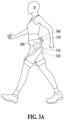
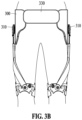
- FIGS. 3a to 3d are diagrams illustrating a wearable device according to embodiments.
- a wearable device 300 may be worn by a user to assist the user in a gait.
- the wearable device 300 may be a device that assists a user in walking.
- the wearable device 300 may be an exercise device that assists the user in walking and provides an exercise function by providing a resistance force to the user.
- the resistance force provided to the user such as a force output by a device such as a motor, may be actively applied to the user.
- the resistance force such as a frictional force, may not be actively applied to the user, but may hinder a movement of the user.
- the resistance force may be referred to as an exercise load.
- FIGS. 3a to 3d show the wearable device 300 as a hip-type
- the type of the wearable device is not limited thereto, and the wearable device may be a type supporting all of the lower extremities or a type supporting a part of the lower extremities.
- the wearable device may be in any one of a form supporting a part of the lower extremities, a form supporting up to the knee, a form supporting up to the ankle, and a form supporting the whole body.
- FIGS. 3a to 3d may be applied to a hip-type, but are not limited thereto, and may be applied to various types of wearable devices.
- the wearable device 300 may include a driver 310, a sensor 320 (e.g., 321 and/or 321-1 in Figs. 3c-3d ), an inertial measurement unit (IMU) 330, a controller 340, a battery 350, and a communication module 352 comprising communication circuitry.
- the IMU 330 and the controller 340 may be arranged in a main frame of the wearable device 300.
- the IMU 330 and the controller 340 may be included in a housing (not shown) that is formed in (or attached to) the outside of the main frame of the wearable device 300.
- Each "module" herein may comprise circuitry.
- the driver 310 may include a motor 314 and a motor driver circuit 312 for driving the motor 314.
- the sensor 320 may include at least one sensor 321.
- the controller 340 may include a processor 342, a memory 344, and an input interface 346. Although only one sensor 321, one motor driver circuit 312, and one motor 314 is illustrated in FIG. 3c , this is provided merely as an example and a wearable device (e.g., a wearable device 300-1) may include a plurality of sensors 321 and 321-1, a plurality of motor driver circuits 312 and 312-1, and a plurality of motors 314 and 314-1 according to another example as illustrated in FIG. 3d . Also, according to implementation, the wearable device 300 may include a plurality of processors. The number of motor driver circuits, the number of motors, or the number of processors may vary according to a body part on which the wearable device 300 is worn.
- the following descriptions of the sensor 321, the motor driver circuit 312, and the motor 314 may also be applicable to the sensor 321-1, the motor driver circuit 312-1, and the motor 314-1 illustrated in FIG. 3d .
- the driver 310 may drive a hip joint of the user.
- the driver 310 may be disposed on a right hip portion of the user and/or a left hip portion of the user.
- the driver 310 may be additionally disposed on knee portions and ankle portions of the user.
- the driver 310 may include the motor 314 configured to generate a rotational torque and the motor driver circuit 312 configured to drive the motor 314.
- the sensor 320 may measure an angle of the hip joint of the user when the user walks.
- Information on the hip joint angle sensed by the sensor 320 may include a right hip joint angle, a left hip joint angle, a difference between both hip joint angles, and a hip joint motion direction.
- the sensor 321 may be disposed in the driver 310. According to a position of the sensor, the sensor 320 (e.g., 321 and/or 321-1) may additionally measure a knee angle and an ankle angle of the user.
- the sensor 321 may include an encoder. The information on the hip joint angle measured by the sensor 320 may be transmitted to the controller 340.
- the senor 320 may include a potentiometer.
- the potentiometer may sense an R-axis joint angle and an L-axis joint angle, and an R-axis joint angular velocity and an L-axis angular velocity, based on a walking motion of the user.
- R and L axes may be reference axes for a right leg and a left leg of the user, respectively.
- the R and L axes may be set to be vertical to the ground and set such that a front side of a body of a person has a negative value and a rear side of the body has a positive value.
- the IMU 330 may measure acceleration information and pose information when the user walks. For example, the IMU 330 may sense an X-axis acceleration, a Y-axis acceleration, and a Z-axis acceleration, and an X-axis angular velocity, a Y-axis angular velocity, and a Z-axis angular velocity, based on a walking motion of the user. The acceleration information and the pose information measured by the IMU 330 may be transmitted to the controller 340.
- the wearable device 300 may detect a point at which the foot of the user lands based on the acceleration information measured by the IMU 330.
- a pressure sensor (not shown) may be disposed on the sole of the foot of the user to detect a landing time of the foot of the user.
- the wearable device 300 may include other sensors (e.g., an electromyogram (EMG) sensor) configured to sense a change in a quantity of motion of the user or a change in biosignal based on a walking motion of the user.
- EMG electromyogram
- the controller 340 may control an overall operation of the wearable device 300.
- the controller 340 may receive information sensed by each of the sensor 320 and the IMU 330.
- the information sensed by the IMU 330 may include the acceleration information and the pose information
- the information sensed by the sensor 320 may include information on the right hip joint angle, the left hip joint angle, the difference between both hip joint angles, and the hip joint motion direction.
- the controller 340 may calculate the difference between both hip joint angles based on the right hip joint angle and the left hip joint angle.
- the controller 340 may generate a signal for controlling the driver 310 based on the sensed information.
- the generated signal may be an assistance force for assisting the user in walking.
- the generated signal may be a resistance force for hindering the walking of the user.
- the resistance force may be provided to the user to assist the user in doing an exercise.
- the processor 342 of the controller 340 may control the driver 310 to provide the resistance force to the user.
- the driver 310 may provide the resistance force to the user by applying an active force to the user through the motor 314.
- the driver 310 may provide the resistance force to the user using back-drivability of the motor 314 without applying an active force to the user.
- the back-drivability of a motor may indicate reactivity of a rotation axis of the motor in response to an external force, and a greater back-drivability may indicate that the motor may more readily respond to an external force acting on the rotation axis, that is, the motor may more readily rotate around the rotation axis.
- a degree of rotation of the motor around the rotation axis may change according to a degree of the back-drivability.
- the driver 310 may provide the resistance force to the user by outputting a torque in a direction that hinders a movement of the user.
- the processor 342 of the controller 240 may control the driver 310 such that the driver 310 outputs a torque (or an assistance torque) to assist the user in walking.
- the driver 310 may be disposed on each of a left hip portion and a right hip portion, and the controller 340 may output a control signal for controlling the driver 310 to generate a torque.
- the driver 310 may generate a torque based on the control signal output by the controller 340.
- a torque value for generating the torque may be externally set or be set by the controller 340.
- the controller 340 may use a magnitude of a current for a signal transmitted to the driver 310. That is, as the magnitude of the current received by the driver 310 increases, the torque value may increase.
- the processor 342 of the controller 340 may transmit the control signal to the motor driver circuit 312 of the driver 310, and the motor driver circuit 312 may generate a current corresponding to the control signal to control the motor 314.
- the battery 350 may supply power to the components of the wearable device 300.
- the wearable device 300 may further include a circuit (e.g., a power management integrated circuit (PMIC)) configured to convert power of the battery 350 to match an operating voltage of the components of the wearable device 300 and provide the power to the components of the wearable device 300.
- PMIC power management integrated circuit
- the battery 350 may or may not supply power to the motor 314 based on an operation mode of the wearable device 300.
- the communication module 352 may support the establishment of a direct (e.g., wired) communication channel or a wireless communication channel between the wearable electronic device 300 and an external electronic device, and support the communication through the established communication channel.
- the communication module 352 may include one or more communication processor configured to support direct (e.g., wired) communication or wireless communication.
- the communication module 352 may include a wireless communication module (e.g., a cellular communication module, a short-range wireless communication module, or a GNSS communication module) or a wired communication module (e.g., an LAN communication module or a PLC module).
- a corresponding one of these communication modules may communicate with the external electronic device via a first network (e.g., a short-range communication network such as Bluetooth TM , Wi-Fi direct, or IrDA) or a second network (e.g., a legacy cellular network, a 5G network, a next-generation communication network, the Internet, or a computer network).
- a first network e.g., a short-range communication network such as Bluetooth TM , Wi-Fi direct, or IrDA
- a second network e.g., a legacy cellular network, a 5G network, a next-generation communication network, the Internet, or a computer network.
- These various types of communication modules may be implemented as a single component (e.g., a single chip), or may be implemented as multiple components (e.g., multiple chips) separate from each other.
- Each processor herein comprises processing circuitry.
- FIG. 4 is a diagram illustrating a wearable device communicating with an electronic device according to an example embodiment.
- the wearable device 300 may communicate with an electronic device 201.
- the electronic device 201 may be an electronic device of a user of the wearable device 300.
- the wearable device 300 and the electronic device 201 may be connected using short-range wireless communication.
- the electronic device 201 may display a user interface (UI) for controlling an operation of the wearable device 300 on a display 201-1.
- the UI may include, for example, at least one soft key through which the user may control the wearable device 300.
- the user may input a command for controlling the operation of the wearable device 300 through the UI on the display 201-1 of the electronic device 201, and a server 1400 (e.g., see Fig. 14 ) may generate a control command corresponding to the command and transmit the generated control command to the wearable device 300.
- the wearable device 300 may operate according to the received control command, and transmit a control result to the electronic device 201.
- the electronic device 201 may display a control completion message on the display 201-1 of the electronic device 201.
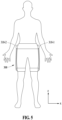
- FIGS. 5 and 6 are diagrams illustrating a method of outputting a torque by a wearable device according to embodiments.
- the drivers 310-1 and 310-2 of the wearable device 300 of FIG. 3 may be disposed at or near a hip joint of a user, and the controller 340 of the wearable device 300 may be disposed at or near a waist of the user.
- the positions of the drivers 310-1 and 310-2 and the controller 340 are not limited to the example positions illustrated in FIGS. 5 and 6 .
- the wearable device 300 may measure (or sense) a left hip joint angle q_l and a right hip joint angle q_r of the user. For example, the wearable device 300 may measure the left hip joint angle q_l of the user through a left encoder, and measure the right hip joint angle q_r of the user through a right encoder. As illustrated in FIG. 6 , the left hip angle q_l may be a negative value because a left leg of the user is in front of a reference line 620, and the right hip angle q_r may be a positive value because a right leg of the user is behind the reference line 620. According to implementation, the right hip joint angle q_r may be negative when the right leg is in front of the reference line 620, and the left hip joint angle q_l may be positive when the left leg is behind the reference line 620.
- the wearable device 300 may acquire a first angle (e.g., q_r) and a second angle (e.g., q_l) by filtering a first raw angle (e.g., q_r_raw) of a first joint (e.g., the right hip joint) and a second raw angle (e.g., q_l_raw) of a second joint (e.g., the left hip joint) measured by the sensor 320.
- the wearable device 300 may filter a first primitive angle and a second primitive angle based on a first previous angle and a second previous angle measured with respect to a previous time.
- the wearable device 300 may determine a torque value ⁇ ( ⁇ ) based on the left hip joint angle q_l, the right hip joint angle q_r, an offset angle c, a sensitivity ⁇ , a gain ⁇ , and a delay ⁇ t, and control the motor driver circuit 312 of the wearable device 300 to output the determined torque value ⁇ (t).
- a force provided to the user by the torque value ⁇ ( ⁇ ) may be referred to as force feedback.
- the wearable device 300 may determine the torque value ⁇ ( ⁇ ) based on Equation 1 below.
- y may denote a state factor
- q_r may denote a right hip joint angle
- q_l may denote a left hip joint angle
- the state factor y may be associated with a distance between both legs. For example, y being 0 may indicate a state (e.g., a crossing state) in which the distance between the legs is 0, and an absolute value of y being maximum may indicate a state (e.g., a landing state) in which an angle between the legs is maximum.
- the state factor may be represented as y(t).
- the gain ⁇ is a parameter indicating a magnitude and direction of an output torque. As the magnitude of the gain ⁇ increases, a greater torque may be output. When the gain ⁇ is a negative value, a torque acting as a resistance force may be output to the user. When the gain ⁇ is a positive value, a torque acting as an assistance force may be output to the user.
- the delay ⁇ t may be a parameter associated with a torque output timing. The value of the gain ⁇ and the value of the delay ⁇ t may be preset, and may be adjustable by the user or the wearable device 300.
- a model for outputting a torque acting as an assistance force to a user based on parameters such as Equation 1, the gain ⁇ , and the delay ⁇ t may be a torque output model (or a torque output algorithm).
- the wearable device 300 may determine a torque magnitude and a torque delay to be output by inputting values of input parameters received through sensors to the torque output model.
- the wearable device 300 may determine a first torque value by applying a first gain value and a first delay value as parameter values determined with respect to the state factor y(t) to a first state factor y(t), based on Equation 2 below.
- the calculated first torque value may include a value related to the first joint and a value related to the second joint since the first torque value is applied to both legs.
- ⁇ l ( t ) may be a value related to the left hip joint which is the second joint
- ⁇ r ( t ) may be a value related to the right hip joint, which is the first joint.
- ⁇ l ( t ) and ⁇ r ( t ) may have the same magnitude and opposite torque directions.
- the wearable device 300 may control the motor driver 312 of the wearable device 300 to output a torque corresponding to the first torque value.
- the wearable device 300 may provide an asymmetrical torque to both legs of the user to assist the asymmetric gait.
- the wearable device 300 may provide a stronger assistance force to the leg with a shorter step length or slower swing speed.
- a leg with a shorter step length or a slower swing speed may be referred to as an affected leg or a target leg.
- the swing time or the step length of an affected leg may be shorter than the swing time or the step length of an unaffected leg.
- a method of adjusting the timing of a torque acting on an affected leg may be considered.
- an offset angle may be added to an actual joint angle for the affected leg to increase the output time of the torque for assisting the swing motion of the affected leg.
- c may be a value of a parameter indicating an offset angle between joint angles.
- the value of an input parameter input to the torque output model mounted (or applied) to the wearable device 300 may be adjusted.
- the values of q_r and q_l may be adjusted through Equation 3 below.
- c may denote an offset angle with respect to the right hip joint
- c 1 may denote an offset angle with respect to the left hip joint.
- the wearable device 300 may filter the state factor to reduce discomfort of the user due to an irregular torque output. For example, the wearable device 300 may determine an initial state factor y raw (t) of the current time t based on the first angle of the first joint and the second angle of the second joint, and determine the first state factor y(t) based on a previous state factor y prv determined with respect to a previous time t-1 and the initial state factor y raw (t).
- the current time t may indicate a processing time for t-th data (or sample)
- the previous time t-1 may indicate a processing time for t-1th data.
- a difference between the current time t and the previous time t-1 may be an operation cycle of a processor configured to generate or process corresponding data.
- the sensitivity ⁇ may be a value of a parameter indicating sensitivity.
- the sensitivity value may be continuously adjusted during a test walk, but to reduce the complexity of calculation, the sensitivity value may be preset to a predetermined value.
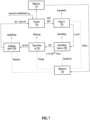
- FIG. 7 is a block diagram for optimizing parameter values of a wearable device according to an example embodiment.
- the electronic device 201 may optimize values of control parameters used by a system 770 (e.g., the wearable device 300 of FIG. 3 ) to output a torque.
- optimized values of the control parameters may be determined by an optimizer 720 of the electronic device 201.
- the control parameters may include at least one of an offset angle 730, a sensitivity 740, a delay 750, or a gain 760 or combination thereof.
- the optimizer 720 may optimize the values of the control parameters based on test sensing information acquired through testing a gait of a user of the wearable device 300.
- a gait test may be for checking the current state of the gait of the user, and the wearable device 300 may not provide an assistance force or a resistance force to the user while the gait test is being performed.
- the optimizer 720 may optimize the values of the control parameters based on the test sensing information and an exercise objective 710 preset by the user through the gait test.
- FIG. 8 is a flowchart illustrating a method of providing an exercise program to a user according to an example embodiment.
- operations 810 to 880 may be performed by an electronic device (e.g., the electronic device 110 of FIG. 1 or the electronic device 201 of FIG. 2 ).
- an electronic device e.g., the electronic device 110 of FIG. 1 or the electronic device 201 of FIG. 2 .
- the electronic device may receive target exercise information from a user.
- the target exercise information may include target exercise time information and target exercise section information.
- the target exercise time information may be information on an entire exercise time (e.g., 30 minutes or 1 hour) during which the user currently wants to perform exercise.
- the target exercise section information may include an exercise route.
- the exercise route may include information on a start point, an end point, and detailed routes between the start point and the end point.
- the electronic device may acquire current values of gait assessment items.
- the gait assessment items may include at least one of a step length, a gait speed, a gait symmetry, or a gait rhythm or combination thereof.
- the electronic device may acquire the current values of the gait assessment items based on previous sensing information acquired while performing a previous exercise program using a wearable device (e.g., the wearable device 120 of FIG. 1 or the wearable device 300 of FIG. 3a ).
- the previous exercise program may be the most recently performed exercise program or accumulated exercise programs.
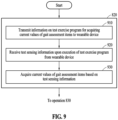
- the electronic device may cause a user to perform a test exercise program through a wearable device, and acquire current values of gait assessment items based on test sensing information acquired as a result of the execution of the test exercise program.
- the acquiring of current values of gait assessment items based on a test exercise program will be described in detail below with reference to FIG. 9 .
- a step length may be a distance between the left foot and the right foot when walking.
- the legs and the ground may form a triangle.
- the step length representing the remaining sides of the triangle may be calculated based on a left hip joint angle, a right hip joint angle, and the leg length. For example, an average step length for a plurality of steps performed by the user may be acquired as the step length.
- the gait speed may be acquired based on a moving distance and a moving time.
- an IMU may be used to estimate the gait speed.
- the IMU may acquire acceleration of 3 degrees of freedom and a rotation rate of 3 degrees of freedom.
- the electronic device may acquire the gait speed by inputting the acquired acceleration of 3 degrees of freedom and rotation rate of 3 degrees of freedom to a pre-trained gait speed estimation model based on a long short-term memory (LSTM).
- LSTM long short-term memory
- the gait speed estimation model may be pre-trained through machine learning.
- the gait speed estimation model may be a model using dynamic analysis.
- the gait speed estimation model may be a model using a method of extracting features and performing linear regression.
- the gait rhythm may indicate how consistently the user walks.
- the gait rhythm may be calculated by Equation 4. 100 ⁇ Stride Time Standard Deviation Stride Time Mean
- the stride time standard deviation may indicate the standard deviation of a stride time
- the stride time mean may indicate an average stride time. That is, the gait rhythm may be a coefficient of variation (CV) with respect to the stride time.
- the stride time may be calculated based on a movement of periodically moving legs.
- a step time of the left leg may be calculated based on a time between time points when a sign of an angular velocity of the left hip joint changes
- a step time of the right leg may be calculated based on a time between time points when a sign of an angular velocity of the right hip joint changes.
- 50 angular velocity samples may be averaged, and the step time and the stride time of each leg may be calculated based on a time between time points when a sign of the mean value changes.
- one stride time may be calculated as the sum of the step time of the left leg and the step time of the right leg.
- the gait symmetry may indicate how symmetrical the gait of the left leg and the gait of the right leg are.
- the gait symmetry may be calculated based on a ratio of a step time of one leg to a step time of the other leg.
- the gait symmetry may be calculated by Equation 5. 100 ⁇ Left Step Time Mean ⁇ Right Step Time Mean 0.5 ⁇ Left Step Time Mean + Right Step Time Mean
- the left step time mean may indicate an average time with respect to the steps of the left leg
- the right step time mean may indicate an average time with respect to the steps of the right leg.
- the gait symmetry may be a symmetry index (SI) between steps.
- SI symmetry index
- the gait symmetry calculated as the SI may indicate temporal gait symmetry, and when time is converted into a length corresponding to time, the gait symmetry may indicate spatial gait symmetry.
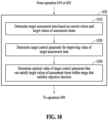
- the electronic device may determine optimal values of the control parameters that may satisfy target values of the gait assessment items based on the target exercise information and the current values of the gait assessment items.
- the electronic device may set target values of gait assessment items based on a target exercise objective selected by a user from among a plurality of exercise objectives.
- the plurality of exercise objectives may include two or more of improving gait ability, improving gait posture, improving cardiovascular health, and improving muscular strength.
- the target values of the assessment items may be adjusted in detail based on body information, age, and gender of the user.
- the electronic device may prioritize or sort the assessment items that are preferentially required for the user among the assessment items based on the target exercise objective.
- the electronic device may determine a target assessment item to be improved based on current values of gait assessment items, and determine one or more control parameter that has the greatest effect on a value of the target assessment item. For example, when the target assessment item is improvement of step length, timing and a gain may be determined as control parameters. For example, when the target assessment item is improvement of gait speed, sensitivity may be determined as the control parameter. For example, when the target assessment item is improvement of gait symmetry, an offset angle may be determined as the control parameter. For example, when the target assessment item is improvement of gait rhythm, sensitivity may be determined as the control parameter. Values of other control parameters that are not determined with respect to the target assessment item may be fixed during the optimization process. According to an example embodiment, when a correlation between the target assessment item and the control parameters is established in advance through a look-up table or a regression model, a process for determining an optimal value of the control parameter may be performed quickly.
- the electronic device may determine the optimal value of the control parameter such that the target values of the gait assessment items may be satisfied within a range that satisfies the set objective function.
- the objective function may be expressed as Equation 6 below.
- ⁇ , ⁇ , ⁇ , and ⁇ may denote weights for each assessment item.
- the value of the objective function may be used as an indicator of directionality, and for example, an optimal value of the control parameter may be determined such that a value improved over a previous value of the objective function is calculated. For example, when the user exercises daily, a value of today's control parameter may be determined as the optimal value so that a value improved over a value of the objective function by yesterday's exercise is calculated.
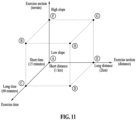
- the electronic device may further consider target exercise information to determine an optimal value of the control parameter. For example, as a target exercise time becomes shorter or a target exercise distance increases, the torque output timing may be shortened as the gait speed increases. In addition, when it is determined that it is difficult to achieve the target exercise distance within the target exercise time only by adjusting the torque output timing based on the gait ability of the current user, the electronic device may determine a gain value such that the magnitude of a torque output for assisting the user in walking increases.
- the electronic device may determine a gain value such that a torque is output to the user that hinders the gait of the user.
- the magnitude of the torque that interferes with the gait may vary depending on the current gait ability of the user.
- the current gait ability of the user may correspond to any one of an upper group, a middle group, or a lower group.
- the electronic device may further consider topographic information on an exercise route to determine an optimal value of the control parameter.
- the electronic device may acquire topographic information on the exercise route received from the user.
- the topographic information on the exercise route may be acquired based on a database in the electronic device.
- the topographic information on the exercise route may be acquired from an external server that provides a map service.
- the electronic device may determine a gain value so that a torque for assisting walking is output to the user.
- the optimal value of the control parameter may be determined as any one predetermined value, or may be determined as a range including the predetermined value.
- the optimal values of a plurality of control parameters may be referred to as an optimal value set.
- the electronic device may acquire one or more recommended exercise program based on an optimal value (or an optimal value set) of the control parameter.
- values of control parameters used by an exercise program or control parameters applied to the exercise program may be matched with each exercise program.
- An intensity and output timing of an assistance force or a resistance force output through the exercise program may vary depending on a value of the control parameter applied to the exercise program.
- the exercise program may provide the user with the same assistance force or resistance force within an entire exercise time through a wearable device.
- the exercise program may divide the entire exercise time into a plurality of sections, and provide different assistance or resistance forces to the user through the wearable device in the plurality of sections.
- the electronic device may determine candidate exercise programs corresponding to the optimal value of the control parameter among a plurality of exercise programs stored in the electronic device. For example, the electronic device may determine the candidate exercise programs corresponding to the optimal value of the control parameter based on a database in which the values of the control parameters applied to each of the plurality of exercise programs are stored.
- the electronic device may determine recommended exercise programs based on a preset filtering condition among the candidate exercise programs.
- the filtering condition may be preset by the user.
- the filtering condition may be set based on a history of an exercise program recently performed by the user. Even when the user frequently exercises in the same exercise environment, the recommended exercise program may vary according to the exercise history, so to the user it may feel like exercising in a different exercise environment than the corresponding exercise environment. The determining of recommended exercise programs and candidate exercise programs will be described in detail below with reference to FIG. 11 .
- the electronic device may transmit an optimal value of a control parameter to a server (e.g., the server 140 of FIG. 1 ) and receive recommended exercise programs from the server.
- a server e.g., the server 140 of FIG. 1
- the acquiring of a recommended exercise program through the server performed by the electronic device will be described in detail below with reference to FIG. 12 .
- the electronic device may determine a target exercise program among one or more recommended exercise program. For example, the electronic device may determine the target exercise program by receiving a selection of the target exercise program from the user.
- the electronic device may output one or more recommended exercise program through a display of the electronic device or a display of an additional device (e.g., the additional device 130 of FIG. 1 ) connected to the electronic device, and receive a selection of a target exercise program from the user through a touch input or a button input.
- an additional device e.g., the additional device 130 of FIG. 1
- the electronic device may provide the user with a gait age achieved when a recommended exercise program is performed. For example, an average age of users who can normally perform the recommended exercise program without the help of the wearable device may be matched with the recommended exercise program in advance.
- the electronic device may transmit information on the target exercise program to the wearable device worn by the user.
- the information on the target exercise program may include information on the values of the control parameters applied to the target exercise program.
- the wearable device may provide an assistance force or a resistance force to the body (e.g., legs) of the user based on the received values of the control parameters.
- the value of the control parameter may represent a trajectory for the target exercise time.
- the target exercise program may provide the user with the same assistance force or resistance force for the entire exercise time.
- the target exercise program may divide the entire exercise time into a plurality of sections, and provide different assistance or resistance forces to the user in the plurality of sections.
- the target exercise program may divide the entire exercise route into a plurality of detailed exercise routes, and provide different assistance or resistance forces to the user in the plurality of detailed exercise routes.
- the electronic device may receive sensing information from the wearable device while the target exercise program is being performed by the wearable device.
- the wearable device may generate sensing information on a gait of the user using at least one sensor and transmit the sensing information to the electronic device.
- the sensing information may include an angle of a left hip joint and an angle of a right hip joint of the user generated by the encoder.
- the sensing information may include acceleration information and pose information generated by an IMU.
- the sensing information may include biometric information generated by a biosensor.
- the sensing information may include position information generated by a global positioning system (GPS) sensor. Each element in the sensing information may be associated with a timestamp.
- GPS global positioning system
- the electronic device may receive additional sensing information from an additional device connected to the electronic device.
- the additional device is a smartwatch (e.g., the smartwatch 132 of FIG. 1 )
- the electronic device may receive a heart rate from the smartwatch as additional sensing information.
- the electronic device may provide feedback information on the execution of the target exercise program to the user based on the sensing information.
- the electronic device may determine whether target values of gait assessment items are satisfied based on the sensing information, and provide different feedback information to the user based on whether the target values are satisfied. The providing of feedback information to the user will be described in detail below with reference to FIG. 13 .
- the electronic device may provide feedback information to the user through a user interface device of the wearable device.
- the feedback information may be provided to the user through a speaker, a display, or a haptic device of the wearable device.
- the electronic device may provide feedback information to the user through an additional device (e.g., the additional device 130 of FIG. 1 ) connected, directly or indirectly, to the electronic device.
- an additional device e.g., the additional device 130 of FIG. 1
- the additional device is a wireless earphone (e.g., the wireless earphone 131 of FIG. 1 )
- auditory feedback information may be provided to the user through the wireless earphone.
- the additional device is a smartwatch (e.g., the smartwatch 132 of FIG. 1 ) or smart glasses (e.g., the smart glasses 133 of FIG. 1 )
- visual, auditory, or tactile feedback information may be provided to the user.
- the user may identify a current state of a gait through the feedback information, and change how an exercise is performed based on the identified current state of the gait. For example, when the feedback information indicates that the gait speed is low, the user may increase the gait speed.
- the electronic device may evaluate a performance result of the exercise, and store the performance result and the assessment.
- the performance result and the assessment for the current exercise may be used as current values of gait assessment items of a following exercise.
- FIG. 9 is a flowchart illustrating a method of acquiring current values of gait assessment items according to an example embodiment.
- operation 820 described above with reference to FIG. 8 may include operations 910 to 930 to be described hereinafter with reference to FIG. 9 .
- an electronic device may transmit information on a test exercise program for acquiring current values of gait assessment items to a wearable device.
- the test exercise program may be an exercise program for checking a current state of a gait of a user.
- the test exercise program may instruct the user to start walking, and the user may walk for a preset distance (e.g., 10 meters) or a preset time (e.g., 5 seconds). While the user performs the test walk, the test exercise program may not provide an assistance force or a resistance force to the user through the wearable device.
- the electronic device may receive test sensing information on the execution of the test exercise program from the wearable device.
- the wearable device may generate the test sensing information on the test walk of the user using at least one sensor, and transmit the test sensing information to the electronic device.
- the test sensing information may include an angle of a left hip joint and an angle of a right hip joint of the user generated by an encoder.
- the test sensing information may include acceleration information and pose information generated by an IMU.
- the test sensing information may include biometric information generated by a biosensor. Each element in the test sensing information may be associated with a timestamp.
- the electronic device may acquire current values of gait assessment items based on the test sensing information.
- the gait assessment items may include at least one of a step length, gait speed, gait symmetry, or gait rhythm or combination thereof.
- a further description of the acquiring of the current values for each of a step length, gait speed, gait symmetry, and gait rhythm may be replaced with the description of operation 820 described above with reference to FIG. 8 .
- FIG. 10 is a flowchart illustrating a method of determining an optimal value of a control parameter according to an example embodiment.
- operation 830 described above with reference to FIG. 8 may include operations 1010 to 1030 to be described hereinafter with reference to FIG. 10 .
- an electronic device may determine a target assessment item based on current values and target values of gait assessment items. For example, assessment items may be arranged in an order of a greatest difference between the current value and the target value of each assessment item, and one or more target assessment item may be determined based on the arrangement.
- the electronic device may determine a target control parameter for improving a value of the target assessment item. For example, when the target assessment item is improvement of step length, timing and a gain may be determined as the control parameter. For example, when the target assessment item is improvement of gait speed, sensitivity may be determined as the control parameter. For example, when the target assessment item is improvement of gait symmetry, an offset angle may be determined as the control parameter. For example, when the target assessment item is improvement of gait rhythm, sensitivity may be determined as the control parameter. Values of other control parameters that are not determined with respect to the target assessment item may be fixed during the optimization process.
- the electronic device may determine an optimal value of a target control parameter that may satisfy target values of assessment items within a range that satisfies the objective function.
- the objective function may be expressed by the above-mentioned Equation 6.
- target exercise time information, target exercise section information, current values of assessment items, and target values of assessment items may be considered.
- the optimal value of the target control parameter may be determined such that an exercise objective of the user is achieved while satisfying both the target exercise time and the target exercise section.
- the objective function may be satisfied by the achievement of the exercise objective of the user, and the objective function may be satisfied when a value of the objective function related to a current exercise becomes greater than a value of the objective function related to a previous exercise.
- FIG. 11 is a diagram illustrating a method of determining recommended exercise programs based on target exercise information according to an example embodiment.
- the three-dimensional space shown in FIG. 11 illustrates an exercise environment expressed by an exercise time, an exercise distance, and an exercise terrain, according to an example. As a value of each axis increases, a greater exercise intensity may be required from the user.
- an electronic device or a server receiving an optimal value (or an optimal value set) of a control parameter from the electronic device may determine recommended exercise programs based on the optimal value of the control parameter.
- an exercise program that increases a gait speed compared to the previously performed exercise program may be determined as the recommended exercise program.
- an exercise program that increases an exercise load e.g., a resistance force
- an exercise program that increases an exercise load e.g., a resistance force
- an exercise program that increases an exercise load e.g., a resistance force
- an exercise program that increases an exercise load e.g., a resistance force
- an exercise program that decreases an exercise load e.g., a resistance force
- provides an assistance force compared to the previously performed exercise program may be determined as the recommended exercise program.
- an exercise program that decreases an exercise load e.g., a resistance force
- provides an assistance force compared to the previously performed exercise program may be determined as the recommended exercise program.
- various recommended exercise programs may be determined based on the optimal value of the control parameter.
- the server may preferentially recommend an exercise program highly suited to the user's preferences based on exercise programs performed by users other than the user of the electronic device.
- the server may include a database in which information related to exercise performed by users using the wearable device is stored. For example, based on the target exercise section information, exercise programs performed by other users in the target exercise section may be acquired. For example, other users to be referenced may have the same exercise objective as the user or have the same gait age as the user.
- FIG. 12 is a flowchart illustrating a method of acquiring recommended exercise programs through a server according to an example embodiment.
- operation 840 described above with reference to FIG. 8 may include operations 1210 and 1220 to be described hereinafter with reference to FIG. 12 .
- an electronic device may transmit an optimal value (or an optimal value set) of a control parameter to a server (e.g., the server 140 of FIG. 1 ).
- the server may determine one or more recommended exercise program based on the optimal value of the control parameter.
- the electronic device may receive, from the server, one or more recommended exercise program determined by the server based on the optimal value of the control parameter.
- FIG. 13 is a flowchart illustrating a method of providing feedback information to a user according to an example embodiment.
- operation 880 described above with reference to FIG. 8 may include operations 1310 to 1330 to be described hereinafter with reference to FIG. 13 .
- an electronic device may determine whether target values of gait assessment items are being satisfied based on sensing information received from a wearable device.
- the electronic device may calculate current values of gait assessment items based on the sensing information, and may determine whether the calculated current values correspond to the target values. For example, the current values for a step length, gait speed, gait symmetry, and gait rhythm may be calculated, and it may be determined whether the current values correspond to the target values.
- the current values of the assessment items may correspond to the target values, and when the user is not performing well on the target exercise program, the current value of at least one assessment item may not reach the target value.
- the electronic device may determine a requested action for satisfying the target values. For example, when a target value of a gait speed is not satisfied, 'walk faster than the current speed' may be determined as the requested action to satisfy the target value of the gait speed. For example, when a target value of a step length is not satisfied, 'widen your step length' may be determined as the requested action to satisfy the target value of the step length.
- the electronic device may provide feedback information including the requested action to the user.
- the electronic device may provide feedback information to the user through a user interface device of the wearable device.
- the feedback information may be provided to the user through a speaker, a display, or a haptic device of the wearable device.
- the electronic device may provide feedback information to the user through an additional device (e.g., the additional device 130 of FIG. 1 ) connected to the electronic device.
- an additional device e.g., the additional device 130 of FIG. 1
- the additional device is a wireless earphone (e.g., the wireless earphone 131 of FIG. 1 )
- auditory feedback information may be provided to the user through the wireless earphone.
- the additional device is a smartwatch (e.g., the smartwatch 132 of FIG. 1 ) or smart glasses (e.g., the smart glasses 133 of FIG. 1 )
- visual, auditory, or tactile feedback information may be provided to the user.
- the user may identify a current state of a gait through the feedback information, and change how an exercise is performed based on the identified current state of the gait. For example, when the feedback information indicates that the gait speed is low, the user may increase the gait speed.
- FIG. 14 is a diagram illustrating a configuration of a server according to an example embodiment.
- a server 1400 may include a communicator 1410, a processor 1420, and a memory 1430.
- the server 1400 may be the server 140 described above with reference to FIG. 1 .
- the communicator 1410 comprising communication circuitry, may be connected, directly or indirectly, to the processor 1420 and the memory 1430 to transmit and receive data to and from the processor 1420 and the memory 1430.
- the communicator 1410 may be connected to another external device to transmit and receive data to and from the external device.
- the communicator 1410 may be implemented as a circuitry in the server 1400.
- the communicator 1410 may include an internal bus and an external bus.
- the communicator 1410 may be an element that connects the server 1400 to the external device.
- the communicator 1410 may be an interface.
- the communicator 1410 may receive data from the external device and transmit the data to the processor 1420 and the memory 1430.
- the processor 1420 may process data received from the communicator 1410 and data stored in the memory 1430.
- the "processor” may be a data processing device implemented by hardware including a circuit having a physical structure to perform desired operations.
- the desired operations may include code or instructions included in a program.
- the hardware-implemented data processing device may include a microprocessor, a central processing unit (CPU), a processor core, a multi-core processor, a multiprocessor, an application-specific integrated circuit (ASIC), and a field-programmable gate array (FPGA).
- the processor 1420 may execute a computer-readable code (for example, software) stored in a memory (for example, the memory 1430) and instructions triggered by the processor 1420.
- a computer-readable code for example, software
- the memory 1430 may store the data received by the communicator 1410 and data processed by the processor 1420.
- the memory 1430 may store the program (or an application, or software).
- the stored program may be a set of syntaxes that are coded and executable by the processor 1420 to determine one or more recommended exercise program based on an optimal value of a control parameter.
- the memory 1430 may include, for example, at least one volatile memory, nonvolatile memory, random-access memory (RAM), flash memory, a hard disk drive, or an optical disc drive or combination thereof.
- the memory 1430 may store an instruction set (for example, software) for operating the server 1400.
- the instruction set for operating the server 1400 may be executed by the processor 1420.
- the memory 1430 may include a database including information on a plurality of exercise programs.
- the memory 1430 may include a database storing a history of exercise programs performed by a plurality of users.
- the server 1400 may include a communication module (e.g., the communicator 1410) configured to exchange data with an external device and at least one processor (e.g., the processor(s) 1420) configured to control the server 1400, wherein the processor may be configured to receive an optimal value of a control parameter from an electronic device (e.g., the electronic device 110 of FIG. 1 or the electronic device 201 of FIG.
- a communication module e.g., the communicator 1410
- the processor(s) 1420 e.g., the processor(s) 1420
- the processor may be configured to receive an optimal value of a control parameter from an electronic device (e.g., the electronic device 110 of FIG. 1 or the electronic device 201 of FIG.
- control parameter being a parameter for adjusting at least one of a magnitude, direction and timing of a torque, an offset angle between joint angles, or sensitivity of a state factor to the joint angles or combination thereof, determine one or more recommended exercise program among a plurality of exercise programs stored in a memory (e.g., the memory 1430) of the server based on the optimal value of the control parameter, and transmit one or more recommended exercise program to the electronic device.
- a memory e.g., the memory 1430
- the processor of the server 1400 may determine the one or more recommended exercise program corresponding to the optimal value among the plurality of exercise programs stored in a memory of the server 1400 based on a history of exercise programs performed by the user.
- the processor of the server 1400 may receive, from the electronic device, sensing information received by the electronic device from a wearable device while a target exercise program among the one or more recommended exercise program is being executed by the wearable device connected to the electronic device, and store the target exercise program and the sensing information in association with an account of the user.
- a processing device may be implemented using one or more general-purpose or special-purpose computers, such as, for example, a processor, a controller and an arithmetic logic unit (ALU), a DSP, a microcomputer, a field-programmable gate array (FPGA), a programmable logic unit (PLU), a microprocessor or any other device capable of responding to and executing instructions in a defined manner.
- the processing device may run an OS and one or more software applications that run on the OS.
- the processing device also may access, store, manipulate, process, and create data in response to execution of the software.
- a processing device may include multiple processing elements and multiple types of processing elements.
- the processing device may include a plurality of processors, or a single processor and a single controller.
- different processing configurations are possible, such as parallel processors.
- Each "unit" herein may comprise circuitry.
- the software may include a computer program, a piece of code, an instruction, or some combination thereof, to independently or uniformly instruct or configure the processing device to operate as desired.
- Software and data may be embodied permanently or temporarily in any type of machine, component, physical or virtual equipment, computer storage medium or device, or in a propagated signal wave capable of providing instructions or data to or being interpreted by the processing device.
- the software also may be distributed over network-coupled computer systems so that the software is stored and executed in a distributed fashion.
- the software and data may be stored by one or more non-transitory computer-readable recording mediums.
- the methods according to the above-described embodiments may be recorded in non-transitory computer-readable media including program instructions to implement various operations of the above-described embodiments.
- the media may also include, alone or in combination with the program instructions, data files, data structures, and the like.
- the program instructions recorded on the media may be those specially designed and constructed for the purposes of embodiments, or they may be of the kind well-known and available to those having skill in the computer software arts.
- non-transitory computer-readable media examples include magnetic media such as hard disks, floppy disks, and magnetic tape; optical media such as CD-ROM discs and/or DVDs; magnetooptical media such as optical discs; and hardware devices that are specially configured to store and perform program instructions, such as read-only memory (ROM), random access memory (RAM), flash memory, and the like.
- program instructions include both machine code, such as produced by a compiler, and files containing higher-level code that may be executed by the computer using an interpreter.
- the above-described devices may be configured to act as one or more software modules in order to perform the operations of the above-described examples, or vice versa.
Landscapes
- Health & Medical Sciences (AREA)
- Engineering & Computer Science (AREA)
- General Health & Medical Sciences (AREA)
- Biomedical Technology (AREA)
- Medical Informatics (AREA)
- Physical Education & Sports Medicine (AREA)
- Public Health (AREA)
- Epidemiology (AREA)
- Primary Health Care (AREA)
- General Business, Economics & Management (AREA)
- Business, Economics & Management (AREA)
- Databases & Information Systems (AREA)
- Computing Systems (AREA)
- Software Systems (AREA)
- Bioethics (AREA)
- Pathology (AREA)
- Accounting & Taxation (AREA)
- Development Economics (AREA)
- Economics (AREA)
- Data Mining & Analysis (AREA)
- Life Sciences & Earth Sciences (AREA)
- Biophysics (AREA)
- Measurement Of The Respiration, Hearing Ability, Form, And Blood Characteristics Of Living Organisms (AREA)
- User Interface Of Digital Computer (AREA)
Applications Claiming Priority (3)
| Application Number | Priority Date | Filing Date | Title |
|---|---|---|---|
| KR20210137285 | 2021-10-15 | ||
| KR1020220084402A KR20230054254A (ko) | 2021-10-15 | 2022-07-08 | 사용자에게 운동 프로그램을 제공하는 방법 및 시스템 |
| PCT/KR2022/015692 WO2023063803A1 (ko) | 2021-10-15 | 2022-10-17 | 사용자에게 운동 프로그램을 제공하는 방법 및 시스템 |
Publications (2)
| Publication Number | Publication Date |
|---|---|
| EP4336512A1 true EP4336512A1 (de) | 2024-03-13 |
| EP4336512A4 EP4336512A4 (de) | 2024-09-11 |
Family
ID=85988745
Family Applications (1)
| Application Number | Title | Priority Date | Filing Date |
|---|---|---|---|
| EP22881430.7A Pending EP4336512A4 (de) | 2021-10-15 | 2022-10-17 | Verfahren und system zur bereitstellung eines übungsprogramms für einen benutzer |
Country Status (3)
| Country | Link |
|---|---|
| US (1) | US20240009519A1 (de) |
| EP (1) | EP4336512A4 (de) |
| WO (1) | WO2023063803A1 (de) |
Families Citing this family (1)
| Publication number | Priority date | Publication date | Assignee | Title |
|---|---|---|---|---|
| WO2025164945A1 (ko) * | 2024-02-02 | 2025-08-07 | 삼성전자주식회사 | 토크 출력의 지연에 이용되는 시간 지연 파라미터를 제어하는 웨어러블 장치 및 이의 동작 방법 |
Family Cites Families (6)
| Publication number | Priority date | Publication date | Assignee | Title |
|---|---|---|---|---|
| JP5237227B2 (ja) * | 2009-08-28 | 2013-07-17 | 日本電信電話株式会社 | 健康情報処理装置および方法 |
| KR101687252B1 (ko) * | 2014-11-06 | 2016-12-16 | 장재윤 | 맞춤형 개인 트레이닝 관리 시스템 및 방법 |
| KR20160091694A (ko) * | 2015-01-26 | 2016-08-03 | 삼성전자주식회사 | 운동 가이드 정보를 제공하는 방법, 장치 및 시스템 |
| JP7209199B2 (ja) * | 2019-04-09 | 2023-01-20 | パナソニックIpマネジメント株式会社 | 筋力管理システム及び筋力管理方法 |
| KR102282092B1 (ko) * | 2019-09-10 | 2021-08-03 | 장은주 | 피트니스 및 바이오 데이터 기반 큐레이션 제공방법 |
| KR102776193B1 (ko) * | 2019-10-28 | 2025-03-11 | 삼성전자주식회사 | 웨어러블 장치를 이용한 균형 훈련 방법 및 그 웨어러블 장치 |
-
2022
- 2022-10-17 EP EP22881430.7A patent/EP4336512A4/de active Pending
- 2022-10-17 WO PCT/KR2022/015692 patent/WO2023063803A1/ko not_active Ceased
-
2023
- 2023-01-31 US US18/103,869 patent/US20240009519A1/en active Pending
Also Published As
| Publication number | Publication date |
|---|---|
| WO2023063803A1 (ko) | 2023-04-20 |
| US20240009519A1 (en) | 2024-01-11 |
| EP4336512A4 (de) | 2024-09-11 |
Similar Documents
| Publication | Publication Date | Title |
|---|---|---|
| KR20230065875A (ko) | 사용자의 심박수에 기초하여 웨어러블 장치를 제어하는 방법 및 장치 | |
| US20230144358A1 (en) | Wearable device and method for measuring human body impedance | |
| KR20230157216A (ko) | 사용자에게 운동 프로그램을 제공하는 방법 및 시스템 | |
| US20240033575A1 (en) | Wearable electronic device for outputting information on exercise, and control method of wearable electronic device | |
| KR20230054254A (ko) | 사용자에게 운동 프로그램을 제공하는 방법 및 시스템 | |
| US20250248879A1 (en) | Method for outputting reference image on basis of sensing information of wearable device, and electronic device which carries out same | |
| KR20230101694A (ko) | 운동 모드에 기초하여 웨어러블 장치를 제어하는 방법 및 그 방법을 수행하는 전자 장치 | |
| EP4336512A1 (de) | Verfahren und system zur bereitstellung eines übungsprogramms für einen benutzer | |
| US20240399187A1 (en) | Method for determining value of control parameter, and electronic device for performing same method | |
| EP4364711A1 (de) | Verfahren zur steuerung einer wearable-vorrichtung auf basis eines übungsmodus und verfahren zur durchführung einer elektronischen vorrichtung | |
| US12415125B2 (en) | Method for providing workout data using a plurality of electronic devices and electronic devices therefor | |
| EP4360813A1 (de) | Verfahren zur erzeugung eines bewegungssteuerungsmodells für eine tragbare vorrichtung und elektronische vorrichtung zur durchführung des besagten verfahrens | |
| KR20220001666A (ko) | 전자 장치와 연결된 히어러블 장치 및 이의 동작 방법 | |
| US12515103B2 (en) | Method and system for providing exercise program to user | |
| US12562043B2 (en) | Method for detecting fall of user and electronic device supporting the same | |
| KR20230121681A (ko) | 제어 파라미터의 값을 결정하는 방법 및 그 방법을 수행하는 전자 장치 | |
| KR20230101685A (ko) | 운동 모드에 기초하여 웨어러블 장치를 제어하는 방법 및 그 방법을 수행하는 전자 장치 | |
| EP4427889A1 (de) | Verfahren zur bestimmung des parameterwertes zur steuerung einer tragbaren vorrichtung und elektronische vorrichtung zur ausführung dieses verfahrens | |
| US20240277550A1 (en) | Method and device for controlling wearable device on basis of user’s heart rate | |
| US20250177231A1 (en) | Method for determining gait state, and device performing method | |
| CN117769745A (zh) | 用于向用户提供锻炼程序的方法和系统 | |
| EP4385394A1 (de) | Tragbare vorrichtung mit körpertemperatursensor, verfahren und nichttransitorisches computerlesbares speichermedium | |
| KR20240143646A (ko) | 사용자의 낙상을 검출하는 방법 및 이를 지원하는 전자 장치 | |
| CN118201581A (zh) | 基于锻炼模式控制可穿戴装置的方法以及执行方法的电子装置 | |
| CN118354872A (zh) | 确定用于控制可穿戴装置的参数的值的方法和执行该方法的电子装置 |
Legal Events
| Date | Code | Title | Description |
|---|---|---|---|
| STAA | Information on the status of an ep patent application or granted ep patent |
Free format text: STATUS: THE INTERNATIONAL PUBLICATION HAS BEEN MADE |
|
| PUAI | Public reference made under article 153(3) epc to a published international application that has entered the european phase |
Free format text: ORIGINAL CODE: 0009012 |
|
| STAA | Information on the status of an ep patent application or granted ep patent |
Free format text: STATUS: REQUEST FOR EXAMINATION WAS MADE |
|
| 17P | Request for examination filed |
Effective date: 20231206 |
|
| AK | Designated contracting states |
Kind code of ref document: A1 Designated state(s): AL AT BE BG CH CY CZ DE DK EE ES FI FR GB GR HR HU IE IS IT LI LT LU LV MC ME MK MT NL NO PL PT RO RS SE SI SK SM TR |
|
| A4 | Supplementary search report drawn up and despatched |
Effective date: 20240808 |
|
| RIC1 | Information provided on ipc code assigned before grant |
Ipc: G16H 40/67 20180101ALI20240802BHEP Ipc: G16H 40/63 20180101ALI20240802BHEP Ipc: G16H 50/20 20180101ALI20240802BHEP Ipc: G16Y 10/60 20200101ALI20240802BHEP Ipc: G16Y 40/20 20200101ALI20240802BHEP Ipc: A63B 24/00 20060101ALI20240802BHEP Ipc: A63B 71/06 20060101ALI20240802BHEP Ipc: G16H 10/60 20180101ALI20240802BHEP Ipc: G16H 20/30 20180101AFI20240802BHEP |
|
| DAV | Request for validation of the european patent (deleted) | ||
| DAX | Request for extension of the european patent (deleted) |