EP4334289B1 - Neue heterocyclische verbindungen, zusammensetzungen, herstellungsverfahren und verwendungen davon - Google Patents
Neue heterocyclische verbindungen, zusammensetzungen, herstellungsverfahren und verwendungen davon Download PDFInfo
- Publication number
- EP4334289B1 EP4334289B1 EP22723156.0A EP22723156A EP4334289B1 EP 4334289 B1 EP4334289 B1 EP 4334289B1 EP 22723156 A EP22723156 A EP 22723156A EP 4334289 B1 EP4334289 B1 EP 4334289B1
- Authority
- EP
- European Patent Office
- Prior art keywords
- compound
- piperidin
- carbonyl
- ylidene
- acetonitrile
- Prior art date
- Legal status (The legal status is an assumption and is not a legal conclusion. Google has not performed a legal analysis and makes no representation as to the accuracy of the status listed.)
- Active
Links
Classifications
-
- C—CHEMISTRY; METALLURGY
- C07—ORGANIC CHEMISTRY
- C07D—HETEROCYCLIC COMPOUNDS
- C07D413/00—Heterocyclic compounds containing two or more hetero rings, at least one ring having nitrogen and oxygen atoms as the only ring hetero atoms
- C07D413/02—Heterocyclic compounds containing two or more hetero rings, at least one ring having nitrogen and oxygen atoms as the only ring hetero atoms containing two hetero rings
- C07D413/06—Heterocyclic compounds containing two or more hetero rings, at least one ring having nitrogen and oxygen atoms as the only ring hetero atoms containing two hetero rings linked by a carbon chain containing only aliphatic carbon atoms
-
- A—HUMAN NECESSITIES
- A61—MEDICAL OR VETERINARY SCIENCE; HYGIENE
- A61K—PREPARATIONS FOR MEDICAL, DENTAL OR TOILETRY PURPOSES
- A61K31/00—Medicinal preparations containing organic active ingredients
- A61K31/33—Heterocyclic compounds
- A61K31/395—Heterocyclic compounds having nitrogen as a ring hetero atom, e.g. guanethidine or rifamycins
- A61K31/435—Heterocyclic compounds having nitrogen as a ring hetero atom, e.g. guanethidine or rifamycins having six-membered rings with one nitrogen as the only ring hetero atom
- A61K31/44—Non condensed pyridines; Hydrogenated derivatives thereof
- A61K31/445—Non condensed piperidines, e.g. piperocaine
- A61K31/4523—Non condensed piperidines, e.g. piperocaine containing further heterocyclic ring systems
- A61K31/4535—Non condensed piperidines, e.g. piperocaine containing further heterocyclic ring systems containing a heterocyclic ring having sulfur as a ring hetero atom, e.g. pizotifen
-
- A—HUMAN NECESSITIES
- A61—MEDICAL OR VETERINARY SCIENCE; HYGIENE
- A61K—PREPARATIONS FOR MEDICAL, DENTAL OR TOILETRY PURPOSES
- A61K31/00—Medicinal preparations containing organic active ingredients
- A61K31/33—Heterocyclic compounds
- A61K31/395—Heterocyclic compounds having nitrogen as a ring hetero atom, e.g. guanethidine or rifamycins
- A61K31/435—Heterocyclic compounds having nitrogen as a ring hetero atom, e.g. guanethidine or rifamycins having six-membered rings with one nitrogen as the only ring hetero atom
- A61K31/44—Non condensed pyridines; Hydrogenated derivatives thereof
- A61K31/445—Non condensed piperidines, e.g. piperocaine
- A61K31/4523—Non condensed piperidines, e.g. piperocaine containing further heterocyclic ring systems
- A61K31/4545—Non condensed piperidines, e.g. piperocaine containing further heterocyclic ring systems containing a six-membered ring with nitrogen as a ring hetero atom, e.g. pipamperone, anabasine
-
- A—HUMAN NECESSITIES
- A61—MEDICAL OR VETERINARY SCIENCE; HYGIENE
- A61K—PREPARATIONS FOR MEDICAL, DENTAL OR TOILETRY PURPOSES
- A61K31/00—Medicinal preparations containing organic active ingredients
- A61K31/33—Heterocyclic compounds
- A61K31/395—Heterocyclic compounds having nitrogen as a ring hetero atom, e.g. guanethidine or rifamycins
- A61K31/495—Heterocyclic compounds having nitrogen as a ring hetero atom, e.g. guanethidine or rifamycins having six-membered rings with two or more nitrogen atoms as the only ring heteroatoms, e.g. piperazine or tetrazines
- A61K31/4965—Non-condensed pyrazines
- A61K31/497—Non-condensed pyrazines containing further heterocyclic rings
-
- A—HUMAN NECESSITIES
- A61—MEDICAL OR VETERINARY SCIENCE; HYGIENE
- A61K—PREPARATIONS FOR MEDICAL, DENTAL OR TOILETRY PURPOSES
- A61K31/00—Medicinal preparations containing organic active ingredients
- A61K31/33—Heterocyclic compounds
- A61K31/395—Heterocyclic compounds having nitrogen as a ring hetero atom, e.g. guanethidine or rifamycins
- A61K31/495—Heterocyclic compounds having nitrogen as a ring hetero atom, e.g. guanethidine or rifamycins having six-membered rings with two or more nitrogen atoms as the only ring heteroatoms, e.g. piperazine or tetrazines
- A61K31/4985—Pyrazines or piperazines ortho- or peri-condensed with heterocyclic ring systems
-
- A—HUMAN NECESSITIES
- A61—MEDICAL OR VETERINARY SCIENCE; HYGIENE
- A61K—PREPARATIONS FOR MEDICAL, DENTAL OR TOILETRY PURPOSES
- A61K31/00—Medicinal preparations containing organic active ingredients
- A61K31/33—Heterocyclic compounds
- A61K31/395—Heterocyclic compounds having nitrogen as a ring hetero atom, e.g. guanethidine or rifamycins
- A61K31/535—Heterocyclic compounds having nitrogen as a ring hetero atom, e.g. guanethidine or rifamycins having six-membered rings with at least one nitrogen and one oxygen as the ring hetero atoms, e.g. 1,2-oxazines
- A61K31/5375—1,4-Oxazines, e.g. morpholine
- A61K31/5377—1,4-Oxazines, e.g. morpholine not condensed and containing further heterocyclic rings, e.g. timolol
-
- A—HUMAN NECESSITIES
- A61—MEDICAL OR VETERINARY SCIENCE; HYGIENE
- A61P—SPECIFIC THERAPEUTIC ACTIVITY OF CHEMICAL COMPOUNDS OR MEDICINAL PREPARATIONS
- A61P35/00—Antineoplastic agents
-
- C—CHEMISTRY; METALLURGY
- C07—ORGANIC CHEMISTRY
- C07D—HETEROCYCLIC COMPOUNDS
- C07D211/00—Heterocyclic compounds containing hydrogenated pyridine rings, not condensed with other rings
- C07D211/04—Heterocyclic compounds containing hydrogenated pyridine rings, not condensed with other rings with only hydrogen or carbon atoms directly attached to the ring nitrogen atom
- C07D211/68—Heterocyclic compounds containing hydrogenated pyridine rings, not condensed with other rings with only hydrogen or carbon atoms directly attached to the ring nitrogen atom having one double bond between ring members or between a ring member and a non-ring member
- C07D211/70—Heterocyclic compounds containing hydrogenated pyridine rings, not condensed with other rings with only hydrogen or carbon atoms directly attached to the ring nitrogen atom having one double bond between ring members or between a ring member and a non-ring member with only hydrogen atoms, hydrocarbon or substituted hydrocarbon radicals, directly attached to ring carbon atoms
-
- C—CHEMISTRY; METALLURGY
- C07—ORGANIC CHEMISTRY
- C07D—HETEROCYCLIC COMPOUNDS
- C07D211/00—Heterocyclic compounds containing hydrogenated pyridine rings, not condensed with other rings
- C07D211/04—Heterocyclic compounds containing hydrogenated pyridine rings, not condensed with other rings with only hydrogen or carbon atoms directly attached to the ring nitrogen atom
- C07D211/68—Heterocyclic compounds containing hydrogenated pyridine rings, not condensed with other rings with only hydrogen or carbon atoms directly attached to the ring nitrogen atom having one double bond between ring members or between a ring member and a non-ring member
- C07D211/72—Heterocyclic compounds containing hydrogenated pyridine rings, not condensed with other rings with only hydrogen or carbon atoms directly attached to the ring nitrogen atom having one double bond between ring members or between a ring member and a non-ring member with hetero atoms or with carbon atoms having three bonds to hetero atoms, with at the most one bond to halogen, directly attached to ring carbon atoms
-
- C—CHEMISTRY; METALLURGY
- C07—ORGANIC CHEMISTRY
- C07D—HETEROCYCLIC COMPOUNDS
- C07D401/00—Heterocyclic compounds containing two or more hetero rings, having nitrogen atoms as the only ring hetero atoms, at least one ring being a six-membered ring with only one nitrogen atom
- C07D401/02—Heterocyclic compounds containing two or more hetero rings, having nitrogen atoms as the only ring hetero atoms, at least one ring being a six-membered ring with only one nitrogen atom containing two hetero rings
- C07D401/06—Heterocyclic compounds containing two or more hetero rings, having nitrogen atoms as the only ring hetero atoms, at least one ring being a six-membered ring with only one nitrogen atom containing two hetero rings linked by a carbon chain containing only aliphatic carbon atoms
-
- C—CHEMISTRY; METALLURGY
- C07—ORGANIC CHEMISTRY
- C07D—HETEROCYCLIC COMPOUNDS
- C07D401/00—Heterocyclic compounds containing two or more hetero rings, having nitrogen atoms as the only ring hetero atoms, at least one ring being a six-membered ring with only one nitrogen atom
- C07D401/14—Heterocyclic compounds containing two or more hetero rings, having nitrogen atoms as the only ring hetero atoms, at least one ring being a six-membered ring with only one nitrogen atom containing three or more hetero rings
-
- C—CHEMISTRY; METALLURGY
- C07—ORGANIC CHEMISTRY
- C07D—HETEROCYCLIC COMPOUNDS
- C07D405/00—Heterocyclic compounds containing both one or more hetero rings having oxygen atoms as the only ring hetero atoms, and one or more rings having nitrogen as the only ring hetero atom
- C07D405/02—Heterocyclic compounds containing both one or more hetero rings having oxygen atoms as the only ring hetero atoms, and one or more rings having nitrogen as the only ring hetero atom containing two hetero rings
- C07D405/12—Heterocyclic compounds containing both one or more hetero rings having oxygen atoms as the only ring hetero atoms, and one or more rings having nitrogen as the only ring hetero atom containing two hetero rings linked by a chain containing hetero atoms as chain links
-
- C—CHEMISTRY; METALLURGY
- C07—ORGANIC CHEMISTRY
- C07D—HETEROCYCLIC COMPOUNDS
- C07D409/00—Heterocyclic compounds containing two or more hetero rings, at least one ring having sulfur atoms as the only ring hetero atoms
- C07D409/02—Heterocyclic compounds containing two or more hetero rings, at least one ring having sulfur atoms as the only ring hetero atoms containing two hetero rings
- C07D409/06—Heterocyclic compounds containing two or more hetero rings, at least one ring having sulfur atoms as the only ring hetero atoms containing two hetero rings linked by a carbon chain containing only aliphatic carbon atoms
-
- C—CHEMISTRY; METALLURGY
- C07—ORGANIC CHEMISTRY
- C07D—HETEROCYCLIC COMPOUNDS
- C07D409/00—Heterocyclic compounds containing two or more hetero rings, at least one ring having sulfur atoms as the only ring hetero atoms
- C07D409/14—Heterocyclic compounds containing two or more hetero rings, at least one ring having sulfur atoms as the only ring hetero atoms containing three or more hetero rings
-
- C—CHEMISTRY; METALLURGY
- C07—ORGANIC CHEMISTRY
- C07D—HETEROCYCLIC COMPOUNDS
- C07D417/00—Heterocyclic compounds containing two or more hetero rings, at least one ring having nitrogen and sulfur atoms as the only ring hetero atoms, not provided for by group C07D415/00
- C07D417/02—Heterocyclic compounds containing two or more hetero rings, at least one ring having nitrogen and sulfur atoms as the only ring hetero atoms, not provided for by group C07D415/00 containing two hetero rings
- C07D417/06—Heterocyclic compounds containing two or more hetero rings, at least one ring having nitrogen and sulfur atoms as the only ring hetero atoms, not provided for by group C07D415/00 containing two hetero rings linked by a carbon chain containing only aliphatic carbon atoms
-
- C—CHEMISTRY; METALLURGY
- C07—ORGANIC CHEMISTRY
- C07D—HETEROCYCLIC COMPOUNDS
- C07D471/00—Heterocyclic compounds containing nitrogen atoms as the only ring hetero atoms in the condensed system, at least one ring being a six-membered ring with one nitrogen atom, not provided for by groups C07D451/00 - C07D463/00
- C07D471/02—Heterocyclic compounds containing nitrogen atoms as the only ring hetero atoms in the condensed system, at least one ring being a six-membered ring with one nitrogen atom, not provided for by groups C07D451/00 - C07D463/00 in which the condensed system contains two hetero rings
- C07D471/04—Ortho-condensed systems
-
- C—CHEMISTRY; METALLURGY
- C07—ORGANIC CHEMISTRY
- C07D—HETEROCYCLIC COMPOUNDS
- C07D487/00—Heterocyclic compounds containing nitrogen atoms as the only ring hetero atoms in the condensed system, not provided for by groups C07D451/00 - C07D477/00
- C07D487/02—Heterocyclic compounds containing nitrogen atoms as the only ring hetero atoms in the condensed system, not provided for by groups C07D451/00 - C07D477/00 in which the condensed system contains two hetero rings
- C07D487/04—Ortho-condensed systems
-
- C—CHEMISTRY; METALLURGY
- C07—ORGANIC CHEMISTRY
- C07D—HETEROCYCLIC COMPOUNDS
- C07D495/00—Heterocyclic compounds containing in the condensed system at least one hetero ring having sulfur atoms as the only ring hetero atoms
- C07D495/02—Heterocyclic compounds containing in the condensed system at least one hetero ring having sulfur atoms as the only ring hetero atoms in which the condensed system contains two hetero rings
- C07D495/04—Ortho-condensed systems
-
- C—CHEMISTRY; METALLURGY
- C07—ORGANIC CHEMISTRY
- C07D—HETEROCYCLIC COMPOUNDS
- C07D498/00—Heterocyclic compounds containing in the condensed system at least one hetero ring having nitrogen and oxygen atoms as the only ring hetero atoms
- C07D498/02—Heterocyclic compounds containing in the condensed system at least one hetero ring having nitrogen and oxygen atoms as the only ring hetero atoms in which the condensed system contains two hetero rings
- C07D498/04—Ortho-condensed systems
-
- C—CHEMISTRY; METALLURGY
- C07—ORGANIC CHEMISTRY
- C07D—HETEROCYCLIC COMPOUNDS
- C07D498/00—Heterocyclic compounds containing in the condensed system at least one hetero ring having nitrogen and oxygen atoms as the only ring hetero atoms
- C07D498/12—Heterocyclic compounds containing in the condensed system at least one hetero ring having nitrogen and oxygen atoms as the only ring hetero atoms in which the condensed system contains three hetero rings
- C07D498/18—Bridged systems
-
- C—CHEMISTRY; METALLURGY
- C07—ORGANIC CHEMISTRY
- C07D—HETEROCYCLIC COMPOUNDS
- C07D513/00—Heterocyclic compounds containing in the condensed system at least one hetero ring having nitrogen and sulfur atoms as the only ring hetero atoms, not provided for in groups C07D463/00, C07D477/00 or C07D499/00 - C07D507/00
Definitions
- the present invention relates to a novel class of aldo-keto reductase family 1 C3 (AKR1C3), also known as 17 ⁇ -hydroxysteroid dehydrogenase type 5 (17 ⁇ -HSD5, HSD17BS) and prostaglandin (PG) F2 ⁇ synthase inhibitors, to salts, solvates and solvates of salts thereof, and to pharmaceutical compositions comprising these compounds as active ingredients.
- ARR1C3 aldo-keto reductase family 1 C3
- PG prostaglandin
- Aldo-keto reductase family 1 member C3 is also known as 17 ⁇ -hydroxysteroid dehydrogenase type 5 (17 ⁇ -HSD5, HSD17BS) and prostaglandin (PG) F 2 ⁇ synthase.
- AKR1C3 is a member of the aldo-keto reductase 1C (AKR1C) subfamily of the aldo-keto reductase (AKR) superfamily of enzymes, which contains >190 members.
- the human AKR1C subfamily consists of four isoforms (AKR1C1, -C2,-C3, and -C4) that are phase I metabolic enzymes and depend on nicotinamide adenine dinucleotide phosphate (NADPH) in reducing 3-keto-, 17-keto-, and 20-ketosteroids. Also AKR1C3 reduce carbonyl groups in steroid hormones to the corresponding alcohols and therefore play an important role in the metabolism, activation, and deactivation of androgens, estrogens, progesterones and prostaglandins.
- NADPH nicotinamide adenine dinucleotide phosphate
- AKR1C3 shares high sequence homology (>86%) with AKR1C1, -C2, and -C4. Even though the structures of the isoforms are similar, the isomers are distributed differently, and they show different biological functions. AKR1C3 shows endocrine organ expression (including liver, GI-tract, prostate, testes, adrenal gland, uterus, breast, lung, kidney, bladder, ovary, adipose tissue, and brain).
- AKR1C3 can catalyse the conversion of estrone (weak estrogen) to estradiol (potent estrogen), the conversion of progesterone (strong anti-estrogenic activity) to 20- ⁇ -hydroxyprogesterone (weak antiestrogenic activity), the conversion of dehydroepiandrosterone (DHEA, weak androgen) to androstenediol (a precursor to testosterone), the conversion of androstenedione (weak androgen) to testosterone (potent androgen), the conversion of 5 ⁇ -androstanedione (5 ⁇ -dione, weak androgen) to DHT (potent androgen), the conversion of androsterone to 17 ⁇ -dihydroandrosterone (Penning et al.
- DHEA dehydroepiandrosterone
- DHEA dehydroepiandrosterone
- DHEA dehydroepiandrosterone
- DHEA dehydroepiandrosterone
- DHEA de
- AKR1C3 has enzymatic activity for 11-keto forms of androgens and therefore capable of the conversion of 11-ketoandrostenedione (weak androgen) to 11-ketotestosterone (potent androgen), the conversion of 11-keto-5 ⁇ -androstanedione to 11-keto-5 ⁇ -dihydrotestosterone, the conversion of 11-ketoandrosterone to 11-keto-3 ⁇ -androstanediol ( Barnarda M. et al. J. Steroid Biochem. Mol.
- the AKR1C3 is also capable of the conversion of PGH 2 to PGF 2 ⁇ and PGD 2 to 11 ⁇ -PGF 2 , both of which are known to stimulate inflammation and proliferation ( Byrns M. et al., Biochem. Pharmacol. 2008, 75 (2), 484-493 ; Byrns M et al. J. Steroid Biochem. Mol. Biol. 118 (2010) 177-187 ; Penning TM. Mol.
- AKR1C3 inhibition may reduce the level of end products as described above and as a result, AKR1C3 mediates the regulation of ligands for androgen, estrogen, progesterone, and prostaglandin receptors.
- AKR1C3 has also been shown to metabolize a wide range of carbonyl compounds and xenobiotics.
- AKR1C3 as a carbonyl reductase can mediate the inactivation and resistance of anthracyclines ( Bukum N. et al. Chem.-Biol. Interact. 2019, 302, 101-107 ; Zhong et al. Biomed. Pharmacother. 2015, 69, 317-325 ; Hofman J. et al. Toxicol. Appl. Pharmacol.
- AKR1C3 as a nitroreductase can induce the activation of nitrogen mustard anticancer drugs (PR-104A ( Bortolozzi R. et al. Br. J. Cancer 2018, 118 (7), 985-994 ) and OBI-3424/TH3424 ( Evans K. et al. Clin. Cancer Res. 2019, 25 (14), 4493-4503 ).
- PR-104A Bortolozzi R. et al. Br. J. Cancer 2018, 118 (7), 985-994
- OBI-3424/TH3424 Evans K. et al. Clin. Cancer Res. 2019, 25 (14), 4493-4503 ).
- AKR1C3 mediates the regulation of ligands for androgen, estrogen, progesterone, and prostaglandin receptors and therefore, inhibition of AKR1C3 activity can reduce the level of these end products and as a result such AKR1C3 inhibitors are suitable for treating and/or preventing diseases and disorders associated with altered levels of androgens, estrogens, progesterones and/or prostaglandins.
- AKR1C3 inhibitors have been previously published. Among the most potent inhibitors published is GTx-560, a pyridine derivative, which inhibits AKR1C3 with an IC 50 -value of 0.035 ⁇ 0.002 ⁇ M ( Clin. Cancer Res. 2013, 19, 20; 5613-5625 ). A flufenamic acid analogue with an AKR1C3 IC 50 -value of 35 nM was published in Heindriks et al., Bioorg. Med. Chem. Lett. 2015, 25 (20), 4437-4440 . Furthermore, patent application EP 3421483A1 discloses AKR1C3 inhibitors that are steroidal 17-beta heteroaryl compounds. One of the disclosed compounds is BAY-1128688, which was included in a phase II clinical trial for the treatment of endometriosis, however, it raised bilirubin levels of patients and the trial was terminated.
- morpholylureas have been disclosed as AKRIC3 inhibitors; e.g. the morpholylurea compound SN34037 has an IC 50 -value of 0.11 ⁇ M ( Flanagan et al., Bioorg. Med. Chem. 2014, 22 (3), 967-977 ). Furthermore, among sulphonylurea compounds published, Glimepiride (GLM) shows an AKR1C3 IC 50 -value of 0.85 ⁇ M ( Zhao Y. et al., Chem.-Biol. Interact. 2015, 240, 310-315 ). Many AKR1C3 inhibitors are shown to inhibit other AKR enzymes and COX enzymes ( Yang et al, J. Med. Chem. 2020, 63, 20, 11305-11329 ).
- WO 2021/005586 A1 discloses tricyclic compounds that are useful as AKR1C3 dependent KARS inhibitors.
- WO 2018/002220 A1 relates to mitochondrial inhibitors and their use in the treatment of proliferation disorders, in particular cancer.
- WO 2008/000950 A2 relates to piperidine or pyrrolidine urea derivatives, to their preparation and to their application in therapy.
- the present compounds modulate the activity of 11[beta]-hydroxysteroid dehydrogenase type 1 (11[beta]HSD1) and are useful for the treatment of conditions in which such modulation is beneficial, such as metabolic syndrome or non-insulin dependent type 2 diabetes.
- AKR1C3 inhibitors inhibiting selectively AKR1C3 over other AKRs or HSD17Bs.
- AKR1C2 plays important role in the inactivation of 5 ⁇ -dihydrotestosterone. While AKR1C2 inhibition in prostate cancer can promote proliferative signalling in the prostate, treatment of prostate carcinoma can be achieved by AKR1C3 inhibition. Therefore, isomer selective AKR1C3 inhibitors are needed ( Penning TM et al. Mol.
- type 2 17 ⁇ -hydroxysteroid dehydrogenase (HSD17B2) drives steroid metabolism opposite direction to AKR1C3 and converts potent steroids like estradiol, testosterone and 5 ⁇ -dihydrotestrosterone to their less active forms estrone, androstenedione and 5 ⁇ -androstanedione, respectively ( Gao X. et al. Clin. Cancer Res. 2019, 25, 1291-301 ; Ko H. et al. Cell Rep. 2018, 22, 809-819 ).
- type 2 enzyme protects tissues from excessive steroid actions. Therefore, it is important to have selective AKR1C3 inhibitors.
- An object of the present invention is to provide compounds useful in treating or preventing diseases and disorders associated with altered levels of androgens, estrogens, progesterones and/or prostaglandins, and/or treatable by inhibition of AKR1C3 enzyme. It is further an object of the present invention to provide compounds that selectively inhibit the AKR1C3 enzyme over the AKR1C2 enzyme.
- the objects of the invention are achieved by a compound which is characterized by what is stated in the independent claims.
- the preferred embodiments of the invention are disclosed in the dependent claims.
- the embodiments, examples and features, if any, described in this specification that do not fall under the scope of the independent claims are to be interpreted as examples useful for understanding various embodiments of the invention.
- an embodiment of the present disclosure provides novel compounds of formula (I) or a salt, solvate or solvate of a salt thereof, wherein R 1 , R 2 , and R 3 are as defined in the claims.
- an embodiment of the present disclosure provides a method for the preparation of a compounds of formula (I), or a salt, solvate or solvate of a salt thereof.
- compositions comprising an effective amount of one or more compounds of formula (I), or a salt, solvate or solvate of a salt thereof, together with one or more pharmaceutically acceptable excipient(s).
- an embodiment of the present disclosure provides compounds of formula (I) for use as a medicament.
- an embodiment of the present disclosure provides compounds of formula (I) for use in treatment or prevention of a disease or disorder selected from the group consisting of polycystic ovary syndrome, endometriosis, uterine leiomyoma, uterine bleeding disorders, dysmenorrhoea, hyperandrogenism, chronic obstructive pulmonary disease (COPD), lung cancer, non-small-cell lung cancer, prostate cancer including castration-resistant prostate cancer, prostate hyperplasia, breast cancer, invasive breast ductal carcinoma, triple negative breast cancer, endometrial carcinoma, renal cell carcinoma, bladder carcinoma, pancreatic adenocarcinoma, acute myeloid leukemia, T-Cell acute lymphoblastic leukemia, melanoma, non-Hodgkins lymphoma, acne, seborrhoea, hair loss, premature sexual maturity, obesity, and inflammation-related pain.
- a disease or disorder selected from the group consisting of polycystic ovary syndrome, endometriosis
- the present invention provides a compound of formula (I) or a salt, solvate or solvate of a salt thereof, wherein R 1 , R 2 , and R 3 are as defined in the claims.
- the invention is based on the surprising realization and finding that novel compounds of formula (I) inhibit the AKR1C3 enzyme.
- a further surprising realization and advantage of the current invention is that compounds of formula (I) inhibit selectively AKR1C3 over other aldo-keto reductases or hydroxysteroid (17 ⁇ ) dehydrogenases (HSD17Bs) enzymes like AKR1C2 and HSD17B2 (17 ⁇ -HSD2).
- an advantage of the invention is that novel compounds of formula (I) do not, or to less extent, cause biological effects due to inhibition of AKR1C2.
- a further surprising realization and advantage of the current invention is that compounds of formula (I) do not, or to less extent, cause biological effects due to HSD17B2 inhibition.
- an embodiment of the present disclosure provides novel compounds of formula (I) wherein
- C 1-6 -alkyl as used herein and hereafter, as such or as part of haloalkyl, perhaloalkyl or alkoxy group, is a linear or branched, hydrocarbon group having the indicated number of carbon atoms; for example C 1-6 -alkyl has 1 to 6 carbon atoms in the alkyl moiety and thus, for example, C 1-3 -alkyl includes methyl, ethyl, n -propyl, isopropyl, and C 1-6 -alkyl additionally includes branched and straight chain n -butyl, sec -butyl, isobutyl, tert -butyl, pentyl and hexyl.
- the said hydrocarbon group having suitably 1 to 6, preferably 1 to 3, carbon atoms in the alkyl moiety.
- aliphatic cyclic hydrocarbon groups include, but are not limited to, cyclopropyl, and cyclohexyl.
- haloalkyl refers to any of the above alkyl groups where one or more hydrogen atoms are replaced by halogen(s): in particular I, Br, F or Cl.
- haloalkyl groups include without limitation chloromethyl, fluoromethyl, -CH 2 CF 3 .
- perhaloalkyl is understood to refer to an alkyl group, in which all the hydrogen atoms are replaced by halogen atoms. Preferred examples include trifluoromethyl (-CF 3 ) and trichloromethyl (-CCl 3 ).
- (per)haloalkyl refers to a haloalkyl or a perhaloalkyl.
- halogen as used herein and hereafter by itself or as part of other groups refers to the Group VIIa elements and includes F, Cl, Br and I.
- aryl used herein and hereafter refers to mono- and polycyclic aromatic hydrocarbons that have the indicated number of ring atoms, e.g. "6-to 13-membered aryl” refers to an aryl with 6 to 13 ring atoms. Examples of aryls include, but are not limited to, phenyl, naphtalenyl, and fluorenyl. The aryl may be substituted with one to six, preferably one or two, substituents as denoted, in particular one, at any suitable ring atom.
- Preferred substituents include, but are not limited to, halogen, in particular F and Cl, cyano, methyl, ethyl, acetyl, trifluoromethyl, hydroxy, methoxy, OCF 3 , CH 2 OH, CH 2 OCH 3 , CH 2 CH 2 OH, CH 2 CH 2 CH 2 OH, OCH 2 CH 3 , 1-hydroxyethyl, SO 2 NH 2 , and acetyl.
- heteroaryl used herein and hereafter refers to mono-, bi-, tri- and tetracyclic aromatic rings having one or more heteroatom(s) as ring atom(s), while the remaining ring atoms are carbon atoms. Therefore, e.g. "5- to 11-membered heteroaryl” refers to a mono-, and bicyclic heteroaryls having in total 5 to 11 ring atoms of which one or more ring atom(s) is/are heteroatom(s) and the remaining ring atoms are carbon atoms.
- the heteroaryl has 1 to 6 heteroatoms, more preferably 1 to 4 heteroatoms, as ring atoms, while the remaining ring atoms are carbon atoms, where the said heteroatoms include at least the heteroatom(s) denoted in the same context and optionally one or more further heteroatom(s).
- Each heteroatom is independently selected form N, O, S, P, Si, and Se, preferably from N, O and S, unless denoted otherwise.
- the heteroaryl group need only have some degree of aromatic character.
- monocyclic heteroaryls include, but are not limited to, pyrrolyl, pyrazolyl, furyl, thienyl, triazolyl, furazanyl, oxadiazolyl, thiadiazolyl, tetrazolyl, imidazolyl, pyridinyl, pyrazinyl, pyrimidinyl, pyridazinyl, triazinyl, and tetrazinyl.
- bicyclic heteroaryls include indolyl, 1 H - and 2 H -indazolyl, indolinyl, isoindolinyl, quinolinyl, benzimidazolyl, benzoazepinyl, benzothiazolyl, 4,5-dihydro-7 H -isoxazolo[3,4- c ]pyridinyl, 6,7-dihydro-4 H -isoxazolo[4,3- c ]pyridinyl, 6,7-dihydro-4 H -[1,2,3]triazolo[1,5- a ]pyrazinyl, 1,4,6,7-tetrahydroimidazo[4,5-c]pyridinyl, 1,4,6,7-tetrahydropyrazolo[4,3- c ]pyridinyl, 5,6-dihydro-8 H -[1,2,4]triazolo[1,5- a ]pyrazinyl,
- tricyclic heteroaryls examples include carbazolyl, acridinyl, and other tricyclic heteroaryls resulting from the fusion of a mono- or bicyclic heteroaryl and an aromatic ring, same or another bicyclic aromatic heterocycle, or a saturated or partly unsaturated cyclic or heterocyclic group.
- the heteroaryl may be substituted with one to six, preferably one or two, substituents as denoted, in particular one, at any suitable ring atom, including N.
- Preferred substituents include, but are not limited to, halogen, in particular F and Cl, cyano, methyl, ethyl, acetyl, trifluoromethyl, hydroxy, methoxy, OCF 3 , CH 2 OH, CH 2 OCH 3 , CH 2 CH 2 OH, CH 2 CH 2 CH 2 OH, OCH 2 CH 3 , 1-hydroxyethyl, SO 2 NH 2 , and acetyl.
- cycloalkyl refers to saturated mono-, bi-, tri- and tetracyclic cycloalkyl groups having the indicated number of ring atoms.
- “3- to 12-membered cycloalkyls” include, but are not limited to, cyclopropyl, cyclobutyl, cyclopentyl, cyclohexyl, cycloheptyl, and bicyclo[4.4.0]decanyl. It is to be understood that the cycloalkyl can be a spirocyclic, fused bicyclic or a bridged bicyclic cycloalkyl.
- the cycloalkyl may be substituted with one to six, preferably one or two, substituents as denoted, in particular one, at any suitable ring atom.
- Preferred substituents include, but are not limited to, halogen, in particular F and Cl, cyano, methyl, ethyl, acetyl, trifluoromethyl, hydroxy, methoxy, OCF 3 , CH 2 OH, CH 2 OCH 3 , CH 2 CH 2 OH, CH 2 CH 2 CH 2 OH, OCH 2 CH 3 , 1-hydroxyethyl, SO 2 NH 2 , and acetyl.
- heterocyclyl used herein and refers to saturated or partly unsaturated mono-, bi-, tri- and tetracyclic rings having one or more heteroatom(s) as ring atom(s), while the remaining ring atoms are carbon atoms. Therefore, e.g. "3- to 10-membered heterocyclyl” refers to saturated or partly unsaturated mono-, bi-, and tri-cyclic rings having in total 3 to 10 ring atoms of which one or more ring atom(s) is/are heteroatom(s) and the remaining ring atoms are carbon atoms.
- the heterocyclyl has 1 to 6 heteroatoms, more preferably 1 to 4 heteroatoms, as ring atoms, while the remaining ring atoms are carbon atoms, where the said heteroatoms include at least the heteroatom(s) denoted in the same context and optionally one or more further heteroatom(s).
- Each heteroatom is independently selected from N, S, O, P, Si and Se, preferably from N, O and S, unless denoted otherwise.
- heterocyclyls include, but are not limited to, 1,4-diazabicyclo[2.2.2]octanyl, 3-oxa-8-azabicyclo[3.2.1]octanyl, azetidinyl, 2-azabicyclo[2.2.1]heptanyl, pyrrolidinyl, tetrahydrofuranyl, imidazolidinyl, pyrazolidinyl, piperidinyl, tetrahydropyranyl, tetrahydrothiopyranyl, piperazinyl, 2,5-diketopiperazine, piperazinedione, morpholinyl, thiomorpholinyl, dioxanyl, oxiranyl, dithianyl, dithiazolyl, oxazinyl, thiazinyl, diozinyl, dithiinyl, thiopyranyl, pyranyl, and tetrazolyl.
- heterocycle can be a spirocyclic, fused bicyclic or a bridged bicyclic heterocycle.
- the heterocyclyl may be substituted with one to six, preferably one or two, substituents as denoted, in particular one, at any suitable ring atom, including N.
- Preferred substituents include, but are not limited to, halogen, in particular F and Cl, cyano, methyl, ethyl, acetyl, trifluoromethyl, hydroxy, methoxy, OCF 3 , CH 2 OH, CH 2 OCH 3 , CH 2 CH 2 OH, CH 2 CH 2 CH 2 OH, OCH 2 CH 3 , 1-hydroxyethyl, SO 2 NH 2 , and acetyl.
- substituted as used herein and hereafter denotes that the group it refers to is either unsubstituted or substituted independently with one to six, preferably 1, 2, 3 or 4, substituent(s) attached at any available atom to produce a stable compound.
- phenyl may be substituted once with a denoted substituent attached to o-, m - or p -position of the phenyl ring.
- substituted refers to a substituent (group) as defined herein and hereafter in which one or more bonds to a hydrogen atom contained therein are replaced by a bond to a non-hydrogen atom unless otherwise denoted.
- unsaturated or aromatic heterocycle refers to unsaturated or aromatic mono-, bi-, tri- and tetracyclic rings having one or more heteroatom(s) as ring atom(s), while the remaining ring atoms are carbon atoms. Therefore, e.g. "4- to 11-membered unsaturated or aromatic heterocycle” refers to unsaturated or aromatic mono-, bi-, and tricyclic rings having in total 4 to 11 ring atoms of which one or more ring atom(s) is/are heteroatom(s) and the remaining ring atoms are carbon atoms.
- the unsaturated or aromatic heterocycle has 1 to 6 heteroatoms as ring atoms, more preferably 1 to 4 heteroatoms, each independently selected from the group consisting of N, S, and O, while the remaining ring atoms are carbon atoms.
- the unsaturated or aromatic heterocycle can be a spirocyclic, fused bicyclic or a bridged bicyclic heterocycle.
- R 1 and R 2 together with the ring nitrogen atom they are attached to, form a unsaturated or aromatic heterocycle, e.g.
- a 9-membered unsaturated or aromatic heterocycle it is enough that at least one of the cyclic rings of said 9-membered unsaturated or aromatic heterocycle is unsaturated or aromatic;
- a representative example of such R 1 and R 2 , together with the ring nitrogen atom they are attached to, form a unsaturated or aromatic heterocycle is indolinyl, which consist of a 6-membered benzene ring fused to a 5-membered pyrrolidinyl. Therefore, the nitrogen to which R 1 and R 2 are attached to, together with the R 1 and R 2 may form a saturated or partially unsaturated heterocycle, which is fused with a unsaturated or aromatic ring and is therefore considered an unsaturated or aromatic heterocycle.
- unsaturated or aromatic heterocycles include, but are not limited to, pyrrolyl, pyrazolyl, furyl, thienyl, triazolyl, furazanyl, 1,2,3-, 1,2,4-, 1,2,5- and 1,3,4-oxadiazolyl, 1,2,3-, 1,2,4-, 1,2,5-, and 1,3,4-thiadiazolyl, tetrazolyl, imidazolyl, pyridinyl, pyrazinyl, pyrimidinyl, pyridazinyl, triazinyl, tetrazinyl, 1 H - and 2 H -indazolyl, indolinyl, isoindolinyl, quinolinyl, benzimidazolyl, benzoazepinyl, benzothiazolyl, 4,5-dihydro-7 H -isoxazolo[3,4- c ]pyridinyl, 6,7-dihydr
- the unsaturated or aromatic heterocycle is selected from indolin-1-yl, isoindolin-2-yl, 4,5-dihydro-7 H- isoxazolo[3,4- c ]pyridin-6-yl, 6,7-dihydro-4 H -isoxazolo[4,3- c ]pyridin-5-yl, 6,7-dihydro-4 H -[1,2,3]triazolo[1,5- a ]pyrazin-5-yl, 3-oxa-8-azabicyclo[3.2.1]octan-8-yl, azetidin-1-yl, 1,4,6,7-tetrahydroimidazo[4,5- c ]pyridin-5-yl, 1,4,6,7-tetrahydropyrazolo[4,3- c ]pyridin-5-yl, 5,6-dihydro-8 H -[1,2,4]triazolo[1,5- a ]pyr
- the heterocycle may be substituted with one to six, preferably one or two, substituents as denoted, in particular one, at any suitable ring atom, including N.
- Preferred substituents include, but are not limited to, halogen, in particular F and Cl, cyano, methyl, ethyl, acetyl, trifluoromethyl, hydroxy, methoxy, OCF 3 , CH 2 OH, CH 2 OCH 3 , CH 2 CH 2 OH, CH 2 CH 2 CH 2 OH, OCH 2 CH 3 , 1-hydroxyethyl, SO 2 NH 2 , and acetyl.
- saturated or partially unsaturated heterocycle refers to saturated or partly unsaturated mono-, bi-, tri- and tetracyclic rings having one or more heteroatom(s) as ring atom(s), while the remaining ring atoms are carbon atoms. Therefore, e.g. "4- to 10-membered saturated or partly unsaturated heterocycle” refers to saturated or partly unsaturated mono-, bi-, and tricyclic rings having in total 4 to 10 ring atoms of which one or more ring atom(s) is/are heteroatom(s) and the remaining ring atoms are carbon atoms.
- the saturated or partly unsaturated heterocycle has 1 to 6 heteroatoms as ring atoms, more preferably 1 to 4 heteroatoms, each independently selected from the group consisting of N, S, and O, while the remaining ring atoms are carbon atoms.
- the saturated or partially unsaturated heterocycle can be a spirocyclic, fused bicyclic or a bridged bicyclic heterocycle.
- saturated or partially unsaturated heterocycles include, but are not limited to, 1,4-diazabicyclo[2.2.2]octanyl, 3-oxa-8-azabicyclo[3.2.1]octanyl, azetidinyl, 2-azabicyclo[2.2.1]heptanyl, pyrrolidinyl, tetrahydrofuranyl, imidazolidinyl, pyrazolidinyl, piperidinyl, tetrahydropyranyl, tetrahydrothiopyranyl, piperazinyl, 2,5-diketopiperazine, piperazinedione, morpholinyl, thiomorpholinyl, dioxanyl, oxiranyl, dithianyl, dithiazolyl, oxazinyl, thiazinyl, diozinyl, dithiinyl, thiopyranyl, pyranyl, 2-oxa-7-azaspiro[3.5]
- the heterocycle may be substituted with one to six, preferably one or two, substituents as denoted, in particular one, at any suitable ring atom, including N.
- Preferred substituents include, but are not limited to, halogen, in particular F and Cl, cyano, methyl, ethyl, acetyl, trifluoromethyl, hydroxy, methoxy, OCF 3 , CH 2 OH, CH 2 OCH 3 , CH 2 CH 2 OH, CH 2 CH 2 CH 2 OH, OCH 2 CH 3 , 1-hydroxyethyl, SO 2 NH 2 , and acetyl.
- C 1-6 -alkoxy refers to a -O-(C 1-6 -alkyl) group where the "C 1-6 -alkyl” has the above-defined meaning.
- preferred alkoxy groups include, but are not limited to, methoxy, ethoxy, and iso-propyloxy.
- C 1-6 -(per)haloalkoxy refers to a -O-(C 1-6 -(per)haloalkyl) group where the "C 1-6 -(per)haloalkyl” has the above-defined meaning.
- preferred alkoxy groups include, but are not limited to, trifluoromethoxy, 2,2,2-trichloromethoxy, and 1,1,1,3,3,3-hexafluoro-isopropoxy.
- oxo refers to a substituent oxygen atom bonded to another atom by a double or single bond.
- 3- to 6-membered aliphatic or aromatic heterocyclic ring comprising 1 to 4 heteroatoms each independently selected from N, S, and O refers to a monocyclic ring which is saturated, partially unsaturated, unsaturated or aromatic with 3 to 6 ring atoms that may or may not comprise one or more double bond between the ring atoms and said monocyclic ring comprises 1 to 4 heteroatom(s) each independently selected from the group consisting of N, S, and O, while the remaining ring atoms are carbon atoms. It may be substituted with one to four substituent(s) at any suitable ring atom, including N.
- Preferred substituents groups include, but are not limited to halogen, in particular fluoro, CN, methoxy, hydroxy, amino, and methyl.
- heterocyclic rings include, but are not limited to, aziridinyl, azetidinyl, 1,3-diazetidinyl, pyrazolidinyl, imidazolidinyl, imidazolyl, piperidinyl, dihydrothiazolyl, piperazinyl, pyrrolidinyl, thiomorpholinyl, dioxide of thiomorpholinyl, and methoxymethylpyrrolidinyl.
- salt refers to salts which are known to be non-toxic and are physiologically and/or pharmaceutically acceptable salts. Typically, these are acid addition salts or base addition salts of the referred compounds of the invention. Also encompassed are salts which are not themselves suitable for pharmaceutical applications but can be used, for example, for isolation or purification of the inventive compounds.
- acid addition salt includes any non-toxic organic and inorganic acid addition salts that that the compounds of the invention can form.
- Illustrative inorganic acids, which form suitable acid addition salts include, but are not limited to, hydrogen chloride, hydrogen bromide, sulphuric and phosphoric acids.
- Illustrative organic acids which form suitable acid addition salts, include, but are not limited to, formic acid, acetic acid, trifluoroacetic acid, lactic acid, malonic acid, succinic acid, glutaric acid, fumaric acid, malic acid, tartaric acid, citric acid, ascorbic acid, maleic acid, benzoic acid, phenylacetic acid, cinnamic acid, methane sulfonic acid, ethane sulfonic acid, toluene sulfonic acid, benzene sulfonic acid, naphthalene disulfonic acid, salicylic acid, and the like. These salts also include salts useful for the chiral resolution of racemates.
- base addition salt includes any non-toxic base addition salts that the compounds of the invention can form.
- Suitable base addition salts include, but are not limited to, those derived from inorganic bases such as aluminum, ammonium, calcium, copper, iron, lithium, magnesium, manganese, potassium, sodium, and zinc salts, in particular sodium and ammonium salts.
- organic base addition salts include, but are not limited to, salts of trialkylamines, such as triethyl amine, trimethyl amine, ethyldiisopropylamine, other salts of organic amines such as methylamine, dimethylamine, trimethylamine, ethylamine, monoethanolamine, diethanolamine, triethanolamine, dicyclohexylamine, dimethylaminoethanol, procaine, dibenzylamine, N-methylmorpholine, morpholine, arginine, lysine, ethylenediamine and N-methylpiperidine, and the like, and choline salts.
- trialkylamines such as triethyl amine, trimethyl amine, ethyldiisopropylamine
- other salts of organic amines such as methylamine, dimethylamine, trimethylamine, ethylamine, monoethanolamine, diethanolamine, triethanolamine, dicyclohexylamine, dimethyla
- solvate refers to those forms of the compounds which, in the solid or liquid state, form a complex by coordination with solvent molecules.
- examples of solvates include, but are not limited to, hydrates, alcoholates, and the like. Hydrates are a specific form of the solvates in which the coordination is with water. Preferred solvates in the context of the present invention are hydrates.
- the present invention encompasses all the tautomeric forms.
- the present invention encompasses all the diastereomeric and enantiomeric forms.
- the ring A in formula (Ib) is a 5-membered aromatic heterocyclic ring having at least one nitrogen atom as ring atom and further one or two heteroatom(s) as ring atom(s), wherein the further one or two heteroatom(s) is/are each independently selected from the group consisting of N and O, while the remaining ring atoms are carbon atoms.
- ring A include, but are not limited to, the bivalent radicals of imidazole, pyrazole, triazolyl and isoxazole.
- an embodiment of the present disclosure provides a method for the preparation of a compound of formula (I), or a salt, solvate or solvate of a salt thereof, comprising the steps:
- leaving group refers to a group of a compound that promotes a reaction to occur and/or has a positive influence of the overall reaction rate and/or have a directing effect on positional isomer of the products that are formed.
- Said leaving group may or may not be part of the formed product, i.e. it is to be understood that the leaving group may be present in the product, or the leaving group may be part of a product, in e.g. S N 2, S N 1, cross-coupling, and addition-elimination reactions.
- a compound disclosed herein may have one or more leaving group (s) that may be the same or different.
- leaving groups include, but are not limited to, sulfonyls such as phenylsulfonyl, tosyl (Ts), mesyl, and trifyl; halogen (fluoride, chloride, bromide, iodide), (substituted) amino groups, amides, esters, hydroxy, alkoxy, acyloxy, thiol, alkyl, (per)haloalkyl, (per)haloalkoxy, photolabile groups, leaving groups formed from boronic acids and (cyclic) boronic esters in cross-coupling reactions, imidazol-1-yl, 3-methylimidazol-3-ium-1-yl halide, such as iodide, and the like.
- sulfonyls such as phenylsulfonyl, tosyl (Ts), mesyl, and trifyl
- halogen fluoride, chloride, bromide,
- hydrogen halide refers to hydrogen fluoride, -chloride, -bromide, and -iodide.
- base refers to organic and inorganic bases such as aluminum, ammonium, calcium, copper, iron, lithium, magnesium, manganese, caesium, potassium, sodium, and zinc, and acetates, hydroxides, alkoxides, phosphates, and carbonates thereof.
- inorganic bases include, but are not limited to, K 2 CO 3 , KOtBu, KOAc, Cs 2 CO 3 , K 3 PO 4 , and NaOH.
- organic bases include, but are not limited to, triethyl amine, trimethyl amine, ethyldiisopropylamine, methylamine, dimethylamine, trimethylamine, ethylamine, monoethanolamine, diethanolamine, triethanolamine, dicyclohexylamine, dimethylaminoethanol, procaine, dibenzylamine, N-methylmorpholine, morpholine, arginine, lysine, ethylenediamine and N-methylpiperidine, and the like.
- cyclic boronic ester refers to mono- and bicyclic heterocycles having one boron and two oxygens as ring atoms, while the remaining ring atoms are carbon atoms.
- the cyclic boronic ester is a 5 to 7 membered monocyclic heterocycle, such as a dioxaborolane or dioxaborinane.
- Examples of cyclic boronic esters are esters formed between a boronic acid and an alcohol such as, but not limited to, pinacol, and trimethylene glycol.
- coupling agent refers to a substance or compound added to a reaction to cause a chemical reaction.
- Said coupling agent may be an activating agent and may or may not be a catalyst. It is to be understood that said coupling agent may or may not be consumed in the reaction.
- Examples of coupling agents include, but are not limited to, palladium(0) complexes such as tetrakis(triphenylphosphine)palladium(0) (Pd(PPh 3 ) 4 ), tris(dibenzylideneacetone)dipalladium(0) (Pd 2 (dba) 3 ); and palladium(II) complexes such as palladium(II) acetate, [1,1'-bis(di-tert-butylphosphino)ferrocene]-dichloropalladium(II) (PdCl 2 (dtbpf)), and [1,1'-is(diphenylphosphino)ferrocene]dichloropalladium(II), complex with dichloromethane (Pd(dppf)Cl 2 .DCM), and the like.
- palladium(0) complexes such as tetrakis(triphenylphosphine)palladium(0) (Pd
- an embodiment of the present disclosure provides a pharmaceutical composition
- a pharmaceutical composition comprising an effective amount of one or more compounds of formula (I), a salt, solvate or solvate of a salt thereof, together with one or more pharmaceutically acceptable excipient(s).
- compositions of the present invention may be administered in an effective amount within a wide dosage range and can cover any effective amount, preferably the dosage range is of about 0.1 ⁇ g/kg to about 300 mg/kg, more preferably between 1.0 ⁇ g/kg to 10 mg/kg of body weight per day.
- Compounds of the present invention may be administered in a single daily dose, or the total daily dosage may be administered in divided doses of two, three or four times daily.
- the term "effective amount" refers to an amount of a composition or a pharmaceutical composition that confers a therapeutic effect on the treated subject.
- the therapeutic effect may be objective (i.e. measurable by some test or marker) or subjective (i.e. subject gives an indication of or feels an effect).
- Such treatment need not necessarily completely ameliorate the disorder, condition, or disease. Further, such treatment or prevention can be used in conjunction with other traditional treatments for reducing the disorder, condition, or disease known to those skilled in the art.
- the effective amount will typically be determined by a physician, and depend on the disorder, condition, or disease to be treated, the chosen route of administration, the actual compound administered, the age, gender, weight, and response of the individual patient, the severity of the patient's symptoms, and like. For example, less than the minimum amount described above may be sufficient in some cases, while the upper limit mentioned must be exceeded in other cases.
- Skilled artisans possess the knowledge and skill in the art to enable them to select suitable pharmaceutically acceptable excipients in appropriate amounts for use in the invention.
- Suitable pharmaceutically acceptable excipients include, but are not limited to, the following types of excipients: diluents (for example starches, mannitol), fillers (for example lactose, microcrystalline cellulose or calcium hydrogen phosphate), binders (for example pre-gelatised corn starch, polyvinylpyrrolidone or methylcellulose), additives (for example magnesium stearate, talc, silica), disintegrants (for example potato starch), lubricants (for example sodium lauryl sulphate), glidants (for example fumed silica, talc, magnesium carbonate), granulating agents (for example water, ethanol), coating agents (for example hydroxypropyl methylcellulose, gelatin, waxes, shellac, plastics, plant fibers), wetting agents (for example sorbitan monopalmitate, poloxamer 407), solvents (for example water), co-solvents (for example ethanol, propylene glycol), suspending agents
- Excipients and/or auxiliaries may facilitate processing of the active agent(s) into preparations that can be used pharmaceutically.
- the skilled artisan will appreciate that certain pharmaceutically acceptable excipients may serve more than one function and may serve alternative functions depending on how much of the excipient is present in the pharmaceutical composition and what other ingredients are present in the pharmaceutical composition.
- compositions of the invention are most preferably used alone or in combination i.e. administered simultaneously, separately or sequentially with one or more further active ingredients, e.g. pharmaceutically active compounds or biologic products.
- the amounts of the pharmaceutical composition(s) of the invention, particularly a pharmaceutical composition comprising a compound of formula (I), or a salt, solvate or solvate of a salt thereof, and the further active ingredient(s) and the relative timings of administration will be selected in order to achieve the desired combined therapeutic effect.
- compositions of the invention may be administered by various routes, for example, oral, parenteral, subcutaneous, intravenous, intraarticular, intrathecal, intramuscular, intraperitoneal, topical, lingual, sublingual, and by intradermal injections, and via dermal, transdermal, rectal, buccal, oromucosal, nasal, ocular routes and via inhalation and via implant or stent.
- routes for example, oral, parenteral, subcutaneous, intravenous, intraarticular, intrathecal, intramuscular, intraperitoneal, topical, lingual, sublingual, and by intradermal injections, and via dermal, transdermal, rectal, buccal, oromucosal, nasal, ocular routes and via inhalation and via implant or stent.
- compositions may be formulated into suitable pharmaceutical formulations; suitable administration forms include, for example, solutions, dispersions, suspensions, powders, capsules, tablets, pills, controlled release capsules, controlled release tablets, controlled release pills, suppositories, vaginal capsules, creams, vaginal rings and stents.
- suitable pharmaceutical formulations of the pharmaceutical compositions may contain one or more suitable pharmaceutically acceptable carrier(s).
- pharmaceutically acceptable carrier(s) refers to substrates comprised in pharmaceutical compositions for drug delivery, which serves to improve the selectivity, effectiveness, and/or safety of drug administration.
- pharmaceutically acceptable carriers include, but are not limited to, pharmaceutically acceptable excipients, liposomes, (polymeric) micelles, microspheres, nanoparticles, and protein-drug conjugates.
- compositions of the invention are prepared using techniques and methods known to those skilled in the art.
- Pharmaceutical compositions of the invention include, but are not limited to, for parenteral and topical administration that include, but are not limited to, sterile aqueous or non-aqueous solvents, suspensions and emulsions.
- non-aqueous solvents are propylene glycol, polyethylene glycol, vegetable oil, fish oil, and injectable organic esters.
- Aqueous carriers include, but are not limited to, water, water-alcohol solutions, including saline and buffered medial parenteral vehicles including sodium chloride solution, Ringer's dextrose solution, dextrose plus sodium chloride solution, Ringer's solution containing lactose, or fixed oils.
- Intravenous vehicles include, but are not limited to, fluid and nutrient replenishers, electrolyte replenishers, such as those based on Ringer's dextrose and the like.
- Aqueous pharmaceutical compositions according to the invention may comprise suitable buffer agents, such as sodium and potassium phosphates, citrate, acetate, carbonate or glycine buffers depending on the targeted pH-range. The use of sodium chloride as a tonicity adjuster is also useful.
- Pharmaceutical compositions may include other excipients, such as stabilizing agents or preservatives.
- Useful stabilizing excipients include surfactants (polysorbate 20 & 80, poloxamer 407), polymers (polyethylene glycols, povidones), carbohydrates (sucrose, mannitol, glucose, lactose), alcohols (sorbitol, glycerol propylene glycol, ethylene glycol), suitable proteins (albumin), suitable amino acids (glycine, glutamic acid), fatty acids (ethanolamine), antioxidants (ascorbic acid, cysteine etc.), chelating agents (EDTA salts, histidine, aspartic acid) or metal ions (Ca, Ni, Mg, Mn).
- the pharmaceutical composition according to the present invention may be provided in concentrated form or in form of a powder to be reconstituted on demand. In such cases formulations of powder for solution for injection/infusion excipients mentioned above may be used. In case of lyophilizing, certain cryoprotectants are preferred, including polymers (povidones, polyethylene glycol, dextran), sugars (sucrose, glucose, lactose), amino acids (glycine, arginine, glutamic acid) and albumin. If solution for reconstitution is added to the packaging, it may consist e.g. of pure water for injection or sodium chloride solution or dextrose or glucose solutions.
- compositions of the present disclosure comprise an effective amount of one or more compounds of formula (I), or a salt, solvate or solvate of a salt thereof, in combination with one or more further active ingredient(s). Therefore, in embodiments, pharmaceutical compositions comprise an effective amount of one or more compounds of formula (I), a salt, solvate or solvate of a salt thereof, together with one or more pharmaceutically acceptable excipient(s) and/or one or more pharmaceutically acceptable carrier(s) and/or one or more other active ingredient(s), or any combination thereof.
- a pharmaceutical composition comprising one or more compounds of formula (I), a salt, solvate or solvate of a salt thereof, together with one or more pharmaceutically acceptable excipient(s) in combination with one or more further active ingredients, wherein the one or more further active ingredients are each independently selected from an antihyperproliferative, cytostatic and cytotoxic substance.
- a disease or disorder selected from the group consisting of polycy
- treatment includes alleviating, ameliorating, attenuating, elimination, inhibition, retardation, checking, attenuating, restricting, reducing, suppressing, repelling, curing or healing of a disease, a condition, a disorder, an injury or a health problem, or the development, the course or the progression of such states and/or the symptoms of such states.
- treatment is understood here to be synonymous with the term "treatment”.
- prevention means the avoidance or reduction of the risk of contracting, experiencing, suffering from or having a disease, a condition, a disorder, an injury or a health problem, or a development or advancement of such states and/or the symptoms of such states.
- the treatment or prevention of a disease, a condition, a disorder, an injury or a health problem may be partial or complete.
- administering or “administered” to a subject or patient includes dispensing, delivering or applying the composition or pharmaceutical composition to the subject by any suitable route for delivery of the composition or pharmaceutical composition to a site in the body where desired.
- the steroid hormone is selected from the group consisting of androgens, estrogen, and progesterones.
- a compound of formula (I) for use in a method for treating or preventing a steroid hormone or prostaglandin dependent malign or benign disease or disorder, comprising administering a compound of formula (I), or a salt, solvate or solvate of a salt thereof, to a patient in need thereof.
- a compound of formula (I) for use in a method for treating or preventing a steroid hormone or prostaglandin dependent malign or benign disease or disorder, comprising administering a compound of formula (I), or a salt, solvate or solvate of a salt thereof, to a patient in need thereof, wherein the disease or disorder is selected from the group consisting of polycystic ovary syndrome, endometriosis, uterine leiomyoma, uterine bleeding disorders, dysmenorrhoea, hyperandrogenism, chronic obstructive pulmonary disease (COPD), lung cancer, non-small-cell lung cancer, prostate cancer including castration-resistant prostate cancer, prostate hyperplasia, breast cancer, invasive breast ductal carcinoma, triple negative breast cancer, endometrial carcinoma, renal cell carcinoma, bladder carcinoma, pancreatic adenocarcinoma, acute myeloid leukemia, T-Cell acute lymphoblastic leukemia, melanoma, non-Ho
- disease or disorder selected from the group consisting of polycystic ovary syndrome, endometrio
- a steroid hormone or prostaglandin dependent malign or benign disease or disorder selected from the group consisting of polycystic ovary syndrome, endometriosis, uterine leiomyoma, uterine bleeding disorders, dysmenorrhoea, hyperandrogenism, chronic obstructive pulmonary disease (COPD), lung cancer, non-small-cell lung cancer, prostate cancer including castration-resistant prostate cancer, prostate hyperplasia, breast cancer, invasive breast ductal carcinoma, triple negative breast cancer, endometrial carcinoma, renal cell carcinoma, bladder carcinoma, pancreatic adenocarcinoma, acute myeloid leukemia, T-Cell acute lymphoblastic leukemia, melanoma, non-Hodgkins lymphoma, acne, seborrhoea, hair loss, premature sexual maturity, obesity, and inflammation-related pain.
- a steroid hormone or prostaglandin dependent malign or benign disease or disorder selected from the group consisting of polycystic ovary
- compounds of formula (I) may be used as synthesis intermediates for the preparation of other compounds, in particular of other pharmaceutically active compositions, which are obtainable from compounds of formula (I) and, for example by introduction of substituents or modification of functional moieties.
- the compounds and pharmaceutical compositions of the invention may also be useful in medical devices and medical kits.
- Representative examples of compounds of formula (I), (Ia), (Ib), and (Ic) are compounds 1-173 shown in Table 1.
- Example compounds of the invention may be prepared starting from 1-Boc-4-piperidone and a substituted acetonitrile in a Knoevenagel reaction (Scheme 1). After Boc-deprotection in acidic conditions, the hydrochloride derivative may be treated with carbonyldiimidazole (CDI) to produce imidazole derivative, which was methylated with methyl iodide (MeI) to produce the iodide salt of the methylated imidazole derivative. The formed iodide salt may be used as an intermediate for the compound (I) preparation.
- CDI carbonyldiimidazole
- MeI methyl iodide
- the formed iodide salt may be used as an intermediate for the compound (I) preparation.
- reaction mixture was diluted with water and extracted trice with EtOAc.
- the combined extracts were dried with sodium sulphate, concentrated under reduced pressure and the precipitate was purified by column chromatography using EtOAc in hexanes as an eluent.
- INT-2 (3.00 g, 100 mol-%) was dissolved in dry THF (30 mL). Carbonyldiimidazole (CDI) (3.46 g, 180 mol-%) was added. Stirred at ⁇ 60 °C for two hours. The solvent was evaporated and the residue was dissolved in ethyl acetate (30 ml). The reaction mixture is washed with water (5 x 10 mL) and brine (3 x 10 mL). Dried over sodium sulphate. The yield of INT-3 was 3.54 g; 96%.
- CDI Carbonyldiimidazole
- INT-3 (3.5 g, 100 mol-%) was dissolved in dry acetonitrile (30 mL). Methyl iodide (7.1 mL, 1000 mol-%) was added under nitrogen atmosphere. Reaction mixture was stirred at ⁇ 40 ° C for three hours. Water (1 ml) was added and followed by co-evaporation with toluene (3 x 10 mL). The crude product was purified by trituration with heptane/DCM. The yield of INT-4 was 4.82 g; 94%.
- INT-6 (2.74 g, 100 mol-%) was dissolved in dry THF (30 mL). Carbonyldiimidazole CDI (2.48 g, 150 mol-%) was added. Stirred at ⁇ 60 °C for three hours. The solvent was evaporated and the residue was dissolved in ethyl acetate (30 ml). The reaction mixture is washed with water (3 x 20 mL) and brine (3 x 10 mL). Dried over sodium sulphate. The yield of INT-7 was 3.14 g; 94%.
- INT-7 (2.4 g, 100 mol-%) was dissolved in dry acetonitrile (20 mL). Methyl iodide (2.3 mL, 500 mol-%) was added under nitrogen atmosphere. Additional amounts of methyl iodide (2 x 500 mol-%) were added during 7 hours at +40 ° C. Reaction mixture was stirred at room temperature overnight. Water (1 ml) was added and followed by co-evaporation with toluene (3 x 10 mL). The crude product was purified by trituration with heptane/DCM (v/v 5:0.5). The yield of INT-8 was 3.37 g; 87%.
- INT-24 To a solution of INT-23 (2.86 g, 100 mol-%) in MTBE (0.5 mL) at 0 °C was added 4M HCl in dioxane (5.9 mL, 380 mol-%) After 10 min, MeOH (3 mL) was added and the mixture was stirred for 16 h. MTBE was added and the solid was filtered and triturated with EtOAc to give 2-(1H-indazol-4-yl)-2-(piperidin-4-ylidene)acetonitrile dihydrochloride in 85% as a pale pink solid.
- INT-48 To a solution of INT-47 (3.63 g, 100 mol-%) in DCM (8 mL) was added 4M HCl in dioxane (11 mL), then stirred at room temperature for 1 h. Further 4M HCl in dioxane (6 mL) was added followed by DCM (5 mL) and MeOH (3 mL), and the reaction mixture stirred overnight. The solvent was removed under reduced pressure, the residue dissolved in a small quantity of MeOH and diluted with MTBE.
- INT-58 Prepared according to General Method D to give tert -butyl 4- ⁇ cyano[2-(tetrahydro- 2H -pyran-2-yl)- 2H -indazol-7-yl]methylene ⁇ piperidine-1-carboxylate) in 74% yield as an orange gum.
- INT-59 To a stirred solution of INT-58 (623 mg, 100 mol-%) in DCM (2 mL) at 0 °C was added 4M HCl in dioxane (1.3 mL, 384 mol-%) After 10 min, MeOH (1.5 mL) was added and the mixture was stirred at 20 °C for 18 h. MTBE was added and the solid was filtered and dried to give 2-( 1H -indazol-7-yl)-2-(piperidin-4-ylidene)acetonitrile dihydrochloride (284 mg, 69%) as an off-white powder.
- INT-63 Prepared from INT-62 and INT-64 according to method used in the preparation of compound 3 to give 2-bromo-2-[1-(4-hydroxypiperidine-1-carbonyl)piperidin-4-ylidene]acetonitrile in 50% yield as a brown solid.
- 1 H-NMR 400 MHz, CDCl 3 ) ⁇ ppm 3.93 - 3.83 (m, 1H), 3.59 (dt, 2H), 3.38 - 3.30 (m, 4H), 3.02 (ddd, 2H), 2.72 - 2.65 (m, 2H), 2.63 - 2.55 (m, 2H), 1.95 - 1.85 (m, 2H), 1.57 - 1.47 (m, 2H).
- m / z (ES+) 328.0/330.0 (M+H) + .
- INT-2 (50.0 mg, 100 mol-%) was dissolved in dry dichloromethane (DCM) (2 ml). 4-Morpholinecarbonyl chloride (26 ⁇ l, 110 mol-%) and triethylamine (83 ⁇ l, 300 mol-%) were added. Stirred at room temperature under nitrogen for 3 hours. The reaction mixture was diluted with DCM (5 mL) and washed with 0.25 N HCl (3 x 5 mL), 0.1 N NaOH (3 x 5 mL), water (3 x 5 mL) and brine (3 x 5 mL). Dried over sodium sulphate. The crude product was purified by trituration with heptane. The yield was 80%.
- Compound 2 was synthesized in 81% yield by the method used in the preparation of the compound 1 by using INT-6 and 4-morpholinecarbonyl chloride as starting materials in four hours reaction time.
- 1 H-NMR 400 MHz, DMSO- d 6 ): 2.40 (t, 2H), 2.70 (t, 2H), 3.16 (m, 4H), 3.22 (t, 2H), 3.39 (t, 2H), 3.57 (m, 4H), 7.38-7.40 (m, 2H), 7.53-7.55 (m, 2H).
- INT-10 (50 mg, 100 mol-%) was dissolved in tetrahydrofuran (THF) (3 ml) and water (1 ml). 3,5-Difluorophenylboronic acid (40 mg, 150 mol-%), Cs 2 CO 3 (157 mg, 300 mol-%) ja Pd(dppf)Cl 2 (12 mg, 10 mol-%) were added. Stirred at 90 °C under nitrogen for 1.5 hours. The solvent was evaporated and ethyl acetate (10 ml) added. The reaction mixture was washed with water (2 x 5 ml) and brine (1 x 5 ml) and dried over sodium sulphate. The yield was 35% after chromatographic purification and trituration with heptane.
- Compound 12 was synthesized by the method used in the preparation of the compound 3 in 71% yield by using INT-4 and 4,5,6,7-tetrahydroisoxazolo[4,3-c]pyridine x HCl (150 mol-%) as starting materials, the crude product was purified by trituration with a mixture of DCM and heptane.
- 1 H-NMR 400 MHz, DMSO- d 6 ): 2.41 (s, 2H), 2.72 (s, 2H), 2.86 (s, 2H), 3.25 (s, 2H), 3.44 (s, 4H), 4.30 (s, 2H), 7.31 (m, 2H), 7.41 (s, 2H), 8.67 (s, 1H).
- Compound 14 was synthesized by the method used in the preparation of the compound 3 in 44% yield by using INT-4 and methyl-(tetrahydro-pyran-4-yl)-amine HCl (150 mol-%) as starting materials in 3 hours reaction time, the crude product was purified by chromatography.
- Compound 18 was synthesized in 96% yield as a white solid by the method used in the preparation of the compound 3 with 400 mol-% of triethylamine, by using INT-8 and piperidin-4-ol (150 mol-%) as starting materials in 90 minutes reaction time at room temperature, the crude product was purified by trituration with heptane:DCM (v/v 5:0.5).
- Compound 19 was synthesized by the method used in the preparation of the compound 3 in 75% yield by using INT-4 and piperidin-4-ylmethanol as starting materials in 3 hours reaction time.
- 1 H-NMR 400 MHz, DMSO- d 6 ): 1.03-1.11 (m, 2H), 1.52 (m, 1H), 1.60-1.66 (m, 2H), 2.38 (t, 2H), 2.69-2.74 (m, 4H), 3.17 (t, 2H), 3.25 (t, 2H), 3.33 (m, 2H), 3.59-3.63 (m, 2H), 4.47 (s, 1H), 7.30 (m, 2H), 7.41 (m, 2H).
- Compound 20 was synthesized by the method used in the preparation of the compound 3 in 56% yield by using INT-4 and 4-ethoxypiperidine as starting materials in two hours reaction time.
- 1 H-NMR 400 MHz, DMSO- d 6 ): 1.10 (t, 3H), 1.33-1.40 (m, 2H), 1.80-1.82 (m, 2H), 2.37 (t, 2H), 2.68 (t, 2H), 2.88-2.93 (m, 2H), 3.18 (t, 2H), 3.33 (t, 2H), 3.40-3.49 (m, 5H), 7.28-7.33 (m, 2H), 7.39-7.43 (m, 2H).
- Compound 24 was synthesized by the method used in the preparation of the compound 3 in 34% yield by using INT-4 and 4,5,6,7-tetrahydro-1H-imidazol[4,5-c]-pyridine diHCl (150 mol-%) as starting materials stirring 7 hours at +50 °C and then overnight at room temperature. Crude oily product was purified by chromatography followed by co-evaporation with DCM and heptane producing a white solid.
- Compound 25 was synthesized as clear oil by the method used in the preparation of the compound 3 in 70% yield by using INT-4 and 4,5,6,7-tetrahydro-1H-pyrazolo[4,3-c]pyridine (150 mol-%) as starting materials stirring overnight at room temperature.
- 1 H-NMR 400 MHz, DMSO- d 6 ): 2.41 (s, 2H), 2.72 (s, 4H), 3.23 (s, 2H), 3.42 (m, 4H), 4.24 (s, 2H), 7.31 (s, 2H), 7.41 (br s, 3H), 12.48 (s, 1H).
- Compound 26 was synthesized by the method used in the preparation of the compound 3 using THF as a solvent in 37% yield by using INT-4 and 5,6,7,8-tetrahydro-[1,2,4]triazolo[1,5-a]pyrazine (150 mol-%) as starting materials stirring 6 hours at room temperature.
- 1 H-NMR 400 MHz, DMSO- d 6 ): 2.41 (dd, 2H), 2.74 (dd, 2H), 3.30 (m, 2H), 3.48 (dd, 2H), 3.70 (dd, 2H), 4.21 (dd, 2H), 4.50 (s, 2H), 7.32 (dd, 2H), 7.42 (m, 2H), 7.96 (s, 1H).
- Compound 27 was synthesized by the method used in the preparation of the compound 3 using THF as a solvent in 62% yield by using INT-4 and 5,6,7,8-tetrahydroimidazo[1,5-a]pyrazine (150 mol-%) as starting materials stirring 3.5 hours at room temperature.
- 1 H-NMR 400 MHz, DMSO- d 6 ): 2.43 (m, 2H), 2.74 (m, 2H), 3.35 (m, 2H), 3.47 (m, 2H), 3.65 (m, 2H), 4.30 (m, 2H), 4.51 (m, 2H), 7.32 (m, 2H), 7.45 (m, 3H), 9.05 (s, 1H).
- Compound 28 was synthesized by the method used in the preparation of the compound 3 using THF as a solvent in 28% yield by using INT-4 and 1,2,3,4-tetrahydropyrrolo[1,2-a]pyrazine (150 mol-%) as starting materials stirring 4 hours at room temperature.
- 1 H-NMR 400 MHz, DMSO- d 6 ): 2.41 (m, 2H), 2.72 (m, 2H), 3.26 (m, 2H), 3.43 (m, 2H), 3.56 (m, 2H), 3.98 (m, 2H), 4.37 (m, 2H), 5.80 (d, 1H), 5.99 (d, 1H), 6.65 (d, 1H), 7.31 (m, 2H), 7.41 (m, 2H).
- Compound 29 was synthesized as an oil by the method used in the preparation of the compound 3 using DCM as a solvent in 99% yield by using INT-4 and 2-azabi-cyclo[2.2.1]heptane (150 mol-%) as starting materials stirring two hours at room temperature.
- 1 H-NMR 400 MHz, DMSO- d 6 ): 1.24-1.34 (m, 3H), 1.46 (d, 1H), 1.58 (s, 2H), 1.72 (d, 1H), 2.37 (m, 2H), 2.68 (m, 2H), 2.83 (d, 1H), 3.18-3.40 (m, 5H), 4.00 (s, 1H), 7.20 (m, 2H), 7.40 (m, 2H).
- Compound 31 was synthesized by the method used in the preparation of the compound 3 in 75% yield by using INT-14 and 3-oxa-8-azabicyclo[3.2.1]octane, HCl (150 mol-%) as starting materials stirring two hours at room temperature.
- 1 H-NMR 400 MHz, DMSO- d 6 ): 1.76 (m, 4H), 2.39 (m, 2H), 2.69 (m, 2H), 3.33 (m, 2H), 3.50 (m, 4H), 3.61 (m, 2H), 3.83 (s, 2H), 7.24 (br s, 1H), 7.53 (m, 2H).
- Compound 32 was synthesized by the method used in the preparation of the compound 3 in 71% yield by using INT-14 and 4,5,6,7-tetrahydroisoxazolo[4,3-c]pyridine, HCl (150 mol-%) as starting materials stirring 2.5 hours at room temperature.
- 1 H-NMR 400 MHz, DMSO- d 6 ): 2.41 (m, 2H), 2.72 (m, 2H), 2.86 (m, 2H), 3.26 (m, 2H), 3.45 (m, 4H), 4.30 (s, 2H), 7.24 (br s, 1H), 7.53 (m, 2H), 8.67 (s, 1H).
- Compound 33 was synthesized by the method used in the preparation of the compound 3 in 67% yield by using INT-14 and piperidin-4-ylmethanol (150 mol%) as starting materials stirring at room temperature.
- 1 H-NMR 400 MHz, DMSO- d 6 ): 1.08 (m, 2H), 1.51-1.64 (m, 3H), 2.37 (m, 2H), 2.71 (m, 4H), 3.20 (m, 5H), 3.33 (m, 1H), 3.61 (d, 2H), 4.48 (s, 1H), 7.23 (s, 1H), 7.52 (m, 2H).
- Compound 34 was synthesized by the method used in the preparation of the compound 3 in 99% yield as an oil by using INT-14 and 2-azabicyclo[2.2.1]heptane (150 mol-%) as starting materials stirring for two hours at room temperature.
- 1 H-NMR 400 MHz, DMSO- d 6 ): 1.33 (d, 2H), 1.47 (d, 1H), 1.59 (m, 2H), 1.73 (d, 1H), 2.30-2.43 (m, 3H), 2.60-2.74 (m, 2H), 2.83 (d, 1H), 3.14-3.29 (m, 2H), 3.36-3.45 (m, 4H), 7.23 (m, 1H), 7.48-7.58 (m, 2H).
- Compound 35 was synthesized by the method used in the preparation of the compound 3 using in 81% yield by using INT-14 and 4,5,6,7-tetrahydrothieno[3,2-c]pyridine, HCl (150 mol-%) as starting materials stirring for two hours at room temperature.
- 1 H-NMR 400 MHz, DMSO- d 6 ): 2.42 (m, 2H), 2.72 (m, 2H), 2.86 (m, 2H), 3.25 (m, 2H), 3.41-3.48 (m, 4H), 4.31 (s, 2H), 6.87 (d, 1H), 7.25 (m, 1H), 7.33 (d, 1H), 7.54 (m, 2H).
- Compound 36 was synthesized by the method used in the preparation of the compound 3 in 84% yield by using INT-14 and azetidine-3-carbonitrile, HCl (150 mol%) as starting materials stirring for two hours at room temperature.
- 1 H-NMR 400 MHz, DMSO- d 6 ): 2.36 (m, 2H), 2.67 (m, 2H), 3.27 (m, 2H), 3.43 (m, 2H), 3.74 (m, 1H), 4.07 (t, 2H), 4.19 (t, 2H), 7.24 (m, 1H), 7.49-7.59 (m, 2H).
- Compound 37 was synthesized by the method used in the preparation of the compound 3 in 47% yield by using INT-18 and 3-oxa-8-azabicyclo[3.2.1]octane as starting materials in five hours reaction time.
- 1 H-NMR 400 MHz, DMSO- d 6 ): 1.70-1.80 (m, 4H), 2.55 (t, 2H), 2.72 (t, 2H), 3.30-3.40 (m, 2H), 3.50 (m, 4H), 3.59-3.63 (m, 2H), 3.84 (m, 2H), 7.22 (m, 1H), 7.40-7.50 (m, 2H).
- Compound 38 was synthesized by the method used in the preparation of the compound 3 in 92% yield by using INT-18 and 4,5,6,7-tetrahydroisoxazolo[4,3-c]pyridine as starting materials in 4 hours reaction time.
- 1 H-NMR 400 MHz, DMSO- d 6 ): 2.27 (t, 2H), 2.75 (t, 2H), 2.86 (t, 2H), 3.24 (t, 2H), 3.40-3.50 (m, 4H), 4.31 (s, 2H), 7.22 (m, 1H), 7.40-7.55 (m, 2H), 8.67 (s, 1H).
- Compound 39 was synthesized by the method used in the preparation of the compound 3 in 77% yield by using INT-18 and piperidin-4-ylmethanol as starting materials in 3 hours reaction time.
- Compound 40 was synthesized by the method used in the preparation of the compound 3 in 58% yield by using INT-18 and azetidine-3-carbonitrile as starting materials in 3 hours reaction time.
- 1 H-NMR 400 MHz, DMSO- d 6 ): 2.21 (t, 2H), 2.69 (t, 2H), 3.26 (t, 2H), 3.44 (t, 2H), 3.69-3.77 (m, 1H), 4.05-4.08 (m, 2H), 4.16-4.20 (m, 2H), 7.22 (m, 1H), 7.40-7.52 (m, 2H).
- Compound 41 was prepared from INT-12 and INT-64 (140 mol-%) in the presence of triethylamine (300 mol-%) in DCM by stirring at room temperature overnight, then diluted with DCM and washed sequentially with 1M HCl solution, saturated aqueous sodium bicarbonate solution and brine, then dried (sodium sulphate) and concentrated under reduced pressure. The resultant residue was purified by column chromatography (EtOAc in hexanes). The yield of product was 49% as an off-white solid.
- Compound 43 was synthesized by the method used in the preparation of the compound 3 in 63% yield by using INT-14 and 4,5,6,7-tetrahydro-1H-pyrazolo[4,3-c]pyridine (150 mol-%) as starting materials stirring overnight at room temperature.
- 1 H-NMR 400 MHz, DMSO- d 6 ): 2.41 (t, 2H), 2.72 (m, 4H), 3.24 (t, 2H), 3.39-3.45 (m, 5H), 4.24 (s, 2H), 7.23 (m, 1H), 7.39 (br s, 1H), 7.50-7.59 (m, 2H).
- Compound 44 was synthesized by the method used in the preparation of the compound 3 in 77% yield by using INT-14 and 5,6,7,8-tetrahydroimidazo[1,5-a]pyrazine (150 mol-%) as starting materials stirring 4 hours at room temperature.
- 1 H-NMR 400 MHz, DMSO- d 6 ): 2.40 (m, 2H), 2.72 (m, 2H), 3.27 (m, 2H), 3.44 (m, 2H), 3.56 (m, 2H), 4.08 (t, 2H), 4.42 (s, 2H), 6.72 (s, 1H), 7.25 (m, 1H), 7.49-7.59 (m, 3H).
- Compound 45 was synthesized by the method used in the preparation of the compound 1 in 52% yield by using INT-24 and dropwise added morpholine-4-carbonyl chloride (110 mol-%) as starting materials stirring 3 hours at room temperature. The product was triturated with heptane-EtOAc (v/v 10:1) and methanol.
- 1 H-NMR 400 MHz, DMSO- d 6 ): 2.30 (t, 2H), 2.79 (t, 2H), 3.17 (m, 6H), 3.45 (t, 2H), 3.56 (m, 4H), 7.08 (d, 1H), 7.42 (t, 1H), 7.62 (d, 1H), 8.08 (s, 1H), 13.35 (s, 1H).
- Compound 46 was synthesized by the method used in the preparation of the compound 3 in 62% yield by using INT-8 and 5,6,7,8-tetrahydroimidazo[1,5-a]pyrazine (150 mol-%) as starting materials stirring four hours at room temperature.
- 1 H-NMR 400 MHz, DMSO- d 6 ): 2.42 (t, 2H), 2.73 (t, 2H), 3.27 (m, 2H), 3.44 (m, 2H), 3.55 (t, 2H), 4.08 (t, 2H), 4.42 (s, 2H), 6.72 (s, 1H), 7.38 (d, 2H), 7.54 (d, 2H), 7.59 (s, 1H).
- Compound 50 was synthesized by the method used in the preparation of the compound 3 in 57% yield by using INT-22 and piperidin-4-ylmethanol as starting materials in 3 hours reaction time.
- 1 H-NMR 400 MHz, DMSO- d 6 ): 1.01-1.12 (m, 2H), 1.52 (m, 1H), 1.60-1.65 (m, 2H), 2.39 (t, 2H), 2.65-2.75 (m, 4H), 3.18 (t, 2H), 3.24 (t, 2H), 3.33 (m, 2H), 3.58-3.63 (m, 2H), 4.46 (t, 1H), 7.12-7.17 (m, 2H), 7.34 (m, 1H).
- Compound 52 was synthesized by the method used in the preparation of the compound 3 in 39% yield after chromatographic purification by using INT-22 and 5,6,7,8-tetrahydroimidazo[1,5-a]pyrazine as starting materials in 4 hours reaction time.
- 1 H-NMR 400 MHz, DMSO- d 6 ): 2.43 (t, 2H), 2.73 (t, 2H), 3.28 (t, 2H), 3.44 (t, 2H), 3.55 (t, 2H), 4.08 (t, 2H), 4.42 (s, 2H), 6.71 (s, 1H), 7.14-7.19 (m, 2H), 7.35 (m, 1H), 7.57 (s, 1H).
- Compound 53 was synthesized by the method used in the preparation of the compound 3 in 75% yield by using INT-34 and piperidin-4-ylmethanol as starting materials in 4 hours reaction time.
- 1 H-NMR 400 MHz, DMSO- d 6 ): 1.02-1.13 (m, 2H), 1.52 (m, 1H), 1.60-1.65 (m, 2H), 2.39 (t, 2H), 2.65-2.75 (m, 4H), 3.18 (t, 2H), 3.25 (t, 2H), 3.35 (m, 2H), 3.58-3.64 (m, 2H), 4.47 (t, 1H), 7.44-7.53 (m, 4H).
- Compound 54 was synthesized by the method used in the preparation of the compound 3 in 67% yield after chromatographic purification by using INT-34 and 4,5,6,7-tetrahydro-1H-pyrazolo[4,3-c]pyridine as starting materials in 5 hours reaction time.
- 1 H-NMR 400 MHz, DMSO- d 6 ): 2.42 (t, 2H), 2.70-2.74 (m, 4H), 3.24 (t, 2H), 3.40-3.45 (m, 4H), 4.25 (br s, 2H), 7.20-7.50 (m, 1H, isomers), 7.45-7.53 (m, 4H), 12.48 (s, 1H).
- Compound 55 was synthesized by the method used in the preparation of the compound 3 in 41% yield by using INT-34 and 5,6,7,8-tetrahydroimidazo[1,5-a]pyrazine as starting materials in 6 hours reaction time.
- 1 H-NMR 400 MHz, DMSO- d 6 ): 2.43 (t, 2H), 2.74 (t, 2H), 3.27 (t, 2H), 3.45 (t, 2H), 3.55 (t, 2H), 4.08 (t, 2H), 4.42 (s, 2H), 6.71 (s, 1H), 7.44-7.53 (m, 4H), 7.57 (s, 1H).
- Compound 59 was synthesized by the method used in the preparation of the compound 3 in 12% yield by using INT-61 and 5,6,7,8-tetrahydroimidazo[1,5-a]pyrazine (150 mol-%) as starting materials stirring 3 hours at +50 °C.
- Compound 60 was synthesized by the method used in the preparation of the compound 3 in 13% yield by using INT-24 and 4,5,6,7-tetrahydro-1H-pyrazolo[4,3-c]pyridine (150 mol-%) as starting materials stirring 4 hours at +50 °C.
- 1 H-NMR 400 MHz, DMSO- d 6 ): 2.32 (m, 2H), 2.71 (m, 2H), 2.81 (m, 2H), 3.20 (m, 2H), 3.45 (m, 4H), 4.24 (s, 2H), 7.08 (d, 1H), 7.42 (t, 2H), 7.62 (d, 1H), 8.09 (s, 1H), 12.47 (s, 1H), 13.27 (s, 1H).
- Compound 64 was synthesized by the method used in the preparation of the compound 3 in 48% yield after chromatographic purification by using INT-42 and 4,5,6,7-tetrahydrothieno[3,2-c]pyridine as starting materials in 5 hours reaction time.
- 1 H-NMR 400 MHz, DMSO- d 6 ): 2.61 (t, 2H), 2.74 (t, 2H), 2.86 (t, 2H), 3.33 (m, 2H), 3.41 (t, 2H), 3.48 (t, 2H), 4.31 (s, 2H), 6.87 (d, 1H), 7.10 (d, 1H), 7.18 (d, 1H), 7.32 (d, 1H).
- Compound 65 was synthesized by the method used in the preparation of the compound 3 using THF as a solvent in 44% yield by using INT-46 and piperidin-4-ylmethanol (150 mol-%) as starting materials stirring 3 hours at +50 °C.
- 1 H-NMR 400 MHz, DMSO- d 6 ): 1.06 (m, 2H), 1.53 (m, 1H), 1.64 (d, 2H), 2.63 (t, 2H), 2.74 (m, 4H), 3.19-3.27 (m, 4H),3.38 (t, 2H), 3.62 (d, 2H), 4.47 (t, 1H), 7.56 (d, 1H), 8.06 (dd,1H), 8.72 (d, 1H).
- Compound 66 was synthesized by the method used in the preparation of the compound 3 using THF as a solvent in 55% yield by using INT-46 and 4,5,6,7-tetrahydrothieno[3,2-c]pyridine, HCl (150 mol-%) as starting materials stirring 3 hours at +50 ° C.
- Compound 67 was synthesized by the method used in the preparation of the compound 3 using THF as a solvent in 38% yield by using INT-46 and 4,5,6,7-tetrahydro-1H-pyrazolo[4,3-c]pyridine (150 mol-%) as starting materials stirring 3 hours at +50 ° C.
- Compound 68 was synthesized by the method used in the preparation of the compound 3 using THF as a solvent in 57% yield by using INT-46 and 5,6,7,8-tetrahydroimidazo[1,5-a]pyrazine (150 mol-%) as starting materials stirring 3 hours at +50 °C.
- 1 H-NMR 400 MHz, DMSO- d 6 ): 2.68 (t, 2H), 2.78 (t, 2H), 3.30 (t, 2H), 3.47 (t, 2H),3.56 (t, 2H), 4.09 (t, 2H), 4.43 (s, 2H), 6.72 (s, 1H), 7.57 (m, 2H), 8.06 (dd, 1H), 8.73 (d, 1H).
- Compound 70 was synthesized as an off-white powder in 20% yield by the method used in the preparation of the compound 41 by using INT-70iii and INT-64 as starting materials.
- 1 H-NMR 400 MHz, CDCl 3 ) ⁇ ppm 10.26 (s, 1H), 7.89 (d, 1H), 7.56 - 7.50 (m, 1H), 7.50 - 7.41 (m, 1H), 7.30 - 7.22 (m, 1H), 3.99 - 3.83 (m, 1H), 3.66 - 3.56 (m, 2H), 3.51 (t, 2H), 3.33 (t, 2H), 3.02 (ddd, 2H), 2.96 - 2.89 (m, 2H), 2.78 (t, 2H), 1.96 - 1.88 (m, 2H), 1.66 - 1.39 (m, 3H). m / z (ES+) 366.2 (M+H) + .
- Compound 71 was synthesized by the method used in the preparation of the compound 3 using THF as a solvent in 9% yield by using a mixture of non-methylated and methylated INT-61 and 4,5,6,7-tetrahydro-1H-pyrazolo[4,3-c]pyridine (150 mol-%) as starting materials stirring 3 hours at +50 °C.
- Compound 72 was synthesized by the method used in the preparation of the compound 3 in 9% yield by using a mixture of methylated and non-methylated INT-61 and 5,6,7,8- tetrahydroimidazo[1,5-a]pyrazine (150 mol-%) as starting materials stirring 3 hours at +50 °C.
- Compound 74 was synthesized in 84% yield by the method used in the preparation of the compound 3 by using INT-8 and piperidin-4-ylmethanol as starting materials in 5 hours reaction time.
- 1 H-NMR 400 MHz, DMSO- d 6 ): 1.03-1.11 (m, 2H), 1.52 (m, 1H), 1.60-1.66 (m, 2H), 2.39 (t, 2H), 2.68-2.75 (m, 4H), 3.17 (t, 2H), 3.25 (t, 2H), 3.33 (m, 2H), 3.59-3.63 (m, 2H), 4.47 (s, 1H), 7.37-7.40 (m, 2H), 7.52-7.55 (m, 2H).
- Compound 76 was synthesized by the method used in the preparation of the compound 3 in 94% yield by using INT-38 and piperidin-4-ylmethanol (150 mol-%) as starting materials stirring two hours at room temperature.
- 1 H-NMR 400 MHz, DMSO- d 6 ): 1.08 (m, 2H), 1.24 (s, 1H), 1.52 (br s 1H), 1.63 (d, 2H), 2.41 (s, 2H), 2.72 (m, 4H), 3.19 (m, 2H), 3.25 (m, 2H)), 3.36 (m, 1H), 3.62 (d, 2H), 4.47 (s, 1H), 7.61 (d, 2H), 7.84 (d, 2H).
- Compound 78 was synthesized by the method used in the preparation of the compound 3 in 85% yield by using INT-42 and 4-metoksipiperidiini (150 mol-%) as starting materials stirring two hours at room temperature.
- 1 H-NMR 400 MHz, DMSO- d 6 ): 1.38 (m, 2H), 1.82 (m, 2H), 2.57 (m, 2H), 2.69 (m, 2H), 2.93 (t, 2H), 3.25 (m, 5H), 3.30-3.42 (m, 5H), 7.09 (d, 1H), 7.18 (d, 1H).
- Compound 82 was synthesized by the method used in the preparation of the compound 3 in 86% yield by using INT-46 and 4-metoksipiperidiini (150 mol-%) as starting materials stirring 4 hours at room temperature.
- 1 H-NMR 400 MHz, DMSO- d 6 ): 1.38 (m, 2H), 1.82 (m, 2H), 2.64 (m, 2H), 2.74 (m, 2H), 2.93 (t, 2H), 3.22 (m, 2H), 3.25 (s, 3H), 3.30-3.42 (m, 5H), 7.56 (d, 1H), 8.05 (d, 1H), 8.72 (s, 1H).
- Compound 82 was synthesized as a oil by the method used in the preparation of the compound 3 in 77% yield by using INT-8 and (S)-(+)-2-(methoxymethyl)pyrrolidine (150 mol-%) as starting materials stirring 1.5 hours at room temperature.
- Compound 83 was synthesized by the method used in the preparation of the compound 1 in 86% yield by using INT-48 and 4-morpholinecarbonyl chloride (150 mol-%) as starting materials stirring two hours at room temperature.
- 1 H-NMR 400 MHz, DMSO- d 6 ): 2.83 (m, 4H), 3.30 (t, 4H), 3.35 (t, 2H), 3.49 (t, 2H), 3.70 (t, 4H), 7.46-7.53 (m, 2H), 8.49 (d, 1H).
- Compound 84 was synthesized by the method used in the preparation of the compound 3 in 68% yield by using INT-50 and 4,5,6,7-tetrahydroisoxazolo[4,3-c]pyridine x HCl (150 mol-%) as starting materials stirring 5 hours at room temperature.
- 1 H-NMR 400 MHz, DMSO- d 6 ): 2.64 (m, 2H), 2.77 (m, 2H), 2.87 (m, 2H), 3.29 (m, 2H), 3.46 (m, 4H), 4.31 (s, 2H), 7.61 (s, 1H), 7.86 (s, 1H), 8.68 (s, 2H).
- Compound 85 was synthesized by the method used in the preparation of the compound 3 in 62% yield by using INT-4 and azetidin-3-ylmethanol, HCl (150 mol-%) as starting materials stirring 5 hours at room temperature.
- 1 H-NMR 400 MHz, DMSO- d 6 ): 2.34 (t, 2H), 2.59 (m, 1H), 2.65 (t, 2H), 3.25 (t, 2H), 3.42 (t, 2H), 3.49 (t, 2H), 3.64 (t, 2H), 3.90 (t, 2H), 4.75 (t, 1H), 7.31 (dd, 2H), 7.40 (dd, 2H).
- Compound 86 was prepared starting from tert-butyl 4-oxopiperidine-1-carboxylate and 2-(5-chloropyridin-3-yl)acetonitrile according to General method A in 38% yield, followed by General method B yielding dihydrochloride intermediate as an off-white powder in 77% yield. Finally compound 86 was synthesized as a cream solid in 62% yield by the method used in the preparation of the compound 41 by using 2-(5-chloropyridin-3-yl)-2-(piperidin-4-ylidene)acetonitrile dihydrochloride and INT-64 as starting materials.
- Compound 90 was synthesized by the method used in the preparation of the compound 3 in 82% yield by using INT-8 and 4-(trifluoromethyl)piperidine as starting materials in 6 hours reaction time.
- 1 H-NMR 400 MHz, DMSO- d 6 ): 1.33-1.46 (m, 2H), 1.75-1.80 (m, 2H), 2.39 (t, 2H), 2.50-2.55 (m, 1H), 2.70 (t, 2H), 2.73-2.83 (m, 2H), 3.20 (t, 2H), 3.37 (t, 2H), 3.60-3.70 (m, 2H), 7.37-7.41 (m, 2H), 7.52-7.56 (m, 2H).
- Compound 92 was synthesized by the method used in the preparation of the compound 3 by using INT-55 and 4-ethoxypiperidine as starting materials in four hours reaction time. The product was purified chromatographically, followed by acetate removal with 2 N HCl in methanol in 6 hours reaction time at room temperature. The total yield was 50%.
- Compound 93 was synthesized by the method used in the preparation of the compound 3 in 46% yield after chromatographic purification by using INT-55 and 4,5,6,7-tetrahydroisoxazolo[4,3-c]pyridine x HCl as starting materials in 7 hours reaction time.
- INT-94i To a mixture of INT-63 (120 mg, 100 mol-%), 1-[5-fluoro-3-(4,4,5,5-tetramethyl-1,3,2-dioxaborolan-2-yl)- 1H -indazol-1-yl]ethan-1-one (133 mg, 120 mol-%) and caesium carbonate (238 mg, 200 mol-%) in 1,4-dioxane (1.4 mL) and water (0.2 mL) was added [1,1'-bis(di-tert-butylphosphino)ferrocene]dichloropalladium(II) (6 mg, 0.025 mol-%) and the mixture sparged with nitrogen for 2 min.
- Compound 94 was prepared from INT-94i by addition of 1M NaOH solution (0.40 mL, 0.40 mmol), and the mixture was stirred at 20 oC for 1h. The reaction mixture was quenched with saturated aqueous ammonium chloride solution (10 mL) and the mixture was extracted with EtOAc (3 ⁇ 10 mL). The combined organics layers were washed with brine (10 mL), dried (sodium sulphate), concentrated under reduced pressure, and purified by column chromatography (1-10% MeOH in DCM) in 14% yield as a pale brown solid.
- Compound 96 was synthesized by the method used in the preparation of the compound 3 in 67% yield by using INT-28 and 1-acetylpiperazine (150 mol-%) as starting materials stirring two hours at room temperature.
- Compound 100 was synthesized by the method used in the preparation of the compound 3 in 48% yield by using INT-4 and thiomorpholine as starting materials in 3 hours reaction time.
- 1 H-NMR 400 MHz, DMSO- d 6 ): 2.38 (m, 2H), 2.40-2.60 (m, 6H), 2.69 (m, 2H), 3.19 (m, 2H), 3.41 (s, 4H), 7.31 (m, 2H), 7.41 (m, 2H).
- Compound 102 was synthesized by the method used in the preparation of the compound 3 in 17% yield by using INT-4 and indoline as starting materials in overnight reaction time. Purified by heptane trituration as an oil.
- 1 H-NMR 400 MHz, CDCl 3 ): 2.53 (t, 2H), 2.86 (t, 2H), 3.05 (t, 2H), 3.40 (t, 2H), 3.57 (t, 2H), 3.95 (t, 2H), 6.92 (t, 1H), 7.01 (d, 1H), 7.11 (m, 3H), 7.19 (d, 1H), 7.29 (m, 2H).
- Compound 103 was synthesized by the method used in the preparation of the compound 3 in 94% yield by using INT-42 and N-methyl-3-oxetanamine as starting materials in 4.5 hours reaction time.
- 1 H-NMR 400 MHz, DMSO- d 6 ): 2.59 (t, 2H), 2.71 (t, 2H), 2.80 (s, 3H), 3.26 (t, 2H), 3.38 (t, 2H), 4.50-4.65 (m, 5H), 7.11 (d, 1H), 7.19 (d, 1H).
- Compound 104 was synthesized by the method used in the preparation of the compound 3 in 59% yield by using INT-8 and piperidine as starting materials in 1.5 hours reaction time.
- 1 H-NMR 400 MHz, DMSO- d 6 ): 1.40-1.60 (m, 6H), 2.39 (m, 2H), 2.69 (m, 2H), 3.10-3.20 (m, 6H), 3.30-3.40 (m, 2H), 7.38 (d, 2H), 7.53 (d, 2H).
- Compound 105 was synthesized by the method used in the preparation of the compound 3 in 81% yield by using INT-8 and diethylamine as starting materials in 4 hours reaction time.
- 1 H-NMR 400 MHz, DMSO- d 6 ): 1.05 (t, 6H), 2.40 (t, 2H), 2.70 (t, 2H), 3.10-3.17 (m, 6H), 3.28-3.30 (m, 2H), 7.39 (d, 2H), 7.54 (d, 2H).
- Compound 106 was synthesized by the method used in the preparation of the compound 3 in 58% yield by using INT-4 and 4-(methoxymethyl)piperidine as starting materials in 4 hours reaction time.
- 1 H-NMR 400 MHz, DMSO- d 6 ): 1.05-1.18 (m, 2H), 1.58-1.68 (m, 2H), 1.69-1.75 (m, 1H), 2.37 (t, 2H), 2.65-2.76 (m, 4H), 3.17 (m, 4H), 3.22 (s, 3H), 3.30-3.40 (m, 2H), 3.56-3.63 (m, 2H), 7.30 (m, 2H), 7.41 (m, 2H).
- Compound 107 was synthesized by the method used in the preparation of the compound 3 in 71% yield by using INT-4 and azepan-4-ol as starting materials in 2 hours reaction time.
- 1 H-NMR 400 MHz, DMSO- d 6 ): 1.40-1.58 (m, 2H), 1.60-1.72 (m, 2H), 1.75-1.90 (m, 2H), 2.39 (t, 2H), 2.70 (t, 2H), 3.08-3.17 (m, 3H), 3.20-3.30 (m, 3H), 3.30-3.35 (m, 2H), 3.63 (m, 1H), 4.50 (d, 1H), 7.30 (m, 2H), 7.40 (m, 2H).
- Compound 108 was synthesized by the method used in the preparation of the compound 3 in 87% yield by using INT-4 and 4,5,6,7-tetrahydrothieno[3,2-c]pyridine (150 mol-%) as starting materials in 90 minutes reaction time.
- the crude product was purified by trituration with heptane:methanol (v/v 1:1) producing a white solid.
- Compound 110 was synthesized by the method used in the preparation of the compound 3 in 6% yield by using INT-4 and (R)-2-methylpiperidine as starting materials in overnight reaction time.
- 1 H-NMR 400 MHz, CDCl 3 ): 1.19/1.20 (2 x s, isom, 3H), 1.40-1.53 (m, 2H), 1.61-1.73 (m, 5H), 2.46 (m, 2H), 2.80 (m, 2H), 2.98-3.05 (m, 1H), 3.21 (m, 2H), 3.39 (m, 2H), 4.03 (m, 1H), 7.07-7.14 (m, 2H), 7.24-7.30 (m, 2H).
- Compound 111 was synthesized by the method used in the preparation of the compound 3 in 46% yield by using INT-18 and 2-azabicyclo[2.2.1]heptane as starting materials in 2.5 hours reaction time.
- 1 H-NMR 400 MHz, DMSO- d 6 ): 1.30-1.35 (m, 2H), 1.44-1.48 (m, 1H), 1.58 (m, 2H), 1.69-1.74 (m, 1H), 2.14-2.30 (m, 2H), 2.60-2.78 (m, 2H), 2.83 (m, 1H), 3.10-3.30 (m, 2H), 3.31-3.46 (m, 4H), 4.00 (s, 1H), 7.22 (m, 1H), 7.40-7.52 (m, 2H).
- Compound 114 was synthesized by the method used in the preparation of the compound 3 in THF at 50°C in 19% yield after chromatographic purification by using INT-26 and 4,5,6,7-tetrahydrothieno[3,2-c]pyridine as starting materials in 6.5 hours reaction time.
- Compound 116 was synthesized by the method used in the preparation of the compound 3 in 75% yield after chromatographic purification by using INT-22 and 4,5,6,7-tetrahydro-1H-pyrazolo[4,3-c]pyridine as starting materials in 5 hours reaction time.
- 1 H-NMR 400 MHz, DMSO- d 6 ): 2.43 (t, 2H), 2.72 (m, 4H), 3.25 (t, 2H), 3.35- 3.50 (m, 4H), 4.25 (s, 2H), 7.14-7.19 (m, 2H), 7.35 (m, 1H), 7.26/7.47 (br m, 1H, isomers), 12.48 (s, 1H).
- Compound 119 was synthesized by the method used in the preparation of the compound 3 in THF in 15% yield after chromatographic purification using INT-61 and 4,5,6,7-tetrahydro-1H-pyrazolo[4,3-c]pyridine as starting materials in 3 hours reaction time at +50 °C.
- Compound 120 was synthesized by the method used in the preparation of the compound 3 in 39% yield by using INT-42 and 4,5,6,7-tetrahydro-1H-pyrazolo[4,3-c]pyridine as starting materials in 3 hours reaction time.
- 1 H-NMR 400 MHz, DMSO- d 6 ): 2.60 (t, 2H), 2.72 (m, 4H), 3.28 (t, 2H), 3.35-3.49 (m, 4H), 4.26 (s, 2H), 7.09 (d, 1H), 7.18 (d, 1H), 7.26/7.48 (br m, 1H, isomers), 12.48 (s, 1H).
- Compound 121 was synthesized by the method used in the preparation of the compound 3 in 47% yield by using INT-42 and 5,6,7,8-tetrahydroimidazo[1,5-a]pyrazine as starting materials in 5.5 hours reaction time.
- 1 H-NMR 400 MHz, DMSO- d 6 ): 2.61 (t, 2H), 2.74 (t, 2H), 3.25-3.40 (m, 2H), 3.43 (t, 2H), 3.55 (t, 2H), 4.08 (t, 2H), 4.42 (s, 2H), 6.71 (s, 1H), 7.09 (d, 1H), 7.19 (d, 1H), 7.57 (s, 1H).
- Compound 122 was synthesized by the method used in the preparation of the compound 3 in 66% yield after chromatographic purification by using INT-18 and 4,5,6,7-tetrahydro-1H-pyrazolo[4,3-c]pyridine as starting materials in 4 hours reaction time.
- 1 H-NMR 400 MHz, DMSO- d 6 ): 2.27 (t, 2H), 2.73 (m, 4H), 3.23 (t, 2H), 3.35-3.50 (m, 4H), 4.25 (s, 2H), 7.18-7.25 (m, 1H), 7.39-7.53 (m, 2H), 7.20-7.53 (m, 1H, isomers), 12.47 (s, 1H).
- Compound 124 was synthesized by the method used in the preparation of the compound 3 in 49% yield by using INT-34 and 1-(piperidin-4-yl)ethan-1-ol as starting materials in 2.5 hours reaction time.
- 1 H-NMR 400 MHz, DMSO- d 6 ): 1.02 (d, 3H), 1.05-1.22 (m, 2H), 1.31 (m, 1H), 1.50-1.53 (m, 1H), 1.72-1.75 (m, 1H), 2.39 (t, 2H), 2.60-2.75 (m, 4H), 3.18 (t, 2H), 3.28-3.40 (m, 3H), 3.60-3.66 (m, 2H), 4.39 (d, 1H), 7.44-7.53 (m, 4H).
- Compound 125 was synthesized by the method used in the preparation of the compound 3 in 64% yield by using INT-42 and 4-ethoxypiperidine as starting materials in 4 hours reaction time.
- 1 H-NMR 400 MHz, DMSO- d 6 ): 1.10 (t, 3H), 1.30-1.40 (m, 2H), 1.75-1.85 (m, 2H), 2.57 (t, 2H), 2.69 (t, 2H), 2.91 (t, 2H), 3.23 (m, 2H), 3.30-3.40 (m, 2H), 3.41-3.50 (m, 5H), 7.09 (m, 1H), 7.18 (m, 1H).
- Compound 128 was synthesized by the method used in the preparation of the compound 3 in 89% yield by using INT-38 and 4-ethoxypiperidine as starting materials in 2 hours reaction time.
- 1 H-NMR 400 MHz, DMSO- d 6 ): 1.10 (t, 3H), 1.34-1.40 (m, 2H), 1.75-1.85 (m, 2H), 2.41 (t, 2H), 2.72 (t, 2H), 2.91 (m, 2H), 3.19 (m, 2H), 3.30-3.50 (m, 7H), 7.61 (d, 2H), 7.84 (d, 2H).
- Compound 129 was synthesized by the method used in the preparation of the compound 3 in 53% yield by using INT-30 and 4-ethoxypiperidine (150 mol-%) as starting materials in 3.5 hours reaction time.
- 1 H-NMR 400 MHz, DMSO- d 6 ): 1.10 (t, 3H), 1.33-1.45 (m, 2H), 1.76-1.85 (m, 2H), 2.39 (t, 2H), 2.69 (t, 2H), 2.91 (t, 2H), 3.19 (t, 2H), 3.35 (m, 2H), 3.40-3.50 (m, 5H), 7.33 (m, 1H), 7.44 (s, 1H), 7.50 (m, 2H).
- Compound 130 was synthesized by the method used in the preparation of the compound 3 in 93% yield by using INT-8 and 1-acetylpiperazine (150 mol-%) as starting materials in 3 hours reaction time.
- 1 H-NMR 400 MHz, DMSO- d 6 ): 2.01 (s, 3H), 2.40 (t, 2H), 2.70 (t, 2H), 3.13 (m, 2H), 3.15-3.25 (m, 4H), 3.35-3.45 (m, 6H), 7.39 (d, 2H), 7.54 (d, 2H).
- Compound 132 was synthesized by the method used in the preparation of the compound 3 in 75% yield by using INT-8 and 4-piperidinepropanol as starting materials in 6 hours reaction time.
- 1 H-NMR 400 MHz, DMSO- d 6 ): 1.00-1.10 (m, 2H), 1.20 (m, 2H), 1.30-1.45 (m, 3H), 1.60-1.65 (m, 2H), 2.39 (t, 2H), 2.65-2.75 (m, 4H), 3.17 (t, 2H), 3.30-3.40 (m, 4H), 3.55-3.63 (m, 2H), 4.35 (m, 1H), 7.39 (d, 2H), 7.53 (d, 2H).
- Compound 133 was synthesized by the method used in the preparation of the compound 3 in 98% yield by using INT-8 and 4-isopropoxypiperidine as starting materials in 6 hours reaction time.
- 1 H-NMR 400 MHz, DMSO- d 6 ): 1.05-1.08 (m, 6H), 1.30-1.38 (m, 2H), 1.70-1.80 (m, 2H), 2.38 (t, 2H), 2.68 (t, 2H), 2.85-2.95 (m, 2H), 3.18 (m, 2H), 3.30-3.37 (m, 2H), 3.38-3.45 (m, 2H), 3.52 (m, 1H), 3.69 (m, 1H), 7.39 (d, 2H), 7.53 (d, 2H).
- Compound 134 was synthesized by the method used in the preparation of the compound 3 in 70% yield by using INT-8 and 4-propoxypiperidine as starting materials in 4 hours reaction time.
- 1 H-NMR 400 MHz, DMSO- d 6 ): 0.87 (t, 3H), 1.36-1.44 (m, 2H), 1.45-1.54 (m, 2H), 1.75-1.85 (m, 2H), 2.39 (t, 2H), 2.70 (t, 2H), 2.93 (t, 2H), 3.19 (m, 2H), 3.30-3.39 (m, 4H), 3.39-3.45 (m, 3H), 7.39 (d, 2H), 7.54 (d, 2H).
- Compound 135 was synthesized by the method used in the preparation of the compound 3 in quantitative yield by using INT-46 and 4-(trifluoromethyl)piperidine (150 mol-%) as starting materials in 5 hours reaction time.
- 1 H-NMR 400 MHz, DMSO- d 6 ): 1.35-1.46 (m, 2H), 1.75-1.82 (m, 2H), 2.64 (t, 2H), 2.70-2.85 (m, 4H), 3.24 (t, 2H), 3.30-3.35 (m, 1H), 3.40 (t, 2H), 3.63-3.71 (m, 2H), 7.56 (d, 1H), 8.05 (dd, 1H), 8.72 (d, 1H).
- Compound 136 was synthesized by the method used in the preparation of the compound 3 in 12% yield using INT-61 and 4,5,6,7-tetrahydroisoxazolo[4,3-c]pyridine (150 mol-%) as starting materials in 2 hours reaction time.
- 1 H-NMR 400 MHz, CDCl 3 ): 2.41 (t, 2H), 2.90-3.00 (m, 4H), 3.34 (t, 2H), 3.50-3.60 (m, 4H), 4.24 (s, 3H), 4.38 (s, 2H), 7.10 (m, 1H), 7.19 (d, 1H), 7.69 (d, 1H), 7.96 (s, 1H), 8.21 (s, 1H).
- Compound 137 was synthesized by the method used in the preparation of the compound 3 in 85% yield by using INT-18 and 4-ethoxypiperidine as starting materials in 4 hours reaction time.
- 1 H-NMR 400 MHz, DMSO- d 6 ): 1.10 (t, 3H), 1.30-1.40 (m, 2H), 1.75-1.85 (m, 2H), 2.23 (t, 2H), 2.70 (t, 2H), 2.91 (m, 2H), 3.17 (t, 2H), 3.35-3-50 (m, 7H), 7.21 (m, 1H), 7.39-7.53 (m, 2H).
- Compound 139 was synthesized by the method used in the preparation of the compound 3 in 96% yield using INT-30 and 4-isopropoxypiperidine as starting materials in 2 hours reaction time.
- 1 H-NMR 400 MHz, DMSO- d 6 ): 1.07 (d, 6H), 1.30-1.40 (m, 2H), 1.71-1.80 (m, 2H), 2.39 (t, 2H), 2.69 (t, 2H), 2.85-2.97 (m, 2H), 3.19 (t, 2H), 3.30-3.45 (m, 4H), 3.52 (m, 1H), 3.69 (m, 1H), 7.33 (m, 1H), 7.44 (s, 1H), 7.49 (m, 2H).
- Compound 140 was synthesized by the method used in the preparation of the compound 3 in 93% yield using INT-30 and 4-piperidineethanol as starting materials in 2 hours reaction time.
- 1 H-NMR 400 MHz, DMSO- d 6 ): 1.00-1.12 (m, 2H), 1.30-1.40 (m, 2H), 1.50-1.58 (m, 1H), 1.60-1.66 (m, 2H), 2.39 (t, 2H), 2.65-2.75 (m, 4H), 3.18 (t, 2H), 3.30-3.40 (m, 2H), 3.40-3.47 (m, 2H), 3.55-3.65 (m, 2H), 4.36 (s, 1H), 7.33 (m, 1H), 7.44 (s, 1H), 7.47-7.54 (m, 2H).
- Compound 141 was synthesized by the method used in the preparation of the compound 3 in 82% yield by using INT-8 and 4,5,6,7-tetrahydroisoxazolo[4,3-c]pyridine as starting materials in 5 hours reaction time.
- 1 H-NMR 400 MHz, DMSO- d 6 ): 2.42 (t, 2H), 2.73 (t, 2H), 2.86 (t, 2H), 3.25 (t, 2H), 3.40-3.50 (m, 4H), 4.30 (s, 2H), 7.39 (d, 2H), 7.54 (d, 2H), 8.68 (s, 1H).
- Compound 142 was synthesized by the method used in the preparation of the compound 3 in 78% yield by using INT-4 and 4-piperidinepropanol as starting materials in 5 hours reaction time.
- 1 H-NMR 400 MHz, DMSO- d 6 ): 0.98-1.10 (m, 2H), 1.22 (m, 2H), 1.30-1.50 (m, 3H), 1.60-1.66 (m, 2H), 2.38 (t, 2H), 2.65-2.75 (m, 4H), 3.17 (t, 2H), 3.30-3.40 (m, 4H), 3.55-3.65 (m, 2H), 4.37 (s, 1H), 7.30 (m, 2H), 7.41 (m, 2H).
- Compound 143 was synthesized by the method used in the preparation of the compound 3 in 91% yield by using INT-4 and 1-acetylpiperazine as starting materials in 4.5 hours reaction time.
- 1 H-NMR 400 MHz, DMSO- d 6 ): 2.01 (s, 3H), 2.39 (t, 2H), 2.70 (t, 2H), 3.13 (t, 2H), 3.15-3.25 (m, 4H), 3.35-3.50 (m, 6H), 7.31 (m, 2H), 7.42 (m, 2H).
- Compound 145 was synthesized by the method used in the preparation of the compound 3 by using INT-55 and 4-(trifluoromethyl)piperidine as starting materials in 6 hours reaction time. The product was received in 36% yield by acetate removal with 2 N HCl in methanol in 6 hours reaction time at room temperature.
- Compound 146 was synthesized by the method used in the preparation of the compound 3 in 84% yield by using INT-38 and 4-methoxypiperidine as starting materials in 1.5 hours reaction time.
- 1 H-NMR 400 MHz, DMSO- d 6 ): 1.35-1.45 (m, 2H), 1.75-1.90 (m, 2H), 2.41 (t, 2H), 2.73 (t, 2H), 2.93 (m, 2H), 3.19 (m, 2H), 3.24 (s, 3H), 3.30-3.45 (m, 5H), 7.61 (d, 2H), 7.84 (d, 2H).
- Compound 147 was synthesized in 95% yield by the method used in the preparation of the compound 1 by using INT-36 and 4-morpholinecarbonyl chloride as starting materials in 1.5 hours reaction time.
- 1 H-NMR 400 MHz, DMSO- d 6 ): 2.41 (t, 2H), 2.73 (t, 2H), 3.10-3.20 (m, 4H), 3.22 (t, 2H), 3.41 (t, 2H), 3.57 (m, 4H), 7.61 (d, 2H), 7.84 (d, 2H).
- Compound 148 was synthesized by the method used in the preparation of the compound 3 in 65% yield by using INT-38 and 4-piperidinesulfonamide as starting materials in 3 hours reaction time.
- 1 H-NMR 400 MHz, DMSO- d 6 ): 1.48-1.62 (m, 2H), 1.94-2.00 (m, 2H), 2.42 (t, 2H), 2.74 (t, 2H), 2.82 (m, 2H), 3.02 (m, 1H), 3.21 (t, 2H), 3.39 (t, 2H), 3.67-3.72 (m, 2H), 6.77 (s, 2H), 7.61 (d, 2H), 7.84 (d, 2H).
- Compound 149 was synthesized by the method used in the preparation of the compound 3 in 87% yield by using INT-38 and 4-piperidineethanol as starting materials in 2 hours reaction time.
- 1 H-NMR 400 MHz, DMSO- d 6 ): 1.00-1.14 (m, 2H), 1.30-1.40 (m, 2H), 1.50-1.59 (m, 1H), 1.60-1.65 (m, 2H), 2.41 (t, 2H), 2.65-2.80 (m, 4H), 3.18 (m, 2H), 3.30-3.38 (m, 2H), 3.40-3.48 (m, 2H), 3.55-3.65 (m, 2H), 4.36 (t, 1H), 7.61 (d, 2H), 7.84 (d, 2H).
- Compound 150 was synthesized by the method used in the preparation of the compound 3 in 53% yield after chromatographic purification by using INT-38 and 4,5,6,7-tetrahydro-1,2,3-triazolo[1,5-a]pyrazine as starting materials in overnight reaction time.
- 1 H-NMR 400 MHz, DMSO- d 6 ): 2.45 (t, 2H), 2.77 (t, 2H), 3.25-3.40 (m, 2H), 3.49 (t, 2H), 3.69 (t, 2H), 4.43 (M, 2H), 4.54 (s, 2H), 7.58-7.65 (m, 3H), 7.85 (d, 2H).
- Compound 151 was synthesized by the method used in the preparation of the compound 3 in 69% yield by using INT-38 and 1-(piperidin-4-yl)ethan-1-ol as starting materials in 1.5 hours reaction time.
- 1 H-NMR 400 MHz, DMSO- d 6 ): 1.02 (d, 3H), 1.05-1.35 (m, 2H), 1.50-1.55 (m, 1H), 1.70-1.78 (m, 1H), 2.41 (t, 2H), 2.60-2.80 (m, 4H), 3.19 (m, 2H), 3.30-3.40 (m, 4H), 3.60-3.68 (m, 2H), 4.39 (d, 1H), 7.61 (d, 2H), 7.84 (d, 2H).
- Compound 152 was synthesized by the method used in the preparation of the compound 3 in 66% yield by using INT-38 and 5,6,7,8-tetrahydro-[1,2,4]triazolo[1,5-a]pyrazine as starting materials in overnight reaction time.
- 1 H-NMR 400 MHz, DMSO- d 6 ): 2.46 (m, 2H), 2.77 (m, 2H), 3.30-3.36 (m, 2H), 3.50 (m, 2H), 3.71 (m, 2H), 4.21 (m, 2H), 4.50 (s, 2H), 7.62 (d, 2H), 7.85 (d, 2H), 7.96 (s, 1H).
- Compound 153 was synthesized by the method used in the preparation of the compound 3 in 91% yield by using INT-30 and 4-(methoxymethyl)piperidine as starting materials in 6 hours reaction time.
- 1 H-NMR 400 MHz, DMSO- d 6 ): 1.06-1.16 (m, 2H), 1.58-1.65 (m, 2H), 1.65-1.75 (m, 1H), 2.38 (t, 2H), 2.69 (t, 2H), 2.69-2.76 (m, 2H), 3.15-3.20 (m, 4H), 3.22 (s, 3H), 3.30-3.40 (m, 2H), 3.56-3.64 (m, 2H), 7.33 (m, 1H), 7.44 (s, 1H), 7.48-7.52 (m, 2H).
- Compound 154 was synthesized by the method used in the preparation of the compound 3 in quantitative yield by using INT-30 and 1-(piperidin-4-yl)ethan-1-ol as starting materials in 5 hours reaction time.
- 1 H-NMR 400 MHz, DMSO- d 6 ): 1.02 (d, 3H), 1.06-1.24 (m, 2H), 1.25-1.37 (m, 1H), 1.50-1.55 (m, 1H), 1.70-1.78 (m, 1H), 2.39 (t, 2H), 2.60-2.75 (m, 4H), 3.18 (t, 2H), 3.30-3.40 (m, 3H), 3.60-3.68 (m, 2H), 4.39 (d, 1H), 7.33 (m, 1H), 7.44 (s, 1H), 7.48-7.52 (m, 2H).
- Compound 156 was synthesized by the method used in the preparation of the compound 3 in 55% yield after chromatographic purification using INT-30 and 3-oxa-8-azabicyclo[3.2.1]octane as starting materials in 5 hours reaction time.
- 1 H-NMR 400 MHz, DMSO- d 6 ): 1.70-1.85 (m, 4H), 2.40 (t, 2H), 2.70 (t, 2H), 3.30-3.40 (m, 2H), 3.45-3.55 (m, 4H), 3.58-3.65 (m, 2H), 3.84 (m, 2H), 7.34 (m, 1H), 7.45 (s, 1H), 7.51 (m, 2H).
- Compound 158 was synthesized by the method used in the preparation of the compound 3 in 67% yield after chromatographic purification by using INT-22 and 4,5,6,7-tetrahydroisoxazolo[4,3-c]pyridine as starting materials in 2 hours reaction time.
- 1 H-NMR 400 MHz, DMSO- d 6 ): 2.43 (t, 2H), 2.73 (t, 2H), 2.87 (t, 2H), 3.27 (t, 2H), 3.35-3.50 (m, 4H), 4.31 (s, 2H), 7.14-7.19 (m, 2H), 7.35 (m, 1H), 8.68 (s, 1H).
- Compound 159 was synthesized by the method used in the preparation of the compound 3 in 63% yield by using INT-34 and 4,5,6,7-tetrahydroisoxazolo[4,3-c]pyridine as starting materials in 2 hours reaction time.
- 1 H-NMR 400 MHz, DMSO- d 6 ): 2.43 (t, 2H), 2.75 (t, 2H), 2.87 (t, 2H), 3.27 (t, 2H), 3.35-3.50 (m, 4H), 4.31 (s, 2H), 7.44-7.54 (m, 4H), 8.68 (s, 1H).
- Compound 160 was synthesized by the method used in the preparation of the compound 3 in 67% yield by using INT-42 and 4,5,6,7-tetrahydroisoxazolo[4,3-c]pyridine as starting materials in 2 hours reaction time.
- 1 H-NMR 400 MHz, DMSO- d 6 ): 2.61 (t, 2H), 2.73 (t, 2H), 2.87 (t, 2H), 3.31 (m, 2H), 3.35-3.50 (m, 4H), 4.31 (s, 2H), 7.10 (d, 1H), 7.19 (d, 1H), 8.68 (s, 1H).
- Compound 161 was synthesized by the method used in the preparation of the compound 3 in 20% yield by using INT-46 and 4,5,6,7-tetrahydroisoxazolo[4,3-c]pyridine as starting materials in 3 hours reaction time.
- 1 H-NMR 400 MHz, CDCl 3 ): 2.85-2.93 (m, 4H), 2.99 (t, 2H), 3.39 (t, 2H), 3.50-3.60 (m, 4H), 4.39 (s, 2H), 7.47 (d, 1H), 7.75 (dd, 1H), 8.22 (s, 1H), 8.58 (d, 1H).
- Compound 162 was synthesized by the method used in the preparation of the compound 3 in 63% yield by using INT-34 and 4,5,6,7- tetrahydro-1,2,3-triazolo[1,5-a]pyrazine as starting materials in overnight reaction time.
- 1 H-NMR 400 MHz, DMSO- d 6 ): 2.44 (t, 2H), 2.75 (t, 2H), 3.30 (t, 2H), 3.48 (t, 2H), 3.68 (t, 2H), 4.43 (t, 2H), 4.53 (s, 2H), 7.44-7.55 (m, 4H), 7.60 (s, 1H).
- Compound 163 was synthesized by the method used in the preparation of the compound 3 in 20% yield by using INT-46 and 4,5,6,7-tetrahydro-1,2,3-triazolo[1,5-a]pyrazine as starting materials in 3 hours reaction time.
- 1 H-NMR 400 MHz, CDCl 3 ): 2.85-2.96 (m, 4H), 3.42 (t, 2H), 3.57 (t, 2H), 3.76 (t, 2H), 4.53 (t, 2H), 4.62 (s, 2H), 7.48 (d, 1H), 7.55 (s, 1H), 7.76 (dd, 1H), 8.59 (d, 1H).
- Compound 164 was synthesized by the method used in the preparation of the compound 3 in 60% yield using INT-8 and 5,6,7,8-tetrahydro-[1,2,4]triazolo[1,5-a]pyrazine as starting materials in overnight reaction time.
- 1 H-NMR 400 MHz, DMSO- d 6 ): 2.44 (t, 2H), 2.74 (t, 2H), 3.28-3.35 (m, 2H), 3.48 (t, 2H), 3.70 (t, 2H), 4.21 (t, 2H), 4.50 (s, 2H), 7.40 (d, 2H), 7.55 (d, 2H), 7.95 (m, 1H).
- Compound 165 was synthesized by the method used in the preparation of the compound 3 in 25% yield after chromatographic purification by using INT-46 and 5,6,7,8-tetrahydro-[1,2,4]triazolo[1,5-a]pyrazine as starting materials in 5 hours reaction time.
- 1 H-NMR 400 MHz, DMSO- d 6 ): 2.69 (t, 2H), 2.79 (t, 2H), 3.28-3.35 (m, 2H), 3.51 (t, 2H), 3.71 (t, 2H), 4.21 (t, 2H), 4.51 (s, 2H), 7.57 (d, 1H), 7.96 (s, 1H), 8.06 (dd,1H), 8.73 (d, 1H).
- Compound 166 was synthesized by the method used in the preparation of the compound 3 in 26% yield after chromatographic purification by using INT-22 and 5,6,7,8-tetrahydro-[1,2,4]triazolo[1,5-a]pyrazine as starting materials in 6.5 hours reaction time.
- 1 H-NMR 400 MHz, DMSO- d 6 ): 2.45 (t, 2H), 2.74 (t, 2H), 3.28-3.40 (m, 2H), 3.48 (t, 2H), 3.70 (t, 2H), 4.21 (t, 2H), 4.50 (s, 2H), 7.10-7.20 (m, 2H), 7.30-7.40 (m, 1H), 7.96 (s, 1H).
- Compound 167 was synthesized by the method used in the preparation of the compound 3 in 60% yield by using INT-34 and 5,6,7,8-tetrahydro-[1,2,4]triazolo[1,5-a]pyrazine as starting materials in overnight reaction time.
- 1 H-NMR 400 MHz, DMSO- d 6 ): 2.44 (t, 2H), 2.75 (t, 2H), 3.28-3.35 (m, 2H), 3.49 (t, 2H), 3.70 (t, 2H), 4.21 (t, 2H), 4.50 (s, 2H), 7.44-7.54 (m, 4H), 7.96 (s, 1H).
- Compound 168 was synthesized by the method used in the preparation of the compound 3 in 54% yield by using INT-42 and 5,6,7,8-tetrahydro-[1,2,4]triazolo[1,5-a]pyrazine as starting materials in overnight reaction time.
- 1 H-NMR 400 MHz, DMSO- d 6 ): 2.63 (t, 2H), 2.75 (t, 2H), 3.28-3.35 (m, 2H), 3.47 (t, 2H), 3.70 (t, 2H), 4.21 (t, 2H), 4.50 (s, 2H), 7.10 (d, 1H), 7.19 (d, 1H), 7.96 (s, 1H).
- Compound 170 was synthesized by the method used in the preparation of the compound 3 in 56% yield by using INT-34 and diethylamine as starting materials in overnight reaction time.
- 1 H-NMR 400 MHz, DMSO- d 6 ): 1.06 (t, 6H), 2.40 (t, 2H), 2.71 (t, 2H), 3.10-3.17 (m, 6H), 3.30-3.35 (m, 2H), 7.44-7.53 (m, 4H).
- Compound 171 was synthesized by the method used in the preparation of the compound 3 in 47% yield by using INT-38 and diethylamine as starting materials in overnight reaction time.
- 1 H-NMR 400 MHz, DMSO- d 6 ): 1.06 (t, 6H), 2.42 (t, 2H), 2.73 (t, 2H), 3.10-3.18 (m, 6H), 3.30-3.36 (m, 2H), 7.61 (d, 2H), 7.84 (d, 2H).
Landscapes
- Chemical & Material Sciences (AREA)
- Organic Chemistry (AREA)
- Health & Medical Sciences (AREA)
- Veterinary Medicine (AREA)
- Medicinal Chemistry (AREA)
- Pharmacology & Pharmacy (AREA)
- Life Sciences & Earth Sciences (AREA)
- Animal Behavior & Ethology (AREA)
- General Health & Medical Sciences (AREA)
- Public Health (AREA)
- Epidemiology (AREA)
- Chemical Kinetics & Catalysis (AREA)
- General Chemical & Material Sciences (AREA)
- Nuclear Medicine, Radiotherapy & Molecular Imaging (AREA)
- Pharmaceuticals Containing Other Organic And Inorganic Compounds (AREA)
- Nitrogen And Oxygen Or Sulfur-Condensed Heterocyclic Ring Systems (AREA)
- Nitrogen Condensed Heterocyclic Rings (AREA)
- Cosmetics (AREA)
- Medicines That Contain Protein Lipid Enzymes And Other Medicines (AREA)
- Plural Heterocyclic Compounds (AREA)
- Heterocyclic Carbon Compounds Containing A Hetero Ring Having Oxygen Or Sulfur (AREA)
Claims (15)
- Verbindung mit der Formel (I)
 R1 eine Gruppe ist, die ausgewählt ist aus C1-6-Alkyl, C1-6-Haloalkyl, C1-6-Perhaloalkyl, (CH2)mOR', (CH2)mN(R')2, 6- bis 13-gliedrigem Aryl, 5- bis 11-gliedrigem Heteroaryl, 3- bis 12-gliedrigem Cycloalkyl und 3- bis 10-gliedrigem Heterocyclyl und die Gruppe wahlweise mit einem bis sechs Substituenten substituiert ist, der bzw. die jeweils unabhängig ausgewählt ist bzw. sind aus R11;R2 eine Gruppe ist, die ausgewählt ist aus C1-6-Alkyl, C1-6-Haloalkyl, C1-6-Perhaloalkyl, (CH2)mOR', (CH2)mN(R')2, 6- bis 13-gliedrigem Aryl, 5- bis 11-gliedrigem Heteroaryl, 3- bis 12-gliedrigem Cycloalkyl und 3- bis 10-gliedrigem Heterocyclyl und die Gruppe wahlweise mit einem bis sechs Substituenten substituiert ist, der bzw. die jeweils unabhängig ausgewählt ist bzw. sind aus R12;
oderR1 und R2 zusammen mit dem Ringstickstoffatom, an das sie gebunden sind, einen 4- bis 11-gliedrigen ungesättigten oder aromatischen Heterocyclus oder einen 4- bis 10-gliedrigen gesättigten oder teilweise ungesättigten Heterocyclus bilden, und der Heterocyclus wahlweise mit einem bis sechs Substituent/en substituiert ist, der bzw. die jeweils unabhängig ausgewählt ist bzw. sind aus R13;R3 eine Gruppe ist, die ausgewählt ist aus 6- bis 13-gliedrigem Aryl, 5- bis 11-gliedrigem Heteroaryl, 3- bis 12-gliedrigem Cycloalkyl und 3- bis 10-gliedrigem Heterocyclyl und die Gruppe wahlweise mit einem bis sechs Substituenten substituiert ist, der bzw. die jeweils unabhängig ausgewählt ist bzw. sind aus R31;R11 ausgewählt ist aus Halogen, CN, C1-6-Alkyl, C1-6-Alkoxy, C1-6-(per) haloalkyl, C1-6-(per) haloalkoxy, OR', Oxo, (OCH2)NOR', SR', NO2, N(R')2, (CH2)nN(R')2, (CH2)nOR', CH(XR')R', CO2R', C(O)N(R')2, C(O)NR'C(O)R", NR'COR'', C(=NH)R'', C(=N-OR')R", C(O)R", NR'C(O)NR", NR'SO2R", SO2NHSO2R'' und SO2N(R')2 und wahlweise mit einem oder mehreren Substituenten substituiert ist, der bzw. die jeweils unabhängig ausgewählt ist bzw. sind aus der Gruppe, die besteht aus R', OR', N(R')2;R12 ausgewählt ist aus Halogen, CN, C1-6-Alkyl, C1-6-Alkoxy, C1-6-(per)haloalkyl, C1-6-(per)haloalkoxy, OR', oxo, (OCH2)nOR', SR', NO2, N(R')2, (CH2)nN(R')2, (CH2)nOR', CH(XR')R', CO2R', C(O)N(R')2, NHCOR", C(=NH)R", C(=N-OR')R", C(O)R"und SO2N(R')2 und wahlweise substituiert ist mit einem oder mehreren Substituenten, der bzw. die jeweils unabhängig ausgewählt ist bzw. sind aus der Gruppe, die besteht aus R', OR', N(R')2;R13 ausgewählt ist aus Halogen, CN, C1-6-Alkyl, C1-6-Alkoxy, C1-6-(per) haloalkyl, C1-6-(per) haloalkoxy, OR', oxo, (OCH2)NOR', SR', NO2, N(R')2, (CH2)nN(R')2, (CH2)nOR', CH(XR')R', CO2R', C(O)N(R')2, C(O)NR'C(O)R", NR'C(O)", C(=NH)R", C(=N-OR')R", C(O)R", NR'C(O)NR", NR'SO2R", SO2NHSO2R" und SO2N(R')2 und wahlweise substituiert ist mit einem oder mehreren Substituenten, der bzw. die jeweils unabhängig ausgewählt ist bzw. sind aus der Gruppe, die besteht aus R', OR', N(R')2;R31 ausgewählt ist aus Halogen, CN, C1-6-Alkyl, C1-6-Alkoxy, C1-6- (per) haloalkyl, C1-6- (per) haloalkoxy, OR', oxo, (OCH2)NOR', SR', NO2, N(R')2, (CH2)nN(R')2, (CH2)nOR', CO2R', C(O)N(R')2, C(O)NR'C(O)R", NR'C(O)R'', C(=NH)R'', C(=N-OR'H)R", C(O)R", NR'C(O)NR", NR' SO2R", SO2NHSO2R" und SO2N(R')2 und wahlweise substituiert ist mit einem oder mehreren Substituenten, der bzw.die jeweils unabhängig ausgewählt ist bzw. sind aus der Gruppe, die besteht aus R', OR', N(R')2;jedes R' unabhängig ausgewählt ist aus H, C1-6-Alkyl, C1-6-Haloalkyl und C1-6-Perhaloalkyl oder, wenn Teil von einem beliebigen N(R')2, beide Rs zusammen mit dem Stickstoff, an den sie gebunden sind, einen 3- bis 6-gliedrigen aliphatischen oder aromatischen heterocyclischen Ring bilden können, der 1 bis 4 Heteroatome umfasst, die jeweils unabhängig ausgewählt sind aus N, S und 0;jedes R" unabhängig ausgewählt ist aus C1-6-Alkyl, C1-6-Haloalkyl und C1-6-Perhaloalkyl;X O oder S ist;m 0 bis 6 ist; undn 1 bis 6 ist; oderein Salz, Solvat oder ein Solvat eines Salzes davon. - Verbindung nach Anspruch 1, wobeiR3 eine Gruppe ist, die ausgewählt ist aus Phenyl, Pyridinyl, Thienyl und 1H-Indazolyl und die Gruppe wahlweise substituiert ist mit einem oder zwei Substituenten, der bzw. die jeweils unabhängig ausgewählt ist bzw. sind aus R31;R31 ist, wie in Anspruch 1 definiert; oderein Salz, Solvat oder ein Solvat eines Salzes davon.
- Verbindung nach Anspruch 1 oder 2, wobeiR31 ausgewählt ist aus Halogen, C1-3-Alkyl, C1-3-(per)haloalkyl, C1-3-(per)haloalkoxy und C(O)C1-6-Alkyl; oderein Salz, Solvat oder ein Solvat eines Salzes davon.
- Verbindung nach einem der vorhergehenden Ansprüche, wobeiR1 eine Gruppe ist, die ausgewählt ist aus Methyl, Ethyl, und Tetrahydropyranyl;R2 eine Gruppe ist, die ausgewählt ist aus Methyl, Ethyl, und Tetrahydropyranyl; oderein Salz, Solvat oder ein Solvat eines Salzes davon.
- Verbindung nach einem der vorhergehenden Ansprüche, wobeiR1 und R2 zusammen mit dem Ringstickstoffatom, an das sie gebunden sind, einen aromatischen Heterocyclus oder einen gesättigten Heterocyclus bilden, der ausgewählt ist aus Piperidinyl, Piperazinyl, Morpholinyl, Pyrrolidinyl, Indolinyl, Isoindolinyl, 4,5-Dihydro-7H-isoxazolo[3,4-c]pyridinyl, 6,7-Dihydro-4H-isoxazolo[4,3-c]pyridinyl, 6,7-Dihydro-4H-[1,2,3]triazolo[1,5-a]pyrazinyl, 3-oxa-8-azabicyclo[3.2.1]octanyl, Azetidinyl, 1,4,6,7-Tetrahydroimidazo[4,5-c]pyridinyl, 1,4,6,7-Tetrahydropyrazolo[4,3-c]pyridinyl, 5,6-Dihydro-8H-[1,2,4]triazolo[1,5-a]pyrazinyl, 5,6-Dihydro-8H-imidazo[1,5-a]pyrazinyl, 3,4-Dihydro-1H-pyrrolo[1,2-a]pyrazinyl, 2,3-Dihydropyrrolo[2,3-b]pyridinyl, 2-Azabicyclo[2.2.1]heptanyl, 6,7-Dihydro-4H-thieno[3,2-c]pyridinyl, Thiomorpholinyl, Octahydrocyclopenta[c]pyrrolyl, N-Methyl-N-(oxetan-3-yl), 4-Hydroxyazepanyl, 5-Fluorindolinyl, 2-Methylpiperidinyl, 4-Isopropoxypiperidinyl, 4-Propoxypiperidinyl und 5,6-Dihydro-8 H-[1,2,4]triazolo[4,3-a]pyrazinyl und der Heterocyclus wahlweise substituiert ist mit einem oder zwei Substituenten, der bzw. die jeweils unabhängig ausgewählt ist bzw. sind aus R13 ;R13 ist wie in Anspruch 1 definiert; oderein Salz, Solvat oder Solvat eines Salzes davon.
- Verbindung nach einem der vorhergehenden Ansprüche, wobeiR13 ausgewählt ist aus CN, C1-3- (per) haloalkyl, OR' , (CH2)nOR', CH(OH)C1-6-Alkyl, C(O)R" und SO2N(R')2;jedes R' unabhängig ausgewählt ist aus H und C1-6-Alkyl;jedes R" unabhängig ausgewählt ist aus C1-6-Alkyl;n 1 bis 3 ist; oderein Salz, Solvat oder Solvat eines Salzes davon.
- Verbindung nach einem der vorhergehenden Ansprüche, wobei die Verbindung die Formel (Ia) aufweist
 Y N oder C-R4 ist, wobei R4 H oder F ist;R5 H, Cl oder F ist;
oderY C-R4 ist und R4 und R5 zusammen mit den Kohlenstoffatomen, an die sie gebunden sind, einen 5-gliedrigen aromatischen Heterocyclus bilden;R6 F, Cl, oder H ist;
oderY N oder C-R4 ist, wobei R4 H oder F ist;R5 und R6 zusammen mit den Kohlenstoffatomen, an die sie gebunden sind, einen 5-gliedrigen aromatischen Heterocyclus bilden; undR1 und R2 sind wie in Anspruch 1 definiert; oderein Salz, Solvat oder Solvat eines Salzes davon. - Verbindung nach einem der vorhergehenden Ansprüche, wobeiwobei R1 und R2 zusammen mit dem Ringstickstoffatom, an das sie gebunden sind, einen aromatischen Heterocyclus oder einen gesättigten Heterocyclus bilden, der ausgewählt ist aus Piperidin-1-yl, Piperazin-1-yl, Morpholin-4-yl, Pyrrolidin-1-yl, Indolin-1-yl, Isoindolin-2-yl, 4,5-Dihydro-7H-isoxazolo[3,4-c]pyridin-6-yl, 6,7-Dihydro-4H-isoxazolo[4,3-c]pyridin-5-yl, 6,7-Dihydro-4H-[1,2,3]triazolo[1,5-a]pyrazin-5-yl, 3-oxa-8-azabicyclo[3.2.1]octan-8-yl, Azetidin-1-yl, 1,4,6,7-Tetrahydroimidazo[4,5-c]pyridin-5-yl, 1,4,6,7-Tetrahydropyrazolo[4,3-c]pyridin-5-yl, 5,6-Dihydro-8H-[1,2,4]triazolo[1,5-a]pyrazin-7-yl, 5,6-Dihydro-8H-imidazo[1,5-a]pyrazin-7-yl, 3,4-Dihydro-1H-pyrrolo[1,2-a]pyrazin-2-yl, 2,3-Dihydropyrrolo[2,3-b]pyridin-1-yl, 2-Azabicyclo[2.2.1]heptan-2-yl, 6,7-Dihydro-4H-thieno[3,2-c]pyridin-5-yl und 5,6-Dihydro-8H-[1,2,4]triazolo[4,3-a]pyrazin-7-yl und der Heterocyclus wahlweise substituiert ist mit einem oder zwei Substituenten, der bzw. die jeweils unabhängig ausgewählt ist bzw. sind aus R13;R13 ausgewählt ist aus CN, C1-3-(per)haloalkyl, OR', (CH2)nOR', CH(OH)C1-6-Alkyl, C (O)R" und SO2N(R')2;jedes R' unabhängig ausgewählt ist aus H und C1-6-Alkyl;jedes R" unabhängig ausgewählt ist aus C1-6-Alkyl; oderein Salz, Solvat oder Solvat eines Salzes davon.
- Verbindung nach einem der vorhergehenden Ansprüche, wobei die Verbindung die Formel (Ib) oder (Ic) aufweist
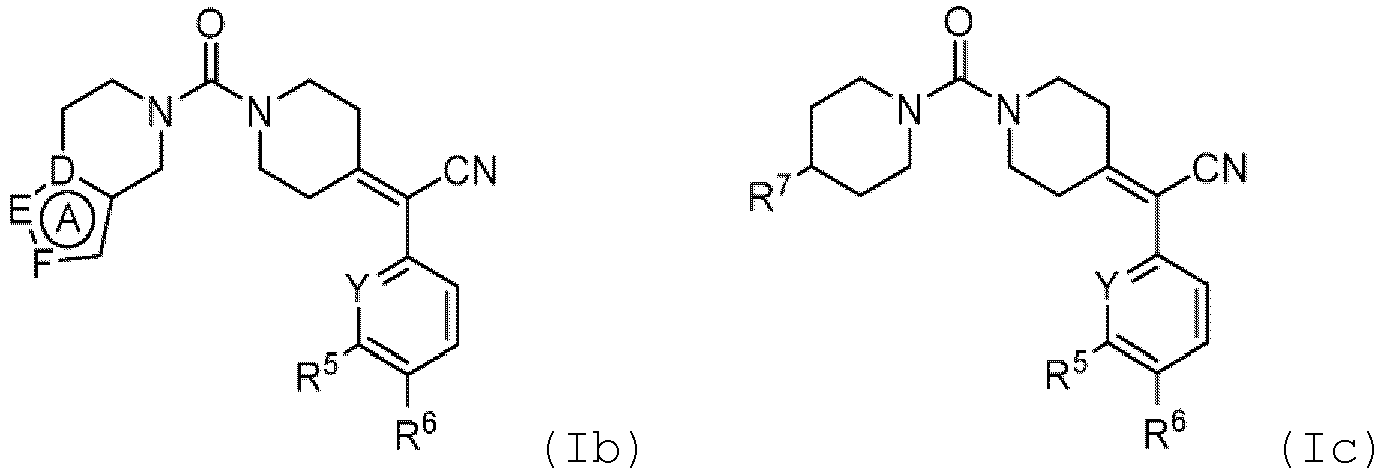 D C oder N ist;E N, NH oder CH ist;F O oder N ist;Y N oder C-R4 ist, wobei R4 H oder F ist;R5 H, Cl oder F ist;
oderY C-R4 ist und R4 und R5 zusammen mit den Kohlenstoffatomen, an die sie gebunden sind, einen 5-gliedrigen aromatischen Heterocyclus bilden;R6 F, Cl oder H ist;
oderY N oder C-R4 ist, wobei R4 H oder F ist;R5 und R6 zusammen mit den Kohlenstoffatomen, an die sie gebunden sind, einen 5-gliedrigen aromatischen Heterocyclus bilden; undR7 OH oder CH2OH ist; oderein Salz, Solvat oder Solvat eines Salzes davon. - Verbindung nach einem der vorhergehenden Ansprüche, die ausgewählt ist aus der Gruppe, die besteht aus:2-(4-Fluorphenyl)-2-(1-(4-hydroxypiperidin-1-carbonyl)piperidin-4-yliden)acetonitril (4);2-(4-Fluorphenyl)-2-(1-(4,5,6,7-tetrahydroisoxazolo[4,3-c]pyridin-5-carbonyl)piperidin-4-yliden)acetonitril (12);2-(4-Fluorphenyl)-2-(1-(4,5,6,7-tetrahydro-[1,2,3]triazolo[1,5-a]pyrazin-5-carbonyl)piperidin-4-yliden)acetonitril (13);2-(4-Chlorphenyl)-2-(1-(4-hydroxypiperidin-1-carbonyl)piperidin-4-yliden)acetonitril (18);2-(4-Fluorphenyl)-2-(1-(4,5,6,7-tetrahydro-1H-pyrazolo[4,3-c]pyridin-5-carbonyl)piperidin-4-yliden)acetonitril (25);2-(3,4-Difluorphenyl)-2-(1-(4-hydroxypiperidin-1-carbonyl)piperidin-4-yliden)acetonitril (41);2-(2,4-Difluorphenyl)-2-(1-(4-hydroxypiperidin-1-carbonyl)piperidin-4-yliden)acetonitril (42);2-(3,4-Difluorphenyl)-2-(1-(4,5,6,7-tetrahydro-1H-pyrazolo[4,3-c]pyridin-5-carbonyl)piperidin-4-yliden)acetonitril (43);2-(3,4-Difluorphenyl)-2-(1-(5,6,7,8-tetrahydroimidazo[1,5-a]pyrazin-7-carbonyl)piperidin-4-yliden)acetonitril (44);2-(1-(4-Hydroxypiperidin-1-carbonyl)piperidin-4-yliden)-2-(1H-indazol-4-yl)acetonitril (48);2-(5-Chlorpyridin-2-yl)-2-(1-(4,5,6,7-tetrahydro-1H-pyrazolo[4,3-c]pyridin-5-carbonyl)piperidin-4-yliden)acetonitril (67);2-(4-Chlorphenyl)-2-(1-(4-(hydroxymethyl)piperidin-1-carbonyl)piperidin-4-yliden)acetonitril (74);2-(3-Chlorphenyl)-2-(1-(4-hydroxypiperidin-1-carbonyl)piperidin- 4-yliden)acetonitril (80);2-(5-Fluorpyridin-2-yl)-2-(1-(4,5,6,7-tetrahydroisoxazolo[4,3-c]pyridin-5-carbonyl)piperidin-4-yliden)acetonitril (84);1-(4-((3-Chlorphenyl)(cyano)methylen)piperidin-1-carbonyl)piperidin-4-sulfonamid (99);2-(4-Chlorphenyl)-2-(1-(4,5,6,7-tetrahydro-1H-pyrazolo[4,3-
c ]pyridin-5-carbonyl)piperidin-4-yliden)acetonitril (113);2-(1-(4-(Hydroxymethyl)piperidin-1-carbonyl)piperidin-4-yliden)-2-(1-methyl-1H-indazol-7-yl)acetonitril (118);2-(1H-Indazol-4-yl)-2-(1-(4,5,6,7-tetrahydroisoxazolo[4,3-c]pyridin-5-carbonyl)piperidin-4-yliden)acetonitril (138);2-(3-Chlorphenyl)-2-(1-(4-(2-hydroxyethyl)piperidin-1-carbonyl)piperidin-4-yliden)acetonitril (140);2-(4-Chlorphenyl)-2-(1-(4,5,6,7-tetrahydroisoxazolo[4,3-c]pyridin-5-carbonyl)piperidin-4-yliden)acetonitril (141);2-(1H-Indazol-4-yl)-2-(1-(4-methoxypiperidin-1-carbonyl)piperidin-4-yliden)acetonitril (144);2-(1H-indazol-4-yl)-2-(1-(4-(trifluormethyl)piperidin-1-carbonyl)piperidin-4-yliden)acetonitril (145);2-(1-(3-oxa-8-azabicyclo[3.2.1]octan-8-carbonyl)piperidin-4-ylidene)-2-(3-chlorphenyl)acetonitril (156);2-(5-Chlorpyridin-2-yl)-2-(1-(4,5,6,7-tetrahydroisoxazolo[4,3-c]pyridin-5-carbonyl)piperidin-4-yliden)acetonitril (161); oderein Salz, Solvat oder Solvat eines Salzes davon. - Verfahren zur Herstellung einer Verbindung mit der Formel (I) oder eines Salzes, Solvats oder Solvats eines Salzes davon nach einem der vorhergehenden Ansprüche, das die folgenden Schritte umfasst:Reagieren der Verbindung mit der Formel (II)
 wobei die punktierte Linie eine wahlfreie Bindung darstellt,R7 eine Abgangsgruppe A oder nicht vorhanden ist, wenn die gepunktete Linie eine Bindung darstellt, undR3A R3 wie für die Verbindung mit der Formel (I) definiert oder eine Abgangsgruppe B ist,mit einer Verbindung mit der Formel (III)
 oder Halogenwasserstoff davon, wobeiR1 und R2 sind wie für die Verbindung mit der Formel (I) definiert;
oderReagieren einer Verbindung mit der Formel (IV) oder Halogenwasserstoff davon, wobeiR3A R3 wie für die Verbindung mit der Formel (I) definiert oder eine Abgangsgruppe B ist,mit einer Verbindung mit der Formel (V)
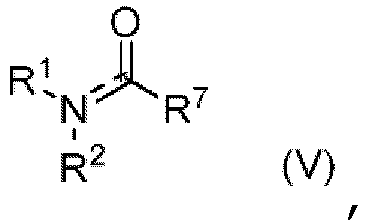 wobei die gepunktete Linie eine wahlfreie Bindung darstellt,R7 eine Abgangsgruppe A oder nicht vorhanden ist, wenn die gepunktete Linie eine Bindung darstellt, undR1 und R2 wie für die Verbindung mit der Formel (I) definiert sind,wahlweise bei Vorhandensein einer Base,zum Erhalten einer Verbindung mit der Formel (I)
 R1, R2 und R3 sind wie für die Verbindung mit der Formel (I) definiert;
oderR1 und R2 sind wie für die Verbindung mit der Formel (I) definiert und R3 die Abgangsgruppe B ist;und wahlweise, vorausgesetzt dass R3 die Abgangsgruppe B ist, Reagieren der erhaltenen Verbindung mit der Formel (I) mit einer Verbindung mit der Formel (VII) wobeiR3B R3 ist wie für die Verbindung mit der Formel (I) definiert,Z eine Abgangsgruppe C oder B(R8)2 ist, wobeiR8 OH, OC1-6-Alkyl oder beide R8 zusammen mit dem Ringboratom, an das sie gebunden sind, einen cyclischen Borester bilden,bei Vorhandensein einer Base und eines Haftvermittlers,zum Erhalten einer Verbindung mit der Formel (I), wobei R1, R2 und R3 sind wie in einem der vorhergehenden Ansprüche definiert;und wahlweise Umwandeln der Verbindung mit der Formel (I) in ein Salz, Solvat oder Solvat eines Salzes davon.
 - Pharmazeutische Zusammensetzung, die eine wirksame Menge von einer oder mehreren Verbindungen mit der Formel (I) oder ein Salz, Solvat oder Solvat eines Salzes davon nach einem der Ansprüche 1 bis 10 zusammen mit einem oder mehreren pharmazeutisch annehmbaren Hilfsstoffen umfasst.
- Pharmazeutische Zusammensetzung nach Anspruch 12, die eine oder mehrere Verbindungen nach einem der Ansprüche 1 bis 10 in Kombination mit einem oder mehreren weiteren Wirkstoffen umfasst.
- Verbindung oder Salz, Solvat oder Solvat eines Salzes davon nach einem der Ansprüche 1 bis 10 zur Verwendung als ein Arzneimittel.
- Verbindung oder ein Salz, Solvat oder Solvat eines Salzes davon nach einem der Ansprüche 1 bis 10 zur Verwendung bei der Behandlung oder Vorbeugung einer Krankheit oder Störung, die ausgewählt ist aus der Gruppe, die besteht aus Polyzystischem Ovarialsyndrom, Endometriose, Gebärmutterleiomyom, Gebärmutterblutungsstörungen, Dysmenorrhoe, Hyperandrogenismus, chronisch obstruktiver Lungenerkrankung (COPD), Lungenkrebs, nicht-kleinzelligem Lungenkarzinom, Prostatakrebs einschließlich kastrationsresistentem Prostatakrebs, Prostatahyperplasie, Brustkrebs, invasivem duktalem Mammakarzinom, dreifach negativem Brustkrebs, Endometriumkarzinom, Nierenzellkarzinom, Blasenkarzinom, Pankreas-Adenokarzinom, akuter myeloischer Leukämie, akuter lymphoblastischer T-Zell-Leukämie, Melanom, Non-Hodgkin-Lymphom, Akne, Seborrhoe, Haarausfall, vorzeitiger sexueller Reife, Fettleibigkeit und entzündungsbedingten Schmerzen.
Priority Applications (3)
| Application Number | Priority Date | Filing Date | Title |
|---|---|---|---|
| HRP20251059TT HRP20251059T1 (hr) | 2021-05-07 | 2022-05-05 | Novi heterociklični spojevi, pripravci, postupci pripreme i njihove uporabe |
| SI202230169T SI4334289T1 (sl) | 2021-05-07 | 2022-05-05 | Nove heterociklične spojine, sestavki, postopki za pripravo in uporabe le-teh |
| RS20250851A RS67138B1 (sr) | 2021-05-07 | 2022-05-05 | Nova heterociklična jedinjenja, kompozicije, postupci pripreme i njihove upotrebe |
Applications Claiming Priority (2)
| Application Number | Priority Date | Filing Date | Title |
|---|---|---|---|
| FI20215545 | 2021-05-07 | ||
| PCT/FI2022/050301 WO2022234193A1 (en) | 2021-05-07 | 2022-05-05 | Novel heterocyclic compounds, compositions, methods of preparation and uses thereof |
Publications (2)
| Publication Number | Publication Date |
|---|---|
| EP4334289A1 EP4334289A1 (de) | 2024-03-13 |
| EP4334289B1 true EP4334289B1 (de) | 2025-06-25 |
Family
ID=81648686
Family Applications (1)
| Application Number | Title | Priority Date | Filing Date |
|---|---|---|---|
| EP22723156.0A Active EP4334289B1 (de) | 2021-05-07 | 2022-05-05 | Neue heterocyclische verbindungen, zusammensetzungen, herstellungsverfahren und verwendungen davon |
Country Status (20)
| Country | Link |
|---|---|
| US (1) | US20240254131A1 (de) |
| EP (1) | EP4334289B1 (de) |
| JP (1) | JP2024516455A (de) |
| KR (1) | KR20240046422A (de) |
| CN (1) | CN117794899A (de) |
| AU (1) | AU2022270395A1 (de) |
| BR (1) | BR112023022664A2 (de) |
| CA (1) | CA3217690A1 (de) |
| DK (1) | DK4334289T3 (de) |
| ES (1) | ES3041113T3 (de) |
| FI (1) | FI4334289T3 (de) |
| HR (1) | HRP20251059T1 (de) |
| HU (1) | HUE072653T2 (de) |
| LT (1) | LT4334289T (de) |
| MX (1) | MX2023013112A (de) |
| PL (1) | PL4334289T3 (de) |
| PT (1) | PT4334289T (de) |
| RS (1) | RS67138B1 (de) |
| SI (1) | SI4334289T1 (de) |
| WO (1) | WO2022234193A1 (de) |
Family Cites Families (4)
| Publication number | Priority date | Publication date | Assignee | Title |
|---|---|---|---|---|
| PE20080212A1 (es) * | 2006-06-27 | 2008-04-25 | Sanofi Aventis | Derivados de ureas de piperidina o pirrolidina como moduladores de la 11b-hidroxiesteroide deshidrogenasa tipo 1 (11bhsd1) |
| CA3024918A1 (en) * | 2016-06-30 | 2018-01-04 | Basilea Pharmaceutica International AG | Mitochondrial inhibitors for the treatment of proliferation disorders |
| EP3421483A1 (de) * | 2017-06-29 | 2019-01-02 | Bayer Pharma Aktiengesellschaft | Neuartige steroidale 17-beta heteroarylverbindungen als akr1c3 inhibitoren |
| UY38806A (es) * | 2019-08-01 | 2021-02-26 | Novartis Ag | Compuestos inhibidores tricíclicos de kars dependientes de akr1c3, composiciones y sus usos |
-
2022
- 2022-05-05 KR KR1020237041302A patent/KR20240046422A/ko not_active Withdrawn
- 2022-05-05 FI FIEP22723156.0T patent/FI4334289T3/fi active
- 2022-05-05 MX MX2023013112A patent/MX2023013112A/es unknown
- 2022-05-05 EP EP22723156.0A patent/EP4334289B1/de active Active
- 2022-05-05 JP JP2023568425A patent/JP2024516455A/ja active Pending
- 2022-05-05 AU AU2022270395A patent/AU2022270395A1/en active Pending
- 2022-05-05 SI SI202230169T patent/SI4334289T1/sl unknown
- 2022-05-05 CA CA3217690A patent/CA3217690A1/en active Pending
- 2022-05-05 HU HUE22723156A patent/HUE072653T2/hu unknown
- 2022-05-05 HR HRP20251059TT patent/HRP20251059T1/hr unknown
- 2022-05-05 PL PL22723156.0T patent/PL4334289T3/pl unknown
- 2022-05-05 LT LTEPPCT/FI2022/050301T patent/LT4334289T/lt unknown
- 2022-05-05 WO PCT/FI2022/050301 patent/WO2022234193A1/en not_active Ceased
- 2022-05-05 PT PT227231560T patent/PT4334289T/pt unknown
- 2022-05-05 US US18/558,860 patent/US20240254131A1/en active Pending
- 2022-05-05 BR BR112023022664A patent/BR112023022664A2/pt unknown
- 2022-05-05 ES ES22723156T patent/ES3041113T3/es active Active
- 2022-05-05 RS RS20250851A patent/RS67138B1/sr unknown
- 2022-05-05 DK DK22723156.0T patent/DK4334289T3/da active
- 2022-05-05 CN CN202280047923.5A patent/CN117794899A/zh active Pending
Also Published As
| Publication number | Publication date |
|---|---|
| FI4334289T3 (fi) | 2025-08-27 |
| WO2022234193A1 (en) | 2022-11-10 |
| US20240254131A1 (en) | 2024-08-01 |
| DK4334289T3 (da) | 2025-09-08 |
| MX2023013112A (es) | 2024-02-09 |
| ES3041113T3 (en) | 2025-11-07 |
| PT4334289T (pt) | 2025-09-01 |
| RS67138B1 (sr) | 2025-09-30 |
| SI4334289T1 (sl) | 2025-10-30 |
| CN117794899A (zh) | 2024-03-29 |
| HUE072653T2 (hu) | 2025-12-28 |
| PL4334289T3 (pl) | 2025-12-08 |
| HRP20251059T1 (hr) | 2025-11-07 |
| LT4334289T (lt) | 2025-09-25 |
| AU2022270395A1 (en) | 2023-11-16 |
| CA3217690A1 (en) | 2022-11-10 |
| BR112023022664A2 (pt) | 2024-01-16 |
| KR20240046422A (ko) | 2024-04-09 |
| EP4334289A1 (de) | 2024-03-13 |
| JP2024516455A (ja) | 2024-04-15 |
Similar Documents
| Publication | Publication Date | Title |
|---|---|---|
| EP4397664A1 (de) | Pyrimidinkondensierte cyclische verbindung sowie herstellungsverfahren und verwendung davon | |
| EP4592295A1 (de) | Pyrimidinkondensierte ringverbindung sowie herstellungsverfahren dafür und verwendung davon | |
| TWI793151B (zh) | 3-(1-氧異吲哚啉-2-基)之氫吡啶-2,6-二酮衍生物及其用途 | |
| CN103874700B (zh) | 吡唑并[3,4‑c]吡啶化合物和使用方法 | |
| TW202122396A (zh) | KRas G12D抑制劑 | |
| EP3968999A1 (de) | Fgfr-inhibitoren und verfahren zur verwendung davon | |
| TW202423914A (zh) | Cdk2降解劑及其用途 | |
| WO2018066718A1 (en) | Therapeutic compounds | |
| EP1945216A1 (de) | Verfahren zur hemmung von proteinkinasen | |
| EP4370124A1 (de) | Pi3ka-inhibitoren und verfahren zur verwendung davon | |
| EP4522583A2 (de) | Pi3k-alpha-hemmer und verfahren zur verwendung davon | |
| TW202330548A (zh) | 用於降解egfr激酶的化合物 | |
| KR20150133765A (ko) | 거대고리 rip2 키나제 억제제 | |
| WO2023081759A1 (en) | Bifunctional pi3k-alpha inhibitors and uses thereof | |
| WO2023039532A1 (en) | Pi3k-alpha inhibitors and methods of use thereof | |
| US20240150339A1 (en) | Compounds and Their Use as PDE4 Activators | |
| AU2018279205A1 (en) | 15.beta.-(3-propanamido)-substituted estra-1,3,5(10)-trien-17-one compounds and their 17-oximes for use in inhibition of 17.beta.-hydroxysteroid dehydrogenases | |
| EP4334289B1 (de) | Neue heterocyclische verbindungen, zusammensetzungen, herstellungsverfahren und verwendungen davon | |
| EP4357347B1 (de) | Trk-kinasehemmerverbindung und verwendung davon | |
| WO2025255298A1 (en) | Pkc-theta inhibitors, compositions, and methods of use | |
| US20260055108A1 (en) | Triazine compounds and uses thereof | |
| WO2025201078A1 (zh) | 化合物、包含其的药物组合物及其制备方法和用途 | |
| HK40027566B (en) | 3-(1-oxoisoindolin-2-yl)piperidine-2,6-dione derivatives and uses thereof | |
| HK40027566A (en) | 3-(1-oxoisoindolin-2-yl)piperidine-2,6-dione derivatives and uses thereof | |
| HK1193807A (en) | Pyrazolo[3,4-c]pyridine compounds and methods of use |
Legal Events
| Date | Code | Title | Description |
|---|---|---|---|
| REG | Reference to a national code |
Ref country code: HR Ref legal event code: TUEP Ref document number: P20251059T Country of ref document: HR |
|
| STAA | Information on the status of an ep patent application or granted ep patent |
Free format text: STATUS: UNKNOWN |
|
| STAA | Information on the status of an ep patent application or granted ep patent |
Free format text: STATUS: THE INTERNATIONAL PUBLICATION HAS BEEN MADE |
|
| PUAI | Public reference made under article 153(3) epc to a published international application that has entered the european phase |
Free format text: ORIGINAL CODE: 0009012 |
|
| STAA | Information on the status of an ep patent application or granted ep patent |
Free format text: STATUS: REQUEST FOR EXAMINATION WAS MADE |
|
| 17P | Request for examination filed |
Effective date: 20231201 |
|
| AK | Designated contracting states |
Kind code of ref document: A1 Designated state(s): AL AT BE BG CH CY CZ DE DK EE ES FI FR GB GR HR HU IE IS IT LI LT LU LV MC MK MT NL NO PL PT RO RS SE SI SK SM TR |
|
| DAV | Request for validation of the european patent (deleted) | ||
| DAX | Request for extension of the european patent (deleted) | ||
| GRAP | Despatch of communication of intention to grant a patent |
Free format text: ORIGINAL CODE: EPIDOSNIGR1 |
|
| STAA | Information on the status of an ep patent application or granted ep patent |
Free format text: STATUS: GRANT OF PATENT IS INTENDED |
|
| INTG | Intention to grant announced |
Effective date: 20250110 |
|
| GRAS | Grant fee paid |
Free format text: ORIGINAL CODE: EPIDOSNIGR3 |
|
| RIN1 | Information on inventor provided before grant (corrected) |
Inventor name: STJERNSCHANTZ, CAMILLA Inventor name: PENTIKAEINEN, OLLI Inventor name: NIINIVEHMAS, SANNA Inventor name: HAKOLA, MARJO Inventor name: ILLIKAINEN, KAISA Inventor name: HIRVELAE, LEENA Inventor name: LINNANEN, TERO |
|
| RAP3 | Party data changed (applicant data changed or rights of an application transferred) |
Owner name: ORGANON R&D FINLAND OY |
|
| GRAA | (expected) grant |
Free format text: ORIGINAL CODE: 0009210 |
|
| STAA | Information on the status of an ep patent application or granted ep patent |
Free format text: STATUS: THE PATENT HAS BEEN GRANTED |
|
| AK | Designated contracting states |
Kind code of ref document: B1 Designated state(s): AL AT BE BG CH CY CZ DE DK EE ES FI FR GB GR HR HU IE IS IT LI LT LU LV MC MK MT NL NO PL PT RO RS SE SI SK SM TR |
|
| REG | Reference to a national code |
Ref country code: GB Ref legal event code: FG4D |
|
| REG | Reference to a national code |
Ref country code: CH Ref legal event code: EP |
|
| REG | Reference to a national code |
Ref country code: DE Ref legal event code: R096 Ref document number: 602022016454 Country of ref document: DE |
|
| REG | Reference to a national code |
Ref country code: CH Ref legal event code: EP |
|
| REG | Reference to a national code |
Ref country code: IE Ref legal event code: FG4D |
|
| REG | Reference to a national code |
Ref country code: FI Ref legal event code: FGE |
|
| REG | Reference to a national code |
Ref country code: PT Ref legal event code: SC4A Ref document number: 4334289 Country of ref document: PT Date of ref document: 20250901 Kind code of ref document: T Free format text: AVAILABILITY OF NATIONAL TRANSLATION Effective date: 20250827 |
|
| REG | Reference to a national code |
Ref country code: NL Ref legal event code: FP |
|
| REG | Reference to a national code |
Ref country code: DK Ref legal event code: T3 Effective date: 20250903 |
|
| REG | Reference to a national code |
Ref country code: SE Ref legal event code: TRGR |
|
| REG | Reference to a national code |
Ref country code: EE Ref legal event code: FG4A Ref document number: E025283 Country of ref document: EE Effective date: 20250915 |
|
| REG | Reference to a national code |
Ref country code: GR Ref legal event code: EP Ref document number: 20250401723 Country of ref document: GR Effective date: 20251009 |
|
| REG | Reference to a national code |
Ref country code: ES Ref legal event code: FG2A Ref document number: 3041113 Country of ref document: ES Kind code of ref document: T3 Effective date: 20251107 Ref country code: HR Ref legal event code: T1PR Ref document number: P20251059 Country of ref document: HR |
|
| REG | Reference to a national code |
Ref country code: SK Ref legal event code: T3 Ref document number: E 47095 Country of ref document: SK |
|
| REG | Reference to a national code |
Ref country code: HU Ref legal event code: AG4A Ref document number: E072653 Country of ref document: HU |
|
| PG25 | Lapsed in a contracting state [announced via postgrant information from national office to epo] |
Ref country code: SM Free format text: LAPSE BECAUSE OF FAILURE TO SUBMIT A TRANSLATION OF THE DESCRIPTION OR TO PAY THE FEE WITHIN THE PRESCRIBED TIME-LIMIT Effective date: 20250625 |