EP4333293A1 - Motorklemmen-stossdämpferschaltung - Google Patents
Motorklemmen-stossdämpferschaltung Download PDFInfo
- Publication number
- EP4333293A1 EP4333293A1 EP22275119.0A EP22275119A EP4333293A1 EP 4333293 A1 EP4333293 A1 EP 4333293A1 EP 22275119 A EP22275119 A EP 22275119A EP 4333293 A1 EP4333293 A1 EP 4333293A1
- Authority
- EP
- European Patent Office
- Prior art keywords
- motor
- voltage
- capacitor
- snubber circuit
- rectifier
- Prior art date
- Legal status (The legal status is an assumption and is not a legal conclusion. Google has not performed a legal analysis and makes no representation as to the accuracy of the status listed.)
- Pending
Links
- 239000003990 capacitor Substances 0.000 claims abstract description 36
- 230000005540 biological transmission Effects 0.000 claims abstract description 20
- 230000000694 effects Effects 0.000 description 12
- 230000008901 benefit Effects 0.000 description 3
- 238000009413 insulation Methods 0.000 description 3
- 230000001939 inductive effect Effects 0.000 description 2
- 230000001960 triggered effect Effects 0.000 description 2
- 230000001133 acceleration Effects 0.000 description 1
- 230000004913 activation Effects 0.000 description 1
- 230000032683 aging Effects 0.000 description 1
- 230000006866 deterioration Effects 0.000 description 1
- 238000010586 diagram Methods 0.000 description 1
- 230000001976 improved effect Effects 0.000 description 1
- 230000006698 induction Effects 0.000 description 1
- 238000002955 isolation Methods 0.000 description 1
- 230000000116 mitigating effect Effects 0.000 description 1
- 230000000630 rising effect Effects 0.000 description 1
- 230000035882 stress Effects 0.000 description 1
- 230000001052 transient effect Effects 0.000 description 1
- 230000007704 transition Effects 0.000 description 1
- 238000004804 winding Methods 0.000 description 1
Images



Classifications
-
- H—ELECTRICITY
- H02—GENERATION; CONVERSION OR DISTRIBUTION OF ELECTRIC POWER
- H02H—EMERGENCY PROTECTIVE CIRCUIT ARRANGEMENTS
- H02H7/00—Emergency protective circuit arrangements specially adapted for specific types of electric machines or apparatus or for sectionalised protection of cable or line systems, and effecting automatic switching in the event of an undesired change from normal working conditions
- H02H7/08—Emergency protective circuit arrangements specially adapted for specific types of electric machines or apparatus or for sectionalised protection of cable or line systems, and effecting automatic switching in the event of an undesired change from normal working conditions for dynamo-electric motors
- H02H7/0833—Emergency protective circuit arrangements specially adapted for specific types of electric machines or apparatus or for sectionalised protection of cable or line systems, and effecting automatic switching in the event of an undesired change from normal working conditions for dynamo-electric motors for electric motors with control arrangements
-
- H—ELECTRICITY
- H02—GENERATION; CONVERSION OR DISTRIBUTION OF ELECTRIC POWER
- H02P—CONTROL OR REGULATION OF ELECTRIC MOTORS, ELECTRIC GENERATORS OR DYNAMO-ELECTRIC CONVERTERS; CONTROLLING TRANSFORMERS, REACTORS OR CHOKE COILS
- H02P29/00—Arrangements for regulating or controlling electric motors, appropriate for both AC and DC motors
- H02P29/02—Providing protection against overload without automatic interruption of supply
- H02P29/024—Detecting a fault condition, e.g. short circuit, locked rotor, open circuit or loss of load
- H02P29/0241—Detecting a fault condition, e.g. short circuit, locked rotor, open circuit or loss of load the fault being an overvoltage
-
- H—ELECTRICITY
- H02—GENERATION; CONVERSION OR DISTRIBUTION OF ELECTRIC POWER
- H02M—APPARATUS FOR CONVERSION BETWEEN AC AND AC, BETWEEN AC AND DC, OR BETWEEN DC AND DC, AND FOR USE WITH MAINS OR SIMILAR POWER SUPPLY SYSTEMS; CONVERSION OF DC OR AC INPUT POWER INTO SURGE OUTPUT POWER; CONTROL OR REGULATION THEREOF
- H02M1/00—Details of apparatus for conversion
- H02M1/32—Means for protecting converters other than automatic disconnection
- H02M1/34—Snubber circuits
- H02M1/348—Passive dissipative snubbers
-
- H—ELECTRICITY
- H02—GENERATION; CONVERSION OR DISTRIBUTION OF ELECTRIC POWER
- H02M—APPARATUS FOR CONVERSION BETWEEN AC AND AC, BETWEEN AC AND DC, OR BETWEEN DC AND DC, AND FOR USE WITH MAINS OR SIMILAR POWER SUPPLY SYSTEMS; CONVERSION OF DC OR AC INPUT POWER INTO SURGE OUTPUT POWER; CONTROL OR REGULATION THEREOF
- H02M7/00—Conversion of AC power input into DC power output; Conversion of DC power input into AC power output
- H02M7/42—Conversion of DC power input into AC power output without possibility of reversal
- H02M7/44—Conversion of DC power input into AC power output without possibility of reversal by static converters
- H02M7/48—Conversion of DC power input into AC power output without possibility of reversal by static converters using discharge tubes with control electrode or semiconductor devices with control electrode
- H02M7/53—Conversion of DC power input into AC power output without possibility of reversal by static converters using discharge tubes with control electrode or semiconductor devices with control electrode using devices of a triode or transistor type requiring continuous application of a control signal
- H02M7/537—Conversion of DC power input into AC power output without possibility of reversal by static converters using discharge tubes with control electrode or semiconductor devices with control electrode using devices of a triode or transistor type requiring continuous application of a control signal using semiconductor devices only, e.g. single switched pulse inverters
- H02M7/5387—Conversion of DC power input into AC power output without possibility of reversal by static converters using discharge tubes with control electrode or semiconductor devices with control electrode using devices of a triode or transistor type requiring continuous application of a control signal using semiconductor devices only, e.g. single switched pulse inverters in a bridge configuration
-
- H—ELECTRICITY
- H02—GENERATION; CONVERSION OR DISTRIBUTION OF ELECTRIC POWER
- H02P—CONTROL OR REGULATION OF ELECTRIC MOTORS, ELECTRIC GENERATORS OR DYNAMO-ELECTRIC CONVERTERS; CONTROLLING TRANSFORMERS, REACTORS OR CHOKE COILS
- H02P29/00—Arrangements for regulating or controlling electric motors, appropriate for both AC and DC motors
- H02P29/02—Providing protection against overload without automatic interruption of supply
- H02P29/024—Detecting a fault condition, e.g. short circuit, locked rotor, open circuit or loss of load
- H02P29/028—Detecting a fault condition, e.g. short circuit, locked rotor, open circuit or loss of load the motor continuing operation despite the fault condition, e.g. eliminating, compensating for or remedying the fault
-
- H—ELECTRICITY
- H02—GENERATION; CONVERSION OR DISTRIBUTION OF ELECTRIC POWER
- H02P—CONTROL OR REGULATION OF ELECTRIC MOTORS, ELECTRIC GENERATORS OR DYNAMO-ELECTRIC CONVERTERS; CONTROLLING TRANSFORMERS, REACTORS OR CHOKE COILS
- H02P3/00—Arrangements for stopping or slowing electric motors, generators, or dynamo-electric converters
- H02P3/06—Arrangements for stopping or slowing electric motors, generators, or dynamo-electric converters for stopping or slowing an individual dynamo-electric motor or dynamo-electric converter
- H02P3/18—Arrangements for stopping or slowing electric motors, generators, or dynamo-electric converters for stopping or slowing an individual dynamo-electric motor or dynamo-electric converter for stopping or slowing an AC motor
- H02P3/22—Arrangements for stopping or slowing electric motors, generators, or dynamo-electric converters for stopping or slowing an individual dynamo-electric motor or dynamo-electric converter for stopping or slowing an AC motor by short-circuit or resistive braking
Definitions
- the present disclosure is concerned with arrangements for mitigating transmission line effects and addressing problems caused by voltage overshoot at converter-driven motor terminals.
- Power trains typically include a power source connected to a load such as a motor via a power convertor/inverter.
- a power source connected to a load such as a motor via a power convertor/inverter.
- a three phase AC motor is conventionally driven from a power supply. If the power supply is AC power, a rectifier will convert the AC power to DC power on a DC link.
- An inverter provides the required three-phase AC power, e.g. at a different frequency from the power supply, to drive the motor, from the DC power. The drive power for the motor is often transmitted to the motor over long cables or lines.
- the power cables have an inherent inductance and capacitance, and a mismatch between the cable characteristic impedance and the connected motor and other components can cause electrical reflections along the power cable.
- the inverter motor generates a PWM voltage pattern at the output. Sharp edges of the PWM signal interacting with the cable can cause a rapid increase in voltage creating a voltage surge at the motor terminals. These surges or spikes of current and voltage can cause so-called transmission line effects at the motor terminals. Such surges can have amplitudes of double the DC link voltage. Such phenomena are described extensively in the literature, e.g. E. Persson, "Transient effects in application of PWM inverters to induction motors," in IEEE Transactions on Industry Applications, vol. 28, no. 5, pp.
- D. A. Rendusara and P. N. Enjeti "An improved inverter output filter configuration reduces common and differential modes dv/dt at the motor terminals in PWM drive systems," in IEEE Transactions on Power Electronics, vol. 13, no. 6, pp. 1135-1143, Nov. 1998 .
- P. Mart-ro W. Sae-Kok and S. Khomfoi, "Analysis of dv/dt filter installation for PWM AC drive applications," 2011 IEEE Ninth International Conference on Power Electronics and Drive Systems, Singapore, 2011, pp. 177-184 .
- Venkataramanan "Filter networks for long cable drives and their influence on motor voltage distribution and common-mode currents," in IEEE Transactions on Industrial Electronics, vol. 52, no. 2, pp. 515-522, April 2005 . J. He, G. Y. Sizov, P. Zhang and N. A. O. Demerdash, "A review of mitigation methods for overvoltage in long-cable-fed PWM AC drives," 2011 IEEE Energy Conversion Congress and Exposition, Phoenix, AZ, 2011, pp. 2160-2166 . K. K. Yuen, H. S. Chung and V. S.
- transmission line effects are managed by an output RLC filter which 'slows down' the edges of the PWM signal to the motor.
- Such an arrangement can, however, lead to losses due to power dissipation. This is particularly problematic in e.g. aerospace applications because of excessive heatsink size.
- the use of capacitors can also give rise to reliability concerns.
- RC components are selected to provide a certain terminating resistance to avoid high frequency components, achieved by matching the resistance to the characteristic impedance of the cable.
- RC components are selected to slow the voltage rise (dv/dt) at the motor terminal to acceptable levels for twice the time delay of the transmission line.
- RC terminators tend to dissipate less energy than RLC circuits and so can be preferable.
- the use of capacitors, again, however, can give rise to reliability issues.
- a sinewave filter comprising inductive and capacitive components.
- Such a filter is essentially lossless due to not having resistive components.
- Such filters are generally designed to have a cut-off frequency at the logarithmic half frequency between the grid frequency and the switching frequency. The filter is then completely independent of cable length.
- a problem with such a filter, though, is that the cut-off frequency requirement means that the inductor needs to be large and will be heavy, which is undesirable, particularly in aerospace applications.
- Such filters also have the disadvantages mentioned above due to the use of capacitors.
- CM common mode
- a snubber circuit for connecting to the terminals of a motor that is driven from a power source and converter via transmission lines, the snubber circuit being configured to selectively capture overshoots only for those PWM edges that endanger motor insulation.
- a snubber circuit to mitigate voltage overshoot in a power train for driving a motor, the snubber circuit configured to be connected to the motor terminal between a transmission line from a power supply and converter and a motor, the snubber circuit comprising a rectifier, a capacitor connected across an output of the rectifier and a load connected across the capacitor, wherein the capacitor is rated to charge to a predetermined link voltage and wherein an input voltage to the rectifier that exceeds the link voltage causes the voltage at the motor terminal to clamp to the link voltage and for excess energy from the input voltage to be stored in the link capacitor and dissipated by the load.
- a typical power train for a motor is described with reference to Fig. 1 .
- Power is provided from a power supply 1 to a motor 4 via a power converter 2.
- the converter 2 has to drive a remote motor load 4 that can be many meters away, connected by long transmission lines 3.
- the converter 2 is a PWM converter and generates sufficiently sharp dv/dt edges, part of the high frequency energy from the switching is trapped in feeder cables which can result in voltage overshoot at the motor terminal.
- This voltage can be much greater than converter line-to-line voltage and can lead to deterioration of the insulation of the motor turn-to-turn windings.
- the present disclosure provides a motor terminal snubber circuit that selectively captures significant voltage overshoots.
- the snubber circuit is generally indicated, in Figure 1 , by reference numeral 5 and comprises a rectifier 6 which is at least a six-pulse rectifier but could, in theory, be multiples of 6 pulse.
- a capacitor 7 is connected across the output of the rectifier 6.
- a resistor 9 may be placed in series with the capacitor 7 across the rectifier output.
- a load e.g. a resistor 8 is connected across the capacitor 7 (or, where the optional resistor 9 is present, across the series connection of the capacitor and the resistor). Whilst the load is shown here as a simple resistor, it can, in fact, be anything that is able to dissipate heat and may be e.g. a useful or functional load.
- the snubber circuit 5 is connected to the motor terminal.
- the snubber is only triggered on occurrence of a high phase-to-phase voltage event, whereupon, the capacitor and the load are connected to discharge the high voltage. Otherwise, at lower voltages, the snubber is not activated. For example, for a motor drive with a 1000V DC link voltage, when the capacitor 7 is charged up to that 1000V and slowly discharged by the load 8, the rectifier will only clamp phase-to-phase voltages if they are greater than 1000V. Such voltages will only occur for voltage overshoots caused by transmission line effects. This shows that the snubber circuit of the disclosure is only selectively activated to suppress transmission line effect overshoots and otherwise is not activated and so not consuming power.
- Figure 2 shows the phase-to-phase voltages output by the converter 2.
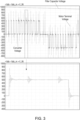
- Figure 3 shows the converter voltage, motor terminal voltage and filter capacitor voltage during time T1 of Figure 2 .
- Figure 2 shows a phase-to-phase voltage waveform generated by a three-level inverter (also referred to herein as converter) 2 with a 1000V DC link during motor drive acceleration.
- a three-level inverter also referred to herein as converter
- the converter 2 generates at its output voltages that are equal to half of the DC link voltage value.
- the rectifier is not triggered and so no limitation is provided on any overshoots. Such overshoots are, however, less than 1000V and so there is no need for them to be discharged.
- the converter 2 During time T2, the converter 2 generates higher voltages. If the converter phase-to-phase voltages reach 1000V (and so would normally cause the voltage at the motor terminals to exceed 1000V), the rectifier 6 is activated for the short periods of time Tr when the voltage is 1000V (without a snubber this voltage will go above 1000V). The rectifier thus clamps the phase-to-phase voltage at these times and excessive energy is stored in the snubber capacitor 7 such that the phase-to-phase voltage at the motor terminals do not exceed the capacitor voltage. This effect is seen in Fig. 4 which shows the converter voltage, motor terminal voltage and filter capacitor voltage during time T2 of Figure 2 .
- the rectifier diodes 6a, 6b are only working for those short periods of time Tr and only for rising edges of the converter phase-to-phase voltages, and so they do not dissipate much power.
- the main power is dissipated by the load 8.
- the load 8 may be fully passive e.g. in the form of a resistor as shown in Figure 1 , which provides a simple arrangement which does not require any intelligence at the input stage. In other embodiments, however, the load may be active and only dissipate power of the voltage stored across the capacitor 7 is greater than the DC link voltage of the assembly. This embodiment would allow for even more selective snubbing and lower loss and the energy acquired by such a load 8 can be either dissipated or used for some other function or purpose.
- the resistor 9 is optional, and can facilitate reduction of inrush current. If this component is not present, all energy would be stored in the capacitor as described above. If resistor 9 is present in series with the capacitor 7, the snubber acts as a self-commutating RC snubber.
- the assembly according to the disclosure has the advantage that the snubber circuit selectively captures only those overshoots that are likely to cause damage to the motor isolation, thus reducing power consumption/losses compared to known solutions.
- the solution also has improved robustness since it allows the capacitor to operate at constant voltage.
- the circuit is also relatively small, lightweight and inexpensive.
Landscapes
- Engineering & Computer Science (AREA)
- Power Engineering (AREA)
- Inverter Devices (AREA)
Priority Applications (2)
| Application Number | Priority Date | Filing Date | Title |
|---|---|---|---|
| EP22275119.0A EP4333293A1 (de) | 2022-08-30 | 2022-08-30 | Motorklemmen-stossdämpferschaltung |
| US18/455,185 US20240072532A1 (en) | 2022-08-30 | 2023-08-24 | Motor terminal snubbing circuit |
Applications Claiming Priority (1)
| Application Number | Priority Date | Filing Date | Title |
|---|---|---|---|
| EP22275119.0A EP4333293A1 (de) | 2022-08-30 | 2022-08-30 | Motorklemmen-stossdämpferschaltung |
Publications (1)
| Publication Number | Publication Date |
|---|---|
| EP4333293A1 true EP4333293A1 (de) | 2024-03-06 |
Family
ID=83149151
Family Applications (1)
| Application Number | Title | Priority Date | Filing Date |
|---|---|---|---|
| EP22275119.0A Pending EP4333293A1 (de) | 2022-08-30 | 2022-08-30 | Motorklemmen-stossdämpferschaltung |
Country Status (2)
| Country | Link |
|---|---|
| US (1) | US20240072532A1 (de) |
| EP (1) | EP4333293A1 (de) |
Families Citing this family (1)
| Publication number | Priority date | Publication date | Assignee | Title |
|---|---|---|---|---|
| EP4425771A1 (de) * | 2023-03-01 | 2024-09-04 | Hamilton Sundstrand Corporation | Steuerung |
Citations (3)
| Publication number | Priority date | Publication date | Assignee | Title |
|---|---|---|---|---|
| US6122184A (en) | 1997-06-19 | 2000-09-19 | The Texas A&M University System | Method and system for an improved converter output filter for an induction drive system |
| US6208537B1 (en) * | 1999-09-28 | 2001-03-27 | Rockwell Technologies, Llc | Series resonant sinewave output filter and design methodology |
| US20140368143A1 (en) * | 2013-06-12 | 2014-12-18 | Rockwell Automation Technologies, Inc. | Method and apparatus for overvoltage protection and reverse motor speed control for motor drive power loss events |
Family Cites Families (7)
| Publication number | Priority date | Publication date | Assignee | Title |
|---|---|---|---|---|
| JP3489022B2 (ja) * | 1999-03-18 | 2004-01-19 | 株式会社安川電機 | ダイナミックブレーキ回路と半導体インバータ装置 |
| JP2004096974A (ja) * | 2002-09-04 | 2004-03-25 | Yaskawa Electric Corp | スナバモジュールおよび電力変換装置 |
| US7479756B2 (en) * | 2006-06-19 | 2009-01-20 | Rockwell Automation Technologies, Inc. | System and method for protecting a motor drive unit from motor back EMF under fault conditions |
| EP2132850A4 (de) * | 2007-04-05 | 2012-04-11 | Georgia Tech Res Inst | Spannungsstoss und überspannungsschutz |
| GB0906020D0 (en) * | 2009-04-07 | 2009-05-20 | Trw Ltd | Motor drive circuitry |
| GB2534348A (en) * | 2014-11-21 | 2016-07-27 | Reinhausen Maschf Scheubeck | Active Snubber |
| EP3340448B1 (de) * | 2016-12-23 | 2023-06-07 | Delta Electronics (Thailand) Public Co., Ltd. | Elektrischer leistungswandler mit dämpferschaltung |
-
2022
- 2022-08-30 EP EP22275119.0A patent/EP4333293A1/de active Pending
-
2023
- 2023-08-24 US US18/455,185 patent/US20240072532A1/en active Pending
Patent Citations (3)
| Publication number | Priority date | Publication date | Assignee | Title |
|---|---|---|---|---|
| US6122184A (en) | 1997-06-19 | 2000-09-19 | The Texas A&M University System | Method and system for an improved converter output filter for an induction drive system |
| US6208537B1 (en) * | 1999-09-28 | 2001-03-27 | Rockwell Technologies, Llc | Series resonant sinewave output filter and design methodology |
| US20140368143A1 (en) * | 2013-06-12 | 2014-12-18 | Rockwell Automation Technologies, Inc. | Method and apparatus for overvoltage protection and reverse motor speed control for motor drive power loss events |
Non-Patent Citations (13)
| Title |
|---|
| A. F. MOREIRAP. M. SANTOST. A. LIPOG. VENKATARAMANAN: "Filter networks for long cable drives and their influence on motor voltage distribution and common-mode currents", IEEE TRANSACTIONS ON INDUSTRIAL ELECTRONICS, vol. 52, no. 2, April 2005 (2005-04-01), pages 515 - 522 |
| A. VON JOUANNEP. N. ENJETI: "Design considerations for an inverter output filter to mitigate the effects of long motor leads in ASD applications", IEEE TRANSACTIONS ON INDUSTRY APPLICATIONS, vol. 33, no. 5, September 1997 (1997-09-01), pages 1138 - 1145 |
| D. A. RENDUSARAP. N. ENJETI: "An improved inverter output filter configuration reduces common and differential modes dv/dt at the motor terminals in PWM drive systems", IEEE TRANSACTIONS ON POWER ELECTRONICS, vol. 13, no. 6, November 1998 (1998-11-01), pages 1135 - 1143, XP011043248 |
| E. PERSSON: "Transient effects in application of PWM inverters to induction motors", IEEE TRANSACTIONS ON INDUSTRY APPLICATIONS, vol. 28, no. 5, September 1992 (1992-09-01), pages 1095 - 1101 |
| J. C. G. WHEELER: "Effects of converter pulses on the electrical insulation in low and medium voltage motors", IEEE ELECTRICAL INSULATION MAGAZINE, vol. 21, no. 2, March 2005 (2005-03-01), pages 22 - 29, XP011129144, DOI: 10.1109/MEI.2005.1412216 |
| J. HEG. Y. SIZOVP. ZHANGN. A. O. DEMERDASH: "A review of mitigation methods for overvoltage in long-cable-fed PWM AC drives", 2011 IEEE ENERGY CONVERSION CONGRESS AND EXPOSITION, PHOENIX, AZ, 2011, pages 2160 - 2166, XP032067448, DOI: 10.1109/ECCE.2011.6064054 |
| K. K. YUENH. S. CHUNG: "A Low-Loss ''RL-Plus-C'' Filter for Overvoltage Suppression in Inverter-Fed Drive System With Long Motor Cable", IEEE TRANSACTIONS ON POWER ELECTRONICS, vol. 30, no. 4, April 2015 (2015-04-01), pages 2167 - 2181 |
| K. K. YUENH. S. CHUNG: "Use of Synchronous Modulation to Recover Energy Gained From Matching Long Cable in Inverter-Fed Motor Drives", IEEE TRANSACTIONS ON POWER ELECTRONICS, vol. 29, no. 2, February 2014 (2014-02-01), pages 883 - 893, XP011524668, DOI: 10.1109/TPEL.2013.2258176 |
| K. K. YUENH. S. CHUNGV. S. CHEUNG: "An Active Low-Loss Motor Terminal Filter for Overvoltage Suppression and Common-Mode Current Reduction", IEEE TRANSACTIONS ON POWER ELECTRONICS, vol. 27, no. 7, July 2012 (2012-07-01), pages 3158 - 3172, XP011440294, DOI: 10.1109/TPEL.2011.2178865 |
| N. AOKIK. SATOHA. NABAE: "Damping circuit to suppress motor terminal overvoltage and ringing in PWM inverter-fed AC motor drive systems with long motor leads", IEEE TRANSACTIONS ON INDUSTRY APPLICATIONS, vol. 35, no. 5, September 1999 (1999-09-01), pages 1014 - 1020 |
| P. MART-ROW. SAE-KOKS. KHOMFOI: "Analysis of dv/dt filter installation for PWM AC drive applications", 2011 IEEE NINTH INTERNATIONAL CONFERENCE ON POWER ELECTRONICS AND DRIVE SYSTEMS, SINGAPORE, 2011, pages 177 - 184, XP032112348, DOI: 10.1109/PEDS.2011.6147243 |
| T. SHIMIZUM. SAITOM. NAKAMURAT. MIYAZAKI: "A Motor Surge Voltage Suppression Method With Surge Energy Regeneration", IEEE TRANSACTIONS ON POWER ELECTRONICS, vol. 27, no. 7, July 2012 (2012-07-01), pages 3434 - 3443 |
| Z. LIUG. L. SKIBINSKI: "Method to reduce overvoltage on AC motor insulation from inverters with ultra-long cable", 2017 IEEE INTERNATIONAL ELECTRIC MACHINES AND DRIVES CONFERENCE (IEMDC), MIAMI, FL, 2017, pages 1 - 8, XP033137304, DOI: 10.1109/IEMDC.2017.8002231 |
Also Published As
| Publication number | Publication date |
|---|---|
| US20240072532A1 (en) | 2024-02-29 |
Similar Documents
| Publication | Publication Date | Title |
|---|---|---|
| EP3595151A1 (de) | Unterdrückung der resonanz in einem extrem langen motorkabel | |
| Narayanasamy et al. | Impact of cable and motor loads on wide bandgap device switching and reflected wave phenomenon in motor drives | |
| Lai et al. | Development of a 10 kW high power density three-phase ac-dc-ac converter using SiC devices | |
| US11398773B2 (en) | Filter for power train | |
| CN102027677B (zh) | 有损耗三相低通滤波器 | |
| US20240072532A1 (en) | Motor terminal snubbing circuit | |
| US11394329B2 (en) | Damper for power train | |
| JPH0638543A (ja) | サージ電圧抑制装置 | |
| Sadoughi et al. | Mitigating high-frequency overvoltage on motor windings: an adaptive approach | |
| CN110649830A (zh) | 电动机过电压保护装置、电力变换装置和驱动装置 | |
| EP3394971B1 (de) | Erdungsschema für stromumwandlungssystem | |
| Tallam et al. | Reducing common-mode current: A modified space vector pulsewidth modulation scheme | |
| CN103314525B (zh) | 磁轴承驱动电路 | |
| EP3817206B1 (de) | Ausgabefilter für antriebsstrang | |
| Mini et al. | LC clamp filter for voltage reflection due to long cable in induction motor drives | |
| Hu et al. | A novel dv/dt filter for SiC-based 2-level dc-fed motor drive with long cables | |
| AR et al. | Comprehensive study of dvdt filter for motor drive system with long cable lead | |
| KR101448920B1 (ko) | 모터 보호 장치 및 이를 포함한 모터 제어 시스템 | |
| Shimizu et al. | A motor surge voltage suppression method with surge energy regeneration | |
| JP2006288161A (ja) | 電力変換装置 | |
| CN114070024A (zh) | 用于在电子设备的启动过程中对lcl滤波器进行阻尼的方法和设备 | |
| EP3793076A1 (de) | Filter für antriebsstrang | |
| Tsai et al. | A novel method for suppression of high voltage gradient transient effects in voltage-fed PWM inverter | |
| Sadoughi et al. | Challenges and Solutions for Uneven Voltage Distribution in SiC-Driven AC Motors | |
| Chen et al. | Loss-less and cost-effective cable terminator topologies with no voltage overshoot |
Legal Events
| Date | Code | Title | Description |
|---|---|---|---|
| PUAI | Public reference made under article 153(3) epc to a published international application that has entered the european phase |
Free format text: ORIGINAL CODE: 0009012 |
|
| STAA | Information on the status of an ep patent application or granted ep patent |
Free format text: STATUS: THE APPLICATION HAS BEEN PUBLISHED |
|
| AK | Designated contracting states |
Kind code of ref document: A1 Designated state(s): AL AT BE BG CH CY CZ DE DK EE ES FI FR GB GR HR HU IE IS IT LI LT LU LV MC MK MT NL NO PL PT RO RS SE SI SK SM TR |
|
| STAA | Information on the status of an ep patent application or granted ep patent |
Free format text: STATUS: REQUEST FOR EXAMINATION WAS MADE |
|
| 17P | Request for examination filed |
Effective date: 20240906 |
|
| RBV | Designated contracting states (corrected) |
Designated state(s): AL AT BE BG CH CY CZ DE DK EE ES FI FR GB GR HR HU IE IS IT LI LT LU LV MC MK MT NL NO PL PT RO RS SE SI SK SM TR |