EP4332836A1 - Verfahren und system zum umschalten zwischen hardwarebeschleunigern für datenmodelltraining - Google Patents
Verfahren und system zum umschalten zwischen hardwarebeschleunigern für datenmodelltraining Download PDFInfo
- Publication number
- EP4332836A1 EP4332836A1 EP23188178.0A EP23188178A EP4332836A1 EP 4332836 A1 EP4332836 A1 EP 4332836A1 EP 23188178 A EP23188178 A EP 23188178A EP 4332836 A1 EP4332836 A1 EP 4332836A1
- Authority
- EP
- European Patent Office
- Prior art keywords
- accuracy
- data model
- epochs
- hardware
- hardware accelerators
- Prior art date
- Legal status (The legal status is an assumption and is not a legal conclusion. Google has not performed a legal analysis and makes no representation as to the accuracy of the status listed.)
- Pending
Links
Images

Classifications
-
- G—PHYSICS
- G06—COMPUTING OR CALCULATING; COUNTING
- G06N—COMPUTING ARRANGEMENTS BASED ON SPECIFIC COMPUTATIONAL MODELS
- G06N20/00—Machine learning
Definitions
- the disclosure herein generally relates to data model training, and, more particularly, to a method and system for data model training using heterogeneous hardware accelerators.
- Machine learning model workloads inherently have a data-flow execution architecture, which can be accelerated using hardware accelerators.
- Hardware accelerators of different specifications and capabilities are available in the market.
- the hardware accelerators may be different in terms of parameters such as but not limited to inference latency, training time, and the prediction accuracy of the models trained on the different hardware accelerators.
- the model training may include a number of tasks. Some of the tasks maybe more process intensive and some maybe less process intensive. While using the hardware accelerators having high specifications may improve certain aspects such as processing speed, they maybe expensive and may require significantly higher supporting hardware, and hence may not be suitable to be considered for prolonged usage. On the other hand, hardware accelerators having comparatively lower specifications are cheaper and require less supporting hardware, while still being able to handle all the tasks that are less process intensive.
- Heterogeneous accelerators refers to use of a set of hardware accelerators with varying specifications and capabilities. Some systems exist which use heterogeneous accelerators for different applications, and which consider switching between different hardware accelerators. Some of the state of the art approaches perform the switching, by considering utilization levels. This approach has the disadvantage that as long as the utilization level/load on a current processor hasn't reached a threshold level, system continues to use the current processor, and this results in complete potential of the heterogeneous hardware accelerators not being used. Some other state of the art approaches determines which among available hardware accelerators is to be used for a particular job, and selected hardware accelerator end up being used to handle entire load, irrespective of other hardware accelerators being available to share load. In this approach as well, the complete potential of the heterogeneous hardware accelerators remain unutilized.
- a processor implemented method is provided.
- a data model training is initiated using a first hardware accelerator from among a plurality of heterogeneous hardware accelerators, wherein the data model training is spread across a plurality of epochs. Further, the following steps are iteratively performed till one of a) a maximum accuracy is achieved for the data model, and b) a final hardware accelerator in a sequence of the plurality of heterogeneous hardware accelerators has reached. Accuracy of the data model is measured after each of the plurality of epochs.
- the data model training is switched to next hardware accelerator in the sequence of the plurality of heterogeneous hardware accelerators.
- a system in another aspect, includes one or more hardware processors, a communication interface, and a memory storing a plurality of instructions.
- the plurality of instructions when executed, cause the one or more hardware processors to initiate a data model training using a first hardware accelerator from among a plurality of heterogeneous hardware accelerators, wherein the data model training is spread across a plurality of epochs. Further, the following steps are iteratively performed till one of a) a maximum accuracy is achieved for the data model, and b) a final hardware accelerator in a sequence of the plurality of heterogeneous hardware accelerators has reached. Accuracy of the data model is measured after each of the plurality of epochs.
- the data model training is switched to next hardware accelerator in the sequence of the plurality of heterogeneous hardware accelerators.
- a non-transitory computer readable medium includes a plurality of instructions which when executed, cause one or more hardware processors to initiate a data model training using a first hardware accelerator from among a plurality of heterogeneous hardware accelerators, wherein the data model training is spread across a plurality of epochs. Further, the following steps are iteratively performed till one of a) a maximum accuracy is achieved for the data model, and b) a final hardware accelerator in a sequence of the plurality of heterogeneous hardware accelerators has reached. Accuracy of the data model is measured after each of the plurality of epochs.
- the data model training is switched to next hardware accelerator in the sequence of the plurality of heterogeneous hardware accelerators.
- Heterogeneous accelerators refers to use of a set of hardware accelerators with varying specifications and capabilities. Some systems exist which use heterogeneous accelerators for different applications, and which consider switching between different hardware accelerators. Some of the state of the art approaches perform the switching, by considering utilization levels. This approach has the disadvantage that as long as the utilization level/load on a current processor hasn't reached a threshold level, system continues to use the current processor, and this results in complete potential of the heterogeneous hardware accelerators not being used. Some other state of the art approaches determines which among available hardware accelerators is to be used for a particular job, and selected hardware accelerator end up being used to handle entire load, irrespective of other hardware accelerators being available to share load. In this approach as well, the complete potential of the heterogeneous hardware accelerators remain unutilized.
- embodiments herein disclose a method and system which enables a precision/accuracy based switching between hardware accelerators in a set of heterogeneous accelerators.
- the hardware accelerators in the set of heterogeneous accelerators are arranged in a sequence in increasing order of specification.
- Model training is initiated with a first hardware accelerator in the sequence, and after each epoch, checks if accuracy of the model training is below a threshold of accuracy in any of a plurality of epochs across which the model training is taking place. If after any of the epochs the accuracy is identified as falling below the threshold of accuracy, the system switches the model training to next hardware accelerator in the sequence of hardware accelerators. This is iterated till one of a) a maximum accuracy is achieved for the data model, and b) a final hardware accelerator in a sequence of the plurality of heterogeneous hardware accelerators has reached.
- FIG. 1 through FIG. 5B where similar reference characters denote corresponding features consistently throughout the figures, there are shown preferred embodiments and these embodiments are described in the context of the following exemplary system and/or method.
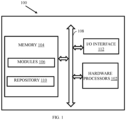
- FIG. 1 illustrates an exemplary system for switching between heterogeneous hardware accelerators, according to some embodiments of the present disclosure.
- the system 100 includes or is otherwise in communication with hardware processors 102, at least one memory such as a memory 104, an I/O interface 112.
- the hardware processors 102, memory 104, and the Input /Output (I/O) interface 112 may be coupled by a system bus such as a system bus 108 or a similar mechanism.
- the hardware processors 102 can be one or more hardware processors.
- the I/O interface 112 may include a variety of software and hardware interfaces, for example, a web interface, a graphical user interface, and the like.
- the I/O interface 112 may include a variety of software and hardware interfaces, for example, interfaces for peripheral device(s), such as a keyboard, a mouse, an external memory, a printer and the like. Further, the I/O interface 112 may enable the system 100 to communicate with other devices, such as web servers, and external databases.
- the I/O interface 112 can facilitate multiple communications within a wide variety of networks and protocol types, including wired networks, for example, local area network (LAN), cable, etc., and wireless networks, such as Wireless LAN (WLAN), cellular, or satellite.
- the I/O interface 112 may include one or more ports for connecting several computing systems with one another or to another server computer.
- the I/O interface 112 may include one or more ports for connecting several devices to one another or to another server.
- the one or more hardware processors 102 may be implemented as one or more microprocessors, microcomputers, microcontrollers, digital signal processors, central processing units, node machines, logic circuitries, and/or any devices that manipulate signals based on operational instructions.
- the one or more hardware processors 102 is configured to fetch and execute computer-readable instructions stored in the memory 104.
- the memory 104 may include any computer-readable medium known in the art including, for example, volatile memory, such as static random-access memory (SRAM) and dynamic random-access memory (DRAM), and/or non-volatile memory, such as read only memory (ROM), erasable programmable ROM, flash memories, hard disks, optical disks, and magnetic tapes.
- volatile memory such as static random-access memory (SRAM) and dynamic random-access memory (DRAM)
- non-volatile memory such as read only memory (ROM), erasable programmable ROM, flash memories, hard disks, optical disks, and magnetic tapes.
- ROM read only memory
- erasable programmable ROM erasable programmable ROM
- flash memories hard disks
- optical disks optical disks
- magnetic tapes magnetic tapes
- the plurality of modules 106 include programs or coded instructions that supplement applications or functions performed by the system 100 for executing different steps involved in the process of switching between hardware accelerators for model training, being performed by the system 100.
- the plurality of modules 106 can include routines, programs, objects, components, and data structures, which performs particular tasks or implement particular abstract data types.
- the plurality of modules 106 may also be used as, signal processor(s), node machine(s), logic circuitries, and/or any other device or component that manipulates signals based on operational instructions.
- the plurality of modules 106 can be used by hardware, by computer-readable instructions executed by the one or more hardware processors 102, or by a combination thereof.
- the plurality of modules 106 can include various sub-modules (not shown).
- the plurality of modules 106 may include computer-readable instructions that supplement applications or functions performed by the system 100 for the switching between hardware accelerators for model training.
- the data repository (or repository) 110 may include a plurality of abstracted piece of code for refinement and data that is processed, received, or generated as a result of the execution of the plurality of modules in the module(s) 106.
- the data repository 110 is shown internal to the system 100, it will be noted that, in alternate embodiments, the data repository 110 can also be implemented external to the system 100, where the data repository 110 may be stored within a database (repository 110) communicatively coupled to the system 100.
- the data contained within such external database may be periodically updated. For example, new data may be added into the database (not shown in FIG. 1 ) and/or existing data may be modified and/or non-useful data may be deleted from the database.
- the data may be stored in an external system, such as a Lightweight Directory Access Protocol (LDAP) directory and a Relational Database Management System (RDBMS). Functions of the components of the system 100 are now explained with reference to the steps in flow diagram in FIG. 2 , and the FIGS. 3 through 5B .
- LDAP Lightweight Directory Access Protocol
- RDBMS Relational Database Management System
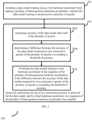
- FIG. 2 is a flow diagram depicting steps involved in the process of switching between heterogeneous hardware accelerators, using the system of FIG. 1 , according to some embodiments of the present disclosure.
- the system 100 comprises one or more data storage devices or the memory 104 operatively coupled to the processor(s) 102 and is configured to store instructions for execution of steps of the method 200 by the processor(s) or one or more hardware processors 102.
- the steps of the method 200 of the present disclosure will now be explained with reference to the components or blocks of the system 100 as depicted in FIG. 1 and the steps of flow diagram as depicted in FIG. 2 .
- process steps, method steps, techniques or the like may be described in a sequential order, such processes, methods, and techniques may be configured to work in alternate orders. In other words, any sequence or order of steps that may be described does not necessarily indicate a requirement that the steps to be performed in that order.
- the steps of processes described herein may be performed in any order practical. Further, some steps may be performed simultaneously.
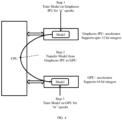
- a Central Processing Unit uses two hardware accelerators, i.e. a Graphcore IPU accelerator and a GPU accelerator.
- more number of hardware accelerators maybe used as per implementation and data processing requirements.
- the hardware accelerators used maybe of different specifications.
- the term ⁇ specifications' used in the context of the hardware accelerators refers to capability/attributes of each of the hardware accelerators.
- each of the hardware accelerators may have different processing speeds, inference latency, training time, and so on. Combination of values of such parameters for each of the hardware accelerators represents the specification of the hardware accelerator.
- the system 100 initiates a data model training using a first hardware accelerator from among a plurality of heterogeneous hardware accelerators.
- the plurality of heterogeneous hardware accelerators which forms a set of hardware accelerators, is arranged in increasing order of the specifications i.e. the hardware accelerator with least specification comes first in the sequence of hardware accelerators and is referred to as the ⁇ first hardware accelerator'. Subsequently the remaining hardware accelerators maybe termed as second hardware accelerator, third hardware accelerator, and so on.
- the term 'specification' in the context of embodiments disclosed herein may refer to a measured precision/accuracy of each of the hardware accelerators. In another embodiment, the term 'specification' may refer to any other parameter such as but not limited to processing speed, and any combination thereof.
- the data model training is spread across a plurality of epochs.
- 'epochs' in the context of embodiments disclosed herein refers to specific time periods/ time windows, which may be pre-configured as per requirements.
- the system 100 iteratively performs till one of a) a maximum accuracy is achieved for the data model, and b) a final hardware accelerator in a sequence of the plurality of heterogeneous hardware accelerators has reached.
- the system 100 measures accuracy of the data model at step 204a of the method 200.
- the system 100 may measure the accuracy of the data model by processing a test data using the data model that is obtained after each epoch.
- the system 100 determines if difference between the accuracy of the data model measured in two consecutive epochs of the plurality of epochs is exceeding a threshold of accuracy.
- difference between the accuracy of the data model measured in two consecutive epochs exceeding the threshold of accuracy indicates that accuracy of the hardware accelerator that is being used for the data model training at that instance (for example, the first hardware accelerator is being used for the model training initially) is less.
- the system 100 is configured to consider this drop in accuracy of the hardware accelerator below the threshold of accuracy as a trigger for hardware accelerator switching, and subsequently at step 204c of the method 200, switches the data model training to next hardware accelerator in the sequence of the plurality of heterogeneous hardware accelerators.
- the steps 204a through 204c are iteratively performed till one of a) a maximum accuracy is achieved for the data model, and b) a final hardware accelerator in a sequence of the plurality of heterogeneous hardware accelerators has reached.
- the system 100 determines/identifies that the maximum accuracy has been achieved for the data model, if the measured accuracy of the data model remains constant over a pre-defined number of epochs or change in the measured accuracy of the data model is minimal (which may be decided in terms of a threshold of change) over the pre-defined number of epochs. In this case, even if there are unutilized hardware accelerators in the sequence, the model training is terminated by the system 100.
- the system 100 continues the model training using the same hardware accelerator even if the measured accuracy is less than the threshold of accuracy in any of subsequent epochs, as there are not further hardware accelerators to which the model training can be switched at that stage.
- FIG. 3 In the example as depicted in FIG. 3 , three hardware accelerators i.e. hardware accelerator 1 (A1), hardware accelerator 2 (A2), and hardware accelerator 3 (A3) are used for model training, and the hardware accelerators are arranged in the order A1-> A2 --> A3.
- the system 100 starts the model training using A1, and after first epoch (epoch 1), the model accuracy measured is S1. After second epoch (epoch 2), the model accuracy measured is S2. After epoch 2, the system 100 checks if difference between S1 and S2 is below a threshold of accuracy (T2), i .e . if S 2 ⁇ S 1 ⁇ T 2
- T2 threshold of accuracy
- (S2 - S1) is less than T2
- the system 100 shifts the model training to A2, and the model training is resumed using A2.
- value of the model accuracy is measured as S3, and the system 100 checks if difference between S2 and S3 is below a threshold of accuracy (T3), and determines whether or not to switch the model training to A3. In this example, as the difference between S2 and S3 is not below T3, the model training continued using A2.
- the system 100 measures the value of model accuracy as S4, and checks if difference between S3 and S4 is below a threshold of accuracy (T4). As (S4 - S3) is less than T4, the system 100 shifts the model training to A3, and the model training is resumed using A2.
- the value of threshold of accuracy for different epochs is determined such that error tolerance level is reduced with each passing epochs. For example, refer the table below: Epoch 1 ( T 1 ) Epoch 2 ( T 2 ) Epoch 3 ( T 3 ) Epoch 4 ( T 4 ) Epoch 5 ( T 5 ) NA N N 2 N 4 N 8
- threshold of accuracy is not calculated for epoch 1 as there is no comparison happening at this stage.
- the value of the threshold of accuracy is determined as N, which may be empirically calculated.
- the value of threshold of accuracy is calculated as equal to N/2, N/4, and N/8 respectively, i.e. the value of threshold of accuracy gets smaller with each passing epoch, and in turn the error tolerance level is reduced.
- NISER Normalized Item and Session Representations
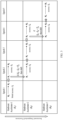
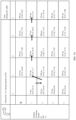
- the table in FIG. 5A contain information on training time as well as training accuracy when the NISER model was trained over IPU for n epochs followed by training over GPU for m epochs.
- the cell with index (1, 3) means the model is trained for 1 epoch on IPU, followed by 3 epochs on GPU.
- the first column contains the performance entries when the model is trained only on IPU. The following observations were made.
- FIG. 5B A similar experiment was conducted using IPU and CPU as the hardware accelerators, and corresponding results are presented FIG. 5B .
- the cell with index (3, 2) shows the training accuracy achieved when the NISER model is trained for 3 epochs on IPU and further 2 epochs on CPU.
- the obtained training accuracy numbers were close to the best numbers achieved by the CPU mentioned in cell (0, 3).
- the time taken was about 25% lesser (1513 vs 2040 seconds).
- the cell with index (1, 3) shows the best training accuracy was achieved when IPU and CPU combination are used, which is higher than training on CPU alone.
- the embodiments of present disclosure herein address unresolved problem of effective utilization of heterogeneous hardware accelerators for data model training.
- the embodiment thus provides a mechanism for accuracy based switching between hardware accelerators.
- Such computer-readable storage means contain program-code means for implementation of one or more steps of the method, when the program runs on a server or mobile device or any suitable programmable device.
- the hardware device can be any kind of device which can be programmed including e.g., any kind of computer like a server or a personal computer, or the like, or any combination thereof.
- the device may also include means which could be e.g., hardware means like e.g., an application-specific integrated circuit (ASIC), a field-programmable gate array (FPGA), or a combination of hardware and software means, e.g., an ASIC and an FPGA, or at least one microprocessor and at least one memory with software processing components located therein.
- the means can include both hardware means and software means.
- the method embodiments described herein could be implemented in hardware and software.
- the device may also include software means. Alternatively, the embodiments may be implemented on different hardware devices, e.g., using a plurality of CPUs.
- the embodiments herein can comprise hardware and software elements.
- the embodiments that are implemented in software include but are not limited to, firmware, resident software, microcode, etc.
- the functions performed by various components described herein may be implemented in other components or combinations of other components.
- a computer-usable or computer readable medium can be any apparatus that can comprise, store, communicate, propagate, or transport the program for use by or in connection with the instruction execution system, apparatus, or device.
- a computer-readable storage medium refers to any type of physical memory on which information or data readable by a processor may be stored.
- a computer-readable storage medium may store instructions for execution by one or more processors, including instructions for causing the processor(s) to perform steps or stages consistent with the embodiments described herein.
- the term "computer-readable medium” should be understood to include tangible items and exclude carrier waves and transient signals, i.e., be non-transitory. Examples include random access memory (RAM), read-only memory (ROM), volatile memory, nonvolatile memory, hard drives, CD ROMs, DVDs, flash drives, disks, and any other known physical storage media.
Landscapes
- Engineering & Computer Science (AREA)
- Theoretical Computer Science (AREA)
- Software Systems (AREA)
- Data Mining & Analysis (AREA)
- Evolutionary Computation (AREA)
- Medical Informatics (AREA)
- Computer Vision & Pattern Recognition (AREA)
- Physics & Mathematics (AREA)
- Computing Systems (AREA)
- General Engineering & Computer Science (AREA)
- General Physics & Mathematics (AREA)
- Mathematical Physics (AREA)
- Artificial Intelligence (AREA)
- Management, Administration, Business Operations System, And Electronic Commerce (AREA)
Applications Claiming Priority (1)
| Application Number | Priority Date | Filing Date | Title |
|---|---|---|---|
| IN202221049467 | 2022-08-30 |
Publications (1)
| Publication Number | Publication Date |
|---|---|
| EP4332836A1 true EP4332836A1 (de) | 2024-03-06 |
Family
ID=87517467
Family Applications (1)
| Application Number | Title | Priority Date | Filing Date |
|---|---|---|---|
| EP23188178.0A Pending EP4332836A1 (de) | 2022-08-30 | 2023-07-27 | Verfahren und system zum umschalten zwischen hardwarebeschleunigern für datenmodelltraining |
Country Status (2)
| Country | Link |
|---|---|
| US (1) | US20240070540A1 (de) |
| EP (1) | EP4332836A1 (de) |
Citations (3)
| Publication number | Priority date | Publication date | Assignee | Title |
|---|---|---|---|---|
| US20190312772A1 (en) * | 2018-04-04 | 2019-10-10 | EMC IP Holding Company LLC | Topology-aware provisioning of hardware accelerator resources in a distributed environment |
| US20200042362A1 (en) * | 2018-08-03 | 2020-02-06 | EMC IP Holding Company LLC | Self-adaptive batch dataset partitioning for distributed deep learning using hybrid set of accelerators |
| US20200184368A1 (en) * | 2018-12-10 | 2020-06-11 | International Business Machines Corporation | Machine learning in heterogeneous processing systems |
Family Cites Families (1)
| Publication number | Priority date | Publication date | Assignee | Title |
|---|---|---|---|---|
| EP3915082B1 (de) * | 2018-10-03 | 2024-11-13 | Services Pétroliers Schlumberger | Ölfeldsystem |
-
2023
- 2023-07-27 EP EP23188178.0A patent/EP4332836A1/de active Pending
- 2023-07-31 US US18/362,123 patent/US20240070540A1/en active Pending
Patent Citations (3)
| Publication number | Priority date | Publication date | Assignee | Title |
|---|---|---|---|---|
| US20190312772A1 (en) * | 2018-04-04 | 2019-10-10 | EMC IP Holding Company LLC | Topology-aware provisioning of hardware accelerator resources in a distributed environment |
| US20200042362A1 (en) * | 2018-08-03 | 2020-02-06 | EMC IP Holding Company LLC | Self-adaptive batch dataset partitioning for distributed deep learning using hybrid set of accelerators |
| US20200184368A1 (en) * | 2018-12-10 | 2020-06-11 | International Business Machines Corporation | Machine learning in heterogeneous processing systems |
Non-Patent Citations (1)
| Title |
|---|
| ZHE LIN ET AL: "Scalable Light-Weight Integration of FPGA Based Accelerators with Chip Multi-Processors", ARXIV.ORG, CORNELL UNIVERSITY LIBRARY, 201 OLIN LIBRARY CORNELL UNIVERSITY ITHACA, NY 14853, 3 September 2020 (2020-09-03), XP081754225, DOI: 10.1109/TMSCS.2017.2754378 * |
Also Published As
| Publication number | Publication date |
|---|---|
| US20240070540A1 (en) | 2024-02-29 |
Similar Documents
| Publication | Publication Date | Title |
|---|---|---|
| US10877816B2 (en) | Optimal task scheduler | |
| WO2022105805A1 (zh) | 数据的处理方法及存算一体芯片 | |
| US20180191706A1 (en) | Controlling access to a shared resource | |
| CN112115105A (zh) | 一种业务处理方法、装置及设备 | |
| EP4332836A1 (de) | Verfahren und system zum umschalten zwischen hardwarebeschleunigern für datenmodelltraining | |
| CN111221827B (zh) | 基于图形处理器的数据库表连接方法、装置、计算机设备和存储介质 | |
| EP3779720B1 (de) | Transaktionsverarbeitungsverfahren und -system sowie server | |
| WO2019071986A1 (zh) | 一种确定搜索周期的方法及设备 | |
| CN114296961B (zh) | 一种网络服务快速切换方法和相关装置 | |
| US12530200B2 (en) | System and method for triggering a zero-cycle context switch | |
| CN109787818B (zh) | 一种接口配置调整方法、装置与电子设备 | |
| US20190385078A1 (en) | Data processing method, electronic device and computer readable storage medium | |
| CN111132011A (zh) | 通信模块的配置方法、系统、电子设备和介质 | |
| EP4198758A1 (de) | Verfahren und system zur skalierbaren beschleunigung einer datenverarbeitungspipeline | |
| WO2022260661A1 (en) | Stack pointer monitor circuit for triggering an interrupt service at a register file | |
| CN110674159A (zh) | 一种业务查询方法及相关装置 | |
| CN114144793A (zh) | 数据传输方法、装置、电子设备及可读存储介质 | |
| US10042774B2 (en) | Method and apparatus for masking and transmitting data | |
| CN115952833A (zh) | 神经网络搜索方法、装置、电子设备和存储介质 | |
| CN119597434A (zh) | 内存本地化方法及其相关设备 | |
| CN112379978B (zh) | 后端服务调用方法、装置、设备和存储介质 | |
| US12519731B2 (en) | Method and system for generating a data model for predicting data transfer rate | |
| EP4293578A1 (de) | Trainieren grosser dl-modelle über serverlose architektur unter verwendung eines kommunikationskanals auf cloud-speicherdienstbasis | |
| US20240184687A1 (en) | Text search processing method and related device | |
| US10193905B2 (en) | Method and apparatus for adaptive cache management |
Legal Events
| Date | Code | Title | Description |
|---|---|---|---|
| PUAI | Public reference made under article 153(3) epc to a published international application that has entered the european phase |
Free format text: ORIGINAL CODE: 0009012 |
|
| STAA | Information on the status of an ep patent application or granted ep patent |
Free format text: STATUS: THE APPLICATION HAS BEEN PUBLISHED |
|
| AK | Designated contracting states |
Kind code of ref document: A1 Designated state(s): AL AT BE BG CH CY CZ DE DK EE ES FI FR GB GR HR HU IE IS IT LI LT LU LV MC ME MK MT NL NO PL PT RO RS SE SI SK SM TR |
|
| STAA | Information on the status of an ep patent application or granted ep patent |
Free format text: STATUS: REQUEST FOR EXAMINATION WAS MADE |
|
| 17P | Request for examination filed |
Effective date: 20240709 |
|
| RBV | Designated contracting states (corrected) |
Designated state(s): AL AT BE BG CH CY CZ DE DK EE ES FI FR GB GR HR HU IE IS IT LI LT LU LV MC ME MK MT NL NO PL PT RO RS SE SI SK SM TR |