EP4330156B1 - Recyclable blister package - Google Patents
Recyclable blister package Download PDFInfo
- Publication number
- EP4330156B1 EP4330156B1 EP22741404.2A EP22741404A EP4330156B1 EP 4330156 B1 EP4330156 B1 EP 4330156B1 EP 22741404 A EP22741404 A EP 22741404A EP 4330156 B1 EP4330156 B1 EP 4330156B1
- Authority
- EP
- European Patent Office
- Prior art keywords
- base
- lidding film
- blister
- cavity
- blister package
- Prior art date
- Legal status (The legal status is an assumption and is not a legal conclusion. Google has not performed a legal analysis and makes no representation as to the accuracy of the status listed.)
- Active
Links
Images





Classifications
-
- B—PERFORMING OPERATIONS; TRANSPORTING
- B65—CONVEYING; PACKING; STORING; HANDLING THIN OR FILAMENTARY MATERIAL
- B65D—CONTAINERS FOR STORAGE OR TRANSPORT OF ARTICLES OR MATERIALS, e.g. BAGS, BARRELS, BOTTLES, BOXES, CANS, CARTONS, CRATES, DRUMS, JARS, TANKS, HOPPERS, FORWARDING CONTAINERS; ACCESSORIES, CLOSURES, OR FITTINGS THEREFOR; PACKAGING ELEMENTS; PACKAGES
- B65D75/00—Packages comprising articles or materials partially or wholly enclosed in strips, sheets, blanks, tubes or webs of flexible sheet material, e.g. in folded wrappers
- B65D75/28—Articles or materials wholly enclosed in composite wrappers, i.e. wrappers formed by associating or interconnecting two or more sheets or blanks
- B65D75/30—Articles or materials enclosed between two opposed sheets or blanks having their margins united, e.g. by pressure-sensitive adhesive, crimping, heat-sealing, or welding
- B65D75/32—Articles or materials enclosed between two opposed sheets or blanks having their margins united, e.g. by pressure-sensitive adhesive, crimping, heat-sealing, or welding one or both sheets or blanks being recessed to accommodate contents
- B65D75/325—Articles or materials enclosed between two opposed sheets or blanks having their margins united, e.g. by pressure-sensitive adhesive, crimping, heat-sealing, or welding one or both sheets or blanks being recessed to accommodate contents one sheet being recessed, and the other being a flat not- rigid sheet, e.g. puncturable or peelable foil
- B65D75/327—Articles or materials enclosed between two opposed sheets or blanks having their margins united, e.g. by pressure-sensitive adhesive, crimping, heat-sealing, or welding one or both sheets or blanks being recessed to accommodate contents one sheet being recessed, and the other being a flat not- rigid sheet, e.g. puncturable or peelable foil and forming several compartments
-
- A—HUMAN NECESSITIES
- A61—MEDICAL OR VETERINARY SCIENCE; HYGIENE
- A61J—CONTAINERS SPECIALLY ADAPTED FOR MEDICAL OR PHARMACEUTICAL PURPOSES; DEVICES OR METHODS SPECIALLY ADAPTED FOR BRINGING PHARMACEUTICAL PRODUCTS INTO PARTICULAR PHYSICAL OR ADMINISTERING FORMS; DEVICES FOR ADMINISTERING FOOD OR MEDICINES ORALLY; BABY COMFORTERS; DEVICES FOR RECEIVING SPITTLE
- A61J1/00—Containers specially adapted for medical or pharmaceutical purposes
- A61J1/14—Details; Accessories therefor
- A61J1/1468—Containers characterised by specific material properties
-
- B—PERFORMING OPERATIONS; TRANSPORTING
- B32—LAYERED PRODUCTS
- B32B—LAYERED PRODUCTS, i.e. PRODUCTS BUILT-UP OF STRATA OF FLAT OR NON-FLAT, e.g. CELLULAR OR HONEYCOMB, FORM
- B32B27/00—Layered products comprising a layer of synthetic resin
- B32B27/06—Layered products comprising a layer of synthetic resin as the main or only constituent of a layer, which is next to another layer of the same or of a different material
- B32B27/08—Layered products comprising a layer of synthetic resin as the main or only constituent of a layer, which is next to another layer of the same or of a different material of synthetic resin
-
- B—PERFORMING OPERATIONS; TRANSPORTING
- B32—LAYERED PRODUCTS
- B32B—LAYERED PRODUCTS, i.e. PRODUCTS BUILT-UP OF STRATA OF FLAT OR NON-FLAT, e.g. CELLULAR OR HONEYCOMB, FORM
- B32B27/00—Layered products comprising a layer of synthetic resin
- B32B27/32—Layered products comprising a layer of synthetic resin comprising polyolefins
-
- B—PERFORMING OPERATIONS; TRANSPORTING
- B32—LAYERED PRODUCTS
- B32B—LAYERED PRODUCTS, i.e. PRODUCTS BUILT-UP OF STRATA OF FLAT OR NON-FLAT, e.g. CELLULAR OR HONEYCOMB, FORM
- B32B3/00—Layered products comprising a layer with external or internal discontinuities or unevennesses, or a layer of non-planar shape; Layered products comprising a layer having particular features of form
- B32B3/26—Layered products comprising a layer with external or internal discontinuities or unevennesses, or a layer of non-planar shape; Layered products comprising a layer having particular features of form characterised by a particular shape of the outline of the cross-section of a continuous layer; characterised by a layer with cavities or internal voids ; characterised by an apertured layer
- B32B3/30—Layered products comprising a layer with external or internal discontinuities or unevennesses, or a layer of non-planar shape; Layered products comprising a layer having particular features of form characterised by a particular shape of the outline of the cross-section of a continuous layer; characterised by a layer with cavities or internal voids ; characterised by an apertured layer characterised by a layer formed with recesses or projections, e.g. hollows, grooves, protuberances, ribs
-
- B—PERFORMING OPERATIONS; TRANSPORTING
- B65—CONVEYING; PACKING; STORING; HANDLING THIN OR FILAMENTARY MATERIAL
- B65D—CONTAINERS FOR STORAGE OR TRANSPORT OF ARTICLES OR MATERIALS, e.g. BAGS, BARRELS, BOTTLES, BOXES, CANS, CARTONS, CRATES, DRUMS, JARS, TANKS, HOPPERS, FORWARDING CONTAINERS; ACCESSORIES, CLOSURES, OR FITTINGS THEREFOR; PACKAGING ELEMENTS; PACKAGES
- B65D65/00—Wrappers or flexible covers; Packaging materials of special type or form
- B65D65/38—Packaging materials of special type or form
- B65D65/40—Applications of laminates for particular packaging purposes
-
- B—PERFORMING OPERATIONS; TRANSPORTING
- B65—CONVEYING; PACKING; STORING; HANDLING THIN OR FILAMENTARY MATERIAL
- B65D—CONTAINERS FOR STORAGE OR TRANSPORT OF ARTICLES OR MATERIALS, e.g. BAGS, BARRELS, BOTTLES, BOXES, CANS, CARTONS, CRATES, DRUMS, JARS, TANKS, HOPPERS, FORWARDING CONTAINERS; ACCESSORIES, CLOSURES, OR FITTINGS THEREFOR; PACKAGING ELEMENTS; PACKAGES
- B65D75/00—Packages comprising articles or materials partially or wholly enclosed in strips, sheets, blanks, tubes or webs of flexible sheet material, e.g. in folded wrappers
- B65D75/28—Articles or materials wholly enclosed in composite wrappers, i.e. wrappers formed by associating or interconnecting two or more sheets or blanks
- B65D75/30—Articles or materials enclosed between two opposed sheets or blanks having their margins united, e.g. by pressure-sensitive adhesive, crimping, heat-sealing, or welding
- B65D75/32—Articles or materials enclosed between two opposed sheets or blanks having their margins united, e.g. by pressure-sensitive adhesive, crimping, heat-sealing, or welding one or both sheets or blanks being recessed to accommodate contents
- B65D75/36—Articles or materials enclosed between two opposed sheets or blanks having their margins united, e.g. by pressure-sensitive adhesive, crimping, heat-sealing, or welding one or both sheets or blanks being recessed to accommodate contents one sheet or blank being recessed and the other formed of relatively stiff flat sheet material, e.g. blister packages, the recess or recesses being preformed
- B65D75/367—Articles or materials enclosed between two opposed sheets or blanks having their margins united, e.g. by pressure-sensitive adhesive, crimping, heat-sealing, or welding one or both sheets or blanks being recessed to accommodate contents one sheet or blank being recessed and the other formed of relatively stiff flat sheet material, e.g. blister packages, the recess or recesses being preformed and forming several compartments
-
- B—PERFORMING OPERATIONS; TRANSPORTING
- B65—CONVEYING; PACKING; STORING; HANDLING THIN OR FILAMENTARY MATERIAL
- B65D—CONTAINERS FOR STORAGE OR TRANSPORT OF ARTICLES OR MATERIALS, e.g. BAGS, BARRELS, BOTTLES, BOXES, CANS, CARTONS, CRATES, DRUMS, JARS, TANKS, HOPPERS, FORWARDING CONTAINERS; ACCESSORIES, CLOSURES, OR FITTINGS THEREFOR; PACKAGING ELEMENTS; PACKAGES
- B65D75/00—Packages comprising articles or materials partially or wholly enclosed in strips, sheets, blanks, tubes or webs of flexible sheet material, e.g. in folded wrappers
- B65D75/52—Details
- B65D75/58—Opening or contents-removing devices added or incorporated during package manufacture
- B65D75/5855—Peelable seals
-
- A—HUMAN NECESSITIES
- A61—MEDICAL OR VETERINARY SCIENCE; HYGIENE
- A61J—CONTAINERS SPECIALLY ADAPTED FOR MEDICAL OR PHARMACEUTICAL PURPOSES; DEVICES OR METHODS SPECIALLY ADAPTED FOR BRINGING PHARMACEUTICAL PRODUCTS INTO PARTICULAR PHYSICAL OR ADMINISTERING FORMS; DEVICES FOR ADMINISTERING FOOD OR MEDICINES ORALLY; BABY COMFORTERS; DEVICES FOR RECEIVING SPITTLE
- A61J1/00—Containers specially adapted for medical or pharmaceutical purposes
- A61J1/03—Containers specially adapted for medical or pharmaceutical purposes for pills or tablets
- A61J1/035—Blister-type containers
-
- B—PERFORMING OPERATIONS; TRANSPORTING
- B32—LAYERED PRODUCTS
- B32B—LAYERED PRODUCTS, i.e. PRODUCTS BUILT-UP OF STRATA OF FLAT OR NON-FLAT, e.g. CELLULAR OR HONEYCOMB, FORM
- B32B2250/00—Layers arrangement
- B32B2250/24—All layers being polymeric
- B32B2250/242—All polymers belonging to those covered by group B32B27/32
-
- B—PERFORMING OPERATIONS; TRANSPORTING
- B32—LAYERED PRODUCTS
- B32B—LAYERED PRODUCTS, i.e. PRODUCTS BUILT-UP OF STRATA OF FLAT OR NON-FLAT, e.g. CELLULAR OR HONEYCOMB, FORM
- B32B2255/00—Coating on the layer surface
- B32B2255/10—Coating on the layer surface on synthetic resin layer or on natural or synthetic rubber layer
-
- B—PERFORMING OPERATIONS; TRANSPORTING
- B32—LAYERED PRODUCTS
- B32B—LAYERED PRODUCTS, i.e. PRODUCTS BUILT-UP OF STRATA OF FLAT OR NON-FLAT, e.g. CELLULAR OR HONEYCOMB, FORM
- B32B2255/00—Coating on the layer surface
- B32B2255/20—Inorganic coating
- B32B2255/205—Metallic coating
-
- B—PERFORMING OPERATIONS; TRANSPORTING
- B32—LAYERED PRODUCTS
- B32B—LAYERED PRODUCTS, i.e. PRODUCTS BUILT-UP OF STRATA OF FLAT OR NON-FLAT, e.g. CELLULAR OR HONEYCOMB, FORM
- B32B2439/00—Containers; Receptacles
- B32B2439/80—Medical packaging
-
- B—PERFORMING OPERATIONS; TRANSPORTING
- B65—CONVEYING; PACKING; STORING; HANDLING THIN OR FILAMENTARY MATERIAL
- B65D—CONTAINERS FOR STORAGE OR TRANSPORT OF ARTICLES OR MATERIALS, e.g. BAGS, BARRELS, BOTTLES, BOXES, CANS, CARTONS, CRATES, DRUMS, JARS, TANKS, HOPPERS, FORWARDING CONTAINERS; ACCESSORIES, CLOSURES, OR FITTINGS THEREFOR; PACKAGING ELEMENTS; PACKAGES
- B65D2565/00—Wrappers or flexible covers; Packaging materials of special type or form
- B65D2565/38—Packaging materials of special type or form
- B65D2565/381—Details of packaging materials of special type or form
- B65D2565/385—Details of packaging materials of special type or form especially suited for or with means facilitating recycling
- B65D2565/386—Details of packaging materials of special type or form especially suited for or with means facilitating recycling packaging containers consisting of two or more parts made of the same material
-
- Y—GENERAL TAGGING OF NEW TECHNOLOGICAL DEVELOPMENTS; GENERAL TAGGING OF CROSS-SECTIONAL TECHNOLOGIES SPANNING OVER SEVERAL SECTIONS OF THE IPC; TECHNICAL SUBJECTS COVERED BY FORMER USPC CROSS-REFERENCE ART COLLECTIONS [XRACs] AND DIGESTS
- Y02—TECHNOLOGIES OR APPLICATIONS FOR MITIGATION OR ADAPTATION AGAINST CLIMATE CHANGE
- Y02W—CLIMATE CHANGE MITIGATION TECHNOLOGIES RELATED TO WASTEWATER TREATMENT OR WASTE MANAGEMENT
- Y02W30/00—Technologies for solid waste management
- Y02W30/50—Reuse, recycling or recovery technologies
- Y02W30/80—Packaging reuse or recycling, e.g. of multilayer packaging
Definitions
- the present invention relates to blister packaging, and in particular to blister packaging that can be recycled in a single plastic waste stream, including both the entire lidding film and base.
- Blister packages are commonly used to retain ingestible products, such as candy, gum, powders, medicine tablets and the like. This type of packaging is convenient for separately securing individual product portions or doses. Each individual portion may be dispensed from the package while leaving additional portions sealed within the package.
- an article e.g., a medicine tablet
- a lidding film extends over the open top end of the cavity and is sealed to the base member around the cavity perimeter.
- the lidding film of a push-through package is typically made of aluminum (Al) foil, a material that is sufficiently brittle so as to rupture and allow release of the article. This requires a certain amount of force and dexterity to rupture the AL foil film, such that the package can be difficult to open.
- Al aluminum
- Peelable lidding film is also typically made of Al foil, and again requires a certain force and dexterity to grasp one edge of the foil and pull the foil away from the base member. Often the foil is sufficiently difficult to peel that not all of the foil is removed from the base and/or the user becomes frustrated and instead punctures the lidding film to evacuate the article, leaving part or all of the AL foil still attached to the base.
- a third type of blister package has a blister base that be easily be broken into two parts (fractured) for evacuating the article from the fractured base.
- a typical blister base is made from a thermoformable plastic, while the lidding film is an extruded single layer or multi-layer film that includes a layer of Al foil.
- the blister package cannot be recycled via a single plastic waste stream.
- lidding film for example composed of three layers: a bi-axially oriented polyester terephthalate (PET) layer, an Al foil layer, and a heat seal layer.
- PET polyester terephthalate
- the foil layer provides a barrier function, while the PET layer provides puncture resistance.
- WO2017/114590A1 discloses a molded plastic film article for a blister, in particular a blister for tablets, comprising a transparent carrier substrate that includes a semi-transparent functional layer which is designed in such a way that the molded plastic film article has a first visible color when viewed in reflected light while having a second visible color when viewed in transmitted light.
- WO2014/088585A1 discloses a multilayer film having low water vapor permeability.
- the multilayer film of the present application is readily thermoformed and is, therefore, suitable for blister packaging sheets as well as for food packaging, medical barriers and device packaging, and other general purposes where low water vapor permeability is desired.
- WO2009/000403A1 discloses a push-through pack with a blister base part (12) and a transparent or translucent push-through outer film (18) which is free from metal foil and is sealed with respect to the blister base part.
- the outer film includes at least one layer of cycloolefin copolymer (COC) or cycloolefin polymer (COP).
- a halogen-free recyclable moisture barrier blister package comprising a lidding film and a base, the base having a plurality of base cavities each configured to hold an individual product portion, the lidding film and base being heat sealed together about a perimeter of each of the plurality of base cavities, and:
- the blister package has a MVTR of no greater than 1 milligram per cavity per 24 hours.
- both the base and the lidding film include a polyolefin surface layer comprising polypropylene (PP) or polyethylene (PE) that form a releasable heat seal to temporarily attach the lidding film to the base, with an individual product portion sealed in each cavity of the base, wherein the lidding film is configured to be grasped and peeled away from the perimeter of each base cavity so as to allow release of the individual product portion from the cavity.
- PP polypropylene
- PE polyethylene
- thermoformed sheet of the base is produced from a flat sheet having a moisture vapor transmission rate (MVTR) of less than 1 gram per square meter per 24 hours at 38°C 90% RH.
- MVTR moisture vapor transmission rate
- the polyolefin consists essentially of polypropylene (PP), which together with the COC is recyclable in a PP plastic waste stream.
- the polyolefin consists essentially of a polyethylene (PE), which together with the COC is recyclable in a PE plastic waste stream.
- PE polyethylene
- the lidding film and base have adjacent polyolefin layers for heat sealing the lidding film around the perimeter of each base cavity.
- the adjacent polyolefin layers are PP.
- the adjacent polyolefin layers are PE.
- the COC layer of each cavity of the blister base is configured to be ruptured by applying a snapping force to rupture the blister base cavity, thereby allowing release of an individual product portion from the ruptured base cavity, wherein the lidding film, still adhered to the blister base after rupture of each base cavity and removal of the product portion from each ruptured base cavity, is recyclable in a single plastic waste stream.
- the lidding film includes a PP layer and the lidding film and base are recyclable in a PP plastic waste stream.
- the lidding film includes a PE layer and the lidding film and base are recyclable in a PE plastic waste stream.
- the lidding film is a puncture resistant lidding film.
- the puncture resistant lidding film includes a puncture resistant layer of bi-axially oriented PP (BOPP) or bi-axially oriented PE (BOPE).
- BOPP bi-axially oriented PP
- BOPE bi-axially oriented PE
- the lidding film is configured to be peeled away from the blister base to enable release of the individual product portion from each cavity of the blister base.
- the lidding film may include: a peelable PP layer and the lidding film and base are recyclable in a PP plastic waste stream, or a peelable PE layer and the lidding film and base are recyclable in a PE plastic waste stream.
- the lidding film further includes one or more of a metallization, SiOx or AlOx layer configured to provide a barrier property for protecting the individual product portion sealed in each blister cavity from contamination or a reduction of shelf life, wherein the metallization, SiOx or AlOx layer has a thickness of a few angstroms so as not to preclude its inclusion in a single plastic waste stream.
- the metallization, SiOx or AlOx layer is configured to provide a moisture barrier property or an oxygen barrier property.
- the lidding film includes a metallization, SiOx or AlOx layer configured to be recyclable in a single plastic waste stream.
- one or more layers of the lidding film and base are configured to provide a barrier property that prevents or retards access of one or more outside contaminants or substances that reduce the shelf life of the individual product portion from entering each cavity of the blister package.
- the package may have a moisture vapor transmission rate (MVTR) measured via a 5-week weight gain test at 40°C and 75% relative humidity (RH) as defined in ASTM D7709 that is equal to or less than that of a comparative package having a base of PVC and PVDC material at a coating weight of 40 grams per square meter onto a PVC base having a thickness ranging from 150 micrometer to 500 micrometer and an Aluminum foil push-through lidding film.
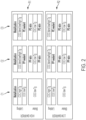
- Figs. 1-2 show twelve alternative layer structures and compositions for both the lidding film and base member in various embodiments of the invention.
- Fig. 1 is a 4 x 3 grid of twelve alternative structures, arranged in a grid of four columns (C1, C2, C3 and C4, from left to right), and three rows (R1, R2 and R3, from top to bottom), wherein:
- Fig. 2 is a 3 x 2 grid of six alternative structures, arranged in a grid of three columns (C1, C2 and C3, from left to right), and two rows (R1 and R2, from top to bottom), wherein:
- the COC high Tg (high glass transition temperature) layer provides a high level of brittleness (easy to rupture) to enable push-through performance.
- the COC low Tg layer provides low brittleness (compared to the high Tg COC) to ensure toughness (puncture resistance).
- a COC blend of high/low Tg can be adjusted to provide a desired balance of ease of rupture (brittleness) of the lidding film during evacuation of the tablet, while remaining intact (puncture resistance) under tension during manufacture (e.g., during extrusion of the lidding film, slitting the extruded roll of lidding film for individual packages, and sealing of the lidding film to the blister base).
- Suitable cyclic olefin copolymers COC include Topas COC 8007, Topas COC 6013, Topas COC 6015, Topas COC 7010, Zeonor 1020R, Zeonor 1060R Zeonor 1420R and Zeonex 690R.
- Topas COC resins are available from Polyplastics Co. Ltd, Tokyo, Japan. Zeonor and Zeonex resins and films are available from Zeon Europe GmbH, Dusseldorf, Germany.
- COC resins are clear/transparent and provide a water vapor barrier. They have high heat moldability and can be used to form both the thermoformed base, and an extruded lidding film.
- Suitable thicknesses of the blister base are in a range of 200 microns to 500 microns. Suitable thicknesses of the COC layer in the base are in a range of 50 microns to 450 microns. Suitable thicknesses for the lidding film are in a range of 20 microns to 150 microns. Suitable thicknesses for the COC layer in the lidding film are in a range of 20 microns to 150 microns.
- An acceptable level of force (push-through force) to rupture the lidding film is in a range of 10 to 20 Newtons.
- the metallization layer refers to a thin (angstroms thick) metal coating applied to a plastic carrier film.
- the resulting metallized film also known as metal-transfer or transferred-metal film, provides reduced permeation (barrier properties that extend the shelf life of the enclosed product) and a glassy, metallic sheen at a reduced weight and cost.
- metal foil such as AL foil, namely Al foil is relatively easy to puncture (during transport and handling) and Al foil exhibits dead-fold, wherein once folded, the fold becomes a permanent crease or blemish that most customers find unattractive in packaging.
- the metallization layer can also be aluminum, but the thickness of the metallization layer is only a few angstroms.
- an inorganic barrier layer (such as SiOx or AlOx) can be included.
- the carrier film can be bi-axially-oriented polypropylene (BOPP) or bi-axially-oriented polyethylene (BOPE), or COC.
- BOPP bi-axially-oriented polypropylene
- BOPE bi-axially-oriented polyethylene
- COC COC
- Metalized films cannot be thermoformed, as they will not soften under heat. They can be used in the lidding film and due to the very low thickness of the metallization layer, will not impact the recycling stream of the carrier film material.
- weld seal means the adhesion between the lidding film and base after sealing is so high that the two elements become inseparable - one or both will fail structurally (e.g., rupture of the lidding film) before the two elements can be separated.
- the required process parameters heat, pressure, time
- the force required to cause rupture of the lidding film will depend on the type of material, thickness, etc.
- a peelable seal means that the adhesion between the lidding and base is lower than the force required for structural failure of the lidding film.
- An acceptable peelable force typically falls below 5 N/15 mm (force in Newtons (N), displacement in millimeters (mm)).
- Figs. 3-5 illustrate an example of a blister package of a type that may be used in the present invention, it being understood that the invention is not limited to this specific structural design or implementation.
- Fig. 3 is an exploded perspective view of the constituent parts of a blister package in one embodiment.
- Fig. 4 is a cross sectional view of one sealed cavity of the blister package assembly of Fig. 3 .
- Fig. 5 is a schematic view of a blister package assembly process.
- a blister package is generally referred to by the numeral 10.
- the constituent parts of the blister package 10 are a thermoformed base member 12, and a lidding film 14 formed by extrusion (or similar process).
- the base 12 includes a plurality of recessed cavities 16 typically arranged in an aligned pattern or array, with each cavity 16 separated by a planer sealing flange 18. Each cavity 16 retains an article or product 20.
- the blister package may be formed with any number of cavities, including a single cavity, and each cavity may retain an individual article as the product, such as the tablet illustrated, multiple products or a quantity of loose product, such as a powder or granular material.
- a series of separation lines may be provided within the sealing flange, between adjacent receptacle cavities, or multiple cavities, so as to permit separation of a portion of the base from the remainder, as desired.
- the lidding film 14 is shown in Fig. 3 as separated from the base 12 for illustration purposes.
- the lidding film 14 is joined to the base 12 in Fig. 4 .
- the lidding film 14 is joined to the sealing flange 18 (an area around the perimeter of the cavity 16) such that each individual cavity 16 is covered and closed.
- a score pattern (not shown) may be formed within the lidding film 14 to assist in push-through rupture of the film, but is not required.
- the rupture force is represented by the arrow 24, with the resulting tear/rupture in the lidding film 14 above the cavity 16 releasing a previously sealed product.
- the relatively outer part 34 of the lidding film 14 is the structural portion of the layer and is formed of a polymer material.
- the second or inner part 36 of the lidding film 14 as shown forms the sealing layer for attachment of the lidding film to the sealing flange area 18 of the base.
- the inner part 36 of the lidding film may be a separate polymer layer and may be formed as part of a laminate structure, with the inner part being compatible with the material of the sealing flange.
- a heat seal coating may be applied on the inner surface of the laminate.
- the lidding film 14 may be secured to the flange 18 by a patterned adhesive or similar attachment mechanism.
- a print layer (not shown) may be provided within the structure and other layers may be included or added. It is preferred that the lidding film not include a paper or metal foil layer.
- Fig. 5 there is schematically shown a forming and assembly process for the blister package 10.
- the material used to form the lidding film 14 is shown in web form and is provided in a roll 40. As shown, the web is wound off of a roll 40 and is fed into a printing station P. The web may be printed on either or both surfaces. The web is moved by rollers 42/44 to be joined with the sealing flange of the base substrate.
- the base substrate 12 is shown as being provided in rolled from 48.
- the cavities 16 may be formed as part of the process or prior to the formation of the roll 48.
- the cavities 16 in the base substrate 12 are filled with product 20 at a filling station F and the open end of each cavity is brought into alignment with the lidding film web 14 at the heating station H (or similar station for securing the lidding film to the base substrate.
- the lidding film web 14 is sealed to the sealing flange (18) to close each cavity 16 (and seal the product 20 therein).
- the combined web and substrate is cut and separated as desired to define a package having the desired number and pattern of product cavities.
- the schematic of FIG. 5 is provided to show the steps of one embodiment of an assembly process for a finished package. These steps may be performed together or as part of separated operations.
- the web material forming the lidding film 14 may be printed, coated and die cut as part of one operation or separate processing operations.
- the printed, coated and cut web which is stored in a roll, may be slit to form narrow rolls, having a width comparable to one package. The slit rolls may then be separately sealed to the base substrate, with the individual packages cut from the elongated combination. Other operations may be performed within this general process outline.
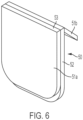
- Fig. 6 shows one example of a blister package with a fracturable base member.
- the package 50 includes a lidding film 52 attached to the rear surface of a thermoformed base substrate 51, shown here with a single cavity, and following fracture of the base member at fracture line 51 the base forms two base portions 51a and 51b with the product being released at the opening formed at the fracture line 53.
- a typical recycling process as illustrated in Fig. 7 (source: Recyclass), consists of multiple steps. In order to demonstrate that a package is considered technically recyclable, laboratories simulate these steps to determine whether a package will be able to be recycled.
- NIR detection An important step in the recycling process is Near Infrared (NIR) detection.
- NIR Near Infrared
- an infrared sensor determines which polymers a package is constituted of, such as PE, PP, PET, etc. In case multiple polymers are detected, a package will not be selected for recycling. In case only one polymer is detected, the package will be sorted in its respective polymer group and further recycled into PCR (post-consumer, recycled) resin pellets.
- the present invention relates to a blister package made of a blister base and a lidding film composed of polymers that are detected as one polymer and can be recycled into one polymer recycling stream.
- the results would be color images that may be visually sorted for example into the following recycling categories or polymer groups: PCT bottle, PE 2D (polyethylene two dimensional), EPS, PUR, Elastomers, PET-lister, PS, PA, POM/PMMA/PLA, EVOH29, PP 3D (polypropylene three dimensional), paper/cardboard, PA6, PVC, EVOH44, PP 2D polypropylene two dimensional), liquid packaging board, PA6-66, wood, ABS, PE 3D, PBT, PC, textiles, unknown.
- the Valve Control (col. 3) shows into which polymer group the package was sorted based on the Classification results.
- the left-hand side picture shows the detection from the blister base side
- the right-hand side picture shows the detection from the lidding film side.
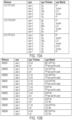
- FIG. 10A Three reference blister base structures were produced for testing as illustrated in Fig. 10A , having the reference base identifiers listed in column 1, and the designated serial layer structures, layer thicknesses, and layer materials listed in columns 2-4.
- the PP resins used were commercially available homopolymer or copolymer PP resins.
- the COC resin used was a COC resin such as Topas 8007 F04.
- the PP heat seal film for weld seals were RP423BX (white or clear) from Copol International.
- the PP heat seal film for peelable seals were CP423BXP (white or clear) from Copol International.
- the SiOx BOPP film was GL-LP-G from Toppan or Ceramis CPP009 from Amcor.
- the MET (metallized) BOPP film was Torayfan M10 from Toray Plastics America.
- the BOPP film was Propafilm TE49 from Innovia.
- the COC film was produced internally from Topas COC 8007 F04 resin. All structures were adhesive laminated.
- the following push-through lidding structures, single layer or multilayer structures may be composed of one or more of the following materials:
- the BOPP layers exhibit high tensile strength and are unsuitable (without further modification) for push-through lidding.
- Techniques such as scoring (partial perforation) can be applied to make BOPP layers suitable for push-through lidding. Such a technique is described in US Patent 11,014,729 by Tekni-Plex .
- Blister packages are designed to protect the contents (e.g., oral-administered solid drug capsules or tablets) from moisture in order to maintain their efficacy.
- contents e.g., oral-administered solid drug capsules or tablets
- blister packages are made from different materials with increasing moisture barrier properties.
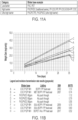
- Transparent thermoformable blister packages can be divided into three groups based on moisture barrier properties, low barrier, high barrier, and ultra-high barrier, as illustrated in Fig. 11A .
- PVC film such as Flexapharm NS products from Tekni-Plex Gallazzi.
- PET film such as Tekniflex PX products from Tekni-Plex.
- PVC/PVDC traditional barrier
- PVC/PVDC ultra-high barrier
- Flexapharm C, HC and SBC products from Tekni-Plex Gallazzi.
- PVC/PCTFE film such as Tekniflex VA products from Tekni-Plex.
- PP-COC-PP, PP-COC-EVOH-PP and COC films such as Tekniflex COC and Tekniflex ECO from Tekni-Plex.
- blister packages In the low barrier category, the majority of blister packages are made from PVC blister base with Al foil push-through lidding. The lidding is permanently attached to the blister base and therefore makes the blister package not suitable for recycling.
- blister packages can be made from PET blister base combined with a scored PET lidding, in order to form a fully recyclable PET blister package. Such examples are described for instance in US Patent 11,014,729 by Tekni-Plex .
- the majority of blister packages are made from PVC/PVDC blister base with Al foil push-through lidding.
- the lidding is permanently attached to the blister base and therefore makes the blister package not suitable for recycling.
- the current invention is proposed: PP-COC-PP, PP-COC-EVOH-PP or COC films as the blister base, combined with high barrier lidding structures.
- Moisture barrier properties on blister packages are typically measured via weight gain studies, such as ASTM D7709. Blisters are filled with desiccants and stored at 40°C 75% relative humidity (RH) for 5 weeks. Each week, the weight gain of the blisters is measured. The increase in weight represents the moisture uptake by the desiccants through the blister materials. The slope of the linear regression lines represent the moisture vapor transmission rate (MVTR) for the blister package. This method was used to evaluate the present invention.
- Fig. 11B is a graph (in grayscale, with designated identifiers A-H for each sample package and comparative package as designated in the legend), of the results from the ASTM D7709 test procedure described in the preceding paragraph.
- the blister packages made from structures related to the present invention show a moisture vapor transmission rate that falls within the range of blister packages made from traditional PVC/PVDC 40 to 90 gsm base films and Al foil push-through lidding film.
Landscapes
- Engineering & Computer Science (AREA)
- Mechanical Engineering (AREA)
- Chemical & Material Sciences (AREA)
- Composite Materials (AREA)
- Health & Medical Sciences (AREA)
- Life Sciences & Earth Sciences (AREA)
- Pharmacology & Pharmacy (AREA)
- Animal Behavior & Ethology (AREA)
- General Health & Medical Sciences (AREA)
- Public Health (AREA)
- Veterinary Medicine (AREA)
- Packages (AREA)
- Laminated Bodies (AREA)
- Wrappers (AREA)
Description
- The present invention relates to blister packaging, and in particular to blister packaging that can be recycled in a single plastic waste stream, including both the entire lidding film and base.
- Blister packages are commonly used to retain ingestible products, such as candy, gum, powders, medicine tablets and the like. This type of packaging is convenient for separately securing individual product portions or doses. Each individual portion may be dispensed from the package while leaving additional portions sealed within the package.
- In a traditional blister package, an article (e.g., a medicine tablet) is held in a cavity of a blister base member and a lidding film extends over the open top end of the cavity and is sealed to the base member around the cavity perimeter. There are two ways for releasing the article from the sealed blister package: 1) by pushing on the outer surface of the base cavity, applying enough force (via the enclosed article) to rupture the lidding film, i.e., the article is "pushed through" while rupturing the lidding film; or 2) by "peeling away" the lidding film from the base thereby allowing release of the article from the now open top end of the cavity.
- The lidding film of a push-through package is typically made of aluminum (Al) foil, a material that is sufficiently brittle so as to rupture and allow release of the article. This requires a certain amount of force and dexterity to rupture the AL foil film, such that the package can be difficult to open.
- Peelable lidding film is also typically made of Al foil, and again requires a certain force and dexterity to grasp one edge of the foil and pull the foil away from the base member. Often the foil is sufficiently difficult to peel that not all of the foil is removed from the base and/or the user becomes frustrated and instead punctures the lidding film to evacuate the article, leaving part or all of the AL foil still attached to the base.
- A third type of blister package has a blister base that be easily be broken into two parts (fractured) for evacuating the article from the fractured base.
- A typical blister base is made from a thermoformable plastic, while the lidding film is an extruded single layer or multi-layer film that includes a layer of Al foil. As a result of the Al foil and/or different plastic material layers, the blister package cannot be recycled via a single plastic waste stream.
- It is also known to provide a puncture resistant lidding film, for example composed of three layers: a bi-axially oriented polyester terephthalate (PET) layer, an Al foil layer, and a heat seal layer. The foil layer provides a barrier function, while the PET layer provides puncture resistance. Again this combination of lidding film and blister base is not suitable for recycling in a single plastic waste stream.
-
WO2017/114590A1 discloses a molded plastic film article for a blister, in particular a blister for tablets, comprising a transparent carrier substrate that includes a semi-transparent functional layer which is designed in such a way that the molded plastic film article has a first visible color when viewed in reflected light while having a second visible color when viewed in transmitted light. -
WO2014/088585A1 discloses a multilayer film having low water vapor permeability. The multilayer film of the present application is readily thermoformed and is, therefore, suitable for blister packaging sheets as well as for food packaging, medical barriers and device packaging, and other general purposes where low water vapor permeability is desired. -
WO2009/000403A1 discloses a push-through pack with a blister base part (12) and a transparent or translucent push-through outer film (18) which is free from metal foil and is sealed with respect to the blister base part. The outer film includes at least one layer of cycloolefin copolymer (COC) or cycloolefin polymer (COP). - It would be desirable to provide a blister package that is recyclable in a single plastic waste stream.
- It would be desirable to provide a puncture resistant lidding film for sealing an article in a cavity of a blister base.
- It would be desirable to provide a blister package with a barrier property, so as to prevent or retard access of one or more outside contaminants or substances that reduce the shelf life of the article from entering the sealed cavity of the blister package.
- In one aspect, a halogen-free recyclable moisture barrier blister package is provided comprising a lidding film and a base, the base having a plurality of base cavities each configured to hold an individual product portion, the lidding film and base being heat sealed together about a perimeter of each of the plurality of base cavities, and:
- the base comprises a thermoformed sheet having one or more layers of cyclic olefin copolymer (COC) in combination with one or more layers of polyolefin;
- the lidding film comprises a laminated or extruded sheet having one or more layers of polyolefin, or one or more layers of polyolefin in combination with one or more layers of COC;
- the lidding film and base have adjacent polyolefin layers heat sealing the lidding film around the perimeter of each base cavity;
- the combination of the base and the lidding film is recyclable in a single plastic polyolefin waste stream based on the polyolefin layer(s) of the lidding film and/or the base;
- the package has a moisture vapor transmission rate (MVTR) measured via a 5-week weight gain test at 40°C and 75% relative humidity (RH) as defined in ASTM D7709 of no greater than 2 milligram per cavity per 24 hours for a
standard capsule size 0 cavity - wherein the polyolefin is polypropylene (PP) or polyethylene (PE), and the lidding film and base are recyclable in a single plastic waste stream, namely a PP or PE plastic waste stream depending on the type of polyolefin (PP or PE).
- In one embodiment, the blister package has a MVTR of no greater than 1 milligram per cavity per 24 hours.
- In one embodiment, both the base and the lidding film include a polyolefin surface layer comprising polypropylene (PP) or polyethylene (PE) that form a releasable heat seal to temporarily attach the lidding film to the base, with an individual product portion sealed in each cavity of the base, wherein the lidding film is configured to be grasped and peeled away from the perimeter of each base cavity so as to allow release of the individual product portion from the cavity.
- In one embodiment, the thermoformed sheet of the base is produced from a flat sheet having a moisture vapor transmission rate (MVTR) of less than 1 gram per square meter per 24 hours at 38°C 90% RH.
- In one embodiment, the polyolefin consists essentially of polypropylene (PP), which together with the COC is recyclable in a PP plastic waste stream.
- In one embodiment, the polyolefin consists essentially of a polyethylene (PE), which together with the COC is recyclable in a PE plastic waste stream.
- The lidding film and base have adjacent polyolefin layers for heat sealing the lidding film around the perimeter of each base cavity.
- In one embodiment, the adjacent polyolefin layers are PP.
- In one embodiment, the adjacent polyolefin layers are PE.
- In one embodiment, the COC layer of each cavity of the blister base is configured to be ruptured by applying a snapping force to rupture the blister base cavity, thereby allowing release of an individual product portion from the ruptured base cavity, wherein the lidding film, still adhered to the blister base after rupture of each base cavity and removal of the product portion from each ruptured base cavity, is recyclable in a single plastic waste stream.
- In one embodiment, the lidding film includes a PP layer and the lidding film and base are recyclable in a PP plastic waste stream.
- In one embodiment, the lidding film includes a PE layer and the lidding film and base are recyclable in a PE plastic waste stream.
- In one embodiment, the lidding film is a puncture resistant lidding film.
- In one embodiment, the puncture resistant lidding film includes a puncture resistant layer of bi-axially oriented PP (BOPP) or bi-axially oriented PE (BOPE).
- In one embodiment, the lidding film is configured to be peeled away from the blister base to enable release of the individual product portion from each cavity of the blister base.
- The lidding film may include: a peelable PP layer and the lidding film and base are recyclable in a PP plastic waste stream, or a peelable PE layer and the lidding film and base are recyclable in a PE plastic waste stream.
- In one embodiment, the lidding film further includes one or more of a metallization, SiOx or AlOx layer configured to provide a barrier property for protecting the individual product portion sealed in each blister cavity from contamination or a reduction of shelf life, wherein the metallization, SiOx or AlOx layer has a thickness of a few angstroms so as not to preclude its inclusion in a single plastic waste stream.
- In one embodiment, the metallization, SiOx or AlOx layer is configured to provide a moisture barrier property or an oxygen barrier property.
- In one embodiment, the lidding film includes a metallization, SiOx or AlOx layer configured to be recyclable in a single plastic waste stream.
- In one embodiment, one or more layers of the lidding film and base are configured to provide a barrier property that prevents or retards access of one or more outside contaminants or substances that reduce the shelf life of the individual product portion from entering each cavity of the blister package.
- The package may have a moisture vapor transmission rate (MVTR) measured via a 5-week weight gain test at 40°C and 75% relative humidity (RH) as defined in ASTM D7709 that is equal to or less than that of a comparative package having a base of PVC and PVDC material at a coating weight of 40 grams per square meter onto a PVC base having a thickness ranging from 150 micrometer to 500 micrometer and an Aluminum foil push-through lidding film.
- For purposes of illustrating the invention, there is shown in the drawings and described various embodiments which are suitable or presently preferred, it being understood that the invention is not limited to the specific arrangements and materials shown, wherein:
-
Figs. 1-2 show twelve alternative layer structures and compositions for both the lidding film and base member in various embodiments of the invention,Fig. 1 being a 4 x 3 grid of twelve alternative structures, arranged in a grid of four columns, andFig. 2 is a 3 x 2 grid of six alternative structures, arranged in a grid of three columns. -
Figs. 3-5 illustrate various examples of a blister package of a type that may be used in the present invention, whereinFig. 3 is an exploded perspective view of the constituent parts of a blister package in one embodiment;Fig. 4 is a cross sectional view of one sealed cavity of the blister package assembly ofFig. 3 ; andFig. 5 is a schematic view of a blister package assembly process. -
Fig. 6 shows one example of a blister package with a fracturable base member. -
Fig. 7 is a schematic illustration of the steps of a typical recycling process. -
Figs. 8A and 8B illustrate the results of an NIR sorting step for three test packages made from various materials for the lidding film and base, whereinFig. 8A is a chart listing the test package number and respective materials for the blister base and lidding film of each test package, andFig. 8B is a chart illustrating the measured Intensity (col. 2), Classification (col. 3) and Valve Control (col. 4) for the respective test package (sample no.) identified in col. 1. -
Figs. 9A -9C list the sorting test results for the samples ofFigs. 8A-8B . -
Figs. 10A-10B show various examples of base and lidding film structures (Figs. 10A and 10B respectively), including the layer thicknesses and layer materials. -
Fig. 11A lists moisture barrier test results for various blister base examples, andFig. 11B is a graph of weight gain versus time for moisture barrier test results comparing various embodiments of the invention to comparative PVC/PVDC packages. -
Figs. 1-2 show twelve alternative layer structures and compositions for both the lidding film and base member in various embodiments of the invention. -
Fig. 1 is a 4 x 3 grid of twelve alternative structures, arranged in a grid of four columns (C1, C2, C3 and C4, from left to right), and three rows (R1, R2 and R3, from top to bottom), wherein: - a) The first row (R1) of examples each include a metallization barrier layer (as described further below) in the lidding film;
- b) The second row (R2) includes a SiOx barrier layer in the lidding film; and
- c) The third row (R3) are examples without a barrier layer in the lidding film. All of the alternative lidding film structures of
Fig. 1 include a puncture resistant BOPP (or alternatively BOPE) layer, such that these examples rely on rupture of the base or a peelable lidding film in order to remove the product. The examples in the first three columns (C1, C2 and C3) are structures in which the lidding film and blister base are permanently attached and the user breaks the blister base to release the article (see for exampleFig. 6 ). The fourth column (C4) ofFig. 1 are examples where the user peels the lidding film off of the blister base to release the article from the cavity. In the examples ofFig. 1 , the layers designated polypropylene (PP) or BOPP can alternatively be polyethylene (PE) or BOPE, in which case the lidding film and base will be recyclable in a PE plastic waste stream (as opposed to a PP plastic waste stream). -
Fig. 2 is a 3 x 2 grid of six alternative structures, arranged in a grid of three columns (C1, C2 and C3, from left to right), and two rows (R1 and R2, from top to bottom), wherein: - a) The first row (R1) of examples each include a metallization barrier layer in the lidding film; as an alternative to the metallization layer, an inorganic barrier layer (such as SiOx or AlOx) may be included in each example;
- b) The second row (R2) are examples without a barrier layer in the lidding film. Also in
Fig. 2 , the alternative examples in all three columns (C1, C2 and C3) are structures in which the lidding film and blister base are permanently attached and the user ruptures the lidding film to release the article. - In the examples above, the COC high Tg (high glass transition temperature) layer provides a high level of brittleness (easy to rupture) to enable push-through performance. The COC low Tg layer provides low brittleness (compared to the high Tg COC) to ensure toughness (puncture resistance). A COC blend of high/low Tg can be adjusted to provide a desired balance of ease of rupture (brittleness) of the lidding film during evacuation of the tablet, while remaining intact (puncture resistance) under tension during manufacture (e.g., during extrusion of the lidding film, slitting the extruded roll of lidding film for individual packages, and sealing of the lidding film to the blister base).
- Suitable cyclic olefin copolymers COC include Topas COC 8007, Topas COC 6013, Topas COC 6015, Topas COC 7010, Zeonor 1020R, Zeonor 1060R Zeonor 1420R and Zeonex 690R. Topas COC resins are available from Polyplastics Co. Ltd, Tokyo, Japan. Zeonor and Zeonex resins and films are available from Zeon Europe GmbH, Dusseldorf, Germany. COC resins are clear/transparent and provide a water vapor barrier. They have high heat moldability and can be used to form both the thermoformed base, and an extruded lidding film.
- Suitable thicknesses of the blister base are in a range of 200 microns to 500 microns. Suitable thicknesses of the COC layer in the base are in a range of 50 microns to 450 microns. Suitable thicknesses for the lidding film are in a range of 20 microns to 150 microns. Suitable thicknesses for the COC layer in the lidding film are in a range of 20 microns to 150 microns.
- An acceptable level of force (push-through force) to rupture the lidding film is in a range of 10 to 20 Newtons.
- The metallization layer refers to a thin (angstroms thick) metal coating applied to a plastic carrier film. The resulting metallized film, also known as metal-transfer or transferred-metal film, provides reduced permeation (barrier properties that extend the shelf life of the enclosed product) and a glassy, metallic sheen at a reduced weight and cost. They negate two main problems with metal foil, such as AL foil, namely Al foil is relatively easy to puncture (during transport and handling) and Al foil exhibits dead-fold, wherein once folded, the fold becomes a permanent crease or blemish that most customers find unattractive in packaging. The metallization layer can also be aluminum, but the thickness of the metallization layer is only a few angstroms. Alternatively, an inorganic barrier layer (such as SiOx or AlOx) can be included. The carrier film can be bi-axially-oriented polypropylene (BOPP) or bi-axially-oriented polyethylene (BOPE), or COC. Metalized films cannot be thermoformed, as they will not soften under heat. They can be used in the lidding film and due to the very low thickness of the metallization layer, will not impact the recycling stream of the carrier film material.
- In the examples, weld seal means the adhesion between the lidding film and base after sealing is so high that the two elements become inseparable - one or both will fail structurally (e.g., rupture of the lidding film) before the two elements can be separated. The required process parameters (heat, pressure, time) to achieve such condition will vary based on the type of materials, thickness, etc. Likewise the force required to cause rupture of the lidding film will depend on the type of material, thickness, etc.
- In the examples, a peelable seal means that the adhesion between the lidding and base is lower than the force required for structural failure of the lidding film. An acceptable peelable force typically falls below 5 N/15 mm (force in Newtons (N), displacement in millimeters (mm)).
-
Figs. 3-5 illustrate an example of a blister package of a type that may be used in the present invention, it being understood that the invention is not limited to this specific structural design or implementation.Fig. 3 is an exploded perspective view of the constituent parts of a blister package in one embodiment.Fig. 4 is a cross sectional view of one sealed cavity of the blister package assembly ofFig. 3 .Fig. 5 is a schematic view of a blister package assembly process. - Referring to
Fig. 3 , a blister package is generally referred to by the numeral 10. The constituent parts of theblister package 10 are athermoformed base member 12, and alidding film 14 formed by extrusion (or similar process). Thebase 12 includes a plurality of recessedcavities 16 typically arranged in an aligned pattern or array, with eachcavity 16 separated by aplaner sealing flange 18. Eachcavity 16 retains an article orproduct 20. The blister package may be formed with any number of cavities, including a single cavity, and each cavity may retain an individual article as the product, such as the tablet illustrated, multiple products or a quantity of loose product, such as a powder or granular material. A series of separation lines (not shown) may be provided within the sealing flange, between adjacent receptacle cavities, or multiple cavities, so as to permit separation of a portion of the base from the remainder, as desired. - The
lidding film 14 is shown inFig. 3 as separated from thebase 12 for illustration purposes. Thelidding film 14 is joined to the base 12 inFig. 4 . As shown, thelidding film 14 is joined to the sealing flange 18 (an area around the perimeter of the cavity 16) such that eachindividual cavity 16 is covered and closed. Optionally a score pattern (not shown) may be formed within thelidding film 14 to assist in push-through rupture of the film, but is not required. InFig. 4 , the rupture force is represented by the arrow 24, with the resulting tear/rupture in thelidding film 14 above thecavity 16 releasing a previously sealed product. - As shown in
Fig. 4 , the relativelyouter part 34 of thelidding film 14 is the structural portion of the layer and is formed of a polymer material. The second or inner part 36 of thelidding film 14 as shown forms the sealing layer for attachment of the lidding film to the sealingflange area 18 of the base. The inner part 36 of the lidding film may be a separate polymer layer and may be formed as part of a laminate structure, with the inner part being compatible with the material of the sealing flange. A heat seal coating may be applied on the inner surface of the laminate. As a further alternative, thelidding film 14 may be secured to theflange 18 by a patterned adhesive or similar attachment mechanism. A print layer (not shown) may be provided within the structure and other layers may be included or added. It is preferred that the lidding film not include a paper or metal foil layer. - In
Fig. 5 there is schematically shown a forming and assembly process for theblister package 10. The material used to form thelidding film 14 is shown in web form and is provided in a roll 40. As shown, the web is wound off of a roll 40 and is fed into a printing station P. The web may be printed on either or both surfaces. The web is moved by rollers 42/44 to be joined with the sealing flange of the base substrate. Thebase substrate 12 is shown as being provided in rolled from 48. Thecavities 16 may be formed as part of the process or prior to the formation of the roll 48. Thecavities 16 in thebase substrate 12 are filled withproduct 20 at a filling station F and the open end of each cavity is brought into alignment with thelidding film web 14 at the heating station H (or similar station for securing the lidding film to the base substrate. Thelidding film web 14 is sealed to the sealing flange (18) to close each cavity 16 (and seal theproduct 20 therein). The combined web and substrate is cut and separated as desired to define a package having the desired number and pattern of product cavities. - The schematic of
FIG. 5 is provided to show the steps of one embodiment of an assembly process for a finished package. These steps may be performed together or as part of separated operations. For example, the web material forming thelidding film 14 may be printed, coated and die cut as part of one operation or separate processing operations. The printed, coated and cut web, which is stored in a roll, may be slit to form narrow rolls, having a width comparable to one package. The slit rolls may then be separately sealed to the base substrate, with the individual packages cut from the elongated combination. Other operations may be performed within this general process outline. -
Fig. 6 shows one example of a blister package with a fracturable base member. Thepackage 50 includes a lidding film 52 attached to the rear surface of athermoformed base substrate 51, shown here with a single cavity, and following fracture of the base member atfracture line 51 the base forms two base portions 51a and 51b with the product being released at the opening formed at the fracture line 53. - These and other embodiments of the invention may be made in accordance with the foregoing disclosure.
- A typical recycling process, as illustrated in
Fig. 7 (source: Recyclass), consists of multiple steps. In order to demonstrate that a package is considered technically recyclable, laboratories simulate these steps to determine whether a package will be able to be recycled. - An important step in the recycling process is Near Infrared (NIR) detection. In this process step, an infrared sensor determines which polymers a package is constituted of, such as PE, PP, PET, etc. In case multiple polymers are detected, a package will not be selected for recycling. In case only one polymer is detected, the package will be sorted in its respective polymer group and further recycled into PCR (post-consumer, recycled) resin pellets.
- The present invention relates to a blister package made of a blister base and a lidding film composed of polymers that are detected as one polymer and can be recycled into one polymer recycling stream.
- As an example, three sample blister packages made from the blister base and lidding materials listed in
Fig. 8A (and further described below under the section "Test Structures") were subjected to an NIR sorting test at an external laboratory (Cyclos-HTP GmbH). The results are shown in columns 2-4 ofFig. 8B , for each of the Sample Package Nos. listed incolumn 1. The Intensity (col. 2) indicates how well the package was detected based on visual characteristics. The Classification (col. 3) indicates which polymer type was detected by the NIR system; while shown inFig. 8B in gray scale, the results would be color images that may be visually sorted for example into the following recycling categories or polymer groups: PCT bottle,PE 2D (polyethylene two dimensional), EPS, PUR, Elastomers, PET-lister, PS, PA, POM/PMMA/PLA, EVOH29,PP 3D (polypropylene three dimensional), paper/cardboard, PA6, PVC, EVOH44,PP 2D polypropylene two dimensional), liquid packaging board, PA6-66, wood, ABS,PE 3D, PBT, PC, textiles, unknown. The Valve Control (col. 3) shows into which polymer group the package was sorted based on the Classification results. In each of cols. 2-4 of the table (Fig. 8B ), the left-hand side picture shows the detection from the blister base side, whereas the right-hand side picture shows the detection from the lidding film side. - Per the results shown in
Figs. 9A and 9B , the threepackage sample numbers Fig. 9C ). - Three reference blister base structures were produced for testing as illustrated in
Fig. 10A , having the reference base identifiers listed incolumn 1, and the designated serial layer structures, layer thicknesses, and layer materials listed in columns 2-4. - The PP resins used were commercially available homopolymer or copolymer PP resins. The COC resin used was a COC resin such as Topas 8007 F04.
- As described in
Fig. 10B , various peelable and weld seal lidding structures were produced (identified by reference # in the first column, and having the designated serial layer structures, layer thicknesses, and representative layer materials listed in columns 2-4). - The PP heat seal film for weld seals were RP423BX (white or clear) from Copol International. The PP heat seal film for peelable seals were CP423BXP (white or clear) from Copol International. The SiOx BOPP film was GL-LP-G from Toppan or Ceramis CPP009 from Amcor. The MET (metallized) BOPP film was Torayfan M10 from Toray Plastics America. The BOPP film was Propafilm TE49 from Innovia. The COC film was produced internally from Topas COC 8007 F04 resin. All structures were adhesive laminated.
- In various embodiments, the following push-through lidding structures, single layer or multilayer structures, may be composed of one or more of the following materials:
- Blends of high and low Tg COC grades (such as Topas 8007, 5013, 6013, 6015,...)
- Blends of COC and LDPE
- Blends of COC and ethylene copolymers
- Blends of COC and PP
- Blends of COC and propylene copolymers
- SiOx BOPP
- MET BOPP
- The BOPP layers exhibit high tensile strength and are unsuitable (without further modification) for push-through lidding. Techniques such as scoring (partial perforation) can be applied to make BOPP layers suitable for push-through lidding. Such a technique is described in
US Patent 11,014,729 by Tekni-Plex - Blister packages are designed to protect the contents (e.g., oral-administered solid drug capsules or tablets) from moisture in order to maintain their efficacy. Such drugs exhibit different levels of sensitivity, therefore blister packages are made from different materials with increasing moisture barrier properties. Transparent thermoformable blister packages can be divided into three groups based on moisture barrier properties, low barrier, high barrier, and ultra-high barrier, as illustrated in
Fig. 11A . - As suitable or representative materials there are included for example: PVC film such as Flexapharm NS products from Tekni-Plex Gallazzi. PET film such as Tekniflex PX products from Tekni-Plex. PVC/PVDC (traditional barrier) and PVC/PVDC (ultra-high barrier) such as Flexapharm C, HC and SBC products from Tekni-Plex Gallazzi. PVC/PCTFE film such as Tekniflex VA products from Tekni-Plex. PP-COC-PP, PP-COC-EVOH-PP and COC films such as Tekniflex COC and Tekniflex ECO from Tekni-Plex.
- In the low barrier category, the majority of blister packages are made from PVC blister base with Al foil push-through lidding. The lidding is permanently attached to the blister base and therefore makes the blister package not suitable for recycling. In this category, blister packages can be made from PET blister base combined with a scored PET lidding, in order to form a fully recyclable PET blister package. Such examples are described for instance in
US Patent 11,014,729 by Tekni-Plex - In the high barrier category, the majority of blister packages are made from PVC/PVDC blister base with Al foil push-through lidding. The lidding is permanently attached to the blister base and therefore makes the blister package not suitable for recycling. In this category, the current invention is proposed: PP-COC-PP, PP-COC-EVOH-PP or COC films as the blister base, combined with high barrier lidding structures.
- Moisture barrier properties on blister packages are typically measured via weight gain studies, such as ASTM D7709. Blisters are filled with desiccants and stored at 40°C 75% relative humidity (RH) for 5 weeks. Each week, the weight gain of the blisters is measured. The increase in weight represents the moisture uptake by the desiccants through the blister materials. The slope of the linear regression lines represent the moisture vapor transmission rate (MVTR) for the blister package. This method was used to evaluate the present invention.
-
Fig. 11B is a graph (in grayscale, with designated identifiers A-H for each sample package and comparative package as designated in the legend), of the results from the ASTM D7709 test procedure described in the preceding paragraph.
One can conclude that the blister packages made from structures related to the present invention show a moisture vapor transmission rate that falls within the range of blister packages made from traditional PVC/PVDC 40 to 90 gsm base films and Al foil push-through lidding film.
Claims (15)
- A halogen-free recyclable moisture barrier blister package (10) comprising a lidding film (14) and a base (12), the base (12) having a plurality of base cavities (16) each configured to hold an individual product portion (20), the lidding film (14) and base (12) being heat sealed together about a perimeter of each of the plurality of base cavities (16), and:the base (12) comprises a thermoformed sheet having one or more layers of cyclic olefin copolymer (COC) in combination with one or more layers of polyolefin;the lidding film (14) comprises a laminated or extruded sheet having one or more layers of polyolefin, or one or more layers of polyolefin in combination with one or more layers of COC;wherein the lidding film (14) and base (12) have adjacent polyolefin layers heat sealing the lidding film (14) around the perimeter of each base cavity (16);the combination of the base (12) and the lidding film (14) is recyclable in a single plastic polyolefin waste stream based on the polyolefin layer(s) of the lidding film and/or the base;the package (10) has a moisture vapor transmission rate (MVTR) measured via a 5-week weight gain test at 40°C and 75% relative humidity (RH) as defined in ASTM D7709 of no greater than 2 milligram per cavity per 24 hours for a standard capsule size 0 cavity;wherein the polyolefin is polypropylene (PP) or polyethylene (PE), and the lidding film (14) and base (12) are recyclable in a single plastic waste stream, namely a PP or PE plastic waste stream depending on the type of polyolefin (PP or PE).
- The blister package (10) of claim 1, wherein the package has a MVTR of no greater than 1 milligram per cavity per 24 hours.
- The blister package (10) of claim 1, wherein both the base (12) and the lidding film (14) include a polyolefin surface layer comprising polypropylene (PP) or polyethylene (PE) that form a releasable heat seal to temporarily attach the lidding film (14) to the base (12), with an individual product portion (20) sealed in each cavity (16) of the base (12), wherein the lidding film (14) is configured to be grasped and peeled away from the perimeter of each base cavity (16) so as to allow release of the individual product portion (20) from the cavity (16).
- The blister package (10) of claim 1, wherein the thermoformed sheet of the base (12) is produced from a flat sheet having a moisture vapor transmission rate (MVTR) of less than 1 gram per square meter per 24 hours at 38°C 90% RH.
- The blister package (10) of claim 1, wherein the polyolefin consists essentially of polypropylene (PP), which together with the COC is recyclable in a PP plastic waste stream.
- The blister package (10) of claim 1, wherein the polyolefin consists essentially of a polyethylene (PE), which together with the COC is recyclable in a PE plastic waste stream.
- The blister package (10) of claim 1, wherein the adjacent polyolefin layers are PP.
- The blister package (10) of claim 1, wherein the adjacent polyolefin layers are PE.
- The blister package (10) of claim 1, wherein the COC layer of each cavity (16) of the blister base is configured to be ruptured by applying a snapping force to rupture the blister base cavity (16), thereby allowing release of an individual product portion (20) from the ruptured base cavity (16), wherein the lidding film (14), still adhered to the blister base after rupture of each base cavity (16) and removal of the product portion (20) from each ruptured base cavity, is recyclable in a single plastic waste stream.
- The blister package (10) of claim 1, wherein the lidding film includes a PP layer and the lidding film (14) and base (12) are recyclable in a PP plastic waste stream.
- The blister package (10) of claim 1, wherein the lidding film (14) includes a PE layer and the lidding film (14) and base (12) are recyclable in a PE plastic waste stream.
- The blister package (10) of claim 1, wherein the lidding film (14) is a puncture resistant lidding film, preferably wherein the puncture resistant lidding film includes a puncture resistant layer of bi-axially oriented PP (BOPP) or bi-axially oriented PE (BOPE),and preferably wherein the lidding film (14) is configured to be peeled away from the blister base to enable release of the individual product portion (20) from each cavity of the blister base.
- The blister package (10) of claim 1, wherein the lidding film (14) further includes one or more of a metallization, SiOx or AlOx layer configured to provide a barrier property for protecting the individual product portion (20) sealed in each blister cavity (16) from contamination or a reduction of shelf life, wherein the metallization, SiOx or AlOx layer has a thickness of a few angstroms so as not to preclude its inclusion in a single plastic waste stream, and preferably wherein the metallization, SiOx or AlOx layer is configured to provide a moisture barrier property or an oxygen barrier property.
- The blister package (10) of claim 1, wherein the lidding film (14) includes a metallization, SiOx or AlOx layer has a thickness of a few angstroms so as to be recyclable in a single plastic waste stream.
- The blister package (10) of claim 1, wherein one or more layers of the lidding film (14) and base (12) are a barrier layer to provide a barrier property that prevents or retards access of one or more outside contaminants or substances that reduce the shelf life of the individual product portion (20) from entering each cavity of the blister package.
Priority Applications (1)
| Application Number | Priority Date | Filing Date | Title |
|---|---|---|---|
| EP25171235.2A EP4563491A3 (en) | 2021-06-03 | 2022-06-02 | Recyclable blister package |
Applications Claiming Priority (2)
| Application Number | Priority Date | Filing Date | Title |
|---|---|---|---|
| US202163196577P | 2021-06-03 | 2021-06-03 | |
| PCT/US2022/031880 WO2022256474A1 (en) | 2021-06-03 | 2022-06-02 | Recyclable blister package |
Related Child Applications (1)
| Application Number | Title | Priority Date | Filing Date |
|---|---|---|---|
| EP25171235.2A Division EP4563491A3 (en) | 2021-06-03 | 2022-06-02 | Recyclable blister package |
Publications (2)
| Publication Number | Publication Date |
|---|---|
| EP4330156A1 EP4330156A1 (en) | 2024-03-06 |
| EP4330156B1 true EP4330156B1 (en) | 2025-05-07 |
Family
ID=82493979
Family Applications (2)
| Application Number | Title | Priority Date | Filing Date |
|---|---|---|---|
| EP25171235.2A Pending EP4563491A3 (en) | 2021-06-03 | 2022-06-02 | Recyclable blister package |
| EP22741404.2A Active EP4330156B1 (en) | 2021-06-03 | 2022-06-02 | Recyclable blister package |
Family Applications Before (1)
| Application Number | Title | Priority Date | Filing Date |
|---|---|---|---|
| EP25171235.2A Pending EP4563491A3 (en) | 2021-06-03 | 2022-06-02 | Recyclable blister package |
Country Status (4)
| Country | Link |
|---|---|
| US (1) | US11939131B2 (en) |
| EP (2) | EP4563491A3 (en) |
| MX (2) | MX2023012551A (en) |
| WO (1) | WO2022256474A1 (en) |
Families Citing this family (8)
| Publication number | Priority date | Publication date | Assignee | Title |
|---|---|---|---|---|
| US12162250B2 (en) | 2016-08-15 | 2024-12-10 | Klöckner Pentaplast Of America, Inc. | Hot fill laminate |
| DE102018112817A1 (en) | 2018-05-29 | 2019-12-05 | Klöckner Pentaplast Gmbh | Transparent polymer film with discoloration compensation |
| EP4247881B1 (en) | 2020-11-18 | 2025-01-29 | Klöckner Pentaplast of America, Inc. | Thermoformed packaging and methods of forming the same |
| WO2022256474A1 (en) | 2021-06-03 | 2022-12-08 | Tekni-Plex, Inc. | Recyclable blister package |
| EP4321337A1 (en) * | 2022-08-10 | 2024-02-14 | SÜDPACK Medica AG | Cover film and base film for a blister package and blister package |
| EP4594101A1 (en) * | 2022-09-30 | 2025-08-06 | Boehringer Ingelheim Vetmedica GmbH | Administration packaging and method for its production |
| DE102022133229A1 (en) | 2022-12-14 | 2024-06-20 | Constantia Pirk Gmbh & Co. Kg | Plastic film and process for its production |
| WO2026095950A1 (en) | 2024-11-01 | 2026-05-07 | Amcor Flexibles North America, Inc. | Multi-layer lidding film with peel off and push through portions |
Family Cites Families (31)
| Publication number | Priority date | Publication date | Assignee | Title |
|---|---|---|---|---|
| KR100235089B1 (en) | 1992-05-14 | 1999-12-15 | Mitsui Chemicals Inc | Ptp or blister packaging articles and packaging material therefor |
| JPH0740520A (en) | 1993-05-21 | 1995-02-10 | Taisei Kako Kk | Constitutional material for portion package formed from amorphous resin laminated sheet like article method and apparatus for producing the same, laminate for portion package consisting of constitutional material and liner layer and method and apparatus for producing the same |
| JPH07257639A (en) * | 1994-03-22 | 1995-10-09 | Dainippon Printing Co Ltd | Press-through pack |
| JP2613175B2 (en) | 1994-03-28 | 1997-05-21 | 小倉美術印刷株式会社 | Cans holder |
| DE19725975A1 (en) | 1997-06-19 | 1998-12-24 | Hoechst Ag | Packaging film useful as backing layer for blister packs |
| DE59711803D1 (en) | 1996-10-28 | 2004-09-02 | Ticona Gmbh | Mono or multilayer film |
| US6641925B1 (en) | 1998-06-29 | 2003-11-04 | Ticona Gmbh | Thermoformable composite film and process to make |
| DE19828857A1 (en) | 1998-06-29 | 1999-12-30 | Ticona Gmbh | One-component adhesive |
| EP0968817A3 (en) | 1998-06-29 | 2000-04-05 | Ticona GmbH | Thermoformable composite sheet |
| DE19828858A1 (en) | 1998-06-29 | 1999-12-30 | Ticona Gmbh | Thermoformable composite film |
| DE19832500A1 (en) | 1998-07-20 | 2000-01-27 | Ticona Gmbh | Thermoformable composite film |
| US6592978B1 (en) * | 2002-02-01 | 2003-07-15 | Kloeckner Pentaplast Of America, Inc. | Three part high moisture barrier for packages |
| US7758936B2 (en) * | 2003-09-18 | 2010-07-20 | Boehringer Ingelheim Gmbh | Pharmaceutical blister |
| DE102005035705A1 (en) * | 2005-07-27 | 2007-02-01 | Boehringer Ingelheim Pharma Gmbh & Co. Kg | pharmaceutical blister |
| WO2009000403A1 (en) | 2007-06-22 | 2008-12-31 | Alcan Technology & Management Ltd. | Outer film for blister packs |
| US20110005961A1 (en) * | 2008-02-28 | 2011-01-13 | Ludovic Leplatois | Extrusion-Coated Lidding Foil For Push-Through Blister Packaging |
| US20100155288A1 (en) * | 2008-12-15 | 2010-06-24 | Alcan Technology & Management Ltd | Multi-layer laminate material |
| FR2945797B1 (en) * | 2009-05-20 | 2015-11-06 | Virbac Sa | FOOD, PHARMACEUTICAL OR VETERINARY SAFETY PACKAGING AND METHOD OF MANUFACTURING THE SAME |
| CH701216A2 (en) * | 2009-06-03 | 2010-12-15 | Alcan Tech & Man Ltd | Process for the production of a cover film for press-through packs. |
| US9511914B2 (en) * | 2009-09-01 | 2016-12-06 | Philip Morris Usa Inc. | Thermoformable multilayer films and blister packs produced therefrom |
| WO2014058863A1 (en) * | 2012-10-08 | 2014-04-17 | The Procter & Gamble Company | Child-resistant blister package |
| CN110126376A (en) * | 2012-12-07 | 2019-08-16 | 比密斯公司 | Multilayer film |
| EP3218187B1 (en) * | 2014-11-12 | 2023-01-11 | Amcor Flexibles North America, Inc. | Chemically-resistant barrier film |
| US20160257438A1 (en) | 2015-03-04 | 2016-09-08 | Tekni-Plex, Inc. | Multi-layer web and process for forming scored lidding film for blister packages |
| DE102016000592A1 (en) * | 2015-12-30 | 2017-07-06 | Giesecke & Devrient Gmbh | Plastic film molding, manufacturing process and blister |
| KR20200007813A (en) | 2017-04-11 | 2020-01-22 | 샌즈 이노베이션즈 리미티드 | A rupturable container |
| DE102019101066A1 (en) * | 2019-01-16 | 2020-07-16 | Huhtamaki Flexible Packaging Germany Gmbh & Co. Kg | Recyclable push-through packaging |
| US11952187B2 (en) | 2019-04-04 | 2024-04-09 | Amcor Flexibles North America, Inc. | High performance recyclable lid |
| DK3808680T3 (en) | 2019-10-14 | 2023-08-07 | Gsk Consumer Healthcare Sarl | BLISTER PACKAGE, PACKAGED MEDICINAL OR NUTRITIONAL PRODUCT AND PROCEDURE FOR THE MANUFACTURE OF SUCH PRODUCT |
| WO2022256474A1 (en) | 2021-06-03 | 2022-12-08 | Tekni-Plex, Inc. | Recyclable blister package |
| DE202021002835U1 (en) | 2021-09-01 | 2021-09-09 | Topas Advanced Polymers Gmbh | Polyolefin blister packaging and its uses |
-
2022
- 2022-06-02 WO PCT/US2022/031880 patent/WO2022256474A1/en not_active Ceased
- 2022-06-02 EP EP25171235.2A patent/EP4563491A3/en active Pending
- 2022-06-02 EP EP22741404.2A patent/EP4330156B1/en active Active
- 2022-06-02 US US17/830,461 patent/US11939131B2/en active Active
- 2022-06-02 MX MX2023012551A patent/MX2023012551A/en unknown
-
2023
- 2023-10-23 MX MX2026002702A patent/MX2026002702A/en unknown
Also Published As
| Publication number | Publication date |
|---|---|
| EP4563491A3 (en) | 2025-09-17 |
| MX2026002702A (en) | 2026-04-01 |
| MX2023012551A (en) | 2023-11-03 |
| US20220388749A1 (en) | 2022-12-08 |
| US11939131B2 (en) | 2024-03-26 |
| EP4563491A2 (en) | 2025-06-04 |
| WO2022256474A1 (en) | 2022-12-08 |
| EP4330156A1 (en) | 2024-03-06 |
Similar Documents
| Publication | Publication Date | Title |
|---|---|---|
| US11939131B2 (en) | Recyclable blister package | |
| US12304712B2 (en) | Recyclable film for thermoforming | |
| US10716733B2 (en) | Child resistant blister package | |
| US9321248B2 (en) | Tear-resistant packaging composite film and packaging | |
| US20150283029A1 (en) | Child-resistant packaging | |
| UA104332C2 (en) | Multi-layer film structure and blister package made from it | |
| US7316317B2 (en) | Packaging | |
| US20110005961A1 (en) | Extrusion-Coated Lidding Foil For Push-Through Blister Packaging | |
| JP5822956B2 (en) | Multilayer film for low adsorptive laminate, composite film using the same, and packaging material | |
| US10501248B2 (en) | Blister package and method of manufacture | |
| KR102124679B1 (en) | Cover material for press-through packs and press-through pack packaging body | |
| WO2007072494A1 (en) | Metallized packaging blister container | |
| US10532856B2 (en) | Self-closing manually re-openable package | |
| MXPA02005238A (en) | Laminates for blisters and pouches. | |
| JP2024067220A (en) | Press-through lid | |
| US12589931B1 (en) | Multi-layer lidding film with peel off and push through portions | |
| KR20090044240A (en) | Safety blister package to prevent child opening | |
| JP7453866B2 (en) | PTP packaging | |
| JP7453867B2 (en) | PTP packaging | |
| JP6088888B2 (en) | Container body, container, packaging container, sealing method, and container body manufacturing method |
Legal Events
| Date | Code | Title | Description |
|---|---|---|---|
| STAA | Information on the status of an ep patent application or granted ep patent |
Free format text: STATUS: UNKNOWN |
|
| STAA | Information on the status of an ep patent application or granted ep patent |
Free format text: STATUS: THE INTERNATIONAL PUBLICATION HAS BEEN MADE |
|
| PUAI | Public reference made under article 153(3) epc to a published international application that has entered the european phase |
Free format text: ORIGINAL CODE: 0009012 |
|
| STAA | Information on the status of an ep patent application or granted ep patent |
Free format text: STATUS: REQUEST FOR EXAMINATION WAS MADE |
|
| 17P | Request for examination filed |
Effective date: 20231130 |
|
| AK | Designated contracting states |
Kind code of ref document: A1 Designated state(s): AL AT BE BG CH CY CZ DE DK EE ES FI FR GB GR HR HU IE IS IT LI LT LU LV MC MK MT NL NO PL PT RO RS SE SI SK SM TR |
|
| P01 | Opt-out of the competence of the unified patent court (upc) registered |
Effective date: 20240327 |
|
| DAV | Request for validation of the european patent (deleted) | ||
| DAX | Request for extension of the european patent (deleted) | ||
| GRAP | Despatch of communication of intention to grant a patent |
Free format text: ORIGINAL CODE: EPIDOSNIGR1 |
|
| STAA | Information on the status of an ep patent application or granted ep patent |
Free format text: STATUS: GRANT OF PATENT IS INTENDED |
|
| INTG | Intention to grant announced |
Effective date: 20241209 |
|
| TPAC | Observations filed by third parties |
Free format text: ORIGINAL CODE: EPIDOSNTIPA |
|
| GRAS | Grant fee paid |
Free format text: ORIGINAL CODE: EPIDOSNIGR3 |
|
| GRAA | (expected) grant |
Free format text: ORIGINAL CODE: 0009210 |
|
| STAA | Information on the status of an ep patent application or granted ep patent |
Free format text: STATUS: THE PATENT HAS BEEN GRANTED |
|
| AK | Designated contracting states |
Kind code of ref document: B1 Designated state(s): AL AT BE BG CH CY CZ DE DK EE ES FI FR GB GR HR HU IE IS IT LI LT LU LV MC MK MT NL NO PL PT RO RS SE SI SK SM TR |
|
| REG | Reference to a national code |
Ref country code: GB Ref legal event code: FG4D |
|
| REG | Reference to a national code |
Ref country code: CH Ref legal event code: EP |
|
| REG | Reference to a national code |
Ref country code: DE Ref legal event code: R096 Ref document number: 602022014389 Country of ref document: DE |
|
| REG | Reference to a national code |
Ref country code: IE Ref legal event code: FG4D |
|
| PGFP | Annual fee paid to national office [announced via postgrant information from national office to epo] |
Ref country code: DE Payment date: 20250627 Year of fee payment: 4 |
|
| PGFP | Annual fee paid to national office [announced via postgrant information from national office to epo] |
Ref country code: FR Payment date: 20250625 Year of fee payment: 4 |
|
| PGFP | Annual fee paid to national office [announced via postgrant information from national office to epo] |
Ref country code: AT Payment date: 20250721 Year of fee payment: 4 |
|
| REG | Reference to a national code |
Ref country code: NL Ref legal event code: MP Effective date: 20250507 |
|
| PG25 | Lapsed in a contracting state [announced via postgrant information from national office to epo] |
Ref country code: PT Free format text: LAPSE BECAUSE OF FAILURE TO SUBMIT A TRANSLATION OF THE DESCRIPTION OR TO PAY THE FEE WITHIN THE PRESCRIBED TIME-LIMIT Effective date: 20250908 Ref country code: ES Free format text: LAPSE BECAUSE OF FAILURE TO SUBMIT A TRANSLATION OF THE DESCRIPTION OR TO PAY THE FEE WITHIN THE PRESCRIBED TIME-LIMIT Effective date: 20250507 Ref country code: FI Free format text: LAPSE BECAUSE OF FAILURE TO SUBMIT A TRANSLATION OF THE DESCRIPTION OR TO PAY THE FEE WITHIN THE PRESCRIBED TIME-LIMIT Effective date: 20250507 |
|
| REG | Reference to a national code |
Ref country code: LT Ref legal event code: MG9D |
|
| PG25 | Lapsed in a contracting state [announced via postgrant information from national office to epo] |
Ref country code: GR Free format text: LAPSE BECAUSE OF FAILURE TO SUBMIT A TRANSLATION OF THE DESCRIPTION OR TO PAY THE FEE WITHIN THE PRESCRIBED TIME-LIMIT Effective date: 20250808 Ref country code: NO Free format text: LAPSE BECAUSE OF FAILURE TO SUBMIT A TRANSLATION OF THE DESCRIPTION OR TO PAY THE FEE WITHIN THE PRESCRIBED TIME-LIMIT Effective date: 20250807 |
|
| PG25 | Lapsed in a contracting state [announced via postgrant information from national office to epo] |
Ref country code: PL Free format text: LAPSE BECAUSE OF FAILURE TO SUBMIT A TRANSLATION OF THE DESCRIPTION OR TO PAY THE FEE WITHIN THE PRESCRIBED TIME-LIMIT Effective date: 20250507 Ref country code: NL Free format text: LAPSE BECAUSE OF FAILURE TO SUBMIT A TRANSLATION OF THE DESCRIPTION OR TO PAY THE FEE WITHIN THE PRESCRIBED TIME-LIMIT Effective date: 20250507 |
|
| PGFP | Annual fee paid to national office [announced via postgrant information from national office to epo] |
Ref country code: IT Payment date: 20250630 Year of fee payment: 4 |
|
| REG | Reference to a national code |
Ref country code: AT Ref legal event code: MK05 Ref document number: 1792284 Country of ref document: AT Kind code of ref document: T Effective date: 20250507 |
|
| PG25 | Lapsed in a contracting state [announced via postgrant information from national office to epo] |
Ref country code: BG Free format text: LAPSE BECAUSE OF FAILURE TO SUBMIT A TRANSLATION OF THE DESCRIPTION OR TO PAY THE FEE WITHIN THE PRESCRIBED TIME-LIMIT Effective date: 20250507 |
|
| PG25 | Lapsed in a contracting state [announced via postgrant information from national office to epo] |
Ref country code: HR Free format text: LAPSE BECAUSE OF FAILURE TO SUBMIT A TRANSLATION OF THE DESCRIPTION OR TO PAY THE FEE WITHIN THE PRESCRIBED TIME-LIMIT Effective date: 20250507 Ref country code: AT Free format text: LAPSE BECAUSE OF FAILURE TO SUBMIT A TRANSLATION OF THE DESCRIPTION OR TO PAY THE FEE WITHIN THE PRESCRIBED TIME-LIMIT Effective date: 20250507 |
|
| PG25 | Lapsed in a contracting state [announced via postgrant information from national office to epo] |
Ref country code: RS Free format text: LAPSE BECAUSE OF FAILURE TO SUBMIT A TRANSLATION OF THE DESCRIPTION OR TO PAY THE FEE WITHIN THE PRESCRIBED TIME-LIMIT Effective date: 20250807 |
|
| PG25 | Lapsed in a contracting state [announced via postgrant information from national office to epo] |
Ref country code: IS Free format text: LAPSE BECAUSE OF FAILURE TO SUBMIT A TRANSLATION OF THE DESCRIPTION OR TO PAY THE FEE WITHIN THE PRESCRIBED TIME-LIMIT Effective date: 20250907 |
|
| PG25 | Lapsed in a contracting state [announced via postgrant information from national office to epo] |
Ref country code: LV Free format text: LAPSE BECAUSE OF FAILURE TO SUBMIT A TRANSLATION OF THE DESCRIPTION OR TO PAY THE FEE WITHIN THE PRESCRIBED TIME-LIMIT Effective date: 20250507 |
|
| REG | Reference to a national code |
Ref country code: DE Ref legal event code: R082 Ref document number: 602022014389 Country of ref document: DE Representative=s name: WESTPHAL, MUSSGNUG & PARTNER PATENTANWAELTE MI, DE |
|
| REG | Reference to a national code |
Ref country code: DE Ref legal event code: R026 Ref document number: 602022014389 Country of ref document: DE |
|
| PLBI | Opposition filed |
Free format text: ORIGINAL CODE: 0009260 |
|
| PG25 | Lapsed in a contracting state [announced via postgrant information from national office to epo] |
Ref country code: DK Free format text: LAPSE BECAUSE OF FAILURE TO SUBMIT A TRANSLATION OF THE DESCRIPTION OR TO PAY THE FEE WITHIN THE PRESCRIBED TIME-LIMIT Effective date: 20250507 Ref country code: SM Free format text: LAPSE BECAUSE OF FAILURE TO SUBMIT A TRANSLATION OF THE DESCRIPTION OR TO PAY THE FEE WITHIN THE PRESCRIBED TIME-LIMIT Effective date: 20250507 |
|
| REG | Reference to a national code |
Ref country code: CH Ref legal event code: L10 Free format text: ST27 STATUS EVENT CODE: U-0-0-L10-L00 (AS PROVIDED BY THE NATIONAL OFFICE) Effective date: 20260114 |
|
| PG25 | Lapsed in a contracting state [announced via postgrant information from national office to epo] |
Ref country code: CZ Free format text: LAPSE BECAUSE OF FAILURE TO SUBMIT A TRANSLATION OF THE DESCRIPTION OR TO PAY THE FEE WITHIN THE PRESCRIBED TIME-LIMIT Effective date: 20250507 |
|
| PG25 | Lapsed in a contracting state [announced via postgrant information from national office to epo] |
Ref country code: EE Free format text: LAPSE BECAUSE OF FAILURE TO SUBMIT A TRANSLATION OF THE DESCRIPTION OR TO PAY THE FEE WITHIN THE PRESCRIBED TIME-LIMIT Effective date: 20250507 |
|
| PG25 | Lapsed in a contracting state [announced via postgrant information from national office to epo] |
Ref country code: SK Free format text: LAPSE BECAUSE OF FAILURE TO SUBMIT A TRANSLATION OF THE DESCRIPTION OR TO PAY THE FEE WITHIN THE PRESCRIBED TIME-LIMIT Effective date: 20250507 |
|
| REG | Reference to a national code |
Ref country code: CH Ref legal event code: H13 Free format text: ST27 STATUS EVENT CODE: U-0-0-H10-H13 (AS PROVIDED BY THE NATIONAL OFFICE) Effective date: 20260127 |
|
| 26 | Opposition filed |
Opponent name: TOPAS ADVANCED POLYMERS GMBH Effective date: 20251218 |
|
| PG25 | Lapsed in a contracting state [announced via postgrant information from national office to epo] |
Ref country code: LU Free format text: LAPSE BECAUSE OF NON-PAYMENT OF DUE FEES Effective date: 20250602 |
|
| PG25 | Lapsed in a contracting state [announced via postgrant information from national office to epo] |
Ref country code: MC Free format text: LAPSE BECAUSE OF FAILURE TO SUBMIT A TRANSLATION OF THE DESCRIPTION OR TO PAY THE FEE WITHIN THE PRESCRIBED TIME-LIMIT Effective date: 20250507 |
|
| PLAX | Notice of opposition and request to file observation + time limit sent |
Free format text: ORIGINAL CODE: EPIDOSNOBS2 |
|
| REG | Reference to a national code |
Ref country code: BE Ref legal event code: MM Effective date: 20250630 |
|
| PG25 | Lapsed in a contracting state [announced via postgrant information from national office to epo] |
Ref country code: RO Free format text: LAPSE BECAUSE OF FAILURE TO SUBMIT A TRANSLATION OF THE DESCRIPTION OR TO PAY THE FEE WITHIN THE PRESCRIBED TIME-LIMIT Effective date: 20250507 |
|
| PG25 | Lapsed in a contracting state [announced via postgrant information from national office to epo] |
Ref country code: IE Free format text: LAPSE BECAUSE OF NON-PAYMENT OF DUE FEES Effective date: 20250602 |
|
| PG25 | Lapsed in a contracting state [announced via postgrant information from national office to epo] |
Ref country code: BE Free format text: LAPSE BECAUSE OF NON-PAYMENT OF DUE FEES Effective date: 20250630 |
|
| PG25 | Lapsed in a contracting state [announced via postgrant information from national office to epo] |
Ref country code: CH Free format text: LAPSE BECAUSE OF NON-PAYMENT OF DUE FEES Effective date: 20250630 |