EP4330079B1 - Loading compartment provided with modular cold room - Google Patents
Loading compartment provided with modular cold room Download PDFInfo
- Publication number
- EP4330079B1 EP4330079B1 EP22711614.2A EP22711614A EP4330079B1 EP 4330079 B1 EP4330079 B1 EP 4330079B1 EP 22711614 A EP22711614 A EP 22711614A EP 4330079 B1 EP4330079 B1 EP 4330079B1
- Authority
- EP
- European Patent Office
- Prior art keywords
- cold room
- modular cold
- loading compartment
- modular
- evaporation coil
- Prior art date
- Legal status (The legal status is an assumption and is not a legal conclusion. Google has not performed a legal analysis and makes no representation as to the accuracy of the status listed.)
- Active
Links
Images



Classifications
-
- B—PERFORMING OPERATIONS; TRANSPORTING
- B60—VEHICLES IN GENERAL
- B60P—VEHICLES ADAPTED FOR LOAD TRANSPORTATION OR TO TRANSPORT, TO CARRY, OR TO COMPRISE SPECIAL LOADS OR OBJECTS
- B60P3/00—Vehicles adapted to transport, to carry or to comprise special loads or objects
- B60P3/20—Refrigerated goods vehicles
- B60P3/205—Refrigerated goods vehicles with means for dividing the interior volume, e.g. movable walls or intermediate floors
-
- F—MECHANICAL ENGINEERING; LIGHTING; HEATING; WEAPONS; BLASTING
- F25—REFRIGERATION OR COOLING; COMBINED HEATING AND REFRIGERATION SYSTEMS; HEAT PUMP SYSTEMS; MANUFACTURE OR STORAGE OF ICE; LIQUEFACTION SOLIDIFICATION OF GASES
- F25D—REFRIGERATORS; COLD ROOMS; ICE-BOXES; COOLING OR FREEZING APPARATUS NOT OTHERWISE PROVIDED FOR
- F25D23/00—General constructional features
- F25D23/06—Walls
- F25D23/069—Cooling space dividing partitions
-
- F—MECHANICAL ENGINEERING; LIGHTING; HEATING; WEAPONS; BLASTING
- F25—REFRIGERATION OR COOLING; COMBINED HEATING AND REFRIGERATION SYSTEMS; HEAT PUMP SYSTEMS; MANUFACTURE OR STORAGE OF ICE; LIQUEFACTION SOLIDIFICATION OF GASES
- F25D—REFRIGERATORS; COLD ROOMS; ICE-BOXES; COOLING OR FREEZING APPARATUS NOT OTHERWISE PROVIDED FOR
- F25D11/00—Self-contained movable devices, e.g. domestic refrigerators
- F25D11/003—Transport containers
Definitions
- the present invention relates to the field of transportation of goods by road, rail or sea by means of a van, truck, trailer, semi-trailer and any other means capable of transporting goods fully loaded or in small batches. More precisely, the loading compartment of the means of transport, modular in various parts and provided with an equally adjustable cold room, is the object of the present patent application.
- the rules for the transportation of goods at controlled temperature provide for some unavoidable travel conditions, such as temperature and hygiene standards: as regards chilled foods a temperature of 0°C -5°C must be guaranteed, as pertains to meat it must be comprised between 3°C - 7°C, storage areas must be delimited according to the shelf life of each product, fresh vegetables cannot be stored near dairy products.
- Knowledge of the legislation of the industry clearly shows the usefulness of the present invention and the positive impact thereof in the logistic management of freight transport.
- US 2 677 244 A discloses a loading compartment similar to the preamble of claim 1.
- a loading compartment provided with a modular cold room which effectively solves the aforementioned problems is provided. Thanks to the equipment included in the present invention, the loading compartment in question is the first one capable of allowing the carrier to transport goods requiring different temperature regimes.
- the loading compartment provided with modular cold room comprises:
- Said evaporation coil can take two different structures: it can be irreversibly extended along the loading deck and provided with a several valves and thermostats suitable to keep the modular cold rooms at the desired temperature, or include an alternative refrigeration system as a function of which the loading deck must be provided with an evaporation coil suitable to be reversibly extended or folded along the extension of the loading compartment.
- the aforementioned devices allow the carrier to organize the spaces of the loading compartment according to the requirements thereof, allowing to decide to:
- the modulability of the cold room is ensured by the central movable panel which slides along the entire extension of the loading compartment by means of side guides, allowing the carrier to choose the size of the cold room. After choosing the desired width, the cold room is delimited by reversibly fixing the central movable panel to the guides, to the side walls or to both structures, thus ensuring the closure of the cold room and the thermal insulation of the section; the loading compartment thus delimited is divided into two separate autonomous and modular cold rooms.
- the evaporation coil is extended along the loading deck and it is provided with a plurality of valves and thermostats suitable to allow to maintain the various modular cold rooms at the temperature desired by the carrier. This occurs by manually or automatically activating the valves and thermostats present along the coil, which thus allow an autonomous thermal control of the various sections of the evaporation coil.
- the various cold rooms thus obtained may accommodate goods requiring different temperature regimes.
- the carrier may also use a section of the loading compartment excluded from the perimeter of the modular cold room to transport goods at room temperature, while the remaining cubic capacity will be included in the volume protected by the modular cold room.
- the loading compartment may include an alternative refrigeration system with respect to that subject of the present study.
- the system illustrated so far has a coil stably arranged along the extension of the loading compartment and it is provided with valves and thermostats which allow to modulate the degree of refrigeration introduced by the same in the various cold rooms.
- the loading compartment in order to allow the variability of the cubic capacity of the various cold rooms without the aid of valves and thermostats, the loading compartment must be provided with at least an evaporation coil suitable to be extended or folded along the extension of the loading compartment chosen to be used as a cold room.
- the coil may consist of any material suitable to ensure such elasticity; it concentrates the cooling capacity thereof in the section of the loading compartment subject of refrigeration.
- the modular refrigeration coil allows, in the extended configuration thereof, the potential use of the entire extension of the loading compartment as a cold room; it is also clear that concentrating the evaporation coil in a smaller loading compartment will allow to use a section of the compartment as desired as a cold room, while the excluded section will remain at room temperature.
- the loading compartment must have a substantially parallelepiped shape obtained by approaching at least six insulating panels organized with respect to each other so as to delimit the six faces of the parallelepiped suitable to define the volume of the modular cold room.
- the insulating walls comprise at least a pair of side insulating panels, at least a covering insulating panel suitable to close - at the upper part - the modular cold room being engaged with the side panels; at least two transverse insulating panels suitable to complete the thermal insulation of said modular cold room; such walls can be fixed, telescopic or removable.
- At least a fan may be provided to support the activity carried out by the coil, so as to distribute the air more effectively throughout the vertical extension of the cold room.
- the compartment comprises - on the lower side thereof - a perforated flooring arranged to cover the evaporation coil, suitable to protect the coil when the goods are loaded into the deck; the perforated flooring also allows the circulation of the refrigerated air introduced by the evaporation coil into the space to be cooled.
- the refrigeration system of the modular cold room can be activated and deactivated mechanically or automatically, upon the passage of the central closing panel of the cold room. Manual or automatic activation of the fans may also be provided for.
- the last accessory that makes the system in question up with the times is an App which, when installed on the electronic device of the carrier, signals alarms and anomalies related to the condition of the goods and the temperature of the cold rooms directly to the driver, to the end customer and to a safety monitoring center.
- the App notifies the user of the signals related to the temperature of the modular cold rooms receiving the information directly from the thermal sensors installed inside the loading compartment, the thermal sensors interface with a control unit suitable for comparing the data with pre-set temperature values so as to detect and signal the changes.
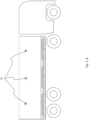
- the loading compartment 100 consists of: a substantially parallelepiped shape obtained by approaching at least six insulating panels.
- the insulating panels are organized with respect to each other so as to delimit the six faces of the parallelepiped, so as to define the volume of the modular cold room 90.
- the insulating panels comprise: a pair of insulating side panels 30, at least one covering insulating panel 31 suitable to close - at the upper part - the modular cold room 90, two transverse insulating panels 32 and 32b suitable to complete the thermal insulation of the modular cold room 90.
- the loading compartment 100 is also provided with a movable insulating panel 10b suitable to divide the volume of the modular cold room 90.
- Figure 1 also shows a plurality of further movable insulating panels 10c, 10d identical and parallel to the movable insulating panel 10b, also suitable to slide along the pair of guides 20 so as to create further modular cold rooms 90b, 90c, 90d, each of the exact volume desired by the vector.
- Said further movable insulating panels 10c, 10d when not used to divide the loading compartment 100 into a plurality of modular cold rooms 90b, 90c, 90d, reversibly lean against the rear face 11 of the movable insulating panel 10b and, therefore matching, may be positioned so as to reversibly adhere to the transverse insulating wall 32. In this manner, the loading compartment 100 will be free of partitioning insulating panels 10b, 10c, 10d along the entire extension thereof and the loading deck will be vacant.
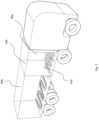
- Figure 2 shows the loading compartment 100 comprising an evaporation coil 40 positioned along the floor of the loading compartment 100 and provided with several valves and thermostats 42 suitable to maintain the temperature of the modular cold rooms 90a, 90b, 90c, 90d to the desired by the vector.
- This result is obtained by manually or automatically activating the valves and thermostats 42 which allow an autonomous thermal control of the various sections of the evaporation coil 40.
- the perforated flooring represented in the figure 2 is arranged to cover the evaporation coil 40, being suitable to protect the coil when the goods are loaded into the deck; furthermore, it allows the circulation of the refrigerated air introduced by the evaporation coil 40 into the space to be cooled.
- the system illustrated herein also provides for the installation of three fans 60 distributed along the lower side of the loading compartment 100, also protected by the perforated flooring 50; the fans support the refrigeration activity carried out by the coil 40, so as to distribute the air more effectively throughout the volume of the modular cold room 90 or of the further modular cold rooms 90a, 90b, 90c, 90d.
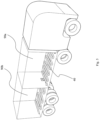
- Figure 4 shows the sliding of the movable insulating panel 10b along the extension of the loading compartment 100.
- the modulability of the cold room is ensured by the central movable panel which slides along the entire extension of the deck of the loading compartment 100 by means of guides 20, therefore allowing the carrier to choose the cubic capacity of the modular cold room 90.
- the cold room 90 is delimited by reversibly fixing the central movable panel 10b to the guides 20, to the side walls 30 or to both structures, ensuring the closure of the cold room and the thermal insulation of the section.
- FIG 3 The final result of the sliding of the movable insulating panel 10b is shown in figure 3 where, thanks to said sliding, there are formed two separate modular insulating cells 90a and 90b, which can be subjected to two different temperature regimes thanks to the presence of the valves and thermostats 42 provided with the evaporation coil 40; the modular cold room 90b can, at the discretion of the carrier, be used to transport goods at room temperature or goods requiring a controlled temperature.
- the refrigeration system of the modular cold room is automatically activated and deactivated upon the passage of the movable insulating panel 10b, same case applying to the auxiliary fans 60.
- each cold room 90 may be further partitioned by installing a raised loading deck which can be reversibly installed at half a height of a cold room so as to create two sub-portions of the cold room, increasing the loading capacity of the means for transporting the goods.
Landscapes
- Engineering & Computer Science (AREA)
- Physics & Mathematics (AREA)
- Thermal Sciences (AREA)
- Mechanical Engineering (AREA)
- Health & Medical Sciences (AREA)
- Public Health (AREA)
- Transportation (AREA)
- Chemical & Material Sciences (AREA)
- Combustion & Propulsion (AREA)
- General Engineering & Computer Science (AREA)
- Devices That Are Associated With Refrigeration Equipment (AREA)
- Cold Air Circulating Systems And Constructional Details In Refrigerators (AREA)
Description
- The present invention relates to the field of transportation of goods by road, rail or sea by means of a van, truck, trailer, semi-trailer and any other means capable of transporting goods fully loaded or in small batches. More precisely, the loading compartment of the means of transport, modular in various parts and provided with an equally adjustable cold room, is the object of the present patent application.
- Means of transport with built-in cold rooms and refrigeration systems are well known in the current state of the art. An example thereof is the United States Patent
US1966164A which improves the system of the travel refrigerator by providing it with compartments for storing and transporting perishable goods, said compartments are connected to a refrigeration duct with flexible construction so as to allow the swinging and rotary movements of the truck. However, nothing seems to have been claimed on the market and in the patent industry to allow a complete modulation of the goods storage spaces, same case applying to volumetric adjustment of the cold rooms arranged on the loading deck inside the vehicle. The inventions patented up to now with respect to the transportation of goods at controlled temperature are limited to describing vehicles provided with refrigerated cargo compartments which can possibly be separated from the main body of the means of transport, and therefore can be classified as removable, but never modular, like in the case of the Chinese patentCN204415225U "Large cold-storage carrier vehicle". - The rules for the transportation of goods at controlled temperature provide for some unavoidable travel conditions, such as temperature and hygiene standards: as regards chilled foods a temperature of 0°C -5°C must be guaranteed, as pertains to meat it must be comprised between 3°C - 7°C, storage areas must be delimited according to the shelf life of each product, fresh vegetables cannot be stored near dairy products. Knowledge of the legislation of the industry clearly shows the usefulness of the present invention and the positive impact thereof in the logistic management of freight transport. The sizeable number of goods required by large commissioning companies and individuals, their varied quality and type, the dynamism of orders, which can be cancelled, modified or updated continuously, force the courier to be equally dynamic and versatile in the organisation of the loading compartment spaces. The volume adjustment of the cold rooms ensures a smart and quick modulation of the spaces so that the means of transport can be easy to reorganise according to the various orders received by the courier.
US 2 677 244 A discloses a loading compartment similar to the preamble of claim 1. - According to the present invention a loading compartment provided with a modular cold room which effectively solves the aforementioned problems is provided. Thanks to the equipment included in the present invention, the loading compartment in question is the first one capable of allowing the carrier to transport goods requiring different temperature regimes. The loading compartment provided with modular cold room comprises:
- at least an insulating movable panel for closing the cold room, a panel which slides on at least a pair of side guides potentially covering the entire longitudinal extension of the loading compartment;
- a plurality of further movable insulating panels, identical and parallel to the aforementioned movable insulating panel, also suitable to slide along the same pair of guides so as to divide the modular cold room into different volumes, each with the exact volume desired by the carrier;
- at least two side panels which can be fixed, telescopic, movable or removable;
- at least a perforated flooring arranged to cover the evaporation coil;
- at least an evaporation coil arranged along the loading compartment deck.
- Said evaporation coil can take two different structures: it can be irreversibly extended along the loading deck and provided with a several valves and thermostats suitable to keep the modular cold rooms at the desired temperature, or include an alternative refrigeration system as a function of which the loading deck must be provided with an evaporation coil suitable to be reversibly extended or folded along the extension of the loading compartment.
- The aforementioned devices allow the carrier to organize the spaces of the loading compartment according to the requirements thereof, allowing to decide to:
- a) prepare the loading compartment for transportation of goods fully at room temperature,
- b) to opt for a transportation of goods fully requiring a controlled temperature,
- c) divide the loading compartment into distinct sections suitable to accommodate a load of goods which require different temperature regimes.
- Let us take a closer look at the three different assumptions:
- a) when the carrier has a batch of goods which fully requires transportation at room temperature, then the carrier can organise the loading compartment so as to ensure such a thermal regime in the entire extension thereof by sliding the movable insulating wall longitudinally, so as to arrange it in a position leaning against the fixed front insulating wall. In this configuration, the loading compartment is without partition panels along the extension of the deck;
- b) when the carrier has a batch of goods which fully requires transportation at controlled temperature, the carrier can activate the motor of the cold room, so as to allow the evaporation coil to cool the loading compartment along the entire extension thereof; the movable insulating wall will once again be arranged in a position leaning against the front fixed insulating wall. In this configuration, the loading compartment is without partition panels along the extension of the deck;
- c) the third assumption has a wider application given that it allows the vector to choose to differentiate the temperature regimes between the different cold rooms using the same evaporation coil.
- It should be borne in mind that the modulability of the cold room is ensured by the central movable panel which slides along the entire extension of the loading compartment by means of side guides, allowing the carrier to choose the size of the cold room. After choosing the desired width, the cold room is delimited by reversibly fixing the central movable panel to the guides, to the side walls or to both structures, thus ensuring the closure of the cold room and the thermal insulation of the section; the loading compartment thus delimited is divided into two separate autonomous and modular cold rooms. It should also be borne in mind that, where necessary, there are present a plurality of further movable insulating panels, identical and parallel to the aforementioned movable insulating panel, also designed to slide along the same pair of guides and suitable to create further modular cold rooms each with the exact volume desired by the carrier. The evaporation coil is extended along the loading deck and it is provided with a plurality of valves and thermostats suitable to allow to maintain the various modular cold rooms at the temperature desired by the carrier. This occurs by manually or automatically activating the valves and thermostats present along the coil, which thus allow an autonomous thermal control of the various sections of the evaporation coil. The various cold rooms thus obtained may accommodate goods requiring different temperature regimes. In the latter case, under c) the carrier may also use a section of the loading compartment excluded from the perimeter of the modular cold room to transport goods at room temperature, while the remaining cubic capacity will be included in the volume protected by the modular cold room.
- The loading compartment may include an alternative refrigeration system with respect to that subject of the present study. The system illustrated so far has a coil stably arranged along the extension of the loading compartment and it is provided with valves and thermostats which allow to modulate the degree of refrigeration introduced by the same in the various cold rooms. In this second variant, on the other hand, in order to allow the variability of the cubic capacity of the various cold rooms without the aid of valves and thermostats, the loading compartment must be provided with at least an evaporation coil suitable to be extended or folded along the extension of the loading compartment chosen to be used as a cold room. The coil may consist of any material suitable to ensure such elasticity; it concentrates the cooling capacity thereof in the section of the loading compartment subject of refrigeration. It is clear that the modular refrigeration coil allows, in the extended configuration thereof, the potential use of the entire extension of the loading compartment as a cold room; it is also clear that concentrating the evaporation coil in a smaller loading compartment will allow to use a section of the compartment as desired as a cold room, while the excluded section will remain at room temperature.
- The loading compartment must have a substantially parallelepiped shape obtained by approaching at least six insulating panels organized with respect to each other so as to delimit the six faces of the parallelepiped suitable to define the volume of the modular cold room. The insulating walls comprise at least a pair of side insulating panels, at least a covering insulating panel suitable to close - at the upper part - the modular cold room being engaged with the side panels; at least two transverse insulating panels suitable to complete the thermal insulation of said modular cold room; such walls can be fixed, telescopic or removable.
- At least a fan may be provided to support the activity carried out by the coil, so as to distribute the air more effectively throughout the vertical extension of the cold room. The compartment comprises - on the lower side thereof - a perforated flooring arranged to cover the evaporation coil, suitable to protect the coil when the goods are loaded into the deck; the perforated flooring also allows the circulation of the refrigerated air introduced by the evaporation coil into the space to be cooled. The refrigeration system of the modular cold room can be activated and deactivated mechanically or automatically, upon the passage of the central closing panel of the cold room. Manual or automatic activation of the fans may also be provided for. Lastly, the last accessory that makes the system in question up with the times, is an App which, when installed on the electronic device of the carrier, signals alarms and anomalies related to the condition of the goods and the temperature of the cold rooms directly to the driver, to the end customer and to a safety monitoring center. The App notifies the user of the signals related to the temperature of the modular cold rooms receiving the information directly from the thermal sensors installed inside the loading compartment, the thermal sensors interface with a control unit suitable for comparing the data with pre-set temperature values so as to detect and signal the changes.
- The advantages offered by the present invention are apparent in the light of the description set forth herein and will be further clarified by the accompanying figures and the detailed description thereof.
- The invention will be described hereinafter in at least a preferred embodiment by way of non-limiting example and with the aid of the attached figures, wherein:
-
FIGURE 1 shows theloading compartment 100 divided into four distinct modularcold rooms insulating panels cold room 90, a pair ofinsulating side panels 30, a covering insulatingpanel 31 suitable to close - at the upper part - said modular cold room, twotransverse insulating panels 32; 32b suitable to complete the thermal insulation of said modular cold room, amovable insulating panel 10b suitable to regulate the longitudinal extension of the modularcold room 90. -
FIGURE 2 shows anevaporation coil 40 positioned along the deck of theloading compartment 100, a plurality of valves andthermostats 42 fitted to saidevaporation coil 40, aperforated flooring 50 arranged to cover the evaporation coil, threefans 60 suitable to distribute the refrigerated air more uniformly in the cold room, a plurality ofturns 41. -
FIGURE 3 shows two modularcold rooms 90a; 90b obtained thanks to the sliding of the movableinsulating panel 10b suitable to adjust the volumetric division of the modularcold room 90 and to delimit the volumes of the two modularcold rooms -
FIGURE 4 shows an exemplifying instant of the sliding by means ofguides 20 of themovable insulating panel 10b suitable to divide the volume of the modularcold room 90 into further modularcold rooms -
FIGURE 5 shows theloading compartment 100 as illustrated in the second assumption of refrigeration system of the paragraph relating to the description of the invention, under b):loading compartment 100 fully used as a cold room and characterized by the presence of various modularcold rooms evaporation coil 40 but concentrating a greater extension thereof inside the cold room which requires a lower temperature. - The present invention will now be illustrated by way of non-limiting or binding example, using the figures which illustrate some embodiments in relation to the present inventive concept.
- With reference to
figure 1 , the structure and components of the loading compartment with a modular cold room is shown in the preferred embodiment. Therefore, theloading compartment 100 consists of: a substantially parallelepiped shape obtained by approaching at least six insulating panels. The insulating panels are organized with respect to each other so as to delimit the six faces of the parallelepiped, so as to define the volume of the modularcold room 90. The insulating panels comprise: a pair of insulatingside panels 30, at least one covering insulatingpanel 31 suitable to close - at the upper part - the modularcold room 90, two transverse insulatingpanels cold room 90. Theloading compartment 100 is also provided with a movableinsulating panel 10b suitable to divide the volume of the modularcold room 90.Figure 1 also shows a plurality of further movable insulatingpanels insulating panel 10b, also suitable to slide along the pair ofguides 20 so as to create further modularcold rooms panels loading compartment 100 into a plurality of modularcold rooms insulating panel 10b and, therefore matching, may be positioned so as to reversibly adhere to the transverse insulatingwall 32. In this manner, theloading compartment 100 will be free of partitioning insulatingpanels -
Figure 2 shows theloading compartment 100 comprising anevaporation coil 40 positioned along the floor of theloading compartment 100 and provided with several valves andthermostats 42 suitable to maintain the temperature of the modularcold rooms thermostats 42 which allow an autonomous thermal control of the various sections of theevaporation coil 40. The perforated flooring represented in thefigure 2 is arranged to cover theevaporation coil 40, being suitable to protect the coil when the goods are loaded into the deck; furthermore, it allows the circulation of the refrigerated air introduced by theevaporation coil 40 into the space to be cooled. The system illustrated herein also provides for the installation of threefans 60 distributed along the lower side of theloading compartment 100, also protected by theperforated flooring 50; the fans support the refrigeration activity carried out by thecoil 40, so as to distribute the air more effectively throughout the volume of the modularcold room 90 or of the further modularcold rooms -
Figure 4 shows the sliding of the movableinsulating panel 10b along the extension of theloading compartment 100. As a matter fact, the modulability of the cold room is ensured by the central movable panel which slides along the entire extension of the deck of theloading compartment 100 by means ofguides 20, therefore allowing the carrier to choose the cubic capacity of the modularcold room 90. After choosing the desired width, thecold room 90 is delimited by reversibly fixing the centralmovable panel 10b to theguides 20, to theside walls 30 or to both structures, ensuring the closure of the cold room and the thermal insulation of the section. The final result of the sliding of the movableinsulating panel 10b is shown infigure 3 where, thanks to said sliding, there are formed two separate modular insulatingcells thermostats 42 provided with theevaporation coil 40; the modularcold room 90b can, at the discretion of the carrier, be used to transport goods at room temperature or goods requiring a controlled temperature. In the preferred embodiment thereof, the refrigeration system of the modular cold room is automatically activated and deactivated upon the passage of the movableinsulating panel 10b, same case applying to theauxiliary fans 60. - Lastly, in a further embodiment each
cold room 90 may be further partitioned by installing a raised loading deck which can be reversibly installed at half a height of a cold room so as to create two sub-portions of the cold room, increasing the loading capacity of the means for transporting the goods. - Lastly, it is clear that modifications, additions or variations which are obvious to a person skilled in the art may be applied to the invention described heretofore without departing from the scope of protection provided by the attached claims.
Claims (11)
- Loading compartment (100) provided with a modular cold room (90) suitable for the transport of goods requiring different temperature regimes, having is a substantially parallelepiped shape obtained by combining at least six insulating panels; said insulating panels being organized together so as to delimit the six faces of the parallelepiped suitable to define the volume of said modular cold room (90); said at least six insulating panels comprising at least a pair of side insulating panels (30), at least a covering insulating panel (31) suitable to close - at the upper part - said modular cold room (90) being engaged with said side panels (30); at least a lower insulating panel (33); at least two transverse insulating panels (32; 32b) suitable to complete the thermal insulation of said modular cold room (90); said insulating panels can be fixed, telescopic, movable or reversibly removable; said loading compartment comprising at least:• a pair of guides (20) positioned on the deck of said loading compartment (100) suitable to allow the longitudinal sliding of a movable insulating panel (10b) along the deck;• a said movable insulating panel (10b) suitable to divide into at least two further cold rooms (90.a-90b) through the sliding of said movable insulating panel (10b) on said guides (20); the sliding of said movable insulating panel (10b) determines the variation of the volume of said further cold rooms (90.a-90b) inside said modular cold room (90);• on the rear face (11) of said movable insulating panel (10b) a plurality of further movable insulating panels (10c, 10d, 10e,...) identical and parallel thereto, also suitable to slide along said guides (20) so as to create additional modular cold rooms (90b, 90c, 90d,...) each with the exact volume desired by the carrier;• a common thermal insulating access opening (43a, 43b, 43c, 43d,...) arranged on each of said insulating panels (10b, 10c, 10d,...) to ensure access to each of said modular cold rooms (90a, 90b, 90c).characterised in that said further movable insulating panels (10c, 10d, 10e,...), when not used to divide said loading compartment (100) into a plurality of distinct said modular cold rooms (90b, 90c, 90d,...), are suitable to reversibly lean against the rear face of said movable insulating panel (10b) and thus aligned being suitable to be arranged so as to reversibly adhere to said transverse insulating wall (32); andin that said loading compartment further comprises:• a loading surface provided with a perforated flooring (50) suitable to protect an evaporation coil (40) when the goods are loaded into the compartment; said perforated flooring (50) suitable to allow the circulation of the refrigerated air introduced by said evaporation coil (40) into the space to be cooled;• an evaporation coil (40) present under the deck of said loading compartment (100); said evaporation coil (40) being provided with a plurality of valves and thermostats (42) suitable to maintain said modular cold rooms (90a, 90b, 90c, 90d,...) at the desired temperature through manual or automatic activation of said valves and thermostats (42); said valves and thermostats (42) in this way allow an autonomous thermal control of the different sections of said evaporation coil (40) at each of said valves and thermostats (42).
- Loading compartment (100) provided with a modular cold room (90), according to the preceding claim 1, characterized in that said evaporation coil (40) is suitable to refrigerate said modular cold room (90) and suitable to manually or automatically take a first extended configuration in which the turns (41) of said coil (40) are homogeneously distributed throughout the deck and ensure the refrigeration of the entire volumetric extension of the modular cold room (90); said evaporation coil (40) being also susceptible to take a second folded configuration in which the entire extension of said evaporation coil (40) is concentrated at said modular cold room (90) of said loading compartment (100) thus allowing the use of at least a further portion of said loading compartment (100) for the transport of goods at room temperature, without having to resort to the aid of said valves and thermostats (42).
- Loading compartment (100) provided with a modular cold room (90), according to the preceding claim 1, characterized in that said evaporation coil (40) is suitable to refrigerate said modular cold room (90) and suitable to manually or automatically take a first extended configuration in which the turns (41) of said coil (40) are homogeneously distributed throughout the deck and ensure the cooling of the entire volumetric extension of said loading compartment (100); said evaporation coil (40) being also suitable to take a second folded configuration in which a greater portion of said evaporation coil (90) is concentrated at said modular cold room (90a), while a smaller portion of coil (40) continues to occupy the remaining part of the deck of the loading compartment (100) thus allowing the use of at least one said further modular cold room (90b) of said loading compartment (100) for the transport of refrigerated goods at a different temperature than the degrees present in said modular cold room (90a), without having to resort to the aid of said valves and thermostats (42).
- Loading compartment provided with a modular cold room (90), according to the preceding claim 2, characterized in that at least one of said insulating panels (10b, 10c, 10d,...) is connected to a turn (41) of said evaporation coil (40); the movement of said insulating panel (10) determining the concentration or extension of at least a portion of said evaporation coil (40) thus ensuring the reversibility of the movement of the modular cold room (90a, 90b, 90c,...).
- Loading compartment provided with a modular cold room (100) according to any one of the preceding claims, characterized in that it comprises at least a raised loading deck suitable to be reversibly installed in any modular cold room (90) so as to divide said modular cold room (90) into two portions, one superimposed on the other.
- Loading compartment provided with a modular cold room (100) according to any one of the preceding claims, characterized in that the refrigeration system of said modular cold room (90a, 90b, 90c,...) is reversibly activated automatically upon passage of said movable insulating panel (10b, 10c, 10d,...) on said side guides (20) thanks to the use of motion sensors.
- Loading compartment provided with a modular cold room (100), according to any one of the preceding claims, characterized in that it comprises the aid of at least a fan (60), suitable to distribute the refrigerated air more uniformly throughout the entire volume of said modular cold room (90).
- Loading compartment provided with a modular cold room (100) according to any one of the preceding claims, characterized in that the insulating panels are telescopic, therefore movable, walls.
- Loading compartment provided with a modular cold room (100) according to any one of the preceding claims, characterized in that the insulating panels are removable.
- Loading compartment provided with a modular cold room (100) according to any one of the preceding claims, characterized in that the common thermal insulating access openings (43a, 43b, 43c, 43d,...) can be suitably positioned along the side panels of the loading compartment.
- Loading compartment provided with a modular cold room (100) according to any one of the preceding claims, characterized in that it comprises an App installed on the electronic device of the carrier that signals alarms and anomalies relating to the condition of the goods and the temperature of the modular cold rooms ( 90a, 90b, 90c,...) directly to the driver and to the end customer and to a safety monitoring center; said App notifies the user of the signals relating to the temperature of the modular cold rooms (90a, 90b, 90c,...) directly received by the thermal sensors (75) installed inside the loading compartment (100), said thermal sensors (75) interface with a control unit suitable to compare data with pre-set temperature values so as to detect, record and report changes.
Applications Claiming Priority (2)
| Application Number | Priority Date | Filing Date | Title |
|---|---|---|---|
| IT102021000006956A IT202100006956A1 (en) | 2021-03-23 | 2021-03-23 | CARGO COMPARTMENT EQUIPPED WITH MODULAR REFRIGERATOR |
| PCT/IB2022/051994 WO2022200893A1 (en) | 2021-03-23 | 2022-03-07 | Loading compartment provided with modular cold room |
Publications (2)
| Publication Number | Publication Date |
|---|---|
| EP4330079A1 EP4330079A1 (en) | 2024-03-06 |
| EP4330079B1 true EP4330079B1 (en) | 2025-05-07 |
Family
ID=76159789
Family Applications (1)
| Application Number | Title | Priority Date | Filing Date |
|---|---|---|---|
| EP22711614.2A Active EP4330079B1 (en) | 2021-03-23 | 2022-03-07 | Loading compartment provided with modular cold room |
Country Status (3)
| Country | Link |
|---|---|
| EP (1) | EP4330079B1 (en) |
| IT (1) | IT202100006956A1 (en) |
| WO (1) | WO2022200893A1 (en) |
Families Citing this family (1)
| Publication number | Priority date | Publication date | Assignee | Title |
|---|---|---|---|---|
| CN116691743A (en) * | 2023-07-25 | 2023-09-05 | 中车长江车辆有限公司 | Railway mechanical refrigerator car |
Family Cites Families (6)
| Publication number | Priority date | Publication date | Assignee | Title |
|---|---|---|---|---|
| US1966164A (en) | 1934-01-08 | 1934-07-10 | Isaac J Clark | Traveling refrigerator |
| US2534272A (en) * | 1947-12-22 | 1950-12-19 | Dole Refrigerating Co | Multitemperature refrigerator car |
| US2677244A (en) * | 1949-09-01 | 1954-05-04 | Jack P Wehby | Variable compartment vehicle |
| GB2211922A (en) * | 1987-11-02 | 1989-07-12 | Salim Kara | Refrigerating trailers |
| US6606875B1 (en) * | 2002-07-02 | 2003-08-19 | Carrier Corporation | Container with movable bulkheads |
| CN204415225U (en) | 2015-01-28 | 2015-06-24 | 山东佳鸣冷储有限公司 | A kind of Large Scale Cold storage transport trolley |
-
2021
- 2021-03-23 IT IT102021000006956A patent/IT202100006956A1/en unknown
-
2022
- 2022-03-07 WO PCT/IB2022/051994 patent/WO2022200893A1/en not_active Ceased
- 2022-03-07 EP EP22711614.2A patent/EP4330079B1/en active Active
Also Published As
| Publication number | Publication date |
|---|---|
| EP4330079A1 (en) | 2024-03-06 |
| IT202100006956A1 (en) | 2022-09-23 |
| WO2022200893A1 (en) | 2022-09-29 |
Similar Documents
| Publication | Publication Date | Title |
|---|---|---|
| US5704676A (en) | Multi-temperature cargo transportation apparatus | |
| US5054295A (en) | Transport with variable volume, independently cooled compartments | |
| US20170259648A1 (en) | Apparatuses and methods for providing transportation container temperature control | |
| US6626625B2 (en) | System and method for partitioning cargo areas | |
| US4901538A (en) | Portable temperature maintenance system | |
| EP4330079B1 (en) | Loading compartment provided with modular cold room | |
| US6640569B2 (en) | Grocery delivery vehicle | |
| US4899554A (en) | Refrigerator with plural storage chambers | |
| KR101734525B1 (en) | Agricultural and fisheries products cold storage distribution ice box | |
| EP2836777B1 (en) | Multiple access aircraft galley chiller | |
| KR20180025400A (en) | Container Capable of Maintaining Setting Temperature Preservation Based Temperature of Real Loading Box and Operating Method Thereof | |
| KR102779435B1 (en) | Refrigerated warehouse system | |
| CN120129914A (en) | Thermal management for actively cooled totes in last-mile food delivery | |
| US4531377A (en) | Temperature control apparatus for mounting in a transportable body | |
| JP7564053B2 (en) | Cooling container | |
| EP4209731A1 (en) | Portable refrigerator and main refrigerator having the same | |
| KR200339939Y1 (en) | a wing-body truck which transport using refrigeration and warming storage | |
| WO2017127860A1 (en) | Chiller container | |
| US7183484B1 (en) | Bulkhead assembly with seal for storage compartments | |
| CN214067675U (en) | An image-based intelligent refrigerated truck | |
| JPH0510202Y2 (en) | ||
| JP2721501B2 (en) | Freight vehicles with different temperature chambers | |
| KR102726890B1 (en) | Large size container with vacuum insulation panel supporting rod | |
| WO2017202615A1 (en) | A cooling device comprising a cold storage container | |
| JPH0714740B2 (en) | Foam synthetic resin container |
Legal Events
| Date | Code | Title | Description |
|---|---|---|---|
| STAA | Information on the status of an ep patent application or granted ep patent |
Free format text: STATUS: UNKNOWN |
|
| STAA | Information on the status of an ep patent application or granted ep patent |
Free format text: STATUS: THE INTERNATIONAL PUBLICATION HAS BEEN MADE |
|
| PUAI | Public reference made under article 153(3) epc to a published international application that has entered the european phase |
Free format text: ORIGINAL CODE: 0009012 |
|
| STAA | Information on the status of an ep patent application or granted ep patent |
Free format text: STATUS: REQUEST FOR EXAMINATION WAS MADE |
|
| 17P | Request for examination filed |
Effective date: 20231011 |
|
| AK | Designated contracting states |
Kind code of ref document: A1 Designated state(s): AL AT BE BG CH CY CZ DE DK EE ES FI FR GB GR HR HU IE IS IT LI LT LU LV MC MK MT NL NO PL PT RO RS SE SI SK SM TR |
|
| DAV | Request for validation of the european patent (deleted) | ||
| DAX | Request for extension of the european patent (deleted) | ||
| GRAP | Despatch of communication of intention to grant a patent |
Free format text: ORIGINAL CODE: EPIDOSNIGR1 |
|
| STAA | Information on the status of an ep patent application or granted ep patent |
Free format text: STATUS: GRANT OF PATENT IS INTENDED |
|
| INTG | Intention to grant announced |
Effective date: 20241203 |
|
| GRAS | Grant fee paid |
Free format text: ORIGINAL CODE: EPIDOSNIGR3 |
|
| GRAA | (expected) grant |
Free format text: ORIGINAL CODE: 0009210 |
|
| STAA | Information on the status of an ep patent application or granted ep patent |
Free format text: STATUS: THE PATENT HAS BEEN GRANTED |
|
| AK | Designated contracting states |
Kind code of ref document: B1 Designated state(s): AL AT BE BG CH CY CZ DE DK EE ES FI FR GB GR HR HU IE IS IT LI LT LU LV MC MK MT NL NO PL PT RO RS SE SI SK SM TR |
|
| REG | Reference to a national code |
Ref country code: GB Ref legal event code: FG4D |
|
| REG | Reference to a national code |
Ref country code: CH Ref legal event code: EP |
|
| REG | Reference to a national code |
Ref country code: DE Ref legal event code: R096 Ref document number: 602022014257 Country of ref document: DE |
|
| REG | Reference to a national code |
Ref country code: IE Ref legal event code: FG4D |
|
| REG | Reference to a national code |
Ref country code: NL Ref legal event code: MP Effective date: 20250507 |
|
| PG25 | Lapsed in a contracting state [announced via postgrant information from national office to epo] |
Ref country code: FI Free format text: LAPSE BECAUSE OF FAILURE TO SUBMIT A TRANSLATION OF THE DESCRIPTION OR TO PAY THE FEE WITHIN THE PRESCRIBED TIME-LIMIT Effective date: 20250507 Ref country code: PT Free format text: LAPSE BECAUSE OF FAILURE TO SUBMIT A TRANSLATION OF THE DESCRIPTION OR TO PAY THE FEE WITHIN THE PRESCRIBED TIME-LIMIT Effective date: 20250908 Ref country code: ES Free format text: LAPSE BECAUSE OF FAILURE TO SUBMIT A TRANSLATION OF THE DESCRIPTION OR TO PAY THE FEE WITHIN THE PRESCRIBED TIME-LIMIT Effective date: 20250507 |
|
| REG | Reference to a national code |
Ref country code: LT Ref legal event code: MG9D |
|
| PG25 | Lapsed in a contracting state [announced via postgrant information from national office to epo] |
Ref country code: GR Free format text: LAPSE BECAUSE OF FAILURE TO SUBMIT A TRANSLATION OF THE DESCRIPTION OR TO PAY THE FEE WITHIN THE PRESCRIBED TIME-LIMIT Effective date: 20250808 Ref country code: NO Free format text: LAPSE BECAUSE OF FAILURE TO SUBMIT A TRANSLATION OF THE DESCRIPTION OR TO PAY THE FEE WITHIN THE PRESCRIBED TIME-LIMIT Effective date: 20250807 |
|
| PG25 | Lapsed in a contracting state [announced via postgrant information from national office to epo] |
Ref country code: PL Free format text: LAPSE BECAUSE OF FAILURE TO SUBMIT A TRANSLATION OF THE DESCRIPTION OR TO PAY THE FEE WITHIN THE PRESCRIBED TIME-LIMIT Effective date: 20250507 Ref country code: NL Free format text: LAPSE BECAUSE OF FAILURE TO SUBMIT A TRANSLATION OF THE DESCRIPTION OR TO PAY THE FEE WITHIN THE PRESCRIBED TIME-LIMIT Effective date: 20250507 |
|
| REG | Reference to a national code |
Ref country code: AT Ref legal event code: MK05 Ref document number: 1792132 Country of ref document: AT Kind code of ref document: T Effective date: 20250507 |
|
| PG25 | Lapsed in a contracting state [announced via postgrant information from national office to epo] |
Ref country code: BG Free format text: LAPSE BECAUSE OF FAILURE TO SUBMIT A TRANSLATION OF THE DESCRIPTION OR TO PAY THE FEE WITHIN THE PRESCRIBED TIME-LIMIT Effective date: 20250507 |
|
| PG25 | Lapsed in a contracting state [announced via postgrant information from national office to epo] |
Ref country code: HR Free format text: LAPSE BECAUSE OF FAILURE TO SUBMIT A TRANSLATION OF THE DESCRIPTION OR TO PAY THE FEE WITHIN THE PRESCRIBED TIME-LIMIT Effective date: 20250507 |
|
| PG25 | Lapsed in a contracting state [announced via postgrant information from national office to epo] |
Ref country code: AT Free format text: LAPSE BECAUSE OF FAILURE TO SUBMIT A TRANSLATION OF THE DESCRIPTION OR TO PAY THE FEE WITHIN THE PRESCRIBED TIME-LIMIT Effective date: 20250507 |
|
| PG25 | Lapsed in a contracting state [announced via postgrant information from national office to epo] |
Ref country code: RS Free format text: LAPSE BECAUSE OF FAILURE TO SUBMIT A TRANSLATION OF THE DESCRIPTION OR TO PAY THE FEE WITHIN THE PRESCRIBED TIME-LIMIT Effective date: 20250807 |
|
| PG25 | Lapsed in a contracting state [announced via postgrant information from national office to epo] |
Ref country code: IS Free format text: LAPSE BECAUSE OF FAILURE TO SUBMIT A TRANSLATION OF THE DESCRIPTION OR TO PAY THE FEE WITHIN THE PRESCRIBED TIME-LIMIT Effective date: 20250907 |
|
| PG25 | Lapsed in a contracting state [announced via postgrant information from national office to epo] |
Ref country code: LV Free format text: LAPSE BECAUSE OF FAILURE TO SUBMIT A TRANSLATION OF THE DESCRIPTION OR TO PAY THE FEE WITHIN THE PRESCRIBED TIME-LIMIT Effective date: 20250507 |
|
| PG25 | Lapsed in a contracting state [announced via postgrant information from national office to epo] |
Ref country code: SM Free format text: LAPSE BECAUSE OF FAILURE TO SUBMIT A TRANSLATION OF THE DESCRIPTION OR TO PAY THE FEE WITHIN THE PRESCRIBED TIME-LIMIT Effective date: 20250507 Ref country code: DK Free format text: LAPSE BECAUSE OF FAILURE TO SUBMIT A TRANSLATION OF THE DESCRIPTION OR TO PAY THE FEE WITHIN THE PRESCRIBED TIME-LIMIT Effective date: 20250507 |
|
| PG25 | Lapsed in a contracting state [announced via postgrant information from national office to epo] |
Ref country code: CZ Free format text: LAPSE BECAUSE OF FAILURE TO SUBMIT A TRANSLATION OF THE DESCRIPTION OR TO PAY THE FEE WITHIN THE PRESCRIBED TIME-LIMIT Effective date: 20250507 |
|
| PG25 | Lapsed in a contracting state [announced via postgrant information from national office to epo] |
Ref country code: EE Free format text: LAPSE BECAUSE OF FAILURE TO SUBMIT A TRANSLATION OF THE DESCRIPTION OR TO PAY THE FEE WITHIN THE PRESCRIBED TIME-LIMIT Effective date: 20250507 |
|
| PG25 | Lapsed in a contracting state [announced via postgrant information from national office to epo] |
Ref country code: SK Free format text: LAPSE BECAUSE OF FAILURE TO SUBMIT A TRANSLATION OF THE DESCRIPTION OR TO PAY THE FEE WITHIN THE PRESCRIBED TIME-LIMIT Effective date: 20250507 |
|
| PG25 | Lapsed in a contracting state [announced via postgrant information from national office to epo] |
Ref country code: IT Free format text: LAPSE BECAUSE OF FAILURE TO SUBMIT A TRANSLATION OF THE DESCRIPTION OR TO PAY THE FEE WITHIN THE PRESCRIBED TIME-LIMIT Effective date: 20250507 |
|
| REG | Reference to a national code |
Ref country code: DE Ref legal event code: R097 Ref document number: 602022014257 Country of ref document: DE |
|
| PLBE | No opposition filed within time limit |
Free format text: ORIGINAL CODE: 0009261 |
|
| STAA | Information on the status of an ep patent application or granted ep patent |
Free format text: STATUS: NO OPPOSITION FILED WITHIN TIME LIMIT |
|
| REG | Reference to a national code |
Ref country code: CH Ref legal event code: L10 Free format text: ST27 STATUS EVENT CODE: U-0-0-L10-L00 (AS PROVIDED BY THE NATIONAL OFFICE) Effective date: 20260318 |
|
| 26N | No opposition filed |
Effective date: 20260210 |