EP4328362A1 - Procédé de construction pour bibliothèque de séquençage d'arn, procédé de séquençage et kit - Google Patents
Procédé de construction pour bibliothèque de séquençage d'arn, procédé de séquençage et kit Download PDFInfo
- Publication number
- EP4328362A1 EP4328362A1 EP21937340.4A EP21937340A EP4328362A1 EP 4328362 A1 EP4328362 A1 EP 4328362A1 EP 21937340 A EP21937340 A EP 21937340A EP 4328362 A1 EP4328362 A1 EP 4328362A1
- Authority
- EP
- European Patent Office
- Prior art keywords
- cdna
- primer
- adapter
- sequence
- mrna
- Prior art date
- Legal status (The legal status is an assumption and is not a legal conclusion. Google has not performed a legal analysis and makes no representation as to the accuracy of the status listed.)
- Pending
Links
Images




Classifications
-
- C—CHEMISTRY; METALLURGY
- C40—COMBINATORIAL TECHNOLOGY
- C40B—COMBINATORIAL CHEMISTRY; LIBRARIES, e.g. CHEMICAL LIBRARIES
- C40B40/00—Libraries per se, e.g. arrays, mixtures
- C40B40/04—Libraries containing only organic compounds
- C40B40/06—Libraries containing nucleotides or polynucleotides, or derivatives thereof
- C40B40/08—Libraries containing RNA or DNA which encodes proteins, e.g. gene libraries
-
- C—CHEMISTRY; METALLURGY
- C12—BIOCHEMISTRY; BEER; SPIRITS; WINE; VINEGAR; MICROBIOLOGY; ENZYMOLOGY; MUTATION OR GENETIC ENGINEERING
- C12N—MICROORGANISMS OR ENZYMES; COMPOSITIONS THEREOF; PROPAGATING, PRESERVING, OR MAINTAINING MICROORGANISMS; MUTATION OR GENETIC ENGINEERING; CULTURE MEDIA
- C12N15/00—Mutation or genetic engineering; DNA or RNA concerning genetic engineering, vectors, e.g. plasmids, or their isolation, preparation or purification; Use of hosts therefor
- C12N15/09—Recombinant DNA-technology
- C12N15/10—Processes for the isolation, preparation or purification of DNA or RNA
- C12N15/1034—Isolating an individual clone by screening libraries
- C12N15/1065—Preparation or screening of tagged libraries, e.g. tagged microorganisms by STM-mutagenesis, tagged polynucleotides, gene tags
-
- C—CHEMISTRY; METALLURGY
- C12—BIOCHEMISTRY; BEER; SPIRITS; WINE; VINEGAR; MICROBIOLOGY; ENZYMOLOGY; MUTATION OR GENETIC ENGINEERING
- C12N—MICROORGANISMS OR ENZYMES; COMPOSITIONS THEREOF; PROPAGATING, PRESERVING, OR MAINTAINING MICROORGANISMS; MUTATION OR GENETIC ENGINEERING; CULTURE MEDIA
- C12N15/00—Mutation or genetic engineering; DNA or RNA concerning genetic engineering, vectors, e.g. plasmids, or their isolation, preparation or purification; Use of hosts therefor
- C12N15/09—Recombinant DNA-technology
- C12N15/10—Processes for the isolation, preparation or purification of DNA or RNA
- C12N15/1096—Processes for the isolation, preparation or purification of DNA or RNA cDNA Synthesis; Subtracted cDNA library construction, e.g. RT, RT-PCR
-
- C—CHEMISTRY; METALLURGY
- C12—BIOCHEMISTRY; BEER; SPIRITS; WINE; VINEGAR; MICROBIOLOGY; ENZYMOLOGY; MUTATION OR GENETIC ENGINEERING
- C12Q—MEASURING OR TESTING PROCESSES INVOLVING ENZYMES, NUCLEIC ACIDS OR MICROORGANISMS; COMPOSITIONS OR TEST PAPERS THEREFOR; PROCESSES OF PREPARING SUCH COMPOSITIONS; CONDITION-RESPONSIVE CONTROL IN MICROBIOLOGICAL OR ENZYMOLOGICAL PROCESSES
- C12Q1/00—Measuring or testing processes involving enzymes, nucleic acids or microorganisms; Compositions therefor; Processes of preparing such compositions
- C12Q1/25—Measuring or testing processes involving enzymes, nucleic acids or microorganisms; Compositions therefor; Processes of preparing such compositions involving enzymes not classifiable in groups C12Q1/26 - C12Q1/66
-
- C—CHEMISTRY; METALLURGY
- C12—BIOCHEMISTRY; BEER; SPIRITS; WINE; VINEGAR; MICROBIOLOGY; ENZYMOLOGY; MUTATION OR GENETIC ENGINEERING
- C12Q—MEASURING OR TESTING PROCESSES INVOLVING ENZYMES, NUCLEIC ACIDS OR MICROORGANISMS; COMPOSITIONS OR TEST PAPERS THEREFOR; PROCESSES OF PREPARING SUCH COMPOSITIONS; CONDITION-RESPONSIVE CONTROL IN MICROBIOLOGICAL OR ENZYMOLOGICAL PROCESSES
- C12Q1/00—Measuring or testing processes involving enzymes, nucleic acids or microorganisms; Compositions therefor; Processes of preparing such compositions
- C12Q1/48—Measuring or testing processes involving enzymes, nucleic acids or microorganisms; Compositions therefor; Processes of preparing such compositions involving transferase
- C12Q1/485—Measuring or testing processes involving enzymes, nucleic acids or microorganisms; Compositions therefor; Processes of preparing such compositions involving transferase involving kinase
-
- C—CHEMISTRY; METALLURGY
- C12—BIOCHEMISTRY; BEER; SPIRITS; WINE; VINEGAR; MICROBIOLOGY; ENZYMOLOGY; MUTATION OR GENETIC ENGINEERING
- C12Q—MEASURING OR TESTING PROCESSES INVOLVING ENZYMES, NUCLEIC ACIDS OR MICROORGANISMS; COMPOSITIONS OR TEST PAPERS THEREFOR; PROCESSES OF PREPARING SUCH COMPOSITIONS; CONDITION-RESPONSIVE CONTROL IN MICROBIOLOGICAL OR ENZYMOLOGICAL PROCESSES
- C12Q1/00—Measuring or testing processes involving enzymes, nucleic acids or microorganisms; Compositions therefor; Processes of preparing such compositions
- C12Q1/68—Measuring or testing processes involving enzymes, nucleic acids or microorganisms; Compositions therefor; Processes of preparing such compositions involving nucleic acids
- C12Q1/6806—Preparing nucleic acids for analysis, e.g. for polymerase chain reaction [PCR] assay
-
- C—CHEMISTRY; METALLURGY
- C12—BIOCHEMISTRY; BEER; SPIRITS; WINE; VINEGAR; MICROBIOLOGY; ENZYMOLOGY; MUTATION OR GENETIC ENGINEERING
- C12Q—MEASURING OR TESTING PROCESSES INVOLVING ENZYMES, NUCLEIC ACIDS OR MICROORGANISMS; COMPOSITIONS OR TEST PAPERS THEREFOR; PROCESSES OF PREPARING SUCH COMPOSITIONS; CONDITION-RESPONSIVE CONTROL IN MICROBIOLOGICAL OR ENZYMOLOGICAL PROCESSES
- C12Q1/00—Measuring or testing processes involving enzymes, nucleic acids or microorganisms; Compositions therefor; Processes of preparing such compositions
- C12Q1/68—Measuring or testing processes involving enzymes, nucleic acids or microorganisms; Compositions therefor; Processes of preparing such compositions involving nucleic acids
- C12Q1/6869—Methods for sequencing
-
- C—CHEMISTRY; METALLURGY
- C40—COMBINATORIAL TECHNOLOGY
- C40B—COMBINATORIAL CHEMISTRY; LIBRARIES, e.g. CHEMICAL LIBRARIES
- C40B50/00—Methods of creating libraries, e.g. combinatorial synthesis
- C40B50/06—Biochemical methods, e.g. using enzymes or whole viable microorganisms
-
- G—PHYSICS
- G01—MEASURING; TESTING
- G01N—INVESTIGATING OR ANALYSING MATERIALS BY DETERMINING THEIR CHEMICAL OR PHYSICAL PROPERTIES
- G01N2333/00—Assays involving biological materials from specific organisms or of a specific nature
- G01N2333/90—Enzymes; Proenzymes
- G01N2333/9015—Ligases (6)
-
- G—PHYSICS
- G01—MEASURING; TESTING
- G01N—INVESTIGATING OR ANALYSING MATERIALS BY DETERMINING THEIR CHEMICAL OR PHYSICAL PROPERTIES
- G01N2333/00—Assays involving biological materials from specific organisms or of a specific nature
- G01N2333/90—Enzymes; Proenzymes
- G01N2333/91—Transferases (2.)
- G01N2333/912—Transferases (2.) transferring phosphorus containing groups, e.g. kinases (2.7)
- G01N2333/91205—Phosphotransferases in general
- G01N2333/91245—Nucleotidyltransferases (2.7.7)
- G01N2333/9125—Nucleotidyltransferases (2.7.7) with a definite EC number (2.7.7.-)
- G01N2333/9128—RNA-directed DNA polymerases, e.g. RT (2.7.7.49)
Definitions
- the present invention relates to the field of sequencing, and specifically, to a method for constructing an RNA sequencing library, a sequencing method and a kit.
- a Smart-seq2 technology uses a single-tube amplification strategy, and then uses technologies, such as flow cytometry and microdissection, to divide single cells into corresponding single wells for lysis, transcription and amplification, interruption, and library construction.
- sequences at both terminals of cDNA are specifically captured by synthesizing a sequence carrying a specific molecular marker on beads.
- sequencing cannot be directly performed on the full-length cDNA carrying a tag, and further interruption is still required. Since the sequence in the middle of the cDNA sequence after interruption is not tagged and filtered out, there is no way to obtain the full length, thereby losing a lot of important information such as variable shear.
- the droplet-based high-throughput sequencing strategy includes the following specific steps.
- a water-in-oil droplet is used to wrap a cell and a bead to obtain a droplet simultaneously including the cell and the bead.
- Other components in the droplet further include a lysis buffer, and the bead includes a large number of DNA sequences with specific molecular markers (barcodes), and a TSO sequence.
- barcodes specific molecular markers
- the cell inside the droplet is lysed by the lysis buffer, so as to release a large amount of mRNA.
- the mRNA is captured by free poly(dT), and an RT reaction is completed in the droplet.
- the TSO sequence is added to the terminal of the mRNA.
- a complementary sequence of TSO on the extended terminal of first strand cDNA binds to the TSO on the bead, such that the mRNA is captured onto the bead.
- a 5' sequence is tagged with a specific molecular marker, so as to achieve single-cell high-throughput sequencing of 5' RNA, for example, 10x Genomics.
- 10x Genomics the bigger problem with the 10x Genomics at present is the high cost.
- the main companies offering single-cell sequencing instruments and services in the market are 10X Genomics, BD, and Nadia of Dolomite. Except for the 10X Genomics, there is a lack of methods for high-throughput 5'RNA sequencing, and 5'RNA seq is an essential part for the acquisition of immunome libraries, for example, 5'TCR/BCR is an important component of immune cells, it is crucial to obtain a TCR/BCR sequence to gain insight into immune mechanisms.
- droplet-based high-throughput single-cell sequencing of full-length mRNA has also not yet been reported, and full length plays an important role in understanding of gene diversity and regulatory mechanisms.
- RNA sequencing based on single tubes are difficult to achieve high-throughput single-cell sequencing.
- the shortcoming of droplet microfluidics is that since the molecular marker can only be designed at the 3' terminal or 5' terminal of the cDNA, after being interrupted and screened during library construction, an intermediate sequence is discarded because there is no specific molecular marker to trace the origin of the fragment, and therefore the full length cannot be obtained.
- 10x Genomics currently achieves single-cell high-throughput sequencing of the 5' RNA, TSO-based complementary capture of mRNA is not as efficient as poly(dT)-based capture and is also more costly.
- the present invention is mainly intended to provide a method for constructing an RNA sequencing library, a sequencing method and a kit, to solve the problem in the prior art that it is difficult to achieve high-throughput sequencing of the 5' terminal or full length of RNA.
- an aspect of the present invention provides a method for constructing an RNA sequencing library.
- the method includes: acquiring a single-stranded cDNA, which is a reverse transcription product of mRNA, where the 3'-terminal of the single-stranded cDNA includes a cDNA tag sequence; cyclizing the single-stranded cDNA to obtain a single-stranded cyclized cDNA; amplifying the single-stranded cyclized cDNA with a primer combination, which is formed by a random primer or a gene-specific primer and a cDNA tag primer, so as to obtain an amplified fragment, where the cDNA tag primer is at least a part of the cDNA tag sequence; and performing fragmentation for library construction on the amplified fragment, so as to obtain the RNA sequencing library.
- the operation of acquiring the single-stranded cDNA, which is the reverse transcription product of mRNA, where the 3'-terminal of the single-stranded cDNA includes the cDNA tag sequence includes: performing reverse transcription on the mRNA, so as to obtain a first strand cDNA; amplifying the first strand cDNA to obtain a double-stranded cDNA, where the 3' terminal of a second strand cDNA, which is complementary to the first strand cDNA includes the cDNA tag sequence, and the cDNA tag sequence comprises a poly(A); and melting the double-stranded cDNA to obtain the single-stranded cDNA.
- the cDNA tag sequence successively includes, in a direction from 3' to 5', a second PCR adapter, a second cell barcode, a second Unique Molecular Identifier (UMI) and the poly(A).
- UMI Unique Molecular Identifier
- the mRNA is derived from a single-cell sample, and the mRNA is a single-cell mRNA.
- the single-cell mRNA with a droplet method, so as to make the single-cell mRNA ligated to a solid support, and preferably, the solid support is a bead.
- the operation of preparing the single-cell mRNA with the droplet method, so as to make the single-cell mRNA ligated to the bead includes: respectively providing one single-cell suspension and the bead, where the bead carries a bead tag sequence, and the terminal of the bead tag sequence includes poly(dT); and wrapping the single-cell suspension and the bead into droplets, where each droplet includes a single cell and one bead, and the bead is combined with the poly(A) of the mRNA in the single-cell suspension through the poly(dT), to connect the mRNA in the single-cell suspension to the bead, so as to obtain the single-cell mRNA.
- the bead tag sequence successively includes, in a direction from 5' to 3', a first PCR adapter, a first cell barcode, a first UMI and the poly(dT); and correspondingly, the cDNA tag sequence successively includes, in a direction from 3' to 5', a second PCR adapter, a second cell barcode, a second UMI and a poly(A).
- the second PCR adapter is complementary to the first PCR adapter;
- the second cell barcode is complementary to the first cell barcode;
- the second UMI is complementary to the first UMI.
- the 5' terminal of the single-stranded cDNA includes a sequence of a TSO primer.
- reverse transcription is performed on the mRNA with a reverse transcriptase and a TSO adapter, so as to obtain the first strand cDNA.
- the reverse transcriptase has a terminal transferase activity, and the 3' terminal of the first strand cDNA includes a complementary sequence of the TSO adapter; and the first strand cDNA is amplified to obtain the second strand cDNA, and the 5' terminal of the second strand cDNA includes the sequence of the TSO primer.
- sequence of the TSO adapter is SEQ ID NO: 1.
- the reverse transcriptase is selected from an Alpha reverse transcriptase of MGI, a Superscript TM II reverse transcriptase of Invitrogen, Superscript IV of Thermo, or Maxima H Minus of Thermo.
- random amplification and/or full-length amplification is performed on the first strand cDNA, so as to obtain the double-stranded cDNA.
- the first strand cDNA is amplified with an adapter amplification primer and a TSO primer, so as to obtain the double-stranded cDNA; or the first strand cDNA is amplified with the adapter amplification primer, a TSO-random primer and the TSO primer, so as to obtain the double-stranded cDNA.
- sequence of the adapter amplification primer is SEQ ID NO: 2; the sequence of the TSO primer is SEQ ID NO: 3; and the sequence of the TSO-random primer is SEQ ID NO: 4.
- the operation of cyclizing the single-stranded cDNA to obtain the single-stranded cyclized cDNA includes: ligating the single-stranded cDNA into a ring under the action of a cyclization auxiliary sequence and a ligase, so as to obtain a ligated product; and performing enzyme digestion on the ligated product to digest the single-stranded cDNA, which is not ligated into the ring, so as to obtain the single-stranded cyclized cDNA.
- the cyclization auxiliary sequence is complementary to sequences on two terminals of the single-stranded cDNA.
- cyclization auxiliary sequence is selected from SEQ ID NO: 5.
- the gene-specific primer is a TCR primer for TCR gene amplification and/or a BCR primer for BCR gene amplification.
- the cDNA tag primer is a poly(A) primer, preferably SEQ ID NO: 6.
- the operation of performing fragmentation for library construction on the amplified fragment, so as to obtain the RNA sequencing library includes: adding a library adapter to the amplified fragment, so as to obtain the RNA sequencing library.
- fragmentation with enzyme digestion is performed on the amplified fragment, so as to obtain digested fragments; and terminal repair, A tailing addition and library adapter ligation are successively performed on the digested fragments, so as to obtain the RNA sequencing library.
- the method further includes performing PCR amplification on the ligated product of the library adapter, so as to obtain the RNA sequencing library.
- the library adapter is an adapter of an MGI sequencing platform or an adapter of an Illumina sequencing platform.
- a second aspect of the present application provides a kit for an RNA library construction.
- the kit includes: a cyclization auxiliary sequence, a DNA ligase, a cDNA tag primer, and at least one of the following primers: (a) a random primer; (b) a TCR primer; or (c) a BCR primer.
- kit further includes an RNA reverse transcription reagent.
- RNA reverse transcription reagent includes a reverse transcriptase; and the reverse transcriptase is a reverse transcriptase having terminal transferase activity.
- the reverse transcriptase is selected from an Alpha reverse transcriptase of MGI, a Superscript TM II reverse transcriptase of Invitrogen, Superscript IV of Thermo, or Maxima H Minus of Thermo.
- RNA reverse transcription reagent further includes a TSO adapter.
- sequence of the TSO adapter is SEQ ID NO: 1.
- kit further includes a TSO primer and an adapter amplification primer.
- sequence of the adapter amplification primer is SEQ ID NO: 2; and the sequence of the TSO primer is SEQ ID NO: 3.
- kit further includes a TSO-random primer.
- sequence of the TSO-random primer is SEQ ID NO: 4.
- cyclization auxiliary sequence is SEQ ID NO: 5.
- the cDNA tag primer is a poly(A) primer.
- sequence of the cDNA tag primer is SEQ ID NO: 6.
- kit further includes at least one of an exonuclease or a library adapter.
- exonuclease is selected from an exonuclease I or exonuclease III.
- the library adapter is an adapter of an MGI sequencing platform or an adapter of an Illumina sequencing platform.
- the MGI sequencing platform is selected from a bubble adapter; and an adapter of the Illumina sequencing platform is selected from P5 and P7 adapters.
- the DNA ligase is selected from a T4 DNA ligase.
- the kit further includes a solid support.
- the solid support is provided with a support tag sequence.
- the cDNA tag primer is complementary to at least a part of the support tag sequence.
- the solid support is a bead
- the support tag sequence is a bead tag sequence.
- the support tag sequence successively includes, in a direction from 5' to 3', a first PCR adapter, a first cell barcode, a first UMI and the poly(dT).
- a third aspect of the present application provides A method for sequencing an RNA library.
- the method includes: constructing an RNA sequencing library with any one of the foregoing methods for constructing an RNA sequencing library, and performing sequencing on the RNA sequencing library.
- the single-stranded cDNA which is a reverse transcription product of mRNA, is obtained, and the 3'-terminal of the single-stranded cDNA includes the cDNA tag sequence; the single-stranded cDNA with the cDNA tag sequence is cyclized to ligate two terminals of the single-stranded cDNA, which corresponding to ligate the 5' terminal and the 3' terminal of the mRNA, such that a fragment of the 5' terminal of the mRNA is tagged by means of a 3'-terminal cDNA tag sequence.
- RNA sequencing library a full-length RNA sequencing library may be obtained according to different research purposes.
- TSO Template Switch Oligo
- a TSO adapter When performing reverse transcription on mRNA, the reverse transcriptase having terminal transferase activity adds CCC (only to a full-length transcript) to the terminal of a first strand cDNA.
- the TSO adapter carries rGrG+G (rG represents ribose guanine nucleotide, and +G represents LNA-modified deoxyribose guanine nucleotide) paired and combined with the CCC, such that during reverse transcription, the 3' terminal CCC of the first strand cDNA carries a complementary sequence of the TSO adapter other than rGrG+G.
- TSO primer may be at least partially combined with the 3' terminal of the first strand cDNA, and is used for synthesis of a second strand cDNA and cDNA amplification.
- the TSO primer is a sequence of the TSO adapter with rGrG+G removed.
- Random primer and TSO-random primer refers to a sequence which only consists of base N, for example, a random sequence consisting of N of 6-12 nt; and the TSO-random primer refers to a sequence including the TSO primer at the upstream of the random primer consisting of base N.
- Support tag sequence in the present application, referring to a tag sequence ligated to a solid support for capturing the mRNA, and at least including oligo(dT) for capturing the mRNA.
- the support tag sequence includes a cell barcode and the oligo(dT) in the order of 5' to 3'.
- the oligo(dT) is used for being complementary to poly(A) of the mRNA, so as to capture the mRNA; and the cell barcode is used for tagging the mRNA from the same cell.
- a UMI may be arranged between the cell barcode and the oligo(dT).
- a PCR adapter may further be arranged in a 5' direction of the cell barcode for subsequent PCR amplification.
- the solid support is a bead.
- a tag sequence on the bead is recorded as a bead tag sequence, and successively includes, according to a sequence from near to far of the bead (that is, a sequence from 5' to 3'): a PCR adapter, the cell barcode, the UMI and the oligo(dT).
- cDNA tag sequence a tag sequence on the cyclized single-stranded cDNA with the poly(A), where the poly(A) is used for being complementary to the oligo(dT) on the solid support, such that the mRNA captured by the solid support is amplified.
- the cDNA tag sequence in addition to including the poly(A), further includes the cell barcode for tagging a cell source.
- the UMI is also arranged between the cell barcode and the oligo(dT), so as to tag different mRNA molecules in the same cell.
- a PCR adapter is also arranged in a 3' direction of the cell barcode, so as to be used as a primer for PCR amplification in the subsequent library construction step.
- the cDNA tag sequence successively includes, according to a sequence from 3' to 5', a PCR adapter, a cell barcode, a UMI and the poly(A).
- the PCR adapter, the cell barcode and the UMI on the support tag sequence are respectively recorded as a first PCR adapter, a first cell barcode, a first UMI.
- the PCR adapter, the cell barcode and the UMI on the cDNA tag sequence are respectively recorded as a second PCR adapter, a second cell barcode, a second UMI.
- the adapter amplification primer in the present application is the PCR adapter, which is described from the perspective of cDNA amplification; and the adapter amplification primer and the TSO primer are used as a primer combination for amplification.
- cDNA tag primer referring to a primer used for amplification of the cyclized single-stranded cDNA, and is at least a part of the tag sequence ligated to the poly(A) of the cyclized single-stranded cDNA, for example, may be the poly(A) or the cDNA tag sequence, and is used for amplifying the sequence with poly(T) after amplification of the cyclized single-stranded cDNA by the random primer or the gene-specific primer, so as to obtain an amplified fragment required to construct a 5' RNA library or a full-length RNA library.
- TCR/BCR primer refers to T Cell Receptor/B Cell Receptor, that is, a primer encoding a T cell receptor or B cell receptor gene, and is one of the gene-specific primers used for single-cell T/B cell receptor sequencing, so as to study an immune mechanism.
- Auxiliary cyclization sequence in the present application, referring to an auxiliary sequence, which is used for bringing the 5' terminal and 3' terminal of the single-stranded cDNA close to each other to achieve the proximity from end to end during the cyclization of the single-stranded cDNA.
- Sequences which are respectively complementary to the 5' terminal and the 3' terminal of the single-stranded cDNA, are used to bring the 5' terminal and the 3' terminal of the single-stranded cDNA close to each other; there may be a gap between the 5' terminal and the 3' terminal, which close to each other; and the gap is filled under the action of a DNA ligase, so as to achieve the cyclization of the single-stranded cDNA.
- poly(A) it is known to those skilled in the art that the mRNA has a poly(A) tail (polyadenylate), and accordingly, the poly(A) tail corresponding to DNA in the present application refers to polydeoxyadenylate, which is complementarily paired with the poly(dT).
- the inventors according to the shortcomings of the existing single-cell sequencing technology to improve the existing single-cell RNA library construction method, and after finding that there is no report on capturing cDNA by means of 3' terminal RNA based single-cell high-throughput sequencing, transfer a tag sequence at the 3' terminal of the mRNA to the 5' terminal of the mRNA by means of cyclization ligation, or shares a tag with the 3' terminal, so as to simultaneously achieve RNA single-cell high-throughput sequencing at the 3' terminal and/or 5' terminal.
- mRNA is captured on the basis of a 3' terminal RNA_seq droplet strategy, and reverse transcription is performed to generate a cDNA full length. Then, cDNA is amplified with the adapter amplification primer, the TSO primer and the TSO-random primer.
- the bead tag sequence at the 3' terminal and from the solid support such as the bead is converted into the cDNA tag sequence for reservation as the bead tag sequence is amplified; and the 5' terminal form DNA fragments with variable lengths according to different positions at which the TSO-random primer is combined, such that the fragments with different lengths are ligated and cyclized, so as to form an end-to-end ring of the cDNA tag sequence at the 3' terminal and the TSO primer at the 5' terminal.
- amplification is performed by means of the random primer complementary to a cDNA ring and a poly(A) primer by further using the ring as a template; and these amplified products are fragmented and screened, and then library construction and sequencing is performed, so as to not only amplify the cDNA full length but also achieve the purpose of high-throughput sequencing (as shown in Fig. 2 ).
- an overall technology route of full-length RNA sequencing is as follows: droplet (a bead phase including a lysis buffer) preparation ⁇ mRNA capture ⁇ emulsion breaking ⁇ reverse transcription reaction ⁇ random primer amplification ⁇ cyclization ligation of an amplified product ⁇ PCR amplification of a cyclized product ⁇ fragmentation for library construction ⁇ sequencing. See embodiments for details.
- a strategy used for RNA sequencing at the 5' terminal includes: obtaining the mRNA by means of a droplet technology of RNA_seq at the 3' terminal; then performing reverse transcription and amplification on the mRNA, so as to obtain full-length cDNA; performing cyclization ligation on the single-stranded cDNA with the poly(A) in an amplified double-stranded full-length cDNA, so as to make the 3' terminal and the 5' terminal of the mRNA sequence ligated end to end; then using the gene-specific primer (for example, the TCR/BCR primer) complementary to the cyclized cDNA or the random primer and the poly A primer for amplification by further using the ring as the template; and performing fragmentation and screening on these amplified products, and then performing library construction and sequencing, so as to achieve the TCR/BCR sequence capture at the 5' terminal or the 5' sequence capture of other target genes (as shown in Fig. 3 ).
- the gene-specific primer for example, the T
- an overall technology route of RNA sequencing at the 5' terminal is as follows: droplet (the liquid phase of the bead including a cell lysis buffer) preparation--*emulsion breaking ⁇ mRNA capture ⁇ reverse transcription reaction--*full-length cDNA amplification ⁇ cyclization ligation of an amplified product ⁇ PCR amplification on a cyclized product with a ployA primer + a TCR/BCR primer or a random primer ⁇ fragmentation for library construction ⁇ sequencing.
- the poly(dT) is complementary to a poly(A) tail at the 3' terminal of mature mRNA, such that the mRNA is captured, and a first strand cDNA full length is synthesized by means of further reverse transcription. Then cDNA fragments with different sizes or the cDNA full length is obtained by means of amplification with the random primer and ring formation by ligation, such that RNA single-cell sequencing at the 5' terminal and RNA full-length sequencing are achieved.
- the present application provides a method for constructing an RNA sequencing library.
- the construction method includes the following operations.
- a single-stranded cDNA which is a reverse transcription product of single-cell mRNA, is acquired.
- the 3'-terminal of the single-stranded cDNA includes a cDNA tag sequence.
- the single-stranded cDNA is cyclized to obtain a single-stranded cyclized cDNA.
- Amplification is performed with a primer combination, which is formed by a random primer or a gene-specific primer and a cDNA tag primer, so as to obtain an amplified fragment.
- the cDNA tag primer is at least a part of the cDNA tag sequence.
- Fragmentation for library construction is performed on the amplified fragment, so as to obtain the RNA sequencing library.
- the single-stranded cDNA which is a reverse transcription product of mRNA, is obtained, and the 3'-terminal of the single-stranded cDNA includes the cDNA tag sequence; the single-stranded cDNA with the cDNA tag sequence is cyclized to ligate two terminals of the single-stranded cDNA, that is, ligate a 5' terminal and a 3' terminal, which correspond to the mRNA, such that a fragment of the 5' terminal of the mRNA is tagged by means of a 3'-terminal cDNA tag sequence.
- RNA sequencing library a full-length RNA sequencing library, or a 5' RNA sequencing library may be obtained.
- the construction method is suitable for RNA library construction of any sample, as long as a reversely-transcribed single-stranded cDNA of the mRNA of the sample can be acquired.
- the construction method is suitable for single-cell RNA library construction.
- the mRNA is derived from a single-cell sample, and is a single-cell mRNA.
- a droplet method is used to prepare the single-cell mRNA, so as to make the single-cell mRNA ligated to a solid support.
- the solid support is preferably a bead.
- the operation of using the droplet method to prepare the single-cell mRNA, so as to make the single-cell mRNA ligated to the bead includes: respectively providing a single-cell suspension and the bead, where the bead carries a bead tag sequence, and the terminal of the bead tag sequence includes poly(dT); and wrapping the single-cell suspension and the bead into droplets, where each droplet includes a single cell and one bead, and the bead is combined with the poly(A) of the mRNA in the single-cell suspension by means of the poly(dT), to connect the mRNA in the single-cell suspension to the bead, so as to obtain the single-cell mRNA.
- the single-cell suspension contains the cell lysis buffer
- the single-cell suspension may also be regarded as a cell nucleus suspension.
- the droplet method achieves the capturing of the mRNA by means of the combination of the poly(dT) on the bead and the poly(A) of the mRNA, such that high capture efficiency is realized. Since a single oil drop corresponds to the single bead and the single cell, the bead tag sequence on the bead can also specifically tag the single cell.
- the specific method for acquiring the single-stranded cDNA which is a reverse transcription product of mRNA, is not limited, as long as the cDNA tag sequence can be carried at the 3' terminal corresponding to the mRNA.
- the length of the single-stranded cDNA obtained which may be either full-length cDNA or random-length cDNA, or both.
- the step of acquiring the single-stranded cDNA, which is the reverse transcription product of mRNA, where the 3'-terminal of the single-stranded cDNA includes the cDNA tag sequence includes: performing reverse transcription on the mRNA, so as to obtain a first strand cDNA; amplifying the first strand cDNA to obtain a double-stranded cDNA, where the 3' terminal of a second strand cDNA, which is complementary to the first strand cDNA, includes the above cDNA tag sequence, and the cDNA tag sequence includes poly(A); and melting the double-stranded cDNA to obtain the single-stranded cDNA including the cDNA tag sequence.
- the melting of the double-stranded cDNA is performed for subsequent cyclization; and when there is a double strand, it is difficult for the cyclization auxiliary sequence to effectively bind to the strand that needs to be cyclized.
- the subsequent cyclization method is not limited here, as long as the cDNA can be ligated end to end.
- the bead tag sequence on the bead for capturing the single cells successively includes, in a direction from 5' to 3', a first PCR adapter, a first cell barcode, a first UMI and the poly(dT); and correspondingly, the cDNA tag sequence successively includes, in a direction from 3' to 5', a second PCR adapter, a second cell barcode, a second UMI and the poly(A).
- the second PCR adapter is complementary to the first PCR adapter;
- the second cell barcode is complementary to the first cell barcode;
- the second UMI is complementary to the first UMI. That is to say, the 5' terminal of the first strand cDNA carries the bead tag sequence; and the 3' terminal of the second strand cDNA obtained by means of amplification carries the cDNA tag sequence complementary to the bead tag sequence.
- the 5' terminal preferably includes the sequence of the TSO primer.
- a specific method for carrying the sequence of the TSO primer at the 5' terminal is not limited.
- reverse transcription is performed on the mRNA with a reverse transcriptase having the terminal transferase activity and the TSO adapter, so as to obtain the first strand cDNA.
- the 3' terminal of the first strand cDNA includes a complementary sequence of the TSO adapter.
- the first strand cDNA is amplified to obtain the second strand cDNA, and the 5' terminal of the second single-stranded cDNA includes the sequence of the TSO primer.
- the full-length second strand cDNA may be obtained if the TSO primer is used; and if the TSO-random primer is used for amplification, the second strand cDNA with any length may be obtained.
- the double-stranded cDNA with a full length or any length may be obtained, such that the full-length or any length single-stranded cDNA with the cDNA tag sequence may be obtained after melting.
- the sequence of the TSO adapter may use an existing known sequence or may be automatically designed according to requirements.
- the sequence of the TSO adapter is SEQ ID NO: 1.
- the reverse transcriptase includes, but is not limited to, an Alpha reverse transcriptase of MGI, a Superscript TM II reverse transcriptase of Invitrogen, Superscript IV of Thermo, or Maxima H Minus of Thermo.
- a method for capturing the mRNA of single cells on the basis of a droplet method is the method that truly achieves low-cost and high-throughput transcriptome sequencing at present.
- the core of the method is to use a droplet as a micro-reactor; and the droplet includes a cell and a carrier/support including a tag sequence (generally, a first cell barcode sequence and a UMI have been included in advance).
- the carrier/support is preferably a bead.
- the mRNA in this case, the mRNA has carried a tag complementary to the bead tag sequence, and thousands of cells may be treated at the same batch
- enriched by all the beads are merged for subsequent library construction.
- the construction of an mRNA library of 10 ⁇ Genomics uses the above principle, but the disadvantages thereof are that the 10 ⁇ Genomics mainly aims at library construction and sequencing at the 3' terminal of the mRNA, but is difficult to achieve library construction and sequencing for the full length of the mRNA.
- the step of capturing the mRNA of single cells by means of the droplet method is the same as that of the above method.
- the process of obtaining the first strand cDNA by performing reverse transcription on the mRNA is also the same as that of the current method; and the reverse transcriptase having the terminal transferase activity may be used to perform reverse transcription, so as to obtain the first strand full-length cDNA. Due to the terminal transferase activity of the reverse transcriptase, three Cs can be added to the terminal of the first strand full-length cDNA.
- three rGrG+G at the terminal of the free TSO adapter (see SEQ ID NO: 1 in Embodiment 1 for examples) in the droplet can be combined with the three Cs; and next, a sequence (see the sequence of the underlined part of SEQ ID NO: 1 in Embodiment 1 for examples) complementary to the TSO adapter is synthesized at the downstream of the CCC at the terminal of the first strand full-length cDNA. Then the synthesis of the second strand cDNA is completed with the TSO primer or the TSO-random primer.
- the obtained double-stranded cDNA is either the full-length cDNA or the cDNA with a fragment of any length; and the 3' terminal corresponding to the mRNA includes the cDNA tag sequence.
- the cDNA tag sequence may be transferred by cyclizing one strand (that is, the single-stranded cDNA with the poly(A)) in such double-stranded cDNA, such that a non-full-length amplified fragment tagging the 5' terminal of the mRNA, or even a full-length amplified fragment, is obtained; and 5' terminal and/or full-length sequencing of the mRNA may be achieved by constructing these amplified fragments into a library.
- random amplification or full-length amplification may be performed on the first strand cDNA according to actual requirements.
- random amplification or full-length amplification is performed on the first strand cDNA, so as to obtain the double-stranded cDNA.
- the first strand cDNA is amplified to obtain the double-stranded cDNA.
- a double-stranded cDNA fragment starting from any position at the 5' terminal may be obtained by means of amplification, such that fragments of all sequences of the mRNA from the 5' terminal to the 3' terminal are covered as comprehensively as possible.
- the TSO primer can ensure that a full-length double-stranded cDNA fragment is obtained.
- single-stranded cyclic DNA molecules with different sizes may be obtained, and all of cyclic fragments are amplified, so as to obtain amplified fragments at different positions that can tag the 5' terminal of the mRNA; and library construction is performed on these amplified fragments, so as to obtain a sequencing library covering fragments at the 5' terminal and/or full length of the mRNA at different positions.
- the step of cyclizing the single-stranded cDNA may use an existing cyclization method.
- a cyclization means in an MGI cyclization sequencing technology is used for implementation.
- the operation of cyclizing the single-stranded cDNA to obtain the single-stranded cyclized cDNA includes: ligating the single-stranded cDNA into a ring under the action of a cyclization auxiliary sequence and a ligase, so as to obtain a ligated product; and performing enzyme digestion on the ligated product to digest the single-stranded cDNA, which is not ligated into the ring (if the double-stranded DNA is melted and directly cyclized without separation, there may also be uncyclized double-stranded DNA here), so as to obtain the single-stranded cyclized cDNA.
- the cyclization auxiliary sequence (see SEQ ID NO:5 in Embodiment 1 for examples) is complementary to sequences on two terminals of the cyclized single-stranded cDNA (for example, being complementary to the second PCR adapter in the cDNA tag sequence, and complementary to the TSO primer).
- heat denaturation is first performed on the double-stranded cDNA to melt the double-stranded cDNA into two single strands; the cyclization auxiliary sequence (reasonably designed according to the sequences at the two terminals of the single strand that needs to be cyclized) is incubated with the single strand in a single-stranded state; and the two terminals of the cyclization auxiliary sequence are closer to each other by being complementary to the sequences at the two terminals of the single strand, such that single-stranded cyclization is achieved under the action of the ligase.
- amplification may be performed with the poly(A) primer and the random primer or the gene-specific primer of the specific type (for example, the TCR/BCR primer) according to the actual purpose of the study, so as to obtain different amplified fragments tagging the 5' terminal.
- the existing method for tagging the 3' terminal of the mRNA is converted to a method for tagging a target fragment at the 5' terminal of the mRNA by means of cyclization first and then amplification, thus achieving 5' terminal sequencing and/or full-length sequencing of the mRNA.
- the method is simple and convenient, and is compatible with library construction steps of various existing sequencing platforms, thereby facilitating the high-throughput sequencing at the 5' terminal and/or full length of the mRNA of the single cells.
- the single-stranded cyclized cDNA is amplified with a combination of at least one of the following primers and the cDNA tag primer, so as to obtain amplified fragments meeting different requirements: (a) a random primer; (b) a TCR gene primer; or (c) a BCR gene primer.
- the cDNA tag primer is the poly(A) primer, more preferably SEQ ID NO: 6.
- the step of performing fragmentation for library construction on the amplified fragment, so as to obtain the RNA sequencing library of the single cell uses a conventional process of fragmentation for library construction.
- the step includes: adding a library adapter to the amplified fragment, so as to obtain the RNA sequencing library.
- the specific way of adding the adapter may select an appropriate library adapter and an operation mode according to different sequencing platforms.
- the step includes: performing fragmentation with enzyme digestion on the amplified fragment, so as to obtain digested fragments; and successively performing terminal repair, A tailing and library adapter ligation on the digested fragments, so as to obtain the RNA sequencing library. More preferably, after terminal repair, A tailing and adapter ligation are performed, the method further includes amplifying the obtained ligated fragments, so as to obtain the RNA sequencing library required for computer operating.
- adapters suitable for a particular sequencing platform may be reasonably selected.
- the adapter may be either an adapter of an MGI sequencing platform or an adapter of an Illumina sequencing platform.
- the amplified primer used to amplify the ligated fragments after the adapter is ligated is also paired with the corresponding platform adapter sequences.
- the primer used to amplify the ligated fragments is also the amplified primer of the MGI sequencing platform.
- a second typical implementation of the present application further provides a single-cell RNA library construction kit.
- the kit includes: a cyclization auxiliary sequence, a DNA ligase, a cDNA tag primer, and at least one of the following primer sequences: (a) a random primer; (b) a TCR gene primer; or (c) a BCR gene primer.
- the kit is mainly designed on the basis reagents used in the above cyclization step and the step of amplifying the specific fragment at the 5' terminal of the target gene on the single-stranded cyclized DNA or the random fragment starting from any position at the 5' terminal in the above library construction method; and a library is conveniently and rapidly constructed by including the reagents.
- the cyclization auxiliary sequence is separately complementary to and combined with the TSO adapter added corresponding to the 5' terminal of the mRNA and the tag sequence at the 3' terminal of the mRNA, such that the specific sequence composition also varies according to the tag sequence and the specific sequence on the TSO adapter.
- the DNA ligase in the kit is mainly used to ligate a phosphorylation-modified base and a base with a hydroxyl group in a DNA strand, such that any DNA ligase that can implement DNA ligation is applicable to the present application.
- it may be a thermally unstable DNA ligase, such as a T4 DNA ligase, or may be a thermally stable DNA ligase, such as a Thermo stable DNA ligase.
- the kit further includes a solid support.
- the solid support is provided with a support tag sequence.
- the cDNA tag primer is complementary to at least a part of the support tag sequence.
- the solid support is a bead, and the support tag sequence is a bead tag sequence.
- the solid support with the support tag sequence can facilitate the capture of single-cell mRNA while allowing the mRNA to carry the tag sequence complementary to the support tag sequence.
- the bead with the tag sequence may be selectively purchased from existing beads or may be self-prepared.
- the tag sequence on each bead includes the following DNA sequences: (1) a PCR adapter, which is used for PCR amplification; (2) a cell barcode, one bead corresponding to one cell barcode; (3) a UMI, which is used for tagging different template molecules in the same cell, and for quantifying the abundance of transcripts; and (4) a capture sequence, which is generally poly(dT), and is used for capturing the mRNA by combining the poly(A) tail of the mRNA.
- the kit preferably further includes an RNA extraction reagent and/or an RNA reverse transcription reagent.
- the RNA reverse transcription reagent includes the reverse transcriptase.
- the reverse transcriptase is the reverse transcriptase having the terminal transferase activity (for example, which may be an Alpha reverse transcriptase of MGI, a Superscript TM II transcriptase of Invitrogen, or may be Maxima H Minus of Thermo, or Superscript IV).
- the usual reverse transcription reagent further includes the TSO adapter (for example, as shown SEQ ID NO: 1).
- CCC can be added to the terminal of the first strand cDNA; then after the rGrG+G on the TSO adapter is used to be complementarily combined with the CCC, with a TSO adapter sequence as a template, the complementary sequence (that is, equivalent to ligating the complementary sequence of TSO to the terminal of the first strand cDNA) of the TSO adapter is added after the CCC.
- the kit further includes a TSO primer, a TSO-random primer and an adapter amplification primer.
- the sequence of the adapter amplification primer is SEQ ID NO: 2; the sequence of the TSO primer is SEQ ID NO: 3; and the sequence of the TSO-random primer is SEQ ID NO: 4.
- the adapter amplification primer can be combined with the cDNA tag sequence at the 3' terminal of the second strand cDNA (corresponding to the 3' terminal of the mRNA); and the TSO-random primer can be combined with any position at the 3' terminal of the first strand cDNA (corresponding to the 5' terminal of the mRNA), such that cDNA fragments with different lengths can be obtained.
- the cyclization auxiliary sequence is SEQ ID NO: 5; and preferably, the cDNA tag primer is the poly(A) primer, preferably SEQ ID NO: 6.
- the kit further includes at least one of an exonuclease or a library adapter.
- the exonuclease is used for degrading uncyclized single-stranded or double-stranded cDNA after the double-stranded cDNA is melted into a single strand for cyclization.
- the exonuclease may be exonuclease I or exonuclease III.
- the adapter used for library construction may be the adapter of the MGI sequencing platform (for example, one is a linear adapter, and one is a double-stranded adapter of a bubble adapter, wherein the linear adapter is A+31bp sequence + 10bp index sequence + 17bp, the bubble adapter includes a bubble sequence of 17bp, 13bp before the bubble sequence of 17bp and 7bp+T after the bubble sequence of 17bp, and the total length of the adapter is 97bp), or may be adapters of other sequencing platforms, for example, the adapter of the Illumina sequencing platform (for example, Y-type P5 and P7 adapters, and one or two of the P5 and P7 adapters carry a library tag sequence according to requirements, so as to facilitate subsequent splitting of output data of the library of mixed sample sequencing).
- the adapter of the Illumina sequencing platform for example, Y-type P5 and P7 adapters, and one or two of the P5 and P7 adapters carry a library tag sequence according to requirements,
- a third typical implementation of the present application further provides an RNA sequencing method.
- the method includes: using any one of the foregoing RNA sequencing library construction methods to construct an RNA sequencing library, and performing sequencing on the RNA sequencing library.
- the RNA sequencing library which is constructed with the above RNA sequencing library construction method, according to different research purposes, may be a fragment covering more 5' terminals of the mRNA, or may be a fragment covering the full length of the mRNA, such that current market requirements for 5' terminal sequencing can be met, for example, requirements for 5' terminal sequencing during the construction of an immunopeptide library. Sequencing of the full-length RNA sequencing library can meet the study of structural variation in variable splicing of certain transcripts.
- RNA sequencing and full-length sequencing may be performed simultaneously or separately, depending on a specific application scenario.
- the following embodiments include cell suspension preparation, bead preparation, droplet generation, emulsion breaking, reverse transcription RT reaction, cDNA amplification, cyclization ligation, cyclized product amplification, fragmentation enzyme library construction, high-throughput sequencing, and the like.
- preparation is performed according to a principal process shown in Fig. 2 , and specifically includes the following.
- PCR tube was removed from the magnetic separator; 200 ⁇ L of 1x Buffer D (1mM EDTA, 9mg/mL 85% KOH) was added to suspend the magnetic beads; and incubation was performed for 5 min at room temperature.
- 1x Buffer D (1mM EDTA, 9mg/mL 85% KOH
- PCR tube was held on the magnetic separator; 200 ⁇ L of 1x Buffer D was added; and standing was performed for 30s, and then supernatant was removed.
- LSWB 50mM TrTSO-HCl, 150mM NaCl, 0.05%Tween-20
- a lysis buffer (6%Ficoll PM-400, 0.2%Salbutamol, 20mM EDTA, 200mM Tris pH 7.5, H 2 O) was added; standing was performed for 30s; then supernatant was removed; the PCR tube was removed from the magnetic separator; and 100 ⁇ L of the lysis buffer and 5 ⁇ L of 1M DTT were added.
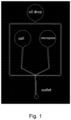
- a surface protective film of a chip (as shown in Fig. 1 ) was torn off; and then the chip was placed in a chip slot region of a droplet generation apparatus (10 ⁇ Genomics).
- connection tube (the connection tube being in contact with the bottom of a collection tube) on a collection cover was inserted into an outlet of the chip.
- a 50 mL syringe was placed on a fixation frame, and a push rod was adjusted to an initial position; and a plain end needle was connected to the syringe and an End B of a connection tube (the connection tube being not in contact with the bottom of the collection tube) on the cover of the collection tube.
- the cells are well mixed by gently blowing with a pipette; and 100 ⁇ L of the cell suspension prepared in step 1.3 was added to the cell wells of the chip, making sure that a pipette tip was in contact with the bottoms of the wells.
- the magnetic beads are well mixed by gently blowing with a pipette; and 100 ⁇ L of the magnetic beads was added to bead wells, making sure that the pipette tip was in contact with the bottoms of the wells.
- a filtering apparatus was connected to a vacuum pump; a pressure parameter was adjusted to 0.01 MPa or 100 mbar; and the vacuum pump was started.
- a filtering port of the filtering apparatus was sealed with the syringe or a rubber stopper.
- the centrifuge tube was removed from the magnetic separator, 100 ⁇ L of collected buffer was used to successively suspend and adsorb the magnetic beads on sides of the two centrifuge tubes, and liquid was transferred into a 0.2mL low-adsorption PCR tube.
- TSO adapter sequence SEQ ID NO : 1 : 5'- AAGCAGTGGTATCAACGCAGAGTACAT rGrG+G-3', wherein +G represents locked nucleic acid; and the reason for using rGrG+G was the better thermal stability of the hybridization of RNA with DNA.
- a reverse transcription reaction was performed according to the following conditions: 42 °C, 90 min, 10 cycles (50 °C, 2 min; 42 °C, 2 min), and a hot lid temperature being set to 75 °C. Due to the settlement phenomenon of the magnetic beads, the beads were flicked and well mixed at 20 min intervals, and after the beads were centrifuged briefly, the reaction was continued.
- PCR tube was removed from the magnetic separator, 200 ⁇ L of TE-SDS(TE Buffer+0.5%SDS) was added and shaken for well mixing, and then the reaction was terminated.
- the Tn primer (that is, the adapter amplification primer) was used to amplify from one terminal ligated to the magnetic beads, and a specific sequence thereof was: SEQ ID NO: 2: 5'-CGTAGCCATGTCGTTCTG-3'.
- the TSO primer was used to amplify from one terminal of the TSO adapter, and a specific sequence thereof was: SEQ ID NO: 3: 5'Phos-AAGCAGTGGTATCAACGCAGAGTACAT-3'.
- the TSO-random primer was used to amplify from any position at the 5' terminal of the cDNA to the 3' terminal, and a specific sequence thereof was: SEQ ID NO: 4: 5'phos-AAGCAGTGGTATCAACGCAGAGTACATNNNNNN-3'.
- the PCR was performed according to the following conditions: 95 °C, 3 min; 10-15 cycles (98°C, 20s; 58°C, 20s; 72°C, 3 min); 72°C, 5 min; 4°C, keeping the temperature.
- VAHTSTM DNA Clean Beads VAZYME: N411-03 (balancing being performed for 30 min at room temperature in advance) was used to purify and recycle a PCR product.
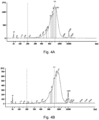
- the PCR purified product was quantified with a Qubit fluorimeter, and an Agilent 2100 biological analyzer was used for detecting the distribution of fragments (see Figs. 4A and 4B for a cell line sample and a solid tissue sample, respectively).
- a specific sequence of the splint oligo 1 (cyclization auxiliary sequence) is: SEQ ID NO: 5: 5'-TACCACTGCTT CGTAGCCATGT-3'.
- the well-prepared ligated product was added into a melted product, short-term vortex was performed for well mixing, brief centrifugation is performed, the PCR tube was placed on a PCR instrument, incubation was performed for 45 min at 37 °C, and the hot lid temperature was 75°C.
- Enzyme digestion termination after an enzyme digestion reaction was finished, 3 ⁇ L of a stop solution (0.1M EDTA) was added into the PCR tube, well mixing was performed, and brief centrifugation was performed to collect liquid to the bottom of the tube.
- a stop solution 0.1M EDTA
- the cyclized DNA product starting at 10-50 ng is taken, the volume was made up to 42 ⁇ L with NF-H 2 O; and 4 ⁇ L of a 20 ⁇ m poly(A) primer, 4 ⁇ L of the random primer (SEQ ID NO: 12: 5'-NNNNNN-3') and 50 ⁇ L of 2x KAPA HiFi Hotstart Ready mix were added.
- Such primers were able to perform amplification of fragments with different lengths on the cyclized products with different sizes, thus the full-length sequence of the cDNA was covered as much as possible.
- a specific sequence of the poly(A) primer was: SEQ ID NO: 6: 5'phos-AAAAAAAAAAAAAAAAAAAAAAAAAAAAAAAAAAAAAAAAAAAAAAAAAAAAAAAAAA-3'.
- the PCR was performed according to the following conditions: 95 °C, 3 min; 10-15 cycles (98 °C, 20s; 60 °C, 20s; 72 °C, 30s); 72 °C, 5 min; 4 °C, keeping the temperature.
- a cDNA concentration obtained in step 8.3 100-200 ng (about 0.1-0.2 pmol) of cDNA to be interrupted was taken into a new 0.2mL PCR tube, the volume should be less than or equal to 16 ⁇ L, and the part less than 16 ⁇ L was made up with H 2 O.
- a fragmentation reaction solution was prepared on ice according to the table below. Table 3 Component Volume System Fragmentation Buffer 2.0 ⁇ L 1X Fragmentation Enzyme 2.0 ⁇ L / Total 4.0 ⁇ L /
- the PCR tube was placed on the PCR instrument; the hot lid was set to 75°C; incubation was performed for 10 min at 37 °C; after the reaction was finished, 30 ⁇ L of 0.1M EDTA was added into the PCR tube, vortex shaking was performed for well mixing; and then the reaction was terminated.
- a specific sequence of the library adapter was:
- a specific sequence of the primer amplifying the adapter ligation product was:
- the well-prepared ligated product was added into a melted product, short-term vortex was performed for well mixing, brief centrifugation was performed, the PCR tube was placed on a PCR instrument, incubation was performed for 30min at 37 °C, and the hot lid temperature was 75 °C.
- preparation was performed according to a principal process shown in Fig. 2 , and specifically includes the following.
- the step of cDNA amplification includes the following.
- a cyclization process was the same as the steps of full-length RNA sequencing.
- the library constructed in Embodiment 2 was sequenced with a sequencer of an MGI sequencing platform; then the coverage of transcripts was analyzed by 5' terminal and 3' terminal sequencing fragments in sequencing data; and a specific result was shown in Fig. 8 .
- the lighter grayscale corresponded to the coverage of the 5' terminal and the darker grayscale corresponded to the coverage of the 3' terminal. It can be seen, from Fig. 8 , that, by means of the method of the present invention, information of the 5' terminal and the 3' terminal of the transcripts can be effectively captured.
Landscapes
- Chemical & Material Sciences (AREA)
- Life Sciences & Earth Sciences (AREA)
- Health & Medical Sciences (AREA)
- Organic Chemistry (AREA)
- Engineering & Computer Science (AREA)
- Genetics & Genomics (AREA)
- Zoology (AREA)
- Wood Science & Technology (AREA)
- Biotechnology (AREA)
- Bioinformatics & Cheminformatics (AREA)
- General Engineering & Computer Science (AREA)
- Molecular Biology (AREA)
- Biochemistry (AREA)
- Proteomics, Peptides & Aminoacids (AREA)
- General Health & Medical Sciences (AREA)
- Microbiology (AREA)
- Biophysics (AREA)
- Physics & Mathematics (AREA)
- Biomedical Technology (AREA)
- Analytical Chemistry (AREA)
- Immunology (AREA)
- Bioinformatics & Computational Biology (AREA)
- Crystallography & Structural Chemistry (AREA)
- Plant Pathology (AREA)
- Chemical Kinetics & Catalysis (AREA)
- General Chemical & Material Sciences (AREA)
- Medicinal Chemistry (AREA)
- Measuring Or Testing Involving Enzymes Or Micro-Organisms (AREA)
- Saccharide Compounds (AREA)
Applications Claiming Priority (1)
| Application Number | Priority Date | Filing Date | Title |
|---|---|---|---|
| PCT/CN2021/088984 WO2022222101A1 (fr) | 2021-04-22 | 2021-04-22 | Procédé de construction pour bibliothèque de séquençage d'arn, procédé de séquençage et kit |
Publications (2)
| Publication Number | Publication Date |
|---|---|
| EP4328362A1 true EP4328362A1 (fr) | 2024-02-28 |
| EP4328362A4 EP4328362A4 (fr) | 2024-07-31 |
Family
ID=83723555
Family Applications (1)
| Application Number | Title | Priority Date | Filing Date |
|---|---|---|---|
| EP21937340.4A Pending EP4328362A4 (fr) | 2021-04-22 | 2021-04-22 | Procédé de construction pour bibliothèque de séquençage d'arn, procédé de séquençage et kit |
Country Status (7)
| Country | Link |
|---|---|
| US (1) | US20240200057A1 (fr) |
| EP (1) | EP4328362A4 (fr) |
| JP (1) | JP7814411B2 (fr) |
| CN (1) | CN117178083A (fr) |
| AU (1) | AU2021442183B2 (fr) |
| CA (1) | CA3217523A1 (fr) |
| WO (1) | WO2022222101A1 (fr) |
Families Citing this family (4)
| Publication number | Priority date | Publication date | Assignee | Title |
|---|---|---|---|---|
| CN116497105B (zh) * | 2023-06-28 | 2023-09-29 | 浙江大学 | 基于末端转移酶的单细胞转录组测序试剂盒及测序方法 |
| WO2025043544A1 (fr) * | 2023-08-30 | 2025-03-06 | 深圳华大生命科学研究院 | Procédé de séquençage de répertoire immunitaire |
| CN120958140A (zh) * | 2023-11-10 | 2025-11-14 | 深圳华大生命科学研究院 | 一种构建空间转录组文库的方法 |
| CN117845339B (zh) * | 2024-01-09 | 2025-02-25 | 广西壮族自治区人民医院 | 一种用于检测与目标基因座相互作用的dna片段的文库构建方法 |
Family Cites Families (11)
| Publication number | Priority date | Publication date | Assignee | Title |
|---|---|---|---|---|
| US6903139B2 (en) * | 2002-11-19 | 2005-06-07 | Conocophillips Company | Production of synthesis gas from a feed stream comprising hydrogen |
| CN105985945B (zh) * | 2015-01-30 | 2019-04-23 | 深圳华大智造科技有限公司 | mRNA片段化方法及基于其构建测序文库的方法 |
| EP3274466A4 (fr) * | 2015-03-24 | 2018-11-21 | Sigma Aldrich Co. LLC | Amplification directionnelle d'arn |
| BR112017023257A2 (pt) * | 2015-04-29 | 2018-07-17 | Univ California | composições e métodos para construir bibliotecas de cdna de cadeias específicas |
| KR102475710B1 (ko) * | 2016-07-22 | 2022-12-08 | 오레곤 헬스 앤드 사이언스 유니버시티 | 단일 세포 전체 게놈 라이브러리 및 이의 제조를 위한 조합 인덱싱 방법 |
| CN110114472A (zh) * | 2016-12-21 | 2019-08-09 | 深圳华大智造科技有限公司 | 将线性测序文库转换为环状测序文库的方法 |
| CN109750086B (zh) * | 2017-11-06 | 2022-08-02 | 深圳华大智造科技股份有限公司 | 单链环状文库的构建方法 |
| CN109811045B (zh) * | 2017-11-22 | 2022-05-31 | 深圳华大智造科技股份有限公司 | 高通量的单细胞全长转录组测序文库的构建方法及其应用 |
| WO2019129133A1 (fr) * | 2017-12-28 | 2019-07-04 | 深圳华大智造科技有限公司 | Procédé d'obtention d'une séquence d'arnm à une seule cellule |
| CN110684829A (zh) * | 2018-07-05 | 2020-01-14 | 深圳华大智造科技有限公司 | 一种高通量的单细胞转录组测序方法和试剂盒 |
| CN112176422B (zh) * | 2020-10-19 | 2022-10-04 | 天津诺禾致源生物信息科技有限公司 | Rna文库的构建方法 |
-
2021
- 2021-04-22 JP JP2023564239A patent/JP7814411B2/ja active Active
- 2021-04-22 AU AU2021442183A patent/AU2021442183B2/en active Active
- 2021-04-22 CA CA3217523A patent/CA3217523A1/fr active Pending
- 2021-04-22 US US18/287,887 patent/US20240200057A1/en active Pending
- 2021-04-22 CN CN202180097147.5A patent/CN117178083A/zh active Pending
- 2021-04-22 WO PCT/CN2021/088984 patent/WO2022222101A1/fr not_active Ceased
- 2021-04-22 EP EP21937340.4A patent/EP4328362A4/fr active Pending
Also Published As
| Publication number | Publication date |
|---|---|
| JP2024521287A (ja) | 2024-05-31 |
| EP4328362A4 (fr) | 2024-07-31 |
| CN117178083A (zh) | 2023-12-05 |
| CA3217523A1 (fr) | 2022-10-27 |
| US20240200057A1 (en) | 2024-06-20 |
| WO2022222101A1 (fr) | 2022-10-27 |
| AU2021442183A1 (en) | 2023-12-07 |
| JP7814411B2 (ja) | 2026-02-16 |
| AU2021442183B2 (en) | 2025-09-11 |
Similar Documents
| Publication | Publication Date | Title |
|---|---|---|
| US20240200057A1 (en) | Method for Constructing RNA Sequencing Library, Sequencing Method and Kit | |
| EP4265723B1 (fr) | Réactifs et procédés pour codage à barres moléculaire d'acides nucléiques de cellules uniques | |
| CN113604545B (zh) | 一种超高通量单细胞染色质转座酶可及性测序方法 | |
| WO2023221842A1 (fr) | Procédé de séquençage à haut débit du transcriptome monocellulaire et son utilisation | |
| EP4095256A1 (fr) | Séquençage de cellule unique à base de microfluidique de gouttelettes et applications | |
| CN114507711B (zh) | 一种单细胞转录组测序方法及其应用 | |
| US20250154495A1 (en) | Construction Method and Sequencing Method for Single-Cell Transcriptome Sequencing Library and Kit for Preparing Single-Cell Transcriptome Library | |
| CN107893100A (zh) | 一种单细胞mRNA逆转录与扩增的方法 | |
| CN111801428B (zh) | 一种获得单细胞mRNA序列的方法 | |
| EP3848473A1 (fr) | Procédé pour la constitution d'une banque d'arn et kit spécialisé correspondant | |
| CN109750086B (zh) | 单链环状文库的构建方法 | |
| EP4484574A1 (fr) | Procédé de séquençage de transcriptome à cellule unique et son utilisation | |
| CN116949132A (zh) | 一种构建单细胞测序文库的方法 | |
| CN115873922B (zh) | 一种单细胞全长转录本建库测序方法 | |
| CN105986020B (zh) | 构建测序文库的方法及装置 | |
| CN118086457A (zh) | Dna文库的构建方法及应用 | |
| CN102409044A (zh) | 用于数字基因表达谱的标签及其使用方法 | |
| CN115948388A (zh) | 特异性捕获引物、靶向捕获探针组合物、靶向捕获文库的构建方法及应用 | |
| Shu et al. | SPARP-seq reveals poly (A) tail shortening as a hallmark of the active human translatome | |
| HK40117038A (en) | Single‑cell transcriptome sequencing method and use thereof | |
| WO2025185521A1 (fr) | Procédé de traitement d'échantillon de tissu et procédé de séquençage de transcriptome à haut rendement de structure subcellulaire à cellule unique | |
| HK40070111A (en) | Droplet microfluidics-based single cell sequencing and applications | |
| CN118272487A (zh) | 一种rna甲基化检测样本微量建库的方法 | |
| CN121046375A (zh) | 一种检测寡核苷酸池合成质量的单链寡核苷酸分子及方法 | |
| CN120591380A (zh) | 少量高效的特异因子介导的全基因组染色质互作检测技术_Solid ChIA-PET |
Legal Events
| Date | Code | Title | Description |
|---|---|---|---|
| STAA | Information on the status of an ep patent application or granted ep patent |
Free format text: STATUS: THE INTERNATIONAL PUBLICATION HAS BEEN MADE |
|
| PUAI | Public reference made under article 153(3) epc to a published international application that has entered the european phase |
Free format text: ORIGINAL CODE: 0009012 |
|
| STAA | Information on the status of an ep patent application or granted ep patent |
Free format text: STATUS: REQUEST FOR EXAMINATION WAS MADE |
|
| 17P | Request for examination filed |
Effective date: 20231121 |
|
| AK | Designated contracting states |
Kind code of ref document: A1 Designated state(s): AL AT BE BG CH CY CZ DE DK EE ES FI FR GB GR HR HU IE IS IT LI LT LU LV MC MK MT NL NO PL PT RO RS SE SI SK SM TR |
|
| A4 | Supplementary search report drawn up and despatched |
Effective date: 20240703 |
|
| DAV | Request for validation of the european patent (deleted) | ||
| DAX | Request for extension of the european patent (deleted) | ||
| RIC1 | Information provided on ipc code assigned before grant |
Ipc: C12N 15/10 20060101ALI20240627BHEP Ipc: C12Q 1/6806 20180101ALI20240627BHEP Ipc: C40B 50/06 20060101AFI20240627BHEP |