EP4326565B1 - Luftreifen - Google Patents
Luftreifen Download PDFInfo
- Publication number
- EP4326565B1 EP4326565B1 EP22722297.3A EP22722297A EP4326565B1 EP 4326565 B1 EP4326565 B1 EP 4326565B1 EP 22722297 A EP22722297 A EP 22722297A EP 4326565 B1 EP4326565 B1 EP 4326565B1
- Authority
- EP
- European Patent Office
- Prior art keywords
- elastomer
- layer
- axially outer
- elongation
- compound layer
- Prior art date
- Legal status (The legal status is an assumption and is not a legal conclusion. Google has not performed a legal analysis and makes no representation as to the accuracy of the status listed.)
- Active
Links
Images

Classifications
-
- B—PERFORMING OPERATIONS; TRANSPORTING
- B60—VEHICLES IN GENERAL
- B60C—VEHICLE TYRES; TYRE INFLATION; TYRE CHANGING; CONNECTING VALVES TO INFLATABLE ELASTIC BODIES IN GENERAL; DEVICES OR ARRANGEMENTS RELATED TO TYRES
- B60C9/00—Reinforcements or ply arrangement of pneumatic tyres
- B60C9/18—Structure or arrangement of belts or breakers, crown-reinforcing or cushioning layers
- B60C9/20—Structure or arrangement of belts or breakers, crown-reinforcing or cushioning layers built-up from rubberised plies each having all cords arranged substantially parallel
- B60C9/2003—Structure or arrangement of belts or breakers, crown-reinforcing or cushioning layers built-up from rubberised plies each having all cords arranged substantially parallel characterised by the materials of the belt cords
- B60C9/2006—Structure or arrangement of belts or breakers, crown-reinforcing or cushioning layers built-up from rubberised plies each having all cords arranged substantially parallel characterised by the materials of the belt cords consisting of steel cord plies only
-
- B—PERFORMING OPERATIONS; TRANSPORTING
- B60—VEHICLES IN GENERAL
- B60C—VEHICLE TYRES; TYRE INFLATION; TYRE CHANGING; CONNECTING VALVES TO INFLATABLE ELASTIC BODIES IN GENERAL; DEVICES OR ARRANGEMENTS RELATED TO TYRES
- B60C11/00—Tyre tread bands; Tread patterns; Anti-skid inserts
- B60C11/0041—Tyre tread bands; Tread patterns; Anti-skid inserts comprising different tread rubber layers
- B60C11/005—Tyre tread bands; Tread patterns; Anti-skid inserts comprising different tread rubber layers with cap and base layers
-
- B—PERFORMING OPERATIONS; TRANSPORTING
- B60—VEHICLES IN GENERAL
- B60C—VEHICLE TYRES; TYRE INFLATION; TYRE CHANGING; CONNECTING VALVES TO INFLATABLE ELASTIC BODIES IN GENERAL; DEVICES OR ARRANGEMENTS RELATED TO TYRES
- B60C11/00—Tyre tread bands; Tread patterns; Anti-skid inserts
- B60C11/0041—Tyre tread bands; Tread patterns; Anti-skid inserts comprising different tread rubber layers
- B60C11/005—Tyre tread bands; Tread patterns; Anti-skid inserts comprising different tread rubber layers with cap and base layers
- B60C11/0075—Tyre tread bands; Tread patterns; Anti-skid inserts comprising different tread rubber layers with cap and base layers with different base rubber layers in the axial direction
-
- B—PERFORMING OPERATIONS; TRANSPORTING
- B60—VEHICLES IN GENERAL
- B60C—VEHICLE TYRES; TYRE INFLATION; TYRE CHANGING; CONNECTING VALVES TO INFLATABLE ELASTIC BODIES IN GENERAL; DEVICES OR ARRANGEMENTS RELATED TO TYRES
- B60C9/00—Reinforcements or ply arrangement of pneumatic tyres
- B60C9/18—Structure or arrangement of belts or breakers, crown-reinforcing or cushioning layers
- B60C9/1835—Rubber strips or cushions at the belt edges
- B60C9/185—Rubber strips or cushions at the belt edges between adjacent or radially below the belt plies
-
- B—PERFORMING OPERATIONS; TRANSPORTING
- B60—VEHICLES IN GENERAL
- B60C—VEHICLE TYRES; TYRE INFLATION; TYRE CHANGING; CONNECTING VALVES TO INFLATABLE ELASTIC BODIES IN GENERAL; DEVICES OR ARRANGEMENTS RELATED TO TYRES
- B60C9/00—Reinforcements or ply arrangement of pneumatic tyres
- B60C9/02—Carcasses
- B60C2009/0269—Physical properties or dimensions of the carcass coating rubber
- B60C2009/0276—Modulus; Hardness; Loss modulus or "tangens delta"
-
- B—PERFORMING OPERATIONS; TRANSPORTING
- B60—VEHICLES IN GENERAL
- B60C—VEHICLE TYRES; TYRE INFLATION; TYRE CHANGING; CONNECTING VALVES TO INFLATABLE ELASTIC BODIES IN GENERAL; DEVICES OR ARRANGEMENTS RELATED TO TYRES
- B60C9/00—Reinforcements or ply arrangement of pneumatic tyres
- B60C9/18—Structure or arrangement of belts or breakers, crown-reinforcing or cushioning layers
- B60C9/1835—Rubber strips or cushions at the belt edges
- B60C2009/1857—Rubber strips or cushions at the belt edges radially above the belt plies
-
- B—PERFORMING OPERATIONS; TRANSPORTING
- B60—VEHICLES IN GENERAL
- B60C—VEHICLE TYRES; TYRE INFLATION; TYRE CHANGING; CONNECTING VALVES TO INFLATABLE ELASTIC BODIES IN GENERAL; DEVICES OR ARRANGEMENTS RELATED TO TYRES
- B60C9/00—Reinforcements or ply arrangement of pneumatic tyres
- B60C9/18—Structure or arrangement of belts or breakers, crown-reinforcing or cushioning layers
- B60C2009/1878—Structure or arrangement of belts or breakers, crown-reinforcing or cushioning layers with flat cushions or shear layers between the carcass and the belt
-
- B—PERFORMING OPERATIONS; TRANSPORTING
- B60—VEHICLES IN GENERAL
- B60C—VEHICLE TYRES; TYRE INFLATION; TYRE CHANGING; CONNECTING VALVES TO INFLATABLE ELASTIC BODIES IN GENERAL; DEVICES OR ARRANGEMENTS RELATED TO TYRES
- B60C9/00—Reinforcements or ply arrangement of pneumatic tyres
- B60C9/18—Structure or arrangement of belts or breakers, crown-reinforcing or cushioning layers
- B60C9/20—Structure or arrangement of belts or breakers, crown-reinforcing or cushioning layers built-up from rubberised plies each having all cords arranged substantially parallel
- B60C2009/2012—Structure or arrangement of belts or breakers, crown-reinforcing or cushioning layers built-up from rubberised plies each having all cords arranged substantially parallel with particular configuration of the belt cords in the respective belt layers
- B60C2009/2019—Structure or arrangement of belts or breakers, crown-reinforcing or cushioning layers built-up from rubberised plies each having all cords arranged substantially parallel with particular configuration of the belt cords in the respective belt layers comprising cords at an angle of 30 to 60 degrees to the circumferential direction
-
- B—PERFORMING OPERATIONS; TRANSPORTING
- B60—VEHICLES IN GENERAL
- B60C—VEHICLE TYRES; TYRE INFLATION; TYRE CHANGING; CONNECTING VALVES TO INFLATABLE ELASTIC BODIES IN GENERAL; DEVICES OR ARRANGEMENTS RELATED TO TYRES
- B60C9/00—Reinforcements or ply arrangement of pneumatic tyres
- B60C9/18—Structure or arrangement of belts or breakers, crown-reinforcing or cushioning layers
- B60C9/20—Structure or arrangement of belts or breakers, crown-reinforcing or cushioning layers built-up from rubberised plies each having all cords arranged substantially parallel
- B60C2009/2061—Physical properties or dimensions of the belt coating rubber
- B60C2009/2064—Modulus; Hardness; Loss modulus or "tangens delta"
-
- B—PERFORMING OPERATIONS; TRANSPORTING
- B60—VEHICLES IN GENERAL
- B60C—VEHICLE TYRES; TYRE INFLATION; TYRE CHANGING; CONNECTING VALVES TO INFLATABLE ELASTIC BODIES IN GENERAL; DEVICES OR ARRANGEMENTS RELATED TO TYRES
- B60C2200/00—Tyres specially adapted for particular applications
- B60C2200/06—Tyres specially adapted for particular applications for heavy duty vehicles
Definitions
- the present invention relates to a tire, with a radial carcass reinforcement and more particularly a tire intended to equip vehicles carrying heavy loads, such as, for example, trucks, tractors, trailers or road buses.
- the carcass reinforcement is anchored on both sides in the bead area and is surmounted radially by a crown reinforcement consisting of at least two layers, superimposed and formed of parallel wires or cables in each layer and crossed from one layer to the next, making angles of between 10° and 45° with the circumferential direction.
- Said working layers, forming the working reinforcement may also be covered with at least one so-called protective layer and formed of advantageously metallic and extensible reinforcement elements, called elastic.
- the triangulation ply may also comprise a layer of low-extensibility metal wires or cables forming an angle of between 45° and 90° with the circumferential direction, this ply, called the triangulation ply, being radially located between the carcass reinforcement and the first crown ply, called the working ply, formed of parallel wires or cables having angles at most equal to 45° in absolute value.
- the triangulation ply forms with at least said working ply a triangulated reinforcement, which, under the various stresses to which it is subjected, exhibits little deformation, the triangulation ply having the essential role of absorbing the transverse compression forces to which all the reinforcing elements are subjected in the area of the crown of the tire.
- Cables are said to be inextensible when said cables exhibit, under a tensile force equal to 10% of the breaking force, a relative elongation of at most 0.2%.
- Cables are said to be elastic when said cables exhibit, under a tensile force equal to the breaking load, a relative elongation at least equal to 3% with a maximum tangent modulus less than 150 GPa.
- the circumferential direction of the tire is the direction tangent to the periphery of the tire and defined by the rolling direction of the tire.
- the tire's axis of rotation is the axis around which it rotates during normal use.
- a radial or meridian plane is a plane that contains the tire's axis of rotation.
- the circumferential median plane is a plane perpendicular to the tire's axis of rotation and which divides the tire into two halves.
- the transverse or axial direction of the tire is parallel to the tire's axis of rotation. An axial distance is measured along the axial direction.
- the expression "axially inside, respectively axially outside” means "whose axial distance measured from the equatorial plane is less than, respectively greater than”.
- the radial direction is a direction intersecting the axis of rotation of the tire and perpendicular to it. A radial distance is measured in the radial direction.
- the expression "radially inward to, respectively radially outward to” means "whose radial distance measured from the axis of rotation of the tire is less than, respectively greater than”.
- the tread Radially outside the crown reinforcement is the tread, usually made of elastomeric materials intended to come into contact with the ground in the contact area between the ground and the tire.
- the tread that is to say the part of the tire intended to come into contact with the ground when rolling and to wear when rolling, with a sculpture formed of raised elements delimited by cutouts such as grooves, whether circumferential, transverse or oblique in orientation.
- the objective of such a sculpture is to give the tread good driving performance on dry roads and on water-covered roads, particularly in wet weather.
- incisions are distinguished from grooves in that the incisions have a width appropriate to allow at least partial contact during rolling between the facing walls delimiting these incisions and in particular during the passage into contact with the ground, which cannot be the case for grooves under normal conditions of use of the tire.
- a longitudinally oriented cutout is a cutout whose mean plane of at least part of the walls of said cutout forms an angle with a longitudinal plane of less than 10°. This angle formed with a longitudinal plane may be oriented in one direction or the other relative to said longitudinal plane.
- a longitudinally oriented cutout may also be a cutout whose walls undulate or zigzag around a mean plane as just described.
- a transversely oriented cutout is a cutout whose mean plane of at least part of the walls of said cutout forms an angle with a radial plane of less than 35°. This angle formed with a radial plane may be oriented in one direction or the other relative to said radial plane.
- a transversely oriented cutout may also be a cutout whose walls undulate or zigzag around a mean plane as just described.
- an obliquely oriented cutout is a cutout in which the mean plane of at least part of the walls of said cutout forms an angle with a radial plane of between 35° and 80°. This angle formed with a radial plane may be oriented in one direction or the other relative to said radial plane.
- a cutout of oblique orientation can still be a cutout whose walls undulate or zigzag around a mean plane as just described.
- road tires Some current tires, called “road tires,” are designed to travel at high speeds and over increasingly long distances, due to the improvement of the road network and the growth of the motorway network around the world.
- the set of conditions under which such a tire is called upon to travel allows for an increase in the number of kilometers traveled, with less wear on the tire.
- the tire and in particular the crown zone of the tire, located between its sidewalls, is thus made up of several polymeric mixtures reinforced or not by reinforcing elements, whether they are the layers forming the crown reinforcement, the carcass reinforcement, the layers forming the tread or even layers of mixtures in contact with one or the other already mentioned.
- the inventors set themselves the task of being able to provide tires with improved endurance performance and more specifically improved endurance properties of the crown zone of the tire, particularly when the latter is subjected to particularly severe constraints, particularly in terms of loads, pressure or temperature.
- a tire with a radial carcass reinforcement consisting of at least one layer of reinforcing elements inserted between two calendering layers, consisting of elastomeric mixtures
- said tire comprising a crown reinforcement consisting of at least one layer of reinforcing elements inserted between calendering layers consisting of elastomeric mixtures, itself radially capped with a tread joined to two beads by means of two sidewalls, said tread comprising cutouts forming at least one sculpture element, said tread comprising at least one first layer of axially continuous elastomeric mixture forming the rolling surface of the tire, at least one second layer of axially continuous elastomeric mixture being radially inside said at least one first layer, forming the radially innermost part of said tread and in contact with at least one calendering layer of at least one layer of reinforcing elements of the crown reinforcement, at least one third layer of axially continuous elastomeric mixture being in contact with a cal
- the secant modulus of elasticity at 10% elongation is the elastic modulus of the compound measured in a uniaxial tensile experiment at an elongation value of 0.1 (i.e. 10% elongation, expressed as a percentage).
- a constant uniaxial tensile speed is imposed on the specimen, and its elongation and stress are measured.
- the measurement is carried out using an INSTRON tensile testing machine at a temperature of 23°C and a relative humidity of 50% (ISO 23529 standard).
- the measurement conditions and the exploitation of the results to determine the elongation and stress are as described in standard NF ISO 37: 2012-03.
- the stress is determined for an elongation of 0.1 and the secant modulus of elasticity at 10% elongation is calculated as reporting this stress value to the elongation value.
- a person skilled in the art will know how to choose and adapt the dimensions of the test piece according to the quantity of mixture accessible and available, particularly in the case of taking samples from a finished product such as a tire.
- values of secant moduli of elasticity at 10% elongation are equal when their ratio is between 0.95 and 1.05; this ratio corresponds to taking into account the uncertainties linked to the measurement of secant moduli of elasticity at 10% elongation.
- the central part of said at least one second layer of elastomeric mixture and the central part of said at least one third layer of elastomeric mixture are centered on the equatorial plane.
- Said at least one second layer of elastomeric mixture advantageously forms a radially inner part of the tread, radially in contact with the radially outermost layer of the crown reinforcement.
- the inventors were able to demonstrate that the area of the crown of the tire comprising axially outer parts of the second layer of elastomeric mixture and axially outer parts of the third layer of elastomeric mixture having equal secant modulus of elasticity values at 10% elongation and said secant modulus of elasticity values at 10% elongation being lower than the secant modulus of elasticity values at 10% elongation of the other elastomeric mixtures of at least some of the layers with which they are in contact, allows for greater rolling than that permitted by tires of more usual design, without seeing any separation appear between the different mixtures, in particular when rolling under particularly severe conditions.
- the inventors have notably demonstrated that when the tire is subjected to severe constraints during rolling, the cracking phenomena appear mainly in the shoulder areas of the tire due in particular to the temperature rises in these areas and the strong deformations to which they are subjected during driving.
- the value of the secant modulus of elasticity at 10% elongation of said two axially outer parts of said at least one third layer of elastomeric mixture is at least 1.5 times lower than the value of the secant modulus of elasticity at 10% elongation of said calendering layer of said at least one layer of reinforcing elements of the carcass reinforcement.
- the elastomeric mixtures constituting said two axially outer parts of said at least one second layer of elastomeric mixture and said two axially outer parts of said at least one third layer of elastomeric mixture are elastomeric mixtures based on natural rubber or synthetic polyisoprene with a majority of cis-1,4 chains and optionally at least one other diene elastomer, the natural rubber or the synthetic polyisoprene in the case of blending being present at a majority rate compared to the rate of the other or other diene elastomers used and of a reinforcing filler, and preferably of the same nature(s).
- elastomeric mixtures based on elastomers of the same nature and in particular based on natural rubber or synthetic polyisoprene, present in the majority in the case of cutting is favorable to a better interpenetration of the mixtures in contact with each other on the one hand when raw and on the other hand after curing.
- the strength of the interface will be all the more resistant as the interpenetration of the mixtures concerned is made to a greater depth. Improving the strength of the interface from the moment the mixtures are combined, before cooking, helps to prevent air from being trapped at the interface as much as possible, as this is further reinforced during cooking.
- the elastomeric mixtures constituting said two axially outer parts of said at least one second layer of elastomeric mixture and said two axially outer parts of said at least one third layer of elastomeric mixture have the same elastomeric composition, that is to say the same elastomer(s) in the same proportions.
- the elastomeric mixtures constituting said two axially outer parts of said at least one second layer of elastomeric mixture and said two axially outer parts of said at least one third layer of elastomeric mixture are based on the same reinforcing filler.
- Such a choice of reinforcing fillers contributes to obtaining equal secant modulus of elasticity values at 10% elongation of said two axially outer parts of said at least one second layer of elastomeric mixture and said two axially outer parts of said at least one third layer of elastomeric mixture.
- the reinforcing filler rates of the elastomeric mixtures constituting said two axially outer parts of said at least one second layer of elastomeric mixture and said two axially outer parts of said at least one third layer of elastomeric mixture are substantially identical.
- the elastomeric mixtures constituting said two axially outer parts of said at least one second layer of elastomeric mixture and the elastomeric mixtures of said two axially outer parts of said at least one third layer of elastomeric mixture are identical.
- the value of the secant modulus of elasticity at 10% elongation of said two axially outer parts of said at least one second layer of elastomeric mixture is at least 1.3 times lower, and preferably at least 1.5 times lower than the value of the secant modulus of elasticity at 10% elongation of said at least one calendering layer of at least one layer of reinforcing elements of the crown reinforcement.
- the value of the secant modulus of elasticity at 10% elongation of said two axially outer parts of said at least one third layer of elastomeric mixture is advantageously at least 1.3 times lower, and preferably at least 1.5 times lower, than the value of the secant modulus of elasticity at 10% elongation of said at least one calendering layer of the radially innermost layer of reinforcing elements of the crown reinforcement.
- a gradient of rigidity of the mixtures appears, the least rigid mixtures being advantageously located axially furthest to the outside with respect to the mixtures with which they are in contact.
- Such arrangements of the elastomeric mixtures contribute to the good behavior of the interfaces between the different mixtures during the use of the tires in rolling whatever the conditions of use.
- the calendering layers of the layers of reinforcing elements of the crown reinforcement being made up of at least one central part and two axially external parts, the value of the secant modulus of elasticity at 10% elongation of said two axially external parts of said calendering layers of the layers of reinforcing elements of the crown reinforcement is at least 1.3 times lower, and preferably at least 1.5 times lower, than the value of the secant modulus of elasticity at 10% elongation of said at least one central part of said calendering layers of the layers of reinforcing elements of the crown reinforcement.
- the value of the secant modulus of elasticity at 10% elongation of said two axially external parts of said calendering layers of the layers of reinforcing elements of the crown reinforcement is equal to the value of the secant modulus of elasticity at 10% elongation of said two axially outer parts of said at least one second layer of elastomeric mixture and at the secant modulus of elasticity value at 10% elongation of said two axially outer parts of said at least one third layer of elastomeric mixture.
- the tire comprising at least a fourth layer of elastomeric mixture separating at least the ends of two layers of reinforcing elements of the crown reinforcement, the value of the secant modulus of elasticity at 10% elongation of said fourth layer of elastomeric mixture is less than or equal to the value of the secant modulus of elasticity at 10% elongation of the calendering layers of said two layers of reinforcing elements of the crown reinforcement.
- the value of the secant modulus of elasticity at 10% elongation of said fourth layer of elastomeric mixture is equal to the value of the secant modulus of elasticity at 10% elongation of said two axially outer parts of said at least one second layer of elastomeric mixture and to the value of the secant modulus of elasticity at 10% elongation of said two axially outer parts of said at least one third layer of elastomeric mixture.
- said at least one second layer of elastomeric mixture is made up of a single polymeric mixture.
- the axially outer parts and the central part of said at least one second layer are made up of the same and single elastomeric mixture.
- said at least one third layer of elastomeric mixture is made of a single polymeric mixture.
- the axially outer parts and the central part of said at least one third layer are made of the same and single elastomeric mixture.
- the invention advantageously provides that during the preparation of semi-finished products made up of non-reinforced elastomeric mixtures for the purpose of manufacturing a tire, several mixtures are coextruded to promote the strength of the interfaces, in particular when these have different secant modulus of elasticity values at 10% elongation.
- the crown reinforcement of the tire is formed from at least two working crown layers of reinforcing elements, preferably inextensible, crossed from one layer to the other making angles of between 10° and 45° with the circumferential direction.
- the crown reinforcement further comprises at least one layer of circumferential reinforcing elements.
- An embodiment of the invention also provides that the crown reinforcement is completed radially on the outside by at least one additional layer, called a protective layer, of so-called elastic reinforcing elements, oriented relative to the circumferential direction with an angle of between 10° and 45° and in the same direction as the angle formed by the inextensible elements of the working layer which is radially adjacent to it.
- a protective layer of so-called elastic reinforcing elements
- the crown reinforcement can also be supplemented, radially inside between the carcass reinforcement and the radially inner working layer closest to said carcass reinforcement, by a triangulation layer of inextensible metallic steel reinforcing elements making, with the circumferential direction, an angle greater than 60° and in the same direction as that of the angle formed by the reinforcing elements of the layer radially closest to the carcass reinforcement.
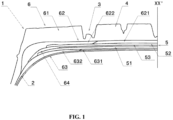
- the tire 1, of dimension 315/70R22.5 comprises a radial carcass reinforcement 2 anchored in two beads, around rods, not shown.
- the carcass reinforcement 2 is formed of a single layer of metal cables.
- the carcass reinforcement 2 is hooped by a crown reinforcement 5, itself capped with a tread 6.
- the tread comprises five grooves 3 forming six ribs 4.
- the axial width L 51 of the first working layer 51 is equal to 246 mm.
- the axial width L 52 of the second working layer 52 is equal to 228 mm.
- the axial width L 53 of the layer of circumferential reinforcing elements 53 it is equal to 200 mm.
- the tread 6 is made up of a first layer 61, made up of a first elastomeric mixture, radially external and which comes into contact with the ground when rolling.
- a second layer 62 consists of a central portion 621 and two axially outer portions 622.
- the central portion 621 consists of a second elastomeric mixture and the axially outer portions 622 consist of a third mixture.
- the axial width of the central part 621 of said second layer 62 is equal to 122 mm.
- the axial width of the central part 621 of said second layer 62 can vary and be greater or less than this value.
- the minimum distance between the parts 622 of the second layer 62 and the groove walls is equal to 2.5 mm.
- a third layer 63 is made up of a central portion 631 and two axially outer portions 632.
- the central portion 631 is made up of a fourth elastomeric mixture and the axially outer portions 632 are made up of a fifth elastomeric mixture.
- the axial width of the central part 631 of said third layer 63 is equal to 160 mm.
- the axial width of the central part 631 of said third layer 63 can vary and be greater or less than this value.
- the working layers 51 and 52 are decoupled at their ends by a layer 64 consisting of a sixth elastomeric mixture.
- the axially outer portions 632 form an interface with the axially outer portions 622.
- axially outer portions 622 and 632 of the layers 62 and 63 cannot be coextruded during the preparation of the semi-finished products since the working layers 51 and 52 are interposed between these axially outer portions 621 and 631.
- the tread can still be made up of several layers, an additional layer being radially interposed between the layer 61 and the layer 62, this also being coextruded with the mixtures previously listed.
- FIG. 2 illustrates another example of embodiment of a tire according to the invention.
- Tire 21 differs from tire 1 of the Figure 1 by a layer 62 consisting of a single part over its entire axial width. It is made of the same elastomeric mixture as the axially external parts 622 of the layer 62 of the tire 1 according to the Figure 1 .
- Tires were produced based on the different elastomeric compounds described below with their properties.
- the secant modulus of elasticity at 10% elongation of the mixtures is indicated under the name MA10 and expressed in MPa.
- a reference tire R produced according to a configuration corresponding to usual designs and corresponding substantially to the representations of the figures 1 And 2 and in which layers 62 and 63 are made in a single part over all their axial widths.
- Layer 62 of the tread is made with mixture A.
- Layer 63 is made with mixture B.
- a tire I1 in accordance with the invention as shown in the Figure 1 comprises a part 621 consisting of mixture A and a part 631 consisting of mixture B. Parts 622 and 632 consist of mixture D.
- a tire I2 conforming to the invention as shown in the Figure 2 comprises a part 631 made of mixture B.
- Layer 62 and parts 632 of layer 63 are made of mixture D.
- a tire I3 conforming to the invention as shown in the Figure 1 differs from tire I1 by a part 621 and a part 631 made of mixture C. Parts 622 and 632 are made of mixture D.
- layer 64 consists of compound C.
- An I4 tire in accordance with the invention as shown in the Figure 1 comprises a part 621 made of mixture A and a part 631 made of mixture B. Parts 622 and 632 as well as layer 64 are made of mixture D.
- the secant modulus of elasticity at 10% elongation of the calendering layers of the working layers 51, 52 is equal to 5.75 MPa.
- the secant modulus of elasticity at 10% elongation of the calendering layers of the carcass reinforcement layer 2 is equal to 9.8 MPa.
- the secant modulus of elasticity at 10% elongation of layer 61 forming the part of the tread which comes into contact with the ground is equal to 5.7 MPa.
- Tires I1, I2, I3 and I4 conforming to the invention are compared with reference tires R.
Landscapes
- Engineering & Computer Science (AREA)
- Mechanical Engineering (AREA)
- Tires In General (AREA)
- Compositions Of Macromolecular Compounds (AREA)
Claims (13)
- Reifen (1) mit einer Radialkarkassenverstärkung (2), die aus mindestens einer Lage aus Festigkeitselementen besteht, welche zwischen zwei Kalandrierlagen eingefügt sind, die aus Elastomermischungen bestehen, wobei der Reifen eine Gürtelverstärkung (5) beinhaltet, die aus mindestens einer Lage aus Festigkeitselementen besteht, welche zwischen zwei Kalandrierlagen eingefügt sind, die aus Elastomermischungen bestehen, die wiederum radial von einem Laufstreifen (6) überdeckt wird, der über zwei Flanken mit zwei Wülsten verbunden ist, wobei der Laufstreifen (6) Ausschnitte (3) umfasst, die mindestens ein Profilelement (4) bilden, wobei der Laufstreifen mindestens eine erste axial durchgehende Lage aus Elastomermischung (61) umfasst, die die Lauffläche des Reifens bildet, wobei mindestens eine zweite axial durchgehende Lage aus Elastomermischung (62) zu der mindestens einen ersten Lage (61) radial innen liegt, den radial innersten Teil des Laufstreifens bildet und mit mindestens einer Kalandrierlage mindestens einer Lage aus Festigkeitselementen (52) der Gürtelverstärkung (5) in Kontakt steht, wobei mindestens eine dritte axial durchgehende Lage aus Elastomermischung (63) mit einer Kalandrierlage der mindestens einen Lage aus Festigkeitselementen der Karkassenverstärkung (2) und mit einer Kalandrierlage der radial innersten Lage aus Festigkeitselementen (51) der Gürtelverstärkung (5) in Kontakt steht, wobei die mindestens eine zweite Lage aus Elastomermischung (62) aus mindestens einem mittleren Teil (621) und zwei axial äußeren Teilen (622) besteht, dadurch gekennzeichnet, dass der Abstand zwischen den zwei axial äußeren Teilen (622) der mindestens einen zweiten Lage aus Elastomermischung (62) und jedem Punkt der Oberfläche der Ausschnitte (3) größer als 1 mm ist, dass die mindestens eine dritte Lage aus Elastomermischung (63) aus mindestens einem mittleren Teil (631) und zwei axial äußeren Teilen (632) besteht, dass jeder der axial äußeren Teile (622) der mindestens einen zweiten Lage aus Elastomermischung (62) eine Kontaktfläche mit einem axial äußeren Teil (632) der mindestens einen dritten Lage aus Elastomermischung (63) aufweist, dass der Wert des Elastizitätssekantenmoduls bei 10 % Dehnung der zwei axial äußeren Teile (622) der mindestens einen zweiten Lage aus Elastomermischung (62) kleiner als oder gleich dem Wert des Elastizitätssekantenmoduls bei 10 % Dehnung der mindestens einen Kalandrierlage mindestens einer Lage aus Festigkeitselementen (53) der Gürtelverstärkung (5) ist, dass der Wert des Elastizitätssekantenmoduls bei 10 % Dehnung der zwei axial äußeren Teile (632) der mindestens einen dritten Lage aus Elastomermischung (63) mindestens um das 1,3-fache kleiner als der Wert des Elastizitätssekantenmoduls bei 10 % Dehnung der Kalandrierlage der mindestens einen Lage aus Festigkeitselementen der Karkassenverstärkung (2) und kleiner als oder gleich dem Wert des Elastizitätssekantenmoduls bei 10 % Dehnung der Kalandrierlage der radial innersten Lage aus Festigkeitselementen (51) der Gürtelverstärkung (5) ist und dass der Wert des Elastizitätssekantenmoduls bei 10 % Dehnung der zwei axial äußeren Teile (622) der mindestens einen zweiten Lage aus Elastomermischung (62) gleich dem Wert des Elastizitätssekantenmoduls bei 10 % Dehnung der zwei axial äußeren Teile (632) der mindestens einen dritten Lage aus Elastomermischung (63) ist.
- Reifen (1) nach Anspruch 1, dadurch gekennzeichnet, dass die Elastomermischungen, die die zwei axial äußeren Teile (622) der mindestens einen zweiten Lage aus Elastomermischung und die zwei axial äußeren Teile (632) der mindestens einen dritten Lage aus Elastomermischung bilden, Elastomermischungen auf Basis von Naturkautschuk oder synthetischem Polyisopren mit mehrheitlich cis-1,4-Verkettungen und gegebenenfalls mindestens einem weiteren Dienelastomer sind, wobei der Naturkautschuk oder das synthetische Polyisopren im Fall eines Verschnitts in Bezug auf den Anteil des oder der weiteren verwendeten Dienelastomere und eines verstärkenden Füllstoffs in einem mehrheitlichen Anteil vorhanden sind, und vorzugsweise gleicher Art sind.
- Reifen (1) nach Anspruch 2, dadurch gekennzeichnet, dass die Elastomermischungen, die die zwei axial äußeren Teile (622) der mindestens einen zweiten Lage aus Elastomermischung und die zwei axial äußeren Teile (632) der mindestens einen dritten Lage aus Elastomermischung bilden, auf Basis des gleichen verstärkenden Füllstoffs sind.
- Reifen (1) nach Anspruch 3, dadurch gekennzeichnet, dass die Anteile an verstärkendem Füllstoff der Elastomermischungen, die die zwei axial äußeren Teile (622) der mindestens einen zweiten Lage aus Elastomermischung und die zwei axial äußeren Teile (632) der mindestens einen dritten Lage aus Elastomermischung bilden, im Wesentlichen identisch sind.
- Reifen (1) nach einem der vorhergehenden Ansprüche, dadurch gekennzeichnet, dass die Elastomermischungen, die die zwei axial äußeren Teile der mindestens einen zweiten Lage aus Elastomermischung bilden, und die Elastomermischungen der zwei axial äußeren Teile der mindestens einen dritten Lage aus Elastomermischung identisch sind.
- Reifen (1) nach einem der vorhergehenden Ansprüche, dadurch gekennzeichnet, dass der Wert des Elastizitätssekantenmoduls bei 10 % Dehnung der zwei axial äußeren Teile (622) der mindestens einen zweiten Lage aus Elastomermischung mindestens um das 1,3-fache kleiner, und vorzugsweise mindestens um das 1,5-fache kleiner, als der Wert des Elastizitätssekantenmoduls bei 10 % Dehnung der mindestens einen Kalandrierlage mindestens einer Lage aus Festigkeitselementen (51, 53) der Gürtelverstärkung ist.
- Reifen (1) nach einem der vorhergehenden Ansprüche, dadurch gekennzeichnet, dass der Wert des Elastizitätssekantenmoduls bei 10 % Dehnung der zwei axial äußeren Teile (632) der mindestens einen dritten Lage aus Elastomermischung mindestens um das 1,3-fache kleiner, und vorzugsweise mindestens um das 1,5-fache kleiner, als der Wert des Elastizitätssekantenmoduls bei 10 % Dehnung der Kalandrierlage der radial innersten Lage aus Festigkeitselementen (51) der Gürtelverstärkung ist.
- Reifen (1) nach einem der Ansprüche 1 bis 5, dadurch gekennzeichnet, dass die Kalandrierlagen der Lagen aus Festigkeitselementen (51, 53) der Gürtelverstärkung aus mindestens einem mittleren Teil und zwei axial äußeren Teilen bestehen und dass der Wert des Elastizitätssekantenmoduls bei 10 % Dehnung der zwei axial äußeren Teile der Kalandrierlagen der Lagen aus Festigkeitselementen der Gürtelverstärkung mindestens um das 1,3-fache kleiner, und vorzugsweise mindestens um das 1,5-fache kleiner, als der Wert des Elastizitätssekantenmoduls bei 10 % Dehnung des mindestens einen mittleren Teils der Kalandrierlagen der Lagen aus Festigkeitselementen der Gürtelverstärkung ist.
- Reifen (1) nach Anspruch 8, dadurch gekennzeichnet, dass der Wert des Elastizitätssekantenmoduls bei 10 % Dehnung der zwei axial äußeren Teile der Kalandrierlagen der Lagen aus Festigkeitselementen der Gürtelverstärkung (51, 53) gleich dem Wert des Elastizitätssekantenmoduls bei 10 % Dehnung der zwei axial äußeren Teile (622) der mindestens einen zweiten Lage aus Elastomermischung und dem Wert des Elastizitätssekantenmoduls bei 10 % Dehnung der zwei axial äußeren Teile (632) der mindestens einen dritten Lage aus Elastomermischung ist.
- Reifen (1) nach einem der vorhergehenden Ansprüche, wobei der Reifen mindestens eine vierte Lage aus Elastomermischung (64) umfasst, die mindestens die Enden von zwei Lagen aus Festigkeitselementen (51, 53) der Gürtelverstärkung trennt, dadurch gekennzeichnet, dass der Wert des Elastizitätssekantenmoduls bei 10 % Dehnung der vierten Lage aus Elastomermischung (64) kleiner als oder gleich dem Wert des Elastizitätssekantenmoduls bei 10 % Dehnung der Kalandrierlagen der zwei Lagen aus Festigkeitselementen (51, 53) der Gürtelverstärkung ist.
- Reifen (1) nach Anspruch 10, dadurch gekennzeichnet, dass der Wert des Elastizitätssekantenmoduls bei 10 % Dehnung der vierten Lage aus Elastomermischung (64) gleich dem Wert des Elastizitätssekantenmoduls bei 10 % Dehnung der zwei axial äußeren Teile (622) der mindestens einen zweiten Lage aus Elastomermischung und dem Wert des Elastizitätssekantenmoduls bei 10 % Dehnung der zwei axial äußeren Teile (632) der mindestens einen dritten Lage aus Elastomermischung ist.
- Reifen (1) nach einem der vorhergehenden Ansprüche, dadurch gekennzeichnet, dass die mindestens eine zweite Lage aus Elastomermischung (62) aus einer einzigen Polymermischung besteht.
- Reifen (1) nach einem der vorhergehenden Ansprüche, dadurch gekennzeichnet, dass die mindestens eine dritte Lage aus Elastomermischung (63) aus einer einzigen Polymermischung besteht.
Applications Claiming Priority (2)
| Application Number | Priority Date | Filing Date | Title |
|---|---|---|---|
| FR2104232A FR3122117B1 (fr) | 2021-04-23 | 2021-04-23 | Pneumatique dont la zone du bourrelet presente des performances d’endurance ameliorees |
| PCT/FR2022/050685 WO2022223903A1 (fr) | 2021-04-23 | 2022-04-11 | Pneumatique |
Publications (2)
| Publication Number | Publication Date |
|---|---|
| EP4326565A1 EP4326565A1 (de) | 2024-02-28 |
| EP4326565B1 true EP4326565B1 (de) | 2025-06-04 |
Family
ID=76034861
Family Applications (1)
| Application Number | Title | Priority Date | Filing Date |
|---|---|---|---|
| EP22722297.3A Active EP4326565B1 (de) | 2021-04-23 | 2022-04-11 | Luftreifen |
Country Status (4)
| Country | Link |
|---|---|
| EP (1) | EP4326565B1 (de) |
| CA (1) | CA3212244A1 (de) |
| FR (1) | FR3122117B1 (de) |
| WO (1) | WO2022223903A1 (de) |
Family Cites Families (7)
| Publication number | Priority date | Publication date | Assignee | Title |
|---|---|---|---|---|
| EP0827845B1 (de) | 1996-09-03 | 2003-05-21 | Michelin Recherche Et Technique S.A. | Reifen mit einer Lauffläche aus zwei verschiedenen Gummizusammensetzungen zur Steuerung der Abnutzung |
| FR2774333B1 (fr) * | 1998-02-05 | 2000-03-03 | Michelin & Cie | Pneumatique a armature de sommet triangulee |
| ES2238242T3 (es) | 1999-11-23 | 2005-09-01 | Societe De Technologie Michelin | Aparato para la coextrusion de mezclas de caucho. |
| US8844595B2 (en) * | 2010-11-30 | 2014-09-30 | The Goodyear Tire & Rubber Company | Pneumatic tire with tread including tread base layer and tread blocks having two different rubber layers |
| FR3022838B1 (fr) * | 2014-06-26 | 2016-06-10 | Michelin & Cie | Pneumatique comportant une couche d'elements de renforcement circonferentiels |
| DE102015223929A1 (de) * | 2015-12-01 | 2017-06-01 | Continental Reifen Deutschland Gmbh | Nutzfahrzeugreifen |
| FR3094276B1 (fr) * | 2019-03-28 | 2021-02-26 | Michelin & Cie | Pneumatique présentant une couche d’armature de carcasse avec des propriétés d’endurance améliorées |
-
2021
- 2021-04-23 FR FR2104232A patent/FR3122117B1/fr active Active
-
2022
- 2022-04-11 CA CA3212244A patent/CA3212244A1/fr active Pending
- 2022-04-11 EP EP22722297.3A patent/EP4326565B1/de active Active
- 2022-04-11 WO PCT/FR2022/050685 patent/WO2022223903A1/fr not_active Ceased
Also Published As
| Publication number | Publication date |
|---|---|
| EP4326565A1 (de) | 2024-02-28 |
| CA3212244A1 (fr) | 2022-10-27 |
| FR3122117A1 (fr) | 2022-10-28 |
| FR3122117B1 (fr) | 2024-03-29 |
| WO2022223903A1 (fr) | 2022-10-27 |
Similar Documents
| Publication | Publication Date | Title |
|---|---|---|
| WO2022180325A1 (fr) | Pneumatique comportant une bande de roulement recreusable | |
| EP3592575B1 (de) | Reifen mit einer lauffläche aus mehreren elastomermischungen | |
| EP3160767A1 (de) | Reifen mit verbesserten dynamischen eigenschaften | |
| EP3390076B1 (de) | Reifen mit verbesserten abnutzungseigenschaften | |
| EP3390079B1 (de) | Reifen mit verbesserten abnutzungseigenschaften | |
| EP4326565B1 (de) | Luftreifen | |
| EP3390077B1 (de) | Reifen mit verbesserten abnutzungseigenschaften | |
| EP3390105B1 (de) | Reifen mit verbesserten abnutzungseigenschaften | |
| EP3390080B1 (de) | Reifen mit verbesserten abnutzungs- und rollwiderstandseigenschaften | |
| EP3655261B1 (de) | Reifen mit verbesserten abnutzungs- und rollwiderstandseigenschaften | |
| EP4065385B1 (de) | Reifen mit einer lauffläche aus mehreren elastomermischungen | |
| EP4065386B1 (de) | Reifen mit einer lauffläche aus mehreren elastomermischungen | |
| EP3390081B1 (de) | Reifen mit verbesserten abnutzungs- und rollwiderstandseigenschaften | |
| EP3390095B1 (de) | Reifen mit verbesserten abnutzungs- und rollwiderstandseigenschaften | |
| EP3390086B1 (de) | Reifen mit verbesserten abnutzungs- und rollwiderstandseigenschaften | |
| EP3390082B1 (de) | Reifen mit verbesserten abnutzungseigenschaften und verbessertem rollwiderstand | |
| EP3390096B1 (de) | Reifen mit verbesserten verschleisseigenschaften und verbessertem rollwiderstand | |
| WO2020200923A1 (fr) | Armature de sommet de pneumatique constituee de deux couches de sommet de travail | |
| EP3390078B1 (de) | Reifen mit verbesserten abnutzungseigenschaften | |
| CA3003081C (fr) | Pneumatique presentant des proprietes d'usure ameliorees | |
| EP3390088B1 (de) | Reifen mit verbesserten abnutzungs- und rollwiderstandseigenschaften | |
| EP3946971A1 (de) | Aus zwei arbeitenden gürtelschichten und einer schicht aus umlaufenden verstärkungselementen zusammengesetzte reifengürtelverstärkung |
Legal Events
| Date | Code | Title | Description |
|---|---|---|---|
| STAA | Information on the status of an ep patent application or granted ep patent |
Free format text: STATUS: UNKNOWN |
|
| STAA | Information on the status of an ep patent application or granted ep patent |
Free format text: STATUS: THE INTERNATIONAL PUBLICATION HAS BEEN MADE |
|
| PUAI | Public reference made under article 153(3) epc to a published international application that has entered the european phase |
Free format text: ORIGINAL CODE: 0009012 |
|
| STAA | Information on the status of an ep patent application or granted ep patent |
Free format text: STATUS: REQUEST FOR EXAMINATION WAS MADE |
|
| 17P | Request for examination filed |
Effective date: 20231123 |
|
| AK | Designated contracting states |
Kind code of ref document: A1 Designated state(s): AL AT BE BG CH CY CZ DE DK EE ES FI FR GB GR HR HU IE IS IT LI LT LU LV MC MK MT NL NO PL PT RO RS SE SI SK SM TR |
|
| DAV | Request for validation of the european patent (deleted) | ||
| DAX | Request for extension of the european patent (deleted) | ||
| GRAP | Despatch of communication of intention to grant a patent |
Free format text: ORIGINAL CODE: EPIDOSNIGR1 |
|
| STAA | Information on the status of an ep patent application or granted ep patent |
Free format text: STATUS: GRANT OF PATENT IS INTENDED |
|
| INTG | Intention to grant announced |
Effective date: 20241213 |
|
| GRAS | Grant fee paid |
Free format text: ORIGINAL CODE: EPIDOSNIGR3 |
|
| GRAA | (expected) grant |
Free format text: ORIGINAL CODE: 0009210 |
|
| STAA | Information on the status of an ep patent application or granted ep patent |
Free format text: STATUS: THE PATENT HAS BEEN GRANTED |
|
| AK | Designated contracting states |
Kind code of ref document: B1 Designated state(s): AL AT BE BG CH CY CZ DE DK EE ES FI FR GB GR HR HU IE IS IT LI LT LU LV MC MK MT NL NO PL PT RO RS SE SI SK SM TR |
|
| REG | Reference to a national code |
Ref country code: GB Ref legal event code: FG4D Free format text: NOT ENGLISH |
|
| REG | Reference to a national code |
Ref country code: CH Ref legal event code: EP |
|
| REG | Reference to a national code |
Ref country code: DE Ref legal event code: R096 Ref document number: 602022015520 Country of ref document: DE |
|
| REG | Reference to a national code |
Ref country code: IE Ref legal event code: FG4D Free format text: LANGUAGE OF EP DOCUMENT: FRENCH |
|
| REG | Reference to a national code |
Ref country code: NL Ref legal event code: MP Effective date: 20250604 |
|
| PG25 | Lapsed in a contracting state [announced via postgrant information from national office to epo] |
Ref country code: FI Free format text: LAPSE BECAUSE OF FAILURE TO SUBMIT A TRANSLATION OF THE DESCRIPTION OR TO PAY THE FEE WITHIN THE PRESCRIBED TIME-LIMIT Effective date: 20250604 Ref country code: ES Free format text: LAPSE BECAUSE OF FAILURE TO SUBMIT A TRANSLATION OF THE DESCRIPTION OR TO PAY THE FEE WITHIN THE PRESCRIBED TIME-LIMIT Effective date: 20250604 |
|
| REG | Reference to a national code |
Ref country code: LT Ref legal event code: MG9D |
|
| PG25 | Lapsed in a contracting state [announced via postgrant information from national office to epo] |
Ref country code: GR Free format text: LAPSE BECAUSE OF FAILURE TO SUBMIT A TRANSLATION OF THE DESCRIPTION OR TO PAY THE FEE WITHIN THE PRESCRIBED TIME-LIMIT Effective date: 20250905 Ref country code: NO Free format text: LAPSE BECAUSE OF FAILURE TO SUBMIT A TRANSLATION OF THE DESCRIPTION OR TO PAY THE FEE WITHIN THE PRESCRIBED TIME-LIMIT Effective date: 20250904 |
|
| PG25 | Lapsed in a contracting state [announced via postgrant information from national office to epo] |
Ref country code: PL Free format text: LAPSE BECAUSE OF FAILURE TO SUBMIT A TRANSLATION OF THE DESCRIPTION OR TO PAY THE FEE WITHIN THE PRESCRIBED TIME-LIMIT Effective date: 20250604 |
|
| PG25 | Lapsed in a contracting state [announced via postgrant information from national office to epo] |
Ref country code: BG Free format text: LAPSE BECAUSE OF FAILURE TO SUBMIT A TRANSLATION OF THE DESCRIPTION OR TO PAY THE FEE WITHIN THE PRESCRIBED TIME-LIMIT Effective date: 20250604 |
|
| PG25 | Lapsed in a contracting state [announced via postgrant information from national office to epo] |
Ref country code: HR Free format text: LAPSE BECAUSE OF FAILURE TO SUBMIT A TRANSLATION OF THE DESCRIPTION OR TO PAY THE FEE WITHIN THE PRESCRIBED TIME-LIMIT Effective date: 20250604 |
|
| PG25 | Lapsed in a contracting state [announced via postgrant information from national office to epo] |
Ref country code: RS Free format text: LAPSE BECAUSE OF FAILURE TO SUBMIT A TRANSLATION OF THE DESCRIPTION OR TO PAY THE FEE WITHIN THE PRESCRIBED TIME-LIMIT Effective date: 20250904 |
|
| PG25 | Lapsed in a contracting state [announced via postgrant information from national office to epo] |
Ref country code: LV Free format text: LAPSE BECAUSE OF FAILURE TO SUBMIT A TRANSLATION OF THE DESCRIPTION OR TO PAY THE FEE WITHIN THE PRESCRIBED TIME-LIMIT Effective date: 20250604 |
|
| PG25 | Lapsed in a contracting state [announced via postgrant information from national office to epo] |
Ref country code: NL Free format text: LAPSE BECAUSE OF FAILURE TO SUBMIT A TRANSLATION OF THE DESCRIPTION OR TO PAY THE FEE WITHIN THE PRESCRIBED TIME-LIMIT Effective date: 20250604 |
|
| PG25 | Lapsed in a contracting state [announced via postgrant information from national office to epo] |
Ref country code: PT Free format text: LAPSE BECAUSE OF FAILURE TO SUBMIT A TRANSLATION OF THE DESCRIPTION OR TO PAY THE FEE WITHIN THE PRESCRIBED TIME-LIMIT Effective date: 20251006 |
|
| REG | Reference to a national code |
Ref country code: AT Ref legal event code: MK05 Ref document number: 1800012 Country of ref document: AT Kind code of ref document: T Effective date: 20250604 |
|
| PG25 | Lapsed in a contracting state [announced via postgrant information from national office to epo] |
Ref country code: IS Free format text: LAPSE BECAUSE OF FAILURE TO SUBMIT A TRANSLATION OF THE DESCRIPTION OR TO PAY THE FEE WITHIN THE PRESCRIBED TIME-LIMIT Effective date: 20251004 |
|
| PG25 | Lapsed in a contracting state [announced via postgrant information from national office to epo] |
Ref country code: SM Free format text: LAPSE BECAUSE OF FAILURE TO SUBMIT A TRANSLATION OF THE DESCRIPTION OR TO PAY THE FEE WITHIN THE PRESCRIBED TIME-LIMIT Effective date: 20250604 Ref country code: AT Free format text: LAPSE BECAUSE OF FAILURE TO SUBMIT A TRANSLATION OF THE DESCRIPTION OR TO PAY THE FEE WITHIN THE PRESCRIBED TIME-LIMIT Effective date: 20250604 |
|
| PG25 | Lapsed in a contracting state [announced via postgrant information from national office to epo] |
Ref country code: CZ Free format text: LAPSE BECAUSE OF FAILURE TO SUBMIT A TRANSLATION OF THE DESCRIPTION OR TO PAY THE FEE WITHIN THE PRESCRIBED TIME-LIMIT Effective date: 20250604 |
|
| PG25 | Lapsed in a contracting state [announced via postgrant information from national office to epo] |
Ref country code: EE Free format text: LAPSE BECAUSE OF FAILURE TO SUBMIT A TRANSLATION OF THE DESCRIPTION OR TO PAY THE FEE WITHIN THE PRESCRIBED TIME-LIMIT Effective date: 20250604 |
|
| PG25 | Lapsed in a contracting state [announced via postgrant information from national office to epo] |
Ref country code: SK Free format text: LAPSE BECAUSE OF FAILURE TO SUBMIT A TRANSLATION OF THE DESCRIPTION OR TO PAY THE FEE WITHIN THE PRESCRIBED TIME-LIMIT Effective date: 20250604 |
|
| PG25 | Lapsed in a contracting state [announced via postgrant information from national office to epo] |
Ref country code: IT Free format text: LAPSE BECAUSE OF FAILURE TO SUBMIT A TRANSLATION OF THE DESCRIPTION OR TO PAY THE FEE WITHIN THE PRESCRIBED TIME-LIMIT Effective date: 20250604 |
|
| REG | Reference to a national code |
Ref country code: DE Ref legal event code: R097 Ref document number: 602022015520 Country of ref document: DE |
|
| PLBE | No opposition filed within time limit |
Free format text: ORIGINAL CODE: 0009261 |
|
| STAA | Information on the status of an ep patent application or granted ep patent |
Free format text: STATUS: NO OPPOSITION FILED WITHIN TIME LIMIT |
|
| PG25 | Lapsed in a contracting state [announced via postgrant information from national office to epo] |
Ref country code: DK Free format text: LAPSE BECAUSE OF FAILURE TO SUBMIT A TRANSLATION OF THE DESCRIPTION OR TO PAY THE FEE WITHIN THE PRESCRIBED TIME-LIMIT Effective date: 20250604 |
|
| REG | Reference to a national code |
Ref country code: CH Ref legal event code: L10 Free format text: ST27 STATUS EVENT CODE: U-0-0-L10-L00 (AS PROVIDED BY THE NATIONAL OFFICE) Effective date: 20260416 |