EP4324718A2 - System und verfahren zum sammeln und überwachen von partikelmaterial, das von schienenfahrzeugen während der bewegung entlang von eisenbahnschienen erzeugt wird - Google Patents
System und verfahren zum sammeln und überwachen von partikelmaterial, das von schienenfahrzeugen während der bewegung entlang von eisenbahnschienen erzeugt wird Download PDFInfo
- Publication number
- EP4324718A2 EP4324718A2 EP23191940.8A EP23191940A EP4324718A2 EP 4324718 A2 EP4324718 A2 EP 4324718A2 EP 23191940 A EP23191940 A EP 23191940A EP 4324718 A2 EP4324718 A2 EP 4324718A2
- Authority
- EP
- European Patent Office
- Prior art keywords
- particulate matter
- railway vehicle
- railway
- travels
- collecting
- Prior art date
- Legal status (The legal status is an assumption and is not a legal conclusion. Google has not performed a legal analysis and makes no representation as to the accuracy of the status listed.)
- Pending
Links
- 239000013618 particulate matter Substances 0.000 title claims abstract description 118
- 238000000034 method Methods 0.000 title claims abstract description 21
- 238000012544 monitoring process Methods 0.000 title claims abstract description 12
- 230000004888 barrier function Effects 0.000 claims description 9
- 239000002245 particle Substances 0.000 claims description 8
- 230000001939 inductive effect Effects 0.000 claims description 7
- 230000001133 acceleration Effects 0.000 claims description 6
- 238000012423 maintenance Methods 0.000 description 7
- 230000035699 permeability Effects 0.000 description 5
- 238000013528 artificial neural network Methods 0.000 description 4
- 230000008859 change Effects 0.000 description 4
- 230000002159 abnormal effect Effects 0.000 description 3
- 230000005284 excitation Effects 0.000 description 3
- 230000008569 process Effects 0.000 description 2
- 238000009423 ventilation Methods 0.000 description 2
- CWYNVVGOOAEACU-UHFFFAOYSA-N Fe2+ Chemical compound [Fe+2] CWYNVVGOOAEACU-UHFFFAOYSA-N 0.000 description 1
- 241000282414 Homo sapiens Species 0.000 description 1
- 238000009825 accumulation Methods 0.000 description 1
- 238000004378 air conditioning Methods 0.000 description 1
- 238000004364 calculation method Methods 0.000 description 1
- 239000011362 coarse particle Substances 0.000 description 1
- 239000000470 constituent Substances 0.000 description 1
- 238000010586 diagram Methods 0.000 description 1
- 238000009826 distribution Methods 0.000 description 1
- 230000007613 environmental effect Effects 0.000 description 1
- 238000003912 environmental pollution Methods 0.000 description 1
- 239000010419 fine particle Substances 0.000 description 1
- 238000010438 heat treatment Methods 0.000 description 1
- 238000004519 manufacturing process Methods 0.000 description 1
- 238000005259 measurement Methods 0.000 description 1
- 238000010297 mechanical methods and process Methods 0.000 description 1
- 230000005226 mechanical processes and functions Effects 0.000 description 1
- 229910052751 metal Inorganic materials 0.000 description 1
- 239000002184 metal Substances 0.000 description 1
- 150000002739 metals Chemical class 0.000 description 1
- 238000012986 modification Methods 0.000 description 1
- 230000004048 modification Effects 0.000 description 1
- 230000000737 periodic effect Effects 0.000 description 1
- 230000004044 response Effects 0.000 description 1
- 238000005070 sampling Methods 0.000 description 1
- 238000003860 storage Methods 0.000 description 1
- 239000000126 substance Substances 0.000 description 1
- 238000012549 training Methods 0.000 description 1
- 239000011882 ultra-fine particle Substances 0.000 description 1
Images

Classifications
-
- B—PERFORMING OPERATIONS; TRANSPORTING
- B61—RAILWAYS
- B61L—GUIDING RAILWAY TRAFFIC; ENSURING THE SAFETY OF RAILWAY TRAFFIC
- B61L15/00—Indicators provided on the vehicle or train for signalling purposes
- B61L15/0081—On-board diagnosis or maintenance
-
- G—PHYSICS
- G01—MEASURING; TESTING
- G01N—INVESTIGATING OR ANALYSING MATERIALS BY DETERMINING THEIR CHEMICAL OR PHYSICAL PROPERTIES
- G01N15/00—Investigating characteristics of particles; Investigating permeability, pore-volume or surface-area of porous materials
- G01N15/06—Investigating concentration of particle suspensions
- G01N15/0656—Investigating concentration of particle suspensions using electric, e.g. electrostatic methods or magnetic methods
Definitions
- the present invention relates to a system and a method for collecting and monitoring particulate matter produced by railway vehicles while travelling along railway tracks.
- the system and method according to the present invention is particularly suitable for being applied to subways lines, and it will be described hereinafter by making particular reference to such application, without intending in any way to limit their possible application to other types of railway lines, such as main railway lines, tramways, and the like.
- PM particulate matter
- railway vehicles can be considered as very environmental friendly means of transportation, in view of their inherent way of functioning, they are prone to produce particulate matter, in particular of metallic type and more precisely ferruginous particulate matter.
- ferruginous particles whose size distribution can vary from ultrafine to fine up to coarse particles, are produced predominantly by mechanical processes of sliding and wear at the contact interfaces between the rails of a track and the wheels of a railway vehicle, by electrical braking, and to a minor extent by high-temperature processes such as sparking.
- the particulate matter, and in particular the fine or ultra-fine metals constituents thereof, deposited and accumulated along the tracks and especially in subway tunnels, can spread over the platforms of the railway line, or can penetrate inside the convoys via heating, ventilation, and air-conditioning (HVAC) systems, and may even outflow via the ventilation system from tunnels into the cities.
- HVAC heating, ventilation, and air-conditioning
- the main aim of the present invention is to face this issue and to provide a solution capable of at least reducing the accumulation of particulate matter while monitoring at the same time the particulate matter produced by a railway vehicle while travelling along a track of a railway line.
- a system for collecting and monitoring particulate matter produced by a railway vehicle while travelling along a railway track the system being characterized in that it comprises at least:
- the above-mentioned aim of the present invention is also achieved by a method for collecting and monitoring particulate matter produced by a railway vehicle while travelling along a railway track, the method being characterized in that it comprises at least the following steps:
- each of the above listed terms means and encompasses electronic circuits or parts thereof, as well as stored, embedded or running software codes and/or routines, algorithms, or complete programs, suitably designed for achieving the technical result and/or the functional performances for which such means are devised.
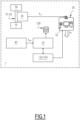
- Figure 1 illustrates schematically a system 1 for collecting and monitoring particulate matter ("PM") produced by a railway vehicle while travelling along a railway track.
- PM particulate matter
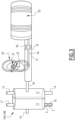
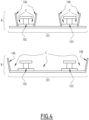
- FIG 2 An example of a railway vehicle is illustrated in figure 2 with the reference number 100, which is formed by three units or cars, and is represented while travelling, along the direction X, along a railway track 101 that comprises a left rail and a right rail, indicated in figure 4 by the reference numbers 102 and 103, respectively.
- railway vehicle 100 can be any suitable type of railway vehicles, such as a subway convoy, a mainline train, a tram, et cetera, and can be composed by any suitable number and type or units or cars.
- the system 1 according to the present invention comprises at least:
- the at least one electronic control unit 30 can comprise a single control unit or a plurality of electronic control units operatively lined to each other, , e.g. two, each unit comprising a processor or a processor-based device.
- a single control unit 30 it can be positioned on board of the railway vehicle or remotely therefrom, e.g. at a trackside remote control center or for example at a center for disposing out the collected particulate matter.
- the at least one control unit 30 is formed by or comprise two or more electronic units, one or more units can be positioned for instance on board of the railway vehicle, and one or more units can be installed at a trackside location.
- the at least one electronic control unit 30 comprises a server, hereinafter indicated as the server 30, which is positioned at a trackside location and includes database 32, which contains, among others, a copy of data stored in a trackside traction/brake database installed on board of the railway vehicle 100 and schematically indicated in figure 1 by the reference number 120.
- the system 100 comprises a further electronic control unit, indicated in figures 1 and 2 by the reference number 35, which is installed onboard of the railway vehicle 100.
- the at least one sensor 20 comprises or is constituted by a planar inductive coil which senses the change of magnetic permeability in response to the amount of wear emission of particulate matter. Depending on the change in the magnitude of the magnetic permeability, the level of concentration of particulate matter is measured.
- planar inductive coil 20 is configured to detect the magnetic permeability of the ferrous wear particles.
- the planar inductive coil 20 comprises two coils: an excitation coil 21 and a sensing coil 22.
- An excitation current is given to the excitation coil, and the inductance associated with the coil is measured on the sensing coil.
- the change in magnetic permeability due to the presence of ferrouginous particles can vary the inductance measured.
- L r 2 N 2 5 r + 7 d ⁇ 10 5 ⁇ ⁇ r
- ⁇ r is the relative magnetic permeability of the medium (for ferruginous particles about 20)
- r is the outer radius of the planar inductive coil
- d is the depth of the planar inductive coil
- N is the number of turns of the planar inductive coil 20.
- the momentary change in inductance can be measured, for example, using any suitable data acquisition card, e.g. a myRIO-1900 card manufactured by National Instruments, or any similar data acquisition card which has for example a very high sampling rate of 500 kHz.
- any suitable data acquisition card e.g. a myRIO-1900 card manufactured by National Instruments, or any similar data acquisition card which has for example a very high sampling rate of 500 kHz.
- the at least one sensor 20 is installed at a trackside location, e.g. at a disposal center or at a depot, as it will be described in more details hereinafter.
- the at least one sensor 20 or any additional sensor 20 can be positioned on board of the railway vehicle 100 to output in real time signals S C indicative of the level of concentration of particulate matter under collection, and especially of ferruginous particles.
- the at least one collecting tank 10 comprises a first storing chamber 12 for storing particulate matter produced in real time directly by the railway vehicle 100 itself during the one or more travels along the railway track 101, and a second storing chamber 13 for storing particulate matter previously deposited along the same railway track 101.
- the particulate matter previously deposited is formed by residual particulate matter produced by other railways vehicles or by the same railway vehicle 100 in previous travels, left along the track 101.
- first storing chamber 12 is provided with first and second inlets 14 15, and the second storing chamber 13 is provided with respective first and second inlets 16, 17, wherein the respective first inlets 14 and 16 can collect each particulate matter from an associated rail of the track 101, e.g. the left rail 102, while the respective second inlets 15, 17 can collect each particulate matter from the opposite rail of the track 101, e.g. the right rail 103.
- One or more of the inlets 14, 15, 16, 17, preferably each, is provided with an electromagnet and/or an air suction fan, schematically represented in figure 3 by the reference number 3 and 5 only for the inlet 16 for ease of illustration, arranged to push particulate matter to flow into and be collected inside the respective storing chamber 12 and 13.
- an electromagnet and/or an air suction fan schematically represented in figure 3 by the reference number 3 and 5 only for the inlet 16 for ease of illustration, arranged to push particulate matter to flow into and be collected inside the respective storing chamber 12 and 13.
- first storing chamber 12 is provided with a first outlet 18, and the second storing chamber 13 is provided with a corresponding second outlet 19, said outlets 18 and 19 being suitable for emptying, e.g. at a disposal center, the corresponding first and second storing chambers 12, 13 from the particulate matter therein collected.
- the at least one collecting tank 10 comprises a first collecting tank 10A and a second collecting tank 10B, which are for instance substantially identical to each other, and comprise each a respective first and second storing chambers 12 and 13 with the corresponding four inlets 13, 14, 15 and 16 and two outlets 18 and 19.
- the first tank 10A is suitable to be mounted at a back end part of the railway vehicle 100 and is adapted to be activated, for example by the electronic control unit 35 installed onboard of the railway vehicle 100, and collect in the first storing chamber 12 particulate matter produced in real time by the railway vehicle 100 itself along the railway track 101
- the second collecting tank 10B is suitable to be positioned at the front end part of the railway vehicle 100 and is arranged to be activated and collect, in the second storing chamber 13 the particulate matter previously deposited along the railway track 101.
- the system 1 further comprises one or more couples of side barriers 106 that are suitable to be installed along at least one portion of the railway track 101, the side barriers 106 being arranged to delimit one or more containment zones C for holding therein particulate matter to be collected.
- each rail 102 and 103 there are provided two corresponding side barriers 106; according to this embedment, the barriers 106 are positioned along the sides of and spaced apart from each rail 102, 103 of the railway track 101, with each couple of barriers 106 delimiting a respective containment area C.
- the system 1 further comprises at least one centralized disposal tank, indicated in figures 1 and 3 by the reference number 50, which comprises at least one inlet 52 adapted to be connected to a corresponding outlet 18 or 19 of the respective first or second storing chambers 12 or of 13 of each collecting tank to be emptied.
- system 1 further comprises at least one further electromagnet and an air suction fan, schematically indicated in figure 3 by the reference number 54 and 56, respectively, which are suitable to be positioned along the inlet 52 suitable to be connected to the outlet 18 or 19, directly, or via the interposition of a connecting conduit 51.
- the further electromagnet 54 and the air suction fan 56 are both arranged to cause flows of collected particulate matter previously collected, in particular coarse and fine or ultrafine particles, to flow from the respective first or second storing chambers 12, 13 into the centralized disposal tank 50.
- the at least one sensor 20 is suitable to positioned at the inlet 52 or along the conduit 51 to detect the level of concentration of particulate matter, in particular of ferruginous particles, in the flows of particulate matter collected in and flowing out from at least the first storing chamber 12 into the disposal tank 50.
- the system 1 comprises one or more devices, cumulatively indicated by the reference number 40 in figure 1 , which are suitable to be mounted onboard of the railway vehicle 100 and are adapted each to output signals S OP indicative of one or more corresponding operative parameters of the railway vehicle 100 during the one or more travels.
- the signals S OP provided by the or each device 40 are supplied for instance to the electronic control unit 35 installed on onboard of the railway vehicle 100.
- the electronic control unit 35 processes the signals received, thus calculating values related to the corresponding operative parameters of the railway vehicle 100.
- the calculated values can be transmitted directly to the trackside electronic control unit 30 where they can be stored and used, or they can be stored in the database 120 onboard of the railway vehicle, and the server 30 can host a copy of such database 120 which is timely updated.
- the database 120 can be further populated with other data, e.g. total distance travelled, acceleration, et cetera.
- the signals S OP can be transmitted directly to and processed by the server 30 for calculating the values of the monitored operative parameters of the railway vehicle 100.
- the one or more devices 40 comprises at least one temperature sensor, indicated in figure by the reference number 42, which is adapted to detect, in a contactless manner and while the railway vehicle 100 travels along the railway track 101, values of the temperature of at least one wheel 41 of the railway vehicle 100 at a contact surface with one corresponding rail 102, 103 of the railway track 101 while the at least one collecting tank 10 or each of the first and second collecting tanks 10A, 10B is collecting particulate matter.
- the least one temperature sensor 42 comprises or is constituted by an infrared sensor.
- FIG 2 there are illustrated only two sensors 42 which are positioned at the front and back ends of the railway vehicle 100; clearly, it is possible to use a different number of sensors 42, e.g. one or more than two, suitably positioned along the railway vehicle 100.
- the one or more devices 40 comprises at least one three-axis accelerometer 44 which is configured to provide, for the at least one electronic control unit 30, signals indicative of at least one of the position, speed or acceleration of the railway vehicle 100 while the railway vehicle 100 travels along the railway track 101 while the at least one collecting tank 10 or each of the first and second collecting tanks 10A, 10B is collecting particulate matter.
- the onboard electronic control unit 35 (or alternatively directly the trackside control unit or server 30), based on the signals provided by the accelerometer 44, and using a Kalman filter, can estimate the movement of the railway vehicle 100, such as the distance travelled, its speed, and its acceleration.
- a constant acceleration model can be used to propagate the states from one instant to another instant.
- the at least one electronic control unit 30 is further configured to calculate a predicted value of particulate matter S P that can be produced by the railway vehicle 100 in a future travel, along a track of a railway line, e.g. the same track 101 or any other, based on at least:
- Data received and/or calculated by the electronic control unit 30 are stored in its trackside database 32.
- the onboard traction/brake application database 120 stores data selected from the group comprising data related but not limiting to: identification data (ID) of the railway vehicle 100, time stamps, values of the temperatures of the wheel(s) as measured via the temperature sensor 42, speed of the railway vehicle as measured via the accelerometer 44 and the Kalman filter, load of the railway vehicle as provided by brake control electronics (BCE) 122, traction/braking effort achieved at the railway vehicle as provided from propulsion control electronics (PCE/BCE) 124.
- ID identification data
- BCE brake control electronics
- PCE/BCE propulsion control electronics
- the database 32 stores, for each monitored railway vehicle, like the vehicle 100, data selected from the group comprising data related but not limiting to: identification data (ID) of each railway vehicle for which the produced and collected particulate matter has been monitored via the at least one sensor 20; number of hours in various wheel temperature ranges (e.g. from 0°C to 50°C, from °50C to 100°C, from 100°C to 150°C, et cetera), as calculated in the respective onboard traction/brake application database 120; number of hours across multiple speed ranges (e.g.
- ID identification data
- the above data can be stored in two or more different databases.
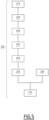
- Figure 5 illustrates a method 200 for collecting and monitoring particulate matter (PM) produced by a railway vehicle while travelling along a railway track 101, which can be carried out for example in connection with and by the components of the system 1, and can execute all steps necessary to carry out the functionalities devised for the system 1 within the frame of the present invention.
- PM particulate matter
- the method 200 comprises at least the following steps:
- the step of collecting 210 comprises,
- the method 200 further comprises:
- the method 200 conveniently further comprises: 260: providing, by means of one or more devices 40 which are suitable to be mounted onboard of the railway vehicle 100, e.g. the previously mentioned temperature sensor 42 and accelerometer 44, signals indicative of values of one or more corresponding operative parameters of the railway vehicle (100) during the one or more travels.
- such signals are indicative for example at least of the temperature at the wheel-rail contact interface and/or the speed of the railway vehicle 100.
- the method 200 further comprises: 270: calculating, by means of the at least one electronic control unit 30, a predicted value of particulate matter S P that can be produced by the railway vehicle 100 in a future travel along a track of a railway line, based on at least:
- the first and second tanks 10A and 10B are selectively activated, i.e. the one 10B at the front end of the railway vehicle to collect in its second storing chamber 13 only the residual particulate matter previously deposited along the track 101, while the other one, i.e. the tank 10A at the back end of the railway vehicle 100, collects in its first storing chamber 12 the wear particulate produced in real by the railway vehicle 100 itself during the travel.
- both collecting tanks 10A and 10B will be always active to collect wear PM irrespective of the travel direction; clearly one storing chamber of each tank will collect only residual PM previously deposited which can be disposed out without the strict need of being monitored for the sake of evaluating the wear of a specific railway vehicle since it cannot be linked to any specific railway vehicle.
- the PM collected in the other chamber can be monitored via the sensor 20, directly in real time or when the relevant tank is emptied.
- relevant data such as the data of wheels temperature, train speed, trainload (from BCE), traction/braking effort achieved (from PCE/BCE) are measured and entered into the onboard traction/brake application database 120.
- the particulate collected, and in particular the one collected into the first storing chamber 12, i.e. that produced directly by the railway vehicle itself during the one or more travels, is analysed via the sensor 20 and the electronic control unit 30, thus determining the level of concentration of particulate matter produced, and in particular of ferruginous particulate matter.
- this phase can be executed when the collecting tank(s) are connected to and emptied into the centralized tank 50.
- all data from different trains are preferably normalized with reference for instance to a standard or reference vehicle.
- Another vehicle with six cars would have forty-eight wheels.
- the normalized measurement of the sensor 20 for an actual vehicle relative to the "reference vehicle” would be equal in the above example to the actual measured level of concentration concentration*(32/48).
- the expected concentration in a next travel or for a predetermined future service time can be predicted using for example a Neural Network based prediction model running in the server 30, based on historical data related to wheel temperature, speed and/or acceleration of the vehicle, its load, traction/braking effort achieved.
- the inputs to the neural network can be one or more of:
- the electronic cotrol unit 30 outputs a signal indicative of the predicted particulate matter S P that will be produced, due to the contact wheel(s)-rail(s), in the following travel or for a predetermined future service time.
- the weights of the neural network for the prediction of the particulate matter producible PM Concentration Prediction will be the output during the tuning phase.
- NN weights can be properly adjusted during a training and/or tuning phase so the error between the predicted PM concentration S P and measured PM concentration S C is minimal within a desired threshold.
- an abnormal wheel-rail contact wear rate This condition can be set as 'Category-1' for a certain duration. If this abnormal wear rate repeats for the specific vehicle for a longer period then Category is set as "0," and a signal for maintenance S M can be outputted so as to send such railway vehicle for a maintenance check of or intervention on its wheels.
- the wheel-rail contact wear rate can be derived, which can help to predict the right time for periodic maintenance.
- system 1 and method 200 according to the present invention allow achieving the intended aim since they allow not only to continuously clean tracks from particulate matter but also to monitor in real time continuously or at least periodically the particulate matter produced by each railway vehicle monitored.
- the system 1 and method 200 thus conceived are susceptible of modifications and variations, all of which are within the scope of the inventive concept as defined in particular by the appended claims;
- the electronic unit 30 and/or the onboard control unit 35 can constituted by, or comprise, any suitable processor-based device, e.g. a processor of a type commercially available, suitably programmed and provided to the extent necessary with circuitry, in order to perform the innovative functionalities devised for the system 1 and method 200 according to the present invention; each of the databases previously described can be further populated with other data, et cetera.
Landscapes
- Chemical & Material Sciences (AREA)
- Engineering & Computer Science (AREA)
- Health & Medical Sciences (AREA)
- General Health & Medical Sciences (AREA)
- Life Sciences & Earth Sciences (AREA)
- Mechanical Engineering (AREA)
- Dispersion Chemistry (AREA)
- Physics & Mathematics (AREA)
- Biomedical Technology (AREA)
- Analytical Chemistry (AREA)
- Biochemistry (AREA)
- General Physics & Mathematics (AREA)
- Immunology (AREA)
- Pathology (AREA)
- Electric Propulsion And Braking For Vehicles (AREA)
- Sampling And Sample Adjustment (AREA)
Applications Claiming Priority (1)
| Application Number | Priority Date | Filing Date | Title |
|---|---|---|---|
| IN202241047105 | 2022-08-18 |
Publications (2)
| Publication Number | Publication Date |
|---|---|
| EP4324718A2 true EP4324718A2 (de) | 2024-02-21 |
| EP4324718A3 EP4324718A3 (de) | 2024-03-13 |
Family
ID=87695944
Family Applications (1)
| Application Number | Title | Priority Date | Filing Date |
|---|---|---|---|
| EP23191940.8A Pending EP4324718A3 (de) | 2022-08-18 | 2023-08-17 | System und verfahren zum sammeln und überwachen von partikelmaterial, das von schienenfahrzeugen während der bewegung entlang von eisenbahnschienen erzeugt wird |
Country Status (1)
| Country | Link |
|---|---|
| EP (1) | EP4324718A3 (de) |
Family Cites Families (2)
| Publication number | Priority date | Publication date | Assignee | Title |
|---|---|---|---|---|
| CN110333325B (zh) * | 2019-08-02 | 2021-09-17 | 中南大学 | 一种大气污染环境下列车运行防护方法及系统 |
| ES2974765T3 (es) * | 2019-11-19 | 2024-07-01 | Alstom Holdings | Sistema, método y vehículo ferroviario para monitorizar un sistema de tercer carril de una línea ferroviaria |
-
2023
- 2023-08-17 EP EP23191940.8A patent/EP4324718A3/de active Pending
Also Published As
| Publication number | Publication date |
|---|---|
| EP4324718A3 (de) | 2024-03-13 |
Similar Documents
| Publication | Publication Date | Title |
|---|---|---|
| EP1791748B1 (de) | Diagnose und zustandsmonitoring von weichen, kreuzungen oder kreuzungsweichen sowie schienenstössen durch ein schienenfahrzeug | |
| US8401720B2 (en) | System, method, and computer software code for detecting a physical defect along a mission route | |
| US11691655B2 (en) | Planning of maintenance of railway | |
| EP0836978B1 (de) | Verfahren und Vorrichtung zur Initialisierung eines automatisierten Zugsteuerungssystems | |
| CN102114856B (zh) | 用于检测机车的车钩是否已经联接到另外的有轨车厢的系统 | |
| US6668239B1 (en) | Track monitoring equipment | |
| US20100262321A1 (en) | System, Method and Computer Software Code for Optimizing Train Operations Considering Rail Car Parameters | |
| US9908545B2 (en) | Method and system for operating a vehicle system to reduce wheel and track wear | |
| WO2020002019A1 (en) | Smart sensor data transmission in railway infrastructure | |
| DE102019210884B4 (de) | Messanordnung sowie Verfahren zur Ermittlung einer Distanz zwischen einem an einem achsmontierten Getriebe eines schienengebundenen Fahrzeugs angeordneten Abstandssensor und einer Messnullfläche außerhalb des Getriebes im laufenden Betrieb | |
| WO2019185873A1 (en) | System and method for detecting and associating railway related data | |
| CN100482512C (zh) | 机车信号质量检测和报告系统及方法 | |
| DE102016116415A1 (de) | Vorrichtung und Verfahren zum Ermitteln des Zustands von Schienenwegen | |
| Lingamanaik et al. | Using instrumented revenue vehicles to inspect track integrity and rolling stock performance in a passenger network during peak times | |
| EP4324718A2 (de) | System und verfahren zum sammeln und überwachen von partikelmaterial, das von schienenfahrzeugen während der bewegung entlang von eisenbahnschienen erzeugt wird | |
| Fridell et al. | On-board measurements of particulate matter emissions from a passenger train | |
| Bracciali et al. | Effective wheel flats detection through a simple device | |
| WO2012007439A1 (de) | Überwachungssystem für einen schienengebundenen waren- oder personentransport in einem waggon | |
| ATE61978T1 (de) | Einrichtung zur gleisfreimeldung, zugortung und geschwindigkeitsmessung. | |
| RU2578620C1 (ru) | Автоматизированная диагностическая система контроля технического состояния элементов подвески объектов железнодорожного транспорта | |
| Schild et al. | Inertial sensing and mapping of railway track properties | |
| RU193429U1 (ru) | Устройство для определения положения колесных пар подвижного состава относительно прямолинейного рельсового пути | |
| Quiroga et al. | Railway systems | |
| RU213551U1 (ru) | Устройство для контроля геометрии пути | |
| DE102004015244B4 (de) | Verfahren und Vorrichtung zur Überwachung der Gleislagequalität |
Legal Events
| Date | Code | Title | Description |
|---|---|---|---|
| PUAI | Public reference made under article 153(3) epc to a published international application that has entered the european phase |
Free format text: ORIGINAL CODE: 0009012 |
|
| STAA | Information on the status of an ep patent application or granted ep patent |
Free format text: STATUS: THE APPLICATION HAS BEEN PUBLISHED |
|
| PUAL | Search report despatched |
Free format text: ORIGINAL CODE: 0009013 |
|
| AK | Designated contracting states |
Kind code of ref document: A2 Designated state(s): AL AT BE BG CH CY CZ DE DK EE ES FI FR GB GR HR HU IE IS IT LI LT LU LV MC ME MK MT NL NO PL PT RO RS SE SI SK SM TR |
|
| AK | Designated contracting states |
Kind code of ref document: A3 Designated state(s): AL AT BE BG CH CY CZ DE DK EE ES FI FR GB GR HR HU IE IS IT LI LT LU LV MC ME MK MT NL NO PL PT RO RS SE SI SK SM TR |
|
| RIC1 | Information provided on ipc code assigned before grant |
Ipc: G01N 15/00 20240101ALI20240205BHEP Ipc: G01N 15/06 20240101ALI20240205BHEP Ipc: B61L 15/00 20060101AFI20240205BHEP |
|
| STAA | Information on the status of an ep patent application or granted ep patent |
Free format text: STATUS: REQUEST FOR EXAMINATION WAS MADE |
|
| 17P | Request for examination filed |
Effective date: 20240328 |
|
| RBV | Designated contracting states (corrected) |
Designated state(s): AL AT BE BG CH CY CZ DE DK EE ES FI FR GB GR HR HU IE IS IT LI LT LU LV MC ME MK MT NL NO PL PT RO RS SE SI SK SM TR |