EP4322245A2 - Negative elektrode für eine wiederaufladbare batterie und wiederaufladbare batterie damit - Google Patents
Negative elektrode für eine wiederaufladbare batterie und wiederaufladbare batterie damit Download PDFInfo
- Publication number
- EP4322245A2 EP4322245A2 EP23187340.7A EP23187340A EP4322245A2 EP 4322245 A2 EP4322245 A2 EP 4322245A2 EP 23187340 A EP23187340 A EP 23187340A EP 4322245 A2 EP4322245 A2 EP 4322245A2
- Authority
- EP
- European Patent Office
- Prior art keywords
- negative electrode
- rechargeable battery
- holes
- metal substrate
- layer
- Prior art date
- Legal status (The legal status is an assumption and is not a legal conclusion. Google has not performed a legal analysis and makes no representation as to the accuracy of the status listed.)
- Pending
Links
Images



Classifications
-
- H—ELECTRICITY
- H01—ELECTRIC ELEMENTS
- H01M—PROCESSES OR MEANS, e.g. BATTERIES, FOR THE DIRECT CONVERSION OF CHEMICAL ENERGY INTO ELECTRICAL ENERGY
- H01M4/00—Electrodes
- H01M4/02—Electrodes composed of, or comprising, active material
- H01M4/64—Carriers or collectors
- H01M4/66—Selection of materials
- H01M4/661—Metal or alloys, e.g. alloy coatings
-
- H—ELECTRICITY
- H01—ELECTRIC ELEMENTS
- H01M—PROCESSES OR MEANS, e.g. BATTERIES, FOR THE DIRECT CONVERSION OF CHEMICAL ENERGY INTO ELECTRICAL ENERGY
- H01M10/00—Secondary cells; Manufacture thereof
- H01M10/05—Accumulators with non-aqueous electrolyte
- H01M10/056—Accumulators with non-aqueous electrolyte characterised by the materials used as electrolytes, e.g. mixed inorganic/organic electrolytes
- H01M10/0564—Accumulators with non-aqueous electrolyte characterised by the materials used as electrolytes, e.g. mixed inorganic/organic electrolytes the electrolyte being constituted of organic materials only
- H01M10/0565—Polymeric materials, e.g. gel-type or solid-type
-
- H—ELECTRICITY
- H01—ELECTRIC ELEMENTS
- H01M—PROCESSES OR MEANS, e.g. BATTERIES, FOR THE DIRECT CONVERSION OF CHEMICAL ENERGY INTO ELECTRICAL ENERGY
- H01M10/00—Secondary cells; Manufacture thereof
- H01M10/05—Accumulators with non-aqueous electrolyte
- H01M10/052—Li-accumulators
-
- H—ELECTRICITY
- H01—ELECTRIC ELEMENTS
- H01M—PROCESSES OR MEANS, e.g. BATTERIES, FOR THE DIRECT CONVERSION OF CHEMICAL ENERGY INTO ELECTRICAL ENERGY
- H01M10/00—Secondary cells; Manufacture thereof
- H01M10/05—Accumulators with non-aqueous electrolyte
- H01M10/052—Li-accumulators
- H01M10/0525—Rocking-chair batteries, i.e. batteries with lithium insertion or intercalation in both electrodes; Lithium-ion batteries
-
- H—ELECTRICITY
- H01—ELECTRIC ELEMENTS
- H01M—PROCESSES OR MEANS, e.g. BATTERIES, FOR THE DIRECT CONVERSION OF CHEMICAL ENERGY INTO ELECTRICAL ENERGY
- H01M10/00—Secondary cells; Manufacture thereof
- H01M10/05—Accumulators with non-aqueous electrolyte
- H01M10/056—Accumulators with non-aqueous electrolyte characterised by the materials used as electrolytes, e.g. mixed inorganic/organic electrolytes
- H01M10/0561—Accumulators with non-aqueous electrolyte characterised by the materials used as electrolytes, e.g. mixed inorganic/organic electrolytes the electrolyte being constituted of inorganic materials only
- H01M10/0562—Solid materials
-
- H—ELECTRICITY
- H01—ELECTRIC ELEMENTS
- H01M—PROCESSES OR MEANS, e.g. BATTERIES, FOR THE DIRECT CONVERSION OF CHEMICAL ENERGY INTO ELECTRICAL ENERGY
- H01M10/00—Secondary cells; Manufacture thereof
- H01M10/05—Accumulators with non-aqueous electrolyte
- H01M10/056—Accumulators with non-aqueous electrolyte characterised by the materials used as electrolytes, e.g. mixed inorganic/organic electrolytes
- H01M10/0561—Accumulators with non-aqueous electrolyte characterised by the materials used as electrolytes, e.g. mixed inorganic/organic electrolytes the electrolyte being constituted of inorganic materials only
- H01M10/0563—Liquid materials, e.g. for Li-SOCl2 cells
-
- H—ELECTRICITY
- H01—ELECTRIC ELEMENTS
- H01M—PROCESSES OR MEANS, e.g. BATTERIES, FOR THE DIRECT CONVERSION OF CHEMICAL ENERGY INTO ELECTRICAL ENERGY
- H01M10/00—Secondary cells; Manufacture thereof
- H01M10/05—Accumulators with non-aqueous electrolyte
- H01M10/056—Accumulators with non-aqueous electrolyte characterised by the materials used as electrolytes, e.g. mixed inorganic/organic electrolytes
- H01M10/0564—Accumulators with non-aqueous electrolyte characterised by the materials used as electrolytes, e.g. mixed inorganic/organic electrolytes the electrolyte being constituted of organic materials only
- H01M10/0566—Liquid materials
- H01M10/0569—Liquid materials characterised by the solvents
-
- H—ELECTRICITY
- H01—ELECTRIC ELEMENTS
- H01M—PROCESSES OR MEANS, e.g. BATTERIES, FOR THE DIRECT CONVERSION OF CHEMICAL ENERGY INTO ELECTRICAL ENERGY
- H01M10/00—Secondary cells; Manufacture thereof
- H01M10/05—Accumulators with non-aqueous electrolyte
- H01M10/058—Construction or manufacture
- H01M10/0585—Construction or manufacture of accumulators having only flat construction elements, i.e. flat positive electrodes, flat negative electrodes and flat separators
-
- H—ELECTRICITY
- H01—ELECTRIC ELEMENTS
- H01M—PROCESSES OR MEANS, e.g. BATTERIES, FOR THE DIRECT CONVERSION OF CHEMICAL ENERGY INTO ELECTRICAL ENERGY
- H01M4/00—Electrodes
- H01M4/02—Electrodes composed of, or comprising, active material
- H01M4/13—Electrodes for accumulators with non-aqueous electrolyte, e.g. for lithium-accumulators; Processes of manufacture thereof
-
- H—ELECTRICITY
- H01—ELECTRIC ELEMENTS
- H01M—PROCESSES OR MEANS, e.g. BATTERIES, FOR THE DIRECT CONVERSION OF CHEMICAL ENERGY INTO ELECTRICAL ENERGY
- H01M4/00—Electrodes
- H01M4/02—Electrodes composed of, or comprising, active material
- H01M4/13—Electrodes for accumulators with non-aqueous electrolyte, e.g. for lithium-accumulators; Processes of manufacture thereof
- H01M4/134—Electrodes based on metals, Si or alloys
-
- H—ELECTRICITY
- H01—ELECTRIC ELEMENTS
- H01M—PROCESSES OR MEANS, e.g. BATTERIES, FOR THE DIRECT CONVERSION OF CHEMICAL ENERGY INTO ELECTRICAL ENERGY
- H01M4/00—Electrodes
- H01M4/02—Electrodes composed of, or comprising, active material
- H01M4/36—Selection of substances as active materials, active masses, active liquids
- H01M4/38—Selection of substances as active materials, active masses, active liquids of elements or alloys
- H01M4/46—Alloys based on magnesium or aluminium
- H01M4/463—Aluminium based
-
- H—ELECTRICITY
- H01—ELECTRIC ELEMENTS
- H01M—PROCESSES OR MEANS, e.g. BATTERIES, FOR THE DIRECT CONVERSION OF CHEMICAL ENERGY INTO ELECTRICAL ENERGY
- H01M4/00—Electrodes
- H01M4/02—Electrodes composed of, or comprising, active material
- H01M4/62—Selection of inactive substances as ingredients for active masses, e.g. binders, fillers
- H01M4/628—Inhibitors, e.g. gassing inhibitors, corrosion inhibitors
-
- H—ELECTRICITY
- H01—ELECTRIC ELEMENTS
- H01M—PROCESSES OR MEANS, e.g. BATTERIES, FOR THE DIRECT CONVERSION OF CHEMICAL ENERGY INTO ELECTRICAL ENERGY
- H01M4/00—Electrodes
- H01M4/02—Electrodes composed of, or comprising, active material
- H01M4/64—Carriers or collectors
- H01M4/66—Selection of materials
- H01M4/665—Composites
- H01M4/667—Composites in the form of layers, e.g. coatings
-
- H—ELECTRICITY
- H01—ELECTRIC ELEMENTS
- H01M—PROCESSES OR MEANS, e.g. BATTERIES, FOR THE DIRECT CONVERSION OF CHEMICAL ENERGY INTO ELECTRICAL ENERGY
- H01M4/00—Electrodes
- H01M4/02—Electrodes composed of, or comprising, active material
- H01M4/64—Carriers or collectors
- H01M4/70—Carriers or collectors characterised by shape or form
-
- H—ELECTRICITY
- H01—ELECTRIC ELEMENTS
- H01M—PROCESSES OR MEANS, e.g. BATTERIES, FOR THE DIRECT CONVERSION OF CHEMICAL ENERGY INTO ELECTRICAL ENERGY
- H01M10/00—Secondary cells; Manufacture thereof
- H01M10/05—Accumulators with non-aqueous electrolyte
- H01M10/056—Accumulators with non-aqueous electrolyte characterised by the materials used as electrolytes, e.g. mixed inorganic/organic electrolytes
-
- H—ELECTRICITY
- H01—ELECTRIC ELEMENTS
- H01M—PROCESSES OR MEANS, e.g. BATTERIES, FOR THE DIRECT CONVERSION OF CHEMICAL ENERGY INTO ELECTRICAL ENERGY
- H01M4/00—Electrodes
- H01M4/02—Electrodes composed of, or comprising, active material
- H01M2004/021—Physical characteristics, e.g. porosity, surface area
-
- H—ELECTRICITY
- H01—ELECTRIC ELEMENTS
- H01M—PROCESSES OR MEANS, e.g. BATTERIES, FOR THE DIRECT CONVERSION OF CHEMICAL ENERGY INTO ELECTRICAL ENERGY
- H01M4/00—Electrodes
- H01M4/02—Electrodes composed of, or comprising, active material
- H01M2004/026—Electrodes composed of, or comprising, active material characterised by the polarity
- H01M2004/027—Negative electrodes
-
- H—ELECTRICITY
- H01—ELECTRIC ELEMENTS
- H01M—PROCESSES OR MEANS, e.g. BATTERIES, FOR THE DIRECT CONVERSION OF CHEMICAL ENERGY INTO ELECTRICAL ENERGY
- H01M2300/00—Electrolytes
- H01M2300/0017—Non-aqueous electrolytes
- H01M2300/0025—Organic electrolyte
- H01M2300/0028—Organic electrolyte characterised by the solvent
-
- H—ELECTRICITY
- H01—ELECTRIC ELEMENTS
- H01M—PROCESSES OR MEANS, e.g. BATTERIES, FOR THE DIRECT CONVERSION OF CHEMICAL ENERGY INTO ELECTRICAL ENERGY
- H01M2300/00—Electrolytes
- H01M2300/0017—Non-aqueous electrolytes
- H01M2300/0025—Organic electrolyte
- H01M2300/0028—Organic electrolyte characterised by the solvent
- H01M2300/0034—Fluorinated solvents
-
- H—ELECTRICITY
- H01—ELECTRIC ELEMENTS
- H01M—PROCESSES OR MEANS, e.g. BATTERIES, FOR THE DIRECT CONVERSION OF CHEMICAL ENERGY INTO ELECTRICAL ENERGY
- H01M2300/00—Electrolytes
- H01M2300/0017—Non-aqueous electrolytes
- H01M2300/0065—Solid electrolytes
- H01M2300/0068—Solid electrolytes inorganic
- H01M2300/0071—Oxides
-
- H—ELECTRICITY
- H01—ELECTRIC ELEMENTS
- H01M—PROCESSES OR MEANS, e.g. BATTERIES, FOR THE DIRECT CONVERSION OF CHEMICAL ENERGY INTO ELECTRICAL ENERGY
- H01M2300/00—Electrolytes
- H01M2300/0017—Non-aqueous electrolytes
- H01M2300/0065—Solid electrolytes
- H01M2300/0068—Solid electrolytes inorganic
- H01M2300/008—Halides
-
- H—ELECTRICITY
- H01—ELECTRIC ELEMENTS
- H01M—PROCESSES OR MEANS, e.g. BATTERIES, FOR THE DIRECT CONVERSION OF CHEMICAL ENERGY INTO ELECTRICAL ENERGY
- H01M2300/00—Electrolytes
- H01M2300/0017—Non-aqueous electrolytes
- H01M2300/0065—Solid electrolytes
- H01M2300/0082—Organic polymers
-
- H—ELECTRICITY
- H01—ELECTRIC ELEMENTS
- H01M—PROCESSES OR MEANS, e.g. BATTERIES, FOR THE DIRECT CONVERSION OF CHEMICAL ENERGY INTO ELECTRICAL ENERGY
- H01M2300/00—Electrolytes
- H01M2300/0088—Composites
- H01M2300/0094—Composites in the form of layered products, e.g. coatings
-
- Y—GENERAL TAGGING OF NEW TECHNOLOGICAL DEVELOPMENTS; GENERAL TAGGING OF CROSS-SECTIONAL TECHNOLOGIES SPANNING OVER SEVERAL SECTIONS OF THE IPC; TECHNICAL SUBJECTS COVERED BY FORMER USPC CROSS-REFERENCE ART COLLECTIONS [XRACs] AND DIGESTS
- Y02—TECHNOLOGIES OR APPLICATIONS FOR MITIGATION OR ADAPTATION AGAINST CLIMATE CHANGE
- Y02E—REDUCTION OF GREENHOUSE GAS [GHG] EMISSIONS, RELATED TO ENERGY GENERATION, TRANSMISSION OR DISTRIBUTION
- Y02E60/00—Enabling technologies; Technologies with a potential or indirect contribution to GHG emissions mitigation
- Y02E60/10—Energy storage using batteries
Definitions
- Embodiments relate to a negative electrode for a rechargeable battery and a rechargeable battery including the same.
- a lithium-ion battery may be used by increasing a Ni content in a positive electrode to 80 to 90% for high capacity, but considering theoretical capacity of a layered positive active material, 70% or more of lithium may be used, so a limit has already been reached in increasing specific capacity of a positive electrode.
- the embodiments may be realized by providing a negative electrode for a rechargeable battery, the negative electrode including a metal substrate including holes therein; a protective layer on the metal substrate, the protective layer including through holes therein overlying and in fluid communication with the holes in the metal substrate; and an electrolyte membrane including a liquid electrolyte layer and a solid electrolyte layer, the liquid electrolyte layer being in the holes and the solid electrolyte layer covering the protective layer and the through holes.
- a planar shape of each hole may be circular or polygonal.
- Each of the holes may include a plurality of smaller sub-holes.
- the liquid electrolyte layer may include a lithium salt dissolved in a solvent, the solvent including ethylene carbonate, ethyl methyl carbonate, dimethyl carbonate, propylene carbonate, or fluoroethylene carbonate.
- the solid electrolyte layer may include a polyethylene oxide, a lithium lanthanum zirconium oxide, or argyrodite Li 6 PS 5 Cl.
- the protective layer may include a polyimide, a polypropylene, a polyethylene, a polyethylene terephthalate, a polyvinylidene fluoride, or a phenylpropanolamine.
- the protective layer may have a thickness of 0.2 ⁇ m to 100 ⁇ m.
- the metal substrate may include aluminium.
- the metal substrate may further include copper such that a pair of aluminium layers sandwich a copper layer therebetween.
- the holes may be in the pair of aluminium layers.
- the holes may extend completely through the pair of aluminium layers to expose the copper layer.
- a thickness of the copper layer may be smaller than or equal to a thickness of each of the pair of aluminium layers.
- the embodiments may be realized by providing a rechargeable battery including the negative electrode according to an embodiment; and a positive electrode overlapping the negative electrode.
- the positive electrode may include an aluminium metal substrate, and an active material layer on the aluminium metal substrate.
- the rechargeable battery may further include a separator between the negative electrode and the positive electrode.
- FIG. 1 illustrates a schematic perspective view of a negative electrode for a rechargeable battery according to an embodiment
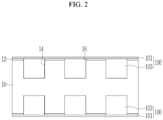
- FIG. 2 illustrates a cross-sectional view taken along line II-II of FIG. 1
- FIG. 3 and FIG. 4 illustrate schematic top plan views of holes included in a negative electrode for a rechargeable battery according to embodiments.
- a negative electrode for a rechargeable battery includes a metal substrate 10, a protective layer 12 on the metal substrate 10, holes 14 in the metal substrate 10, and an electrolyte membrane 100 covering (and in) the holes 14.
- the metal substrate 10 may be made of, e.g., aluminium, which is inexpensive and easy to process.
- the holes 14 may be in the metal substrate 10.
- a planar shape of the hole 14 e.g., a shape in a plan view
- the holes 14 may be formed as one, e.g., individually, with a desired size.
- each of the holes 14 may be divided into a plurality of smaller sub-holes 15.
- the size of each hole 14 may be determined according to a volume of Li x Al formed by reaction between aluminium of the metal substrate 10 and lithium of an electrolyte layer.
- a width (or diameter) D of each hole 14 may be, e.g., 0.5 ⁇ m to 2,000 ⁇ m, and an area thereof may be, e.g., 10% to 90% of an area of the metal substrate 10. If the area occupied by the holes 14 were to be less than 10%, capacity implementation could be small or an expansion volume could be large. If the area occupied by the holes 14 were to exceed 90%, structural safety of the substrate and an electrode plate could deteriorate.
- a depth of each hole 14 may be 1/2 or more of a thickness of the metal substrate 10. In an implementation, a depth of each hole 14 may be less than 1/2 the thickness of the metal substrate 10. In an implementation, the holes 14 may not pass all the way through the metal substrate 10.
- FIG. 5 and FIG. 6 illustrate drawings for explaining volume expansion of Li x Al according to an embodiment.
- the holes 14 are formed, even if volume expansion were to occur during generation of Li x Al 20, e.g., as shown in FIG. 5 and FIG. 6 , the volume expansion may be inside the holes 14, and it is possible to minimize a change in thickness of a battery cell due to the volume expansion.
- the holes 14 may be in the metal substrate 10 at uniform intervals and sizes, and it is possible to prevent non-uniform and abnormal stress from occurring.
- the holes 14 may be formed in the metal substrate, swelling force of a cell may be reduced or made uniform, and a structure of a module pack may be simplified and formed at a low cost.
- the holes 14 may be uniformly distributed and the stress may be controlled inside the holes, a lifespan may be improved, and an effect of improving resistance may be expected by removing unnecessary interfacial reaction and interfacial non-uniformity.
- the protective layer 12 may be made of or include a material that is chemically stable and is difficult to transmit lithium, e.g., polyimide (PI), polypropylene (PP), polyethylene (PE), polyethylene terephthalate (PET), polyvinylidene fluoride (PVDF), or phenylpropanolamine (PPA).
- the protective layer 12 may have a thickness of, e.g., 0.2 ⁇ m to 100 ⁇ m.
- the term "or” is not an exclusive term, e.g., "A or B" would include A, B, or A and B.
- the protective layer 12 may include through holes 16 therein.
- the through holes 16 may overlie and may be in fluid communication with the holes 14 (e.g., each through hole 16 in the protective layer 12 may overlie and be in fluid communication with one corresponding hole 14 in the metal substrate 10.
- planar shapes of the through holes 16 and the holes 14 may be the same.
- the electrolyte membrane 100 includes a liquid electrolyte layer 103 that fills the holes 14, and a solid electrolyte layer 101 that covers the holes 14, e.g., may be on the entire (outer) surface of the protective layer 12.
- the liquid electrolyte layer 103 may include a mixture in which a lithium salt is dissolved in a solvent.
- the solvent may include, e.g., ethylene carbonate (EC), ethyl methyl carbonate (EMC), dimethyl carbonate (DMC), propylene carbonate (PC), or fluoroethylene carbonate (FEC).
- the solid electrolyte layer 101 may include, e.g., a polymer material, a ceramic material, or a sulfide material.
- the solid electrolyte layer 101 may include, e.g., a polyethylene oxide (PEO), a lithium lanthanum zirconium oxide (LLZO), or argyrodite (Li 6 PS 5 Cl).
- the liquid electrolyte layer 103 may be in the holes 14.
- lithium in the electrolyte and aluminium which is a metal base material, may react to form the Li x Al 20 in the holes 14.
- the Li x Al may fill 0% to 100% of a volume of the holes 14. The volume expansion of the Li x Al may proceed into the hole 14 uniformly formed, and the volume expansion of the Li x Al may locally proceed, so that a phenomenon that causes cracks by being non-uniformly positioned or excessively protruding may not occur, so uniform charging and discharging may be performed.
- an unreacted liquid electrolyte may be pushed out of the holes 14 due to the volume expansion of the Li x Al, an amount thereof may not be large and the liquid electrolyte may be uniformly spread inside the battery cell due to capillary action, and cracks due to non-uniform protruding do not occur, so uniform charging and discharging may be performed.
- the solid electrolyte layer 101 may entirely cover the holes 14 and the protective layer 12, and may have a thickness of 1 ⁇ m to 200 ⁇ m. The solid electrolyte layer 101 may be in contact with the liquid electrolyte layer 103 exposed in the holes 14.
- the swelling phenomenon of the battery may not occur.
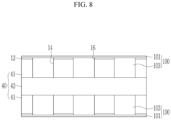
- FIG. 7 and FIG. 8 illustrate cross-sectional views of a negative electrode according to other embodiments.
- the negative electrode according to the other embodiments may be mostly the same as the negative electrode of FIG. 1 , and only other parts may be described in detail.
- the negative electrode shown in FIG. 7 may include a protective layer 12 on a metal substrate 30, holes 14 in the metal substrate 30, and an electrolyte membrane 100 covering (and filling) the holes 14.
- the electrolyte membrane 100 may include a liquid electrolyte layer 103 and a solid electrolyte layer 101.
- the metal substrate 30 may be formed by stacking a plurality of metal substrates, and may include an aluminium layer 31 and a copper layer 32.
- a pair of aluminium layers 31 may be at both sides of the copper layer 32 at the center (e.g., the copper layer 32 may be between the pair of aluminium layers 31. In an implementation, the aluminium layers 31 may contact the electrolyte membrane 100.
- the copper layer 32 may have the same thickness as a thickness of the aluminium layers 31, or may have a thinner thickness than the thickness of the aluminium layers 31.
- aluminium layers 41 and a copper layer 42 of a metal substrate 40 may each have the same thickness.
- holes 14 may pass (e.g., completely) through the aluminium layers 41, so that (e.g., a part of) the copper layer 42 may be exposed in the holes 14.
- the negative electrode according to the embodiment described above may be used in an electrode assembly, and hereinafter, an electrode assembly according to an embodiment will be described with reference to the drawings.
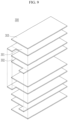
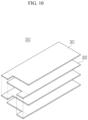
- FIG. 9 and FIG. 10 illustrate schematic drawings of an electrode assembly according to another embodiment.
- an electrode assembly 300 may be a stacked electrode assembly 300 in which a negative electrode 301 and a positive electrode 302 are repeatedly stacked with a separator 303 therebetween.
- the separator 303 may be a polymer film through which lithium ions may pass.
- the separator 303 may include, e.g., polyethylene, polypropylene, polyvinylidene fluoride, or a multifilm of two or more layers thereof, or a mixed multifilm such as a polyethylene/polypropylene double-layered separator, a polyethylene/polypropylene/polyethylene triple-layered separator, or a polypropylene/polyethylene/polypropylene triple-layered separator may be used as the separator 303.
- the negative electrode 301 may have the structure of the negative electrode shown in FIG. 1 , e.g., may include the metal substrate 10 made of aluminium, the protective layer 12 on the metal substrate 10, the holes 14 in the metal substrate 10, and the electrolyte membrane 100 covering the holes 14.
- the positive electrode 302 may include an electrode part in which an active material is coated to or on a current collector made of the metal substrate made of aluminium (Al), and an uncoated region in which the metal substrate is exposed because the active material is not coated.
- the active material of the positive electrode 302 may include, e.g., a compound (lithiated intercalation compound) capable of reversibly intercalating and deintercalating lithium ions.
- the active material of the positive electrode may include a composite oxide of lithium and a metal such as cobalt, manganese, nickel, or a combination thereof.
- a content of the active material of the positive electrode may be, e.g., 90 wt% to 98 wt%, based on a total weight of the active material layer of the positive electrode.
- the active material layer of the positive electrode may further include a binder and a conductive material.
- a content of each of the binder and the conductive material may be, e.g., 1 wt% to 5 wt%, based on the total weight of the active material layer of the positive electrode.
- the binder may help attach particles of the active material of the positive electrode to each other, and may help attach the active material of the positive electrode to the metal substrate that is a current collector well.
- the binder may include, e.g., polyvinyl alcohol, carboxy methyl cellulose, hydroxypropyl cellulose, diacetylcellulose, polyvinyl chloride, carboxylated polyvinyl chloride, polyvinylidene fluoride, a polymer containing ethylene oxide, polyvinyl pyrrolidone, polyurethane, polytetrafluoroethylene, polyvinylidene fluoride, polyethylene, polypropylene, styrene-butadiene rubber, acrylated styrene-butadiene rubber, epoxy resin, nylon, or the like.
- the conductive material may help give conductivity to the electrode, and may include a suitable material that does not trigger a chemical change in the configured battery.
- a plurality of uncoated regions of the positive electrode 302 and the negative electrode 301 may be electrically connected to the same polarity to be electrically connected to an external terminal.
- the uncoated region of the positive electrode 302 and the uncoated region of the negative electrode 301 may protrude in the same direction, or may protrude in opposite directions and be spaced apart from each other.
- the separator 303 may be larger than the negative electrode 301 and the positive electrode 302 to protrude further out than the negative electrode 301 and the positive electrode 302.
- the solid electrolyte layer may serve as a separator, the separator may be omitted, and the negative electrode 301 and the positive electrode 302 may be alternately stacked, as in the electrode assembly 310 of FIG. 10 .
- the electrode assemblies 300 and 310 may be accommodated in a pouch or can-shaped prismatic case to be used as a rechargeable battery.
- Energy density may be improved through improvement of positive and negative electrode active materials.
- expansion of a cell and increase in side reactions due to graphite Si contained in the active material could occur, cell performance may deteriorate and safety may be weakened, so it may not be easy to improve the energy density.
- Aluminium has a specific capacity five times higher than that of graphite, and is an ultra-low-cost material that may be easier to handle than lithium metal.
- an expansion rate thereof may be high like Si, so it may be difficult to handle volume change during charging and discharging, and cracks could occur and non-uniform charging may occur.
- One or more embodiments may provide a negative electrode for a rechargeable battery and a rechargeable battery including the same in which, while aluminium is used as a negative electrode material, cracks due to volume change during charging and discharging do not occur, and uniform charging and discharging are possible.
- the negative electrode according to the embodiment may help reduce a production cost of a rechargeable battery by using aluminium, which is easy to work with, as a metal base material.
- the stress during charging and discharging may be controlled due to a hole, a lifespan may be improved, and an effect of improving resistance may be expected by removing unnecessary interfacial reaction and interfacial non-uniformity.
- swelling force of a rechargeable battery may be reduced or made uniform, and a structure of a module pack may be simplified and formed at a low cost.
Landscapes
- Chemical & Material Sciences (AREA)
- Chemical Kinetics & Catalysis (AREA)
- General Chemical & Material Sciences (AREA)
- Electrochemistry (AREA)
- Engineering & Computer Science (AREA)
- Manufacturing & Machinery (AREA)
- Materials Engineering (AREA)
- Inorganic Chemistry (AREA)
- Physics & Mathematics (AREA)
- General Physics & Mathematics (AREA)
- Condensed Matter Physics & Semiconductors (AREA)
- Composite Materials (AREA)
- Dispersion Chemistry (AREA)
- Secondary Cells (AREA)
- Battery Electrode And Active Subsutance (AREA)
- Cell Electrode Carriers And Collectors (AREA)
Applications Claiming Priority (1)
| Application Number | Priority Date | Filing Date | Title |
|---|---|---|---|
| KR1020220100759A KR102885279B1 (ko) | 2022-08-11 | 2022-08-11 | 이차 전지용 음극 및 이를 포함하는 이차 전지 |
Publications (2)
| Publication Number | Publication Date |
|---|---|
| EP4322245A2 true EP4322245A2 (de) | 2024-02-14 |
| EP4322245A3 EP4322245A3 (de) | 2024-03-27 |
Family
ID=87474133
Family Applications (1)
| Application Number | Title | Priority Date | Filing Date |
|---|---|---|---|
| EP23187340.7A Pending EP4322245A3 (de) | 2022-08-11 | 2023-07-24 | Negative elektrode für eine wiederaufladbare batterie und wiederaufladbare batterie damit |
Country Status (3)
| Country | Link |
|---|---|
| US (1) | US20240055656A1 (de) |
| EP (1) | EP4322245A3 (de) |
| KR (1) | KR102885279B1 (de) |
Family Cites Families (5)
| Publication number | Priority date | Publication date | Assignee | Title |
|---|---|---|---|---|
| EP1265950B1 (de) | 1999-12-23 | 2005-07-27 | AEA Technology Battery Systems Limited | Mikroporöse membran |
| KR101465164B1 (ko) * | 2013-05-07 | 2014-11-25 | 주식회사 엘지화학 | 케이블형 이차전지 |
| KR102268176B1 (ko) * | 2017-08-28 | 2021-06-22 | 주식회사 엘지에너지솔루션 | 리튬 이차전지 |
| US12327866B2 (en) * | 2020-12-07 | 2025-06-10 | Samsung Electronics Co., Ltd. | Electrode structure, positive electrode and electrochemical device including the same, and method of preparing the electrode structure |
| CN114388739B (zh) * | 2022-03-24 | 2022-05-17 | 成都工业学院 | 一种复合锂金属负极、制备方法及应用 |
-
2022
- 2022-08-11 KR KR1020220100759A patent/KR102885279B1/ko active Active
-
2023
- 2023-04-19 US US18/136,472 patent/US20240055656A1/en active Pending
- 2023-07-24 EP EP23187340.7A patent/EP4322245A3/de active Pending
Also Published As
| Publication number | Publication date |
|---|---|
| KR102885279B1 (ko) | 2025-11-11 |
| US20240055656A1 (en) | 2024-02-15 |
| EP4322245A3 (de) | 2024-03-27 |
| KR20240022277A (ko) | 2024-02-20 |
Similar Documents
| Publication | Publication Date | Title |
|---|---|---|
| US9142811B2 (en) | Current collector having built-in sealing means, and bipolar battery including such a collector | |
| US10622640B2 (en) | Current collector with integrated leak-proofing means, bipolar battery comprising such a collector | |
| US8067112B2 (en) | Stacked lithium secondary battery and its fabrication utilizing a folded configuration | |
| US20110281159A1 (en) | Multi-layer coatings for bipolar rechargeable batteries with enhanced terminal voltage | |
| KR102742761B1 (ko) | 전극 조립체 및 이차 전지 | |
| US10141597B2 (en) | Bipolar Li-ion battery having improved sealing and associated method of production | |
| KR102099905B1 (ko) | 파우치형 이차전지 및 그 제조방법 | |
| US10497941B2 (en) | Current collector having a built-in sealing means, bipolar battery including such a collector, method for manufacturing such a battery | |
| US20100291444A1 (en) | Multilayer coatings for rechargeable batteries | |
| US20150180038A1 (en) | Bipolar Li-Ion Battery with Improved Seal and Associated Production Process | |
| US20240030483A1 (en) | Cell assembly and all solid-state battery comprising the same | |
| US20060240290A1 (en) | High rate pulsed battery | |
| EP3993089B1 (de) | Verfahren zur herstellung einer elektrode mit darauf gebildeter widerstandsschicht | |
| CN116487586A (zh) | 包括具有竹型纤维的聚合物粘合剂网络的电极 | |
| WO2004097971A1 (en) | Stacked lithium secondary battery and its fabrication | |
| US7166387B2 (en) | Thin battery with an electrode having a higher strength base portion than a tip portion | |
| KR20200058752A (ko) | 이차 전지의 제조 방법 | |
| EP4322245A2 (de) | Negative elektrode für eine wiederaufladbare batterie und wiederaufladbare batterie damit | |
| US20250246598A1 (en) | Electrode for rechargeable battery | |
| US20260045654A1 (en) | Secondary battery and method for manufacturing same | |
| EP4704160A1 (de) | Elektrodenanordnung und batteriezelle damit | |
| EP4679538A1 (de) | Sekundärbatterie und verfahren zur herstellung davon | |
| EP4693720A1 (de) | Lärmschutzisolierband und batteriepack damit | |
| US20260100452A1 (en) | Case for secondary battery and secondary battery including the same | |
| US20250316860A1 (en) | Secondary battery |
Legal Events
| Date | Code | Title | Description |
|---|---|---|---|
| PUAI | Public reference made under article 153(3) epc to a published international application that has entered the european phase |
Free format text: ORIGINAL CODE: 0009012 |
|
| STAA | Information on the status of an ep patent application or granted ep patent |
Free format text: STATUS: REQUEST FOR EXAMINATION WAS MADE |
|
| 17P | Request for examination filed |
Effective date: 20230724 |
|
| AK | Designated contracting states |
Kind code of ref document: A2 Designated state(s): AL AT BE BG CH CY CZ DE DK EE ES FI FR GB GR HR HU IE IS IT LI LT LU LV MC ME MK MT NL NO PL PT RO RS SE SI SK SM TR |
|
| PUAL | Search report despatched |
Free format text: ORIGINAL CODE: 0009013 |
|
| AK | Designated contracting states |
Kind code of ref document: A3 Designated state(s): AL AT BE BG CH CY CZ DE DK EE ES FI FR GB GR HR HU IE IS IT LI LT LU LV MC ME MK MT NL NO PL PT RO RS SE SI SK SM TR |
|
| RIC1 | Information provided on ipc code assigned before grant |
Ipc: H01M 4/02 20060101ALI20240216BHEP Ipc: H01M 10/056 20100101ALI20240216BHEP Ipc: H01M 10/0585 20100101ALI20240216BHEP Ipc: H01M 10/0569 20100101ALI20240216BHEP Ipc: H01M 10/0525 20100101ALI20240216BHEP Ipc: H01M 10/052 20100101ALI20240216BHEP Ipc: H01M 4/70 20060101ALI20240216BHEP Ipc: H01M 4/66 20060101ALI20240216BHEP Ipc: H01M 4/134 20100101ALI20240216BHEP Ipc: H01M 4/13 20100101AFI20240216BHEP |