EP4317199A1 - Photocurable resin composition, photocured article, and method for producing three-dimensional molded article - Google Patents
Photocurable resin composition, photocured article, and method for producing three-dimensional molded article Download PDFInfo
- Publication number
- EP4317199A1 EP4317199A1 EP22795860.0A EP22795860A EP4317199A1 EP 4317199 A1 EP4317199 A1 EP 4317199A1 EP 22795860 A EP22795860 A EP 22795860A EP 4317199 A1 EP4317199 A1 EP 4317199A1
- Authority
- EP
- European Patent Office
- Prior art keywords
- meth
- resin composition
- photocurable resin
- acrylic acid
- acid ester
- Prior art date
- Legal status (The legal status is an assumption and is not a legal conclusion. Google has not performed a legal analysis and makes no representation as to the accuracy of the status listed.)
- Withdrawn
Links
Images


Classifications
-
- C—CHEMISTRY; METALLURGY
- C08—ORGANIC MACROMOLECULAR COMPOUNDS; THEIR PREPARATION OR CHEMICAL WORKING-UP; COMPOSITIONS BASED THEREON
- C08F—MACROMOLECULAR COMPOUNDS OBTAINED BY REACTIONS ONLY INVOLVING CARBON-TO-CARBON UNSATURATED BONDS
- C08F2/00—Processes of polymerisation
- C08F2/46—Polymerisation initiated by wave energy or particle radiation
- C08F2/48—Polymerisation initiated by wave energy or particle radiation by ultraviolet or visible light
-
- B—PERFORMING OPERATIONS; TRANSPORTING
- B29—WORKING OF PLASTICS; WORKING OF SUBSTANCES IN A PLASTIC STATE IN GENERAL
- B29C—SHAPING OR JOINING OF PLASTICS; SHAPING OF MATERIAL IN A PLASTIC STATE, NOT OTHERWISE PROVIDED FOR; AFTER-TREATMENT OF THE SHAPED PRODUCTS, e.g. REPAIRING
- B29C64/00—Additive manufacturing, i.e. manufacturing of three-dimensional [3D] objects by additive deposition, additive agglomeration or additive layering, e.g. by 3D printing, stereolithography or selective laser sintering
- B29C64/10—Processes of additive manufacturing
- B29C64/106—Processes of additive manufacturing using only liquids or viscous materials, e.g. depositing a continuous bead of viscous material
- B29C64/124—Processes of additive manufacturing using only liquids or viscous materials, e.g. depositing a continuous bead of viscous material using layers of liquid which are selectively solidified
- B29C64/129—Processes of additive manufacturing using only liquids or viscous materials, e.g. depositing a continuous bead of viscous material using layers of liquid which are selectively solidified characterised by the energy source therefor, e.g. by global irradiation combined with a mask
-
- B—PERFORMING OPERATIONS; TRANSPORTING
- B29—WORKING OF PLASTICS; WORKING OF SUBSTANCES IN A PLASTIC STATE IN GENERAL
- B29C—SHAPING OR JOINING OF PLASTICS; SHAPING OF MATERIAL IN A PLASTIC STATE, NOT OTHERWISE PROVIDED FOR; AFTER-TREATMENT OF THE SHAPED PRODUCTS, e.g. REPAIRING
- B29C64/00—Additive manufacturing, i.e. manufacturing of three-dimensional [3D] objects by additive deposition, additive agglomeration or additive layering, e.g. by 3D printing, stereolithography or selective laser sintering
- B29C64/10—Processes of additive manufacturing
- B29C64/106—Processes of additive manufacturing using only liquids or viscous materials, e.g. depositing a continuous bead of viscous material
- B29C64/124—Processes of additive manufacturing using only liquids or viscous materials, e.g. depositing a continuous bead of viscous material using layers of liquid which are selectively solidified
-
- B—PERFORMING OPERATIONS; TRANSPORTING
- B29—WORKING OF PLASTICS; WORKING OF SUBSTANCES IN A PLASTIC STATE IN GENERAL
- B29C—SHAPING OR JOINING OF PLASTICS; SHAPING OF MATERIAL IN A PLASTIC STATE, NOT OTHERWISE PROVIDED FOR; AFTER-TREATMENT OF THE SHAPED PRODUCTS, e.g. REPAIRING
- B29C64/00—Additive manufacturing, i.e. manufacturing of three-dimensional [3D] objects by additive deposition, additive agglomeration or additive layering, e.g. by 3D printing, stereolithography or selective laser sintering
- B29C64/20—Apparatus for additive manufacturing; Details thereof or accessories therefor
- B29C64/264—Arrangements for irradiation
-
- B—PERFORMING OPERATIONS; TRANSPORTING
- B33—ADDITIVE MANUFACTURING TECHNOLOGY
- B33Y—ADDITIVE MANUFACTURING, i.e. MANUFACTURING OF THREE-DIMENSIONAL [3D] OBJECTS BY ADDITIVE DEPOSITION, ADDITIVE AGGLOMERATION OR ADDITIVE LAYERING, e.g. BY 3D PRINTING, STEREOLITHOGRAPHY OR SELECTIVE LASER SINTERING
- B33Y10/00—Processes of additive manufacturing
-
- B—PERFORMING OPERATIONS; TRANSPORTING
- B33—ADDITIVE MANUFACTURING TECHNOLOGY
- B33Y—ADDITIVE MANUFACTURING, i.e. MANUFACTURING OF THREE-DIMENSIONAL [3D] OBJECTS BY ADDITIVE DEPOSITION, ADDITIVE AGGLOMERATION OR ADDITIVE LAYERING, e.g. BY 3D PRINTING, STEREOLITHOGRAPHY OR SELECTIVE LASER SINTERING
- B33Y70/00—Materials specially adapted for additive manufacturing
-
- C—CHEMISTRY; METALLURGY
- C08—ORGANIC MACROMOLECULAR COMPOUNDS; THEIR PREPARATION OR CHEMICAL WORKING-UP; COMPOSITIONS BASED THEREON
- C08F—MACROMOLECULAR COMPOUNDS OBTAINED BY REACTIONS ONLY INVOLVING CARBON-TO-CARBON UNSATURATED BONDS
- C08F2/00—Processes of polymerisation
- C08F2/46—Polymerisation initiated by wave energy or particle radiation
- C08F2/48—Polymerisation initiated by wave energy or particle radiation by ultraviolet or visible light
- C08F2/50—Polymerisation initiated by wave energy or particle radiation by ultraviolet or visible light with sensitising agents
-
- C—CHEMISTRY; METALLURGY
- C08—ORGANIC MACROMOLECULAR COMPOUNDS; THEIR PREPARATION OR CHEMICAL WORKING-UP; COMPOSITIONS BASED THEREON
- C08F—MACROMOLECULAR COMPOUNDS OBTAINED BY REACTIONS ONLY INVOLVING CARBON-TO-CARBON UNSATURATED BONDS
- C08F290/00—Macromolecular compounds obtained by polymerising monomers on to polymers modified by introduction of aliphatic unsaturated end or side groups
- C08F290/02—Macromolecular compounds obtained by polymerising monomers on to polymers modified by introduction of aliphatic unsaturated end or side groups on to polymers modified by introduction of unsaturated end groups
- C08F290/06—Polymers provided for in subclass C08G
- C08F290/067—Polyurethanes; Polyureas
-
- C—CHEMISTRY; METALLURGY
- C08—ORGANIC MACROMOLECULAR COMPOUNDS; THEIR PREPARATION OR CHEMICAL WORKING-UP; COMPOSITIONS BASED THEREON
- C08G—MACROMOLECULAR COMPOUNDS OBTAINED OTHERWISE THAN BY REACTIONS ONLY INVOLVING UNSATURATED CARBON-TO-CARBON BONDS
- C08G18/00—Polymeric products of isocyanates or isothiocyanates
- C08G18/06—Polymeric products of isocyanates or isothiocyanates with compounds having active hydrogen
- C08G18/28—Polymeric products of isocyanates or isothiocyanates with compounds having active hydrogen characterised by the compounds used containing active hydrogen
- C08G18/40—High-molecular-weight compounds
- C08G18/48—Polyethers
- C08G18/4833—Polyethers containing oxyethylene units
- C08G18/4837—Polyethers containing oxyethylene units and other oxyalkylene units
- C08G18/4845—Polyethers containing oxyethylene units and other oxyalkylene units containing oxypropylene or higher oxyalkylene end groups
-
- C—CHEMISTRY; METALLURGY
- C08—ORGANIC MACROMOLECULAR COMPOUNDS; THEIR PREPARATION OR CHEMICAL WORKING-UP; COMPOSITIONS BASED THEREON
- C08G—MACROMOLECULAR COMPOUNDS OBTAINED OTHERWISE THAN BY REACTIONS ONLY INVOLVING UNSATURATED CARBON-TO-CARBON BONDS
- C08G18/00—Polymeric products of isocyanates or isothiocyanates
- C08G18/06—Polymeric products of isocyanates or isothiocyanates with compounds having active hydrogen
- C08G18/28—Polymeric products of isocyanates or isothiocyanates with compounds having active hydrogen characterised by the compounds used containing active hydrogen
- C08G18/67—Unsaturated compounds having active hydrogen
- C08G18/671—Unsaturated compounds having only one group containing active hydrogen
- C08G18/6715—Unsaturated monofunctional alcohols or amines
-
- C—CHEMISTRY; METALLURGY
- C08—ORGANIC MACROMOLECULAR COMPOUNDS; THEIR PREPARATION OR CHEMICAL WORKING-UP; COMPOSITIONS BASED THEREON
- C08G—MACROMOLECULAR COMPOUNDS OBTAINED OTHERWISE THAN BY REACTIONS ONLY INVOLVING UNSATURATED CARBON-TO-CARBON BONDS
- C08G18/00—Polymeric products of isocyanates or isothiocyanates
- C08G18/06—Polymeric products of isocyanates or isothiocyanates with compounds having active hydrogen
- C08G18/28—Polymeric products of isocyanates or isothiocyanates with compounds having active hydrogen characterised by the compounds used containing active hydrogen
- C08G18/67—Unsaturated compounds having active hydrogen
- C08G18/671—Unsaturated compounds having only one group containing active hydrogen
- C08G18/672—Esters of acrylic or alkyl acrylic acid having only one group containing active hydrogen
-
- C—CHEMISTRY; METALLURGY
- C08—ORGANIC MACROMOLECULAR COMPOUNDS; THEIR PREPARATION OR CHEMICAL WORKING-UP; COMPOSITIONS BASED THEREON
- C08G—MACROMOLECULAR COMPOUNDS OBTAINED OTHERWISE THAN BY REACTIONS ONLY INVOLVING UNSATURATED CARBON-TO-CARBON BONDS
- C08G18/00—Polymeric products of isocyanates or isothiocyanates
- C08G18/06—Polymeric products of isocyanates or isothiocyanates with compounds having active hydrogen
- C08G18/70—Polymeric products of isocyanates or isothiocyanates with compounds having active hydrogen characterised by the isocyanates or isothiocyanates used
- C08G18/72—Polyisocyanates or polyisothiocyanates
- C08G18/74—Polyisocyanates or polyisothiocyanates cyclic
- C08G18/75—Polyisocyanates or polyisothiocyanates cyclic cycloaliphatic
- C08G18/751—Polyisocyanates or polyisothiocyanates cyclic cycloaliphatic containing only one cycloaliphatic ring
- C08G18/752—Polyisocyanates or polyisothiocyanates cyclic cycloaliphatic containing only one cycloaliphatic ring containing at least one isocyanate or isothiocyanate group linked to the cycloaliphatic ring by means of an aliphatic group
- C08G18/753—Polyisocyanates or polyisothiocyanates cyclic cycloaliphatic containing only one cycloaliphatic ring containing at least one isocyanate or isothiocyanate group linked to the cycloaliphatic ring by means of an aliphatic group containing one isocyanate or isothiocyanate group linked to the cycloaliphatic ring by means of an aliphatic group having a primary carbon atom next to the isocyanate or isothiocyanate group
- C08G18/755—Polyisocyanates or polyisothiocyanates cyclic cycloaliphatic containing only one cycloaliphatic ring containing at least one isocyanate or isothiocyanate group linked to the cycloaliphatic ring by means of an aliphatic group containing one isocyanate or isothiocyanate group linked to the cycloaliphatic ring by means of an aliphatic group having a primary carbon atom next to the isocyanate or isothiocyanate group and at least one isocyanate or isothiocyanate group linked to a secondary carbon atom of the cycloaliphatic ring, e.g. isophorone diisocyanate
-
- C—CHEMISTRY; METALLURGY
- C08—ORGANIC MACROMOLECULAR COMPOUNDS; THEIR PREPARATION OR CHEMICAL WORKING-UP; COMPOSITIONS BASED THEREON
- C08K—Use of inorganic or non-macromolecular organic substances as compounding ingredients
- C08K5/00—Use of organic ingredients
- C08K5/0008—Organic ingredients according to more than one of the "one dot" groups of C08K5/01 - C08K5/59
- C08K5/0025—Crosslinking or vulcanising agents; including accelerators
-
- C—CHEMISTRY; METALLURGY
- C09—DYES; PAINTS; POLISHES; NATURAL RESINS; ADHESIVES; COMPOSITIONS NOT OTHERWISE PROVIDED FOR; APPLICATIONS OF MATERIALS NOT OTHERWISE PROVIDED FOR
- C09D—COATING COMPOSITIONS, e.g. PAINTS, VARNISHES OR LACQUERS; FILLING PASTES; CHEMICAL PAINT OR INK REMOVERS; INKS; CORRECTING FLUIDS; WOODSTAINS; PASTES OR SOLIDS FOR COLOURING OR PRINTING; USE OF MATERIALS THEREFOR
- C09D175/00—Coating compositions based on polyureas or polyurethanes; Coating compositions based on derivatives of such polymers
- C09D175/04—Polyurethanes
- C09D175/14—Polyurethanes having carbon-to-carbon unsaturated bonds
-
- C—CHEMISTRY; METALLURGY
- C09—DYES; PAINTS; POLISHES; NATURAL RESINS; ADHESIVES; COMPOSITIONS NOT OTHERWISE PROVIDED FOR; APPLICATIONS OF MATERIALS NOT OTHERWISE PROVIDED FOR
- C09D—COATING COMPOSITIONS, e.g. PAINTS, VARNISHES OR LACQUERS; FILLING PASTES; CHEMICAL PAINT OR INK REMOVERS; INKS; CORRECTING FLUIDS; WOODSTAINS; PASTES OR SOLIDS FOR COLOURING OR PRINTING; USE OF MATERIALS THEREFOR
- C09D175/00—Coating compositions based on polyureas or polyurethanes; Coating compositions based on derivatives of such polymers
- C09D175/04—Polyurethanes
- C09D175/14—Polyurethanes having carbon-to-carbon unsaturated bonds
- C09D175/16—Polyurethanes having carbon-to-carbon unsaturated bonds having terminal carbon-to-carbon unsaturated bonds
Definitions
- the present invention relates to a photocurable resin composition, a photocured product, and a method for producing a three-dimensional modeled object.
- a technique for producing a three-dimensional modeled object by laminate modeling has been developed.
- a three-dimensional model made of a resin material is modeled by irradiating a photocurable composition with light.
- Patent Literature 1 As a photocurable composition, various component compositions have been studied in consideration of the characteristics of the obtained three-dimensional modeled object, and an example using a composition containing a (meth) acrylic acid ester has also been reported (Patent Literature 1).
- Patent Literature 1 JP2017-210539A
- modeling accuracy is a practical problem, and there is a demand for improving the modeling accuracy.
- the present invention has been made in view of such a problem and provides a photocurable resin composition for three-dimensional modeling capable of suppressing the formation of a non-designed hardened area on the opposite side of the light irradiation surface of the modeled object.
- a photocurable resin composition comprising a polymerizable organic compound component and a photopolymerization initiator, wherein a light transmittance at a wavelength of 405 nm of a cured product with an average thickness of 100 ⁇ m is 24% or less, and the cured product is cured by irradiating the photocurable resin composition with a light having a light intensity of 1.7 mW/cm 2 and an irradiation amount of 7.65 mJ/cm 2 .
- the inventors have conducted an intensive study and have found that when the transmittance is within a specified range for a specific wavelength, it is possible to suppress the formation of the non-designed hardened area on the opposite side of the light irradiation surface of the modeled object and have completed the present invention.
- a photocured product of the above photocurable rein composition is provided.
- a method for producing a three-dimensional modeled object comprising a step of irradiating the above photocurable resin composition is provided.
- the photocurable resin composition according to one embodiment of the present invention contains a polymerizable organic compound component and a photopolymerization initiator.
- the polymerizable organic compound component preferably comprises:
- the monofunctional (meth) acrylic acid ester monomer is a compound having one (meth) acryloyl group.
- the polyfunctional (meth) acrylic acid ester monomer is a compound having two or more (meth) acryloyl groups.
- the monofunctional (meth) acrylamide-based monomer refers to a (meth) acrylamide compound having one (meth) acryloyl group.
- the content of the polyfunctional (meth) acrylic acid ester monomer is preferably 6 to 50% by mass, more preferably 20 to 50% by mass, and even more preferably 30 to 45% by mass, in 100% by mass of the polymerizable organic compound component. Specifically, the content is, for example, 6, 10, 15, 20, 25, 30, 35, 40, 45, 50% by mass, and may be in the range between the two values exemplified herein.
- the monofunctional (meth) acrylic acid ester monomer preferably contains a monofunctional (meth) acrylic acid ester monomer having a cyclic structure (a first cyclic structure).
- the first cyclic structure is, for example, a cyclic structure having a polycyclic structure or an alicyclic hydrocarbon group, and preferably a cyclic structure having a polycyclic structure and a saturated hydrocarbon group.
- a monofunctional (meth) acrylic acid ester monomer preferably does not have all of an ether bond, an aromatic ring, and heteroatoms other than an oxygen, and more preferably does not have any of an ether bond, an aromatic ring, and heteroatoms other than an oxygen.
- the acrylic equivalent of the monofunctional (meth) acrylic acid ester monomer is preferably 160 to 250, more preferably 180 to 220, and even more preferably 200 to 215.
- the acrylic equivalent of the monofunctional (meth) acrylic acid ester monomer is a value obtained by dividing the molecular weight of the monofunctional (meth) acrylic acid ester monomer by the number of functional groups of the (meth) acryloyl group.
- the molecular weight of the monofunctional (meth) acrylic acid ester monomer is preferably 160 to 250, more preferably 180 to 220, and even more preferably 200 to 215.
- Examples of monofunctional (meth) acrylic acid ester monomers include:
- alicyclic (meth) acrylates alicyclic (meth) acrylic acid ester is preferable.
- alicyclic (meth) acrylic acid esters one or more selected from the group consisting of dicyclopentanyl (meth) acrylate, tetracyclododecanyl (meth) acrylate, isobomyl (meth) acrylate, norbornyl (meth) acrylate, and adamantane-1-yl (meth) acrylate is preferable.
- an alicyclic (meth) acrylic acid ester one or more of selected from the group consisting of an acyclic aliphatic (meth) acrylic acid ester and an alicyclic (meth) acrylic acid ester is preferable, and an alicyclic (meth) acrylic acid ester is more preferable.
- Isobornyl (meth) acrylate is preferable from the viewpoint of availability and glass transition temperature and the like.
- the monofunctional (meth) acrylamide-based monomer preferably contains a monofunctional (meth) acrylamide-based monomer having a cyclic structure (a second cyclic structure).
- the second cyclic structure is, for example, a heterocyclic ring, preferably a cyclic structure having a hetero atom such as an oxygen atom, a nitrogen atom, and the like.
- the second cyclic structure is preferably, according to one embodiment, a cyclic structure not having an aromatic ring.
- the second cyclic structure is, for example, a cyclic structure having a morpholine skeleton, a pyrrolidine skeleton and the like.
- the acrylic equivalent of the monofunctional (meth) acrylamide-based monomer is preferably 100 to 200, more preferably 120 to 180, and even more preferably 130 to 160.
- the acrylic equivalent of the monofunctional (meth) acrylamide-based monomer is a value obtained by dividing the molecular weight of the monofunctional (meth) acrylamide-based monomer by the number of functional groups of the (meth) acryloyl group.
- the molecular weight of the monofunctional (meth) acrylamide-based monomer is preferably 100 to 200, more preferably 120 to 180, and even more preferably 130 to 160.
- Examples of the monofunctional (meth) acrylamide-based monomer include (meth) acryloylmorpholine, dimethyl (meth) acrylamide, diethyl (meth) acrylamide, hydroxyethyl (meth) acrylamide, isopropyl (meth) acrylamide, dimethylaminopropyl (meth) acrylamide and N- (meth) acryloyloxyethyl hexahydrophthalimide.
- At least one from the group of (meth) acryloylmorpholin or N- (meth) acryloyloxyethyl hexahydrophthalimide is preferable, and (meth) acryloylmorpholin is particularly preferable.
- the polyfunctional (meth) acrylic acid ester monomer preferably contains a polyfunctional (meth) acrylic acid ester monomer having a cyclic structure (a third cyclic structure).
- the third cyclic structure is, for example, a cyclic structure having a polycyclic structure or an alicyclic hydrocarbon group, more preferably a cyclic structure having a polycyclic structure and a saturated hydrocarbon group.
- a polyfunctional (meth) acrylic acid ester monomer preferably does not have all of an ether bond, an aromatic ring, and heteroatoms other than an oxygen, and more preferably does not have any of an ether bond, an aromatic ring, and heteroatoms other than an oxygen.
- the polyfunctional (meth) acrylic acid ester monomer is preferably a bifunctional (meth) acrylic acid ester monomer.
- polyfunctional (meth) acrylic acid ester monomer examples include a bifunctional (meth) acrylic acid ester monomer, a trifunctional (meth) acrylic acid ester monomer, and a tetrafunctional or higher functional (meth) acrylic acid ester monomer.
- the acrylic equivalent of the polyfunctional (meth) acrylic acid ester monomer is preferably 80 to200, more preferably 100 to 180, and even more preferably 120 to 160.
- the acrylic equivalent of the polyfunctional (meth) acrylic acid ester monomer is a value obtained by dividing the molecular weight of the polyfunctional (meth) acrylic acid ester monomer by the number of functional groups of the (meth) acryloyl group.
- the molecular weight of the polyfunctional (meth) acrylic acid ester monomer is preferably 200 to 2000, more preferably 250 to 1500, and even more preferably 280 to 1000.
- bifunctional (meth) acrylic acid ester monomer examples include:
- Examples of the trifunctional (meth) acrylic acid ester monomer include isocyanurate ethylene oxide-modified tri (meth) acrylate, pentaerythritol tri (meth) acrylate, trimethylolpropane tri (meth) acrylate, and tris [(meth) acryloixi ethyl] isocyanurate and the like.
- tetrafunctional or higher functional (meth) acrylic acid ester monomer examples include ditrimethylolpropane tetra (meth) acrylate, dimethylolpropanetetra (meth) acrylate, pentaerythritol tetra (meth) acrylate, and pentaerythritol ethoxytetra (meth) acrylate, dipentaerythritol penta (meth) acrylate, dipentaerythritol hexa (meth) acrylate and the like.
- the polymerizable organic compound component preferably contains a urethane (meth) acrylate oligomer.
- the urethane (meth) acrylate oligomer has at least one urethane bond and at least one (meth) acrylate group in the molecule.
- the toughness of the modeled object obtained after modeling can be improved.
- the addition of the urethane (meth) acrylate oligomer is preferable from the viewpoint of curing shrinkage in modeling and can contribute to the bending strength of the modeled object by stress relaxation in a low temperature region.
- the urethane (meth) acrylate oligomer is preferably a polyfunctional urethane (meth) acrylate oligomer.
- the polyfunctional urethane (meth) acrylate oligomer is preferably a bifunctional or higher functional urethane (meth) acrylate oligomer, more preferably a 2 to 15 functional urethane (meth) acrylate oligomer, and further preferably a 2 to 6 functional urethane, most preferably a bifunctional urethane (meth) acrylate oligomer.
- Examples of the urethane (meth) acrylate oligomer preferably do not include the polyfunctional (meth) acrylic acid ester monomer described above.
- the polyfunctional (meth) acrylic acid ester monomer described above preferably does not include an urethane (meth) acrylate oligomer.
- the urethane (meth) acrylate oligomer is composed of an active hydrogen group-containing polyol component (a), a diisocyanate component (b), and an active hydrogen group-containing (meth) acrylic component (c).
- component (a) examples include polyethylene glycol, polypropylene glycol, polytetramethylene glycol, ethylene oxide-modified bisphenol, propylene oxide-modified bisphenol, polyglycol obtained by copolymerization of ethylene oxide and propylene oxide, polyester polyol, polycarbonate polyol, polybutadiene polyol. These can be used alone, or two or more of these can be used in combination.
- component (b) is, for example, tolylene diisocyanate, xylylene diisocyanate, diphenylmethane diisocyanate, hexamethylene diisocyanate, trimethylhexamethylene diisocyanate, tetramethylxylylene diisocyanate, isophorone diisocyanate, hydrogenated tolylene diisocyanate, hydrogenated xylylene diisocyanate and hydrogenated diphenylmethane diisocyanate. These can be used alone, or two or more of these can be used in combination.
- component (c) examples include hydroxyalkyl (meth) acrylates such as 2-hydroxyethyl (meth) acrylate, 2-hydroxypropyl (meth) acrylate, 4-hydroxybutyl (meth) acrylate, pentaerythritol triacrylate, pentaerythritol tri (meth) acrylate. These can be used alone, or two or more of these can be used in combination.
- the urethane (meth) acrylate oligomer may be obtained, for example, by reacting the active hydrogen group-containing polyol component (a), the diisocyanate component (b), and the active hydrogen group-containing (meth) acrylic component (c) (for example, a polycondensation reaction).
- the weight average molecular weight of the urethane (meth) acrylate oligomer is preferably 1000 to 60,000, more preferably 3000 to 40,000, and most preferably 5000 to 10000.
- the weight average molecular weight is preferably determined by preparing a calibration curve with commercially available standard polystyrene using tetrahydrofuran as a solvent and using a GPC system (SC-8010 manufactured by Tosoh Corporation) under the following conditions.
- the content of the monofunctional (meth) acrylamide-based monomer is preferably 30 to 70% by mass, more preferably 40 to 60% by mass, and further preferably 45 to 65% by mass in100% by mass of the polymerizable organic compound component.
- the content of the polyfunctional (meth) acrylic acid ester monomer is preferably 20 to 60% by mass, more preferably 30 to 50% by mass, and further preferably 35 to 45% by mass in 100% by mass of the polymerizable organic compound component.
- the content of the urethane (meth) acrylate oligomer is preferably 0.1 to 30% by mass, more preferably 1 to 20% by mass, and further preferably 5 to 15% by mass in 100% by mass of the polymerizable organic compound component.
- the polymerizable organic compound component may contain a monomer such as another vinyl compound or an epoxy compound as long as the effect of the present invention is not impaired.
- vinyl compound examples include vinylpyrrolidone, N-vinylformamide and the like.
- photopolymerization initiator examples include benzophenone and its derivatives, benzyl and its derivatives, anthraquinone and its derivatives, benzoin, benzoin derivatives such as benzoin methyl ether, benzoin ethyl ether, benzoin propyl ether, benzoin isobutyl ether, benzyl dimethyl ketal, acetphenone derivatives such as diethoxyacetophenone and 4-t-butyltrichloroacetophenone , 2-dimethylaminoethylbenzoate, p-dimethylaminoethylbenzoate, diphenyldisulfide, thioxanthone and its derivatives, camphorquinone, camphorquinone derivatives such as 7,7-dimethyl-2,3-di oxobicyclo [2.2.1] heptane-1-carboxylic acid, 7,7-dimethyl-2,3-dioxobicyclo [
- the content of the photopolymerization initiator is preferably 0.5 to 10 parts by mass, and more preferably 1 to 7 parts by mass with respect to 100 parts by mass of the polymerizable organic compound component. Within such a range, a sufficient curing rate can be obtained and storage stability is also good.
- the photocurable resin composition according to one embodiment of the present invention may contain a dye.
- the dye is preferably an organic dye.
- the organic dye preferably has the cyclic structure(a fourth cyclic structure).
- the fourth cyclic structure is preferably an aromatic ring.
- the fourth cyclic structure preferably does not have a nitrogen atom(does not have a nitrogen atom as an ring-forming atom). Further, according to one embodiment, the fourth cyclic structure preferably have neither a nitrogen atom nor a sulfur atom.
- the fourth cyclic structure include, an aromatic ring, preferably an aromatic ring not having a hetero atom in the cyclic skeleton.
- the fourth cyclic structure is preferably a polycyclic structure, specifically, for example, a structure containing anthraquinone or its derivative in its skeleton.
- An organic dye having a structure containing anthraquinone and its derivative in its skeleton as the fourth cyclic structure is, for example, a compound represented by the following general formula (1).
- Each of R 1 and R 2 is independently a hydrogen atom, a hydroxyl group, or a monovalent organic group, preferably a hydrogen atom or a hydroxyl group.
- Each of X and Y is independently an oxygen atom (-O-), a sulfur atom (-S-) or a nitrogen atom (-NH-), preferably a nitrogen atom (-NH-).
- Each of R 3 and R 4 is independently a hydrogen atom, a hydroxyl group, or an alkyl group having 1 to 10 carbon atoms.
- An aromatic ring to which R 3 and R 4 are bonded may each have a plurality of R 3 and R 4 .
- the organic dye is, for example, a compound represented by the following structural formula (2) or (3).
- the content of the dye is preferably 0.001 to 1.0 parts by mass, and more preferably 0.03 to 0.8 parts by mass, and most preferably 0.05 to 0.5parts by mass with respect to 100 parts by mass of the polymerizable organic compound component.
- the content of the dye is, for example, 0.001, 0.01, 0.02, 0.03, 0.04, 0.05, 0.06, 0.07, 0.08, 0.09, 0.1, 0.2, 0.3, 0.4, 0.5, 0.6, 0.7, 0.8, 0.9, 1.0 parts by mass with respect to 100 parts by mass of the polymerizable organic compound component, and may be in the range between the two values exemplified herein. Within such a range, a sufficient curing rate can be obtained and storage stability is also good.
- the photocurable resin composition according to one embodiment of the present invention may include additives, for example, a known substance such as a curing accelerator, a chain transfer agent, a thickener, a filler, a plasticizer, a rust preventive, and the like, as long as the physical characteristics of the present invention are satisfied.
- additives for example, a known substance such as a curing accelerator, a chain transfer agent, a thickener, a filler, a plasticizer, a rust preventive, and the like, as long as the physical characteristics of the present invention are satisfied.
- the curing accelerator examples include those containing a nitrogen atom.
- a tertiary amine having an alkyl group and the like are preferable, and specific examples thereof include dimethyl palmitylamine.
- the content of the curing accelerator is preferably 0.1 to 10 parts by mass, and more preferably 0.3 to 7 parts by mass with respect to 100 parts by mass of the polymerizable organic compound component.
- organic phosphine preferably does not contain a photopolymerization initiator.
- organic phosphines those having a skeleton in which three organic groups are bonded to a phosphorus atom are preferred.
- organic group an aromatic group is preferable.
- organic phosphine triphenylphosphine is preferred.
- the content of the organic phosphine is preferably 0.001 to 1.0 parts by mass, more preferably 0.02 to 0.8 parts by mass, most preferably 0.03 to 0.5 parts by mass with respect to 100 parts by mass of the polymerizable organic compound component. Within such a range, a sufficient curing rate can be obtained and storage stability is also good.
- a light transmittance at a wavelength of 405 nm of a cured product with an average thickness of 100 ⁇ m is 24% or less, preferably 23% or less, and the cured product is cured by irradiating the photocurable resin composition with a light having a light intensity of 1.7 mW/cm 2 and an irradiation amount of 7.65 mJ/cm 2 .
- the light transmittance is preferably 1% or more, more preferably 10% or more.
- the photocurable resin composition according to one embodiment of the present invention can be applied to various three-dimensional modeling methods for polymerizing by light irradiation and modeling.
- the photocurable resin composition of the present invention is preferably used in a surface exposure method, particularly in which light is irradiated from below.
- the method for producing the three-dimensional modeled object comprises a step of irradiating the above photocurable resin composition.
- the photocurable resin composition is curd by light irradiation to obtain a photocured product, which becomes a three-dimensional modeled object.
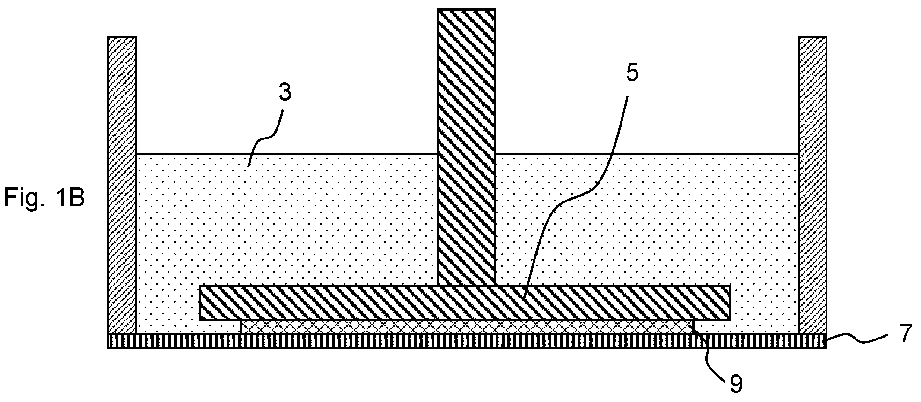
- the method for producing the three-dimensional modeled object will be described in more detail with reference to Fig. 1 .
- the method comprises a step of irradiating at least a part of the photocurable resin composition 3 between a modeling substrate 5 and a model film 7 to form a cured layer.
- irradiating is irradiating by a surface exposure method, in which the light is more preferably irradiated from below.
- the method for producing further includes a step of moving the modeling substrate 5 or the modeling film 7 in the vertical direction.
- the moving in the vertical direction is performed.
- it may rise by the distance equal to or longer than the distance required for moving to the light irradiation position of the next layer and then return (descend) to the light irradiation position of the next layer to proceed to model.
- the method for producing the three-dimensional modeled object further includes a step of filling with the photocurable resin composition 3.
- the step of taking out the modeled object from the modeling apparatus 1, cleaning the modeled object, and irradiating the modeled object with a light to further cure is included.
- acryloylmorpholine ACMO: manufactured by KJ Chemicals Corporation, molecular weight: 141.17, acrylic equivalent: 141.17
- A-DCP tricyclodecanedimethanol diacrylate
- urethane acrylate Polyether-based bifunctional urethane acrylate has a weight average molecular weight of 6500.
- a polyol compound is polypropylene glycol.
- An organic polyisocyanate compound is isophorone diisocyanate.
- Hydroxy (meth) acrylate is 2-hydroxyethyl acrylate.
- 4g of phenylbis (2,4,6-trimethylbenzoyl) phosphine oxide I-819: manufactured by IGM Resins B.V.
- 0.5g of dimethyl palmityl amine DM6098: manufactured by Kao Corporation
- 50 mg of triphenylphosphine and 50 mg of the dye of the above structural formula (2) were mixed.
- the photocurable resin composition coated on the substrate was irradiated with light having a wavelength of 405 nm and an illuminance of 1.7 mW/cm for 4.5 seconds (irradiation amount of 7.65 mJ/cm 2 ) to form a 45 mm long x 25 mm wide x 100 ⁇ m thick film.
- a test piece was prepared. Then, using a spectrophotometer "SolidSpec-3700" manufactured by SHIMADZU CORPORATION, the absorbance a at a wavelength of 405 nm in the thickness direction of the test piece separated from the substrate was measured. The sampling pitch was 1.0 nm, and an integrating sphere was used as a detector.
- the actual thickness b of the test piece was measured with a digital caliper "MDC-25MX" manufactured by Mitutoyo Corporation, and the transmittance T of light with a wavelength of 405 nm per 100 ⁇ m thickness was obtained by the following formula (3).
- T % 10 ⁇ a ⁇ 100 / b nm ⁇ 100
- Table 1 shows the measurement results.
- an evaluation model was actually modeled and its formability and overhang were evaluated.
- a modeling apparatus ML-48: manufactured by MUTOH INDUSTRIES LTD.
- modeling was performed under the conditions of a laminated thickness of 25 ⁇ m, and an irradiation time of 1.3 seconds/layer.
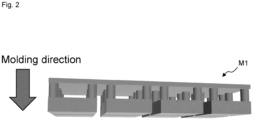
- evaluation model M1 shown in Fig. 2 was used.
- Fig. 3A is an enlarged view of a part of the formability evaluation model M1 viewed from a direction perpendicular to the molding direction.
- Fig. 3B is a cross-sectional view taken along line B-B in Fig. 3A .
- the dimensions of each part are as follows. Note that the height of the cylinder S is d2, and the diameter is d5.
- the occurrence of a non-designed hardened area on the opposite side of the light irradiation surface of the modeled object in three-dimensional modeling or the non-designed hardened area may be referred to as "overhang”.
- an evaluation model was actually modeled and its formability and overhang were evaluated.
- a modeling apparatus ML-48: manufactured by MUTOH INDUSTRIES LTD.
- modeling was performed under the conditions of a laminated thickness of 25 ⁇ m, and an irradiation time of 1.3 seconds/layer.
- evaluation model M1 shown in Fig. 2 was used.
- the photocurable resin composition was prepared according to the compositions shown in Table 1, and physical characteristics were measured and a molded modeling model was evaluated as in Example 1.
- a benzotriazole compound was added instead of dye, but it was difficult to perform curing and modeling.
- Tinuvin 928 "2-(2H-benzotriazol-2-yl)-6-(1-methyl-1-phenylethyl)-4-(1,1,3,3-tetramethylbutyl)phenol": Manufactured BASF Japan Ltd.
Landscapes
- Chemical & Material Sciences (AREA)
- Materials Engineering (AREA)
- Engineering & Computer Science (AREA)
- Organic Chemistry (AREA)
- Health & Medical Sciences (AREA)
- Polymers & Plastics (AREA)
- Medicinal Chemistry (AREA)
- Chemical Kinetics & Catalysis (AREA)
- Manufacturing & Machinery (AREA)
- Physics & Mathematics (AREA)
- Mechanical Engineering (AREA)
- Optics & Photonics (AREA)
- Life Sciences & Earth Sciences (AREA)
- Wood Science & Technology (AREA)
- Toxicology (AREA)
- Polymerisation Methods In General (AREA)
Abstract
wherein a light transmittance at a wavelength of 405 nm of a cured product with an average thickness of 100 µm is 24% or less, and the cured product is cured by irradiating the photocurable resin composition with a light having a light intensity of 1.7 mW/cm2 and an irradiation amount of 7.65 mJ/cm2.

Description
- The present invention relates to a photocurable resin composition, a photocured product, and a method for producing a three-dimensional modeled object.
- In recent years, a technique for producing a three-dimensional modeled object by laminate modeling has been developed. A three-dimensional model made of a resin material is modeled by irradiating a photocurable composition with light.
- As a photocurable composition, various component compositions have been studied in consideration of the characteristics of the obtained three-dimensional modeled object, and an example using a composition containing a (meth) acrylic acid ester has also been reported (Patent Literature 1).
- Patent Literature 1:
JP2017-210539A - However, modeling accuracy is a practical problem, and there is a demand for improving the modeling accuracy.
- The present invention has been made in view of such a problem and provides a photocurable resin composition for three-dimensional modeling capable of suppressing the formation of a non-designed hardened area on the opposite side of the light irradiation surface of the modeled object.
- According to the present invention, a photocurable resin composition, comprising a polymerizable organic compound component and a photopolymerization initiator is provided,
wherein a light transmittance at a wavelength of 405 nm of a cured product with an average thickness of 100 µm is 24% or less, and the cured product is cured by irradiating the photocurable resin composition with a light having a light intensity of 1.7 mW/cm2 and an irradiation amount of 7.65 mJ/cm2. - The inventors have conducted an intensive study and have found that when the transmittance is within a specified range for a specific wavelength, it is possible to suppress the formation of the non-designed hardened area on the opposite side of the light irradiation surface of the modeled object and have completed the present invention.
- Further, according to another aspect of the present invention, a photocured product of the above photocurable rein composition is provided.
- Further, according to another aspect of the present invention, a method for producing a three-dimensional modeled object, comprising a step of irradiating the above photocurable resin composition is provided.
- Various embodiments of the present invention will be described below. The embodiments shown below can be combined with each other.
- (1) A photocurable resin composition, comprising a polymerizable organic compound component and a photopolymerization initiator,
wherein a light transmittance at a wavelength of 405 nm of a cured product with an average thickness of 100 µm is 24% or less, and the cured product is cured by irradiating the photocurable resin composition with a light having a light intensity of 1.7 mW/cm2 and an irradiation amount of 7.65 mJ/cm2. - (2) The photocurable resin composition of (1), wherein the polymerizable organic compound component comprises:
- at least one selected from a group of a monofunctional (meth) acrylic acid ester monomer and a monofunctional (meth) acrylamide-based monomer; and
- a polyfunctional (meth) acrylic acid ester monomer.
- (3) The photocurable resin composition of (2), wherein a content of the polyfunctional (meth) acrylic acid ester monomer is 6 to 50% by mass in 100% by mass of the polymerizable organic compound component.
- (4) The photocurable resin composition of (2) or (3), wherein the monofunctional (meth) acrylic acid ester monomer contains a monofunctional (meth) acrylic acid ester monomer having a first cyclic structure.
- (5) The photocurable resin composition of any one of (2) to (4), wherein the monofunctional (meth) acrylamide-based monomer contains a monofunctional (meth) acrylamide-based monomer having a second cyclic structure.
- (6) The photocurable resin composition of any one of (2) to (5), wherein the polyfunctional (meth) acrylic acid ester monomer contains a polyfunctional (meth) acrylic acid ester monomer having a third cyclic structure.
- (7) The photocurable resin composition of (2) or (3),
wherein:- the monofunctional (meth) acrylic acid ester monomer contains a monofunctional (meth) acrylic acid ester monomer having a first cyclic structure,
- the monofunctional (meth) acrylamide-based monomer contains monofunctional (meth) acrylamide-based monomer having a second cyclic structure,
- the polyfunctional (meth) acrylic acid ester monomer contains the polyfunctional (meth) acrylic acid ester monomer having a third cyclic structure.
- (8) The photocurable resin composition of any one of (1) to (7), which contains a urethane (meth) acrylate oligomer.
- (9) The photocurable resin composition of any one of (1) to (8), which contains a dye.
- (10) The photocurable resin composition of (9), wherein the dye is an organic dye.(11) The photocurable resin composition of (9) or (10), wherein the organic dye has a fourth cyclic structure.
- (12) The photocurable resin composition of (11), wherein the fourth cyclic structure does not contain a nitrogen atom.
- (13) The photocured product of the photocurable resin of any one of (1) to (12).
- (14) A method for producing a three-dimensional modeled object, comprising a step of irradiating the photocurable resin composition of any one of (1) to (12) with a light.
-
-
Fig. 1A to 1C are schematic diagrams of a method for producing a three-dimensional modeled object according to one embodiment of the present invention. -
Fig. 2 is a schematic diagram showing a whole evaluation model M1. -
Fig. 3A is an enlarged view of a part of the evaluation model M1 viewed from a direction perpendicular to the modeling direction.Fig. 3B is a cross-sectional view taken along line B-B inFig. 3A . -
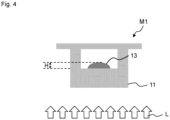
Fig. 4 is a figure explaining the modeledobject 11 and the non-designed hardenedarea 13 which occurs in the modeled object. - The embodiments of the present invention will be described below. The features shown in the embodiments shown below can be combined with each other. In addition, the invention is established independently for each feature.
- In the present specification, the symbol "- (to)" means "greater than or equal to" and "less than or equal to", and for example, the description "A-B (A to B)" means more than or equal to A and less than or equal to B.
- The photocurable resin composition according to one embodiment of the present invention contains a polymerizable organic compound component and a photopolymerization initiator.
- The polymerizable organic compound component preferably comprises:
- at least one selected from the group of a monofunctional (meth) acrylic acid ester monomer and a monofunctional (meth) acrylamide-based monomer; and
- a polyfunctional (meth) acrylic acid ester monomer.
- The monofunctional (meth) acrylic acid ester monomer is a compound having one (meth) acryloyl group. The polyfunctional (meth) acrylic acid ester monomer is a compound having two or more (meth) acryloyl groups.
- The monofunctional (meth) acrylamide-based monomer refers to a (meth) acrylamide compound having one (meth) acryloyl group.
- The content of the polyfunctional (meth) acrylic acid ester monomer is preferably 6 to 50% by mass, more preferably 20 to 50% by mass, and even more preferably 30 to 45% by mass, in 100% by mass of the polymerizable organic compound component. Specifically, the content is, for example, 6, 10, 15, 20, 25, 30, 35, 40, 45, 50% by mass, and may be in the range between the two values exemplified herein.
- The monofunctional (meth) acrylic acid ester monomer preferably contains a monofunctional (meth) acrylic acid ester monomer having a cyclic structure (a first cyclic structure). The first cyclic structure is, for example, a cyclic structure having a polycyclic structure or an alicyclic hydrocarbon group, and preferably a cyclic structure having a polycyclic structure and a saturated hydrocarbon group. Further, a monofunctional (meth) acrylic acid ester monomer preferably does not have all of an ether bond, an aromatic ring, and heteroatoms other than an oxygen, and more preferably does not have any of an ether bond, an aromatic ring, and heteroatoms other than an oxygen.
- The acrylic equivalent of the monofunctional (meth) acrylic acid ester monomer is preferably 160 to 250, more preferably 180 to 220, and even more preferably 200 to 215. The acrylic equivalent of the monofunctional (meth) acrylic acid ester monomer is a value obtained by dividing the molecular weight of the monofunctional (meth) acrylic acid ester monomer by the number of functional groups of the (meth) acryloyl group.
- The molecular weight of the monofunctional (meth) acrylic acid ester monomer is preferably 160 to 250, more preferably 180 to 220, and even more preferably 200 to 215.
- Examples of monofunctional (meth) acrylic acid ester monomers include:
- acyclic aliphatic (meth) acrylates such as methyl (meth) acrylate, ethyl (meth) acrylate, n-butyl (meth) acrylate, iso-butyl (meth) acrylate, t-butyl (meth) acrylate, 2-ethylhexyl (meth) acrylate, nonyl (meth) acrylate, tridecyl (meth) acrylate, hexadecyl (meth) acrylate, octadecyl (meth) acrylate, isoamyl (meth) acrylate, isodecyl (meth) acrylate, isostearyl (meth) acrylate, and lauryl (meth) acrylate;
- aromatic (meth) acrylates such as benzyl (meth) acrylate, nonylphenoxyethyl (meth) acrylate, 2-hydroxy-3-phenoxypropyl (meth) acrylate, nonylphenoxyethyl tetrahydrofurfuryl (meth) acrylate, and phenoxyethyl (meth) acrylate;
- alicyclic (meth) acrylates such as dicyclopentenyl (meth) acrylate, dicyclopentanyl (meth) acrylate, dicyclopentenyloxyethyl (meth) acrylate, tetracyclododecanyl (meth) acrylate, cyclohexyl (meth) acrylate, isobomyl (meth) acrylate, norbornyl (meth) acrylate, adamantan-1-yl (meth) acrylate, and 2- (meth) acryloyloxymethyl-2-methyladamantan;
- hydroxyalkyl (meth) acrylates such as 2-hydroxyethyl (meth) acrylate, 2-hydroxypropyl (meth) acrylate, 4-hydroxybutyl (meth) acrylate, and 3-chloro-2-hydroxypropyl (meth) acrylate;
- (meth) acrylic acids such as ethoxyethoxyethyl (meth) acrylate, methoxyethyl (meth) acrylate, butoxyethyl (meth) acrylate, tetrahydrofurfuryl (meth) acrylate, glycidyl (meth) acrylate, caprolactone-modified tetrahydrofurfuryl (meth) acrylate, 4-t- butylcyclohexyl (meth) acrylate, and urethane mono (meth) acrylate, and (meth) acrylic acid.
- Among alicyclic (meth) acrylates, alicyclic (meth) acrylic acid ester is preferable. Among alicyclic (meth) acrylic acid esters, one or more selected from the group consisting of dicyclopentanyl (meth) acrylate, tetracyclododecanyl (meth) acrylate, isobomyl (meth) acrylate, norbornyl (meth) acrylate, and adamantane-1-yl (meth) acrylate is preferable.
- Among these, one or more of selected from the group consisting of an acyclic aliphatic (meth) acrylic acid ester and an alicyclic (meth) acrylic acid ester is preferable, and an alicyclic (meth) acrylic acid ester is more preferable.
- Isobornyl (meth) acrylate is preferable from the viewpoint of availability and glass transition temperature and the like.
- These can be used alone, or two or more of these can be used in combination.
- The monofunctional (meth) acrylamide-based monomer preferably contains a monofunctional (meth) acrylamide-based monomer having a cyclic structure (a second cyclic structure). The second cyclic structure is, for example, a heterocyclic ring, preferably a cyclic structure having a hetero atom such as an oxygen atom, a nitrogen atom, and the like. The second cyclic structure is preferably, according to one embodiment, a cyclic structure not having an aromatic ring. Specifically, the second cyclic structure is, for example, a cyclic structure having a morpholine skeleton, a pyrrolidine skeleton and the like.
- The acrylic equivalent of the monofunctional (meth) acrylamide-based monomer is preferably 100 to 200, more preferably 120 to 180, and even more preferably 130 to 160. The acrylic equivalent of the monofunctional (meth) acrylamide-based monomer is a value obtained by dividing the molecular weight of the monofunctional (meth) acrylamide-based monomer by the number of functional groups of the (meth) acryloyl group.
- The molecular weight of the monofunctional (meth) acrylamide-based monomer is preferably 100 to 200, more preferably 120 to 180, and even more preferably 130 to 160.
- Examples of the monofunctional (meth) acrylamide-based monomer include (meth) acryloylmorpholine, dimethyl (meth) acrylamide, diethyl (meth) acrylamide, hydroxyethyl (meth) acrylamide, isopropyl (meth) acrylamide, dimethylaminopropyl (meth) acrylamide and N- (meth) acryloyloxyethyl hexahydrophthalimide. From the viewpoint of availability, glass transition temperature, and the like, at least one from the group of (meth) acryloylmorpholin or N- (meth) acryloyloxyethyl hexahydrophthalimide is preferable, and (meth) acryloylmorpholin is particularly preferable.
- These can be used alone, or two or more of these can be used in combination.
- The polyfunctional (meth) acrylic acid ester monomer preferably contains a polyfunctional (meth) acrylic acid ester monomer having a cyclic structure (a third cyclic structure). The third cyclic structure is, for example, a cyclic structure having a polycyclic structure or an alicyclic hydrocarbon group, more preferably a cyclic structure having a polycyclic structure and a saturated hydrocarbon group. Further, a polyfunctional (meth) acrylic acid ester monomer preferably does not have all of an ether bond, an aromatic ring, and heteroatoms other than an oxygen, and more preferably does not have any of an ether bond, an aromatic ring, and heteroatoms other than an oxygen. From another point of view, the polyfunctional (meth) acrylic acid ester monomer is preferably a bifunctional (meth) acrylic acid ester monomer.
- Examples of the polyfunctional (meth) acrylic acid ester monomer include a bifunctional (meth) acrylic acid ester monomer, a trifunctional (meth) acrylic acid ester monomer, and a tetrafunctional or higher functional (meth) acrylic acid ester monomer.
- The acrylic equivalent of the polyfunctional (meth) acrylic acid ester monomer is preferably 80 to200, more preferably 100 to 180, and even more preferably 120 to 160. The acrylic equivalent of the polyfunctional (meth) acrylic acid ester monomer is a value obtained by dividing the molecular weight of the polyfunctional (meth) acrylic acid ester monomer by the number of functional groups of the (meth) acryloyl group.
- The molecular weight of the polyfunctional (meth) acrylic acid ester monomer is preferably 200 to 2000, more preferably 250 to 1500, and even more preferably 280 to 1000.
- Examples of the bifunctional (meth) acrylic acid ester monomer include:
- alicyclic di (meth) acrylic acid ester monomers such as 1,3-adamantane dimethanol di (meth) acrylate, tricyclodecane dimethanol di (meth) acrylate;
- alcan diol di (meth) acrylic acid ester monomers such as 1,3-butanediol di (meth) acrylate, 1,4-butanediol di (meth) acrylate, 1,6-hexadioldi (meth) acrylate, 1,9-nonanediol di (meth) acrylate, and 1,10-decanediol di (meth) acrylate;
- di (meth) acrylic acid ester monomers having a neopentyl glycol structure such as neopentyl glycol di (meth) acrylate and neopentyl glycol-modified trimethylolpropane di (meth) acrylate;
- (poly) alkylene glycol di (meth) acrylic acid ester monomers such as tetramethylene glycol di (meth) acrylate, diethylene glycol di (meth) acrylate, triethylene glycol di (meth) acrylate, tetraethylene glycol di (meth) acrylate, polyethylene glycol di (meth) acrylate, propylene glycol di (meth) acrylate, dipropylene glycol di (meth) acrylate, tripropylene glycol di (meth) acrylate, polypropylene glycol di (meth) acrylate;
- di (meth) acrylic acid ester monomers having a bisphenol structure such as 2,2-bis (4- (meth) acryloxidiethoxyphenyl) propane, 2,2-bis (4- (meth) acryloxipropoxyphenyl) propane, 2,2-bis (4-(meth) acryloxy) tetraethoxyphenyl propane;
- stearic acid-modified pentaeristoldi (meth) acrylate, isocyanuric acid ethylene oxide-modified di (meth) acrylate, and diglycerin EO (ethylene oxide) -modified di (meth) acrylate.
- Examples of the trifunctional (meth) acrylic acid ester monomer include isocyanurate ethylene oxide-modified tri (meth) acrylate, pentaerythritol tri (meth) acrylate, trimethylolpropane tri (meth) acrylate, and tris [(meth) acryloixi ethyl] isocyanurate and the like.
- Examples of the tetrafunctional or higher functional (meth) acrylic acid ester monomer include ditrimethylolpropane tetra (meth) acrylate, dimethylolpropanetetra (meth) acrylate, pentaerythritol tetra (meth) acrylate, and pentaerythritol ethoxytetra (meth) acrylate, dipentaerythritol penta (meth) acrylate, dipentaerythritol hexa (meth) acrylate and the like.
- The polymerizable organic compound component preferably contains a urethane (meth) acrylate oligomer. The urethane (meth) acrylate oligomer has at least one urethane bond and at least one (meth) acrylate group in the molecule. By containing the urethane (meth) acrylate oligomer, the toughness of the modeled object obtained after modeling can be improved. Further, the addition of the urethane (meth) acrylate oligomer is preferable from the viewpoint of curing shrinkage in modeling and can contribute to the bending strength of the modeled object by stress relaxation in a low temperature region.
- The urethane (meth) acrylate oligomer is preferably a polyfunctional urethane (meth) acrylate oligomer. The polyfunctional urethane (meth) acrylate oligomer is preferably a bifunctional or higher functional urethane (meth) acrylate oligomer, more preferably a 2 to 15 functional urethane (meth) acrylate oligomer, and further preferably a 2 to 6 functional urethane, most preferably a bifunctional urethane (meth) acrylate oligomer.
- Examples of the urethane (meth) acrylate oligomer preferably do not include the polyfunctional (meth) acrylic acid ester monomer described above. The polyfunctional (meth) acrylic acid ester monomer described above preferably does not include an urethane (meth) acrylate oligomer.
- The urethane (meth) acrylate oligomer is composed of an active hydrogen group-containing polyol component (a), a diisocyanate component (b), and an active hydrogen group-containing (meth) acrylic component (c).
- Examples of the component (a) include polyethylene glycol, polypropylene glycol, polytetramethylene glycol, ethylene oxide-modified bisphenol, propylene oxide-modified bisphenol, polyglycol obtained by copolymerization of ethylene oxide and propylene oxide, polyester polyol, polycarbonate polyol, polybutadiene polyol. These can be used alone, or two or more of these can be used in combination.
- Examples of the component (b) is, for example, tolylene diisocyanate, xylylene diisocyanate, diphenylmethane diisocyanate, hexamethylene diisocyanate, trimethylhexamethylene diisocyanate, tetramethylxylylene diisocyanate, isophorone diisocyanate, hydrogenated tolylene diisocyanate, hydrogenated xylylene diisocyanate and hydrogenated diphenylmethane diisocyanate. These can be used alone, or two or more of these can be used in combination.
- Examples of the component (c) include hydroxyalkyl (meth) acrylates such as 2-hydroxyethyl (meth) acrylate, 2-hydroxypropyl (meth) acrylate, 4-hydroxybutyl (meth) acrylate, pentaerythritol triacrylate, pentaerythritol tri (meth) acrylate. These can be used alone, or two or more of these can be used in combination.
- Here, the urethane (meth) acrylate oligomer may be obtained, for example, by reacting the active hydrogen group-containing polyol component (a), the diisocyanate component (b), and the active hydrogen group-containing (meth) acrylic component (c) (for example, a polycondensation reaction).
- The weight average molecular weight of the urethane (meth) acrylate oligomer is preferably 1000 to 60,000, more preferably 3000 to 40,000, and most preferably 5000 to 10000. The weight average molecular weight is preferably determined by preparing a calibration curve with commercially available standard polystyrene using tetrahydrofuran as a solvent and using a GPC system (SC-8010 manufactured by Tosoh Corporation) under the following conditions.
- Flow velocity: 1.0 ml/min
- Set temperature: 40°C
- Column configuration:
- "TSK guardcolum MP (xL)" 6.0 mm ID x 4.0
cm 1 piece manufactured by Tosoh Corporation - "TSK-GELMULTIPOREHXL-M" 7.8 mm ID x 30.0 cm (16,000 of theoretical plates) 2 pieces manufactured by Tosoh Corporation
- 3 pieces in total (32,000 of theoretical plates as a whole)
- Sample injection volume: 100 µl (
sample solution concentration 1 mg/ml) - Liquid transfer pressure: 39 kg/cm2
- Detector: RI detector
- "TSK guardcolum MP (xL)" 6.0 mm ID x 4.0
- When the polymerizable organic compound component contains the monofunctional (meth) acrylamide-based monomer, the polyfunctional (meth) acrylic acid ester monomer, and the urethane (meth) acrylate oligomer, the content of the monofunctional (meth) acrylamide-based monomer is preferably 30 to 70% by mass, more preferably 40 to 60% by mass, and further preferably 45 to 65% by mass in100% by mass of the polymerizable organic compound component.
- When the polymerizable organic compound component contains the monofunctional (meth) acrylamide-based monomer, the polyfunctional (meth) acrylic acid ester monomer, and the urethane (meth) acrylate oligomer, the content of the polyfunctional (meth) acrylic acid ester monomer is preferably 20 to 60% by mass, more preferably 30 to 50% by mass, and further preferably 35 to 45% by mass in 100% by mass of the polymerizable organic compound component.
- When the polymerizable organic compound component contains the monofunctional (meth) acrylamide-based monomer, the polyfunctional (meth) acrylic acid ester monomer, and the urethane (meth) acrylate oligomer, the content of the urethane (meth) acrylate oligomer is preferably 0.1 to 30% by mass, more preferably 1 to 20% by mass, and further preferably 5 to 15% by mass in 100% by mass of the polymerizable organic compound component.
- Further, the polymerizable organic compound component may contain a monomer such as another vinyl compound or an epoxy compound as long as the effect of the present invention is not impaired.
- Examples of the vinyl compound include vinylpyrrolidone, N-vinylformamide and the like.
- Examples of the photopolymerization initiator include benzophenone and its derivatives, benzyl and its derivatives, anthraquinone and its derivatives, benzoin, benzoin derivatives such as benzoin methyl ether, benzoin ethyl ether, benzoin propyl ether, benzoin isobutyl ether, benzyl dimethyl ketal, acetphenone derivatives such as diethoxyacetophenone and 4-t-butyltrichloroacetophenone , 2-dimethylaminoethylbenzoate, p-dimethylaminoethylbenzoate, diphenyldisulfide, thioxanthone and its derivatives, camphorquinone, camphorquinone derivatives such as 7,7-dimethyl-2,3-di oxobicyclo [2.2.1] heptane-1-carboxylic acid, 7,7-dimethyl-2,3-dioxobicyclo [2.2.1] heptane-1-carboxy-2-bromoethyl ester, 7, 7-dimethyl-2,3-dioxobicyclo [2.2.1] heptane-1-carboxy-2-methyl ester, 7,7-dimethyl-2,3-dioxobicyclo [2.2.1] heptane -1-carboxylic acid chloride , 2-methyl-1- [4- (methylthio) phenyl] -2-morpholinopropane-1-one, α-aminoalkylphenone derivatives such as 2-benzyl-2-dimethylamino-1- (4-mophorinophenyl) -butanone-1 , acylphosphine oxide derivatives such as benzoyldiphenylphosphine oxide, 2,4,6-trimethylbenzoyldiphenylphosphine oxide, benzoyldiethoxyposphine oxide, 2,4,6-trimethylbenzoyl dimethoxyphenylphosphine oxide, 2,4,6-trimethylbenzoyl diethoxyphenylphosphine oxide, phenylbis (2,4,6-trimethylbenzoyl) phosphine oxide, oxy-phenyl- acetic acid 2- [2-oxo-2-phenyl-acetoxy-ethoxy] -ethyl ester, and oxy-phenyl- acetic acid 2-[2-hydroxy-ethoxy] -ethyl ester and the like. Among these, acylphosphine oxide derivatives are preferable from the viewpoint of molding speed, and phenylbis (2,4,6-trimethylbenzoyl) phosphine oxide is particularly preferable.
- The content of the photopolymerization initiator is preferably 0.5 to 10 parts by mass, and more preferably 1 to 7 parts by mass with respect to 100 parts by mass of the polymerizable organic compound component. Within such a range, a sufficient curing rate can be obtained and storage stability is also good.
- The photocurable resin composition according to one embodiment of the present invention may contain a dye. The dye is preferably an organic dye. The organic dye preferably has the cyclic structure(a fourth cyclic structure). The fourth cyclic structure is preferably an aromatic ring.
- If a radical trapping ability is too high, the influence on the polymerization reaction will be large, so the fourth cyclic structure preferably does not have a nitrogen atom(does not have a nitrogen atom as an ring-forming atom). Further, according to one embodiment, the fourth cyclic structure preferably have neither a nitrogen atom nor a sulfur atom. Examples of the fourth cyclic structure include, an aromatic ring, preferably an aromatic ring not having a hetero atom in the cyclic skeleton.
- The fourth cyclic structure is preferably a polycyclic structure, specifically, for example, a structure containing anthraquinone or its derivative in its skeleton. An organic dye having a structure containing anthraquinone and its derivative in its skeleton as the fourth cyclic structure is, for example, a compound represented by the following general formula (1).

- Each of R1 and R2 is independently a hydrogen atom, a hydroxyl group, or a monovalent organic group, preferably a hydrogen atom or a hydroxyl group.
- Each of X and Y is independently an oxygen atom (-O-), a sulfur atom (-S-) or a nitrogen atom (-NH-), preferably a nitrogen atom (-NH-).
- Each of R3 and R4 is independently a hydrogen atom, a hydroxyl group, or an alkyl group having 1 to 10 carbon atoms. An aromatic ring to which R3 and R4 are bonded may each have a plurality of R3 and R4.
- More specifically, the organic dye is, for example, a compound represented by the following structural formula (2) or (3).


- The content of the dye is preferably 0.001 to 1.0 parts by mass, and more preferably 0.03 to 0.8 parts by mass, and most preferably 0.05 to 0.5parts by mass with respect to 100 parts by mass of the polymerizable organic compound component. Specifically, the content of the dye is, for example, 0.001, 0.01, 0.02, 0.03, 0.04, 0.05, 0.06, 0.07, 0.08, 0.09, 0.1, 0.2, 0.3, 0.4, 0.5, 0.6, 0.7, 0.8, 0.9, 1.0 parts by mass with respect to 100 parts by mass of the polymerizable organic compound component, and may be in the range between the two values exemplified herein. Within such a range, a sufficient curing rate can be obtained and storage stability is also good.
- If desired, in addition to the above components, the photocurable resin composition according to one embodiment of the present invention may include additives, for example, a known substance such as a curing accelerator, a chain transfer agent, a thickener, a filler, a plasticizer, a rust preventive, and the like, as long as the physical characteristics of the present invention are satisfied.
- Examples of the curing accelerator include those containing a nitrogen atom. Among these, a tertiary amine having an alkyl group and the like are preferable, and specific examples thereof include dimethyl palmitylamine. The content of the curing accelerator is preferably 0.1 to 10 parts by mass, and more preferably 0.3 to 7 parts by mass with respect to 100 parts by mass of the polymerizable organic compound component.
- Other additives include an organic phosphine. The organic phosphine preferably does not contain a photopolymerization initiator. Among organic phosphines, those having a skeleton in which three organic groups are bonded to a phosphorus atom are preferred. As the organic group, an aromatic group is preferable. As the organic phosphine, triphenylphosphine is preferred.
- The content of the organic phosphine is preferably 0.001 to 1.0 parts by mass, more preferably 0.02 to 0.8 parts by mass, most preferably 0.03 to 0.5 parts by mass with respect to 100 parts by mass of the polymerizable organic compound component. Within such a range, a sufficient curing rate can be obtained and storage stability is also good.
- In the photocurable resin composition according to one embodiment of the present invention, a light transmittance at a wavelength of 405 nm of a cured product with an average thickness of 100 µm is 24% or less, preferably 23% or less, and the cured product is cured by irradiating the photocurable resin composition with a light having a light intensity of 1.7 mW/cm2 and an irradiation amount of 7.65 mJ/cm2. Due to manufacturing difficulties, the light transmittance is preferably 1% or more, more preferably 10% or more.
- The photocurable resin composition according to one embodiment of the present invention can be applied to various three-dimensional modeling methods for polymerizing by light irradiation and modeling. The photocurable resin composition of the present invention is preferably used in a surface exposure method, particularly in which light is irradiated from below.
- The method for producing the three-dimensional modeled object according to one embodiment of the present invention comprises a step of irradiating the above photocurable resin composition. The photocurable resin composition is curd by light irradiation to obtain a photocured product, which becomes a three-dimensional modeled object.
- The method for producing the three-dimensional modeled object according to one embodiment of the present invention will be described in more detail with reference to
Fig. 1 . The method comprises a step of irradiating at least a part of thephotocurable resin composition 3 between amodeling substrate 5 and amodel film 7 to form a cured layer. - Preferably, irradiating is irradiating by a surface exposure method, in which the light is more preferably irradiated from below.
- Preferably, the method for producing further includes a step of moving the
modeling substrate 5 or themodeling film 7 in the vertical direction. - Preferably, for peeling off the modeled object from the
modeling film 7 and for moving to the light irradiation position of the next layer, the moving in the vertical direction is performed. In the moving for peeling, it may rise by the distance equal to or longer than the distance required for moving to the light irradiation position of the next layer and then return (descend) to the light irradiation position of the next layer to proceed to model. - Preferably, the method for producing the three-dimensional modeled object further includes a step of filling with the
photocurable resin composition 3. - Preferably, the step of taking out the modeled object from the
modeling apparatus 1, cleaning the modeled object, and irradiating the modeled object with a light to further cure is included. - Hereinafter, the present invention will be described in more detail with reference to examples. Moreover, these are merely examples and do not limit the present invention.
- To prepare a photocurable resin composition, 50g of acryloylmorpholine (ACMO: manufactured by KJ Chemicals Corporation, molecular weight: 141.17, acrylic equivalent: 141.17), 40g of tricyclodecanedimethanol diacrylate (A-DCP: manufactured by SHIN-NAKAMURA CHEMICAL Co., Ltd., molecular weight: 304.38, acrylic equivalent: 152.19), 10g of urethane acrylate (Polyether-based bifunctional urethane acrylate has a weight average molecular weight of 6500. A polyol compound is polypropylene glycol. An organic polyisocyanate compound is isophorone diisocyanate. Hydroxy (meth) acrylate is 2-hydroxyethyl acrylate.), 4g of phenylbis (2,4,6-trimethylbenzoyl) phosphine oxide (I-819: manufactured by IGM Resins B.V.), 0.5g of dimethyl palmityl amine (DM6098: manufactured by Kao Corporation), 50 mg of triphenylphosphine and 50 mg of the dye of the above structural formula (2) (Macrolex Blue: manufactured by LANXESS) were mixed.
- The photocurable resin composition coated on the substrate was irradiated with light having a wavelength of 405 nm and an illuminance of 1.7 mW/cm for 4.5 seconds (irradiation amount of 7.65 mJ/cm2) to form a 45 mm long x 25 mm wide x 100 µm thick film. A test piece was prepared. Then, using a spectrophotometer "SolidSpec-3700" manufactured by SHIMADZU CORPORATION, the absorbance a at a wavelength of 405 nm in the thickness direction of the test piece separated from the substrate was measured. The sampling pitch was 1.0 nm, and an integrating sphere was used as a detector.
- The actual thickness b of the test piece was measured with a digital caliper "MDC-25MX" manufactured by Mitutoyo Corporation, and the transmittance T of light with a wavelength of 405 nm per 100 µm thickness was obtained by the following formula (3).

- Table 1 shows the measurement results.
- Using the obtained photocurable resin composition, an evaluation model was actually modeled and its formability and overhang were evaluated. Using a modeling apparatus (ML-48: manufactured by MUTOH INDUSTRIES LTD.), modeling was performed under the conditions of a laminated thickness of 25 µm, and an irradiation time of 1.3 seconds/layer. As the evaluation model, evaluation model M1 shown in
Fig. 2 was used. -
Fig. 3A is an enlarged view of a part of the formability evaluation model M1 viewed from a direction perpendicular to the molding direction.Fig. 3B is a cross-sectional view taken along line B-B inFig. 3A . The dimensions of each part are as follows. Note that the height of the cylinder S is d2, and the diameter is d5. - d1 = 1.0 mm
- d2 = 3.0 mm
- d3 = 3.0 mm
- d4 = 5.0 mm
- d5 = 1.0 mm
- In the present specification, the occurrence of a non-designed hardened area on the opposite side of the light irradiation surface of the modeled object in three-dimensional modeling or the non-designed hardened area may be referred to as "overhang".
- Using the obtained photocurable resin composition, an evaluation model was actually modeled and its formability and overhang were evaluated. Using a modeling apparatus (ML-48: manufactured by MUTOH INDUSTRIES LTD.), modeling was performed under the conditions of a laminated thickness of 25 µm, and an irradiation time of 1.3 seconds/layer. As the evaluation model, evaluation model M1 shown in
Fig. 2 was used. - Those in which the molded object fell off during the process due to insufficient curing or could not be molded according to the model were marked as B, and those that could be molded in the shape according to the model were marked as A.
- Regarding the three-dimensional model obtained by modeling the above evaluation model M1, as shown in
Fig 3 and4 , the extent to which the non-designedhardened area 13 were generated on the opposite side F (Fig. 3A ) of the light irradiation surface of themodeling object 11 was measured. That is, the height H (µm) of the non-designedhardened area 13 generated on the upper surface of the modeledobject 11 was measured. Table 1 shows the measurement results. - The photocurable resin composition was prepared according to the compositions shown in Table 1, and physical characteristics were measured and a molded modeling model was evaluated as in Example 1. In Comparative Example 3, a benzotriazole compound was added instead of dye, but it was difficult to perform curing and modeling.
-
- Macrolex Green: Manufactured by LANXESS (dye with the above structural formula (3))
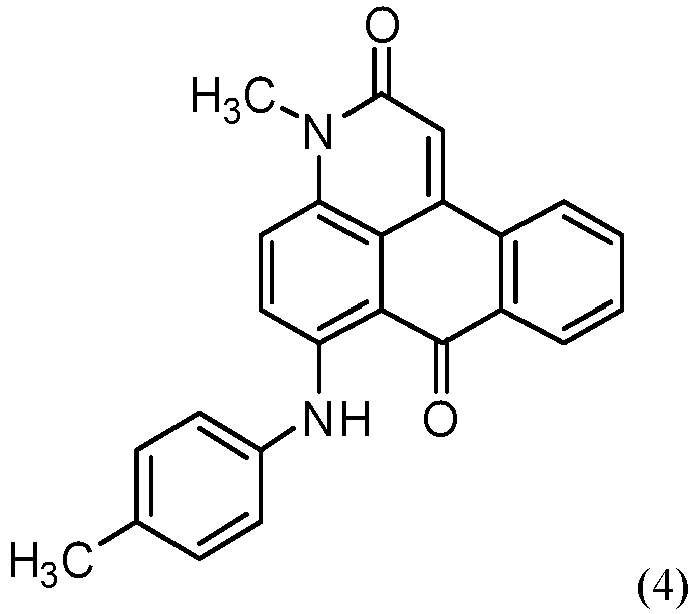
- Macrolex Red: Manufactured by LANXESS (dye with the above structural formula (4))
- Tinuvin 928 "2-(2H-benzotriazol-2-yl)-6-(1-methyl-1-phenylethyl)-4-(1,1,3,3-tetramethylbutyl)phenol": Manufactured BASF Japan Ltd.
[Table 1] Table 1 Example Comparative Example 1 2 3 4 5 1 2 3 4 5 6 Photocured resin Isobornyl (meth) acrylate Mass[g] 0 0 0 55 0 0 0 0 0 55 55 Acryloylmorpholine Mass[g] 50 50 50 0 50 50 50 50 50 0 0 Tricyclodecanedimethanol diacrylate Mass[g] 40 40 40 40 40 40 40 40 40 40 40 Urethane acrylate Mass[g] 10 10 10 5 10 10 10 10 10 5 5 Phenylbis (2,4,6-trimethylbenzoyl) phosphine oxide Mass[g] 4 4 4 4 4 4 4 4 4 4 4 Dimethyl palmityl Mass[g] 0.5 0.5 0.5 3 0.5 0.5 0.5 0.5 0.5 3 3 Triphenylphosphine Mass[mg] 50 50 50 50 0 50 50 50 50 50 50 MacrolexBlue Mass[mg] 50 100 0 500 100 0 0 0 0 0 100 MacrolexGreen Mass[mg] 0 0 100 0 0 0 10 0 0 0 0 MacrolexRed Mass[mg] 0 0 0 0 0 0 0 10 0 0 0 Tinuvin 928 Mass[mg] 0 0 0 0 0 0 0 0 1000 0 0 Physical characteristics Transmittance of light with a wavelength of 405 nm [%] / 100µm 23 23 22 22 23 26 31 - 32 32 27 Evaluation Formability - A A A A A A A B A A A Overhang [µm] 127 126 115 103 129 232 208 - 269 244 208 - In Comparative Example 3, since it was difficult to perform curing and modeling, "transmittance of light with a wavelength of 405 nm" and "overhang" were not measured.
-
- 1: modeling apparatus 3: composition, 5: modeling substrate, 7: modeling film, 9: cured layer, 11: modeled object
- 13: non-designed hardened area
- L: light, M1: evaluation model
Claims (14)
- A photocurable resin composition, comprising a polymerizable organic compound component and a photopolymerization initiator,
wherein a light transmittance at a wavelength of 405 nm of a cured product with an average thickness of 100 µm is 24% or less, and the cured product is cured by irradiating the photocurable resin composition with a light having a light intensity of 1.7 mW/cm2 and an irradiation amount of 7.65 mJ/cm2. - The photocurable resin composition of Claim 1, wherein the polymerizable organic compound component comprises:at least one selected from a group of a monofunctional (meth) acrylic acid ester monomer and a monofunctional (meth) acrylamide-based monomer; anda polyfunctional (meth) acrylic acid ester monomer.
- The photocurable resin composition of Claim 2, wherein a content of the polyfunctional (meth) acrylic acid ester monomer is 6 to 50% by mass in 100% by mass of the polymerizable organic compound component.
- The photocurable resin composition of Claim 2, wherein the monofunctional (meth) acrylic acid ester monomer contains a monofunctional (meth) acrylic acid ester monomer having a first cyclic structure.
- The photocurable resin composition of Claim 2, wherein the monofunctional (meth) acrylamide-based monomer contains a monofunctional (meth) acrylamide-based monomer having a second cyclic structure.
- The photocurable resin composition of Claim 2, wherein the polyfunctional (meth) acrylic acid ester monomer contains a polyfunctional (meth) acrylic acid ester monomer having a third cyclic structure.
- The photocurable resin composition of Claim 2,
wherein:the monofunctional (meth) acrylic acid ester monomer contains a monofunctional (meth) acrylic acid ester monomer having a first cyclic structure,the monofunctional (meth) acrylamide-based monomer contains monofunctional (meth) acrylamide-based monomer having a second cyclic structure,the polyfunctional (meth) acrylic acid ester monomer contains the polyfunctional (meth) acrylic acid ester monomer having a third cyclic structure,the first cyclic structure is a polycyclic structure or an alicyclic hydrocarbon group,the second cyclic structure is a heterocyclic ring,the third cyclic structure is a polycyclic structure or an alicyclic hydrocarbon group. - The photocurable resin composition of Claim 1, which contains a urethane (meth) acrylate oligomer.
- The photocurable resin composition of Claim 1, which contains a dye.
- The photocurable resin composition of Claim 9, wherein the dye is an organic dye.
- The photocurable resin composition of Claim 10, wherein the organic dye has a fourth cyclic structure.
- The photocurable resin composition of Claim 11, wherein the fourth cyclic structure does not contain a nitrogen atom.
- The photocured product of the photocurable resin composition of any one of Claims 1 to 12.
- A method for producing a three-dimensional modeled object, comprising a step of irradiating the photocurable resin composition of any one of Claims 1 to 12 with a light.
Applications Claiming Priority (2)
| Application Number | Priority Date | Filing Date | Title |
|---|---|---|---|
| JP2021078053 | 2021-04-30 | ||
| PCT/JP2022/019129 WO2022230947A1 (en) | 2021-04-30 | 2022-04-27 | Photocurable resin composition, photocured article, and method for producing three-dimensional molded article |
Publications (2)
| Publication Number | Publication Date |
|---|---|
| EP4317199A1 true EP4317199A1 (en) | 2024-02-07 |
| EP4317199A4 EP4317199A4 (en) | 2024-10-16 |
Family
ID=83848570
Family Applications (1)
| Application Number | Title | Priority Date | Filing Date |
|---|---|---|---|
| EP22795860.0A Withdrawn EP4317199A4 (en) | 2021-04-30 | 2022-04-27 | Photocurable resin composition, photocured article, and method for producing three-dimensional molded article |
Country Status (6)
| Country | Link |
|---|---|
| US (1) | US20240227284A1 (en) |
| EP (1) | EP4317199A4 (en) |
| JP (1) | JPWO2022230947A1 (en) |
| CN (1) | CN117222676A (en) |
| TW (1) | TW202248232A (en) |
| WO (1) | WO2022230947A1 (en) |
Cited By (1)
| Publication number | Priority date | Publication date | Assignee | Title |
|---|---|---|---|---|
| EP4624537A1 (en) * | 2024-03-25 | 2025-10-01 | LANXESS Deutschland GmbH | 3d printed products |
Family Cites Families (5)
| Publication number | Priority date | Publication date | Assignee | Title |
|---|---|---|---|---|
| JP6275413B2 (en) * | 2013-08-19 | 2018-02-07 | デンカ株式会社 | (Meth) acrylic resin composition for stereolithography and method for producing support |
| JP6828273B2 (en) | 2016-05-25 | 2021-02-10 | Dic株式会社 | Method for manufacturing curable composition for stereolithography, photocurable product, and molded product |
| EP3658598B1 (en) * | 2017-07-28 | 2022-11-16 | Nikon Corporation | Photocurable composition and method of manufacturing three-dimensional object |
| JP2019059101A (en) * | 2017-09-26 | 2019-04-18 | 富士ゼロックス株式会社 | Ink composition for three-dimensional molding, ink cartridge for three-dimensional molding, and three-dimensional molding apparatus |
| JP6983378B2 (en) * | 2017-10-30 | 2021-12-17 | セイコーエプソン株式会社 | Manufacturing method of 3D model |
-
2022
- 2022-04-27 EP EP22795860.0A patent/EP4317199A4/en not_active Withdrawn
- 2022-04-27 WO PCT/JP2022/019129 patent/WO2022230947A1/en not_active Ceased
- 2022-04-27 CN CN202280031653.9A patent/CN117222676A/en active Pending
- 2022-04-27 JP JP2023517602A patent/JPWO2022230947A1/ja not_active Withdrawn
- 2022-04-27 US US18/287,932 patent/US20240227284A1/en not_active Abandoned
- 2022-04-29 TW TW111116318A patent/TW202248232A/en unknown
Cited By (1)
| Publication number | Priority date | Publication date | Assignee | Title |
|---|---|---|---|---|
| EP4624537A1 (en) * | 2024-03-25 | 2025-10-01 | LANXESS Deutschland GmbH | 3d printed products |
Also Published As
| Publication number | Publication date |
|---|---|
| CN117222676A (en) | 2023-12-12 |
| TW202248232A (en) | 2022-12-16 |
| WO2022230947A1 (en) | 2022-11-03 |
| US20240227284A1 (en) | 2024-07-11 |
| EP4317199A4 (en) | 2024-10-16 |
| JPWO2022230947A1 (en) | 2022-11-03 |
Similar Documents
| Publication | Publication Date | Title |
|---|---|---|
| JP6275413B2 (en) | (Meth) acrylic resin composition for stereolithography and method for producing support | |
| EP3753957A1 (en) | Photolithographic curable composition, evaporative pattern, and method for producing three dimensional shaped article | |
| US20200407581A1 (en) | Optical shaping ink set, optically shaped article, and method for producing optically shaped article | |
| EP3882028B1 (en) | Photocurable composition for three-dimensional molding, three-dimensional molded product, and method for producing three-dimensional molded product | |
| EP4317232A1 (en) | Curable resin composition for stereolithography, cured product, and three-dimensional object | |
| EP3705263B1 (en) | Rubber composition for shaping three-dimensional laminate | |
| US10822464B2 (en) | Formulation composition for 3D additive manufacturing and processing method of the same | |
| US20060189706A1 (en) | Actinic-energy-ray-curable resin composition for lens sheet and lens sheet | |
| JP7731867B2 (en) | (Meth)acrylate-functionalized oligomers and methods for preparing and using such oligomers | |
| JP2010060890A (en) | Active energy ray-curable resin composition for optical article and cured product | |
| JP2019001865A (en) | Radiation curable composition and radiation curable composition set | |
| EP4426761B1 (en) | Polyglycerin-based urethane (meth)acrylate | |
| US20240227284A1 (en) | Photocurable resin composition, photocured article, and method for producing three-dimensional molded article | |
| KR20240096630A (en) | Active energy ray curable composition | |
| JP2010072428A (en) | Active energy ray-curable resin composition for optical article and cured material | |
| EP2612756A1 (en) | Hard coat film and front surface protective plate | |
| EP3431519A1 (en) | Composition for model materials, optically shaped article, and method for producing optically shaped articles | |
| JPWO2008123358A1 (en) | Active energy ray-curable resin composition for cast polymerization and cured product | |
| EP4079777A1 (en) | Curable resin composition, cured object, and three-dimensional object | |
| JP2006111868A (en) | Active energy ray-curable resin composition and synthetic resin molding | |
| KR102595289B1 (en) | Resin sheet and curable composition for producing the same | |
| WO2023188464A1 (en) | Curable resin composition, cured product and three-dimensional molded product | |
| TWI708808B (en) | Active energy ray curable resin composition, cured product and optical sheet for optical articles | |
| JP2009091586A (en) | Active energy ray curable resin sheet | |
| JP7626107B2 (en) | Urethane (meth)acrylate resin, active energy ray curable composition, cured product, and laminated film |
Legal Events
| Date | Code | Title | Description |
|---|---|---|---|
| STAA | Information on the status of an ep patent application or granted ep patent |
Free format text: STATUS: THE INTERNATIONAL PUBLICATION HAS BEEN MADE |
|
| PUAI | Public reference made under article 153(3) epc to a published international application that has entered the european phase |
Free format text: ORIGINAL CODE: 0009012 |
|
| STAA | Information on the status of an ep patent application or granted ep patent |
Free format text: STATUS: REQUEST FOR EXAMINATION WAS MADE |
|
| 17P | Request for examination filed |
Effective date: 20231026 |
|
| AK | Designated contracting states |
Kind code of ref document: A1 Designated state(s): AL AT BE BG CH CY CZ DE DK EE ES FI FR GB GR HR HU IE IS IT LI LT LU LV MC MK MT NL NO PL PT RO RS SE SI SK SM TR |
|
| DAV | Request for validation of the european patent (deleted) | ||
| DAX | Request for extension of the european patent (deleted) | ||
| A4 | Supplementary search report drawn up and despatched |
Effective date: 20240917 |
|
| RIC1 | Information provided on ipc code assigned before grant |
Ipc: C09D 175/16 20060101ALI20240911BHEP Ipc: C09D 175/14 20060101ALI20240911BHEP Ipc: C08G 18/75 20060101ALI20240911BHEP Ipc: C08G 18/67 20060101ALI20240911BHEP Ipc: C08G 18/48 20060101ALI20240911BHEP Ipc: C08F 2/48 20060101ALI20240911BHEP Ipc: C08L 101/00 20060101ALI20240911BHEP Ipc: C08G 18/64 20060101ALI20240911BHEP Ipc: C08F 290/06 20060101ALI20240911BHEP Ipc: C08F 2/44 20060101ALI20240911BHEP Ipc: B33Y 70/00 20200101ALI20240911BHEP Ipc: B33Y 10/00 20150101ALI20240911BHEP Ipc: B29C 64/264 20170101ALI20240911BHEP Ipc: B29C 64/124 20170101ALI20240911BHEP Ipc: C08F 2/50 20060101AFI20240911BHEP |
|
| STAA | Information on the status of an ep patent application or granted ep patent |
Free format text: STATUS: THE APPLICATION IS DEEMED TO BE WITHDRAWN |
|
| 18D | Application deemed to be withdrawn |
Effective date: 20250408 |