EP4316881A1 - Electric power control device and electric power control method - Google Patents
Electric power control device and electric power control method Download PDFInfo
- Publication number
- EP4316881A1 EP4316881A1 EP21844942.9A EP21844942A EP4316881A1 EP 4316881 A1 EP4316881 A1 EP 4316881A1 EP 21844942 A EP21844942 A EP 21844942A EP 4316881 A1 EP4316881 A1 EP 4316881A1
- Authority
- EP
- European Patent Office
- Prior art keywords
- vehicle
- power
- power control
- control device
- hot
- Prior art date
- Legal status (The legal status is an assumption and is not a legal conclusion. Google has not performed a legal analysis and makes no representation as to the accuracy of the status listed.)
- Granted
Links
Images



Classifications
-
- H—ELECTRICITY
- H05—ELECTRIC TECHNIQUES NOT OTHERWISE PROVIDED FOR
- H05B—ELECTRIC HEATING; ELECTRIC LIGHT SOURCES NOT OTHERWISE PROVIDED FOR; CIRCUIT ARRANGEMENTS FOR ELECTRIC LIGHT SOURCES, IN GENERAL
- H05B1/00—Details of electric heating devices
- H05B1/02—Automatic switching arrangements specially adapted to apparatus ; Control of heating devices
- H05B1/0227—Applications
- H05B1/023—Industrial applications
- H05B1/0236—Industrial applications for vehicles
-
- B—PERFORMING OPERATIONS; TRANSPORTING
- B60—VEHICLES IN GENERAL
- B60H—ARRANGEMENTS OF HEATING, COOLING, VENTILATING OR OTHER AIR-TREATING DEVICES SPECIALLY ADAPTED FOR PASSENGER OR GOODS SPACES OF VEHICLES
- B60H1/00—Heating, cooling or ventilating devices
- B60H1/22—Heating, cooling or ventilating devices the heat source being other than the propulsion plant
- B60H1/2215—Heating, cooling or ventilating devices the heat source being other than the propulsion plant the heat being derived from electric heaters
- B60H1/2218—Heating, cooling or ventilating devices the heat source being other than the propulsion plant the heat being derived from electric heaters controlling the operation of electric heaters
-
- B—PERFORMING OPERATIONS; TRANSPORTING
- B60—VEHICLES IN GENERAL
- B60H—ARRANGEMENTS OF HEATING, COOLING, VENTILATING OR OTHER AIR-TREATING DEVICES SPECIALLY ADAPTED FOR PASSENGER OR GOODS SPACES OF VEHICLES
- B60H1/00—Heating, cooling or ventilating devices
- B60H1/00642—Control systems or circuits; Control members or indication devices for heating, cooling or ventilating devices
- B60H1/00735—Control systems or circuits characterised by their input, i.e. by the detection, measurement or calculation of particular conditions, e.g. signal treatment, dynamic models
- B60H1/00764—Control systems or circuits characterised by their input, i.e. by the detection, measurement or calculation of particular conditions, e.g. signal treatment, dynamic models the input being a vehicle driving condition, e.g. speed
-
- B—PERFORMING OPERATIONS; TRANSPORTING
- B60—VEHICLES IN GENERAL
- B60J—WINDOWS, WINDSCREENS, NON-FIXED ROOFS, DOORS, OR SIMILAR DEVICES FOR VEHICLES; REMOVABLE EXTERNAL PROTECTIVE COVERINGS SPECIALLY ADAPTED FOR VEHICLES
- B60J1/00—Windows; Windscreens; Accessories therefor
- B60J1/20—Accessories, e.g. wind deflectors, blinds
-
- B—PERFORMING OPERATIONS; TRANSPORTING
- B60—VEHICLES IN GENERAL
- B60N—SEATS SPECIALLY ADAPTED FOR VEHICLES; VEHICLE PASSENGER ACCOMMODATION NOT OTHERWISE PROVIDED FOR
- B60N2/00—Seats specially adapted for vehicles; Arrangement or mounting of seats in vehicles
- B60N2/56—Heating or ventilating devices
- B60N2/5678—Heating or ventilating devices characterised by electrical systems
- B60N2/5685—Resistance
-
- B—PERFORMING OPERATIONS; TRANSPORTING
- B60—VEHICLES IN GENERAL
- B60S—SERVICING, CLEANING, REPAIRING, SUPPORTING, LIFTING, OR MANOEUVRING OF VEHICLES, NOT OTHERWISE PROVIDED FOR
- B60S1/00—Cleaning of vehicles
- B60S1/02—Cleaning windscreens, windows or optical devices
- B60S1/023—Cleaning windscreens, windows or optical devices including defroster or demisting means
- B60S1/026—Cleaning windscreens, windows or optical devices including defroster or demisting means using electrical means
-
- B—PERFORMING OPERATIONS; TRANSPORTING
- B60—VEHICLES IN GENERAL
- B60H—ARRANGEMENTS OF HEATING, COOLING, VENTILATING OR OTHER AIR-TREATING DEVICES SPECIALLY ADAPTED FOR PASSENGER OR GOODS SPACES OF VEHICLES
- B60H1/00—Heating, cooling or ventilating devices
- B60H1/00271—HVAC devices specially adapted for particular vehicle parts or components and being connected to the vehicle HVAC unit
- B60H1/00285—HVAC devices specially adapted for particular vehicle parts or components and being connected to the vehicle HVAC unit for vehicle seats
-
- B—PERFORMING OPERATIONS; TRANSPORTING
- B60—VEHICLES IN GENERAL
- B60H—ARRANGEMENTS OF HEATING, COOLING, VENTILATING OR OTHER AIR-TREATING DEVICES SPECIALLY ADAPTED FOR PASSENGER OR GOODS SPACES OF VEHICLES
- B60H1/00—Heating, cooling or ventilating devices
- B60H1/22—Heating, cooling or ventilating devices the heat source being other than the propulsion plant
- B60H2001/2246—Heating, cooling or ventilating devices the heat source being other than the propulsion plant obtaining information from a variable, e.g. by means of a sensor
- B60H2001/2253—Heating, cooling or ventilating devices the heat source being other than the propulsion plant obtaining information from a variable, e.g. by means of a sensor related to an operational state of the vehicle or a vehicle component
-
- B—PERFORMING OPERATIONS; TRANSPORTING
- B60—VEHICLES IN GENERAL
- B60H—ARRANGEMENTS OF HEATING, COOLING, VENTILATING OR OTHER AIR-TREATING DEVICES SPECIALLY ADAPTED FOR PASSENGER OR GOODS SPACES OF VEHICLES
- B60H1/00—Heating, cooling or ventilating devices
- B60H1/22—Heating, cooling or ventilating devices the heat source being other than the propulsion plant
- B60H2001/2259—Heating, cooling or ventilating devices the heat source being other than the propulsion plant output of a control signal
- B60H2001/2265—Heating, cooling or ventilating devices the heat source being other than the propulsion plant output of a control signal related to the quantity of heat produced by the heater
-
- H—ELECTRICITY
- H05—ELECTRIC TECHNIQUES NOT OTHERWISE PROVIDED FOR
- H05B—ELECTRIC HEATING; ELECTRIC LIGHT SOURCES NOT OTHERWISE PROVIDED FOR; CIRCUIT ARRANGEMENTS FOR ELECTRIC LIGHT SOURCES, IN GENERAL
- H05B2203/00—Aspects relating to Ohmic resistive heating covered by group H05B3/00
- H05B2203/002—Heaters using a particular layout for the resistive material or resistive elements
- H05B2203/005—Heaters using a particular layout for the resistive material or resistive elements using multiple resistive elements or resistive zones isolated from each other
-
- H—ELECTRICITY
- H05—ELECTRIC TECHNIQUES NOT OTHERWISE PROVIDED FOR
- H05B—ELECTRIC HEATING; ELECTRIC LIGHT SOURCES NOT OTHERWISE PROVIDED FOR; CIRCUIT ARRANGEMENTS FOR ELECTRIC LIGHT SOURCES, IN GENERAL
- H05B3/00—Ohmic-resistance heating
- H05B3/84—Heating arrangements specially adapted for transparent or reflecting areas, e.g. for demisting or de-icing windows, mirrors or vehicle windshields
Definitions
- the present invention relates to a power control device and a power control method for controlling electric power of a vehicle which includes hot-wire heaters provided respectively in a plurality of areas which are obtained by dividing a front window.
- Patent Literature 1 discloses a heater device having heaters provided at a front window of a vehicle.
- heaters are individually disposed in an upper area, side areas, a center area, and a lower area of the front window. The area in which a heater is to be energized was determined according to the external air temperature and the speed of the vehicle.
- Patent Literature 1 Japanese Unexamined Patent Application Publication No. 2010-36592
- an object of the present invention is to provide a power control device and a power control method capable of reducing the power consumption of a vehicle when hot-wire heaters provided at a front window are energized.
- a power control device and a power control method switch between alternating control and entire surface control based on the external air temperature of a vehicle and the speed of the vehicle, the alternating control being for sequentially energizing each hot-wire heater provided in each of a plurality of areas of a front window, and the entire surface control being for simultaneously energizing all the hot-wire heaters provided in the plurality of areas.
- the power consumption of a vehicle can be reduced when hot-wire heaters provided at a front window are energized.
- FIG. 1 is a block diagram showing a configuration of a vehicle in which a power control device according to the present embodiment is installed.
- a vehicle 100 includes hot-wire heaters 1a and 1b, a DCDC converter 3, a power control device 5, a vehicle control unit 7, a powertrain control unit 9, an external air temperature sensor 11, a vehicle interior temperature sensor 13, and a seat heater 15.
- a case where the vehicle 100 is an electric vehicle will be described, but a vehicle having a normal internal combustion engine may be used.
- the hot-wire heaters 1a and 1b are provided respectively in a plurality of areas which are obtained by dividing a front window.
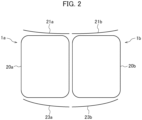
- a front window is divided into two electrothermal areas that are a left electrothermal area 20a and a right electrothermal area 20b.
- the hot-wire heater 1a is formed by disposing energizing electrodes 21a and 23a on the top side and the bottom side of the left electrothermal area 20a respectively.
- the hot-wire heater 1b is formed by disposing energizing electrodes 21b and 23b on the top side and the bottom side of the right electrothermal area 20b respectively.
- the DCDC converter 3 converts a high voltage for driving a motor into a voltage to be supplied to electric components of the vehicle 100, and supplies power to each electric component.
- power is supplied from the DCDC converter 3 to the hot-wire heaters 1a and 1b and the seat heater 15.
- the power control device 5 controls power supplied to each electric component of the vehicle 100, and in the present embodiment, controls power supplied to the hot-wire heaters 1a and 1b and the seat heater 15. Specifically, the power control device 5 switches between alternating control and entire surface control based on the external air temperature of the vehicle and the speed of the vehicle, the alternating control being for sequentially energizing each hot-wire heater provided in each of the plurality of areas of the front window, and the entire surface control being for simultaneously energizing all the hot-wire heaters provided in the plurality of areas of the front window.
- the power control device 5 performs the entire surface control. In this case, it is considered that the front window is frozen, and thus the vehicle 100 is not able to start travelling and is stopped. Therefore, the power control device 5 performs the entire surface control to simultaneously energize all of the hot-wire heaters 1a and 1b provided in the front window.
- both of the left hot-wire heater 1a and the right hot-wire heater 1b shown in FIG. 2 are energized simultaneously.
- the ice on the front window can be melted quickly by energizing the heaters with the maximum power.
- the power supplied to the vehicle 100 does not become insufficient even when the heaters are energized with the maximum power. This is because the vehicle is stopped, and thus the power required for the vehicle to travel is not being used.
- the power control device 5 performs the alternating control. In this case, since the vehicle 100 is already travelling, it is considered that the front window is not frozen, and that it is sufficient if the fogging is removed. Therefore, the power control device 5 performs the alternating control to sequentially energize the hot-wire heaters 1a and 1b provided in the plurality of areas of the front window for each area.
- the hot-wire heaters 1a and 1b shown in FIG. 2 are controlled such that the left hot-wire heater 1a and the right hot-wire heater 1b are alternately energized at intervals of several seconds to several tens of seconds. This can further reduce power consumption than when the entire surface control is performed.
- the alternating control does not have the ability to melt ice on a frozen front window. However, the device can function sufficiently even in the case of the alternating control, if the vehicle 100 is already travelling with the front window being not frozen, and it is only necessary to remove fogging.
- the power control device 5 determines whether the total power consumption of the vehicle 100 is equal to or larger than a predetermined power value. That is, the power control device 5 determines whether the power supplied to the vehicle 100 includes surplus power. In a case where the power consumption of the vehicle 100 is equal to or larger than a predetermined power value, and the power does not include surplus power, the power control device 5 determines whether the seat heater 15 is in use, and when the seat heater 15 is in use, the energization amount to the seat heater 15 is reduced.
- the power supplied to the vehicle 100 does not include surplus power
- the power can be preferentially supplied to the hot-wire heaters 1a and 1b which are important for the vehicle to travel.
- a heater for which power is to be reduced is not limited to the seat heater 15, but may be any other heater as long as the heater is provided in the interior of the vehicle 100.
- the power control device 5 controls the hot-wire heaters 1a and 1b such that the hot-wire heaters 1a and 1b are not energized even when a switch for energizing the hot-wire heaters 1a and 1b is turned on.
- a switch for energizing the hot-wire heaters 1a and 1b is turned on in spite of it being a temperature which does not require the use of heating, such an operation is considered to be an erroneous operation by an occupant of the vehicle 100.
- the power control device 5 controls the hot-wire heaters 1a and 1b such that the hot-wire heaters 1a and 1b are not energized. This avoids wasteful power consumption.
- the power control device 5 is a controller that includes a general purpose electronic circuit having a microcomputer, a microprocessor, and a CPU, and a peripheral device such as a memory.
- a computer program for executing a power control process is installed in the power control device 5.
- Each function of the power control device 5 can be implemented by one or more processing circuits.
- the processing circuits include, for example, a programmed processing device having an electrical circuit.
- the processing circuits also include devices such as application specific integrated circuits (ASICs) that are arranged to perform functions described in the embodiment and conventional circuit components.
- ASICs application specific integrated circuits
- the vehicle control unit 7 is an ECU (Electronic Control Unit) that outputs a command signal for operating each unit of the vehicle in response to an operation signal input by an occupant of the vehicle 100 or a control signal input from a controller of the vehicle 100.
- the vehicle control unit 7 outputs, for example, a command signal for operating the hot-wire heaters 1a and 1b in response to a control signal output from the power control device 5.
- the powertrain control unit 9 is an ECU that controls a powertrain such as a motor and a transmission.
- the powertrain control unit 9 obtains the speed of the vehicle 100 from a vehicle speed sensor (not shown), and controls a motor and a transmission in accordance with an accelerator operation.
- the external air temperature sensor 11 is a sensor that detects the external air temperature of the vehicle 100, and outputs the detected external air temperature to the power control device 5.
- the vehicle interior temperature sensor 13 is a sensor that detects the temperature in the interior of the vehicle 100, and outputs the detected vehicle interior temperature to the power control device 5.
- the seat heater 15 is a heater that is disposed in a seat in the interior of the vehicle 100.
- FIGS. 3A and 3B are flowcharts showing processing procedures of the power control process performed by the power control device 5 according to the present embodiment.
- the power control process shown in FIGS. 3A and 3B starts after a switch for energizing the hot-wire heaters 1a and 1b is turned on.
- step S101 the power control device 5 obtains the external air temperature of the vehicle 100 from the external air temperature sensor 11.
- the power control device 5 determines whether the external air temperature of the vehicle 100 is equal to or lower than the temperature at which a front window freezes.
- the process proceeds to step S103, and alternatively when the external air temperature is higher than the freezing temperature, the process proceeds to step S117.
- step S103 the power control device 5 determines whether the speed of the vehicle 100 is equal to or slower than the speed at which the vehicle is considered to be stopped.
- the speed of the vehicle 100 may be obtained from the powertrain control unit 9, or directly from a speed sensor (not shown).
- the process proceeds to step S105, and alternatively when the speed of the vehicle 100 is faster than the speed at which the vehicle is considered to be stopped, the process proceeds to step 5111.
- step S105 the power control device 5 determines whether the power supplied to the vehicle 100 includes surplus power. Specifically, the power control device 5 obtains the total power consumption of the vehicle 100 from the DCDC converter 3 or another ECU. Then, the power control device 5 determines whether the obtained total power consumption of the vehicle 100 is equal to or larger than a predetermined power value to determine whether the power includes surplus power. When the power supplied to the vehicle 100 does not include surplus power, the process proceeds to step S107, and alternatively when the power supplied to the vehicle 100 includes surplus power, the process proceeds to step S109.
- step 107 first, the power control device 5 determines whether the seat heater 15 is in use. When the seat heater 15 is in use, the power control device 5 reduces the energization amount to the seat heater 15 because the power of the vehicle 100 does not include surplus power. Thereafter, the process proceeds to step S109.
- step S109 the power control device 5 performs the entire surface control for simultaneously energizing all of the hot-wire heaters 1a and 1b provided in the plurality of areas of the front window. Therefore, when the external air temperature of the vehicle 100 is equal to or lower than the temperature at which the front window freezes, and the speed of the vehicle 100 is equal to or slower than the speed at which the vehicle is considered to be stopped, the power control device 5 performs the entire surface control. After the entire surface control of the hot-wire heaters 1a and 1b is performed in this way, the power control process according to the present embodiment ends.
- step S103 it is determined in step S103 that the speed of the vehicle 100 is faster than the speed at which the vehicle is considered to be stopped, and the process proceeds to step S111.
- step S111 the power control device 5 determines whether the power supplied to the vehicle 100 includes surplus power. Specifically, the power control device 5 obtains the total power consumption of the vehicle 100 from the DCDC converter 3 or another ECU. Then, the power control device 5 determines whether the obtained total power consumption of the vehicle 100 is equal to or larger than a predetermined power value to determine whether the power includes surplus power. When the power supplied to the vehicle 100 does not include surplus power, the process proceeds to step S113, and alternatively when the power supplied to the vehicle 100 includes surplus power, the process proceeds to step S115.
- step S113 the power control device 5 determines whether the seat heater 15 is in use. When the seat heater 15 is in use, the power control device 5 reduces the energization amount to the seat heater 15 because the power of the vehicle 100 does not include surplus power. Thereafter, the process proceeds to step S115.
- step S115 the power control device 5 performs the alternating control for sequentially energizing the hot-wire heaters 1a and 1b provided in the plurality of areas of the front window for each area. Therefore, when the external air temperature of the vehicle 100 is equal to or lower than the temperature at which the front window freezes, and the speed of the vehicle 100 is faster than the speed at which the vehicle is considered to be stopped, the power control device 5 performs the alternating control. After the alternating control of the hot-wire heaters 1a and 1b is performed in this way, the power control process according to the present embodiment ends.
- step S101 determines that the external air temperature of the vehicle 100 is higher than the temperature at which the front window freezes, and the process proceeds to step S117.
- step S117 first, the power control device 5 obtains the external air temperature of the vehicle 100 from the external air temperature sensor 11. Then, the power control device 5 determines whether the external air temperature of the vehicle 100 is higher than the temperature which does not require the use of heating and corresponds to the temperature in summer. When the external air temperature is equal to or lower than the temperature which does not require the use of heating, the process proceeds to step S123, and alternatively when the external air temperature is higher than the temperature which does not require the use of heating, the process proceeds to step S121.
- step S121 the power control device 5 controls the hot-wire heaters 1a and 1b such that the hot-wire heaters 1a and 1b are not energized even when a switch for energizing the hot-wire heaters 1a and 1b is turned on.
- a switch for energizing the hot-wire heaters 1a and 1b is turned on, and thus this operation is considered to be an erroneous operation by an occupant of the vehicle 100.
- the power control device 5 controls the hot-wire heaters 1a and 1b such that the hot-wire heaters 1a and 1b are not energized even when a switch for energizing the hot-wire heaters 1a and 1b is turned on. This prevents wasteful power consumption. After the hot-wire heaters 1a and 1b are controlled such that the hot-wire heaters 1a and 1b are not energized in this way, the power control process according to the present embodiment ends.
- step S117 determines that the external air temperature of the vehicle 100 is equal to or lower than the temperature which does not require the use of heating and corresponds to the temperature in summer and the process proceeds to step S123.
- step S123 the power control device 5 determines whether the power supplied to the vehicle 100 includes surplus power. Specifically, the power control device 5 obtains the total power consumption of the vehicle 100 from the DCDC converter 3 or another ECU. Then, the power control device 5 determines whether the obtained total power consumption of the vehicle 100 is equal to or larger than a predetermined power value to determine whether the power includes surplus power. When the power supplied to the vehicle 100 does not include surplus power, the process proceeds to step S125, and alternatively when the power supplied to the vehicle 100 includes surplus power, the process proceeds to step S127.
- step S125 the power control device 5 determines whether the seat heater 15 is in use. When the seat heater 15 is in use, the power control device 5 reduces the energization amount to the seat heater 15 because the power of the vehicle 100 does not include surplus power. Thereafter, the process proceeds to step S127.
- step S127 the power control device 5 performs the alternating control for sequentially energizing the hot-wire heaters 1a and 1b provided in the plurality of areas of the front window for each area. Therefore, the power control device 5 performs the alternating control when the external air temperature is equal to or lower than the temperature which does not require the use of heating. After the alternating control of the hot-wire heaters 1a and 1b is performed in this way, the power control process according to the present embodiment ends.
- the power control device 5 switches between the alternating control and the entire surface control based on the external air temperature and the speed of the vehicle, the alternating control being for sequentially energizing each hot-wire heater provided in each of a plurality of areas of a front window, and the entire surface control being for simultaneously energizing all the hot-wire heaters provided in the plurality of areas.
- the alternating control capable of saving power can thereby be performed in accordance with the external air temperature and the speed of the vehicle. Accordingly, the power consumption of the vehicle can be reduced when the hot-wire heaters provided in the front window are energized.
- the power control device 5 when the external air temperature of the vehicle is equal to or lower than a predetermined first temperature and the speed of the vehicle is equal to or slower than a predetermined value, the power control device 5 according to the present embodiment performs the entire surface control. Accordingly, when the external air temperature of the vehicle is low and the speed of the vehicle is also slow, ice on the front window can be quickly melted by means of the entire surface control in consideration of the frozen front window.
- the power control device 5 when the external air temperature of the vehicle is equal to or lower than a predetermined first temperature and the speed of the vehicle is faster than a predetermined value, the power control device 5 according to the present embodiment performs the alternating control. Accordingly, when the speed of the vehicle is fast even through the external air temperature of the vehicle is low, it is determined that the front window is not frozen, and the power consumption of the vehicle can be reduced by means of the alternating control.
- the power control device 5 determines whether the heater provided in the interior of the vehicle is in use in a case where the power consumption of the vehicle is equal to or larger than a predetermined power value, and when the heater is in use, the energization amount to the heater provided in the interior of the vehicle is reduced. This can reduce the energization amount to the heater provided in the vehicle interior in a case where the total power of the vehicle does not include surplus power. Accordingly, the power can be supplied preferentially to the hot-wire heaters.
- the power control device 5 when the external air temperature of the vehicle is higher than a predetermined second temperature, the power control device 5 according to the present embodiment performs control such that the hot-wire heaters are not energized even when a switch for energizing the hot-wire heaters is turned on. This can avoid wasteful power consumption even when an occupant of the vehicle turns on the switch by mistake.
Landscapes
- Engineering & Computer Science (AREA)
- Mechanical Engineering (AREA)
- Physics & Mathematics (AREA)
- Thermal Sciences (AREA)
- Aviation & Aerospace Engineering (AREA)
- Transportation (AREA)
- Air-Conditioning For Vehicles (AREA)
Abstract
Description
- The present invention relates to a power control device and a power control method for controlling electric power of a vehicle which includes hot-wire heaters provided respectively in a plurality of areas which are obtained by dividing a front window.
-
Patent Literature 1 discloses a heater device having heaters provided at a front window of a vehicle. In the conventional heater device disclosed inPatent Literature 1, heaters are individually disposed in an upper area, side areas, a center area, and a lower area of the front window. The area in which a heater is to be energized was determined according to the external air temperature and the speed of the vehicle. -
Patent Literature 1Japanese Unexamined Patent Application Publication No. 2010-36592 - However, in the above-described conventional heater device, when the heaters provided at the front window are energized, there has been a problem that no consideration has been given to saving power consumption even though the power consumption becomes large. In particular, in the case of an electric vehicle, the amount of power that can be supplied is limited, and therefore saving power consumption has been an important problem to be solved.
- Therefore, the present invention has been proposed in view of the above-described problem, and an object of the present invention is to provide a power control device and a power control method capable of reducing the power consumption of a vehicle when hot-wire heaters provided at a front window are energized.
- In order to solve the above-described problem, a power control device and a power control method according to an aspect of the present invention switch between alternating control and entire surface control based on the external air temperature of a vehicle and the speed of the vehicle, the alternating control being for sequentially energizing each hot-wire heater provided in each of a plurality of areas of a front window, and the entire surface control being for simultaneously energizing all the hot-wire heaters provided in the plurality of areas.
- According to the present invention, the power consumption of a vehicle can be reduced when hot-wire heaters provided at a front window are energized.
-
- [
FIG. 1] FIG. 1 is a block diagram showing the configuration of a vehicle in which a power control device according to an embodiment of the present invention is installed. - [
FIG. 2] FIG. 2 is a diagram showing the structure of hot-wire heaters controlled by a power control device according to an embodiment of the present invention. - [
FIG. 3A] FIG. 3A is a flowchart showing a process procedure of a power control process performed by a power control device according to an embodiment of the present invention. - [
FIG. 3B] FIG. 3B is a flowchart showing a process procedure of a power control process performed by a power control device according to an embodiment of the present invention. - Hereinafter, an embodiment to which the present invention is applied will be described with reference to the drawings. In descriptions of the drawings, the same parts are denoted by the same reference numerals, and a detailed description thereof will be omitted.
-
FIG. 1 is a block diagram showing a configuration of a vehicle in which a power control device according to the present embodiment is installed. As shown inFIG. 1 , avehicle 100 includes hot-wire heaters DCDC converter 3, apower control device 5, avehicle control unit 7, apowertrain control unit 9, an external air temperature sensor 11, a vehicleinterior temperature sensor 13, and aseat heater 15. In the present embodiment, a case where thevehicle 100 is an electric vehicle will be described, but a vehicle having a normal internal combustion engine may be used. - The hot-
wire heaters FIG. 2 , a front window is divided into two electrothermal areas that are a leftelectrothermal area 20a and a rightelectrothermal area 20b. The hot-wire heater 1a is formed by disposing energizingelectrodes electrothermal area 20a respectively. Similarly, the hot-wire heater 1b is formed by disposing energizingelectrodes electrothermal area 20b respectively. However, it is not necessary to limit the number of hot-wire heaters to two, and three or more hot-wire heaters may be provided by dividing a front window into three or more areas. - The
DCDC converter 3 converts a high voltage for driving a motor into a voltage to be supplied to electric components of thevehicle 100, and supplies power to each electric component. In the present embodiment, power is supplied from theDCDC converter 3 to the hot-wire heaters seat heater 15. - The
power control device 5 controls power supplied to each electric component of thevehicle 100, and in the present embodiment, controls power supplied to the hot-wire heaters seat heater 15. Specifically, thepower control device 5 switches between alternating control and entire surface control based on the external air temperature of the vehicle and the speed of the vehicle, the alternating control being for sequentially energizing each hot-wire heater provided in each of the plurality of areas of the front window, and the entire surface control being for simultaneously energizing all the hot-wire heaters provided in the plurality of areas of the front window. - In particular, when the external air temperature of the
vehicle 100 is equal to or lower than the temperature at which the front window freezes (first temperature) and the speed of thevehicle 100 is equal to or slower than the speed at which the vehicle is considered to be stopped (predetermined value), thepower control device 5 performs the entire surface control. In this case, it is considered that the front window is frozen, and thus thevehicle 100 is not able to start travelling and is stopped. Therefore, thepower control device 5 performs the entire surface control to simultaneously energize all of the hot-wire heaters - For example, in the entire surface control, both of the left hot-
wire heater 1a and the right hot-wire heater 1b shown inFIG. 2 are energized simultaneously. At this time, in the entire surface control, it is necessary to melt ice on the front window. The ice on the front window can be melted quickly by energizing the heaters with the maximum power. However, the power supplied to thevehicle 100 does not become insufficient even when the heaters are energized with the maximum power. This is because the vehicle is stopped, and thus the power required for the vehicle to travel is not being used. - Further, when the external air temperature of the
vehicle 100 is equal to or lower than the temperature at which the front window freezes (first temperature), and the speed of thevehicle 100 is faster than the speed at which the vehicle is considered to be stopped (predetermined value), thepower control device 5 performs the alternating control. In this case, since thevehicle 100 is already travelling, it is considered that the front window is not frozen, and that it is sufficient if the fogging is removed. Therefore, thepower control device 5 performs the alternating control to sequentially energize the hot-wire heaters - For example, in the alternating control, the hot-
wire heaters FIG. 2 are controlled such that the left hot-wire heater 1a and the right hot-wire heater 1b are alternately energized at intervals of several seconds to several tens of seconds. This can further reduce power consumption than when the entire surface control is performed. The alternating control does not have the ability to melt ice on a frozen front window. However, the device can function sufficiently even in the case of the alternating control, if thevehicle 100 is already travelling with the front window being not frozen, and it is only necessary to remove fogging. - When the entire surface control or the alternating control are performed for the hot-
wire heaters power control device 5 determines whether the total power consumption of thevehicle 100 is equal to or larger than a predetermined power value. That is, thepower control device 5 determines whether the power supplied to thevehicle 100 includes surplus power. In a case where the power consumption of thevehicle 100 is equal to or larger than a predetermined power value, and the power does not include surplus power, thepower control device 5 determines whether theseat heater 15 is in use, and when theseat heater 15 is in use, the energization amount to theseat heater 15 is reduced. - Accordingly, when the power supplied to the
vehicle 100 does not include surplus power, by reducing the power to theseat heater 15, the power can be preferentially supplied to the hot-wire heaters seat heater 15, but may be any other heater as long as the heater is provided in the interior of thevehicle 100. - Further, when the external air temperature of the
vehicle 100 is higher than the temperature (second temperature) at which heating is not used and which corresponds to the temperature in summer, thepower control device 5 controls the hot-wire heaters wire heaters wire heaters wire heaters vehicle 100. Therefore, in such a case, even when a switch for energizing the hot-wire heaters power control device 5 controls the hot-wire heaters wire heaters - The
power control device 5 is a controller that includes a general purpose electronic circuit having a microcomputer, a microprocessor, and a CPU, and a peripheral device such as a memory. A computer program for executing a power control process is installed in thepower control device 5. Each function of thepower control device 5 can be implemented by one or more processing circuits. The processing circuits include, for example, a programmed processing device having an electrical circuit. The processing circuits also include devices such as application specific integrated circuits (ASICs) that are arranged to perform functions described in the embodiment and conventional circuit components. - The
vehicle control unit 7 is an ECU (Electronic Control Unit) that outputs a command signal for operating each unit of the vehicle in response to an operation signal input by an occupant of thevehicle 100 or a control signal input from a controller of thevehicle 100. Thevehicle control unit 7 outputs, for example, a command signal for operating the hot-wire heaters power control device 5. - The
powertrain control unit 9 is an ECU that controls a powertrain such as a motor and a transmission. Thepowertrain control unit 9 obtains the speed of thevehicle 100 from a vehicle speed sensor (not shown), and controls a motor and a transmission in accordance with an accelerator operation. - The external air temperature sensor 11 is a sensor that detects the external air temperature of the
vehicle 100, and outputs the detected external air temperature to thepower control device 5. - The vehicle
interior temperature sensor 13 is a sensor that detects the temperature in the interior of thevehicle 100, and outputs the detected vehicle interior temperature to thepower control device 5. - The
seat heater 15 is a heater that is disposed in a seat in the interior of thevehicle 100. - Next, a power control process performed by the
power control device 5 according to the present embodiment will be described.FIGS. 3A and3B are flowcharts showing processing procedures of the power control process performed by thepower control device 5 according to the present embodiment. The power control process shown inFIGS. 3A and3B starts after a switch for energizing the hot-wire heaters - As shown in
FIG. 3A , in step S101, thepower control device 5 obtains the external air temperature of thevehicle 100 from the external air temperature sensor 11. Thepower control device 5 determines whether the external air temperature of thevehicle 100 is equal to or lower than the temperature at which a front window freezes. When the external air temperature is equal to or lower than the freezing temperature, the process proceeds to step S103, and alternatively when the external air temperature is higher than the freezing temperature, the process proceeds to step S117. - In step S103, the
power control device 5 determines whether the speed of thevehicle 100 is equal to or slower than the speed at which the vehicle is considered to be stopped. The speed of thevehicle 100 may be obtained from thepowertrain control unit 9, or directly from a speed sensor (not shown). When the speed of thevehicle 100 is equal to or slower than the speed at which the vehicle is considered to be stopped, the process proceeds to step S105, and alternatively when the speed of thevehicle 100 is faster than the speed at which the vehicle is considered to be stopped, the process proceeds to step 5111. - In step S105, the
power control device 5 determines whether the power supplied to thevehicle 100 includes surplus power. Specifically, thepower control device 5 obtains the total power consumption of thevehicle 100 from theDCDC converter 3 or another ECU. Then, thepower control device 5 determines whether the obtained total power consumption of thevehicle 100 is equal to or larger than a predetermined power value to determine whether the power includes surplus power. When the power supplied to thevehicle 100 does not include surplus power, the process proceeds to step S107, and alternatively when the power supplied to thevehicle 100 includes surplus power, the process proceeds to step S109. - In step 107, first, the
power control device 5 determines whether theseat heater 15 is in use. When theseat heater 15 is in use, thepower control device 5 reduces the energization amount to theseat heater 15 because the power of thevehicle 100 does not include surplus power. Thereafter, the process proceeds to step S109. - In step S109, the
power control device 5 performs the entire surface control for simultaneously energizing all of the hot-wire heaters vehicle 100 is equal to or lower than the temperature at which the front window freezes, and the speed of thevehicle 100 is equal to or slower than the speed at which the vehicle is considered to be stopped, thepower control device 5 performs the entire surface control. After the entire surface control of the hot-wire heaters - Next, a case will be described in which it is determined in step S103 that the speed of the
vehicle 100 is faster than the speed at which the vehicle is considered to be stopped, and the process proceeds to step S111. - In step S111, the
power control device 5 determines whether the power supplied to thevehicle 100 includes surplus power. Specifically, thepower control device 5 obtains the total power consumption of thevehicle 100 from theDCDC converter 3 or another ECU. Then, thepower control device 5 determines whether the obtained total power consumption of thevehicle 100 is equal to or larger than a predetermined power value to determine whether the power includes surplus power. When the power supplied to thevehicle 100 does not include surplus power, the process proceeds to step S113, and alternatively when the power supplied to thevehicle 100 includes surplus power, the process proceeds to step S115. - In step S113, the
power control device 5 determines whether theseat heater 15 is in use. When theseat heater 15 is in use, thepower control device 5 reduces the energization amount to theseat heater 15 because the power of thevehicle 100 does not include surplus power. Thereafter, the process proceeds to step S115. - In step S115, the
power control device 5 performs the alternating control for sequentially energizing the hot-wire heaters vehicle 100 is equal to or lower than the temperature at which the front window freezes, and the speed of thevehicle 100 is faster than the speed at which the vehicle is considered to be stopped, thepower control device 5 performs the alternating control. After the alternating control of the hot-wire heaters - Next, a case will be described in which it is determined in step S101 that the external air temperature of the
vehicle 100 is higher than the temperature at which the front window freezes, and the process proceeds to step S117. - As shown in
FIG. 3B , in step S117, first, thepower control device 5 obtains the external air temperature of thevehicle 100 from the external air temperature sensor 11. Then, thepower control device 5 determines whether the external air temperature of thevehicle 100 is higher than the temperature which does not require the use of heating and corresponds to the temperature in summer. When the external air temperature is equal to or lower than the temperature which does not require the use of heating, the process proceeds to step S123, and alternatively when the external air temperature is higher than the temperature which does not require the use of heating, the process proceeds to step S121. - In step S121, the
power control device 5 controls the hot-wire heaters wire heaters wire heaters wire heaters vehicle 100. Therefore, thepower control device 5 controls the hot-wire heaters wire heaters wire heaters wire heaters wire heaters - Next, a case will be described in which it is determined in step S117 that the external air temperature of the
vehicle 100 is equal to or lower than the temperature which does not require the use of heating and corresponds to the temperature in summer and the process proceeds to step S123. - In step S123, the
power control device 5 determines whether the power supplied to thevehicle 100 includes surplus power. Specifically, thepower control device 5 obtains the total power consumption of thevehicle 100 from theDCDC converter 3 or another ECU. Then, thepower control device 5 determines whether the obtained total power consumption of thevehicle 100 is equal to or larger than a predetermined power value to determine whether the power includes surplus power. When the power supplied to thevehicle 100 does not include surplus power, the process proceeds to step S125, and alternatively when the power supplied to thevehicle 100 includes surplus power, the process proceeds to step S127. - In step S125, first, the
power control device 5 determines whether theseat heater 15 is in use. When theseat heater 15 is in use, thepower control device 5 reduces the energization amount to theseat heater 15 because the power of thevehicle 100 does not include surplus power. Thereafter, the process proceeds to step S127. - In step S127, the
power control device 5 performs the alternating control for sequentially energizing the hot-wire heaters power control device 5 performs the alternating control when the external air temperature is equal to or lower than the temperature which does not require the use of heating. After the alternating control of the hot-wire heaters - As described above in detail, the
power control device 5 according to the present embodiment switches between the alternating control and the entire surface control based on the external air temperature and the speed of the vehicle, the alternating control being for sequentially energizing each hot-wire heater provided in each of a plurality of areas of a front window, and the entire surface control being for simultaneously energizing all the hot-wire heaters provided in the plurality of areas. The alternating control capable of saving power can thereby be performed in accordance with the external air temperature and the speed of the vehicle. Accordingly, the power consumption of the vehicle can be reduced when the hot-wire heaters provided in the front window are energized. - Further, when the external air temperature of the vehicle is equal to or lower than a predetermined first temperature and the speed of the vehicle is equal to or slower than a predetermined value, the
power control device 5 according to the present embodiment performs the entire surface control. Accordingly, when the external air temperature of the vehicle is low and the speed of the vehicle is also slow, ice on the front window can be quickly melted by means of the entire surface control in consideration of the frozen front window. - Further, when the external air temperature of the vehicle is equal to or lower than a predetermined first temperature and the speed of the vehicle is faster than a predetermined value, the
power control device 5 according to the present embodiment performs the alternating control. Accordingly, when the speed of the vehicle is fast even through the external air temperature of the vehicle is low, it is determined that the front window is not frozen, and the power consumption of the vehicle can be reduced by means of the alternating control. - The
power control device 5 according to the present embodiment determines whether the heater provided in the interior of the vehicle is in use in a case where the power consumption of the vehicle is equal to or larger than a predetermined power value, and when the heater is in use, the energization amount to the heater provided in the interior of the vehicle is reduced. This can reduce the energization amount to the heater provided in the vehicle interior in a case where the total power of the vehicle does not include surplus power. Accordingly, the power can be supplied preferentially to the hot-wire heaters. - Further, when the external air temperature of the vehicle is higher than a predetermined second temperature, the
power control device 5 according to the present embodiment performs control such that the hot-wire heaters are not energized even when a switch for energizing the hot-wire heaters is turned on. This can avoid wasteful power consumption even when an occupant of the vehicle turns on the switch by mistake. - The above-described embodiment is an example of the present invention. For this reason, the present invention is not limited to the above-described embodiment, and even in forms other than the above-described embodiment, it is needless to say that various modifications are possible according to designs and the like within a scope not departing from the technical idea according to the present invention.
-
- 1a, 1b
- Hot-wire heaters
- 3
- DCDC converter
- 5
- Power control device
- 7
- Vehicle control unit
- 9
- Powertrain control unit
- 11
- External air temperature sensor
- 13
- Vehicle interior temperature sensor
- 15
- Seat heater
- 20a, 20b
- Electrothermal areas
- 21a, 21b, 23a, 23b
- Energizing electrodes
- 100
- Vehicle
Claims (6)
- A power control device for controlling electric power of a vehicle which includes hot-wire heaters provided respectively in a plurality of areas which are obtained by dividing a front window, the power control device being configured to:
switch between alternating control and entire surface control based on an external air temperature of the vehicle and a speed of the vehicle, the alternating control being for sequentially energizing each hot-wire heater provided in each of the plurality of areas, and the entire surface control being for simultaneously energizing all the hot-wire heaters provided in the plurality of areas. - The power control device according to claim 1, wherein
when the external air temperature of the vehicle is equal to or lower than a predetermined first temperature and the speed of the vehicle is equal to or slower than a predetermined value, the entire surface control is performed. - The power control device according to claim 1 or 2, wherein
when the external air temperature of the vehicle is equal to or lower than the predetermined first temperature and the speed of the vehicle is faster than the predetermined value, the alternating control is performed. - The power control device according to claim 2 or 3, wherein
the power control device determines whether a heater provided in an interior of the vehicle is in use in a case where power consumption of the vehicle is equal to or larger than a predetermined power value, and when the heater is in use, an energization amount to the heater provided in the interior of the vehicle is reduced. - The power control device according to any one of claims 1 to 4, wherein
when the external air temperature of the vehicle is higher than a predetermined second temperature, the hot-wire heaters are not energized even when a switch for energizing the hot-wire heaters is turned on. - A power control method performed by a controller for controlling electric power of a vehicle which includes hot-wire heaters provided respectively in a plurality of areas which are obtained by dividing a front window, the power control method comprising:
switching between alternating control and entire surface control based on an external air temperature of the vehicle and a speed of the vehicle, the alternating control being for sequentially energizing each hot-wire heater provided in each of a plurality of areas, and the entire surface control being for simultaneously energizing all the hot-wire heaters provided in the plurality of areas.
Applications Claiming Priority (1)
| Application Number | Priority Date | Filing Date | Title |
|---|---|---|---|
| PCT/JP2021/013699 WO2022208693A1 (en) | 2021-03-30 | 2021-03-30 | Electric power control device and electric power control method |
Publications (3)
| Publication Number | Publication Date |
|---|---|
| EP4316881A1 true EP4316881A1 (en) | 2024-02-07 |
| EP4316881A4 EP4316881A4 (en) | 2024-06-12 |
| EP4316881B1 EP4316881B1 (en) | 2024-10-09 |
Family
ID=83458413
Family Applications (1)
| Application Number | Title | Priority Date | Filing Date |
|---|---|---|---|
| EP21844942.9A Active EP4316881B1 (en) | 2021-03-30 | 2021-03-30 | Electric power control device and electric power control method |
Country Status (5)
| Country | Link |
|---|---|
| US (1) | US12016085B2 (en) |
| EP (1) | EP4316881B1 (en) |
| JP (1) | JP7207603B1 (en) |
| CN (1) | CN117042992B (en) |
| WO (1) | WO2022208693A1 (en) |
Family Cites Families (19)
| Publication number | Priority date | Publication date | Assignee | Title |
|---|---|---|---|---|
| JPH01233140A (en) * | 1988-03-14 | 1989-09-18 | Nissan Motor Co Ltd | Ice melting device for window glass for vehicle |
| JPH0742885Y2 (en) * | 1988-03-14 | 1995-10-04 | 日産自動車株式会社 | Defrosting device for vehicle window glass |
| GB9601865D0 (en) * | 1996-01-30 | 1996-04-03 | Pilkington Glass Ltd | Electrically heated window |
| DE19709166C2 (en) * | 1997-03-06 | 2001-12-13 | Daimler Chrysler Ag | Method for controlling a heating element in a window of a motor vehicle and device for carrying out the method |
| JP3845940B2 (en) * | 1997-03-25 | 2006-11-15 | 日産自動車株式会社 | Vehicle heater |
| JP4219790B2 (en) | 2003-11-14 | 2009-02-04 | 日本板硝子株式会社 | Electric window glass |
| JP2007145293A (en) * | 2005-11-30 | 2007-06-14 | Toyota Motor Corp | Vehicle power supply control device |
| US9301343B2 (en) * | 2008-02-19 | 2016-03-29 | Fuji Jukogyo Kabushiki Kaisha | Window-glass heating device |
| JP2009247634A (en) * | 2008-04-08 | 2009-10-29 | Panasonic Corp | Heated seat |
| JP2010036592A (en) * | 2008-07-31 | 2010-02-18 | Mazda Motor Corp | Heater device for vehicular windshield |
| JP2012200100A (en) * | 2011-03-23 | 2012-10-18 | Omron Automotive Electronics Co Ltd | Power supply control device and method, and power management system |
| JP5786809B2 (en) | 2012-06-29 | 2015-09-30 | 株式会社デンソー | Electric vehicle air conditioner |
| US9724980B2 (en) * | 2014-08-20 | 2017-08-08 | Ford Global Technologies, Llc | Windshield defogging system and method |
| JP6402866B2 (en) * | 2016-08-29 | 2018-10-10 | トヨタ自動車株式会社 | Window glass heating device |
| JP2019031239A (en) * | 2017-08-09 | 2019-02-28 | アンデン株式会社 | Vehicle load drive device |
| WO2019078258A1 (en) * | 2017-10-20 | 2019-04-25 | Agc株式会社 | Laminated glass for vehicle |
| JP6939536B2 (en) * | 2017-12-27 | 2021-09-22 | トヨタ自動車株式会社 | Vehicle photography equipment |
| JP7140698B2 (en) * | 2019-03-05 | 2022-09-21 | 本田技研工業株式会社 | Fog suppressing device and its control method |
| JP7069074B2 (en) * | 2019-03-20 | 2022-05-17 | 本田技研工業株式会社 | Transport equipment |
-
2021
- 2021-03-30 US US17/633,070 patent/US12016085B2/en active Active
- 2021-03-30 WO PCT/JP2021/013699 patent/WO2022208693A1/en not_active Ceased
- 2021-03-30 CN CN202180004776.9A patent/CN117042992B/en active Active
- 2021-03-30 JP JP2022504209A patent/JP7207603B1/en active Active
- 2021-03-30 EP EP21844942.9A patent/EP4316881B1/en active Active
Also Published As
| Publication number | Publication date |
|---|---|
| WO2022208693A1 (en) | 2022-10-06 |
| JP7207603B1 (en) | 2023-01-18 |
| JPWO2022208693A1 (en) | 2022-10-06 |
| EP4316881B1 (en) | 2024-10-09 |
| EP4316881A4 (en) | 2024-06-12 |
| US20230380014A1 (en) | 2023-11-23 |
| CN117042992A (en) | 2023-11-10 |
| US12016085B2 (en) | 2024-06-18 |
| CN117042992B (en) | 2024-10-18 |
Similar Documents
| Publication | Publication Date | Title |
|---|---|---|
| CN100509465C (en) | A vehicle battery temperature control method and system | |
| KR101609034B1 (en) | Battery temperature control device | |
| EP0721060B1 (en) | Control device for automobile | |
| EP1872984A1 (en) | Load drive controller and control system | |
| US9758129B2 (en) | Method of minimizing ice buildup on a windshield of a vehicle | |
| CN104972864B (en) | Control hybrid electric vehicle(HEV)Heating mode system and method | |
| JP2012512078A (en) | System and method for reducing stationary power draw and machine using the same | |
| CN102878646A (en) | Air-conditioner control system and method for electric vehicle | |
| JP6841194B2 (en) | vehicle | |
| EP4316881B1 (en) | Electric power control device and electric power control method | |
| JP6774030B2 (en) | Charge control device and charge control method for electric vehicles | |
| JP4810870B2 (en) | Power supply system and power supply method | |
| JP5204057B2 (en) | Heater control device | |
| JP2008195150A (en) | VEHICLE DRIVE CONTROL DEVICE, VEHICLE DRIVE CONTROL METHOD, AND OVERVOLTAGE PROTECTION CIRCUIT | |
| JPH10285813A (en) | Electronic equipment and power supply control method | |
| KR20150081878A (en) | Air conditioning system for automotive vehicles | |
| KR100405565B1 (en) | Device for fan motor working control in vehicle | |
| JP2023140405A (en) | Vehicle air conditioning control system | |
| CN106956563A (en) | Warm air system control method and device, warm air system and automobile | |
| JP4696933B2 (en) | Defrosting device for vehicles | |
| JP7064393B2 (en) | Control device | |
| JP4660833B2 (en) | Stepping motor control device | |
| KR100443969B1 (en) | Auxiliary Heater Controlling Device of Diesel Automobiles | |
| KR20100041254A (en) | Method for controlling car air-conditioner | |
| JP2003154924A (en) | Wiper deicer device and method of operating wiper deicer |
Legal Events
| Date | Code | Title | Description |
|---|---|---|---|
| STAA | Information on the status of an ep patent application or granted ep patent |
Free format text: STATUS: UNKNOWN |
|
| STAA | Information on the status of an ep patent application or granted ep patent |
Free format text: STATUS: THE INTERNATIONAL PUBLICATION HAS BEEN MADE |
|
| PUAI | Public reference made under article 153(3) epc to a published international application that has entered the european phase |
Free format text: ORIGINAL CODE: 0009012 |
|
| STAA | Information on the status of an ep patent application or granted ep patent |
Free format text: STATUS: REQUEST FOR EXAMINATION WAS MADE |
|
| 17P | Request for examination filed |
Effective date: 20220218 |
|
| AK | Designated contracting states |
Kind code of ref document: A1 Designated state(s): AL AT BE BG CH CY CZ DE DK EE ES FI FR GB GR HR HU IE IS IT LI LT LU LV MC MK MT NL NO PL PT RO RS SE SI SK SM TR |
|
| REG | Reference to a national code |
Ref country code: DE Ref legal event code: R079 Free format text: PREVIOUS MAIN CLASS: B60J0001200000 Ipc: H05B0001020000 Ref country code: DE Ref legal event code: R079 Ref document number: 602021020149 Country of ref document: DE Free format text: PREVIOUS MAIN CLASS: B60J0001200000 Ipc: H05B0001020000 |
|
| A4 | Supplementary search report drawn up and despatched |
Effective date: 20240510 |
|
| RIC1 | Information provided on ipc code assigned before grant |
Ipc: B60N 2/56 20060101ALI20240503BHEP Ipc: B60H 1/22 20060101ALI20240503BHEP Ipc: B60H 1/00 20060101ALI20240503BHEP Ipc: H05B 3/84 20060101ALI20240503BHEP Ipc: B60S 1/02 20060101ALI20240503BHEP Ipc: B60J 1/20 20060101ALI20240503BHEP Ipc: H05B 1/02 20060101AFI20240503BHEP |
|
| DAV | Request for validation of the european patent (deleted) | ||
| DAX | Request for extension of the european patent (deleted) | ||
| GRAP | Despatch of communication of intention to grant a patent |
Free format text: ORIGINAL CODE: EPIDOSNIGR1 |
|
| STAA | Information on the status of an ep patent application or granted ep patent |
Free format text: STATUS: GRANT OF PATENT IS INTENDED |
|
| INTG | Intention to grant announced |
Effective date: 20240730 |
|
| GRAS | Grant fee paid |
Free format text: ORIGINAL CODE: EPIDOSNIGR3 |
|
| GRAA | (expected) grant |
Free format text: ORIGINAL CODE: 0009210 |
|
| STAA | Information on the status of an ep patent application or granted ep patent |
Free format text: STATUS: THE PATENT HAS BEEN GRANTED |
|
| AK | Designated contracting states |
Kind code of ref document: B1 Designated state(s): AL AT BE BG CH CY CZ DE DK EE ES FI FR GB GR HR HU IE IS IT LI LT LU LV MC MK MT NL NO PL PT RO RS SE SI SK SM TR |
|
| REG | Reference to a national code |
Ref country code: CH Ref legal event code: EP |
|
| REG | Reference to a national code |
Ref country code: DE Ref legal event code: R096 Ref document number: 602021020149 Country of ref document: DE |
|
| REG | Reference to a national code |
Ref country code: IE Ref legal event code: FG4D |
|
| REG | Reference to a national code |
Ref country code: LT Ref legal event code: MG9D |
|
| REG | Reference to a national code |
Ref country code: NL Ref legal event code: MP Effective date: 20241009 |
|
| REG | Reference to a national code |
Ref country code: AT Ref legal event code: MK05 Ref document number: 1732058 Country of ref document: AT Kind code of ref document: T Effective date: 20241009 |
|
| PG25 | Lapsed in a contracting state [announced via postgrant information from national office to epo] |
Ref country code: NL Free format text: LAPSE BECAUSE OF FAILURE TO SUBMIT A TRANSLATION OF THE DESCRIPTION OR TO PAY THE FEE WITHIN THE PRESCRIBED TIME-LIMIT Effective date: 20241009 |
|
| PG25 | Lapsed in a contracting state [announced via postgrant information from national office to epo] |
Ref country code: NL Free format text: LAPSE BECAUSE OF FAILURE TO SUBMIT A TRANSLATION OF THE DESCRIPTION OR TO PAY THE FEE WITHIN THE PRESCRIBED TIME-LIMIT Effective date: 20241009 |
|
| PG25 | Lapsed in a contracting state [announced via postgrant information from national office to epo] |
Ref country code: HR Free format text: LAPSE BECAUSE OF FAILURE TO SUBMIT A TRANSLATION OF THE DESCRIPTION OR TO PAY THE FEE WITHIN THE PRESCRIBED TIME-LIMIT Effective date: 20241009 Ref country code: PT Free format text: LAPSE BECAUSE OF FAILURE TO SUBMIT A TRANSLATION OF THE DESCRIPTION OR TO PAY THE FEE WITHIN THE PRESCRIBED TIME-LIMIT Effective date: 20250210 Ref country code: IS Free format text: LAPSE BECAUSE OF FAILURE TO SUBMIT A TRANSLATION OF THE DESCRIPTION OR TO PAY THE FEE WITHIN THE PRESCRIBED TIME-LIMIT Effective date: 20250209 |
|
| PG25 | Lapsed in a contracting state [announced via postgrant information from national office to epo] |
Ref country code: FI Free format text: LAPSE BECAUSE OF FAILURE TO SUBMIT A TRANSLATION OF THE DESCRIPTION OR TO PAY THE FEE WITHIN THE PRESCRIBED TIME-LIMIT Effective date: 20241009 |
|
| PG25 | Lapsed in a contracting state [announced via postgrant information from national office to epo] |
Ref country code: BG Free format text: LAPSE BECAUSE OF FAILURE TO SUBMIT A TRANSLATION OF THE DESCRIPTION OR TO PAY THE FEE WITHIN THE PRESCRIBED TIME-LIMIT Effective date: 20241009 |
|
| PG25 | Lapsed in a contracting state [announced via postgrant information from national office to epo] |
Ref country code: ES Free format text: LAPSE BECAUSE OF FAILURE TO SUBMIT A TRANSLATION OF THE DESCRIPTION OR TO PAY THE FEE WITHIN THE PRESCRIBED TIME-LIMIT Effective date: 20241009 |
|
| PG25 | Lapsed in a contracting state [announced via postgrant information from national office to epo] |
Ref country code: NO Free format text: LAPSE BECAUSE OF FAILURE TO SUBMIT A TRANSLATION OF THE DESCRIPTION OR TO PAY THE FEE WITHIN THE PRESCRIBED TIME-LIMIT Effective date: 20250109 |
|
| PG25 | Lapsed in a contracting state [announced via postgrant information from national office to epo] |
Ref country code: LV Free format text: LAPSE BECAUSE OF FAILURE TO SUBMIT A TRANSLATION OF THE DESCRIPTION OR TO PAY THE FEE WITHIN THE PRESCRIBED TIME-LIMIT Effective date: 20241009 Ref country code: AT Free format text: LAPSE BECAUSE OF FAILURE TO SUBMIT A TRANSLATION OF THE DESCRIPTION OR TO PAY THE FEE WITHIN THE PRESCRIBED TIME-LIMIT Effective date: 20241009 Ref country code: GR Free format text: LAPSE BECAUSE OF FAILURE TO SUBMIT A TRANSLATION OF THE DESCRIPTION OR TO PAY THE FEE WITHIN THE PRESCRIBED TIME-LIMIT Effective date: 20250110 |
|
| PG25 | Lapsed in a contracting state [announced via postgrant information from national office to epo] |
Ref country code: PL Free format text: LAPSE BECAUSE OF FAILURE TO SUBMIT A TRANSLATION OF THE DESCRIPTION OR TO PAY THE FEE WITHIN THE PRESCRIBED TIME-LIMIT Effective date: 20241009 |
|
| PG25 | Lapsed in a contracting state [announced via postgrant information from national office to epo] |
Ref country code: RS Free format text: LAPSE BECAUSE OF FAILURE TO SUBMIT A TRANSLATION OF THE DESCRIPTION OR TO PAY THE FEE WITHIN THE PRESCRIBED TIME-LIMIT Effective date: 20250109 |
|
| PG25 | Lapsed in a contracting state [announced via postgrant information from national office to epo] |
Ref country code: SM Free format text: LAPSE BECAUSE OF FAILURE TO SUBMIT A TRANSLATION OF THE DESCRIPTION OR TO PAY THE FEE WITHIN THE PRESCRIBED TIME-LIMIT Effective date: 20241009 |
|
| PG25 | Lapsed in a contracting state [announced via postgrant information from national office to epo] |
Ref country code: DK Free format text: LAPSE BECAUSE OF FAILURE TO SUBMIT A TRANSLATION OF THE DESCRIPTION OR TO PAY THE FEE WITHIN THE PRESCRIBED TIME-LIMIT Effective date: 20241009 |
|
| REG | Reference to a national code |
Ref country code: DE Ref legal event code: R097 Ref document number: 602021020149 Country of ref document: DE |
|
| PG25 | Lapsed in a contracting state [announced via postgrant information from national office to epo] |
Ref country code: EE Free format text: LAPSE BECAUSE OF FAILURE TO SUBMIT A TRANSLATION OF THE DESCRIPTION OR TO PAY THE FEE WITHIN THE PRESCRIBED TIME-LIMIT Effective date: 20241009 |
|
| PG25 | Lapsed in a contracting state [announced via postgrant information from national office to epo] |
Ref country code: RO Free format text: LAPSE BECAUSE OF FAILURE TO SUBMIT A TRANSLATION OF THE DESCRIPTION OR TO PAY THE FEE WITHIN THE PRESCRIBED TIME-LIMIT Effective date: 20241009 |
|
| PG25 | Lapsed in a contracting state [announced via postgrant information from national office to epo] |
Ref country code: SK Free format text: LAPSE BECAUSE OF FAILURE TO SUBMIT A TRANSLATION OF THE DESCRIPTION OR TO PAY THE FEE WITHIN THE PRESCRIBED TIME-LIMIT Effective date: 20241009 |
|
| PG25 | Lapsed in a contracting state [announced via postgrant information from national office to epo] |
Ref country code: CZ Free format text: LAPSE BECAUSE OF FAILURE TO SUBMIT A TRANSLATION OF THE DESCRIPTION OR TO PAY THE FEE WITHIN THE PRESCRIBED TIME-LIMIT Effective date: 20241009 |
|
| PG25 | Lapsed in a contracting state [announced via postgrant information from national office to epo] |
Ref country code: IT Free format text: LAPSE BECAUSE OF FAILURE TO SUBMIT A TRANSLATION OF THE DESCRIPTION OR TO PAY THE FEE WITHIN THE PRESCRIBED TIME-LIMIT Effective date: 20241009 |
|
| PLBE | No opposition filed within time limit |
Free format text: ORIGINAL CODE: 0009261 |
|
| STAA | Information on the status of an ep patent application or granted ep patent |
Free format text: STATUS: NO OPPOSITION FILED WITHIN TIME LIMIT |
|
| PG25 | Lapsed in a contracting state [announced via postgrant information from national office to epo] |
Ref country code: SE Free format text: LAPSE BECAUSE OF FAILURE TO SUBMIT A TRANSLATION OF THE DESCRIPTION OR TO PAY THE FEE WITHIN THE PRESCRIBED TIME-LIMIT Effective date: 20241009 |
|
| 26N | No opposition filed |
Effective date: 20250710 |
|
| PG25 | Lapsed in a contracting state [announced via postgrant information from national office to epo] |
Ref country code: MC Free format text: LAPSE BECAUSE OF FAILURE TO SUBMIT A TRANSLATION OF THE DESCRIPTION OR TO PAY THE FEE WITHIN THE PRESCRIBED TIME-LIMIT Effective date: 20241009 |
|
| REG | Reference to a national code |
Ref country code: CH Ref legal event code: H13 Free format text: ST27 STATUS EVENT CODE: U-0-0-H10-H13 (AS PROVIDED BY THE NATIONAL OFFICE) Effective date: 20251024 |
|
| PG25 | Lapsed in a contracting state [announced via postgrant information from national office to epo] |
Ref country code: LU Free format text: LAPSE BECAUSE OF NON-PAYMENT OF DUE FEES Effective date: 20250330 |
|
| REG | Reference to a national code |
Ref country code: BE Ref legal event code: MM Effective date: 20250331 |
|
| PG25 | Lapsed in a contracting state [announced via postgrant information from national office to epo] |
Ref country code: BE Free format text: LAPSE BECAUSE OF NON-PAYMENT OF DUE FEES Effective date: 20250331 |
|
| PG25 | Lapsed in a contracting state [announced via postgrant information from national office to epo] |
Ref country code: CH Free format text: LAPSE BECAUSE OF NON-PAYMENT OF DUE FEES Effective date: 20250331 |
|
| PG25 | Lapsed in a contracting state [announced via postgrant information from national office to epo] |
Ref country code: IE Free format text: LAPSE BECAUSE OF NON-PAYMENT OF DUE FEES Effective date: 20250330 |
|
| PGFP | Annual fee paid to national office [announced via postgrant information from national office to epo] |
Ref country code: GB Payment date: 20260220 Year of fee payment: 6 |
|
| PGFP | Annual fee paid to national office [announced via postgrant information from national office to epo] |
Ref country code: DE Payment date: 20260219 Year of fee payment: 6 |
|
| PGFP | Annual fee paid to national office [announced via postgrant information from national office to epo] |
Ref country code: FR Payment date: 20260219 Year of fee payment: 6 |