EP4316814A1 - Polymer, composition, cured product, multilayer body, and electronic component - Google Patents
Polymer, composition, cured product, multilayer body, and electronic component Download PDFInfo
- Publication number
- EP4316814A1 EP4316814A1 EP22780310.3A EP22780310A EP4316814A1 EP 4316814 A1 EP4316814 A1 EP 4316814A1 EP 22780310 A EP22780310 A EP 22780310A EP 4316814 A1 EP4316814 A1 EP 4316814A1
- Authority
- EP
- European Patent Office
- Prior art keywords
- group
- compound
- hydrocarbon group
- polymer
- carbon atoms
- Prior art date
- Legal status (The legal status is an assumption and is not a legal conclusion. Google has not performed a legal analysis and makes no representation as to the accuracy of the status listed.)
- Pending
Links
- 239000000203 mixture Substances 0.000 title claims abstract description 135
- 229920000642 polymer Polymers 0.000 title claims abstract description 126
- 125000004432 carbon atom Chemical group C* 0.000 claims abstract description 90
- 150000008282 halocarbons Chemical group 0.000 claims abstract description 29
- 125000002029 aromatic hydrocarbon group Chemical group 0.000 claims abstract description 26
- 125000001424 substituent group Chemical group 0.000 claims abstract description 22
- 125000004435 hydrogen atom Chemical group [H]* 0.000 claims abstract description 21
- 125000001931 aliphatic group Chemical group 0.000 claims abstract description 13
- 125000002887 hydroxy group Chemical group [H]O* 0.000 claims abstract description 13
- 125000000962 organic group Chemical group 0.000 claims abstract description 12
- 229910052717 sulfur Inorganic materials 0.000 claims abstract description 9
- 125000004430 oxygen atom Chemical group O* 0.000 claims abstract description 8
- 125000004434 sulfur atom Chemical group 0.000 claims abstract description 8
- -1 vinyl compound Chemical class 0.000 claims description 112
- 150000001875 compounds Chemical class 0.000 claims description 71
- 150000002430 hydrocarbons Chemical group 0.000 claims description 40
- OKKJLVBELUTLKV-UHFFFAOYSA-N methanol Natural products OC OKKJLVBELUTLKV-UHFFFAOYSA-N 0.000 claims description 33
- 239000000758 substrate Substances 0.000 claims description 29
- 239000003963 antioxidant agent Substances 0.000 claims description 12
- 230000003078 antioxidant effect Effects 0.000 claims description 12
- 125000002947 alkylene group Chemical group 0.000 claims description 11
- 125000001570 methylene group Chemical group [H]C([H])([*:1])[*:2] 0.000 claims description 10
- 125000003903 2-propenyl group Chemical group [H]C([*])([H])C([H])=C([H])[H] 0.000 claims description 8
- 239000004593 Epoxy Substances 0.000 claims description 7
- 229920002554 vinyl polymer Polymers 0.000 claims description 7
- 229910000077 silane Inorganic materials 0.000 claims description 5
- 239000004793 Polystyrene Substances 0.000 claims description 4
- 229920002223 polystyrene Polymers 0.000 claims description 4
- 125000001183 hydrocarbyl group Chemical group 0.000 abstract 2
- 230000015572 biosynthetic process Effects 0.000 description 136
- 238000003786 synthesis reaction Methods 0.000 description 136
- 239000010408 film Substances 0.000 description 60
- BWHMMNNQKKPAPP-UHFFFAOYSA-L potassium carbonate Chemical compound [K+].[K+].[O-]C([O-])=O BWHMMNNQKKPAPP-UHFFFAOYSA-L 0.000 description 48
- SECXISVLQFMRJM-UHFFFAOYSA-N N-Methylpyrrolidone Chemical compound CN1CCCC1=O SECXISVLQFMRJM-UHFFFAOYSA-N 0.000 description 40
- 230000000052 comparative effect Effects 0.000 description 39
- IJGRMHOSHXDMSA-UHFFFAOYSA-N Atomic nitrogen Chemical compound N#N IJGRMHOSHXDMSA-UHFFFAOYSA-N 0.000 description 38
- RYGMFSIKBFXOCR-UHFFFAOYSA-N Copper Chemical compound [Cu] RYGMFSIKBFXOCR-UHFFFAOYSA-N 0.000 description 37
- 239000000047 product Substances 0.000 description 37
- 239000011889 copper foil Substances 0.000 description 36
- 238000000034 method Methods 0.000 description 34
- 229920005989 resin Polymers 0.000 description 33
- 239000011347 resin Substances 0.000 description 33
- 239000002994 raw material Substances 0.000 description 31
- 239000000126 substance Substances 0.000 description 28
- YXFVVABEGXRONW-UHFFFAOYSA-N Toluene Chemical compound CC1=CC=CC=C1 YXFVVABEGXRONW-UHFFFAOYSA-N 0.000 description 27
- 239000000178 monomer Substances 0.000 description 27
- 150000003839 salts Chemical class 0.000 description 26
- 239000003999 initiator Substances 0.000 description 24
- 229910000027 potassium carbonate Inorganic materials 0.000 description 24
- 235000011181 potassium carbonates Nutrition 0.000 description 24
- 150000001339 alkali metal compounds Chemical class 0.000 description 23
- 239000007787 solid Substances 0.000 description 23
- 238000001723 curing Methods 0.000 description 21
- 239000010410 layer Substances 0.000 description 21
- 238000002156 mixing Methods 0.000 description 21
- 229910052757 nitrogen Inorganic materials 0.000 description 19
- 239000002904 solvent Substances 0.000 description 19
- 125000002723 alicyclic group Chemical group 0.000 description 16
- 229940125782 compound 2 Drugs 0.000 description 16
- 238000006116 polymerization reaction Methods 0.000 description 16
- 238000012360 testing method Methods 0.000 description 16
- KOMNUTZXSVSERR-UHFFFAOYSA-N 1,3,5-tris(prop-2-enyl)-1,3,5-triazinane-2,4,6-trione Chemical compound C=CCN1C(=O)N(CC=C)C(=O)N(CC=C)C1=O KOMNUTZXSVSERR-UHFFFAOYSA-N 0.000 description 15
- VYPSYNLAJGMNEJ-UHFFFAOYSA-N Silicium dioxide Chemical compound O=[Si]=O VYPSYNLAJGMNEJ-UHFFFAOYSA-N 0.000 description 15
- 239000011521 glass Substances 0.000 description 15
- 239000000243 solution Substances 0.000 description 14
- XJPZKYIHCLDXST-UHFFFAOYSA-N 4,6-dichloropyrimidine Chemical compound ClC1=CC(Cl)=NC=N1 XJPZKYIHCLDXST-UHFFFAOYSA-N 0.000 description 13
- 238000006243 chemical reaction Methods 0.000 description 12
- 238000000576 coating method Methods 0.000 description 12
- YMTYZTXUZLQUSF-UHFFFAOYSA-N 3,3'-Dimethylbisphenol A Chemical compound C1=C(O)C(C)=CC(C(C)(C)C=2C=C(C)C(O)=CC=2)=C1 YMTYZTXUZLQUSF-UHFFFAOYSA-N 0.000 description 11
- UMPGNGRIGSEMTC-UHFFFAOYSA-N 4-[1-(4-hydroxyphenyl)-3,3,5-trimethylcyclohexyl]phenol Chemical compound C1C(C)CC(C)(C)CC1(C=1C=CC(O)=CC=1)C1=CC=C(O)C=C1 UMPGNGRIGSEMTC-UHFFFAOYSA-N 0.000 description 11
- NRFQZTCQAYEXEE-UHFFFAOYSA-N Fenclorim Chemical compound ClC1=CC(Cl)=NC(C=2C=CC=CC=2)=N1 NRFQZTCQAYEXEE-UHFFFAOYSA-N 0.000 description 11
- 235000006708 antioxidants Nutrition 0.000 description 11
- 239000011248 coating agent Substances 0.000 description 11
- 238000010828 elution Methods 0.000 description 11
- 125000002950 monocyclic group Chemical group 0.000 description 11
- 125000003367 polycyclic group Chemical group 0.000 description 11
- 229910052731 fluorine Inorganic materials 0.000 description 10
- 125000001153 fluoro group Chemical group F* 0.000 description 10
- 125000005843 halogen group Chemical group 0.000 description 10
- 238000005470 impregnation Methods 0.000 description 10
- 229910052751 metal Inorganic materials 0.000 description 10
- 239000002184 metal Substances 0.000 description 10
- 238000005065 mining Methods 0.000 description 10
- 239000002966 varnish Substances 0.000 description 10
- ZWEHNKRNPOVVGH-UHFFFAOYSA-N 2-Butanone Chemical compound CCC(C)=O ZWEHNKRNPOVVGH-UHFFFAOYSA-N 0.000 description 9
- 230000009477 glass transition Effects 0.000 description 9
- 229910052783 alkali metal Inorganic materials 0.000 description 8
- 229940125904 compound 1 Drugs 0.000 description 8
- JHIVVAPYMSGYDF-UHFFFAOYSA-N cyclohexanone Chemical compound O=C1CCCCC1 JHIVVAPYMSGYDF-UHFFFAOYSA-N 0.000 description 8
- CATSNJVOTSVZJV-UHFFFAOYSA-N heptan-2-one Chemical compound CCCCCC(C)=O CATSNJVOTSVZJV-UHFFFAOYSA-N 0.000 description 8
- 238000005259 measurement Methods 0.000 description 8
- ISWSIDIOOBJBQZ-UHFFFAOYSA-N Phenol Chemical compound OC1=CC=CC=C1 ISWSIDIOOBJBQZ-UHFFFAOYSA-N 0.000 description 7
- 239000000853 adhesive Substances 0.000 description 7
- 230000001070 adhesive effect Effects 0.000 description 7
- 150000001340 alkali metals Chemical class 0.000 description 7
- 125000003277 amino group Chemical group 0.000 description 7
- 150000001450 anions Chemical class 0.000 description 7
- 229910052801 chlorine Inorganic materials 0.000 description 7
- 125000001309 chloro group Chemical group Cl* 0.000 description 7
- 239000002245 particle Substances 0.000 description 7
- 239000000843 powder Substances 0.000 description 7
- 230000009257 reactivity Effects 0.000 description 7
- 125000001302 tertiary amino group Chemical group 0.000 description 7
- MYRTYDVEIRVNKP-UHFFFAOYSA-N 1,2-Divinylbenzene Chemical compound C=CC1=CC=CC=C1C=C MYRTYDVEIRVNKP-UHFFFAOYSA-N 0.000 description 6
- ZRZHXNCATOYMJH-UHFFFAOYSA-N 1-(chloromethyl)-4-ethenylbenzene Chemical compound ClCC1=CC=C(C=C)C=C1 ZRZHXNCATOYMJH-UHFFFAOYSA-N 0.000 description 6
- ZCYVEMRRCGMTRW-UHFFFAOYSA-N 7553-56-2 Chemical group [I] ZCYVEMRRCGMTRW-UHFFFAOYSA-N 0.000 description 6
- UHOVQNZJYSORNB-UHFFFAOYSA-N Benzene Chemical compound C1=CC=CC=C1 UHOVQNZJYSORNB-UHFFFAOYSA-N 0.000 description 6
- WKBOTKDWSSQWDR-UHFFFAOYSA-N Bromine atom Chemical group [Br] WKBOTKDWSSQWDR-UHFFFAOYSA-N 0.000 description 6
- YMWUJEATGCHHMB-UHFFFAOYSA-N Dichloromethane Chemical compound ClCCl YMWUJEATGCHHMB-UHFFFAOYSA-N 0.000 description 6
- ZMXDDKWLCZADIW-UHFFFAOYSA-N N,N-Dimethylformamide Chemical compound CN(C)C=O ZMXDDKWLCZADIW-UHFFFAOYSA-N 0.000 description 6
- WYURNTSHIVDZCO-UHFFFAOYSA-N Tetrahydrofuran Chemical compound C1CCOC1 WYURNTSHIVDZCO-UHFFFAOYSA-N 0.000 description 6
- 239000003795 chemical substances by application Substances 0.000 description 6
- 125000000392 cycloalkenyl group Chemical group 0.000 description 6
- 125000000753 cycloalkyl group Chemical group 0.000 description 6
- 238000011156 evaluation Methods 0.000 description 6
- 239000004744 fabric Substances 0.000 description 6
- 239000011256 inorganic filler Substances 0.000 description 6
- 229910003475 inorganic filler Inorganic materials 0.000 description 6
- 229910052740 iodine Inorganic materials 0.000 description 6
- 239000012766 organic filler Substances 0.000 description 6
- 125000001997 phenyl group Chemical group [H]C1=C([H])C([H])=C(*)C([H])=C1[H] 0.000 description 6
- NBIIXXVUZAFLBC-UHFFFAOYSA-N Phosphoric acid Chemical group OP(O)(O)=O NBIIXXVUZAFLBC-UHFFFAOYSA-N 0.000 description 5
- 125000003118 aryl group Chemical group 0.000 description 5
- 125000003178 carboxy group Chemical group [H]OC(*)=O 0.000 description 5
- 125000004093 cyano group Chemical group *C#N 0.000 description 5
- 239000003112 inhibitor Substances 0.000 description 5
- 239000000463 material Substances 0.000 description 5
- 125000001624 naphthyl group Chemical group 0.000 description 5
- 125000000449 nitro group Chemical group [O-][N+](*)=O 0.000 description 5
- 239000003960 organic solvent Substances 0.000 description 5
- ABLZXFCXXLZCGV-UHFFFAOYSA-N phosphonic acid group Chemical group P(O)(O)=O ABLZXFCXXLZCGV-UHFFFAOYSA-N 0.000 description 5
- 229920001955 polyphenylene ether Polymers 0.000 description 5
- 239000010453 quartz Substances 0.000 description 5
- 125000000542 sulfonic acid group Chemical group 0.000 description 5
- IPJGAEWUPXWFPL-UHFFFAOYSA-N 1-[3-(2,5-dioxopyrrol-1-yl)phenyl]pyrrole-2,5-dione Chemical compound O=C1C=CC(=O)N1C1=CC=CC(N2C(C=CC2=O)=O)=C1 IPJGAEWUPXWFPL-UHFFFAOYSA-N 0.000 description 4
- WUQYBSRMWWRFQH-UHFFFAOYSA-N 2-prop-1-en-2-ylphenol Chemical compound CC(=C)C1=CC=CC=C1O WUQYBSRMWWRFQH-UHFFFAOYSA-N 0.000 description 4
- XOUQAVYLRNOXDO-UHFFFAOYSA-N 2-tert-butyl-5-methylphenol Chemical compound CC1=CC=C(C(C)(C)C)C(O)=C1 XOUQAVYLRNOXDO-UHFFFAOYSA-N 0.000 description 4
- SHBHYINHXNTBRP-UHFFFAOYSA-N 3-[4-(aminomethyl)-6-(trifluoromethyl)pyridin-2-yl]oxy-N-(2-methylsulfonylethyl)benzamide Chemical compound NCC1=CC(=NC(=C1)C(F)(F)F)OC=1C=C(C(=O)NCCS(=O)(=O)C)C=CC=1 SHBHYINHXNTBRP-UHFFFAOYSA-N 0.000 description 4
- YEJRWHAVMIAJKC-UHFFFAOYSA-N 4-Butyrolactone Chemical compound O=C1CCCO1 YEJRWHAVMIAJKC-UHFFFAOYSA-N 0.000 description 4
- IAZDPXIOMUYVGZ-UHFFFAOYSA-N Dimethylsulphoxide Chemical compound CS(C)=O IAZDPXIOMUYVGZ-UHFFFAOYSA-N 0.000 description 4
- QIGBRXMKCJKVMJ-UHFFFAOYSA-N Hydroquinone Chemical compound OC1=CC=C(O)C=C1 QIGBRXMKCJKVMJ-UHFFFAOYSA-N 0.000 description 4
- KDLHZDBZIXYQEI-UHFFFAOYSA-N Palladium Chemical compound [Pd] KDLHZDBZIXYQEI-UHFFFAOYSA-N 0.000 description 4
- PPBRXRYQALVLMV-UHFFFAOYSA-N Styrene Chemical compound C=CC1=CC=CC=C1 PPBRXRYQALVLMV-UHFFFAOYSA-N 0.000 description 4
- WGCOQYDRMPFAMN-ZDUSSCGKSA-N [(3S)-3-[4-(aminomethyl)-6-(trifluoromethyl)pyridin-2-yl]oxypiperidin-1-yl]-pyrimidin-5-ylmethanone Chemical compound NCC1=CC(=NC(=C1)C(F)(F)F)O[C@@H]1CN(CCC1)C(=O)C=1C=NC=NC=1 WGCOQYDRMPFAMN-ZDUSSCGKSA-N 0.000 description 4
- 239000002253 acid Substances 0.000 description 4
- 125000003545 alkoxy group Chemical group 0.000 description 4
- RDOXTESZEPMUJZ-UHFFFAOYSA-N anisole Chemical compound COC1=CC=CC=C1 RDOXTESZEPMUJZ-UHFFFAOYSA-N 0.000 description 4
- 125000005428 anthryl group Chemical group [H]C1=C([H])C([H])=C2C([H])=C3C(*)=C([H])C([H])=C([H])C3=C([H])C2=C1[H] 0.000 description 4
- 230000005540 biological transmission Effects 0.000 description 4
- LLEMOWNGBBNAJR-UHFFFAOYSA-N biphenyl-2-ol Chemical compound OC1=CC=CC=C1C1=CC=CC=C1 LLEMOWNGBBNAJR-UHFFFAOYSA-N 0.000 description 4
- IISBACLAFKSPIT-UHFFFAOYSA-N bisphenol A Chemical class C=1C=C(O)C=CC=1C(C)(C)C1=CC=C(O)C=C1 IISBACLAFKSPIT-UHFFFAOYSA-N 0.000 description 4
- WTEOIRVLGSZEPR-UHFFFAOYSA-N boron trifluoride Chemical compound FB(F)F WTEOIRVLGSZEPR-UHFFFAOYSA-N 0.000 description 4
- 229910052799 carbon Inorganic materials 0.000 description 4
- 239000003054 catalyst Substances 0.000 description 4
- 230000008859 change Effects 0.000 description 4
- 238000010790 dilution Methods 0.000 description 4
- 239000012895 dilution Substances 0.000 description 4
- 238000001914 filtration Methods 0.000 description 4
- NIHNNTQXNPWCJQ-UHFFFAOYSA-N fluorene Chemical compound C1=CC=C2CC3=CC=CC=C3C2=C1 NIHNNTQXNPWCJQ-UHFFFAOYSA-N 0.000 description 4
- 238000010438 heat treatment Methods 0.000 description 4
- 238000007654 immersion Methods 0.000 description 4
- 239000012299 nitrogen atmosphere Substances 0.000 description 4
- BASFCYQUMIYNBI-UHFFFAOYSA-N platinum Chemical group [Pt] BASFCYQUMIYNBI-UHFFFAOYSA-N 0.000 description 4
- 229920003048 styrene butadiene rubber Polymers 0.000 description 4
- 230000002194 synthesizing effect Effects 0.000 description 4
- XQUPVDVFXZDTLT-UHFFFAOYSA-N 1-[4-[[4-(2,5-dioxopyrrol-1-yl)phenyl]methyl]phenyl]pyrrole-2,5-dione Chemical compound O=C1C=CC(=O)N1C(C=C1)=CC=C1CC1=CC=C(N2C(C=CC2=O)=O)C=C1 XQUPVDVFXZDTLT-UHFFFAOYSA-N 0.000 description 3
- KGRVJHAUYBGFFP-UHFFFAOYSA-N 2,2'-Methylenebis(4-methyl-6-tert-butylphenol) Chemical compound CC(C)(C)C1=CC(C)=CC(CC=2C(=C(C=C(C)C=2)C(C)(C)C)O)=C1O KGRVJHAUYBGFFP-UHFFFAOYSA-N 0.000 description 3
- XMNIXWIUMCBBBL-UHFFFAOYSA-N 2-(2-phenylpropan-2-ylperoxy)propan-2-ylbenzene Chemical compound C=1C=CC=CC=1C(C)(C)OOC(C)(C)C1=CC=CC=C1 XMNIXWIUMCBBBL-UHFFFAOYSA-N 0.000 description 3
- QIRNGVVZBINFMX-UHFFFAOYSA-N 2-allylphenol Chemical compound OC1=CC=CC=C1CC=C QIRNGVVZBINFMX-UHFFFAOYSA-N 0.000 description 3
- 125000000094 2-phenylethyl group Chemical group [H]C1=C([H])C([H])=C(C([H])=C1[H])C([H])([H])C([H])([H])* 0.000 description 3
- XEWPEIOKCHAXBH-UHFFFAOYSA-N 4-[1-(4-hydroxy-3-methylphenyl)-3,3,5-trimethylcyclohexyl]-2-methylphenol Chemical compound C1C(C)CC(C)(C)CC1(C=1C=C(C)C(O)=CC=1)C1=CC=C(O)C(C)=C1 XEWPEIOKCHAXBH-UHFFFAOYSA-N 0.000 description 3
- WOCGGVRGNIEDSZ-UHFFFAOYSA-N 4-[2-(4-hydroxy-3-prop-2-enylphenyl)propan-2-yl]-2-prop-2-enylphenol Chemical compound C=1C=C(O)C(CC=C)=CC=1C(C)(C)C1=CC=C(O)C(CC=C)=C1 WOCGGVRGNIEDSZ-UHFFFAOYSA-N 0.000 description 3
- NUDSREQIJYWLRA-UHFFFAOYSA-N 4-[9-(4-hydroxy-3-methylphenyl)fluoren-9-yl]-2-methylphenol Chemical compound C1=C(O)C(C)=CC(C2(C3=CC=CC=C3C3=CC=CC=C32)C=2C=C(C)C(O)=CC=2)=C1 NUDSREQIJYWLRA-UHFFFAOYSA-N 0.000 description 3
- WMFOQBRAJBCJND-UHFFFAOYSA-M Lithium hydroxide Chemical compound [Li+].[OH-] WMFOQBRAJBCJND-UHFFFAOYSA-M 0.000 description 3
- 229920000877 Melamine resin Polymers 0.000 description 3
- CTQNGGLPUBDAKN-UHFFFAOYSA-N O-Xylene Chemical compound CC1=CC=CC=C1C CTQNGGLPUBDAKN-UHFFFAOYSA-N 0.000 description 3
- KWYUFKZDYYNOTN-UHFFFAOYSA-M Potassium hydroxide Chemical compound [OH-].[K+] KWYUFKZDYYNOTN-UHFFFAOYSA-M 0.000 description 3
- HEMHJVSKTPXQMS-UHFFFAOYSA-M Sodium hydroxide Chemical compound [OH-].[Na+] HEMHJVSKTPXQMS-UHFFFAOYSA-M 0.000 description 3
- 125000005073 adamantyl group Chemical group C12(CC3CC(CC(C1)C3)C2)* 0.000 description 3
- 125000004414 alkyl thio group Chemical group 0.000 description 3
- 150000001412 amines Chemical class 0.000 description 3
- 125000003710 aryl alkyl group Chemical group 0.000 description 3
- 125000001797 benzyl group Chemical group [H]C1=C([H])C([H])=C(C([H])=C1[H])C([H])([H])* 0.000 description 3
- 150000001768 cations Chemical class 0.000 description 3
- 229920001577 copolymer Polymers 0.000 description 3
- 125000001047 cyclobutenyl group Chemical group C1(=CCC1)* 0.000 description 3
- 125000001995 cyclobutyl group Chemical group [H]C1([H])C([H])([H])C([H])(*)C1([H])[H] 0.000 description 3
- 125000000596 cyclohexenyl group Chemical group C1(=CCCCC1)* 0.000 description 3
- 125000000113 cyclohexyl group Chemical group [H]C1([H])C([H])([H])C([H])([H])C([H])(*)C([H])([H])C1([H])[H] 0.000 description 3
- 125000002433 cyclopentenyl group Chemical group C1(=CCCC1)* 0.000 description 3
- 125000001511 cyclopentyl group Chemical group [H]C1([H])C([H])([H])C([H])([H])C([H])(*)C1([H])[H] 0.000 description 3
- 125000000298 cyclopropenyl group Chemical group [H]C1=C([H])C1([H])* 0.000 description 3
- 125000001559 cyclopropyl group Chemical group [H]C1([H])C([H])([H])C1([H])* 0.000 description 3
- 125000000816 ethylene group Chemical group [H]C([H])([*:1])C([H])([H])[*:2] 0.000 description 3
- 238000005227 gel permeation chromatography Methods 0.000 description 3
- FBAFATDZDUQKNH-UHFFFAOYSA-M iron chloride Chemical compound [Cl-].[Fe] FBAFATDZDUQKNH-UHFFFAOYSA-M 0.000 description 3
- JDSHMPZPIAZGSV-UHFFFAOYSA-N melamine Chemical compound NC1=NC(N)=NC(N)=N1 JDSHMPZPIAZGSV-UHFFFAOYSA-N 0.000 description 3
- VHRYZQNGTZXDNX-UHFFFAOYSA-N methacryloyl chloride Chemical compound CC(=C)C(Cl)=O VHRYZQNGTZXDNX-UHFFFAOYSA-N 0.000 description 3
- 125000002496 methyl group Chemical group [H]C([H])([H])* 0.000 description 3
- 238000000465 moulding Methods 0.000 description 3
- 125000004923 naphthylmethyl group Chemical group C1(=CC=CC2=CC=CC=C12)C* 0.000 description 3
- 125000003518 norbornenyl group Chemical group C12(C=CC(CC1)C2)* 0.000 description 3
- 125000002868 norbornyl group Chemical group C12(CCC(CC1)C2)* 0.000 description 3
- 125000004344 phenylpropyl group Chemical group 0.000 description 3
- 230000000704 physical effect Effects 0.000 description 3
- 229920003192 poly(bis maleimide) Polymers 0.000 description 3
- 229920003223 poly(pyromellitimide-1,4-diphenyl ether) Polymers 0.000 description 3
- 125000000467 secondary amino group Chemical group [H]N([*:1])[*:2] 0.000 description 3
- 229920000468 styrene butadiene styrene block copolymer Polymers 0.000 description 3
- 125000000999 tert-butyl group Chemical group [H]C([H])([H])C(*)(C([H])([H])[H])C([H])([H])[H] 0.000 description 3
- YLQBMQCUIZJEEH-UHFFFAOYSA-N tetrahydrofuran Natural products C=1C=COC=1 YLQBMQCUIZJEEH-UHFFFAOYSA-N 0.000 description 3
- JOXIMZWYDAKGHI-UHFFFAOYSA-N toluene-4-sulfonic acid Chemical compound CC1=CC=C(S(O)(=O)=O)C=C1 JOXIMZWYDAKGHI-UHFFFAOYSA-N 0.000 description 3
- 125000003944 tolyl group Chemical group 0.000 description 3
- 125000000391 vinyl group Chemical group [H]C([*])=C([H])[H] 0.000 description 3
- XLYOFNOQVPJJNP-UHFFFAOYSA-N water Substances O XLYOFNOQVPJJNP-UHFFFAOYSA-N 0.000 description 3
- 239000008096 xylene Substances 0.000 description 3
- 125000005023 xylyl group Chemical group 0.000 description 3
- NAWXUBYGYWOOIX-SFHVURJKSA-N (2s)-2-[[4-[2-(2,4-diaminoquinazolin-6-yl)ethyl]benzoyl]amino]-4-methylidenepentanedioic acid Chemical compound C1=CC2=NC(N)=NC(N)=C2C=C1CCC1=CC=C(C(=O)N[C@@H](CC(=C)C(O)=O)C(O)=O)C=C1 NAWXUBYGYWOOIX-SFHVURJKSA-N 0.000 description 2
- HUWSZNZAROKDRZ-RRLWZMAJSA-N (3r,4r)-3-azaniumyl-5-[[(2s,3r)-1-[(2s)-2,3-dicarboxypyrrolidin-1-yl]-3-methyl-1-oxopentan-2-yl]amino]-5-oxo-4-sulfanylpentane-1-sulfonate Chemical compound OS(=O)(=O)CC[C@@H](N)[C@@H](S)C(=O)N[C@@H]([C@H](C)CC)C(=O)N1CCC(C(O)=O)[C@H]1C(O)=O HUWSZNZAROKDRZ-RRLWZMAJSA-N 0.000 description 2
- VZXTWGWHSMCWGA-UHFFFAOYSA-N 1,3,5-triazine-2,4-diamine Chemical compound NC1=NC=NC(N)=N1 VZXTWGWHSMCWGA-UHFFFAOYSA-N 0.000 description 2
- AZQWKYJCGOJGHM-UHFFFAOYSA-N 1,4-benzoquinone Chemical compound O=C1C=CC(=O)C=C1 AZQWKYJCGOJGHM-UHFFFAOYSA-N 0.000 description 2
- VXNZUUAINFGPBY-UHFFFAOYSA-N 1-Butene Chemical group CCC=C VXNZUUAINFGPBY-UHFFFAOYSA-N 0.000 description 2
- ARXJGSRGQADJSQ-UHFFFAOYSA-N 1-methoxypropan-2-ol Chemical compound COCC(C)O ARXJGSRGQADJSQ-UHFFFAOYSA-N 0.000 description 2
- POYODSZSSBWJPD-UHFFFAOYSA-N 2-methylprop-2-enoyloxy 2-methylprop-2-eneperoxoate Chemical compound CC(=C)C(=O)OOOC(=O)C(C)=C POYODSZSSBWJPD-UHFFFAOYSA-N 0.000 description 2
- XCZKKZXWDBOGPA-UHFFFAOYSA-N 2-phenylbenzene-1,4-diol Chemical compound OC1=CC=C(O)C(C=2C=CC=CC=2)=C1 XCZKKZXWDBOGPA-UHFFFAOYSA-N 0.000 description 2
- 229940061334 2-phenylphenol Drugs 0.000 description 2
- VSAWBBYYMBQKIK-UHFFFAOYSA-N 4-[[3,5-bis[(3,5-ditert-butyl-4-hydroxyphenyl)methyl]-2,4,6-trimethylphenyl]methyl]-2,6-ditert-butylphenol Chemical compound CC1=C(CC=2C=C(C(O)=C(C=2)C(C)(C)C)C(C)(C)C)C(C)=C(CC=2C=C(C(O)=C(C=2)C(C)(C)C)C(C)(C)C)C(C)=C1CC1=CC(C(C)(C)C)=C(O)C(C(C)(C)C)=C1 VSAWBBYYMBQKIK-UHFFFAOYSA-N 0.000 description 2
- DBPKMSBWOKAKLA-UHFFFAOYSA-N 4-chloropyrimidine Chemical compound ClC1=CC=NC=N1 DBPKMSBWOKAKLA-UHFFFAOYSA-N 0.000 description 2
- UZFMOKQJFYMBGY-UHFFFAOYSA-N 4-hydroxy-TEMPO Chemical group CC1(C)CC(O)CC(C)(C)N1[O] UZFMOKQJFYMBGY-UHFFFAOYSA-N 0.000 description 2
- FUGYGGDSWSUORM-UHFFFAOYSA-N 4-hydroxystyrene Chemical compound OC1=CC=C(C=C)C=C1 FUGYGGDSWSUORM-UHFFFAOYSA-N 0.000 description 2
- ULKLGIFJWFIQFF-UHFFFAOYSA-N 5K8XI641G3 Chemical compound CCC1=NC=C(C)N1 ULKLGIFJWFIQFF-UHFFFAOYSA-N 0.000 description 2
- 229910015900 BF3 Inorganic materials 0.000 description 2
- HEDRZPFGACZZDS-UHFFFAOYSA-N Chloroform Chemical compound ClC(Cl)Cl HEDRZPFGACZZDS-UHFFFAOYSA-N 0.000 description 2
- RTZKZFJDLAIYFH-UHFFFAOYSA-N Diethyl ether Chemical compound CCOCC RTZKZFJDLAIYFH-UHFFFAOYSA-N 0.000 description 2
- YCKRFDGAMUMZLT-UHFFFAOYSA-N Fluorine atom Chemical compound [F] YCKRFDGAMUMZLT-UHFFFAOYSA-N 0.000 description 2
- WHXSMMKQMYFTQS-UHFFFAOYSA-N Lithium Chemical compound [Li] WHXSMMKQMYFTQS-UHFFFAOYSA-N 0.000 description 2
- FXHOOIRPVKKKFG-UHFFFAOYSA-N N,N-Dimethylacetamide Chemical compound CN(C)C(C)=O FXHOOIRPVKKKFG-UHFFFAOYSA-N 0.000 description 2
- IMNFDUFMRHMDMM-UHFFFAOYSA-N N-Heptane Chemical compound CCCCCCC IMNFDUFMRHMDMM-UHFFFAOYSA-N 0.000 description 2
- PXHVJJICTQNCMI-UHFFFAOYSA-N Nickel Chemical compound [Ni] PXHVJJICTQNCMI-UHFFFAOYSA-N 0.000 description 2
- XBDQKXXYIPTUBI-UHFFFAOYSA-M Propionate Chemical compound CCC([O-])=O XBDQKXXYIPTUBI-UHFFFAOYSA-M 0.000 description 2
- CDBYLPFSWZWCQE-UHFFFAOYSA-L Sodium Carbonate Chemical compound [Na+].[Na+].[O-]C([O-])=O CDBYLPFSWZWCQE-UHFFFAOYSA-L 0.000 description 2
- UIIMBOGNXHQVGW-UHFFFAOYSA-M Sodium bicarbonate Chemical compound [Na+].OC([O-])=O UIIMBOGNXHQVGW-UHFFFAOYSA-M 0.000 description 2
- 239000002174 Styrene-butadiene Substances 0.000 description 2
- 239000007983 Tris buffer Substances 0.000 description 2
- 150000008065 acid anhydrides Chemical class 0.000 description 2
- ORILYTVJVMAKLC-UHFFFAOYSA-N adamantane Chemical compound C1C(C2)CC3CC1CC2C3 ORILYTVJVMAKLC-UHFFFAOYSA-N 0.000 description 2
- WNLRTRBMVRJNCN-UHFFFAOYSA-N adipic acid Chemical compound OC(=O)CCCCC(O)=O WNLRTRBMVRJNCN-UHFFFAOYSA-N 0.000 description 2
- 229910000288 alkali metal carbonate Inorganic materials 0.000 description 2
- 150000008041 alkali metal carbonates Chemical class 0.000 description 2
- 125000003342 alkenyl group Chemical group 0.000 description 2
- 125000000217 alkyl group Chemical group 0.000 description 2
- 125000000304 alkynyl group Chemical group 0.000 description 2
- PNEYBMLMFCGWSK-UHFFFAOYSA-N aluminium oxide Inorganic materials [O-2].[O-2].[O-2].[Al+3].[Al+3] PNEYBMLMFCGWSK-UHFFFAOYSA-N 0.000 description 2
- 125000000129 anionic group Chemical group 0.000 description 2
- TZCXTZWJZNENPQ-UHFFFAOYSA-L barium sulfate Chemical compound [Ba+2].[O-]S([O-])(=O)=O TZCXTZWJZNENPQ-UHFFFAOYSA-L 0.000 description 2
- XITRBUPOXXBIJN-UHFFFAOYSA-N bis(2,2,6,6-tetramethylpiperidin-4-yl) decanedioate Chemical compound C1C(C)(C)NC(C)(C)CC1OC(=O)CCCCCCCCC(=O)OC1CC(C)(C)NC(C)(C)C1 XITRBUPOXXBIJN-UHFFFAOYSA-N 0.000 description 2
- BEWYHVAWEKZDPP-UHFFFAOYSA-N bornane Chemical compound C1CC2(C)CCC1C2(C)C BEWYHVAWEKZDPP-UHFFFAOYSA-N 0.000 description 2
- FACXGONDLDSNOE-UHFFFAOYSA-N buta-1,3-diene;styrene Chemical compound C=CC=C.C=CC1=CC=CC=C1.C=CC1=CC=CC=C1 FACXGONDLDSNOE-UHFFFAOYSA-N 0.000 description 2
- 125000004369 butenyl group Chemical group C(=CCC)* 0.000 description 2
- 125000000480 butynyl group Chemical group [*]C#CC([H])([H])C([H])([H])[H] 0.000 description 2
- YCIMNLLNPGFGHC-UHFFFAOYSA-N catechol Chemical compound OC1=CC=CC=C1O YCIMNLLNPGFGHC-UHFFFAOYSA-N 0.000 description 2
- 125000002091 cationic group Chemical group 0.000 description 2
- MVPPADPHJFYWMZ-UHFFFAOYSA-N chlorobenzene Chemical compound ClC1=CC=CC=C1 MVPPADPHJFYWMZ-UHFFFAOYSA-N 0.000 description 2
- 238000004891 communication Methods 0.000 description 2
- 238000004132 cross linking Methods 0.000 description 2
- BGTOWKSIORTVQH-UHFFFAOYSA-N cyclopentanone Chemical compound O=C1CCCC1 BGTOWKSIORTVQH-UHFFFAOYSA-N 0.000 description 2
- NNBZCPXTIHJBJL-UHFFFAOYSA-N decalin Chemical compound C1CCCC2CCCCC21 NNBZCPXTIHJBJL-UHFFFAOYSA-N 0.000 description 2
- USIUVYZYUHIAEV-UHFFFAOYSA-N diphenyl ether Chemical compound C=1C=CC=CC=1OC1=CC=CC=C1 USIUVYZYUHIAEV-UHFFFAOYSA-N 0.000 description 2
- KZTYYGOKRVBIMI-UHFFFAOYSA-N diphenyl sulfone Chemical compound C=1C=CC=CC=1S(=O)(=O)C1=CC=CC=C1 KZTYYGOKRVBIMI-UHFFFAOYSA-N 0.000 description 2
- 230000000694 effects Effects 0.000 description 2
- 239000012776 electronic material Substances 0.000 description 2
- 239000003759 ester based solvent Substances 0.000 description 2
- 125000004185 ester group Chemical group 0.000 description 2
- 239000004210 ether based solvent Substances 0.000 description 2
- 125000001495 ethyl group Chemical group [H]C([H])([H])C([H])([H])* 0.000 description 2
- 125000002534 ethynyl group Chemical group [H]C#C* 0.000 description 2
- 238000011049 filling Methods 0.000 description 2
- 239000011737 fluorine Substances 0.000 description 2
- 239000011888 foil Substances 0.000 description 2
- VPVSTMAPERLKKM-UHFFFAOYSA-N glycoluril Chemical compound N1C(=O)NC2NC(=O)NC21 VPVSTMAPERLKKM-UHFFFAOYSA-N 0.000 description 2
- 150000004820 halides Chemical class 0.000 description 2
- 238000009413 insulation Methods 0.000 description 2
- 239000011229 interlayer Substances 0.000 description 2
- 125000000959 isobutyl group Chemical group [H]C([H])([H])C([H])(C([H])([H])[H])C([H])([H])* 0.000 description 2
- 125000001449 isopropyl group Chemical group [H]C([H])([H])C([H])(*)C([H])([H])[H] 0.000 description 2
- 239000005453 ketone based solvent Substances 0.000 description 2
- 239000007788 liquid Substances 0.000 description 2
- UZKWTJUDCOPSNM-UHFFFAOYSA-N methoxybenzene Substances CCCCOC=C UZKWTJUDCOPSNM-UHFFFAOYSA-N 0.000 description 2
- 125000004108 n-butyl group Chemical group [H]C([H])([H])C([H])([H])C([H])([H])C([H])([H])* 0.000 description 2
- 125000000740 n-pentyl group Chemical group [H]C([H])([H])C([H])([H])C([H])([H])C([H])([H])C([H])([H])* 0.000 description 2
- 125000004123 n-propyl group Chemical group [H]C([H])([H])C([H])([H])C([H])([H])* 0.000 description 2
- 239000004745 nonwoven fabric Substances 0.000 description 2
- 235000010292 orthophenyl phenol Nutrition 0.000 description 2
- 229910052763 palladium Inorganic materials 0.000 description 2
- 125000002255 pentenyl group Chemical group C(=CCCC)* 0.000 description 2
- 125000005981 pentynyl group Chemical group 0.000 description 2
- 238000000016 photochemical curing Methods 0.000 description 2
- XOKSLPVRUOBDEW-UHFFFAOYSA-N pinane Chemical compound CC1CCC2C(C)(C)C1C2 XOKSLPVRUOBDEW-UHFFFAOYSA-N 0.000 description 2
- 229920001343 polytetrafluoroethylene Polymers 0.000 description 2
- 239000004810 polytetrafluoroethylene Substances 0.000 description 2
- 238000002360 preparation method Methods 0.000 description 2
- 238000003825 pressing Methods 0.000 description 2
- 125000002924 primary amino group Chemical group [H]N([H])* 0.000 description 2
- 125000004368 propenyl group Chemical group C(=CC)* 0.000 description 2
- 125000004805 propylene group Chemical group [H]C([H])([H])C([H])([*:1])C([H])([H])[*:2] 0.000 description 2
- 125000002568 propynyl group Chemical group [*]C#CC([H])([H])[H] 0.000 description 2
- 125000000714 pyrimidinyl group Chemical group 0.000 description 2
- 150000003254 radicals Chemical class 0.000 description 2
- 230000035484 reaction time Effects 0.000 description 2
- GHMLBKRAJCXXBS-UHFFFAOYSA-N resorcinol Chemical compound OC1=CC=CC(O)=C1 GHMLBKRAJCXXBS-UHFFFAOYSA-N 0.000 description 2
- 125000002914 sec-butyl group Chemical group [H]C([H])([H])C([H])([H])C([H])(*)C([H])([H])[H] 0.000 description 2
- 239000004065 semiconductor Substances 0.000 description 2
- 229910000679 solder Inorganic materials 0.000 description 2
- 125000000472 sulfonyl group Chemical group *S(*)(=O)=O 0.000 description 2
- HHVIBTZHLRERCL-UHFFFAOYSA-N sulfonyldimethane Chemical compound CS(C)(=O)=O HHVIBTZHLRERCL-UHFFFAOYSA-N 0.000 description 2
- 229920002725 thermoplastic elastomer Polymers 0.000 description 2
- CNHDIAIOKMXOLK-UHFFFAOYSA-N toluquinol Chemical compound CC1=CC(O)=CC=C1O CNHDIAIOKMXOLK-UHFFFAOYSA-N 0.000 description 2
- RIOQSEWOXXDEQQ-UHFFFAOYSA-N triphenylphosphine Chemical compound C1=CC=CC=C1P(C=1C=CC=CC=1)C1=CC=CC=C1 RIOQSEWOXXDEQQ-UHFFFAOYSA-N 0.000 description 2
- 239000011800 void material Substances 0.000 description 2
- NWPIOULNZLJZHU-UHFFFAOYSA-N (1,2,2,6,6-pentamethylpiperidin-4-yl) 2-methylprop-2-enoate Chemical compound CN1C(C)(C)CC(OC(=O)C(C)=C)CC1(C)C NWPIOULNZLJZHU-UHFFFAOYSA-N 0.000 description 1
- SEOSQBZZSQXYDO-UHFFFAOYSA-N (2,2,6,6-tetramethylpiperidin-1-yl) 2-methylprop-2-enoate Chemical compound CC(=C)C(=O)ON1C(C)(C)CCCC1(C)C SEOSQBZZSQXYDO-UHFFFAOYSA-N 0.000 description 1
- WOGITNXCNOTRLK-VOTSOKGWSA-N (e)-3-phenylprop-2-enoyl chloride Chemical compound ClC(=O)\C=C\C1=CC=CC=C1 WOGITNXCNOTRLK-VOTSOKGWSA-N 0.000 description 1
- RJUIDDKTATZJFE-NSCUHMNNSA-N (e)-but-2-enoyl chloride Chemical compound C\C=C\C(Cl)=O RJUIDDKTATZJFE-NSCUHMNNSA-N 0.000 description 1
- HSLFISVKRDQEBY-UHFFFAOYSA-N 1,1-bis(tert-butylperoxy)cyclohexane Chemical compound CC(C)(C)OOC1(OOC(C)(C)C)CCCCC1 HSLFISVKRDQEBY-UHFFFAOYSA-N 0.000 description 1
- ODJQFZXHKPCJMD-UHFFFAOYSA-N 1,2,3,3a,4,5,6,7,8,8a-decahydroazulene Chemical compound C1CCCCC2CCCC21 ODJQFZXHKPCJMD-UHFFFAOYSA-N 0.000 description 1
- GVJFFQYXVOJXFI-UHFFFAOYSA-N 1,2,3,4,4a,5,6,7,8,8a,9,9a,10,10a-tetradecahydroanthracene Chemical compound C1C2CCCCC2CC2C1CCCC2 GVJFFQYXVOJXFI-UHFFFAOYSA-N 0.000 description 1
- FIDRAVVQGKNYQK-UHFFFAOYSA-N 1,2,3,4-tetrahydrotriazine Chemical compound C1NNNC=C1 FIDRAVVQGKNYQK-UHFFFAOYSA-N 0.000 description 1
- JYEUMXHLPRZUAT-UHFFFAOYSA-N 1,2,3-triazine Chemical group C1=CN=NN=C1 JYEUMXHLPRZUAT-UHFFFAOYSA-N 0.000 description 1
- CCNDOQHYOIISTA-UHFFFAOYSA-N 1,2-bis(2-tert-butylperoxypropan-2-yl)benzene Chemical compound CC(C)(C)OOC(C)(C)C1=CC=CC=C1C(C)(C)OOC(C)(C)C CCNDOQHYOIISTA-UHFFFAOYSA-N 0.000 description 1
- XGQJGMGAMHFMAO-UHFFFAOYSA-N 1,3,4,6-tetrakis(methoxymethyl)-3a,6a-dihydroimidazo[4,5-d]imidazole-2,5-dione Chemical compound COCN1C(=O)N(COC)C2C1N(COC)C(=O)N2COC XGQJGMGAMHFMAO-UHFFFAOYSA-N 0.000 description 1
- VNQNXQYZMPJLQX-UHFFFAOYSA-N 1,3,5-tris[(3,5-ditert-butyl-4-hydroxyphenyl)methyl]-1,3,5-triazinane-2,4,6-trione Chemical compound CC(C)(C)C1=C(O)C(C(C)(C)C)=CC(CN2C(N(CC=3C=C(C(O)=C(C=3)C(C)(C)C)C(C)(C)C)C(=O)N(CC=3C=C(C(O)=C(C=3)C(C)(C)C)C(C)(C)C)C2=O)=O)=C1 VNQNXQYZMPJLQX-UHFFFAOYSA-N 0.000 description 1
- CYSGHNMQYZDMIA-UHFFFAOYSA-N 1,3-Dimethyl-2-imidazolidinon Chemical compound CN1CCN(C)C1=O CYSGHNMQYZDMIA-UHFFFAOYSA-N 0.000 description 1
- RYHBNJHYFVUHQT-UHFFFAOYSA-N 1,4-Dioxane Chemical compound C1COCCO1 RYHBNJHYFVUHQT-UHFFFAOYSA-N 0.000 description 1
- FLBAYUMRQUHISI-UHFFFAOYSA-N 1,8-naphthyridine Chemical group N1=CC=CC2=CC=CN=C21 FLBAYUMRQUHISI-UHFFFAOYSA-N 0.000 description 1
- HMDQPBSDHHTRNI-UHFFFAOYSA-N 1-(chloromethyl)-3-ethenylbenzene Chemical compound ClCC1=CC=CC(C=C)=C1 HMDQPBSDHHTRNI-UHFFFAOYSA-N 0.000 description 1
- QUMXDOLUJCHOAY-UHFFFAOYSA-N 1-Phenylethyl acetate Chemical compound CC(=O)OC(C)C1=CC=CC=C1 QUMXDOLUJCHOAY-UHFFFAOYSA-N 0.000 description 1
- YNSSPVZNXLACMW-UHFFFAOYSA-N 1-[4-[[4-(2,5-dioxopyrrol-1-yl)-3-ethyl-5-methylphenyl]methyl]-2-ethyl-6-methylphenyl]pyrrole-2,5-dione Chemical compound C=1C(C)=C(N2C(C=CC2=O)=O)C(CC)=CC=1CC(C=C1CC)=CC(C)=C1N1C(=O)C=CC1=O YNSSPVZNXLACMW-UHFFFAOYSA-N 0.000 description 1
- FBHPRUXJQNWTEW-UHFFFAOYSA-N 1-benzyl-2-methylimidazole Chemical compound CC1=NC=CN1CC1=CC=CC=C1 FBHPRUXJQNWTEW-UHFFFAOYSA-N 0.000 description 1
- PNKVFPOTXQOCKF-UHFFFAOYSA-N 1-bis(2-fluorophenyl)phosphorylanthracene Chemical compound FC1=C(C=CC=C1)P(C1=CC=CC2=CC3=CC=CC=C3C=C12)(C1=C(C=CC=C1)F)=O PNKVFPOTXQOCKF-UHFFFAOYSA-N 0.000 description 1
- NWJQIVWRCZJVNO-UHFFFAOYSA-N 1-bis(2-fluorophenyl)phosphorylnaphthalene Chemical compound FC1=C(C=CC=C1)P(C1=CC=CC2=CC=CC=C12)(C1=C(C=CC=C1)F)=O NWJQIVWRCZJVNO-UHFFFAOYSA-N 0.000 description 1
- CDDDRVNOHLVEED-UHFFFAOYSA-N 1-cyclohexyl-3-[1-[[1-(cyclohexylcarbamoylamino)cyclohexyl]diazenyl]cyclohexyl]urea Chemical compound C1CCCCC1(N=NC1(CCCCC1)NC(=O)NC1CCCCC1)NC(=O)NC1CCCCC1 CDDDRVNOHLVEED-UHFFFAOYSA-N 0.000 description 1
- IYSVFZBXZVPIFA-UHFFFAOYSA-N 1-ethenyl-4-(4-ethenylphenyl)benzene Chemical group C1=CC(C=C)=CC=C1C1=CC=C(C=C)C=C1 IYSVFZBXZVPIFA-UHFFFAOYSA-N 0.000 description 1
- MBDUIEKYVPVZJH-UHFFFAOYSA-N 1-ethylsulfonylethane Chemical compound CCS(=O)(=O)CC MBDUIEKYVPVZJH-UHFFFAOYSA-N 0.000 description 1
- JAPZQMHGKQRTPH-UHFFFAOYSA-N 1-fluoro-2-[(2-fluorophenyl)-phenylphosphoryl]benzene Chemical compound FC1=CC=CC=C1P(=O)(C=1C(=CC=CC=1)F)C1=CC=CC=C1 JAPZQMHGKQRTPH-UHFFFAOYSA-N 0.000 description 1
- RNFJDJUURJAICM-UHFFFAOYSA-N 2,2,4,4,6,6-hexaphenoxy-1,3,5-triaza-2$l^{5},4$l^{5},6$l^{5}-triphosphacyclohexa-1,3,5-triene Chemical compound N=1P(OC=2C=CC=CC=2)(OC=2C=CC=CC=2)=NP(OC=2C=CC=CC=2)(OC=2C=CC=CC=2)=NP=1(OC=1C=CC=CC=1)OC1=CC=CC=C1 RNFJDJUURJAICM-UHFFFAOYSA-N 0.000 description 1
- HGOUNPXIJSDIKV-UHFFFAOYSA-N 2,2-bis(hydroxymethyl)butyl 2-methylprop-2-enoate Chemical compound CCC(CO)(CO)COC(=O)C(C)=C HGOUNPXIJSDIKV-UHFFFAOYSA-N 0.000 description 1
- BYBGSCXPMGPLFP-UHFFFAOYSA-N 2,3,4,5,6,7-hexahydro-1h-tricyclo[2.2.1.0^{2,6}]heptane Chemical compound C12CC3CC1C2C3 BYBGSCXPMGPLFP-UHFFFAOYSA-N 0.000 description 1
- QIXDHVDGPXBRRD-UHFFFAOYSA-N 2,3,5-trimethylcyclohexa-2,5-diene-1,4-dione Chemical compound CC1=CC(=O)C(C)=C(C)C1=O QIXDHVDGPXBRRD-UHFFFAOYSA-N 0.000 description 1
- MLCNOCRGSBCAGH-UHFFFAOYSA-N 2,3-dichloropyrazine Chemical compound ClC1=NC=CN=C1Cl MLCNOCRGSBCAGH-UHFFFAOYSA-N 0.000 description 1
- ZTHHRSBDBPCCMZ-UHFFFAOYSA-N 2,4-dichloro-5-methoxypyrimidine Chemical compound COC1=CN=C(Cl)N=C1Cl ZTHHRSBDBPCCMZ-UHFFFAOYSA-N 0.000 description 1
- DQXNTSXKIUZJJS-UHFFFAOYSA-N 2,4-dichloro-5-methylpyrimidine Chemical compound CC1=CN=C(Cl)N=C1Cl DQXNTSXKIUZJJS-UHFFFAOYSA-N 0.000 description 1
- INUSQTPGSHFGHM-UHFFFAOYSA-N 2,4-dichloro-5-nitropyrimidine Chemical compound [O-][N+](=O)C1=CN=C(Cl)N=C1Cl INUSQTPGSHFGHM-UHFFFAOYSA-N 0.000 description 1
- BTLKROSJMNFSQZ-UHFFFAOYSA-N 2,4-dichloro-6-methylpyrimidine Chemical compound CC1=CC(Cl)=NC(Cl)=N1 BTLKROSJMNFSQZ-UHFFFAOYSA-N 0.000 description 1
- BTTNYQZNBZNDOR-UHFFFAOYSA-N 2,4-dichloropyrimidine Chemical compound ClC1=CC=NC(Cl)=N1 BTTNYQZNBZNDOR-UHFFFAOYSA-N 0.000 description 1
- KIYKHEOWZLJZSB-UHFFFAOYSA-N 2,5-dibromopyrazine Chemical compound BrC1=CN=C(Br)C=N1 KIYKHEOWZLJZSB-UHFFFAOYSA-N 0.000 description 1
- XAHITOJPIWZJHD-UHFFFAOYSA-N 2,5-dibromopyrimidine Chemical compound BrC1=CN=C(Br)N=C1 XAHITOJPIWZJHD-UHFFFAOYSA-N 0.000 description 1
- CEJAHXLRNZJPQH-UHFFFAOYSA-N 2,5-dichloropyrimidine Chemical compound ClC1=CN=C(Cl)N=C1 CEJAHXLRNZJPQH-UHFFFAOYSA-N 0.000 description 1
- JXKQTRCEKQCAGH-UHFFFAOYSA-N 2,6-dibromopyrazine Chemical compound BrC1=CN=CC(Br)=N1 JXKQTRCEKQCAGH-UHFFFAOYSA-N 0.000 description 1
- LSEAAPGIZCDEEH-UHFFFAOYSA-N 2,6-dichloropyrazine Chemical compound ClC1=CN=CC(Cl)=N1 LSEAAPGIZCDEEH-UHFFFAOYSA-N 0.000 description 1
- UPVBKNZVOJNQKE-UHFFFAOYSA-N 2,6-dichloropyrimidin-4-amine Chemical compound NC1=CC(Cl)=NC(Cl)=N1 UPVBKNZVOJNQKE-UHFFFAOYSA-N 0.000 description 1
- AVTLBBWTUPQRAY-UHFFFAOYSA-N 2-(2-cyanobutan-2-yldiazenyl)-2-methylbutanenitrile Chemical compound CCC(C)(C#N)N=NC(C)(CC)C#N AVTLBBWTUPQRAY-UHFFFAOYSA-N 0.000 description 1
- WYGWHHGCAGTUCH-UHFFFAOYSA-N 2-[(2-cyano-4-methylpentan-2-yl)diazenyl]-2,4-dimethylpentanenitrile Chemical compound CC(C)CC(C)(C#N)N=NC(C)(C#N)CC(C)C WYGWHHGCAGTUCH-UHFFFAOYSA-N 0.000 description 1
- NKMOLEYVYVWWJC-UHFFFAOYSA-N 2-[2,4,6-trioxo-3,5-bis[2-(3-sulfanylbutanoyloxy)ethyl]-1,3,5-triazinan-1-yl]ethyl 3-sulfanylbutanoate Chemical compound CC(S)CC(=O)OCCN1C(=O)N(CCOC(=O)CC(C)S)C(=O)N(CCOC(=O)CC(C)S)C1=O NKMOLEYVYVWWJC-UHFFFAOYSA-N 0.000 description 1
- QSRJVOOOWGXUDY-UHFFFAOYSA-N 2-[2-[2-[3-(3-tert-butyl-4-hydroxy-5-methylphenyl)propanoyloxy]ethoxy]ethoxy]ethyl 3-(3-tert-butyl-4-hydroxy-5-methylphenyl)propanoate Chemical compound CC(C)(C)C1=C(O)C(C)=CC(CCC(=O)OCCOCCOCCOC(=O)CCC=2C=C(C(O)=C(C)C=2)C(C)(C)C)=C1 QSRJVOOOWGXUDY-UHFFFAOYSA-N 0.000 description 1
- TXBCBTDQIULDIA-UHFFFAOYSA-N 2-[[3-hydroxy-2,2-bis(hydroxymethyl)propoxy]methyl]-2-(hydroxymethyl)propane-1,3-diol Chemical compound OCC(CO)(CO)COCC(CO)(CO)CO TXBCBTDQIULDIA-UHFFFAOYSA-N 0.000 description 1
- SLQAJWTZUXJPNY-UHFFFAOYSA-N 2-chloro-5-fluoropyrimidin-4-amine Chemical compound NC1=NC(Cl)=NC=C1F SLQAJWTZUXJPNY-UHFFFAOYSA-N 0.000 description 1
- AGYUQBNABXVWMS-UHFFFAOYSA-N 2-chloro-5-fluoropyrimidine Chemical compound FC1=CN=C(Cl)N=C1 AGYUQBNABXVWMS-UHFFFAOYSA-N 0.000 description 1
- WSZRCNZXKKTLQE-UHFFFAOYSA-N 2-chloro-5-iodopyrimidine Chemical compound ClC1=NC=C(I)C=N1 WSZRCNZXKKTLQE-UHFFFAOYSA-N 0.000 description 1
- YTWBFUCJVWKCCK-UHFFFAOYSA-N 2-heptadecyl-1h-imidazole Chemical compound CCCCCCCCCCCCCCCCCC1=NC=CN1 YTWBFUCJVWKCCK-UHFFFAOYSA-N 0.000 description 1
- LXBGSDVWAMZHDD-UHFFFAOYSA-O 2-methyl-1h-imidazol-3-ium Chemical compound CC=1NC=C[NH+]=1 LXBGSDVWAMZHDD-UHFFFAOYSA-O 0.000 description 1
- LXBGSDVWAMZHDD-UHFFFAOYSA-N 2-methyl-1h-imidazole Chemical compound CC1=NC=CN1 LXBGSDVWAMZHDD-UHFFFAOYSA-N 0.000 description 1
- GJJVAFUKOBZPCB-UHFFFAOYSA-N 2-methyl-2-(4,8,12-trimethyltrideca-3,7,11-trienyl)-3,4-dihydrochromen-6-ol Chemical compound OC1=CC=C2OC(CCC=C(C)CCC=C(C)CCC=C(C)C)(C)CCC2=C1 GJJVAFUKOBZPCB-UHFFFAOYSA-N 0.000 description 1
- QTWJRLJHJPIABL-UHFFFAOYSA-N 2-methylphenol;3-methylphenol;4-methylphenol Chemical compound CC1=CC=C(O)C=C1.CC1=CC=CC(O)=C1.CC1=CC=CC=C1O QTWJRLJHJPIABL-UHFFFAOYSA-N 0.000 description 1
- BNCADMBVWNPPIZ-UHFFFAOYSA-N 2-n,2-n,4-n,4-n,6-n,6-n-hexakis(methoxymethyl)-1,3,5-triazine-2,4,6-triamine Chemical compound COCN(COC)C1=NC(N(COC)COC)=NC(N(COC)COC)=N1 BNCADMBVWNPPIZ-UHFFFAOYSA-N 0.000 description 1
- ZCUJYXPAKHMBAZ-UHFFFAOYSA-N 2-phenyl-1h-imidazole Chemical compound C1=CNC(C=2C=CC=CC=2)=N1 ZCUJYXPAKHMBAZ-UHFFFAOYSA-N 0.000 description 1
- ZDULHUHNYHJYKA-UHFFFAOYSA-N 2-propan-2-ylsulfonylpropane Chemical compound CC(C)S(=O)(=O)C(C)C ZDULHUHNYHJYKA-UHFFFAOYSA-N 0.000 description 1
- WJQOZHYUIDYNHM-UHFFFAOYSA-N 2-tert-Butylphenol Chemical compound CC(C)(C)C1=CC=CC=C1O WJQOZHYUIDYNHM-UHFFFAOYSA-N 0.000 description 1
- PFANXOISJYKQRP-UHFFFAOYSA-N 2-tert-butyl-4-[1-(5-tert-butyl-4-hydroxy-2-methylphenyl)butyl]-5-methylphenol Chemical compound C=1C(C(C)(C)C)=C(O)C=C(C)C=1C(CCC)C1=CC(C(C)(C)C)=C(O)C=C1C PFANXOISJYKQRP-UHFFFAOYSA-N 0.000 description 1
- LLEASVZEQBICSN-UHFFFAOYSA-N 2-undecyl-1h-imidazole Chemical compound CCCCCCCCCCCC1=NC=CN1 LLEASVZEQBICSN-UHFFFAOYSA-N 0.000 description 1
- DXIJHCSGLOHNES-UHFFFAOYSA-N 3,3-dimethylbut-1-enylbenzene Chemical compound CC(C)(C)C=CC1=CC=CC=C1 DXIJHCSGLOHNES-UHFFFAOYSA-N 0.000 description 1
- DTLBKXRFWUERQN-UHFFFAOYSA-N 3,5-dibromopyrazin-2-amine Chemical compound NC1=NC=C(Br)N=C1Br DTLBKXRFWUERQN-UHFFFAOYSA-N 0.000 description 1
- JZSAUQMXKHBZEO-UHFFFAOYSA-N 3,5-dichloropyridazine Chemical compound ClC1=CN=NC(Cl)=C1 JZSAUQMXKHBZEO-UHFFFAOYSA-N 0.000 description 1
- ROYHWGZNGMXQEU-UHFFFAOYSA-N 3,6-dichloro-4-methylpyridazine Chemical compound CC1=CC(Cl)=NN=C1Cl ROYHWGZNGMXQEU-UHFFFAOYSA-N 0.000 description 1
- GUSWJGOYDXFJSI-UHFFFAOYSA-N 3,6-dichloropyridazine Chemical compound ClC1=CC=C(Cl)N=N1 GUSWJGOYDXFJSI-UHFFFAOYSA-N 0.000 description 1
- LSCYSSYUBYLBIU-UHFFFAOYSA-N 3,9-bis[2-(4,6-diamino-1,3,5-triazin-2-yl)ethyl]spiro[5.5]undecane-2,4,8,10-tetrone Chemical compound NC1=NC(N)=NC(CCC2C(CC3(CC2=O)CC(=O)C(CCC=2N=C(N)N=C(N)N=2)C(=O)C3)=O)=N1 LSCYSSYUBYLBIU-UHFFFAOYSA-N 0.000 description 1
- QOQBXALKWRGLQQ-UHFFFAOYSA-N 3,9-bis[2-(4,6-diamino-1,3,5-triazin-2-yl)propyl]spiro[5.5]undecane-2,4,8,10-tetrone Chemical compound N=1C(N)=NC(N)=NC=1C(C)CC(C(C1)=O)C(=O)CC1(CC1=O)CC(=O)C1CC(C)C1=NC(N)=NC(N)=N1 QOQBXALKWRGLQQ-UHFFFAOYSA-N 0.000 description 1
- UIDDPPKZYZTEGS-UHFFFAOYSA-N 3-(2-ethyl-4-methylimidazol-1-yl)propanenitrile Chemical compound CCC1=NC(C)=CN1CCC#N UIDDPPKZYZTEGS-UHFFFAOYSA-N 0.000 description 1
- SESYNEDUKZDRJL-UHFFFAOYSA-N 3-(2-methylimidazol-1-yl)propanenitrile Chemical compound CC1=NC=CN1CCC#N SESYNEDUKZDRJL-UHFFFAOYSA-N 0.000 description 1
- SXPVZPQNFIDDPP-UHFFFAOYSA-N 3-(4-hydroxyphenyl)pyrrole-2,5-dione Chemical compound C1=CC(O)=CC=C1C1=CC(=O)NC1=O SXPVZPQNFIDDPP-UHFFFAOYSA-N 0.000 description 1
- QYXVDGZUXHFXTO-UHFFFAOYSA-L 3-oxobutanoate;platinum(2+) Chemical compound [Pt+2].CC(=O)CC([O-])=O.CC(=O)CC([O-])=O QYXVDGZUXHFXTO-UHFFFAOYSA-L 0.000 description 1
- YBRVSVVVWCFQMG-UHFFFAOYSA-N 4,4'-diaminodiphenylmethane Chemical compound C1=CC(N)=CC=C1CC1=CC=C(N)C=C1 YBRVSVVVWCFQMG-UHFFFAOYSA-N 0.000 description 1
- VPWNQTHUCYMVMZ-UHFFFAOYSA-N 4,4'-sulfonyldiphenol Chemical compound C1=CC(O)=CC=C1S(=O)(=O)C1=CC=C(O)C=C1 VPWNQTHUCYMVMZ-UHFFFAOYSA-N 0.000 description 1
- CEPVZSXIONCAJV-UHFFFAOYSA-N 4,6-dibromopyrimidine Chemical compound BrC1=CC(Br)=NC=N1 CEPVZSXIONCAJV-UHFFFAOYSA-N 0.000 description 1
- FKRXXAMAHOGYNT-UHFFFAOYSA-N 4,6-dichloro-2-methylpyrimidin-5-amine Chemical compound CC1=NC(Cl)=C(N)C(Cl)=N1 FKRXXAMAHOGYNT-UHFFFAOYSA-N 0.000 description 1
- FIMUTBLUWQGTIJ-UHFFFAOYSA-N 4,6-dichloro-2-methylpyrimidine Chemical compound CC1=NC(Cl)=CC(Cl)=N1 FIMUTBLUWQGTIJ-UHFFFAOYSA-N 0.000 description 1
- FCMLONIWOAGZJX-UHFFFAOYSA-N 4,6-dichloro-2-methylsulfanylpyrimidine Chemical compound CSC1=NC(Cl)=CC(Cl)=N1 FCMLONIWOAGZJX-UHFFFAOYSA-N 0.000 description 1
- DROUVIKCNOHKBA-UHFFFAOYSA-N 4,6-dichloro-2-methylsulfonylpyrimidine Chemical compound CS(=O)(=O)C1=NC(Cl)=CC(Cl)=N1 DROUVIKCNOHKBA-UHFFFAOYSA-N 0.000 description 1
- IJQIGKLDBGKSNT-UHFFFAOYSA-N 4,6-dichloro-5-methoxypyrimidine Chemical compound COC1=C(Cl)N=CN=C1Cl IJQIGKLDBGKSNT-UHFFFAOYSA-N 0.000 description 1
- NUEYDUKUIXVKNB-UHFFFAOYSA-N 4,6-dichloro-5-methylpyrimidine Chemical compound CC1=C(Cl)N=CN=C1Cl NUEYDUKUIXVKNB-UHFFFAOYSA-N 0.000 description 1
- JPZOAVGMSDSWSW-UHFFFAOYSA-N 4,6-dichloropyrimidin-2-amine Chemical compound NC1=NC(Cl)=CC(Cl)=N1 JPZOAVGMSDSWSW-UHFFFAOYSA-N 0.000 description 1
- NIGDWBHWHVHOAD-UHFFFAOYSA-N 4,6-dichloropyrimidin-5-amine Chemical compound NC1=C(Cl)N=CN=C1Cl NIGDWBHWHVHOAD-UHFFFAOYSA-N 0.000 description 1
- ZXWGHENZKVQKPX-UHFFFAOYSA-N 4,6-dichloropyrimidine-2,5-diamine Chemical compound NC1=NC(Cl)=C(N)C(Cl)=N1 ZXWGHENZKVQKPX-UHFFFAOYSA-N 0.000 description 1
- YCIGYTFKOXGYTA-UHFFFAOYSA-N 4-(3-cyanopropyldiazenyl)butanenitrile Chemical compound N#CCCCN=NCCCC#N YCIGYTFKOXGYTA-UHFFFAOYSA-N 0.000 description 1
- LABQKWYHWCYABU-UHFFFAOYSA-N 4-(3-sulfanylbutanoyloxy)butyl 3-sulfanylbutanoate Chemical compound CC(S)CC(=O)OCCCCOC(=O)CC(C)S LABQKWYHWCYABU-UHFFFAOYSA-N 0.000 description 1
- BATCUENAARTUKW-UHFFFAOYSA-N 4-[(4-hydroxyphenyl)-diphenylmethyl]phenol Chemical compound C1=CC(O)=CC=C1C(C=1C=CC(O)=CC=1)(C=1C=CC=CC=1)C1=CC=CC=C1 BATCUENAARTUKW-UHFFFAOYSA-N 0.000 description 1
- BHWMWBACMSEDTE-UHFFFAOYSA-N 4-[1-(4-hydroxyphenyl)cyclododecyl]phenol Chemical compound C1=CC(O)=CC=C1C1(C=2C=CC(O)=CC=2)CCCCCCCCCCC1 BHWMWBACMSEDTE-UHFFFAOYSA-N 0.000 description 1
- ICYDRUIZSPKQOH-UHFFFAOYSA-N 4-[1-(4-hydroxyphenyl)decyl]phenol Chemical compound C=1C=C(O)C=CC=1C(CCCCCCCCC)C1=CC=C(O)C=C1 ICYDRUIZSPKQOH-UHFFFAOYSA-N 0.000 description 1
- OUKOUEHLRVEKCJ-UHFFFAOYSA-N 4-[1-(4-hydroxyphenyl)nonyl]phenol Chemical compound C=1C=C(O)C=CC=1C(CCCCCCCC)C1=CC=C(O)C=C1 OUKOUEHLRVEKCJ-UHFFFAOYSA-N 0.000 description 1
- SWZOQAGVRGQLDV-UHFFFAOYSA-N 4-[2-(4-hydroxy-2,2,6,6-tetramethylpiperidin-1-yl)ethoxy]-4-oxobutanoic acid Chemical compound CC1(C)CC(O)CC(C)(C)N1CCOC(=O)CCC(O)=O SWZOQAGVRGQLDV-UHFFFAOYSA-N 0.000 description 1
- BKTRENAPTCBBFA-UHFFFAOYSA-N 4-[2-(4-hydroxy-3-phenylphenyl)propan-2-yl]-2-phenylphenol Chemical compound C=1C=C(O)C(C=2C=CC=CC=2)=CC=1C(C)(C)C(C=1)=CC=C(O)C=1C1=CC=CC=C1 BKTRENAPTCBBFA-UHFFFAOYSA-N 0.000 description 1
- VHLLJTHDWPAQEM-UHFFFAOYSA-N 4-[2-(4-hydroxyphenyl)-4-methylpentan-2-yl]phenol Chemical compound C=1C=C(O)C=CC=1C(C)(CC(C)C)C1=CC=C(O)C=C1 VHLLJTHDWPAQEM-UHFFFAOYSA-N 0.000 description 1
- PVFQHGDIOXNKIC-UHFFFAOYSA-N 4-[2-[3-[2-(4-hydroxyphenyl)propan-2-yl]phenyl]propan-2-yl]phenol Chemical compound C=1C=CC(C(C)(C)C=2C=CC(O)=CC=2)=CC=1C(C)(C)C1=CC=C(O)C=C1 PVFQHGDIOXNKIC-UHFFFAOYSA-N 0.000 description 1
- FLMZHPQIDVOWEJ-UHFFFAOYSA-N 4-[9-(4-hydroxy-3-phenylphenyl)fluoren-9-yl]-2-phenylphenol Chemical compound OC1=CC=C(C2(C3=CC=CC=C3C3=CC=CC=C32)C=2C=C(C(O)=CC=2)C=2C=CC=CC=2)C=C1C1=CC=CC=C1 FLMZHPQIDVOWEJ-UHFFFAOYSA-N 0.000 description 1
- OVEMTTZEBOCJDV-UHFFFAOYSA-N 4-hexylaniline Chemical compound CCCCCCC1=CC=C(N)C=C1 OVEMTTZEBOCJDV-UHFFFAOYSA-N 0.000 description 1
- YXHRTMJUSBVGMX-UHFFFAOYSA-N 4-n-butyl-2-n,4-n-bis(2,2,6,6-tetramethylpiperidin-4-yl)-2-n-[6-[(2,2,6,6-tetramethylpiperidin-4-yl)amino]hexyl]-1,3,5-triazine-2,4-diamine Chemical compound N=1C=NC(N(CCCCCCNC2CC(C)(C)NC(C)(C)C2)C2CC(C)(C)NC(C)(C)C2)=NC=1N(CCCC)C1CC(C)(C)NC(C)(C)C1 YXHRTMJUSBVGMX-UHFFFAOYSA-N 0.000 description 1
- JAGRUUPXPPLSRX-UHFFFAOYSA-N 4-prop-1-en-2-ylphenol Chemical compound CC(=C)C1=CC=C(O)C=C1 JAGRUUPXPPLSRX-UHFFFAOYSA-N 0.000 description 1
- QUFXYBKGILUJHS-UHFFFAOYSA-N 5,6-dichloropyrazine-2,3-dicarbonitrile Chemical compound ClC1=NC(C#N)=C(C#N)N=C1Cl QUFXYBKGILUJHS-UHFFFAOYSA-N 0.000 description 1
- XPGIBDJXEVAVTO-UHFFFAOYSA-N 5-bromo-2-chloropyrimidine Chemical compound ClC1=NC=C(Br)C=N1 XPGIBDJXEVAVTO-UHFFFAOYSA-N 0.000 description 1
- CTWZYPZCDJKBRS-UHFFFAOYSA-N 5-bromo-2-fluoropyrimidine Chemical compound FC1=NC=C(Br)C=N1 CTWZYPZCDJKBRS-UHFFFAOYSA-N 0.000 description 1
- ZEZKXPQIDURFKA-UHFFFAOYSA-N 5-bromo-2-iodopyrimidine Chemical compound BrC1=CN=C(I)N=C1 ZEZKXPQIDURFKA-UHFFFAOYSA-N 0.000 description 1
- XVRYJQACDDVZEI-UHFFFAOYSA-N 5-bromo-4-chloro-2-methylsulfanylpyrimidine Chemical compound CSC1=NC=C(Br)C(Cl)=N1 XVRYJQACDDVZEI-UHFFFAOYSA-N 0.000 description 1
- IXDGHAZCSMVIFX-UHFFFAOYSA-N 6-(dibutylamino)-1h-1,3,5-triazine-2,4-dithione Chemical compound CCCCN(CCCC)C1=NC(=S)NC(=S)N1 IXDGHAZCSMVIFX-UHFFFAOYSA-N 0.000 description 1
- ZVVFVKJZNVSANF-UHFFFAOYSA-N 6-[3-(3,5-ditert-butyl-4-hydroxyphenyl)propanoyloxy]hexyl 3-(3,5-ditert-butyl-4-hydroxyphenyl)propanoate Chemical compound CC(C)(C)C1=C(O)C(C(C)(C)C)=CC(CCC(=O)OCCCCCCOC(=O)CCC=2C=C(C(O)=C(C=2)C(C)(C)C)C(C)(C)C)=C1 ZVVFVKJZNVSANF-UHFFFAOYSA-N 0.000 description 1
- ZXLYUNPVVODNRE-UHFFFAOYSA-N 6-ethenyl-1,3,5-triazine-2,4-diamine Chemical compound NC1=NC(N)=NC(C=C)=N1 ZXLYUNPVVODNRE-UHFFFAOYSA-N 0.000 description 1
- YWFPGFJLYRKYJZ-UHFFFAOYSA-N 9,9-bis(4-hydroxyphenyl)fluorene Chemical compound C1=CC(O)=CC=C1C1(C=2C=CC(O)=CC=2)C2=CC=CC=C2C2=CC=CC=C21 YWFPGFJLYRKYJZ-UHFFFAOYSA-N 0.000 description 1
- 229910002012 Aerosil® Inorganic materials 0.000 description 1
- OSDWBNJEKMUWAV-UHFFFAOYSA-N Allyl chloride Chemical compound ClCC=C OSDWBNJEKMUWAV-UHFFFAOYSA-N 0.000 description 1
- 239000004342 Benzoyl peroxide Substances 0.000 description 1
- OMPJBNCRMGITSC-UHFFFAOYSA-N Benzoylperoxide Chemical compound C=1C=CC=CC=1C(=O)OOC(=O)C1=CC=CC=C1 OMPJBNCRMGITSC-UHFFFAOYSA-N 0.000 description 1
- 229930185605 Bisphenol Natural products 0.000 description 1
- VOWWYDCFAISREI-UHFFFAOYSA-N Bisphenol AP Chemical compound C=1C=C(O)C=CC=1C(C=1C=CC(O)=CC=1)(C)C1=CC=CC=C1 VOWWYDCFAISREI-UHFFFAOYSA-N 0.000 description 1
- GIXXQTYGFOHYPT-UHFFFAOYSA-N Bisphenol P Chemical compound C=1C=C(C(C)(C)C=2C=CC(O)=CC=2)C=CC=1C(C)(C)C1=CC=C(O)C=C1 GIXXQTYGFOHYPT-UHFFFAOYSA-N 0.000 description 1
- SDDLEVPIDBLVHC-UHFFFAOYSA-N Bisphenol Z Chemical compound C1=CC(O)=CC=C1C1(C=2C=CC(O)=CC=2)CCCCC1 SDDLEVPIDBLVHC-UHFFFAOYSA-N 0.000 description 1
- 239000007848 Bronsted acid Substances 0.000 description 1
- DKPFZGUDAPQIHT-UHFFFAOYSA-N Butyl acetate Natural products CCCCOC(C)=O DKPFZGUDAPQIHT-UHFFFAOYSA-N 0.000 description 1
- NLZUEZXRPGMBCV-UHFFFAOYSA-N Butylhydroxytoluene Chemical compound CC1=CC(C(C)(C)C)=C(O)C(C(C)(C)C)=C1 NLZUEZXRPGMBCV-UHFFFAOYSA-N 0.000 description 1
- LYQLVEMOMJIVCK-UHFFFAOYSA-N C1(=CC=CC=C1)OC(OC1=CC=CC=C1)=[Se] Chemical compound C1(=CC=CC=C1)OC(OC1=CC=CC=C1)=[Se] LYQLVEMOMJIVCK-UHFFFAOYSA-N 0.000 description 1
- 239000004215 Carbon black (E152) Substances 0.000 description 1
- VEXZGXHMUGYJMC-UHFFFAOYSA-M Chloride anion Chemical compound [Cl-] VEXZGXHMUGYJMC-UHFFFAOYSA-M 0.000 description 1
- 229920000089 Cyclic olefin copolymer Polymers 0.000 description 1
- MQJKPEGWNLWLTK-UHFFFAOYSA-N Dapsone Chemical compound C1=CC(N)=CC=C1S(=O)(=O)C1=CC=C(N)C=C1 MQJKPEGWNLWLTK-UHFFFAOYSA-N 0.000 description 1
- LFQSCWFLJHTTHZ-UHFFFAOYSA-N Ethanol Chemical compound CCO LFQSCWFLJHTTHZ-UHFFFAOYSA-N 0.000 description 1
- 229920006358 Fluon Polymers 0.000 description 1
- 229910002601 GaN Inorganic materials 0.000 description 1
- JMASRVWKEDWRBT-UHFFFAOYSA-N Gallium nitride Chemical compound [Ga]#N JMASRVWKEDWRBT-UHFFFAOYSA-N 0.000 description 1
- 101100276101 Hyalophora cecropia CP66 gene Proteins 0.000 description 1
- DGAQECJNVWCQMB-PUAWFVPOSA-M Ilexoside XXIX Chemical compound C[C@@H]1CC[C@@]2(CC[C@@]3(C(=CC[C@H]4[C@]3(CC[C@@H]5[C@@]4(CC[C@@H](C5(C)C)OS(=O)(=O)[O-])C)C)[C@@H]2[C@]1(C)O)C)C(=O)O[C@H]6[C@@H]([C@H]([C@@H]([C@H](O6)CO)O)O)O.[Na+] DGAQECJNVWCQMB-PUAWFVPOSA-M 0.000 description 1
- XETQTCAMTVHYPO-UHFFFAOYSA-N Isocamphan von ungewisser Konfiguration Natural products C1CC2C(C)(C)C(C)C1C2 XETQTCAMTVHYPO-UHFFFAOYSA-N 0.000 description 1
- BJIOGJUNALELMI-ONEGZZNKSA-N Isoeugenol Natural products COC1=CC(\C=C\C)=CC=C1O BJIOGJUNALELMI-ONEGZZNKSA-N 0.000 description 1
- 239000002841 Lewis acid Substances 0.000 description 1
- 229920000106 Liquid crystal polymer Polymers 0.000 description 1
- 239000004977 Liquid-crystal polymers (LCPs) Substances 0.000 description 1
- IGFHQQFPSIBGKE-UHFFFAOYSA-N Nonylphenol Natural products CCCCCCCCCC1=CC=C(O)C=C1 IGFHQQFPSIBGKE-UHFFFAOYSA-N 0.000 description 1
- 239000004677 Nylon Substances 0.000 description 1
- YGYAWVDWMABLBF-UHFFFAOYSA-N Phosgene Chemical compound ClC(Cl)=O YGYAWVDWMABLBF-UHFFFAOYSA-N 0.000 description 1
- OAICVXFJPJFONN-UHFFFAOYSA-N Phosphorus Chemical compound [P] OAICVXFJPJFONN-UHFFFAOYSA-N 0.000 description 1
- 239000004696 Poly ether ether ketone Substances 0.000 description 1
- 239000004952 Polyamide Substances 0.000 description 1
- 239000005062 Polybutadiene Substances 0.000 description 1
- 239000004698 Polyethylene Substances 0.000 description 1
- 239000004642 Polyimide Substances 0.000 description 1
- 239000004734 Polyphenylene sulfide Substances 0.000 description 1
- ZLMJMSJWJFRBEC-UHFFFAOYSA-N Potassium Chemical compound [K] ZLMJMSJWJFRBEC-UHFFFAOYSA-N 0.000 description 1
- JUJWROOIHBZHMG-UHFFFAOYSA-N Pyridine Chemical group C1=CC=NC=C1 JUJWROOIHBZHMG-UHFFFAOYSA-N 0.000 description 1
- 229910052581 Si3N4 Inorganic materials 0.000 description 1
- XUIMIQQOPSSXEZ-UHFFFAOYSA-N Silicon Chemical compound [Si] XUIMIQQOPSSXEZ-UHFFFAOYSA-N 0.000 description 1
- BQCADISMDOOEFD-UHFFFAOYSA-N Silver Chemical compound [Ag] BQCADISMDOOEFD-UHFFFAOYSA-N 0.000 description 1
- KEAYESYHFKHZAL-UHFFFAOYSA-N Sodium Chemical compound [Na] KEAYESYHFKHZAL-UHFFFAOYSA-N 0.000 description 1
- 229910000831 Steel Inorganic materials 0.000 description 1
- NINIDFKCEFEMDL-UHFFFAOYSA-N Sulfur Chemical compound [S] NINIDFKCEFEMDL-UHFFFAOYSA-N 0.000 description 1
- GWEVSGVZZGPLCZ-UHFFFAOYSA-N Titan oxide Chemical compound O=[Ti]=O GWEVSGVZZGPLCZ-UHFFFAOYSA-N 0.000 description 1
- VJDDQSBNUHLBTD-GGWOSOGESA-N [(e)-but-2-enoyl] (e)-but-2-enoate Chemical compound C\C=C\C(=O)OC(=O)\C=C\C VJDDQSBNUHLBTD-GGWOSOGESA-N 0.000 description 1
- ORLQHILJRHBSAY-UHFFFAOYSA-N [1-(hydroxymethyl)cyclohexyl]methanol Chemical compound OCC1(CO)CCCCC1 ORLQHILJRHBSAY-UHFFFAOYSA-N 0.000 description 1
- XMUZQOKACOLCSS-UHFFFAOYSA-N [2-(hydroxymethyl)phenyl]methanol Chemical compound OCC1=CC=CC=C1CO XMUZQOKACOLCSS-UHFFFAOYSA-N 0.000 description 1
- CGRTZESQZZGAAU-UHFFFAOYSA-N [2-[3-[1-[3-(3-tert-butyl-4-hydroxy-5-methylphenyl)propanoyloxy]-2-methylpropan-2-yl]-2,4,8,10-tetraoxaspiro[5.5]undecan-9-yl]-2-methylpropyl] 3-(3-tert-butyl-4-hydroxy-5-methylphenyl)propanoate Chemical compound CC(C)(C)C1=C(O)C(C)=CC(CCC(=O)OCC(C)(C)C2OCC3(CO2)COC(OC3)C(C)(C)COC(=O)CCC=2C=C(C(O)=C(C)C=2)C(C)(C)C)=C1 CGRTZESQZZGAAU-UHFFFAOYSA-N 0.000 description 1
- JOTGQABKKXBQQR-UHFFFAOYSA-N [4-[4,4-bis[5-tert-butyl-4-[3-(3,5-ditert-butyl-4-hydroxyphenyl)propanoyloxy]-2-methylphenyl]butan-2-yl]-2-tert-butyl-5-methylphenyl] 3-(3,5-ditert-butyl-4-hydroxyphenyl)propanoate Chemical compound C=1C(C(C)(C)C)=C(OC(=O)CCC=2C=C(C(O)=C(C=2)C(C)(C)C)C(C)(C)C)C=C(C)C=1C(C)CC(C=1C(=CC(OC(=O)CCC=2C=C(C(O)=C(C=2)C(C)(C)C)C(C)(C)C)=C(C=1)C(C)(C)C)C)C(C(=C1)C)=CC(C(C)(C)C)=C1OC(=O)CCC1=CC(C(C)(C)C)=C(O)C(C(C)(C)C)=C1 JOTGQABKKXBQQR-UHFFFAOYSA-N 0.000 description 1
- RJDOZRNNYVAULJ-UHFFFAOYSA-L [O--].[O--].[O--].[O--].[O--].[O--].[O--].[O--].[O--].[O--].[F-].[F-].[Mg++].[Mg++].[Mg++].[Al+3].[Si+4].[Si+4].[Si+4].[K+] Chemical compound [O--].[O--].[O--].[O--].[O--].[O--].[O--].[O--].[O--].[O--].[F-].[F-].[Mg++].[Mg++].[Mg++].[Al+3].[Si+4].[Si+4].[Si+4].[K+] RJDOZRNNYVAULJ-UHFFFAOYSA-L 0.000 description 1
- KYIKRXIYLAGAKQ-UHFFFAOYSA-N abcn Chemical compound C1CCCCC1(C#N)N=NC1(C#N)CCCCC1 KYIKRXIYLAGAKQ-UHFFFAOYSA-N 0.000 description 1
- 125000000641 acridinyl group Chemical group C1(=CC=CC2=NC3=CC=CC=C3C=C12)* 0.000 description 1
- NIXOWILDQLNWCW-UHFFFAOYSA-N acrylic acid group Chemical group C(C=C)(=O)O NIXOWILDQLNWCW-UHFFFAOYSA-N 0.000 description 1
- HFBMWMNUJJDEQZ-UHFFFAOYSA-N acryloyl chloride Chemical compound ClC(=O)C=C HFBMWMNUJJDEQZ-UHFFFAOYSA-N 0.000 description 1
- 239000000654 additive Substances 0.000 description 1
- 239000001361 adipic acid Substances 0.000 description 1
- 235000011037 adipic acid Nutrition 0.000 description 1
- 229910000102 alkali metal hydride Inorganic materials 0.000 description 1
- 150000008046 alkali metal hydrides Chemical class 0.000 description 1
- 150000008044 alkali metal hydroxides Chemical class 0.000 description 1
- BHELZAPQIKSEDF-UHFFFAOYSA-N allyl bromide Chemical compound BrCC=C BHELZAPQIKSEDF-UHFFFAOYSA-N 0.000 description 1
- 229910052782 aluminium Inorganic materials 0.000 description 1
- XAGFODPZIPBFFR-UHFFFAOYSA-N aluminium Chemical compound [Al] XAGFODPZIPBFFR-UHFFFAOYSA-N 0.000 description 1
- 150000001408 amides Chemical class 0.000 description 1
- XLJMAIOERFSOGZ-UHFFFAOYSA-N anhydrous cyanic acid Natural products OC#N XLJMAIOERFSOGZ-UHFFFAOYSA-N 0.000 description 1
- 239000003242 anti bacterial agent Substances 0.000 description 1
- 229940027987 antiseptic and disinfectant phenol and derivative Drugs 0.000 description 1
- 239000004760 aramid Substances 0.000 description 1
- 150000004945 aromatic hydrocarbons Chemical class 0.000 description 1
- 229920003235 aromatic polyamide Polymers 0.000 description 1
- 238000003491 array Methods 0.000 description 1
- 239000002585 base Substances 0.000 description 1
- FYXKZNLBZKRYSS-UHFFFAOYSA-N benzene-1,2-dicarbonyl chloride Chemical compound ClC(=O)C1=CC=CC=C1C(Cl)=O FYXKZNLBZKRYSS-UHFFFAOYSA-N 0.000 description 1
- FDQSRULYDNDXQB-UHFFFAOYSA-N benzene-1,3-dicarbonyl chloride Chemical compound ClC(=O)C1=CC=CC(C(Cl)=O)=C1 FDQSRULYDNDXQB-UHFFFAOYSA-N 0.000 description 1
- RWCCWEUUXYIKHB-UHFFFAOYSA-N benzophenone Chemical compound C=1C=CC=CC=1C(=O)C1=CC=CC=C1 RWCCWEUUXYIKHB-UHFFFAOYSA-N 0.000 description 1
- 239000012965 benzophenone Substances 0.000 description 1
- 235000019400 benzoyl peroxide Nutrition 0.000 description 1
- VIQRCOQXIHFJND-UHFFFAOYSA-N bicyclo[2.2.2]oct-2-ene Chemical compound C1CC2CCC1C=C2 VIQRCOQXIHFJND-UHFFFAOYSA-N 0.000 description 1
- 230000001588 bifunctional effect Effects 0.000 description 1
- 125000006267 biphenyl group Chemical group 0.000 description 1
- FLPKSBDJMLUTEX-UHFFFAOYSA-N bis(1,2,2,6,6-pentamethylpiperidin-4-yl) 2-butyl-2-[(3,5-ditert-butyl-4-hydroxyphenyl)methyl]propanedioate Chemical compound C1C(C)(C)N(C)C(C)(C)CC1OC(=O)C(C(=O)OC1CC(C)(C)N(C)C(C)(C)C1)(CCCC)CC1=CC(C(C)(C)C)=C(O)C(C(C)(C)C)=C1 FLPKSBDJMLUTEX-UHFFFAOYSA-N 0.000 description 1
- RSOILICUEWXSLA-UHFFFAOYSA-N bis(1,2,2,6,6-pentamethylpiperidin-4-yl) decanedioate Chemical compound C1C(C)(C)N(C)C(C)(C)CC1OC(=O)CCCCCCCCC(=O)OC1CC(C)(C)N(C)C(C)(C)C1 RSOILICUEWXSLA-UHFFFAOYSA-N 0.000 description 1
- 229930006742 bornane Natural products 0.000 description 1
- MTAZNLWOLGHBHU-UHFFFAOYSA-N butadiene-styrene rubber Chemical compound C=CC=C.C=CC1=CC=CC=C1 MTAZNLWOLGHBHU-UHFFFAOYSA-N 0.000 description 1
- 125000004106 butoxy group Chemical group [*]OC([H])([H])C([H])([H])C(C([H])([H])[H])([H])[H] 0.000 description 1
- DAQREMPZDNTSMS-UHFFFAOYSA-M butyl(triphenyl)phosphanium;thiocyanate Chemical compound [S-]C#N.C=1C=CC=CC=1[P+](C=1C=CC=CC=1)(CCCC)C1=CC=CC=C1 DAQREMPZDNTSMS-UHFFFAOYSA-M 0.000 description 1
- 125000000609 carbazolyl group Chemical group C1(=CC=CC=2C3=CC=CC=C3NC12)* 0.000 description 1
- 239000007795 chemical reaction product Substances 0.000 description 1
- BJIOGJUNALELMI-ARJAWSKDSA-N cis-isoeugenol Chemical compound COC1=CC(\C=C/C)=CC=C1O BJIOGJUNALELMI-ARJAWSKDSA-N 0.000 description 1
- 239000004927 clay Substances 0.000 description 1
- 229910052570 clay Inorganic materials 0.000 description 1
- 239000003086 colorant Substances 0.000 description 1
- 229910052802 copper Inorganic materials 0.000 description 1
- 239000010949 copper Substances 0.000 description 1
- 229930003836 cresol Natural products 0.000 description 1
- 150000001991 dicarboxylic acids Chemical class 0.000 description 1
- CCAFPWNGIUBUSD-UHFFFAOYSA-N diethyl sulfoxide Chemical compound CCS(=O)CC CCAFPWNGIUBUSD-UHFFFAOYSA-N 0.000 description 1
- GQZLUBQHOLNJIL-UHFFFAOYSA-N diphenoxymethanethione Chemical compound C=1C=CC=CC=1OC(=S)OC1=CC=CC=C1 GQZLUBQHOLNJIL-UHFFFAOYSA-N 0.000 description 1
- ROORDVPLFPIABK-UHFFFAOYSA-N diphenyl carbonate Chemical compound C=1C=CC=CC=1OC(=O)OC1=CC=CC=C1 ROORDVPLFPIABK-UHFFFAOYSA-N 0.000 description 1
- 238000001035 drying Methods 0.000 description 1
- 239000000428 dust Substances 0.000 description 1
- 125000003700 epoxy group Chemical group 0.000 description 1
- HQQADJVZYDDRJT-UHFFFAOYSA-N ethene;prop-1-ene Chemical group C=C.CC=C HQQADJVZYDDRJT-UHFFFAOYSA-N 0.000 description 1
- AZDCYKCDXXPQIK-UHFFFAOYSA-N ethenoxymethylbenzene Chemical compound C=COCC1=CC=CC=C1 AZDCYKCDXXPQIK-UHFFFAOYSA-N 0.000 description 1
- 125000001301 ethoxy group Chemical group [H]C([H])([H])C([H])([H])O* 0.000 description 1
- XTHFKEDIFFGKHM-UHFFFAOYSA-N ethylene glycol dimethyl ether Natural products COCCOC XTHFKEDIFFGKHM-UHFFFAOYSA-N 0.000 description 1
- 125000004705 ethylthio group Chemical group C(C)S* 0.000 description 1
- 239000003063 flame retardant Substances 0.000 description 1
- 239000004088 foaming agent Substances 0.000 description 1
- 239000005350 fused silica glass Substances 0.000 description 1
- 239000007789 gas Substances 0.000 description 1
- 238000001879 gelation Methods 0.000 description 1
- PCHJSUWPFVWCPO-UHFFFAOYSA-N gold Chemical compound [Au] PCHJSUWPFVWCPO-UHFFFAOYSA-N 0.000 description 1
- 229910052737 gold Inorganic materials 0.000 description 1
- 239000010931 gold Substances 0.000 description 1
- 229910052736 halogen Inorganic materials 0.000 description 1
- 150000002367 halogens Chemical class 0.000 description 1
- FUZZWVXGSFPDMH-UHFFFAOYSA-N hexanoic acid Chemical compound CCCCCC(O)=O FUZZWVXGSFPDMH-UHFFFAOYSA-N 0.000 description 1
- 125000003707 hexyloxy group Chemical group [H]C([H])([H])C([H])([H])C([H])([H])C([H])([H])C([H])([H])C([H])([H])O* 0.000 description 1
- 229930195733 hydrocarbon Natural products 0.000 description 1
- NWVVVBRKAWDGAB-UHFFFAOYSA-N hydroquinone methyl ether Natural products COC1=CC=C(O)C=C1 NWVVVBRKAWDGAB-UHFFFAOYSA-N 0.000 description 1
- 150000002460 imidazoles Chemical class 0.000 description 1
- 230000001771 impaired effect Effects 0.000 description 1
- 230000006872 improvement Effects 0.000 description 1
- 238000002347 injection Methods 0.000 description 1
- 239000007924 injection Substances 0.000 description 1
- 239000012212 insulator Substances 0.000 description 1
- ZFSLODLOARCGLH-UHFFFAOYSA-N isocyanuric acid Chemical compound OC1=NC(O)=NC(O)=N1 ZFSLODLOARCGLH-UHFFFAOYSA-N 0.000 description 1
- 125000003253 isopropoxy group Chemical group [H]C([H])([H])C([H])(O*)C([H])([H])[H] 0.000 description 1
- 125000002183 isoquinolinyl group Chemical group C1(=NC=CC2=CC=CC=C12)* 0.000 description 1
- 238000010030 laminating Methods 0.000 description 1
- 150000007517 lewis acids Chemical class 0.000 description 1
- 229910052744 lithium Inorganic materials 0.000 description 1
- XGZVUEUWXADBQD-UHFFFAOYSA-L lithium carbonate Chemical compound [Li+].[Li+].[O-]C([O-])=O XGZVUEUWXADBQD-UHFFFAOYSA-L 0.000 description 1
- 229910052808 lithium carbonate Inorganic materials 0.000 description 1
- 229910000103 lithium hydride Inorganic materials 0.000 description 1
- 229910000032 lithium hydrogen carbonate Inorganic materials 0.000 description 1
- HQRPHMAXFVUBJX-UHFFFAOYSA-M lithium;hydrogen carbonate Chemical compound [Li+].OC([O-])=O HQRPHMAXFVUBJX-UHFFFAOYSA-M 0.000 description 1
- 239000000314 lubricant Substances 0.000 description 1
- 125000005395 methacrylic acid group Chemical group 0.000 description 1
- DCUFMVPCXCSVNP-UHFFFAOYSA-N methacrylic anhydride Chemical compound CC(=C)C(=O)OC(=O)C(C)=C DCUFMVPCXCSVNP-UHFFFAOYSA-N 0.000 description 1
- 125000005394 methallyl group Chemical group 0.000 description 1
- 125000000956 methoxy group Chemical group [H]C([H])([H])O* 0.000 description 1
- SKTCDJAMAYNROS-UHFFFAOYSA-N methoxycyclopentane Chemical compound COC1CCCC1 SKTCDJAMAYNROS-UHFFFAOYSA-N 0.000 description 1
- ZQMHJBXHRFJKOT-UHFFFAOYSA-N methyl 2-[(1-methoxy-2-methyl-1-oxopropan-2-yl)diazenyl]-2-methylpropanoate Chemical compound COC(=O)C(C)(C)N=NC(C)(C)C(=O)OC ZQMHJBXHRFJKOT-UHFFFAOYSA-N 0.000 description 1
- 125000002816 methylsulfanyl group Chemical group [H]C([H])([H])S[*] 0.000 description 1
- 239000010445 mica Substances 0.000 description 1
- 229910052618 mica group Inorganic materials 0.000 description 1
- 238000012986 modification Methods 0.000 description 1
- 230000004048 modification Effects 0.000 description 1
- ORECYURYFJYPKY-UHFFFAOYSA-N n,n'-bis(2,2,6,6-tetramethylpiperidin-4-yl)hexane-1,6-diamine;2,4,6-trichloro-1,3,5-triazine;2,4,4-trimethylpentan-2-amine Chemical compound CC(C)(C)CC(C)(C)N.ClC1=NC(Cl)=NC(Cl)=N1.C1C(C)(C)NC(C)(C)CC1NCCCCCCNC1CC(C)(C)NC(C)(C)C1 ORECYURYFJYPKY-UHFFFAOYSA-N 0.000 description 1
- DYUWTXWIYMHBQS-UHFFFAOYSA-N n-prop-2-enylprop-2-en-1-amine Chemical compound C=CCNCC=C DYUWTXWIYMHBQS-UHFFFAOYSA-N 0.000 description 1
- 125000003506 n-propoxy group Chemical group [H]C([H])([H])C([H])([H])C([H])([H])O* 0.000 description 1
- 125000004706 n-propylthio group Chemical group C(CC)S* 0.000 description 1
- 229910052759 nickel Inorganic materials 0.000 description 1
- QJGQUHMNIGDVPM-UHFFFAOYSA-N nitrogen group Chemical group [N] QJGQUHMNIGDVPM-UHFFFAOYSA-N 0.000 description 1
- SNQQPOLDUKLAAF-UHFFFAOYSA-N nonylphenol Chemical compound CCCCCCCCCC1=CC=CC=C1O SNQQPOLDUKLAAF-UHFFFAOYSA-N 0.000 description 1
- UMRZSTCPUPJPOJ-KNVOCYPGSA-N norbornane Chemical compound C1C[C@H]2CC[C@@H]1C2 UMRZSTCPUPJPOJ-KNVOCYPGSA-N 0.000 description 1
- JFNLZVQOOSMTJK-KNVOCYPGSA-N norbornene Chemical compound C1[C@@H]2CC[C@H]1C=C2 JFNLZVQOOSMTJK-KNVOCYPGSA-N 0.000 description 1
- 229920001778 nylon Polymers 0.000 description 1
- SSDSCDGVMJFTEQ-UHFFFAOYSA-N octadecyl 3-(3,5-ditert-butyl-4-hydroxyphenyl)propanoate Chemical compound CCCCCCCCCCCCCCCCCCOC(=O)CCC1=CC(C(C)(C)C)=C(O)C(C(C)(C)C)=C1 SSDSCDGVMJFTEQ-UHFFFAOYSA-N 0.000 description 1
- KZCOBXFFBQJQHH-UHFFFAOYSA-N octane-1-thiol Chemical compound CCCCCCCCS KZCOBXFFBQJQHH-UHFFFAOYSA-N 0.000 description 1
- 125000005447 octyloxy group Chemical group [H]C([H])([H])C([H])([H])C([H])([H])C([H])([H])C([H])([H])C([H])([H])C([H])([H])C([H])([H])O* 0.000 description 1
- 230000003287 optical effect Effects 0.000 description 1
- 239000012788 optical film Substances 0.000 description 1
- 150000001451 organic peroxides Chemical class 0.000 description 1
- KZAUOCCYDRDERY-UHFFFAOYSA-N oxamyl Chemical compound CNC(=O)ON=C(SC)C(=O)N(C)C KZAUOCCYDRDERY-UHFFFAOYSA-N 0.000 description 1
- MPQXHAGKBWFSNV-UHFFFAOYSA-N oxidophosphanium Chemical class [PH3]=O MPQXHAGKBWFSNV-UHFFFAOYSA-N 0.000 description 1
- NFHFRUOZVGFOOS-UHFFFAOYSA-N palladium;triphenylphosphane Chemical compound [Pd].C1=CC=CC=C1P(C=1C=CC=CC=1)C1=CC=CC=C1.C1=CC=CC=C1P(C=1C=CC=CC=1)C1=CC=CC=C1.C1=CC=CC=C1P(C=1C=CC=CC=1)C1=CC=CC=C1.C1=CC=CC=C1P(C=1C=CC=CC=1)C1=CC=CC=C1 NFHFRUOZVGFOOS-UHFFFAOYSA-N 0.000 description 1
- WXZMFSXDPGVJKK-UHFFFAOYSA-N pentaerythritol Chemical compound OCC(CO)(CO)CO WXZMFSXDPGVJKK-UHFFFAOYSA-N 0.000 description 1
- 125000004115 pentoxy group Chemical group [*]OC([H])([H])C([H])([H])C([H])([H])C(C([H])([H])[H])([H])[H] 0.000 description 1
- 125000001791 phenazinyl group Chemical group C1(=CC=CC2=NC3=CC=CC=C3N=C12)* 0.000 description 1
- DLRJIFUOBPOJNS-UHFFFAOYSA-N phenetole Chemical compound CCOC1=CC=CC=C1 DLRJIFUOBPOJNS-UHFFFAOYSA-N 0.000 description 1
- 150000002989 phenols Chemical class 0.000 description 1
- 150000004714 phosphonium salts Chemical class 0.000 description 1
- 229910052698 phosphorus Inorganic materials 0.000 description 1
- 239000011574 phosphorus Substances 0.000 description 1
- 150000003018 phosphorus compounds Chemical class 0.000 description 1
- LFSXCDWNBUNEEM-UHFFFAOYSA-N phthalazine Chemical group C1=NN=CC2=CC=CC=C21 LFSXCDWNBUNEEM-UHFFFAOYSA-N 0.000 description 1
- 229930006728 pinane Natural products 0.000 description 1
- 238000007747 plating Methods 0.000 description 1
- 229910052697 platinum Inorganic materials 0.000 description 1
- 230000010287 polarization Effects 0.000 description 1
- 229920003207 poly(ethylene-2,6-naphthalate) Polymers 0.000 description 1
- 229920002647 polyamide Polymers 0.000 description 1
- 229920002857 polybutadiene Polymers 0.000 description 1
- 229920000728 polyester Polymers 0.000 description 1
- 229920002530 polyetherether ketone Polymers 0.000 description 1
- 229920000573 polyethylene Polymers 0.000 description 1
- 239000011112 polyethylene naphthalate Substances 0.000 description 1
- 229920000139 polyethylene terephthalate Polymers 0.000 description 1
- 239000005020 polyethylene terephthalate Substances 0.000 description 1
- 229920001721 polyimide Polymers 0.000 description 1
- 239000003505 polymerization initiator Substances 0.000 description 1
- 230000000379 polymerizing effect Effects 0.000 description 1
- 229920000098 polyolefin Polymers 0.000 description 1
- 229920005672 polyolefin resin Polymers 0.000 description 1
- 229920000069 polyphenylene sulfide Polymers 0.000 description 1
- 229920005990 polystyrene resin Polymers 0.000 description 1
- 229910052700 potassium Inorganic materials 0.000 description 1
- 239000011591 potassium Substances 0.000 description 1
- 229960003975 potassium Drugs 0.000 description 1
- 229910000028 potassium bicarbonate Inorganic materials 0.000 description 1
- 235000015497 potassium bicarbonate Nutrition 0.000 description 1
- 239000011736 potassium bicarbonate Substances 0.000 description 1
- NTTOTNSKUYCDAV-UHFFFAOYSA-N potassium hydride Chemical compound [KH] NTTOTNSKUYCDAV-UHFFFAOYSA-N 0.000 description 1
- 229910000105 potassium hydride Inorganic materials 0.000 description 1
- TYJJADVDDVDEDZ-UHFFFAOYSA-M potassium hydrogencarbonate Chemical compound [K+].OC([O-])=O TYJJADVDDVDEDZ-UHFFFAOYSA-M 0.000 description 1
- 229940086066 potassium hydrogencarbonate Drugs 0.000 description 1
- 230000008569 process Effects 0.000 description 1
- ARJOQCYCJMAIFR-UHFFFAOYSA-N prop-2-enoyl prop-2-enoate Chemical compound C=CC(=O)OC(=O)C=C ARJOQCYCJMAIFR-UHFFFAOYSA-N 0.000 description 1
- LLHKCFNBLRBOGN-UHFFFAOYSA-N propylene glycol methyl ether acetate Chemical compound COCC(C)OC(C)=O LLHKCFNBLRBOGN-UHFFFAOYSA-N 0.000 description 1
- 230000001681 protective effect Effects 0.000 description 1
- 150000003216 pyrazines Chemical class 0.000 description 1
- 125000003373 pyrazinyl group Chemical group 0.000 description 1
- PBMFSQRYOILNGV-UHFFFAOYSA-N pyridazine Chemical group C1=CC=NN=C1 PBMFSQRYOILNGV-UHFFFAOYSA-N 0.000 description 1
- 150000004892 pyridazines Chemical class 0.000 description 1
- 150000003230 pyrimidines Chemical class 0.000 description 1
- 125000000168 pyrrolyl group Chemical group 0.000 description 1
- 125000002294 quinazolinyl group Chemical group N1=C(N=CC2=CC=CC=C12)* 0.000 description 1
- 125000002943 quinolinyl group Chemical group N1=C(C=CC2=CC=CC=C12)* 0.000 description 1
- 150000004053 quinones Chemical class 0.000 description 1
- 125000001567 quinoxalinyl group Chemical group N1=C(C=NC2=CC=CC=C12)* 0.000 description 1
- 229910052703 rhodium Inorganic materials 0.000 description 1
- 239000010948 rhodium Substances 0.000 description 1
- MHOVAHRLVXNVSD-UHFFFAOYSA-N rhodium atom Chemical compound [Rh] MHOVAHRLVXNVSD-UHFFFAOYSA-N 0.000 description 1
- 239000003566 sealing material Substances 0.000 description 1
- 229910052710 silicon Inorganic materials 0.000 description 1
- 239000010703 silicon Substances 0.000 description 1
- HBMJWWWQQXIZIP-UHFFFAOYSA-N silicon carbide Chemical compound [Si+]#[C-] HBMJWWWQQXIZIP-UHFFFAOYSA-N 0.000 description 1
- 229910010271 silicon carbide Inorganic materials 0.000 description 1
- HQVNEWCFYHHQES-UHFFFAOYSA-N silicon nitride Chemical compound N12[Si]34N5[Si]62N3[Si]51N64 HQVNEWCFYHHQES-UHFFFAOYSA-N 0.000 description 1
- 229910052709 silver Inorganic materials 0.000 description 1
- 239000004332 silver Substances 0.000 description 1
- 239000011734 sodium Substances 0.000 description 1
- 229910052708 sodium Inorganic materials 0.000 description 1
- 229910000030 sodium bicarbonate Inorganic materials 0.000 description 1
- 235000017557 sodium bicarbonate Nutrition 0.000 description 1
- 229910000029 sodium carbonate Inorganic materials 0.000 description 1
- 239000012312 sodium hydride Substances 0.000 description 1
- 229910000104 sodium hydride Inorganic materials 0.000 description 1
- 239000012321 sodium triacetoxyborohydride Substances 0.000 description 1
- 239000010959 steel Substances 0.000 description 1
- 239000011115 styrene butadiene Substances 0.000 description 1
- HXJUTPCZVOIRIF-UHFFFAOYSA-N sulfolane Chemical compound O=S1(=O)CCCC1 HXJUTPCZVOIRIF-UHFFFAOYSA-N 0.000 description 1
- 150000003457 sulfones Chemical class 0.000 description 1
- 239000011593 sulfur Substances 0.000 description 1
- 150000003464 sulfur compounds Chemical class 0.000 description 1
- 239000000454 talc Substances 0.000 description 1
- 229910052623 talc Inorganic materials 0.000 description 1
- LXEJRKJRKIFVNY-UHFFFAOYSA-N terephthaloyl chloride Chemical compound ClC(=O)C1=CC=C(C(Cl)=O)C=C1 LXEJRKJRKIFVNY-UHFFFAOYSA-N 0.000 description 1
- UGNWTBMOAKPKBL-UHFFFAOYSA-N tetrachloro-1,4-benzoquinone Chemical compound ClC1=C(Cl)C(=O)C(Cl)=C(Cl)C1=O UGNWTBMOAKPKBL-UHFFFAOYSA-N 0.000 description 1
- LPSXSORODABQKT-UHFFFAOYSA-N tetrahydrodicyclopentadiene Chemical compound C1C2CCC1C1C2CCC1 LPSXSORODABQKT-UHFFFAOYSA-N 0.000 description 1
- 238000001029 thermal curing Methods 0.000 description 1
- 150000003573 thiols Chemical class 0.000 description 1
- ZWZVWGITAAIFPS-UHFFFAOYSA-N thiophosgene Chemical compound ClC(Cl)=S ZWZVWGITAAIFPS-UHFFFAOYSA-N 0.000 description 1
- 235000010215 titanium dioxide Nutrition 0.000 description 1
- 229930003802 tocotrienol Natural products 0.000 description 1
- 239000011731 tocotrienol Substances 0.000 description 1
- 235000019148 tocotrienols Nutrition 0.000 description 1
- VJDDQSBNUHLBTD-UHFFFAOYSA-N trans-crotonic acid-anhydride Natural products CC=CC(=O)OC(=O)C=CC VJDDQSBNUHLBTD-UHFFFAOYSA-N 0.000 description 1
- BJIOGJUNALELMI-UHFFFAOYSA-N trans-isoeugenol Natural products COC1=CC(C=CC)=CC=C1O BJIOGJUNALELMI-UHFFFAOYSA-N 0.000 description 1
- 238000001291 vacuum drying Methods 0.000 description 1
- PXXNTAGJWPJAGM-UHFFFAOYSA-N vertaline Natural products C1C2C=3C=C(OC)C(OC)=CC=3OC(C=C3)=CC=C3CCC(=O)OC1CC1N2CCCC1 PXXNTAGJWPJAGM-UHFFFAOYSA-N 0.000 description 1
- 229910052727 yttrium Inorganic materials 0.000 description 1
- JDLYKQWJXAQNNS-UHFFFAOYSA-L zinc;dibenzoate Chemical compound [Zn+2].[O-]C(=O)C1=CC=CC=C1.[O-]C(=O)C1=CC=CC=C1 JDLYKQWJXAQNNS-UHFFFAOYSA-L 0.000 description 1
- CHJMFFKHPHCQIJ-UHFFFAOYSA-L zinc;octanoate Chemical compound [Zn+2].CCCCCCCC([O-])=O.CCCCCCCC([O-])=O CHJMFFKHPHCQIJ-UHFFFAOYSA-L 0.000 description 1
Classifications
-
- C—CHEMISTRY; METALLURGY
- C08—ORGANIC MACROMOLECULAR COMPOUNDS; THEIR PREPARATION OR CHEMICAL WORKING-UP; COMPOSITIONS BASED THEREON
- C08G—MACROMOLECULAR COMPOUNDS OBTAINED OTHERWISE THAN BY REACTIONS ONLY INVOLVING UNSATURATED CARBON-TO-CARBON BONDS
- C08G65/00—Macromolecular compounds obtained by reactions forming an ether link in the main chain of the macromolecule
- C08G65/34—Macromolecular compounds obtained by reactions forming an ether link in the main chain of the macromolecule from hydroxy compounds or their metallic derivatives
- C08G65/38—Macromolecular compounds obtained by reactions forming an ether link in the main chain of the macromolecule from hydroxy compounds or their metallic derivatives derived from phenols
- C08G65/40—Macromolecular compounds obtained by reactions forming an ether link in the main chain of the macromolecule from hydroxy compounds or their metallic derivatives derived from phenols from phenols (I) and other compounds (II), e.g. OH-Ar-OH + X-Ar-X, where X is halogen atom, i.e. leaving group
- C08G65/4006—(I) or (II) containing elements other than carbon, oxygen, hydrogen or halogen as leaving group (X)
-
- C—CHEMISTRY; METALLURGY
- C08—ORGANIC MACROMOLECULAR COMPOUNDS; THEIR PREPARATION OR CHEMICAL WORKING-UP; COMPOSITIONS BASED THEREON
- C08G—MACROMOLECULAR COMPOUNDS OBTAINED OTHERWISE THAN BY REACTIONS ONLY INVOLVING UNSATURATED CARBON-TO-CARBON BONDS
- C08G65/00—Macromolecular compounds obtained by reactions forming an ether link in the main chain of the macromolecule
- C08G65/34—Macromolecular compounds obtained by reactions forming an ether link in the main chain of the macromolecule from hydroxy compounds or their metallic derivatives
- C08G65/38—Macromolecular compounds obtained by reactions forming an ether link in the main chain of the macromolecule from hydroxy compounds or their metallic derivatives derived from phenols
- C08G65/40—Macromolecular compounds obtained by reactions forming an ether link in the main chain of the macromolecule from hydroxy compounds or their metallic derivatives derived from phenols from phenols (I) and other compounds (II), e.g. OH-Ar-OH + X-Ar-X, where X is halogen atom, i.e. leaving group
-
- C—CHEMISTRY; METALLURGY
- C08—ORGANIC MACROMOLECULAR COMPOUNDS; THEIR PREPARATION OR CHEMICAL WORKING-UP; COMPOSITIONS BASED THEREON
- C08G—MACROMOLECULAR COMPOUNDS OBTAINED OTHERWISE THAN BY REACTIONS ONLY INVOLVING UNSATURATED CARBON-TO-CARBON BONDS
- C08G61/00—Macromolecular compounds obtained by reactions forming a carbon-to-carbon link in the main chain of the macromolecule
- C08G61/12—Macromolecular compounds containing atoms other than carbon in the main chain of the macromolecule
- C08G61/122—Macromolecular compounds containing atoms other than carbon in the main chain of the macromolecule derived from five- or six-membered heterocyclic compounds, other than imides
-
- B—PERFORMING OPERATIONS; TRANSPORTING
- B32—LAYERED PRODUCTS
- B32B—LAYERED PRODUCTS, i.e. PRODUCTS BUILT-UP OF STRATA OF FLAT OR NON-FLAT, e.g. CELLULAR OR HONEYCOMB, FORM
- B32B27/00—Layered products comprising a layer of synthetic resin
- B32B27/28—Layered products comprising a layer of synthetic resin comprising synthetic resins not wholly covered by any one of the sub-groups B32B27/30 - B32B27/42
- B32B27/285—Layered products comprising a layer of synthetic resin comprising synthetic resins not wholly covered by any one of the sub-groups B32B27/30 - B32B27/42 comprising polyethers
-
- C—CHEMISTRY; METALLURGY
- C08—ORGANIC MACROMOLECULAR COMPOUNDS; THEIR PREPARATION OR CHEMICAL WORKING-UP; COMPOSITIONS BASED THEREON
- C08F—MACROMOLECULAR COMPOUNDS OBTAINED BY REACTIONS ONLY INVOLVING CARBON-TO-CARBON UNSATURATED BONDS
- C08F283/00—Macromolecular compounds obtained by polymerising monomers on to polymers provided for in subclass C08G
- C08F283/06—Macromolecular compounds obtained by polymerising monomers on to polymers provided for in subclass C08G on to polyethers, polyoxymethylenes or polyacetals
-
- C—CHEMISTRY; METALLURGY
- C08—ORGANIC MACROMOLECULAR COMPOUNDS; THEIR PREPARATION OR CHEMICAL WORKING-UP; COMPOSITIONS BASED THEREON
- C08F—MACROMOLECULAR COMPOUNDS OBTAINED BY REACTIONS ONLY INVOLVING CARBON-TO-CARBON UNSATURATED BONDS
- C08F290/00—Macromolecular compounds obtained by polymerising monomers on to polymers modified by introduction of aliphatic unsaturated end or side groups
- C08F290/02—Macromolecular compounds obtained by polymerising monomers on to polymers modified by introduction of aliphatic unsaturated end or side groups on to polymers modified by introduction of unsaturated end groups
- C08F290/06—Polymers provided for in subclass C08G
- C08F290/062—Polyethers
-
- C—CHEMISTRY; METALLURGY
- C08—ORGANIC MACROMOLECULAR COMPOUNDS; THEIR PREPARATION OR CHEMICAL WORKING-UP; COMPOSITIONS BASED THEREON
- C08F—MACROMOLECULAR COMPOUNDS OBTAINED BY REACTIONS ONLY INVOLVING CARBON-TO-CARBON UNSATURATED BONDS
- C08F290/00—Macromolecular compounds obtained by polymerising monomers on to polymers modified by introduction of aliphatic unsaturated end or side groups
- C08F290/08—Macromolecular compounds obtained by polymerising monomers on to polymers modified by introduction of aliphatic unsaturated end or side groups on to polymers modified by introduction of unsaturated side groups
- C08F290/14—Polymers provided for in subclass C08G
- C08F290/142—Polyethers
-
- C—CHEMISTRY; METALLURGY
- C08—ORGANIC MACROMOLECULAR COMPOUNDS; THEIR PREPARATION OR CHEMICAL WORKING-UP; COMPOSITIONS BASED THEREON
- C08F—MACROMOLECULAR COMPOUNDS OBTAINED BY REACTIONS ONLY INVOLVING CARBON-TO-CARBON UNSATURATED BONDS
- C08F299/00—Macromolecular compounds obtained by interreacting polymers involving only carbon-to-carbon unsaturated bond reactions, in the absence of non-macromolecular monomers
- C08F299/02—Macromolecular compounds obtained by interreacting polymers involving only carbon-to-carbon unsaturated bond reactions, in the absence of non-macromolecular monomers from unsaturated polycondensates
-
- C—CHEMISTRY; METALLURGY
- C08—ORGANIC MACROMOLECULAR COMPOUNDS; THEIR PREPARATION OR CHEMICAL WORKING-UP; COMPOSITIONS BASED THEREON
- C08G—MACROMOLECULAR COMPOUNDS OBTAINED OTHERWISE THAN BY REACTIONS ONLY INVOLVING UNSATURATED CARBON-TO-CARBON BONDS
- C08G65/00—Macromolecular compounds obtained by reactions forming an ether link in the main chain of the macromolecule
- C08G65/34—Macromolecular compounds obtained by reactions forming an ether link in the main chain of the macromolecule from hydroxy compounds or their metallic derivatives
- C08G65/38—Macromolecular compounds obtained by reactions forming an ether link in the main chain of the macromolecule from hydroxy compounds or their metallic derivatives derived from phenols
- C08G65/40—Macromolecular compounds obtained by reactions forming an ether link in the main chain of the macromolecule from hydroxy compounds or their metallic derivatives derived from phenols from phenols (I) and other compounds (II), e.g. OH-Ar-OH + X-Ar-X, where X is halogen atom, i.e. leaving group
- C08G65/4012—Other compound (II) containing a ketone group, e.g. X-Ar-C(=O)-Ar-X for polyetherketones
- C08G65/4031—(I) or (II) containing nitrogen
- C08G65/4037—(I) or (II) containing nitrogen in ring structure, e.g. pyridine group
-
- C—CHEMISTRY; METALLURGY
- C08—ORGANIC MACROMOLECULAR COMPOUNDS; THEIR PREPARATION OR CHEMICAL WORKING-UP; COMPOSITIONS BASED THEREON
- C08G—MACROMOLECULAR COMPOUNDS OBTAINED OTHERWISE THAN BY REACTIONS ONLY INVOLVING UNSATURATED CARBON-TO-CARBON BONDS
- C08G65/00—Macromolecular compounds obtained by reactions forming an ether link in the main chain of the macromolecule
- C08G65/34—Macromolecular compounds obtained by reactions forming an ether link in the main chain of the macromolecule from hydroxy compounds or their metallic derivatives
- C08G65/48—Polymers modified by chemical after-treatment
- C08G65/485—Polyphenylene oxides
-
- C—CHEMISTRY; METALLURGY
- C08—ORGANIC MACROMOLECULAR COMPOUNDS; THEIR PREPARATION OR CHEMICAL WORKING-UP; COMPOSITIONS BASED THEREON
- C08G—MACROMOLECULAR COMPOUNDS OBTAINED OTHERWISE THAN BY REACTIONS ONLY INVOLVING UNSATURATED CARBON-TO-CARBON BONDS
- C08G73/00—Macromolecular compounds obtained by reactions forming a linkage containing nitrogen with or without oxygen or carbon in the main chain of the macromolecule, not provided for in groups C08G12/00 - C08G71/00
- C08G73/06—Polycondensates having nitrogen-containing heterocyclic rings in the main chain of the macromolecule
- C08G73/10—Polyimides; Polyester-imides; Polyamide-imides; Polyamide acids or similar polyimide precursors
- C08G73/12—Unsaturated polyimide precursors
-
- C—CHEMISTRY; METALLURGY
- C08—ORGANIC MACROMOLECULAR COMPOUNDS; THEIR PREPARATION OR CHEMICAL WORKING-UP; COMPOSITIONS BASED THEREON
- C08K—Use of inorganic or non-macromolecular organic substances as compounding ingredients
- C08K3/00—Use of inorganic substances as compounding ingredients
- C08K3/34—Silicon-containing compounds
- C08K3/36—Silica
-
- C—CHEMISTRY; METALLURGY
- C08—ORGANIC MACROMOLECULAR COMPOUNDS; THEIR PREPARATION OR CHEMICAL WORKING-UP; COMPOSITIONS BASED THEREON
- C08K—Use of inorganic or non-macromolecular organic substances as compounding ingredients
- C08K5/00—Use of organic ingredients
- C08K5/04—Oxygen-containing compounds
- C08K5/14—Peroxides
-
- C—CHEMISTRY; METALLURGY
- C08—ORGANIC MACROMOLECULAR COMPOUNDS; THEIR PREPARATION OR CHEMICAL WORKING-UP; COMPOSITIONS BASED THEREON
- C08K—Use of inorganic or non-macromolecular organic substances as compounding ingredients
- C08K5/00—Use of organic ingredients
- C08K5/16—Nitrogen-containing compounds
- C08K5/34—Heterocyclic compounds having nitrogen in the ring
- C08K5/3412—Heterocyclic compounds having nitrogen in the ring having one nitrogen atom in the ring
- C08K5/3415—Five-membered rings
-
- C—CHEMISTRY; METALLURGY
- C08—ORGANIC MACROMOLECULAR COMPOUNDS; THEIR PREPARATION OR CHEMICAL WORKING-UP; COMPOSITIONS BASED THEREON
- C08L—COMPOSITIONS OF MACROMOLECULAR COMPOUNDS
- C08L71/00—Compositions of polyethers obtained by reactions forming an ether link in the main chain; Compositions of derivatives of such polymers
- C08L71/08—Polyethers derived from hydroxy compounds or from their metallic derivatives
- C08L71/10—Polyethers derived from hydroxy compounds or from their metallic derivatives from phenols
-
- C—CHEMISTRY; METALLURGY
- C08—ORGANIC MACROMOLECULAR COMPOUNDS; THEIR PREPARATION OR CHEMICAL WORKING-UP; COMPOSITIONS BASED THEREON
- C08L—COMPOSITIONS OF MACROMOLECULAR COMPOUNDS
- C08L79/00—Compositions of macromolecular compounds obtained by reactions forming in the main chain of the macromolecule a linkage containing nitrogen with or without oxygen or carbon only, not provided for in groups C08L61/00 - C08L77/00
- C08L79/04—Polycondensates having nitrogen-containing heterocyclic rings in the main chain; Polyhydrazides; Polyamide acids or similar polyimide precursors
- C08L79/08—Polyimides; Polyester-imides; Polyamide-imides; Polyamide acids or similar polyimide precursors
- C08L79/085—Unsaturated polyimide precursors
-
- C—CHEMISTRY; METALLURGY
- C09—DYES; PAINTS; POLISHES; NATURAL RESINS; ADHESIVES; COMPOSITIONS NOT OTHERWISE PROVIDED FOR; APPLICATIONS OF MATERIALS NOT OTHERWISE PROVIDED FOR
- C09J—ADHESIVES; NON-MECHANICAL ASPECTS OF ADHESIVE PROCESSES IN GENERAL; ADHESIVE PROCESSES NOT PROVIDED FOR ELSEWHERE; USE OF MATERIALS AS ADHESIVES
- C09J171/00—Adhesives based on polyethers obtained by reactions forming an ether link in the main chain; Adhesives based on derivatives of such polymers
- C09J171/08—Polyethers derived from hydroxy compounds or from their metallic derivatives
- C09J171/10—Polyethers derived from hydroxy compounds or from their metallic derivatives from phenols
-
- G—PHYSICS
- G03—PHOTOGRAPHY; CINEMATOGRAPHY; ANALOGOUS TECHNIQUES USING WAVES OTHER THAN OPTICAL WAVES; ELECTROGRAPHY; HOLOGRAPHY
- G03F—PHOTOMECHANICAL PRODUCTION OF TEXTURED OR PATTERNED SURFACES, e.g. FOR PRINTING, FOR PROCESSING OF SEMICONDUCTOR DEVICES; MATERIALS THEREFOR; ORIGINALS THEREFOR; APPARATUS SPECIALLY ADAPTED THEREFOR
- G03F7/00—Photomechanical, e.g. photolithographic, production of textured or patterned surfaces, e.g. printing surfaces; Materials therefor, e.g. comprising photoresists; Apparatus specially adapted therefor
- G03F7/004—Photosensitive materials
-
- G—PHYSICS
- G03—PHOTOGRAPHY; CINEMATOGRAPHY; ANALOGOUS TECHNIQUES USING WAVES OTHER THAN OPTICAL WAVES; ELECTROGRAPHY; HOLOGRAPHY
- G03F—PHOTOMECHANICAL PRODUCTION OF TEXTURED OR PATTERNED SURFACES, e.g. FOR PRINTING, FOR PROCESSING OF SEMICONDUCTOR DEVICES; MATERIALS THEREFOR; ORIGINALS THEREFOR; APPARATUS SPECIALLY ADAPTED THEREFOR
- G03F7/00—Photomechanical, e.g. photolithographic, production of textured or patterned surfaces, e.g. printing surfaces; Materials therefor, e.g. comprising photoresists; Apparatus specially adapted therefor
- G03F7/004—Photosensitive materials
- G03F7/0045—Photosensitive materials with organic non-macromolecular light-sensitive compounds not otherwise provided for, e.g. dissolution inhibitors
-
- G—PHYSICS
- G03—PHOTOGRAPHY; CINEMATOGRAPHY; ANALOGOUS TECHNIQUES USING WAVES OTHER THAN OPTICAL WAVES; ELECTROGRAPHY; HOLOGRAPHY
- G03F—PHOTOMECHANICAL PRODUCTION OF TEXTURED OR PATTERNED SURFACES, e.g. FOR PRINTING, FOR PROCESSING OF SEMICONDUCTOR DEVICES; MATERIALS THEREFOR; ORIGINALS THEREFOR; APPARATUS SPECIALLY ADAPTED THEREFOR
- G03F7/00—Photomechanical, e.g. photolithographic, production of textured or patterned surfaces, e.g. printing surfaces; Materials therefor, e.g. comprising photoresists; Apparatus specially adapted therefor
- G03F7/004—Photosensitive materials
- G03F7/027—Non-macromolecular photopolymerisable compounds having carbon-to-carbon double bonds, e.g. ethylenic compounds
-
- G—PHYSICS
- G03—PHOTOGRAPHY; CINEMATOGRAPHY; ANALOGOUS TECHNIQUES USING WAVES OTHER THAN OPTICAL WAVES; ELECTROGRAPHY; HOLOGRAPHY
- G03F—PHOTOMECHANICAL PRODUCTION OF TEXTURED OR PATTERNED SURFACES, e.g. FOR PRINTING, FOR PROCESSING OF SEMICONDUCTOR DEVICES; MATERIALS THEREFOR; ORIGINALS THEREFOR; APPARATUS SPECIALLY ADAPTED THEREFOR
- G03F7/00—Photomechanical, e.g. photolithographic, production of textured or patterned surfaces, e.g. printing surfaces; Materials therefor, e.g. comprising photoresists; Apparatus specially adapted therefor
- G03F7/004—Photosensitive materials
- G03F7/038—Macromolecular compounds which are rendered insoluble or differentially wettable
- G03F7/0382—Macromolecular compounds which are rendered insoluble or differentially wettable the macromolecular compound being present in a chemically amplified negative photoresist composition
-
- G—PHYSICS
- G03—PHOTOGRAPHY; CINEMATOGRAPHY; ANALOGOUS TECHNIQUES USING WAVES OTHER THAN OPTICAL WAVES; ELECTROGRAPHY; HOLOGRAPHY
- G03F—PHOTOMECHANICAL PRODUCTION OF TEXTURED OR PATTERNED SURFACES, e.g. FOR PRINTING, FOR PROCESSING OF SEMICONDUCTOR DEVICES; MATERIALS THEREFOR; ORIGINALS THEREFOR; APPARATUS SPECIALLY ADAPTED THEREFOR
- G03F7/00—Photomechanical, e.g. photolithographic, production of textured or patterned surfaces, e.g. printing surfaces; Materials therefor, e.g. comprising photoresists; Apparatus specially adapted therefor
- G03F7/20—Exposure; Apparatus therefor
-
- G—PHYSICS
- G03—PHOTOGRAPHY; CINEMATOGRAPHY; ANALOGOUS TECHNIQUES USING WAVES OTHER THAN OPTICAL WAVES; ELECTROGRAPHY; HOLOGRAPHY
- G03F—PHOTOMECHANICAL PRODUCTION OF TEXTURED OR PATTERNED SURFACES, e.g. FOR PRINTING, FOR PROCESSING OF SEMICONDUCTOR DEVICES; MATERIALS THEREFOR; ORIGINALS THEREFOR; APPARATUS SPECIALLY ADAPTED THEREFOR
- G03F7/00—Photomechanical, e.g. photolithographic, production of textured or patterned surfaces, e.g. printing surfaces; Materials therefor, e.g. comprising photoresists; Apparatus specially adapted therefor
- G03F7/26—Processing photosensitive materials; Apparatus therefor
- G03F7/30—Imagewise removal using liquid means
- G03F7/32—Liquid compositions therefor, e.g. developers
- G03F7/325—Non-aqueous compositions
-
- H—ELECTRICITY
- H05—ELECTRIC TECHNIQUES NOT OTHERWISE PROVIDED FOR
- H05K—PRINTED CIRCUITS; CASINGS OR CONSTRUCTIONAL DETAILS OF ELECTRIC APPARATUS; MANUFACTURE OF ASSEMBLAGES OF ELECTRICAL COMPONENTS
- H05K1/00—Printed circuits
- H05K1/02—Details
- H05K1/03—Use of materials for the substrate
- H05K1/0313—Organic insulating material
- H05K1/032—Organic insulating material consisting of one material
- H05K1/0326—Organic insulating material consisting of one material containing O
-
- H—ELECTRICITY
- H05—ELECTRIC TECHNIQUES NOT OTHERWISE PROVIDED FOR
- H05K—PRINTED CIRCUITS; CASINGS OR CONSTRUCTIONAL DETAILS OF ELECTRIC APPARATUS; MANUFACTURE OF ASSEMBLAGES OF ELECTRICAL COMPONENTS
- H05K1/00—Printed circuits
- H05K1/02—Details
- H05K1/03—Use of materials for the substrate
- H05K1/0313—Organic insulating material
- H05K1/032—Organic insulating material consisting of one material
- H05K1/0346—Organic insulating material consisting of one material containing N
-
- H—ELECTRICITY
- H05—ELECTRIC TECHNIQUES NOT OTHERWISE PROVIDED FOR
- H05K—PRINTED CIRCUITS; CASINGS OR CONSTRUCTIONAL DETAILS OF ELECTRIC APPARATUS; MANUFACTURE OF ASSEMBLAGES OF ELECTRICAL COMPONENTS
- H05K1/00—Printed circuits
- H05K1/02—Details
- H05K1/03—Use of materials for the substrate
- H05K1/0313—Organic insulating material
- H05K1/0353—Organic insulating material consisting of two or more materials, e.g. two or more polymers, polymer + filler, + reinforcement
- H05K1/0373—Organic insulating material consisting of two or more materials, e.g. two or more polymers, polymer + filler, + reinforcement containing additives, e.g. fillers
-
- H—ELECTRICITY
- H05—ELECTRIC TECHNIQUES NOT OTHERWISE PROVIDED FOR
- H05K—PRINTED CIRCUITS; CASINGS OR CONSTRUCTIONAL DETAILS OF ELECTRIC APPARATUS; MANUFACTURE OF ASSEMBLAGES OF ELECTRICAL COMPONENTS
- H05K2201/00—Indexing scheme relating to printed circuits covered by H05K1/00
- H05K2201/02—Fillers; Particles; Fibers; Reinforcement materials
- H05K2201/0203—Fillers and particles
- H05K2201/0206—Materials
- H05K2201/0209—Inorganic, non-metallic particles
Definitions
- One embodiment of the present invention relates to a polymer, a composition, a cured product, a laminate, or an electronic component.
- Patent Literatures 1 to 6 As a material corresponding to the high frequency, for example, a polyolefin resin, a styrene resin, a fluororesin, a polyphenylene ether resin, a vinyl benzyl ether resin, or a composition using a polyphenylene ether resin has been proposed (Patent Literatures 1 to 6).
- Patent Literatures 1 to 6 are excellent in low dielectric-low loss tangent to some extent, but do not necessarily satisfy all requirements for properties required for electronic materials such as heat resistance, chemical resistance, and adhesiveness.
- a composition using a polyphenylene ether resin and a fluororesin are excellent in low dielectric-low loss tangent and heat resistance, but do not have sufficient adhesiveness to a copper foil with low roughness, and the composition described in Patent Literature 6 has room for improvement in terms of chemical resistance and low dielectric properties.
- One embodiment of the present invention provides a polymer that has a low dielectric constant and a low loss tangent, and provides a composition and a laminate that have a low dielectric constant and a low loss tangent and are excellent in curability, adhesiveness, and heat resistance in a well-balanced manner.
- the present inventors have conducted intensive studies in order to solve the above problems, and as a result, have found that the above problems can be solved by the following configuration examples.
- a vinyl compound a maleimide compound
- an allyl compound an acrylic compound, a methacrylic compound, a thiol compound, an oxazine compound, a cyanate compound
- an epoxy compound an oxetane compound, a methylol compound, a benzocyclobutene compound, a propargyl compound, and a silane compound.
- a cured product which is a cured product of the composition according to any one of [5] to [7].
- a laminate including:
- a polymer that has a low dielectric constant and a low loss tangent
- a composition and a laminate that have a low dielectric constant and a low loss tangent and are excellent in curability, adhesiveness, and heat resistance in a well-balanced manner.
- a numerical range described using “to” means including numerical values described before and after “to” as a lower limit value and an upper limit value.
- a polymer according to one embodiment of the present invention (hereinafter, also referred to as "polymer (A)”) has a repeating structural unit represented by the following Formula (1), and a group Y (terminal group Y) represented by the following Formula (a) at a terminal.
- X's are each independently -O-, -S-, or -N(R 3 )-.
- R 3 is a hydrogen atom, a monovalent hydrocarbon group having 1 to 20 carbon atoms, a monovalent halogenated hydrocarbon group having 1 to 20 carbon atoms, or a group obtained by substituting a part of the hydrocarbon group or the halogenated hydrocarbon group with at least one selected from an oxygen atom and a sulfur atom.
- R 1 is a divalent organic group.
- R 2 is a divalent unsubstituted or substituted nitrogen-containing heteroaromatic ring.
- Y is a group containing an ethylenically unsaturated double bond and having 3 to 50 carbon atoms, an unsubstituted or substituted aromatic hydrocarbon group having 6 to 50 carbon atoms, an unsubstituted or substituted aliphatic hydrocarbon group having 6 to 50 carbon atoms, or an unsubstituted nitrogen-containing heteroaromatic ring, and when the aromatic hydrocarbon group or the aliphatic hydrocarbon group has a substituent, the substituent is a group other than a hydroxy group.
- the divalent organic group represented by R 1 preferably contains a group represented by the following Formula (2-1).
- Ar 1 and Ar 2 are each independently an unsubstituted or substituted aromatic hydrocarbon group.
- L is a single bond, -O-, -S-, -N(R 8 )-, -C(O)-, -C(O)-O-, -C(O)-NH-, -S(O)-, -S(O) 2 -, -P(O)-, or a divalent organic group
- R 8 is a hydrogen atom, a monovalent hydrocarbon group having 1 to 20 carbon atoms, or a monovalent halogenated hydrocarbon group having 1 to 20 carbon atoms.
- y is an integer of 0 to 5.
- a plurality of Ar 1 and L may be the same as or different from each other.
- R 6 and R 7 are each independently a single bond, a methylene group, or an alkylene group having 2 to 4 carbon atoms.
- the aromatic hydrocarbon groups represented by Ar 1 and Ar 2 are each independently preferably an aromatic hydrocarbon group having 6 to 30 carbon atoms, more preferably a phenyl group, a naphthyl group, or an anthryl group, and particularly preferably a phenyl group or a naphthyl group.
- Each of the aromatic hydrocarbon groups represented by Ar 1 and Ar 2 may have 1 to 8 substituents.
- the number of substituents that each of the aromatic hydrocarbon groups represented by Ar 1 and Ar 2 has is preferably 0 to 8, more preferably 0 to 4, and still more preferably 0 to 2 from the viewpoint that, for example, the polymer (A) can be synthesized with good polymerization reactivity.
- the substituent in Ar 1 and Ar 2 is not particularly limited, and examples thereof include an allyl group, a halogen atom, a monovalent hydrocarbon group having 1 to 20 carbon atoms, a monovalent halogenated hydrocarbon group having 1 to 20 carbon atoms, an alkoxy group having 1 to 20 carbon atoms, an alkylthio group having 1 to 20 carbon atoms, a nitro group, a cyano group, a carboxy group, a sulfonic acid group, a phosphonic acid group, a phosphoric acid group, a hydroxy group, primary to tertiary amino groups, a salt of a carboxy group, a salt of sulfonic acid group, a salt of phosphonic acid group, a salt of a phosphoric acid group, a salt of a hydroxy group, and a salt of primary to tertiary amino groups.
- an allyl group is preferable.
- halogen atom examples include a fluorine atom, a chlorine atom, a bromine atom, and an iodine atom.
- Examples of the monovalent hydrocarbon group having 1 to 20 carbon atoms include a monovalent chain hydrocarbon group, a monovalent alicyclic hydrocarbon group, and a monovalent aromatic hydrocarbon group.
- Examples of the chain hydrocarbon group include alkyl groups such as a methyl group, an ethyl group, a n-propyl group, an isopropyl group, a n-butyl group, an isobutyl group, a sec-butyl group, a tert-butyl group, and a n-pentyl group; alkenyl groups such as an ethenyl group, a propenyl group, a butenyl group, and a pentenyl group; and alkynyl groups such as an ethynyl group, a propynyl group, a butynyl group, and a pentynyl group.
- alkyl groups such as a methyl group, an ethyl group, a n-propyl group, an isopropyl group, a n-butyl group, an isobutyl group, a sec-butyl group, a
- Examples of the monovalent alicyclic hydrocarbon group include monocyclic cycloalkyl groups such as a cyclopropyl group, a cyclobutyl group, a cyclopentyl group, and a cyclohexyl group; polycyclic cycloalkyl groups such as a norbornyl group and an adamantyl group; monocyclic cycloalkenyl groups such as a cyclopropenyl group, a cyclobutenyl group, a cyclopentenyl group, and a cyclohexenyl group; and polycyclic cycloalkenyl groups such as a norbornenyl group.
- Examples of the monovalent aromatic hydrocarbon group include aryl groups such as a phenyl group, a tolyl group, a xylyl group, a naphthyl group, and an anthryl group; and aralkyl groups such as a benzyl group, a phenethyl group, a phenylpropyl group, and a naphthylmethyl group.
- Examples of the monovalent halogenated hydrocarbon group having 1 to 20 carbon atoms include groups in which some or all of hydrogen atoms of the monovalent hydrocarbon group having 1 to 20 carbon atoms are substituted with halogen atoms such as a fluorine atom, a chlorine atom, a bromine atom, and an iodine atom.
- alkoxy group having 1 to 20 carbon atoms examples include a methoxy group, an ethoxy group, a n-propoxy group, an isopropoxy group, a butoxy group, a pentyloxy group, a hexyloxy group, and an octyloxy group.
- alkylthio group having 1 to 20 carbon atoms examples include a methylthio group, an ethylthio group, a n-propylthio group, an isopropylthio group, a butylthio group, a pentylthio group, a hexylthio group, and an octylthio group.
- the substituent (R) in the secondary amino group (-NHR) and the tertiary amino group (-NR 2 ) is not particularly limited, and examples thereof include a monovalent hydrocarbon group having 1 to 20 carbon atoms. Specific examples thereof include groups exemplified as substituents in the following nitrogen-containing heteroaromatic ring.
- the cation constituting the cation site in the salt of a carboxy group, the salt of a sulfonic acid group, the salt of a phosphonic acid group, the salt of a phosphoric acid group, and the salt of a hydroxy group is not particularly limited, and examples thereof include known cations such as Na + .
- the anion constituting the anion site in the salt of the amino group is not particularly limited, and examples thereof include known anions such as Cl - .
- Ar 1 and Ar 2 may each independently be an aromatic hydrocarbon group having an allyl group.
- the divalent organic group in L is preferably a divalent organic group having 1 to 20 carbon atoms, and examples thereof include a methylene group, an alkylene group having 2 to 20 carbon atoms, a halogenated methylene group, a halogenated alkylene group having 2 to 20 carbon atoms, a divalent cardo structure, and a group represented by the following Formula (L1).
- R c is an unsubstituted or substituted 5- to 30-membered divalent alicyclic hydrocarbon group.
- Examples of the alkylene group having 2 to 20 carbon atoms in L include an ethylene group, a n-propylene group, an isopropylene group, a n-butylene group, a sec-butylene group, a neopentylene group, a 4-methyl-pentane-2,2-diyl group, a nonane-1,9-diyl group, and a decane-1,1-diyl group.
- halogenated methylene group in L examples include groups in which some or all of hydrogen atoms of the methylene group are substituted with halogen atoms such as a fluorine atom, a chlorine atom, a bromine atom, and an iodine atom.
- halogenated alkylene group having 2 to 20 carbon atoms in L examples include groups in which some or all of hydrogen atoms of the alkylene group having 2 to 20 carbon atoms are substituted with halogen atoms such as a fluorine atom, a chlorine atom, a bromine atom, and an iodine atom.
- Examples of the divalent cardo structure in L include a divalent group derived from fluorene represented by the following Formula (L2) (that is, a group excluding two hydrogen atoms in a compound having a fluorene skeleton).
- R 8 and R 9 are each independently a hydrogen atom, a fluorine atom, or a monovalent chain hydrocarbon group having 1 to 20 carbon atoms, and k is independently an integer of 0 to 4.
- divalent cardo structure examples include a structure derived from a compound represented by the following formula.
- Examples of the unsubstituted or substituted 5- to 30-membered divalent alicyclic hydrocarbon group represented by R c include an unsubstituted or substituted 5- to 15-membered monocyclic alicyclic hydrocarbon group, an unsubstituted or substituted 5- to 15-membered monocyclic fluorinated alicyclic hydrocarbon group, an unsubstituted or substituted 7- to 30-membered polycyclic alicyclic hydrocarbon group, and an unsubstituted or substituted 7- to 30-membered polycyclic fluorinated alicyclic hydrocarbon group.
- Examples of the unsubstituted or substituted 5- to 15-membered monocyclic alicyclic hydrocarbon group include a cyclopentane-1,1-diyl group, a cyclohexane-1,1-diyl group, a 3,3,5-trimethylcyclohexane-1,1-diyl group, a cyclopentene-3,3-diyl group, a cyclohexene-3,3-diyl group, a cyclooctane-1,1-diyl group, a cyclodecane-1,1-diyl group, a cyclododecane-1,1-diyl group, and a group in which some or all of hydrogen atoms of these groups are substituted with a monovalent chain hydrocarbon group having 1 to 20 carbon atoms.
- Examples of the unsubstituted or substituted 5- to 15-membered monocyclic fluorinated alicyclic hydrocarbon group include a group in which some or all of hydrogen atoms of the group exemplified as the 5- to 15-membered monocyclic alicyclic hydrocarbon group are substituted with fluorine atoms.
- Examples of the unsubstituted or substituted 7- to 30-membered polycyclic alicyclic hydrocarbon group include groups excluding two hydrogen atoms bonded to one carbon atom of a polycyclic alicyclic hydrocarbon such as norbornane, norbornene, adamantane, tricyclo[5.2.1.0 2,6 ]decane, tricyclo[5.2.1.0 2,6 ]heptane, pinane, camphane, decalin, nortricyclane, perhydroanthracene, perhydroazulene, cyclopentanohydrophenanthrene, and bicyclo[2.2.2]-2-octene, and a group in which some or all of hydrogen atoms of these groups are substituted with a monovalent chain hydrocarbon group having 1 to 20 carbon atoms.
- Examples of the unsubstituted or substituted 7- to 30-membered polycyclic fluorinated alicyclic hydrocarbon group include a group in which some or all of hydrogen atoms of the group exemplified as the 7- to 30-membered polycyclic alicyclic hydrocarbon group are substituted with fluorine atoms.
- R 8 in -N(R 8 )- is a hydrogen atom, a monovalent hydrocarbon group having 1 to 20 carbon atoms, or a monovalent halogenated hydrocarbon group having 1 to 20 carbon atoms, and examples of each of the monovalent hydrocarbon group having 1 to 20 carbon atoms and the monovalent halogenated hydrocarbon group having 1 to 20 carbon atoms include the monovalent hydrocarbon group having 1 to 20 carbon atoms and the monovalent halogenated hydrocarbon group having 1 to 20 carbon atoms exemplified for Ar 1 .
- L is preferably a single bond, -O-, -S-, -C(O)-, -S(O)-, -S(O) 2 -, -C(O)-NH-, -C(O)-O-, a methylene group, an alkylene group having 2 to 5 carbon atoms, a halogenated methylene group, a halogenated alkylene group having 2 to 10, or a divalent cardo structure.
- y is preferably 0 to 4 and more preferably 0 to 3.
- R 6 and R 7 examples include an ethylene group, a n-propylene group, an isopropylene group, a n-butylene group, and a sec-butylene group.
- R 6 and R 7 are preferably each independently a single bond, a methylene group, or an ethylene group.
- Examples of the monomer as a raw material for the moiety containing R 1 include dihydroxyphenyl compounds such as hydroquinone, resorcinol, catechol, and phenylhydroquinone; bisphenol compounds such as 9,9-bis(4-hydroxyphenyl)fluorene, 9,9-bis(4-hydroxy-3-methylphenyl)fluorene, 9,9-bis(4-hydroxy-3-phenylphenyl)fluorene, 1,1-bis(4-hydroxyphenyl)-1-phenylethane, bis(4-hydroxyphenyl)diphenylmethane, 2,2-bis(4-hydroxyphenyl)propane, 2,2-bis(4-hydroxy-3-allylphenyl)propane, 2,2-bis(4-hydroxy-3-methylphenyl)propane, 2,2-bis(4-hydroxy-3-phenylphenyl)propane, 4,4'-(1,3-dimethylbutylidene)bisphenol, 1,1-bis(4-hydroxy
- R 2 represents a divalent unsubstituted or substituted nitrogen-containing heteroaromatic ring.
- nitrogen-containing heteroaromatic ring examples include a pyrrole ring, a pyridine ring, a pyrimidine ring, a pyrazine ring, a pyridazine ring, a triazine ring, a quinoline ring, an isoquinoline ring, a quinoxaline ring, a phthalazine ring, a quinazoline ring, a naphthyridine ring, a carbazole ring, an acridine ring, and a phenazine ring.
- the nitrogen-containing heteroaromatic ring is preferably a pyrimidine ring, for example, from the viewpoint that the polymer (A) can be synthesized with good polymerization reactivity, and the polymer (A) excellent in solubility in various organic solvents can be easily obtained.
- the positions of two bonds bonded to the nitrogen-containing heteroaromatic ring (bonds bonded to X) are not particularly limited, but the meta position is preferable from the viewpoint that the polymer (A) can be synthesized with good polymerization reactivity.
- Examples of the substituent in the nitrogen-containing heteroaromatic ring include a halogen atom, a monovalent hydrocarbon group having 1 to 20 carbon atoms, a monovalent halogenated hydrocarbon group having 1 to 20 carbon atoms, a group in which a part of the hydrocarbon group or the halogenated hydrocarbon group is substituted with at least one selected from an oxygen atom and a sulfur atom, a nitro group, a cyano group, an amino group, and a salt of an amino group.
- a halogen atom a monovalent hydrocarbon group having 1 to 20 carbon atoms
- a monovalent halogenated hydrocarbon group having 1 to 20 carbon atoms a group in which a part of the hydrocarbon group or the halogenated hydrocarbon group is substituted with at least one selected from an oxygen atom and a sulfur atom, a nitro group, a cyano group, an amino group, and a salt of an amino group.
- halogen atom examples include a fluorine atom, a chlorine atom, a bromine atom, and an iodine atom.
- Examples of the monovalent hydrocarbon group having 1 to 20 carbon atoms include a monovalent chain hydrocarbon group, a monovalent alicyclic hydrocarbon group, and a monovalent aromatic hydrocarbon group.
- Examples of the chain hydrocarbon group include alkyl groups such as a methyl group, an ethyl group, a n-propyl group, an isopropyl group, a n-butyl group, an isobutyl group, a sec-butyl group, a tert-butyl group, and a n-pentyl group; alkenyl groups such as an ethenyl group, a propenyl group, a butenyl group, and a pentenyl group; and alkynyl groups such as an ethynyl group, a propynyl group, a butynyl group, and a pentynyl group.
- alkyl groups such as a methyl group, an ethyl group, a n-propyl group, an isopropyl group, a n-butyl group, an isobutyl group, a sec-butyl group, a
- Examples of the monovalent alicyclic hydrocarbon group include monocyclic cycloalkyl groups such as a cyclopropyl group, a cyclobutyl group, a cyclopentyl group, and a cyclohexyl group; polycyclic cycloalkyl groups such as a norbornyl group and an adamantyl group; monocyclic cycloalkenyl groups such as a cyclopropenyl group, a cyclobutenyl group, a cyclopentenyl group, and a cyclohexenyl group; and polycyclic cycloalkenyl groups such as a norbornenyl group.
- Examples of the monovalent aromatic hydrocarbon group include aryl groups such as a phenyl group, a tolyl group, a xylyl group, a naphthyl group, and an anthryl group; and aralkyl groups such as a benzyl group, a phenethyl group, a phenylpropyl group, and a naphthylmethyl group.
- Examples of the monovalent halogenated hydrocarbon group having 1 to 20 carbon atoms include groups in which some or all of hydrogen atoms of the monovalent hydrocarbon group having 1 to 20 carbon atoms are substituted with halogen atoms such as a fluorine atom, a chlorine atom, a bromine atom, and an iodine atom.
- Specific examples of the group in which a part of the monovalent hydrocarbon group having 1 to 20 carbon atoms or the monovalent halogenated hydrocarbon group having 1 to 20 carbon atoms is substituted with at least one selected from an oxygen atom and a sulfur atom include a group in which a part of the hydrocarbon group or the halogenated hydrocarbon group is substituted with -O-, -S-, an ester group, or a sulfonyl group.
- the amino group is not particularly limited, and may be a primary amino group (-NH 2 ), a secondary amino group (-NHR), or a tertiary amino group (-NR 2 ).
- the substituent (R) in the secondary amino group and the tertiary amino group is not particularly limited, and examples thereof include the monovalent hydrocarbon group having 1 to 20 carbon atoms described above.
- the anion constituting the anion site in the salt of the amino group is not particularly limited, and examples thereof include known anions such as Cl - .
- a halogen atom a monovalent hydrocarbon group having 1 to 6 carbon atoms, a monovalent halogenated hydrocarbon group having 1 to 6 carbon atoms, a nitro group, a cyano group, an amino group, or a salt of an amino group is preferable, and a fluorine atom, a chlorine atom, a methyl group, a nitro group, a cyano group, a tert-butyl group, a phenyl group, or a primary amino group is more preferable.
- Examples of the monomer as a raw material for the moiety containing R 2 include pyrimidine compounds such as 4,6-dichloropyrimidine, 4,6-dibromopyrimidine, 2,4-dichloropyrimidine, 2,5-dichloropyrimidine, 2,5-dibromopyrimidine, 5-bromo-2-chloropyrimidine, 5-bromo-2-fluoropyrimidine, 5-bromo-2-iodopyrimidine, 2-chloro-5-fluoropyrimidine, 2-chloro-5-iodopyrimidine, 2-phenyl-4,6-dichloropyrimidine, 2-methylthio-4,6-dichloropyrimidine, 2-methylsulfonyl-4,6-dichloropyrimidine, 5-methyl-4,6-dichloropyrimidine, 2-amino-4,6-dichloropyrimidine, 5-amino-4,6-dichloropyrimidine, 2,5-dia
- X's in Formula (1) are each independently -O-, -S-, or -N(R 3 )-.
- X is preferably -O- from the viewpoint of flexibility, solubility, and heat resistance.
- X is preferably -N(R 3 )- from the viewpoint of, for example, adhesion.
- R 3 is a hydrogen atom, a monovalent hydrocarbon group having 1 to 20 carbon atoms, a monovalent halogenated hydrocarbon group having 1 to 20 carbon atoms, or a group obtained by substituting a part of the hydrocarbon group or the halogenated hydrocarbon group with at least one selected from an oxygen atom and a sulfur atom.
- Examples of each of the monovalent hydrocarbon group having 1 to 20 carbon atoms and the monovalent halogenated hydrocarbon group having 1 to 20 carbon atoms in R 3 include the monovalent hydrocarbon group having 1 to 20 carbon atoms and the monovalent halogenated hydrocarbon group having 1 to 20 carbon atoms exemplified for Ar 1 .
- Specific examples of the group in which a part of the monovalent hydrocarbon group having 1 to 20 carbon atoms or the monovalent halogenated hydrocarbon group having 1 to 20 carbon atoms is substituted with at least one selected from an oxygen atom and a sulfur atom in R 3 include a group in which a part or all of the hydrocarbon group or the halogenated hydrocarbon group is substituted with an ester group or a sulfonyl group.
- R 3 is preferably a hydrogen atom or a monovalent hydrocarbon group having 1 to 10 carbon atoms.
- R 3' s when both X's on both sides of R 1 are - N(R 3 )-, two R 3' s may be the same as or different from each other.
- the polymer (A) may usually have another structural unit in addition to the repeating unit represented by the above Formula (1), as necessary. Therefore, the repeating units represented by the above Formula (1) are bonded to each other, or bonded to the other structural units or the terminal group Y represented by Formula (a).
- a plurality of R 1' s may be the same as or different from each other. The same applies to R 2 and other repeating units.
- Examples of the monomer from which the other structural unit is derived include compounds from which a structural unit containing a carbonate bond, a thiocarbonate bond, or a selenocarbonate bond is derived, such as diphenyl carbonate, diphenyl thiocarbonate, diphenyl selenocarbonate, phosgene, thiophosgene, or selenophosgene; dihydroxy compounds such as benzenedimethanol and cyclohexanedimethanol; phosphine oxide compounds such as bis(fluorophenyl)phenylphosphine oxide, bis(fluorophenyl)naphthylphosphine oxide, and bis(fluorophenyl)anthrylphosphine oxide; and dihalides of dicarboxylic acids such as phthalic acid dichloride, isophthalic acid dichloride, and terephthalic acid dichloride. One kind of these monomers may be used singly, or two or more
- the terminal group Y (terminal structure) of the polymer (A) is represented by the following Formula (a).
- Y is a group containing an ethylenically unsaturated double bond and having 3 to 50 carbon atoms, an unsubstituted or substituted aromatic hydrocarbon group having 6 to 50 carbon atoms, an unsubstituted or substituted aliphatic hydrocarbon group having 6 to 50 carbon atoms, or an unsubstituted nitrogen-containing heteroaromatic ring, and when the aromatic hydrocarbon group or the aliphatic hydrocarbon group has a substituent, the substituent is a group other than a hydroxy group.
- the terminal group Y is bonded to the main chain terminal of the polymer (A), and specifically, forms a terminal moiety of the polymer (A) represented by the following Formula (a1) or (a2). That is, the terminal group Y is a group different from the group constituting the end portion (for example: substituents in Ar 1 , Ar 2 , and R 2 , R 3 in -N(R 3 )- of X) in R 1 , R 2 , and X.
- Formulae (a1) and (a2)
- the terminal group Y is preferably an aromatic or aliphatic hydrocarbon group having small polarization or a nitrogen-containing heteroaromatic ring in order to improve dielectric properties, and when the terminal group Y further contains an ethylenically unsaturated double bond, the cross-linking density can be improved, and thus heat resistance and curability can be expected.
- Examples of the group containing an ethylenically unsaturated double bond and having 3 to 50 carbon atoms include aromatic ring-containing groups such as a 3-isopropenylphenyl group, a 4-isopropenylphenyl group, a 2-allylphenyl group, a 2-methoxy-4-allylphenyl group, a 4-(1-propenyl)-2-methoxyphenyl group, a 4-vinylbenzyl group, a 3-vinylbenzyl group, and a 2-vinylbenzyl group, an allyl group, an acrylic group, a methacrylic group, and a methallyl group.
- aromatic ring-containing groups such as a 3-isopropenylphenyl group, a 4-isopropenylphenyl group, a 2-allylphenyl group, a 2-methoxy-4-allylphenyl group, a 4-(1-propenyl)-2-methoxyphenyl
- aromatic hydrocarbon group having 6 to 50 carbon atoms examples include aryl groups such as a phenyl group, a biphenyl group, a tolyl group, a xylyl group, a naphthyl group, and an anthryl group; and aralkyl groups such as a benzyl group, a phenethyl group, a phenylpropyl group, and a naphthylmethyl group.
- Examples of the aliphatic hydrocarbon group having 6 to 50 carbon atoms include monocyclic cycloalkyl groups such as a cyclopropyl group, a cyclobutyl group, a cyclopentyl group, and a cyclohexyl group; polycyclic cycloalkyl groups such as a norbornyl group and an adamantyl group; monocyclic cycloalkenyl groups such as a cyclopropenyl group, a cyclobutenyl group, a cyclopentenyl group, and a cyclohexenyl group; and polycyclic cycloalkenyl groups such as a norbornenyl group.
- Examples of the unsubstituted nitrogen-containing heteroaromatic ring include the same rings as the rings exemplified for R 2 .
- the substituent in the unsubstituted or substituted aromatic hydrocarbon group having 6 to 50 carbon atoms, the unsubstituted or substituted aliphatic hydrocarbon group having 6 to 50, and the unsubstituted nitrogen-containing heteroaromatic ring is a group other than a hydroxy group, and specific examples thereof include groups similar to the groups exemplified as the substituent in Ar 1 .
- the substituent is not particularly limited, and examples thereof include an allyl group, a halogen atom, a monovalent hydrocarbon group having 1 to 20 carbon atoms, a monovalent halogenated hydrocarbon group having 1 to 20 carbon atoms, an alkoxy group having 1 to 20 carbon atoms, an alkylthio group having 1 to 20 carbon atoms, a nitro group, a cyano group, a carboxy group, a sulfonic acid group, a phosphonic acid group, a phosphoric acid group, primary to tertiary amino groups, a salt of a carboxy group, a salt of sulfonic acid group, a salt of phosphonic acid group, a salt of a phosphoric acid group, and a salt of primary to tertiary amino groups.
- an allyl group is preferable.
- At least one monomer for forming the terminal group Y selected from the group consisting of a monovalent phenol, a monovalent amine, a monovalent thiol, a monovalent aromatic halide, a monovalent aliphatic halide, a monovalent acid halide, and a monovalent acid anhydride is used as a raw material and reacted, whereby a polymer (A) having a terminal sealed with the terminal group Y can be obtained.
- the monomer for forming the terminal group Y may be added and reacted after polymerization of the monomer as a raw material for the moiety containing R 1 and the monomer as a raw material for the moiety containing R 2 .
- Examples of the monomer for forming the terminal group Y include monovalent phenol compounds such as t-butylphenol, nonylphenol, 4-isopropenylphenol, 4-vinylphenol, 2-allylphenol, isoeugenol, tocotrienol, ⁇ -tocophenol, 4-hydroxyphenylmaleimide, and 2-phenylphenol; monovalent amines compound such as 4-hexylaniline and diallylamine; monovalent thiol compounds such as 1-octanethiol; monovalent aliphatic halides such as allyl chloride, 4-(chloromethyl)styrene, and 3-(chloromethyl)styrene; monovalent acid halides such as acrylic chloride, methacrylic chloride, crotonoyl chloride, and cinnamoyl chloride; and monovalent acid anhydrides such as acrylic anhydride, crotonic anhydride, and methacrylic anhydride.
- monomers may be used
- the content ratio of the repeating unit represented by the above Formula (1) in the polymer (A) is preferably 30 mol% or more, more preferably 50 mol% or more, and still more preferably 60 mol% or more, and is preferably 99.5 mol% or less, more preferably 98 mol% or less, and still more preferably 95 mol% or less.
- Examples of the polymer (A) having the repeating unit represented by the above Formula (1) and the terminal group Y represented by the above Formula (a) include polymers having, for example, a combination of these repeating units in the main chain, and specific examples thereof include a polymer represented by the following Formula (3) or (4).
- the "main chain” refers to a relatively longest bonded chain in the polymer.
- R 1 , R 2 , X, Y, and X' have the same meaning as R 1 , R 2 , X, Y, and X' in the above Formulae (1), (a), (a1), and (a2).
- n is an integer of 0 to 100 and more preferably 2 to 30.
- a plurality of R 1 , R 2 , X, Y, and X' may be the same as or different from each other.
- a method for synthesizing the polymer (A) is not particularly limited, and a known method can be used.
- the polymer (A) can be synthesized by heating the monomer as a raw material for the moiety containing R 1 , the monomer as a raw material for the moiety containing R 2 , the monomer for forming the terminal group Y, and as necessary, the monomer from which the other structural unit is derived in an organic solvent together with, for example, an alkali metal or an alkali metal compound.
- the monomer from which the other structural unit is derived and the monomer for forming the terminal group Y may be heated, and may be mixed and reacted with the obtained polymer.
- the alkali metal and the alkali metal compound react with the compound having a hydroxy group to form an alkali metal salt.
- alkali metal and alkali metal compound examples include
- an alkali metal carbonate is preferable, and potassium carbonate is more preferable.
- the lower limit of a ratio of the number of moles of alkali metal atoms to the number of moles of hydroxy groups in all compounds used in the synthesis of the polymer (A) is preferably 1, more preferably 1.1, and still more preferably 1.2, and the upper limit of the ratio is preferably 3, more preferably 2, and still more preferably 1.8.
- organic solvent examples include
- 2-heptanone, cyclohexanone, N-methyl-2-pyrrolidone, toluene, and xylene are preferable, and N-methyl-2-pyrrolidone, 2-heptanone, and cyclohexanone are more preferable.
- the lower limit of the reaction temperature at the time of the synthesis is preferably 50°C and more preferably 80°C, and the upper limit thereof is preferably 300°C and more preferably 200°C.
- the lower limit of the reaction time at the time of the synthesis is preferably 1 hour, more preferably 2 hours, and still more preferably 3 hours, and the upper limit thereof is preferably 100 hours, more preferably 50 hours, and still more preferably 24 hours.
- the lower limit of the reaction temperature when the monomer for forming the terminal group Y is added after polymerization is preferably 0°C and more preferably 10°C, and the upper limit thereof is preferably 130°C and more preferably 110°C.
- the lower limit of the reaction time when the monomer for forming the terminal group Y is added and reacted after polymerization is preferably 1 hour, more preferably 2 hours, and still more preferably 3 hours, and the upper limit thereof is preferably 48 hours, more preferably 24 hours, and still more preferably 10 hours.
- the lower limit of the weight average molecular weight (Mw) of the polymer (A) in terms of polystyrene is preferably 1,000, more preferably 2,000, still more preferably 3,000, and particularly preferably 5,000, and the upper limit thereof is preferably 500,000, more preferably 100,000, still more preferably 50,000, more preferably 30,000, and particularly preferably 15,000.
- the polymer (A) having an Mw in the above range is excellent in balance, for example, among adhesion, heat resistance, impregnation into a glass cloth, moldability such as resin flow, which is preferable.
- the Mw in the present invention is a value as measured by gel permeation chromatography (GPC) under the conditions described in the following Examples.
- the loss tangent (tan ⁇ ) of the polymer (A) is preferably less than 0.0030, more preferably 0.0020 or less, and still more preferably 0.0012 or less, and the lower limit thereof is not particularly limited, and is preferably 0.0005 or more, from the viewpoint that, for example, the transmission loss when a composition containing the polymer (A) is obtained can be reduced.
- the loss tangent can be measured by the method described in the following Examples.
- a composition according to one embodiment of the present invention (hereinafter, also referred to as "present composition") is not particularly limited as long as it contains the polymer (A), but preferably contains a curable compound (B) other than the polymer (A).
- the present composition may further contain other components such as a curing aid.
- the polymer (A) used in the present composition may be one or two or more kinds.
- the present composition may be a mixture of two or more kinds of the polymers (A).
- the polymer (A) having a different molecular weight in the above range of the molecular weight of the polymer (A) can be mixed depending on, for example, desired physical properties.
- the content ratio of the polymer (A) in the present composition is preferably 0.05 mass% or more, more preferably 10 mass% or more, and still more preferably 20 mass% or more, and preferably 99.95 mass% or less, more preferably 90 mass% or less, and still more preferably 80 mass% or less, when the total solid content in the present composition is regarded as 100 mass%.
- the content ratio of the polymer (A) is in the above range, it is preferable from the viewpoint that, for example, adhesiveness, heat resistance, curability, and electrical properties of a cured product obtained from the present composition can be further improved.
- the curable compound (B) (hereinafter, also referred to as “compound (B)”) is a compound other than the polymer (A), is a compound that cures by heat or irradiation with light (for example: visible light, ultraviolet light, near infrared light, or far infrared light), and may require a curing aid described below.
- Examples of such a compound (B) include a vinyl compound, a maleimide compound, an allyl compound, an acrylic compound, a methacrylic compound, a thiol compound, an oxazine compound, a cyanate compound, an epoxy compound, an oxetane compound, a methylol compound, a benzocyclobutene compound, a propargyl compound, and a silane compound.
- compatibility and reactivity with the polymer (A) particularly, at least one of a vinyl compound, a maleimide compound, and an allyl compound
- One kind of the compound (B) may be used singly, or two or more kinds thereof may be used.
- Examples of the vinyl compound include compounds represented by the following Formulae (b-1-1) to (b-1-5).
- the vinyl compound further include, as a styrene-based thermoplastic elastomer such as a styrene butadiene styrene copolymer (SBS), a hydrogenated styrene butadiene styrene copolymer (SEBS), a styrene isoprene styrene copolymer (SIS), a hydrogenated styrene isoprene styrene copolymer, a styrene butadiene elastomer (SBR), and compounds containing a vinyl group such as tert-butylstyrene, and 2-vinyl-4,6-diamino-1,3,5-triazine.
- a styrene-based thermoplastic elastomer such as a styrene butadiene styrene copolymer (SBS), a hydrogenated st
- vinyl compound examples include TA100 (manufactured by MITSUBISHI GAS CHEMICAL COMPANY, INC.) and ULL-950S (manufactured by LONZA).
- n is independently 1 to 5000.
- l, m, and n are each independently 1 to 5000.
- maleimide compound examples include compounds represented by the following Formulae (b-2-1) to (b-2-8).
- n is independently 1 to 50.
- allyl compound examples include compounds represented by the following Formulae (b-3-1) to (b-3-6).
- acrylic compound examples include compounds represented by the following Formulae (b-4-1) to (b-4-7).
- n is independently 1 to 50.
- m is 1 to 50.
- R is a divalent hydrocarbon group having 1 to 20 carbon atoms.
- methacrylic compound examples include bisphenol A-type epoxy methacrylate, phenol novolac-type epoxy methacrylate, trimethylolpropane methacrylate, dipentaerythritol hexamethacrylate, and SA-9000 (manufactured by SABIC).
- Examples of the thiol compound include 1,4-bis(3-mercaptobutyryloxy)butane, 1,3,5-tris(2-(3-sulfanylbutanoyloxy)ethyl)-1,3,5-triazinane-2,4,6-trione, 2-(dibutylamino)-1,3,5-triazine-4,6-dithiol, and 6-diallylamino-1,3,5-triazine-2,4-dithiol.
- silane compound examples include KF-99 (manufactured by Shin-Etsu Chemical Co., Ltd.) and KF-9901 (manufactured by Shin-Etsu Chemical Co., Ltd.).
- Examples of the oxazine compound include compounds represented by the following Formulae (b-5-1) to (b-5-5).
- Examples of the cyanate compound include compounds represented by the following Formulae (b-6-1) to (b-6-7).
- n is independently 0 to 30.
- Examples of the epoxy compound include compounds represented by the following Formulae (b-7-1) to (b-7-5).
- Examples of the epoxy compound further include polyglycidyl ether of a dicyclopentadiene-phenol polymer, a phenol novolac-type liquid epoxy compound, a cresol novolac-type epoxy compound, an epoxidized product of a styrenebutadiene block copolymer, 3',4'-epoxycyclohexylmethyl-3,4-epoxycyclohexanecarboxylate, XER-81 (manufactured by JSR Corporation, epoxy group-containing NBR particles), and JP-100 (manufactured by Nippon Soda Co., Ltd.).
- n is 0 to 5000.
- oxetane compound examples include compounds represented by the following Formulae (b-8-1) to (b-8-3).
- Formulae (b-8-1) and (b-8-2) n is each independently 0 to 30.
- methylol compound examples include methylol compounds described in JP 2006-178059 A and JP 2012-226297 A . Specific examples thereof include melamine-based methylol compounds such as polymethylolated melamine, hexamethoxymethylmelamine, hexaethoxymethylmelamine, hexapropoxymethylmelamine, and hexabutoxymethylmelamine; glycoluril-based methylol compounds such as polymethylolated glycoluril, tetramethoxymethylglycoluril, and tetrabutoxymethylglycoluril; guanamine-based methylol compounds such as compounds in which guanamine is methylolated, such as 3,9-bis[2-(3,5-diamino-2,4,6-triazaphenyl)ethyl]-2,4,8,10-tetraoxospiro[5.5]undecane and 3,9-bis[2-(3,5-diamino-2,4,6-
- benzocyclobutene compound examples include compounds described in JP 2005-60507 A .
- propargyl compound examples include compounds represented by the following Formulae (b-9-1) to (b-9-2).
- the content ratio of the compound (B) in the present composition is preferably 0.05 mass% or more, more preferably 10 mass% or more, and still more preferably 20 mass% or more, and is preferably 99.95 mass% or less, more preferably 90 mass% or less, and still more preferably 80 mass% or less, when the total solid content in the present composition is regarded as 100 mass%.
- the content ratio of the compound (B) is in the above range, it is preferable from the viewpoint that, for example, strength, heat resistance, and chemical resistance of a cured product obtained from the present composition can be further improved.
- the content ratio of the compound (B) is preferably 1 mass% or more, more preferably 5 mass% or more, and still more preferably 10 mass% or more, and is preferably 99 mass% or less, more preferably 95 mass% or less, and still more preferably 90 mass% or less.
- the content ratio of the compound (B) is in the above range, it is preferable from the viewpoint that, for example, toughness, heat resistance, and chemical resistance of a cured product obtained from the present composition can be further improved.
- the present composition may contain other components as long as the effect of the present invention is not impaired, in addition to the polymer (A) and the compound (B) .
- Examples of the other components include a curing aid, a solvent, a polymerization inhibitor for increasing stability, an antioxidant, an inorganic filler, an organic filler, an adhesion aid, a lubricant, a flame retardant, an antibacterial agent, a colorant, a release agent, a foaming agent, and a polymer other than the polymer (A).
- One kind of each of these other components may be used singly, or two or more kinds thereof may be used.
- the present composition may contain a curing aid as necessary.
- curing aid examples include polymerization initiators such as a thermal radical or photoradical initiator, a cationic curing agent, and an anionic curing agent.
- thermal radical initiator examples include organic peroxides such as dicumyl peroxide, 1,1-di(t-butylperoxy)cyclohexane, di(t-butylperoxyisopropyl)benzene, 2,5-dimethyl-2,5-di(t-butylperoxy)hexine-3, and benzoyl peroxide; and azo compounds such as azobisbutyronitrile, 1,1'-azobis(1-acetoxy-1-phenylethane)], 2,2'-azobis(2,4-dimethylvaleronitrile), 1,1'-azobis(cyclohexane-1-carbonitrile), dimethyl-2,2'-azobis(isobutyrate), and 2,2'-azobis(2-methylbutyronitrile) .
- organic peroxides such as dicumyl peroxide, 1,1-di(t-butylperoxy)cyclohexane, di(t-butylperoxyisoprop
- Examples of the cationic curing agent include diallylyodonium salts having BF 4 , PF 6 , or SbF 6 as a counter anion, such as SP70, SP172, and CP66 manufactured by ADEKA CORPORATION, CI2855 and CI2823 manufactured by Nippon Soda Co., Ltd., and SI100 and SI150 manufactured by SANSHIN CHEMICAL INDUSTRY CO., LTD.; trialkylsulfonium salts; phosphonium salts such as butyltriphenylphosphonium thiocyanate; and boron trifluoride.
- diallylyodonium salts having BF 4 , PF 6 , or SbF 6 as a counter anion such as SP70, SP172, and CP66 manufactured by ADEKA CORPORATION, CI2855 and CI2823 manufactured by Nippon Soda Co., Ltd., and SI100 and SI150 manufactured by SANSHIN CHEMICAL INDUSTRY CO
- anionic curing agent examples include imidazole compounds such as 2-methylimidazole, 2-ethyl-4-methylimidazole, 2-undecylimidazole, 2-heptadecylimidazole, 2-phenylimidazole, 1-benzyl-2-methylimidazole, 1-cyanoethyl-2-methylimidazole, 1-cyanoethyl-2-ethyl-4-methylimidazole, 2-methylimidazolium isocyanurate, 2,4-diamino-6-[2-methylimidazolin-(1)]-ethyl-S-triazine, and 2,4-diamino-6-[2-ethyl-4-methylimidazolin-(1)]-ethyl-S-triazine; phosphorus compounds such as triphenylphosphine; and amine compounds such as 4,4'-diaminodiphenylmethane.
- imidazole compounds such as 2-methylimid
- Examples of the curing aid when a silane compound is used as the compound (B) include zinc benzoate, zinc octylate and platinum group metal catalysts such as platinum-based catalysts such as platinum black, platinic chloride, chloroplatinic acid, a reaction product of chloroplatinic acid with monohydric alcohol, chloroplatinic acid-olefin complexes, and platinum bisacetoacetate; palladium-based catalysts; and rhodium-based catalyst.
- platinum-based catalysts such as platinum black, platinic chloride, chloroplatinic acid, a reaction product of chloroplatinic acid with monohydric alcohol, chloroplatinic acid-olefin complexes, and platinum bisacetoacetate
- palladium-based catalysts and rhodium-based catalyst.
- Examples of the curing aid when an oxazine compound is used as the compound (B) include phenol and derivatives thereof, cyanic acid ester, Bronsted acids such as p-toluenesulfonic acid, adipic acid, p-toluenesulfonic acid ester, aromatic amine compounds such as 4,4'-diaminodiphenylsulfone, and melamine, bases such as 2-ethyl-4-methylimidazole, and curing agents such as boron trifluoride and Lewis acid.
- Bronsted acids such as p-toluenesulfonic acid, adipic acid, p-toluenesulfonic acid ester
- aromatic amine compounds such as 4,4'-diaminodiphenylsulfone, and melamine
- bases such as 2-ethyl-4-methylimidazole
- curing agents such as boron trifluoride and Lewis acid.
- the content ratio of the curing aid is preferably in a range in which the present composition is satisfactorily cured to obtain a cured product.
- the content ratio of the curing aid is preferably 0.000001 parts by mass or more and more preferably 0.001 parts by mass or more, and is preferably 20 parts by mass or less and more preferably 10 parts by mass or less, with respect to 100 parts by mass of the total solid content of the polymer (A) and the compound (B).
- the present composition may contain a solvent as necessary.
- the solvent examples include amide-based solvents such as N,N-dimethylformamide; ester-based solvents such as ⁇ -butyrolactone and butyl acetate; ketone-based solvents such as cyclopentanone, cyclohexanone, methyl ethyl ketone, and 2-heptanone; ether-based solvents such as 1,2-methoxyethane, anisole, and tetrahydrofuran, polyfunctional solvents such as 1-methoxy-2-propanol and propylene glycol methyl ether acetate; sulfone-based solvents such as dimethyl sulfoxide; methylene chloride, benzene, toluene, xylene, and trialkoxybenzene (number of carbon atoms of an alkoxy group; 1 to 4).
- amide-based solvents such as N,N-dimethylformamide
- ester-based solvents such as ⁇ -butyrolactone and but
- the content ratio of the solvent in the present composition is not particularly limited, but is preferably 0 parts by mass or more and 2000 parts by mass or less, and more preferably 0 parts by mass or more and 1000 parts by mass or less with respect to 100 parts by mass of the total solid content of the polymer (A) and the compound (B).
- the content ratio of the solvent in the present composition may be 50 parts by mass or more and 200 parts by mass or less.
- polymerization inhibitor examples include quinones such as hydroquinone, methylhydroquinone, p-benzoquinone, chloranil, and trimethylquinone, and aromatic diols.
- the content ratio of the polymerization inhibitor is preferably 0.000001 parts by mass or more and 10 parts by mass or less with respect to 100 parts by mass of the total solid content of the polymer (A) and the compound (B).
- antioxidants examples include a hindered phenol-based compound, a phosphorus-based compound, a sulfur-based compound, a metal-based compound, and a hindered amine-based compound. Among these, a hindered phenol-based compound is preferable.
- the hindered phenol-based compound is preferably a compound having a molecular weight of 500 or more.
- examples of the hindered phenol-based compound having a molecular weight of 500 or more include triethylene glycol-bis[3-(3-t-butyl-5-methyl-4-hydroxyphenyl)propionate], 1,6-hexanediol-bis[3-(3,5-di-t-butyl-4-hydroxyphenyl)propionate], 2,4-bis-(n-octylthio)-6-(4-hydroxy-3,5-di-t-butylanilino)-3,5-triazine, pentaerythritol tetrakis[3-(3,5-t-butyl-4-hydroxyphenyl)propionate], 1,1,3-tris[2-methyl-4-[3-(3,5-dit-butyl-4-hydroxyphenyl)propionyloxy]-5-t-butylphenyl
- hindered amine-based compound examples include 2,2,6,6-tetramethyl-4-hydroxypiperidine-1-oxyl [manufactured by ADEKA CORPORATION, ADK STAB LA-7RD], IRGASTAB UV 10(4,4'-[1,10-dioxo-1,10-decanediyl)bis(oxy)]bis[2,2,6,6-tetramethyl]-1-piperidinyloxy) ( CAS.2516-92-9 ) and TINUVIN 123 (4-hydroxy-2,2,6,6,-tetramethylpiperidine-N-oxyl) (all manufactured by BASF), FA-711HM and FA-712HM (2,2,6,6-tetramethylpiperidinyl methacrylate, manufactured by Showa Denko Materials Co., Ltd.), TINUVIN 111FDL, TINUVIN 144, TINUVIN 152, TINUVIN 292, TINUVIN 765, TINUVIN 770DF, TINUVIN 5100, SANOL
- the content ratio of the antioxidant is preferably 0.001 parts by mass or more and 10 parts by mass or less with respect to 100 parts by mass of the total solid content of the polymer (A) and the compound (B).
- the inorganic filler examples include silicas such as natural silica, fused silica, and amorphous silica, white carbon, titanium white, aerosil, alumina, talc, natural mica, synthetic mica, clay, barium sulfate, E-glass, A-glass, C-glass, L-glass, D-glass, S-glass, S-glass, and M-glass G20.
- silicas such as natural silica, fused silica, and amorphous silica, white carbon, titanium white, aerosil, alumina, talc, natural mica, synthetic mica, clay, barium sulfate, E-glass, A-glass, C-glass, L-glass, D-glass, S-glass, S-glass, and M-glass G20.
- the content ratio of the inorganic filler is preferably 0.1 parts by mass or more and 300 parts by mass or less with respect to 100 parts by mass of the total solid content of the polymer (A) and the compound (B).
- the inorganic filler may be in a state of being dispersed in the solvent by the polymer (A).
- organic filler examples include fluorine-based resins, such as polytetrafluoroethylene (PTFE), a polyperfluoroalkoxy resin, a polyfluorinated ethylene propylene resin, and a polytetrafluoroethylene-polyethylene copolymer, or fluorine-based particles, polystyrene resins or particles, rubber-like resins, such as polybutadiene and a styrene-butadiene resin, or particles, and hollow particles having divinylbenzene or divinylbiphenyl as a shell.
- fluorine-based resins such as polytetrafluoroethylene (PTFE), a polyperfluoroalkoxy resin, a polyfluorinated ethylene propylene resin, and a polytetrafluoroethylene-polyethylene copolymer
- fluorine-based particles such as polytetrafluoroethylene (PTFE), a polyperfluoroalkoxy resin, a polyflu
- the content ratio of the organic filler is preferably 0.1 parts by mass or more and 300 parts by mass or less with respect to 100 parts by mass of the total solid content of the polymer (A) and the compound (B).
- the organic filler may be in a state of being dispersed in the solvent by the polymer (A).
- the resin flow amount of the present composition is preferably 0% or more and more preferably 10% or more, and is preferably 25% or less and more preferably 20% or less.
- the resin flow amount is measured by the method described in the following Examples.
- the present composition can be prepared, for example, by uniformly mixing the polymer (A), the compound (B), and the other components.
- a cured product according to one embodiment of the present invention (hereinafter, also referred to as "present cured product”) is a cured product of the present composition, and is obtained by curing the present composition.
- the present cured product may be, for example, a partially cured product of the present composition obtained by drying a solvent from the present composition.
- a method of curing the present composition is not particularly limited, but usually, a method of thermally curing the present composition by heating or a method of photocuring the present composition by irradiation with light is used. These methods can also be used in combination.
- the heating temperature is preferably 50°C or higher, more preferably 100°C or higher, and still more preferably 120°C or higher, and is preferably 250°C or lower and more preferably 220°C or lower.
- the heating time is preferably 0.1 hours or longer and more preferably 0.5 hours or longer, and is preferably 36 hours or shorter and more preferably 5 hours or shorter.
- examples of the light to be irradiated include visible light, ultraviolet light, near infrared light, and far infrared light.
- the lower limit of Tg of the present cured product is preferably 100°C and more preferably 110°C, and the upper limit thereof is, for example, 300°C.
- Tg is in the above range, melt molding can be more easily performed, and a cured product excellent in heat resistance can be easily obtained.
- Tg was measured by preparing a test piece (width: 3 mm ⁇ length: 1 cm), measuring Tg at a temperature increase rate of 10°C/min from 50°C to 300°C and at 1 Hz under nitrogen using a dynamic viscoelasticity measuring device (manufactured by Seiko Instruments Inc., Model No.: "EXSTAR4000"), and measuring Tg at a temperature increase rate of 10°C/min to 300°C at 1 Hz, and tan ⁇ at this time was taken as the glass transition temperature (Tg). When two or more tan ⁇ values were present, the lowest value was defined as Tg.
- the loss tangent (tan ⁇ ) of the present cured product is preferably 0.0025 or less, more preferably 0.0018 or less, and still more preferably 0.0015 or less, and the lower limit thereof is not particularly limited, and is preferably 0.0005 or more, from the viewpoint that, for example, the transmission loss can be reduced.
- the loss tangent can be measured by the method described in the following Examples.
- the shape of the present cured product is not particularly limited, and may be a shape suitable for, for example, use application and purpose, and examples thereof include a film.
- the present composition can be obtained as a film-shaped cured product by melt-molding or cast-molding the present composition.
- the thickness of the film is not particularly limited, and may be appropriately selected according to a desired use application, but is, for example, 10 um or more and preferably 30 um or more, and is, for example, 2 mm or less and preferably 1 mm or less.
- a laminate according to one embodiment of the present invention includes, for example, a substrate and a cured layer formed using the present composition.
- the present laminate may include two or more layers of substrates, two or more layers of cured layers, or conventionally known layers other than the substrate and the cured layer.
- these layers may be the same layer (plate) or different layers (plates).
- the present laminate may be a prepreg obtained by impregnating a substrate such as a glass cloth, an aramid nonwoven fabric, or a polyester nonwoven fabric with the present composition and curing the resultant.
- the substrate examples include an inorganic substrate, a metal substrate, and a resin substrate from the viewpoint of adhesiveness and practical use.
- the substrate may be a prepreg.
- the inorganic substrate examples include inorganic substrates containing, for example, silicon, silicon carbide, silicon nitride, alumina, glass, or gallium nitride as a component.
- metal substrates examples include metal substrates containing, for example, copper, aluminum, gold, silver, nickel, or palladium as a component.
- the resin substrate examples include resin substrates containing, for example, a liquid crystal polymer, polyimide, polyphenylene sulfide, polyether ether ketone, polyamide (nylon), polyethylene terephthalate, polyethylene naphthalate, a cycloolefin polymer, or polyolefin as a component.
- resin substrates containing, for example, a liquid crystal polymer, polyimide, polyphenylene sulfide, polyether ether ketone, polyamide (nylon), polyethylene terephthalate, polyethylene naphthalate, a cycloolefin polymer, or polyolefin as a component.
- the cured layer can be formed, for example, by curing according to the method described in the section of the cured product.
- the thickness of the cured layer is not particularly limited, and is, for example, 1 um to 3 mm.
- the polymer (A), the present composition, the present cured product, and the present laminate can be suitably used for, for example, structural materials used in the transportation industry such as the aircraft industry and the automobile industry, electrical and electronic materials used in the electrical and electronic industry.
- the polymer (A), the present composition, the present cured product, and the present laminate can be suitably used for a sealing material for an electrical and electronic component, an interlayer insulating film, and a stress relaxation primer; laminate use applications (for example: a prepreg, a copper-clad laminate, a (multilayer) printed wiring board, an interlayer adhesive, a solder resist, and a solder paste); adhesive use applications (for example: an adhesive sheet for forming an insulating layer, a thermally conductive adhesive, and an adhesive sheet); structural adhesives/prepregs used for various structural materials; various coatings and optical component use applications (for example: optical films such as wave plates and retardation plates, various special lenses such as conical lenses, spherical lenses, and cylindrical lenses,
- An electronic component according to one embodiment of the present invention includes the present cured product or the present laminate.
- the electronic component may include two or more present cured products or two or more present laminates, or may include one or more present cured product and one or more present laminate.
- these present cured products or present laminates may be the same as or different from each other.
- Examples of the electronic component include a circuit board, a semiconductor package, and a display board.
- the present cured product (cured film) can be used as a prepreg, a copper-clad laminate, a printed wiring board, an adhesive sheet for forming an insulating layer, a surface protective film, a rewiring layer, or a planarization film of these electronic components. Since the present cured product can maintain insulation even under high temperature and high humidity, the electronic component can protect a circuit pattern from an external environment such as dust, heat, and moisture, has excellent insulation reliability between circuit patterns, and can stably operate for many years.
- the rewiring layer can be formed by filling of the pattern of the present cured product (cured film) with a metal, for example, by plating, further, as necessary, repeating laminating the present cured product (cured film) and filling with a metal, whereby an electronic component having a substrate and a rewiring layer including a metal wiring and an insulating film can be manufactured.
- a polymer represented by the following Formula (2) was obtained (yield: 80.08 g, 90%) by performing synthesis in the same procedure as in Synthesis Example 1, except that the raw materials and the alkali metal compound used were changed to 1,1-bis(4-hydroxyphenyl)-3,3,5-trimethylcyclohexane (62.08 g), isopropenylphenol (2.170 g), 4,6-dichloropyrimidine (30.99 g), and potassium carbonate (38.83 g).
- a polymer represented by the following Formula (3) was obtained (yield: 121.9 g, 90%) by performing synthesis in the same procedure as in Synthesis Example 1, except that the raw materials and the alkali metal compound used were changed to 1,1-bis(4-hydroxyphenyl)-3,3,5-trimethylcyclohexane (86.92 g), 4,6-dichloropyrimidine (47.58 g), 2-allylphenol (10.67 g), and potassium carbonate (59.66 g).
- a polymer represented by the following Formula (6) was obtained (yield: 77.04 g, 90%) by performing synthesis in the same procedure as in Synthesis Example 1, except that the raw materials and the alkali metal compound used were changed to 1,1-bis(4-hydroxyphenyl)-3,3,5-trimethylcyclohexane (58.98 g), 2,2'-diallylbisphenol A (3.084 g), 2-phenylphenol (2.764 g), 4,6-dichloropyrimidine (30.99 g), and potassium carbonate (37.317 g).
- a polymer represented by the following Formula (7) was obtained (yield: 68.70 g, 90%) by performing synthesis in the same procedure as in Synthesis Example 1, except that the raw materials and the alkali metal compound used were changed to 2,2-bis(4-hydroxy-3-methylphenyl)propane (51.26 g), isopropenylphenol (7.834 g), 4,6-dichloropyrimidine (34.10 g), and potassium carbonate (35.93 g).
- a polymer represented by the following Formula (8) was obtained (yield: 86.10 g, 90%) by performing synthesis in the same procedure as in Synthesis Example 1, except that the raw materials and the alkali metal compound used were changed to 2,2-bis(4-hydroxy-3-methylphenyl)propane (51.27 g), isopropenylphenol (7.83 g), 4,6-dichloro-2-phenylpyrimidine (51.51 g), and potassium carbonate (35.93 g).
- a polymer represented by the following Formula (9) was obtained (yield: 77.00 g, 90%) by performing synthesis in the same procedure as in Synthesis Example 1, except that the raw materials and the alkali metal compound used were changed to 1,1-bis(4-hydroxyphenyl)-3,3,5-trimethylcyclohexane (58.98 g), 4-chloropyrimidine (1.145 g), 4,6-dichloropyrimidine (29.34 g), and potassium carbonate (37.31 g).
- a polymer represented by the following Formula (10) was obtained (yield: 70.00 g, 90%) by performing synthesis in the same procedure as in Synthesis Example 1, except that the raw materials and the alkali metal compound used were changed to 1,1-bis(4-hydroxyphenyl)-3,3,5-trimethylcyclohexane (46.56 g), 4,6-dichloropyrimidine (21.45 g), and potassium carbonate (22.80 g).
- a polymer for evaluating a loss tangent represented by the above Formula (10) and having a weight average molecular weight Mw of 50,000 was obtained (yield: 70 g, 90%) by performing in the same procedure as in Synthesis Example 1, except that the raw materials and the alkali metal compound used were changed to 1,1-bis(4-hydroxyphenyl)-3,3,5-trimethylcyclohexane (56.237 g, 181.15 mmol), 4,6-dichloropyrimidine (26.959 g, 180.97 mmol), and potassium carbonate (33.800 g, 244.56 mmol).
- a polymer represented by the following Formula (12) was obtained (yield: 46.55 g, 90%) by performing synthesis in the same procedure as in Synthesis Example 12, except that the raw materials and the alkali metal compound used were changed to 1,1-bis(4-hydroxy-3-methylphenyl)-3,3,5-trimethylcyclohexane (33.85 g), 4,6-dichloro-2-phenylpyrimidine (16.66 g), m,p-chloromethylstyrene (8.680 g), potassium carbonate (18.66 g), and N-methyl-2-pyrrolidone (42.50 g).
- a polymer represented by the following Formula (13) was obtained (yield: 89.30 g, 90%) by performing synthesis in the same procedure as in Synthesis Example 12, except that the raw materials and the alkali metal compound used were changed to 2,2-bis(4-hydroxy-3-methylphenyl)propane (25.63 g), 9,9-bis(4-hydroxy-3-methylphenyl)fluorene (37.84 g), 4,6-dichloro-2-phenylpyrimidine (33.31 g), m,p-chloromethylstyrene (17.36 g), potassium carbonate (37.31 g), and N-methyl-2-pyrrolidone (181.4 g).
- a polymer represented by the following Formula (14) was obtained (yield: 39.69 g, 88%) by performing synthesis in the same procedure as in Synthesis Example 12, except that the raw materials and the alkali metal compound used were changed to 2,2-bis(4-hydroxy-3-methylphenyl)propane (25.63 g), 4,6-dichloro-2-phenylpyrimidine (13.50 g), m,p-(chloromethyl)styrene (16.96 g), potassium carbonate (18.66 g), and N-methyl-2-pyrrolidone (78.28 g).
- a polymer represented by the following Formula (15) was obtained (yield: 37.91 g, 90%) by performing synthesis in the same procedure as in Synthesis Example 12, except that the raw materials and the alkali metal compound used were changed to 2,2-bis(4-hydroxy-3-methylphenyl)propane (25.63 g), 4,6-dichloro-2-phenylpyrimidine (19.81 g), m,p-(chloromethyl)styrene (5.087 g), potassium carbonate (18.66 g), and N-methyl-2-pyrrolidone (78.28 g).
- a polymer represented by the following Formula (16) was obtained (yield: 40.55 g, 90%) by performing synthesis in the same procedure as in Synthesis Example 12, except that the raw materials and the alkali metal compound used were changed to 2,2-bis(4-hydroxy-3-methylphenyl)propane (26.43 g), 4,6-dichloro-2-phenylpyrimidine (17.08 g), potassium carbonate (19.23 g), and N-methyl-2-pyrrolidone (42.50 g).
- a polymer represented by the following Formula (17) was obtained (yield: 76.44 g, 89%) was obtained by performing synthesis in the same procedure as in Synthesis Example 14, except that the raw materials and the alkali metal compound used were changed to 2,2-bis(4-hydroxy-3-methylphenyl)propane (25.63 g), 9,9-bis(4-hydroxy-3-methylphenyl)fluorene (37.84 g), 4,6-dichloro-2-phenylpyrimidine (33.31 g), potassium carbonate (37.31 g), and N-methyl-2-pyrrolidone (181.4 g).
- a polymer represented by the following Formula (18) was obtained (yield: 45.05 g, 90%) was obtained by performing synthesis in the same procedure as in Synthesis Example 17, except that the raw materials and the alkali metal compound used were changed to 1,1-bis(4-hydroxy-3-methylphenyl)-3,3,5-trimethylcyclohexane (33.85 g), 4,6-dichloro-2-phenylpyrimidine (16.65 g), potassium carbonate (18.65 g), and N-methyl-2-pyrrolidone (50.5 g).
- a polymer represented by the following Formula (19) was obtained (yield: 48.19 g, 90%) by performing synthesis in the same procedure as in Synthesis Example 1, except that the raw materials and the alkali metal compound used were changed to 2,2-bis(4-hydroxy-3-methylphenyl)propane (25.63 g), 4,6-dichloro-2-phenylpyrimidine (29.25 g), 2-allylphenol (8.131 g), and potassium carbonate (24.31 g).
- a polymer represented by the following Formula (20) was obtained (yield: 34.71 g, 85%) by performing synthesis in the same procedure as in Synthesis Example 5, except that the raw materials and the alkali metal compound used were changed to 2,2-bis(4-hydroxy-3-methylphenyl)propane (25.63 g), 4,6-dichloropyrimidine (16.57 g), potassium carbonate (18.65 g), N-methyl-2-pyrrolidone (64.00 g), and methacryloyl chloride (7.657 g).
- a polymer represented by the following Formula (21) was obtained (yield: 44.71 g, 90%) by performing synthesis in the same procedure as in Synthesis Example 1, except that the raw materials and the alkali metal compound used were changed to 1,1-bis(4-hydroxyphenyl)-3,3,5-trimethylcyclohexane (31.04 g), 2,2'-diallylbisphenol A (7.711 g), 4-chloropyrimidine (5.267 g), 4,6-dichloropyrimidine (21.33 g), and potassium carbonate (27.61 g).
- Samples obtained by blending the polymers to be measured (the polymers synthesized in Synthesis Examples 1 to 10 and 12 to 22 and SA-9000) and the polymer synthesized in Synthesis Example 11 at 90 : 10, 75 : 25, and 50 : 50, respectively, were spin-coated on a substrate, and fired in an oven under nitrogen conditions at 100°C for 5 minutes and further at 250°C for 1 hour.
- the loss tangent at 10 GHz was measured using a cavity resonator method (dielectric constant measurement system TE mode resonator manufactured by AET, Inc.).
- the loss tangent of the polymer to be measured was calculated from the extrapolated value of the relationship between the obtained result of the loss tangent and the content ratio of the polymer to be measured. The results are shown in Tables 1 and 2.
- a varnish for evaluation was prepared by mixing 100 parts by mass of the polymers to be measured (the polymers synthesized in Synthesis Examples 12 to 19 and SA-9000), 0.5 parts by mass of PERCUMYL D (manufactured by NOF CORPORATION), and 100 parts by mass of toluene, and then the prepared varnish for evaluation was applied onto a copper foil (TQ-M4-VSP (manufactured by MITSUI MINING & SMELTING CO., LTD.)) using a baker-type applicator (gap: 75 um) and dried at 100°C for 5 minutes to form a coating film.
- TQ-M4-VSP manufactured by MITSUI MINING & SMELTING CO., LTD.
- a copper foil (TQ-M4-VSP (manufactured by MITSUI MINING & SMELTING CO., LTD.)) was overlaid on the obtained coating film, and vacuum-pressed at 150°C for 5 minutes, and then fired at 200°C for 2 hours under nitrogen to prepare a cured film with a copper foil.
- the prepared cured film with a copper foil was immersed in a 40 mass% iron chloride solution to remove the copper foil from the cured film with a copper foil, then washed with water, and dried at 80°C for 30 minutes to prepare a film for measuring a glass transition temperature (Tg).
- Tg glass transition temperature
- a test piece (width: 3 mm ⁇ length: 1 cm) was cut out from the prepared film for measuring Tg, and measured at a temperature increase rate of 10°C/min from 50°C to 300°C and at 1 Hz using a dynamic viscoelasticity measuring device (manufactured by Seiko Instruments Inc., Model No.: "EXSTAR4000”), and tan ⁇ at this time was taken as the glass transition temperature (Tg).
- Tg glass transition temperature
- a varnish for evaluation was prepared by mixing 100 parts by mass of the polymers to be measured (the polymers synthesized in Synthesis Examples 12 to 19 and SA-9000), 0.5 parts by mass of PERCUMYL D (manufactured by NOF CORPORATION), and 100 parts by mass of toluene, and then the prepared varnish for evaluation was applied onto a copper foil (TQ-M4-VSP (manufactured by MITSUI MINING & SMELTING CO., LTD.)) using a baker-type applicator (gap: 75 um), heated at 100°C for 5 minutes, and then dried at 130°C for 5 minutes to form a coating film.
- TQ-M4-VSP manufactured by MITSUI MINING & SMELTING CO., LTD.
- a copper foil (TQ-M4-VSP (manufactured by MITSUI MINING & SMELTING CO., LTD.) was overlaid on the obtained coating film, and vacuum-pressed at 150°C for 5 minutes, and then fired at 200°C for 2 hours under nitrogen to prepare a cured film with a copper foil, and the cured film with a copper foil was used as a sample for peel strength.
- test piece width: 5 mm ⁇ length: 10 cm
- the copper foil with the cured film a laminated portion of one copper foil and the cured film in the sample for peel strength
- the peel strength was measured in accordance with "IPC-TM-650 2.4.9". The results are shown in Table 2.
- Each component described in the section of composition type shown in Tables 3-1, 3-2, and 4 was mixed with a mix rotor to have the ratio (parts by mass) described in the section of composition blending ratio shown in Tables 3-1, 3-2, and 4, and the concentration was adjusted with toluene so that the concentration of the solid content was 50 parts by mass to prepare a composition.
- Each component described in the section of composition type shown in Tables 3-1, 3-2, and 4 was mixed with a mix rotor to have the ratio (parts by mass) described in the section of composition blending ratio shown in Tables 3-1, 3-2, and 4, and 67 mass% of toluene was added to 100 mass% of the mixture to prepare a varnish.
- a glass cloth (Toyobo NE Glass, #1027) was immersed in the prepared varnish for 2 minutes, taken out from the varnish, and then dried at 100°C for 5 minutes and then at 160°C for 10 minutes to prepare a prepreg.
- a copper foil (TQ-M4-VSP (manufactured by MITSUI MINING & SMELTING CO., LTD., 10 ⁇ 10 cm) was overlaid on both surfaces of the prepared prepreg (10 ⁇ 10 cm), and vacuum-pressed at room temperature and 3 MPa, then heated to 200°C at 10°C/min, and held at 200°C for 2 hours to prepare a copper-clad laminate (10 ⁇ 10 cm).
- the resin protruding from the prepared copper-clad laminate (10 ⁇ 10 cm) was cut out, and the mass of the protruding resin was measured.
- composition obtained in each of Examples and Comparative Examples was applied onto a copper foil (TQ-M4-VSP (manufactured by MITSUI MINING & SMELTING CO., LTD.)) using a baker-type applicator (gap: 125 um), and then dried at 100°C for 5 minutes, and in the case of using the composition obtained in Example 4 or Comparative Example 2, the composition was fired at 120°C for 1.5 hours under nitrogen and then fired at 250°C for 3 hours under nitrogen, and in the case of the composition obtained in each of Examples and Comparative Examples other than Example 4 and Comparative Example 2, the composition was fired at 120°C for 1.5 hours under nitrogen and then fired at 180°C for 3 hours under nitrogen.
- TQ-M4-VSP manufactured by MITSUI MINING & SMELTING CO., LTD.
- the obtained cured film with a copper foil was immersed in a 40 mass% iron chloride solution to remove the copper foil, then washed with water, and dried in an oven at 80°C for 30 minutes to prepare a cured film.
- composition obtained in each of Examples and Comparative Examples was applied onto a Kapton film (150EN-C (manufactured by DU PONT-TORAY CO., LTD.)) using a baker-type applicator (gap: 12.5 um), and dried at 100°C for 5 minutes.
- a copper foil (TQ-M4-VSP (manufactured by MITSUI MINING & SMELTING CO., LTD.)) having a thickness of 12 um was disposed on the coating film of the laminate of the obtained coating film and the Kapton film, the coating film and the copper foil were bonded together under the conditions of 150°C and 0.3 m/min using a thermal laminator (VA-700 (manufactured by TAISEI LAMINATOR CO,.
- VA-700 thermal laminator
- Example 4 or Comparative Example 2 the composition was fired at 120°C for 1.5 hours under nitrogen and then fired at 250°C for 3 hours under nitrogen, and in the case of the composition obtained in each of Examples and Comparative Examples other than Example 4 and Comparative Example 2, the composition was fired at 120°C for 1.5 hours under nitrogen and then fired at 180°C for 3 hours under nitrogen, thereby preparing a laminate.
- test piece width: 6 cm ⁇ length: 6 cm
- loss tangent of the test piece at 10 GHz was measured using a cavity resonator method (dielectric constant measurement system TE mode resonator manufactured by AET, Inc.). The results are shown in Tables 3-1, 3-2, and 4.
- test piece width: 5 mm ⁇ length: 10 cm
- Kapton film with a cured film was pulled in a 90-degree direction under a condition of 500 mm/min by using "Instron 5567" manufactured by Instron, and the peel strength between the cured film and the copper foil was measured in accordance with "IPC-TM-650 2.4.9".
- the results are shown in Tables 3-1, 3-2, and 4.
- a test piece (width: 3 mm ⁇ length: 1 cm) was cut out from the prepared cured film, and measured at a temperature increase rate of 10°C/min from 50°C to 300°C and at 1 Hz using a dynamic viscoelasticity measuring device (manufactured by Seiko Instruments Inc., "EXSTAR4000"), and tan ⁇ at this time was taken as the glass transition temperature (Tg).
- Tg glass transition temperature
- composition obtained in each of Examples and Comparative Examples was applied onto a copper foil (TQ-M4-VSP (manufactured by MITSUI MINING & SMELTING CO., LTD.)) using a baker-type applicator (gap: 125 um), and then dried at 100°C for 5 minutes, and in the case of using the composition obtained in Example 4 or Comparative Example 2, the composition was fired at 120°C for 1.5 hours under nitrogen and then fired at 250°C for 3 hours under nitrogen, and in the case of the composition obtained in each of Examples and Comparative Examples other than Example 4 and Comparative Example 2, the composition was fired at 120°C for 1.5 hours under nitrogen and then fired at 180°C for 3 hours under nitrogen.
- TQ-M4-VSP manufactured by MITSUI MINING & SMELTING CO., LTD.
- cured film mass before immersion a cured film with a copper foil was obtained, and the mass of the obtained cured film with a copper foil was measured.
- the mass of the copper foil before coating was weighed in advance, and the mass obtained by subtracting the previously weighed mass of the copper foil from the mass of the obtained cured film with a copper foil was regarded as "cured film mass before immersion".
- the obtained cured film with a copper foil was immersed in methyl ethyl ketone (1.5 L) at room temperature for 10 minutes, and then vacuum-dried at 120°C for 3 hours to measure the mass of the cured film with a copper foil.
- the mass obtained by subtracting the mass of the previously weighed copper foil from the mass of the cured film with a copper foil after vacuum drying was regarded as "cured film mass after immersion”.
- a glass cloth (manufactured by Nitto Boseki Co., Ltd., #2116 type) having a size of 5 cm ⁇ 7 cm ⁇ 95 um in thickness was impregnated with the composition obtained in each of Examples and Comparative Examples, and heated and dried at 160°C for 10 minutes to obtain a prepreg having a thickness of 110 um.
- the obtained prepreg was observed with a digital microscope (manufactured by KEYENCE CORPORATION, VHX-6000) in a transmission mode at a magnification of 300 to observe voids between the glass cloth and the resin layer.
- the prepreg was bent by 180° to the long side and the short side, and the presence or absence of powder fall-off of the resin was visually observed.
- Each component described in the section of composition type shown in Tables 5 and 6 was mixed with a mix rotor to have the ratio (parts by mass) described in the section of composition blending ratio shown in Tables 5 and 6, and the concentration was adjusted with toluene so that the concentration of the solid content was 30 parts by mass to prepare a composition.
- Each component described in the section of composition type shown in Tables 5 and 6 was mixed with a mix rotor to have the ratio (parts by mass) described in the section of composition blending ratio shown in Tables 5 and 6, and 67 mass% of toluene was added to 100 mass% of the mixture to prepare a varnish.
- a glass cloth (Toyobo NE Glass, #1027) was immersed in the prepared varnish for 2 minutes, taken out from the varnish, and then dried at 100°C for 5 minutes and then at 160°C for 10 minutes to prepare a prepreg.
- a copper foil (TQ-M4-VSP (manufactured by MITSUI MINING & SMELTING CO., LTD., 10 ⁇ 10 cm) was overlaid on both surfaces of the prepared prepreg (10 ⁇ 10 cm), and vacuum-pressed at room temperature and 3 MPa, then heated to 200°C at 10°C/min, and held at 200°C for 2 hours to prepare a copper-clad laminate (10 ⁇ 10 cm).
- the resin protruding from the prepared copper-clad laminate (10 ⁇ 10 cm) was cut out, and the mass of the protruding resin was measured.
- composition obtained in each of Examples 15 to 28 and Comparative Examples 8 to 17 was spin-coated on a 3-inch quartz substrate, dried at 100°C for 5 minutes, and fired at 200°C for 2 hours under nitrogen to prepare a substrate for loss tangent measurement having a cured film formed on the quartz substrate.
- the loss tangent at 10 GHz of each of the quartz substrate before coating and the prepared substrate for loss tangent measurement was measured using a cavity resonator method (dielectric constant measurement system TE mode resonator manufactured by AET, Inc.). Based on the obtained results, the loss tangent of each composition was calculated from the following calculation formula. The results are shown in Tables 5 and 6.
- the dielectric constant is designated as Dk1
- the loss tangent is designated as Df1
- the thickness of the quartz substrate is designated as t1 in the case of using the quartz substrate
- the dielectric constant of the cured film is designated as Dk2
- the loss tangent of the cured film is designated as Df2
- the thickness of the cured film is designated as t2
- the dielectric constant is designated as Dk3
- the loss tangent is designated as Df3
- the thickness of the substrate for loss tangent measurement is designated as t3 in the case of using the substrate for loss tangent measurement
- the dielectric constant (Dk2) and the loss tangent (Df2) of the cured film are calculated by the following calculation formula.
- Dk 2 Dk 3 ⁇ t 3 ⁇ Dk 1 ⁇ t 1 / t 2
- Df 2 Dk 3 ⁇ Df 3 ⁇ t 3 ⁇ Dk 1 ⁇ Df 1 ⁇ t 1 / Dk 2 ⁇ t 2
- composition obtained in each of Examples 15 to 28 and Comparative Examples 8 to 17 was applied onto a copper foil (CF-V9S-SV-18 (manufactured by FUKUDA METAL FOIL & POWDER CO., LTD.)) having a thickness of 18 um using a baker-type applicator (gap: 12.5 um), and dried at 100°C for 5 minutes and then at 130°C for 5 minutes to form a coating film.
- a copper foil (CF-V9S-SV-18 (FUKUDA METAL FOIL & POWDER CO., LTD.)) having a thickness of 18 um was overlaid on the formed coating film, pressed under vacuum at 150°C for 5 minutes, and then fired at 200°C for 2 hours under nitrogen to prepare a laminate.
- composition obtained in each of Examples 15 to 28 and Comparative Examples 8 to 17 was applied onto a copper foil (TQ-M4-VSP (manufactured by MITSUI MINING & SMELTING CO., LTD.)) using a baker-type applicator (gap: 75 um), then dried at 100°C for 5 minutes, and fired at 200°C for 2 hours under nitrogen.
- a baker-type applicator gap: 75 um
- the obtained cured film with a copper foil was immersed in a 40 mass% iron chloride solution to remove the copper foil, then washed with water, and dried in an oven at 80°C for 30 minutes to obtain a cured film.
- Tg glass transition temperature
- appearance were measured and evaluated using the obtained cured film in the same manner as in, for example, Example 1.
- the results are shown in Tables 5 and 6.
Landscapes
- Chemical & Material Sciences (AREA)
- Organic Chemistry (AREA)
- Chemical Kinetics & Catalysis (AREA)
- Medicinal Chemistry (AREA)
- Polymers & Plastics (AREA)
- Health & Medical Sciences (AREA)
- Physics & Mathematics (AREA)
- General Physics & Mathematics (AREA)
- Spectroscopy & Molecular Physics (AREA)
- Engineering & Computer Science (AREA)
- Microelectronics & Electronic Packaging (AREA)
- Crystallography & Structural Chemistry (AREA)
- General Chemical & Material Sciences (AREA)
- Addition Polymer Or Copolymer, Post-Treatments, Or Chemical Modifications (AREA)
- Macromonomer-Based Addition Polymer (AREA)
- Materials For Photolithography (AREA)
- Compositions Of Macromolecular Compounds (AREA)
- Polyethers (AREA)
- Organic Low-Molecular-Weight Compounds And Preparation Thereof (AREA)
Abstract
Description
- One embodiment of the present invention relates to a polymer, a composition, a cured product, a laminate, or an electronic component.
- In recent years, in the field of information communication, a signal band of an information communication device has been increased in frequency for the purpose of high-speed and large-capacity transmission. In order to cope with this high frequency, there is an increasing demand for a low dielectric-low loss tangent material for an insulator used for a printed wiring board or a semiconductor package.
- As a material corresponding to the high frequency, for example, a polyolefin resin, a styrene resin, a fluororesin, a polyphenylene ether resin, a vinyl benzyl ether resin, or a composition using a polyphenylene ether resin has been proposed (Patent Literatures 1 to 6).
-
- Patent Literature 1:
JP H07-188362 A - Patent Literature 2:
JP 2004-83680 A - Patent Literature 3:
JP 3414556 B2 - Patent Literature 4:
JP 2003-306591 A - Patent Literature 5:
JP 5649773 B2 - Patent Literature 6:
JP 2017-200997 A - However, the conventional materials such as the compositions described in Patent Literatures 1 to 6 are excellent in low dielectric-low loss tangent to some extent, but do not necessarily satisfy all requirements for properties required for electronic materials such as heat resistance, chemical resistance, and adhesiveness.
- For example, a composition using a polyphenylene ether resin and a fluororesin are excellent in low dielectric-low loss tangent and heat resistance, but do not have sufficient adhesiveness to a copper foil with low roughness, and the composition described in Patent Literature 6 has room for improvement in terms of chemical resistance and low dielectric properties.
- One embodiment of the present invention provides a polymer that has a low dielectric constant and a low loss tangent, and provides a composition and a laminate that have a low dielectric constant and a low loss tangent and are excellent in curability, adhesiveness, and heat resistance in a well-balanced manner.
- The present inventors have conducted intensive studies in order to solve the above problems, and as a result, have found that the above problems can be solved by the following configuration examples.
- The configuration examples of the present invention are as follows.
-
- [1] A polymer having:
- a repeating structural unit represented by the following Formula (1); and
- a group Y represented by the following Formula (a) at a terminal.
- [Chem. 2]
-Y (a)
[wherein Y is a group containing an ethylenically unsaturated double bond and having 3 to 50 carbon atoms, an unsubstituted or substituted aromatic hydrocarbon group having 6 to 50 carbon atoms, an unsubstituted or substituted aliphatic hydrocarbon group having 6 to 50 carbon atoms, or an unsubstituted nitrogen-containing heteroaromatic ring, and when the aromatic hydrocarbon group or the aliphatic hydrocarbon group has a substituent, the substituent is a group other than a hydroxy group.] - [2] The polymer according to [1], wherein the divalent organic group represented by R1 in the above Formula (1) contains a group represented by the following Formula (2-1):

- [3] The polymer according to [2], wherein Ar1 and Ar2 in the Formula (2-1) are each independently an aromatic hydrocarbon group having an allyl group.
- [4] The polymer according to any one of [1] to [3], wherein a weight average molecular weight of the polymer in terms of polystyrene is 1,000 to 500,000.
- [5] A composition containing:
- the polymer according to any one of [1] to [4]; and
- a curable compound (B) other than the polymer.
- [6] The composition according to [5], wherein the curable compound (B) contains at least one selected from the group consisting of a vinyl compound, a maleimide compound, an allyl compound, an acrylic compound, a methacrylic compound, a thiol compound, an oxazine compound, a cyanate compound, an epoxy compound, an oxetane compound, a methylol compound, a benzocyclobutene compound, a propargyl compound, and a silane compound.
- [7] The composition according to [5] or [6], further containing an antioxidant.
- [8] A cured product which is a cured product of the composition according to any one of [5] to [7].
- [9] A laminate including:
- a substrate; and
- a cured layer formed using the composition according to any one of [5] to [7].
- [10] An electronic component including the cured product according to [8] or the laminate according to [9].
- According to one embodiment of the present invention, it is possible to provide a polymer that has a low dielectric constant and a low loss tangent, and it is possible to provide a composition and a laminate that have a low dielectric constant and a low loss tangent and are excellent in curability, adhesiveness, and heat resistance in a well-balanced manner.
- Hereinafter, preferred embodiments according to the present invention will be described in detail. It should be understood that the present invention is not limited only to embodiments described below, but also includes various modifications performed without changing the gist of the present invention.
- In the present specification, a numerical range described using "to" means including numerical values described before and after "to" as a lower limit value and an upper limit value.
- Hereinafter, a polymer, a composition, a cured product, a laminate, or an electronic component according to one embodiment of the present invention will be described in detail.
- A polymer according to one embodiment of the present invention (hereinafter, also referred to as "polymer (A)") has a repeating structural unit represented by the following Formula (1), and a group Y (terminal group Y) represented by the following Formula (a) at a terminal.


- R1 is a divalent organic group.
- R2 is a divalent unsubstituted or substituted nitrogen-containing heteroaromatic ring.
- [Chem. 5]
-Y (a)
- In Formula (a), Y is a group containing an ethylenically unsaturated double bond and having 3 to 50 carbon atoms, an unsubstituted or substituted aromatic hydrocarbon group having 6 to 50 carbon atoms, an unsubstituted or substituted aliphatic hydrocarbon group having 6 to 50 carbon atoms, or an unsubstituted nitrogen-containing heteroaromatic ring, and when the aromatic hydrocarbon group or the aliphatic hydrocarbon group has a substituent, the substituent is a group other than a hydroxy group.
- The divalent organic group represented by R1 preferably contains a group represented by the following Formula (2-1).

- L is a single bond, -O-, -S-, -N(R8)-, -C(O)-, -C(O)-O-, -C(O)-NH-, -S(O)-, -S(O)2-, -P(O)-, or a divalent organic group, and R8 is a hydrogen atom, a monovalent hydrocarbon group having 1 to 20 carbon atoms, or a monovalent halogenated hydrocarbon group having 1 to 20 carbon atoms.
- y is an integer of 0 to 5. When y is 2 or more, a plurality of Ar1 and L may be the same as or different from each other.
- R6 and R7 are each independently a single bond, a methylene group, or an alkylene group having 2 to 4 carbon atoms.
- The aromatic hydrocarbon groups represented by Ar1 and Ar2 are each independently preferably an aromatic hydrocarbon group having 6 to 30 carbon atoms, more preferably a phenyl group, a naphthyl group, or an anthryl group, and particularly preferably a phenyl group or a naphthyl group.
- Each of the aromatic hydrocarbon groups represented by Ar1 and Ar2 may have 1 to 8 substituents. The number of substituents that each of the aromatic hydrocarbon groups represented by Ar1 and Ar2 has is preferably 0 to 8, more preferably 0 to 4, and still more preferably 0 to 2 from the viewpoint that, for example, the polymer (A) can be synthesized with good polymerization reactivity.
- The substituent in Ar1 and Ar2 is not particularly limited, and examples thereof include an allyl group, a halogen atom, a monovalent hydrocarbon group having 1 to 20 carbon atoms, a monovalent halogenated hydrocarbon group having 1 to 20 carbon atoms, an alkoxy group having 1 to 20 carbon atoms, an alkylthio group having 1 to 20 carbon atoms, a nitro group, a cyano group, a carboxy group, a sulfonic acid group, a phosphonic acid group, a phosphoric acid group, a hydroxy group, primary to tertiary amino groups, a salt of a carboxy group, a salt of sulfonic acid group, a salt of phosphonic acid group, a salt of a phosphoric acid group, a salt of a hydroxy group, and a salt of primary to tertiary amino groups. Among these, an allyl group is preferable.
- Examples of the halogen atom include a fluorine atom, a chlorine atom, a bromine atom, and an iodine atom.
- Examples of the monovalent hydrocarbon group having 1 to 20 carbon atoms include a monovalent chain hydrocarbon group, a monovalent alicyclic hydrocarbon group, and a monovalent aromatic hydrocarbon group.
- Examples of the chain hydrocarbon group include alkyl groups such as a methyl group, an ethyl group, a n-propyl group, an isopropyl group, a n-butyl group, an isobutyl group, a sec-butyl group, a tert-butyl group, and a n-pentyl group; alkenyl groups such as an ethenyl group, a propenyl group, a butenyl group, and a pentenyl group; and alkynyl groups such as an ethynyl group, a propynyl group, a butynyl group, and a pentynyl group.
- Examples of the monovalent alicyclic hydrocarbon group include monocyclic cycloalkyl groups such as a cyclopropyl group, a cyclobutyl group, a cyclopentyl group, and a cyclohexyl group; polycyclic cycloalkyl groups such as a norbornyl group and an adamantyl group; monocyclic cycloalkenyl groups such as a cyclopropenyl group, a cyclobutenyl group, a cyclopentenyl group, and a cyclohexenyl group; and polycyclic cycloalkenyl groups such as a norbornenyl group.
- Examples of the monovalent aromatic hydrocarbon group include aryl groups such as a phenyl group, a tolyl group, a xylyl group, a naphthyl group, and an anthryl group; and aralkyl groups such as a benzyl group, a phenethyl group, a phenylpropyl group, and a naphthylmethyl group.
- Examples of the monovalent halogenated hydrocarbon group having 1 to 20 carbon atoms include groups in which some or all of hydrogen atoms of the monovalent hydrocarbon group having 1 to 20 carbon atoms are substituted with halogen atoms such as a fluorine atom, a chlorine atom, a bromine atom, and an iodine atom.
- Examples of the alkoxy group having 1 to 20 carbon atoms include a methoxy group, an ethoxy group, a n-propoxy group, an isopropoxy group, a butoxy group, a pentyloxy group, a hexyloxy group, and an octyloxy group.
- Examples of the alkylthio group having 1 to 20 carbon atoms include a methylthio group, an ethylthio group, a n-propylthio group, an isopropylthio group, a butylthio group, a pentylthio group, a hexylthio group, and an octylthio group.
- The substituent (R) in the secondary amino group (-NHR) and the tertiary amino group (-NR2) is not particularly limited, and examples thereof include a monovalent hydrocarbon group having 1 to 20 carbon atoms. Specific examples thereof include groups exemplified as substituents in the following nitrogen-containing heteroaromatic ring.
- The cation constituting the cation site in the salt of a carboxy group, the salt of a sulfonic acid group, the salt of a phosphonic acid group, the salt of a phosphoric acid group, and the salt of a hydroxy group is not particularly limited, and examples thereof include known cations such as Na+.
- The anion constituting the anion site in the salt of the amino group is not particularly limited, and examples thereof include known anions such as Cl-.
- From the viewpoint that, for example, a cured product having a high cross-linking density can be easily obtained, Ar1 and Ar2 may each independently be an aromatic hydrocarbon group having an allyl group.
- The divalent organic group in L is preferably a divalent organic group having 1 to 20 carbon atoms, and examples thereof include a methylene group, an alkylene group having 2 to 20 carbon atoms, a halogenated methylene group, a halogenated alkylene group having 2 to 20 carbon atoms, a divalent cardo structure, and a group represented by the following Formula (L1).

- Examples of the alkylene group having 2 to 20 carbon atoms in L include an ethylene group, a n-propylene group, an isopropylene group, a n-butylene group, a sec-butylene group, a neopentylene group, a 4-methyl-pentane-2,2-diyl group, a nonane-1,9-diyl group, and a decane-1,1-diyl group.
- Examples of the halogenated methylene group in L include groups in which some or all of hydrogen atoms of the methylene group are substituted with halogen atoms such as a fluorine atom, a chlorine atom, a bromine atom, and an iodine atom.
- Examples of the halogenated alkylene group having 2 to 20 carbon atoms in L include groups in which some or all of hydrogen atoms of the alkylene group having 2 to 20 carbon atoms are substituted with halogen atoms such as a fluorine atom, a chlorine atom, a bromine atom, and an iodine atom.
- Examples of the divalent cardo structure in L include a divalent group derived from fluorene represented by the following Formula (L2) (that is, a group excluding two hydrogen atoms in a compound having a fluorene skeleton).

- Examples of the divalent cardo structure include a structure derived from a compound represented by the following formula.

- Examples of the unsubstituted or substituted 5- to 30-membered divalent alicyclic hydrocarbon group represented by Rc include an unsubstituted or substituted 5- to 15-membered monocyclic alicyclic hydrocarbon group, an unsubstituted or substituted 5- to 15-membered monocyclic fluorinated alicyclic hydrocarbon group, an unsubstituted or substituted 7- to 30-membered polycyclic alicyclic hydrocarbon group, and an unsubstituted or substituted 7- to 30-membered polycyclic fluorinated alicyclic hydrocarbon group.
- Examples of the unsubstituted or substituted 5- to 15-membered monocyclic alicyclic hydrocarbon group include a cyclopentane-1,1-diyl group, a cyclohexane-1,1-diyl group, a 3,3,5-trimethylcyclohexane-1,1-diyl group, a cyclopentene-3,3-diyl group, a cyclohexene-3,3-diyl group, a cyclooctane-1,1-diyl group, a cyclodecane-1,1-diyl group, a cyclododecane-1,1-diyl group, and a group in which some or all of hydrogen atoms of these groups are substituted with a monovalent chain hydrocarbon group having 1 to 20 carbon atoms.
- Examples of the unsubstituted or substituted 5- to 15-membered monocyclic fluorinated alicyclic hydrocarbon group include a group in which some or all of hydrogen atoms of the group exemplified as the 5- to 15-membered monocyclic alicyclic hydrocarbon group are substituted with fluorine atoms.
- Examples of the unsubstituted or substituted 7- to 30-membered polycyclic alicyclic hydrocarbon group include groups excluding two hydrogen atoms bonded to one carbon atom of a polycyclic alicyclic hydrocarbon such as norbornane, norbornene, adamantane, tricyclo[5.2.1.02,6]decane, tricyclo[5.2.1.02,6]heptane, pinane, camphane, decalin, nortricyclane, perhydroanthracene, perhydroazulene, cyclopentanohydrophenanthrene, and bicyclo[2.2.2]-2-octene, and a group in which some or all of hydrogen atoms of these groups are substituted with a monovalent chain hydrocarbon group having 1 to 20 carbon atoms.
- Examples of the unsubstituted or substituted 7- to 30-membered polycyclic fluorinated alicyclic hydrocarbon group include a group in which some or all of hydrogen atoms of the group exemplified as the 7- to 30-membered polycyclic alicyclic hydrocarbon group are substituted with fluorine atoms.
- R8 in -N(R8)- is a hydrogen atom, a monovalent hydrocarbon group having 1 to 20 carbon atoms, or a monovalent halogenated hydrocarbon group having 1 to 20 carbon atoms, and examples of each of the monovalent hydrocarbon group having 1 to 20 carbon atoms and the monovalent halogenated hydrocarbon group having 1 to 20 carbon atoms include the monovalent hydrocarbon group having 1 to 20 carbon atoms and the monovalent halogenated hydrocarbon group having 1 to 20 carbon atoms exemplified for Ar1.
- From the viewpoint of the structure stability of the polymer (A), L is preferably a single bond, -O-, -S-, -C(O)-, -S(O)-, -S(O)2-, -C(O)-NH-, -C(O)-O-, a methylene group, an alkylene group having 2 to 5 carbon atoms, a halogenated methylene group, a halogenated alkylene group having 2 to 10, or a divalent cardo structure.
- From the same viewpoint, y is preferably 0 to 4 and more preferably 0 to 3.
- Examples of the alkylene group having 2 to 4 carbon atoms in R6 and R7 include an ethylene group, a n-propylene group, an isopropylene group, a n-butylene group, and a sec-butylene group. From the viewpoint that the polymer (A) can be synthesized with good polymerization reactivity, R6 and R7 are preferably each independently a single bond, a methylene group, or an ethylene group.
- Examples of the monomer as a raw material for the moiety containing R1 include dihydroxyphenyl compounds such as hydroquinone, resorcinol, catechol, and phenylhydroquinone; bisphenol compounds such as 9,9-bis(4-hydroxyphenyl)fluorene, 9,9-bis(4-hydroxy-3-methylphenyl)fluorene, 9,9-bis(4-hydroxy-3-phenylphenyl)fluorene, 1,1-bis(4-hydroxyphenyl)-1-phenylethane, bis(4-hydroxyphenyl)diphenylmethane, 2,2-bis(4-hydroxyphenyl)propane, 2,2-bis(4-hydroxy-3-allylphenyl)propane, 2,2-bis(4-hydroxy-3-methylphenyl)propane, 2,2-bis(4-hydroxy-3-phenylphenyl)propane, 4,4'-(1,3-dimethylbutylidene)bisphenol, 1,1-bis(4-hydroxyphenyl)-nonane, bis(4-hydroxyphenyl)sulfone, 1,1-bis(4-hydroxyphenyl)cyclohexane, 1,1-bis(4-hydroxyphenyl)-3,3,5-trimethylcyclohexane, 1,1-bis(3-methyl-4-hydroxyphenyl)-3,3,5-trimethylcyclohexane, 1,1-bis(3-cyclohexyl-4-hydroxyphenyl)-3,3,5-trimethylcyclohexane, 1,4-bis[2-(4-hydroxyphenyl)-2-propyl]benzene, 1,3-bis[2-(4-hydroxyphenyl)-2-propyl]benzene, 4,4'-cyclododecylidene bisphenol, and 4,4'-decylidene bisphenol; and diol compounds such as Priplast 1901, 1838, 3186, 3192, 3197, and 3199 (manufactured by Croda Japan KK). One kind of these monomers may be used singly, or two or more kinds thereof may be used.
- R2 represents a divalent unsubstituted or substituted nitrogen-containing heteroaromatic ring.
- Specific examples of the nitrogen-containing heteroaromatic ring include a pyrrole ring, a pyridine ring, a pyrimidine ring, a pyrazine ring, a pyridazine ring, a triazine ring, a quinoline ring, an isoquinoline ring, a quinoxaline ring, a phthalazine ring, a quinazoline ring, a naphthyridine ring, a carbazole ring, an acridine ring, and a phenazine ring.
- The nitrogen-containing heteroaromatic ring is preferably a pyrimidine ring, for example, from the viewpoint that the polymer (A) can be synthesized with good polymerization reactivity, and the polymer (A) excellent in solubility in various organic solvents can be easily obtained.
- The positions of two bonds bonded to the nitrogen-containing heteroaromatic ring (bonds bonded to X) are not particularly limited, but the meta position is preferable from the viewpoint that the polymer (A) can be synthesized with good polymerization reactivity.
- Examples of the substituent in the nitrogen-containing heteroaromatic ring include a halogen atom, a monovalent hydrocarbon group having 1 to 20 carbon atoms, a monovalent halogenated hydrocarbon group having 1 to 20 carbon atoms, a group in which a part of the hydrocarbon group or the halogenated hydrocarbon group is substituted with at least one selected from an oxygen atom and a sulfur atom, a nitro group, a cyano group, an amino group, and a salt of an amino group.
- Examples of the halogen atom include a fluorine atom, a chlorine atom, a bromine atom, and an iodine atom.
- Examples of the monovalent hydrocarbon group having 1 to 20 carbon atoms include a monovalent chain hydrocarbon group, a monovalent alicyclic hydrocarbon group, and a monovalent aromatic hydrocarbon group.
- Examples of the chain hydrocarbon group include alkyl groups such as a methyl group, an ethyl group, a n-propyl group, an isopropyl group, a n-butyl group, an isobutyl group, a sec-butyl group, a tert-butyl group, and a n-pentyl group; alkenyl groups such as an ethenyl group, a propenyl group, a butenyl group, and a pentenyl group; and alkynyl groups such as an ethynyl group, a propynyl group, a butynyl group, and a pentynyl group.
- Examples of the monovalent alicyclic hydrocarbon group include monocyclic cycloalkyl groups such as a cyclopropyl group, a cyclobutyl group, a cyclopentyl group, and a cyclohexyl group; polycyclic cycloalkyl groups such as a norbornyl group and an adamantyl group; monocyclic cycloalkenyl groups such as a cyclopropenyl group, a cyclobutenyl group, a cyclopentenyl group, and a cyclohexenyl group; and polycyclic cycloalkenyl groups such as a norbornenyl group.
- Examples of the monovalent aromatic hydrocarbon group include aryl groups such as a phenyl group, a tolyl group, a xylyl group, a naphthyl group, and an anthryl group; and aralkyl groups such as a benzyl group, a phenethyl group, a phenylpropyl group, and a naphthylmethyl group.
- Examples of the monovalent halogenated hydrocarbon group having 1 to 20 carbon atoms include groups in which some or all of hydrogen atoms of the monovalent hydrocarbon group having 1 to 20 carbon atoms are substituted with halogen atoms such as a fluorine atom, a chlorine atom, a bromine atom, and an iodine atom.
- Specific examples of the group in which a part of the monovalent hydrocarbon group having 1 to 20 carbon atoms or the monovalent halogenated hydrocarbon group having 1 to 20 carbon atoms is substituted with at least one selected from an oxygen atom and a sulfur atom include a group in which a part of the hydrocarbon group or the halogenated hydrocarbon group is substituted with -O-, -S-, an ester group, or a sulfonyl group.
- The amino group is not particularly limited, and may be a primary amino group (-NH2), a secondary amino group (-NHR), or a tertiary amino group (-NR2).
- The substituent (R) in the secondary amino group and the tertiary amino group is not particularly limited, and examples thereof include the monovalent hydrocarbon group having 1 to 20 carbon atoms described above.
- The anion constituting the anion site in the salt of the amino group is not particularly limited, and examples thereof include known anions such as Cl-.
- As the substituent in the nitrogen-containing heteroaromatic ring, from the viewpoint that the polymer (A) can be synthesized with good polymerization reactivity and the solubility of a monomer as a raw material for the polymer (A) is improved, a halogen atom, a monovalent hydrocarbon group having 1 to 6 carbon atoms, a monovalent halogenated hydrocarbon group having 1 to 6 carbon atoms, a nitro group, a cyano group, an amino group, or a salt of an amino group is preferable, and a fluorine atom, a chlorine atom, a methyl group, a nitro group, a cyano group, a tert-butyl group, a phenyl group, or a primary amino group is more preferable.
- Examples of the monomer as a raw material for the moiety containing R2 include pyrimidine compounds such as 4,6-dichloropyrimidine, 4,6-dibromopyrimidine, 2,4-dichloropyrimidine, 2,5-dichloropyrimidine, 2,5-dibromopyrimidine, 5-bromo-2-chloropyrimidine, 5-bromo-2-fluoropyrimidine, 5-bromo-2-iodopyrimidine, 2-chloro-5-fluoropyrimidine, 2-chloro-5-iodopyrimidine, 2-phenyl-4,6-dichloropyrimidine, 2-methylthio-4,6-dichloropyrimidine, 2-methylsulfonyl-4,6-dichloropyrimidine, 5-methyl-4,6-dichloropyrimidine, 2-amino-4,6-dichloropyrimidine, 5-amino-4,6-dichloropyrimidine, 2,5-diamino-4,6-dichloropyrimidine, 4-amino-2,6-dichloropyrimidine, 5-methoxy-4,6-dichloropyrimidine, 5-methoxy-2,4-dichloropyrimidine, 2-methyl-4,6-dichloropyrimidine, 6-methyl-2,4-dichloropyrimidine, 5-methyl-2,4-dichloropyrimidine, 5-nitro-2,4-dichloropyrimidine, 4-amino-2-chloro-5-fluoropyrimidine, 2-methyl-5-amino-4,6-dichloropyrimidine, and 5-bromo-4-chloro-2-methylthiopyrimidine; pyridazine compounds such as 3,6-dichloropyridazine, 3,5-dichloropyridazine, and 4-methyl-3,6-dichloropyridazine; and pyrazine compounds such as 2,3-dichloropyrazine, 2,6-dichloropyrazine, 2,5-dibromopyrazine, 2,6-dibromopyrazine, 2-amino-3,5-dibromopyrazine, and 5,6-dicyano-2,3-dichloropyrazine. One kind of these monomers may be used singly, or two or more kinds thereof may be used.
- X's in Formula (1) are each independently -O-, -S-, or -N(R3)-. X is preferably -O- from the viewpoint of flexibility, solubility, and heat resistance. X is preferably -N(R3)- from the viewpoint of, for example, adhesion.
- R3 is a hydrogen atom, a monovalent hydrocarbon group having 1 to 20 carbon atoms, a monovalent halogenated hydrocarbon group having 1 to 20 carbon atoms, or a group obtained by substituting a part of the hydrocarbon group or the halogenated hydrocarbon group with at least one selected from an oxygen atom and a sulfur atom.
- Examples of each of the monovalent hydrocarbon group having 1 to 20 carbon atoms and the monovalent halogenated hydrocarbon group having 1 to 20 carbon atoms in R3 include the monovalent hydrocarbon group having 1 to 20 carbon atoms and the monovalent halogenated hydrocarbon group having 1 to 20 carbon atoms exemplified for Ar1. Specific examples of the group in which a part of the monovalent hydrocarbon group having 1 to 20 carbon atoms or the monovalent halogenated hydrocarbon group having 1 to 20 carbon atoms is substituted with at least one selected from an oxygen atom and a sulfur atom in R3 include a group in which a part or all of the hydrocarbon group or the halogenated hydrocarbon group is substituted with an ester group or a sulfonyl group.
- From the viewpoint that the polymer (A) can be synthesized with good polymerization reactivity, R3 is preferably a hydrogen atom or a monovalent hydrocarbon group having 1 to 10 carbon atoms.
- In Formula (1), when both X's on both sides of R1 are - N(R3)-, two R3's may be the same as or different from each other.
- The polymer (A) may usually have another structural unit in addition to the repeating unit represented by the above Formula (1), as necessary. Therefore, the repeating units represented by the above Formula (1) are bonded to each other, or bonded to the other structural units or the terminal group Y represented by Formula (a).
- When the polymer (A) has a plurality of repeating units represented by Formula (1), a plurality of R1's may be the same as or different from each other. The same applies to R2 and other repeating units.
- Examples of the monomer from which the other structural unit is derived include compounds from which a structural unit containing a carbonate bond, a thiocarbonate bond, or a selenocarbonate bond is derived, such as diphenyl carbonate, diphenyl thiocarbonate, diphenyl selenocarbonate, phosgene, thiophosgene, or selenophosgene; dihydroxy compounds such as benzenedimethanol and cyclohexanedimethanol; phosphine oxide compounds such as bis(fluorophenyl)phenylphosphine oxide, bis(fluorophenyl)naphthylphosphine oxide, and bis(fluorophenyl)anthrylphosphine oxide; and dihalides of dicarboxylic acids such as phthalic acid dichloride, isophthalic acid dichloride, and terephthalic acid dichloride. One kind of these monomers may be used singly, or two or more kinds thereof may be used.
- The terminal group Y (terminal structure) of the polymer (A) is represented by the following Formula (a).
- [Chem. 10]
-Y (a)
- In Formula (a), Y is a group containing an ethylenically unsaturated double bond and having 3 to 50 carbon atoms, an unsubstituted or substituted aromatic hydrocarbon group having 6 to 50 carbon atoms, an unsubstituted or substituted aliphatic hydrocarbon group having 6 to 50 carbon atoms, or an unsubstituted nitrogen-containing heteroaromatic ring, and when the aromatic hydrocarbon group or the aliphatic hydrocarbon group has a substituent, the substituent is a group other than a hydroxy group.
- The terminal group Y is bonded to the main chain terminal of the polymer (A), and specifically, forms a terminal moiety of the polymer (A) represented by the following Formula (a1) or (a2). That is, the terminal group Y is a group different from the group constituting the end portion (for example: substituents in Ar1, Ar2, and R2, R3 in -N(R3)- of X) in R1, R2, and X.

- Y has the same meaning as Y in the above Formula (a).
- X, R1, and R2 have the same meaning as X, R1, and R2 in the above Formula (1).
- X' is a single bond, -O-, -S-, or -N(R3)-. R3 has the same meaning as R3 in the above Formula (1).
- The terminal group Y is preferably an aromatic or aliphatic hydrocarbon group having small polarization or a nitrogen-containing heteroaromatic ring in order to improve dielectric properties, and when the terminal group Y further contains an ethylenically unsaturated double bond, the cross-linking density can be improved, and thus heat resistance and curability can be expected.
- Examples of the group containing an ethylenically unsaturated double bond and having 3 to 50 carbon atoms include aromatic ring-containing groups such as a 3-isopropenylphenyl group, a 4-isopropenylphenyl group, a 2-allylphenyl group, a 2-methoxy-4-allylphenyl group, a 4-(1-propenyl)-2-methoxyphenyl group, a 4-vinylbenzyl group, a 3-vinylbenzyl group, and a 2-vinylbenzyl group, an allyl group, an acrylic group, a methacrylic group, and a methallyl group.
- Examples of the aromatic hydrocarbon group having 6 to 50 carbon atoms include aryl groups such as a phenyl group, a biphenyl group, a tolyl group, a xylyl group, a naphthyl group, and an anthryl group; and aralkyl groups such as a benzyl group, a phenethyl group, a phenylpropyl group, and a naphthylmethyl group.
- Examples of the aliphatic hydrocarbon group having 6 to 50 carbon atoms include monocyclic cycloalkyl groups such as a cyclopropyl group, a cyclobutyl group, a cyclopentyl group, and a cyclohexyl group; polycyclic cycloalkyl groups such as a norbornyl group and an adamantyl group; monocyclic cycloalkenyl groups such as a cyclopropenyl group, a cyclobutenyl group, a cyclopentenyl group, and a cyclohexenyl group; and polycyclic cycloalkenyl groups such as a norbornenyl group.
- Examples of the unsubstituted nitrogen-containing heteroaromatic ring include the same rings as the rings exemplified for R2.
- The substituent in the unsubstituted or substituted aromatic hydrocarbon group having 6 to 50 carbon atoms, the unsubstituted or substituted aliphatic hydrocarbon group having 6 to 50, and the unsubstituted nitrogen-containing heteroaromatic ring is a group other than a hydroxy group, and specific examples thereof include groups similar to the groups exemplified as the substituent in Ar1.
- The substituent is not particularly limited, and examples thereof include an allyl group, a halogen atom, a monovalent hydrocarbon group having 1 to 20 carbon atoms, a monovalent halogenated hydrocarbon group having 1 to 20 carbon atoms, an alkoxy group having 1 to 20 carbon atoms, an alkylthio group having 1 to 20 carbon atoms, a nitro group, a cyano group, a carboxy group, a sulfonic acid group, a phosphonic acid group, a phosphoric acid group, primary to tertiary amino groups, a salt of a carboxy group, a salt of sulfonic acid group, a salt of phosphonic acid group, a salt of a phosphoric acid group, and a salt of primary to tertiary amino groups. Among these, an allyl group is preferable.
- In addition to the monomers to give R1 and R2 in the above Formula (1), at least one monomer for forming the terminal group Y selected from the group consisting of a monovalent phenol, a monovalent amine, a monovalent thiol, a monovalent aromatic halide, a monovalent aliphatic halide, a monovalent acid halide, and a monovalent acid anhydride is used as a raw material and reacted, whereby a polymer (A) having a terminal sealed with the terminal group Y can be obtained.
- In the case of synthesizing the polymer (A) in which the terminal group Y contains a double bond, for example, in order to avoid that the double bonds in the monomer for forming the terminal group Y react with each other and gel at the time of polymerization of the monomer as a raw material for the moiety containing R1 and the monomer as a raw material for the moiety containing R2, the monomer for forming the terminal group Y may be added and reacted after polymerization of the monomer as a raw material for the moiety containing R1 and the monomer as a raw material for the moiety containing R2.
- Examples of the monomer for forming the terminal group Y include monovalent phenol compounds such as t-butylphenol, nonylphenol, 4-isopropenylphenol, 4-vinylphenol, 2-allylphenol, isoeugenol, tocotrienol, α-tocophenol, 4-hydroxyphenylmaleimide, and 2-phenylphenol; monovalent amines compound such as 4-hexylaniline and diallylamine; monovalent thiol compounds such as 1-octanethiol; monovalent aliphatic halides such as allyl chloride, 4-(chloromethyl)styrene, and 3-(chloromethyl)styrene; monovalent acid halides such as acrylic chloride, methacrylic chloride, crotonoyl chloride, and cinnamoyl chloride; and monovalent acid anhydrides such as acrylic anhydride, crotonic anhydride, and methacrylic anhydride. One kind of these monomers may be used singly, or two or more kinds thereof may be used.
- The content ratio of the repeating unit represented by the above Formula (1) in the polymer (A) is preferably 30 mol% or more, more preferably 50 mol% or more, and still more preferably 60 mol% or more, and is preferably 99.5 mol% or less, more preferably 98 mol% or less, and still more preferably 95 mol% or less.
- Examples of the polymer (A) having the repeating unit represented by the above Formula (1) and the terminal group Y represented by the above Formula (a) include polymers having, for example, a combination of these repeating units in the main chain, and specific examples thereof include a polymer represented by the following Formula (3) or (4). The "main chain" refers to a relatively longest bonded chain in the polymer.
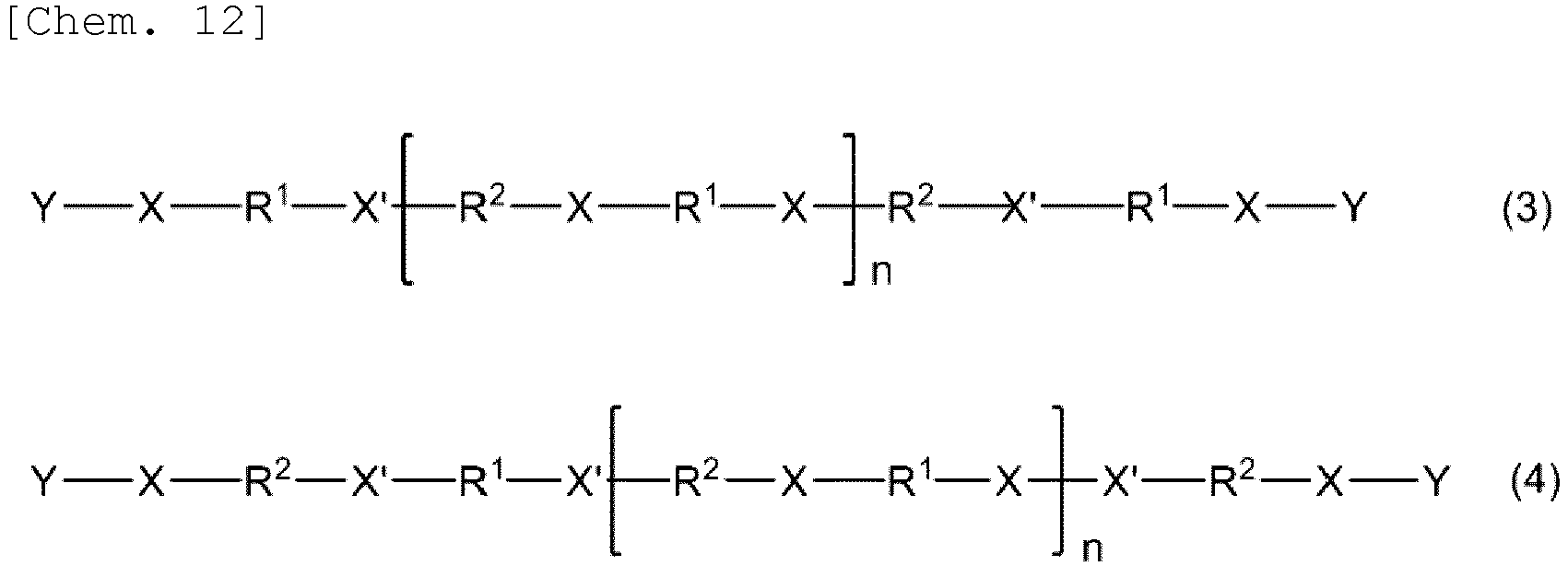
- In the above formula, R1, R2, X, Y, and X' have the same meaning as R1, R2, X, Y, and X' in the above Formulae (1), (a), (a1), and (a2). n is an integer of 0 to 100 and more preferably 2 to 30.
- In the above formula, a plurality of R1, R2, X, Y, and X' may be the same as or different from each other.
- A method for synthesizing the polymer (A) is not particularly limited, and a known method can be used. For example, the polymer (A) can be synthesized by heating the monomer as a raw material for the moiety containing R1, the monomer as a raw material for the moiety containing R2, the monomer for forming the terminal group Y, and as necessary, the monomer from which the other structural unit is derived in an organic solvent together with, for example, an alkali metal or an alkali metal compound. After polymerizing the monomer as a raw material for the moiety containing R1 and the monomer as a raw material for the moiety containing R2, then the monomer from which the other structural unit is derived and the monomer for forming the terminal group Y may be heated, and may be mixed and reacted with the obtained polymer.
- When a compound having a hydroxy group such as a phenol compound is used as a raw material in the process of synthesizing the polymer (A), the alkali metal and the alkali metal compound react with the compound having a hydroxy group to form an alkali metal salt.
- Examples of such an alkali metal and alkali metal compound include
- alkali metals such as lithium, sodium, and potassium;
- alkali metal hydrides such as lithium hydride, sodium hydride, and potassium hydride;
- alkali metal hydroxides such as lithium hydroxide, sodium hydroxide, and potassium hydroxide;
- alkali metal carbonates such as lithium carbonate, sodium carbonate, and potassium carbonate; and
- alkali metal hydrogen carbonates such as lithium hydrogen carbonate, sodium hydrogen carbonate, and potassium hydrogen carbonate.
- Among these, an alkali metal carbonate is preferable, and potassium carbonate is more preferable.
- When a compound having a hydroxy group is used at the time of synthesis of the polymer (A), as amounts of the alkali metal and the alkali metal compound used, the lower limit of a ratio of the number of moles of alkali metal atoms to the number of moles of hydroxy groups in all compounds used in the synthesis of the polymer (A) is preferably 1, more preferably 1.1, and still more preferably 1.2, and the upper limit of the ratio is preferably 3, more preferably 2, and still more preferably 1.8.
- Examples of the organic solvent include
- ether-based solvents such as tetrahydrofuran (THF), dioxane, cyclopentyl methyl ether, anisole, phenetol, diphenyl ether, dialkoxybenzene, and trialkoxybenzene;
- nitrogen-containing solvents such as N,N-dimethylacetamide (DMAc), N,N-dimethylformamide, N-methyl-2-pyrrolidone, and 1,3-dimethyl-2-imidazolidinone;
- ester-based solvents such as γ-butyrolactone;
- sulfur-containing solvents such as sulfolane, dimethyl sulfoxide, diethyl sulfoxide, dimethyl sulfone, diethyl sulfone, diisopropyl sulfone, and diphenyl sulfone;
- ketone-based solvents such as benzophenone, 2-heptanone, cyclohexanone, and methyl ethyl ketone;
- halogen-based solvents such as methylene chloride, chloroform, and chlorobenzene; and
- aromatic hydrocarbon-based solvents such as benzene, toluene, and xylene.
- Among these organic solvents, 2-heptanone, cyclohexanone, N-methyl-2-pyrrolidone, toluene, and xylene are preferable, and N-methyl-2-pyrrolidone, 2-heptanone, and cyclohexanone are more preferable.
- The lower limit of the reaction temperature at the time of the synthesis is preferably 50°C and more preferably 80°C, and the upper limit thereof is preferably 300°C and more preferably 200°C.
- The lower limit of the reaction time at the time of the synthesis is preferably 1 hour, more preferably 2 hours, and still more preferably 3 hours, and the upper limit thereof is preferably 100 hours, more preferably 50 hours, and still more preferably 24 hours.
- For the purpose of suppressing gelation of a polymerization liquid, the lower limit of the reaction temperature when the monomer for forming the terminal group Y is added after polymerization is preferably 0°C and more preferably 10°C, and the upper limit thereof is preferably 130°C and more preferably 110°C.
- The lower limit of the reaction time when the monomer for forming the terminal group Y is added and reacted after polymerization is preferably 1 hour, more preferably 2 hours, and still more preferably 3 hours, and the upper limit thereof is preferably 48 hours, more preferably 24 hours, and still more preferably 10 hours.
- The lower limit of the weight average molecular weight (Mw) of the polymer (A) in terms of polystyrene is preferably 1,000, more preferably 2,000, still more preferably 3,000, and particularly preferably 5,000, and the upper limit thereof is preferably 500,000, more preferably 100,000, still more preferably 50,000, more preferably 30,000, and particularly preferably 15,000.
- The polymer (A) having an Mw in the above range is excellent in balance, for example, among adhesion, heat resistance, impregnation into a glass cloth, moldability such as resin flow, which is preferable.
- The Mw in the present invention is a value as measured by gel permeation chromatography (GPC) under the conditions described in the following Examples.
- The loss tangent (tanδ) of the polymer (A) is preferably less than 0.0030, more preferably 0.0020 or less, and still more preferably 0.0012 or less, and the lower limit thereof is not particularly limited, and is preferably 0.0005 or more, from the viewpoint that, for example, the transmission loss when a composition containing the polymer (A) is obtained can be reduced.
- Specifically, the loss tangent can be measured by the method described in the following Examples.
- A composition according to one embodiment of the present invention (hereinafter, also referred to as "present composition") is not particularly limited as long as it contains the polymer (A), but preferably contains a curable compound (B) other than the polymer (A). The present composition may further contain other components such as a curing aid.
- The polymer (A) used in the present composition may be one or two or more kinds. The present composition may be a mixture of two or more kinds of the polymers (A).
- In the case of using two or more kinds of the polymers (A), for example, the polymer (A) having a different molecular weight in the above range of the molecular weight of the polymer (A) can be mixed depending on, for example, desired physical properties.
- For example the content ratio of the polymer (A) in the present composition is preferably 0.05 mass% or more, more preferably 10 mass% or more, and still more preferably 20 mass% or more, and preferably 99.95 mass% or less, more preferably 90 mass% or less, and still more preferably 80 mass% or less, when the total solid content in the present composition is regarded as 100 mass%.
- When the content ratio of the polymer (A) is in the above range, it is preferable from the viewpoint that, for example, adhesiveness, heat resistance, curability, and electrical properties of a cured product obtained from the present composition can be further improved.
- The curable compound (B) (hereinafter, also referred to as "compound (B)") is a compound other than the polymer (A), is a compound that cures by heat or irradiation with light (for example: visible light, ultraviolet light, near infrared light, or far infrared light), and may require a curing aid described below. Examples of such a compound (B) include a vinyl compound, a maleimide compound, an allyl compound, an acrylic compound, a methacrylic compound, a thiol compound, an oxazine compound, a cyanate compound, an epoxy compound, an oxetane compound, a methylol compound, a benzocyclobutene compound, a propargyl compound, and a silane compound. Among these, from the viewpoint of, for example, compatibility and reactivity with the polymer (A), particularly, at least one of a vinyl compound, a maleimide compound, and an allyl compound is preferable.
- One kind of the compound (B) may be used singly, or two or more kinds thereof may be used.
- Examples of the vinyl compound include compounds represented by the following Formulae (b-1-1) to (b-1-5).
- Examples of the vinyl compound further include, as a styrene-based thermoplastic elastomer such as a styrene butadiene styrene copolymer (SBS), a hydrogenated styrene butadiene styrene copolymer (SEBS), a styrene isoprene styrene copolymer (SIS), a hydrogenated styrene isoprene styrene copolymer, a styrene butadiene elastomer (SBR), and compounds containing a vinyl group such as tert-butylstyrene, and 2-vinyl-4,6-diamino-1,3,5-triazine.
- Examples of the vinyl compound further include TA100 (manufactured by MITSUBISHI GAS CHEMICAL COMPANY, INC.) and ULL-950S (manufactured by LONZA).


- In Formulae (b-1-2) and (b-1-4), n is independently 1 to 5000. In Formula (b-1-5), l, m, and n are each independently 1 to 5000.
- Examples of the maleimide compound include compounds represented by the following Formulae (b-2-1) to (b-2-8).

- In Formulae (b-2-4), (b-2-5), (b-2-7), and (b-2-8), n is independently 1 to 50.
- Examples of the allyl compound include compounds represented by the following Formulae (b-3-1) to (b-3-6).


- Examples of the acrylic compound include compounds represented by the following Formulae (b-4-1) to (b-4-7).

- In Formulae (b-4-1), (b-4-2), (b-4-3), and (b-4-6), n is independently 1 to 50. In Formula (b-4-3), m is 1 to 50. In Formula (b-4-6), R is a divalent hydrocarbon group having 1 to 20 carbon atoms.
- Examples of the methacrylic compound include bisphenol A-type epoxy methacrylate, phenol novolac-type epoxy methacrylate, trimethylolpropane methacrylate, dipentaerythritol hexamethacrylate, and SA-9000 (manufactured by SABIC).
- Examples of the thiol compound include 1,4-bis(3-mercaptobutyryloxy)butane, 1,3,5-tris(2-(3-sulfanylbutanoyloxy)ethyl)-1,3,5-triazinane-2,4,6-trione, 2-(dibutylamino)-1,3,5-triazine-4,6-dithiol, and 6-diallylamino-1,3,5-triazine-2,4-dithiol.
- Examples of the silane compound include KF-99 (manufactured by Shin-Etsu Chemical Co., Ltd.) and KF-9901 (manufactured by Shin-Etsu Chemical Co., Ltd.).
- Examples of the oxazine compound include compounds represented by the following Formulae (b-5-1) to (b-5-5).


- Examples of the cyanate compound include compounds represented by the following Formulae (b-6-1) to (b-6-7).


- In Formulae (b-6-6) and (b-6-7), n is independently 0 to 30.
- Examples of the epoxy compound include compounds represented by the following Formulae (b-7-1) to (b-7-5).
- Examples of the epoxy compound further include polyglycidyl ether of a dicyclopentadiene-phenol polymer, a phenol novolac-type liquid epoxy compound, a cresol novolac-type epoxy compound, an epoxidized product of a styrenebutadiene block copolymer, 3',4'-epoxycyclohexylmethyl-3,4-epoxycyclohexanecarboxylate, XER-81 (manufactured by JSR Corporation, epoxy group-containing NBR particles), and JP-100 (manufactured by Nippon Soda Co., Ltd.).

- In Formula (b-7-5), n is 0 to 5000.
- Examples of the oxetane compound include compounds represented by the following Formulae (b-8-1) to (b-8-3).

- Examples of the methylol compound include methylol compounds described in
JP 2006-178059 A JP 2012-226297 A - Examples of the benzocyclobutene compound include compounds described in
JP 2005-60507 A - Examples of the propargyl compound include compounds represented by the following Formulae (b-9-1) to (b-9-2).


- For example the content ratio of the compound (B) in the present composition is preferably 0.05 mass% or more, more preferably 10 mass% or more, and still more preferably 20 mass% or more, and is preferably 99.95 mass% or less, more preferably 90 mass% or less, and still more preferably 80 mass% or less, when the total solid content in the present composition is regarded as 100 mass%.
- When the content ratio of the compound (B) is in the above range, it is preferable from the viewpoint that, for example, strength, heat resistance, and chemical resistance of a cured product obtained from the present composition can be further improved.
- When the total solid content of the polymer (A) and the compound (B) in the present composition is regarded as 100 mass%, the content ratio of the compound (B) is preferably 1 mass% or more, more preferably 5 mass% or more, and still more preferably 10 mass% or more, and is preferably 99 mass% or less, more preferably 95 mass% or less, and still more preferably 90 mass% or less.
- When the content ratio of the compound (B) is in the above range, it is preferable from the viewpoint that, for example, toughness, heat resistance, and chemical resistance of a cured product obtained from the present composition can be further improved.
- The present composition may contain other components as long as the effect of the present invention is not impaired, in addition to the polymer (A) and the compound (B) .
- Examples of the other components include a curing aid, a solvent, a polymerization inhibitor for increasing stability, an antioxidant, an inorganic filler, an organic filler, an adhesion aid, a lubricant, a flame retardant, an antibacterial agent, a colorant, a release agent, a foaming agent, and a polymer other than the polymer (A).
- One kind of each of these other components may be used singly, or two or more kinds thereof may be used.
- The present composition may contain a curing aid as necessary.
- Examples of the curing aid include polymerization initiators such as a thermal radical or photoradical initiator, a cationic curing agent, and an anionic curing agent.
- Examples of the thermal radical initiator include organic peroxides such as dicumyl peroxide, 1,1-di(t-butylperoxy)cyclohexane, di(t-butylperoxyisopropyl)benzene, 2,5-dimethyl-2,5-di(t-butylperoxy)hexine-3, and benzoyl peroxide; and azo compounds such as azobisbutyronitrile, 1,1'-azobis(1-acetoxy-1-phenylethane)], 2,2'-azobis(2,4-dimethylvaleronitrile), 1,1'-azobis(cyclohexane-1-carbonitrile), dimethyl-2,2'-azobis(isobutyrate), and 2,2'-azobis(2-methylbutyronitrile) .
- Examples of the cationic curing agent include diallylyodonium salts having BF4, PF6, or SbF6 as a counter anion, such as SP70, SP172, and CP66 manufactured by ADEKA CORPORATION, CI2855 and CI2823 manufactured by Nippon Soda Co., Ltd., and SI100 and SI150 manufactured by SANSHIN CHEMICAL INDUSTRY CO., LTD.; trialkylsulfonium salts; phosphonium salts such as butyltriphenylphosphonium thiocyanate; and boron trifluoride.
- Examples of the anionic curing agent include imidazole compounds such as 2-methylimidazole, 2-ethyl-4-methylimidazole, 2-undecylimidazole, 2-heptadecylimidazole, 2-phenylimidazole, 1-benzyl-2-methylimidazole, 1-cyanoethyl-2-methylimidazole, 1-cyanoethyl-2-ethyl-4-methylimidazole, 2-methylimidazolium isocyanurate, 2,4-diamino-6-[2-methylimidazolin-(1)]-ethyl-S-triazine, and 2,4-diamino-6-[2-ethyl-4-methylimidazolin-(1)]-ethyl-S-triazine; phosphorus compounds such as triphenylphosphine; and amine compounds such as 4,4'-diaminodiphenylmethane.
- Examples of the curing aid when a silane compound is used as the compound (B) include zinc benzoate, zinc octylate and platinum group metal catalysts such as platinum-based catalysts such as platinum black, platinic chloride, chloroplatinic acid, a reaction product of chloroplatinic acid with monohydric alcohol, chloroplatinic acid-olefin complexes, and platinum bisacetoacetate; palladium-based catalysts; and rhodium-based catalyst.
- Examples of the curing aid when an oxazine compound is used as the compound (B) include phenol and derivatives thereof, cyanic acid ester, Bronsted acids such as p-toluenesulfonic acid, adipic acid, p-toluenesulfonic acid ester, aromatic amine compounds such as 4,4'-diaminodiphenylsulfone, and melamine, bases such as 2-ethyl-4-methylimidazole, and curing agents such as boron trifluoride and Lewis acid.
- When the present composition contains a curing aid, the content ratio of the curing aid is preferably in a range in which the present composition is satisfactorily cured to obtain a cured product. Specifically, the content ratio of the curing aid is preferably 0.000001 parts by mass or more and more preferably 0.001 parts by mass or more, and is preferably 20 parts by mass or less and more preferably 10 parts by mass or less, with respect to 100 parts by mass of the total solid content of the polymer (A) and the compound (B).
- The present composition may contain a solvent as necessary.
- Examples of the solvent include amide-based solvents such as N,N-dimethylformamide; ester-based solvents such as γ-butyrolactone and butyl acetate; ketone-based solvents such as cyclopentanone, cyclohexanone, methyl ethyl ketone, and 2-heptanone; ether-based solvents such as 1,2-methoxyethane, anisole, and tetrahydrofuran, polyfunctional solvents such as 1-methoxy-2-propanol and propylene glycol methyl ether acetate; sulfone-based solvents such as dimethyl sulfoxide; methylene chloride, benzene, toluene, xylene, and trialkoxybenzene (number of carbon atoms of an alkoxy group; 1 to 4).
- When the present composition contains a solvent, for example, the content ratio of the solvent in the present composition is not particularly limited, but is preferably 0 parts by mass or more and 2000 parts by mass or less, and more preferably 0 parts by mass or more and 1000 parts by mass or less with respect to 100 parts by mass of the total solid content of the polymer (A) and the compound (B).
- When the solubility of the polymer (A) or the compound (B) in the solvent is high, the content ratio of the solvent in the present composition may be 50 parts by mass or more and 200 parts by mass or less.
- Examples of the polymerization inhibitor include quinones such as hydroquinone, methylhydroquinone, p-benzoquinone, chloranil, and trimethylquinone, and aromatic diols.
- When the present composition contains a polymerization inhibitor, for example, the content ratio of the polymerization inhibitor is preferably 0.000001 parts by mass or more and 10 parts by mass or less with respect to 100 parts by mass of the total solid content of the polymer (A) and the compound (B).
- Examples of the antioxidant include a hindered phenol-based compound, a phosphorus-based compound, a sulfur-based compound, a metal-based compound, and a hindered amine-based compound. Among these, a hindered phenol-based compound is preferable.
- The hindered phenol-based compound is preferably a compound having a molecular weight of 500 or more. Examples of the hindered phenol-based compound having a molecular weight of 500 or more include triethylene glycol-bis[3-(3-t-butyl-5-methyl-4-hydroxyphenyl)propionate], 1,6-hexanediol-bis[3-(3,5-di-t-butyl-4-hydroxyphenyl)propionate], 2,4-bis-(n-octylthio)-6-(4-hydroxy-3,5-di-t-butylanilino)-3,5-triazine, pentaerythritol tetrakis[3-(3,5-t-butyl-4-hydroxyphenyl)propionate], 1,1,3-tris[2-methyl-4-[3-(3,5-dit-butyl-4-hydroxyphenyl)propionyloxy]-5-t-butylphenyl]butane, 2,2-thio-diethylene bis[3-(3,5-di-t-butyl-4-hydroxyphenyl)propionate], octadecyl-3-(3,5-di-t-butyl-4-hydroxyphenyl)propionate, N,N-hexamethylene bis(3,5-di-t-butyl-4-hydroxy-hydrocinnamamide), 1,3,5-trimethyl-2,4,6-tris(3,5-di-t-butyl-4-hydroxybenzyl)benzene, tris-(3,5-di-t-butyl-4-hydroxybenzyl)-isocyanurate, 3,9-bis[2-[3-(3-t-butyl-4-hydroxy-5-methylphenyl)propionyloxy]-1,1-dimethylethyl]-2,4,8,10-tetraoxaspiro[5.5]undecane, 2,6-di-tert-butyl-p-cresol (BHT), 1,3,5-tris(3,5-di-tert-butyl-4-hydroxybenzyl)-1,3,5-triazine-2,4,6(1H,3H,5H)-trione [manufactured by ADEKA CORPORATION, AO-020], 4,4',4"-(1-methylpropanyl-3-ylidene)tris(6-tert-butyl-m-cresol) [manufactured by ADEKA CORPORATION, AO-030], 6,6'-di-tert-butyl-4,4'-butylidenedi-m-cresol [manufactured by ADEKA CORPORATION, AO-040], and 1,3,5-tris(3,5-di-tert-butyl-4-hydroxyphenylmethyl)-2,4,6-trimethylbenzene [manufactured by ADEKA CORPORATION, AO-330].
- Examples of the hindered amine-based compound include 2,2,6,6-tetramethyl-4-hydroxypiperidine-1-oxyl [manufactured by ADEKA CORPORATION, ADK STAB LA-7RD], IRGASTAB UV 10(4,4'-[1,10-dioxo-1,10-decanediyl)bis(oxy)]bis[2,2,6,6-tetramethyl]-1-piperidinyloxy) (CAS.2516-92-9) and TINUVIN 123 (4-hydroxy-2,2,6,6,-tetramethylpiperidine-N-oxyl) (all manufactured by BASF), FA-711HM and FA-712HM (2,2,6,6-tetramethylpiperidinyl methacrylate, manufactured by Showa Denko Materials Co., Ltd.), TINUVIN 111FDL, TINUVIN 144, TINUVIN 152, TINUVIN 292, TINUVIN 765, TINUVIN 770DF, TINUVIN 5100, SANOL LS-2626, CHIMASSORB 119FL, CHIMASSORB 2020 FDL, CHIMASSORB 944 FDL, and TINUVIN 622 LD (all manufactured by BASF), and LA-52, LA-57, LA-62, LA-63P, LA-68LD, LA-77Y, LA-77G, LA-81, LA-82 (1,2,2,6,6-pentamethyl-4-piperidyl methacrylate), and LA-87 (all manufactured by ADEKA CORPORATION).
- When the present composition contains an antioxidant, for example, the content ratio of the antioxidant is preferably 0.001 parts by mass or more and 10 parts by mass or less with respect to 100 parts by mass of the total solid content of the polymer (A) and the compound (B).
- Examples of the inorganic filler include silicas such as natural silica, fused silica, and amorphous silica, white carbon, titanium white, aerosil, alumina, talc, natural mica, synthetic mica, clay, barium sulfate, E-glass, A-glass, C-glass, L-glass, D-glass, S-glass, S-glass, and M-glass G20.
- When the present composition contains an inorganic filler, for example, the content ratio of the inorganic filler is preferably 0.1 parts by mass or more and 300 parts by mass or less with respect to 100 parts by mass of the total solid content of the polymer (A) and the compound (B). The inorganic filler may be in a state of being dispersed in the solvent by the polymer (A).
- Examples of the organic filler include fluorine-based resins, such as polytetrafluoroethylene (PTFE), a polyperfluoroalkoxy resin, a polyfluorinated ethylene propylene resin, and a polytetrafluoroethylene-polyethylene copolymer, or fluorine-based particles, polystyrene resins or particles, rubber-like resins, such as polybutadiene and a styrene-butadiene resin, or particles, and hollow particles having divinylbenzene or divinylbiphenyl as a shell.
- When the present composition contains an organic filler, for example, the content ratio of the organic filler is preferably 0.1 parts by mass or more and 300 parts by mass or less with respect to 100 parts by mass of the total solid content of the polymer (A) and the compound (B). The organic filler may be in a state of being dispersed in the solvent by the polymer (A).
- The resin flow amount of the present composition is preferably 0% or more and more preferably 10% or more, and is preferably 25% or less and more preferably 20% or less.
- When the resin flow amount is in the above range, film thickness uniformity of, for example, a prepreg or a copper-clad laminate obtained using the present composition is improved.
- Specifically, the resin flow amount is measured by the method described in the following Examples.
- The present composition can be prepared, for example, by uniformly mixing the polymer (A), the compound (B), and the other components.
- There is no particular limitation in, for example, the order of mixing and mixing conditions in this case, and a conventionally known mixer may be used for mixing.
- A cured product according to one embodiment of the present invention (hereinafter, also referred to as "present cured product") is a cured product of the present composition, and is obtained by curing the present composition.
- The present cured product may be, for example, a partially cured product of the present composition obtained by drying a solvent from the present composition.
- A method of curing the present composition is not particularly limited, but usually, a method of thermally curing the present composition by heating or a method of photocuring the present composition by irradiation with light is used. These methods can also be used in combination.
- In the case of thermal curing, the heating temperature is preferably 50°C or higher, more preferably 100°C or higher, and still more preferably 120°C or higher, and is preferably 250°C or lower and more preferably 220°C or lower. The heating time is preferably 0.1 hours or longer and more preferably 0.5 hours or longer, and is preferably 36 hours or shorter and more preferably 5 hours or shorter.
- In the case of photocuring, examples of the light to be irradiated include visible light, ultraviolet light, near infrared light, and far infrared light.
- The lower limit of Tg of the present cured product is preferably 100°C and more preferably 110°C, and the upper limit thereof is, for example, 300°C.
- When Tg is in the above range, melt molding can be more easily performed, and a cured product excellent in heat resistance can be easily obtained.
- Tg was measured by preparing a test piece (width: 3 mm × length: 1 cm), measuring Tg at a temperature increase rate of 10°C/min from 50°C to 300°C and at 1 Hz under nitrogen using a dynamic viscoelasticity measuring device (manufactured by Seiko Instruments Inc., Model No.: "EXSTAR4000"), and measuring Tg at a temperature increase rate of 10°C/min to 300°C at 1 Hz, and tanδ at this time was taken as the glass transition temperature (Tg). When two or more tanδ values were present, the lowest value was defined as Tg.
- The loss tangent (tanδ) of the present cured product is preferably 0.0025 or less, more preferably 0.0018 or less, and still more preferably 0.0015 or less, and the lower limit thereof is not particularly limited, and is preferably 0.0005 or more, from the viewpoint that, for example, the transmission loss can be reduced.
- Specifically, the loss tangent can be measured by the method described in the following Examples.
- The shape of the present cured product is not particularly limited, and may be a shape suitable for, for example, use application and purpose, and examples thereof include a film.
- For example, the present composition can be obtained as a film-shaped cured product by melt-molding or cast-molding the present composition.
- The thickness of the film is not particularly limited, and may be appropriately selected according to a desired use application, but is, for example, 10 um or more and preferably 30 um or more, and is, for example, 2 mm or less and preferably 1 mm or less.
- A laminate according to one embodiment of the present invention (hereinafter, also referred to as "present laminate") includes, for example, a substrate and a cured layer formed using the present composition.
- The present laminate may include two or more layers of substrates, two or more layers of cured layers, or conventionally known layers other than the substrate and the cured layer. When the present laminate has two or more layers of substrates, cured layers, and other layers, these layers may be the same layer (plate) or different layers (plates).
- The present laminate may be a prepreg obtained by impregnating a substrate such as a glass cloth, an aramid nonwoven fabric, or a polyester nonwoven fabric with the present composition and curing the resultant.
- Examples of the substrate include an inorganic substrate, a metal substrate, and a resin substrate from the viewpoint of adhesiveness and practical use. The substrate may be a prepreg.
- Examples of the inorganic substrate include inorganic substrates containing, for example, silicon, silicon carbide, silicon nitride, alumina, glass, or gallium nitride as a component.
- Examples of the metal substrate include metal substrates containing, for example, copper, aluminum, gold, silver, nickel, or palladium as a component.
- Examples of the resin substrate include resin substrates containing, for example, a liquid crystal polymer, polyimide, polyphenylene sulfide, polyether ether ketone, polyamide (nylon), polyethylene terephthalate, polyethylene naphthalate, a cycloolefin polymer, or polyolefin as a component.
- The cured layer can be formed, for example, by curing according to the method described in the section of the cured product.
- The thickness of the cured layer is not particularly limited, and is, for example, 1 um to 3 mm.
- The polymer (A), the present composition, the present cured product, and the present laminate can be suitably used for, for example, structural materials used in the transportation industry such as the aircraft industry and the automobile industry, electrical and electronic materials used in the electrical and electronic industry. Specifically, for example, the polymer (A), the present composition, the present cured product, and the present laminate can be suitably used for a sealing material for an electrical and electronic component, an interlayer insulating film, and a stress relaxation primer; laminate use applications (for example: a prepreg, a copper-clad laminate, a (multilayer) printed wiring board, an interlayer adhesive, a solder resist, and a solder paste); adhesive use applications (for example: an adhesive sheet for forming an insulating layer, a thermally conductive adhesive, and an adhesive sheet); structural adhesives/prepregs used for various structural materials; various coatings and optical component use applications (for example: optical films such as wave plates and retardation plates, various special lenses such as conical lenses, spherical lenses, and cylindrical lenses, and lens arrays), and insulating films for printed wiring boards.
- An electronic component according to one embodiment of the present invention includes the present cured product or the present laminate. The electronic component may include two or more present cured products or two or more present laminates, or may include one or more present cured product and one or more present laminate. When the electronic component includes two or more present cured products or present laminates, these present cured products or present laminates may be the same as or different from each other.
- Examples of the electronic component include a circuit board, a semiconductor package, and a display board. The present cured product (cured film) can be used as a prepreg, a copper-clad laminate, a printed wiring board, an adhesive sheet for forming an insulating layer, a surface protective film, a rewiring layer, or a planarization film of these electronic components. Since the present cured product can maintain insulation even under high temperature and high humidity, the electronic component can protect a circuit pattern from an external environment such as dust, heat, and moisture, has excellent insulation reliability between circuit patterns, and can stably operate for many years.
- For example, the rewiring layer can be formed by filling of the pattern of the present cured product (cured film) with a metal, for example, by plating, further, as necessary, repeating laminating the present cured product (cured film) and filling with a metal, whereby an electronic component having a substrate and a rewiring layer including a metal wiring and an insulating film can be manufactured.
- The present invention will now be described specifically based on Examples, but the present invention is not limited to the following Examples.
- In a four-neck separable flask equipped with a stirrer, 1,1-bis(4-hydroxyphenyl)-3,3,5-trimethylcyclohexane (86.92 g), 4,6-dichloropyrimidine (47.58 g), isopropenylphenol (10.67 g), and potassium carbonate (50.66 g) were weighed, N-methyl-2-pyrrolidone (64.00 g) was added thereto, and the mixture was reacted at 130°C for 6 hours in a nitrogen atmosphere. After completion of the reaction, N-methyl-2-pyrrolidone (368.0 g) was added for dilution, and the solution after removal of the salt by filtration was charged into methanol (19.4 kg). The precipitated solid was filtered off, and the solid was washed with a small amount of methanol, filtered off again to recover the solid, and then dried at 120°C for 12 hours under reduced pressure using a vacuum dryer to obtain a polymer represented by the following Formula (1) (yield: 122.0 g, 90%).

- A polymer represented by the following Formula (2) was obtained (yield: 80.08 g, 90%) by performing synthesis in the same procedure as in Synthesis Example 1, except that the raw materials and the alkali metal compound used were changed to 1,1-bis(4-hydroxyphenyl)-3,3,5-trimethylcyclohexane (62.08 g), isopropenylphenol (2.170 g), 4,6-dichloropyrimidine (30.99 g), and potassium carbonate (38.83 g).

- A polymer represented by the following Formula (3) was obtained (yield: 121.9 g, 90%) by performing synthesis in the same procedure as in Synthesis Example 1, except that the raw materials and the alkali metal compound used were changed to 1,1-bis(4-hydroxyphenyl)-3,3,5-trimethylcyclohexane (86.92 g), 4,6-dichloropyrimidine (47.58 g), 2-allylphenol (10.67 g), and potassium carbonate (59.66 g).


- In a four-neck separable flask equipped with a stirrer, 1,1-bis(4-hydroxyphenyl)-3,3,5-trimethylcyclohexane (86.92 g), 4,6-dichloropyrimidine (47.58 g), and potassium carbonate (59.66 g) were weighed, N-methyl-2-pyrrolidone (64.00 g) was added thereto, and the mixture was reacted at 130°C for 6 hours in a nitrogen atmosphere. After the reaction, allyl bromide (10.67 g) was added dropwise while the vessel was cooled to 10°C, and then the reaction was performed at 70°C for 6 hours. After removal of the salt by filtration from a solution obtained by adding N-methyl-2-pyrrolidone (368.0 g) for dilution to the obtained reaction solution, the obtained solution was charged into methanol (19.40 kg). The precipitated solid was filtered off, and the solid was washed with a small amount of methanol, filtered off again to recover the solid, and then dried at 120°C for 12 hours under reduced pressure using a vacuum dryer to obtain a polymer represented by the following Formula (4) (yield: 121.9 g, 90%).

- In a four-neck separable flask equipped with a stirrer, 1,1-bis(4-hydroxyphenyl)-3,3,5-trimethylcyclohexane (71.13 g), 4,6-dichloropyrimidine (29.79 g), and potassium carbonate (39.27 g) were weighed, N-methyl-2-pyrrolidone (64.00 g) was added thereto, and the mixture was reacted at 130°C for 6 hours in a nitrogen atmosphere. After the reaction, methacryloyl chloride (6.094 g) was added dropwise while the vessel was cooled to 10°C, and then the reaction was performed at 50°C for 6 hours. After removal of the salt by filtration from a solution obtained by adding N-methyl-2-pyrrolidone (368.0 g) for dilution to the obtained reaction solution, the obtained solution was charged into methanol (19.40 kg). The precipitated solid was filtered off, and the solid was washed with a small amount of methanol, filtered off again to recover the solid, and then dried at 120°C for 12 hours under reduced pressure using a vacuum dryer to obtain a polymer represented by the following Formula (5) (yield: 92.30 g, 90%).

- A polymer represented by the following Formula (6) was obtained (yield: 77.04 g, 90%) by performing synthesis in the same procedure as in Synthesis Example 1, except that the raw materials and the alkali metal compound used were changed to 1,1-bis(4-hydroxyphenyl)-3,3,5-trimethylcyclohexane (58.98 g), 2,2'-diallylbisphenol A (3.084 g), 2-phenylphenol (2.764 g), 4,6-dichloropyrimidine (30.99 g), and potassium carbonate (37.317 g).

- A polymer represented by the following Formula (7) was obtained (yield: 68.70 g, 90%) by performing synthesis in the same procedure as in Synthesis Example 1, except that the raw materials and the alkali metal compound used were changed to 2,2-bis(4-hydroxy-3-methylphenyl)propane (51.26 g), isopropenylphenol (7.834 g), 4,6-dichloropyrimidine (34.10 g), and potassium carbonate (35.93 g).

- A polymer represented by the following Formula (8) was obtained (yield: 86.10 g, 90%) by performing synthesis in the same procedure as in Synthesis Example 1, except that the raw materials and the alkali metal compound used were changed to 2,2-bis(4-hydroxy-3-methylphenyl)propane (51.27 g), isopropenylphenol (7.83 g), 4,6-dichloro-2-phenylpyrimidine (51.51 g), and potassium carbonate (35.93 g).


- A polymer represented by the following Formula (9) was obtained (yield: 77.00 g, 90%) by performing synthesis in the same procedure as in Synthesis Example 1, except that the raw materials and the alkali metal compound used were changed to 1,1-bis(4-hydroxyphenyl)-3,3,5-trimethylcyclohexane (58.98 g), 4-chloropyrimidine (1.145 g), 4,6-dichloropyrimidine (29.34 g), and potassium carbonate (37.31 g).

- A polymer represented by the following Formula (10) was obtained (yield: 70.00 g, 90%) by performing synthesis in the same procedure as in Synthesis Example 1, except that the raw materials and the alkali metal compound used were changed to 1,1-bis(4-hydroxyphenyl)-3,3,5-trimethylcyclohexane (46.56 g), 4,6-dichloropyrimidine (21.45 g), and potassium carbonate (22.80 g).

- A polymer for evaluating a loss tangent represented by the above Formula (10) and having a weight average molecular weight Mw of 50,000 was obtained (yield: 70 g, 90%) by performing in the same procedure as in Synthesis Example 1, except that the raw materials and the alkali metal compound used were changed to 1,1-bis(4-hydroxyphenyl)-3,3,5-trimethylcyclohexane (56.237 g, 181.15 mmol), 4,6-dichloropyrimidine (26.959 g, 180.97 mmol), and potassium carbonate (33.800 g, 244.56 mmol).
- In a four-neck separable flask equipped with a stirrer, 2,2-bis(4-hydroxy-3-methylphenyl)propane (26.43 g), 4,6-dichloro-2-phenylpyrimidine (17.08 g), and potassium carbonate (19.23 g) were weighed, N-methyl-2-pyrrolidone (42.50 g) was added thereto, and the mixture was reacted at 100°C for 6 hours in a nitrogen atmosphere. After the reaction, m,p-(chloromethyl)styrene (11.53 g) was added dropwise while the vessel was cooled to 10°C, and then the reaction was performed at 100°C for 4 hours. After removal of the salt by filtration from a solution obtained by adding N-methyl-2-pyrrolidone (55.0 g) for dilution to the obtained reaction solution, the obtained solution was charged into methanol (6900 g). The precipitated solid was filtered off, and the solid was washed with a small amount of methanol, filtered off again to recover the solid, and then dried at 60°C for 12 hours under reduced pressure using a vacuum dryer to obtain a polymer represented by the following Formula (11) (yield: 44.10 g, 90%).

- A polymer represented by the following Formula (12) was obtained (yield: 46.55 g, 90%) by performing synthesis in the same procedure as in Synthesis Example 12, except that the raw materials and the alkali metal compound used were changed to 1,1-bis(4-hydroxy-3-methylphenyl)-3,3,5-trimethylcyclohexane (33.85 g), 4,6-dichloro-2-phenylpyrimidine (16.66 g), m,p-chloromethylstyrene (8.680 g), potassium carbonate (18.66 g), and N-methyl-2-pyrrolidone (42.50 g).

- A polymer represented by the following Formula (13) was obtained (yield: 89.30 g, 90%) by performing synthesis in the same procedure as in Synthesis Example 12, except that the raw materials and the alkali metal compound used were changed to 2,2-bis(4-hydroxy-3-methylphenyl)propane (25.63 g), 9,9-bis(4-hydroxy-3-methylphenyl)fluorene (37.84 g), 4,6-dichloro-2-phenylpyrimidine (33.31 g), m,p-chloromethylstyrene (17.36 g), potassium carbonate (37.31 g), and N-methyl-2-pyrrolidone (181.4 g).

- A polymer represented by the following Formula (14) was obtained (yield: 39.69 g, 88%) by performing synthesis in the same procedure as in Synthesis Example 12, except that the raw materials and the alkali metal compound used were changed to 2,2-bis(4-hydroxy-3-methylphenyl)propane (25.63 g), 4,6-dichloro-2-phenylpyrimidine (13.50 g), m,p-(chloromethyl)styrene (16.96 g), potassium carbonate (18.66 g), and N-methyl-2-pyrrolidone (78.28 g).

- A polymer represented by the following Formula (15) was obtained (yield: 37.91 g, 90%) by performing synthesis in the same procedure as in Synthesis Example 12, except that the raw materials and the alkali metal compound used were changed to 2,2-bis(4-hydroxy-3-methylphenyl)propane (25.63 g), 4,6-dichloro-2-phenylpyrimidine (19.81 g), m,p-(chloromethyl)styrene (5.087 g), potassium carbonate (18.66 g), and N-methyl-2-pyrrolidone (78.28 g).

- A polymer represented by the following Formula (16) was obtained (yield: 40.55 g, 90%) by performing synthesis in the same procedure as in Synthesis Example 12, except that the raw materials and the alkali metal compound used were changed to 2,2-bis(4-hydroxy-3-methylphenyl)propane (26.43 g), 4,6-dichloro-2-phenylpyrimidine (17.08 g), potassium carbonate (19.23 g), and N-methyl-2-pyrrolidone (42.50 g).

- A polymer represented by the following Formula (17) was obtained (yield: 76.44 g, 89%) was obtained by performing synthesis in the same procedure as in Synthesis Example 14, except that the raw materials and the alkali metal compound used were changed to 2,2-bis(4-hydroxy-3-methylphenyl)propane (25.63 g), 9,9-bis(4-hydroxy-3-methylphenyl)fluorene (37.84 g), 4,6-dichloro-2-phenylpyrimidine (33.31 g), potassium carbonate (37.31 g), and N-methyl-2-pyrrolidone (181.4 g).

- A polymer represented by the following Formula (18) was obtained (yield: 45.05 g, 90%) was obtained by performing synthesis in the same procedure as in Synthesis Example 17, except that the raw materials and the alkali metal compound used were changed to 1,1-bis(4-hydroxy-3-methylphenyl)-3,3,5-trimethylcyclohexane (33.85 g), 4,6-dichloro-2-phenylpyrimidine (16.65 g), potassium carbonate (18.65 g), and N-methyl-2-pyrrolidone (50.5 g).

- A polymer represented by the following Formula (19) was obtained (yield: 48.19 g, 90%) by performing synthesis in the same procedure as in Synthesis Example 1, except that the raw materials and the alkali metal compound used were changed to 2,2-bis(4-hydroxy-3-methylphenyl)propane (25.63 g), 4,6-dichloro-2-phenylpyrimidine (29.25 g), 2-allylphenol (8.131 g), and potassium carbonate (24.31 g).

- A polymer represented by the following Formula (20) was obtained (yield: 34.71 g, 85%) by performing synthesis in the same procedure as in Synthesis Example 5, except that the raw materials and the alkali metal compound used were changed to 2,2-bis(4-hydroxy-3-methylphenyl)propane (25.63 g), 4,6-dichloropyrimidine (16.57 g), potassium carbonate (18.65 g), N-methyl-2-pyrrolidone (64.00 g), and methacryloyl chloride (7.657 g).

- A polymer represented by the following Formula (21) was obtained (yield: 44.71 g, 90%) by performing synthesis in the same procedure as in Synthesis Example 1, except that the raw materials and the alkali metal compound used were changed to 1,1-bis(4-hydroxyphenyl)-3,3,5-trimethylcyclohexane (31.04 g), 2,2'-diallylbisphenol A (7.711 g), 4-chloropyrimidine (5.267 g), 4,6-dichloropyrimidine (21.33 g), and potassium carbonate (27.61 g).
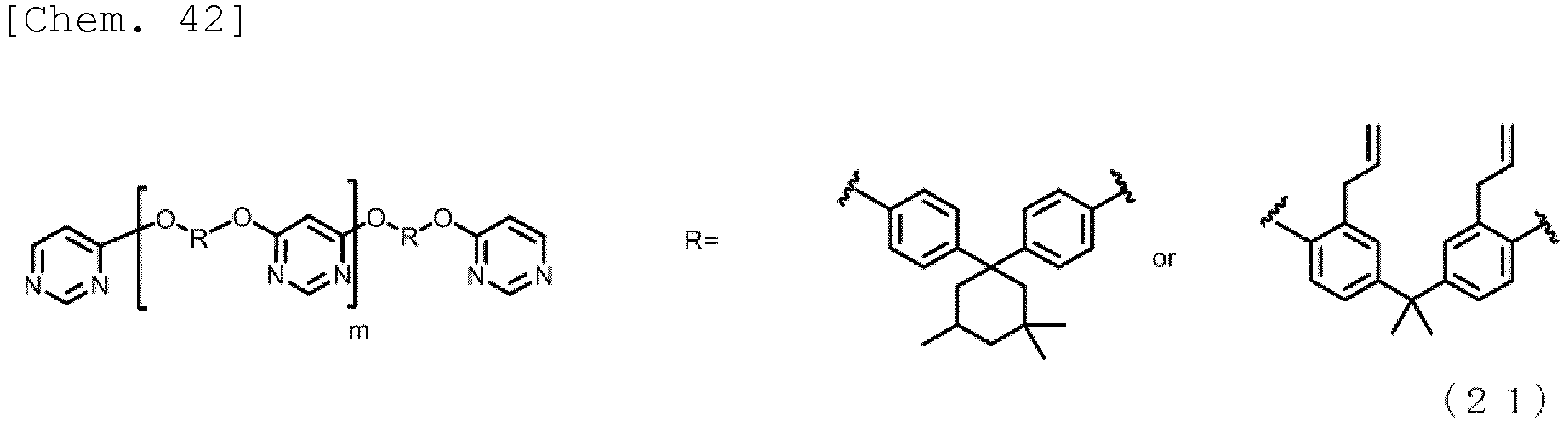
- The weight average molecular weight (Mw) and the number average molecular weight (Mn) of the polymers synthesized in Synthesis Examples 1 to 10 and 12 to 22 and SA-9000 used in Comparative Example described below were measured under the following conditions using a GPC apparatus ("HLC-8320" manufactured by Tosoh Corporation). The results are shown in Tables 1 and 2.
- · Column: obtained by connecting "TSKgel α-M" manufactured by Tosoh Corporation "TSKgel guard column α" manufactured by Tosoh Corporation
- · Developing solvent: N-methyl-2-pyrrolidone
- · Column temperature: 40°C
- · Flow rate: 1.0 mL/min
- · Sample concentration: 0.75 mass%
- · Sample injection amount: 50 µL
- · Detector: refractometer
- · Standard substance: monodisperse polystyrene
- · Concentration of measurement sample: 0.1 mass%
- Samples obtained by blending the polymers to be measured (the polymers synthesized in Synthesis Examples 1 to 10 and 12 to 22 and SA-9000) and the polymer synthesized in Synthesis Example 11 at 90 : 10, 75 : 25, and 50 : 50, respectively, were spin-coated on a substrate, and fired in an oven under nitrogen conditions at 100°C for 5 minutes and further at 250°C for 1 hour.
- Using the obtained fired product, the loss tangent at 10 GHz was measured using a cavity resonator method (dielectric constant measurement system TE mode resonator manufactured by AET, Inc.). The loss tangent of the polymer to be measured was calculated from the extrapolated value of the relationship between the obtained result of the loss tangent and the content ratio of the polymer to be measured. The results are shown in Tables 1 and 2.
-
Table 1 Synthesis Example 1 Synthesis Example 2 Synthesis Example 3 Synthesis Example 20 Synthesis Example 4 Synthesis Example 5 Synthesis Example 21 Mn 3200 8800 3200 1600 3700 3200 1500 Mw 8000 24000 7900 4000 7300 7400 4000 Loss tangent 0.002 0.002 0.002 0.001 0.002 0.003 0.002 Synthesis Example 6 Synthesis Example 7 Synthesis Example 8 Synthesis Example 9 Synthesis Example 22 Synthesis Example 10 SA-9000 Mn 9100 3000 3000 3100 1600 10000 2000 Mw 25000 7500 7500 7000 4000 25000 4100 Loss tangent 0.002 0.002 0.001 0.002 0.002 0.004 0.004 - A varnish for evaluation was prepared by mixing 100 parts by mass of the polymers to be measured (the polymers synthesized in Synthesis Examples 12 to 19 and SA-9000), 0.5 parts by mass of PERCUMYL D (manufactured by NOF CORPORATION), and 100 parts by mass of toluene, and then the prepared varnish for evaluation was applied onto a copper foil (TQ-M4-VSP (manufactured by MITSUI MINING & SMELTING CO., LTD.)) using a baker-type applicator (gap: 75 um) and dried at 100°C for 5 minutes to form a coating film. A copper foil (TQ-M4-VSP (manufactured by MITSUI MINING & SMELTING CO., LTD.)) was overlaid on the obtained coating film, and vacuum-pressed at 150°C for 5 minutes, and then fired at 200°C for 2 hours under nitrogen to prepare a cured film with a copper foil. The prepared cured film with a copper foil was immersed in a 40 mass% iron chloride solution to remove the copper foil from the cured film with a copper foil, then washed with water, and dried at 80°C for 30 minutes to prepare a film for measuring a glass transition temperature (Tg). The results are shown in Table 2.
- A test piece (width: 3 mm × length: 1 cm) was cut out from the prepared film for measuring Tg, and measured at a temperature increase rate of 10°C/min from 50°C to 300°C and at 1 Hz using a dynamic viscoelasticity measuring device (manufactured by Seiko Instruments Inc., Model No.: "EXSTAR4000"), and tanδ at this time was taken as the glass transition temperature (Tg).
- A varnish for evaluation was prepared by mixing 100 parts by mass of the polymers to be measured (the polymers synthesized in Synthesis Examples 12 to 19 and SA-9000), 0.5 parts by mass of PERCUMYL D (manufactured by NOF CORPORATION), and 100 parts by mass of toluene, and then the prepared varnish for evaluation was applied onto a copper foil (TQ-M4-VSP (manufactured by MITSUI MINING & SMELTING CO., LTD.)) using a baker-type applicator (gap: 75 um), heated at 100°C for 5 minutes, and then dried at 130°C for 5 minutes to form a coating film. A copper foil (TQ-M4-VSP (manufactured by MITSUI MINING & SMELTING CO., LTD.)) was overlaid on the obtained coating film, and vacuum-pressed at 150°C for 5 minutes, and then fired at 200°C for 2 hours under nitrogen to prepare a cured film with a copper foil, and the cured film with a copper foil was used as a sample for peel strength.
- A test piece (width: 5 mm × length: 10 cm) was cut out from the prepared sample for peel strength, the copper foil with the cured film (a laminated portion of one copper foil and the cured film in the sample for peel strength) was pulled in a 90-degree direction under a condition of 500 mm/min by using "Instron 5567" manufactured by Instron, and the peel strength was measured in accordance with "IPC-TM-650 2.4.9". The results are shown in Table 2.
-
Table 2 Resin Example Synthesis Example 12 Synthesis Example 13 Synthesis Example 14 Synthesis Example 15 Synthesis Example 16 Mn 1600 1600 1800 800 3200 Mw 3400 3400 4000 2000 8000 Loss tangent 0.0010 0.0012 0.0009 0.0012 0.0010 Tg (°C) > 130 > 130 > 130 > 130 > 130 Peel strength (N/mm) 0.5 0.5 0.5 0.5 0.5 Resin Comparative Example Synthesis Example 17 Synthesis Example 18 Synthesis Example 19 SA-9000 Mn 1500 1600 1700 2000 Mw 3400 4000 4250 4100 Loss tangent 0.0040 0.0030 0.0030 0.0040 Tg (°C) Unmeasurable Unmeasurable Unmeasurable > 130 Peel strength (N/mm) Unmeasurable Unmeasurable Unmeasurable 0.5 - Each component described in the section of composition type shown in Tables 3-1, 3-2, and 4 was mixed with a mix rotor to have the ratio (parts by mass) described in the section of composition blending ratio shown in Tables 3-1, 3-2, and 4, and the concentration was adjusted with toluene so that the concentration of the solid content was 50 parts by mass to prepare a composition.
- Each component described in the section of composition type shown in Tables 3-1, 3-2, and 4 was mixed with a mix rotor to have the ratio (parts by mass) described in the section of composition blending ratio shown in Tables 3-1, 3-2, and 4, and 67 mass% of toluene was added to 100 mass% of the mixture to prepare a varnish. A glass cloth (Toyobo NE Glass, #1027) was immersed in the prepared varnish for 2 minutes, taken out from the varnish, and then dried at 100°C for 5 minutes and then at 160°C for 10 minutes to prepare a prepreg. A copper foil (TQ-M4-VSP (manufactured by MITSUI MINING & SMELTING CO., LTD., 10 × 10 cm) was overlaid on both surfaces of the prepared prepreg (10 × 10 cm), and vacuum-pressed at room temperature and 3 MPa, then heated to 200°C at 10°C/min, and held at 200°C for 2 hours to prepare a copper-clad laminate (10 × 10 cm). The resin protruding from the prepared copper-clad laminate (10 × 10 cm) was cut out, and the mass of the protruding resin was measured. The resin flow (%) was calculated by the following calculation formula.

- The composition obtained in each of Examples and Comparative Examples was applied onto a copper foil (TQ-M4-VSP (manufactured by MITSUI MINING & SMELTING CO., LTD.)) using a baker-type applicator (gap: 125 um), and then dried at 100°C for 5 minutes, and in the case of using the composition obtained in Example 4 or Comparative Example 2, the composition was fired at 120°C for 1.5 hours under nitrogen and then fired at 250°C for 3 hours under nitrogen, and in the case of the composition obtained in each of Examples and Comparative Examples other than Example 4 and Comparative Example 2, the composition was fired at 120°C for 1.5 hours under nitrogen and then fired at 180°C for 3 hours under nitrogen.
- The obtained cured film with a copper foil was immersed in a 40 mass% iron chloride solution to remove the copper foil, then washed with water, and dried in an oven at 80°C for 30 minutes to prepare a cured film.
- The composition obtained in each of Examples and Comparative Examples was applied onto a Kapton film (150EN-C (manufactured by DU PONT-TORAY CO., LTD.)) using a baker-type applicator (gap: 12.5 um), and dried at 100°C for 5 minutes. A copper foil (TQ-M4-VSP (manufactured by MITSUI MINING & SMELTING CO., LTD.)) having a thickness of 12 um was disposed on the coating film of the laminate of the obtained coating film and the Kapton film, the coating film and the copper foil were bonded together under the conditions of 150°C and 0.3 m/min using a thermal laminator (VA-700 (manufactured by TAISEI LAMINATOR CO,. LTD.)), and then in the case of using the composition obtained in Example 4 or Comparative Example 2, the composition was fired at 120°C for 1.5 hours under nitrogen and then fired at 250°C for 3 hours under nitrogen, and in the case of the composition obtained in each of Examples and Comparative Examples other than Example 4 and Comparative Example 2, the composition was fired at 120°C for 1.5 hours under nitrogen and then fired at 180°C for 3 hours under nitrogen, thereby preparing a laminate.
- A test piece (width: 6 cm × length: 6 cm) was cut out from the prepared cured film, and the loss tangent of the test piece at 10 GHz was measured using a cavity resonator method (dielectric constant measurement system TE mode resonator manufactured by AET, Inc.). The results are shown in Tables 3-1, 3-2, and 4.
- A test piece (width: 5 mm × length: 10 cm) was cut out from the prepared laminate, the Kapton film with a cured film was pulled in a 90-degree direction under a condition of 500 mm/min by using "Instron 5567" manufactured by Instron, and the peel strength between the cured film and the copper foil was measured in accordance with "IPC-TM-650 2.4.9". The results are shown in Tables 3-1, 3-2, and 4.
- A test piece (width: 3 mm × length: 1 cm) was cut out from the prepared cured film, and measured at a temperature increase rate of 10°C/min from 50°C to 300°C and at 1 Hz using a dynamic viscoelasticity measuring device (manufactured by Seiko Instruments Inc., "EXSTAR4000"), and tanδ at this time was taken as the glass transition temperature (Tg). The results are shown in Tables 3-1, 3-2, and 4.
- When two or more tanδ values were present, the lowest value was defined as Tg.
- The composition obtained in each of Examples and Comparative Examples was applied onto a copper foil (TQ-M4-VSP (manufactured by MITSUI MINING & SMELTING CO., LTD.)) using a baker-type applicator (gap: 125 um), and then dried at 100°C for 5 minutes, and in the case of using the composition obtained in Example 4 or Comparative Example 2, the composition was fired at 120°C for 1.5 hours under nitrogen and then fired at 250°C for 3 hours under nitrogen, and in the case of the composition obtained in each of Examples and Comparative Examples other than Example 4 and Comparative Example 2, the composition was fired at 120°C for 1.5 hours under nitrogen and then fired at 180°C for 3 hours under nitrogen. In this way, a cured film with a copper foil was obtained, and the mass of the obtained cured film with a copper foil was measured. The mass of the copper foil before coating was weighed in advance, and the mass obtained by subtracting the previously weighed mass of the copper foil from the mass of the obtained cured film with a copper foil was regarded as "cured film mass before immersion".
- The obtained cured film with a copper foil was immersed in methyl ethyl ketone (1.5 L) at room temperature for 10 minutes, and then vacuum-dried at 120°C for 3 hours to measure the mass of the cured film with a copper foil. The mass obtained by subtracting the mass of the previously weighed copper foil from the mass of the cured film with a copper foil after vacuum drying was regarded as "cured film mass after immersion".
- The chemical resistance was evaluated by calculating the mass change rate by the following formula. A case where the mass change rate was 90% or more was designated as "O", and a case where the mass change rate was 90% or less was designated as "X". The results are shown in Tables 3-1, 3-2, and 4.

- The appearance of the prepared cured film was visually observed, and the cured film with cracks was designated as "X", and the cured film without no cracks was designated as "O". The results are shown in Tables 3-1, 3-2, and 4.
- A glass cloth (manufactured by Nitto Boseki Co., Ltd., #2116 type) having a size of 5 cm × 7 cm × 95 um in thickness was impregnated with the composition obtained in each of Examples and Comparative Examples, and heated and dried at 160°C for 10 minutes to obtain a prepreg having a thickness of 110 um. The obtained prepreg was observed with a digital microscope (manufactured by KEYENCE CORPORATION, VHX-6000) in a transmission mode at a magnification of 300 to observe voids between the glass cloth and the resin layer. The prepreg was bent by 180° to the long side and the short side, and the presence or absence of powder fall-off of the resin was visually observed.
- A case where no void was observed and powder fall-off was not observed was designated as "O", and a case where a void was observed or powder fall-off was observed was designated as "X". The results are shown in Tables 3-1, 3-2, and 4.
-
Table 3-1 Example 1 Example 2 Example 3 Example 4 Example 29 Composition type Polymer-1 Synthesis Example 1 Synthesis Example 2 Synthesis Example 6 Synthesis Example 1 Synthesis Example 1 Polymer-2 Synthesis Example 3 Synthesis Example 20 Curable compound-1 SLK-1500 SLK-1500 SLK-1500 SLK-1500 SLK-1500 Curable compound-2 Initiator DCP DCP DCP DCP DCP Composition blending ratio Polymer-1 50 50 50 25 25 Polymer-2 25 25 Curable compound-1 50 50 50 50 50 Curable compound-2 Initiator 1.1 1.1 1.1 1.1 1.1 CCL Resin flow (%) 20 15 20 15 15 Composition properties Loss tangent 0.0015 0.0015 0.0016 0.0020 0.0016 Peel strength (N/mm) 0.6 0.6 0.7 0.5 0.5 Tg(°C) 123 116 120 113 115 Chemical resistance ○ ○ ○ ○ ○ Appearance ○ ○ ○ ○ ○ Impregnation test ○ ○ ○ ○ ○ Example 5 Example 6 Example 30 Example 7 Composition type Polymer-1 Synthesis Example 1 Synthesis Example 1 Synthesis Example 1 Synthesis Example 1 Polymer-2 Synthesis Example 4 Synthesis Example 5 Synthesis Example 21 Synthesis Example 7 Curable compound-1 SLK-1500 SLK-1500 SLK-1500 SLK-1500 Curable compound-2 Initiator DCP DCP DCP DCP Composition blending ratio Polymer-1 25 25 25 45 Polymer-2 25 25 25 5 Curable compound-1 50 50 5 50 Curable compound-2 Initiator 1.1 1.1 1.1 1.1 CCL Resin flow (%) 15 15 15 20 Composition properties Loss tangent 0.0018 0.0021 0.0017 0.0015 Peel strength (N/mm) 0.5 0.5 0.5 0.6 Tg (°C) 116 120 120 124 Chemical resistance ○ ○ ○ ○ Appearance ○ ○ ○ ○ Impregnation test ○ ○ ○ ○ -
Table 3-2 Example 8 Example 9 Example 31 Example 10 Example 11 Composition type Polymer-1 Synthesis Example 1 Synthesis Example 9 Synthesis Example 22 Synthesis Example 1 Synthesis Example 1 Polymer-2 Synthesis Example 8 Curable compound-1 SLK-1500 SLK-1500 SLK-1500 SLK-1500 SLK-1500 Curable compound-2 Tufprene 912 TAIC Initiator DCP DCP DCP DCP DCP Composition blending ratio Polymer-1 45 50 50 45 45 Polymer-2 5 Curable compound-1 50 50 50 45 45 Curable compound-2 10 10 Initiator 1.1 1.1 1.1 1.1 1.1 CCL Resin flow (%) 20 20 20 10 10 Composition properties Loss tangent 0.0013 0.0016 0.0016 0.0016 0.0015 Peel strength (N/mm) 0.6 0.7 0.7 0.7 0.6 Tg (°C) 120 121 125 111 110 Chemical resistance ○ ○ ○ ○ ○ Appearance ○ ○ ○ ○ ○ Impregnation test ○ ○ ○ ○ ○ Comparative Example 1 Comparative Example 2 Comparative Example 18 Composition type Polymer-1 Synthesis Example 10 Synthesis Example 10 SA9000 Polymer-2 Curable compound-1 SLK-1500 SLK-1500 SLK-1500 Curable compound-2 Initiator DCP DCP DCP Composition blending ratio Polymer-1 50 50 50 Polymer-2 Curable compound-1 50 50 50 Curable compound-2 Initiator 1.1 1.1 1.1 CCL Resin flow (%) 30 30 10.0 Composition properties Loss tangent 0.0020 0.0020 0.0030 Peel strength (N/mm) 0.4 0.4 0.4 Tg (°C) Unmeasurable Unmeasurable < 50 Chemical resistance X Elution X Elution ○ Appearance X X ○ Impregnation test X X X -
Table 4 Example 12 Example 13 Example 14 Composition type Polymer Synthesis Example 2 Synthesis Example 2 Synthesis Example 2 Curable compound SLK-1500 SLK-1500 SLK-1500 Additive-1 Silica particles Silica particles Additive-2 Fluororesin powder Initiator DCP DCP DCP Composition blending ratio Polymer 40 15 45 Curable compound 40 15 45 Additive-1 20 70 Additive-2 10 Initiator 1.1 1.1 1.1 CCL Resin flow (%) 10 10 10 Cured product properties Loss tangent 0.0013 0.0010 0.0013 Peel strength (N/mm) 0.5 0.4 0.5 Tg (°C) 120 121 121 Chemical resistance ○ ○ ○ Appearance ○ ○ ○ Impregnation test ○ ○ ○ Comparative Example 3 Comparative Example 4 Comparative Example 5 Comparative Example 6 Comparative Example 7 Composition type Polymer Synthesis Example 10 Synthesis Example 10 SA-9000 Synthesis Example 10 SA-9000 Curable compound SLK-1500 SLK-1500 SLK-1500 SLK-1500 SLK-1500 Additive-1 Silica particles Silica particles Silica particles Additive-2 Fluororesin powder Fluororesin powder Initiator DCP DCP DCP DCP DCP Composition blending ratio Polymer 40 15 40 45 45 Curable compound 40 15 40 45 45 Additive-1 20 70 70 Additive-2 15 15 Initiator 1.1 1.1 1.1 1.1 1.1 CCL Resin flow (%) 30 30 30 30 10 Cured product properties Loss tangent 0.0013 0.0020 0.0020 0.0013 0.0020 Peel strength (N/mm) 0.3 0.2 0.1 0.3 0.1 Tg (°C) Unmeasurable Unmeasurable < 50 Unmeasurable < 50 Chemical resistance X Elution X Elution ○ X Elution ○ Appearance X X X X X Impregnation test X X - X - - Abbreviations used in Tables 3-1, 3-2, and 4 will be described below.
- · SA-9000: manufactured by SABIC, terminal-modified polyphenylene ether
-
- SLK-1500: manufactured by Shin-Etsu Chemical Co., Ltd., bismaleimide, number average molecular weight 1500
- TAIC: manufactured by Mitsubishi Chemical Corporation, triallyl isocyanurate
- Tufprene 912: manufactured by Asahi Kasei Corp., styrene-butadiene styrene thermoplastic elastomer
-
- Additive-1: silica particles, ADMAFINE (manufactured by ADMATECHS COMPANY LIMITED, phenylaminosilane-modified particles, particle size 0.4 to 0.6 um)
- Additive-2: fluororesin powder, Fluon+ EA-2000
- · DCP: dicumyl peroxide, manufactured by Tokyo Chemical Industry Co., Ltd.
- Each component described in the section of composition type shown in Tables 5 and 6 was mixed with a mix rotor to have the ratio (parts by mass) described in the section of composition blending ratio shown in Tables 5 and 6, and the concentration was adjusted with toluene so that the concentration of the solid content was 30 parts by mass to prepare a composition.
- Each component described in the section of composition type shown in Tables 5 and 6 was mixed with a mix rotor to have the ratio (parts by mass) described in the section of composition blending ratio shown in Tables 5 and 6, and 67 mass% of toluene was added to 100 mass% of the mixture to prepare a varnish. A glass cloth (Toyobo NE Glass, #1027) was immersed in the prepared varnish for 2 minutes, taken out from the varnish, and then dried at 100°C for 5 minutes and then at 160°C for 10 minutes to prepare a prepreg. A copper foil (TQ-M4-VSP (manufactured by MITSUI MINING & SMELTING CO., LTD., 10 × 10 cm) was overlaid on both surfaces of the prepared prepreg (10 × 10 cm), and vacuum-pressed at room temperature and 3 MPa, then heated to 200°C at 10°C/min, and held at 200°C for 2 hours to prepare a copper-clad laminate (10 × 10 cm). The resin protruding from the prepared copper-clad laminate (10 × 10 cm) was cut out, and the mass of the protruding resin was measured. The resin flow (%) was calculated by the following calculation formula.

- The composition obtained in each of Examples 15 to 28 and Comparative Examples 8 to 17 was spin-coated on a 3-inch quartz substrate, dried at 100°C for 5 minutes, and fired at 200°C for 2 hours under nitrogen to prepare a substrate for loss tangent measurement having a cured film formed on the quartz substrate.
- The loss tangent at 10 GHz of each of the quartz substrate before coating and the prepared substrate for loss tangent measurement was measured using a cavity resonator method (dielectric constant measurement system TE mode resonator manufactured by AET, Inc.). Based on the obtained results, the loss tangent of each composition was calculated from the following calculation formula. The results are shown in Tables 5 and 6.
- When the dielectric constant is designated as Dk1, the loss tangent is designated as Df1, and the thickness of the quartz substrate is designated as t1 in the case of using the quartz substrate; the dielectric constant of the cured film is designated as Dk2, the loss tangent of the cured film is designated as Df2, and the thickness of the cured film is designated as t2; and the dielectric constant is designated as Dk3, the loss tangent is designated as Df3, and the thickness of the substrate for loss tangent measurement is designated as t3 in the case of using the substrate for loss tangent measurement, the dielectric constant (Dk2) and the loss tangent (Df2) of the cured film are calculated by the following calculation formula.


- The composition obtained in each of Examples 15 to 28 and Comparative Examples 8 to 17 was applied onto a copper foil (CF-V9S-SV-18 (manufactured by FUKUDA METAL FOIL & POWDER CO., LTD.)) having a thickness of 18 um using a baker-type applicator (gap: 12.5 um), and dried at 100°C for 5 minutes and then at 130°C for 5 minutes to form a coating film. A copper foil (CF-V9S-SV-18 (FUKUDA METAL FOIL & POWDER CO., LTD.)) having a thickness of 18 um was overlaid on the formed coating film, pressed under vacuum at 150°C for 5 minutes, and then fired at 200°C for 2 hours under nitrogen to prepare a laminate.
- The peel strength was measured using the prepared laminate in the same manner as in, for example, Example 1. The results are shown in Tables 5 and 6.
- The composition obtained in each of Examples 15 to 28 and Comparative Examples 8 to 17 was applied onto a copper foil (TQ-M4-VSP (manufactured by MITSUI MINING & SMELTING CO., LTD.)) using a baker-type applicator (gap: 75 um), then dried at 100°C for 5 minutes, and fired at 200°C for 2 hours under nitrogen.
- The obtained cured film with a copper foil was immersed in a 40 mass% iron chloride solution to remove the copper foil, then washed with water, and dried in an oven at 80°C for 30 minutes to obtain a cured film.
- The glass transition temperature (Tg) and appearance were measured and evaluated using the obtained cured film in the same manner as in, for example, Example 1. The results are shown in Tables 5 and 6.
- Chemical resistance and impregnation test were performed in the same manner as in Example 1, except that the compositions obtained in Examples 15 to 28 and Comparative Examples 8 to 17 were used. The results are shown in Tables 5 and 6.
-
Table 5 Example 15 Example 16 Example 17 Example 18 Example 19 Example 20 Example 21 Composition Polymer-1 Synthesis Example 12 Synthesis Example 12 Synthesis Example 12 Synthesis Example 12 Synthesis Example 12 Synthesis Example 12 Synthesis Example 12 Curable compound-1 TAIC DVB960 BMI-3000 Curable compound-2 BMI-70 Antioxidant Antioxidant-1 Antioxidant-2 Antioxidant-3 Initiator DCP DCP DCP DCP DCP DCP DCP Composition blending ratio Polymer-1 100 100 100 100 70 70 60 Curable compound-1 30 30 30 Curable compound-2 10 Antioxidant 100 ppm 100 ppm 100 ppm Initiator 0.5 0.5 0.5 0.5 0.5 0.5 3 CCL Resin flow (%) 10 15 15 15 10 10 10 Composition properties Loss tangent 0.0011 0.0011 0.0012 0.0012 0.0012 0.0012 0.0011 Peel strength (N/mm) 0.5 0.5 0.5 0.5 > 0.6 > 0.6 > 0.6 Tg (°C) > 130 > 130 > 130 > 130 > 130 > 130 > 130 Chemical resistance O O O O O O O Appearance O O O O O O O Example 22 Example 23 Example 24 Example 25 Example 26 Example 27 Example 28 Composition Polymer-1 Synthesis Example 13 Synthesis Example 14 Synthesis Example 15 Synthesis Example 16 Synthesis Example 12 Synthesis Example 12 Synthesis Example 12 Curable compound-1 TAIC TAIC TAIC TAIC TAIC TAIC TAIC Curable compound-2 Antioxidant Antioxidant-1 Antioxidant-2 Antioxidant-3 Initiator DCP DCP DCP DCP DCP DCP DCP Composition blending ratio Polymer-1 70 70 70 70 70 70 70 Curable compound-1 30 30 30 30 30 30 30 Curable compound-2 10 10 10 10 Antioxidant 500 ppm 500 ppm 500 ppm Initiator 0.5 0.5 0.5 0.5 0.5 0.5 0.5 CCL Resin flow (%) 10 10 20 10 15 15 15 Composition properties Loss tangent 0.0011 0.0012 0.0012 0.0012 0.0011 0.0012 0.0012 Peel strength (N/mm) 0.5 >0.6 > 0.6 > 0.6 > 0.6 > 0.6 > 0.6 Tg (°C) > 130 > 130 > 130 > 130 > 130 > 130 > 130 Chemical resistance 0 0 0 0 0 0 0 Appearance 0 0 0 0 0 0 0 [Table 6] Comparative Example 8 Comparative Example 9 Comparative Example 10 Comparative Example 11 Comparative Example 12 Composition Polymer-1 Synthesis Example 17 Synthesis Example 17 Synthesis Example 17 Synthesis Example 17 Synthesis Example 18 Curable compound-1 TA/C DVB960 BMI-70 TAIC Curable compound-2 BMI-3000 Initiator DCP DCP DCP DCP DCP Composition blending ratio Polymer-1 100 70 70 60 70 Curable compound-1 30 30 30 30 Curable compound-2 10 Initiator 0.5 0.5 0.5 3 0.5 CCL Resin flow (%) 30 30 30 30 30 Composition properties Loss tangent 0.0040 0.0023 0.0023 0.0023 0.0030 Peel strength (N/mm) 0.1 0.2 0.2 0.1 0.1 Tg (°C) Unmeasurable Unmeasurable Unmeasurable Unmeasurable Unmeasurable Chemical resistance X Elution X Elution X Elution X Elution X Elution Appearance X X X X X Table 6 (continued) Comparative Example 13 Comparative Example 14 Comparative Example 15 Comparative Example 16 Comparative Example 17 Composition Polymer-1 Synthesis Example 19 SA-9000 SA-9000 SA-9000 SA-9000 Curable compound-1 TA/C TAIC DVB960 BMI-70 Curable compound-2 BMI-3000 Initiator DCP DCP DCP DCP DCP Composition blending ratio Polymer-1 70 100 70 70 60 Curable compound-1 30 30 30 30 Curable compound-2 10 Initiator 0.5 0.5 0.5 0.5 3 CCL Resin flow (%) 30 10 10 10 10 Composition properties Loss tangent 0.0030 0.0040 0.0027 0.0027 0.0026 Peel strength (N/mm) 0.1 0.5 0.5 0.5 0.5 Tg (°C) Unmeasurable > 130 > 130 > 130 > 130 Chemical resistance X Elution 0 0 0 O Appearance X 0 0 0 0 - Abbreviations used in Tables 5 and 6 will be described below.
- · SA-9000: manufactured by SABIC, terminal-modified polyphenylene ether
-
- · TAIC: manufactured by Mitsubishi Chemical Corporation, triallyl isocyanurate
- · DVB960: manufactured by NIPPON STEEL Chemical & Material CO., LTD., divinylbenzene (divinylbenzene: 96 mass%)
- · BMI-3000: manufactured by Designer Molecules Inc., bismaleimide (bifunctional bismaleimide, Mw: about 3000)
- · BMI-70: manufactured by K.I Chemical Industry Co., Ltd., bis-(3-ethyl-5-methyl-4-maleimidophenyl)methane
-
- · Antioxidant-1: manufactured by TCI, 2,2,6,6-tetramethyl-4-hydroxypiperidine-1-oxyl
- · Antioxidant-2: manufactured by TCI, 3,5-di-tert-4-butylhydroxytoluene
- · Antioxidant-3: manufactured by ADEKA CORPORATION, AO-30 (chemical name: 4,4',4"-(1-methylpropanyl-3-ylidene)tris(6-tert-butyl-m-cresol)
- · DCP: dicumyl peroxide, manufactured by Tokyo Chemical Industry Co., Ltd.

Claims (10)
- A polymer comprising:a repeating structural unit represented by the following Formula (1); anda group Y represented by the following Formula (a) at a terminal:
 wherein X's are each independently -O-, -S-, or - N(R3)-, R3 is a hydrogen atom, a monovalent hydrocarbon group having 1 to 20 carbon atoms, a monovalent halogenated hydrocarbon group having 1 to 20 carbon atoms, or a group obtained by substituting a part of the hydrocarbon group or the halogenated hydrocarbon group with at least one selected from an oxygen atom and a sulfur atom, R1 is a divalent organic group, and R2 is a divalent unsubstituted or substituted nitrogen-containing heteroaromatic ring;
[Chem. 2]
Y (a)
wherein Y is a group containing an ethylenically unsaturated double bond and having 3 to 50 carbon atoms, an unsubstituted or substituted aromatic hydrocarbon group having 6 to 50 carbon atoms, an unsubstituted or substituted aliphatic hydrocarbon group having 6 to 50 carbon atoms, or an unsubstituted nitrogen-containing heteroaromatic ring, and when the aromatic hydrocarbon group or the aliphatic hydrocarbon group has a substituent, the substituent is a group other than a hydroxy group. - The polymer according to claim 1, wherein the divalent organic group represented by R1 in the above Formula (1) comprises a group represented by the following Formula (2-1):

- The polymer according to claim 2, wherein Ar1 and Ar2 in the Formula (2-1) are each independently an aromatic hydrocarbon group having an allyl group.
- The polymer according to any one of claims 1 to 3, wherein a weight average molecular weight of the polymer in terms of polystyrene is 1,000 to 500,000.
- A composition comprising:the polymer according to any one of claims 1 to 4; anda curable compound (B) other than the polymer.
- The composition according to claim 5, wherein the curable compound (B) comprises at least one selected from the group consisting of a vinyl compound, a maleimide compound, an allyl compound, an acrylic compound, a methacrylic compound, a thiol compound, an oxazine compound, a cyanate compound, an epoxy compound, an oxetane compound, a methylol compound, a benzocyclobutene compound, a propargyl compound, and a silane compound.
- The composition according to claim 5 or 6, further comprising an antioxidant.
- A cured product which is a cured product of the composition according to any one of claims 5 to 7.
- A laminate comprising:a substrate; anda cured layer formed using the composition according to any one of claims 5 to 7.
- An electronic component comprising the cured product according to claim 8 or the laminate according to claim 9.
Applications Claiming Priority (3)
| Application Number | Priority Date | Filing Date | Title |
|---|---|---|---|
| JP2021063606 | 2021-04-02 | ||
| JP2021063607 | 2021-04-02 | ||
| PCT/JP2022/013158 WO2022210095A1 (en) | 2021-04-02 | 2022-03-22 | Polymer, composition, cured product, multilayer body, and electronic component |
Publications (2)
| Publication Number | Publication Date |
|---|---|
| EP4316814A1 true EP4316814A1 (en) | 2024-02-07 |
| EP4316814A4 EP4316814A4 (en) | 2025-04-09 |
Family
ID=83455279
Family Applications (1)
| Application Number | Title | Priority Date | Filing Date |
|---|---|---|---|
| EP22780310.3A Pending EP4316814A4 (en) | 2021-04-02 | 2022-03-22 | POLYMER, COMPOSITION, CURED PRODUCT, MULTILAYER BODY AND ELECTRONIC COMPONENT |
Country Status (6)
| Country | Link |
|---|---|
| US (2) | US20240389227A1 (en) |
| EP (1) | EP4316814A4 (en) |
| JP (4) | JP7738056B2 (en) |
| KR (2) | KR20230165903A (en) |
| TW (1) | TW202239815A (en) |
| WO (2) | WO2022210095A1 (en) |
Families Citing this family (21)
| Publication number | Priority date | Publication date | Assignee | Title |
|---|---|---|---|---|
| WO2021187481A1 (en) * | 2020-03-18 | 2021-09-23 | 日産化学株式会社 | Photosensitive insulating film-forming composition |
| JP2024160416A (en) * | 2021-09-21 | 2024-11-14 | 日産化学株式会社 | Non-photosensitive insulating film forming composition |
| KR102849732B1 (en) | 2022-03-14 | 2025-08-22 | 미츠비시 가스 가가쿠 가부시키가이샤 | Resin composition, cured product, prepreg, metal foil-clad laminate, resin composite sheet, printed wiring board, and semiconductor device |
| CN118891298A (en) | 2022-03-14 | 2024-11-01 | 三菱瓦斯化学株式会社 | Resin composition, cured product, prepreg, metal foil-clad laminate, resin composite sheet, printed wiring board, and semiconductor device |
| JP7643582B2 (en) | 2022-03-14 | 2025-03-11 | 三菱瓦斯化学株式会社 | Hydroxy resin, styrene resin, manufacturing method of hydroxyl resin, manufacturing method of styrene resin, and its application |
| CN118922466A (en) | 2022-03-14 | 2024-11-08 | 三菱瓦斯化学株式会社 | Resin, resin composition, cured product, prepreg, metal foil-clad laminate, resin composite sheet, printed wiring board, and semiconductor device |
| CN120092029A (en) | 2022-10-26 | 2025-06-03 | 三菱瓦斯化学株式会社 | Resin composition, cured product, prepreg, metal foil-clad laminate, resin composite sheet, and printed circuit board |
| WO2024090409A1 (en) | 2022-10-27 | 2024-05-02 | 三菱瓦斯化学株式会社 | Resin composition, cured product, prepreg, metal foil-clad laminate, resin composite sheet, and printed wiring board |
| WO2024095884A1 (en) * | 2022-10-31 | 2024-05-10 | 富士フイルム株式会社 | Resin composition, cured product, laminate, method for producing cured product, method for producing laminate, method for manufacturing semiconductor device, and semiconductor device |
| KR20240075715A (en) | 2022-11-16 | 2024-05-29 | 에이지씨 멀티 머티리얼 아메리카, 인코포레이티드 | Curable compositions |
| TW202500608A (en) * | 2023-06-16 | 2025-01-01 | 日商Jsr 股份有限公司 | Thermosetting resin composition for forming wiring board, cured product, prepreg, copper-clad laminate, interlayer insulation film |
| WO2025058028A1 (en) | 2023-09-13 | 2025-03-20 | 三菱瓦斯化学株式会社 | Resin composition, cured product, prepreg, metal-foil-clad laminate, resin composite sheet, printed circuit board, and semiconductor device |
| WO2025058026A1 (en) | 2023-09-13 | 2025-03-20 | 三菱瓦斯化学株式会社 | Resin composition, cured article, prepreg, metal-foil-clad laminate board, resin composite sheet, printed circuit board, and semiconductor device |
| EP4778949A1 (en) | 2023-09-13 | 2026-07-22 | Mitsubishi Gas Chemical Company, Inc. | Resin composition, cured article, prepreg, metal-foil-clad laminate board, resin composite sheet, printed circuit board, and semiconductor device |
| WO2025058024A1 (en) | 2023-09-13 | 2025-03-20 | 三菱瓦斯化学株式会社 | Resin composition, cured product, prepreg, metal foil-clad laminated sheet, composite resin sheet, printed wiring board, and semiconductor device |
| CN122055400A (en) * | 2023-10-16 | 2026-05-15 | Agc株式会社 | Composition, prepreg and metal-clad laminate |
| TWI871055B (en) * | 2023-10-19 | 2025-01-21 | 台燿科技股份有限公司 | Resin composition and uses of the same |
| CN121909253A (en) * | 2023-11-30 | 2026-04-21 | Jsr株式会社 | Resin composition, cured product, and electronic component |
| JP2025104831A (en) | 2023-12-28 | 2025-07-10 | 味の素株式会社 | resin composition |
| TW202607088A (en) * | 2024-03-28 | 2026-02-16 | 日商太陽控股股份有限公司 | Photosensitive resin composition, dry film, cured product, and printed wiring board |
| TW202617863A (en) | 2024-09-10 | 2026-05-01 | 日商味之素股份有限公司 | Resin composition capable of producing a cured product having a low dielectric loss tangent and excellent adhesion strength with a conductor layer while also exhibiting good flexibility before curing |
Family Cites Families (33)
| Publication number | Priority date | Publication date | Assignee | Title |
|---|---|---|---|---|
| FR1527714A (en) * | 1966-07-01 | 1968-06-07 | Inst Francais Du Petrole | Polyethers derived from pyridine |
| JPS5347496A (en) * | 1976-10-14 | 1978-04-27 | Kanegafuchi Chem Ind Co Ltd | Active halogen atom-containing polyether and its preparation |
| FR2587348B1 (en) * | 1985-09-16 | 1988-02-05 | Mat Organ Technolog Centre | COMPOSITIONS OF POLYARYLOXYPYRIDINE OLIGOMERS WITH PHTALONITRIL TERMINATIONS, THEIR PREPARATION, THEIR USE IN THE MANUFACTURE OF POLYARYLOXYPYRIDINE CO-POLYPHTALOCYANINE NETWORKS, AND THE NETWORKS OBTAINED |
| JP2540521B2 (en) * | 1986-08-01 | 1996-10-02 | 三井東圧化学株式会社 | Thermoplastic aromatic polyether pyridine and method for producing the same |
| JPH0713142B2 (en) * | 1986-11-06 | 1995-02-15 | 三井東圧化学株式会社 | Thermoplastic aromatic polyether pyridine and method for producing the same |
| FR2605010B1 (en) * | 1986-10-09 | 1988-12-30 | Etu Materiaux Organiques Centr | COMPOSITIONS OF POLYARYLOXYPYRIDINE OLIGOMERS WITH ACETYLENIC TERMINATIONS, THEIR PREPARATION, AND THE NETWORKS OBTAINED BY THEIR THERMAL POLYMERIZATION |
| JPH0673003A (en) * | 1992-08-28 | 1994-03-15 | Toshiba Corp | Bismaleimide compound and photosensitive resin composition |
| JPH07188362A (en) | 1993-12-27 | 1995-07-25 | Asahi Chem Ind Co Ltd | Curable polyphenylene ether-based resin film |
| JP3414556B2 (en) | 1995-07-24 | 2003-06-09 | 昭和高分子株式会社 | Polyvinyl benzyl ether compound and method for producing the same |
| JP4190093B2 (en) * | 1999-06-24 | 2008-12-03 | 株式会社Adeka | Piperidine derivative polymer and polymer composition containing the same |
| JP2003306591A (en) | 2002-02-13 | 2003-10-31 | Showa Highpolymer Co Ltd | Curable resin composition and interlayer insulation material using the same |
| JP3801117B2 (en) | 2002-08-26 | 2006-07-26 | 株式会社日立製作所 | Low dielectric loss tangent film and wiring film |
| JP2005060507A (en) | 2003-08-11 | 2005-03-10 | Sumitomo Bakelite Co Ltd | Resin composition |
| JP2006076950A (en) | 2004-09-10 | 2006-03-23 | Asahi Denka Kogyo Kk | Piperidyl group-containing compound, polymer and copolymer of the compound, and method for producing the compound |
| JP3891441B2 (en) * | 2004-10-21 | 2007-03-14 | 独立行政法人 宇宙航空研究開発機構 | Manufacturing method of fiber reinforced polyimide composite material |
| JP2006178059A (en) | 2004-12-21 | 2006-07-06 | Hitachi Chemical Dupont Microsystems Ltd | Negative photosensitive resin composition, method for producing pattern and electronic component |
| JP5649773B2 (en) | 2007-05-31 | 2015-01-07 | 三菱瓦斯化学株式会社 | Curable resin composition, curable film and cured product thereof |
| JP4282750B1 (en) * | 2008-02-07 | 2009-06-24 | 大和製罐株式会社 | Imide oligomer and polyimide resin obtained by heat curing this |
| JP2009260232A (en) * | 2008-03-26 | 2009-11-05 | Hitachi Chem Co Ltd | Film-like adhesive for sealing semiconductor, and semiconductor apparatus and method of manufacturing the same |
| CN102143989B (en) * | 2008-09-03 | 2013-03-13 | 株式会社钟化 | Soluble end-modified imide oligomers using 2-phenyl-4,4'-diaminodiphenyl ethers, varnishes, cured products thereof, imide prepregs, and excellent heat resistance Fiber Reinforced Laminates |
| JP5807523B2 (en) | 2011-04-08 | 2015-11-10 | 大日本印刷株式会社 | Resist antistatic film laminate and relief pattern manufacturing method |
| JP2014215440A (en) * | 2013-04-25 | 2014-11-17 | 日立化成株式会社 | Photosensitive resin composition, film-like adhesive, adhesive sheet, adhesive pattern, adhesive-layer-provided semiconductor wafer and semiconductor device |
| JP2015147907A (en) * | 2014-02-07 | 2015-08-20 | 日立化成デュポンマイクロシステムズ株式会社 | Resin composition, method of producing cured film using resin composition and electronic component |
| WO2015141618A1 (en) * | 2014-03-17 | 2015-09-24 | 旭化成イーマテリアルズ株式会社 | Photosensitive resin composition, cured-relief-pattern production method, and semiconductor device |
| JP6866737B2 (en) * | 2016-04-20 | 2021-04-28 | Jsr株式会社 | Polymers, compositions and moldings |
| JP6919290B2 (en) | 2016-04-27 | 2021-08-18 | Jsr株式会社 | Compositions, cured products and laminates |
| CN122386585A (en) | 2016-08-22 | 2026-07-14 | 旭化成株式会社 | Photosensitive resin composition and method for producing cured relief pattern |
| WO2020004500A1 (en) * | 2018-06-26 | 2020-01-02 | 旭化成株式会社 | Photosensitive resin composition, method for manufacturing curable relief pattern, and semiconductor device |
| JP7569143B2 (en) | 2018-08-22 | 2024-10-17 | 株式会社レゾナック | Curable Composition |
| JP7277573B2 (en) * | 2019-05-08 | 2023-05-19 | 富士フイルム株式会社 | Curable resin composition, cured film, laminate, method for producing cured film, and semiconductor device |
| JP7277572B2 (en) | 2019-05-08 | 2023-05-19 | 富士フイルム株式会社 | Curable resin composition, cured film, laminate, method for producing cured film, and semiconductor device |
| WO2021079977A1 (en) * | 2019-10-25 | 2021-04-29 | 日産化学株式会社 | Triazine ring-containing polymer and film-forming composition containing same |
| WO2021187481A1 (en) * | 2020-03-18 | 2021-09-23 | 日産化学株式会社 | Photosensitive insulating film-forming composition |
-
2022
- 2022-03-22 JP JP2023511016A patent/JP7738056B2/en active Active
- 2022-03-22 WO PCT/JP2022/013158 patent/WO2022210095A1/en not_active Ceased
- 2022-03-22 WO PCT/JP2022/013159 patent/WO2022210096A1/en not_active Ceased
- 2022-03-22 KR KR1020237031974A patent/KR20230165903A/en active Pending
- 2022-03-22 EP EP22780310.3A patent/EP4316814A4/en active Pending
- 2022-03-22 US US18/284,345 patent/US20240389227A1/en active Pending
- 2022-03-22 KR KR1020237031975A patent/KR20230165904A/en active Pending
- 2022-03-22 JP JP2023511017A patent/JP7831475B2/en active Active
- 2022-04-01 TW TW111112728A patent/TW202239815A/en unknown
-
2023
- 2023-09-27 US US18/373,415 patent/US20240026069A1/en active Pending
-
2025
- 2025-06-30 JP JP2025110601A patent/JP7827200B2/en active Active
-
2026
- 2026-02-13 JP JP2026021896A patent/JP2026091294A/en active Pending
Also Published As
| Publication number | Publication date |
|---|---|
| JP7831475B2 (en) | 2026-03-17 |
| JP7827200B2 (en) | 2026-03-10 |
| WO2022210095A1 (en) | 2022-10-06 |
| KR20230165904A (en) | 2023-12-05 |
| JP7738056B2 (en) | 2025-09-11 |
| EP4316814A4 (en) | 2025-04-09 |
| TW202239815A (en) | 2022-10-16 |
| KR20230165903A (en) | 2023-12-05 |
| JPWO2022210095A1 (en) | 2022-10-06 |
| US20240389227A1 (en) | 2024-11-21 |
| JP2025138797A (en) | 2025-09-25 |
| WO2022210096A1 (en) | 2022-10-06 |
| TW202305034A (en) | 2023-02-01 |
| US20240026069A1 (en) | 2024-01-25 |
| JP2026091294A (en) | 2026-06-03 |
| JPWO2022210096A1 (en) | 2022-10-06 |
Similar Documents
| Publication | Publication Date | Title |
|---|---|---|
| JP7738056B2 (en) | Polymers, compositions, cured products, laminates, and electronic components | |
| EP3770202B1 (en) | Polymer, composition, molded article, cured product and laminate | |
| JP7816155B2 (en) | Prepregs, metal-clad laminates, and printed wiring boards | |
| US20140370771A1 (en) | Resin composition, prepreg and metal foil-clad laminate | |
| US20260085154A1 (en) | Polymer, composition, cured product, laminated body, and electronic component | |
| KR20250009960A (en) | Resin compositions, prepregs, laminates, resin films, printed wiring boards and semiconductor packages | |
| EP3061789B1 (en) | Resin composition, prepreg, laminated sheet, and metal-foil-clad laminated board | |
| JP2024061610A (en) | Polymers, compositions, cured products, laminates, and electronic components | |
| WO2024257781A1 (en) | Thermosetting resin composition for forming wiring board, cured product, prepreg, and interlayer insulating film | |
| WO2025115606A1 (en) | Resin composition, cured object, and electronic component | |
| CN116948359A (en) | Resin composition | |
| CN116917376A (en) | Polymers, compositions, hardened materials, laminates and electronic components | |
| CN122055400A (en) | Composition, prepreg and metal-clad laminate | |
| JP2026020129A (en) | Resin composition, cured product, laminate, and electronic component | |
| JP7284945B1 (en) | Curable composition, prepreg, metal foil-clad laminate, and printed wiring board | |
| US20250188263A1 (en) | Resin composition, prepreg, laminated board, resin film, printed wiring board, and semiconductor package | |
| US20250129242A1 (en) | Resin composition and uses of the same | |
| CN121420032A (en) | Resin compositions, curing agents, prepregs, copper-clad laminates, interlayer insulating films, and compounds | |
| KR20250103489A (en) | Resin composition |
Legal Events
| Date | Code | Title | Description |
|---|---|---|---|
| STAA | Information on the status of an ep patent application or granted ep patent |
Free format text: STATUS: THE INTERNATIONAL PUBLICATION HAS BEEN MADE |
|
| PUAI | Public reference made under article 153(3) epc to a published international application that has entered the european phase |
Free format text: ORIGINAL CODE: 0009012 |
|
| STAA | Information on the status of an ep patent application or granted ep patent |
Free format text: STATUS: REQUEST FOR EXAMINATION WAS MADE |
|
| 17P | Request for examination filed |
Effective date: 20230929 |
|
| AK | Designated contracting states |
Kind code of ref document: A1 Designated state(s): AL AT BE BG CH CY CZ DE DK EE ES FI FR GB GR HR HU IE IS IT LI LT LU LV MC MK MT NL NO PL PT RO RS SE SI SK SM TR |
|
| DAV | Request for validation of the european patent (deleted) | ||
| DAX | Request for extension of the european patent (deleted) | ||
| A4 | Supplementary search report drawn up and despatched |
Effective date: 20250310 |
|
| RIC1 | Information provided on ipc code assigned before grant |
Ipc: G03F 7/027 20060101ALI20250304BHEP Ipc: C08L 71/00 20060101ALI20250304BHEP Ipc: C08G 73/10 20060101ALI20250304BHEP Ipc: C08G 65/40 20060101ALI20250304BHEP Ipc: C08F 299/02 20060101ALI20250304BHEP Ipc: B32B 27/00 20060101AFI20250304BHEP |