EP4316360A2 - Wirbelsäulenmessvorrichtung, wirbelsäulenmesssystem, messverfahren und steuerungsvorrichtung - Google Patents
Wirbelsäulenmessvorrichtung, wirbelsäulenmesssystem, messverfahren und steuerungsvorrichtung Download PDFInfo
- Publication number
- EP4316360A2 EP4316360A2 EP23189638.2A EP23189638A EP4316360A2 EP 4316360 A2 EP4316360 A2 EP 4316360A2 EP 23189638 A EP23189638 A EP 23189638A EP 4316360 A2 EP4316360 A2 EP 4316360A2
- Authority
- EP
- European Patent Office
- Prior art keywords
- wheel
- measuring
- spine
- sensor
- sensors
- Prior art date
- Legal status (The legal status is an assumption and is not a legal conclusion. Google has not performed a legal analysis and makes no representation as to the accuracy of the status listed.)
- Granted
Links
Images





Classifications
-
- A—HUMAN NECESSITIES
- A61—MEDICAL OR VETERINARY SCIENCE; HYGIENE
- A61B—DIAGNOSIS; SURGERY; IDENTIFICATION
- A61B5/00—Measuring for diagnostic purposes; Identification of persons
- A61B5/45—For evaluating or diagnosing the musculoskeletal system or teeth
- A61B5/4538—Evaluating a particular part of the muscoloskeletal system or a particular medical condition
- A61B5/4561—Evaluating static posture, e.g. undesirable back curvature
-
- A—HUMAN NECESSITIES
- A61—MEDICAL OR VETERINARY SCIENCE; HYGIENE
- A61B—DIAGNOSIS; SURGERY; IDENTIFICATION
- A61B5/00—Measuring for diagnostic purposes; Identification of persons
-
- A—HUMAN NECESSITIES
- A61—MEDICAL OR VETERINARY SCIENCE; HYGIENE
- A61B—DIAGNOSIS; SURGERY; IDENTIFICATION
- A61B5/00—Measuring for diagnostic purposes; Identification of persons
- A61B5/103—Measuring devices for testing the shape, pattern, colour, size or movement of the body or parts thereof, for diagnostic purposes
-
- A—HUMAN NECESSITIES
- A61—MEDICAL OR VETERINARY SCIENCE; HYGIENE
- A61B—DIAGNOSIS; SURGERY; IDENTIFICATION
- A61B5/00—Measuring for diagnostic purposes; Identification of persons
- A61B5/103—Measuring devices for testing the shape, pattern, colour, size or movement of the body or parts thereof, for diagnostic purposes
- A61B5/1036—Measuring load distribution, e.g. podologic studies
-
- A—HUMAN NECESSITIES
- A61—MEDICAL OR VETERINARY SCIENCE; HYGIENE
- A61B—DIAGNOSIS; SURGERY; IDENTIFICATION
- A61B5/00—Measuring for diagnostic purposes; Identification of persons
- A61B5/103—Measuring devices for testing the shape, pattern, colour, size or movement of the body or parts thereof, for diagnostic purposes
- A61B5/107—Measuring physical dimensions, e.g. size of the entire body or parts thereof
- A61B5/1071—Measuring physical dimensions, e.g. size of the entire body or parts thereof measuring angles, e.g. using goniometers
-
- A—HUMAN NECESSITIES
- A61—MEDICAL OR VETERINARY SCIENCE; HYGIENE
- A61B—DIAGNOSIS; SURGERY; IDENTIFICATION
- A61B5/00—Measuring for diagnostic purposes; Identification of persons
- A61B5/103—Measuring devices for testing the shape, pattern, colour, size or movement of the body or parts thereof, for diagnostic purposes
- A61B5/107—Measuring physical dimensions, e.g. size of the entire body or parts thereof
- A61B5/1079—Measuring physical dimensions, e.g. size of the entire body or parts thereof using optical or photographic means
-
- A—HUMAN NECESSITIES
- A61—MEDICAL OR VETERINARY SCIENCE; HYGIENE
- A61B—DIAGNOSIS; SURGERY; IDENTIFICATION
- A61B5/00—Measuring for diagnostic purposes; Identification of persons
- A61B5/103—Measuring devices for testing the shape, pattern, colour, size or movement of the body or parts thereof, for diagnostic purposes
- A61B5/11—Measuring movement of the entire body or parts thereof, e.g. head or hand tremor or mobility of a limb
- A61B5/1121—Determining geometric values, e.g. centre of rotation or angular range of movement
-
- A—HUMAN NECESSITIES
- A61—MEDICAL OR VETERINARY SCIENCE; HYGIENE
- A61B—DIAGNOSIS; SURGERY; IDENTIFICATION
- A61B5/00—Measuring for diagnostic purposes; Identification of persons
- A61B5/45—For evaluating or diagnosing the musculoskeletal system or teeth
- A61B5/4538—Evaluating a particular part of the muscoloskeletal system or a particular medical condition
- A61B5/4566—Evaluating the spine
-
- A—HUMAN NECESSITIES
- A61—MEDICAL OR VETERINARY SCIENCE; HYGIENE
- A61B—DIAGNOSIS; SURGERY; IDENTIFICATION
- A61B5/00—Measuring for diagnostic purposes; Identification of persons
- A61B5/68—Arrangements of detecting, measuring or recording means, e.g. sensors, in relation to patient
- A61B5/6801—Arrangements of detecting, measuring or recording means, e.g. sensors, in relation to patient specially adapted to be attached to or worn on the body surface
- A61B5/6813—Specially adapted to be attached to a specific body part
- A61B5/6823—Trunk, e.g., chest, back, abdomen, hip
-
- A—HUMAN NECESSITIES
- A61—MEDICAL OR VETERINARY SCIENCE; HYGIENE
- A61B—DIAGNOSIS; SURGERY; IDENTIFICATION
- A61B2562/00—Details of sensors; Constructional details of sensor housings or probes; Accessories for sensors
- A61B2562/02—Details of sensors specially adapted for in-vivo measurements
- A61B2562/0247—Pressure sensors
-
- A—HUMAN NECESSITIES
- A61—MEDICAL OR VETERINARY SCIENCE; HYGIENE
- A61B—DIAGNOSIS; SURGERY; IDENTIFICATION
- A61B5/00—Measuring for diagnostic purposes; Identification of persons
- A61B5/103—Measuring devices for testing the shape, pattern, colour, size or movement of the body or parts thereof, for diagnostic purposes
- A61B5/107—Measuring physical dimensions, e.g. size of the entire body or parts thereof
- A61B5/1072—Measuring physical dimensions, e.g. size of the entire body or parts thereof measuring distances on the body, e.g. measuring length, height or thickness
Definitions
- the present disclosure relates to the technical field of detection instruments, in particular to a spine measuring device, a spine measuring system, a measuring method and a control device.
- Scoliosis detection as an important item of orthopedic detection, is of great significance in the prevention, correction and diagnosis and treatment of adolescent spinal diseases.
- the conventional detection methods comprise a scoliosis measuring ruler, an X-ray, a CT and other image detection methods.
- large-scale three-dimensional optical detection devices have been developed.
- the scoliosis measuring ruler has a simple structure, but it is complicated for doctors to operate and the result is not intuitive.
- Fluoroscopic image inspection has a large amount of radiation, which is potentially harmful to human body, and the inspection cost is high.
- large-scale three-dimensional optical devices are expensive.
- the present disclosure aims to provide a spine measuring device, a spine measuring system, a measuring method and a control device.
- a traveling wheel moves on the back of a human body, a measuring wheel moves along the spine, and each sensor acquires data, so as to obtain scoliosis data.
- the device is simple in structure and convenient to use. Many technical effects that can be produced by the preferred technical scheme among the technical schemes provided by the present disclosure are described in detail hereinafter.
- the present disclosure provides the following technical scheme.
- the present disclosure provides a spine measuring device, comprising a measuring body, a measuring wheel, a balance wheel, a first detection device, a spatial coordinate acquisition device and a control device, wherein the measuring wheel is provided at one end of the measuring body, at least four balance wheels are symmetrically provided in rows at both sides of the measuring wheel and are all connected with the measuring body, the first detection device and the spatial coordinate acquisition device are both connected with the control device, the first detection device is configured to detect the movement of the measuring wheel, and the spatial coordinate acquisition device is configured to detect a spatial angle value.
- the spine measuring device further comprises a mounting frame and an elastic element
- the mounting frame is provided at one end of the measuring body
- the measuring wheel is installed on the mounting frame
- the elastic element is provided in the measuring body, one end of the elastic element abuts against the measuring body, and the other end thereof is connected with the mounting frame.
- the spatial coordinate acquisition device is provided on the mounting frame, the spatial coordinate acquisition device is opposite to the position of the measuring wheel, and the spatial coordinate acquisition device comprises a triaxial angle sensor.
- the spine measuring device further comprises a pressure sensor configured to measure the pressure on the measuring wheel, the pressure sensor is connected with the control device, and the pressure sensor is provided between the mounting frame and the elastic element.
- the measuring wheel is provided on a central axis of the measuring body;
- the first detection device comprises a plurality of first sensors, and the plurality of first sensors are arranged along a rolling direction of a wheel surface of the measuring wheel.
- a radial section of any position of the measuring wheel is circular, a diameter of the middle position of the measuring wheel is larger than diameters of the left and right positions of the measuring wheel; the plurality of first sensors are arranged in three groups along the rolling direction of the wheel surface of the measuring wheel, one group of the first sensors is provided at the middle position of the measuring wheel, and the other two groups of the first sensors are provided at both sides of the measuring wheel.
- an arc angle between sensing points of two adjacent of the first sensors and the center of the measuring wheel is less than 72 degrees; alternatively, there are not less than 20 first sensors in each circle.
- an optical sensor and a light emitting device are provided on the mounting frame supporting the measuring wheel, the optical sensor and the light emitting device are provided above the measuring wheel, an outer surface of an outer wheel of the measuring wheel is provided with reflective strips with different light reflectivity at intervals along the rolling direction, and the intensity of the reflected light is received by the optical sensor for judging a rolling speed and a travel distance of the measuring wheel.
- the measuring wheel comprises an inner wheel and an outer wheel, the outer wheel is sleeved on the inner wheel, the inner wheel is fixed, and the outer wheel rolls with respect to the inner wheel; more than two fourth sensors are provided in a downward area of the outer surface of the inner wheel, the fourth sensors are provided along a circumferential direction of the inner wheel, the fourth sensors are connected with the control device, and the fourth sensors are configured to test a pressure change between the measuring wheel and skin.
- the balance wheel is further provided with a third sensor, the third sensor is provided on the wheel surface or a wheel shaft of the balance wheel, and the third sensor is configured to detect the position where the wheel surface of the balance wheel is in contact with a measured person.
- either of a pair of balance wheels provided oppositely is provided with a second sensor, the second sensor is connected with the control device, and the second sensor is configured to detect a moving distance of the balance wheels.
- a distance between the pair of balance wheels provided oppositely is greater than a width of the measuring wheel; at least four balance wheels rotate independently, and each of the balance wheels has a cylindrical structure.
- the present disclosure provides a spine measurement system, comprising an external host and the spine measuring device, wherein the external host is in communication connection with the spine measuring device.
- the present disclosure provides a measuring method for detecting a spine by using the spine measuring device, comprising: acquiring pressure data of each coordinate position of the spine; and identifying a position of a seventh cervical spinous process based on the pressure data for positioning the detection of cervical vertebra.
- identifying the position of the seventh cervical spinous process based on the pressure data specifically comprises: acquiring pressure change data based on the pressure data of each position coordinate; searching for target pressure change data which conforms to a preset seventh cervical pressure abrupt change range according to the pressure change data; determining a corresponding measurement coordinate position according to the target pressure change data; identifying the position of the seventh cervical spinous process based on the corresponding measurement coordinate position.
- the present disclosure provides a control module, comprising: a sensing component, which is configured to acquire pressure data of each position coordinate during spine measurement; an acquisition module, which is configured to acquire pressure change data based on the pressure data of each position coordinate; a searching module, which is configured to search for target pressure change data which conforms to a preset seventh cervical pressure abrupt change range according to the pressure change data; a determining module, which is configured to determine a corresponding measurement coordinate position according to the target pressure change data; an identifying module, which is configured to identify the position of the seventh cervical spinous process based on the corresponding measurement coordinate position.
- control module further comprises: an analyzing and processing module, which is configured to calculate and acquire spatial curve data and spatial angle change data of a spine measuring point, and is configured to measure a cobb angle of scoliosis base on the spatial curve data and the spatial angle change data, so as to determine a scoliosis degree according to the cobb angle.
- an analyzing and processing module which is configured to calculate and acquire spatial curve data and spatial angle change data of a spine measuring point, and is configured to measure a cobb angle of scoliosis base on the spatial curve data and the spatial angle change data, so as to determine a scoliosis degree according to the cobb angle.
- the preferred technical scheme of the present disclosure can at least produce the following technical effect.
- the first detection device when the measuring wheel rolls along skin, the first detection device can detect the movement of the measuring wheel and calculate a movement speed and a rolling distance of the measuring wheel. Based on the current movement speed, the rolling distance and each position coordinate acquired by the spatial coordinate acquisition device, spatial curve data is acquired and generated, so as to obtain scoliosis data.
- the device is simple in structure and is convenient to use.
- the present disclosure provides a measuring method, which acquires pressure change data through a pressure sensor of a spine measuring device, accurately identifies and positions the seventh cervical vertebra, and finds the starting point of measurement accurately. Data acquisition also starts from the seventh cervical vertebra, thus ensuring the accuracy of subsequent data acquisition and analysis.
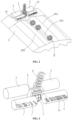
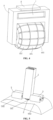
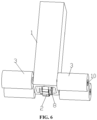
- 1 Measuring body; 101. Handle; 2. Measuring wheel; 201. Inner wheel; 2011. Arc strip; 202. Outer wheel; 3. Balance wheel; 4. First sensor; 401. Intermediate sensor; 402. Left sensor; 403. Right sensor; 5. Simulated measured person; 501. Spine; 502. High skin point; 6. Pressure sensor; 7. Angle detection device; 8. Mounting frame; 9. Elastic element; 10. Third sensor; 11. Second sensor; 12. Fourth sensor; 13. Optical sensor; 14. Light emitting device; 15. Reflective strip; 1501. High-reflectivity strip; 1502. Low-reflectivity strip; 16. Detection window.
- the present disclosure provides a spine measuring device, comprising a measuring body 1, a measuring wheel 2, a balance wheel 3, a first detection device, a spatial coordinate acquisition device 7 and a control device, wherein the measuring wheel 2 is provided at one end of the measuring body 1, at least four balance wheels 3 are symmetrically provided in rows at both sides of the measuring wheel 2 and are all connected with the measuring body 1, the first detection device and the spatial coordinate acquisition device 7 are both connected with the control device, the first detection device is configured to detect the movement of the measuring wheel 2, and the spatial coordinate acquisition device 7 is configured to detect a spatial angle value.
- the first detection device can detect the movement of the measuring wheel 2 and calculate a movement speed and a rolling distance of the measuring wheel 2. Based on the current movement speed, the rolling distance and each position coordinate acquired by the spatial coordinate acquisition device 7, spatial curve data is acquired and generated, so as to obtain scoliosis data.
- the device is simple in structure and is convenient to use.
- the present disclosure provides a spine measuring device, comprising a measuring body 1, a measuring wheel 2, a balance wheel 3, and a control device.
- the measuring wheel 2 is provided at one end of the measuring body 1.
- a plurality of first sensors 4 are provided on the measuring wheel 2, and the first sensors 4 are configured to detect the position where the measuring wheel 2 is located.
- At least four balance wheels 3 are provided at one end of the measuring body 1 close to the measuring wheel 2.
- At least four balance wheels 3 are symmetrically provided in two rows at both sides of the measuring wheel 2.
- the control device is provided in the measuring body 1.
- the control device is connected with the plurality of first sensors 4 and the spatial coordinate acquisition device 7, respectively.
- the spatial coordinate acquisition device 7 comprises a triaxial angle sensor.
- the triaxial angle sensor is provided on the measuring body 1 and is fixed with respect to the position of the measuring wheel 2.
- the triaxial angle sensor can also be an acceleration sensor or a gyroscope sensor or be replaced by other MEMS motion sensors.
- the triaxial angle sensor is combined with a geomagnetic sensor, the rotation angle change of the spatial X, Y and Z axes of the positions where the triaxial angle sensor and the geomagnetic sensor are located can be obtained.
- the triaxial angle sensor is installed inside the measuring body 1.
- Four balance wheels 3 are in contact with four skin high points 502 of the skin.
- the measuring wheel 2 always moves along the central position of the spine 501. With the movement of the measuring body 1, the spatial angle value of each test point can be obtained, and the spatial angle change comprises a pitch angle, a roll angle and a heading angle.
- the spatial curves can be calculated using the method of eliminating multiple types of error data; a first type is that the contact point between the test wheel and the skin is a real test point, but the position of the triaxial angle sensor is fixed with respect to the test wheel, so that it is necessary to eliminate the error of the relative distance. After correction, the position of the triaxial angle sensor coincides with the contact point between the test wheel and the skin, which eliminates the sagittal data error.
- the measuring body 1 has a long strip structure.
- One side of the measuring body 1 is provided with a handle 101, and the measuring wheel 2 is provided on the central axis of the measuring body 1.
- the first detection device comprises a plurality of first sensors 4.
- the plurality of first sensors 4 are arranged along the rolling direction of the wheel surface of the measuring wheel 2. When the measuring wheel 2 rolls along the skin, the sensors are in contact with the skin in sequence.
- the current movement speed and rolling distance can be calculated by the contact interval time and the arc length of the sensor.
- the plurality of first sensors 4 are arranged in three groups along the rolling direction of the wheel surface of the measuring wheel 2, namely, the first sensor in the middle position (referred to as the middle sensor 401), the first sensor in the left position (referred to as the left sensor 402) and the first sensor in the right position (the right sensor 403).
- the first sensor 4 can be a capacitance sensor.
- the first sensor 4 is a multi-channel surface capacitance sensor. After the multi-channel surface capacitance sensor is in contact with the skin, the capacitance changes, and the area of the skin in contact with the surface of the measuring wheel 2 can be calculated by calculating the capacitance change.
- the radial section of any position of the measuring wheel 2 is circular, and the diameter of the middle position of the measuring wheel 2 is larger than the diameters of the left and right positions of the measuring wheel 2.
- the middle sensor 401 is provided at the middle position of the measuring wheel 2.
- the left sensor 402 is provided at the left position of the measuring wheel 2, and the right sensor 403 is provided at the right position of the measuring wheel 2. Since the shape of the body surface area where the spine is located is convex in the neck area, only the middle sensor 401 can be in contact with the skin, while the left sensor 402 and the right sensor 403 cannot be in contact with the skin.
- the body surface shape of the thoracic vertebra and lumbar vertebra gradually transits from an upper convex part to a lower concave part.
- the contact area between three groups of sensors and the skin gradually increases, in which at the beginning, only the middle sensor 401 is in contact with the skin, and then the left sensor 402 and the right sensor 403 are in contact with the skin, until the area of the middle sensor 401 in contact with a very concave area decreases or even is not in contact with the very concave area. In this way, it can be judged that the spine measuring device is located in the measured area of the human body.
- the upper three groups of capacitance sensors can also be used to evaluate the accuracy of the operation method of the measured person.
- the data of the left sensor 402 and the right sensor 403 are basically symmetrical because of the symmetry of the human body. If serious asymmetry occurs, there are two situations: the first situation is an operation error since the measuring body 1 is skewed left and right or the measuring process deviates from the center line; the second situation is that the measured person has serious local scoliosis deformation.
- the sensing points of each group of first sensors 4 are uniformly distributed on the wheel surface of the measuring wheel 2 to form three circles of sensing points of the sensors.
- an arc angle between sensing points of two adjacent of the first sensors 4 and the center of the measuring wheel 2 is less than 72 degrees; alternatively, there are not less than 20 first sensors 4 in each circle.
- the spine measuring device further comprises a mounting frame 8 and an elastic element 9.
- the mounting frame 8 is provided at one end of the measuring body 1.
- the measuring wheel 2 is installed on the mounting frame 8 through a rotating shaft so that the measuring wheel 2 can rotate with respect to the mounting frame 8.
- the elastic element 9 is provided in the measuring body 1.
- One end of the elastic element 9 abuts against the measuring body 1, and the other end of the elastic element 9 is connected with the mounting frame 8, so that the measuring wheel 2 can move in the axial direction of the elastic element 9.
- the elastic element 9 can be an elastic column or a telescopic spring.
- the wheel surface of the measuring wheel 2 can always be attached to the skin surface by providing the elastic element 9.
- the measuring wheel 2 is located in the middle of the balance wheels 3.
- the width of the measuring wheel 2 is smaller than the gap width between each pair of balance wheels 3.
- the wheel surface of the measuring wheel 2 can be shrunk above the tangent plane of the wheel surface of the four balance wheels 3, and the protruding part of the human body is just located in the gap between each pair of balance wheels 3, so that the balance wheels 3 can continue to be in contact with the skin surface.
- the spine measuring device further comprises a pressure sensor 6.
- the pressure sensor 6 is sandwiched between the mounting frame 8 and the elastic element 9 and is configured to measure the pressure on the measuring wheel 2.
- the pressure sensor 6 is configured to measure the pressure change, in which when the measuring wheel 2 moves on the uneven skin surface, the measuring wheel 2 will fluctuate with the unevenness, and the elastic element 9 will compress accordingly. Because the human body will be particularly convex in the seventh cervical spinous process, the pressure may abruptly change. By recording the abruptly changing pressure signal, the measurement position of the seventh cervical spinous process can be identified, which is used to further optimize the position of pathological points after measurement.
- the number of balance wheels 3 can be set as four, six, eight, ten, etc.
- four balance wheels 3 are provided.
- the four balance wheels 3 rotate independently, and each balance wheel 3 has a cylindrical structure.
- the four balance wheels 3 are provided at one end of the measuring body 1 close to the measuring wheel 2.
- the four balance wheels 3 are symmetrically provided at both sides of the measuring wheel 2 in two rows, wherein a pair of balance wheels 3 which are oppositely provided (namely, two balance wheels 3 on the left and right sides of the measuring wheel 2) are respectively provided with second sensors 11, and the second sensors 11 are configured to detect the moving distance of the balance wheels 3.
- the second sensor 11 can be an angle measuring sensor, which independently measures the relative moving distance between the two wheel surfaces and the skin, calculates the moving distance of the central axis position of the measuring body 1 through the moving distance between the left and right wheels and the interval between the left and right wheels and the skin, and compares it with the data measured by the balance wheel 3 itself.
- the balance wheel 3 is further provided with a plurality of third sensors 10.
- the plurality of third sensors are arranged on the wheel surface of the balance wheel 3 along the same axis direction.
- the third sensors 10 are configured to detect the position where the wheel surface of the balance wheel 3 is in contact with the measured person.
- the four balance wheels 3 are all cylindrical wheel surfaces, and the position where the wheel surface is in contact with the skin needs to be confirmed.
- a group of third sensors 10 is added to the wheel surface, and the third sensors 10 can be pressure sensors or capacitance sensors.
- the contact center position can be determined by judging the extreme value of pressure intensity or the extreme value of capacitance of this group of sensors in contact with the skin, so as to confirm the position where the wheel surface is in contact with the skin.
- the accuracy of the test operation can also be evaluated by judging the contact between the wheel surface and the skin. During normal measurement, none of the four balance wheels 3 are allowed to leave the skin, and the contact points between the left and right wheel surfaces of the two groups of balance wheels 3 and the skin should be symmetrical. Through these evaluations, the accuracy of the test operation can be improved.
- the first sensors 4 are in contact with the skin in sequence.
- the current movement speed and rolling distance can be calculated by the contact interval time and the arc length of the first sensor.
- the second sensor 11 detects the moving distance of the balance wheel 3, and calculates the moving distance of the measuring wheel 2 by calculating the moving distance of the left and right wheels and the interval between the left and right wheels and the skin when the balance wheel 3 travels along a curved path.
- the shape of the body surface area where the spine is located is convex in the neck area, and the body surface shape of the thoracic vertebra and lumbar vertebra gradually transits from an upper convex part to a lower concave part.
- the first sensor 4 can detect which measured area of the human body the measuring wheel 2 is located in.
- the triaxial angle sensor and the geomagnetic sensor are used to measure the spatial angle value of each test point, in combination with the movement data of the measuring wheel 2, a series of spatial curves of test points can be calculated, and the angle change value of spinal torsion can be calculated, so as to obtain the scoliosis data.
- the device is simple in structure and convenient to use.
- the control device can be provided with a variety of circuits, and the types and numbers of the circuits can be arranged according to the actual needs.
- the control device has calculation function, and can calculate the data acquired by each sensor to obtain scoliosis data.
- a spine measuring device comprises a measuring body 1, a measuring wheel 2, a balance wheel 3, a first detection device, a spatial coordinate acquisition device 7 and a control device, wherein the measuring wheel 2 is provided at one end of the measuring body 1. At least four balance wheels 3 are symmetrically provided in rows at both sides of the measuring wheel 2 and are all connected with the measuring body 1.
- the first detection device and the spatial coordinate acquisition device 7 are both connected with the control device.
- the first detection device is configured to detect the movement of the measuring wheel 2, and the spatial coordinate acquisition device 7 is configured to detect a spatial angle value.
- the spatial coordinate acquisition device 7 is provided on the mounting frame.
- the spatial coordinate acquisition device 7 is opposite to the position of the measuring wheel 2.
- the spatial coordinate acquisition device 7 comprises a 3-axis accelerometer, a 3-axis gyroscope and a 3-axis magnetometer, forming a group of 9-axis sensing devices, which can measure the angle changes of the spatial pitch angle, rolling angle and heading angle and their absolute values with respect to the magnetic field of the earth during the movement of the measuring wheel 2 in real time.
- the spatial coordinate acquisition device 7 is installed inside the measuring body 1.
- Four balance wheels 3 are in contact with four skin high points 502 of the skin, and the measuring wheel 2 always moves along the central position of the spine 501. With the movement of the measuring body 1, the spatial angle value of each test point can be obtained.
- the spatial curves can be calculated using the method of eliminating multiple types of error data; a first type is that the contact point between the test wheel and the skin is a real test point, but the position of the triaxial angle sensor is fixed with respect to the test wheel, so that it is necessary to eliminate the error of the relative distance. After correction, the position of the triaxial angle sensor coincides with the contact point between the test wheel and the skin, which eliminates the sagittal data error.
- the spine measuring device further comprises a mounting frame 8 and an elastic element 9.
- the mounting frame 8 is provided at one end of the measuring body 1.
- the measuring wheel 2 is installed on the mounting frame 8.
- the elastic element 9 is provided in the measuring body 1.
- One end of the elastic element 9 abuts against the measuring body 1, and the other end thereof is connected with the mounting frame 8.
- the elastic element 9 is provided in the measuring body 1.
- One end of the elastic element 9 abuts against the measuring body 1, and the other end of the elastic element 9 is connected with the mounting frame 8, so that the measuring wheel 2 can move in the axial direction of the elastic element 9.
- the elastic element 9 can be an elastic column or a telescopic spring.
- the wheel surface of the measuring wheel 2 can always be attached to the skin surface by providing the elastic element 9.
- the measuring wheel 2 is located in the middle of the balance wheels 3.
- the wheel surface of the measuring wheel 2 can be shrunk above the tangent plane of the wheel surface of the four balance wheels 3, and the protruding part of the human body is just located in the gap between each pair of balance wheels 3, so that the balance wheels 3 can continue to be in contact with the skin surface.
- the measuring wheel 2 is provided at the front end of the measuring body 1 through the mounting frame 8.
- the measuring wheel 2 comprises an inner wheel 201 and an outer wheel 202.
- the outer wheel 202 is sleeved on the inner wheel 201, the inner wheel 201 is fixed, and the outer wheel 202 can roll with respect to the inner wheel 201.
- More than two fourth sensors 12 are provided in the downward area of the outer surface of the inner wheel 201.
- the fourth sensors 12 are provided along the circumferential direction of the inner wheel 201.
- the fourth sensors 12 are connected with the control device, and the fourth sensors 12 are configured to test the pressure change between the measuring wheel 2 and the skin.
- the inner wheel 201 is provided with grooves in the direction facing the skin contact surface, and at least three pressure sensors (the fourth sensors 12) are provided, respectively.
- a plurality of pressure sensors are provided along the circumferential direction of the inner wheel 201.
- the inner wheel 201 and the outer wheel 202 can slide and wheel with each other.
- the outer surface of the outer wheel 202 is rough, and the inner surface is smooth.
- the outer wheel 202 can be made of plastic, Teflon, nylon and other materials.
- the outer surface of the inner wheel 201 is smooth.
- Axles are provided at both ends of the inner wheel 201, which are fixed on the mounting frame 8 through the axles.
- the outer wheel 202 When the measuring wheel 2 is pressed to the skin surface as a whole for rolling measurement, the outer wheel 202 is in contact with the skin. Because the friction between the outer surface of the outer wheel 202 and the skin is greater than that between the inner surface of the outer wheel 202 and the outer surface of the inner wheel 201, the outer wheel 202 rolls, the inner wheel 201 does not move, and the reaction force of the pressure on the skin is transmitted to the inner wheel 201 through the outer wheel 202. Because the inner wheel 201 is provided with a plurality of pressure sensors at the position opposite to the skin surface, the pressure change between the inner wheel 201 and the skin can be measured.
- the pressure change of the skin measured by the pressure sensor on the measuring wheel 2 has the beneficial effect that it can be judged whether the measuring wheel 2 rolls over the skin surface on the spinal ridge skeleton or rolls over the skin surface on the spinal ridge skeleton space by identifying the trend of pressure change (because the skin hardness on the spinal ridge skeleton is high, the skin hardness on the spinal ridge skeleton space is low).
- the overall circumferential outer contour of the outer wheel 201 has a smooth circumferential curved surface, and the outer wheel 201 comprises a wheel body and an arc-shaped strip 2011.
- the wheel body is provided with an installation groove matched with the arc-shaped strip 2011, and a groove space in which the fourth sensor 12 is installed is provided on the wheel body.
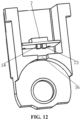
- An optical sensor 13 and a light emitting device 14 are provided on the mounting frame 8 supporting the measuring wheel 2.
- the optical sensor 13 and the light emitting device 14 are provided above the measuring wheel 2.
- An outer surface of an outer wheel of the measuring wheel 2 is provided with reflective strips 15 with different light reflectivity at intervals along the rolling direction, and the intensity of the reflected light is received by the optical sensor 13 for judging a rolling speed and a travel distance of the measuring wheel 2.
- an optical sensor 13 and a light emitting device 14 are provided on the mounting frame 8 supporting the measuring wheel 2.
- the outer surface of the outer wheel 202 of the measuring wheel 2 is provided with reflective strips 15 with different light reflectivity at intervals along the rolling direction.
- the mounting frame 8 is provided with a detection window 16, so that the emitted light can be emitted to the surface of the outer wheel 202, and the reflected light can be emitted to the optical sensor 13.
- the reflective strips 15 with different reflectivity provided at intervals are illuminated and reflected in sequence.
- the optical sensor 13 judges the rolling speed and the travel distance of the outer wheel 202 according to the intensity of the received reflected light.
- the outer wheel 201 is provided with reflective strips 15.
- the reflective strips 15 are divided into high-reflectivity strips 1501 and low-reflectivity strips 1502.
- the high-reflectivity strips 1501 and the low-reflectivity strips 1502 are distributed at intervals along the circumferential direction of the outer wheel 201 in sequence.
- the mounting frame 8 comprises a cylindrical part and rotating shaft supporting plates.
- Two rotating shaft supporting plates are provided at the bottom of the cylindrical part.
- the two rotating shaft supporting plates are opposite to each other to fix the inner wheel 201.
- the bottom of the cylindrical part is provided with a detection window 16, and the detection window 16 is located between the two rotating shaft support plates.
- a supporting plate is provided inside the cylindrical part.
- An angle detection device 7 is provided on the top surface of the supporting plate, and a light sensor 13 and a light emitting device 14 are fixed on the bottom surface of the supporting plate.
- the balance wheel 13 is further provided with a third sensor 10.
- the third sensor 10 is provided on the wheel surface or a wheel shaft of the balance wheel 3, and the third sensor 10 is configured to detect the position where the wheel surface of the balance wheel is in contact with a measured person.
- the balance wheels 3 are located on both sides of the measuring wheel 2 and are connected with the measuring body 1, respectively.
- the axle direction of the balance wheel 3 is parallel to the axle of the measuring wheel 2.
- the balance wheels 3 are provided in pairs (the balance wheels 3 provided on the left and right sides of the measuring wheel 2 are referred to as a pair of balance wheels), which are not less than two pairs. During the measurement, the balance wheel 3 is in contact with the skin surface of the muscle high points on both sides of the spine.
- the balance wheel 3 consists of an axle fixedly installed on the measuring body 1 and a rollable wheel surface.
- the height of the wheel surface cylinder is more than twice its diameter, and the height of the wheel surface is not less than 30mm.
- a pressure sensor or a strain sensor (the third sensor 10) is provided on the axle or the wheel surface of the balance wheel 3 to measure the contact pressure between the balance wheel 3 and the skin. When the contact pressure is zero, it can be judged that the measurement operation is deviated.
- the control device is located in the measuring body 1.
- the control device comprises a control panel, a spatial coordinate trajectory data analyzing module, a data transmission module and a power management function module.
- the spine measuring device can be in communication connection with a computer, a tablet, a mobile terminal, an upper computer or other devices.
- the present disclosure provides a spine measuring system, comprising an external host and the spine measurement device, wherein the external host is in communication connection with the spine measurement device.
- the present disclosure provides a measuring method for detecting a spine by using the spine measuring device, comprising:
- the measuring method acquires pressure change data through a pressure sensor of a spine measuring device, accurately identifies and positions the seventh cervical vertebra, and finds the starting point of measurement accurately. Data acquisition also starts from the seventh cervical vertebra, thus ensuring the accuracy of subsequent data acquisition and analysis.
- the step of "identifying a position of a seventh cervical spinous process based on the pressure data" specifically comprises;
- the measuring method for detecting the spine is introduced as follows.
- the present disclosure provides a measuring method, comprising the following steps.
- the sensing component acquires pressure data of each position coordinate during spine measurement.
- an elastic element 9 (a telescopic spring) is installed on the mounting frame 8 on which the measuring wheel 2 is installed, so that the surface of the measuring wheel 2 can be kept in contact with the skin surface.
- the measuring wheel 2 is located in the middle of the balance wheels 3.
- the width of the measuring wheel 2 is smaller than the gap width between each pair of balance wheels 3.
- the sensing component comprises sensors installed on the measuring wheel 2, the balance wheel 3 and the mounting frame 8.
- the sensing component acquires pressure data of the measuring wheel 2 and the balance wheel 3 moving to each position coordinate during spine measurement.
- Pressure change data is acquired based on the pressure data of each position coordinate.
- the measuring wheel 2 when the measuring wheel 2 moves on the uneven skin surface, the measuring wheel 2 will fluctuate with the unevenness, and the spring will compress accordingly.
- Target pressure change data which conforms to a preset seventh cervical pressure abrupt change range is searched for according to the pressure change data.
- a corresponding measurement coordinate position is determined according to the target pressure change data.
- the position of the seventh cervical spinous process is identified based on the corresponding measurement coordinate position.
- the pressure may abruptly change.
- the measurement position of the seventh cervical spinous process can be identified, which is used to further optimize the position of pathological points after measurement, so that the starting point of measurement can be found accurately.
- Data acquisition also starts from the seventh cervical vertebra, thus ensuring the accuracy of subsequent data acquisition and analysis.
- the step further comprises:
- the seventh cervical vertebra In order to position the seventh cervical vertebra more accurate, on the basis of "searching for target pressure change data which conforms to a preset seventh cervical pressure abrupt change range", it is combined with the position change data. That is, when the device moves to the seventh cervical spinous process, the spatial trajectory will abruptly change due to the external characteristics of the seventh cervical vertebra.
- the seventh cervical vertebra can be positioned and identified by extracting the trajectory abrupt change characteristic value of the seventh cervical vertebra.
- the pressure data of each position coordinate during spine measurement is acquired by the pressure sensor and the triaxial angle sensor.
- a pressure sensor 6 is installed on the end face of the telescopic spring on which the measuring wheel 2 is installed. During the measurement of the pressure sensor 6, when the measuring wheel 2 moves on the uneven skin surface, the measuring wheel 2 will fluctuate with the unevenness, and the spring will compress accordingly.
- Three groups of capacitance sensors are installed side by side along the rolling direction on the wheel surface of the measuring wheel 2. Based on the capacitance data acquired by three groups of capacitance sensors and the acquired spatial curve data, the measured area of the human body where a spine detection handheld device is located can be judged.
- the first sensors 4 are in contact with the skin in sequence.
- the current movement speed and rolling distance are calculated based on the contact interval time and the arc length of the capacitance sensor.
- the spatial curve data are acquired.
- a group of capacitance sensors are provided on either of the left, middle and right parts of the wheel surface of the measuring wheel 2.
- the sensing points of each group of capacitance sensors are uniformly distributed in the corresponding wheel surface area of the measuring wheel.
- Three groups of capacitance sensors form three circles of sensing points of sensors.
- the middle group of capacitance sensors are located on the central axis of the wheel surface of the measuring wheel, and the left and right groups of capacitance sensors are symmetrically distributed with the middle group of capacitance sensors as the axis.
- the middle group of capacitance sensors acquire capacitance data and the left and right groups of capacitance sensors do not acquire capacitance data
- the measured area of the human body where the spine detection handheld device is located is a cervical vertebra section.
- the left and right groups of capacitance sensors acquire the capacitance data and the middle group of capacitance sensors do not acquire capacitance data
- the measured area of the human body where the spine detection handheld device is located is a lumbar vertebra section.
- all three groups of capacitance sensors acquire capacitance data, it is determined that the measured area of the human body where the spine detection handheld device is located is the thoracic vertebra section.
- the body surface shape of the thoracic vertebra and lumbar vertebra gradually transits from an upper convex part to a lower concave part.
- the contact area between three groups of sensors and the skin gradually increases, in which at the beginning, only the middle group of capacitance sensors are in contact with the skin, and then the left and right groups of capacitance sensors are in contact with the skin, until the area of the middle group of capacitance sensors in contact with a very concave area decreases or even is not in contact with the very concave area. In this way, it can be judged that the spine measuring device is located in the measured area of the human body.
- control device comprising:
- the control device further comprises a judging module, which is configured to:
- the control device further comprises an analyzing and processing module, which is configured to calculate and acquire spatial curve data and spatial angle change data of a spine measuring point, and is configured to measure a cobb angle of scoliosis base on the spatial curve data and the spatial angle change data, so as to determine a scoliosis degree according to the cobb angle.
- an analyzing and processing module which is configured to calculate and acquire spatial curve data and spatial angle change data of a spine measuring point, and is configured to measure a cobb angle of scoliosis base on the spatial curve data and the spatial angle change data, so as to determine a scoliosis degree according to the cobb angle.
- a plurality of steps or methods can be implemented by software or firmware stored in a memory and executed by a suitable instruction execution system.
- the steps or methods can be implemented by any one of the following technologies known in the art or the combination thereof: a discrete logic circuit with a logic gate for realizing logic functions on data signals, an application specific integrated circuit with appropriate combined logic gates, a Programmable Gate Array (PGA), a Field Programmable Gate Array (FPGA), etc.
- PGA Programmable Gate Array
- FPGA Field Programmable Gate Array
- each functional unit in each embodiment of the present disclosure may be integrated in one processing module, each unit may exist physically alone, or two or more units may be integrated in one module.
- the above integrated modules can be realized in the form of hardware or in the form of a software functional module. If the integrated module is implemented in the form of a software functional module and sold or used as an independent product, the integrated module can also be stored in a computer-readable storage medium.
- the storage medium mentioned above can be a read-only memory, a magnetic disk or an optical disk, etc.
Landscapes
- Health & Medical Sciences (AREA)
- Life Sciences & Earth Sciences (AREA)
- Physics & Mathematics (AREA)
- Surgery (AREA)
- General Health & Medical Sciences (AREA)
- Biophysics (AREA)
- Pathology (AREA)
- Engineering & Computer Science (AREA)
- Biomedical Technology (AREA)
- Heart & Thoracic Surgery (AREA)
- Medical Informatics (AREA)
- Molecular Biology (AREA)
- Veterinary Medicine (AREA)
- Animal Behavior & Ethology (AREA)
- Public Health (AREA)
- Oral & Maxillofacial Surgery (AREA)
- Dentistry (AREA)
- Physical Education & Sports Medicine (AREA)
- Orthopedic Medicine & Surgery (AREA)
- Rheumatology (AREA)
- Geometry (AREA)
- Physiology (AREA)
- Measurement Of The Respiration, Hearing Ability, Form, And Blood Characteristics Of Living Organisms (AREA)
- A Measuring Device Byusing Mechanical Method (AREA)
Applications Claiming Priority (1)
| Application Number | Priority Date | Filing Date | Title |
|---|---|---|---|
| CN202222058140.7U CN218391094U (zh) | 2022-08-05 | 2022-08-05 | 一种脊柱测量装置 |
Publications (4)
| Publication Number | Publication Date |
|---|---|
| EP4316360A2 true EP4316360A2 (de) | 2024-02-07 |
| EP4316360A3 EP4316360A3 (de) | 2024-03-20 |
| EP4316360B1 EP4316360B1 (de) | 2025-07-09 |
| EP4316360C0 EP4316360C0 (de) | 2025-07-09 |
Family
ID=85026740
Family Applications (1)
| Application Number | Title | Priority Date | Filing Date |
|---|---|---|---|
| EP23189638.2A Active EP4316360B1 (de) | 2022-08-05 | 2023-08-04 | Wirbelsäulenmessvorrichtung, wirbelsäulenmesssystem und messverfahren |
Country Status (4)
| Country | Link |
|---|---|
| US (1) | US20240041393A1 (de) |
| EP (1) | EP4316360B1 (de) |
| JP (1) | JP2024022493A (de) |
| CN (1) | CN218391094U (de) |
Families Citing this family (3)
| Publication number | Priority date | Publication date | Assignee | Title |
|---|---|---|---|---|
| WO2025093913A1 (en) * | 2023-11-01 | 2025-05-08 | Saeidi Fatemehsadat | Infrared scanning of the spine roller sensor |
| CN117653039B (zh) * | 2023-12-29 | 2024-09-06 | 河南翔宇医疗设备股份有限公司 | 一种测量脊柱侧弯的装置 |
| JP7698256B1 (ja) * | 2024-08-02 | 2025-06-25 | 国立大学法人旭川医科大学 | 脊柱計測装置 |
Family Cites Families (6)
| Publication number | Priority date | Publication date | Assignee | Title |
|---|---|---|---|---|
| DE4336144A1 (de) * | 1993-10-22 | 1995-04-27 | Zebris Medizintechnik Gmbh | Verfahren zur Erfassung der Oberflächenform von Körpern sowie eine Vorrichtung in Form einer Meßwalze zur Durchführung des Verfahrens |
| AU7238198A (en) * | 1998-05-15 | 1999-12-06 | Yoshio Muramatsu | Therapeutic pressing device |
| US20060015042A1 (en) * | 2004-07-15 | 2006-01-19 | Linial Andrew V | Method and apparatus for detection and measurement of scoliosis of the spine |
| KR101542663B1 (ko) * | 2013-11-22 | 2015-08-06 | 한국산업기술대학교산학협력단 | 근골격 콥스각의 3차원 모델을 이용한 척추 만곡 진단장치 및 그 진단방법 |
| CN215227638U (zh) * | 2020-03-31 | 2021-12-21 | 吴昀效 | 一种新型脊柱侧弯支具矫形效果智能显示装置 |
| CN113786188A (zh) * | 2021-08-05 | 2021-12-14 | 芙索特(上海)医疗科技有限公司 | 一种脊柱侧弯检测装置及脊柱侧弯检测方法 |
-
2022
- 2022-08-05 CN CN202222058140.7U patent/CN218391094U/zh active Active
-
2023
- 2023-06-20 US US18/211,774 patent/US20240041393A1/en active Pending
- 2023-07-04 JP JP2023110305A patent/JP2024022493A/ja active Pending
- 2023-08-04 EP EP23189638.2A patent/EP4316360B1/de active Active
Also Published As
| Publication number | Publication date |
|---|---|
| JP2024022493A (ja) | 2024-02-16 |
| US20240041393A1 (en) | 2024-02-08 |
| EP4316360B1 (de) | 2025-07-09 |
| CN218391094U (zh) | 2023-01-31 |
| EP4316360A3 (de) | 2024-03-20 |
| EP4316360C0 (de) | 2025-07-09 |
Similar Documents
| Publication | Publication Date | Title |
|---|---|---|
| EP4316360B1 (de) | Wirbelsäulenmessvorrichtung, wirbelsäulenmesssystem und messverfahren | |
| CN104864827B (zh) | 坐标测量机和坐标测量机的校正矩阵计算方法 | |
| CN101583851B (zh) | 用于确定在角度测量仪中导致偏心度的作用变量的方法 | |
| US10317197B2 (en) | System and method for stabilizing optical shape sensing | |
| US20130307967A1 (en) | Short rolling runout compensation for vehicle wheel alignment | |
| RU2627634C2 (ru) | Устройство для мониторинга пользователя и способ для калибровки устройства | |
| CN112857212B (zh) | 一种大型结构多点位移和转动响应同步监测系统及其数据分析方法 | |
| CN113786188A (zh) | 一种脊柱侧弯检测装置及脊柱侧弯检测方法 | |
| EP3346228B1 (de) | Formmessvorrichtung | |
| US20110308309A1 (en) | Method for wheel suspension measurement and a device for measuring the wheel suspension geometry of a vehicle | |
| CN109009135B (zh) | 脊柱3d测量仪及其测量方法 | |
| CN102901460A (zh) | 一种三轴试样径向变形的测量装置与方法 | |
| CA2349709A1 (en) | Measuring system for determining the surface line of a body | |
| EP3612801A1 (de) | Verfahren und systeme zur messung von parametern von drehwellen und kupplungen | |
| CN101566466B (zh) | 轮廓度分析系统及方法 | |
| CN115153448B (zh) | 一种脊柱识别定位方法、装置和系统 | |
| US20060015042A1 (en) | Method and apparatus for detection and measurement of scoliosis of the spine | |
| CN114562962A (zh) | 一种基于激光跟踪仪的设备同轴度测量方法 | |
| US20190357983A1 (en) | Dynamic reference deviation detecting method and system thereof | |
| EP3305194A1 (de) | Vorrichtung und verfahren zur messung der bewegung von halswirbeln | |
| EP3021095A1 (de) | Spektroskopiesystem mit verschiebungsausgleich und spektroskopieverfahren mit dem spektroskopiesystem | |
| CN209230563U (zh) | 一种直线度或弯曲度在线测量装置 | |
| KR102635642B1 (ko) | 변위 변경이 가능한 심전도 측정 장치 | |
| CN220175109U (zh) | 一种脊柱侧弯测量装置 | |
| CN117653039B (zh) | 一种测量脊柱侧弯的装置 |
Legal Events
| Date | Code | Title | Description |
|---|---|---|---|
| PUAI | Public reference made under article 153(3) epc to a published international application that has entered the european phase |
Free format text: ORIGINAL CODE: 0009012 |
|
| STAA | Information on the status of an ep patent application or granted ep patent |
Free format text: STATUS: THE APPLICATION HAS BEEN PUBLISHED |
|
| AK | Designated contracting states |
Kind code of ref document: A2 Designated state(s): AL AT BE BG CH CY CZ DE DK EE ES FI FR GB GR HR HU IE IS IT LI LT LU LV MC ME MK MT NL NO PL PT RO RS SE SI SK SM TR |
|
| PUAL | Search report despatched |
Free format text: ORIGINAL CODE: 0009013 |
|
| AK | Designated contracting states |
Kind code of ref document: A3 Designated state(s): AL AT BE BG CH CY CZ DE DK EE ES FI FR GB GR HR HU IE IS IT LI LT LU LV MC ME MK MT NL NO PL PT RO RS SE SI SK SM TR |
|
| RIC1 | Information provided on ipc code assigned before grant |
Ipc: A61B 5/107 20060101ALN20240214BHEP Ipc: A61B 5/00 20060101AFI20240214BHEP |
|
| STAA | Information on the status of an ep patent application or granted ep patent |
Free format text: STATUS: REQUEST FOR EXAMINATION WAS MADE |
|
| STAA | Information on the status of an ep patent application or granted ep patent |
Free format text: STATUS: EXAMINATION IS IN PROGRESS |
|
| 17P | Request for examination filed |
Effective date: 20240918 |
|
| RBV | Designated contracting states (corrected) |
Designated state(s): AL AT BE BG CH CY CZ DE DK EE ES FI FR GB GR HR HU IE IS IT LI LT LU LV MC ME MK MT NL NO PL PT RO RS SE SI SK SM TR |
|
| 17Q | First examination report despatched |
Effective date: 20241016 |
|
| GRAP | Despatch of communication of intention to grant a patent |
Free format text: ORIGINAL CODE: EPIDOSNIGR1 |
|
| STAA | Information on the status of an ep patent application or granted ep patent |
Free format text: STATUS: GRANT OF PATENT IS INTENDED |
|
| RIC1 | Information provided on ipc code assigned before grant |
Ipc: A61B 5/107 20060101ALN20250220BHEP Ipc: A61B 5/11 20060101ALI20250220BHEP Ipc: A61B 5/103 20060101ALI20250220BHEP Ipc: A61B 5/00 20060101AFI20250220BHEP |
|
| INTG | Intention to grant announced |
Effective date: 20250318 |
|
| GRAS | Grant fee paid |
Free format text: ORIGINAL CODE: EPIDOSNIGR3 |
|
| GRAA | (expected) grant |
Free format text: ORIGINAL CODE: 0009210 |
|
| STAA | Information on the status of an ep patent application or granted ep patent |
Free format text: STATUS: THE PATENT HAS BEEN GRANTED |
|
| AK | Designated contracting states |
Kind code of ref document: B1 Designated state(s): AL AT BE BG CH CY CZ DE DK EE ES FI FR GB GR HR HU IE IS IT LI LT LU LV MC ME MK MT NL NO PL PT RO RS SE SI SK SM TR |
|
| REG | Reference to a national code |
Ref country code: GB Ref legal event code: FG4D |
|
| REG | Reference to a national code |
Ref country code: CH Ref legal event code: EP |
|
| REG | Reference to a national code |
Ref country code: IE Ref legal event code: FG4D |
|
| REG | Reference to a national code |
Ref country code: DE Ref legal event code: R096 Ref document number: 602023004656 Country of ref document: DE |
|
| U01 | Request for unitary effect filed |
Effective date: 20250805 |
|
| U07 | Unitary effect registered |
Designated state(s): AT BE BG DE DK EE FI FR IT LT LU LV MT NL PT RO SE SI Effective date: 20250814 |
|
| U20 | Renewal fee for the european patent with unitary effect paid |
Year of fee payment: 3 Effective date: 20250821 |