EP4311073A2 - Ausrichtung zwischen aufladeelementen eines hörgeräts und einem ladegerät - Google Patents
Ausrichtung zwischen aufladeelementen eines hörgeräts und einem ladegerät Download PDFInfo
- Publication number
- EP4311073A2 EP4311073A2 EP23215187.8A EP23215187A EP4311073A2 EP 4311073 A2 EP4311073 A2 EP 4311073A2 EP 23215187 A EP23215187 A EP 23215187A EP 4311073 A2 EP4311073 A2 EP 4311073A2
- Authority
- EP
- European Patent Office
- Prior art keywords
- digital
- hearing device
- charging element
- model
- dimensional
- Prior art date
- Legal status (The legal status is an assumption and is not a legal conclusion. Google has not performed a legal analysis and makes no representation as to the accuracy of the status listed.)
- Pending
Links
Images



Classifications
-
- H—ELECTRICITY
- H04—ELECTRIC COMMUNICATION TECHNIQUE
- H04R—LOUDSPEAKERS, MICROPHONES, GRAMOPHONE PICK-UPS OR LIKE ACOUSTIC ELECTROMECHANICAL TRANSDUCERS; ELECTRIC HEARING AIDS; PUBLIC ADDRESS SYSTEMS
- H04R25/00—Electric hearing aids
- H04R25/55—Electric hearing aids using an external connection, either wireless or wired
- H04R25/554—Electric hearing aids using an external connection, either wireless or wired using a wireless connection, e.g. between microphone and amplifier or using Tcoils
-
- H—ELECTRICITY
- H02—GENERATION; CONVERSION OR DISTRIBUTION OF ELECTRIC POWER
- H02J—ELECTRIC POWER NETWORKS; CIRCUIT ARRANGEMENTS OR SYSTEMS FOR SUPPLYING OR DISTRIBUTING ELECTRIC POWER; SYSTEMS FOR STORING ELECTRIC ENERGY
- H02J50/00—Circuit arrangements or systems for wireless supply or distribution of electric power
- H02J50/90—Circuit arrangements or systems for wireless supply or distribution of electric power involving detection or optimisation of position, e.g. alignment
-
- H—ELECTRICITY
- H02—GENERATION; CONVERSION OR DISTRIBUTION OF ELECTRIC POWER
- H02J—ELECTRIC POWER NETWORKS; CIRCUIT ARRANGEMENTS OR SYSTEMS FOR SUPPLYING OR DISTRIBUTING ELECTRIC POWER; SYSTEMS FOR STORING ELECTRIC ENERGY
- H02J50/00—Circuit arrangements or systems for wireless supply or distribution of electric power
- H02J50/10—Circuit arrangements or systems for wireless supply or distribution of electric power using inductive coupling
-
- H—ELECTRICITY
- H02—GENERATION; CONVERSION OR DISTRIBUTION OF ELECTRIC POWER
- H02J—ELECTRIC POWER NETWORKS; CIRCUIT ARRANGEMENTS OR SYSTEMS FOR SUPPLYING OR DISTRIBUTING ELECTRIC POWER; SYSTEMS FOR STORING ELECTRIC ENERGY
- H02J7/00—Circuit arrangements for charging or discharging batteries or for supplying loads from batteries
-
- H—ELECTRICITY
- H02—GENERATION; CONVERSION OR DISTRIBUTION OF ELECTRIC POWER
- H02J—ELECTRIC POWER NETWORKS; CIRCUIT ARRANGEMENTS OR SYSTEMS FOR SUPPLYING OR DISTRIBUTING ELECTRIC POWER; SYSTEMS FOR STORING ELECTRIC ENERGY
- H02J7/00—Circuit arrangements for charging or discharging batteries or for supplying loads from batteries
- H02J7/70—Circuit arrangements for charging or discharging batteries or for supplying loads from batteries characterised by the mechanical construction
- H02J7/751—Circuit arrangements for charging or discharging batteries or for supplying loads from batteries characterised by the mechanical construction concerning the insertion or the connection of the batteries
-
- H—ELECTRICITY
- H04—ELECTRIC COMMUNICATION TECHNIQUE
- H04R—LOUDSPEAKERS, MICROPHONES, GRAMOPHONE PICK-UPS OR LIKE ACOUSTIC ELECTROMECHANICAL TRANSDUCERS; ELECTRIC HEARING AIDS; PUBLIC ADDRESS SYSTEMS
- H04R1/00—Details of transducers, loudspeakers or microphones
- H04R1/10—Earpieces; Attachments therefor ; Earphones; Monophonic headphones
- H04R1/1016—Earpieces of the intra-aural type
-
- H—ELECTRICITY
- H04—ELECTRIC COMMUNICATION TECHNIQUE
- H04R—LOUDSPEAKERS, MICROPHONES, GRAMOPHONE PICK-UPS OR LIKE ACOUSTIC ELECTROMECHANICAL TRANSDUCERS; ELECTRIC HEARING AIDS; PUBLIC ADDRESS SYSTEMS
- H04R1/00—Details of transducers, loudspeakers or microphones
- H04R1/10—Earpieces; Attachments therefor ; Earphones; Monophonic headphones
- H04R1/1058—Manufacture or assembly
- H04R1/1066—Constructional aspects of the interconnection between earpiece and earpiece support
-
- H—ELECTRICITY
- H04—ELECTRIC COMMUNICATION TECHNIQUE
- H04R—LOUDSPEAKERS, MICROPHONES, GRAMOPHONE PICK-UPS OR LIKE ACOUSTIC ELECTROMECHANICAL TRANSDUCERS; ELECTRIC HEARING AIDS; PUBLIC ADDRESS SYSTEMS
- H04R25/00—Electric hearing aids
- H04R25/60—Mounting or interconnection of hearing aid parts, e.g. inside tips, housings or to ossicles
- H04R25/602—Mounting or interconnection of hearing aid parts, e.g. inside tips, housings or to ossicles of batteries
-
- H—ELECTRICITY
- H04—ELECTRIC COMMUNICATION TECHNIQUE
- H04R—LOUDSPEAKERS, MICROPHONES, GRAMOPHONE PICK-UPS OR LIKE ACOUSTIC ELECTROMECHANICAL TRANSDUCERS; ELECTRIC HEARING AIDS; PUBLIC ADDRESS SYSTEMS
- H04R25/00—Electric hearing aids
- H04R25/60—Mounting or interconnection of hearing aid parts, e.g. inside tips, housings or to ossicles
- H04R25/609—Mounting or interconnection of hearing aid parts, e.g. inside tips, housings or to ossicles of circuitry
-
- H—ELECTRICITY
- H04—ELECTRIC COMMUNICATION TECHNIQUE
- H04R—LOUDSPEAKERS, MICROPHONES, GRAMOPHONE PICK-UPS OR LIKE ACOUSTIC ELECTROMECHANICAL TRANSDUCERS; ELECTRIC HEARING AIDS; PUBLIC ADDRESS SYSTEMS
- H04R25/00—Electric hearing aids
- H04R25/65—Housing parts, e.g. shells, tips or moulds, or their manufacture
- H04R25/652—Ear tips; Ear moulds
-
- H—ELECTRICITY
- H04—ELECTRIC COMMUNICATION TECHNIQUE
- H04R—LOUDSPEAKERS, MICROPHONES, GRAMOPHONE PICK-UPS OR LIKE ACOUSTIC ELECTROMECHANICAL TRANSDUCERS; ELECTRIC HEARING AIDS; PUBLIC ADDRESS SYSTEMS
- H04R25/00—Electric hearing aids
- H04R25/65—Housing parts, e.g. shells, tips or moulds, or their manufacture
- H04R25/658—Manufacture of housing parts
-
- H—ELECTRICITY
- H04—ELECTRIC COMMUNICATION TECHNIQUE
- H04R—LOUDSPEAKERS, MICROPHONES, GRAMOPHONE PICK-UPS OR LIKE ACOUSTIC ELECTROMECHANICAL TRANSDUCERS; ELECTRIC HEARING AIDS; PUBLIC ADDRESS SYSTEMS
- H04R2225/00—Details of deaf aids covered by H04R25/00, not provided for in any of its subgroups
- H04R2225/31—Aspects of the use of accumulators in hearing aids, e.g. rechargeable batteries or fuel cells
-
- H—ELECTRICITY
- H04—ELECTRIC COMMUNICATION TECHNIQUE
- H04R—LOUDSPEAKERS, MICROPHONES, GRAMOPHONE PICK-UPS OR LIKE ACOUSTIC ELECTROMECHANICAL TRANSDUCERS; ELECTRIC HEARING AIDS; PUBLIC ADDRESS SYSTEMS
- H04R2225/00—Details of deaf aids covered by H04R25/00, not provided for in any of its subgroups
- H04R2225/33—Aspects relating to adaptation of the battery voltage, e.g. its regulation, increase or decrease
-
- H—ELECTRICITY
- H04—ELECTRIC COMMUNICATION TECHNIQUE
- H04R—LOUDSPEAKERS, MICROPHONES, GRAMOPHONE PICK-UPS OR LIKE ACOUSTIC ELECTROMECHANICAL TRANSDUCERS; ELECTRIC HEARING AIDS; PUBLIC ADDRESS SYSTEMS
- H04R2225/00—Details of deaf aids covered by H04R25/00, not provided for in any of its subgroups
- H04R2225/77—Design aspects, e.g. CAD, of hearing aid tips, moulds or housings
-
- H—ELECTRICITY
- H04—ELECTRIC COMMUNICATION TECHNIQUE
- H04R—LOUDSPEAKERS, MICROPHONES, GRAMOPHONE PICK-UPS OR LIKE ACOUSTIC ELECTROMECHANICAL TRANSDUCERS; ELECTRIC HEARING AIDS; PUBLIC ADDRESS SYSTEMS
- H04R2420/00—Details of connection covered by H04R, not provided for in its groups
- H04R2420/07—Applications of wireless loudspeakers or wireless microphones
-
- H—ELECTRICITY
- H04—ELECTRIC COMMUNICATION TECHNIQUE
- H04R—LOUDSPEAKERS, MICROPHONES, GRAMOPHONE PICK-UPS OR LIKE ACOUSTIC ELECTROMECHANICAL TRANSDUCERS; ELECTRIC HEARING AIDS; PUBLIC ADDRESS SYSTEMS
- H04R2460/00—Details of hearing devices, i.e. of ear- or headphones covered by H04R1/10 or H04R5/033 but not provided for in any of their subgroups, or of hearing aids covered by H04R25/00 but not provided for in any of its subgroups
- H04R2460/17—Hearing device specific tools used for storing or handling hearing devices or parts thereof, e.g. placement in the ear, replacement of cerumen barriers, repair, cleaning hearing devices
Definitions
- the present disclosure relates to a method for alignment of a receiver charging element of a hearing device and a transmitter charging element of a charger.
- the present disclosure further relates to a kit comprising the charger comprising the transmitter charging element and the hearing device comprising the receiver charging element, wherein the two charging elements are aligned.
- Rechargeable hearing aids are gaining popularity because they require low maintenance compared to traditional hearing aids with alkaline batteries.
- the rechargeable hearing aids do not generate an extra cost for a user, as there is no need for purchasing a new battery every time an old battery is drained.
- the rechargeable hearing aids have other benefits, they are watertight, robust, environmentally friendly, and allow for new architectures.
- the rechargeable hearing devices are typically charged wirelessly.
- Wireless charging has various advantages, it is simple as a charging device may simply be placed at a charging pad. Furthermore, mechanical strain on a charging port is reduced, as there is no plug to be plugged and unplugged every time. Additionally, wireless charging is constantly growing so it will be more and more common that wireless charging pads will be installed in various places so that users can simply drop their device for charging. This applies to standard devices which do not require special, i.e. custom, types of charging pads.
- wireless charging is in general slower than wired charging as, often, a charging device and a charger may not have a good energy transfer due to low efficiency, and especially if the charging device has a special shape, like a custom-made hearing device. Due to their specific shape, hearing devices may require a charging station, and not a simple charging pad. Therefore, there is a need for an improved method for ensuring optimal charging of a hearing device in a charger.
- efficient power transfer between the two charging elements is provided.
- the invention provides a method for alignment of a receiver charging element (Rx) of a hearing device and a transmitter charging element (Tx) of a charger.
- the hearing device is a custom rechargeable hearing device designed to be worn by a user.
- the charger comprises a custom insert, the custom insert being configured to receive the hearing device.
- the method comprises obtaining a digital scan of the user's ear shape.
- the method further comprises creating a digital three-dimensional (3D) hearing device model based on the digital scan of the user's ear shape.
- the position of the receiver charging element Rx is configured to be added to the digital 3D hearing device model.
- a digital 3D charger model is provided or obtained and the position of the transmitter charging element Tx is configured to be added to the digital 3D charger model.
- a generic digital 3D insert model is provided or obtained and a digital cavity is created in the generic digital 3D insert model.
- the digital cavity is based on the digital 3D hearing device model to thereby obtain a custom digital 3D insert model.
- the cavity is configured to receive the hearing device. Alignment between the receiver charging element Rx in the digital 3D hearing device model and the transmitter charging element Tx in the 3D charger model is ensured to thereby maximize coupling between the transmitter charging element Tx and receiver charging element Rx.
- the method may thereby comprise obtaining the digital three-dimensional hearing device model, wherein the digital three-dimensional hearing device model is based on the digital scan of an ear of the user, the digital three-dimensional hearing device model comprising a representation of the receiver charging element Rx; obtaining the digital three-dimensional charger model, the digital three-dimensional charger model comprising a representation of the transmitter charging element Tx; obtaining the generic digital three-dimensional insert model; obtaining the digital cavity representing the cavity in the custom insert to be made for receiving the hearing device; and creating the custom digital three-dimensional insert model based on the digital cavity and the generic digital three-dimensional insert model, wherein the custom digital three-dimensional insert model is created such that (1) the representation of the receiver charging element Rx in the digital three-dimensional hearing device model and (2) the representation of the transmitter charging element Tx in the three-dimensional charger model, are aligned.
- the custom insert may be configured to receive the hearing device so that the hearing device only can be placed correctly in one position.
- the position of the receiver charging element Rx in the hearing device with relation to the transmitter charging element Tx in the charger is thus controlled in the use situation.
- the method as described above and as specified below may be performed by an apparatus, such as a design software, a workstation, etc., and/or by a human.
- the transmitter charging element Tx is comprised in the charger and have a connection point to a power supply source.
- the charger i.e., the transmitter charging element is typically driven by electric power from a power source and generates a time-varying electromagnetic field, which transmits power across space and towards the receiver charging element Rx in the hearing device.
- the power supply source may be an electric current supply source, a solar power source, a light source, a hand driven dynamo or the like.
- the transmitter charging element may be positioned in the bottom of the charger.
- the receiver charging element of the hearing device will be positioned on top of the transmitter charging element, once the hearing device is placed in the custom insert.
- the transmitter charging element may be positioned in the lid of the charger. In this scenario, the receiver charging element of the hearing device will be positioned below the transmitter charging element, once the hearing device is placed in the custom insert.
- the receiver charging element Rx is comprised in the hearing device and is configured to extract power from the electromagnetic field produced by the transmitter charging element.
- the receiver charging element is typically placed in the outer part of the hearing device, i.e. the part facing towards the user's surroundings, when the hearing device is worn by the user.
- the receiver charging element is typically arranged on a faceplate of the hearing device.
- the receiver charging element Rx is coupled or connected to a rechargeable battery of the hearing device.
- the receiver charging element Rx is configured to charge the rechargeable battery of the hearing device.
- the transmitter charging element Tx may transfer energy wirelessly to the receiver charging element.
- one of the important factors which defines efficiency of the charging process is alignment between the transmitter charging element and receiver charging element.
- the transmitter charging element and receiver charging element may be tightly coupled.
- the coupling between the charging elements may be loose, i.e., the receiver charging element may be placed anywhere in the electromagnetic field of the transmitter charging element. In this scenario, the alignment between the charging elements may be poor and only a portion of the electric flux of the transmitter charging element links to the receiver charging element.
- Alignment between the receiver charging element and transmitter charging element may be obtained when the receiver charging element and transmitter charging element are close to each other, such as as close as physically possible to each other, such as within a predetermined distance from each other, such as within a predetermined distance from each other in a z-direction, such as center-aligned in a x and/or y-direction.
- the hearing device is a custom rechargeable hearing device designed to be worn by a user.
- the term custom device is intended to mean that the device is made specifically to fit an individual's ear canal, i.e. the ear canal of the hearing device user. Since each person's ear has a unique shape, the custom hearing device typically cannot be worn by another person.
- the hearing device may be any custom hearing device providing sound to a user.
- the hearing device may include all sizes and form factors of custom hearing devices.
- the hearing device may comprise a shell and a faceplate.
- the hearing device may be a hearing aid programmed/configured to compensate for a hearing loss of the user who is a hearing-impaired person.
- the hearing device may have additional features, e.g. the hearing device may be configured to stream audio content to the user, it may be configured for user's speech extraction, etc.
- the hearing device may be an in-the-ear (ITE) hearing aid or be a completely-in-the-canal (CIC) type hearing aid in which the hearing device is provided in the ear of the user.
- ITE in-the-ear
- CIC completely-in-the-canal
- hearing device components such as a processing unit, a battery, a wireless communication unit, one or more microphones, etc. may be distributed on the faceplate or in the shell.
- a speaker of the hearing device may be arranged in the shell or on the shell.
- the speaker may be arranged in/on the end of the shell opposite to the faceplate.
- the speaker may point towards the tympanic membrane of the user, when the hearing device is arranged in its operational position in the ear of the user.
- the hearing device may comprise two hearing aids allowing for binaural hearing. These binaural hearing devices may comprise the same or different components or modules.
- the rechargeable hearing device is configured to be charged by the charger.
- the rechargeable hearing device may comprise a rechargeable battery.
- the rechargeable battery may then power the hearing device components.
- the battery may be built into the hearing device.
- the battery may be arranged in the faceplate of the hearing device.
- the battery may be arranged inside the shell of the hearing device, i.e. within the volume of the hearing device shell where other components may be arranged.
- the charger is configured to charge the hearing device.
- the charger may comprise a housing for securing the hearing device when the hearing device is charging the battery.
- the charger may comprise a support structure comprising the transmitter charging element Tx.
- the charger may comprise a lid.
- the support structure may be the lid of the charger.
- the lid may comprise or be connected to the transmitter charging element.
- the support structure may be a movable arm comprising the transmitter charging element Tx.
- the movable arm may be connected to the charger housing or lid. The user may move the movable arm into a predefined position, i.e. a charging position, on top of the hearing device and thereby connecting the transmitter charging element Tx and the receiver charging element Rx.
- the predefined position may be temporarily locked position.
- the charger itself may be a rechargeable device configured to be charged by means of wireless or wired charging.
- the charger comprises the custom insert which is configured to receive the hearing device.
- the custom insert comprises at least one cavity for receiving the hearing device.
- the cavity may have a mirrored geometry of the hearing device, i.e. the cavity may be an impression of the hearing device.
- the cavity may be configured to receive the hearing device so that the hearing device only can be placed correctly in one position. The position of the receiver charging element Rx in the hearing device with relation to the transmitter charging element Tx in the charger is thus controlled in the use situation.
- the charger or any of its components such as the insert and the transmitter charging element, unless specifically stated otherwise, may refer to a charger or its component(s) that is already produced, or may refer to a charger or its component(s) that is to be made, or to both.
- the hearing device or any of its components such as the receiver charging element, unless specifically stated otherwise, may refer to a hearing device or component(s) that is already produced, or may refer to a hearing device or component(s) that is to be made, or to both.
- a digital scan of the user's ear shape is obtained.
- the digital scan is a digital representation of a three-dimensional (3D) image of the ear shape.
- the digital scan comprises data related to the shape and appearance of the ear.
- the digital scan comprises a 3D representation of at least a part of the outer ear, such as at least a part of the ear canal and the concha.
- the digital scan may either be a digital scan of a physical impression of the user's ear, or the digital scan can be obtained by directly scanning the ear using an ear scanner.
- a physical impression of the user's ear is made by arranging the impression material in the user's ear and then the physical impression is scanned in a 3D scanner to thereby provide the digital scan of the user's ear.
- a 3D scanner may directly scan the user's ear shape and provide the digital scan.
- the user's ear shape obtained by the 3D scanning may comprise the shape of at least a part of the user's ear canal and/or outer ear parts surrounding the ear canal, such as the concha, tragus, antitragus, and/or incisura intertragica.
- the digital scan may comprise information about at least a part of the shape of one or more of these parts of the ear.
- a digital 3D hearing device model is created based on the digital scan.
- the digital hearing device model is a geometrical representation of the ear surfaces and may be created by a specialized software by importing the digital scan to thereby create the digital 3D hearing device model of the custom hearing device.
- the position of the receiver charging element is configured to be added to the digital 3D hearing device model.
- the receiver charging element is arranged in the faceplate together with other electronic components of the hearing device.
- the position of the receiver charging element may be determined on the basis of miniaturization rules. Namely, a person designing the hearing device may design the faceplate and arrange the electronic components such that the device size is minimized. Alternatively, the faceplate is a pre-designed part where the electronic components have a fixed position.
- the position of the receiver charging element may partly determine the geometry of the custom insert. When the position of the receiver charging element is added to the digital 3D hearing device model it may form part of the model and influence further method steps towards the alignment of the receiver charging element and transmitter charging element.
- a digital 3D charger model is provided or obtained.
- the digital 3D charger model is a geometrical representation of the charger and comprises physical dimensions of the charger and possibly the lid.
- the position of the transmitter charging element is configured to be added to the digital 3D charger model.
- the transmitter charging element may be positioned in the bottom of the charger and/or in the lid of the charger and/or a support structure connected to the charger.
- the position of the transmitter charging element may be changed during the alignment process for ensuring alignment between the transmitter charging element and the receiver charging element.
- the position of the transmitter charging element in the charger may define the position of the cavity in the custom insert.
- the digital 3D charger model and the position of the transmitter charging element are predefined and may be provided by a third party.
- a generic digital 3D insert model is then provided or obtained.
- a generic insert represented by the generic digital 3D insert model may fit inside the charger.
- the generic 3D insert model may be a geometrical representation of the generic insert.
- the generic insert may be a plate having approximately the same dimensions as an inside cavity of the charger housing.
- the generic insert may be a plate having approximately a thickness of at least 0.5 mm, or between 1-2 mm, or between 1 - 1.5 mm or 1.5 mm.
- the generic insert may be made of a plastic material.
- All the models may be provided and/or created and/or obtained using a specialized software program.
- the specialised software program may be configured for performing digital modifications to computer aided design (CAD) files.
- CAD computer aided design
- the digitally modified CAD files may then be manufactured by rapid prototyping, such as by computer aided manufacturing (CAM) machines, such as 3D printers etc. This may apply to all the digital models in the present method.
- CAM computer aided manufacturing
- the digital cavity can be created. Based on the digital cavity, a physical cavity for receiving the hearing device may then be created in the custom insert.
- the digital cavity is created in the generic digital 3D insert model.
- the digital cavity is based on the digital 3D hearing device model to thereby obtain a custom digital 3D insert model.
- the digital cavity may be created based on the position of the transmitter charging element in the digital 3D charger model.
- the position of the digital cavity in the custom 3D insert model may be determined by the position of the transmitter charging element in the 3D charger model and/or by the position of the receiver charging element in the 3D hearing device model.
- the digital cavity may define the volume which may be formed in the generic insert during the manufacturing of the custom insert.
- the 3D custom insert model may be sent to a 3D printer for printing the custom insert comprising at least one cavity. The printed custom insert may then be arranged in the charger.
- the custom 3D insert model After obtaining the custom 3D insert model, further modelling is performed in order to ensure alignment between the receiver charging element in the digital 3D hearing device model and the transmitter charging element in the 3D charger model to thereby maximize coupling between the receiver charging element and the transmitter charging element. Alignment between the two charging elements can be ensured or improved in various ways.
- the 3D hearing device model can be used to optimize the position of the digital cavity in the custom insert and to thereby adjust, such as fine tune, the position of the receiver charging element in the hearing device with respect to the transmitter charging element in the charger.
- the position of the transmitter charging element in the charger is optimized such that the transmitter charging element is as close as possible to the receiver charging element in the hearing device when the hearing aid is placed in the charger and the transmitter charging element is placed in a charging position.
- positioning the transmitter charging element physical interference between the receiver charging element and transmitter charging element and other physical parts of the hearing device and the charger is to be taken into account.
- Proper positioning of the charging elements also ensures that the hearing device, e.g. the faceplate, and the charger lid or support structure do not collide and possibly prevent proper charging and/or closing of the charger.
- both the position of the transmitter charging element and the position of the receiver charging element can be adjusted when aligning. The position of the receiver charging element is adjusted by optimizing the position of the digital cavity on the basis of the 3D hearing device model.
- charging speed of the hearing device may be improved compared to non-custom chargers, as the position of the receiver charging element in the hearing device with respect to the transmitter charging element in the charger is controlled. Furthermore, power consumption is decreased as the efficiency of the charging process is increased.
- the method of the present invention provides a guidance on how to align charging elements in the charger and the hearing device. Adjusting the relative position of the charging elements allows for a smaller charger compared to chargers in which the alignment between the charging elements was not performed.
- the method according to the first aspect can be applied to a charging system comprising a charger and a hearing device in which charging of the hearing device by the charger is performed wirelessly and where alignment between the charger and the hearing device has an impact on the efficiency of the charging system.
- a charging system comprising a charger and a hearing device in which charging of the hearing device by the charger is performed wirelessly and where alignment between the charger and the hearing device has an impact on the efficiency of the charging system.
- a number of different technologies can be used such as inductive coupling, resonant inductive coupling, capacitive coupling, magneto-dynamic coupling, microwaves, light waves, etc.
- the rechargeable batteries may be lithium-ion batteries, a silver-zinc battery, etc.
- the method according to the first aspect can be applied to a charging system comprising a charger and a hearing device in which charging of the hearing device by the charger is performed by terminal or contact charging and where alignment between the charger and the hearing device has an impact on the efficiency of the charging system.
- Terminal or contact charging can use rechargeable batteries.
- For the terminal or contact power transfer a number of different technologies and battery types can be used, such as alkaline batteries, galvanic charging etc.
- the method further comprises controlling the position of the receiver charging element in the digital 3D hearing device model with respect to the position of the transmitter charging element.
- the position of the receiver charging element with respect to the transmitter charging element may be controlled by controlling the position of the digital cavity in x, y, and/or z direction. By controlling the position of the digital cavity, the position of the receiver charging element with respect to the transmitter charging element is controlled. By controlling the position of the receiver charging element relative to the transmitter charging element further alignment between the two is achieved and thereby the efficiency of the charging process is increased.
- the positioning of the digital cavity may be performed by the specialized software and typically before the custom insert is manufactured.
- the custom digital three-dimensional insert model may be defined by a top surface extending through a plane, wherein the position of the receiver charging element is controlled by controlling the position of the digital cavity along a direction parallel to the plane of the custom digital three-dimensional insert model.
- the plane being an xy plane and the direction parallel to the plane corresponding to the x or y direction or a combination thereof.
- the custom digital 3D insert model may be defined by a top surface extending through a plane and a vertical axis, the vertical axis being perpendicular to the plane or the top surface, wherein the position of the receiver charging element is controlled by controlling the position of the cavity along a direction parallel to the plane or top surface of the custom digital 3D insert model.
- a height of a portion of the hearing device protruding from the digital cavity above the top surface is constant, i.e. it does not change with the digital cavity positioning.
- the height of a portion of the hearing device protruding from the digital cavity above the top surface may be 3 - 10 mm, or 5 - 8 mm or 6 - 7 mm or 7 mm.
- an angle between the receiver charging element and transmitter charging element is controlled.
- the receiver charging element and transmitter charging element may need to be arranged in parallel to each other. Tolerances up to ⁇ 20 degrees offset from parallel may be allowed.
- the method may further comprise adjusting the position of the transmitter charging element with respect to the receiver charging element.
- the position of the transmitter charging element in the charger may be adjusted by a charger manufacturer to thereby ensure correct functionality of the charger.
- the manufacturer may use the digital 3D models of the hearing device and the custom insert to perform the adjustment of the transmitter charging element in the charger to match or be aligned with the receiver charging element of the hearing device.
- an adjustment tool placed in the charger may be used to thereby adjust the position of the transmitter charging element to match the position of the receiver charging element in the hearing device.
- the position of the transmitter charging element may be adjusted after the cavity for receiving the hearing device is created. Adjusting the position of the transmitter charging element in the charger may be performed after manufacturing the custom insert.
- both the position of the digital cavity and the position of the transmitter charging element may be adjusted. This allows for miniaturization of the charger, and design and manufacturing of custom hearing device is less challenging regarding the tolerances. Further, adjusting the position of both the transmitter charging element and the digital cavity allows for a faster design and manufacture of the hearing device and it prevents collisions between the transmitter charging element in the charger and parts of the hearing device, e.g. a pull out wire or a volume control button at the faceplate of the hearing device. A larger custom hearing device may also be allowed if the position of the transmitter charging element in the charger is controlled.
- adjusting the position of the transmitter charging element is performed by adjusting the position of the transmitter charging element in at least one of x or y or z directions. This adjustment may be performed manually with an external tool, or with the adjustment tool placed in the charger. Alternatively, the transmitter charging element may be adjusted completely manually by an operator. The transmitter charging element may be moved in some or all three directions at the same time. The transmitter charging element may be embedded in a charging tower attached to the lid of the charger and then the charging tower may be moved in any direction thereby moving the transmitter charging element with respect to the receiver charging element. This large freedom in positioning of the transmitter charging element in the charger allows for further improvements in charging efficiency and power consumption.
- the charging tower may be a protrusion extending from an inside surface of the lid toward the position of the receiver charging element when the hearing aid is placed in the charger.
- the receiver charging element may be placed in/on a surface or an end surface of the protrusion. Wherein the surface or an end surface of the protrusion may be close to the receiver charging element when the hearing aid is placed in the charger and the lid is closed.
- the method further comprises creating a digital 3D gap in the digital cavity of the digital 3D custom insert model, the digital 3D gap defining an air-gap between the digital cavity and the digital 3D hearing device model.
- the digital 3D gap may be created by the specialized software program by offsetting surfaces of the digital cavity from the digital 3D hearing device model.
- the air-gap may mainly be at the upper half of the digital cavity to allow for an easy insertion/removal of the hearing device into/from the charger.
- the 3D gap formed in the insert makes it easy and intuitive for the user to remove the hearing device from the charger and the custom insert and place it in the ear with one movement and without a need for reorientation of the hearing device.
- the defined air-gap ensures that the hearing device is not too tightly inserted in the custom insert and/or to ensure that it is not difficult to take the hearing device out from the charger and to place it back for charging.
- the digital 3D gap may be created by increasing a size of the digital cavity of the custom 3D insert model.
- the digital 3D gap may be created by applying transformations or modifications to the created digital cavity. These transformations may include changing the width of the digital cavity, carving one or more sides of the digital 3D cavity mainly in the upper half of the cavity etc. As a result of the digital cavity transformations, the digital 3D gap is formed to make it possible for the user to take out the hearing device from the cavity in the charger insert.
- the hearing device is an inductively chargeable hearing device.
- the inductively chargeable hearing device is inductively coupled to the charger when charging the battery of the hearing device in the charger.
- the receiver charging element may be a receiver coil and the transmitter charging element may be a transmitter coil.
- the receiver coil and/or the transmitter coli may comprise at least one magnetic coil thereby enabling inductive charging.
- the two coils couple inductively and can be modelled as a two-coil transformer with an air core.
- the receiver charging element coil(s) and transmitter charging element coil(s) may have the same size or they may have different sizes.
- the coils may be matched in frequency and/or in phase and be positioned close to each other and in parallel. As distance and parallelism between the coils mainly depend on the shape of the hearing device and the custom insert, it is therefore important to design the custom insert such that efficiency of the energy transfer is improved.
- the charging elements may form a galvanic contact.
- the charging elements may form an optical charging interface.
- the charging elements may form capacitive coupling.
- the charging elements may be in a form of metal electrodes.
- the custom insert may be configured to have a first cavity and a second cavity for receiving a first custom rechargeable hearing device and a second custom rechargeable hearing device, respectively, i.e. a first cavity for receiving the custom rechargeable hearing device, and a second cavity for receiving a second custom rechargeable hearing device. Therefore, a first digital cavity and a second digital cavity may be created in the generic 3D insert model.
- the first and second rechargeable hearing device may differ from each other and thereby the respective cavities may also differ from each other to accommodate the corresponding hearing devices.
- the first and second hearing device may correspond to the user's left and right hearing aid, respectively. Both of the cavities may be formed in accordance to the method of the first aspect.
- the cavities may be formed simultaneously or in two separate iterations.
- the hearing device may comprise a faceplate, and the faceplate may comprise the receiver charging element.
- the faceplate may be arranged onto/into the hearing device after a custom shell of the device is produced.
- the faceplate may be represented by a digital 3D faceplate model.
- the digital 3D faceplate model may be obtained and used to create the digital 3D hearing device model.
- the digital 3D faceplate model may comprise the position of the receiver charging element.
- An arrangement of the receiver charging element and other components on the faceplate may be predefined or it may depend on the size of the hearing device.
- the faceplate may be a generic faceplate, where all the components are in a fixed position when delivered from the manufacturer of the faceplate.
- the faceplate may be a custom faceplate, where the components are to be placed in position in the faceplate by an operator or designer.
- the faceplate may be selected from different sizes of faceplates and/or from the selection and/or quality of the components in the faceplate.
- the operator assembling the hearing device may select the faceplate for the custom shell based on the size of the shell.
- An operator or designer of the faceplate may decide the position of the receiver charging element, depending on the shell design and in order to miniaturize the hearing device.
- the faceplate may comprise microphone(s), wireless communication unit, processor, and other electronics required for functioning of the hearing device and/or hearing aid. Once assembled, the arrangement of the receiver charging element on the faceplate may not be changed.
- the charger may comprise a lid.
- the lid may ensure that the hearing device is securely placed inside the charger when the lid is closed. By having the charger lid, the charger together with the hearing device inside it may be transported while the charging process takes place.
- the charger itself may be rechargeable.
- the digital 3D charger model may comprise a digital 3D lid model.
- the charger lid may comprise at least one charging tower, the charging tower comprising the transmitter charging element.
- the charging tower may be movably arranged on the lid so that its position may be adjusted in order to match the position of the receiver charging element in the hearing device.
- the transmitter charging element may be movably arranged on/in the charging tower so that its position may be adjusted in order to match the position of the receiver charging element in the hearing device.
- the charging towers may be stationary, without a possibility to be moved. In this scenario, the alignment of the receiver charging element is performed by designing the custom insert such that the two charging elements are matched, such as within a predetermined distance from each other.
- the lid of the charger may be closed in order for the charging to be efficient.
- the lid of the charger may be open when placing and removing the hearing device in the cavity of the charger insert.
- creating the digital cavity for receiving the hearing device in the custom digital 3D insert model may comprise digitally removing one or more undercuts/negative draft in/from the digital cavity. By digitally removing any undercuts or negative drafts, it is ensured that the hearing device can be placed and removed from the cavity. If any undercuts or negative drafts are not removed, the hearing device cannot be placed or removed from the cavity, as material in the insert is blocking the free passage of the hearing device in the cavity.
- the invention provides a kit comprising a charger and a hearing device.
- the charger comprises a transmitter charging element and a custom insert being configured to receive the hearing device.
- the hearing device is a custom rechargeable hearing device designed to be worn by a user and comprises a receiver charging element.
- the transmitter charging element and receiver charging element are aligned using the method according to any of the embodiments according to the first aspect of the invention.
- kit according to the second aspect of the invention may utilize the method according to the first aspect of the invention.
- any feature described in combination with the first aspect of the invention could also be combined with the second aspect of the invention, and vice versa. Accordingly, the remarks set forth above with reference to the first aspect of the invention are equally applicable on the second aspect of the invention.
- the invention provides a system for alignment of a receiver charging element of a hearing device and a transmitter charging element of a charger.
- the hearing device is a custom rechargeable hearing device designed to be worn by a user.
- the charger comprises a custom insert, wherein the custom insert is configured to receive the hearing device.
- the system comprises one or more communication interfaces configured to obtaining a digital scan of the user's ear shape; a processing unit configured to creating a digital three-dimensional hearing device model based on the digital scan of the user's ear shape, wherein the processing unit is configured to add the position of the receiver charging element to the digital three-dimensional hearing device model.
- the one or more communication interfaces are also configured to provide a digital three-dimensional charger model.
- the processing unit is also configured to add the position of the transmitter charging element to the digital three-dimensional charger model.
- the one or more communication interfaces are also configured to provide a generic digital three-dimensional insert model.
- the processing unit is also configured to create a digital cavity in the generic digital three-dimensional insert model, the digital cavity being created based on the digital three-dimensional hearing device model to thereby obtain a custom digital three-dimensional insert model, the cavity being configured to receive the hearing device.
- the processing unit is also configured to ensuring alignment between the receiver charging element in the digital three-dimensional hearing device model and the transmitter charging element in the three-dimensional charger model to thereby maximize coupling between the receiver charging element and the transmitter charging element.
- the one or more communication interfaces comprise an interface for accessing a storage medium, a user interface, or a combination of the foregoing.
- the invention provides a non-transitory computer-readable medium storing a set of instructions, an execution of which by a processing unit will cause a method of alignment of a receiver charging element of a hearing device and a transmitter charging element of a charger.
- the hearing device is a custom rechargeable hearing device designed to be worn by a user.
- the charger comprises a custom insert, wherein the custom insert is configured to receive the hearing device.
- the method comprises:
- the present invention relates to different aspects including the method described above and in the following, and a corresponding kit, a system, and a non-transitory computer-readable medium, each yielding one or more of the benefits and advantages described in connection with the first mentioned aspect, and each having one or more embodiments corresponding to the embodiments described in connection with the first mentioned aspect and/or disclosed in the appended claims.
- Fig. 1 schematically illustrates a method for alignment of a receiver charging element Rx of a hearing device, such as a hearing aid, and a transmitter charging element Tx of a charger.
- the hearing device is a custom rechargeable hearing device designed to be worn by a user.
- the charger comprises a custom insert which is configured to receive the hearing device.
- the method comprises at first obtaining 100 a digital scan of the user's ear shape.
- the method further comprises creating 102 a digital 3D hearing device model based on the digital scan of the user's ear shape.
- the position of the receiver charging element may be added to the digital three-dimensional hearing device model.
- the method further comprises providing or obtaining 112 a digital 3D charger model.
- the position of the transmitter charging element may be added to the digital 3D charger model.
- the method further comprises providing or obtaining 104 a generic digital 3D insert model and creating 108 a digital cavity in the generic digital 3D insert model.
- the digital cavity is created based on the digital 3D hearing device model to thereby obtain a custom digital 3D insert model.
- the cavity is configured to receive the hearing device.
- the method comprises ensuring 114 alignment between the receiver charging element in the digital 3D hearing device model and the transmitter charging element in the 3D charger model to thereby maximize coupling between the receiver charging element and the transmitter charging element.
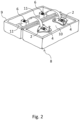
- Fig. 2 schematically illustrates a kit comprising a charger 8 and two hearing devices 4, such as two hearing aids.
- the hearing devices 4 comprise a receiver charging element 2 and the charger 8 comprises two transmitter charging elements 6.
- the hearing devices 4 are custom rechargeable hearing devices designed to be worn by a user.
- the charger 8 comprises a custom insert 10.
- the custom insert 10 is configured to receive the hearing devices 4.
- the charger 8 comprises a lid 9.
- the lid 9 may comprise charging towers 11.
- the transmitter charging elements 6 are comprised in the charging towers 11.
- the receiver charging elements 2 and the transmitter charging elements 6 are aligned. Therefore, when the lid 9 is closed, the hearing devices 4 are efficiently charged, with a charging efficiency as high as 20%, such as 25%, such as 30%, and such as 35% or more.
- the arrows are for indicating that the lid 9 can be moved in the direction of the arrows for closing the charger 8 when the hearing devices 4 should be charged.
- each hearing device 4 has a receiver charging element 2.
- the charger 8 therefore has two transmitter charging elements 6 for charging each of the two receiver charging elements 2, respectively.
- each hearing device 4 has a receiver charging element 2, and when the lid 9 of the charger 8 is closed, the transmitter charging elements 6 are moved to a charging position where each receiver charging element 2 is aligned with a corresponding transmitter charging element 6 in the lid 9. If the charger 8 is configured for receiving only one hearing device 4, then there may be only one transmitter charging element 6 in the charger 8, where the transmitter charging element 6 is configured to be aligned with the receiver charging element 2 of the hearing device 4, when the hearing device 4 is placed in the charger 8.
- Fig. 3 schematically illustrates various embodiments of alignment of a receiver charging element 2 and a transmitter charging element 6.
- Fig. 3a schematically illustrates a charger lid 9 of a charger (not shown) with two charging towers 11, two hearing devices 4 comprising the receiver charging elements 2, and the custom insert 10 of the charger (not shown).
- the custom insert 10 comprises a flat structure 13 extending in a xy plane, the flat structure 13 having a top surface 13a, a bottom surface 13b, and a peripheral rim 13c, where cavities 12 extend away from the bottom surface 13b of the custom insert 10.
- the peripheral rim 13c of the custom insert 10 is configured to cooperate with a rim of the charger (not shown).
- the rim of the charger may be an inside rim defining a cavity within the charger.
- Each charging tower 11 comprise a transmitter charging element 6.
- the charging towers 11, and the transmitter charging elements 6, are stationary, i.e. their position is not adjustable, or their position is not adjusted during the present method or process.
- the alignment may be achieved by controlling the position of the receiver charging element 2 of the hearing device 4 which may be achieved by controlling the position of the cavities 12 in the custom insert 10, as indicated with arrows 12a, e.g. by moving the digital cavities 12 in the custom insert 10 in a x, y and/or z direction relative to the xy plane.
- Positioning of the digital cavities 12 may be performed during the digital modelling phase and may include digitally moving the digital cavities 12 in a x, y and/or z direction relative to the xy plane, etc.
- a result of the digital cavity positioning is that the position of the receiver charging elements 2 with respect to the transmitter charging elements 6 is controlled and changed. Adjusting the position of the receiver charging elements may be performed by adjusting the position of the receiver charging elements in at least one of x or y or z directions by controlling the position of the digital cavities 12 in the custom insert 10, as indicated by the arrows 12a (x-y-z arrows). By controlling the position of the receiver charging elements 2 relative to the transmitter charging elements 6, alignment between the two is achieved and thereby the efficiency of the charging process is increased.
- the digital cavity positioning may be performed by the specialized software program and typically before the custom insert 10 is manufactured.
- Fig. 3b schematically illustrates a charger lid 9 with two charging towers 11, two hearing devices 4 comprising the receiver charging elements 2 and the custom insert 10.
- the lid 9 comprises an inner surface 9a extending in a xy plane.
- the xy plane may be a substantially flat plane or a curved plane.
- the charging towers 11, and/or the transmitter charging elements 6, may be repositioned, as indicated by arrows 6a.
- Adjusting the position of the transmitter charging elements 6 may be performed by reposition of the transmitter charging elements 6 in at least one of x or y or z directions relative to the xy plane and/or by reposition of charging towers 11 in at least one of x or y or z directions relative to the xy plane and/or along the inner surface 9a, as indicated by arrows 6a (x-y-z arrows).
- This adjustment of the charging towers 11 and/or the transmitter charging elements 6 may be performed manually with an external tool, or with an adjustment tool placed in the charger.
- the position of the transmitter charging elements 6 may be digitally adjusted/determined.
- the transmitter charging elements 6 may be manually adjusted to the determined position during the manufacturing process to obtain better charging efficiency.
- the transmitter charging elements 6 may be adjusted completely manually by an operator.
- the transmitter charging elements 6 may be moved in some or all three directions at the same time.
- the transmitter charging elements 6 may be moved by moving/repositioning the charging towers 11 in any direction. This large freedom in positioning of the transmitter charging elements 6 in the charging towers 11 and/or the charging towers 11 in the charger lid 9 allows for further improvements in charging efficiency and power consumption.
- the position of the receiver charging elements 2 of the hearing device 4 may be defined by the position of the cavity 12 in the custom insert 10.
- Fig. 3c illustrates a combination of Figs. 3a and 3b .
- the alignment between the corresponding charging elements 6, 2 is achieved by both repositioning the transmitter charging element 6 and/or by repositioning of the charging towers 11, as indicated by arrows 6a, and by repositioning of the receiver charging elements 2 by repositioning the cavity 12, as indicated by arrows 12a.
- a first repositioning step is made according to the description of Fig. 3a and a following second repositioning step is made according to the description of Fig. 3b .
- Fig. 4 illustrates an exemplary method for creation of a digital cavity 20 in a generic digital 3D insert model 28, i.e. configuring a custom insert, as shown in Fig. 3 , to be made.
- the digital cavity 20 may be created by using a specialized software program.
- a digital scan 22 of the user's ear shape is first obtained 100.
- the digital scan 22 comprises a 3D representation of at least a part of the outer ear, such as at least a part of the ear canal and the concha.
- a digital 3D hearing device model 24 is created 102.
- the digital 3D hearing device model 24 is a geometrical representation of the ear surfaces and further a shell of the hearing device.
- the position of a receiver charging element is added 103 to the digital 3D hearing device model 24 to thereby obtain a complete model 26.
- the receiver charging element is arranged in a faceplate together with other electronic components of the hearing device. The position of the receiver charging element may be determined on the basis of miniaturization rules and geometry of the hearing device shell.
- a generic digital 3D insert model 28 is then provided 104 or obtained.
- the generic digital 3D insert model 28 may comprise a flat 3D structure 29 extending in a xy plane, the flat 3D structure 29 having a top surface 29a, a bottom surface 29b, and a peripheral rim 29c.
- a digital 3D charger model together with the position of a transmitter charging element is also provided or obtained (not shown).
- the peripheral rim 29c of the flat 3D structure 29 may be configured to cooperate with a rim of the digital 3D charger model (not shown).
- the digital 3D hearing device model 24 or 26 which includes the position of the receiver charging element is then placed 105 in the generic digital 3D insert model 28.
- the digital 3D charger model (not shown) including the position of the transmitter charging element (not shown) is also placed 106 in the generic 3D insert model 28 to define the location of the digital cavity in the generic 3D insert model 28.
- the digital cavity 20 is then created 108 in the generic 3D insert model 28.
- the digital cavity 20 is created based on the complete digital 3D hearing device model 26.
- the digital cavity 20 may extend away from the bottom surface 29b of the flat 3D structure 29.
- the digital cavity 20 may be further modified by digitally removing 109 one or more undercuts/negative draft 30 in the digital 3D insert model 28. By digitally removing 109 any undercuts or negative drafts 30, it is ensured that the hearing device can be placed and removed from the cavity.
- the hearing device cannot be placed or removed from the cavity, as material in the insert is blocking the free passage of the hearing device in the cavity.
- the digital cavity 20 with well-defined cavity surfaces is created thereby defining a digital custom insert 32.
- Fig. 5 schematically illustrates an exemplary method for alignment of charging elements of a hearing device and a charger.
- a hearing device is first designed 400.
- a digital scan of the user's ear shape is first obtained 100.
- the digital scan is then imported 101 into a specialized software program and a baseline shell is created 101 based on the digital scan.
- the baseline shell is then further redesigned based on the digital scan to thereby create a digital 3D hearing device model.
- the hearing device design is then complete 401 and the shell of the hearing device may be manufactured 402 based on the hearing device design.
- the position of the receiver charging element is defined by an operator. Namely, the operator has a complete freedom during the hearing device assembly to modify the shell and position a faceplate and thereby the receiver charging element in any position to minimize the device size.
- the digital 3D hearing device model is exported 105 into an insert layout, i.e. into a generic digital 3D insert model.
- the generic digital 3D insert model is transformed 404 to create a digital cavity and the location of the cavity is defined 405.
- the transformation is performed based on the digital 3D hearing device model and the location of the digital cavity may be based on the position of a representation of the transmitter charging element in the digital 3D charger model.
- the custom insert can be installed into the charger, 408.
- the hearing device to be charged may also be inserted into the custom insert.
- the position of the transmitter charging element can be adjusted 409 and the charging function may be confirmed.
- alignment between the receiver charging element and the transmitter charging element is obtained by adjusting the position of the transmitter charging element.
- the hearing device and the charger are then complete 410 and ready for shipment.
- This embodiment allows for maximum miniaturization of the hearing device and the charger.
- Fig. 6 schematically illustrates an exemplary method for alignment of charging elements of a hearing device and a charger.
- the difference between this embodiment and the embodiment illustrated in Fig. 5 is in that the position of the receiver charging element is defined 501 during the device design process 500 and that the digital 3D hearing device model is exported 105 into an insert layout, i.e. into a generic digital 3D insert model with/comprising a representation of the position of the receiver charging element defined in 501.
- a final step in the digital cavity creation is; defining the digital cavity alignment 406 which tunes the position of the representation of the receiver charging element and the representation of the transmitter charging element to thereby align the two charging elements in the hearing device and the charger.
- the custom insert may be manufactured 407.
- step 409 is optional, i.e. the position of the transmitter charging element may be adjusted 409 and the charging function may be confirmed. Alternatively, only the charging function may be confirmed.
- the operator assembling the hearing device has almost no freedom to modify the shell and the faceplate in order to minimize the hearing device.
- the alignment between the transmitter charging element and the receiver charging element may be obtained by digital modelling of the position of the hearing device in the insert and/or by positioning of the transmitter charging element in the charger.
- the present invention may be provided according to any one or any combination of the following items:
- the present invention may additionally be provided according to any one or any combination of the following items:
Landscapes
- Engineering & Computer Science (AREA)
- Physics & Mathematics (AREA)
- Acoustics & Sound (AREA)
- Signal Processing (AREA)
- Computer Networks & Wireless Communication (AREA)
- Health & Medical Sciences (AREA)
- General Health & Medical Sciences (AREA)
- Neurosurgery (AREA)
- Otolaryngology (AREA)
- Power Engineering (AREA)
- Manufacturing & Machinery (AREA)
- Charge And Discharge Circuits For Batteries Or The Like (AREA)
Applications Claiming Priority (2)
| Application Number | Priority Date | Filing Date | Title |
|---|---|---|---|
| US16/700,638 US11202157B2 (en) | 2019-12-02 | 2019-12-02 | Alignment between charging elements of a hearing device and a charger |
| EP20150699.5A EP3833051B1 (de) | 2019-12-02 | 2020-01-08 | Ausrichtung zwischen ladeelementen eines hörgeräts und eines ladegeräts |
Related Parent Applications (2)
| Application Number | Title | Priority Date | Filing Date |
|---|---|---|---|
| EP20150699.5A Division-Into EP3833051B1 (de) | 2019-12-02 | 2020-01-08 | Ausrichtung zwischen ladeelementen eines hörgeräts und eines ladegeräts |
| EP20150699.5A Division EP3833051B1 (de) | 2019-12-02 | 2020-01-08 | Ausrichtung zwischen ladeelementen eines hörgeräts und eines ladegeräts |
Publications (2)
| Publication Number | Publication Date |
|---|---|
| EP4311073A2 true EP4311073A2 (de) | 2024-01-24 |
| EP4311073A3 EP4311073A3 (de) | 2024-06-12 |
Family
ID=69147539
Family Applications (2)
| Application Number | Title | Priority Date | Filing Date |
|---|---|---|---|
| EP20150699.5A Active EP3833051B1 (de) | 2019-12-02 | 2020-01-08 | Ausrichtung zwischen ladeelementen eines hörgeräts und eines ladegeräts |
| EP23215187.8A Pending EP4311073A3 (de) | 2019-12-02 | 2020-01-08 | Ausrichtung zwischen aufladeelementen eines hörgeräts und einem ladegerät |
Family Applications Before (1)
| Application Number | Title | Priority Date | Filing Date |
|---|---|---|---|
| EP20150699.5A Active EP3833051B1 (de) | 2019-12-02 | 2020-01-08 | Ausrichtung zwischen ladeelementen eines hörgeräts und eines ladegeräts |
Country Status (4)
| Country | Link |
|---|---|
| US (1) | US11202157B2 (de) |
| EP (2) | EP3833051B1 (de) |
| JP (1) | JP2021090192A (de) |
| CN (1) | CN112994274A (de) |
Families Citing this family (10)
| Publication number | Priority date | Publication date | Assignee | Title |
|---|---|---|---|---|
| US11792585B2 (en) * | 2019-12-02 | 2023-10-17 | Gn Hearing A/S | Alignment between charging elements of a hearing device and a charger |
| EP4143947A4 (de) * | 2020-04-29 | 2025-02-26 | Cochlear Limited | Induktives ladegehäuse |
| US20220377473A1 (en) * | 2021-05-18 | 2022-11-24 | Oticon A/S | Method for charging at least one hearing device and a hearing aid system |
| EP4102858A1 (de) * | 2021-06-07 | 2022-12-14 | GN Hearing A/S | Drahtlos aufladbares, ohrinternes hörgerät und ladegerät dafür |
| US12046914B2 (en) | 2021-06-07 | 2024-07-23 | Gn Hearing A/S | Wirelessly rechargeable in-ear hearing device and charger for same |
| WO2023194749A1 (en) * | 2022-04-07 | 2023-10-12 | Scanstrut Limited | Wireless power system for portable electrical devices on marine vessels and land vehicles |
| US12279093B2 (en) | 2023-03-21 | 2025-04-15 | Sonova Ag | Hearing device chargers and hearing devices for use with same |
| US12494679B2 (en) | 2023-03-21 | 2025-12-09 | Sonova Ag | Hearing device chargers and hearing devices for use with same |
| US12418188B2 (en) | 2023-03-21 | 2025-09-16 | Sonova Ag | Hearing device chargers |
| WO2025041134A1 (en) * | 2023-08-20 | 2025-02-27 | Shklarsh Yuval | System and method for transferring energy to an implant |
Family Cites Families (11)
| Publication number | Priority date | Publication date | Assignee | Title |
|---|---|---|---|---|
| DE29718104U1 (de) | 1997-10-14 | 1998-01-02 | Audia Akustik Gmbh | Ladevorrichtung für Hörgeräte |
| EP1246506A1 (de) * | 2001-03-26 | 2002-10-02 | Widex A/S | CAD-CAM-System zum Entwurf eines Hörgerätes |
| US8253377B2 (en) * | 2006-03-06 | 2012-08-28 | Gn Resound A/S | Hearing aid battery charger |
| NL1032220C2 (nl) * | 2006-07-21 | 2008-01-22 | Exsilent Res Bv | Hoortoestel, uitbreidingseenheid en werkwijze voor het vervaardigen van een hoortoestel. |
| DE102006052713A1 (de) * | 2006-11-08 | 2008-05-15 | Siemens Audiologische Technik Gmbh | Hörgerät und dazugehöriges Ladegerät |
| SG171798A1 (en) * | 2008-12-11 | 2011-07-28 | Widex As | Hearing aid earpiece and a method of manufacturing a hearing aid earpiece |
| DE102012218663A1 (de) | 2012-10-12 | 2014-04-17 | Audia Akustik Gmbh | Ladeschale und Verfahren zum Laden von Hörgeräten |
| DE102013202930A1 (de) * | 2013-02-22 | 2014-09-11 | Siemens Aktiengesellschaft | Kabelloses Ladesystem für Hörinstrumente |
| US10424955B2 (en) * | 2016-10-28 | 2019-09-24 | Starkey Laboratories, Inc. | Charging system with compressible contacts |
| WO2019037854A1 (en) * | 2017-08-24 | 2019-02-28 | Sonova Ag | CHARGER FOR HEARING DEVICE WITH INSERT / EJECT CONTROL |
| EP3518560B1 (de) * | 2018-01-30 | 2020-11-04 | Sonova AG | Anpassbarer hörgeräteladeanschluss für ein hörgerätladegerät |
-
2019
- 2019-12-02 US US16/700,638 patent/US11202157B2/en active Active
-
2020
- 2020-01-08 EP EP20150699.5A patent/EP3833051B1/de active Active
- 2020-01-08 EP EP23215187.8A patent/EP4311073A3/de active Pending
- 2020-11-16 JP JP2020190433A patent/JP2021090192A/ja active Pending
- 2020-12-02 CN CN202011389386.1A patent/CN112994274A/zh active Pending
Also Published As
| Publication number | Publication date |
|---|---|
| US20210168536A1 (en) | 2021-06-03 |
| EP3833051A1 (de) | 2021-06-09 |
| US11202157B2 (en) | 2021-12-14 |
| EP3833051B1 (de) | 2024-02-21 |
| EP4311073A3 (de) | 2024-06-12 |
| EP3833051C0 (de) | 2024-02-21 |
| CN112994274A (zh) | 2021-06-18 |
| JP2021090192A (ja) | 2021-06-10 |
Similar Documents
| Publication | Publication Date | Title |
|---|---|---|
| EP3833051B1 (de) | Ausrichtung zwischen ladeelementen eines hörgeräts und eines ladegeräts | |
| US12069439B2 (en) | Alignment between charging elements of a hearing device and a charger | |
| CN101795429B (zh) | 具有干扰补偿的助听器设备和设计方法 | |
| DK1768450T3 (da) | Høreapparat med antenne | |
| US20080205678A1 (en) | Hearing apparatus with a special energy acceptance system and corresponding method | |
| JP2009545201A (ja) | 補聴器、拡張ユニット、および補聴器を製造するための方法 | |
| EP4152765A1 (de) | Drahtlos aufladbare hörvorrichtung | |
| EP3682650B1 (de) | Verfahren zum induktiven aufladen eines wiederaufladbaren hörgeräts | |
| US12219326B2 (en) | Hearing instrument charger device and system, and a method of manufacturing a holder therefor | |
| JP2022107515A (ja) | 1つまたは複数の充電式聴覚装置を充電するための充電キット | |
| US20260012044A1 (en) | Wirelessly rechargeable in-ear hearing device and charger for same | |
| CN103109548A (zh) | 有电池充电器的助听器 | |
| CN113286241B (zh) | 包括感应线圈的助听器 | |
| EP4013069B1 (de) | Verfahren zur herstellung eines ladeeinsatzes für eine hörgeräte-ladevorrichtungür | |
| EP4102858A1 (de) | Drahtlos aufladbares, ohrinternes hörgerät und ladegerät dafür | |
| CN112653977B (zh) | 连接到耳壳的助听器电池 | |
| CN114629194A (zh) | 听力设备充电器装置和系统以及制造其保持座的方法 | |
| US20260129376A1 (en) | Wirelessly rechargeable hearing device and charger for same | |
| US8548183B2 (en) | Hearing device with individually aligned electronic component and production method |
Legal Events
| Date | Code | Title | Description |
|---|---|---|---|
| PUAI | Public reference made under article 153(3) epc to a published international application that has entered the european phase |
Free format text: ORIGINAL CODE: 0009012 |
|
| STAA | Information on the status of an ep patent application or granted ep patent |
Free format text: STATUS: THE APPLICATION HAS BEEN PUBLISHED |
|
| AC | Divisional application: reference to earlier application |
Ref document number: 3833051 Country of ref document: EP Kind code of ref document: P |
|
| AK | Designated contracting states |
Kind code of ref document: A2 Designated state(s): AL AT BE BG CH CY CZ DE DK EE ES FI FR GB GR HR HU IE IS IT LI LT LU LV MC MK MT NL NO PL PT RO RS SE SI SK SM TR |
|
| REG | Reference to a national code |
Ref country code: DE Ref legal event code: R079 Free format text: PREVIOUS MAIN CLASS: H02J0007000000 Ipc: H04R0025000000 |
|
| RIC1 | Information provided on ipc code assigned before grant |
Ipc: H02J 7/00 20060101ALI20240214BHEP Ipc: H02J 50/90 20160101ALI20240214BHEP Ipc: H04R 25/00 20060101AFI20240214BHEP |
|
| PUAL | Search report despatched |
Free format text: ORIGINAL CODE: 0009013 |
|
| AK | Designated contracting states |
Kind code of ref document: A3 Designated state(s): AL AT BE BG CH CY CZ DE DK EE ES FI FR GB GR HR HU IE IS IT LI LT LU LV MC MK MT NL NO PL PT RO RS SE SI SK SM TR |
|
| RIC1 | Information provided on ipc code assigned before grant |
Ipc: H02J 7/00 20060101ALI20240508BHEP Ipc: H02J 50/90 20160101ALI20240508BHEP Ipc: H04R 25/00 20060101AFI20240508BHEP |
|
| STAA | Information on the status of an ep patent application or granted ep patent |
Free format text: STATUS: REQUEST FOR EXAMINATION WAS MADE |
|
| 17P | Request for examination filed |
Effective date: 20241205 |
|
| RAP3 | Party data changed (applicant data changed or rights of an application transferred) |
Owner name: GN HEARING A/S |
|
| GRAP | Despatch of communication of intention to grant a patent |
Free format text: ORIGINAL CODE: EPIDOSNIGR1 |
|
| STAA | Information on the status of an ep patent application or granted ep patent |
Free format text: STATUS: GRANT OF PATENT IS INTENDED |
|
| RIC1 | Information provided on ipc code assigned before grant |
Ipc: H04R 25/00 20060101AFI20260203BHEP Ipc: H02J 50/90 20160101ALI20260203BHEP Ipc: H02J 7/00 20060101ALI20260203BHEP Ipc: H02J 7/70 20260101ALI20260203BHEP |
|
| INTG | Intention to grant announced |
Effective date: 20260212 |