EP4310119A1 - Silicone-based composition and cured product thereof - Google Patents
Silicone-based composition and cured product thereof Download PDFInfo
- Publication number
- EP4310119A1 EP4310119A1 EP21890367.2A EP21890367A EP4310119A1 EP 4310119 A1 EP4310119 A1 EP 4310119A1 EP 21890367 A EP21890367 A EP 21890367A EP 4310119 A1 EP4310119 A1 EP 4310119A1
- Authority
- EP
- European Patent Office
- Prior art keywords
- silicone
- group
- based composition
- weight
- polyorganosiloxane
- Prior art date
- Legal status (The legal status is an assumption and is not a legal conclusion. Google has not performed a legal analysis and makes no representation as to the accuracy of the status listed.)
- Pending
Links
- 239000000203 mixture Substances 0.000 title claims abstract description 80
- 229920001296 polysiloxane Polymers 0.000 title claims abstract description 78
- -1 acryl Chemical group 0.000 claims abstract description 55
- 238000013008 moisture curing Methods 0.000 claims abstract description 44
- 239000000178 monomer Substances 0.000 claims abstract description 34
- 239000003054 catalyst Substances 0.000 claims abstract description 30
- NIXOWILDQLNWCW-UHFFFAOYSA-M acrylate group Chemical group C(C=C)(=O)[O-] NIXOWILDQLNWCW-UHFFFAOYSA-M 0.000 claims abstract description 19
- 125000003545 alkoxy group Chemical group 0.000 claims abstract description 19
- 238000001723 curing Methods 0.000 claims description 32
- 239000000126 substance Substances 0.000 claims description 25
- 239000002318 adhesion promoter Substances 0.000 claims description 21
- 150000001875 compounds Chemical class 0.000 claims description 21
- 229910021485 fumed silica Inorganic materials 0.000 claims description 20
- 239000002516 radical scavenger Substances 0.000 claims description 18
- 125000004432 carbon atom Chemical group C* 0.000 claims description 16
- VYPSYNLAJGMNEJ-UHFFFAOYSA-N Silicium dioxide Chemical compound O=[Si]=O VYPSYNLAJGMNEJ-UHFFFAOYSA-N 0.000 claims description 15
- RTAQQCXQSZGOHL-UHFFFAOYSA-N Titanium Chemical compound [Ti] RTAQQCXQSZGOHL-UHFFFAOYSA-N 0.000 claims description 11
- ATJFFYVFTNAWJD-UHFFFAOYSA-N Tin Chemical compound [Sn] ATJFFYVFTNAWJD-UHFFFAOYSA-N 0.000 claims description 8
- 125000000217 alkyl group Chemical group 0.000 claims description 7
- 239000007983 Tris buffer Substances 0.000 claims description 6
- 150000001412 amines Chemical class 0.000 claims description 5
- RTZKZFJDLAIYFH-UHFFFAOYSA-N Diethyl ether Chemical compound CCOCC RTZKZFJDLAIYFH-UHFFFAOYSA-N 0.000 claims description 4
- 125000004103 aminoalkyl group Chemical group 0.000 claims description 4
- 125000003118 aryl group Chemical group 0.000 claims description 4
- ZFSLODLOARCGLH-UHFFFAOYSA-N isocyanuric acid Chemical compound OC1=NC(O)=NC(O)=N1 ZFSLODLOARCGLH-UHFFFAOYSA-N 0.000 claims description 4
- FIHBHSQYSYVZQE-UHFFFAOYSA-N 6-prop-2-enoyloxyhexyl prop-2-enoate Chemical compound C=CC(=O)OCCCCCCOC(=O)C=C FIHBHSQYSYVZQE-UHFFFAOYSA-N 0.000 claims description 3
- 239000000654 additive Substances 0.000 claims description 3
- 125000002947 alkylene group Chemical group 0.000 claims description 3
- PBOSTUDLECTMNL-UHFFFAOYSA-N lauryl acrylate Chemical compound CCCCCCCCCCCCOC(=O)C=C PBOSTUDLECTMNL-UHFFFAOYSA-N 0.000 claims description 3
- 230000000996 additive effect Effects 0.000 claims description 2
- 230000001012 protector Effects 0.000 claims description 2
- 238000002360 preparation method Methods 0.000 description 38
- 230000000052 comparative effect Effects 0.000 description 30
- 238000000034 method Methods 0.000 description 24
- 239000000047 product Substances 0.000 description 18
- 125000000524 functional group Chemical group 0.000 description 17
- 239000000470 constituent Substances 0.000 description 12
- 230000008569 process Effects 0.000 description 11
- 239000000853 adhesive Substances 0.000 description 10
- 230000001070 adhesive effect Effects 0.000 description 10
- 125000001424 substituent group Chemical group 0.000 description 10
- 239000004205 dimethyl polysiloxane Substances 0.000 description 9
- 229920000435 poly(dimethylsiloxane) Polymers 0.000 description 9
- 239000000463 material Substances 0.000 description 7
- 239000011248 coating agent Substances 0.000 description 5
- 238000000576 coating method Methods 0.000 description 5
- 239000011347 resin Substances 0.000 description 5
- 229920005989 resin Polymers 0.000 description 5
- KWOLFJPFCHCOCG-UHFFFAOYSA-N Acetophenone Chemical compound CC(=O)C1=CC=CC=C1 KWOLFJPFCHCOCG-UHFFFAOYSA-N 0.000 description 4
- IJGRMHOSHXDMSA-UHFFFAOYSA-N Atomic nitrogen Chemical compound N#N IJGRMHOSHXDMSA-UHFFFAOYSA-N 0.000 description 4
- 229920001971 elastomer Polymers 0.000 description 4
- CERQOIWHTDAKMF-UHFFFAOYSA-M methacrylate group Chemical group C(C(=C)C)(=O)[O-] CERQOIWHTDAKMF-UHFFFAOYSA-M 0.000 description 4
- BDAGIHXWWSANSR-UHFFFAOYSA-N methanoic acid Natural products OC=O BDAGIHXWWSANSR-UHFFFAOYSA-N 0.000 description 4
- 229920002379 silicone rubber Polymers 0.000 description 4
- 239000004945 silicone rubber Substances 0.000 description 4
- 125000000391 vinyl group Chemical group [H]C([*])=C([H])[H] 0.000 description 4
- XMLYCEVDHLAQEL-UHFFFAOYSA-N 2-hydroxy-2-methyl-1-phenylpropan-1-one Chemical compound CC(C)(O)C(=O)C1=CC=CC=C1 XMLYCEVDHLAQEL-UHFFFAOYSA-N 0.000 description 3
- SJECZPVISLOESU-UHFFFAOYSA-N 3-trimethoxysilylpropan-1-amine Chemical group CO[Si](OC)(OC)CCCN SJECZPVISLOESU-UHFFFAOYSA-N 0.000 description 3
- RMKZLFMHXZAGTM-UHFFFAOYSA-N [dimethoxy(propyl)silyl]oxymethyl prop-2-enoate Chemical compound CCC[Si](OC)(OC)OCOC(=O)C=C RMKZLFMHXZAGTM-UHFFFAOYSA-N 0.000 description 3
- 230000007246 mechanism Effects 0.000 description 3
- 238000002156 mixing Methods 0.000 description 3
- 229920000642 polymer Polymers 0.000 description 3
- QWOVEJBDMKHZQK-UHFFFAOYSA-N 1,3,5-tris(3-trimethoxysilylpropyl)-1,3,5-triazinane-2,4,6-trione Chemical compound CO[Si](OC)(OC)CCCN1C(=O)N(CCC[Si](OC)(OC)OC)C(=O)N(CCC[Si](OC)(OC)OC)C1=O QWOVEJBDMKHZQK-UHFFFAOYSA-N 0.000 description 2
- KWVGIHKZDCUPEU-UHFFFAOYSA-N 2,2-dimethoxy-2-phenylacetophenone Chemical compound C=1C=CC=CC=1C(OC)(OC)C(=O)C1=CC=CC=C1 KWVGIHKZDCUPEU-UHFFFAOYSA-N 0.000 description 2
- NJBCRXCAPCODGX-UHFFFAOYSA-N 2-methyl-n-(2-methylpropyl)propan-1-amine Chemical compound CC(C)CNCC(C)C NJBCRXCAPCODGX-UHFFFAOYSA-N 0.000 description 2
- 125000005916 2-methylpentyl group Chemical group 0.000 description 2
- IZXRSZNHUSJWIQ-UHFFFAOYSA-N 2-methylpropan-2-ol;titanium Chemical compound [Ti].CC(C)(C)O.CC(C)(C)O.CC(C)(C)O.CC(C)(C)O IZXRSZNHUSJWIQ-UHFFFAOYSA-N 0.000 description 2
- XDLMVUHYZWKMMD-UHFFFAOYSA-N 3-trimethoxysilylpropyl 2-methylprop-2-enoate Chemical compound CO[Si](OC)(OC)CCCOC(=O)C(C)=C XDLMVUHYZWKMMD-UHFFFAOYSA-N 0.000 description 2
- OSWFIVFLDKOXQC-UHFFFAOYSA-N 4-(3-methoxyphenyl)aniline Chemical compound COC1=CC=CC(C=2C=CC(N)=CC=2)=C1 OSWFIVFLDKOXQC-UHFFFAOYSA-N 0.000 description 2
- NLZUEZXRPGMBCV-UHFFFAOYSA-N Butylhydroxytoluene Chemical compound CC1=CC(C(C)(C)C)=C(O)C(C(C)(C)C)=C1 NLZUEZXRPGMBCV-UHFFFAOYSA-N 0.000 description 2
- ZMDDERVSCYEKPQ-UHFFFAOYSA-N Ethyl (mesitylcarbonyl)phenylphosphinate Chemical compound C=1C=CC=CC=1P(=O)(OCC)C(=O)C1=C(C)C=C(C)C=C1C ZMDDERVSCYEKPQ-UHFFFAOYSA-N 0.000 description 2
- GUCYFKSBFREPBC-UHFFFAOYSA-N [phenyl-(2,4,6-trimethylbenzoyl)phosphoryl]-(2,4,6-trimethylphenyl)methanone Chemical compound CC1=CC(C)=CC(C)=C1C(=O)P(=O)(C=1C=CC=CC=1)C(=O)C1=C(C)C=C(C)C=C1C GUCYFKSBFREPBC-UHFFFAOYSA-N 0.000 description 2
- 239000002253 acid Substances 0.000 description 2
- ISAOCJYIOMOJEB-UHFFFAOYSA-N benzoin Chemical compound C=1C=CC=CC=1C(O)C(=O)C1=CC=CC=C1 ISAOCJYIOMOJEB-UHFFFAOYSA-N 0.000 description 2
- MQDJYUACMFCOFT-UHFFFAOYSA-N bis[2-(1-hydroxycyclohexyl)phenyl]methanone Chemical compound C=1C=CC=C(C(=O)C=2C(=CC=CC=2)C2(O)CCCCC2)C=1C1(O)CCCCC1 MQDJYUACMFCOFT-UHFFFAOYSA-N 0.000 description 2
- 239000006227 byproduct Substances 0.000 description 2
- 238000005520 cutting process Methods 0.000 description 2
- 125000004122 cyclic group Chemical group 0.000 description 2
- 230000007423 decrease Effects 0.000 description 2
- 239000003085 diluting agent Substances 0.000 description 2
- 238000007599 discharging Methods 0.000 description 2
- 230000009977 dual effect Effects 0.000 description 2
- 230000000694 effects Effects 0.000 description 2
- NKSJNEHGWDZZQF-UHFFFAOYSA-N ethenyl(trimethoxy)silane Chemical compound CO[Si](OC)(OC)C=C NKSJNEHGWDZZQF-UHFFFAOYSA-N 0.000 description 2
- 125000001301 ethoxy group Chemical group [H]C([H])([H])C([H])([H])O* 0.000 description 2
- 238000011156 evaluation Methods 0.000 description 2
- 235000019253 formic acid Nutrition 0.000 description 2
- FFUAGWLWBBFQJT-UHFFFAOYSA-N hexamethyldisilazane Chemical compound C[Si](C)(C)N[Si](C)(C)C FFUAGWLWBBFQJT-UHFFFAOYSA-N 0.000 description 2
- 230000002209 hydrophobic effect Effects 0.000 description 2
- 230000001678 irradiating effect Effects 0.000 description 2
- 238000000691 measurement method Methods 0.000 description 2
- 125000000956 methoxy group Chemical group [H]C([H])([H])O* 0.000 description 2
- BFXIKLCIZHOAAZ-UHFFFAOYSA-N methyltrimethoxysilane Chemical compound CO[Si](C)(OC)OC BFXIKLCIZHOAAZ-UHFFFAOYSA-N 0.000 description 2
- 229910052757 nitrogen Inorganic materials 0.000 description 2
- 150000001451 organic peroxides Chemical class 0.000 description 2
- 125000001997 phenyl group Chemical group [H]C1=C([H])C([H])=C(*)C([H])=C1[H] 0.000 description 2
- 238000000016 photochemical curing Methods 0.000 description 2
- 238000006467 substitution reaction Methods 0.000 description 2
- 125000001973 tert-pentyl group Chemical group [H]C([H])([H])C([H])([H])C(*)(C([H])([H])[H])C([H])([H])[H] 0.000 description 2
- 229910052719 titanium Inorganic materials 0.000 description 2
- 239000010936 titanium Substances 0.000 description 2
- VXUYXOFXAQZZMF-UHFFFAOYSA-N titanium(IV) isopropoxide Chemical compound CC(C)O[Ti](OC(C)C)(OC(C)C)OC(C)C VXUYXOFXAQZZMF-UHFFFAOYSA-N 0.000 description 2
- 238000009281 ultraviolet germicidal irradiation Methods 0.000 description 2
- JNELGWHKGNBSMD-UHFFFAOYSA-N xanthone Chemical compound C1=CC=C2C(=O)C3=CC=CC=C3OC2=C1 JNELGWHKGNBSMD-UHFFFAOYSA-N 0.000 description 2
- WYTZZXDRDKSJID-UHFFFAOYSA-N (3-aminopropyl)triethoxysilane Chemical compound CCO[Si](OCC)(OCC)CCCN WYTZZXDRDKSJID-UHFFFAOYSA-N 0.000 description 1
- RYSXWUYLAWPLES-MTOQALJVSA-N (Z)-4-hydroxypent-3-en-2-one titanium Chemical compound [Ti].C\C(O)=C\C(C)=O.C\C(O)=C\C(C)=O.C\C(O)=C\C(C)=O.C\C(O)=C\C(C)=O RYSXWUYLAWPLES-MTOQALJVSA-N 0.000 description 1
- UVDDHYAAWVNATK-VGKOASNMSA-L (z)-4-[dibutyl-[(z)-4-oxopent-2-en-2-yl]oxystannyl]oxypent-3-en-2-one Chemical compound CC(=O)\C=C(C)/O[Sn](CCCC)(CCCC)O\C(C)=C/C(C)=O UVDDHYAAWVNATK-VGKOASNMSA-L 0.000 description 1
- TYKCBTYOMAUNLH-MTOQALJVSA-J (z)-4-oxopent-2-en-2-olate;titanium(4+) Chemical compound [Ti+4].C\C([O-])=C\C(C)=O.C\C([O-])=C\C(C)=O.C\C([O-])=C\C(C)=O.C\C([O-])=C\C(C)=O TYKCBTYOMAUNLH-MTOQALJVSA-J 0.000 description 1
- YJTKZCDBKVTVBY-UHFFFAOYSA-N 1,3-Diphenylbenzene Chemical group C1=CC=CC=C1C1=CC=CC(C=2C=CC=CC=2)=C1 YJTKZCDBKVTVBY-UHFFFAOYSA-N 0.000 description 1
- URXZKGGRKRRVDC-UHFFFAOYSA-N 1-[dimethoxy(propyl)silyl]oxyethanamine Chemical compound CCC[Si](OC)(OC)OC(C)N URXZKGGRKRRVDC-UHFFFAOYSA-N 0.000 description 1
- 125000006218 1-ethylbutyl group Chemical group [H]C([H])([H])C([H])([H])C([H])([H])C([H])(*)C([H])([H])C([H])([H])[H] 0.000 description 1
- 239000012956 1-hydroxycyclohexylphenyl-ketone Substances 0.000 description 1
- XDOFQFKRPWOURC-UHFFFAOYSA-N 16-methylheptadecanoic acid Chemical compound CC(C)CCCCCCCCCCCCCCC(O)=O XDOFQFKRPWOURC-UHFFFAOYSA-N 0.000 description 1
- KIJDMKUPUUYDLN-UHFFFAOYSA-N 2,2-dimethyl-4-trimethoxysilylbutan-1-amine Chemical compound CO[Si](OC)(OC)CCC(C)(C)CN KIJDMKUPUUYDLN-UHFFFAOYSA-N 0.000 description 1
- PUBNJSZGANKUGX-UHFFFAOYSA-N 2-(dimethylamino)-2-[(4-methylphenyl)methyl]-1-(4-morpholin-4-ylphenyl)butan-1-one Chemical compound C=1C=C(N2CCOCC2)C=CC=1C(=O)C(CC)(N(C)C)CC1=CC=C(C)C=C1 PUBNJSZGANKUGX-UHFFFAOYSA-N 0.000 description 1
- GJKGAPPUXSSCFI-UHFFFAOYSA-N 2-Hydroxy-4'-(2-hydroxyethoxy)-2-methylpropiophenone Chemical compound CC(C)(O)C(=O)C1=CC=C(OCCO)C=C1 GJKGAPPUXSSCFI-UHFFFAOYSA-N 0.000 description 1
- IHEDBVUTTQXGSJ-UHFFFAOYSA-M 2-[bis(2-oxidoethyl)amino]ethanolate;titanium(4+);hydroxide Chemical compound [OH-].[Ti+4].[O-]CCN(CC[O-])CC[O-] IHEDBVUTTQXGSJ-UHFFFAOYSA-M 0.000 description 1
- 125000006176 2-ethylbutyl group Chemical group [H]C([H])([H])C([H])([H])C([H])(C([H])([H])*)C([H])([H])C([H])([H])[H] 0.000 description 1
- KTXWGMUMDPYXNN-UHFFFAOYSA-N 2-ethylhexan-1-olate;titanium(4+) Chemical compound [Ti+4].CCCCC(CC)C[O-].CCCCC(CC)C[O-].CCCCC(CC)C[O-].CCCCC(CC)C[O-] KTXWGMUMDPYXNN-UHFFFAOYSA-N 0.000 description 1
- NLGDWWCZQDIASO-UHFFFAOYSA-N 2-hydroxy-1-(7-oxabicyclo[4.1.0]hepta-1,3,5-trien-2-yl)-2-phenylethanone Chemical compound OC(C(=O)c1cccc2Oc12)c1ccccc1 NLGDWWCZQDIASO-UHFFFAOYSA-N 0.000 description 1
- PCKZAVNWRLEHIP-UHFFFAOYSA-N 2-hydroxy-1-[4-[[4-(2-hydroxy-2-methylpropanoyl)phenyl]methyl]phenyl]-2-methylpropan-1-one Chemical compound C1=CC(C(=O)C(C)(O)C)=CC=C1CC1=CC=C(C(=O)C(C)(C)O)C=C1 PCKZAVNWRLEHIP-UHFFFAOYSA-N 0.000 description 1
- 239000012957 2-hydroxy-2-methyl-1-phenylpropanone Substances 0.000 description 1
- AIFLGMNWQFPTAJ-UHFFFAOYSA-J 2-hydroxypropanoate;titanium(4+) Chemical compound [Ti+4].CC(O)C([O-])=O.CC(O)C([O-])=O.CC(O)C([O-])=O.CC(O)C([O-])=O AIFLGMNWQFPTAJ-UHFFFAOYSA-J 0.000 description 1
- LWRBVKNFOYUCNP-UHFFFAOYSA-N 2-methyl-1-(4-methylsulfanylphenyl)-2-morpholin-4-ylpropan-1-one Chemical compound C1=CC(SC)=CC=C1C(=O)C(C)(C)N1CCOCC1 LWRBVKNFOYUCNP-UHFFFAOYSA-N 0.000 description 1
- GRWPYGBKJYICOO-UHFFFAOYSA-N 2-methylpropan-2-olate;titanium(4+) Chemical compound [Ti+4].CC(C)(C)[O-].CC(C)(C)[O-].CC(C)(C)[O-].CC(C)(C)[O-] GRWPYGBKJYICOO-UHFFFAOYSA-N 0.000 description 1
- MWDGNKGKLOBESZ-UHFFFAOYSA-N 2-oxooctanal Chemical compound CCCCCCC(=O)C=O MWDGNKGKLOBESZ-UHFFFAOYSA-N 0.000 description 1
- 125000006607 3,3-dimethylbutyloxy group Chemical group 0.000 description 1
- HXLAEGYMDGUSBD-UHFFFAOYSA-N 3-[diethoxy(methyl)silyl]propan-1-amine Chemical compound CCO[Si](C)(OCC)CCCN HXLAEGYMDGUSBD-UHFFFAOYSA-N 0.000 description 1
- ZYAASQNKCWTPKI-UHFFFAOYSA-N 3-[dimethoxy(methyl)silyl]propan-1-amine Chemical compound CO[Si](C)(OC)CCCN ZYAASQNKCWTPKI-UHFFFAOYSA-N 0.000 description 1
- FMGBDYLOANULLW-UHFFFAOYSA-N 3-isocyanatopropyl(trimethoxy)silane Chemical compound CO[Si](OC)(OC)CCCN=C=O FMGBDYLOANULLW-UHFFFAOYSA-N 0.000 description 1
- NNTRMVRTACZZIO-UHFFFAOYSA-N 3-isocyanatopropyl-dimethoxy-methylsilane Chemical compound CO[Si](C)(OC)CCCN=C=O NNTRMVRTACZZIO-UHFFFAOYSA-N 0.000 description 1
- TZZGHGKTHXIOMN-UHFFFAOYSA-N 3-trimethoxysilyl-n-(3-trimethoxysilylpropyl)propan-1-amine Chemical compound CO[Si](OC)(OC)CCCNCCC[Si](OC)(OC)OC TZZGHGKTHXIOMN-UHFFFAOYSA-N 0.000 description 1
- KVUMYOWDFZAGPN-UHFFFAOYSA-N 3-trimethoxysilylpropanenitrile Chemical compound CO[Si](OC)(OC)CCC#N KVUMYOWDFZAGPN-UHFFFAOYSA-N 0.000 description 1
- KBQVDAIIQCXKPI-UHFFFAOYSA-N 3-trimethoxysilylpropyl prop-2-enoate Chemical compound CO[Si](OC)(OC)CCCOC(=O)C=C KBQVDAIIQCXKPI-UHFFFAOYSA-N 0.000 description 1
- 125000004920 4-methyl-2-pentyl group Chemical group CC(CC(C)*)C 0.000 description 1
- IKHGUXGNUITLKF-UHFFFAOYSA-N Acetaldehyde Chemical compound CC=O IKHGUXGNUITLKF-UHFFFAOYSA-N 0.000 description 1
- 239000004342 Benzoyl peroxide Substances 0.000 description 1
- OMPJBNCRMGITSC-UHFFFAOYSA-N Benzoylperoxide Chemical compound C=1C=CC=CC=1C(=O)OOC(=O)C1=CC=CC=C1 OMPJBNCRMGITSC-UHFFFAOYSA-N 0.000 description 1
- RDPVEYHOWXOISG-UHFFFAOYSA-N NCCNC(C)[O-].[Ti+4].NCCNC(C)[O-].NCCNC(C)[O-].NCCNC(C)[O-] Chemical compound NCCNC(C)[O-].[Ti+4].NCCNC(C)[O-].NCCNC(C)[O-].NCCNC(C)[O-] RDPVEYHOWXOISG-UHFFFAOYSA-N 0.000 description 1
- DRNPGEPMHMPIQU-UHFFFAOYSA-N O.[Ti].[Ti].CCCCO.CCCCO.CCCCO.CCCCO.CCCCO.CCCCO Chemical compound O.[Ti].[Ti].CCCCO.CCCCO.CCCCO.CCCCO.CCCCO.CCCCO DRNPGEPMHMPIQU-UHFFFAOYSA-N 0.000 description 1
- WYWZRNAHINYAEF-UHFFFAOYSA-N Padimate O Chemical compound CCCCC(CC)COC(=O)C1=CC=C(N(C)C)C=C1 WYWZRNAHINYAEF-UHFFFAOYSA-N 0.000 description 1
- BLRPTPMANUNPDV-UHFFFAOYSA-N Silane Chemical compound [SiH4] BLRPTPMANUNPDV-UHFFFAOYSA-N 0.000 description 1
- 244000028419 Styrax benzoin Species 0.000 description 1
- 235000000126 Styrax benzoin Nutrition 0.000 description 1
- 235000008411 Sumatra benzointree Nutrition 0.000 description 1
- 238000003848 UV Light-Curing Methods 0.000 description 1
- LFOXEOLGJPJZAA-UHFFFAOYSA-N [(2,6-dimethoxybenzoyl)-(2,4,4-trimethylpentyl)phosphoryl]-(2,6-dimethoxyphenyl)methanone Chemical compound COC1=CC=CC(OC)=C1C(=O)P(=O)(CC(C)CC(C)(C)C)C(=O)C1=C(OC)C=CC=C1OC LFOXEOLGJPJZAA-UHFFFAOYSA-N 0.000 description 1
- ISKQADXMHQSTHK-UHFFFAOYSA-N [4-(aminomethyl)phenyl]methanamine Chemical compound NCC1=CC=C(CN)C=C1 ISKQADXMHQSTHK-UHFFFAOYSA-N 0.000 description 1
- FGPCETMNRYMFJR-UHFFFAOYSA-L [7,7-dimethyloctanoyloxy(dimethyl)stannyl] 7,7-dimethyloctanoate Chemical compound CC(C)(C)CCCCCC(=O)O[Sn](C)(C)OC(=O)CCCCCC(C)(C)C FGPCETMNRYMFJR-UHFFFAOYSA-L 0.000 description 1
- UKLDJPRMSDWDSL-UHFFFAOYSA-L [dibutyl(dodecanoyloxy)stannyl] dodecanoate Chemical compound CCCCCCCCCCCC(=O)O[Sn](CCCC)(CCCC)OC(=O)CCCCCCCCCCC UKLDJPRMSDWDSL-UHFFFAOYSA-L 0.000 description 1
- 125000002178 anthracenyl group Chemical group C1(=CC=CC2=CC3=CC=CC=C3C=C12)* 0.000 description 1
- 150000004945 aromatic hydrocarbons Chemical class 0.000 description 1
- XRASGLNHKOPXQL-UHFFFAOYSA-L azane 2-oxidopropanoate titanium(4+) dihydrate Chemical compound N.N.O.O.[Ti+4].CC([O-])C([O-])=O.CC([O-])C([O-])=O XRASGLNHKOPXQL-UHFFFAOYSA-L 0.000 description 1
- 229960002130 benzoin Drugs 0.000 description 1
- RWCCWEUUXYIKHB-UHFFFAOYSA-N benzophenone Chemical compound C=1C=CC=CC=1C(=O)C1=CC=CC=C1 RWCCWEUUXYIKHB-UHFFFAOYSA-N 0.000 description 1
- 239000012965 benzophenone Substances 0.000 description 1
- 125000003236 benzoyl group Chemical group [H]C1=C([H])C([H])=C(C([H])=C1[H])C(*)=O 0.000 description 1
- 235000019400 benzoyl peroxide Nutrition 0.000 description 1
- 125000000051 benzyloxy group Chemical group [H]C1=C([H])C([H])=C(C([H])=C1[H])C([H])([H])O* 0.000 description 1
- 125000006267 biphenyl group Chemical group 0.000 description 1
- FPCJKVGGYOAWIZ-UHFFFAOYSA-N butan-1-ol;titanium Chemical compound [Ti].CCCCO.CCCCO.CCCCO.CCCCO FPCJKVGGYOAWIZ-UHFFFAOYSA-N 0.000 description 1
- 125000000484 butyl group Chemical group [H]C([*])([H])C([H])([H])C([H])([H])C([H])([H])[H] 0.000 description 1
- 229910052799 carbon Inorganic materials 0.000 description 1
- 238000006243 chemical reaction Methods 0.000 description 1
- 125000002676 chrysenyl group Chemical group C1(=CC=CC=2C3=CC=C4C=CC=CC4=C3C=CC12)* 0.000 description 1
- 238000013005 condensation curing Methods 0.000 description 1
- 125000000753 cycloalkyl group Chemical group 0.000 description 1
- 125000000113 cyclohexyl group Chemical group [H]C1([H])C([H])([H])C([H])([H])C([H])(*)C([H])([H])C1([H])[H] 0.000 description 1
- 125000004210 cyclohexylmethyl group Chemical group [H]C([H])(*)C1([H])C([H])([H])C([H])([H])C([H])([H])C([H])([H])C1([H])[H] 0.000 description 1
- 125000001511 cyclopentyl group Chemical group [H]C1([H])C([H])([H])C([H])([H])C([H])(*)C1([H])[H] 0.000 description 1
- 125000004851 cyclopentylmethyl group Chemical group C1(CCCC1)C* 0.000 description 1
- JGFBRKRYDCGYKD-UHFFFAOYSA-N dibutyl(oxo)tin Chemical compound CCCC[Sn](=O)CCCC JGFBRKRYDCGYKD-UHFFFAOYSA-N 0.000 description 1
- AYOHIQLKSOJJQH-UHFFFAOYSA-N dibutyltin Chemical compound CCCC[Sn]CCCC AYOHIQLKSOJJQH-UHFFFAOYSA-N 0.000 description 1
- 239000012975 dibutyltin dilaurate Substances 0.000 description 1
- ZXDVQYBUEVYUCG-UHFFFAOYSA-N dibutyltin(2+);methanolate Chemical compound CCCC[Sn](OC)(OC)CCCC ZXDVQYBUEVYUCG-UHFFFAOYSA-N 0.000 description 1
- ASGKDLGXPOIMTM-UHFFFAOYSA-N diethoxy-methyl-[2-(7-oxabicyclo[4.1.0]heptan-4-yl)ethyl]silane Chemical compound C1C(CC[Si](C)(OCC)OCC)CCC2OC21 ASGKDLGXPOIMTM-UHFFFAOYSA-N 0.000 description 1
- OTARVPUIYXHRRB-UHFFFAOYSA-N diethoxy-methyl-[3-(oxiran-2-ylmethoxy)propyl]silane Chemical compound CCO[Si](C)(OCC)CCCOCC1CO1 OTARVPUIYXHRRB-UHFFFAOYSA-N 0.000 description 1
- SLQTWNAJXFHMHM-UHFFFAOYSA-N dimethoxy-methyl-[2-(7-oxabicyclo[4.1.0]heptan-4-yl)ethyl]silane Chemical compound C1C(CC[Si](C)(OC)OC)CCC2OC21 SLQTWNAJXFHMHM-UHFFFAOYSA-N 0.000 description 1
- VFHVQBAGLAREND-UHFFFAOYSA-N diphenylphosphoryl-(2,4,6-trimethylphenyl)methanone Chemical compound CC1=CC(C)=CC(C)=C1C(=O)P(=O)(C=1C=CC=CC=1)C1=CC=CC=C1 VFHVQBAGLAREND-UHFFFAOYSA-N 0.000 description 1
- KPUWHANPEXNPJT-UHFFFAOYSA-N disiloxane Chemical class [SiH3]O[SiH3] KPUWHANPEXNPJT-UHFFFAOYSA-N 0.000 description 1
- BCTOVGWZAFCYBA-UHFFFAOYSA-N dodecyl benzenesulfonate titanium Chemical compound [Ti].C1(=CC=CC=C1)S(=O)(=O)OCCCCCCCCCCCC BCTOVGWZAFCYBA-UHFFFAOYSA-N 0.000 description 1
- 125000003700 epoxy group Chemical group 0.000 description 1
- XYIBRDXRRQCHLP-UHFFFAOYSA-N ethyl acetoacetate Chemical compound CCOC(=O)CC(C)=O XYIBRDXRRQCHLP-UHFFFAOYSA-N 0.000 description 1
- 125000001495 ethyl group Chemical group [H]C([H])([H])C([H])([H])* 0.000 description 1
- 230000005284 excitation Effects 0.000 description 1
- 238000002474 experimental method Methods 0.000 description 1
- 230000002349 favourable effect Effects 0.000 description 1
- 125000003983 fluorenyl group Chemical group C1(=CC=CC=2C3=CC=CC=C3CC12)* 0.000 description 1
- 239000011521 glass Substances 0.000 description 1
- 235000019382 gum benzoic Nutrition 0.000 description 1
- 150000008282 halocarbons Chemical class 0.000 description 1
- 125000005843 halogen group Chemical group 0.000 description 1
- 238000010438 heat treatment Methods 0.000 description 1
- 125000003187 heptyl group Chemical group [H]C([*])([H])C([H])([H])C([H])([H])C([H])([H])C([H])([H])C([H])([H])C([H])([H])[H] 0.000 description 1
- 125000000623 heterocyclic group Chemical group 0.000 description 1
- 125000004051 hexyl group Chemical group [H]C([H])([H])C([H])([H])C([H])([H])C([H])([H])C([H])([H])C([H])([H])* 0.000 description 1
- 125000004435 hydrogen atom Chemical group [H]* 0.000 description 1
- 125000002887 hydroxy group Chemical group [H]O* 0.000 description 1
- 230000006872 improvement Effects 0.000 description 1
- 229910052909 inorganic silicate Inorganic materials 0.000 description 1
- 125000002510 isobutoxy group Chemical group [H]C([H])([H])C([H])(C([H])([H])[H])C([H])([H])O* 0.000 description 1
- 125000000959 isobutyl group Chemical group [H]C([H])([H])C([H])(C([H])([H])[H])C([H])([H])* 0.000 description 1
- 125000004491 isohexyl group Chemical group C(CCC(C)C)* 0.000 description 1
- 125000005921 isopentoxy group Chemical group 0.000 description 1
- 125000001972 isopentyl group Chemical group [H]C([H])([H])C([H])(C([H])([H])[H])C([H])([H])C([H])([H])* 0.000 description 1
- 125000003253 isopropoxy group Chemical group [H]C([H])([H])C([H])(O*)C([H])([H])[H] 0.000 description 1
- 125000001449 isopropyl group Chemical group [H]C([H])([H])C([H])(*)C([H])([H])[H] 0.000 description 1
- 238000005259 measurement Methods 0.000 description 1
- 125000002496 methyl group Chemical group [H]C([H])([H])* 0.000 description 1
- 125000002950 monocyclic group Chemical group 0.000 description 1
- PHQOGHDTIVQXHL-UHFFFAOYSA-N n'-(3-trimethoxysilylpropyl)ethane-1,2-diamine Chemical compound CO[Si](OC)(OC)CCCNCCN PHQOGHDTIVQXHL-UHFFFAOYSA-N 0.000 description 1
- KBJFYLLAMSZSOG-UHFFFAOYSA-N n-(3-trimethoxysilylpropyl)aniline Chemical compound CO[Si](OC)(OC)CCCNC1=CC=CC=C1 KBJFYLLAMSZSOG-UHFFFAOYSA-N 0.000 description 1
- 125000006606 n-butoxy group Chemical group 0.000 description 1
- 125000004108 n-butyl group Chemical group [H]C([H])([H])C([H])([H])C([H])([H])C([H])([H])* 0.000 description 1
- 125000006610 n-decyloxy group Chemical group 0.000 description 1
- FRDNYWXDODPUJV-UHFFFAOYSA-N n-ethyl-2-methyl-3-trimethoxysilylpropan-1-amine Chemical compound CCNCC(C)C[Si](OC)(OC)OC FRDNYWXDODPUJV-UHFFFAOYSA-N 0.000 description 1
- 125000003136 n-heptyl group Chemical group [H]C([H])([H])C([H])([H])C([H])([H])C([H])([H])C([H])([H])C([H])([H])C([H])([H])* 0.000 description 1
- 125000001298 n-hexoxy group Chemical group [H]C([H])([H])C([H])([H])C([H])([H])C([H])([H])C([H])([H])C([H])([H])O* 0.000 description 1
- 125000001280 n-hexyl group Chemical group C(CCCCC)* 0.000 description 1
- 125000006609 n-nonyloxy group Chemical group 0.000 description 1
- 125000006608 n-octyloxy group Chemical group 0.000 description 1
- 125000003935 n-pentoxy group Chemical group [H]C([H])([H])C([H])([H])C([H])([H])C([H])([H])C([H])([H])O* 0.000 description 1
- 125000000740 n-pentyl group Chemical group [H]C([H])([H])C([H])([H])C([H])([H])C([H])([H])C([H])([H])* 0.000 description 1
- 125000003506 n-propoxy group Chemical group [H]C([H])([H])C([H])([H])C([H])([H])O* 0.000 description 1
- 125000004123 n-propyl group Chemical group [H]C([H])([H])C([H])([H])C([H])([H])* 0.000 description 1
- 125000001624 naphthyl group Chemical group 0.000 description 1
- 125000005484 neopentoxy group Chemical group 0.000 description 1
- 125000001971 neopentyl group Chemical group [H]C([*])([H])C(C([H])([H])[H])(C([H])([H])[H])C([H])([H])[H] 0.000 description 1
- 125000002560 nitrile group Chemical group 0.000 description 1
- KQJBQMSCFSJABN-UHFFFAOYSA-N octadecan-1-olate;titanium(4+) Chemical compound [Ti+4].CCCCCCCCCCCCCCCCCC[O-].CCCCCCCCCCCCCCCCCC[O-].CCCCCCCCCCCCCCCCCC[O-].CCCCCCCCCCCCCCCCCC[O-] KQJBQMSCFSJABN-UHFFFAOYSA-N 0.000 description 1
- 125000002347 octyl group Chemical group [H]C([*])([H])C([H])([H])C([H])([H])C([H])([H])C([H])([H])C([H])([H])C([H])([H])C([H])([H])[H] 0.000 description 1
- FZUGPQWGEGAKET-UHFFFAOYSA-N parbenate Chemical compound CCOC(=O)C1=CC=C(N(C)C)C=C1 FZUGPQWGEGAKET-UHFFFAOYSA-N 0.000 description 1
- 125000003538 pentan-3-yl group Chemical group [H]C([H])([H])C([H])([H])C([H])(*)C([H])([H])C([H])([H])[H] 0.000 description 1
- 125000001147 pentyl group Chemical group C(CCCC)* 0.000 description 1
- 239000013500 performance material Substances 0.000 description 1
- 125000002080 perylenyl group Chemical group C1(=CC=C2C=CC=C3C4=CC=CC5=CC=CC(C1=C23)=C45)* 0.000 description 1
- 125000005561 phenanthryl group Chemical group 0.000 description 1
- 125000003367 polycyclic group Chemical group 0.000 description 1
- 238000011165 process development Methods 0.000 description 1
- 238000011112 process operation Methods 0.000 description 1
- KRIOVPPHQSLHCZ-UHFFFAOYSA-N propiophenone Chemical compound CCC(=O)C1=CC=CC=C1 KRIOVPPHQSLHCZ-UHFFFAOYSA-N 0.000 description 1
- 125000001436 propyl group Chemical group [H]C([*])([H])C([H])([H])C([H])([H])[H] 0.000 description 1
- 125000001725 pyrenyl group Chemical group 0.000 description 1
- 150000004053 quinones Chemical class 0.000 description 1
- 230000009257 reactivity Effects 0.000 description 1
- 238000000518 rheometry Methods 0.000 description 1
- 125000005920 sec-butoxy group Chemical group 0.000 description 1
- 125000003548 sec-pentyl group Chemical group [H]C([H])([H])C([H])([H])C([H])([H])C([H])(*)C([H])([H])[H] 0.000 description 1
- 229910000077 silane Inorganic materials 0.000 description 1
- 239000000377 silicon dioxide Substances 0.000 description 1
- 239000007787 solid Substances 0.000 description 1
- 239000000243 solution Substances 0.000 description 1
- 125000006850 spacer group Chemical group 0.000 description 1
- 230000007480 spreading Effects 0.000 description 1
- 238000003892 spreading Methods 0.000 description 1
- 239000000758 substrate Substances 0.000 description 1
- 125000004213 tert-butoxy group Chemical group [H]C([H])([H])C(O*)(C([H])([H])[H])C([H])([H])[H] 0.000 description 1
- 125000000999 tert-butyl group Chemical group [H]C([H])([H])C(*)(C([H])([H])[H])C([H])([H])[H] 0.000 description 1
- KSBAEPSJVUENNK-UHFFFAOYSA-L tin(ii) 2-ethylhexanoate Chemical compound [Sn+2].CCCCC(CC)C([O-])=O.CCCCC(CC)C([O-])=O KSBAEPSJVUENNK-UHFFFAOYSA-L 0.000 description 1
- JUWGUJSXVOBPHP-UHFFFAOYSA-B titanium(4+);tetraphosphate Chemical compound [Ti+4].[Ti+4].[Ti+4].[O-]P([O-])([O-])=O.[O-]P([O-])([O-])=O.[O-]P([O-])([O-])=O.[O-]P([O-])([O-])=O JUWGUJSXVOBPHP-UHFFFAOYSA-B 0.000 description 1
- FRGPKMWIYVTFIQ-UHFFFAOYSA-N triethoxy(3-isocyanatopropyl)silane Chemical compound CCO[Si](OCC)(OCC)CCCN=C=O FRGPKMWIYVTFIQ-UHFFFAOYSA-N 0.000 description 1
- UDUKMRHNZZLJRB-UHFFFAOYSA-N triethoxy-[2-(7-oxabicyclo[4.1.0]heptan-4-yl)ethyl]silane Chemical compound C1C(CC[Si](OCC)(OCC)OCC)CCC2OC21 UDUKMRHNZZLJRB-UHFFFAOYSA-N 0.000 description 1
- DQZNLOXENNXVAD-UHFFFAOYSA-N trimethoxy-[2-(7-oxabicyclo[4.1.0]heptan-4-yl)ethyl]silane Chemical compound C1C(CC[Si](OC)(OC)OC)CCC2OC21 DQZNLOXENNXVAD-UHFFFAOYSA-N 0.000 description 1
- BPSIOYPQMFLKFR-UHFFFAOYSA-N trimethoxy-[3-(oxiran-2-ylmethoxy)propyl]silane Chemical compound CO[Si](OC)(OC)CCCOCC1CO1 BPSIOYPQMFLKFR-UHFFFAOYSA-N 0.000 description 1
- PZJJKWKADRNWSW-UHFFFAOYSA-N trimethoxysilicon Chemical compound CO[Si](OC)OC PZJJKWKADRNWSW-UHFFFAOYSA-N 0.000 description 1
- 125000003960 triphenylenyl group Chemical group C1(=CC=CC=2C3=CC=CC=C3C3=CC=CC=C3C12)* 0.000 description 1
Classifications
-
- C—CHEMISTRY; METALLURGY
- C08—ORGANIC MACROMOLECULAR COMPOUNDS; THEIR PREPARATION OR CHEMICAL WORKING-UP; COMPOSITIONS BASED THEREON
- C08L—COMPOSITIONS OF MACROMOLECULAR COMPOUNDS
- C08L51/00—Compositions of graft polymers in which the grafted component is obtained by reactions only involving carbon-to-carbon unsaturated bonds; Compositions of derivatives of such polymers
- C08L51/08—Compositions of graft polymers in which the grafted component is obtained by reactions only involving carbon-to-carbon unsaturated bonds; Compositions of derivatives of such polymers grafted on to macromolecular compounds obtained otherwise than by reactions only involving unsaturated carbon-to-carbon bonds
- C08L51/085—Compositions of graft polymers in which the grafted component is obtained by reactions only involving carbon-to-carbon unsaturated bonds; Compositions of derivatives of such polymers grafted on to macromolecular compounds obtained otherwise than by reactions only involving unsaturated carbon-to-carbon bonds on to polysiloxanes
-
- C—CHEMISTRY; METALLURGY
- C09—DYES; PAINTS; POLISHES; NATURAL RESINS; ADHESIVES; COMPOSITIONS NOT OTHERWISE PROVIDED FOR; APPLICATIONS OF MATERIALS NOT OTHERWISE PROVIDED FOR
- C09D—COATING COMPOSITIONS, e.g. PAINTS, VARNISHES OR LACQUERS; FILLING PASTES; CHEMICAL PAINT OR INK REMOVERS; INKS; CORRECTING FLUIDS; WOODSTAINS; PASTES OR SOLIDS FOR COLOURING OR PRINTING; USE OF MATERIALS THEREFOR
- C09D4/00—Coating compositions, e.g. paints, varnishes or lacquers, based on organic non-macromolecular compounds having at least one polymerisable carbon-to-carbon unsaturated bond ; Coating compositions, based on monomers of macromolecular compounds of groups C09D183/00 - C09D183/16
- C09D4/06—Organic non-macromolecular compounds having at least one polymerisable carbon-to-carbon unsaturated bond in combination with a macromolecular compound other than an unsaturated polymer of groups C09D159/00 - C09D187/00
-
- C—CHEMISTRY; METALLURGY
- C08—ORGANIC MACROMOLECULAR COMPOUNDS; THEIR PREPARATION OR CHEMICAL WORKING-UP; COMPOSITIONS BASED THEREON
- C08F—MACROMOLECULAR COMPOUNDS OBTAINED BY REACTIONS ONLY INVOLVING CARBON-TO-CARBON UNSATURATED BONDS
- C08F2/00—Processes of polymerisation
- C08F2/46—Polymerisation initiated by wave energy or particle radiation
- C08F2/48—Polymerisation initiated by wave energy or particle radiation by ultraviolet or visible light
- C08F2/50—Polymerisation initiated by wave energy or particle radiation by ultraviolet or visible light with sensitising agents
-
- C—CHEMISTRY; METALLURGY
- C08—ORGANIC MACROMOLECULAR COMPOUNDS; THEIR PREPARATION OR CHEMICAL WORKING-UP; COMPOSITIONS BASED THEREON
- C08F—MACROMOLECULAR COMPOUNDS OBTAINED BY REACTIONS ONLY INVOLVING CARBON-TO-CARBON UNSATURATED BONDS
- C08F290/00—Macromolecular compounds obtained by polymerising monomers on to polymers modified by introduction of aliphatic unsaturated end or side groups
- C08F290/02—Macromolecular compounds obtained by polymerising monomers on to polymers modified by introduction of aliphatic unsaturated end or side groups on to polymers modified by introduction of unsaturated end groups
- C08F290/06—Polymers provided for in subclass C08G
- C08F290/068—Polysiloxanes
-
- C—CHEMISTRY; METALLURGY
- C08—ORGANIC MACROMOLECULAR COMPOUNDS; THEIR PREPARATION OR CHEMICAL WORKING-UP; COMPOSITIONS BASED THEREON
- C08K—Use of inorganic or non-macromolecular organic substances as compounding ingredients
- C08K3/00—Use of inorganic substances as compounding ingredients
- C08K3/34—Silicon-containing compounds
- C08K3/36—Silica
-
- C—CHEMISTRY; METALLURGY
- C08—ORGANIC MACROMOLECULAR COMPOUNDS; THEIR PREPARATION OR CHEMICAL WORKING-UP; COMPOSITIONS BASED THEREON
- C08K—Use of inorganic or non-macromolecular organic substances as compounding ingredients
- C08K5/00—Use of organic ingredients
- C08K5/54—Silicon-containing compounds
- C08K5/549—Silicon-containing compounds containing silicon in a ring
-
- C—CHEMISTRY; METALLURGY
- C08—ORGANIC MACROMOLECULAR COMPOUNDS; THEIR PREPARATION OR CHEMICAL WORKING-UP; COMPOSITIONS BASED THEREON
- C08L—COMPOSITIONS OF MACROMOLECULAR COMPOUNDS
- C08L83/00—Compositions of macromolecular compounds obtained by reactions forming in the main chain of the macromolecule a linkage containing silicon with or without sulfur, nitrogen, oxygen or carbon only; Compositions of derivatives of such polymers
- C08L83/04—Polysiloxanes
- C08L83/06—Polysiloxanes containing silicon bound to oxygen-containing groups
-
- C—CHEMISTRY; METALLURGY
- C08—ORGANIC MACROMOLECULAR COMPOUNDS; THEIR PREPARATION OR CHEMICAL WORKING-UP; COMPOSITIONS BASED THEREON
- C08G—MACROMOLECULAR COMPOUNDS OBTAINED OTHERWISE THAN BY REACTIONS ONLY INVOLVING UNSATURATED CARBON-TO-CARBON BONDS
- C08G77/00—Macromolecular compounds obtained by reactions forming a linkage containing silicon with or without sulfur, nitrogen, oxygen or carbon in the main chain of the macromolecule
- C08G77/04—Polysiloxanes
- C08G77/14—Polysiloxanes containing silicon bound to oxygen-containing groups
-
- C—CHEMISTRY; METALLURGY
- C08—ORGANIC MACROMOLECULAR COMPOUNDS; THEIR PREPARATION OR CHEMICAL WORKING-UP; COMPOSITIONS BASED THEREON
- C08G—MACROMOLECULAR COMPOUNDS OBTAINED OTHERWISE THAN BY REACTIONS ONLY INVOLVING UNSATURATED CARBON-TO-CARBON BONDS
- C08G77/00—Macromolecular compounds obtained by reactions forming a linkage containing silicon with or without sulfur, nitrogen, oxygen or carbon in the main chain of the macromolecule
- C08G77/04—Polysiloxanes
- C08G77/20—Polysiloxanes containing silicon bound to unsaturated aliphatic groups
-
- C—CHEMISTRY; METALLURGY
- C08—ORGANIC MACROMOLECULAR COMPOUNDS; THEIR PREPARATION OR CHEMICAL WORKING-UP; COMPOSITIONS BASED THEREON
- C08K—Use of inorganic or non-macromolecular organic substances as compounding ingredients
- C08K2201/00—Specific properties of additives
- C08K2201/012—Additives improving oxygen scavenging properties
-
- C—CHEMISTRY; METALLURGY
- C08—ORGANIC MACROMOLECULAR COMPOUNDS; THEIR PREPARATION OR CHEMICAL WORKING-UP; COMPOSITIONS BASED THEREON
- C08L—COMPOSITIONS OF MACROMOLECULAR COMPOUNDS
- C08L2205/00—Polymer mixtures characterised by other features
- C08L2205/02—Polymer mixtures characterised by other features containing two or more polymers of the same C08L -group
- C08L2205/025—Polymer mixtures characterised by other features containing two or more polymers of the same C08L -group containing two or more polymers of the same hierarchy C08L, and differing only in parameters such as density, comonomer content, molecular weight, structure
Definitions
- the present application relates to a silicone-based composition capable of dual curing by ultraviolet (UV) irradiation and moisture, and a cured product thereof.
- UV ultraviolet
- the present disclosure relates to a composition in which silicone is cured through a dual curing process of photocuring by irradiation of light in an ultraviolet region (UV) and condensation curing by moisture present in the air, and an application thereof.
- UV ultraviolet region
- the present application is directed to providing a silicone-based composition capable of quick curing using ultraviolet light (UV), and capable of curing using a moisture curing method even for an area not irradiated with ultraviolet light, and a cured product thereof.
- UV ultraviolet light
- Another embodiment of the present application provides a cured product prepared by curing the silicone-based composition.
- Another embodiment of the present application provides a device comprising the cured product.
- a silicone-based composition according to one embodiment of the present application is capable of quick curing using ultraviolet (UV) light, and is capable of sufficient curing using a moisture curing method even for areas not irradiated with ultraviolet light.
- UV ultraviolet
- the silicone-based composition according to one embodiment of the present application can have properties of silicone rubber, can control variously adhesive strength, and can provide a quick tack free time on the surface just by moisture curing.
- a composition In order to rapidly conduct a process in an actual field, a composition needs to quickly have a property of non-fluidity after ultraviolet irradiation, and in addition thereto, curing needs to be proceeding quickly even for areas not covered by light.
- the present application is directed to providing a silicone-based composition capable of quick curing using ultraviolet (UV) light, and capable of curing using a moisture curing method even for areas not irradiated with ultraviolet light, and a cured product thereof.
- UV ultraviolet
- the silicone-based composition comprises a polyorganosiloxane having both ends formed with an acrylate group and comprising at least one alkoxy group; at least one type of an acryl-based monomer; at least one type of a photoinitiator; and a catalyst for moisture curing.
- the silicone-based composition according to one embodiment of the present application is mainly cured through ultraviolet light first, and the curing can be completed with a moisture curing mechanism.
- the silicone-based composition quickly has a property of non-fluidity by ultraviolet irradiation, and after that, the curing can be quickly completed by moisture at room temperature. Accordingly, switching to a next process can be fast in an actual field by irradiating ultraviolet light, and processes such as additional heating and ultraviolet re-radiation are not required at all to completely cure the composition.
- curing can be achieved without an additional ultraviolet irradiation process using a moisture curing mechanism even for areas not covered by ultraviolet light.
- the moisture curing mechanism can also be conducted alone with a fast tack free time.
- the polyorganosiloxane having both ends formed with an acrylate group and comprising at least one alkoxy group is a polyorganosiloxane comprising an ultraviolet curable functional group and a moisture curable functional group at the same time. More specifically, the polyorganosiloxane has both ends formed with an acrylate group as an ultraviolet curable functional group, and comprises at least one alkoxy group in the polyorganosiloxane as a moisture curable functional group.
- the polyorganosiloxane according to one embodiment of the present application has both ends formed with an acrylate group, and, compared to a polyorganosiloxane having both ends formed with a methacrylate group instead of an acrylate group, a more solid level of hardness properties can be obtained.
- a polyorganosiloxane has one end formed with an acrylate group and the other end formed with an epoxy group, higher ultraviolet intensity is required, and a tack free time in the area not irradiated with ultraviolet light becomes slow making it difficult to expect an effect of process improvement.
- the silicone-based composition according to one embodiment of the present application can be rapidly cured using ultraviolet (UV) light, and can be sufficiently cured using a moisture curing method even for areas not irradiated with ultraviolet light.
- UV ultraviolet
- the polyorganosiloxane can be represented by the following Chemical Formula 1.
- substitution means a hydrogen atom bonding to a carbon atom of a compound being changed to another substituent, and the position of substitution is not limited as long as it is a position at which the hydrogen atom is substituted, that is, a position at which a substituent can substitute, and when two or more substituents substitute, the two or more substituents can be the same as or different from each other.
- substituted or unsubstituted means being substituted with one, two or more substituents selected from the group consisting of a halogen group; a nitrile group; a hydroxy group; an alkoxy group; an alkyl group; a cycloalkyl group; an aryl group; and a heterocyclic group, or being substituted with a substituent linking two or more of the substituents illustrated above, or having no substituents.
- the alkyl group can be linear, branched or cyclic, and preferably has 1 to 10 carbon atoms. Specific examples thereof can comprise a methyl group, an ethyl group, a propyl group, an n-propyl group, an isopropyl group, a butyl group, an n-butyl group, an isobutyl group, a tert-butyl group, a see-butyl group, a 1-methyl-butyl group, a 1-ethyl-butyl group, a pentyl group, an n-pentyl group, a cyclopentyl group, an isopentyl group, a neopentyl group, a tert-pentyl group, a hexyl group, an n-hexyl group, a cyclohexyl group, a 1-methylpentyl group, a 2-methylpentyl group
- the alkoxy group can be linear, branched or cyclic, and preferably has 1 to 10 carbon atoms. Specific examples thereof can comprise a methoxy group, an ethoxy group, an n-propoxy group, an isopropoxy group, an i-propyloxy group, an n-butoxy group, an isobutoxy group, a tert-butoxy group, a sec-butoxy group, an n-pentyloxy group, a neopentyloxy group, an isopentyloxy group, an n-hexyloxy group, a 3,3-dimethylbutyloxy group, a 2-ethylbutyloxy group, an n-octyloxy group, an n-nonyloxy group, an n-decyloxy group, a benzyloxy group, a p-methylbenzyloxy group and the like, but are not limited thereto.
- the aryl group can be monocyclic or polycyclic, and preferably has 6 to 20 carbon atoms. Specific examples thereof can comprise a phenyl group, a biphenyl group, a terphenyl group, a naphthyl group, a triphenylenyl group, an anthracenyl group, a phenanthryl group, a pyrenyl group, a perylenyl group, a chrysenyl group, a fluorenyl group and the like, but are not limited thereto.
- the alkyl group described above can be applied to the alkylene group except for being a divalent group.
- m1 in Chemical Formula 1, can be a real number of 1 or greater, and n1 is 0 or a real number of 1 or greater.
- Chemical Formula 1 can be represented by the following Chemical Formula 2 or 3.
- n2 are each independently a real number of 1 or greater.
- viscosity of the polyorganosiloxane can be from 10 cps to 100,000 cps, or from 100 cps to 80,000 cps based on 23°C.
- the viscosity can be measured using any proper method comprising a method of using a rheometer.
- m1, m2, m3, n1 and n2 of Chemical Formulae 1 to 3 are values that the polyorganosiloxane of Chemical Formulae 1 to 3 has desirable viscosity. More specifically, m1, m2, m3, n1 and n2 of Chemical Formulae 1 to 3 are values that the polyorganosiloxane of Chemical Formulae 1 to 3 has viscosity of 10 cps to 100,000 cps based on 23°C.
- a content of the polyorganosiloxane can be from 40% by weight to 98% by weight, or from 50% by weight to 95% by weight based on a total weight of the silicone-based composition.
- the silicone-based composition of the present application can have properties of silicone rubber, can diversely control adhesive strength, and can provide a fast tack free time on the surface just by moisture curing.
- the polyorganosiloxane content being less than 40% by weight based on the total weight of the silicone-based composition is not preferred since a cured product of the silicone-based composition becomes hard causing a problem of being very readily broken and thereby causing an issue of cracks, and rubber properties of silicone are lost.
- an acryl-based monomer that is a diluent is comprised in one embodiment of the present application in order to smoothly mix the polyorganosiloxane and a photoinitiator.
- the acryl-based monomer not only serves as a diluent, but also serves to increase curability for ultraviolet light.
- acryl-based monomers known in the art can also be used as long as they are materials that can be sufficiently mixed with the polyorganosiloxane.
- the acryl-based monomer at least one type of isobomyl acrylate, lauryl acrylate and 1,6-hexanediol diacrylate is preferably comprised, however, the acryl-based monomer is not limited thereto.
- the acryl-based monomer described above is advantageous for mixing with the polyorganosiloxane by having low molecular weight and surface tension, and not having high refractive index, and is advantageous for revealing rubber properties of silicone.
- by adjusting the content of the acryl-based monomer in the silicone-based composition changes in various properties of the silicone-based composition can be obtained.
- a content of the acryl-based monomer can be from 0.1% by weight to 50% by weight, and more preferably from 1% by weight to 46% by weight based on the total weight of the silicone-based composition.
- the silicone-based composition of the present application can have properties of silicone rubber, can diversely control adhesive strength, and can provide a fast tack free time on the surface just by moisture curing.
- the acryl-based monomer content being greater than 50% by weight based on the total weight of the silicone-based composition is not preferred since the polyorganosiloxane content relatively decreases, and a cured product of the silicone-based composition becomes hard causing a problem of being very readily broken and thereby causing an issue of cracks, and rubber properties of silicone are lost.
- the photoinitiator is thermally inactive, but is excited by receiving light to generate free radicals, and these free radicals provide excitation energy to the siloxane to initiate a curing reaction by ultraviolet curing.
- the photoinitiator can comprise aromatic hydrocarbon, acetophenone and derivatives thereof, benzophenone and derivatives thereof, o-benzoyl benzoic acid ester, benzoin, benzoin ether and derivatives thereof, xanthone and derivatives thereof, quinone compounds, halogenated hydrocarbon and amines, organic peroxides and the like, and from the viewpoint of compatibility with silicone and stability, compounds containing a substituted or unsubstituted benzoyl group or organic peroxides are more preferred.
- Examples thereof can comprise acetophenone, propiophenone, 2-hydroxy-2-methylpropiophenone, 2,2-dimethoxy-1,2-diphenylethan-1 -one, 2-hydroxy-2-methyl-1-phenyl-propan-1-one, 1-hydroxycyclohexyl-phenyl-ketone, ethyl(2,4,6-trimethylbenzoyl)phenylphosphinate, 1-[4-(2-hydroxyethoxy)-phenyl]-2-hydroxy-2-methyl-1-propan-1-one, 2-hydroxy-1 - ⁇ 4-[4-(2-hydroxy-2-methyl-propionyl)-benzyl]phenyl ⁇ -2-methyl-propan-1 -one, 2-methyl-1 -(4-methylthiophenyl)-2-morpholinopropan-1 -one, 2-benzyl-2-dimethylamino-(4-morpholinophenyl)-butanone-1, 2-(dimethylamino)-2-[(4-methylpheny
- the photoinitiator can be used in a form of a mixture dissolved in the above-described acryl-based monomer in terms of compatibility with the polyorganosiloxane.
- a content of the photoinitiator can be from 0.1% by weight to 5% by weight, and more preferably from 0.3% by weight to 3% by weight based on the total weight of the silicone-based composition.
- the silicone-based composition of the present application can accomplish fast ultraviolet curing.
- the silicone-based composition comprises a catalyst for moisture curing to provide a fast a tack free time on the surface.
- the tack free time can be 60 minutes or shorter, 55 minutes or shorter, or 5 minutes or longer.
- the goal of a fast curing process that the present application aims to accomplish is difficult to obtain.
- a method of measuring the tack free time is specifically described in an experimental example to describe later.
- the catalyst for moisture curing can comprise at least one of a tin-based compound and a titanate-based compound.
- the tin-based compound used as the catalyst for moisture curing can comprise at least one type of dibutyltin dilaurate, dibutyltin diacetate, dibutyltin dimethoxide, dimethyltin di-neodecanoate, tin octoate, dibutyltin oxide, diorgano-tin bis ⁇ -diketonate and dibutyltin bis-acetylacetonate, but is not limited thereto.
- the titanate-based compound used as the catalyst for moisture curing can comprise at least one type of tetra-tert-butyl orthotitanate, tetra-n-butyl titanate, tetra-isopropyl titanate, tetra-2-ethylhexyl titanate, tertra tert-butyl titanate, poly butyl titanate, butyl-titanate dimer, titanium acetylacetonate, titanium tetra-acetylacetonate, ethyl acetoacetate titanate, titanium dodecylbenzene sulfonate, titanium phosphate complex, titanium octyleneglycolate, titanium lactate ammonium salt, titanium lactate, titanium triethanolaminate, tetra stearyl titanate, titanium isostearate and titanium aminoethylaminoethanolate, but is not limited thereto.
- the catalyst for moisture curing comprises the tin-based compound, and a content of the tin-based compound can be from 0.05% by weight to 0.5% by weight, and more preferably from 0.07% by weight to 0.35% by weight based on the total weight of the silicone-based composition.
- the catalyst for moisture curing comprises the titanate-based compound, and a content of the titanate-based compound can be from 0.1% by weight to 5.0% by weight based on the total weight of the silicone-based composition.
- the silicone-based composition according to one embodiment of the present application can be sufficiently cured using a moisture curing method even for areas not irradiated with ultraviolet light.
- the silicone-based composition can further comprise an additive including at least one of a scavenger and an adhesion promoter.
- a scavenger described in European Patent Application Laid-Open Publication No. 0905195 can be used as the scavenger. More specifically, the scavenger can be 3-(trimethoxysilyl)-1-propanamine polymer with 1,1,1-trimethyl-N-(trimethylsilyl) silanamine represented by the following Chemical Formula 4, but is not limited thereto.
- n is a real number of 1 to 20.
- a content of the scavenger can be from 0.1% by weight to 5% by weight, and more preferably from 0.7% by weight to 5% by weight based on the total weight of the silicone-based composition.
- silicone-based compounds or silane-based compounds comprising at least one hydrolysable functional group such as methoxy or ethoxy can be used.
- the adhesion promoter can comprise at least one type of (aminoalkyl)trialkoxysilane, (aminoalkyl)alkyldialkoxysilane, bis(trialkoxysilylalkyl)amine, tris(trialkoxysilylalkyl)amine, tris(trialkoxysilylalkyl)cyanurate, tris(trialkoxysilylalkyl)isocyanurate, (epoxyalkyl)trialkoxysilane and (epoxyalkyl ether)trialkoxysilane, but is not limited thereto.
- the adhesion promoter can comprise at least one type of N-(2-aminoethyl)aminopropyltrimethoxysilane, gamma-aminopropyltriethoxysilane, gamma-aminopropyltrimethoxysilane, bis(3-trimethoxysilylpropyl)amine, N-phenyl-gamma-aminopropyltrimethoxysilane, triaminofunctionaltrimethoxysilane, gamma-aminopropylmethyldimethoxysilane, gamma-aminopropylmethyldiethoxysilane, methacryloxypropyltrimethoxysilane, methylaminopropyltrimethoxysilane, gamma-glycidoxypropylethyldimethoxysilane, gamma-glycidoxypropyltrimethoxysilane, gamma-glycid
- a content of the adhesion promoter can be from 0.1% by weight to 5% by weight, and more preferably from 0.7% by weight to 3% by weight based on the total weight of the silicone-based composition.
- a content range of the adhesion promoter more superior adhesive strength can be obtained.
- the content of the adhesion promoter is less than 0.1% by weight based on the total weight of the silicone-based composition, adhesive strength is difficult to obtain, and the content being greater than 5% by weight is not preferred since viscosity of the silicone-based composition decreases changing the rheology itself, and adhesive strength no longer increases.
- the silicone-based composition can further comprise fumed silica, other additives and the like.
- a content of the fumed silica can be from 0% by weight to 15% by weight, and more preferably from 1% by weight to 10% by weight based on the total weight of the silicone-based composition. Comprising the fumed silica in such a content range can be effective in controlling viscosity and thixotropy of the silicone-based composition.
- the fumed silica content is greater than 15% by weight based on the total weight of the silicone-based composition, a viscosity increase becomes greater, which can be disadvantageous in dispensing discharge workability, and this can be disadvantageous when using the composition in a coating material and the like requiring proper viscosity and thixotropy.
- the fumed silica content being greater than 1% by weight based on the total weight of the silicone-based composition can be advantageous for packages that needs to maintain the shape since a phenomenon of the composition spreading on the coating surface after dispensing discharge can be prevented.
- hydrophobic fumed silica having the silica surface being hydrophobized is more preferred. More specifically, hydrophobic fumed silica can be used as the fumed silica, however, the fumed silica is not limited thereto.
- the silicone-based composition can further comprise a second polyorganosiloxane known in the art in addition to the above-described polyorganosiloxane having both ends formed with an acrylate group and comprising at least one alkoxy group.
- the second polyorganosiloxane can not comprise both an ultraviolet curable functional group and a moisture curable functional group while having a general siloxane structure, and can comprise any one functional group of the ultraviolet curable functional group and the moisture curable functional group.
- the second polyorganosiloxane can perform a role of controlling mechanical properties of the silicone-based composition.
- a polyorganosiloxane comprising a vinyl group on both ends; a polyorganosiloxane selected from among a MQ resin, a MTQ resin, a MDQ resin and a MDTQ resin comprising an M unit (Me 3 SiO), a D unit (Me 2 SiO 2 ), a T unit (MeSiO 3 ), a Q unit (SiO 4 ) and the like without comprising both a ultraviolet curable functional group and a moisture curable functional group; a non-reactive polyorganosiloxane (M-Dn-M) and the like can be used, however, the second polyorganosiloxane is not limited thereto.
- a content of the second polyorganosiloxane can be from 0% by weight to 45% by weight, and more preferably from 0% by weight to 40% by weight based on the total weight of the silicone-based composition.
- adhesive strength can be properly controlled.
- the second polyorganosiloxane content is greater than 45% by weight, the content of the polyorganosiloxane having both ends formed with an acrylate group and comprising at least one alkoxy group (polyorganosiloxane comprising the ultraviolet curable functional group and the moisture curable functional group at the same time) is relatively small. This is inconsistent with the purpose of the present application to apply the polyorganosiloxane comprising the ultraviolet curable functional group and the moisture curable functional group at the same time.
- the cured product according to one embodiment of the present application is prepared by curing the silicone-based composition. More specifically, the cured product according to one embodiment of the present application can comprise a polyorganosiloxane having both ends formed with an acrylate group and comprising at least one alkoxy group; at least one type of an acryl-based monomer; at least one type of a photoinitiator; and a catalyst for moisture curing.
- the cured product according to one embodiment of the present application can be formed using methods known in the art except for curing the above-described silicone-based composition. More specifically, the cured product can be formed using a method such as applying coating or printing the silicone-based composition on a substrate and a curing method, however, the method is not limited thereto.
- Another embodiment of the present application provides a device comprising the cured product.
- the cured product according to one embodiment of the present application can be used in applications of coating and protecting various objects.
- the cured product can be effective in protecting objects comprising devices sensitive to external components such as moisture or humidity.
- Examples of the objects for which a coating material comprising the cured product can be used can comprise a photovoltaic device, a rectifier, a transmitter, an organic light emitting diode (OLED), a moisture protector for a printed circuit board, a solar cell, a secondary battery, an automotive component or the like, but are not limited thereto.
- a mixture of bis silanol-end polydimethylsiloxane (5,000 cps, 1,000 g), acryloxypropyltrimethoxysilane (30 g), diisobutylamine (1.6 g), formic acid (0.57 g) and a butylhydroxytoluene (1.0 g) was stirred under nitrogen at 80 °C for 5 hours. Then, the mixture was stirred at 110 °C for 2 hours and then reduced pressure to remove by-products. Then, it was cooled to prepare a polyorganosiloxane represented by Chemical Formula 2.
- the prepared polyorganosiloxane had viscosity of approximately 6,000 cps based on 23°C.
- a polyorganosiloxane represented by Chemical Formula 3 was prepared in the same manner as in Preparation Example 1 except that bis silanol-end polydimethyldiphenylsiloxane was used instead of the bis silanol-end polydimethylsiloxane.
- the prepared polyorganosiloxane had viscosity of approximately 13,000 cps based on 23°C.
- a mixture of bis silanol-end polydimethylsiloxane (700 cps, 1,000 g), acryloxypropyltrimethoxysilane (60 g), diisobutylamine (3.2 g), formic acid (1.14 g) and a butylhydroxytoluene (1.0 g) was stirred under nitrogen at 80 °C for 5 hours. Then, the mixture was stirred at 110 °C for 2 hours and then reduced pressure to remove by-products. Then, it was cooled to prepare a polyorganosiloxane represented by Chemical Formula 2.
- the prepared polyorganosiloxane had viscosity of approximately 1,000 cps based on 23°C.
- a polyorganosiloxane comprising a methacrylate group on both ends was prepared in the same manner as in Preparation Example 1 except that methacryloxypropyltrimethoxysilane was used instead of acryloxypropyltrimethoxysilane.
- the prepared polyorganosiloxane had viscosity of approximately 15,000 cps based on 23°C.
- Acrylate-end polydimethylsiloxane (available from Momentive Performance Materials Inc.) was prepared.
- the acrylate-end polydimethylsiloxane had viscosity of approximately 7,500 cps based on 23°C.
- Silicone-based compositions were each prepared by mixing an acryl-based monomer and a photoinitiator described in the following Tables 1 to 10, and then further mixing constituents described in the following Tables 1 to 10.
- Table 1 Constituent Type Content (% by Weight)
- Example 2 Example 3
- Example 4 Example 5 Polyorganosiloxane
- Preparation Example 1 60.00 74.41 74.41 74.41 74.41
- B-1 34.82 17.41 17.41 17.41 17.41 17.41 B-2 - - - - - B-3 - - - - - - Photoinitiator (C) C-1 1.00 1.00 - - 0.25 C-2 - - 1.00 - - C-3 - - - 0.50 0.25 C-4 - - - 0.50 - Catalyst for Moisture Curing (D) D-1 0.10 0.1
- Types of the constituents in Table 1 to Table 10 are as follows.
- the evaluation result of "X” means that the property evaluation results were not able to be measured due to failure of curing, or the range was outside the measurement range.
- the silicone-based composition according to one embodiment of the present application was able to be quickly cured using ultraviolet (UV) light, and was sufficiently cured using a moisture curing method even for areas not irradiated with ultraviolet light.
- UV ultraviolet
- the silicone-based composition according to one embodiment of the present application can have properties of silicone rubber, can variously control adhesive strength, and can provide a quick tack free time on the surface just by moisture curing.
- Types of the properties in Table 11 and the measurement methods thereof are as follows.
- the depth was adjusted by cutting off the top surface using a spatula. A timer was immediately started, and by touching the surface with a fingertip every 5 minutes, the time at which the sample did not smear was measured. The experiment was conducted under a condition of 25°C and 50 RH%.
- Thixotropy was obtained in a ratio between the measured value at 10 rpm and the measured value at 20 rpm using a rheometer.
- the depth was adjusted by cutting off the top surface using a spatula.
- a UV lamp of LED 365 nm was used, and the sample was UV cured by being exposed to 5,000 mJ/cm 2 .
- the spacer was dissembled, and after wiping the uncured lower part, the result was kept for 3 days at 25°C and 50 RH%.
- the thickness of the cured product was obtained by measuring with a micrometer.
- a specimen cured to a thickness of 2 mm was prepared.
- the specimen was cured under a curing condition of UV 5,000 mJ/cm 2 , and kept for 3 days at 25°C and 50 RH%.
- the specimen was cut to a dog-bone, and locked on an Instron tester to measure tensile force.
- a specimen cured to a thickness of 2 mm was prepared.
- the specimen was cured under a curing condition of UV 5,000 mJ/cm 2 , and kept for 3 days at 25°C and 50 RH%.
- the specimen was cut to a dog-bone, and locked on an Instron tester to measure elongation.
- Adhesive strength was measured using a lap shear measurement method, and herein, FR4, glass was employed as a material.
- the sample thickness was employed to be 1 T.
- the specimen was cured under a curing condition of UV 5,000 mJ/cm 2 , and kept for 3 days at 25°C and 50 RH%.
- a specimen cured to a thickness of 2 mm was prepared.
- the specimen was cured under a curing condition of UV 5,000 mJ/cm 2 , and kept for 3 days at 25°C and 50 RH%.
- Three 2 mm specimens were stacked to make a total of 6 mm, and hardness was measured with Durometer shore A.
Landscapes
- Chemical & Material Sciences (AREA)
- Organic Chemistry (AREA)
- Polymers & Plastics (AREA)
- Health & Medical Sciences (AREA)
- Chemical Kinetics & Catalysis (AREA)
- Medicinal Chemistry (AREA)
- Materials Engineering (AREA)
- Wood Science & Technology (AREA)
- Engineering & Computer Science (AREA)
- Life Sciences & Earth Sciences (AREA)
- Macromonomer-Based Addition Polymer (AREA)
- Paints Or Removers (AREA)
- Adhesives Or Adhesive Processes (AREA)
- Polymerisation Methods In General (AREA)
- Compositions Of Macromolecular Compounds (AREA)
Abstract
Description
- This application claims priority to and the benefits of
Korean Patent Application No. 10-2021-0034102, filed with the Korean Intellectual Property Office on March 16, 2021 - The present application relates to a silicone-based composition capable of dual curing by ultraviolet (UV) irradiation and moisture, and a cured product thereof.
- The present disclosure relates to a composition in which silicone is cured through a dual curing process of photocuring by irradiation of light in an ultraviolet region (UV) and condensation curing by moisture present in the air, and an application thereof.
- In existing curing through UV irradiation, photocuring has not been obtained for areas not covered by UV. In view of the above, a process of irradiating UV several times at various angles has been conducted, however, despite quick curability of UV in the process operation, the process time relatively increases since UV needs to be irradiated at various angles and an UV irradiator becomes complicated for angle control. However, despite such a process, there has been a problem in that curing is not sufficiently completed since areas not irradiated by UV are still present. In addition, due to low surface tension and low refractive index, which are properties of silicone, the use of a photoinitiator widely used in the field has been inevitably limited, and methods of curing with UV have been limited.
- The present application is directed to providing a silicone-based composition capable of quick curing using ultraviolet light (UV), and capable of curing using a moisture curing method even for an area not irradiated with ultraviolet light, and a cured product thereof.
- One embodiment of the present application provides a silicone-based composition comprising
- a polyorganosiloxane having both ends formed with an acrylate group and comprising at least one alkoxy group in 40% by weight or greater,
- at least one type of an acryl-based monomer in 0.1% by weight to 50% by weight;
- at least one type of a photoinitiator in 0.1% by weight to 5% by weight; and
- a catalyst for moisture curing,
- based on a total weight of the silicone-based composition.
- Another embodiment of the present application provides a cured product prepared by curing the silicone-based composition.
- Another embodiment of the present application provides a device comprising the cured product.
- A silicone-based composition according to one embodiment of the present application is capable of quick curing using ultraviolet (UV) light, and is capable of sufficient curing using a moisture curing method even for areas not irradiated with ultraviolet light.
- In addition, by comprising both a polyorganosiloxane having both ends formed with an acrylate group and comprising at least one alkoxy group; and at least one type of an acryl-based monomer, the silicone-based composition according to one embodiment of the present application can have properties of silicone rubber, can control variously adhesive strength, and can provide a quick tack free time on the surface just by moisture curing.
- Hereinafter, the present application will be described in detail.
- With silicone materials curable just by ultraviolet irradiation, curing has not been obtained for areas not covered by ultraviolet light. In view of the above, ultraviolet light needed to be irradiated several times at various angles, and rapidly conducting a curing process has not been possible. In addition, the use of a photoinitiator has been limited due to low surface tension and refractive index of silicone materials, and therefore, curability for ultraviolet light has not been favorable as well.
- In order to rapidly conduct a process in an actual field, a composition needs to quickly have a property of non-fluidity after ultraviolet irradiation, and in addition thereto, curing needs to be proceeding quickly even for areas not covered by light.
- Accordingly, the present application is directed to providing a silicone-based composition capable of quick curing using ultraviolet (UV) light, and capable of curing using a moisture curing method even for areas not irradiated with ultraviolet light, and a cured product thereof.
- The silicone-based composition according to one embodiment of the present application comprises a polyorganosiloxane having both ends formed with an acrylate group and comprising at least one alkoxy group; at least one type of an acryl-based monomer; at least one type of a photoinitiator; and a catalyst for moisture curing.
- The silicone-based composition according to one embodiment of the present application is mainly cured through ultraviolet light first, and the curing can be completed with a moisture curing mechanism. In other words, the silicone-based composition quickly has a property of non-fluidity by ultraviolet irradiation, and after that, the curing can be quickly completed by moisture at room temperature. Accordingly, switching to a next process can be fast in an actual field by irradiating ultraviolet light, and processes such as additional heating and ultraviolet re-radiation are not required at all to completely cure the composition.
- In addition, according to one embodiment of the present application, curing can be achieved without an additional ultraviolet irradiation process using a moisture curing mechanism even for areas not covered by ultraviolet light. In addition, the moisture curing mechanism can also be conducted alone with a fast tack free time.
- In one embodiment of the present application, the polyorganosiloxane having both ends formed with an acrylate group and comprising at least one alkoxy group is a polyorganosiloxane comprising an ultraviolet curable functional group and a moisture curable functional group at the same time. More specifically, the polyorganosiloxane has both ends formed with an acrylate group as an ultraviolet curable functional group, and comprises at least one alkoxy group in the polyorganosiloxane as a moisture curable functional group.
- Particularly, the polyorganosiloxane according to one embodiment of the present application has both ends formed with an acrylate group, and, compared to a polyorganosiloxane having both ends formed with a methacrylate group instead of an acrylate group, a more solid level of hardness properties can be obtained. In addition, when a polyorganosiloxane has one end formed with an acrylate group and the other end formed with an epoxy group, higher ultraviolet intensity is required, and a tack free time in the area not irradiated with ultraviolet light becomes slow making it difficult to expect an effect of process improvement.
- In other words, by comprising a polyorganosiloxane having both ends formed with an acrylate group and comprising at least one alkoxy group, the silicone-based composition according to one embodiment of the present application can be rapidly cured using ultraviolet (UV) light, and can be sufficiently cured using a moisture curing method even for areas not irradiated with ultraviolet light.
- In one embodiment of the present application, the polyorganosiloxane can be represented by the following Chemical Formula 1.
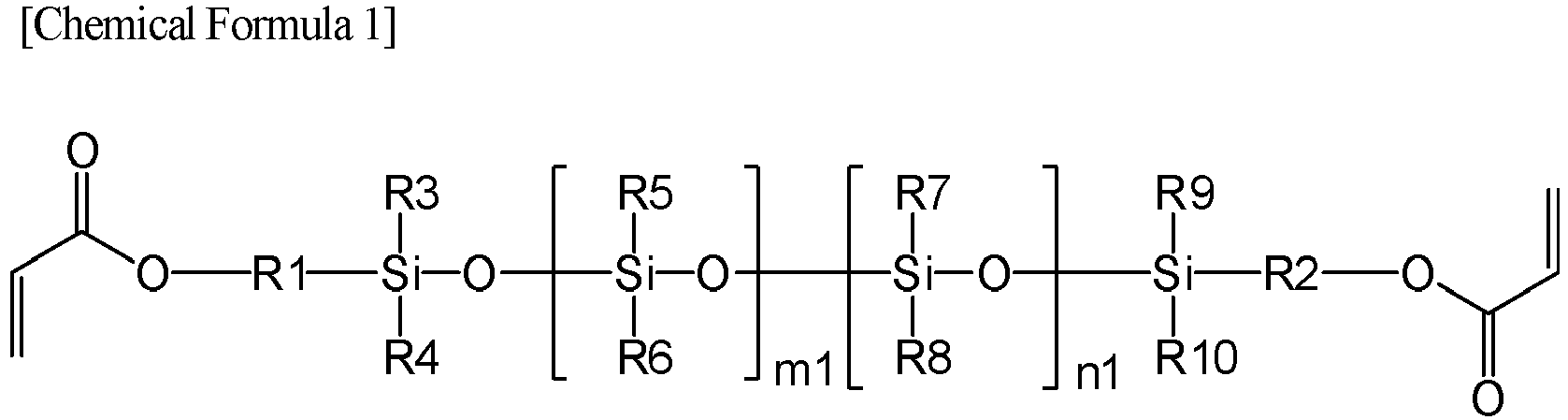
- In Chemical Formula 1,
- R1 and R2 are the same as or different from each other, and each independently a substituted or unsubstituted alkylene group having 1 to 10 carbon atoms,
- R5 and R6 are the same as or different from each other, and each independently an alkyl group having 1 to 10 carbon atoms,
- at least one of R3, R4, R9 and R10 is an alkoxy group having 1 to 10 carbon atoms, and the rest are the same as or different from each other, and each independently an alkyl group having 1 to 10 carbon atoms, or an alkoxy group having 1 to 10 carbon atoms,
- R7 and R8 are the same as or different from each other, and each independently an aryl group having 6 to 20 carbon atoms, and
- m1 and n1 are each independently a real number of 0 or greater.
- Examples of substituents in the present application are described below, however, the substituents are not limited thereto.
- The term "substitution" means a hydrogen atom bonding to a carbon atom of a compound being changed to another substituent, and the position of substitution is not limited as long as it is a position at which the hydrogen atom is substituted, that is, a position at which a substituent can substitute, and when two or more substituents substitute, the two or more substituents can be the same as or different from each other.
- In the present application, the term "substituted or unsubstituted" means being substituted with one, two or more substituents selected from the group consisting of a halogen group; a nitrile group; a hydroxy group; an alkoxy group; an alkyl group; a cycloalkyl group; an aryl group; and a heterocyclic group, or being substituted with a substituent linking two or more of the substituents illustrated above, or having no substituents.
- In one embodiment of the present application, the alkyl group can be linear, branched or cyclic, and preferably has 1 to 10 carbon atoms. Specific examples thereof can comprise a methyl group, an ethyl group, a propyl group, an n-propyl group, an isopropyl group, a butyl group, an n-butyl group, an isobutyl group, a tert-butyl group, a see-butyl group, a 1-methyl-butyl group, a 1-ethyl-butyl group, a pentyl group, an n-pentyl group, a cyclopentyl group, an isopentyl group, a neopentyl group, a tert-pentyl group, a hexyl group, an n-hexyl group, a cyclohexyl group, a 1-methylpentyl group, a 2-methylpentyl group, a 4-methyl-2-pentyl group, a 3,3-dimethylbutyl group, a 2-ethylbutyl group, a heptyl group, an n-heptyl group, a 1-methylhexyl group, a cyclopentylmethyl group, a cyclohexylmethyl group, an octyl group, an n-octyl group, a tert-octyl group, a 1-methylheptyl group, a 2-ethylhexyl group, a 2-propylpentyl group, an n-nonyl group, a 2,2-dimethylheptyl group, a 1-ethyl-propyl group, a 1,1-dimethyl-propyl group, an isohexyl group, a 2-methylpentyl group, a 4-methylhexyl group, a 5-methylhexyl group and the like, but are not limited thereto.
- In one embodiment of the present application, the alkoxy group can be linear, branched or cyclic, and preferably has 1 to 10 carbon atoms. Specific examples thereof can comprise a methoxy group, an ethoxy group, an n-propoxy group, an isopropoxy group, an i-propyloxy group, an n-butoxy group, an isobutoxy group, a tert-butoxy group, a sec-butoxy group, an n-pentyloxy group, a neopentyloxy group, an isopentyloxy group, an n-hexyloxy group, a 3,3-dimethylbutyloxy group, a 2-ethylbutyloxy group, an n-octyloxy group, an n-nonyloxy group, an n-decyloxy group, a benzyloxy group, a p-methylbenzyloxy group and the like, but are not limited thereto.
- In one embodiment of the present application, the aryl group can be monocyclic or polycyclic, and preferably has 6 to 20 carbon atoms. Specific examples thereof can comprise a phenyl group, a biphenyl group, a terphenyl group, a naphthyl group, a triphenylenyl group, an anthracenyl group, a phenanthryl group, a pyrenyl group, a perylenyl group, a chrysenyl group, a fluorenyl group and the like, but are not limited thereto.
- In one embodiment of the present application, the alkyl group described above can be applied to the alkylene group except for being a divalent group.
- In one embodiment of the present application, in Chemical Formula 1, m1 can be a real number of 1 or greater, and n1 is 0 or a real number of 1 or greater.
- In one embodiment of the present application, Chemical Formula 1 can be represented by the following Chemical Formula 2 or 3.


- In Chemical Formulae 2 and 3,
m2, m3 and n2 are each independently a real number of 1 or greater. - In one embodiment of the present application, viscosity of the polyorganosiloxane can be from 10 cps to 100,000 cps, or from 100 cps to 80,000 cps based on 23°C.
- The viscosity can be measured using any proper method comprising a method of using a rheometer. For example, the viscosity can be measured at 20 rpm under a condition of 23°C after setting to gap=0.5 mm using a spindle PP-25 of Anton-Paar rheometer.
- In one embodiment of the present application, m1, m2, m3, n1 and n2 of Chemical Formulae 1 to 3 are values that the polyorganosiloxane of Chemical Formulae 1 to 3 has desirable viscosity. More specifically, m1, m2, m3, n1 and n2 of Chemical Formulae 1 to 3 are values that the polyorganosiloxane of Chemical Formulae 1 to 3 has viscosity of 10 cps to 100,000 cps based on 23°C.
- In one embodiment of the present application, a content of the polyorganosiloxane can be from 40% by weight to 98% by weight, or from 50% by weight to 95% by weight based on a total weight of the silicone-based composition. When satisfying such a content range of the polyorganosiloxane, the silicone-based composition of the present application can have properties of silicone rubber, can diversely control adhesive strength, and can provide a fast tack free time on the surface just by moisture curing. In addition, the polyorganosiloxane content being less than 40% by weight based on the total weight of the silicone-based composition is not preferred since a cured product of the silicone-based composition becomes hard causing a problem of being very readily broken and thereby causing an issue of cracks, and rubber properties of silicone are lost.
- As described above, the use of a photoinitiator has been limited in the art due to low surface tension and refractive index of silicone materials, and curability for ultraviolet light has been poor as well. In view of the above, an acryl-based monomer that is a diluent is comprised in one embodiment of the present application in order to smoothly mix the polyorganosiloxane and a photoinitiator. In one embodiment of the present application, the acryl-based monomer not only serves as a diluent, but also serves to increase curability for ultraviolet light.
- As the acryl-based monomer, acryl-based monomers known in the art can also be used as long as they are materials that can be sufficiently mixed with the polyorganosiloxane. Particularly, as the acryl-based monomer, at least one type of isobomyl acrylate, lauryl acrylate and 1,6-hexanediol diacrylate is preferably comprised, however, the acryl-based monomer is not limited thereto. The acryl-based monomer described above is advantageous for mixing with the polyorganosiloxane by having low molecular weight and surface tension, and not having high refractive index, and is advantageous for revealing rubber properties of silicone. In addition, by adjusting the content of the acryl-based monomer in the silicone-based composition, changes in various properties of the silicone-based composition can be obtained.
- In one embodiment of the present application, a content of the acryl-based monomer can be from 0.1% by weight to 50% by weight, and more preferably from 1% by weight to 46% by weight based on the total weight of the silicone-based composition.
- When satisfying such a content range of the acryl-based monomer, the silicone-based composition of the present application can have properties of silicone rubber, can diversely control adhesive strength, and can provide a fast tack free time on the surface just by moisture curing. In addition, the acryl-based monomer content being greater than 50% by weight based on the total weight of the silicone-based composition is not preferred since the polyorganosiloxane content relatively decreases, and a cured product of the silicone-based composition becomes hard causing a problem of being very readily broken and thereby causing an issue of cracks, and rubber properties of silicone are lost.
- In one embodiment of the present application, the photoinitiator is thermally inactive, but is excited by receiving light to generate free radicals, and these free radicals provide excitation energy to the siloxane to initiate a curing reaction by ultraviolet curing. From the viewpoint of reactivity, the photoinitiator can comprise aromatic hydrocarbon, acetophenone and derivatives thereof, benzophenone and derivatives thereof, o-benzoyl benzoic acid ester, benzoin, benzoin ether and derivatives thereof, xanthone and derivatives thereof, quinone compounds, halogenated hydrocarbon and amines, organic peroxides and the like, and from the viewpoint of compatibility with silicone and stability, compounds containing a substituted or unsubstituted benzoyl group or organic peroxides are more preferred. Examples thereof can comprise acetophenone, propiophenone, 2-hydroxy-2-methylpropiophenone, 2,2-dimethoxy-1,2-diphenylethan-1 -one, 2-hydroxy-2-methyl-1-phenyl-propan-1-one, 1-hydroxycyclohexyl-phenyl-ketone, ethyl(2,4,6-trimethylbenzoyl)phenylphosphinate, 1-[4-(2-hydroxyethoxy)-phenyl]-2-hydroxy-2-methyl-1-propan-1-one, 2-hydroxy-1 - {4-[4-(2-hydroxy-2-methyl-propionyl)-benzyl]phenyl } -2-methyl-propan-1 -one, 2-methyl-1 -(4-methylthiophenyl)-2-morpholinopropan-1 -one, 2-benzyl-2-dimethylamino-(4-morpholinophenyl)-butanone-1, 2-(dimethylamino)-2-[(4-methylphenyl)methyl]-1-[4-(4-morpholinyl)phenyl]-1-butanone, 2,4,6-trimethylbenzoyl-diphenylphosphine oxide, bis(2,4,6-trimethylbenzoyl)-phenylphosphine oxide, 1,2-octanedione, 1-[4-(phenylthio)-2-(O-benzoyloxime)], ethanone, 1-[9-ethyl-6-(2-methylbenzoyl)-9H-carbazol-3-yl]-1-(O-acetyloxime), oxyphenylacetic acid, 2-[2-oxo-2-phenylacetoxyethoxy]ethyl ester and oxyphenylacetic acid, 2-(2-hydroxyethoxy)ethyl ester mixture, ethyl-4-dimethylaminobenzoate, 2-ethylhexyl-4-dimethylaminobenzoate, bis(2,6-dimethoxybenzoyl)-2,4,4-trimethyl-pentylphosphine oxide, benzoyl peroxide and the like, but are not limited thereto.
- In addition, the photoinitiator can be used in a form of a mixture dissolved in the above-described acryl-based monomer in terms of compatibility with the polyorganosiloxane.
- In one embodiment of the present application, a content of the photoinitiator can be from 0.1% by weight to 5% by weight, and more preferably from 0.3% by weight to 3% by weight based on the total weight of the silicone-based composition.
- When satisfying such a content range of the photoinitiator, the silicone-based composition of the present application can accomplish fast ultraviolet curing.
- According to one embodiment of the present application, the silicone-based composition comprises a catalyst for moisture curing to provide a fast a tack free time on the surface. Particularly, according to one embodiment of the present application, the tack free time can be 60 minutes or shorter, 55 minutes or shorter, or 5 minutes or longer. When the tack free time is longer than 60 minutes, the goal of a fast curing process that the present application aims to accomplish is difficult to obtain. A method of measuring the tack free time is specifically described in an experimental example to describe later.
- In one embodiment of the present application, the catalyst for moisture curing can comprise at least one of a tin-based compound and a titanate-based compound.
- The tin-based compound used as the catalyst for moisture curing can comprise at least one type of dibutyltin dilaurate, dibutyltin diacetate, dibutyltin dimethoxide, dimethyltin di-neodecanoate, tin octoate, dibutyltin oxide, diorgano-tin bis β-diketonate and dibutyltin bis-acetylacetonate, but is not limited thereto.
- The titanate-based compound used as the catalyst for moisture curing can comprise at least one type of tetra-tert-butyl orthotitanate, tetra-n-butyl titanate, tetra-isopropyl titanate, tetra-2-ethylhexyl titanate, tertra tert-butyl titanate, poly butyl titanate, butyl-titanate dimer, titanium acetylacetonate, titanium tetra-acetylacetonate, ethyl acetoacetate titanate, titanium dodecylbenzene sulfonate, titanium phosphate complex, titanium octyleneglycolate, titanium lactate ammonium salt, titanium lactate, titanium triethanolaminate, tetra stearyl titanate, titanium isostearate and titanium aminoethylaminoethanolate, but is not limited thereto.
- In one embodiment of the present application, the catalyst for moisture curing comprises the tin-based compound, and a content of the tin-based compound can be from 0.05% by weight to 0.5% by weight, and more preferably from 0.07% by weight to 0.35% by weight based on the total weight of the silicone-based composition.
- In one embodiment of the present application, the catalyst for moisture curing comprises the titanate-based compound, and a content of the titanate-based compound can be from 0.1% by weight to 5.0% by weight based on the total weight of the silicone-based composition.
- When satisfying such content ranges of the catalyst for moisture curing, the silicone-based composition according to one embodiment of the present application can be sufficiently cured using a moisture curing method even for areas not irradiated with ultraviolet light.
- In one embodiment of the present application, the silicone-based composition can further comprise an additive including at least one of a scavenger and an adhesion promoter.
- In one embodiment of the present application, a scavenger described in
European Patent Application Laid-Open Publication No. 0905195 can be used as the scavenger. More specifically, the scavenger can be 3-(trimethoxysilyl)-1-propanamine polymer with 1,1,1-trimethyl-N-(trimethylsilyl) silanamine represented by the following Chemical Formula 4, but is not limited thereto.
- In Chemical Formula 4,
n is a real number of 1 to 20. - In one embodiment of the present application, a content of the scavenger can be from 0.1% by weight to 5% by weight, and more preferably from 0.7% by weight to 5% by weight based on the total weight of the silicone-based composition.
- In one embodiment of the present application, as the adhesion promoter, silicone-based compounds or silane-based compounds comprising at least one hydrolysable functional group such as methoxy or ethoxy can be used.
- The adhesion promoter can comprise at least one type of (aminoalkyl)trialkoxysilane, (aminoalkyl)alkyldialkoxysilane, bis(trialkoxysilylalkyl)amine, tris(trialkoxysilylalkyl)amine, tris(trialkoxysilylalkyl)cyanurate, tris(trialkoxysilylalkyl)isocyanurate, (epoxyalkyl)trialkoxysilane and (epoxyalkyl ether)trialkoxysilane, but is not limited thereto.
- More specifically, the adhesion promoter can comprise at least one type of N-(2-aminoethyl)aminopropyltrimethoxysilane, gamma-aminopropyltriethoxysilane, gamma-aminopropyltrimethoxysilane, bis(3-trimethoxysilylpropyl)amine, N-phenyl-gamma-aminopropyltrimethoxysilane, triaminofunctionaltrimethoxysilane, gamma-aminopropylmethyldimethoxysilane, gamma-aminopropylmethyldiethoxysilane, methacryloxypropyltrimethoxysilane, methylaminopropyltrimethoxysilane, gamma-glycidoxypropylethyldimethoxysilane, gamma-glycidoxypropyltrimethoxysilane, gamma-glycidoxyethyltrimethoxysilane, gamma-glycidoxypropylmethyldimethoxysilane, gamma-glycidoxypropylmethyldiethoxysilane, beta-(3,4-epoxycyclohexyl)ethyltrimethoxy silane, beta-(3,4-epoxycyclohexyl)ethylmethyldimethoxysilane, beta-(3,4-epoxycyclohexyl)ethyltriethoxysilane, beta-(3,4-epoxycyclohexyl)ethylmethyldiethoxysilane, epoxylimonyltrimethoxysilane, isocyanatopropyltriethoxysilane, isocyanatopropyltrimethoxysilane, isocyanatopropylmethyldimethoxysilane, beta-cyanoethyltrimethoxysilane, gamma-acryloxypropyltrimethoxysilane, gamma-methacryloxypropylmethyldimethoxysilane, alpha, omega-bis(aminoalkyldiethoxysilyl)polydimethylsiloxane (Pn=1 to 7), alpha, omega-bis(aminoalkyldiethoxysilyl)octamethyltetrasiloxane, 4-amino-3,3-dimethylbutyltrimethoxysilane, N-ethyl-3-trimethoxysilyl-2-methylpropanamine, 3-(N,N-diethylaminopropyl)trimethoxysilane, tris[3-(trimethoxysilyl)propyl]isocyanurate, methyltrimethoxysilane, vinyltrimethoxysilane and the like.
- In one embodiment of the present application, a content of the adhesion promoter can be from 0.1% by weight to 5% by weight, and more preferably from 0.7% by weight to 3% by weight based on the total weight of the silicone-based composition. When satisfying such a content range of the adhesion promoter, more superior adhesive strength can be obtained. When the content of the adhesion promoter is less than 0.1% by weight based on the total weight of the silicone-based composition, adhesive strength is difficult to obtain, and the content being greater than 5% by weight is not preferred since viscosity of the silicone-based composition decreases changing the rheology itself, and adhesive strength no longer increases.
- In one embodiment of the present application, the silicone-based composition can further comprise fumed silica, other additives and the like.
- In one embodiment of the present application, a content of the fumed silica can be from 0% by weight to 15% by weight, and more preferably from 1% by weight to 10% by weight based on the total weight of the silicone-based composition. Comprising the fumed silica in such a content range can be effective in controlling viscosity and thixotropy of the silicone-based composition. However, when the fumed silica content is greater than 15% by weight based on the total weight of the silicone-based composition, a viscosity increase becomes greater, which can be disadvantageous in dispensing discharge workability, and this can be disadvantageous when using the composition in a coating material and the like requiring proper viscosity and thixotropy. In addition, the fumed silica content being greater than 1% by weight based on the total weight of the silicone-based composition can be advantageous for packages that needs to maintain the shape since a phenomenon of the composition spreading on the coating surface after dispensing discharge can be prevented.
- As the fumed silica, using hydrophobic fumed silica having the silica surface being hydrophobized is more preferred. More specifically, hydrophobic fumed silica can be used as the fumed silica, however, the fumed silica is not limited thereto.
- In one embodiment of the present application, the silicone-based composition can further comprise a second polyorganosiloxane known in the art in addition to the above-described polyorganosiloxane having both ends formed with an acrylate group and comprising at least one alkoxy group. The second polyorganosiloxane can not comprise both an ultraviolet curable functional group and a moisture curable functional group while having a general siloxane structure, and can comprise any one functional group of the ultraviolet curable functional group and the moisture curable functional group. The second polyorganosiloxane can perform a role of controlling mechanical properties of the silicone-based composition.
- As the second polyorganosiloxane, a polyorganosiloxane comprising a vinyl group on both ends; a polyorganosiloxane selected from among a MQ resin, a MTQ resin, a MDQ resin and a MDTQ resin comprising an M unit (Me3SiO), a D unit (Me2SiO2), a T unit (MeSiO3), a Q unit (SiO4) and the like without comprising both a ultraviolet curable functional group and a moisture curable functional group; a non-reactive polyorganosiloxane (M-Dn-M) and the like can be used, however, the second polyorganosiloxane is not limited thereto.
- In one embodiment of the present application, a content of the second polyorganosiloxane can be from 0% by weight to 45% by weight, and more preferably from 0% by weight to 40% by weight based on the total weight of the silicone-based composition. When satisfying such a content range of the second polyorganosiloxane, adhesive strength can be properly controlled. In addition, when the second polyorganosiloxane content is greater than 45% by weight, the content of the polyorganosiloxane having both ends formed with an acrylate group and comprising at least one alkoxy group (polyorganosiloxane comprising the ultraviolet curable functional group and the moisture curable functional group at the same time) is relatively small. This is inconsistent with the purpose of the present application to apply the polyorganosiloxane comprising the ultraviolet curable functional group and the moisture curable functional group at the same time.
- In addition, the cured product according to one embodiment of the present application is prepared by curing the silicone-based composition. More specifically, the cured product according to one embodiment of the present application can comprise a polyorganosiloxane having both ends formed with an acrylate group and comprising at least one alkoxy group; at least one type of an acryl-based monomer; at least one type of a photoinitiator; and a catalyst for moisture curing.
- The cured product according to one embodiment of the present application can be formed using methods known in the art except for curing the above-described silicone-based composition. More specifically, the cured product can be formed using a method such as applying coating or printing the silicone-based composition on a substrate and a curing method, however, the method is not limited thereto.
- Another embodiment of the present application provides a device comprising the cured product.
- The cured product according to one embodiment of the present application can be used in applications of coating and protecting various objects. Particularly, the cured product can be effective in protecting objects comprising devices sensitive to external components such as moisture or humidity. Examples of the objects for which a coating material comprising the cured product can be used can comprise a photovoltaic device, a rectifier, a transmitter, an organic light emitting diode (OLED), a moisture protector for a printed circuit board, a solar cell, a secondary battery, an automotive component or the like, but are not limited thereto.
- Hereinafter, the present specification will be described in more detail with reference to examples. However, the following examples are for illustrative purposes only, and the present specification is not limited thereto.
- A mixture of bis silanol-end polydimethylsiloxane (5,000 cps, 1,000 g), acryloxypropyltrimethoxysilane (30 g), diisobutylamine (1.6 g), formic acid (0.57 g) and a butylhydroxytoluene (1.0 g) was stirred under nitrogen at 80 °C for 5 hours. Then, the mixture was stirred at 110 °C for 2 hours and then reduced pressure to remove by-products. Then, it was cooled to prepare a polyorganosiloxane represented by Chemical Formula 2. The prepared polyorganosiloxane had viscosity of approximately 6,000 cps based on 23°C.
- A polyorganosiloxane represented by Chemical Formula 3 was prepared in the same manner as in Preparation Example 1 except that bis silanol-end polydimethyldiphenylsiloxane was used instead of the bis silanol-end polydimethylsiloxane. The prepared polyorganosiloxane had viscosity of approximately 13,000 cps based on 23°C.
- A mixture of bis silanol-end polydimethylsiloxane (700 cps, 1,000 g), acryloxypropyltrimethoxysilane (60 g), diisobutylamine (3.2 g), formic acid (1.14 g) and a butylhydroxytoluene (1.0 g) was stirred under nitrogen at 80 °C for 5 hours. Then, the mixture was stirred at 110 °C for 2 hours and then reduced pressure to remove by-products. Then, it was cooled to prepare a polyorganosiloxane represented by Chemical Formula 2. The prepared polyorganosiloxane had viscosity of approximately 1,000 cps based on 23°C.
- A polyorganosiloxane comprising a methacrylate group on both ends was prepared in the same manner as in Preparation Example 1 except that methacryloxypropyltrimethoxysilane was used instead of acryloxypropyltrimethoxysilane. The prepared polyorganosiloxane had viscosity of approximately 15,000 cps based on 23°C.
- Acrylate-end polydimethylsiloxane (available from Momentive Performance Materials Inc.) was prepared. The acrylate-end polydimethylsiloxane had viscosity of approximately 7,500 cps based on 23°C.
- Silicone-based compositions were each prepared by mixing an acryl-based monomer and a photoinitiator described in the following Tables 1 to 10, and then further mixing constituents described in the following Tables 1 to 10.
[Table 1] Constituent Type Content (% by Weight) Example 1 Example 2 Example 3 Example 4 Example 5 Polyorganosiloxane (A) Preparation Example 1 60.00 74.41 74.41 74.41 74.41 Preparation Example 2 - - - - - Acryl-based Monomer (B) B-1 34.82 17.41 17.41 17.41 17.41 B-2 - - - - - B-3 - - - - - Photoinitiator (C) C-1 1.00 1.00 - - 0.25 C-2 - - 1.00 - - C-3 - - - 0.50 0.25 C-4 - - - 0.50 - Catalyst for Moisture Curing (D) D-1 0.10 0.1 0.1 0.1 0.2 D-2 - - - - - Scavenger (E) 2.50 2.50 2.50 2.50 2.50 Adhesion Promoter (F) F-1 0.58 0.58 0.58 0.58 0.40 F-2 1.00 1.00 1.00 1.00 1.58 F-3 - - - - - Fumed Silica (G) - 3.0 3.0 3.0 3.0 [Table 2] Constituent Type Content (% by Weight) Example 6 Example 7 Example 8 Example 9 Example 10 Polyorganosiloxane (A) Preparation Example 1 74.41 60.00 91.82 85.82 64.00 Preparation Example 2 - - - - - Acryl-based Monomer (B) B-1 17.41 28.82 3.00 3.00 3.00 B-2 - - - - 27.82 B-3 - - - - - Photoinitiator (C) C-1 - 1.00 1.00 1.00 1.00 C-2 0.25 - - - - C-3 - - - - - C-4 0.25 - - - - Catalyst for Moisture Curing (D) D-1 0.20 0.10 0.10 0.10 0.10 D-2 - - - - - Scavenger (E) 2.50 2.50 2.50 2.50 2.50 Adhesion Promoter (F) F-1 0.40 0.58 0.58 0.58 0.58 F-2 1.58 1.00 1.00 1.00 1.00 F-3 - - - - - Fumed Silica (G) 3.00 6.00 - 6.00 - [Table 3] Constituent Type Content (% by Weight) Example 11 Example 12 Example 13 Example 14 Example 15 Polyorganosiloxane (A) Preparation Example 1 64.00 - 74.24 78.90 - Preparation Example 2 - 54.00 - - 62.05 Acryl-based Monomer (B) B-1 18.00 28.00 17.65 3.00 17.65 B-2 12.82 7.76 - 7.00 - B-3 - - - - 15.00 Photoinitiator (C) C-1 1.00 1.00 1.00 1.00 0.50 C-2 - - - - - C-3 - - - - 0.50 C-4 - - - - - Catalyst for Moisture Curing (D) D-1 0.10 0.16 0.10 0.10 0.22 D-2 - - - - - Scavenger (E) 2.50 2.50 2.50 1.00 2.50 Adhesion Promoter (F) F-1 0.58 0.58 0.58 - 0.58 F-2 1.00 1.00 1.00 1.00 1.00 F-3 - - - - - Fumed Silica (G) - - - 3.00 - Second Polyoiganosiloxane (H) H-1 - - 2.93 - - H-2 - - - 5.00 - H-3 - 5.00 - - - [Table 4] Constituent Type Content (% by Weight) Example 16 Example 17 Example 18 Example 19 Polyorganosiloxane (A) Preparation Example 1 - - 78.7 77.20 Preparation Example 2 50.00 59.70 - - Acryl-based Monomer (B) B-1 15.36 - 10.00 17.65 B-2 - - - - B-3 29.32 35.00 - - Photoinitiator (C) C-1 1.00 1.00 0.50 1.00 C-2 - - - - C-3 - - - - C-4 - - - - Catalyst for Moisture Curing (D) D-1 0.22 0.22 0.22 0.07 D-2 - - - - Scavenger (E) 2.50 2.50 1.50 2.50 Adhesion Promoter (F) F-1 0.60 0.58 0.58 0.58 F-2 1.00 1.00 - 1.00 F-3 - - 1.00 - Fumed Silica (G) - - 7.50 - [Table 5] Constituent Type Content (% by Weight) Example 20 Example 21 Example 22 Example 23 Example 24 Polyorganosiloxane (A) Preparation Example 1 77.16 77.05 76.94 71.90 67.05 Preparation Example 2 - - - - - Acryl-based Monomer (B) B-1 17.65 17.65 17.65 17.65 17.65 B-2 - - - - - B-3 - - - - - Photoinitiator (C) C-1 1.00 1.00 1.00 1.00 1.00 C-2 - - - - - C-3 - - - - - C-4 - - - - - Catalyst for Moisture Curing (D) D-1 0.11 0.22 0.33 0.22 0.22 D-2 - - - - - Scavenger (E) 2.50 2.50 2.50 0.15 5.00 Adhesion Promoter (F) F-1 0.58 0.58 0.58 0.58 0.58 F-2 1.00 1.00 1.00 1.00 1.00 F-3 - - - - - Fumed Silica (G) - - - 7.50 7.50 [Table 6] Constituent Type Content (% by Weight) Example 25 Example 26 Example 27 Example 28 Example 29 Polyorganosiloxane (A) Preparation Example 1 72.22 72.32 - 95.52 49.90 Preparation Example 2 - - - - - Preparation Example 3 - - 72.20 - - Acryl-based Monomer (B) B-1 3.00 3.00 3.00 3.00 9.00 B-2 - - - - - B-3 - - - - - Photoinitiator (C) C-1 - - 1.00 1.00 0.70 C-2 0.70 0.70 - - - C-5 0.30 0.30 - - 0.30 Catalyst for Moisture Curing (D) D-1 0.20 - 0.22 0.48 - D-2 - - - - - D-3 - 1.50 - - 0.30 Scavenger (E) 2.00 - 2.00 - 0.15 Adhesion Promoter (F) F-1 0.58 0.58 0.58 - 0.10 F-2 1.00 1.00 1.00 - 0.10 Fumed Silica (G) - - - - - Second Polyorganosiloxane (H) H-4 20.00 20.60 20.00 - 39.45 [Table 7] Constituent Type Content (% by Weight) Example 30 Example 31 Example 32 Example 33 Example 34 Polyorganosiloxane (A) Preparation Example 1 - 45.00 40.00 45.00 45.00 Preparation Example 2 78.20 - - - - Preparation Example 3 - 29.90 27.20 11.30 13.90 Acryl-based Monomer (B) B-1 9.00 15.00 9.00 17.00 17.00 B-2 - - - - - B-3 - - - - - Photoinitiator (C) C-1 1.00 2.00 1.00 0.70 0.70 C-2 - - - - - C-5 - - - 0.30 0.30 Catalyst for D-1 - - - - - Moisture Curing (D) D-2 4.80 - 2.40 - - D-3 - 3.00 2.40 2.10 2.10 Scavenger (E) 2.00 - - 1.00 1.00 Adhesion Promoter (F) F-1 - 0.30 - 0.80 - F-2 - 1.80 - 1.80 - Fumed Silica (G) 5.00 3.00 3.00 5.00 5.00 Second Polyorganosiloxane (H) H-4 - - 15.00 15.00 15.00 [Table 8] Constituent Type Content (% by Weight) Example 35 Example 36 Polyorganosiloxane (A) Preparation Example 1 45.00 45.00 Preparation Example 2 - - Preparation Example 3 12.30 14.90 Acryl-based Monomer (B) B-1 17.00 17.00 B-2 - - B-3 - - Photoinitiator (C) C-1 0.70 0.70 C-2 - - C-5 0.30 0.30 Catalyst for Moisture Curing (D) D-1 - - D-2 - - D-3 2.10 2.10 Scavenger (E) - - Adhesion Promoter (F) F-1 0.80 - F-2 1.80 - Fumed Silica (G) 5.00 5.00 Second Polyorganosiloxane (H) H-4 15.00 15.00 [Table 9] Constituent Type Content (% by Weight) Comparative Example 1 Comparative Example 2 Comparative Example 3 Comparative Example 4 Comparative Example 5 Polyorganosiloxane (A) Preparation Example 1 77.26 77.24 63.75 61.20 - Preparation Example 2 Comparative Preparation Example 1 - - - - - Comparative Preparation Example 2 - - - - 77.17 Acryl-based Monomer (B) B-1 17.65 17.65 3.00 34.42 17.65 B-2 - - 27.82 - - B-3 - - - - - Photoinitiator (C) C-1 1.00 1.00 1.00 1.00 1.00 C-2 - - - - - C-3 - - - - - C4 - - - - - Catalyst for Moisture Curing (D) D-1 0.01 0.03 - - 0.10 D-2 - - - 0.05 - D-3 - - 0.05 - - Scavenger (E) 2.50 2.50 2.55 1.50 2.50 Adhesion Promoter (F) F-1 0.58 0.58 0.58 0.58 0.58 F-2 1.00 1.00 1.25 1.25 1.00 F-3 - - - - - [Table 10] Constituent Type Content (%by Weight) Comparative Example 6 Comparative Example 7 Comparative Example 8 Comparative Example 9 Polyorganosiloxane (A) Preparation Example 1 Preparation Example 2 Comparative Preparation Example 1 - 77.17 60.00 91.82 Comparative Preparation Example 2 91.82 - - - Acryl-based Monomer (B) B-1 3.00 17.65 34.82 3.00 B-2 - - - - B-3 - - - - Photoinitiator (C) C-1 1.00 1.00 1.00 1.00 C-2 - - - - C-3 - - - - C-4 - - - - Catalyst for Moisture Curing (D) D-1 0.10 0.10 0.10 0.10 D-2 - - - - D-3 - - - - Scavenger (E) 2.50 2.50 2.50 2.50 Adhesion Promoter (F) F-1 0.58 0.58 0.58 0.58 F-2 1.00 1.00 1.00 1.00 F-3 - - - - - Types of the constituents in Table 1 to Table 10 are as follows.
- Acryl-based monomer B-1: Isobomyl acrylate
- Acryl-based monomer B-2: Lauryl acrylate
- Acryl-based monomer B-3: 1,6-Hexanediol diacrylate
- Photoinitiator C-1: Omnirad BDK (2,2-Dimethoxy-2-phenylacetophenone)
- Photoinitiator C-2: Omnirad 1173 (2-Hydroxy-2-methyl-1-phenylpropanone)
- Photoinitiator C-3: Omnirad TPO-L (Ethyl(2,4,6-trimethylbenzoyl)phenyl phosphinate)
- Photoinitiator C-4: Omnirad 184 (1-Hydroxycyclohexyl-phenylketone)
- Photoinitiator C-5: Omnirad 819 (bis(2,4,6-trimethylbenzoyl)phenylphosphine oxide
- Catalyst for moisture curing D-1: Dibutyltin bis(acetylacetonate)
- Catalyst for moisture curing D-2: Tetra-n-butyl titanate
- Catalyst for moisture curing D-3: tetra-tert-butyl orthotitanate
- Scavenger E: 3-(Trimethoxysilyl)-1-propanamine polymer with 1,1,1-trimethyl-N-(trimethylsilyl) silanamine
- Adhesion promoterF-1: Tris[3-(trimethoxysilyl)propyl] isocyanurate
- Adhesion promoter F-2: Methyltrimethoxysilane
- Adhesion promoter F-3: Vinyltrimethoxysilane
- Fumed Silica G: Evonik RX200
- Second polyorganosiloxane H-1: Polydimethylsiloxane comprising a vinyl group on both ends and side chain (viscosity is 1,000,000 cps based on 23°C)
- Second polyorganosiloxane H-2: Polydimethylsiloxane comprising a vinyl group on both ends (viscosity is 100,000 cps based on 23°C)
- Second polyorganosiloxane H-3: Polydimethylsiloxane comprising a vinyl group on both ends, and having a phenyl group content of 10% (viscosity is 1,000 cps based on 23°C)
- Second polyorganosiloxane H4: Polyorganosiloxane consisting of 50 wt% of a resin with an alkoxy-terminated MQ structure and 50 wt% of a polymer (viscosity is 200 cps) containing an alkoxy group at both ends
- Properties of each of the silicone-based compositions prepared in the examples and the comparative examples were evaluated, and the results are shown in the following Table 11.
[Table 11] Properties (1) (2) (3) (4) (5) (6) (7) (8) Example 1 30 1.4 1.0 2.9 5.3 213 2.9 44 Example 2 30 5.8 1.2 3.6 2.2 179 1.4 35 Example 3 30 5.9 1.2 3.5 1.8 164 1.3 38 Example 4 30 5.7 1.2 3.7 2.1 186 1.2 37 Example 5 30 5.7 1.2 3.6 2.1 177 1.3 37 Example 6 30 5.8 1.2 3.6 2.1 176 1.0 37 Example 7 30 5.9 1.4 2.9 5.2 210 2.4 56 Example 8 30 6.4 1.0 4.5 0.4 146 0.3 20 Example 9 30 20.7 1.4 4.3 1.1 173 0.5 30 Example 10 20 1.3 1.0 3.5 0.6 171 0.2 14 Example 11 20 1.3 1.0 3.6 0.9 188 0.3 19 Example 12 30 1.4 1.0 5.9 2.6 123 0.3 29 Example 13 25 5.9 1.05 3.7 1.6 168 1.0 30 Example 14 25 16.7 1.4 5.1 0.6 151 0.4 17 Example 15 30 1.8 1.0 2.5 2.2 34 1.1 67 Example 16 35 1.0 1.0 2.8 3.9 19 1.2 70 Example 17 30 1.8 1.0 5.9 6.1 131 1.6 78 Example 18 15 12.8 1.3 6.4 1.5 114 1.0 40 Example 19 55 3.1 1.0 3.1 1.2 167 1.1 28 Example 20 30 3.1 1.0 3.0 1.3 160 1.5 30 Example 21 15 3.2 1.0 3.1 1.1 119 1.2 30 Example 22 10 3.4 1.0 3.2 1.3 157 1.1 30 Example 23 35 12.9 1.5 3.3 2.6 162 1.8 34 Example 24 30 13.5 1.5 3.1 2.8 151 2.1 43 Example 25 15 7.3 1.0 5.4 1.2 150 0.6 20 Example 26 25 5.9 1.0 6.3 0.8 140 0.5 20 Example 27 20 1.4 1.0 4.5 0.5 60 0.3 31 Example 28 5 9.4 1.0 7.1 0.3 222 0.15 11 Example 29 55 1.3 1.1 4.5 0.3 116 0.4 12 Example 30 30 24.2 1.2 3.4 0.6 120 0.4 14 Example 31 25 2.6 1.1 2.6 2.4 162 1.3 35 Example 32 5 1.4 1.5 3.9 2.0 148 0.6 39 Example 33 50 6.7 1.3 2.0 2.4 235 0.7 27 Example 34 40 11.8 1.4 2.6 2.5 230 0.4 36 Example 35 30 3.8 1.1 2.2 2.9 141 1.1 50 Example 36 5 5.5 1.1 3.1 3.4 224 0.9 43 Comparative Example 1 290 3.1 1.0 3 1.0 187 1.1 20 Comparative Example 2 170 3.0 1.0 3.1 1.0 161 1.1 25 Comparative Example 3 >24hrs 1.2 1.0 0.6 X X 0.1 X Comparative Example 4 >24hrs 1.4 1.0 2.2 X X 0.2 X Comparative Example 5 X 5.83 1.0 3.7 0.6 431 0.3 1 Comparative Example 6 X 11.6 1.0 X X X X X Comparative Example 7 75 5.85 1.0 3.2 0.5 144 0.5 15 Comparative Example 8 75 2.45 1.0 3.21 5.0 210 2.4 35 Comparative Example 9 75 11.5 1.0 X 0.3 167 0.3 10 - In Table 11, the evaluation result of "X" means that the property evaluation results were not able to be measured due to failure of curing, or the range was outside the measurement range.
- As shown from the results, it was identified that a fast tack free time was not provided when the content range was outside the range of the catalyst for moisture curing comprising a tin-based compound of the present application (Comparative Examples 1 and 2).
- In Comparative Examples 3 and 4, curing was obtained by ultraviolet irradiation, however, moisture curing was not conducted thereafter, and the product was prepared at a gel level instead of having rubber properties. This is due to the result that the content range was outside the range of the catalyst for moisture curing comprising a titanate-based compound of the present application.
- In Comparative Examples 5 and 6, the polyorganosiloxane did not comprise a moisture curable functional group, and the product was prepared at a gel level without being rubberized.
- In Comparative Examples 7 to 9, the polyorganosiloxane had both ends formed with a methacrylate group instead of an acrylate group as in the present application, which resulted in a tack free time of longer than 60 minutes, and in this case, the goal of rapid process development that the present application aimed to achieve was not accomplished.
- Accordingly, it was identified that the silicone-based composition according to one embodiment of the present application was able to be quickly cured using ultraviolet (UV) light, and was sufficiently cured using a moisture curing method even for areas not irradiated with ultraviolet light.
- In addition, by comprising a polyorganosiloxane having both ends formed with an acrylate group and comprising at least one alkoxy group; and at least one type of an acryl-based monomer at the same time, the silicone-based composition according to one embodiment of the present application can have properties of silicone rubber, can variously control adhesive strength, and can provide a quick tack free time on the surface just by moisture curing.
- Types of the properties in Table 11 and the measurement methods thereof are as follows.
- After discharging the sample overflowingly to a width of 50 mm, a length of 50 mm and a depth of 2 mm, the depth was adjusted by cutting off the top surface using a spatula. A timer was immediately started, and by touching the surface with a fingertip every 5 minutes, the time at which the sample did not smear was measured. The experiment was conducted under a condition of 25°C and 50 RH%.
- Viscosity was measured at 20 rpm under a 23°C condition after setting to gap=0.5 mm using a spindle PP-25 of Anton-Paar rheometer.
- Thixotropy was obtained in a ratio between the measured value at 10 rpm and the measured value at 20 rpm using a rheometer.
- After discharging the sample overflowingly to a width of 20 mm, a length of 20 mm and a depth of 10 mm, the depth was adjusted by cutting off the top surface using a spatula. A UV lamp of LED 365 nm was used, and the sample was UV cured by being exposed to 5,000 mJ/cm2.
- After the UV irradiation, the spacer was dissembled, and after wiping the uncured lower part, the result was kept for 3 days at 25°C and 50 RH%. The thickness of the cured product was obtained by measuring with a micrometer.
- A specimen cured to a thickness of 2 mm was prepared. Herein, the specimen was cured under a curing condition of UV 5,000 mJ/cm2, and kept for 3 days at 25°C and 50 RH%.
- The specimen was cut to a dog-bone, and locked on an Instron tester to measure tensile force.
- A specimen cured to a thickness of 2 mm was prepared. Herein, the specimen was cured under a curing condition of UV 5,000 mJ/cm2, and kept for 3 days at 25°C and 50 RH%.
- The specimen was cut to a dog-bone, and locked on an Instron tester to measure elongation.
- Adhesive strength was measured using a lap shear measurement method, and herein, FR4, glass was employed as a material. The sample thickness was employed to be 1 T. Herein, the specimen was cured under a curing condition of UV 5,000 mJ/cm2, and kept for 3 days at 25°C and 50 RH%.
- A specimen cured to a thickness of 2 mm was prepared. Herein, the specimen was cured under a curing condition of UV 5,000 mJ/cm2, and kept for 3 days at 25°C and 50 RH%. Three 2 mm specimens were stacked to make a total of 6 mm, and hardness was measured with Durometer shore A.
Claims (16)
- A silicone-based composition comprising:a polyorganosiloxane having both ends formed with an acrylate group and comprising at least one alkoxy group in 40% by weight or greater,at least one type of an acryl-based monomer in 0.1% by weight to 50% by weight;at least one type of a photoinitiator in 0.1% by weight to 5% by weight; anda catalyst for moisture curing,based on a total weight of the silicone-based composition.
- The silicone-based composition of claim 1, wherein the polyorganosiloxane is represented by the following Chemical Formula 1:
 R1 and R2 are the same as or different from each other, and each independently a substituted or unsubstituted alkylene group having 1 to 10 carbon atoms;R5 and R6 are the same as or different from each other, and each independently an alkyl group having 1 to 10 carbon atoms,at least one of R3, R4, R9 and R10 is an alkoxy group having 1 to 10 carbon atoms, and the rest are the same as or different from each other, and each independently an alkyl group having 1 to 10 carbon atoms, or an alkoxy group having 1 to 10 carbon atoms,R7 and R8 are the same as or different from each other, and each independently an aryl group having 6 to 20 carbon atoms; andm1 and n1 are each independently a real number of 0 or greater.
 - The silicone-based composition of claim 2, wherein Chemical Formula 1 is represented by the following Chemical Formula 2 or 3:


m2, m3 and n2 are each independently a real number of 1 or greater. - The silicone-based composition of claim 1, wherein the polyorganosiloxane has viscosity of 10 cps to 100,000 cps based on 23°C.
- The silicone-based composition of claim 1, wherein the acryl-based monomer comprises at least one type of isobomyl acrylate, lauryl acrylate and 1,6-hexanediol diacrylate.
- The silicone-based composition of claim 1, wherein the catalyst for moisture curing comprises at least one of a tin-based compound and a titanate-based compound.
- The silicone-based composition of claim 6, wherein the catalyst for moisture curing comprises the tin-based compound, and
wherein a content of the tin-based compound is from 0.05% by weight to 0.5% by weight based on the total weight of the silicone-based composition. - The silicone-based composition of claim 6, wherein the catalyst for moisture curing comprises the titanate-based compound, and
wherein a content of the titanate-based compound is from 0.1% by weight to 5.0% by weight based on the total weight of the silicone-based composition. - The silicone-based composition of claim 1, further comprising an additive including at least one of a scavenger and an adhesion promoter.
- The silicone-based composition of claim 9, wherein the scavenger comprises a compound represented by the following Chemical Formula 4:

n is a real number of 1 to 20. - The silicone-based composition of claim 9, wherein the adhesion promoter comprises at least one type of (aminoalkyl)trialkoxysilane, (aminoalkyl)alkyldialkoxysilane, bis(trialkoxysilylalkyl)amine, tris(trialkoxysilylalkyl)amine, tris(trialkoxysilylalkyl)cyanurate, tris(trialkoxysilylalkyl)isocyanurate, (epoxyalkyl)trialkoxysilane and (epoxyalkyl ether)trialkoxysilane.
- The silicone-based composition of claim 1, further comprising at least one type of fumed silica and a second polyorganosiloxane.
- The silicone-based composition of claim 1, a tack free time of the silicone-based composition is 60 minutes or shorter.
- A cured product prepared by curing the silicone-based composition of any one of claims 1 to 13.
- A device comprising the cured product of claim 14.
- The device of claim 15, wherein the device is a photovoltaic device, a rectifier, a transmitter, an organic light emitting diode, a moisture protector for a printed circuit board, a solar cell, a secondary battery or an automotive component.
Applications Claiming Priority (2)
| Application Number | Priority Date | Filing Date | Title |
|---|---|---|---|
| KR1020210034102A KR102315376B1 (en) | 2021-03-16 | 2021-03-16 | Silicone-based composition and cured product thereof |
| PCT/KR2021/014729 WO2022196878A1 (en) | 2021-03-16 | 2021-10-20 | Silicone-based composition and cured product thereof |
Publications (2)
| Publication Number | Publication Date |
|---|---|
| EP4310119A1 true EP4310119A1 (en) | 2024-01-24 |
| EP4310119A4 EP4310119A4 (en) | 2025-02-26 |
Family
ID=78267951
Family Applications (1)
| Application Number | Title | Priority Date | Filing Date |
|---|---|---|---|
| EP21890367.2A Pending EP4310119A4 (en) | 2021-03-16 | 2021-10-20 | Silicone-based composition and cured product thereof |
Country Status (9)
| Country | Link |
|---|---|
| US (1) | US20240174850A1 (en) |
| EP (1) | EP4310119A4 (en) |
| JP (1) | JP7408807B2 (en) |
| KR (1) | KR102315376B1 (en) |
| CN (1) | CN115348980A (en) |
| MX (1) | MX2022007657A (en) |
| MY (1) | MY209926A (en) |
| TW (1) | TWI809542B (en) |
| WO (1) | WO2022196878A1 (en) |
Families Citing this family (3)
| Publication number | Priority date | Publication date | Assignee | Title |
|---|---|---|---|---|
| KR102613806B1 (en) * | 2021-07-02 | 2023-12-15 | 주식회사 케이비지 | UV moisture hybrid curable polysiloxane composition, polysiloxane cured film prepared therefrom, and uses thereof |
| EP4306595A1 (en) * | 2022-06-30 | 2024-01-17 | Sika Technology AG | Moisture and radically curable silicone acrylate composition for cured-in-place gasketing |
| KR102619618B1 (en) * | 2022-12-22 | 2024-01-04 | 모멘티브 퍼포먼스 머티리얼즈 인크. | Silicone-based composition and cured product thereof |
Family Cites Families (18)
| Publication number | Priority date | Publication date | Assignee | Title |
|---|---|---|---|---|
| JP2587340B2 (en) * | 1991-12-27 | 1997-03-05 | 信越化学工業株式会社 | Method for producing acrylic organopolysiloxane |
| JP3261592B2 (en) * | 1992-04-20 | 2002-03-04 | 株式会社スリーボンド | Moisture-curable and photocurable silicone compositions |
| JP3500168B2 (en) * | 1992-07-02 | 2004-02-23 | ジーイー東芝シリコーン株式会社 | Room temperature curable polyorganosiloxane composition |
| US5962559A (en) * | 1997-09-30 | 1999-10-05 | General Electric Company | Neutral cure one component room temperature vulcanizable silicone compositions |
| US6323253B1 (en) * | 1998-06-01 | 2001-11-27 | Loctite Corporation | Flame-retardant UV and UV/moisture curable silicone compositions |
| US20080064815A1 (en) * | 2006-09-12 | 2008-03-13 | Henkel Corporation | Reinforcement and Cure Enhancement of Curable Resins |
| JPWO2012050201A1 (en) * | 2010-10-14 | 2014-02-24 | 旭化成イーマテリアルズ株式会社 | Photosensitive resin composition and method for producing the same |
| EP3573337B1 (en) | 2011-04-22 | 2022-06-22 | Dolby International AB | Method and device for lossy compress-encoding image data |
| CN104995281A (en) * | 2013-03-04 | 2015-10-21 | 株式会社德山 | Photochromic curable composition |
| CN105164168A (en) * | 2013-03-15 | 2015-12-16 | 横滨橡胶株式会社 | Curable resin composition |
| KR101824581B1 (en) | 2014-08-21 | 2018-02-01 | 옌타이 다본드 어드밴스드 실리콘 머티리얼스 컴퍼니 리미티드 | Uv/moisture dual curable organic silicon glue |
| ES2807252T3 (en) * | 2015-03-10 | 2021-02-22 | Henkel IP & Holding GmbH | A moisture and radiation curable adhesive composition and the use thereof |
| US10035911B2 (en) * | 2016-05-19 | 2018-07-31 | Momentive Performance Materials Inc. | Curable, dual cure, one part silicone composition |
| JP6800522B2 (en) * | 2016-10-03 | 2020-12-16 | モメンティブ・パフォーマンス・マテリアルズ・ジャパン合同会社 | UV curable silicone resin composition |
| JP6893721B2 (en) * | 2016-10-03 | 2021-06-23 | モメンティブ・パフォーマンス・マテリアルズ・ジャパン合同会社 | Ultraviolet curable silicone resin composition and articles using it |
| AU2018270565B2 (en) * | 2017-05-16 | 2020-12-24 | Momentive Performance Materials Korea Co., Ltd | Optical transparent resin and electronic element formed using same |
| CN111234234A (en) * | 2018-11-28 | 2020-06-05 | 万华化学集团股份有限公司 | UV/moisture dual-curing polysiloxane and preparation method and application thereof |
| CN113677773B (en) * | 2019-04-10 | 2024-03-01 | 信越化学工业株式会社 | Room temperature curable organopolysiloxane composition for oil seals and automotive parts |
-
2021
- 2021-03-16 KR KR1020210034102A patent/KR102315376B1/en active Active
- 2021-10-20 EP EP21890367.2A patent/EP4310119A4/en active Pending
- 2021-10-20 CN CN202180007072.7A patent/CN115348980A/en active Pending
- 2021-10-20 MX MX2022007657A patent/MX2022007657A/en unknown
- 2021-10-20 JP JP2022533170A patent/JP7408807B2/en active Active
- 2021-10-20 WO PCT/KR2021/014729 patent/WO2022196878A1/en not_active Ceased
- 2021-10-20 MY MYPI2022002905A patent/MY209926A/en unknown
- 2021-10-20 US US17/778,806 patent/US20240174850A1/en not_active Abandoned
- 2021-10-28 TW TW110140107A patent/TWI809542B/en active
Also Published As
| Publication number | Publication date |
|---|---|
| JP7408807B2 (en) | 2024-01-05 |
| TW202237677A (en) | 2022-10-01 |
| TWI809542B (en) | 2023-07-21 |
| MX2022007657A (en) | 2022-10-07 |
| KR102315376B1 (en) | 2021-10-20 |
| EP4310119A4 (en) | 2025-02-26 |
| BR112022011085A2 (en) | 2023-10-03 |
| US20240174850A1 (en) | 2024-05-30 |
| CN115348980A (en) | 2022-11-15 |
| JP2023521261A (en) | 2023-05-24 |
| MY209926A (en) | 2025-08-12 |
| WO2022196878A1 (en) | 2022-09-22 |
Similar Documents
| Publication | Publication Date | Title |
|---|---|---|
| US11390748B2 (en) | Dually-curable resin composition, cured body prepared therefrom, and electronic device comprising such cured body | |
| JP7408807B2 (en) | Silicone composition and its cured product | |
| CN116096827B (en) | UV/moisture dual cure compositions with enhanced substrate adhesion | |
| KR20200023384A (en) | Dual Curing Organopolysiloxane Compositions | |
| KR101472829B1 (en) | Curable composition, cured product, photo-semiconductor device, and polysiloxane | |
| JP3123351B2 (en) | Curable silicone composition | |
| KR20160149203A (en) | Polycarbosiloxane containing curable compositions for led encapsulants | |
| EP3031845A1 (en) | Condensation-curable silicone resin composition | |
| US10100156B2 (en) | Curable resin composition | |
| JP7108432B2 (en) | Addition type silicone resin composition and optical semiconductor device using the same | |
| WO2022024734A1 (en) | Thermal radical curable organopolysiloxane composition, article adhered, coated, or potted with said composition, and method for producing cured product of said composition | |
| TWI634160B (en) | Organic-silicon metal composites, curable organopolysiloxane composition comprising thereof, and optical material comprising the composition | |
| JP7327212B2 (en) | Two-component room temperature condensation-curable organopolysiloxane composition | |
| KR102478712B1 (en) | Organopolysiloxane cluster polymer for rapid air curing | |
| KR102619618B1 (en) | Silicone-based composition and cured product thereof | |
| BR112022011085B1 (en) | SILICONE BASED COMPOSITION AND CURED PRODUCT OF SUCH | |
| JPH0797518A (en) | Single-component polysiloxane compound | |
| KR20150037952A (en) | Curable compositions for LED encapsulants comprising a polycarbosilane and a hydrosilicone | |
| JP7647879B2 (en) | Room temperature curable silicone coating composition and article | |
| KR20260021023A (en) | Condensation-curing silicone adhesive | |
| US20260001998A1 (en) | Uv curable resin-linear polysiloxane hot-melt composition | |
| TW202424114A (en) | UV-curable polysilicone composition, cured product, and silicon wafer coating agent | |
| TW202323441A (en) | Low temperature fast cure dual cure silicones | |
| WO2022239271A1 (en) | Thermosetting resin composition, organosilicon compound, molded body, and optical semiconductor device |
Legal Events
| Date | Code | Title | Description |
|---|---|---|---|
| STAA | Information on the status of an ep patent application or granted ep patent |
Free format text: STATUS: UNKNOWN |
|
| STAA | Information on the status of an ep patent application or granted ep patent |
Free format text: STATUS: THE INTERNATIONAL PUBLICATION HAS BEEN MADE |
|
| PUAI | Public reference made under article 153(3) epc to a published international application that has entered the european phase |
Free format text: ORIGINAL CODE: 0009012 |
|
| STAA | Information on the status of an ep patent application or granted ep patent |
Free format text: STATUS: REQUEST FOR EXAMINATION WAS MADE |
|
| 17P | Request for examination filed |
Effective date: 20220519 |
|
| AK | Designated contracting states |
Kind code of ref document: A1 Designated state(s): AL AT BE BG CH CY CZ DE DK EE ES FI FR GB GR HR HU IE IS IT LI LT LU LV MC MK MT NL NO PL PT RO RS SE SI SK SM TR |
|
| DAV | Request for validation of the european patent (deleted) | ||
| DAX | Request for extension of the european patent (deleted) | ||
| RBV | Designated contracting states (corrected) |
Designated state(s): AL AT BE BG CH CY CZ DE DK EE ES FI FR GB GR HR HU IE IS IT LI LT LU LV MC MK MT NL NO PL PT RO RS SE SI SK SM TR |
|
| REG | Reference to a national code |
Ref country code: DE Ref legal event code: R079 Free format text: PREVIOUS MAIN CLASS: C08F0290060000 Ipc: C09D0004060000 |
|
| A4 | Supplementary search report drawn up and despatched |
Effective date: 20250127 |
|
| RIC1 | Information provided on ipc code assigned before grant |
Ipc: C08K 3/36 20060101ALI20250121BHEP Ipc: C08K 5/5415 20060101ALI20250121BHEP Ipc: C08K 5/544 20060101ALI20250121BHEP Ipc: C08G 77/18 20060101ALI20250121BHEP Ipc: C08G 77/20 20060101ALI20250121BHEP Ipc: C08F 2/50 20060101ALI20250121BHEP Ipc: C08F 290/06 20060101ALI20250121BHEP Ipc: C09D 4/06 20060101AFI20250121BHEP |
|
| RAP1 | Party data changed (applicant data changed or rights of an application transferred) |
Owner name: MOMENTIVE PERFORMANCE MATERIALS INC. |