EP4309331B1 - Exploitation minière écologique utilisant au moins un dispositif d'impression pour preuve de travail dans un réseau de chaîne de blocs - Google Patents
Exploitation minière écologique utilisant au moins un dispositif d'impression pour preuve de travail dans un réseau de chaîne de blocs Download PDFInfo
- Publication number
- EP4309331B1 EP4309331B1 EP22714444.1A EP22714444A EP4309331B1 EP 4309331 B1 EP4309331 B1 EP 4309331B1 EP 22714444 A EP22714444 A EP 22714444A EP 4309331 B1 EP4309331 B1 EP 4309331B1
- Authority
- EP
- European Patent Office
- Prior art keywords
- digital image
- mining
- task
- printer control
- control setting
- Prior art date
- Legal status (The legal status is an assumption and is not a legal conclusion. Google has not performed a legal analysis and makes no representation as to the accuracy of the status listed.)
- Active
Links
Images


Classifications
-
- H—ELECTRICITY
- H04—ELECTRIC COMMUNICATION TECHNIQUE
- H04L—TRANSMISSION OF DIGITAL INFORMATION, e.g. TELEGRAPHIC COMMUNICATION
- H04L9/00—Cryptographic mechanisms or cryptographic arrangements for secret or secure communications; Network security protocols
- H04L9/32—Cryptographic mechanisms or cryptographic arrangements for secret or secure communications; Network security protocols including means for verifying the identity or authority of a user of the system or for message authentication, e.g. authorization, entity authentication, data integrity or data verification, non-repudiation, key authentication or verification of credentials
- H04L9/3236—Cryptographic mechanisms or cryptographic arrangements for secret or secure communications; Network security protocols including means for verifying the identity or authority of a user of the system or for message authentication, e.g. authorization, entity authentication, data integrity or data verification, non-repudiation, key authentication or verification of credentials using cryptographic hash functions
- H04L9/3239—Cryptographic mechanisms or cryptographic arrangements for secret or secure communications; Network security protocols including means for verifying the identity or authority of a user of the system or for message authentication, e.g. authorization, entity authentication, data integrity or data verification, non-repudiation, key authentication or verification of credentials using cryptographic hash functions involving non-keyed hash functions, e.g. modification detection codes [MDCs], MD5, SHA or RIPEMD
-
- G—PHYSICS
- G06—COMPUTING OR CALCULATING; COUNTING
- G06K—GRAPHICAL DATA READING; PRESENTATION OF DATA; RECORD CARRIERS; HANDLING RECORD CARRIERS
- G06K15/00—Arrangements for producing a permanent visual presentation of the output data, e.g. computer output printers
- G06K15/02—Arrangements for producing a permanent visual presentation of the output data, e.g. computer output printers using printers
- G06K15/18—Conditioning data for presenting it to the physical printing elements
- G06K15/1801—Input data handling means
- G06K15/1803—Receiving particular commands
- G06K15/1805—Receiving printer configuration commands
-
- G—PHYSICS
- G06—COMPUTING OR CALCULATING; COUNTING
- G06F—ELECTRIC DIGITAL DATA PROCESSING
- G06F21/00—Security arrangements for protecting computers, components thereof, programs or data against unauthorised activity
- G06F21/60—Protecting data
- G06F21/64—Protecting data integrity, e.g. using checksums, certificates or signatures
- G06F21/645—Protecting data integrity, e.g. using checksums, certificates or signatures using a third party
-
- G—PHYSICS
- G06—COMPUTING OR CALCULATING; COUNTING
- G06K—GRAPHICAL DATA READING; PRESENTATION OF DATA; RECORD CARRIERS; HANDLING RECORD CARRIERS
- G06K15/00—Arrangements for producing a permanent visual presentation of the output data, e.g. computer output printers
- G06K15/02—Arrangements for producing a permanent visual presentation of the output data, e.g. computer output printers using printers
- G06K15/18—Conditioning data for presenting it to the physical printing elements
- G06K15/1867—Post-processing of the composed and rasterized print image
- G06K15/1872—Image enhancement
- G06K15/1878—Adjusting colours
-
- H—ELECTRICITY
- H04—ELECTRIC COMMUNICATION TECHNIQUE
- H04L—TRANSMISSION OF DIGITAL INFORMATION, e.g. TELEGRAPHIC COMMUNICATION
- H04L63/00—Network architectures or network communication protocols for network security
-
- H—ELECTRICITY
- H04—ELECTRIC COMMUNICATION TECHNIQUE
- H04L—TRANSMISSION OF DIGITAL INFORMATION, e.g. TELEGRAPHIC COMMUNICATION
- H04L9/00—Cryptographic mechanisms or cryptographic arrangements for secret or secure communications; Network security protocols
- H04L9/50—Cryptographic mechanisms or cryptographic arrangements for secret or secure communications; Network security protocols using hash chains, e.g. blockchains or hash trees
-
- H—ELECTRICITY
- H04—ELECTRIC COMMUNICATION TECHNIQUE
- H04N—PICTORIAL COMMUNICATION, e.g. TELEVISION
- H04N1/00—Scanning, transmission or reproduction of documents or the like, e.g. facsimile transmission; Details thereof
- H04N1/00002—Diagnosis, testing or measuring; Detecting, analysing or monitoring not otherwise provided for
- H04N1/00005—Diagnosis, testing or measuring; Detecting, analysing or monitoring not otherwise provided for relating to image data
-
- H—ELECTRICITY
- H04—ELECTRIC COMMUNICATION TECHNIQUE
- H04N—PICTORIAL COMMUNICATION, e.g. TELEVISION
- H04N1/00—Scanning, transmission or reproduction of documents or the like, e.g. facsimile transmission; Details thereof
- H04N1/00002—Diagnosis, testing or measuring; Detecting, analysing or monitoring not otherwise provided for
- H04N1/00026—Methods therefor
- H04N1/00047—Methods therefor using an image not specifically designed for the purpose
-
- H—ELECTRICITY
- H04—ELECTRIC COMMUNICATION TECHNIQUE
- H04N—PICTORIAL COMMUNICATION, e.g. TELEVISION
- H04N1/00—Scanning, transmission or reproduction of documents or the like, e.g. facsimile transmission; Details thereof
- H04N1/00002—Diagnosis, testing or measuring; Detecting, analysing or monitoring not otherwise provided for
- H04N1/00026—Methods therefor
- H04N1/00063—Methods therefor using at least a part of the apparatus itself, e.g. self-testing
-
- H—ELECTRICITY
- H04—ELECTRIC COMMUNICATION TECHNIQUE
- H04N—PICTORIAL COMMUNICATION, e.g. TELEVISION
- H04N1/00—Scanning, transmission or reproduction of documents or the like, e.g. facsimile transmission; Details thereof
- H04N1/00002—Diagnosis, testing or measuring; Detecting, analysing or monitoring not otherwise provided for
- H04N1/00071—Diagnosis, testing or measuring; Detecting, analysing or monitoring not otherwise provided for characterised by the action taken
- H04N1/00074—Indicating or reporting
-
- H—ELECTRICITY
- H04—ELECTRIC COMMUNICATION TECHNIQUE
- H04N—PICTORIAL COMMUNICATION, e.g. TELEVISION
- H04N1/00—Scanning, transmission or reproduction of documents or the like, e.g. facsimile transmission; Details thereof
- H04N1/21—Intermediate information storage
- H04N1/2166—Intermediate information storage for mass storage, e.g. in document filing systems
-
- H—ELECTRICITY
- H04—ELECTRIC COMMUNICATION TECHNIQUE
- H04L—TRANSMISSION OF DIGITAL INFORMATION, e.g. TELEGRAPHIC COMMUNICATION
- H04L2209/00—Additional information or applications relating to cryptographic mechanisms or cryptographic arrangements for secret or secure communication H04L9/00
- H04L2209/56—Financial cryptography, e.g. electronic payment or e-cash
-
- H—ELECTRICITY
- H04—ELECTRIC COMMUNICATION TECHNIQUE
- H04L—TRANSMISSION OF DIGITAL INFORMATION, e.g. TELEGRAPHIC COMMUNICATION
- H04L2209/00—Additional information or applications relating to cryptographic mechanisms or cryptographic arrangements for secret or secure communication H04L9/00
- H04L2209/88—Medical equipments
Definitions
- the invention relates to a computer implemented method for proof-of-work for generating and validating a block of a blockchain using at least one printing device, and a use of said method for trading crypto currency.
- the method and uses according to the present invention specifically may be used for secured processing of transactions in the fields of smart contracts, financial services, healthcare, personal identification, cryptocurrencies, supply chain. Other applications are possible.
- the blockchain technology is an efficient technology to ensure the secured processing of transactions such as of licensing, cooperation with other companies and selling technology.
- a blockchain is a growing list of records, called blocks, that are linked using cryptography. Each block contains a cryptographic hash of the previous block, a timestamp, and transaction data. By design, a blockchain is resistant to modification of the data. It is "an open, distributed ledger that can record transactions between two parties efficiently and in a verifiable and permanent way", see en.wikipedia.org/wiki/Blockchain.
- a blockchain is typically managed by a peer-to-peer network collectively adhering to a protocol for inter-node communication and validating new blocks. Each block includes the cryptographic hash of the prior block in the blockchain, linking the two. The linked blocks form a chain.
- a computer implemented method for proof-of-work for generating and validating a block of a blockchain using at least one printing device and a use for trading crypto currency shall be provided, which allow for reducing the energy consumption for proof-of-work.
- the terms “have”, “comprise” or “include” or any arbitrary grammatical variations thereof are used in a non-exclusive way. Thus, these terms may both refer to a situation in which, besides the feature introduced by these terms, no further features are present in the entity described in this context and to a situation in which one or more further features are present.
- the expressions “A has B”, “A comprises B” and “A includes B” may both refer to a situation in which, besides B, no other element is present in A (i.e. a situation in which A solely and exclusively consists of B) and to a situation in which, besides B, one or more further elements are present in entity A, such as element C, elements C and D or even further elements.
- the terms "at least one”, “one or more” or similar expressions indicating that a feature or element may be present once or more than once typically will be used only once when introducing the respective feature or element.
- the expressions “at least one” or “one or more” will not be repeated, non-withstanding the fact that the respective feature or element may be present once or more than once.
- a computer implemented method for proof-of-work for generating and validating a block of a blockchain using at least one printing device is proposed.
- the printing device is configured for generating at least one digital image depending on a printer control setting.
- the method comprises the following method steps which, specifically, may be performed in the given order. Still, a different order is also possible. It is further possible to perform two or more of the method steps fully or partially simultaneously. Further, one or more or even all of the method steps may be performed once or may be performed repeatedly, such as repeated once or several times. Further, the method may comprise additional method steps which are not listed.
- the method comprises the following steps:
- the term "computer-implemented” as used herein is a broad term and is to be given its ordinary and customary meaning to a person of ordinary skill in the art and is not to be limited to a special or customized meaning.
- the term specifically may refer, without limitation, to a process which is fully or partially implemented by using a data processing means, such as data processing means comprising at least one processor.
- the term "computer”, thus, may generally refer to a device or to a combination or network of devices having at least one data processing means such as at least one processor.
- the computer additionally, may comprise one or more further components, such as at least one of a data storage device, an electronic interface or a human-machine interface.
- Block is a broad term and is to be given its ordinary and customary meaning to a person of ordinary skill in the art and is not to be limited to a special or customized meaning.
- the term specifically may refer, without limitation, to a component or an element of the blockchain.
- Blockchains can be defined as a chain of blocks which can hold certain records and the blocks are linked to one another using the principles of cryptography, for further details see “ Eshani et al, "A study on the issue of blockchain's energy consumption", Chapter 2, DOI: 10.1007/978-981-15-0361-0_5 or en.wikipedia.org/wiki/Blockchain.
- Each block may comprise transaction data.
- the blocks may be linked by comprising the hash value of the previous block.
- Each block comprises a cryptographic hash of the previous block.
- Each block may further comprise a timestamp.
- the blockchain may comprise a plurality of linked blocks.
- the term "generating a block” as used herein is a broad term and is to be given its ordinary and customary meaning to a person of ordinary skill in the art and is not to be limited to a special or customized meaning.
- the term specifically may refer, without limitation, to adding and/or producing and/or creating a new block to the blockchain.
- the term "proof-of-work” as used herein is a broad term and is to be given its ordinary and customary meaning to a person of ordinary skill in the art and is not to be limited to a special or customized meaning.
- printing device also denoted as printer, as used herein is a broad term and is to be given its ordinary and customary meaning to a person of ordinary skill in the art and is not to be limited to a special or customized meaning.
- the term specifically may refer, without limitation, to a device configured for applying, e.g. printing, at least one material onto at least one printing surface or substrate, specifically in a patterned fashion, according to the printer control setting.
- the printing device may comprise one or more of a drum, such as an image drum; a laser, a lens system, such as a lens system comprising at least one mirror, e.g.
- a rotatable mirror a cleaning element, such as a roll, a scraper or similar means for cleaning, e.g. for cleaning the drum
- a cassette e.g. for storing one or more of the substrate, such as a paper cassette
- at least one transporting element such as a roller and/or conveyor, e.g. for feeding, transferring and/or ejecting the substrate, specifically the paper, into, within and/or from the printing device
- a printer control unit configured for controlling the printing device.
- the printing device is configured for generating the at least one digital image.
- digital image also denoted digital picture
- the term specifically may refer, without limitation, to a two-dimensional representation of the physical object.
- image and picture are used in the following as synonyms.
- the digital image may comprise a plurality of colored pixels.
- the digital image may be a digital RGB image.
- the digital RGB image may be a color digital image having three color channels, i.e. one for red (R), one for green (G) and one blue (B).
- the primary colors of the digital RGB image may be red, green and blue.
- the RGB digital image may have a color channel for each primary color.
- the digital color image may comprise a plurality of image pixels, wherein each image pixel is made of combinations of the primary colors.
- the digital RGB image may be 24-bit or 48-bit.
- Each pixel of the digital RGB image may be specified by two spatial coordinates and three color values.
- the digital image may be a digital CMYK color image, wherein the primary colors of the CMYK color space are black, cyan, magenta, yellow and white. However, other color spaces are possible.
- printer control setting is a broad term and is to be given its ordinary and customary meaning to a person of ordinary skill in the art and is not to be limited to a special or customized meaning.
- the term specifically may refer, without limitation, to printer control information comprising a plurality of parameters for controlling at least one function of the printing device.
- the printer control setting may comprise a string of characters of a pre-defined length.
- the printer control setting may comprise at least one item of blending information, which will be outlined in more detail below.
- the printing device may be configured for generating text and/or images on the at least one printing surface according to the printer control setting, such as one or more of a string of characters, a bitmapped image, a vector image, a computer program, e.g. provided in at least one printer control language.
- the printing device specifically at least one function of the printing device, may be controllable via at least one printer control language, such as one or more page description languages (PDLs), printer command languages (PCLs), PostScript, XML Paper Specification and the like.
- PDLs page description languages
- PCLs printer command languages
- PostScript XML Paper Specification
- the term "generating at least one digital image” as used herein is a broad term and is to be given its ordinary and customary meaning to a person of ordinary skill in the art and is not to be limited to a special or customized meaning.
- the term specifically may refer, without limitation, to a process of determining the color of pixels of the digital image.
- the generating of the digital image may comprise blending pigments, in particular colored pigments, based on the printer control setting by using the printing device and scanning the blended pigments, in particular by using at least one scanning device such as of the printing device. With respect to embodiments of the printing device and the blending reference is made to WO 2021/001 147 .
- the present invention takes the advantage of using the high entropy of solid particle bulks when they are blended. Especially, applying colored pigments for performing the blending of solid particle bulks, was found as effective way to analyze the physical results due the optical principle. Especially, the most significant part of energy consumption for the "proof-of-work" is proposed to be transferred to the physical process of blending. Performed by and/or done in the printing device, the blending may require only a very small amount of energy. Hence, the mining process is transferred to printing, where the miner needs to find an individual printer control setting to generate a dedicated image for each block. The binary code of the printer control setting may be transferred into a decimal number string known as a nonce from the digital mining.
- Substituting the "proof-of-work" by blending of pigments in a printing device may reduce the electrical energy consumption, for example in case of using natural pigments by 99%, in comparison to publicly available data for the Bitcoin blockchain technology.
- the present invention may allow a significant contribution to reduce costs and CO 2 emission as most of the electrical energy is not from renewable sources.
- initial digital image is a broad term and is to be given its ordinary and customary meaning to a person of ordinary skill in the art and is not to be limited to a special or customized meaning.
- the term specifically may refer, without limitation, to an arbitrary digital image used as a starting point for mining.
- the initial digital image may be taken from an image database and/or is generated by printing and scanning the initial digital image by using an initial printer control setting.
- the image database may be comprised by the printing device and/or may be an external database.
- the initial digital image may be a task digital image or mining digital image used for generating and validating the previous block.
- the term "providing" the initial digital image is a broad term and is to be given its ordinary and customary meaning to a person of ordinary skill in the art and is not to be limited to a special or customized meaning.
- the term specifically may refer, without limitation, to generating the initial digital image or retrieving the initial digital image.
- the generating of the initial digital image may comprise blending pigments, in particular colored pigments, based on the initial printer control setting by using the printing device and scanning the blended pigments, in particular by using at least one scanning device such as of the printing device.
- the initial digital image may be generated by digital scanning of a physical object.
- the physical object may be an arbitrary physical object.
- the physical object may be a blend, a painting, a building, a plant and the like.
- initial printer control setting is a broad term and is to be given its ordinary and customary meaning to a person of ordinary skill in the art and is not to be limited to a special or customized meaning.
- the term specifically may refer, without limitation, to an arbitrary printer control setting used as starting point for mining.
- the initial printer control setting may be the printer control setting used for generating and validating the previous block.
- Step i) may comprise changing of colors while printing of the initial digital image.
- the changing of color may comprise changing of colors of the color dots.
- the changing of colors of the color dots may comprise placing of pigments of another color on the substrate than the pigments to be placed according to the original color of the initial digital image. For example, a given color dot of yellow pigments may become a color dot of cyan pigments in the CMYK color space.
- the term "task digital image" as used herein is a broad term and is to be given its ordinary and customary meaning to a person of ordinary skill in the art and is not to be limited to a special or customized meaning. The term specifically may refer, without limitation, to an arbitrary digital image used as cryptographic puzzle.
- the task digital image comprises a plurality of colored pixels different from the initial digital image.
- the task digital image may be generated by using at least one random algorithm. Such random algorithms are generally known to the skilled person.
- the random numbers such as hexadecimal numbers generated by the random algorithm may be converted into color values.
- the conversion of the hexadecimal numerals into the color values may be performed using at least one mathematical algorithm and/or at least one pre-determined relationship such as a look-up table, e.g. as described in " Improving Image Performance by Using Color Lookup Tables, Adobe developer support, Technical Note #5121, 31 March 1992 or https://www.rgbtohex.net/hextorgb/ .
- the task digital image may be provided by transforming digital information of transaction of a block, such as of the block to be added or of a previous block, e.g. in RGB colors or CMYK colors.
- the transaction may comprise financial transactions such as payments, licensing, orders, invoices, and/or logistic transactions such as deliveries, storage records, travel records, and/or transactions relating to plans, and/or tax declarations, and/or contracts, and/or personal health information and the like.
- financial transactions such as payments, licensing, orders, invoices, and/or logistic transactions such as deliveries, storage records, travel records, and/or transactions relating to plans, and/or tax declarations, and/or contracts, and/or personal health information and the like.
- digital information of transaction as used herein is a broad term and is to be given its ordinary and customary meaning to a person of ordinary skill in the art and is not to be limited to a special or customized meaning.
- the term specifically may refer, without limitation, to data describing at least one transaction, also denoted as transaction data.
- the transaction data may comprise information about one or more of time of transaction, a numerical value of the transaction a text of the transaction, a digital picture of the transaction, a text of the transaction, a digital image of the transaction and the like.
- the transaction data may be provided in binary format.
- the colored pixels of the initial digital image and/or the task digital image may be colored pixels of CMYK color space, wherein the primary colors of the CMYK color space are black, cyan, magenta, yellow and white.
- CMYK color space wherein the primary colors of the CMYK color space are black, cyan, magenta, yellow and white.
- other color spaces such as RGB may be possible.
- mining printer control setting is a broad term and is to be given its ordinary and customary meaning to a person of ordinary skill in the art and is not to be limited to a special or customized meaning.
- the term specifically may refer, without limitation, to the printer control setting assumed to be used for generating the task digital image.
- the mining printer control setting may be selected iteratively, in particular when repeating step iii).
- the mining printer control setting may be selected to adjust the color pixelwise and/or for a group of pixels.
- the mining printer control setting may comprise a character string, wherein the characters of the character string, such as numbers, may be changed iteratively, e.g.
- the numbers of the character string may be incremented, such as by one, when selecting the next mining printer control setting.
- the mining printer control setting may be selected by one or more of at least one cloud service, at least one processing device of a node of the blockchain network, or the like.
- each of the nodes may be configured for execute a software program configured for selecting the mining printer control setting.
- the mining digital image has a plurality of colored pixels different from the initial digital image.
- the colored pixels of the mining digital image may be colored pixels of CMYK or RGB colors space.
- mining digital image is a broad term and is to be given its ordinary and customary meaning to a person of ordinary skill in the art and is not to be limited to a special or customized meaning.
- the term specifically may refer, without limitation, to a digital image being generated by printing the initial digital image by using the printing device by blending pigments with the selected mining printer control setting and scanning the printed image by using at least one scanning device.
- the blending may comprise at least one process of mixing pigments in a defined manner, thereby creating a blend.
- the printing device may be configured for use as a blending device. Specifically, the printing device is configured for receiving the at least one item of blending information and for generating the digital image.
- the printing device may specifically be configured for blending at least two materials according to the at least one item of blending information onto at least one substrate.
- the printing device may be configured for blending the at least two materials according to the item of blending information, thereby e.g. generating the blend, onto a substrate for receiving the blend.
- a substrate for receiving the blend With respect to embodiments of the printing device and the generating of the encryption key reference is made to WO 2021/001 147 .
- the term "material” as used herein is a broad term and is to be given its ordinary and customary meaning to a person of ordinary skill in the art and is not to be limited to a special or customized meaning.
- the term specifically may refer, without limitation, to a chemical element or a chemical compound, specifically a chemical element or a chemical compound being capable of mixing with other chemical elements or chemical compounds.
- the material specifically may be suitable for pouring.
- the material generally may be in one or more of a solid state, specifically a granular solid state, a liquid state or a gaseous state.
- the material may be or may comprise at least one of a powder or a liquid.
- the material may be a homogeneous, unitary material.
- the material may also comprise a plurality of components which are mixed homogeneously or inhomogeneously.
- the material may be a mixture or a composite by itself.
- the material may be or may comprise a liquid, wherein the liquid, as an example, comprise at least one solvent and at least one chemical compound dissolved, emulsified or dispersed in the at least one solvent.
- the solvent may form part of the material, or, alternatively, the at least one chemical compound may be considered the material, whereas the solvent may simply be considered as an adjuvant or additive to the material.
- blending is a broad term and is to be given its ordinary and customary meaning to a person of ordinary skill in the art and is not to be limited to a special or customized meaning.
- the term specifically may refer, without limitation, to the process of mixing the at least two materials in a defined manner, thereby creating a blend.
- the terms blending and mixing will be used interchangeable herein.
- the process of creating the blend may include further steps such as temperature changes or temperature treatments of the at least two materials.
- the mixing take place in various ways, in accordance with the nature of the at least two materials. As an example, in case the at least two materials comprise powders, the mixing may involve co-dispensing or subsequently dispensing the powders into a common receptacle, including the option of stirring the mixture.
- the mixing may also involve co-dispensing or subsequently dispensing the liquids into a common receptacle, including the option of stirring the mixture.
- the mixing may also comprise printing processes, e.g. inkjet printing of the at least two materials, e.g. onto a common substrate.
- the blending may comprise other types of mixing processes of the at least two materials, such as mixing the at least two materials on at least one common substrate.
- the blending may comprise one or more electrostatic precipitation processes, such as electrostatic precipitation of the at least two materials, e.g. onto a common substrate, e.g.
- the blending and/or mixing may comprise electrostatic precipitation in printing processes.
- the blending and/or mixing may comprise electrostatic precipitation in printing processes of at least two electrostatic charged materials onto an electrostatic neutralized surface.
- the materials may be mixed, thereby at least temporarily changing their electrical charges.
- the blending and/or mixing may comprise electrostatic precipitation in laser printing processes, such as processes typically performed in a laser printer.
- the at least two materials e.g. the pigments, may for example firstly be electrostatically charged and deposited on an equally charged image roll where specific areas have been electrostatically neutralized, e.g. by using a laser and/or LED. These deposited materials may, as an example, then be drawn and/or removed off the image roll by a reversely charged substrate, such as by a reversely charged paper.
- the blending may leave the materials unchanged or may also fully or partially change the nature of the materials.
- the materials may simply be mixed without any chemical changes.
- the materials may be mixed, thereby changing their chemical nature. The latter specifically may take place in case the materials contain solvents which, during the blending or afterwards, may fully or partially evaporate.
- the materials may also fully or partially react with each other, thereby generating at least one reaction product.
- the term "blend” as used herein is a broad term and is to be given its ordinary and customary meaning to a person of ordinary skill in the art and is not to be limited to a special or customized meaning.
- the term specifically may refer, without limitation, to a mixture of the at least two materials.
- the mixture specifically may be present in at least one receptacle and/or on at least one substrate.
- the mixture generally may be in one or more of a solid state, specifically a granular solid state, a liquid state or a gaseous state.
- the mixture may be or may comprise at least one of a powder or a liquid.
- the mixture may be in the same state as the materials or may be in a different state.
- the term "item of blending information" as used herein is a broad term and is to be given its ordinary and customary meaning to a person of ordinary skill in the art and is not to be limited to a special or customized meaning.
- the term specifically may refer, without limitation, to at least one item of information describing a defined blending process.
- the at least one item of blending information may refer to the process of blending itself, such as to the way the at least two materials are mixed, e.g. to process parameters of the mixing process. Additionally or alternatively, the at least one item of blending information may also refer to the materials for blending, such as to quantities to be mixed in the blending process, e.g. to masses or volumes of the materials.
- the at least one property selected from the group consisting of: a specific density of the blend; a volume of the blend; a weight of the blend; an optical property of the blend; a spectral composition of the blend, specifically a color spectrum of the blend; a color intensity of the blend; a viscosity of the blend.
- Other material properties may be used alternatively or additionally.
- the term specifically may refer, without limitation, to an arbitrary device configured for performing the detecting process, such as a device having at least one sensor for measuring the at least one measurable variable of the object.
- the sensor may comprise one or more of: a weight sensor, specifically a scale; a volume sensor; a density sensor; a color sensor; a particle size distribution sensor.
- Other sensors may be used in addition or alternatively.
- the at least two materials blended specifically may be different materials, specifically materials being different with respect to at least one property selected from the group consisting of: a chemical property, specifically a chemical composition; an optical property, specifically an optical appearance such as one or more of a color, a transparency, a brilliance; a mechanical property, specifically one or more of granularity, particle size, density, viscosity or flowing properties; an electrostatic chargeability; a compressibility; a crystallinity; a particle shape. Still, additionally or alternatively, other properties may be used.
- the at least two materials specifically may comprise bulk materials and/or loose materials.
- the at least two materials independently, each may be selected from the group consisting of solid materials, gaseous materials and liquid materials. More specifically, the at least two materials, independently, may be selected from the group consisting of and/or may comprise at least two materials selected from the group consisting of:
- the term material and pigment may be used herein as synonyms.
- the term pigment may comprise a color particle, a powder, a liquid comprising these particles.
- the term pigment may comprise pure pigments and/or pigments having at least one polymer coating, e.g. of styrene acrylate copolymer, polyester resin, styrene butadiene copolymer, or similar polymers.
- the term pigment may refer to toner powders.
- any suitable pigment can be used. It is also possible to use mixtures of one or more pigments or toner powders of one or more pigments in the context of the present invention.
- the amount of the pigments used may vary.
- the amount of pigments used is in the range of from 10 -15 g/cm 2 to 1 g/cm 2 , more preferable in the range of from 10 -9 g/cm 2 to 10 -3 g/cm 2 .
- the particle size of the pigments used preferably is in the range of from 10 nanometer to 1 mm, preferably, in particular in the range of from 100 nanometer to 100 micrometer.
- suitable pigments are selected from inorganic materials, preferably from metal oxides, metal oxides, preferably metal oxides from natural sources.
- Suitable may for example be pigments selected from iron oxides.
- Iron oxide pigments are relatively low-cost materials that resist color change due to exposure to sunlight, have good chemical resistance and are stable under normal ambient conditions. It has been found that iron oxides are particularly suitable since the materials can easily be recycled and reused. Iron oxide pigments can for example be collected and can be used as feedstock for steel production leading to the avoidance of disposal of used pigment as waste.
- Suitable iron oxides are also available as natural pigments.
- Suitable red pigments may be derived from hematite, yellow and brown pigments, such as ochres, sierras and umbers, may be derived from limonite, and magnetite provides a black iron oxide pigment.
- synthetic pigments in particular metal oxides such as iron oxides, which are manufactured under controlled conditions such that particle size, distribution and shape resulting in superior uniformity, may be used according to the present invention to improve color quality and chemical purity.
- pigments from natural sources are suitable for the method of the present invention such as pigments selected from natural organic materials, for example organic material from plants, animals, and minerals.
- pigments selected from synthetic organic materials such as for example azopigments.
- Suitable mineral pigments are for example ochre, sienna, azurite, cobalt or ultramarine.
- spinels may be used.
- Ochre is usually a red or yellow that is obtained from ore of iron or ferruginous clay.
- Sienna is a form of limonite clay that is derived from ferric oxides to produce a rich red.
- Azurite is found in the upper oxidized portions of copper ore deposits. Ultramarine can be obtained from lapis lazuli or can be artificially manufactured.
- Spinels are available in yellow, orange, turquoise, and blue. Further examples include: carmine lake natural red 4 (cochineal), natural yellow 3 lake (from plants), madder lake natural red 9 (madder root), indigo lake natural blue 2 (woad), chlorophylin green lake (plant matter), vegetable or bone black, titanium white, iron oxides, talc, chalk, kaolin and other earth pigments.
- the pigments used should be of natural origin, i.e. derived from natural products, other than products of the petrochemical industry, by simple separation or purification steps.
- Other embodiments are possible, too.
- 100% of the pigments used can be of natural origin.
- pigments also comprises pigments which are visible under UV light.
- Sustainable and eco friendly materials may be used such as pigments from Clariant available under the Ecotrain label, for example pigments selected from the group of Novoperm Yellow HR 72, Hostaperm Blue B2G 03, Hostaperm Green GNX 01 , Hansa Brilliant Yellow 2GX 72-S, Hostaperm Yellow H3G EDW VP 5131, Novoperm Orange HL 71, and Hostaperm Blue B2G-EDS VP 3491.
- effect pigments such as for example absorption pigments, metal effect pigments, and pearlescent pigments.
- Metal effect pigments or metallic effect pigments usually consist of flakes or platelets of aluminum, copper, copper-zinc alloys, zinc and other metals.
- Suitable pearlescent pigments are for example mica-based pigments, but also pigments based on silica or alumina flakes. Suitable are for example pigments of natural mica coated with thin films of metal oxides such as TiO 2 or iron oxide.
- pigments based on silica flakes (SiO 2 ) or alumina (Al 2 O 3 ) based pigments can be used in the context of the invention.
- Suitable substrate-free pearlescent pigments are for example natural pearl essence, basic lead carbonate, bismuth oxychloride, micaceous iron oxide and TiO 2 flakes.
- the energy consumption can be enhanced if the pigments described above, such as "natural pigments", are used which do not require the energy input to perform the chemical synthesis.
- natural pigments in a printer may reduce the electrical energy consumption by 99% compared to publicly available data for the Bitcoin blockchain technology, see publications above.
- the present invention provides a significant contribution to reduce costs and CO 2 emission as most of the electrical energy is not from renewable sources.
- the blending of the at least two materials may be performed according to at least one item of blending information.
- the at least one item of blending information specifically may comprise at least one of: quantities for the at least two materials to be blended; weights for the at least two materials to be blended; volumes of the at least two materials to be blended; a blending ratio of volumes of the at least two materials to be blended; a blending ratio of weights of the at least two materials to be blended; mixing instructions for mixing two or more continuous or discontinuous streams of the at least two materials to be blended; printing instructions for blending the at least two materials to be blended, such as a tilting information for blending the at least two materials to be blended using differently tilted raster images, e.g. raster images generated by a raster image processor (RIP) of a printer. Still, additionally or alternatively, other types of blending information may also be used.
- a tilting information for blending the at least two materials to be blended using differently tilted raster images, e.g. rast
- the at least two materials may be fed into the blending device continuously or discontinuously.
- the blending device may comprise at least two reservoirs for the at least two materials to be blended.
- other means of feeding the materials into the at least one blending device are also possible.
- a continuous feeding is also possible, in addition or alternatively to using at least one reservoir for at least one of the materials.
- the blending device may further comprise at least one receiving element for receiving the blend.
- the term "receiving element” may generally refer to an arbitrary element configured for receiving the blend.
- the receiving element specifically may have at least one receiving surface and/or at least one receiving material for receiving the blend.
- the at least one receiving element specifically may comprise at least one element selected from the group consisting of: a receiving vessel for receiving the blend; a substrate for receiving the blend.
- the at least one receiving element may be a stationary receiving element and/or maybe a moving receiving element, such as a rotatable receiving element.
- the receiving element may comprise at least one substrate, such as a substrate having at least one substrate surface which may be or may comprise a planar substrate surface and/or which may be or may comprise a curved substrate surface.
- the receiving element may comprise at least one drum having a receiving surface for receiving the blend, such as a rotating drum.
- the blend by using the blending device, specifically may be deposited directly or indirectly on to the rotating drum.
- a drum may be used on which the blend is temporarily secured, such as electrostatically.
- electrostatic drums are generally known in the technical field of printing, such as laser printing.
- the drum specifically may be a rotating drum.
- the method may further comprise at least one cleaning step in which, after detecting the at least one material property, the blend specifically may be removed from the receiving surface of the drum.
- powders and/or pigments may be dispensed onto a rotating drum and may be, as an example, temporarily secured to the surface of the rotating drum by electrostatic forces.
- the at least one material property of the blend on the surface might be detected, e.g. by optical reading.
- colors may be detected and, subsequently, may, as an example, be transformed into binary information, such as a binary row of numbers.
- the drum may be cleaned, such as by rotating into a cleaning position, e.g. by rotating the drum by 90°.
- a similar procedure may also be performed by using inkjet printing, either directly onto the surface of a drum and/or onto a moving substrate, such as onto a paper substrate.
- the drum after detecting the at least one property, may be cleaned for reuse.
- the blending device may comprise at least one inkjet printer.
- the materials may be or may comprise inkjet printing of the materials, which may be or may comprise liquid materials, onto the at least one receiving element, such as onto the at least one rotating drum and/or onto at least one substrate. Subsequently, the detection of the at least one material property may take place, such as of the at least one optical property, e.g. by optical reading.
- colors may be detected and, subsequently, may, as an example, be transformed into binary information, such as a binary row of numbers.
- the drum may be cleaned, such as by rotating into a cleaning position, e.g. by rotating the drum by 90°.
- a new receiving element or a new part of the receiving element may be used for further steps, such as for further printing and for repeating the blending and the detecting.
- the blending device specifically may comprise at least one blending element for generating the blend.
- blending element as used herein is a broad term and is to be given its ordinary and customary meaning to a person of ordinary skill in the art and is not to be limited to a special or customized meaning.
- the term specifically may refer, without limitation, to an arbitrary element, device or combination of elements configured for blending the at least two materials, specifically by mixing the at least two materials, e.g. before, during or after deposition onto the at least one optional receiving element.
- the at least one blending element may be or may comprise at least one element selected from the group consisting of: a dispenser for continuously or discontinuously dispensing at least one of the two materials; a printer for printing the at least two materials onto at least one receiving element, specifically onto at least one substrate, specifically at least one printer selected from the group consisting of: an inkjet printer, a laser printer. Still, additionally or alternatively, other types of blending elements may be used.
- the blending element may be or may comprise at least one of a stirring element, a dispenser, a nozzle, an extruder.
- the method may comprise transforming the detected material property into color values of pixels for generating the mining digital image.
- the transforming may be performed by using at least one data processing device configured for applying at least one transformation algorithm to the material property.
- the transforming of the at least one material property into color values may take place in a computer-implemented fashion.
- the transforming of the at least one material property into the color values takes place by using at least one data processing device configured for applying the at least one transformation algorithm to the material property.
- data processing device as used herein is a broad term and is to be given its ordinary and customary meaning to a person of ordinary skill in the art and is not to be limited to a special or customized meaning.
- processor also denoted as processing device, as used herein is a broad term and is to be given its ordinary and customary meaning to a person of ordinary skill in the art and is not to be limited to a special or customized meaning.
- the term specifically may refer, without limitation, to an arbitrary logic circuitry configured for performing basic operations of an electronic device or system, and/or, generally, to a device which is configured for performing calculations or logic operations.
- the processor may be configured for processing basic instructions that drive the device or system, such as a computer.
- the scanning device may have at least one scanning element configured for optically recording and/or capturing spatially resolved one-dimensional, two-dimensional or even three-dimensional optical information on the blend.
- the scanning device may, for example, comprise at least one sensor, such as optical sensors, specifically image sensors, e.g. at least one light sensitive capacitor, at least one charge-coupled device (CCD).
- CCD charge-coupled device
- the scanning device may for example comprise at least one CCD-chip and/or at least one CMOS chip.
- the scanning device may be configured for detecting optical signals of the blend, e.g. of the blended and/or merged powder components, such as by using an optical system.
- the scanning system may be configured for convert, e.g.
- the method comprises comparing the colored pixels of the mining digital image and the task digital image by using at least one processing device.
- the comparing of the colored pixels of the mining digital image and the task digital image may be performed pixelwise.
- the method may comprises pixelating the mining digital image.
- the pixelating may comprise dividing the mining digital image into pixels, in particular in a pre-defined number of pixels.
- the pre-defined number of pixels may correspond to the number of pixels of the task digital image.
- the pre-defined number of pixels may depend on mining difficulty.
- the method may comprise determining a color code of the pixelated mining digital image by converting the colored pixels to, e.g. hexadecimal or binary, numerals.
- the conversion of the color values into hexadecimal numerals may be performed using at least one mathematical algorithm and/or at least one pre-determined relationship such as a look-up table, e.g. as described in www.maschine-umpetit.de or " The Image-Interface: Graphical Supports for Visual Information", Everardo Reyes-Garcia, John Wiley & Sons, 2017, ISBN 978-1-1194-7497-5 .
- the hexadecimal numerals may be further converted into the binary code of the mining digital image, for example, by using at least one mathematical algorithm and/or at least one pre-determined relationship such as a look-up table, e.g. as described in " Improving Image Performance by Using Color Lookup Tables, Adobe developer support, Technical Note #5121, 31 March 1992 or https://www.rgbtohex.net/hextorgb /.
- a look-up table e.g. as described in " Improving Image Performance by Using Color Lookup Tables, Adobe developer support, Technical Note #5121, 31 March 1992 or https://www.rgbtohex.net/hextorgb /.
- the mining digital image and the task digital image may be considered identical within an overall error tolerance range 30% of deviating pixels, preferably of 10% of deviating pixels, more preferably 3% of deviating pixels.
- the comparing may be performed by a processing device of the node, e.g. of the printing device.
- the method may comprise determining by the other nodes of the network if the mining digital image and the task digital image are identical at least within a pre-defined tolerance range.
- the pixel color error tolerance range of the node performing the method may be tighter in comparison to the pre-defined tolerance range of the other nodes. This may allow ensuring that verifying of the found mining printer control setting is correct within a tolerance range is possible by each of the other nodes even if the printing device has a deviating accuracy.
- the binary code of the mining printer control setting may be applied to generate a nonce for generating and validating the block of the blockchain.
- a size of the nonce is may be set by the size of the binary code of the mining printer control setting.
- the size of nonce may be derived from a ratio of a number of pixel of the initial digital image and of number of pixel per same printer control setting.
- the method may allow adjusting the time to protocol of the transactions in each block.
- the method may be performed with different and/or adjustable mining difficulty.
- the mining difficulty may be adjustable by one or more of the following variables: amount of pigment colors, size of initial image, size of task digital image, number of pixels per same printer control setting, pixel color error tolerance (e.g., red ⁇ 10%), overall error tolerance (10 of 100 pixel are wrong), ras-tering, tilting, Moiré-effect.
- the time of each block can vary between 0.001 seconds and 10 hours, preferably between 1 second and 1 hour.
- the method may comprise at least one calibration.
- a plurality of pre-specified color fields such as primary colors of a used color space, may be provided in addition to the initial digital image and the task digital image and printed with the mining digital image. This may allow calibration of the scanning result.
- the method for proof-of-work as disclosed herein may fully or partially be computer-implemented by at least one computer or computer network. Steps i) to iv) may also be partially computer-implemented or computer-supported. Consequently, the invention also discloses a computer program and a computer program product having program code means, in order to fully or partially perform or support the method for proof-of-work according to the present invention in one or more of the embodiments enclosed herein when the computer program product or the computer program is executed on a computer or computer network.
- the program code means may be stored on a computer-readable data carrier and/or on a computer-readable storage medium.
- computer-readable data carrier and “computer-readable storage medium” specifically may refer to non-transitory data storage means, such as a hardware storage medium having stored thereon computer-executable instructions.
- the computer-readable data carrier or storage medium specifically may be or may comprise a storage medium such as a random-access memory (RAM) and/or a read-only memory (ROM).
- RAM random-access memory
- ROM read-only memory
- a computer implemented method for proof-of-work for generating and validating a block of a blockchain using at least one printing device is disclosed.
- the printing device is configured for generating at least one digital image depending on a printer control setting.
- embodiments of the printing device reference is made to the method described in a first aspect of the present invention.
- the method comprises the following method steps which, specifically, may be performed in the given order. Still, a different order is also possible. It is further possible to perform two or more of the method steps fully or partially simultaneously. Further, one or more or even all of the method steps may be performed once or may be performed repeatedly, such as repeated once or several times. Further, the method may comprise additional method steps which are not listed.
- the method comprises the following steps:
- the mining task digital image and the task digital image may be considered identical within a pixel color error tolerance range of ⁇ 30% for each of the RGB colors of a pixel, preferably of ⁇ 10 % for each of the RGB colors of a pixel , more preferably of ⁇ 3% for each of the RGB colors of a pixel .
- the mining task digital image and the task digital image may be considered identical within an overall error tolerance range 30% of deviating pixels, preferably of 10% of deviating pixels, more preferably 3% of deviating pixels.
- the method for proof-of-work of the further aspect as disclosed herein may fully or partially be computer-implemented by at least one computer or computer network. Steps a) to c) may also be partially computer-implemented or computer-supported. Consequently, the invention also discloses a computer program and a computer program product having program code means, in order to fully or partially perform or support the method for proof-of-work according to the present invention in one or more of the embodiments enclosed herein when the computer program product or the computer program is executed on a computer or computer network.
- the program code means may be stored on a computer-readable data carrier and/or on a computer-readable storage medium.
- a blockchain based on digital images is disclosed.
- the blockchain comprises a plurality of linked blocks.
- the blockchain is generated by using one of the methods for proof-of-work according to the present invention as described above or as described in more detail below. Thus, for definitions and embodiments reference is made to the description the method for proof-of-work.
- Figure 1 a schematic illustration of an embodiment of a computer implemented method for proof-of-work for generating and validating a block of a blockchain using at least one printing device is shown.
- the printing device is configured for generating at least one digital image depending on a printer control setting.
- the method comprises the following steps:
- the printer control setting may be printer control information comprising a plurality of parameters for controlling at least one function of the printing device.
- the printer control setting may comprise a string of characters of a pre-defined length.
- the printer control setting may comprise at least one item of blending information, which will be outlined in more detail below.
- the printing device may be configured for generating text and/or images on the at least one printing surface according to the printer control setting, such as one or more of a string of characters, a bitmapped image, a vector image, a computer program, e.g. provided in at least one printer control language.
- the printing device may be controllable via at least one printer control language, such as one or more page description languages (PDLs), printer command languages (PCLs), PostScript, XML Paper Specification and the like.
- printer control language such as one or more page description languages (PDLs), printer command languages (PCLs), PostScript, XML Paper Specification and the like.
- the generating at least one digital image may comprise blending pigments, in particular colored pigments, based on the printer control setting by using the printing device and scanning the blended pigments, in particular by using at least one scanning device such as of the printing device.
- blending pigments in particular colored pigments
- the printer control setting by using the printing device and scanning the blended pigments, in particular by using at least one scanning device such as of the printing device.
- the present invention takes the advantage of using the high entropy of solid particle bulks when they are blended. Especially, applying colored pigments for performing the blending of solid particle bulks, was found as effective way to analyze the physical results due the optical principle. Especially, the most significant part of energy consumption for the "proof-of-work" is proposed to be transferred to the physical process of blending. Performed by and/or done in the printing device, the blending may require only a very small amount of energy. Hence, the mining process is transferred to printing, where the miner needs to find an individual printer control setting to generate a dedicated image for each block. The binary code of the printer control setting may be transferred into a decimal number string known as a nonce from the digital mining.
- Substituting the "proof-of-work" by blending of pigments in a printing device may reduce the electrical energy consumption, for example in case of using natural pigments by 99%, in comparison to publicly available data for the Bitcoin blockchain technology.
- the present invention may allow a significant contribution to reduce costs and CO 2 emission as most of the electrical energy is not from renewable sources.
- the initial digital image 112 may be used as a starting point for mining.
- the initial digital image may be taken from an image database and/or is generated by printing by using an initial printer control setting and scanning the initial digital image.
- the image database may be comprised by the printing device and/or may be an external database.
- the initial digital image 112 may be a task digital image or mining digital image used for generating and validating the previous block.
- the providing of the initial digital image 112 may comprise generating the initial digital image 112 or retrieving the initial digital image 112.
- the generating of the initial digital image 112 may comprise blending pigments, in particular colored pigments, based on an initial printer control setting by using the printing device and scanning the blended pigments, in particular by using at least one scanning device such as of the printing device.
- the initial printer control setting may be the printer control setting used for generating and validating the previous block.
- the initial digital image 112 may be generated by digital scanning of a physical object.
- the physical object may be an arbitrary physical object.
- the physical object may be a blend, a painting, a building, a plant and the like.
- the task digital image 116 may be used as cryptographic puzzle.
- the task digital image 16 comprises a plurality of colored pixels different from the initial digital image 112.
- the task digital image 116 may be generated by using at least one random algorithm, such as by a random color code generator. In Figure 2 exemplary a generated color code 126 is shown. Such random algorithms are generally known to the skilled person. Additionally or alternatively, the task digital image 116 may be provided by transforming digital information of transaction of a block, such as of the block to be added or of a previous block, e.g. in RGB colors or CMYK colors.
- the transaction may comprise financial transactions such as payments, licensing, orders, invoices, and/or logistic transactions such as deliveries, storage records, travel records, and/or transactions relating to plans, and/or tax declarations, and/or contracts, and/or personal health information and the like.
- the digital information of transaction may be transaction data describing at least one transaction.
- the transaction data may comprise information about one or more of time of transaction, a numerical value of the transaction a text of the transaction, a digital picture of the transaction, a text of the transaction, a digital image of the transaction and the like.
- the transaction data may be provided in binary format.
- the colored pixels of the initial digital image 112 and/or the task digital image 116 may be colored pixels of CMYK color space, wherein the primary colors of the CMYK color space are black, cyan, magenta, yellow and white. However, other color spaces such as RGB may be possible.
- Figure 3 shows an embodiment of method step ii) comprising providing a task digital image for generating new blocks of the blockchain.
- the blockchain may comprise a plurality of blocks n to n+X with X being a positive integer and X>n.
- X being a positive integer and X>n.
- Each time for generating a new block a new task digital image 116 is required, wherein the subsequent task digital image 116 has to be different from the preceding task digital images 116.
- exemplary three task digital images 116 are shown for three blocks.
- Each time the task digital image 116 may be generated by using the at least one random algorithm 126.
- the random numbers such as hexadecimal numbers generated by the random algorithm may be converted into color values.
- the conversion of the hexadecimal numerals into the color values may be performed using at least one mathematical algorithm and/or at least one pre-determined relationship such as a look-up table, e.g. as described in " Improving Image Performance by Using Color Lookup Tables, Adobe developer support, Technical Note #5121, 31 March 1992 or https://www.rgbtohex.net/hextorgb/.
- a look-up table e.g. as described in " Improving Image Performance by Using Color Lookup Tables, Adobe developer support, Technical Note #5121, 31 March 1992 or https://www.rgbtohex.net/hextorgb/.
- three generated color codes 126 are shown which are converted into the respective task digital image 116.
- the task digital image 116 may be provided by transforming digital information of transaction of a block, such as of the block to be added or of a previous block, e.g. in RGB colors or CMYK colors.
- the task digital image 116 of the previous block may be used as initial digital
- the mining printer control setting 120 may be the printer control setting assumed to be used for generating the task digital image 116, which is denoted with the "?" in Figure 2 .
- the mining printer control setting 120 may be selected iteratively, in particular when repeating step iii) (denoted with arrow 128).
- the mining printer control setting 120 may be selected to adjust the color pixelwise and/or for a group of pixels.
- the mining printer control setting 120 may comprise a character string, wherein the characters of the character string, such as numbers, may be changed iteratively, e.g. the numbers of the character string may be incremented, such as by one, when selecting the next mining printer control setting 120.
- the mining printer control setting 120 may be selected by one or more of at least one cloud service, at least one processing device of a node of the blockchain network, or the like.
- each of the nodes may be configured for execute a software program configured for selecting the mining printer control setting 120.
- the mining digital image 122 may be generated by printing the initial digital image 112 by using the printing device by blending pigments with the selected mining printer control setting 120 and scanning the printed image by using at least one scanning device.
- the blending may comprise at least one process of mixing pigments in a defined manner, thereby creating a blend.
- the printing device may be configured for use as a blending device. Specifically, the printing device is configured for receiving the at least one item of blending information and for generating the digital image.
- the printing device may specifically be configured for blending at least two materials according to the at least one item of blending information onto at least one substrate. In particular, the printing device may be configured for blending the at least two materials according to the item of blending information, thereby e.g. generating the blend, onto a substrate for receiving the blend.
- the printing device and the generating of the encryption key reference is made to WO 2021/001147 .
- the method comprises comparing the colored pixels of the mining digital image 122 and the task digital image 116 by using at least one processing device.
- the comparing of the colored pixels of the mining digital image 122 and the task digital image 116 may be performed pixelwise.
- the method may comprises pixelating the mining digital image 122.
- the pixelating may comprise dividing the mining digital image 122 into pixels, in particular in a pre-defined number of pixels.
- the pre-defined number of pixels may correspond to the number of pixels of the task digital image 116.
- the pre-defined number of pixels may depend on mining difficulty.
- the method may comprise determining a color code of the pixelated mining digital image 122 by converting the colored pixels to, e.g. hexadecimal or binary, numerals.
- the conversion of the color values into hexadecimal numerals may be performed using at least one mathematical algorithm and/or at least one pre-determined relationship such as a look-up table, e.g. as described in www.maschine-umpetit.de or " The Image-Interface: Graphical Supports for Visual Information", Everardo Reyes-Garcia, John Wiley & Sons, 2017, ISBN 978-1-1194-7497-5 .
- the hexadecimal numerals may be further converted into the binary code of the first digital RGB image, for example, by using at least one mathematical algorithm and/or at least one pre-determined relationship such as a look-up table, e.g. as described in " Improving Image Performance by Using Color Lookup Tables, Adobe developer support, Technical Note #5121, 31 March 1992 or https://www.rgbtohex.net/hextorgb/.
- a look-up table e.g. as described in " Improving Image Performance by Using Color Lookup Tables, Adobe developer support, Technical Note #5121, 31 March 1992 or https://www.rgbtohex.net/hextorgb/.
- the comparing of the colored pixels of the mining digital image 122 and the task digital image 116 may comprise comparing color codes of the pixelated mining digital image 122 and the task digital image 116.
- the comparing may comprise determining if the mining digital image 122 and the task digital image 116 are identical at least within a pre-defined pixel color tolerance range.
- the mining digital image 122 and the task digital image 116 may be considered identical within the pixel color error tolerance range of ⁇ 30% for each of the RGB colors of a pixel, preferably of ⁇ 10 % for each of the RGB colors of a pixel , more preferably of ⁇ 3% for each of the RGB colors of a pixel .
- an overall matching of the mining digital image 122 and the task digital image 116 may be determined.
- the mining digital image 122 and the task digital image 116 may be considered identical within an overall error tolerance range 30% of deviating pixels, preferably of 10% of deviating pixels, more preferably 3% of deviating pixels.
- the comparing may be performed by a processing device of the node, e.g. of the printing device.
- the method may comprise determining by the other nodes of the network if the mining digital image 122 and the task digital image 116 are identical at least within a pre-defined tolerance range.
- the pixel color error tolerance range of the node performing the method may be tighter in comparison to the pre-defined tolerance range of the other nodes. This may allow ensuring that verifying of the found mining printer control setting 120 is correct within a tolerance range is possible by each of the other nodes even if the printing device has a deviating accuracy.
- Figure 4 shows a further embodiment of the method for proof-of-work of Figure 1 .
- the cryptography puzzle to solve is which is the printer control setting 120 to change the color code of the initial digital image 112 to the task digital image.
- the initial digital image 112 is provided.
- the initial digital image 112 may be printed by using the printing device by blending pigments with the selected mining printer control setting 120.
- the printed initial digital image 112 may be scanned by using the scanning device, thereby generating the mining digital image 122.
- Step iii) 124 may further comprise pixelating the mining digital image.
- the number of pixels of the mining digital image 122 and the task digital image 116 may be different.
- the task digital image may have less pixels compared to the mining digital image 116.
- the pixelating of the mining digital image 122 may comprise grouping the pixels of the mining digital image to match the number of pixels of the task digital image 116.
- the mining digital image 122 is compared to the task digital image 116.
- the mining printer control setting 120 for which the mining digital image 122 and the task digital image 116 are found to be identical is used as the proof-of-work for generating and validating the block of the blockchain.
- pre-specified color fields 130 which can be used for calibration.
- four pre-specified color fields 130 are shown which may be provided in addition to the initial digital image 112 and the task digital image 116 and may be printed with the mining digital image 122. This may allow calibration of the scanning result.
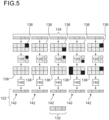
- Figure 5 shows an embodiment of generating of one pixel 132 of the mining digital image 122, such as of an RGB pixel.
- the generating of the pixel 132 is describes as a flow chart from up to down.
- the initial digital image 112 may be provided from the image database.
- the 5 pixels 134 of the initial digital image 112 are depicted which are used for generating the pixel 132 of the mining digital image 122.
- the pixels 134 may be RGB pixels.
- the RGB pixels 134 may be converted into CMYK color pixels 136.
- the CMYK color pixels 136 may be printed by blending pigments with the selected mining printer control setting 120.
- mining printer control settings 120 changing one color of the respective pixels into one other color are shown, e.g.
- the printed pixels 138 of the initial digital image 112 are shown in the next row of Figure 5 .
- the printed pixels 138 may be scanned 140 by using the scanning device thereby generating pixels 142, in particular RGB pixels, of the mining digital image 122.
- the method as shown in the next row of Figure 5 , may comprise pixelating the mining digital image 122 thereby generating the pixel 132 of the mining digital image 122.
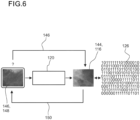
- Figure 6 shows a further illustration of a computer implemented method for proof-of-work for generating and validating a block of a blockchain using at least one printing device.
- the printing device is configured for generating at least one digital image depending on a printer control setting.
- the method comprises the following steps:
Landscapes
- Engineering & Computer Science (AREA)
- Signal Processing (AREA)
- Computer Security & Cryptography (AREA)
- Health & Medical Sciences (AREA)
- General Health & Medical Sciences (AREA)
- Multimedia (AREA)
- Theoretical Computer Science (AREA)
- General Engineering & Computer Science (AREA)
- Biomedical Technology (AREA)
- Physics & Mathematics (AREA)
- General Physics & Mathematics (AREA)
- Computer Networks & Wireless Communication (AREA)
- Computer Hardware Design (AREA)
- Software Systems (AREA)
- Bioethics (AREA)
- Computing Systems (AREA)
- Management, Administration, Business Operations System, And Electronic Commerce (AREA)
- Record Information Processing For Printing (AREA)
- Accessory Devices And Overall Control Thereof (AREA)
Claims (19)
- Procédé mis en œuvre par ordinateur pour preuve de travail afin de générer et valider un bloc d'une chaîne de blocs au moyen d'au moins un dispositif d'impression, dans lequel le dispositif d'impression est conçu pour générer au moins une image numérique en fonction d'un réglage de contrôle d'imprimante, le procédé comprenant les étapes suivantes :i) (110) obtention d'une image numérique initiale (112) comprenant une pluralité de pixels colorés, l'image numérique initiale (110) étant extraite d'une base de données d'images et/ou étant générée par impression et numérisation de l'image numérique initiale au moyen d'un réglage de contrôle d'imprimante initial ;ii) (114) obtention d'une image numérique de tâche (116) comprenant une pluralité de pixels colorés différente de l'image numérique initiale (112) ;iii) (118) sélection d'un réglage de contrôle d'imprimante de minage (120), impression de l'image numérique initiale (112) au moyen du dispositif d'impression par mélange de pigments avec le réglage de contrôle d'imprimante de minage sélectionné (120) et numérisation de l'image imprimée au moyen d'au moins un dispositif de numérisation, pour générer ainsi une image numérique de minage (122) ayant une pluralité de pixels colorés différente de l'image numérique initiale (112) ;iv) (124) comparaison des pixels colorés de l'image numérique de minage (122) et de l'image numérique de tâche (116) au moyen d'au moins un dispositif de traitement ;le procédé comprenant la répétition des étapes ii) (114) à iv) (124) jusqu'à ce que les pixels colorés de l'image numérique de minage (122) et de l'image numérique de tâche (116) se révèlent identiques, dans lequel, dans chaque cas, à l'étape iii) (118), un réglage de contrôle d'imprimante de minage différent (120) est sélectionné, dans lequel le réglage de contrôle d'imprimante de minage (120) pour lequel l'image numérique de minage (122) et l'image numérique de tâche (116) se révèlent identiques est utilisé comme preuve de travail afin de générer et valider le bloc de la chaîne de blocs.
- Procédé selon la revendication précédente, dans lequel une information binaire de réglage de contrôle d'imprimante de minage (120) est utilisée pour générer une chaîne de chiffres à appliquer comme nombre aléatoire afin de générer et valider le bloc de la chaîne de blocs.
- Procédé selon la revendication précédente, dans lequel une taille de nombre aléatoire est déduite du réglage de contrôle d'imprimante de minage, dans lequel la taille du nombre aléatoire est déduite d'un rapport entre un nombre de pixels de l'image numérique initiale (112) et un nombre de pixels pour un même réglage de contrôle d'imprimante.
- Procédé selon l'une quelconque des revendications précédentes, dans lequel le mélange comprend au moins une opération de mélange de pigments de manière définie, pour créer ainsi un mélange.
- Procédé selon la revendication précédente, dans lequel le mélange comprend d'autres étapes telles que des changements de température ou des traitements thermiques des pigments.
- Procédé selon l'une quelconque des revendications précédentes, dans lequel les pigments sont choisis parmi les matériaux organiques naturels et parmi les matériaux organiques de synthèse.
- Procédé selon l'une quelconque des revendications précédentes, dans lequel les pigments sont choisis parmi les matériaux inorganiques, de préférence parmi les oxydes métalliques, mieux encore parmi les oxydes de fer.
- Procédé selon l'une quelconque des revendications précédentes, le procédé comprenant la pixellisation de l'image numérique de minage (122).
- Procédé selon la revendication précédente, dans lequel la comparaison des pixels colorés de l'image numérique de minage (122) et de l'image numérique de tâche (116) est effectuée pixel par pixel.
- Procédé selon l'une quelconque des deux revendications précédentes, le procédé comprenant la détermination d'un code de couleurs de l'image numérique de minage pixellisée (122) par conversion des pixels colorés en chiffres, dans lequel la comparaison des pixels colorés de l'image numérique de minage (122) et de l'image numérique de tâche (116) comprend la comparaison de codes de couleurs de l'image numérique de minage pixellisée (122) et de l'image numérique de tâche (116).
- Procédé selon l'une quelconque des trois revendications précédentes, dans lequel l'image numérique de minage (122) et l'image numérique de tâche (116) sont considérées comme identiques à l'intérieur d'une fourchette de tolérance d'erreur de couleur de pixel de ±30 % pour chacune des couleurs RVB d'un pixel, de préférence de ±10 % pour chacune des couleurs RVB d'un pixel, mieux encore de ±3 % pour chacune des couleurs RVB d'un pixel.
- Procédé selon l'une quelconque des trois revendications précédentes, dans lequel l'image numérique de minage (122) et l'image numérique de tâche (116) sont considérées comme identiques à l'intérieur d'une fourchette de tolérance d'erreur globale de 10 % de pixels déviants, de préférence de 5 % de pixels déviants, mieux encore de 1 % de pixels déviants.
- Procédé selon l'une quelconque des revendications précédentes, dans lequel le réglage de contrôle d'imprimante de minage (120) est sélectionné par itérations.
- Procédé selon l'une quelconque des revendications précédentes, dans lequel le réglage de contrôle d'imprimante de minage (120) est sélectionné par au moins un service en nuage et/ou au moins un dispositif de traitement d'un nœud d'un réseau de chaînes de blocs.
- Procédé selon l'une quelconque des revendications précédentes, dans lequel l'étape i) (110) comprend le dimensionnement et/ou l'inclinaison de l'image numérique initiale (112) par rapport à la dimension et/ou l'inclinaison de l'image numérique de tâche (116).
- Procédé mis en œuvre par ordinateur pour preuve de travail afin de générer et valider un bloc d'une chaîne de blocs au moyen d'au moins un dispositif d'impression, dans lequel le dispositif d'impression est conçu pour générer au moins une image numérique en fonction d'un réglage de contrôle d'imprimante, le procédé comprenant les étapes suivantes :a) obtention d'une image numérique de tâche (116) comprenant une pluralité de pixels colorés et d'un réglage de contrôle d'imprimante de tâche utilisé pour générer l'image numérique de tâche (116) ;b) sélection d'une image numérique initiale de minage ayant une pluralité de pixels colorés différente de l'image numérique de tâche (116), impression de l'image numérique initiale de minage au moyen du dispositif d'impression par mélange de pigments avec le réglage de contrôle d'imprimante de tâche et numérisation de l'image imprimée au moyen d'au moins un dispositif de numérisation, pour générer ainsi une image numérique de tâche de minage ;c) comparaison des pixels colorés de l'image numérique de tâche de minage et de l'image numérique de tâche au moyen d'au moins un dispositif de traitement ;le procédé comprenant la répétition des étapes a) à c) jusqu'à ce que les pixels colorés de l'image numérique de tâche de minage et de l'image numérique de tâche (116) se révèlent identiques, dans lequel, dans chaque cas, à l'étape c), une image numérique initiale de minage différente est sélectionnée, dans lequel l'image numérique initiale de minage pour laquelle l'image numérique de tâche de minage et l'image numérique de tâche (116) se révèlent identiques est utilisée comme preuve de travail afin de générer et valider le bloc de la chaîne de blocs.
- Programme informatique comprenant des instructions qui, lorsque le programme est exécuté par un ou plusieurs processeurs, amènent le processeur à effectuer le procédé selon l'une quelconque des revendications 1 à 15 ou le procédé de la revendication 16.
- Support non transitoire lisible par ordinateur comportant des instructions qui, lorsqu'elles sont exécutées par un ou plusieurs processeurs, amènent le processeur à effectuer le procédé selon l'une quelconque des revendications 1 à 15 ou le procédé de la revendication 16.
- Utilisation d'un procédé mis en œuvre par ordinateur pour preuve de travail selon l'une quelconque des revendications 1 à 15 ou du procédé de la revendication 16, à des fins de minage pour l'échange d'une cryptomonnaie, le traitement sécurisé de transactions dans les domaines des contrats intelligents, des services financiers, des soins de santé, de l'identification des personnes, des cryptomonnaies, de la chaîne logistique.
Applications Claiming Priority (2)
| Application Number | Priority Date | Filing Date | Title |
|---|---|---|---|
| EP21162922.5A EP4060933A1 (fr) | 2021-03-16 | 2021-03-16 | Procédé de preuve de travail |
| PCT/EP2022/056665 WO2022194850A1 (fr) | 2021-03-16 | 2022-03-15 | Exploitation minière écologique à l'aide d'au moins un dispositif d'impression pour preuve de travail |
Publications (2)
| Publication Number | Publication Date |
|---|---|
| EP4309331A1 EP4309331A1 (fr) | 2024-01-24 |
| EP4309331B1 true EP4309331B1 (fr) | 2025-03-12 |
Family
ID=74946998
Family Applications (2)
| Application Number | Title | Priority Date | Filing Date |
|---|---|---|---|
| EP21162922.5A Withdrawn EP4060933A1 (fr) | 2021-03-16 | 2021-03-16 | Procédé de preuve de travail |
| EP22714444.1A Active EP4309331B1 (fr) | 2021-03-16 | 2022-03-15 | Exploitation minière écologique utilisant au moins un dispositif d'impression pour preuve de travail dans un réseau de chaîne de blocs |
Family Applications Before (1)
| Application Number | Title | Priority Date | Filing Date |
|---|---|---|---|
| EP21162922.5A Withdrawn EP4060933A1 (fr) | 2021-03-16 | 2021-03-16 | Procédé de preuve de travail |
Country Status (5)
| Country | Link |
|---|---|
| US (1) | US12462132B2 (fr) |
| EP (2) | EP4060933A1 (fr) |
| JP (1) | JP2024511399A (fr) |
| CN (1) | CN116982289A (fr) |
| WO (1) | WO2022194850A1 (fr) |
Family Cites Families (8)
| Publication number | Priority date | Publication date | Assignee | Title |
|---|---|---|---|---|
| JP6339962B2 (ja) * | 2015-03-31 | 2018-06-06 | 富士フイルム株式会社 | 画像処理装置及び方法、並びにプログラム |
| JP6649173B2 (ja) * | 2016-05-17 | 2020-02-19 | 日本電信電話株式会社 | 仮想通貨管理方法及び仮想通貨管理プログラム |
| LU100142B1 (en) * | 2017-03-20 | 2018-10-01 | Univ Luxembourg | Electronic communication and access-control method |
| WO2019211669A2 (fr) * | 2018-05-03 | 2019-11-07 | Entrust & Title (FZE) | Système et procédé de sécurisation d'exécution et d'authentification de document électronique |
| JP7091852B2 (ja) * | 2018-06-04 | 2022-06-28 | コニカミノルタ株式会社 | 画像処理装置及び画像処理方法 |
| EP3761556A1 (fr) * | 2019-07-04 | 2021-01-06 | Basf Se | Nouveau procédé de génération de nombres pseudo-aléatoires pour le cryptage d'informations |
| EP4080863A1 (fr) * | 2021-04-20 | 2022-10-26 | Basf Se | Signatures et étiquettes dans une chaîne de blocs dérivée d'images numériques |
| EP4187841A1 (fr) * | 2021-11-26 | 2023-05-31 | Basf Se | Preuve de travail via l'impression et la numérisation d'images rvb dérivées de valeurs de hachage |
-
2021
- 2021-03-16 EP EP21162922.5A patent/EP4060933A1/fr not_active Withdrawn
-
2022
- 2022-03-15 EP EP22714444.1A patent/EP4309331B1/fr active Active
- 2022-03-15 US US18/281,967 patent/US12462132B2/en active Active
- 2022-03-15 JP JP2023557458A patent/JP2024511399A/ja active Pending
- 2022-03-15 CN CN202280021122.1A patent/CN116982289A/zh active Pending
- 2022-03-15 WO PCT/EP2022/056665 patent/WO2022194850A1/fr not_active Ceased
Also Published As
| Publication number | Publication date |
|---|---|
| EP4060933A1 (fr) | 2022-09-21 |
| CN116982289A (zh) | 2023-10-31 |
| US12462132B2 (en) | 2025-11-04 |
| EP4309331A1 (fr) | 2024-01-24 |
| US20240305485A1 (en) | 2024-09-12 |
| JP2024511399A (ja) | 2024-03-13 |
| WO2022194850A1 (fr) | 2022-09-22 |
Similar Documents
| Publication | Publication Date | Title |
|---|---|---|
| US20250023739A1 (en) | Proof of work via printing and scanning rgb images derived from hash values | |
| JP7682814B2 (ja) | 情報の暗号化のための新しい擬似乱数生成方法 | |
| US20260017653A1 (en) | Method for building a blockchain | |
| US12236300B2 (en) | Signatures and labels in a blockchain derived from digital images | |
| EP4309331B1 (fr) | Exploitation minière écologique utilisant au moins un dispositif d'impression pour preuve de travail dans un réseau de chaîne de blocs | |
| EP4473695B1 (fr) | Preuve de travail numérique et physique sécurisée par l'informatique quantique | |
| EP4256452B1 (fr) | Distribution de clé pour un système de cryptage physique non copiable |
Legal Events
| Date | Code | Title | Description |
|---|---|---|---|
| STAA | Information on the status of an ep patent application or granted ep patent |
Free format text: STATUS: UNKNOWN |
|
| STAA | Information on the status of an ep patent application or granted ep patent |
Free format text: STATUS: THE INTERNATIONAL PUBLICATION HAS BEEN MADE |
|
| PUAI | Public reference made under article 153(3) epc to a published international application that has entered the european phase |
Free format text: ORIGINAL CODE: 0009012 |
|
| STAA | Information on the status of an ep patent application or granted ep patent |
Free format text: STATUS: REQUEST FOR EXAMINATION WAS MADE |
|
| 17P | Request for examination filed |
Effective date: 20231016 |
|
| AK | Designated contracting states |
Kind code of ref document: A1 Designated state(s): AL AT BE BG CH CY CZ DE DK EE ES FI FR GB GR HR HU IE IS IT LI LT LU LV MC MK MT NL NO PL PT RO RS SE SI SK SM TR |
|
| DAV | Request for validation of the european patent (deleted) | ||
| DAX | Request for extension of the european patent (deleted) | ||
| REG | Reference to a national code |
Ref country code: DE Free format text: PREVIOUS MAIN CLASS: H04L0009320000 Ref legal event code: R079 Ref document number: 602022011724 Country of ref document: DE Ipc: H04L0009400000 |
|
| GRAP | Despatch of communication of intention to grant a patent |
Free format text: ORIGINAL CODE: EPIDOSNIGR1 |
|
| STAA | Information on the status of an ep patent application or granted ep patent |
Free format text: STATUS: GRANT OF PATENT IS INTENDED |
|
| RIC1 | Information provided on ipc code assigned before grant |
Ipc: H04L 9/32 20060101ALI20240919BHEP Ipc: H04L 9/40 20220101AFI20240919BHEP |
|
| INTG | Intention to grant announced |
Effective date: 20241004 |
|
| GRAS | Grant fee paid |
Free format text: ORIGINAL CODE: EPIDOSNIGR3 |
|
| GRAA | (expected) grant |
Free format text: ORIGINAL CODE: 0009210 |
|
| STAA | Information on the status of an ep patent application or granted ep patent |
Free format text: STATUS: THE PATENT HAS BEEN GRANTED |
|
| AK | Designated contracting states |
Kind code of ref document: B1 Designated state(s): AL AT BE BG CH CY CZ DE DK EE ES FI FR GB GR HR HU IE IS IT LI LT LU LV MC MK MT NL NO PL PT RO RS SE SI SK SM TR |
|
| REG | Reference to a national code |
Ref country code: GB Ref legal event code: FG4D |
|
| REG | Reference to a national code |
Ref country code: CH Ref legal event code: EP |
|
| REG | Reference to a national code |
Ref country code: DE Ref legal event code: R096 Ref document number: 602022011724 Country of ref document: DE |
|
| REG | Reference to a national code |
Ref country code: IE Ref legal event code: FG4D |
|
| PGFP | Annual fee paid to national office [announced via postgrant information from national office to epo] |
Ref country code: DE Payment date: 20250327 Year of fee payment: 4 |
|
| PGFP | Annual fee paid to national office [announced via postgrant information from national office to epo] |
Ref country code: AT Payment date: 20250417 Year of fee payment: 4 |
|
| PGFP | Annual fee paid to national office [announced via postgrant information from national office to epo] |
Ref country code: FR Payment date: 20250324 Year of fee payment: 4 |
|
| PG25 | Lapsed in a contracting state [announced via postgrant information from national office to epo] |
Ref country code: RS Free format text: LAPSE BECAUSE OF FAILURE TO SUBMIT A TRANSLATION OF THE DESCRIPTION OR TO PAY THE FEE WITHIN THE PRESCRIBED TIME-LIMIT Effective date: 20250612 |
|
| PG25 | Lapsed in a contracting state [announced via postgrant information from national office to epo] |
Ref country code: FI Free format text: LAPSE BECAUSE OF FAILURE TO SUBMIT A TRANSLATION OF THE DESCRIPTION OR TO PAY THE FEE WITHIN THE PRESCRIBED TIME-LIMIT Effective date: 20250312 |
|
| PG25 | Lapsed in a contracting state [announced via postgrant information from national office to epo] |
Ref country code: ES Free format text: LAPSE BECAUSE OF FAILURE TO SUBMIT A TRANSLATION OF THE DESCRIPTION OR TO PAY THE FEE WITHIN THE PRESCRIBED TIME-LIMIT Effective date: 20250312 |
|
| REG | Reference to a national code |
Ref country code: LT Ref legal event code: MG9D |
|
| PG25 | Lapsed in a contracting state [announced via postgrant information from national office to epo] |
Ref country code: NO Free format text: LAPSE BECAUSE OF FAILURE TO SUBMIT A TRANSLATION OF THE DESCRIPTION OR TO PAY THE FEE WITHIN THE PRESCRIBED TIME-LIMIT Effective date: 20250612 |
|
| PG25 | Lapsed in a contracting state [announced via postgrant information from national office to epo] |
Ref country code: HR Free format text: LAPSE BECAUSE OF FAILURE TO SUBMIT A TRANSLATION OF THE DESCRIPTION OR TO PAY THE FEE WITHIN THE PRESCRIBED TIME-LIMIT Effective date: 20250312 |
|
| REG | Reference to a national code |
Ref country code: NL Ref legal event code: MP Effective date: 20250312 |
|
| PG25 | Lapsed in a contracting state [announced via postgrant information from national office to epo] |
Ref country code: LV Free format text: LAPSE BECAUSE OF FAILURE TO SUBMIT A TRANSLATION OF THE DESCRIPTION OR TO PAY THE FEE WITHIN THE PRESCRIBED TIME-LIMIT Effective date: 20250312 |
|
| PG25 | Lapsed in a contracting state [announced via postgrant information from national office to epo] |
Ref country code: GR Free format text: LAPSE BECAUSE OF FAILURE TO SUBMIT A TRANSLATION OF THE DESCRIPTION OR TO PAY THE FEE WITHIN THE PRESCRIBED TIME-LIMIT Effective date: 20250613 Ref country code: BG Free format text: LAPSE BECAUSE OF FAILURE TO SUBMIT A TRANSLATION OF THE DESCRIPTION OR TO PAY THE FEE WITHIN THE PRESCRIBED TIME-LIMIT Effective date: 20250312 |
|
| PG25 | Lapsed in a contracting state [announced via postgrant information from national office to epo] |
Ref country code: AT Free format text: LAPSE BECAUSE OF FAILURE TO SUBMIT A TRANSLATION OF THE DESCRIPTION OR TO PAY THE FEE WITHIN THE PRESCRIBED TIME-LIMIT Effective date: 20250312 |
|
| REG | Reference to a national code |
Ref country code: AT Ref legal event code: MK05 Ref document number: 1775961 Country of ref document: AT Kind code of ref document: T Effective date: 20250312 |
|
| PG25 | Lapsed in a contracting state [announced via postgrant information from national office to epo] |
Ref country code: NL Free format text: LAPSE BECAUSE OF FAILURE TO SUBMIT A TRANSLATION OF THE DESCRIPTION OR TO PAY THE FEE WITHIN THE PRESCRIBED TIME-LIMIT Effective date: 20250312 |
|
| PG25 | Lapsed in a contracting state [announced via postgrant information from national office to epo] |
Ref country code: SE Free format text: LAPSE BECAUSE OF FAILURE TO SUBMIT A TRANSLATION OF THE DESCRIPTION OR TO PAY THE FEE WITHIN THE PRESCRIBED TIME-LIMIT Effective date: 20250312 |
|
| PG25 | Lapsed in a contracting state [announced via postgrant information from national office to epo] |
Ref country code: SM Free format text: LAPSE BECAUSE OF FAILURE TO SUBMIT A TRANSLATION OF THE DESCRIPTION OR TO PAY THE FEE WITHIN THE PRESCRIBED TIME-LIMIT Effective date: 20250312 |
|
| PG25 | Lapsed in a contracting state [announced via postgrant information from national office to epo] |
Ref country code: PT Free format text: LAPSE BECAUSE OF FAILURE TO SUBMIT A TRANSLATION OF THE DESCRIPTION OR TO PAY THE FEE WITHIN THE PRESCRIBED TIME-LIMIT Effective date: 20250714 |
|
| PG25 | Lapsed in a contracting state [announced via postgrant information from national office to epo] |
Ref country code: IT Free format text: LAPSE BECAUSE OF FAILURE TO SUBMIT A TRANSLATION OF THE DESCRIPTION OR TO PAY THE FEE WITHIN THE PRESCRIBED TIME-LIMIT Effective date: 20250312 Ref country code: PL Free format text: LAPSE BECAUSE OF FAILURE TO SUBMIT A TRANSLATION OF THE DESCRIPTION OR TO PAY THE FEE WITHIN THE PRESCRIBED TIME-LIMIT Effective date: 20250312 |
|
| PG25 | Lapsed in a contracting state [announced via postgrant information from national office to epo] |
Ref country code: EE Free format text: LAPSE BECAUSE OF FAILURE TO SUBMIT A TRANSLATION OF THE DESCRIPTION OR TO PAY THE FEE WITHIN THE PRESCRIBED TIME-LIMIT Effective date: 20250312 Ref country code: CZ Free format text: LAPSE BECAUSE OF FAILURE TO SUBMIT A TRANSLATION OF THE DESCRIPTION OR TO PAY THE FEE WITHIN THE PRESCRIBED TIME-LIMIT Effective date: 20250312 |
|
| PG25 | Lapsed in a contracting state [announced via postgrant information from national office to epo] |
Ref country code: RO Free format text: LAPSE BECAUSE OF FAILURE TO SUBMIT A TRANSLATION OF THE DESCRIPTION OR TO PAY THE FEE WITHIN THE PRESCRIBED TIME-LIMIT Effective date: 20250312 |
|
| REG | Reference to a national code |
Ref country code: CH Ref legal event code: H13 Free format text: ST27 STATUS EVENT CODE: U-0-0-H10-H13 (AS PROVIDED BY THE NATIONAL OFFICE) Effective date: 20251024 |
|
| PG25 | Lapsed in a contracting state [announced via postgrant information from national office to epo] |
Ref country code: SK Free format text: LAPSE BECAUSE OF FAILURE TO SUBMIT A TRANSLATION OF THE DESCRIPTION OR TO PAY THE FEE WITHIN THE PRESCRIBED TIME-LIMIT Effective date: 20250312 |
|
| PG25 | Lapsed in a contracting state [announced via postgrant information from national office to epo] |
Ref country code: IS Free format text: LAPSE BECAUSE OF FAILURE TO SUBMIT A TRANSLATION OF THE DESCRIPTION OR TO PAY THE FEE WITHIN THE PRESCRIBED TIME-LIMIT Effective date: 20250712 |
|
| PG25 | Lapsed in a contracting state [announced via postgrant information from national office to epo] |
Ref country code: LU Free format text: LAPSE BECAUSE OF NON-PAYMENT OF DUE FEES Effective date: 20250315 |
|
| REG | Reference to a national code |
Ref country code: BE Ref legal event code: MM Effective date: 20250331 |
|
| REG | Reference to a national code |
Ref country code: DE Ref legal event code: R097 Ref document number: 602022011724 Country of ref document: DE |
|
| PG25 | Lapsed in a contracting state [announced via postgrant information from national office to epo] |
Ref country code: MC Free format text: LAPSE BECAUSE OF FAILURE TO SUBMIT A TRANSLATION OF THE DESCRIPTION OR TO PAY THE FEE WITHIN THE PRESCRIBED TIME-LIMIT Effective date: 20250312 |
|
| PG25 | Lapsed in a contracting state [announced via postgrant information from national office to epo] |
Ref country code: DK Free format text: LAPSE BECAUSE OF FAILURE TO SUBMIT A TRANSLATION OF THE DESCRIPTION OR TO PAY THE FEE WITHIN THE PRESCRIBED TIME-LIMIT Effective date: 20250312 |
|
| PG25 | Lapsed in a contracting state [announced via postgrant information from national office to epo] |
Ref country code: BE Free format text: LAPSE BECAUSE OF NON-PAYMENT OF DUE FEES Effective date: 20250331 |
|
| PLBE | No opposition filed within time limit |
Free format text: ORIGINAL CODE: 0009261 |
|
| STAA | Information on the status of an ep patent application or granted ep patent |
Free format text: STATUS: NO OPPOSITION FILED WITHIN TIME LIMIT |
|
| PG25 | Lapsed in a contracting state [announced via postgrant information from national office to epo] |
Ref country code: CH Free format text: LAPSE BECAUSE OF NON-PAYMENT OF DUE FEES Effective date: 20250331 |
|
| PG25 | Lapsed in a contracting state [announced via postgrant information from national office to epo] |
Ref country code: IE Free format text: LAPSE BECAUSE OF NON-PAYMENT OF DUE FEES Effective date: 20250315 |
|
| REG | Reference to a national code |
Ref country code: CH Ref legal event code: L10 Free format text: ST27 STATUS EVENT CODE: U-0-0-L10-L00 (AS PROVIDED BY THE NATIONAL OFFICE) Effective date: 20260121 |