EP4308798B1 - Dispositif de centrage et de guidage d'un arbre de turbomachine d'aéronef - Google Patents
Dispositif de centrage et de guidage d'un arbre de turbomachine d'aéronef Download PDFInfo
- Publication number
- EP4308798B1 EP4308798B1 EP22713701.5A EP22713701A EP4308798B1 EP 4308798 B1 EP4308798 B1 EP 4308798B1 EP 22713701 A EP22713701 A EP 22713701A EP 4308798 B1 EP4308798 B1 EP 4308798B1
- Authority
- EP
- European Patent Office
- Prior art keywords
- support
- ring
- elements
- axis
- connecting elements
- Prior art date
- Legal status (The legal status is an assumption and is not a legal conclusion. Google has not performed a legal analysis and makes no representation as to the accuracy of the status listed.)
- Active
Links
Images

Classifications
-
- F—MECHANICAL ENGINEERING; LIGHTING; HEATING; WEAPONS; BLASTING
- F02—COMBUSTION ENGINES; HOT-GAS OR COMBUSTION-PRODUCT ENGINE PLANTS
- F02C—GAS-TURBINE PLANTS; AIR INTAKES FOR JET-PROPULSION PLANTS; CONTROLLING FUEL SUPPLY IN AIR-BREATHING JET-PROPULSION PLANTS
- F02C7/00—Features, components parts, details or accessories, not provided for in, or of interest apart form groups F02C1/00 - F02C6/00; Air intakes for jet-propulsion plants
- F02C7/06—Arrangements of bearings; Lubricating
-
- F—MECHANICAL ENGINEERING; LIGHTING; HEATING; WEAPONS; BLASTING
- F01—MACHINES OR ENGINES IN GENERAL; ENGINE PLANTS IN GENERAL; STEAM ENGINES
- F01D—NON-POSITIVE DISPLACEMENT MACHINES OR ENGINES, e.g. STEAM TURBINES
- F01D25/00—Component parts, details, or accessories, not provided for in, or of interest apart from, other groups
- F01D25/16—Arrangement of bearings; Supporting or mounting bearings in casings
- F01D25/162—Bearing supports
-
- F—MECHANICAL ENGINEERING; LIGHTING; HEATING; WEAPONS; BLASTING
- F01—MACHINES OR ENGINES IN GENERAL; ENGINE PLANTS IN GENERAL; STEAM ENGINES
- F01D—NON-POSITIVE DISPLACEMENT MACHINES OR ENGINES, e.g. STEAM TURBINES
- F01D25/00—Component parts, details, or accessories, not provided for in, or of interest apart from, other groups
- F01D25/16—Arrangement of bearings; Supporting or mounting bearings in casings
- F01D25/162—Bearing supports
- F01D25/164—Flexible supports; Vibration damping means associated with the bearing
-
- F—MECHANICAL ENGINEERING; LIGHTING; HEATING; WEAPONS; BLASTING
- F04—POSITIVE - DISPLACEMENT MACHINES FOR LIQUIDS; PUMPS FOR LIQUIDS OR ELASTIC FLUIDS
- F04D—NON-POSITIVE-DISPLACEMENT PUMPS
- F04D29/00—Details, component parts, or accessories
- F04D29/05—Shafts or bearings, or assemblies thereof, specially adapted for elastic fluid pumps
- F04D29/056—Bearings
- F04D29/059—Roller bearings
-
- F—MECHANICAL ENGINEERING; LIGHTING; HEATING; WEAPONS; BLASTING
- F16—ENGINEERING ELEMENTS AND UNITS; GENERAL MEASURES FOR PRODUCING AND MAINTAINING EFFECTIVE FUNCTIONING OF MACHINES OR INSTALLATIONS; THERMAL INSULATION IN GENERAL
- F16C—SHAFTS; FLEXIBLE SHAFTS; ELEMENTS OR CRANKSHAFT MECHANISMS; ROTARY BODIES OTHER THAN GEARING ELEMENTS; BEARINGS
- F16C19/00—Bearings with rolling contact, for exclusively rotary movement
- F16C19/22—Bearings with rolling contact, for exclusively rotary movement with bearing rollers essentially of the same size in one or more circular rows, e.g. needle bearings
- F16C19/24—Bearings with rolling contact, for exclusively rotary movement with bearing rollers essentially of the same size in one or more circular rows, e.g. needle bearings for radial load mainly
- F16C19/26—Bearings with rolling contact, for exclusively rotary movement with bearing rollers essentially of the same size in one or more circular rows, e.g. needle bearings for radial load mainly with a single row of rollers
-
- F—MECHANICAL ENGINEERING; LIGHTING; HEATING; WEAPONS; BLASTING
- F16—ENGINEERING ELEMENTS AND UNITS; GENERAL MEASURES FOR PRODUCING AND MAINTAINING EFFECTIVE FUNCTIONING OF MACHINES OR INSTALLATIONS; THERMAL INSULATION IN GENERAL
- F16C—SHAFTS; FLEXIBLE SHAFTS; ELEMENTS OR CRANKSHAFT MECHANISMS; ROTARY BODIES OTHER THAN GEARING ELEMENTS; BEARINGS
- F16C27/00—Elastic or yielding bearings or bearing supports, for exclusively rotary movement
- F16C27/04—Ball or roller bearings, e.g. with resilient rolling bodies
-
- F—MECHANICAL ENGINEERING; LIGHTING; HEATING; WEAPONS; BLASTING
- F16—ENGINEERING ELEMENTS AND UNITS; GENERAL MEASURES FOR PRODUCING AND MAINTAINING EFFECTIVE FUNCTIONING OF MACHINES OR INSTALLATIONS; THERMAL INSULATION IN GENERAL
- F16C—SHAFTS; FLEXIBLE SHAFTS; ELEMENTS OR CRANKSHAFT MECHANISMS; ROTARY BODIES OTHER THAN GEARING ELEMENTS; BEARINGS
- F16C27/00—Elastic or yielding bearings or bearing supports, for exclusively rotary movement
- F16C27/04—Ball or roller bearings, e.g. with resilient rolling bodies
- F16C27/045—Ball or roller bearings, e.g. with resilient rolling bodies with a fluid film, e.g. squeeze film damping
-
- F—MECHANICAL ENGINEERING; LIGHTING; HEATING; WEAPONS; BLASTING
- F16—ENGINEERING ELEMENTS AND UNITS; GENERAL MEASURES FOR PRODUCING AND MAINTAINING EFFECTIVE FUNCTIONING OF MACHINES OR INSTALLATIONS; THERMAL INSULATION IN GENERAL
- F16F—SPRINGS; SHOCK-ABSORBERS; MEANS FOR DAMPING VIBRATION
- F16F15/00—Suppression of vibrations in systems; Means or arrangements for avoiding or reducing out-of-balance forces, e.g. due to motion
- F16F15/02—Suppression of vibrations of non-rotating, e.g. reciprocating systems; Suppression of vibrations of rotating systems by use of members not moving with the rotating systems
- F16F15/023—Suppression of vibrations of non-rotating, e.g. reciprocating systems; Suppression of vibrations of rotating systems by use of members not moving with the rotating systems using fluid means
- F16F15/0237—Suppression of vibrations of non-rotating, e.g. reciprocating systems; Suppression of vibrations of rotating systems by use of members not moving with the rotating systems using fluid means involving squeeze-film damping
-
- F—MECHANICAL ENGINEERING; LIGHTING; HEATING; WEAPONS; BLASTING
- F04—POSITIVE - DISPLACEMENT MACHINES FOR LIQUIDS; PUMPS FOR LIQUIDS OR ELASTIC FLUIDS
- F04D—NON-POSITIVE-DISPLACEMENT PUMPS
- F04D29/00—Details, component parts, or accessories
- F04D29/66—Combating cavitation, whirls, noise, vibration or the like; Balancing
- F04D29/661—Combating cavitation, whirls, noise, vibration or the like; Balancing especially adapted for elastic fluid pumps
- F04D29/668—Combating cavitation, whirls, noise, vibration or the like; Balancing especially adapted for elastic fluid pumps damping or preventing mechanical vibrations
-
- F—MECHANICAL ENGINEERING; LIGHTING; HEATING; WEAPONS; BLASTING
- F05—INDEXING SCHEMES RELATING TO ENGINES OR PUMPS IN VARIOUS SUBCLASSES OF CLASSES F01-F04
- F05D—INDEXING SCHEME FOR ASPECTS RELATING TO NON-POSITIVE-DISPLACEMENT MACHINES OR ENGINES, GAS-TURBINES OR JET-PROPULSION PLANTS
- F05D2240/00—Components
- F05D2240/50—Bearings
-
- F—MECHANICAL ENGINEERING; LIGHTING; HEATING; WEAPONS; BLASTING
- F05—INDEXING SCHEMES RELATING TO ENGINES OR PUMPS IN VARIOUS SUBCLASSES OF CLASSES F01-F04
- F05D—INDEXING SCHEME FOR ASPECTS RELATING TO NON-POSITIVE-DISPLACEMENT MACHINES OR ENGINES, GAS-TURBINES OR JET-PROPULSION PLANTS
- F05D2240/00—Components
- F05D2240/50—Bearings
- F05D2240/54—Radial bearings
-
- F—MECHANICAL ENGINEERING; LIGHTING; HEATING; WEAPONS; BLASTING
- F05—INDEXING SCHEMES RELATING TO ENGINES OR PUMPS IN VARIOUS SUBCLASSES OF CLASSES F01-F04
- F05D—INDEXING SCHEME FOR ASPECTS RELATING TO NON-POSITIVE-DISPLACEMENT MACHINES OR ENGINES, GAS-TURBINES OR JET-PROPULSION PLANTS
- F05D2250/00—Geometry
- F05D2250/70—Shape
- F05D2250/75—Shape given by its similarity to a letter, e.g. T-shaped
-
- F—MECHANICAL ENGINEERING; LIGHTING; HEATING; WEAPONS; BLASTING
- F05—INDEXING SCHEMES RELATING TO ENGINES OR PUMPS IN VARIOUS SUBCLASSES OF CLASSES F01-F04
- F05D—INDEXING SCHEME FOR ASPECTS RELATING TO NON-POSITIVE-DISPLACEMENT MACHINES OR ENGINES, GAS-TURBINES OR JET-PROPULSION PLANTS
- F05D2260/00—Function
- F05D2260/96—Preventing, counteracting or reducing vibration or noise
-
- F—MECHANICAL ENGINEERING; LIGHTING; HEATING; WEAPONS; BLASTING
- F16—ENGINEERING ELEMENTS AND UNITS; GENERAL MEASURES FOR PRODUCING AND MAINTAINING EFFECTIVE FUNCTIONING OF MACHINES OR INSTALLATIONS; THERMAL INSULATION IN GENERAL
- F16C—SHAFTS; FLEXIBLE SHAFTS; ELEMENTS OR CRANKSHAFT MECHANISMS; ROTARY BODIES OTHER THAN GEARING ELEMENTS; BEARINGS
- F16C2360/00—Engines or pumps
- F16C2360/23—Gas turbine engines
-
- Y—GENERAL TAGGING OF NEW TECHNOLOGICAL DEVELOPMENTS; GENERAL TAGGING OF CROSS-SECTIONAL TECHNOLOGIES SPANNING OVER SEVERAL SECTIONS OF THE IPC; TECHNICAL SUBJECTS COVERED BY FORMER USPC CROSS-REFERENCE ART COLLECTIONS [XRACs] AND DIGESTS
- Y02—TECHNOLOGIES OR APPLICATIONS FOR MITIGATION OR ADAPTATION AGAINST CLIMATE CHANGE
- Y02T—CLIMATE CHANGE MITIGATION TECHNOLOGIES RELATED TO TRANSPORTATION
- Y02T50/00—Aeronautics or air transport
- Y02T50/60—Efficient propulsion technologies, e.g. for aircraft
Definitions
- the present invention relates to a device for centering and guiding an aircraft turbomachine shaft, as well as an aircraft turbomachine.
- An aircraft turbomachine comprises shafts, such as a low pressure shaft and a high pressure shaft, which are centered and guided in rotation by bearings, generally rolling bearings and for example roller or ball bearings.
- a rolling bearing comprises outer and inner rings between which the rollers or balls are arranged.
- the inner ring is secured to the shaft to be guided and the outer ring is fixed to a bearing support which is a rigid part of the stator of the turbomachine.
- a turbomachine shaft can reach a very high speed, typically between 2,000 and 30,000 revolutions per minute. Such speeds induce excitations of the shafts' natural modes which can have harmful effects on the engine if the mode responds strongly.
- the bearings are generally associated with flexible cages which make it possible to relax the boundary conditions of the shaft and which lower the frequency of the natural mode.
- the mode less high in speed, then responds less strongly.
- the term "flexible cage” means a member or assembly that provides a flexible connection between the outer ring of a bearing and its support.
- the flexibility of this cage is generally ensured by an elastic deformation capacity of this cage, for example in torsion and/or bending.
- the cage comprises at least one series of columns distributed around the axis of the bearing and extending substantially parallel to this axis.
- a cage of this type comprises generally an inner cylindrical wall to which the outer ring of the bearing is fixed or integrated, and an outer cylindrical wall or flange for fixing to the bearing support.
- the walls are connected together by a series of generally C- or L-shaped columns, or by two series of columns extending around each other and connected together. The columns and walls are then formed in one piece.
- a second technology described in the document FR-A1-3 009 843 relates to a cage obtained by assembling independent columns with the support and the ring.
- Each column comprises an elongated body connected to a first longitudinal end for fixing to the support and to a second longitudinal end for fixing to the ring.
- the body has a circular cross-section, i.e. an axisymmetric shape (the cross-sectional shape of the body of the column has symmetry with respect to the longitudinal axis of this body).
- the flexible cage equipped with these columns also has an axisymmetric shape and its stiffness is identical regardless of the transverse direction of the stress forces on the cage.
- the state of the art also includes technologies described by US-B1-10 794 222 , DE-A4-10 2017 100572 , FR-A1-3 096 072 Or DE-A1-10 2012 221369 .
- the invention proposes an improvement to these technologies, which in particular makes it possible to adapt the stiffness of the flexible cage depending on the direction of stress.
- the ring, the support and the connecting elements are formed in a single piece, for example by additive manufacturing. This makes it possible to simplify the manufacture of the device by eliminating assembly and adjustment steps.
- the distribution of the connecting elements around the device and their inclination relative to a radial direction which is specific to each of the elements makes it possible to adjust the stiffness of the device in the aforementioned directions.
- a device according to the prior art equipped with columns with axisymmetric bodies has the same stiffness in all transverse directions (perpendicular to the axis), regardless of the position of the columns around their respective axes.
- the invention makes it possible to give the device different stiffnesses according to the transverse directions of stress.
- the device comprises at least two different stiffnesses in transverse directions relative to the axis of the shaft. It is in fact particularly interesting for stabilizing a shaft to provide different stiffnesses in two transverse directions perpendicular to each other because this makes it possible to delay the speed at which instabilities of the shaft guided by the device appear.
- the invention also relates to an aircraft turbomachine, comprising at least one device as described above.
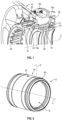
- FIG. 1 represents a first single-piece flexible cage technology 10 according to the prior art.
- the flexible cage 10 ensures the connection of an external ring 12 of a rolling bearing 14 to an annular support 16 of this bearing 14.
- the bearing 14 comprises, in addition to the outer ring 12, an inner ring 18 which is integral with a shaft of the turbomachine which is not shown.
- the rings 12, 18 define a roller raceway in the example shown.
- the external ring 12 is here integrated into an internal cylindrical wall 10a of the cage 10 which comprises a radially external annular flange 10b for fixing to the support 16 by screw-nut type means not shown.
- the cage 10 here comprises two series of columns 20, 22, respectively radially internal and external relative to the axis X of the bearing 14 and the shaft which it guides.
- the axis X corresponds to the engine axis of the turbomachine.
- the columns 20, 22 are distributed around the axis X and extend parallel to this axis.
- the columns 20 extend around the columns 22 and have a first of their longitudinal ends which is connected to the flange 10b, and a second of their longitudinal ends which is connected to the other columns 22 by an annular portion 24 with a C-section of the cage 10.
- the columns 22 extend from the wall 10a, in the extension thereof, to this portion 24.
- the support 16 is part of a stator of the turbomachine and here has a substantially truncated general shape. At its internal periphery, it comprises an internal cylindrical surface 16a for hooping a ring 26 which extends around the wall 10a of the cage and which defines with the latter an annular space 28 supplied with oil in order to form a film of oil for damping the vibrations transmitted by the bearing 14 in operation.
- the stiffness of the cage 10 and the bearing 14 is the same in all transverse directions (perpendicular to the X axis).
- the frequencies of the modes created will frame the frequency of the initial single mode.
- Control of the movements of the shaft according to the azimuth can also be used to improve the performance of the engine. Indeed, under mechanical or thermal loading the frame of the engine deforms, these distortions generate different openings and closings of clearances according to the azimuth. This implies a degradation of the performance of the engine which could be limited if the dynamic movement is optimized to compensate for part of the distortion, for example by stiffening the flexible cage in the direction of the clearance closing and by softening it in the direction of the clearance opening.
- the present invention makes it possible to meet this need thanks to elements connecting the ring 12 to the support 16, which are formed in a single piece with the ring and the support.
- FIGS 2 to 4 illustrate an embodiment of a device, according to the invention, for centering and guiding an aircraft turbomachine shaft.
- the device is symmetrical with respect to a median plane P perpendicular to an axis X, as shown in figure 2 .
- This means that the device has two identical axial ends. In other words, what is described below for a first axial end of the device also applies to the other axial end, opposite the first.
- the ring 12, the support 16 and the connecting elements 40 are formed in a single piece.
- the device is a single piece.
- the support 16 is here also formed in a single piece with the ring 12 and the elements 40.
- the outer ring 12 comprises a cylindrical portion 12b which has at its outer periphery an outer cylindrical surface 12d defining with the support 16 an annular space 50 for forming a damping oil film.
- the ring 12 also comprises at each of its ends an internal cylindrical rim 12c extending in the axial extension of the cylindrical portion 12b.
- An internal cylindrical rim 12c is understood to mean a rim which extends, in the axial extension of the ring 12, as close as possible to the axis X.
- the thickness of the rim 12c is less than the thickness of the cylindrical portion 12b of the ring 12.
- the support 16 comprises a cylindrical portion 16b which extends at least partly around the cylindrical portion 12b of the ring 12.
- the cylindrical portion 16b comprises at its internal periphery an internal cylindrical surface 16a defining with the external cylindrical surface 12d the aforementioned annular space 50 for forming a damping oil film.
- the support 16 comprises at least one oil supply orifice 52 and at least one oil discharge orifice, each of these orifices communicating with the annular space 50. These orifices are located on the external periphery of the cylindrical part 16b.
- the supply orifice 52 can open into a first annular groove, not visible here, which makes it possible to ensure an equal distribution of the oil in the annular space 50. In the case where several supply orifices 52 are present, several first annular grooves ensure the distribution of the oil
- the support 16 also comprises at each of its ends an external cylindrical rim 16c which extends in the axial extension of the cylindrical part 16b, and which extends around the internal rim 12c.
- An external cylindrical rim 16c is understood to mean a rim which extends, in the axial extension of the support 16, as far as possible from the axis X.
- the thickness of the rim 16c is less than the thickness of the cylindrical part of the support 16.
- the internal cylindrical rim 12c may be called the first cylindrical rim 12c and the external cylindrical rim 16c may be called the second cylindrical rim 16c.
- the connecting elements 40 are located at an axial end of the annular space 50. They are located on a circumference C1 having a diameter substantially equal to the diameter of the space 50. This means that the geometric center of each of the elements 40 is located on this circumference C1. It is understood that a portion of the shape of the element 40 may be outside this circumference C1, in other words a portion of the element 40 may be located on a circumference with a diameter substantially greater or less than the diameter of the circumference C1.
- the connecting elements 40 are elastically deformable and can be formed by blades, themselves elastically deformable.
- a blade is understood to mean a strip that is thin and long, the thickness of which is less than the width, width which extends in a direction substantially parallel to the axis X.
- the blades are interposed between the internal cylindrical rim 12c of the ring 12 and the external cylindrical rim 16c of the support 16.
- each of the blades is connected to the rim 16c of the support 16 by its first end 40a, radially external, and to the rim 12c of the ring 12 by its second end 40b, radially internal.
- the connecting elements 40 are enclosed in an annular housing 60.
- This housing 60 is delimited radially by the internal cylindrical rim 12c and the external cylindrical rim 16c, and is closed laterally by the cumulative excess thickness of the cylindrical parts 12b, 16b, between which the annular space 50 extends, and by an annular web 62.
- the term web 62 means a wall that is thin, in particular the thickness of the web 62 is less than the thickness of the rims 12c, 16c that it connects by being formed in one piece with the ring 12 and the support 16.
- the web 62 is elastically deformable and can take a corrugated shape in the radial direction.
- the web 62 can, for example, take a general bellows shape or have an ⁇ shape in section.
- Such a shape allows the web 62 to be able to absorb the relative movements between the ring 12 and the support 16 in an axial direction.
- the web 62 also has the advantage of ensuring lateral sealing of the annular space 50 for forming the damping oil film. Indeed, since the web 62 is in one piece with the ring 12 and the support 16, the oil cannot escape laterally from the device.
- the housing 60 can contain oil coming from the annular space 50.
- the connecting elements 40 can be immersed in oil.
- At least one oil evacuation hole may be present in the housing 60. This hole is calibrated so as to evacuate the oil from the housing 60 with a flow rate equivalent to the oil flow rate necessary for the formation of the damping oil film in the annular space 50. Furthermore, to ensure better evacuation, the holes may open into a second annular groove.
- annular segments axially delimit the annular space 50. It is understood that only the annular space 50 contains oil. Each segment comprises a leak calibrated so as to evacuate the oil from the annular space 50 with a flow rate substantially lower than the supply flow rate of the annular space 50. This leak is calibrated to have a flow rate substantially lower than the evacuation flow rate of the evacuation hole of the housing 60. The oil is evacuated via an outlet at a low point.
- the blades each have a general “S” shape. Such a shape has the advantage of having curvatures 41a, 41b at the ends 40a, 40b of the blade. Indeed, a first curvature 41a, at the first end 40a, is oriented in a first direction, and a second curvature 41b, at the second end 40b, is oriented in a second direction, opposite to the first.
- An "S" shape also has the advantage of having a center of symmetry.
- This center of symmetry corresponds to the geometric center of the shape and is substantially located on the circumference C1.
- a first junction between the first end 40a and the support 16 is symmetrical, with respect to this center of symmetry, to a second junction between the second end 40b and the ring 12.
- the first junction, the second junction and the center of symmetry, located in the same plane are radially aligned with the center of the device through which the axis X passes.
- Another advantage of the “S” shape is to give the elements 40 at least two different stiffnesses depending on the direction of a stress. Indeed, with a so-called vertical stress, that is to say in a direction tangent to the curvatures 41a, 41b, the elements 40 can deform. The curvatures 41a, 41b ensure the flexibility of the elements 40. With a so-called horizontal stress, perpendicular to the vertical stress, the elements 40 do not deform.
- This “S” shape is not limiting and the blades can adopt any shape offering different stiffness in two directions in a plane orthogonal to the axis of rotation of the motor shaft, in other words the X axis.
- the connecting elements 40 are arranged around the X axis. They can be distributed with a regular pitch, that is to say that between two consecutive elements 40, the distance is identical. They can also be distributed with an irregular pitch, that is to say that the distance between the elements 40 can vary. In a non-limiting example, there can be a first set of elements 40, spaced from each other by the same distance or the same pitch, and a second set of elements 40, spaced from each other by the same distance but spaced from the first set by a different distance. It is thus understood that the pitch between the elements 40 can be regular and/or irregular.
- the device can be produced by additive manufacturing. This can be metal additive manufacturing, for example by powder sintering. Since the device can comprise elements 40 with a particular conformation, such a technique allows, among other things, a simplified production of the device, by eliminating assembly and adjustment steps. In addition, this allows the configuration of the parts to be easily and quickly modified during the development phase.
- a set of elements 40 is distributed around the X axis. It is understood that the cage 10 is not axisymmetric with respect to the X axis and its stiffness is also not axisymmetric.
- Each of the elements 40 is arranged with a given inclination with respect to the radial direction. In other words, each element 40 has an inclination with respect to the radial direction which is specific to it. In this way, an overall stiffness is obtained when the device is stressed in a first direction (arrow F1), or in a second direction (arrow F2) orthogonal to the first direction.
- the first direction can for example be vertical and the second direction, orthogonal to the first, can for example be horizontal. Thanks to this given inclination, it is understood that each element 40 deforms differently according to the stresses F1 or F2, and has a stiffness which is specific to it. In this way, all the elements 40 work, which makes it possible to limit the concentration of stresses.
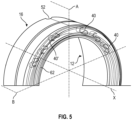
- the device is similar to what was previously described. It comprises a first set of elements 40 and a second set of elements 40'.
- the second set of elements 40' is symmetrical to the first set of elements 40 with respect to a plane A of symmetry.
- the device may also comprise, although not shown here, two other sets of elements 40, 40': a third set of elements 40' and a fourth set of elements 40.
- the third set of elements 40' may be positioned opposite the first set of elements 40 with respect to a plane B of symmetry. It is understood that this third set is identical to the second set.
- the fourth set of elements 40 may be positioned opposite the second set of elements 40' with respect to the plane B, the fourth set being symmetrical to the second set. It is understood that the fourth set is also symmetrical to the third set with respect to plane A and it is also understood that the fourth set is identical to the first set of elements 40.
- a given first step separates the elements 40, 40' for each set of elements 40, 40'. It is understood that this first step is identical for each of the sets.
- a second step different from the first step, separates each set. This second step can be less than or greater than the first step.
- the invention also relates to an aircraft turbomachine comprising at least one device as described above.
- the device and the flexible cage according to the invention are thus advantageous insofar as the stiffness of the cage is different depending on the angular position of the force transmitted to the cage in a direction transverse to its main axis. It is in fact particularly interesting for stabilizing a shaft to provide different stiffnesses in different transverse directions because this makes it possible to delay the speed of appearance of instabilities of the shaft guided by the device.
Landscapes
- Engineering & Computer Science (AREA)
- General Engineering & Computer Science (AREA)
- Mechanical Engineering (AREA)
- Chemical & Material Sciences (AREA)
- Combustion & Propulsion (AREA)
- Physics & Mathematics (AREA)
- Acoustics & Sound (AREA)
- Aviation & Aerospace Engineering (AREA)
- Rolling Contact Bearings (AREA)
- Support Of The Bearing (AREA)
- Structures Of Non-Positive Displacement Pumps (AREA)
Description
- La présente invention concerne un dispositif de centrage et de guidage d'un arbre de turbomachine d'aéronef, ainsi qu'une turbomachine d'aéronef.
- Une turbomachine d'aéronef comprend des arbres, tels qu'un arbre basse pression et un arbre haute pression, qui sont centrés et guidés en rotation par des paliers, en général à roulement et par exemple à rouleaux ou billes.
- Un palier à roulement comprend des bagues externe et interne entre lesquelles sont disposés les rouleaux ou les billes. La bague interne est solidaire de l'arbre à guider et la bague externe est fixée à un support de palier qui est une pièce rigide de stator de la turbomachine.
- Un arbre de turbomachine peut atteindre un régime très important, typiquement entre 2 000 et 30 000 tours par minute. De tels régimes induisent des excitations des modes propres des arbres qui peuvent avoir des effets néfastes sur le moteur si le mode répond fortement.
- Afin de contrôler la position du mode, les paliers sont en général associés à des cages souples qui permettent d'assouplir les conditions aux limites de l'arbre et qui abaissent la fréquence du mode propre. Le mode, moins haut en régime, répond alors moins fortement.
- Dans la présente demande, on entend par « cage souple », un organe ou un assemblage qui assure une liaison souple entre la bague externe d'un palier et son support. La souplesse de cette cage est en général assurée par une capacité de déformation élastique de cette cage, par exemple en torsion et/ou en flexion. Pour conférer cette capacité, la cage comprend au moins une série de colonnettes réparties autour de l'axe du palier et s'étendant sensiblement parallèlement à cet axe.
- Il existe à ce jour deux technologies de cage souple pour palier.
- La première technologie décrite dans les documents
FR-A1-3 009 843 FR-A1-3 078 370 - Une seconde technologie décrite dans le document
FR-A1-3 009 843 - L'état de la technique comprend également des technologies décrites par
US-B1-10 794 222 DE-A4-10 2017 100572 FR-A1-3 096 072 DE-A1-10 2012 221369 - L'invention propose un perfectionnement à ces technologies, qui permet notamment d'adapter la raideur de la cage souple en fonction de la direction de sollicitation.
- L'invention propose un dispositif de centrage et de guidage d'un arbre de turbomachine d'aéronef, ce dispositif comportant :
- une bague externe d'un palier à roulement, cette bague s'étendant autour d'un axe,
- un support annulaire de palier s'étendant autour de l'axe et au moins en partie autour de la bague,
- au moins une série d'éléments de liaison de la bague au support, ces éléments étant élastiquement déformables et répartis autour de l'axe avec une inclinaison par rapport à une direction radiale qui est propre à chaque élément, la bague, le support et les éléments de liaison étant formés d'une seule pièce, caractérisé en ce que lesdits éléments de liaison sont intercalés entre un rebord cylindrique interne de la bague et un rebord cylindrique externe du support qui s'étend autour dudit rebord interne et comportent chacun une première extrémité radialement externe de liaison audit rebord cylindrique externe et une seconde extrémité radialement interne de liaison audit rebord cylindrique interne, et en ce que les éléments de liaison sont enfermés dans un logement annulaire délimité radialement par les rebords, le logement annulaire étant fermé latéralement par un voile annulaire élastiquement déformable et reliant les rebords en étant formé d'une seule pièce avec la bague et le support.
- La bague, le support et les éléments de liaison sont formés d'une seule pièce, par exemple par fabrication additive. Ceci permet de simplifier la fabrication du dispositif en supprimant des étapes d'assemblage et de réglage. La distribution des éléments de liaison autour du dispositif et leur inclinaison par rapport à une direction radiale qui est propre à chacun des éléments permet d'ajuster la raideur du dispositif dans les directions précitées.
- Un dispositif selon la technique antérieure équipée de colonnettes à corps axisymétriques possède une même raideur dans toutes les directions transversales (perpendiculaires à l'axe), et ce quelle que soit la position des colonnettes autour de leurs axes respectifs. Cela signifie que la raideur du dispositif dans une première direction perpendiculaire à l'axe (par exemple dans un plan horizontal) est identique à la raideur du dispositif dans une seconde direction perpendiculaire à l'axe (par exemple dans un plan vertical). L'invention permet au contraire de conférer au dispositif des raideurs différentes selon les directions transversales de sollicitation. Avantageusement, le dispositif comprend au moins deux raideurs différentes en directions transversales par rapport à l'axe de l'arbre. Il est en effet particulièrement intéressant pour stabiliser un arbre de fournir des raideurs différentes dans deux directions transversales et perpendiculaires entre elles car cela permet de repousser la vitesse d'apparition d'instabilités de l'arbre guidé par le dispositif.
- Le dispositif selon l'invention peut comprendre une ou plusieurs des caractéristiques ci-dessous, prises isolément les unes avec les autres ou en combinaison les unes avec les autres :
- la bague externe comprend une surface cylindrique externe définissant avec une surface cylindrique interne du support un espace annulaire de formation d'un film d'huile d'amortissement ;
- les éléments de liaison sont situés à une extrémité axiale de l'espace annulaire et sont situés sur une circonférence ayant un diamètre sensiblement égal au diamètre de cet espace ;
- les éléments de liaison sont formés par des lames ;
- les lames ont chacune une forme générale en S ;
- le voile a une forme générale de soufflet ;
- une première série de lames et un premier voile sont situés à une extrémité axiale du dispositif, et une seconde série de lames et un second voile sont situés à une extrémité axiale opposée du dispositif ;
- les premier et second voiles forment des étanchéités latérales de l'espace annulaire, le support comportant au moins un orifice d'alimentation et au moins un orifice d'évacuation en huile de cet espace.
- L'invention concerne également une turbomachine d'aéronef, comportant au moins un dispositif tel que décrit dans ce qui précède.
- D'autres caractéristiques et avantages de l'invention apparaitront au cours de la lecture de la description détaillée qui va suivre pour la compréhension de laquelle on se reportera aux dessins annexés dans lesquels :
- [
Fig.1 ] Lafigure 1 est une vue schématique en coupe axiale et en perspective d'un dispositif de guidage et de centrage d'un palier de turbomachine d'aéronef, selon la technique antérieure ; - [
Fig.2 ] Lafigure 2 est une vue schématique en perspective d'un dispositif de guidage et de centrage d'un palier de turbomachine d'aéronef selon une forme de réalisation de l'invention ; - [
Fig.3 ] Lafigure 3 est une semi-vue schématique en coupe de lafigure 2 ; - [
Fig.4 ] Lafigure 4 est une vue très schématique en coupe de lafigure 3 ; et - [
Fig.5 ] Lafigure 5 est vue schématique en perspective d'un dispositif de guidage et de centrage d'un palier de turbomachine d'aéronef selon une autre forme de réalisation de l'invention, montrant une extrémité axiale du dispositif en transparence. - On se réfère d'abord à la
figure 1 qui représente une première technologie de cage souple monobloc 10 selon la technique antérieure. - La cage souple 10 assure la liaison d'une bague externe 12 d'un palier à roulement 14 à un support annulaire 16 de ce palier 14.
- Le palier 14 comporte, en plus de la bague externe 12, une bague interne 18 qui est solidaire d'un arbre de la turbomachine qui n'est pas représenté. Les bagues 12, 18 définissent un chemin de roulement de rouleaux dans l'exemple représenté.
- La bague externe 12 est ici intégrée à une paroi cylindrique interne 10a de la cage 10 qui comprend une bride annulaire 10b radialement externe de fixation au support 16 par des moyens du type vis-écrou non représentés.
- La cage 10 comprend ici deux séries de colonnettes 20, 22, respectivement radialement interne et externe par rapport à l'axe X du palier 14 et de l'arbre qu'il guide. L'axe X correspond à l'axe moteur de la turbomachine.
- Les colonnettes 20, 22 sont réparties autour de l'axe X et s'étendent parallèlement à cet axe. Les colonnettes 20 s'étendent autour des colonnettes 22 et ont une première de leurs extrémités longitudinales qui est reliée à la bride 10b, et une seconde de leurs extrémités longitudinales qui est reliée aux autres colonnettes 22 par une portion annulaire 24 à section en C de la cage 10. Les colonnettes 22 s'étendent depuis la paroi 10a, dans le prolongement de celle-ci, jusqu'à cette portion 24.
- Le support 16 fait partie d'un stator de la turbomachine et a ici une forme générale sensiblement tronconique. À sa périphérie interne, il comprend une surface cylindrique interne 16a de frettage d'un anneau 26 qui s'étend autour de la paroi 10a de la cage et qui définit avec celle-ci un espace annulaire 28 alimenté en huile afin de former un film d'huile d'amortissement des vibrations transmises par le palier 14 en fonctionnement.
- Dans ce type de technologie, la raideur de la cage 10 et du palier 14 est la même dans toutes les directions transversales (perpendiculaires à l'axe X).
- Cependant, d'un point de vue dynamique, il peut être intéressant d'avoir des raideurs différentes dans deux directions orthogonales : cela fournit un effet stabilisateur au dispositif en repoussant la vitesse d'apparition d'instabilités dues à l'amortissement interne de l'arbre.
- En effet, en créant des souplesses différentes selon au moins deux directions, on observe l'apparition d'au moins deux modes contre un seul et unique mode dans le cas axisymétrique.
- Dans le cas où la raideur radiale initiale de la cage souple axisymétrique K est telle que K1<K<K2 où K1 et K2 sont les raideurs de la cage souple asymétrique respectivement dans les directions différentes 1 et 2 transverses à l'axe X, alors les fréquences des modes créés encadreront la fréquence du mode unique initial.
- Dans ce cas, la fréquence d'apparition possible des instabilités est augmentée, ce qui permet de limiter le risque d'instabilité potentiellement dommageable pour le moteur.
- Le contrôle des déplacements de l'arbre selon l'azimut peut aussi être exploité pour améliorer les performances du moteur. En effet, sous chargement mécanique ou thermique la carcasse du moteur se déforme, ces distorsions génèrent des ouvertures et fermetures de jeux différentes selon l'azimut. Cela implique une dégradation de la performance du moteur qui pourrait être limitée si le déplacement dynamique est optimisé pour compenser une partie de la distorsion, par exemple en raidissant la cage souple dans la direction de la fermeture de jeu et en l'assouplissant dans la direction de l'ouverture de jeu. La présente invention permet de répondre à ce besoin grâce à des éléments de liaison de la bague 12 au support 16, qui sont formés d'une seule pièce avec la bague et le support.
- Les
figures 2 à 4 illustrent un mode de réalisation d'un dispositif, selon l'invention, de centrage et de guidage d'un arbre de turbomachine d'aéronef. Le dispositif est symétrique par rapport à un plan P médian perpendiculaire à un axe X, comme le montre lafigure 2 . Cela signifie que le dispositif comporte deux extrémités axiales identiques. Autrement dit, ce qui est décrit dans ce qui suit pour une première extrémité axiale du dispositif s'applique également à l'autre extrémité axiale, opposée à la première. - Le dispositif comprend :
- une bague externe 12 d'un palier à roulement, cette bague 12 s'étendant autour d'un axe X,
- un support annulaire 16 de palier s'étendant autour de l'axe X et au moins en partie autour de la bague 12, et
- au moins une série d'éléments 40 de liaison de la bague 12 au support 16, ces éléments 40 étant répartis autour de l'axe X et comportant chacun une première extrémité 40a de liaison au support 16 et une seconde extrémité 40b de liaison à la bague 12.
- La bague 12, le support 16 et les éléments 40 de liaison sont formés d'une seule pièce. Autrement dit, le dispositif est monobloc. À la différence de la cage souple 10 de la technique antérieure où seules les colonnettes 20, 22, la paroi 10a et la bride 10b sont formés d'une seule pièce, le support 16 est ici également formé d'une seule pièce avec la bague 12 et les éléments 40.
- La bague 12 externe comprend une partie cylindrique 12b qui comporte à sa périphérie externe une surface cylindrique externe 12d définissant avec le support 16 un espace annulaire 50 de formation d'un film d'huile d'amortissement. La bague 12 comprend également à chacune de ses extrémités un rebord cylindrique interne 12c s'étendant dans le prolongement axial de la partie cylindrique 12b. On comprend par rebord cylindrique interne 12c un rebord qui s'étend, dans le prolongement axial de la bague 12, au plus près de l'axe X. L'épaisseur du rebord 12c est inférieure à l'épaisseur de la partie cylindrique 12b de la bague 12.
- Le support 16 comprend une partie cylindrique 16b qui s'étend au moins en partie autour de la partie cylindrique 12b de la bague 12. La partie cylindrique 16b comporte à sa périphérie interne une surface cylindrique interne 16a définissant avec la surface cylindrique externe 12d l'espace annulaire 50 précité de formation d'un film d'huile d'amortissement.
- Le support 16 comprend au moins un orifice d'alimentation 52 en huile et au moins un orifice d'évacuation en huile, chacun de ces orifices communiquant avec l'espace annulaire 50. Ces orifices sont situés sur la périphérie externe de la partie cylindrique 16b. L'orifice d'alimentation 52 peut déboucher dans une première gorge annulaire, non visible ici, qui permet d'assurer une équirépartition de l'huile dans l'espace annulaire 50. Dans le cas où plusieurs orifices d'alimentation 52 sont présents, plusieurs premières gorges annulaires assurent la répartition de l'huile
- Le support 16 comprend également à chacune de ses extrémités un rebord cylindrique externe 16c qui s'étend dans le prolongement axial de la partie cylindrique 16b, et qui s'étend autour du rebord interne 12c. On comprend par rebord cylindrique externe 16c un rebord qui s'étend, dans le prolongement axial du support 16, au plus loin de l'axe X. L'épaisseur du rebord 16c est inférieure à l'épaisseur de la partie cylindrique du support 16.
- Par ailleurs, de manière non limitative, le rebord cylindrique interne 12c peut être nommé premier rebord cylindrique 12c et le rebord cylindrique externe 16c peut être nommé second rebord cylindrique 16c.
- Les éléments 40 de liaison sont situés à une extrémité axiale de l'espace annulaire 50. Ils sont situés sur une circonférence C1 ayant un diamètre sensiblement égal au diamètre de l'espace 50. On entend par là que le centre géométrique de chacun des éléments 40 se situe sur cette circonférence C1. On comprend qu'une partie de la forme de l'élément 40 peut être en dehors de cette circonférence C1, en d'autres termes une partie de l'élément 40 peut se situer sur une circonférence avec un diamètre sensiblement supérieur ou inférieur au diamètre de la circonférence C1.
- Les éléments 40 de liaison sont élastiquement déformables et peuvent être formés par des lames, elles-mêmes élastiquement déformables. On entend par lame une bande qui est fine et longue, dont l'épaisseur est inférieure à la largeur, largeur qui s'étend dans une direction sensiblement parallèle à l'axe X. Les lames sont intercalées entre le rebord cylindrique interne 12c de la bague 12 et le rebord cylindrique externe 16c du support 16. En particulier, chacune des lames est reliée au rebord 16c du support 16 par sa première extrémité 40a, radialement externe, et au rebord 12c de la bague 12 par sa seconde extrémité 40b, radialement interne.
- Les éléments 40 de liaison sont enfermés dans un logement 60 annulaire. Ce logement 60 est délimité radialement par le rebord cylindrique interne 12c et le rebord cylindrique externe 16c, et est fermé latéralement par la surépaisseur cumulée des parties cylindriques 12b, 16b, entre lesquelles s'étend l'espace annulaire 50, et par un voile 62 annulaire. On entend par voile 62 une paroi qui est fine, en particulier l'épaisseur du voile 62 est inférieure à l'épaisseur des rebords 12c, 16c qu'il relie en étant formé d'une seule pièce avec la bague 12 et le support 16. Le voile 62 est élastiquement déformable et peut prendre une forme ondulée en direction radiale. Le voile 62 peut, par exemple, prendre une forme générale de soufflet ou avoir en section une forme en Ω.
- Une telle forme permet au voile 62 de pouvoir absorber les déplacements relatifs entre la bague 12 et le support 16 selon une direction axiale. Le voile 62 présente aussi l'avantage d'assurer une étanchéité latérale de l'espace annulaire 50 de formation du film d'huile d'amortissement. En effet, le voile 62 étant d'une seule pièce avec la bague 12 et le support 16, l'huile ne peut s'échapper latéralement du dispositif.
- On comprend que le logement 60 peut contenir de l'huile provenant de l'espace annulaire 50. Autrement dit, les éléments 40 de liaison peuvent baigner dans l'huile.
- Au moins un trou d'évacuation d'huile, non représenté, peut être présent dans le logement 60. Ce trou est calibré de sorte à évacuer l'huile du logement 60 avec un débit équivalent au débit d'huile nécessaire à la formation du film d'huile d'amortissement dans l'espace annulaire 50. En outre, pour assurer une meilleure évacuation, les trous peuvent déboucher dans une seconde gorge annulaire.
- Dans une variante non représentée ici, des segments annulaires délimitent axialement l'espace annulaire 50. On comprend que seul l'espace annulaire 50 contient de l'huile. Chaque segment comprend une fuite calibrée de sorte à évacuer l'huile de l'espace annulaire 50 avec un débit sensiblement inférieur au débit d'alimentation de l'espace annulaire 50. Cette fuite est calibrée pour avoir un débit sensiblement inférieur au débit d'évacuation du trou d'évacuation du logement 60. L'huile est évacuée par une sortie en point bas. Dans l'exemple donné par les
figures 3 et 4 , les lames ont chacune une forme générale en « S ». Une telle forme présente l'intérêt d'avoir des courbures 41a, 41b au niveau des extrémités 40a, 40b de la lame. En effet, une première courbure 41a, au niveau de la première extrémité 40a, est orientée selon un premier sens, et une seconde courbure 41b, au niveau de la seconde extrémité 40b, est orientée selon un second sens, opposé au premier. - Une forme en « S » a aussi l'avantage d'avoir un centre de symétrie. Ce centre de symétrie correspond au centre géométrique de la forme et est sensiblement situé sur la circonférence C1. De la sorte, une première jonction entre la première extrémité 40a et le support 16 est symétrique, par rapport à ce centre de symétrie, à une seconde jonction entre la seconde extrémité 40b et la bague 12. En outre, la première jonction, la seconde jonction et le centre de symétrie, situés dans le même plan, sont alignés radialement avec le centre du dispositif par lequel passe l'axe X.
- Un autre avantage de la forme en « S » est de conférer aux éléments 40 au moins deux raideurs différentes en fonction de la direction d'une sollicitation. En effet, avec une sollicitation dite verticale, c'est-à-dire dans une direction tangente aux courbures 41a, 41b, les éléments 40 peuvent se déformer. Les courbures 41a, 41b assurent la souplesse des éléments 40. Avec une sollicitation dite horizontale, perpendiculaire à la sollicitation verticale, les éléments 40 ne se déforment pas.
- Cette forme en « S » n'est pas limitative et les lames peuvent adopter toute forme offrant une raideur différente dans deux directions dans un plan orthogonal à l'axe de rotation de l'arbre moteur, autrement dit l'axe X.
- Les éléments 40 de liaison, ou lames, sont disposés autour de l'axe X. Ils peuvent être répartis avec un pas régulier, c'est-à-dire qu'entre deux éléments 40 consécutifs, la distance est identique. Ils peuvent aussi être répartis avec un pas irrégulier, c'est-à-dire que la distance entre les éléments 40 peut varier. Dans un exemple non limitatif, on peut avoir un premier ensemble d'éléments 40, espacés les uns des autres d'une même distance ou d'un même pas, et un deuxième ensemble d'éléments 40, espacés les uns des autres de la même distance mais espacé du premier ensemble avec une distance différente. On comprend ainsi que le pas entre les éléments 40 peut être régulier et/ou irrégulier.
- Le dispositif peut être réalisé par fabrication additive. Celle-ci ci peut être une fabrication additive métallique, par frittage de poudre par exemple. Le dispositif pouvant comporter des éléments 40 avec une conformation particulière, une telle technique permet, entre autres, une réalisation simplifiée du dispositif, en supprimant des étapes d'assemblage et de réglage. De plus, cela permet de pouvoir modifier aisément et rapidement la configuration des pièces durant la phase de développement.
- Sur la
figure 4 est représentée, en coupe transverse, une portion du dispositif. Un ensemble d'éléments 40 est répartis autour de l'axe X. On comprend que la cage 10 est non axisymétrique par rapport à l'axe X et sa raideur n'est pas non plus axisymétrique. Chacun des éléments 40 est disposé avec une inclinaison donnée par rapport à la direction radiale. Autrement dit, chaque élément 40 a une inclinaison par rapport à la direction radiale qui lui est propre. De la sorte, une raideur globale est obtenue lorsque le dispositif est sollicité selon une première direction (flèche F1), ou selon une seconde direction (flèche F2) orthogonale à la première direction. La première direction peut par exemple être verticale et la seconde direction, orthogonale à la première, peut par exemple être horizontale. Grâce à cette inclinaison donnée, on comprend que chaque élément 40 se déforme différemment selon les sollicitations F1 ou F2, et a une raideur qui lui est propre. De la sorte, tous les éléments 40 travaillent, ce qui permet de limiter la concentration de contraintes. - On s'intéresse maintenant à la
figure 5 qui illustre un autre exemple de réalisation du dispositif. Dans cet exemple, le dispositif est similaire à ce qui a été décrit précédemment. Il comporte un premier ensemble d'éléments 40 et un deuxième ensemble d'éléments 40'. Le deuxième ensemble d'éléments 40' est symétrique au premier ensemble d'éléments 40 par rapport à un plan A de symétrie. Le dispositif peut également comporter, bien que non représentés ici, deux autres ensembles d'éléments 40, 40' : un troisième ensemble d'éléments 40' et un quatrième ensemble d'éléments 40. Le troisième ensemble d'éléments 40' peut être positionné en regard du premier ensemble d'éléments 40 par rapport à un plan B de symétrie. On comprend que ce troisième ensemble est identique au deuxième ensemble. Le quatrième ensemble d'éléments 40 peut être positionné en regard du deuxième ensemble d'éléments 40' par rapport au plan B, le quatrième ensemble étant symétrique au deuxième ensemble. On comprend que le quatrième ensemble est également symétrique au troisième ensemble par rapport au plan A et on comprend également que le quatrième ensemble est identique au premier ensemble d'éléments 40. - Un premier pas donné sépare les éléments 40, 40' pour chaque ensemble d'éléments 40, 40'. On comprend que ce premier pas est identique pour chacun des ensembles. Un second pas, différent du premier pas, sépare chaque ensemble. Ce second pas peut être inférieur ou supérieur au premier pas.
- L'invention concerne également une turbomachine d'aéronef comportant au moins un dispositif tel que décrit dans ce qui précède.
- Le dispositif et la cage souple selon l'invention sont ainsi avantageux dans la mesure où la raideur de la cage est différente selon la position angulaire de l'effort transmis à la cage dans une direction transversale à son axe principal. Il est en effet particulièrement intéressant pour stabiliser un arbre de fournir des raideurs différentes dans des directions transversales différentes car cela permet de repousser la vitesse d'apparition d'instabilités de l'arbre guidé par le dispositif.
Claims (9)
- Dispositif de centrage et de guidage d'un arbre de turbomachine d'aéronef, ce dispositif comportant :- une bague externe (12) d'un palier à roulement, cette bague s'étendant autour d'un axe (X),- un support annulaire (16) de palier s'étendant autour de l'axe (X) et au moins en partie autour de la bague (12),- au moins une série d'éléments (40) de liaison de la bague au support, ces éléments étant élastiquement déformables et répartis autour de l'axe (X) avec une inclinaison par rapport à une direction radiale qui est propre à chaque élément, la bague, le support et les éléments de liaison étant formés d'une seule pièce, caractérisé en ce quelesdits éléments de liaison sont intercalés entre un rebord cylindrique interne (12c) de la bague (12) et un rebord cylindrique externe (16c) du support (16) qui s'étend autour dudit rebord interne et comportent chacun une première extrémité (40a) radialement externe de liaison audit rebord cylindrique externe et une seconde extrémité (40b) radialement interne de liaison audit rebord cylindrique interne, et en ce que les éléments (40) de liaison sont enfermés dans un logement annulaire (60) délimité radialement par lesdits rebords (12c, 16c), ledit logement annulaire étant fermé latéralement par un voile annulaire (62) élastiquement déformable et reliant lesdits rebords (12c, 16c) en étant formé d'une seule pièce avec la bague (12) et le support (16).
- Dispositif selon la revendication précédente, dans lequel la bague externe (12) comprend une surface cylindrique externe (12d) définissant avec une surface cylindrique interne (16a) du support (16) un espace (50) annulaire de formation d'un film d'huile d'amortissement.
- Dispositif selon la revendication précédente, dans lequel les éléments (40) de liaison sont situés à une extrémité axiale dudit espace (50) et sont situés sur une circonférence (C1) ayant un diamètre sensiblement égal au diamètre dudit espace.
- Dispositif selon l'une des revendications précédentes, dans lequel les éléments (40) de liaison sont formés par des lames.
- Dispositif selon la revendication précédente, dans lequel les lames ont chacune une forme générale en S.
- Dispositif selon l'une quelconque des revendications 4 ou 5, dans lequel une première série de lames et un premier voile (62) sont situés à une extrémité axiale du dispositif, et une seconde série de lames et un second voile (62) sont situés à une extrémité axiale opposée du dispositif.
- Dispositif selon la revendication précédente, en dépendance de la revendication 2 ou 3, lesdits premier et second voiles (62) forment des étanchéités latérales dudit espace (50), le support comportant au moins un orifice (52) d'alimentation et au moins un orifice d'évacuation en huile de cet espace.
- Dispositif selon l'une quelconque des revendications précédentes, dans lequel le voile (62) a une forme générale de soufflet.
- Turbomachine d'aéronef, comportant au moins un dispositif selon l'une des revendications précédentes.
Applications Claiming Priority (2)
| Application Number | Priority Date | Filing Date | Title |
|---|---|---|---|
| FR2102712A FR3120904B1 (fr) | 2021-03-18 | 2021-03-18 | Dispositif de centrage et de guidage d’un arbre de turbomachine d’aeronef |
| PCT/FR2022/050410 WO2022195193A1 (fr) | 2021-03-18 | 2022-03-08 | Dispositif de centrage et de guidage d'un arbre de turbomachine d'aeronef |
Publications (2)
| Publication Number | Publication Date |
|---|---|
| EP4308798A1 EP4308798A1 (fr) | 2024-01-24 |
| EP4308798B1 true EP4308798B1 (fr) | 2024-11-20 |
Family
ID=75850338
Family Applications (1)
| Application Number | Title | Priority Date | Filing Date |
|---|---|---|---|
| EP22713701.5A Active EP4308798B1 (fr) | 2021-03-18 | 2022-03-08 | Dispositif de centrage et de guidage d'un arbre de turbomachine d'aéronef |
Country Status (5)
| Country | Link |
|---|---|
| US (1) | US12055097B2 (fr) |
| EP (1) | EP4308798B1 (fr) |
| CN (1) | CN117083448A (fr) |
| FR (1) | FR3120904B1 (fr) |
| WO (1) | WO2022195193A1 (fr) |
Families Citing this family (2)
| Publication number | Priority date | Publication date | Assignee | Title |
|---|---|---|---|---|
| FR3120902B1 (fr) * | 2021-03-18 | 2023-03-10 | Safran Aircraft Engines | Dispositif de centrage et de guidage d’un arbre de turbomachine d’aeronef |
| WO2026019848A1 (fr) * | 2024-07-16 | 2026-01-22 | Beehive Industries, LLC | Support de palier rainuré |
Citations (3)
| Publication number | Priority date | Publication date | Assignee | Title |
|---|---|---|---|---|
| GB2415019A (en) * | 2004-06-07 | 2005-12-14 | Boc Group Plc | A supporting arrangement for a roller bearing |
| JP2011144924A (ja) * | 2009-12-18 | 2011-07-28 | Mitsubishi Heavy Ind Ltd | ダンパ軸受装置 |
| US20190353051A1 (en) * | 2018-05-15 | 2019-11-21 | General Electric Company | Variable Stiffness Static Structure |
Family Cites Families (19)
| Publication number | Priority date | Publication date | Assignee | Title |
|---|---|---|---|---|
| US3709570A (en) * | 1970-12-28 | 1973-01-09 | Trw Inc | Anti-friction bearing housing |
| US5054938A (en) * | 1987-05-29 | 1991-10-08 | Ide Russell D | Hydrodynamic bearings having beam mounted bearing pads and sealed bearing assemblies including the same |
| US5743654A (en) * | 1987-05-29 | 1998-04-28 | Kmc, Inc. | Hydrostatic and active control movable pad bearing |
| US5380100A (en) * | 1994-02-04 | 1995-01-10 | Yu; Han J. | Squeeze film damper covered by torus shells |
| SE517176C2 (sv) * | 1997-06-11 | 2002-04-23 | Alfa Laval Ab | Stödanordning för en centrifugalseparator |
| US8083413B2 (en) * | 2007-10-23 | 2011-12-27 | General Electric Company | Compliant hybrid gas journal bearing using integral wire mesh dampers |
| US8182153B2 (en) * | 2009-02-27 | 2012-05-22 | General Electric Company | Bearing damper with spring seal |
| DE102012221369A1 (de) * | 2012-11-22 | 2014-05-22 | Schaeffler Technologies Gmbh & Co. Kg | Wälzlager |
| FR3009843B1 (fr) | 2013-08-26 | 2015-09-25 | Snecma | Colonnettes de support d'une bague exterieure de palier de roulement pour turbomachine d'aeronef, et procede de montage desdites colonnettes |
| US9850814B2 (en) * | 2014-02-19 | 2017-12-26 | United Technologies Corporation | Annular spring for a bearing assembly of a gas turbine engine |
| US9677659B1 (en) * | 2016-01-28 | 2017-06-13 | General Electric Company | Gearbox planet attenuation spring damper |
| DE102017100572A1 (de) * | 2017-01-13 | 2018-03-01 | Schaeffler Technologies AG & Co. KG | Wälzlager |
| DE102017100571A1 (de) | 2017-01-13 | 2018-03-01 | Schaeffler Technologies AG & Co. KG | Lagerkäfig für ein Lager |
| FR3078370B1 (fr) | 2018-02-28 | 2020-02-14 | Safran Helicopter Engines | Ensemble pour une turbomachine |
| US10450893B1 (en) * | 2019-02-01 | 2019-10-22 | United Technologies Corporation | Bearing centering spring and damper |
| FR3094031B1 (fr) * | 2019-03-18 | 2021-05-14 | Safran Aircraft Engines | Ensemble pour une turbomachine |
| US10753391B1 (en) * | 2019-04-05 | 2020-08-25 | Raytheon Technologies Corporation | Compact centering spring configuration, retention, and bladeout features |
| FR3096072B1 (fr) * | 2019-05-14 | 2021-04-30 | Safran Aircraft Engines | Turbomachine comprenant un amortisseur de palier d’arbre à viscance variable |
| US10794222B1 (en) * | 2019-08-14 | 2020-10-06 | General Electric Company | Spring flower ring support assembly for a bearing |
-
2021
- 2021-03-18 FR FR2102712A patent/FR3120904B1/fr active Active
-
2022
- 2022-03-08 WO PCT/FR2022/050410 patent/WO2022195193A1/fr not_active Ceased
- 2022-03-08 US US18/549,796 patent/US12055097B2/en active Active
- 2022-03-08 CN CN202280021256.3A patent/CN117083448A/zh active Pending
- 2022-03-08 EP EP22713701.5A patent/EP4308798B1/fr active Active
Patent Citations (3)
| Publication number | Priority date | Publication date | Assignee | Title |
|---|---|---|---|---|
| GB2415019A (en) * | 2004-06-07 | 2005-12-14 | Boc Group Plc | A supporting arrangement for a roller bearing |
| JP2011144924A (ja) * | 2009-12-18 | 2011-07-28 | Mitsubishi Heavy Ind Ltd | ダンパ軸受装置 |
| US20190353051A1 (en) * | 2018-05-15 | 2019-11-21 | General Electric Company | Variable Stiffness Static Structure |
Also Published As
| Publication number | Publication date |
|---|---|
| CN117083448A (zh) | 2023-11-17 |
| EP4308798A1 (fr) | 2024-01-24 |
| FR3120904B1 (fr) | 2023-03-24 |
| FR3120904A1 (fr) | 2022-09-23 |
| WO2022195193A1 (fr) | 2022-09-22 |
| US20240151182A1 (en) | 2024-05-09 |
| US12055097B2 (en) | 2024-08-06 |
Similar Documents
| Publication | Publication Date | Title |
|---|---|---|
| EP2801702B1 (fr) | Virole interne de redresseur de turbomachine avec joint abradable | |
| EP4308800B1 (fr) | Dispositif de centrage et de guidage d'un arbre de turbomachine d'aéronef | |
| CA2776313C (fr) | Dispositif de centrage et de guidage en rotation d'un arbre de turbomachine | |
| EP4308798B1 (fr) | Dispositif de centrage et de guidage d'un arbre de turbomachine d'aéronef | |
| EP2718546B1 (fr) | Turbomachine comportant un palier flottant de guidage d'un arbre de la turbomachine | |
| EP4034776B1 (fr) | Ensemble de soufflante de turbomachine comprenant un roulement à rouleaux et un roulement à double rangée de billes à contact oblique | |
| CA2725864C (fr) | Turbine haute pression d'une turbomachine avec montage ameliore du boitier de pilotage des jeux radiaux d'aubes mobiles | |
| EP3682139A1 (fr) | Pivot pour palier lisse | |
| EP4308799B1 (fr) | Dispositif de centrage et de guidage d'un arbre de turbomachine d'aéronef | |
| EP3580431B1 (fr) | Virole de réduction de la surpression au voisinage du joint amont d'une enceinte de palier de turboreacteur | |
| WO2010130923A1 (fr) | Pompe centrifuge a double echappement | |
| EP2071138A1 (fr) | Dispositif de découplage d'un support de palier avec double centrage | |
| FR3014155A1 (fr) | Cage de roulement avec un jonc peripherique d'amortissement de vibrations | |
| FR3087481A1 (fr) | Ensemble d’equilibrage modulaire pour turbomachine | |
| EP2333365B1 (fr) | Entretoises à longueurs ajustées pour roulements | |
| FR3120899A1 (fr) | Dispositif de centrage et de guidage d’un arbre de turbomachine d’aeronef | |
| WO2019053372A1 (fr) | Pivot pour palier lisse | |
| WO2018078239A1 (fr) | Roue pour pompe centrifuge, pompe centrifuge et procede de fabrication | |
| WO2023194677A1 (fr) | Turbomachine d'aeronef comprenant un support de roulement a conception amelioree | |
| WO2022161735A1 (fr) | Roulement de roue equipe d'un dispositif d'etancheite a gouttiere et chicane | |
| FR3126961A1 (fr) | Helice pour une turbomachine d’aeronef | |
| FR3079553A1 (fr) | Ensemble pour turbomachine | |
| EP4374048A1 (fr) | Manchon rapporté sur un arbre basse pression dans une turbomachine | |
| FR3137713A1 (fr) | Carter d'entrée d'une turbomachine | |
| FR3126446A1 (fr) | Amortisseur déformable pour roue mobile de turbomachine |
Legal Events
| Date | Code | Title | Description |
|---|---|---|---|
| STAA | Information on the status of an ep patent application or granted ep patent |
Free format text: STATUS: UNKNOWN |
|
| STAA | Information on the status of an ep patent application or granted ep patent |
Free format text: STATUS: THE INTERNATIONAL PUBLICATION HAS BEEN MADE |
|
| PUAI | Public reference made under article 153(3) epc to a published international application that has entered the european phase |
Free format text: ORIGINAL CODE: 0009012 |
|
| STAA | Information on the status of an ep patent application or granted ep patent |
Free format text: STATUS: REQUEST FOR EXAMINATION WAS MADE |
|
| 17P | Request for examination filed |
Effective date: 20230928 |
|
| AK | Designated contracting states |
Kind code of ref document: A1 Designated state(s): AL AT BE BG CH CY CZ DE DK EE ES FI FR GB GR HR HU IE IS IT LI LT LU LV MC MK MT NL NO PL PT RO RS SE SI SK SM TR |
|
| DAV | Request for validation of the european patent (deleted) | ||
| DAX | Request for extension of the european patent (deleted) | ||
| GRAP | Despatch of communication of intention to grant a patent |
Free format text: ORIGINAL CODE: EPIDOSNIGR1 |
|
| STAA | Information on the status of an ep patent application or granted ep patent |
Free format text: STATUS: GRANT OF PATENT IS INTENDED |
|
| INTG | Intention to grant announced |
Effective date: 20240816 |
|
| GRAS | Grant fee paid |
Free format text: ORIGINAL CODE: EPIDOSNIGR3 |
|
| GRAA | (expected) grant |
Free format text: ORIGINAL CODE: 0009210 |
|
| STAA | Information on the status of an ep patent application or granted ep patent |
Free format text: STATUS: THE PATENT HAS BEEN GRANTED |
|
| AK | Designated contracting states |
Kind code of ref document: B1 Designated state(s): AL AT BE BG CH CY CZ DE DK EE ES FI FR GB GR HR HU IE IS IT LI LT LU LV MC MK MT NL NO PL PT RO RS SE SI SK SM TR |
|
| REG | Reference to a national code |
Ref country code: GB Ref legal event code: FG4D Free format text: NOT ENGLISH |
|
| REG | Reference to a national code |
Ref country code: CH Ref legal event code: EP |
|
| REG | Reference to a national code |
Ref country code: DE Ref legal event code: R096 Ref document number: 602022007965 Country of ref document: DE |
|
| REG | Reference to a national code |
Ref country code: IE Ref legal event code: FG4D Free format text: LANGUAGE OF EP DOCUMENT: FRENCH |
|
| REG | Reference to a national code |
Ref country code: LT Ref legal event code: MG9D |
|
| REG | Reference to a national code |
Ref country code: NL Ref legal event code: MP Effective date: 20241120 |
|
| PG25 | Lapsed in a contracting state [announced via postgrant information from national office to epo] |
Ref country code: HR Free format text: LAPSE BECAUSE OF FAILURE TO SUBMIT A TRANSLATION OF THE DESCRIPTION OR TO PAY THE FEE WITHIN THE PRESCRIBED TIME-LIMIT Effective date: 20241120 Ref country code: IS Free format text: LAPSE BECAUSE OF FAILURE TO SUBMIT A TRANSLATION OF THE DESCRIPTION OR TO PAY THE FEE WITHIN THE PRESCRIBED TIME-LIMIT Effective date: 20250320 Ref country code: PT Free format text: LAPSE BECAUSE OF FAILURE TO SUBMIT A TRANSLATION OF THE DESCRIPTION OR TO PAY THE FEE WITHIN THE PRESCRIBED TIME-LIMIT Effective date: 20250320 |
|
| PG25 | Lapsed in a contracting state [announced via postgrant information from national office to epo] |
Ref country code: FI Free format text: LAPSE BECAUSE OF FAILURE TO SUBMIT A TRANSLATION OF THE DESCRIPTION OR TO PAY THE FEE WITHIN THE PRESCRIBED TIME-LIMIT Effective date: 20241120 Ref country code: NL Free format text: LAPSE BECAUSE OF FAILURE TO SUBMIT A TRANSLATION OF THE DESCRIPTION OR TO PAY THE FEE WITHIN THE PRESCRIBED TIME-LIMIT Effective date: 20241120 |
|
| REG | Reference to a national code |
Ref country code: AT Ref legal event code: MK05 Ref document number: 1743751 Country of ref document: AT Kind code of ref document: T Effective date: 20241120 |
|
| PG25 | Lapsed in a contracting state [announced via postgrant information from national office to epo] |
Ref country code: BG Free format text: LAPSE BECAUSE OF FAILURE TO SUBMIT A TRANSLATION OF THE DESCRIPTION OR TO PAY THE FEE WITHIN THE PRESCRIBED TIME-LIMIT Effective date: 20241120 |
|
| PG25 | Lapsed in a contracting state [announced via postgrant information from national office to epo] |
Ref country code: ES Free format text: LAPSE BECAUSE OF FAILURE TO SUBMIT A TRANSLATION OF THE DESCRIPTION OR TO PAY THE FEE WITHIN THE PRESCRIBED TIME-LIMIT Effective date: 20241120 |
|
| PG25 | Lapsed in a contracting state [announced via postgrant information from national office to epo] |
Ref country code: NO Free format text: LAPSE BECAUSE OF FAILURE TO SUBMIT A TRANSLATION OF THE DESCRIPTION OR TO PAY THE FEE WITHIN THE PRESCRIBED TIME-LIMIT Effective date: 20250220 |
|
| PG25 | Lapsed in a contracting state [announced via postgrant information from national office to epo] |
Ref country code: GR Free format text: LAPSE BECAUSE OF FAILURE TO SUBMIT A TRANSLATION OF THE DESCRIPTION OR TO PAY THE FEE WITHIN THE PRESCRIBED TIME-LIMIT Effective date: 20250221 Ref country code: AT Free format text: LAPSE BECAUSE OF FAILURE TO SUBMIT A TRANSLATION OF THE DESCRIPTION OR TO PAY THE FEE WITHIN THE PRESCRIBED TIME-LIMIT Effective date: 20241120 Ref country code: LV Free format text: LAPSE BECAUSE OF FAILURE TO SUBMIT A TRANSLATION OF THE DESCRIPTION OR TO PAY THE FEE WITHIN THE PRESCRIBED TIME-LIMIT Effective date: 20241120 |
|
| PG25 | Lapsed in a contracting state [announced via postgrant information from national office to epo] |
Ref country code: PL Free format text: LAPSE BECAUSE OF FAILURE TO SUBMIT A TRANSLATION OF THE DESCRIPTION OR TO PAY THE FEE WITHIN THE PRESCRIBED TIME-LIMIT Effective date: 20241120 |
|
| PG25 | Lapsed in a contracting state [announced via postgrant information from national office to epo] |
Ref country code: RS Free format text: LAPSE BECAUSE OF FAILURE TO SUBMIT A TRANSLATION OF THE DESCRIPTION OR TO PAY THE FEE WITHIN THE PRESCRIBED TIME-LIMIT Effective date: 20250220 |
|
| PG25 | Lapsed in a contracting state [announced via postgrant information from national office to epo] |
Ref country code: SM Free format text: LAPSE BECAUSE OF FAILURE TO SUBMIT A TRANSLATION OF THE DESCRIPTION OR TO PAY THE FEE WITHIN THE PRESCRIBED TIME-LIMIT Effective date: 20241120 |
|
| PG25 | Lapsed in a contracting state [announced via postgrant information from national office to epo] |
Ref country code: DK Free format text: LAPSE BECAUSE OF FAILURE TO SUBMIT A TRANSLATION OF THE DESCRIPTION OR TO PAY THE FEE WITHIN THE PRESCRIBED TIME-LIMIT Effective date: 20241120 |
|
| PG25 | Lapsed in a contracting state [announced via postgrant information from national office to epo] |
Ref country code: EE Free format text: LAPSE BECAUSE OF FAILURE TO SUBMIT A TRANSLATION OF THE DESCRIPTION OR TO PAY THE FEE WITHIN THE PRESCRIBED TIME-LIMIT Effective date: 20241120 |
|
| PG25 | Lapsed in a contracting state [announced via postgrant information from national office to epo] |
Ref country code: RO Free format text: LAPSE BECAUSE OF FAILURE TO SUBMIT A TRANSLATION OF THE DESCRIPTION OR TO PAY THE FEE WITHIN THE PRESCRIBED TIME-LIMIT Effective date: 20241120 |
|
| PG25 | Lapsed in a contracting state [announced via postgrant information from national office to epo] |
Ref country code: SK Free format text: LAPSE BECAUSE OF FAILURE TO SUBMIT A TRANSLATION OF THE DESCRIPTION OR TO PAY THE FEE WITHIN THE PRESCRIBED TIME-LIMIT Effective date: 20241120 |
|
| PG25 | Lapsed in a contracting state [announced via postgrant information from national office to epo] |
Ref country code: CZ Free format text: LAPSE BECAUSE OF FAILURE TO SUBMIT A TRANSLATION OF THE DESCRIPTION OR TO PAY THE FEE WITHIN THE PRESCRIBED TIME-LIMIT Effective date: 20241120 |
|
| PG25 | Lapsed in a contracting state [announced via postgrant information from national office to epo] |
Ref country code: IT Free format text: LAPSE BECAUSE OF FAILURE TO SUBMIT A TRANSLATION OF THE DESCRIPTION OR TO PAY THE FEE WITHIN THE PRESCRIBED TIME-LIMIT Effective date: 20241120 |
|
| REG | Reference to a national code |
Ref country code: DE Ref legal event code: R097 Ref document number: 602022007965 Country of ref document: DE |
|
| PG25 | Lapsed in a contracting state [announced via postgrant information from national office to epo] |
Ref country code: SE Free format text: LAPSE BECAUSE OF FAILURE TO SUBMIT A TRANSLATION OF THE DESCRIPTION OR TO PAY THE FEE WITHIN THE PRESCRIBED TIME-LIMIT Effective date: 20241120 |
|
| PLBE | No opposition filed within time limit |
Free format text: ORIGINAL CODE: 0009261 |
|
| STAA | Information on the status of an ep patent application or granted ep patent |
Free format text: STATUS: NO OPPOSITION FILED WITHIN TIME LIMIT |
|
| PG25 | Lapsed in a contracting state [announced via postgrant information from national office to epo] |
Ref country code: MC Free format text: LAPSE BECAUSE OF FAILURE TO SUBMIT A TRANSLATION OF THE DESCRIPTION OR TO PAY THE FEE WITHIN THE PRESCRIBED TIME-LIMIT Effective date: 20241120 |
|
| 26N | No opposition filed |
Effective date: 20250821 |
|
| REG | Reference to a national code |
Ref country code: CH Ref legal event code: H13 Free format text: ST27 STATUS EVENT CODE: U-0-0-H10-H13 (AS PROVIDED BY THE NATIONAL OFFICE) Effective date: 20251023 |
|
| PG25 | Lapsed in a contracting state [announced via postgrant information from national office to epo] |
Ref country code: LU Free format text: LAPSE BECAUSE OF NON-PAYMENT OF DUE FEES Effective date: 20250308 |
|
| REG | Reference to a national code |
Ref country code: BE Ref legal event code: MM Effective date: 20250331 |
|
| PG25 | Lapsed in a contracting state [announced via postgrant information from national office to epo] |
Ref country code: BE Free format text: LAPSE BECAUSE OF NON-PAYMENT OF DUE FEES Effective date: 20250331 |
|
| PG25 | Lapsed in a contracting state [announced via postgrant information from national office to epo] |
Ref country code: CH Free format text: LAPSE BECAUSE OF NON-PAYMENT OF DUE FEES Effective date: 20250331 |
|
| PG25 | Lapsed in a contracting state [announced via postgrant information from national office to epo] |
Ref country code: IE Free format text: LAPSE BECAUSE OF NON-PAYMENT OF DUE FEES Effective date: 20250308 |
|
| PGFP | Annual fee paid to national office [announced via postgrant information from national office to epo] |
Ref country code: GB Payment date: 20260324 Year of fee payment: 5 |
|
| PGFP | Annual fee paid to national office [announced via postgrant information from national office to epo] |
Ref country code: DE Payment date: 20260320 Year of fee payment: 5 |
|
| PGFP | Annual fee paid to national office [announced via postgrant information from national office to epo] |
Ref country code: FR Payment date: 20260324 Year of fee payment: 5 |