EP4304474B1 - Verfahren und vorrichtung zum ableiten einer plantaren drucklinie - Google Patents
Verfahren und vorrichtung zum ableiten einer plantaren drucklinie Download PDFInfo
- Publication number
- EP4304474B1 EP4304474B1 EP22720477.3A EP22720477A EP4304474B1 EP 4304474 B1 EP4304474 B1 EP 4304474B1 EP 22720477 A EP22720477 A EP 22720477A EP 4304474 B1 EP4304474 B1 EP 4304474B1
- Authority
- EP
- European Patent Office
- Prior art keywords
- foot
- pressure line
- plantar pressure
- individual
- plantar
- Prior art date
- Legal status (The legal status is an assumption and is not a legal conclusion. Google has not performed a legal analysis and makes no representation as to the accuracy of the status listed.)
- Active
Links
Images


Classifications
-
- A—HUMAN NECESSITIES
- A61—MEDICAL OR VETERINARY SCIENCE; HYGIENE
- A61B—DIAGNOSIS; SURGERY; IDENTIFICATION
- A61B5/00—Measuring for diagnostic purposes; Identification of persons
- A61B5/103—Measuring devices for testing the shape, pattern, colour, size or movement of the body or parts thereof, for diagnostic purposes
- A61B5/11—Measuring movement of the entire body or parts thereof, e.g. head or hand tremor or mobility of a limb
- A61B5/112—Gait analysis
-
- A—HUMAN NECESSITIES
- A61—MEDICAL OR VETERINARY SCIENCE; HYGIENE
- A61B—DIAGNOSIS; SURGERY; IDENTIFICATION
- A61B5/00—Measuring for diagnostic purposes; Identification of persons
- A61B5/103—Measuring devices for testing the shape, pattern, colour, size or movement of the body or parts thereof, for diagnostic purposes
- A61B5/1036—Measuring load distribution, e.g. podologic studies
- A61B5/1038—Measuring plantar pressure during gait
-
- A—HUMAN NECESSITIES
- A61—MEDICAL OR VETERINARY SCIENCE; HYGIENE
- A61B—DIAGNOSIS; SURGERY; IDENTIFICATION
- A61B5/00—Measuring for diagnostic purposes; Identification of persons
- A61B5/103—Measuring devices for testing the shape, pattern, colour, size or movement of the body or parts thereof, for diagnostic purposes
- A61B5/11—Measuring movement of the entire body or parts thereof, e.g. head or hand tremor or mobility of a limb
- A61B5/1121—Determining geometric values, e.g. centre of rotation or angular range of movement
-
- A—HUMAN NECESSITIES
- A61—MEDICAL OR VETERINARY SCIENCE; HYGIENE
- A61B—DIAGNOSIS; SURGERY; IDENTIFICATION
- A61B5/00—Measuring for diagnostic purposes; Identification of persons
- A61B5/68—Arrangements of detecting, measuring or recording means, e.g. sensors, in relation to patient
- A61B5/6801—Arrangements of detecting, measuring or recording means, e.g. sensors, in relation to patient specially adapted to be attached to or worn on the body surface
- A61B5/6802—Sensor mounted on worn items
- A61B5/6804—Garments; Clothes
- A61B5/6807—Footwear
-
- A—HUMAN NECESSITIES
- A61—MEDICAL OR VETERINARY SCIENCE; HYGIENE
- A61B—DIAGNOSIS; SURGERY; IDENTIFICATION
- A61B5/00—Measuring for diagnostic purposes; Identification of persons
- A61B5/72—Signal processing specially adapted for physiological signals or for diagnostic purposes
- A61B5/7235—Details of waveform analysis
- A61B5/7264—Classification of physiological signals or data, e.g. using neural networks, statistical classifiers, expert systems or fuzzy systems
- A61B5/7267—Classification of physiological signals or data, e.g. using neural networks, statistical classifiers, expert systems or fuzzy systems involving training the classification device
-
- G—PHYSICS
- G06—COMPUTING OR CALCULATING; COUNTING
- G06N—COMPUTING ARRANGEMENTS BASED ON SPECIFIC COMPUTATIONAL MODELS
- G06N20/00—Machine learning
-
- A—HUMAN NECESSITIES
- A61—MEDICAL OR VETERINARY SCIENCE; HYGIENE
- A61B—DIAGNOSIS; SURGERY; IDENTIFICATION
- A61B2562/00—Details of sensors; Constructional details of sensor housings or probes; Accessories for sensors
- A61B2562/02—Details of sensors specially adapted for in-vivo measurements
- A61B2562/0219—Inertial sensors, e.g. accelerometers, gyroscopes, tilt switches
-
- A—HUMAN NECESSITIES
- A61—MEDICAL OR VETERINARY SCIENCE; HYGIENE
- A61B—DIAGNOSIS; SURGERY; IDENTIFICATION
- A61B2562/00—Details of sensors; Constructional details of sensor housings or probes; Accessories for sensors
- A61B2562/02—Details of sensors specially adapted for in-vivo measurements
- A61B2562/0247—Pressure sensors
Definitions
- the invention relates to the field of podometry. In particular, it relates to a method for determining a plantar pressure line of an individual. The invention further relates to a device or system for determining a plantar pressure line of an individual.
- the foot comprising 26 bones, 107 ligaments and nearly 19 muscles, is a particularly complex part of the human body. It also plays an important role since it is the keystone allowing a human being to move. The slightest deterioration of the latter can quickly become disabling. Although this is particularly true in the context of practicing a sport involving contact of the foot with the ground, a poor gait during daily activities can also have a significant impact on health. The study of the forces applied to the foot during walking is therefore constantly evolving and new systems or new indicators to facilitate these studies are regularly emerging.
- the analysis of the plantar pressure line is based mainly on the study of plantar pressures in static and dynamic conditions, more commonly through pedometric or baropodometric studies.
- receptors pressure sensors
- the signal produced by the activation of the receptors is collected and processed, then reproduced in the form of an image where each pressure value is converted into color.
- the health professional can thus visualize at what levels the plantar pressures are located, in order to deduce a plantar pressure line. possibly revealing an altered gait.
- Such analyses are essential for the healthcare professional since it is from these that he will be able, for example, to offer the patient suitable foot orthoses to correct the patient's gait.
- the applicant has developed a method capable of determining a plantar pressure line from movement data generated by an inertial unit. While the plantar pressure line was previously only accessible from data from pressure sensors, such an innovation makes it possible to considerably expand the use cases and monitoring of the plantar pressure line.
- the latter may further comprise at least one inertial unit capable of being coupled to a shoe worn by said individual or to the foot of said individual, said at least one inertial unit being configured to generate movement data for a plurality of instants of a support phase of a foot of said individual.
- each block in the flowcharts or block diagrams may represent a system, device, module, or code, which includes one or more executable instructions for implementing the specified logical function(s).
- the functions associated with the blocks may appear in a different order than shown in the figures. For example, two blocks shown in succession may, in fact, be executed substantially simultaneously, or the blocks may sometimes be executed in reverse order, depending on the functionality involved.
- Each block of the block diagrams and/or flowchart, and combinations of blocks in the block diagrams and/or flowchart may be implemented by special hardware systems that perform the specified functions or acts or carry out combinations of special hardware and computer instructions.
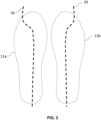
- plantar pressure line within the meaning of the invention corresponds to the change in the position of the center of plantar pressure (e.g. barycenter) during the movement of an individual (e.g. walking or running), preferably from the heel landing until the toes lift off.
- inferred plantar pressure line or “inference of a plantar pressure line” within the meaning of the invention corresponds to a prediction of the evolution of the position of the center of plantar pressures (e.g. barycenter) during the movement of an individual as generated from movement data of the individual's foot.
- the inferred plantar pressure line corresponds to a dynamic plantar pressure line. That is to say, it is generated through an analysis over time of the distribution of plantar pressure and in particular of the center of plantar pressures.
- motion data may correspond, within the meaning of the invention, to data comprising values of acceleration, angular velocity, magnetic fields or even fusion data obtained from one or more of these values.
- the motion data may be raw data or pre-processed data.
- Coupled means connected, directly or indirectly, with one or more intermediate elements. Two elements may be coupled mechanically, electrically, or linked by a communication channel.
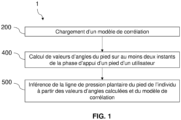
- the invention relates to a method 1 for inferring a plantar pressure line 30.
- the microprocessor(s) 22 implementing the method according to the invention may be integrated into an electronic device also integrating the inertial unit(s) or may be integrated into a computer device, such as a computer or a computer server, configured to receive data generated by the inertial unit(s).
- a computer device such as a computer or a computer server, configured to receive data generated by the inertial unit(s).
- An inference device 2 according to the invention will be detailed further in the remainder of this description.
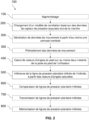
- a method according to the invention may comprise a learning step 100.
- This learning step is preferably a step carried out prior to the implementation of the method on the movement data of an individual. Furthermore, it may be repeated and be enriched with data generated within the framework of the present invention.
- a learning step 100 may include a collection of training data then an aggregation and storage of this target data in a database.
- the training data will include data from pressure sensors.
- the plantar pressure line is usually calculated from plantar pressure data.
- This plantar pressure data may have been generated by any device known to a person skilled in the art and capable of generating plantar pressure data for an individual.
- the plantar pressure data may have been generated from a treadmill, or even from insoles incorporating pressure sensors.
- the training data will include foot movement data during the stance phase, preferably generated from one or more inertial measurement units.
- the learning step 100 enables the generation of a correlation model based on pressure sensor data acquired during walking.
- the correlation model defines, through one or more instructions, a relationship between a plurality of data obtained from plantar pressure sensors and a plurality of foot angle values.
- Such a model is advantageously configured so as to be able to infer position data of the plantar center of pressure, and preferably its displacement, from movement data of a foot.
- the learning step 100 may include the generation of multiple machine learning models and a selection of the machine learning model providing the best prediction performance.
- a method according to the invention comprises a step 200 of loading a correlation model.
- loading 200 may correspond to storing the correlation model for use.
- This step implies that the correlation model has already been generated previously, for example during a learning step 100 and that it is its inference capacity which is used within the framework of the method according to the invention.
- a method according to the invention may comprise a step 300 of generating data by at least one inertial unit.
- the inertial unit 21 may for example be a six-axis or nine-axis inertial unit.
- the inertial unit(s) 21 are coupled to a shoe.
- a method according to the invention may use movement data from several inertial units 21 coupled to one or two shoes.
- the inertial unit 21 generating the movement data is preferably positioned in an electronic box 20 arranged to be integrated into a sole. Nevertheless, the invention can be implemented from data generated by one or more inertial units positioned on a shoe or at the level of an ankle. In particular, during the step 300 of generation of the data by the inertial unit 21, the inertial unit 21 can be positioned in an electronic box 20 fixed to the shoe worn by an individual.
- the data generated by the inertial unit 21 may preferably be generated during an individual's walk, a run or any other exercise likely to generate movement data that can be used in the context of an analysis of the kinetics of movement of the foot in space. This data is called movement data.
- the inertial unit is preferably coupled to a shoe but more generally it is coupled to an individual's foot. The coupling may be direct or via a shoe.
- the movement data are generated for a plurality of instants of the foot placement.
- the movement data is generated for at least ten instants of the foot being placed, preferably at least twenty and more preferably at least fifty.
- the movement data will comprise movement data generated between the instant of heel strike and the instant of toe strike.
- the movement data may also comprise movement data generated between the instant of heel lift-off and the instant of toe lift-off. Indeed, the applicant has determined that these data are of particular importance for improving the prediction performance of the method according to the invention.
- the method 1 for inferring a plantar pressure line 30 inferred according to the invention may include a preprocessing step 350 of the movement data generated by the inertial unit(s).
- this step of preprocessing 350 of the movement data may correspond to the preprocessing of the acceleration, angular velocity, and/or magnetic field values.
- it may comprise in particular at least one processing selected from: frequency filtering, gravity suppression on the acceleration values, gravity suppression, noise suppression on the acceleration values and drift suppression on the measured angular velocity values.
- the motion data may correspond to data generated by an inertial unit 21 which has been normalized, filtered, supplemented or even to data which has been merged for example by Kalman filtering.
- the motion data includes variable values in the form of time series. These variable values may preferably correspond to acceleration and angular velocity values. They may optionally include magnetic field data or a fusion of these data.
- a method according to the invention comprises a step 400 of calculating foot angle values.
- this calculation 400 of foot angle values is made with respect to the predetermined reference frame.
- the step 400 of calculating foot angle values preferably corresponds to a step of calculating angle values for the individual's two feet so as to generate an inferred plantar pressure line 30 for each of the individual's feet.
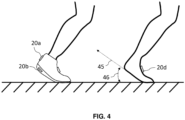
- foot angle values generally correspond to angle values of a foot relative to its environment. Examples of foot angle values that can be calculated are illustrated in Figure 3 .
- the calculated foot angle values comprise angle values selected from: an angle of the anteroposterior axis of the foot relative to its line of progression, an angle of the anteroposterior axis of the foot relative to a plane formed by the ground, an angle of the transverse axis of the foot relative to its line of progression or angle of the transverse axis of the foot relative to a plane formed by the ground.
- the present invention derives a particular advantage from using values of several foot angles.
- the step 400 of calculating foot angle values comprises calculating values of at least two foot angles, preferably at least three foot angles and more preferably at least four foot angles.
- the inference step 500 comprises the use of angle values calculated for at least five times of the foot landing, preferably at least ten and more preferably at least twenty.
- the calculated angle values used during the inference 500 of the plantar pressure line 30 comprise at least 70% of angle values calculated from movement data generated between the instant of heel strike and the instant of toe strike and between the instant of heel lift-off and the instant of toe lift-off.
- This inference step 500 is preferably carried out from values of several angles.
- the inference step 500 is preferably carried out from the values of at least two angles of the foot, preferably at least three angles of the foot and more preferably at least four angles of the foot.
- the inference step 500 may be repeated so as to establish a plantar pressure line 30 inferred from several support phases, for example obtained during walking or running cycles.
- This pressure line may for example be composed from a calculation taking into account several repetitions such as a mean or median calculation.
- a method according to the invention may comprise a step 600 of comparing inferred plantar pressure lines 30.
- the method according to the invention may include a comparison of the plantar pressure lines 30 inferred from each of the individual's feet.
- a method according to the invention may comprise a step 700 of transmitting the plantar pressure line 30 to a remote electronic device 50, 60, also called external terminal 50, 60.
- the method may also comprise a step 800 of storing data.
- This storing is preferably done continuously. In particular, this may correspond to the storing of all the data generated and/or calculated within the framework of a method according to the invention.
- the stored data may for example be raw data as generated by the motion sensors, preprocessed data, transformed data or even inferred plantar pressure line data.
- the stored data correspond to inferred plantar pressure line data.
- the calculation of an inferred plantar pressure line 30 is done in real time, that is to say less than 1 hour after the generation of the data by one or more of the movement sensors of a sole, preferably less than 10 minutes, more preferably less than one minute, even more preferably less than 10 seconds.
- the invention relates to a device for inferring 2 of a line plantar pressure line 30.
- the plantar pressure line 30 includes a plurality of inferred pressure centers for an individual's foot.
- An inference device 2 according to the invention is detailed in the Figure 6 .
- Such an inference device 2 can in particular be used to infer a plantar pressure line 30 from movement data generated by one or more inertial units 21. It applies when the movement sensors 21 are coupled to the foot of an individual, for example coupled to the shoe of an individual.
- an inference device 2 comprises one or more microprocessors 22 configured to execute a method according to the invention, preferably the inference method 1, and its various embodiments, preferred, advantageous or not.
- the one or more microprocessors 22 are configured to load a correlation model.
- the correlation model defines a relationship between a plurality of data obtained from plantar pressure sensors and a plurality of foot angle values relative to a predetermined reference frame.
- the one or more microprocessors 22 can also be configured to calculate values of angles of the foot relative to the predetermined reference frame, from movement data generated by at least one inertial unit 21, over at least two instants of the support phase of the foot of said individual.
- the one or more microprocessors 22 may also be configured to infer a plurality of pressure centers to form the plantar pressure line 30 of the individual's foot, from the angle values calculated over the at least two instants of the foot's stance phase and the correlation model.
- the inference device 2 of a plantar pressure line 30 may also include the inertial unit(s) 21.
- it will preferably be of reduced size and may be fixed to the foot of an individual by any means. It may, for example, be directly fixed to the foot in a removable manner using an adhesive device. It may also be coupled to the foot of the individual via a shoe worn by the individual. In this case, it may be fixed to the shoe or integrated into the sole.
- the inference device 2 is integrated into a sole, for example in a removable manner.
- the inference device 2 weighs less than 10 grams and is arranged so that it can be housed in an inner and/or outer sole.
- a small volume for example less than 10 cm 3 , limits the impact on the comfort of the individual and has the advantage of optimizing production costs by making the integration of this technology into the sole during the industrial process less expensive and simpler.
- such an inference device 2 comprises a motion sensor such as an inertial unit 21 configured to generate motion data of a foot of the individual.
- the inertial unit 21 acquires signals representative of a motion parameter (acceleration and/or speed, for example angular speed) of the user's foot, along the X, Y, Z axes.
- the inertial unit 21 is for example made up of at least one accelerometer and one gyroscope. Preferably, it comprises several accelerometers and gyroscopes.
- the inference device 2 may also comprise one or more magnetometers so as to acquire three additional raw signals corresponding to the magnetic field values in three dimensions.
- the movement data can be processed to generate movement data resulting from a fusion between inertial and magnetic data.
- Each inference device 2 may further include other sensors, including an inclinometer, a barometer, a temperature sensor and an altimeter to benefit from increased precision.
- the inference device 2 also comprises a data memory 23, configured to store at least part of the generated movement data and/or inferred plantar pressure lines.
- the data memory 23 is also configured to store the correlation model.
- the various components of the inference device 2 are preferably arranged on an electronic card 24 (or printed circuit), but the invention can provide various types of arrangement such as for example a single module combining all of the functions described here. Similarly, these means can be divided into several electronic cards or else gathered on a single electronic card.
- a means or a module this is in fact generally carried out by a microprocessor of the device or module controlled by instruction codes recorded in a memory.
- a microprocessor of the device in a memory in which the instruction codes corresponding to the application are recorded.
- the inference device 2 advantageously comprises one or more communication means 25.
- the one or more communication means 25 are capable of receiving and transmitting the data on at least one communication network R1.
- the communication is carried out via a wireless protocol such as Wi-Fi, 3G, 4G, 5G and/or Bluetooth.
- the communication protocol is a BLE or ANT+ protocol. These communication protocols allow low energy consumption.
- the inference device 2 comprises a first communication means 25 configured so that the inference device 2 is capable of transmitting at least one inferred plantar pressure line 30 to an external terminal 50, 60.
- This data can be transmitted in real time or delayed to an external terminal 50, 60.
- the external terminal or the remote electronic device 50, 60 can for example be a remote system such as a tablet, a mobile phone (“smartphone” in English terminology), a computer or a server.
- an inference device 2 further comprises a second communication means 25 configured so that a first inference device 2 is able to communicate with a second inference device 2.
- the inference device 2 may comprise a port for wired connection 26, preferably protected by a removable tab.
- This port for wired connection can be for example a USB or firewire port.
- the USB port is also resistant to water or humidity.
- the USB port is advantageously topped with a polymer beam to give it greater resistance in use conditions.
- This port for wired connection 26 can be used as mentioned above to recharge the battery but also to exchange data and for example to update the firmware of the electronic card carrying the various components of the inference device 2.
Landscapes
- Health & Medical Sciences (AREA)
- Life Sciences & Earth Sciences (AREA)
- Engineering & Computer Science (AREA)
- Physics & Mathematics (AREA)
- Medical Informatics (AREA)
- General Health & Medical Sciences (AREA)
- Public Health (AREA)
- Biophysics (AREA)
- Pathology (AREA)
- Biomedical Technology (AREA)
- Heart & Thoracic Surgery (AREA)
- Veterinary Medicine (AREA)
- Molecular Biology (AREA)
- Surgery (AREA)
- Animal Behavior & Ethology (AREA)
- Artificial Intelligence (AREA)
- Dentistry (AREA)
- Oral & Maxillofacial Surgery (AREA)
- Physiology (AREA)
- Evolutionary Computation (AREA)
- Mathematical Physics (AREA)
- Computer Vision & Pattern Recognition (AREA)
- Theoretical Computer Science (AREA)
- Software Systems (AREA)
- Fuzzy Systems (AREA)
- Psychiatry (AREA)
- Signal Processing (AREA)
- Geometry (AREA)
- Data Mining & Analysis (AREA)
- General Engineering & Computer Science (AREA)
- General Physics & Mathematics (AREA)
- Computing Systems (AREA)
- Measurement Of The Respiration, Hearing Ability, Form, And Blood Characteristics Of Living Organisms (AREA)
- Manipulator (AREA)
Claims (15)
- Verfahren (1) zur Ermittlung einer Plantardrucklinie (30), wobei die genannte Plantardrucklinie (30) der zeitlichen Entwicklung der Position des Schwerpunkts der Plantardrücke während der Fortbewegung einer Person entspricht und eine Vielzahl aufeinanderfolgender Positionen des genannten Schwerpunkts der Plantardrücke für einen Fuß der genannten Person aufweist, wobei das genannte Verfahren durch einen oder mehrere Mikroprozessoren (22) aus Bewegungsdaten implementiert wird, die durch mindestens eine inertiale Messeinheit (21) erzeugt werden, die an einem von der genannten Person getragenen Schuh oder am Fuß der genannten Person gekoppelt ist, wobei die genannte mindestens eine inertiale Messeinheit (21) konfiguriert ist, Bewegungsdaten für mehrere Zeitpunkte einer Standphase eines Fußes der genannten Person zu erzeugen, und wobei das genannte Verfahren folgende Schritte umfasst:• Laden (200) eines Korrelationsmodells, wobei das genannte Korrelationsmodell eine Beziehung zwischen einer Vielzahl von Daten aus Plantardrucksensoren und einer Vielzahl von Fußwinkelwerten relativ zu einem vorbestimmten Referenzrahmen definiert, wobei die genannte Beziehung die Bestimmung der Position des Schwerpunkts der Plantardrücke zu jedem Zeitpunkt einer Standphase ermöglicht;• Berechnung (400) von Fußwinkelwerten relativ zum vorbestimmten Referenzrahmen aus den von der genannten mindestens einen inertialen Messeinheit (21) erzeugten Bewegungsdaten zu mindestens zwei Zeitpunkten der Standphase des Fußes der genannten Person; und• Ermittlung (500) einer Vielzahl aufeinanderfolgender Positionen des Schwerpunkts der Plantardrücke zur Bildung der Plantardrucklinie (30) des Fußes der genannten Person aus den berechneten Winkelwerten über die genannten mindestens zwei Zeitpunkte der Standphase und dem Korrelationsmodell.
- Verfahren (1) zur Ermittlung einer Plantardrucklinie (30) nach Anspruch 1, dadurch gekennzeichnet, dass der Inferenzschritt (500) wiederholt wird, um die aus mehreren Standphasen abgeleitete Plantardrucklinie (30) zu erstellen.
- Verfahren (1) zur Ermittlung einer Plantardrucklinie (30) nach einem der Ansprüche 1 oder 2, dadurch gekennzeichnet, dass der Berechnungsschritt (400) auf Grundlage von Bewegungsdaten durchgeführt wird, die von den inertialen Messeinheiten (21) erzeugt werden, während diese in einer herausnehmbaren oder nicht herausnehmbaren Sohle positioniert sind.
- Verfahren (1) zur Ermittlung einer Plantardrucklinie (30) nach einem der Ansprüche 1 bis 3, dadurch gekennzeichnet, dass der Berechnungsschritt (400) auf Grundlage von Bewegungsdaten durchgeführt wird, die von den inertialen Messeinheiten (21) erzeugt werden, während diese in einem zur Befestigung an dem von der genannten Person getragenen Schuh vorgesehenen Gehäuse angeordnet sind.
- Verfahren (1) zur Ermittlung einer Plantardrucklinie (30) nach einem der Ansprüche 1 bis 3, dadurch gekennzeichnet, dass der Berechnungsschritt (400) auf Grundlage von Bewegungsdaten durchgeführt wird, die von den inertialen Messeinheiten (21) erzeugt werden, während diese in einem elektronischen Gehäuse positioniert sind, wobei das genannte elektronische Gehäuse ferner den oder die Mikroprozessor(en) (22) enthält, die zur Berechnung der Fußwinkelwerte relativ zum vorbestimmten Referenzrahmen konfiguriert sind.
- Verfahren (1) zur Ermittlung einer Plantardrucklinie (30) nach dem vorangehenden Anspruch, dadurch gekennzeichnet, dass die Berechnung (400) der Fußwinkelwerte und die Inferenz (500) einer Vielzahl von Druckschwerpunkten von dem oder den in einer in eine Sohle integrierten elektronischen Gehäuse angeordneten Mikroprozessor(en) (22) durchgeführt werden.
- Verfahren (1) zur Ermittlung einer Plantardrucklinie (30) nach einem der Ansprüche 1 oder 2, dadurch gekennzeichnet, dass der Berechnungsschritt (400) auf Grundlage von Bewegungsdaten durchgeführt wird, die von den inertialen Messeinheiten (21) erzeugt werden, während diese an drei verschiedenen Positionen des Fußes der genannten Person angeordnet sind.
- Verfahren (1) zur Ermittlung einer Plantardrucklinie (30) nach einem der vorangehenden Ansprüche, dadurch gekennzeichnet, dass die Berechnung (400) der Fußwinkelwerte die Ermittlung von Werten von mindestens zwei Fußwinkeln umfasst.
- Verfahren (1) zur Ermittlung einer Plantardrucklinie (30) nach einem der vorangehenden Ansprüche, dadurch gekennzeichnet, dass der genannte vorbestimmte Referenzrahmen außerhalb des menschlichen Körpers liegt und ausgewählt wird aus: dem Boden, einer berechneten Ganglinie oder einer berechneten Trajektorie des genannten Fußes der genannten Person.
- Verfahren (1) zur Ermittlung einer Plantardrucklinie (30) nach dem vorangehenden Anspruch, dadurch gekennzeichnet, dass die berechneten Fußwinkelwerte relativ zum vorbestimmten Referenzrahmen Winkelwerte ausgewählter Winkel umfassen aus:einem Winkel der anteroposterioren Achse des Fußes relativ zu dessen Verlaufslinie,einem Winkel der anteroposterioren Achse des Fußes relativ zum Boden, einem Winkel der transversalen Achse des Fußes relativ zu dessen Verlaufslinie, einem Winkel der transversalen Achse des Fußes relativ zum Boden oder dem Auftreffwinkel zwischen der Fußsohle und dem Boden beim Erstkontakt.
- Verfahren (1) zur Ermittlung einer Plantardrucklinie (30) nach den vorangehenden Ansprüchen, dadurch gekennzeichnet, dass ein Vergleich der Plantardrucklinien (30) beider Füße der Person vorgenommen wird.
- Verfahren (1) zur Ermittlung einer Plantardrucklinie (30) nach den vorangehenden Ansprüchen, dadurch gekennzeichnet, dass ein Vergleich der für denselben Fuß für zwei unterschiedliche Zeitintervalle erhaltenen Plantardrucklinien (30) vorgenommen wird.
- Verfahren (1) zur Ermittlung einer Plantardrucklinie (30) nach den vorangehenden Ansprüchen, dadurch gekennzeichnet, dass ein Schritt der Vorverarbeitung der von der genannten mindestens einen inertialen Messeinheit (21) generierten Bewegungsdaten umfasst wird, wobei der Vorverarbeitungsschritt eine Frequenzfilterung, eine Schwerkraftunterdrückung und/oder eine Driftunterdrückung umfasst.
- Vorrichtung (2) zur Inferenz einer Plantardrucklinie (30), wobei die genannte Plantardrucklinie (30) der zeitlichen Entwicklung der Position des Schwerpunkts der Plantardrücke während der Fortbewegung einer Person entspricht und eine Vielzahl aufeinanderfolgender Positionen des genannten Schwerpunkts der Plantardrücke für einen Fuß der genannten Person umfasst, wobei die genannte Inferenzvorrichtung (2) einen oder mehrere Mikroprozessoren (22) umfasst, wobei der oder die genannten Mikroprozessor(en) (22) konfiguriert sind zu:• Laden eines Korrelationsmodells, wobei das genannte Korrelationsmodell eine Beziehung zwischen einer Vielzahl von Daten aus Plantardrucksensoren und einer Vielzahl von Fußwinkelwerten relativ zu einem vorbestimmten Referenzrahmen definiert, wobei die genannte Beziehung die Bestimmung der Position des Schwerpunkts der Plantardrücke zu jedem Zeitpunkt einer Standphase ermöglicht;• Berechnen von Fußwinkelwerten relativ zum vorbestimmten Referenzrahmen aus den von mindestens einer inertialen Messeinheit (21) erzeugten Bewegungsdaten über mindestens zwei Zeitpunkte der Standphase des Fußes der genannten Person; und• Inferieren einer Vielzahl aufeinanderfolgender Positionen des Schwerpunkts der Plantardrücke zur Bildung der Plantardrucklinie (30) des Fußes der genannten Person aus den über die genannten mindestens zwei Zeitpunkte der Standphase berechneten Winkelwerten und dem Korrelationsmodell.
- Vorrichtung (2) zur Inferenz einer Plantardrucklinie (30) nach dem vorangehenden Anspruch, dadurch gekennzeichnet, dass sie ferner mindestens eine inertiale Messeinheit (21) umfasst, die an einem von der genannten Person getragenen Schuh oder am Fuß der genannten Person gekoppelt ist, wobei die genannte mindestens eine inertiale Messeinheit (21) konfiguriert ist, Bewegungsdaten für eine Vielzahl von Zeitpunkten einer Standphase eines Fußes der genannten Person zu erzeugen.
Applications Claiming Priority (2)
| Application Number | Priority Date | Filing Date | Title |
|---|---|---|---|
| FR2103554A FR3121595B1 (fr) | 2021-04-07 | 2021-04-07 | Procede et dispositif d’inference d’une ligne de pression plantaire |
| PCT/FR2022/050657 WO2022214769A1 (fr) | 2021-04-07 | 2022-04-07 | Procede et dispositif d'inference d'une ligne de pression plantaire |
Publications (2)
| Publication Number | Publication Date |
|---|---|
| EP4304474A1 EP4304474A1 (de) | 2024-01-17 |
| EP4304474B1 true EP4304474B1 (de) | 2025-07-02 |
Family
ID=76283927
Family Applications (1)
| Application Number | Title | Priority Date | Filing Date |
|---|---|---|---|
| EP22720477.3A Active EP4304474B1 (de) | 2021-04-07 | 2022-04-07 | Verfahren und vorrichtung zum ableiten einer plantaren drucklinie |
Country Status (4)
| Country | Link |
|---|---|
| US (1) | US20240197203A1 (de) |
| EP (1) | EP4304474B1 (de) |
| FR (1) | FR3121595B1 (de) |
| WO (1) | WO2022214769A1 (de) |
Families Citing this family (1)
| Publication number | Priority date | Publication date | Assignee | Title |
|---|---|---|---|---|
| CN121400813B (zh) * | 2025-12-29 | 2026-02-24 | 吉林大学 | 一种基于足底多点压力阵列的下肢康复训练评估装置 |
Family Cites Families (14)
| Publication number | Priority date | Publication date | Assignee | Title |
|---|---|---|---|---|
| US20030009308A1 (en) * | 2000-06-24 | 2003-01-09 | Chris Kirtley | Instrumented insole |
| US20040143452A1 (en) * | 2003-01-15 | 2004-07-22 | Podo Technology, Inc. | System and method of dynamically assessing foot characteristics |
| US8382684B2 (en) * | 2005-03-11 | 2013-02-26 | Rsscan International | Method and apparatus for displaying 3D images of a part of the skeleton |
| EP2422698A1 (de) | 2010-08-26 | 2012-02-29 | Nederlandse Organisatie voor toegepast -natuurwetenschappelijk onderzoek TNO | Verfahren und System zur Bestimmung der Lauf- bzw. Renngeschwindigkeit einer Person |
| CN103442607B (zh) * | 2011-02-07 | 2016-06-22 | 新平衡运动公司 | 用于监视运动表现的系统和方法 |
| EP2556795A1 (de) | 2011-08-09 | 2013-02-13 | Nederlandse Organisatie voor toegepast -natuurwetenschappelijk onderzoek TNO | Verfahren und System für Feedback über den Laufstil |
| CA2866025A1 (en) * | 2013-10-03 | 2015-04-03 | Quiang Song | Sensor unit for a functional electrical stimulation (fes) orthotic system |
| US20200146594A1 (en) * | 2017-01-20 | 2020-05-14 | Figur8, Inc. | Movement biomarker generation using body part motion analysis |
| TWI629012B (zh) * | 2016-02-24 | 2018-07-11 | 國立清華大學 | 智慧鞋墊 |
| FR3072251B1 (fr) | 2017-10-16 | 2021-02-26 | Zhor Tech | Dispositif electronique pour produits chaussants. |
| CN108209924B (zh) * | 2018-01-16 | 2019-02-19 | 北京大学第三医院 | 一种前交叉韧带断裂后步态特征的分析方法 |
| FR3079734B1 (fr) | 2018-04-06 | 2024-12-20 | Zhor Tech | Systeme pour la detection d'un trouble de la demarche chez un utilisateur et procedes associes. |
| FR3095527B1 (fr) | 2019-04-25 | 2022-09-09 | Zhor Tech | Procédé et système de détermination d’une valeur de paramètre biomécanique avancé de démarche |
| CN111631719B (zh) * | 2020-05-21 | 2023-08-11 | 北京城市系统工程研究中心 | 一种用于预测老年人跌倒风险的方法 |
-
2021
- 2021-04-07 FR FR2103554A patent/FR3121595B1/fr not_active Expired - Fee Related
-
2022
- 2022-04-07 WO PCT/FR2022/050657 patent/WO2022214769A1/fr not_active Ceased
- 2022-04-07 EP EP22720477.3A patent/EP4304474B1/de active Active
- 2022-04-07 US US18/286,164 patent/US20240197203A1/en active Pending
Also Published As
| Publication number | Publication date |
|---|---|
| FR3121595A1 (fr) | 2022-10-14 |
| EP4304474A1 (de) | 2024-01-17 |
| US20240197203A1 (en) | 2024-06-20 |
| FR3121595B1 (fr) | 2023-08-25 |
| WO2022214769A1 (fr) | 2022-10-13 |
Similar Documents
| Publication | Publication Date | Title |
|---|---|---|
| EP3697245B1 (de) | System und verfahren zur gangalnalyse und -quantifizierung eines benutzers | |
| EP1673590B1 (de) | Schrittüberwachungs-einrichtung | |
| EP3773164A1 (de) | System zur erkennung einer gangstörung eines benutzers und zugehörige verfahren | |
| EP3958738B1 (de) | Verfahren und system zur bestimmung eines wertes eines fortgeschrittenen biomechanischen gangparameters | |
| EP3811032B1 (de) | Analyse des gangs eines gehenden fussgängers | |
| US20220260442A1 (en) | System and method for multi-sensor combination for indirect sport assessment and classification | |
| EP3797625A1 (de) | Verfahren und system zur berechnung personalisierter werte von parametern einer einzelnen für das design benutzerdefinierter solle | |
| EP4152993A1 (de) | Einlegesohle und stimulationsverfahren | |
| EP4304474B1 (de) | Verfahren und vorrichtung zum ableiten einer plantaren drucklinie | |
| EP3408612B1 (de) | Verfahren zur kalkulation der physischen aktivität einer oberen gliedmasse | |
| EP1586353A1 (de) | Verfahren und Vorrichtung zur Messung der Wirksamkeit einer Sportbewegung | |
| WO2022219289A1 (fr) | Procédé d'encodage de données de capteur de mouvement, dispositif et système associés | |
| FR3046346A1 (fr) | Semelle intelligente | |
| EP3761063A1 (de) | Tragbares instrument zur steuerung einer sport- oder fitness-aktivität | |
| FR3125956A1 (fr) | Procédé de traitement de mesures effectuées par un capteur porté par une personne | |
| FR3121831A1 (fr) | Procédé d’encodage de données de capteur de mouvement, dispositif et système associés | |
| WO2023017227A1 (fr) | Systeme et procede pour la recommandation de semelle ou d'article chaussant a un utilisateur | |
| TWI554745B (zh) | Intelligent wearable device and method for calculating body weight | |
| WO2023067135A1 (fr) | Procédé et système de validation d'une correction orthopédique pour un individu | |
| FR3142246A1 (fr) | Procédé d’estimation de l’évolution d’une vitesse d’un point de mesure | |
| FR3014306A1 (fr) | Procede de commande d'une prothese ou d'une orthese reglable | |
| EP3714775A1 (de) | System zur charakterisierung der körperhaltung und des gangs | |
| FR3009945A1 (fr) | Dispositif d'analyse de la stabilite posturele d'un utilisateur |
Legal Events
| Date | Code | Title | Description |
|---|---|---|---|
| STAA | Information on the status of an ep patent application or granted ep patent |
Free format text: STATUS: UNKNOWN |
|
| STAA | Information on the status of an ep patent application or granted ep patent |
Free format text: STATUS: THE INTERNATIONAL PUBLICATION HAS BEEN MADE |
|
| PUAI | Public reference made under article 153(3) epc to a published international application that has entered the european phase |
Free format text: ORIGINAL CODE: 0009012 |
|
| STAA | Information on the status of an ep patent application or granted ep patent |
Free format text: STATUS: REQUEST FOR EXAMINATION WAS MADE |
|
| 17P | Request for examination filed |
Effective date: 20231011 |
|
| AK | Designated contracting states |
Kind code of ref document: A1 Designated state(s): AL AT BE BG CH CY CZ DE DK EE ES FI FR GB GR HR HU IE IS IT LI LT LU LV MC MK MT NL NO PL PT RO RS SE SI SK SM TR |
|
| DAV | Request for validation of the european patent (deleted) | ||
| DAX | Request for extension of the european patent (deleted) | ||
| GRAP | Despatch of communication of intention to grant a patent |
Free format text: ORIGINAL CODE: EPIDOSNIGR1 |
|
| STAA | Information on the status of an ep patent application or granted ep patent |
Free format text: STATUS: GRANT OF PATENT IS INTENDED |
|
| INTG | Intention to grant announced |
Effective date: 20240823 |
|
| GRAJ | Information related to disapproval of communication of intention to grant by the applicant or resumption of examination proceedings by the epo deleted |
Free format text: ORIGINAL CODE: EPIDOSDIGR1 |
|
| STAA | Information on the status of an ep patent application or granted ep patent |
Free format text: STATUS: REQUEST FOR EXAMINATION WAS MADE |
|
| GRAP | Despatch of communication of intention to grant a patent |
Free format text: ORIGINAL CODE: EPIDOSNIGR1 |
|
| INTC | Intention to grant announced (deleted) | ||
| STAA | Information on the status of an ep patent application or granted ep patent |
Free format text: STATUS: GRANT OF PATENT IS INTENDED |
|
| INTG | Intention to grant announced |
Effective date: 20250123 |
|
| GRAS | Grant fee paid |
Free format text: ORIGINAL CODE: EPIDOSNIGR3 |
|
| GRAA | (expected) grant |
Free format text: ORIGINAL CODE: 0009210 |
|
| STAA | Information on the status of an ep patent application or granted ep patent |
Free format text: STATUS: THE PATENT HAS BEEN GRANTED |
|
| AK | Designated contracting states |
Kind code of ref document: B1 Designated state(s): AL AT BE BG CH CY CZ DE DK EE ES FI FR GB GR HR HU IE IS IT LI LT LU LV MC MK MT NL NO PL PT RO RS SE SI SK SM TR |
|
| REG | Reference to a national code |
Ref country code: GB Ref legal event code: FG4D Free format text: NOT ENGLISH |
|
| REG | Reference to a national code |
Ref country code: CH Ref legal event code: EP |
|
| REG | Reference to a national code |
Ref country code: DE Ref legal event code: R096 Ref document number: 602022016886 Country of ref document: DE |
|
| REG | Reference to a national code |
Ref country code: IE Ref legal event code: FG4D Free format text: LANGUAGE OF EP DOCUMENT: FRENCH |
|
| REG | Reference to a national code |
Ref country code: NL Ref legal event code: MP Effective date: 20250702 |
|
| PG25 | Lapsed in a contracting state [announced via postgrant information from national office to epo] |
Ref country code: PT Free format text: LAPSE BECAUSE OF FAILURE TO SUBMIT A TRANSLATION OF THE DESCRIPTION OR TO PAY THE FEE WITHIN THE PRESCRIBED TIME-LIMIT Effective date: 20251103 |
|
| PG25 | Lapsed in a contracting state [announced via postgrant information from national office to epo] |
Ref country code: NL Free format text: LAPSE BECAUSE OF FAILURE TO SUBMIT A TRANSLATION OF THE DESCRIPTION OR TO PAY THE FEE WITHIN THE PRESCRIBED TIME-LIMIT Effective date: 20250702 |
|
| REG | Reference to a national code |
Ref country code: AT Ref legal event code: MK05 Ref document number: 1808299 Country of ref document: AT Kind code of ref document: T Effective date: 20250702 |
|
| PG25 | Lapsed in a contracting state [announced via postgrant information from national office to epo] |
Ref country code: IS Free format text: LAPSE BECAUSE OF FAILURE TO SUBMIT A TRANSLATION OF THE DESCRIPTION OR TO PAY THE FEE WITHIN THE PRESCRIBED TIME-LIMIT Effective date: 20251102 |
|
| PG25 | Lapsed in a contracting state [announced via postgrant information from national office to epo] |
Ref country code: NO Free format text: LAPSE BECAUSE OF FAILURE TO SUBMIT A TRANSLATION OF THE DESCRIPTION OR TO PAY THE FEE WITHIN THE PRESCRIBED TIME-LIMIT Effective date: 20251002 |
|
| REG | Reference to a national code |
Ref country code: LT Ref legal event code: MG9D |
|
| PG25 | Lapsed in a contracting state [announced via postgrant information from national office to epo] |
Ref country code: AT Free format text: LAPSE BECAUSE OF FAILURE TO SUBMIT A TRANSLATION OF THE DESCRIPTION OR TO PAY THE FEE WITHIN THE PRESCRIBED TIME-LIMIT Effective date: 20250702 |
|
| PG25 | Lapsed in a contracting state [announced via postgrant information from national office to epo] |
Ref country code: FI Free format text: LAPSE BECAUSE OF FAILURE TO SUBMIT A TRANSLATION OF THE DESCRIPTION OR TO PAY THE FEE WITHIN THE PRESCRIBED TIME-LIMIT Effective date: 20250702 |
|
| PG25 | Lapsed in a contracting state [announced via postgrant information from national office to epo] |
Ref country code: HR Free format text: LAPSE BECAUSE OF FAILURE TO SUBMIT A TRANSLATION OF THE DESCRIPTION OR TO PAY THE FEE WITHIN THE PRESCRIBED TIME-LIMIT Effective date: 20250702 |
|
| PG25 | Lapsed in a contracting state [announced via postgrant information from national office to epo] |
Ref country code: GR Free format text: LAPSE BECAUSE OF FAILURE TO SUBMIT A TRANSLATION OF THE DESCRIPTION OR TO PAY THE FEE WITHIN THE PRESCRIBED TIME-LIMIT Effective date: 20251003 |
|
| PG25 | Lapsed in a contracting state [announced via postgrant information from national office to epo] |
Ref country code: CZ Free format text: LAPSE BECAUSE OF FAILURE TO SUBMIT A TRANSLATION OF THE DESCRIPTION OR TO PAY THE FEE WITHIN THE PRESCRIBED TIME-LIMIT Effective date: 20250702 Ref country code: SE Free format text: LAPSE BECAUSE OF FAILURE TO SUBMIT A TRANSLATION OF THE DESCRIPTION OR TO PAY THE FEE WITHIN THE PRESCRIBED TIME-LIMIT Effective date: 20250702 |
|
| PG25 | Lapsed in a contracting state [announced via postgrant information from national office to epo] |
Ref country code: LV Free format text: LAPSE BECAUSE OF FAILURE TO SUBMIT A TRANSLATION OF THE DESCRIPTION OR TO PAY THE FEE WITHIN THE PRESCRIBED TIME-LIMIT Effective date: 20250702 |
|
| PG25 | Lapsed in a contracting state [announced via postgrant information from national office to epo] |
Ref country code: BG Free format text: LAPSE BECAUSE OF FAILURE TO SUBMIT A TRANSLATION OF THE DESCRIPTION OR TO PAY THE FEE WITHIN THE PRESCRIBED TIME-LIMIT Effective date: 20250702 Ref country code: PL Free format text: LAPSE BECAUSE OF FAILURE TO SUBMIT A TRANSLATION OF THE DESCRIPTION OR TO PAY THE FEE WITHIN THE PRESCRIBED TIME-LIMIT Effective date: 20250702 |
|
| PG25 | Lapsed in a contracting state [announced via postgrant information from national office to epo] |
Ref country code: RS Free format text: LAPSE BECAUSE OF FAILURE TO SUBMIT A TRANSLATION OF THE DESCRIPTION OR TO PAY THE FEE WITHIN THE PRESCRIBED TIME-LIMIT Effective date: 20251002 |
|
| PG25 | Lapsed in a contracting state [announced via postgrant information from national office to epo] |
Ref country code: ES Free format text: LAPSE BECAUSE OF FAILURE TO SUBMIT A TRANSLATION OF THE DESCRIPTION OR TO PAY THE FEE WITHIN THE PRESCRIBED TIME-LIMIT Effective date: 20250702 |
|
| PG25 | Lapsed in a contracting state [announced via postgrant information from national office to epo] |
Ref country code: SM Free format text: LAPSE BECAUSE OF FAILURE TO SUBMIT A TRANSLATION OF THE DESCRIPTION OR TO PAY THE FEE WITHIN THE PRESCRIBED TIME-LIMIT Effective date: 20250702 |
|
| PG25 | Lapsed in a contracting state [announced via postgrant information from national office to epo] |
Ref country code: DK Free format text: LAPSE BECAUSE OF FAILURE TO SUBMIT A TRANSLATION OF THE DESCRIPTION OR TO PAY THE FEE WITHIN THE PRESCRIBED TIME-LIMIT Effective date: 20250702 |
|
| PG25 | Lapsed in a contracting state [announced via postgrant information from national office to epo] |
Ref country code: IT Free format text: LAPSE BECAUSE OF FAILURE TO SUBMIT A TRANSLATION OF THE DESCRIPTION OR TO PAY THE FEE WITHIN THE PRESCRIBED TIME-LIMIT Effective date: 20250702 |