EP4304331B1 - Système et procédé de culture de plantes dans un espace intérieur fermé - Google Patents
Système et procédé de culture de plantes dans un espace intérieur fermé Download PDFInfo
- Publication number
- EP4304331B1 EP4304331B1 EP22720647.1A EP22720647A EP4304331B1 EP 4304331 B1 EP4304331 B1 EP 4304331B1 EP 22720647 A EP22720647 A EP 22720647A EP 4304331 B1 EP4304331 B1 EP 4304331B1
- Authority
- EP
- European Patent Office
- Prior art keywords
- growth
- growing
- plants
- space
- plant
- Prior art date
- Legal status (The legal status is an assumption and is not a legal conclusion. Google has not performed a legal analysis and makes no representation as to the accuracy of the status listed.)
- Active
Links
Images





Classifications
-
- A—HUMAN NECESSITIES
- A01—AGRICULTURE; FORESTRY; ANIMAL HUSBANDRY; HUNTING; TRAPPING; FISHING
- A01G—HORTICULTURE; CULTIVATION OF VEGETABLES, FLOWERS, RICE, FRUIT, VINES, HOPS OR SEAWEED; FORESTRY; WATERING
- A01G9/00—Cultivation in receptacles, forcing-frames or greenhouses; Edging for beds, lawn or the like
- A01G9/24—Devices or systems for heating, ventilating, regulating temperature, illuminating, or watering, in greenhouses, forcing-frames, or the like
- A01G9/249—Lighting means
-
- A—HUMAN NECESSITIES
- A01—AGRICULTURE; FORESTRY; ANIMAL HUSBANDRY; HUNTING; TRAPPING; FISHING
- A01G—HORTICULTURE; CULTIVATION OF VEGETABLES, FLOWERS, RICE, FRUIT, VINES, HOPS OR SEAWEED; FORESTRY; WATERING
- A01G31/00—Soilless cultivation, e.g. hydroponics
- A01G31/02—Special apparatus therefor
- A01G31/04—Hydroponic culture on conveyors
- A01G31/042—Hydroponic culture on conveyors with containers travelling on a belt or the like, or conveyed by chains
-
- A—HUMAN NECESSITIES
- A01—AGRICULTURE; FORESTRY; ANIMAL HUSBANDRY; HUNTING; TRAPPING; FISHING
- A01G—HORTICULTURE; CULTIVATION OF VEGETABLES, FLOWERS, RICE, FRUIT, VINES, HOPS OR SEAWEED; FORESTRY; WATERING
- A01G31/00—Soilless cultivation, e.g. hydroponics
- A01G31/02—Special apparatus therefor
- A01G31/04—Hydroponic culture on conveyors
- A01G31/045—Hydroponic culture on conveyors with containers guided along a rail
-
- A—HUMAN NECESSITIES
- A01—AGRICULTURE; FORESTRY; ANIMAL HUSBANDRY; HUNTING; TRAPPING; FISHING
- A01G—HORTICULTURE; CULTIVATION OF VEGETABLES, FLOWERS, RICE, FRUIT, VINES, HOPS OR SEAWEED; FORESTRY; WATERING
- A01G31/00—Soilless cultivation, e.g. hydroponics
- A01G31/02—Special apparatus therefor
- A01G31/06—Hydroponic culture on racks or in stacked containers
-
- A—HUMAN NECESSITIES
- A01—AGRICULTURE; FORESTRY; ANIMAL HUSBANDRY; HUNTING; TRAPPING; FISHING
- A01G—HORTICULTURE; CULTIVATION OF VEGETABLES, FLOWERS, RICE, FRUIT, VINES, HOPS OR SEAWEED; FORESTRY; WATERING
- A01G9/00—Cultivation in receptacles, forcing-frames or greenhouses; Edging for beds, lawn or the like
- A01G9/24—Devices or systems for heating, ventilating, regulating temperature, illuminating, or watering, in greenhouses, forcing-frames, or the like
- A01G9/246—Air-conditioning systems
-
- Y—GENERAL TAGGING OF NEW TECHNOLOGICAL DEVELOPMENTS; GENERAL TAGGING OF CROSS-SECTIONAL TECHNOLOGIES SPANNING OVER SEVERAL SECTIONS OF THE IPC; TECHNICAL SUBJECTS COVERED BY FORMER USPC CROSS-REFERENCE ART COLLECTIONS [XRACs] AND DIGESTS
- Y02—TECHNOLOGIES OR APPLICATIONS FOR MITIGATION OR ADAPTATION AGAINST CLIMATE CHANGE
- Y02A—TECHNOLOGIES FOR ADAPTATION TO CLIMATE CHANGE
- Y02A40/00—Adaptation technologies in agriculture, forestry, livestock or agroalimentary production
- Y02A40/10—Adaptation technologies in agriculture, forestry, livestock or agroalimentary production in agriculture
- Y02A40/25—Greenhouse technology, e.g. cooling systems therefor
Definitions
- the invention relates to an arrangement for growing plants in a closed interior space, according to the preamble of claim 1.
- the invention further relates to a method for growing plants in a closed interior space, according to the preamble of claim 8 6.
- Plants are typically grown outdoors. The quality and quantity depend heavily on the environmental conditions, which, however, are difficult to influence.
- WO 2018/220011 A1 For example, such an arrangement for plant cultivation is shown, in which the plants can also be moved vertically by means of a conveyor system. By appropriately arranging the equipment for supplying the plants with the necessary nutrients and lighting, large quantities of plants can be grown efficiently even on relatively small areas.
- WO 2018/050816 A1 an arrangement according to the preamble of claim 1 is known.
- Such plant cultivation arrangements can thus be used in relatively high and large halls or buildings, often in stacked arrangements.
- the energy required to adjust, for example, an elevated temperature for an individual plant, e.g., depending on the growth phase, also increases considerably with the increase in interior space.
- the object of the invention is to provide an arrangement and a method for plant cultivation in enclosed interior spaces, which enable plant cultivation to be carried out particularly efficiently.
- the arrangement according to the invention is characterized in that a plurality of growth chambers are formed in the interior, each of which is enclosed and formed by an enclosing wall on a receiving unit.
- These enclosing walls can be dividing elements and can preferably consist of dimensionally stable and/or flexible and/or mobile, lightweight elements that can be inserted on all sides (mechanically or like a roller shutter from top to bottom or vice versa) and can form a boundary to the nearest process, growth, or sub-chamber.
- a basic idea of the invention can be seen in the fact that the individual plants and/or plant parts are individually cared for in the growth chambers according to their needs and growth phases, on the one hand, and on the other hand have the opportunity to develop their own individual atmosphere corresponding to the respective growth phase.
- the growth climate and other growth parameters can be adjusted locally and on a small scale. This allows for significant energy savings compared to air conditioning much larger indoor spaces.
- the interior can also be referred to as a process room. Since each plant creates its own growth atmosphere through transpiration, perspiration, and radiation, the invention creates the conditions for each individual plant or group of plants to develop individually.
- each growth room is assigned a conditioning device, with which the ambient conditions in each growth room can be individually adjusted. In principle, this also makes it possible to grow different types of plants that require different or differing environmental conditions in a closed interior space.
- the enclosing wall is provided with a flexible
- Membrane material or a membrane means thin structures with different properties which, like a skin or film, have a large surface area in relation to their thickness. Membranes are often used for separation or enveloping, especially when they have selective permeability.
- the membrane material comprises a film, a textile material, in particular a woven fabric, a knitted fabric or a net, wherein the membrane material is preferably designed to be gas-permeable.
- the membrane material can be a particularly thin material which has a material thickness of 1 mm or less.
- the peripheral wall can be formed only at the sides, leaving a growth chamber open at the top. However, the entire growth chamber, including the ceiling area, can generally be closed, so that each individual growth chamber is hermetically sealed.
- the preferred formation of gas permeability enables the desired gas exchange.
- the growth spaces each have a substrate or a holding device for accommodating one or more plants and a supply device for supplying water and/or nutrients.
- the term substrate is not solely understood to mean soil or an earth-like medium. Rather, within the meaning of the invention, the substrate can be a supporting or holding element for the plant and in particular the plant roots, wherein a hydroponic or aeroponic nutrient supply is achieved by supplying a nutrient liquid or a vapor- or aerosol-like nutrient medium.
- the supply device can be a feed device for supplying solid, particularly powdered nutrients, and in particular a feed device for liquids and/or gases/aerosols.
- the liquid is primarily water, which is mixed with appropriately dissolved nutrients and active ingredients for strong and healthy plant growth.
- the growth chambers can be installed in a moving transport device.
- modular receiving units with a conditioning device are attached to the moving transport device.
- the growth chambers are placed inside these units and connected to the conditioning device of the receiving unit.
- the receiving units with the growth spaces are mounted on a stationary support device or on a transport device with which the receiving units with the growth spaces can be transported continuously or step by step through the interior/processing space.
- the growth spaces together with the enclosing wall can form a planting module, which can be designed identically overall.
- the stationary support device can be a shelf or a shelf-like structure, wherein the receiving units and/or the growth spaces can be stored next to one another and/or one above the other, for example in the manner of a high-bay warehouse.
- the respectively assigned conditioning device can be permanently arranged on the stationary support device at a location provided for the receiving units or can be attached directly to the growth space.
- conveyor belts, conveyor chains or the like can be provided, by means of which the receiving units and/or growth chambers can be transported horizontally and/or vertically, in particular in a pater-noster manner, through the interior/processing space.
- the transport device has a plurality of transport members, each of which carries a receiving unit. and/or growth chamber.
- the receiving unit and/or growth chamber are each transported with the associated conditioning device.
- the growth chambers with the plants can pass through various growth phases, which may be differently conditioned, for example, at different temperatures. By continuously or step-by-step transporting the growth chambers with the plants, optimal conditions can be set for each growth phase.
- the conditioning device of the individual growth chambers can be designed in any suitable manner to establish the necessary growth conditions for a plant.
- the conditioning device of the individual growth chambers comprises, in addition to a lighting device, a heating and/or cooling device.
- the conditioning device also comprises a ventilation device, a misting and/or sprinkling device, and/or a supply device for nutrient supply, and/or a fumigation or pollination device.
- each growth chamber is divided into further, structured sub-chambers located next to or above one another, in particular into an upper/outer sub-chamber for the plant parts exposed to light and growing against gravity, and a lower/inner sub-chamber for plant parts on the ground, growing in the direction of gravity.
- the supply device for water and nutrients can preferably be provided in the lower/inner sub-chamber, while in particular the lighting device is assigned to the upper/outer sub-chamber.
- a middle sub-chamber or further sub-chambers can also be provided, which are arranged vertically one above the other or next to one another.
- a further advantageous embodiment of the invention consists in that each growth space is assigned a detection device with one or more sensors which are designed to detect environmental conditions, a water and/or nutrient supply and/or plant growth, and that at least one control device is provided, which is connected to the detection device and is designed to control the conditioning device and/or the supply device in the individual growth rooms depending on the values detected by the detection device.
- the respective ambient conditions in the individual growth rooms or sub-rooms can be locally detected and automatically adjusted.
- the conditioning device and/or the supply device can be controlled via a control device, which can be provided centrally or decentrally in the individual growth rooms or even sub-rooms, so that almost optimal growth conditions and a needs-based adjustment of the growth conditions and nutrient supply can be achieved individually for each growth room and thus practically also for each plant or group of plants.
- the invention further comprises a method for cultivating plants in a closed interior space, wherein a plurality of growth rooms are provided in the interior space/processing room, each of which is enclosed by an enclosing wall formed from a flexible membrane material and connected to the receiving units. The method can be carried out in particular with the arrangement according to the invention described above. The advantages described above can thereby be achieved.
- a preferred method variant according to the invention consists in that each growth space is assigned a detection device with one or more sensors with which the ambient conditions, a water and/or nutrient supply and/or plant growth are detected, and in that at least one control device is provided which is connected to the detection device and regulates the conditioning device and/or a supply device in the individual growth spaces depending on the data detected by the detection device.
- the procedure allows for a needs-based individual adjustment of the Growth conditions and nutrient supply for virtually any plant or group of plants can be adjusted in one recording unit.
- the vertical farm/indoor farm is divided into an interior/processing area and one or more growth rooms.
- the interior/processing area represents the part of the building in which the growth rooms are located. Between the growth rooms, there can be paths/corridors in the interior/processing area through which people can move and access the growth rooms when needed.
- the growth rooms are designed such that the individual growth rooms can be largely hermetically separated from both the processing room and the remaining growth rooms, provided that several different growth rooms are installed.
- the invention serves to optimize the vertical farm/indoor farm system such that the growth conditions within the growth rooms can be individually adapted and improved to the individual plant and/or plant group, their growth phase, health status, etc.
- plants with differently adjusted growth parameters can be cultivated in the same facility.
- the growth and culture conditions of the plants in the growth rooms are controllable.
- the growth and culture conditions preferably include one or more of the following factors for plant cultivation, referred to below as growth parameters: temperature, air pressure, humidity, air velocity, type of light (LED, full-spectral, hybrid composition), light irradiance, composition of the gas atmosphere, composition of the nutrient solution, pH value, reproductive or fertilization conditions, etc.
- the growth space is divided into further, preferably three, sub-spaces.
- the sub-spaces are divided according to the plant anatomical, morphological, and physiological characteristics:
- the usually above-ground parts of the shoot axis e.g., trunk, stalk, shaft, stem
- leaves and fruits of the plant In the upper/outer sub-space, the usually above-ground parts of the shoot axis (e.g., trunk, stalk, shaft, stem), leaves and fruits of the plant.
- the term "upper compartment” refers to the location of the upper parts of the plant.
- the term “outer compartment” refers to the location, depending on the design, outside the support or horizontal or vertical transport mechanism. Furthermore, there is a lower/inner compartment in which roots, tubers, nodes, fungi, etc. can develop.
- the term “lower compartment” refers to the location of the lower parts of the plant.
- the term “inner compartment” refers to the location, depending on the design, inside the support or transport mechanism. Between the upper/outer and lower/inner compartments is the middle compartment, which essentially serves two functions: Firstly, the central compartment serves to support plant growth by accommodating plant containers, substrates, or other devices suitable for securing seeds or plants. This also includes the possibility of individually or completely interchangeable holding devices that can be removed similarly to a single box or drawer. Furthermore, according to the invention, the central compartment can be used for the additional supply and dosing of a nutrient solution in the form of aeroponic or hydroponic systems, a liquid film, or other systems suitable for nutrient supply.
- the middle compartment can be used for the installation of technical operating and auxiliary devices of any kind, such as sensors, control and regulation elements, lighting, ventilation, air pressure, support elements, etc.
- the growth parameters in the upper/outer and lower/inner sections, or in all three sections can be individually regulated, regardless of whether a hydroponic, aeroponic, or other system for nutrient and, if applicable, water supply is installed.
- the architecture, design, and auxiliary devices of the sections can be configured in such a way that plant growth and the plants can be individually and optimally promoted for the desired material composition in the upper/outer and lower/inner sections.
- Special fixtures or stimuli acting on the plants direct For this purpose, the growth of all plant organs in the desired manner (e.g. by providing sufficient space, supports, steering devices, etc.) and enable simplified and efficient harvesting and/or further processing of the plants.
- the growth chambers and sub-chambers can be further subdivided, opened, or closed as needed by enclosing walls, for example, partition elements, so that the growth parameters in the various growth chambers and sub-chambers can differ from one another.
- the partition elements can preferably consist of dimensionally stable and/or flexible and/or mobile elements that can be inserted on all sides (mechanically or like a roller shutter from top to bottom or vice versa) and can form a boundary to the nearest process chamber, growth chamber, or sub-chamber.
- the partition elements can consist of single- or multi-layer, lightweight, rigid, foldable, or rollable textile and/or rubber-like carrier materials.
- the separating elements made of carrier materials are equipped with different mechanical and/or surface properties, which can include one or more of the following properties: air- and/or liquid-tight properties, different permeabilities for gas mixtures and/or water, different wetting properties for different liquids (hydrophilic/hydrophobic/lipophilic/lipophobic), different properties that can be influenced by electricity (e.g., current conduction, creation of a capacitive or inductive field, heating, cooling, light generation), light-conducting or light-radiating or light-reflecting properties, heating or cooling properties, the ability to transmit air movement into the growth chamber or generate it there and/or generate movement in the plants, the ability to attach different sensors to the surfaces of the separating elements to measure growth parameters.
- electricity e.g., current conduction, creation of a capacitive or inductive field, heating, cooling, light generation
- light-conducting or light-radiating or light-reflecting properties e.g., the ability to transmit air movement into the growth chamber or generate it there
- the textile separating elements can also be equipped in such a way that an electric or magnetic field acting in any direction can be generated in the growth chamber to influence plant growth and/or light.
- the separating elements are equipped according to the invention with membranes with suitable pore opening, so that the humidity and/or composition of the air The air can be influenced and/or filtered or sanitized.
- the separating elements are preferably lightweight and can be transported and/or stored with little effort and in a space-saving manner.
- the lower/inner compartment can be divided according to the invention such that the roots of each cultivated plant can grow in its own root chamber.
- the root chamber can be equipped with dimensionally stable and/or textile separating elements and/or with semi-permeable membranes applied to textile supports, optionally with a stabilizing framework for mechanical support of the root chamber, which allow the penetration of liquid components into the root chamber.
- the lower/inner compartment can be completely divided into root chambers.
- individual root chambers can be suspended in a nutrient solution without neighboring contact with other root chambers, which surrounds the root chambers.
- the uptake of the nutrient solution into the root chambers can be regulated by an osmotic pressure difference or by a transmembrane pressure difference by generating a negative pressure in the root chamber or positive pressure in the spaces between them.
- the root chambers can be completely or partially filled with nutrient solution.
- the composition of the nutrient solution can be individually and independently of time adjusted for each growth space and/or root chamber, so that the plant can be optimally supplied with nutrients depending on the species, growth phase, health status, etc.
- the nutrient solution is introduced at a suitable location and in a suitable manner (e.g., hydroponically or aeroponically).
- the nutrient solution can be used once or repeatedly by pumping it around.
- the nutrient solution can be supplemented with nutrients and/or water as needed and/or readjusted.
- the nutrient solution In moving, transporting systems, the nutrient solution can be conveyed in a countercurrent or crosscurrent process relative to the direction of transport.
- the basic setting of the nutrient solution can be ensured using a solid salt block.
- the time to replace the salt block can be determined after a certain period of time or by analyzing the drained nutrient solution.
- the growth rooms are preferably supplied with full-spectral light obtained from sunlight, which is collected via light collectors outside the processing room and guided into the growth rooms via fiber optics, or with mono- or multichromatic light from electrical light sources (e.g., LEDs). If the light supply from sunlight is not sufficient for optimal cultivation, the light intensity can be supplemented according to the invention using electrical light sources.
- the lighting conditions in the growth rooms can be recorded at suitable locations by sensors and, particularly in the upper/outer and lower/inner sections, optimized by lighting installations so that the plants can be individually supported. This includes, for example, that the undersides of the leaves, roots, etc. can also be supplied with sufficient light if necessary.
- the growth parameters can be individually adjusted for each individual growth area and sub-area.
- the composition and individual availability of the growth parameters can be determined using plant-specific algorithms and regulated as needed. In this way, specific, potential diseases can be specifically localized to corresponding plant parts, and the requirements for individual components of the growth parameters can be prophylactically adjusted, thus strengthening the growth and defenses of the plants and allowing them to be cultivated as far as possible without disease and/or infestation and without the use of pesticides.
- Any suitable cultivation system can be installed in the grow room.
- a shelving system for example, hydroponic and/or aeroponic systems are preferably used for plant cultivation.
- plant tubes or plant columns can be placed vertically next to one another to supply the plants with nutrients via aeroponic systems.
- Another alternative cultivation system in a grow room can be a moving system in which the seeds or young plants are placed on belts or plant supports that are moved vertically or horizontally along a predetermined orbit.
- the belts can be made of suitable materials such as rubber or textile, or they can be constructed from link, slat, or slatted belts.
- the growth chambers can be arranged next to each other and/or one above the other in the process chamber, thus multiplying the cultivation area compared to the floor space of the process chamber.
- the invention includes the possibility of installing the growth chambers in the process chamber in the following ways, whereby the growth parameters in the growth chambers and sub-chambers in all embodiments can be measured by sensors if necessary and transmitted via supply lines. can be individually regulated and controlled:
- the growth rooms can be installed on or in individual levels of a shelving system, either stationary or with interchangeable sub-rooms and/or partition elements, or as completely transportable, mobile growth rooms.
- the growth chambers can be moved vertically and/or horizontally along an axis, continuously or intermittently, at an adjustable speed, on a revolving transport mechanism.
- the transport mechanism can be installed, for example, as a carrying belt, conveyor chain, or guide rail with a traction device.
- several support units can form the transport mechanism.
- the growth chambers can be installed on the support units and separated from their surroundings (the neighboring growth chambers and the processing room) at the sides and top by mobile or fixed partition elements, so that individually conditioned growth conditions can be created in the growth chambers and sub-chambers. This includes the possibility of individually controlling the growth chambers and/or sub-chambers with supply lines, or of introducing a sufficient amount of nutrient solution into the growth chamber once.
- the box-shaped growth chambers and sub-chambers can be significantly reduced in their external dimensions by removing or stowing the partition elements.
- the remaining receiving units are tilted at the end of the transport route and, while upside down, are treated as needed, e.g., cleaned and/or sanitized, during their journey to the beginning of the transport route.
- the receiving units can be restocked and/or growth chambers can be installed and restocked at the beginning of the transport route.
- vertical and/or horizontal transport of the growth chambers can be achieved, particularly by means of tilting bearings to which the support units are attached.
- the return transport of the support units/growth chambers also takes place upright, which is why the transport time on the underside or opposite side of the transport path can also be used for plant cultivation and can be almost doubled.
- the return transport can also be for treatment such as cleaning and/or sterilization. If necessary, the side walls/dividers can be rolled up.
- the growth rooms can be equipped with individual drive units and thus transported back to the starting point and restocked.
- the transport mechanism can also preferably be located in a single, demarcated growth chamber.
- a driven conveyor belt represents the growth device in which the plants are fixed.
- the nutrient solution is delivered to the plants in a suitable manner from the back of the conveyor belt.
- the migration speed of the transport can be regulated in all cases described and adapted to the time until the desired maturity stage of the respective plants.
- the Fig. 1 shows a schematic diagram of an arrangement 1 according to the invention with an interior/processing space 2, in which growth spaces 3 for plants 4 are located on receiving units 5.
- the growth spaces 3 are in turn divided into three sub-spaces, an upper/outer sub-space 6, a middle sub-space 7 with a plant container and/or a substrate 9 and a lower/inner sub-space 8, in which a nutrient solution 10 is made available via a channel-like supply device 11 and roots, tubers, mycelles, etc. of the plant 4 develop.
- the lower/inner sub-space 8 can be further divided into root chambers 12.
- Characteristic features are enclosing walls 13 made of membrane material 14 and/or the separating elements 15 and seals 16 for separating the individual growth spaces 3 and sub-spaces 6, 7, 8 from one another.
- the film- or textile-like enclosing walls 13 are attached to holders 17 or stretched over. On these holders 17, the plants 4 can be pulled along support devices 18 and/or attached via conditioning devices 19, which can be a lighting device 20 or humidifying devices 21, via which the growth conditions in the growth rooms 3 are adjusted.
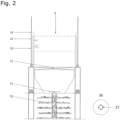
- Fig. 2 shows auxiliary equipment 18 in the growth chamber 3.
- the upper/outer compartment 6 shows examples of fastening, carrying, or supporting equipment 18, as well as humidification equipment 21 and lighting equipment 20.
- Cutting equipment 32 for separating the upper and lower plant parts can be installed at the upper and lower ends of the middle compartment 7.
- the lower/inner compartment 8 shows examples of fixtures 33 for accommodating old and young roots, as well as for tuber deposition.
- the top view shows an example installation in the root area with openings for growing roots.
- Fig. 3 shows the interior/processing room 2 with a support device 22, which is formed by growth shelves 23, which in turn are divided into growth levels 24.
- the receiving units 5 with the growth rooms 3 are located in the growth levels 24.
- the individual, closed receiving units 5 with the growth rooms 3 can either stand next to one another as individual box elements (a) or be arranged in series and separated from one another by common enclosing walls 13, 14, or separating elements 15 (b).
- Fig. 4 is the side view of Fig. 3 which is located in the interior/processing room 2.
- Several growth shelves 23 are arranged therein as a support device 22 for receiving recording units 5 and growth rooms 3.
- Fig. 5 schematically illustrates the growth levels 24 with separate growth chambers 3 and the differently set growth parameters, e.g. temperature T, air humidity phi, pressure p, etc., in the individual growth chambers 3 and partly also in the different sub-chambers 6, 7, 8.
- growth parameters e.g. temperature T, air humidity phi, pressure p, etc.
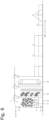
- Fig. 6 and 7 show an arrangement 1 with a transport device 25, which is based on a horizontal transport mechanism with a transport chain/conveyor chain (pulling chain) 26 for moving the growth spaces 3 with box-shaped receiving units 5 (box elements 27).
- a transport device 25 which is based on a horizontal transport mechanism with a transport chain/conveyor chain (pulling chain) 26 for moving the growth spaces 3 with box-shaped receiving units 5 (box elements 27).
- Fig. 6 schematically shows growth spaces 3 separated by separating elements 15 with various possible cultivation methods (horizontal-flat cultivation method; cultivation method using a plant column 36; cultivation method using a moving transport mechanism within the growth space 37).
- the receiving units 5 form part of the transport device 25, on which the removable, if necessary, enclosing walls 13, 14, 15 for forming the growth spaces 3 can be attached and/or the flexible, if necessary, rollable enclosing walls 13, 14, 15 can be stowed.
- FIG. 7 shows schematically the fastening of receiving units 5 (box elements 27), into which individual growth chambers 3 can be inserted.
- the return transport of the receiving units 5 (box elements 27) takes place upside down with horizontally directed deflection axes 28 or in a horizontal plane with vertically directed deflection axes 28.
- the Fig. 8 shows a section of a transport device 25, in which the receiving units 5 (box elements 27) are attached to horizontal deflection axes 28 with conveyor wheels (not shown) by means of self-aligning bearings 29.
- the enclosing walls 13, 14, 15 can be individually rolled up, their outer dimensions reduced, or even removed as needed (e.g., for harvesting, return transport, or cleaning).
- the return transport of the receiving units 5 (box elements 27) takes place upright.
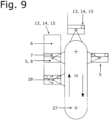
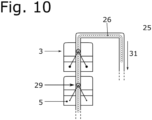
- the Fig. 9 and 10 show transport devices 25 with a vertically extending transport mechanism, to which the receiving units 5 (box elements 27) with the growth chambers 3 are attached by means of self-aligning bearings 29.
- a transport chain/conveyor chain (pulling chain) 26 is guided circumferentially around conveyor wheels with vertically directed deflection axes 28.
- the flexible enclosing walls 13, 14, 15 can be individually removed or rolled up as needed.
- the self-aligning bearings are attached to the transport chain/conveyor chain (pulling chain) 26 with a suitable movement element 30 and are moved along a predetermined guide track 31.
- the return transport of the receiving units 5 (box elements 27) takes place upright.
Landscapes
- Life Sciences & Earth Sciences (AREA)
- Environmental Sciences (AREA)
- Hydroponics (AREA)
Claims (7)
- Agencement pour la culture de plantes (4) dans un espace intérieur fermé (2), avec- une pluralité d'espaces de croissance (3) pour recevoir une ou plusieurs plantes (4) à cultiver et- au moins un appareil de conditionnement (19) pour ajuster les conditions ambiantes nécessaires à la croissance des plantes, l'appareil de conditionnement (19) comprenant au moins un appareil d'éclairage (20),- une pluralité d'espaces de croissance (3) étant réalisés dans l'espace intérieur (2), lesquels sont respectivement entourés par une paroi d'enceinte (13, 15) et formés sur une unité de réception (5), etcaractérisé en ce que- - un appareil de conditionnement (19) étant associé à chaque espace de croissance (3), qui comprend un appareil de chauffage et/ou un appareil de refroidissement avec lequel une température dans l'espace de croissance (3) peut être adaptée et régulée individuellement, les unités de réception (5) étant montées sur un dispositif de transport (25) avec lequel les unités de réception (5) peuvent être transportées en continu ou par étapes à travers l'espace intérieur/l'espace de traitement (2),
la paroi d'enceinte (13, 15) comprend un matériau de membrane flexible (14), notamment une feuille, un matériau textile, un tissu, un tricot ou un filet, le matériau de membrane (14) étant de préférence réalisé sous forme perméable aux gaz. - Agencement selon la revendication 1,
caractérisé en ce que- les unités de réception (5) présentent chacune un substrat (9) supportant la plante pour recevoir une ou plusieurs plantes (4) et un appareil d'approvisionnement (11) pour amener de l'eau et/ou des substances nutritives. - Agencement selon l'une quelconque des revendications 1 à 2,
caractérisé en ce que- l'appareil de conditionnement (19) présente, outre un appareil d'éclairage (20), au moins l'un des appareils suivants :- un appareil d'aération,- un appareil d'humidification (21),- un appareil d'arrosage et/ou- un appareil de fumigation ou de pollinisation. - Agencement selon l'une quelconque des revendications 1 à 3,
caractérisé en ce que- chaque espace de croissance (3) est divisé en d'autres sous-espaces (6, 7, 8) segmentés horizontalement, notamment un sous-espace supérieur/extérieur (6) pour les parties de la plante exposées à la lumière et un sous-espace inférieur/intérieur (8) pour les parties de la plante situées au sol. - Agencement selon l'une quelconque des revendications 1 à 4,
caractérisé en ce qu'- à chaque espace de croissance (3) est associé un appareil de détection avec un ou plusieurs capteurs qui sont réalisés pour détecter les conditions ambiantes, un approvisionnement en eau et/ou en substances nutritives et/ou une croissance des plantes, et- en ce qu'il est prévu au moins un appareil de commande qui est en liaison avec l'appareil de détection et qui est réalisé pour commander l'appareil de conditionnement (19) et/ou l'appareil d'alimentation (11) dans les différents espaces de croissance (3) en fonction des valeurs détectées par l'appareil de détection. - Procédé de culture de plantes (4) dans un espace intérieur fermé (2), avec- une pluralité d'espaces de croissance (3) dans lesquels sont reçues une ou plusieurs plantes (4) à cultiver, et- au moins un appareil de conditionnement (19) avec lequel sont ajustées les conditions ambiantes nécessaires à la croissance des plantes, l'appareil de conditionnement (19) comprenant au moins un appareil d'éclairage (20), notamment avec un agencement selon l'une quelconque des revendications 1 à 5,- un appareil de conditionnement (19) étant associé à chaque espace de croissance (3), lequel comprend un appareil de chauffage et/ou un appareil de refroidissement, avec lequel une température dans l'espace de croissance (3) est adaptée et régulée individuellement,une pluralité d'espaces de croissance (3) étant prévus dans l'espace intérieur (2), lesquels sont respectivement entourés par une paroi d'enceinte (13, 15) et formés sur une unité de réception (5), et les unités de réception (5) étant montées sur un dispositif de transport (25) avec lequel les unités de réception (5) peuvent être transportées en continu ou par étapes à travers l'espace intérieur/de traitement (2), caractérisé en ce que la paroi d'enceinte (13, 15) est formée avec un matériau de membrane flexible (14).
- Procédé selon la revendication 6,
caractérisé en ce qu'à chaque espace de croissance (3) est associé un appareil de détection avec un ou plusieurs capteurs, avec lesquels les conditions ambiantes, un approvisionnement en eau et/ou en substances nutritives et/ou une croissance des plantes sont détectés, eten ce qu'il est prévu au moins un appareil de commande, qui est en liaison avec l'appareil de détection et qui commande l'appareil de conditionnement (19) et/ou un appareil d'approvisionnement dans les différents espaces de croissance (3) en fonction des données détectées par l'appareil de détection.
Applications Claiming Priority (2)
| Application Number | Priority Date | Filing Date | Title |
|---|---|---|---|
| DE102021110717.2A DE102021110717A1 (de) | 2021-04-27 | 2021-04-27 | Anordnung und verfahren zur aufzucht von pflanzen in einem geschlossenen innenraum |
| PCT/EP2022/058879 WO2022228831A1 (fr) | 2021-04-27 | 2022-04-04 | Système et procédé de culture de plantes dans un espace intérieur fermé |
Publications (3)
| Publication Number | Publication Date |
|---|---|
| EP4304331A1 EP4304331A1 (fr) | 2024-01-17 |
| EP4304331B1 true EP4304331B1 (fr) | 2025-03-26 |
| EP4304331C0 EP4304331C0 (fr) | 2025-03-26 |
Family
ID=81579710
Family Applications (1)
| Application Number | Title | Priority Date | Filing Date |
|---|---|---|---|
| EP22720647.1A Active EP4304331B1 (fr) | 2021-04-27 | 2022-04-04 | Système et procédé de culture de plantes dans un espace intérieur fermé |
Country Status (3)
| Country | Link |
|---|---|
| EP (1) | EP4304331B1 (fr) |
| DE (1) | DE102021110717A1 (fr) |
| WO (1) | WO2022228831A1 (fr) |
Families Citing this family (2)
| Publication number | Priority date | Publication date | Assignee | Title |
|---|---|---|---|---|
| DE102024001224A1 (de) * | 2024-04-17 | 2025-10-23 | Gordon Opitz | MÖBEL für PFLANZEN |
| DE202024106697U1 (de) | 2024-11-20 | 2024-12-06 | Alexander Simon | Anordnung zur Beleuchtung wenigstens eines Bereiches insbesondere zur Aufzucht von Pflanzen in einem Gebäude |
Citations (3)
| Publication number | Priority date | Publication date | Assignee | Title |
|---|---|---|---|---|
| CN202009585U (zh) * | 2011-01-26 | 2011-10-19 | 北京中环易达设施园艺科技有限公司 | 智能型家庭植物工厂 |
| CN205511005U (zh) * | 2015-12-04 | 2016-08-31 | 镇江科达环境股份有限公司 | 一种家用智能菌菇机 |
| WO2018050816A1 (fr) * | 2016-09-15 | 2018-03-22 | Ocado Innovation Limited | Systèmes et procédés de culture |
Family Cites Families (8)
| Publication number | Priority date | Publication date | Assignee | Title |
|---|---|---|---|---|
| US8468741B2 (en) | 2010-03-23 | 2013-06-25 | Myles D. Lewis | Semi-automated crop production system |
| KR101278696B1 (ko) * | 2011-06-27 | 2013-06-25 | 최원영 | 식물공장용 광원 제어시스템 |
| NL2012234C2 (en) | 2014-02-10 | 2015-08-17 | Vivi B V | Plant holder. |
| JP6746056B2 (ja) * | 2015-02-13 | 2020-08-26 | 伊東電機株式会社 | 植物栽培装置及び植物栽培システム |
| ES2895175T3 (es) | 2017-05-30 | 2022-02-17 | Fraunhofer Ges Forschung | Dispositivo y método para favorecer el crecimiento de plantas |
| TR201712415A2 (tr) * | 2017-08-21 | 2019-03-21 | Arcelik As | Bi̇r otonom bi̇tki̇ yeti̇şti̇rme dolabi |
| KR20210057574A (ko) * | 2019-11-12 | 2021-05-21 | 농업회사법인 누리(주) | 모듈형 식물 재배 시스템 |
| DE202021000223U1 (de) * | 2021-01-21 | 2021-02-10 | Uwe Stiens | Kartoffelaufzuchtanlage |
-
2021
- 2021-04-27 DE DE102021110717.2A patent/DE102021110717A1/de not_active Withdrawn
-
2022
- 2022-04-04 WO PCT/EP2022/058879 patent/WO2022228831A1/fr not_active Ceased
- 2022-04-04 EP EP22720647.1A patent/EP4304331B1/fr active Active
Patent Citations (3)
| Publication number | Priority date | Publication date | Assignee | Title |
|---|---|---|---|---|
| CN202009585U (zh) * | 2011-01-26 | 2011-10-19 | 北京中环易达设施园艺科技有限公司 | 智能型家庭植物工厂 |
| CN205511005U (zh) * | 2015-12-04 | 2016-08-31 | 镇江科达环境股份有限公司 | 一种家用智能菌菇机 |
| WO2018050816A1 (fr) * | 2016-09-15 | 2018-03-22 | Ocado Innovation Limited | Systèmes et procédés de culture |
Also Published As
| Publication number | Publication date |
|---|---|
| EP4304331A1 (fr) | 2024-01-17 |
| WO2022228831A1 (fr) | 2022-11-03 |
| DE102021110717A1 (de) | 2022-10-27 |
| EP4304331C0 (fr) | 2025-03-26 |
Similar Documents
| Publication | Publication Date | Title |
|---|---|---|
| EP3750398B1 (fr) | Dispositif et procédé pour stimuler la croissance de plantes | |
| DE68923877T2 (de) | Verfahren und vorrichtung für die hydroponkultur. | |
| EP3777519B1 (fr) | Procédé de fonctionnement automatisé d'une serre, dispositif d'alimentation et serre automatique | |
| CA3028899C (fr) | Systeme et methode de culture de plantes en l'absence de sol | |
| CH621234A5 (fr) | ||
| EP2615906A1 (fr) | Dispositif et procédé pour la culture d'une ou de plusieurs plantes | |
| EP4304331B1 (fr) | Système et procédé de culture de plantes dans un espace intérieur fermé | |
| EP3484271B1 (fr) | Procédé et installation pour la mise en oeuvre industrielle d'une culture, croissance, récolte, lavage, emballage, étiquetage et réfricheration de plantes, en particulier de salates, de légumes ou de produits agricoles | |
| WO2018185011A1 (fr) | Procédé, système d'éclairage et serre | |
| DE102011050545B3 (de) | Transportable Pflanzenanbaueinrichtung für abgelegene Orte | |
| EP3873194A1 (fr) | Chambre climatique pour la culture de plantes comprenant un système climatique optimisé | |
| EP0142643A2 (fr) | Dispositif de stockage, de traitement et de transbordement de plantes | |
| DE4302273C1 (de) | Vorrichtung zum Züchten von Pilzen, insbesondere Champignons | |
| DE3434486A1 (de) | Verfahren und anlage zum kultivieren von saprophytisch lebenden pilzen | |
| EP4062749B1 (fr) | Dispositif et procédé de culture pour plantes | |
| KR102125499B1 (ko) | 식물 재배 장치 | |
| AT520937B1 (de) | Vorrichtung zum vertikalen Anbau von Pflanzen | |
| CH719014B9 (de) | Gewächshaus. | |
| EP4082330A1 (fr) | Serre microclimatique dotée d'une zone automatisée de croissance et d'une pluralité de tables de germination | |
| AT312983B (de) | Verfahren und Anlage zur Erzeugung natürlicher Rohstoffe mittels Pflanzen, die nach hydroponischen Kulturmethoden gewonnen werden | |
| DE112022000709T5 (de) | Vorrichtung zur automatisierten kultivierung von pflanzen | |
| EP4537653A1 (fr) | Procédés et dispositifs de culture de plantes | |
| DE102022115528A1 (de) | Trägersystem zur Aufzucht von Pflanzen | |
| AT364567B (de) | Verfahren und vorrichtung zur vertikalen kultivation von hohen gewaechsen | |
| CH720874A1 (de) | System und Vorrichtung zur Aufzucht von Lebewesen in einer kontrollierten Umgebung |
Legal Events
| Date | Code | Title | Description |
|---|---|---|---|
| STAA | Information on the status of an ep patent application or granted ep patent |
Free format text: STATUS: UNKNOWN |
|
| STAA | Information on the status of an ep patent application or granted ep patent |
Free format text: STATUS: THE INTERNATIONAL PUBLICATION HAS BEEN MADE |
|
| PUAI | Public reference made under article 153(3) epc to a published international application that has entered the european phase |
Free format text: ORIGINAL CODE: 0009012 |
|
| STAA | Information on the status of an ep patent application or granted ep patent |
Free format text: STATUS: REQUEST FOR EXAMINATION WAS MADE |
|
| 17P | Request for examination filed |
Effective date: 20230920 |
|
| AK | Designated contracting states |
Kind code of ref document: A1 Designated state(s): AL AT BE BG CH CY CZ DE DK EE ES FI FR GB GR HR HU IE IS IT LI LT LU LV MC MK MT NL NO PL PT RO RS SE SI SK SM TR |
|
| DAV | Request for validation of the european patent (deleted) | ||
| DAX | Request for extension of the european patent (deleted) | ||
| GRAP | Despatch of communication of intention to grant a patent |
Free format text: ORIGINAL CODE: EPIDOSNIGR1 |
|
| STAA | Information on the status of an ep patent application or granted ep patent |
Free format text: STATUS: GRANT OF PATENT IS INTENDED |
|
| INTG | Intention to grant announced |
Effective date: 20241113 |
|
| GRAS | Grant fee paid |
Free format text: ORIGINAL CODE: EPIDOSNIGR3 |
|
| GRAA | (expected) grant |
Free format text: ORIGINAL CODE: 0009210 |
|
| STAA | Information on the status of an ep patent application or granted ep patent |
Free format text: STATUS: THE PATENT HAS BEEN GRANTED |
|
| AK | Designated contracting states |
Kind code of ref document: B1 Designated state(s): AL AT BE BG CH CY CZ DE DK EE ES FI FR GB GR HR HU IE IS IT LI LT LU LV MC MK MT NL NO PL PT RO RS SE SI SK SM TR |
|
| REG | Reference to a national code |
Ref country code: GB Ref legal event code: FG4D Free format text: NOT ENGLISH |
|
| REG | Reference to a national code |
Ref country code: CH Ref legal event code: EP |
|
| REG | Reference to a national code |
Ref country code: DE Ref legal event code: R096 Ref document number: 502022003333 Country of ref document: DE |
|
| REG | Reference to a national code |
Ref country code: IE Ref legal event code: FG4D Free format text: LANGUAGE OF EP DOCUMENT: GERMAN |
|
| U01 | Request for unitary effect filed |
Effective date: 20250425 |
|
| U07 | Unitary effect registered |
Designated state(s): AT BE BG DE DK EE FI FR IT LT LU LV MT NL PT RO SE SI Effective date: 20250502 |
|
| U20 | Renewal fee for the european patent with unitary effect paid |
Year of fee payment: 4 Effective date: 20250429 |
|
| PG25 | Lapsed in a contracting state [announced via postgrant information from national office to epo] |
Ref country code: RS Free format text: LAPSE BECAUSE OF FAILURE TO SUBMIT A TRANSLATION OF THE DESCRIPTION OR TO PAY THE FEE WITHIN THE PRESCRIBED TIME-LIMIT Effective date: 20250626 |
|
| PG25 | Lapsed in a contracting state [announced via postgrant information from national office to epo] |
Ref country code: NO Free format text: LAPSE BECAUSE OF FAILURE TO SUBMIT A TRANSLATION OF THE DESCRIPTION OR TO PAY THE FEE WITHIN THE PRESCRIBED TIME-LIMIT Effective date: 20250626 |
|
| PG25 | Lapsed in a contracting state [announced via postgrant information from national office to epo] |
Ref country code: HR Free format text: LAPSE BECAUSE OF FAILURE TO SUBMIT A TRANSLATION OF THE DESCRIPTION OR TO PAY THE FEE WITHIN THE PRESCRIBED TIME-LIMIT Effective date: 20250326 |
|
| PG25 | Lapsed in a contracting state [announced via postgrant information from national office to epo] |
Ref country code: GR Free format text: LAPSE BECAUSE OF FAILURE TO SUBMIT A TRANSLATION OF THE DESCRIPTION OR TO PAY THE FEE WITHIN THE PRESCRIBED TIME-LIMIT Effective date: 20250627 |
|
| PG25 | Lapsed in a contracting state [announced via postgrant information from national office to epo] |
Ref country code: SM Free format text: LAPSE BECAUSE OF FAILURE TO SUBMIT A TRANSLATION OF THE DESCRIPTION OR TO PAY THE FEE WITHIN THE PRESCRIBED TIME-LIMIT Effective date: 20250326 |
|
| PG25 | Lapsed in a contracting state [announced via postgrant information from national office to epo] |
Ref country code: ES Free format text: LAPSE BECAUSE OF FAILURE TO SUBMIT A TRANSLATION OF THE DESCRIPTION OR TO PAY THE FEE WITHIN THE PRESCRIBED TIME-LIMIT Effective date: 20250326 |
|
| PG25 | Lapsed in a contracting state [announced via postgrant information from national office to epo] |
Ref country code: PL Free format text: LAPSE BECAUSE OF FAILURE TO SUBMIT A TRANSLATION OF THE DESCRIPTION OR TO PAY THE FEE WITHIN THE PRESCRIBED TIME-LIMIT Effective date: 20250326 |
|
| PG25 | Lapsed in a contracting state [announced via postgrant information from national office to epo] |
Ref country code: SK Free format text: LAPSE BECAUSE OF FAILURE TO SUBMIT A TRANSLATION OF THE DESCRIPTION OR TO PAY THE FEE WITHIN THE PRESCRIBED TIME-LIMIT Effective date: 20250326 |
|
| PG25 | Lapsed in a contracting state [announced via postgrant information from national office to epo] |
Ref country code: IS Free format text: LAPSE BECAUSE OF FAILURE TO SUBMIT A TRANSLATION OF THE DESCRIPTION OR TO PAY THE FEE WITHIN THE PRESCRIBED TIME-LIMIT Effective date: 20250726 |
|
| REG | Reference to a national code |
Ref country code: CH Ref legal event code: H13 Free format text: ST27 STATUS EVENT CODE: U-0-0-H10-H13 (AS PROVIDED BY THE NATIONAL OFFICE) Effective date: 20251125 |