EP4300688A2 - Endothermic and fire suppressive material and lithium battery module - Google Patents
Endothermic and fire suppressive material and lithium battery module Download PDFInfo
- Publication number
- EP4300688A2 EP4300688A2 EP23180203.4A EP23180203A EP4300688A2 EP 4300688 A2 EP4300688 A2 EP 4300688A2 EP 23180203 A EP23180203 A EP 23180203A EP 4300688 A2 EP4300688 A2 EP 4300688A2
- Authority
- EP
- European Patent Office
- Prior art keywords
- lithium battery
- endothermic
- battery module
- housing
- barbituric acid
- Prior art date
- Legal status (The legal status is an assumption and is not a legal conclusion. Google has not performed a legal analysis and makes no representation as to the accuracy of the status listed.)
- Pending
Links
Images


Classifications
-
- H—ELECTRICITY
- H01—ELECTRIC ELEMENTS
- H01M—PROCESSES OR MEANS, e.g. BATTERIES, FOR THE DIRECT CONVERSION OF CHEMICAL ENERGY INTO ELECTRICAL ENERGY
- H01M10/00—Secondary cells; Manufacture thereof
- H01M10/60—Heating or cooling; Temperature control
- H01M10/61—Types of temperature control
- H01M10/613—Cooling or keeping cold
-
- H—ELECTRICITY
- H01—ELECTRIC ELEMENTS
- H01M—PROCESSES OR MEANS, e.g. BATTERIES, FOR THE DIRECT CONVERSION OF CHEMICAL ENERGY INTO ELECTRICAL ENERGY
- H01M50/00—Constructional details or processes of manufacture of the non-active parts of electrochemical cells other than fuel cells, e.g. hybrid cells
- H01M50/20—Mountings; Secondary casings or frames; Racks, modules or packs; Suspension devices; Shock absorbers; Transport or carrying devices; Holders
- H01M50/289—Mountings; Secondary casings or frames; Racks, modules or packs; Suspension devices; Shock absorbers; Transport or carrying devices; Holders characterised by spacing elements or positioning means within frames, racks or packs
- H01M50/293—Mountings; Secondary casings or frames; Racks, modules or packs; Suspension devices; Shock absorbers; Transport or carrying devices; Holders characterised by spacing elements or positioning means within frames, racks or packs characterised by the material
-
- A—HUMAN NECESSITIES
- A62—LIFE-SAVING; FIRE-FIGHTING
- A62C—FIRE-FIGHTING
- A62C3/00—Fire prevention, containment or extinguishing specially adapted for particular objects or places
- A62C3/16—Fire prevention, containment or extinguishing specially adapted for particular objects or places in electrical installations, e.g. cableways
-
- A—HUMAN NECESSITIES
- A62—LIFE-SAVING; FIRE-FIGHTING
- A62D—CHEMICAL MEANS FOR EXTINGUISHING FIRES OR FOR COMBATING OR PROTECTING AGAINST HARMFUL CHEMICAL AGENTS; CHEMICAL MATERIALS FOR USE IN BREATHING APPARATUS
- A62D1/00—Fire-extinguishing compositions; Use of chemical substances in extinguishing fires
- A62D1/0007—Solid extinguishing substances
- A62D1/0014—Powders; Granules
-
- A—HUMAN NECESSITIES
- A62—LIFE-SAVING; FIRE-FIGHTING
- A62D—CHEMICAL MEANS FOR EXTINGUISHING FIRES OR FOR COMBATING OR PROTECTING AGAINST HARMFUL CHEMICAL AGENTS; CHEMICAL MATERIALS FOR USE IN BREATHING APPARATUS
- A62D1/00—Fire-extinguishing compositions; Use of chemical substances in extinguishing fires
- A62D1/0028—Liquid extinguishing substances
-
- A—HUMAN NECESSITIES
- A62—LIFE-SAVING; FIRE-FIGHTING
- A62D—CHEMICAL MEANS FOR EXTINGUISHING FIRES OR FOR COMBATING OR PROTECTING AGAINST HARMFUL CHEMICAL AGENTS; CHEMICAL MATERIALS FOR USE IN BREATHING APPARATUS
- A62D1/00—Fire-extinguishing compositions; Use of chemical substances in extinguishing fires
- A62D1/0028—Liquid extinguishing substances
- A62D1/005—Dispersions; Emulsions
-
- A—HUMAN NECESSITIES
- A62—LIFE-SAVING; FIRE-FIGHTING
- A62D—CHEMICAL MEANS FOR EXTINGUISHING FIRES OR FOR COMBATING OR PROTECTING AGAINST HARMFUL CHEMICAL AGENTS; CHEMICAL MATERIALS FOR USE IN BREATHING APPARATUS
- A62D1/00—Fire-extinguishing compositions; Use of chemical substances in extinguishing fires
- A62D1/0064—Gels; Film-forming compositions
-
- A—HUMAN NECESSITIES
- A62—LIFE-SAVING; FIRE-FIGHTING
- A62D—CHEMICAL MEANS FOR EXTINGUISHING FIRES OR FOR COMBATING OR PROTECTING AGAINST HARMFUL CHEMICAL AGENTS; CHEMICAL MATERIALS FOR USE IN BREATHING APPARATUS
- A62D1/00—Fire-extinguishing compositions; Use of chemical substances in extinguishing fires
- A62D1/06—Fire-extinguishing compositions; Use of chemical substances in extinguishing fires containing gas-producing, chemically-reactive components
-
- H—ELECTRICITY
- H01—ELECTRIC ELEMENTS
- H01M—PROCESSES OR MEANS, e.g. BATTERIES, FOR THE DIRECT CONVERSION OF CHEMICAL ENERGY INTO ELECTRICAL ENERGY
- H01M10/00—Secondary cells; Manufacture thereof
- H01M10/05—Accumulators with non-aqueous electrolyte
- H01M10/052—Li-accumulators
-
- H—ELECTRICITY
- H01—ELECTRIC ELEMENTS
- H01M—PROCESSES OR MEANS, e.g. BATTERIES, FOR THE DIRECT CONVERSION OF CHEMICAL ENERGY INTO ELECTRICAL ENERGY
- H01M10/00—Secondary cells; Manufacture thereof
- H01M10/05—Accumulators with non-aqueous electrolyte
- H01M10/052—Li-accumulators
- H01M10/0525—Rocking-chair batteries, i.e. batteries with lithium insertion or intercalation in both electrodes; Lithium-ion batteries
-
- H—ELECTRICITY
- H01—ELECTRIC ELEMENTS
- H01M—PROCESSES OR MEANS, e.g. BATTERIES, FOR THE DIRECT CONVERSION OF CHEMICAL ENERGY INTO ELECTRICAL ENERGY
- H01M10/00—Secondary cells; Manufacture thereof
- H01M10/60—Heating or cooling; Temperature control
- H01M10/65—Means for temperature control structurally associated with the cells
- H01M10/654—Means for temperature control structurally associated with the cells located inside the innermost case of the cells, e.g. mandrels, electrodes or electrolytes
-
- H—ELECTRICITY
- H01—ELECTRIC ELEMENTS
- H01M—PROCESSES OR MEANS, e.g. BATTERIES, FOR THE DIRECT CONVERSION OF CHEMICAL ENERGY INTO ELECTRICAL ENERGY
- H01M10/00—Secondary cells; Manufacture thereof
- H01M10/60—Heating or cooling; Temperature control
- H01M10/65—Means for temperature control structurally associated with the cells
- H01M10/658—Means for temperature control structurally associated with the cells by thermal insulation or shielding
-
- H—ELECTRICITY
- H01—ELECTRIC ELEMENTS
- H01M—PROCESSES OR MEANS, e.g. BATTERIES, FOR THE DIRECT CONVERSION OF CHEMICAL ENERGY INTO ELECTRICAL ENERGY
- H01M50/00—Constructional details or processes of manufacture of the non-active parts of electrochemical cells other than fuel cells, e.g. hybrid cells
- H01M50/20—Mountings; Secondary casings or frames; Racks, modules or packs; Suspension devices; Shock absorbers; Transport or carrying devices; Holders
- H01M50/233—Mountings; Secondary casings or frames; Racks, modules or packs; Suspension devices; Shock absorbers; Transport or carrying devices; Holders characterised by physical properties of casings or racks, e.g. dimensions
- H01M50/24—Mountings; Secondary casings or frames; Racks, modules or packs; Suspension devices; Shock absorbers; Transport or carrying devices; Holders characterised by physical properties of casings or racks, e.g. dimensions adapted for protecting batteries from their environment, e.g. from corrosion
-
- H—ELECTRICITY
- H01—ELECTRIC ELEMENTS
- H01M—PROCESSES OR MEANS, e.g. BATTERIES, FOR THE DIRECT CONVERSION OF CHEMICAL ENERGY INTO ELECTRICAL ENERGY
- H01M2200/00—Safety devices for primary or secondary batteries
- H01M2200/10—Temperature sensitive devices
-
- Y—GENERAL TAGGING OF NEW TECHNOLOGICAL DEVELOPMENTS; GENERAL TAGGING OF CROSS-SECTIONAL TECHNOLOGIES SPANNING OVER SEVERAL SECTIONS OF THE IPC; TECHNICAL SUBJECTS COVERED BY FORMER USPC CROSS-REFERENCE ART COLLECTIONS [XRACs] AND DIGESTS
- Y02—TECHNOLOGIES OR APPLICATIONS FOR MITIGATION OR ADAPTATION AGAINST CLIMATE CHANGE
- Y02E—REDUCTION OF GREENHOUSE GAS [GHG] EMISSIONS, RELATED TO ENERGY GENERATION, TRANSMISSION OR DISTRIBUTION
- Y02E60/00—Enabling technologies; Technologies with a potential or indirect contribution to GHG emissions mitigation
- Y02E60/10—Energy storage using batteries
Definitions
- the present invention generally relates to an endothermic and fire suppressive material and a battery module, and more specifically to an endothermic and fire suppressive material and a lithium battery module.
- the application of a lithium battery module or a lithium battery cell are more and more widely. Moreover, based on an applicability of a product, the capacity of a lithium battery module or a lithium battery cell is increasing.
- a lithium battery module or a lithium battery cell is used improperly, or if an external protection circuit (e.g., a battery management system (BMS)) fails, or when external damage causes changes in the internal structure of a lithium battery module or a lithium battery cell, it is easy to cause the internal short circuit phenomenon of the lithium battery module or the lithium battery cell. Therefore, there is a high probability that a single or a group of lithium batteries will burn and explode and spread to other lithium batteries, causing a large-scale combustion and explosion hazard, endangering the safety of life and property.
- BMS battery management system
- a lithium battery module or a lithium battery cell may have a corresponding electric potential energy.
- the present invention provides an endothermic and fire suppressive material and a lithium battery module.
- an endothermic and fire suppressive material includes barbituric acid, barbituric acid derivative, or a combination thereof.
- the barbituric acid, the barbituric acid derivative, or a combination thereof account for at least 1 wt% of the endothermic and fire suppressive material.
- the endothermic and fire suppressive material further include ammonium dihydrogen phosphate.
- a weight ratio of the barbituric acid, the barbituric acid derivative, or a combination thereof account to the ammonium dihydrogen phosphate is 99:1 to 1:99.
- a lithium battery module includes a housing, a cover, at least one lithium battery cell and an endothermic and fire suppressive material.
- the cover covers the housing.
- the housing and the cover form an accommodating space.
- the lithium battery cell is disposed in the accommodating space.
- the endothermic and fire suppressive material is filled in the accommodating space.
- At least one of the housing or the cover has an injection hole.
- the injection hole is sealed.
- the endothermic and fire suppressive material is an electrically insulating material
- at least one of the housing or the cover has a positive contact
- at least one of the housing or the cover has a negative contact
- a positive electrode of the lithium battery cell is connected to the positive contact
- a negative electrode of the lithium battery cell is connected to the negative contact
- the endothermic and fire suppressive material is in a liquid form, a powder form, an emulsified form, or a colloidal form.
- the lithium battery cell includes a solid electrolyte interface (SEI), a maximum temperature after the lithium battery module is short-circuited and heated up is lower than a minimum temperature of thermal decomposition or thermal degradation of the solid electrolyte interface (SEI) included in the lithium battery cell.
- SEI solid electrolyte interface
- the endothermic and fire suppressive material includes barbituric acid, barbituric acid derivative, or a combination thereof.
- the barbituric acid, the barbituric acid derivative, or a combination thereof account for at least 1 wt% of the endothermic and fire suppressive material.
- the endothermic and fire suppressive material further include ammonium dihydrogen phosphate.
- a weight ratio of the barbituric acid, the barbituric acid derivative, or a combination thereof account to the ammonium dihydrogen phosphate is 99:1 to 1:99.
- fireproof', "fire-extinguishing” or “fire-suppressive” or “fire retardant” used herein mean the object or the material (including but not limited to: film, layer, block and other structures) may pass the flame retardancy criteria of the standard test method.
- the degree is at least the HB level; preferably V1 level; more preferably 5VA level.
- FIG. 1A is a partial flowchart of a partial manufacturing method of a lithium battery module according to an embodiment of the present invention.
- a partial manufacturing method of a lithium battery module may be described as follows.
- the corresponding drawing symbols may be understood by referring to FIG. 1B to FIG. 1C exemplarily.
- the partial manufacturing method of the lithium battery module is not limited to those shown in FIG. 1B to FIG. 1C .
- the flowchart as shown in FIG. 1A may be an exemplary partial process.
- step S10 at least one lithium battery cell (e.g., a lithium battery cell 131 described later, a lithium battery cell 432 described later, or a lithium battery cell similar thereof; but not limited to) is provided.
- the present invention is not limited to the form of the lithium battery cell, as long as it meets a standard of a general lithium battery cell.
- a lithium battery cell may include a square tank type battery cell, a prismatic type battery cell a pouch type battery cell, or a cylindrical type battery cell; for example, a 126090-type battery cell, an 18650-type battery cell, or similar.
- the plurality of lithium battery cells may be connected in series or in parallel.
- lithium battery cell standard such as but not limited to: IEC 61960 standard, IEC62619 standard, VDE-AR-E 2510-50 standard, CNS 15391-2 standard, UL 1642 standard.
- step S20 the lithium battery cell is disposed in a housing (such as a housing 110 described later, a housing 310 described later, a housing 410 described later, a housing 510 described later, a housing described later, or a housing similar thereof; but not limited to).
- the present invention is not limited to the form of the housing, as long as it is suitable for a corresponding object (e.g., the lithium battery cell) to be placed therein; and/or, it is suitable for being injected a corresponding material (e.g., an endothermic and fire suppressive material mentioned later).
- the housing may meet a general fire protection standard.
- a material of the housing may include metal (e.g., an aluminum galvanized shell), a metal alloy (e.g., an aluminum-silicon alloy coating housing) or a polymer (e.g., Bakelite).
- the housing may have an injection hole (e.g., an injection hole 150 described later; but not limited).
- an injection hole e.g., an injection hole 150 described later; but not limited.
- an electrode contact e.g., a positive contact and/or a negative contacts
- the electrode contact on the aforementioned housing may be electrically connected to a corresponding electrode (e.g., a positive electrode or a negative electrode) of the lithium battery cell by an appropriate conductor (e.g., a wire connection and/or a circuit board connection).
- an appropriate conductor e.g., a wire connection and/or a circuit board connection
- step S30 a cover (e.g., a cover 120 described later, a cover 320 described later, a cover 420 described later, a cover 520 described later, a cover 620 described later, or a lithium battery cell similar thereof; but not limited to) is placed on the housing with the lithium battery cell placed therein.
- a cover e.g., a cover 120 described later, a cover 320 described later, a cover 420 described later, a cover 520 described later, a cover 620 described later, or a lithium battery cell similar thereof; but not limited to
- the present invention is not limited to the form of the cover, as long as it is suitable for covering the housing.
- the cover may meet a general fireproof standard.
- the material of the cover may be the same or similar to the material of the housing.
- the cover may have an injection hole (e.g., an injection hole 150 described later; but not limited).
- an injection hole e.g., an injection hole 150 described later; but not limited.
- an electrode contact e.g., a positive contact and/or a negative contacts
- the electrode contact on the aforementioned cover may be electrically connected to a corresponding electrode (e.g., a positive electrode or a negative electrode) of the lithium battery cell by an appropriate conductor (e.g., a wire connection and/or a circuit board connection).
- an appropriate conductor e.g., a wire connection and/or a circuit board connection
- step S40 an endothermic and fire suppressive material (e.g., an endothermic and fire suppressive material 140, or an endothermic and fire suppressive material similar thereof; but not limited to) is injected from the injection hole into the housing with the cover covering it.
- an endothermic and fire suppressive material e.g., an endothermic and fire suppressive material 140, or an endothermic and fire suppressive material similar thereof; but not limited to
- the endothermic and fire suppressive material may include insulating and non-conductive liquid, colloid, or powdered solid.
- the endothermic and fire suppressive material may include a suitable endothermic fluid, a suitable flame retardant and/or a suitable flame retardant.
- the endothermic and fire suppressive material may include an ether compound.
- the aforementioned ether compound may include, but are not limited to: ethyl perfluorobutyl ether ( CAS: 163702-05-4 ), ethyl nonafluoroisobutyl ether ( CAS: 163702-06-5 ), or a combination there above.
- the endothermic and fire suppressive material may include an organophosphorus compound.
- the aforementioned organophosphorus compound may include, but are not limited to: 2-carboxyethyl(phenyl) phosphinicacid ( CAS: 14657-64-8 ), 6-oxido-6H-dibenz[c,e][1,2]oxaphosphorin-6-yl)methyl] butanedioic acid ( CAS: 63562-33-4 ), [(6-oxido-6H-dibenz[c,e][1,2]oxaphosphorin-6-yl)methyl]butanedioic acid bis(2-hydroxyethyl) ester ( CAS: 63562-34-5 ), 10-benzylmethyl-9-oxa-10-phosphaphenanthrene-10-oxide ( CAS: 113504-81-7 ), 6,6'-(1-phenylethane-1,2-diyl)bis(6H-dibenzo[c,e]
- the endothermic and fire suppressive material may include an organobromine compound.
- the aforementioned organobromine compound may include but are not limited to: 2,3-dibromo-2-propen-1-ol, dibromomethane, 1,2-dibromoethane, 1,2-dibromoethylene, 1,4-dibromobutane, 1,5-dibromopentane, or a combination therea bove.
- the endothermic and fire suppressive material may include barbituric acid or barbituric acid derivative (e.g., barbiturates; or, one of the hydrogen atoms bonded to the carbon atom of barbituric acid is replaced by methyl, ethyl or isotopes; or a salt thereof).
- the barbituric acid or the barbituric acid derivative may be used as a free radical scavenger (FRS), which may reduce the concentration or quantity of free radicals in the process of combustion. As such, the combustion may be slowed down or stopped.
- the barbituric acid or the barbituric acid derivative may produce water and carbon dioxide after being heated and/or burned, in which water may reduce the ambient temperature (which may be regarded as cooling or endothermic), and carbon dioxide may reduce combustion (which may be regarded as fire extinguishing, or fire-suppressive, or fire retardant).
- the barbituric acid or the barbituric acid derivative may be suitable as an endothermic and fire suppressive material.
- the barbituric acid/derivative thereof may reduce the maximum temperature after the lithium battery module is short-circuited and heated up.
- the maximum temperature after the lithium battery module is short-circuited and heated up may be lower than the minimum temperature of thermal decomposition or thermal degradation of the solid electrolyte interface (SEI) used in a general lithium battery cell.
- SEI solid electrolyte interface
- the solid electrolyte interface (SEI) may be a layer (e.g., a passivation layer).
- the minimum temperature of thermal decomposition or thermal degradation of the solid electrolyte interface (SEI) used in a general lithium battery cell is about 100°C. That is to say, compared with not using the barbituric acid/derivative thereof, the barbituric acid/derivative thereof may at least reduce the maximum temperature after the lithium battery module is short-circuited and heated up, and at least may be regarded as an endothermic material.
- the weight of the barbituric acid/derivative thereof accounts for at least 1% by weight of the whole endothermic and fire suppressive material. That is, the barbituric acid, the barbituric acid derivative, or a combination thereof account for at least 1 wt% of the endothermic and fire suppressive material.
- the endothermic and fire suppressive material may include ammonium dihydrogen phosphate (ADP).
- ADP ammonium dihydrogen phosphate
- ammonium dihydrogen phosphate may absorb heat to decompose phosphoric acid and ammonia, and may continue to react in multiple steps to generate phosphorus pentoxide. Each of the aforementioned steps is an endothermic reaction, and water vapor may be generated, which may exert a cooling or endothermic effect.
- the endothermic and fire suppressive material may include ammonium dihydrogen phosphate and the barbituric acid/derivative thereof.
- the weight ratio of the barbituric acid/derivative thereof to the ammonium dihydrogen phosphate may be from about 99:1 to about 1:99. In an embodiment, the weight ratio of the barbituric acid/derivative thereof to the ammonium dihydrogen phosphate may be about 4: 1.
- the barbituric acid, the barbituric acid derivative, the ammonium dihydrogen phosphate, or a combination there above may be referred as a powder endothermic and fire suppressive material.
- the endothermic and fire suppressive material may include triethyl phosphate (TEP).
- TEP triethyl phosphate
- the boiling point of triethyl phosphate may be about 215°C, and the flash point of triethyl phosphate may be about 115°C.
- Triethyl phosphate may be miscible with water.
- the barbituric acid/derivative thereof may be prepared in combination with triethyl phosphate and ammonium dihydrogen phosphate, and may be used as a liquid endothermic and fire suppressive material.
- the above-mentioned liquid endothermic and fire suppressive material may not be ignited or produce any burning phenomenon when sprayed with a spray gun, and has the effect of endothermic.
- a solvent used in the aforementioned liquid endothermic and fire suppressive material may further include fluorinated solvents, brominated solvents, and dimethyl sulfoxide (DMSO), and may further exclude water.
- a liquid endothermic and fire suppressive material may include triethyl phosphate, water, the barbituric acid/derivative thereof, ammonium dihydrogen phosphate , wherein: the weight ratio of the barbituric acid/derivative thereof to the triethyl phosphate may be about 99:1 to about 1:99; or, the weight ratio of the barbituric acid/derivative thereof to the ammonium dihydrogen phosphate may be about 99:1 to about 1:99. Within the aforementioned range of weight ratios, the ratio of each component may be adjusted according to the amount of heat released by the battery and/or the corresponding safety factor. In an embodiment, the weight ratio of triethyl phosphate, water, the barbituric acid/derivative thereof, ammonium dihydrogen phosphate may be about 1:4:4:1.
- the liquid endothermic and fire suppressive material may further include a dispersant.
- the dispersant may improve the dispersibility of the components in the liquid endothermic and fire suppressive material, so as to have a better heat absorption effect, cooling and/or endothermic effect.
- the dispersant may include an acrylic polymer containing ammonium salt.
- the dispersant may include a dispersant manufactured by Taiwan Hopax Chemicals Mfg. Co., Ltd under the tradename CA-A48.
- the above-mentioned liquid endothermic and fire suppressive material may be emulsified after adding a dispersant, and further increase the content of the barbituric acid/ derivative thereof, and then add Boehmite and a composite material which may be formed by bonding the polyurethane (PU) foaming material and an inorganic material.
- the formed colloidal or emulsified endothermic and fire suppressive material may have better heat absorption, heat conduction, endothermic and fire suppressive and/or flame-resistant performance.
- the endothermic and fire suppressive material may include triethyl phosphate, dispersant, nonflammable solvent (e.g., water, fluorinated solvent, brominated solvent or dimethyl sulfone), the barbituric acid/derivative thereof, ammonium dihydrogen phosphate, and N-dodecyl-N,N-dimethyl-3-ammonio-1-propanesulfonate ( CAS No. 14933-08-5 ).
- the N-dodecyl-N,N-dimethyl-3-ammonio-1-propanesulfonate may be included in a zwitterionic surfactant and further be manufactured by Taiwan Hopax Chemicals Mfg. Co., Ltd under the tradename SB-10.
- the colloidal or emulsified endothermic and fire suppressive material may include triethyl phosphate, dispersant, non-flammable solvents, the barbituric acid/derivative thereof, ammonium dihydrogen phosphate, and N-Dodecyl-N,N-dimethyl-3-ammonio-1-propanesulfonate, wherein: the weight ratio of the barbituric acid/derivative thereof to the triethyl phosphate may be about 99:1 to about 1:99; or, the weight ratio of the barbituric acid/derivative thereof to the ammonium dihydrogen phosphate may be about 99:1 to about 1:99.
- the ratio of each component may be adjusted according to the amount of heat released by the battery and/or the corresponding safety factor.
- the weight ratio of the triethyl phosphate, the dispersant, the non-flammable solvent, the barbituric acid/derivative thereof, and the ammonium dihydrogen phosphate may be about 2:0.3:1.5:5.5:0.7.
- the colloidal or emulsified endothermic and fire suppressive material may include triethyl phosphate, dispersant, non-flammable solvent, the barbituric acid/derivative thereof, ammonium dihydrogen phosphate, N-Dodecyl-N,N-dimethyl-3-ammonio-1-propanesulfonate, a composite material which may be formed by bonding the polyurethane (PU) foaming material and an inorganic material, and Boehmite, wherein: the weight ratio of the barbituric acid/derivative thereof to the triethyl phosphate may be about 99:1 to about 1:99; or, the weight ratio of the barbituric acid/derivative thereof to the ammonium dihydrogen phosphate may be about 99:1 to about 1:99.
- the ratio of each component may be adjusted according to the amount of heat released by the battery and/or the corresponding safety factor.
- the weight ratio of the triethyl phosphate, the dispersant, the non-flammable solvent, the barbituric acid/derivative thereof, the ammonium dihydrogen phosphate, the N-Dodecyl-N,N-dimethyl-3-ammonio-1-propanesulfonate, the composite material which may be formed by bonding the polyurethane (PU) foaming material and an inorganic material, and the Boehmite may be about 2:0.3:1.5:5:0.5:0.2:0.2:0.3.
- the lithium battery cell may be properly tested by using the corresponding electrode contacts on the cover or housing.
- the test item may include but is not limited to: external short circuit test, impact test, drop test, overcharge test (e.g., voltage overcharge or current overcharge), forced discharge test, internal short circuit test or overheating test. In this way, if an aforementioned test is not passed, at least an appropriate repair step or a confirmation step may be performed before injecting the endothermic and fire suppressive material.
- the step of injecting the endothermic and fire suppressive material may be performed.
- the intermediate product may be scrapped or the corresponding lithium battery cell, housing or cover may be recycled for reuse.
- step S50 the injection hole is sealed.
- the injection hole for being injected the endothermic and fire suppressive material may be sealed by filling the injection hole with heat-resistant and fire-resistant glue (e.g., an acrylic glue or an epoxy resin; but not limited) and curing it.
- heat-resistant and fire-resistant glue e.g., an acrylic glue or an epoxy resin; but not limited
- a fireproof film, a fire-resistant film, or a fire suppressive film may be formed on the outside of the housing and/or the cover by spraying, coating, wetting and/or another suitable method.
- the aforementioned fireproof film, the aforementioned fire-resistant film, the aforementioned fire suppressive film may at least partially cover the injection hole.
- the aforementioned endothermic and fire suppressive material may be applied to a lithium battery module, but the endothermic and fire suppressive material may further have other applications.
- the injection hole since the material of the objection filled into and/or covered the injection hole is different from the material of the housing or the material of the cover, under the same pressure, before the housing or cover is damaged, the objection filled into and/or covered the injection hole may be relatively easy to peel and/or detach from the injection hole. Therefore, in an application of the lithium battery module, the injection hole may be referred as a corresponding pressure relief hole (e.g., for reducing the gas pressure in the accommodating space formed by the housing and the cover.).
- the production of the lithium battery module of an embodiment could be substantially completed.
- a lithium battery module of an embodiment of the present invention could be subjected to various tests according to requirements to confirm that it meets a general safety standard.
- the test item may include but is not limited to: external short circuit test, impact test, vibration test, altitude mode test, forced discharge test, drop test (e.g., a 1.2-meter drop test), temperature test, overcharge test or impact test.
- a test standard may include but is not limited to: UL 2054, IEC 61960 and/or GB/T 18287.
- the test may be performed for the entire lithium battery module.
- a corresponding electrical test may be to conduct an electrical test on the entire lithium battery module through the positive contact and the negative contact.
- FIG. 1C is a partial perspective view of a lithium battery module according to the first embodiment of the present invention.
- a lithium battery module 100 includes a housing 110, a cover 120, at least one lithium battery cell 131, and an endothermic and fire suppressive material 140.
- the cover 120 is disposed on the housing 110.
- the housing 110 and the cover 120 constitute an accommodating space S.
- the lithium battery cell 131 is disposed in the accommodating space S.
- the endothermic and fire suppressive material 140 is filled in the accommodating space S.
- the lithium battery module 100 may include a plurality of lithium battery cells 131.
- the lithium battery cell 131 may be a pouch type battery cell.
- the positive contact E1 and the negative contact E2 are disposed on the cover 120.
- the injection hole 150 is disposed on the cover 120.
- FIG. 2 is a partial perspective view of a lithium battery module according to the second embodiment of the present invention.
- the manufacturing method of the lithium battery module 200 of this embodiment is similar to the manufacturing method of the lithium battery module 100 of the previous embodiment, and the same or similar components are denoted by the same or similar symbols, and have similar functions, materials or forms, and descriptions are omitted.
- a lithium battery module 200 includes a housing 110, a cover 120, at least one lithium battery cell 131, and an endothermic and fire suppressive material 140.
- the cover 120 is disposed on the housing 110.
- the housing 110 and the cover 120 constitute an accommodating space S.
- the lithium battery cell 131 is disposed in the accommodating space S.
- the endothermic and fire suppressive material 140 is filled in the accommodating space S.
- the lithium battery module 200 may include a single lithium battery cell 131.
- FIG. 3 is a partial perspective view of a lithium battery module according to the third embodiment of the present invention.
- the manufacturing method of the lithium battery module 300 of this embodiment is similar to the manufacturing method of the lithium battery module 100 of the previous embodiment, and the same or similar components are denoted by the same or similar symbols, and have similar functions, materials or forms, and descriptions are omitted.
- a lithium battery module 300 includes a housing 310, a cover 320, at least one lithium battery cell 131, and an endothermic and fire suppressive material 140.
- the cover 320 is disposed on the housing 310.
- the housing 310 and the cover 320 constitute an accommodating space S.
- the lithium battery cell 131 is disposed in the accommodating space S.
- the endothermic and fire suppressive material 140 is filled in the accommodating space S.
- the lithium battery module 300 may include a single lithium battery cell 131.
- one of the positive contact E1 and the negative contact E2 is disposed on the cover 320, and the other of the positive contact E1 and the negative contact E2 is disposed on the housing 310.
- the positive contact E1 is disposed on the cover 320
- the negative contact E2 is disposed on the housing 310.
- the negative contact E2 could be disposed on the cover 320
- the positive contact E1 could be disposed on the housing 310.
- the injection hole 150 is disposed on the cover 320.
- FIG. 4 is a partial perspective view of a lithium battery module according to the fourth embodiment of the present invention.
- the manufacturing method of the lithium battery module 400 of this embodiment is similar to the manufacturing method of the lithium battery module 100 of the previous embodiment, and the same or similar components are denoted by the same or similar symbols, and have similar functions, materials or forms, and descriptions are omitted.
- a lithium battery module 400 includes a housing 410, a cover 420, at least one lithium battery cell 432, and an endothermic and fire suppressive material 140.
- the cover 420 is disposed on the housing 410.
- the housing 410 and the cover 420 constitute an accommodating space S.
- the lithium battery cell 432 is disposed in the accommodating space S.
- the endothermic and fire suppressive material 140 is filled in the accommodating space S.
- the lithium battery module 400 may include a single lithium battery cell 431.
- the lithium battery cell 432 may be a cylindrical type battery cell.
- the positive contact E1 and the negative contact E2 are disposed on the cover 420.
- the injection hole 150 is disposed on the cover 420.
- FIG. 5 is a partial perspective view of a lithium battery module according to the fifth embodiment of the present invention.
- the manufacturing method of the lithium battery module 500 of this embodiment is similar to the manufacturing method of the lithium battery module 100 of the previous embodiment, and the same or similar components are denoted by the same or similar symbols, and have similar functions, materials or forms, and descriptions are omitted.
- a lithium battery module 500 includes a housing 510, a cover 520, at least one lithium battery cell 432, and an endothermic and fire suppressive material 140.
- the cover 520 is disposed on the housing 510.
- the housing 510 and the cover 520 constitute an accommodating space S.
- the lithium battery cell 432 is disposed in the accommodating space S.
- the endothermic and fire suppressive material 140 is filled in the accommodating space S.
- the lithium battery module 500 may include a plurality of lithium battery cells 432.
- one of the positive contact E1 and the negative contact E2 is disposed on the cover 520, and the other of the positive contact E1 and the negative contact E2 is disposed on the housing 510.
- the positive contact E1 is disposed on the cover 520
- the negative contact E2 is disposed on the housing 510.
- the negative contact E2 could be disposed on the cover 520
- the positive contact E1 could be disposed on the housing 510.
- the injection hole 150 is disposed on the cover 520.
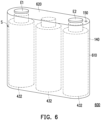
- FIG. 6 is a partial perspective view of a lithium battery module according to the sixth embodiment of the present invention.
- the manufacturing method of the lithium battery module 600 of this embodiment is similar to the manufacturing method of the lithium battery module 100 of the previous embodiment, and the same or similar components are denoted by the same or similar symbols, and have similar functions, materials or forms, and descriptions are omitted.
- a lithium battery module 600 includes a housing 610, a cover 620, at least one lithium battery cell 432, and an endothermic and fire suppressive material 140.
- the cover 620 is disposed on the housing 610.
- the housing 610 and the cover 620 constitute an accommodating space S.
- the lithium battery cell 432 is disposed in the accommodating space S.
- the endothermic and fire suppressive material 140 is filled in the accommodating space S.
- the lithium battery module 600 may include a plurality of lithium battery cells 432.
- the positive contact E1 and the negative contact E2 are disposed on the cover 620.
- the injection hole 150 is disposed on the cover 620.
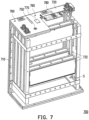
- FIG. 7 is a partial perspective view of a lithium battery module according to the seventh embodiment of the present invention.
- the manufacturing method of the lithium battery module 700 of this embodiment is similar to the manufacturing method of the lithium battery module 100 of the previous embodiment, and the same or similar components are denoted by the same or similar symbols, and have similar functions, materials or forms, and descriptions are omitted.
- a lithium battery module 700 includes a housing 710, a cover 720, at least one lithium battery cell 732, and an endothermic and fire suppressive material (not directly shown, may be the same or similar to the aforementioned endothermic and fire suppressive material 140).
- the cover 720 is disposed on the housing 710.
- the housing 710 and the cover 720 constitute an accommodating space S.
- the lithium battery cell 732 is disposed in the accommodating space S.
- the endothermic and fire suppressive material may be filled in the accommodating space S.
- the injection hole 550 is disposed on the cover 720.
- the endothermic and fire suppressive material may be injected from the injection hole 750 into the housing 710 with the cover 720 covering it.
- the cover 720 may have a pressure relief hole 760. If necessary, the pressure relief hole 760 may reduce the gas pressure in the accommodating space S formed by the housing 710 and the cover 720. In addition, the present invention does not limit the number or position of a pressure relief hole that is/are the same as or similar to the pressure relief hole 760.
- the cover 720 may have a gas release valve 770. If necessary, the gas release valve 770 may release the gas generated in the accommodating space S formed by the housing 710 and the cover 720 to the outside. In addition, the present invention does not limit the number or position of a pressure relief hole that is/are the same as or similar to the gas release valve 770.
- the gas release valve 770 may include an explosion-proof valve, a vent valve, a gas release groove or a fin-type pressure relief hole, but the present invention is not limited thereto.
- the profile of the gas release groove may be the same or similar to that of a cone, but the present invention is not limited thereto.
- the fin-type pressure relief hole may have a plurality of fin-type covers on the outside and a corresponding mesh barrier on the inside.
- the lithium battery module 700 may further include an electronic device 780 disposed on the cover 720.
- the electronic device 780 may include a protection circuit module (PCM) or a battery management system (BMS).
- PCM protection circuit module
- BMS battery management system
- the present invention does not limit the number or position of an electronic device that is/are the same as or similar to the electronic device 780.
- examples and comparative examples can be tested and recorded in a standard environment according to a standard test method by a third-party non-profit impartial organization (e.g., Industrial Technology Research Institute (ITRI)).
- ITRI Industrial Technology Research Institute
- Example 1 [Example 1], [Example 2] and [Example 3] have no fire or smoke.
- the highest temperature measured by the temperature probe did not exceed about 100°C, and the appearance of the entire housing and battery cells did not have obvious burning damage, only the battery cells were slightly bulging.
- Example 4 filled with an endothermic and fire suppressive material
- Comparative Example 4 without any endothermic and fire suppressive material
- the lithium battery module of [Comparative Example 4] was overcharged; then, the lithium battery module of [Comparative Example 4] was tested by a commonly used acupuncture test.
- the lithium battery module of [Example 4] was overcharged; then, the lithium battery module of [Example 4] was tested by a commonly used acupuncture test.
- the output voltage of the battery module will be significantly reduced due to the short-circuit effect.
- heat energy is rapidly generated inside the battery module.
- the heat energy may be dissipated to the outside, and therefore, the corresponding temperature rise can be measured for both the inside of the battery module (e.g., the lithium battery cells) and the outside of the battery module (e.g., the outer surface of the housing).
- [Comparative Example 4] is similar to the structure of [Example 4], and the difference is: [Comparative Example 4] has no endothermic and fire suppressive material, and [Example 4] has an endothermic and fire suppressive material. Therefore, in order to reduce the variation of position, for the temperature measurement described later, the temperature comparison measurement between [Comparative Example 4] and [Example 4] can be performed at the same or similar corresponding position.
- the temperature is measured at one or more corresponding positions inside the battery module (e.g., the lithium battery cells).
- the highest temperature measured in [Comparative Example 4] was about 100° C or more higher than the highest temperature measured in [Example 4].
- the temperature is measured at one or more corresponding positions outside of the battery module (e.g., the outer surface of the housing).
- the highest temperature measured in [Comparative Example 4] was about 80° C or more higher than the highest temperature measured in [Example 4].
- the time of the highest temperature measured in [Example 4] is the M th second
- the time of the highest temperature measured in [Comparative Example 4] is the N th second
- M and N have the following relationship: M-N ⁇ 30 (e.g., M minus N is greater than or equal to 30).
- Example 5 filled with an endothermic and fire suppressive material
- Comparative Example 5 without any endothermic and fire suppressive material
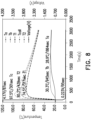
- overcharge the battery and then an actual test is performed and the temperature is measured (e.g., the time-temperature curve as shown in FIG. 8 ) for comparison.
- One purpose of overcharging the battery first is to confirm that it has a higher electric potential energy.
- Example 5 was tested by a commonly used acupuncture test.
- the output voltage of the lithium battery module, the temperature of the pierced portion approximately at the center of the battery module, the temperature on both sides in the length direction (one side includes the positive and negative contacts) of the battery module, the temperature on both sides in the width direction of the battery module were measured during the acupuncture test.
- the needle was approximately pierced into the center of the battery module at about the 87 th second.
- the "Voltage” curve corresponds the output voltage (unit of vertical axis: volt) of the lithium battery module at each time (unit of horizontal axis: second);
- the "Tc” curve corresponds the temperature (unit of vertical axis: °C) of the pierced portion approximately at the center of the battery module at each time (unit of horizontal axis: second);
- the "T1" curve corresponds the temperature (unit of vertical axis: °C) near the positive and negative contacts in the length direction of the battery module at each time (unit of horizontal axis: second);
- the "T2" curve corresponds the temperature (unit of vertical axis: °C) away from the positive and negative contacts in the length direction of the battery module at each time (unit of horizontal axis: second);
- the "Ta” curve corresponds the temperature (unit of vertical axis: °C) on one side of the battery module in the width direction of the battery module at each time (unit of horizontal axis: second
- the output voltage of the battery module will be significantly reduced (from 4.17V to 0.223V) due to the short-circuit effect. Moreover, due to the short-circuit effect, heat energy is rapidly generated inside the battery module.
- the endothermic and fire suppressive material of an embodiment of the present invention it is possible to reduce and/or avoid burning phenomena (e.g., no fire and smoke in appearance) and have an endothermic and/or cooling effect (e.g., the highest temperature on the outside surface of the battery module does not exceed 100°C at any time).
- the manufacturing method of the lithium battery module of the present invention it is possible to make the manufacturing method of the lithium battery module relatively simple by directly filling an endothermic and fire suppressive material into an accommodating space where the lithium battery cell(s) is/are placed; and/or the lithium battery cell(s) of a lithium battery module of the present invention is/are covered by an endothermic and fire suppressive material, so the lithium battery module is relatively safe.
- the endothermic and fire suppressive material of the present invention may be applied to a lithium battery module.
- the endothermic and fire retardant material of the present invention may further have other applications.
- the endothermic and fire suppressive material may be properly applied in conjunction or integration with a circuit board, depending on a reasonable application.
- the lithium battery module of the present invention may be used as an electrical energy storage application.
Landscapes
- Chemical & Material Sciences (AREA)
- Chemical Kinetics & Catalysis (AREA)
- General Chemical & Material Sciences (AREA)
- Electrochemistry (AREA)
- Engineering & Computer Science (AREA)
- Business, Economics & Management (AREA)
- Emergency Management (AREA)
- Manufacturing & Machinery (AREA)
- Materials Engineering (AREA)
- Public Health (AREA)
- Health & Medical Sciences (AREA)
- Dispersion Chemistry (AREA)
- Battery Mounting, Suspending (AREA)
- Fire-Extinguishing Compositions (AREA)
- Fireproofing Substances (AREA)
- Connection Of Batteries Or Terminals (AREA)
- Primary Cells (AREA)
Abstract
Description
- The present invention generally relates to an endothermic and fire suppressive material and a battery module, and more specifically to an endothermic and fire suppressive material and a lithium battery module.
- The application of a lithium battery module or a lithium battery cell are more and more widely. Moreover, based on an applicability of a product, the capacity of a lithium battery module or a lithium battery cell is increasing.
- If a lithium battery module or a lithium battery cell is used improperly, or if an external protection circuit (e.g., a battery management system (BMS)) fails, or when external damage causes changes in the internal structure of a lithium battery module or a lithium battery cell, it is easy to cause the internal short circuit phenomenon of the lithium battery module or the lithium battery cell. Therefore, there is a high probability that a single or a group of lithium batteries will burn and explode and spread to other lithium batteries, causing a large-scale combustion and explosion hazard, endangering the safety of life and property.
- Furthermore, a lithium battery module or a lithium battery cell may have a corresponding electric potential energy. Once a large amount of energy is released in an instant, it is difficult for general fire suppressive equipment to extinguish and/or suppress the fire caused by it in time, and it also needs to consume a large amount of water resources to cool down and/or endothermic. Therefore, if people's lives and properties are endangered, it will cause uncontrollable consequences and losses.
- Based on the above, the safety of a lithium battery module or a lithium battery cell is very important.
- The present invention provides an endothermic and fire suppressive material and a lithium battery module.
- According to the present invention, an endothermic and fire suppressive material includes barbituric acid, barbituric acid derivative, or a combination thereof.
- In one exemplary embodiment of the present invention, the barbituric acid, the barbituric acid derivative, or a combination thereof account for at least 1 wt% of the endothermic and fire suppressive material.
- In one exemplary embodiment of the present invention, the endothermic and fire suppressive material further include ammonium dihydrogen phosphate.
- In one exemplary embodiment of the present invention, a weight ratio of the barbituric acid, the barbituric acid derivative, or a combination thereof account to the ammonium dihydrogen phosphate is 99:1 to 1:99.
- According to the present invention, a lithium battery module includes a housing, a cover, at least one lithium battery cell and an endothermic and fire suppressive material. The cover covers the housing. The housing and the cover form an accommodating space. The lithium battery cell is disposed in the accommodating space. The endothermic and fire suppressive material is filled in the accommodating space.
- In one exemplary embodiment of the present invention, at least one of the housing or the cover has an injection hole.
- In one exemplary embodiment of the present invention, the injection hole is sealed.
- In one exemplary embodiment of the present invention, the endothermic and fire suppressive material is an electrically insulating material, at least one of the housing or the cover has a positive contact, at least one of the housing or the cover has a negative contact, a positive electrode of the lithium battery cell is connected to the positive contact, and a negative electrode of the lithium battery cell is connected to the negative contact.
- In one exemplary embodiment of the present invention, the endothermic and fire suppressive material is in a liquid form, a powder form, an emulsified form, or a colloidal form.
- In one exemplary embodiment of the present invention, the lithium battery cell includes a solid electrolyte interface (SEI), a maximum temperature after the lithium battery module is short-circuited and heated up is lower than a minimum temperature of thermal decomposition or thermal degradation of the solid electrolyte interface (SEI) included in the lithium battery cell.
- In one exemplary embodiment of the present invention, the endothermic and fire suppressive material includes barbituric acid, barbituric acid derivative, or a combination thereof.
- In one exemplary embodiment of the present invention, the barbituric acid, the barbituric acid derivative, or a combination thereof account for at least 1 wt% of the endothermic and fire suppressive material.
- In one exemplary embodiment of the present invention, the endothermic and fire suppressive material further include ammonium dihydrogen phosphate.
- In one exemplary embodiment of the present invention, a weight ratio of the barbituric acid, the barbituric acid derivative, or a combination thereof account to the ammonium dihydrogen phosphate is 99:1 to 1:99.
- To make the aforementioned more comprehensible, several embodiments accompanied with drawings are described in detail as follows.
- The accompanying drawings are included to provide a further understanding of the present invention, and are incorporated in and constitute a part of this specification. The drawings illustrate exemplary embodiments of the present invention and, together with the description, serve to explain the principles of the present invention.
-
FIG. 1A is a partial flowchart of a partial manufacturing method of a lithium battery module according to an embodiment of the present invention. -
FIG. 1B to FIG. 1C are partial perspective views of a partial manufacturing method of a lithium battery module according to a first embodiment of the present invention. -
FIG. 2 is a partial perspective view of a lithium battery module according to a second embodiment of the present invention. -
FIG. 3 is a partial perspective view of a lithium battery module according to a third embodiment of the present invention. -
FIG. 4 is a partial perspective view of a lithium battery module according to a fourth embodiment of the present invention. -
FIG. 5 is a partial perspective view of a lithium battery module according to a fifth embodiment of the present invention. -
FIG. 6 is a partial perspective view of a lithium battery module according to a sixth embodiment of the present invention. -
FIG. 7 is a partial perspective view of a lithium battery module according to a seventh embodiment of the present invention. -
FIG. 8 is a chart of test results of [Example 5] of the present invention. - In the present invention, for an object or a material, "fireproof', "fire-extinguishing" or "fire-suppressive" or "fire retardant" used herein mean the object or the material (including but not limited to: film, layer, block and other structures) may pass the flame retardancy criteria of the standard test method. For example, taking the UL94 plastic flammability standard (Test for Flammability of Plastic Materials for Parts in Devices and appliances) issued by Underwriters Laboratories Inc (UL) as an example, the degree is at least the HB level; preferably V1 level; more preferably 5VA level.
-
FIG. 1A is a partial flowchart of a partial manufacturing method of a lithium battery module according to an embodiment of the present invention. - A partial manufacturing method of a lithium battery module may be described as follows. In addition, for the convenience of description, in the following description of the manufacturing method of the lithium battery module, the corresponding drawing symbols may be understood by referring to
FIG. 1B to FIG. 1C exemplarily. It should be noted that the partial manufacturing method of the lithium battery module is not limited to those shown inFIG. 1B to FIG. 1C . Similarly, for the lithium battery module as shown inFIG. 1C , the flowchart as shown inFIG. 1A may be an exemplary partial process. - Referring to
FIG. 1A , step S10: at least one lithium battery cell (e.g., alithium battery cell 131 described later, alithium battery cell 432 described later, or a lithium battery cell similar thereof; but not limited to) is provided. The present invention is not limited to the form of the lithium battery cell, as long as it meets a standard of a general lithium battery cell. For example, a lithium battery cell may include a square tank type battery cell, a prismatic type battery cell a pouch type battery cell, or a cylindrical type battery cell; for example, a 126090-type battery cell, an 18650-type battery cell, or similar. In an embodiment, there may be a plurality of lithium battery cells. The plurality of lithium battery cells may be connected in series or in parallel. Whether it is a single lithium battery cell, a plurality of lithium battery cells in series, or a plurality of lithium battery cells, all must comply with a corresponding lithium battery cell standard, such as but not limited to: IEC 61960 standard, IEC62619 standard, VDE-AR-E 2510-50 standard, CNS 15391-2 standard, UL 1642 standard. - Referring to
FIG. 1A , step S20: the lithium battery cell is disposed in a housing (such as ahousing 110 described later, ahousing 310 described later, ahousing 410 described later, ahousing 510 described later, a housing described later, or a housing similar thereof; but not limited to). The present invention is not limited to the form of the housing, as long as it is suitable for a corresponding object (e.g., the lithium battery cell) to be placed therein; and/or, it is suitable for being injected a corresponding material (e.g., an endothermic and fire suppressive material mentioned later). - In an embodiment, the housing may meet a general fire protection standard. In an embodiment, a material of the housing may include metal (e.g., an aluminum galvanized shell), a metal alloy (e.g., an aluminum-silicon alloy coating housing) or a polymer (e.g., Bakelite).
- In an embodiment, the housing may have an injection hole (e.g., an
injection hole 150 described later; but not limited). - In an embodiment, there may be an electrode contact (e.g., a positive contact and/or a negative contacts) on the housing. The electrode contact on the aforementioned housing may be electrically connected to a corresponding electrode (e.g., a positive electrode or a negative electrode) of the lithium battery cell by an appropriate conductor (e.g., a wire connection and/or a circuit board connection).
- Referring to
FIG. 1A , step S30: a cover (e.g., acover 120 described later, acover 320 described later, acover 420 described later, acover 520 described later, acover 620 described later, or a lithium battery cell similar thereof; but not limited to) is placed on the housing with the lithium battery cell placed therein. The present invention is not limited to the form of the cover, as long as it is suitable for covering the housing. - In an embodiment, the cover may meet a general fireproof standard. In an embodiment, the material of the cover may be the same or similar to the material of the housing.
- In an embodiment, the cover may have an injection hole (e.g., an
injection hole 150 described later; but not limited). - In an embodiment, there may be an electrode contact (e.g., a positive contact and/or a negative contacts) on the cover. The electrode contact on the aforementioned cover may be electrically connected to a corresponding electrode (e.g., a positive electrode or a negative electrode) of the lithium battery cell by an appropriate conductor (e.g., a wire connection and/or a circuit board connection).
- Referring to
FIG. 1A , step S40: an endothermic and fire suppressive material (e.g., an endothermic and firesuppressive material 140, or an endothermic and fire suppressive material similar thereof; but not limited to) is injected from the injection hole into the housing with the cover covering it. - In the embodiment, the endothermic and fire suppressive material may include insulating and non-conductive liquid, colloid, or powdered solid.
- In an embodiment, the endothermic and fire suppressive material may include a suitable endothermic fluid, a suitable flame retardant and/or a suitable flame retardant.
- In an embodiment, the endothermic and fire suppressive material may include an ether compound. The aforementioned ether compound may include, but are not limited to: ethyl perfluorobutyl ether (CAS: 163702-05-4), ethyl nonafluoroisobutyl ether (CAS: 163702-06-5), or a combination there above.
- In an embodiment, the endothermic and fire suppressive material may include an organophosphorus compound. The aforementioned organophosphorus compound may include, but are not limited to: 2-carboxyethyl(phenyl) phosphinicacid (CAS: 14657-64-8), 6-oxido-6H-dibenz[c,e][1,2]oxaphosphorin-6-yl)methyl] butanedioic acid (CAS: 63562-33-4), [(6-oxido-6H-dibenz[c,e][1,2]oxaphosphorin-6-yl)methyl]butanedioic acid bis(2-hydroxyethyl) ester (CAS: 63562-34-5), 10-benzylmethyl-9-oxa-10-phosphaphenanthrene-10-oxide (CAS: 113504-81-7), 6,6'-(1-phenylethane-1,2-diyl)bis(6H-dibenzo[c,e][1,2]oxaphosphinine)6,6'-dioxide (CAS: 1631149-46-6), or a combination there above.
- In an embodiment, the endothermic and fire suppressive material may include an organobromine compound. The aforementioned organobromine compound may include but are not limited to: 2,3-dibromo-2-propen-1-ol, dibromomethane, 1,2-dibromoethane, 1,2-dibromoethylene, 1,4-dibromobutane, 1,5-dibromopentane, or a combination therea bove.
- In an embodiment, the endothermic and fire suppressive material may include barbituric acid or barbituric acid derivative (e.g., barbiturates; or, one of the hydrogen atoms bonded to the carbon atom of barbituric acid is replaced by methyl, ethyl or isotopes; or a salt thereof). In the process of combustion, the barbituric acid or the barbituric acid derivative (may be referred as: the barbituric acid/derivative thereof) may be used as a free radical scavenger (FRS), which may reduce the concentration or quantity of free radicals in the process of combustion. As such, the combustion may be slowed down or stopped. In an embodiment, the barbituric acid or the barbituric acid derivative may produce water and carbon dioxide after being heated and/or burned, in which water may reduce the ambient temperature (which may be regarded as cooling or endothermic), and carbon dioxide may reduce combustion (which may be regarded as fire extinguishing, or fire-suppressive, or fire retardant). As such, the barbituric acid or the barbituric acid derivative may be suitable as an endothermic and fire suppressive material.
- In an embodiment, even if an unexpected short circuit occurs inside the lithium battery module (including but not limited to: damage or short circuit of the lithium battery cell, damage or short circuit of the internal circuit) and a large amount of electric potential energy is converted into heat energy, if the barbituric acid/derivative thereof are used as an endothermic and fire suppressive material, it may reduce the maximum temperature after the lithium battery module is short-circuited and heated up. In an embodiment, if the barbituric acid/derivative thereof are used as an endothermic and fire suppressive material, the maximum temperature after the lithium battery module is short-circuited and heated up may be lower than the minimum temperature of thermal decomposition or thermal degradation of the solid electrolyte interface (SEI) used in a general lithium battery cell. The solid electrolyte interface (SEI) may be a layer (e.g., a passivation layer). The minimum temperature of thermal decomposition or thermal degradation of the solid electrolyte interface (SEI) used in a general lithium battery cell is about 100°C. That is to say, compared with not using the barbituric acid/derivative thereof, the barbituric acid/derivative thereof may at least reduce the maximum temperature after the lithium battery module is short-circuited and heated up, and at least may be regarded as an endothermic material.
- In an embodiment, based on the total weight of the endothermic and fire suppressive material, the weight of the barbituric acid/derivative thereof accounts for at least 1% by weight of the whole endothermic and fire suppressive material. That is, the barbituric acid, the barbituric acid derivative, or a combination thereof account for at least 1 wt% of the endothermic and fire suppressive material.
- In an embodiment, the endothermic and fire suppressive material may include ammonium dihydrogen phosphate (ADP). For a combustion process, ammonium dihydrogen phosphate may absorb heat to decompose phosphoric acid and ammonia, and may continue to react in multiple steps to generate phosphorus pentoxide. Each of the aforementioned steps is an endothermic reaction, and water vapor may be generated, which may exert a cooling or endothermic effect.
- In an embodiment, the endothermic and fire suppressive material may include ammonium dihydrogen phosphate and the barbituric acid/derivative thereof. In an embodiment, the weight ratio of the barbituric acid/derivative thereof to the ammonium dihydrogen phosphate may be from about 99:1 to about 1:99. In an embodiment, the weight ratio of the barbituric acid/derivative thereof to the ammonium dihydrogen phosphate may be about 4: 1.
- In an embodiment, the barbituric acid, the barbituric acid derivative, the ammonium dihydrogen phosphate, or a combination there above may be referred as a powder endothermic and fire suppressive material.
- In an embodiment, the endothermic and fire suppressive material may include triethyl phosphate (TEP). The boiling point of triethyl phosphate may be about 215°C, and the flash point of triethyl phosphate may be about 115°C. Triethyl phosphate may be miscible with water. In an embodiment, the barbituric acid/derivative thereof may be prepared in combination with triethyl phosphate and ammonium dihydrogen phosphate, and may be used as a liquid endothermic and fire suppressive material. The above-mentioned liquid endothermic and fire suppressive material may not be ignited or produce any burning phenomenon when sprayed with a spray gun, and has the effect of endothermic. In addition, a solvent used in the aforementioned liquid endothermic and fire suppressive material may further include fluorinated solvents, brominated solvents, and dimethyl sulfoxide (DMSO), and may further exclude water.
- In an embodiment, a liquid endothermic and fire suppressive material may include triethyl phosphate, water, the barbituric acid/derivative thereof, ammonium dihydrogen phosphate , wherein: the weight ratio of the barbituric acid/derivative thereof to the triethyl phosphate may be about 99:1 to about 1:99; or, the weight ratio of the barbituric acid/derivative thereof to the ammonium dihydrogen phosphate may be about 99:1 to about 1:99. Within the aforementioned range of weight ratios, the ratio of each component may be adjusted according to the amount of heat released by the battery and/or the corresponding safety factor. In an embodiment, the weight ratio of triethyl phosphate, water, the barbituric acid/derivative thereof, ammonium dihydrogen phosphate may be about 1:4:4:1.
- In an embodiment, the liquid endothermic and fire suppressive material may further include a dispersant. The dispersant may improve the dispersibility of the components in the liquid endothermic and fire suppressive material, so as to have a better heat absorption effect, cooling and/or endothermic effect. In an embodiment, the dispersant may include an acrylic polymer containing ammonium salt. In an embodiment, the dispersant may include a dispersant manufactured by Taiwan Hopax Chemicals Mfg. Co., Ltd under the tradename CA-A48.
- In an embodiment, the above-mentioned liquid endothermic and fire suppressive material may be emulsified after adding a dispersant, and further increase the content of the barbituric acid/ derivative thereof, and then add Boehmite and a composite material which may be formed by bonding the polyurethane (PU) foaming material and an inorganic material. In this way, the formed colloidal or emulsified endothermic and fire suppressive material may have better heat absorption, heat conduction, endothermic and fire suppressive and/or flame-resistant performance.
- In an embodiment, the endothermic and fire suppressive material may include triethyl phosphate, dispersant, nonflammable solvent (e.g., water, fluorinated solvent, brominated solvent or dimethyl sulfone), the barbituric acid/derivative thereof, ammonium dihydrogen phosphate, and N-dodecyl-N,N-dimethyl-3-ammonio-1-propanesulfonate (CAS No. 14933-08-5). The N-dodecyl-N,N-dimethyl-3-ammonio-1-propanesulfonate may be included in a zwitterionic surfactant and further be manufactured by Taiwan Hopax Chemicals Mfg. Co., Ltd under the tradename SB-10.
- In an embodiment, the colloidal or emulsified endothermic and fire suppressive material may include triethyl phosphate, dispersant, non-flammable solvents, the barbituric acid/derivative thereof, ammonium dihydrogen phosphate, and N-Dodecyl-N,N-dimethyl-3-ammonio-1-propanesulfonate, wherein: the weight ratio of the barbituric acid/derivative thereof to the triethyl phosphate may be about 99:1 to about 1:99; or, the weight ratio of the barbituric acid/derivative thereof to the ammonium dihydrogen phosphate may be about 99:1 to about 1:99. Within the aforementioned range of weight ratios, the ratio of each component may be adjusted according to the amount of heat released by the battery and/or the corresponding safety factor. In an embodiment, the weight ratio of the triethyl phosphate, the dispersant, the non-flammable solvent, the barbituric acid/derivative thereof, and the ammonium dihydrogen phosphate may be about 2:0.3:1.5:5.5:0.7.
- In an embodiment, the colloidal or emulsified endothermic and fire suppressive material may include triethyl phosphate, dispersant, non-flammable solvent, the barbituric acid/derivative thereof, ammonium dihydrogen phosphate, N-Dodecyl-N,N-dimethyl-3-ammonio-1-propanesulfonate, a composite material which may be formed by bonding the polyurethane (PU) foaming material and an inorganic material, and Boehmite, wherein: the weight ratio of the barbituric acid/derivative thereof to the triethyl phosphate may be about 99:1 to about 1:99; or, the weight ratio of the barbituric acid/derivative thereof to the ammonium dihydrogen phosphate may be about 99:1 to about 1:99. Within the aforementioned range of weight ratios, the ratio of each component may be adjusted according to the amount of heat released by the battery and/or the corresponding safety factor.
- In an embodiment, the weight ratio of the triethyl phosphate, the dispersant, the non-flammable solvent, the barbituric acid/derivative thereof, the ammonium dihydrogen phosphate, the N-Dodecyl-N,N-dimethyl-3-ammonio-1-propanesulfonate, the composite material which may be formed by bonding the polyurethane (PU) foaming material and an inorganic material, and the Boehmite may be about 2:0.3:1.5:5:0.5:0.2:0.2:0.3.
- In an embodiment, after the cover is covered on the housing with the lithium battery cell placed therein, and after the corresponding electrode of the lithium battery cell is electrically connected to the corresponding electrode contact on the cover or housing, and before the endothermic and fire suppressive material is injected from the injection hole into the housing with the cover covering it, the lithium battery cell may be properly tested by using the corresponding electrode contacts on the cover or housing. The test item may include but is not limited to: external short circuit test, impact test, drop test, overcharge test (e.g., voltage overcharge or current overcharge), forced discharge test, internal short circuit test or overheating test. In this way, if an aforementioned test is not passed, at least an appropriate repair step or a confirmation step may be performed before injecting the endothermic and fire suppressive material. For example, if it could be repaired or confirmed to have applicability, the step of injecting the endothermic and fire suppressive material may be performed. For another example, if it could not be repaired or it is confirmed not applicable, the intermediate product may be scrapped or the corresponding lithium battery cell, housing or cover may be recycled for reuse.
- Referring to
FIG. 1A , step S50: the injection hole is sealed. - In an embodiment, the injection hole for being injected the endothermic and fire suppressive material may be sealed by filling the injection hole with heat-resistant and fire-resistant glue (e.g., an acrylic glue or an epoxy resin; but not limited) and curing it.
- In an embodiment, after the endothermic and fire suppressive material is injected into the housing through the injection hole; and/or, after sealing the injection hole, a fireproof film, a fire-resistant film, or a fire suppressive film may be formed on the outside of the housing and/or the cover by spraying, coating, wetting and/or another suitable method. In an embodiment, the aforementioned fireproof film, the aforementioned fire-resistant film, the aforementioned fire suppressive film may at least partially cover the injection hole.
- In an embodiment, the aforementioned endothermic and fire suppressive material may be applied to a lithium battery module, but the endothermic and fire suppressive material may further have other applications.
- In an embodiment, since the material of the objection filled into and/or covered the injection hole is different from the material of the housing or the material of the cover, under the same pressure, before the housing or cover is damaged, the objection filled into and/or covered the injection hole may be relatively easy to peel and/or detach from the injection hole. Therefore, in an application of the lithium battery module, the injection hole may be referred as a corresponding pressure relief hole (e.g., for reducing the gas pressure in the accommodating space formed by the housing and the cover.).
- After the above process, the production of the lithium battery module of an embodiment could be substantially completed.
- A lithium battery module of an embodiment of the present invention could be subjected to various tests according to requirements to confirm that it meets a general safety standard. The test item may include but is not limited to: external short circuit test, impact test, vibration test, altitude mode test, forced discharge test, drop test (e.g., a 1.2-meter drop test), temperature test, overcharge test or impact test. A test standard may include but is not limited to: UL 2054, IEC 61960 and/or GB/T 18287.
- The test may be performed for the entire lithium battery module. For example, a corresponding electrical test may be to conduct an electrical test on the entire lithium battery module through the positive contact and the negative contact.
-
FIG. 1C is a partial perspective view of a lithium battery module according to the first embodiment of the present invention. - Referring to
FIG. 1C , alithium battery module 100 includes ahousing 110, acover 120, at least onelithium battery cell 131, and an endothermic and firesuppressive material 140. Thecover 120 is disposed on thehousing 110. Thehousing 110 and thecover 120 constitute an accommodating space S. Thelithium battery cell 131 is disposed in the accommodating space S. The endothermic and firesuppressive material 140 is filled in the accommodating space S. - In the embodiment, the
lithium battery module 100 may include a plurality oflithium battery cells 131. In an embodiment, thelithium battery cell 131 may be a pouch type battery cell. - In the embodiment, the positive contact E1 and the negative contact E2 are disposed on the
cover 120. - In the embodiment, the
injection hole 150 is disposed on thecover 120. -
FIG. 2 is a partial perspective view of a lithium battery module according to the second embodiment of the present invention. The manufacturing method of thelithium battery module 200 of this embodiment is similar to the manufacturing method of thelithium battery module 100 of the previous embodiment, and the same or similar components are denoted by the same or similar symbols, and have similar functions, materials or forms, and descriptions are omitted. - Referring to
FIG. 2 , alithium battery module 200 includes ahousing 110, acover 120, at least onelithium battery cell 131, and an endothermic and firesuppressive material 140. Thecover 120 is disposed on thehousing 110. Thehousing 110 and thecover 120 constitute an accommodating space S. Thelithium battery cell 131 is disposed in the accommodating space S. The endothermic and firesuppressive material 140 is filled in the accommodating space S. - In the embodiment, the
lithium battery module 200 may include a singlelithium battery cell 131. -
FIG. 3 is a partial perspective view of a lithium battery module according to the third embodiment of the present invention. The manufacturing method of thelithium battery module 300 of this embodiment is similar to the manufacturing method of thelithium battery module 100 of the previous embodiment, and the same or similar components are denoted by the same or similar symbols, and have similar functions, materials or forms, and descriptions are omitted. - Referring to
FIG. 3 , alithium battery module 300 includes ahousing 310, acover 320, at least onelithium battery cell 131, and an endothermic and firesuppressive material 140. Thecover 320 is disposed on thehousing 310. Thehousing 310 and thecover 320 constitute an accommodating space S. Thelithium battery cell 131 is disposed in the accommodating space S. The endothermic and firesuppressive material 140 is filled in the accommodating space S. - In the embodiment, the
lithium battery module 300 may include a singlelithium battery cell 131. - In the embodiment, one of the positive contact E1 and the negative contact E2 is disposed on the
cover 320, and the other of the positive contact E1 and the negative contact E2 is disposed on thehousing 310. For example, the positive contact E1 is disposed on thecover 320, and the negative contact E2 is disposed on thehousing 310. In an embodiment not shown, the negative contact E2 could be disposed on thecover 320, and the positive contact E1 could be disposed on thehousing 310. - In the embodiment, the
injection hole 150 is disposed on thecover 320. -
FIG. 4 is a partial perspective view of a lithium battery module according to the fourth embodiment of the present invention. The manufacturing method of thelithium battery module 400 of this embodiment is similar to the manufacturing method of thelithium battery module 100 of the previous embodiment, and the same or similar components are denoted by the same or similar symbols, and have similar functions, materials or forms, and descriptions are omitted. - Referring to
FIG. 4 , alithium battery module 400 includes ahousing 410, acover 420, at least onelithium battery cell 432, and an endothermic and firesuppressive material 140. Thecover 420 is disposed on thehousing 410. Thehousing 410 and thecover 420 constitute an accommodating space S. Thelithium battery cell 432 is disposed in the accommodating space S. The endothermic and firesuppressive material 140 is filled in the accommodating space S. - In the embodiment, the
lithium battery module 400 may include a single lithium battery cell 431. In an embodiment, thelithium battery cell 432 may be a cylindrical type battery cell. - In the embodiment, the positive contact E1 and the negative contact E2 are disposed on the
cover 420. - In the embodiment, the
injection hole 150 is disposed on thecover 420. -
FIG. 5 is a partial perspective view of a lithium battery module according to the fifth embodiment of the present invention. The manufacturing method of thelithium battery module 500 of this embodiment is similar to the manufacturing method of thelithium battery module 100 of the previous embodiment, and the same or similar components are denoted by the same or similar symbols, and have similar functions, materials or forms, and descriptions are omitted. - Referring to
FIG. 5 , alithium battery module 500 includes ahousing 510, acover 520, at least onelithium battery cell 432, and an endothermic and firesuppressive material 140. Thecover 520 is disposed on thehousing 510. Thehousing 510 and thecover 520 constitute an accommodating space S. Thelithium battery cell 432 is disposed in the accommodating space S. The endothermic and firesuppressive material 140 is filled in the accommodating space S. - In the embodiment, the
lithium battery module 500 may include a plurality oflithium battery cells 432. - In the embodiment, one of the positive contact E1 and the negative contact E2 is disposed on the
cover 520, and the other of the positive contact E1 and the negative contact E2 is disposed on thehousing 510. For example, the positive contact E1 is disposed on thecover 520, and the negative contact E2 is disposed on thehousing 510. In an embodiment not shown, the negative contact E2 could be disposed on thecover 520, and the positive contact E1 could be disposed on thehousing 510. - In the embodiment, the
injection hole 150 is disposed on thecover 520. -
FIG. 6 is a partial perspective view of a lithium battery module according to the sixth embodiment of the present invention. The manufacturing method of thelithium battery module 600 of this embodiment is similar to the manufacturing method of thelithium battery module 100 of the previous embodiment, and the same or similar components are denoted by the same or similar symbols, and have similar functions, materials or forms, and descriptions are omitted. - Referring to
FIG. 6 , alithium battery module 600 includes ahousing 610, acover 620, at least onelithium battery cell 432, and an endothermic and firesuppressive material 140. Thecover 620 is disposed on thehousing 610. Thehousing 610 and thecover 620 constitute an accommodating space S. Thelithium battery cell 432 is disposed in the accommodating space S. The endothermic and firesuppressive material 140 is filled in the accommodating space S. - In the embodiment, the
lithium battery module 600 may include a plurality oflithium battery cells 432. - In the embodiment, the positive contact E1 and the negative contact E2 are disposed on the
cover 620. - In the embodiment, the
injection hole 150 is disposed on thecover 620. -
FIG. 7 is a partial perspective view of a lithium battery module according to the seventh embodiment of the present invention. The manufacturing method of thelithium battery module 700 of this embodiment is similar to the manufacturing method of thelithium battery module 100 of the previous embodiment, and the same or similar components are denoted by the same or similar symbols, and have similar functions, materials or forms, and descriptions are omitted. - Referring to
FIG. 7 , alithium battery module 700 includes ahousing 710, acover 720, at least onelithium battery cell 732, and an endothermic and fire suppressive material (not directly shown, may be the same or similar to the aforementioned endothermic and fire suppressive material 140). Thecover 720 is disposed on thehousing 710. Thehousing 710 and thecover 720 constitute an accommodating space S. Thelithium battery cell 732 is disposed in the accommodating space S. The endothermic and fire suppressive material may be filled in the accommodating space S. - In the embodiment, the injection hole 550 is disposed on the
cover 720. The endothermic and fire suppressive material may be injected from theinjection hole 750 into thehousing 710 with thecover 720 covering it. - In the embodiment, the
cover 720 may have apressure relief hole 760. If necessary, thepressure relief hole 760 may reduce the gas pressure in the accommodating space S formed by thehousing 710 and thecover 720. In addition, the present invention does not limit the number or position of a pressure relief hole that is/are the same as or similar to thepressure relief hole 760. - In the embodiment, the
cover 720 may have agas release valve 770. If necessary, thegas release valve 770 may release the gas generated in the accommodating space S formed by thehousing 710 and thecover 720 to the outside. In addition, the present invention does not limit the number or position of a pressure relief hole that is/are the same as or similar to thegas release valve 770. - In an embodiment, the
gas release valve 770 may include an explosion-proof valve, a vent valve, a gas release groove or a fin-type pressure relief hole, but the present invention is not limited thereto. In an embodiment, the profile of the gas release groove may be the same or similar to that of a cone, but the present invention is not limited thereto. In an embodiment, the fin-type pressure relief hole may have a plurality of fin-type covers on the outside and a corresponding mesh barrier on the inside. - In the embodiment, the
lithium battery module 700 may further include anelectronic device 780 disposed on thecover 720. Theelectronic device 780 may include a protection circuit module (PCM) or a battery management system (BMS). In addition, the present invention does not limit the number or position of an electronic device that is/are the same as or similar to theelectronic device 780. - Hereinafter, examples and comparative examples are provided to specifically describe the present invention, but the present invention is not limited to the following examples.
- In addition, the examples and comparative examples can be tested and recorded in a standard environment according to a standard test method by a third-party non-profit impartial organization (e.g., Industrial Technology Research Institute (ITRI)).
- Actual test comparisons were carried out with Examples 1, 2 and 3 filled with an endothermic and fire suppressive material and Comparative Example 1 not filled with any endothermic and fire suppressive material.
- After taking two commercially available lithium-cobalt battery cell with a capacity of 5Ah and connecting them in parallel, and then put the parallel-connected battery cells into a housing to simulate a lithium battery module. Additionally, there is no endothermic and fire suppressive material in the housing.
- Performing the same or similar method to the aforementioned comparative example 1, after taking two commercially available lithium-cobalt battery cell with a capacity of 5Ah and connecting them in parallel, and then put the parallel-connected battery cells into a housing to simulate a lithium battery module. Additionally, 21 grams of powdered endothermic and fire suppressive material was filled into the housing. The powdered endothermic and fire suppressive material used in [Example 1] is the barbituric acid/derivative thereof.
- Performing the same or similar method to the aforementioned comparative example 1, after taking two commercially available lithium-cobalt battery cell with a capacity of 5Ah and connecting them in parallel, and then put the parallel-connected battery cells into a housing to simulate a lithium battery module. Additionally, 27 grams of liquid endothermic and fire suppressive material was filled into the housing. The liquid endothermic and fire suppressive material used in [Example 2] is triethyl phosphate, water, the barbituric acid/derivative thereof, and ammonium dihydrogen phosphate in a weight ratio of approximately 1:4:4:1.
- Performing the same or similar method to the aforementioned comparative example 1, after taking two commercially available lithium-cobalt battery cell with a capacity of 5Ah and connecting them in parallel, and then put the parallel-connected battery cells into a housing to simulate a lithium battery module. Additionally, 29 grams of emulsified endothermic and fire suppressive material was filled into the housing. The emulsified endothermic and fire suppressive material used in [Example 3] is triethyl phosphate, dispersant, water, the barbituric acid/derivative thereof, and ammonium dihydrogen phosphate in a weight ratio of approximately 2:0.3:1.5:5.5:0.7.
- [Comparative Example 1], [Example 1], [Example 2] and [Example 3] were tested by a commonly used acupuncture test.
- [Comparative Example 1] caught fire and emitted smoke. The highest temperature measured by the temperature probe exceeded 210° C, and the entire housing and battery cells were burned and damaged.
- [Example 1], [Example 2] and [Example 3] have no fire or smoke. The highest temperature measured by the temperature probe did not exceed about 100°C, and the appearance of the entire housing and battery cells did not have obvious burning damage, only the battery cells were slightly bulging.
- [Example 4] (filled with an endothermic and fire suppressive material) and [Comparative Example 4] (without any endothermic and fire suppressive material) are simulated in an actual use condition: overcharge the battery, and then perform an actual test for comparison. One purpose of overcharging the battery first is to confirm that it has a higher electric potential energy.
- Performing the same or similar method to the aforementioned comparative example 1, after taking two commercially available lithium-cobalt battery cell with a capacity of 5Ah and connecting them in parallel, and then put the parallel-connected battery cells into a housing to simulate a lithium battery module. Additionally, there is no endothermic and fire suppressive material in the housing.
- The lithium battery module of [Comparative Example 4] was overcharged; then, the lithium battery module of [Comparative Example 4] was tested by a commonly used acupuncture test.
- Performing the same or similar method to the aforementioned comparative example 1, after taking two commercially available lithium-cobalt battery cell with a capacity of 5Ah and connecting them in parallel, and then put the parallel-connected battery cells into a housing to simulate a lithium battery module. Additionally, a powdered endothermic and fire suppressive material was filled into the housing. The powdered endothermic and fire suppressive material used in [Example 4] is the barbituric acid/derivative thereof and ammonium dihydrogen phosphate.
- The lithium battery module of [Example 4] was overcharged; then, the lithium battery module of [Example 4] was tested by a commonly used acupuncture test.
- After the needle is pierced into the battery module, the output voltage of the battery module will be significantly reduced due to the short-circuit effect. Moreover, due to the short-circuit effect, heat energy is rapidly generated inside the battery module. The heat energy may be dissipated to the outside, and therefore, the corresponding temperature rise can be measured for both the inside of the battery module (e.g., the lithium battery cells) and the outside of the battery module (e.g., the outer surface of the housing).
- The structure of [Comparative Example 4] is similar to the structure of [Example 4], and the difference is: [Comparative Example 4] has no endothermic and fire suppressive material, and [Example 4] has an endothermic and fire suppressive material. Therefore, in order to reduce the variation of position, for the temperature measurement described later, the temperature comparison measurement between [Comparative Example 4] and [Example 4] can be performed at the same or similar corresponding position.
- After the needle is pierced into the battery module, the temperature is measured at one or more corresponding positions inside the battery module (e.g., the lithium battery cells). The highest temperature measured in [Comparative Example 4] was about 100° C or more higher than the highest temperature measured in [Example 4].
- After the needle is pierced into the battery module, the temperature is measured at one or more corresponding positions outside of the battery module (e.g., the outer surface of the housing). The highest temperature measured in [Comparative Example 4] was about 80° C or more higher than the highest temperature measured in [Example 4].
- Taking the moment when the needle is pierced into the battery module as the 0th second, the time of the highest temperature measured in [Example 4] is the Mth second, and the time of the highest temperature measured in [Comparative Example 4] is the Nth second, and M and N have the following relationship: M-N ≥ 30 (e.g., M minus N is greater than or equal to 30).
- [Example 5] (filled with an endothermic and fire suppressive material) and [Comparative Example 5] (without any endothermic and fire suppressive material) are simulated in an actual use condition: overcharge the battery, and then an actual test is performed and the temperature is measured (e.g., the time-temperature curve as shown in
FIG. 8 ) for comparison. One purpose of overcharging the battery first is to confirm that it has a higher electric potential energy. - Performing the same or similar method to the aforementioned comparative example 1, after taking two commercially available lithium-cobalt battery cell with a capacity of 5Ah and connecting them in parallel, and then put the parallel-connected battery cells into a housing to simulate a lithium battery module. Additionally, there is no endothermic and fire suppressive material in the housing.
- [Comparative Example 5] was tested by a commonly used acupuncture test.
- After the needle is pierced into the battery module, heat energy will be rapidly generated inside the battery module due to the short-circuit effect. Moreover, the short-circuited battery module quickly caught fire and emitted smoke. The highest temperature measured somewhere on the outside of the battery module (e.g., the outer surface of the housing) exceeds 350°C. Furthermore, external and internal inspections were performed after the acupuncture test, both the housing and the battery cells have been burned and destroyed obviously.
- Performing the same or similar method to the aforementioned comparative example 1, after taking two commercially available lithium-cobalt battery cell with a capacity of 5Ah and connecting them in parallel, and then put the parallel-connected battery cells into a housing to simulate a lithium battery module. Additionally, a powdered endothermic and fire suppressive material was filled into the housing. The powdered endothermic and fire suppressive material used in [Example 5] is the barbituric acid/derivative thereof and ammonium dihydrogen phosphate. The appearance of the lithium battery module could be similar to that shown in
FIG. 1B orFIG. 1C . - [Example 5] was tested by a commonly used acupuncture test.
- Additionally, the output voltage of the lithium battery module, the temperature of the pierced portion approximately at the center of the battery module, the temperature on both sides in the length direction (one side includes the positive and negative contacts) of the battery module, the temperature on both sides in the width direction of the battery module were measured during the acupuncture test. During the acupuncture test, the needle was approximately pierced into the center of the battery module at about the 87th second.
- The test results are shown in
FIG. 8 . InFIG. 8 , the "Voltage" curve corresponds the output voltage (unit of vertical axis: volt) of the lithium battery module at each time (unit of horizontal axis: second); the "Tc" curve corresponds the temperature (unit of vertical axis: °C) of the pierced portion approximately at the center of the battery module at each time (unit of horizontal axis: second); the "T1" curve corresponds the temperature (unit of vertical axis: °C) near the positive and negative contacts in the length direction of the battery module at each time (unit of horizontal axis: second); the "T2" curve corresponds the temperature (unit of vertical axis: °C) away from the positive and negative contacts in the length direction of the battery module at each time (unit of horizontal axis: second); the "Ta" curve corresponds the temperature (unit of vertical axis: °C) on one side of the battery module in the width direction of the battery module at each time (unit of horizontal axis: second); and the "Tb" curve corresponds the temperature (unit of vertical axis: °C) at the other side in the width direction of the battery module at each time (unit of horizontal axis: second). - As shown in
FIG. 8 , after the needle is pierced into the battery module, the output voltage of the battery module will be significantly reduced (from 4.17V to 0.223V) due to the short-circuit effect. Moreover, due to the short-circuit effect, heat energy is rapidly generated inside the battery module. However, with the endothermic and fire suppressive material of an embodiment of the present invention, it is possible to reduce and/or avoid burning phenomena (e.g., no fire and smoke in appearance) and have an endothermic and/or cooling effect (e.g., the highest temperature on the outside surface of the battery module does not exceed 100°C at any time). - Furthermore, external and internal inspections were performed after the acupuncture test, both the housing and the battery cells have been burned and destroyed obviously, and only the battery cells were slightly bulging (the swelling rate were about 65%-90%).
- In summary, in the manufacturing method of the lithium battery module of the present invention, it is possible to make the manufacturing method of the lithium battery module relatively simple by directly filling an endothermic and fire suppressive material into an accommodating space where the lithium battery cell(s) is/are placed; and/or the lithium battery cell(s) of a lithium battery module of the present invention is/are covered by an endothermic and fire suppressive material, so the lithium battery module is relatively safe.
- The endothermic and fire suppressive material of the present invention may be applied to a lithium battery module. The endothermic and fire retardant material of the present invention may further have other applications. For example, the endothermic and fire suppressive material may be properly applied in conjunction or integration with a circuit board, depending on a reasonable application. The lithium battery module of the present invention may be used as an electrical energy storage application.
Claims (14)
- An endothermic and fire suppressive material, comprising:
barbituric acid, barbituric acid derivative, or a combination thereof. - The endothermic and fire suppressive material according to claim 1, wherein the barbituric acid, the barbituric acid derivative, or a combination thereof account for at least 1 wt% of the endothermic and fire suppressive material.
- The endothermic and fire suppressive material according to claim 1, further comprising:
ammonium dihydrogen phosphate. - The endothermic and fire suppressive material according to claim 3,
a weight ratio of the barbituric acid, the barbituric acid derivative, or a combination thereof account to the ammonium dihydrogen phosphate is 99:1 to 1:99. - A lithium battery module (100, 200, 300, 400, 500, 600, 700), comprising:a housing (110, 310, 410, 510, 610, 710);a cover (120, 320, 420, 520, 620, 720), disposed on the housing, wherein the housing and the cover constitute an accommodating space (S);at least one lithium battery cell (lithium battery cell), disposed in the accommodating space; andan endothermic and fire suppressive material (140), filled in the accommodating space.
- The lithium battery module to claim 5, wherein at least one of the housing or the cover has an injection hole (150, 750).
- The lithium battery module to claim 6, wherein the injection hole is sealed.
- The lithium battery module to claim 5, wherein the endothermic and fire suppressive material is an electrically insulating material, at least one of the housing or the cover has a positive contact (E1), at least one of the housing or the cover has a negative contact (E2), a positive electrode of the lithium battery cell is connected to the positive contact, and a negative electrode of the lithium battery cell is connected to the negative contact.
- The lithium battery module to claim 5, the endothermic and fire suppressive material is in a liquid form, a powder form, an emulsified form, or a colloidal form.
- The lithium battery module to claim 5, wherein the lithium battery cell includes a solid electrolyte interface (SEI), a maximum temperature after the lithium battery module is short-circuited and heated up is lower than a minimum temperature of thermal decomposition or thermal degradation of the solid electrolyte interface (SEI) included in the lithium battery cell.
- The lithium battery module to claim 5, wherein the endothermic and fire suppressive material, comprising:
barbituric acid, barbituric acid derivative, or a combination thereof. - The lithium battery module to claim 11, wherein the barbituric acid, the barbituric acid derivative, or a combination thereof account for at least 1 wt% of the endothermic and fire suppressive material.
- The lithium battery module to claim 11, wherein the endothermic and fire suppressive material further comprising:
ammonium dihydrogen phosphate. - The lithium battery module to claim 13,
a weight ratio of the barbituric acid, the barbituric acid derivative, or a combination thereof account to the ammonium dihydrogen phosphate is 99:1 to 1:99.
Applications Claiming Priority (1)
| Application Number | Priority Date | Filing Date | Title |
|---|---|---|---|
| US202263354695P | 2022-06-23 | 2022-06-23 |
Publications (2)
| Publication Number | Publication Date |
|---|---|
| EP4300688A2 true EP4300688A2 (en) | 2024-01-03 |
| EP4300688A3 EP4300688A3 (en) | 2024-01-17 |
Family
ID=86904383
Family Applications (1)
| Application Number | Title | Priority Date | Filing Date |
|---|---|---|---|
| EP23180203.4A Pending EP4300688A3 (en) | 2022-06-23 | 2023-06-20 | Endothermic and fire suppressive material and lithium battery module |
Country Status (5)
| Country | Link |
|---|---|
| US (1) | US12485303B2 (en) |
| EP (1) | EP4300688A3 (en) |
| JP (1) | JP7546109B2 (en) |
| CN (1) | CN117282067A (en) |
| TW (1) | TWI848743B (en) |
Families Citing this family (1)
| Publication number | Priority date | Publication date | Assignee | Title |
|---|---|---|---|---|
| JP7840544B2 (en) * | 2024-09-06 | 2026-04-06 | Attaccato合同会社 | Fire extinguishing cases, fire extinguishing equipment |
Family Cites Families (21)
| Publication number | Priority date | Publication date | Assignee | Title |
|---|---|---|---|---|
| JPH0919990A (en) | 1995-07-05 | 1997-01-21 | Chisso Corp | Fire retardant resin laminate |
| JP4700852B2 (en) | 2000-07-26 | 2011-06-15 | ポリプラスチックス株式会社 | Flame retardant resin composition |
| EP1423487B1 (en) * | 2001-09-07 | 2005-12-28 | Hawo Ökologische Produktions-, Handels- & Logistik GmbH & Co KG | Flame retarding agent and use thereof |
| JP5150193B2 (en) | 2007-10-15 | 2013-02-20 | シャープ株式会社 | Battery pack |
| EP2328203B1 (en) * | 2008-09-05 | 2020-01-01 | Panasonic Intellectual Property Management Co., Ltd. | Battery pack |
| CN103996884B (en) * | 2014-06-16 | 2016-02-17 | 苏州和钧新能源有限公司 | Lithium battery module |
| WO2016015603A1 (en) * | 2014-07-30 | 2016-02-04 | 浙江超威创元实业有限公司 | Lithium battery and electric vehicle using same |
| TWM507349U (en) * | 2015-05-15 | 2015-08-21 | Asia Electronic Material Co | Battery shell structure |
| TWI608646B (en) * | 2016-01-22 | 2017-12-11 | 國立臺灣科技大學 | Oligomer additive and lithium battery |
| KR102370998B1 (en) | 2017-05-11 | 2022-03-04 | 기아 주식회사 | A lithium ion battery comprising a separator coated by fire extinguishing particle |
| JP7544685B2 (en) | 2018-07-30 | 2024-09-03 | カデンツァ・イノベーション・インコーポレイテッド | Housing for a rechargeable battery |
| CN111263992B (en) * | 2018-10-03 | 2023-06-16 | 杰富意化学株式会社 | Paste composition, electrode material for secondary battery, electrode for secondary battery, and secondary battery |
| CN209822728U (en) * | 2019-05-27 | 2019-12-20 | 南京工程学院 | A battery cell assembly for an electric vehicle |
| CN112216864B (en) * | 2019-07-09 | 2024-03-22 | 宁德时代新能源科技股份有限公司 | A lithium-ion battery |
| CN110311138B (en) * | 2019-07-11 | 2022-05-31 | 安普瑞斯(无锡)有限公司 | Lithium ion secondary battery with thermal protection function |
| TWI711653B (en) * | 2019-07-31 | 2020-12-01 | 國立臺灣科技大學 | Polymer and lithium battery |
| US12519160B2 (en) * | 2020-07-29 | 2026-01-06 | Prologium Technology Co., Ltd. | Thermal runaway suppressant of lithium batteries and the related applications |
| CN114597588A (en) * | 2020-12-07 | 2022-06-07 | 比亚迪股份有限公司 | Lithium ion battery diaphragm and lithium ion battery |
| KR20220114888A (en) * | 2021-02-09 | 2022-08-17 | 주식회사 엘지에너지솔루션 | Battery module and battery pack including the same |
| CN113422133B (en) * | 2021-05-11 | 2022-09-02 | 江苏正力新能电池技术有限公司 | Structure for preventing battery thermal runaway, battery shell and battery |
| CN114350326B (en) | 2022-01-14 | 2024-02-02 | 湖北及安盾消防科技有限公司 | Coolant and preparation method thereof, temperature-sensitive floc gel, aerosol fire extinguishing device |
-
2023
- 2023-06-12 TW TW112121852A patent/TWI848743B/en active
- 2023-06-20 EP EP23180203.4A patent/EP4300688A3/en active Pending
- 2023-06-20 US US18/337,456 patent/US12485303B2/en active Active
- 2023-06-21 CN CN202310739416.4A patent/CN117282067A/en active Pending
- 2023-06-21 JP JP2023101843A patent/JP7546109B2/en active Active
Also Published As
| Publication number | Publication date |
|---|---|
| US12485303B2 (en) | 2025-12-02 |
| EP4300688A3 (en) | 2024-01-17 |
| US20230414982A1 (en) | 2023-12-28 |
| TWI848743B (en) | 2024-07-11 |
| JP7546109B2 (en) | 2024-09-05 |
| TW202400271A (en) | 2024-01-01 |
| CN117282067A (en) | 2023-12-26 |
| JP2024002958A (en) | 2024-01-11 |
Similar Documents
| Publication | Publication Date | Title |
|---|---|---|
| CN110433419B (en) | Lithium battery thermal runaway fire suppression capsule and lithium ion battery | |
| CN104284700A (en) | Battery pack with fire preventing agent | |
| US12559607B2 (en) | Flame-retardant composite pad, method for manufacturing same, and secondary battery module and secondary battery pack comprising such composite pad | |
| US12485303B2 (en) | Endothermic and fire suppressive material and lithium battery module | |
| CN105742728A (en) | Lithium-ion secondary battery | |
| KR20240082096A (en) | Battery Pack | |
| KR20240014937A (en) | Battery Cell and Battery Pack having the same | |
| CN220873705U (en) | Battery monomer, cover plate suite, battery and electricity utilization device | |
| CN108155307B (en) | Aluminum plastic film and application thereof | |
| JP2019153790A (en) | Power storage device | |
| KR101449787B1 (en) | Secondary battery with improved safety | |
| KR20250011779A (en) | Off-gas based battery thermal runaway monitoring system | |
| Said et al. | A perspective on the safety of large-format lithium-ion battery in underground mining operations: Thermal runaway and its mitigation: KO Said et al. | |
| KR20250005114A (en) | Storage device structure | |
| Guo et al. | Self-triggered fire-extinguishing microcapsules with pronounced performance in suppressing the thermal runaway of lithium-ion batteries | |
| KR20210017557A (en) | The Case For Secondary Battery And The Pouch Type Secondary Battery | |
| CN114891416A (en) | Heat-insulating flame-retardant fireproof coating material for lithium ion battery pack shell | |
| KR102602280B1 (en) | Fire safety battery pack | |
| CN214625306U (en) | Battery thermal runaway prevention isolation assembly, battery module and battery pack | |
| CN114374019B (en) | A self-extinguishing protection device for power battery | |
| KR102616790B1 (en) | Fire safety battery pack | |
| EP4635782A1 (en) | Heat dissipation composition and method of manufacturing busbar assembly using the same | |
| KR102878183B1 (en) | Fire suppression system of battery module | |
| CN113078385A (en) | Method for arranging fusible plug on shell of power battery | |
| KR102932384B1 (en) | Fire suppressing cell, battery module and battery pack |
Legal Events
| Date | Code | Title | Description |
|---|---|---|---|
| PUAI | Public reference made under article 153(3) epc to a published international application that has entered the european phase |
Free format text: ORIGINAL CODE: 0009012 |
|
| STAA | Information on the status of an ep patent application or granted ep patent |
Free format text: STATUS: REQUEST FOR EXAMINATION WAS MADE |
|
| PUAL | Search report despatched |
Free format text: ORIGINAL CODE: 0009013 |
|
| 17P | Request for examination filed |
Effective date: 20230620 |
|
| AK | Designated contracting states |
Kind code of ref document: A2 Designated state(s): AL AT BE BG CH CY CZ DE DK EE ES FI FR GB GR HR HU IE IS IT LI LT LU LV MC ME MK MT NL NO PL PT RO RS SE SI SK SM TR |
|
| AK | Designated contracting states |
Kind code of ref document: A3 Designated state(s): AL AT BE BG CH CY CZ DE DK EE ES FI FR GB GR HR HU IE IS IT LI LT LU LV MC ME MK MT NL NO PL PT RO RS SE SI SK SM TR |
|
| RIC1 | Information provided on ipc code assigned before grant |
Ipc: H01M 50/289 20210101AFI20231214BHEP |
|
| RBV | Designated contracting states (corrected) |
Designated state(s): AL AT BE BG CH CY CZ DE DK EE ES FI FR GB GR HR HU IE IS IT LI LT LU LV MC ME MK MT NL NO PL PT RO RS SE SI SK SM TR |