EP4298757B1 - Verfahren und vorrichtung für ein softwaredefiniertes netzwerk - Google Patents
Verfahren und vorrichtung für ein softwaredefiniertes netzwerk Download PDFInfo
- Publication number
- EP4298757B1 EP4298757B1 EP21707960.7A EP21707960A EP4298757B1 EP 4298757 B1 EP4298757 B1 EP 4298757B1 EP 21707960 A EP21707960 A EP 21707960A EP 4298757 B1 EP4298757 B1 EP 4298757B1
- Authority
- EP
- European Patent Office
- Prior art keywords
- enabled
- link
- sdn
- physical
- physical links
- Prior art date
- Legal status (The legal status is an assumption and is not a legal conclusion. Google has not performed a legal analysis and makes no representation as to the accuracy of the status listed.)
- Active
Links
Images




Classifications
-
- H—ELECTRICITY
- H04—ELECTRIC COMMUNICATION TECHNIQUE
- H04L—TRANSMISSION OF DIGITAL INFORMATION, e.g. TELEGRAPHIC COMMUNICATION
- H04L9/00—Cryptographic mechanisms or cryptographic arrangements for secret or secure communications; Network security protocols
- H04L9/08—Key distribution or management, e.g. generation, sharing or updating, of cryptographic keys or passwords
- H04L9/0816—Key establishment, i.e. cryptographic processes or cryptographic protocols whereby a shared secret becomes available to two or more parties, for subsequent use
- H04L9/0852—Quantum cryptography
-
- H—ELECTRICITY
- H04—ELECTRIC COMMUNICATION TECHNIQUE
- H04L—TRANSMISSION OF DIGITAL INFORMATION, e.g. TELEGRAPHIC COMMUNICATION
- H04L41/00—Arrangements for maintenance, administration or management of data switching networks, e.g. of packet switching networks
- H04L41/40—Arrangements for maintenance, administration or management of data switching networks, e.g. of packet switching networks using virtualisation of network functions or resources, e.g. SDN or NFV entities
-
- H—ELECTRICITY
- H04—ELECTRIC COMMUNICATION TECHNIQUE
- H04L—TRANSMISSION OF DIGITAL INFORMATION, e.g. TELEGRAPHIC COMMUNICATION
- H04L41/00—Arrangements for maintenance, administration or management of data switching networks, e.g. of packet switching networks
- H04L41/50—Network service management, e.g. ensuring proper service fulfilment according to agreements
- H04L41/5041—Network service management, e.g. ensuring proper service fulfilment according to agreements characterised by the time relationship between creation and deployment of a service
- H04L41/5051—Service on demand, e.g. definition and deployment of services in real time
-
- H—ELECTRICITY
- H04—ELECTRIC COMMUNICATION TECHNIQUE
- H04L—TRANSMISSION OF DIGITAL INFORMATION, e.g. TELEGRAPHIC COMMUNICATION
- H04L45/00—Routing or path finding of packets in data switching networks
- H04L45/02—Topology update or discovery
-
- H—ELECTRICITY
- H04—ELECTRIC COMMUNICATION TECHNIQUE
- H04L—TRANSMISSION OF DIGITAL INFORMATION, e.g. TELEGRAPHIC COMMUNICATION
- H04L9/00—Cryptographic mechanisms or cryptographic arrangements for secret or secure communications; Network security protocols
- H04L9/08—Key distribution or management, e.g. generation, sharing or updating, of cryptographic keys or passwords
- H04L9/0816—Key establishment, i.e. cryptographic processes or cryptographic protocols whereby a shared secret becomes available to two or more parties, for subsequent use
- H04L9/0819—Key transport or distribution, i.e. key establishment techniques where one party creates or otherwise obtains a secret value, and securely transfers it to the other(s)
-
- H—ELECTRICITY
- H04—ELECTRIC COMMUNICATION TECHNIQUE
- H04L—TRANSMISSION OF DIGITAL INFORMATION, e.g. TELEGRAPHIC COMMUNICATION
- H04L9/00—Cryptographic mechanisms or cryptographic arrangements for secret or secure communications; Network security protocols
- H04L9/08—Key distribution or management, e.g. generation, sharing or updating, of cryptographic keys or passwords
- H04L9/0816—Key establishment, i.e. cryptographic processes or cryptographic protocols whereby a shared secret becomes available to two or more parties, for subsequent use
- H04L9/085—Secret sharing or secret splitting, e.g. threshold schemes
-
- H—ELECTRICITY
- H04—ELECTRIC COMMUNICATION TECHNIQUE
- H04L—TRANSMISSION OF DIGITAL INFORMATION, e.g. TELEGRAPHIC COMMUNICATION
- H04L41/00—Arrangements for maintenance, administration or management of data switching networks, e.g. of packet switching networks
- H04L41/12—Discovery or management of network topologies
- H04L41/122—Discovery or management of network topologies of virtualised topologies, e.g. software-defined networks [SDN] or network function virtualisation [NFV]
-
- H—ELECTRICITY
- H04—ELECTRIC COMMUNICATION TECHNIQUE
- H04L—TRANSMISSION OF DIGITAL INFORMATION, e.g. TELEGRAPHIC COMMUNICATION
- H04L41/00—Arrangements for maintenance, administration or management of data switching networks, e.g. of packet switching networks
- H04L41/50—Network service management, e.g. ensuring proper service fulfilment according to agreements
- H04L41/5077—Network service management, e.g. ensuring proper service fulfilment according to agreements wherein the managed service relates to simple transport services, i.e. providing only network infrastructure
-
- H—ELECTRICITY
- H04—ELECTRIC COMMUNICATION TECHNIQUE
- H04L—TRANSMISSION OF DIGITAL INFORMATION, e.g. TELEGRAPHIC COMMUNICATION
- H04L45/00—Routing or path finding of packets in data switching networks
- H04L45/645—Splitting route computation layer and forwarding layer, e.g. routing according to path computational element [PCE] or based on OpenFlow functionality
Definitions
- the invention relates to a method performed by an apparatus in a Software Defined Network, SDN, to an apparatus for an SDN and to an apparatus for defining a virtual link in an SDN.
- SDN Software Defined Network
- Software Defined Networking refers to an approach for network programmability in which network control and data forwarding functions are separated, with control functions centralised in one or more software implemented SDN controllers.
- Software Defined Networking affords the capacity to initialize, control, change, and manage network behaviour dynamically via open interfaces.
- the centralised network Control Layer of SDN architectures allows for flexible and efficient network management, and also, through dynamic and automated programming, facilitates the optimisation of network resources.
- the separation of control and data functions allows for faster innovation cycles in both Control and Data layers.
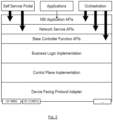
- FIGS 1 and 3 illustrate example SDN architectures in which core functions of the network are concentrated in SDN controllers in the Control Layer.
- Service providers communicate network requirements and required network behaviour to SDN controllers via Applications in the Application Layer. These requirements, received over standardised interfaces between the Application and Control Layers, are translated by the SDN controllers and enforced via standardised interfaces between the SDN controllers in the Control Layer and the individual Network Elements (NEs) in the Infrastructure Layer. Service providers thus gain network control independence from network equipment vendors, and can initialise network nodes through simple programming, as opposed to manually configuring individual elements.
- the centralised functions of the SDN controller can also be used to promptly handle network issues and greatly reduce the time needed to provide a new network service or application.
- SDN architectures provide Application Programming Interfaces (APIs), enabling users to implement customised services for certain purposes including switching, routing, network resource allocation, bandwidth management, traffic engineering, system optimization, Quality of Service, QoS, security, access control lists, ACLs, and policy management.
- APIs Application Programming Interfaces
- Traffic Engineering, TE information is exchanged, allowing forthe population of a Traffic Engineering Database, TED.
- the TED contains resource attribute information and network topology information for the domain or domains in the network under the authority of the SDN controller.
- Resource attributes may include bandwidth, delay, jitter performance and metrics (for example, cost) associated with resources in the network.
- the network topology information may include node and link identity as well as node/link connectivity.
- the SDN controller may then request computation of a path by a Path Computation Element, PCE.
- the PCE computes an optimal path based on source and destination node information and performance requirements received from the SDN controller, and on resource attribute and connectivity information received from the TED, including network link parameters and attributes.
- Data transported over an SDN may have varying levels of sensitivity.
- certain data relating to financial or business transactions, to proprietary business information or technology, as part of Lawful Intercept activity or to national or government interests may be considered to be particularly sensitive, and it may be desirable to place restrictions on how such data may be transported.
- a security domain, SD may be defined within an SDN for the transport and processing of sensitive data.
- a security domain is a network domain that groups virtual and physical entities or objects with different levels of sensitivity. Since SDN permits high flexibility and the possibility to change paths on the fly and also create network slices dynamically, it is desirable to be able to control that new paths and network slices meet security requirements for the transport of sensitive data. Respecting security requirements in the transport of sensitive data remains an ongoing challenge.
- Aguado et al: "The Engineering of Software-Defined Quantum Key Distribution Networks" discloses path discovery in a quantum network.
- Chinese Patent Application publication document CN 110661620 A discloses background prior art on a virtual key link-based shared key negotiation method, and a corresponding routing mechanism, in a quantum-capable network.
- a first aspect provides a method performed by an apparatus in a Software Defined Network, SDN.
- the method comprises receiving a request to define a virtual link, VL, in the SDN.
- the request includes security constraint information for the VL.
- the method further comprises identifying from a network topology of the SDN physical links that are Quantum Cryptography, QC, enabled.
- the method further comprises computing a path for the VL using only physical links of the identified QC enabled physical links.
- the method further comprises initiating provisioning of the VL using the computed path.
- the method advantageously enables enforcement of security requirements for the transport of sensitive data over VLs in an SDN by ensuring that all physical links within a path for a VL are Quantum Cryptography, QC, enabled.
- the method advantageously enables control of physical link selection for VL paths according to whether links are QC enabled; the method enables enforcement of QC enabled links at the physical layer.
- SDN permits high flexibility and the ability to change paths on the fly and to create network slices dynamically.
- the method advantageously enables control of network slices, planned paths, protection paths and modification of paths, to ensure that the slices/paths are using QC enabled links and therefore can avoid eavesdropping from the links.
- said identifying comprises interrogating QKD support information of the network topology physical links in a Traffic Engineering Database, TED, of the SDN to identify the physical links that are QC enabled.
- the QKD support information is indicative of whether respective physical links are QC enabled.
- the method advantageously enables the TED to control physical link selection for VL paths according to whether links are QC enabled.
- the QKD support information is provided within link topology definitions of the physical links in the TED.
- the TED is therefore enriched with QKD support information, enabling a path for a VL to be computed using only QC enabled physical links.
- the QKD support information in the link topology definitions comprises one of a link type parameter indicative of whether the physical link is QC enabled or a link cost parameter indicative of whether the physical link is QC enabled.
- Providing a specific link type parameter that can indicate that a link is QC enabled may ensure that the link is always identified as a resource for a path for a VL that requires that all physical links are QC enabled.
- Providing a link cost parameter that can indicate that a link is QC enabled may ensure that the link is always identified as a resource for a path for a VL that requires that all physical links are QC enabled.
- the link cost parameter is set to a low value relative to the cost of non-QC enabled physical links of the network topology of the SDN. This may ensure that a QC enabled link is practically always selected as a resource for the path.
- a physical link is QC enabled if endpoint nodes of the physical link have access to a shared Quantum key, Qkey.
- the endpoint nodes are supported by a quantum key distribution, QKD, infrastructure across which the shared Qkey has been exchanged.
- QKD quantum key distribution
- the security constraint information comprises a VL descriptor, VLD, including a sensitivity level attribute value indicative of whether the VL requires a path that is QC enabled.
- VLD VL descriptor
- the method provides a modified VLD that enables specification that the VL requires a path that is QC enabled.
- the sensitivity level attribute value is provided within a Connectivity Type information element of the VLD.
- the method may advantageously be implemented by modifying an existing information element of the VLD.
- the VL is for a security domain of the SDN.
- the VL is a lawful intercept, LI, interface.
- the method may be advantageously used for LI interfaces, such as H1/2/3 and X1/2/3 interfaces, and may enable improved security as compared to current H1/2/3 and X1/2/3 interfaces.
- a second aspect provides apparatus for a Software Defined Network, SDN.
- the apparatus comprises a controller and a Path Computation Element, PCE.
- the controller is configured to receive a request to define a virtual link, VL, in the SDN.
- the request includes security constraint information for the VL.
- the PCE is configured to identify from a network topology of the SDN physical links that are Quantum Cryptography, QC, enabled.
- the PCE is further configured to compute a path for the VL using only physical links of the identified QC enabled physical links
- the controller is further configured to initiate provisioning of the VL using the computed path.
- the PCE of the apparatus is advantageously enhanced to only use physical links that are QC enabled, to meet the security constraint information for the VL that the apparatus is defining. The same will hold for computation of protection paths and on the fly routing by the PCE. Any change in path computation due to the addition of new physical links shall only be possible if the new links are QC enabled.
- the apparatus further comprises a Traffic Engineering Database, TED, containing QKD support information of the network topology physical links.
- the PCE is configured to interrogate the QKD support information in the TED to identify physical links that are QC enabled.
- the QKD support information is indicative of whether respective physical links are QC enabled.
- the QKD support information is provided within link topology definitions of the physical links in the TED.
- the QKD support information in the link topology definitions comprises one of a link type parameter indicative of whether the physical link is QC enabled or a link cost parameter indicative of whether the physical link is QC enabled.
- a physical link is QC enabled if endpoint nodes of the physical link have access to a shared Quantum key, Qkey.
- the endpoint nodes are supported by a quantum key distribution, QKD, infrastructure across which the shared Qkey has been exchanged.
- QKD quantum key distribution
- the security constraint information comprises a VL descriptor, VLD, including a sensitivity level attribute value indicative of whether the VL requires a path that is QC enabled.
- the sensitivity level attribute value is provided within a Connectivity Type information element of the VLD.
- the apparatus comprises at least one processing circuitry and memory, the memory containing instructions executable by the at least one processing circuitry such that the apparatus is operative to implement the controller, the PCE and the TED as virtualised network functions, VNFs.
- a third aspect provides apparatus for defining a virtual link, VL, in a Software Defined Network, SDN.
- the apparatus comprises at least one processing circuitry and memory.
- the memory contains instructions executable by the at least one processing circuitry such that the apparatus is operative to: receive a request to define a virtual link, VL, in the SDN, the request including security constraint information for the VL; identify from a network topology of the SDN physical links that are Quantum Cryptography, QC, enabled; compute a path for the VL using only physical links of the identified QC enabled physical links; and initiate provisioning of the VL using the computed path.
- QC Quantum Cryptography
- a fourth aspect provides a computer program comprising instructions which, when executed on at least one processor, cause the at least one processor to carry out any of the above steps of the method performed by an apparatus in a Software Defined Network, SDN.
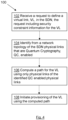
- An embodiment provides a method 100 performed by an apparatus in a Software Defined Network, SDN.
- the steps of the method 100 are illustrated in Figure 4 and comprise:
- an embodiment provides a method 200 performed by an apparatus in a SDN.
- the step of identifying physical links comprises interrogating 204 QKD support information of physical links of a network topology of the SDN to identify physical links that are QC enabled.
- the network topology and the QC support information are provided in a Traffic Engineering Database, TED, of the SDN.
- the QKD support information is indicative of whether respective physical links are QC enabled.
- the security constraint information comprises a VL descriptor, VLD.
- the VLD includes a sensitivity level attribute value indicative of whether the VL requires a path that is QC enabled.
- the sensitivity level attribute value may specify a sensitivity level of the VL, at least one value specifying a VL that requires all physical links in the path to be QC enabled.
- the sensitivity level attribute value is provided within a Connectivity Type information element of the VLD.
- the ConnectivityType information element defined at 6.5.3 of the ETSI GS NFV-IFA 014 V3.3.1 standard, "Network Functions Virtualisation (NFV) Release 3; Management and Orchestration; Network Service Templates Specification” may be modified in this respect to include an additional Attribute "sensitivityLevel", as illustrated in Table 6.5.3.2-1A below: Table 6.5.3.2-1A: Attributes of the ConnectivityType information element Attribute Qualifier Cardinality Content Description layerProtocol M 1..N Enum Specifies the protocols the VL uses (Ethernet, MPLS, ODU2, IPV4, IPV6, Pseudo-Wire). See note.
- flowPattern M 0..1 String Specifies the flow pattern of the connectivity (Line, Tree, Mesh, etc.).
- sensitivityLevel M 0..1 String Specifies the sensitivity level of the connection which implies that Quantum Cryptography enabled path shall be available between the end-points of the link.
- the top layer protocol of the VL protocol stack shall always be provided. The lower layer protocols may be included when there are specific requirements on these layers.
- the QKD support information is provided within link topology definitions of the physical links in the TED.
- the QKD support information in the link topology definitions is a link type parameter indicative of whether the physical link is QC enabled.
- the link type parameter can be set for a link to indicate that the link is QC enabled. This may ensure that the link is always identified as a QC enabled candidate link for a path for a VL having security constraint information indicating that the VL requires a path that is QC enabled.
- the QKD support information in the link topology definitions is a link cost parameter indicative of whether the physical link is QC enabled.
- the link cost parameter can be set for a link to indicate that the link is QC enabled by giving the link a cost that is lower than non-QC enabled physical links of the network topology of the SDN. This may cause the link to practically always be identified as a QC enabled candidate link for a path for a VL having security constraint information indicating that the VL requires a path that is QC enabled.
- a physical link is QC enabled if endpoint nodes of the physical link have access to a shared Quantum key, Qkey.
- the endpoint nodes are supported by a quantum key distribution, QKD, infrastructure across which the shared Qkey has been exchanged.
- QKD quantum key distribution
- the VL is for a security domain of the SDN.
- the VL is a lawful intercept, LI, interface according to the ETSI TS 133 107 v16.0.0 (3GPP TS 33.107 version 16.0.0 Release 16) standard on "Lawful interception architecture and functions".
- the VL may, for example be a H1/2/3 interface or an X1/2/3 interface, as illustrated in Figure 9 .
- the method 100 is applicable whether the Administration Function, ADMF, and/or the Intercepting Control Elements, ICE, such as the 4G Mobility Management Entity, MME, Home Subscriber Server, HSS, Serving Gateway, SGW, and Packet Data Network Gateway, PGW, as illustrated in Figure 8 , or 5G Access and Mobility Management Functions, AMF, Session Management Function, SMF, Unified Data Management, UDM, User Plane Function, UPF, and Policy Control Function, PCF, as illustrated in Figure 9 , are deployed as physical network functions or virtualized network functions, according to the ETSI NFV standard definitions.
- ICE such as the 4G Mobility Management Entity, MME, Home Subscriber Server, HSS, Serving Gateway, SGW, and Packet Data Network Gateway, PGW, as illustrated in Figure 8 , or 5G Access and Mobility Management Functions, AMF, Session Management Function, SMF, Unified Data Management, UDM, User Plane Function, UPF, and Policy Control Function, PCF, as illustrated in Figure 9 , are deployed
- An embodiment provides apparatus 300 for a Software Defined Network, SDN, as illustrated in Figure 6 .
- the apparatus comprises a controller 302 and a Path Computation Element, PCE, 304.
- the controller 302 is configured to receive a request to define VL in the SDN.
- the request includes security constraint information for the VL.
- the PCE 304 is configured to identify from a network topology of the SDN physical links that are QC enabled and to compute a path for the VL using only physical links of the identified QC enabled physical links.
- the controller is further configured to initiate provisioning of the VL using the computed path.
- the apparatus 400 further comprises a Traffic Engineering Database, TED 402.
- the TED contains QKD support information of the network topology physical links.
- the QKD support information is indicative of whether respective physical links are QC enabled.
- the PCE 304 is configured to interrogate the QKD support information in the TED to identify physical links that are QC enabled.
- the controller 302 is an SDN controller.
- traffic engineering, TE information is exchanged, and based on exchanged TE information, the TED is built.
- a TED is generated based on network domain resources and network topology information. It includes the topology of the controlled network Nodes and Links and the connectivity and bandwidth of the Nodes/Links. It also stores available resources and attributes, such as available link bandwidth, link metrics (e.g. costs), delay and jitters.
- the SDN controller 302 requests the PCE 304 to compute a path for the VL.
- a PCE typically calculates all paths based on source/database node information and network performance elements (such as bandwidth, delay, etc.) received from a TED. The information received from the TED is used by the PCE to compute an optimal path meeting specified requirements, including the requirement that the path only uses physical links of the identified QC enabled physical links.
- the controller is an orchestrator or a network management system, NMS.
- the QKD support information is provided within link topology definitions of the physical links in the TED.
- the QKD support information in the link topology definitions is a link type parameter indicative of whether the physical link is QC enabled.
- the link type parameter can be set for a link to indicate that the link is QC enabled. This may ensure that the link is always identified as a QC enabled candidate link for a path for a VL having security constraint information indicating that the VL requires a path that is QC enabled.
- the QKD support information in the link topology definitions is a link cost parameter indicative of whether the physical link is QC enabled.
- the link cost parameter can be set for a link to indicate that the link is QC enabled by giving the link a cost that is lower than non-QC enabled physical links of the network topology of the SDN. This may cause the link to practically always be identified as a QC enabled candidate link for a path for a VL having security constraint information indicating that the VL requires a path that is QC enabled.
- a physical link is QC enabled if endpoint nodes of the physical link have access to a shared Quantum key, Qkey.
- the endpoint nodes are supported by a quantum key distribution, QKD, infrastructure across which the shared Qkey has been exchanged.
- QKD quantum key distribution
- the security constraint information comprises a VL descriptor, VLD.
- the VLD includes a sensitivity level attribute value indicative of whether the VL requires a path that is QC enabled.
- the sensitivity level attribute value may specify a sensitivity level of the VL, at least one value specifying a VL that requires all physical links in the path to be QC enabled.
- the sensitivity level attribute value is provided within a Connectivity Type information element of the VLD.
- the ConnectivityType information element defined at 6.5.3 of the ETSI GS NFV-IFA 014 V3.3.1 standard, "Network Functions Virtualisation (NFV) Release 3; Management and Orchestration; Network Service Templates Specification” may be modified in this respect to include an additional Attribute "sensitivityLevel”, as illustrated in Table 6.5.3.2-1A above.
- the VL is for a security domain of the SDN.
- the VL is a lawful intercept, LI, interface according to the ETSI TS 133 107 v16.0.0 (3GPP TS 33.107 version 16.0.0 Release 16) standard on "Lawful interception architecture and functions".
- the VL may, for example be a H1/2/3 interface or an X1/2/3 interface, as illustrated in Figure 9 .
- the method 100 is applicable whether the Administration Function, ADMF, and/orthe Intercepting Control Elements, ICE, such as 4G MME, HSS, SGW and PGW, as illustrated in Figure 8 , or 5G AMF, SMF, UDM, UPF, PCF, as illustrated in Figure 9 , are deployed as physical network functions or virtualized network functions, according to the ETSI NFV standard definitions.
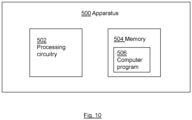
- the apparatus 500 comprises at least one processing circuitry 502 and memory 504, as illustrated in Figure 10 .
- the memory contains instructions executable by the at least one processing circuitry such that the apparatus is operative to implement the controller, the PCE and the TED as virtualised network functions, VNFs.
- an embodiment provides apparatus 500 for defining a virtual link, VL, in a Software Defined Network, SDN.
- the apparatus comprising at least one processing circuitry 502 and memory 504.
- the memory contains instructions executable by the at least one processing circuitry such that the apparatus is operative to:
- An embodiment provides a computer program comprising instructions which, when executed on at least one processor, cause the at least one processor to carry out any of the above steps of the method 100 performed by an apparatus in a Software Defined Network, SDN.
Landscapes
- Engineering & Computer Science (AREA)
- Computer Networks & Wireless Communication (AREA)
- Signal Processing (AREA)
- Computer Security & Cryptography (AREA)
- Physics & Mathematics (AREA)
- Electromagnetism (AREA)
- Theoretical Computer Science (AREA)
- Data Exchanges In Wide-Area Networks (AREA)
Claims (15)
- Verfahren (100, 200), das von einer Vorrichtung (300, 400, 500) in einem softwaredefinierten Netzwerk, SDN, durchgeführt wird, wobei das Verfahren umfasst:- Empfangen (102) einer Anforderung zum Definieren einer virtuellen Verbindung, VL, im SDN, wobei die Anforderung Sicherheitsbeschränkungsinformationen für die VL umfasst;- Identifizieren (104, 204) physischer Verbindungen, die quantenkryptografiefähig, QC-fähig, sind, aus einer Netzwerktopologie des SDN;- wobei eine physische Verbindung QC-fähig ist, wenn Endpunktknoten der physischen Verbindung Zugriff auf einen gemeinsamen Quantenschlüssel, Qkey, haben;- Berechnen (106) eines Pfades für die VL unter Verwendung nur physischer Verbindungen der identifizierten QC-fähigen physischen Verbindungen; und- Initiieren (108) der Bereitstellung der VL unter Verwendung des berechneten Pfades.
- Verfahren nach Anspruch 1, wobei die Endpunktknoten durch eine Quantenschlüsselverteilungsinfrastruktur, QKD-Infrastruktur, unterstützt werden, über die der gemeinsame Qkey ausgetauscht wurde.
- Verfahren nach einem der Ansprüche 1 bis 2, wobei die Sicherheitsbeschränkungsinformationen einen VL-Deskriptor, VLD, umfassen, der einen Empfindlichkeitsstufen-Attributwert umfasst, der angibt, ob die VL einen Pfad erfordert, der QC-fähig ist.
- Verfahren nach einem der Ansprüche 1 bis 3, wobei der Empfindlichkeitsstufen-Attributwert innerhalb eines Konnektivitätstyp-Informationselements des VLD bereitgestellt wird.
- Verfahren nach einem der Ansprüche 1 bis 4, wobei die VL eine Schnittstelle für legales Abhören, LI, ist.
- Vorrichtung (300, 400) für ein softwaredefiniertes Netzwerk, SDN, wobei die Vorrichtung umfasst:eine Steuerung (302), die konfiguriert ist zum:
Empfangen einer Anforderung zum Definieren einer virtuellen Verbindung, VL, im SDN, wobei die Anforderung Sicherheitsbeschränkungsinformationen für die VL umfasst;ein Pfadberechnungselement, PCE, (304), umfassend:Identifizieren physischer Verbindungen, die quantenkryptografiefähig, QC-fähig, sind, aus einer Netzwerktopologie des SDN;wobei eine physische Verbindung QC-fähig ist, wenn Endpunktknoten der physischen Verbindung Zugriff auf einen gemeinsamen Quantenschlüssel, Qkey, haben; undBerechnen eines Pfades für die VL unter Verwendung nur physischer Verbindungen der identifizierten QC-fähigen physischen Verbindungen; undwobei die Steuerung ferner zum Initiieren der Bereitstellung der VL unter Verwendung des berechneten Pfades konfiguriert ist. - Vorrichtung nach Anspruch 6, ferner umfassend eine Traffic-Engineering-Datenbank, TED, (402), die QKD-Unterstützungsinformationen der physischen Verbindungen der Netzwerktopologie enthält und wobei das PCE zum Abfragen der QKD-Unterstützungsinformationen in der TED konfiguriert ist, um physische Verbindungen zu identifizieren, die QC-fähig sind, wobei die QKD-Informationen angeben, ob jeweilige physische Verbindungen QC-fähig sind.
- Vorrichtung nach Anspruch 7, wobei die QKD-Unterstützungsinformationen innerhalb von Verbindungstopologiedefinitionen der physischen Verbindungen in der TED bereitgestellt werden.
- Vorrichtung nach Anspruch 8, wobei die QKD-Unterstützungsinformationen in den Verbindungstopologiedefinitionen eines von einem Verbindungstyp-Parameter, der angibt, ob die physische Verbindung QC-fähig ist, oder einem Verbindungskostenparameter umfassen, der angibt, ob die physische Verbindung QC-fähig ist.
- Vorrichtung nach einem der Ansprüche 6 bis 9, wobei eine physische Verbindung QC-fähig ist, wenn Endpunktknoten der physischen Verbindung Zugriff auf einen gemeinsamen Quantenschlüssel, Qkey, haben.
- Vorrichtung nach einem der Ansprüche 6 bis 10, wobei die Sicherheitsbeschränkungsinformationen einen VL-Deskriptor, VLD, umfassen, der einen Empfindlichkeitsstufen-Attributwert umfasst, der angibt, ob die VL einen Pfad erfordert, der QC-fähig ist.
- Vorrichtung nach Anspruch 11, wobei der Empfindlichkeitsstufen-Attributwert innerhalb eines Konnektivitätstyp-Informationselements des VLD bereitgestellt wird.
- Vorrichtung nach einem der Ansprüche 6 bis 12, wobei die Vorrichtung mindestens eine Verarbeitungsschaltungsanordnung und Speicher umfasst, wobei der Speicher Anweisungen enthält, die von der mindestens einen Verarbeitungsschaltungsanordnung ausgeführt werden können, sodass die Vorrichtung zum Implementieren der Steuerung, des PCE und der TED als virtualisierte Netzwerkfunktionen, VNFs, ausgelegt ist.
- Computerprogramm (506), umfassend Anweisungen, die bei Ausführung auf mindestens einem Prozessor den mindestens einen Prozessor zum Durchführen des Verfahrens nach einem der Ansprüche 1 bis 5 veranlassen.
- Vorrichtung (500) zum Definieren einer virtuellen Verbindung, VL, in einem softwaredefinierten Netzwerk, SDN, wobei die Vorrichtung mindestens eine Verarbeitungsschaltungsanordnung (502) und Speicher (504) umfasst, wobei der Speicher Anweisungen (506) enthält, die von der mindestens einen Verarbeitungsschaltungsanordnung ausgeführt werden können, sodass die Vorrichtung ausgelegt ist zum:- Empfangen einer Anforderung zum Definieren einer virtuellen Verbindung, VL, im SDN, wobei die Anforderung Sicherheitsbeschränkungsinformationen für die VL umfasst;- Identifizieren physischer Verbindungen, die quantenkryptografiefähig, QC-fähig, sind, aus einer Netzwerktopologie des SDN;- wobei eine physische Verbindung QC-fähig ist, wenn Endpunktknoten der physischen Verbindung Zugriff auf einen gemeinsamen Quantenschlüssel, Qkey, haben;- Berechnen eines Pfades für die VL unter Verwendung nur physischer Verbindungen der identifizierten QC-fähigen physischen Verbindungen; und- Initiieren der Bereitstellung der VL unter Verwendung des berechneten Pfades.
Applications Claiming Priority (1)
| Application Number | Priority Date | Filing Date | Title |
|---|---|---|---|
| PCT/EP2021/054440 WO2022179677A1 (en) | 2021-02-23 | 2021-02-23 | Method and apparatus for a software defined network |
Publications (2)
| Publication Number | Publication Date |
|---|---|
| EP4298757A1 EP4298757A1 (de) | 2024-01-03 |
| EP4298757B1 true EP4298757B1 (de) | 2024-08-21 |
Family
ID=74732919
Family Applications (1)
| Application Number | Title | Priority Date | Filing Date |
|---|---|---|---|
| EP21707960.7A Active EP4298757B1 (de) | 2021-02-23 | 2021-02-23 | Verfahren und vorrichtung für ein softwaredefiniertes netzwerk |
Country Status (3)
| Country | Link |
|---|---|
| US (1) | US20240146518A1 (de) |
| EP (1) | EP4298757B1 (de) |
| WO (1) | WO2022179677A1 (de) |
Families Citing this family (1)
| Publication number | Priority date | Publication date | Assignee | Title |
|---|---|---|---|---|
| WO2026046501A1 (en) * | 2024-08-27 | 2026-03-05 | Telefonaktiebolaget Lm Ericsson (Publ) | Dynamic constrained network slice deployment |
Family Cites Families (33)
| Publication number | Priority date | Publication date | Assignee | Title |
|---|---|---|---|---|
| AU691197B2 (en) * | 1993-09-09 | 1998-05-14 | British Telecommunications Public Limited Company | Method for key distribution using quantum cryptography |
| WO2001086855A2 (en) * | 2000-04-28 | 2001-11-15 | The Regents Of The University Of California | Apparatus for free-space quantum key distribution in daylight |
| US7581093B2 (en) * | 2003-12-22 | 2009-08-25 | Nortel Networks Limited | Hitless manual cryptographic key refresh in secure packet networks |
| WO2005098781A1 (en) * | 2004-04-01 | 2005-10-20 | Dana Corporation | Intelligent transportation system |
| US7437081B2 (en) * | 2004-11-01 | 2008-10-14 | Magiq Technologies, Inc | System and method for providing two-way communication of quantum signals, timing signals, and public data |
| US7826749B2 (en) * | 2005-09-19 | 2010-11-02 | The Chinese University Of Hong Kong | Method and system for quantum key distribution over multi-user WDM network with wavelength routing |
| US7889868B2 (en) * | 2005-09-30 | 2011-02-15 | Verizon Business Global Llc | Quantum key distribution system |
| US7940757B2 (en) * | 2006-02-23 | 2011-05-10 | Cisco Technology, Inc. | Systems and methods for access port ICMP analysis |
| US8855316B2 (en) * | 2008-01-25 | 2014-10-07 | Qinetiq Limited | Quantum cryptography apparatus |
| WO2010044709A2 (en) * | 2008-10-17 | 2010-04-22 | Dmitry Ivanovich Sychev | Methods and devices of quantum encoding on dwdm (roadm) network and fiber optic links |
| GB0819665D0 (en) * | 2008-10-27 | 2008-12-03 | Qinetiq Ltd | Quantum key dsitribution |
| KR101351012B1 (ko) * | 2009-12-18 | 2014-01-10 | 한국전자통신연구원 | 다자간 양자 통신에서의 사용자 인증 방법 및 장치 |
| US9237098B2 (en) * | 2012-07-03 | 2016-01-12 | Cisco Technologies, Inc. | Media access control (MAC) address summation in Datacenter Ethernet networking |
| JP6030925B2 (ja) * | 2012-11-12 | 2016-11-24 | ルネサスエレクトロニクス株式会社 | 半導体装置及び情報処理システム |
| US10560265B2 (en) * | 2013-06-08 | 2020-02-11 | Quantumctek Co., Ltd. | Mobile secret communications method based on quantum key distribution network |
| KR101776137B1 (ko) * | 2014-10-30 | 2017-09-19 | 에스케이 텔레콤주식회사 | 양자 키 분배 시스템에서 복수의 장치에 키를 공급하는 장치 및 방법 |
| EP3026939B1 (de) * | 2014-11-27 | 2017-08-16 | Rohde & Schwarz GmbH & Co. KG | Verkehrskontrollsystem |
| CN105991285B (zh) * | 2015-02-16 | 2019-06-11 | 阿里巴巴集团控股有限公司 | 用于量子密钥分发过程的身份认证方法、装置及系统 |
| JP6400513B2 (ja) * | 2015-03-18 | 2018-10-03 | 株式会社東芝 | 量子鍵配送装置、量子鍵配送方法およびプログラム |
| CN106301769B (zh) * | 2015-06-08 | 2020-04-10 | 阿里巴巴集团控股有限公司 | 量子密钥输出方法、存储一致性验证方法、装置及系统 |
| US11588783B2 (en) * | 2015-06-10 | 2023-02-21 | Cisco Technology, Inc. | Techniques for implementing IPV6-based distributed storage space |
| US9960465B2 (en) * | 2015-07-30 | 2018-05-01 | Lg Chem, Ltd. | Battery pack |
| KR101830339B1 (ko) * | 2016-05-20 | 2018-03-29 | 한국전자통신연구원 | 양자 네트워크상에서의 양자키 분배 장치 및 방법 |
| CN112217637B (zh) * | 2016-11-04 | 2024-03-15 | 华为技术有限公司 | 一种基于集中管理与控制网络的量子密钥中继方法和装置 |
| KR101860234B1 (ko) * | 2016-12-20 | 2018-05-21 | 엘에스산전 주식회사 | 듀얼 포트 스위치의 링크 속도 설정 방법 |
| US10476794B2 (en) * | 2017-07-30 | 2019-11-12 | Mellanox Technologies Tlv Ltd. | Efficient caching of TCAM rules in RAM |
| US10673883B2 (en) * | 2018-05-14 | 2020-06-02 | Cisco Technology, Inc. | Time synchronization attack detection in a deterministic network |
| US11212294B2 (en) * | 2018-09-12 | 2021-12-28 | Grid7 LLC | Data packet security with expiring time-based hash message authentication codes (HMACs) |
| WO2020079841A1 (ja) * | 2018-10-19 | 2020-04-23 | 日本電気株式会社 | 乱数品質管理方法および装置 |
| US11469888B2 (en) * | 2019-05-03 | 2022-10-11 | Quantumxchange, Inc. | Tamper detection in a quantum communications system |
| CN110661620B (zh) * | 2019-09-06 | 2022-04-01 | 成都量安区块链科技有限公司 | 一种基于虚拟量子链路的共享密钥协商方法 |
| US12088703B2 (en) * | 2021-05-10 | 2024-09-10 | Electronics And Telecommunications Research Institute | Method and apparatus for control action based on software defined networking associated with quantum key distribution network management in quantum key distribution network |
| EP4374541A4 (de) * | 2021-07-20 | 2025-05-28 | The Research Foundation for The State University of New York | System und verfahren für quantensichere mikronetze |
-
2021
- 2021-02-23 EP EP21707960.7A patent/EP4298757B1/de active Active
- 2021-02-23 US US18/547,298 patent/US20240146518A1/en active Pending
- 2021-02-23 WO PCT/EP2021/054440 patent/WO2022179677A1/en not_active Ceased
Also Published As
| Publication number | Publication date |
|---|---|
| US20240146518A1 (en) | 2024-05-02 |
| WO2022179677A1 (en) | 2022-09-01 |
| EP4298757A1 (de) | 2024-01-03 |
Similar Documents
| Publication | Publication Date | Title |
|---|---|---|
| US12556443B2 (en) | Methods and systems for application and policy based network traffic isolation and data transfer | |
| US11750614B2 (en) | Methods and systems for dynamic creation of access control lists | |
| Sezer et al. | Are we ready for SDN? Implementation challenges for software-defined networks | |
| US10587698B2 (en) | Service function registration mechanism and capability indexing | |
| CN112020844B (zh) | 用于互连多域网络分片控制和管理的系统、功能和接口 | |
| EP2993840B1 (de) | Verfahren, vorrichtung und system für datenstromweiterleitung | |
| EP2712480B1 (de) | Erweiterte steuer- und verwaltungsarchitektur für cloud-dienst zur schnittstellenbildung mit der netzwerkschicht | |
| US9100346B2 (en) | Commmon agent framework for network devices | |
| US10326669B2 (en) | Data service policy control based on software defined network (SDN) key performance indicators (KPIS) | |
| EP3488565B1 (de) | Bestimmung von einem datenpfad in einem software-definierten netzwerk | |
| Erel-Özçevik et al. | OFaaS: OpenFlow switch as a service for multi tenant slicing in SD-CDN | |
| KR101746105B1 (ko) | 서비스 체이닝이 가능한 오픈플로우 스위치 | |
| EP4298757B1 (de) | Verfahren und vorrichtung für ein softwaredefiniertes netzwerk | |
| Varadharajan et al. | Securing communication in multiple autonomous system domains with software defined networking | |
| Silva et al. | Evolving fast innovation in next-generation networking through flexible and customized softwarization and slicing capabilities | |
| KR101739097B1 (ko) | 오픈플로우 스위치의 서비스 체이닝 방법 | |
| KR101739100B1 (ko) | 서비스 체이닝 가능한 오픈플로우 스위치 제어 방법 및 그 제어기 | |
| KR20260019380A (ko) | 무선 통신 시스템에서 응용 서비스 요구 기반 사용자 트래픽 제어를 위한 장치 및 방법 | |
| KR20010047997A (ko) | 디렉토리 기반의 통합관리를 통한 네트워크 보안 유지 방법 | |
| Karim | Design of the intelligent WAN for the next generation |
Legal Events
| Date | Code | Title | Description |
|---|---|---|---|
| STAA | Information on the status of an ep patent application or granted ep patent |
Free format text: STATUS: UNKNOWN |
|
| STAA | Information on the status of an ep patent application or granted ep patent |
Free format text: STATUS: THE INTERNATIONAL PUBLICATION HAS BEEN MADE |
|
| PUAI | Public reference made under article 153(3) epc to a published international application that has entered the european phase |
Free format text: ORIGINAL CODE: 0009012 |
|
| STAA | Information on the status of an ep patent application or granted ep patent |
Free format text: STATUS: REQUEST FOR EXAMINATION WAS MADE |
|
| 17P | Request for examination filed |
Effective date: 20230825 |
|
| AK | Designated contracting states |
Kind code of ref document: A1 Designated state(s): AL AT BE BG CH CY CZ DE DK EE ES FI FR GB GR HR HU IE IS IT LI LT LU LV MC MK MT NL NO PL PT RO RS SE SI SK SM TR |
|
| GRAP | Despatch of communication of intention to grant a patent |
Free format text: ORIGINAL CODE: EPIDOSNIGR1 |
|
| STAA | Information on the status of an ep patent application or granted ep patent |
Free format text: STATUS: GRANT OF PATENT IS INTENDED |
|
| DAV | Request for validation of the european patent (deleted) | ||
| DAX | Request for extension of the european patent (deleted) | ||
| INTG | Intention to grant announced |
Effective date: 20240215 |
|
| GRAJ | Information related to disapproval of communication of intention to grant by the applicant or resumption of examination proceedings by the epo deleted |
Free format text: ORIGINAL CODE: EPIDOSDIGR1 |
|
| STAA | Information on the status of an ep patent application or granted ep patent |
Free format text: STATUS: REQUEST FOR EXAMINATION WAS MADE |
|
| GRAP | Despatch of communication of intention to grant a patent |
Free format text: ORIGINAL CODE: EPIDOSNIGR1 |
|
| STAA | Information on the status of an ep patent application or granted ep patent |
Free format text: STATUS: GRANT OF PATENT IS INTENDED |
|
| INTC | Intention to grant announced (deleted) | ||
| GRAS | Grant fee paid |
Free format text: ORIGINAL CODE: EPIDOSNIGR3 |
|
| INTG | Intention to grant announced |
Effective date: 20240620 |
|
| GRAA | (expected) grant |
Free format text: ORIGINAL CODE: 0009210 |
|
| STAA | Information on the status of an ep patent application or granted ep patent |
Free format text: STATUS: THE PATENT HAS BEEN GRANTED |
|
| AK | Designated contracting states |
Kind code of ref document: B1 Designated state(s): AL AT BE BG CH CY CZ DE DK EE ES FI FR GB GR HR HU IE IS IT LI LT LU LV MC MK MT NL NO PL PT RO RS SE SI SK SM TR |
|
| REG | Reference to a national code |
Ref country code: GB Ref legal event code: FG4D |
|
| REG | Reference to a national code |
Ref country code: CH Ref legal event code: EP |
|
| REG | Reference to a national code |
Ref country code: DE Ref legal event code: R096 Ref document number: 602021017504 Country of ref document: DE |
|
| REG | Reference to a national code |
Ref country code: IE Ref legal event code: FG4D |
|
| REG | Reference to a national code |
Ref country code: LT Ref legal event code: MG9D |
|
| REG | Reference to a national code |
Ref country code: NL Ref legal event code: MP Effective date: 20240821 |
|
| PG25 | Lapsed in a contracting state [announced via postgrant information from national office to epo] |
Ref country code: NO Free format text: LAPSE BECAUSE OF FAILURE TO SUBMIT A TRANSLATION OF THE DESCRIPTION OR TO PAY THE FEE WITHIN THE PRESCRIBED TIME-LIMIT Effective date: 20241121 |
|
| REG | Reference to a national code |
Ref country code: AT Ref legal event code: MK05 Ref document number: 1716603 Country of ref document: AT Kind code of ref document: T Effective date: 20240821 |
|
| PG25 | Lapsed in a contracting state [announced via postgrant information from national office to epo] |
Ref country code: NL Free format text: LAPSE BECAUSE OF FAILURE TO SUBMIT A TRANSLATION OF THE DESCRIPTION OR TO PAY THE FEE WITHIN THE PRESCRIBED TIME-LIMIT Effective date: 20240821 Ref country code: GR Free format text: LAPSE BECAUSE OF FAILURE TO SUBMIT A TRANSLATION OF THE DESCRIPTION OR TO PAY THE FEE WITHIN THE PRESCRIBED TIME-LIMIT Effective date: 20241122 Ref country code: FI Free format text: LAPSE BECAUSE OF FAILURE TO SUBMIT A TRANSLATION OF THE DESCRIPTION OR TO PAY THE FEE WITHIN THE PRESCRIBED TIME-LIMIT Effective date: 20240821 Ref country code: PT Free format text: LAPSE BECAUSE OF FAILURE TO SUBMIT A TRANSLATION OF THE DESCRIPTION OR TO PAY THE FEE WITHIN THE PRESCRIBED TIME-LIMIT Effective date: 20241223 Ref country code: PL Free format text: LAPSE BECAUSE OF FAILURE TO SUBMIT A TRANSLATION OF THE DESCRIPTION OR TO PAY THE FEE WITHIN THE PRESCRIBED TIME-LIMIT Effective date: 20240821 |
|
| PG25 | Lapsed in a contracting state [announced via postgrant information from national office to epo] |
Ref country code: BG Free format text: LAPSE BECAUSE OF FAILURE TO SUBMIT A TRANSLATION OF THE DESCRIPTION OR TO PAY THE FEE WITHIN THE PRESCRIBED TIME-LIMIT Effective date: 20240821 |
|
| PG25 | Lapsed in a contracting state [announced via postgrant information from national office to epo] |
Ref country code: LV Free format text: LAPSE BECAUSE OF FAILURE TO SUBMIT A TRANSLATION OF THE DESCRIPTION OR TO PAY THE FEE WITHIN THE PRESCRIBED TIME-LIMIT Effective date: 20240821 |
|
| PG25 | Lapsed in a contracting state [announced via postgrant information from national office to epo] |
Ref country code: AT Free format text: LAPSE BECAUSE OF FAILURE TO SUBMIT A TRANSLATION OF THE DESCRIPTION OR TO PAY THE FEE WITHIN THE PRESCRIBED TIME-LIMIT Effective date: 20240821 Ref country code: IS Free format text: LAPSE BECAUSE OF FAILURE TO SUBMIT A TRANSLATION OF THE DESCRIPTION OR TO PAY THE FEE WITHIN THE PRESCRIBED TIME-LIMIT Effective date: 20241221 |
|
| PG25 | Lapsed in a contracting state [announced via postgrant information from national office to epo] |
Ref country code: HR Free format text: LAPSE BECAUSE OF FAILURE TO SUBMIT A TRANSLATION OF THE DESCRIPTION OR TO PAY THE FEE WITHIN THE PRESCRIBED TIME-LIMIT Effective date: 20240821 |
|
| PG25 | Lapsed in a contracting state [announced via postgrant information from national office to epo] |
Ref country code: ES Free format text: LAPSE BECAUSE OF FAILURE TO SUBMIT A TRANSLATION OF THE DESCRIPTION OR TO PAY THE FEE WITHIN THE PRESCRIBED TIME-LIMIT Effective date: 20240821 Ref country code: RS Free format text: LAPSE BECAUSE OF FAILURE TO SUBMIT A TRANSLATION OF THE DESCRIPTION OR TO PAY THE FEE WITHIN THE PRESCRIBED TIME-LIMIT Effective date: 20241121 |
|
| PG25 | Lapsed in a contracting state [announced via postgrant information from national office to epo] |
Ref country code: RS Free format text: LAPSE BECAUSE OF FAILURE TO SUBMIT A TRANSLATION OF THE DESCRIPTION OR TO PAY THE FEE WITHIN THE PRESCRIBED TIME-LIMIT Effective date: 20241121 Ref country code: PT Free format text: LAPSE BECAUSE OF FAILURE TO SUBMIT A TRANSLATION OF THE DESCRIPTION OR TO PAY THE FEE WITHIN THE PRESCRIBED TIME-LIMIT Effective date: 20241223 Ref country code: PL Free format text: LAPSE BECAUSE OF FAILURE TO SUBMIT A TRANSLATION OF THE DESCRIPTION OR TO PAY THE FEE WITHIN THE PRESCRIBED TIME-LIMIT Effective date: 20240821 Ref country code: NO Free format text: LAPSE BECAUSE OF FAILURE TO SUBMIT A TRANSLATION OF THE DESCRIPTION OR TO PAY THE FEE WITHIN THE PRESCRIBED TIME-LIMIT Effective date: 20241121 Ref country code: NL Free format text: LAPSE BECAUSE OF FAILURE TO SUBMIT A TRANSLATION OF THE DESCRIPTION OR TO PAY THE FEE WITHIN THE PRESCRIBED TIME-LIMIT Effective date: 20240821 Ref country code: LV Free format text: LAPSE BECAUSE OF FAILURE TO SUBMIT A TRANSLATION OF THE DESCRIPTION OR TO PAY THE FEE WITHIN THE PRESCRIBED TIME-LIMIT Effective date: 20240821 Ref country code: IS Free format text: LAPSE BECAUSE OF FAILURE TO SUBMIT A TRANSLATION OF THE DESCRIPTION OR TO PAY THE FEE WITHIN THE PRESCRIBED TIME-LIMIT Effective date: 20241221 Ref country code: HR Free format text: LAPSE BECAUSE OF FAILURE TO SUBMIT A TRANSLATION OF THE DESCRIPTION OR TO PAY THE FEE WITHIN THE PRESCRIBED TIME-LIMIT Effective date: 20240821 Ref country code: GR Free format text: LAPSE BECAUSE OF FAILURE TO SUBMIT A TRANSLATION OF THE DESCRIPTION OR TO PAY THE FEE WITHIN THE PRESCRIBED TIME-LIMIT Effective date: 20241122 Ref country code: FI Free format text: LAPSE BECAUSE OF FAILURE TO SUBMIT A TRANSLATION OF THE DESCRIPTION OR TO PAY THE FEE WITHIN THE PRESCRIBED TIME-LIMIT Effective date: 20240821 Ref country code: ES Free format text: LAPSE BECAUSE OF FAILURE TO SUBMIT A TRANSLATION OF THE DESCRIPTION OR TO PAY THE FEE WITHIN THE PRESCRIBED TIME-LIMIT Effective date: 20240821 Ref country code: BG Free format text: LAPSE BECAUSE OF FAILURE TO SUBMIT A TRANSLATION OF THE DESCRIPTION OR TO PAY THE FEE WITHIN THE PRESCRIBED TIME-LIMIT Effective date: 20240821 Ref country code: AT Free format text: LAPSE BECAUSE OF FAILURE TO SUBMIT A TRANSLATION OF THE DESCRIPTION OR TO PAY THE FEE WITHIN THE PRESCRIBED TIME-LIMIT Effective date: 20240821 |
|
| PG25 | Lapsed in a contracting state [announced via postgrant information from national office to epo] |
Ref country code: RO Free format text: LAPSE BECAUSE OF FAILURE TO SUBMIT A TRANSLATION OF THE DESCRIPTION OR TO PAY THE FEE WITHIN THE PRESCRIBED TIME-LIMIT Effective date: 20240821 Ref country code: DK Free format text: LAPSE BECAUSE OF FAILURE TO SUBMIT A TRANSLATION OF THE DESCRIPTION OR TO PAY THE FEE WITHIN THE PRESCRIBED TIME-LIMIT Effective date: 20240821 Ref country code: SM Free format text: LAPSE BECAUSE OF FAILURE TO SUBMIT A TRANSLATION OF THE DESCRIPTION OR TO PAY THE FEE WITHIN THE PRESCRIBED TIME-LIMIT Effective date: 20240821 |
|
| PG25 | Lapsed in a contracting state [announced via postgrant information from national office to epo] |
Ref country code: EE Free format text: LAPSE BECAUSE OF FAILURE TO SUBMIT A TRANSLATION OF THE DESCRIPTION OR TO PAY THE FEE WITHIN THE PRESCRIBED TIME-LIMIT Effective date: 20240821 |
|
| PG25 | Lapsed in a contracting state [announced via postgrant information from national office to epo] |
Ref country code: CZ Free format text: LAPSE BECAUSE OF FAILURE TO SUBMIT A TRANSLATION OF THE DESCRIPTION OR TO PAY THE FEE WITHIN THE PRESCRIBED TIME-LIMIT Effective date: 20240821 |
|
| PG25 | Lapsed in a contracting state [announced via postgrant information from national office to epo] |
Ref country code: SK Free format text: LAPSE BECAUSE OF FAILURE TO SUBMIT A TRANSLATION OF THE DESCRIPTION OR TO PAY THE FEE WITHIN THE PRESCRIBED TIME-LIMIT Effective date: 20240821 Ref country code: IT Free format text: LAPSE BECAUSE OF FAILURE TO SUBMIT A TRANSLATION OF THE DESCRIPTION OR TO PAY THE FEE WITHIN THE PRESCRIBED TIME-LIMIT Effective date: 20240821 |
|
| REG | Reference to a national code |
Ref country code: DE Ref legal event code: R097 Ref document number: 602021017504 Country of ref document: DE |
|
| PLBE | No opposition filed within time limit |
Free format text: ORIGINAL CODE: 0009261 |
|
| STAA | Information on the status of an ep patent application or granted ep patent |
Free format text: STATUS: NO OPPOSITION FILED WITHIN TIME LIMIT |
|
| 26N | No opposition filed |
Effective date: 20250522 |
|
| PG25 | Lapsed in a contracting state [announced via postgrant information from national office to epo] |
Ref country code: SE Free format text: LAPSE BECAUSE OF FAILURE TO SUBMIT A TRANSLATION OF THE DESCRIPTION OR TO PAY THE FEE WITHIN THE PRESCRIBED TIME-LIMIT Effective date: 20240821 |
|
| PG25 | Lapsed in a contracting state [announced via postgrant information from national office to epo] |
Ref country code: MC Free format text: LAPSE BECAUSE OF FAILURE TO SUBMIT A TRANSLATION OF THE DESCRIPTION OR TO PAY THE FEE WITHIN THE PRESCRIBED TIME-LIMIT Effective date: 20240821 |
|
| REG | Reference to a national code |
Ref country code: CH Ref legal event code: PL |
|
| PG25 | Lapsed in a contracting state [announced via postgrant information from national office to epo] |
Ref country code: LU Free format text: LAPSE BECAUSE OF NON-PAYMENT OF DUE FEES Effective date: 20250223 |
|
| PG25 | Lapsed in a contracting state [announced via postgrant information from national office to epo] |
Ref country code: CH Free format text: LAPSE BECAUSE OF NON-PAYMENT OF DUE FEES Effective date: 20250228 |
|
| REG | Reference to a national code |
Ref country code: BE Ref legal event code: MM Effective date: 20250228 |
|
| PG25 | Lapsed in a contracting state [announced via postgrant information from national office to epo] |
Ref country code: FR Free format text: LAPSE BECAUSE OF NON-PAYMENT OF DUE FEES Effective date: 20250228 |
|
| PG25 | Lapsed in a contracting state [announced via postgrant information from national office to epo] |
Ref country code: BE Free format text: LAPSE BECAUSE OF NON-PAYMENT OF DUE FEES Effective date: 20250228 |
|
| PG25 | Lapsed in a contracting state [announced via postgrant information from national office to epo] |
Ref country code: IE Free format text: LAPSE BECAUSE OF NON-PAYMENT OF DUE FEES Effective date: 20250223 |
|
| PGFP | Annual fee paid to national office [announced via postgrant information from national office to epo] |
Ref country code: GB Payment date: 20260227 Year of fee payment: 6 |
|
| PGFP | Annual fee paid to national office [announced via postgrant information from national office to epo] |
Ref country code: DE Payment date: 20260227 Year of fee payment: 6 |