EP4296639B1 - Temperature sensor testing - Google Patents
Temperature sensor testing Download PDFInfo
- Publication number
- EP4296639B1 EP4296639B1 EP22179961.2A EP22179961A EP4296639B1 EP 4296639 B1 EP4296639 B1 EP 4296639B1 EP 22179961 A EP22179961 A EP 22179961A EP 4296639 B1 EP4296639 B1 EP 4296639B1
- Authority
- EP
- European Patent Office
- Prior art keywords
- temperature
- temperature sensor
- cargo space
- wireless
- refrigerated
- Prior art date
- Legal status (The legal status is an assumption and is not a legal conclusion. Google has not performed a legal analysis and makes no representation as to the accuracy of the status listed.)
- Active
Links
Images

Classifications
-
- G—PHYSICS
- G01—MEASURING; TESTING
- G01K—MEASURING TEMPERATURE; MEASURING QUANTITY OF HEAT; THERMALLY-SENSITIVE ELEMENTS NOT OTHERWISE PROVIDED FOR
- G01K1/00—Details of thermometers not specially adapted for particular types of thermometer
- G01K1/02—Means for indicating or recording specially adapted for thermometers
- G01K1/024—Means for indicating or recording specially adapted for thermometers for remote indication
-
- B—PERFORMING OPERATIONS; TRANSPORTING
- B60—VEHICLES IN GENERAL
- B60P—VEHICLES ADAPTED FOR LOAD TRANSPORTATION OR TO TRANSPORT, TO CARRY, OR TO COMPRISE SPECIAL LOADS OR OBJECTS
- B60P3/00—Vehicles adapted to transport, to carry or to comprise special loads or objects
- B60P3/20—Refrigerated goods vehicles
-
- B—PERFORMING OPERATIONS; TRANSPORTING
- B62—LAND VEHICLES FOR TRAVELLING OTHERWISE THAN ON RAILS
- B62D—MOTOR VEHICLES; TRAILERS
- B62D21/00—Understructures, i.e. chassis frame on which a vehicle body may be mounted
- B62D21/18—Understructures, i.e. chassis frame on which a vehicle body may be mounted characterised by the vehicle type and not provided for in groups B62D21/02 - B62D21/17
- B62D21/20—Understructures, i.e. chassis frame on which a vehicle body may be mounted characterised by the vehicle type and not provided for in groups B62D21/02 - B62D21/17 trailer type, i.e. a frame specifically constructed for use in a non-powered vehicle
-
- B—PERFORMING OPERATIONS; TRANSPORTING
- B62—LAND VEHICLES FOR TRAVELLING OTHERWISE THAN ON RAILS
- B62D—MOTOR VEHICLES; TRAILERS
- B62D33/00—Superstructures for load-carrying vehicles
- B62D33/04—Enclosed load compartments ; Frameworks for movable panels, tarpaulins or side curtains
- B62D33/048—Enclosed load compartments ; Frameworks for movable panels, tarpaulins or side curtains for refrigerated goods vehicles
-
- G—PHYSICS
- G01—MEASURING; TESTING
- G01K—MEASURING TEMPERATURE; MEASURING QUANTITY OF HEAT; THERMALLY-SENSITIVE ELEMENTS NOT OTHERWISE PROVIDED FOR
- G01K15/00—Testing or calibrating of thermometers
- G01K15/005—Calibration
-
- G—PHYSICS
- G01—MEASURING; TESTING
- G01K—MEASURING TEMPERATURE; MEASURING QUANTITY OF HEAT; THERMALLY-SENSITIVE ELEMENTS NOT OTHERWISE PROVIDED FOR
- G01K15/00—Testing or calibrating of thermometers
- G01K15/007—Testing
-
- G—PHYSICS
- G01—MEASURING; TESTING
- G01K—MEASURING TEMPERATURE; MEASURING QUANTITY OF HEAT; THERMALLY-SENSITIVE ELEMENTS NOT OTHERWISE PROVIDED FOR
- G01K3/00—Thermometers giving results other than momentary value of temperature
- G01K3/08—Thermometers giving results other than momentary value of temperature giving differences of values; giving differentiated values
-
- G—PHYSICS
- G06—COMPUTING OR CALCULATING; COUNTING
- G06Q—INFORMATION AND COMMUNICATION TECHNOLOGY [ICT] SPECIALLY ADAPTED FOR ADMINISTRATIVE, COMMERCIAL, FINANCIAL, MANAGERIAL OR SUPERVISORY PURPOSES; SYSTEMS OR METHODS SPECIALLY ADAPTED FOR ADMINISTRATIVE, COMMERCIAL, FINANCIAL, MANAGERIAL OR SUPERVISORY PURPOSES, NOT OTHERWISE PROVIDED FOR
- G06Q10/00—Administration; Management
- G06Q10/08—Logistics, e.g. warehousing, loading or distribution; Inventory or stock management
- G06Q10/083—Shipping
- G06Q10/0832—Special goods or special handling procedures, e.g. handling of hazardous or fragile goods
Definitions
- the present invention relates to a method and system for testing temperature sensors of refrigerated cargo spaces.
- Refrigerated cargo spaces are used to maintain goods at specific desired temperatures.
- the trailer of a truck may have a refrigerated cargo space for the transport of perishable goods such as food products.
- a temperature sensor is provided within the cargo space and communicates recorded temperature to a data processing device such that on delivery the customer can check the temperatures the goods have been subjected to during transport.
- the present invention provides a method and system for performing testing of cargo space temperature sensor(s).
- IT TO20110503 A1 discloses calibration techniques for wireless sensor networks comprising a plurality of measurement nodes and at least one measurement processing node.
- US 10228188 B2 discloses a method of real-time performance checks of transport refrigeration units.
- a method of testing a temperature sensor(s) of a refrigerated cargo spaces comprises: removably installing a wireless temperature sensor in proximity of a cargo space temperature sensor of a refrigerated cargo space; receiving, at a data processing device, temperature data from both the cargo space temperature sensor and the wireless temperature sensor; calculating a temperature difference between the temperature measured by the cargo space temperature sensor and the wireless temperature sensor; and calibrating or replacing the cargo space temperature sensor if the temperature difference exceeds a threshold difference.
- a cargo space temperature sensor of a refrigerated cargo space is operating within an acceptable threshold.
- the test can be rapidly repeated for different cargo space temperature sensors and/or different cargo spaces altogether, for example testing of refrigerated cargo spaces of other trailers, since it can be installed and removed with ease.
- the use of a wireless temperature sensor allows for the wireless temperature sensor to be placed as close as possible to the cargo space temperature sensor providing for an accurate comparison between the two sensors.
- Installing a wireless temperature sensor in proximity of a cargo space temperature sensor may comprise installing the wireless temperature sensor within 1 m, 50 cm, 30 cm, 25 cm, 20 cm, 15 cm, 10 cm, 5 cm, or directly abutting.
- the temperature threshold difference may be selected based on the use of the cargo space. For example, for the transport of goods, the temperature threshold difference may be selected in accordance with the EN 13486 standard. Further as an example, if the cargo space is used for the transport of perishable goods the threshold temperature difference may be selected as +/- 2°C. If the cargo space is used for transport of pharmaceutical and blood products the threshold temperature difference may be selected as +/- 1°C in the negative temperature ranges, i.e. when the cargo space is below 0°C, and +/-0.5 in the positive temperature ranges, i.e. when the cargo space is above 0°C.
- calculating a temperature difference comprises: calculating an average temperature measured by the cargo space temperature sensor over a period of time; calculating an average temperature measured by the wireless temperature sensor over the same period of time, and calculating the difference between the average temperature measured by the cargo space temperature sensor and the wireless temperature sensor.
- noise in the sensor measurement and/or small transitory fluctuations in temperature between the two sensors are effectively removed by taking an average.
- Calculating an average temperature measured by the cargo space temperature sensor over a period of time may refer to a mean average.
- Calculating an average temperature measured by the wireless temperature sensor over a period of time may refer to a mean average.
- Calculating a mean average of the temperature measured by the cargo space temperature sensor and/or the wireless temperature sensor may comprise recording the measured temperature at sampling intervals over a predetermined period of time and then dividing the sum of the measured temperatures by the number of samples.
- the temperature sampling rate of the cargo space temperature sensor and/or the wireless temperature sensor may be 10 Hz, or 1 Hz.
- Calculating an average of the temperature measured by the cargo space temperature sensor and/or the wireless temperature sensor may begin only after the measured temperature by the cargo space temperature sensor and/or the wireless temperature sensor has not fluctuated beyond predetermined bounds for a predetermined time. In other words, calculating an average of the temperature measured by the cargo space temperature sensor and/or the wireless temperature sensor may begin only after the refrigerated cargo space has reached a steady state temperature. This beneficially ensures that the refrigerated cargo space has achieved a steady state before average temperatures are calculated and reduces the likelihood that the temperature difference between the cargo space temperature sensor and the wireless temperature sensor exceed the threshold because of local temperature variations.
- the data processing device sends a target temperature command to a temperature control unit associated with the refrigerated cargo space such that the temperature control unit changes the temperature of the cargo space.
- the data processing device sends a command to the temperature control unit such that the temperature control unit causes the refrigerated cargo space to be cooled or heated to a temperature corresponding to the command.
- Calculating a temperature difference between the temperature measured by the cargo space temperature sensor and the wireless temperature sensor may begin only after the cargo space has reached a temperature corresponding to the target temperature command.
- Calculating a temperature difference between the temperature measured by the cargo space temperature sensor and the wireless temperature sensor may begin only after the measured temperature by the cargo space temperature sensor and/or the wireless temperature sensor has not fluctuated beyond predetermined bounds for a predetermined period of time. This beneficially ensures that the refrigerated cargo space has achieved a steady state before temperature differences between the cargo space temperature sensor and wireless temperature sensor are calculated.
- the data processing device may be configured to receive a wired data connection for receiving data from the cargo space temperature sensor.
- the data processing device may be configured to receive a wired data connection for data communication between the data processing device and the temperature control unit.
- the temperature control unit may be a transport refrigeration unit (TRU).
- TRU transport refrigeration unit
- the TRU may be installed on a refrigerated transport vehicle, for example a light commercial vehicle (LCV), a truck, or a trailer, and may be configured to provide temperature regulation to the cargo space of said LCV, truck or trailer.
- the refrigerated cargo space may be a cargo space of a refrigerated transport vehicle, such as one of the vehicles mentioned above.
- the method may hence be a method of testing temperature sensors of a refrigerated transport vehicle. This method may be used in relation to multiple refrigerated transport vehicles, such as in context of a larger refrigerated transport system, which may comprise a fleet of vehicles each having a transport refrigeration unit as discussed herein.
- the data processing device sends a plurality of target temperature commands to the temperature control unit, each lasting for a predetermined period of time, such that the temperature control unit changes the temperature of the cargo space a corresponding plurality of times, for a corresponding period of time and to corresponding temperatures and the calculating the temperature difference is conducted for each temperature command.
- the cargo space temperature sensor may be calibrated or replaced if the temperature difference between the wireless temperature sensor and the cargo space temperature sensor at each target temperature differs beyond a respective threshold difference for each target temperature.
- the threshold difference for each target temperature may be the same for all target temperatures, may be predetermined for each target temperature, or may be proportional to the number of degrees above or below a reference, such as 0 degrees Celsius.
- the wireless temperature sensor is at least one of a Bluetooth, ZigBee, WLAN temperature sensor.
- the wireless sensor can be rapidly installed and removed with ease as well as having added flexibility for positioning due to being wireless.
- the method comprises installing a wireless temperature sensor at each cargo space temperature sensor or installing a wireless temperature sensor at each of a subset of the cargo space temperature sensors.
- the method may comprise receiving, at the data processing device, temperature data from both the plurality of cargo space temperature sensors and the wireless temperature sensors.
- the method may comprise calculating a temperature difference between the temperature measured by each cargo space temperature sensor and the corresponding wireless temperature sensor located in closest proximity to the cargo space temperature sensor.
- each cargo space temperature sensor may have a corresponding wireless temperature sensor and the temperature difference between the two may be calculated, or in the case where there are fewer wireless temperature sensors than cargo space temperature sensors the temperature of each cargo space temperature sensor is compared to the nearest wireless temperature sensor.
- the method may comprise calibrating or replacing one or more of the cargo space temperature sensors if the temperature difference between said cargo space temperature sensor and the corresponding wireless temperature sensor exceeds a threshold difference.
- installing the wireless temperature sensor comprises installing the wireless temperature sensor in proximity of a cargo space temperature sensor of the refrigerated cargo space at a return air inlet of the cargo space.
- both the wireless temperature sensor and the temperature sensor of the refrigerated transport unit are positioned at the return air inlet.
- the return air inlet may be a return air inlet of a refrigeration unit, for example a transport refrigeration unit.
- the data processing device is a telematics device, a fleet data recorder, a mobile phone, a tablet, or a computer.
- the data processing device may be integrated within a temperature control unit.
- the temperature control unit may be a transport refrigeration unit and the data processing device may be integrated within the transport refrigeration unit.
- the data processing device integrated within the transport refrigeration unit may additionally control the transport refrigeration unit.
- the data processing device may not be an in-cab telematics device. In other words, it may not be a data processing device of a private passenger vehicle, for example a car.
- the data processing device may instead be a data processing device of a cargo space. In other words, where the data processing device is associated with the cargo space of a commercial vehicle, such as an LCV, truck or trailer, the data processing device solely processes data associated with environmental regulation of the cargo space as opposed to data relating to operation of the vehicle itself.
- the data processing device may comprise one or more of a Bluetooth, ZigBee or WLAN transmitter and receiver to enable wireless data communication with the wireless temperature sensor and/or to enable wireless communication with a temperature control unit associated with the refrigerated cargo space.
- a temperature sensor testing system for refrigerated cargo spaces.
- the temperature sensor testing system comprising: a wireless temperature sensor configured to be removably installed in a location proximate a cargo space temperature sensor of a refrigerated cargo space; and a data processing device configured to receive temperature data from both the cargo space temperature sensor and the wireless temperature sensor; wherein the data processing device is configured to calculate a temperature difference between the temperature measured by the cargo space temperature sensor and the wireless temperature sensor, and to indicate the cargo space temperature sensor requires calibrating or replacing if the temperature difference exceeds a threshold difference.
- this temperature sensor testing system it is possible to test that a cargo space temperature sensor of a refrigerated cargo space is operating within an acceptable threshold. Moreover, due to the system having a wireless temperature sensor the system can be used for the testing of different cargo space temperature sensors and/or different cargo spaces altogether in quick succession since the system can be installed and removed with ease. Further, the system having a wireless temperature sensor allows for the wireless temperature sensor to be placed as close as possible to the cargo space temperature sensor providing for an accurate comparison between the two sensors.
- the data processing device is configured to calculate a temperature difference between the average temperature measured by the cargo space temperature sensor and the wireless temperature sensor over a predetermined period of time.
- the data processing device is configured to send a target temperature command to a temperature control unit associated with a refrigerated cargo space.
- the wireless temperature sensor may at least one of a Bluetooth, ZigBee, or WLAN temperature sensor.
- the data processing device may be a telematics device, fleet data recorder, a mobile phone, a tablet or a computer.
- the testing system is configured to perform the method as described as the first aspect of the invention above when in combination with a refrigerated cargo space.
- a servicing system for transport refrigeration units comprising a temperature testing system as described above.
- the servicing system may be incorporated into a transport refrigeration system that comprises at least one, or a plurality of, cargo spaces and associated transport refrigeration unit(s).
- the servicing system may be configured to perform the method of testing temperature sensors of the refrigerated cargo spaces as described above.
- the servicing system may be provided as a part of a transport refrigeration system of the type discussed above, such as a transport refrigeration system comprising a fleet of vehicles each having a transport refrigeration unit as discussed herein.
- the method may be performed by the servicing system for one or a plurality of refrigerated cargo spaces independently or simultaneously.
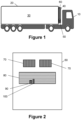
- FIG. 1 illustrates a truck 10 and trailer 20 for transporting refrigerated goods such as food items.
- the trailer 20 forms a refrigerated cargo space 30 defined by outer walls of the trailer 20.
- a temperature control unit 40 or more specifically in this case a transport refrigeration unit (TRU) 40, is provided on a forward wall 60 of the trailer 20.
- TRU transport refrigeration unit
- the TRU 40 comprises a refrigeration circuit (not illustrated) which is configured to absorb heat from within the refrigerated cargo space 30 and reject heat to the environment external to the trailer 20.
- a refrigeration circuit (not illustrated) which is configured to absorb heat from within the refrigerated cargo space 30 and reject heat to the environment external to the trailer 20.
- the forward wall 60 of the trailer 20 has air outlets 70 and an air return inlet 80 as illustrated in Figure 2 .
- the air outlets 70 being configured to allow a stream of air to exit the TRU 40 and enter the refrigerated cargo space 30 after having passed over a heat absorption heat exchanger of the refrigeration circuit.
- the air return inlet 80 being configured to allow air from within the refrigerated cargo space 30 to enter the TRU 40 and subsequently pass over said heat absorption heat exchanger.
- a cargo space temperature sensor 90 is positioned at the air return inlet 80 to monitor the temperature of the refrigerated cargo space 30.
- the cargo space temperature sensor 90 measures the temperature of air that is being returned from the refrigerated cargo space 30 to the TRU 40 and is configured to send the measured temperature data to the TRU 40 so that the TRU 40 can adjust the refrigeration to maintain a desired temperature.
- the cargo space temperature sensor 90 is a permanent component of the trailer 20 or TRU 40. That is to say, in normal operation of the refrigerated cargo space 30 the cargo space temperature sensor 90 is present such that a desired temperature can be maintained via the TRU 40. Further, the cargo space temperature sensor 90 in combination with a data processing device 50 (discussed later in more detail) can provide a history of the temperature of the trailer during transit of goods. This is particularly beneficial for the customer as it allows them to check whether the goods they are taking delivery off have been exposed to temperatures outside of acceptable limits.
- the TRU 40 comprises an integrated data processing device 50 provided on an outer surface of the TRU 40 such that it can be accessed by an operator.
- the data processing device 50 in other examples may be installed within the cab of the truck 10, within the cab of a light commercial vehicle (LCV) or may be in the form of a remote device such as a phone or tablet and connecting to the TRU 40 wirelessly via Bluetooth, WLAN, Zigbee and the like.
- a wireless temperature sensor 100 is installed in close proximity to the cargo space temperature sensor 90.
- both the cargo space temperature sensor 90 and wireless temperature sensor 100 are installed at the air return inlet 80. This may be conducted at a service interval of the trailer 20, TRU 40, truck 10 etc. It may be conducted at an interval imposed by government standards, customer standards, etc.
- the wireless temperature sensor 100 is configured to wirelessly communicate with the data processing device 50. That is, both the cargo space temperature sensor 90 and the wireless temperature sensor 100 provide data representing the measured temperature at the respective sensor to the data processing device 50.
- the wireless temperature sensor 100 is installed 200 in close proximity to the cargo space temperature sensor 90 such that the temperature of the air surrounding the two sensors should be substantially uniform.
- step 210 temperature data is received at the data processing device 50 from both the cargo space temperature sensor 90 and the wireless temperature sensor 100.
- a difference in the temperature recorded by the cargo space temperature sensor 90 and the wireless temperature sensor 100 is determined by the data processing device 50. This may, for example, involve calculating the mean average temperature recorded by each of the sensors over a predetermined period of time and subtracting one from the other.
- the difference calculated at step 220 between temperature recorded by the cargo space temperature sensor 90 and the wireless temperature sensor 100 is compared by the data processing device 50 to a threshold value, e.g. an acceptable tolerance.
- the threshold value may be, for example, +/- 2 °C, +/- 1 °C, +/- 0.5 °C.
- the data processing device 50 then indicates at step 240 that the cargo space temperature sensor 90 is acceptable, i.e. it is operating within the acceptable tolerance. Otherwise the data processing device 50 indicates that the cargo space temperature sensor 90 should be calibrated or replaced.
- the method can be completed by uninstalling the wireless temperature sensor 100, i.e. removing it from the refrigerated cargo space, thus allowing the wireless temperature sensor to be reused in testing of other refrigerated cargo spaces.
Landscapes
- Physics & Mathematics (AREA)
- General Physics & Mathematics (AREA)
- Engineering & Computer Science (AREA)
- Transportation (AREA)
- Mechanical Engineering (AREA)
- Thermal Sciences (AREA)
- Chemical & Material Sciences (AREA)
- Combustion & Propulsion (AREA)
- Health & Medical Sciences (AREA)
- Public Health (AREA)
- Arrangements For Transmission Of Measured Signals (AREA)
- Devices That Are Associated With Refrigeration Equipment (AREA)
Description
- The present invention relates to a method and system for testing temperature sensors of refrigerated cargo spaces.
- Refrigerated cargo spaces are used to maintain goods at specific desired temperatures. For example, the trailer of a truck may have a refrigerated cargo space for the transport of perishable goods such as food products.
- In the case of transporting perishable goods, the customer often requires a log of temperatures the goods have been subjected to during transport. To accommodate for this a temperature sensor is provided within the cargo space and communicates recorded temperature to a data processing device such that on delivery the customer can check the temperatures the goods have been subjected to during transport.
- To ensure that the temperature data logged is accurate it is necessary for the cargo space temperature sensor to be tested and calibrated or replaced when necessary. The customer or government bodies, for example, may impose the frequency of the testing required and the acceptable tolerance.
- The present invention provides a method and system for performing testing of cargo space temperature sensor(s).
-
IT TO20110503 A1 -
US 10228188 B2 - According to a first aspect of the invention, a method of testing a temperature sensor(s) of a refrigerated cargo spaces is provided. The method comprises: removably installing a wireless temperature sensor in proximity of a cargo space temperature sensor of a refrigerated cargo space; receiving, at a data processing device, temperature data from both the cargo space temperature sensor and the wireless temperature sensor; calculating a temperature difference between the temperature measured by the cargo space temperature sensor and the wireless temperature sensor; and calibrating or replacing the cargo space temperature sensor if the temperature difference exceeds a threshold difference.
- With this method, it is possible to test that a cargo space temperature sensor of a refrigerated cargo space is operating within an acceptable threshold. Moreover, due to the use of a wireless temperature sensor the test can be rapidly repeated for different cargo space temperature sensors and/or different cargo spaces altogether, for example testing of refrigerated cargo spaces of other trailers, since it can be installed and removed with ease. Further, the use of a wireless temperature sensor allows for the wireless temperature sensor to be placed as close as possible to the cargo space temperature sensor providing for an accurate comparison between the two sensors.
- Installing a wireless temperature sensor in proximity of a cargo space temperature sensor may comprise installing the wireless temperature sensor within 1 m, 50 cm, 30 cm, 25 cm, 20 cm, 15 cm, 10 cm, 5 cm, or directly abutting.
- The temperature threshold difference may be selected based on the use of the cargo space. For example, for the transport of goods, the temperature threshold difference may be selected in accordance with the EN 13486 standard. Further as an example, if the cargo space is used for the transport of perishable goods the threshold temperature difference may be selected as +/- 2°C. If the cargo space is used for transport of pharmaceutical and blood products the threshold temperature difference may be selected as +/- 1°C in the negative temperature ranges, i.e. when the cargo space is below 0°C, and +/-0.5 in the positive temperature ranges, i.e. when the cargo space is above 0°C.
- Optionally, calculating a temperature difference comprises: calculating an average temperature measured by the cargo space temperature sensor over a period of time; calculating an average temperature measured by the wireless temperature sensor over the same period of time, and calculating the difference between the average temperature measured by the cargo space temperature sensor and the wireless temperature sensor.
- Advantageously, noise in the sensor measurement and/or small transitory fluctuations in temperature between the two sensors are effectively removed by taking an average.
- Calculating an average temperature measured by the cargo space temperature sensor over a period of time may refer to a mean average. Calculating an average temperature measured by the wireless temperature sensor over a period of time may refer to a mean average.
- Calculating a mean average of the temperature measured by the cargo space temperature sensor and/or the wireless temperature sensor may comprise recording the measured temperature at sampling intervals over a predetermined period of time and then dividing the sum of the measured temperatures by the number of samples.
- The temperature sampling rate of the cargo space temperature sensor and/or the wireless temperature sensor may be 10 Hz, or 1 Hz.
- Calculating an average of the temperature measured by the cargo space temperature sensor and/or the wireless temperature sensor may begin only after the measured temperature by the cargo space temperature sensor and/or the wireless temperature sensor has not fluctuated beyond predetermined bounds for a predetermined time. In other words, calculating an average of the temperature measured by the cargo space temperature sensor and/or the wireless temperature sensor may begin only after the refrigerated cargo space has reached a steady state temperature. This beneficially ensures that the refrigerated cargo space has achieved a steady state before average temperatures are calculated and reduces the likelihood that the temperature difference between the cargo space temperature sensor and the wireless temperature sensor exceed the threshold because of local temperature variations.
- Optionally, the data processing device sends a target temperature command to a temperature control unit associated with the refrigerated cargo space such that the temperature control unit changes the temperature of the cargo space.
- In other words, the data processing device sends a command to the temperature control unit such that the temperature control unit causes the refrigerated cargo space to be cooled or heated to a temperature corresponding to the command.
- Calculating a temperature difference between the temperature measured by the cargo space temperature sensor and the wireless temperature sensor may begin only after the cargo space has reached a temperature corresponding to the target temperature command.
- Calculating a temperature difference between the temperature measured by the cargo space temperature sensor and the wireless temperature sensor may begin only after the measured temperature by the cargo space temperature sensor and/or the wireless temperature sensor has not fluctuated beyond predetermined bounds for a predetermined period of time. This beneficially ensures that the refrigerated cargo space has achieved a steady state before temperature differences between the cargo space temperature sensor and wireless temperature sensor are calculated.
- The data processing device may be configured to receive a wired data connection for receiving data from the cargo space temperature sensor. The data processing device may be configured to receive a wired data connection for data communication between the data processing device and the temperature control unit.
- The temperature control unit may be a transport refrigeration unit (TRU). The TRU may be installed on a refrigerated transport vehicle, for example a light commercial vehicle (LCV), a truck, or a trailer, and may be configured to provide temperature regulation to the cargo space of said LCV, truck or trailer. The refrigerated cargo space may be a cargo space of a refrigerated transport vehicle, such as one of the vehicles mentioned above. The method may hence be a method of testing temperature sensors of a refrigerated transport vehicle. This method may be used in relation to multiple refrigerated transport vehicles, such as in context of a larger refrigerated transport system, which may comprise a fleet of vehicles each having a transport refrigeration unit as discussed herein.
- Optionally, the data processing device sends a plurality of target temperature commands to the temperature control unit, each lasting for a predetermined period of time, such that the temperature control unit changes the temperature of the cargo space a corresponding plurality of times, for a corresponding period of time and to corresponding temperatures and the calculating the temperature difference is conducted for each temperature command.
- The cargo space temperature sensor may be calibrated or replaced if the temperature difference between the wireless temperature sensor and the cargo space temperature sensor at each target temperature differs beyond a respective threshold difference for each target temperature.
- The threshold difference for each target temperature may be the same for all target temperatures, may be predetermined for each target temperature, or may be proportional to the number of degrees above or below a reference, such as 0 degrees Celsius.
- Optionally, the wireless temperature sensor is at least one of a Bluetooth, ZigBee, WLAN temperature sensor.
- Advantageously the wireless sensor can be rapidly installed and removed with ease as well as having added flexibility for positioning due to being wireless.
- Optionally, there are a plurality of cargo space temperature sensors and the method comprises installing a wireless temperature sensor at each cargo space temperature sensor or installing a wireless temperature sensor at each of a subset of the cargo space temperature sensors.
- The method may comprise receiving, at the data processing device, temperature data from both the plurality of cargo space temperature sensors and the wireless temperature sensors.
- The method may comprise calculating a temperature difference between the temperature measured by each cargo space temperature sensor and the corresponding wireless temperature sensor located in closest proximity to the cargo space temperature sensor. In other words, each cargo space temperature sensor may have a corresponding wireless temperature sensor and the temperature difference between the two may be calculated, or in the case where there are fewer wireless temperature sensors than cargo space temperature sensors the temperature of each cargo space temperature sensor is compared to the nearest wireless temperature sensor.
- The method may comprise calibrating or replacing one or more of the cargo space temperature sensors if the temperature difference between said cargo space temperature sensor and the corresponding wireless temperature sensor exceeds a threshold difference.
- Optionally, installing the wireless temperature sensor comprises installing the wireless temperature sensor in proximity of a cargo space temperature sensor of the refrigerated cargo space at a return air inlet of the cargo space.
- In other words, both the wireless temperature sensor and the temperature sensor of the refrigerated transport unit are positioned at the return air inlet. The return air inlet may be a return air inlet of a refrigeration unit, for example a transport refrigeration unit.
- Optionally, the data processing device is a telematics device, a fleet data recorder, a mobile phone, a tablet, or a computer.
- The data processing device may be integrated within a temperature control unit. The temperature control unit may be a transport refrigeration unit and the data processing device may be integrated within the transport refrigeration unit. The data processing device integrated within the transport refrigeration unit may additionally control the transport refrigeration unit.
- The data processing device may not be an in-cab telematics device. In other words, it may not be a data processing device of a private passenger vehicle, for example a car. The data processing device may instead be a data processing device of a cargo space. In other words, where the data processing device is associated with the cargo space of a commercial vehicle, such as an LCV, truck or trailer, the data processing device solely processes data associated with environmental regulation of the cargo space as opposed to data relating to operation of the vehicle itself.
- The data processing device may comprise one or more of a Bluetooth, ZigBee or WLAN transmitter and receiver to enable wireless data communication with the wireless temperature sensor and/or to enable wireless communication with a temperature control unit associated with the refrigerated cargo space.
- According to a second aspect of the invention, a temperature sensor testing system for refrigerated cargo spaces is provided. The temperature sensor testing system comprising: a wireless temperature sensor configured to be removably installed in a location proximate a cargo space temperature sensor of a refrigerated cargo space; and a data processing device configured to receive temperature data from both the cargo space temperature sensor and the wireless temperature sensor; wherein the data processing device is configured to calculate a temperature difference between the temperature measured by the cargo space temperature sensor and the wireless temperature sensor, and to indicate the cargo space temperature sensor requires calibrating or replacing if the temperature difference exceeds a threshold difference.
- With this temperature sensor testing system it is possible to test that a cargo space temperature sensor of a refrigerated cargo space is operating within an acceptable threshold. Moreover, due to the system having a wireless temperature sensor the system can be used for the testing of different cargo space temperature sensors and/or different cargo spaces altogether in quick succession since the system can be installed and removed with ease. Further, the system having a wireless temperature sensor allows for the wireless temperature sensor to be placed as close as possible to the cargo space temperature sensor providing for an accurate comparison between the two sensors.
- Optionally, the data processing device is configured to calculate a temperature difference between the average temperature measured by the cargo space temperature sensor and the wireless temperature sensor over a predetermined period of time.
- Optionally, the data processing device is configured to send a target temperature command to a temperature control unit associated with a refrigerated cargo space.
- The wireless temperature sensor may at least one of a Bluetooth, ZigBee, or WLAN temperature sensor.
- The data processing device may be a telematics device, fleet data recorder, a mobile phone, a tablet or a computer.
- Optionally, the testing system is configured to perform the method as described as the first aspect of the invention above when in combination with a refrigerated cargo space.
- According to a further aspect, a servicing system for transport refrigeration units is provided, the servicing system comprising a temperature testing system as described above. The servicing system may be incorporated into a transport refrigeration system that comprises at least one, or a plurality of, cargo spaces and associated transport refrigeration unit(s). The servicing system may be configured to perform the method of testing temperature sensors of the refrigerated cargo spaces as described above. The servicing system may be provided as a part of a transport refrigeration system of the type discussed above, such as a transport refrigeration system comprising a fleet of vehicles each having a transport refrigeration unit as discussed herein. The method may be performed by the servicing system for one or a plurality of refrigerated cargo spaces independently or simultaneously.
- Certain exemplary embodiments will now be described in greater detail by way of example only and with reference to the accompanying drawings in which:
-
Figure 1 illustrates a truck and trailer having a refrigerated cargo space; -
Figure 2 illustrates an internal wall of the refrigerated cargo space; and -
Figure 3 illustrates a method of testing a temperature sensor of a refrigerated cargo space. -
Figure 1 illustrates atruck 10 andtrailer 20 for transporting refrigerated goods such as food items. Thetrailer 20 forms arefrigerated cargo space 30 defined by outer walls of thetrailer 20. To provide temperature regulation of the refrigerated cargo space 30 atemperature control unit 40, or more specifically in this case a transport refrigeration unit (TRU) 40, is provided on aforward wall 60 of thetrailer 20. - The
TRU 40 comprises a refrigeration circuit (not illustrated) which is configured to absorb heat from within the refrigeratedcargo space 30 and reject heat to the environment external to thetrailer 20. To allow for heat absorption at theTRU 40 theforward wall 60 of thetrailer 20 hasair outlets 70 and anair return inlet 80 as illustrated inFigure 2 . Theair outlets 70 being configured to allow a stream of air to exit theTRU 40 and enter therefrigerated cargo space 30 after having passed over a heat absorption heat exchanger of the refrigeration circuit. Theair return inlet 80 being configured to allow air from within the refrigeratedcargo space 30 to enter theTRU 40 and subsequently pass over said heat absorption heat exchanger. - As illustrated in
Figure 2 a cargospace temperature sensor 90 is positioned at theair return inlet 80 to monitor the temperature of the refrigeratedcargo space 30. The cargospace temperature sensor 90 measures the temperature of air that is being returned from the refrigeratedcargo space 30 to theTRU 40 and is configured to send the measured temperature data to theTRU 40 so that theTRU 40 can adjust the refrigeration to maintain a desired temperature. - The cargo
space temperature sensor 90 is a permanent component of thetrailer 20 orTRU 40. That is to say, in normal operation of the refrigeratedcargo space 30 the cargospace temperature sensor 90 is present such that a desired temperature can be maintained via theTRU 40. Further, the cargospace temperature sensor 90 in combination with a data processing device 50 (discussed later in more detail) can provide a history of the temperature of the trailer during transit of goods. This is particularly beneficial for the customer as it allows them to check whether the goods they are taking delivery off have been exposed to temperatures outside of acceptable limits. - In this example, the
TRU 40 comprises an integrateddata processing device 50 provided on an outer surface of theTRU 40 such that it can be accessed by an operator. Though it will be appreciated thedata processing device 50 in other examples may be installed within the cab of thetruck 10, within the cab of a light commercial vehicle (LCV) or may be in the form of a remote device such as a phone or tablet and connecting to theTRU 40 wirelessly via Bluetooth, WLAN, Zigbee and the like. - To check that the cargo
space temperature sensor 90 is operating with an acceptable tolerance, awireless temperature sensor 100 is installed in close proximity to the cargospace temperature sensor 90. In this example, both the cargospace temperature sensor 90 andwireless temperature sensor 100 are installed at theair return inlet 80. This may be conducted at a service interval of thetrailer 20,TRU 40,truck 10 etc. It may be conducted at an interval imposed by government standards, customer standards, etc. - The
wireless temperature sensor 100 is configured to wirelessly communicate with thedata processing device 50. That is, both the cargospace temperature sensor 90 and thewireless temperature sensor 100 provide data representing the measured temperature at the respective sensor to thedata processing device 50. - To test the cargo
space temperature sensor 90, the method depicted inFigure 3 is performed. Thewireless temperature sensor 100 is installed 200 in close proximity to the cargospace temperature sensor 90 such that the temperature of the air surrounding the two sensors should be substantially uniform. - At
step 210 temperature data is received at thedata processing device 50 from both the cargospace temperature sensor 90 and thewireless temperature sensor 100. - At step 220 a difference in the temperature recorded by the cargo
space temperature sensor 90 and thewireless temperature sensor 100 is determined by thedata processing device 50. This may, for example, involve calculating the mean average temperature recorded by each of the sensors over a predetermined period of time and subtracting one from the other. - At
step 230 the difference calculated atstep 220 between temperature recorded by the cargospace temperature sensor 90 and thewireless temperature sensor 100 is compared by thedata processing device 50 to a threshold value, e.g. an acceptable tolerance. The threshold value may be, for example, +/- 2 °C, +/- 1 °C, +/- 0.5 °C. - The
data processing device 50 then indicates atstep 240 that the cargospace temperature sensor 90 is acceptable, i.e. it is operating within the acceptable tolerance. Otherwise thedata processing device 50 indicates that the cargospace temperature sensor 90 should be calibrated or replaced. - The method can be completed by uninstalling the
wireless temperature sensor 100, i.e. removing it from the refrigerated cargo space, thus allowing the wireless temperature sensor to be reused in testing of other refrigerated cargo spaces.
Claims (15)
- A method of testing temperature sensors (90) of refrigerated cargo spaces (30), comprising:removably installing a wireless temperature sensor (100) in proximity of a cargo space temperature sensor (90) of a refrigerated cargo space (30);receiving, at a data processing device (50), temperature data from both the cargo space temperature sensor (90) and the wireless temperature sensor (100);calculating a temperature difference between the temperature measured by the cargo space temperature sensor (90) and the wireless temperature sensor (100); andcalibrating or replacing the cargo space temperature sensor (90) if the temperature difference exceeds a threshold difference.
- The method of claim 1, wherein calculating a temperature difference comprises:calculating an average temperature measured by the cargo space temperature sensor (90) over a period of time;calculating an average temperature measured by the wireless temperature sensor (100) over the same period of time, andcalculating the difference between the average temperature measured by the cargo space temperature sensor (90) and the wireless temperature sensor (100).
- The method of claim 1 or 2, wherein the data processing device (50) sends a target temperature command to a temperature control unit (40) associated with the refrigerated cargo space (30) such that the temperature control unit (40) changes the temperature of the refrigerated cargo space (30).
- The method of claim 3, wherein the data processing device (50) sends a plurality of target temperature commands to the temperature control unit (40), each lasting for a predetermined period of time, such that the temperature control unit (40) changes the temperature of the refrigerated cargo space (30) a corresponding plurality of times, for a corresponding period of time and to a corresponding temperature and the calculating the temperature difference is conducted for each temperature command.
- The method of any preceding claim, wherein the wireless temperature sensor (100) is at least one of a Bluetooth, ZigBee, WLAN temperature sensor.
- The method of any preceding claim, wherein there are a plurality of cargo space temperature sensors (90) and the method comprises installing a wireless temperature sensor (100) at each cargo space temperature sensor (90) or at a subset of the cargo space temperature sensors (90).
- The method of any preceding claim, wherein installing the wireless temperature sensor (100) comprises installing the wireless temperature sensor in proximity of a cargo space temperature sensor (90) of the refrigerated cargo space (30) at a return air inlet (80).
- The method of any preceding claim, wherein the refrigerated cargo space (30) is a refrigerated cargo space of a light commercial vehicle (LCV), a truck, or a trailer.
- The method of any preceding claim, wherein the data processing device (50) is a telematics device, a fleet data recorder, a mobile phone, a tablet, or a computer.
- The method of any preceding claim, being a method of testing temperature sensors of a plurality of refrigerated transport vehicles in a refrigerated transport system, comprising a fleet of vehicles each having a transport refrigeration unit (40), refrigerated cargo space (30), and cargo space temperature sensor (90).
- A temperature sensor testing system for refrigerated cargo spaces, comprising:a wireless temperature sensor (100) configured to be removably installed in a location proximate a cargo space temperature sensor (90) of a refrigerated cargo space (30); anda data processing device (50) configured to receive temperature data from both the cargo space temperature sensor (90) and the wireless temperature sensor (100);wherein the data processing device (50) is configured to calculate a temperature difference between the temperature measured by the cargo space temperature sensor (90) and the wireless temperature sensor (100), andto indicate the cargo space temperature sensor (90) requires calibrating or replacing if the temperature difference exceeds a threshold difference.
- The temperature testing system of claim 11, wherein the data processing device (50) is configured to calculate a temperature difference between the average temperature measured by the cargo space temperature sensor (90) and the wireless temperature sensor (100) over a predetermined period of time.
- The temperature testing system of claim 11 or 12, wherein the data processing device (50) is configured to send a target temperature command to a temperature control unit (40) associated with a refrigerated cargo space (30).
- The temperature testing system of any of claims 11 to 13, wherein the testing system is configured to perform the method of any of claims 1 to 10 when in combination with a refrigerated cargo space (30).
- A servicing system for transport refrigeration units, the servicing system comprising a temperature testing system as claimed in any of claims 11 to 14.
Priority Applications (3)
| Application Number | Priority Date | Filing Date | Title |
|---|---|---|---|
| EP22179961.2A EP4296639B1 (en) | 2022-06-20 | 2022-06-20 | Temperature sensor testing |
| US18/336,367 US20230408347A1 (en) | 2022-06-20 | 2023-06-16 | Temperature sensor testing |
| CN202310729013.1A CN117309188A (en) | 2022-06-20 | 2023-06-19 | Temperature sensor testing |
Applications Claiming Priority (1)
| Application Number | Priority Date | Filing Date | Title |
|---|---|---|---|
| EP22179961.2A EP4296639B1 (en) | 2022-06-20 | 2022-06-20 | Temperature sensor testing |
Publications (3)
| Publication Number | Publication Date |
|---|---|
| EP4296639A1 EP4296639A1 (en) | 2023-12-27 |
| EP4296639C0 EP4296639C0 (en) | 2025-01-29 |
| EP4296639B1 true EP4296639B1 (en) | 2025-01-29 |
Family
ID=82117255
Family Applications (1)
| Application Number | Title | Priority Date | Filing Date |
|---|---|---|---|
| EP22179961.2A Active EP4296639B1 (en) | 2022-06-20 | 2022-06-20 | Temperature sensor testing |
Country Status (3)
| Country | Link |
|---|---|
| US (1) | US20230408347A1 (en) |
| EP (1) | EP4296639B1 (en) |
| CN (1) | CN117309188A (en) |
Families Citing this family (1)
| Publication number | Priority date | Publication date | Assignee | Title |
|---|---|---|---|---|
| CN119847236B (en) * | 2024-12-31 | 2025-06-13 | 北京钥途冷运物流有限公司 | Constant temperature control method and system applied to pharmaceutical cold chain transportation process |
Citations (1)
| Publication number | Priority date | Publication date | Assignee | Title |
|---|---|---|---|---|
| DE102011083277A1 (en) * | 2011-09-23 | 2013-03-28 | Robert Bosch Gmbh | Method for checking operation of temperature sensor of electric drive of hybrid vehicle, involves comparing first detected temperature with second detected temperature with respect to operation of two temperature sensors |
Family Cites Families (9)
| Publication number | Priority date | Publication date | Assignee | Title |
|---|---|---|---|---|
| US7555411B2 (en) * | 2007-01-31 | 2009-06-30 | Gm Global Technology Operations, Inc. | Method and apparatus to monitor a temperature sensing device |
| US20110193710A1 (en) * | 2010-02-05 | 2011-08-11 | Par Technology Corporation | Refrigerated container monitoring system |
| ITTO20110503A1 (en) * | 2011-06-08 | 2012-12-09 | .M.) | PROCEDURE FOR THE CALIBRATION OF WIRELESS SENSOR NETWORKS AND ITS SYSTEM |
| US9846086B1 (en) * | 2012-11-09 | 2017-12-19 | Startrak Systems Llc | System and method for time-temperature monitoring of transportable goods |
| US10228188B2 (en) * | 2016-06-09 | 2019-03-12 | Maersk Container Industry A/S | Method for real-time performance check of container system |
| WO2018057083A1 (en) * | 2016-09-23 | 2018-03-29 | Villanueva Arturo N Jr | Methods and device for temperature regulation in refrigeration units using multiple targeted readings |
| JP6678094B2 (en) * | 2016-12-05 | 2020-04-08 | ルネサスエレクトロニクス株式会社 | Temperature measurement circuit, method, and microcomputer unit |
| CN113631879A (en) * | 2019-01-23 | 2021-11-09 | 箭点系统有限公司 | Refrigerated cargo monitoring |
| FR3114390B1 (en) * | 2020-09-24 | 2022-08-26 | Vitesco Technologies | Temperature sensor calibration process |
-
2022
- 2022-06-20 EP EP22179961.2A patent/EP4296639B1/en active Active
-
2023
- 2023-06-16 US US18/336,367 patent/US20230408347A1/en active Pending
- 2023-06-19 CN CN202310729013.1A patent/CN117309188A/en active Pending
Patent Citations (1)
| Publication number | Priority date | Publication date | Assignee | Title |
|---|---|---|---|---|
| DE102011083277A1 (en) * | 2011-09-23 | 2013-03-28 | Robert Bosch Gmbh | Method for checking operation of temperature sensor of electric drive of hybrid vehicle, involves comparing first detected temperature with second detected temperature with respect to operation of two temperature sensors |
Also Published As
| Publication number | Publication date |
|---|---|
| EP4296639A1 (en) | 2023-12-27 |
| EP4296639C0 (en) | 2025-01-29 |
| CN117309188A (en) | 2023-12-29 |
| US20230408347A1 (en) | 2023-12-21 |
Similar Documents
| Publication | Publication Date | Title |
|---|---|---|
| US11079173B2 (en) | Control system for automatic controlling reefer container resources | |
| EP3017981B1 (en) | Method and system for predicting remaining useful life of transport units | |
| EP3514573B1 (en) | Method and system for cargo load detection | |
| US11635312B2 (en) | Systems and methods for remote sensor calibration | |
| US20110193710A1 (en) | Refrigerated container monitoring system | |
| US9229904B2 (en) | Diagnostic method and diagnostic device for a vehicle component of a vehicle | |
| US20130226391A1 (en) | Diagnostic method and diagnostic device for a vehicle component of a vehicle | |
| EP3913558B1 (en) | Methods and systems of conveying data to and from a transport climate control system | |
| US20170203633A1 (en) | Apparatus and method for refrigeration unit control | |
| EP2693795B1 (en) | Wireless performance testing onboard a complex system | |
| EP4296639B1 (en) | Temperature sensor testing | |
| WO2013142698A1 (en) | Systems and methods for handling discrete sensor information in a transport refrigeration system | |
| KR101802326B1 (en) | System for logistics monitoring by composite sensor and method thereof | |
| US20110156877A1 (en) | Apparatus and method for monitoring refrigerated containers | |
| US20160182640A1 (en) | Method and system for controlling the collection and storage of data in a transport refrigeration system | |
| KR20220046110A (en) | System and method for maintaining production vehicle quality | |
| KR101937307B1 (en) | Digital tachogragh | |
| US12459643B2 (en) | System and method for monitoring cargo during transportation | |
| JP2006232417A (en) | Physical distribution management system and physical distribution management method | |
| EP3803457B1 (en) | Method and system for cargo sensing estimation | |
| EP3589902B1 (en) | Controlling detection of cargo transportation unit conditions | |
| SG11202111085RA (en) | Active response cold treatment for refrigerated cargo | |
| CN108369140B (en) | Determining hot cargo load conditions in refrigerated containers | |
| EP3953669B1 (en) | Method and system for shipping container load estimation | |
| US20210381822A1 (en) | Systems and methods for measuring cargo capacity |
Legal Events
| Date | Code | Title | Description |
|---|---|---|---|
| PUAI | Public reference made under article 153(3) epc to a published international application that has entered the european phase |
Free format text: ORIGINAL CODE: 0009012 |
|
| STAA | Information on the status of an ep patent application or granted ep patent |
Free format text: STATUS: THE APPLICATION HAS BEEN PUBLISHED |
|
| AK | Designated contracting states |
Kind code of ref document: A1 Designated state(s): AL AT BE BG CH CY CZ DE DK EE ES FI FR GB GR HR HU IE IS IT LI LT LU LV MC MK MT NL NO PL PT RO RS SE SI SK SM TR |
|
| STAA | Information on the status of an ep patent application or granted ep patent |
Free format text: STATUS: REQUEST FOR EXAMINATION WAS MADE |
|
| 17P | Request for examination filed |
Effective date: 20240605 |
|
| RBV | Designated contracting states (corrected) |
Designated state(s): AL AT BE BG CH CY CZ DE DK EE ES FI FR GB GR HR HU IE IS IT LI LT LU LV MC MK MT NL NO PL PT RO RS SE SI SK SM TR |
|
| GRAP | Despatch of communication of intention to grant a patent |
Free format text: ORIGINAL CODE: EPIDOSNIGR1 |
|
| STAA | Information on the status of an ep patent application or granted ep patent |
Free format text: STATUS: GRANT OF PATENT IS INTENDED |
|
| RIC1 | Information provided on ipc code assigned before grant |
Ipc: G06Q 10/0832 20230101ALN20240903BHEP Ipc: G01K 3/08 20060101ALI20240903BHEP Ipc: G01K 15/00 20060101ALI20240903BHEP Ipc: G01K 1/024 20210101AFI20240903BHEP |
|
| INTG | Intention to grant announced |
Effective date: 20240919 |
|
| GRAS | Grant fee paid |
Free format text: ORIGINAL CODE: EPIDOSNIGR3 |
|
| GRAA | (expected) grant |
Free format text: ORIGINAL CODE: 0009210 |
|
| STAA | Information on the status of an ep patent application or granted ep patent |
Free format text: STATUS: THE PATENT HAS BEEN GRANTED |
|
| RAP1 | Party data changed (applicant data changed or rights of an application transferred) |
Owner name: CARRIER CORPORATION |
|
| AK | Designated contracting states |
Kind code of ref document: B1 Designated state(s): AL AT BE BG CH CY CZ DE DK EE ES FI FR GB GR HR HU IE IS IT LI LT LU LV MC MK MT NL NO PL PT RO RS SE SI SK SM TR |
|
| REG | Reference to a national code |
Ref country code: GB Ref legal event code: FG4D |
|
| REG | Reference to a national code |
Ref country code: CH Ref legal event code: EP |
|
| REG | Reference to a national code |
Ref country code: DE Ref legal event code: R096 Ref document number: 602022009990 Country of ref document: DE |
|
| REG | Reference to a national code |
Ref country code: IE Ref legal event code: FG4D |
|
| U01 | Request for unitary effect filed |
Effective date: 20250205 |
|
| U07 | Unitary effect registered |
Designated state(s): AT BE BG DE DK EE FI FR IT LT LU LV MT NL PT RO SE SI Effective date: 20250211 |
|
| PG25 | Lapsed in a contracting state [announced via postgrant information from national office to epo] |
Ref country code: RS Free format text: LAPSE BECAUSE OF FAILURE TO SUBMIT A TRANSLATION OF THE DESCRIPTION OR TO PAY THE FEE WITHIN THE PRESCRIBED TIME-LIMIT Effective date: 20250429 |
|
| PG25 | Lapsed in a contracting state [announced via postgrant information from national office to epo] |
Ref country code: PL Free format text: LAPSE BECAUSE OF FAILURE TO SUBMIT A TRANSLATION OF THE DESCRIPTION OR TO PAY THE FEE WITHIN THE PRESCRIBED TIME-LIMIT Effective date: 20250129 |
|
| PG25 | Lapsed in a contracting state [announced via postgrant information from national office to epo] |
Ref country code: ES Free format text: LAPSE BECAUSE OF FAILURE TO SUBMIT A TRANSLATION OF THE DESCRIPTION OR TO PAY THE FEE WITHIN THE PRESCRIBED TIME-LIMIT Effective date: 20250129 |
|
| PG25 | Lapsed in a contracting state [announced via postgrant information from national office to epo] |
Ref country code: IS Free format text: LAPSE BECAUSE OF FAILURE TO SUBMIT A TRANSLATION OF THE DESCRIPTION OR TO PAY THE FEE WITHIN THE PRESCRIBED TIME-LIMIT Effective date: 20250529 Ref country code: NO Free format text: LAPSE BECAUSE OF FAILURE TO SUBMIT A TRANSLATION OF THE DESCRIPTION OR TO PAY THE FEE WITHIN THE PRESCRIBED TIME-LIMIT Effective date: 20250429 |
|
| PG25 | Lapsed in a contracting state [announced via postgrant information from national office to epo] |
Ref country code: HR Free format text: LAPSE BECAUSE OF FAILURE TO SUBMIT A TRANSLATION OF THE DESCRIPTION OR TO PAY THE FEE WITHIN THE PRESCRIBED TIME-LIMIT Effective date: 20250129 |
|
| PG25 | Lapsed in a contracting state [announced via postgrant information from national office to epo] |
Ref country code: GR Free format text: LAPSE BECAUSE OF FAILURE TO SUBMIT A TRANSLATION OF THE DESCRIPTION OR TO PAY THE FEE WITHIN THE PRESCRIBED TIME-LIMIT Effective date: 20250430 |
|
| PG25 | Lapsed in a contracting state [announced via postgrant information from national office to epo] |
Ref country code: SM Free format text: LAPSE BECAUSE OF FAILURE TO SUBMIT A TRANSLATION OF THE DESCRIPTION OR TO PAY THE FEE WITHIN THE PRESCRIBED TIME-LIMIT Effective date: 20250129 |
|
| PG25 | Lapsed in a contracting state [announced via postgrant information from national office to epo] |
Ref country code: CZ Free format text: LAPSE BECAUSE OF FAILURE TO SUBMIT A TRANSLATION OF THE DESCRIPTION OR TO PAY THE FEE WITHIN THE PRESCRIBED TIME-LIMIT Effective date: 20250129 |
|
| PG25 | Lapsed in a contracting state [announced via postgrant information from national office to epo] |
Ref country code: SK Free format text: LAPSE BECAUSE OF FAILURE TO SUBMIT A TRANSLATION OF THE DESCRIPTION OR TO PAY THE FEE WITHIN THE PRESCRIBED TIME-LIMIT Effective date: 20250129 |
|
| PLBE | No opposition filed within time limit |
Free format text: ORIGINAL CODE: 0009261 |
|
| STAA | Information on the status of an ep patent application or granted ep patent |
Free format text: STATUS: NO OPPOSITION FILED WITHIN TIME LIMIT |
|
| REG | Reference to a national code |
Ref country code: CH Ref legal event code: L10 Free format text: ST27 STATUS EVENT CODE: U-0-0-L10-L00 (AS PROVIDED BY THE NATIONAL OFFICE) Effective date: 20251210 |
|
| 26N | No opposition filed |
Effective date: 20251030 |
|
| REG | Reference to a national code |
Ref country code: CH Ref legal event code: H13 Free format text: ST27 STATUS EVENT CODE: U-0-0-H10-H13 (AS PROVIDED BY THE NATIONAL OFFICE) Effective date: 20260127 |
|
| PG25 | Lapsed in a contracting state [announced via postgrant information from national office to epo] |
Ref country code: MC Free format text: LAPSE BECAUSE OF FAILURE TO SUBMIT A TRANSLATION OF THE DESCRIPTION OR TO PAY THE FEE WITHIN THE PRESCRIBED TIME-LIMIT Effective date: 20250129 |
|
| U90 | Renewal fees not paid: noting of loss of rights |
Free format text: RENEWAL FEE NOT PAID FOR YEAR 04 Effective date: 20260119 |
|
| PG25 | Lapsed in a contracting state [announced via postgrant information from national office to epo] |
Ref country code: IE Free format text: LAPSE BECAUSE OF NON-PAYMENT OF DUE FEES Effective date: 20250620 |
|
| PG25 | Lapsed in a contracting state [announced via postgrant information from national office to epo] |
Ref country code: CH Free format text: LAPSE BECAUSE OF NON-PAYMENT OF DUE FEES Effective date: 20250630 |