EP4295358B1 - Rekurrentes sprachmodell mit nachschlagetabelle - Google Patents
Rekurrentes sprachmodell mit nachschlagetabelle Download PDFInfo
- Publication number
- EP4295358B1 EP4295358B1 EP22706188.4A EP22706188A EP4295358B1 EP 4295358 B1 EP4295358 B1 EP 4295358B1 EP 22706188 A EP22706188 A EP 22706188A EP 4295358 B1 EP4295358 B1 EP 4295358B1
- Authority
- EP
- European Patent Office
- Prior art keywords
- token
- embedding
- tokens
- sequence
- candidate transcription
- Prior art date
- Legal status (The legal status is an assumption and is not a legal conclusion. Google has not performed a legal analysis and makes no representation as to the accuracy of the status listed.)
- Active
Links
Images



Classifications
-
- G—PHYSICS
- G10—MUSICAL INSTRUMENTS; ACOUSTICS
- G10L—SPEECH ANALYSIS TECHNIQUES OR SPEECH SYNTHESIS; SPEECH RECOGNITION; SPEECH OR VOICE PROCESSING TECHNIQUES; SPEECH OR AUDIO CODING OR DECODING
- G10L15/00—Speech recognition
- G10L15/08—Speech classification or search
- G10L15/083—Recognition networks
-
- G—PHYSICS
- G06—COMPUTING OR CALCULATING; COUNTING
- G06F—ELECTRIC DIGITAL DATA PROCESSING
- G06F40/00—Handling natural language data
- G06F40/20—Natural language analysis
- G06F40/205—Parsing
- G06F40/216—Parsing using statistical methods
-
- G—PHYSICS
- G06—COMPUTING OR CALCULATING; COUNTING
- G06F—ELECTRIC DIGITAL DATA PROCESSING
- G06F40/00—Handling natural language data
- G06F40/20—Natural language analysis
- G06F40/237—Lexical tools
-
- G—PHYSICS
- G06—COMPUTING OR CALCULATING; COUNTING
- G06F—ELECTRIC DIGITAL DATA PROCESSING
- G06F40/00—Handling natural language data
- G06F40/20—Natural language analysis
- G06F40/279—Recognition of textual entities
- G06F40/284—Lexical analysis, e.g. tokenisation or collocates
-
- G—PHYSICS
- G06—COMPUTING OR CALCULATING; COUNTING
- G06F—ELECTRIC DIGITAL DATA PROCESSING
- G06F40/00—Handling natural language data
- G06F40/20—Natural language analysis
- G06F40/279—Recognition of textual entities
- G06F40/289—Phrasal analysis, e.g. finite state techniques or chunking
-
- G—PHYSICS
- G06—COMPUTING OR CALCULATING; COUNTING
- G06F—ELECTRIC DIGITAL DATA PROCESSING
- G06F40/00—Handling natural language data
- G06F40/20—Natural language analysis
- G06F40/279—Recognition of textual entities
- G06F40/289—Phrasal analysis, e.g. finite state techniques or chunking
- G06F40/295—Named entity recognition
-
- G—PHYSICS
- G06—COMPUTING OR CALCULATING; COUNTING
- G06F—ELECTRIC DIGITAL DATA PROCESSING
- G06F40/00—Handling natural language data
- G06F40/30—Semantic analysis
-
- G—PHYSICS
- G06—COMPUTING OR CALCULATING; COUNTING
- G06N—COMPUTING ARRANGEMENTS BASED ON SPECIFIC COMPUTATIONAL MODELS
- G06N3/00—Computing arrangements based on biological models
- G06N3/02—Neural networks
- G06N3/04—Architecture, e.g. interconnection topology
-
- G—PHYSICS
- G06—COMPUTING OR CALCULATING; COUNTING
- G06N—COMPUTING ARRANGEMENTS BASED ON SPECIFIC COMPUTATIONAL MODELS
- G06N3/00—Computing arrangements based on biological models
- G06N3/02—Neural networks
- G06N3/04—Architecture, e.g. interconnection topology
- G06N3/044—Recurrent networks, e.g. Hopfield networks
-
- G—PHYSICS
- G06—COMPUTING OR CALCULATING; COUNTING
- G06N—COMPUTING ARRANGEMENTS BASED ON SPECIFIC COMPUTATIONAL MODELS
- G06N3/00—Computing arrangements based on biological models
- G06N3/02—Neural networks
- G06N3/04—Architecture, e.g. interconnection topology
- G06N3/044—Recurrent networks, e.g. Hopfield networks
- G06N3/0442—Recurrent networks, e.g. Hopfield networks characterised by memory or gating, e.g. long short-term memory [LSTM] or gated recurrent units [GRU]
-
- G—PHYSICS
- G06—COMPUTING OR CALCULATING; COUNTING
- G06N—COMPUTING ARRANGEMENTS BASED ON SPECIFIC COMPUTATIONAL MODELS
- G06N3/00—Computing arrangements based on biological models
- G06N3/02—Neural networks
- G06N3/04—Architecture, e.g. interconnection topology
- G06N3/045—Combinations of networks
-
- G—PHYSICS
- G06—COMPUTING OR CALCULATING; COUNTING
- G06N—COMPUTING ARRANGEMENTS BASED ON SPECIFIC COMPUTATIONAL MODELS
- G06N3/00—Computing arrangements based on biological models
- G06N3/02—Neural networks
- G06N3/04—Architecture, e.g. interconnection topology
- G06N3/045—Combinations of networks
- G06N3/0455—Auto-encoder networks; Encoder-decoder networks
-
- G—PHYSICS
- G06—COMPUTING OR CALCULATING; COUNTING
- G06N—COMPUTING ARRANGEMENTS BASED ON SPECIFIC COMPUTATIONAL MODELS
- G06N3/00—Computing arrangements based on biological models
- G06N3/02—Neural networks
- G06N3/04—Architecture, e.g. interconnection topology
- G06N3/0464—Convolutional networks [CNN, ConvNet]
-
- G—PHYSICS
- G06—COMPUTING OR CALCULATING; COUNTING
- G06N—COMPUTING ARRANGEMENTS BASED ON SPECIFIC COMPUTATIONAL MODELS
- G06N3/00—Computing arrangements based on biological models
- G06N3/02—Neural networks
- G06N3/04—Architecture, e.g. interconnection topology
- G06N3/0495—Quantised networks; Sparse networks; Compressed networks
-
- G—PHYSICS
- G06—COMPUTING OR CALCULATING; COUNTING
- G06N—COMPUTING ARRANGEMENTS BASED ON SPECIFIC COMPUTATIONAL MODELS
- G06N3/00—Computing arrangements based on biological models
- G06N3/02—Neural networks
- G06N3/08—Learning methods
- G06N3/09—Supervised learning
-
- G—PHYSICS
- G10—MUSICAL INSTRUMENTS; ACOUSTICS
- G10L—SPEECH ANALYSIS TECHNIQUES OR SPEECH SYNTHESIS; SPEECH RECOGNITION; SPEECH OR VOICE PROCESSING TECHNIQUES; SPEECH OR AUDIO CODING OR DECODING
- G10L15/00—Speech recognition
- G10L15/08—Speech classification or search
- G10L15/16—Speech classification or search using artificial neural networks
-
- G—PHYSICS
- G10—MUSICAL INSTRUMENTS; ACOUSTICS
- G10L—SPEECH ANALYSIS TECHNIQUES OR SPEECH SYNTHESIS; SPEECH RECOGNITION; SPEECH OR VOICE PROCESSING TECHNIQUES; SPEECH OR AUDIO CODING OR DECODING
- G10L15/00—Speech recognition
- G10L15/08—Speech classification or search
- G10L15/18—Speech classification or search using natural language modelling
- G10L15/183—Speech classification or search using natural language modelling using context dependencies, e.g. language models
- G10L15/187—Phonemic context, e.g. pronunciation rules, phonotactical constraints or phoneme n-grams
-
- G—PHYSICS
- G10—MUSICAL INSTRUMENTS; ACOUSTICS
- G10L—SPEECH ANALYSIS TECHNIQUES OR SPEECH SYNTHESIS; SPEECH RECOGNITION; SPEECH OR VOICE PROCESSING TECHNIQUES; SPEECH OR AUDIO CODING OR DECODING
- G10L15/00—Speech recognition
- G10L15/08—Speech classification or search
- G10L15/18—Speech classification or search using natural language modelling
- G10L15/183—Speech classification or search using natural language modelling using context dependencies, e.g. language models
- G10L15/19—Grammatical context, e.g. disambiguation of the recognition hypotheses based on word sequence rules
- G10L15/197—Probabilistic grammars, e.g. word n-grams
-
- G—PHYSICS
- G10—MUSICAL INSTRUMENTS; ACOUSTICS
- G10L—SPEECH ANALYSIS TECHNIQUES OR SPEECH SYNTHESIS; SPEECH RECOGNITION; SPEECH OR VOICE PROCESSING TECHNIQUES; SPEECH OR AUDIO CODING OR DECODING
- G10L15/00—Speech recognition
- G10L15/26—Speech to text systems
-
- G—PHYSICS
- G10—MUSICAL INSTRUMENTS; ACOUSTICS
- G10L—SPEECH ANALYSIS TECHNIQUES OR SPEECH SYNTHESIS; SPEECH RECOGNITION; SPEECH OR VOICE PROCESSING TECHNIQUES; SPEECH OR AUDIO CODING OR DECODING
- G10L15/00—Speech recognition
- G10L15/08—Speech classification or search
- G10L2015/088—Word spotting
Definitions
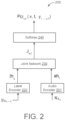
- the operations include determining a token embedding for the corresponding token using a first embedding table, determining a n-gram token embedding for a previous sequence of n-gram tokens using a second embedding table, and concatenating the token embedding and the n-gram token embedding to generate a concatenated output for the corresponding token.
- the operations also include rescoring, using an external language model, the candidate transcription for the spoken utterance by processing the concatenated output generated for each corresponding token in the sequence of tokens.
- each token in the sequence of tokens of the candidate transcription represents an n-gram, phoneme, or grapheme in the candidate transcription.
- the data processing hardware may reside on user device.
- the operations include determining a token embedding for the corresponding token using a first embedding table, determining a n-gram token embedding for a previous sequence of n-gram tokens using a second embedding table, and concatenating the token embedding and the n-gram token embedding to generate a concatenated output for the corresponding token.
- the operations also include rescoring, using an external language model, the candidate transcription for the spoken utterance by processing the concatenated output generated for each corresponding token in the sequence of tokens.
- the embedding vocabulary represents an embedding identification associated with each token of a token vocabulary (i.e., words, wordpieces, n-grams, etc.) of the language model.
- increasing the embedding vocabulary includes increasing the token vocabulary which requires large amounts of memory and computational resources that burden the speech recognition systems. Further, downstream tasks of the speech recognition system are also effected by an increased token vocabulary.
- the token embedding provides the speech recognition system a likelihood of transcribing a particular word and the sequence embedding provides a likelihood of transcribing a particular word based on the particular sequence of previously transcribed words.
- the second embedding table increases the embedding vocabulary of the language model while the token vocabulary remains constant.
- the audio encoder 201 may include transformer layers in lieu of conformer layers.
- the label encoder 220 may also include a neural network of transformer layers or a look-up table embedding model, which, like a language model (LM), processes the sequence of non-blank symbols output by a final Softmax layer 240 so far, y 0 , ..., y ui-1 , into a dense representation Ih u that encodes predicted label history.
- LM language model
- each token 133 in the sequence of tokens 133 is represented by an n-best list of possible candidate tokens 133 associated with a ranked list of the n possible candidate tokens 133 having the highest probability/likelihood scores
- Each candidate token 133 may be referred to as a speech recognition hypothesis.
- each token 133 in the sequence of tokens 133 is represented by the possible candidate token 133 having the highest probability/likelihood score in the probability distribution over possible candidate tokens 133
- the language model 300 may assist in biasing speech recognition hypotheses output by the ASR model 200 toward rare words, such as proper nouns or long tail content, which were rarely included, or not included, in training audio data used to train the ASR model 200.
- the language model 300 may bias speech recognition by boosting the probability/likelihood score for the candidate token 133 associated with the word "Beaubien” in the probability distribution over possible candidate tokens 133 for the fourth token 133 in the sequence of tokens 133.
- the language model 300 may include a recurrent neural network (RNN) language model. More specifically, the language model 300 may include a lookup-table language model configured to scale up the size of the RNN language model by increasing a number of rows in an embedding table, but with only a minimal increase in floating point operations. That is, the lookup-table allows embeddings to be sparsely stored on the memory hardware (e.g., CPU memory or disc) and retrieved from the table via a look up such that the size of the table adds no additional operations to each forward pass alleviating the need for storage on limited/constrained GPU/TPU memory.
- RNN recurrent neural network
- the second embedding table 320 may generate the n-gram token embedding 322 to represent the entire sequence of three previous n-gram tokens (e.g., "driving directions to") from the current token 133 (e.g., "bourbon) represented by the respective token embedding 312 looked-up by the first embedding table 310. Thereafter, the concatenator 330 may concatenate the n-gram token embedding 322 and the respective token embedding 312 to generate the concatenated output 335 (e.g., "driving directions to bourbon"). The RNN 340 rescores the candidate transcription 132 by processing the concatenated output 335.
- the concatenator 330 may concatenate the n-gram token embedding 322 and the respective token embedding 312 to generate the concatenated output 335 (e.g., "driving directions to bourbon").
- the RNN 340 rescores the candidate transcription
- the RNN 340 may rescore the candidate transcription 132 (e.g., driving directions to bourbon ) such that the RNN 340 boosts the likelihood/probability score of "Bemibien” to now have a higher likelihood/probability score for the fourth token 133 than "bourbon.”
- the RNN 340 boosts the likelihood/probability score of "Beaubien” based, in part, on the determination that "bourbon" is not likely the correct token 133 with the current context information (e.g., previous n-gram token sequence t 0 , . . . , t n-1 ) .
- ngram token embedding (e.g., embedding identifier) 322 via a modular hash as follows.
- modular hashing necessitates collisions such that arbitrarily different n-gram embeddings will be hashed to the same n-gram token embedding 322.
- collisions reduce and performance improves by increasing the number of unique tokens V.
- the first embedding table 310 determines "pan” as the third token 133c (denoted by the black box) because "pan” may have a 0.8 likelihood/probability score while "Pam” has a 0.2 likelihood/probability score.
- the RNN 340 rescores the candidate transcription 132 by processing the concatenated output 335. That is, the RNN 340 may boost the probability of the term "Pam” based on the context information (e.g., previous n-gram token sequence 133) included in the concatenated output 335. Accordingly, the RNN 340 may adjust the likelihood/probability score of "pan” to 0.4 and the likelihood/probability score of "Pam” to 0.6. As such, the RNN generates the rescored transcription to include "Pam" as the third token 133c and correctly recognize the spoken utterance 119.
- the context information e.g., previous n-gram token sequence 133
- the memory 520 stores information non-transitorily within the computing device 500
- the memory 520 may be a computer-readable medium, a volatile memory unit(s), or non-volatile memory unit(s).
- the non-transitory memory 520 may be physical devices used to store programs (e.g., sequences of instructions) or data (e.g., program state information) on a temporary or permanent basis for use by the computing device 500.
- non-volatile memory examples include, but are not limited to, flash memory and read-only memory (ROM) / programmable read-only memory (PROM) / erasable programmable read-only memory (EPROM) / electronically erasable programmable read-only memory (EEPROM) (e.g , typically used for firmware, such as boot programs)
- ROM read-only memory
- PROM programmable read-only memory
- EPROM erasable programmable read-only memory
- EEPROM electronically erasable programmable read-only memory
- volatile memory examples include, but are not limited to, random access memory (RAM), dynamic random access memory (DRAM), static random access memory (SRAM), phase change memory (PCM) as well as disks or tapes.
- RAM random access memory
- DRAM dynamic random access memory
- SRAM static random access memory
- PCM phase change memory
- the high speed controller 540 manages bandwidth-intensive operations for the computing device 500, while the low speed controller 560 manages lower bandwidth-intensive operations. Such allocation of duties is exemplary only.
- the high-speed controller 540 is coupled to the memory 520, the display 580 (e.g., through a graphics processor or accelerator), and to the high-speed expansion ports 550, which may accept various expansion cards (not shown).
- the low-speed controller 560 is coupled to the storage device 530 and a low-speed expansion port 590.
Landscapes
- Engineering & Computer Science (AREA)
- Physics & Mathematics (AREA)
- Theoretical Computer Science (AREA)
- Health & Medical Sciences (AREA)
- Computational Linguistics (AREA)
- Artificial Intelligence (AREA)
- Audiology, Speech & Language Pathology (AREA)
- General Health & Medical Sciences (AREA)
- General Engineering & Computer Science (AREA)
- General Physics & Mathematics (AREA)
- Human Computer Interaction (AREA)
- Acoustics & Sound (AREA)
- Multimedia (AREA)
- Evolutionary Computation (AREA)
- Computing Systems (AREA)
- Mathematical Physics (AREA)
- Software Systems (AREA)
- Molecular Biology (AREA)
- Data Mining & Analysis (AREA)
- Biophysics (AREA)
- Biomedical Technology (AREA)
- Life Sciences & Earth Sciences (AREA)
- Probability & Statistics with Applications (AREA)
- Machine Translation (AREA)
Claims (13)
- Computerimplementiertes Verfahren (400), das bei Ausführung auf einer Datenverarbeitungshardware (103) die Datenverarbeitungshardware (103) veranlasst, Operationen durchzuführen, wobei die Operationen Folgendes umfassend:Empfangen von Audiodaten (120), die einer durch einen Benutzer (10) gesprochenen Äußerung (119) entsprechen und durch eine Benutzervorrichtung (102) aufgenommen wurden;Verarbeiten der Audiodaten (120) unter Verwendung eines Spracherkenners (200), um eine Kandidaten-Transkription (132) für die gesprochene Äußerung (119) zu bestimmen, wobei die Kandidaten-Transkription (132) eine Sequenz von Token (133) umfasst;für jedes Token (133) in der Sequenz von Token (133):Bestimmen einer Tokeneinbettung (312) für das entsprechende Token (133) unter Verwendung einer ersten Einbettungstabelle (310);Bestimmen einer N-Gramm-Tokeneinbettung (322) für eine vorhergehende Sequenz von N-Gramm-Token (133) unter Verwendung einer zweiten Einbettungstabelle (320); undVerketten der Tokeneinbettung (312) und der n-Gramm-Tokeneinbettung (322) zum Erzeugen einer verketteten Ausgabe (335) für das entsprechende Token (133); undWiederbewerten der Kandidaten-Transkription (132) für die gesprochene Äußerung (119) durch das Verarbeiten der für jedes entsprechende Token (133) in der Sequenz von Token (133) erzeugten verketteten Ausgabe (335) unter Verwendung eines externen Sprachmodells (300).
- Verfahren (400) nach Anspruch 1, wobei das externe Sprachmodell (300) ein rekurrentes neuronales Netz- (340) Sprachmodell umfasst.
- Verfahren (400) nach Anspruch 1 oder 2, wobei das externe Sprachmodell (300) mit dem Spracherkenner (200) durch einen hybriden autoregressiven Wandler (Hybrid Autoregressive Transducer, HAT) integriert wird, der den Spracherkenner (200) faktorisiert.
- Verfahren (400) nach einem der Ansprüche 1-3, wobei der Spracherkenner (200) einen Konformer-Audiocodierer (201) und einen rekurrenten neuronalen Netz-Wandler-Decodierer (220) umfasst.
- Verfahren (400) nach einem der Ansprüche 1-3, wobei der Spracherkenner (200) einen Transformator-Audiocodierer (201) und einen rekurrenten neuronalen Netz-Wandler-Decodierer (220) umfasst.
- Verfahren (400) nach einem der Ansprüche 1-5, wobei jedes Token (133) in der Sequenz von Token (133) der Kandidaten-Transkription (132) ein Wort in der Kandidaten-Transkription (132) darstellt.
- Verfahren (400) nach einem der Ansprüche 1-6, wobei jedes Token (133) in der Sequenz von Token (133) der Kandidaten-Transkription (132) ein Wortstück in der Kandidaten-Transkription (132) darstellt.
- Verfahren (400) nach einem der Ansprüche 1-7, wobei jedes Token (133) in der Sequenz von Token (133) der Kandidaten-Transkription (132) ein n-Gramm, Phonem oder Graphem in der Kandidaten-Transkription (132) darstellt.
- Verfahren (400) nach einem der Ansprüche 1-8, wobei die erste und die zweite Einbettungstabelle (310, 320) auf einer Speicherhardware (105) in Kommunikation mit der Datenverarbeitungshardware (103) platzsparend gespeichert sind.
- Verfahren (400) nach einem der Ansprüche 1-9, wobei das Bestimmen der Tokeneinbettung (312) für das entsprechende Token (133) Abrufen der Tokeneinbettung (312) aus der ersten Einbettungstabelle (310) über einen Nachschlag umfasst, ohne dass Zugriff auf Grafikverarbeitungseinheiten und/oder Tensorverarbeitungseinheiten erforderlich ist.
- Verfahren (400) nach einem der Ansprüche 1-10, wobei sich die Datenverarbeitungshardware (103) auf der Vorrichtung (102) des Benutzers befindet.
- System (100), umfassend:Datenverarbeitungshardware (103); undSpeicherhardware (105), die mit der Datenverarbeitungshardware (103) in Kommunikationsverbindung steht, wobei die Speicherhardware (105) Anweisungen speichert, die bei Ausführung durch die Datenverarbeitungshardware (103) die Datenverarbeitungshardware (103) veranlassen, das Verfahren nach einem der vorstehenden Ansprüche durchzuführen.
- Computerlesbares Medium, auf dem ein Computerprogramm gespeichert ist, umfassend Anweisungen, die bei Ausführung das Verfahren nach den vorhergehenden Ansprüchen 1-11 durchführen.
Applications Claiming Priority (2)
| Application Number | Priority Date | Filing Date | Title |
|---|---|---|---|
| US202163165725P | 2021-03-24 | 2021-03-24 | |
| PCT/US2022/015956 WO2022203773A1 (en) | 2021-03-24 | 2022-02-10 | Lookup-table recurrent language model |
Publications (2)
| Publication Number | Publication Date |
|---|---|
| EP4295358A1 EP4295358A1 (de) | 2023-12-27 |
| EP4295358B1 true EP4295358B1 (de) | 2025-04-09 |
Family
ID=80449228
Family Applications (1)
| Application Number | Title | Priority Date | Filing Date |
|---|---|---|---|
| EP22706188.4A Active EP4295358B1 (de) | 2021-03-24 | 2022-02-10 | Rekurrentes sprachmodell mit nachschlagetabelle |
Country Status (6)
| Country | Link |
|---|---|
| US (1) | US12412566B2 (de) |
| EP (1) | EP4295358B1 (de) |
| JP (1) | JP7544989B2 (de) |
| KR (1) | KR20230156125A (de) |
| CN (1) | CN117043859A (de) |
| WO (1) | WO2022203773A1 (de) |
Families Citing this family (9)
| Publication number | Priority date | Publication date | Assignee | Title |
|---|---|---|---|---|
| US12087306B1 (en) * | 2021-11-24 | 2024-09-10 | Meta Platforms, Inc. | Contextualized streaming end-to-end speech recognition with trie-based deep biasing and shallow fusion |
| WO2023113784A1 (en) * | 2021-12-14 | 2023-06-22 | Google Llc | Lattice speech corrections |
| CN120188214A (zh) * | 2022-10-13 | 2025-06-20 | 谷歌有限责任公司 | 用于多语言语音辨识的通用单语言输出层 |
| CN118016058A (zh) * | 2022-11-10 | 2024-05-10 | 脸萌有限公司 | 语音识别方法、装置及电子设备 |
| KR102734145B1 (ko) * | 2023-11-22 | 2024-11-26 | 주식회사 사피온코리아 | LUT 메모리 기반 k-max 선택 동작을 수행하기 위한 방법 및 장치 |
| US12620389B2 (en) * | 2023-11-30 | 2026-05-05 | Cisco Technology, Inc. | Predictor-corrector method for including speech hints in automatic speech recognition |
| US20250336401A1 (en) * | 2024-04-29 | 2025-10-30 | Nvidia Corporation | Unified speech recognition models for diacriticized languages |
| US20250316261A1 (en) * | 2024-09-24 | 2025-10-09 | Intel Corporation | Hardware embedded inferencing of speech recognition model |
| CN120336510B (zh) * | 2025-06-16 | 2025-09-19 | 苏州元脑智能科技有限公司 | 数据处理方法、装置、设备及存储介质 |
Family Cites Families (16)
| Publication number | Priority date | Publication date | Assignee | Title |
|---|---|---|---|---|
| JP6325770B2 (ja) * | 2013-02-04 | 2018-05-16 | 日本放送協会 | 音声認識誤り修正装置及びそのプログラム |
| US10896681B2 (en) | 2015-12-29 | 2021-01-19 | Google Llc | Speech recognition with selective use of dynamic language models |
| US10019438B2 (en) * | 2016-03-18 | 2018-07-10 | International Business Machines Corporation | External word embedding neural network language models |
| US10176802B1 (en) * | 2016-03-21 | 2019-01-08 | Amazon Technologies, Inc. | Lattice encoding using recurrent neural networks |
| KR102359216B1 (ko) * | 2016-10-26 | 2022-02-07 | 딥마인드 테크놀로지스 리미티드 | 신경망을 이용한 텍스트 시퀀스 처리 |
| US11042796B2 (en) * | 2016-11-03 | 2021-06-22 | Salesforce.Com, Inc. | Training a joint many-task neural network model using successive regularization |
| US10431210B1 (en) * | 2018-04-16 | 2019-10-01 | International Business Machines Corporation | Implementing a whole sentence recurrent neural network language model for natural language processing |
| WO2019245916A1 (en) * | 2018-06-19 | 2019-12-26 | Georgetown University | Method and system for parametric speech synthesis |
| EP4047596B1 (de) * | 2019-06-04 | 2025-02-19 | Google LLC | Zweigängige end-to-end-spracherkennung |
| JP7192995B2 (ja) * | 2019-08-08 | 2022-12-20 | 日本電信電話株式会社 | 判定装置、学習装置、判定方法及び判定プログラム |
| US20210264220A1 (en) * | 2020-02-21 | 2021-08-26 | Alibaba Group Holding Limited | Method and system for updating embedding tables for machine learning models |
| US11307831B2 (en) * | 2020-03-05 | 2022-04-19 | Microsoft Technology Licensing, Llc. | Neural code completion via re-ranking |
| US11256707B1 (en) * | 2020-03-31 | 2022-02-22 | Amazon Technologies, Inc. | Per-query database partition relevance for search |
| US11836438B2 (en) * | 2021-01-28 | 2023-12-05 | Microsoft Technology Licensing, Llc | ML using n-gram induced input representation |
| US11727077B2 (en) * | 2021-02-05 | 2023-08-15 | Microsoft Technology Licensing, Llc | Inferring information about a webpage based upon a uniform resource locator of the webpage |
| US11610586B2 (en) * | 2021-02-23 | 2023-03-21 | Google Llc | Learning word-level confidence for subword end-to-end automatic speech recognition |
-
2022
- 2022-02-10 JP JP2023558607A patent/JP7544989B2/ja active Active
- 2022-02-10 WO PCT/US2022/015956 patent/WO2022203773A1/en not_active Ceased
- 2022-02-10 EP EP22706188.4A patent/EP4295358B1/de active Active
- 2022-02-10 KR KR1020237034901A patent/KR20230156125A/ko active Pending
- 2022-02-10 US US17/650,566 patent/US12412566B2/en active Active
- 2022-02-10 CN CN202280023642.6A patent/CN117043859A/zh active Pending
Also Published As
| Publication number | Publication date |
|---|---|
| JP2024512579A (ja) | 2024-03-19 |
| JP7544989B2 (ja) | 2024-09-03 |
| EP4295358A1 (de) | 2023-12-27 |
| WO2022203773A1 (en) | 2022-09-29 |
| US12412566B2 (en) | 2025-09-09 |
| CN117043859A (zh) | 2023-11-10 |
| KR20230156125A (ko) | 2023-11-13 |
| US20220310067A1 (en) | 2022-09-29 |
Similar Documents
| Publication | Publication Date | Title |
|---|---|---|
| US12412566B2 (en) | Lookup-table recurrent language model | |
| CN113692616B (zh) | 用于在端到端模型中的跨语言语音识别的基于音素的场境化 | |
| EP3948853B1 (de) | Automatische end-zu-end-spracherkennung auf numerischen sequenzen | |
| US12536989B2 (en) | Language-agnostic multilingual modeling using effective script normalization | |
| EP4078572B1 (de) | Korrekte substantiverkennung in der end-to-end-spracherkennung | |
| EP4295362B1 (de) | Mehrsprachige neuauswahlmodelle für automatische spracherkennung | |
| EP4405936B1 (de) | Gemeinsames unüberwachtes und überwachtes training zur mehrsprachigen automatischen spracherkennung | |
| JP7295839B2 (ja) | 音節に基づく自動音声認識 | |
| US20240177706A1 (en) | Monte Carlo Self-Training for Speech Recognition | |
| US20240185841A1 (en) | Parameter-efficient model reprogramming for cross-lingual speech recognition | |
| WO2025183882A1 (en) | Using synthetic data to improve word error rate of differentially private asr models | |
| US20240185844A1 (en) | Context-aware end-to-end asr fusion of context, acoustic and text presentations | |
| WO2024182499A1 (en) | Mask-conformer augmenting conformer with mask-predict decoder unifying speech recognition and rescoring | |
| US20250182753A1 (en) | Non-autoregressive and multilingual language-model-fused asr system | |
| US20260120685A1 (en) | Large-Scale Context Retrieval for Automatic Speech Recognition | |
| JP7858433B2 (ja) | 情報処理システム、情報処理方法およびプログラム |
Legal Events
| Date | Code | Title | Description |
|---|---|---|---|
| STAA | Information on the status of an ep patent application or granted ep patent |
Free format text: STATUS: UNKNOWN |
|
| STAA | Information on the status of an ep patent application or granted ep patent |
Free format text: STATUS: THE INTERNATIONAL PUBLICATION HAS BEEN MADE |
|
| PUAI | Public reference made under article 153(3) epc to a published international application that has entered the european phase |
Free format text: ORIGINAL CODE: 0009012 |
|
| STAA | Information on the status of an ep patent application or granted ep patent |
Free format text: STATUS: REQUEST FOR EXAMINATION WAS MADE |
|
| 17P | Request for examination filed |
Effective date: 20230920 |
|
| AK | Designated contracting states |
Kind code of ref document: A1 Designated state(s): AL AT BE BG CH CY CZ DE DK EE ES FI FR GB GR HR HU IE IS IT LI LT LU LV MC MK MT NL NO PL PT RO RS SE SI SK SM TR |
|
| DAV | Request for validation of the european patent (deleted) | ||
| DAX | Request for extension of the european patent (deleted) | ||
| REG | Reference to a national code |
Ref country code: DE Free format text: PREVIOUS MAIN CLASS: G10L0015160000 Ref country code: DE Ref legal event code: R079 Ref document number: 602022012904 Country of ref document: DE Free format text: PREVIOUS MAIN CLASS: G10L0015160000 Ipc: G06F0040237000 |
|
| RIC1 | Information provided on ipc code assigned before grant |
Ipc: G06N 3/045 20230101ALI20240716BHEP Ipc: G10L 15/16 20060101ALI20240716BHEP Ipc: G06F 40/289 20200101ALI20240716BHEP Ipc: G06F 40/216 20200101ALI20240716BHEP Ipc: G10L 15/197 20130101ALI20240716BHEP Ipc: G06N 3/044 20230101ALI20240716BHEP Ipc: G06F 40/30 20200101ALI20240716BHEP Ipc: G06F 40/295 20200101ALI20240716BHEP Ipc: G06F 40/284 20200101ALI20240716BHEP Ipc: G06F 40/237 20200101AFI20240716BHEP |
|
| GRAP | Despatch of communication of intention to grant a patent |
Free format text: ORIGINAL CODE: EPIDOSNIGR1 |
|
| STAA | Information on the status of an ep patent application or granted ep patent |
Free format text: STATUS: GRANT OF PATENT IS INTENDED |
|
| INTG | Intention to grant announced |
Effective date: 20240902 |
|
| GRAS | Grant fee paid |
Free format text: ORIGINAL CODE: EPIDOSNIGR3 |
|
| P01 | Opt-out of the competence of the unified patent court (upc) registered |
Free format text: CASE NUMBER: APP_2242/2025 Effective date: 20250114 |
|
| GRAA | (expected) grant |
Free format text: ORIGINAL CODE: 0009210 |
|
| STAA | Information on the status of an ep patent application or granted ep patent |
Free format text: STATUS: THE PATENT HAS BEEN GRANTED |
|
| AK | Designated contracting states |
Kind code of ref document: B1 Designated state(s): AL AT BE BG CH CY CZ DE DK EE ES FI FR GB GR HR HU IE IS IT LI LT LU LV MC MK MT NL NO PL PT RO RS SE SI SK SM TR |
|
| REG | Reference to a national code |
Ref country code: GB Ref legal event code: FG4D |
|
| REG | Reference to a national code |
Ref country code: CH Ref legal event code: EP |
|
| REG | Reference to a national code |
Ref country code: DE Ref legal event code: R096 Ref document number: 602022012904 Country of ref document: DE |
|
| REG | Reference to a national code |
Ref country code: IE Ref legal event code: FG4D |
|
| REG | Reference to a national code |
Ref country code: NL Ref legal event code: MP Effective date: 20250409 |
|
| PG25 | Lapsed in a contracting state [announced via postgrant information from national office to epo] |
Ref country code: NL Free format text: LAPSE BECAUSE OF FAILURE TO SUBMIT A TRANSLATION OF THE DESCRIPTION OR TO PAY THE FEE WITHIN THE PRESCRIBED TIME-LIMIT Effective date: 20250409 |
|
| REG | Reference to a national code |
Ref country code: AT Ref legal event code: MK05 Ref document number: 1784188 Country of ref document: AT Kind code of ref document: T Effective date: 20250409 |
|
| PG25 | Lapsed in a contracting state [announced via postgrant information from national office to epo] |
Ref country code: FI Free format text: LAPSE BECAUSE OF FAILURE TO SUBMIT A TRANSLATION OF THE DESCRIPTION OR TO PAY THE FEE WITHIN THE PRESCRIBED TIME-LIMIT Effective date: 20250409 Ref country code: ES Free format text: LAPSE BECAUSE OF FAILURE TO SUBMIT A TRANSLATION OF THE DESCRIPTION OR TO PAY THE FEE WITHIN THE PRESCRIBED TIME-LIMIT Effective date: 20250409 Ref country code: PT Free format text: LAPSE BECAUSE OF FAILURE TO SUBMIT A TRANSLATION OF THE DESCRIPTION OR TO PAY THE FEE WITHIN THE PRESCRIBED TIME-LIMIT Effective date: 20250811 |
|
| REG | Reference to a national code |
Ref country code: LT Ref legal event code: MG9D |
|
| PG25 | Lapsed in a contracting state [announced via postgrant information from national office to epo] |
Ref country code: GR Free format text: LAPSE BECAUSE OF FAILURE TO SUBMIT A TRANSLATION OF THE DESCRIPTION OR TO PAY THE FEE WITHIN THE PRESCRIBED TIME-LIMIT Effective date: 20250710 Ref country code: NO Free format text: LAPSE BECAUSE OF FAILURE TO SUBMIT A TRANSLATION OF THE DESCRIPTION OR TO PAY THE FEE WITHIN THE PRESCRIBED TIME-LIMIT Effective date: 20250709 |
|
| PG25 | Lapsed in a contracting state [announced via postgrant information from national office to epo] |
Ref country code: PL Free format text: LAPSE BECAUSE OF FAILURE TO SUBMIT A TRANSLATION OF THE DESCRIPTION OR TO PAY THE FEE WITHIN THE PRESCRIBED TIME-LIMIT Effective date: 20250409 |
|
| PG25 | Lapsed in a contracting state [announced via postgrant information from national office to epo] |
Ref country code: BG Free format text: LAPSE BECAUSE OF FAILURE TO SUBMIT A TRANSLATION OF THE DESCRIPTION OR TO PAY THE FEE WITHIN THE PRESCRIBED TIME-LIMIT Effective date: 20250409 |
|
| PG25 | Lapsed in a contracting state [announced via postgrant information from national office to epo] |
Ref country code: HR Free format text: LAPSE BECAUSE OF FAILURE TO SUBMIT A TRANSLATION OF THE DESCRIPTION OR TO PAY THE FEE WITHIN THE PRESCRIBED TIME-LIMIT Effective date: 20250409 |
|
| PG25 | Lapsed in a contracting state [announced via postgrant information from national office to epo] |
Ref country code: AT Free format text: LAPSE BECAUSE OF FAILURE TO SUBMIT A TRANSLATION OF THE DESCRIPTION OR TO PAY THE FEE WITHIN THE PRESCRIBED TIME-LIMIT Effective date: 20250409 |
|
| PG25 | Lapsed in a contracting state [announced via postgrant information from national office to epo] |
Ref country code: RS Free format text: LAPSE BECAUSE OF FAILURE TO SUBMIT A TRANSLATION OF THE DESCRIPTION OR TO PAY THE FEE WITHIN THE PRESCRIBED TIME-LIMIT Effective date: 20250709 |
|
| PG25 | Lapsed in a contracting state [announced via postgrant information from national office to epo] |
Ref country code: IS Free format text: LAPSE BECAUSE OF FAILURE TO SUBMIT A TRANSLATION OF THE DESCRIPTION OR TO PAY THE FEE WITHIN THE PRESCRIBED TIME-LIMIT Effective date: 20250809 |
|
| PG25 | Lapsed in a contracting state [announced via postgrant information from national office to epo] |
Ref country code: LV Free format text: LAPSE BECAUSE OF FAILURE TO SUBMIT A TRANSLATION OF THE DESCRIPTION OR TO PAY THE FEE WITHIN THE PRESCRIBED TIME-LIMIT Effective date: 20250409 |
|
| REG | Reference to a national code |
Ref country code: DE Ref legal event code: R097 Ref document number: 602022012904 Country of ref document: DE |
|
| PG25 | Lapsed in a contracting state [announced via postgrant information from national office to epo] |
Ref country code: DK Free format text: LAPSE BECAUSE OF FAILURE TO SUBMIT A TRANSLATION OF THE DESCRIPTION OR TO PAY THE FEE WITHIN THE PRESCRIBED TIME-LIMIT Effective date: 20250409 Ref country code: SM Free format text: LAPSE BECAUSE OF FAILURE TO SUBMIT A TRANSLATION OF THE DESCRIPTION OR TO PAY THE FEE WITHIN THE PRESCRIBED TIME-LIMIT Effective date: 20250409 |
|
| PG25 | Lapsed in a contracting state [announced via postgrant information from national office to epo] |
Ref country code: CZ Free format text: LAPSE BECAUSE OF FAILURE TO SUBMIT A TRANSLATION OF THE DESCRIPTION OR TO PAY THE FEE WITHIN THE PRESCRIBED TIME-LIMIT Effective date: 20250409 |
|
| PG25 | Lapsed in a contracting state [announced via postgrant information from national office to epo] |
Ref country code: EE Free format text: LAPSE BECAUSE OF FAILURE TO SUBMIT A TRANSLATION OF THE DESCRIPTION OR TO PAY THE FEE WITHIN THE PRESCRIBED TIME-LIMIT Effective date: 20250409 |
|
| PG25 | Lapsed in a contracting state [announced via postgrant information from national office to epo] |
Ref country code: SK Free format text: LAPSE BECAUSE OF FAILURE TO SUBMIT A TRANSLATION OF THE DESCRIPTION OR TO PAY THE FEE WITHIN THE PRESCRIBED TIME-LIMIT Effective date: 20250409 |
|
| PG25 | Lapsed in a contracting state [announced via postgrant information from national office to epo] |
Ref country code: IT Free format text: LAPSE BECAUSE OF FAILURE TO SUBMIT A TRANSLATION OF THE DESCRIPTION OR TO PAY THE FEE WITHIN THE PRESCRIBED TIME-LIMIT Effective date: 20250409 |
|
| PLBE | No opposition filed within time limit |
Free format text: ORIGINAL CODE: 0009261 |
|
| STAA | Information on the status of an ep patent application or granted ep patent |
Free format text: STATUS: NO OPPOSITION FILED WITHIN TIME LIMIT |
|
| REG | Reference to a national code |
Ref country code: CH Ref legal event code: L10 Free format text: ST27 STATUS EVENT CODE: U-0-0-L10-L00 (AS PROVIDED BY THE NATIONAL OFFICE) Effective date: 20260218 |
|
| 26N | No opposition filed |
Effective date: 20260112 |
|
| PGFP | Annual fee paid to national office [announced via postgrant information from national office to epo] |
Ref country code: GB Payment date: 20260227 Year of fee payment: 5 |
|
| PGFP | Annual fee paid to national office [announced via postgrant information from national office to epo] |
Ref country code: DE Payment date: 20260227 Year of fee payment: 5 |