EP3948853B1 - Automatische end-zu-end-spracherkennung auf numerischen sequenzen - Google Patents
Automatische end-zu-end-spracherkennung auf numerischen sequenzen Download PDFInfo
- Publication number
- EP3948853B1 EP3948853B1 EP20720649.1A EP20720649A EP3948853B1 EP 3948853 B1 EP3948853 B1 EP 3948853B1 EP 20720649 A EP20720649 A EP 20720649A EP 3948853 B1 EP3948853 B1 EP 3948853B1
- Authority
- EP
- European Patent Office
- Prior art keywords
- transcription
- utterance
- rnn
- output
- neural
- Prior art date
- Legal status (The legal status is an assumption and is not a legal conclusion. Google has not performed a legal analysis and makes no representation as to the accuracy of the status listed.)
- Active
Links
Images
Classifications
-
- G—PHYSICS
- G06—COMPUTING OR CALCULATING; COUNTING
- G06F—ELECTRIC DIGITAL DATA PROCESSING
- G06F40/00—Handling natural language data
- G06F40/20—Natural language analysis
- G06F40/279—Recognition of textual entities
-
- G—PHYSICS
- G06—COMPUTING OR CALCULATING; COUNTING
- G06N—COMPUTING ARRANGEMENTS BASED ON SPECIFIC COMPUTATIONAL MODELS
- G06N3/00—Computing arrangements based on biological models
- G06N3/02—Neural networks
- G06N3/04—Architecture, e.g. interconnection topology
- G06N3/044—Recurrent networks, e.g. Hopfield networks
-
- G—PHYSICS
- G06—COMPUTING OR CALCULATING; COUNTING
- G06N—COMPUTING ARRANGEMENTS BASED ON SPECIFIC COMPUTATIONAL MODELS
- G06N3/00—Computing arrangements based on biological models
- G06N3/02—Neural networks
- G06N3/04—Architecture, e.g. interconnection topology
- G06N3/044—Recurrent networks, e.g. Hopfield networks
- G06N3/0442—Recurrent networks, e.g. Hopfield networks characterised by memory or gating, e.g. long short-term memory [LSTM] or gated recurrent units [GRU]
-
- G—PHYSICS
- G06—COMPUTING OR CALCULATING; COUNTING
- G06N—COMPUTING ARRANGEMENTS BASED ON SPECIFIC COMPUTATIONAL MODELS
- G06N3/00—Computing arrangements based on biological models
- G06N3/02—Neural networks
- G06N3/04—Architecture, e.g. interconnection topology
- G06N3/045—Combinations of networks
-
- G—PHYSICS
- G06—COMPUTING OR CALCULATING; COUNTING
- G06N—COMPUTING ARRANGEMENTS BASED ON SPECIFIC COMPUTATIONAL MODELS
- G06N3/00—Computing arrangements based on biological models
- G06N3/02—Neural networks
- G06N3/04—Architecture, e.g. interconnection topology
- G06N3/045—Combinations of networks
- G06N3/0455—Auto-encoder networks; Encoder-decoder networks
-
- G—PHYSICS
- G06—COMPUTING OR CALCULATING; COUNTING
- G06N—COMPUTING ARRANGEMENTS BASED ON SPECIFIC COMPUTATIONAL MODELS
- G06N3/00—Computing arrangements based on biological models
- G06N3/02—Neural networks
- G06N3/08—Learning methods
-
- G—PHYSICS
- G06—COMPUTING OR CALCULATING; COUNTING
- G06N—COMPUTING ARRANGEMENTS BASED ON SPECIFIC COMPUTATIONAL MODELS
- G06N3/00—Computing arrangements based on biological models
- G06N3/02—Neural networks
- G06N3/08—Learning methods
- G06N3/09—Supervised learning
-
- G—PHYSICS
- G10—MUSICAL INSTRUMENTS; ACOUSTICS
- G10L—SPEECH ANALYSIS TECHNIQUES OR SPEECH SYNTHESIS; SPEECH RECOGNITION; SPEECH OR VOICE PROCESSING TECHNIQUES; SPEECH OR AUDIO CODING OR DECODING
- G10L13/00—Speech synthesis; Text to speech systems
-
- G—PHYSICS
- G10—MUSICAL INSTRUMENTS; ACOUSTICS
- G10L—SPEECH ANALYSIS TECHNIQUES OR SPEECH SYNTHESIS; SPEECH RECOGNITION; SPEECH OR VOICE PROCESSING TECHNIQUES; SPEECH OR AUDIO CODING OR DECODING
- G10L15/00—Speech recognition
- G10L15/06—Creation of reference templates; Training of speech recognition systems, e.g. adaptation to the characteristics of the speaker's voice
- G10L15/063—Training
-
- G—PHYSICS
- G10—MUSICAL INSTRUMENTS; ACOUSTICS
- G10L—SPEECH ANALYSIS TECHNIQUES OR SPEECH SYNTHESIS; SPEECH RECOGNITION; SPEECH OR VOICE PROCESSING TECHNIQUES; SPEECH OR AUDIO CODING OR DECODING
- G10L15/00—Speech recognition
- G10L15/08—Speech classification or search
- G10L15/16—Speech classification or search using artificial neural networks
-
- G—PHYSICS
- G10—MUSICAL INSTRUMENTS; ACOUSTICS
- G10L—SPEECH ANALYSIS TECHNIQUES OR SPEECH SYNTHESIS; SPEECH RECOGNITION; SPEECH OR VOICE PROCESSING TECHNIQUES; SPEECH OR AUDIO CODING OR DECODING
- G10L15/00—Speech recognition
- G10L15/08—Speech classification or search
- G10L15/18—Speech classification or search using natural language modelling
- G10L15/183—Speech classification or search using natural language modelling using context dependencies, e.g. language models
- G10L15/19—Grammatical context, e.g. disambiguation of the recognition hypotheses based on word sequence rules
- G10L15/197—Probabilistic grammars, e.g. word n-grams
-
- G—PHYSICS
- G10—MUSICAL INSTRUMENTS; ACOUSTICS
- G10L—SPEECH ANALYSIS TECHNIQUES OR SPEECH SYNTHESIS; SPEECH RECOGNITION; SPEECH OR VOICE PROCESSING TECHNIQUES; SPEECH OR AUDIO CODING OR DECODING
- G10L15/00—Speech recognition
- G10L15/22—Procedures used during a speech recognition process, e.g. man-machine dialogue
Definitions
- This disclosure relates to end-to-end automated speech recognition on numeric sequences.
- ASR automated speech recognition
- RNN-T recurrent neural network transducer
- E2E end-to-end
- WER word error rate
- RNN-T, E2E models are particularly attractive for on-device ASR, as they can outperform on-device conventional models of comparable size.
- an ASR system can output a transcription of that spoken, numeric sequence in the so-called “spoken domain,” i.e., as those words are actually spoken ("My Phone Number is Six Five Oh Five Five Five Five One Two One Two"), or in the so-called “written domain,” i.e., as those words would likely be reproduced in writing ("My phone number is 650-555-1212").
- spoke domain i.e., as those words are actually spoken
- My phone number is Six Five Oh Five Five Five Five One Two One Two
- written domain i.e., as those words would likely be reproduced in writing
- My phone number is 650-555-1212 a transcription of the numeric sequence in the written domain
- the transcription can represent the numeric sequence as numerical words (e.g., "Six Five Zero Five Five Five One Two One Two”) rather than as a corresponding numerical representation (e.g., "650-555-1212") as intended.
- Other numeric sequences such as those that are included in addresses, phone numbers and postal codes, often have different
- the OOV issue is addressed in conventional ASR systems by training its acoustic model (AM) and/or its pronunciation model (PM) on spoken domain utterances for which numeric sequences are composed of in-vocabulary, spelled-out numbers (e.g., numerical words), then by inserting a weighted finite state transducer (WFST) verbalizer before a class-based language model (LM) to correct (or "denormalize” or "denorm”) the spoken domain result into the written domain.
- WFST weighted finite state transducer
- LM class-based language model
- conventional ASR models and WFST verbalizers are not suitable for the low memory constraints of on-device ASR.
- the verbalizer and class-based LM use a predefined set of rules, these components do not scale well to changes in training data.
- RNN-T recurrent neural network transducer
- E2E end-to-end
- WER word error rate
- RNN-T, E2E models are particularly attractive for on-device ASR, as they can outperform on-device conventional models of comparable size.
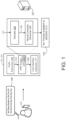
- an automated speech recognition (ASR) system 100 is enhanced to recognize numeric sequences.
- the ASR system 100 resides on a user device 102 of a user 104 and/or on a remote computing device 201 (e.g., one or more serves of a distributed system executing in a cloud-computing environment) in communication with the user device.
- a remote computing device 201 e.g., one or more serves of a distributed system executing in a cloud-computing environment
- the user device 102 is depicted as a mobile computing device (e.g., a smart phone), the user device 102 may correspond to any type of computing device such as, without limitation, a tablet device, a laptop/desktop computer, a wearable device, a digital assistant device, a smart speaker/display, a smart appliance, an automotive infotainment system, or an Internet-of-Things (IoT) device.
- a tablet device e.g., a smart phone
- the user device 102 may correspond to any type of computing device such as, without limitation, a tablet device, a laptop/desktop computer, a wearable device, a digital assistant device, a smart speaker/display, a smart appliance, an automotive infotainment system, or an Internet-of-Things (IoT) device.
- IoT Internet-of-Things
- the user device 102 includes an audio subsystem 108 configured to receive an utterance 106 spoken by the user 104 (e.g., the user device 102 may include one or more microphones for recording the spoken utterance 106) and convert the utterance 106 into a corresponding digital format associated with parameterized input acoustic frames 110 capable of being processed by the ASR system 100.
- the user speaks a respective utterance 106 for the phrase that would be transcribed in a spoken domain as "My Phone Number is Six Five Oh Five Five Five Five One Two One Two" and the audio subsystem 108 converts the utterance 106 into corresponding acoustic frames 110 for input to the ASR system 100.
- the acoustic frames 110 may be a series of parameterized input acoustic frames that each include 80-dimensional log-Mel features, computed with a short, e.g., 25ms, window and shifted every few, e.g., 10, milliseconds.
- the ASR system 100 receives, as input, the acoustic frames 110 corresponding to the utterance 106, and generates/predicts, as output, a corresponding transcription (e.g., recognition result/hypothesis) 120 for the utterance 106 in the written domain, i.e., the text "My phone number is (650) 555-1212".
- the user device 102 and/or the remote computing device 201 also executes a user interface generator 107 configured to present a representation of the transcription 120 of the utterance 106 to the user 104 of the user device 102.
- the transcription 120 output from the ASR system 100 is processed, e.g., by a natural language understanding (NLU) module executing on the user device 102 or the remote computing device 201, to execute a user command.
- NLU natural language understanding
- a text-to-speech system e.g., executing on any combination of the user device 104 or the remote computing device 201 may convert the transcription into synthesized speech for audible output by another device.
- the original utterance 106 may correspond to a message the user 104 is sending to a friend in which the transcription 120 is converted to synthesized speech for audible output to the friend to listen to the message conveyed in the original utterance 106.
- the enhanced ASR system 100 includes a decoder 200 and a neural corrector/denormer 300.
- the decoder 200 is configured to receive, as input, the parameterized input acoustic frames 110, and generate, as output, an intermediate transcription 115 that represents the utterance 105 in the spoken domain or the written domain.
- the neural corrector/denormer 300 is configured to receive the intermediate transcription 115 output from the decoder 200 and perform one of written domain-to-written domain correction or spoken domain-to-written domain denorming.
- the neural corrector/denoffiler 300 is configured to receive, as input, the intermediate transcription 115 in the spoken domain, and generate, as output, the transcription 120 for the utterance 106 in the written domain, i.e., the text "My phone number is (650) 555-1212".
- the neural corrector/denormer 300 is configured to receive, as input, the intermediate transcription 115 in the written domain, and generate, as output, the transcription 120 as a "corrected" written domain transcription for the utterance 106.
- the intermediate transcription 115 in the written domain may represent the numeric sequence as numerical words such that the numeric sequence is spelled out as "Six Five Zero Five Five Five One Two One Two", whereby the neural corrector 300 generates the "corrected” transcription 120 in the written domain such that a corresponding numerical representation of "650-555-1212" replaces the spelled out, in vocabulary numerical word representation from the intermediate transcription 115 output from the decoder 200.
- the enhanced ASR system 100 is trained on additional numeric training data 416 ( FIG. 4 ) generated by a text-to-speech (TTS) system 412 ( FIG. 4 ), and uses the neural corrector/denormer 300 to in lieu of a FST-based verbalizer to improve E2E model performance on training utterances 402 ( FIG. 4 ) having numeric sequences.
- TTS text-to-speech
- Such an enhanced approach yields measurable improvement in several categories of numeric sequences, and exhibits significant improvement in WER for longer numeric sequences.
- the neural corrector/denormer 300 includes a small-footprint neural network to enable the neural corrector/denormer 300 suitable for use in an on-device environment (e.g., locally on the user device 102) to perform correction or denorming on intermediate transcriptions 115 output from the decoder 200.
- the large footprint associated with FST-based verbalizers prohibits their use in the on-device ASR environment due to the low memory constrains. Additionally, FST-based verbalizers use a predefined set of rules that do not scale well to changes in training data.
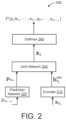
- the decoder 200 may include an E2E, RNN-T model 200 which adheres to latency constrains associated with interactive applications.
- the RNN-T model 200 provides a small computational footprint and utilizes less memory requirements than conventional ASR architectures, making the RNN-T model architecture suitable for performing speech recognition entirely on the user device 102 (e.g., no communication with a remote server is required).
- the RNN-T model 200 includes an encoder network 210, a prediction network 220, and a joint network 230.
- the encoder network 210 which is roughly analogous to an acoustic model (AM) in a traditional ASR system, includes a recurrent network of stacked Long Short-Term Memory (LSTM) layers.
- AM acoustic model
- LSTM Long Short-Term Memory
- This higher-order feature representation is denoted as
- the prediction network 220 is also an LSTM network, which, like a language model (LM), processes the sequence of non-blank symbols output by a final Softmax layer 240 so far, into a dense representation
- the representations produced by the encoder and prediction networks 210, 220 are combined by the joint network 230.
- the joint network then predicts which is a distribution over the next output symbol.
- the joint network 230 generates, at each output step (e.g., time step), a probability distribution over possible speech recognition hypotheses.
- the "possible speech recognition hypotheses" correspond to a set of output labels each representing a symbol/character in a specified natural language.
- the joint network 230 may output a set of values indicative of the likelihood of occurrence of each of a predetermined set of output labels.
- This set of values can be a vector and can indicate a probability distribution over the set of output labels.
- the output labels are graphemes (e.g., individual characters, and potentially punctuation and other symbols), but the set of output labels is not so limited.
- the output distribution of the joint network 230 can include a posterior probability value for each of the different output labels. Thus, if there are 100 different output labels representing different grapheines or other symbols, the output y i of the joint network 230 can include 100 different probability values, one for each output label.
- the probability distribution can then be used to select and assign scores to candidate orthgraphic elements (e.g., graphemes, wordpieces, and/or words) in a beam search process (e.g., by the Softmax layer 240) for determining the intermediate transcription115.
- candidate orthgraphic elements e.g., graphemes, wordpieces, and/or words
- the Softmax layer 240 may employ any technique to select the output label/symbol with the highest probability in the distribution as the next output symbol predicted by the model 200 at the corresponding output step. In this manner, the RNN-T model 200 does not make a conditional independence assumption, rather the prediction of each symbol is conditioned not only on the acoustics but also on the sequence of labels output so far. The RNN-T model 200 does assume an output symbol is independent of future acoustic frames 110, which allows the RNN-T model to be employed in a streaming fashion.
- the encoder network 210 of the RNN-T model 200 is made up of eight 2,04-8-dimensional LSTM layers, each followed by a 640-dimensional projection layer.
- a time-reduction layer with the reduction factor of two may be inserted after the second LSTM layer of the encoder to reduce model latency.
- the prediction network 220 may have two 2,048-dimensional LSTM layers, each of which is also followed by 640-dimensional projection layer.
- the joint network 230 may also have 640 hidden units, followed by a 4,096 wordpiece softmax output.
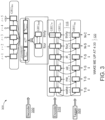
- FIG. 3 shows an example architecture for the neural corrector/denormer 300 of the enhanced ASR system 100 of FIG. 1 for performing neural correction or neural denorming as a post-processing operation on outputs received from the RNN-T, E2E decoder 200 of the enhanced ASR system 100.
- the architecture for the neural corrector/denormer 300 includes an encoder portion 310, a tagger portion 320, and an attention/decoder portion 330.
- the encoder portion 3 10 is a bidirectional RNN (BiRNN) that includes a bidirectional single-layer Gated Recurrent Unit (GRU) encoder 310 having 256 units that emits a 256-dimensional hidden state.
- BiRNN bidirectional RNN
- GRU Gated Recurrent Unit
- the tagger portion 320 may be a RNN including a single-layer GRU with 64 units and the attention/decoder portion 330 may be a bidirectional single-layer GRU with 256 units.
- FIG. 2 describes the neural corrector/denormer 300 primary in terms of neural correction, the neural corrector/denormer 300 may be additionally or alternatively used for neural denorming. In the example shown, “T” stands for trivial, “N” stands for non-trivial, “S” stands for start, and “C” stands for continuation.
- the neural corrector/denormer 300 When implemented as the neural corrector, the neural corrector/denormer 300 corresponds a written domain correction model 300 that receives, as input, a written-domain, intermediate transcription 115 generated by the RNN-T, E2E decoder 200, and generates, as output, a corrected, written domain transcription 120 (e.g., a final transcription 120).
- the neural corrector/denormer 300 When implemented as a neural denormer, the neural corrector/denormer 300 corresponds to a written domain denorming model 300 that receives, as input, a spoken domain, intermediate transcription 115 generated by the RNN-T, E2E decoder 200, and generates, as output, a written domain transcription 120 (e.g., a final transcription 120).
- the architecture of the neural corrector/denormer 300 provides an attention-based, sequence-to-sequence model that receives the output from another sequence-to-sequence model, i.e., the RNN-T, E2E decoder 200.
- the architecture of the neural corrector/denormer 300 is further adapted to the correction context by accounting for the fact that many of words in an input 115, written domain phrase, e.g., "wake me up at”, are simply copied into the written domain output 120, e.g., "wake me up at,” during correction.
- the tagger RNN 320 is trained to run on the input sequence before the attention/decoder portion 330, by tagging the words in the input sequence of the intermediate transcription 115 as either "trivial” (e.g., not requiring correction), in which case the word can simply be copied to the output, written domain sequence of the written domain transcription 120, or "non-trivial” (e.g., requiring correction), in which case the word is passed into attention/decoder portion 330.
- the written domain correction model 300 could also be used to re-rank an n-best list in a second-pass setting.
- the encoder/tagger portion 303, 304 of the model 300 which runs for all input, contains about four (4) million parameters, while the attention/decoder portion 301 of the model 300, which runs only for text spans marked for correction, contains about six (6) million parameters.
- the small footprint of the neural correction model makes it attractive for the on-device context.
- the model is implemented in Tensorflow and is trained asynchronously on twelve graphics processing units (GPUs), with a batch size of sixteen.
- the E2E, RNN-T decoder 200 of the ASR system includes about one-hundred fourteen (114) million parameters.
- the BiRNN encoder 310 is defined as follows: where are hidden encoder states.
- Each tag t i is a joined tag in the cross-product set of ⁇ trivial, non-trivial ⁇ ⁇ ⁇ start, continuation ⁇ to model whether a word is the beginning of a new segment needed to be corrected or a continuation of the previous segment. This refinement allows for the modeling of consecutive non-trivial segments.
- the learning objective of the tagger RNN 320 may be expressed by the following equation.
- Alignments for training the tagger RNN 320 may be obtained using a heuristic alignment technique that determines subsequences common to the input and output transcripts 115, 120. These common subsequences are marked as "trivial” (e.g., not requiring correction). For instance, common subsequences may generally include non-numerical words. In the example shown, the common subsequences marked/tagged as "trivial" by the tagger RNN 320 include the word sequence "Wake me up at". Here, since the phrase "Wake me up at" is in the written domain and does not require correction, the phrase can be copied over to the output to form part of the corrected, written domain transcription 120.
- the written domain correction model 300 uses the results of the tagger RNN 320 to extract text snippets to be corrected, such as the numerical words "four" and "thirty" in the intermediate transcription 115 marked as non-trivial. For example, if a text snippet spans from time s to e, the input spans ⁇ x s , ..., x e ⁇ along with the context hidden states h s a and h e become the input to the next stage attention model.
- the BiRNN encoder 310 is defined RNN mid over ⁇ x s , ..., x e ⁇ .
- the two-dimensional indices ( i , t ) indicate t is relative to a given position i ( s, e ) in the input sequence.
- the results of the tagger RNN 320 enable the attention/decoder portion 330 of the neural corrector/denormer 300 to be applied to less than all of the text in the intermediate transcription 115, e.g. only to relevant spans of text, thereby improving accuracy and decreasing latency, cost, and computation expense.
- the relevant spans of text to be corrected include the numerical words "four" and "thirty”, whereby the attention/decoder 330 corrects "four” and “thirty” to be "4:30” such that the numerical representation "4:30" now represents the numeric sequence in the final transcription 120.
- the model 300 is trained to also inject proper symbols/characters associated with the numeric sequence, such as currency symbols, a colon for time, etc.
- the corrected portion "4:30" is appended to the copied over portion "Wake me up at” to provide the complete corrected, written domain final transcription 120.
- Equation (1) and Equation (2) translate to two cross-entropy losses that can be linearly combined.
- inference i.e., decoding time
- the attention/decoder portion 330 and the tagger RNN 320 work as a pipeline such that the attention/decoder portion 330 is only used as required by tagger RNN 320, i.e., when the tagger RNN 320 tags words in the intermediate transcription 115 as "non-trivial" (e.g., not requiring correction).
- the enhanced ASR system 100 can improve E2E, speech recognition performance on numeric sequences by applying one or more of several enhancements.
- synthetic training data 422 can be used to successfully address data sparsity issues, by using a TTS system 412 to synthesize additional training data 422 for written domain numeric sequences. In doing so, synthesized speech training data 422 can be generated for challenging categories of numeric sequences in order to improve model coverage of those categories.
- the data sparsit), or OOV issues can additionally or alternatively be addressed through the use of a neural correction network (e.g., neural corrector/denormer 300), which is trained on written-domain ground truth transcription/RNN-T written-domain hypothesis pairs 115, 424, and which can learns to correct mistakes.
- a neural correction network e.g., neural corrector/denormer 300
- the RNN-T, E2E decoder 200 is trained to output numeric sequences in the spoken domain, and to denorm back to the written domain.
- such an approach can be implemented using an FST-based denormer or a neural denormer that is based on a written-domain correction model.
- the ASR system 100 benefits by augmenting the training data 402 using the TTS system 412 to synthesize additional training data 416, 422 for written domain numeric sequences, thereby addressing a "long tail" data sparsity issue of the RNN-T, E2E decoder 200.
- additional training data 416, 422 that represents challenging yet realistic numeric sequences can be generated.
- categories of numeric sequences that are frequently seen in logs, e.g., of digital assistant requests or of search engines, can be identified.
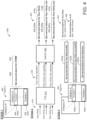
- FIG. 4 shows an example process 400 for obtaining additional training data 416, 422 for training the neural decoder/encoder 200 to learn to represent various categories of numeric sequences in the written domain.
- the remote computing device 201 e.g., server
- the process 400 obtains a plurality of training utterance sets 402, 402A-N each associated with a different respective numeric category A-N and including a plurality of respective transcript templates 404, 404a-n.
- different respective numeric categories of numeric sequences may include, without limitation, a "Day” category, a "Percent” category, a "Postal Code” category, a "Time” category, or a "Year” category.
- Table 1 illustrates several such categories of numeric sequences including, specifically, categories that represent a variety of numeric ranges or sizes.
- Stage 1 shows each transcript template 404 including a respective default phrase 406 in the written domain and a numeric slot 408.
- the respective default phrase 406 in each unique transcript template 404 may represent spoken voice samples, e.g., "(spoken) "set second alarm for...,” from anonymized non-synthetic utterances.
- one or more transcript templates 404. may include a corresponding written default phrase 406 that is provided as input to the TTS system 412 for generating a synthetic speech representation of the default phrase 406.
- the process 400 At stage 2, for each transcript template 404, the process 400 generates one or more synthetic speech representations 416 of numeric values (e.g., (spoken) "four thirty,” (spoken) “four thirty one,” (spoken) “four thirty two,” etc.), and for each of the one or more synthetic speech representations 416 of numeric values generated, injects the corresponding synthetic speech representation 416 of numeric values into the slot 408 of the corresponding transcript template 404 to generate a unique training utterance 422.
- numeric values e.g., (spoken) "four thirty,” (spoken) “four thirty one,” (spoken) “four thirty two,” etc.
- the unique training utterance 422 includes an audible representation of the default phrase 406, e.g., (spoken) "set second alarm for", for the corresponding transcript template 404 and the corresponding synthetic speech representation 412, e.g., (spoken) "four thirty", of numerical values.
- the process 400 may implement the TTS system 412 to generate each synthetic speech representation 416 of numeric values based on corresponding training numerical value input text 410.
- the TTS system 412 may include a multi-speaker TTS system that generates a mel-spectrogram that is conditioned on phonemes and an n -dimensional speaker embedding that is learned for each speaker during training. In some examples, n is equal to 256.
- the predicted mel-spectrogram may then be inverted to a time-domain waveform with a WaveRNN neural vocoder.
- Multi-style training may be used to add artificial noise to synthesized audio.
- TTS training data may include audio data derived from speakers of a single language or from multiple languages, or of speakers that share a single accent or have multiple different accents.
- textual numeric sequences are mapped to phonemes, and a speaker is randomly selected.
- the process 400 may implement an injector 420 that is configured to receive, as input, each synthetic speech representation 416 of numeric values output from the TTS system 412, and provide, as output, the unique training utterance 422 by injecting the synthetic speech representation 416 into the slot 408 associated with the default phrase 406.
- injector 420 configured to receive, as input, each synthetic speech representation 416 of numeric values output from the TTS system 412, and provide, as output, the unique training utterance 422 by injecting the synthetic speech representation 416 into the slot 408 associated with the default phrase 406.
- Such injection can occur by performing weighted sampling from a numeric WFST grammar which is weighted on the spoken domain. While the slot 408 is shown as following the default phrase 406 in the template 404, the slot 408 may precede the default phrase 406 or may be interspersed anywhere between the start and end of the default phrase 406.
- the audible representation of the default phrase 406 corresponding to at least one of the transcript templates 404 includes anonymized non-synthetic speech.
- the utterances used to generate templates may be anonymized in one or more ways before they are generated, stored or used, so that personally identifiable information is removed.
- a user's identity may be anonymized so that no personally identifiable information can be determined for the user, or a user's geographic location may be generalized where location information is obtained, e.g., such as to a city, ZIP code, or state level, so that a particular location of a user cannot be determined.
- the user may have control over how information is collected about him or her and used by the ASR system 100.
- the audible representation of the default phrase 406 corresponding to at least one of the transcript templates 404 includes a synthetized speech representation of the default phrase 406.
- the TTS system 412 may synthesize the respective default phrase 406 in one or more of the transcript templates 404.
- the process 400 updates each respective transcript template 404 of the plurality of transcript templates 404 in each of the plurality of training utterance sets 402 representing a respective different category with the one or more respective unique training utterances 422 generated that each include the same default phrase 406 and a different synthetic speech representation 416 of numeric values. Furthermore, the process 400 may also generate, for each unique training utterance 422, parallel textual transcriptions 424, 426, one in the spoken domain, e.g. (text) "set second alarm for four thirty", and the other in the written domain, e.g., (text) "set second alarm for 4:30". This process 400 is repeated numerous times for each template 404, each time synthesizing a unique training utterance for that category of numeric sequence.
- the written domain transcription 426 of the unique training utterance 422 includes a ground-truth transcription that is used in conjunction with recognition hypothesis 115 output from the decoder 200 for training neural corrector/denormer 300 of FIG. 3 .
- the ASR system 100 benefits from spoken domain training and FST denorming.
- the RNN-T, E2E decoder 200 is trained on a spoken domain version of the training set, and the translation back to written domain is left to an FST denormer derived from a legacy, production grammar.
- transcriptions of utterances in both the spoken domain and the written domain are used as training data.
- These examples can be obtained by passing written domain transcripts from a training set through an FST verbalizer, then choosing a single, spoken domain verbalization by passing each candidate hypothesis through a lexicon, and force-aligning the resulting phone sequences against the phones in the utterance.
- the spoken domain transcription that was obtained using the verbalization grammar is used as TTS training data.
- the ASR system 100 benefits from the use of neural denorming.
- a neural denormer could also be used in place of an FST.
- the written domain neural correction model may be adapted to the spoken domain by rephrasing or recharacterizing it as a neural denormer which consumes spoken domain training data and emits written domain output.
- the architecture of the neural denorming model is identical to the written correction model.
- the ASR system 100 benefits over legacy systems by the introduction of synthesized training data, particularly for shorter numeric sequences, and that errors that plague rule-based FST denormers can be almost entirely mitigated.
- the avoidance of OOV issues obtained by training in the spoken domain appears to largely solve formatting problems experienced by written domain models, while using a neural denormer, which learns how to denorm from training data, sidesteps the denorming errors seen in the FST-based spoken domain model.
- the spoken domain denorming approach does not result in a significant degradation on the real-audio data sets. When multiple enhancements were used together, the improvements for E2E performance were greatest, particularly for longer utterances.
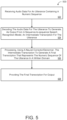
- FIG. 5 provides a flowchart of an example arrangement of operations for a method 500 of generating final transcriptions 120 representing numerical sequences of utterances 106 in a written domain.
- Data processing hardware residing on the user device 102 or the remote server 201 may execute the operations for the method 500.
- the method 500 includes receiving, at the data processing hardware, audio data 110 for an utterance 106 containing a numeric sequence.
- the method 500 includes decoding, by the data processing hardware, using a sequence-to-sequence speech recognition model 200, the audio data 110 for the utterance 106 to generate, as output from the sequence-to-sequence speech recognition model 200, an intermediate transcription 115 of the utterance 106.
- the method 500 also includes processing, by the data processing hardware, using a neural corrector 300, the intermediate transcription 115 output from the sequence-to-sequence speech recognition model 200 to generate a final transcription 120 that represents the numeric sequence of the utterance 106 in a written domain.
- the neural corrector is trained on a set of training samples 402, where each training sample 402 includes a speech recognition hypothesis 115 for a corresponding training utterance and a ground-truth transcription 426 of the corresponding training utterance.
- the ground-truth transcription 426 of the corresponding training utterance is in the written domain.
- the method 500 also includes providing, by the data processing hardware, the final transcription 120 representing the numeric sequence of the utterance 106 in the written domain for output
- a software application may refer to computer software that causes a computing device to perform a task.
- a software application may be referred to as an "application,” an "app,” or a "program.”
- Example applications include, but are not limited to, system diagnostic applications, system management applications, system maintenance applications, word processing applications, spreadsheet applications, messaging applications, media streaming applications, social networking applications, and gaming applications.
- the non-transitory memory may be physical devices used to store programs (e.g., sequences of instructions) or data (e.g., program state information) on a temporary or permanent basis for use by a computing device.
- the non-transitory memory may be volatile and/or non-volatile addressable semiconductor memory. Examples of non-volatile memory include, but are not limited to, flash memory and read-only memory (ROM) / programmable read-only memory (PROM) / erasable programmable read-only memory (EPROM) / electronically erasable programmable read-only memory (EEPROM) (e.g., typically used for firmware, such as boot programs). Examples of volatile memory include, but are not limited to, random access memory (RAM), dynamic random access memory (DRAM), static random access memory (SRAM), phase change memory (PCM) as well as disks or tapes.
- RAM random access memory
- DRAM dynamic random access memory
- SRAM static random access memory
- PCM phase change memory
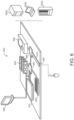
- FIG. 6 is schematic view of an example computing device 600 that may be used to implement the systems and methods described in this document.
- the computing device 600 is intended to represent various forms of digital computers, such as laptops, desktops, workstations, personal digital assistants, servers, blade servers, mainframes, and other appropriate computers.
- the components shown here, their connections and relationships, and their functions, are meant to be exemplary only, and are not meant to limit implementations of the inventions described and/or claimed in this document.
- the computing device 600 includes a processor 610, memory 620, a storage device 630, a high-speed interface/controller 640 connecting to the memory 620 and high-speed expansion ports 650, and a low speed interface/controller 660 connecting to a low speed bus 670 and a storage device 630.
- Each of the components 610, 620, 630, 640, 650, and 660 are interconnected using various busses, and may be mounted on a common motherboard or in other manners as appropriate.
- the processor 610 can process instructions for execution within the computing device 600, including instructions stored in the memory 620 or on the storage device 630 to display graphical information for a graphical user interface (GUI) on an external input/output device, such as display 680 coupled to high speed interface 640.
- GUI graphical user interface
- multiple processors and/or multiple buses may be used, as appropriate, along with multiple memories and types of memory.
- multiple computing devices 600 may be connected, with each device providing portions of the necessary operations (e.g., as a server bank, a group of blade servers, or a multi-processor system).
- the memory 620 stores information non-transitorily within the computing device 600.
- the memory 620 may be a computer-readable medium, a volatile memory unit(s), or non-volatile memory unit(s).
- the non-transitory memory 620 may be physical devices used to store programs (e.g., sequences of instructions) or data (e.g., program state information) on a temporary or permanent basis for use by the computing device 600.
- non-volatile memory examples include, but are not limited to, flash memory and read-only memory (ROM) / programmable read-only memory (PROM) / erasable programmable read-only memory (EPROM) / electronically erasable programmable read-only memory (EEPROM) (e.g., typically used for firmware, such as boot programs).
- volatile memory examples include, but are not limited to, random access memory (RAM), dynamic random access memory (DRAM), static random access memory (SRAM), phase change memory (PCM) as well as disks or tapes.
- the storage device 630 is capable of providing mass storage for the computing device 600.
- the storage device 630 is a computer-readable medium.
- the storage device 630 may be a floppy disk device, a hard disk device, an optical disk device, or a tape device, a flash memory or other similar solid state memory device, or an array of devices, including devices in a storage area network or other configurations.
- a computer program product is tangibly embodied in an information carrier.
- the computer program product contains instructions that, when executed, perform one or more methods, such as those described above.
- the information carrier is a computer- or machine-readable medium, such as the memory 620, the storage device 630, or memory on processor 610.
- the high speed controller 640 manages bandwidth-intensive operations for the computing device 600, while the low speed controller 660 manages lower bandwidth-intensive operations. Such allocation of duties is exemplary only.
- the high-speed controller 640 is coupled to the memory 620, the display 680 (e.g., through a graphics processor or accelerator), and to the high-speed expansion ports 650, which may accept various expansion cards (not shown).
- the low-speed controller 660 is coupled to the storage device 630 and a low-speed expansion port 690.
- the low-speed expansion port 690 which may include various communication ports (e.g., USB, Bluetooth, Ethernet, wireless Ethernet), may be coupled to one or more input/output devices, such as a keyboard, a pointing device, a scanner, or a networking device such as a switch or router, e.g., through a network adapter.
- input/output devices such as a keyboard, a pointing device, a scanner, or a networking device such as a switch or router, e.g., through a network adapter.
- the computing device 600 may be implemented in a number of different forms, as shown in the figure. For example, it may be implemented as a standard server 600a or multiple times in a group of such servers 600a, as a laptop computer 600b, or as part of a rack server system 600c.
- implementations of the systems and techniques described herein can be realized in digital electronic and/or optical circuitry, integrated circuitry, specially designed ASICs (application specific integrated circuits), computer hardware, firmware, software, and/or combinations thereof.
- ASICs application specific integrated circuits
- These various implementations can include implementation in one or more computer programs that are executable and/or interpretable on a programmable system including at least one programmable processor, which may be special or general purpose, coupled to receive data and instructions from, and to transmit data and instructions to, a storage system, at least one input device, and at least one output device.
- the processes and logic flows described in this specification can be performed by one or more programmable processors, also referred to as data processing hardware, executing one or more computer programs to perform functions by operating on input data and generating output.
- the processes and logic flows can also be performed by special purpose logic circuitry, e.g., an FPGA (field programmable gate array) or an ASIC (application specific integrated circuit).
- processors suitable for the execution of a computer program include, by way of example, both general and special purpose microprocessors, and any one or more processors of any kind of digital computer.
- a processor will receive instructions and data from a read only memory or a random access memory or both.
- the essential elements of a computer are a processor for performing instructions and one or more memory devices for storing instructions and data.
- a computer will also include, or be operatively coupled to receive data from or transfer data to, or both, one or more mass storage devices for storing data, e.g., magnetic, magneto optical disks, or optical disks.
- mass storage devices for storing data
- a computer need not have such devices.
- Computer readable media suitable for storing computer program instructions and data include all forms of non-volatile memory, media and memory devices, including by way of example semiconductor memory devices, e.g., EPROM, EEPROM, and flash memory devices; magnetic disks, e.g., internal hard disks or removable disks; magneto optical disks; and CD ROM and DVD-ROM disks.
- the processor and the memory can be supplemented by, or incorporated in, special purpose logic circuitry.
- one or more aspects of the disclosure can be implemented on a computer having a display device, e.g., a CRT (cathode ray tube), LCD (liquid crystal display) monitor, or touch screen for displaying information to the user and optionally a keyboard and a pointing device, e.g., a mouse or a trackball, by which the user can provide input to the computer.
- a display device e.g., a CRT (cathode ray tube), LCD (liquid crystal display) monitor, or touch screen for displaying information to the user and optionally a keyboard and a pointing device, e.g., a mouse or a trackball, by which the user can provide input to the computer.
- Other kinds of devices can be used to provide interaction with a user as well; for example, feedback provided to the user can be any form of sensory feedback, e.g., visual feedback, auditory feedback, or tactile feedback; and input from the user can be received in any form, including acoustic, speech, or tactile input
Landscapes
- Engineering & Computer Science (AREA)
- Physics & Mathematics (AREA)
- Health & Medical Sciences (AREA)
- Computational Linguistics (AREA)
- Theoretical Computer Science (AREA)
- Artificial Intelligence (AREA)
- Audiology, Speech & Language Pathology (AREA)
- Multimedia (AREA)
- Acoustics & Sound (AREA)
- Human Computer Interaction (AREA)
- Evolutionary Computation (AREA)
- General Physics & Mathematics (AREA)
- General Health & Medical Sciences (AREA)
- General Engineering & Computer Science (AREA)
- Biophysics (AREA)
- Mathematical Physics (AREA)
- Software Systems (AREA)
- Computing Systems (AREA)
- Molecular Biology (AREA)
- Data Mining & Analysis (AREA)
- Biomedical Technology (AREA)
- Life Sciences & Earth Sciences (AREA)
- Probability & Statistics with Applications (AREA)
- Machine Translation (AREA)
- Image Analysis (AREA)
- Character Discrimination (AREA)
Claims (2)
- Verfahren (500) umfassend:Empfangen von Audiodaten (110) für eine Äußerung (106), die eine numerische Sequenz enthält, an Datenverarbeitungshardware (610);Decodieren der Audiodaten (110) für die Äußerung (106) durch die Datenverarbeitungshardware (610) unter Verwendung eines rekurrenten neuronalen Netz-Transducer (recurrent neural network-transducer, RNN-T), End-to-End-Decodierermodells (200), um als Ausgabe von dem rekurrenten neuronalen Netz-Transducer (RNN-T), End-to-End-Decodierermodell (200) eine Zwischentranskription (115) der Äußerung (106) zu erzeugen, wobei die Zwischentranskription eine schriftliche Transkription der Äußerung ist, die numerische und nichtnumerische Wörter umfasst, wobei die numerischen Wörter die Sequenz von Zahlen darstellen;Verarbeiten der Zwischentranskription (115), die von dem rekurrenten neuronalen Netz-Transducer (RNN-T), dem End-to-End-Decodierermodell (200) ausgegeben wird, durch die Datenverarbeitungshardware (610) unter Verwendung eines neuronalen Korrektors (300), um eine finale Transkription (120) zu erzeugen, die die numerische Sequenz der Äußerung (106) darstellt, wobei die finale Transkription die numerischen Wörter in der Zwischentranskription durch eine entsprechende numerische Darstellung der Zahlenfolge ersetzt, wobei das Verarbeiten unter Verwendung eines neuronalen Korrektors Folgendes umfasst:Verarbeiten nur eines ersten Abschnitts der Zwischentranskription (115), der die numerischen Wörter beinhaltet, ohne einen restlichen zweiten Abschnitt der Zwischentranskription (115) zu verarbeiten, der nichtnumerische Wörter beinhaltet,wobei der neuronale korrigierende (300) anhand eines Satzes von Trainingsproben trainiert wurde, wobei jede Trainingsprobe eine Spracherkennungshypothese (115) für eine entsprechende Trainingsäußerung (422) und eine Ground-Truth-Transkription (426) der entsprechenden Trainingsäußerung (422) umfasst; und Bereitstellen der finalen Transkription (120), die die numerische Sequenz der Äußerung (106) darstellt, durch die Datenverarbeitungshardware (610) zur Ausgabe.
- System (600), umfassend:Datenverarbeitungshardware (610); undSpeicherhardware (620) in Kommunikation mit der Datenverarbeitungshardware (610), wobei die Speicherhardware (620) Anweisungen speichert, die, wenn sie auf der Datenverarbeitungshardware ausgeführt werden, die Datenverarbeitungshardware veranlassen, ein Verfahren durchzuführen, das Folgendes umfasst:Empfangen von Audiodaten (110) für eine Äußerung (106), die eine numerische Sequenz enthält;Decodieren der Audiodaten (110) für die Äußerung (106) unter Verwendung eines rekurrenten neuronalen Netz-Transducer (recurrent neural network-transducer, RNN-T), End-to-End-Decodierermodells (200), um als Ausgabe von dem rekurrenten neuronalen Netz-Transducer (RNN-T), End-to-End-Decodierermodell (200) eine Zwischentranskription (115) der Äußerung (106) zu erzeugen, wobei die Zwischentranskription eine schriftliche Transkription der Äußerung ist, die numerische und nichtnumerische Wörter umfasst, wobei die numerischen Wörter die Sequenz von Zahlen darstellen;Verarbeiten der Zwischentranskription (115), die von dem rekurrenten neuronalen Netz-Transducer (RNN-T), dem End-to-End-Decodierermodell (200) ausgegeben wird, unter Verwendung eines neuronalen Korrektors (300), um eine finale Transkription (120) zu erzeugen, die die numerische Sequenz der Äußerung (106) darstellt, wobei die finale Transkription die numerischen Wörter in der Zwischentranskription durch eine entsprechende numerische Darstellung der Zahlenfolge ersetzt, wobei das Verarbeiten unter Verwendung eines neuronalen Korrektors Folgendes umfasst:Verarbeiten nur eines ersten Abschnitts der Zwischentranskription (115), der die numerischen Wörter beinhaltet, ohne einen restlichen zweiten Abschnitt der Zwischentranskription (115) zu verarbeiten, der nichtnumerische Wörter beinhaltet,wobei der neuronale korrigierende (300) anhand eines Satzes von Trainingsproben trainiert wurde, wobei jede Trainingsprobe eine Spracherkennungshypothese (115) für eine entsprechende Trainingsäußerung (422) und eine Ground-Truth-Transkription (424) der entsprechenden Trainingsäußerung (422) umfasst; und Bereitstellen der finalen Transkription (120), die die numerische Sequenz der Äußerung (106) darstellt, zur Ausgabe.
Applications Claiming Priority (2)
| Application Number | Priority Date | Filing Date | Title |
|---|---|---|---|
| US201962842566P | 2019-05-03 | 2019-05-03 | |
| PCT/US2020/025036 WO2020226777A1 (en) | 2019-05-03 | 2020-03-26 | End-to-end automated speech recognition on numeric sequences |
Publications (2)
| Publication Number | Publication Date |
|---|---|
| EP3948853A1 EP3948853A1 (de) | 2022-02-09 |
| EP3948853B1 true EP3948853B1 (de) | 2025-06-25 |
Family
ID=70334123
Family Applications (1)
| Application Number | Title | Priority Date | Filing Date |
|---|---|---|---|
| EP20720649.1A Active EP3948853B1 (de) | 2019-05-03 | 2020-03-26 | Automatische end-zu-end-spracherkennung auf numerischen sequenzen |
Country Status (6)
| Country | Link |
|---|---|
| US (1) | US11367432B2 (de) |
| EP (1) | EP3948853B1 (de) |
| JP (1) | JP7280382B2 (de) |
| KR (1) | KR102754124B1 (de) |
| CN (1) | CN113811946B (de) |
| WO (1) | WO2020226777A1 (de) |
Families Citing this family (39)
| Publication number | Priority date | Publication date | Assignee | Title |
|---|---|---|---|---|
| JP6849621B2 (ja) * | 2018-02-02 | 2021-03-24 | 日本電信電話株式会社 | 学習装置、学習方法及び学習プログラム |
| US11990134B2 (en) * | 2020-03-18 | 2024-05-21 | Sas Institute Inc. | Method for configuring and using a numeric-to-alphabetic expression machine learning model |
| US12165650B2 (en) | 2020-03-18 | 2024-12-10 | Sas Institute Inc. | Systems and methods for enhanced speaker diarization |
| CN113470662B (zh) * | 2020-03-31 | 2024-08-27 | 微软技术许可有限责任公司 | 生成和使用用于关键词检出系统的文本到语音数据和语音识别系统中的说话者适配 |
| US11657799B2 (en) * | 2020-04-03 | 2023-05-23 | Microsoft Technology Licensing, Llc | Pre-training with alignments for recurrent neural network transducer based end-to-end speech recognition |
| GB2596606B (en) | 2020-07-03 | 2025-01-01 | Imagination Tech Ltd | Number format selection in recurrent neural networks |
| US11715461B2 (en) * | 2020-10-21 | 2023-08-01 | Huawei Technologies Co., Ltd. | Transformer-based automatic speech recognition system incorporating time-reduction layer |
| CN112580370B (zh) * | 2020-12-24 | 2023-09-26 | 内蒙古工业大学 | 一种融合语义知识的蒙汉神经机器翻译方法 |
| US11908458B2 (en) * | 2020-12-29 | 2024-02-20 | International Business Machines Corporation | Customization of recurrent neural network transducers for speech recognition |
| US11790906B2 (en) * | 2021-01-25 | 2023-10-17 | Google Llc | Resolving unique personal identifiers during corresponding conversations between a voice bot and a human |
| JP7521617B2 (ja) * | 2021-02-02 | 2024-07-24 | 日本電信電話株式会社 | 事前学習方法、事前学習装置及び事前学習プログラム |
| US11942078B2 (en) * | 2021-02-26 | 2024-03-26 | International Business Machines Corporation | Chunking and overlap decoding strategy for streaming RNN transducers for speech recognition |
| US20220284193A1 (en) * | 2021-03-04 | 2022-09-08 | Tencent America LLC | Robust dialogue utterance rewriting as sequence tagging |
| US12154544B1 (en) * | 2021-03-18 | 2024-11-26 | Amazon Technologies, Inc. | Synthetic speech processing |
| KR20230156427A (ko) * | 2021-03-23 | 2023-11-14 | 구글 엘엘씨 | 연결 및 축소된 rnn-t |
| KR102508640B1 (ko) * | 2021-03-26 | 2023-03-10 | 한양대학교 산학협력단 | 다화자 훈련 데이터셋에 기초한 음성합성 방법 및 장치 |
| US12424200B2 (en) * | 2021-03-31 | 2025-09-23 | Speechly Oy | Method and system for performing domain adaptation of end-to-end automatic speech recognition model |
| CN116057534B (zh) * | 2021-06-15 | 2026-03-20 | 微软技术许可有限责任公司 | 用于自动语音识别(asr)的上下文拼写校正(csc) |
| EP4338156B1 (de) | 2021-06-30 | 2025-06-04 | Google LLC | Weiterführung der verwendung von text und sprache beim asr-vortraining mit konsistenz- und kontrastverlusten |
| US12159617B2 (en) | 2021-06-30 | 2024-12-03 | Google Llc | Injecting text in self-supervised speech pre-training |
| GB2608596B (en) * | 2021-06-30 | 2024-06-19 | Imagination Tech Ltd | Number format selection for bidirectional RNNs |
| EP4388527B1 (de) | 2021-09-30 | 2026-03-11 | Google Llc | Grossskalige sprachmodelldatenauswahl zur spracherkennung seltener wörter |
| JP7559288B1 (ja) * | 2021-10-04 | 2024-10-01 | グーグル エルエルシー | カスケードエンコーダのためのトランスデューサベースのストリーミングの審議 |
| WO2023060008A1 (en) * | 2021-10-05 | 2023-04-13 | Google Llc | Optimizing inference performance for conformer |
| US12437749B2 (en) * | 2021-11-03 | 2025-10-07 | International Business Machines Corporation | Training data sequence for RNN-T based global English model |
| US12315495B2 (en) * | 2021-12-17 | 2025-05-27 | Snap Inc. | Speech to entity |
| KR102891215B1 (ko) * | 2022-01-05 | 2025-11-26 | 한국전자통신연구원 | 도메인특화 음성인식 모델 구성 방법 및 장치와 이를 이용한 종단형 음성인식기 |
| EP4227938A1 (de) * | 2022-02-09 | 2023-08-16 | Nuance Communications, Inc. | Automatisches kanonisieren in einem semantischen etikettierer und einer sprach-zu-text-pipeline |
| US12417770B2 (en) * | 2022-03-21 | 2025-09-16 | Google Llc | Unified cascaded encoder ASR model for dynamic model sizes |
| US12073839B2 (en) * | 2022-03-24 | 2024-08-27 | Capital One Services, Llc | Authentication by speech at a machine |
| US12165638B2 (en) * | 2022-04-14 | 2024-12-10 | Google Llc | Personalizable probabilistic models |
| US20230335124A1 (en) * | 2022-04-14 | 2023-10-19 | Google Llc | Comparison Scoring For Hypothesis Ranking |
| FI20225352A1 (en) * | 2022-04-27 | 2023-10-28 | Elisa Oyj | Computer-implemented method for obtaining at least one number |
| CN115132208A (zh) * | 2022-07-07 | 2022-09-30 | 湖南三湘银行股份有限公司 | 一种基于ctc算法构建的人工智能催收方法 |
| US12361934B2 (en) | 2022-07-14 | 2025-07-15 | Snap Inc. | Boosting words in automated speech recognition |
| US12548561B2 (en) * | 2022-10-13 | 2026-02-10 | Google Llc | Universal monolingual output layer for multilingual speech recognition |
| WO2024096641A1 (ko) * | 2022-11-02 | 2024-05-10 | 삼성전자 주식회사 | 전자 장치 및 전자 장치의 음성 인식 방법 |
| CN115985290A (zh) * | 2022-12-22 | 2023-04-18 | 思必驰科技股份有限公司 | 基于音素的语音领域迁移方法、系统和电子设备 |
| US12400083B2 (en) * | 2023-06-20 | 2025-08-26 | Google Llc | Transcription error resilient training of neural semantic parsers |
Family Cites Families (6)
| Publication number | Priority date | Publication date | Assignee | Title |
|---|---|---|---|---|
| DE19709990C2 (de) * | 1997-03-11 | 2000-03-02 | Philips Corp Intellectual Pty | System zur Erkennung gesprochener Ziffernfolgen |
| US10319374B2 (en) | 2015-11-25 | 2019-06-11 | Baidu USA, LLC | Deployed end-to-end speech recognition |
| US10229672B1 (en) * | 2015-12-31 | 2019-03-12 | Google Llc | Training acoustic models using connectionist temporal classification |
| CN106328122A (zh) * | 2016-08-19 | 2017-01-11 | 深圳市唯特视科技有限公司 | 一种利用长短期记忆模型递归神经网络的语音识别方法 |
| US10872598B2 (en) * | 2017-02-24 | 2020-12-22 | Baidu Usa Llc | Systems and methods for real-time neural text-to-speech |
| JP7190283B2 (ja) | 2018-08-24 | 2022-12-15 | 日本放送協会 | 音声認識結果整形モデル学習装置およびそのプログラム |
-
2020
- 2020-03-26 WO PCT/US2020/025036 patent/WO2020226777A1/en not_active Ceased
- 2020-03-26 US US16/830,996 patent/US11367432B2/en active Active
- 2020-03-26 KR KR1020217035057A patent/KR102754124B1/ko active Active
- 2020-03-26 JP JP2021565084A patent/JP7280382B2/ja active Active
- 2020-03-26 CN CN202080032988.3A patent/CN113811946B/zh active Active
- 2020-03-26 EP EP20720649.1A patent/EP3948853B1/de active Active
Also Published As
| Publication number | Publication date |
|---|---|
| US20200349922A1 (en) | 2020-11-05 |
| CN113811946B (zh) | 2024-07-16 |
| EP3948853A1 (de) | 2022-02-09 |
| KR102754124B1 (ko) | 2025-01-14 |
| KR20210146368A (ko) | 2021-12-03 |
| CN113811946A (zh) | 2021-12-17 |
| US11367432B2 (en) | 2022-06-21 |
| JP2022531414A (ja) | 2022-07-06 |
| WO2020226777A1 (en) | 2020-11-12 |
| JP7280382B2 (ja) | 2023-05-23 |
Similar Documents
| Publication | Publication Date | Title |
|---|---|---|
| EP3948853B1 (de) | Automatische end-zu-end-spracherkennung auf numerischen sequenzen | |
| US11942076B2 (en) | Phoneme-based contextualization for cross-lingual speech recognition in end-to-end models | |
| JP7544989B2 (ja) | ルックアップテーブルリカレント言語モデル | |
| JP7678227B2 (ja) | 多言語自動音声認識のための教師無しおよび教師有り共同トレーニング(just) | |
| US12230249B2 (en) | Supervised and unsupervised training with contrastive loss over sequences | |
| US20240304178A1 (en) | Using text-injection to recognize speech without transcription | |
| US20240177706A1 (en) | Monte Carlo Self-Training for Speech Recognition | |
| WO2024182499A1 (en) | Mask-conformer augmenting conformer with mask-predict decoder unifying speech recognition and rescoring | |
| US20250166614A1 (en) | Supervised and Unsupervised Training with Contrastive Loss Over Sequences | |
| US20250182753A1 (en) | Non-autoregressive and multilingual language-model-fused asr system |
Legal Events
| Date | Code | Title | Description |
|---|---|---|---|
| STAA | Information on the status of an ep patent application or granted ep patent |
Free format text: STATUS: UNKNOWN |
|
| STAA | Information on the status of an ep patent application or granted ep patent |
Free format text: STATUS: THE INTERNATIONAL PUBLICATION HAS BEEN MADE |
|
| PUAI | Public reference made under article 153(3) epc to a published international application that has entered the european phase |
Free format text: ORIGINAL CODE: 0009012 |
|
| STAA | Information on the status of an ep patent application or granted ep patent |
Free format text: STATUS: REQUEST FOR EXAMINATION WAS MADE |
|
| 17P | Request for examination filed |
Effective date: 20211102 |
|
| AK | Designated contracting states |
Kind code of ref document: A1 Designated state(s): AL AT BE BG CH CY CZ DE DK EE ES FI FR GB GR HR HU IE IS IT LI LT LU LV MC MK MT NL NO PL PT RO RS SE SI SK SM TR |
|
| DAV | Request for validation of the european patent (deleted) | ||
| DAX | Request for extension of the european patent (deleted) | ||
| STAA | Information on the status of an ep patent application or granted ep patent |
Free format text: STATUS: EXAMINATION IS IN PROGRESS |
|
| 17Q | First examination report despatched |
Effective date: 20230314 |
|
| GRAP | Despatch of communication of intention to grant a patent |
Free format text: ORIGINAL CODE: EPIDOSNIGR1 |
|
| STAA | Information on the status of an ep patent application or granted ep patent |
Free format text: STATUS: GRANT OF PATENT IS INTENDED |
|
| RIC1 | Information provided on ipc code assigned before grant |
Ipc: G06N 3/045 20230101ALN20250108BHEP Ipc: G10L 13/00 20060101ALN20250108BHEP Ipc: G10L 15/06 20130101ALN20250108BHEP Ipc: G06F 40/279 20200101ALI20250108BHEP Ipc: G06N 3/08 20060101ALI20250108BHEP Ipc: G06N 3/044 20230101ALI20250108BHEP Ipc: G10L 15/16 20060101AFI20250108BHEP |
|
| INTG | Intention to grant announced |
Effective date: 20250120 |
|
| GRAS | Grant fee paid |
Free format text: ORIGINAL CODE: EPIDOSNIGR3 |
|
| GRAA | (expected) grant |
Free format text: ORIGINAL CODE: 0009210 |
|
| STAA | Information on the status of an ep patent application or granted ep patent |
Free format text: STATUS: THE PATENT HAS BEEN GRANTED |
|
| P01 | Opt-out of the competence of the unified patent court (upc) registered |
Free format text: CASE NUMBER: APP_21128/2025 Effective date: 20250505 |
|
| AK | Designated contracting states |
Kind code of ref document: B1 Designated state(s): AL AT BE BG CH CY CZ DE DK EE ES FI FR GB GR HR HU IE IS IT LI LT LU LV MC MK MT NL NO PL PT RO RS SE SI SK SM TR |
|
| REG | Reference to a national code |
Ref country code: GB Ref legal event code: FG4D |
|
| REG | Reference to a national code |
Ref country code: CH Ref legal event code: EP |
|
| REG | Reference to a national code |
Ref country code: CH Ref legal event code: EP |
|
| REG | Reference to a national code |
Ref country code: IE Ref legal event code: FG4D |
|
| REG | Reference to a national code |
Ref country code: DE Ref legal event code: R096 Ref document number: 602020053278 Country of ref document: DE |
|
| PG25 | Lapsed in a contracting state [announced via postgrant information from national office to epo] |
Ref country code: FI Free format text: LAPSE BECAUSE OF FAILURE TO SUBMIT A TRANSLATION OF THE DESCRIPTION OR TO PAY THE FEE WITHIN THE PRESCRIBED TIME-LIMIT Effective date: 20250625 |
|
| REG | Reference to a national code |
Ref country code: LT Ref legal event code: MG9D |
|
| PG25 | Lapsed in a contracting state [announced via postgrant information from national office to epo] |
Ref country code: GR Free format text: LAPSE BECAUSE OF FAILURE TO SUBMIT A TRANSLATION OF THE DESCRIPTION OR TO PAY THE FEE WITHIN THE PRESCRIBED TIME-LIMIT Effective date: 20250926 Ref country code: NO Free format text: LAPSE BECAUSE OF FAILURE TO SUBMIT A TRANSLATION OF THE DESCRIPTION OR TO PAY THE FEE WITHIN THE PRESCRIBED TIME-LIMIT Effective date: 20250925 |
|
| PG25 | Lapsed in a contracting state [announced via postgrant information from national office to epo] |
Ref country code: BG Free format text: LAPSE BECAUSE OF FAILURE TO SUBMIT A TRANSLATION OF THE DESCRIPTION OR TO PAY THE FEE WITHIN THE PRESCRIBED TIME-LIMIT Effective date: 20250625 |
|
| PG25 | Lapsed in a contracting state [announced via postgrant information from national office to epo] |
Ref country code: HR Free format text: LAPSE BECAUSE OF FAILURE TO SUBMIT A TRANSLATION OF THE DESCRIPTION OR TO PAY THE FEE WITHIN THE PRESCRIBED TIME-LIMIT Effective date: 20250625 |
|
| PG25 | Lapsed in a contracting state [announced via postgrant information from national office to epo] |
Ref country code: RS Free format text: LAPSE BECAUSE OF FAILURE TO SUBMIT A TRANSLATION OF THE DESCRIPTION OR TO PAY THE FEE WITHIN THE PRESCRIBED TIME-LIMIT Effective date: 20250925 |
|
| PG25 | Lapsed in a contracting state [announced via postgrant information from national office to epo] |
Ref country code: LV Free format text: LAPSE BECAUSE OF FAILURE TO SUBMIT A TRANSLATION OF THE DESCRIPTION OR TO PAY THE FEE WITHIN THE PRESCRIBED TIME-LIMIT Effective date: 20250625 |
|
| REG | Reference to a national code |
Ref country code: NL Ref legal event code: MP Effective date: 20250625 |
|
| PG25 | Lapsed in a contracting state [announced via postgrant information from national office to epo] |
Ref country code: NL Free format text: LAPSE BECAUSE OF FAILURE TO SUBMIT A TRANSLATION OF THE DESCRIPTION OR TO PAY THE FEE WITHIN THE PRESCRIBED TIME-LIMIT Effective date: 20250625 |
|
| PG25 | Lapsed in a contracting state [announced via postgrant information from national office to epo] |
Ref country code: PT Free format text: LAPSE BECAUSE OF FAILURE TO SUBMIT A TRANSLATION OF THE DESCRIPTION OR TO PAY THE FEE WITHIN THE PRESCRIBED TIME-LIMIT Effective date: 20251027 |
|
| REG | Reference to a national code |
Ref country code: AT Ref legal event code: MK05 Ref document number: 1807408 Country of ref document: AT Kind code of ref document: T Effective date: 20250625 |
|
| PG25 | Lapsed in a contracting state [announced via postgrant information from national office to epo] |
Ref country code: IS Free format text: LAPSE BECAUSE OF FAILURE TO SUBMIT A TRANSLATION OF THE DESCRIPTION OR TO PAY THE FEE WITHIN THE PRESCRIBED TIME-LIMIT Effective date: 20251025 |
|
| PG25 | Lapsed in a contracting state [announced via postgrant information from national office to epo] |
Ref country code: AT Free format text: LAPSE BECAUSE OF FAILURE TO SUBMIT A TRANSLATION OF THE DESCRIPTION OR TO PAY THE FEE WITHIN THE PRESCRIBED TIME-LIMIT Effective date: 20250625 Ref country code: SM Free format text: LAPSE BECAUSE OF FAILURE TO SUBMIT A TRANSLATION OF THE DESCRIPTION OR TO PAY THE FEE WITHIN THE PRESCRIBED TIME-LIMIT Effective date: 20250625 |
|
| PG25 | Lapsed in a contracting state [announced via postgrant information from national office to epo] |
Ref country code: CZ Free format text: LAPSE BECAUSE OF FAILURE TO SUBMIT A TRANSLATION OF THE DESCRIPTION OR TO PAY THE FEE WITHIN THE PRESCRIBED TIME-LIMIT Effective date: 20250625 |
|
| PG25 | Lapsed in a contracting state [announced via postgrant information from national office to epo] |
Ref country code: PL Free format text: LAPSE BECAUSE OF FAILURE TO SUBMIT A TRANSLATION OF THE DESCRIPTION OR TO PAY THE FEE WITHIN THE PRESCRIBED TIME-LIMIT Effective date: 20250625 |
|
| PG25 | Lapsed in a contracting state [announced via postgrant information from national office to epo] |
Ref country code: EE Free format text: LAPSE BECAUSE OF FAILURE TO SUBMIT A TRANSLATION OF THE DESCRIPTION OR TO PAY THE FEE WITHIN THE PRESCRIBED TIME-LIMIT Effective date: 20250625 |
|
| PG25 | Lapsed in a contracting state [announced via postgrant information from national office to epo] |
Ref country code: SK Free format text: LAPSE BECAUSE OF FAILURE TO SUBMIT A TRANSLATION OF THE DESCRIPTION OR TO PAY THE FEE WITHIN THE PRESCRIBED TIME-LIMIT Effective date: 20250625 |
|
| PG25 | Lapsed in a contracting state [announced via postgrant information from national office to epo] |
Ref country code: ES Free format text: LAPSE BECAUSE OF FAILURE TO SUBMIT A TRANSLATION OF THE DESCRIPTION OR TO PAY THE FEE WITHIN THE PRESCRIBED TIME-LIMIT Effective date: 20250625 |
|
| PG25 | Lapsed in a contracting state [announced via postgrant information from national office to epo] |
Ref country code: DK Free format text: LAPSE BECAUSE OF FAILURE TO SUBMIT A TRANSLATION OF THE DESCRIPTION OR TO PAY THE FEE WITHIN THE PRESCRIBED TIME-LIMIT Effective date: 20250625 |
|
| PGFP | Annual fee paid to national office [announced via postgrant information from national office to epo] |
Ref country code: DE Payment date: 20260327 Year of fee payment: 7 |
|
| PG25 | Lapsed in a contracting state [announced via postgrant information from national office to epo] |
Ref country code: IT Free format text: LAPSE BECAUSE OF FAILURE TO SUBMIT A TRANSLATION OF THE DESCRIPTION OR TO PAY THE FEE WITHIN THE PRESCRIBED TIME-LIMIT Effective date: 20250625 |