EP4289834A1 - Tetrahydropyrrolocyclic compound and application thereof - Google Patents
Tetrahydropyrrolocyclic compound and application thereof Download PDFInfo
- Publication number
- EP4289834A1 EP4289834A1 EP22749047.1A EP22749047A EP4289834A1 EP 4289834 A1 EP4289834 A1 EP 4289834A1 EP 22749047 A EP22749047 A EP 22749047A EP 4289834 A1 EP4289834 A1 EP 4289834A1
- Authority
- EP
- European Patent Office
- Prior art keywords
- compound
- added
- present disclosure
- reaction
- pharmaceutically acceptable
- Prior art date
- Legal status (The legal status is an assumption and is not a legal conclusion. Google has not performed a legal analysis and makes no representation as to the accuracy of the status listed.)
- Granted
Links
Classifications
-
- C—CHEMISTRY; METALLURGY
- C07—ORGANIC CHEMISTRY
- C07D—HETEROCYCLIC COMPOUNDS
- C07D403/00—Heterocyclic compounds containing two or more hetero rings, having nitrogen atoms as the only ring hetero atoms, not provided for by group C07D401/00
- C07D403/14—Heterocyclic compounds containing two or more hetero rings, having nitrogen atoms as the only ring hetero atoms, not provided for by group C07D401/00 containing three or more hetero rings
-
- A—HUMAN NECESSITIES
- A61—MEDICAL OR VETERINARY SCIENCE; HYGIENE
- A61K—PREPARATIONS FOR MEDICAL, DENTAL OR TOILETRY PURPOSES
- A61K31/00—Medicinal preparations containing organic active ingredients
- A61K31/33—Heterocyclic compounds
- A61K31/395—Heterocyclic compounds having nitrogen as a ring hetero atom, e.g. guanethidine or rifamycins
- A61K31/41—Heterocyclic compounds having nitrogen as a ring hetero atom, e.g. guanethidine or rifamycins having five-membered rings with two or more ring hetero atoms, at least one of which being nitrogen, e.g. tetrazole
- A61K31/4192—1,2,3-Triazoles
-
- A—HUMAN NECESSITIES
- A61—MEDICAL OR VETERINARY SCIENCE; HYGIENE
- A61K—PREPARATIONS FOR MEDICAL, DENTAL OR TOILETRY PURPOSES
- A61K31/00—Medicinal preparations containing organic active ingredients
- A61K31/33—Heterocyclic compounds
- A61K31/395—Heterocyclic compounds having nitrogen as a ring hetero atom, e.g. guanethidine or rifamycins
- A61K31/495—Heterocyclic compounds having nitrogen as a ring hetero atom, e.g. guanethidine or rifamycins having six-membered rings with two or more nitrogen atoms as the only ring heteroatoms, e.g. piperazine or tetrazines
- A61K31/505—Pyrimidines; Hydrogenated pyrimidines, e.g. trimethoprim
- A61K31/506—Pyrimidines; Hydrogenated pyrimidines, e.g. trimethoprim not condensed and containing further heterocyclic rings
-
- A—HUMAN NECESSITIES
- A61—MEDICAL OR VETERINARY SCIENCE; HYGIENE
- A61P—SPECIFIC THERAPEUTIC ACTIVITY OF CHEMICAL COMPOUNDS OR MEDICINAL PREPARATIONS
- A61P25/00—Drugs for disorders of the nervous system
- A61P25/20—Hypnotics; Sedatives
-
- A—HUMAN NECESSITIES
- A61—MEDICAL OR VETERINARY SCIENCE; HYGIENE
- A61P—SPECIFIC THERAPEUTIC ACTIVITY OF CHEMICAL COMPOUNDS OR MEDICINAL PREPARATIONS
- A61P25/00—Drugs for disorders of the nervous system
- A61P25/24—Antidepressants
Definitions
- the present disclosure relates to a class of tetrahydropyrrolocyclic compounds, in particular to compounds represented by formula (I) and pharmaceutically acceptable salts thereof.
- Orexin (Hypocretin) signaling is mediated by two receptors and two peptide agonists. Specifically, orexin A and orexin B bind to two high affinity receptors, called the orexin-1 receptor (OX-1 receptor) and the orexin-2 receptor (OX-2 receptor). The OX-1 receptor binds to orexin A with a higher affinity, while the OX-2 receptor binds to orexin A and orexin B with similar affinity. Orexin-secreting neurons are mainly distributed in the prefrontal nucleus, dorsal hypothalamus and lateral hypothalamus ( C. Peyron et al., J. Neurosci., 1998, 18(23), 9996-10015 ).
- the secreted orexin affects many areas of the brain and is involved in many behavioral and physiological functions, including: eating, drinking, reproduction, arousal system, stress system, reward system, etc. ( T. Sakurai, Nature Reviews Neuroscience, 2007, 8(3), 171 - 181 ). Among them, the orexin system has a significant regulatory effect on the sleep-wake process, and the awake time of rodents administered with orexin intraperitoneally is prolonged ( Piper et al., J. Neurosci. 2000, 12, 726-730 ).
- mutant or non-functional orexin-2 receptors would cause narcolepsy in dogs ( Lin et al., Cell, 1999, 98, 365-376 ) and the orexin signal in cerebrospinal fluid of individual with narcolepsy is found deficient ( Nishino et al., Lancet 2000, 355, 39-40 ). All this shows that the orexin system promotes wakefulness of humans, while the inhibition of the orexin system facilitates sleep.
- orexin receptor antagonists are useful in the treatment of the following diseases: insomnia, depression, anxiety, drug addiction, mental disorders, dementia, schizophrenia, Parkinson's disease, Alzheimer's disease, insulin resistance, type II diabetes, hyperlipidemia, gallstones, angina, high blood pressure, dyspnea, tachycardia, infertility, sleep apnea, back and joint pain, varicose veins, osteoarthritis, etc.
- the present disclosure provides a compound represented by the following formula or a pharmaceutically acceptable salt thereof, which is selected from: wherein
- each R 1 described above is independently selected from halogen, cyano, methyl and methoxy, and the methyl and methoxy are independently and optionally substituted by 1, 2 or 3 F, and other variables are as defined in the present disclosure.
- each R 1 described above is independently selected from F, Cl, methyl and methoxy, and other variables are as defined in the present disclosure.
- each R 2 described above is independently selected from halogen, cyano, methyl and methoxy, and the methyl and methoxy are each independently and optionally substituted by 1, 2 or 3 F, and other variables are as defined in the present disclosure.
- each R 2 described above is independently selected from F, Cl, methyl and methoxy, and other variables are as defined in the present disclosure.
- R 3 described above is selected from H, methyl and cyclopropyl, and other variables are as defined in the present disclosure.
- the compounds described above are selected from the structures represented by formulas (I-1), (I-2) and (I-3): wherein R 1 , R 2 , R 3 , m and n are as defined in the present disclosure.
- the present disclosure further provides the following compound or a pharmaceutically acceptable salt thereof, wherein the compound is selected from:
- the present disclosure further provides an application of the compound or the pharmaceutically acceptable salt thereof described above in the manufacture of a medicament for treating a disease related to a selective orexin-2 receptor antagonist.
- the disease related to a selective orexin-2 receptor antagonist is selected from insomnia and/or depression.
- the present disclosure further provides following test method:
- Plasma samples were collected at 0.083, 0.25, 0.5, 1.0, 2.0, 4.0, 6.0, 8.0, and 24 h after administration for the intravenous injection group and intragastric administration group, respectively. Quantitative analysis of all biological samples was carried out by LC-MS/MS method, and the WinNonlin TM Version 6.3 (Pharsight, Mountain View, CA) pharmacokinetic software was used to calculate the relevant pharmacokinetic parameters by the non-compartmental model linear logarithmic trapezoidal method.
- AUC 0-last represents area under the plasma concentration-time curve from time zero to the last detectable concentration time point; p.o. represents oral; i.v. represents intravenous injection; T 1/2 represents half-life; CL represents clearance rate; Vd represents apparent volume of distribution; C max represents peak concentration; T max represents time to peak; F% represents oral bioavailability.
- the compound of the present disclosure has a selective antagonistic effect on the OX-2 receptor, exhibits good activity in in vitro tests, and can be used to develop a drug for the treatment of a mental disease related to Orexin signaling pathways such as insomnia and depression.
- the compound of the present disclosure exhibits good pharmacokinetic properties in rats, can penetrate the blood-brain barrier into the brain tissue in rats, and reach a high drug concentration.
- pharmaceutically acceptable refers to those compounds, materials, compositions and/or dosage forms, which are, within the scope of sound medical judgment, suitable for use in contact with human and animal tissues, without excessive toxicity, irritation, allergic reactions or other problems or complications, which is commensurate with a reasonable benefit/risk ratio.
- pharmaceutically acceptable salt refers to a salt of the compound of the present disclosure, which is prepared from the compound having specific substituents found in the present disclosure with relatively non-toxic acids or bases.
- base addition salts can be obtained by contacting such compounds with a sufficient amount of base, either in pure solution or a suitable inert solvent.
- Pharmaceutically acceptable base addition salts include sodium, potassium, calcium, ammonium, organic amine or magnesium salts or similar salts.
- acid addition salts can be obtained by contacting such compounds with a sufficient amount of acid, either in pure solution or a suitable inert solvent.
- Examples of pharmaceutically acceptable acid addition salts include salts of inorganic acids, which include, for example, hydrochloric acid, hydrobromic acid, nitric acid, carbonic acid, bicarbonate, phosphoric acid, monohydrogen phosphate, dihydrogen phosphate, sulfuric acid, hydrogen sulfate, hydroiodic acid and phosphorous acid; and salts of organic acids, which include, for example, acetic acid, propionic acid, isobutyric acid, maleic acid, malonic acid, benzoic acid, succinic acid, suberic acid, fumaric acid, lactic acid, mandelic acid, phthalic acid, benzenesulfonic acid, p-toluenesulfonic acid, citric acid, tartaric acid, and methanesulfonic acid; and also include salts of amino acids (such as arginine), and salts of organic acids such as glucuronic acid.
- Certain specific compounds of the present disclosure contain basic and acidic functional groups and thus can
- the pharmaceutically acceptable salts of the present disclosure can be synthesized from a parent compound containing acid radicals or base radicals by conventional chemical methods.
- the method for preparing such salts comprises: in water or an organic solvent or a mixture of both, reacting these compounds in free acid or base forms with a stoichiometric amount of a suitable base or acid to prepare the salts.
- C 1-3 alkyl is used to represent a linear or branched saturated hydrocarbon group consisting of 1 to 3 carbon atoms.
- the C 1-3 alkyl includes C 1-2 alkyl, C 2-3 alkyl, etc. ; and it can be monovalent (such as methyl), divalent (such as methylene) or multivalent (such as methine).
- Examples of C 1-3 alkyl include, but are not limited to, methyl (Me), ethyl (Et), propyl (including n-propyl and isopropyl), etc.
- C 1-3 alkoxy means those alkyl groups comprising 1 to 3 carbon atoms that are connected to the rest of the molecule through one oxygen atom.
- the C 1-3 alkoxy includes C 1-2 alkoxy, C 2-3 alkoxy, C 3 alkoxy, C 2 alkoxy, etc.
- Examples of C 1-3 alkoxy include but are not limited to methoxy, ethoxy, propoxy (including n-propoxy and isopropoxy), etc.
- C 3-6 cycloalkyl means a saturated cyclic hydrocarbon group consisting of 3 to 6 carbon atoms, which comprises a monocyclic and bicyclic ring system, and the C 3-6 cycloalkyl includes C 3-5 , C 4-5 , and C 5-6 cycloalkyl; and it can be monovalent, bivalent or multivalent.
- Examples of C 3-6 cycloalkyl include, but are not limited to, cyclopropyl, cyclobutyl, cyclopentyl, cyclohexyl, etc.
- halo or halogen by itself or as part of another substituent means a fluorine, chlorine, bromine or iodine atom.
- the term “isomer” is intended to include geometric isomers, cis-trans isomers, stereoisomers, enantiomers, optical isomers, diastereomers and tautomers.
- the compounds of the present disclosure may exist in specific geometric or stereoisomeric forms.
- the present disclosure contemplates all such compounds, including cis and trans isomers, (-)- and (+)-enantiomers, (R)- and (S)-enantiomers, diastereomers, (D)-isomers, (Z)-isomers, and racemic mixtures and other mixtures thereof, such as enantiomerically or diastereomerically enriched mixtures, all of which fall within the scope of the present disclosure.
- Additional asymmetric carbon atoms may be present in a substituent such as an alkyl group. All these isomers and mixtures thereof are included in the scope of the present disclosure.
- enantiomer or “optical isomer” refers to stereoisomers that are mirror images of each other.
- cis-trans isomer or “geometric isomer” is caused by the fact that double bonds or single bonds of ring-forming carbon atoms cannot rotate freely.
- diastereomer refers to stereoisomers in which molecules have two or more chiral centers and are not mirror images of each other.
- the wedge-shaped solid bond ( ) and the wedge-shaped dotted bond ( ) represent the absolute configuration of a stereoscopic center; the straight solid bond ( ) and the straight dotted bond ( ) represent the relative configuration of a stereoscopic center; the wavy line ( ) represents the wedge-shaped solid bond ( ) or the wedge-shaped dotted bond ( ); or the wavy line ( ) represents the straight solid bond ( ) or the straight dotted bond ( ).
- the term “rich in one isomer”, “isomer enriched”, “rich in one enantiomer” or “enantiomerically enriched” refers to the content of one of the isomers or enantiomers is less than 100%, and the content of the isomer or enantiomer is greater than or equal to 60%, or greater than or equal to 70%, or greater than or equal to 80%, or greater than or equal to 90%, or greater than or equal to 95%, or greater than or equal to 96%, or greater than or equal to 97%, or greater than or equal to 98%, or greater than or equal to 99%, or greater than or equal to 99.5%, or greater than or equal to 99.6%, or greater than or equal to 99.7%, or greater than or equal to 99.8%, or greater than or equal to 99.9%.
- the term “isomer excess” or “enantiomeric excess” refers to the difference between the relative percentages of two isomers or two enantiomers. For example, if the content of one isomer or enantiomer is 90%, and the content of the other isomer or enantiomer is 10%, the isomer or enantiomeric excess (ee value) is 80%.
- Optically active ( R )- and ( S )-isomers and D and L isomers can be prepared using chiral synthesis or chiral reagents or other conventional techniques. If a particular enantiomer of a compound of the present disclosure is desired, it can be prepared by asymmetric synthesis or derivatization with a chiral auxiliary, wherein the resulting diastereomeric mixture is separated and the auxiliary groups are cleaved to provide pure desired enantiomers.
- diastereomeric salts can be formed with an appropriate optically active acid or base, followed by resolution of the diastereomers using conventional methods well known in the art, and subsequent recovery of the pure enantiomers.
- separation of enantiomers and diastereomers is frequently accomplished using chromatography, which uses chiral stationary phases, optionally in combination with chemical derivatization methods (e.g., formation of carbamates from amines).
- the compounds of the present disclosure may contain unnatural proportions of atomic isotopes at one or more of the atoms constituting the compound.
- the compounds may be radiolabeled with radioactive isotopes, such as tritium ( 3 H), iodine-125 ( 125 I) or C-14 ( 14 C).
- the hydrogen can be substituted by heavy hydrogen to form deuterated drugs.
- the bond formed by deuterium and carbon is stronger than the bond formed by ordinary hydrogen and carbon.
- deuterated drugs have reduced toxic side effects, increased drug stability, enhanced efficacy, prolonged biological half-life of drugs and other advantages. All isotopic variations of the compounds of the present disclosure, whether radioactive or not, are intended to be encompassed within the scope of the present disclosure.
- substituted means that any one or more hydrogen atoms on the designated atom are substituted by a substituent, which may include heavy hydrogen and hydrogen variants, provided that the valence state of the designated atom is normal, and the substituted compound is stable.
- any variable (such as R) appears more than once in the composition or structure of a compound, its definition in each case is independent.
- R in each case has independent options.
- substituents and/or variants thereof are permissible only if such combinations result in stable compounds.
- linking group When the number of a linking group is 0, such as -(CRR) 0 -, it means that the linking group is a single bond.
- one of the variables When one of the variables is selected from a single bond, it means that the two groups to which it is connected are directly connected. For example, when L represents a single bond in A-L-Z, it means that the structure is actually A-Z.
- the substituent can be bonded to any atom on the ring, for example, the structural unit indicates that the substituent R can be substituted at any position on the cyclohexyl or cyclohexadiene.
- substituents listed do not indicate through which atom they are connected to the substituted group, such substituents can be bonded through any of the atoms thereof, for example, pyridyl as a substituent can be attached to the substituted group via any carbon atom on the pyridine ring.
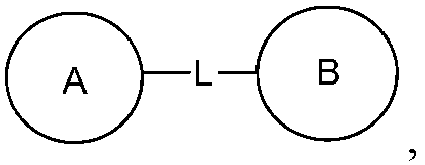
- the linking direction is arbitrary, for example, the linking group L is -M-W- in at this situation, -M-W- can connect ring A and ring B in the same direction as the reading order from left to right to form and can also connect ring A and ring B in the opposite direction as the reading order from left to right to form
- Combinations of the linking groups, substituents, and/or variants thereof are permissible only if such combinations result in stable compounds.
- any one or more sites of the group can be connected to other groups through chemical bonds.
- the connection mode of the chemical bond is not positioned, and there is an H atom at the connectable site, the number of H atoms at the site will decrease correspondingly with the number of chemical bonds connected to become a group with the corresponding valence when the chemical bond is connected.
- the chemical bonds between the sites and other groups can be represented by a straight solid bond ( ), a straight dotted bond (), or a wavy line
- the straight solid bond in -OCH 3 means that the group is connected to other groups through the oxygen atom in the group
- the straight dotted bond in means that the group is connected to other groups through the two ends of the nitrogen atom in the group
- the wavy line in means that the group is connected to other groups through the 1 and 2 carbon atoms in the phenyl group
- any connectable site on the piperidinyl can be connected to other groups through one chemical bond, including at least four connection modes: even if the H atom is drawn on -N-, still includes the group of the connection mode but the H at the site will decrease correspondingly by one and become the corresponding monovalent piperidinyl when one chemical bond is connected.
- the number of atoms in a ring is usually defined as the member number of the ring.
- “5- to 7-membered ring” means a “ring” with 5-7 atoms arranging in a circle.
- the compounds of the present disclosure can be prepared by various synthetic methods well known to a person skilled in the art, including the specific embodiments listed below, the embodiments formed by the combination with other chemical synthesis methods, and equivalent alternative embodiments well known to a person skilled in the art, wherein the preferred embodiments include but are not limited to the examples of the present disclosure.
- the structure of the compound of the present disclosure can be confirmed by conventional methods well known to a person skilled in the art. If the present disclosure relates to the absolute configuration of the compound, the absolute configuration can be confirmed by conventional technical means in the art.
- single-crystal X-ray diffraction uses a Bruker D8 venture diffractometer to collect the diffraction intensity data of the cultivated single crystal, with a light source of CuK ⁇ radiation, and a scanning mode of ⁇ / ⁇ scanning. After the related data is collected, a direct method (Shelxs97) is further used to resolve the crystal structure, so that the absolute configuration can be confirmed.
- the solvents used in the present disclosure are commercially available.
- H 2 SO 4 (50.00 mL) was added to a dry vial, then HNO 3 (2.84 mL, 65% concentration) was slowly added dropwise at 0 °C, and then compound 3-1 (5 g) was added slowly, and the reaction was stirred at 15 °C for 16 h.
- the reaction liquid was slowly poured into 100 mL of ice water, then the aqueous phase was extracted with methyl tert-butyl ether (20 mL ⁇ 2), and the organic phases were combined, dried over anhydrous sodium sulfate, filtered and concentrated.
- the crude product was homogenized with 50 mL of petroleum ether for 1 h and then filtered. The filter cake was collected, concentrated and dried to obtain compound 3-2.
- reaction liquid was poured into 20 mL of water, the aqueous phase was extracted with ethyl acetate (10 mL ⁇ 2), and the organic phases were combined, dried with anhydrous sodium sulfate, filtered and concentrated.
- the crude product was separated and purified by preparative HPLC (chromatographic column: Phenomenex Gemini-NX 80*40 mm*3 ⁇ m; mobile phase: [water (containing 10 mM NH 4 HCO 3 )-acetonitrile]; acetonitrile%: 35%-65%, 8 min) to obtain compound 3.
- reaction liquid was poured into 20 mL of water, the aqueous phase was extracted with ethyl acetate (10 mL ⁇ 2), and the organic phases were combined, dried with anhydrous sodium sulfate, filtered and concentrated.
- the crude product was separated and purified by preparative HPLC (chromatographic column: Phenomenex Gemini-NX 80*40 mm*3 ⁇ m; mobile phase: [water (10 mM NH 4 HCO 3 )-acetonitrile]; acetonitrile%: 25%-55%, 8 min) to obtain compound 4.
- the crude product was purified by preparative HPLC (column: Waters Xbridge BEH C18 100*30 mm*10 ⁇ m; mobile phase: [water (containing 10 mM NH 4 HCO 3 )-acetonitrile]; acetonitrile%: 25%-45%, 8 min)-acetonitrile]; acetonitrile%: 45%-75%, 10 min) to obtain compound 10.
- the change of intracellular calcium signal was detected by FLIPR, and the antagonism of the compounds on OX1R and OX2R receptors was evaluated by using IC 50 value of the compounds as an index.
- the compound of the present disclosure has a certain antagonistic activity on human orexin receptors, and exhibits higher activity on OX2 receptors.
- Plasma samples were collected at 0.083, 0.25, 0.5, 1.0, 2.0, 4.0, 6.0, 8.0, and 24 h after administration for the intravenous injection group and intragastric administration group, respectively. Quantitative analysis of all biological samples was carried out by LC-MS/MS method, and the WinNonlin TM Version 6.3 (Pharsight, Mountain View, CA) pharmacokinetic software was used to calculate the relevant pharmacokinetic parameters by the non-compartmental model linear logarithmic trapezoidal method.
- AUC 0-last represents area under the plasma concentration-time curve from time zero to the last detectable concentration time point; p.o. represents oral; i.v. represents intravenous injection; T 1/2 represents half-life; CL represents clearance rate; Vd represents apparent volume of distribution; C max represents peak concentration; T max represents time to peak; F% represents oral bioavailability.
- the experimental results are shown in Table 3.
- Table 3. Pharmacokinetic properties of the test compound PK parameter Compound 8 i.v. 2 mg/kg T 1/2 (h) 0.2 Vd ss (L/kg) 0.57 CL (mL/min/kg) 44 AUC 0-last (nM h) 1761 p.o. 10 mg/kg T max (h) 0.25 C max (nM) 1032 AUC 0-last (nM h) 1451 F% 17%
- the compound of the present disclosure exhibits good pharmacokinetic properties in SD rats.
- the compound of the present disclosure can penetrate the blood-brain barrier and enter the brain tissue in rats.
- the brain tissue homogenate of SD rats (that is, matrix, purchased from BioIVT) was taken, and the DMSO working solution of the test compound or the DMSO working solution of a control (propranolol) was added, so that the final concentrations of the test compound and propranolol in the plasma samples were both 2 ⁇ M, and the samples were fully mixed.
- the final concentration of DMSO was controlled to be 0.5%; 50 ⁇ L was pipetted into a sample receiving plate, and a corresponding volume of corresponding blank matrix/buffer was immediately added so that the final volume of each sample well was 100 ⁇ L, and the volume ratio of matrix: dialysis buffer was 1 : 1, and then a stop solution was added to these samples.
- This sample would be used as a T 0 sample for recovery rate and stability determination.
- the test compound sample and propranolol sample were added to the administration end of each dialysis well, and blank dialysis buffer was added to the corresponding receiving end of the dialysis well. Then the plate was placed in a humidified 5% CO 2 incubator and incubated for 4 h at 37 °C with shaking at 100 rpm. After dialysis, 50 ⁇ L of the dialyzed buffer sample and the dialyzed brain tissue homogenate sample was pipetted to a new sample receiving plate, respectively.
- Fc is the concentration of the compound at the buffer end of the dialysis plate
- T C is the concentration of the compound at the matrix end of the dialysis plate
- T 0 is the concentration of the compound in the plasma sample at time zero.
- Table 5 Test results of binding rate in SD rat brain tissue Compound No. SD rat brain tissue_Unbound (%) Compound 8 21.8%
- the compound of the present disclosure has a higher proportion of unbound drugs in the SD rat brain tissue.
- Plasma samples were collected at 0.033, 0.083, 0.25, 0.5, 1.0, 2.0, 4.0, 6.0, 8.0, and 24 h after administration for the intravenous injection group and intragastric administration group, respectively.
- AUC 0-last represents area under the plasma concentration-time curve from time zero to the last detectable concentration time point; p.o. represents oral; i.v. represents intravenous injection; T 1/2 represents half-life; CL represents clearance rate; Vd represents apparent volume of distribution; C max represents peak concentration; T max represents time to peak; F% represents oral bioavailability.
- the experimental results are shown in Table 6. Table 6. Pharmacokinetic properties of test compound PK parameter Compound 8 i.v.
- the compound of the present disclosure exhibits good pharmacokinetic properties in Beagle dogs.
- AUC 0-last represents area under the plasma concentration-time curve from time zero to the last detectable concentration time point; p.o. represents oral; i.v.
- the compound of the present disclosure can be detected in dog CSF, indicating that the compound can pass through the blood-brain barrier and reach the brain.
- Test purpose to judge the effect of the test compound on the activity of rats by measuring the spontaneous activity distance of rats in a period of time.
- Test scheme 12 male SD rats aged 7 weeks were adapted in the laboratory 1 day before the start of the test. On the day of the experiment, the rats were randomly divided into 2 groups according to their body weight, with 6 rats in each group, and the rats were given blank vehicle and compound 8 (30 mg/kg), respectively. The animals were put into a test box 30 minutes after administration, and the distance data of animal activity were recorded every 5 min with Any-maze software, and the recording was continued for 60 min. By comparing the total distance of animal activity within the recording time, it is judged whether the drug has a significant effect on the spontaneous activity of the animal. The experimental data were represented by the mean ⁇ standard deviation (Mean ⁇ SEM). The statistical method adopted one-way analysis of variance plus Dunnett's multiple comparisons.
- the compound of the present disclosure can significantly reduce the spontaneous activity distance of SD rats.
- Test purpose to evaluate the effect of test substance on sleep in SD rats by electroencephalogram/electromyography telemetry (EEG).
- Test scheme 36 male SD rats aged 5-6 weeks needed an adaptation period of 5-15 days after arriving at the facility, during which the experimental animals were placed in an alternating light and dark environment for 12 h for adaptation (light on: 19:00; light off: 07:00) to adjust the rhythm time, and the health of the animals was monitored every day. Animals needed to be surgically implanted with electroencephalogram electrode and electromyography electrode for later telemetry data collection. On the day of the operation experiment, the animals were anesthetized with Zoletil (i.p., 20 mg/kg) combined with xylazine (i.p., 8 mg/kg). After anesthesia, the animals were fixed by brain stereotaxic apparatus.
- the skin of the head was cut, and the four corners were clamped with hemostats to fully expose the skull.
- the periosteum was peeled off and wiped with dry absorbent cotton until the surface was clean.
- a hole was drilled according to the type of implanter, and an electrode was implanted and in contact with the dura mater.
- the electrode was fixed on the skull with dental cement. At the same time, the cement dripping on the tissue and skin was cleaned up.
- the 2 electromyography electrodes were respectively inserted into the neck muscles in parallel, and the two ends were fixed with sutures to prevent their ends from touching each other.
- the implanter was then placed under the skin, and the surgical wound was sutured and sterilized.
- the rats were carefully placed in a clean recovery cage, lying on their sides to ensure a smooth airway.
- the rats were raised in a single cage and placed in a shielded recovery room, in which the light and dark automatically alternated for 12 h (light on: 19:00, light off: 07:00), the temperature was 20-26 °C, and the relative humidity was 40-70%.
- the animals were given nursing care for 3 days.
- the surgical incision was treated with cephradine powder locally, gentamicin at 4-8 mg/kg was subcutaneously administered, and meloxicam at 0.1 mL/rat was injected subcutaneously for 3 consecutive days.
- the experiment was carried out after 7-10 days of recovery and the animals were randomly divided into groups according to their weight the day before the experiment.
- Rat EEG test data Group Sleep latency (min) Total awake time within 7 h after administration (min) NREM sleep time within 7 h after administration (min) Blank vehicle group 32 ⁇ 3.1 303 ⁇ 20 102 ⁇ 18 Compound 8 at 5 mg/kg 27 ⁇ 8.1 274 ⁇ 19 129 ⁇ 17 Compound 8 at 10 mg/kg 15 ⁇ 2.9** 250 ⁇ 21 144 ⁇ 16 Compound 8 at 30 mg/kg 7 ⁇ 1.3*** 228 ⁇ 12* 171 ⁇ 11**
- the compound of the present disclosure at 10 mg/kg and 30 mg/kg can significantly shorten the sleep latency of SD rats, and the compound of the present disclosure at 30 mg/kg can significantly reduce the awake time and increase the sleep time within 7 h after administration. Therefore, the compound of the present disclosure has good sleep-promoting drug effect.
Landscapes
- Health & Medical Sciences (AREA)
- Chemical & Material Sciences (AREA)
- Organic Chemistry (AREA)
- Medicinal Chemistry (AREA)
- Pharmacology & Pharmacy (AREA)
- Life Sciences & Earth Sciences (AREA)
- Animal Behavior & Ethology (AREA)
- General Health & Medical Sciences (AREA)
- Public Health (AREA)
- Veterinary Medicine (AREA)
- Epidemiology (AREA)
- Bioinformatics & Cheminformatics (AREA)
- Nuclear Medicine, Radiotherapy & Molecular Imaging (AREA)
- Biomedical Technology (AREA)
- Neurology (AREA)
- Neurosurgery (AREA)
- Chemical Kinetics & Catalysis (AREA)
- General Chemical & Material Sciences (AREA)
- Engineering & Computer Science (AREA)
- Anesthesiology (AREA)
- Pain & Pain Management (AREA)
- Psychiatry (AREA)
- Pharmaceuticals Containing Other Organic And Inorganic Compounds (AREA)
- Nitrogen Condensed Heterocyclic Rings (AREA)
- Nitrogen And Oxygen Or Sulfur-Condensed Heterocyclic Ring Systems (AREA)
- Plural Heterocyclic Compounds (AREA)
Abstract
Description
- The present application claims the right of priorities of
-
CN 2021101461359 with application date of February 2, 2021 -
CN 2021106175620 with application date of June 2, 2021 -
CN 2021109065355 with application date of August 11, 2021 -
CN 2021116252159 with application date of December 27, 2021 - The present disclosure relates to a class of tetrahydropyrrolocyclic compounds, in particular to compounds represented by formula (I) and pharmaceutically acceptable salts thereof.
- Orexin (Hypocretin) signaling is mediated by two receptors and two peptide agonists. Specifically, orexin A and orexin B bind to two high affinity receptors, called the orexin-1 receptor (OX-1 receptor) and the orexin-2 receptor (OX-2 receptor). The OX-1 receptor binds to orexin A with a higher affinity, while the OX-2 receptor binds to orexin A and orexin B with similar affinity. Orexin-secreting neurons are mainly distributed in the prefrontal nucleus, dorsal hypothalamus and lateral hypothalamus (C. Peyron et al., J. Neurosci., 1998, 18(23), 9996-10015). The secreted orexin affects many areas of the brain and is involved in many behavioral and physiological functions, including: eating, drinking, reproduction, arousal system, stress system, reward system, etc. (T. Sakurai, Nature Reviews Neuroscience, 2007, 8(3), 171 - 181). Among them, the orexin system has a significant regulatory effect on the sleep-wake process, and the awake time of rodents administered with orexin intraperitoneally is prolonged (Piper et al., J. Neurosci. 2000, 12, 726-730). On the other hand, mutant or non-functional orexin-2 receptors would cause narcolepsy in dogs (Lin et al., Cell, 1999, 98, 365-376) and the orexin signal in cerebrospinal fluid of individual with narcolepsy is found deficient (Nishino et al., Lancet 2000, 355, 39-40). All this shows that the orexin system promotes wakefulness of humans, while the inhibition of the orexin system facilitates sleep. Therefore, orexin receptor antagonists are useful in the treatment of the following diseases: insomnia, depression, anxiety, drug addiction, mental disorders, dementia, schizophrenia, Parkinson's disease, Alzheimer's disease, insulin resistance, type II diabetes, hyperlipidemia, gallstones, angina, high blood pressure, dyspnea, tachycardia, infertility, sleep apnea, back and joint pain, varicose veins, osteoarthritis, etc.
- The present disclosure provides a compound represented by the following formula or a pharmaceutically acceptable salt thereof, which is selected from:

- each R1 is independently selected from halogen, cyano, C1-3alkyl and C1-3alkoxy, and the C1-3alkyl and C1-3alkoxy are each independently and optionally substituted by 1, 2 or 3 halogen atoms;
- each R2 is independently selected from halogen, cyano, C1-3alkyl and C1-3alkoxy, and the C1-3alkyl and C1-3alkoxy are each independently and optionally substituted by 1, 2 or 3 halogen atoms;
- R3 is selected from H, C1-3alkyl and C3-6cycloalkyl;
- m and n are each independently selected from 0, 1, 2 and 3;
- ring A is selected from

- ring B is selected from

- In some embodiments of the present disclosure, each R1 described above is independently selected from halogen, cyano, methyl and methoxy, and the methyl and methoxy are independently and optionally substituted by 1, 2 or 3 F, and other variables are as defined in the present disclosure.
- In some embodiments of the present disclosure, each R1 described above is independently selected from F, Cl, methyl and methoxy, and other variables are as defined in the present disclosure.
- In some embodiments of the present disclosure, each R2 described above is independently selected from halogen, cyano, methyl and methoxy, and the methyl and methoxy are each independently and optionally substituted by 1, 2 or 3 F, and other variables are as defined in the present disclosure.
- In some embodiments of the present disclosure, each R2 described above is independently selected from F, Cl, methyl and methoxy, and other variables are as defined in the present disclosure.
- In some embodiments of the present disclosure, R3 described above is selected from H, methyl and cyclopropyl, and other variables are as defined in the present disclosure.
- In some embodiments of the present disclosure, the compounds described above are selected from the structures represented by formulas (I-1), (I-2) and (I-3):

- There are still some embodiments of the present disclosure derived from any combination of the above-mentioned variables.
- The present disclosure further provides the following compound or a pharmaceutically acceptable salt thereof, wherein the compound is selected from:


- In some embodiments of the present disclosure, for the compound or the pharmaceutically acceptable salt thereof described above, wherein the compound is selected from:


- The present disclosure further provides an application of the compound or the pharmaceutically acceptable salt thereof described above in the manufacture of a medicament for treating a disease related to a selective orexin-2 receptor antagonist.
- In some embodiments of the present disclosure, the disease related to a selective orexin-2 receptor antagonist is selected from insomnia and/or depression.
- The present disclosure further provides following test method:
- 4 healthy SD rats aged 6-9 weeks were selected and randomly divided into two groups, with 2 rats in each group. One group was given the test compound at 2 mg/kg by intravenous injection, and the other group was given the test compound at 10 mg/kg by intragastric administration. Plasma samples were collected at 0.083, 0.25, 0.5, 1.0, 2.0, 4.0, 6.0, 8.0, and 24 h after administration for the intravenous injection group and intragastric administration group, respectively. Quantitative analysis of all biological samples was carried out by LC-MS/MS method, and the WinNonlin™ Version 6.3 (Pharsight, Mountain View, CA) pharmacokinetic software was used to calculate the relevant pharmacokinetic parameters by the non-compartmental model linear logarithmic trapezoidal method. AUC0-last represents area under the plasma concentration-time curve from time zero to the last detectable concentration time point; p.o. represents oral; i.v. represents intravenous injection; T1/2 represents half-life; CL represents clearance rate; Vd represents apparent volume of distribution; Cmax represents peak concentration; Tmax represents time to peak; F% represents oral bioavailability.
- 4 healthy SD rats aged 6-9 weeks were selected, and the other group was given the test compound at 10 mg/kg by intragastric administration. 2 animals were randomly selected at 0.5 h and 2 h after administration, respectively. Plasma and brain tissue samples were collected, and LC-MS/MS method was used for quantitative analysis of all biological samples.
- As an OX-2 receptor antagonist, the compound of the present disclosure has a selective antagonistic effect on the OX-2 receptor, exhibits good activity in in vitro tests, and can be used to develop a drug for the treatment of a mental disease related to Orexin signaling pathways such as insomnia and depression. The compound of the present disclosure exhibits good pharmacokinetic properties in rats, can penetrate the blood-brain barrier into the brain tissue in rats, and reach a high drug concentration.
- Unless otherwise stated, the following terms and phrases used herein are intended to have the following meanings. A specific term or phrase should not be considered uncertain or unclear unless specifically defined, but should be understood in its ordinary meaning. When a trade name appears herein, it is intended to refer to the corresponding commodity or an active ingredient thereof.
- The term "pharmaceutically acceptable" as used herein refers to those compounds, materials, compositions and/or dosage forms, which are, within the scope of sound medical judgment, suitable for use in contact with human and animal tissues, without excessive toxicity, irritation, allergic reactions or other problems or complications, which is commensurate with a reasonable benefit/risk ratio.
- The term "pharmaceutically acceptable salt" refers to a salt of the compound of the present disclosure, which is prepared from the compound having specific substituents found in the present disclosure with relatively non-toxic acids or bases. When compounds of the present disclosure contain relatively acidic functional groups, base addition salts can be obtained by contacting such compounds with a sufficient amount of base, either in pure solution or a suitable inert solvent. Pharmaceutically acceptable base addition salts include sodium, potassium, calcium, ammonium, organic amine or magnesium salts or similar salts. When compounds of the present disclosure contain relatively basic functional groups, acid addition salts can be obtained by contacting such compounds with a sufficient amount of acid, either in pure solution or a suitable inert solvent. Examples of pharmaceutically acceptable acid addition salts include salts of inorganic acids, which include, for example, hydrochloric acid, hydrobromic acid, nitric acid, carbonic acid, bicarbonate, phosphoric acid, monohydrogen phosphate, dihydrogen phosphate, sulfuric acid, hydrogen sulfate, hydroiodic acid and phosphorous acid; and salts of organic acids, which include, for example, acetic acid, propionic acid, isobutyric acid, maleic acid, malonic acid, benzoic acid, succinic acid, suberic acid, fumaric acid, lactic acid, mandelic acid, phthalic acid, benzenesulfonic acid, p-toluenesulfonic acid, citric acid, tartaric acid, and methanesulfonic acid; and also include salts of amino acids (such as arginine), and salts of organic acids such as glucuronic acid. Certain specific compounds of the present disclosure contain basic and acidic functional groups and thus can be converted to any base or acid addition salt.
- The pharmaceutically acceptable salts of the present disclosure can be synthesized from a parent compound containing acid radicals or base radicals by conventional chemical methods. In general, the method for preparing such salts comprises: in water or an organic solvent or a mixture of both, reacting these compounds in free acid or base forms with a stoichiometric amount of a suitable base or acid to prepare the salts.
- Unless otherwise specified, the term "C1-3 alkyl" is used to represent a linear or branched saturated hydrocarbon group consisting of 1 to 3 carbon atoms. The C1-3 alkyl includes C1-2 alkyl, C2-3 alkyl, etc.; and it can be monovalent (such as methyl), divalent (such as methylene) or multivalent (such as methine). Examples of C1-3 alkyl include, but are not limited to, methyl (Me), ethyl (Et), propyl (including n-propyl and isopropyl), etc.
- Unless otherwise specified, the term "C1-3 alkoxy" means those alkyl groups comprising 1 to 3 carbon atoms that are connected to the rest of the molecule through one oxygen atom. The C1-3 alkoxy includes C1-2 alkoxy, C2-3 alkoxy, C3 alkoxy, C2 alkoxy, etc. Examples of C1-3 alkoxy include but are not limited to methoxy, ethoxy, propoxy (including n-propoxy and isopropoxy), etc.
- Unless otherwise specified, "C3-6 cycloalkyl" means a saturated cyclic hydrocarbon group consisting of 3 to 6 carbon atoms, which comprises a monocyclic and bicyclic ring system, and the C3-6 cycloalkyl includes C3-5, C4-5, and C5-6 cycloalkyl; and it can be monovalent, bivalent or multivalent. Examples of C3-6 cycloalkyl include, but are not limited to, cyclopropyl, cyclobutyl, cyclopentyl, cyclohexyl, etc.
- Unless otherwise specified, the term "halo" or "halogen" by itself or as part of another substituent means a fluorine, chlorine, bromine or iodine atom.
- Unless otherwise stated, the term "isomer" is intended to include geometric isomers, cis-trans isomers, stereoisomers, enantiomers, optical isomers, diastereomers and tautomers.
- The compounds of the present disclosure may exist in specific geometric or stereoisomeric forms. The present disclosure contemplates all such compounds, including cis and trans isomers, (-)- and (+)-enantiomers, (R)- and (S)-enantiomers, diastereomers, (D)-isomers, (Z)-isomers, and racemic mixtures and other mixtures thereof, such as enantiomerically or diastereomerically enriched mixtures, all of which fall within the scope of the present disclosure. Additional asymmetric carbon atoms may be present in a substituent such as an alkyl group. All these isomers and mixtures thereof are included in the scope of the present disclosure.
- Unless otherwise stated, the term "enantiomer" or "optical isomer" refers to stereoisomers that are mirror images of each other.
- Unless otherwise stated, the term "cis-trans isomer" or "geometric isomer" is caused by the fact that double bonds or single bonds of ring-forming carbon atoms cannot rotate freely.
- Unless otherwise stated, the term "diastereomer" refers to stereoisomers in which molecules have two or more chiral centers and are not mirror images of each other.
- Unless otherwise stated, "(+)" represents right-handed, "(-)" represents left-handed, and "(±)" means racemic.
- Unless otherwise stated, the wedge-shaped solid bond () and the wedge-shaped dotted bond (
 ) represent the absolute configuration of a stereoscopic center; the straight solid bond (
 ) and the straight dotted bond (
 ) represent the relative configuration of a stereoscopic center; the wavy line (
 ) represents the wedge-shaped solid bond (
 ) or the wedge-shaped dotted bond (); or the wavy line () represents the straight solid bond () or the straight dotted bond ().
 - Unless otherwise stated, the term "rich in one isomer", "isomer enriched", "rich in one enantiomer" or "enantiomerically enriched" refers to the content of one of the isomers or enantiomers is less than 100%, and the content of the isomer or enantiomer is greater than or equal to 60%, or greater than or equal to 70%, or greater than or equal to 80%, or greater than or equal to 90%, or greater than or equal to 95%, or greater than or equal to 96%, or greater than or equal to 97%, or greater than or equal to 98%, or greater than or equal to 99%, or greater than or equal to 99.5%, or greater than or equal to 99.6%, or greater than or equal to 99.7%, or greater than or equal to 99.8%, or greater than or equal to 99.9%.
- Unless otherwise stated, the term "isomer excess" or "enantiomeric excess" refers to the difference between the relative percentages of two isomers or two enantiomers. For example, if the content of one isomer or enantiomer is 90%, and the content of the other isomer or enantiomer is 10%, the isomer or enantiomeric excess (ee value) is 80%.
- Optically active (R)- and (S)-isomers and D and L isomers can be prepared using chiral synthesis or chiral reagents or other conventional techniques. If a particular enantiomer of a compound of the present disclosure is desired, it can be prepared by asymmetric synthesis or derivatization with a chiral auxiliary, wherein the resulting diastereomeric mixture is separated and the auxiliary groups are cleaved to provide pure desired enantiomers. Alternatively, where the molecule contains a basic functional group (such as an amino group) or an acidic functional group (such as a carboxyl group), diastereomeric salts can be formed with an appropriate optically active acid or base, followed by resolution of the diastereomers using conventional methods well known in the art, and subsequent recovery of the pure enantiomers. In addition, separation of enantiomers and diastereomers is frequently accomplished using chromatography, which uses chiral stationary phases, optionally in combination with chemical derivatization methods (e.g., formation of carbamates from amines).
- The compounds of the present disclosure may contain unnatural proportions of atomic isotopes at one or more of the atoms constituting the compound. For example, the compounds may be radiolabeled with radioactive isotopes, such as tritium (3H), iodine-125 (125 I) or C-14 (14C). For another example, the hydrogen can be substituted by heavy hydrogen to form deuterated drugs. The bond formed by deuterium and carbon is stronger than the bond formed by ordinary hydrogen and carbon. Compared with undeuterated drugs, deuterated drugs have reduced toxic side effects, increased drug stability, enhanced efficacy, prolonged biological half-life of drugs and other advantages. All isotopic variations of the compounds of the present disclosure, whether radioactive or not, are intended to be encompassed within the scope of the present disclosure.
- The term "optional" or "optionally" means that the subsequently described event or circumstance may, but not necessarily occur, and that the description includes instances where said event or circumstance occurs and instances where said event or circumstance does not occur.
- The term "substituted" means that any one or more hydrogen atoms on the designated atom are substituted by a substituent, which may include heavy hydrogen and hydrogen variants, provided that the valence state of the designated atom is normal, and the substituted compound is stable. Where the substituent is oxygen (i.e., =O), it means that two hydrogen atoms are substituted. Oxygen substitution does not occur on aromatic groups.
- The term "optionally substituted" means that it may or may not be substituted. Unless otherwise specified, the type and number of substituents may be arbitrary on the basis that they can be achieved in chemistry.
- Where any variable (such as R) appears more than once in the composition or structure of a compound, its definition in each case is independent. Thus, for example, if a group is substituted with 0-2 R, the group can optionally be substituted with up to two R, and R in each case has independent options. In addition, combinations of substituents and/or variants thereof are permissible only if such combinations result in stable compounds.
- When the number of a linking group is 0, such as -(CRR)0-, it means that the linking group is a single bond.
- When the number of a substituent is 0, it means that the substituent does not exist. For example, -A-(R)0 means that the structure is actually -A.
- When a substituent is vacant, it means that the substituent does not exist. For example, when X is vacant in A-X, it means that the structure is actually A.
- When one of the variables is selected from a single bond, it means that the two groups to which it is connected are directly connected. For example, when L represents a single bond in A-L-Z, it means that the structure is actually A-Z.
- When the bond of a substituent can be cross-connected to more than two atoms on a ring, the substituent can be bonded to any atom on the ring, for example, the structural unit

- When the linking group listed does not indicate the linking direction thereof, the linking direction is arbitrary, for example, the linking group L is -M-W- in


- Unless otherwise specified, when a group has one or more connectable sites, any one or more sites of the group can be connected to other groups through chemical bonds. When the connection mode of the chemical bond is not positioned, and there is an H atom at the connectable site, the number of H atoms at the site will decrease correspondingly with the number of chemical bonds connected to become a group with the corresponding valence when the chemical bond is connected. The chemical bonds between the sites and other groups can be represented by a straight solid bond (), a straight dotted bond (), or a wavy line


- Unless otherwise specified, the number of atoms in a ring is usually defined as the member number of the ring. For example, "5- to 7-membered ring" means a "ring" with 5-7 atoms arranging in a circle.
- The compounds of the present disclosure can be prepared by various synthetic methods well known to a person skilled in the art, including the specific embodiments listed below, the embodiments formed by the combination with other chemical synthesis methods, and equivalent alternative embodiments well known to a person skilled in the art, wherein the preferred embodiments include but are not limited to the examples of the present disclosure.
- The structure of the compound of the present disclosure can be confirmed by conventional methods well known to a person skilled in the art. If the present disclosure relates to the absolute configuration of the compound, the absolute configuration can be confirmed by conventional technical means in the art. For example, single-crystal X-ray diffraction (SXRD) uses a Bruker D8 venture diffractometer to collect the diffraction intensity data of the cultivated single crystal, with a light source of CuKα radiation, and a scanning mode of ϕ/ω scanning. After the related data is collected, a direct method (Shelxs97) is further used to resolve the crystal structure, so that the absolute configuration can be confirmed.
- The present disclosure uses the following abbreviations: H2O represents water; eq represents equivalent; PE represents petroleum ether; EtOAc represents ethyl acetate; EtOH represents ethanol; MeOH represents methanol; HOAc represents acetic acid; HCl represents hydrochloric acid; HPLC represents high performance liquid chromatography; H2SO4 represents sulfuric acid; HCl/EtOAc represents a solution hydrochloric acid in ethyl acetate; HATU represents O-(7-azabenzotriazol-1-yl)-N,N,N',N'-tetramethylurea hexafluorophosphate; TFA represents trifluoroacetic acid; TEA represents triethylamine; DIEA or DIPEA represents N,N-diisopropylethylamine; mp represents melting point; °C represents celsius degree; h represents hour; mL represents milliliter; mM represents millimole per liter; mmol represents millimole; µmol represents micromole; HNMR represents hydrogen nuclear magnetic resonance spectrum; MS represents mass spectrum; min represents minute; pH represents the negative logarithm of the hydrogen ion molar concentration; SFC represents supercritical liquid chromatography.
- The solvents used in the present disclosure are commercially available.
- Compounds are named by hand or using ChemDraw® software, and commercially available compounds are named by the supplier catalog names.
- The present disclosure will be described in detail with the following examples, but not imply any adverse limitation to the present disclosure. The present disclosure has been described in detail herein, and the specific embodiments thereof are also disclosed therein. For a person skilled in the art, without departing from the spirit and scope of the present disclosure, all the variations and improvements made to the specific embodiments of the present disclosure would have been obvious.
-

-

- Compound 1-1 (233 mg), 4-methoxy-o-phenylenediamine (169.99 mg), HATU (584.76 mg), DIPEA (267.88 µL) and solvent DMF (3 mL) were added to a pre-dried flask, and stirred for 15 h at 25 °C under nitrogen protection. After the reaction was completed, the reaction was quenched by adding water (40 mL), and extracted with ethyl acetate (20 mL × 2), and the organic phases were combined, dried over anhydrous sodium sulfate, filtered, and concentrated under reduced pressure to obtain a crude product, which was purified by a flash silica gel column (petroleum ether:ethyl acetate = 60 : 40) to obtain compound 1-2. 1H NMR (400 MHz, CDCl3) δ ppm 6.93 - 7.20 (m, 1 H), 6.31 (br d, J=12.30 Hz, 2 H), 4.43 (s, 1 H), 3.80 - 4.01 (m, 2 H), 3.75 (s, 3 H), 3.37 - 3.72 (m, 2 H), 1.92 (br s, 1 H), 1.62 (br s, 1 H), 1.46 (s, 9 H), 0.82 (br d, J=6.02 Hz, 1 H), 0.23 (q, J=4.27 Hz, 1 H).
- Compound 1-2 (100 mg) and glacial acetic acid (5 mL) were added to a pre-dried flask, and stirred at 100 °C for 5 h. After the reaction was complete, the reaction was quenched by adding water (20 mL), and extracted with ethyl acetate (20 mL) and saturated NaHCOs (30 mL × 3), and the organic phases were combined, dried over anhydrous sodium sulfate, filtered, and concentrated under reduced pressure to obtain crude product compound 1-3, which was directly used in the next step without purification. LCMS m/z = 330.0[M+H]+
- Compound 1-3 (90 mg) and solvent DCM (2 mL) were added to a pre-dried flask, then TFA (2 mL) was added, and stirred for 1 h at 25 °C under nitrogen protection. After the reaction was completed, the reaction liquid was concentrated to dryness to obtain the crude trifluoroacetate of compound 1-4, which was directly used in the next step without purification. LCMS m/z = 230.0[M+H]+
- The trifluoroacetate of compound 1-4 (60 mg), 2-(2H-1,2,3-triazol-2-yl)benzoic acid (64.36 mg), HATU (149.25 mg), DIPEA (68.37 µL) and solvent DMF (3 mL) were added to a pre-dried flask and stirred at 25 °C for 15 h. After the reaction was completed, the reaction liquid was diluted with ethyl acetate (10 mL) and extracted with water (20 mL × 2). The organic phases were combined, dried over anhydrous sodium sulfate, filtered, and concentrated under reduced pressure to obtain a crude product, which was subjected to Pre-HPLC (column type: Phenomenex Gemini-NX 80*30 mm*3 µm; mobile phase: [H2O(10 mM NH4HCO3)-ACN]; ACN%: 30%-60%, 9 min) for separation to obtain compound 1. 1H NMR (400 MHz, DMSO-d 6) δ ppm 12.08 (br s, 1 H), 8.24 - 8.00 (m, 1 H), 7.99 - 7.70 (m, 2 H), 7.68 - 7.25 (m, 4 H), 7.21 - 6.99 (m, 1 H), 6.94 - 6.72 (m, 1 H), 5.35 (s, 0.63H), 4.65 (s, 0.37H), 3.97 - 3.60 (m, 5H), 1.95 - 1.52 (m, 2 H), 0.91 - 0.43 (m, 2 H). LCMS m/z = 401.2[M+H]+
-

-

- Compound 2-1 (500 mg), HATU (1.25 g) and DMF (10 mL) were added to a pre-dried flask, then 4-methoxy-o-phenylenediamine (364.79 mg) and DIPEA (1.15 mL) were added and stirred at 15 °C for 15 h. After the reaction was completed, the reaction liquid was diluted with ethyl acetate (80 mL), washed with water (100 mL) and brine (100 mL × 2). The organic phase was dried over anhydrous sodium sulfate, filtered, and concentrated under reduced pressure to obtain a crude product, which was purified by a flash silica gel column (petroleum ether : ethyl acetate = 30 : 70) to obtain compound 2-2. 1H NMR (400 MHz, DMSO-d6 ) δ 9.03 (br s, 1H), 6.73-7.06 (m, 1H), 6.04-6.34 (m, 2H), 4.68-5.01 (m, 2H), 3.96 (br s, 1H), 3.65 (s, 3H), 3.37 (br s, 1H), 2.22-2.39 (m, 1H), 2.06-2.20 (m, 1H), 1.59 (br s, 1H), 1.29-1.47 (m, 9H), 0.72 (td, J=5.55, 8.47 Hz, 1H), 0.42 (br s, 1H).
- Compound 2-2 (500 mg) and glacial acetic acid (10 mL) were added to a pre-dried flask, and stirred at 100 °C for 1.5 h. After completion of the reaction, the reaction liquid was directly concentrated under reduced pressure to obtain a crude product. Saturated sodium bicarbonate (80 mL) was added to the crude product and extracted with DCM/MeOH (80 mL × 2, 10/1), and the organic phases were combined, dried over anhydrous sodium sulfate, filtered, and concentrated under reduced pressure to obtain a crude product. The crude product was purified with a flash silica gel column (petroleum ether : ethyl acetate = 50 : 50) to obtain compound 2-3, 1H NMR (400 MHz, CDCl3) δ 10.41 (br s, 1H), 6.85-7.74 (m, 3H), 4.99 (br s, 1H), 3.84 (s, 3H), 3.24 (br s, 2H), 2.40 (br t, J=10.92 Hz, 1H), 1.81 (br s, 1H), 1.50 (br s, 9H), 0.91 (td, J=5.62, 8.60 Hz, 1H), 0.50 (br s, 1H).
- Compound 2-3 (300 mg) and solvent ethyl acetate (8 mL) were added to a pre-dried flask, then HCl/EtOAc (4 M, 8 mL) was added, and stirred at 15 °C for 15 h. After the reaction was completed, the reaction liquid was directly concentrated and spin-dried to obtain the hydrochloride of compound 2-4. 1H NMR (400 MHz, DMSO-d 6) δ 10.71 (br s, 1H), 7.64 (d, J=9.03 Hz, 1H), 7.19 (d, J=2.26 Hz, 1H), 7.03 (dd, J=2.38, 8.91 Hz, 1H), 4.79-4.93 (m, 1H), 3.83 (s, 3H), 3.37-3.49 (m, 1H), 2.53-2.67 (m, 2H), 1.95 (br dd, J=4.27, 8.53 Hz, 1H), 1.09-1.20 (m, 1H), 0.80-0.92 (m, 1H).
- 2-(2H-1,2,3-triazol-2-yl)benzoic acid (128.14 mg), HATU (372.02 mg) and dichloromethane (10 mL) were added to a pre-dried flask, and then the hydrochloride of compound 2-4 (200 mg) and DIEA (393.27 µL) were added, and stirred for 15 h at 15 °C. After the reaction was complete, the reaction liquid was diluted with dichloromethane (80 mL), and washed with water (80 mL) and brine (80 mL × 2). The organic phase was dried over anhydrous sodium sulfate, filtered, and concentrated under reduced pressure to obtain a crude product. The crude product was purified by a flash silica gel column (petroleum ether : ethyl acetate = 30 : 70) to obtain compound 2. 1H NMR (400 MHz, CDCl3) δ 8.06 (d, J=8.28 Hz, 1H), 7.53-7.64 (m, 4H), 7.44-7.51 (m, 2H), 7.05 (d, J=2.01 Hz, 1H), 6.94 (dd, J=2.26, 9.03 Hz, 1H), 5.58 (br d, J=5.77 Hz, 1H), 3.81 (s, 3H), 2.97-3.09 (m, 2H), 2.44 (dd, J=9.66, 13.18 Hz, 1H), 1.89-2.00 (m, 1H), 0.73 (br s, 1H), 0.53 (br s, 1H). LCMS m/z = 401.1[M+H]+
-

-

- H2SO4 (50.00 mL) was added to a dry vial, then HNO3 (2.84 mL, 65% concentration) was slowly added dropwise at 0 °C, and then compound 3-1 (5 g) was added slowly, and the reaction was stirred at 15 °C for 16 h. The reaction liquid was slowly poured into 100 mL of ice water, then the aqueous phase was extracted with methyl tert-butyl ether (20 mL × 2), and the organic phases were combined, dried over anhydrous sodium sulfate, filtered and concentrated. The crude product was homogenized with 50 mL of petroleum ether for 1 h and then filtered. The filter cake was collected, concentrated and dried to obtain compound 3-2. 1H NMR (400 MHz, CDCl3) δ: 8.06 (d, J=8.8Hz, 1 H), 7.70 (d, J=8.8Hz, 1 H), 2.43 (s, 3 H). MS m/z : 239[M+23]+.
- Compound 3-2 (4.6 g) was dissolved in EtOH (100 mL) and H2O (50 mL) in a one-necked flask, Fe powder (11.86 g) and NH4Cl (22.72 g) were added, and the reaction was stirred at 75 °C for 16 h. The reaction liquid was diluted by adding 200 mL of ethanol and then filtered, the filter cake was washed with ethanol (200 mL × 2). The filtrate was concentrated, and then dissolved by adding 500 mL of ethyl acetate, homogenated for 30 minutes and filtered, and the filtrate was concentrated. The crude product was separated and purified by column chromatography (PE : EtOAc = 10 : 1 to 1 : 1) to obtain compound 3-3. 1H NMR (400 MHz, CDCl3) δ: 6.74 (d, J=8.4Hz, 1 H), 6.55 (d, J=8.4Hz, 1 H), 3.41 (br s, 4H), 2.26 (s, 3 H). MS m/z : 157[M+H]+.
- Compound 3-3 (227.42 mg) and compound 1-1 (300 mg) were dissolved in DMF (10 mL) in a dry vial, and DIEA (511.83 mg) and a solution of tri-n-propylcyclophosphoric anhydride in ethyl acetate (785.10 µL, 50% content) were added under nitrogen protection at 0 °C, and then the reaction was stirred at 15 °C for 16 h. The reaction liquid was poured into 50 mL of water, the aqueous phase was extracted with ethyl acetate (20 mL × 3), the organic phases were combined and washed with water (20 mL × 2), dried over anhydrous sodium sulfate, filtered and concentrated. The crude product was separated and purified by column chromatography (PE : EtOAc = 10 : 1 to 1 : 1) to obtain compound 3-4. MS m/z : 310[M+H-56]+.
- Compound 3-4 (450 mg) was dissolved in DMF (8 mL) in a dry vial and AcOH (703.44 µL) was added, and the reaction was stirred at 130 °C for 2 h. The reaction liquid was poured into 50 mL of water, the aqueous phase was extracted with ethyl acetate (20 mL × 3), the organic phases were combined and washed with water (20 mL × 2), dried over anhydrous sodium sulfate, filtered and concentrated. The crude product was separated and purified by column chromatography (PE : EtOAc = 10 : 1 to 1 : 1) to obtain compound 3-5, MS m/z : 348[M+H]+.
- Compound 3-5 (310 mg) was dissolved in EtOAc (5 mL) in a dry vial and HCl/EtOAc (4 M, 4.46 mL) was added and the reaction was stirred at 15 °C for 16 h. The reaction liquid was concentrated under reduced pressure to obtain the crude product - the hydrochloride of compound 3-6, which was directly used in the next step without further purification, MS m/z: 248[M+H]+.
- The hydrochloride of compound 3-6 (100 mg) and 2-(2H-1,2,3-triazol-2-yl) benzoic acid (66.57 mg) were dissolved in THF (5 mL) in a dry vial, and TEA (146.93 µL) and a solution of tri-n-propylcyclophosphoric anhydride in ethyl acetate (418.55 µL, 50% purity) were added, and the reaction was further stirred at 50 °C for 16 h under nitrogen protection. After the reaction was completed, the reaction liquid was poured into 20 mL of water, the aqueous phase was extracted with ethyl acetate (10 mL × 2), and the organic phases were combined, dried with anhydrous sodium sulfate, filtered and concentrated. The crude product was separated and purified by preparative HPLC (chromatographic column: Phenomenex Gemini-NX 80*40 mm*3 µm; mobile phase: [water (containing 10 mM NH4HCO3)-acetonitrile]; acetonitrile%: 35%-65%, 8 min) to obtain compound 3. 1H NMR (400 MHz, DMSO-d6) δ: 8.30-7.89 (m, 3 H), 7.66-7.63 (m, 1 H), 7.58-7.31 (m, 3 H), 7.24-7.20 (m, 1 H), 5.39 (s, 1 H), 4.15-3.86 (m, 1 H), 2.67-2.59 (m, 3 H), 2.43-2.32 (m, 1 H), 1.82-1.58 (m, 3 H), 0.80-0.52 (m, 3H). MS m/z : 419[M+H]+.
-

-

- The trifluoroacetate of compound 1-4 (100 mg) and 5-methoxy-2-(2H-1,2,3-triazol-2-yl)benzoic acid (82.49 mg) were dissolved in THF (5 mL) in a dry vial, and TEA (157.13 µL) and a solution of tri-n-propylcyclophosphoric anhydride in ethyl acetate (447.61 µL, 50% content) were added, and the reaction was stirred at 50 °C for 16 h under nitrogen protection. The reaction liquid was poured into 20 mL of water, the aqueous phase was extracted with ethyl acetate (10 mL × 2), and the organic phases were combined, dried with anhydrous sodium sulfate, filtered and concentrated. The crude product was separated and purified by preparative HPLC (chromatographic column: Phenomenex Gemini-NX 80*40 mm*3 µm; mobile phase: [water (10 mM NH4HCO3)-acetonitrile]; acetonitrile%: 25%-55%, 8 min) to obtain compound 4. 1H NMR (400 MHz, DMSO-d6 ) δ: 12.17-12.10 (m, 1 H), 8.09-8.08 (m, 2 H), 7.77-7.70 (m, 1 H), 7.49-7.47 (m, 1 H), 7.41-7.32 (m, 1 H), 7.20-7.00 (m, 2 H), 6.93-6.79 (m, 1 H), 5.31-4.74 (m, 1 H), 3.99-3.76 (m, 6 H), 3.07 (m, 1H), 2.51-2.49 (m, 1H), 1.66-1.63 (m, 2H), 0.77-0.54 (m, 2H). MS m/z : 431[M+H]+.
-

-

- The trifluoroacetate of compound 1-4 (50 mg), 5-methyl-2-(2H-1,2,3-triazol-2-yl)benzoic acid (44.31 mg) and THF (1 mL) were added to a reaction flask, and TEA (151.77 µL) and a solution of tri-n-propylcyclophosphoric anhydride in ethyl acetate (194.54 µL, 50% content) were added under stirring and reacted at 50 °C for 16 h. Water (10 mL) was added to the reaction liquid, extracted with ethyl acetate (3 × 10 mL), and the organic phases were combined, dried over anhydrous sodium sulfate, and concentrated under reduced pressure to obtain a crude product, which is purified by preparative HPLC (column: Phenomenex Gemini-NX C18 75*30 mm*3 µm; mobile phase: [water (10 mM NH4HCO3)-acetonitrile]; acetonitrile%: 25%-45%, 8 min), to obtain compound 5. 1H NMR (400 MHz, DMSO-d 6) δ: 10.97 - 12.91 (m, 1 H), 7.81 - 8.39 (m, 1 H), 7.67 - 7.80 (m, 1 H), 7.22 - 7.65 (m, 3 H), 6.87 - 7.21 (m, 1 H), 6.72 - 6.86 (m, 1 H), 6.15 - 6.58 (m, 1 H), 4.61 - 5.38 (m, 1 H), 3.82 - 4.02 (m, 1 H), 3.75 - 3.81 (m, 3 H), 2.56 (br s, 1 H), 2.38 - 2.44 (m, 2 H), 1.57 - 1.86 (m, 3 H), 0.72 - 0.80 (m, 1 H), 0.51 - 0.61 (m, 1 H). MS m/z : 415 [M+H]+.
-

-

- The trifluoroacetate of compound 1-4 (100 mg), 2-fluoro-6-(2H-1,2,3-triazol-2-yl)benzoic acid (99.39 mg) and THF (2 mL) were added to a reaction flask and stirred, and TEA (303.54 µL) and a solution of tri-n-propylcyclophosphoric anhydride in ethyl acetate (389.09 µL, 50% content) were added and reacted at 50 °C for 16 h. Water (10 mL) was added to the reaction liquid, extracted with ethyl acetate (3 × 10 mL), and the organic phases were combined, dried over anhydrous sodium sulfate, and concentrated under reduced pressure to obtain a crude product, which is separated and purified by preparative HPLC (column: Phenomenex Gemini-NX C18 75*30 mm*3 µm; mobile phase: [water (10 mM NH4HCO3)-acetonitrile]; acetonitrile%: 25%-45%, 8 min), to obtain compound 6. 1H NMR (400 MHz, DMSO-d 6) δ: 11.53 - 12.33 (m, 1 H), 8.15 - 8.26 (m, 1 H), 7.74 - 7.90 (m, 1 H), 7.60 - 7.73 (m, 1 H), 7.11 - 7.60 (m, 3 H), 6.52 - 7.10 (m, 2 H), 4.52 - 5.50 (m, 1 H), 3.90 - 4.22 (m, 1 H), 3.79 (d, J=13.13 Hz, 3 H), 3.21 - 3.50 (m, 1 H), 1.53 - 1.94 (m, 2 H), 0.33 - 0.88 (m, 2 H). MS m/z : 419 [M+H]+.
-

-
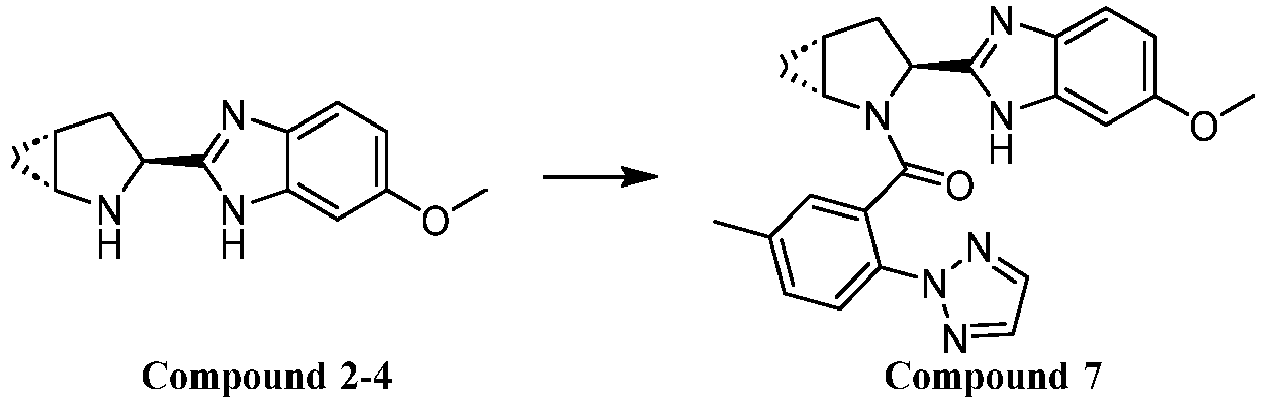
- The hydrochloride of compound 2-4 (100 mg), 5-methyl-2-(2H-1,2,3-triazol-2-yl)benzoic acid (97.49 mg) and THF (2 mL) were added to a reaction flask and stirred, and TEA (607.08 µL) and a solution of tri-n-propylcyclophosphoric anhydride in ethyl acetate (778.18 µL, 50% content) were added and reacted at 15 °C for 16 h. After the reaction was completed, water (10 mL) was added, and extracted with ethyl acetate (3 × 10 mL), and the organic phases were combined, dried over anhydrous sodium sulfate, and concentrated under reduced pressure to obtain a crude product. The crude product was purified by preparative HPLC (column: Waters Xbridge BEH C18 100*30 mm*10 µm; mobile phase: [water (10 mM NH4HCO3)-acetonitrile]; acetonitrile%: 20%-50%, 8 min) to obtain compound 7. 1H NMR (400 MHz, DMSO-d 6) δ: 11.75 - 12.09 (m, 1 H), 7.87 - 8.16 (m, 2 H), 7.63 - 7.85 (m, 1 H), 7.41 - 7.53 (m, 2 H), 6.38 - 7.40 (m, 3 H), 4.60 - 5.20 (m, 1 H) , 3.73 - 3.79 (m, 3 H), 3.11 (br d, J=6.02 Hz, 1 H), 2.30 - 2.45 (m, 4H), 1.52 - 1.81 (m, 2 H), 0.46 - 0.98 (m, 2 H). MS m/z : 415 [M+H]+.
- Chiral purity was detected by chiral SFC (column: Chiralcel OD-3, 50 × 4.6 mm I.D., 3 µm; mobile phase: [supercritical CO2-methanol (containing 0.1% isopropylamine)]; methanol (containing 0.1% isopropylamine)%: 5%-50%, 3 min), retention time = 1.161 min, ee = 100%.
-

-

- The hydrochloride of compound 2-4 (100 mg), 5-methoxy-2-(2H-1,2,3-triazol-2-yl)benzoic acid (105.16 mg) and THF (2 mL) were added to a reaction flask and stirred, and TEA (607.08 µL) and a solution of tri-n-propylcyclophosphoric anhydride in ethyl acetate (778.18 µL, 50% content) were added and reacted at 15 °C for 16 h. After the reaction was completed, water (10 mL) was added, and extracted with ethyl acetate (3 × 10 mL), and the organic phases were combined, dried over anhydrous sodium sulfate, and concentrated under reduced pressure to obtain a crude product. The crude product was purified by preparative HPLC (column: Waters Xbridge BEH C18 100*30 mm*10 µm; mobile phase: [water (10 mM NH4HCO3)-acetonitrile]; acetonitrile%: 20%-95%, 8 min) to obtain compound 8. 1H NMR (400 MHz, DMSO-d 6) δ : 11.71 (s, 1 H), 7.99 - 8.15 (m, 1 H), 7.81 - 7.91 (m, 2 H), 7.38 - 7.72 (m, 1 H), 7.07 - 7.36 (m, 2 H), 6.44 - 7.03 (m, 2 H), 4.76 - 5.18 (m, 1 H), 3.63 - 3.91 (m, 6 H), 3.17 - 3.20 (m, 1 H), 2.34 - 2.38 (m, 1 H), 1.70 - 1.85 (m, 1 H), 1.11 (s, 1 H), 0.55 - 0.89 (m, 2 H). MS m/z : 431 [M+H]+. Optical rotation value: (+) 60.99° ± 0.13° (10.38 mg/mL chloroform solution, length = 50 mm, temperature = 20 °C, n = 2). Chiral purity was detected by chiral SFC (column: Chiralpak AS-3, 50 × 4.6 mm I.D., 3 µm; mobile phase: [supercritical CO2-methanol (containing 0.1% isopropylamine)]; methanol (containing 0.1% isopropylamine)%: 5%-50%, 3 min), retention time = 0.980 min, ee = 100%.
-

-

- Compound 9-1 (4.5 g), 1H-1,2,3-triazole (1.29 g), 1,10-phenanthroline (152.43 mg), cesium carbonate (8.27 g) and 1,4-dioxane (45 mL) were added to a reaction flask, and cuprous iodide (322.18 mg) was added, nitrogen replacement was performed three times and the reaction was performed at 100 °C for 16 h. After the reaction was complete, water was added to the reaction liquid (10 mL), pH was adjusted to 1-2 with HCl, and ethyl acetate (3 × 50 mL) was used for extraction. The organic phases were combined, dried over anhydrous sodium sulfate, and concentrated under reduced pressure to obtain a crude product. The crude product was separated and purified by silica gel column chromatography (eluent: DCM : MeOH = 100 : 1 to 50 : 1) to obtain compound 9-2. 1H NMR (400 MHz, DMSO-d6 ) δ: 13.1 (s, 1 H), 7.85 (s, 2 H), 7.81-7.83 (m, 1 H), 7.65-7.68 (m, 1 H), 7.46-7.65(m, 1 H). MS m/z : 208 [M+H]+.
- Compound 9-2 (100.00 mg) and toluene (1 mL) were added to a reaction flask and stirred, and thionyl chloride (38.52 µL) was added and reacted at 50 °C for 1 h, the reaction liquid was concentrated under reduced pressure, and dissolved in 0.5 mL of dichloromethane for later use. The hydrochloride of compound 2-4 (100 mg), dichloromethane (1 mL), and triethylamine (261.89 µL) were added to a reaction flask, stirred and cooled down to 0 °C. The above dichloromethane solution was added dropwise and reacted at 15 °C for 16 h. After the reaction was complete, water was added to the reaction liquid (10 mL), and ethyl acetate (3 × 10 mL) was used for extraction. The organic phases were combined, dried over anhydrous sodium sulfate, and concentrated under reduced pressure to obtain a crude product. The crude product was purified by preparative HPLC (column: Waters Xbridge BEH C18 100*30 mm*10 µm; mobile phase: [water (10 mM NH4HCO3)-acetonitrile]; acetonitrile%: 25%-55%, 8 min) to obtain compound 9. 1H NMR (400 MHz, CDCl3) δ: 9.59 - 11.75 (m, 1 H), 7.82 (d, J=2.4, 1 H), 7.35 - 7.69 (m, 4 H), 7.04 - 7.23 (m, 2 H), 6.95 (d, J=4, 1 H), 5.63 (m, 1 H), 3.88(s, 3 H), 3.53 (m , 1 H), 2.72 - 2.83 (m, 1 H), 2.30 (m, 1 H), 1.92 - 2.08 (m, 1 H), 0.74 - 0.91 (m, 1 H), 0.36 - 0.62 (m, 1 H). MS m/z : 419 [M+H]+.
-

-

- Compound 10-1 (2.8 g), 1H-1,2,3-triazole (811.78 mg), cesium carbonate (5.22 g), 1,10-phenanthroline (96.28 mg) and 1,4-dioxane (28 mL) were added to a reaction flask, and cuprous iodide (203.50 mg) was added and reacted at 100 °C for 16 h. After the reaction was complete, water was added to the reaction liquid (10 mL), pH was adjusted to 1-2 with HCl, and ethyl acetate (3 × 50 mL) was used for extraction. The organic phases were combined, dried over anhydrous sodium sulfate, and concentrated under reduced pressure to obtain a crude product. The crude product was separated and purified by silica gel column chromatography (eluent: DCM : MeOH = 100 : 1 to 50 : 1) to obtain compound 10-2. 1H NMR (400 MHz, DMSO-d 6) δ: 12.9 (s, 1 H),8.06 (s, 2 H), 7.67 (d, J=8, 1 H), 7.55 (s, 1 H), 7.39 (d, J=6.8, 1 H), 2.43 (s, 3 H). MS m/z : 204 [M+H]+.
- The hydrochloride of compound 2-4 (100 mg), compound 10-2 (97.49 mg) and tetrahydrofuran (2 mL) were added to a reaction flask and stirred, and triethylamine (607.08 µL) and a solution of tri-n-propylcyclophosphoric anhydride in ethyl acetate (778.18 µL, 50% content) were added and reacted at 15 °C for 16 h. After the reaction was complete, water was added to the reaction liquid (10 mL), and ethyl acetate (3 × 10 mL) was used for extraction. The organic phases were combined, dried over anhydrous sodium sulfate, and concentrated under reduced pressure to obtain a crude product. The crude product was purified by preparative HPLC (column: Waters Xbridge BEH C18 100*30 mm*10 µm; mobile phase: [water (containing 10 mM NH4HCO3)-acetonitrile]; acetonitrile%: 25%-45%, 8 min)-acetonitrile]; acetonitrile%: 45%-75%, 10 min) to obtain compound 10. 1H NMR (400 MHz, DMSO-d 6) δ: 11.72 - 12.20 (m, 1 H), 7.87 - 8.19 (m, 2 H), 7.76 (s, 1 H), 7.56 - 7.66 (m, 1 H), 6.71 - 7.47 (m, 4 H), 4.53 - 5.32 (m, 1 H), 3.62 - 3.81 (m, 3 H), 3.30 (s, 1 H), 3.02 - 3.14 (m, 1 H), 2.44 (s, 3 H), 2.21 - 2.31 (m, 1 H), 1.66 - 1.80 (m, 1 H), 0.49 - 1.04 (m, 2 H). MS m/z : 415 [M+H]+.
-

-

- Compound 11-1 (3 g), 1H-1,2,3-triazole (856.80 mg), cesium carbonate (5.51 g), 1,10-phenanthroline (101.62 mg) and 1,4-dioxane (30 mL) were added to a reaction flask, and cuprous iodide (214.79 mg) was added and reacted at 100 °C for 16 h. After the reaction was complete, water was added to the reaction liquid (10 mL), pH was adjusted to 1-2 with HCl, and ethyl acetate (3 × 50 mL) was used for extraction. The organic phases were combined, dried over anhydrous sodium sulfate, and concentrated under reduced pressure to obtain a crude product. The crude product was separated and purified by silica gel column chromatography (eluent: DCM : MeOH = 100 : 1 to 50 : 1) and the obtained product was purified by preparative HPLC (chromatographic column: Phenomenex luna C18 (250*70 mm, 15 µm); mobile phase: [water (containing HCl)-acetonitrile]; acetonitrile%: 8%-38%, 20 min) to obtain compound 11-2. 1H NMR (400 MHz, DMSO-d 6) δ : 13.3 (s, 1 H), 8.08 (s, 2 H), 7.79-7.82 (m, 1 H), 7.57-7.63 (m, 2 H). MS m/z : 208 [M+H]+.
- The hydrochloride of compound 2-4 (50 mg), compound 11-2 (49.69 mg) and N,N-dimethylformamide (1 mL) were added to a reaction flask and stirred, and N,N-diisopropylethylamine (113.95 µL) and HATU (165.84 mg) were added and reacted at 15 °C for 16 h. After the reaction was complete, water was added to the reaction liquid (10 mL), and ethyl acetate (3 × 10 mL) was used for extraction. The organic phases were combined, dried over anhydrous sodium sulfate, and concentrated under reduced pressure to obtain a crude product. The crude product was purified by preparative HPLC (column: Waters Xbridge BEH C18 100*30 mm*10 µm; mobile phase: [water (containing 10 mM NH4HCO3)-acetonitrile]; acetonitrile%: 20%-50%, 8 min) to obtain compound 11. 1H NMR (400 MHz, DMSO-d 6) δ : 11.75 - 12.21 (m, 1 H), 7.80 - 8.24 (m, 3 H), 7.69 (dd, J=8.13, 3.25 Hz, 1 H), 7.19 - 7.56 (m, 2 H), 6.60 - 7.14 (m, 2 H), 4.66 - 5.21 (m, 1 H), 3.69 - 3.81 (m, 3H), 3.31 (s, 1 H), 3.19 (s, 1 H), 2.34 - 2.42 (m, 1 H), 1.72 - 1.84 (m, 1 H), 0.55 - 1.03 (m, 2 H). MS m/z : 419 [M+H]+.
-

-

- Compound 12-1 (1 g), 1H-1,2,3-triazole (285.60 mg), cesium carbonate (1.84 g), 1,10-phenanthroline (33.87 mg) and 1,4-dioxane (10 mL) were added to a reaction flask, and cuprous iodide (71.60 mg) was added and reacted at 100 °C for 16 h. After the reaction was complete, water was added to the reaction liquid (10 mL), pH was adjusted to 1-2 with HCl, and ethyl acetate (3 × 30 mL) was used for extraction. The organic phases were combined, dried over anhydrous sodium sulfate, and concentrated under reduced pressure to obtain a crude product. The crude product was separated and purified by silica gel column chromatography (eluent: DCM : MeOH = 100 : 1 to 50 : 1) to obtain compound 12-2. 1H NMR (400 MHz, DMSO-d 6) δ: 13.67 (s, 1 H), 8.16 (s, 2 H), 7.71-7.80 (m, 1 H), 7.68-7.70 (m, 1 H), 7.44-7.47 (m, 1 H).
- The hydrochloride of compound 2-4 (50 mg), compound 12-2 (35.08 mg) and acetonitrile (1 mL) were added to a pre-dried one-necked flask and stirred, then reagents N,N-diisopropylethylamine (65.55 µL), N-methylimidazole (52.49 µL), N,N,N,N-tetramethylchloroformamidine hexafluorophosphate (63.35 mg) were added and reacted at 15 °C for 16 h. After the reaction was complete, water was added to the reaction liquid (10 mL), and ethyl acetate (3 × 10 mL) was used for extraction. The organic phases were combined, dried over anhydrous sodium sulfate, and concentrated under reduced pressure to obtain a crude product. The crude product was purified by preparative HPLC (column: Waters Xbridge BEH C18 100*30 mm*10 µm; mobile phase: [water (containing 10 mM NH4HCO3)-acetonitrile]; acetonitrile%: 20%-50%, 8 min) to obtain compound 12. 1H NMR (400 MHz, DMSO-d 6) δ: 11.34 - 12.19 (m, 1 H), 8.10 - 8.29 (m, 1 H), 7.63 - 7.92 (m, 2 H), 7.39 - 7.54 (m, 2 H), 6.59 - 7.37 (m, 3 H), 4.52 - 5.52 (m, 1 H), 3.70 - 3.87 (m, 3 H), 3.12 - 3.31 (m, 1 H), 2.77 - 2.99 (m, 1 H), 2.34 - 2.63 (m, 1 H), 1.74 - 1.97 (m, 1 H), 0.72 - 1.18 (m, 1.5 H), 0.24 - 0.50 (m, 0.5 H). MS m/z : 419 [M+H]+.
-
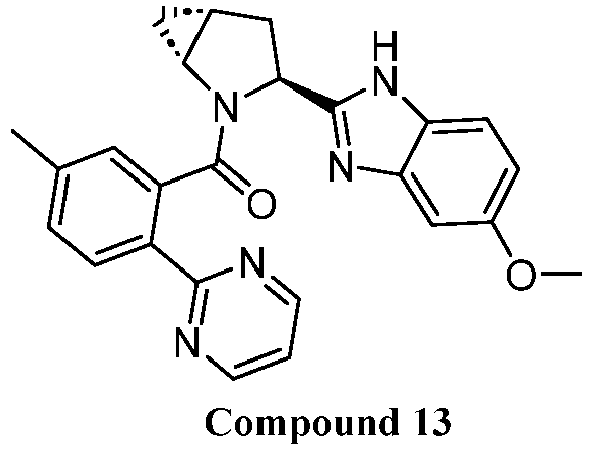
-

- The hydrochloride of compound 2-4 (30 mg), 5-methyl-2-(pyrimidin-2-yl)benzoic acid (25.23 mg) and tetrahydrofuran (1 mL) were added to a reaction flask and stirred, and triethylamine (91.06 µL) and a solution of tri-n-propylcyclophosphoric anhydride in ethyl acetate (233.45 µL, 50% concentration) were added and reacted at 15 °C for 16 h. After the reaction was complete, water was added to the reaction liquid (10 mL), and ethyl acetate (3 × 10 mL) was used for extraction. The organic phases were combined, dried over anhydrous sodium sulfate, and concentrated under reduced pressure to obtain a crude product. The crude product was separated and purified by silica gel column chromatography (eluent: petroleum ether : ethyl acetate = 1 : 1 to 0 : 1) and the obtained product was purified by preparative HPLC (chromatographic column: Waters Xbridge BEH C18 100*30 mm*10 µm; mobile phase: [water (containing 10 mMNH4HCO3)-acetonitrile]; acetonitrile%: 25% -55%, 8 min) to obtain compound 13. 1H NMR (400 MHz, CDCl3) δ : 8.18 - 8.33 (m, 3 H), 7.33 - 7.62 (m, 2 H), 7.28 (s, 1 H), 7.04 - 7.19 (m, 1 H), 6.89 - 7.00 (m, 2 H), 5.64 (dd, J=8.82, 2.69 Hz, 1 H), 3.88 (s, 3 H), 3.57 (m, 1 H), 2.81 - 2.93 (m, 1 H), 2.47 (s, 3 H), 2.29 - 2.41 (m, 1 H), 1.94 - 2.04 (m, 1 H), 0.69 - 0.84 (m, 1 H), 0.48 - 0.61 (m, 1 H). MS m/z : 426 [M+H]+.
-

-

- Compound 14-1 (9 g), 1H-1,2,3-triazole (2.42 g) and 1,4-dioxane (90 mL) were added to a reaction flask and stirred, and cesium carbonate (15.57 g), 1,10-phenanthroline (287.10 mg) and cuprous iodide (606.82 mg) were added, nitrogen replacement was performed three times and the reaction was performed at 100 °C for 16 h. After the reaction was complete, water was added to the reaction liquid (10 mL), pH was adjusted to 1-2 with HCl, and ethyl acetate (3 × 100 mL) was used for extraction. The organic phases were combined, dried over anhydrous sodium sulfate, and concentrated under reduced pressure to obtain a crude product. The crude product was separated and purified by silica gel column chromatography (eluent: DCM : MeOH = 100 : 1 to 50 : 1) to obtain compound 14-2. 1H NMR (400 MHz, DMSO-d6 ) δ : 13.46 (s, 1 H), 8.1 (s, 2 H), 7.77 - 7.82 (m, 3 H). MS m/z : 224 [M+H]+.
- Acetonitrile (1 mL) was added to a reaction flask, and the hydrochloride of compound 2-4 (50 mg), compound 14-2 (43.89 mg), N,N-diisopropylethylamine (75.97 µL), N-methylimidazole (60.84 µL) and N,N,N,N-tetramethylchloroformamidine hexafluorophosphate (73.43 mg) were added at 15 °C under stirring and reacted at 15 °C for 16 h. After the reaction was complete, water was added to the reaction liquid (10 mL), and ethyl acetate (3 × 10 mL) was used for extraction. The organic phases were combined, dried over anhydrous sodium sulfate, and concentrated under reduced pressure to obtain a crude product. The crude product was purified by preparative HPLC (column: Waters Xbridge BEH C18 100*30 mm*10 µm; mobile phase: [water (containing 10 mM NH4HCO3)-acetonitrile]; acetonitrile%: 30%-60%, 8 min) to obtain compound 14. 1H NMR (400 MHz, CDCl3) δ : 8.03 (d, J=8.63 Hz, 1 H), 7.38 - 7.62 (m, 5 H), 7.06 - 7.18 (m, 1 H), 6.96 (dd, J=8.82, 2.31 Hz, 1 H), 5.63 (dd, J=8.57, 2.19 Hz, 1 H), 3.89 (s, 3 H), 3.53 (m, 1 H), 2.83 (t, 1 H), 2.33 (m, 1 H), 1.98 - 2.10 (m, 1 H), 0.78 - 0.91 (m, 1 H), 0.54 (br s, 1 H). MS m/z : 435 [M+H]+.
- The change of intracellular calcium signal was detected by FLIPR, and the antagonism of the compounds on OX1R and OX2R receptors was evaluated by using IC50 value of the compounds as an index.
-
- Cell lines: Transfected HEK293-OX1R and HEK293-OX2R stable cell lines
- HEK293-OX1R cell culture medium (DMEM, Invitrogen #11960-044, 10% serum Gibco #10099141, L-Glutamine 1×, Gibco #25030, sodium pyruvate 1×, Gibco #11360, Geneticin 300 µg/mL, Gibco #10131)
- HEK293-OX2R cell culture medium (DMEM, Invitrogen #11960-044, 10% serum Gibco #10099141, L-Glutamine 1×, Gibco #25030, sodium pyruvate 1×, Gibco #11360, Geneticin 300 µg/mL, Gibco #10131, Blasticin 2 µg/mL, Invitrogen #R21001)
-
- a) Cell seeding (HEK293-OX1R and HEK293-OX2R cells)
- 1) preheating the culture medium, trypsin and DPBS under water bath at 37 °C; pipetting and removing the medium of cell culture and washing same with 10 mL of DPBS;
- 2) adding the preheated trypsin to a culture flask, rotating the culture flask so that the trypsin evenly covered the culture flask, and putting the culture flask in a 37 °C, 5% CO2 incubator for digestion for 1-2 min;
- 3) suspending the cells with 10-15 mL of medium for each T150 and centrifuging at 800 rpm for 5 min; resuspending the cells with 10 mL of medium, pipetting 1 mL of the cell suspension and counting with Vi-cell;
- 4) diluting OX1R cells with medium to 5 × 10⁵ cells/mL, and diluting OX2R cells with medium to 4 × 10⁵ cells/mL, and adding the diluted cells to 384 plate (Greiner.781946) with a multi-channel pipette (50 µL/well, 25000 cells/well for OX1R cells, 20000 cells/well for OX2R cells); placing the cell plate in a 37 °C, 5% CO2 incubator overnight.
- b) Compound loading:
- 1) diluting the compound to 20 mM with DMSO, 3-fold dilution, 8 gradients, duplicate wells, and adding same to a compound plate with an Echo liquid handler; then adding 20 µL of buffer to maintain the final concentration of DMSO of 0.1%.
- c) FLIPR experiment:
- 1) washing off the cell culture medium in the 384 plate with a vacuum pump, adding 30 µL of Fluo-4 Direct fluorescent dye, incubating in 37 °C, 5% CO2 incubator for 1 h, and balancing at room temperature for another 10 min.
- 2) EC50 test: manually diluting Orexin A on ice, 3-fold dilution, 8 gradients, duplicate wells; preparing a DMSO plate and keep the DMSO concentration to be 0.5%; putting the cell plate, OrexinA plate, and DMSO plate in FLIPR respectively, and reading the fluorescence value.
- 3) calculating the EC70 value based on the EC50 value of Orexin A; preparing a 5× EC70 solution, adding same to 384 compound plate with a multi-channel pipette, and storing on ice;
- 4) putting the compound plate, 5× EC70 plate, cell plate, and FLIPR tip in sequence in FLIPR, running the program, and reading the fluorescence value.
- d) Data analyzing: using Prism5.0 to analyze the data, and calculating the IC50 value of the compound.
- The experimental results are shown in Table 2:
Table 2. Test results of IC50 by FLIPR detection Compound No. hOXIR IC50 (nM) hOX2R IC50 (nM) Compound 1 > 10000 25 Compound 2 > 10000 72 Compound 4 462 64 Compound 5 337 96 Compound 6 1416 299 Compound 7 877 24 Compound 8 1794 42 Compound 9 3170 42 Compound 10 710 17 Compound 11 3602 33 Compound 12 1278 81 Compound 13 2444 60 Compound 14 1036 30 - Conclusion: The compound of the present disclosure has a certain antagonistic activity on human orexin receptors, and exhibits higher activity on OX2 receptors.
- 4 healthy male SD rats aged 6-9 weeks were selected and randomly divided into two groups, with 2 rats in each group. One group was given the test compound at 2 mg/kg by intravenous injection, and the other group was given the test compound at 10 mg/kg by intragastric administration. Plasma samples were collected at 0.083, 0.25, 0.5, 1.0, 2.0, 4.0, 6.0, 8.0, and 24 h after administration for the intravenous injection group and intragastric administration group, respectively. Quantitative analysis of all biological samples was carried out by LC-MS/MS method, and the WinNonlin™ Version 6.3 (Pharsight, Mountain View, CA) pharmacokinetic software was used to calculate the relevant pharmacokinetic parameters by the non-compartmental model linear logarithmic trapezoidal method. AUC0-last represents area under the plasma concentration-time curve from time zero to the last detectable concentration time point; p.o. represents oral; i.v. represents intravenous injection; T1/2 represents half-life; CL represents clearance rate; Vd represents apparent volume of distribution; Cmax represents peak concentration; Tmax represents time to peak; F% represents oral bioavailability. The experimental results are shown in Table 3.
Table 3. Pharmacokinetic properties of the test compound PK parameter Compound 8 i.v. 2 mg/kg T 1/2 (h) 0.2 Vdss (L/kg) 0.57 CL (mL/min/kg) 44 AUC0-last (nM h) 1761 p.o. 10 mg/kg Tmax (h) 0.25 Cmax (nM) 1032 AUC0-last (nM h) 1451 F% 17% - Conclusion: The compound of the present disclosure exhibits good pharmacokinetic properties in SD rats.
- 4 healthy male SD rats aged 6-9 weeks were selected and given the test compound by intragastric administration. 2 animals were randomly selected to be euthanized at 0.5 h and 2 h after administration, respectively. Plasma and brain tissue samples were collected, and LC-MS/MS method was used for quantitative analysis of all biological samples. The experimental results are shown in Table 4.
Table 4. Brain-to-blood ratio of test compound in rats Compound 8 (0.5 h) Compound 8 (2 h) p.o. 30 mg/kg Drug concentration in brain (nmol/L) 1393 212 Drug concentration in plasma (nmol/L) 5600 1100 Brain-to-blood ratio 0.25 0.19 - Conclusion: The compound of the present disclosure can penetrate the blood-brain barrier and enter the brain tissue in rats.
- The brain tissue homogenate of SD rats (that is, matrix, purchased from BioIVT) was taken, and the DMSO working solution of the test compound or the DMSO working solution of a control (propranolol) was added, so that the final concentrations of the test compound and propranolol in the plasma samples were both 2 µM, and the samples were fully mixed. The final concentration of DMSO was controlled to be 0.5%; 50 µL was pipetted into a sample receiving plate, and a corresponding volume of corresponding blank matrix/buffer was immediately added so that the final volume of each sample well was 100 µL, and the volume ratio of matrix: dialysis buffer was 1 : 1, and then a stop solution was added to these samples. This sample would be used as a T0 sample for recovery rate and stability determination. The test compound sample and propranolol sample were added to the administration end of each dialysis well, and blank dialysis buffer was added to the corresponding receiving end of the dialysis well. Then the plate was placed in a humidified 5% CO2 incubator and incubated for 4 h at 37 °C with shaking at 100 rpm. After dialysis, 50 µL of the dialyzed buffer sample and the dialyzed brain tissue homogenate sample was pipetted to a new sample receiving plate, respectively. A corresponding volume of corresponding blank matrix/buffer was added to the samples so that the final volume of each sample well was 100 µL and the volume ratio of plasma:dialysis buffer was 1 : 1. All samples were analyzed by LC/MS/MS after protein precipitation, and the free rate (% Unbound), binding rate (% Bound) and recovery rate (% Recovery) of the compound were calculated by the following formula:


- Among them, Fc is the concentration of the compound at the buffer end of the dialysis plate; TC is the concentration of the compound at the matrix end of the dialysis plate; T0 is the concentration of the compound in the plasma sample at time zero. The experimental results are shown in Table 5.
Table 5. Test results of binding rate in SD rat brain tissue Compound No. SD rat brain tissue_Unbound (%) Compound 8 21.8% - Conclusion: The compound of the present disclosure has a higher proportion of unbound drugs in the SD rat brain tissue.
- 4 healthy male Beagle dogs were selected and randomly divided into two groups, with 2 dogs in each group. One group was given the test compound at 1 mg/kg by intravenous injection, and the other group was given the test compound at 5 mg/kg by intragastric administration. Plasma samples were collected at 0.033, 0.083, 0.25, 0.5, 1.0, 2.0, 4.0, 6.0, 8.0, and 24 h after administration for the intravenous injection group and intragastric administration group, respectively. Quantitative analysis of all biological samples was carried out by LC-MS/MS method, and the WinNonlin™ Version 6.3 (Pharsight, Mountain View, CA) pharmacokinetic software was used to calculate the relevant pharmacokinetic parameters by the non-compartmental model linear logarithmic trapezoidal method. AUC0-last represents area under the plasma concentration-time curve from time zero to the last detectable concentration time point; p.o. represents oral; i.v. represents intravenous injection; T1/2 represents half-life; CL represents clearance rate; Vd represents apparent volume of distribution; Cmax represents peak concentration; Tmax represents time to peak; F% represents oral bioavailability. The experimental results are shown in Table 6.
Table 6. Pharmacokinetic properties of test compound PK parameter Compound 8 i.v. 1 mg/kg T1/2 (h) 2.79 Vdss (L/kg) 0.41 CL (mL/min/kg) 2.57 AUC0-last (nM h) 15320 p.o. 5 mg/kg Tmax (h) 1 Cmax (nM) 6180 AUC0-last (nM h) 26182 F% 34% - Conclusion: The compound of the present disclosure exhibits good pharmacokinetic properties in Beagle dogs.
- 2 healthy male Beagle dogs were selected, and after intragastric administration of the test compound at 5 mg/kg, cerebrospinal fluid samples were taken at 0.5 h, 2 h and 6 h after the administration, respectively. Quantitative analysis of all biological samples was carried out by LC-MS/MS method, and the WinNonlin™ Version 6.3 (Pharsight, Mountain View, CA) pharmacokinetic software was used to calculate the relevant pharmacokinetic parameters by the non-compartmental model linear logarithmic trapezoidal method. AUC0-last represents area under the plasma concentration-time curve from time zero to the last detectable concentration time point; p.o. represents oral; i.v. represents intravenous injection; T1/2 represents half-life; CL represents clearance rate; Vd represents apparent volume of distribution; Cmax represents peak concentration; Tmax represents time to peak; F% represents oral bioavailability. The experimental results are shown in Table 7.
Table 7. Drug concentration of test compound in canine cerebrospinal fluid Compound 8 (0.5 h) Compound 8 (2 h) Compound 8 (6 h) p.o. 5 mg/kg Drug concentration in cerebrospinal fluid (nmol/L) 1160 773 110 - Conclusion: The compound of the present disclosure can be detected in dog CSF, indicating that the compound can pass through the blood-brain barrier and reach the brain.
- Test purpose: to judge the effect of the test compound on the activity of rats by measuring the spontaneous activity distance of rats in a period of time.
- Test scheme: 12 male SD rats aged 7 weeks were adapted in the laboratory 1 day before the start of the test. On the day of the experiment, the rats were randomly divided into 2 groups according to their body weight, with 6 rats in each group, and the rats were given blank vehicle and compound 8 (30 mg/kg), respectively. The animals were put into a test box 30 minutes after administration, and the distance data of animal activity were recorded every 5 min with Any-maze software, and the recording was continued for 60 min. By comparing the total distance of animal activity within the recording time, it is judged whether the drug has a significant effect on the spontaneous activity of the animal. The experimental data were represented by the mean ± standard deviation (Mean ± SEM). The statistical method adopted one-way analysis of variance plus Dunnett's multiple comparisons. P < 0.05 was represented as *, p < 0.01 was represented as **, and p < 0.001 was represented as ***. The experimental results are shown in Table 8.
Table 8. Test data of rat spontaneous activity Group Spontaneous activity distance Statistical analysis result Blank vehicle 31.91 ± 3.92 meters Compound 8 at 30 mg/kg 14.73 ± 1.38 meters *** - Conclusion: The compound of the present disclosure can significantly reduce the spontaneous activity distance of SD rats.
- Test purpose: to evaluate the effect of test substance on sleep in SD rats by electroencephalogram/electromyography telemetry (EEG).
- Test scheme: 36 male SD rats aged 5-6 weeks needed an adaptation period of 5-15 days after arriving at the facility, during which the experimental animals were placed in an alternating light and dark environment for 12 h for adaptation (light on: 19:00; light off: 07:00) to adjust the rhythm time, and the health of the animals was monitored every day. Animals needed to be surgically implanted with electroencephalogram electrode and electromyography electrode for later telemetry data collection. On the day of the operation experiment, the animals were anesthetized with Zoletil (i.p., 20 mg/kg) combined with xylazine (i.p., 8 mg/kg). After anesthesia, the animals were fixed by brain stereotaxic apparatus. After the head has hair clipped and was disinfected, the skin of the head was cut, and the four corners were clamped with hemostats to fully expose the skull. The periosteum was peeled off and wiped with dry absorbent cotton until the surface was clean. A hole was drilled according to the type of implanter, and an electrode was implanted and in contact with the dura mater. The electrode was fixed on the skull with dental cement. At the same time, the cement dripping on the tissue and skin was cleaned up. The 2 electromyography electrodes were respectively inserted into the neck muscles in parallel, and the two ends were fixed with sutures to prevent their ends from touching each other. The implanter was then placed under the skin, and the surgical wound was sutured and sterilized. After the operation, the rats were carefully placed in a clean recovery cage, lying on their sides to ensure a smooth airway. The rats were raised in a single cage and placed in a shielded recovery room, in which the light and dark automatically alternated for 12 h (light on: 19:00, light off: 07:00), the temperature was 20-26 °C, and the relative humidity was 40-70%. After the operation, the animals were given nursing care for 3 days. The surgical incision was treated with cephradine powder locally, gentamicin at 4-8 mg/kg was subcutaneously administered, and meloxicam at 0.1 mL/rat was injected subcutaneously for 3 consecutive days. The experiment was carried out after 7-10 days of recovery and the animals were randomly divided into groups according to their weight the day before the experiment.
- On the day of the experiment, the basic electroencephalogram and electromyography were recorded first, and then the administration began. During and after the administration, the electroencephalogram and electromyography were recorded continuously until 24 h after the administration. Raw data were collected by DSI system Ponemah software and analyzed by NeuroScore software. The experimental data were represented by the mean ± standard error (Mean ± SEM), and statistical analysis was performed using the one-way variance method. Compared with the blank vehicle group, P < 0.05 indicated a significant difference, and represented as *; P < 0.01 indicated a very significant difference, and represented as **; P < 0.001 indicated an extremely significant difference, and represented as ***. The experimental results are shown in Table 9.
Table 9. Rat EEG test data Group Sleep latency (min) Total awake time within 7 h after administration (min) NREM sleep time within 7 h after administration (min) Blank vehicle group 32 ± 3.1 303 ± 20 102 ±18 Compound 8 at 5 mg/kg 27 ± 8.1 274 ± 19 129 ± 17 Compound 8 at 10 mg/kg 15 ± 2.9** 250 ± 21 144 ± 16 Compound 8 at 30 mg/kg 7 ± 1.3*** 228 ± 12* 171 ± 11** - Conclusion: the compound of the present disclosure at 10 mg/kg and 30 mg/kg can significantly shorten the sleep latency of SD rats, and the compound of the present disclosure at 30 mg/kg can significantly reduce the awake time and increase the sleep time within 7 h after administration. Therefore, the compound of the present disclosure has good sleep-promoting drug effect.
| Reagent/Instrument | Brand and catalog number |
| Trypsin | Invitrogen, #25200-072 |
| DPBS (Dulbecco's phosphate buffered saline) | Hyclone, #SH30028.01B |
| Fluo-4 Direct (fluorescent probe) | Invitrogen, Cat# F10471 |
| F-127 (poloxamer) | Invitrogen #P3000MP |
| Probenecid (probenecid) | Sigma #P8761 |
| 384 cell plate | Greiner #781946 |
| 384 compound plate | Greiner #781280 |
| CO2 incubator | Thermo #371 |
| Centrifuge | Eppendorf #5810R |
| Vi-cell cell counter | Beckman Coulter |
| Labcyte FLIPR | Molecular Device |
| POD 810 Plate Assembler Automatic Microplate Pretreatment System | |
Claims (11)
- A compound represented by formula (I) or a pharmaceutically acceptable salt thereof, which is selected from:
 each R1 is independently selected from halogen, cyano, C1-3alkyl and C1-3alkoxy, and the C1-3alkyl and C1-3alkoxy are each independently and optionally substituted by 1, 2 or 3 halogen atoms;each R2 is independently selected from halogen, cyano, C1-3alkyl and C1-3alkoxy, and the C1-3alkyl and C1-3alkoxy are each independently and optionally substituted by 1, 2 or 3 halogen atoms;R3 is selected from H, C1-3alkyl and C3-6cycloalkyl;m and n are each independently selected from 0, 1, 2 and 3;ring A is selected from
 ring B is selected from
- The compound or the pharmaceutically acceptable salt thereof according to claim 1, wherein each R1 is independently selected from halogen, cyano, methyl and methoxy, and the methyl and methoxy are each independently and optionally substituted by 1, 2 or 3 F.
- The compound or the pharmaceutically acceptable salt thereof according to claim 2, wherein each R1 is independently selected from F, Cl, methyl and methoxy.
- The compound or the pharmaceutically acceptable salt thereof according to claim 1, wherein each R2 is independently selected from halogen, cyano, methyl and methoxy, and the methyl and methoxy are each independently and optionally substituted by 1, 2 or 3 F.
- The compound or the pharmaceutically acceptable salt thereof according to claim 4, wherein each R2 is independently selected from F, Cl, methyl and methoxy.
- The compound or the pharmaceutically acceptable salt thereof according to claim 1, wherein R3 is selected from H, methyl and cyclopropyl.
- The compound or the pharmaceutically acceptable salt thereof according to any one of claims 1 to 6, wherein the compound is selected from structures shown in formulas (I-1), (I-2) and (I-3),

- A compound represented by the following formula or a pharmaceutically acceptable salt thereof:


- The compound or the pharmaceutically acceptable salt thereof according to claim 8, wherein the compound is selected from:


- An application of the compound or the pharmaceutically acceptable salt thereof according to any one of claims 1 to 9 in the manufacture of a medicament for treating a disease related to a selective orexin-2 receptor antagonist.
- The application according to claim 10, wherein the disease related to the selective orexin-2 receptor antagonist is selected from insomnia and/or depression.
Applications Claiming Priority (5)
| Application Number | Priority Date | Filing Date | Title |
|---|---|---|---|
| CN202110146135 | 2021-02-02 | ||
| CN202110617562 | 2021-06-02 | ||
| CN202110906535 | 2021-08-11 | ||
| CN202111625215 | 2021-12-27 | ||
| PCT/CN2022/074381 WO2022166768A1 (en) | 2021-02-02 | 2022-01-27 | Tetrahydropyrrolocyclic compound and application thereof |
Publications (4)
| Publication Number | Publication Date |
|---|---|
| EP4289834A1 true EP4289834A1 (en) | 2023-12-13 |
| EP4289834A4 EP4289834A4 (en) | 2025-03-12 |
| EP4289834B1 EP4289834B1 (en) | 2025-11-26 |
| EP4289834C0 EP4289834C0 (en) | 2025-11-26 |
Family
ID=82741973
Family Applications (1)
| Application Number | Title | Priority Date | Filing Date |
|---|---|---|---|
| EP22749047.1A Active EP4289834B1 (en) | 2021-02-02 | 2022-01-27 | Tetrahydropyrrolocyclic compound and application thereof |
Country Status (9)
| Country | Link |
|---|---|
| US (1) | US12583841B2 (en) |
| EP (1) | EP4289834B1 (en) |
| JP (1) | JP7681113B2 (en) |
| KR (1) | KR20230142554A (en) |
| CN (1) | CN116783182B (en) |
| BR (1) | BR112023015463A2 (en) |
| CA (1) | CA3206870A1 (en) |
| ES (1) | ES3059690T3 (en) |
| WO (1) | WO2022166768A1 (en) |
Families Citing this family (1)
| Publication number | Priority date | Publication date | Assignee | Title |
|---|---|---|---|---|
| WO2026012316A1 (en) * | 2024-07-08 | 2026-01-15 | 石药集团中奇制药技术(石家庄)有限公司 | Benzimidazole derivative and use thereof |
Family Cites Families (10)
| Publication number | Priority date | Publication date | Assignee | Title |
|---|---|---|---|---|
| CL2007002809A1 (en) | 2006-09-29 | 2008-04-18 | Actelion Pharmaceuticals Ltd | COMPOUNDS DERIVED FROM 3-AZA BICICLO [3.1.0] HEXANO; AND ITS USE IN THE TREATMENT OF SUCH DISEASES AS PSYCHOTIC AND ANXIETY DISORDERS, DISORDERS OF THE SOUND, USE AND ABUSE OF PSYCHOACTIVE SUBSTANCES, DEMENTIA AND DETERIORATION OF COGNITIVE FUNCTIONS |
| TW200833328A (en) | 2006-12-28 | 2008-08-16 | Actelion Pharmaceuticals Ltd | 2-aza-bicyclo[3.1.0]hexane derivatives |
| US8030495B2 (en) * | 2007-05-23 | 2011-10-04 | Coleman Paul J | Cyclopropyl pyrrolidine orexin receptor antagonists |
| JP2009016560A (en) | 2007-07-04 | 2009-01-22 | Sharp Corp | Semiconductor light emitting device |
| EP2185512B1 (en) | 2007-07-27 | 2010-12-29 | Actelion Pharmaceuticals Ltd. | Trans-3-aza-bicyclo[3.1.0]hexane derivatives |
| TWI570120B (en) | 2012-06-04 | 2017-02-11 | 艾克泰聯製藥有限公司 | Benzimidazole proline derivative |
| AU2013328301A1 (en) | 2012-10-10 | 2015-05-28 | Actelion Pharmaceuticals Ltd | Orexin receptor antagonists which are [ortho bi (hetero-)aryl]-[2-(meta bi (hetero-)aryl)-pyrrolidin-1-yl]-methanone derivatives |
| JP6496733B2 (en) * | 2013-12-03 | 2019-04-03 | イドーシア ファーマシューティカルズ リミテッドIdorsia Pharmaceuticals Ltd | (S)-(2- (6-Chloro-7-methyl-1H-benzo [D] imidazol-2-yl) -2-methylpyrrolidin-1-yl) (5-methoxy-2- (2H-1, Crystalline form of 2,3-triazol-2-yl) phenyl) methanone and its use as an orexin receptor antagonist |
| KR102330133B1 (en) | 2013-12-04 | 2021-11-23 | 이도르시아 파마슈티컬스 리미티드 | Use of benzimidazole-proline derivatives |
| WO2020007964A1 (en) * | 2018-07-05 | 2020-01-09 | Idorsia Pharmaceuticals Ltd | 2-(2-azabicyclo[3.1.0]hexan-1-yl)-1h-benzimidazole derivatives |
-
2022
- 2022-01-27 EP EP22749047.1A patent/EP4289834B1/en active Active
- 2022-01-27 ES ES22749047T patent/ES3059690T3/en active Active
- 2022-01-27 BR BR112023015463A patent/BR112023015463A2/en unknown
- 2022-01-27 CA CA3206870A patent/CA3206870A1/en active Pending
- 2022-01-27 JP JP2023547113A patent/JP7681113B2/en active Active
- 2022-01-27 CN CN202280012699.6A patent/CN116783182B/en active Active
- 2022-01-27 US US18/275,251 patent/US12583841B2/en active Active
- 2022-01-27 KR KR1020237029661A patent/KR20230142554A/en active Pending
- 2022-01-27 WO PCT/CN2022/074381 patent/WO2022166768A1/en not_active Ceased
Also Published As
| Publication number | Publication date |
|---|---|
| EP4289834B1 (en) | 2025-11-26 |
| EP4289834C0 (en) | 2025-11-26 |
| BR112023015463A2 (en) | 2023-10-10 |
| US20240300925A1 (en) | 2024-09-12 |
| US12583841B2 (en) | 2026-03-24 |
| CN116783182A (en) | 2023-09-19 |
| JP7681113B2 (en) | 2025-05-21 |
| CA3206870A1 (en) | 2022-08-11 |
| WO2022166768A1 (en) | 2022-08-11 |
| EP4289834A4 (en) | 2025-03-12 |
| CN116783182B (en) | 2025-08-29 |
| JP2024504854A (en) | 2024-02-01 |
| KR20230142554A (en) | 2023-10-11 |
| ES3059690T3 (en) | 2026-03-23 |
Similar Documents
| Publication | Publication Date | Title |
|---|---|---|
| TWI758999B (en) | Thiazololactam compound as erk inhibitor and application thereof | |
| TWI765451B (en) | Spirocyclic compounds as erk inhibitor and application thereof | |
| TWI800691B (en) | COMPOUNDS FOR INHIBITION OF α4β7 INTEGRIN | |
| JP6207752B2 (en) | Quinazoline derivative and method for producing the same | |
| TWI473803B (en) | Morpholinothiazoles as alpha 7 positive allosteric modulators | |
| JP2025529831A (en) | Amide-containing heterocyclic derivatives and uses thereof | |
| JP7710223B2 (en) | Substituted pyrrolotriazine compounds and pharmaceutical compositions thereof and their uses | |
| KR20180016485A (en) | Positive allosteric modulator of muscarinic M2 receptor | |
| JP2022515335A (en) | Substituted pyrazolo [1,5-a] pyridine compound, composition containing the compound and its use | |
| JP7138768B2 (en) | Dimethylphosphine oxide compound | |
| TW202413371A (en) | Nitrogen-containing heterocyclic compounds as pde4b inhibitors | |
| CN118510757A (en) | Cyclopropyl compounds | |
| EP4289834B1 (en) | Tetrahydropyrrolocyclic compound and application thereof | |
| JP2010013434A (en) | New isoindolinone derivative having activity against t-type calcium channel, and method for producing the same | |
| JP2011529942A (en) | Crystals of pyridine derivatives | |
| US8357674B2 (en) | Analogues of cilostazol | |
| HK40105263A (en) | Tetrahydropyrrolocyclic compound and application thereof | |
| JPH11510816A (en) | 4,5-Dihydronaphtho [1,2-c] isoxazole having CNS activity and derivatives thereof | |
| US20110212976A1 (en) | Deuterium-enriched risperidone | |
| TW202132311A (en) | Solid forms of an s1p-receptor modulator | |
| CN114478586B (en) | A dicyclic derivative inhibitor salt or crystal form, its preparation method, and its application. | |
| TWI825811B (en) | Thiazololactam-spiroheterocyclic compound and application thereof | |
| CN115443274B (en) | Compounds containing phenylsulfonamide | |
| CN105732480B (en) | 2-Amino-3-(6-hydroxynaphthalen-2-yl)propionic acid derivative, its preparation method and application | |
| JP7738667B2 (en) | Oxadiazole-substituted spirocyclic compounds and uses thereof |
Legal Events
| Date | Code | Title | Description |
|---|---|---|---|
| STAA | Information on the status of an ep patent application or granted ep patent |
Free format text: STATUS: THE INTERNATIONAL PUBLICATION HAS BEEN MADE |
|
| PUAI | Public reference made under article 153(3) epc to a published international application that has entered the european phase |
Free format text: ORIGINAL CODE: 0009012 |
|
| STAA | Information on the status of an ep patent application or granted ep patent |
Free format text: STATUS: REQUEST FOR EXAMINATION WAS MADE |
|
| 17P | Request for examination filed |
Effective date: 20230829 |
|
| AK | Designated contracting states |
Kind code of ref document: A1 Designated state(s): AL AT BE BG CH CY CZ DE DK EE ES FI FR GB GR HR HU IE IS IT LI LT LU LV MC MK MT NL NO PL PT RO RS SE SI SK SM TR |
|
| DAV | Request for validation of the european patent (deleted) | ||
| DAX | Request for extension of the european patent (deleted) | ||
| REG | Reference to a national code |
Ref country code: HK Ref legal event code: DE Ref document number: 40105263 Country of ref document: HK |
|
| REG | Reference to a national code |
Ref legal event code: R079 Ipc: C07D0403140000 Ref country code: DE Ref legal event code: R079 Ref document number: 602022025682 Country of ref document: DE Free format text: PREVIOUS MAIN CLASS: C07D0401140000 Ipc: C07D0403140000 |
|
| A4 | Supplementary search report drawn up and despatched |
Effective date: 20250211 |
|
| RIC1 | Information provided on ipc code assigned before grant |
Ipc: A61P 25/24 20060101ALI20250205BHEP Ipc: A61K 31/403 20060101ALI20250205BHEP Ipc: A61K 31/4184 20060101ALI20250205BHEP Ipc: C07D 403/14 20060101AFI20250205BHEP |
|
| GRAP | Despatch of communication of intention to grant a patent |
Free format text: ORIGINAL CODE: EPIDOSNIGR1 |
|
| STAA | Information on the status of an ep patent application or granted ep patent |
Free format text: STATUS: GRANT OF PATENT IS INTENDED |
|
| INTG | Intention to grant announced |
Effective date: 20250627 |
|
| GRAS | Grant fee paid |
Free format text: ORIGINAL CODE: EPIDOSNIGR3 |
|
| GRAA | (expected) grant |
Free format text: ORIGINAL CODE: 0009210 |
|
| STAA | Information on the status of an ep patent application or granted ep patent |
Free format text: STATUS: THE PATENT HAS BEEN GRANTED |
|
| AK | Designated contracting states |
Kind code of ref document: B1 Designated state(s): AL AT BE BG CH CY CZ DE DK EE ES FI FR GB GR HR HU IE IS IT LI LT LU LV MC MK MT NL NO PL PT RO RS SE SI SK SM TR |
|
| REG | Reference to a national code |
Ref country code: CH Ref legal event code: F10 Free format text: ST27 STATUS EVENT CODE: U-0-0-F10-F00 (AS PROVIDED BY THE NATIONAL OFFICE) Effective date: 20251126 Ref country code: GB Ref legal event code: FG4D |
|
| REG | Reference to a national code |
Ref country code: IE Ref legal event code: FG4D |
|
| REG | Reference to a national code |
Ref country code: DE Ref legal event code: R096 Ref document number: 602022025682 Country of ref document: DE |
|
| U01 | Request for unitary effect filed |
Effective date: 20251222 |
|
| REG | Reference to a national code |
Ref country code: CH Ref legal event code: U11 Free format text: ST27 STATUS EVENT CODE: U-0-0-U10-U11 (AS PROVIDED BY THE NATIONAL OFFICE) Effective date: 20260203 |
|
| U07 | Unitary effect registered |
Designated state(s): AT BE BG DE DK EE FI FR IT LT LU LV MT NL PT RO SE SI Effective date: 20260109 |
|
| REG | Reference to a national code |
Ref country code: CH Ref legal event code: R17 Free format text: ST27 STATUS EVENT CODE: U-0-0-R10-R17 (AS PROVIDED BY THE NATIONAL OFFICE) Effective date: 20260226 |
|
| REG | Reference to a national code |
Ref country code: ES Ref legal event code: FG2A Ref document number: 3059690 Country of ref document: ES Kind code of ref document: T3 Effective date: 20260323 |
|
| PGFP | Annual fee paid to national office [announced via postgrant information from national office to epo] |
Ref country code: GB Payment date: 20260121 Year of fee payment: 5 |
|
| PGFP | Annual fee paid to national office [announced via postgrant information from national office to epo] |
Ref country code: ES Payment date: 20260217 Year of fee payment: 5 |
|
| PG25 | Lapsed in a contracting state [announced via postgrant information from national office to epo] |
Ref country code: NO Free format text: LAPSE BECAUSE OF FAILURE TO SUBMIT A TRANSLATION OF THE DESCRIPTION OR TO PAY THE FEE WITHIN THE PRESCRIBED TIME-LIMIT Effective date: 20260226 |
|
| PG25 | Lapsed in a contracting state [announced via postgrant information from national office to epo] |
Ref country code: HR Free format text: LAPSE BECAUSE OF FAILURE TO SUBMIT A TRANSLATION OF THE DESCRIPTION OR TO PAY THE FEE WITHIN THE PRESCRIBED TIME-LIMIT Effective date: 20251126 |
|
| PG25 | Lapsed in a contracting state [announced via postgrant information from national office to epo] |
Ref country code: RS Free format text: LAPSE BECAUSE OF FAILURE TO SUBMIT A TRANSLATION OF THE DESCRIPTION OR TO PAY THE FEE WITHIN THE PRESCRIBED TIME-LIMIT Effective date: 20260226 |
|
| PG25 | Lapsed in a contracting state [announced via postgrant information from national office to epo] |
Ref country code: IS Free format text: LAPSE BECAUSE OF FAILURE TO SUBMIT A TRANSLATION OF THE DESCRIPTION OR TO PAY THE FEE WITHIN THE PRESCRIBED TIME-LIMIT Effective date: 20260326 |
|
| PGFP | Annual fee paid to national office [announced via postgrant information from national office to epo] |
Ref country code: CH Payment date: 20260203 Year of fee payment: 5 |
|
| PG25 | Lapsed in a contracting state [announced via postgrant information from national office to epo] |
Ref country code: PL Free format text: LAPSE BECAUSE OF FAILURE TO SUBMIT A TRANSLATION OF THE DESCRIPTION OR TO PAY THE FEE WITHIN THE PRESCRIBED TIME-LIMIT Effective date: 20251126 |
|
| U20 | Renewal fee for the european patent with unitary effect paid |
Year of fee payment: 5 Effective date: 20260330 |