EP4289637B1 - Heat shield panel retainer - Google Patents
Heat shield panel retainer Download PDFInfo
- Publication number
- EP4289637B1 EP4289637B1 EP22461569.0A EP22461569A EP4289637B1 EP 4289637 B1 EP4289637 B1 EP 4289637B1 EP 22461569 A EP22461569 A EP 22461569A EP 4289637 B1 EP4289637 B1 EP 4289637B1
- Authority
- EP
- European Patent Office
- Prior art keywords
- retainer
- heat shield
- panel
- panels
- wheel
- Prior art date
- Legal status (The legal status is an assumption and is not a legal conclusion. Google has not performed a legal analysis and makes no representation as to the accuracy of the status listed.)
- Active
Links
Images
Classifications
-
- B—PERFORMING OPERATIONS; TRANSPORTING
- B60—VEHICLES IN GENERAL
- B60C—VEHICLE TYRES; TYRE INFLATION; TYRE CHANGING; CONNECTING VALVES TO INFLATABLE ELASTIC BODIES IN GENERAL; DEVICES OR ARRANGEMENTS RELATED TO TYRES
- B60C23/00—Devices for measuring, signalling, controlling, or distributing tyre pressure or temperature, specially adapted for mounting on vehicles; Arrangement of tyre inflating devices on vehicles, e.g. of pumps or of tanks; Tyre cooling arrangements
- B60C23/18—Tyre cooling arrangements, e.g. heat shields
-
- B—PERFORMING OPERATIONS; TRANSPORTING
- B64—AIRCRAFT; AVIATION; COSMONAUTICS
- B64C—AEROPLANES; HELICOPTERS
- B64C25/00—Alighting gear
- B64C25/32—Alighting gear characterised by elements which contact the ground or similar surface
- B64C25/34—Alighting gear characterised by elements which contact the ground or similar surface wheeled type, e.g. multi-wheeled bogies
- B64C25/36—Arrangements or adaptations of wheels, tyres or axles in general
-
- F—MECHANICAL ENGINEERING; LIGHTING; HEATING; WEAPONS; BLASTING
- F16—ENGINEERING ELEMENTS AND UNITS; GENERAL MEASURES FOR PRODUCING AND MAINTAINING EFFECTIVE FUNCTIONING OF MACHINES OR INSTALLATIONS; THERMAL INSULATION IN GENERAL
- F16D—COUPLINGS FOR TRANSMITTING ROTATION; CLUTCHES; BRAKES
- F16D55/00—Brakes with substantially-radial braking surfaces pressed together in axial direction, e.g. disc brakes
- F16D55/24—Brakes with substantially-radial braking surfaces pressed together in axial direction, e.g. disc brakes with a plurality of axially-movable discs, lamellae, or pads, pressed from one side towards an axially-located member
- F16D55/26—Brakes with substantially-radial braking surfaces pressed together in axial direction, e.g. disc brakes with a plurality of axially-movable discs, lamellae, or pads, pressed from one side towards an axially-located member without self-tightening action
- F16D55/36—Brakes with a plurality of rotating discs all lying side by side
-
- F—MECHANICAL ENGINEERING; LIGHTING; HEATING; WEAPONS; BLASTING
- F16—ENGINEERING ELEMENTS AND UNITS; GENERAL MEASURES FOR PRODUCING AND MAINTAINING EFFECTIVE FUNCTIONING OF MACHINES OR INSTALLATIONS; THERMAL INSULATION IN GENERAL
- F16D—COUPLINGS FOR TRANSMITTING ROTATION; CLUTCHES; BRAKES
- F16D65/00—Parts or details
- F16D65/02—Braking members; Mounting thereof
- F16D65/12—Discs; Drums for disc brakes
- F16D65/128—Discs; Drums for disc brakes characterised by means for cooling
-
- F—MECHANICAL ENGINEERING; LIGHTING; HEATING; WEAPONS; BLASTING
- F16—ENGINEERING ELEMENTS AND UNITS; GENERAL MEASURES FOR PRODUCING AND MAINTAINING EFFECTIVE FUNCTIONING OF MACHINES OR INSTALLATIONS; THERMAL INSULATION IN GENERAL
- F16D—COUPLINGS FOR TRANSMITTING ROTATION; CLUTCHES; BRAKES
- F16D65/00—Parts or details
- F16D65/78—Features relating to cooling
- F16D2065/785—Heat insulation or reflection
-
- F—MECHANICAL ENGINEERING; LIGHTING; HEATING; WEAPONS; BLASTING
- F16—ENGINEERING ELEMENTS AND UNITS; GENERAL MEASURES FOR PRODUCING AND MAINTAINING EFFECTIVE FUNCTIONING OF MACHINES OR INSTALLATIONS; THERMAL INSULATION IN GENERAL
- F16D—COUPLINGS FOR TRANSMITTING ROTATION; CLUTCHES; BRAKES
- F16D65/00—Parts or details
- F16D65/78—Features relating to cooling
- F16D65/84—Features relating to cooling for disc brakes
- F16D65/847—Features relating to cooling for disc brakes with open cooling system, e.g. cooled by air
Definitions
- the present invention relates to a retainer for connecting panels or segments of a heat shield assembly for a wheel for a vehicle especially, but not exclusively, for an aircraft wheel.
- Wheels on aircraft and other vehicles are often provided with a brake assembly comprising a stack of brake discs mounted inside the wheel, within the tube well of the wheel.
- the brake operates by compressing the brake discs together to slow and stop rotation of the wheel.
- the friction between the pressed brake discs generates a large amount of heat which can cause damage to the wheel and/or tyres.
- the heat shield can also catch hot brake material that is ejected from the brake discs during braking, before it strikes the wheel.
- heat shields are in the form of metal sheets or panels provided concentric with the wheel tube well and spaced a small distance from the tube well.
- the heat shield can be provided as a single cylindrical piece but more typically is formed as a number of arcuate panels or segments that are attached together to form a complete cylindrical heat shield.
- EP3712061A shows an example of a retainer.
- Heat shields are therefore, often made of thin metal panels but may be arranged as two or more layers of panels with an insulation gap therebetween.
- the heat shield can be caused to deform and/or deflect. This can cause high stresses on the heat shield and can cause the heat shield to come into contact with the wheel tube well which can, in turn, result in wheel abrasion.
- the connectors used to join adjacent panels comprise two engaging or interleaving hook parts resulting in a seam that is thicker than the individual panels themselves and the seams provide points around the heat shield that are even more likely to contact the wheel tube well during movement and/or if the heat shield panels are deflected or deformed.
- Flatter retainers have also been designed, that take the form of a central panel and side wings or panels.
- the central panel is provided with a hole at the top end through which a bolt can pass, and a foot at the bottom to be supported by a torque bar.
- the side panels extend partly across respective adjacent heat shield panels.
- the retainer and torque bar combine to connect/retain the heat shield panels.
- Such retainers are made of relatively thin sheets of metal to maintain a low profile.
- the retainer being thin, provides an area of weakness in the heat shield assembly, and is the area where the greatest deflection and plasticity appears.
- the retainer may not be strong enough to prevent deflection of the wings and the heat shield panels they support, in certain conditions. This can therefore lead to the heat shield panels making contact with the tube well, thus resulting in abrasion.
- a retainer for connecting two panels of a heat shield assembly comprising: a central elongate panel having a length I and a width w, a top end, a bottom end and first and second long sides extending from the top end to the bottom end; a first side panel extending along the first long side of the central elongate panel and a second side panel extending along the second long side of the central elongate panel; and characterized in that the central elongate panel is corrugated, with corrugations running along the length of the central elongate panel from the top end to the bottom end.
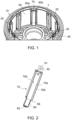
- Figure 1 shows a section of a typical wheel assembly comprising a wheel rim or tube well 1 having an outer diameter surface 10, on which a tyre (not shown) will usually be mounted, and an inner diameter surface 20 defining an interior cavity in which a brake assembly (not shown) will typically be arranged around a wheel hub 30.
- the hub 30 would be attached by bearing to an axle (not shown).
- the hub 30 is connected to the wheel rim 1 via a web 40.
- Rotor disc drive lugs (or torque bars) 50 extend axially across the tube well 1 for engagement with the brake discs.
- a heat shield is mounted to the inner diameter surface 20 of the wheel.
- the heat shield may be a single tubular shield or, as shown in this example, may be formed of several heat shield panels 60 provided between the rotor drive lugs 50.
- the heat shield/panels 60 is in the form of an arcuate thin metal sheet or several thin metal sheets and is attached to the wheel so as to be spaced apart from the wheel inner diameter surface by a small insulation gap (not shown).
- the heat shield is made of a number of panels or segments attached together, the adjoining edges 60a, 60b of the panels are connected and retained by means of retainers 70.
- the retainers 70 each define a seam between adjacent panels.
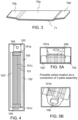
- a typical retainer 70 is shown in Figs. 2 and 3 .
- Such a retainer 70 is formed of a shaped metal sheet having a main panel 70a that, in use, will define the seam between two adjacent heat shield panels when positioned between their adjacent edges 60a, 60b.
- the main panel 70a has a length I and a width w essentially corresponding to the dimensions of a drive lug 50.
- the top of the main panel is provided with a tab 61 within which is formed a hole 62 to receive a bolt or fastener (not shown).
- the other end of the main panel is provided with a foot 63 to support the retainer in place against the lug 50.
- the foot 63 may also have a hole 65 therethrough, in which an end pin of the lug can be located.
- cut-outs 66 are formed between the main panel and the foot. Extending along each of the long sides of the main panel is a side panel or wing 70b, 70b'. A bend 71 provides the transition from the main panel 70a to the wing 70b, 70b'.
- the retainer is located between adjacent edges of adjacent heat shield segments such that the wings extend over part of the respective segment to retain the segments to form the circular heat shield at the appropriate distance from the tube well.
- Figure 4 shows a retainer 100 modified according to the disclosure to add stiffness and strength to the heat shield whilst minimising the thickness of the retainer in the space between the heat shield and the wheel, so reducing the effects of deformation or deflection of the panel, to avoid or mitigate the problems mentioned above.
- the shape of the retainer is similar to that shown in Figs. 2 and 3 in that the retainer 100 is formed of a sheet of metal shaped to define an elongate central panel 101 flanked by two side panels or wings 102, 102'. Similarly to the known design, one end of the central panel is provided with a tab 103 through which a fastener hole 104 may be formed and the other end of the central panel is formed as a foot 105 which may have a hole 106 therethrough to retain a torque bar (not shown).
- the central panel is corrugated as best seen in Figs. 5A and 5B .
- the corrugations 200 run along the full length of the retainer, from the top end to the bottom end, which significantly adds to the strength and stiffness of the retainer.
- the retainer can be formed as a single piece, it is possible to form the retainer as three separate parts, as can be seen in Figs. 5A and 5B , whereby a top end portion 101a of the corrugated central elongate panel is formed as one part with the tab 103, and a bottom end part 101b of the central elongate panel is formed in a part with the foot 106, and these parts are then attached e.g. by welding, to the middle part 101c of the central elongate panel.
- the corrugated form increases the surface area of the retainer and so improves its thermal properties.
- the number of corrugations can be increased or decreased.
- the central panel 101 is located at the seam between adjoining edges of adjacent panels and the side panels 102, 102; extend partially across the respective heat shield panel to retain the heat shield panels in the heat shield configuration and spaced from the tube well by the insulation gap.
- the retainer With the added stiffness and strength provided by the corrugations, if the heat shield panels deflect, the retainer will be strong and stiff enough to retain the heat shield panels away from the inner diameter of the tube well without the retainer or the heat shield panels contacting the wheel and causing abrasion.
- the corrugations combine to increase the stiffness of the retainer, and so the depth of each individual corrugation can still be relatively small.
- the retainers in the space between the heat shield and the wheel rim therefore, have a relatively small profile and are thus less likely to contact the wheel rim if the panel is deformed or deflected than in conventional assemblies.
- the depth d of the corrugations 200 is approximately the same as the distance by which the foot 106 extends radially inwards.
- the modified retainer does not, therefore, take up any additional space compared to the known design.
- each pair of adjacent heat shield panels is provided with a retainer between their adjoining edges.
- two or more retainers may be positioned between each pair of heat shield panels.
- the retainer of this invention provides additional strength to the heat shield and a secure connection between heat shield panels, whilst minimising the risk of wheel abrasion due to deformation or deflection of the panels.
Landscapes
- Engineering & Computer Science (AREA)
- Mechanical Engineering (AREA)
- General Engineering & Computer Science (AREA)
- Aviation & Aerospace Engineering (AREA)
- Braking Arrangements (AREA)
Description
- The present invention relates to a retainer for connecting panels or segments of a heat shield assembly for a wheel for a vehicle especially, but not exclusively, for an aircraft wheel.
- Wheels on aircraft and other vehicles are often provided with a brake assembly comprising a stack of brake discs mounted inside the wheel, within the tube well of the wheel. The brake operates by compressing the brake discs together to slow and stop rotation of the wheel. The friction between the pressed brake discs generates a large amount of heat which can cause damage to the wheel and/or tyres. It is conventional to provide a heat shield between the brake assembly and the wheel rim or tube well to reduce the effects of the heat generated by braking on the wheel parts. The heat shield can also catch hot brake material that is ejected from the brake discs during braking, before it strikes the wheel.
- Various types of heat shield are known but, typically, heat shields are in the form of metal sheets or panels provided concentric with the wheel tube well and spaced a small distance from the tube well. The heat shield can be provided as a single cylindrical piece but more typically is formed as a number of arcuate panels or segments that are attached together to form a complete cylindrical heat shield.
EP3712061A shows an example of a retainer. - Particularly with the increased use of carbon disc brakes, which have greater energy absorption capability than steel brakes and are significantly lighter, but which are larger than steel brake discs, it is important for the heat shields to be robust. There is, however, also a need for them to be as simple and lightweight as possible. In aircraft in particular, but also in other vehicles with braked wheels, there is a need to minimise the weight and size of the wheel assembly. Heat shields are therefore, often made of thin metal panels but may be arranged as two or more layers of panels with an insulation gap therebetween.
- Because of the high temperature and high stress/vibrational environments that braked wheels operate in and high centrifugal forces acting on the heat shields, as well as changes in tyre pressure, the heat shield can be caused to deform and/or deflect. This can cause high stresses on the heat shield and can cause the heat shield to come into contact with the wheel tube well which can, in turn, result in wheel abrasion. The connectors used to join adjacent panels comprise two engaging or interleaving hook parts resulting in a seam that is thicker than the individual panels themselves and the seams provide points around the heat shield that are even more likely to contact the wheel tube well during movement and/or if the heat shield panels are deflected or deformed. This is even more of an issue for carbon brakes because they are larger and so there is less space between the discs and the wheel. Flatter retainers have also been designed, that take the form of a central panel and side wings or panels. The central panel is provided with a hole at the top end through which a bolt can pass, and a foot at the bottom to be supported by a torque bar. The side panels extend partly across respective adjacent heat shield panels. The retainer and torque bar combine to connect/retain the heat shield panels. Such retainers are made of relatively thin sheets of metal to maintain a low profile. The retainer being thin, provides an area of weakness in the heat shield assembly, and is the area where the greatest deflection and plasticity appears. The retainer may not be strong enough to prevent deflection of the wings and the heat shield panels they support, in certain conditions. This can therefore lead to the heat shield panels making contact with the tube well, thus resulting in abrasion.
- There is a need for a heat shield assembly which is less prone to deflection and deforming and also an improved retainer, so as to avoid or reduce damage to the heat shield and to avoid or reduce wheel abrasion.
- According to the present invention, there is provided a retainer for connecting two panels of a heat shield assembly, the retainer comprising: a central elongate panel having a length I and a width w, a top end, a bottom end and first and second long sides extending from the top end to the bottom end; a first side panel extending along the first long side of the central elongate panel and a second side panel extending along the second long side of the central elongate panel; and characterized in that the central elongate panel is corrugated, with corrugations running along the length of the central elongate panel from the top end to the bottom end.
- The assembly according to the invention will be described, by way of example only, with reference to the drawings. Variations and modifications are possible within the scope of the claims.
-
Figure 1 shows an example of a heat shield in a wheel. -
Figure 2 shows a conventional retainer forming the connection between heat shield panels as inFig. 1 . -
Figure 3 shows a profile view of a retainer as shown inFig. 2 . -
Figure 4 is a view of a retainer according to the disclosure. -
Figure 5A is a detail of the top end of a retainer as shown inFig. 4 . -
Figure 5B is a detail of the bottom end of the retainer ofFig. 4 . -
Figure 1 shows a section of a typical wheel assembly comprising a wheel rim or tube well 1 having anouter diameter surface 10, on which a tyre (not shown) will usually be mounted, and aninner diameter surface 20 defining an interior cavity in which a brake assembly (not shown) will typically be arranged around awheel hub 30. Thehub 30 would be attached by bearing to an axle (not shown). Thehub 30 is connected to thewheel rim 1 via aweb 40. Rotor disc drive lugs (or torque bars) 50 extend axially across the tube well 1 for engagement with the brake discs. - To protect the
wheel rim 1 from the heat generated during hard braking or from brake disc material ejected during braking, a heat shield is mounted to theinner diameter surface 20 of the wheel. The heat shield may be a single tubular shield or, as shown in this example, may be formed of severalheat shield panels 60 provided between therotor drive lugs 50. The heat shield/panels 60 is in the form of an arcuate thin metal sheet or several thin metal sheets and is attached to the wheel so as to be spaced apart from the wheel inner diameter surface by a small insulation gap (not shown). Where the heat shield is made of a number of panels or segments attached together, theadjoining edges retainers 70. Theretainers 70 each define a seam between adjacent panels. - A
typical retainer 70 is shown inFigs. 2 and3 . Such aretainer 70 is formed of a shaped metal sheet having amain panel 70a that, in use, will define the seam between two adjacent heat shield panels when positioned between theiradjacent edges main panel 70a has a length I and a width w essentially corresponding to the dimensions of adrive lug 50. The top of the main panel is provided with atab 61 within which is formed ahole 62 to receive a bolt or fastener (not shown). The other end of the main panel is provided with a foot 63 to support the retainer in place against thelug 50. The foot 63 may also have ahole 65 therethrough, in which an end pin of the lug can be located. Typically, cut-outs 66 are formed between the main panel and the foot. Extending along each of the long sides of the main panel is a side panel orwing bend 71 provides the transition from themain panel 70a to thewing - In use, the retainer is located between adjacent edges of adjacent heat shield segments such that the wings extend over part of the respective segment to retain the segments to form the circular heat shield at the appropriate distance from the tube well.
- As mentioned above, in the harsh braking conditions experienced by e.g. wheels on an aircraft landing gear, high temperatures are reached and pieces of hot material can break off from the rotor discs. All of this can cause the heat shield panels to deform or deflect and be damaged and/or to contact the wall by being deflected into the insulation gap between the heat shield and the tube well interior surface. Because the retainer is made of relatively thin, light material, deformation of the panels can cause the retainer to deflect outwards and contact the wheel rim and this can result in damage and wheel abrasion. Also, if the retainers are not sufficiently strong to retain the heat shield panels in such conditions, the heat shield panels themselves can also contact the wheel. This can cause wheel abrasion and/or heat shield damage/abrasion and require the entire wheel assembly to be replaced.
-
Figure 4 shows aretainer 100 modified according to the disclosure to add stiffness and strength to the heat shield whilst minimising the thickness of the retainer in the space between the heat shield and the wheel, so reducing the effects of deformation or deflection of the panel, to avoid or mitigate the problems mentioned above. - As shown in
Fig. 4 , the shape of the retainer is similar to that shown inFigs. 2 and3 in that theretainer 100 is formed of a sheet of metal shaped to define an elongatecentral panel 101 flanked by two side panels orwings 102, 102'. Similarly to the known design, one end of the central panel is provided with atab 103 through which afastener hole 104 may be formed and the other end of the central panel is formed as a foot 105 which may have ahole 106 therethrough to retain a torque bar (not shown). Rather than the central panel being formed merely by a flat metal sheet as in the known design, however, in the modified design of this disclosure, the central panel is corrugated as best seen inFigs. 5A and 5B . Thecorrugations 200 run along the full length of the retainer, from the top end to the bottom end, which significantly adds to the strength and stiffness of the retainer. - Whilst the retainer can be formed as a single piece, it is possible to form the retainer as three separate parts, as can be seen in
Figs. 5A and 5B , whereby atop end portion 101a of the corrugated central elongate panel is formed as one part with thetab 103, and abottom end part 101b of the central elongate panel is formed in a part with thefoot 106, and these parts are then attached e.g. by welding, to themiddle part 101c of the central elongate panel. - In addition to adding strength to the retainer, the corrugated form increases the surface area of the retainer and so improves its thermal properties.
- Depending on application and design requirements, the number of corrugations can be increased or decreased.
- In use, the
central panel 101 is located at the seam between adjoining edges of adjacent panels and theside panels - In addition, in the example shown, in forming the corrugations, there is no need for any cut-outs which further adds to the strength of the retainer. Because of the added strength, the retainer is less a region of weakness than in the known designs.
- The corrugations combine to increase the stiffness of the retainer, and so the depth of each individual corrugation can still be relatively small. The retainers in the space between the heat shield and the wheel rim, therefore, have a relatively small profile and are thus less likely to contact the wheel rim if the panel is deformed or deflected than in conventional assemblies.
- In the example shown, the depth d of the
corrugations 200 is approximately the same as the distance by which thefoot 106 extends radially inwards. The modified retainer does not, therefore, take up any additional space compared to the known design. - In an example, each pair of adjacent heat shield panels is provided with a retainer between their adjoining edges. In other examples, two or more retainers may be positioned between each pair of heat shield panels.
- To assemble the heat shield, two adjacent panels are connected by means of the retainer.
- The retainer of this invention provides additional strength to the heat shield and a secure connection between heat shield panels, whilst minimising the risk of wheel abrasion due to deformation or deflection of the panels.
Claims (13)
- A retainer for connecting two panels of a heat shield assembly, the retainer comprising: a central elongate panel (101) having a length I and a width w, a top end, a bottom end and first and second long sides extending from the top end to the bottom end; a first side panel (102) extending along the first long side of the central elongate panel and a second side panel (102') extending along the second long side of the central elongate panel; and characterised in that the central elongate panel is corrugated, with corrugations running along the length of the central elongate panel from the top end to the bottom end.
- The retainer of claim 1, further comprising a tab (103) extending from the top end.
- The retainer of claim 2, further comprising a fastening hole (104) formed in the tab (103).
- The retainer of any preceding claim, further comprising a foot (105) at the bottom end.
- The retainer of claim 4, further comprising a locating hole (106) in the foot (105).
- The retainer of any preceding claim, the central panel and the first and second side panels being formed from a single piece of sheet metal.
- The retainer of any of claims 1 to 5, wherein the retainer is formed of a top section, a middle section and a bottom section, the top section welded to one end of the middle section and the bottom section welded to the other end of the middle section.
- A heat shield assembly for a wheel assembly, comprising a plurality of arcuate heat shield panels (60) arranged to be connected together to form a heat shield to be attached to the interior of a wheel, and a retainer as claimed in any preceding claim, for attaching adjacent panels.
- The heat shield assembly as claimed in claim 8, wherein one or more retainers is provided between each pair of adjacent panels.
- The heat shield assembly of claim 8 or 9, wherein each panel comprises two heat shield panel layers arranged radially adjacent each other and wherein a retainer prevents relative movement of the layers.
- A wheel assembly comprising a wheel rim having a radially inner surface and a radially outer surface, and a heat shield assembly as claimed in claim 8, 9 or 10 attached to and having a radially outer surface radially spaced from the radially inner surface of the wheel rim.
- The wheel assembly of claim 11, further comprising a plurality of torque bars (50) arranged around the radially inner surface of the heat shield, a torque bar positioned along the central elongate panel of each retainer.
- The wheel assembly of claims 11 or 12 being a wheel assembly for the landing gear of an aircraft.
Priority Applications (2)
| Application Number | Priority Date | Filing Date | Title |
|---|---|---|---|
| EP22461569.0A EP4289637B1 (en) | 2022-06-09 | 2022-06-09 | Heat shield panel retainer |
| US18/325,763 US12558928B2 (en) | 2022-06-09 | 2023-05-30 | Heat shield panel retainer |
Applications Claiming Priority (1)
| Application Number | Priority Date | Filing Date | Title |
|---|---|---|---|
| EP22461569.0A EP4289637B1 (en) | 2022-06-09 | 2022-06-09 | Heat shield panel retainer |
Publications (2)
| Publication Number | Publication Date |
|---|---|
| EP4289637A1 EP4289637A1 (en) | 2023-12-13 |
| EP4289637B1 true EP4289637B1 (en) | 2025-02-19 |
Family
ID=82019689
Family Applications (1)
| Application Number | Title | Priority Date | Filing Date |
|---|---|---|---|
| EP22461569.0A Active EP4289637B1 (en) | 2022-06-09 | 2022-06-09 | Heat shield panel retainer |
Country Status (2)
| Country | Link |
|---|---|
| US (1) | US12558928B2 (en) |
| EP (1) | EP4289637B1 (en) |
Families Citing this family (1)
| Publication number | Priority date | Publication date | Assignee | Title |
|---|---|---|---|---|
| EP4289638A1 (en) * | 2022-06-09 | 2023-12-13 | Goodrich Corporation | Heat shield panel retainer |
Family Cites Families (9)
| Publication number | Priority date | Publication date | Assignee | Title |
|---|---|---|---|---|
| US1961486A (en) * | 1927-07-20 | 1934-06-05 | Duluth Show Case Company | Holding clip for partition plates and the like |
| US4017123A (en) * | 1976-04-02 | 1977-04-12 | The Bendix Corporation | Dual layer heat shield for wheels |
| US4084857A (en) * | 1976-12-20 | 1978-04-18 | The Bendix Corporation | Drive key heat shield and support for wheel rim heat shield of multiple disc brake |
| US5851056A (en) * | 1996-06-03 | 1998-12-22 | The B. F. Goodrich Company | Aircraft brake heat shield having easily removed heat shield sections |
| DE60218355T2 (en) * | 2001-10-10 | 2007-10-31 | Goodrich Corp. | Brake assembly with a heat shield in an aircraft wheel |
| US11346418B2 (en) * | 2019-03-19 | 2022-05-31 | Goodrich Corporation | Covered retainer for segmented annular heat shield |
| US11713111B2 (en) * | 2019-03-19 | 2023-08-01 | Goodrich Corporation | Retainer for segmented annular heat shield |
| US11274715B2 (en) * | 2019-07-16 | 2022-03-15 | Goodrich Corporation | Heat shield retainer and methods |
| US12017487B2 (en) * | 2020-12-09 | 2024-06-25 | Goodrich Corporation | Wheel assembly with torque bar bracket ribs |
-
2022
- 2022-06-09 EP EP22461569.0A patent/EP4289637B1/en active Active
-
2023
- 2023-05-30 US US18/325,763 patent/US12558928B2/en active Active
Also Published As
| Publication number | Publication date |
|---|---|
| EP4289637A1 (en) | 2023-12-13 |
| US20230398818A1 (en) | 2023-12-14 |
| US12558928B2 (en) | 2026-02-24 |
Similar Documents
| Publication | Publication Date | Title |
|---|---|---|
| EP0555822B1 (en) | Heatshield installation for aircraft brake | |
| EP3647622B1 (en) | Segmented heat shield with reduced interlayer thermal conduction | |
| EP4289637B1 (en) | Heat shield panel retainer | |
| US20190093719A1 (en) | Disc brakes and braking systems | |
| EP4289636B1 (en) | Heat shield panel retainer | |
| US12459312B2 (en) | Heat shield panel retainer | |
| US9709110B2 (en) | Brake disc ventilation arrangement | |
| EP4417833B1 (en) | Heat shield assembly | |
| US12486028B2 (en) | Heat shield panel connector | |
| EP4321769B1 (en) | Heat shield panel | |
| EP4155571B1 (en) | Heat shield panel attachment bracket | |
| EP3404283B1 (en) | Extended torque tube | |
| EP4155572B1 (en) | Heat shield assembly for wheel and wheel with heat shield assembly | |
| US12498008B2 (en) | Rotor clip for brake assembly | |
| US20240344571A1 (en) | Torque pad | |
| EP4155570B1 (en) | Rotor clip for brake assembly | |
| EP4403790B1 (en) | Heat shield assembly | |
| US12486877B2 (en) | Rotor clip for brake assembly |
Legal Events
| Date | Code | Title | Description |
|---|---|---|---|
| PUAI | Public reference made under article 153(3) epc to a published international application that has entered the european phase |
Free format text: ORIGINAL CODE: 0009012 |
|
| STAA | Information on the status of an ep patent application or granted ep patent |
Free format text: STATUS: THE APPLICATION HAS BEEN PUBLISHED |
|
| AK | Designated contracting states |
Kind code of ref document: A1 Designated state(s): AL AT BE BG CH CY CZ DE DK EE ES FI FR GB GR HR HU IE IS IT LI LT LU LV MC MK MT NL NO PL PT RO RS SE SI SK SM TR |
|
| STAA | Information on the status of an ep patent application or granted ep patent |
Free format text: STATUS: REQUEST FOR EXAMINATION WAS MADE |
|
| 17P | Request for examination filed |
Effective date: 20240611 |
|
| RBV | Designated contracting states (corrected) |
Designated state(s): AL AT BE BG CH CY CZ DE DK EE ES FI FR GB GR HR HU IE IS IT LI LT LU LV MC MK MT NL NO PL PT RO RS SE SI SK SM TR |
|
| RIC1 | Information provided on ipc code assigned before grant |
Ipc: F16D 65/847 20060101ALI20240828BHEP Ipc: F16D 65/78 20060101ALI20240828BHEP Ipc: F16D 55/36 20060101ALI20240828BHEP Ipc: B60C 23/18 20060101AFI20240828BHEP |
|
| GRAP | Despatch of communication of intention to grant a patent |
Free format text: ORIGINAL CODE: EPIDOSNIGR1 |
|
| STAA | Information on the status of an ep patent application or granted ep patent |
Free format text: STATUS: GRANT OF PATENT IS INTENDED |
|
| INTG | Intention to grant announced |
Effective date: 20241009 |
|
| RIN1 | Information on inventor provided before grant (corrected) |
Inventor name: SOSNOWSKI, MIROS AW Inventor name: MILLER, JERRY Inventor name: STEVENSON, JOHN A. Inventor name: HERRMANN, NATHANIEL Inventor name: ZUK, BARTLOMIEJ Inventor name: SOKOLOWSKI, MARCIN |
|
| GRAS | Grant fee paid |
Free format text: ORIGINAL CODE: EPIDOSNIGR3 |
|
| GRAA | (expected) grant |
Free format text: ORIGINAL CODE: 0009210 |
|
| STAA | Information on the status of an ep patent application or granted ep patent |
Free format text: STATUS: THE PATENT HAS BEEN GRANTED |
|
| AK | Designated contracting states |
Kind code of ref document: B1 Designated state(s): AL AT BE BG CH CY CZ DE DK EE ES FI FR GB GR HR HU IE IS IT LI LT LU LV MC MK MT NL NO PL PT RO RS SE SI SK SM TR |
|
| REG | Reference to a national code |
Ref country code: GB Ref legal event code: FG4D |
|
| REG | Reference to a national code |
Ref country code: CH Ref legal event code: EP |
|
| REG | Reference to a national code |
Ref country code: DE Ref legal event code: R096 Ref document number: 602022010815 Country of ref document: DE |
|
| REG | Reference to a national code |
Ref country code: IE Ref legal event code: FG4D |
|
| REG | Reference to a national code |
Ref country code: NL Ref legal event code: MP Effective date: 20250219 |
|
| PG25 | Lapsed in a contracting state [announced via postgrant information from national office to epo] |
Ref country code: RS Free format text: LAPSE BECAUSE OF FAILURE TO SUBMIT A TRANSLATION OF THE DESCRIPTION OR TO PAY THE FEE WITHIN THE PRESCRIBED TIME-LIMIT Effective date: 20250519 |
|
| PG25 | Lapsed in a contracting state [announced via postgrant information from national office to epo] |
Ref country code: FI Free format text: LAPSE BECAUSE OF FAILURE TO SUBMIT A TRANSLATION OF THE DESCRIPTION OR TO PAY THE FEE WITHIN THE PRESCRIBED TIME-LIMIT Effective date: 20250219 |
|
| PG25 | Lapsed in a contracting state [announced via postgrant information from national office to epo] |
Ref country code: PL Free format text: LAPSE BECAUSE OF FAILURE TO SUBMIT A TRANSLATION OF THE DESCRIPTION OR TO PAY THE FEE WITHIN THE PRESCRIBED TIME-LIMIT Effective date: 20250219 |
|
| PG25 | Lapsed in a contracting state [announced via postgrant information from national office to epo] |
Ref country code: ES Free format text: LAPSE BECAUSE OF FAILURE TO SUBMIT A TRANSLATION OF THE DESCRIPTION OR TO PAY THE FEE WITHIN THE PRESCRIBED TIME-LIMIT Effective date: 20250219 |
|
| REG | Reference to a national code |
Ref country code: LT Ref legal event code: MG9D |
|
| PG25 | Lapsed in a contracting state [announced via postgrant information from national office to epo] |
Ref country code: IS Free format text: LAPSE BECAUSE OF FAILURE TO SUBMIT A TRANSLATION OF THE DESCRIPTION OR TO PAY THE FEE WITHIN THE PRESCRIBED TIME-LIMIT Effective date: 20250619 Ref country code: NO Free format text: LAPSE BECAUSE OF FAILURE TO SUBMIT A TRANSLATION OF THE DESCRIPTION OR TO PAY THE FEE WITHIN THE PRESCRIBED TIME-LIMIT Effective date: 20250519 |
|
| PG25 | Lapsed in a contracting state [announced via postgrant information from national office to epo] |
Ref country code: NL Free format text: LAPSE BECAUSE OF FAILURE TO SUBMIT A TRANSLATION OF THE DESCRIPTION OR TO PAY THE FEE WITHIN THE PRESCRIBED TIME-LIMIT Effective date: 20250219 |
|
| PG25 | Lapsed in a contracting state [announced via postgrant information from national office to epo] |
Ref country code: HR Free format text: LAPSE BECAUSE OF FAILURE TO SUBMIT A TRANSLATION OF THE DESCRIPTION OR TO PAY THE FEE WITHIN THE PRESCRIBED TIME-LIMIT Effective date: 20250219 |
|
| PG25 | Lapsed in a contracting state [announced via postgrant information from national office to epo] |
Ref country code: PT Free format text: LAPSE BECAUSE OF FAILURE TO SUBMIT A TRANSLATION OF THE DESCRIPTION OR TO PAY THE FEE WITHIN THE PRESCRIBED TIME-LIMIT Effective date: 20250620 Ref country code: LV Free format text: LAPSE BECAUSE OF FAILURE TO SUBMIT A TRANSLATION OF THE DESCRIPTION OR TO PAY THE FEE WITHIN THE PRESCRIBED TIME-LIMIT Effective date: 20250219 |
|
| PGFP | Annual fee paid to national office [announced via postgrant information from national office to epo] |
Ref country code: FR Payment date: 20250520 Year of fee payment: 4 |
|
| PG25 | Lapsed in a contracting state [announced via postgrant information from national office to epo] |
Ref country code: BG Free format text: LAPSE BECAUSE OF FAILURE TO SUBMIT A TRANSLATION OF THE DESCRIPTION OR TO PAY THE FEE WITHIN THE PRESCRIBED TIME-LIMIT Effective date: 20250219 Ref country code: GR Free format text: LAPSE BECAUSE OF FAILURE TO SUBMIT A TRANSLATION OF THE DESCRIPTION OR TO PAY THE FEE WITHIN THE PRESCRIBED TIME-LIMIT Effective date: 20250520 |
|
| REG | Reference to a national code |
Ref country code: AT Ref legal event code: MK05 Ref document number: 1767983 Country of ref document: AT Kind code of ref document: T Effective date: 20250219 |
|
| PG25 | Lapsed in a contracting state [announced via postgrant information from national office to epo] |
Ref country code: SE Free format text: LAPSE BECAUSE OF FAILURE TO SUBMIT A TRANSLATION OF THE DESCRIPTION OR TO PAY THE FEE WITHIN THE PRESCRIBED TIME-LIMIT Effective date: 20250219 |
|
| PG25 | Lapsed in a contracting state [announced via postgrant information from national office to epo] |
Ref country code: SM Free format text: LAPSE BECAUSE OF FAILURE TO SUBMIT A TRANSLATION OF THE DESCRIPTION OR TO PAY THE FEE WITHIN THE PRESCRIBED TIME-LIMIT Effective date: 20250219 |
|
| PG25 | Lapsed in a contracting state [announced via postgrant information from national office to epo] |
Ref country code: DK Free format text: LAPSE BECAUSE OF FAILURE TO SUBMIT A TRANSLATION OF THE DESCRIPTION OR TO PAY THE FEE WITHIN THE PRESCRIBED TIME-LIMIT Effective date: 20250219 |
|
| PG25 | Lapsed in a contracting state [announced via postgrant information from national office to epo] |
Ref country code: IT Free format text: LAPSE BECAUSE OF FAILURE TO SUBMIT A TRANSLATION OF THE DESCRIPTION OR TO PAY THE FEE WITHIN THE PRESCRIBED TIME-LIMIT Effective date: 20250219 |
|
| PG25 | Lapsed in a contracting state [announced via postgrant information from national office to epo] |
Ref country code: AT Free format text: LAPSE BECAUSE OF FAILURE TO SUBMIT A TRANSLATION OF THE DESCRIPTION OR TO PAY THE FEE WITHIN THE PRESCRIBED TIME-LIMIT Effective date: 20250219 |
|
| PG25 | Lapsed in a contracting state [announced via postgrant information from national office to epo] |
Ref country code: EE Free format text: LAPSE BECAUSE OF FAILURE TO SUBMIT A TRANSLATION OF THE DESCRIPTION OR TO PAY THE FEE WITHIN THE PRESCRIBED TIME-LIMIT Effective date: 20250219 Ref country code: CZ Free format text: LAPSE BECAUSE OF FAILURE TO SUBMIT A TRANSLATION OF THE DESCRIPTION OR TO PAY THE FEE WITHIN THE PRESCRIBED TIME-LIMIT Effective date: 20250219 |
|
| PG25 | Lapsed in a contracting state [announced via postgrant information from national office to epo] |
Ref country code: RO Free format text: LAPSE BECAUSE OF FAILURE TO SUBMIT A TRANSLATION OF THE DESCRIPTION OR TO PAY THE FEE WITHIN THE PRESCRIBED TIME-LIMIT Effective date: 20250219 |
|
| PG25 | Lapsed in a contracting state [announced via postgrant information from national office to epo] |
Ref country code: SK Free format text: LAPSE BECAUSE OF FAILURE TO SUBMIT A TRANSLATION OF THE DESCRIPTION OR TO PAY THE FEE WITHIN THE PRESCRIBED TIME-LIMIT Effective date: 20250219 |
|
| REG | Reference to a national code |
Ref country code: DE Ref legal event code: R097 Ref document number: 602022010815 Country of ref document: DE |
|
| PLBE | No opposition filed within time limit |
Free format text: ORIGINAL CODE: 0009261 |
|
| STAA | Information on the status of an ep patent application or granted ep patent |
Free format text: STATUS: NO OPPOSITION FILED WITHIN TIME LIMIT |
|
| REG | Reference to a national code |
Ref country code: CH Ref legal event code: L10 Free format text: ST27 STATUS EVENT CODE: U-0-0-L10-L00 (AS PROVIDED BY THE NATIONAL OFFICE) Effective date: 20251231 |
|
| REG | Reference to a national code |
Ref country code: DE Ref legal event code: R119 Ref document number: 602022010815 Country of ref document: DE |
|
| REG | Reference to a national code |
Ref country code: CH Ref legal event code: H13 Free format text: ST27 STATUS EVENT CODE: U-0-0-H10-H13 (AS PROVIDED BY THE NATIONAL OFFICE) Effective date: 20260127 |
|
| 26N | No opposition filed |
Effective date: 20251120 |
|
| PG25 | Lapsed in a contracting state [announced via postgrant information from national office to epo] |
Ref country code: MC Free format text: LAPSE BECAUSE OF FAILURE TO SUBMIT A TRANSLATION OF THE DESCRIPTION OR TO PAY THE FEE WITHIN THE PRESCRIBED TIME-LIMIT Effective date: 20250219 |
|
| PG25 | Lapsed in a contracting state [announced via postgrant information from national office to epo] |
Ref country code: LU Free format text: LAPSE BECAUSE OF NON-PAYMENT OF DUE FEES Effective date: 20250609 |
|
| REG | Reference to a national code |
Ref country code: BE Ref legal event code: MM Effective date: 20250630 |
|
| PG25 | Lapsed in a contracting state [announced via postgrant information from national office to epo] |
Ref country code: DE Free format text: LAPSE BECAUSE OF NON-PAYMENT OF DUE FEES Effective date: 20260101 Ref country code: IE Free format text: LAPSE BECAUSE OF NON-PAYMENT OF DUE FEES Effective date: 20250609 |
|
| PG25 | Lapsed in a contracting state [announced via postgrant information from national office to epo] |
Ref country code: BE Free format text: LAPSE BECAUSE OF NON-PAYMENT OF DUE FEES Effective date: 20250630 |
|
| PG25 | Lapsed in a contracting state [announced via postgrant information from national office to epo] |
Ref country code: CH Free format text: LAPSE BECAUSE OF NON-PAYMENT OF DUE FEES Effective date: 20250630 |