EP4289293A1 - Zerstäuber, elektronische zerstäubungsvorrichtung und zerstäubungsanordnung - Google Patents
Zerstäuber, elektronische zerstäubungsvorrichtung und zerstäubungsanordnung Download PDFInfo
- Publication number
- EP4289293A1 EP4289293A1 EP22748940.8A EP22748940A EP4289293A1 EP 4289293 A1 EP4289293 A1 EP 4289293A1 EP 22748940 A EP22748940 A EP 22748940A EP 4289293 A1 EP4289293 A1 EP 4289293A1
- Authority
- EP
- European Patent Office
- Prior art keywords
- trajectory
- vaporization
- liquid
- vaporization surface
- porous body
- Prior art date
- Legal status (The legal status is an assumption and is not a legal conclusion. Google has not performed a legal analysis and makes no representation as to the accuracy of the status listed.)
- Pending
Links
Images










Classifications
-
- A—HUMAN NECESSITIES
- A24—TOBACCO; CIGARS; CIGARETTES; SIMULATED SMOKING DEVICES; SMOKERS' REQUISITES
- A24F—SMOKERS' REQUISITES; MATCH BOXES; SIMULATED SMOKING DEVICES
- A24F40/00—Electrically operated smoking devices; Component parts thereof; Manufacture thereof; Maintenance or testing thereof; Charging means specially adapted therefor
- A24F40/10—Devices using liquid inhalable precursors
-
- A—HUMAN NECESSITIES
- A24—TOBACCO; CIGARS; CIGARETTES; SIMULATED SMOKING DEVICES; SMOKERS' REQUISITES
- A24F—SMOKERS' REQUISITES; MATCH BOXES; SIMULATED SMOKING DEVICES
- A24F40/00—Electrically operated smoking devices; Component parts thereof; Manufacture thereof; Maintenance or testing thereof; Charging means specially adapted therefor
- A24F40/40—Constructional details, e.g. connection of cartridges and battery parts
-
- A—HUMAN NECESSITIES
- A24—TOBACCO; CIGARS; CIGARETTES; SIMULATED SMOKING DEVICES; SMOKERS' REQUISITES
- A24F—SMOKERS' REQUISITES; MATCH BOXES; SIMULATED SMOKING DEVICES
- A24F40/00—Electrically operated smoking devices; Component parts thereof; Manufacture thereof; Maintenance or testing thereof; Charging means specially adapted therefor
- A24F40/40—Constructional details, e.g. connection of cartridges and battery parts
- A24F40/42—Cartridges or containers for inhalable precursors
-
- A—HUMAN NECESSITIES
- A24—TOBACCO; CIGARS; CIGARETTES; SIMULATED SMOKING DEVICES; SMOKERS' REQUISITES
- A24F—SMOKERS' REQUISITES; MATCH BOXES; SIMULATED SMOKING DEVICES
- A24F40/00—Electrically operated smoking devices; Component parts thereof; Manufacture thereof; Maintenance or testing thereof; Charging means specially adapted therefor
- A24F40/40—Constructional details, e.g. connection of cartridges and battery parts
- A24F40/44—Wicks
-
- A—HUMAN NECESSITIES
- A24—TOBACCO; CIGARS; CIGARETTES; SIMULATED SMOKING DEVICES; SMOKERS' REQUISITES
- A24F—SMOKERS' REQUISITES; MATCH BOXES; SIMULATED SMOKING DEVICES
- A24F40/00—Electrically operated smoking devices; Component parts thereof; Manufacture thereof; Maintenance or testing thereof; Charging means specially adapted therefor
- A24F40/40—Constructional details, e.g. connection of cartridges and battery parts
- A24F40/46—Shape or structure of electric heating means
-
- H—ELECTRICITY
- H05—ELECTRIC TECHNIQUES NOT OTHERWISE PROVIDED FOR
- H05B—ELECTRIC HEATING; ELECTRIC LIGHT SOURCES NOT OTHERWISE PROVIDED FOR; CIRCUIT ARRANGEMENTS FOR ELECTRIC LIGHT SOURCES, IN GENERAL
- H05B3/00—Ohmic-resistance heating
- H05B3/20—Heating elements having extended surface area substantially in a two-dimensional [2D] plane, e.g. plate-heater
- H05B3/22—Heating elements having extended surface area substantially in a two-dimensional [2D] plane, e.g. plate-heater non-flexible
- H05B3/26—Heating elements having extended surface area substantially in a two-dimensional [2D] plane, e.g. plate-heater non-flexible heating conductor mounted on insulating base
- H05B3/265—Heating elements having extended surface area substantially in a two-dimensional [2D] plane, e.g. plate-heater non-flexible heating conductor mounted on insulating base the insulating base being an inorganic material, e.g. ceramic
-
- H—ELECTRICITY
- H05—ELECTRIC TECHNIQUES NOT OTHERWISE PROVIDED FOR
- H05B—ELECTRIC HEATING; ELECTRIC LIGHT SOURCES NOT OTHERWISE PROVIDED FOR; CIRCUIT ARRANGEMENTS FOR ELECTRIC LIGHT SOURCES, IN GENERAL
- H05B2203/00—Aspects relating to Ohmic resistive heating covered by group H05B3/00
- H05B2203/021—Heaters specially adapted for heating liquids
Definitions
- Embodiments of this application relate to the technical field of electronic vaporization apparatuses, and in particular, to a vaporizer, an electronic vaporization apparatus, and a vaporization assembly.
- Tobacco products (such as cigarettes and cigars) burn tobacco during use to produce tobacco smoke. Attempts are made to replace these tobacco-burning products by manufacturing products that release compounds without burning tobacco.
- the materials may be tobacco or other non-tobacco products, where the non-tobacco products may or may not include nicotine.
- aerosol-providing products for example, electronic vaporization apparatuses. These apparatuses usually contain a liquid substrate, and the liquid substrate is heated to vaporize, so as to generate an inhalable vapor or an aerosol.
- the liquid substrate may contain nicotine, and/or aromatics, and/or aerosol-generation substances (for example, the solvent usually includes propylene glycol and vegetable glycerin).
- the proportion of the vegetable glycerin in the liquid substrate can be increased, but the increase of the viscosity of the liquid substrate is not conducive to infiltration, absorption and transmission by a vaporization assembly.
- An embodiment of this application provides a vaporizer, configured to vaporize a liquid substrate to generate an aerosol for inhaling, and including:
- the resistance heating trajectory is further lengthened, so that a heat radiation range can be extended to a farther part in the porous body, a high-viscosity liquid substrate away from the vaporization surface can be preheated to reduce the viscosity, and the fluidity of the liquid substrate can be improved.
- the porous body has a heat conductivity of 1 to 50 W/(m ⁇ K).
- the porous body includes a porous ceramic body, where the porous ceramic body includes at least one of silicon carbide, aluminum nitride, boron nitride or silicon nitride.
- the projection area of the resistance heating trajectory in the vaporization surface is greater than 35% of the area of the vaporization surface.
- the resistance heating trajectory at least partially extends in the width direction of the vaporization surface to a position with a shortest distance from an edge of the vaporization surface less than 0.32 mm.
- the resistance heating trajectory includes a first trajectory part and a second trajectory part which are alternately arranged in the length direction of the vaporization surface, where the first trajectory part and/or the second trajectory part are/is curved and have/has different bending directions.
- the vaporization surface includes a first side part and a second side part which are opposite to each other in the width direction, where the first trajectory part is close to the first side part, and the second trajectory part is close to the second side part.
- first trajectory part and/or the second trajectory part are/is configured to bend outwards in the width direction of the vaporization surface.
- first trajectory part and/or the second trajectory part are/is arc-shaped.
- the resistance heating trajectory further includes a third trajectory part extending between the adjacent first trajectory part and second trajectory part; and the third trajectory part is straight.
- the third trajectory part is arranged obliquely relative to the width direction of the vaporization surface.
- the curvature of any position of the first trajectory part and/or the second trajectory part is not zero.
- the resistance heating trajectory is constructed such that the whole trajectory only includes limited points with the curvature being zero.
- the porous body has a liquid channel penetrating through the porous body in a length direction, and is in fluid communication with the liquid storage cavity through the liquid channel to absorb the liquid substrate of the liquid storage cavity.
- the liquid channel has an inner bottom wall close to and parallel with the vaporization surface, and a distance between the inner bottom wall and the vaporization surface is less than 1.5 mm.
- the vaporizer further includes:
- the porous body includes a first side wall and a second side wall which are arranged oppositely in the width direction of the vaporization surface, and a base part positioned between the first side wall and the second side wall, and the liquid channel is defined jointly by the first side wall, the second side wall and the base part; and a groove extending in an axial direction of the porous body is formed in a surface, adjacent to the liquid channel, of the base part, and is configured to increase the surface area of the base part for absorbing the liquid substrate.
- Another embodiment of this application further provides a vaporizer, configured to vaporize a liquid substrate to generate an aerosol for inhaling, and including:
- Another embodiment of this application further provides an electronic vaporization apparatus, including a vaporizer configured to vaporize a liquid substrate to generate an aerosol for inhaling, and a power supply assembly supplying power to the vaporizer, where the vaporizer includes the vaporizer described above.
- Yet another embodiment of this application further provides a vaporization assembly for an electronic vaporization apparatus, including a porous body for absorbing a liquid substrate, where the porous body has a vaporization surface, and a resistance heating trajectory is formed on the vaporization surface; the vaporization surface is a flat plane, and includes a length direction and a width direction perpendicular to the length direction; the resistance heating trajectory includes a first end and a second end that are opposite to each other in the length direction of the vaporization surface; and a distance between a straight line passing through the first end in the width direction and a straight line passing through the second end in the width direction in the vaporization surface is greater than 75% of a length dimension of the vaporization surface.
- the electronic vaporization apparatus includes: a vaporizer 100, configured to store a liquid substrate and vaporize the liquid substrate to generate an aerosol; and a power supply mechanism 200, configured to supply power to the vaporizer 100.
- the power supply mechanism 200 includes: a receiving cavity 270, arranged at one end in a length direction and configured to receive and accommodate at least a part of the vaporizer 100; and a first electrical contact 230, at least partially exposed on a surface of the receiving cavity 270 and configured to be electrically connected to the vaporizer 100 to supply power to the vaporizer 100 when at least a part of the vaporizer 100 is received and accommodated in the power supply mechanism 200.
- a second electrical contact 21 is arranged at an end part of the vaporizer 100 opposite to the power supply mechanism 200 in the length direction, so that when the at least a part of the vaporizer 100 is received in the receiving cavity 270, the second electrical contact 21 is in contact with and abuts against the first electrical contact 230 to conduct electricity.
- a sealing member 260 is arranged in the power supply mechanism 200, and at least a part of an internal space of the power supply mechanism 200 is separated by the sealing member 260 to form the above receiving cavity 270.
- the sealing member 260 is constructed to extend in a cross-sectional direction of the power supply mechanism 200, and is prepared by a flexible material, so as to prevent the liquid substrate seeping from the vaporizer 100 to the receiving cavity 270 from flowing to a controller 220, a sensor 250, and other components in the power supply mechanism 200.
- the power supply mechanism 200 further includes a core 210, located close to the other end opposite to the receiving cavity 270 in the length direction, and configured to supply power; and the controller 220, arranged between the core 210 and an accommodating cavity, and operably guiding a current between the core 210 and the first electrical contact 230.
- the power supply mechanism 200 includes the sensor 250, configured to sense an inhalation flow generated by using a suction nozzle cover 20 of the vaporizer 100 during inhalation, so that the controller 220 controls the core 210 to output a current to the vaporizer 100 according to a detection signal of the sensor 250.
- a charging interface 240 is arranged at the other end, away from the receiving cavity 270, of the power supply mechanism 200, and is configured to supply power to the core 210 after being connected to an external charging device.
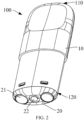
- FIG. 2 and FIG. 3 are specific schematic structural diagrams of a vaporizer 100 according to an embodiment of this application.
- the vaporizer includes: a main housing 10.
- the main housing 10 is substantially in a flat cylindrical shape, and certainly, a hollow interior of the main housing is a necessary functional device configured to store and vaporize the liquid substrate.
- the main housing 10 has a near end 110 and a far end 120 opposite to each other in the length direction.
- the near end 110 is configured as an end for a user to inhale the aerosol, and a suction nozzle A for the user to suck is arranged at the near end 110; and the far end 120 is used as an end combined with the power supply assembly 200, and the far end 120 of the main housing 10 is an opening on which a detachable end cap 20 is mounted.
- the opening structure is configured to mount necessary functional components inside the main housing 10.
- the second electrical contact 21 for conducting with the first electrical contact 230 of the power supply assembly 200 is arranged on the end cap 20.
- the main housing 10 is internally provided with a liquid storage cavity 12 for storing the liquid substrate, and a vaporization assembly for absorbing the liquid substrate from the liquid storage cavity 12, and heating and vaporizing the liquid substrate.
- the vaporization assembly includes a liquid guide element such as a porous body 30 in FIG. 3 , and a heating element 40 configured to heat and vaporize a liquid substrate absorbed by the porous body 30.
- the porous body 30 has one side which is close to the liquid storage cavity 12 in a longitudinal direction of the main housing 10 and is in fluid communication with the liquid storage cavity to absorb the liquid substrate; and the porous body 30 further has a vaporization surface 320 away from the liquid storage cavity 12 in the longitudinal direction of the main housing 10, and the vaporization surface 320 is provided with a heating element 40 for heating at least a part of the liquid substrate in the porous body 30 to generate an aerosol and release the aerosol in a vaporization chamber 80 defined between the vaporization surface 320 and the end cap 20.
- a vapor-gas transmission pipe 11 arranged in an axial direction is arranged inside the main housing 10, and the liquid storage cavity 12 configured to store the liquid substrate is formed in a space between an outer wall of the vapor-gas transmission pipe 11 and an inner wall of the main housing 10.
- a first end of the vapor-gas transmission pipe 11 opposite to the near end 110 is in communication with the suction nozzle A, and a second end opposite to the far end 120 is in airflow connection with a vaporization chamber 80 that releases the aerosol, thereby transmitting the aerosol generated by vaporizing the liquid substrate by the heating element 40 and released to the vaporization chamber 80 to the suction nozzle A for inhalation.
- the main housing 10 is further internally provided with a flexible silicone sleeve 50, a rigid support frame 60 and a flexible first seal element 70, thereby not only sealing an opening of the liquid storage cavity 12, but also fixing and holding the porous body 30 inside.
- the flexible silicone sleeve 50 is substantially hollow and cylindrical, is hollow inside for accommodating the porous body 30, and is sleeved outside the porous body 30 through tight fit.
- the rigid support frame 60 holds the porous body 30 sleeved with the flexible silicone sleeve 50.
- the rigid support frame may be substantially in a ring shape with a lower end being an opening, and an inner space thereof is configured to accommodate and hold the flexible silicone sleeve 50 and the porous body 30.
- the flexible silicone sleeve 50 can seal a gap between the porous body 30 and the support frame 60 to prevent the liquid substrate from seeping out of the gap between the porous body 30 and the support frame 60.
- the flexible silicone sleeve 50 is located between the porous body 30 and the support frame 60, which is advantageous for the porous body 30 to be stably accommodated in the support frame 60 to avoid loosening.
- the flexible seal element 70 is arranged on an end portion of the liquid storage cavity 12 facing the far end 120, and a shape thereof matches a cross section of an inner contour of the main housing 10, thereby sealing the liquid storage cavity 12 and preventing the liquid substrate from seeping from the liquid storage cavity 12. Further, to prevent shrinkage and deformation of a flexible seal element 70 made of a flexible material from affecting sealing tightness, the above rigid support frame 60 is accommodated in the flexible seal element 70 to support the flexible seal element.
- a first liquid guide hole 71 for the liquid substrate to flow through is formed in the flexible seal element 70, a second liquid guide hole 61 is correspondingly arranged on the rigid support frame 60, and a third liquid guide hole 51 is formed in the flexible silicone sleeve 50.
- the liquid substrate in the liquid storage cavity 12 sequentially passes through the first liquid guide hole 71, the second liquid guide hole 61 and the third liquid guide hole 51 and flows to the liquid channel 33 of the porous body 30 held in the flexible silicone sleeve 50, and then is absorbed by the porous body 30.
- the liquid substrate is absorbed and conveyed to the vaporization surface 320 for vaporization, and then the generated aerosol is released into the vaporization chamber 80 defined between the vaporization surface 320 and the end cap 20.
- the end cap 20 is further provided with an air inlet 23.
- An airflow during inhalation is shown in an arrow R2 in FIG. 3 .
- the air enters the vaporization chamber 80 through the air inlet 23, and then carries the generated aerosol to be outputted to vapor-gas transmission pipe 11 until being inhaled at the suction nozzle A.
- the shape of the porous body 30 is constructed to be, but not limited to, generally a blocky structure in the embodiment.
- the porous body includes a first side wall 31 and a second side wall 32 which are arched and are opposite to each other in a thickness direction, and a base part 34 extending between the first side wall 31 and the second side wall 32; and a lower surface of the base part 34 is respectively configured as a vaporization surface 320.
- first side wall 31 and the second side wall 32 extend in a width direction to define a liquid channel 33 between the first side wall 31 and the second side wall 32, and two ends of the liquid channel 33 are in fluid communication with the liquid storage cavity 12 so as to receive the liquid substrate.
- the porous body 30 may be made of a material of a hard capillary structure, such as a porous ceramic, a porous glass ceramic and a porous glass.
- the heating element 40 is preferably formed on the vaporization surface 320 by mixing conductive raw material powder with a printing assistant to form a slurry and then sintering after printing, so that an entire surface or most of the surface of the heating element is closely attached to the vaporization surface 320, and the heating element has the effects such as high vaporization efficiency, less heat loss, and dry-burn prevention or dry-burn reduction.
- the heating element 40 is obtained by bonding a sheet-like or net-like resistive base material on the vaporization surface 320.
- the heating element 40 may be made of a material such as stainless steel, nickel chromium alloy, iron chromium aluminum alloy and metal titanium.
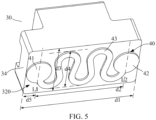
- the heating element 40 includes a first electrode connection portion 41 close to one side of the vaporization surface 320 in the length direction, and a second electrode connection portion 42 close to the other side of the vaporization surface 320 in the length direction; and during use, the first electrode connection portion 41 and the second electrode connection portion 42 are electrically connected in an abutting or welding manner of the positive/negative electrode 21 in FIG. 1 , so as to supply power to the heating element 40.
- the first electrode connection portion 41 and the second electrode connection portion 42 are constructed as a circular shape, or in other optional implementation, the first electrode connection portion and the second electrode connection portion may be square or oval.
- the first electrode connection portion 41 and the second electrode connection portion 42 are preferably made of a material with high resistance coefficient and high conductivity, such as gold and silver.
- the first electrode connection portion 41 and the second electrode connection portion 42 are located at a center position in the width direction of the vaporization surface 320.
- the first electrode connection portion 41 and the second electrode connection portion 42 are staggered in the width direction of the vaporization surface 320.
- the first electrode connection portion 41 is close to a lower side end in the width direction of the vaporization surface 320
- the second electrode connection portion 42 is close to an upper side end in the width direction of the vaporization surface 320.
- the heating element 40 further includes a resistance heating trajectory 43 extending between the first electrode connection portion 41 and the second electrode connection portion 42.
- the resistance heating trajectory 43 is usually made of a resistive metal material and a metal alloy material with a suitable impedance based on the functional requirements of heating and vaporization.
- a suitable metal or alloy material includes at least one of nickel, cobalt, zirconium, titanium, nickel alloy, cobalt alloy, zirconium alloy, titanium alloy, nickel-chromium alloy, nickel-iron alloy, iron-chromium alloy, iron-manganese-aluminum based alloy, or stainless steel.
- the resistance heating trajectory 43 basically cover an extension length of the vaporization surface 320. Specifically:
- the resistance heating trajectory 43 has a resistance value of 0.5 to 2 ⁇ , for example, the resistance value may be 0.7 S2 or 1.2 ⁇ .
- the resistance heating trajectory 43 is in a shape of a zigzag strip, and has a trajectory width of about 0.36 mm, so that the resistance heating trajectory 43 has sufficient heating area and ensures the radiation range of a temperature field.
- the strip area of the resistance heating trajectory 43 is 8.29 mm2
- the area of the vaporization surface 320 is 21.41 mm2
- the area of the resistance heating trajectory 43 is greater than 35% of the area of the vaporization surface 320.
- the resistance heating trajectory 43 may have larger area by making the resistance heating trajectory 43 have a higher height or a wider trajectory width, for example, the area of the resistance heating trajectory 43 is greater than 50% of the area of the vaporization surface 320.
- the extension length and width of the resistance heating trajectory 43 are larger than an existing conventional length and width, so that the temperature field range of the resistance heating trajectory 43 is larger, and the heat radiation area basically can cover the whole vaporization surface 320.
- the resistance heating trajectory 43 is of a uniquely designed zigzag shape, thereby having a wider and more uniform temperature field.
- the resistance heating trajectory 43 includes several alternately arranged first trajectory parts 431/431a, and several second trajectory parts 432/432a, and are formed by sequentially alternately connecting the first trajectory parts and second trajectory parts along the extension length of the resistance heating trajectory 43.
- the first trajectory parts 431/431a located on the outermost side of the length direction of the resistance heating trajectory 43 are directly connected to the first electrode connection portion 41/the second electrode connection portion 42.
- the second trajectory parts 432/432a are not arranged at the outermost side, so as not to be directly connected to the first electrode connection portion 41/the second electrode connection portion 42.
- the first trajectory parts 431/431a and the second trajectory parts 432/432a have opposite or different bending directions in the width direction of the vaporization surface 320.
- the first trajectory parts 431/431a are bent downwards, and the second trajectory parts 432/432a are bent upwards.
- the first trajectory parts 431/431a are arranged close to a lower end side of the vaporization surface 320, and the second trajectory parts 432/432a are arranged close to an upper end side of the vaporization surface 320.
- the first trajectory parts 431/431a are of a shape substantially or very close to a semi-circular arc, so that the curvature of each part of the first trajectory parts 431/431a is not 0.
- the second trajectory parts 432/432a are of a shape substantially or very close to a semi-circular arc, and the curvature of each part is not 0.
- the first trajectory parts 431/431a and the second trajectory parts 432/432a are in a shape of a semi-circular arc with a same curvature radius. That is, the curvatures of the first trajectory parts 431/431a and the second trajectory parts 432/432a are the same.
- the first trajectory parts 431/431a have a curvature or curvature radius different from that of the second trajectory parts 432/432a.
- the resistance heating trajectory 43 further includes a third trajectory part 433 extending between the adjacent first trajectory part 431 and second trajectory part 432.
- the third trajectory part 433 is of a flat shape with a constant curvature of 0, and the first trajectory part 431 and the second trajectory part 432 are connected through the third trajectory part 433 to form electrical conduction.
- an extension length of the third trajectory part 433 is about 1 mm, and is slightly greater than the radius (0.8 mm) of the first trajectory part 431 and the second trajectory part 432.
- third trajectory parts 433 are arranged obliquely in the vaporization surface 320, that is, have a certain included angle with the width direction of the vaporization surface 320 and are not arranged vertically.
- four third trajectory parts 433 are included in FIG. 6 , and the inclination directions of the third trajectory parts are not exactly the same as each other, but are alternately arranged along the extension length direction of the resistance heating trajectory 43.
- FIG. 6 illustrates the third trajectory parts 433 arranged obliquely in the vaporization surface 320, that is, have a certain included angle with the width direction of the vaporization surface 320 and are not arranged vertically.
- four third trajectory parts 433 are included in FIG. 6 , and the inclination directions of the third trajectory parts are not exactly the same as each other, but are alternately arranged along the extension length direction of the resistance heating trajectory 43.
- an included angle ⁇ 1 between the third trajectory part 433 closest to the first electrode connection portion 41 on the left side and the length direction of the vaporization surface 320 is an obtuse angle and about 104 degrees; and an included angle ⁇ 2 between the next third trajectory part 433 and the length direction of the vaporization surface 320 is an acute angle and about 76 degrees.
- the later third trajectory parts 433 are alternately arranged repeatedly in the above oblique direction.
- each part of the resistance heating trajectory part 43 due to the variable bending direction or shape of each part of the resistance heating trajectory part 43, several or a plurality of bending direction transition points 434/434a are formed at a position where each part is connected, for example, in FIG. 6 , a transition point 434 where two ends of the third trajectory parts 433 and the first trajectory part 431/the second trajectory part 432 are connected; or in FIG. 7 , a transition point 434a where the first trajectory part 431a and the second trajectory part 432a are connected.
- the curvature of the part only having limited transition points 434/434a is 0, and the curvatures of other positions are not 0.
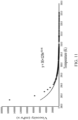
- FIG. 11 shows a schematic diagram of a curve of the viscosity of the common high-viscosity liquid substrate with the vegetable glycerin content exceeding 80% changing along with the temperature.
- the viscosity is about 179000 mPa ⁇ s at 290 K, and the viscosity is reduced to 1070 mPa ⁇ s when the temperature is increased to 320 K.
- FIG. 8 is a schematic structural diagram of a positive projection of one side of the porous body 30 in the length direction.
- the porous body 30 has a width d3 of 3.2 mm and a height d4 of 3.65 mm, and the outline area S1 after the whole side omits a filleted corner defect is basically 11.68 mm2.
- the liquid channel 33 adopts a rectangular cross-section shape of the filleted corner, and has a width d5 of 1.60 mm and a height d6 of 1.94 mm; the section area S2 of the liquid channel 33 is basically 3.1 mm2, and is at least greater than 25% of the outline area S1 of the side of the porous body 30; and it is ensured that the liquid substrate in the liquid channel 33 and the surface of the porous body 30 have sufficient contact area, and the efficiency of the porous body 30 absorbing the high-viscosity liquid substrate is kept.
- the sectional area S2 of the liquid channel 33 may be increased to be larger, for example, is larger than 50% of the outline area S1 of the side of the porous body 30.
- the liquid channel 33 at least partially penetrates through a base part 34, for example, in FIG. 8 , a depth d7 of the liquid channel 33 extending in the base part 34 is about 0.5 mm; and in the height direction of the porous body 30, a distance d8 between the heating element 40 on the vaporization surface 320 and an inner bottom wall 35 of the liquid channel 33 is less than 1.5 mm, more preferably, may be less than 1 mm.
- d8 is 1.2 mm, compared with the height d4 of the porous body 30 being 3.65 mm, d8 is close to and less than 1/3 of the height d4 of the porous body 30.
- the heat of the vaporization surface 320 can be more rapidly transmitted to the high-viscosity liquid substrate in the liquid channel 33 for preheating, thereby reducing the viscosity.
- FIG. 9 shows a schematic diagram of a porous body 30a according to another preferred embodiment.
- a surface, adjacent to or defining the liquid channel 33, of the base part 34a is provided with at least one or more grooves 341a penetrating in the length direction, so that the base part 34a has larger specific surface area, and the efficiency of absorbing and transmitting the high-viscosity liquid substrate is improved.
- the liquid channel 33 may further be designed to have more cross-sectional shapes such as a circle, an ellipse or a polygon.
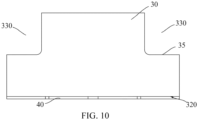
- FIG. 10 it is a schematic diagram of a positive projection of one side of a porous body 30 in a thickness direction.
- An avoidance part 330 opposite to a first liquid guide hole 71/a second liquid guide hole 61/a third liquid guide hole 51 is formed on at least one side (two sides in FIG. 10 ) of the porous body 30 in the length direction, so that the porous body 30 does not have a part extending between the first liquid guide hole 71/the second liquid guide hole 61/the third liquid guide hole 51 and the liquid channel 33, thereby not shielding a flow path between the first liquid guide hole 71/the second liquid guide hole 61/the third liquid guide hole 51 and the liquid channel 33.
- a liquid substrate transmitted by the first liquid guide hole 71/the second liquid guide hole 61/the third liquid guide hole 51 directly flows from the avoidance part 330 to the base part 34 and then is stored in the liquid channel 33.
- the avoidance parts 330 at two ends of the liquid channel 33 of the porous body 30 are defined by a step surface 35, and the step surface 35 is parallel to the vaporization surface 320. Further, as shown in FIG. 8 , the step surface 35 is higher than the inner bottom wall 35, adjacent to the vaporization surface 320, of the liquid channel 330.
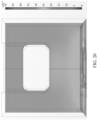
- FIG. 21 it is a schematic structural diagram of a porous body 30a according to another variable embodiment.
- an oblique flat or curved arc-shaped step surface 35a defines avoidance parts 330a at two ends of a liquid channel 33a.
- the step surface 35a is still higher than an inner bottom wall 36a of the liquid channel 33a.
- a distance d8 between the inner bottom wall 36a and the vaporization surface 320a is 1.2 mm
- a shortest distance d7 between the step surface 35a and the inner bottom wall 36a is 0.5 mm.
- the porous body 30 is made of a material with a heat conductivity higher than that of the conventional porous ceramic material, so that the porous body 30 has a higher heat conductivity finally; and in an implementation, the porous body 30 has a heat conductivity ranging from 1 to 50 W/(m K).
- the above porous body 30 is a porous body with a high heat conductivity, prepared by adding an inorganic ceramic component with a high heat conductivity, such as silicon carbide and silicon nitride with the heat conductivity reaching 83.6 W/(m K) or more, or aluminum nitride and boron nitride with the heat conductivity capable of reaching 220 W/(m K) or more on a conventional inorganic ceramic raw material such as silicon oxide, zirconium oxide and aluminum oxide.
- an inorganic ceramic component with a high heat conductivity such as silicon carbide and silicon nitride with the heat conductivity reaching 83.6 W/(m K) or more, or aluminum nitride and boron nitride with the heat conductivity capable of reaching 220 W/(m K) or more on a conventional inorganic ceramic raw material such as silicon oxide, zirconium oxide and aluminum oxide.
- the heat of the resistance heating trajectory 43 can be more rapidly transmitted to other parts in the porous body 30, so that the liquid substrates in other parts can be preheated between the transmission and the vaporization surface 320, the viscosity of the liquid substrate can be reduced through preheating, and the fluidity can be improved.
- the heat conductivity of the porous body 30 may be adjusted by changing the weight ratio of the above high-heat-conductivity components such as the silicon carbide and the aluminum nitride.
- the porous body 30 has the heat conductivity ranging from 20 to 50 W/(m ⁇ K) by adjusting the weight ratio of the silicon carbide and the aluminum nitride.
- the influence on the vaporization efficiency of the liquid substrate on the vaporization surface 320 due to the fact that the heat of the resistance heating trajectory 43 is transmitted to other parts of the porous body 30 by the higher heat conductivity can be avoided; and on the other hand, the fact that the heat of the resistance heating trajectory 43 cannot be effectively transmitted to other parts of the porous body 30 to preheat the high-viscosity liquid substrate when the heat conductivity is lower than the above heat conductivity can be avoided.
- the vaporization assembly according to the above embodiments is subjected to a performance test by the high-viscosity liquid substrate shown in FIG. 11 .
- the material and parameter of each part of the vaporization assembly is shown in the following table. Resistance Heating Trajectory Fe-Cr Alloy Heat Conductivity Coefficient 12.8 W/m/K Density 7200 kg/m 3 Porous Ceramic Body Aluminum Oxide-Aluminum Nitride Heat Conductivity Coefficient 44.8 W/m/K Density 900 kg/m 3
- the contents of the test include: a temperature distribution test, and the flow velocity of the liquid substrate in the porous body 30, specifically, the temperature field after a constant power (6.5 W) is loaded on the vaporization assembly according to the embodiment and simulated heating is performed for 3 s, and the flow velocity of the internal liquid substrate.
- the results are shown in FIG. 12 to FIG. 17 .
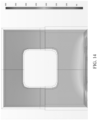
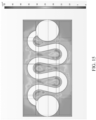
- FIG. 12 is a temperature field distribution diagram on a vaporization surface
- FIG. 13 is a temperature field distribution diagram of a section in a length direction
- FIG. 14 is a temperature field distribution diagram of a section in a thickness direction. It may be seen from the figure that the highest temperature of the resistance heating trajectory 43 on the vaporization surface 320 is about 300°C, and the interior between the vaporization surface 320 of the vaporization assembly and the liquid channel 33, and the other parts of the vaporization surface 320 can be preheated to about 150°C.
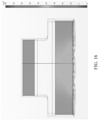
- FIG. 15 to FIG. 17 show distribution diagrams of the flow velocity of the liquid substrate of and inside the vaporization surface 320 of the porous body 30 of the vaporization assembly. It may be seen from the figure that the maximum flow velocity of the liquid substrate close to the vaporization surface 320 can basically reach 50 ⁇ 10 -4 m/s, and the flow velocity of the liquid substrate within the extension length range of the resistance heating trajectory 43 in the vaporization surface 320 is basically kept at about 35 ⁇ 10 -4 m/s; and the flow velocity of the liquid substrate of a part between the vaporization surface 320 and the liquid channel 33 is about 15 ⁇ 10 -4 m/s.
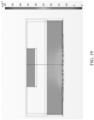
- FIG. 18 to FIG. 20 show distribution diagrams of the flow velocity of the same liquid substrate used in the vaporization assembly in one comparative example, and the flow velocity of the liquid substrate of and inside the vaporization surface 320 simulated at the same power and time in the above implementations. It may be seen from the figure that the size ratio of the resistance heating trajectory 43 in the comparative example is reduced; and in the comparative example of FIG. 18 , the resistance heating trajectory 43 has the extension length d20 of 3.42 mm and the height d40 of 1.72 mm.
- the flow velocity distribution of the liquid substrate within the extension length range of the resistance heating trajectory 43 located in the vaporization surface 320 is quite different, the flow velocity of the liquid substrate of only a few areas adjacent to the resistance heating trajectory 43 can reach 50 ⁇ 10 -4 m/s, and the flow velocity of other areas is basically only 15 ⁇ 10 -4 m/s to 20 ⁇ 10 -4 m/s.
- the flow velocity of the liquid substrate of the part outside the extension length range of the heating resistance trajectory 43, and flow velocity of the liquid substrate of the part between the vaporization surface 320 and the liquid channel 33 are about 10 ⁇ 10 -4 m/s.
Landscapes
- Chemical & Material Sciences (AREA)
- Engineering & Computer Science (AREA)
- Ceramic Engineering (AREA)
- Fuel-Injection Apparatus (AREA)
- Resistance Heating (AREA)
- Physical Vapour Deposition (AREA)
Applications Claiming Priority (2)
| Application Number | Priority Date | Filing Date | Title |
|---|---|---|---|
| CN202110163395.7A CN114868967A (zh) | 2021-02-05 | 2021-02-05 | 雾化器、电子雾化装置及雾化组件 |
| PCT/CN2022/073541 WO2022166661A1 (zh) | 2021-02-05 | 2022-01-24 | 雾化器、电子雾化装置及雾化组件 |
Publications (2)
| Publication Number | Publication Date |
|---|---|
| EP4289293A1 true EP4289293A1 (de) | 2023-12-13 |
| EP4289293A4 EP4289293A4 (de) | 2024-07-31 |
Family
ID=82668423
Family Applications (1)
| Application Number | Title | Priority Date | Filing Date |
|---|---|---|---|
| EP22748940.8A Pending EP4289293A4 (de) | 2021-02-05 | 2022-01-24 | Zerstäuber, elektronische zerstäubungsvorrichtung und zerstäubungsanordnung |
Country Status (5)
| Country | Link |
|---|---|
| US (1) | US20240081407A1 (de) |
| EP (1) | EP4289293A4 (de) |
| CN (1) | CN114868967A (de) |
| CA (1) | CA3210667A1 (de) |
| WO (1) | WO2022166661A1 (de) |
Families Citing this family (5)
| Publication number | Priority date | Publication date | Assignee | Title |
|---|---|---|---|---|
| CA210611S (en) * | 2021-09-01 | 2023-08-24 | Shenzhen Verdewell Technology Ltd | Power supply for electronic atomization device |
| CN117796568A (zh) * | 2022-09-23 | 2024-04-02 | 深圳市合元科技有限公司 | 雾化器、电子雾化装置、多孔体及制备方法 |
| CN115644519A (zh) * | 2022-11-08 | 2023-01-31 | 深圳市吉迩科技有限公司 | 一种能增强导液及雾化的发热组件及雾化器 |
| CN220000828U (zh) * | 2023-04-25 | 2023-11-14 | 深圳雾芯科技有限公司 | 雾化装置和雾化器 |
| CN116763006A (zh) * | 2023-08-11 | 2023-09-19 | 深圳市康唯普科技有限公司 | 一种带导液纤维片的雾化芯及电子雾化装置 |
Family Cites Families (17)
| Publication number | Priority date | Publication date | Assignee | Title |
|---|---|---|---|---|
| WO2017139963A1 (zh) * | 2016-02-19 | 2017-08-24 | 深圳麦克韦尔股份有限公司 | 电子雾化装置 |
| EP3462936B1 (de) * | 2016-05-31 | 2021-04-14 | Philip Morris Products S.A. | Aerosolerzeugungsartikel mit wärmeverteiler |
| CN108078010A (zh) * | 2017-12-14 | 2018-05-29 | 深圳市卓力能电子有限公司 | 一种具有面发热体的电子烟 |
| CN207885668U (zh) * | 2018-01-27 | 2018-09-21 | 深圳市新宜康电子技术有限公司 | 具有陶瓷雾化芯的雾化发生装置 |
| EP4212048A1 (de) * | 2018-09-05 | 2023-07-19 | Shenzhen Smoore Technology Limited | Zerstäuber und elektronische zerstäubungsvorrichtung |
| CN109674094A (zh) * | 2019-01-26 | 2019-04-26 | 深圳市合元科技有限公司 | 电子烟雾化器及电子烟、雾化组件制备方法 |
| CN210299502U (zh) * | 2019-03-18 | 2020-04-14 | 深圳市五轮电子股份有限公司 | 一种电子烟发热体 |
| CN210203316U (zh) * | 2019-05-07 | 2020-03-31 | 深圳市合元科技有限公司 | 烟弹及电子烟 |
| CN210581001U (zh) * | 2019-06-14 | 2020-05-22 | 深圳麦克韦尔科技有限公司 | 电子雾化装置及其雾化器和发热组件 |
| CN110384258B (zh) * | 2019-06-14 | 2025-06-03 | 深圳麦克韦尔科技有限公司 | 电子雾化装置及其雾化器和发热组件 |
| CN210520094U (zh) * | 2019-06-24 | 2020-05-15 | 深圳哈卡科技有限公司 | 雾化器及电子烟 |
| CN211379619U (zh) * | 2019-08-26 | 2020-09-01 | 东莞市洪都塑胶五金有限公司 | 一种电子烟雾化器芯及电子烟 |
| CN211910526U (zh) * | 2019-11-26 | 2020-11-13 | 深圳市合元科技有限公司 | 雾化组件及电子烟 |
| CN111000293B (zh) * | 2019-12-05 | 2025-05-27 | 东莞市陶陶新材料科技有限公司 | 电子烟雾化芯及其制备方法 |
| CN212279874U (zh) * | 2020-01-15 | 2021-01-05 | 深圳市合元科技有限公司 | 雾化元件、雾化器以及电子烟 |
| CN211746949U (zh) * | 2020-03-10 | 2020-10-27 | 常州市派腾电子技术服务有限公司 | 雾化器及气溶胶发生装置 |
| CN215347015U (zh) * | 2021-02-05 | 2021-12-31 | 深圳市合元科技有限公司 | 雾化器、电子雾化装置及雾化组件 |
-
2021
- 2021-02-05 CN CN202110163395.7A patent/CN114868967A/zh active Pending
-
2022
- 2022-01-24 US US18/263,909 patent/US20240081407A1/en active Pending
- 2022-01-24 CA CA3210667A patent/CA3210667A1/en active Pending
- 2022-01-24 WO PCT/CN2022/073541 patent/WO2022166661A1/zh not_active Ceased
- 2022-01-24 EP EP22748940.8A patent/EP4289293A4/de active Pending
Also Published As
| Publication number | Publication date |
|---|---|
| CN114868967A (zh) | 2022-08-09 |
| CA3210667A1 (en) | 2022-08-11 |
| WO2022166661A1 (zh) | 2022-08-11 |
| US20240081407A1 (en) | 2024-03-14 |
| EP4289293A4 (de) | 2024-07-31 |
Similar Documents
| Publication | Publication Date | Title |
|---|---|---|
| EP4289293A1 (de) | Zerstäuber, elektronische zerstäubungsvorrichtung und zerstäubungsanordnung | |
| US20250302105A1 (en) | Electronic atomization apparatus, and atomizer and heating body of electronic atomization apparatus | |
| US20230218005A1 (en) | E-cigarette vaporizer and e-cigarette | |
| CN103974637B (zh) | 具有气流喷嘴的浮质产生装置 | |
| EP4218441A1 (de) | Aerosolerzeugungsvorrichtung | |
| CN114794574B (zh) | 一种发热组件、雾化器及电子雾化装置 | |
| US20230389615A1 (en) | Vaporizer and electronic vaporization device | |
| WO2023134314A1 (zh) | 雾化芯、雾化器及电子雾化装置 | |
| US20240090579A1 (en) | Atomizer and electronic atomization device | |
| CN215347015U (zh) | 雾化器、电子雾化装置及雾化组件 | |
| EP4353094A1 (de) | Zerstäuber und elektronische zerstäubungsvorrichtung | |
| US20240148066A1 (en) | Atomizer and electronic atomization apparatus | |
| CN109820252A (zh) | 一种多层复合结构的加热模组及电子烟器件 | |
| CN115226957A (zh) | 加热组件及雾化装置 | |
| WO2024234852A1 (zh) | 发热组件、雾化器及电子雾化装置 | |
| US20240389655A1 (en) | Atomizer and electronic atomization device | |
| WO2024234842A1 (zh) | 发热组件、雾化器及电子雾化装置 | |
| EP4537682A1 (de) | Elektronische zerstäubungsvorrichtung | |
| KR102799091B1 (ko) | 모세관 기반 액상 이송 에어로졸 발생 장치 | |
| CN216776109U (zh) | 夹层式气雾发生装置 | |
| CN209711550U (zh) | 一种多层复合结构的加热模组及电子烟器件 | |
| WO2022156717A1 (zh) | 雾化器及电子雾化装置 | |
| US20240381933A1 (en) | Atomizer and electronic atomization device | |
| CN115836747A (zh) | 雾化器、电子雾化装置及用于雾化器的雾化组件 | |
| US20250009025A1 (en) | Atomizer, electronic atomization device, and atomization assembly for atomizer |
Legal Events
| Date | Code | Title | Description |
|---|---|---|---|
| STAA | Information on the status of an ep patent application or granted ep patent |
Free format text: STATUS: THE INTERNATIONAL PUBLICATION HAS BEEN MADE |
|
| PUAI | Public reference made under article 153(3) epc to a published international application that has entered the european phase |
Free format text: ORIGINAL CODE: 0009012 |
|
| STAA | Information on the status of an ep patent application or granted ep patent |
Free format text: STATUS: REQUEST FOR EXAMINATION WAS MADE |
|
| 17P | Request for examination filed |
Effective date: 20230818 |
|
| AK | Designated contracting states |
Kind code of ref document: A1 Designated state(s): AL AT BE BG CH CY CZ DE DK EE ES FI FR GB GR HR HU IE IS IT LI LT LU LV MC MK MT NL NO PL PT RO RS SE SI SK SM TR |
|
| DAV | Request for validation of the european patent (deleted) | ||
| DAX | Request for extension of the european patent (deleted) | ||
| STAA | Information on the status of an ep patent application or granted ep patent |
Free format text: STATUS: EXAMINATION IS IN PROGRESS |
|
| A4 | Supplementary search report drawn up and despatched |
Effective date: 20240701 |
|
| RIC1 | Information provided on ipc code assigned before grant |
Ipc: A24F 40/42 20200101ALI20240625BHEP Ipc: A24F 40/40 20200101ALI20240625BHEP Ipc: A24F 40/46 20200101ALI20240625BHEP Ipc: A24F 40/10 20200101AFI20240625BHEP |
|
| 17Q | First examination report despatched |
Effective date: 20240712 |